







Abstract
We develop a three‐step methodology to restructure a product line by quantifying the restructuring's likely effects on revenues and costs: (i) Constructing migration lists to capture customer preferences and willingness to substitute; (ii) Explicitly capturing the (positive and negative) cost of complexity across different functional areas, using statistical analysis of cost data; and (iii) Integrating these tools within a mathematical optimization program to produce a final product line, incorporating the possibility of differentiating products by lead‐time (into different lanes). Our methodology is highly flexible—each step can be tailored to a company's particular setting, data availability and strategic needs, so long as it produces the necessary output for the next step. We report on the successful application of our methodology to the Backhoe Loader product line at Caterpillar: In collaboration with Caterpillar, we were able to significantly simplify this line, reducing the number of configurations from 37,920 to 135, in three lanes, while increasing sales by almost 7%.
Introduction
One of the crucial decisions a company must make concerns its product portfolio. Some companies, especially in highly competitive industries, compete by offering variety – a very broad, often highly customizable, portfolio. Such a product line can typically garner high customer satisfaction and help drive market share, but can also complicate the company's supply chain and service operations: Broad portfolios enable customers to disperse their demand, requiring retailers to hold large amounts of inventory to represent the many possible choices, as well as to satisfy those customers who are unwilling to wait for an out‐of‐inventory variant. In addition, forecasting for this potentially fragmented portfolio is typically difficult. And, if the company is in a manufacturing environment, developing, managing, assembling and servicing such a broad portfolio may incur other costs – for example, due to increased documentation, more frequent change‐overs, and reduced learning effects.
So, while the marketing and sales benefits of a large portfolio are obvious, there is also incentive for companies to strategically reduce, or optimize their product portfolio. But before embarking on such a product line rationalization, three critical questions must be answered: “How will customers react to a product line reduction?” Answering this question requires developing an understanding of how customers value different elements of the product line. “How much could be saved by focusing the product line?” Answering this question requires developing an understanding of the general form of the cost of complexity for the organization “Given the answers to the first two questions, how should we configure our product line?” Specifically, which products should we offer, and at what prices?
The primary contribution of this study is to demonstrate the power of the three‐step analytical framework we have developed for product line simplification: answers question 1 by building a detailed analytical model of customer preferences and substitution, capturing customer behavior in migration lists (see section 3). answers question 2 by creating a detailed mathematical representation of the company's cost of complexity (CoC), which can include both variety‐based costs driven by number of options offered and attribute‐based costs driven by specific complex options (see section 4). answers the final question by combining the migration lists and the cost of complexity function into an optimization model, evaluating different product lines against different potential demand patterns, market scenarios and company objectives (see section 5).
The generality and flexibility of our framework stem from the fact that the mathematical and statistical techniques used in steps 1, 2, and 3 can be tailored to the situation and company at hand, as long as they produce the output required by each subsequent step. Our framework can also be used as an effective what‐if tool for managers, allowing them to successfully evaluate different solutions under varying problem conditions.
We demonstrate our framework through a product line reorganization project we initiated with Caterpillar (CAT) for pricing and marketing their BHL series of small backhoe loaders, one of the most popular products within their Building Construction Products (BCP) division. The outcome of the project was implemented as a new Lane strategy at BCP, offering machines within three different lanes: Lane 1, the Express Lane, featuring four built‐to‐stock configuration choices at an expected lead time of a few days; Lane 2, the Standard Lane, featuring 120 predefined configurations, built‐to‐order at an expected lead time of a few weeks; and Lane 3, the A‐La‐Carte Lane, built to order machines with an expected lead time of a few months. Since the completion of our project CAT has continued expanding and refining their BHL lane strategy—for example, they have now reduced the Lane 1 configurations to only two. In addition, CAT has applied variations of our cost of complexity analysis to other divisions within the firm, helping to guide portfolio rationalization within the company.
To the best of our knowledge, no previous work has ever combined an Empirically developed CoC function as detailed and comprehensive as ours, with customer preferences regarding product substitution, within an optimization algorithm that was implemented with real‐life data, at an industrial scale. Moreover, our work ultimately produced recommendations that were actually implemented and verified to generate significant improvements.
The rest of the study proceeds as follows. In section 2, we place our work within the product line optimization and practical application literature. Sections 3–5 present our customer behavior, cost of complexity, and optimization models in a generic fashion that is neither company‐ nor product‐specific. In Section 6, we describe CAT's problem in more detail, and demonstrate how the steps in the three preceding sections were tailored to suit CAT's specific requirements. We present the implementation details and results for CAT in sections 7 and 8, discuss sensitivity analysis and general insights in section 9, and conclude in section 10.
Literature Review
Some marketing research describes how narrowing a product line may detract from brand image or market share, e.g., Chong et al. (1998), while other works posit that reducing the breadth of lines and focusing on customer “favorites” may actually increase sales, see for example Broniarczyk et al. (1998). Our model is consistent with both of these streams: If a customer finds a product that meets her needs (i.e., a “favorite”) she will make a purchase; if such a product and its acceptable alternatives are no longer part of the product line, she will not.
There is a long history of empirically studying the impact of product line complexity on costs. Foster and Gupta (1990) assess the impacts of volume‐, efficiency‐, and complexity‐based cost drivers within an electronics manufacturing company. They find that manufacturing overhead is associated with volume, but not complexity or variety. Banker et al. (1995), using data from 32 plants, find an association of overhead costs with both volume and transactions, which they take as a measure of complexity. Anderson (1995) identifies seven different types of product mix heterogeneity in three textile factories, and finds that two are associated with higher overhead costs. Fisher and Ittner (1999) analyze data from a GM assembly plant, finding that option variety contributes to higher labor and overhead costs. We complement these works by explicitly formulating and calibrating a detailed model to estimate the total direct and indirect costs (and benefits) of complexity for the BHL line at CAT, based on expert surveys and empirical analysis.
Product line optimization has a rich literature: Kok et al. (2009) and Tang (2010) provide recent surveys. Several recent papers consider the strategic selection of a product line via equilibrium analysis: Alptekinoglu and Corbett (2008), Chen et al. (2008, 2010), and Tang and Yin (2010); they focus on deriving general insights via analysis of abstract models. Our study uses math programming to optimize a detailed model of a company, their customers and products based on data and expert opinion. In addition, we implement our solution in practice.
Bitran and Ferrer (2007) determine the optimal price and composition of a single bundle of items and a single segment of customers in a competitive market. They provide extensions to multiple segments or multiple bundles based on mathematical programming, but this latter problem becomes very complex, and is left as future research. Wang et al. (2009) use branch‐and‐price to select a line to maximize the share of market, testing their algorithm on problems with a small number of items but many levels of product attributes on simulated and commercial data. Chen and Hausman (2000) demonstrate how choice‐based conjoint analysis can be applied to the product portfolio problem; Schoen (2010) extends this work to allow more general costs and heterogeneous customers. None of these algorithms have been shown to be suitable for problems anywhere near the size and complexity of CAT's (thousands of customers and millions of potential configurations). This has led to the investigation of heuristic methods: For example, Fruchter et al. (2006) and Belloni et al. (2008). Neither of these are actual implementations.
Kok and Fisher (2007) develop and apply a methodology to estimate demand and substitution patterns for a Dutch supermarket chain, based on empirical demand data. They develop an iterative heuristic that determines the facings allocated to different categories, and the inventory of individual elements within the categories. Fisher and Vaidyanathan (2011) explore how to select retail store assortments; their work enhances a localized choice model with randomization, location at extant configurations, and preference sets for substitution (similar to our migration lists). All customers who prefer a particular product have the same preference set. In contrast to our approach that seeks to maximize profits using our empirical cost of complexity function, they maximize revenue with greedy heuristics and demonstrate their approach, using two examples—snack cakes and tires—their recommendations for tires leads to a 5.8% revenue increase.
Ward et al. (2010) develops two analytical tools to apply to Hewlett‐Packard's product line problem. Like CAT, HP has product lines that could, in theory, span millions of different configurations. The first tool develops a comprehensive cost of complexity function, comprised of variable and fixed costs, to be used when evaluating the introduction of new products. This function has some similarities to ours, but focuses more on inventory costs, lacking anything related to our attribute‐based costing. Furthermore, cannibalization, which is how they refer to any substitution effects on inventory, are in their words “subjectively estimated” at a high level. Their second tool uses a heuristic to construct a line from a selection of extant products. This tool does not use their cost of complexity function, nor does it consider substitution—rather it constructs a Pareto frontier of those top k products that would cover the desired percentage of historical order demand (or order revenue). So while they seek the appropriate line to satisfy possibly multi‐product orders assuming customers will not substitute, we find the correct line of products to satisfy orders for individual products in which customers may substitute. Rash and Kempf (2012) find the set of products Intel should produce to maximize profit over a time horizon while obeying budget and availability constraints. They perform hierarchical decomposition, utilizing genetic algorithms along with MIPs. Their demand is deterministic, so substitution is not included in the model.
The three‐step framework we use was first introduced in Yunes et al. (2007), which describes a product line simplification effort implemented at John Deere & Co. Our current work extends their work in several dimensions. Specifically, we: (i) Explicitly calculate and validate estimates of the parts utilities; they were exogenous in Yunes et al. (2007); (ii) Create a sophisticated, endogenous, cost of complexity function; the function used in Yunes et al. (2007) was exogenous; (iii) Owing to the form of our endogenous function, we use a different optimization procedure, the “differential approach”; (iv) To achieve CAT's aggressive product line goals, we make decisions at the option level, rather than the machine level, as in Yunes et al. (2007); and (v) we incorporate pricing decisions and migration across models, absent in Yunes et al. (2007).
Compared to the literature, our work is unique in that cost of complexity, utility estimation and substitution behavior is modeled, estimated, and incorporated into a modular solution framework for the product portfolio problem, applicable across different industries and problem settings. In addition, we demonstrate how our solution can be used in practice; describing a dramatic redesign of a product portfolio at CAT.
Modeling Customer Behavior
The key to evaluating the potential pitfalls of reducing a product line is a good understanding of customers’ purchasing flexibility: While customers will require that the configuration they are buying satisfy some minimum requirements, not every feature needs to be in perfect alignment with their expectations. In addition, customers typically display some degree of price flexibility.
The centerpiece of our approach to capture customer flexibility is the migration list, an ordered list of configurations within the customer's price, utility, and availability tolerance (see Yunes et al. 2007 for details). The first configuration on the list is the customer's first choice; if available the customer will buy it. If that configuration is unavailable and there exists a second one on the list the customer will buy that, if available, and so on. If none of the configurations on a customer's list are available, that customer buys nothing (i.e., goes to a competitor). As mentioned in section 2, this is an enhanced localized choice model, in the spirit of Fisher and Vaidyanathan (2011).
One advantage of this methodology is that it is independent of the way migration lists are created; the only requirement is that there be one list, L i , per customer i, consisting of a collection of configurations sorted in decreasing order of preference, where preference is defined by some ranking function. This ranking function could map configurations to utilities (as calculated by conjoint analysis (Hauser and Rao 2004)), or to purchase probabilities (as in a multinomial logit model (Guadagni and Little 1983)), or to any other quantitative measure of choice.
The configurations on customer i 's migration list L i could also be determined by sales history. If customer i purchased machine M i , L i should contain configurations “similar enough” to M i to satisfy i. There are several ways to define a similarity function. It could be as sophisticated as a formal metric in the space of configurations, or as simple as a conjunction of conditions. For example: their utilities and prices do not differ too much, and the number of features on which they differ is not too great, and they share compatible options for a few crucial features, etc. To illustrate the last condition, assume customer i needs a machine with large towing capacity (engine power is a crucial feature for i). All acceptable substitutes for M i need to have an engine at least as powerful as M i 's engine. Once those machines “similar enough” to M i are determined, they would be ranked and placed in L i . In some settings, L i may need to be truncated once its length reaches a certain threshold value to capture possible limits on customer willingness to substitute. Finally, if creating different ranking and/or similarity functions for each customer is too burdensome, customers can be clustered into market segments.
In summary, the following steps are repeated for each customer i in the optimization (assume, for the sake of illustration, we use the method based on sales history): Let s be the customer segment to which i belongs (possibly unique for each customer); Let g
is
and h
is
be, respectively, the similarity and ranking functions tailored for i and/or s; Apply g
is
to M
i
to obtain a list L
i
of configurations that are acceptable substitutes for M
i
; Sort the elements of L
i
in non‐increasing order according their h
is
value; Truncate L
i
to a maximum acceptable length and save it for the optimization step.
Capturing Cost of Complexity
Our next task is to estimate how a line reduction might affect costs. Product variety affects many functional areas in heterogeneous ways, and in some areas, the impact on costs is not straightforward: Sales costs may increase as variety increases because a large line may overwhelm customers and sales personnel; on the other hand, sales costs may decrease in variety if it is easier to satisfy a demanding customer. As a result, complexity has to be understood in each functional area and individually modeled in different departments. We refer to all costs impacted by the variety of product offerings, that is, number of features and options, as the cost of complexity.
We describe important elements of cost of complexity, propose a cost of complexity function that captures these elements, and derive a differential cost of complexity function in sections 4.1, 4.2, and 4.3 respectively. The result of this process is used by our optimization model in section 5.
Important Elements of Cost of Complexity
Option Effects
We distinguish between two main effects: Certain processes are impacted by the number of options offered for a feature, while other processes are impacted by the presence of specific options or combinations of options (within one feature or across features). For example, material planners need to calculate stocking requirements for each SKU offered. If one SKU is eliminated, the cost of complexity will go down proportionally, regardless of which SKU is eliminated. We refer to this effect as Variety Based Complexity, or VBC.
In contrast, other features may include simple and complex options; engineering cost for releasing a complex option may be much higher than that for releasing a simple option. Hence, the reduction in the cost of complexity will depend on the particular option eliminated. We refer to this effect as Attribute‐level‐based Complexity or ABC. ABC is not limited to single options; there may be cases in which a combination of options drives the cost of complexity.
Temporal Effects
Building the cost of complexity function also requires understanding the lagged impact of complexity on costs. For example, assembly cost today is impacted by the product complexity being built today, while warranty costs are affected by the complexity that was offered a certain time ago (positive time lag), and engineering and marketing costs may be impacted by the complexity that will be offered in the future (negative time lag). Some of these time lags may already be incorporated into the cost data, e.g., accounting may allocate costs for material write‐offs to the month when an option was discontinued. In contrast, expenses paid to sub‐contractors involved in development of a new set of options are likely to be recorded in the month when the work is being done, not in the months when the options will be added to the price list. Hence, it is important to talk to accounting about potential lags in data.
Volume Effects
Finally, the cost of complexity is impacted by different volume metrics. Not surprisingly, most processes are affected by sales volume: Costs increase as more items are produced and sold. However, costs are also driven by other volumes. For example, product support is impacted by the number of unique configurations built, because quality may decrease when employees have to work on many different configurations. Other processes, such as engineering, are impacted by the complexity offered, as engineers have to prepare releases for all options and each associated feasible configuration, while sales volume is unlikely to have an impact on the engineering cost.
Cost of Complexity Function
We estimate two separate components of the cost of complexity function: VBC d (·) is the cost of complexity caused by variety and is specific to each functional area or department d, and ABC o (·) is the cost of complexity caused by offering a specific option o. We summarize this and additional notation used in this section in Table 1 – we use small letters for superscripts and subscripts, bold letters for sets, and capital letters for numbers coming from collected data.
Table of Notation
Estimation of VBC
We use the Cobb–Douglas log‐linear function to estimate the variety‐based effect on the cost of complexity for each department d. The Cobb–Douglas function is frequently used for estimating non‐linear relationships (see Greene 2000); it can capture different returns to scale and has several attractive analytical properties. Two properties are of particular convenience for us: First, the log transformation of the Cobb–Douglas function is linear and hence can be estimated using linear regression. Second, a partial derivative of the Cobb–Douglas function has a simple form that is useful in the derivation of the differential cost of complexity function (section 4.3).
Using lower‐case Greek letters to represent estimated parameters, the Cobb–Douglas cost of complexity function at time t is given by:
The 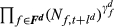

We log‐transform this function to use linear regression analysis to estimate needed parameters:
Within our optimization model, we evaluate the effect of a one‐time change to the product portfolio on the long‐term cost. Hence we do not need the time dimension for further analysis and will suppress time subscript t, using a functional representation VBC
d
(
Estimation of ABC
Introducing a complex option may have different effects: (1) There may be a fixed cost associated with offering the option (e.g., part design cost); and (2) There may be variable costs incurred each time the option is produced (e.g., additional testing each time the part is installed). We model the total cost of offering and producing option o, ABC
o
, as the sum of the one‐time cost across all departments if option o is offered (complexity offered) and the incremental cost across all departments incurred each time a configuration with option o is built (complexity built):
Differential Cost of Complexity Function
To facilitate optimization, instead of computing the total cost of each offering, we build a cost of complexity function that starts with the current line and computes the estimated change in cost as the numbers of features and options change. For the variety‐based component, we take the partial derivatives of VBC
d
(
For example, the change in VBC with the number of options for feature f is:
This differential cost of complexity function includes the predicted value of VBC
d
(

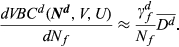
Using Equation 3, the total change in cost of complexity due to a change in the number of options offered for feature f is then estimated as:
In an analogous fashion, we differentiate the cost of complexity function with respect to volume and number of unique configurations. Aggregating these differences yields the total variety‐based differential cost of complexityDVBC
d
:
To capture the differential ABC effect, we must account for the change in the number of options offered and sold. If we eliminate an option o from the price list the cost of complexity will decrease by 

Finally, the total differential cost of complexity is:
Equation 6, with estimated parameters, becomes a part of the objective function in the optimization model of section 5. Because the cost of complexity function is non‐linear, this approach is accurate only for small changes. In practice, the accuracy of this approximation may be tested by calculating the actual change in the total cost of complexity for the original product line VBC
d
(
The Optimization Model
With the migration lists from section 3 and Equation 6 from section 4, we are now ready to describe our optimization model. We use a mixed‐integer linear program to select the set of options and configurations offered, and their prices, to maximize total profit from sales minus the change in cost of complexity (the objective function value increases when this change is negative).
In addition to the data defined in section 4, our optimization model uses the following data:
R
i
— Reservation price of customer i ∈
M — Maximum reservation price over all customers (
C
jk
, B
jk
, P
jk
— Cost, base price, and current sale price of configuration (j, k) ∈


The decision variables (a
o
was defined in Table 1, but we repeat it here for completeness):
a
o
= 1 if option o ∈
q
jk
= 1 if configuration (j, k) ∈
x
ijk
= 1 if customer i buys configuration (j, k), 0 otherwise (i ∈
p
o
— Price of option o ∈
r
ijk
— Profit if customer i purchases configuration (j,k) (i ∈


We now provide precise definitions to the following terms that appear in Equation 4 and Equation 5:
Our optimization model is then: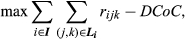








The objective function Equation 7 maximizes the total profit from sales minus the differential cost of complexity given by Equation 6. The purpose of each constraint is as follows (where 

We can turn off the price optimization aspect of this model by removing variables p o and constraints Equations (13)-(15), and changing the right‐hand side of Equation 12 to (P jk − C jk )x ijk . Lane assignment decisions can be removed by deleting constraint Equation 10 and all occurrences of index k.
CAT‐Specific Modeling Details
In this section, we first provide some background on CAT's BHL product families, in 6.1. We then detail the assumptions and decisions made to create the CAT‐specific instantiation of the generic framework we describe in sections 3, 4, and 5, (in Sections 6.2, 6.3 and 6.4, respectively). CAT experts participated in the entire process, making sure they understood and, when necessary, validated, the inputs and outputs of each intermediate step.
BHL Product Families
Our product line simplification effort at CAT involved four models in the backhoe loader (BHL) family: 416E, 420E, 430E, and 450E. The 416E is their basic model, while the 420E, 430E and 450E provide progressively superior horsepower and capabilities. We refer to a complete machine as a configuration. Each configuration is composed of features; for each feature, a configuration specifies one of the options within that feature. For example, the feature stick has the options standard and electronic. In the marketing literature, what we call a feature is also known as an attribute, and what we call on option is also known as an attribute level. Table 2 summarizes the features and number of corresponding options present in each BHL model in our project. A dash “‐” indicates that a feature is not present in a model or was not included in our analysis.
Number of Options in Each Feature of CAT's BHL Models
To create a complete configuration, a customer selects one option for each of its features, ensuring that these options are compatible. The number of such configurations is immensely large: For model 416E in its most basic version, there are 37,920 feasible configurations. Including choices for attachments yields 2,275,200 distinct feasible configurations. The vast majority of these configurations have never been, and most likely will never be, built. The mere fact that they could be purchased, however, creates overhead costs for CAT. Moreover, every unique option offered incurs a cost for CAT, due to the engineering and support costs it requires. We discuss this in detail in section 4.
So how many configurations are actually built? Figure 1 depicts the minimum number of different configurations (left panel) and options (right panel) required to capture given percentages of revenue and sales, respectively, for eight month's worth of sales data for model 420E. Of the 569 built configurations, 400 were needed to capture about 95% of revenues and sales volume. Similarly, 36 out of the 42 available options were needed to capture at least 95% of revenues and sales volume. Therefore, to achieve the sought reductions in product offerings, it was imperative to steer purchases toward a considerably smaller subset of products and options.
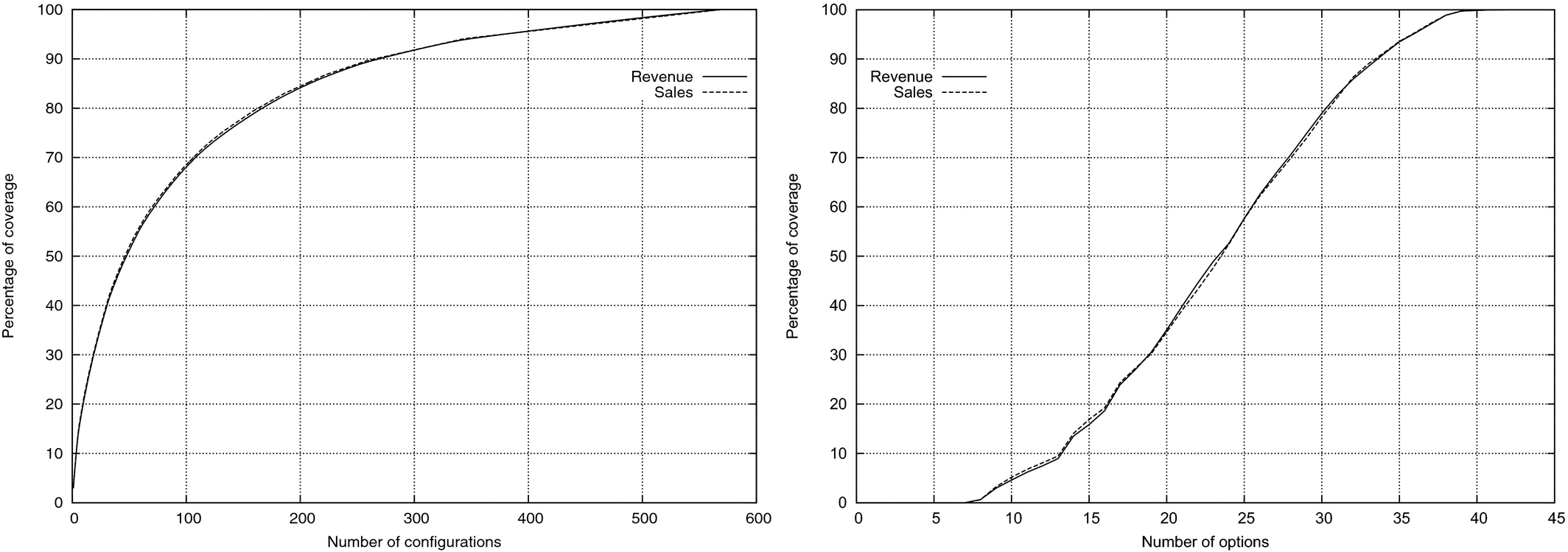
Minimum Number of Distinct Configurations (Left) and Options (Right) Required to Capture Given Percentages of Revenue and Sales Volume for BHL Model 420E
As we will see in section 8, CAT ultimately converged on a lane system in which configuration lead times depend on the lane to which they belong. Although not part of our original algorithm, our modeling framework can incorporate such a structure assuming the lanes and lead times are given. Specifically, lanes, with corresponding lead times, can be treated as options of an additional configuration feature, which we will call Availability. In addition, just as customers can be modeled as having tolerances for price and utility, there can be a maximum availability threshold per customer as well.
Modeling the Behavior of CAT's Customers
The pseudo‐code below shows how migration lists were constructed for CAT; we use customer purchases in 2006 as the basis for generating our migration lists.
For each customer i ∈
Let M
i
be the configuration (i.e., machine) bought by i. Apply segmentation rules to M
i
(section 6.2.1) to place i in a customer segment S
i
. Based on the price and utility of M
i
, and on characteristics of segment S
i
, construct a randomized list of configurations, L
i
, as acceptable alternatives to M
i
(section 6.2.2). Sort L
i
in non‐increasing order of configuration utility, pruning it if it exceeds the maximum allowed length (section 6.2.3).
Customer Segmentation
Customer segmentation is important in CAT's business because it affects customer flexibility. For example, customers who live in extreme weather conditions are unlikely to buy a configuration that does not include a cab with climate control, and customers who need to carry very heavy loads are not willing to sacrifice horsepower. We used focus groups composed of CAT experts and actual customers to identify the main customer segments and their characteristics: performance extreme (PE), performance extreme versatility (PEV), performance mild (PM), performance mild versatility (PMV), commodity extreme (CE), and commodity mild (CM). The performance category represents customers who are less price sensitive and need powerful machines. The extreme and mild categories refer to weather conditions, and the versatility category represents customers who need their machines to perform a variety of tasks. Based on historical sales data, the fraction of customers in each of the above six segments are approximately 20%, 20%, 25%, 10%, 5%, and 20%.
A set of segmentation rules was created to classify each purchase: Given a configuration, its customer segment is determined by the presence and/or absence of certain options, represented as part numbers. For example, there are eight ways for a 416E loader to be placed in segment PE. One is: Two out of the options 2,146,913, 2,099,929, and 2,139,293 must be present (89HP powertrain and e‐stick), and one out of the options 2,044,161, 2,044,162, and 2,284,602 must be present (cabs), and the option 2,120,206 cannot be present (6‐function hydraulics), and neither option 2,497,912, nor option 2,624,213 can be present (one‐way and combined auxiliary lines).
In addition to the segment‐specific option utilities discussed in section 6.2.2, segment‐specific reservation prices and reservation utilities also affect migration list generation (section 6.2.3).
Estimating Utilities
For each of the customer segments identified in section 6.2.1, we calculate option utilities as follows. First, to estimate the importance of a model's features, we asked a group of CAT employees with sales and manufacturing expertise to use the Analytic Hierarchy Process (AHP) (Saaty 1980). AHP asks experts to estimate the relative importance between every pair of features on a scale from 1 (equally important) to 9 (much more important). The pairwise scores are then transformed into absolute scores of relative importance for each individual feature. The same group of experts is then asked to rank the options within each feature on a scale from 0 to 100. These option scores are scaled so that the option receiving a score of 100 is assigned a value equal to its feature's relative importance. These scaled scores represent the final option utilities. The utility of a complete configuration is estimated as the sum of the utilities of its options.
To validate the utility values calculated for each of the options—for every BHL model in all customer segments—we conducted a survey asking actual customers to choose among alternate configurations. Using t‐tests, CAT determined that differences between the utilities derived from the survey results and those estimated by experts were not statistically significant.
Building Migration Lists
Although customers of a given segment tend to behave similarly, they are certainly not identical. To account for variations within each segment, we modify the migration list procedure in several ways. First, for each segment we randomly perturb the relative importance (and, consequently, the option utilities) of randomly selected features. The number of features to perturb is an input parameter (for CAT, this was around three). Given a perturbation factor θ (approximately ten), the change to a feature's relative importance is randomly drawn from a uniform distribution over the interval [−θ%, + θ%]. CAT also did not want customers to have lists containing configurations too dissimilar from the one purchased. Therefore, a number called the disparity factor (around five) limits how many options an alternative configuration can have that differ from M i . Finally, the model generates the customer's reservation price and reservation utility; again, these values are randomly picked from a predetermined interval around the price and utility of M i . 2
We collect the above procedures into a Constraint Programming (CP) model (Marriott and Stuckey 1998) that finds feasible configurations for L i . This CP model needs to know what constitutes a feasible configuration, that is, which options are compatible. We use configuration rules to describe these interdependences. For example, for model 420E, one rule is: If a configuration has option 9R58666 and either option 2139272 or 2139273, then it cannot have option 9R5321. After all feasible configurations are found, those that exceed the generated reservation price or fall short of the reservation utility are pruned from the customer's migration list.
Next, configurations are sorted in non‐increasing order of total utility and L i is truncated, if desired, while respecting two conditions. First, if L i is truncated, M i must always be retained. Second, we assume customers place M i first, regardless of M i 's utility, with a certain probability (the β factor; for CAT it was between 0.3 and 0.7). This is an attempt to capture the fact that some customers are attracted to their M i for reasons we cannot capture with utilities.
Migration across different models is also possible. In this case, we apply a set of migration rules that map a purchased configuration M 1 of model m 1 (e.g., 416E) to its most likely counterpart M 2, of a different model m 2 (e.g., 420E). Once M 2 is known, we generate alternatives as if it were the customer's original purchase, and include them (together with alternatives to M 1) onto L i . Because m 2 configurations may have higher utilities, when L i is sorted it may contain almost no highly ranked m 1 configurations. Thus, to capture the fact that customer i originally preferred an m 1 configuration, we inflate the utilities of all m 1 configurations on L i by a preference factor (between 10% and 20%). As a result, L i ends up with configurations of both models, but it does not allow utilities to overemphasize the attractiveness of m 2 configurations. According to CAT, the plausible model migrations are from 416E to 420E and from 430E to 420E.
As was done for option utilities, we also conducted an extensive validation study with CAT experts to evaluate the quality of our migration lists. Throughout this process, the experts provided valuable feedback that helped us fine tune our input parameters. After a few iterations, CAT experts agreed that our migration lists could be safely used by our optimization algorithm.
Estimating the Cost of Complexity at CAT
Understanding the Impact of Complexity at CAT
In conjunction with CAT experts, we identified nine functional areas impacted the most by complexity. Within each area, we (i) identified up to three major processes most impacted by product complexity; (ii) found cost‐measures that capture the impact of complexity for each major process; and (iii) identified particular product features and/or options that have the largest impact on the cost of complexity. Table 3 lists the functional areas, processes impacted, and measures used (when alternate cost measures are used due to data unavailability they are denoted by a dagger †). Below, we elaborate on several cost measures in Table 3.
Main Business Processes Impacted by Complexity and the Corresponding Cost Measures
Note
Alternative cost measures used due to lack of data availability.
Cost of supplier delivery performance refers to a program targeted towards improving availability, in which CAT contacts suppliers with low delivery performance to improve their processes. We use the cost allocated to this program as a proxy for the cost of supplier operations. In the customer acquisition department, CAT calculates sales variance cost by tracking all the discounts that go into making a sale: invoice, extended service, cost of free attachments, etc. We use this measure to approximate the cost of customer acquisition. We rely on CAT's accounting system for cost estimates of engineering changes (primarily consisting of payroll to engineers working on changes) and engineering of new releases (primarily consisting of the payroll of developers and engineers who work on new parts, and costs of testing and design equipment).
Option Effects for CAT
The next step was to understand which features have VBC and/or ABC effects on identified processes. The results of VBC/ABC classification are summarized in Table 4.
VBC/ABC Classification of Features
Temporal Effects for CAT
We then estimated the time lags for different cost pools, some time lags are naturally incorporated into the cost data based on the accounting rules, but some needed adjustments. Table 5 summarizes our analysis of time lag parameters. We use this information in section 6.3.5 to estimate the parameters of the cost of complexity function.
Summary of the Time Lags (in Months)
Volume Effects for CAT
Similar to the time lags, we collected initial estimates of the primary volume drivers for different cost pools from the experts in each department, summarized the results, and held a group discussion to come to consensus. Table 6 provides a summary of the results.
Main Volume Drivers
Estimation of the VBC Effect
With a good understanding of the costs, time lags, and volume drivers, we collected data to estimate parameters ξ
d
, 


The nature of the data suggested that there may be serial correlation, hence, we examined partial autocorrelation function plots and checked for autocorrelation, using the generalized Durbin–Watson statistics using the AUTOREG procedure in SAS. For those cost pools having autocorrelation (all three “Cost of repairs” measures), we used the autocorrelation order identified by SAS (all three were a lag of one) and used the Yule‐Walker approach to fit the data (Greene 2000).
Next, we obtained statistical models for all departments by fitting collected data to Equation 2. We evaluated our models using both graphical and numerical tests using standard statistical techniques (e.g., examined the plots of residuals for normality, heteroscedasticity, and influential outliers). Although our cost data exhibited seasonality, the seasonality in cost (our dependent variable) is driven mainly by the seasonality in the volume (an independent variable) and, hence, it is likely to be automatically taken into account by our model. We checked this by analyzing residuals: In each model, we group the residuals for each month; F‐tests show that there are no statistically significant differences between the means of the groups. We also checked for significance, and only accepted those factors with reasonable coefficients of determination and low RMSE. Hence, not all of the originally identified departments were included in the final cost of complexity function. Table 7 summarizes all models/departments included in the optimization model. The estimates that are statistically significant at the 0.05 significance level are marked with an asterisk. 3
Fit Results


Notes
Statistically significant parameters at 0.05 significance level. Subscripts HC, C, CW and H stand for hydraulic combinations, cabs, counterweights, and hydraulics.
We comment on the coefficient of determination (R 2) of the models in Table 7. Some of the departmental costs are heavily impacted by factors outside CAT's walls: For example, cost of customer acquisition is impacted by competitors’ actions, and cost of supplier delivery performance is impacted by suppliers’ operations. Hence, we expect the coefficients of determination to be lower for such departments. In running the optimization model, nevertheless, in order to help ensure that our results are robust, we evaluate ranges of parameters as described in section 7.
Some other findings in Table 7 are noteworthy. Increasing the number of options for hydraulics and cabs decreases the cost of customer acquisition, that is, 

Another observation is that sales volume has a negative impact on product support costs (i.e., repair costs): When volume goes up, CAT employees assemble more machines with the same options, and learning effects reduce the number of mistakes. This intuition again seemed plausible to CAT, but had never been quantified. On the other hand, sales volume has a positive impact on the cost of inventory of prime product. As CAT subsidizes dealers for carrying final product inventory for time sensitive customers, and the lead time demand increases when volume increases, subsidies increase. Guided by our study, CAT subsequently has performed similar cost of complexity analyses in other product divisions and obtained comparable results.
Finally, we validated our model by using the first two years of data to fit the model, then, compared the predicted values for the next three years to actual data. A large majority (7 out of 9) of the actual cost pool values were within the 95% confidence interval around their predictions.
Estimation of the ABC Effect
From focus groups, we identified that ABC effects were observed primarily in three departments: assembly, production planning, and engineering. The nature of work in these departments suggested a linear relationship between ABC cost and complexity: If it takes 5 extra minutes to install a particular option on a machine, this cost will apply to each machine that contains the option. This coincided with expert opinion, which posited minimal learning effects. This supported the form of our proposed ABC o function having a fixed and variable cost component.
The cost parameters δ o and ω o were estimated using expert opinions, time studies, and accounting information from all functional areas that identified this option as important (see Table 8).
ABC Costs
CAT's Optimization Model
CAT used the optimization model in section 5 without its lane‐assignment features. In addition to the constraints described therein, CAT's optimization model includes two constraints that deal with profit margins. Let 
CAT provided a specific formula that they use to enforce the minimum average margin over all configurations sold. Besides the configuration cost C
j
defined in section 5, CAT uses another cost figure, denoted 

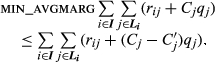
The resulting optimization models have around 850,000 variables and 1.8 million constraints, they are solved, using ILOG CPLEX Optimizer with default parameters. Typical solution times range from 6 to 8 hours, including preprocessing.
Results from Our Analysis
CAT's goal was to make a drastic reduction in the number of configurations offered without significantly reducing customer satisfaction or market share. How to achieve such a goal, or whether it was even possible, was unclear at the outset of the project. Since this reduction would present customers with fewer configurations, CAT assumed each remaining configuration could be priced a little lower; the reduced cost of complexity would allow this while maintaining profit.
Throughout our analysis, to ensure that our recommendations were robust, we ran the optimization model across a range of parameters and migration list lengths.
Stage 1: Focusing on Configuration and Option Reduction
As an initial benchmark for our optimization, we first sought to identify the set of configurations that maximized profit at the current option prices, assuming limited customer migration (no more than a dozen configurations on a migration list, and no migration across models). While profits did increase, we obtained very little reduction in the number of configurations, except when a reduction was explicitly enforced by the constraint 
Given these results, we hypothesized that further reducing the cost of complexity would require significant cuts in options. Hence, a new constraint was added to the model to force option reduction: 
Stage 2: Opening Up Choices
Thus, in the next phase of our analysis, we wanted to explore what results would be possible if customers were presumed to be significantly more flexible, possibly as a result of price incentives. We modeled this flexibility in two ways: We increased the migration list length (to 100 configurations) and we enabled model‐to‐model migration.
This approach started to generate encouraging results. A solution emerged with an increase in profit of 8.8%, less than a 2% reduction in sales volume, and a reduction in configurations equal to 65%. But further analysis showed that the number of options had not decreased significantly. The increase in profit came from a decrease in the number of configurations, and increases in price paid by customers who migrated to slightly more expensive machines. Performing sensitivity analysis confirmed this conclusion: Expecting a large reduction in options was not realistic. However, a large reduction in configurations was possible.
This resulted in a problem for CAT: Without a reduction of options, how would this new (and limited) set of configurations be presented to the customers? Restaurants can get by with a 3–4 page menu that lists all their entrees. But no customer would flip through a menu of 70–90 pages listing all the possible BHL configurations. A new scheme had to be devised.
Stage 3: Standardization and Options Packages
We decided to try two new strategies to concentrate customer demand on a manageable number of configurations. The first strategy was standardization: Could options such as High Ambient Cooler and Engine Heater be made standard across all configurations? Optimization models with these options forced into every configuration yielded cost reductions that justified a reduction in price large enough to make the standardized configurations attractive to customers, while maintaining sales volumes and profit. Other rarely used options were eliminated, using a similar approach. For example, the Cab/Canopy options were cut from five to two.
The second strategy was creating packages of options commonly found together. For example, guided by customer segment preferences, a single pair of loader hydraulics and powertrain options most likely to meet each segment's needs were proposed. Manual inspection and cluster analysis of the best solutions found so far led to the discovery of other options often found together.
The optimization was then run assuming standardization and option packaging, with constraints on the maximum price increase. This yielded the final product hierarchy for the 420E series, shown in Figure 2: It consists of 9 base‐machine‐assembly (BMA) packages, 5 finished‐to‐order (FTO) packages, and 3 hydraulics options, for a total of 135 possible configurations, some of them anticipated to be much more popular than others.
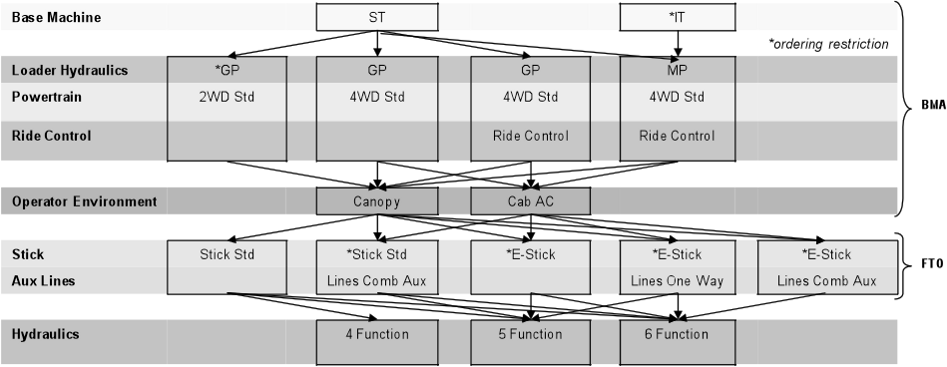
Final Product Hierarchy and Packages for the BHL 420E Series
Pricing optimization showed that with these 135 configurations, revenue from sales could increase by almost 7%, and profit could increase by 15%, with 99.6% demand fulfillment. The standardization and bundling of options greatly reduced the universe of feasible configurations, which led to inventory and quality savings: 76% of the projected cost of complexity savings came from reductions in finished goods inventory and warranty costs (in particular, the cost of addressing failures in the first 100 hours of machine operation). Since the goal of the project was to maintain similar profit levels (rather than seeking increases), the team determined appropriate option price reductions to drive dealer behavior toward these configurations while maintaining profit. The proposed pricing policy resulted in an anticipated reduction in profit from sales of 4%, which was easily made up by the reduction in cost of complexity to yield a total profit increase of 4.8%. We had finally found the very small subset of configurations that we believed was broad enough to satisfy CAT's customers and dealers, but also focused enough to drive operational and supply chain efficiencies. This final recommendation was presented to CAT, and was approved.
Implementation Details
Initial Implementation
CAT put an updated price list for the 430E product line (modified via dealer input to now feature 124 configurations) into effect in some regions in April 2010; but, in order to minimize the risk of lost sales, customers could still order a‐la‐carte machines according to the old price list. Concurrent with this new price list, CAT introduced a 3‐lane strategy for order fulfillment: Lane 1 (the fastest lane): Orders on the four designated “most popular” fully configured machines would be satisfied within a few days; Lane 2: Orders on the remaining 120 choices, broken into the Loader, Comfort and Convenience, and Excavation packages, would be satisfied within a few weeks; Lane 3: Any a‐la‐carte machine would be satisfied within a few months, as previously.
Upon implementation, CAT experienced positive dealer feedback and large reductions in the number of unique configurations sold. This contrasted with previous attempts to reduce the size of the product line, based on a Pareto analysis of the top few dealers. These had likely been ineffective, in CAT's opinion, because they did not effectively model the interaction of cost, customer preferences, and substitution, as we had.
It is worth noting that, to the best of our knowledge, neither standardization nor option packaging were being considered prior to the start of our project. These concepts, and the lane strategy they support, were only developed after our analysis indicated that CAT needed to find a way to limit the number of configurations while not eliminating too many options. Our analysis then gave CAT direction in implementing these new strategies, by indicating which sets of configurations were likely to be most successful.
This evolution of the solution strategy also affected how the results of our algorithm were applied. Specifically, we initially modeled a problem setting in which there would be a reduced set of products offered to customers differentiated by price, but not by lead time. The solution CAT implemented (in principle) still includes all possible configurations within Lane 3, and differentiates these from the first two lanes by lead time. Thus, our forecasts of the savings in cost of complexity, which would be accurate if only the first two lanes were offered, are only an approximation given the continued possibility of a‐la‐carte ordering. Caterpillar felt that the flexibility of retaining Lane 3 outweighed any reductions in cost of complexity savings. Likewise, although lead time differences could be incorporated into our framework as shown in sections 3 and 5, Caterpillar felt comfortable enough with the main conclusions of the analysis to forgo additional analysis.
Moving Forward
In 2011, CAT released a single price list featuring options packages for use in all regions. They were able to capture over a quarter of their sales volume just in Lane 1; in contrast, the four top‐selling configurations CAT offered before this project captured 11.3% of both sales and total revenue for the 420E model (Figure 1). In addition, CAT enjoyed a reduction in warranty costs, attributable to many factors, including this project. CAT has continued to focus their BHL offerings, for example reducing the 420E (now the 420F) Lane 1 offerings to three base machines by mid 2014. The other BHL lines have seen similar reductions.
The lane approach has become an integral part of CAT's business strategy (Thomson Reuters 2014). While the methodologies used to determine lane offerings in other divisions were somewhat simpler than the analysis done here, our work provided support for the corporate‐wide lane strategy. In particular, our cost of complexity analysis approach has been applied to other divisions, such as Wheel Loaders, with the goal of capturing all the benefits and understanding all the consequences of proposed line changes. The detailed analysis and structured optimization approach reported in this study allowed CAT to counteract skepticism toward the lane approach embarked upon by BCP prior to the diffusion of this strategy throughout the company.
Sensitivity Analysis and Insights
In order to generate additional insights from our model, we conducted an extensive sensitivity analysis of our framework by running a large number of experiments in which we vary the main input parameters over a range of values and record key output measures. Because of space limitations, we do not include all of the experiments here; they are available in a separate Appendix S1 to this article. This section summarizes the main findings generated by this analysis.
Modeling Customer Behavior
Customer Flexibility: The More the Better
As customers become more flexible and willing to accept a wider range of configurations, the expected effects include a decrease in the number of configurations needed to satisfy them, a reduced number of required options, decreased complexity costs, and higher profits. These trends are supported by our experiments; specifically, when any of the following parameters increases in value: maximum migration list length, reservation price, disparity factor, and percentage of novel configurations in the portfolio. Varying the number of features whose utilities are perturbed and/or the amount of perturbation around the point estimate (perturbation factor) seems to add some noise, but does not ultimately change the observed outcomes significantly.
Role and Effect of Migration Lists
While performance improves with longer migration lists, we note that the effects of greater list length is more pronounced for smaller lists—once lists are of moderate size (about forty) metrics are largely insensitive to further increases in length (see Figure 3, additional figures and discussion are provided in Appendix S1, section 1). Furthermore, more choices lead to purchases being more spread through migration lists, decreasing the number of top‐ranked purchases, as these are knocked out of the portfolio in favor of more universally appealing configurations.
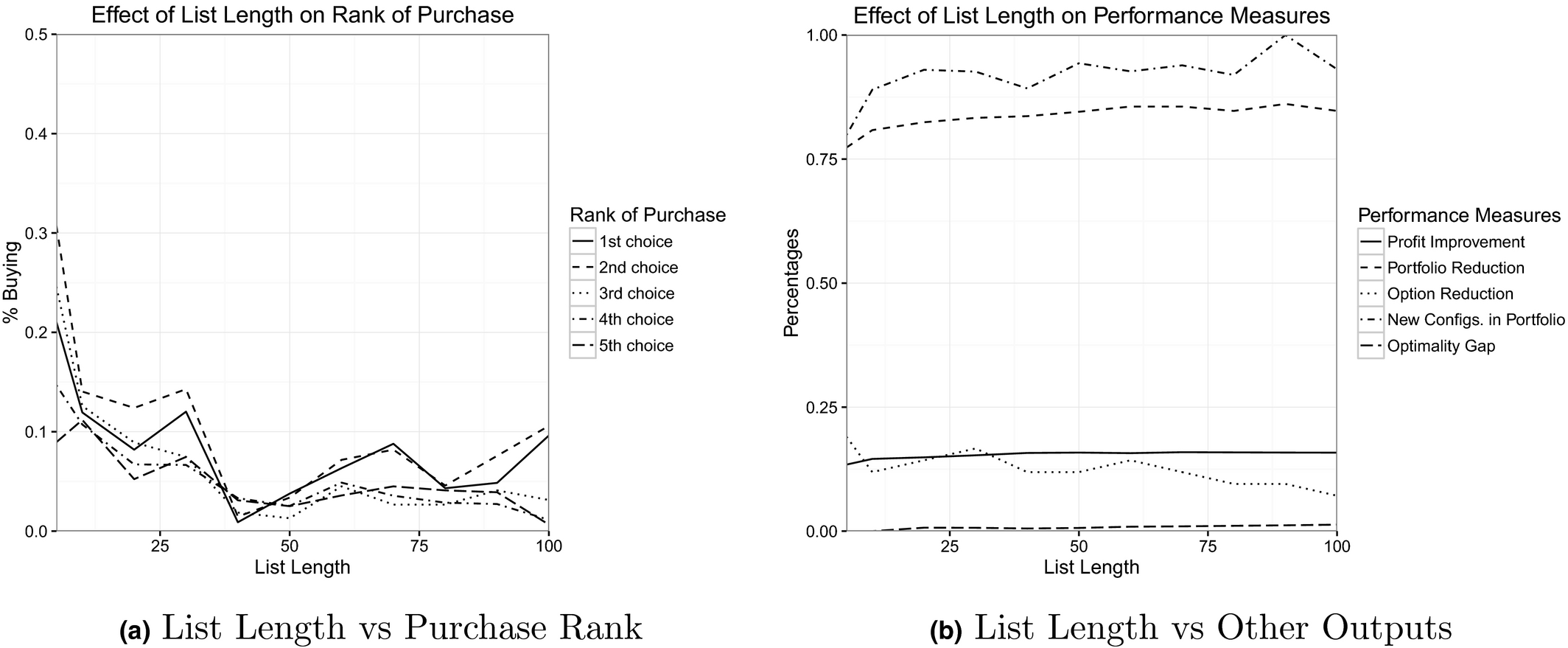
Effect of Migration List Length
To better explain the role of migration lists, Figure 4 shows how many times, out of 3825 customers, a customer's original choice ended up at a given position on that customer's (100 configuration long) migration list (note the log scale on the vertical axis). The rightmost, tallest bar indicates that for 2601 customers (68% of the time) a customer's original choice would not have appeared anywhere in the first 100 positions of the customer's list. For CAT this means that, for over two thirds of their customers, there are many products that provide them with higher utility than the first product they had in mind. Figure 4 emphasizes that, within the context of product portfolio reduction, the main purpose of migration lists is not to predict what a given customer would buy. Rather, the migration list's job is to determine which products would provide high utility to each customer, thus forming a pool of configurations from which to select the ultimate product portfolio.
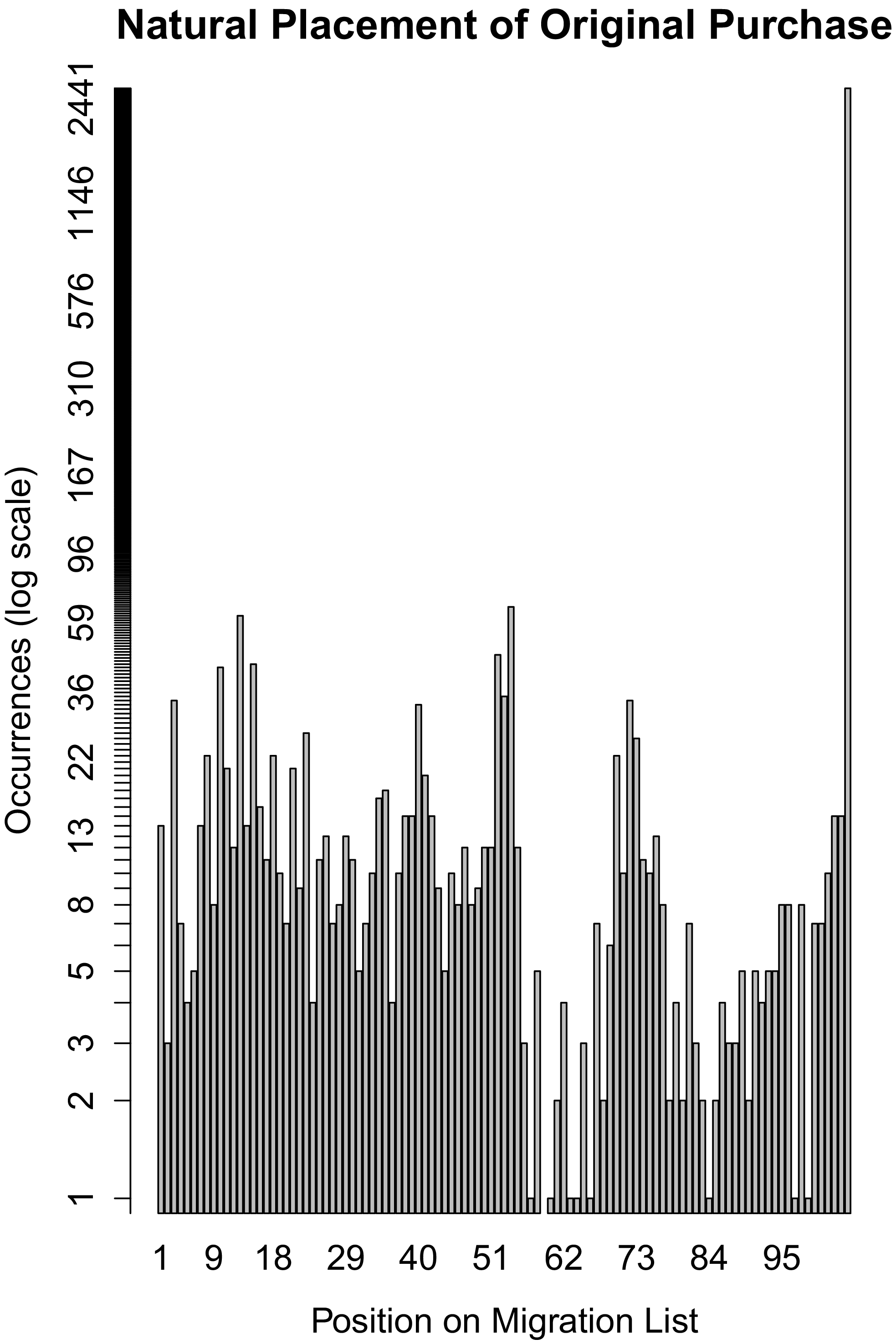
Number of Migration Lists, Out of 3825, Containing Original Purchase
To explore this point further, consider the following thought experiment: Assume a company had a perfect forecasting algorithm that could always guess exactly what any customer's first choice of product would be. Despite being useful for several things (such as targeted advertising, as well as production and inventory planning), if the universe of customers’ first choices were very heterogeneous, this algorithm would not allow the company to reduce the size of its product portfolio because it would not provide any information about customers’ flexibility and willingness to substitute. Instead, a migration list, as defined in our framework, tries to predict, given a customer's first choice of product, what other products would likely be acceptable to that customer. In doing so, if a large number of customers happen to like the same not‐so‐large collection of products, there is a chance that significant savings can be achieved by focusing the portfolio on that smaller collection, even if some of those products are not the first choice of many, or even any, of the original customers.
Varying the β Factor
As β goes up, the probability of buying the first configuration on the migration list goes down. This is likely because many of the originally purchased configurations are pruned from the portfolio in an effort to concentrate customers. As for profit, it is largely insensitive to β, even though the composition of the portfolio may change.
Reservation Price Vs. Reservation Utility
As expected, when customers are willing to pay more, everything improves for the company. Customers whose β factor does not force their originally purchased configuration to appear first on the list are more likely to buy their top choice, as it will likely be a high‐utility, high‐price machine. The remaining customers are more likely to purchase configurations further down their migration lists, as their top, lower utility/lower priced choices get pruned. In contrast, having customers willing to accept lower utility machines is not as impactful as their becoming less price sensitive. That is because accepting machines with lower utility does not remove the higher utility machines from consideration (which the company would typically prefer to sell anyway), and the latter get placed ahead of the lower utility machines on the migration lists.
Role and Effect of the Number of Lanes
The concept of lanes introduced in section 8.1 adds another dimension to a configuration's attractiveness: Availability, that is, how quickly a customer can obtain it. Availability can be treated as a feature whose options are fastest, second fastest, etc. As a feature, availability would then have a relative importance and its options would have utilities. And, given these utilities, the company may choose to either charge a premium/markup for configurations in faster lanes or keep the prices the same. We ran a set of experiments to understand what happens to customers’ migration lists and to several output measures related to the optimal product portfolio when different numbers of lanes are present (e.g., the company decided to offer 3 lanes instead of 2). For the optimization algorithm, what matters are the configurations on each migration list, as well as the order in which they appear. Hence, we simulate the presence of the availability feature by exploring the composition of migration lists under different lane scenarios. One benefit of this approach is that it does not require us to choose exact values for different costs and profits related to different lanes, as would be required to run a full‐blown optimization.
For our experiments, we first need to characterize customers based on two dimensions: willingness‐to‐pay (low, medium, high) and the utility they assign to the availability feature (low, medium, high). Note that these are two different things: A customer may prefer to have high availability, but be unwilling to pay extra for it. As an example of how we categorize customers, consider a case with three lanes where Lane A is the fastest and Lane C is the slowest. A customer who has low willingness‐to‐pay (wtp) and low utility for availability (avail), will only have the slowest lane on his migration list (C), and a customer who has low wtp and medium avail, may have a migration list comprised of configurations in lanes C and then B (CB). For our experiments, we consider 10 different values for the Utility of Availability (specifically, from 1 to 10), such that: a customer with low avail is mapped to value of 1, medium to 5, and high to 10. The values in between capture the gradual transition in the proportion of customers switching to the type of migration list: namely, for customers with low wtp, when the utility of availability equals 1, all customers have only one migration list (C), but as the values increase from 1 to 5, the proportion of customers switching to list CB increases. The exact proportion of customers corresponding to each utility value depends on the selected percentage of customers having different wtp. 5 In addition, we consider cases with and without a price markup on faster lanes as some companies may have no markup and use the lanes solely to incentivize customers to purchase certain subsets of products, while others may put a markup on the configurations offered in faster lanes.
In this section, we report the results on the effect of utility of availability for an experiment without price markup, where the customers are split equally between the wtp values. 6 We provide additional results from multiple experiments in Appendix S1 in section 2. In Figure 5a, we demonstrate what percentage of profit is attributable to each lane as the utility of availability changes. Notice that as the utility of availability increases, Lane 3 (the slowest lane) gets utilized less and eventually disappears. This observations persists across scenarios with different markups and different distribution of customers across wtp values. In Figure 5b, we compare the profit of five replications of the portfolio with 2 lanes vs. the portfolio with 3 lanes and show that when the utility of availability is low, the 2‐lane portfolio provides a higher profit than a 3‐lane portfolio, but the opposite is true when the utility of availability is greater.
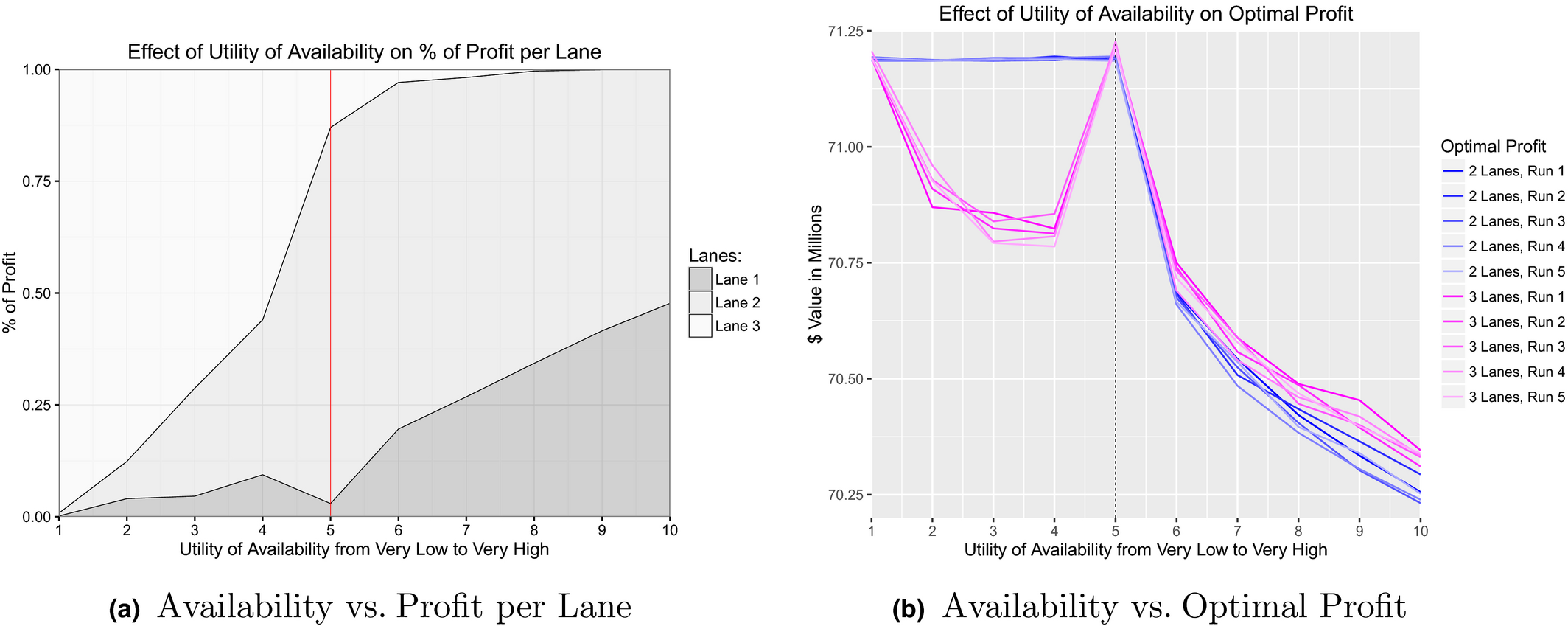
Effect of the Utility of Availability [Color figure can be viewed at
This arises because the overall portfolio size of the two lane portfolio stays comparatively more stable than the three lane portfolio for smaller utilities – there is just less room for movement. But once availability becomes more valuable, there is greater dispersion among the customer base, and thus the three lane portfolio has an easier time accommodating this: While both portfolios grow, the two lane portfolio grows more abruptly, lowering the profits. 7 Note that these experiments were run for the case of zero markup – as expected, when markup is permitted profit increases with the utility of availability, as customers are steered toward more expensive, more available, machines. Note finally, that these effects remain present, but are mitigated, if greater dispersion of customers is assumed.
Constraints on Sales Volume and Unique Configurations
For CAT, our experiments indicated that the best course of action would be to lose as much sales volume as permitted (see Figure 6). (Recall that early profit maximizing solutions decreased sales volume by as much as 67% and were thus rejected.) This was driven primarily by lower volumes creating savings in inventory cost and quality control: quality level is impacted highly by the total volume (not so much by options) as you have more time to spend on machines when the volume is low. Inventory cost is also reduced based on volume because lower volume implies less inventory held at dealers and, hence, CAT has to subsidize less. In CAT's specific case, these two cost pools have a large enough impact to explain the change in profit. This is why the strategic constraint on market share is so important—CAT wants to hold the line on market share, which restricts the portfolio reductions they will tolerate. In contrast, the number of unique configurations can be easily reduced by up to 80% in CAT's case, without negative effects on other performance measures, indicating it is not nearly as important as the minimum market share requirement.
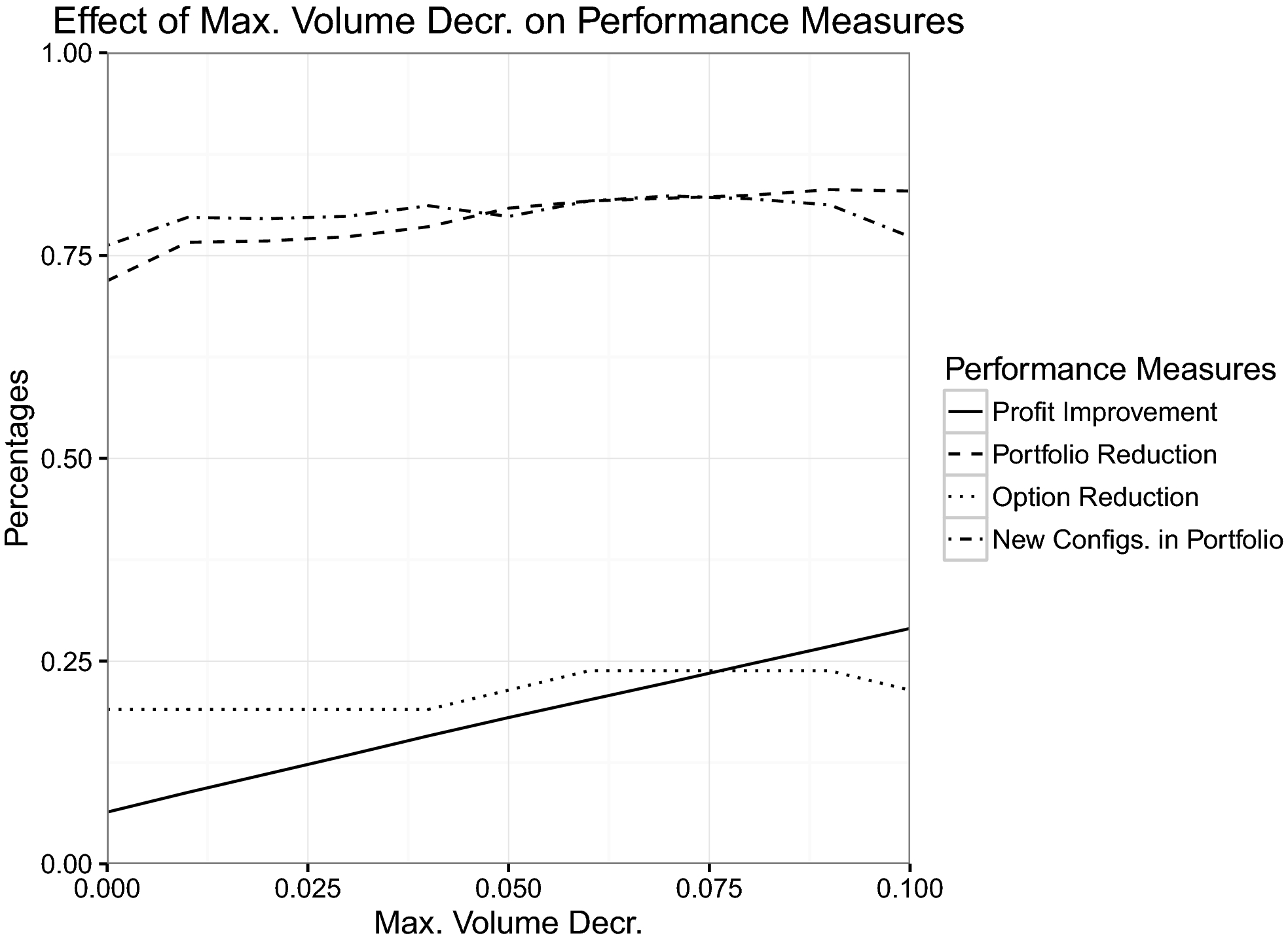
Maximum Sales Volume Decrease vs. Other Outputs
Insights Related to Cost of Complexity
Section 6.3.5 provided evidence for two insights that, although intuitive, had never been empirically verified by CAT. First, for some features, increasing the number of options decreases the costs of customer acquisition. Second, sales volume has a negative impact on product support costs (i.e., repair costs) and, at the same time, a positive impact on the cost of prime product inventory. In addition, we emphasize three complexity‐related takeaways from our analysis: (i) There are two types of impact of product portfolio complexity on cost, which need to be modeled separately: complexity driven by the number of options offered (VBC) and complexity driven by specific options (ABC); (ii) There are time lags and leads on the impact of complexity that may or may not be reflected in cost data is depending on the accounting methods used; (iii) Costs can be impacted in either direction (increase or decrease) by complexity.
Data Collection
As we collected data to implement and run our models, we found some data particularly useful, while there were other instances when we wished we had certain types of data that were not available, forcing us to go with the next‐best thing. Hence, as an added insight, we believe that tracking the following data, whenever possible and practical, would enhance a company's ability to improve their product portfolio: (i) Whether or not the product purchased by a customer was the one she originally had in mind to buy and, if not, record both the original choice and the final purchase; (ii) Record what options/features the product support costs are associated with. Having this data could have revealed that some options had an ABC effect on the cost pool.
Conclusion
We present a three‐step procedure to restructure a product line, demonstrating its successful application on the Backhoe Loader line at CAT. Our methodology hinges on (i) the construction of migration lists to capture customer preferences and willingness to substitute; (ii) explicitly capturing the (positive and negative) cost of complexity of a specific product line across different functional areas; and (iii) integrating these tools within a mathematical programming framework to produce a final product line. One of the greatest strengths of our methodology is its flexibility—each step can be tailored to a company's particular setting, data availability and strategic needs, so long as it produces the necessary output for the next step.
CAT's lane strategy has continued to evolve, for example, Thomson Reuters (2014) discusses a new variation in which lanes may contain only partially completed machines, which can be finished to customer order as needed. Ideas such as these offer opportunities to extend our work to new problem domains—analytically characterizing the performance of such a delayed differentiation strategy is an exciting and challenging problem.
Outside of CAT, our work can be extended in several directions. First, explicit experimental validation of our empirical models—in particular our migration list approach—would be of value. While this approach has been successfully applied in the construction equipment industry, further study could help establish how it could be applied in other sectors, and what changes might be necessary. For example, we set the list lengths based on consultation with CAT executives. A better understanding of how long such lists really are, and how willing customers are to substitute (and whether there is any sort of explicit cost to this) would be of interest.
Second, as our methodology is applied to other settings, new constraints might need to be incorporated into our mathematical program. One of the benefits of our procedure is that our optimization model is flexible enough to accommodate such constraints. Nevertheless, how it performs in other settings needs to be established.
Finally, the central thrust of this study has considered the trade‐off between cost of complexity and product line breadth. CAT has found what they believe to be the correct trade‐off, which entailed a dramatic reduction in their product line. Different companies, in different industries, will have to answer this question for themselves. It is our hope that the methods we present in our study can likewise help them find the answers they seek.
Footnotes
Alternatively, one can refine this approach by keeping the time lags in the model and computing the net present value of future cash flows.
Note that randomness in our choice model is restricted to the generation of option utilities and reservation values, which influence the construction of customer migration lists. Once created, these (fixed) lists serve as input to a deterministic optimization algorithm. Thus, we refer to our model as being “randomized”, as opposed to a random choice model, which typically has a different meaning.
Some data is masked to preserve confidentiality. The signs and magnitudes have been preserved.

We describe this process in great detail in Appendix S1 in section 2.
Please note that even without markups, we enforce the 9 types of lists, taking wtp into account. We do this assuming that the company would first solve this no‐markup version of the problem to find a solution with a higher complexity cost reduction; and once the optimal portfolio and lane assignments are decided, they can increase prices because they already know people are willing to pay a little premium.
Please refer to section 2 of Appendix S1 for the plots illustrating this and following observations.