







Abstract
As more customers purchase pre‐owned apparel, firms are increasingly adopting resale based business models. These models typically operate as either (i) a trade‐in and resale program, wherein a firm offers a trade‐in discount on a new product and resells the traded‐in products, or (ii) a P2P resale marketplace where customers can buy and sell used products to each other. Since different firms choose different resale strategies, it is not clear which strategy is more profitable. Furthermore, although firms that adopt each resale model also promote their environmental benefits, there are concerns that these firms are greenwashing, that is, misrepresenting the environmental benefits of their business models. Hence, we investigate the profitability and environmental impacts of these resale marketplace models and find that the trade‐in model may be more profitable despite the lower reverse logistics cost in the P2P model, and the P2P resale marketplace may be more profitable despite the trade‐in program having direct control over the supply and demand of used products. Furthermore, both models can be better for the environment depending on the product characteristics and perceived quality difference between the used products sold in these programs. We further identify when each model is better for profitability and environment concurrently and when there is misalignment. Other results and managerial insights include comparative pricing of new and used products, market coverage, total sales, and resales, and the impact of product durability on pricing. The insights presented in this study provide useful guidelines for firms, non‐governmental organizations, and environmental advocacy groups.
Introduction
The US apparel resale market was worth $28 billion in 2019, and it is predicted that it will exceed $50 billion in revenue by 2023 (ThredUP 2019). Since more customers now consider purchasing pre‐owned or used products (Amed et al. 2019), several apparel firms are now engaged with the secondary market for apparel through resale models such as the sale and trade‐in with resale model or the sale and peer‐to‐peer (P2P) resale marketplace model. 1 Furthermore, environmental advocacy groups and non‐governmental organizations (NGOs) have raised concerns around apparel over‐consumption and premature disposal (Niinimäki et al. 2020). Hence, these models have the potential to reduce the apparel industry's environmental impact by encouraging and profiting from product reuse (Morlet et al. 2017). Therefore, there is a business opportunity to increase profits by adopting a resale strategy, and at the same time, a possibility of achieving a smaller environmental footprint.
Although the literature has studied trade‐in programs and P2P resale marketplaces separately, there is no study, to the best of our knowledge, that looks at the comparative business value and environmental impact of trade‐in programs and P2P resale marketplaces (in the context of resales) for an apparel manufacturer or retailer (Agrawal et al. 2019). Moreover, both resale models are prevalent in practice (e.g., Danziger 2019,
Motivation
Some apparel firms have developed strategies to capture resale profits from used apparel, either through the trade‐in and resale model or through sale and P2P resale marketplace model. As an example of the trade‐in and resale model, Patagonia offers a discount on new apparel purchases to customers that trade‐in their used apparel. Patagonia then refurbishes and resells the used apparel on its online platform where customers can buy second‐hand Patagonia apparel (Patagonia 2020c). Other apparel firms like Eileen Fisher, The North Face, and REI have adopted a similar approach of offering a trade‐in discount, refurbishing used products, and reselling them (Danziger 2019). On the other hand, other apparel firms established P2P resale marketplaces. For example, COS (a brand owned by H&M) has been developing its online platform for selling second‐hand COS clothing (Group 2020,
In a trade‐in operation, the apparel firm controls both the used product supply and demand through the trade‐in discount and the used product price, respectively (Li et al. 2019). However, the firm incurs the cost of reverse logistics and resales (Patagonia 2020b). In contrast, in a P2P resale marketplace setting, the used product prices are determined endogenously in the marketplace between potential sellers and buyers (Einav et al. 2016, Jiang et al. 2017). In this model, the apparel firm does not incur the reverse logistics costs, which are instead incurred by the consumers (COS 2021b). Therefore, since both models are used in practice, there is no consensus or clear direction in the apparel industry regarding which model is more profitable.
In addition to their impacts on the profitability of apparel firms, there are environmental implications of the trade‐in and P2P models. In effect, environmental advocates state that apparel resale business models can help reduce the rising environmental impact of apparel manufacturing created by growing consumption (Morlet et al. 2017). However, there is limited understanding on how different circular economy‐based business models, such as trade‐ins and P2P resale marketplaces, compare in terms of their impact on the environment (Agrawal et al. 2019). Some environmental advocacy groups and consumer watchdogs argue that certain apparel firms are “greenwashing,” that is, misrepresenting the environmental benefits of their business models (Hitti 2019, Siegle 2018).
In particular, using a life‐cycle approach to modeling the environmental impact, total environmental impact is expressed as a sum of all the impacts in different phases of the product's life‐cycle consisting of new production, consumer use, collection and resale activity, and disposal (Agrawal et al. 2012, Örsdemir et al. 2019). On the one hand, trade‐in programs may increase the overall consumption of new apparel and thus increased environmental impact since they incentivize consumers to replace their used apparel with new ones (Zhang and Zhang 2018). And since the apparel firm may dispose the traded‐in apparel without resale, they may also worsen the environmental impact (Baraniuk 2020, Nguyen 2020). On the other hand, P2P business models may also lead to a greater environmental impact because buyers purchase the used products directly from sellers who compete in the marketplace; the competition between sellers may increase market coverage leading to higher use‐phase environmental impact (Bellos et al. 2017).
Given the complex dynamics between new product and used product sales in both the trade‐in and P2P resale marketplace models, it is not clear which resale business model produces a lower environmental footprint and is also more profitable. Next, we highlight our research questions and contributions to the literature.
Research Questions and Contributions
Although, Patagonia had planned to launch an online P2P marketplace that allows customers to sell used products (Reinhardt et al. 2014), it recently pivoted and has instead developed a trade‐in program through their Worn Wear campaign (Patagonia 2020c). In contrast, COS has recently opened a P2P resale marketplace where customers can sell pre‐owned COS pieces for a fee to other COS customers (COS 2021b,
Furthermore, both Patagonia and COS promote the environmental benefits of their businesses. For instance, Patagonia is a member of the Sustainable Apparel Coalition with a goal to transition to an apparel industry that “produces no unnecessary environmental harm” (Patagonia 2020a). Patagonia also promotes the environmental benefits of its trade‐in program (Patagonia 2017). Similarly, COS also promotes its commitment to sustainability and the environmental benefits from its P2P resale marketplace (COS 2021a). Although both firms have committed to reducing their environmental footprint, they do so through different resale models. However, it is not clear which model is environmentally better. Therefore, we ask: Which resale model is better for the environment?
One may expect that the trade‐in program has a worse environmental impact due to increased new production (Zhang and Zhang 2018). Some NGOs and environmental advocacy groups promote P2P resale marketplaces, rather than trade‐in programs, to extend the lifespan of products and lower the environmental impact (EAC 2019, Morlet et al. 2017). However, we find that the trade‐in program has a lower environmental impact compared to the P2P resale marketplace model. Thus, the answer to the question about the environmental impact is: it depends. Our findings have implications for government agencies and NGOs promoting or advocating for circular economy business models as a way to lower environmental impacts of traditional business models (EAC 2019). Our modeling approach enables us to investigate if and when each resale model is both profit maximizing and better for the environment. We present our findings in a matrix that is based on product and resale model characteristics (such as durability and perceived quality difference between the resale models) and the different environmental impacts of the products. We outline the scenarios where the profit and environmental impact are aligned and misaligned for the trade‐in and the P2P models.
We also provide several findings based on the business impact of the resale models. For example, although our focus is “not” on the sale of luxury items and their dynamics, it is known that some fashion houses attempt to maintain exclusivity and favor business models that keep their prices high and do not implement any form of resale business models (e.g., see McDowell 2019). However, as customers become more environmentally conscious and different groups advocate for resale business models, these luxury brands might want to engage in resales (Luxe 2020). Therefore, we compare the pricing strategies for both new and used apparels sold in the trade‐in or the P2P model.
We present several additional results and managerial insights comparing different variables of interest in the trade‐in and the P2P resale business models. For example, the profits and environmental implications depend on the pricing structure under both models. Since higher durability is associated with a higher willingness to pay for used products, manufacturers may take advantage of this by charging higher used prices (Chen et al. 2013, He et al. 2016). Therefore, we ask in the e‐companion: How does durability impact the used product price and the platform fee in the P2P model? A similar observation is made in the case of trade‐in price (i.e., the difference between the new product price and the trade‐in discount). Therefore, for the trade‐in model, we also ask: How does an increase in durability impact the trade‐in price? We find that the answers to these questions are nuanced. Interestingly, used and new product prices may actually decrease with durability. The managerial insight here is that more durable products may not always be priced higher. Therefore, for such apparel firms, pricing decisions may need to be taken with care to balance the revenue mix from selling new and used products. Furthermore, we present several other results regarding the volume of new apparel production, the extent of market coverage, and the number of used apparel resold. In the next section, we position our work with respect to the literature.
Literature Review
Our paper studies and contributes to the following streams of literature: (i) economic models of durable goods in the presence of P2P resale marketplaces, (ii) trade‐in programs for used product acquisition and resale, and (iii) sustainable operations. Next, we review some relevant papers and highlight our contributions to each of these streams of literature as depicted in Figure 1.
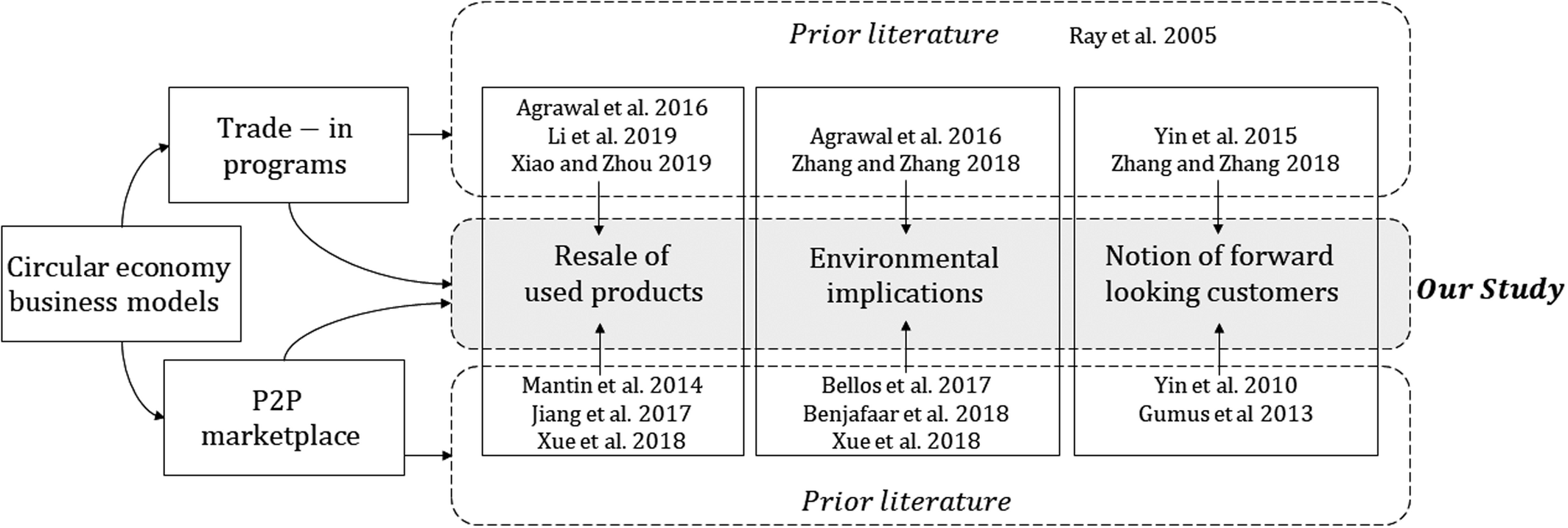
Comparison with the Closely Related Literature
Durable Goods and P2P Marketplaces
First, we contribute to the literature on secondhand markets for durable goods as we focus on P2P resale models. For a comprehensive overview of P2P markets in general, we refer the reader to Einav et al. (2016). In this subsection, we discuss how our contribution differs from this literature stream.
Gümüş et al. (2013) study a manufacturer's incentive to offer a return policy contract in the presence of a P2P used good market, whereas Yin et al. (2010) focus on how retail and P2P used goods markets shape a manufacturer's product upgrade strategy and a retailer's pricing strategy. Furthermore, although Gümüş et al. (2013) and Yin et al. (2010) consider the notion of forward‐looking behavior, they do not consider environmental implications, resale of used products, and trade‐in programs. Furthermore, Bellos et al. (2017) consider an original equipment manufacturer (OEM) who introduces car sharing to complement its traditional sales‐oriented business model and appropriately designs its product line, whereas Xue et al. (2018) investigate the economic and environmental potential of encouraging the reuse and reselling of secondhand goods through firm‐enabled P2P platforms. However, the business settings of these works are different as they do not consider reselling in trade‐in programs and the notion of forward‐looking customer behavior.
On the other hand, Jiang et al. (2017) focus on buyer valuation uncertainty in a P2P marketplace setting, while Mantin et al. (2014) consider the strategic aspects of operating a P2P resale marketplace for bargaining with upstream manufacturers in dual‐format retail. However, our work differs from these studies in considering the possibility of an apparel firm that sells new products while participating in the used product market through either a trade‐in program or a P2P resale marketplace.
Trade‐in Programs for Used Product Acquisition and Resale
Second, our paper is related to the commonly adopted business practice of trade‐in remanufacturing, whereby manufacturers collect used products for remanufacturing by allowing customers to trade in used products for new ones at a discounted price. There is a well‐established research stream in this area but we discuss only the papers that are closely related to our work.
Xiao and Zhou (2019) analyze hybrid trade‐in programs, consisting of a trade‐in for upgrade and trade‐in for cash, and quantify the additional value over traditional trade‐in programs. Second, Ray et al. (2005) study three pricing schemes for trade‐in programs: (i) uniform price for all customers, (ii) age‐independent price differentiation between new and replacement customers, and (iii) age‐dependent price differentiation between new and replacement customers. Furthermore, Li et al. (2019) consider an OEM that offers a trade‐in program and remanufactures traded‐in products to resell them in the secondary market. Agrawal et al. (2016) consider a setting where an OEM negotiates with customers to offer personalized trade‐in rebates in a B2B context. However, in contrast to our work, these papers do not analyze trade‐in programs under forward‐looking customer behavior. Furthermore, they do not capture P2P resale markets; hence, they do not analyze the relative value of trade‐ins vis‐à‐vis P2P resale marketplace programs as we do in our study. Moreover, among these papers, only Agrawal et al. (2016) consider environmental issues.
Zhang and Zhang (2018) also study the environmental impact of trade‐in remanufacturing and consider that customers can be forward‐looking. Furthermore, Yin et al. (2015) examine the selling of successive generation products where the customers are again forward‐looking. However, to our knowledge, neither Yin et al. (2015) nor Zhang and Zhang (2018) analyzes the relative value of trade‐in vis‐à‐vis P2P resale marketplace programs similar to the rest of the literature stream. Furthermore, none of these studies consider reselling the traded‐in items explicitly. Hence, we contribute to the literature by examining and revealing new insights on this topic.
Sustainable Operations
Our paper is related to the sustainable operations literature that has emphasized the environmental impacts of business operations (Kleindorfer et al. 2005). Our paper builds on the emerging stream of research that contrasts the profit and environmental potential of innovative business strategies with traditional models. Some of the relevant work in this stream of literature has contrasted leasing with selling (Agrawal et al. 2012), selling a service (i.e., servicizing) as opposed to selling a product (Agrawal and Bellos 2017, Örsdemir et al. 2019), and sharing‐based business models including P2P rentals (Bellos et al. 2017, Benjaafar et al. 2018). All these papers take a product life‐cycle perspective consisting of all phases of the product life‐cycle to evaluate the environmental footprint. We take a similar methodological approach and expand the literature in regard to the comparison of profitability and environmental impact of the trade‐in and P2P resale marketplace‐based models.
Our key contribution to theory is that we jointly capture the sale and resale operations in both trade‐in and P2P resale marketplace settings to identify the better resale oriented business model for different product characteristics (e.g., durability) and cost structures (e.g., reverse logistics and fixed costs of setting the resale program) when customers can be forward‐looking. Particularly, we endogenize the new and used product prices as well as the fees and discounts and prescribe the resale business model that is more profitable and has a lower environmental impact under different conditions. Our analysis provides guidance to apparel firms and helps NGOs and environmental advocacy groups promote the best resale business models to accelerate the transition to a circular economy. In the next section, we describe our model.
Model Formulation
We consider the example of a focal firm like Patagonia or COS that sells new apparel and participates in the resale market for its used apparel. Patagonia sells new apparel, but customers can also buy used apparel on its Worn Wear website (Patagonia 2020c). Similarly, COS sells new apparel and operates a P2P marketplace where customers can buy and sell used COS apparel (
In our setting, apparel generally has a life span of up to a few years whereas the average lives of firms and customers are much longer (Beton et al. 2014). Therefore, we consider that apparel has a finite product life, whereas customers and the firm operate over an infinite time horizon (hence, there are repeat purchases). The literature (e.g., Alev et al. 2020, Bond and Samuelson 1984, Hendel and Lizzeri 1999a) also considers similar settings where the product has a finite useful life over an infinite horizon. Furthermore, in line with the literature (e.g., Agrawal et al. 2012, Alev et al. 2020, Rao et al. 2009), we consider a two‐period product life to capture the quality deterioration in a tractable way, that is, the apparel is considered “new” in the first period of its life, and “used” in the later stage of its life.
As discussed earlier, the global apparel resale market is predicted to exceed $50 billion in revenue by 2023 (ThredUP 2019). Therefore, we only focus on apparel for which there is interest in buying used, that is, we do not focus on apparel that is perishable (i.e., the apparel is semi‐durable). We model the interaction between the firm and consumers as a sequential game over an infinite horizon and use l to denote the time period under consideration (l = 1, 2, 3, …). Next, we present each component of our models (i.e., product and customer attributes, prices, and operating costs) and the environmental footprint.
Product and Customer Attributes
Adopting the customer utility model of Mussa and Rosen (1978), we consider that a customer's willingness to pay for a new product θ is heterogeneous and uniformly distributed between
Furthermore, buyers face uncertainties in online marketplaces because they mostly transact with new or unknown sellers with no brand name (Pavlou and Dimoka 2006). In contrast, a used product that a manufacturer or retailer sells is likely to command a premium due to authentication of the product by the brand, and better “perceived” quality by the consumers (Kennedy et al. 2001). Therefore, we consider that consumers obtain an additional utility when buying a used product from the firm under a trade‐in program. We consider that a consumer (i) obtains a per‐period utility δθ from a used product that is purchased from the P2P resale marketplace, and (ii) a utility δθ + k when she purchases the product from the firm's trade‐in program. Here, k > 0 represents the additional utility consumers receive from buying a used product that is authenticated by the firm. Henceforth, we refer to k as the perceived quality differential between used products purchased from the firm's trade‐in program and the P2P resale marketplace. 3
In the apparel industry, customers are increasingly purchasing new with an intent to resell their used products (The Associated Press 2014, ThredUP 2019). Therefore, we consider that customers are forward‐looking and discount future utility at a rate μ, where μ ∈ [0, 1), that is, as customers become increasingly forward‐looking (μ increases) they attach a greater weight to future period's utility (e.g., resale value of the apparel) in making new apparel purchase decisions. Moreover, following the generally adopted approach in the literature, we consider that a customer holds at most one unit of apparel in a given period (Agrawal et al. 2012, Hendel and Lizzeri 1999b, Huang et al. 2001, 2019, Rao et al. 2009). 4
Pricing, Trade‐in Discount, and Platform Fee
In this section, we discuss the pricing structure of each resale model. Patagonia sets new product prices, offers a trade‐in discount, and earns additional revenue by selling its used products on its Worn Wear website at a discounted rate compared to new products (Patagonia 2020a). Therefore, in the trade‐in program with resales, we consider that the apparel firm sets the new product price


Cost Structure
In this subsection, we consider the cost structures of the trade‐in and the P2P marketplace models, respectively. Then, we provide a discussion on the disposal cost.
Cost Structure of the Trade‐in Model
Patagonia's trade‐in program accepts lightly used apparel for trade‐in at its stores; it also has service centers that handle repairs, and manages the reverse logistics (Patagonia 2020b). Patagonia also resells refurbished apparel on its website and incurred costs for establishing and maintaining the Worn Wear platform and the reverse channel (Reinhardt et al. 2014). Similarly, traded‐in clothing at Eileen Fisher is sent to its recycling centers, where they are sorted, dry cleaned, and repaired (Blackburn 2015). Therefore, apparel firms that adopt trade‐in programs incur fixed and variable costs of establishing, maintaining, and managing the trade‐in operations (Fleischmann et al. 2001). For instance, the fixed costs in the reverse channel may include (i) advertising/promotion of the trade‐in program, (ii) inventory capacity, (iii) contractual arrangements, and (iv) cost for setting up a resale platform; likewise, the variable costs include collection and handling among other things (Hagiu and Wright 2014). Therefore, we capture the total fixed cost of operation in a period by F T , and the variable cost per traded‐in product by c R .
Cost Structure of the P2P Resale Marketplace Model
Similar to trade‐in programs, apparel firms like COS incur an upfront cost to establish a P2P resale marketplace (Hagiu and Wright 2014). Therefore, we denote the fixed cost of establishing and maintaining a P2P resale marketplace by F M . However, COS transfers the resale costs (e.g., costs for repairing the apparel and creating product listings) to consumers participating in the marketplace (COS 2021b). Therefore, a unique feature of the P2P resale marketplace model is that the seller incurs the variable cost c R . Furthermore, the decentralized nature of the P2P platforms suggests that apparel firms like COS may not need to invest in a collection of used products and repair centers. Hence, we consider that the apparel firm incurs a lower fixed cost for the P2P resale marketplace, that is, F T ≥ F M . Table EC.1 in the e‐companion summarizes the key variables and parameters.
Product Disposal
Products that reach end‐of‐life can be recycled or disposed of through incineration or landfilling (Esenduran et al. 2016). In the apparel industry, NGOs have highlighted that several apparel firms have been incinerating or landfilling products to prevent cannibalizing new product sales, which is corroborated by the relatively high share of landfilling among the disposal options (Baraniuk 2020, EPA 2017, Siegle 2018). Therefore, we capture the possibility that used apparel can be prematurely disposed by the apparel firm in the trade‐in model, or by individual customers in the P2P resale marketplace model. Since the disposal cost is negligible 6 compared to the other costs (e.g., Chen et al. 2013), we consider that the disposal cost is zero. Note that including a positive disposal cost does not change any of our key results qualitatively. Although disposal does not incur a cost, there is still an environmental impact of disposal that we capture in our models as discussed in detail later.
Model of the Environmental Impact
As discussed earlier, we model the environmental impact in each period over all the different phases of a product's life‐cycle, that is, production, use, repair, and disposal. In doing so, we take a life‐cycle approach to modeling the environmental impact (Blackburn 2015) and adopt an approach consistent with the sustainable operations literature (e.g., Agrawal et al. 2012, Esenduran et al. 2016). We denote the environmental impact of production per unit by e p , the environmental impact of use per unit per period by e u , and the environmental impact of disposal per unit by e d . We note that in addition to the environmental impact of production, use, and disposal, there is also an environmental impact due to collection and minor repairs of the used product in the trade‐in program and the P2P resale marketplace. Unlike studies in the sustainable operations literature that assume no environmental impact of remanufacturing activity (e.g., Mazahir et al. 2019, Zhang and Zhang 2018), we consider that the per‐unit environmental impact from the reverse channel activity involving transport and minor repairs is non‐zero and denote it by e r .
The total environmental impact can then be written as a sum of all the impacts in different phases of the product's life‐cycle. This is obtained by multiplying the size of each customer segment with the segment's corresponding per‐unit environmental impact value (Agrawal et al. 2012, Örsdemir et al. 2019). Note that while the per‐unit environmental impact is captured by e p , e u , e r , and e d , the size of the customer segment is obtained from the solution of the profit maximization problem that we derive in the next section.
Customer Demand and Business Models
In this section, we first go over the solution methodology and later discuss the customer demand for different business models.
Solution Concept
Recall that we consider that consumers are infinitely lived and consume a durable product that lasts for two periods. In line with the literature on pricing durable goods (Huang et al. 2001, Rao et al. 2009), customers in our models make consumption decisions every period based on the prevailing and anticipated prices, trade‐in values, and other incentives, and their decisions in the previous periods. The apparel firm also takes the current and future customer response into account in its pricing decisions. Hence, both the customers and the apparel firm solve dynamic optimization problems.
We consider a solution concept that is a Markov perfect equilibrium (MPE), where the actions of the customers and firm are based only on a payoff‐relevant state (Maskin and Tirole 2001). Furthermore, we focus on a steady‐state equilibrium in our solutions, where the equilibrium values of all decision variables and the aggregate customer behavior are consistent over time. Rust (1985) and Konishi and Sandfort (2002) formally show the existence of this equilibrium in other contexts, as it has been utilized in the literature extensively (e.g., Agrawal et al. 2012, Hendel and Lizzeri 1999b, Huang et al. 2001, 2019, Rao et al. 2009, Tilson et al. 2009). We use this concept to examine the long‐run behavior of the apparel firm and the customers. Hence, we omit the index for time henceforth.
An alternative would be to capture the trade‐offs using a two‐period time horizon. This would be similar to some durable goods models (e.g., Bulow 1982, Desai and Purohit 1998). However, in this context, a two‐period time horizon model suffers from numerous issues. First, in a two‐period model, the literature does not endogenize the availability of the used products in the first period. Second, the two‐period model suffers from an “end‐of‐the‐world” feature as it assumes that the customers at the end of the second period cannot sell their used products, which has implications on both the business angle and environmental issues that we examine in our work. Third, as highlighted by recent literature (e.g., Alev et al. 2020), a two‐period model gives rise to time inconsistency, complicating the analysis in our context, where the firm may simultaneously set both new and used product prices or platform fees, and strategically dispose of trade‐in returns. As noted in the literature, a finite‐product life in an infinite‐horizon setting does not have the time‐inconsistency problem due to replacement sales (Bond and Samuelson 1984). 7
Customer Demand
In this section, for each model, we (i) outline the feasible purchasing strategies in the steady‐state and the respective utilities for customers, (ii) derive the customer demand resulting from purchase decisions that are incentive compatible and individually rational, and (iii) formulate the profit maximization and environmental impact models. We start our discussion with the trade‐in with resale model.
Sale and Trade‐in with Resale Model
As discussed earlier, in the trade‐in with resale model, the apparel firm (i) sells a new product, (ii) accepts a used product as a trade‐in and offers a trade‐in discount on a new product, and (iii) remarkets the traded‐in product. Since the product has a two‐period life, a consumer is in one of two possible states at the beginning of a period: either owning a used product, or not owning the product. If the consumer does not possess a used product at the beginning of the period, she can either buy a new product with a per‐period utility


We show in the e‐companion that the following purchasing strategies are sustained in the steady‐state equilibrium: (1) if t + k − p u < 0, there are four possible purchasing strategies, that is, (i) Strategy {new, trade‐in}, where a consumer trades‐in a used product and buys a new product each period, (ii) Strategy {new, keep}, where a customer buys a new product every two periods and keeps the used product, (iii) Strategy {used}, where a customer buys a used product each period, and (iv) Strategy {inactive}, where a customer stays inactive, and (2) if t + k − p u > 0, there are three possible purchasing strategies, which are Strategy {new, trade‐in}, Strategy {used}, and Strategy {inactive}. We note that the case t + k − p u > 0 leads to trivial results because the {new, keep} strategy is dominated. Therefore, we omit this trivial case from consideration and focus on the more interesting case t + k − p u < 0 for the rest of the paper. Furthermore, although we consider a single new product in the main manuscript, we also consider two horizontally differentiated new products with vertically differentiated used counterparts in section EC.5.1 of the e‐companion. 8
In line with Hendel and Lizzeri (1999a), first, the discounted utility for a customer of type θ that purchases a new product with trade‐in every period is

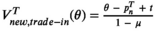

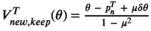

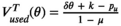


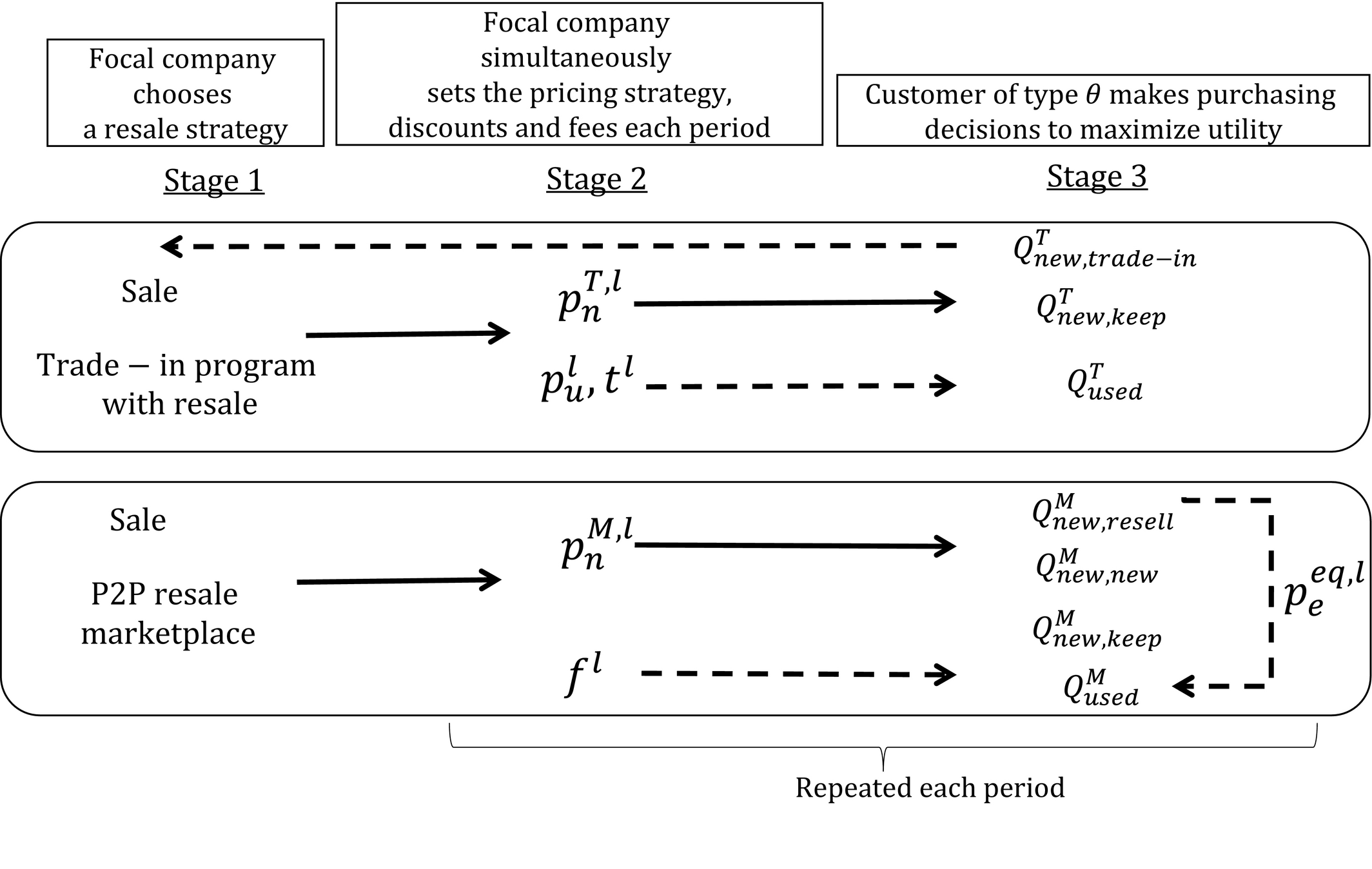
Sequence of Events where Straight (resp., dashed) Lines Show the Flow of New (resp., resold) Products
Customer Utilities
Sale and P2P Resale Marketplace Model
In this setting, the apparel firm sells new products and sets up and operates a P2P resale marketplace where customers buy and sell used products. If the customer does not own a used product at the beginning of a period, she can either buy a new product with per‐period utility 




Note that if 

Taken together, as depicted in Table 2 and Figure 2, five possible purchasing strategies emerge in the steady‐state equilibrium in this setting: (i) Strategy {new, new}, where a customer buys and discards the new product every period, (ii) Strategy {new, resell}, where a customer buys a new product and sells the used product over the P2P resale marketplace every period, (iii) Strategy {new, keep}, where a customer buys a new product and keeps it every two periods, (iv) Strategy {used}, where a customer buys a used product each period, and (v) Strategy {inactive}, where a customer stays inactive. Table 2 presents the different customer segments and their size and customer utilities.
Customer Utilities
†Equilibrium trading price 

First, the discounted utility for a customer of type‐θ that purchases a new product and disposes of the used product every period is 
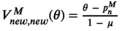






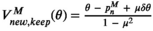

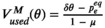
The size of the customer demand in each region that follows strategy i is obtained by integrating over all customers such that 

Profit and Environmental Impact
In this section, we first formulate the profit maximization problem for each model and compare them in terms of creating better business value. Then, we repeat the same process for the environmental impacts of each of these business models at equilibrium.
Sale and Trade‐in with Resale Model
In this model, we consider that the apparel firm simultaneously sets the new product price (




The first term of the objective function, that is, 



Next, we formulate the environmental impact of the trade‐in model at a profit‐maximizing equilibrium solution that we denote using the superscript *. The per period environmental impact is obtained as follows. First, consider the products that are traded‐in and (prematurely) disposed by the apparel firm, that is, they are not remarketed. The quantity of such products is 


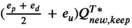
Next, consider the environmental impact from the customer segment involved in the resale of used products. This environmental impact stems from two customer segments. First, the customers that buy new and trade‐in their used product after one period of use have an environmental impact due to production, use, and reverse logistics, that is, 


Sale and P2P Resale Marketplace Model
Since there are multiple buyers and sellers in the marketplace, the sellers compete and, in the long run, settle on an equilibrium selling price, that is, 



In Equation (3), the first term is the apparel firm's profit per period from the sale of new products, that is, 

Next, the per period environmental impact can be obtained as follows. The environmental impact of new products that are purchased by customers every period and disposed of by the customers after one period of use is 
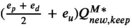



Solution of the Models
By considering all the dynamics of the trade‐in program and P2P marketplace, we derive closed‐form expressions for all variables of interest. We relegate the detailed solution procedure to section EC.3 of the e‐companion. In the next section, we present several results and managerial insights based on the solutions obtained.
Results and Managerial Insights
In this section, we provide results and insights by comparing the prices, profitability, and environmental footprints of both the trade‐in program and the P2P marketplace models.
Comparison of Pricing in the Trade‐In and P2P Models
In the trade‐in and the P2P resale models that we analyze in our work, the apparel firms determine the most profitable levels of new product prices and used product prices, and these pricing decisions are often challenging (
Therefore, although the comparison of prices in the two business models is important for some apparel firms, this issue remains unaddressed in the literature, as no other study, to our knowledge, has modeled the trade‐in and P2P resale marketplaces together. Hence, we attempt to address this important issue in the next proposition.
The apparel firm sells the new product at a higher price in the trade‐in model than the P2P model, that is, The apparel firm sells the used product at a higher price in the trade‐in model than the equilibrium selling price in the P2P resale marketplace that is endogenously determined between sellers and buyers, that is,


It is unclear whether the apparel firm sets a higher price for its products, new or used, in the trade‐in model, as new product prices impact both the sales of new products and the supply of used products for resale, and vice versa. Furthermore, the apparel firm does not directly control the selling activity in the P2P resale marketplace other than by setting the platform fee (COS 2021b). Therefore, it is not clear how the prices in the trade‐in model compare to those in the P2P model. However, Proposition 1 reveals that the trade‐in prices are higher than the P2P prices.
Interestingly, two key factors contribute to this result. First, in the trade‐in model, the apparel firm can strategically dispose part of the trade‐in returns, limiting the number of used products remarketed, allowing it to charge a higher used product price. Second, the used product price over the P2P resale marketplace is endogenously determined between the sellers and buyers, and the competition among the sellers in the P2P marketplace drives the equilibrium resale price down as Lemma EC.3 implies. Therefore, because of all the factors above, the apparel firm charges a higher price for the used products in the trade‐in model, which also drives the new product prices to be higher in the trade‐in model. 10
The practical implication of this proposition is that the apparel firms that want to engage in resales and have better control on prices, limited access, or exclusivity should adopt the trade‐in model. However, increased prices do not necessarily imply increased profitability as we discuss in the next section.
Which Business Model is More Profitable: Trade‐In or P2P?
In the apparel industry, several firms offer trade‐in programs and remarket their used products (e.g., Patagonia) and some other firms operate P2P resale marketplaces (e.g., COS). Motivated by a lack of clear direction regarding which resale strategy to adopt, we ask: When should an apparel firm establish a P2P resale platform, or run its own trade‐in and resale operation? We provide an answer to this question in Proposition 2 below. The threshold in this proposition is provided in the e‐companion.
Each of the business models, that is, the trade‐in or the P2P resale marketplace can be more profitable. In particular, there exists a durability threshold If the product is highly durable, that is, Otherwise, that is, 


It is argued in the literature that the presence of a secondhand market enables the apparel firm to extract additional revenue from the used product sales (Oraiopoulos et al. 2012, Ramani and De Giovanni 2017). Therefore, one may expect that the P2P resale marketplace strategy may be more profitable for products with high durability (Xue et al. 2018). Interestingly, part (i) of Proposition 2 reveals that this reasoning is incorrect. Instead, as illustrated in Figure EC.4 in the e‐companion, the trade‐in model is the better resale strategy for high durability products.
As discussed earlier, in the trade‐in model, the apparel firm can strategically control both the supply (since it determines the trade‐in discount) and the demand (since it determines the used apparel price). As a result, the disposition of the traded‐in product (premature disposal or resale) is managed directly by the apparel firm in order not to substantially lower used product prices. It is also clear that there is a higher value for the buyers of used apparel if the durability is high. Therefore, the higher profitability of the trade‐in model compared to the P2P marketplace model is driven by the greater control over the supply of used apparel and the greater value that used apparel commands because of high durability. Hence, part (i) of the proposition. Furthermore, note that as the perceived quality difference between used products sold by the firm in the trade‐in and consumers in the marketplace programs (i.e., k) increases, as expected, the trade‐in program is favored. In other words, 
Next, we discuss the case when durability is not high. Our proof of Proposition EC.1 implies that the apparel firm sets a high platform fee at moderate levels of durability. This means that a higher marginal fee per transaction is collected at moderate values of durability—hence, there is an increase in the profitability of the apparel firm under the P2P resale marketplace model. Furthermore, in a P2P resale marketplace, the apparel firm relies on individual sellers for the exchange of products rather than dealing with the reverse logistics of the pre‐owned products (i.e., operating return warehouses, collection, and refurbishing activity)—this implies cost savings, which favors the P2P resale marketplace. Proposition EC.2 and the ensuing discussions imply that the trade‐in model may focus significantly more on new product sales than resales when the durability is not high. Therefore, the focus on resales also enables the P2P resale model to perform better than the trade‐in model when the durability is at a medium level. Hence, part (ii) of Proposition 2.
Both parts of this proposition are observed in practice. For example, Patagonia, which adopted a trade‐in model, sells apparel on the higher end of the durability spectrum (O'Rourke and Strand 2017). On the other hand, H&M, which is known for selling moderately durable apparel, operates a P2P channel with its COS brand (
In the next section, we compare the trade‐in with resale and the P2P resale marketplace models based on their impact on the environment.
Environmental Implications
As discussed earlier, the apparel industry has been operating a “take‐make‐dispose” business model—a linear system where apparel is manufactured, used, and disposed at end‐of‐life (Morlet et al. 2017). This has significant negative environmental impacts (Niinimäki et al. 2020). For example, growing material like cotton for apparel requires high volumes of fertilizers, pesticides, and water leading to a significant environmental impact due to production (Niinimäki et al. 2020). Furthermore, the use of apparel has a significant negative impact on the environment due to large amounts of water and energy used during laundry and ironing (Fletcher 2013). There are also environmental impacts associated with disposal—for instance, incineration of textiles may produce harmful emissions such as methane gas, which is a by‐product of wool incineration (Blackburn 2015). There is also an environmental impact associated with repair and refurbishment, but that is usually dominated by the environmental impacts of the other phases in the life‐cycle (i.e., production, use, and disposal). Therefore, non‐governmental organizations and environmental advocacy groups have highlighted that a system‐level understanding of how to transition toward a more sustainable apparel industry is needed (Morlet et al. 2017). These organizations have advocated for circular economy‐based business models instead of the linear model for the apparel industry (Niinimäki et al. 2020). However, there is limited understanding of how different circular economy‐based business models, such as trade‐ins and P2P resale marketplaces, compare in terms of their impact on the environment (Agrawal et al. 2019).
To evaluate the environmental impact of each resale model, the apparel firms and NGOs need to understand the comparative dynamics that result from the optimal pricing decisions, such as the total quantity of new products produced, resales, and the total market coverage (i.e., the total number of customers who buy either new or used products). Hence, we attempt to address this important issue in the next proposition.
Interestingly, the total quantity of new apparel produced can be greater or lower in the trade‐in or P2P models. In particular, the new production in the trade‐in model Here,
The market coverage in the P2P resale marketplace ( The total quantity of used products resold in the trade‐in model
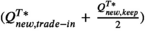






Let us first discuss the total new production. Proposition 3 reveals that the overall new apparel production can be lower or greater in the trade‐in and P2P models depending on the perceived quality difference. Consider the case when the perceived quality difference is lower than the threshold (i.e., 
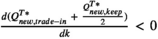


Let us now discuss the market coverage. Proposition 3 states that the market coverage is greater in the P2P resale marketplace model. This is due to the lower used product prices (as depicted in Proposition 3) determined among the buyers and sellers in the marketplace endogenously. This means that lower valuation customers (that remain inactive in the trade‐in model) purchase a used product, effectively increasing the market coverage in the P2P model. Therefore, part (ii) of the proposition.
Interestingly, Proposition 3 further reveals that overall resales are greater in the trade‐in model. Two key factors contribute to this result. First, consumers have greater willingness‐to‐pay for used products sold by the manufacturer under its trade‐in program (since k ≥ 0). This increases the demand for used products sold by the firm and contributes to increased resales in the trade‐in model (to benefit from the greater willingness‐to‐pay for the used products sold by the apparel firm). Second, in the trade‐in model, the trade‐in discount acts as an incentive for customers to replace their used products with new ones, increasing the supply of used products for resale.
Therefore, the practical implication is that Proposition 3 enables the apparel firms to assess their likely comparative “production levels” and “market coverage” if they adopt the trade‐in or the P2P resale business models, as these are two important characteristics in the apparel industry. Furthermore, Proposition 3 also helps the apparel firms and NGOs evaluate the environmental impact of the resale business strategies as we do in the next section.
Which Resale Model is Better for the Environment?
Both COS and Patagonia promote the environmental benefits of their businesses. For instance, Patagonia is a member of the Sustainable Apparel Coalition with a goal to transition to an apparel industry that “produces no unnecessary environmental harm” (Patagonia 2020a). On the other hand, COS also promotes its commitment to sustainability and the environmental benefits from its P2P resale marketplace (COS 2021a). While both firms have voluntarily committed to reducing their environmental footprint, they are doing so through different resale models. However, it is unclear which model is better for the environment. Therefore, we ask: Which resale model is better for the environment? Corollary 1 addresses this question.
Both the trade‐in with resale model and the P2P resale marketplace model can be better for the environment. Particularly, the trade‐in with resale model is better for the environment when the perceived quality difference is significant, that is, the use‐related environmental impact per unit (e
u
) is dominant. On the other hand, the P2P resale marketplace model is better for the environment when the perceived quality difference is insignificant, that is, the repair‐related environmental impact per unit (e
r
) is dominant.
11


When customers are forward‐looking, they may anticipate future resale value and purchase more new products (Oraiopoulos et al. 2012). Therefore, one may expect that the trade‐in program has a worse environmental impact due to increased in new production (Zhang and Zhang 2018). However, Corollary 1 states that the trade‐in program may have a lower environmental impact than the P2P resale marketplace model. This is because the relative environmental impact depends on the new apparel production, market coverage, and used product sales as discussed earlier. As shown in Proposition 3, when the perceived quality difference (between the used products sold in the trade‐in program and the P2P marketplace) is sufficiently high, then the new production is lower in the trade‐in model. Therefore, in this case, if the production‐related environmental impact per unit is dominant, then the trade‐in program may be better for the environment. Furthermore, as shown in Proposition 3, the market coverage is greater in the P2P resale marketplace model. Therefore, if the use‐related environmental impact per unit is dominant, then the trade‐in program may be better for the environment. Hence, part (i) of the corollary.
On the other hand, the environmental impact can be lower in the P2P model. As shown in Proposition 3, the overall production of new apparel is lower under the P2P resale marketplace when the perceived quality difference is sufficiently low. Therefore, when the perceived quality difference is sufficiently low and the production‐related environmental impact per unit is dominant, the P2P model may be better for the environment. Furthermore, since the resale and refurbish activity is lower in the P2P resale marketplace model, it may be better for the environment when the repair‐related environmental impact per unit is dominant. Therefore, part (ii) of Corollary 1.
Our findings have implications for government agencies promoting circular economy business models to lower the environmental impacts of traditional business models (EAC 2019) and as a way for apparel firms to decide which resale model to adopt. We discuss further practical implications of these findings in the next subsection, where we compare the profitability and environmental impact of each resale business model for different product types.
Which Resale Model is Better for Both Business and Environment?
Our discussion in section 4.2 reveals that each resale business model is more profitable under certain conditions. However, most apparel firms engaged in the resale of used products also claim that their preferred resale model, that is, the trade‐in model or the P2P resale marketplace model, is good for the environment. However, some environmental advocacy groups and consumer watchdogs argue that some of these claims are greenwashing, that is, misrepresenting the environmental benefits of their business models (Hitti 2019). Hence, in this section, we check when profitability and environmental outcomes are aligned for different product categories based on (i) the durability of the apparel (i.e., δ), (ii) the perceived quality difference between the used apparel in both models (i.e., k), and (iii) having a use‐dominant environmental impact (i.e., 

As discussed before, Proposition 2 suggests that the trade‐in model is better for profitability when the product durability is high. However, not all durable products are equivalent in terms of their overall environmental impact. For example, some durable products, such as jeans, are washed on average several times more than some other durable apparel, such as outdoor jackets (Roos et al. 2015). Hence, the environmental impact of use is more dominant for jeans (Roos et al. 2015). Therefore, as implied by Corollary 1, the trade‐in business model is better for the environment for an apparel like jeans that has a use‐dominant environmental impact. Hence, the trade‐in model is profit‐maximizing and aligned with having a smaller environmental footprint in this case. This is illustrated in the upper‐right quadrant of Figure 3a and the upper‐half of Figure 3b. This win‐win strategy is also observed in practice, that is, Patagonia offers a trade‐in discount to customers who return their branded used jeans.
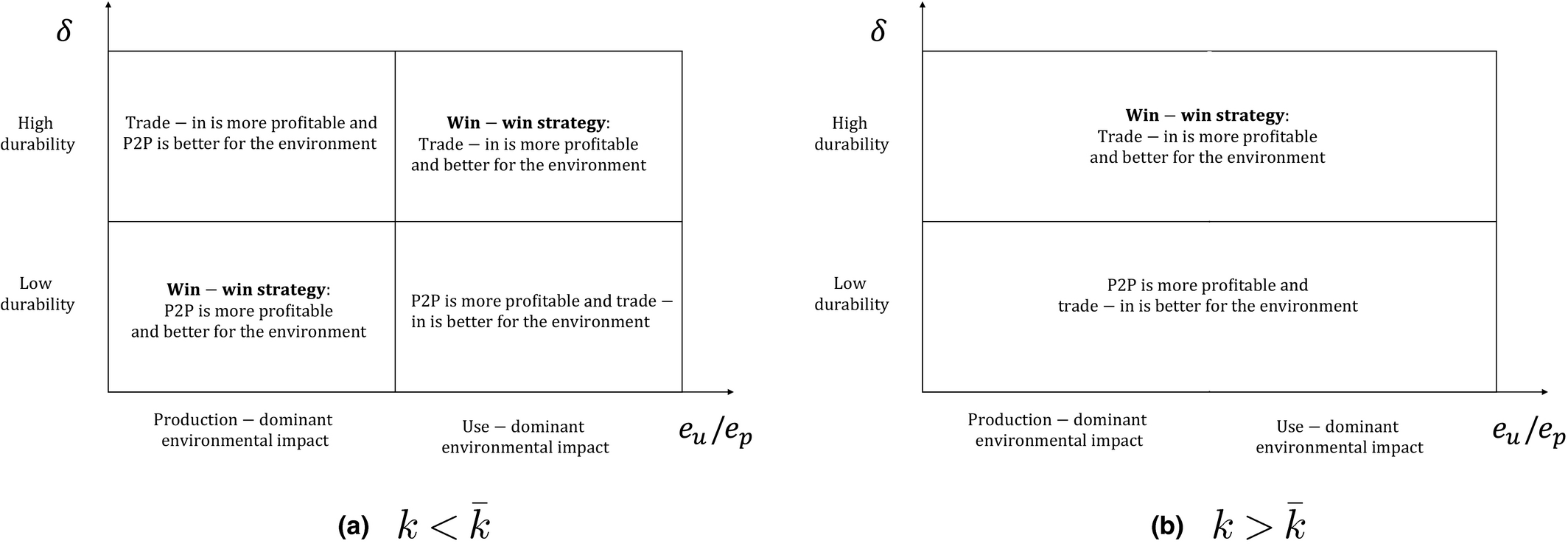
Illustration of Best Resale Business Models for Environment and Profitability
On the other hand, as discussed earlier, other durable apparels like outdoor jackets have a smaller environmental impact from use than other durable apparel like jeans (Roos et al. 2015). For such products, the production phase (consisting of fiber production, spinning, weaving, and dyeing processes) contributes most of the environmental impact (Fletcher 2013). However, in this case, although Proposition 2 suggests that the trade‐in model maximizes the profit of the apparel firm, Corollary 1 reveals that both resale models may have a smaller environmental footprint. Therefore, there may be a misalignment of business objectives and environmental footprint when the perceived quality difference (between the used products sold in the trade‐in program and the P2P marketplace, i.e., k) is low as illustrated in the upper‐left quadrant of Figure 3a. 13
Some apparel firms seem to be addressing this misalignment. For example, Patagonia, which is regarded as environmentally conscious (Patagonia 2020a), provides trade‐in discounts to customers for returning their used outdoor jackets, but also sells outdoors jackets made from 100% organic cotton which have lower production based environmental impact compared to polyester‐based jackets (Reinhardt et al. 2014). By doing so, they may be attempting to transition from the upper‐left quadrant to the upper‐right quadrant in Figure 3a, where there is a greater alignment of profit and environmental impact.
Next, Proposition 2 suggests that for moderate or less durable products, the P2P resale marketplace model is better for profitability. However, not all such products are the same in terms of their overall environmental impact. For example, some relatively lower durability products such as T‐shirts have more laundry and ironing requirements than some other apparel that are also not highly durable, such as polyester dresses (Roos et al. 2015). As a result, the use phase dominates the environmental impact of T‐shirts. Then, Corollary 1 states that the trade‐in model has a lower environmental footprint for such products. Therefore, there is a misalignment of business objectives and environmental footprint for products exchanged in the P2P marketplace with a use‐dominant environmental impact factor. This is illustrated in the lower‐right quadrant of Figure 3 and the lower half of Figure 3b. To address this misalignment, if the perceived quality difference is low, apparel firms can reduce the use‐based environmental factors for apparel like T‐shirts by educating customers (e.g., reducing their washing and tumble‐drying frequency and washing clothes at lower temperatures). By doing so, they can transition from the lower‐right quadrant to the lower‐left quadrant, which can better align the profitability and the overall environmental impact of such products.
On the other hand, as discussed earlier, polyester dresses are also not highly durable (Roos et al. 2015). Since polyester requires petroleum, it leads to a higher production‐based environmental impact due to fossil fuel use (Niinimäki et al. 2020). As Proposition 2 suggests, the P2P model is better for the profitability of the apparel firm in this case. However, Corollary 1 states that both the trade‐in and the P2P model can be the environmentally friendlier option. Therefore, there is an alignment of business and environmental objectives in products with production‐dominant environmental impact that are not highly durable when the perceived quality difference is low; otherwise, there is a misalignment. This is illustrated in the lower‐left quadrant of Figure 3a and the lower half of Figure 3b, respectively.
Discussion and Conclusions
In this section, we discuss our findings and practical implications on (i) the business impacts of the trade‐in and P2P marketplace models and (ii) their relative environmental footprints.
Business Impacts of the Trade‐in and P2P Marketplace Models
Several apparel firms have already adopted or have plans to adopt resale strategies. For example, Patagonia offers a trade‐in program and resells its products on its online platform (Patagonia 2020c). On the other hand, some apparel firms, such as COS, operate a P2P resale marketplace, where customers can sell and buy used clothing (
Therefore, our results suggest that Patagonia's move to a trade‐in program and COS's move to facilitate a P2P resale marketplace are a natural consequence of their strategies to sell apparel with high against moderate‐to‐low levels of durability, respectively. Our findings have practical implications for apparel firms that NGOs and environmental advocacy groups are pressuring to adopt circular business models to operationalize and facilitate reuse (EAC 2019). Furthermore, we find that the relative profitability of the programs is more sensitive to the fixed cost of the trade‐in program rather than the P2P marketplace from a practical perspective. This implies that if the cost of establishing and maintaining a trade‐in program reduces, then the trade‐in strategy may be the preferable choice for firms interested in resale business models.
Furthermore, we also provide several findings based on the pricing dynamics. For example, although our focus is “not” on the sale of luxury items and their dynamics, some fashion houses desire to maintain exclusivity and favor business models that keep their prices high and do not implement any form of resale business models (e.g., see McDowell 2019). However, as customers become more environmentally conscious and different groups advocate for resale business models, these luxury brands might want to engage in resales (Luxe 2020). Therefore, we investigate this issue and compare the pricing strategies in the trade‐in and P2P models for both new apparel and used items sold in the trade‐in program or the P2P marketplace. We find that the new and used product prices are higher in the trade‐in model.
Several factors contribute to this result. In the trade‐in model, the apparel firm has direct control over the new and used product prices along with the trade‐in discount. Furthermore, the apparel firm can strategically dispose part of the trade‐in returns, limiting the quantity of used apparel remarketed, allowing it to charge a higher price. On the other hand, the apparel firm that engages in the P2P resale marketplace does not directly control the used product price because it is endogenously determined between the sellers and the buyers in the marketplace. Furthermore, the competition among the sellers in the P2P marketplace lowers the equilibrium resale price. In addition, the apparel firm incurs the reverse logistics cost in the trade‐in model, while the sellers incur the reverse logistics cost in the P2P model. Therefore, the apparel firm has an incentive to charge higher prices for new and used products in the trade‐in model. The practical implication of this result is that the apparel firms that want to have better price control, limited access, or exclusivity, may adopt the trade‐in model if they need to participate in some reselling model due to the pressing need from the market and push from environmental groups.
The implications above depend on the pricing structure under both models. Since higher durability is associated with a higher willingness to pay for used products, manufacturers may take advantage of this by charging higher used prices. Hence, we explore the impact of durability on pricing and find that the used and new product prices may decrease with durability. Hence, the managerial insight here is that more durable products may not always be priced higher—in fact, they may be available at a lower price point when firms engage with the secondary market. Therefore, for apparel firms planning to get involved in the secondary market through either of the resale models, pricing decisions may need to be taken with care to balance the mix of the revenue from selling new and used products. Next, we discuss our findings based on the environmental impact and its alignment with profitability.
Environmental Impacts of the Resale Models and Alignment with Profitability
Furthermore, environmental advocates have proposed that adopting resale business models, that is, trade‐in with resale or P2P resale marketplace, can lower an apparel firm's environmental impact (Morlet et al. 2017). However, it is not clear which of these resale business models can lower the environmental impact of the apparel firm (Niinimäki et al. 2020). As illustrated in Figure 3, both the trade‐in with resale model and the P2P resale marketplace model can be better for the environment. In particular, if the use‐based environmental impact of the apparel (due to frequent laundry, ironing, etc.) is relatively high, then the trade‐in model has a lower environmental impact. On the other hand, if the production‐based environmental impact is higher and the perceived quality difference (between the used products sold in the trade‐in program and the P2P marketplace) is low, then the P2P resale marketplace model can also be better for the environment.
Therefore, combining the results on the relative profitability of each model with the environmental impact discussions reveal settings in which the business and environmental objectives are aligned and situations when they are not. In the latter scenario, we also discuss ways in which businesses can better align these objectives.
Future Research Opportunities
There are several future research opportunities in the business setting we investigate. For example, the apparel firm, Patagonia, had initially planned to launch an online P2P marketplace but later switched to a trade‐in model. Our findings provide analytical evidence on the viability of this strategy. However, future research can empirically validate or investigate the rationale behind Patagonia changing its resale business model in a case study. Furthermore, some firms are already utilizing trade‐in or P2P resale‐based business models in the apparel industry. Therefore, empirically investigating the impacts of product and market characteristics on the adoption of these resale models and their effects on profitability and environmental footprint are open and promising research opportunities. Furthermore, although not observed in practice, analytically investigating the profitability of a firm that concurrently operates a trade‐in resale program and a P2P resale marketplace is another venue for future research.
Footnotes
We also refer to the sale and trade‐in with resale model as the trade‐in model; and refer to the sale and P2P resale marketplace model as the P2P resale marketplace model or the P2P model hereafter for brevity.
The upper bound of the distribution is set to 1 for ease of exposition and for brevity in the discussions. Consideration of an arbitrary upper bound does not change any of our results qualitatively.
To ensure that the new and used products are vertically differentiated with a clear preference ordering, we consider that δ
Although it is possible to model the case where a customer can hold more than one product in a period, doing so does not provide additional insights. Hence, for brevity, we skip this analysis and discussions.
Although it is also possible to utilize different transaction costs such as commissions instead of flat fees, we do not examine other types of transaction costs for brevity.
The average cost per ton to landfill in the United States is $54 (Powell and Chertow 2019), whereas the average weight of a T‐shirt is less than 5 oz (Roos et al.  ). Hence, the landfill cost per T‐shirt is less than $0.01 and could be ignored.
We numerically show that our results are qualitatively unchanged in a two‐period time horizon setup in section EC.5.2 of the e‐companion.
Since this situation leads to a greater number of possible purchasing patterns that are sustained in the steady state—for example, a customer may buy a new product (say, Product 1) and trade in the used product for a different used or new product (say, Product 2) in the next period—the resulting problem is analytically intractable. Therefore, we take recourse to numerical analysis and find that our key results are unchanged in this setting. The details of the model and an illustration of our numerical results are provided in section EC.5.1 of the e‐companion.
As discussed before, in line with the literature (e.g., see Huang et al. 2001, Rao et al. ), since we focus on equilibrium settings that are homogeneous or time consistent, exactly half of the {new,keep} customer segment buys a new product in a period. The other half utilizes the used product that they bought in the previous period. Therefore, the formal proof is straightforward and hence skipped for brevity.
We provide additional results on how durability impacts the platform fee in the P2P resale marketplace and the trade‐in price in section EC.4.1 of the e‐companion.
We also find that the results in parts (i)(a), (i)(b), and (ii)(a) of this Corollary hold when comparing the environmental impact with a setting without any resales (no‐resale model). As expected, if e r is substantially large in (ii)(b), then the no‐resale model has a lower environmental impact than both resale models. We provide further details in section EC.6 of the e‐companion.
This behavior is not observed in Figure 3b. The new production level is lower in the trade‐in model when the perceived quality difference (i.e., k) is high (as shown in Proposition ). Therefore, the environmental impact of the trade‐in model is better in this case.