







Abstract
To retain old customers and promote sales, firms offer trade‐in programs in which consumers bring in an old product and receive a trade‐in rebate when buying a new one. However, after buying the new product, the consumer who has traded in (the “trade‐in consumer”) may return the new product and claim a refund for it if she/he is not satisfied with it. In this situation, under a full‐trade‐in‐return (FTR) policy, trade‐in consumers receive a generous refund that includes a trade‐in‐rebate for them to redeem if they purchase again in future. Alternatively, some firms have a partial‐trade‐in‐return (PTR) policy under which trade‐in consumers who return a newly purchased product only receive a refund for the amount of money they paid (without including the trade‐in‐rebate). In this study, we build stylized analytical models to explore the optimal choice of a trade‐in‐return policy. We find that there is no difference to the firm between an FTR and a PTR policy when no trade‐in consumers keep unsatisfactory new products. In the case of a relatively medium residual value of the used product, FTR is always the better choice for the firm. When some trade‐in consumers keep unsatisfactory new products, we show that FTR (PTR) is the better choice when the used product's durability is sufficiently low (high). We also show that the firm may not reduce its trade‐in rebate when the “average new product satisfaction rate” of trade‐in consumers increases. In the extended models, we find that, the firm is more likely to prefer PTR to FTR under the online–offline dual‐channel retailing mode, but tends to prefer FTR to PTR when there is a competitive secondhand market, and should make the same optimal trade‐in return policy when there are two selling periods.
Introduction
Background and Motivation
Trade‐in programs are business practices in which consumers return their used products in exchange for trade‐in rebates that can be redeemed when they buy new products. Some trade‐in programs are restricted to the seller's own branded products whereas others include any brand. Despite having many different forms, trade‐in programs are routinely used as an operations strategy in the consumer electronics, smart‐phones, fashion apparel (Choi et al. 2018), automobile, and computerized information technology industries (Li et al. 2011). The popularity of trade‐in programs can be explained by their success in helping firms retain their old consumers and promote the sales of new products (Ray et al. 2005). As a typical trade‐in example, consider the iPhone, sold at Apple Stores. If a replacement consumer (that is, a consumer who owns a used iPhone) is ready to buy a new iPhone, she or he can return her/his used iPhone to Apple and receive a rebate (called a trade‐in‐rebate) that can then be applied to a new purchase. In some cases, if the replacement consumer is not ready to make a purchase, she or he can turn in her/his used iPhone to Apple and receive an Apple store gift card, which can be redeemed for any future Apple purchase (
Consumer returns are also a regular practice, and have become especially prominent with the advance of e‐commerce. According to recent statistics, the offline product return rate in brick‐and‐mortar stores is roughly 8%, whereas the online product return rate is almost 25% (SaleCycle 2020). In the United States, delivery costs resulting from consumer returns are estimated to be US$550 billion by 2020, an increase of 57.1% from 2017 (Statista 2021); the return deliveries costs of e‐commerce items are estimated to be US$348 billion by 2023, which means an increase of 187.6% from 2017 (Shopify 2021). Thus, there is no doubt that consumer returns are an important issue to sellers.
Both consumer returns and trade‐ins occur in practice. Any consumer, including trade‐in consumers (those replacement consumers who join trade‐in programs) and new consumers (who do not own products for trade‐in), can return their recently purchased “new products” to the seller (hereinafter, “firm”) they purchased from if they are not happy with them. This raises an important issue. After buying a new product with a trade‐in rebate, a trade‐in consumer can return it and claim a refund. In this situation, does it make sense for the firm to generously offer a refund that includes both the money that the trade‐in consumer paid and the trade‐in rebate? If the answer is “yes,” the firm offers a full‐trade‐in‐return (FTR) policy. However, some firms are less generous and only implement a partial trade‐in‐return (PTR) policy, under which trade‐in consumers receive a refund for the amount of money they paid, without the trade‐in rebate. In this study, we examine FTR and PTR as distinct types of “trade‐in return” (TIR) policies. In practice, firms such as Apple, Huawei, Xiaomi, Nokia, OPPO, and DJI offer a FTR policy, under which trade‐in consumers who return their newly purchased products
1
receive a trade‐in rebate (in the form of a “trade‐in credit”) for future purchases (
Real‐World Practices of FTR and PTR
Notes
FTR, full‐trade‐in‐return; PTR, partial‐trade‐in‐return.
We consider two types of consumers (that is, the new consumer and replacement consumer) in this study. In the context of FTR, if a trade‐in consumer returns an unsatisfactory new product, she or he will receive a trade‐in rebate in exchange for forfeiting her recently purchased product, with the firm absorbing the cost. In the context of PTR, if a trade‐in consumer returns a product, she/he will bear the expense of forfeiting her used product. Considering that unsatisfactory products still have values for trade‐in consumers, some trade‐in consumers may not return new products they find unsatisfactory. The firm offering the PTR policy is happy because it avoids large losses from consumer returns and it can obtain additional rebate incomes. Comparing the PTR and FTR policies, replacement consumers' willingness to trade in is lower under PTR, which may reduce the demand for the firm's products derived from trade‐in. The above‐described trade‐offs clearly show that PTR and FTR have their own pros and cons. As a result, it is critically important for firms offering a trade‐in service to explore the conditions under which either PTR or FTR is preferred.
Research Questions and Major Findings
Considering the challenges discussed above and the real‐world issues, some questions arise. How do FTR and PTR affect the choices of replacement consumers who consider joining a trade‐in program? How should firms determine the optimal product price and trade‐in rebate considering consumer returns? Which TIR policy is a better choice for a firm? Does the secondhand market affect a firm's preference for FTR or PTR? Does the online–offline dual‐channel retailing mode affect the optimal TIR policy? How should a firm determine the optimal TIR policies when there are two selling periods with preannounced pricing and dynamic pricing mechanisms?
To answer these questions, we analyze a firm that produces and sells a new product to both new consumers and replacement consumers (who own used products). Moreover, we consider that if the product is unsatisfactory, consumers will have a lower valuation of the product quality than the case when the product is found to be satisfactory. Based on the firm's TIR choices, we develop two theoretical models, namely Model FTR and Model PTR. We investigate the optimal product pricing and trade‐in rebate decisions under these models and compare the optimal profits and consumer surpluses under them. Among the findings, we analytically prove that there is no difference to the firm between FTR and PTR if no trade‐in consumers retain unsatisfactory new products. Interestingly, the firm may not reduce its trade‐in rebate when the average new product satisfaction rate of trade‐in consumers increases. To generate additional insights and check the robustness of our analytical results, we extend the model to examine cases with (i) a competitive secondhand market, (ii) online–offline dual‐channel retailing mode, and (iii) two selling periods with preannounced pricing and dynamic pricing mechanisms.
Contributions and Organization of the Study
Both consumer returns and product trade‐ins are commonly observed in practice. However, the literature has never explored how the two practices, taken together, influence operations under TIR policies. This study positions itself as the first to fill this gap. The findings highlight a few novel insights, such as (i) the equivalence between FTR and PTR (from the firm's perspective) holds if no trade‐in consumers retain their unsatisfactory new products; when the residual value of the used product is relatively medium, FTR is always better than PTR. If some trade‐in consumers retain their unsatisfactory new products, we show that FTR (PTR) is the better choice when a used product's durability is sufficiently low (high); (ii) a firm may not reduce its trade‐in rebate when the average new product satisfaction rate of trade‐in consumers increases; and (iii) the firm is more likely to (1) prefer PTR to FTR when the online–offline dual‐channel retailing mode is present, (2) prefer FTR to PTR when there is a competitive secondhand market, and (3) should make the same choice for the optimal TIR policy when there are two selling periods. We believe that these findings not only contribute to the literature but also advance the industrial practices related to trade‐in and consumer return policies.
The rest of this study is arranged as follows. Section 2 reviews the related literature. Section 3 describes our research problems, in which demand and return functions, cost structures, and consumer surpluses are established. Section 4 introduces two models, derives the optimal solutions, and reports findings from the analyses. Section 5 presents several important extended models. Section 6 concludes the main insights, presents limitations, and highlights future research directions. To enhance the presentation, a list of notation and some detailed model formulations are included in the appendix. All proofs are provided in Online Appendix S1.
Literature Review
The study investigates TIR policies (that is, the trade‐in policies related to consumer returns). We concisely review the following two related research areas.
The previous literature has examined the reasons why firms offer trade‐in policies, such as the following: improving consumers' switching costs (Klemperer 1987); reducing the competitiveness of the secondhand market (Levinthal and Purohit 1989); enhancing consumers' purchasing frequency (Van Ackere and Reyniers 1995); and reducing the impact of the “lemon problem” (Rao et al. 2009). In addition, some operations management (OM) issues have been explored. For instance, Ray et al. (2005) analytically investigated optimal product prices and trade‐in rebates. The authors showed the impact of some critical factors on making the optimal decisions. Li et al. (2011) studied trade‐in management in B2C markets. Yin et al. (2015) examined optimal trade‐in policies by considering two successive generations of products. Zhu et al. (2016) explored the optimal trade‐in policies within a competitive environment. Han et al. (2017) and Ma et al. (2017) derived the optimal trade‐in policies for remanufactured products. Other related studies on trade‐ins have probed the optimal online and offline trade‐in operations strategies (Cao et al. 2018); remanufacturing systems with trade‐ins and the role of government policies (Zhang and Zhang 2018); the optimal trade‐in policies considering environmental regulations for carbon emissions (Miao et al. 2018); e‐commerce platforms' optimal trade‐in policies (Cao et al. 2019); the optimal trade‐in policies when there are strategic, forward‐looking consumers (Liu et al. 2019); the extended consumer responsibility associated with trade‐ins (Sheu and Choi 2019); the optimal pricing and trade‐in system for successive multiple generations of goods when there are forward‐looking consumers (Hu et al. 2019); and the optimal trade‐in program when the trade‐in for cash, upgrade, and hybrid trade‐in programs are present (Xiao and Zhou 2020). Note that similar to these studies of trade‐ins, this study also explores the optimal trade‐in policies. Specifically, the consumer utility model in this study follows many of the prior studies (e.g., Ray et al. 2005). However, unlike other research, this study considers trade‐in policies with consumer returns. To the best of our knowledge, this has never been examined in prior analytical studies of OM.
The second stream of related research pertains to consumer returns. Note that consumer returns are different from channel returns (also called buybacks), as Pasternack (1985), Emmons and Gilbert (1998), Brown et al. (2008), Zhao et al. (2014), Genc and De Giovanni (2017), and Genc and De Giovanni (2018) observed. Some prior studies of consumer returns have investigated unconditional full‐refund policies (e.g., Davis et al. 1995, Ferguson et al. 2006, Shulman et al. 2011). In particular, Chen and Chen (2017) explored the optimal channel choice and consumer return policies for retailers. The authors suggested retailers offer a full‐refund service if the net salvage value of the returned product is positive.
In addition to full‐refund policies, partial‐refund policies for consumer returns have been widely studied (Choi 2013, Hess et al. 1996, Shulman et al. 2009). For instance, Su (2009) investigated the impact of partial‐refund policies on supply chain performance. The authors found that consumer returns affected the supply contract's performance in coordinating the channel. Other than full and partial‐refund policies, a few important studies have recently been published on related matters. For example, Tran et al. (2018) compared quota‐based and partial‐refund consumer return policies. They showed that the variance in manufacturers' profits was higher under the quota‐based return policy. Since the emergence of e‐commerce, many studies have also reported findings on consumer return policies in this context (Altug and Aydinliyim 2016, Mukhopadhyay and Setoputro 2004). For instance, Hua et al. (2017) investigated the optimal shipping and return policies for “no‐questions‐asked” e‐commerce consumer returns. For a comprehensive review of consumer returns in the OM literature, please refer to Abdulla et al. (2019). See Online Appendix S2 for more elaborated discussions on how this study is different from several recently published important studies.
As can be seen from the literature, consumer returns are important to OM and have been widely explored. However, the ways that consumer returns affect the choice of optimal trade‐in policies remain largely unknown. Given that consumer returns and trade‐in programs coexist, and they significantly affect consumers' purchasing decisions, it is crucial to explore them together to establish the optimal TIR policy. To the best of our knowledge, this study is the first to examine consumer returns and trade‐in programs together. The resulting managerial insights are novel and important.
Problem Description: Preliminaries
We consider a firm (e.g., Samsung) that produces and sells a new product (e.g., mobile phone) to consumers. In the market, there are “new consumers” and “replacement consumers.” In this study, new consumers are defined as those who have not previously purchased products from the firm. Replacement consumers are defined as those who have previously purchased and hence own the (now) used product. Following Ray et al. (2005), we consider the case in which each replacement consumer has only one used product with the same residual value. We also focus on the case in which the new product and the used product belong to the same common product type, as is typical (e.g., a consumer trades in an old‐model mobile phone to buy a new mobile phone). Both the new consumers and the replacement consumers can return their newly purchased products if they are unsatisfactory.
For consumer returns, the firm offers a money‐back guarantee, full‐refund policy. For new consumers, this is simply a full‐refund policy. For trade‐in consumers, the firm offers either an FTR or a PTR policy, as defined in section 1. Note that when trade‐in consumers return newly purchased products, as a common practice, firms do not return the “used products for trade‐in” to them. When “newly purchased products” are returned, the firm could obtain their residual value, but the firm still suffers some loss considering its production and operations costs. 2 This study investigates the firm's optimal decisions under FTR and PTR, to determine when FTR or PTR are the optimal policy. To enhance the study, a list of notation is presented in Table A1 in Appendix A1.
Following the literature (e.g., Ray et al. 2005), we consider a situation in which the market includes both new consumers and replacement consumers. Their sizes are given by M and N, respectively.
Similar to Jing (2017) and Liao et al. (2020), we assume that the consumers are heterogeneous with respect to their valuation 


As we mentioned above, unlike the previous studies, we consider both the new product return problem and trade‐in policies. Pinpointing the problem of consumer returns, we assume that the average new product satisfaction rate of new consumers is 






Under PTR, with the unit trade‐in rebate r, for a trade‐in consumer, if a new product is satisfactory, she obtains a utility of 



For the cost‐revenue parameters, the new product's unit production cost is equal to 


Demand and Return Quantity Function
For a new consumer
3
who is ready to purchase a new product, if she plans to return the purchased product that is unsatisfactory, she can obtain a utility of 



The return quantity from new consumers can easily be found as follows:
Under FTR, it is a straightforward process to find that a replacement consumer receives a utility of 




The return quantity from replacement consumers under FTR can be given as follows:
Under PTR, a replacement consumer can obtain a utility of 








The return quantity from replacement consumers under PTR can be given as follows:
Looking at Equations (1)–(6), we can see that the demand functions and return quantity functions appear similar in “format.” However, there are some differences that are driven by the type of consumer and the average new product satisfaction rate with respect to the corresponding consumer type. (Please refer to the Online Appendix for the detailed proof of utilities, demand and return quantity functions).
Consumer Surplus
Trade‐in programs relate not only to the firm, but also to consumers. As a result, consumer surplus is a key area to explore when we examine trade‐ins. Specifically, the consumer surplus has two parts: the consumer surplus from the new consumers and consumer surplus from the replacement consumers.
Under FTR, the consumer surplus can be derived as follows:
Under PTR, the consumer surplus in the case of 

Under PTR, the consumer surplus in the case of 
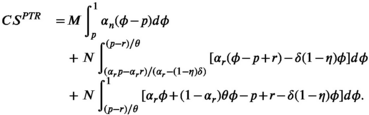
The above‐derived consumer surplus values under different TIR models are used for subsequent analyses.
Basic Models and Analyses
In this section, we build analytical models to investigate the optimal (new) product pricing, trade‐in rebate, and TIR policies of the firm under FTR and PTR. Note that the decision variables for the firm are the product price p and trade‐in rebate r.
Different Models
Model FTR
Under Model FTR, the firm's profit includes five parts, namely the (i) profit from new consumers without returns, (ii) loss from new consumers with returns, (iii) sales profit from replacement consumers without returns, (iv) loss from replacement consumers with returns, and (v) profit of recycling used products from replacement consumers. Thus, the firm's optimization problem under Model FTR is given as follows:
Solving (10) yields the optimal decisions, which are shown in Table 2.
The Optimal Decisions under the Basic Models
Model PTR
Under Model PTR, the firm's profit includes the following six parts: (i) profit from new consumers without returns; (ii) loss from new consumers with returns; (iii) sales profit from replacement consumers without returns; (iv) loss from replacement consumers with returns; (v) profit of recycling used products from replacement consumers; and (vi) additional rebate income from replacement consumers with returns. Thus, the firm makes its optimal decisions under PTR by solving (11):
For a notational purpose, in this study, we use PTRL (that is, when the used product's residual value is sufficiently low) to represent a case under the condition of 




Solving (11) gives the optimal decisions under Model PTR, which are summarized in Table 2 (in three cases, namely PTRL, PTRM, and PTRH).
Results and Analysis
In section 4.1, we solved the firm's optimal product pricing and trade‐in rebate decisions under different trade‐in rebate policies and subcases. As we aim to explore the optimal pricing, trade‐in rebate, and TIR policies of the firm, we use Lemma 1 to show the relationship among the optimal product prices under models FTR and PTR.

Lemma 1 shows that the optimal product prices under Models FTR and PTR are equal. This is a solid finding that is consistent with the reality that firms do not change their products' selling price irrespective of the type of trade‐in services they offer. This is also consistent with the reported findings in the literature (see Cao et al. 2018). Lemma 1 thus reveals that the firm's TIR policy has no effect on the optimal product pricing decision for new products. This is an interesting result.
The firm's TIR choices have different impacts on the utility of the replacement consumers who consider joining the trade‐in program. Lemma 2 shows how the TIR choices affect the optimal trade‐in rebates.
The relationship between optimal trade‐in rebates under Model FTR, and PTR‐related models (Models PTRL, PTRM, and PTRH) are given as follows: In the case of In the case of









Lemma 2(a) shows that the optimal trade‐in rebate under Model FTR is less than the one under Model PTRL. Under Model PTRL, the replacement consumers will choose to return their newly purchased products if the products are unsatisfactory. Compared with those under Model FTR, the replacement consumers under Model PTRL are less willing to trade in, because the firm under Model PTRL does not offer any “refund” for the trade‐in rebate when the product is returned. Thus, compared with Model FTR, under Model PTRL the firm should increase its trade‐in rebate to entice more replacement consumers to join the PTR‐related models. This result can be illustrated by a real‐world example:
Lemma 2(b) shows that when the consumer‐perceived product quality for unsatisfactory product is less than a threshold value, the optimal trade‐in rebates under Models PTRM and PTRH are larger than they are under Model FTR. In other words, for the case when the consumer‐perceived product quality for unsatisfactory product is relatively low, most replacement consumers will choose to return the purchased products if they feel unsatisfactory. In this case, similar to Lemma 2(a), compared with Model FTR, the firm under Models PTRM and PTRH should improve its trade‐in rebate to entice more replacement consumers.
Lemma 2(c) shows that, when the consumer‐perceived product quality for unsatisfactory product is less than the corresponding threshold value, the optimal trade‐in rebates under Models PTRM and PTRH are larger than the one under Model FTR; otherwise, the optimal trade‐in rebates under Models PTRM and PTRH are less (larger) than the one under Model FTR if the unit loss from the returned product is smaller (larger) than the threshold value. It means that when the consumer‐perceived product quality for unsatisfactory product is relatively larger, most replacement consumers will choose to retain their purchased products even if they are unsatisfactory. Under the scenario, in which the unit loss from the returned product is sufficiently small, the firm under Models PTRM and PTRH cannot obtain a significantly larger profit than it can under Model FTR. Thus, under Models PTRM and PTRH, compared with FTR, the firm should reduce its trade‐in rebate to earn more unit trade‐in profit. However, when the unit loss from the returned product is relatively large, under Models PTRM and PTRH, the firm can obviously obtain a larger profit than it can under Model FTR (from the perspective of having a sufficiently large unit loss from the returned product). As a consequence, compared with the case under Model FTR, the firm under Models PTRM and PTRH should improve its trade‐in rebate to encourage more replacement consumers to join its trade‐in program.
Lemma 2 suggests that under Model FTR, in some conditions, the firm should set a higher trade‐in rebate than it would under the PTR‐related models if the consumer‐perceived product quality for unsatisfactory product is not sufficiently low and the unit loss from the returned product is not sufficiently high. Otherwise, when the opposite case occurs, the firm under the PTR‐related models should set a higher trade‐in rebate than it would under Model FTR.
From the expression of the optimal trade‐in rebate, the optimal trade‐in rebate is affected by the parameters 

The optimal trade‐in rebates exhibit the following properties: (a) The optimal trade‐in rebate decreases with 



Proposition 1(a) shows that the optimal trade‐in rebate decreases with the average new product satisfaction rate of new consumers. As 
Proposition 1(b) indicates that the optimal trade‐in rebates under Models FTR and PTRL increase with the average new product satisfaction rate of replacement consumers. As 


Proposition 1 uncovers that the impact brought by the replacement consumers' average new product satisfaction rate on the optimal trade‐in rebate depends not only on the size of the used product's residual value, but also on the size of the unit loss from the returned product.
From Lemmas 1 and 2, we observe that the TIR choices do not affect the optimal product prices but affect the optimal trade‐in rebates. Lemma 3 summarizes how the TIR choices affect the optimal product demands and return quantities.
The relationships between optimal product demands and new product return quantities under Model FTR, and the PTR‐related models are given as follows: (a) 











Lemma 3(a) shows that the optimal new product demands and new product return quantities from new consumers under Models FTR and PTR are equal, respectively. In Lemma 1, we also find that the optimal product prices under Models FTR and PTR are equal. Since the firm's TIR policies do not affect new consumers' utility, the product demands and new product return quantity from new consumers under different models are therefore equal.
Lemma 3(b) suggests that the optimal trade‐in demands and new product return quantities from replacement consumers under Models FTR and PTRL are equal, respectively. Although under Model PTRL, the firm does not offer a trade‐in rebate to trade‐in consumers who return their unsatisfactory new products, compared with Model FTR, the firm sets a higher trade‐in rebate. Compared with those under Model FTR, replacement consumers under Model PTRL can obtain more utility from trade‐in rebates but can also suffer a higher loss if they return their newly purchased products, which makes the trade‐in demands under Models FTR and PTRL equal. Since the replacement consumers under Models FTR and PTRL will return unsatisfactory newly purchased products, the new product return quantities from the replacement consumers under Modes FTR and PTRL are equal.
Lemma 3(c) shows that the optimal trade‐in demands and new product return quantities from replacement consumers under Model FTR are larger than those under Model PTRM. Considering that the trade‐in rebate under model PTRM is smaller than it is under Model PTRL, the trade‐in demand under Model PTRM is smaller than it is under Model PTRL. Lemma 3(b) shows that the trade‐in demands under Models FTR and PTRL are equal. Thus, the trade‐in demand under Model PTRM is smaller than the one under Model FTR. Similarly, the new product return quantity from replacement consumers under Model PTRM is smaller than the one under Model FTR.
Lemma 3(d) shows that if the unit loss from the returned product is less (resp., more) than the threshold, the trade‐in demand from replacement consumers under Model FTR is greater (resp., less) than it is under Model PTRH. In the context of a sufficiently low unit loss from the returned product, Model PTRH reduces replacement consumers' willingness to trade in. Thus, the trade‐in demand from replacement consumers under Model PTRH is lower than it is under Model FTR. Otherwise, compared with Model FTR, under Model PTRH, the firm can avoid considerable return losses. As a consequence, under Model PTRH, the firm will increase its trade‐in rebate to entice more replacement consumers.
Lemma 3(e) shows that the new product return quantity from replacement consumers under Model FTR is less (resp., greater) than it is under PTRH if the used product's residual value is sufficiently small (resp., large). In the context of a sufficiently low used product's residual value, under Model PTRH, the firm has less reason to increase its trade‐in rebate (to attract more replacement consumers). As a result, the replacement consumers in this context are more willing to return the unsatisfactory newly purchased products than to keep them. However, if the used product's residual value is greater than the threshold, under Model PTRH (compared with Model FTR), the firm has more motivation to lift its trade‐in rebate offering to attract more replacement consumers. Thus, the replacement consumers are more willing to keep unsatisfactory new purchased products.
Overall, Lemma 3 suggests that if no replacement consumers keep their unsatisfactory new products, the choice of the TIR will have no effect on the product demands and the new product return quantities of either new or replacement consumers. However, if some replacement consumers keep their unsatisfactory new products, the choice of TIR will have no effect on the product demands and the new product return quantities of new consumers, but will affect the trade‐in demands and the new product return quantities of replacement consumers.
Now, we turn to a core issue, which is the key objective of this study: Among the models examined above, under what conditions will a TIR model be optimal? The following theorem answers this.
The optimal TIR policy is presented as follows: (a) 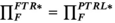




Theorem 1(a) shows that the firm's optimal profit under Model FTR is equal to the profit under Model PTRL. From Lemma 3, we observe that the trade‐in demands under Model FTR and Model PTRL are equal. Although the trade‐in rebate under Model PTRL is larger than it is under Model FTR, under Model PTRL the firm does not return the trade‐in rebate to the replacement consumers when the replacement consumers return their unsatisfactory new products. This brings an equal unit trade‐in cost to the firm (that is, 

Theorem 1(b) indicates that the firm's optimal profit under Model FTR is larger than the one under PTRM. From Lemma 3, we find that the trade‐in demand under PTRM is less than the one under FTR. Although the firm under PTRM could obtain some rebate incomes from the replacement consumers who return unsatisfactory newly purchased products, the increased incomes cannot make up for the losses caused by the decline in trade‐in demand. Thus, under Model PTRM, compared with Model FTR, the firm earns a lower profit. In practice, for products with a relatively medium residual value of used products, FTR rather than PTR is adopted by firms such as Huawei, DJI, etc. This observation is consistent with the results of Theorem 1(b).
Theorem 1(c) shows a critical result. Between Model FTR and Model PTRH, the optimal TIR model depends on the size of the durability parameter. Specifically, the optimal profit under Model PTRH is smaller (resp., greater) than it is under FTR if the durability parameter of the used product is smaller (resp., greater) than the threshold. In the scenario in which there is a sufficiently low durability parameter for the used product, and the trade‐in demands are not too low, the trade‐in demand under Model PTRH is dramatically lower than it is under Model FTR. As a result, under Model FTR, the firm earns a larger profit than it does under Model PTRH. This makes Model FTR be the better choice. When the durability parameter of the used product is sufficiently high, the trade‐in demands are sufficiently low. Compared with Model FTR, Model PTRH helps to slightly reduce the trade‐in demand. Thus, under Model PTRH, compared with Model FTR, the firm can earn a higher profit due to lower return losses from replacement consumers. As we all know, computers and household appliances are more durable than mobile phones. Firms like Dell, Lenovo, and Microsoft in China mainly produce and sell computer products, whereas firms like Apple mainly produce and sell mobile phones. Accordingly, in practice, it would be optimal for Dell, Lenovo, and Microsoft in China to adopt the PTR policy and for Apple to choose the FTR policy. This would follow the results of Theorem 1(c).
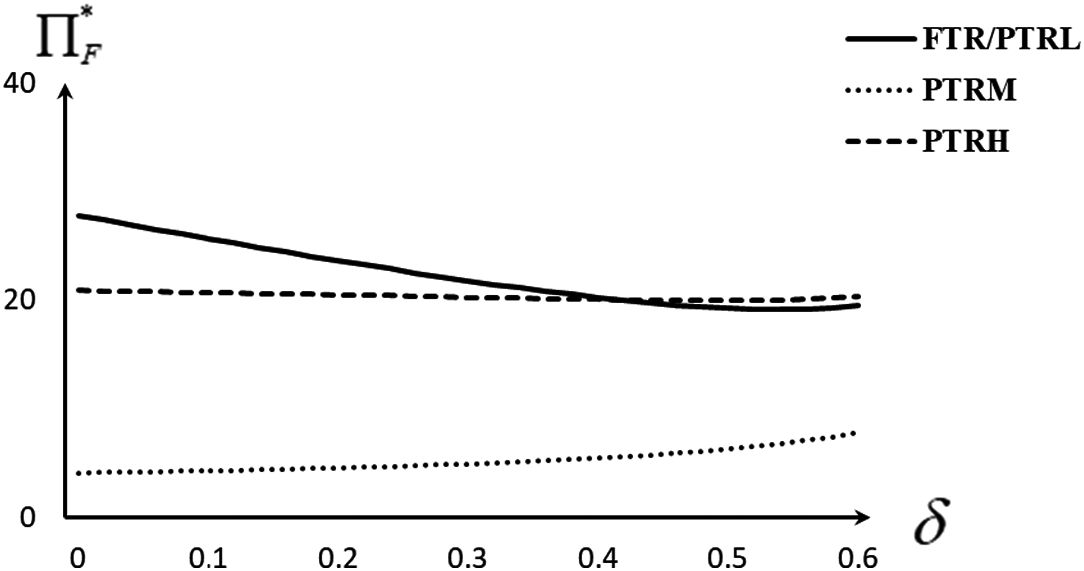
To provide a clearer picture of Theorem 1, we present the following numerical example. Similar to Cao et al. (2018), we set “


The Firm's Optimal Profits with Respect to δ
Figure 1 shows that the optimal profits under Models FTR and PTRL are equal. Moreover, the optimal profit under Model FTR is larger than the one under Model PTRM. If 

Theorem 1 suggests that when no replacement consumers keep their unsatisfactory new products (that is, Model PTRL), there is no difference to the firm between the PTR policy and the FTR policy. When the used product's residual value is medium (that is, Model PTRM), FTR is always the optimal choice for the firm. When some replacement consumers keep unsatisfactory new products (that is, Model PTRH), we know that the PTR policy is a better choice for the firm if the durability parameter of the used product is sufficiently high. Otherwise, the FTR policy is the better choice. We now proceed to examine consumer surplus. Lemma 4 shows the result.

Lemma 4 shows that the optimal consumer surpluses under Model FTR and Model PTRL are equal. In Lemma 1, we find that the optimal product prices under Model FTR and Model PTRL are equal. Moreover, choosing Model PTRL does not affect new consumers' and replacement consumers' utilities. Thus, the consumer surpluses under Model FTR and Model PTRL are equal.
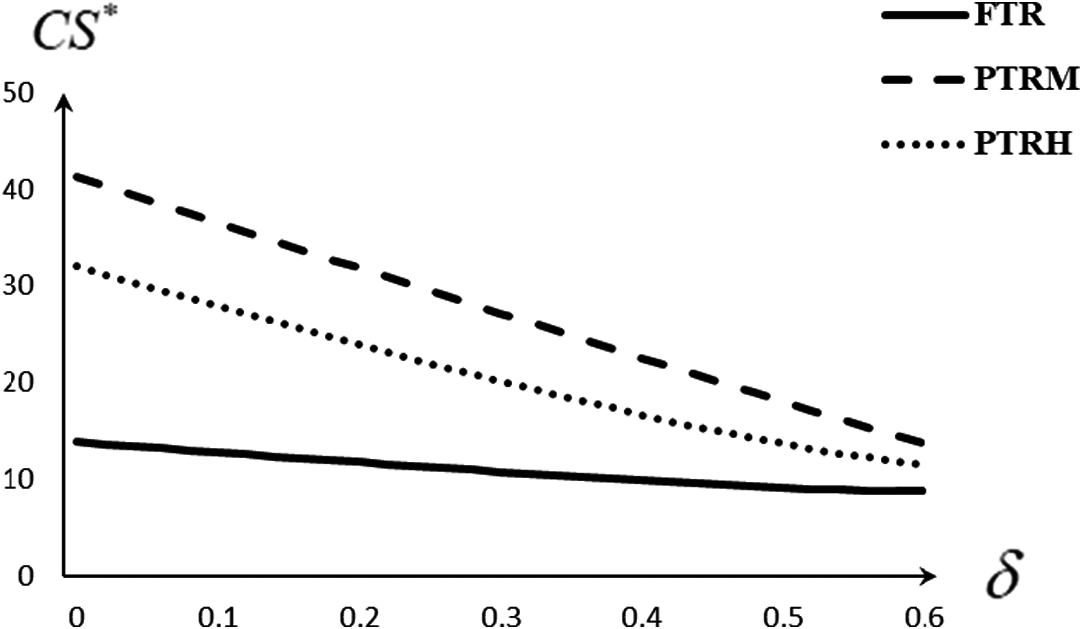
It is analytically difficult to compare the relationship between consumer surpluses under Model FTR and Model PTRH. We thus use a numerical example to analyze it. Following the model setting and assumptions, we set “


The Optimal Consumer Surpluses with Respect to δ
Figure 2 shows that the optimal consumer surpluses decrease with respect to the used product's durability parameter. As 
From Theorem 1 and Figure 2, we can see that the firm's optimal TIR choice may or may not benefit consumers. It is important to note that when 
Further Analyses and Extended Models
Our basic model and the analyses consider the optimal TIR policies assuming (i) the absence of a secondhand market, (ii) a single‐channel retailing mode, and (iii) a single selling period. In this section, for robustness checking and to generate more insights, we relax these assumptions one by one and examine the respective scenarios.
Considering the Secondhand Trading Market
In practice, some third‐party e‐commerce firms like 


In the presence of the secondhand market, the following results hold: (a) 





Property 1 implies that the method of determining the optimal TIR policy in the presence of the secondhand market is similar to that in the absence of the secondhand market (see Theorem 1).
To compare the cases in the presence and absence of the secondhand market, we need to compare the size relationship between 


The Threshold Value
From Figure 3, we can find that both 


Moreover, Figure 3 shows that 

Online–Offline Dual‐Channel Retailing
In recent years, in order to satisfy consumers' online purchasing needs, more and more firms are adopting online–offline dual‐channel retailing, that is selling product via online and offline channels with the two channels integrated together. Companies such as Walmart, Best Buy, Apple, Suning, Lenovo, Huawei, Xiaomi, etc. are all examples. In this subsection, we consider a firm selling new products and offering trade‐in service through its online and offline channels. The firm offers the same TIR policies for its online and offline sales channels. In the online–offline dual‐channel retailing context, the firm determines the same online and offline product price and rebate (Gao and Su 2017). Following the literature (Chiang et al. 2003, Letizia et al. 2018), we consider the case in which consumers prefer offline channel to online channel for their purchases as they can experience the product with physical touches and trials. We set the consumer acceptance of online channel to be 

In the online–offline dual‐channel retailing mode, the following results hold: (a) 







Property 2 implies that the method of determining the optimal TIR policy in the context of online–offline dual‐channel retailing mode is similar to that in the context of single‐channel retailing mode (see Theorem 1).
Considering that it is very difficult to analytically compare the sizes between 


The Threshold Value
Figure 4 shows that 

Moreover, from Figure 4, we find that 

Two Selling Periods
In this subsection, we consider the case in which there are two selling periods and explore the respective optimal pricing, and TIR policies of the firm in both. Specifically, we consider the case in which the firm sells two generations of products, namely products 1 and 2. In the first period, the firm sells product 1. In the second period, the firm sells product 2 and offers the trade‐in service. The market consists of risk neutral consumers, and the market base is normalized to be 1. Some consumers enter the market in the first period while others enter the market in the second period, and we assume that the proportion of consumers entering the market in the first period is 


Preannounced Pricing
In this subsection, the firm in the first period announces the price of product 1 (p1), the price of product 2 (p2), and the trade‐in rebate (r). Note that we add the letter P to represent this extension, that is, we use Model FTRP to represent Model FTR and use Model PTRP to represent Model PTR under the two‐selling period cases. The details of this extension are placed in Appendix A4.
Dynamic Pricing
In the dynamic pricing mechanism, the firm in the first period determines the price of product 1, and the firm in the second period determines the price of product 2 and the trade‐in rebate. Note that we add the letter D to represent this extension, that is, we use Model FTRD to represent Model FTR and use Model PTRD to represent Model PTR under the two‐selling period cases. The details of this extension are put in Appendix A4.
Compared with the single selling period problem, the firm's preference for FTR policy and PTR policy has not changed when there are two selling periods.
Theorem 2 is an interesting result which shows that the firms' optimal choice for FTR and PTR is not affected by the presence of two selling periods, no matter which pricing mechanism is adopted. This indicates the robustness of the findings in the basic models.
Conclusion
Concluding Remarks and Major Insights
To retain old customers and promote the sale of new products, firms are becoming more active in offering trade‐ins. Motivated by the popularity of trade‐ins and the practical importance of consumer returns, in this study, we analytically explore two major categories of TIR policies, that is, the FTR and the PTR. In practice, some firms offer an FTR under which trade‐in consumers who return their newly purchased but unsatisfactory products receive a generous refund, which includes a trade‐in rebate (for them to redeem if they purchase in future). Other firms offer a PTR policy under which the trade‐in consumers only receive a refund for the amount of money they paid, without any compensation for the trade‐in rebate.
As we have shown in the previous sections, we analytically explore these two TIR policies. We build formal stylized analytical models to study the optimal choice of a TIR policy (FTR or PTR) and determine the optimal trade‐in rebates under both FTR and PTR. We show that there is no difference to the firm between the choice of an FTR and a PTR when no trade‐in consumers retain their unsatisfactory new products. In the case of a relatively medium residual value of the used product, FTR is always the better choice. When some replacement consumers retain unsatisfactory new products, we show that FTR (resp., PTR) is the better choice when the used product's durability is sufficiently low (resp., high). We analytically prove that the firm may not reduce its trade‐in rebate when the average new product satisfaction rate of trade‐in consumers increases. In the extended models, we find that the firm is more likely to prefer PTR to FTR when the firm adopts the online–offline dual‐channel retailing mode, whereas the firm tends to prefer FTR to PTR when there is a competitive secondhand market, and the firm will choose the same optimal TIR police when there are two selling periods. In the following discussion, we further elaborate and discuss the managerial implications of the findings.
Factors to consider when choosing the optimal TIR policy: For the cases in which no trade‐in consumers retain their unsatisfactory new products (that is, PTRL, PTRLS, PTRLO, PTRLP, and PTRLD), there is no difference between FTR and PTR for the firm (Theorem 1(a) and Properties 1–4(a)). For the cases in which the residual value of the used product is medium (that is, PTRM, PTRMS, PTRMO, PTRMP, and PTRMD), FTR is always the better choice for the firm (Theorem 1(b) and Properties 1–4(b)). For the cases in which some trade‐in consumers keep their unsatisfactory new products, FTR is the better choice if the durability parameter of the used product is sufficiently low; otherwise, the firm should choose PTR (refer to Theorem 1(c) and Properties 1–4(c)). We can see that the firm's optimal TIR choice may not always benefit or hurt consumers (please refer to Figure 2). A firm with online–offline dual‐channel retailing mode is more likely to choose PTR than FTR, whereas when there is a competitive secondhand market, the firm is more likely to choose FTR than PTR (Figures 3 and 4). Moreover, when there are two selling periods, regardless of whether preannounced pricing or dynamic pricing is adopted, the optimal TIR policy does not change (Theorem 2). All of these findings imply that the optimal TIR choice should be made with reference to the market. Specifically, firms choosing the optimal TIR policy should carefully examine, whether the residual value of the used product is high, medium, or low, whether the used product's durability is high or low, whether there is a secondhand market, and whether there is online–offline dual‐channel retailing mode. Since TIR policies have not been explored in prior studies, the abovementioned insights highlight the original contribution of this study.
Optimal trade‐in rebate: For the cases in which no trade‐in consumers retain their unsatisfactory new products, a firm with a PTR policy should always set a higher trade‐in rebate than it would under FTR. For the cases where some trade‐in consumers keep their unsatisfactory new products, a firm with an FTR policy should set a higher (resp., lower) trade‐in rebate than it would under PTR if consumer‐perceived product quality for unsatisfactory product is sufficiently high (resp., low) and (resp., or) the unit loss from the returned product is sufficiently low (resp., high) (see Lemma 2). The firm should reduce its trade‐in rebate as the average new product satisfaction rate of new consumers increases. As the average new product satisfaction rate of replacement consumers increases, the firm should increase its trade‐in rebate for the case in which no trade‐in consumers retain their unsatisfactory new products, and the firm should hold its trade‐in rebate for the case with a relatively medium residual value of the used product, and the firm should improve (resp., reduce) its trade‐in rebate if the unit loss from the returned product is sufficiently low (high) for the case in which some trade‐in consumers retain their unsatisfactory new products (Proposition 1). The above findings highlight the critical factors, such as the residual value of the used product, the loss incurred by each returned product, and the average new product satisfaction rates of new and replacement customers, which determine whether it is wise to set a higher or lower trade‐in rebate. It is therefore crucial for firms offering trade‐ins to consider them when deciding the optimal amount of trade‐in rebates to grant to the market. Note that the monotonic property of trade‐in rebates mentioned above is novel and has not been proposed in previous studies.
Optimal product price: It is interesting to find that different TIR choices have no effect on the optimal product price. This finding makes the work of firms easier because they need not worry about product pricing under different TIR policies. The same price is optimal.
Optimal product demand and return quantity: Different TIR choices do not affect the product demands and return quantities of new consumers (Lemma 3(a)). For the cases in which no trade‐in consumers keep their unsatisfactory new products, the firm's TIR choices do not affect the product demands and return quantities of replacement consumers (see Lemma 3(b)). For the case with a relatively medium residual value of used product, the product demands and return quantities of replacement consumers under FTR are always larger than those under PTR (see Lemma 3(c)). For the case where some trade‐in consumers keep their unsatisfactory new products, product demand from replacement consumers under FTR is higher (resp., lower) than it is under PTR if the unit loss from the returned product is sufficiently low (resp., high), and return quantity from replacement consumers under FTR is lower (resp., higher) than it is under PTR if the used product's residual value was sufficiently low (high) (Lemma 3(d) and (e)). These findings uncover specific cases in which the choice of TIR does not affect product demand and return quantity and specific cases in which product demand and return quantity are affected. Firms with special target market segment objectives should therefore pay attention to the implications of TIR choices with respect to the demands and the returns associated with different market segments. Of course, the respective factors should be studied carefully before firms make any decisions on their optimal TIR choices. The impact of TIR policy on product demands and return quantities from new and replacement consumers is among the novel findings of this study.
Future Research
Similar to most OM modeling research, we admit limitations in our studies and call for future research. First, our study investigated TIR policies for one type of product. Thus, TIR policies exploring two competing or multiple competing products can be considered in future. Further, this study assumed that there is information symmetry between consumers and the firm. However, both consumers and the firm in practice may have their own private information. It would therefore be interesting to investigate the optimal TIR policies in the context of asymmetric information (e.g., product quality information asymmetry). Channel leadership and power structure of the supply chain (Shi et al. 2013) may affect the performance of TIR policies. Future research can be conducted to investigate this issue. Replacement consumers in practice may have used products with different durability (depreciation rate). As a result, future research may consider the heterogeneous durability of used products in the TIR policy. Finally, in our model for the secondhand trading market case, the “trading price” is exogenously given. In the future, it will be interesting yet analytically challenging to consider the case when it is endogenous.
Footnotes
Notation Table
Detailed Analysis on the Secondhand Trading Market Case
Detailed Analysis on the Online–Offline Dual‐Channel Retailing Case
Detailed Analysis on the Two‐Selling Period Cases
Acknowledgments
This research is partly supported by the National Natural Science Foundation of China (grant nos. 71801121; 72061024). The authors sincerely thank Lipan Feng, Xuting Sun, and Juzhi Zhang for their comments on the earlier version of this study. They also thank the English editor in Asia‐Edit who has helped proofread and enhance the English presentation of this study. Tsan‐Ming Choi's research is supported by Yushan Fellow Program (NTU‐110VV012).
In this study, “returning the new product” means “returning the recently purchased new product.”
In our model, we assume that newly purchased products that are returned are disposed of by the firm to obtain their residual value. The firm suffers a loss from these returned products because their residual value is less than the firm's production cost.
In this study, we use “she” to represent the consumer.