







Abstract
With the growth of online mental healthcare platforms, health professionals have been providing online consultation services during their spare time. However, little is known about the prosocial behaviors of health professionals on these platforms and their effect on professionals’ economic performance. In this research, we aim to identify and quantify the main effect of prosocial behaviors (i.e., offering free services) on future economic performance and the potential mediation effects of relationship capital and reputation capital in an online mental healthcare platform. Based on signaling and commitment theories, we use a panel dataset from a Chinese online mental healthcare platform to test our hypotheses. Our findings show that a mental health professional's previous prosocial behavior has a positive impact on economic performance and that this effect may manifest through the relationship capital pathway. However, reputation capital generated from prosocial behaviors does not significantly mediate the impact of prosocial behavior on economic performance. Our research provides important implications for healthcare operations concerning service offerings and healthcare providers’ performance on online mental healthcare platforms.
Keywords
INTRODUCTION
Recently, there has been a boom in the use of online healthcare platforms (OHCs). A report shows that the global telemedicine market was valued at more than $100 billion in 2021 (Mordor Intelligence, 2021). Mental health disorders are an enormous and increasing global burden. However, personnel and financial resources devoted to mental health services are limited, especially in low‐income and middle‐income countries (Vigo et al., 2019). Currently, most mental health issues remain untreated. The emerging “uberization” of mental healthcare services can reduce the gap between the need for mental healthcare services and their provision (Nurvala, 2015). Mental healthcare service providers can provide consultation services online with fewer restrictions on time and space than in person. Although the emergence of online mental healthcare platforms provides a new means for patients to access services, the complexity of mental illness and treatment methods, people's low level of mental health literacy, and the nature of mental healthcare services as a type of experience good make the information asymmetry in online mental healthcare service transactions a severe problem.
Participating in prosocial activities, especially providing free services, is a strategy widely adopted by online service providers to reduce information asymmetry, thereby increasing transactions. However, free service offerings may lead to demand cannibalization, in which consumers who are satisfied with free services will not purchase paid services. Although previous literature studies the free product offering strategy in the software and online content industries (Cheng et al., 2015; Niculescu & Wu, 2014), these studies mainly focus on the free sampling strategy as a commercial behavior rather than a prosocial behavior. Unlike digital goods in industries that have almost no reproduction costs, each healthcare consultation service provided requires the service provider to pay the costs of time and energy. Moreover, free healthcare service offerings may only be available to a limited number of individuals because of these high service costs. Hence, the high service cost and scarcity of healthcare services may make people perceive the provision of free services by healthcare service providers as a prosocial behavior. There is still a lack of empirical research on the effects of free service provision as a prosocial behavior on health professionals’ economic performance on online mental health platforms.
When individuals receive free services without providing monetary compensation to service providers, they may wish or feel obligated to repay the free service providers through other reciprocation forms, such as transmitting positive opinions of services and establishing close social ties with service providers (R. Bapna et al., 2017; Bond et al., 2019; N. Kumar et al., 2018). Prior literature suggests that prosocial behaviors can promote the acquisition of relationship capital and reputation capital (Gandini, 2016; Qiu & Kumar, 2017) and, in turn, affect the economic performance of service providers (Bolton et al., 2004; B. Li & Kumar, 2018). Therefore, we focus on whether relationship capital and reputation capital mediate the relationship between prosocial behaviors and the economic performance of a mental healthcare service provider.
In the field of operations management (OM), researchers highlight the importance of creating social relationships between buyers and suppliers to foster performance and information inflow (Cousins et al., 2006; Villena & Craighead, 2017). In previous OM studies, relationship capital is measured using suppliers’ and buyers’ perceptions of the level of mutual respect, trust, and interaction (Cousins et al., 2006). When applying this in the context of online platforms, we define counselors’ relationship capital as actual social‐relationship‐forming behavior. Previous literature focusing on the demand side of online mental healthcare services finds that social interactions in online communities have a significant impact on the health status of people suffering from mental illness (L. Yan & Tan, 2014). The establishment of social relationships is also essential for mental healthcare service providers. “Follow,” “friend,” “like,” and “subscribe” are standard tools in online communities for facilitating the formation of social relationships between suppliers and buyers (Kuang et al., 2019; L. Yan, 2020), which is related to high purchase intentions among buyers (John et al., 2017). Our mediation analyses use the number of followers counselors received in the previous week on the platform as one of the potential mediators.
Reputation capital can also be positively affected by prosocial behavior. Although a large body of literature on traditional online markets shows that the reputation system is positively associated with (i.e., facilitates) transactions (Bolton et al., 2004; Cheng et al., 2020; H. Wang et al., 2022), this finding does not necessarily apply to emerging business models. For example, in an online peer‐to‐peer (P2P) barter market, developing lasting relationships among transaction partners is proven to effectively improve exchange, but reputation has a negligible impact on promoting exchange (Ye et al., 2018). No reliable evidence demonstrates the efficacy of a reputation system in online mental healthcare markets. The literature on online labor markets for information technology (IT) services investigates how reputation influences individual service providers’ employment chances, earnings, and survival in the market (Hong & Pavlou, 2017). However, in these studies, the reputation of service providers is generated from their past fee‐based services rather than from prosocial activities. It is not clear whether reputation capital generated from past prosocial activities can mediate the relationship between prosocial behaviors and counselors’ economic performance on online mental healthcare platforms.
We aim to identify and quantify the direct effect of conducting prosocial behaviors (i.e., offering free services) on the future economic performance of online mental healthcare platforms and the indirect (mediating) effects of relationship capital and reputation capital on this effect. Our results show a positive aggregate effect of prosocial behaviors performed in the previous week on counselors’ economic performance. Moreover, we demonstrate that relationship capital obtained in the previous week mediates the effect of prosocial behaviors on economic performance. However, the reputation capital generated from prosocial behaviors does not significantly mediate the impact of counselors’ prosocial behaviors on their economic performance.
Our study makes several contributions to the literature. First, our research extends relevant prior work on free service offerings in digital goods (Chellappa & Mehra, 2018; Dou et al., 2013; Niculescu & Wu, 2014) to the context of online healthcare services. Although digital goods (such as software and digital music) and online healthcare services both belong to the broader category of experience goods, the extension across research contexts is still important and significant because online healthcare services are quite different from digital goods. The negligible cost of digital goods and their characteristic of unlimited supply make the behavior of free offering of these goods basically a marketing strategy rather than a prosocial behavior. In contrast, the high service cost and scarcity of healthcare services may make people perceive free services provided by counselors as a prosocial behavior. Such behavior not only directly affects economic performance but may also indirectly affect performance through other aspects, such as relationship capital.
Moreover, prior OM studies on the free offerings of goods focus mainly on developing theoretical models to explore the optimal strategy for such offerings (Cheng et al., 2015; S. Li et al., 2020; Niculescu & Wu, 2014; Qiu & Whinston, 2017). Our study provides empirical evidence of the positive effect of prosocial behaviors, specifically the offering of free services, on the economic performance of online healthcare service providers. Moreover, we investigate relationship capital and reputation capital as potential mediators in the way prosocial behaviors affect economic performance.
Finally, regarding our contribution to online healthcare operation management, to the best of our knowledge, our study is among the first to investigate how to improve healthcare service providers’ online performance. Although online healthcare services have become an essential part of healthcare management, studies focusing on online healthcare operational issues are lacking (S. Kumar et al., 2018). Prior OM literature on healthcare mostly concentrates on offline contexts (Chen et al., 2021; Khuntia et al., 2017; S. Kumar et al., 2022; Qiu et al., 2022; Yaraghi et al., 2015), and how to improve healthcare professionals’ operational performance in an online context remains underexplored. Our research enhances the understanding of online healthcare operations. Moreover, prior literature on OHCs mainly focuses on physical health (Eijk et al., 2013; Goh et al., 2016) and overlooks the mental health context. Our work also contributes to OHC research by focusing on the mental health services provided by healthcare professionals on an online counselor‐driven platform.
LITERATURE REVIEW
In this section, we review the literature from two aspects: (i) digital healthcare operation, and (ii) free service and product offerings. We highlight our contributions by comparing and contrasting our work with past studies.
Digital healthcare operation
Enabled by technological advances, the digitization of healthcare expands from the adoption of electronic medical records (EHRs) and healthcare information exchanges (HIEs) within the brick‐and‐mortar hospitals to the rise of OHCs outside the hospitals (Z. Yan et al., 2016). Prior literature investigates the factors that are drivers of the digitization of healthcare, including HIEs and EHRs, which are the main constituents of healthcare operations and delivery (Khuntia et al., 2017; Yaraghi et al., 2015). Studies in the healthcare OM and information systems (IS) fields explore the effects of applying IT within hospitals on healthcare delivery performance, such as reducing patient safety events (Hydari et al., 2019) and improving provider capacity and clinical quality (Bavafa et al., 2018; S. F. Lu et al., 2018). In addition to the effects of healthcare technologies implemented in hospitals on providers’ offline operational performance, previous studies find that the online physician rating is associated with healthcare providers’ operational efficiency (Ko et al., 2019), patient flow (Venkataraman et al., 2018), service quality (S. F. Lu & Rui, 2018), and physician demand (Xu et al., 2021).
Prior work investigates various aspects of how digital healthcare influences operational performance in the offline context (Fan et al., 2022; S. Kumar & Qiu, 2022). However, there is a dearth of studies focusing on healthcare providers’ online operational performance (Huang et al., 2021). Given that online healthcare service is an important segment of healthcare management and the matching role of OHCs between healthcare providers and patients, our study focuses on reducing the matching frictions caused by the online context and improving online healthcare operational efficiency. Particularly, we explore the relationships between free service offerings and healthcare professionals’ performance.
Free service and product offering
Free service and product offerings are ubiquitous strategies employed by firms. Prior OM literature investigates the optimal strategy of free service and product offering by developing theoretical models (Cheng et al., 2015; Niculescu & Wu, 2014). Most of the existing studies on free services and products are in the context of the software industry. A stream of literature investigates a software firm's optimal choices of limited version, time‐locked, and hybrid free service strategies (Cheng et al., 2015). Several IS and marketing studies empirically investigate the impacts of free service and product offerings on paid services and products. For example, researchers focus on the free sample in digital content and find that high‐quality free content can increase the demand for paid content (H. Li et al., 2019). In the context of the mobile app market, studies also find that the free app offering strategy is effective in increasing the sales of paid apps if the free apps have high review ratings (C. Z. Liu et al., 2014).
Nonetheless, the previous findings on free goods offerings in the digital goods industry might not be directly applicable to the online healthcare industry. Online healthcare services are quite different from digital goods, such as software goods and digital music. In the software industry, the reproduction and redistribution costs of software products are negligible. In contrast, in the healthcare industry, health service providers need to pay a significant cost involving time and effort every time they provide services. Hence, free trials in the software industry are more likely to be considered a commercial activity rather than a prosocial activity. The free service provision of counselors in our context is regarded as a type of prosocial behavior that affects the acquisition of relationship capital and reputation capital. Further, previous studies mainly analyze the free trial business model through theoretical modeling. Our research provides empirical evidence for the positive effects of free service offerings as a type of prosocial behavior on economic performance. Moreover, we investigate the underlying mechanisms of the relations between prosocial behaviors and economic performance by analyzing the mediating roles of relationship and reputation capital.
THEORETICAL FOUNDATION AND HYPOTHESIS DEVELOPMENT
In this section, we develop our theoretical framework and set hypotheses based on commitment and signaling theories, which we first explain.
Commitment theory
Commitment theory is widely studied in the organizational behavior and marketing literature. Recent research focusing on online communities has begun to explain users’ participatory behavior based on commitment theory (Bateman et al., 2011; Kuem et al., 2017), where commitment is defined as an enduring desire to maintain a valued relationship (Moorman et al., 1992). In the organizational behavior literature, organizational commitment as a psychological state is separated into three components: affective commitment, continuance commitment, and normative commitment. These three components can influence an individual's participatory behavior in an online community.
In our study, we apply commitment theory at the individual rather than the organizational level. Affective commitment is desire‐based commitment. In our context, it refers to a user's emotional attachment to a specific counselor in an online healthcare community in which the user feels a sense of belonging arising from receiving social support from the counselor. Continuance commitment is need‐based commitment. It depends on an individual's perceived benefits and costs from the relationship in relation to alternative relationships. In our context, if users receive informational and social benefits from a professional counselor, they are likely to continue their relationship with that professional counselor because of these perceived benefits. Normative commitment is obligation‐based commitment and reflects that an individual feels obligated to continue a relationship. In our context, counselees who derive benefits from a counselor's free professional suggestions may feel indebted to the counselor and may feel a sense of obligation to maintain their relationship with the counselor to repay the counselor's kindness.
Signaling theory
Signaling theory is widely applied in many research fields, including OM and IS (Khurana et al., 2019; Kwark et al., 2021; N. Kumar et al., 2022; Haoying Sun & Xu, 2018). A signal is a cue that discloses reliable information about unobservable product quality to consumers (Wells et al., 2011); an appropriate signal can be used to identify the quality of services or products. Based on different levels of prepurchase information scarcity and postpurchase information clarity, services or goods are divided into three categories: search goods, experience goods, and credence goods (Darby & Karni, 1973). Search goods have a low degree of information asymmetry: Consumers can easily assess the quality of goods before and after their purchase. In contrast, experience and credence goods have a high level of information asymmetry, and consumers must use signals to judge the quality attributes of such goods. Thus, the signaling theory is highly applicable to experience and credence goods.
Signals are applied in many online contexts. For example, rank in open‐source software communities serves as a credible signal of programmer productivity (Hann et al., 2013). E‐commerce platforms provide customer reviews to signal product quality (Ho et al., 2017). In OHCs, online health consultation is essentially a type of credence good (Saifee et al., 2019). A physician or counselor knows more about the quality of a patient or counselee's needs than the patient or counselee himself. A high level of information asymmetry exists between the physician (counselor) party and the patient (counselee) party in the online healthcare service market. According to the signaling theory, information asymmetry can be reduced if credible signals are sent from the party with more information to the party with less information or from the agent (the platform connecting the two parties) to the party with less information.
Hypothesis development
We propose the conceptual mediation analysis model shown in Figure 1 to explain how prosocial behaviors influence relationship capital and reputation capital and how these social returns transform into economic performance.
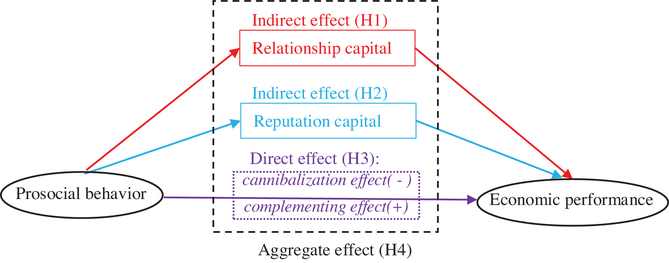
The conceptual mediation analysis model
Prosocial behaviors and economic performance: Mediating role of relationship capital
In this study, prosocial behaviors are the behaviors engaged in by counselors providing professional answers to mental health questions free of charge. The literature on online communities suggests that users only begin to participate in contribution activities when they observe or consume content created by the community (S. Bapna et al., 2019; Kane & Ransbothamb, 2016; Pu et al., 2020; Pu et al., 2022; Shi et al., 2021). In our context, users derive benefits from counselors’ prosocial activities; then, inspired by these benefits, users may proceed to be involved in social activities with counselors on the platform, such as establishing close relationships with counselors. In accordance with commitment theory, the three types of commitment that may influence users’ behavior on an online mental healthcare platform (Bateman et al., 2011; Kuem et al., 2017; Moorman et al., 1992) are affective commitment, continuance commitment, and normative commitment. When a counselor gives free suggestions to a user on a mental or emotional problem, the user may easily establish an emotional connection to the counselor and thus may be more willing to establish social ties with the counselor on the platform. All things equal, the counselee will have a higher affective commitment toward the counselor who performs more prosocial activities. Moreover, receiving informational and social support from a counselor for free will allow users to perceive benefits that other counselors cannot provide. The counselee will develop continuance commitment toward the counselor and will expect to gain more support from continued service provision in the future. As for normative commitment, counselors’ volunteer work is not charged, and counselees may perceive that they gain benefits from unpaid work that outweighs its costs to them. Therefore, they may feel obligated to repay and support counselors who perform unpaid work. For counselors, having more followers indicates that they have a high social status on the platform. The prosocial service provision of counselors helps counselees develop a strong obligation commitment to help increase the counselors’ popularity by following their account on the platform. In summary, these three types of commitment imply that when a counselor conducts more prosocial behaviors in the past, they will have higher relationship commitment (i.e., relationship capital) in the current period from users on the platform. Following previous literature (Moqri et al., 2018), we empirically measure relationship capital using the number of followers a counselor has.
The number of followers reflects the counselor's popularity, which has a positive effect on sales performance (Bai et al., 2015). Individuals are likely to make the same decisions as the majority when facing high information asymmetry (Dewan et al., 2017; Qiu et al., 2018, 2021). In addition, drawing on the signaling theory (Rao et al., 1999), counselors’ popularity information (i.e., here, number of followers) can be regarded as a credible signal of their consultation service quality, as counselors cannot manipulate the popularity information displayed on the platform. Users on an online mental healthcare platform can distinguish high‐quality service providers from low‐quality ones using this signal. When counselees need paid consultation services, they then seek help from a counselor they follow. We expect an increase in counselors’ economic performance, as indicated by the number of fee‐based consultations. In summary, we hypothesize the following mediating effect of relationship capital obtained in the previous week on the effect of free answer‐provision services on counselors’ current economic performance: The number of free answer services provided in the past week is positively associated with the number of new followers in the current week, which, in turn, leads to an increase in counselors’ economic performance.
Prosocial behaviors and economic performance: Mediating role of reputation capital
Providing suggestions or advice to users with potential mental disorders free of monetary charge creates a channel for counselors to show their kindness. Volunteer work uses up a counselor's time and energy but gives users advice to help them solve their psychological problems. In our focal context, on a Chinese online mental health platform, users can choose to express gratitude by giving a small amount of money to the counselor, from 2 RMB (approximately 0.29 USD) to 10 RMB (approximately 1.43 USD). The number of thanks received by the counselor is publicly visible. Compared with the value of professional advice provided by counselors, the small tips cannot compensate for counselors’ time and effort: The average price of counselors’ cheapest fee‐based service is 100 RMB (about US$ 14.3) per session, much higher than tips from providing free answers. In addition, most counselors answer counselees’ questions with a long text, and editing such a text requires considerable time and effort. Counselors receive thanks mainly in the form of accumulated reputation capital rather than as a way of making significant money. Following previous literature (Guo et al., 2017), the number of thanks received is a good indicator of the degree to which a counselor is recognized by users on an online mental healthcare platform. This recognition of a counselor's past prosocial behavior can be perceived as reputation capital.
Previous research shows that an online reputation system in an OHC is effective in reducing information asymmetry (Gao et al., 2015). Therefore, the number of thanks received by a counselor can be considered a reliable signal of service quality. The construction of a professional reputation is perceived as an essential determinant of career success (Cederberg, 2017; X. Liu et al., 2016). Consequently, counselors who have accumulated a high reputation in the past can attract more counselees to conduct fee‐based consultations in the current period. In summary, we hypothesize the following mediating effect of reputation capital obtained in the previous week on the effect of free answer services on counselors’ current economic performance: The number of free answer services in the past week is positively associated with the number of thanks received in the current week, which, in turn, leads to an increase in counselors’ economic performance.
The direct effect of prosocial behaviors on economic performance
Besides the indirect relationship capital and reputation capital effects, prosocial behaviors also directly affect a counselor's economic performance. On the one hand, offering free services can be viewed as a ubiquitous strategy to mitigate information asymmetry and promote sales (called the complementing effect). Users can reduce uncertainty about service quality by using a service free of charge (Reza et al., 2021). In addition, considering the high service cost and scarcity of healthcare services, offering free services can also be seen as a manifestation of counselors’ altruism. The prosocial image of counselors then also helps them improve their economic performance. On the other hand, previous studies in the software industry suggest that free trials may cannibalize the sales of paid software goods (the cannibalization effect; Niculescu & Wu, 2014). Software products are generally built using a modular architecture that facilitates the combination, separation, or locking of certain functions (Niculescu & Wu, 2014). Time‐limited, feature‐limited, and hybrid free trial strategies are widely applied in the software industry (Cheng et al., 2015), and users can easily infer the degree of substitution of these free trials for paid products by comparing the differences in modular functions, which influence purchase decisions. However, online healthcare consultation services are personalized, and it is difficult for users to distinguish between free and paid consultation services in terms of treatment effectiveness, resulting in their not viewing free services as an alternative to paid consultation services. Thus, for online healthcare services, the complementary effect dominates the cannibalization effect. We posit that prosocial behaviors have a positive direct effect on counselors’ economic performance. The number of free answer services in the past week is positively associated with counselors’ economic performance in the current week after controlling for relationship capital and reputation capital obtained in the previous week.
Aggregating direct and indirect effects
In hypotheses H1–H3, we develop the hypotheses on the direct effect of prosocial behaviors on economic performance as well as the indirect effects of relationship capital and reputation capital. In practice, the overall effect of prosocial behavior on economic performance is of greatest concern to platform managers and counselors themselves. They want to know whether a counselor's economic performance decreases or improves when the counselor offers free consulting services.
Combining the previous analyses of direct and indirect effects presented above, we propose the following hypotheses about the overall aggregate effect: The number of free answer services in the past week is positively associated with counselors’ economic performance in the current week.
RESEARCH CONTEXT AND DATA DESCRIPTION
To empirically test our hypotheses, we collect data from a Chinese mental healthcare platform (yidianling.com) that enables psychological counselors to provide e‐consultation services to individuals with mental disorders. Yidianling.com is one of the largest online mental healthcare platforms in China; the platform claims that 20 million individuals will be registered on the site by July 2021. 1 Counselors provide users with services for depression, anxiety, and other psychological consultations. Counselors can voluntarily join the platform. The counselors on the platform are verified by mental healthcare professionals; that is, when signing up on the platform, a counselor must submit a series of identifying documents to prove their authenticities, such as the front and end of the residential identity card and qualification certification (as a psychological counselor, psychotherapist, or psychiatrist). The platform reviews the residential identity card and qualification certification and confirms it with the counselor, who then signs a contract to join the platform. 2
Users can search for counselors by city, areas of expertise, fees, recommendations, tenure, and the number of fee‐based consultations. Users can interact with counselors on the platform in two ways. On the one hand, users can book consultation services on this platform and consult counselors directly through online chat or online video conferences. The consultation service is not free, and a one‐time consultation usually takes 50 minutes. Each counselor has a homepage that shows their personal information, prosocial activities they offer, and paid consultation services they conduct. Figure 2 illustrates an example of a counselor's home page with translation. In addition to paid consultation, users can post questions or share thoughts about relationship problems and work pressure, and some counselors may provide suggestions for free below individuals’ posts. Voluntary answers can be found on the counselor's homepage. Users can choose to express gratitude by giving a small amount of money to the counselor. Only the person who asked the question can express thanks to a counselor who answers the question free of charge. Figure 3 shows an example of thanks received from users.
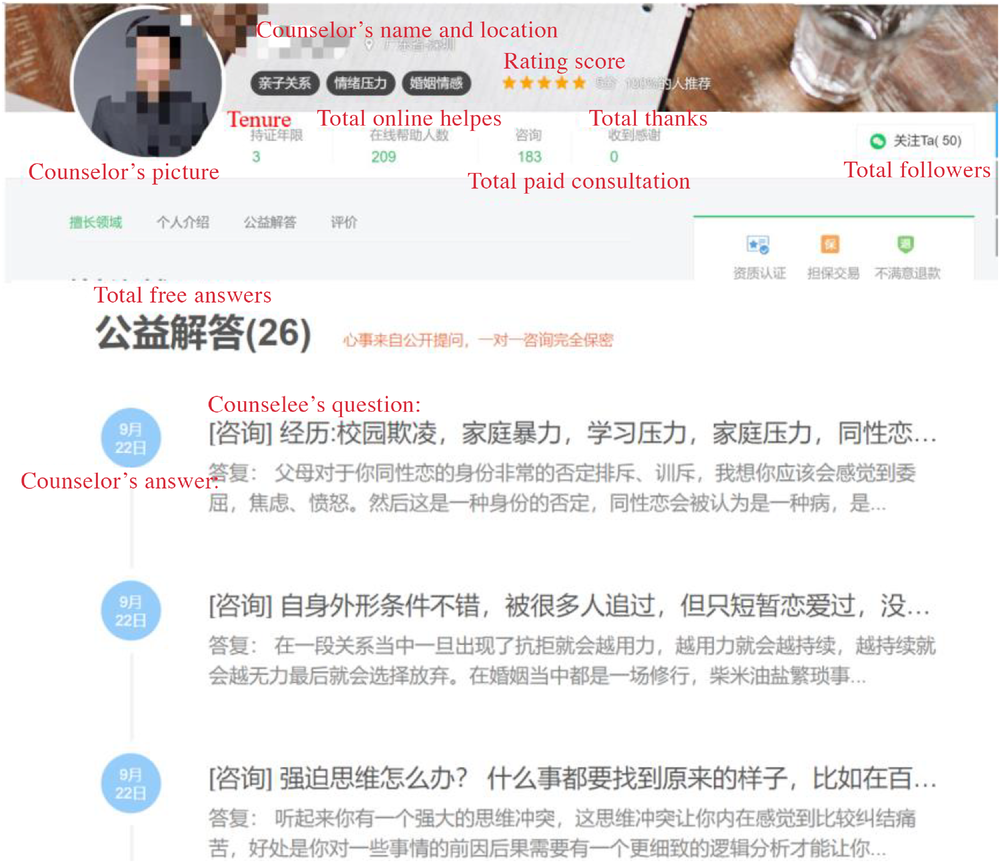
The home page of a counselor
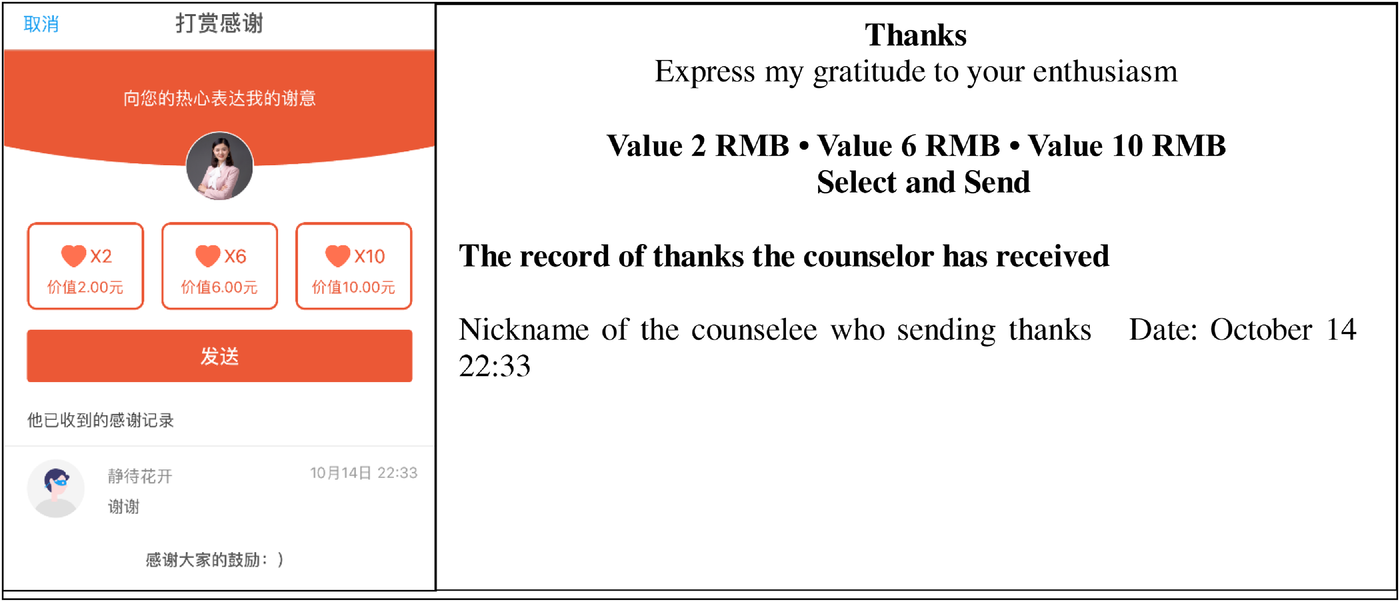
The thanks feature in the platform
We obtain 16 weeks of a dataset, from January 21 to May 13, 2019. We scrape the basic and behavioral information of all counselors on the platform during our research period. Basic information includes the counselor's gender, location, areas of expertise, self‐introduction, and tenure as a counselor. Behavior information includes free suggestions/answers provided on the platform by week, the weekly number of paid consultations, the weekly number of thanks received, and the weekly number of increased new followers. During our study period, 7015 counselors are registered on the platform, although most are inactive, meaning they did not give free suggestions or conduct fee‐based consultations for individuals, nor did they receive thanks or gain followers during the research period. Since the behavior of these inactive counselors cannot be observed, we cannot analyze the relationship between prosocial behavior and economic performance for them. After filtering out inactive counselors, we obtain a sample of 659 counselors who performed at least one activity in our sample period. Table 1 presents the definitions of the notations and variables used in this study.
The definitions of main notations and variables
Table 2 provides summary statistics for the main variables. Given that we use one lagged term for the variables in the main analysis, we summarize the descriptive statistics for 15 weeks of data from 659 counselors. During the study period, on average, counselors answered 3.81 questions per week for free. They were followed by 3.3 individuals per week on average and received 0.12 thanks per week on average. In addition, they conducted 6.13 fee‐based consultations per week.
The descriptive statistics of variables
To reduce the skewness of the variables, we use a log–log specification throughout the study (except for the hurdle model). We take the natural logarithms of our variables (e.g., the log‐transformed variable week_cons is logweek_cons) and calculate the correlation between variables. To address the zeros in the data, we take the logarithm of the value of the variable (week_answers, week_thanks, and week_cons) plus one. Then, we take the logarithm of the variable week_follower value plus three. The values for week_answers include many zeros, seemingly because counselors did not provide free services; similarly, week_thanks includes many zeros seemingly because counselors did not provide enough free consultation and therefore did not receive user thanks—presumably because the free consultation did not satisfy the users. As shown in Table 3, logaccum_follower is highly correlated with many other variables, such as logaccum_cons and logaccum_answer; hence, we drop logaccum_follower as a control variable in the model.
The correlation matrix between variables
We also run a regression model without controlling logaccum_follower to calculate the variance inflation factors (VIFs). The VIFs of the remaining variables after the removal of logaccum_follower are listed in Table 4. For VIF, most prior studies rely on the informal rules of thumb: When the VIF value is less than 4, multicollinearity is not an issue (Burtch et al., 2013; Petryk et al., 2022; Rivera et al., 2021; X. Wang et al., 2022). Hence, multicollinearity is not considered a severe problem in our study.
The variance inflation factors (VIFs)
EMPIRICAL MODEL
We explore the aggregate effect of prosocial behaviors on economic performance and conduct the formal mediation analysis suggested by previous literature (Ding et al., 2021; Hayes, 2017; Zhao et al., 2010).
Aggregate effect
We analyze the aggregate effect of prosocial behaviors on a counselor's economic performance by utilizing a fixed‐effects model. The model is expressed as follows: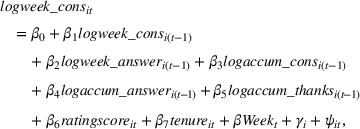
The aggregate effect of prosocial behaviors on economic performance is captured by parameter β2. The first column of Table 5 (“aggregate‐effect model”) reports the results for the impact of prosocial behaviors performed in week t‐1 on counselors’ economic performance in week t. The results suggest that the number of fee‐based consultations provided in the current week increases by approximately 5% if the number of free answers increased by 100% in the past week, which supports H4. The average price of counselors’ cheapest fee‐based services is 100 RMB (about USD 14.3). The counselors provide an average of six paid consultations every month. Counselors can earn a monthly income of at least 600 RMB. The results of the aggregate effect suggest that if a counselor can provide 100 free answers per month, in other words, 3.3 free answers per day, they can nearly double their number of paid consultations and hence the money they receive per month. Considering that answering 3.3 questions a day for free may not be very costly for an experienced counselor, offering free consultations is an effective strategy for counselors.
Effects of previous prosocial behavior on economic performance using a fixed effects model
Note: As one‐period lagged variables are used, the observed sample for the fixed effects model has only 15 weeks of data. There were 659 active counselors used in our study. The number of observations is 659*15 = 9885. Due to the nonscore observations for variable ratingscoreit (the number of nonscore observations is 1369), the model has only 9885 − 1369 = 8516 observations. Robust standard errors in parentheses.
***p < 0.01, **p < 0.05, *p < 0.1.
Mediation effect and direct effect
Following the mediation analysis guidelines (Hayes, 2017; Zhao et al., 2010), our analysis procedure includes two steps. We first regress the two mediators (changes in relationship capital and reputation capital in week t) on counselors’ prosocial behaviors in week t − 1. We then test whether the changes in relationship capital and reputation capital mediate the impact of prosocial behaviors on economic performance. The econometric models are as follows. Following previous literature, we estimate the equations simultaneously in a system specified as a fixed‐effects model and use robust standard errors (Zhao et al., 2010).
First step: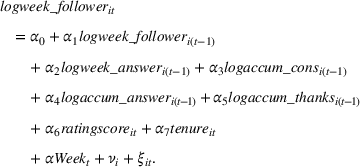
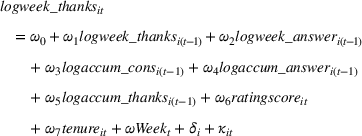
Second step: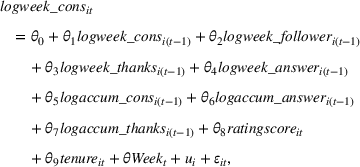
Using the above specifications, the estimated coefficient α2 is the estimate of the effect of prosocial behaviors on counselors’ relationship capital, while ω2 is the estimated effect of prosocial behaviors on counselors’ reputation capital. Columns 2 and 3 of Table 5 report that the impacts of counselors’ prosocial behaviors in the previous week on changes in counselors’ relationship capital (0.029) and reputation capital (0.019) are positive and significant. These results suggest that the number of new followers received in the current week increases by approximately 2.9% 3 and the number of thanks received in the current week by approximately 1.9% if the number of free answers in the past week increases by 100%. Column 4 of Table 5 shows that the impact of changes in counselors’ relationship capital on their economic performance is positive and significant. However, our study shows that reputation capital obtained in the past week does not significantly increase the number of fee‐based consultations in the current week.
Following recent guidelines on mediation analysis (Zhao et al., 2010), we examine the mediating effect as follows. In our case, the mediation effect of relationship capital is estimated as the product of the two estimators, α2 × θ2; similarly, the mediation effect of reputation capital is estimated by the product of the two estimators, ω2 × θ3. Bootstrapping procedures are used to compute standard errors and confidence intervals for mediating effects; this bootstrapping analysis (5000 samples) shows that the mediation effect of relationship capital is equal to 0.0150 and is statistically significant. This result supports H1. However, bootstrapping analysis also shows that the mediation effect of reputation capital is equal to 0.0004 and is statistically insignificant, which rejects H2. These results demonstrate that only relationship capital is a mediator of prosocial behaviors on economic performance; the total indirect effect is 0.0151, which is statistically significant.
The direct effect is 0.024 (see the fourth column of Table 5), and the aggregate effect is 0.05 (refer to the first column of Table 5). The ratios of indirect and direct effects to the aggregate effect are 30.2% and 48%, respectively. The results show that the change in the sales volume of counselors’ paid consultations is mainly directly affected by the free services they provide and is partly mediated by relationship capital. We propose that 30.2% of the economic benefits counselors receive from providing free consultations are due to increased relationship capital. Similar to our hypothesis that prosocial behavior has a direct effect on economic performance, free service offerings can have direct complementary effects on paid consultation services. The ratio of the unexplained effect to the total effect is 21.8%, which may be due to the estimation error and to other, unobserved mediating variables, such as service quality.
Moreover, the first and fourth columns of Table 5 show that accumulating more free answers in the past (logaccum_answeri(t−1 ) ) will not increase counselors’ economic performance. The results suggest that counselors’ prosocial behavior does not have a significant long‐run effect on their economic performance. In addition, changes in relationship capital and reputation capital in the previous week do not mediate the impacts of accumulated free answers in the past and counselors’ current economic performance. There are two possible reasons why free services offering is beneficial for counselors’ economic performance in the short term but not in the long term. First, providing a free answer in the previous week may serve as a signal of the counselor being active on the platform, and potential customers are drawn to “active” counselors in the short term. Second, free answers provided in the previous week are a good way of converting customers who ask questions, but there might be no significant spillover effect for other potential customers.
ROBUSTNESS CHECKS
System GMM model
The fixed‐effects model may suffer from a small sample bias when the lagged dependent variable is included in the model and when the number of time‐series observations (T) is small (Nickell, 1981). Previous literature designs a generalized method of moments (GMM) estimator for dynamic panel analysis to obtain consistent estimates (Arellano & Bover, 1995; Blundell & Bond, 1998); thus, in the robustness check section, we use this system GMM model to re‐estimate the main effects of prosocial behaviors on economic performance and the mediation effects through relationship capital and reputation capital based on the previous week.
We include more lags for the dependent variables when estimating the system GMM. These additional lags are used as control variables (e.g., logweek_followeri(t−2)) in the mediation‐effect model because the system GMM requires lags of the dependent variables. These additional lags are significant predictors of the dependent variables rather than valid instrumental variables. For each period, we use all available lags of the potentially endogenous variables in levels dated t − 2 or earlier as instruments for the transformed equation, while we use the first differences in levels dated t − 1 as instruments in the level equation. We use the “collapse” option of Stata command “xtabond2” to create one instrument for each variable and lag distance rather than one for each time period, variable, and lag distance, which can prevent the number of instruments from climbing toward the number of observations. Under this specification, to test the overall validity of the instruments used, we perform the Hansen test (Hansen, 1982). The results show that the null hypothesis is not rejected. We also conduct an Arellano–Bond test to examine the serial correlation of the error term. The results reveal that there is no second‐order serial correlation.
Table 6 shows the estimation results. Using the GMM model, we estimate these equations independently and calculate the indirect effects. We calculate 95% confidence intervals for the indirect effect coefficients using Monte Carlo simulations as suggested by Preacher and Selig (2012). Based on the estimation results of the GMM model shown in Table 6, the indirect effect of relationship capital is 0.012, the 95% confidence interval is [0.0043,0.019], and the direct effect size is 0.026. The ratios of indirect and direct effects to the total effect are 26.1% and 56.5%, respectively; thus, the indirect effect estimated by the GMM model is slightly smaller than that estimated by the fixed‐effects model. Counselors’ prosocial behavior in the previous week has a positive impact on current economic performance. In addition, relationship capital obtained in the previous week positively mediates the impact of counselors’ prosocial behavior on economic performance. Although counselors’ prosocial behavior in the previous week can help them obtain reputation capital, this reputation capital does not significantly affect their economic performance.
Effects of previous prosocial behavior on economic performance using the system GMM model
Note: When we estimate the result of the first column of Table 6, we introduce ratingscoreit and four lags of dependent variable logweek_followerit as controls. There are only 12 weeks left for the model and 992 missing values of variable ratingscoreit of these 12 weeks. The number of observations for the model is 12 * 659 − 992 = 6916. Similarly, we can also calculate the number of observations of other columns in Table 6. We only use three lags of the dependent variables as controls in Equation (3). Thus, the number of observations for the model is 7456. Standard errors in parentheses.
***p < 0.01, **p < 0.05, *p < 0.1.
Panel VAR model
We employ a panel vector autoregression (VAR) model to identify the potential reverse effect of counselors’ economic performance on their prosocial behaviors, relationship capital, and reputation capital. Most of the results in Table 7 are generally consistent with those of our main model. The first column of Table 7 shows that the impact of prosocial behavior performed in the previous week on economic performance is still positive, although insignificant. In addition, the relationship capital obtained in the previous week has a positive impact on current economic performance. Reputation capital generated from prosocial behaviors in the previous week has no significant impact on economic performance. The second column of Table 7 shows that the effect of paid consultation in the previous week on current prosocial behaviors is insignificant.
Results of panel VAR model
Note: Standard errors in parentheses.
***p < 0.01, **p < 0.05, *p < 0.1.
We also test Granger causality. The Granger causality test aims to examine the dynamic relations among counselors’ prosocial behaviors, relationship capital, reputation capital, and economic performance. The Granger causality test differs from the ordinary cause–effect relationship in that it is based on predictions. The results of Granger causality can provide predictive information on whether knowledge of past prosocial behaviors improves short‐term forecasts of the current acquisition of relationship and reputation capital and whether knowledge of past acquisition of relationship and reputation capital improves short‐run prediction of current economic performance and vice versa (Granger, 1969). The results of the Granger causality tests (see Table 8) reveal that free answer behaviors Granger‐cause new followers at the 5% confidence level and Granger‐cause received thanks at the 5% confidence level. The results show that the number of free answers provided by a counselor helps predict that counselor's relationship and reputation capital in the future. New followers Granger‐cause fee‐based consultations. Counselors’ new followers in the past week possess predictive information about the number of fee‐based consultations that they will conduct in the future.
Results of Granger causality test
We also employ an impulse response function (IRF) analysis. Figure 4 shows the highlight selective IRFs. Hence, we examine the response of counselors’ relationship capital and reputation capital to a shock in prosocial behaviors. Figure 4 shows the highlighted selective IRFs. We examine the response of counselors’ economic performance to shocks in relationship capital and reputation capital. From Figure 4, we see that the reactions of logweek_follower and logweek_thanks to a shock in logweek_answer are positive and attenuate sharply over time; from Figure 5, we can see that the reaction of logweek_cons to a shock in logweek_follower is significantly positive and decreases to close to zero over time. In addition, logweek_cons has an insignificant reaction to a shock in logweek_thanks.
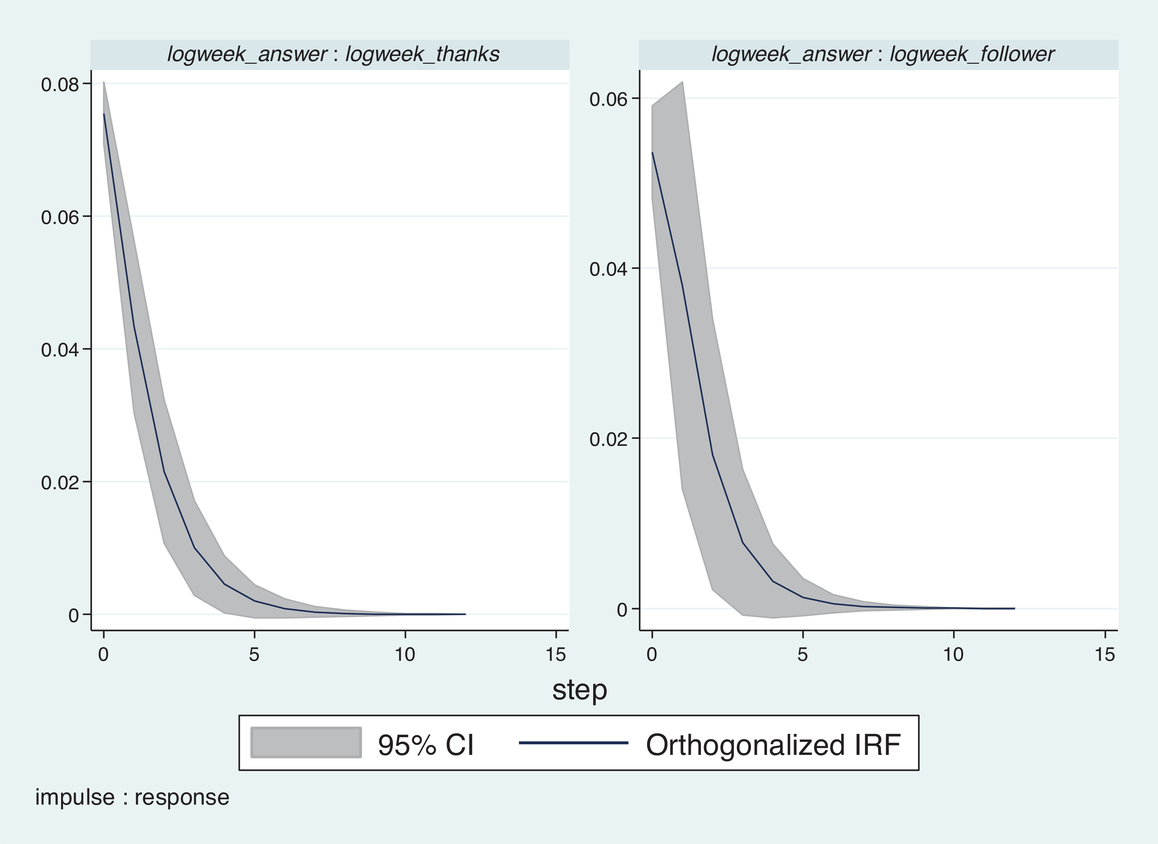
The reactions of relationship capital and reputation capital to a shock in prosocial behaviors. IRF, impulse response function
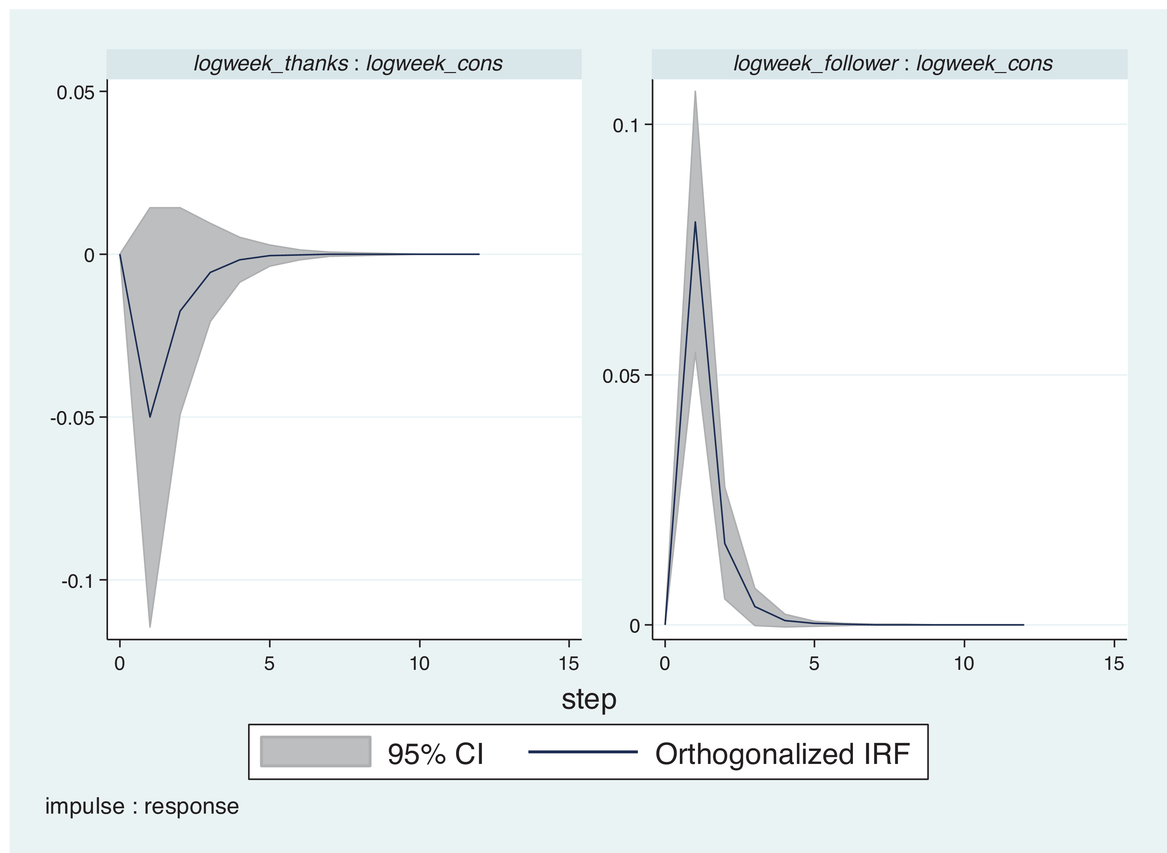
The reactions of economic performance to a shock in relationship capital and reputation capital. IRF, impulse response function
Alternative empirical model specifications
To further ensure the robustness of our results, we also conduct a few alternative model specifications. Specifically, we estimate models that use ifscoreit (referring to whether counselor i receives a rating score in week t) as a control variable and estimate models that use both ratingscoreit and ifscoreit as control variables (refer to Online Appendices A and B in the Supporting Information for details). We also include logaccum_follower as a control variable and rerun our model (see Online Appendix C in the Supporting Information for details). Considering that there are many zeros in the data, we also use the panel hurdle model developed by Dong and Kaiser (2008) to check the robustness of our results (see Online Appendix D in the Supporting Information for details).
DISCUSSION AND CONCLUSION
Online mental healthcare platforms are growing rapidly in the sharing economy. To an extent, the emergence of online mental health platforms alleviates the shortage of mental healthcare resources by making full use of mental professionals’ spare time. Mental healthcare professionals can work as freelancers with scheduling freedom and high flexibility. Developing self‐branding and gaining social and economic returns are important issues for self‐employed counselors on online mental health platforms.
In this research, we investigate the impacts of prosocial behaviors, specifically free service offerings, on counselors’ economic performance and uncover the underlying mechanisms through a formal mediation analysis. We have several findings. First, the aggregate impact of free service offering, including both direct and indirect effects, is a 5% increase in counselors’ paid consultation service sales. Second, we find that the mediation effect of relationship capital obtained in the previous week is positive and statistically significant. However, our study shows that the mediation effect of reputation capital obtained in the previous week is statistically insignificant. These findings demonstrate that only relationship capital obtained in the previous week is a mediator of free service offering behaviors on counselors’ economic performance. Third, our findings show that free service offerings have direct complementary effects on counselors’ economic performance. Fourth, our results show that the ratios of indirect and direct effects to the aggregate effect are 30.2% and 48%, respectively. Thus, the change in the sales volume of counselors’ paid consultations is mainly directly affected by the free services they provide and is partly mediated by relationship capital. Our results are robust to alternative model specifications.
We make several contributions to the relevant literature. First, our study extends relevant prior work on free service offerings in digital goods (Chellappa & Mehra, 2018; Dou et al., 2013; Niculescu & Wu, 2014) to the context of online healthcare services. Second, our study provides empirical evidence of the aggregate effect of free service offerings on the economic performance of online healthcare service providers and the mediating effect of relationship capital, extending prior theoretical work on the optimal strategy of offering free goods (Cheng et al., 2015). Third, our work contributes to studies on online healthcare operation management by focusing on the online mental health services provided by healthcare professionals on an online counselor‐driven platform.
Practical implications
Our study also provides practical implications for online mental healthcare platform managers and mental healthcare service providers. For healthcare service providers, our findings demonstrate that prosocial behavior on OHCs has implications for counselors wanting to adopt a free service offering strategy to reach potential counselees. Although we only study an online mental healthcare platform, the free service offering strategy can also be easily applied by service providers on other OHCs. There are also streams of literature that propose sales‐increasing strategies such as promotional marketing (X. Lu et al., 2013) and live chats (Haoyan Sun et al., 2021). In contrast with live chats, free consultations do not require a counselor to answer questions in real time and thus may be more cost‐effective than a live chat strategy.
Moreover, our IRF analysis shows that the effect of relationship capital on economic performance is immediate and tapers to zero in a few weeks. In addition, we show that an increase in counselors’ economic performance is attributable in part to an increase in relationship capital after performing prosocial activities. The implication is that service providers can enhance social relationships with counselees, for example, by sending messages of care to their followers regularly. Furthermore, platform managers can design effective features to promote social relationships between counselors and their users. However, there is a caveat: Compared with other marketing strategies, offering a free service to establish social relationships may not be the most effective tool to increase sales because a 100% increase in prosocial behavior leads to only an approximately 5% increase in paid consultations, with only 30.2% of it explained by an increase in the number of followers.
Limitations and future research directions
Although we use multiple models to identify the relationship between prosocial behaviors and social returns and the relationship between social returns and economic returns for counselors on an online mental healthcare platform, our research is not without limitations.
First, while we provide empirical evidence for the effect of prosocial behaviors on economic performance using multiple identification strategies, because of unobserved confounding variables, our estimated effects may not be as accurate as those of a randomized field experiment. Future research can conduct field experiments to enhance the causal interpretation of our findings. Second, it may be difficult to generalize our estimation to other types of online communities or sharing economy platforms. If users on P2P platforms do not have multiple, long‐term interactions with another user, the feature that helps users establish social relationships may not be important. It would be interesting to examine prosocial behavior on other types of platforms. In addition, considering that we only focus on the subsample of active counselors who have performed activities on the platform, our results may not be generalizable beyond the subsample of “active” counselors. Future work should consider studying the factors that influence the economic performance of inactive counselors. Third, we focus on the number of prosocial behaviors and neglect their quality. For example, counselors may advertise themselves when providing free answers or suggestions, which may affect counselees’ perception of the public image of counselors. Thus, the quality of prosocial behaviors may affect the relationship and reputation values of counselors. Future research can examine the effect of the quality of prosocial behaviors, which can be measured through text‐mining techniques and survey questionnaires. Fourth, we focus on the free service offering strategy. Future work can compare prosocial behavior to other strategies (e.g., advertising, providing a high‐quality paid service, and maintaining a high rating) as a way to bring in customers.
To summarize, this paper has deepened our understanding of how the prosocial behaviors of counselors affect their economic performance on an online mental health platform. We find a positive aggregate impact of free service offerings on counselors’ economic performance and a mediating effect of relationship capital. Our research also provides practical implications for managers on how to use free services to reach potential customers.
Footnotes
ACKNOWLEDGMENTS
The authors thank the department editor, senior editor, and reviewers for their valuable suggestions that have significantly improved this study. This study was supported by the National Natural Science Foundation of China (Grant No: 72110107003, 71872013, and 72072011).
1
Accessed from
2
Accessed from
3
Because of the negative values of the variable week_follower, we add 3 prior to the variable log transformation. The estimated result of adding 3 to the variable week_follower before log transformation is similar to those of adding 1 to the variable week_follower before log transformation. We interpret the result as 100% increase in the number of free answers in the past week resulting in approximately 2.9% increase in the number of new followers received in the current week.