







Abstract
The recent outbreak of Coronavirus disease 2019 (COVID‐19) has posed serious threats and challenges to global supply chain management (GSCM). To survive the crisis, it is critical to rethink the proper setting of global supply chains and reform many related operational strategies. We hence attempt to reform the GSCM from both supply and demand sides considering different pandemic stages (i.e., pre, during, and post‐pandemic stages). In this research paper, we combine a careful literature review with real‐world case studies to examine the impacts and specific challenges brought by the pandemic to global supply chains. We first classify the related literature from the demand and supply sides. Based on the insights obtained, we search publicly available information and report real practices of GSCM under COVID‐19 in nine top global enterprises. To achieve responsiveness, resilience, and restoration (3Rs), we then propose the “GREAT‐3Rs” framework, which shows the critical issues and measures for reforming GSCM under the three pandemic stages. In particular, the “GREAT” part of the framework includes five critical domains, namely, “government proactive policies and measures,” “redesigning global supply chains,” “economic and financing strategies under risk,” “adjustment of operations,” and “technology adoption,” to help global enterprises to survive the pandemic; “3Rs” are the outputs that can be achieved after using the “GREAT” strategies under the three pandemic stages. Finally, we establish a future research agenda from five aspects.
Keywords
INTRODUCTION
Background
The year 2020 is an extraordinary year in which we have witnessed great changes in the whole world due to the unexpected COVID‐19 outbreak. Since the World Health Organization formally announced that the Coronavirus disease 2019 (COVID‐19) is a global pandemic in early 2020, all walks of life, as well as all business operations, have been affected significantly. It is reported that the COVID‐19 pandemic has led to a deterioration of business performances of almost all companies and resulted in the rapid growth of bankruptcy figures in the United States. From 2020 January to August, the annual number of bankruptcies of large international corporations increased by nearly 200% during COVID‐19 (Jialan Wang et al., 2020). Indeed, the disruptions in the demand and supply sides created by COVID‐19 are the source of the problem, and they also uncover the fragile and inefficient nature of global supply chain management (GSCM). In the literature, Manuj and Mentzer (2008) point out that global supply chains are usually difficult and complex to manage. This also means that GSCM is inherently a challenging and risky task. Similar views are also revealed by Meixell and Gargeya (2005) who highlight that uncertainty in the regulatory environment, currency exchange rates, and economic and political instabilities are all sources of problems for GSCM. Cohen et al.’s (2018) industrial survey reveals that many global firms are restructuring their supply chains while the tradeoffs of multiple factors (e.g., markets, suppliers, and technologies) along with risk factors are highly complex. As a result, global supply chains must establish a comprehensive risk management and mitigation framework to proactively identify the specific challenges and restructure themselves to be responsive to unexpected pandemics such as COVID‐19.
Undoubtedly, responsiveness, resilience, and restoration (3Rs) are the three major goals for GSCM enhancement under different stages of a pandemic. 1 In general, supply chains with higher responsiveness (R1) before a pandemic tend to have stronger viability to adapt to and react with risks when the pandemic strikes. During the pandemic, supply chains with higher resilience (R2) tend to survive better when facing turbulent changes, for example, supply chain disruptions. After the pandemic, supply chains need to restore (R3) their operations as soon as possible and re‐position themselves for long‐term development.
A recent Harvard Business Review article (Carlsson‐Szlezak et al., 2020) articulated that the COVID‐19 pandemic will affect the global economy from both the demand and supply sides. On the demand side, the pandemic brings shocks to financial markets as well as reduces consumer confidence. On the supply side, it leads to the closure of production, handicapped logistics, and shortages of critical components. Similar views are reported by Forbes (Tang & Yang, 2020) and California Management Review (Li & Nell, 2020) as well. Several prior studies examine and discuss the impacts of epidemics 2 on supply chain management. For instance, Queiroz et al. (2020) conduct a systematic review and propose a framework for operations management (OM) under epidemic outbreaks. By scrutinizing the existing literature, Ivanov and Dolgui (2020a) conceptualize the current state and future research directions based on the ripple effect brought by supply disruptions under COVID‐19. Zhang et al. (2020) investigate the evolution of OM research, in which they highlight the serious consequence of disruptions in global supply chains with the COVID‐19 pandemic. Wang et al. (2021) realize the potential risks brought by the COVID‐19 pandemic and propose how principles in the operations‐finance interface may come to the rescue. Craighead et al. (2020) conclude the effectiveness of 10 different theories in examining pandemics’ effects on supply chains. Baveja et al. (2020) explore supply chain disruption risks and uncover the severe hardship for the transportation industry due to city lockdown arrangements during the COVID‐19 pandemic. Some papers focus more on the influence of COVID‐19 on the sustainable development of the supply chain. For instance, Farahani and Asgari (2021) explain the key impacts brought by the COVID‐19 pandemic on the fashion circular economy performance. Besiou et al. (2021) study the relationships between COVID‐19 and the United Nation (UN)’s Sustainable Development Goals (SDGs). Gupta et al.’s (2021) study, which reviews the OM papers related to disease outbreaks and provides guidance for future research, is the paper most closely related to our study; while differently, our paper emphasizes the feature of “global” supply chains and includes a substantial part on real practices and focuses more on achieving 3Rs.
Research questions and methodology
Based on the above background, our research objective is to guide both scholars and industrialists on reforming GSCM to achieve the 3Rs and seek survival under a pandemic. We hence propose this study to answer the following major research questions. (i) Under pandemics like COVID‐19, from the extant literature, what are the specific research issues in GSCM from both the demand‐ and supply‐side risks? (ii) Combining the literature review findings with the real‐world case studies, what are the critical issues in the pre‐pandemic, during‐pandemic, and post‐pandemic stages? (iii) What are the strategic measures that can be taken to achieve the 3Rs? (iv) For future research, what are the promising research areas to explore?
Different from the previous works mentioned above in this paper, we conduct a literature review specifically in OM. We focus on the “global” features of GSCM during the whole review. For example, keywords/features of GSCM, such as being multilateral and involving flexibility, are all critical in our review and discussions (Meixell & Gargeya, 2005). Importantly, we intend to provide practical implications to mitigate both demand‐ and supply‐side risks based on the global supply chain structure. This classification approach is supported by prior reviews in supply chain risk management (Tang, 2006), global supply chain risk analysis (Choi et al., 2019) as well as the use of information in supply chains (Choi & Sethi, 2010). By this classification, we not only have a systematic structure to organize the review but also better highlight the findings revealed from this study as well as compare our findings with those obtained in the related prior studies.
To construct a solid framework for our systematic literature review, we first summarize the key GSCM‐related issues discussed in prior studies in Table A2 (see Online Appendix A) as an overview and integrate them into a typical global supply chain proposed by Vidal and Goetschalckx (1997) in Figure A1 (in Online Appendix A). From Table A2, it is crystal clear that the potential risks brought by the pandemic on the demand side cover (i) demand disruptions, (ii) demand uncertainty, and (iii) consumer behaviors; and on the supply side, the main concerns include (i) supply disruptions, (ii) resource allocation, and (iii) transportation issues. In particular, supply disruptions (mentioned in the majority of prior studies) appear to be the most popular and urgent issue that needs to be addressed. This point is logical as, during the COVID‐19 outbreak, the lockdowns of cities result in unexpected labor and resource shortage problems.
In the following sections, we conduct our literature review based on this classification. We attempt to figure out the critical insights and findings reported in the literature. To provide more practical implications from this study, we follow Choi et al. (2018) to examine public cases. The connections between literature reviews and case studies are mutual. On one hand, the literature review findings uncover areas for further explorations in case studies (i.e., important topics related to demand‐ and supply‐side risks); on the other hand, the case studies supplement the findings with real‐world observations to generate a more comprehensive and “practice‐based” framework. Afterward, we integrate the findings from both literature reviews and case studies into a “GREAT‐3Rs” framework, which provides hints on the major issues faced before, during, and after the pandemic and measures to be taken to achieve the 3Rs. Finally, we build a future research agenda that includes potential areas for further investigations. The research method of this study and the road map for reading are depicted in Figure 1.
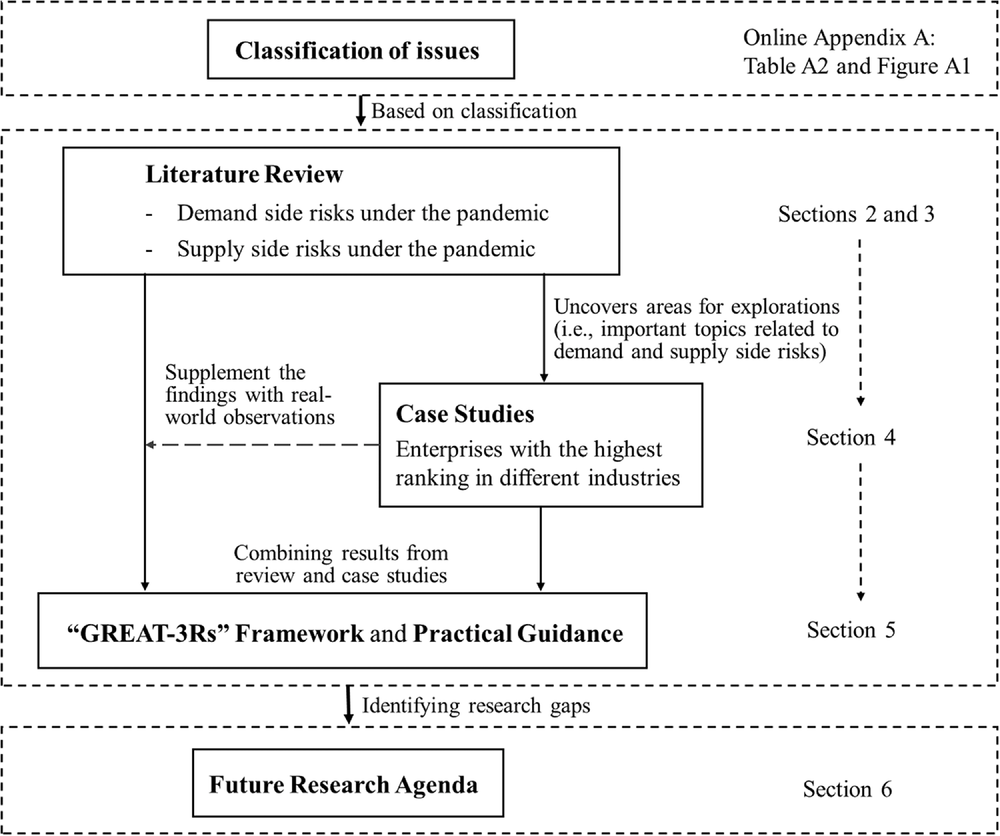
Overview of the research method and road map
Review methodology
To provide a comprehensive review in our study, we adopt a three‐stage (i.e., “planning, conducting, and reporting”) systematic review methodology to search, collect, and analyze target papers. We adopt this approach because it can help us more comprehensively survey the related literature and find the relevant studies for in‐depth analyses. Note that this methodology is widely used in the literature, for example, Tranfield et al. (2003), Choi et al. (2018), and Cai & Choi (2019). The details for each stage are as follows.
First, in the planning stage, it is important to identify the keywords for searching. Note that the epidemic outbreak is different from other disasters due to two specific features, namely, long‐term disruption and increasing propagation (Govindan et al., 2020). Therefore, in our review study, we concentrate on examining prior studies on the pandemic in OM rather than all disaster‐management research.
3
We intentionally include all kinds of infectious diseases rather than just paying attention to COVID‐19‐related work because: (i) the number of papers working on COVID‐19 in the OM domain is still very limited, and (ii) other infectious diseases (e.g., Severe Acute Respiratory Syndrome, influenza, and Ebola) have similar features with COVID‐19 (Ru et al., 2021), for example, high infection rate, high fatality rate, and global influences. For the identifications of related papers, we adopt the following searching protocol: (“epidemic” OR “outbreak” OR “pandemic” OR “disease”) AND (“operations management” OR “operational” OR “operation” OR “logistics” OR “optimization”).
After identifying the searching protocol, we proceed to the second stage, that is, the searching stage. For the journals in which we search papers from, we follow Choi et al. (2018) and focus our search on papers published in Science Citation Index/Social Sciences Citation Index (SCI/SSCI) journals in the operations research and management science category via Web of Science portals and supplement with Google Scholar and Social Science Resaerch Network (SSRN). Apart from searching identified keywords, we also include some additional papers by tracking the references therein, while excluding papers that are out of scope (e.g., those mainly in the field of medicine without sufficient relevance to OM) and pure literature review papers. By checking the titles and abstracts, 56 papers from 24 journals are finally selected for an in‐depth review, in which the first related paper can be traced back to the year 2006. We summarize the literature searching process in Figure A2 in Online Appendix A.
Finally, in the reporting stage, we conduct a descriptive analysis and provide the summary of selected papers investigating the respective issues for supply and demand sides in Table 1. The specific details can be checked in Table A3 in Online Appendix A. Note that, in some cases, a paper may be included in more than one classification, as it may consider multiple aspects. In Table 1, we use dotted lines to connect the two issues being explored in “multiple issues” papers. For instance, in the first line where the number 4 (in bold font) is connected with the issues “resource allocation” and “demand uncertainty,” it means that there are four “multiple issues” papers that examine these two issues simultaneously in the papers. As we can observe from Table 1, prior studies focus more on the impacts from the supply side than the demand side (i.e., 49 papers vs. 21 papers). Meanwhile, we interestingly notice that great attention has been paid to the resource allocation issue (25 papers); however, this issue is rarely discussed in prior review/discussion papers (see Table A2). This is hence one area we highlight in this study. Furthermore, we observe that 14 papers explore multiple issues, and most of them consider the impacts from both supply and demand sides.
Summary of the selected papers investigating the respective issues
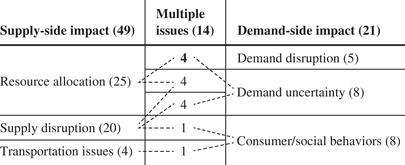
Note: Numbers represent the number of selected papers for each issue; dotted lines represent the linkages/combination for multiple issues.
Contribution statement
Compared with the prior reviews, the contributions of our paper are three‐fold: (i) It is to our knowledge the first paper that explores the impacts of COVID‐19 on global supply chain operations with a focus on real‐world cases and a comprehensive examination of prior studies. Focusing on “global” is important since, under COVID‐19, global supply chains are very fragile. Finding a way to get around becomes crucial. However, no prior studies focus on this point. (ii) We combine the real‐world cases and literature review to establish a novel “GREAT‐3Rs” framework based on the different stages of the pandemic (i.e., pre‐, during‐, and post‐pandemic). This framework provides specific and feasible measures for global enterprises to enhance GSCM practices and survive the pandemic, which supplements the existing findings with real‐world observations. (iii) Third, based on the proposed framework, we establish a future research agenda that helps stimulate future OM studies. These future directions have not been proposed earlier by others. In short, we believe that this study creates valuable insights regarding how GSCM can be restructured to survive the current and future pandemics with the support of real‐world cases.
DEMAND SIDE RISK UNDER PANDEMIC
From Table 1, we can see that for prior studies on the “demand‐side,” demand disruption, demand uncertainty, and consumer/social behaviors are identified as important areas. We hence present some related studies and insights accordingly (see Figure 2).
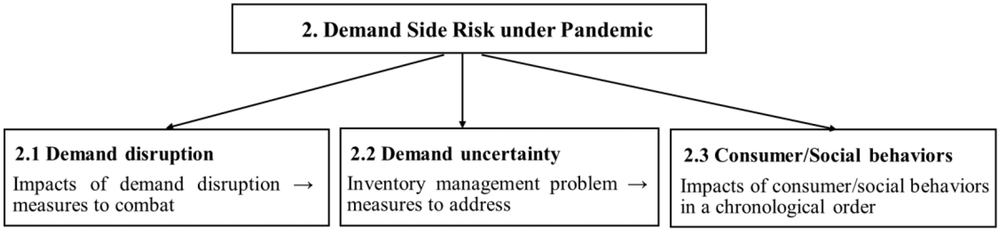
Roadmap for Section 2
Demand disruption
Demand disruption usually refers to the sudden demand variability or radical change of customer fragmentation (Ivanov et al., 2019). It is crystal clear that demand disruption is very likely to happen under a pandemic such as COVID‐19 and may create a ripple effect (Ivanov & Dolgui, 2020a). Recently, two papers focus on examining the demand disruption risk under the pandemic. First, Ivanov & Das (2020) conduct simulation studies to explore the ripple effect of an epidemic outbreak in global supply chains. Three distinctive scenarios are modeled, and the authors put a strong emphasis on investigating the uncertainty of market disruption with different durations. The authors interestingly show that the combinatorial effects of market disruption and other negative events may indeed benefit the global supply chain. Second, Cheema‐Fox et al. (2021) use data from over 3000 global companies in different industries to empirically study the firms’ resilience and responsive operations under a sharp market decline during COVID‐19. The authors uncover that the company with “positive sentiment” tends to possess stronger resilience and response‐ability. As we can see, both Ivanov & Das (2020) and Cheema‐Fox et al. (2021) reveal that demand disruption under the pandemic is an issue that can be addressed if proper measures are imposed.
To generate more useful insights for GSCM to combat demand disruption, we further search and review some important OM literature related to demand disruption risks. For example, Chen & Xiao (2009) and Zhang et al. (2012) build analytical models to examine the impacts of demand disruptions on supply chain coordination. Specifically, Chen & Xiao (2009) propose two coordination schedules, namely, the “linear quantity discount schedule” and “Groves wholesale price schedule.” They prove that both schedules have their superiorities to fight against demand disruption under certain conditions. Zhang et al. (2012) find that the supply chain members must adjust the original revenue‐sharing contracts when there exist demand disruptions; otherwise, the supply chain performance will be harmed. Moreover, Xu et al. (2018) construct an “online‐to‐offline” supply chain model with online subsidies, through which they analyze the value of online subsidies in terms of eliminating the demand disruptions. To summarize, we conclude that the demand disruption risks under the pandemic are present while luckily they may not be that fatal. Some measures, such as proper coordination schedules and subsidy programs may be helpful.
Demand uncertainty
Global markets are affected by COVID‐19, and pandemics naturally would magnify market demand uncertainty and vulnerability. In particular, companies are placing much bigger orders to compensate for the probable delays and shortages in supplies. The bullwhip effect (Lee et al., 1997) is hence magnified under COVID‐19, and this was recently reported by Wall Street Journal. 4 This situation was even more severe when many factories went downsizing over the past decades. Prior literature related to demand uncertainty mainly works on solving inventory management problems. For example, realizing the challenges of demand uncertainty in humanitarian operations, Rottkemper et al. (2011) develop an optimization model based on penalty costs for nonsatisfied demand to balance inventories and reduce total nonserved demand. Wang et al. (2009) and Liu & Zhao (2012) investigate how demand uncertainty affects emergency resource usages and planning in epidemic areas. To figure out optimal material distribution decisions under the pandemic, Wang et al. (2009) develop a multi‐objective stochastic optimization model with “time‐varying demand.” The authors incorporate epidemic diffusion into the model. Then, Liu and Zhao (2012) construct and solve an integrated and dynamic optimization model with time‐varying demand. They provide useful guidelines for decision‐makers to solve the emergency rescue problem with uncertain demands. Van der Laan et al. (2016) realize the high demand uncertainty nature of medical aid items under epidemics. The authors empirically study the demand prediction and order planning problem for medical items. Parvin et al. (2018) examine the optimal allocation of malaria medications in a three‐layer centralized health supply chain system, in which the market demand uncertainty is modeled by a two‐stage stochastic programming approach. Shamsi et al. (2018) develop a specific “options contract” for vaccine procurement under demand uncertainty. The authors build an analytical epidemic model to capture the establishment and spread of an infectious disease. They also apply the log‐normal distribution to model the uncertain demand. The authors argue that different from the commonly used normal distribution, the log‐normal distribution can well capture the skewed probability distribution, which is known to be common for demand under a pandemic (e.g., with a long right tail). To cope with demand uncertainties under the pandemic, governments should consider the social cost associated with the infected individuals and the specific data when making optimal decisions. Li et al. (2021) and Shen & Sun (2021) examine the huge uncertainty of demand under the COVID‐19 pandemic and make efforts to address it for supply chain resilience. To be specific, Li et al. (2021) analyze the potential influence of COVID‐19 on passenger air transport demand and make forecasts under different cases by using simulation. Their results reveal that the two forces (i.e., supply restriction and demand depression) will have opposite impacts on air transport demand concerning different passenger segments. Shen & Sun (2021) use quantitative operational data from JD.com to evaluate the challenges brought by COVID‐19 (e.g., exceptional demand). The authors highlight some corresponding measures taken by JD.com in the Chinese market. They conclude that it is necessary and effective for firms, the government, and the whole society to make joint efforts to control the market demand under the pandemic.
Consumer/social behaviors
COVID‐19 changes our daily life. Although the pandemic may be temporary, changes in consumer/social behaviors in global supply chains are likely long‐lasting (Downes, 2020). For instance, consumers are more willing to have online shopping while less likely to take public transport. Thus, it is natural to consider consumer/social behaviors when exploring the impacts brought by pandemics like COVID‐19. To help both governments and individuals develop better control policies for fighting an influenza pandemic, Larson (2007) establishes a “nonhomogeneous probabilistic mixing” model to examine how a population's heterogeneity and social behaviors could affect the evolution of the disease. Singh et al. (2020) conduct a simulation analysis of the public distribution systems network to explore the impacts of COVID‐19 on food supply chains. The authors consider the consumers’ flexibility in ordering items, which is an important modeling feature. Choi (2020) analytically studies the values of “bring‐service‐near‐your‐home” operations for small service providers to survive COVID‐19. In his model setting, consumers make their decisions not only based on the service fee but also on factors such as the hygiene level and average distance to the firm. The author also explores the roles played by the government under the pandemic. Muggy & Stamm (2020) work on the decentralized beneficiary's “last mile behavior” in humanitarian supply chains. The authors build a game‐theoretic model to measure the impact of uncoordinated decisions on supply chain performance. Their findings guide how to change decentralized decisions so that they will approach the ones under the coordinated system. Observing that consumers tend to shift from offline stores to online, Hwang et al. (2021) pay attention to examining the retailer's omnichannel operations under COVID‐19. The authors empirically examine the implications of the COVID‐19 pandemic and government interventions on an omnichannel retailer's performance. They offer helpful omnichannel operations suggestions for retailers to adapt to the pandemic under the new normal. Observing the firm's closure decisions under COVID‐19, De Vaan et al. (2021) study how social learning impacts the firm's operations decisions. The authors claim that not only the consumer's behavior but also the competitors’ behavior can provide signals for the firm's closure decisions. Motivated by Timberland's WhatsApp shopping service operations (WSO) during COVID‐19, Xu et al. (2021) build analytical models to capture the consumer's fear of infection when going to physical stores. The authors consider the workers’ welfare when doing analyses. Their findings show the value of WSO implementation under the pandemic from both the profitability and social welfare perspectives. Liu et al. (2021) conduct an empirical study to analyze the effect of providing coupons on consumer spending in the Chinese market. The authors verify the effectiveness of implementing a coupon program on stimulating consumption under COVID‐19 and also highlight the importance of considering behavioral factors when designing the program. From the above studies, we notice that consumer/social behaviors would shift and influence GSCM. This deserves the companies’ attention. We construct Table A4 (in Online Appendix A) to summarize the demand side risk‐related literature.
SUPPLY‐SIDE SHOCK UNDER PANDEMIC
As identified in Table 1, supply disruption, resource allocation, and transportation issues are the three major issues discussed in the supply side. We hence organize our discussions accordingly as shown in Figure 3.
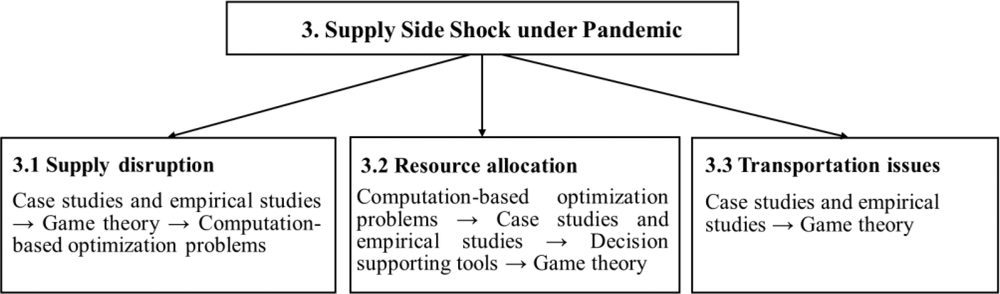
Roadmap for Section 3
Supply disruption
Supply‐side uncertainty is an inherent part of GSCM (Li et al., 2017), and supply disruptions are very critical (Shan et al., 2021). As we can see from Table 1, supply disruption risk is the most popular and urgent issue that needs to be resolved under COVID‐19 for GSCM. Usually, firms cannot recover rapidly from disruptions (Hendricks & Singhal, 2005). Before the occurrence of COVID‐19, Cohen et al. (2018) discuss the offshore production and reshoring decisions in global supply chains. With industrial inputs and data analyses, the authors uncover a few insights and establish a few hypotheses, for example, “restructuring of global supply chains is taking place in all industries and geographies (see hypothesis 1 of Cohen et al., 2018),” “China and Eastern Europe have emerged as the dominating destinations for offshoring (see hypothesis 2),” and “natural hedging occurs in many industries (see hypothesis 4).” Global companies have long considered supply disruption risk in planning the optimal supply chain configuration. COVID‐19 probably pushes the situation further, and companies need to think even more thoroughly and consider the option of reshoring even more urgently than ever.
Supply disruption risk is inevitable for global supply chains due to the lockdowns of cities during the pandemic. Numerous studies investigated this topic and provided useful guidelines for global supply chains on how to combat the negative effects brought by supply disruptions. In the literature, different research methodologies are adopted for exploring supply disruption and these include (i) case studies and empirical studies, (ii) game theory, and (iii) computation‐based optimization problems.
First, for case studies and empirical studies, Govindan et al. (2020) develop a practical decision‐supporting tool to help reduce supply disruption risks in the healthcare supply chain system. The authors further conduct case studies to evaluate the performance of their proposed system and show promising results. Handfield et al. (2020) focus on exploring trade disruptions (e.g., Brexit and the United States imposing tariffs) for GSCM under the recent COVID‐19 pandemic. Through two case studies, the authors explore the impacts brought by trade disruption risk on the supplies and the proper design of future global supply chains. The authors expect to witness a dramatic transformation of global supply chains rather than imposing tariffs in the new normal. Then, in the context of quantitative empirical research, Nikolopoulos et al. (2021) highlight the significant disruptions in both up‐ and downstreams of global supply chains. The authors use data collected from different countries (including the United States, India, and the United Kingdom) up to mid‐April 2020 to provide short‐term predictions on the COVID‐19 pandemic and its effect on GSCM. They argue that the findings are very useful for enterprises and policymakers. Similarly, Shen & Sun (2021) collect the data of JD.com and explore the corresponding supply disruption problem. By analyzing the practical measures taken by JD.com under COVID‐19, the authors summarize that the operational flexibility and collaboration among supply chains are effective ways to cope with the severe supply disruptions challenges under the pandemic. Chundakkadan et al. (2021) evaluate the role of government support to small and medium enterprises. By empirically analyzing the firm‐level data from over a dozen countries, the authors conclude that those firms with financial constraints tend to shut down their operations due to supply disruptions, and most of them are supported by the government. Cui et al. (2022) interestingly examine the operations problem with social issues under COVID‐19. The authors study how the disruption problem caused by city lockdowns influences the related gender equity in terms of research productivity. Their empirical findings verify the existence of the fairness issue in productivity due to the disruption problem.
Second, for analytical studies, game theory is frequently adopted to explore the supply disruption risk under pandemics. Chick et al. (2008) develop an integrated analytical model with considerations of both the government's and manufacturer's decisions in a global supply chain for vaccines. They reveal that the supply disruption of vaccines will be caused by a lack of coordination. Chen (2013) uses game‐theoretical models to derive the optimal procurement design under supply disruptions (caused by disease outbreaks) and heterogeneous beliefs between buyers and suppliers. The authors show that heterogeneous beliefs of disruption probability will result in severe production inefficiencies, which should be avoided as much as possible. Ivanov (2020b) proposes an analytical “viable supply chain” model using the dynamic systems theory and dynamics optimal control. The author verifies the supply chain's performance in terms of recovering and rebuilding of the supply chain capability after the COVID‐19 pandemic. Ivanov & Dolgui (2020b) use the “dynamic game‐theoretic modeling” approach to investigate the viability of “intertwined supply networks.” They focus on uncovering the impacts brought by disruptions and the critical “ripple effect.” The authors evaluate how the existence of backup suppliers and “subcontracting facilities” affects GSCM with supply disruption risks.
Finally, there are a substantial number of papers that explore supply disruptions under the pandemic by using computation‐based approaches, including simulation and optimization. First of all, some inventory control problems are examined. For instance, based on simulation‐based analysis, Rottkemper et al. (2011) work on the optimal inventory relocation problem in the context of humanitarian operations. The authors surprisingly find that considering future disruptions can sometimes be helpful to balance inventories and reduce the total “nonserved” demand. Ekici et al. (2014) construct simulation models to study the optimal food distribution problem during an influenza pandemic with the consideration of supply chain disruptions. Their experimental results indicate that the capacity bottleneck, as well as the level of supply disruptions, will be reduced significantly by implementing the “voluntary quarantine” mechanism. Shamsi et al. (2018) analytically develop a specific option contract for vaccine procurement by adopting the bi‐level optimization approach with a nonlinear optimization problem. In their model, two suppliers, called the “main” and “back‐up” suppliers, are explored in the presence of supply disruption. The authors conclude that vaccine reservations could be an effective way to deal with those infectious disease epidemics and help achieve “post‐pandemic resilience” for the supply chain. By building and solving a “dynamic hybrid facility network” model, Mishra & Singh (2020) find that capacity expansion could be an effective approach to address the problem of supply disruption in a global supply chain. The authors adopt both “mixed‐integer nonlinear programming” and “linear programming” approaches in their modeling analyses.
Also, several computation‐based studies in the literature are devoted to providing risk mitigation measures for supply chains to survive pandemics. For instance, Paul & Venkateswaran (2020) adopt the “exploratory modelling and analysis” methodology to discuss robust supply chain optimal policies for mitigating an epidemic. The authors construct simulation models and run computational experiments to examine the role of drug supply disruptions in controlling the epidemic dynamics. To minimize the negative influence of disruptions under the COVID‐19 pandemic, Paul & Chowdhury (2020) propose a nonlinear programming recovery optimization model for assisting decision‐making in revising the optimal production plan. Their study highlights the superiority of a proper combination of two recovery strategies, namely, (i) lifting production capacity, and (ii) implementing emergency sourcing with supplier collaboration.
Moreover, numerous studies (i) reveal the importance of building a resilient supply chain system and (ii) propose various practical strategies, under pandemics. To be specific, Dasaklis et al. (2017) develop a linear programming model to study emergency supply chain operations. The results show that supply disruptions in vaccine supply chains appear at the “middle stage” of the major supply period. The authors hence highlight the necessity of establishing an emergency supply chain model to deal with a pandemic outbreak. Ivanov (2020a) and Ivanov & Das (2020) conduct simulation‐based analyses to examine how to strengthen the resilience of global supply chains when facing disruptions that are triggered by pandemics like COVID‐19. In particular, Ivanov (2020a) predicts the impacts of epidemic outbreaks on GSCM along with proposals for managerial actions. They surprisingly show that disruptions, especially short‐term disruptions, may positively affect the supply chain performance during an epidemic outbreak under some conditions. Ivanov & Das (2020) analytically model the ripple effect brought by an epidemic outbreak on GSCM. The authors build optimization models to determine the (potential) recovery paths for global supply chains under pandemics. Their simulation results interestingly show that the combined effects of disruption uncertainty and other negative events may indeed benefit the supply chain in some cases. Singh et al. (2020) propose a simulation model for studying logistics systems in food supply chains under COVID‐19. In their model, supply disruptions are considered. The authors aim at establishing a tool to achieve a resilient food supply chain system. We provide a summary of the reviewed literature on supply disruption in Table A5 in Online Appendix A.
Resource allocation
Resource allocation (from the supply side) is the hottest problem being discussed in the related literature in the presence of pandemics. Among all the emergency resources, healthcare resources should undoubtedly be the most crucial ones. A multitude of works has explored the optimization problems associated with allocation strategies for healthcare resources based on computation‐based approaches. For instance, Wang et al. (2009) build a multi‐objective stochastic programming model to study the optimal medical material distribution problem. The authors incorporate the epidemic diffusion rule as well as the delay brought by the disease epidemic into the model construction. Savachkin & Uribe (2012) establish a simulation optimization model to determine the optimal dynamic allocation strategies for limited healthcare resources such as vaccines. The authors aim at finding the optimal solution that balances both the ongoing and potential impacts under an influenza pandemic. Their computational results show that when the resource availability cannot meet the basic requirement, it is valuable to increase the additional resource availability. Rachaniotis et al. (2012) propose a simulation model to study the optimization problem of scheduling a single available resource in a pandemic area. The authors use a real case of the influenza epidemic in Greece to validate the model and demonstrate the good performance of their proposal. Ekici et al. (2014) combine the “disease spread” model with an optimal resource allocation model to estimate the demand for food under a pandemic. The authors derive the optimal food allocation strategy. Liu & Zhang (2016) establish a dynamic logistics model for medical resource allocation considering time‐varying demand and forecasting mechanisms. The authors build and solve a 0–1 programming problem to find the first best medical resource allocation. Dasaklis et al. (2017) consider the “dynamic spread” of a pandemic outbreak. They find the optimal resource allocation decisions via solving the corresponding linear programming model. Long et al. (2018) and Büyüktahtakın et al. (2018) conduct research concerning Ebola outbreaks. To be specific, Long et al. (2018) develop a two‐stage model for an optimal spatial allocation problem with limited intervention resources under the Ebola pandemic. The authors conduct a comparison study among four approaches, namely, the heuristics approach, a greedy policy, a myopic policy, and an “approximate dynamic programming” algorithm. Their results surprisingly uncover that the myopic policy can be the best method to resolve this optimal allocation problem. Parvin et al. (2018) design efficient medicine allocation schemes for malaria medication. The authors explore the problem in the context of resource‐constrained countries. They also examine from both the strategic and tactical levels. Through case analyses and numerical studies, the authors validate the performance of their proposed model in terms of medicine allocation. Büyüktahtakın et al. (2018) develop a novel “epidemics–logistics mixed‐integer programming” model to examine how to optimally allocate resources for controlling the Ebola outbreak. Then, by changing the capacity constraint in the model proposed by Büyüktahtakın et al. (2018), Liu et al. (2020) extend the “epidemics–logistics mixed‐integer model” and apply it for controlling the H1N1 outbreak in China. Enayati & Özaltın (2020) derive an optimal vaccine distribution policy with the consideration of a “quality guarantee.” By building a computation‐based optimization model, the authors conclude that the optimal decision of influenza vaccine distribution should be based on “group‐specific transmission dynamics.” Mehrotra et al. (2020) adopt a stochastic programming model to investigate the optimal ventilator allocation and sharing problem during a pandemic. Exploring several cases in the United States, they propose to appoint a central agency to be a coordinator because this can substantially improve the system efficiency by sharing resources in shortage. Besides, some prior studies investigate emergency resources rather than just focusing on healthcare resources alone. For instance, Liu & Zhao (2012) propose an optimization model based on a “dynamic and multistage programming” problem to derive the optimal allocation policy for all kinds of emergency resources facing uncertain demand. Mishra & Singh (2020) model a global supply chain by using a “mixed‐integer nonlinear programming approach.” They find the optimal production and allocation policy under a pandemic.
Availability of real data is always of great significance to determine the optimal resource allocation facing a pandemic. Many prior studies have pointed out this fact. For example, De Treville et al. (2006) conduct a real‐case study of not‐for‐profit (NFP) operations for a global drug facility planning problem. They uncover that lead‐time reduction can be an effective way for the NFP organizations to well distribute their resources to improve the supply chain operations as well as save valuable human lives. Cohen et al. (2018) conduct a detailed global field case study of manufacturing sourcing decisions. The authors focus on studying trade‐offs and the associated risks. They propose the use of “industry clusters” as a possible allocation strategy in global manufacturing. Van der Laan et al. (2016) acquire and analyze the standardized consumption data from more than 2000 medical items consumed in 2013. The authors empirically examine the demand prediction and optimal order planning problem and identify the key factors that will influence the performance. To provide effective planning of “logistical supply chains” for a developing economy during epidemic outbreaks, Anparasan & Lejeune (2018) collect detailed data for the 2010 cholera outbreak in Haiti. They construct a robust “data‐driven allocation” model for estimating the optimal emergency medical response. After that, based on collected real‐world data, Anparasan & Lejeune (2019) further establish an epidemic response model and propose a novel algorithmic procedure to help NFP parties to make optimal operational decisions. In their optimal operational plans, critical decisions, such as “healthcare triage” capabilities, distribution needs, and requirements for medical staff, are made.
Three studies in the literature focus on deriving the decision‐supporting tool for resource allocation problems related to health care/diseases. To be specific, Lee et al. (2006) develop a decision‐supporting tool called “RealOpt,” which includes different exact algorithms as well as fast heuristics, to determine the optimal allocation for vaccines. Ramirez‐Nafarrate et al. (2021) propose a novel flexible algorithm to help formulate the location‐allocation optimization problem with both capacity and time constraints. In their model, a penalty function is carefully considered for leveraging the associated resources. Realizing the food assistance crisis under the COVID‐19 pandemic in the United States, Blackmon et al. (2021) try to develop a decision support system to support the “Farmers to Families Food Box program,” aiming at facilitating the food allocation and distribution process between suppliers (or distributors) and farmers.
A few papers use the game‐theoretical approach for studying resource allocation problems in supply‐side operations. First, Sun et al. (2009) analytically investigate the “optimal stockpile allocation strategy” for different countries by constructing a multiple‐period model. Their analytical results show that if the disease's infection rate between countries is low, countries are suggested to agree on an optimal allocation scheme so that an all‐win situation will be attained; while if it is unattainable, some countries may have to sacrifice a part of their population to minimize the total infected number, which raises very serious ethical issues. Second, McCoy & Johnson (2014) build an analytical model to study the optimal epidemic control problem. The authors integrate the clinic's capacity decisions with the epidemic control rule. Their findings imply that public health can be improved significantly by incorporating “adherence” into the optimal clinic plan. Besides, clinics are recommended to allocate their budgets across periods to lower the cost. Third, Ivanov (2020b) designs a viable supply chain model for proper supply—demand matching that is integrated with three important aspects, namely, “agility, resilience, and sustainability.” The authors especially highlight the importance of being resilient as it can guarantee the viability of the supply chain system in the future. The summary of the relevant works on supply‐side resource allocation is shown in Table A5 in Online Appendix A.
Transportation issues
Under the outbreak of epidemics, individuals are less willing to take public transport as they may be infected and also spread the virus. At the same time, some governments impose policies to intervene in transportation to control the pandemic. As a result, the public transportation system and logistics operations in global supply chains are facing huge challenges under pandemics such as COVID‐19. So far, several studies have examined logistics and transportation topics in the case of pandemics. For example, to assess the impacts of commercial air travel on the Ebola virus spreading, Bogoch et al. (2015) analyze the empirical data from “International Air Transport Association” and study the global flight schedules in 2014. Based on the analysis results, the authors suggest using noncommercial flights for shipping essential materials, which not only can help maintain crucial supplies but also mitigate the high risk of having an international infection. Bóta et al. (2017) propose a “vehicle trip network” model to dynamically simulate different kinds of disease outbreak scenarios. By using the real case and data of Twin Cities, they validate and prove that their proposed model is very effective and robust. Kaplan (2020) discusses analytical modeling approaches to capture the effects of COVID‐19 on different key business operations issues. The author finds that countries’ lockdown restrictions for transportation may not be as effective as they seem to be because they cannot completely mitigate the infections. Instead, the author proposes that an aggressive community screening should be a more efficient way to end the outbreak. Motivated by a real case in Hong Kong, Choi (2020) analytically evaluates the innovative “bring‐service‐near‐your‐home” model under COVID‐19. The author explores how logistics (offering services on a truck) and technologies can help to support this new business model to combat the operations challenges caused by the pandemic. In particular, the author suggests that the government could adopt various subsidy programs to help improve the supply chain performance if technologies such as blockchain (Rajendran, 2021) are known to be helpful while companies lack resources. Table A5 (in Online Appendix A) shows a summary of related works for transportation issues on supply‐side operations.
The above review analyses in Sections 2 and 3 offer the major insights of reforming GSCM under the pandemic from both the demand and supply sides. Based on these, we summarize interesting findings that can be further considered research gaps: (i) Most of the previous studies emphasize the issues related to the supply chain resilience in the “during‐pandemic” stage. They ignore the other stages. (ii) Findings of the prior reviews focus mainly on the healthcare industry and overlook other industries. (iii) Among different research methodologies—analytical, computational, and simulation—are adopted more frequently than others. Moreover, from another perspective, our review results uncover the critical dimensions (with related organizational behaviors) that can help researchers to develop empirical hypotheses for future studies to improve the 3Rs in global supply chains. Note that, according to Ketchen & Hult (2007), nine organizational theories are primarily used for best‐value supply chain management (for the details, see section 2 in Ketchen & Hult, 2007), we hence follow their contention and identify the corresponding theories for GSCM under COVID‐19. Consequently, four related organizational theories (i.e., strategic choice theory, agency theory, transaction cost economics, and resource/knowledge‐based view) applied for four major dimensions (i.e., operational flexibilities and strategies, managerial attitudes, enhanced logistics, and forecasting and analytics) that would help firms in the global supply chain to better survive pandemics and achieve the 3Rs are depicted in Figure 4.
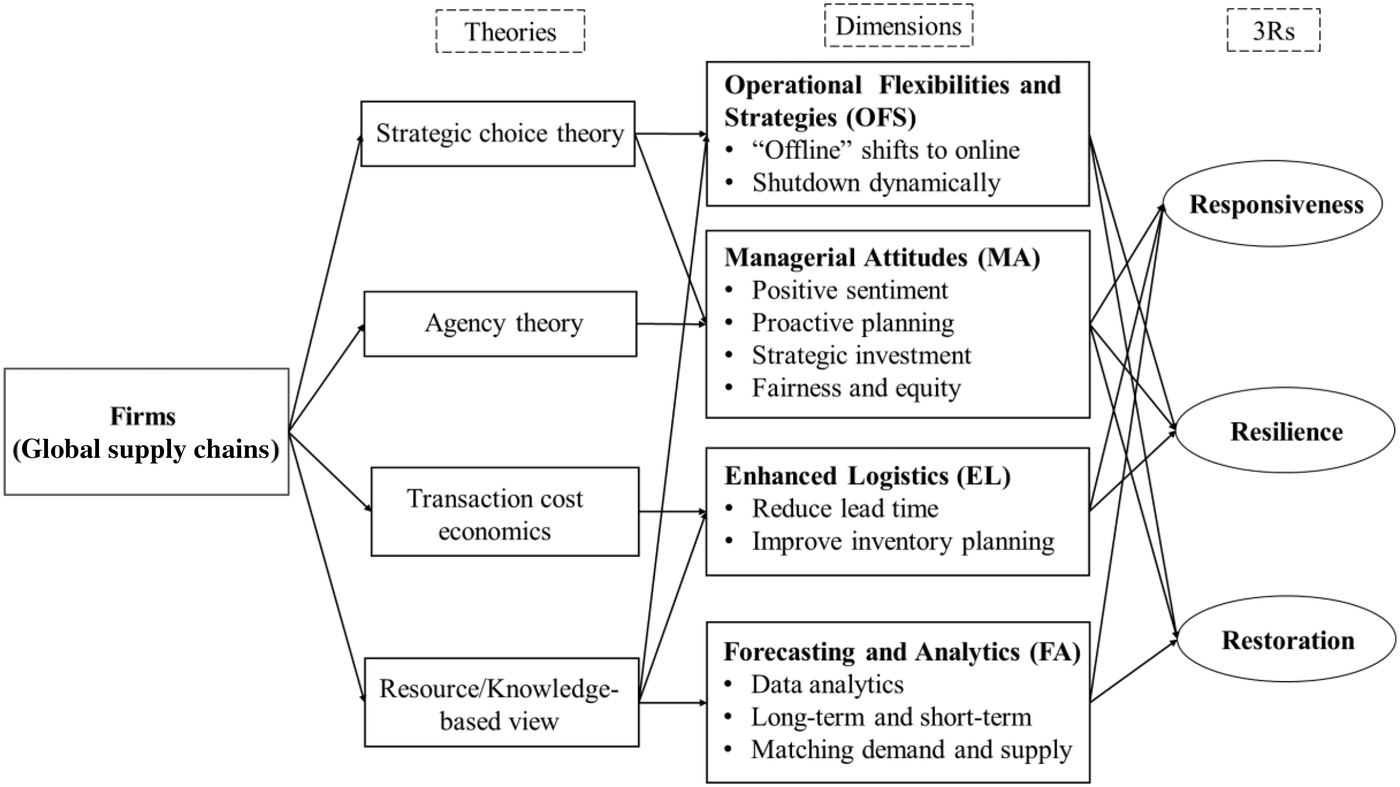
Critical theories and dimensions that enhance responsiveness, resilience, and restoration (3Rs) of global supply chains under pandemics 5
Note that, the findings summarized in Figure 4 are very useful, especially for those empirical researchers, as various empirical hypotheses for reforming GSCM can be proposed by referring to this figure. For example: According to the strategic choice theory and resource/knowledge‐based view, operational flexibilities and strategies (OFS) can help global enterprises to achieve supply chain resilience and restoration (R2 and R3) under the pandemic (Hypothesis 1). More valuable hypotheses derived from Figure 4 can be checked in Online Appendix B. These hypotheses can guide empirical researchers to study GSCM under pandemics. Besides, the findings in Figure 4 imply that the most important theory contributing to all 3Rs from different dimensions should be of a resource/knowledge‐based view that requires global enterprises to utilize all their tangible and intangible resources/knowledge to gain long‐lasting competitive advantages, for example, OFS, enhanced logistics, and forecasting and analytics, under a pandemic. The findings from Figure 4 can also help identify the areas for further explorations in our real‐world cases in Section 4 and derive the final “GREAT‐3Rs” framework in Section 5.
REAL‐WORLD CASE STUDIES
By reviewing literature relevant to GSCM under pandemics in Sections 2 and 3, we have identified several critical research areas from both the demand and supply sides. We have also found various important dimensions that would help enhance the 3Rs of global supply chains (Figure 4). These findings from the literature review uncover areas for further real‐world explorations. A recent Wall Street Journal (March 18, 2021) article indicated that global supply chains are in a mess, and manufacturers of all industries suffer shortages of supplies of all kinds (chemicals, chips, etc.) and some even have to stop production. 6 In this section, we would like to conduct public real‐case analyses based on those issues identified in the literature review. We aim at revealing some important real‐world observations of how top enterprises in the world adapt and survive COVID‐19. Following Choi et al. (2018), we select the enterprises with the highest ranking in different industries according to Forbes’ annual list of the world's most valuable brands (from 2019 to 2020). 7 For instance, we choose Apple as it ranks first among all technology companies in the list and Caterpillar as it ranks highest in the heavy equipment industry. Our choice is based on the fact that these enterprises usually have more resources to invest in their GSCM, and their supply chain systems are more well‐established. Meanwhile, more public information regarding their operations strategies toward COVID‐19 can be found online. We mainly check the official websites of these enterprises and also public news on Forbes.com. In Table 2, we summarize the major findings and highlight the implications from both the “supply and demand sides” for GSCM of each selected company in our case studies. The detailed discussions can be found in Online Appendix C. All these implications will be further classified and summarized as practical guidance in Section 5.
Implications for global supply chain management (GSCM) in the case study companies
As shown in Table 2, all the examined companies in different industries take various measures to cope with the COVID‐19 pandemic from both the demand and supply sides. From the demand side, “closing stores,” “encouraging online purchases,” and “producing medical supplies” are the three major actions taken by the companies. By taking these measures, the problem of demand reduction in physical stores can be addressed to some extent. Besides, technologies like artificial intelligence (AI) and blockchain (Luo & Choi, 2022) are adopted by enterprises (e.g., McDonald's, Walmart) to improve operations efficiency and customer services under the pandemic. From the supply side, we interestingly find that the companies in different industries may take markedly distinct actions. For example, Coca‐Cola conducts a local sourcing strategy to simplify its supply chain during the pandemic, whereas other companies like Apple, Nike, and Walmart adopt a supply diversification strategy to avoid supply disruption risks. Hence, it may be interesting for researchers to further explore the real reasons behind it. Moreover, establishing long‐term collaborations with, for example, governments and local and national health authorities seems to be an effective way for companies to acquire additional support for their global operations to fight against the supply‐side risks caused by COVID‐19.
THE “GREAT‐3RS” RESEARCH FRAMEWORK
After reviewing all relevant literature and summarizing the implications derived from the real cases, we attempt to propose a systemic framework for the GSCM revolution in Figure 5, which shows the key issues, corresponding measures, and expected outcomes for the GSCM revolution under a pandemic. Note that the points inside the identified dimensions in Figure 4 are also incorporated into the framework. We call it a “GREAT‐3Rs” framework. It is based on the demand‐ and supply‐side risks and it covers the three distinct pandemic stages (pre‐, during‐, and post‐pandemic). As we mentioned in Section 1.1, the 3Rs are the three major goals for GSCM enhancement under different stages of a pandemic; we hence believe that our framework can provide a detailed and clear picture for global supply chains to better identify the influence of COVID‐19 as well as achieve the 3Rs. Note that the “GREAT” strategy part provides practical guidance for global supply chains to address the key issues under the pandemic. The specific contents of the “GREAT” strategy will be discussed in more detail later.
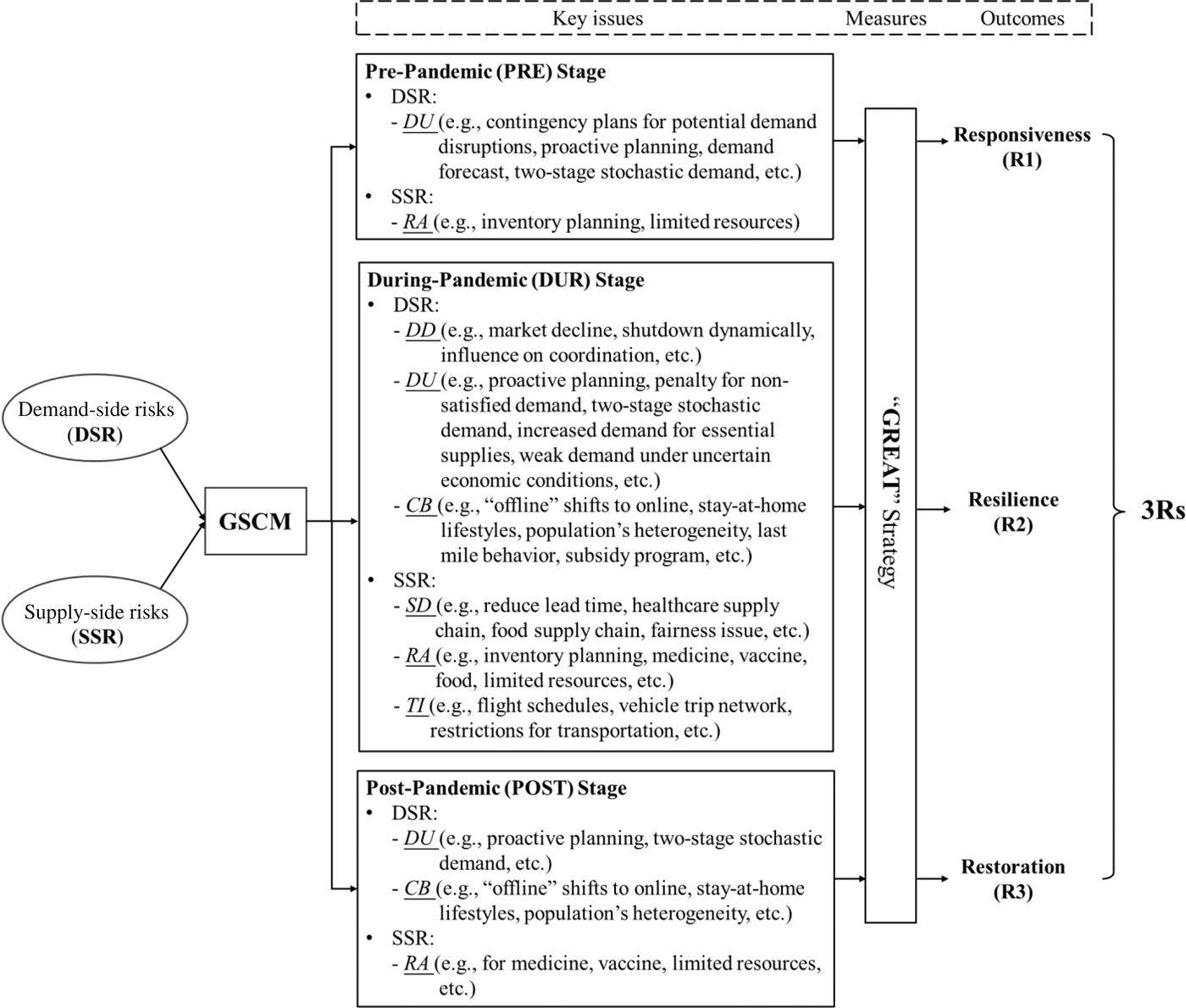
As we can observe from Figure 5, the key issues faced by the global supply chain vary with the stage of the pandemic. It is hence necessary for the firms to identify the situation and choose the proper strategy to achieve the 3Rs. For example, before the pandemic (i.e., pre‐pandemic stage) when there is no city lockdown, the risk of supply disruption and transportation issues do not exist; we hence suggest firms focus on typical OM issues including resource allocation and demand uncertainty problems, to establish a global supply chain with responsiveness by taking measures. During a pandemic, all the risks from demand and supply sides appear, which requires a global supply chain with strong resilience to combat these critical challenges all within a very short time efficiently. Finally, after a pandemic (i.e., post‐pandemic stage), some risks may disappear while the influence of pandemic on consumer behavior is long‐lasting (PwC, 2020). Thus, it is the task for the companies to adapt to the “new normal” in the post‐pandemic stage as well as improve restoration for the global supply chain to seek long‐term survival and economic sustainability. In short, we expect firms in the global supply chains to identify the specific issues faced under different pandemic stages, and implement our proposed measures (i.e., “GREAT” strategy) to achieve the 3Rs for the GSCM revolution.
In our “GREAT‐3Rs” framework, we include some GSCM practical guidance for policymakers and industrialists to help them address the key issues and achieve the 3Rs. Based on the findings from the reviewed literature (i.e., Tables A3, A4, and A5 in Online Appendix A) and case studies (i.e., Table 2), five main dimensions are identified as the “GREAT” strategy (we extract the first letter of each dimension to form “GREAT”): government proactive policies and measures, redesigning global supply chains, economic and financing strategies under risk, adjustment of operations, and technology adoption. We present the “GREAT” strategy with practical guidance in Table 3. Particularly, to make the “GREAT” strategy more applicable for the industrialists, we identify the related issues and applied stages for each practical guidance according to our review results. Note that, some of the measures are only applicable to the “global” pandemic due to its global features (i.e., those measures with superscript “a” in Table 3), whereas the others are effective during both the “global” and “nonglobal” outbreaks. By combining the proposed framework (i.e., Figure 5) with Table 3, the practitioners can have a clear picture regarding how to improve GSCM under the pandemic.
Overview of “GREAT” strategy and practical guidance
Note: Please check Table 4 for the specific meanings of notations.
means that the measure is only applicable to the “global” supply chain, and the others can be applied to both “global” and “nonglobal” ones.
Notation table for the “GREAT‐3Rs” framework
Government proactive policies and measures
The survival and development of global supply chains under the pandemic require mutual efforts from all governments in the world (Choi, 2021). During such unsettled times, the government's proactive policies and measures are critically important for GSCM. First, we have to emphasize that imposing tariffs need not be an effective policy to implement for the global supply chain (Handfield et al., 2020). Instead, the governments should: (i) encourage voluntary quarantine and community screening because voluntary quarantine can decrease capacity bottlenecks and supply chain disruptions significantly (Ekici et al., 2014), and aggressive community screening could be an efficient way to cope with the COVID‐19 pandemic (Kaplan, 2020). These measures have been already taken in places including Canada, China, Japan, Taiwan, and the United Kingdom 8 and are proven to be effective to mitigate the pandemic. (ii) Countries’ collaboration (e.g., global research and development and agreement on an allocation scheme) is a possible way for global supply chains to achieve an all‐win situation. The UN's 17 SDGs 9 reveal that sustainable development can only be realized with strong global cooperation (Goal 17: Partnerships), which is especially an urgent mission under the COVID‐19 pandemic. On June 3, 2020, four of Europe's largest economies announced to co‐develop and produce a vaccine “on European soil” to fight against COVID‐19; meanwhile, collaboration on vaccine development was also conducted between a Chinese vaccine company and the Canadian National Research Council (Zhou, 2020). (iii) A well‐designed subsidy program should be a feasible way for the government to help firms survive the pandemic (Choi, 2020; Liu et al., 2021), as financial support is vital for the transformation of global supply chains. Besides, providing subsidies is also an effective way to enhance the consumer affordability of the product (Arifoğlu & Tang, 2021), which can eventually keep or even yield an increased market demand under the pandemic. In real practice, after the outbreak of COVID‐19, the European Union (EU) has provided funding for a broad range of projects; Japan's Ministry of Economy, Trade and Industry (METI) has conducted a subsidy project to support mask manufacturers and individual businesses operators affected by COVID‐19. Most recently, the White House announced an American rescue plan in January 2021, in which US$1.9 trillion will be provided to help its citizens to survive COVID‐19. 10 (iv) Government's supportive incentive policies for GSCM (e.g., adjustments of import and export quotas, investment credits, and tax incentives) are crucial. For example, Brazil's government has extended the list of zero import taxes on medical items (e.g., medicines, testing equipment, and vaccines) during COVID‐19 (KPMG, 2020). This policy not only helps Brazil to enhance its domestic healthcare system to combat COVID‐19 and achieve the UN's 17 SDGs (especially Goal 3: Good health and well‐being), but also benefits global healthcare supply chains. (v) Setting policies for fairness and equity should be considered by the government, as there exist fairness issues caused by the disruption problem under the pandemic (Cui et al., 2022). In particular, the government should have the responsibility to address this issue to help enhance social welfare and achieve supply chain resilience and restoration.
Redesigning global supply chains
Studies on trade disruption under COVID‐19 have revealed that the transformation of a new supply chain design is expected for GSCM (Handfield et al., 2020). Numerous measures can be taken to redesign the global supply chain: (i) Remodeling production lines can help firms to better adapt to the radical change of demands and overcome the potential supply disruptions. The “plant charter strategies,” which include consolidation plans on product lines as well as vertical integration, could also be considered (Cohen & Lee, 2020). For example, noticing the new “stay‐at‐home lifestyles” and resource limitation, Coca‐Cola has redesigned its production line to prioritize the supply of “bottle/can” drinks and “multipacks” during the pandemic (see the case study). For those products with a modular structure, for example, high‐technology products, postponement of the assembly process to different global distribution points may also be an advisable strategy, as this proposal may enhance the flexibility of global companies (Cohen & Lee, 2020). (ii) Just‐in‐time (JIT) manufacturing can be an effective approach to achieve flexible scheduling, which is well adopted in Toyota's supply chain. By adopting JIT manufacturing, the supply chain can adjust its production schedule flexibly to meet uncertain demands. (iii) Establishing an emergency supply chain with contingency plans is necessary (Dasaklis et al., 2017), especially for the pre‐pandemic stage (Choi, 2021). We suggest that firms, especially those who produce essential products, establish a plan to properly increase their production capacity, provide resource reservations, and adopt an emergency sourcing and collaboration strategy to combat both demand and supply disruption risks (Mishra & Singh, 2020; Paul & Chowdhury, 2020; Shamsi et al., 2018). (iv) Rerouting the vehicles and having alternative logistics choices (e.g., using third‐party logistics) under travel restrictions can be considered (Li et al., 2018). This is helpful to construct a flexible and resilient supply chain in terms of resource allocation (Singh et al., 2020). For example, Caterpillar considers using alternative air freight in its global supply chain to avoid potential supply disruption associated with other shipping modes (see case study). (v) Using noncommercial flights to transport essential materials can not only help maintain crucial supplies but also mitigate the risk of international infection, which can be applied by logistics companies. (vi) Supply chain coordination is the most commonly adopted strategy to improve supply chain performance, and there is no exception in the case of the COVID‐19 pandemic. First, various contracts can be designed to reduce impacts brought by demand uncertainty (Shamsi et al., 2018) as well as to achieve a global social optimum (Chick et al., 2008) under the pandemic. Walmart and JD.com have built long‐term contractual collaborations with thousands of suppliers to achieve supply chain coordination, which contributes to its great viability to combat demand uncertainty and survive COVID‐19. Besides, the global central agencies (e.g., EU) may act as a coordinator to improve the global supply chain system efficiency by sharing resources in shortage (Mehrotra et al., 2020). (vii) Supply diversification is an efficient way for the manufacturer to diversify its potential supply disruption risks. It is critically important for those global firms. After the COVID‐19 outbreak, Nike has diversified its sourcing, and Apple has partially moved its iPhone manufacturing plants out of China as well as cooperated with many new suppliers to avoid supply disruption (see Section 4). This is especially significant for the trendy and critical goods or parts such as semiconductors, medicines, and chemicals. (viii) Reshoring is a trend for global product sourcing decisions. Before the COVID‐19 pandemic, offshoring was much more popular than reshoring in global supply chains (Cohen et al., 2018). However, the COVID‐19 pandemic has brought critical offshore production uncertainties (risks) owing to various changing rules and uncontrollable political issues. Consequently, reshoring becomes a well‐proposed action. For instance, Coca‐Cola's local sourcing strategy is helpful to reduce the potential supply disruption risk during the COVID‐19. Nowadays, in the United States, perhaps more reshoring actions than ever over the past decades, there are serious proposals requesting the reallocation of production plants back to the country so that local supplies and sourcing of critical materials become feasible. 11 However, note that taking the reshoring action involves a substantially high fixed cost, which should be seriously considered by the firms when making decisions. (ix) Following the proposal by Cohen & Lee (2020), “smart taxation” can be designed under a special period (e.g., during the pandemic) by the governments to support GSCM. As we mentioned above, Brazil's government has provided zero import taxes for medical items under COVID‐19 (KPMG, 2020), and this is one of the smart taxation schemes for global healthcare product supply chains. It also establishes a golden opportunity to attract overseas medical companies to produce and supply more medical products for the Brazilian market. This is potentially a win‐win outcome for both Brazil (in getting the needed medical supplies for its citizens) and medical manufacturers and suppliers outside Brazil.
Economic and financing strategies under risk
Facing the global financial crisis brought by COVID‐19, firms should carefully set economic strategies to cope with risks, as their financial situation should always be a decisive factor for their survival. Observing real‐world practices, three effective strategies are recommended: (i) Reshaping cost structure is required for firms to fit the new financial situation under the pandemic. This measure can help the firms to achieve cost and resource flexibility to rapidly recover to the regular trading condition. (ii) Taping the credit line is a considerable way to solve the pressing need during a pandemic. It is reported that Toyota has tapped a ¥1.25 tn credit line to sustain its balance sheet in 2020 (see Section 4). However, decision‐makers should also pay high attention to the uncertainties in the regulatory environment and political instability, which may lead to an unfavorable situation for the firms. (iii) For the firms with sufficient capital, it is important to carefully plan their future project (e.g., smart cities and self‐driving for Toyota), to improve their restoration, especially for the post‐pandemic stage. This should be a sustainable method for the firms to ensure long‐term success.
Adjustment of operations
The uncertain demand and “always changing” consumer behavior require companies to make the corresponding adjustment to operations under the pandemic. We propose the following: (i) Re‐establish the channel strategies (e.g., closing physical stores and facilities to save operations costs, especially during city lockdowns) and focus more on online/remote business. For the case when physical stores need to be kept (e.g., when a long‐term contract has been signed or the setup cost is huge, e.g., the flagship stores of many luxury brands such as Hermes and Ferragamo), innovative measures such as WhatsApp shopping can be implemented (see Choi & Sethi, 2021; Xu et al., 2021). Besides, e‐procurement platforms can be applied to help global buyers and suppliers to conduct transactions remotely (Hong & Shao, 2021). (ii) Providing medical supplies can be a sensible decision for those manufacturing firms (e.g., Coca‐Cola, Louis Vuitton, Toyota, and Nike), as it is a good way to not only expand the business but also show the corporate social responsibility of the company. (iii) “Industry clusters” can be an effective strategy to establish a competitive and responsive supply chain to survive COVID‐19. As suggested by the theory of industry competitiveness (Porter, 1998), “industry clusters” can bring benefits to groups of firms that operate a similar business and share common markets. To address the challenges posed by COVID‐19, the European Cluster Collaboration Platform has launched the “The COVID‐19 Industrial Clusters Response Portal” to facilitate the fast and direct interactions among the industrial cluster community in Europe. 12
Technology adoption
In the present era of Industry 4.0 (Choi et al., 2022), firms are recommended to make full use of technologies for GSCM to survive the COVID‐19 pandemic. This applies to all relevant industrial sectors. We list the five most helpful tools that can be adopted: (i) Intelligent information systems are powerful systems that can help decision‐makers to devise optimal GSCM strategies (e.g., resource allocation and public transit strategies) to mitigate global supply disruption risks (Bóta et al., 2017; Govindan et al., 2020; Rachaniotis et al., 2012). (ii) Big data analytics can be an efficient tool to conduct short‐term real‐time forecasts to deal with supply disruptions and increase sales (Nikolopoulos et al., 2021) as well as reduce the bullwhip effect (Yildiz et al., 2016). This technology has been well‐adopted by Walmart, which has successfully estimated demand and established a more reliable supply chain for hand sanitizers and fresh meat demands under the pandemic (see Section 4). In healthcare global supply chain operations, data analytics and the related scientific models are also essentially important (for more discussions, see Dai & Tayur, 2021). The recent COVID‐19 vaccine development and allocation problems require very sophisticated data analytics to help. (iii) Blockchain‐based product provenance information disclosure system is a technology that has great potential to increase business value in international trade by providing transparent and reliable information. As reported by World Trade Organization, the business value of blockchain technology in international trading is estimated to exceed $3 trillion by 2030 (Cohen & Lee, 2020). Under the COVID‐19 pandemic, this technology has also been proven to be beneficial for supply chain operations (Choi, 2020). Countries such as the United Kingdom and South Korea are having plans to use blockchain to fight against COVID‐19 in making sure vaccines are genuine and establishing the vaccine passport. Transparency is proven to be a crucial factor in procurement (Quiroga et al., 2021). As we discussed in Section 4, Walmart has been collaborating with IBM to create a food traceability system by using blockchain technology. This system can successfully enhance food safety and sustainability since the process of the food supply chain is transparent, which should be the foremost issue concerned by many consumers under COVID‐19. (iv) A digital‐based distribution strategy would enable global supply chain members to share real‐time digital market and inventory data, which can help the firm to keep precisely tuned global inventory levels during a pandemic. GE has implemented digital technologies to (i) collect market demand and (ii) apply machine learning to predict inventory shortages and probable delivery delays. Then, the related information and recommendation will be used to plan the product movement from plants to warehouses. 13 As a remark, a recent MIT Sloan Management Review article (Schrage, 2020) highlights the inevitable trend of digital transformation in the post‐pandemic stage and emphasizes the visibility and transparency of data. Our proposal here is hence consistent with it even though our discussion is from the GSCM perspective. (v) AI‐based self‐serving service station can be an efficient tool for the firm to provide contactless services to consumers during the pandemic. For example, McDonald's has adopted an automated “intelligent” drive‐thru ordering system to provide a faster and more convenient shopping experience under the pandemic. This technology can not only streamline transaction processes and reduce overhead but also eliminate infection concerns and potentially increase revenue (Gao & Su, 2018).
Note that the above‐mentioned GSCM measures are applicable to different pandemic stages (pre‐, during‐, and post‐pandemic). In other words, companies should not blindly implement all of them at the same time. Instead, they should carefully take measures based on the assessment of conditions and their operational objectives. For instance, when the pandemic comes unexpectedly, that is, in the “during‐pandemic” stage, companies would face the most severe challenges and supply chain resilience should be prioritized. As we can observe from Table 3, most of the proposed measures can be applied in this stage, which means that companies should try their best to reform the global supply chain from every perspective. While as time goes on, when it comes to the “post‐pandemic” stage, in which companies have already adapted to the pandemic and aim at seeking for supply chain restoration, only those measures helping in long‐term development are recommended, for example, countries' collaboration, policies for fairness and equality, supply diversification, investing in the future survival, and blockchain implementation. In particular, we notice that “redesigning global supply chains” and “technology adoption” are the two major strategies that companies should focus on in the post‐pandemic stage. Then, after the “current” pandemic is settled, the next crisis could come in the future. Thus, it is also crucial for companies to establish a responsive supply chain and be prepared in the “pre‐pandemic stage.” Specifically, measures, such as adopting JIT manufacturing, establishing an emergency supply chain with contingency plans, reshoring, using big data analytics, and making a short‐term forecast, can be helpful to the companies to cope with future challenges. Consequently, our proposed framework should be dynamic, which would enable companies to reform their GSCM constantly when facing different pandemics in a long‐term perspective.
We believe that the proposed “GREAT‐3Rs” framework could be effective for the firm to improve GSCM under COVID‐19 while it does require the participation of all supply chain members and related stakeholders, including governments, suppliers, manufacturers, and consumers. Although there already exist some papers studying OM problems under COVID‐19 with some proposed frameworks (e.g., Queiroz et al., 2020; Wang et al., 2021), our “GREAT‐3Rs” framework is still significant and innovative because of the following reasons: (i) We combine the research issues (i.e., supply‐ and demand‐side risks) with measures (i.e., “GREAT” strategy) and outcomes (i.e., 3Rs) systemically based on different stages of the pandemic. This makes our framework highly applicable. (ii) Compared with Queiroz et al. (2020) and Gupta et al. (2021), in which the authors construct frameworks showing the future research directions, our research focuses more on practical implications and improvements brought by the research findings; meanwhile, we will also propose research agenda in Section 6 for future studies. (iii) Compared with Wang et al. (2021), who pay more attention to the operations–finance interface in risk management, our framework is comprehensive in providing useful managerial guidance from various aspects to better help global supply chains survive the pandemic and achieve the 3Rs.
RESEARCH GAPS AND FUTURE RESEARCH AGENDA
Based on the proposed “GREAT‐3Rs” framework, we have identified some important issues and measures to take to build a global supply chain possessing 3Rs. By comparing the key issues and “GREAT” strategy highlighted in the framework (i.e., Tables A3, A4, and A5 in Online Appendix A), we identify several interesting and important gaps between the current state of knowledge reported in the literature and the proposed framework, which are summarized in Table 5. Based on Table 5, we further propose several areas for explorations in our proposed future research agenda.
Summary of prior literature, “GREAT‐3Rs” framework, and research gaps
Demand‐side risk
As summarized in Table 5, relatively fewer prior studies focus on the potential risks brought by the demand side than by the supply side. However, in real‐world cases, demand‐side risks are crucial in GSCM. Observing the case study results shown in Table 2, we can easily notice that both demand and supply‐side risks are emphasized by the companies. In particular, under the COVID‐19 pandemic, global markets are being confronted with extremely high volatility and uncertainty, which will adversely affect global supply chains in both the short‐term and long‐term (Asian & Nie, 2014). In real‐world cases, government subsidies play an important role in helping or even increasing market demand while it is seldom explored in the literature dealing with pandemics. Besides, a recent survey by PwC reveals that consumer behavior is being reshaped (e.g., working from home, buying more essentials, spending more time on entertainment, and preferring shopping online) due to the public health concerns and global economic crises, and it could have long‐lasting effects (PwC, 2020). We hence believe that it is imperative and even urgent for researchers to emphasize the risks from the demand side under a pandemic. Furthermore, to achieve the goal of being responsive in the pre‐pandemic stage concerning demand‐side risks, contingency plans must be well‐established in the global supply chain before disruptions brought by a pandemic appear.
Multiple issues
Understandably, the impacts brought by COVID‐19 should not be single‐sided (i.e., not just focusing on the demand side or supply side). This can be easily proved by observing the results shown in Table 2. As we can see, all the companies from different industries are facing challenges from both the demand and supply sides simultaneously. Even though several prior studies have already included multiple issues in their research (refer to Table 1), the integration of different issues is still far from being comprehensive enough. For instance, there is no study combining the resource allocation problem with consumer behaviors that are critical under COVID‐19. We understand that the reason maybe because it is too complicated in analytical modeling analyses to fully consider strategic consumer behaviors. However, we trust with proper model simplification in other aspects as well as trying alternative analysis methodologies, this issue can be overcome. Similarly, we surprisingly notice that there is no prior research considering both demand uncertainty and consumer behavior simultaneously in the case of a pandemic. While actually, the combination of these two issues is common to see in OM research (e.g., Aviv & Pazgal, 2008; Hu et al., 2016). Thus, we strongly suggest that in the future, more research can be conducted on combining and investigating multiple issues (especially consumers’ behavior) for GSCM under a pandemic.
Besides, inspired by Cui et al. (2022), we believe that combining the OM problem with social issues (such as fairness and equity, workers’ welfare, and nongovernmental organizations) under the pandemic should be emerging topics for future research as well. This can benefit the long‐term development of global supply chains and enhance supply chain restoration.
Building 3Rs global supply chains
As highlighted in the proposed “GREAT‐3Rs” framework, to restructure GSCM in light of pandemics, 3Rs outcomes are pertinent and necessary. As we summarized in Tables A3, A4, and A5 in Online Appendix A, current research mainly pays attention to building a resilient global supply chain while neglecting the significance of the other 2Rs (i.e., responsiveness and restoration). Thus, to help the global supply chain be more economically sustainable for long‐term development, we suggest that more research should be conducted to explore the key issues and practices in the pre‐pandemic and post‐pandemic stages. Specific examples include collaborations among countries involved in the global supply chain, remodeling production lines, establishing emergency supplies, supply diversification (i.e., supply‐base risk hedging), use of information technologies such as blockchain and AI, and paying attention to cybersecurity issues (Cheung et al., 2021). Consequently, the global supply chains can better adapt to the “new normal” after the pandemic as well as be well‐prepared for the impending pandemics in the future. Furthermore, to achieve the goal of being responsive in the pre‐pandemic stage, pre‐determined contingency plans must be well‐established in global supply chains before disruptions from both the demand and supply sides brought by a pandemic appear. It is hence crucial for the companies to build the “sense‐and‐respond” capability. More research should hence be conducted along this line. The use of information technologies also plays a role here.
Widen the scope of industries
Observing the review results in Tables A3, A4, and A5 in Online Appendix A, we find that the scope of the industry being explored in the OM literature under the pandemic is relatively narrow. This is especially true for the issue of resource allocation, as the majority of studies put their emphasis solely on the healthcare industry such as vaccine and medicine supply chains. There is no denying that the healthcare industry should be crucially important under pandemics, but the case‐study results indicate that almost all industries are facing challenges under COVID‐19. Hence, OM researchers still need to set sights on some other industries such as the food industry, technology industry, automotive industry, and apparel industry, which are the typical global supply chains that will be influenced by the COVID‐19 pandemic (Cohen & Lee, 2020).
Empirical research
In terms of research methodology, as we can see from Tables A3, A4, and A5 in Online Appendix A, simulation‐based analysis, optimization models with computational studies, and analytical modeling have been very widely adopted in current OM literature investigating problems associated with disease and the pandemic. However, empirical research is still relatively underexplored. The main reason for this result may attribute to the lack of related data for conducting a decent statistical analysis under the disease epidemics, especially for the most recent COVID‐19 pandemic. However, as time passes and more companies and governments are willing to publish data related to COVID‐19, we expect that in the future, more empirical research should be conducted. Note that, for reference, we have already proposed four empirical hypotheses with consideration of four important organizational theories based on the prior studies (see Section 3 and Online Appendix B); while we also encourage the scholars to focus on other theories and try to derive more interesting insights for GSCM under pandemics. Besides, once empirical data and details are available, to enhance research rigor, researchers can adopt the multimethod approach (Choi et al., 2016) to investigate related GSCM problems. For example, establishing an analytical model based on empirical data, then testing the theoretical findings using empirical data and supplementing with industrial interviews will be promising ways of deriving solid insights.
CONCLUSION
The recent outbreak of COVID‐19 has brought a multitude of negative impacts on GSCM. It is widely agreed that GSCM has faced a challenge bigger than ever. Unfortunately, prior literature in OM has not provided adequate solutions to cope with the related challenges. This motivates us to conduct this research to fill this important gap. In this paper, we have combined a careful systematic literature review with the exploration of real‐world cases to examine the impacts and specific challenges brought by pandemics to GSCM. We have first classified the related literature from two aspects, namely, the demand‐side and supply‐side risks. Based on the findings obtained from the literature review, we have further searched and reported various real cases of GSCM under COVID‐19 in nine top global enterprises. Then, to achieve the 3Rs outcome, we have established the “GREAT‐3Rs” framework, which depicts the pertinent issues and critical factors for proper GSCM concerning different pandemic stages (i.e., pre, during, and post‐pandemic stages). In particular, the “GREAT” part of the framework includes five critical domains, which would provide the strategic measures helping companies to survive the pandemic and achieve the 3Rs in their global supply chains. Finally, we have leveraged our literature review findings and the proposed framework to establish a future research agenda.
Implications to theories and practices
The major outputs of our research are the innovatively proposed “GREAT‐3Rs” framework and the future research agenda, which provide implications to both theory and practice. Note that these implications also answer the four research questions stated in the introduction and help us understand the impacts of COVID‐19 on GSCM as well as guide scholars and industrialists on reforming GSCM to achieve the 3Rs under a pandemic. Implications to OM theories: (i) Six important issues related to the risks brought by the pandemic are identified from both the demand and supply sides. The demand‐side issues cover demand disruptions, demand uncertainty, and consumer behaviors; on the supply side, the main issues include supply disruptions, resource allocation, and transportation issues. (ii) Four organizational theories (i.e., strategic choice theory, agency theory, transaction cost economics, and resource/knowledge‐based view) are found, which are applicable for four major dimensions (i.e., operational flexibilities and strategies, managerial attitudes, enhanced logistics, and forecasting and analytics). These theories would help firms in the global supply chain to better survive pandemics and achieve the 3Rs, which ultimately guide researchers to study GSCM under pandemics. (iii) Five future research directions are proposed based on the identified research gaps, including demand‐side risk, multiple issues, building 3Rs global supply chain, widening the scope of industries, and empirical research. Implications to practices: We link 3Rs with three different pandemic stages (i.e., pre‐, during‐, and post‐pandemic), and propose the “GREAT‐3Rs” framework accordingly. In the framework, the “GREAT” strategy is presented with practical guidance, which is applicable for the industrialists to revolutionize GSCM under the pandemic (see Table 3). Specifically, we propose 25 feasible measures for the global enterprises from five domains, that is, government proactive policies and measures, redesigning global supply chains, economic and financing strategies under risk, adjustment of operations, and technology adoption.
Research limitations
No research is perfect. We do admit a few limitations. First, despite our best effort in systematically conducting the literature review, we may have overlooked some related studies. Second, for our future research proposals for GSCM, we do not focus on the global supply chains of some specialized products such as personal protective equipment (Dai, 2020). This is an area that deserves deeper investigation in the future. Finally, in the explorations of practical cases, we focus on the top enterprises that have their own well‐established global supply chains. The case for the smaller firms is hence not covered. Future research can investigate them to generate new insights.
Footnotes
ACKNOWLEDGMENTS
We sincerely thank the editors and reviewers for their helpful comments. This paper is a part of the first author's doctoral thesis research and the research idea was co‐developed by Tsan‐Ming Choi and Xiaoyan Xu. All co‐authors have important contributions, and the authorship listing follows a reversed alphabetical order. Xiaoyan Xu's research was fully supported by The Hong Kong Polytechnic University under the account code RK38. Tsan‐Ming Choi is the corresponding author.
1
The specific definition of 3Rs in GSCM can be checked in Table A1 in the Online Appendix A.
2
A “pandemic” is an “epidemic” that spreads over multiple countries or continents.
3
See Galindo and Batta (2013) and Akter and Wamba ( ) for disaster management‐related studies.
4
5
The related references for each key factor can be checked in Table A7 in Online Appendix A.
6
7
The details of Forbes’ list can be checked in Table A8 in Online Appendix A.
8
Further details of “Worldwide travel restrictions” can be found on
9
More details of UN's 17 SDG can be found on the UN's official website:
10
Further information can be found on the official websites of EU, METI, and the White House:
11
12
13
References
Supplementary Material
Please find the following supplemental material available below.
For Open Access articles published under a Creative Commons License, all supplemental material carries the same license as the article it is associated with.
For non-Open Access articles published, all supplemental material carries a non-exclusive license, and permission requests for re-use of supplemental material or any part of supplemental material shall be sent directly to the copyright owner as specified in the copyright notice associated with the article.
