







Abstract
It is important for firms to repurpose production responsively during a crisis such as the COVID‐19 pandemic, to seize the market opportunity and create social value. However, occupational health and safety (OHS) can also be a concern in a crisis, and adherence to OHS management systems can undermine a firm's responsiveness in repurposing decision making. We adopt the “capability–rigidity” lens to construct a connection between OHS management standards (i.e., OHSAS 18001) and firms’ adaptation responsiveness. After sampling 734 listed Chinese manufacturing firms, our match‐based analysis reveals that firms certified with OHSAS 18001 were less responsive during COVID‐19 in terms of production repurposing than those without the certification. Yet, certain experience, namely, prepandemic manufacturing of related products, experience of the severe acute respiratory syndrome (SARS) epidemic, and being geographically located close to firms that produced medical supplies, could attenuate this effect. We discuss the implications of our findings in the context of and adding to the literature on safety management, certified management standards, and organizational adaptation and learning.
Introduction
The outbreak of the severe acute respiratory syndrome coronavirus‐2 (SARS‐CoV‐2)—COVID‐19—pandemic led to severe global shortages of medical supplies, such as personal protective equipment (PPE), diagnostic equipment, and clinical care equipment (Newton et al., 2020). As a result, the United Nations called for firms’ rapid production repurposing to produce critical items that could save lives (López‐Gómez et al., 2020). In response, to provide an example, BYD, a giant Chinese automaker, shifted from making cars to making PPE at scale in 2 weeks, something that would have usually taken 2 months. At full capacity, it produced five million face masks and 300,000 bottles of hand sanitizer per day. General Motors also shifted its operations and made a “war‐like” effort to produce ventilators as quickly as possible. These responsive production repurposing decisions helped firms seize tremendous market opportunities as well as fulfill urgent societal needs, both of which benefitted the firms’ resilience (Williams et al., 2017), market value, and profitability (Glynn, 2020) while saving lives.
Although pursuing these changes was good for firms, the pandemic also prompted them to take safety concerns into account when making operational decisions (Alekseev et al., 2022). Voluntary occupational health and safety (OHS) management standards (e.g., OHSAS 18001 and ISO 45001 1 ) have helped millions of firms worldwide to reduce work‐related illnesses and accidents, which represents an important capability and has been argued to offer firms access to a competitive advantage (Adaku et al., 2021; Griffin et al., 2016; Rechenthin, 2004). Adoption of these certified management standards (CMS) requires firms to establish institutionalized OHS management systems and follow formal and written guidelines. After having done so, when undergoing organizational change, firms are supposed to conduct formal risk identification, assessment, response, and control (Abad et al., 2013; Madsen et al., 2020).
OHS management has been an important operations management (OM) research focus. However, it has been unclear what impact it may have, if any, on organizational adaptation. In setting out to conduct this research, we expected that OHS management may have added safety capability during the COVID‐19 pandemic, which contributed to the long‐term well‐being of an organization. Yet, OHS management may also have made firms rigid. This “capability–rigidity” paradox, first posited in the landmark study of Leonard‐Barton (1992), suggests that an institutionalized core capability incurs the risk of core rigidity when a prospective change contradicts the current capability (e.g., when the change presents the risk of interfering with that capability). The paradox has been extensively examined in previous studies, but the focus has usually been on how business‐centric capabilities, such as new product development and IT capability, can hamper firms from exploring and adapting (Atuahene‐Gima, 2005; Lu and Ramamurthy, 2011; Rawley, 2010). Going beyond that, ours is one of the first studies to focus on OHS management standards as a capability that may make firms rigid. That objective led to the first research question (
Although OHS management standards may reduce a firm's responsiveness to the need to embark on major organizational change, continuous operation during adversity still rests on ensuring workers’ health and safety. In that context, we propose that the rigid aspects of OHSAS 18001 could represent an indispensable part of the management system as they support the bottom line of an organization. In light of the paradox previously mentioned, we posit a moderating strategy by building on the core tenets of the organizational learning literature. We argue that experience linked to self‐related practices, historical events, and other firms may help companies lessen OHS‐related threats in production repurposing and accelerate the pace of change while still allowing for adherence to OHS management standards (Lenox and King, 2004). In doing so, we advance the literature on the “capability–rigidity” paradox by highlighting the role of experience in reconciling the current capability and the prospective change. Accordingly, we answer the second research question (
Our motivation to answer the two RQs was strengthened by our conversations with senior managers in China, who expressed concerns about workers’ safety as they underwent production repurposing during the pandemic. 2 The risks they were exposed to included COVID‐19 infection, adaptation difficulties for workers, overload caused by the need to work overtime, and increased psychological stress. As production repurposing is a vital strategic move to maintain positive cash flows in a crisis, managers urgently need guidance on how to carry out the associated changes efficiently, both in business terms and in workers’ best interest.
To that end, we conducted an empirical analysis using a unique database containing certification and production repurposing information for listed Chinese firms during the early stage (i.e., January 1, 2020, to April 30, 2020) of the COVID‐19 pandemic. China experienced the first outbreak of COVID‐19 in January 2020. One of the most notable concerns during this period and that spring that followed was the shortage of medical supplies to combat the infection, resulting from the great surge in demand. Repurposing production was an effective way to address this shortage. In China, more than 3000 firms altered their operations and established production lines to manufacture equipment that could protect people from COVID‐19. 3 Note that this study mainly focuses on firms’ repurposing behaviors during the early outbreak, when knowledge about the virus was scarce, the understanding of transmission patterns was limited, and the development of vaccines was a distant possibility. These conditions provided us with a fitting context in which to study the repurposing of production under uncertainty.
Based on a matched sample of 734 OHSAS 18001–certified and OHSAS 18001–noncertified firms, we found that the likelihood of announcing production repurposing during the pandemic was 55 % lower in firms that had OHSAS 18001 certification than those that did not. The time taken to announce the decision to repurpose was also prolonged by approximately 5 days for these certified firms compared to others (the sample's average was 47 days), indicating slow adaptation responsiveness. Given that the time taken for COVID‐19 cases to double during the early outbreak was around 2 days (Muniz‐Rodriguez et al., 2020), the far greater time taken for firms to repurpose had significant implications. Several sources of experience—prepandemic manufacturing of related products, experience of the SARS epidemic, and being geographically located close to firms that produce medical supplies—were key to ameliorating the negative effect of OHSAS 18001 on the responsiveness to production repurposing. We lend generalizability to the results by using World Bank data covering 37 countries. We further triangulate the results with a post hoc interview study of eight firms that did or did not repurpose their production. The implications for safety management, certified management systems (CMS), and organizational adaptation and learning are discussed.
Literature Review
This study is related and contributes to four strands of the literature. First, the study is positioned in the safety management literature, an important field in the OM discipline. Existing studies have discussed the effects of safety management on firm performance, yielding mixed results. For example, safety management practices have been found to be positively related to safety, sales, and profitability performance (Lo et al., 2014). A safety‐specific leadership style reduces warehouse occupational accidents, and it fails to harm productivity and quality (de Vries et al., 2016). At the employee level, safety management can improve workers’ job motivation and capability (Gubler et al., 2018). However, creating a safe workplace may reduce a firm's probability or long‐term survival in the market as a result of higher safety management costs (Pagell et al., 2020). The conflict between safety goals and operational efficiency may become apparent when these functions are managed separately (Brown, 1996; Das et al., 2008; Pagell et al., 2015). The mixed results in the literature are likely caused by the use of different operational metrics. In particular, the potential negative impact of safety management practices on adaptability has received little attention in the OM discipline. Our study sheds new light on the impact of safety management practices on firms’ adaptability during environmental change as a critical operational metric.
Second, the study contributes to the literature on formal management systems with respect to certified management systems (CMS). The use of CMS as a decentralized private institution designed to shape socially desired firm activities has become common in OM (King et al., 2005; Montiel et al., 2012; Terlaak, 2007). CMS explicitly formulate “sets of internal organizational management practices and [create] systems for certification” (King et al., 2005, p. 1092). Examples of CMS are the ISO 9001 quality management system, the ISO 14001 environmental management system, and the OHSAS 18001 occupational health and safety (OHS) management system (Corbett, 2006; Delmas, 2001; Gray et al., 2015; Levine and Toffel, 2010; Lo et al., 2014). There is ample evidence that implementing CMS improves firm compliance (Gray et al., 2015; He et al., 2018). ISO 9001, ISO 14001, and OHSAS 18001 were all developed based on the continuous improvement model, directing certified firms to develop management systems with PDCA cycles. The continuous improvement model can push firms forward and prompt them to make gradual changes (or exploitative improvements). Yet, despite the numerous benefits of CMS, scholars note that management standards such as ISO 9001 can lead firms to overrely on exploitation, which crowds out exploration and inhibits disruptive organizational changes (Benner and Tushman, 2002). Benner (2009) demonstrated that ISO 9001 adoption prevents firms from adapting to technological change. Furthermore, de Colle et al. (2014) proposed that corporate social responsibility standards lead to three paradoxical outcomes: deceptive measurements, erosion of individual responsibility, and having an internal focus. They stated that firms that adopt these standards tend to follow the rules, “tick the box” of standardized measures, and address only critical concerns inside the organization.
Despite OHSAS 18001 requirements having similar structures (PDCA) to those of ISO 9001 and ISO 14001 (Albuquerque et al., 2007), OHSAS 18001 has some unique features that differentiate the focus of this study from the previous literature. The most prominent feature is that OHSAS 18001 centers on OHS, a major issue during the COVID‐19 crisis. OHSAS 18001 states that OHS hazards and risks must be closely evaluated when changes take place (Koivupalo et al., 2015). ISO 9001 and 14001, meanwhile, focus on quality and environmental factors of core business activities, with the management of change concerning the impact on product quality and the environment, respectively. Another feature is that OHSAS 18001 is based on a formal risk management cycle. Firms must follow the procedural requirements of OHSAS 18001 and implement “hazard identification, risk assessment, risk control” processes (Fernández‐Muñiz et al., 2012). Firms are also required to maintain a written risk register to ensure regular monitoring and reviewing of OHS risks. ISO 9001 and 14001 only started to give risk management a prominent place in their 2015 versions. Accordingly, these certifications are more flexible than OHSAS 18001 when it comes to the risk management model, and they do not stipulate formal risk management procedures and documentation (Björnsdóttir et al., 2022). While recent studies have highlighted that OHS management standards have some bureaucratic and ineffective clauses (e.g., Karanikas et al., 2022; Madsen et al., 2020), our study is one of the first to empirically show that OHSAS 18001 hinders a firm's capacity to change. This study departs from previous studies by incorporating the unique context of the COVID‐19 pandemic, based on which we seek to understand the effect of OHSAS 18001 on production repurposing when faced with external safety threats.
Third, this study is closely linked to the organizational change and adaptation literature. Business adaptation is vital in the current complex and dynamic business environment, in which firms must assess the environment, seize opportunities, and increase their survival chances (Sarta et al., 2021). If confronted with external uncertainties, firms must adjust their production, such as by adopting process improvement programs (Collins and Browning, 2019), relocating their production processes (Kent and Siemsen, 2018), and changing business models (Cozzolino et al., 2018). The research focus in this area is on understanding why some firms show rigidity (i.e., are less adaptive than others) when faced with environmental change. Scholars in the strategic management discipline laid the theoretical groundwork for investigating this phenomenon. Leonard‐Barton (1992) argued that the core capability may become core rigidity given that the imprinted capability prevents firms from searching for alternatives outside their familiar fields. Building on this argument, Gilbert (2005) further highlighted that external threats may exacerbate routine rigidity by directing firms toward preserving their current capabilities and avoiding risks. Specifically, when firms interpret environmental changes (e.g., economic adversity, technological discontinuance, and performance decline) as a threat that reduces their control over the situation, they tend to become conservative and inward‐focused, relying on standard processes and existing behavioral patterns (Chattopadhyay et al., 2001).
Firms’ rigidity toward environmental changes has received extensive empirical attention. Researchers have found that capabilities based on quality management practices (Benner and Tushman, 2002), new product innovation (Atuahene‐Gima, 2005), IT–business alignment (Liang et al., 2017), and interorganizational business process standards (Bala and Venkatesh, 2007) can make firms complacent about furthering their existing achievements and hamper their responsiveness to environmental change. However, this examination is certainly not conclusive given that its research focus is dominated by core organizational products and processes. Prior to this study, we have not known whether a safety‐centered management practice may induce rigid responses to a major crisis that poses severe threats to human life (e.g., the COVID‐19 pandemic). Our study is unique in investigating the “capability–rigidity” paradox in an important but little‐attended area of research on OHS management. In doing so, we extend the primary rationale of Leonard‐Barton's (1992) argument by addressing how the “capability–rigidity” paradox unexpectedly came to the fore with the prioritization of safety goals during the COVID‐19 pandemic.
Fourth, the present study draws on the organizational learning literature and identifies several important channels through which firms may overcome the rigidity trap brought about by OHSAS 18001 adoption (Lenox and King, 2004; Rawley, 2010; Zollo and Winter, 2002). Organizational learning starts with experience (Argote and Miron‐Spektor, 2011). The gap between the current capability and the prospective change can be filled with experience, either focal or related (Kc and Staats, 2012; Mani and Muthulingam, 2019), based on success or failure (Hora and Klassen, 2013), and common routines or rare events (Labib et al., 2019). Several studies in the OM field have explored the significance of experience in facilitating operational performance, such as when adopting new practices (Tucker et al., 2007), restructuring a corporate business (Bergh and Lim, 2008), and surviving in a new environment (Posen and Chen, 2013). A closely related study was carried out by Ru et al. (2021), who found that prior experience of the severe acute respiratory syndrome (SARS) virus accounted for different countries’ timely responses to COVID‐19. However, we still have limited knowledge about how various types of experience matter in an emergency context. Our study is unique in documenting the role of experience in reducing the OHS concerns around repurposing, thereby resolving the “capability–rigidity” paradox, in the context of the COVID‐19 pandemic. Moreover, the study departs from previous ones, in that, we recognize the rigidity of OHS management standards (e.g., their unwavering goal of ensuring workers’ safety) as a necessary component of their capability. Previous studies sought to mitigate the rigidity in terms of capabilities by continuously monitoring OHS systems’ workability and making changes if necessary (Kent and Siemsen, 2018; Schreyögg and Kliesch‐Eberl, 2007). Instead, our study avoids the negative effects and instead addresses the gap between the existing capabilities and the prospective change through learning, not by changing the safety requirements of the OHS management system.
Hypotheses Development
Based on the existing literature, the “capability–rigidity” paradox is most likely to arise in firms whose capabilities do not fit the prospective change. In our study, the role of OHSAS 18001 in ensuring workers’ safety during the COVID‐19 pandemic represents a core capability, as indicated by Leonard‐Barton (1992). When approaching the topic from that perspective, we expected that certified firms would refrain from repurposing their production because doing so might incur safety risks, potentially contradicting their capabilities. As such, we expected to unearth a “capability–rigidity” paradox in the OHS management scene. In the following section, we set out our hypothesis that OHSAS 18001 certification reduced firms’ responsiveness to production repurposing and that the effect was conditional on the levels of related, past, and others’ experience. The research framework is presented in Figure 1.
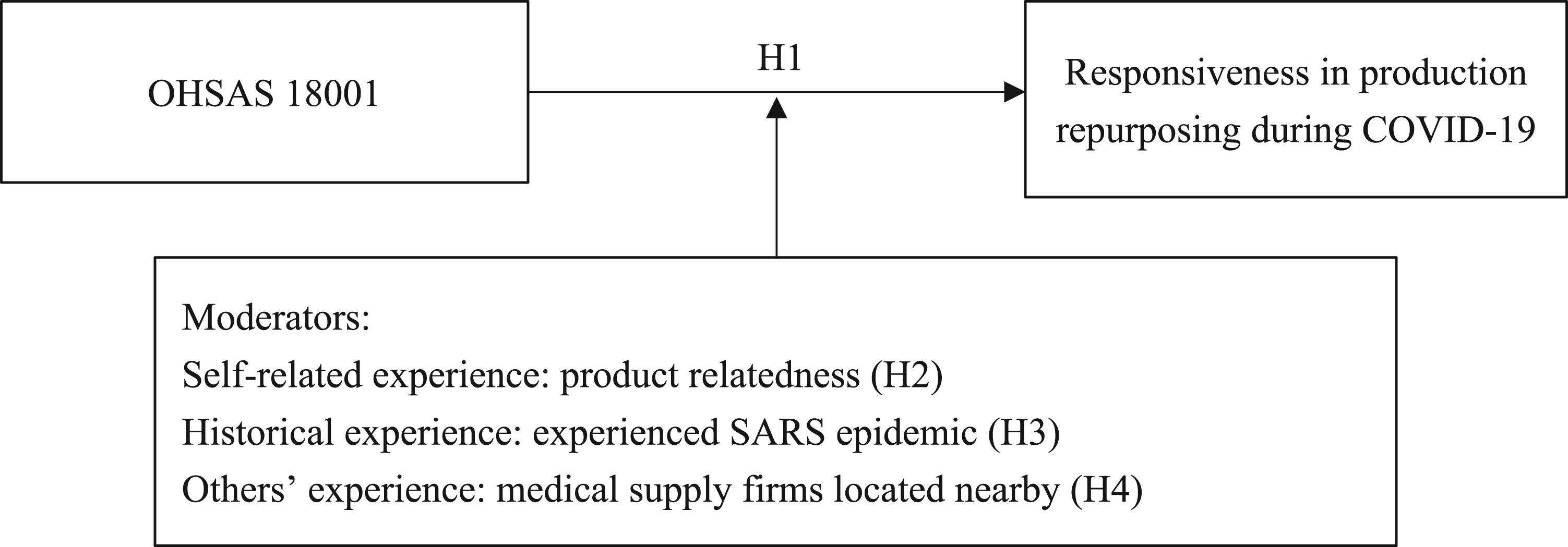
Research model.
Our first hypothesis postulates that firms with OHSAS 18001 certification were less responsive to repurposing than others. This is based on the proposition that this type of management system can result in firms’ rigidity (Leonard‐Barton, 1992). Rigidity comes from the following dilemma: While the OHS management standard builds operational safety as a capability for protecting workers from risk exposure (e.g., during a pandemic), it also leads to rigidity as firms are less likely than others to make adaptations that carry safety risks (Gilbert, 2005; Leonard‐Barton, 1992). In a preliminary content analysis of the collected production repurposing announcements, 4 we found that more than half of the firms announced their repurposing intention along with an outline of potential OHS concerns, including working overtime, resuming work early, increasing repurposing speed, and facing the risk of infection. Our post hoc interviews with both repurposed and nonrepurposed firms also showed that managers were widely aware of the OHS risk of production repurposing. Such findings set our expectation that firms considered production repurposing during the early COVID‐19 outbreak to be risky for them.
OHSAS 18001 collates the best practices of safety management processes (Benner and Tushman, 2002; Terlaak, 2007) in written guidelines about OHS policies, risk assessment procedures, and control measures that make firms specifically sensitive to OHS‐related issues (Granerud and Rocha, 2011). The clauses around change management in OHSAS 18001 closely attend to possible interruptions in the OHS policies. We suggest that these detailed and formal clauses enable workers and managers to reach a collective consensus on the significance of OHS issues and focus on key risks. A decision to repurpose production likely comes with a high risk of violating OHSAS 18001 standards. A specific risk of repurposing during the COVID‐19 pandemic was that workers who returned to their positions could contract the virus. In addition, more generally, repurposing production represents a fast‐track change that involves using new facilities, redesigning operational processes, and establishing new product specifications and quality standards. Many workers, therefore, must perform unfamiliar production tasks, not to mention handle heavy workloads and long hours. Work stress, fatigue, and inexperience are likely to lead to unsafe behaviors, increasing the probability of accidents and injuries (Johnson and Lipscomb, 2006; Nahrgang et al., 2011). Such ideas set our expectation that in a crisis such as the COVID‐19 pandemic, OHSAS 18001–certified firms would act conservatively rather than make risky decisions.
Adherence to formal management practices is another critical aspect of CMS. Certified firms are subject to internal and external audits to ensure that they adhere to the relevant standards (Boiral, 2012; Robson et al., 2012; Tremblay and Badri, 2018). The control mechanism has been instrumental in developing the bureaucratization of OHS risk management processes and reinforcing them (Granerud and Rocha, 2011; Nielsen, 2000). In this context of vigilant adherence, OHSAS 18001–certified firms follow a series of institutionalized routines, including prudent hazard identification, assessment, and prevention processes, when deciding whether to repurpose production (Abad et al., 2013). The decision‐making process around repurposing during the COVID‐19 outbreak involved high uncertainty owing to the limited understanding of the virus. We thus expected that, among OHSAS 18001– certified firms, risk management processes were prolonged when compared to others as assessing the risk of repurposing production was complex. Firms potentially deferred to their prior production, backing out of a repurposing plan, due to unfavorable risk assessment results. Hence, we proposed the following hypothesis:
H1: Firms with OHSAS 18001 certification were less responsive in terms of production repurposing during the COVID‐19 pandemic compared to firms without this certification.
Moderating Effect of Learning From Experience
As discussed, we proposed that OHSAS 18001 diminished firms’ responsiveness to production repurposing because of rigidity. To examine that, it was essential to resolve the contradictions between the capability and the prospective change by investigating the safety concerns over production repurposing during the COVID‐19 pandemic. Drawing on organizational learning theory, we posited that learning from experience can provide a way for firms to enhance their control over OHS issues during production repurposing. We identified several sources from which firms could gain experience that would allow the gap between the existing capability and the prospective change to be bridged (Cyert and March, 1963).
Learning occurs when “experience generates a systematic change in behavior or knowledge” (Miner et al., 2001, p. 315). Lenox and King (2004) found that firms can absorb experience from three sources: self‐related practices, historical events, and other adopters. The former two are related to a firm's experience, also known as “experiential learning,” while the latter is related to the experience of other firms, known as “vicarious learning” (Baum et al., 2000; Cyert and March, 1963). Following this reasoning, we identified learning from three types of experience in the case of COVID‐19: prepandemic manufacturing of related products, experience of the SARS epidemic, and being geographically located close to firms that produced medical supplies.
Product relatedness refers to the degree to which firms’ different business lines are linked (Amit and Livnat, 1988). In this study, we define product relatedness as referring to whether the production after repurposing (i.e., medical supplies) is related to the firm's original business. If a firm starts manufacturing new goods that are similar to its previous core business, it has much lower coordination costs than if the goods are dissimilar and it can apply its existing resources and knowledge to the new context (Aggarwal and Wu, 2015; Barkema and Vermeulen, 1998). With self‐related experience, firms can develop analogous operational routines, thus easing workers’ burden of having to learn new skills for repurposed production lines (Milch and Laumann, 2016). In contrast, a firm producing unrelated goods may not be able to transfer its routines, meaning it may have to build completely new ones. We studied these phenomena with the expectation that OHSAS 18001–certified firms would favor repurposing to produce something similar to what they already manufactured as this would require fewer changes to their production practices and would, therefore, mean a lower likelihood of violating safety requirements than if they repurposed to produce something dissimilar. Thus, we set the following hypothesis:
H2: Experience in manufacturing related products positively moderated the relationship between OHSAS 18001 certification and firms’ responsiveness during production repurposing, such that the negative effect of OHSAS 18001 on repurposing was less pronounced when firms had this experience than when they did not.
Firms may also learn how to respond to a crisis through their historical experience (Argote and Miron‐Spektor, 2011; Levitt and March, 1988). Of relevance here, the 2003 SARS epidemic was a serious health crisis that caused more than 800 deaths and infected thousands of people. Many similarities can be found between the SARS and COVID‐19 emergencies, in that, both were caused by a novel coronavirus and resulted in substantial damage to society (Ru et al., 2021). Firms located in regions that experienced SARS, therefore, might have paid earlier attention to COVID‐19 and more rapidly introduced disease prevention and control measures compared to others (Ru et al., 2021). Accordingly, we set out expecting that thanks to learning from the historical experience of SARS, certain firms could swiftly deploy resources to cope with similar circumstances and quickly adapt to new safety requirements. In such cases, the fear of the unknown would be allayed, and firms with OHSAS 18001 certification would be less likely to suffer rigidity if they had this prior experience than if they did not. Thus, we set the following hypothesis:
H3: Experience of the SARS epidemic positively moderated the relationship between OHSAS 18001 certification and firms’ responsiveness in production repurposing, such that the negative effect of OHSAS 18001 on production repurposing was less pronounced when firms had this experience than when they did not.
Learning vicariously from others can also facilitate adaptation (Cyert and March, 1963). By observing other firms’ behavior, companies can construct a template for adopting similar practices (Chang et al., 2012; Easterby‐Smith et al., 2008; Kent and Siemsen, 2018). In particular, when it came to COVID‐19, having medical firms nearby (i.e., in the same province) that manufactured products related to the pandemic provided a critical wealth of experience. Knowledge about new production practices, such as the installation and maintenance of new facilities, the storage of raw materials and finished products, and the disposal of waste, was valuable for firms wishing to develop their production lines efficiently. Firms could exploit external knowledge to forecast potential OHS risks and formulate feasible controls to guard against these risks when repurposing their production. Accordingly, certified firms located close to firms that manufactured medical supplies may have been less hindered by unexpected OHS risks and rigid risk management processes when coordinating a rapid response compared to other firms with no neighboring manufacturers from which to draw on experience.
H4: Experience of nearby firms that produced medical supplies positively moderated the relationship between OHSAS 18001 certification and firms’ responsiveness in terms of production repurposing, such that the negative effect of OHSAS 18001 on production repurposing was less pronounced when firms had this experience compared to when they did not.
Data and Variables
In conducting this research, we focused on public Chinese firms in the manufacturing industries and collected firm‐level data from multiple sources. We sourced production repurposing announcements from January 1, 2020, to April 30, 2020. This was the period when China was first hit by the COVID‐19 virus. Note that this study focuses on firms’ repurposing behaviors during the first outbreak period, when firms were making decisions in a highly uncertain environment. Our data collection began by checking listed firms’ official announcements on CNINFO, 5 an official information disclosure website for A‐share firms managed by the China Securities Regulatory Commission. We read every announcement and filtered those related to production repurposing. This exhaustive search yielded 509 announcements. We noted that some firms did not reveal production repurposing information officially, so we supplemented the sample by conducting a keyword search using major Internet search engines (i.e., Baidu and Sina) and the China Stock Market and Accounting Research 6 (CSMAR) database. We used firms’ names and keywords 7 corresponding to the list of medical emergency supplies 8 issued by the central Chinese government in the early stages of the pandemic. By doing so, we obtained 109 announcements. After dropping duplicate announcements and conducting matching with firms’ financial information, our final sample contained 200 production repurposing announcements. The distribution of these announcements and several representative examples are provided in Appendix A in the Supporting Information.
We then collected the OHSAS 18001 data for the sample firms from the Certification and Accreditation Administration of the People's Republic of China 9 (CNCA), an official database that records certifications obtained by Chinese firms. We searched each firm's name in the database to ascertain whether they had a facility certified with OHSAS 18001. In such a way, we identified the following: (1) whether the firm was certified, (2) when the first certification was obtained, and (3) the number of people covered by the certification. For the period 2004−2019, we found that 1014 firms adopted the OHSAS 18001 management standard, while 1317 did not. We combined the certification data with financial data from the CSMAR database.
Dependent Variable
We collected the date of the production repurposing announcement to track the responsiveness of the decision. We used a dummy variable to indicate whether a firm repurposed production in the given time window (1 = yes, 0 = no). This variable served as the outcome variable for Cox's regression analysis.
Independent Variable
We applied code 1 to firms that obtained OHSAS 18001 certification in the year 2019 or earlier (i.e., before the COVID‐19 outbreak), and code 0 to all other firms.
Moderating Variables
We measured the experience gained from manufacturing related products before the pandemic with the variable product relatedness. Specifically, we counted the medical, chemical, and fiber industries as related to medical emergency supplies and coded them as 1, while we coded other industries as 0. Meanwhile, we measured the experience gained from the SARS epidemic with the variable SARS severity (SARS). In detail, we used the number of cases (taking 100 cases as the unit) in each province to indicate the severity of SARS. Furthermore, we measured the experience gained from firms manufacturing medical supplies in the vicinity with the logarithm of the number of nearby medical supply firms (MSF) in each province.
Control Variables
We also included control variables that might have affected the decision to repurpose the production. The variable historical injuries was included to control for firms’ past safety conditions (Levine and Toffel, 2010). This variable represented the number of workers reported as being injured since 2010. It was calculated based on the accidents disclosed on government websites and in firm announcements. Beyond that, given that larger firms have more financial and managerial resources than smaller ones with which to adjust their production processes (Tafti et al., 2013), we controlled for the firm size using the logarithm of the total assets. As another factor to consider, firm age is related to having production experience and established routines, which are predictors of production repurposing (Tsikriktsis et al., 2004). Furthermore, older firms may be less inclined to take risks than younger firms. Therefore, we employed the control variable firm age, calculated as the years since establishment. Moreover, we controlled for performance measured by the ratio of net profit to total assets (return on assets [ROA]). We also controlled for the profit margin given that poorly performing firms have more of an incentive to make changes than firms that are performing well (Greve, 1998). In addition, tight liquidity might harm creditworthiness and hinder external parties’ financial resources (Kouvelis and Turcic, 2020). Therefore, we included the net cash flow and account receivables as further controls. Net cash flow was measured by the difference between cash inflows and cash outflows; account receivables were measured by the goods and services sold on credit.
At the same time, we controlled for state ownership (SOE) depending on whether a firm was controlled by the local or the central government. In China, state‐owned firms have formal political connections and are likely to conform to government goals (e.g., scaling up production of medical equipment; Lu et al., 2020). Accordingly, they might be mandated to respond rapidly when the country is in a public health crisis. As another valuable factor to consider, the availability of slack resources may affect the degree of complexity and coupling of production processes (Wiengarten et al., 2017). Thus, we included the following two control variables related to slack resources: financial slack, which was measured by one minus the ratio of total debts to total assets, and inventory turnover, as measured by the ratio of inventories to sales revenues. In a further consideration, labor‐intense firms are particularly vulnerable to safety hazards because of the extensive interpersonal interactions involved in everyday work (Wiengarten et al., 2017). Therefore, we controlled for labor intensity, which was measured by the ratio of the number of employees to the total assets (Lo et al., 2014). Additionally, given that high‐tech companies have more robust innovation capabilities to transform their production lines than low‐tech companies do (Lo et al., 2014), we also included R&D intensity as a control variable, measured by the ratio of research and development expenditure to total assets. Finally, ISO 14001 and ISO 9001 are the most widely adopted CMS (Corbett, 2006; King et al., 2005). Thinking that these standards might have led firms to make process improvements in the early stage of the pandemic, we included the controls ISO 14001 and ISO 9001 as dummy variables.
All the variables in the study and their data sources are presented in Appendix B in the Supporting Information. The descriptive statistics and correlations among the variables are presented in Table 1.
Descriptive statistics and correlations (N = 734).
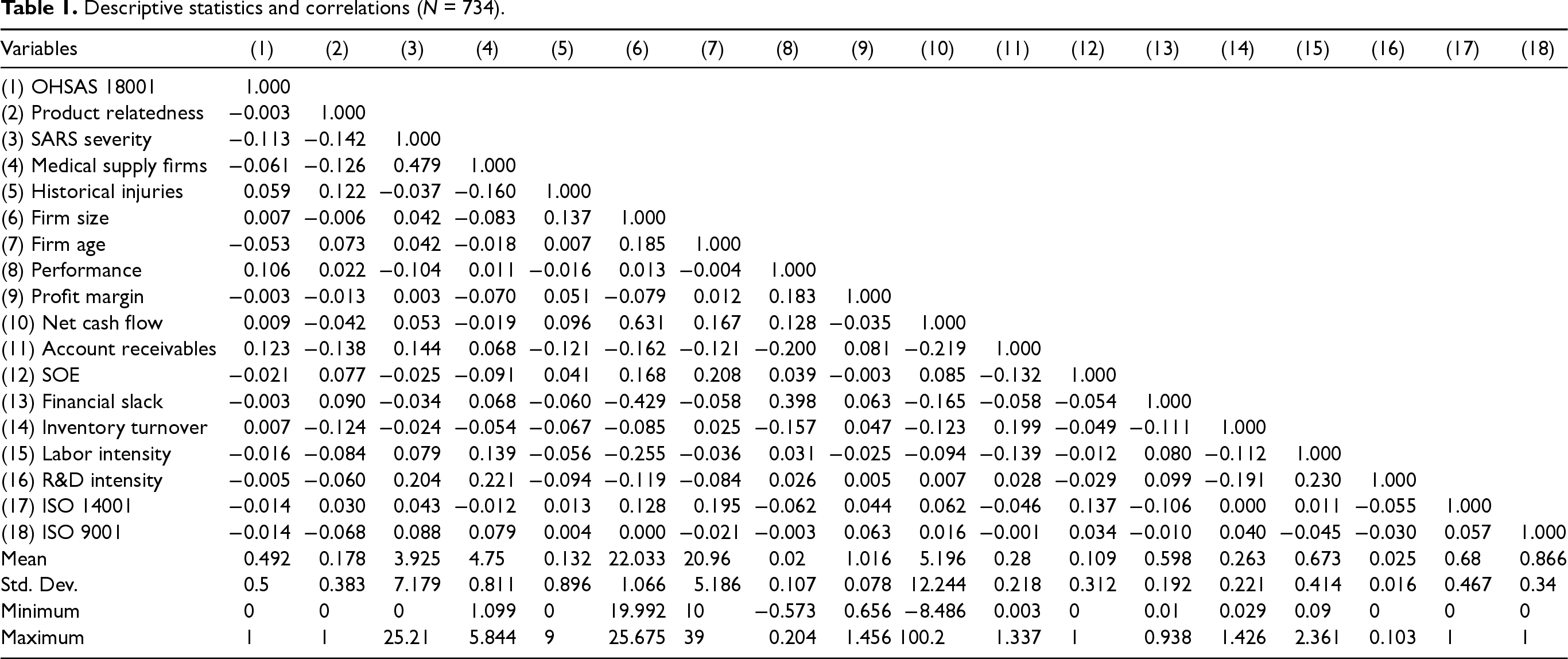
Descriptive statistics and correlations (N = 734).
In this section, we present the results of the main and moderating effects (Section 5.1), provide an additional analysis of the consequences of production repurposing (Section 5.2), and discuss the various robustness tests employed (Section 5.3).
Effect of OHSAS 18001 Certification on Production Repurposing
To mitigate the potential selection bias of OHSAS 18001 certification, we matched OHSAS 18001–certified firms (treatment group) with noncertified firms (control group) based on a series of firm characteristics. Specifically, we applied propensity score matching (PSM) to form treatment and control groups. Sample firms were matched based on propensity scores estimated from the firm‐level characteristics, including state ownership, ISO 9001, ISO 14001, and sales revenues. We first used the nearest‐neighbor (1:1) matching algorithm to identify each treatment unit's closest control unit. We then restricted the matches to a caliper of 0.05 and obtained a matched data set that included 734 firms, of which 364 were OHSAS 18001–certified and 370 were noncertified. 10 The matched sample reduced obvious sources of heterogeneity between the treatment and control groups (Caliendo and Kopeinig, 2008). Appendix C in the Supporting Information presents the details of the PSM procedure.
Event history analysis was employed to estimate the hazard ratio of production repurposing for each firm based on the covariates. The method is uniquely suited to discrete events occurring during a period. Given that our observation window was finite, cases with no repurposing announcement at the end of the window were right‐censored by nature (Allison, 1984). We followed previous studies and adopted Cox's regression, an event history analysis approach, to test our hypotheses (e.g., Blossfeld et al., 2014). The formula of the hazard rate h(t) in Cox's model is the product of a time‐dependent term that fits the data, h0(t), and a regression function for the covariates:

A key assumption of Cox's regression is proportionality (Fine and Gray, 1999), meaning that any individual's hazard is a fixed proportion of the hazard for any other individual in the sample. We checked the proportional hazard assumption for OHSAS 18001 using estat phtest in Stata 14. The slope was roughly 0, and the slope of this regression line was not significantly different from 0 (χ2 = 18.80; d.f. = 18; Prob. > χ2 = 0.404), which satisfied the proportional hazard assumption (Grambsch and Therneau, 1994).
We used the following hazard functions
11
to analyze the effect of OHSAS 18001 on the likelihood of production repurposing at time t (hazard), as well as the moderating effects.
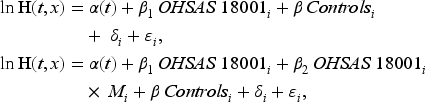
Table 2 presents the results of Cox's regression model. Model 1 introduced the first‐step prediction with control variables. The coefficient of OHSAS 18001 was negative and significant (β = −0.800, p < 0.05), which indicated that firms with OHSAS 18001 certification were less likely to repurpose their production lines than those without the certification. Specifically, a discrete change of the OHSAS 18001 variable from 0 to 1 was associated with a 55 % (exp(−0.800) – 1 = −0.551) decrease in the hazard rate of production repurposing. Thus, H1 was supported. Our following hypotheses predicted that the negative effect of OHSAS 18001 on production repurposing was weakened when firms could learn from several sources (H2–H4). On that topic, Model 2 revealed a significant and positive coefficient for the interaction between OHSAS 18001 and product relatedness (β = 2.433, p < 0.01). Model 3 then showed a significantly positive coefficient for the interaction between OHSAS 18001 and the number of SARS cases in the province (β = 0.072, p < 0.10). Furthermore, Model 4 showed that the interaction between OHSAS 18001 and the number of MSFs in the province was significant and positive (β = 0.621, p < 0.10). Thus, our hypotheses were supported. We estimated the practical effect and provided the graphical representation of the moderating variables in Appendix D in the Supporting Information.
Cox's regression results.
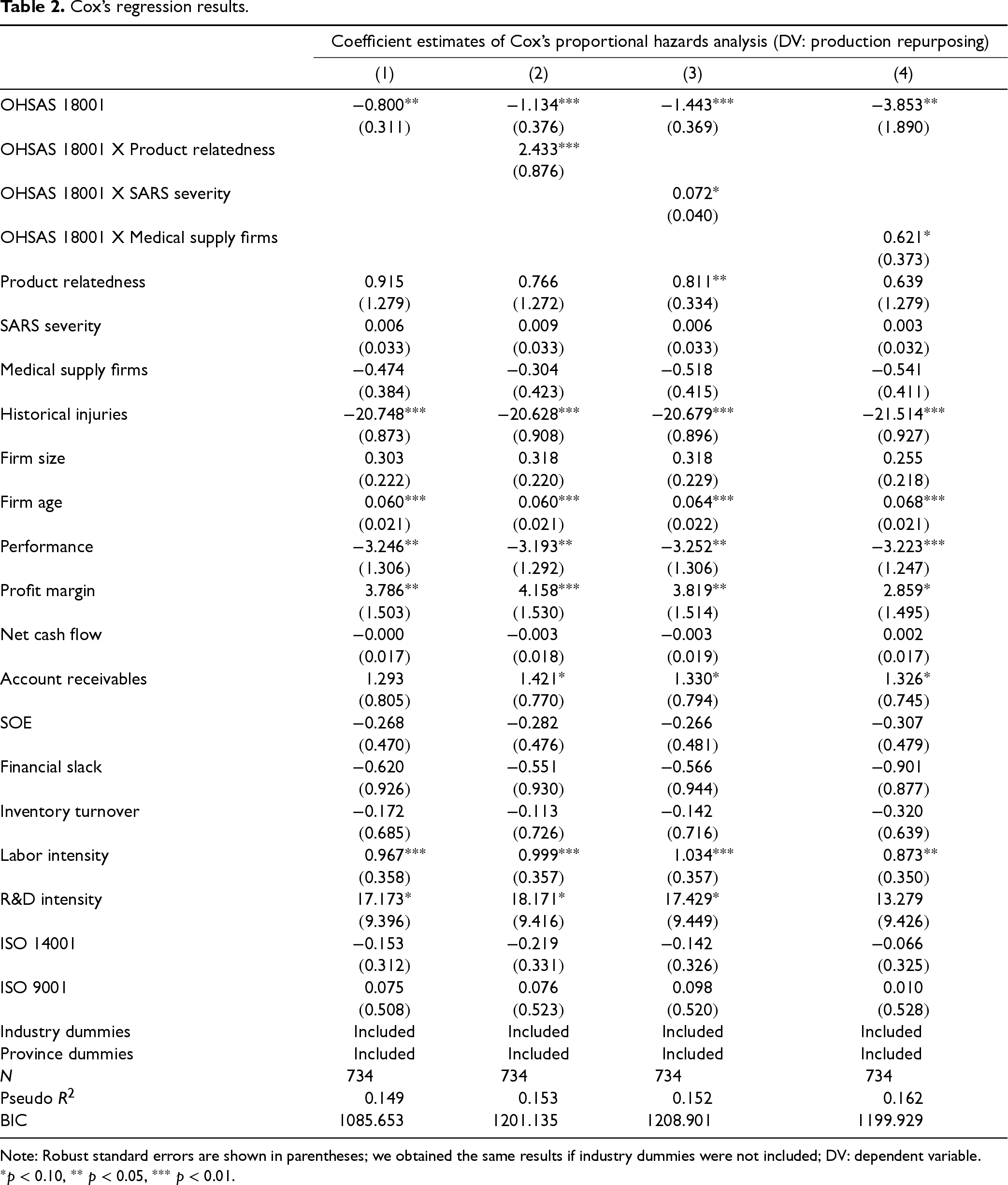
Cox's regression results.
Note: Robust standard errors are shown in parentheses; we obtained the same results if industry dummies were not included; DV: dependent variable.
*p < 0.10, ** p < 0.05, *** p < 0.01.
Our theoretical argument was based on the assumption that production repurposing would bring economic benefits during the COVID‐19 pandemic. We conducted additional analyses to verify that assumption. We estimated the short‐, mid‐, and long‐term performance of firms that engaged in production repurposing. Firms that repurposed their production may have been rewarded with favorable stock market reactions immediately after repurposing, experienced better weekly stock market returns, and posted superior quarterly profitability and operational performance compared to firms that did not repurpose their production. In practical terms, the results suggested that the average (minimum) weekly stock returns of firms that repurposed their production increased by approximately 0.747 (0.632) yuan compared to those that did not repurpose their production. Firms that repurposed their production enjoyed approximately 1.9 % and 0.9 % increases in their ROA and asset turnover, respectively. We then delved deeper into the short‐term effects of production repurposing among OHSAS 18001–certified and noncertified firms. The findings showed that the former did not gain significant stock returns compared to the latter. We proposed that an important reason for this finding is that certified firms were on average 5 days late in announcing their repurposing decision, which according to our logic, was due to their concerns over OHS risks. Their longer decision time when compared to noncertified firms, unfortunately, could eliminate the positive gains to be had from production repurposing. The details of this analysis are presented in Appendix E in the Supporting Information.
Robustness Checks
To examine the sensitivity of our main result (H1) to different specifications, we conducted several robustness checks (see Appendix F in the Supporting Information). Specifically, the checks used alternative measures of the independent variables, namely, the number of years since the OHSAS 18001 certification was first obtained and the number of employees covered by the certification. The results suggested that our results were robust (Appendix F1 in the Supporting Information). We also used an alternative measure of the dependent variable and estimation methods to predict whether the standards influenced the timing of the decision. The results were consistent again in this case (Appendix F2 in the Supporting Information). In the third stage of checks, we then adopted the two‐stage residual inclusion (2SRI) approach to further reduce concerns with endogeneity by reducing the potential correlation between the independent variable and the error term. The results further supported our original findings (Appendix F3 in the Supporting Information). Moreover, we tried out alternative matching criteria, and the results showed that the effect of OHSAS 18001 on production repurposing was insensitive to different PSM schemes (Appendix F4 in the Supporting Information).
We also conducted robustness checks with different subsamples (Appendix F5 in the Supporting Information). First, we found that the effects of OHSAS 18001 on different types of production repurposing, classified as mask and protective clothing production (i.e., low complexity levels) and nonmask and non–protective‐clothing production (i.e., high complexity levels), were consistent. Second, we considered the important transition from OHSAS 18001 to ISO 45001 was in progress; thus, we dropped ISO 45001–certified firms from the sample and found consistent results. We will further elaborate on how the transition of OHS management standards was related to rigidity in the discussion.
Since COVID‐19 has become a global crisis, it was important to determine whether our findings were valid only in the Chinese outbreak context. To do so, we conducted a generalizability analysis using a merged data set from Enterprise Surveys (ES) and a follow‐up COVID‐19 survey conducted by the World Bank. This sample contained 11,696 firms from 37 countries. The results of the analysis showed that OHSAS 18001 certification was negatively and significantly related to production repurposing, consistent with H1 (Appendix F6 in the Supporting Information). The analysis, therefore, enhanced the external validity of our conclusion.
Discussion
This study has provided a fresh perspective for the OM literature by considering the effect of OHS management standards on firms’ adaptability. Ours is one of the first studies to show that OHSAS 18001 certification can create rigidity, which contributed to hindering firms’ responsiveness during the COVID‐19 pandemic. Specifically, we have found that OHSAS 18001–certified firms were less likely to initiate production repurposing during the pandemic than noncertified firms. However, the negative effect of OHSAS 18001 on production repurposing was less pronounced for firms manufacturing related products before the pandemic, those with experience of the SARS epidemic, and those geographically located close to other firms producing medical supplies. Furthermore, this study has highlighted the significant economic value of adaptability, as represented by production repurposing during the pandemic. To corroborate the theoretical and practical implications of our findings, we conducted a post hoc qualitative study with eight senior managers from China's textile and garment industries (for details, see Appendix G in the Supporting Information). We found their OHS considerations relating to the decision‐making process involved in repurposing production during the pandemic.
Implications for Theory
First, this study underscores the need to integrate OHS issues into the OM literature, particularly their relationships with different operational capabilities and performance indicators. We are among the first researchers to examine the significance of OHS issues in a crisis such as the COVID‐19 pandemic and to investigate how these issues affect firms’ operations. Our post hoc interviews confirmed that OHS could constitute a primary factor impacting firms’ operational decisions.
Second, the study corroborates the “dark side” of CMS, which emphasizes stringent process compliance to standards (Corbett, 2006; Terlaak, 2007). Our study has shown that during the COVID‐19 outbreak in China, firms with OHSAS 18001 certification were 55 % less likely to repurpose their production; when they did, they needed five more days to announce production repurposing, compared to firms without this certification. Research in the CMS area has explored the effects of routinization and standardization on firms’ explorative behaviors. ISO 9001 has been shown to hinder disruptive organizational change, though such a change is essential in a crisis (Benner and Tushman, 2002). In this study, we observed rigidity only in firms with OHSAS 18001 certification, while ISO 9001 and ISO 14001 did not significantly affect production repurposing (Appendix F4 in the Supporting Information). This suggests that OHSAS 18001 causes inertia through a different mechanism compared to ISO 9001/14001. After a careful comparison of the clauses of the three certifications, we propose that such rigidity likely occurs because of the formal OHS‐related risk management as a central focus of OHSAS 18001; however, risk management is not the main focus of ISO 9001 or ISO 14001.
Third, the study links operational safety to the literature on organizational adaptation and advances our understanding of the “capability–rigidity” paradox. Leonard‐Barton (1992) suggested that a firm's core capability can represent a source of core rigidity. We have developed this idea and revealed a novel source of rigidity that received little attention in previous research work. Our study indicates that OHS management standards (i.e., OHSAS 18001) help firms build capability (i.e., safety competence), and that such capability was reinforced during the pandemic. This capability is meant to secure workers against possible OHS risks, which is good in the long run. However, the flip side is that the safety capability leads to poor adaptation responsiveness. Managers noted in the interviews that they were deeply aware of the risks of production repurposing. In the firms that repurposed, workers often faced work overload, adaptation difficulties, and psychological stress. In the companies that did not repurpose, managers clearly anticipated those potential risks. In such cases, OHSAS 18001–certified firms sought to protect their safety capability from being hampered and erred on the side of caution when considering whether to repurpose.
Fourth, we underscore the role of learning in bridging the gap between old and new production, thus promoting adaptability. In particular, we have found that both experiential and vicarious learning are beneficial for firms to engage in successful risk control and change management. With the appropriate experience, OHSAS 18001 is less likely to form a cause of organizational inertia, and can even be leveraged to support the achievement of operational goals. This finding points to learning as representing an important mechanism for overcoming the rigidity trap created by institutionalized safety management routines, that is, other than changing or modifying the safety capability. In particular, we found that OHSAS 18001 can facilitate production repurposing during COVID‐19 for firms with high product relatedness. It is likely because the experience of producing related products relieves OHS concerns and facilitates risk management processes. The role of the experience coheres with the objective of OHSAS 18001, which in turn enhances the confidence of the managers to execute production repurposing.
Implications for Managers
Our study has important implications for managers. Production repurposing is vital for fulfilling society's essential needs in disruptive environments, such as the COVID‐19 pandemic. By rapidly shifting their production lines to accommodate environmental needs, firms can survive the disruption and protect their profit margins. However, this rapid response capability in emergencies may contradict the safety management capability. Reconciling the need for speed during an emergency with the need for safe production calls on firms to develop ambidextrous organizations for strategic agility (Adler et al., 1999; Benner and Tushman, 2015). This represents the first implication for managers, and to succeed, in practical terms, we suggest they should accept tensions within the organization, understand the link between OHS risks and adaptation, and allow for different processes occurring at the same time. Furthermore, they should avoid overreacting or supporting unhelpful or counterproductive responses that hinder rapid, adaptable decision making (Lewis et al., 2014).
Second, managers should be aware that CMS can stand as an obstacle to adaptability. In addition to the commonly adopted CMS (e.g., ISO 9001, ISO 14001), we suggest that they should also monitor their firm's adoption of OHS management standards and the resulting rigidity. We do not recommend that managers forgo certification given that the standards help develop routines that ensure workplace safety and build firms’ safety competence. Furthermore, to avoid certification becoming a cause of rigidity, managers should always keep the certification up to date (e.g., replacing OHSAS 18001 with ISO 45001). Managers will note that ISO 45001's requirements are less standardized than those of OHSAS 18001. The updated ISO 45001 pushes for more proactive actions toward change and encourages the identification of both opportunities and risks when managing change.
Third, our study provides evidence for managers that learning is an effective means of resolving the paradox between OHSAS 18001 and production repurposing. Accordingly, managers who seek to introduce organizational change should accumulate experience from firms’ historical events, related operations, and peers’ practices. Learning from these sources of experience eases the adaptation process and reduces the risk of OHS accidents among workers. Then, firms may protect workers’ safety by following OHSAS 18001 but may avoid being burdened by rigidity.
Implications for Policymakers and Certification Bodies
This study has implications for policymakers. Emergencies such as the COVID‐19 pandemic can cause severe shortages of critical supplies. In these situations, it is essential to appeal to firms to engage in the production of goods that have become vital for dealing with the crisis. In such situations, we encourage government policymakers to talk to managers about their urgent needs and reduce the regulatory times and costs of production repurposing. Supportive measures may include accelerating the procedures for obtaining production and operation permits and establishing priority channels for special and urgent issues. As long as the loosened restrictions do not harm baseline requirements such as product quality and workers’ safety, we suggest that governments should promote flexible policies that offer firms convenience and help ease workers’ burden. In addition to implementing supportive policies, governments can assist firms by providing easily accessible archives, such as an online repository, which can foster learning from related and past experience (i.e., experiential learning). They can also promote efficient information flows and knowledge sharing by hosting conferences, coordinating industrial and academic associations, and pairing up different firms, thus reinforcing vicarious learning.
Our advice to the ISO and other certification bodies is to consider the role of CMS during times of urgent need to meet emergency conditions (e.g., the COVID‐19 pandemic). OHSAS 18001 sets out that before introducing any change, firms must identify and assess the OHS risks in the organization through consultations with managers, cross‐functional workers, and OHS committee members. The risk assessment will be followed by preventative actions to mitigate the risks. These procedural requirements can take a long time to complete. When contemplating the time and effort required, firms may decide not to bother, leaving them rigid and unreceptive to change. Our findings have illustrated this drawback of OHSAS 18001 by showing that firms following OHSAS 18001 were rigid when faced with the call to repurpose their production lines, even though this offered potential benefits for their performance during the COVID‐19 pandemic. Our interview data showed that rigidity arose partly from OHS risk concerns, which raised the time and effort required to implement a change. Specifically, the interviewed representatives of OHSAS 18001–certified firms performed a series of risk assessments and followed change management routines when considering repurposing during the pandemic.
Our findings echo the recent initiative by the ISO to introduce ISO 45001 as a replacement for OHSAS 18001. ISO 45001 emphasizes flexibility, which represents an improvement on OHSAS 18001. It also incorporates an improved risk management system (i.e., risk‐based thinking), which encourages firms to proactively look for opportunities accompanying risks and embrace change in different contexts (Glaesel and Corrie, 2018). The clauses of ISO 45001 have been made less restrictive and the need to follow specific requirements when implementing OHS management procedures has been reduced. Firms are allowed to develop nuanced safety action plans that fit their industrial and organizational contexts, rather than using a one‐size‐fits‐all management system. The documentation requirements are also more flexible than before as firms can now judge the amount required and the level of detail necessary to satisfy their specific business goals. For these reasons, our findings support the initiative to transform OHSAS 18001 to ISO 45001.
Our findings also have implications for how we can develop ISO 45001. The current ISO 45001 promotes balancing risk management and opportunity management; however, studies have suggested that it does not yet go far enough to emphasize how external environments and external opportunities may still be deemed threats (Karanikas et al., 2022). When following a risk‐based thinking paradigm, future developments of ISO 45001 may add best practices for emergency responses and provide comprehensive change management directives that facilitate external adaptation in emergencies, in ways that are compatible with the overall objectives of the certification. In the long run, we propose that the ISO should promote joint management systems that have coordinating mechanisms between different objectives and different areas of operational metrics, such as efficiency and safety (Pagell et al., 2015). For instance, ISO 45001 could be integrated with ISO 22320 (emergency management) to go further to support firms to operate safely and adaptively.
Limitations
Despite the important contributions made by this study, certain limitations remain. First, we lacked sufficient observations of firms’ safety performance after production repurposing. We addressed the safety risk of production repurposing based only on conceptual reasoning and qualitative evidence founded on the interviewed managers’ perceptions. The idea that production repurposing involves safety risks is an assumption we use to support our rationale that OHS‐certified firms will take longer to make decisions about risk management than noncertified firms. For an improved research approach, future studies may seek direct measures of safety outcomes and probe the actual effect of production repurposing on safety using a difference‐in‐difference design. Second, our measure of production repurposing in the main analysis was based on firms’ announcements in the early stage of the COVID‐19 outbreak. Some of the announcements reflected firms’ early intentions or efforts to repurpose. However, we do not know whether repurposing was successfully achieved or became a long‐term strategy. It would thus be fruitful for future studies to conduct a longitudinal examination of the outcomes of production repurposing. Third, we infer that OHSAS 18001 was a reason behind firms’ rigidity given the high level of emphasis on safety in the context of COVID‐19. Our analysis implies that firms using other CMS did not exhibit such rigidity during the pandemic. ISO 45001, as an updated version of OHSAS 18001, has somewhat overcome the rigidity of the latter by incorporating more proactive risk‐based thinking. Yet, our ISO 45001 sample was too small for an in‐depth analysis of this improvement. To further our work, future studies should investigate which CMS and under what conditions lead to rigidity. Fourth, while we conducted a generalizability test to account for country differences in the effect of OHSAS 18001 on production repurposing, there may still be a concern regarding the effectiveness of such repurposing. Government support for repurposing may vary among nations. In particular, China may be more successful than other countries at guiding firms during an emergency. We propose that future studies should examine different governments’ roles in steering firms’ adaptation and make cross‐country comparisons to determine whether there are indeed differences.
Supplemental Material
sj-docx-1-pao-10.1177_10591478231226024 - Supplemental material for Rigidity in Crisis: The Impact of OHSAS 18001 Certification on Production Repurposing During COVID‐19
Supplemental material, sj-docx-1-pao-10.1177_10591478231226024 for Rigidity in Crisis: The Impact of OHSAS 18001 Certification on Production Repurposing During COVID‐19 by Yuxiao Ye, Shenyang Jiang, Di Fan, Baofeng Huo and Maggie Wenjing Liu in Production and Operations Management
Footnotes
Acknowledgments
The authors thank the editors, the anonymous senior editors, and reviewers for their constructive suggestions and comments. The research was supported by National Natural Science Foundation of China (Grant Numbers: 72002150, 72091214, 72072098, 71832009).
Declaration of Conflicting Interests
The author(s) declared no potential conflicts of interest with respect to the research, authorship, and/or publication of this article.
Funding
The author(s) received the following financial support for the research, authorship and/or publication of this article: National Natural Science Foundation of China, Grant/Award Numbers: 72002150, 72091214, 72072098, 71832009.

Notes
How to cite this article
Ye Y, Jiang S, Fan D, Huo B and Liu MW (2026) Rigidity in Crisis: The Impact of OHSAS 18001 Certification on Production Repurposing During COVID‐19. Production and Operations Management 35(1): 105–121.