






Abstract
There is mixed evidence regarding the impact of poor dental health on cardiovascular disease and other health outcomes. Our objective was to determine the outcomes associated with poor dental health among hospitalized patients with and without diabetes mellitus (DM) at our institution. We enrolled a consecutive sample of adult patients admitted to an academic medical center. We gathered demographic, health and dental information, reviewed their medical records and then examined their teeth. We analyzed data using SPSS V.24. There was a high prevalence of dental loss among all hospitalized patients. Older age (p<0.001), smoking (p=0.034), having DM (p=0.001) and lower frequency of teeth brushing (p<0.001) were predictors of having a lower number of healthy teeth. Among DM and non-DM patients, fewer remaining healthy teeth was associated with presence of heart disease (p=0.025 and 0.003, respectively). Patients with diabetes mellitus (DM) had a higher prevalence of stroke (p=0.006) while patients without DM had a higher number of discharge medications (p=0.001) associated with having fewer number of healthy teeth. There was no correlation between number of healthy teeth and the length or frequency of hospitalization. Patients with DM are more likely to have fewer number of healthy teeth compared with non-DM patients. Fewer number of healthy teeth was associated with higher prevalence of heart disease in both DM and non-DM patients and with more discharge medications in non-DM patients.
Significance of this study
What is already known about this subject?
Patients with DM have worse dental health compared with those without DM.
Poor dental health and DM are associated with adverse cardiovascular outcomes.
There are mixed reports about the benefits of maintaining good dental health on cardiovascular outcomes.
What are the new findings?
There was an inverse relationship between number of healthy teeth and prevalence of cardiovascular disease in hospitalized patients.
Patients without DM who had fewer healthy teeth also had a significantly more number of discharge medications.
Length or frequency of hospitalization were not associated with number of healthy teeth in patients with or without DM.
How might these results change the focus of research or clinical practice?
Dental examinations could be used as a means of stratifying patients at risk for adverse health outcomes.
The association established in this study further highlights the relevance of looking for the underlying mechanisms behind this increase in risk.
Introduction
The prevalence of periodontitis among all adults 30 years or older in the National Health and Nutrition Examination Survey (NHANES) was 46%.1 Periodontitis is more severe and is estimated to be three times more likely to occur in patients with diabetes mellitus (DM) compared with the general population.2–5 Poorly controlled DM results in an environment that favors the development of periodontitis, which if left untreated results in alveolar bone loss and ultimately tooth loss.6–8
Previous studies have demonstrated that there is a relationship between periodontitis and CVD among individuals with DM.9–11 Because poorly managed periodontitis ultimately results in tooth loss, the degree of dental loss in an individual can be used as a surrogate indication of periodontal disease (PD) severity.
Based on the known relationship between PD and CVD, and on the relationship between PD and dental loss, this study was conducted to evaluate the health outcomes associated with hospitalized patients with and without DM based on the number and health of their teeth.
Study design and method
This was a cross-sectional study conducted in an academic medical center. A daily census of all patients admitted in the preceding 24 hours was obtained from the hospital. Adult patients admitted for all conditions were approached for enrollment. Following explanation of the purpose of the study and obtaining informed consent, eligible participants who agreed to participate were interviewed using an investigator-administered questionnaire. Examination of the oral cavity (inspection to count their total number remaining teeth and to assess for broken or decayed teeth) was performed. We did not perform any invasive dental procedures.
Participants
We included all hospitalized patients that meet the following criteria;
Non-pregnant adult patients with age >18 and <89 years. Able to understand and give informed consent. Patients without altered mental status. Patients without terminal illness. Not in the intensive care unit at time of enrollment. Admitted for at least 1 day in the hospital. DM duration of at least 1 year (for the DM group).
Information gathered from the questionnaire included demographic information (age, gender, ethnicity, highest level of education and total household income); hospital admission date, number of admissions in the preceding 1 year, DM history, dental care history, history of CVD and history of smoking. We reviewed the electronic medical records of all participants to verify information provided on the investigator-administered questionnaire. A second chart review was done after discharge to determine their length of hospitalization and to count the number of discharge medications.
Because of the strong association between DM and poor dental health,2–6 participants were stratified into DM and non-DM groups in order to better appreciate differences between the two populations while looking at their health outcomes.
Dental measures
Prior to starting enrollment, the study team met and reviewed several images of teeth in various degrees of health. There was agreement between all team members on the number and health of the teeth samples that were reviewed. This was done to calibrate the findings reported by each team member during enrollment of participants for consistency.
Inspection of the oral cavity was conducted using a tongue depressor and a flashlight. All the natural teeth were counted and then out of these, the number of teeth that was broken or decaying were determined. The number of healthy teeth was determined by subtracting the number of decayed or broken teeth from the total number of teeth.
We obtained information about the dental hygiene practices by asking for the number of times a week that each participant brushed, flossed or used mouthwash.
Hospital outcome measures
Including the present admission, participants were asked the number of times they were hospitalized in the preceding 1 year.
Following discharge, each participant's medical record was reviewed to determine the duration of hospitalization by counting the number of days between the date of admission and discharge.
Number of discharge medication was determined by reviewing the discharge medication reconciliation section of the patient's chart. Included medications were only prescriptions. Multivitamins and other over the counter medications were not included.
Cardiovascular disease outcome measures
All participants were asked if they had history of stroke or history of heart disease defined as atherosclerotic heart disease (coronary artery disease, history of myocardial infarction or angina) or congestive heart failure. Their answers were verified through a review of their medical records.
We also gathered information about their smoking status. Participants were classified as either having a smoking history (current or past smoker) or none (never-smoker).
Statistical analysis
Data management and statistical analyses were performed using SPSS V.24 (IBM, Armonk, New York, USA). Baseline clinical and demographic characteristics were summarized for each diagnostic category, and appropriate univariate analyses were done to ascertain significant difference between the DM and non-DM patients for each variable. Multivariate analysis using linear and logistic regression was done to identify and adjust for factors that were significant predictors of the number of healthy teeth and the presence of heart disease, respectively. The threshold for significance was set at a p value of 0.05.
Results
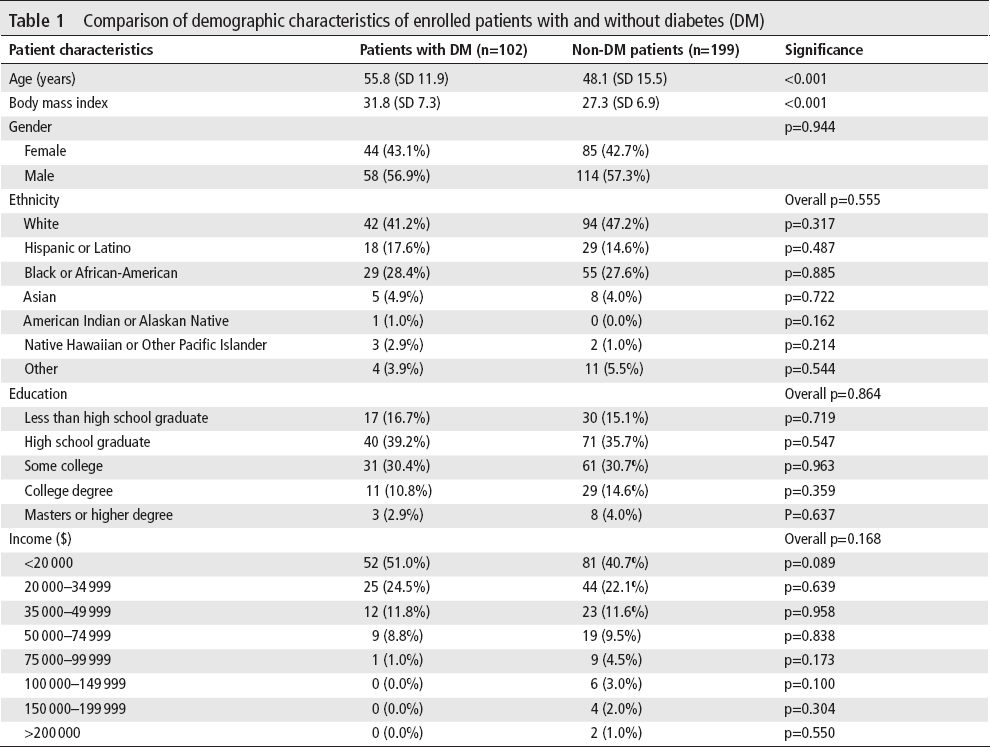
A total of 301 participants were enrolled (172 male and 129 female) of which 102 had DM and 199 did not have DM. Compared with participants without DM, those with DM were older (55.8±11.9 years vs 48.1±15.5 years; p<0.001) and had higher body mass index (BMI) (31.8±7.3 kg/m2 vs 27.3±6.9 kg/m2; p<0.001). There was no difference in gender distribution (43.1% female vs 42.7% female; p=0.944), ethnicity distribution (p=0.555), income distribution (p=0.168) or educational distribution (p=0.864) between the DM and non-DM groups (table 1).
Comparison of demographic characteristics of enrolled patients with and without diabetes (DM)
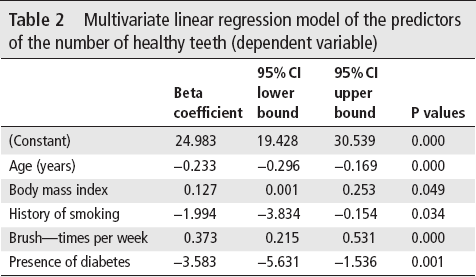
Patients with DM had significantly fewer number of healthy teeth compared with the non-DM patients (14.2±9.8 teeth vs 20.5±8.9 teeth; p<0.001). In a multivariate linear regression model, patient factors that predicted the number of healthy teeth included age, BMI, smoking history, frequency of toothbrushing and presence of DM (table 2).
Multivariate linear regression model of the predictors of the number of healthy teeth (dependent variable)
There was a significant inverse relationship between having a history of heart disease and the number of healthy teeth in both the DM and non-DM groups (p=0.025 and 0.003, respectively; figure 1A, B) but only the DM group had significant inverse association between a history of stroke and the number of healthy teeth (p=0.006; figure 1C, D).
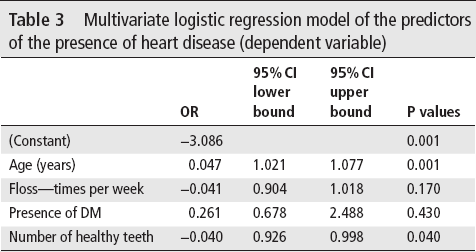
In a multivariate logistic regression model that included variables with significant univariate relationship with heart disease (age, flossing, presence of DM and number of healthy teeth), only age (OR 0.047, 95% CI 1.021 to 1.077; p=0.001) and number of healthy teeth (OR −0.040, 95% CI 0.926 to 0.998; p=0.04) were significant predictors of the presence of heart disease (table 3).
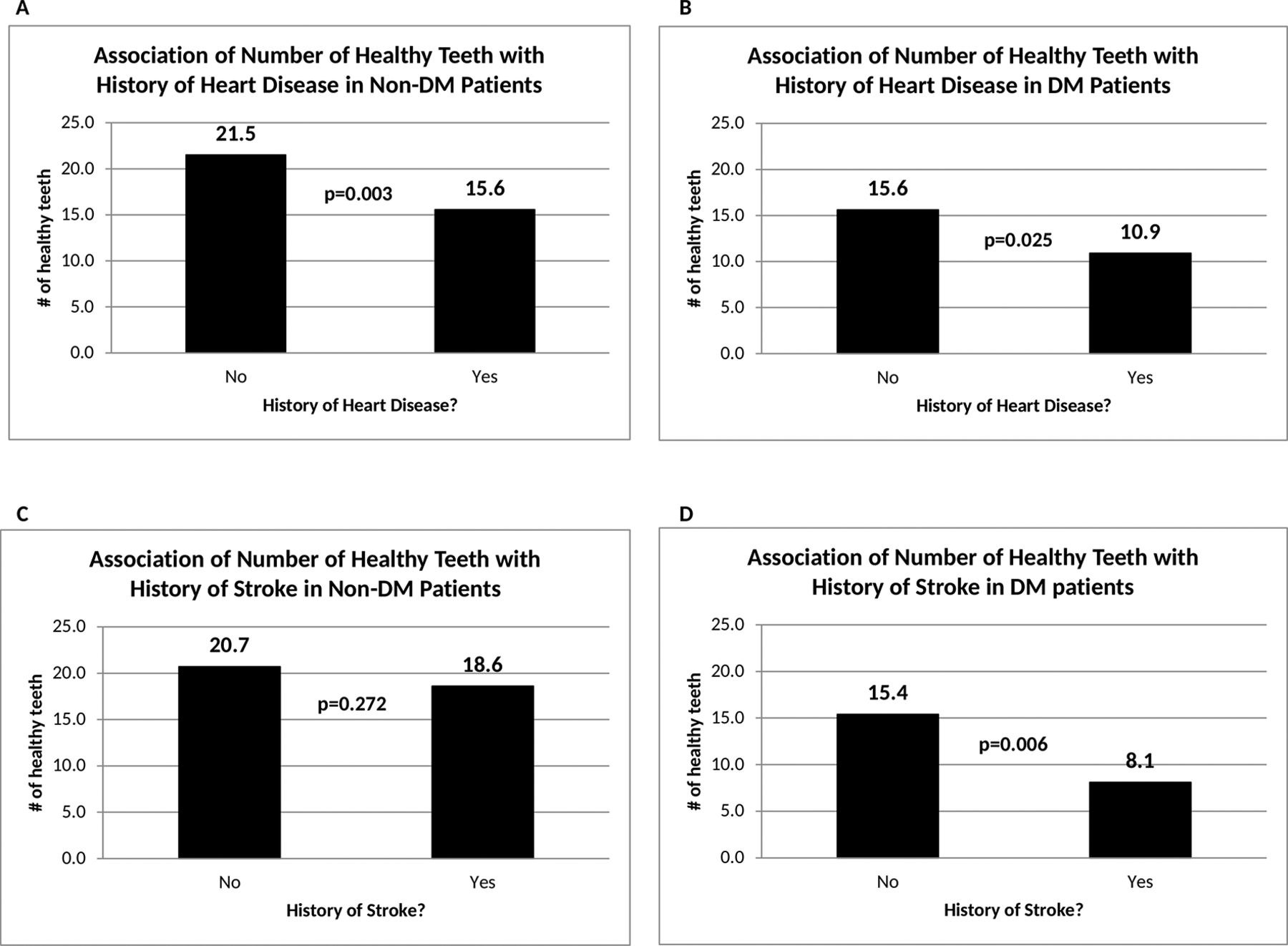
Relationship between number of healthy teeth and having a history of cardiovascular disease among patients with and without diabetes (DM).
Multivariate logistic regression model of the predictors of the presence of heart disease (dependent variable)
There was no correlation between the number of healthy teeth and the duration of hospitalization or number of past admissions for both the DM and non-DM populations. There was a significant negative correlation between the number of healthy teeth and the number of discharge medications in the non-DM group (r= –0.245, p=0.001). Although the DM group had more discharge medications compared with the non-DM group (8±3.4 medications vs 4.1±3.2 medication; p<0.001), there was no correlation between the number of healthy teeth and number of discharge medications in the DM population.
Discussion
Our study found that in a group of 301 hospitalized patients, those with DM had fewer number of teeth, had more broken and decayed teeth and had fewer number of healthy teeth. The predictors for having fewer number of healthy teeth were older age, presence of DM, cigarette smoking and less frequent brushing of the teeth. Having fewer number of heathy teeth was associated with having a history of heart disease for DM and non-DM patients, stroke for DM patients and a greater number of discharge medications for non-DM patients.
Previous studies have shown that DM is associated with poorer dental health and fewer teeth.6 12 13 This relationship is thought to be a result of the higher prevalence of PD and dental caries among patients with DM. However, the clinical relevance of this association is still not clear. There have been strong associations between PD and CVD. However, there is inconclusive evidence on the cause and effect mechanism of this relationship. Because PD typically results in loss of the teeth, assessment of health outcomes based on the number or health of the teeth may provide a better understanding of the nature of this relationship.
We found that having fewer number of teeth was associated with having a history of heart disease in patients with and without DM. In a large population-based cohort study, Joshy et al found significantly higher risk for heart failure, ischemic heart disease, peripheral vascular disease and overall mortality among individuals with fewer teeth or poorer dental health independent of DM status,.14 They did not find a significant relationship between tooth loss and ischemic stroke. Other studies have also reported similar associations between poor dental health and CVD.15–17 Similar to our study, all of these studies show an association but do not explain the mechanism behind this relationship. A theory behind this association is that chronic systemic inflammation resulting from or associated with PD could also result in atherosclerosis and adverse CVD outcomes.18 19 Another more direct proposed mechanism is from the effects of bacterial infection (from periodontal pathogens) on the blood vessels.19 20 Several studies that looked at the treatment of PD have resulted in mixed results regarding its impact on CVD outcome measures. While some studies show improved outcomes, others have failed to do so.19 21–24
The relationship between dental loss and CVD could have a cause and effect relationship or they could be co-variables in a higher risk environment resulting from an entirely different but common etiology. They both share common risk factors like age, smoking and DM. Any or a combination of these risk factors may explain their common predisposition. This relationship is a likely explanation of why DM did not predict presence of heart disease in the multivariate logistic regression model that also included number of healthy teeth, age and flossing (table 3).
Finally, assessment of hospital outcomes did not reveal any association between the number of healthy teeth and the length of hospital admission or the number of previous admissions within the preceding year. We found that a higher number of discharge medications was associated with fewer healthy teeth in the non-DM group. This may suggest that non-DM patients with fewer number of healthy teeth were also sicker compared with those with more healthy teeth. This relationship was not observed in patients with DM and may be because of the overall poorer health among the DM population who were discharged with significantly more medications compared with the non-DM population.
Conclusion
Having DM is associated with dental loss and with fewer number of healthy teeth. There was a higher prevalence of heart disease among the DM and non-DM patients with fewer number of healthy teeth. Also, those patients with DM had a higher prevalence of stroke while those without DM had a higher number of discharge medications that were associated with having fewer number of healthy teeth. These relationships are only associations and do not explain the mechanism behind these adverse health outcomes. Future studies designed to explore the mechanism(s) behind these associations are required to better understand the relationships and to guide development of effective intervention strategies.
Footnotes
Acknowledgements
The authors acknowledge the contribution from Dr Harmeet Marshiana who assisted with data collection.