







Abstract
In this article we apply Viktor Turner’s ideas on liminality and social dramas to scandals involving the Finnish political and economic elites that have occurred since the early 1970s. We suggest that mediated scandals are transformative social dramas through which society’s moral codes are negotiated. In Finland, scandals have increased considerably and have become more dangerous for Finnish elites because they have caused increasing numbers to lose their positions. We suggest that the trend signals a long-term social transformation in society’s moral order. The Finnish scandals have reworked societal moralities and addressed the problematic issues often associated with the Cold War political order, such as drinking and sexual harassment. As a result of this process, the media have developed into liminal-like spaces that are increasingly dangerous for elites.
Introduction
Until quite recently, scandals were considered an ephemeral and somewhat irrelevant side of societal life. It is only in the past few decades that scandals have become the subject of social and media theory (Adut, 2008; Allern and Pollack, 2009, 2012; Jacobsson and Löfmarck, 2008; Lull and Hinerman, 1997; Thompson, 2000). Simultaneously, there has clearly been a surge in the number of scandals (Allern et al., 2012; Castells, 2009: 240–264). This article looks at the rise of scandals in recent decades and suggests that mediated scandals work as social dramas through which society’s moral codes are renegotiated.
In early Greek, Latin and Judaeo-Christian meaning scandal denoted a ‘cause of moral stumbling’. Similarly, contemporary scandals typically involve the transgression of values, norms or moral codes (Thompson, 2000: 12–14). Scandals are part of a broader process of moralization: the moral order is negotiated and affirmed through the outcome of the scandal (Thompson, 1997: 41; 2000: 16). Often these transgressions are not clear-cut; scandals are messy occurrences in which moral standards are fiercely debated in public. In contemporary societies this negotiation takes place increasingly in and through the media, which have become increasingly important sites for society’s morality work (Silverstone, 2007).
We analyse mediated scandals as windows on the ways modern societies work out their moral order as society changes. Theoretically, we use Viktor Turner’s work on social dramas and liminality and suggest that in scandals the media provide liminal-like places of modernity where the normal order of society is abolished temporarily as societal moralities become a matter of public negotiation (see Turner, 1988: 33–36).
Turner’s ideas have been applied earlier to landmark scandals such as Watergate (Alexander, 1988; Turner, 1982: 74), Monicagate (Mast, 2006) and the Swedish Nannygate (Jacobsson and Löfmarck, 2008). We, however, are interested in the more long-term changes. Instead of focusing on a single scandal, we study the changes of moralities in scandals over a period of time. To demonstrate our points, we examine Finnish scandals targeting leaders in political and economic life from 1970 to 2009. The number of scandals has risen and their consequences have become far graver for those involved. Today, the actions of society’s elites are far more closely scrutinized than in the 1970s, and we suggest that this change indicates the wider societal transformations that have taken place in Finnish society since the 1970s.
Mediated scandals as liminal social dramas
Victor Turner’s views on liminal social dramas have been widely applied to modern public life (St John, 2008), for instance, to understanding the performances of power (Alexander, 2011: 17–23), public rituals (Cottle, 2006: 424), the making of collective identity (Shinar, 2005) and scandals. Many scholars, including Turner himself, have noted that mediated scandals in particular can be seen as social dramas that bring out crises in norm-governed social relations (Alexander, 1988; Cottle, 2008; Jacobsson and Löfmarck, 2008; Mast, 2006; Turner, 1982: 74). Scandals as social dramas are transformative performances linked with societal upheavals when the normative order of society is disrupted by human transgression (Coman, 1995; Lewis, 2008: 43 f.). Thus, scandals reveal major classifications and categories of cultural processes and their contradictions (Turner, 1988: 75). Such dramas typically have four phases: (1) a breach of regular, norm-governed social relations, followed by (2) crisis, in which the breach widens. Thereafter, (3) redressive action takes place and (4) reintegrates the disturbed social group or, alternatively, recognizes an irreparable schism (Turner, 1988: 74 f.; 1974: 78 f.). For instance, in the Watergate scandal in the United States, New World moralities of democracy fought the static, corrupt and hierarchical values of the Old World. A breach opened up with the finding of the incriminating tape and widened with the subsequent investigations; redressive action took place when the scandal was interpreted by the different media (Turner, 1982: 74).
In Turner’s scheme, social dramas are also dynamic processes which work out a moral order. They involve open-ended moral positioning (Jacobsson and Löfmarck, 2008: 209) and serve as tests for society’s moral codes. For instance, the racist murder of black teenager Stephen Lawrence in London in 1993 became a litmus test of the extent to which British society was prepared to move beyond the practices of racism and embrace cultural diversity (Cottle, 2008: 122). The massacre on Utøya Island, outside Oslo in 2011, or the UK and London riots in that same year, created a sense of societal crisis fuelling discussions about the wider moral order (Sumiala, 2013: 31).
Earlier studies on scandals as social dramas have focused on single scandals. We, however, suggest that Turner’s framework could be used to track the long-standing changes in society’s moral order: how a morality issue surfaces again and again until it is resolved. As many studies have suggested, scandals often come in waves: a certain type of scandal is repeated until it fades away or changes form (e.g. Adut, 2004: 530; Esser and Hartung, 2004: 1065; Gulyás, 2004: 77; Lawson, 2002: 138–156; Maesschalck and Van de Walle 2006: 1012; Pujas and Rhodes, 1999; Waisbord, 1994; Wishnevsky, 2006: 179). Recurring scandals suggest that societies work out moralities gradually as new values challenge the existing moral order.
We also examine the role of the media in the work of morality. For Turner, social dramas take place in liminal places. They are places which are cut out of the normal life of society and characterized by the absence of order. Liminal places are dangerous; anything can happen there, yet they also offer the possibility for renewal and change (Turner, 1967: 7, 1977: 76). Liminality has been much debated. Even Turner himself had several views of it. First, he meant by liminal the rituals having structures of rites de passage (Handelman, 1990: 65 f.; Turner, 1978: 286; Van Gennep, 1960: 114). Later, he took up the question of how to apply liminality to complex, modern societies and introduced the notion of ‘liminoid’, the liminal-like sentiments of post-industrial societies (Turner, 1982: 55). He also discussed liminality as cultural performance (Turner, 1982: 78 f.; Turner, 1988: 21–24). Turner’s basic problem still remains: how do we apply liminality to societies that involve complex institutions, large groups of people and long periods of change? (Coman, 2008; St John, 2008).
In media studies, liminality has been used routinely to mean everyday media consumption and production. Such a wide usage of liminality can be questioned, however; not all media can be liminal or the concept becomes diluted. Instead, we should look for mediated performances that involve moral transgressions, as well as a sense of ambiguity, disturbance, anarchy and a threat to the social stability (Coman, 2008: 95 f., 105; Lewis, 2008: 43).
Mediated scandals in particular seem to fit these qualities. Scandals are dangerous and messy affairs – dynamic and open-ended moments in which society’s moral order is at stake (Thompson, 2000: 20). In elite scandals the media single out individuals for public scrutiny in a way in which it seems that anything can happen (Handelman, 1990: 64–66; Turner, 1967: 7, 1977: 76). We therefore suggest that mediated scandals can be seen as liminal and open-ended social dramas through which society’s moral order is negotiated in times of societal change.
Below, using scandals involving the Finnish elite, we show how Finland can be seen as a laboratory of societal changes: how scandals as social dramas have signalled and worked through the societal changes that have taken place in recent decades and how the media have acquired an increasingly important role as sites of societal morality.
Finnish elite scandals
In order to understand the role of elite scandals in Finnish society, we tracked scandals that had received extensive coverage in the Finnish national media from 1970 to 2009 and which involved transgressions of norms by people in high-ranking positions in society: leading politicians, public officials and business leaders. We chose elite scandals because elite individuals who are their targets typically symbolize the wider moralities at stake: by virtue of their positions and affiliations, such individuals embody more general values and norms (Lull and Hinerman, 1997: 19–25; Thompson, 1997: 40 f.).
To identify the relevant scandals, we reviewed the secondary literature extensively, including studies and accounts of political and public life, and identified events in which the morality of high-ranking individuals became the subject of public scrutiny. Next, we researched the archives of Finland’s largest daily newspaper by distribution, Helsingin Sanomat, and of Finland’s most important tabloid, Ilta-Sanomat, and selected only scandals that were reported in these papers. Articles about recent scandals were found in the electronic archives by using the names of persons who had been at the centre of scandal as keywords (the electronic archive of Helsingin Sanomat is available from 1990 and of Ilta-Sanomat from 1994). Articles about older scandals were researched in the joint clippings archive of the two publications. In the archive, the clippings have been classified according to the names of the principal persons, the names of the organizations involved or the scandal/trial. Lastly, we asked some experienced political journalists to review the list to see if any relevant scandals had been omitted. The unit of analysis is a scandal that targets individual members of a socially elite group. In most cases only one elite member was targeted; in a few cases several persons were involved in the same scandal.
The results show that, in Finland, the number of scandals has risen considerably since the early 1970s; in fact, the number has roughly doubled every decade. Mediated elite scandals began to proliferate in the 1980s; by the late 1990s they were an integral part of political life. At the same time the scandals became increasingly dangerous: more and more often, the person embroiled in a scandal had to resign or otherwise lost their public position (Table 1).
Scandals targeting social elites in Finland, 1970–2009.
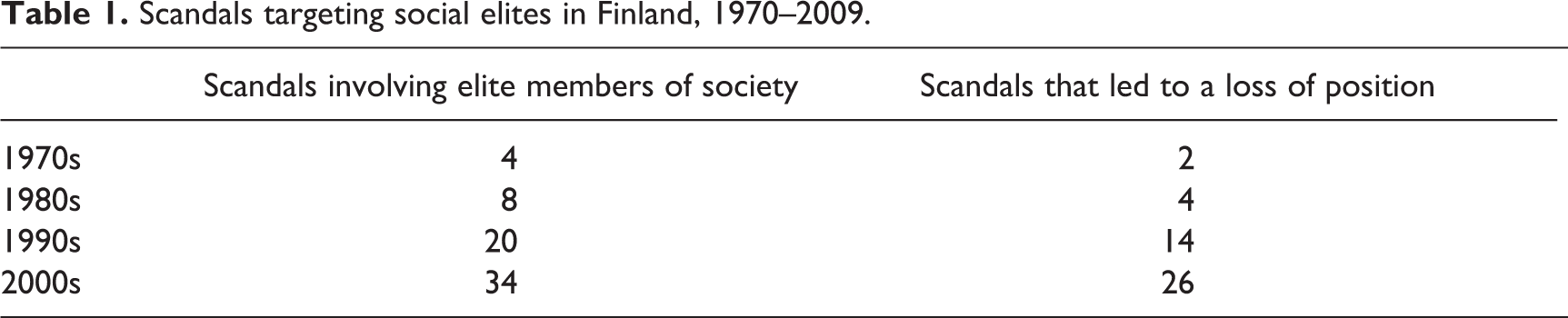
To understand the moralities at stake we set out to study the different phases of a scandal: the public row, the redressive action and the moral lesson learned from the scandal’s outcomes (Turner, 1988: 74 f., 1974: 78 f.). We classified the types of moral norms that were at stake in each scandal (see also Kantola and Vesa, 2011) and found several recurring themes. The most typical 1 moral transgressions were: financial misconduct: corruption, bribery and other improper financial benefits (30); inappropriate personal behaviour: drinking or drug abuse (8), improper sexual behaviour and sexual harassment (11) or violent behaviour (4); mismanagement of public duty: as a minister, official or CEO (6).
In each of these categories, the number of cases grew in every decade from the 1970s to the 2000s. It also became clear that in all categories the morality by which behaviour of elites was judged had become increasingly strict and unforgiving. In the following section we examine the most common moral transgressions in elite scandals, namely financial misconduct and inappropriate personal behaviour, and show how these scandals became social dramas through which society’s moral order was negotiated as the Cold War moral order was being transformed.
The Cold War moral order
During the Cold War, Finnish political culture was dominated by the threat of the Soviet Union – the old military enemy. Power was centralized in the President of the Finnish republic and the major political parties, which had relatively stable, class-based supporters, namely the bourgeois, the workers and the farmers. Urho Kekkonen (1900–1986) was elected president of the republic four times, becoming the longest-serving president of Finland, from 1956 until 1982.
Partly owing to Soviet pressure, the Conservatives were not included in the Government until 1987. Economic life was clearly subservient to politics; the flow of capital was under national control, and state as well as Soviet trade had a decisive role in industrial politics. With all movement of capital nationally controlled, the corporate sector worked closely with the state (Ojala, 2008: 196; Tainio, 2006: 68–71).
In the Cold War order, the political elite had a strong position: leaders were respected and journalists exercised self-censorship when covering issues concerning the Soviet Union (Salminen, 1996; Uskali, 2003: 59–63), as well as matters related to high-level politicians. Business editors and journalists had close ties with political and economic elites (Johnson, 1990: 65; Kantola, 2011). From the 1950s through to the 1970s, scandals involving political or economic elites were infrequent. Political journalism maintained a respectful silence about such things as Foreign Minister Ahti Karjalainen’s drinking problem (Pernaa and Railo, 2006: 22; Uimonen, 2009: 36–39) and President Kekkonen’s deteriorating health (Heiskanen, 2010: 24 f.).
If scandals did erupt, their outcomes were not serious. A good example is Finland’s best-known political scandal of the 1970s, the Zavidovo case, when confidential discussions held at Zavidovo in the Soviet Union between President Kekkonen and Soviet leaders were leaked to the Finnish daily Vasabladet. The leaked memos made it clear that the Soviet Union opposed Finland’s proposed membership in the EEC. As was typical in those days, the scandal only strengthened the position of President Kekkonen, though he said that the leak had undermined the confidence he enjoyed in the Soviet Union (Hämäläinen, 2002: 24–28; Ylen Elävä arkisto, 2007). Consequently, the Finnish Parliament extended the President’s term in office, and the next presidential elections were simply skipped.
Another example was the scandal surrounding the electronics producer Salora Oy (Hemánus, 1988: 460; Pernaa, 2009: 157). The company had given several high-level politicians, such as Prime Minister Kalevi Sorsa and Foreign Affairs Minister Ahti Karjalainen, complimentary hi-fi equipment. The Supreme Court took the view that these were bribes intended to garner political support for the state-owned television tube factory. However, none of the ministers involved was impeached (Pernaa, 2009: 157–161; Pernaa and Railo, 2006: 28; Ylen Elävä arkisto, 2006).
The tightening of accountability for financial misconduct
In the 1980s, the Cold War moral order began to break down. President Kekkonen resigned from his position in 1982 and the Finnish media distanced themselves from party loyalties (Aula, 1991; Lehtinen, 2002: 627–632). Since the fall of the Soviet Union, foreign policy has been strongly geared to the West, with Finland becoming a member of the European Union in 1995 and, in 1999, joining the European Monetary Union (EMU) and, in 2002, adopting the euro. In the background were wider societal changes. With the rise in standards of living, class-based identities weakened, and voters became more individualized. Party loyalties weakened and voters demanded transparency from the political parties and their leaders.
Subsequently, in the 1980s and early 1990s, a number of scandals focused on leading politicians in a new way. The most common morality issue dealt with financial misconduct: corruption, bribery and other improper financial benefits. For instance, in 1982, the Chairman of the Centre Party, Paavo Väyrynen, became a media target for drawing an allowance granted to MPs who live outside Helsinki. Väyrynen was registered as a resident of Lapland, but in fact he lived in Helsinki; his ‘home’ in Lapland was just a ramshackle summer cottage (Pernaa and Railo, 2006: 29–30).
Since the 1990s, many ministers have been accused of financial wrongdoing and have subsequently resigned (Virkkunen, 2006). Most notably, in 1992, the debts and murky business affairs of Kauko Juhantalo, the Minister of Trade and Industry, caused a public outcry. His muddled business dealings were considered compromising to his credibility, and he resigned from the Government. Later, he received a twelve-month conditional prison sentence for seeking a bribe and was expelled from Parliament (Uimonen, 2009: 110–114). Other ministers have also resigned. The second Minister of Finance, Arja Alho, resigned in 1997 (Alho, 2004: 226 f.), and the Minister of Culture Suvi Lindén in 2002, as they had shown favouritism to their political allies or benefited themselves financially. The media played a considerable role in the scandals, especially the tabloids, which put pressure on the ministers.
The biggest wave of financial scandals involving Finland’s political elites was the election financing scandal from 2008 to 2011. For those years we have identified seven different scandals. The core issue was unreported election campaign funding, which was discovered to be a regular practice in many political parties. A number of individual politicians were targeted, and an array of related scandals broke out revealing practices that hid campaign financing through public organizations. Many politicians were suspected of bribery, of abusing their official positions or of just plain incompetency, owing to the likelihood of bias. The most prominent figure to fall was the Prime Minister, Matti Vanhanen. Caught in the eye of a storm, he resigned from the Government and the leadership of his party. The media were particularly active in this crisis, with journalists clearly using it to enhance their watchdog status at a time of economic belt-tightening (Kantola, 2012; Kantola and Vesa, 2011).
Along with political leaders, business leaders have been targeted more and more often since the 1980s. As in the case of political scandals, this situation results in part from the opening up of what used to be a closed national system. From the 1980s onwards, capital markets were deregulated in Finland, and the power of banks began to wane. It was no longer enough for a company to persuade the banks at home to grant them loans; the company had to convince its shareholders abroad, who often demanded greater transparency. At the same time, business journalism began to take an increasingly critical approach to corporate life (Johnson, 1990; Mikkonen, 1998: 308 f.; Uskali, 2005: 41–46).
Since the 1990s, business managers have been at the centre of an increasing number of scandals, which have concerned losses sustained by companies, their business deals or management styles or the abuse of insider information. In 1991, Jaakko Lassila resigned as the CEO of a major bank in Finland (KOP). A nationwide media scandal publicized the bank’s significant losses in the wake of financial dealings by one of its investors, Pentti Kouri; CEO Lassila was blamed as being responsible for the losses (Mikkonen, 1998: 360–386). Helsingin Sanomat and the weekly magazine Suomen Kuvalehti were particularly active in disclosing details about Kouri’s trading practices (Uimonen, 2009: 102–110). In 1995 a similar scandal led to the resignation of Seppo Lindblom, the CEO of another major bank (Postipankki). The bank’s New York branch had suffered losses of some 75 million euros on derivatives. Lindblom first refused to accept these losses as grounds for his resignation, but after a public outcry he was forced to step down (Uimonen, 2009: 119).
Other CEOs have resigned under the glare of public attention: Iiro Viinanen, the CEO of insurance giant Pohjola, was forced to resign in 2000 (Uimonen, 2009: 140–151). The CEO of Sonera, Kaj-Erik Relander, resigned in 2001 when, based on anonymous sources, Helsingin Sanomat reported his harsh management style (Uimonen, 2009: 169–174). In 2000, Antero Siljola, the CEO of the country’s leading publishers, WSOY and SanomaWSOY, was the first CEO of a listed company in Finland to resign because of intentional insider abuse (Uimonen, 2009: 158–161). The CEO of Sampo Bank, Jouko Leskinen, was also suspected of insider trading involving medical and insurance stocks and resigned in 2000 (Uimonen, 2009: 161–167).
All of these scandals turned on the honesty of political and economic leaders. In Turnerian terms a breach opened between the old conception of fair political and economic leadership and the new perception, namely that elites are working in closed and corruptive networks equivalent to a brotherhood. This breach was clearly linked with societal changes. As the relatively closed and national Cold War culture changed politically and economically, it came to be seen in a new light; the scandals highlighted this change and made it visible to the public.
Tightening personal morality
Another prominent theme in the scandals starting from the 1980s was inappropriate personal behaviour on the part of elites: drinking or drug abuse, improper sexual behaviour and sexual harassment or violence.
Heavy drinking was a relatively common practice in the Finnish political culture in the 1960s and 1970s when hardboiled men made hard decisions while drinking in the sauna. President Kekkonen’s long and alcohol-soaked negotiations with Soviet leaders demonstrated the Finnish ability to survive the Eastern bear. Thus, before the 1980s, mainstream journalism paid little attention to politicians’ drinking. For instance, in 1960 a long-standing minister, Väinö Leskinen, was charged with two counts of drunk driving. Even so, Leskinen was re-elected to Parliament twice, in 1962 and 1966; in 1968 he became Minister of Trade and Industry; then, in 1970, Minister for Foreign Affairs (Uimonen, 2009: 21 f.). Similarly, Ahti Karjalainen, Prime Minister and Foreign Minister, who was tipped as the country’s next president, was safe from public scrutiny for a long time despite his serious drinking problem. Although Karjalainen’s drunk-driving conviction in 1979 was mentioned in national newspapers, there was no scandal.
Attitudes to drinking, however, gradually became more critical. In 1983, while serving as the Governor of the Bank of Finland, Karjalainen was relieved of his duties amid a huge media frenzy (Pernaa and Railo, 2006: 22; Uimonen, 2009: 36–39). The gradual public negotiation surrounding alcoholic drinking was also illustrated by the treatment of the newly elected president, Martti Ahtisaari. On returning from his first official state visit to Sweden in 1994, Ahtisaari was seen with a plaster on his forehead, and speculation was rife that the injury was the result of a fall caused by excessive drinking. In the midst of the media scandal, the President had to explain on a television talk show that he had slipped and fallen at an evening gala, for which he blamed his new leather-soled shoes.
The morality code on drinking had clearly become stricter. In November 1994 the Coalition Party leader, Pekka Kivelä, had an embarrassing episode of rowdy drunkenness at the airport in Tallinn; he immediately resigned. In 2003, when former minister Sirpa Pietikäinen was caught drunk driving after moving her car just a few metres in a parking area and hitting a snow bank, on the very same day in the midst of a media frenzy she announced that she would not be running for re-election to Parliament (Uimonen, 2009: 180 f.).
Besides drinking, sexual harassment was another issue reflecting the changes in the moral order. In the Cold War political culture, women had a marginal role in the exercise of political power, and sexual harassment remained a silent phenomenon that had not been addressed in public. However, sexual harassment gradually came to be targeted in mediated scandals. The first sex scandal proper unravelled in 1990 when Marianne Laxén, a senior researcher at the Equality Ombudsman’s Office, received a picture postcard from a group of male labour market leaders depicting a naked woman, with oversized bras for a parachute, landing on a field of erect penises. Laxén forwarded the card to Finland’s biggest daily, Helsingin Sanomat, which ran the story (Holli, 1991: 3). The then National Conciliator Jorma Reini, who was at the centre of the scandal, eventually issued a public apology. For the first time the scandal brought the question of sexism into the public sphere; as with drinking, the change in public attitudes took place gradually. Since 2000, all public office-holders charged with inappropriate sexual behaviour have had to resign. In 2001, Matti Ahde, a former minister and the CEO of Finland’s state-controlled gaming operator, Veikkaus, was removed from office following allegations that he had harassed several female employees in the workplace (Uimonen, 2009: 167–169). In 2006 the secretary of the Coalition Party, Harri Jaskari, was suspected of pimping and accused of using violence against his girlfriend, and he too was dismissed (Uimonen, 2009: 200–202). In November 2008, Stefan Johansson, political secretary to the Minister of Culture, resigned following accusations that he had groped women at a gala at the Swedish Embassy (Uimonen, 2009: 216 f.).
In Turnerian terms the elite scandals involving drinking and inappropriate sexual behaviour signal societal changes in which the moral codes for political elites have been tightened. The emergence of these kinds of scandals in the 1980s revealed a break with the moral order of the Cold War, when men made decisions on benches of saunas. As women became more powerful in society and also among political elites, sexual harassment became the subject of public scandals. The tightening morality on drinking also reflects the enhanced power of voters and citizens: the morality codes for society’s leaders have become stricter.
Media as liminal sites
While scandals have signalled the transformation of the Cold War moral order, the media have clearly been playing a central role in these transformations. As many of the cases reviewed above suggest, the media have been active by raising the issues in public or by serving as sites through which different actors can create scandal. The escalating role of the media is clear in figures showing the initiators of scandals (Table 2). The Finnish scandals were stirred up into public issues most often by (i) the media; (ii) official juridical processes, such as police investigations and court cases; or (iii) other actors, such as political opponents or whistle-blowers. All along, the media have been the most frequent initiators of scandal, and especially since 2000 the media have played a central role in the proliferation of scandals (Table 2).
Main initiators of scandals targeting social elites in Finland, 1970–2009.
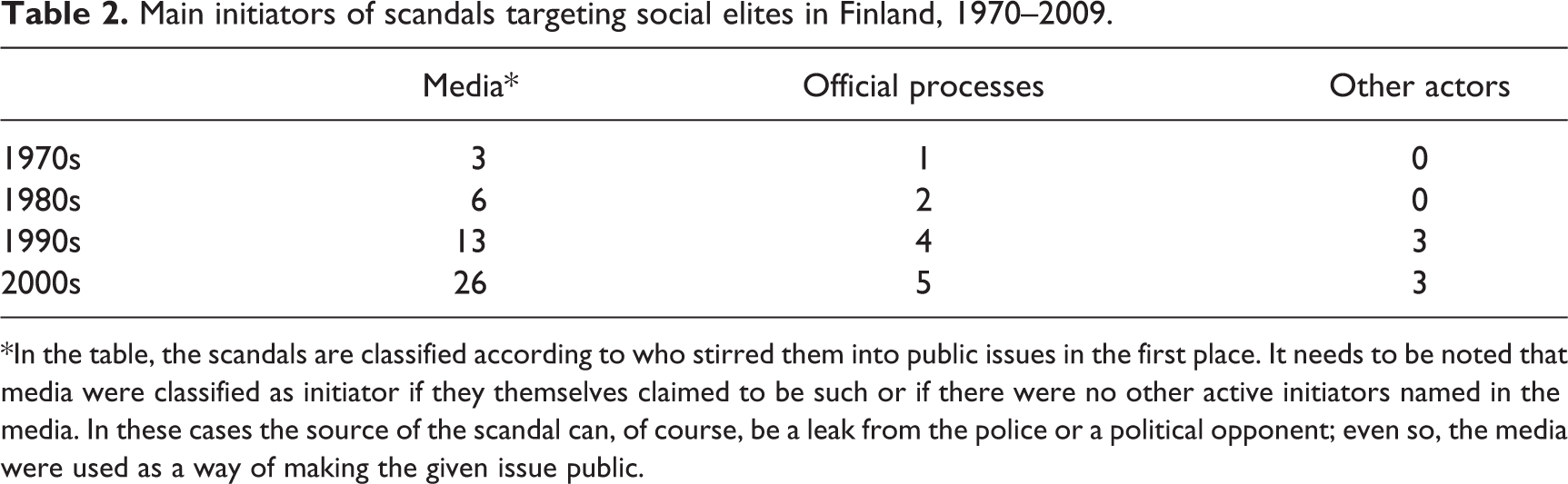
*In the table, the scandals are classified according to who stirred them into public issues in the first place. It needs to be noted that media were classified as initiator if they themselves claimed to be such or if there were no other active initiators named in the media. In these cases the source of the scandal can, of course, be a leak from the police or a political opponent; even so, the media were used as a way of making the given issue public.
The central role of the media is partly explained by structural changes. In the Cold War moral order the media were closely linked with political elites (Kantola, 2011). As the order began to break down in the 1980s, Finland’s public service broadcaster, YLE, lost its monopoly status, and newspapers broke away from their political affiliations. The media gradually became more detached and independent from political and economic elites and thus more assertive and aggressive, and this was reflected in the rising number of political scandals (Luostarinen and Uskali, 2006: 181). The tabloids played a central role. They have been the leading protagonists in scandals since the 1980s, targeting individual politicians more aggressively than ever before. In Turnerian terms the media grew into liminal-like spaces that provided sites for social dramas, places that have become increasingly dangerous for the societal elites.
A good example of the more assertive media in Finland was the public scandal in 1986 when the Social Democratic Minister of the Interior, Kaisa Raatikainen, was criticized for shortcomings in public information in the wake of the Chernobyl nuclear disaster (Huhtala and Hakala, 2007: 45 f.). The same year she was also criticized for the excessive use of police force in connection with the Mikkeli hostage crisis, where both the hostage and the kidnapper were killed as police opened fire on a vehicle packed with explosives. The public stir created by these events was exceptional, something unheard of in Finland at the time. The scandal subsided when President Mauno Koivisto intervened to express his support for Minister Raatikainen (Uimonen, 2009: 100 f.). Nevertheless, Raatikainen was not re-elected to Parliament in 1987.
Another benchmark scandal, mentioned earlier, was the plaster on the forehead of President Ahtisaari in 1994. Ahtisaari eventually explained himself on a television talk show. Yet his mediated confession paved the way for a new standard in which politicians had to be prepared to explain themselves in public.
Since 2000, the media have been active initiators of scandals (Table 2). Most notably, the first woman Prime Minister, Anneli Jäätteenmäki, was forced to resign in 2003 after it was revealed that she had used information in her campaign which had been leaked by a government official from the office of the President. The tabloid media played a decisive role in this scandal and within the profession was credited with digging up details about Jäätteenmäki’s actions.
Paraphrasing Victor Turner, we suggest that the media in recent decades have increasingly turned into a liminal-like space in society; they provide liminal platforms in which elite actions are questioned and contested. Originally, Turner’s liminal phenomena reveal the collective, integrative and obligatory ritual actions of premodernity, and we must be careful in applying liminality to modern societies (Coman, 2008; St John, 2008). In complex and heterogeneous societies, social processes are subject to conflict and argumentation and authorities become contested. In such societies the media often take up roles considered liminal phenomena in premodern societies. The media provide stages that stand apart from the normal order of society, places of leisure and performative play. Moreover, it is just in scandals when media become risky places for the elites. In mediated scandals, individuals are stripped of the protection of their high rank and positions, their secrets are brought to light, and they stand exposed in a place where, it seems, anything can happen. Shame and disgrace always lurk behind a scandal and threaten those who are the main protagonists in the social drama. For those individuals who are targeted, the media provide a dangerous space where people are left to cope on their own facing forces that may ultimately destroy their status and credibility.
Our study suggests that mediated elite scandals in particular can work as transformative cultural performances: they signal changes in the moral order and serve as points where new norms are negotiated. In recent decades the media in Finland have become a truly dangerous place for political elites – sites where elites have found themselves threatened and have had to face new moralities. The media have thus provided a platform for long-term societal transformations by bringing out contentious moral issues that, in the Cold War era, had been kept under wraps.
Are all mediated elite scandals thus a good thing, tapping into society’s vital issues? We don’t think so. Rather, one needs to examine the moralities that are at stake in each scandal. In Finland after the year 2000 mediated scandals began to show signs of overheated reporting, and these years became a decade of bloated sex scandals. In March of 2008 the gossip magazine Hymy reported that the then Minister for Foreign Affairs, Ilkka Kanerva, had used his work cell phone to send 200 sexually suggestive text messages to an erotic dancer, Johanna Tukiainen. Kanerva was forced to resign his ministerial post after two months of a humiliating scandal (Juntunen and Väliverronen, 2010). Another sex scandal was the hubbub surrounding the private life of Finland’s former Prime Minister, Matti Vanhanen (Juntunen and Väliverronen, 2009; Paasonen and Pajala, 2011). Following Vanhanen’s divorce, a stream of highly publicized ‘sex scandals’ and ‘dubious romances’ appeared in the media. The biggest scandal concerned Vanhanen’s relationship with Susan Ruusunen, which hit the headlines in 2006 and continued to linger on after the couple split up. This whole scandal was, in large part, created by the media, particularly the afternoon tabloids (Juntunen and Väliverronen, 2009: 276–278; Paasonen and Pajala, 2011: 122–128).
In these sex scandals the main driver has evidently been the profit motive: scandals, and especially sex scandals, sell very well. Politicians’ private lives have been reported in tabloid-style magazines since the 1970s (Saari, 2007: 34–40), and in the 1990s their lives became regular features of political news reporting in the tabloids. In the 2000s, even quality mainstream media jumped on the bandwagon (Kivioja, 2008: 189; Pernaa et al., 2006: 275–277). As the media and quality journalism have been hampered by economic crises, the media and journalists have become more assertive, with tabloid formats filtering into the quality journalism of dailies, television and radio (Kantola, 2013).
This can also lead to scandal fatigue (Thompson, 2000: 117) as people become cynical and tired of empty scandals with no real content. This too could perhaps be viewed in the Turnerian light. Turner suggested that genres of cultural performance can become empty shells and lose vitality and their touch with the tensions of society (Turner, 1982: 81). In Turner’s terms it is unclear whether the scandals are still social dramas that represent society’s fundamental values. This is implied, for instance, by the deteriorating circulation of the Finnish tabloids; the circulation of the Finnish tabloids has diminished some 25 per cent in the last decade, which is considerable. This might indicate that the tabloids are losing their contact with the crucial issues of societal transformations and are weakening as liminal spaces where society negotiates its moral order. Thus, a mediated scandal can be, but is not always, a site of social drama.
Renegotiating the moral order
Over the past several decades, Finnish political and economic elites have been increasingly subjected to scandals. The general pattern of development in Finland is similar to the pattern seen in many other countries. In many countries, scandals have proliferated with the growth of democracy and transparency (Heywood, 1997: 419; Newell, 2010: 2). In Germany, the number of political scandals increased in the 1980s; France and Belgium saw a host of scandals in the 1990s (Adut, 2004: 530; Esser and Hartung, 2004: 1065; Maesschalck and Van de Walle, 2006: 1012). Democratization created waves of scandals in Argentina, Mexico (Lawson, 2002: 138–156; Waisbord, 1994), Brazil (Zirker and Redinger, 2003: 41) and Hungary (Gulyás, 2004: 77). Additionally, the collapse of the Soviet Union was preceded by a string of scandals (Wishnevsky, 2006: 179).
Does the rising number of scandals suggest that the morality of the elites has deteriorated? This does not seem very likely. We suggest that the repeated themes in societal scandals can be understood as signalling long-term societal changes in society’s moral order. Scandals, especially those that involve public figures who embody society’s powerful institutions, are linked to the general moral order. Mediated elite scandals especially can be seen to work as litmus tests of societal morality. They test the major cultural classifications by bringing contentious issues into the light of day and turning them into societal morality plays. Moral tensions surface in public life when an elite member, as the protagonist of the drama, is placed in the public eye, and a broad discussion about morality ensues.
The moralities of the Finnish elite scandals show how society’s moral order has been revised and renegotiated in recent decades. Over time, new, stricter moralities have appeared governing appropriate elite behaviour in areas such as financial conduct, drinking and sexual harassment. These changes in moral order are linked to wider societal transformations. The relatively solid political system of a class-based society has been shaken by individualization, middle-class allegiances, shifting voters and financial liberalization. All this has meant that, in the more egalitarian societies, authorities are questioned in the name of democracy, openness and transparency. The norms for elites have become more restrictive, and their social morality violations are taken up in public more readily than before.
In Finland, the past several decades have been a transformative period as the relatively closed political and public culture of the Cold War era has been altered. In the Cold War, the elite culture valued heavy drinking and male-bonding. Women played a marginal role at the top levels of politics and economy. The Cold War moral order has been renegotiated with the rise of democratization and economic liberalization. The elite scandals have worked out new moralities: heavy drinking or sexual misbehaviour is no longer acceptable by those who hold public positions. This signals the democratization and equalization of society: the relatively sheltered positions that high-ranking elites previously enjoyed have been challenged by public opinion, citizens, customers and shareholders. Thus, somewhat paradoxically, the more liberal-minded and individualized Finnish society has developed stricter moral codes for its elites.
The Finnish case also emphasizes the role that the media have played in making society’s moral order. Until the early 1980s, scandals involving societal elites were rare, and the media were not particularly active in fomenting scandals. Since the 1980s, the media became increasingly liminal-like: indeterminate, dangerous and play-like (Coman, 2008: 105; Handelman, 1990: 66). However, all this does not mean that scandals always work as social dramas that address society’s vital issues. Beginning in the 2000s, the media have become troubled by decreasing circulation and increasingly volatile audiences (Kantola, 2013). News criteria have veered to human interest and tabloid criteria and some of the scandals have turned into media frenzies that manufacture headlines on minor issues (Juntunen and Väliverronen, 2009: 276–278). This might indicate that mediated scandals can also resemble empty barrels, making a lot of noise without any real content (Garrard, 2006: 23; Schudson, 2004: 1236). Scandal fatigue (Thompson, 2000: 117) or societal rebuttal of the scandal-fomenting media might suggest that the media are no longer dealing with crucial issues in a society’s moral order and, instead, are just trying to duplicate the scandal format in order to increase sales.