







Abstract
The paper seeks to promote a sociological understanding of the current wave of nostalgic expressions haunting late-modern Western culture and to re-evaluate the predominantly negative assessment of nostalgia. Filling two gaps in the existing research on nostalgia, the authors wish (1) to reintegrate into the phenomenon its experiential and collective dimensions and (2) to propose a theoretical sociological framework capable of analysing nostalgic ritual. In the first part of the paper, we discuss different approaches to the phenomenon of nostalgia. Second, we delve into the complex emotional and experiential aspects of the phenomenon and distil three different types of nostalgia. Third, seeking inspiration from Émile Durkheim and Randall Collins, we scrutinise the common collective characteristics of these different types of nostalgia. Arguing that Collins remains too interactionist in his approach to ritual, we seek to erect a theoretical framework apt for articulating mediated forms of nostalgic ritual. Fourth, we use our theoretical framework to analyse a well-known instance of nostalgic ritual in Scandinavia: The Disney Christmas Show.
Introduction
Nostalgic sentiment presents an important experiential dimension to numerous contemporary cultural expressions. On major television channels we find nostalgic programmes wherein celebrities recall the objects and events of their childhood, and on the cable networks we find entire channels devoted exclusively to nostalgic film classics. A multitude of recent film and television series indulge in the material cultures and designs of past decades (Holdsworth, 2011; Niemeyer and Wentz, 2014). In Denmark we find the recycling of old children’s programmes and Christmas calendars and never-ending reruns of popular television series such as ‘Huset på Christianshavn’, ‘En by i provinsen’ and ‘Beverly Hills 90210’. The current broadcasting vista of the major Danish broadcasting corporation (DR) includes nostalgic programme series such as The Time-Machine [Tidsmaskinen], Do You Remember: Highlights From the Sixties [Husker du – highlights fra 60’erne] (later reiterated for the seventies, eighties and nineties), Obsessed by the Past [Besat af fortiden], and To the Seventies and Back [70’erne tur-retur] (also reiterated for the following decades). At the same time, the auction houses – currently portrayed by no less than three Danish documentary series [Antikkrejlerne, Hammerslag, Antikduellen] – belly out with vintage dolls’ houses, puppet theatres and porcelain dolls, while new large-scale ‘childhood museums’ emerge in major European cities.
These overtly nostalgic phenomena, and the reiteration of the recent past in all areas of popular culture, are characteristic for late-modern retro culture. Here we find the celebration of technologically outdated media: the vinyl disc, the typewriter, the Walkman, the first home computer, seventies-style polaroid photography; we find ironic connoisseurs of ‘camp’ seeking out the most gaudy, ridiculous and failed objects among past fashions and fads – and often among their own childhood fascinations; but we also find genuine appreciations of forgotten cultural expressions, media, design or music.
In this paper we analyse different ‘types’ of nostalgia, their ritual embeddedness, and their different phenomenological aspects. Our goal is to promote a sociological understanding of nostalgia by combining motifs from diverse sources of nostalgia research with sociological theory on ritual and mediation. The paper is meant to fill two gaps in existing research: it reintegrates the phenomenological – here simply meaning experiential or ‘as experienced’, including all the complex emotional and ‘psychological’ tonalities to the phenomenon – and the ritualistic dimensions to the enactment of nostalgia; and it proposes a theoretical framework capable of analysing nostalgic ritual as an illustrative instance of mediated ritual.
In the first part of the paper, we discuss scholarly approaches to nostalgia. Second, we investigate nostalgia’s phenomenological dimension, outlining its three different types: ‘restorative’, ‘reflective’ and ‘ironic’ nostalgia. Third, we expand theoretically on the ritualistic dimension to nostalgia and sketch the contours of a theory of mediated ritual. Fourth, we use our theoretical framework to analyse a well-known instance of nostalgic ritual in Scandinavia: The Disney Christmas Show.
Perspectives on nostalgia – and the neglect of the collective
Nostalgia figures as a rather vilified sentiment in much ‘critical’ sociology. It reeks of ideology and escapism. The nostalgic individual, so the critics reckon, is unaware of the fact that the problems prompting the search for nostalgic escape – modern loneliness and alienation – are created by society and can only truly be remedied by social change. Nostalgia transfers societal problems to a simplified and individualised realm, and thus creates an inauthentic relation to history (DaSilva and Faught, 1982; Jameson, 1991). Other critics (Higonnet, 1998; Kincaid, 1992) have investigated the nostalgic conception of childhood as allegedly untouched by social complexity and by sexuality. They have shown how such misconceptions are rooted in a modern construction of childhood as a state of innocence and authenticity. 1
However, there is ample agreement in recent literature that the critical theorists tend to simplify the phenomenological dimension to nostalgia (Boym, 2001; Holdsworth, 2011; Niemeyer, 2014: 6; Pickering and Keightly, 2006; Sedikides et al., 2008; Wildschut et al., 2006; Wilson, 2005). The crux of the present paper’s argument is that we should also consider said critics’ complete disregard of the collective aspects of the nostalgia phenomenon.
Recently a number of important texts have emerged which seek to do justice to the richly facetted phenomenology of nostalgia (together with its political implications). Investigations into post-communist Eastern European nostalgia have crystalised into a proper area of research – to the extent that Olivia Angé and David Berliner, in their introduction to a recent anthology on nostalgia, remark that ‘as much as Holocaust has become a paradigm for researchers in memory studies […], works on nostalgia are paradigmatically “Eastern Europe”’ (2015: 1). The present paper is inspired by this body of research, but wishes to transcend the geographical curtailment. In fact Angé and Berliner, referring to current Western ‘retromania’, are well aware that ‘a whole field of research about contemporary forms of nostalgia remains to be investigated’ (2015: 3).
Another contribution to the scientific literature on nostalgia comes from empirical psychology. After an initial struggle with the historical conception of nostalgia as a mere physiological or psychological disorder, 2 post-war psychology has become increasingly aware of nostalgia’s positive effects. A number of psychologists, echoing insights also found in sociological or anthropological work (Davis, 1977, 1979; Nadkarni and Shevchenko, 2004: 516; Wilson, 2005), see nostalgia as a way of preserving continuity in life and a resource for the development of collective ties (Batcho, 1995; Hepper et al., 2012, esp. 988 ff.; Mills and Coleman, 1994; Sedikides et al., 2008; Wildschut et al., 2006). Nostalgia can be an important life-sustaining force in dire conditions – for instance in the Nazi-concentration camps – providing crucial psychological and collective support to the individual.
Thus, as emphasised by Dutch psychologist Tim Wildshut and his co-authors, nostalgia possesses an inherent social dimension; it predominantly thrives among people who are good at initiating relations to others (Wildshut et al., 2006: 988–989). Repeating classical insights from Maurice Halbwachs (1992), Wildshut points out that the experiences longed for are in fact almost always emphatically shared experiences – most often, of course, shared with relatives or close friends. Not only do ‘persons’ figure among the most important ‘triggers’ of nostalgia (Wildshut et al., 2006; Halbwachs 1992: 38) – i.e. as objects for nostalgic longing – but also their co-presence in the situation of nostalgic enactment is often a crucial aspect of the nostalgic sentiment (Hepper et al., 2012: 32). Nostalgia is not a reaction to loneliness or social alienation. It is embedded in collective ritual.
The crux of the present paper is that this collective dimension remains acutely under-researched. However, before we investigate nostalgic ritual, an investigation into nostalgic phenomenology is necessary.
The phenomenology of nostalgia
We shall take as our point of departure Svetlana Boym’s distinction between ‘restorative’ and ‘reflective’ nostalgia: Restorative nostalgia stresses nostos (home) and attempts a transhistorical reconstruction of the lost home. Reflective nostalgia thrives on algia (the longing itself) and delays homecoming – wistfully, ironically, desperately. […] Restorative nostalgia does not think of itself as nostalgia, but rather as truth and tradition. Reflective nostalgia dwells on the ambivalences of human longing and does not shy away from the contradictions of modernity. (Boym, 2007: 13)
Boym notices that reflective nostalgia may turn ironic. We shall construct ironic nostalgia as a form of (ironic) affection, which often combines with forms of so-called Proustian nostalgia. If the reader thinks about the ironic trait to some of the ‘Ostalgic’ fetishisation of GDR material culture, he or she might glimpse what is meant here. We are dealing with a species of irony which differs from mere parody or caricature (Boyer and Yurchak, 2010; Nadkarni and Shevchenko, 2004: 500); a more sophisticated, tender and emphatic variant of irony directed at particularly anachronistic, inauthentic or kitschy objects of the recent past: failed objects. 3 At its most genuine, ironic nostalgia is always – also – directed inwardly and it is always double; it is about distancing oneself from one’s own emotional involvement, from felt impulses of restorative nostalgia connected to idealisations of one’s own childhood and its object world, while at the same time feeling and even cultivating these selfsame emotions. Simply put, it is restorative nostalgia from a distance. In its less tender – and less nostalgic – variants, it merely mocks the nostalgia of others but does not itself feel nostalgic. In contrast to restorative nostalgia, ironic nostalgia does not wish restore the past political and social context of the ‘Proustian’ object. Irony does not idealise on its own behalf; it savours the inauthentic idealisations of oneself and others. Thus, in contrast to reflective nostalgia it remains parasitical, dependent on the restorative expression it exploits.
Ritual, irony and nostalgia
We have already highlighted the ‘critical’ ignorance of the collective aspect to nostalgia. But in fact we meet the same willful neglect regarding the collective side to the phenomenon of irony. In recent decades, in deconstructionist or postmodern thought, irony has been seen as a particularly ‘slippery form of [literary] discourse’ (Hutcheon, 1994), as an inherent form of deconstruction belonging to language itself (De Man, 1983; Eco, 1992), or as a consciousness of historical contingency (on the part of certain critical and anti-realist philosophers) (Rorty, 1989). In postmodern architecture it has been seen as a form of playfulness with kitschy historical references (cf. the architecture of Robert Venturi). These signposts are of course caricatured, yet recent approaches to irony, for all their differences, largely ignore the concrete social sentiment emerging in ironic interaction. However, the reader should ask how often he or she uses irony or humour when alone. Irony is a powerful but hazardous collective spice. The successful understanding of irony creates instant social bonds, whereas mistaken irony creates awkward situations.
In the following, we shall conceive of nostalgia and irony as collective rituals in a very informal sense: ritual is present every time a shared object, sentiment or event takes centre stage in collective formation. In this sense ritual always, even if implicitly, contains a dynamic of reinforcement between collective sentiment and phenomenological experience. All assembly around an emphatically shared object takes place through an articulation of the object’s ‘objective’ properties, and, conversely, all collective animation of a common object leads to further strengthening of collective ties. In our view, this is the essence of Émile Durkheim’s theoretical remarks on the ‘projection’ or ‘superimposition’ of the social upon the material (or immaterial) in the central Chapter 7 in Book II of The Elementary Forms of Religious Life (1995: 207–241).
We shall construct irony as yet another form of articulation of a shared object. The Danish philosopher Søren Kierkegaard wrote that the ironist deliberately ‘makes the failed even worse’ without, of course, making the ironic attitude explicit (1995: 263). This implicit exaggeration of the failed, we shall insist, is what ironists do when they come together. It is overtly tangible in Dominik Boyer’s and Alexei Yurchak’s anthropological descriptions of the phenomenon of Soviet stiob as a form of ‘over-identification’ with the object, in which it is often ‘impossible to tell whether it [is] a form of sincere support, subtle ridicule or a peculiar mixture of the two’ (2010: 181). When stiob is implicit, it is not just because it was originally invented to circumvent censure – indeed, Boyer and Yurchak insist that similar forms of irony are found in contemporary Western settings – but also because irony is at its most forceful and collective when it remains implicit, ‘secret’ and shared, whilst explored through apparently positive ‘over-identifying’ forms of cathexis.
Ironic nostalgics thus experience some of the same emotions and the same collective warmth as the restorative collective, while at the same time implicitly denouncing the inauthentic idealisations of the lost object as mere ‘nostalgia’. On the other hand: whereas restorative and ironic nostalgia focuses on the object, reflective nostalgia cultivates the very feeling of nostalgia and its collective and ritual construction. Ironic nostalgia distances itself from the sentiment of nostalgia, reflective nostalgia delves deeper into it. It is not ashamed of itself. It is not tainted by ‘critical’ thought. Yet, in contrast to restorative nostalgia, it knows the object is lost. The participants collectively delve into the nostalgia as nostalgia, consciously exploiting and amplifying the bittersweet sentiment together.
To couch this collectivist template in more theoretical terms, we will seek inspiration in Randall Collins’s formalisation of Durkheim. Collins considers himself an heir of Durkheim, yet places the Durkheimian inspiration in a Goffmanian micro-sociological framework (2004: xi). Criticising a functionalist interpretation of Durkheim, he emphasises that rituals exist for the sake of the individuals who participate in them and not for the sake of society. However, whereas Goffman focuses exclusively on one (modern) shared object and the concomitant prescriptions it imposes on the participants – i.e. the ‘self’ – Collins, following Durkheim, attempts a more general theory (Collins, 2004).
Collins lists four ‘ingredients’ which are necessarily present in ‘interaction ritual’ (2004: 48–49): (a) two or more people assembled in the same place, consciously or unconsciously aware of one another; (b) boundaries to outsiders (the participants know who is taking part in the collective situation, and who is not); (c) a shared object of attention; and (d) the emergence of a common mood or sensation of intensity. A feedback loop exists between the different ingredients: at the same time as borders are emphasised, solidarity among participants grows, the object gains in fascination, power and importance (negatively or positively), the shared mood becomes ‘effervescent’, and the individual is injected with ‘emotional energy’ (Collins, 2004: 48–49). Furthermore, Collins makes short shrift of a number of Durkheim’s weaknesses: Durkheim’s insistence on the stable over the ephemeral object, his totalitarian and functionalist focus on the whole of ‘society’, and his unjustified privileging of the religious, political and moral spheres over the cultural and consumptive ones (Schiermer, 2014a, 2015). Yet, Collins does not see – or chooses not to see – that Durkheim’s template also presents a potential contribution to a theory of mediated ritual.
Mediated ritual
Interaction rituals constantly emerge in all areas of cultural and social life. In a modern society, however, they are often mediated, i.e. transcending the singular interactionist instance. Rituals taking place around shop windows or Christmas trees, in front of television sets or internet sites, or at sporting or cultural events and performances are connected to a myriad of other interaction rituals focusing on the same or similar objects. In a modern context, events, persons or objects depend on media and mediation to give them broad impact or general significance. In this sense, instances of interaction ritual often resonate with a mediated, low-frequent, anonymous and decentralised ‘background effervescence’ – prominent examples span fashion, public opinion, referendums and large-scale sporting events.
This dialectic is, so it seems to us, missed by Collins. Even though he insists with explicit reference to Durkheim that ‘collective sentiments can only be prolonged by symbols’ (Collins, 2004: 37), he persists in seeing mediated ritual as a mere privative or less intense instance of interactionist ritual (2004: 53–64; 2011). He fails to appreciate that it is completely possible to investigate rituals in miniature whilst also paying due notice to their mediated nature or large-scale effects.
Since this omission is also found in prominent theories of mediated ritual, we will linger a bit on this discussion. Like Collins, Nick Couldry in his theory of ‘media rituals’ (2003) remains bewitched by the functionalism he attributes to contemporary Durkheimian media-theoreticians (Dayan and Katz, 1992; Real, 1975; Rothenbuhler, 1988), i.e. by the idea that, modern society at least at certain marginal moments is as united and coherent as the pre-modern one; only in modern society it is media which make possible this all-encompassing master-ritual uniting the entire modern tribe (Couldry, 2003: 6–9). Thus, following Couldry’s critique, in this functionalist view, media guarantee an experience of order or coherence of the ‘whole’; they mediate (or even create) experiences in which all ‘societies central meanings and values are at stake’ (2003: 9).
Interestingly, however, Couldry does not critically target whether the alleged experience of wholeness or social coherence actually exists. He merely insists that this experience is ideological, virtual and illusory and that it is the media that conjure up this illusion through the implicit construction of certain basic cognitive categories of participation, order and presence. This is then what Couldry calls ‘media ritual’. Instead of simply insisting on a less all-encompassing and harmonistic concept of collective mediation in ritual, Couldry keeps the all-encompassing notion of ritual, yet cleanses it for collective force. We end up with an all-encompassing, yet de-collectivised concept of ritual, combined with an implicit ‘critical’ eclipse of the concept of media. On the one hand media are tacitly reduced to national and conventional news media. Or better: media are simply ‘the press’. On the other hand they are conveyed with the full power to construct the reality of the inhabitants through images and discourse. But they do not mediate – relate – collective sentiments, they do not connect people.
In our view, Couldry remains hostage to a pre-internet, unidirectional, cognitivist and overtly centralised (conspiratorial and manipulative) conception of media, which fails to appreciate the sheer proliferation and scope of shared objects and events, not to mention the diverse forms of ritual in which it is embedded: interactionist or mediated, transitional or stable, anonymous or personal species of collectvity. To furnish news media with the right to define what is topical and central across the entire social space amounts to an acute overestimation of the power of news media and an empirically unworkable over-simplification of our collective reality. It is like furnishing the fashion industry with absolute power to determine what is ‘in’, not only across spheres of clothing and design (which is already wrong!), but in all cultural areas haunted by fashion dynamics and synchronisation around changing objects, from trends in name-giving to fads in science or art.
We shall maintain the Durkheimian idea that actuality is collectively generated; i.e. that the importance or actuality of prominent events or objects is inseparable from the fact that others bestow them with equal topicality. We shall equally insist that this dynamic is always rooted in particular instances of effervescent synchronisation, particularly ritual formations. 4 In our account of ritual what takes precedence in experience is not a sensation of order or coherence but the concretely shared object. All the time different objects, persons, sentiments or events gain further importance, attraction, power of fascination and actuality due to their placement at the centre of attention of a given collective. In this scenario, what we call zeitgeist is but a complex tissue of disembedded, overlapping, partly superimposed and decentralised ‘gatherings’ of entirely different duration, but all centred on their respective mass-(re)produced object, person, concept or event. This fabric changes constantly. And no thread runs through the whole fabric, no one sacred object constitutes the ‘centre’ of a united all-encompassing modern collective.
An example taken from Benedict Anderson’s well-known work on ‘imagined communities’ may aptly delineate the transparent sentiment of mediated ritual we seek to convey. Anderson describes the ritual of reading the morning newspaper in the following terms: The significance of this mass ceremony […] is paradoxical. It is performed in silent privacy, in the lair of the skull. Yet each communicant is well aware that the ceremony he performs is being replicated simultaneously by thousands (or millions) of others of whose existence he is confident, yet of whose identity he has not the slightest notion. Furthermore, this ceremony is incessantly repeated at daily or half daily intervals throughout the calendar. (Anderson, 2006: 35)
We constantly share such insignificant yet decisively collective moments through ‘replicative’ or imitative use of mass media and shared objects. These reflections are in no way disqualified by the contemporary individualisation of media intake. Granted, technological developments fragment existing collectives, yet they simultaneously present new possibilities for spontaneous synchronisation: when people choose to watch a sporting event at the same time as ‘thousands (or millions) of others’, it is because strong collective embeddedness makes experience more intense than streaming the game in one’s own time. And by the same token: when people watch a football match on the television or over the internet they often turn up the volume to hear – or better: feel – the roar from the audience gathered at the stadium, since this intensifies the experience and importance of what goes on at the screen. Conversely, if the volume is turned off a certain sensation of indifference or detachedness intrudes on the viewer. Anderson’s theory of imagined community lacks this concrete dimension of collectively generated intensity or actuality. But Collins, as well, passes this dimension over. Couldry, it seems to us, wrongly thinks that all-powerful news media may install it on their own terms. The authors of this paper, in contrast, maintain that effervescence also determines actuality; that collectivity determines temporality. In this sense Durkheim was as right as ever.
Method and data
Below we shall illustrate how collective enactment influences and informs our three identified forms of nostalgia, through an analysis of the rituals surrounding the annual broadcasting of The Disney Christmas Show in Denmark.
We do not lay claim to any inductive validation of the empirical existence of our three types, nor to any representative measurement of their respective prevalence. The analysis is theoretically informed and merely aims at the illustration of our three types of nostalgia. We are equally interested in the two dimensions of interaction and mediation. The posts and comments analysed below are to be regarded concurrently as testimonies about interaction rituals which could then be observed and further unfolded through ethnographic work, and as genuine contributions to an actually occurring mediated ritual taking place on the internet. In the latter aspect they constitute primary data.
Data were assembled by various means: other scholars’ empirical work with Disney (Drotner, 2003); comments on the show generated through Google searches on the term ‘Disney Christmas Show’ [Disney Juleshow] or derivative forms thereof; and posts found on Instagram, a popular site on which short comments are posted together with visual content related to an actual event while it unfolds. Through the use of a so-called Instagram ‘scraper’, data from the Instagram API containing posts from December 2012 to December 2016 were collected (in February 2016). We searched for the hashtags #Disneyjuleshow and #juleshow respectively and then filtered the posts. This gave us a result of 675 posts analysable as to their written and their visual content, as well as supplying us with additional information on the commentators and the exact times of their postings. 5
Nostalgic ritual: The Disney Christmas Show
The Disney Christmas Show – originally titled From All of US to All of You – is broadcast in all Scandinavian countries during the Christmas season, at fixed times on major channels. In Sweden, the show is seen by up to three and a half million viewers every year, according to Swedish Wikipedia. The content of the show is highly ritualised: it varies a bit from country to country, yet within all variants the composition remains identical from year to year except for a short clip or two from the newest Disney productions. Thus, inasmuch as the content has been the same for years, there is reason to believe that the popularity of the show is due to other factors.
In Denmark the show aired for the first time in 1967, and it has been a fixed part of the traditional Christmas broadcasting, shown on Christmas Eve (at 16 h), since 1991. In recent years it has been watched by approximately one-fifth of the population. Two-thirds of the viewers are adults, and this indicates that they watch the show for reasons other than its producers originally intended. Due to its long and unbroken Scandinavian history, The Disney Christmas Show belongs among the childhood memories of its many adult viewers; the programme thus presents an opportunity to enter into a nostalgic sentiment, which goes hand-in-hand with the strongly sentimental, pastoral and romantic content of the show. Further testifying to the collective importance of the phenomenon are the disproportionately heated debates that at times circulate around it. In Sweden, one year, the replacement of Ferdinand the Bull with The Ugly Duckling caused vehement public protests which led to a reestablishment of the orthodox form the following year. Recently, criticism from Swedish feminists has elicited strong collective responses in Denmark. There is no doubt that The Christmas Show plays an important role in the collective consciousness of Scandinavian countries around Christmas time.
There is no blog, at least in the Danish language, exclusively devoted to The Christmas Show. What we found upon searching the internet was its recurrence as a shared theme on a number of sites devoted to other subjects or hosted by major newspapers. Its search profile on Google Trends shows slim annual peaks from the middle to the end of December (topping on the day of broadcast, Christmas Eve). We generated the graph above (Figure 1) to portray the number of Instagram posts over time.
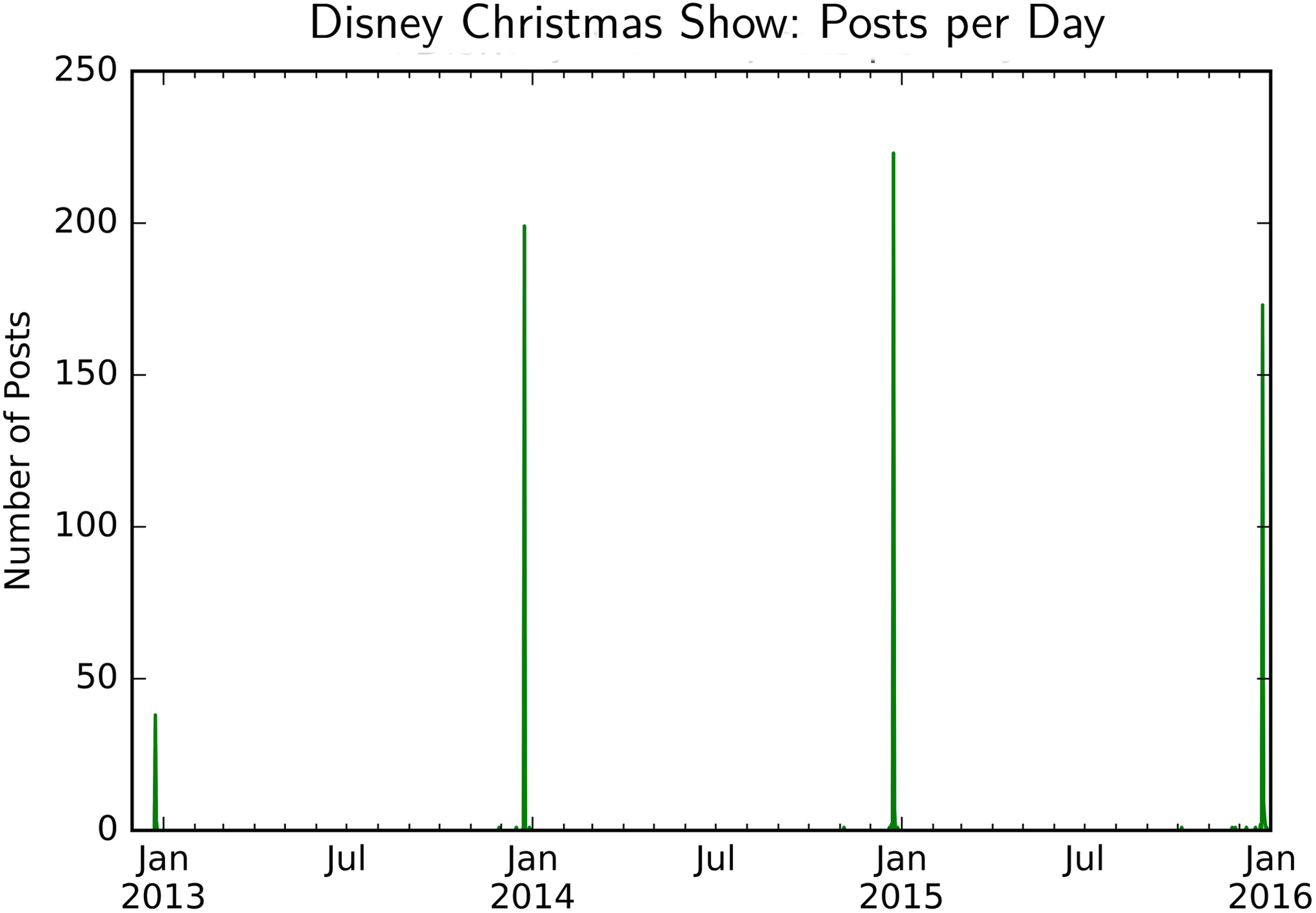
Number of Instagram postings per day 2013–2016 containing the hashtag ‘Disney Juleshow’ (or derived forms).
When it is taken into consideration that it is possible to stream the content anytime, the obvious conclusion is that its sudden annual popularity testifies to its ritualistic use. In Figure 2 we have displayed the frequencies of informative words – pointing to the ritual dimension – occurring in the Instagram posts.
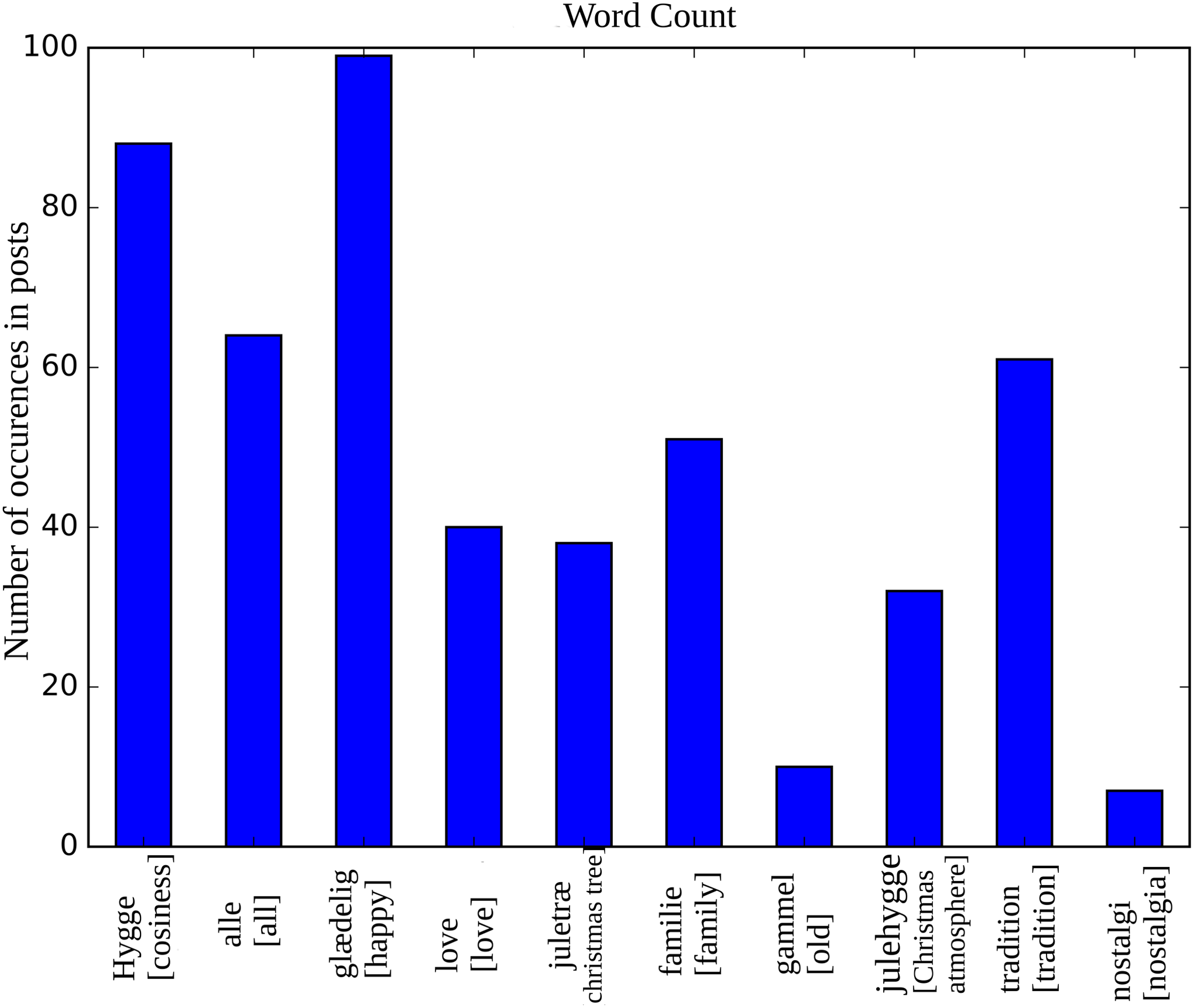
Word count of frequently used words in the Instagram postings.
The enjoyment of collectivity is apparent. Besides mere seasonal markers such as ‘Christmas’ and ‘Christmas tree’ [juletræ], we find words like ‘cosiness’ [hygge], ‘tradition’, ‘all’ and ‘love’ which all celebrate the feeling of togetherness. Probably, the strong collectivism testifies to the fact that many of the postings are made during the actual ritual.
This rudimentary and automated content analysis, however, can hardly serve as a basis for distinguishing our three types of nostalgia. Only eight out of 675 posts reflect the viewing experience as ‘nostalgic’, and we find no trace at all of the term ‘irony’. Yet since irony remains implicit and thus undetected by mere syntactical or numerical analysis, this is no big surprise. Only by manually interpreting the posts together with other data and theoretical reflection can we identify the types.
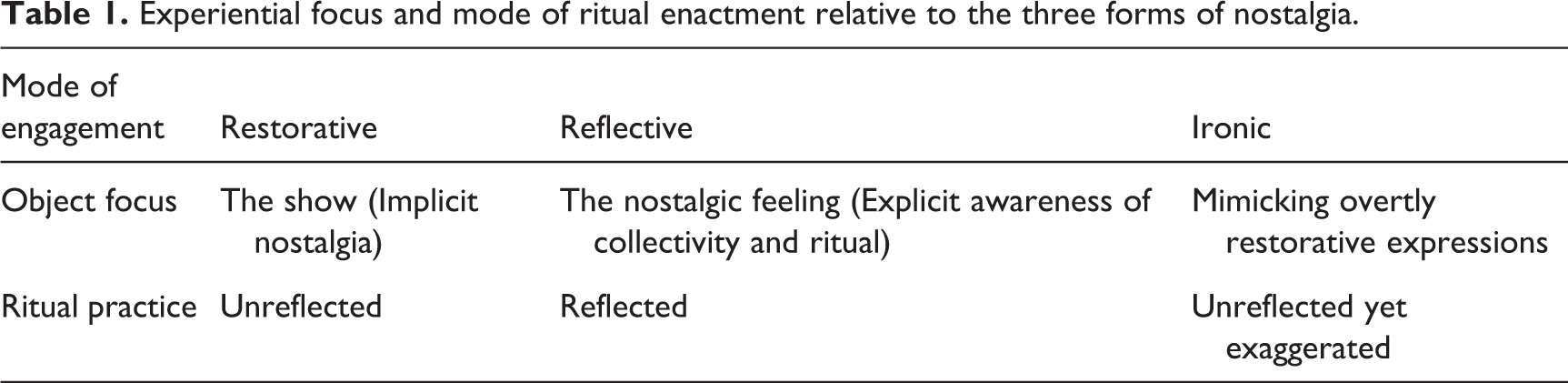
In the following we shall take a theoretically informed viewpoint and seek to articulate our three forms of nostalgia on the basis of the following analytical distinctions: nostalgia may be (1) restorative, not even seeing itself as nostalgia; (2) reflected, and at least partly aware of its nostalgic and sentimental nature; or (3) ironic, ironically mimicking salient expressions of restorative nostalgia. In the case of restorative nostalgia it is the actual object (The Disney Show) which is charged and animated; in the case of reflected nostalgia the focus is on the feeling of nostalgia and on expounding collective sentiment (qua collective sentiment) attached to the show; and in the ironic case, overtly restorative expressions of nostalgia are inverted and exaggerated through forms of ‘over-identification’. The ironic type tends to be as object-orientated as the restorative one it ironises, and may thus be just as non-reflexive toward its own ritual enactment. Some of these basic points are summarised in Table 1.
Experiential focus and mode of ritual enactment relative to the three forms of nostalgia.
As indicated, in the restorative case nostalgia remains implicit. Thus, going through the Instagram comments we noticed that many posts use hashtags like ‘never-too-old-for’ [aldrig-for-gammel-til], or derived forms thereof. This is restorative nostalgia. The comments refrain from using the explicit terminology of nostalgia yet still deal in a nostalgic reconnection to childhood. Expressions or hashtags such as ‘memories’, ‘Childhood Street’ [Barndommens Gade], ‘no-Christmas-without-Disney-Juleshow’, ‘traditions’, ‘5-years-old-again’, and ‘25-years-in-a-row’ abound.
Focus is placed on the object. Illustrative are the posts which explicitly and exclusively targets scenes of the show at the very moment of their occurrence on television. Notably, citations and scenes from Peter Pan or from one of the two signature songs of the show are found in several posts: Come on Nana [Kom så Nanna] #Cozychristmas #Christmasstockings #DisneyChristmasshow #Merry-Christmas ♥♥♥ No Christmas without Disney – from all of us to all of you ♥ Now that is what I call animated cartoons ⌣ #disney #jiminycricket #disneyjuleshow #Cinderella #whenIwasakid Without Jiminy Cricket it never really becomes Christmas #disneyjuleshow […] #disneychristmas #disneychristmasshow #authentic #bambionthinice #sothisischristmas ♥ It is not Christmas without the Disney Christmas Show #christmaseve #disneychristmasshow #Donoldduckisthebest […] #family #cozyness [hygge] The Disney Show should remain on DR1 every Christmas eve. This is the film which causes a cosy Christmas. Disney is just so good at making fantastic films. Mostly, I like to watch animated films in English but the Disney Show must be shown in Danish so that everybody may understand and love it. Best TV-SHOW/Movie EVER.
6
 #disney #disneyjuleshow
The reflective nostalgic ‘knows’ that the attraction or importance of the object is in no way inherent to it. The following statement made by a user of the site Kino.dk is illustrative for this kind of nostalgia: No Christmas without Disney – even though you are bored with the content! [kender det hele til hudløshed].
7
Watching #Disneyjuleshow while the duck is roasting in the oven and everything is prepped, just feeling nostalgic as this show brings back many childhood memories … Happy Christmas everyone!!! The Disney Christmas Show must be the same as when I was six. That is the reason why I return year after year. Now, I have turned thirty and yesterday me and my granddad sat and watched it together. This is nostalgia at the highest level. […] I love it. (Metro Express, 2014)
As indicated, ironic nostalgia is intricate for the very reason that irony remains (at least partly) implicit. An informant interviewed by Danish media researcher Kirsten Drotner conveys this: Especially in my husband’s family there are fixed traditions for watching Disney animations or The Disney Christmas show. Then we all sing the melodies [laughing]. (Drotner, 2003: 146)
A spectacular expression of mediated irony occurred on Christmas Day in 2015, when the second major broadcasting corporation in Denmark (TV2) invited a high-ranked military strategist into their studio to comment on the snow fight between Donald Duck and his nephews (Donald’s Snow Fight).
8
As intimated, irony manifests as a form of over-identification with an object, which exaggerates its importance and the seriousness which surrounds its ritual use implying that others conveying the object with true ritual prominence have fallen pray to collective hysteria and restorative nostalgia. In this vein, a commentator scolds others in an internet forum thread discussing the Show, for not taking it seriously: You TALK during the show? What? You just don’t do that – unless, that is, it is to recite the dialogues or the sound effects or say ‘ … RHINO’ in the scene with the snow ball fight, where Anders runs against a tree and becomes covered with snow and ice [big laugh].
9
The object itself
As briefly mentioned in the introduction, historical media – television, radio, home computers, arcade games, analogue photography, traditional home video technology – may in themselves constitute triggers of nostalgia (Bartholeyn, 2014; Holdsworth, 2011; Niemeyer, 2014; Sapio, 2014). In this respect The Disney Christmas Show fits into current retro culture sensibility; it consists of hand-animated cartoons (with undeniable aesthetic quality). This sense of authenticity, and the nostalgia which may attach to it, is largely collectively and historically constructed in the sense that their current topicality is collectively generated.
Nevertheless, of course, collectively generated significance and attraction may be initiated and promoted by inherent properties. Avoiding ultimate – Durkheimian – reductionism (Durkheim, 1995: 230), we may pause for a moment to consider the nostalgia-triggering effects of The Disney Christmas Show by virtue of its specific content and style (Pickering and Keightly, 2006: 930).
The Disney Christmas Show begins with a certain framing: a meta-narrative portraying a live stage show hosted by Jiminy Cricket in a conventional theatre emphasises ‘warm’ and collective interactionism, and suppresses the show’s mediated character. Especially interesting, however, is Cricket’s second signature tune; the outro ‘When You Wish Upon A Star’. While Cricket sings, the viewer sees the extended Disney ‘family’ harmoniously absorbed in watching the show together, the animal species forgetting their eternal strife and the mothers cuddling their kids. They all come together in watching Cricket’s performance – which metamorphoses into a larger celebration of the Christian spirit of Christmas. The religious analogies are explicit and some of the spectating figures overtly demonstrate their reverence (hand on chest, hats off), while a moment of fear must be overcome by the more shy or vulnerable animals when first confronted with the light radiating from the spectacle. The euphoric audience is then transported out of the theatre into a setting without seats or interior – outside time and space – while the light emanating from the scene (Jiminy Cricket sits at the foot of an enormous candle) merges with the star of Bethlehem. The dreamy faces of the animals show the sheer bliss resulting from this combination of inclusive collective harmony and quasi-religious experience. At the same time Cricket’s lyrics urge the viewer to actively ‘dream up’ an alternative time and place filled with love and happiness and thus encourage the nostalgic projection of emotions and desires upon the childhood proper. It comes as no surprise that visual content from Cricket’s outro performance is overrepresented among our Instagram posts.
However, it’s not only its sophisticated and manipulative framing, but also the show’s general emotional and ideological tone – which goes hand-in-hand with the warm ‘vintage-like’ quality of the old clips and the outdated technology used – that make it overtly conducive to forms of restorative nostalgia. No-one, of course, believes that it would be possible literally to ‘restore’ the imaginary universe conjured up by Disney. We are dealing with an animated cartoon. 10 Yet, the way the clips celebrate a rural, pre-globalised and ‘white’ suburbia, a pre-industrialised material universe (Santa’s Workshop included in the Swedish version presents an interesting exception), and restrictive, traditional and discriminatory gender constructions, may for some resonate with a broader celebration of the political and historical reality surrounding these expressions. They are from a time before the world went mad. In this sense the restorative nostalgic identifies with the idealisation of a less politically, socially and ethnically complex world (say, the ‘world’ of the white, 1950s entertainment industry) – akin to the way the ‘Ostalgic’ predilection for GDR material culture in certain older segments of the eastern-born German population might signify a wish to restore a former (now idealised) political reality (Bach, 2015; Nadkarni and Shevchenko, 2004).
On the other hand, the very same characteristics that make The Disney Christmas Show conducive to overtly restorative forms of nostalgia for some people, make it apt for ironic consummation by others. Parts of the show are simply ‘too much’ for many contemporary Scandinavian viewers. The romantic scenes from The Lady and the Tramp, for instance, are so overtly cliché-ridden that they provoke ironic over-identification. It must be signalled by the ironic viewers that their appreciation is not – or at least not only – ‘serious’ and that they are aware of both the anachronistic character of the show and its strong ideological bias.
Observations seem to indicate that reflective approaches to the show are becoming ever more prevalent: as can be seen in the following statement from DR’s programme planner Jakob Stegelman in a Danish newspaper, DR deliberately and actively promotes reflective (or ironic) reception: When you see the Show, you re-experience your own life. It is the stuff you associate with Christmas, you watch again and again.
11
Stegelman instrumentalises the show as a mere vehicle for nostalgic sentiments associated with it. He has clearly seen that the show primarily satisfies ritual purposes and, as he tells us, routinely turns down Disney’s suggestions about compositional changes since such changes would discourage ritual use.
In a sense, nostalgic ritual may occur around any object that is usable as a vehicle for reassessing and reconstructing collective childhood situations. This explains why the object must remain stable and unchanging (and thus its quasi-sacred status). On the other hand, the ideological, manipulative and suggestive character of The Disney Christmas Show forces certain clear-cut emotions and ideologies upon the viewers, and is thus particularly prone to ritual animation and animation of ritual.
However, what is decisive for us is that collective embeddedness attributes something to it. Its contours – sensuous, conceptual and emotional – are further animated, idealised, made even ‘better’, bigger or more beautiful. This is the unconscious accomplishment of restorative nostalgia. Ironists work the opposite way: the contours of the object are made even gaudier, more outdated, more ‘wonderfully anachronistic’, all the while ideological biases and clichés are further investigated, unfolded and detailed. Among reflective nostalgics the processes of ‘exteriorisation’ of collective sentiment are inverted, and the very idealisation of the object is deliberately and actively used to reinforce collective bonds or sentiments.
Interaction and mediation
Almost one-sixth of the posts in our Instagram sample (97 out of 675) contained the word ‘family’. This is a clear indicator that interaction ritual is important in the minds of the users. Yet it also indicates that users do not connect to non-present others because they are bored with the interactionist situation. Nor are the participants in mediated ritual ‘lonely’; mediated ritual is not – as Collins seems to mean – a mere substitute for genuine interaction. Judging from the uploaded photos on Instagram, there is no over-weight of sole viewers. Moreover, in Figure 2 we see that the indefinite pronoun ‘all’ figures frequently (64 out of 675) in the posts. This indicates an inclusive attitude and an appreciation of anonymous collectivity. Further, it accords with the fact that relatively few of the posts (30 out of 675) contain references to particular receivers (of the comments or observations made).
It now becomes clear that, at least when dealing with popular objects or events, mediation inflates interactionist intensity rather than deflating it. The act of tapping into the larger ritual of anonymous shared experiences feeds back into the local situation and enlivens it. This effect is extremely salient when mediated and interactionist rituals coincide temporally to the extent that is the case here. The spikes seen in Figure 1 indicate an extended, decentralised and mediated ritual. Without this mediated ritual, there would be no interactionist ritual of watching the show with one’s relatives and friends; without such background atmospheres there would, finally, be no such thing as ‘Christmas’.
Most often nostalgic, emotional and collective memoires – including intimate and private ones – are inscribed in larger anonymous cultural traditions and rituals. Many very ‘personal’ memories are thus naturally connected to common feasts or holidays, to traditions, events, objects or forms of experience prevalent in a certain cultural and historical context. Drotner observes that The Disney Christmas Show contributes to creat[ing a sense of] community among the Danes. While we watch it with our own family, we know that everybody else is also watching it, and that gives us a sentiment of commonality.
12
Now, a proviso needs to be inserted if we want to avoid the ‘harmonistic’ tendencies criticised by Couldry and Collins. As Collins’s template implies, border-drawing reinforces collective emotions and the very sense of sharing something. This may explain why nationality, perhaps surprisingly, seems to play a rather large role for our Danish Instagram subset; the term ‘Denmark’ (most often in the English variant!) occurs fairly frequently in the sample (in 24 out of 675 posts), indicating that many users connect something distinctively Danish with The Disney Christmas Show ritual – even though many Danish viewers also see the Swedish version.
A Swedish debate provoked in 2014 by feminist criticism made such boundary-drawing dynamics extremely salient in Denmark. In a thread attached to a net-article on the debate in a Danish newspaper Berlingske Tidende (23 December 2014), we find comments such as the following: ‘If the Swedes take away the Disney Show on Christmas Eve, we must engage in yet another war against them.’
The remark evidently contains a moment of ironic ‘over-identification’ and so does the comment above on Disney ‘as a kind of religion’. Yet not all the radical comments are humorously meant. The debate contains ‘authentic’ heated nationalist expressions. Another thread about the Swedish debate, this time on Facebook – the Facebook site of Danish newspaper BT – contains over 500 comments, some level-headed, others ironic, but most strongly critical towards the Swedes. 14
The combination of mediation – which cannot but make mutual understanding more difficult – and irony – with its use of underdetermined or private meaning – creates interesting destabilisations of borders. Mediation makes it hard, and often impossible, to distinguish ironic over-identification from genuine forms of strong identification since the reader is unacquainted with the person behind the post and often has no possibility to further clarify opinions. Smileys and emoticons may help, yet as Nadkarni and Shevchenko remark, the two types of nostalgia may indeed be present simultaneously without the participants being conscious of their differences or capable of distinguishing who belongs to which group (Boym, 2007: 15; Nadkarni and Shevchenko, 2004: 505). Is it, for instance, ironically framed when an Instagram user caricatures Sweden as the ‘North-Korea of the Nordic countries’? Or when Disney is compared to a religion?
This brings us to a last important theme: the politics of nostalgia. Nadkarni and Shevchenko are right in asserting – primarily against tendencies in Boym’s work – that no form of nostalgia is inherently progressive or conservative. Nostalgia is ‘beyond good and evil’ (Nadkarni and Shevchenko, 2004: 518). What creates political significance is the context. It makes all the difference in the world whether a ritual of restorative nostalgia idealises the political reality of the Weimer republic or childhood under the Nazi regime.
Nevertheless, also from a political perspective the existence of different types of nostalgia is extremely important. Restorative nostalgia idealises a certain past, wanting to restore it; and since it insists on this actual possibility, it is inherently politically motivating. By contrast, reflective nostalgia’s idealisation is accompanied by an insistence on its object’s irretrievability; a structure which, conversely, tends to maintain status quo. It may thus entail massive political consequences, for example, whether the nostalgic celebration of old Soviet ritual songs expresses either an ironic predilection for the opulent, baroque and kitschy vocabulary of these songs, an implicit wish for the restoration of Soviet imperial grandeur in a new nationalist Russian framework, or is consciously and deliberately used as a mere vehicle for engendering collective sentiment.
Assessment of the political consequences of nostalgic phenomena is a highly contextual endeavour, requiring considerable knowledge of local political and historical realities and thus extended ethnographic efforts. Yet a priori structural-psychological differences among our three forms exist which may be used to articulate and entangle empirical aspects when applied in the concrete setting. We hope that we have shown the fecundity of this approach in the above analysis of The Disney Christmas Show.
Conclusion
In this paper we have sought to explore the collective and ritual dimension to Western late-modern nostalgia-infused culture. The recent approaches to nostalgia have largely ignored this dimension, and we have therefore revisited the work of Randall Collins and Émile Durkheim (and Benedict Anderson and Maurice Halbwachs) in an attempt to address this neglect. We have sought to illustrate the analytical and empirical potentials of the Durkheim/Collins model of ritual and highlighted the importance of the mediated dimension to modern ritual.
We have distilled three different types of nostalgic ritual. These types all contain collective forms of idealisation, animation or construction of an object, which then feed back and strengthen collective sentiment. Restorative nostalgia projects its emotional energy towards the ‘content’ or the inherent properties of an object, which allegedly possesses enough power to create collective resonance of its own accord. Ironic nostalgia throws itself ironically on forms of restorative nostalgia. It performs ironic distance by furnishing content and ritual with extreme or absurd significance; it thus enforces collective bonds through an over-identification with the object, and the depiction and exaggeration of its most failed traits. But no more than restorative nostalgia does it reflect upon the collective enactment of shared ritual. Only in reflective nostalgia did we find awareness of the collective dimension together with an awareness of the idealised character of the object. Reflective nostalgia uses the idealisation of the object as a conscious pretext for ritual.
The paper has invested Durkheim’s template – the self-enforcing circuitry between phenomenological investment and production of solidarity and effervescence – with a strong sociological importance. Even Collins, while having the honour of having turned Durkheim’s informal understanding of ritual into a sharp sociological tool, overlooks, so we have argued, its full explanatory potential. What Durkheim tells us is essentially that certain parts of our material or immaterial reality – the parts at the centre of collective attention – resonate cognitively and emotionally at the same time as collective ties are strengthened. This happens all the time, consciously or unconsciously, strongly or vaguely, in intimate settings among friends or family or in extended and anonymous collective formations, in interactionist or mediated situations
Late-modern cultural consumption is decisively influenced by such forms of more or less unconscious ritual participation in a number of anonymous and transient object-centered collectives. These collectives are mediated and decentralised, yet unmistakably ‘effervescent’ and ritualistic. Through large-scale forms of unconscious collective synchronisation, they bestow actuality, attraction and importance upon certain objects and thus help to centre our perception, our emotions and our intellectual landscapes. Evidently, these dynamics are as psychologically important to the individual as they are sociologically significant when it comes to theorising and assessing issues of macro-scale integration. An elaborated theory of mediation as collective ritual should aim to theorise both the social-psychological and the sociological dimensions, as well as the connection between them – whilst of course avoiding the two pitfalls of functionalism and interactionism.
Footnotes
Declaration of conflicting interests
The author(s) declared no potential conflicts of interest with respect to the research, authorship, and/or publication of this article.
Funding
The author(s) received no financial support for the research, authorship, and/or publication of this article.