







Abstract
In this paper, we use register data to examine horizontal stratification within university institutions and university fields of study in Denmark, a country that has experienced a reduction of the social class gap in access to higher education. First, we argue that it is important to use a relatively detailed classification of parents’ occupations to determine how students are endowed with different forms of capital, even when their parents would typically be characterised as belonging to the same social group. Second, we distinguish among disciplines and among university institutions to explain the dynamics of horizontal stratification in the Danish university system. Using unique and exhaustive register data, including all higher education institutions and the entire 1984 cohort as of the age of 24, we uncover distinct differences in the magnitude and type of horizontal stratification in different fields of study and university institutions. Most importantly, we find distinct patterns of horizontal stratification by field of study and parental occupation that would have remained hidden had we used more aggregated classifications for field of study and social origin.
Keywords
Introduction
There is political consensus in most countries, regardless of their welfare regimes, regarding the importance of striving for equal access to education. The primary challenge to this endeavour is arguably that enrolment becomes more socially exclusive the higher one progresses in the educational hierarchy. As numerous studies demonstrate, access to higher education is not equal for all (for an overview, see Alon, 2009; Gerber and Cheung, 2008; Schudde and Goldrick-Rab, 2015; Shavit et al., 2007).
Studies show that the social class gap in access to education is smaller in Scandinavian countries than elsewhere and that the gap in access to higher education in Denmark has narrowed over time (cf. Esping-Andersen, 2007; Munk, 2014; Thomsen, 2015). Prominent theories of educational stratification, differentiation, and exclusion (e.g. Lucas, 2001) argue that in such situations, inequalities can be expected to manifest horizontally via qualitatively different types of education.
We study a Danish cohort born in 1984, focusing on qualitatively different forms of educational advantage in Denmark by examining horizontal stratification in choice of university and field of study. We ask whether certain fields of study and institutions – including those that are highly socially selective – persist in offering access exclusively to those class fractions endowed with the forms of capital required to enter these programmes and institutions. We extend the existing research by (a) employing a much more detailed categorisation of fields of study than is conventionally used, (b) differentiating among specific university institutions, and (c) using a relatively detailed classification of parents’ occupation. This approach enables a more thorough examination of reproduction patterns. In other words, we more fully reveal the transmission mechanisms between parents’ occupation and their offspring’s choice of university institution and field of study.
Social stratification in higher education is a rapidly growing research field (for overviews, see for example Grodsky and Jackson, 2009; Stevens et al., 2008). The continuing importance of family background in access to higher education is well documented both internationally (see Shavit et al., 2007) and in Denmark (Benjaminsen, 2006; McIntosh and Munk, 2007; Thomsen, 2015). Research in this area has focussed mainly on vertical educational mobility, whereas horizontal social stratification within higher education (i.e. differences in access to specific programmes) has received less attention in the research literature. Of central importance to this topic is whether the development of mass higher education (Trow, 1972) has led to genuine social mobility or whether relative inequality in access to different programmes has been maintained. Some studies find that inequalities in higher education persist between different types of education programmes within educational levels (e.g. Boliver, 2011; Thomsen, 2015; Triventi, 2013). Davies and Guppy (1997) examine the relationship between socioeconomic status, academic ability, chosen field of study and college selectivity, finding that ‘…students from higher socioeconomic households and those with more cultural capital are more likely to enter selective universities and lucrative programmes within selective universities’ (p. 1433). While a number of papers document a diversion of first-generation students (i.e. the first in their family to enter higher education) into less prestigious higher education programmes (Astin and Oseguera, 2004; Ayalon and Yogev, 2005; Becker and Hecken, 2009), Duru-Bellat et al. (2008) emphasise the importance of differentiating between types of higher education institutions (see also Espenshade and Radford, 2009; Goyette and Mullen, 2006).
Helland (2006) analyses the connection between social origin and field of study in Norwegian higher education. He finds that the reproduction of inequalities is not only hierarchical but also horizontal, pertaining to differences in cultural capital between different class fractions. Van de Werfhorst and colleagues (2003) find that class matters only in the choice of the relatively prestigious fields of law and medicine (see also Reimer and Pollak (2010) and Zarifa (2012)). They argue that this finding may be the result of analysing data from a 1958 cohort and that social stratification in modern universities will be far greater. In a similar vein, Jackson et al. (2008) do not find support for the need to differentiate among fields of study in relation to an origin–education–destination model; however, they have several reservations, including that their categorisation of fields of study may be too imprecise, thereby concealing differences that would be revealed by more detailed categorisations. Indeed, Hällsten (2010) demonstrates that horizontal segregation in tertiary education exists and that it operates through the choice of specific degrees, which in turn leads to disparities in labour market outcomes (see also Prix, 2013). Hällsten suggests that aggregating programmes into field of study categories that are too broad may lead to biased, inconclusive results.
Taken together, these studies convey two important messages: (a) the narrowing of the class gap in access in higher education has been followed by the diversion of first-generation students into less prestigious programmes, and (b) there appears to be mixed evidence of stratification by field of study, which may be the result of shortcomings in categorisations of fields of study. In addition, most previous studies have employed only conventional aggregated classifications of social origin. As mentioned above, we extend the findings of these studies by using a highly detailed categorisation scheme for fields of study and an equally detailed categorisation of parental occupation. This approach enables us to examine not only whether aggregated field of study categorisations conceal substantial differences in access to university studies related to social origin, but also whether such differences vary when social origin is disaggregated into occupational classifications, thus enabling the identification of different parental capital.
Theory and expectations
Theoretically, we view access to higher education as a battle over desirable social positions. In accordance with Bourdieu, Lucas (2001) posits in his framing of the ‘Effectively Maintained Inequality’ thesis that ‘socioeconomically advantaged actors secure for themselves and their children some degree of advantage wherever advantages are commonly possible’ (p. 1652). He generalises that if quantitative (vertical) differences are common, the socioeconomically advantaged will seek out quantitative advantage, and that if qualitative (horizontal) differences are common, the socioeconomically advantaged will seek out qualitative advantages. The qualitative form of socioeconomic advantage is particularly important to investigate in countries in which vertical educational stratification has diminished over time (cf. Hällsten, 2010; Lucas, 2001; Thomsen, 2015). In particular, we derive our expectations from capital and field theory (cf. Bourdieu, 1996; Krarup and Munk, 2016). Bourdieu (1984, 1986) argues for a context- and capital-sensitive social space with a multidimensional operationalisation of social positions, and more recently, Weeden and Grusky (2005, 2012) have emphasised the importance of using a relatively detailed occupational classification in immobility studies (see also McIntosh and Munk, 2009). Professions form distinct social communities, endowing their members’ offspring with unique forms of capital and dispositions in the struggle for education and the social positions to which education provides access.
Bourdieu (1996) views higher education institutions as a field in which families compete for attractive occupational positions that are transmitted through access to prestigious higher education programmes. The reproduction strategies of families with large amounts of capital will be to seek and monopolise prestigious or lucrative programmes according to the specific composition of capital the families possess (Bourdieu, 1996; see also Ball, 2003; Krarup and Munk, 2016; Lareau, 2011). Children from these families will, vis-à-vis the socialisation processes in the family, be predisposed towards choosing specific programmes that correspond to their parents’ occupational positions (see also Espenshade and Radford, 2009; Karabel, 2005). Thus, a child of parents who hold professional positions in the arts and social sciences will be more likely to study certain types of humanistic and social science programmes, whereas children of parents who occupy professional positions in the sciences will tend to study technical or medical science. Based on capital and field theory and a taxonomy suggested by Biglan (1973; see later), we apply a 14-field-of-study classification to capture qualitatively different types of programmes; for instance, to distinguish between the choice of medicine and other health programmes. To provide a yardstick for comparison, we use a frequently employed five-field of study classification.
In this paper, we do not examine financial returns to education, and we consider that the choice of higher education is driven more by students’ pre-existing characteristics than by subsequent returns to education. Returns to education are relatively lower in Denmark than in other countries (Hanushek et al., 2015), and there is little competition for access to some economically lucrative applied programmes. Students’ ‘pre-existing characteristics’ refer to social origin-based preferences for different subjects and institutions that are to a large extent shaped by familial socialisation, parental occupational placements and trajectories, and different forms of capital. These pre-existing characteristics explain why some soft social sciences, arts and humanities programmes are highly desirable in Denmark, even though such programmes have low economic returns and relatively high unemployment rates (Commission on Productivity, 2013). We consider returns to education as only one (albeit very important) dimension of social stratification, and we view inequality of access to different university programmes as a legitimate sociological problem: specific fields of study may lead to occupations with relatively modest returns, but these occupations may enable an individual to exercise substantial cultural, organisational, or communicative power. 1
In the following, we examine horizontal stratification in (a) university fields of study and (b) university institutions. Based on a review of the empirical and theoretical literature, we expect to observe a horizontal intergenerational transmission of occupational trajectories reflected in the choice of field of study and university; consequently, reproduction patterns can be more fully revealed by applying highly detailed categorisations of fields of study and parental occupation: We expect not only that the amount of parental cultural capital and economic capital matter for students’ choice of field of study but also that specific forms of capital and parental occupational placements are important. For example, we expect that students of parents in arts and social sciences professions are more likely to choose creative fields of study than other programmes. We expect more intense competition for institutions in metropolitan areas and for institutions with prestigious programmes. We expect students from families with lower amounts of capital to enrol in less prestigious institutions, whereas students from homes with large amounts of capital – particularly in the form of the cultural capital provided by specific professional occupations – are expected to enrol in more prestigious institutions. For example, we expect students of parents in science and health science occupations to be more likely to enrol in the Technical University of Denmark or prestigious science and health programmes at the University of Copenhagen. Finally, we expect first-generation students to seek out specific programmes because of the applied nature of those programmes (with a strong orientation towards future job possibilities) and not simply because these programmes are the only programmes to which such students can gain access (because of the students’ statistically relatively low upper secondary GPA).
We now embark on an examination of these expectations. We proceed with a presentation of the data, variables, and methods, after which we provide a brief summary of the key characteristics of the Danish educational system and Danish universities. We then describe our model estimates before discussing our results in the conclusion.
Data, variables, and method
We examine descriptive tables and construct two different multinomial logistic regression models with university fields of study and institutions as dependent variables. We do not consider choice of field of study and choice of institution as independent of each other, but we build two models to investigate any possible institutional differences not revealed by fields of study only. 2 Although multinomial logistic regression models should stand up to the independence of irrelevant alternatives (IIA) assumption, the feasibility of IIA tests is disputed (Long and Freese, 2006: 243–246). Dow and Endersby (2004) argue that estimating substitution patterns is purely hypothetical in many cases. We consider the model to be an approximation (Train, 2009) and thus describe a preference structure in choice of higher education without making causal claims based on our models. Our aim is primarily to uncover reproduction patterns that are not typically revealed in these types of studies. We use administrative data from Statistics Denmark on all individuals born in 1984 (N = 54,708) and their university enrolment (or completion) status at age 24 by field of study and institution. 3 We categorise fields of study into 14 fields, as presented in Table 1.
Disaggregated university fields of study.
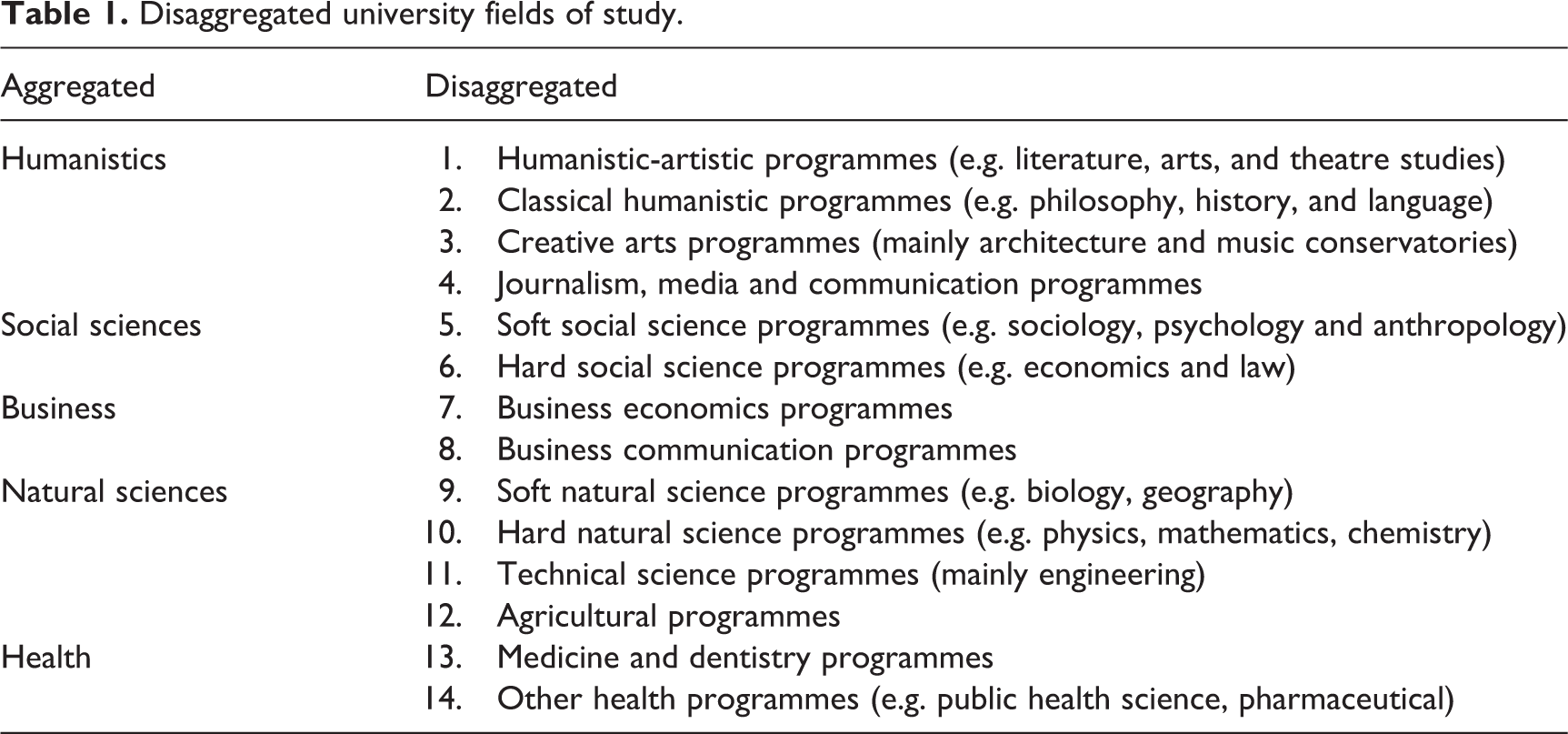
To address occupational reproduction with respect to the choice of field of study, we followed Biglan’s (1973) taxonomy to disaggregate major fields of study into smaller units of pure and applied subjects and soft and hard sciences (see also Hansen and Mastekaasa, 2006). Soft programmes are characterised by more ‘plural’ curricula (e.g. sociology, anthropology), whereas hard programmes have a more strongly classified, hierarchical content (e.g. law, economics).
The social origin variables reflect the respondents’ circumstances at the age of 16 years unless otherwise specified. A series of dummy variables was used to control for differences in family and individual background: a. female; b. non-Western (all immigrants or descendants of immigrants from non-Western countries; the reference is all others including Danes and immigrants from Western countries); c. urban (individuals living in either Copenhagen or Aarhus; the reference is living elsewhere); and d. nuclear family (living with both parents at the age of 16; the reference is not living in a nuclear family). The ages of both parents were included as numeric variables to control for age-specific differences (this addressed the possibility that older parents may differ from younger parents in terms of degree of maturity and ability). Family income was measured as parents’ combined gross income divided by DKK 100,000 (approximately 15,000 Euros). 4
Finally, a categorical variable for each parents’ occupation was created. The occupational categories were constructed based on the International Standard Classification of Occupations and ordered hierarchically by the amount of skill required for each occupation. The categories were coded to enable the separation of groups with different forms of capital (especially within the higher classes), taking into account the importance of the occupations’ specific capital possessions and socialisation patterns (Bourdieu, 1986; Weeden and Grusky, 2005). Fathers’ occupations were classified into 13 categories, whereas some of the occupational categories were merged for mothers (because mothers’ occupational patterns were more homogeneous).
Table 2 displays the occupational groupings for fathers and mothers. As the table illustrates, we have distinguished among different forms of capital within the more skilled occupations. The forms of capital differ mainly among occupations in the areas of (1) sales, business, and finance; (2) technical; (3) arts and social sciences; (4) teaching; (5) natural sciences; and (6) administration. As mentioned above, our aim is to investigate whether the associations between these disaggregated occupations and the detailed fields of study will reveal patterns of educational stratification that would otherwise be concealed.
Disaggregated parental occupation.
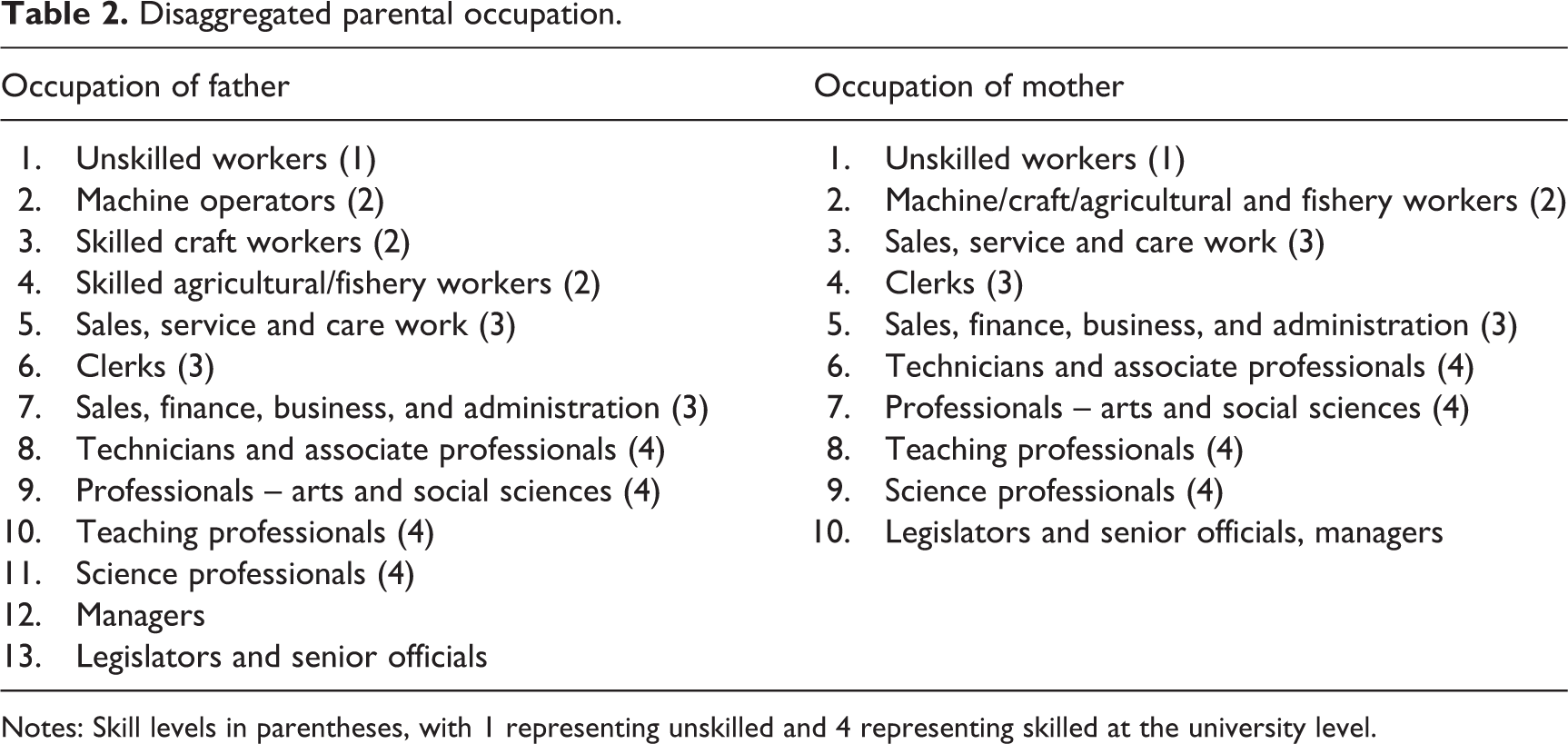
Notes: Skill levels in parentheses, with 1 representing unskilled and 4 representing skilled at the university level.
University institution characteristics
In Denmark, young people typically choose either a vocational programme at the upper secondary level or the upper secondary track that prepares them for higher education. In 2014, 46% of all 25-year-olds had obtained an academic upper secondary track diploma, 23% had a vocational education and training diploma, 9% were enrolled in upper secondary education, and 22% had no upper secondary education. In Denmark, as in many other countries, the number of students enrolled in university-level education has increased more than tenfold over the past 60 years, and the number of university study places available per 20-year-old has nearly tripled since 1979. This had led to a larger proportion of the youth in Denmark attending higher education. In 2014, 62% of all young 9th graders in Denmark were expected to eventually complete a higher education degree programme: 5% will graduate from business academies (2–3 year, short-cycle programmes), 28% will graduate from university colleges (3–4 year, medium-cycle programmes primarily for teachers, nurses, and child care or social workers), and 29% will graduate from university institutions (3–5 year, long-cycle courses with a range of traditional and professional programmes).
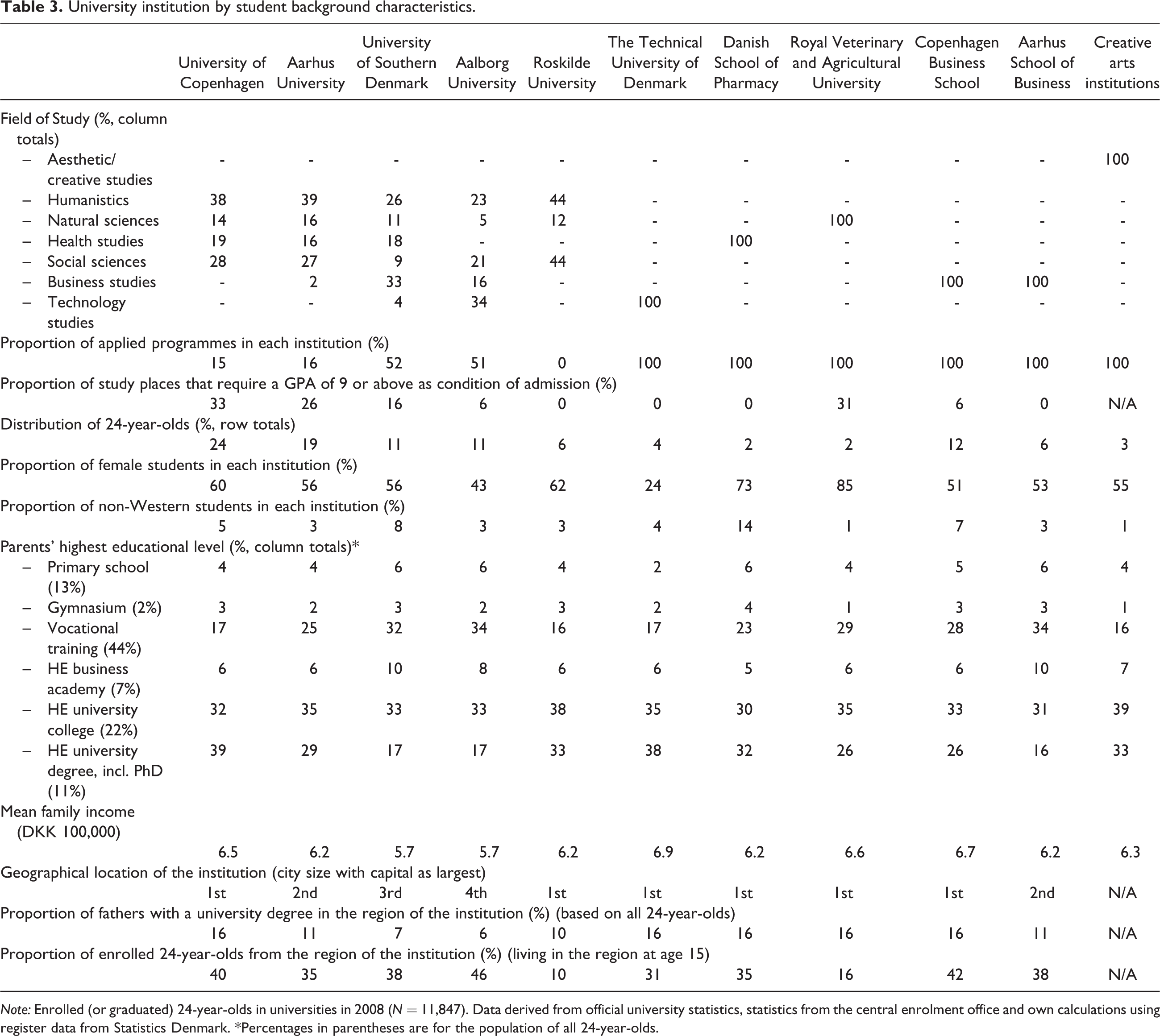
Table 3 outlines various characteristics of university institutions and the socio-demographic profiles of university students. The majority of programmes accept all qualified students (those with an upper secondary diploma preparing them for higher education); however, programmes in which the demand for study places exceeds the places available – found almost exclusively at the university level – will accept only those applicants with the highest upper secondary GPAs. If, for instance, a programme has 200 applicants but offers only 100 places, it will accept only the top 100 students with the highest GPAs. These programmes often have a second admissions channel for a small proportion of applicants (typically 10–20%), favouring extra-curricular merits, through which applicants are assessed on the basis of non-scholarly accomplishments. There are no tuition fees in higher education institutions in Denmark, and students are automatically granted relatively generous government subsidies for the stipulated period of their higher education programmes (in 2011, this was 740 Euros per month for the duration of the study programme, with the possibility of one additional grant year).
University institution by student background characteristics.
Note: Enrolled (or graduated) 24-year-olds in universities in 2008 (N = 11,847). Data derived from official university statistics, statistics from the central enrolment office and own calculations using register data from Statistics Denmark. *Percentages in parentheses are for the population of all 24-year-olds.
Denmark had 10 major university institutions in 2006. Two of the older universities, the Universities of Copenhagen (KU) and Aarhus (AU), and three of the newer universities, the Universities of Odense (SDU), Aalborg (AAU), and Roskilde (RUC) (dating from the 1960s and early 1970s), are multi-disciplinary universities. Denmark also has the Technical University of Denmark (DTU) – an older, mono-disciplinary institution – the Danish School of Pharmacy (DFU), the Royal Veterinary and Agricultural University (KVL), and two business schools: Aarhus School of Business (ASB) and Copenhagen Business School (CBS). There are also various higher education institutions for the creative arts: schools of architecture in both Copenhagen and Aarhus and seven smaller arts and music conservatories. These institutions are merged into the ‘creative arts institutions’ category in Table 3.
The upper portion of Table 3 displays the distribution of fields of study among the institutions and reflects the mono- or multi-disciplinary status of each institution (divided here into only seven fields for brevity). In terms of gender, the majority of students at Aalborg University (which has several large engineering programmes) and the Technical University of Denmark are male. Otherwise, women outnumber men, and women’s preferred fields of study follow a similar pattern to that observed in many other countries (Barone, 2011): women are underrepresented in the natural/technical sciences and overrepresented in (for instance) the health sciences. The Danish School of Pharmacy has by far the highest proportion of non-Western students. These students often prefer professional and vocationally oriented programmes within the fields of health and business. Table 3 also lists the percentage of study places in each institution that require an upper secondary school GPA of 9 or higher (a relatively high GPA in Denmark) as a condition of admission. The more the demand for study places in a specific programme exceeds the supply, the higher the GPA required for entry. As Table 3 demonstrates, the most highly desirable programmes are more often found at the oldest institutions: the University of Copenhagen (with the highest proportion of study places requiring a GPA of 9 or above as a condition of admission), the Royal Veterinary and Agricultural University, and Aarhus University.
We have identified each institution’s share of applied programmes using Biglan’s (1973) distinction between pure and applied subjects. As Table 3 indicates, there is variation in the distribution of applied programmes among the multi-disciplinary universities: the non-metropolitan, non-selective institutions (SDU and AAU) have the largest proportion of applied programmes, whereas the mono-disciplinary institutions (DTU, DFU, and KVL) and the business schools (CBS, ASB) exclusively offer applied programmes.
In terms of level of parental education, students with parents who had vocational training are predominantly found at AAU, ASB, and SDU, all of which are non-Copenhagen institutions with a high proportion of applied programmes that do not require a high GPA for entry. The same institutions have low proportions of students whose parents have academic backgrounds, whereas the metropolitan institutions (CREA, DTU, KU, and RUC) have the highest proportions of such students.
The second to last row presents the educational level of the fathers of all 24-year-olds in the region of the institutions, while the last row displays the share of 24-year-old students who grew up in the same region as the university institution they are attending. We observe that institutions far from Copenhagen, such as AAU and SDU, are situated in regions with a low level of parental education. In contrast, institutions close to Copenhagen are situated in regions with a higher level of parental education (see also Statistics Denmark, 2001). By analysing the two last rows (parental level of education over proportion of ‘home-grown’ students attending), we obtain a simple measure of institutional selectivity that accounts for the educational level of the parent population in the region. Whereas institutions close to Copenhagen are relatively selective (high level of parental education in the home region and low-medium share of students who grew up in the same region (such as KVL [16/16 = 1], RUC [10/10 = 1], DTU [16/31 = 0.52] and KU [16/40 = 0.40])), institutions located farther from Copenhagen (such as SDU [7/38 = 0.18] and AAU [6/46 = 0.13]) are less selective. In the latter group of institutions, enrolment draws more from the local population, and the educational level of the parent population is lower.
After outlining the basic characteristics of Danish university institutions, we now proceed to our model results.
Results
In the following section, we present the results of two multinomial logistical regression models of the choice of university field of study and institution. We pay particular attention to the parental occupation variable in our presentation (full estimates from the mlogit regressions can be found in Appendix A –C). 5
Fields of study
We begin by examining the results of the model with our primary outcome variable of interest: the 14-level categorisation of fields of study. The baseline category represents those who are not enrolled in a university. Before we examine how field of study relates to parental occupation, we note that our control variables capture some well-known demographic and social origin differences: the odds of women entering a university programme, especially in business communication, agricultural studies, and other health programmes, versus not entering a university programme are greater than the odds of men doing the same (see also Barone, 2011). Non-Western immigrants have higher odds of being enrolled in business programmes and medicine, dentistry, and other health programmes than not being enrolled relative to other 24-year-olds. Economic capital also appears to be associated with field of study (net of parental occupation): high family income increases the odds of studying medicine, hard social sciences, and business economics versus not enrolling in a university programme.
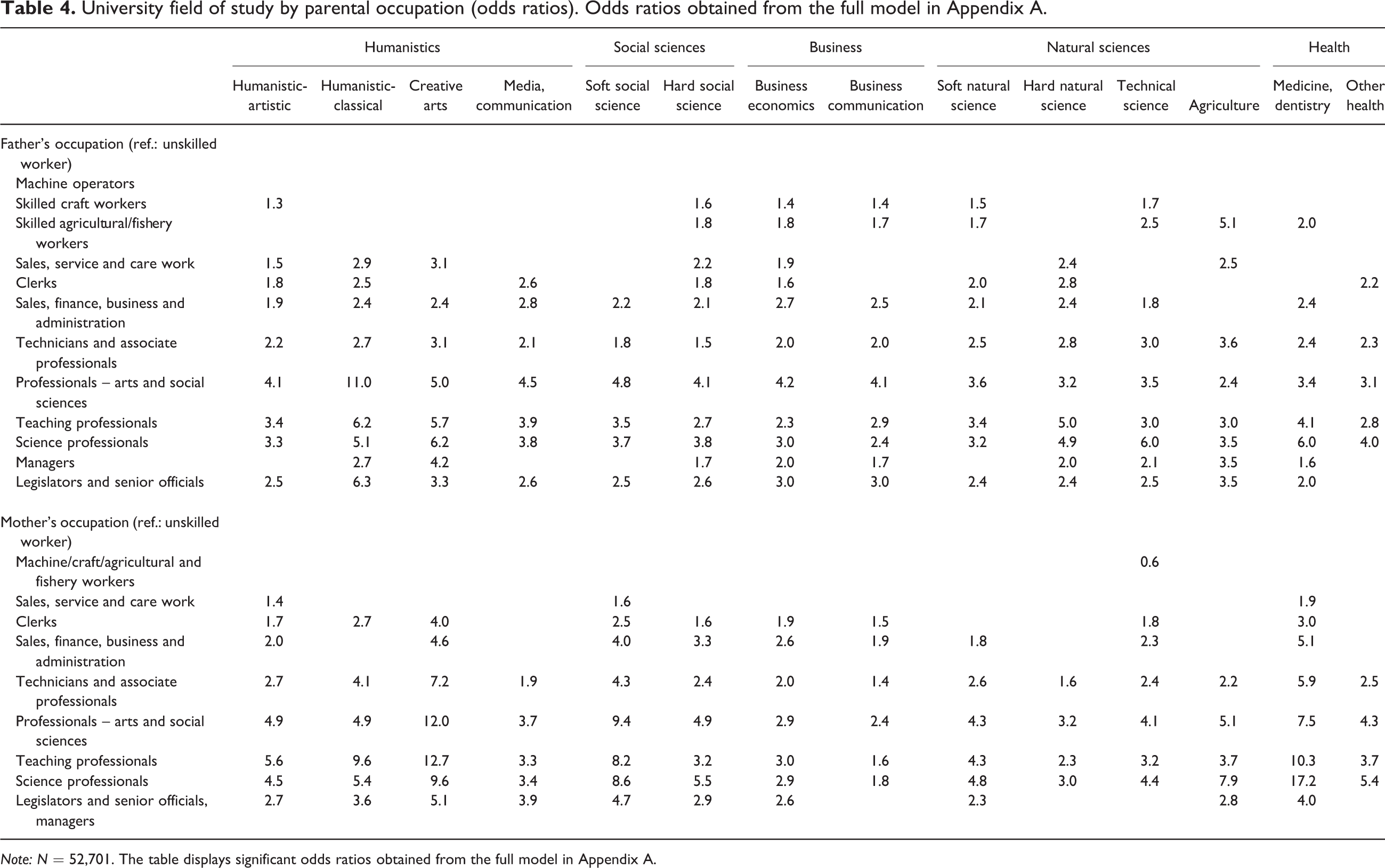
Table 4 presents the odds ratios for having a parent in a specific occupation relative to having a parent in unskilled work for different university fields of study relative to no university attendance.
University field of study by parental occupation (odds ratios). Odds ratios obtained from the full model in Appendix A.
Note: N = 52,701. The table displays significant odds ratios obtained from the full model in Appendix A.
First, Table 4 demonstrates that students with parents in professional occupations requiring a high education level (a university degree) have higher odds of studying any field than students with unskilled parents. We also observe major differences in the odds ratios for studying specific fields, particularly for medical and creative arts programmes. Having a mother in professional arts and social sciences, teaching and science occupations substantially increases the chances of studying these or similar fields, whereas students with mothers in lower-skilled occupations have nearly the same odds of studying business communication as students with mothers in high-skill occupations.
Second, we observe a clear pattern between parental occupation and propensity among students to select a field of study close to their parents’ occupation: having parents who work as arts and social sciences or teaching professionals in particular increases the odds ratios of studying fields within the humanities more than having parents who are unskilled workers. In addition, within the humanities, there are major differences among subfields. For instance, the creative arts and classical humanities are more occupationally selective than the other humanistic fields.
Among the social science fields, having professional, high-skilled parents increases the odds of studying the social sciences, and although the difference between studying hard and soft social sciences is negligible in relation to father’s occupation, the difference in relation to mother’s occupation is substantial (see Beller (2009) on the significance of mother’s occupation). Here, the field of soft social science is more selective in terms of whether students have professional mothers. This is consistent with our theoretical perspective: soft social science is closer to the cultural capital occupations in the social space than are the hard social science professions. This specific finding was not revealed by the more aggregated five-field of study classification.
Moving to the science field, having a father in the science profession greatly increases the odds of studying technical or hard natural science, suggesting that fathers possessing educational and occupational knowledge in mathematics, physics, chemistry, and technical areas will transmit these resources to their offspring. Having mothers with a science background greatly increases the odds of studying agriculture (including the highly desirable veterinarian programme). We also note that having skilled fathers engaged in agriculture or fishery substantially increases the odds of studying agriculture, again indicating the intergenerational transmission of occupations from fathers to children. Turning to the field of health, we observe that having parents in teaching and especially in science professions (which include physicians) increases the odds of studying medicine. Students with mothers in professional occupations show major differences in enrolment medicine and other health programmes, depending on the specific occupation of the mother.
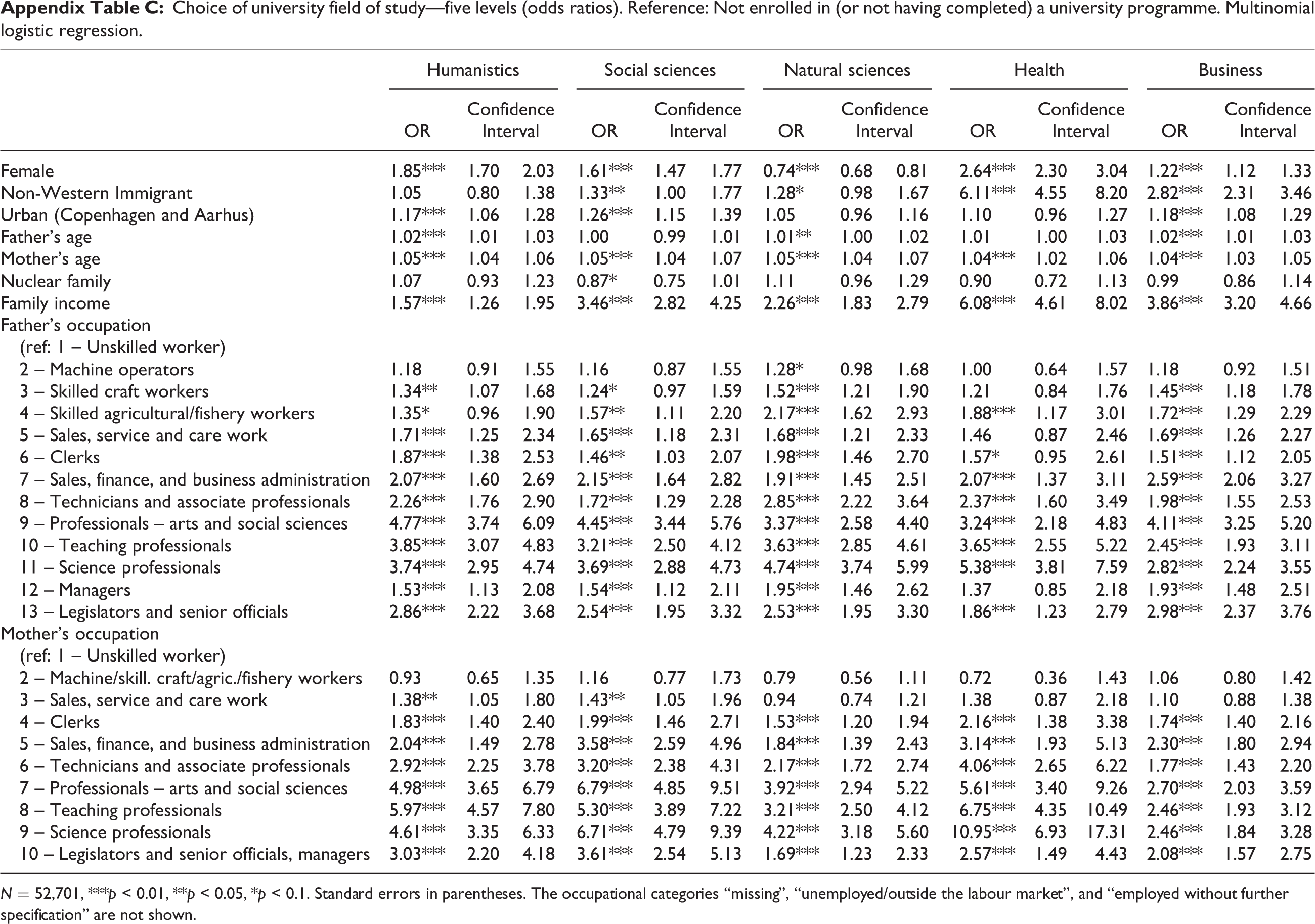
Using a relatively detailed categorisation of fields of study enables us to observe differences between disciplines that would otherwise be nested into larger fields of study (see, for comparison, our five-field classification in Appendix Table C). One example is business programmes, in which business communication students are a less selective group than business economics students, and, as we touched upon earlier, family income matters more for the field of business economics than for business communication. Similarly, we observe major differences between hard and soft social science programmes related to parental occupation. On the one hand, having professional mothers in high-skilled occupations (arts and social sciences, teaching, and science) increases students’ propensity to enter the soft social sciences. On the other hand, family income increases the likelihood of enrolling in hard social science programmes such as law and economics. This result reveals that the intergenerational transmission of specific forms of capital manifests in the association between parental occupation and choice of field of study at the detailed level. High parental income and having highly educated parents in specific occupations (particularly mothers in the science and teaching professions) increases the odds of studying medicine, which is substantially different from other health programmes.
In terms of conspicuous horizontal stratification within university programmes, we find that it is fruitful to utilise a detailed categorisation of fields of study and parental occupation. Highly aggregated fields of study, such as the five categories commonly used in the literature, conceal differences in the intergenerational transmission of societal positions that are rooted in parental forms of capital and preferences for applied or non-applied studies. Academic and cultural forms of capital specific to parents’ professional occupations are transmitted to offspring as preferences for particular fields of study; for instance, in the choice of medicine or business studies. These forms of capital constitute a substantial advantage in mastering specific fields of study and subsequently progressing to preferred types of occupations. In short, our analysis reveals these patterns of reproduction more fully when we use a detailed categorisation of parental occupation that accounts for the identification of different parental forms of capital within class or class-like categories that would otherwise typically be aggregated.
University institutions
In the second model, we differentiate between specific university institutions because we expect that institutional differentiation is another important factor for horizontal stratification in higher education. In Table B in the Appendix, we present the full results of a multinomial logit analysis of the effects of various background variables on entering specific university institutions in 2008 (as in the first model, the reference category is those who are not enrolled in a university).
The model with specific university institutions replicates many of the findings from our first model, but it also demonstrates institution-specific differences not revealed in the fields of study model. We observe familiar patterns in gender-specific choices: female students generally have higher odds of enrolling in university institutions than male students, with the unsurprising exceptions of the Technical University of Denmark and Aalborg University (both of which have large engineering programmes). In addition, and as observed in Table 3, students of non-Western origin are more likely to study at institutions that offer predominantly applied programmes. In addition, growing up in urban areas increases the odds ratios of enrolling in a university institution but not in institutions located far from city centres (SDU and AAU). The sizes of the urban estimates are comparable with those for the lower parental occupational categories but clearly smaller than the estimates for the upper parental professional categories.
Table 5 presents the odds ratios for having parents in a specific occupation and having a parent in unskilled work for 11 different universities relative to no university attendance (see Appendix B for the full model results including 12 university institutions).
University institution by parental occupation (odds ratios). Odds ratios obtained from the full model in Appendix B.
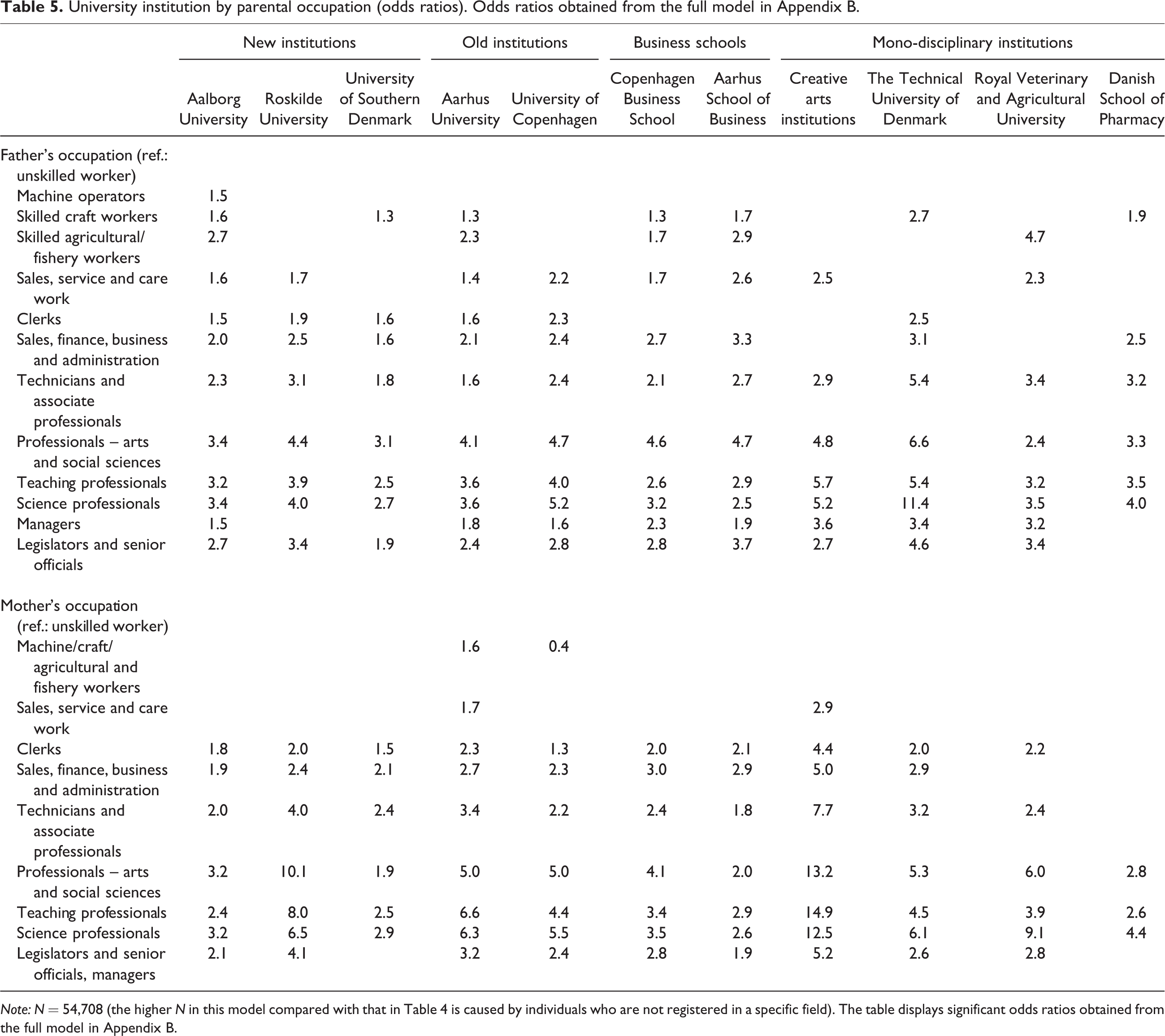
Note: N = 54,708 (the higher N in this model compared with that in Table 4 is caused by individuals who are not registered in a specific field). The table displays significant odds ratios obtained from the full model in Appendix B.
We observe differences in selectivity among institutions with comparable programme profiles: of the two old metropolitan universities in Denmark, the University of Copenhagen is slightly more selective than Aarhus University in terms of father’s occupation, particularly for occupations in the sciences. Of the newer multi-disciplinary university institutions, Roskilde University is notably the most selective. That this newer university institution more closely resembles the older institutions in terms of selectivity may be related to the fact that Roskilde University is very close to the Danish capital and is primarily a liberal arts university (having no applied programmes, as observed in Table 3). In addition, high family income increases the odds of studying at Copenhagen Business School and the Danish School of Pharmacy.
Notably, we also find that educational mobility is related to affinities between choice of institution and parental occupation: students with skilled fathers working as craftsmen or in agricultural/fishery occupations have relatively high odds ratios of enrolling in applied programme-oriented institutions such as the Royal Veterinarian and Agricultural School, Aarhus Business School, the Technical University of Denmark and Aalborg University. Had we examined only a ‘newer institutions’ category and collapsed, for instance, Aalborg University and the University of Southern Denmark, we would not have discovered other substantial differences in the enrolment estimates for females, non-Western immigrants, and family income.
Overall, the differences among the institutions follow a clear order: universities with classic programme profiles (liberal arts and creative institutions) are more socially selective, and universities with large proportions of applied programmes (such as Aalborg University and the University of Southern Denmark) are less socially stratified. There is no reason to assume, however, that this is an effect of deliberate pedagogical measures, direct targeting, or affirmative action programmes initiated by the universities themselves, in part because Danish universities do not have affirmative action programmes that directly target specific groups. Instead, these institutions are less socially selective because they predominantly offer applied programmes and programmes for which there are lower thresholds and less competition for entry (they do not require a high GPA to enter) and because some of them are located in regions of Denmark where the educational level of parents is relatively low, as demonstrated in Table 3.
The fact that working-class students opt for applied programmes at institutions with low or no competition for study places prompts us to ask the following: do working-class students choose to enrol in these programmes by necessity, or do they make a strategic choice of applied programmes? In other words, would first-generation students choose to enrol in highly desirable programmes, such as political science or literature studies, if they had the required upper secondary GPA? We ask these questions to rule out the possibility that GPA, rather than parental background and preferences, drives the choice of applied versus non-applied programmes. Table 6 sheds some light on these questions by comparing the choice of field of study among students from different social origins with the same upper secondary GPA.
Chosen field of study among students with comparable high school GPAs from different social groups.
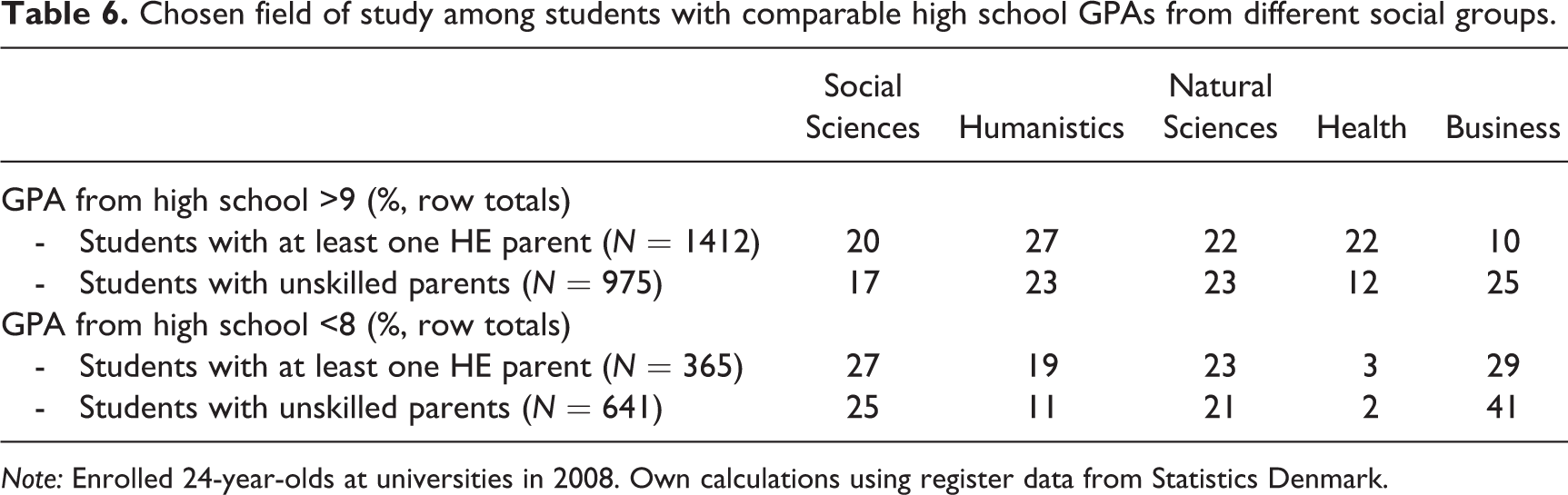
Note: Enrolled 24-year-olds at universities in 2008. Own calculations using register data from Statistics Denmark.
Table 6 illustrates that among students with an upper secondary GPA above 9 (as mentioned earlier, a relatively high score in Denmark), two and a half times as many students with unskilled parents choose business studies as those with academic parents, while only half as many choose health sciences. Among students with a mediocre to low GPA of less than 8, unskilled-origin students choose business studies more often than students with academic parents, who in turn are twice as likely as working-class students to choose studies in the humanities. This table supports the expectation that working-class students choose a programme based not only on which programmes they can realistically gain access to but also according to what makes sense for them given the dispositions and preferences endowed by their background. 6 Such students choose these programmes because they are applied and represent a means to an end: they provide useful qualifications in the pursuit of well-defined and well-paid careers.
Conclusion
In this paper, we have argued that the expansion and narrowing of the class gap in access to higher education in many countries has increased the importance of examining whether and how higher education is horizontally stratified. We have responded to this need by using highly disaggregated categorisations of university fields of study and of specific university institutions. Our most important finding regarding our first expectation is that we have observed distinct patterns of horizontal stratification by our 14 fields of study and disaggregated parental occupations. These patterns would have been hidden had we used more aggregated classifications of fields of study and social origin nested in socioeconomic or social class-like categories. Our disaggregated approach has enabled us to uncover differences in the intergenerational transmission of societal positions rooted in specific preferences and parental forms of capital.
We find, as expected, that students are particularly likely to study a given field if that field is closely related to their parents’ occupation; for example, students have a much greater chance of studying in humanistic-classical, creative, and soft social science programmes if one of their parents is in the teaching or in the arts and social sciences professions than students whose parents are in unskilled occupations. We observe major social differences when we disaggregate fields: business economics programmes, for example, are more socially selective than business communications programmes. Economic capital in the family matters more for business economics students than for business communication students and for choosing hard social science programmes, whereas high skill-level parental occupations with large amounts of cultural capital matter more for entering soft social science programmes. In terms of conspicuous social differences, we therefore find that it is fruitful to use a detailed categorisation of fields of study.
However, and here we address our second expectation, stratification is also institutional: competition is more intense in metropolitan areas and in institutions with prestigious programmes. In addition, stratification patterns depend on the university institutions’ geographical locations and the socio-demographic profile of the region. We also find that horizontal stratification is dependent upon the proportion of vocational or applied programmes offered by the university institutions. First-generation students will aim for applied programmes that align with the students’ strong orientation towards future job opportunities (Thomsen et al., 2013). In other words, institutions with a large proportion of applied programmes contribute to educational mobility.
This differentiation by field of study and institution may be better understood as a division between two opposite profiles than as a division between mass and elite universities. On the one hand, we have ‘classical’, non-vocational, liberal arts universities (including law and medicine programmes) and creative institutions, where we find students from homes in which the transmission of academic and cultural capital is the primary mechanism of reproduction. Students of parents who are in the teaching or in the arts and social sciences professions, for instance, are likely to study at creative institutions and universities dominated by social science and humanistic faculties. On the other hand, we have university institutions with vocational or applied programmes – programmes such as pharmacy, business studies, and engineering – where students are from homes in which education is important largely because it promises access to solid, well-paid, and well-respected jobs with low unemployment rates.
We have also found indications that these choices are preference-based: even working-class students with a high upper secondary GPA will favour specific vocational fields of study and applied programmes in easy-access institutions more than their peers from academic families. In other words, parental background and preferences drive the intergenerational transmission of educational preferences. The choice of an applied programme may lead to high returns, which could in effect lead to a reduction of inequality; however, many economically high-yield programmes, such as law, medicine, engineering, and economics, continue to be socially selective.
The preference-based choice of an applied programme has implications for how we address the problem of equal educational opportunities for all students. We must not only endeavour to establish a more equitable distribution of educational opportunities and of the capital that young people possess but also address whether the different choices made by talented first-generation students and their second-generation counterparts represent a problem. As long as specific recruitment patterns co-vary so strongly with social class origin, even net of cognitive ability, the reality of enrolment in higher education continues to conflict with societal ideals regarding equality of educational and occupational opportunity.
Footnotes
Acknowledgments
We thank the former Danish Strategic Research Council and NordForsk for financial support. Special thanks to Nikita Baklanov for excellent research assistance. The thoughtful and thorough comments of three anonymous referees, leading to significant improvements of this paper, are gratefully acknowledged. Finally, we thank the editors for a helpful editorial process.
Funding
The authors received financial support for the research from the former Danish Strategic Research Council and NordForsk.
Notes
Choice of university field of study—five levels (odds ratios). Reference: Not enrolled in (or not having completed) a university programme. Multinomial logistic regression.
| Humanistics | Social sciences | Natural sciences | Health | Business | |||||||||||
|---|---|---|---|---|---|---|---|---|---|---|---|---|---|---|---|
| OR | Confidence Interval | OR | Confidence Interval | OR | Confidence Interval | OR | Confidence Interval | OR | Confidence Interval | ||||||
| Female | 1.85*** | 1.70 | 2.03 | 1.61*** | 1.47 | 1.77 | 0.74*** | 0.68 | 0.81 | 2.64*** | 2.30 | 3.04 | 1.22*** | 1.12 | 1.33 |
| Non-Western Immigrant | 1.05 | 0.80 | 1.38 | 1.33** | 1.00 | 1.77 | 1.28* | 0.98 | 1.67 | 6.11*** | 4.55 | 8.20 | 2.82*** | 2.31 | 3.46 |
| Urban (Copenhagen and Aarhus) | 1.17*** | 1.06 | 1.28 | 1.26*** | 1.15 | 1.39 | 1.05 | 0.96 | 1.16 | 1.10 | 0.96 | 1.27 | 1.18*** | 1.08 | 1.29 |
| Father’s age | 1.02*** | 1.01 | 1.03 | 1.00 | 0.99 | 1.01 | 1.01** | 1.00 | 1.02 | 1.01 | 1.00 | 1.03 | 1.02*** | 1.01 | 1.03 |
| Mother’s age | 1.05*** | 1.04 | 1.06 | 1.05*** | 1.04 | 1.07 | 1.05*** | 1.04 | 1.07 | 1.04*** | 1.02 | 1.06 | 1.04*** | 1.03 | 1.05 |
| Nuclear family | 1.07 | 0.93 | 1.23 | 0.87* | 0.75 | 1.01 | 1.11 | 0.96 | 1.29 | 0.90 | 0.72 | 1.13 | 0.99 | 0.86 | 1.14 |
| Family income | 1.57*** | 1.26 | 1.95 | 3.46*** | 2.82 | 4.25 | 2.26*** | 1.83 | 2.79 | 6.08*** | 4.61 | 8.02 | 3.86*** | 3.20 | 4.66 |
| Father’s occupation (ref: 1 – Unskilled worker) | |||||||||||||||
| 2 – Machine operators | 1.18 | 0.91 | 1.55 | 1.16 | 0.87 | 1.55 | 1.28* | 0.98 | 1.68 | 1.00 | 0.64 | 1.57 | 1.18 | 0.92 | 1.51 |
| 3 – Skilled craft workers | 1.34** | 1.07 | 1.68 | 1.24* | 0.97 | 1.59 | 1.52*** | 1.21 | 1.90 | 1.21 | 0.84 | 1.76 | 1.45*** | 1.18 | 1.78 |
| 4 – Skilled agricultural/fishery workers | 1.35* | 0.96 | 1.90 | 1.57** | 1.11 | 2.20 | 2.17*** | 1.62 | 2.93 | 1.88*** | 1.17 | 3.01 | 1.72*** | 1.29 | 2.29 |
| 5 – Sales, service and care work | 1.71*** | 1.25 | 2.34 | 1.65*** | 1.18 | 2.31 | 1.68*** | 1.21 | 2.33 | 1.46 | 0.87 | 2.46 | 1.69*** | 1.26 | 2.27 |
| 6 – Clerks | 1.87*** | 1.38 | 2.53 | 1.46** | 1.03 | 2.07 | 1.98*** | 1.46 | 2.70 | 1.57* | 0.95 | 2.61 | 1.51*** | 1.12 | 2.05 |
| 7 – Sales, finance, and business administration | 2.07*** | 1.60 | 2.69 | 2.15*** | 1.64 | 2.82 | 1.91*** | 1.45 | 2.51 | 2.07*** | 1.37 | 3.11 | 2.59*** | 2.06 | 3.27 |
| 8 – Technicians and associate professionals | 2.26*** | 1.76 | 2.90 | 1.72*** | 1.29 | 2.28 | 2.85*** | 2.22 | 3.64 | 2.37*** | 1.60 | 3.49 | 1.98*** | 1.55 | 2.53 |
| 9 – Professionals – arts and social sciences | 4.77*** | 3.74 | 6.09 | 4.45*** | 3.44 | 5.76 | 3.37*** | 2.58 | 4.40 | 3.24*** | 2.18 | 4.83 | 4.11*** | 3.25 | 5.20 |
| 10 – Teaching professionals | 3.85*** | 3.07 | 4.83 | 3.21*** | 2.50 | 4.12 | 3.63*** | 2.85 | 4.61 | 3.65*** | 2.55 | 5.22 | 2.45*** | 1.93 | 3.11 |
| 11 – Science professionals | 3.74*** | 2.95 | 4.74 | 3.69*** | 2.88 | 4.73 | 4.74*** | 3.74 | 5.99 | 5.38*** | 3.81 | 7.59 | 2.82*** | 2.24 | 3.55 |
| 12 – Managers | 1.53*** | 1.13 | 2.08 | 1.54*** | 1.12 | 2.11 | 1.95*** | 1.46 | 2.62 | 1.37 | 0.85 | 2.18 | 1.93*** | 1.48 | 2.51 |
| 13 – Legislators and senior officials | 2.86*** | 2.22 | 3.68 | 2.54*** | 1.95 | 3.32 | 2.53*** | 1.95 | 3.30 | 1.86*** | 1.23 | 2.79 | 2.98*** | 2.37 | 3.76 |
| Mother’s occupation (ref: 1 – Unskilled worker) | |||||||||||||||
| 2 – Machine/skill. craft/agric./fishery workers | 0.93 | 0.65 | 1.35 | 1.16 | 0.77 | 1.73 | 0.79 | 0.56 | 1.11 | 0.72 | 0.36 | 1.43 | 1.06 | 0.80 | 1.42 |
| 3 – Sales, service and care work | 1.38** | 1.05 | 1.80 | 1.43** | 1.05 | 1.96 | 0.94 | 0.74 | 1.21 | 1.38 | 0.87 | 2.18 | 1.10 | 0.88 | 1.38 |
| 4 – Clerks | 1.83*** | 1.40 | 2.40 | 1.99*** | 1.46 | 2.71 | 1.53*** | 1.20 | 1.94 | 2.16*** | 1.38 | 3.38 | 1.74*** | 1.40 | 2.16 |
| 5 – Sales, finance, and business administration | 2.04*** | 1.49 | 2.78 | 3.58*** | 2.59 | 4.96 | 1.84*** | 1.39 | 2.43 | 3.14*** | 1.93 | 5.13 | 2.30*** | 1.80 | 2.94 |
| 6 – Technicians and associate professionals | 2.92*** | 2.25 | 3.78 | 3.20*** | 2.38 | 4.31 | 2.17*** | 1.72 | 2.74 | 4.06*** | 2.65 | 6.22 | 1.77*** | 1.43 | 2.20 |
| 7 – Professionals – arts and social sciences | 4.98*** | 3.65 | 6.79 | 6.79*** | 4.85 | 9.51 | 3.92*** | 2.94 | 5.22 | 5.61*** | 3.40 | 9.26 | 2.70*** | 2.03 | 3.59 |
| 8 – Teaching professionals | 5.97*** | 4.57 | 7.80 | 5.30*** | 3.89 | 7.22 | 3.21*** | 2.50 | 4.12 | 6.75*** | 4.35 | 10.49 | 2.46*** | 1.93 | 3.12 |
| 9 – Science professionals | 4.61*** | 3.35 | 6.33 | 6.71*** | 4.79 | 9.39 | 4.22*** | 3.18 | 5.60 | 10.95*** | 6.93 | 17.31 | 2.46*** | 1.84 | 3.28 |
| 10 – Legislators and senior officials, managers | 3.03*** | 2.20 | 4.18 | 3.61*** | 2.54 | 5.13 | 1.69*** | 1.23 | 2.33 | 2.57*** | 1.49 | 4.43 | 2.08*** | 1.57 | 2.75 |
N = 52,701, ***p < 0.01, **p < 0.05, *p < 0.1. Standard errors in parentheses. The occupational categories “missing”, “unemployed/outside the labour market”, and “employed without further specification” are not shown.