







Abstract
Using population register data from Norway (n = 209,532) and Sweden (n = 592,491), this study addressed the relationship between partner choice and the timing of first marriage. We considered all migrant-background individuals born between 1972 and 1989 who were either native-born or who immigrated prior to age 18, relative to 10% random samples of the majority populations. The results demonstrate that marital timing patterns of migrant background individuals who married exogamously (that is, with a majority-background spouse or across their global region of origin) were more similar to the majority populations than among those who married endogamously (that is, with another migrant-background individual originating in the same global region). However, among immigrant-background individuals who endogamously married, there was evidence of a shift toward the Scandinavian pattern of later marriage across generations. Taken together the results provide an important starting point for investigations into the family life-courses and social position of children of immigrants in Europe, an increasingly large population subgroup currently entering family formation ages.
Introduction
Numerous studies have confirmed that exogamous marriages (that is, marrying outside of one’s national or ethnic and migrant generation group) are associated with and perhaps promotes social and economic integration into their receiving societies (Kalmijn, 1998; Nystedt and Dribe, 2015; Song, 2010). Endogamous marriages (that is, marrying within one’s national or ethnic and migrant generation group), in contrast, may provide poorer opportunities for family members’ socio-economic integration into receiving societies because they are subjected to stronger social control and perhaps render close contacts with majority-background individuals less necessary (Kulu and González-Ferrer, 2014).
The timing of first marriage may also be a useful indicator of the incorporation of immigrants and their descendants (Kulu and González-Ferrer, 2014), particularly in the Nordic context where the age at first marriage has increased in the last half century (Sobotka and Toulemon, 2008). Deferral of first marriage among immigrant background individuals could signal adaptation of the receiving country’s family formation patterns and norms (DeValk and Liefbroer, 2007), as well as being associated with expanded education and labor market participation, particularly among immigrant-background women (Dale et al., 2006; Heath et al., 2008).
Considering simultaneously the processes of partner choice and the timing of marriage may further increase our understanding of the social position of immigrants and their descendants. For instance, deferral of first marriage among migrant-background individuals who marry endogamously may nonetheless signal adaptation to the receiving country’s marriage pattern (Alba, 2005). Moreover, if there are differences in marital timing among majority individuals who marry individuals of immigrant background and those who marry endogamously, minority–majority adaptation may indeed be a ‘two-way street’.
Using Norwegian and Swedish register data on individuals born between 1972 and 1989 (inclusive), we investigated how exogamy, defined as marrying outside of one’s migrant generation or region of origin groups, and endogamy (marrying inside one’s migrant generation and region of origin group) are associated with differential marriage timing across migrant generations. Our main focus was on the children of immigrants; that is, native-born men and women with two (the second generation) or one (generation 2.5) immigrant parents as well as those arriving in their countries of residence prior to age 18 (generation 1.5). We focused on all first marriages occurring between 1990 and 2012 (inclusive), for all never-married individuals comprising these groups residing in Sweden and Norway at age 18. Ten percent random samples of never-married majority-background individuals were included as comparison groups.
Norway and Sweden are useful contexts for investigating the association between partner choice and the marriage timing of immigrant-background individuals. Both countries share similar family and social welfare policy regimes and are on the leading edge of demographic trends associated with the Second Demographic Transition (Lesthaeghe, 2010); in particular, they have high proportions of unmarried cohabitation and comparatively late mean ages at marriage (Sobotka and Toulemon, 2008). The few extant studies investigating the interrelationship between partner choice and marriage timing were not able to exploit such large variation between the dominant family formation timing regimes in countries of residence and origin (Sassler and Qian, 2003; Soehl and Yahirun, 2011). At the same time, the two countries have distinct histories of migration and different compositions of their respective immigrant populations. Comparisons of family behavior across sub-populations within similar family formation regimes allowed us to identify better aspects of behavior that are attributed to migrant background rather than to unobserved differences between country contexts. Uniformity in the association between partner choice and marriage timing across these contexts will make a stronger theoretical contribution regarding processes of adaptation among immigrants and their descendants in contemporary Nordic societies (Neyer and Andersson, 2008).
Partner selection and its determinants
Marriages between one native-born and one foreign-born partner are becoming more common in Scandinavia and elsewhere in Europe (Lanzieri, 2012). The second generation is more likely to marry majority individuals than immigrants (Kulu and González-Ferrer, 2014; Muttarak and Heath, 2010), although in many countries the second generation has been so young that, until recently, it was only possible to gain a vague impression of their family behavior. Most large-scale European studies of the union formation behavior of the second generation have been restricted to those with parents from the largest and oldest sending countries, most notably Turkey (Huschek et al., 2010; Milewski and Hamel, 2010).
Theoretical explanations for patterns of assortative mating can broadly be categorized into cultural and structural perspectives (Kalmijn, 2012). According to the cultural perspective, individuals’ preferences, norms and values are important factors when choosing a spouse. Apart from obviously important factors such as love and looks, there is a well-documented tendency toward ‘like seeking like’ (Kalmijn, 1998; Schwartz, 2013), with individuals selecting in-group partners with whom they share traits such as language, culture and religion. Individuals are socialized into their group’s values and norms, and it is usually expected that they will marry within their own or a similar group. Indeed, research confirms that immigrants’ family behavior is influenced by the norms of their countries of origin (Dribe and Lundh, 2011; Holland and DeValk, 2013; Scott and Stanfors, 2011). Third parties, such as family and friends, play a role in directly reinforcing or relaxing group identity and cohesion, discouraging marriage across group lines (Huschek et al., 2012; Kalmijn, 1998; DeValk and Liefbroer, 2007). At the same time, children internalize parental expectations and attitudes through childhood socialization. Children’s own preferences for when and whom to marry is thus a product of their parents’ preferences, even when parents do not invoke social control techniques (Barber, 2000; Jennings et al., 2012).
The structural perspective emphasizes the chances that people have to meet in-group and out-group members and the way such chances are shaped by social and geographical constraints. Individuals may face a limited partnership market, as a result of residential segregation and the extent to which they interact with others of similar backgrounds (Blau et al., 1982). Moreover, partnership markets are shaped by structural and demographic factors, such as the population’s gender and age ratios, as well as the relative availability of co-ethnic partners or partners with a similar migrant background (Qian and Lichter, 2007). A shortage of available men or women could limit the number of partners with the desired traits, thus constraining the partner selection, resulting in higher levels of exogamy (Nì Bhrolchàin and Sigle-Rushton, 2005). In contrast, endogamous marriages are more common in countries with large immigrant populations (Lanzieri, 2012), as well as in urban areas, where immigrants are more likely to settle (Castles and Miller, 2009).
Linking ‘when’ and ‘whom’
Partner choice and marriage timing are two connected processes. According to search theory, individuals spend time searching for a suitable match and a union is formed if the ‘offers’ are above an acceptable minimum utility level (Oppenheimer, 1988). If no suitable partner is found, or if the individuals are themselves deemed unsuitable, marriages are postponed. The timing of marriage in the life-course may also condition the cultural and structural influences on intermarriage. As individuals age, in-group preferences may weaken and spousal characteristics other than nativity or ethnicity, such as socio-economic potential, may become more important (Kalmijn, 2012). If so, those who delay first marriage might be less likely to marry endogamously. Norms held by parents, third parties and by society at large influence not only the choice of a partner but also the timing of demographic events such as childbearing and first union formation (Liefbroer and Billari, 2010; Willoughby et al., 2012). However, as children reach adulthood, independence and intellectual maturity may put them in a stronger bargaining position with regard to third parties. Pressure to marry endogamously may be stronger for those who marry at younger ages, because family and friends have more influence on younger adults’ choice of spouse (Kalmijn, 1998). At the same time, children may also actively delay marriage to avoid objections to their choice of partner. Correspondingly, Norwegians of Pakistani origin, who reported autonomous choice of spouse married at older ages than those who reported more parental influence (Elgvin and Grødem, 2011). Among Turkish and Moroccan immigrants in the Netherlands, parents’ involvement in the partner choice was greatest among those who married at younger ages (Van Zantvliet et al., 2014).
The tendency toward exogamy at older ages may also be influenced by unsuccessful partnership searches. Because many groups of immigrant-background individuals tend to marry earlier than their majority counterparts (Andersson et al., 2015; Bernhardt et al., 2007; Milewski and Hamel, 2010), there may be ‘temporal separation’ in the marriage market (Soehl and Yahirun, 2011). That is, those who marry relatively late may fail to find a suitable partner from their own group and thus be obliged to ‘cast a wider net’, partnering exogamously with majority spouses. Both cultural and structural theories of assortative mating suggest that migrant background individuals who defer first marriage are more likely to marry exogamously than those who marry earlier in life (Hypothesis 1).
Few published studies have considered partner choice and marriage timing simultaneously. Soehl and Yahirun (2011) investigated the timing of union formation and its implications for partner selection using urban samples from Germany (Berlin and Frankfurt am Main) and the USA (Los Angeles). They found that second generation Turks (Germany) and Mexicans (the USA) who married within their ethnic group did so at younger ages than those who married exogamously. Other studies have included marital age as an independent variable and found that there was a positive age gradient in intermarriage. This was true in countries such as Great Britain (Muttarak and Heath, 2010), the USA (Kalmijn and Van Tubergen, 2010), France (Safi, 2010) and the Netherlands (Van Tubergen and Maas, 2007; Huschek et al., 2012).
Differences across migrant generations and gender
Taken separately or in combination, intermarriage and marriage timing can be understood as facets of the process of adaptation into receiving societies. Structural assimilation may lead immigrants to adopt patterns of family formation more similar to those of the majority population over time and across generations, either as strategies for optimizing socio-economic success (Adserà and Ferrer, 2016) or as a result of institutional contexts shared with majority populations, such as educational systems, political institutions and cultural outlets (Huschek et al., 2010; Bernhardt et al., 2007; DeValk and Milewski, 2011). Even so, the norms, practices and behaviors of their parents’ countries of origin may be transmitted and maintained through links to family and friends in countries of origin and first generation migrants in countries of residence (DeValk and Liefbroer, 2007; Nauck, 2001). In such a way, immigrants, and particularly the children of immigrants, occupy a ‘socio-cultural middle ground’ between their countries of origin and residence (Holland and DeValk, 2013; Foner, 1997).
There is evidence that immigrant women’s fertility converges towards non-immigrant levels with length of stay (Sobotka, 2008). Immigrants with longer durations of residence, and the children of immigrants, may adopt marital timing preferences (Holland and De Valk, 2013) and actual marital behavior (Sassler and Qian, 2003) that are more similar to majority populations. Correspondingly, Swedish immigrants with longer duration were more likely to intermarry than their recently-arrived counterparts (Dribe and Lundh, 2008). Nevertheless, this pattern may be contingent upon social distance between countries of origin and residence (Dribe and Lundh, 2008; Portes and Zhou, 1993). Taken together, this leads us to hypothesize that second generation immigrants who postpone first marriage are more prone to intermarry than their 1.5 generation counterparts, net of differences in countries of origin (Hypothesis 2a).
Those with one native-born and one foreign-born parent, in contrast, may identify less strongly with the minority group than those with two immigrant parents. Correspondingly, recent research using data on 14-year-old Swedes confirmed that these ‘mixed children’ have more contact with natives and hold more liberal family values than their counterparts with two immigrant parents (Kalmijn, 2015). We therefore expect to find that 2.5 generation individuals are more likely to follow the dominant marriage timing pattern and to be more prone to marry a majority individual and less likely to marry endogamously than those belonging to the second and 1.5 generations (Hypothesis 2b).
Clearly there are important gender differences in marriage timing, the incidence of exogamy, and their determinants. In several European countries, immigrant women are more likely to partner exogamously and majority-background men are generally more likely to have a foreign-born wife (Lanzieri, 2012). This pattern is probably due to marriage-related immigration, i.e. men ‘importing’ wives from abroad (Van Bavel, 2012), and would thus not apply to 1.5 and second generation women. There is evidence that the level of parental involvement in children’s choice of spouse is greater for immigrant women (Van Zantvliet et al., 2014). Some have argued that gender socialization teaches women to be submissive and to prioritize family over career (Xiao, 2000). This is true for majority and immigrant women alike, though immigrant-background women may have a central role in transmitting ethnic traditions to the next generation (Kalmijn and Van Tubergen, 2010; Liversage, 2012). This could imply that immigrant-background women are more susceptible to social pressure to marry within their group at prescribed ages than their male counterparts. We therefore expect to find that second and 1.5 generation women will be more likely to partner endogamously and that we will observe greater age differentiation in marriage by immigrant generation among women (versus men) (Hypothesis 3).
The Scandinavian context
While there is a long history of migration flows within Scandinavia, in the past 50 years European and global migration flows have changed the composition of migrant stocks in the region (Castles and Miller, 2009). Although Norway and Sweden share many similar institutional, economic and cultural characteristics, they have different migration histories, with implications for the size and composition of immigrant-background populations. Whereas a large number of migrant workers, mainly from Southern Europe, had already been arriving in Sweden in the 1950s, Norway first became a country of net immigration in the late 1960s, with the arrival of labor migrants from new sending countries such as Pakistan, Turkey, Morocco and India. Following the non-Nordic block on immigration, introduced in the mid-1970s, non-Nordic/non-EU immigration to both countries has been dominated by family reunification and humanitarian migrants (Brochmann and Hagelund, 2011), although enlargement of the EU in 2004 and 2007 increased labor immigration from Eastern Europe.
In 2015, immigrants and their descendants constituted 16.3% of the total population in Norway (Statistics Norway, 2017) and 22.2% in Sweden (Statistics Sweden, 2017). As elsewhere in Europe, the second generation is a young and growing population subgroup, currently comprising 2.9% of the total population in Norway (Statistics Norway, 2017) and 5.2% in Sweden (Statistics Sweden, 2017). In both countries, large proportions of the migrant-background populations come from countries in Asia, the Middle-East and North Africa, with a predominantly Islamic cultural heritage (Dribe and Lundh, 2011; Elgvin and Tronstad, 2013), characterized by traditional family formation patterns centered on early and universal marriage and larger families (DeValk and Milewski, 2011). This contrasts with dominant Scandinavian family formation systems, characterized by high rates of cohabitation, deferral of first marriage, and fertility just below replacement level (Sobotka and Toulemon, 2008).
Method
Data and samples
We used comparable Norwegian and Swedish longitudinal register data on all individuals born between 1972 and 1989 (inclusive) residing in their countries at age 18, with information on first marriages contracted in the two countries between 1990 and 2012 (inclusive). We selected these birth cohorts so that all civil status changes from age 18 could be obtained. These data were linked with longitudinal register data on vital demographics such as age, children, dates of immigration and emigration, (parents’) country of birth, and education. Unfortunately, using these data it was not possible to identify complete histories of non-marital cohabiting unions.
Because our data contain no information about marriages contracted abroad, and that including such marriages might overestimate rates of endogamy (Hwang and Saenz, 1990), we excluded immigrants who arrived at ages above 18 (n = 337,653 for Norway; n = 446,480 for Sweden). 1 Note that we made no such restrictions on married individuals’ spouses. In order to have balanced samples across majority and migrant generation groups, we took 10% random samples of majority-background individuals (excluding 813,507 Norwegians and 1,331,072 Swedes). Our final analysis samples comprised 209,538 for Norway and 592,491 for Sweden.
Dependent variable and approach
The transition to first marriage was modelled in discrete-time using multinomial logistic regression. The model takes the form:

where α is a constant and
Because information on countries of origin was aggregated for smaller country groups in the Swedish register extract used here, we used seven regions of origin to make analyses comparable across countries (see below for further details). Because the data were stored at the Norwegian and Swedish statistical offices, it was not possible to conduct pooled analyses of the two country subsamples.
The duration dependence was age in years, which was specified with linear and second-degree polynomial terms, and spells consisted of unmarried periods after age 18. Alternative specifications of the age variable (for example, linear splines) yielded similar results. Individuals were censored if they out-migrated, died or at the end of the observation period (December 2012), giving a maximum duration of 22 years. Individuals marrying spouses with missing country of origin information (n = 9108 for Norway; n = 27,103 for Sweden) were included in the analysis but not included at marriage. 2
In the multivariate results section, we first present models pooled by gender. To assess the association between partner choice and marriage timing by generation and gender, we ran separate models by gender, including interactions between age and age-squared and immigrant generation. For ease of interpretation, we present the results from these interaction models graphically as predicted probabilities.
Independent variables
We grouped individuals into four migrant generations based on country of (parents’) birth: The 1.5 generation (that is, foreign-born, migrated prior to age 18); Second generation (that is, native-born with two foreign-born parents); 2.5 generation (that is, native-born with one foreign-born parent); and Majority individuals (that is, native-born with two native-born parents).
We further disaggregated individuals by seven regions of (parents’) origin: Nordic countries; Europe (excluding Eastern Europe), North America, Australia and New Zealand; Eastern Europe; Asia and rest of Oceania; Sub-Saharan Africa; Middle-East and North-Africa, including Turkey (MENA); and South and Middle America.
3
Because women marry at younger ages than men (Huschek et al., 2010; Wiik, 2009) and there are gender differences in intermarriage (Kalmijn, 1998), in pooled models we controlled for gender with values 0 (zero) for men and 1 for women.
We controlled for available characteristics related to marriage timing and assortative mating. First, immigrants with higher levels of education have been found to be more likely to marry a majority spouse (Kalmijn, 2012), and education is positively related to marriage timing after accounting for student status (Wiik, 2009). Using information on educational level achieved as of the previous year, education was recoded into four categories: Primary (<11 years); Secondary (11–13 years); Tertiary (14+ years); and Missing.
We also accounted for enrollment in education at time (t–1). A time-varying dummy measured whether individuals were parents to at least one child (1 = yes, 0 (zero) = no) at time (t–1). Another potential confounder is place of residence. Those living in the municipalities of one of Norway’s (that is, Oslo, Bergen, and Trondheim) and Sweden’s (that is, Stockholm, Gothenburg, Malmö) three most populated cities at time (t–1) were defined as urbanites and coded 1: this indicator was otherwise set to 0 (zero). Because immigration in Europe is an urban phenomenon and most migrants and their decedents live in cities (Castles and Miller, 2009), this variable serves as a proxy for a marriage market providing a greater opportunity for partnership with an immigrant background individual.
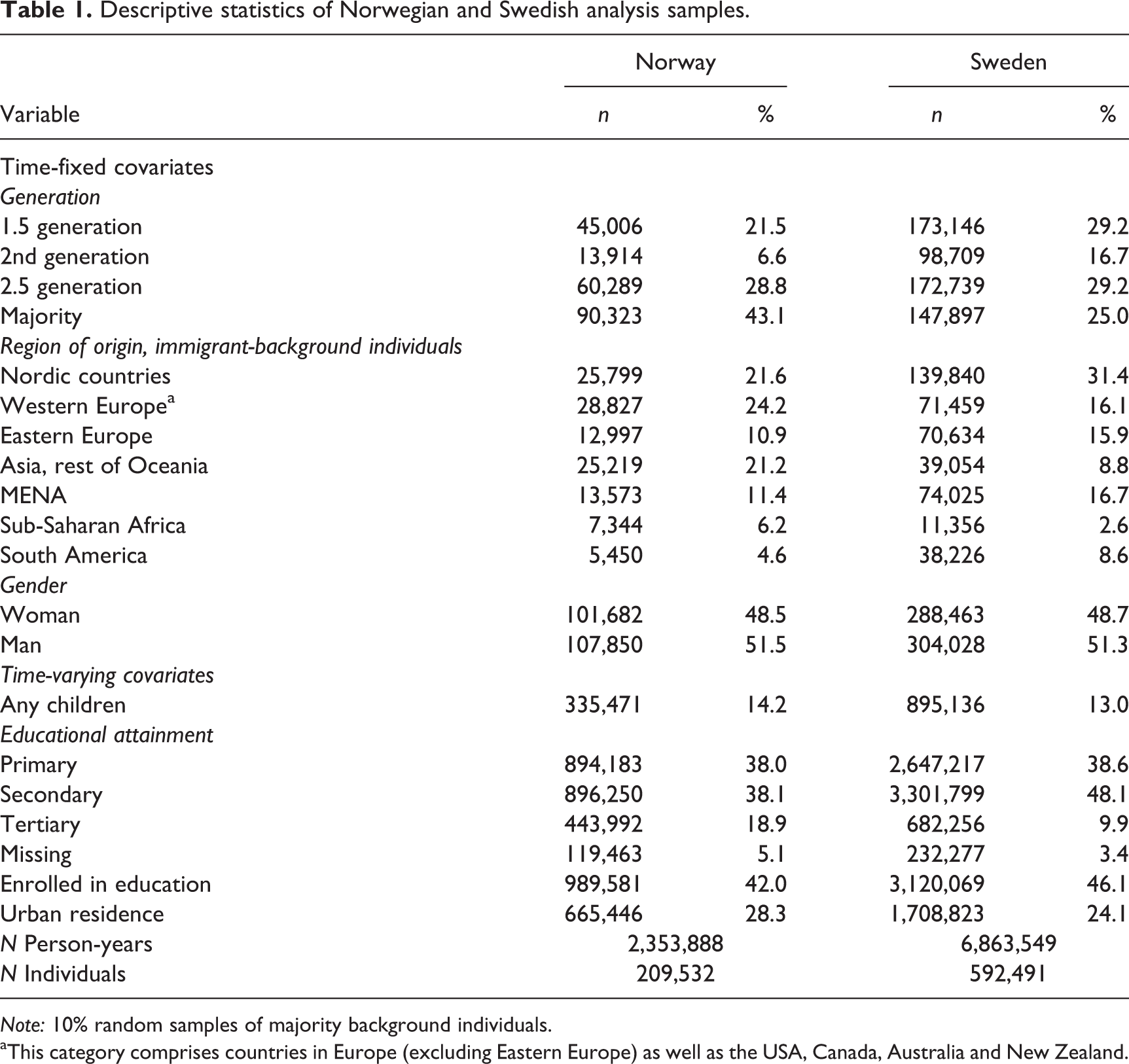
Descriptive statistics on the independent variables are presented in Table 1: it can be seen that 75.0% of the Swedish sample and 56.9% of the Norwegian immigrated as children or teens or have at least one parent with a migration experience. This distribution reflects the fact that we included only a 10% random sample of the majority. Given Sweden’s longer migration history, the share of second generation immigrants was higher there (16.7%) than in Norway (6.6%). In both countries, immigrant background individuals from Asia and MENA comprised the two largest non-European region of origin groups. Whereas a larger share of immigrant background Swedes originated from countries in Eastern Europe and South and Middle America, the share from Western Europe and Sub-Saharan Africa was higher in Norway.
Descriptive statistics of Norwegian and Swedish analysis samples.
Note: 10% random samples of majority background individuals.
aThis category comprises countries in Europe (excluding Eastern Europe) as well as the USA, Canada, Australia and New Zealand.
Results
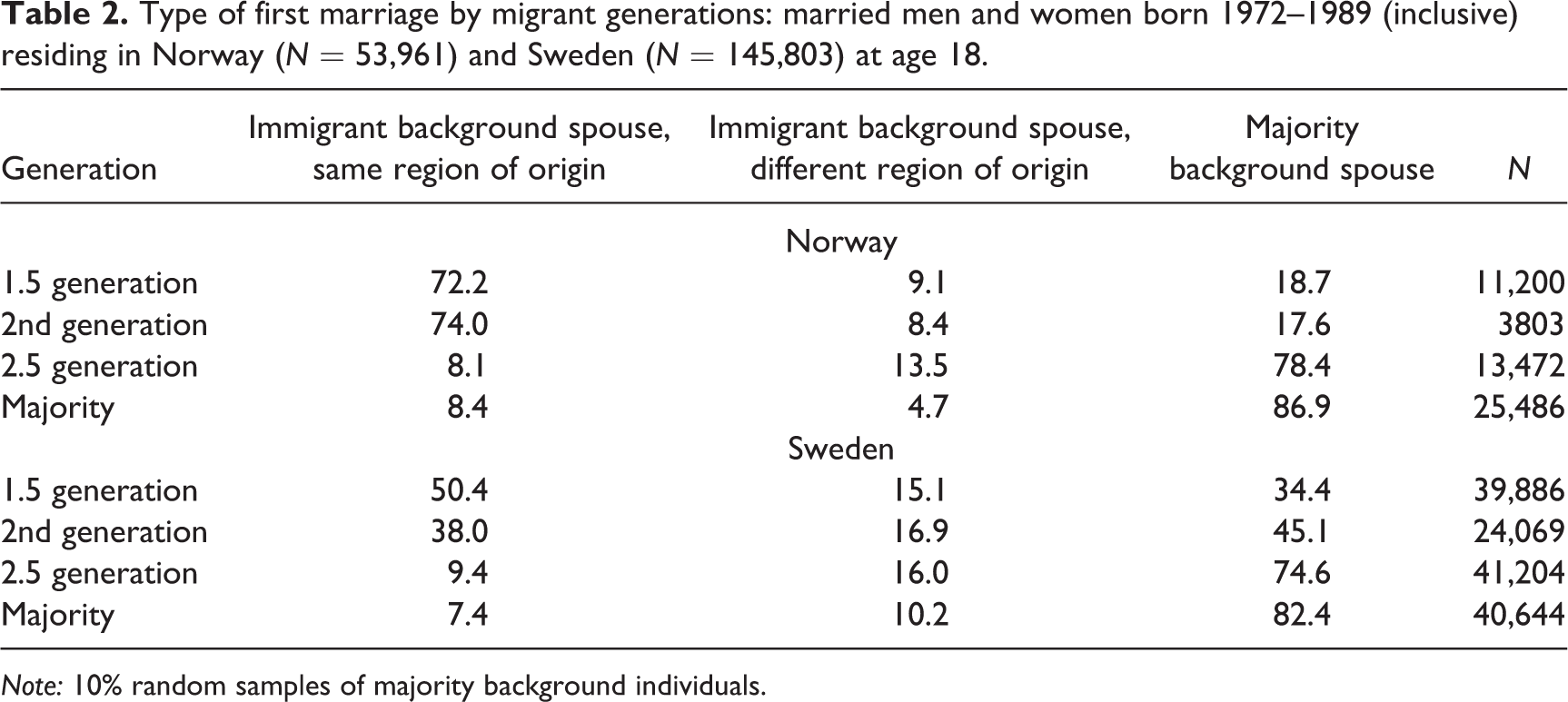
One quarter of both country samples married during the period of observation. As shown in Table 2, there were notable differences across migrant generations in their choice of spouse. Nearly three quarters of married Norwegians belonging to the 1.5 and second generations married endogamously – that is, with an immigrant-background partner from the same region of origin, compared with 50.4% and 38.0% respectively in Sweden. The corresponding proportions among those native-born with one foreign-born parent (that is, generation 2.5) were 8.1% (Norway) and 9.4% (Sweden). Table 2 further confirms that in both country samples 1.5 and second generation individuals more often married a majority spouse than an immigrant-background spouse originating from a different global region, though marriages with majority individuals were more frequent among these groups in Sweden than in Norway. Among married majority individuals, 86.9% (Norway) and 82.5% (Sweden) of the samples married endogamously, whereas 8.4% (Norway) and 7.4% (Sweden) married an immigrant-background spouse originating in another Nordic country. Of majority Norwegians, 4.7% married an immigrant-background spouse from a non-Nordic country, compared with 10.1% of majority Swedes.
Type of first marriage by migrant generations: married men and women born 1972–1989 (inclusive) residing in Norway (N = 53,961) and Sweden (N = 145,803) at age 18.
Note: 10% random samples of majority background individuals.
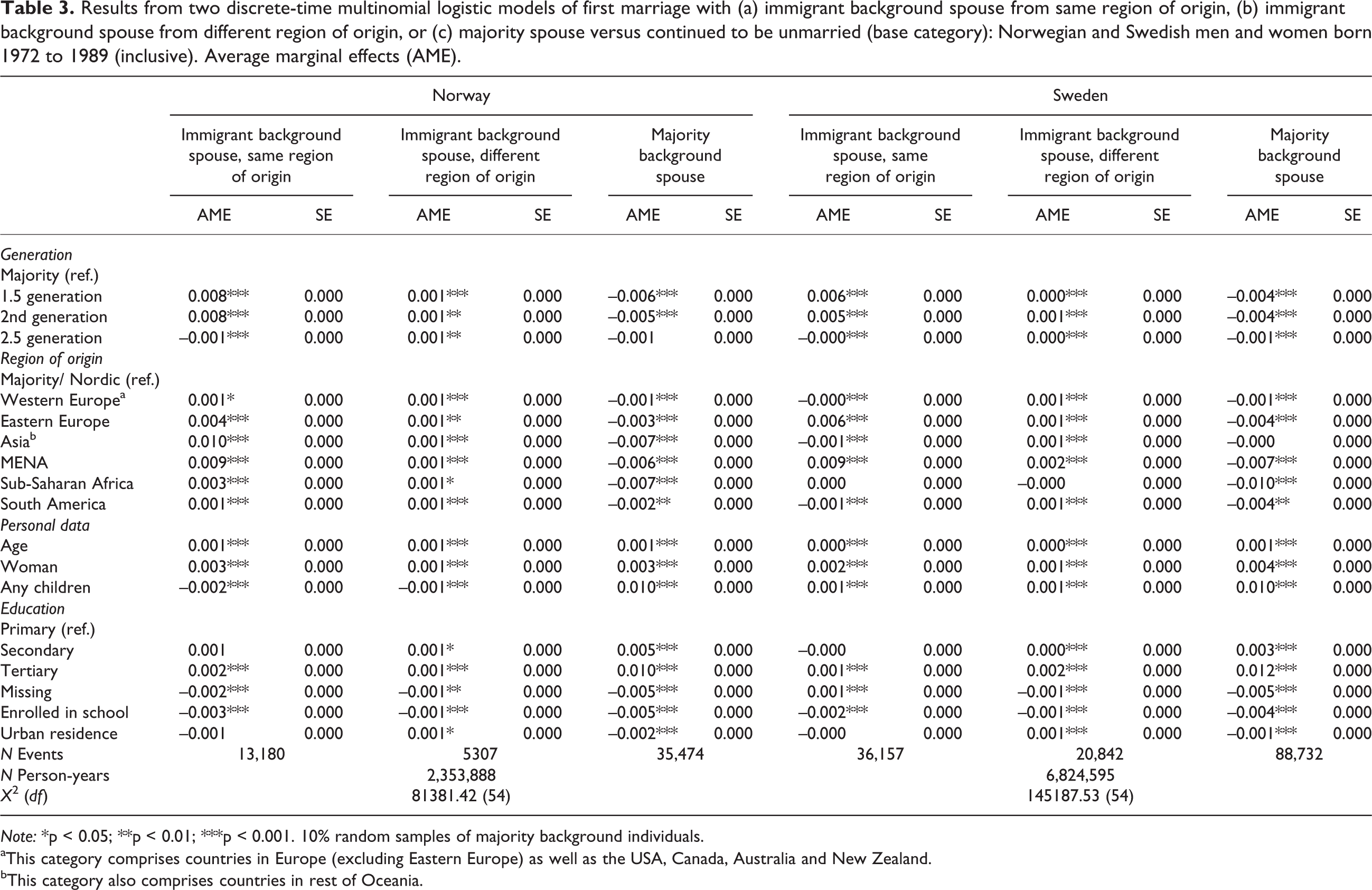
Table 3 presents results from gender-pooled discrete-time multinomial models of marrying an individual of majority or migrant background from the same or different region of origin relative to remaining unmarried. The results are reported as average marginal effects (AMEs) indicating the difference in marriage probabilities in any given year relative to the reference group. For continuous variables, the average marginal effect indicates to what extent the marriage probability changes if the covariate increases by one unit. From Table 3 it can be seen that individuals belonging to the second and 1.5 generations were significantly more likely to marry an immigrant-background spouse, as compared to majority individuals. This relationship was particularly strong for those 1.5 and second generation individuals marrying an immigrant-background spouse from the same region of origin. In contrast, the chance of marrying an immigrant-background spouse originating from the same region relative to remaining unmarried was significantly lower among the 2.5 generation than among majority individuals in both countries. Immigrant-background individuals belonging to all generations were, however, more likely to marry an immigrant-background spouse from a different region of origin compared with their counterparts without migrant background.
Results from two discrete-time multinomial logistic models of first marriage with (a) immigrant background spouse from same region of origin, (b) immigrant background spouse from different region of origin, or (c) majority spouse versus continued to be unmarried (base category): Norwegian and Swedish men and women born 1972 to 1989 (inclusive). Average marginal effects (AME).
Note: *p < 0.05; **p < 0.01; ***p < 0.001. 10% random samples of majority background individuals.
aThis category comprises countries in Europe (excluding Eastern Europe) as well as the USA, Canada, Australia and New Zealand.
bThis category also comprises countries in rest of Oceania.
The results presented in Table 3 further confirm that the 1.5 and second generations were less likely to marry a majority spouse, as compared to majority individuals, net of the other characteristics. Whereas in Sweden 2.5 generation individuals were also less likely to marry a majority person compared with majority Swedes, this difference failed to reach statistical significance in Norway. Taken together, these results are consistent with our hypothesized generational gradient among immigrant-background individuals (Hypotheses 2a and 2b).
Regarding region of origin, the results presented in Table 3 show that immigrant-background Norwegians from all global regions were significantly more likely to marry another immigrant-background individual compared with their majority counterparts and immigrants and their descendants from other Nordic countries (reference category). This was particularly so for immigrants and their descendants from Asia and MENA. A similar relationship was found in Sweden, although immigrants and descendants originating from Asia, Western Europe and South America were less likely to marry an immigrant-background individual from the same region of origin compared with their counterparts of Nordic origin and majority individuals. In both countries, however, individuals originating from non-Nordic countries were less likely to marry a majority spouse relative to remaining unmarried compared with majority individuals and Nordic immigrants and their descendants.
In agreement with prior research on marital timing, the likelihood of marriage first increased but then decreased with age. 4 The results in Table 3 further confirm that women were more likely to marry than men, likely attributable to an earlier age at first marriage. Having a non-marital birth was positively related to marrying a majority spouse in both countries, but increased the chance of marrying an immigrant-background spouse in Sweden only. This finding suggests that immigrant-background Swedes increasingly follow the Nordic family formation pattern of having their first birth outside of marriage. Education level was positively associated with marriage, but missing education and school enrolment were negatively associated with marriage: the education gradient was certainly stronger for marriage to a majority than to an immigrant-background spouse. Finally, it can be seen from Table 3 that urbanites were more likely to marry an immigrant-background spouse from a different region of origin and less likely to marry a majority spouse, compared with those living elsewhere in Norway and Sweden.
To assess further the association between partner choice and marriage timing by generation and gender, we included interaction terms between age and age-squared and migrant generation in separate models for men and women. The results from these interaction models are presented as predicted probabilities in Figures 1, 2 and 3 (full model results are available on request from the Corresponding Author). Note that these figures represent a standard profile: childless individuals of Western European immigrant descent with a secondary education, not currently enrolled in education, and living in an urban area. Given differences in coefficient and intercept estimates across countries, the magnitude of the probability of marriage in any one year varies by country and by the chosen profile of individuals. However, because our hypotheses concern the relative propensity to marry by age, generation and gender, different proportionate shifts in the magnitude of the propensity to marry (by country or due to differences in the selected predicted probability profile) will not affect our interpretations of our results.
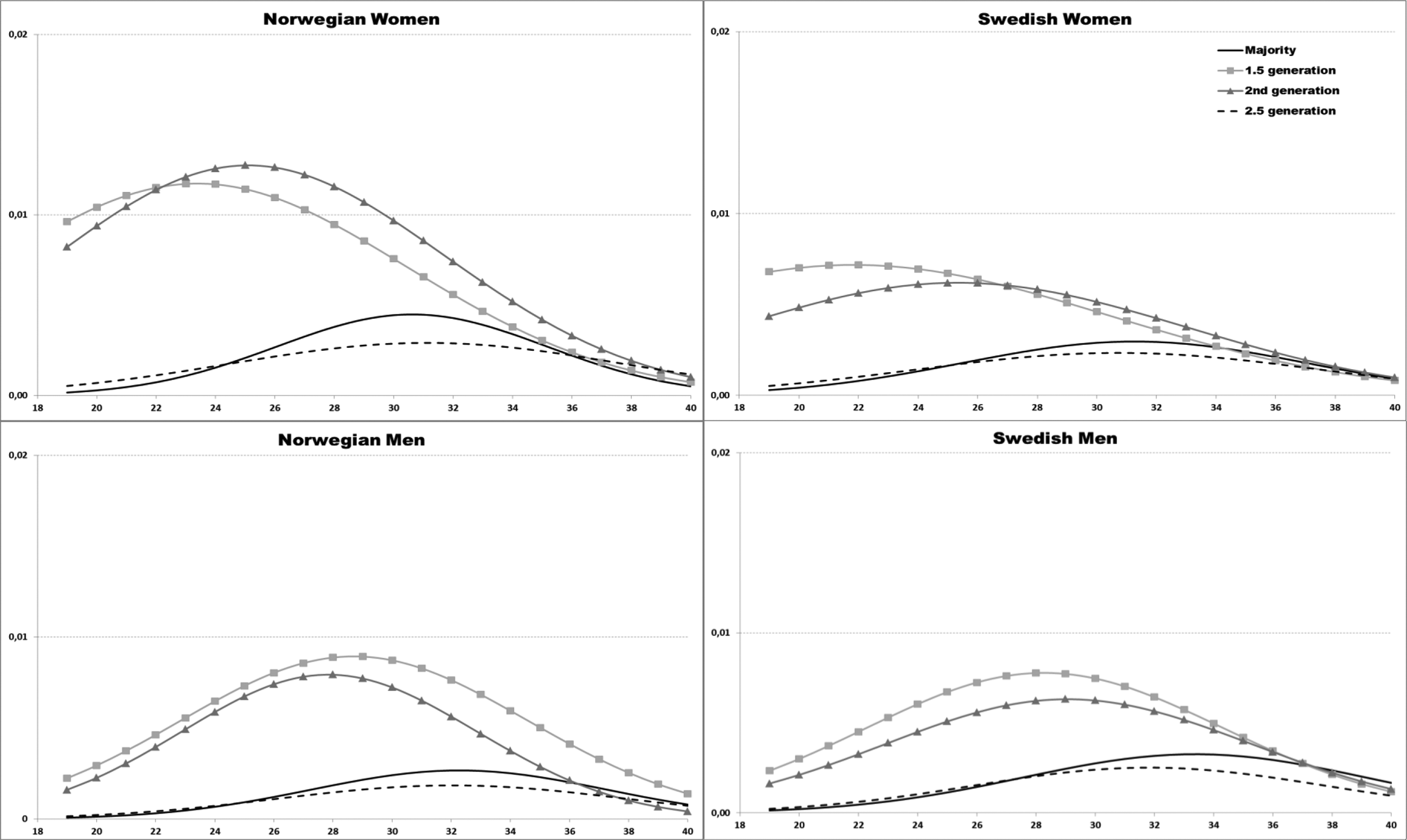
Interactions between age and migrant generation, marriage to immigrant background spouse from the same region of origin, predicted probabilities, women and men.

Interactions between age and migrant generation, marriage to immigrant background spouse from different region of origin, predicted probabilities, women and men.
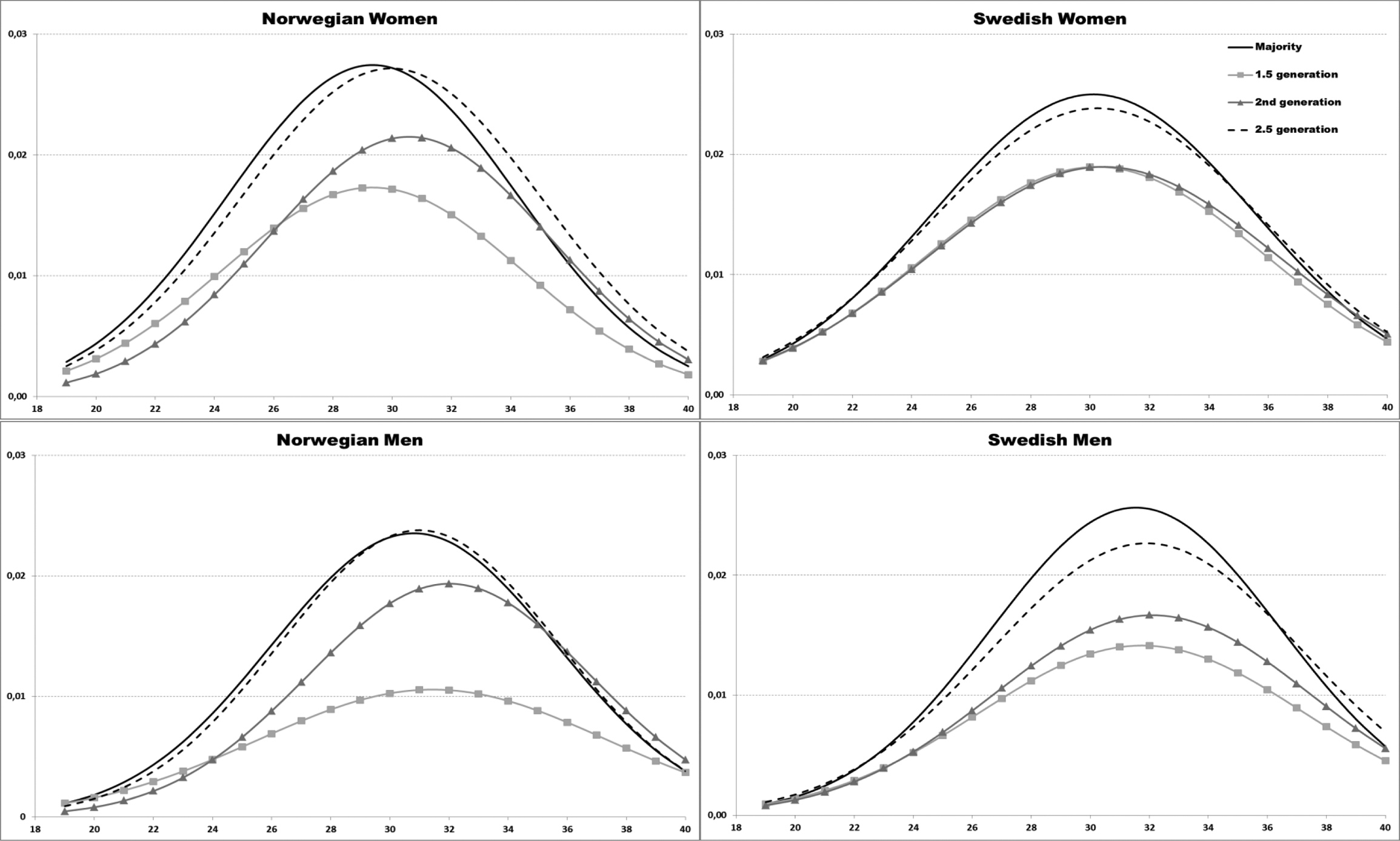
Interactions between age and migrant generation, marriage to majority background spouse, predicted probabilities, women and men.
As shown in Figure 1, there were notable differences across migrant generations in the marital timing patterns among those who married an immigrant-background spouse originating from the same global region. Among the second and 1.5 generations, such endogamous marriages were most likely to occur in the early-to-mid-20s for women and the mid-to-late-20s for men. Second generation women in such marriages did, however, marry slightly later as compared with their 1.5 generation counterparts. Among the 2.5 generation endogamous marriages were more common at older ages, in the early 30s for men and late 20s for women (Figure 1).
Exogamous marriages, whereby immigrant-background individuals partnered across regions of origin (Figure 2) or with majority spouses (Figure 3), in contrast, occurred at later ages, when compared with that of their counterparts who partnered endogamously (Figure 1). Taken together, our findings thus confirmed Hypothesis 1, that exogamous marriages tend to occur at later ages than endogamous marriages among immigrant-background individuals.
In nearly all cases, we found evidence of a uniform age pattern of marriage for majority individuals, regardless of their choice of partner: marriage tended to occur in the early 30s for men and the late 20s for women. One exception to this overall pattern was Norwegian majority men who partner immigrant background women originating in non-Nordic countries (Figure 2): these men tended to marry later, on average, compared to their endogamously-partnering majority counterparts (Figure 3). Nevertheless, the uniformity in the age pattern of marriage where there was at least one majority spouse suggests that the Scandinavian marriage pattern tends to dominate, even where the immigrant-background composition of the couple is mixed.
The results from these gender-differentiated models provide further nuance with respect to our generational gradient hypotheses (2a and 2b). We expected to find that second generation immigrants would be more likely to intermarry than their 1.5 generation counterparts, particularly among those deferring first marriage (Hypothesis 2a). Correspondingly, Figure 3 shows that second generation men who married exogamously tended to fall in between their 2.5 and 1.5 generation counterparts. As shown in the upper left panel of Figure 3, a similar pattern was found among second generation women in Norway. The marital timing and propensities of the 2.5 generation who married a majority spouse, in contrast, was similar to patterns observed for endogamously marrying majority populations, consistent with Hypothesis 2b (Figure 3).
Comparing men and women in each country, we found evidence in support of our hypothesis that differences in the timing of marriage by generation and type of marriage was greater for women than for men (Hypothesis 3). In particular, as shown in Figure 1, although there was a clear distinction on the one hand between the 1.5 and the second generations, and the 2.5 generation and majority individuals on the other, in the timing of endogamous marriages for men and women alike there was greater generational variation among women. There was a slightly greater tendency for 1.5 and second generation women to marry endogamously as compared to their male counterparts in Norway; however, this was not the case in Sweden (Figure 1, upper panel).
Discussion
Using Norwegian and Swedish register data on all migrant background individuals born between 1972 and 1989 (inclusive) who were either native-born or who immigrated prior to age 18, the current study addressed not only patterns of partner choice, but also how these were associated with differential marriage timing across migrant generations, a topic that has received little attention to date (Kulu and González-Ferrer, 2014). Simultaneously considering partner choice and marriage timing opens up the possibility of conceptualizing adaptation as a process and provides further insights into processes of social change, because the changing timing of marriage may represent a more subtle form of adaptation than intermarriage.
Our results confirmed that in both countries the marital timing patterns of migrant background individuals who married exogamously, particularly those marrying a majority spouse, were more similar to the majority populations than among those who married another migrant-background individual from the same region of origin. In agreement with previous research, this finding implies that intermarriage is a boundary-crossing behavior (Alba, 2005): exogamy and the adoption of the dominant Scandinavian pattern of later marriage seem to go hand-in-hand. There was, however, evidence of delayed first marriage across generations among immigrant-background individuals who partnered endogamously. Whereas the age pattern of marriage among 2.5 generation individuals partnering with spouses from the regions of origin of their immigrant parent still tended to follow the dominant age pattern of marriage in Sweden and Norway, there was evidence of a gradient in marriage timing when comparing women of the 1.5 and second generations.
This shift in marriage timing across generations could be indicative of ‘boundary blurring’ between majority and minority groups, whereby the social profile of marital behavior becomes less distinct, particularly among the second generation (and in future years among the third generation) (Alba, 2005). However, the differences in the marital timing of the 1.5 and second generations, on the one hand, and the 2.5 generation, individuals with one majority parent, on the other, suggest that socialization and the intergenerational transmission of family formation behaviors may be a key pathway for determining marriage timing. That is, children of mixed parental origin may have adapted the majority family behavior to a larger extent than the children of two immigrants.
Overall, endogamy among immigrant-background individuals was associated with younger ages at marriage, while exogamy tended to occur at older ages. Nevertheless, there was evidence that these patterns were gendered and varied across generation. In line with Hypothesis 3, the relationship between partner choice and marital timing was particularly strong among 1.5 and second generation women; these women who married endogamously were most likely to do so in the first half of their 20s. It may be that young immigrant background women experience greater social pressure to marry within their group at prescribed ages than their male counterparts, while older women and men can exert more autonomy over the timing of their marriages and their choice of partner (Van Zantvliet et al., 2014). In order to understand more fully the shifting age gradient of marriage across generations and the gendered nature of these patterns, it may be important also to consider the experience of immigrants arriving as adults. While we chose to exclude these individuals from our analysis because of concerns that migration and family formation may be endogenous processes (Andersson, 2004), this may be a fruitful avenue for future research.
Few studies have investigated intermarriage from the perspective of majority individuals (Kalmijn, 1998); the nature of these unions can help us understand processes of social change in countries with large or growing proportions of migrants and their descendants. If there are differences in marital timing among majority individuals who marry individuals of immigrant background and those who marry endogamously, minority–majority adaptation may indeed be a ‘two-way street’. The country contexts under investigation here provided mixed evidence with respect to the marital timing of majority individuals. For women in both countries, and for men in Sweden, where at least one of the partners was of majority background, the Scandinavian pattern of later marriage seemed to dominate. However, among majority men in Norway, we did find evidence of later first marriage if that marriage was with an immigrant-background woman originating from a non-Nordic country, suggesting that these men search longer and ‘cast a wider net’ in order to find a partner. A deeper exploration of the gendered nature of (simultaneous) adaptation processes among both immigrant and majority background populations is warranted.
The comparison between Sweden and Norway, two countries sharing a pattern of relatively late marriage and family formation and similar institutional, economic and cultural characteristics, was ideal for investigating processes of adaptation in partner choice and marriage timing. Despite these similarities, the countries represent two different immigrant destination contexts with compositional differences in their immigrant background sub-populations. Sweden has a longer history of modern immigration than Norway and thus the second generation comprises a larger proportion of Sweden’s population. Net of compositional and historical differences, we nonetheless found similarities in the patterns of partner choice and marriage timing across the two countries. Given the sufficiently similar contexts, it is more likely that our findings reflect social changes in partner choice and marriage timing across immigrant generations rather than unobserved differences between countries (Neyer and Anderson 2008).
Register data are a promising source of information on immigrant background populations, a hard-to-reach group that is sometimes too small to be captured in nationally representative surveys. Moreover, using these data we were able to pay particular attention to the children of immigrants, who are now just entering family formation ages, as well as highlighting the unique position of the 2.5 generation, the children of one immigrant and one majority parent.
Despite these strengths, the data also had several limitations. Due to the nature of the Swedish register extract available to us, we were obliged to aggregate countries of origin into global regions for purposes of comparison. Swedish research on intermarriage among first generation immigrants (Dribe and Lundh, 2008, 2011) and the childbearing behavior of children of immigrants (Scott and Stanfors, 2011) have demonstrated important differences by countries of origin. Immigrant-background individuals from countries that are socio-culturally dissimilar to Sweden and Norway may be less likely to conform to the dominant family formation pattern than those from more similar contexts. While we were in part able to capture socio-cultural differences across countries of origin with our aggregated regional specification, future research should investigate differences by countries of (parents’) origin. Furthermore, research should draw in more information on spouses and assess whether the marriage timing of individuals marrying an immigrant differ from those marrying someone of immigrant origin who has lived in the country since childhood.
A focus on other individual characteristics, such as attitudes and values, may provide greater insights into socio-cultural distance between migrant and majority populations. For instance, religiosity is often used as a proxy for culture and/or normative attachment of immigrants (Foner and Alba, 2008): unfortunately, the data used here do not provide information on attitudes, values or religiosity. Also, using these data it was not possible to identify histories of non-marital cohabiting unions. Although many immigrant background individuals marry directly (Andersson et al., 2015; Bernhardt et al., 2007; Milewski and Hamel, 2010), cohabitation before marriage is universal behavior among the majority populations in the two countries. Given the prevalence of cohabitation in Norway and Sweden an investigation into the propensity to cohabit endogamously and exogamously, and the timing of entry into both marital and non-marital co-residential unions, would provide additional insights into immigrant adaptation processes.
Our results nonetheless suggest some uniformity in changing patterns of marriage formation for men and women across migrant generations in the two countries. Furthermore, the results demonstrate that we can draw richer insights about processes of adaptation by drawing in information about the timing of marriages, in addition to the characteristics of spouses. The composition of immigrant-background subgroups entering marital ages will change in the years to come, and more children of immigrants will enter family formation ages. The results are an important starting point for new insights into adaptation drawn from investigations into the family life-courses of immigrants and their descendants now coming of age in Europe.
Footnotes
Acknowledgements
The authors would like to thank Helga de Valk, three anonymous reviewers and the editors for their useful comments and suggestions.
Funding
The author(s) disclosed receipt of the following financial support for the research, authorship, and/or publication of this article: This work was funded by the Norwegian Research Council [grant number 250486] and the European Research Council [grant number 263829].