







Abstract
This analysis of the work of George Herbert Mead and Alfred Sohn-Rethel compares their respective accounts of the formation of the self. The analysis proceeds from two important similarities: the effort to understand self-consciousness not as primordial but as the product of social processes, and the view that these processes form a circuit: the self arises from consciousness’ return to itself, concluding a movement whereby consciousness is first externalized onto objects and then internalized, taking on the insular shape of self-consciousness. What sets the two accounts apart is the site from whence the self returns: objects. In Mead, the self returns from meaningful objects, and this same (intersubjective) meaning is entangled with the process of self-formation. In contrast, for Sohn-Rethel, the self returns from objects whose meaning is not established intersubjectively but objectively: the self is the unintended consequence of commodity exchange. In Mead, interaction among people affords meaning to objects and thus evokes the self; in Sohn-Rethel, interaction among commodities evokes an objective meaning that renders people as selves. Interpretative sociology should attend to the objectively and unconsciously meaningful forms analyzed by Sohn-Rethel. To illustrate this conclusion, reference is made to a certain experience of the social under neoliberalism.
Our so-called laws of thought are the abstractions of social intercourse. Our whole process of abstract thought, technique and method is essentially social. (Mead, 2015: 90) The formation of thinking which in every respect merits the term “social” presents itself as the diametrical opposite to society […] Nothing could be wrapped in greater secrecy than the truth that the independence of the intellect is owed to its originally social character. (Sohn-Rethel, 1978: 72)
Introduction
Interpretative sociology, the sociological analysis of meaning, displays a certain unease about the relationship between people and things. In trying to unearth a meaning that underpins social interaction, interpretative sociology demarcates a space of meaningful objects resolutely sealed off from another space of stupid, or, in themselves meaningless, things. This segregation is premised on certain ideas concerning the imposition of meaning on objects (material or ideal) by human agents. For, according to the interpretative sociologist, humans are beings who speak to each other and in this process attribute meaning to things. Humans use things to convey meaning. Communication among people, and by implication, communication tout court, is understood to occur through the intermediary of a meaningful object, which exists as such through conscious human agency. Any other kind of communication is ludicrous, including Marx’s “language of commodities,” a mode of communication wherein humans, bizarrely, are merely intermediaries. This anthropocentrism produces, as I will show in the case of Mead, the symptom of absenting, or reducing to a symbol, an object that does not fit the dichotomy of stupid things and intersubjectively meaningful objects: money.
According to this predominant conception, the self – taken here as an undifferentiated “I” and not, in the first place, as a series of identifications – is bound up with meaningful, symbolic objects. Without such selves, there would be no entity to confer meaning upon things; without such entities that confer meaning, virtually meaningful objects would remain stupid things and, therefore, relegated outside the operative space of interpretative sociology (e.g. Weber, 1968: 7). Moreover, for George Herbert Mead, selves are formed in the very process of rendering things meaningful. A different view of self-formation and the production of meaning is provided by Alfred Sohn-Rethel. Described as a fellow traveler of the Frankfurt school by Slavoj Žižek (1989: 10), this once obscure intellectual has lately risen to some prominence, pioneering research on “real abstractions” (Toscano, 2014): the intangible and invisible, yet practically true abstractions which inhere in the movement of capital and suture different aspects of social life, including economy, science and ideology. However, though latent to his argument, Sohn-Rethel’s theory of how the rudiments of scientific cognition are prefigured in the actions that comprise commodity exchange has not been explored in order to tease out its significance for a sociological and social psychological conception of self-formation. This is what I hope to accomplish.
Mead is interrogated here as a proxy for an interpretative sociology that unduly restricts analysis of the formation of selves, this key aspect of subjectivity, to interaction among people. Mead is not singled out for this critical exercise because he is particularly influential, the most representative figure in this tradition or out of spite. Rather, there is a structural affinity, which facilitates comparison, between his account and that of Sohn-Rethel. Comparing his work to Mead’s explicitly social psychological account of self-formation will enable the elucidation of what Sohn-Rethel (1978: 42) suggested was a corollary of his thesis on the form determination of scientific cognition: integrating “the causal relationship between the abstractions of exchange and thought” into a “materialist social psychology of the future.”
The two accounts of self-formation pivot on the structure of a circuit. Hence, the self performatively arises from consciousness’ return to itself: the self is this return and, because this return erases the self’s origin, it retroactively seems primordial (circles don’t have beginnings). In both circuits, moreover, the self arrives at its insular form as self-consciousness through the mediation of meaningful objects and a realm of universality: here, consciousness is relayed as self-consciousness. The crux of the matter, however, comes down to the nature of the site from whence the self returns, the site of its relay, and to the signifying action effected between people, in Mead, and between things, in Sohn-Rethel. Because in the latter, the meaning of (universal) objects is established objectively, not intersubjectively.
What stands to be gained from this exercise in terms of a sociological analysis of modern society? Arguably, its central problem, a notion of objective meaning, bears on pervasive phenomena. Without pretention to provide an exhaustive definition it might, in light of this problematic, be suggested that “neoliberalism” as a trajectory of social change is associated on the one hand with an accentuation of individuality – the isolated self – as the basis on which people interact, and on the other hand with a reification of the social, that is, its autonomization as against its deliberate creation. Because this autonomization seems to preclude “projects” of all kinds, neoliberalism extinguishes the 20th century’s “passion for the real” which, for Alain Badiou (2007), involved a sense of being summoned to effect imminent revolutionary transformations in politics, esthetics and other fields. Yet, paradoxically, because autonomization undercuts all efforts to render capital meaningful, it also facilitates its contestation.
Mead’s intersubjective circuit
It might be said that Mead’s (1910) project takes off from refuting the idea that interaction between people and things is the basis of the self. Why was refuting this idea a concern to him? Well, because the relation of an organism to its environment was a point of departure in pragmatist accounts of the self. Dewey (1896: 361) thus subverted the behavioral stimulus–response model by placing it in the context of “the act”: inserted into different encompassing frames, that is, different acts, the same stimulus takes on “a very different psychical value; it is a different experience.” Stimuli have no significance per se because they involve interpretations by individuals involved in acts; they are always being reconstituted as part of acts. For Dewey this reconstitution or circuit attests to how a unity of activity subsumes and transforms stimuli and consciousness. And because stimuli are not passively received, consciousness, for its part, does not result from, nor does it antedate, but is co-constituted with stimuli; it resides in the hesitation pertaining to the constitution of stimuli (Dewey, 1896: 368). However, the relation here is one of subject–object – intersubjectivity does not enter into this account – and this is Mead’s problem with Dewey’s act.
Mead (1910: 179–180) claims that “in a consciousness of things that [are] merely physical [there is] no adequate motive for directing attention toward one’s own attitudes.” Outside of the subject–subject relation, “the social situation of converse,” there is no basis for the establishment of self-consciousness nor, as will become clear shortly, of meaning. Furthermore, this is a relation in process and in circulation. Dewey had described the act in terms of a circuit and Mead will reproduce this structural feature in his account of self-formation. Before describing his version of the circuit, however, we may gain additional purchase on Mead’s point of departure from his critique of parallelism.
Parallelism might be described as a form of psychophysical dualism: on the one hand, there exists the sealed universe of consciousness, on the other a universe of physical events. The former reflects the latter in an isomorphic relationship. The central nervous system produces conscious shadows running alongside physical processes insofar as they affect the individual, rendering consciousness derivative and epiphenomenal. In Mead’s view (1925: 253), this is unacceptable: it is an “unstable compromise” resulting from the asymmetry of the deadlocks of speculative philosophy and the steady advance of natural science, and rendering known facts that “could answer only to sensing and thinking as processes” inexplicable. Sensing and thinking as processes are intrinsic to social acts where a stimulus (gesture) causes, not just an appropriate response, but “an image of the response”; of the response by another individual called out by the gesture. Only in the gesturing individual’s “imagining the consequence of the gesture” will consciousness of meaning arise (Mead, 1910: 178). Gestures take on meaning through the response, a response that is “identified with the content of one’s own emotion and attitude” (Mead, 1910: 179); consciousness of meaning thus appears in “a response which involves the consciousness of another self as the presupposition of the meaning in one’s own attitude.”
Mead’s is a view of selves and objects as internally related. Introspective self-consciousness is, here, attendant on processes rendering selves as objectively given. There is no pure self to be reached by way of introspection; it is always bound up with others, even in its introspective capacity. Relatedly, the idea of delineated physical objects arises only once interaction has delimited the self; it alone provides the relief against which objects are perceptible as such. Social objects, on the other hand, exist in interaction and, in a sense, comprise the gestures of the other; and by taking the attitude of the other in interaction, the individual relates to itself as such an object. Also, Mead (1925: 263–264, 275) sometimes considers social objects as overarching themes of acts (e.g. property as an object in the act of exchange).
The contours of Mead’s circuit can already be glimpsed at this stage: the self arises (or returns) as awareness ventures outside itself and moves to the object, as in the object of the social act, and returns as self-consciousness. This means that awareness turns to the object not as a mere thing, not even as a meaningful object in terms of an individual act, as in Dewey, but as an object to which others are likely to respond in certain ways. As such, this is a strictly intersubjective circuit in which awareness returns from the object, as in the attitudes of others, to itself; and in this return, awareness constitutes itself as self-consciousness (retroactively constituting awareness as self-awareness). In explaining this, Mead often evokes an image of circularity: “it is only by taking the roles of others that we [are] able to come back to ourselves” (Mead, 1925: 268, emphasis added).
This view is radically anti-solipsistic, and yet fully circular. It rejects the insularity of the self, and yet pivots on its repeated externalization and return to itself. In this intersubjective circuit the “stimulus,” the social object, appears as an intermediary between interactors, as the interstice where selves are co-constituted in and through social acts. The process endows the individual with a point from where it can observe itself, from where it is able to consider itself as an object. In social acts the individual assumes the attitudes others take toward it. Specifically, the self is enacted as the individual takes the view of a generalized other toward itself; it then appears in utter isolation. Here, Mead touches a theme in Marxist work on real abstraction: subjectivity as external to and independent of the subject. Analogously, “mind” does not inhere in some internal dialogue – it is coextensive with social interaction: Mind is a field that is not confined to the individual much less is located in a brain. Significance belongs to things in their relations to individuals. It does not lie in mental processes which are enclosed within individuals. (Mead, 1922: 163) [The symbol] neither denotes nor connotes except, when in form at least, denotation and connotation are addressed both to a self and to others, when it is in a universe of discourse that is oriented with reference to a self. If the gesture simply indicates the object to another, it has no meaning to the individual who makes it, nor does the response which the other individual carries out become a meaning to him, unless he assumes the attitude of having his attention directed by an individual to whom it has meaning. (Mead, 1922: 162)
This idea of universality enables Mead (2015: 289–303) to apply his theory of meaning and the self in analyses of social institutions; foremost here, of exchange. In his behaviorist jargon, universality resides in the regularity of a response with regard to an infinite number of stimuli (Mead, 2015: 87). Importantly, Mead thereby avoids presuming a primordial capacity for rationality and is able to develop a sociological theory of abstraction: universals have a timeless, indestructible quality and are impervious to differences of perspective not because they antedate interaction, but because, in the context of modern institutions, communication forces individuals to take the attitude of others toward themselves to indicate a single meaning. 1 To illustrate how intersubjective meaning thus underpins behavior, Mead counterposes the economy involved in buying and selling food to that of a squirrel’s gathering and storing of nuts: the difference is not that purchasing food is physically more challenging than picking it from the ground, but that exchange is an act of mutuality, wherein one is incited “to give by making an offer.” One “cannot exchange otherwise than by putting one’s self in the attitude of the other party” (Mead, 1925: 267). This would all be well and good were it not that Mead leaves out one thing: money.
This omission is consistent with Mead’s (2015: 292) theory of meaning because for him “money is nothing but a token, a symbol.” It therefore makes sense to abstract from specific modes of speech; they are interchangeable on principle, even while money might be particularly apt in business. Implicitly, however, Mead is taking a stand in an enduring controversy in economics on the nature of money. He is on head-on collision with Marx’s adamant claim that money is a commodity, not merely a symbol: its circulation obeys an objective logic, independent of the parties to exchange. By implication, money can be said to communicate something to the parties whether they are aware of it or not, as Sohn-Rethel following Marx would later stress.
Staying with Mead on the subject of exchange, it is noteworthy that the corollary of the omission of money in the example with the squirrel – of depicting economy as an essentially meaningful activity – is depicting the development of industrial capitalism as an intersubjective accomplishment. Rather than the result of some “structural causality,” say, the incidental coming-together and realization of disparate and inexistent elements, the development of capitalism is rendered curiously agentic; an outcome of the “establishing of markets, of setting up means for transportation, of elaborating the media of exchange, of building up banking systems.” In a word, “the creation of the structure of these larger communities” (Mead, 2015: 290–291). While Mead does not go as far as describing the overall process as conscious or deliberate with regard to its end result, he relies on a concept of universality that flows so seamlessly from the intersubjective attitude as such as to naturalize markets and associated modes of production. Because exchange is simply a mode of rational language, intersubjectivity is “universal society” in embryo: When such an immediate attitude of exchange becomes a principle of social conduct, it carries with it a process of social development in the way of production, of transportation, and of all the media involved in the economic process, that sets up something of the very universal society that this attitude carries with it as a possibility. (Mead, 2015: 291)
Modern economy involves a deepening of a sympathetic, albeit impersonal, attitude toward others, entrenched in the basic unit of economic society: the act of exchange. Taking the example of two producers exchanging surpluses, Mead (2015: 301) elucidates this attitude: “from his point of view [the surplus] is not valuable, but he is putting himself in the attitude of the other individual who will give something in return because he can find some use for it.” In taking this as an example of the attitude that pervades modern economy, Mead is collapsing a great variety of scenarios wherein commodity exchange takes place. His particular account is based on the perspective of producers of their own means of subsistence who bring excess products to market. Furthermore, while the limitations of this scheme are obvious, Mead also abstracts from the particular “ways of seeing” involved even in this mode of commodity exchange as a result of its mediation by money. Although the overall process might be said to result in mutual satisfaction, the parties to exchange – as far as they are considered exchangers of commodities – are oblivious to this result. In superseding barter, money separates the parties: in generalized commodity exchange, the seller of a commodity is not also the buyer of another commodity sold by the buyer of the first commodity. Intersubjective meaning ceases to circulate through economic life exactly where the objective meaning of money intervenes.
Digression on money
In fact, Mead’s intersubjective account of exchange is modelled on barter, and relies on a supposed smooth passage from barter to monetary exchange. However, the social psychological and sociological consequences of monetization are substantial. Indeed, there is a vast literature on the nature of money and this is not the place to enumerate divergent conceptions. Here, I outline the basics of a conception of money as impersonal (Seaford, 2004: 152–157), foregrounding how money relates to specifically modern interrelations between people who are oblivious of one another: Stripped of all personal association, money is promiscuous, capable of being exchanged with anybody for anything, indifferent to all non-monetary interpersonal relationships […] Barter, even of goods made for the market, tends to require knowledge of co-transactors and personal trust, and so to rely on lasting […] interpersonal relations and contexts of exchange, whereas the guarantee provided by coinage tends to enable fleeting transactions with complete strangers. (Seaford, 2004: 155–156)
If the foregoing touches on the social psychological consequences of monetization, the sociological effects are no less revolutionary. Of course, by enabling fleeting transactions between strangers, the monetized society’s networks of interaction expand exponentially, but, besides its sheer vastness, this society – with money’s transformation into capital – takes on a life of its own, appears as an “automatic subject” (Marx, 1976: 255) and thereby escapes that regulation through conscious human action implied by Mead’s characterization of industrial society as an accomplishment or outgrowth of intersubjectivity. These are two sides of the same coin: just because monetary exchange is not in the first place an activity in which individuals relate their particular motivations to the concerns of a wider community, exchange (through price formation) effects economic planning “behind the backs” of economic actors. Monetized society’s autonomization as capital is a discontinuous progression tied to transformations in the money form. As the latest phase in this progression, neoliberalism has been described as reliant on a financial fix to restore profitability and subdue labor (Silver, 2003: 163–167, 176) and so conditional on the expansion of interest-bearing capital and related forms of credit money. Metallic money or government paper is here replaced by what Marx (1981: 525) calls bills of exchange (IOUs), enabling a fictitious expansion of capital out of proportion with underlying labor values (until crisis enforces a violent correction). Here, it is clear that the autonomization caused by money has reification as its experiential corollary: interest-bearing capital is self-valorizing value – M-M’ – where the product of a “social relation” presents itself as a “mere thing” (Marx, 1981: 515). In its interest-bearing form, capital thus appears self-sufficient, independent of society. This is an ideological effect of form. That is, practically true ideology, or actual appearance: the interest-bearing form is a “real form of existence” of capital and “the form in which it exists in the consciousness and is reflected in the imagination of its representatives” (Marx, 1972: 483).
Sohn-Rethel’s practical circuit
The following will try to tease out the basics of a materialist social psychology of the self from Sohn-Rethel’s (1978) argument in Intellectual and Manual Labour that the thought forms of scientific cognition are the social forms of commodity exchange. A structural correspondence with Mead’s account of self-formation will assist us here, so the contours of the latter should be borne in mind: in Mead’s view, the meaningful object provides the point of contact with an other and so provides a precondition of self-formation (the recognition of oneself in the attitude of the other). However, this is not sufficient, because to delineate the self presupposes orienting it toward social community in toto, thereby dissociating it from particular others. This takes place through universality of meaning correlated with a generalized other abstracted from concrete others: “in abstract thought the individual takes the attitude of the generalized other toward himself, without reference to its expression in any particular other” (Mead, 2015: 155–156).
Analogously, in tracing Sohn-Rethel’s argument and attempting to extract its social psychological significance, we shall likewise encounter a certain object placing us in contact with an other that, by way of universality, allows consciousness to assume the insular form of self-consciousness. The difference here is that concrete others and intersubjectivity are circumnavigated through what Sohn-Rethel calls “practical solipsism.” The commodity object places us in contact with an other similar to, but also different from, Mead’s generalized other: similar in that it totalizes community; different in that it is a sociality individuals are oblivious to. Whereas, in Mead (2015: 155), an individual must take the attitudes of other members of organized society toward its complex co-operative social activity and “direct his behaviour accordingly” in order to sustain this advanced sociality, in Sohn-Rethel, capitalist society is based on an automatic self-regulation that bypasses consciousness. The formal content of this mode of synthesis that Sohn-Rethel calls the “exchange abstraction” – the other in his circuit – imparts itself to individuals unconsciously and converts into non-empirical concepts, into universality. Here, the accounts reconverge because, in Sohn-Rethel too, universality is the immediate cause of the self’s isolation. These comparisons are summarized in Figure 1 below.
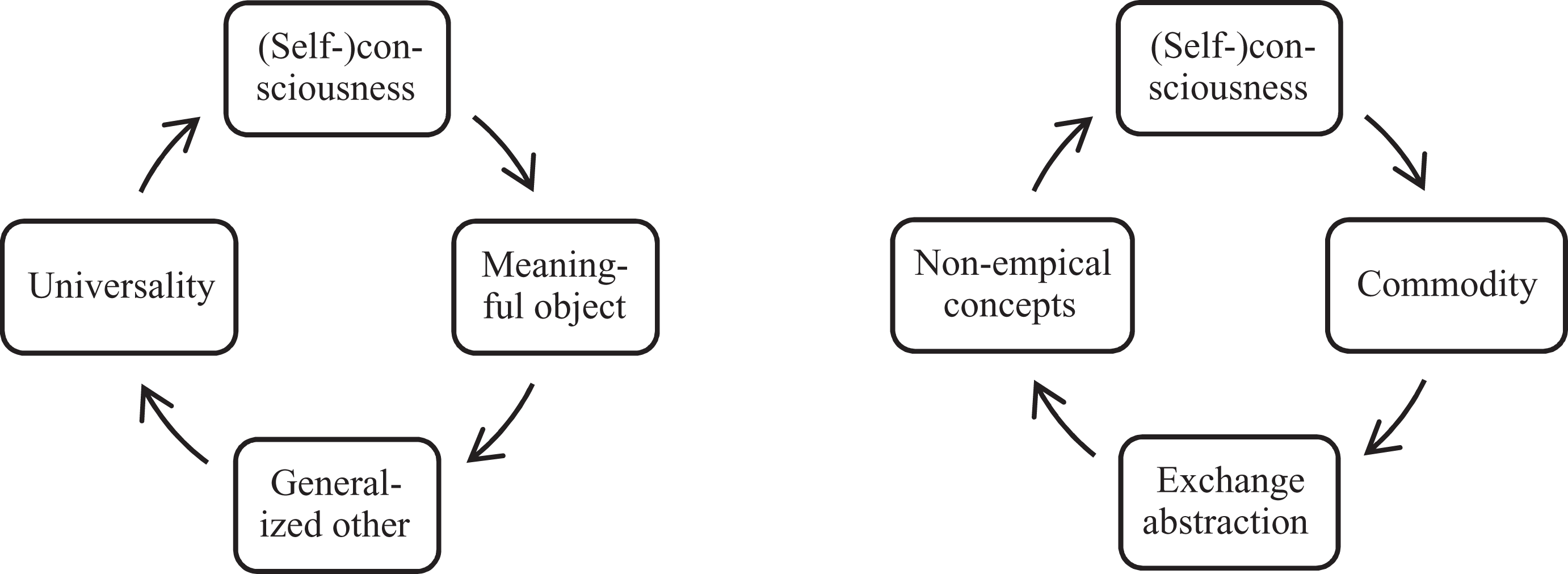
Mead’s intersubjective circuit and Sohn-Rethel’s practical circuit.
Commodity exchange is a unique activity, according to Sohn-Rethel. While other practices involve the material transformation of objects, and the changing of ourselves in the process, exchange is exclusively about changing the social status of objects, that is, transfers of property. The material status of objects, on the other hand, must be assumed constant throughout the exchange process (Sohn-Rethel, 1978: 31); their use is suspended while on sale and while being sold. People thus enter into a uniquely passive relation with the commodity object where, Sohn-Rethel (1965: 118) writes, they “are reduced to the […] role of receiving ‘sense impressions’” (in an allusion to the formal affinity between commodity exchange and Kant’s transcendental subject).
As such, exchange is an abstract practice in two fundamental ways. First, as an abstraction from “use” (taken in its widest sense, as human interaction with nature), exchange is purely social on the material level of actions. Conversely, on the level of thought, exchange is all about the comparative evaluation of different use values. Hence, Sohn-Rethel (1978: 29) emphasizes that “the action and the thinking of people part company in exchange and go different ways.” Strangely, this partition happens in a way that locates abstraction at the level of the act, not in the mind. Secondly, exchange is an abstract practice in that it equalizes the heterogeneous: qualitatively different products are unified as exchange values. This is also of no concern to the agents, preoccupied as they are with the evaluation of use value; although this equalization is the economy’s synthesizer and planner (price formation unifies and feeds back into isolated production processes; it affects profitability, affecting capital’s movement between branches of production, affecting the allocation of labor). This is the automatic nature of money mentioned in the foregoing Digression. The following sums up Sohn-Rethel’s account as developed thus far: In commodity exchange the action and the consciousness of people go separate ways. Only the action is abstract; the consciousness of the actors is not. The abstractness of their action is hidden to the people performing it. The actions of exchange are reduced to strict uniformity, eliminating the differences of people, commodities, locality and date. The uniformity finds expression in the monetary function of one of the commodities acting as the common denominator to all the others. The relations of exchange […] create a system of social communication of actions performed by individuals in complete independence of one another and oblivious of the socialising effect involved. (Sohn-Rethel, 1978: 30) the doctrine that between all people, for every one of them, solus ipse (I alone) exist is only a philosophical formulation of the principles that in practice regulate exchange. What the commodity owners do in an exchange relation is practical solipsism – irrespective of what they think and say about it. (Sohn-Rethel, 1978: 42).
In terms of Sohn-Rethel’s overall argument, the prehistory of capitalist production saw the socially synthetic reality of exchange convert into ideal forms of cognition and so instituted what he regards as the pillar of class society: the division of head and hand, of intellectual and manual labor. The division is caused by commodity exchange insofar as its rise is concomitant with the rise of abstract thought, with a “capacity of conceptual reasoning in terms of abstract universals […] which established full intellectual independence from manual labor” (Sohn-Rethel, 1978: 60). This independence allowed for the rise of science and “scientific management,” as forces directing and configuring the labor process. However, in terms of the argument made here, the key point is that the subject of science shares with the subject of modernity a certain rudimentary capacity for conceptual reasoning, the attainment of which is not performed by a pre-constituted self – rather, the self is co-constituted along with this mental faculty. Because commodity exchange and money permeate modernity, this point is latent to Sohn-Rethel’s argument. The juncture where this co-constitution of conceptual reasoning and the self takes place can be explicated by tracing his argument in its structural similarity to Mead’s circuit.
Hence, it is important to note that the conversion of the practical forms of exchange into the thought forms characteristic of monetized society marks that juncture in the circuit of self-formation equivalent to the passage to universality through the generalized other in Mead. Taken solely in its formal content, commodity exchange contains what Sohn-Rethel calls the “exchange abstraction.” Dispensing with some philosophical heavy lifting here, the key is that there is a regularity to the acts performed by the agents in exchange, and to the movements of the objects involved, and because these regularities are “second nature,” as in taken for granted and practiced automatically, they stealthily convert into thought forms. We must now explicate these formal regularities of commodity exchange; that is, the elements of the exchange abstraction.
We have noted the equalization of the heterogeneous through exchange value. Implied here is a conception of “pure quantity.” While the prices of individual use values are empirical quantities, their relative prices or exchange values are abstract or non-empirical (Sohn-Rethel, 1978: 19). Exchange values are part of a single “world” as against the potentially infinite universe of use values: every particular use value exists as such because of the meaning it has for someone and for some purpose; use values are, phenomenologically, part of an infinity of worlds (Sohn-Rethel, 1978: 43). In the spirit of Sohn-Rethel, Seaford (2004: 175) has thus argued that monetization in ancient Greece significantly contributed to a cosmology based on the notion of “a single substance underlying the plurality of things manifest to the senses.” Moreover, besides pure quantity, exchange implies abstract movement devoid of qualitative change because, as already noted, commodities must be assumed corporeally unaltered while they are being sold; and this movement must occur in a time and space that is equally uniform and so exclusive of transformation. We thus obtain pure quantity, abstract movement and abstract time and space as conceptions latent to exchange (Sohn-Rethel, 1978: 46–49). Together, they make up a formal heuristic or framework in which modern subjects are fluent, although oblivious to its origin. For Sohn-Rethel, this follows from the purely social character of exchange, or its abstraction from use. This is its first principle insofar as it implies that throughout this physical act, the object’s physical state remains unchanged: True, this is no more than a postulate, but without it exchange would be rendered impossible. It must therefore serve as the standard for the description of the act by which the exchange agreement concluded between the owners of the commodities is carried out. Accordingly the act of exchange has to be described as abstract movement through abstract (homogenous, continuous, and empty) space and time of abstract substances (materially real but bare of sense-qualities) which thereby suffer no material change and which allow for none but quantitative differentiation (differentiation in abstract, non-dimensional quantity). (Sohn-Rethel, 1978: 53, emphasis in the original)
The conversion of the real to ideal or conceptual abstraction is the threshold of modern subjectivity: non-empirical concepts are inseparable from autonomous logical reasoning. Such reasoning involves interpretation of these concepts and their application to the external world. Because of the automatism of the social synthesis whose form reflection it is, the abstract conceptual framework appears to exist a priori; because it is not identified at its source, it is explicated and experienced as an inherent individual ability. Furthermore, the framework also seems to derive exclusively from the subject because its complete vacuity and generality – “a compound of the most fundamental elements of nature such as space, time, matter, movement, quantity and so on” (Sohn-Rethel, 1978: 70) – renders it independent of, and thus applicable to, any particular external entity. The elements of the exchange abstraction turn into normative, ideal forms of cognition, from which spring experiences of individual autonomy and isolation (taken here as an estrangement from the social): cut off from its social origin, the abstract intellect emerges with a peculiar normative sense all its own, serving as its “logic” […] non-empirical conceptual abstraction […] proves to be connected from the very beginning with its own sense of truth and untruth and a kind of reasoning characterized by argument of logic […] Thus the conversion involves both self-alienation and self-direction. The explanation of this normative sense which carries the logical independence of the abstract intellect and is responsible for its cognitive faculty lies in the very nature of the exchange abstraction. (Sohn-Rethel, 1978: 68) As it assumes representation as the ego cogito of Descartes or of the “subject of cognition” of philosophical epistemology the false consciousness of intellectual labour reaches its culmination: the formation of thinking which in every respect merits the term “social” presents itself as the diametrical opposite to society, the EGO of which there cannot be another. (Sohn-Rethel, 1978: 77)
Toward an objective phenomenology of neoliberalism
In the first epigraph to this paper, Mead affirms that abstract thought is not an inherent feature of the mind but a product of social activity. The aim to identify how selves arise through “conduct” (Mead) or “practice” (Sohn-Rethel) is the common ground between the two theorists, leading them to stipulate a circular movement whereby consciousness is displaced onto the objects of social activity, a displacement allowing consciousness to return to itself as self-consciousness. At this stage, the common ground ends because of differences in their analyses of the site of the relay; that is, the object or thing from whence consciousness returns as self-consciousness. According to Sohn-Rethel, the commodity, the objectively meaningful object, disrupts Mead’s intersubjective circuit and results in an insular modality of self. The comparative analysis thus suggests that self-consciousness and individuality can be understood as the unintended consequence of commodity exchange.
The critique Sohn-Rethel thus launched of what is now commonly referred to as “real abstractions” points to an epistemic level of objective meaning, and (borrowing from Alain Badiou) to what might be called an “objective phenomenology.” Such a research program would attend to how changes in the movements of capital, which can now be taken to include certain forms of cognition, change how the social is experienced. In recent years, for example, watersheds in welfare capitalism (Esping-Andersen, 1990; Harvey, 2005) that may reasonably be called “neoliberal,” in that they bring commodification to areas that used to be beyond the market’s reach, have extended the function of commodity exchange in bringing about social synthesis. Relatedly, as observed in the extant literature, this neoliberal condition occurs alongside the ascent of finance capital. With the marked decline in forms of popular contestation, and in the context of what Badiou calls “the Restoration,” it seems that this condition mitigates against any “project,” any envisaging of radical social change carried out by human agents. Given what has been discussed in this paper, a slight detour will suffice to connect these phenomena.
In the form of interest-bearing capital, Marx (1981: 469–470) remarks, the real movement of industrial capital – which exists as such through the purchase of means of production and labor power, the process of production and the sale of the resultant commodities – vanishes: we are left with the formulae M-M’, money that begets money. This form, the predominant form in the era of finance capital, is not only cut off from the real movement that results in surplus value; even the elements (the individual transactions) comprising the derivative movement of interest-bearing capital fail to reveal themselves as elements of this movement. All is membra disjecta, and despite this fragmentation the end result, the augmentation of capital, is clear as day. The banality and senselessness stressed by Marx resides in a diremption of the form and the elements, which obliterates the real movement of surplus value creation. Using this image to account for the neoliberal condition, it can be suggested that the growth of finance causes capital to objectively appear all the more irresistible and automatic – all the more impervious to intransigence on labor’s part; in fact, the latter appears to be superfluous to the former – and that the multiplication of the points of commodity exchange constitutes people all the more as individuals, rather than members of a community. Any project of far-reaching social change naturally seems vain in a situation where the social form takes its leave of the individual elements of which it was once composed.
However, the form of interest-bearing capital, tautology of M-M’ – “capital reduced to a meaningless abbreviation” (Marx, 1981: 514; emphasis added) – while disposed to inculcate a sense of despondency in its ascendancy, at the same time makes financial crisis impervious to ideological framing. The latter would be to render the meaningless meaningful, to refer crisis to the irresponsibility of financial players, corruption of policymakers, lassitude of peoples, the greed of elites, etc. – that is, to pin the blame on an agent, despite the fact that the phenomenon in question does not seem to afford any agency. The anti-systemic movements that shook capital in the wake of the last crisis thus appear as so many failures to accomplish this feat.
Footnotes
Funding
The author(s) received no financial support for the research, authorship, and/or publication of this article.