







Abstract
According to European comparative studies, organisational change and restructuration have been especially prevalent in Nordic countries. In particular, public-sector organisations have been under turbulence due to pressures for cost reduction and increased efficiency. Yet, not much is known about how these changes have affected the organisation of everyday work. Based on the three waves of European Working Conditions surveys (2000, 2005, 2010), this paper analyses the change in the organisation of work in Nordic countries. The aim is to look into types of work organisation in public- and private-sector organisations in Sweden, Finland, and Denmark. The questions asked are how the type of work organisation differs between sectors and to what extent are there changes in the prevalence of work organisation types. According to the results, the trend is a move away from the use of forms of work organisation characterised by high levels of learning and autonomy to more constrained or formalised forms. However, differences were also found between countries and sectors. The formalisation of work (i.e. features characteristic especially of the lean model of work organisation) is more common in the public sector and in Finland and Denmark compared to Sweden.
Keywords
Introduction
In the beginning of the first decade of the 2000s, the paradigm of post-bureaucratic organisation implied that ‘the decentralised, loosely coupled, flexible, non-hierarchical, and fluid organization is or will become dominant’ (Alvesson and Thompson, 2005: 487). All-pervasive social, economic, political, and technological change was expected to supersede bureaucratic organisations that were seen as incapable of coping efficiently within the new globalised and flexible systems of production, distribution, exchange, and consumption. As a result, there was an expectation of new organisational designs that were supposed to be flatter, less hierarchical, more networked, and flexible. The post-bureaucratic thesis postulated the tendency for organisations to delegate more power to employees, reflecting the breakdown of traditional bureaucratically ordered power relations (Castells, 1996; Heckscher, 1994; Kalleberg, 2001; Maravelias, 2003) and the emergence of a functionally flexible, high-performance workforce with ‘responsible autonomy’ (Appelbaum et al., 2000).
Especially in the public sector, organisations have faced strong pressure to renew their old structures that are considered bureaucratic and inefficient. By the mid-1990s, critical tones emphasised that the public-sector employment model was characterised as inflexible and hierarchical, producing a poorly motivated and over-protected work force (Hebdon and Kirkpatrick, 2005). And, indeed, there have been growing pressures on public-service organisations under the impetus of new public management (NPM) to increase their efficiency by adopting concepts and methodologies commonly associated with private enterprises and manufacturing (Brunsson and Sahlin-Andersson, 2000; Emery and Giauque, 2005; Kapucu, 2006).
Post-bureaucratic organisations were argued to empower employees to exercise individual discretion and self-management. Some empirical studies have confirmed a tendency over time for organisations to make greater use of mechanisms that promote greater responsible autonomy (Johnson et al., 2009) or individual decision-making authority (Bolin and Härenstam, 2008).
However, much of the research literature emphasises how pressures to organisational efficiency have led management to introduce management principles that decrease employee discretion in order to achieve higher accountability, especially in the public sector. Due to the drive to curtail expenditure on public services, the public sector has been subject to new management ideas, such as internal markets, competition, initiatives with result-based resource allocation, increased usage of auditing and evaluations, and demands for constant structural rationalisation (Hall, 2013; Movitz and Sandberg, 2013). Consequently, at the workplace level, these processes increase the need for organisational capabilities for standardising, documenting, reporting, and assessing the quality of their functions (see, e.g. Meagher and Szebehely, 2013). Consequently, these restructuring and reforms often lead to more formalisation, even in cases where they have been promoted as post-bureaucratic reforms. It seems that NPM may have unanticipated outcomes: professional and managerial discretion is expected to gain importance, but managerialism of NPM may create neo-bureaucracy and neo-Taylorism (Torsteinsen, 2012.)
The aim of this study is to demonstrate how, despite strong expectations of the rise of post-bureaucracies, organisation of work is, in fact, changing towards increasing formalisation – that is, increasing different forms of control and accountability of work, formal or informal rules and process descriptions, and lower personal discretion. Much of the research literature unfolding formalisation are based on case studies from public-sector and qualitative methods (e.g. Hood and Dixon, 2015; Morris and Farrell, 2007; Torsteinsen, 2012). This study contributes to this field by demonstrating the trend towards increasing formalisation of work both in private- and public-sector organisations based on large-scale representative employee surveys from Nordic countries.
Analytical framework and research questions
Post-bureaucracy is widely used concept in work organisation studies. Post-bureaucracy is, however, sometimes regarded more as a rhetorical and theoretical manifestation than a usable, empirical indicator of changing forms of work organisation (Alvesson and Thompson, 2005: 502). The principles characterising post-bureaucracies, such as organising work in order to enable learning and employee autonomy, are often labelled in empirical research and human resource management literature as ‘high involvement management’ or as ‘learning organisation’. These forms of work organisation are often described as ‘new’ and, as such, juxtaposed with ‘old’ forms, such as Tayloristic principles of work organisation. High involvement management has been associated with higher productivity (Bloom and Van Reenen, 2011) and more radical and creative innovation capabilities (Arundel et al., 2007; Shalley and Gilson, 2004). Learning organisations are also associated with the well-being of employees (e.g. Valeyre et al., 2009). Seen as a key for competitive performance of companies, their adoption has been on the European political agenda since the launch of the European Commission Green Paper on new forms of work organisation (European Commission, 1997).
Due to the strong expectations of change, it is often neglected how bureaucratic and post-bureaucratic tendencies may coexist. It has been pointed out that management often face conflicting principles when it comes to the question of what the best solution is for competitive performance and innovation (e.g. Kasvio et al., 2012): procedures increasing employee involvement and participation may be considered time- and cost-consuming and, thus, should be replaced with governance by experts. Recent research has also found that learning organisations were, in fact, decreasing between 2000 and 2010 in most European Union countries (Holm and Lorenz, 2015). Explanation sought in the study was how in times of economic contraction, firms tend to employ strategies that focus on the short-term actions, such as cutting costs and decreasing discretion to achieve higher accountability of costs. This study, however, concerned only private-sector organisations. More detailed descriptions on change in public-sector organisations have provided evidence of how in the face of increasing pressures to cut costs, forms of work organisation that entail rationalisation and performance management systems that embody specified targets, rules, scripts, and frequent appraisals might be appealing to management. Therefore, much of the organisational change is argued to lead to the increasing formalisation of work (Hood and Dixon, 2015; Morris and Farrell, 2007; Torsteinsen, 2012).
During the last 10 years, comparative studies have produced analytical typologies to discern organisations’ transformation. Based on the European Working Conditions Survey (EWCS) from 2000, Lorenz and Valeyre (2005) have formed a typology that separates ‘discretionary learning’, ‘lean production’, ‘Taylorism’, and ‘simple forms’ of work organisation. Later they applied the typology in a wide range of studies using different waves of EWCS (Arundel et al., 2007; Holm and Lorenz, 2015; Holm et al., 2010; Valeyre et al., 2009). Their operationalisation of work organisation types is based on the literature that addresses the relationship between organisational design and the capacity for adaptation and learning (e.g. Lam, 2005; Mintzberg, 1983). The theoretical framework also separates bureaucratic and organic organisations (see the online supplementary material for a detailed description).
Discretionary learning forms of work organisation are characterised by high levels of employee learning and problem-solving, as well as considerable employee control over work methods and pace of work. Discretionary learning matches the ideal type of post-bureaucratic organisation. Discretionary learning forms are particularly characteristic of the work of managers, professionals, and technicians. Typically, lean organisation also supports learning and innovation; however, compared to discretionary learning, the lean form is relatively bureaucratic as it relies on formal team structures and rules of job rotation. Lean can be distinguished from discretionary learning by the relatively lower levels of autonomy in work and by the higher levels of work-pace constraints. Lean production forms characterise the work of skilled blue-collar workers, and also the work of managerial or professional white-collar workers.
A key element of Taylorism is the standardisation of jobs and tasks through the use of formal job descriptions and rules imposed by management. It has a high degree of formalisation and work specialisation. Taylorist forms are generally found among blue-collar workers.
The simple form relies on the direct supervision by one individual, typically a manager. Simple forms of work organisation are particularly characteristic of the work of service and sales workers and unskilled workers. The simple and Taylorist forms share the characteristics of low levels of learning, problem-solving, and task complexity.
We focus our analysis on three Nordic countries: Denmark, Finland and Sweden. Nordic countries form an interesting case to study for multiple reasons: Nordic countries held the highest positions in the EWCS in 2010 in terms of organisational change (Eurofound, 2012: 31). Sweden, Finland and Denmark were especially salient in this respect among the 27 countries of the European Union. The term ‘organisational change’ in this connection covered the introduction of new work processes and technologies, as well as restructuring and reorganisation in the workplace. Furthermore, according to earlier comparative studies, new forms of work organisation such as ‘learning organisations’ are most prevalent in Denmark and other Nordic countries (e.g. Lorenz and Valeyre, 2005; Valeyre et al., 2009).
The questions asked are primarily how the type of work organisation differs between sectors and to what extent are there changes in the prevalence of work organisation types. Following the post-bureaucratic thesis, we expect that employee learning and autonomy-based models of work organisation have become more prevalent in all countries (hypothesis 1). Alternatively, increasing pressures to organisational efficiency may have led management to introduce management principles that decrease employee discretion in order to achieve higher accountability (hypothesis 2). Due to the strong emphasis on NPM principles in the public sector, we expect that organisations have increasingly adopted management methodologies from the private sector, leading to convergence; that is, increased similarity between sectors in forms of work organisation (hypothesis 3). In addition, we assume that the prevalence of different forms of work organisation depends on structural factors, especially industry and occupation. Therefore, to obtain reliable estimates of actual differences between countries and sectors, we control for country and sectoral differences.
Data and methods
Data
The empirical analyses are based on the EWCS collected in 2000, 2005, and 2010 by the European Foundation for the Improvement of Living and Working Conditions (Eurofound). Our analyses are restricted to employees in Denmark, Finland, and Sweden (N = 9605). We excluded Norway from our analysis because it was included in the EWCS surveys only from 2005 onward. The statistical population of the EWCS was persons in employment according to the Eurostat Labour Force Survey criteria. In each country, a multi-stage, stratified, and clustered design was used with a random walk procedure for the selection of respondents for the last stage. The target number of interviews in each country has been 1000 in all surveys except in the year 2000, when it was 1500. The respondents were interviewed face to face in their homes outside normal working hours. The overall response rate was 44% in 2010, although there was considerable variation in the participation rates in different countries. The dataset has been weighted to correct for non-responses. The post-stratification weight is constructed to match the European Labour Force Survey figures by using gender, age, occupation, sector and region. The data provide a unique insight into the evolution of the conditions of work and employment in the European Union. The survey allows for comparison over time, as it retains a core of key questions, and it also permits comparison across countries because it uses the same questionnaire everywhere (Eurofound, 2012). The EWCS is an employee-level survey that does not allow us to measure the extent of different types of firms or establishments with regards to the type of work organisation. However, with individual-level data, it is possible to capture the prevalence of different forms of work organisation at the general level. In addition, employee-level data show that multiple forms of work organisation might be in use within the same establishment (Holm et al., 2010).
Operationalisation of work organisation forms
The variables that measure key aspects of work organisation are derived from previous studies using the same framework (see Arundel et al., 2007; Holm and Lorenz, 2015; Holm et al., 2010; Valeyre et al., 2009). In particular, the operationalisation is designed to capture differences in the amount of learning and problem-solving activity employees engage in and the extent to which employees have control or autonomy over the way they work. In addition, the variables are also chosen to measure specific managerial practices, including the use of team work, job rotation, individual responsibility for quality control, and the need to respect quality standards in work.
Following the aforementioned studies, we include 15 categorical variables from the EWCS data that capture the use of different forms of work organisation in Nordic countries. The variables and their level by sector and country are presented in the supplementary material (online supplementary Table 2). Variables include measures for the use of the core work practices identified in high-performance work systems literature (team work, job rotation, employee responsibility for quality control, precise quality norms). Measures for learning and problem-solving activities are characteristics of both learning and lean forms of work organisation. Variables measuring the complexity of tasks and work autonomy (ability to choose or change methods of work or pace of work) are especially relevant to the discretionary learning type of work organisation. Measures of hierarchical (direct control of boss) and automatic (automatic speed of machine or movement of product) work-pace constraints are characteristics of Taylorist work settings. Norm-based constraints (numerical production targets or performance targets) characterise both Taylorism and lean forms of work organisation. The horizontal constraints variable (work done by colleagues) provides a measure of whether work is carried out collectively rather than individually. Measures of task repetitiveness and task monotony capture typical features of Taylorism (see Arundel et al., 2007; Holm et al., 2010; Valeyre et al., 2009).
Methods
We apply the two-phase methodology developed by Lorenz and Valeyre (2005) for deriving types of work organisation. First, multiple correspondence analysis (MCA) is used to identify the underlying associations that exist among the individual variables measuring work organisation. MCA is a method aimed specifically at quantifying categorical data by assigning numerical scale values to the response categories of discrete variables, with certain optimal properties. MCA can be used to develop scales which synthesise the responses to several categorical questions which have a common theme (see online supplementary material for more detail on MCA) (Greenacre, 2007; Le Roux and Rouanet, 2010).
Second, the scale values of each dimension derived from MCA are used as a basis for clustering individuals into distinct types of work organisation using hierarchical cluster analysis with Ward’s method and a squared Euclidean distance measure. Since hierarchical cluster analysis is sensitive to correlations between variables, the uncorrelated dimension scores from MCA are better suited for the analysis than the set of original variables (Aldenderfer and Blashfield, 1984). The appropriate number of clusters is decided according to elbow criterion; that is, by plotting the proportion of variance explained by the clustering process against the number of clusters and seeking a clear drop in the resulting line. Both MCA and clustering are conducted on the pooled dataset of employees in Denmark, Finland and Sweden covering the years 2000, 2005, and 2010.
After deriving results from MCA and hierarchical cluster analysis, we use crosstabs to examine differences between sectors and countries with regard to the prevalence of different forms of work organisation. We use regression analysis on the dimensions derived from MCA to analyse which factors might explain country and sector differences in work organisation. Interaction effects between country and sector with survey year are tested to gain insight into whether the general trend in the prevalence of different forms of work organisation varies between countries and sectors.
There are two reasons why we use the MCA dimensions in our multivariate analysis and not the work organisation types derived from hierarchical cluster analysis. First and foremost, the use of work organisation types in analysis requires the use on nonlinear models, in this case binary or multinomial logistic regression. The use of a logistic regression model in sequential analysis (i.e. entering covariates step by step) is questionable, as the coefficients from different models are not comparable (Mood, 2010). By using the scores or dimensions of work organisation variables from MCA, we can use a standard linear model, which is more suitable for sequential analysis. Second, the MCA scores or dimensions actually measure the degree of closeness to different forms of work organisation without the need to categorise them.
Results
Dimensions of work organisation
Figure 1 depicts the position of measures of work organisation defined by the first two dimensions from MCA. Work organisation types derived from a hierarchical cluster analysis are also presented in the figure to ease interpretation. Only the first two dimensions from MCA are used in the analysis, as they account for the majority of the total variation in the data matrix (inertias 15% and 13%, respectively), and there is a clear drop in the eigenvalues after the second dimension. Categories contributing more than average (3.2%) are used in the interpretation of dimensions (Le Roux and Rouanet, 2010). At least one of the categories of each variable contributes significantly to either of the two dimensions; hence, none of the variables need to be removed.
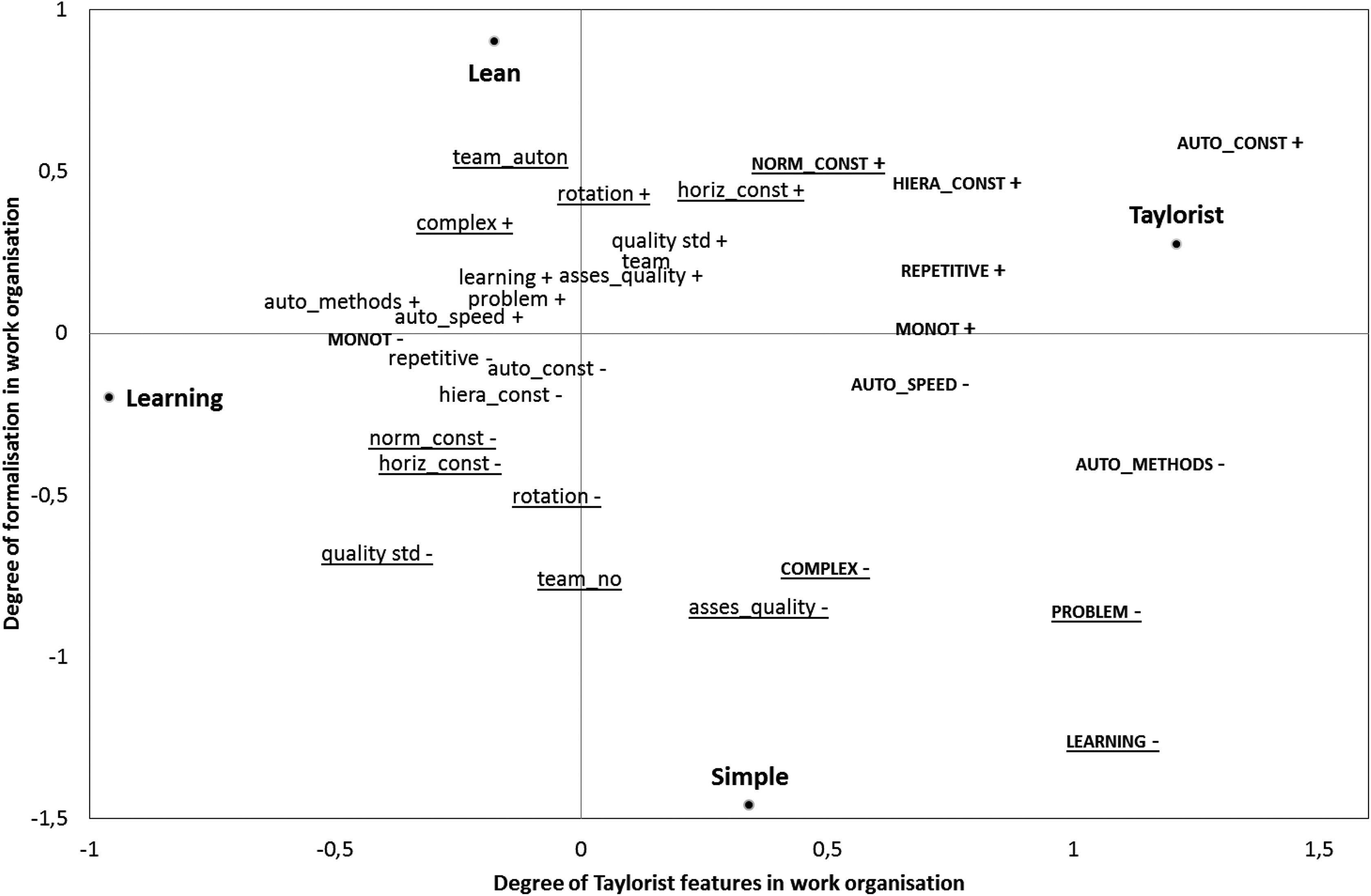
Forms of work organisation in Denmark, Finland, and Sweden (EWCS 2000–2010).
Positive values in the first dimension are associated with a low level of autonomy in methods of work and speed of work, different constraints (automatic, hierarchical and norm-based) of work pace, monotonous and repetitive tasks, and a low level of learning and problem-solving activities. Thus, positive values in the first MCA dimension indicate a growing degree of Taylorist features in the work setting. In contrast, negative values in this dimension are associated with the forms of work organisation emphasising employee discretion and learning.
The positive values for the second dimension are characterised by horizontal (work done by colleagues) and norm-based (production and performance targets) constraints of work pace, task rotation, autonomous work teams, and, to a lesser extent, the complexity of tasks. Lack of quality standards and quality management coupled with a lack of learning and problem-solving activities characterise the negative values in the second dimension. We interpret this dimension as measuring the degree of formalisation in work organisation characteristic to the lean forms of work organisation (see Valeyre et al., 2009). By formalisation we mean organisational control over the individual (see Hall, 1996: 65). Compared to Tayloristic control methods, the degree of formalisation describes the types of managerial control applicable to knowledge work and enabled by increasing use of computers and information and communications technology. Positive values in the second dimension correspond to a high level of work formalisation, and negative values are associated with simple or traditional forms of work organisation.
The results from our analysis correspond closely to the results obtained in earlier research using the same methodology (see Arundel et al., 2007; Holm et al., 2010; Valeyre et al., 2009). However, there are some interesting differences. The most notable difference is that in our results, learning and problem-solving activities and task complexity contribute to both dimensions derived from MCA. In earlier studies, these variables loaded only to the first dimension, measuring the extent of Taylorism versus new forms of work organisation. This divergence in results comes from the fact that we have included the public sector in the analysis. A second discrepancy derives from the first: the position of work organisation types in two-dimensional space defined by the first two dimensions from MCA is somewhat different compared to previous studies. The position of work organisation types is near to the axes defining the dimensions, not the corners. However, this positioning is close to the result obtained in the first paper applying this methodology (Lorenz and Valeyre, 2005) and more in line with theory. When we repeated our analysis with only the private sector, the results from MCA and cluster analysis were nearly identical with previous ones.
Deriving a typology for forms of work organisation
Next, we focus on the prevalence of types of work organisation in the three Nordic countries and the differences between sectors. Following the two-phase methodology of Lorenz and Valeyre (2005), we continue our analysis with the scale values of the first two dimensions from MCA used as a basis for clustering individuals into distinct types of work organisation using hierarchical cluster analysis. A four-cluster solution was chosen, since there was a steep rise in cluster distance coefficients as the amount of clusters decreased from four to three. Until the four-cluster solution, there was only a gradual increase in distance coefficients. This means that we are combining increasingly more dissimilar clusters and individuals as the amount of clusters is decreased to three or less.
The four clusters derived from hierarchical cluster analysis match well with the classification of work organisation types from earlier studies (Holm et al., 2010; Valeyre et al., 2009). Based on Figure 1 we name these types as Lean, Simple (or traditional), Discretionary Learning, and Taylorist types of work organisation, as in previous studies. The differences between these types in individual measures of work organisation are presented in the online supplementary Table 3. The type of work organisation we label as Taylorist is characterised by a low level of autonomy, monotonous and repetitive tasks, meeting precise quality standards, and different constraints of work pace, especially those related to automatic speed of machine or product movement. These features adhere to the classical Taylorist model of production. The Lean model is associated with a high prevalence of autonomous teamwork, task rotation, and assessing the quality of one’s own work. The level of employee discretion and learning possibilities, especially solving complex tasks, is relatively high in the Lean model. Similarly to the Taylorist model, the Lean type is also associated with meeting precise quality standards and work-pace constrains. However, in the Lean model constraints derive mainly from production and performance targets and work done by colleagues. The Discretionary Learning type of work organisation is characterised by lack of work-pace constraints and quality assessment, and a high prevalence of employee autonomy and learning possibilities. The Simple form is, in turn, associated with low levels of learning possibilities coupled with low level of work-pace constraints and quality assessment. The share of each type of work organisation between 2000 and 2010 in the public and private sectors in each country is presented in Table 1. There is a statistically significant difference between sectors in frequency of work organisation types in all three countries in 2010. In all countries, learning forms of work organisation are more common in the public sector and Taylorist forms in the private sector. In addition, simple forms are more common in the private sector in Denmark and lean forms in the public sector in Finland. When we compare countries, we also find significant differences within sectors. These differences are found mainly in the share of learning and/or Taylorist forms of work organisation and are identical in both sectors. Learning forms are clearly more common, and Taylorist forms are more uncommon in Sweden and Denmark in both sectors when compared to Finland. These differences are quite notable and large, especially with regard to the private sector. This indicates that the general form of work organisation is quite different in Finland; that is, the new forms associated with productivity and innovation are not as common as in other Nordic countries.
The Prevalence (%) of work organisation types by country and sector between 2000 and 2010.
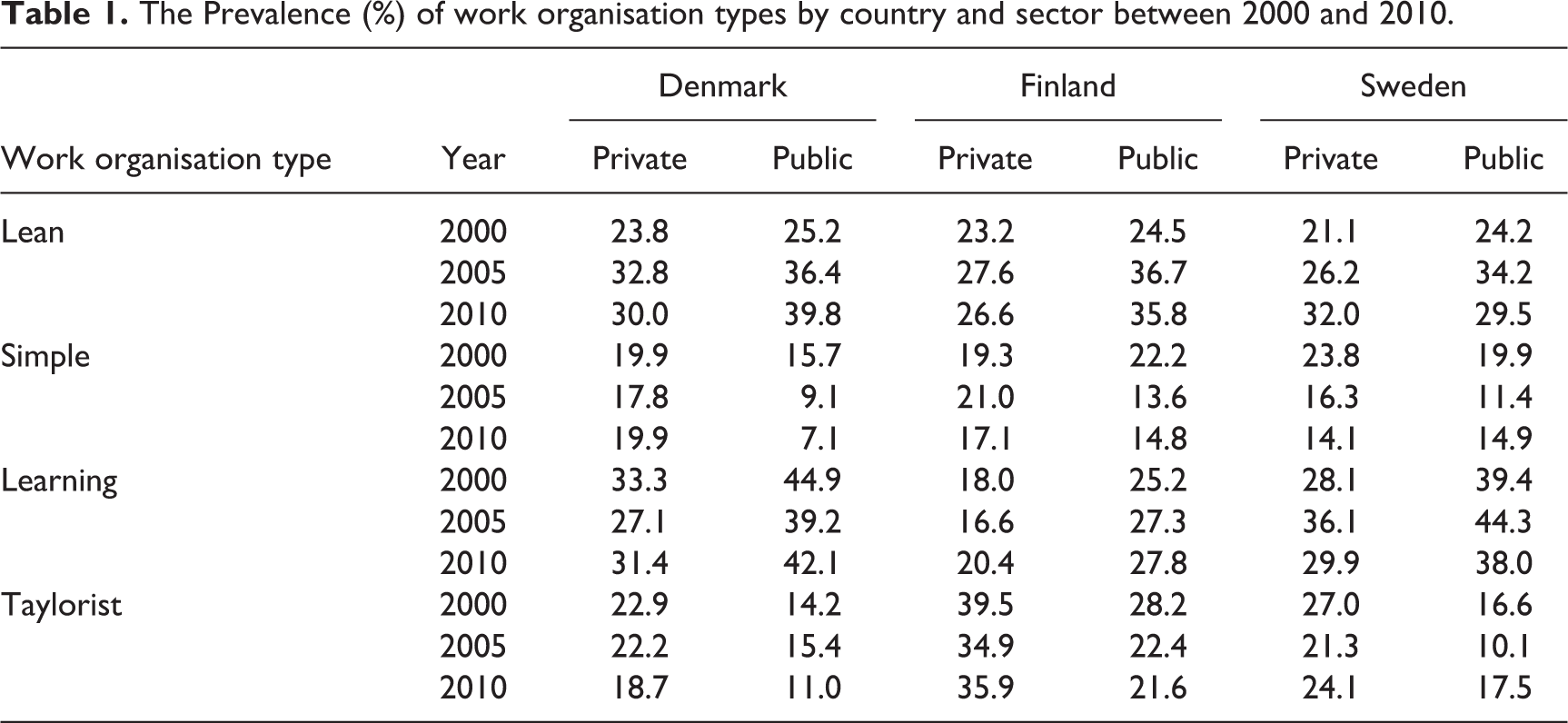
There seems to be a general increase in the lean form of work organisation across sectors and countries (see Figure 2). The strength of this trend varies considerably between countries and sectors. Interestingly, the prevalence of the lean form was quite similar in all countries and sectors in the year 2000, after which differences emerged. In particular, the Finnish private sector stands out from the rest by its small increase in lean forms compared to all other sectors. By contrast, the share of the learning form of work organisation changed little during the whole observation period. The prevalence of the Taylorist form decreased somewhat in most countries, with the Swedish public sector being the only exception. Paralleling the increasing trend of lean forms, we observe a general decline of simple or traditional forms of work organisation. The only exception has been the Danish private sector, in which the share of simple forms stayed at a high level during the whole decade.
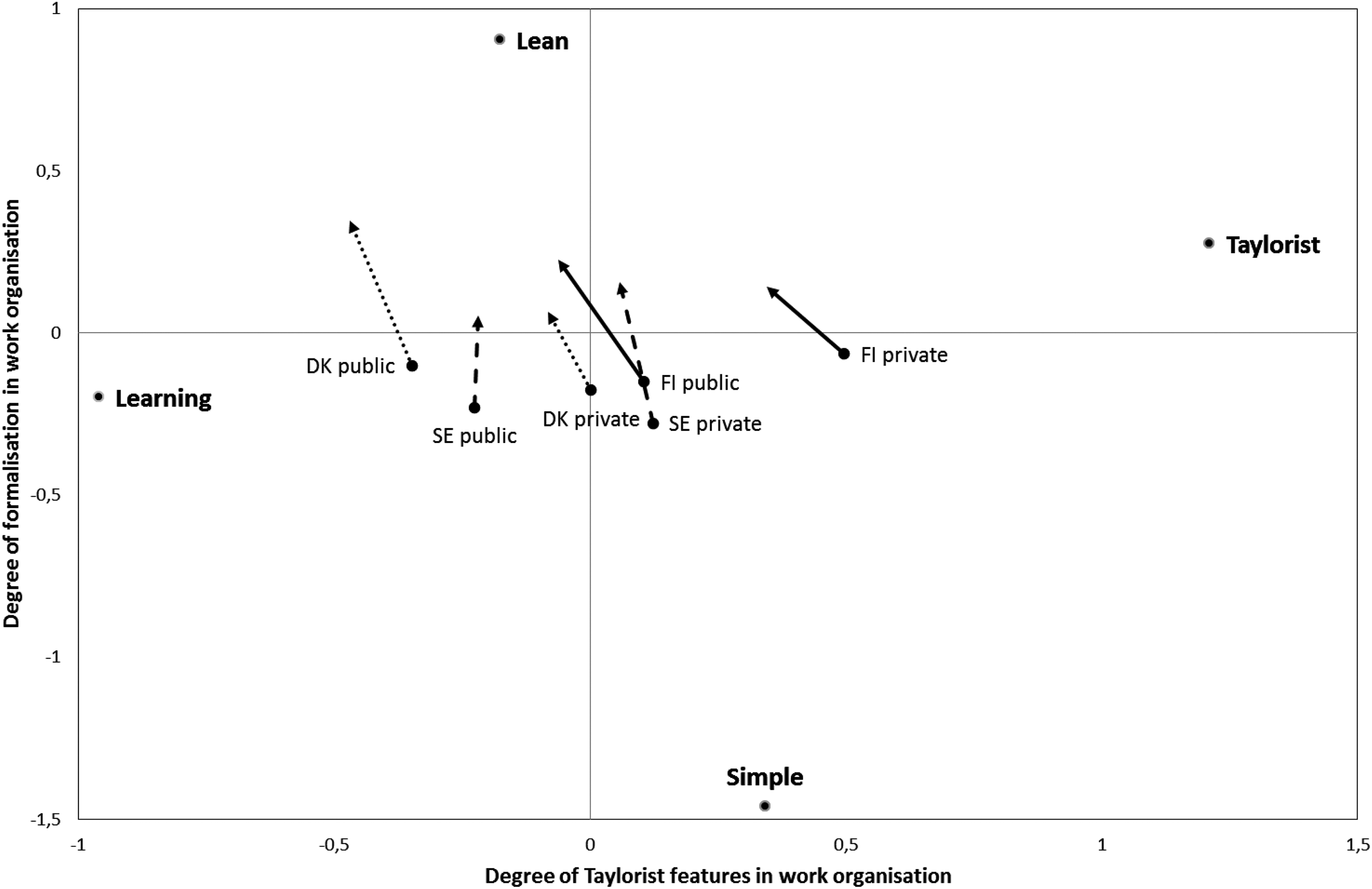
Changes in work organisation by country and sector between 2000 and 2010 (EWCS).
Multivariate analysis
Next, we use regression analysis to address which factors contribute most to the differences between countries and sectors in work organisation. The analysis incorporates the first two dimensions from MCA. Country and sector are the main independent factors in our analysis. Also, the general trend in both dimensions is investigated, and divergence from this general trend will be addressed via cross-product terms of country and sector with survey year. The survey year was coded using backward difference coding; that is, the coefficients represent changes between each pair of adjacent survey years (2000–2005 and 2005–2010). We use occupation, industry, age (centred to mean), gender, job tenure in years, and establishment size as controls in the sequential models. The prevalence of different forms of work organisation depends on structural factors, especially industry and occupation (see online supplementary Table 4). Thus, it is important to control for country and sectoral differences in these factors in order to obtain reliable estimates of actual differences between countries and sectors. Occupation (ISCO-88) is coded to five categories following the hierarchy of required skill level: managers, professionals, technicians, clerks and workers, and elementary occupations. For industry, we use NACE code at the 1-digit level: agriculture (A–B), mining (C–D), electricity (E), construction (F), wholesale (G), hotels and restaurants (H), transport (I), financial intermediation (J), real estate (K), public administration (L), and other services (M–Q). Job tenure in years is used as a continuous variable. Establishment size is coded to five categories: working alone, 2–10 employees, 10–49 employees, 50–249 employees, and 250 or more employees.
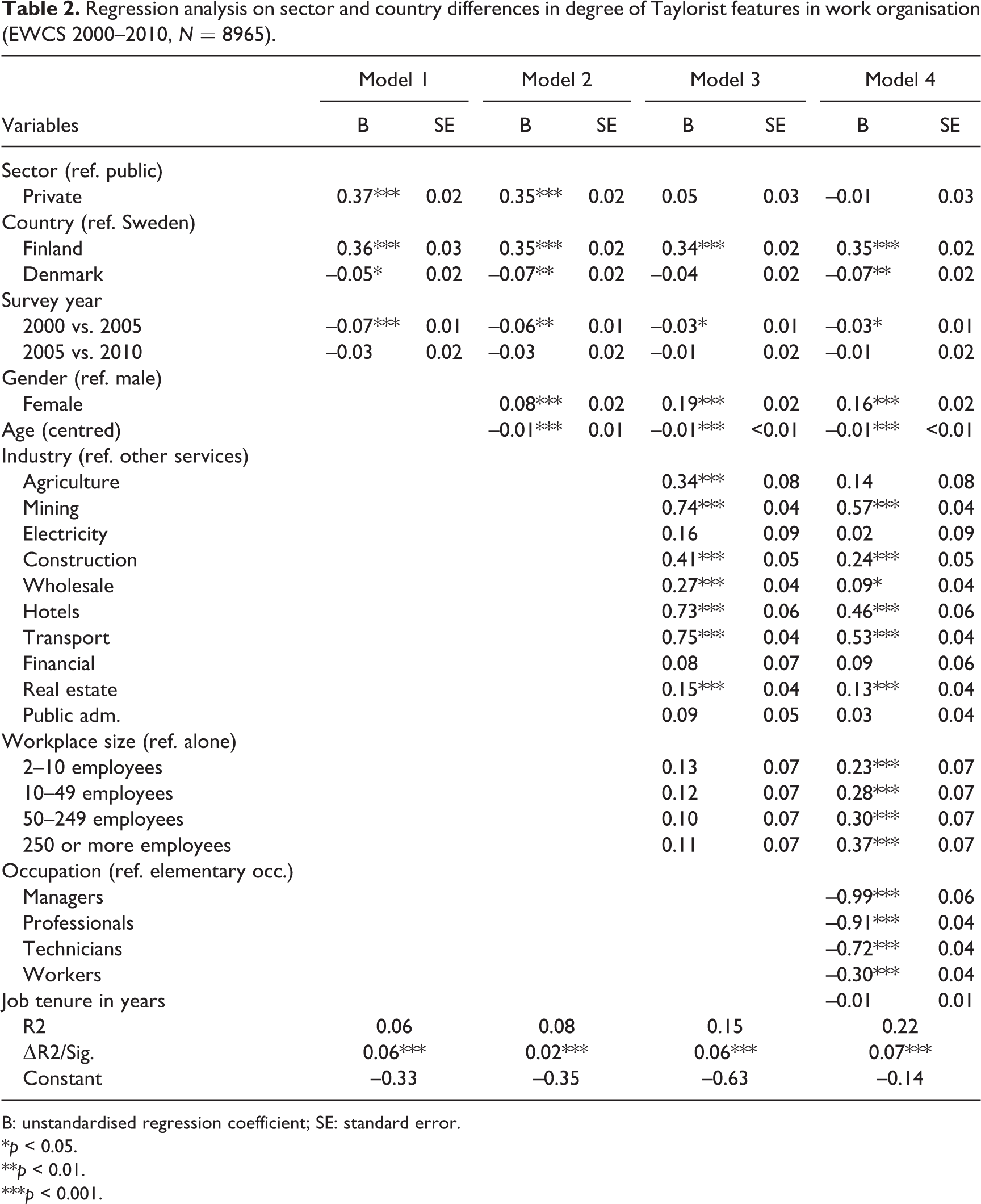
With these variables, we are trying to cancel out any structural factors that might affect the level or prevalence of work organisation forms. Industry is a somewhat problematic control variable, as some industries are highly centred on either the public or private sector (see online supplementary Table 5). Mining and quarrying, construction, wholesale, and financial intermediation are predominantly private sector (over 90% of all employees working in these industries are in the private sector). Employees in public administration, defence, and social security (96%) work predominantly in the public sector. However, since the sample size is large, there is a large enough variation to estimate public and private sector differences in the whole sample. As will be evident from our analysis, the industry variable does not account for all differences between sectors. If there remains a significant difference between sectors or countries after controls are introduced in to the models, it suggests that there is indeed real difference in how work is organised. If the opposite is true (i.e. differences diminish and become insignificant), it indicates that they were products of differences in structural factors, not in the way work is actually organised. The same logic applies to the explanation of changes in trend coefficients between models. Results for the first MCA dimension are presented in Table 2 and for the second dimension in Table 3.
Regression analysis on sector and country differences in degree of Taylorist features in work organisation (EWCS 2000–2010, N = 8965).
B: unstandardised regression coefficient; SE: standard error.
*p < 0.05.
**p < 0.01.
***p < 0.001.
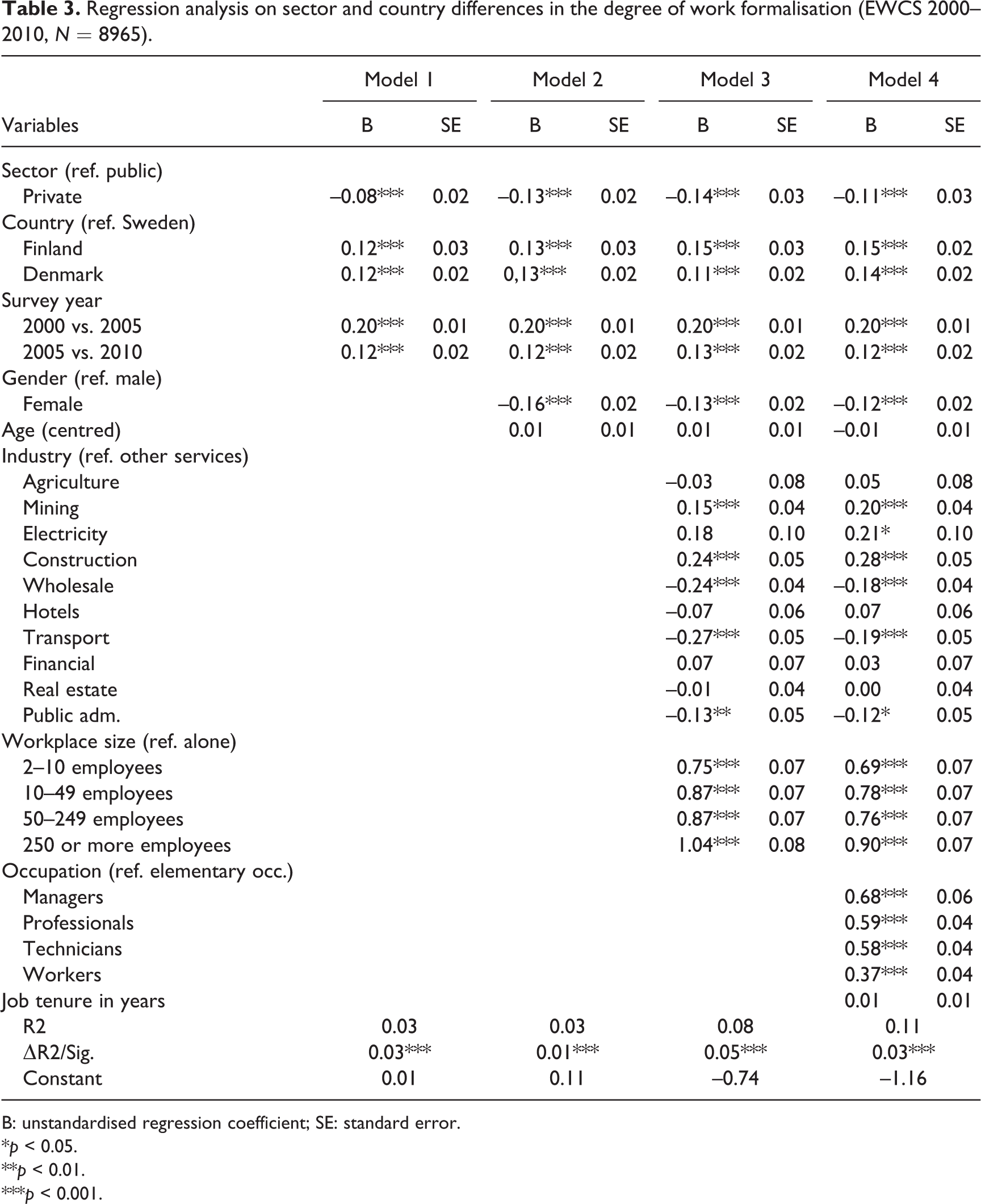
Regression analysis on sector and country differences in the degree of work formalisation (EWCS 2000–2010, N = 8965).
B: unstandardised regression coefficient; SE: standard error.
*p < 0.05.
**p < 0.01.
***p < 0.001.
In Table 2 we can see that the relatively large difference between the public and private sectors in the degree of Taylorist features of work organisation disappears when industry is introduced to the model. The decrease in coefficient is considerable, from 0.37 (model 1) to 0.05 (model 3). Thus, the higher prevalence of Taylorist features in the private sector is caused by differences in industry (i.e. if we compare public- and private-sector employees working in the same industry, we find no difference with regards to the degree of Taylorist features in the work organisation).
Looking at country differences, the higher degree of Taylorist features in Finland compared to Sweden is not explained by any of the structural factors. In addition, the Taylorist features of work organisation are rarer in Denmark than in Sweden, and this difference stays virtually the same when structural factors are controlled for. Thus, the differences between countries reflect more or less real differences in the ability to adopt new innovative and productive forms of work organisation. Finland seems to be lagging behind Sweden and especially Denmark in this regard.
Between 2000 and 2005 there was a significant decrease in the prevalence of Taylorist features of work organisation (or increase in learning- and discretion-based models), as the coefficient for time trend is negative. After 2005 the level stayed virtually unchanged. The decrease in Taylorist features between 2000 and 2005 seems to be almost entirely a product of change in the structural features of the work force, mainly the industrial structure. There was also a statistically significant interaction effect between country and survey year. In Figure 3 we present the marginal means for the degree of Taylorist features by survey year and country adjusted for all structural factors. As is evident from the figure, the negative trend of Taylorist features in work organisation was most consistent in Finland during the whole observation period. In Denmark there was a significant decrease in Taylorist forms only between 2005 and 2010. However, for Sweden we find a clear increase in Taylorist forms between last two survey years (2005 and 2010). Thus, the prevalence of Taylorist types of work organisation has decreased in Denmark and Finland, but increased somewhat in Sweden during the later years. This indicates some degree of convergence between Finland and Sweden in work organisation. However, Taylorist features are still more common in Finland than in the other two countries.
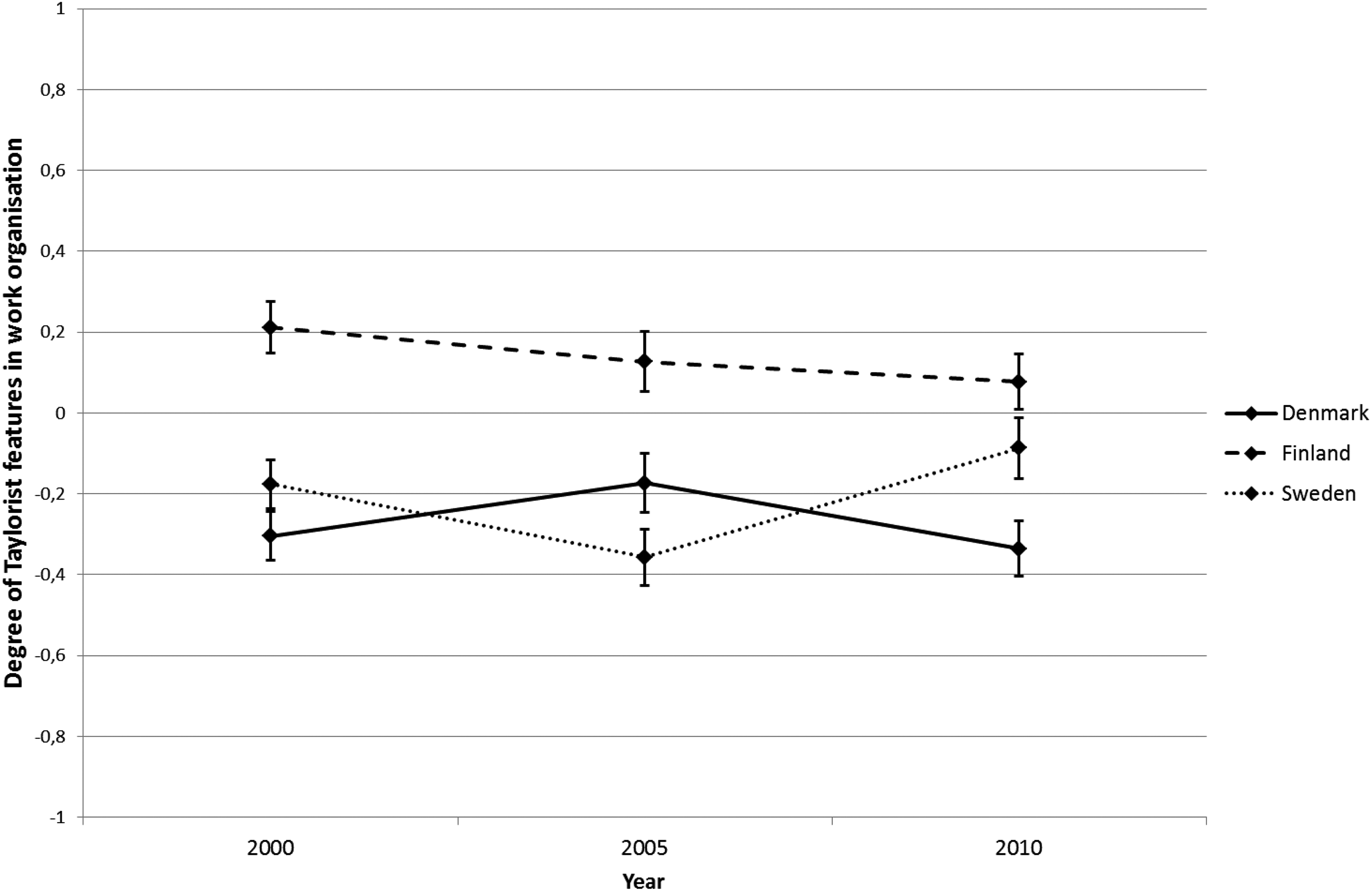
Change in the degree of Taylorist features in work organisation by country (EWCS 2000–2010).
Results concerning the effect of covariates follow the same line as in previous studies with regards to the private sector (see Lorenz and Valeyre, 2005; Valeyre et al., 2009). Women and younger employees work more often in Taylorist settings than men and older employees. Characteristics of the new (learning- and autonomy-based) forms of work organisation are common in the electricity, gas and water, and financial sectors. However, public administration and other services score highest in the adoption of new forms of work organisation and are predominately situated in the public sector. By contrast, the degree of Taylorist features in work organisation is at a high level in hotels and restaurants, transport, and mining, all of which are heavily concentrated in the private sector. Establishment size becomes significant only after introducing occupation to the model, and the degree of Taylorist features increases as the establishment size increases. There are strong differences between occupations with regards to Taylorist features in work organisation. The higher the occupational position, the more common are new learning- and autonomy-based forms of work organisation. Job tenure had no association with the degree of Taylorist features in work organisation.
The analysis of the second dimension from MCA on the degree of work formalisation is presented in Table 3. The difference between sectors is considerably smaller in the uncontrolled model than was the case for the first dimension, but the difference increases somewhat when industry and workplace size are controlled for. Adding occupation to the model decreases the sectoral difference near to the uncontrolled level. Thus, a negative and significant coefficient for the sector dummy indicates that work formalisation is more prevalent in the public sector, even after controlling for sectoral differences in structural factors. This finding indicates that the lean type of work organisation has been adopted widely in public-sector organisations and is currently at a higher level than in the private sector.
Differences between countries stay virtually unchanged after introducing controls to the models and thus indicate a ‘real’ difference in the way work is organised in these countries. Positive coefficients for Denmark and Finland indicate that formalisation of work (i.e. features especially characteristic of the lean model of work organisation) is more common in these countries compared to Sweden.
The general trend of work formalisation is more evident than was the case for the first dimension (the prevalence of Taylorist features). The significant positive coefficients between each pair of adjacent survey years point to a clear increase in work formalisation (i.e. the lean type of work organisation), and this increase is not explained by any of the structural factors. Thus, features that are characteristic of the lean mode (i.e. increased control and monitoring of work) have increased during the whole observation period.
There was a statistically significant third-order interaction of country, sector, and survey year with regards to work formalisation. This effect can be interpreted as differences between countries in how sectoral differences in work formalisation have evolved. A more detailed analysis indicates that the two-level interaction of survey year and sector is significant only in Finland. Hence, there was a difference between the public and private sectors in the development of work formalisation in Finland. In Denmark and Sweden both sectors have followed more or less the same pattern. Figure 4 presents marginal means for prevalence of work formalisation by survey year, country, and sector, adjusted for all structural factors. In Denmark the difference between the public and private sector has increased slightly during the observation period and in 2005–2010 work formalisation was more prevalent in the public sector. In both sectors, work formalisation has increased significantly during 2000–2005, especially in the public sector, but has remained virtually the same after that. In Finland, the difference between sectors was largest during 2005, but has diminished and become non-significant after that. This was caused by the fact that work formalisation increased more strongly in public sector, paralleling the development in Denmark. However, after 2005, work formalisation continued to increase in the Finnish private sector but decreased somewhat in public sector. By contrast, in Sweden the sectoral differences have been minimal and non-significant during the whole observation period. There has been a steady increase in work formalisation in both sectors between 2000 and 2010 in Sweden.
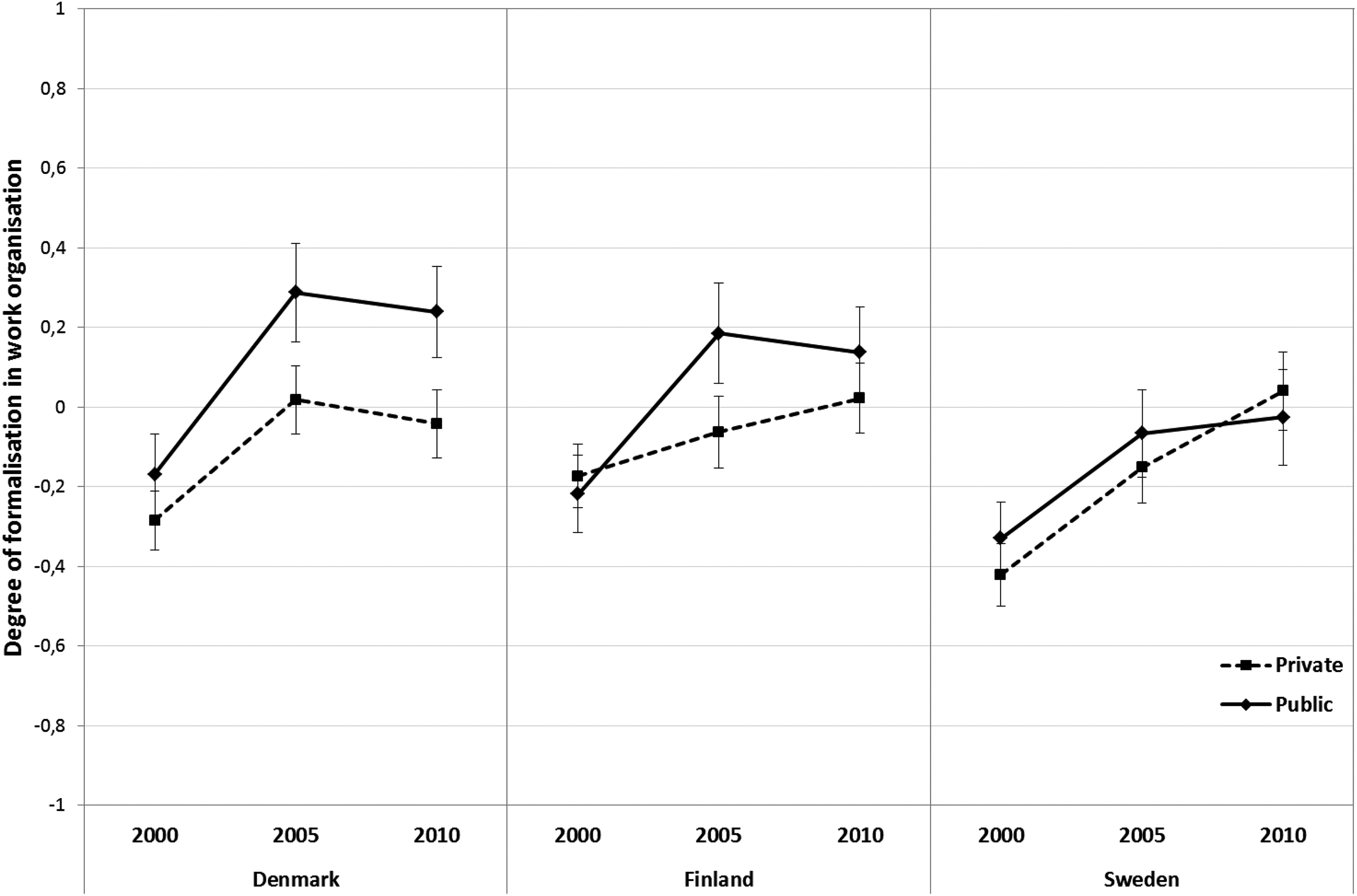
Change in the degree of formalisation in work organisation by country and sector (EWCS 2000–2010).
There were also clear differences between background factors in the degree of work formalisation. Men and younger employees worked in a more formalised work setting. As found in previous studies (Lorenz and Valeyre, 2005; Valeyre et al., 2009), work formalisation was most common in construction, mining, quarrying, and manufacturing, and also in electricity and gas and water supply. There was a clear tendency of an increase in the degree of work formalisation as the establishment size increases. Again, work formalisation became more prevalent in upper occupational groups. Job tenure had no association with the degree of work formalisation.
Discussion
Our results show that in both the public and private sector there is a move away from the use of forms of work organisation characterised by high levels of learning and autonomy to more constrained or formalised forms in which the employee’s capacity for exploring novel knowledge as a basis for new solutions in daily problem-solving activity is curtailed. This finding is contrary to our first hypothesis (1) and gives support for the alternative hypothesis (2). Similar experiences have been reported by scholars of public administration. The public-sector case studies from Norway (Torsteinsen, 2012), as well as from the UK Civil Service (McSweeney, 2006), indicate that post-bureaucratic reforms, characteristic of NPM programmes, often lead to the paradoxical result of more formalisation. Thus, NMP policy programmes for downsizing public bureaucracies may result in the expansion of management bureaucracy (see Hall, 2013; Hood and Peters, 2004).
It might seem surprising that discretionary learning forms are not increasing. On the one hand, according to previous studies, these types of work organisation in Nordic countries were already at the highest level in European private-sector comparisons, which has been largely explained by the distinctiveness of the Nordic labour market regime. On the other hand, research has not been able to confirm that, for example, labour market policies are linked to new forms of work organisation; but rather, that a changing economic climate would explain the changes in organisation of work (Holm and Lorenz, 2015): in times of economic contraction, firms tend to employ strategies that focus on the short term, such as cutting costs and decreasing discretion to achieve higher accountability of costs (by tightening up control over employee effort). Our results do not fully support this thesis either, as the use of lean-inspired management methods involving standardisation and limited autonomy increased during the period of economic growth in 2000–2005.
Another possible avenue for understanding the trend of work formalisation is to consider how technological change is affecting both structure of the labour market as well as how managerial strategies mould the organisation of work. Over the period under study, there has been an increase in ‘knowledge work’, described also as a structural change of the labour market towards job upgrading in the Nordic countries (Eurofound, 2013, 2014). Assuming that low-skilled jobs that are being destroyed correspond largely to traditional and Taylorist work organisation, it is surprising that this type of work organisation has not declined more (or that this process of structural change might explain the decline in traditional forms of work organisation instead of organisations developing and implementing new forms of work organisation). Yet, it does not explain why discretionary learning forms have not increased (if high-skilled jobs represent the job creation potential).
The trend of increasing formalisation might actually correspond to the increasing use of personal computers, the Internet, and email in the workplaces. The use of computers increased sharply between 1995 and 2005, especially in lower and upper white-collar jobs, and was associated with declining autonomy (Eurofound, 2008). In addition, Eurofound (2016) researchers, Fernandez-Macias and Bisello, found that, paradoxically, while there is a decline in routine jobs, there is a clear trend towards increasing standardisation, routine, and repetitiveness across occupations. And, in fact, standardisation and formalisation at work seem to be concentrated in occupations that have not traditionally been associated with such a kind of work: managers, professionals, and clerical occupations are among the occupational groups that report the largest increases in the levels of routine. Increasing use of computers can both facilitate and require a further standardisation of labour input and output. Use of computers, software, and related technology also transfers tasks within organisations, for instance from administration to experts and professionals.
If the degree of Tayloristic work organisation represents the methods of control developed for manufacturing, and more lately to clerical office and service work, the degree of formalisation may be understood as methods of managerial control suitable to be applied in knowledge work performed by higher-skilled employees. Thus, the trend of formalisation may be understood as increasing the need of managerial planning and following and controlling new types of work tasks. In other words, technology is used to increase the accountability of (knowledge) workers. Applying purely discretionary learning forms of work organisation would entail high levels of trust and employee leeway. However, at the organisational level, market mechanisms may be considered far better (Kasvio et al., 2012). This is one reason why rationalisation and the various ways of increasing employee accountability that are represented under the ‘lean’ type of work organisation are so appealing, and why they are increasing, especially in the public sector.
However, contrary to our hypothesis (3) we find no evidence for a general convergence of the public and private sectors in the forms of work organisation in Nordic countries. Instead, we found a general trend towards work formalisation. In fact, formalisation was even more evident in the public sector.
Interestingly, Radnor and Osborne (2013) have stated that ‘lean thinking’ has recently become a prominent and popular approach in public-service reform. The core idea of the lean concept is effective resource management achieved with a flow-based production layout, reducing waste and increasing standardisation (Hall, 2013; Hvidman and Calmar Andersen, 2014; Sederblad, 2013). In the situation of constrained public spending, lean thinking has been promoted as a way of helping to maintain service quality and at the same time even increasing service productivity and improving resource utilisation (Björkman, 2013; Laursen et al., 2003). Indeed, Sederblad (2013) identified a ‘second wave’ of lean management in Nordic countries also in the public sector.
In general, it seems certainly plausible that together with increasing competitive pressures and pressures for increasing efficiency in the public sector, an increasing use of performance benchmarking and quality management systems, facilitated by the use of technology across most economic activities (including the public sector), would be related to the reported formalisation of work.
We acknowledge that there are limitations regarding our data and analysis. First, the typologies of work organisation derived from our analysis are theory-driven constructions representing the main types of work organisation. Thus, they do not present all available types of work organisation found in working life. However, this typology serves well as the means of comparing the general differences between private and public sector in work organisation. Secondly, with the EWCS dataset we are restricted by the relatively small sample size. We are not able to examine in detail, for example, how various occupations within both sectors differ from each other in the prevalence of work organisation types. This would be an important topic for further studies but clearly requires a larger dataset. Despite these limitations our study is the first to apply this methodology to both the private and public sector with representative national samples and to show that there was a general trend towards work formalisation in both sectors in all Nordic countries.
Supplemental material
Supplementary_material - Towards formalisation: The organisation of work in the public and private sectors in Nordic countries
Supplementary_material for Towards formalisation: The organisation of work in the public and private sectors in Nordic countries by Timo Anttila, Tomi Sakari Oinas and Armi Mustosmäki in Acta Sociologica
Footnotes
Funding
The author(s) disclosed receipt of the following financial support for the research, authorship, and/or publication of this article: This work was supported by the Finnish Work Environment Fund and the Academy of Finland (grant number 277376).
Supplemental material
Supplemental material for this article is available online.
References
Supplementary Material
Please find the following supplemental material available below.
For Open Access articles published under a Creative Commons License, all supplemental material carries the same license as the article it is associated with.
For non-Open Access articles published, all supplemental material carries a non-exclusive license, and permission requests for re-use of supplemental material or any part of supplemental material shall be sent directly to the copyright owner as specified in the copyright notice associated with the article.
