







Abstract
This paper studies dynamically the direct effect of social origin on occupational destinations among men in Italy over the career. It aims at investigating the existence, the pattern over time and the heterogeneity of differences in occupational achievement related to social origins, net of education (DESO) and occupational allocation at first job. It also analyses if the change of the DESO over the career is related to the effect of specific job change episodes (voluntary job change, involuntary job change, internal career move). Results based on growth curve models show the relevance of first job in shaping the DESO, which also slightly increases over the career. The DESO is stronger among highly educated individuals, confirming a boosting pattern primarily driven by a better allocation at first job. The (smaller) DESO among the low-educated, increasing over the career, depends from the higher probabilities to benefit from voluntary and internal career job changes for the children of the service class. The (stronger) DESO among the highly educated is driven by the higher probabilities of experiencing internal career mobility for the children of the service class as well as by their ability to benefit also from an involuntary job change (e.g. dismissal).
Introduction
Research on social stratification and mobility has extensively focused on a number of substantive questions concerning the so-called O-E-D triangle, that is, the relationships between social origins (O), education (E) and occupational destinations (D) (Blau and Duncan, 1967). While much work has been devoted to the OE association (inequality of educational opportunities) and to the ED association (returns to education), less attention has been given to the OD|E association, that is, the direct effect of social origins on occupational attainment, net of education (hereforth, DESO).
Recently, however, a number of studies have looked at the latter association, showing that, contrary to the predictions of modernization theory, family background is still substantially associated to occupational achievement and wage, even when education is controlled for, and that the association does not decrease over cohorts (Bernardi and Ballarino, 2016). This is a negative indicator of the societal movement towards a modern and more efficient mechanism of occupational allocation, based on merit. Indeed, the more the occupational allocation relies solely on achieved traits such as education and job experience, the less it relies on family background or on other ascribed traits, making society more meritocratic (Marks, 2014). This is the way the DESO is treated in arguments such as the ‘increased merit selection’ hypothesis (Jonsson, 1996), the ‘education-based meritocracy’ thesis (Goldthorpe and Jackson, 2007) or the ‘education as the great equalizer’ thesis (Torche, 2011).
Thanks to the greater availability of panel data, a recent wave of research provided more reliable estimations of the effect of social origins on occupational achievement, analysing the whole process of career development as well as the social mechanisms producing it (Gugushvili et al., 2017; Mills et al., 2008; Passaretta et al., 2018). This approach helps to make a step forward in the social stratification literature, which usually studies the intertwinement between intergenerational and intragenerational mobility by comparing the first and the last job, thus treating careers as a ‘black box’ (Barone and Schizzerotto, 2011).
This paper gives a threefold contribution to this literature. First, by means of a dynamic analysis of the direct effect of social origin on men’s occupational achievement over the career in Italy, it investigates if differences shaped by social origins at labour market entry increase, decrease, or remain stable over the career, and if such patterns of the DESO differ according to education. Second, it adds to the literature a direct investigation of the role of the first job as a mediator of the association between origin and destination, since the allocation of individuals at labour market entry is crucial to explain subsequent career patterns and their stratification by social origin. Third, it analyses if the (possible) change of the DESO over the career might be related to the different effects of specific job changes on the career of individuals from different social origins. The question is whether a voluntary or involuntary job change, as well as a career move within the same organization, might affect career patterns and the differences by social origins therein. More generally, our study asks if cumulative advantage patterns prevail with respect to compensation patterns and discusses the implications of results for the social mechanisms underlying the DESO. Italy is an interesting case in point, since comparative studies found the country to have both a relatively low occupational mobility (Barone et al., 2011) and a relatively high DESO (Ballarino et al., 2016a).
Mechanisms producing advantage
The literature has singled out a number of mechanisms underlying the direct effect of social origins on occupational achievement, besides education (Erikson and Jonsson, 1998). First, the advantage of the children of the upper classes, net of education, may be driven by higher productivity, in turn related to non-cognitive skills (e.g. communication skills) or personality traits (e.g. assertiveness, self-confidence, capacity to work in a team), which are acquired in the family of origin and well rewarded in the labour market (Bourdieu, 1979). Second, persons from socio-economically advantaged families are likely to have access to contacts who can assist them in securing better positions in the labour market (Lin, 1999). Third, persons from high social origins may be more career-oriented and more willing and able to take risky choices that will pay off in terms of higher earnings later in the life course, especially to avoid social demotion (Breen and Goldthorpe, 1997; Erikson and Jonsson, 1996). Fourth, employers may prefer to hire for better jobs applicants from socio-economically advantaged families, all other conditions, including productivity, being equal (Jackson, 2009). Finally, inheritance of parental resources, be it of wealth or of the family business, as well as gifts and favourable borrowing, can help the children of high-status individuals, in particular employers and professionals, to set up their own businesses and thus improve their occupational and earnings prospects (Bernardi and Ballarino, 2016).
These mechanisms might contribute to the existence of a direct effect of social origin on achievement over and above education: social origin makes a difference in the occupational achievement of individuals with the same educational level. However, it is less clear how the DESO evolves over the career, from the first entry into the labour market towards the ensuing working career. This paper analyses this issue considering also the interaction between social origin and own education, with the aim of establishing whether the DESO over the career is stronger among the most educated or less educated. Moreover, it also explores the role of three types of job episodes, such as a voluntary change work, involuntary change (due to dismissal or end of contract) and an internal career step within the same organization. How can these episodes shed some light on the mechanisms underlying the DESO over the career? Next sections address these issues, pointing out a set of research hypotheses.
The patterns over the career of the DESO
We know from previous research that most occupational advantage for those coming from high social origins already appears at labour market entry, in Italy (Barone et al., 2011; Passaretta et al., 2018) as elsewhere (Härkönen and Bihagen, 2011; Manzoni et al., 2014; Wolbers et al., 2011). This might be related to the importance of social networks, favouritism and the direct transmission of inheritance in this early stage of the occupational career; mechanisms which are largely independent from the individual’s productivity, as the latter is hardly observed during the hiring process. Our first hypothesis then underscores the importance of labour market entry for inequality of occupational achievement, suggesting that a substantial component of the DESO already appears at this early career stage (H1).
While this hypothesis is supported by most of the literature, less is known about the trend of the magnitude of the DESO during the career. The question is whether the advantage provided by social origin at the first entry decreases or remains stable over the life course. A first scenario is that initial gaps for individuals from socio-economically disadvantaged families may get smaller over the occupational career (H2a, merit compensation hypothesis). This hypothesis assumes that the labour market in its aggregate working is at least to some extent meritocratic, as in a market economy competition pressures firms towards efficiency. While mechanisms related to familiar networking, favouritism and direct transmission of resources might be effective at the beginning of the career, when the actual ability and effort of workers are not easily observed, they might become less important over the career, when employers are able to observe an individual’s actual productivity in the workplace. Once established in the labour market, thus, individuals from socio-economically disadvantaged families might compensate for the early ‘bad’ entry due to non-merit-based selection.
However, different scenarios might be envisaged, in which merit-related compensation mechanisms are not as strong as the family-related mechanisms producing advantage when entering the labour market. Hence, differences by social origins shaped at labour market entry may remain stable over the career. This hypothesis might fit particularly well in those contexts, as the Italian one, where career mobility is quite low. Therefore, in this case (H2b, persistent advantage hypothesis) career opportunities – and the differences therein – are fully explained by the first entry in the labour market (Erola, 2009; Warren et al., 2002).
However, differences among groups might even increase over the career (H2c, cumulative advantage hypothesis). This might be the effect of different mechanisms. For instance, the advantage of better-off individuals may increase over time, since career processes are strongly affected by previous achievement, according to the ‘tournament model’ of careers (Rosenbaum, 1979). In this case, the family effect on the first job turns immediately into a cumulative career advantage. On the other hand, the disadvantages of the lower classes might increase over the career, since they remain trapped in the lowest strata of the occupational structure, leading to an increase of the gap between individuals with different social origins.
Education and the DESO
The direct effect of social origin might also differ over individuals with different educational titles (Bernardi and Ballarino, 2016). As some authors have found no DESO among those with a better education (Hout, 1988; Torche, 2011), it is argued that the labour market for the more educated is a more meritocratic one – perhaps as it is more competitive – while family of origin still has some impact on the careers of the less educated, giving to those with a better family background a supplement of resources to be invested in order to compensate for the educational disadvantage.
More generally, according to the concept of compensatory advantage (Bernardi, 2012, 2014), families would provide more resources to those of their members who are more in need, in this case because of a weak school career. When their own educational achievement is low, individuals from the upper class can rely on their families’ material and immaterial resources in order to avoid low-level occupations and downward social mobility. In general, low-educated children of high-status families have often a second chance provided by their parents (Breen and Jonsson, 2000; Jacob and Tieben, 2009). According to such arguments, a higher DESO might be expected among the low-educated individuals (H3a, family compensation hypothesis). 1
Conversely, other mechanisms might act in the opposite way, by favouring those with both a good family background and a good education. Indeed, socio-economically advantaged families might choose to concentrate their resources not on their children who are more in need, because of their weak educational career, but on those whose good educational performance assures a better return to their investment. Hence, they might be more likely to give an extra push to their children who are good students, so that the DESO cumulates to the effect of education according to a ‘boosting’ pattern, which has been indeed observed concerning wages (Bernardi and Ballarino, 2016). If this is true, we should expect a higher DESO among the highly-educated (H3b, family boosting hypothesis).
Social origins and job changes
We come now to the third part of our work, concerning how the DESO works in the case of job changes. Since an occupational career is a succession of occupational episodes (Mayer and Carroll, 1987), it is likely that the evolution of the DESO over the career might be mediated by the occurrence of different types of episodes, such as voluntary job change, involuntary job change, or internal career (i.e. a change of job within the same organization). However, previous research on careers has neglected the role of job episodes in shaping individual careers and the effect of social origins on occupational destination therein.
Our hypothesis is that a DESO exists also in this case, as the family-related mechanisms discussed above are at work during the transition from one job to another, whichever the transition is. In general, networks, favouritism and soft skills make it easier to find a new job, inheritance enables one to start a brand new business or simply acts like a buffer while waiting for the right job to be found, while higher motivation is likely to push people with a better family background to put more effort in their job search, in order to avoid the risk of social demotion. Thus, we first expect persons with an advantaged social origin to be more likely to experience job change episodes (H4a). From the point of view of the career outcomes, our expectation is that changing a job, either voluntarily or involuntarily, may be on average associated with a subsequent improvement of the occupational status more for those coming from the upper classes, even controlling for education (H4b).
Finally, concerning the heterogeneity over educational levels of this advantage, we expect to find a compensation pattern: among those with a better social origin, we expect it to be particularly strong for those with lower educational background (H5a) and for those who are involuntarily laid off (H5b). The argument is similar to the one put forward above: family-provided purposeful support should be stronger for those who are more in need, having weak educational credentials or having been fired. Indeed, their worse situation should favour the mobilization of resources on the part of the family, particularly via mechanisms such as the transmission of information concerning job vacancies and opportunities and the elicitation of favouritism, or even the anticipated transmission of inheritance via some form of gift or transfer inter vivos.
Data, variables and methods
Data and variables
The paper used data from the most recent available wave (2009) of the Multipurpose Survey – Family and Social Actors, a sample survey conducted by the Italian Statistical Institute (ISTAT) every five years since 1998. In the 2009 wave, retrospective longitudinal information was collected on a sample of about 8,000 families and 44,000 individuals. This allowed reconstructing educational, career and family histories and creating a longitudinal yearly dataset.
The analysis was restricted to a subsample of 8,003 men born from 1930 to 1980 and who had at least 15 years of effective work experience. We followed them from their first entry in the labour market until the fifteenth year of effective work experience, truncating observations at age 15 and censoring at age 63. Episodes of unemployment and inactivity were dropped from the sample. 2 Parallel analyses were conducted on the female population, but were left to a future companion paper for lack of space, as including women would have implied an analysis of labour market participation, given the low employment rate of Italian women and its possible relations to education and social origins (see Cantalini, 2019, 2020).
The dependent variable was the Standard International Occupational Prestige Score (SIOPS, Treiman 1977). In our sample, the SIOPS score ranged from 18 (e.g. assembling labourers, miners) to 70 (e.g. civil engineers, dentists, CEOs in large firms), with an average score of 38.7 (s.d. 10.2) (e.g. customer service clerks, welders). Social origins were measured according to the parents’ social class, which was constructed using the dominance principle and operationalized by the EGP scheme. 3 Four categories were included: service class (EGP I-II), white collars (IIIab), self-employed, including farmers (IVabc), and working class (V-VI-VIIab). We also performed robustness checks with a more detailed version of social class of origin distinguishing the agricultural classes – as well as with alternative measures of social origins, that is, parental education – but results did not substantially differ.
Educational attainment was the main control variable, which was treated as a time-constant variable because we followed individuals starting from their first job after completion of studies (see below). 4 In order to have an appropriate measure of the DESO, we used the most detailed categorization of education available in the data, distinguishing respondents into six groups: illiterate or without education, primary, lower secondary, upper secondary, tertiary, and post-tertiary educated. Unfortunately, data did not include information on upper secondary track or tertiary field of study. However, previous studies have shown that even very detailed classifications of education, which also include the horizontal stratification of educational systems, do not entirely mediate the OD association, making our estimations unlikely to be driven by an incomplete measure of education (Erikson and Jonsson, 1998; Hällsten, 2013). Other time constant controls are age of entry in the labour market (year dummies), SIOPS of the first job (see below) and geographical residence at the time of the interview (North-west, North-east, Centre, South and Islands).
Among the time-varying variables, we controlled for career duration, entered as yearly dummies for labour market experience from the first job after completion of studies until the fifteenth year of actual work experience, while most previous studies on Italian career only considered 10 years of experience (e.g. Passaretta et al., 2018). We also controlled for period dummies, marital status (single or in a union) and number of children (childless, one child, two children, and three children or more). An interaction between period and region of residence was also added, which controls for heterogeneous effects related to each possible combination between calendar year and region (business cycles, unemployment rate, etc.).
Finally, we included three variables (dummies) for three types of specific job change episodes experienced during the career. We considered the following three types of episodes: (a) voluntary job changes – that is, the intended decision to change occupation; (b) involuntary job changes – that is, dismissal or the end of fixed-term employment, or the closure of firm’s activity; (c) internal career – that is, change of job position within the same organization, moving from part-time or fixed-term jobs to full-time or permanent jobs, changing job tasks, and so on.
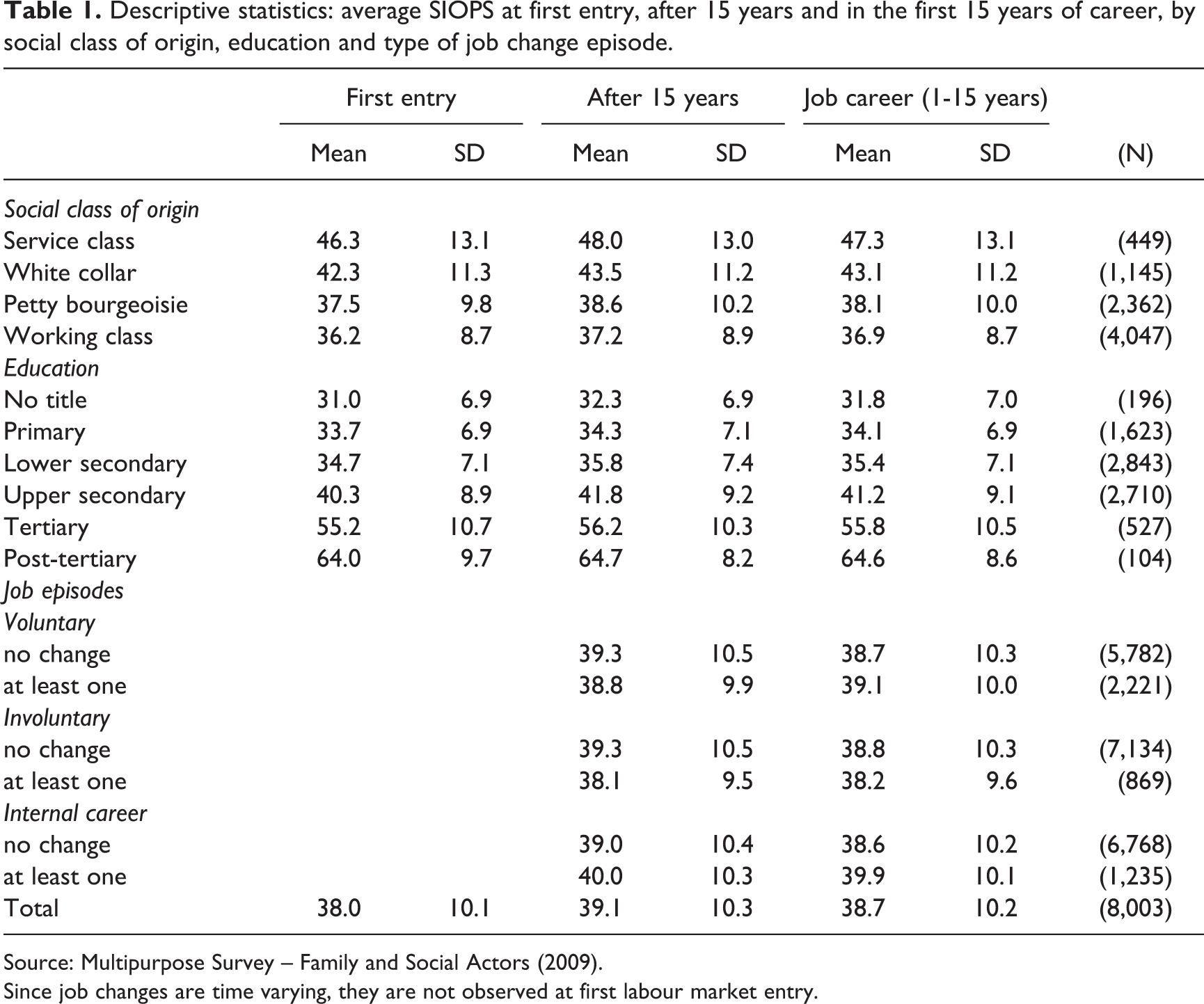
Descriptive statistics of our analytical sample are reported in Table 1.
Descriptive statistics: average SIOPS at first entry, after 15 years and in the first 15 years of career, by social class of origin, education and type of job change episode.
Source: Multipurpose Survey – Family and Social Actors (2009).
Since job changes are time varying, they are not observed at first labour market entry.
Methods and analytical strategy
We used growth curve models with random effects (Halaby 2003), which have been used to study career progression in the recent social stratification and mobility literature (see Barone et al. 2011; Härkönen and Bihagen 2011; Wolbers et al. 2011; Manzoni et al. 2014; Passaretta et al. 2018).
Our full model can be written as:

where
The empirical strategy included four steps. The first aimed at measuring both the total (TESO) and the direct effect of social origin on occupational attainment (DESO). We estimated three models: model 1 measured the total effect of social origin on occupational destination, while model 2, controlling for own education, measured the direct effect of social origin. Model 3 added the SIOPS of the first job as additional mediator, thus analysing the effect of social origins on the subsequent career, net of the SIOPS at the first entrance in the labour market (i.e. the deviation from individual’s position in the occupational hierarchy at first labour market entry). Model 3 excluded the first observation in the data (i.e. when work experience was equal to 1), in order not to have the same measure both on the right and left side of the equation.
The second part of the empirical strategy studied the variation of the DESO over the career, by adding an interaction term between yearly dummies for career time and social origin to model 2. We presented the evolution of absolute prestige scores over the career for different social origins, which indirectly helped us to comment on the DESO over the career.
The third step studied the differences in the effect of social origin according to education, analysing whether the DESO is stronger for children with lower, according to a compensation pattern, or higher educational attainment, according to a boosting effect. Two groups of models were estimated, separately by education. The first measured whether the average occupational differences among social groups change according to the educational level. Also in this case we estimated the total DESO and, controlling for first job, the deviation from the DESO at first career entry. The second estimated how this heterogeneity changes over the career (with an interaction between career duration and social class of origin, see above).
Finally, the fourth step focused on the job change episodes, evaluating their role with respect to the DESO estimated by the previous models. Changes in job episodes can affect social inequality either when there is a class-based selection into the probability of experiencing the episodes or/and when the careers of individuals from different social origin are differently affected by them. Therefore, we estimated two groups of models, separately by each level of education. The first group focused on the probability of experiencing at least one episode of each job change, using the same specification of model 2: three models estimated the effect of social origin on the probability of experiencing a voluntary or involuntary job change, or a job change related to internal career, respectively. The second group, finally, studied the effect of the three types of job episodes on the subsequent prestige score among different social classes, by means of an interaction between social origin and a specific type of occupational episode (controlling for the occurrence of the remaining two types).
Empirical results
The DESO over the career
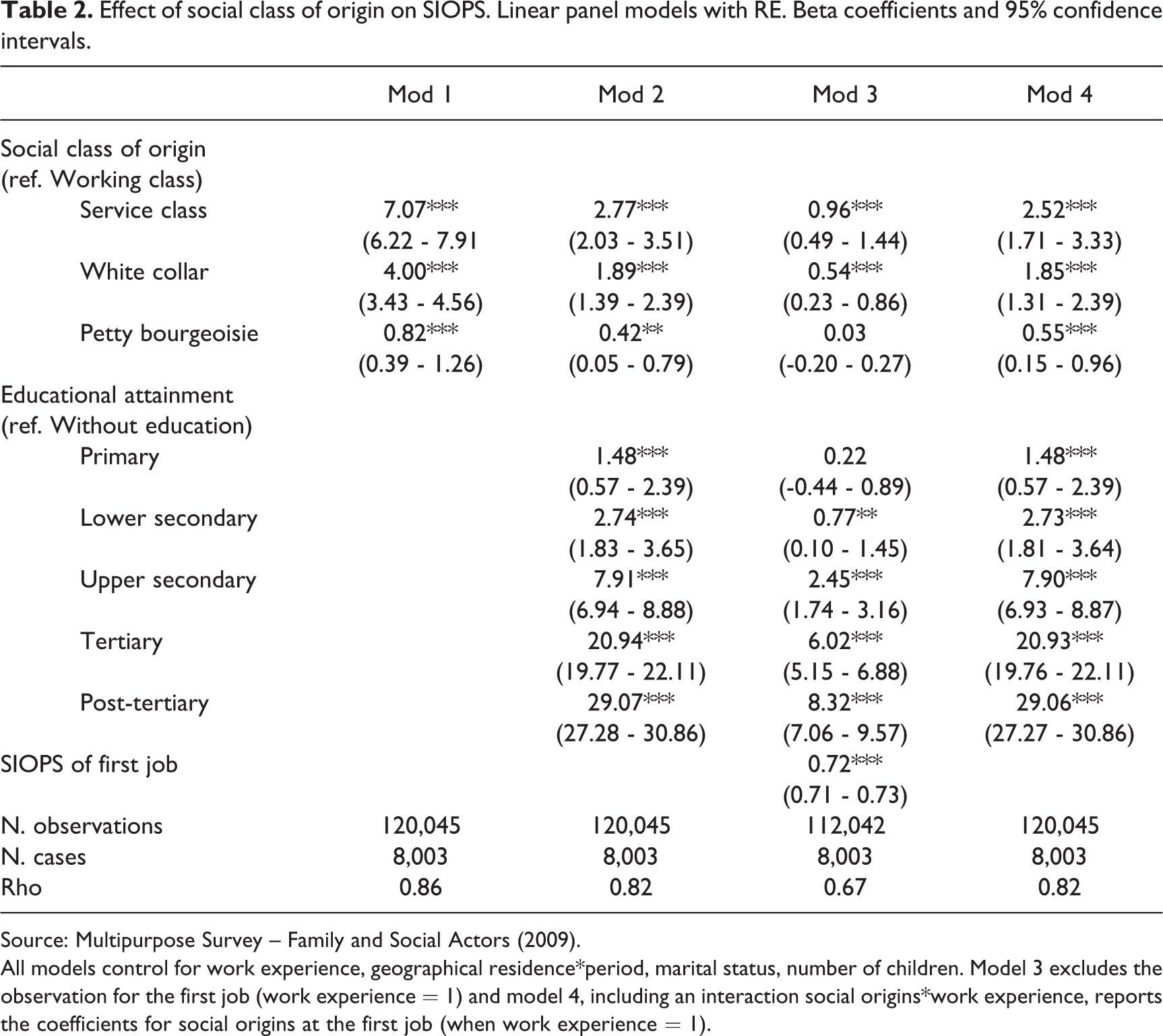
Table 2 reports the estimates of the effect of social origins on the career from a number of model specifications. Model 1 presents the total effect of social origin (TESO), showing that, compared to the children of the working class, those coming from the service class have an average predicted SIOPS score that is 7.07 points higher. Differences between the working class and the white collars are lower (4.00 points in the SIOPS scale), but still substantially and statistically significant, whereas those between the working class and the self-employed are negligible and lower than one point in the prestige scale (0.82).
Effect of social class of origin on SIOPS. Linear panel models with RE. Beta coefficients and 95% confidence intervals.
Source: Multipurpose Survey – Family and Social Actors (2009).
All models control for work experience, geographical residence*period, marital status, number of children. Model 3 excludes the observation for the first job (work experience = 1) and model 4, including an interaction social origins*work experience, reports the coefficients for social origins at the first job (when work experience = 1).
Model 2 estimates the direct effect of social origin (DESO) by adding educational attainment as a control variable. Coefficients notably decrease, confirming that a large part – about two-thirds – of the occupational disadvantage of those coming from the lower classes is mediated by inequalities in educational opportunities. Nevertheless small coefficients still remain statistically significant: the advantage of the children of the service class, the white collars and the self-employed with respect to those of the working class, net of education, is equal to 2.77, 1.89 and 0.42 SIOPS points, respectively.
While the previous two models focus on the average effect of social origins over the entire career (including the first job), model 3 estimates the DESO once the SIOPS of the first job is controlled for, hence looking at the deviation over the career from the DESO of the first job. The advantage of the upper and medium classes is lower, confirming that the DESO mostly operates via the different allocation of individuals already at the first job, rather than via incremental advantages or disadvantages over the career. Indeed, the differences between the working class and the self-employed totally disappear once first job is controlled for, whereas the advantage of the service class and the white collars becomes equal to 0.96 and 0.54, respectively (M3). Although these coefficients are very small – less than 1 prestige point on a scale from 18 to 70 – they are still statistically significant.
The relevance of first job in shaping occupational career inequalities is further confirmed by coefficients in model 4, which includes an interaction term between social origin and experience. In this model, therefore, the main effect of social origin – as reported in the table – quantifies the DESO at the first entry into the labour market (when time is equal to 0, i.e. when work experience is equal to 1). Results from this interaction are discussed in more detail in Figure 1 below, as a part of the second step of our empirical strategy. Results show that individuals from the working class start their career with jobs on average characterized by a gap of 2.52, 1.85 and 0.55 prestige points compared to the children of the service class, white collars and self-employed, respectively (M4).
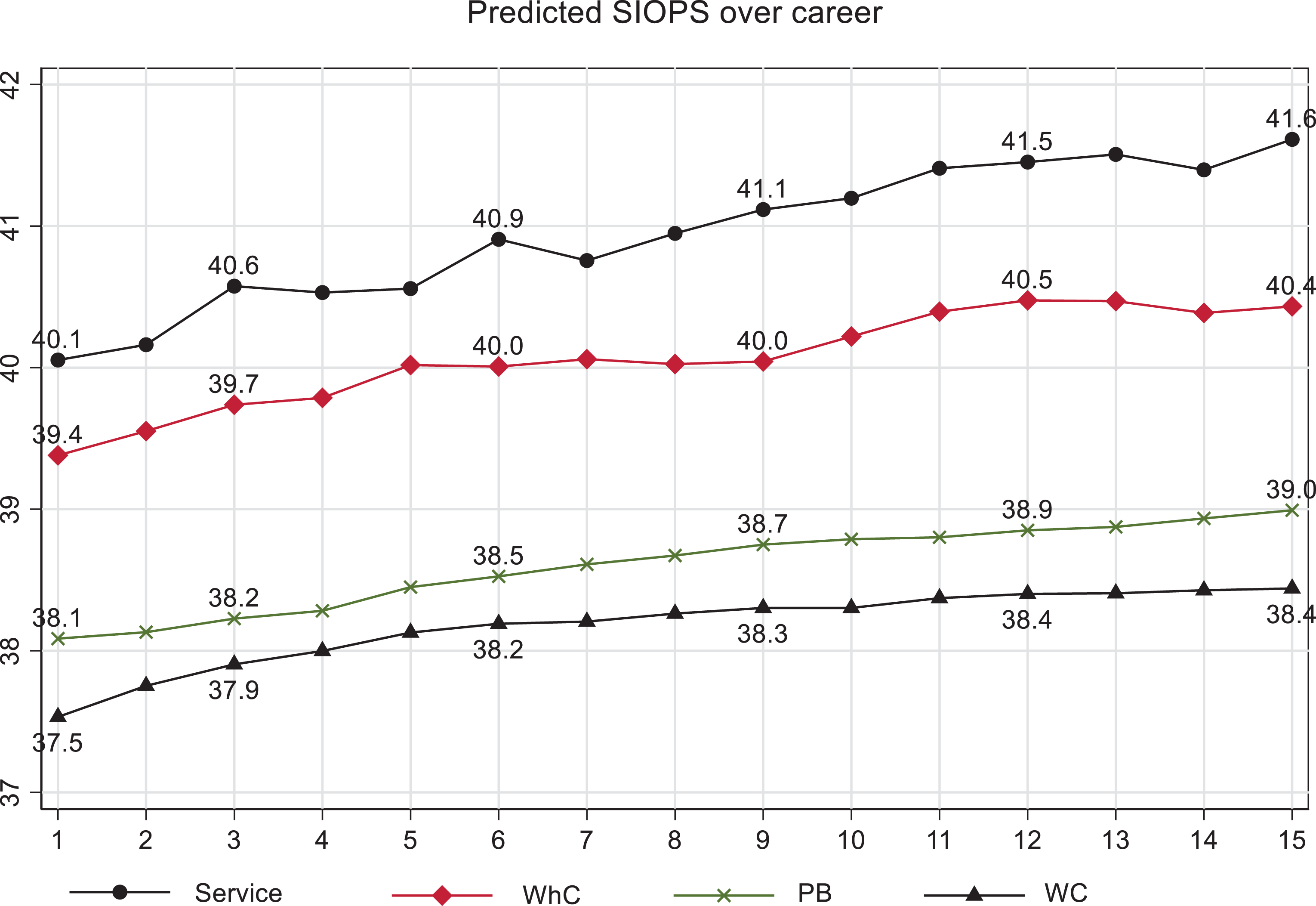
Effect of social class of origin on SIOPS by experience in the labour market. Linear panel models with RE. Predicted SIOPS with robust standard errors. Source: Multipurpose Survey – Family and Social Actors (2009). Service: Service class; WhC: White collar; PB: Petty bourgeoisie; WC: Working class. Estimations reported in the graph come from model 4 in Table 1.
At the bottom of Table 2 the intraclass correlation (rho) is shown, as computed from the variances of the two error terms
Having seen that a (small) DESO exists, and that it is concentrated at the start of the career, we move now to the second step of our analysis, asking how the DESO evolves over the career: does it decrease (merit-based compensation), remain stable (persistent advantage), or increase over time (cumulative advantage)?
Figure 1, showing the predicted SIOPS score by social origin estimated from model 4, confirms that most of the inequality by social class of origin, net of education, already exists at labour market entry. Then, over the career the SIOPS increases for men from all class origins, but the DESO does not diminish. There are no signs of a compensation pattern. Indeed, although there are no huge changes, they all point towards an increase of the origin-related gap. This is especially true for the prestige difference between those coming from the working class and their counterparts from the service class. Indeed, the gap increases substantially some 8–9 years after labour market entry (i.e. around the age of 28–30, on average), as those from a higher background show a stronger career boost than those with a lower background, whose occupational trajectories become almost flat. The graph shows that the gap between a service and a working class background is 2.52 SIOPS points at first entry (40.05–37.53, p = 0.000, see also model 4), then it increases up to 2.82 (41.12–38.30, p = 0.000), to 3.05 (41.45–38.40, p = 0.000) and to 3.17 (41.61–38.44, p = 0.000) after 9, 12 and 15 years, respectively.
In sum, over the careers the advantage provided by a good family background net of education (DESO) slightly increases, while there are no signs of a (possibly) merit-based compensation.
DESO and education: Compensation or boosting?
Figure 2 shows how the DESO differs according to education. The vertical bars represent the DESO over the career, divided between the overall advantage (coloured with a darker grey) and its deviation from the first labour market entry (lighter grey, showing the coefficients of models estimated separately by education and controlling for the SIOPS of the first job). It appears that the total DESO is much higher among the upper secondary and tertiary educated, as predicted by the family boosting hypothesis. For instance, the highly-educated children of the service class have, on average, an occupational prestige that is 5.93 points higher compared to the children of the working class with the same level of education. Conversely, individuals from the service class with a low educational level have an average occupational prestige that is only 1.20 points higher with respect to the low-educated persons from the working class.
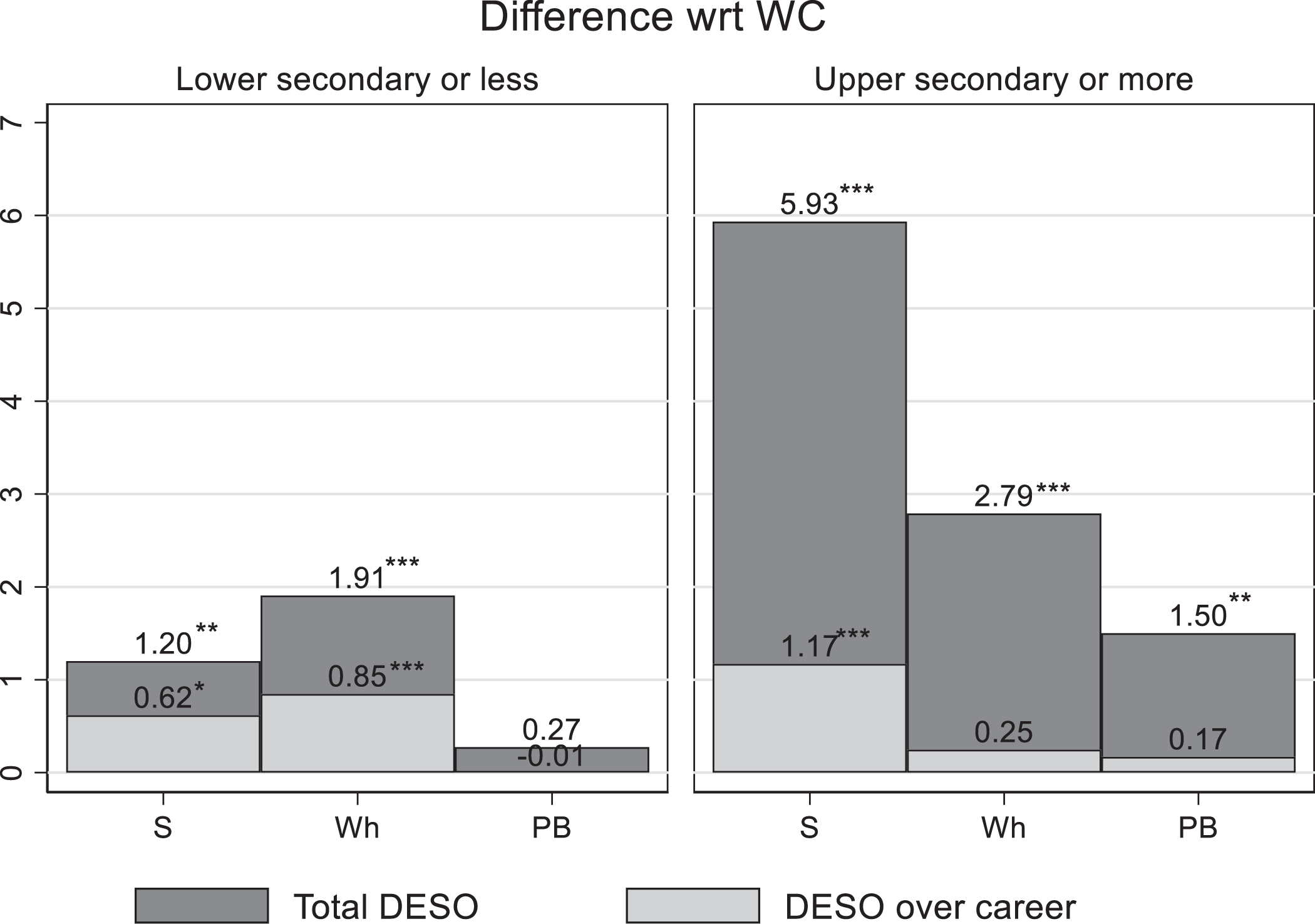
Effect of social class of origin on SIOPS, by education. Linear panel models with RE. Beta coefficients with robust standard errors. Source: Multipurpose Survey – Family and Social Actors (2009). S: Service class; Wh: White collars; PB: Petty bourgeoisie. Light grey bars show the differences in the predicted SIOPS (wrt working class) from a model controlling for SIOPS at first job and excluding the observation of the first career entry (work experience = 1).
Light grey bars confirm again the relevance of labour market entry in shaping the DESO, since it becomes quite lower once the first job is controlled for. Indeed, the DESO over the career controlling for the first job – that is, the deviation from the SIOPS of the first job over the career – is still higher among the highly educated, but it is only 1.17 SIOPS points when service class and working class are compared. Among the low-educated, the same class gap decreases up to 0.62 prestige points.
The relevance of first entry in the labour market is also confirmed by the observation of the pattern by education of the DESO over the career, presented in Figure 3. The average SIOPS predictions were calculated on the basis of the specification of model 4, Table 1, estimated separately by education. Indeed, the predicted SIOPS over the career shows that the class gap already appears at labour market entry and is much higher among the more educated. In other words, the boosting effect for the careers of highly-educated individuals from the service class is, again, mostly driven by a better allocation in the occupational hierarchy at first job. Indeed, the predicted SIOPS for the service class at first career entry is 6.04 points higher than the one of the working class. This gap slightly increases over the career, reaching 6.12 SIOPS points in the final years of our observational window.
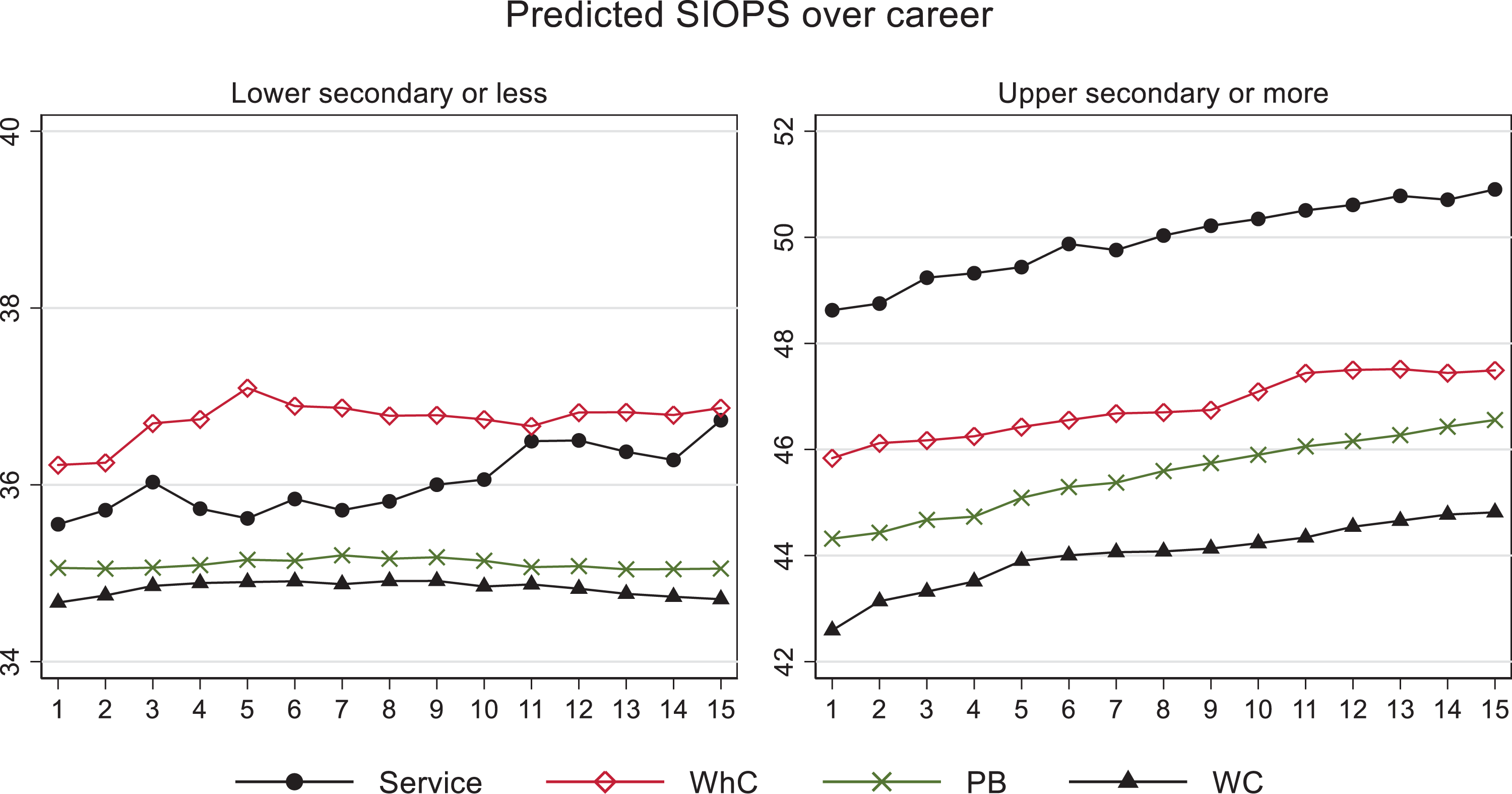
Effect of social class of origin on SIOPS by experience in the labour market and education. Linear regression panel models with RE. Predicted SIOPS with robust standard errors. Source: Multipurpose Survey – Family and Social Actors (2009). Service: Service class; WhC: White collar; PB: Petty bourgeoisie; WC: Working class. Estimations reported in the graph come from model 4 in Table 1, estimated separately by education.
The gap between the service class and the working class increases over the career even more among the low-educated. While differences are small during the first years in the labour market (0.89 points at the first job), they increase over the career because of the already noted occupational improvement experienced by those coming from the service class after 8-9 years of work, and the class gap reaches 2.02 SIOPS points 15 years after first entry. Something similar happens with respect to those with a white-collar family background, who among the low-educated appear at slight advantage with respect to those with a service class background at the start of the career, but are then ‘surpassed’ by the latter when they experience their mid-career boost.
In sum, among those with medium-to-high education, the relative position of those with different class of origin does not change much over the career, while among those with no more than compulsory education the position of those with a service class background improves with respect to those with a different class background. This suggests a (slight) compensatory effect of social origins among the individuals with a low educational level.
The role of job episodes in shaping the DESO
We come now to the final step of our study, concerning the relation between the DESO and job change episodes. We start by studying the selection into three types of job change episodes by social class of origin. For each type of job change episode (voluntary, involuntary, internal), Figure 4 presents the predicted probabilities of having experienced it at least once, by social class of origin and education. Results show that in general voluntary job changes are more frequent than involuntary ones and, to a lesser extent, than those related to internal career. The probabilities do not change according to social origins among those with a low educational attainment. Among the upper secondary and tertiary educated, however, individuals with a service class origin are more likely to experience an internal career move than their counterparts with different social origins.
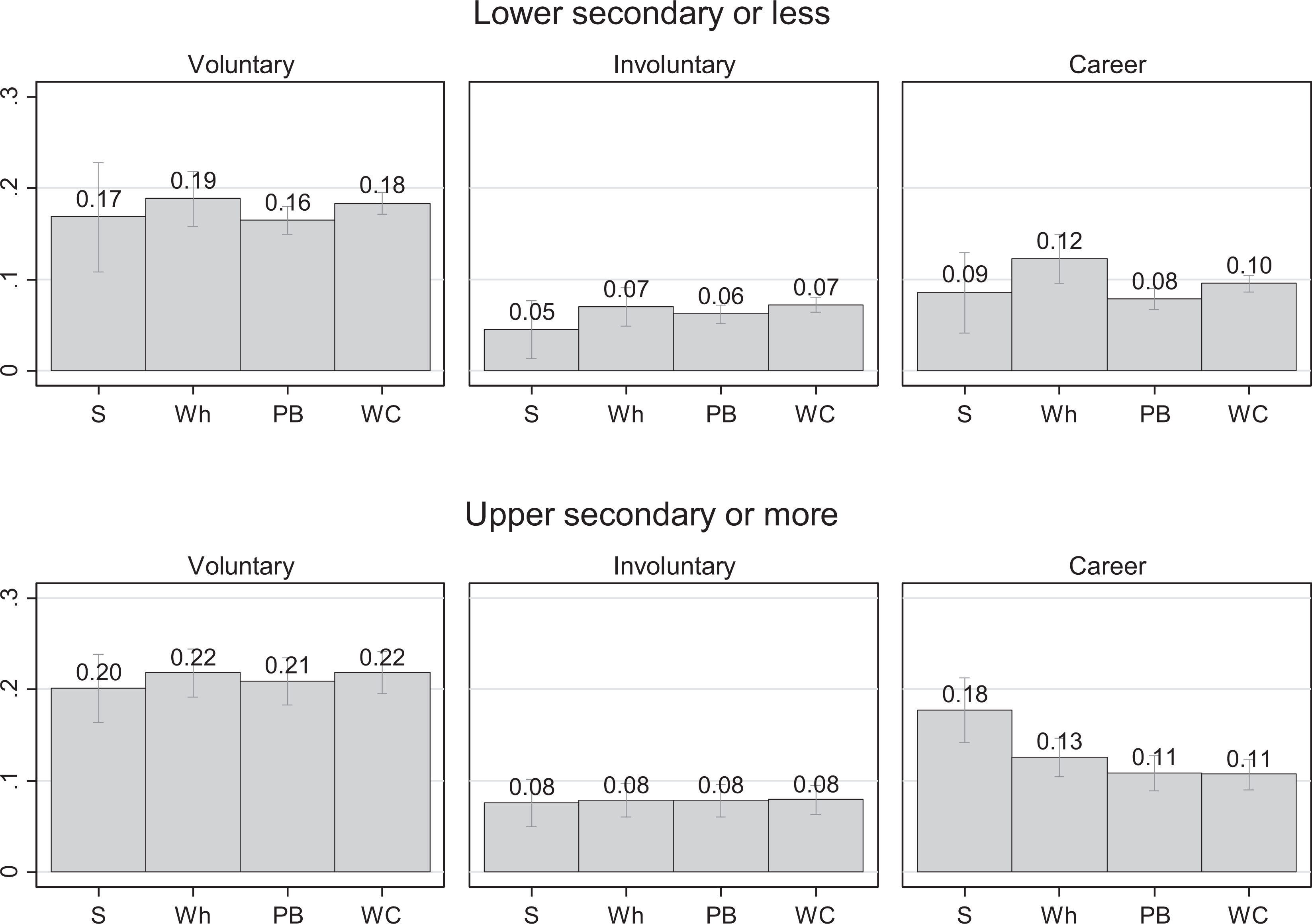
Probability of job change episodes by social class of origin and education. Pooled linear probability models. Predicted probabilities with 95% confidence intervals. Source: Multipurpose Survey – Family and Social Actors (2009). S: Service class; Wh: White collars; PB: Petty bourgeoisie; WC: Working class.
Then, we focus on whether and how much the effect of experiencing specific job change episodes on the subsequent career is stratified by social origin and education. Figure 5 presents the differences by social class of origin and education in the average effect of having had at least one job change of each type on occupational prestige, as estimated by models interacting social origins and type of job episodes. Among the less educated (upper panel), only those with a service class origin substantially benefit from a voluntary job change and from an internal job change. However, on the other hand, they are also more penalized, but to a lower extent, by an involuntary job change.
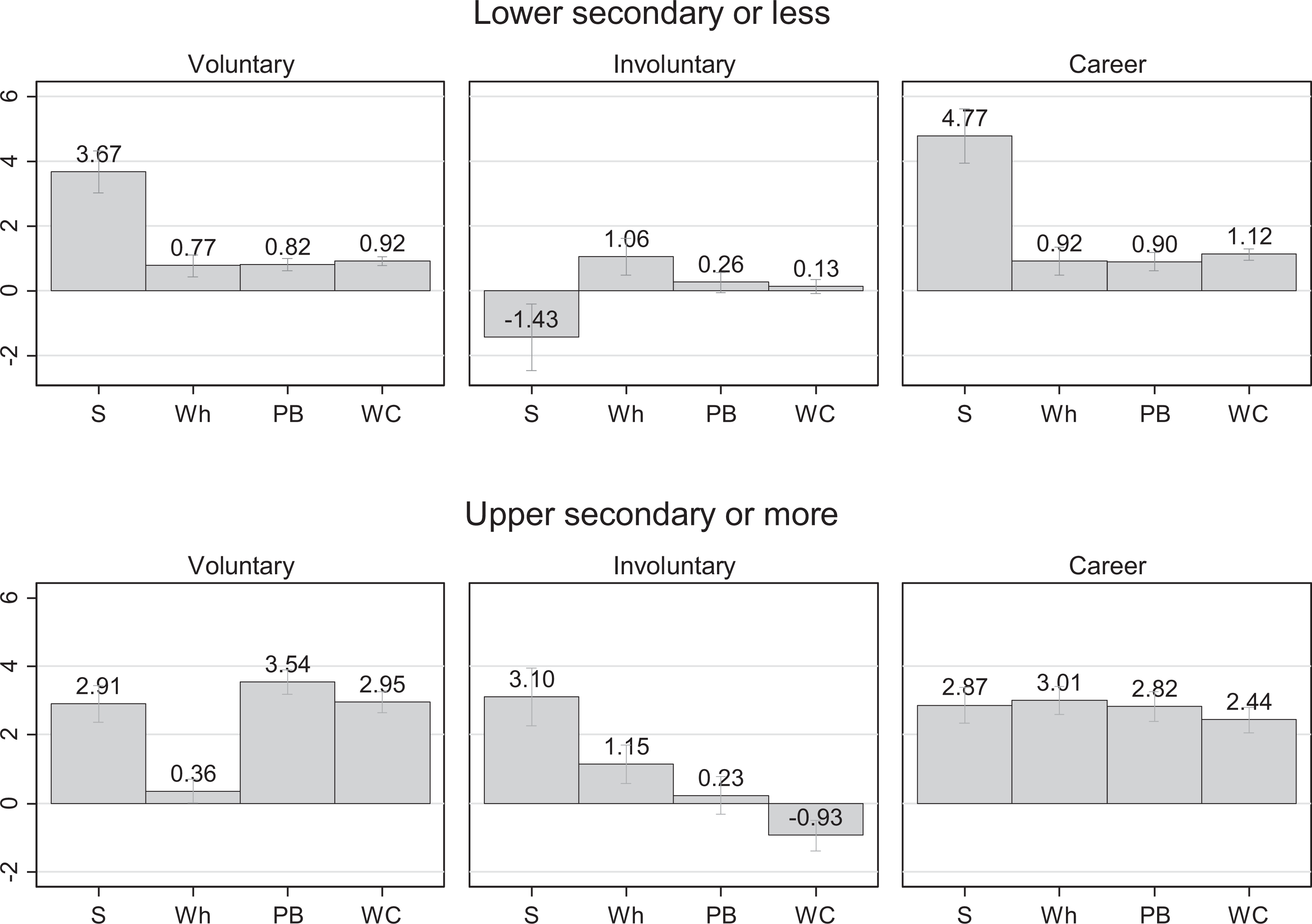
Effect of job change episodes on SIOPS by social class of origin and education. Linear regression panel models with RE. Beta coefficients with 95% confidence intervals. Source: Multipurpose Survey – Family and Social Actors (2009). S: Service class; Wh: White collars; PB: Petty bourgeoisie; WC: Working class.
Among the more educated (lower panel) there are no differences related to social origins in the effect of a voluntary job change or of an internal career move on occupational prestige. However, a DESO can be found concerning involuntary job changes, as men from the upper classes – particularly from the service class – on average see their SIOPS score increase by 3.10 points after an involuntary job change, whereas men from the working class lose on average 0.93 points when experiencing the same type of job change episode.
To sum up, findings confirm that a DESO is to be seen in the case of job change episodes, as those with a higher social origin are generally better off after one, according to a pattern of cumulative advantage. This advantage is clearly seen in the case of voluntary job changes and career moves among the less educated and might explain to some extent the family compensation effect observed as a stronger occupational improvement over the career for the low-educated individuals with a service class background (see Figure 3). Differently from what expected, however, there appears no family compensation pattern for those who are involuntary laid off, as in their case a DESO is to be seen only among the more educated, while among the less educated the effect is negative for those with a service class origin. This results in a family boosting pattern among those with a service class origin, but it also shows a small, possibly merit-based compensation effect among the low-educated. This is the only instance of this type we found all over the analyses performed for this paper, and, although the class gap is significant, it does not have any visible impact on the career stratification patterns observed in Figure 3.
On the other hand, concerning the highly educated, the results of this analysis suggest that the DESO – more specifically, the small gradual increase over the career of the advantage associated to a service class origin (see Figure 3) – is mainly explained by two processes. First, those with a service class background experience higher probabilities of internal career mobility – that is, are more easily promoted – consistent with a pattern of counter-mobility (Bernardi and Ballarino, 2016: 269). Second, their careers – and, to a lesser extent, those of the white collars – are the only ones to benefit from involuntary job changes (dismissal, end of contracts, and so on).
Conclusion
This paper studied dynamically the direct effect of social origin on occupational destinations among men in Italy over the career. The aim was to investigate the existence, the pattern over time and the heterogeneity of differences in occupational achievement related to social origins, net of education (DESO) and occupational allocation at first job. Moreover, the paper analysed the role of specific job change episodes (voluntary job change; involuntary job change; internal career move) in shaping the DESO and its changes over the career.
The first aim was to quantify the magnitude of the DESO in Italy: results showed that children of the service class have an average occupational prestige that is 2.77 points higher than the children of the working class, once education is controlled for. On a scale from 6 to 78, this is not a huge difference, but it is nevertheless worth attention. Moreover, our estimates also confirmed that most of the differences among individuals with different social origins already appear at the first entrance in the labour market (H1 supported). This result confirmed that in Italy, given the low degree of intragenerational social mobility, a large amount of career inequalities depends on the uneven allocation at first job across social origins (Barone et al., 2011; Ballarino et al., 2016b).
However, our analysis showed that the DESO remains statistically significant – although of smaller magnitude – even when the SIOPS at first job is controlled for, confirming that differences between social classes slightly increase over the career. Indeed, the detailed analysis of the DESO until the fifteenth year of actual work experience showed that the advantage of the service class with respect to the working class increases after 8-9 years of career, thus supporting the cumulative advantage hypothesis (H2c) with respect to a merit compensation hypothesis and a persistent advantage one.
Thirdly, we studied the interaction between the DESO and education, looking for compensatory or boosting effects of social origins on careers. Results generally confirmed the family boosting hypothesis (H3b): the occupational gap between the service class and the working class – but also with respect to other social origins – was higher among the highly educated, who are given an ‘extra lift’ in occupational attainment by their socio-economically advantaged parents. The allocation at first job still appeared to be more important than the subsequent career; although the gap slightly increased over time, the stronger advantage of the highly-educated children of the service class already appeared at labour market entry, explaining the largest part of the boosting effect over the following career. However, the pattern of the DESO over the career among the low-educated showed that while the SIOPS gap between those with a service class background and those with a different background was negligible in the early career years, then it notably increased over time because of the already mentioned mid-career boost experienced by the former, according to a family compensation pattern.
Finally, the last research question concerned the role of different types of occupational change episodes (voluntary, involuntary, related to internal career) in shaping the DESO. Integrating job transitions into our career analysis enabled us to investigate why we found a small DESO – and some family compensation over the career – among the less educated and a large DESO – and some family boosting over the career – among the more educated. The class gap appearing over the career among the low-educated seems to be driven by the beneficial effects that the offspring of the service class get, differently from any other social origin, from voluntary job changes and from job changes within the same organization (internal career). However, the (small) increase in the advantages of highly-educated children of the service class over the career was driven by two different patterns. On the one side, they experience higher probability of internal career mobility compared to other social origins, as they are more likely to experience career progression within the same organization, improving their job positions or job tasks, moving from part-time or fixed-term jobs to full-time or permanent jobs, etc. On the other side, they are the only ones – as the offspring of the white collars, but less strongly so – that do not experience the disruptive costs related to involuntary job changes, such as dismissals, end of contracts, and so on.
As a general result, we would then add that cumulative advantage patterns are clearly prevalent with respect to compensation patterns. Those with a better family background are advantaged in the labour market, and this advantage is stronger for the better educated. We do not find much evidence of the ‘education as the great equalizer’ thesis, according to which the occupational effects of the familiar background are weaker among the more educated (Torche, 2011). Most of the advantage provided by a privileged background comes via education, as stratification research has shown since long. To this, a further, smaller, advantage adds ups when entering the labour market, and over the career this advantage increases further, albeit to a limited extent.
While unfortunately our data are not detailed enough to allow us to discern between the working of different mechanisms, we speculate that the advantage experienced by those with a service class background at the very start of their careers is related to purposive action on part of the families, who transfer wealth and property, mobilize contact networks and elicit favouritism to support their offspring when they start their careers. However, evidence that the advantage still grows over the career, when efficiency issues related to market competition at least to some extent shape firms’ strategies concerning their personnel, points also to the intra-familial transmission of productivity-enhancing personality traits, such as non-cognitive ‘soft’ skills and motivation. This is particularly clear among the less educated, where the advantage is not seen when entering the labour market, but emerges 8–9 years into the career, when the impact of family investment is likely to be lower than the one of family endowment. A similar suggestion comes from evidence that the DESO is higher among the more educated, according to a boosting pattern, which might be hardly explained by the family’s purposive action. This is a result worth further analysis and discussion, since it differs from the compensation pattern frequently found by studies focusing on school careers (Bernardi, 2012, 2014), as well as from previous studies of work careers based on cross-sectional data (Bernardi and Ballarino, 2016). From the point of view of the theory, this interpretation of our results would suggest to give more weight to the contrast between purposive and non-purposive familiar action in favour of children: in the former case the advantage of the better-off might be seen as an investment, while in the latter it is better conceptualized as an endowment (Erola and Kilpi-Jakonen, 2017).
