







Abstract
Women who expect an upcoming divorce have the possibility of taking action in order to protect themselves against the projected negative financial consequences. In this paper we investigate whether they do. Using retrospective data for a sample of 884 divorced women from the Divorce in Flanders (DiF)-survey, we estimate the difference in the probability that women increase their employment intensity surrounding the time a couple stops living together between women who expected the divorce and those who did not. We find that in the year leading up to the factual separation, women who expect the divorce are three to five times more likely to increase their employment. Our results suggest that when anticipatory employment behaviour is not considered when researching the negative consequences of relationship dissolution, both the magnitude of the downturn as well as the time to recovery is likely underestimated for a large group of women.
Introduction
Although the issue of anticipatory behaviour in the female employment-divorce risk nexus is not new, research has only been performed sporadically. This is somewhat surprising as the issue is an attractive and important subject for two reasons: on the one hand, the argument for possible reversed causality is intuitively compelling. For a number of women, greater financial independence is not the cause of lower thresholds for exiting marriage, but rather the dissatisfaction with their marriage is the reason for seeking more employment in order to deal with the upcoming negative consequences of divorce (Özcan and Breen, 2012). Therefore, when this behaviour is unaccounted for, the causal effect of increased female labour force participation on divorce risks is overestimated (Bremmer and Kesselring, 2011). This concern had already been raised by Becker et al. (1977) in their seminal work on the economics of marital instability and has featured in the work of Johnson and Skinner (1986), Poortman (2005), and Amato (2010) among others. On the other hand, accounting for anticipatory employment behaviour is important for the study of the consequences of divorce. Employment has been found to be a coping strategy for women experiencing relationship dissolution (Jansen et al., 2009; Vignoli et al., 2018). As coping is a process, its effectiveness is dependent on many factors, including time. When a significant proportion of divorced women who expect an upcoming separation take measures such as increasing employment beforehand, the overall negative consequences after divorce risk being underestimated. Arguably, this second reason is of more direct concern for real-world stakeholders.
A clear understanding of the occurrence and strength of anticipatory employment behaviour of women surrounding divorce is indispensable to adequately assess not only the causal effect of female employment on divorce, but also the differences in outcomes for divorced women. The subject has, however, only received limited attention (Johnson and Skinner, 1986; Poortman, 2005; Sen, 2000; Vignoli et al., 2018). This article contributes to this existing literature in several ways. Firstly, we argue that it is unlikely that people are aware of their own ‘divorce risk’. Since we use data from the very detailed Divorce in Flanders (DiF)- survey, we have several ways to measure the expectedness of a relationship’s dissolution, as was proposed by Poortman (2005), rather than examining the hazards of marital disruption (Vignoli et al., 2018), or a calculated probability of divorce (Johnson and Skinner, 1986; Sen, 2000). Secondly, rather than looking at entry into employment (Johnson and Skinner, 1986; Poortman, 2005), we extend employment behaviour to the binary choice of increasing employment in the time surrounding the factual separation. Thirdly, we extend earlier work of (Thielemans and Mortelmans, 2019) on female employment increase surrounding divorce by looking at heterogeneity within the group of women who increased employment. In addition, we provide arguments in favour of clarifying the concept of anticipation in future research beyond the topic of female employment behaviour and relationship dissolution.
Theoretical background
Offering an in-depth discussion of the use of the concept of anticipation in sociological, economic, psychological, or other human sciences research lies beyond the scope of this paper. Nevertheless, we want to explicitly distinguish its use from the concept of expectation. As these interpretations of both concepts are important for the theoretical background, a brief preliminary discussion is necessary for the reader’s understanding.
When using derivations from the verb ‘to expect’ in this paper, we refer to a state of mind. However, when we use derivations of ‘to anticipate’, we refer to an action. In the case of relationship dissolution, expecting a divorce is the state of foreseeing, with some certainty, a divorce that is going to happen in the future while anticipating divorce is meant as an action that is taken prior to that divorce, which is guided by the expected consequences of that divorce. In a sense, the action is then informed by events that happen on a hypothetical internalized timeline that moves faster than real time (Nadin, 2009). This means that the theoretical underpinnings of anticipatory behaviour are the same as that of behaviour in reaction to the event. For divorce and labour force participation, the socio-economic literature traditionally theorizes that increased employment may occur because of the loss of economic wellbeing (De Graaf and Kalmijn, 2003).
The economic necessity hypothesis predicts a positive effect of relationship dissolution on labour force participation. As a result of one household splitting in two, there is a reduction in household income (Tamborini et al., 2015). This is exacerbated by the loss of economies of scale (Bane, 1976; Couch et al., 2013; Espenshade, 1979). Lower household income then incentivizes women to either enter the labour market or increase their working hours (Becker, 1991). A considerable body of empirical research supports this hypothesis. Firstly, that women are financially disadvantaged after divorce has been, and remains, well documented across countries (Aassve et al., 2007; Andreß et al., 2006; Uunk, 2004). Secondly, Prasad (2003) has found empirical support that for German women, household income is negatively associated with reservation wages. Finally, concerning employment, evidence has been found that women increase their employment after divorce (Brewer and Nandi, 2014; Raz-Yurovich, 2013). Other research found that those who did were financially significantly better off than those who did not (Bröckel and Andreß, 2015; De Regt et al., 2013; De Vaus et al., 2017; Fokkema, 2000; Jansen et al., 2009; Mortelmans et al., 2020).
Policies regarding work-life balance or financial support for single parents play a role in both the financial downturn as the employment behaviour. In all of the 14 European countries studied by Uunk (2004), median income for women drops in the short-term period after divorce, although the decline is mediated by welfare state regime. Andreß et al. (2006) found that women incur a larger financial loss than men in Great Britain, Italy, Belgium and Germany, but not in Sweden where the financial consequences are more equally divided, but negative nonetheless. Controlling for country effects, Van Damme et al. (2009) found that European women, on average, modestly increase their employment after separation, but that country-specific institutions such as childcare facilities play an important role in promoting employment increase. Similar findings for Israel were reported by Herbst and Kaplan (2016). Raz-Yurovich (2011) showed that in Israel, women increased their levels of economic activity relative to when they were married, both by having more continuous and stable employment and by increasing the number of jobs they hold.
Empirical studies on the existence of anticipatory behaviour are scarce and inconclusive. In most cases, this can be attributed to insufficiently detailed data on the expectedness of a separation. Evidence of women increasing employment not only after a dissolution but also beforehand was found by Thielemans and Mortelmans (2019), which showed for Flanders that the probability of an employment increase is significantly higher during a short period surrounding the separation. Similarly, Van Damme and Kalmijn (2014) find indications of possible anticipation effects in Sweden, Finland, US, West-Germany, Austria, Switzerland, Spain, and Greece. Another approach was used by Vignoli et al. (2018), who suggest the possibility anticipatory behaviour by Italian women as divorce risks increased sharply from the moment they entered the labour market but decreased with time.
Other studies have used either direct or indirect measures of expectedness. Johnson and Skinner (1986) found evidence of anticipation in women’s employment for the United States by estimating a simultaneous equation model, which included a predicted probability of divorce. Similarly, Sen (2000) used estimated divorce risks based on the age at marriage and found significant evidence for women’s anticipatory behaviour for both the American birth cohorts of 1944–54 and 1957–64, although the effect was very small for the latter cohort.
Only one study uses a more direct measure of expectedness. Focusing on the Netherlands, Poortman (2005) separated the estimated effects of women’s employment intensity on divorce risks by the degree to which a divorce was expected. Her findings offer some support for the existence of anticipatory behaviour. When a divorce was ‘fully expected’, both working hours and women’s full-time employment showed a significant positive association with divorce risks. Nevertheless, the analyses did not provide evidence that these were systematic across the degree of expectedness, nor did they lead to the conclusion that the effect of anticipation was strong enough to indicate systematic reversed causality in the effect of wives’ work on divorce risks.
An important criticism of previous research into this issue is the possibility of selection effects. Among others, Vignoli et al. (2018) argued the possibility of unobserved factors that explain both women’s employment behaviour and their propensity to divorce. It is theoretically possible that, for instance, one partner’s unemployment leads to financial stress in the couple and causes both the other partner to increase their own employment intensity as well as make the decision to divorce. While the literature has not yet suggested that there are reasons why women would be more inclined to both increase employment and expect an upcoming divorce, we must remain wary of its existence.
We combine insights from previous work on women’s employment behaviour surrounding divorce to arrive at two testable hypotheses. First, as it seems unlikely that people are aware of their own divorce risks based on their socio-demographic and socio-economic positions, we follow Poortman (2005) in using more direct measures of expectedness. Next, in line with Vignoli et al. (2018), we study increases in employment, rather than employment intensity. Following Thielemans and Mortelmans (2019), we hypothesize that, regardless of whether an upcoming divorce was expected, for women who are not already working full-time the probability of increasing employment is higher surrounding the time of factual separation (H1). When the divorce was expected, we predict that the probability of increasing employment is higher prior to the time of the actual separation for those who did than for those who did not expect the upcoming dissolution (H2). We investigate whether this anticipation through employment increase is present after controlling for socio-demographic characteristics, characteristics related to the individual choice to increase employment and group characteristics.
Data
We use a subsample of the data collected by the DiF study (Mortelmans et al., 2011). The survey was specifically targeted towards the causes and consequences of divorce, and therefore besides socio-demographic background variables also contains information on a wide range of divorce-related issues including – but not limited to – relationship history, divorce initiation, reasons for relationship dissolution, custody arrangements, and legal process variables. The dataset was drawn from the Belgian national register. It contains a disproportionate sample of one-third intact (n = 2502) and two-thirds dissolved (n = 6004) first marriages between 1971 and 2008. The selected marriages consisted only of partners of a different sex and with Belgian nationality from birth on. Furthermore, none of the (ex-)partners had experienced divorce more than once.
Primary respondents were asked to reconstruct their labour history, starting from the moment they left school. The gross sample used in this study consists of 2110 heterosexual women between the ages of 18 and 65 who had been married for at least 3.5 years. Left censoring takes place at three years prior to the factual separation. Right censoring occurred at either five years after the separation, at retirement, at the time of the interview, or at the age of 65, whichever came first. This led to a base sample of 1799 divorced women.
We used the event of separation, the moment at which the couple stopped living together, instead of divorce. We assumed this to be the time around which the incentive to increase employment is highest. For each respondent, we used a total observation period of eight years (in 16 six-month intervals). Separation occurs at the start of the seventh observation period.
The outcome variable of increased employment was constructed by comparing the average employment intensity over one six-month time period with that of the previous six-month period. No detailed information on working hours was available. Instead, the survey consisted of six categories for employment intensity, measured as a percentage of full-time employment: zero hours (homemakers and the unemployed), < 25% of full-time employment, 25–50% of full-time, 50–75% of full-time, 75–95% of full-time and more than 95% (full-time corresponding to 38–40 hours per week). There were a total of 372 instances of increased employment. Spells in which women were in (early) retirement, students, in military service or had indicated that their employment status was permanently ill or disabled at the time of separation were excluded. Entry into the labour market after these spells was not coded as an increase in employment. The dichotomous variable for employment increase takes on the value of unity when a respondent transitions from a category of lower to one with higher employment intensity and zero otherwise, regardless of the amount with which employment was increased. After collapsing the data into six-month intervals, this variable indicates an employment increase anywhere during those six months. As we studied increases of employment and no information on second jobs was available, the probability that women already working full-time increase employment is by design equal to zero. Spells of full-time employment are therefore also censored. Women who worked full-time during the entire previous six-month time period were not included in the analyses, resulting in a total of 9,342 observation points for 884 women (Figure 1).

. Research design for the study of the probability of divorced women’s employment increase surrounding the time of factual separation.
DiF offers three questions that we used as proxies for expectedness: Who first mentioned the divorce, who took the decision for the divorce, and who started the legal process of divorce? We constructed the three indicators of expectedness as a binary variable based on these questions. The first one is used for our main analyses, while the others are used in robustness checks. The questions and answers were as follows (Table 1):
Questions and possible answers from the Divorce in Flanders Questionnaire.
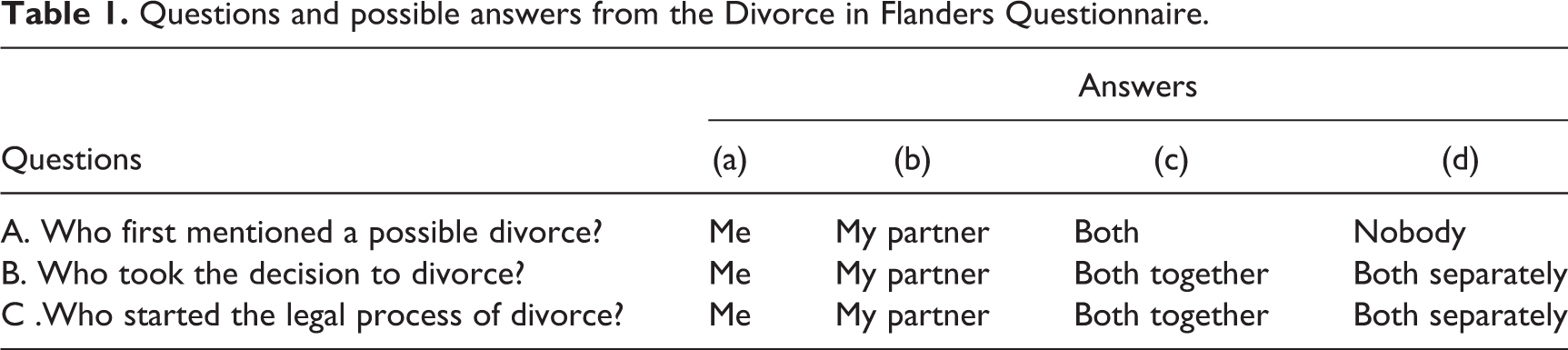
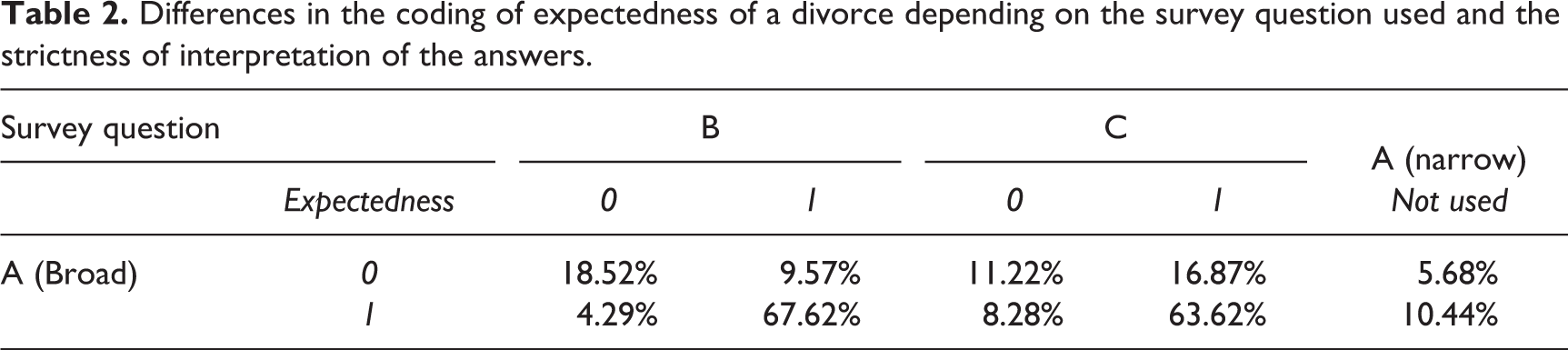
For question A, expectedness was coded as (a, c) = 1 and (b, d) = 0. For questions B and C, the coding was (a, c, d) = 1 and (b) = 0. The percentages of the women who were coded as having expected the divorce for the three questions were respectively: 72%, 77% and 80%. The correlation between the main variable and the robustness checks based on questions B and C is respectively 0.62 and 0.32. As another robustness check, we use a narrow interpretation of expectedness based on question A, where we code answer (a) as expected, answers (b) and (d) as unexpected and leave out those who answered (c). Table 2 shows the percentages of how many respondents are coded differently between the main indicator and the robustness checks.
Differences in the coding of expectedness of a divorce depending on the survey question used and the strictness of interpretation of the answers.
We controlled for several other factors which are associated with both the expectation of divorce and the probability of increased employment. First, while increasing employment might be the result of an expected divorce, it could also be the result of dissatisfaction with the financial situation of the household. The survey included one question on the most important reasons for the divorce. Three possible answers could be chosen out of a list of 21 (containing among others: we had grown apart, lack of freedom, jealousy, physical abuse). We constructed a binary indicator for financial dissatisfaction if the respondent included ‘financial problems’ as one of the three choices. For 6.5% of the respondents, financial troubles were one of the main reasons for divorce. Second, we proxy for differences in costs surrounding the separation by including an indicator for where the respondent started living immediately after the separation. This categorical covariate consisted of four categories depending on whether the respondent a) stayed in the marital home (52%), b) started living on their own somewhere else (25%), c) stayed with friends or family (16%), or d) started living with a new partner (7%).
In order to separate the association of employment increase with divorce from other movements on the labour market, we included three indicators that are linked to the probability of increasing employment. Firstly, increases that were due to frictional unemployment, i.e. the move from one job to another with a short spell of reduced work in between, were controlled for with a dichotomous variable for a decrease in employment during the previous six-month period. A total of 221 instances of decreased employment were present in the sample. Secondly, a temporary exit from the labour market due to childbirth and subsequent care needs was controlled for by including a dichotomous variable for the presence of biological children younger than three years old. In 14% of the observations, a young child was living with the woman. Finally, long-term illness or disability can also lead to (temporary) diminished activity in the labour market. While we exclude women who have retracted fully from the labour market because of this, we include those who have been diagnosed with a long-term illness, but do not state that this is their main activity. This covariate was also included as a time-varying dichotomous variable. In 9.5% of the observation points, the respondent reported suffering from a long-term illness or a disability while still employed.
We controlled for characteristics that the literature widely agrees influence the probability of employment. The number of children living in the household was categorically coded starting from a childless household up to a household with three or more children. The sample consisted of 13% of childless households, 22% of women living with one child, 41% living with two children and 24% living with three or more children. Educational attainment was included as a categorical variable in accordance with the International Standard Classification of Education (ISCED) (Schneider, 2008). The variable was measured as educational attainment at the time of the separation and contained three categories. In total, 24% were lower educated (ISCED 0-2), 45% were middle educated (ISCED 3-4) and 31% were higher educated (ISCED 5-8).
Although obviously respondents grow older at the same rate, age was nonetheless included as a continuous predictor. Failure to do so would result in the time variable picking up the effect of ageing on employment behaviour, obscuring the associations with the event of separation itself. Mean age at the time of separation was 37 years, with a standard deviation of 7.15 years.
Methodology
As censoring is not related to event occurrence and considering the theoretical implications of anticipatory behaviour, we model the binary choice to increase employment around the time of divorce (or rather, factual separation) as a probability with logistic regression:

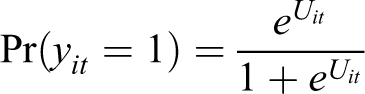
Where

Results
Descriptive statistics
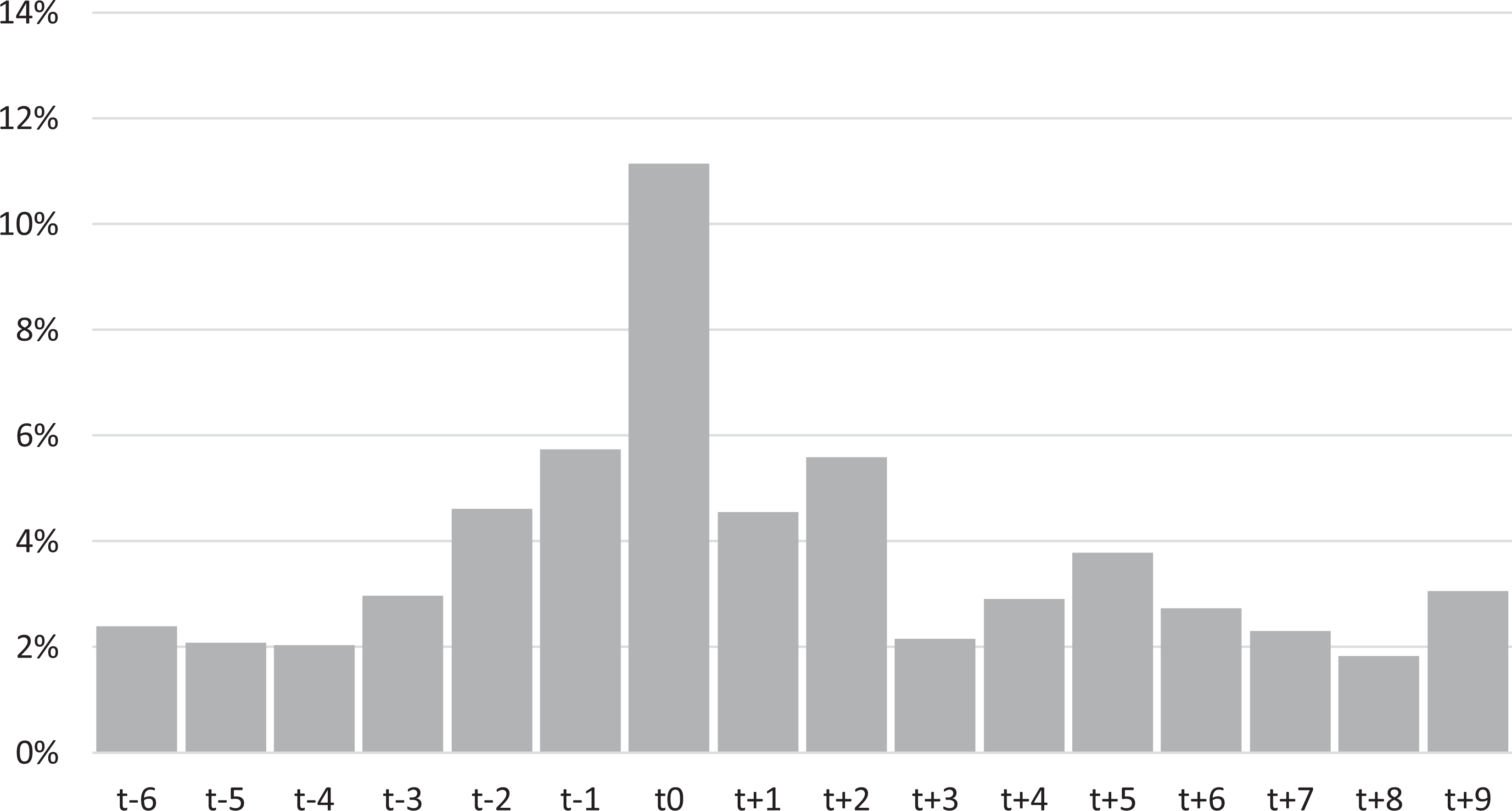
Observed probability of divorced women not working full-time increasing employment intensity surrounding the time of factual separation (N = 884).
Considering the timing of employment increase surrounding factual separation, Figure 2 shows the observed probability of an employment increase during each of the observation periods. These probabilities start out at 2.4% during t-6, then rapidly peak during the six-month period immediately following the factual separation (11.1%) and decrease again to reach 3% at t+9. On average, the probability of increasing employment at any time period is 3.8%.
In Figure 3, the observed probabilities are split up by whether the separation was expected, based on the survey question: Who first mentioned the divorce? While the same overall pattern emerges for both subgroups, the probability of increasing employment at t-2 (i.e. starting one year prior to the separation) is notably higher for those who expected the upcoming separation. In no other time periods is the difference between the two categories as large. The subgroup average probability for the women who did not expect is 3.4% versus 4% for those who did.
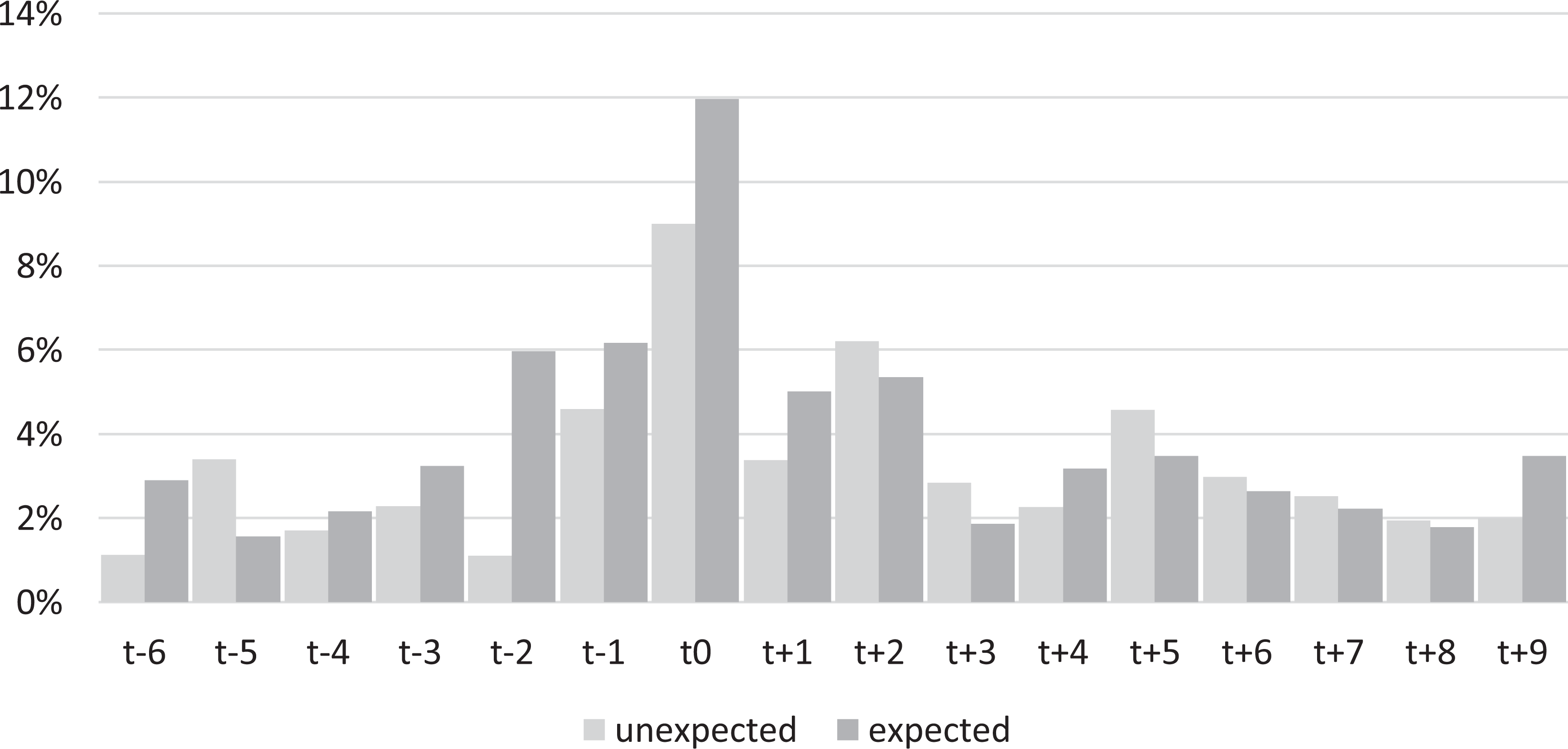
Observed probability of divorced women not working full-time increasing employment intensity surrounding the time of factual separation, divided by whether or not the divorce was expected. (N = 884)
Multivariate results
Figure 4 shows the results of a formal multivariate test of the descriptive bivariate results shown in Figure 2. All covariates described in the data section were included except for an indicator for expectedness. Probabilities were calculated at the mean values of the covariates 1 and with robust standard errors to adjust for the multiple observations per individual. The probability that divorcing women who were not already working full-time increase their employment is significantly higher than the estimated average of 3.8% (SE 0.002) in time periods t-1, t0, and t+2. This confirms our first hypothesis that these women have a higher probability of increasing employment surrounding the time of factual separation (H1).
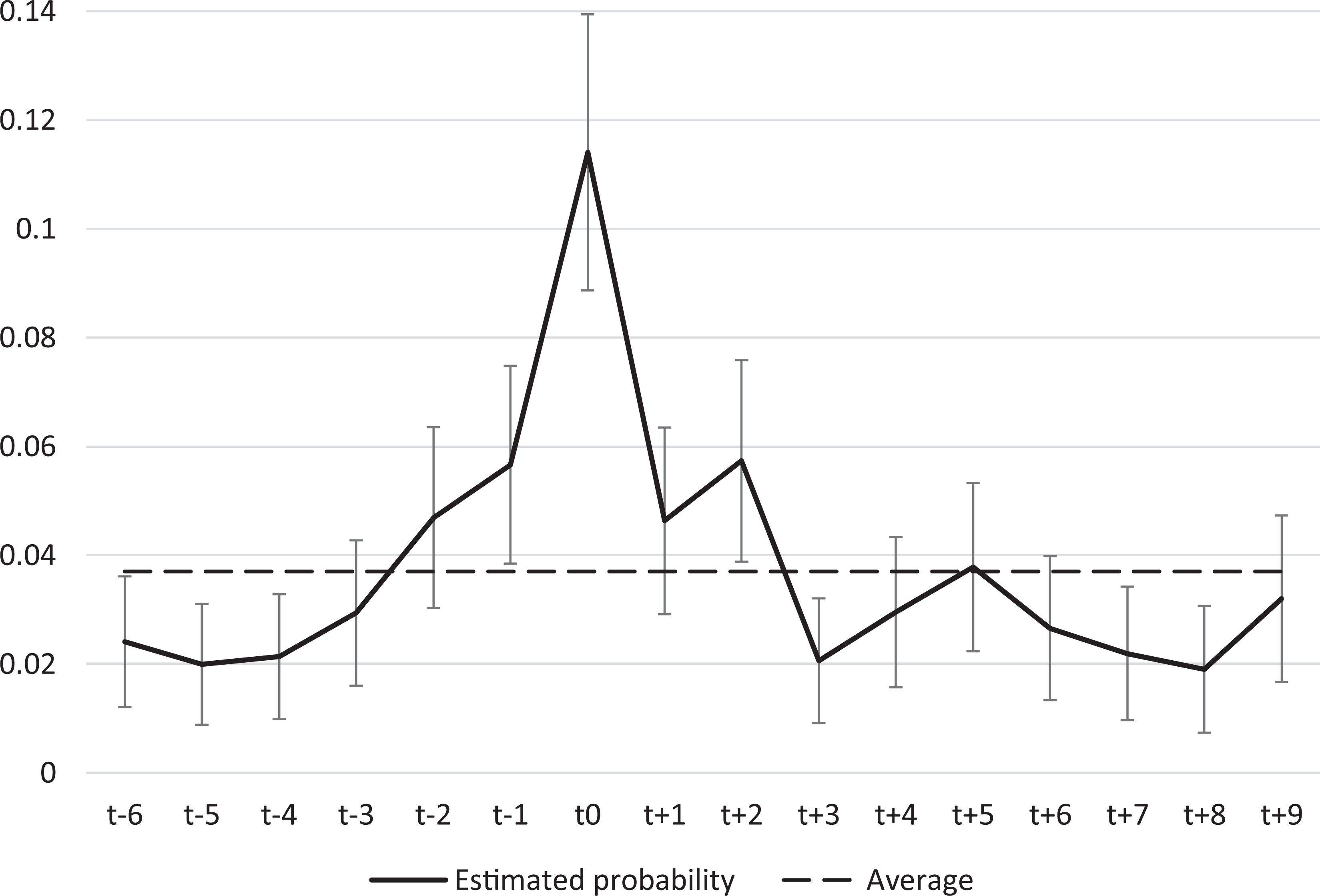
Estimated probability that divorced women not already working full-time will increase their employment intensity surrounding the time of factual separation, with 95% confidence intervals. (N = 884).
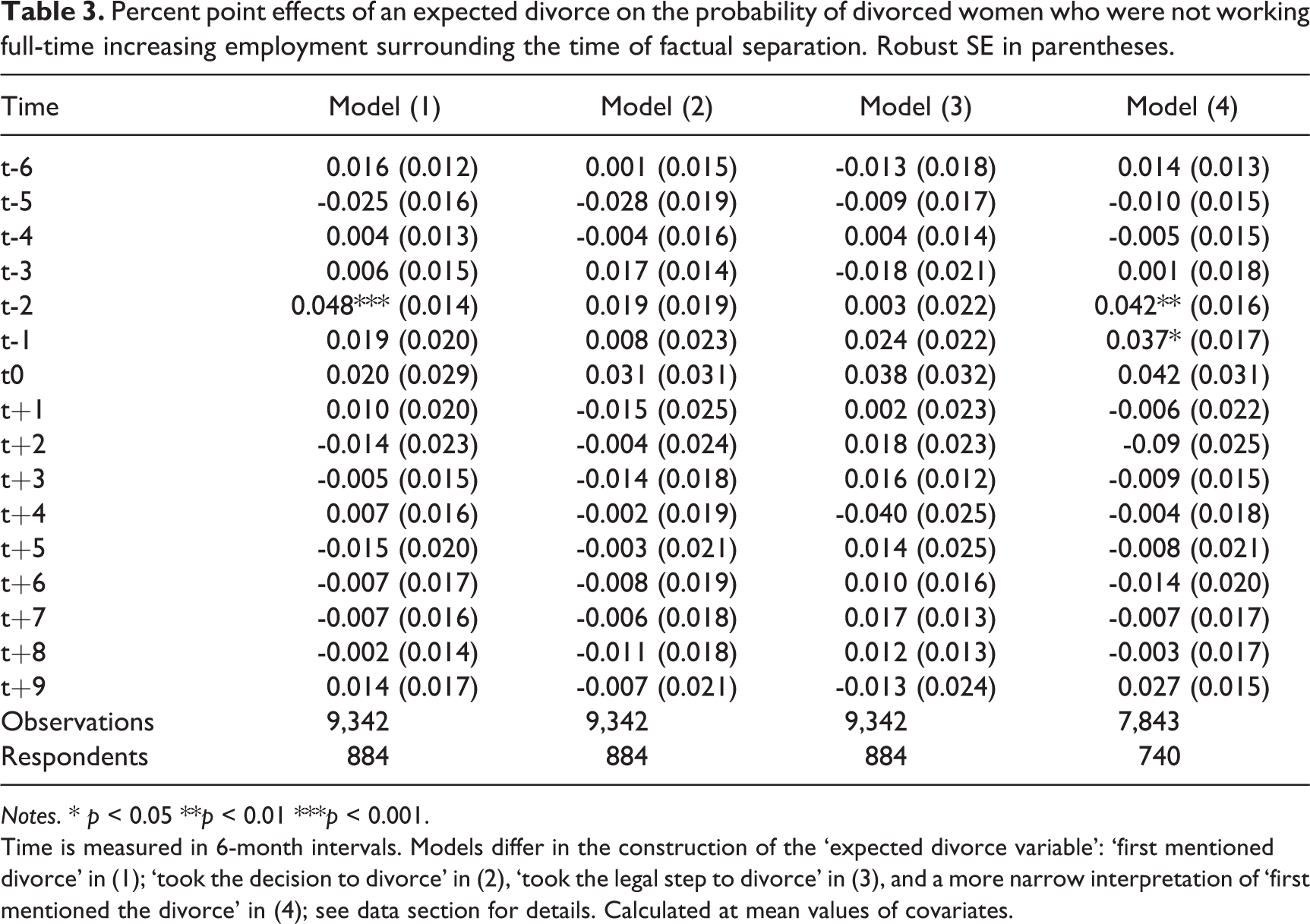
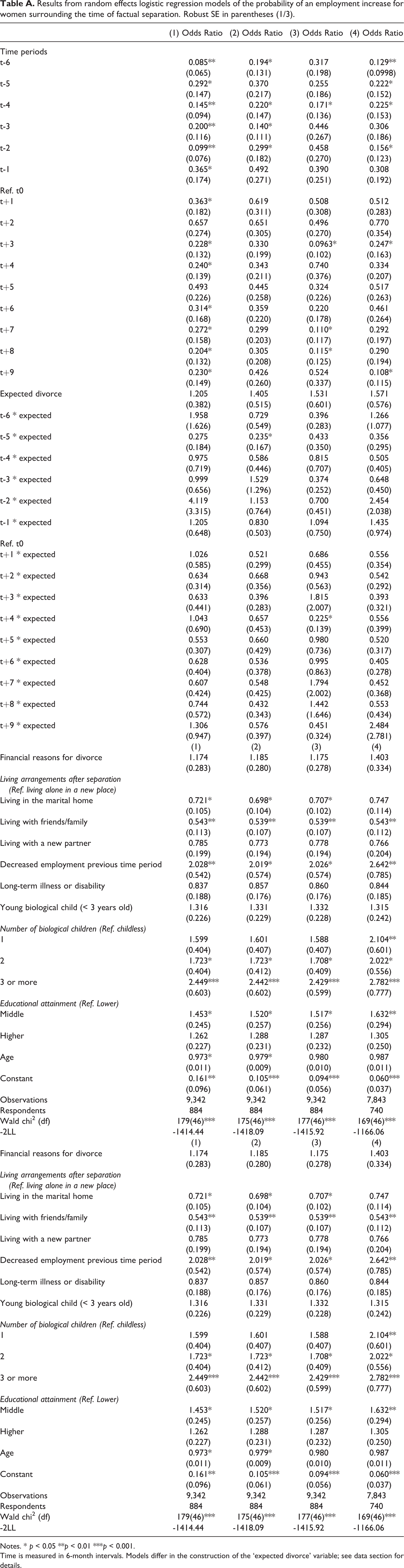
In the next step, four random effects logistic regressions that include an indicator for the expectedness of the upcoming dissolution as well as interactions of this indicator with the time-period dummies were estimated. The full estimates of these models with robust standard errors can be found in Table A in the appendix. In order to evaluate our second hypothesis, the differences in probabilities that were due to expectedness were calculated. Note that these are expressed as percent point increases rather than percent increase, i.e. the actual amount a probability increases, rather than a rate of change. Again, these probabilities were calculated at the mean values of the covariates. The results can be found in Table 3.
Percent point effects of an expected divorce on the probability of divorced women who were not working full-time increasing employment surrounding the time of factual separation. Robust SE in parentheses.
Notes. * p < 0.05 **p < 0.01 ***p < 0.001.
Time is measured in 6-month intervals. Models differ in the construction of the ‘expected divorce variable’: ‘first mentioned divorce’ in (1); ‘took the decision to divorce’ in (2), ‘took the legal step to divorce’ in (3), and a more narrow interpretation of ‘first mentioned the divorce’ in (4); see data section for details. Calculated at mean values of covariates.
The results show that expectedness of the upcoming divorce is only associated with a significant increase of the probability of increasing employment for a few select time periods, depending on the proxy that was used in the model. The first model, where expectedness was proxied by a broad interpretation of the survey question ‘who first mentioned the divorce’, shows a point estimate of a 4.8 percent point increase one year prior to the factual separation, which translates into a 95% confidence interval of 2–7.5 percent points. The fourth model, based on a narrow interpretation of the same survey question, shows a 4.2 percent point increase one year prior to separation and a 3.7 percent point increase in the six months before the couple stopped living together. While the estimates at the time of separation (t0) are of a similar magnitude in models 2, 3, and 4, the difference between the expected and unexpected groups is no longer significant during the first six months after separation. At this point in time the overall probability of increasing employment is at its highest (cfr. Figure 2), and thus the relative increase that is associated with expecting divorce is smaller. These results support our second hypothesis, that women who expected an upcoming dissolution are more likely to increase their employment before the factual separation than those who did not.
Model 3 shows a lower probability of 4 percent points for those who expected divorce at two years after the divorce. Though not significant, in absolute magnitude the estimated change rivals that of the increases found in models 1 and 4. While the overall probability of an employment increase is higher at t+2, the estimates for the subgroups do not differ significantly. When expectedness is proxied based on either who took the decision to divorce or who started the legal process of divorce, no support for this hypothesis is found. Additional support for the second hypothesis was found in two separate models (results not shown) that included expectedness as coded in model (1), but with a different outcome variable. Firstly, (re-)entering employment after being a homemaker, unemployed, a career break, early retirement or previously stated their main activity was being long-term ill or disabled. This resulted in a 2 percent point higher probability in t-3 (p < 0.05) and a 2.6 percent point increase in t-2 (p < 0.05) and nowhere else. Alternatively, the probability of women making the transition to full-time employment was found to be 4 percent points higher in t-2 (p < 0.01), but also 5 percent points higher in t+1 (p < 0.001), and 2.5 percent points higher in t+9 (p < 0.05).
Discussion
The question of women’s anticipatory employment behaviour has first been raised as an alternative explanation to the observation that marriage became less stable as women’s labour force participation increased (Becker et al., 1977; Johnson and Skinner, 1986). The sparse and inconclusive research has largely been from this angle (Poortman, 2005; Sen 2000, Vignoli et al., 2018). In doing so, research has overlooked another reason why anticipatory employment behaviour deserves considerably more attention, namely, that of the financial consequences of relationship dissolution.
On average, women are financially worse off when a union comes to an end, whether in the traditional divorce research (Hoffman and Duncan, 1988; Peterson, 1996) or the more recent extension into relationship dissolution in general (Andreß et al., 2006; Brewer and Nandi, 2014). While there is considerable difference in the size of the financial downturn, that it is there continues to be found even in the most recent research (Mortelmans et al., 2020). Additionally, Thielemans and Mortelmans (2019) found that the probability that Flemish women increase their employment is up to seven times higher surrounding the time of a couple’s factual separation. If there is a considerable group of women who start taking measures to deal with the envisioned financial consequences of an expected upcoming divorce, for instance by increasing their employment beforehand, this means that both the size of the downturn and the time it takes to recover may be underestimated for those women who were unprepared for the event.
Rather than trying to explain the association between increased employment and divorce risks through anticipatory behaviour, the objective of this paper is then to uncover whether women who expect an upcoming divorce do in fact increase their employment intensity beforehand. By using data from the DiF-survey, which has detailed information on both employment histories and measures that can be used to proxy the expectedness, we have found indications that women who expect an upcoming divorce might have between 2 and 7.5 percent points higher probability of increasing employment one year prior to the factual separation. The moment a couple stops living together was chosen over the moment of legal divorce as, in accordance with the economic necessity hypothesis (Tamborini et al., 2015), this is the time when the financial incentives for increasing employment are greatest due to loss of a partner’s income as well as the loss of economies of scale (Couch et al., 2013).
Besides using common socio-demographic controls, the rich DiF-dataset allowed us to include characteristics related to both the decision to increase employment and the separation itself, namely whether there were financial reasons for the split-up and which living arrangements were made. Additionally, a set of characteristics that are associated with the probability of increasing employment at any given time, such as increases resulting from frictional unemployment (i.e. the move from one job to another), returning to work after taking care of new-borns or young children, and long-term illness or disabilities were controlled for.
Our results contrast with those of previous research that found only weak support for the anticipation-thesis in the U.S. (Sen, 2000), the Netherlands (Poortman, 2005) and Italy (Vignoli et al., 2018). There are several possible explanations for this. On the one hand, Sen (2000) and Vignoli et al. (2018) relied on either calculated probabilities of divorce or hazards of marital disruption of which most people are arguably unaware. Poortman (2005), on the other hand, separated the effect of wives’ work on divorce risk by using a direct measure of expectedness. The research design was, however, not set up to uncover whether women who expect an upcoming dissolution increased their employment beforehand, but rather if employment intensity had a different effect on divorce risks depending on the expectedness of divorce. As it stands, our research is therefore the first to look at the association between expectedness and actual employment behaviour of women surrounding separation.
That being said, from a substantive point of view, our results indicate the existence of anticipation in terms of employment behaviour, but the order of magnitude with which expectedness is associated with an employment increase is not enough to offer an alternative explanation to the thesis that women’s work increases divorce risk. In this, our results are in line with Poortman (2005), who, besides having found weak support for the anticipation-thesis, also contends ‘that there is something in wives’ work that increases the risk of divorce’ (Poortman, 2005, p. 307).
This something might, for instance, be a selection effect. It is possible that women that have a high perception of divorce risks are more prone to working full-time in order to insure against an expected breakup. To illustrate this, Figures A to E in the appendix show the monthly observed employment status for all women for whom the data allowed to reconstruct employment histories, subdivided by the expectedness variable used in model (1) of our analyses. These graphs show that next to anticipation effects, there might be a small selection effect in the way that women who did not expect an upcoming dissolution were already more likely to be homemakers three years prior to separation (Figure E). Interestingly, while there is no difference in the proportion of women working full-time at the start of the observation period (Figure A), women who were already working part-time and did not expect the divorce were more likely to be working a lower number of hours per week (Figures B/C/D). If it is easier to slightly increase working hours when already working more than 75% of full-time and given that homemakers lose human capital (Brown and Viken, 1990) or that unemployment predicts even more unemployment (Arulampalam et al., 2001), it could then mean that women who expect an upcoming dissolution just happen to be in a situation where they can more easily increase their employment. Another explanation is that there is a division between those women with more postmodern and egalitarian versus more traditional views. It could be that the latter group might not even consider divorce, while also having lower employment rates when they are married.
Our study has several limitations. At the sample level, our research was restricted to marriages. These results are therefore not generalizable to dissolutions of cohabitational relationships. Previous research has found that the choice for cohabitation rather than marriage is selective on for instance educational attainment and egalitarian views, which in turn are related to female labour force participation, with women in cohabiting unions more often working full-time (Euwals et al., 2011). On the other hand, as we excluded women working full-time because the data did not allow us to control for second jobs and therefore these women were by design unable to increase their employment further, we can therefore not say whether the behaviour of these women is similar to our findings.
Next, for the outcome variable we were forced to use a categorical specification of employment intensity to construct increases in employment as working hours were not available in the survey. With categories such as 50–75% of full-time employment, we cannot exclude that some women’s increased employment hours were not measured as an increase as they still fell in the same category. However, it is not unreasonable to assume that women who intentionally increase their employment intensity are not doing this by just one or two hours. Working an extra day per week results in a 20% full-time increase in employment. Nonetheless, a more detailed measure of employment intensity is to be preferred.
Related to this limitation a more detailed measure would also consider the initial state of employment, as extending an existing contract might be easier than (re-)entering the labour force. Unfortunately, including 10 possible transitions from one category to another would be too demanding for the sample we have available at this time.
For our main explanatory variable, we were limited to three possible survey questions that might indicate (un)expectedness of a divorce. We therefore had to assume that women who first mentioned divorce were also those who expected it. This is not necessarily the case. For one, the possibility of divorce might be brought up in conversation without the express intention of divorcing. Alternatively, when a partner mentions divorce, one might argue that from that moment on it can be expected to happen. Depending on how many divorces were wrongly attributed to being (un)expected according to these two scenarios, it is possible that the estimated association with expectedness is biased either up or downwards. As we have no longitudinal information on when the divorce was first brought up, we cannot control for this possible weakness.
Two findings speak in favour of our interpretations. First, both a broad and narrow interpretation of the answers to the question who first mentioned divorce produced similar results. Second, our measure of expectedness is only significantly related to employment increase in the time periods immediately preceding the separation, i.e. starting one year before the moment the couple stops living together. If the relationship was completely spurious, one would expect to find it in other time periods that are less indicative of anticipatory behaviour as well.
Another problem with this variable is that it might be subject to misremembering. The narrow interpretation of the answers as a robustness check should, however, considerably have reduced that possibility. Nonetheless, these results would be more convincing if a clearer indicator of expectedness such as was used by Poortman (2005) were available. Furthermore, as there was no information available on how long the process lasted between the moment the respondent started expecting the divorce and the factual separation, expectedness could only be included as a time-invariant indicator. A more detailed analysis of anticipatory employment behaviour would benefit greatly from longitudinal information on the expectedness of a relationship dissolution.
Another important limitation is that, as we have no longitudinal information on any type of income these women received during the time of factual separation, we are unable to fully test the economic necessity hypothesis. As such, these results should be interpreted as merely indicative of the existence of anticipatory employment behaviour, rather than a means to calculate the exact effect. The nature of the research does not allow us to fully exclude the possibility that the observed relationship is due to a change in unobserved characteristics such as increases in non-labour income or preferences towards employment. Furthermore, causal interpretation of these results is not possible as we cannot observe women who: intend to divorce – for instance due to financial problems – and as a result increase their employment, but then do not divorce because the extra income removes the cause of the intended divorce. Alternatively, increasing employment might act as a self-fulfilling prophecy increasing the probability of divorce.
Lastly, omitted variable bias could also be present due to the omission of other indicators that have been found to be related to female employment. Examples here are access to formal and informal childcare (Apps et al., 2016; Connelly, 1992; Del Boca, 2015), and the presence of children with special needs (DeRigne and Porterfield, 2017).
Conclusion
Not counting people with perhaps nefarious intent, no one enters into a marriage with the purpose of getting divorced. When the relationship does end, often this is a turbulent process. Human, emotional, material, and financial turmoil often spike at the moment a couple stops living together. For women, especially those who have invested in their household rather than their career, research continues to demonstrate that there is a financial downturn followed by a long road to recovery which might never be fully reached. But not everybody is blindsided by the end of their relationship. Women who expect a breakup in the foreseeable future might take actions to counter the envisaged negative consequences, like increase their employment. In the past this anticipatory employment behaviour has only been studied because it might offer an alternative explanation to the observed simultaneous rise in women’s employment and divorce rates.
While this intention undeniably has its scientific merits, it ignores one important and tangible implication of the existence of anticipatory employment behaviour, namely that the magnitude and recovery time of the financial setback is likely underestimated for the group of women who did not expect a divorce. When the objective is to uncover anticipatory behaviour itself, this implies a different research strategy altogether. As we have shown, there is a nontrivial probability that women who expect an upcoming dissolution start increasing their employment intensity before those who remain ignorant of the future split-up. These findings should incite future research to include controls for anticipation when studying the consequences of marital- or relationship dissolution in order to avoid the possibility of underestimating the negative consequences for a large group of women.
Footnotes
Declaration of conflicting interests
The author(s) declared no potential conflicts of interest with respect to the research, authorship, and/or publication of this article.
Funding
The author(s) disclosed receipt of the following financial support for the research, authorship, and/or publication of this article: Flemish Institute for Innovation through Science and Technology (IWT) – Grant n° 140069 Fellowship of the Research Foundation Flanders (FWO) – Grant n° V432318 N.

Notes
Appendix
Results from random effects logistic regression models of the probability of an employment increase for women surrounding the time of factual separation. Robust SE in parentheses (1/3).
| (1) Odds Ratio | (2) Odds Ratio | (3) Odds Ratio | (4) Odds Ratio | |
|---|---|---|---|---|
| Time periods | ||||
| t-6 | 0.085** | 0.194* | 0.317 | 0.129** |
| (0.065) | (0.131) | (0.198) | (0.0998) | |
| t-5 | 0.292* | 0.370 | 0.255 | 0.222* |
| (0.147) | (0.217) | (0.186) | (0.152) | |
| t-4 | 0.145** | 0.220* | 0.171* | 0.225* |
| (0.094) | (0.147) | (0.136) | (0.153) | |
| t-3 | 0.200** | 0.140* | 0.446 | 0.306 |
| (0.116) | (0.111) | (0.267) | (0.186) | |
| t-2 | 0.099** | 0.299* | 0.458 | 0.156* |
| (0.076) | (0.182) | (0.270) | (0.123) | |
| t-1 | 0.365* | 0.492 | 0.390 | 0.308 |
| (0.174) | (0.271) | (0.251) | (0.192) | |
| Ref. t0 | ||||
| t+1 | 0.363* | 0.619 | 0.508 | 0.512 |
| (0.182) | (0.311) | (0.308) | (0.283) | |
| t+2 | 0.657 | 0.651 | 0.496 | 0.770 |
| (0.274) | (0.305) | (0.270) | (0.354) | |
| t+3 | 0.228* | 0.330 | 0.0963* | 0.247* |
| (0.132) | (0.199) | (0.102) | (0.163) | |
| t+4 | 0.240* | 0.343 | 0.740 | 0.334 |
| (0.139) | (0.211) | (0.376) | (0.207) | |
| t+5 | 0.493 | 0.445 | 0.324 | 0.517 |
| (0.226) | (0.258) | (0.226) | (0.263) | |
| t+6 | 0.314* | 0.359 | 0.220 | 0.461 |
| (0.168) | (0.220) | (0.178) | (0.264) | |
| t+7 | 0.272* | 0.299 | 0.110* | 0.292 |
| (0.158) | (0.203) | (0.117) | (0.197) | |
| t+8 | 0.204* | 0.305 | 0.115* | 0.290 |
| (0.132) | (0.208) | (0.125) | (0.194) | |
| t+9 | 0.230* | 0.426 | 0.524 | 0.108* |
| (0.149) | (0.260) | (0.337) | (0.115) | |
| Expected divorce | 1.205 | 1.405 | 1.531 | 1.571 |
| (0.382) | (0.515) | (0.601) | (0.576) | |
| t-6 * expected | 1.958 | 0.729 | 0.396 | 1.266 |
| (1.626) | (0.549) | (0.283) | (1.077) | |
| t-5 * expected | 0.275 | 0.235* | 0.433 | 0.356 |
| (0.184) | (0.167) | (0.350) | (0.295) | |
| t-4 * expected | 0.975 | 0.586 | 0.815 | 0.505 |
| (0.719) | (0.446) | (0.707) | (0.405) | |
| t-3 * expected | 0.999 | 1.529 | 0.374 | 0.648 |
| (0.656) | (1.296) | (0.252) | (0.450) | |
| t-2 * expected | 4.119 | 1.153 | 0.700 | 2.454 |
| (3.315) | (0.764) | (0.451) | (2.038) | |
| t-1 * expected | 1.205 | 0.830 | 1.094 | 1.435 |
| (0.648) | (0.503) | (0.750) | (0.974) | |
| Ref. t0 | ||||
| t+1 * expected | 1.026 | 0.521 | 0.686 | 0.556 |
| (0.585) | (0.299) | (0.455) | (0.354) | |
| t+2 * expected | 0.634 | 0.668 | 0.943 | 0.542 |
| (0.314) | (0.356) | (0.563) | (0.292) | |
| t+3 * expected | 0.633 | 0.396 | 1.815 | 0.393 |
| (0.441) | (0.283) | (2.007) | (0.321) | |
| t+4 * expected | 1.043 | 0.657 | 0.225* | 0.556 |
| (0.690) | (0.453) | (0.139) | (0.399) | |
| t+5 * expected | 0.553 | 0.660 | 0.980 | 0.520 |
| (0.307) | (0.429) | (0.736) | (0.317) | |
| t+6 * expected | 0.628 | 0.536 | 0.995 | 0.405 |
| (0.404) | (0.378) | (0.863) | (0.278) | |
| t+7 * expected | 0.607 | 0.548 | 1.794 | 0.452 |
| (0.424) | (0.425) | (2.002) | (0.368) | |
| t+8 * expected | 0.744 | 0.432 | 1.442 | 0.553 |
| (0.572) | (0.343) | (1.646) | (0.434) | |
| t+9 * expected | 1.306 | 0.576 | 0.451 | 2.484 |
| (0.947) | (0.397) | (0.324) | (2.781) | |
| (1) | (2) | (3) | (4) | |
| Financial reasons for divorce | 1.174 | 1.185 | 1.175 | 1.403 |
| (0.283) | (0.280) | (0.278) | (0.334) | |
|
Living arrangements after separation
|
||||
| Living in the marital home | 0.721* | 0.698* | 0.707* | 0.747 |
| (0.105) | (0.104) | (0.102) | (0.114) | |
| Living with friends/family | 0.543** | 0.539** | 0.539** | 0.543** |
| (0.113) | (0.107) | (0.107) | (0.112) | |
| Living with a new partner | 0.785 | 0.773 | 0.778 | 0.766 |
| (0.199) | (0.194) | (0.194) | (0.204) | |
| Decreased employment previous time period | 2.028** | 2.019* | 2.026* | 2.642** |
| (0.542) | (0.574) | (0.574) | (0.785) | |
| Long-term illness or disability | 0.837 | 0.857 | 0.860 | 0.844 |
| (0.188) | (0.176) | (0.176) | (0.185) | |
| Young biological child (< 3 years old) | 1.316 | 1.331 | 1.332 | 1.315 |
| (0.226) | (0.229) | (0.228) | (0.242) | |
| Number of biological children (Ref. childless) | ||||
| 1 | 1.599 | 1.601 | 1.588 | 2.104** |
| (0.404) | (0.407) | (0.407) | (0.601) | |
| 2 | 1.723* | 1.723* | 1.708* | 2.022* |
| (0.404) | (0.412) | (0.409) | (0.556) | |
| 3 or more | 2.449*** | 2.442*** | 2.429*** | 2.782*** |
| (0.603) | (0.602) | (0.599) | (0.777) | |
| Educational attainment (Ref. Lower) | ||||
| Middle | 1.453* | 1.520* | 1.517* | 1.632** |
| (0.245) | (0.257) | (0.256) | (0.294) | |
| Higher | 1.262 | 1.288 | 1.287 | 1.305 |
| (0.227) | (0.231) | (0.232) | (0.250) | |
| Age | 0.973* | 0.979* | 0.980 | 0.987 |
| (0.011) | (0.009) | (0.010) | (0.011) | |
| Constant | 0.161** | 0.105*** | 0.094*** | 0.060*** |
| (0.096) | (0.061) | (0.056) | (0.037) | |
| Observations | 9,342 | 9,342 | 9,342 | 7,843 |
| Respondents | 884 | 884 | 884 | 740 |
| Wald chi2 (df) | 179(46)*** | 175(46)*** | 177(46)*** | 169(46)*** |
| -2LL | -1414.44 | -1418.09 | -1415.92 | -1166.06 |
| (1) | (2) | (3) | (4) | |
| Financial reasons for divorce | 1.174 | 1.185 | 1.175 | 1.403 |
| (0.283) | (0.280) | (0.278) | (0.334) | |
|
Living arrangements after separation
|
||||
| Living in the marital home | 0.721* | 0.698* | 0.707* | 0.747 |
| (0.105) | (0.104) | (0.102) | (0.114) | |
| Living with friends/family | 0.543** | 0.539** | 0.539** | 0.543** |
| (0.113) | (0.107) | (0.107) | (0.112) | |
| Living with a new partner | 0.785 | 0.773 | 0.778 | 0.766 |
| (0.199) | (0.194) | (0.194) | (0.204) | |
| Decreased employment previous time period | 2.028** | 2.019* | 2.026* | 2.642** |
| (0.542) | (0.574) | (0.574) | (0.785) | |
| Long-term illness or disability | 0.837 | 0.857 | 0.860 | 0.844 |
| (0.188) | (0.176) | (0.176) | (0.185) | |
| Young biological child (< 3 years old) | 1.316 | 1.331 | 1.332 | 1.315 |
| (0.226) | (0.229) | (0.228) | (0.242) | |
| Number of biological children (Ref. childless) | ||||
| 1 | 1.599 | 1.601 | 1.588 | 2.104** |
| (0.404) | (0.407) | (0.407) | (0.601) | |
| 2 | 1.723* | 1.723* | 1.708* | 2.022* |
| (0.404) | (0.412) | (0.409) | (0.556) | |
| 3 or more | 2.449*** | 2.442*** | 2.429*** | 2.782*** |
| (0.603) | (0.602) | (0.599) | (0.777) | |
| Educational attainment (Ref. Lower) | ||||
| Middle | 1.453* | 1.520* | 1.517* | 1.632** |
| (0.245) | (0.257) | (0.256) | (0.294) | |
| Higher | 1.262 | 1.288 | 1.287 | 1.305 |
| (0.227) | (0.231) | (0.232) | (0.250) | |
| Age | 0.973* | 0.979* | 0.980 | 0.987 |
| (0.011) | (0.009) | (0.010) | (0.011) | |
| Constant | 0.161** | 0.105*** | 0.094*** | 0.060*** |
| (0.096) | (0.061) | (0.056) | (0.037) | |
| Observations | 9,342 | 9,342 | 9,342 | 7,843 |
| Respondents | 884 | 884 | 884 | 740 |
| Wald chi2 (df) | 179(46)*** | 175(46)*** | 177(46)*** | 169(46)*** |
| -2LL | -1414.44 | -1418.09 | -1415.92 | -1166.06 |
Notes. * p < 0.05 **p < 0.01 ***p < 0.001.
Time is measured in 6-month intervals. Models differ in the construction of the ‘expected divorce’ variable; see data section for details.