







Abstract
Previous studies in the Nordic context have found a positive association between stronger labor market attachment and entry into parenthood (i.e. first birth), with the association being stronger for men than women and influenced by educational attainment and life-course stage. Using total population register data and event history methods, this study asks whether and how the relationship between employment status and entry into parenthood has changed for women and men born in Finland in the 1970s, 1980s, and early 1990s. We first examine how the employment situations in which women and men make decisions about entering parenthood have changed across cohorts. Our results indicate that episodes of unemployment have not increased across cohorts of women and men who are (still) childless. At the same time, young adults are increasingly combining studies and paid employment. Stable employment promotes entry into parenthood for both men and women, although the association remains stronger for men. Sufficient economic resources to start a family may have become even more important in recent cohorts, as the negative association between longer-term unemployment and transition to parenthood appears to have intensified. We also observe a cohort trend toward delayed or foregone entry into parenthood occurring regardless of labor market status. To conclude, although weak labor market status is associated with lower first-birth rates, it is unlikely to be a major driver of the cohort fertility decline, as we observe no deterioration in young adults’ labor market status and only modest changes in its association with entry into parenthood.
Keywords
Introduction
The relationship between employment and fertility is one of the most extensively studied intersections of life domains in family demography (Balbo et al., 2013). Employment uncertainty and employment status, in particular, have gained attention due to their potentially negative impact on family outcomes and the growing uncertainty at both global and local levels (Mills and Blossfeld, 2013). This issue also connects the public and private spheres of life and holds significant policy implications.
Despite the considerable attention the issue has received, the empirical evidence on the relationship between individuals’ employment situations and their fertility remains mixed (Alderotti et al., 2021; Matysiak and Vignoli, 2008). In earlier studies, women's paid employment has generally been associated with lower fertility (Ahn and Mira, 2002; Brewster and Rindfuss, 2000; Kögel, 2004; Liefbroer and Corijn, 1999), while more recent studies have provided contrasting results (Kreyenfeld, 2015; Luci-Greulich and Thévenon, 2014; Schmitt, 2012; Wood and Neels, 2017). Research also suggests that the relationship between employment and family formation varies across countries and policy contexts (Adsera, 2011; Hsu, 2023; Matysiak and Vignoli, 2013; Schmitt, 2012; Tomatis and Impicciatore, 2023), as well as across different population segments (Kreyenfeld and Andersson, 2014; Wood and Neels, 2017). For example, in gender-egalitarian societies where the dual-earner family model is prevalent, both the male and the female partners having a solid foothold in the labor market is increasingly a prerequisite for family formation and childbearing (Kreyenfeld et al., 2012; Vignoli et al., 2020). Research in Finland indicates that a stronger labor market attachment is positively associated with entry into parenthood (i.e. first birth) for both women and men. However, the association is stronger for men and modified by educational attainment and life course stage (Miettinen and Jalovaara, 2020).
Recent research increasingly adopts a dynamic approach, asking whether the association between employment status and entry into parenthood has changed over time (Alderotti et al., 2021; Comolli et al., 2021; Kristensen and Lappegård, 2022). Long-term changes in the relationship between employment status and fertility may result from societal shifts such as increases in educational attainment, changes in the social and economic roles of women and men, or changes in policies and labor market institutions. Furthermore, individuals’ employment prospects may vary over time due to cyclically changing macroeconomic conditions. In this respect, the fertility decline in Finland and other Nordic countries, which has persisted well beyond the economic downturn around 2010, even as the economies gradually recovered, is particularly puzzling. Recently, scholars have argued that an “uncertainty narrative,” that is, subjectively perceived uncertainty about the future, tends to weaken intentions to have children, regardless of the individual's current employment status (Vignoli et al., 2020). The view that future employment expectations affect fertility decisions is not new (Hoem, 2000; Mills and Blossfeld, 2005). However, uncertainty may be fueled by expectations about the career implications of having children, or the increasing demands of parenthood (Bazzani et al. 2025; Van Wijk and Billari, 2024). These developments may help explain why the economic recovery has not translated into higher fertility; instead, fertility rates have continued to decline.
Building on the above arguments, this country-specific study focuses on change over time. We ask whether and how the relationship between employment status and entry into parenthood varies across cohorts of women and men born in Finland in the 1970s, 1980s, and early 1990s. The recent drop in fertility levels and the increase in childlessness suggest that weakening employment situations may contribute to these trends. Still, it is unclear whether young adults now spend longer time in precarious employment situations or if the adverse effect of a weaker labor market position has become stronger over time. We begin the analysis by exploring how the employment situations in which women and men make decisions about entering parenthood have changed across cohorts.
Additionally, we present evidence on the role of partnership status in the employment–fertility nexus. This is an important aspect: as stable employment likely promotes union formation (and reduces the risk of union dissolution), partnership status may partly explain the positive link between stable employment and fertility, irrespective of birth cohort. We use register-based longitudinal data covering the entire population of Finland, including detailed individual histories of education, employment, co-residence with partners, childbearing, and income for the years 1987–2020. We conceptualize weak employment status as shorter or longer episodes of unemployment or being enrolled in education (cf. Miettinen and Jalovaara, 2020). Furthermore, among employed persons, we distinguish those with the dual status of being simultaneously in education and paid work to capture how this liminal phase linking two life domains is related to first birth.
Theoretical considerations and previous findings
Employment status and entry into parenthood
Two main theoretical frameworks are relevant when examining the link between employment status and first birth at the micro level. First, from a microeconomic perspective (e.g. Becker, 1993; Jones et al., 2011; Werding, 2014), strong economic resources are crucial in supporting the transition to parenthood for individuals with stable positions in the labor market, while weaker resources limit family formation for those with a less secure connection to the workforce. In addition to current income levels, employment may be linked to greater long-term income security and improved access to earnings-based family benefits. On the other hand, the opportunity cost argument suggests that non-employment could encourage the transition to parenthood, especially for women, who often bear the primary responsibility for childcare in the family. The financial consequences of a temporary withdrawal from the labor market after having children are weaker for those already without a job than for those employed (Adsera, 2011; Becker, 1993).
From the life-course perspective, individuals’ lives are composed of various interrelated life domains, each involving different roles and preconditions (Elder, 1994; Mayer, 2009). The association between employment status and first birth is governed by norms regarding the timing, sequencing, and coupling of life events such as the acquisition of (post-compulsory) education, entry and establishment on the labor market, and family formation. The socially feasible time of becoming a parent is primarily associated with a life stage when a person is sufficiently independent to maintain their household (Huinink and Kohli, 2014). Thus, in both frameworks, stable employment is associated with an increased likelihood of first birth, and this association is more pronounced and consistent among men than among women.
There is already ample evidence that paid employment facilitates entry into parenthood, while unemployment creates obstacles to it (Alderotti et al., 2021; Matysiak and Vignoli, 2008). Studies have also shown that the negative association between unemployment or precarious employment situations and entry into parenthood is more pronounced when the unfavorable situation persists for an extended period (Schmitt, 2012; Van Wijk et al., 2022). While this is more uniformly the case for men, there is growing evidence that stable employment also increases the likelihood of a first birth for women. The previously prevalent view that unemployment promotes women's entry into parenthood has been challenged by several recent studies, particularly from the Nordic countries where the dual-earner family model prevails (Kreyenfeld and Andersson, 2014; Kristensen and Lappegård, 2022; Lundström and Andersson, 2012; Miettinen and Jalovaara, 2020), but also from countries with more traditional views on maternal employment (Alderotti, 2022; Comolli, 2021; Wood and Neels, 2017). However, gender differences persist: the negative impact of unemployment on the likelihood of having a first child appears to be more pronounced for men than women (Hellstrand et al., 2024, 2025; Kreyenfeld and Andersson, 2014; Miettinen and Jalovaara, 2020).
Similar to the employment–unemployment divide commonly used to distinguish between stronger and weaker attachment to the labor market, individuals who are studying typically have a weaker attachment to the labor market and face more significant economic uncertainty. The acquisition of education is usually associated with preparation for the labor market. Moreover, with the increase in tertiary education, it has become increasingly common to be employed while studying (Eurostat, 2023; Quintini, 2015). This dual status may be necessary to finance the studies or serve as a career strategy, enhancing future employment opportunities by gaining relevant experience before completing education (Quintini, 2015). While income from employment may encourage childbearing, potential role conflicts between work, childcare, and study are likely to discourage entry into parenthood, especially for women, who are more likely to take on greater responsibility for childcare. Examining the transition to first birth among young Hungarian women, Spéder and Bartus (2017) supported both arguments: Those with a dual status had higher first birth rates than full-time students but lower rates than those who were employed and not studying.
A vast majority of children are born to partnered parents. Stronger economic resources and stable employment are associated with the formation and stability of co-residential unions (Jalovaara, 2012, 2013; Jalovaara and Andersson, 2023). Partnership status may, therefore, be a key factor in the relationship between employment status and entry into parenthood. Recent research has shown that the rates of union formation have declined, especially among young adults, while separation rates have increased, and those with lower levels of education continue to separate at a much higher rate than those with higher levels of education (Jalovaara and Andersson, 2023). In addition, first-birth rates within unions have also declined (Hellstrand et al., 2022; Rahnu and Jalovaara, 2023).
Employment status and first birth across birth cohorts
The dominant discourse suggests that employment opportunities have become more precarious, making it increasingly difficult for young people to establish themselves in the globalized and competitive labor market (Mills and Blossfeld, 2013). However, while recession periods have resulted in higher unemployment levels, it remains an open question whether precariousness or low-quality jobs are becoming more characteristic of the labor market (Rasmussen et al., 2019). Many European countries faced severe economic downturns in the early 1990s and around 2008–2010. The downturn in the 1990s was particularly steep in Finland, with unemployment rates reaching unprecedented levels and particularly impacting young adults entering the labor market. The expansion of education, with a growing share of young adults holding tertiary degrees, has also meant that new generations entering the labor market are, on average, better educated than the older workforce. However, the increasing educational attainment of the population may also contribute to growing polarization in the labor market, as individuals without sufficient skills or education face increasing barriers to securing employment (Autor, 2014; Green et al., 2022).
Public policies can mitigate the impact of employment status on family formation. In many European countries, especially in the Nordic region, labor markets are relatively regulated, and labor market institutions (such as tripartite bargaining) offer protection to workers. Providing financial support to unemployed individuals or families, as well as implementing labor market policies such as job protection and training opportunities for the unemployed, can reduce the negative consequences of unemployment on families and support individuals in realizing their childbearing plans despite employment insecurity or periods of unemployment. In this regard, the austerity measures introduced in many countries, particularly during the 2008/2009 recession, may have worsened the negative effects of the economic downturn on families. While the Nordic welfare states are known for their generous social benefits, they too have made cuts in social benefits and strengthened active labor market policies aimed at addressing youth and long-term unemployment (Greve and Kvist, 2021; Kangas, 2019; Svalund et al., 2013; Tosun et al., 2017).
One possibility is that the relationship between employment and the transition to parenthood has changed for women but not men. In the Nordic countries, labor force participation rates for women are high, and women generally return to work after parental leave (Esping-Andersen and Billari, 2015). Many social benefits, including parental benefits, are earnings-related, encouraging individuals to be in gainful employment before having children, and subsidized day care for children facilitates combining paid work and family life. Moreover, rising housing costs and living standards have increased the importance of women’s contributions to household budgets, further incentivizing both partners to be employed (Stevenson and Wolfers, 2007). In this context, precarious employment or unemployment may influence women's decisions to enter parenthood in a manner similar to that of men. On the other hand, parenthood continues to impact women's employment situation and career more than men's even in the gender-egalitarian Nordic countries (Goldscheider et al., 2015; Nisén et al., 2024), suggesting that gender differences in the association between employment status and entry into parenthood persist.
Very few studies have examined whether the links between employment status and entry into parenthood remain constant or change over time. Such an analysis requires data that track individuals’ employment statuses and fertility behavior over a longer period, which are rarely available even in large-scale surveys. Dribe and Stanfors (2009), studying Swedish cohorts born in 1949–1964 found a strong positive association, increasing over time, between full time employment and first birth for women (but not for men). Alderotti et al. (2021) conducted a meta-analysis of studies across a wide range of European countries and time periods from the late 1970s to the 2000s, finding that job insecurity had an increasingly negative relationship with fertility over time, although the association varied by country context. In the Nordic countries, unemployment was negatively associated with men's entry into parenthood, while no significant association was found for women. In contrast, Kristensen and Lappegård (2022) show that in Norway, unemployment was negatively associated with first birth risk for both men and women, and this negative association strengthened for both sexes from the mid-1990s to 2010. Similarly, Scherer and Brini (2023) report a clear negative association between employment instability and first births in Italy (for both men and women), with this effect intensifying toward 2020. These findings are supported by a study by Van Wijk and Billari (2024), who show that the positive link between income and transition to parenthood has become stronger over the past decades, especially for women.
In this paper, we investigate the association between employment status and entry into parenthood among men and women born between 1969 and 1994. We begin by examining whether there have been changes in the employment situations in which young adults make decisions about entering parenthood, and then explore whether the associations between employment status and entry into parenthood have evolved over time. We hypothesize that (H1a) being employed is associated with a higher likelihood of first birth compared to other employment status categories, such as being unemployed, a non-employed student, or inactive. Individuals who combine employment with studying are expected to have first-birth rates that fall between those of non-employed students and those who are employed but not studying. In line with previous research, we anticipate (H1b) that the importance of economic security provided by employment for entry into parenthood has increased across cohorts. We also expect that (H2a) a stronger employment status is positively associated with entry into parenthood among both men and women, although the association is still stronger for men, but that (H2b) the gender gap in fertility responses by employment status will have narrowed across cohorts.
The Finnish context
Finland, as one of the Nordic welfare states, provides robust institutional support for reconciling work and family life and explicitly strives for gender equality in both employment and parenting. The educational attainment of women and men of reproductive age is high, with women in the working-age population having a higher proportion of tertiary education than men (Statistics Finland, 2024a). Women’s employment rates, particularly those of mothers, are high by European standards, and most mothers return to full-time work after parental leave (OECD Family Database, 2022). Public childcare services are subsidized and available to all children below school age, with demand being fully met since the early 1990s.
A notable trend in Finland’s fertility development has been the continuous postponement of first childbearing, with women now having children around the age of 30 and men around 32–33 years old (Statistics Finland, 2024b). Until 2010, Finland’s total fertility rate (TFR) remained relatively high by European standards, around 1.8. Since then, the TFR has been declining, reaching a low of 1.26 in 2023 (Statistics Finland, 2024b). This decline is primarily attributed to a decrease in first-birth rates, although second and subsequent-birth rates have also fallen (Hellstrand et al., 2021). Cohort fertility studies show that Finland has a higher rate of lifetime childlessness compared to other Nordic countries, with particularly high rates of childlessness among individuals with lower educational attainment (Jalovaara et al., 2022).
Over the past three decades, Finland has undergone two major economic recessions: the first in the early 1990s and the second around 2008–2010. The early 1990s recession led to an unprecedented rise in unemployment, particularly among young adults, with unemployment rates reaching over 20% for those aged 20–34 (Statistics Finland, 2024c). Although the 2008 recession was more severe in terms of GDP decline, unemployment among young adults was more moderate, peaking at 10–15%. Employment began to improve in the following years, reaching pre-1990 levels only by the late 2010s (Statistics Finland, 2024c). Additionally, the early 1990s recession coincided with a significant increase in the proportion of young adults pursuing higher education: the percentage of men and women aged 25–29 with tertiary education rose from 20% and 30%, respectively, before the downturn, to 27% and 44% by 2000, after which it has slightly decreased among women (to 42% in 2023) (Statistics Finland, 2024a).
Finland’s educational system is highly flexible, offering numerous opportunities for individuals to leave and return to education. Many students from vocational institutions continue their studies at the tertiary level, contributing to Finland having one of the highest average ages of completing tertiary education among OECD countries (OECD, 2022). As the number of young adults in tertiary education has increased, combining studies with part-time or temporary employment has become more common (Saloniemi et al., 2020). This trend is also evident in other countries (Spéder and Bartus, 2017); however, the flexibility of the Finnish educational system, particularly in tertiary institutions, facilitates the combination of studies with work (OECD, 2022).
Despite the sharp economic downturns in the early 1990s and around 2010, Finland’s main support mechanisms for the unemployed have remained relatively stable. Registered job seekers are eligible for unemployment benefits, with higher benefits for those with a prior employment history. Unemployed individuals not registered with an unemployment office can apply for means-tested basic social assistance, and low-income households may receive housing benefits. Many social security benefits, including parental leave provisions, are linked to prior earnings, offering income compensation. For individuals with no prior earnings, a minimum parental leave benefit is available, which, until 2003, was lower than the basic unemployment benefit (Haataja, 2008).
Data and methods
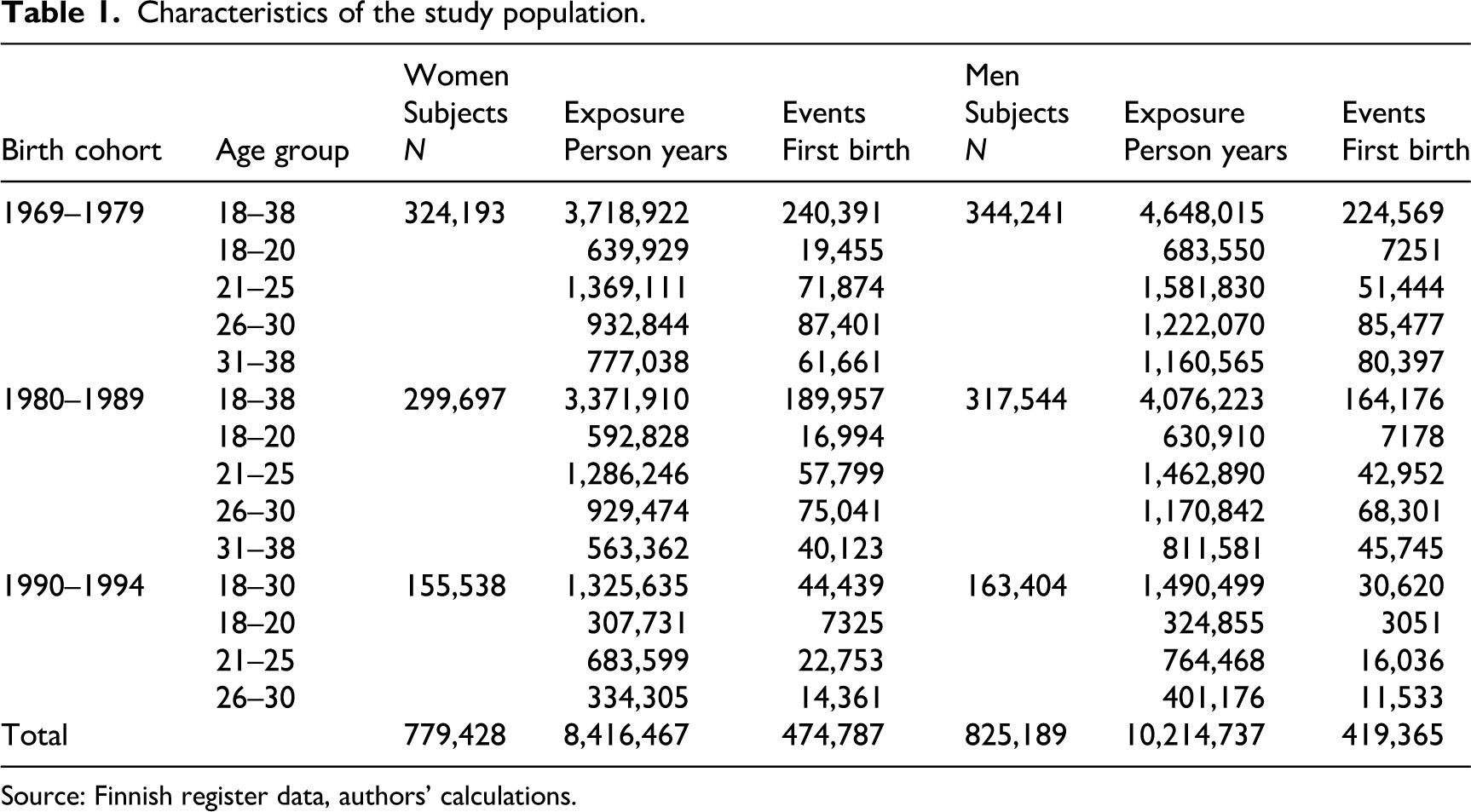
We use longitudinal, individual-level data from Statistics Finland by linking different register sources. A core part of the data encompasses the entire resident population in Finland for the years 1987–2020, including complete histories of childbearing and co-residential partnerships and information on employment, education, and income. Our study population comprises men and women born between 1969 and 1994 in Finland, who were also included in the population of Finland the year they reached the age of 18. The follow-up covers the years 1988–2020. The study population includes 779,428 women and 825,189 men, among whom 474,787 and 419,365 first births occurred, respectively (Table 1).
Characteristics of the study population.
Source: Finnish register data, authors’ calculations.
We use event history methods. Individuals are followed from the age of 18, provided they do not have biological children at that time, and are followed until they become biological parents for the first time, reach the age of 39, experience death or emigration, or the end of 2020, whichever comes first. The outcome event is conception, which results in the birth of the first child. We derive the month of conception by subtracting seven months from the month of the birth of the first child. 1 Data on terminated pregnancies or stillbirths were not available. Since the study follows individuals from age 18, it excludes childbearing below that age, which is relatively rare in Finland. Additionally, it does not capture births at later reproductive ages. In 2024, 0.4% of all first births were to women younger than 18 years, and 5.6% to women aged 39 years or older (Statistics Finland, 2025a). By concentrating on young and mid-reproductive ages, we maximize the range of comparable cohorts included in the analysis.
We use piecewise constant exponential models where the baseline hazard, age, is held constant within two-year intervals and allowed to vary between the intervals. We calculate yearly risks of conception in a given year. The results are reported as hazard ratios. All covariates are time-varying and refer to the status at the end of the previous year (employment status and income) or the end of the previous month (education and partnership status). Information on all dates in our data is on a monthly precision.
The main explanatory variable, employment status, is based on annual information regarding the primary type of activity, the number of months of unemployment, and whether a person has received a student's financial allowance for at least one semester (spring or autumn), indicating active engagement in studies leading to a degree. Unemployed persons are, according to the Ministry of Labour's registers, job seekers and are available for work; these are prerequisites for receiving unemployment benefits. We distinguish the following five categories of employment status and a residual category for a small fraction of “Others,” including individuals who do not fall into any of the other categories, such as those unemployed without registration. The categories are: (1) those who are employed and not studying (“Employed only”), (2) those who are both studying at least one semester during the calendar year and employed (“Studying and employed”), (3) those briefly unemployed or inactive (registered unemployment, but less than 4 months during the calendar year) (“Briefly unemployed”), (4) those with longer-term periods of unemployment or inactivity (4 + months of registered unemployment during the calendar year) (“Longer-term unemployed”), (5) those studying (not employed) or conscripted (“Students”), and the residual category (6) “Others.” Unlike most previous studies, which use a single category for those employed, we include a separate category for individuals who are both studying actively and employed. The dual status subcategory “studying and employed” provides a possible proxy to distinguish more or less advanced career stages within the employed population.
Educational attainment is linked to future employment security and earnings potential, with higher levels of education associated with higher employment rates and more favorable earnings progression (OECD, 2022). We, therefore, include information on the highest level of education attained by an individual as a potential confounding factor in the association between employment status and first birth. The variable is based on the date of obtaining each educational qualification and the level of the qualification. Four categories are distinguished: basic level (no education beyond compulsory basic level education), upper secondary level (corresponding to ISCED 3–4), lower tertiary level (ISCED 5–6), and higher tertiary level (ISCED 7–8).
Overall, people in stable partnerships have better opportunities to realize their childbearing intentions. We include partnership status in the models to assess whether it influences the relationship between employment status and first birth. The variable is based on the date of entering a co-residential partnership (i.e. married and cohabiting different-sex couples as defined by the family statistics; for the rules of inference, see Jalovaara and Kulu (2018)) and the date of dissolving the partnership. We distinguish between those currently cohabiting, married, or neither (single).
Income relates to economic (dis)advantage and could also affect the association of interest. The income variable is based on data on annual individual income subject to state taxation during a calendar year, that is, earnings from current employment and income from social security benefits under state taxation (e.g. unemployment benefits and sickness benefits). To adjust for inflation, the annual amounts are converted to 2020 values (Statistics Finland, 2025b). A categorical variable distinguishes eight income levels from 0–2000€ to 28,000€ or more. Almost half of our study population (by exposure time) had an annual income that was less than 16,000€ per year.
We compare the association between employment status and first births across cohorts during three decades: those born from 1969 to 1979 are addressed as the 1970s cohort, those born from 1980 to 1989 as the 1980s cohort, and those born from 1990 to 1994 as the early 1990s cohort. We do not observe anyone beyond the age of 38, but for those born in 1983 or later, the time is right-censored earlier, that is, at the respective age that a person had completed by the year 2020. In the case of the early 1990s cohort, we capture first birth dynamics only at ages below thirty. Their result is still informative for the investigation, and we report it next to the older cohorts. To see how the results are affected by age at censoring, we performed a robustness check with a similar set of models as presented in the results section, but censored the process time at age 30 for all cohorts. These results are referred to in the text where relevant, but due to spatial limitations, they are only shown in the Online supplement.
The results section begins by detailing the proportion of exposure time contributed by women and men across different employment statuses. This helps to illustrate the relative importance of each employment status group and shows the changes in the employment situations of childless young adults across cohorts.
In the multivariate analyses, we present separate models for each cohort range, sequentially incorporating educational attainment, partnership status, and income. This shows whether the association between employment status and first birth changes after accounting for the other variables. We then investigate cohorts together, adding an interaction term between employment status and cohort. This provides insight into whether the previously observed decline in the first birth rates across cohorts (e.g. Rahnu and Jalovaara, 2023) characterizes all employment status groups similarly. We also provide supplementary analyses where we included an interaction term between educational attainment and cohort, and between partnership status and cohort to investigate if the associations between employment status and first birth remained the same even if we allowed temporal variation in the associations between these covariates and first birth. Women and men are studied separately throughout the analysis.
Results
Employment status across cohorts
Figure 1 shows the share of exposure time to first birth by employment status among Finnish women and men aged 18–38, who have not (yet) had biological children. In the late twenties and early thirties, a typical age for entering parenthood in Finland, being employed is the most common status among our study population, with clearly more than half of the risk time contributed by employed persons (“employed only”). Being briefly or longer-term unemployed accounts for a relatively stable proportion of exposure time across the age groups, ranging between 9–16% for women and 11–20% for men, but remains considerably lower than the proportion of employed persons in all age groups.
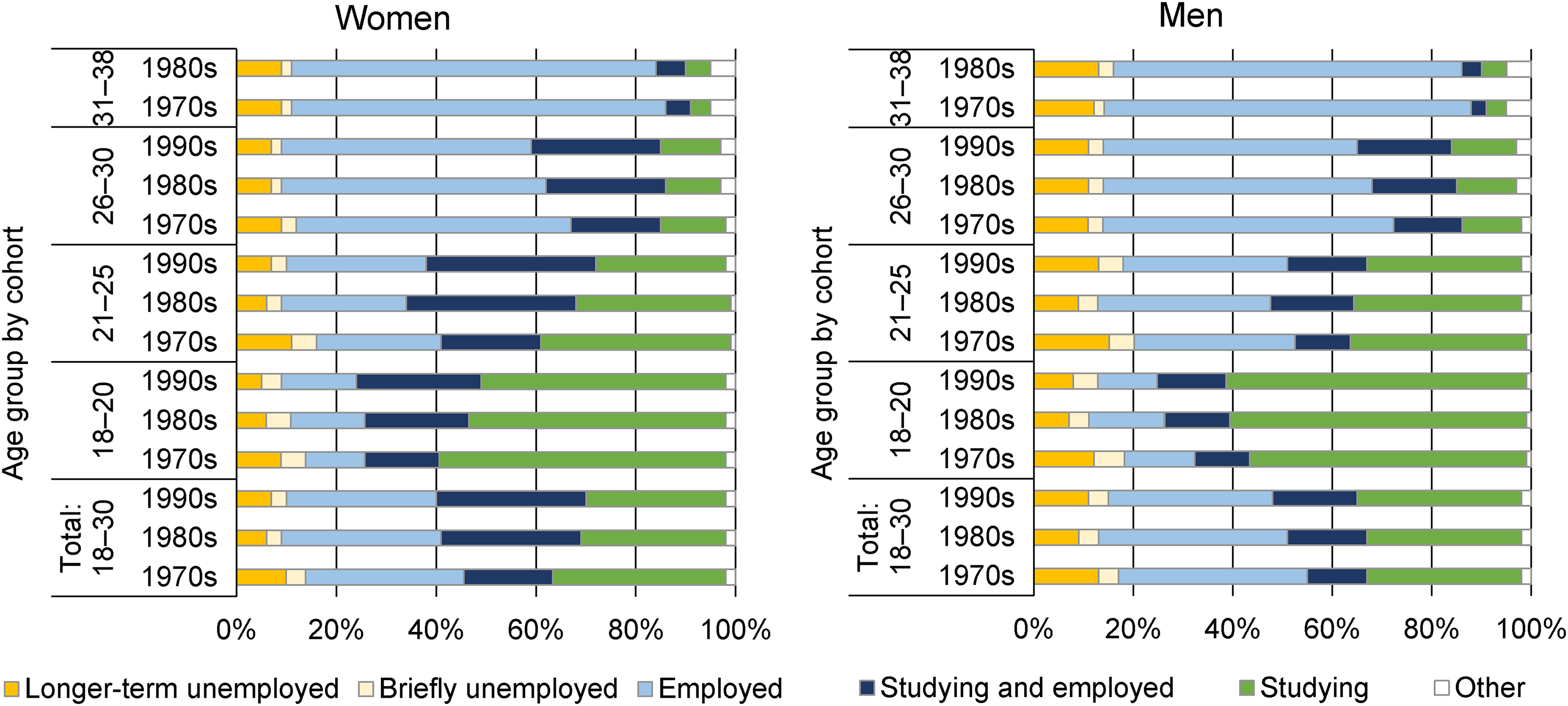
Share of exposure time (person-years) by employment status, birth cohort, and age group.
Compared to more recent cohorts, labor market attachment tends to be weaker among the 1970s cohorts, who reached reproductive age during the early 1990s recession. This difference is most evident in the 21–25 age group, where being active in the labor market (employed only or studying and employed) accounts for 45% of exposure time for women born in the 1970s, compared to 59% and 62%, respectively, for those born in the 1980s and early 1990s (the same proportions are 43%, 52%, and 49% for men).
Another trend that distinguishes cohorts is the proportion of time spent studying, especially in a dual status (studying and employed). For women, the share of those only studying has decreased, especially among those under 26 years of age, while for men, it has increased slightly. Instead, combining studies with employment (dual status) has become more common. This trend is evident for women and, to a lesser extent, for men in all age groups below 30. For example, in the 21–25 age group, the dual status accounts for 20% of exposure time for women born in the 1970s, compared with 34% for those born in the 1980s and early 1990s. In the next age group (26–30), the proportion of women with a dual status is 18%, 24%, and 26% for the respective cohorts. The proportion of men (by time of exposure) combining studies with employment is lower than for women, but has also increased over time.
In conclusion, the data show that the most significant shift in the most prevalent employment status occurs as women and men move from young to mid-reproductive age. Across all cohorts, from mid-reproductive ages onwards, most women and men with no children are employed. Compared to the 1970s cohort, the proportion of those who are unemployed (either briefly or longer-term) has not increased. However, there is an increasing tendency, particularly among women, to combine employment with education during their early and mid-reproductive years.
The association between employment status and first birth
We first examine individuals born in the 1970s, 1980s, and early 1990s separately. We include the level of education, partnership status, and income in the models one at a time to see whether this affects the association between first birth and employment status differently across cohorts.
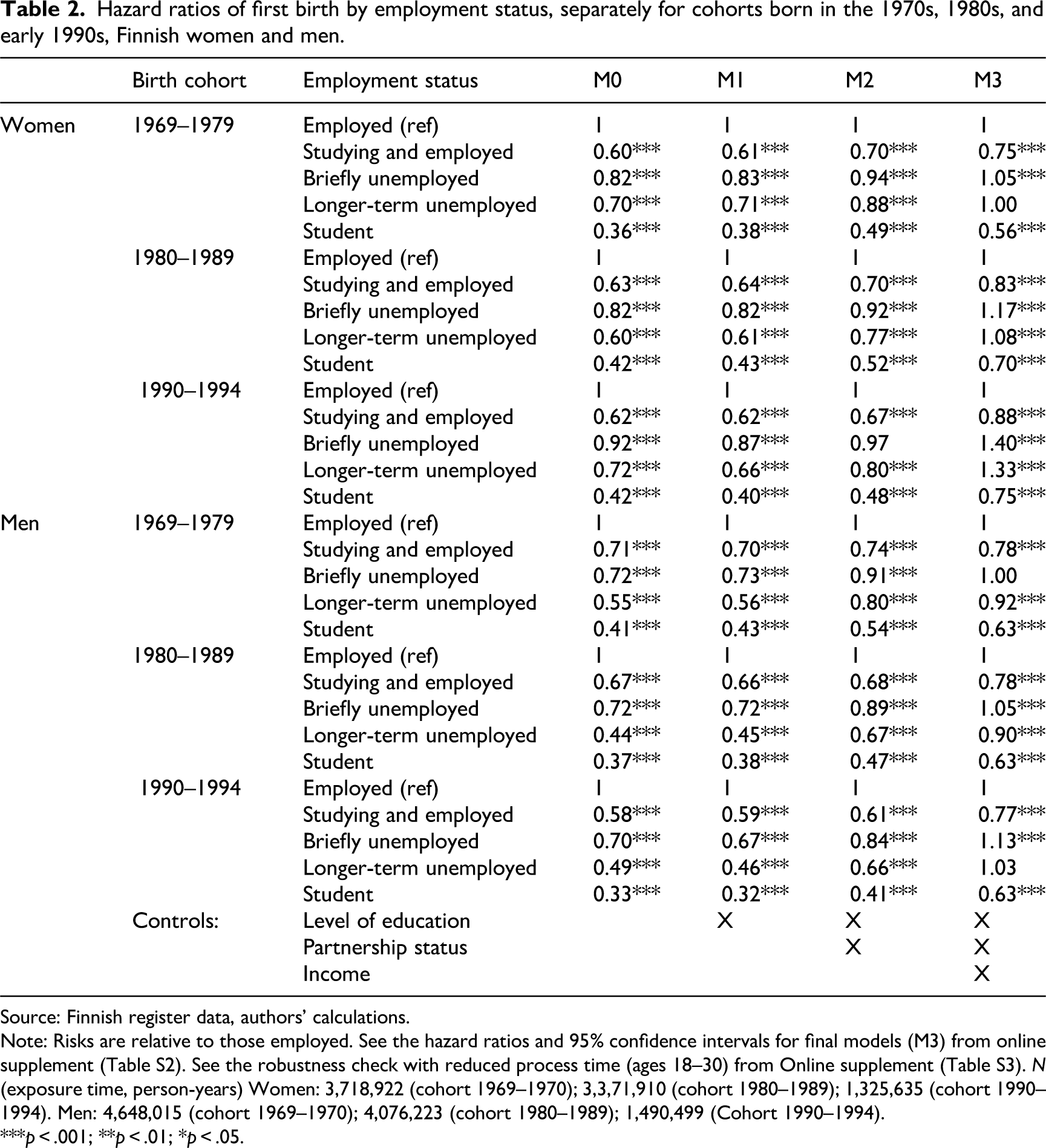
The initial model M0 shows that stronger labor market attachment is positively associated with first birth for Finnish women (Table 2, top panels) born in the 1970s. While controlling for educational attainment in model M1 does not change the association, controlling for partnership status (model M2) reduces the difference from the reference group (Employed only) by 18 percentage points for those longer-term unemployed and by about 10 percentage points for the other employment status categories. Controlling for income (model M3) further reduces the differences from the reference group, and for example, in the final model, those who have experienced longer-term unemployment do not differ from those in employment. For students, first-birth risks are significantly lower compared to the reference. For instance, being a student is associated with the lowest first-birth risks, which remain 44% lower than for those in employment, even in the final model controlling for income (M3). First-birth rates for women with a dual status of studying and being employed are higher than for those studying only, but are still 25% lower than for those employed only (see the output including hazard ratios for all variables of model M3 from the Online supplement, Table S2).
Hazard ratios of first birth by employment status, separately for cohorts born in the 1970s, 1980s, and early 1990s, Finnish women and men.
Source: Finnish register data, authors’ calculations.
Note: Risks are relative to those employed. See the hazard ratios and 95% confidence intervals for final models (M3) from online supplement (Table S2). See the robustness check with reduced process time (ages 18–30) from Online supplement (Table S3). N (exposure time, person-years) Women: 3,718,922 (cohort 1969–1970); 3,3,71,910 (cohort 1980–1989); 1,325,635 (cohort 1990–1994). Men: 4,648,015 (cohort 1969–1970); 4,076,223 (cohort 1980–1989); 1,490,499 (Cohort 1990–1994).
***p < .001; **p < .01; *p < .05.
For women born in the 1980s, the relationship between employment status and first birth closely resembles that of women born in the 1970s (Table 2). As with the 1970s cohorts, controlling for partnership status reduces the differences from the reference group by about 10 percentage points for those in education or briefly unemployed and up to 17 percentage points for those longer-term unemployed. Unlike the preceding cohort, both briefly and longer-term unemployed women have elevated first birth rates in the final model (model M3 controlling for income), 17% and 8% higher than the reference, respectively. For those born in the early 1990s, the association between unemployment spells and entry into parenthood is less negative (model M0), and more strongly positive than in the earlier cohorts in the final model (M3) when income is controlled for (40% and 33% higher than the reference for briefly and longer-term unemployed women, respectively). It should be noted, however, that those born in the early 1990s are only followed up to the age of 26–30, while the life course of the previous cohorts is followed longer. In an additional analysis, we reduced the process time to age thirty for all cohorts (see robustness checks from the online supplement, Tables S3 and S4). After reducing the process time, we observe a tendency that the association between unemployment spells and entry into parenthood is somewhat less negative in the initial model (M0) and, particularly for women born in the 1980s, more strongly positive in the final model (M3) compared to the models with the full process time for the respective cohorts. This indicates that the magnitude of the gradients is slightly sensitive to the life-course stage (age) that is captured in the models. However, in terms of the direction of the gradients, the models with reduced process time behaved almost identically to those with full process time and did not alter our general conclusions.
The overall pattern of the association between employment status and first birth is similar for men across cohorts (Table 2, bottom panels), with only a few exceptions. Short or longer-term unemployment is more detrimental for men's entry into parenthood than for women, whereas the association between first births and enrolment in education (“Studying and employed,” “Student”) is slightly less negative than for women. For unemployed men (brief or long-term unemployment), controlling for partnership status mattered more than for unemployed women (model M2). Controlling for partnership status also reduces the difference between the reference group and those studying, but doesn’t affect those with a dual status (studying and employed). Also, for longer-term unemployed men, we do not observe a change in the first-birth gradient from negative to positive when income is controlled for (model M3), as was the case for women. On the other hand, as for women, a positive association between brief unemployment and entry into parenthood is observed for men in the more recent cohorts once income is controlled for (M3).
These results indicate that not having a partner combined with a weak labor market status (lower income in our model) is the primary factor hindering progression to first birth among the unemployed, and this is more detrimental for (longer-term) unemployed men than women. However, those still preparing for their employment career (students and those with a dual status) are less likely to become parents, regardless of their income or partnership status. This pattern is consistent across all cohorts.
Next, we examined the interaction between employment status and birth cohorts to see whether the recent fertility decline has been similar across employment status groups. All rates are relative to the first birth risks of employed (“employed only”) women or men born in the 1970s. The findings (Figure 2) suggest that a decline in first birth rates toward more recent cohorts is a general trend across all employment status groups. The only exception is women who are (only) students—they have similar first birth rates among cohorts born in the 1970s and 1980s. The size of the difference between cohorts within the employment status categories varies. Among the two older cohorts, longer-term unemployed men and women show the most significant decline in first birth rates in all models (M1–M3). At the same time, the early 1990s cohort stands out from its predecessors with a sharp decline also among those who are only employed, or briefly unemployed (see the output including hazard ratios for all variables of model M3 from the Online supplement, Table S5).
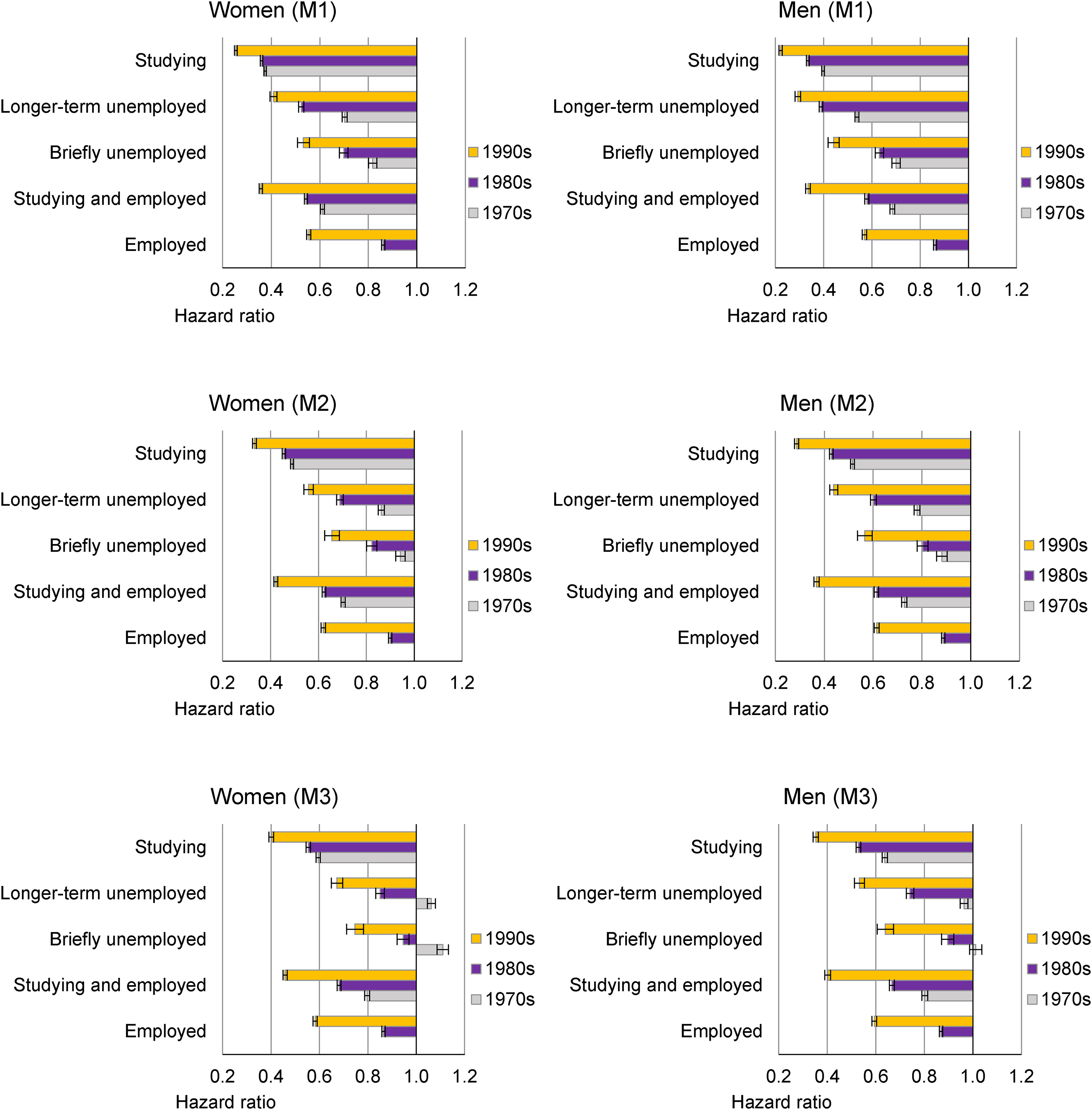
Hazard ratios of first birth by employment status and cohort, Finnish women and men.
The alternative set of models, which includes individuals under 30 (Online Supplement, Figure S1), shows only minor variations in the magnitude of cohort differences. This suggests that the foundation for lower first birth rates among more recent cohorts is laid at younger reproductive ages, where young adults, regardless of their employment status, prefer to delay entering parenthood compared to their predecessors at the same age.
Online supplement Tables S6 and S7 include analyses with (direct) interaction effects between cohort and employment status, educational attainment, and partnership status, confirming that the negative impact of longer-term unemployment on the entry into parenthood increased over time (from the 1970s cohort to the 1980s cohort) for both men and women. This trend is less clear for the 1990s cohort, whose follow-up period is also shorter.
Discussion
Using longitudinal data on the entire population from Finnish registers, we asked whether and how the association between employment status and entry into parenthood has changed among women and men born in the past decades: the 1970s, 1980s, and early 1990s. In line with previous findings from Finland and other high-income countries, our individual-level analysis confirmed that stable employment is associated with higher rates of entry into parenthood (Hypothesis H1a) (Kreyenfeld and Andersson, 2014; Kristensen and Lappegård, 2022; Liefbroer and Corijn, 1999; Miettinen and Jalovaara, 2020; Vignoli et al., 2020). The results suggest that unemployment, regardless of whether the spells were shorter or longer, discourages entry into parenthood. The results are also consistent with findings that mainly indicate a negative association between enrolment in education and first birth (ibid).
While our individual-level analysis of the association between employment status and first birth follows in the footsteps of previous studies, a comparison of this association across birth cohorts is a less explored territory. We found no marked changes in the association between short spells of unemployment and entry into parenthood across cohorts. Short spells of unemployment are associated with a delayed entry into parenthood, but the association has not strengthened over time. In contrast, longer spells of unemployment have become more detrimental to entry into parenthood for those born in the 1980s and early 1990s than those born in the 1970s who came of age in the aftermath of the early 1990s recession. One reason could be that during economic downturns, unemployment is less indicative of personal characteristics. Overall, however, first-birth rates have declined across birth cohorts regardless of employment status, keeping the differences in first-birth risks by employment status relatively stable. In other words, our results provide partial support to Hypothesis H1b.
Some of the mechanisms contributing to lower fertility differed between employment status groups: among the unemployed, the negative association with first birth seems to operate mainly through reduced income, supporting the economic arguments, while among students, the income only partly explained their lowest first birth rates. The latter suggests that low fertility rates among students also reflect non-financial factors such as life-course timing and norms. Moreover, the results suggest that partnership status is an essential factor in the relationship between labor market attachment and first birth for all groups, and even more so for men than women. However, that we find that employment status differences remain once we control for partnership status, suggests that employment situation influences entry into parenthood beyond its impact on forming and maintaining partnerships.
Previous evidence on the relationship between weaker labor market attachment and entry into parenthood has shown considerable variation between societal contexts and over time, especially for women. The pattern we observed in this study is typical of a contemporary dual-earner and gender-egalitarian family system, where weaker labor market attachment tends to discourage entry into parenthood for both men and women, as anticipated (H2a). The negative association was not entirely explained by income and was somewhat stronger for men. However, in contrast to our expectation (H2b), the gender gap in the association between employment status and entry into parenthood has not narrowed across our study cohorts but remains large. It seems that even in this Nordic context, male partners’ employment and income continue to be more important in decisions regarding family formation, related to persistently gendered attitudes toward breadwinning and care-giving in families.
We also examined whether, and how, the employment situations in which women and men make decisions about entering parenthood have changed across cohorts. We considered that being employed is not necessarily a homogeneous status. In Finland, young adults, particularly women, are increasingly combining studies and employment. Our results showed that being in a dual status delayed first parenthood compared to those who were (only) employed. However, similar to what has been reported for Hungary (Spéder and Bartus, 2017), first-birth risks were lowest for those only studying. This example illustrates the dilemmas embedded into a contemporary life course: a dual status contributes to a prolonged transition to (full-time) employment, but it may also improve a person's labor market status later on, both of which affect childbearing decisions, but in different directions. Combining studies and employment may become increasingly important for employees to update their skills throughout their careers, not just during the transition from education to work.
Our findings are relevant to the debate on the postponement of parenthood in advanced, low-fertility societies. Prolonged transitions related to the acquisition of education and establishment in the labor market have been identified as key factors pushing first births into older ages (Neels et al., 2013; Ní Bhrolcháin and Beaujouan, 2012). While this assertion is certainly true for women and men at younger reproductive ages, where enrollment in education was the most common status in our study population, by the age of around thirty and above, the overwhelming majority were already engaged in the labor market. Unemployment was associated with lower first-birth risks across cohorts, but there were no marked changes in the associations. In addition, the share of young adults who experienced shorter or longer spells of unemployment before proceeding to parenthood has not increased but rather decreased over time, especially compared to the 1970s cohort. Therefore, unemployment cannot be considered as a major contributor to the recent declines in fertility (see also Van Wijk and Billari, 2024). If anything, based on changes in unemployment rates over cohorts, we could rather expect an increase in first birth rates over time. Consequently, the argument regarding the incomplete transition to the labor market as a main reason for the declines in first-birth rates among contemporary young adults should be complemented by a more focused exploration of why, at the mid-reproductive life stage, many employed women and men do not opt for parenthood. Changes in the labor market, such as increased flexibility and remote work, and the rise of platform work and forced self-employment, affect individuals differently and widen the gap between the skilled and less skilled workforce. While these changes can offer greater autonomy and work-life balance for highly skilled workers, they often present significant challenges for less-skilled workers. In this respect, policies, including workplace practices, that support work-family or work-study-family reconciliation may now be more important than in the past for individuals to realize their fertility aspirations. Nevertheless, declining first birth rates in all employment status groups suggest that we also need to look at other factors besides changes in the labor markets.
Supplemental Material
sj-docx-1-asj-10.1177_00016993251403380 - Supplemental material for Employment status and entry into parenthood: Weaker labor market status an unlikely driver of cohort fertility decline in a Nordic welfare state
Supplemental material, sj-docx-1-asj-10.1177_00016993251403380 for Employment status and entry into parenthood: Weaker labor market status an unlikely driver of cohort fertility decline in a Nordic welfare state by Marika Jalovaara, Leen Rahnu and Anneli Miettinen in Acta Sociologica
Footnotes
Acknowledgements
The authors wish to thank Statistics Finland for granting permission (No. TK-53-731-16) to use the data. We also gratefully acknowledge funding from the Research Council of Finland under Grant 369118 for the INVEST research flagship, and FLUX project funded by the Strategic Research Council (decision number 364374).
Funding
The authors disclosed receipt of the following financial support for the research, authorship, and/or publication of this article: This work was supported by the Research Council of Finland, Strategic Research Council affiliated at Research Council of Finland (grant number 369118, 364374).
Data availability
Statistics Finland owns the data, and the data are confidential. Researchers may apply to Statistics Finland for access to the data (https://stat.fi/en). We provide a replication package containing the analysis code and information at https://doi.org/10.17605/OSF.IO/CB8YA ( ).
).
Supplemental material
Supplemental material for this article is available online.
Notes
Author biographies
References
Supplementary Material
Please find the following supplemental material available below.
For Open Access articles published under a Creative Commons License, all supplemental material carries the same license as the article it is associated with.
For non-Open Access articles published, all supplemental material carries a non-exclusive license, and permission requests for re-use of supplemental material or any part of supplemental material shall be sent directly to the copyright owner as specified in the copyright notice associated with the article.
