






Abstract
Why do some individuals make economic choices aligning with rational choice principles while others regularly deviate from such norms? This paper addresses this question by applying Bourdieu's field theory to economic cognition, arguing that economic and cultural fields cultivate opposing dispositions through fundamentally inverse logics of accumulation. Drawing on three original studies with U.S. adults, I demonstrate that capital composition and field socialization systematically pattern economic decision-making in ways behavioural economics cannot explain through psychological mechanisms alone. Study 1 reveals a negative correlation between performance on probability-based tasks (blackjack) and aesthetic evaluation, suggesting competing rather than parallel cognitive competencies. Study 2 shows that economic capital predicts lower loss aversion while cultural capital predicts heightened loss sensitivity, controlling for risk tolerance and demographics. Study 3 demonstrates that occupational and educational field socialization predicts loss aversion above and beyond capital stocks, providing direct evidence for the habitus mechanism. These findings make three contributions. First, they provide quantitative, micro-cognitive evidence for Bourdieu's chiastic structure, demonstrating that opposing field logics generate measurable cognitive interference. Second, they advance culture and cognition scholarship by introducing relational opposition as an explanatory principle: dispositions optimized for one field create systematic disadvantages in another, not merely parallel differences. Third, they suggest implications for dual-process theory, indicating that automatic and controlled processes may be relationally structured by field position rather than simply varying in content. The results challenge behavioural economics' universal bias framework and illuminate how social structure penetrates economic cognition, with practical implications for financial literacy interventions in an increasingly financialized economy.
Introduction
Why do some individuals seem to consistently make economic choices that conform closer to the tenets of rational choice theory, while others regularly deviate from such norms of objective rationality? Behavioural economics has convincingly demonstrated that human beings often diverge from purely rational decision-making, documenting numerous cognitive biases and heuristics that influence economic behaviour (Ariely, 2008; Kahneman, 2011; Kahneman and Tversky, 1979; Thaler, 2015). However, studies have also shown substantial heterogeneity in the extent to which individuals exhibit these biases (Benjamin et al., 2013; Bruhin et al., 2010; Von Gaudecker et al., 2011). Some people do generally respond to financial choices essentially in line with rational expectations (Hey and Orme, 1994; Locke and Mann, 2005), while others more frequently succumb to cognitive biases and heuristics.
While behavioural economics has documented this heterogeneity extensively, it typically attributes individual differences to individual-level phenomena: psychological factors, genetic variation, or situational contexts (see: Kahneman, 2011; Thaler, 2015), largely overlooking the potential for social structure and cultural socialisation to systematically pattern economic cognition. This speaks to a broader disconnect: economists often model rationality as a portable property of minds, while sociologists treat it as a situated accomplishment shaped by institutions, networks and culture. Yet, these parallel conversations rarely intersect (see: Hayes, 2025). Dual-process theory (DPT) – distinguishing between fast, automatic (Type 1) and deliberative, controlled (Type 2) cognitive processes – has emerged as a potential bridge between traditions (Barone, 2025; Lamont et al., 2017). 1 Sociologists have employed dual-process frameworks to demonstrate how cultural socialisation operates through both implicit, embodied dispositions and explicit, reflective reasoning (Leschziner, 2019; Nisbett and Masuda, 2013; Lizardo et al., 2016; Vaisey, 2009; Vila-Henninger, 2021); while similar frameworks help behavioural economists explain systematic deviations from rational choice (Kahneman, 2011; Stanovich, 2018). An emerging literature in cultural sociology and cognitive social science takes this bridge seriously, conceptualising cultural influence as producing variation in behaviour – different groups possess different cognitive toolkits, scripts, or capacities – but much of it still tends to reify those differences as individual attributes (personal schemas or toolkits) rather than linking them to positions in fields and the incentives, accountabilities and resources those positions entail (see: Lizardo, 2017; Lizardo and Strand, 2010; Wood et al., 2018).
Bourdieu's (1986, 1990, 2000) theory clarifies the socially structured underpinnings of cognition (Lizardo, 2019). But while influential across sociology, his concepts have not been systematically applied to explain individual-level heterogeneity in economic decision-making, nor within behavioural economics (see: Etzioni et al., 2010; Hayes, 2020; Lindenberg, 2023; Swedberg, 2011; but cf. DiMaggio, 2019; Hayes, 2025; Stoltz, 2025; Vila-Henninger, 2021). Integrating Bourdieu's field theory offers analytical leverage precisely because it specifies the structural conditions under which different cognitive processes are inculcated and activated, and the relational oppositions that pattern their distribution across social space.
Habitus – durable, embodied, often-subconscious dispositions acquired through socialisation – maps closely onto Type 1 processing: it supplies quick, taken-for-granted perceptions of ‘what makes sense’ and ready-to-hand heuristics for practical choice (Bourdieu, 1990; Hayes, 2020; Lizardo, 2017). Fields – relatively autonomous social arenas with their own stakes and rules – shape when and how actors engage Type 2 processing: field-specific logics of evaluation, accountability regimes, and the temporal and informational demands of competition structure incentives to allocate effort to deliberation (see: Barone, 2025; Lamont et al., 2017; Vila-Henninger, 2021).
Capital composition conditions both sides of this ledger. Greater cultural capital can expand one's repertoire of scripts and the metacognitive control needed to shift between Type 1 and Type 2; while greater economic capital can alter the opportunity costs and payoffs of deliberation versus reliance on habit (Bourdieu, 1990, 2005; DiMaggio, 2019). From this perspective, what behavioural economics labels ‘bias’ may sometimes be a field-inappropriate, habitus-driven response that travels poorly across contexts; where ‘rationality’ itself is partly a field-specific normative style of reasoning.
To be sure, field socialisation instructs actors towards legitimate capital-accumulation strategies – what to invest in, which forms of capital ‘count’ and how to convert among them – thereby calibrating both the heuristics they rely on and the situations in which they mobilize deliberation (Bourdieu, 1986; Bourdieu and Wacquant, 1992). Because fields privilege distinct – and at times oppositional – accumulation logics (e.g. disinterested cultural distinction vs. calculative profit-maximisation), dispositions adaptive in one arena can be contradictory or even counter-productive in another, producing cross-field frictions (i.e. hysteresis or allodoxia) when strategies travel (Bourdieu, 1984, 2000). Indeed, oppositional logics of practice, once internalised, may shape how individuals evaluate risk, interpret incentives, or respond to informational complexity – especially outside the primary field in which those dispositions were acquired (Bourdieu, 1983).
This yields a testable claim: observed variability in economic rationality should covary with field socialisation and capital portfolios, precisely because particular field logics equip actors with distinct heuristics and evaluative styles (de Nieves Gutiérrez de Rubalcava, 2025): when tasks align with the logic of an actor's primary field, performance should improve (i.e. among those socialised in economic fields or holding relatively more economic capital, classical deviations from rational choice should attenuate on monetary and probability-assessment tasks), whereas cross-field misalignment should amplify deviations (i.e. cultural-field specialists confronting profit-framed, calculative problems – or economic-field specialists tasked with aesthetic, meaning-centred evaluations outside their home field).
I empirically test this claim by examining whether individuals’ field socialisation and composition of capital – specifically as it relates to the tension between cultural versus economic logics – is associated with their individual economic decision-making, arguing that apparent differences in rationality reflect field-conditioned competencies and mismatches rather than fixed cognitive endowments. 2
To do this, I conduct three complementary studies. First, I examine whether individuals with different capital compositions perform differently when presented with both an ‘economic’ task requiring probability assessment (blackjack) and a ‘cultural’ task focusing on aesthetic evaluation. Second, I analyse the relationship between capital composition and loss aversion (λ) – a canonical behavioural economics concept that describes the tendency to weigh losses more heavily than equivalent gains. Finally, a third study measures participants’ occupational and educational socialisation history to provide more direct evidence for the hypothesised mechanism.
This research contributes to sociology and behavioural economics by showing that heterogeneity in ‘economic rationality’ is systematically patterned by field socialisation and capital composition. Across the three studies, I find that competencies align with field-congruent tasks and interfere across domains. Taken together, the results support a sociological account in which apparent (ir)rationality and bias reflect field-conditioned competencies and cross-field mismatches, rather than fixed, individual traits. This provides a sociological perspective to individual-level economic phenomena – a perspective that has largely remained absent both from behavioural economics’ psychological focus and from economic sociology's macro-structural and relational emphases alike (Etzioni et al., 2010; Hayes, 2025).
The paper also refines dual-process models in sociology. Although the empirics do not directly index Type 1/Type 2 processing, they identify meso-level moderators of which habitual versus deliberative routines are likely to be cued and prove efficacious: field alignment advantages calculative routines on probability tasks and disadvantages them on aesthetic interpretation (Study 1), and λ itself proves plastic – lower among economically dominant actors and higher among culturally dominant actors (Study 2 and 3). These patterns specify boundary conditions under which different evaluative habits are mobilised and with what consequences, situating dual-process heterogeneity in positions within fields and in capital portfolios (Lizardo et al., 2016; Lamont et al., 2017; Vila-Henninger, 2021). The paper thus situates dual-process heterogeneity sociologically (Barone, 2025).
A further contribution is to field theory itself: the analyses translate Bourdieu's proposed ‘chiastic’ opposition between economic and cultural logics into tractable indicators, observable in micro-level choice. This provides quantitative evidence that field-specific logics travel across contexts, sometimes producing allodoxia when dispositions are (mis-)applied outside their home domain (Bennett et al., 2013; Bourdieu, 1984, 1986, 2000; Deer, 2014; Hayes, 2020). The methodological approach – pairing behavioural tasks with multidimensional measures of capital and direct socialisation histories – furthermore offers a template for integrating cultural-sociological constructs into experimental and survey designs legible to behavioural economics (see: Lamont et al., 2017).
Finally, the findings suggest that practical policy interventions premised solely on information deficits are incomplete: financial literacy education and advising may be more effective when calibrated to participants’ socialisation backgrounds and the evaluative styles those experiences cultivate (Lusardi and Mitchell, 2023; Lazarus, 2016; Mullainathan and Shafir, 2013) – and clarifying how inequalities in economic outcomes can be reproduced as field-conditioned dispositions meet an increasingly financialised everyday life (Fligstein and Goldstein, 2015; Martin, 2002).
The remainder of the article proceeds as follows. The next section elaborates the theoretical framework, detailing how capital composition and field socialisation are expected to structure economic cognition and specifying four testable hypotheses. I then describe the data, measures and analytic strategy employed across the three studies. These are followed by the empirical results, followed by a discussion and conclusions.
Theoretical framework: capital composition and opposing field logics
The inverse logics of economic and cultural fields
Bourdieu (1986, 1990) conceptualised social space as multi-dimensional, with individuals positioned according to both their total volume of capital and, importantly, its composition. Social life is thus organised into semi-autonomous fields with their own internal logics, stakes and principles of valuation.
In particular, Bourdieu (1984, 2005) identified the economic and cultural fields as principal domains that tend to permeate all facets of social life while operating through fundamentally inverse logics. This inversion, or ‘chiastic structure’ between the two fields means that the very resources, practices and marks of distinction valorised in one domain are misrecognised, de-valorised or even actively disparaged in the other (Bourdieu, 1996: 223). This polarity helps organize patterns in individual dispositions and can be observed in institutional arrangements, occupational clustering and some political or ideological alignments (Brosnan, 2010; Flemmen and Haakestad, 2018; Rivera, 2015; Savage et al., 2018; Stevens, 2007; Verter, 2003). It provides an important grammar of worth that individuals use to classify both themselves and others, creating a set of organising principles that shape how individuals navigate social life (Bourdieu, 1984; Lamont and Molnár, 2002; see also de Nieves Gutiérrez de Rubalcava, 2025).
Different accumulation logics cultivate distinct dispositions through repeated practice and socialisation, which, in turn, reinforce and legitimate the continued accumulation of field-specific capital. The economic field, in this way, prioritizes instrumental calculation, profit maximisation and material accumulation (Bourdieu, 2005; Hayes, 2020). Success in this field demands objective assessment of probabilities and strategic risk management, cultivating dispositions oriented towards material efficiency and measurable returns on investment. In economic fields, regular engagement with negotiation, pricing and calculation cultivates dispositions that privilege quantifiable outcomes and instrumental reasoning – a ‘calculating mind’.
Meanwhile, the cultural field values symbolic recognition, aesthetic appreciation and often the appearance of disinterestedness in commercial success. This extends far beyond artistic production to encompass a wide spectrum of intellectual and symbolic domains including science, law, academia and religious institutions (Bourdieu, 1983). What unites these diverse domains as ‘cultural’ is a shared principle of valuation that tends to privilege subjective and symbolic recognition from qualified peers over quantitative measures like market success, thus maintaining relative autonomy from purely economic considerations (Bourdieu, 1996; Sapiro, 2003; Desmond, 2004) – a ‘pure gaze’.
But note that economic and cultural capital should not be thought of simply as parallel and opposing resources, but also ones that interact and overlap in complex ways (Jarness, 2017). The accumulation of cultural capital often requires ‘a suspension of economic urgency’, which is itself often facilitated by means of existing economic resources. Conversely, cultural capital can be converted into economic capital through specialised markets or access to prestigious occupations – what Bourdieu terms ‘reconversion strategies’. While Bourdieu (1984: 131–137) recognised that many individuals indeed possess significant amounts of both capitals (particularly in ‘balanced class fractions’ like liberal professions), he maintained that the fundamental logics organising these two fields remain intact and in tension. This means that dispositions optimised for success in one field may not transfer advantageously to the other and may indeed sometimes operate at cross-purposes – which could thus manifest in concrete cognitive tendencies that may appear irrational when individuals encounter out-of-field decisions.
Habitus, culture and cognition, and economic decision-making
The concept of habitus – internalised dispositions or modes of perception, thought, taste and action – provides a mechanism connecting social position to economic decision-making. The habitus is both structured by one's position in social space and is structuring of future practices (Wacquant, 2016). Crucially, these dispositions are transposable, meaning they are subconsciously applied across various domains of life. Individuals with a habitus formed primarily through participation in cultural fields would thus develop dispositions that privilege symbolic, aesthetic and disinterested evaluation over instrumental calculation (Bourdieu, 1996) – but when applied to economic decisions, may produce behaviour that deviates from rational expectations.
This perspective aligns with the broader tradition of economic sociology, which has long emphasised the social embeddedness of economic action. As scholars like Granovetter (1985), Zelizer (2012) and Fligstein and Dauter (2007), among others, argue, economic action is not performed by atomised, self-interested individuals but is embedded in ongoing social relations and cultural frameworks. Bourdieu's approach is distinctive in highlighting how broader social forces become embodied dispositions that shape individuals’ own practices from within. This offers a sociological complement to behavioural economics’ predominantly psychological explanations for phenomena like loss aversion, present bias, or probability misjudgement, among others (DellaVigna, 2009; Heukelom, 2014; Kahneman, 2011; Shah, et al., 2012; Thaler, 2015). Yet, economic sociologists rarely interrogate individual-level decision-making and have essentially consigned any such studies to behavioural economists (Smelser and Swedberg, 2005; see also: Etzioni et al., 2010; Hayes, 2025).
Importing social position and habitus to individual economic choice also aligns with contemporary work in sociology at the intersection of culture and cognition (Brekhus and Ignatow, 2019; Vaisey, 2021). DiMaggio (1997) argued that cultural sociologists had long made implicit assumptions about cognitive processes – how people perceive, store, retrieve and use cultural information – but these assumptions were often incorrect or oversimplified (see: Cerulo et al., 2021 for a review). By urging sociologists to engage seriously with cognitive science, DiMaggio opened pathways for understanding culture not as a monolithic force but as ‘disparate bits of information and as schematic structures that organize that information’ (DiMaggio, 1997: 263). The culture and cognition literature has since developed sophisticated frameworks for understanding how socialisation processes and social position shape mental processes. Lizardo's (2017) distinction between declarative and nondeclarative culture, for instance, provides particularly valuable analytical leverage. Declarative culture encompasses explicit, verbalizable knowledge – the attitudes, values and ideologies people can consciously articulate. Nondeclarative culture instead consists of implicit, embodied knowledge – the automatic responses, cognitive associations and practiced skills that operate below conscious awareness. This maps onto dual-process theories that distinguish between deliberative ‘Type 2’ reasoning and automatic ‘Type 1’ responses (Kahneman, 2011; Lizardo et al., 2016).
DPT, situated activation and field logics
Initially developed in cognitive psychology, DPT was quickly adopted by behavioural economics to account for systematic departures from expected-utility models (Kahneman, 2011; Kahneman and Tversky, 1979). In sociology, DPT has been fruitfully used to connect culture and cognition by specifying how implicit, embodied schemas interact with explicit, articulated reasoning (Lizardo et al., 2016; Lamont et al., 2017; Vaisey, 2009, 2021). This paper follows that spirit but also heeds recent clarifications: Type 2 is not synonymous with ‘rational’ choice, and Type 1 is not inherently biased – both can be effective or error-prone depending on the situation and the ‘mindware’ available (Barone, 2025; Evans and Stanovich, 2013; Stanovich, 2018). Indeed. recent work argues that the promise of DPT for sociology lies not in reifying two ‘systems’, but in clarifying when different cognitive routines are likely to be cued and prove efficacious within social ecologies.
Building on Barone's (2025) synthesis, I treat the relation between the two processes as default-interventionist rather than permanently ‘competing’. In ordinary activity, well-learned heuristics guide action; reflective processing intervenes selectively – when incentives, accountability or informational complexity make it worthwhile, and only insofar as people have the metacognitive resources to override or revise an initial response.
From this view, DPT maps naturally onto Bourdieusian theory without collapsing into psychological reductionism. Habitus comprises durable, often nondeclarative dispositions that resemble automatic routines; fields supply the stakes, audiences and accountability regimes that render deliberation more or less worthwhile in practice (Bourdieu, 1990; Hayes, 2020; Lizardo, 2017). In this way, fields calibrate both which schemas are chronically accessible and when actors expend effort to override defaults – linking cognitive activation to position, capital composition and the perceived payoffs of calculative effort (Lamont et al. 2017; Lizardo et al., 2016).
What looks like a stable ‘style’ often reflects domain-specific rules, concepts and repertoires one has learned subconsciously to deploy (Evans and Stanovich, 2013; Lizardo et al., 2016). Field theory specifies the situational triggers for shifts in activation and override – that is, when default routines are cued and when agents invest in reflective correction (Barone, 2025). In economic fields, calculative routines are institutionalised and monitored; markets reward probabilistic accuracy, auditability and risk-managed returns. In cultural fields, symbolic interpretation and disinterested evaluation are valorised, while instrumental calculation and price-based justification are downranked in favour of originality, peer recognition and autonomy from commercial aims. Fields both train the automatic repertoire actors carry (what ‘comes first’) and structure if and when actors will invest the reflective effort to intervene. In short: habitus aligns with the automatic track; field demands and sanctions shape the selective deployment of deliberation.
This framing yields the empirical strategy below. I do not attempt to measure ‘Type 1/Type 2’ directly. Instead, I probe field alignment and misalignment as meso-level moderators of which routines are likely to be cued and effective. The prediction is straightforward: when tasks match a respondent's home-field logic, performance should improve; when they cross fields, the same well-learned routines can become counter-productive, producing deviations that behavioural economists label ‘bias’– to locate which routines get cued, where and for whom – and to show empirically that such cuing covaries with field socialisation and capital composition.
Despite a conceptual apparatus well-suited to analysing economic decisions, culture and cognition scholars have largely focused on other domains such as social classification (Brekhus, 2007), collective memory (Olick, 2007), identity formation (Cerulo, 1997) and meaning-making (Ignatow, 2007). When economic behaviour has been addressed, it has typically been through the lens of consumption patterns or taste (e.g. Lizardo and Skiles, 2009) rather than fundamental decision-making processes like risk and loss assessment, probability judgment, valuation, or intertemporal choice – those that preoccupy behavioural economists. Indeed, the ‘cognitive turn’ in cultural sociology remains largely disconnected from behavioural economics – despite their shared focus on cognitive processes and socially relevant outcomes. This disconnect represents a significant missed opportunity for cross-fertilisation between fields studying similar phenomena (but see: DiMaggio, 2019; Fligstein and Goldstein, 2015; Wherry, 2012; Zelizer, 2010 for cultural interventions into other areas of economic sociology).
A canonical behavioural economics phenomenon: loss aversion
Among the many biases catalogued by behavioural economists, loss aversion – the tendency to subjectively weigh losses more heavily than commensurate gains (Kahneman and Tversky, 1979) – is perhaps the field's signature finding. It underpins prospect theory, informs explanations of the endowment effect and regret aversion, and shapes policy applications from retirement saving to consumer protection (Köszegi and Rabin, 2006; Thaler, 2015).
In its classical formulation, individuals faced with a 50–50 gamble to win, say $100, or else lose the same amount will typically reject it – requiring potential gains upwards of 2.5–3.5x the potential loss to make the prospect agreeable (Blake et al., 2021). This asymmetry between equivalent gains versus losses violates expected utility theory's assumption that outcomes should be weighted solely by their objective probabilities. Extensive research documents loss aversion across domains: investors hold losing stocks too long while selling winners too quickly (Odean, 1998), employees resist wage cuts more than they pursue raises (Bewley, 1999) and consumers overvalue goods they already possess relative to identical items they might acquire (Kahneman et al., 1991).
The standard explanation roots loss aversion in evolutionary psychology – an adaptive mechanism where threats to survival loomed larger than opportunities for gain (Kahneman, 2011; Rick, 2011). This account therefore treats loss aversion as universally hardwired into human cognition, varying only perhaps in magnitude due to genetic differences or temporary states like mood or cognitive load. Some work has identified moderators: professionals like traders and economists show reduced loss aversion through training and experience (Cipriani et al., 2009; Frank et al., 1993; Haigh and List, 2005), while poverty appears to heighten it (Haushofer and Fehr, 2014). Yet these findings are typically interpreted through individualistic lenses – expertise reduces bias through learning, poverty through stress – rather than recognising systematic social patterning.
While cultural explanations for variation in loss aversion remain understudied, cross-national comparisons do find meaningful differences in average population-level prevalence, with collectivist cultures showing distinct patterns (Wang et al., 2017). Within societies, gender, age and education do correlate with loss aversion (Gächter et al., 2022), but which are better explained in ways that suggest socialisation pathways rather than purely biological mechanisms (Hayes and Miletzky, 2024). Such patterns hint at deeper structural forces shaping how individuals weight gains versus losses. Yet most empirical work still treats ‘λ’, the loss-aversion parameter, as a sort of cognitive constant, varying only with situational framing or individual numeracy.
I instead treat λ as a socially patterned disposition – a sedimented ‘feel for the game’ that reflects long-term immersion in competing field logics.
Hypotheses
Building on this integrated framework of field logics, habitus and dual-process cognition, the present study advances four hypotheses:
H1 (field competence): Individuals whose capital portfolios are economically dominant will outperform culturally dominant counterparts on probability-based tasks that reward instrumental calculation. H2 (cross-domain interference): Competence in the economic task will be negatively correlated with performance in an aesthetic-evaluation task, especially at extreme poles of capital composition. H3 (loss-aversion sensitivity): Economic dominance will predict lower loss aversion (λ), whereas cultural dominance will predict heightened loss aversion. H4 (field socialisation): Independent of current capital, biographical immersion in economic versus cultural fields – operationalised via occupation, coursework and parental background – will account for additional variance in λ.
Study 1: Economic and cultural tasks
Task design
Study 1 challenged participants to engage in two distinct tasks – one an ‘economic’ game emphasising objective probability assessment and a second ‘culture’ game focusing on subjective aesthetic evaluation.
For the economic task, participants played 20 rounds of online blackjack (‘21’). Blackjack was selected because it captures essential elements of economic decision-making settings (Carlin and Robinson, 2009; Phillips and Siegel, 2009; Yu and Wang, 2009; see also: Mezrich, 2008): calculating probabilities, managing risk and making strategic decisions under uncertainty. While blackjack is often framed as a gambling, there is an optimal method of play and the game serves as a suitable proxy for the specific cognitive skill of probability judgment in a controlled setting, which is a core component of economic rationality (see: Baldwin et al., 1956; Thorp, 1966).
For the cultural task, participants evaluated a series of seven photographs and rated them on a 4-point scale: beautiful, interesting, meaningless, or ugly. This scale, inspired by Bourdieu's (1984: 6–7) research in the French context, is conceptualised as an ordinal variable reflecting a continuum of aesthetic engagement or appreciation (see: Barthes, 2000). 3 Following his methodology in Distinction, the photographs included an old woman's hands, an industrial gasworks at night, the bark of a tree, traditional dancers, a head of lettuce, a butcher shop and a self-portrait by the artist Frida Kahlo, presented in random order (Barthes, 2000, see Appendix).
Participants also provided written descriptions of three images (the old woman's hands, the gasworks at night and the Frida Kahlo self-portrait), which were coded thematically as either ‘descriptive’ or ‘interpretive’. For the Kahlo portrait, an additional coding category of ‘recognition’ replaced ‘interpretive’ when participants identified the artist. This qualitative component provides insight into participants’ approaches to cultural objects, revealing whether they focus primarily on concrete or utilitarian features versus symbolic meanings (see: Hanquinet et al., 2014; Holt, 1998). As Bourdieu (1984: 44) notes, when confronted with similar photographs, those with limited cultural capital often express conventional emotions or focus only on functional aspects, while those rich in cultural capital respond more allegorically, emphasising symbolic interpretation.
Sample and data collection
Participants for Study 1 were recruited through Amazon's Mechanical Turk (AMT). An initial sample of 600 was sourced, but 17 were removed by listwise deletion due to missing data. While not representative, AMT samples are used widely in social science research and provide validated findings (Berinsky et al., 2012; Buhrmester et al., 2011; Shank, 2016). All participants completed both tasks, with task order randomised.
The sample (N = 585) was 55% female, 79% white, with a median age of 42 years. Sixty percent had a 4-year college degrees or higher and median income was $40,000–50,000/year. Participants received monetary compensation for their participation at approximately the pro-rata U.S. federal minimum wage.
Measures
Economic capital was measured primarily via personal net assets, supplemented by household income. Accumulated assets hones closer to Bourdieu's (1986) conception of economic capital as that which is money or money-convertible, where income represents a flow rather than a stock of resources (but still provides useful additional information about participants’ economic position). Both measures were log-transformed in analyses to address skewness.
Cultural capital was measured using a multi-dimensional approach including embodied (cultural participation), objectified (possession of cultural goods) and institutionalised (educational attainment) forms, following established methods (see: DiMaggio and Mukhtar, 2004; Goßmann, 2018; Hanquinet, 2018; Katz-Gerro, 2002; Lizardo and Skiles, 2009; Nagel and Verboord, 2012; Sieben and Lechner, 2019). Utilising multiple measures of cultural capital increases construct validity and ensures findings are not driven by particular operationalisations. This approach aligns with methodological discussions emphasising the multidimensional nature of cultural capital (Bourdieu, 1986; Prieur and Savage, 2013).
The study also collected data on demographic characteristics, including age, gender and race, which were included as controls in analyses as they are known correlates of both capital endowments and economic preferences.
Two control variables are included for potential confounders such as one's ex-ante propensity to gamble and self-reported risk tolerance (Dohmen et al., 2011). 4
Outcomes
For the blackjack task, the primary outcome was the number of hands won out of 20 played, with a minimum score of zero and maximum of 20.
Following Bourdieu's method (1984: 6–7) described for the aesthetic evaluation task, an index was constructed by assigning numerical values to responses: 0 for ‘ugly’, 1 for ‘meaningless’, 2 for ‘interesting’ and 3 for ‘beautiful’. 5 These values were summed across the seven images to create a composite score ranging from 0 to 21, with higher scores indicating greater aesthetic appreciation (see also: Atkinson, 2011; Hanquinet et al., 2014). According to his own analysis of this scale, ‘Factorial analysis of judgements on ‘photogenic’ objects reveals an opposition within each class between the fractions richest in cultural capital and poorest in economic capital and the fractions richest in economic capital and poorest in cultural capital’ (Bourdieu, 1984: 39).
Written descriptions of selected images were independently coded by two researchers as either ‘descriptive’ or ‘interpretive’ (or ‘descriptive’ versus ‘recognition’ for the Frida Kahlo self-portrait). As sole-authored project, coding decisions from the principal investigator alone were used for this supplementary analysis, with the understanding that interpretations should thus be considered more cautiously. Examples of descriptive codes resulted from responses like:
The photograph is an older person with deformed hands. A black and white photo of an old women shown from the waist down, focusing on her hands. An older lady in a dress is standing with her hands in front of her.
Examples of interpretive codes included:
It makes you think she has worked hard in her life.
Old peasant lady who has toiled her whole life showing her weathered hands.
This is called experience.
With the photograph of an industrial gasworks, responses were coded in the same manner. Examples of descriptive responses include:
I think it's a photo of an oil refinery or some other type of industrial complex. A brightly lit factory at night. There is a city skyline at night with lots of lights.
Some of the interpretive responses included:
The power plant glows like a jewelled city The lights are vivid and I can imagine workers scurrying about…. A futuristic cityscape lights up a dark night. Light pollution in action.
Results
Table 1 presents regression results examining the relationship between economic capital and blackjack performance. Net assets, all else equal, is found to be positively associated with blackjack performance (standardised β = 0.14, p < .01). 6 When using log income as the measure of economic capital, the association is preserved, but not statistically significant (β = 0.06, p = .20). This distinction is particularly important given growing evidence that wealth and income capture different dimensions of economic position (Keister, 2014; Killewald et al., 2017).
OLS regression modelling the effect of economic capital on blackjack scores.
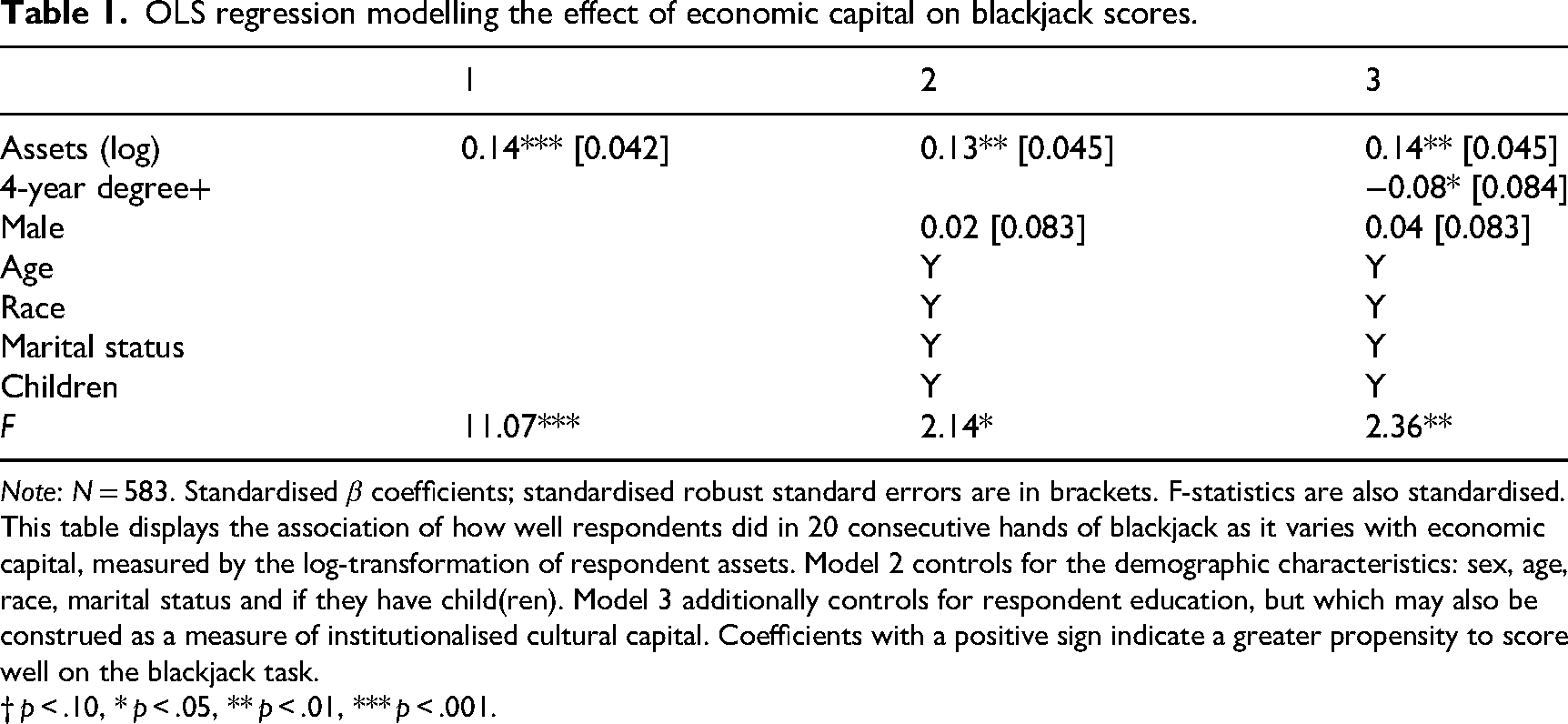
Note: N = 583. Standardised β coefficients; standardised robust standard errors are in brackets. F-statistics are also standardised. This table displays the association of how well respondents did in 20 consecutive hands of blackjack as it varies with economic capital, measured by the log-transformation of respondent assets. Model 2 controls for the demographic characteristics: sex, age, race, marital status and if they have child(ren). Model 3 additionally controls for respondent education, but which may also be construed as a measure of institutionalised cultural capital. Coefficients with a positive sign indicate a greater propensity to score well on the blackjack task.
† p < .10, * p < .05, ** p < .01, *** p < .001.
The modest but consistent relationship suggests that economic capital is indeed associated with probability-based reasoning capabilities, such as those found in economic decision making.
Table 2 shows the relationship between various measures of cultural capital and performance on the aesthetic evaluation task. All measures of cultural capital positively associated with higher aesthetic evaluation scores, with objectified cultural capital (β = 0.24, p < .001 for owned items; β = 0.12–0.13, p < .01 for books), embodied (β = 0.21–0.23, p < .001) and institutionalised cultural capital (β = 0.09–0.10, p < .05).
OLS regression modelling the effect of cultural capital on rating images.
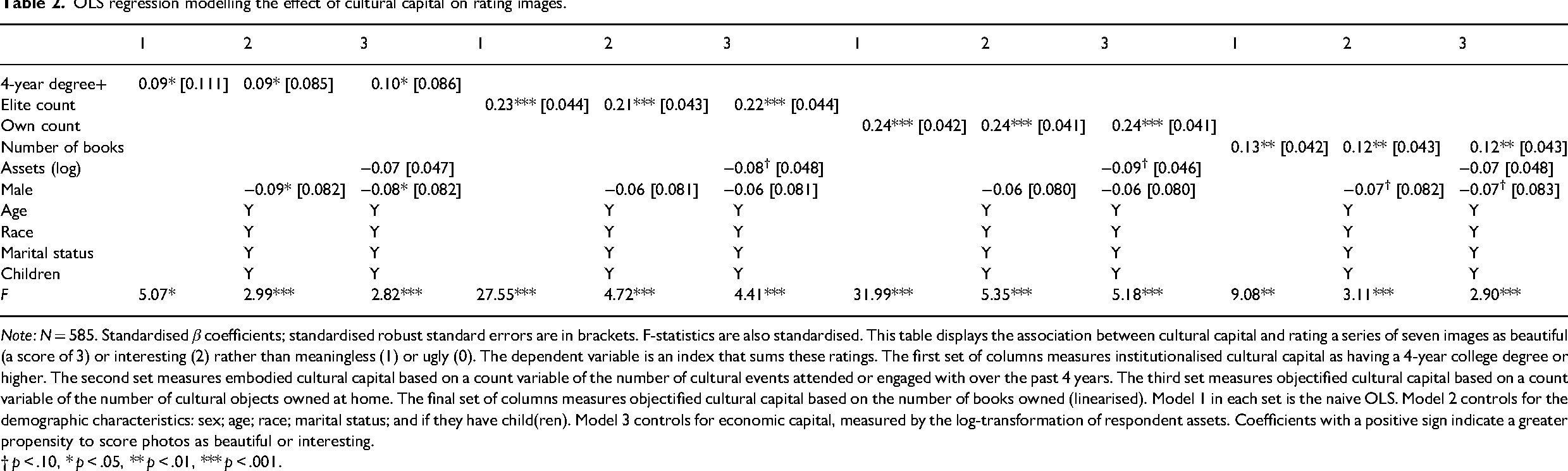
Note: N = 585. Standardised β coefficients; standardised robust standard errors are in brackets. F-statistics are also standardised. This table displays the association between cultural capital and rating a series of seven images as beautiful (a score of 3) or interesting (2) rather than meaningless (1) or ugly (0). The dependent variable is an index that sums these ratings. The first set of columns measures institutionalised cultural capital as having a 4-year college degree or higher. The second set measures embodied cultural capital based on a count variable of the number of cultural events attended or engaged with over the past 4 years. The third set measures objectified cultural capital based on a count variable of the number of cultural objects owned at home. The final set of columns measures objectified cultural capital based on the number of books owned (linearised). Model 1 in each set is the naive OLS. Model 2 controls for the demographic characteristics: sex; age; race; marital status; and if they have child(ren). Model 3 controls for economic capital, measured by the log-transformation of respondent assets. Coefficients with a positive sign indicate a greater propensity to score photos as beautiful or interesting.
† p < .10, * p < .05, ** p < .01, *** p < .001.
These results support H1 that forms of capital correlate with like field-specific competencies.
Next, I examined performance across the two tasks. Table 3 presents regression results revealing a significant negative association between the aesthetic evaluation scores and blackjack performance (β = −0.14–0.15, p < .001), controlling for total capital volume, capital composition and demographic variables. The bidirectional analysis reveals the inverse relationship is robust regardless of which task is treated as the outcome. This pattern provides support for H2, suggestive of interfering or competing set of dispositions cultivated in economic versus cultural fields. Figure 1 visualizes this relationship.
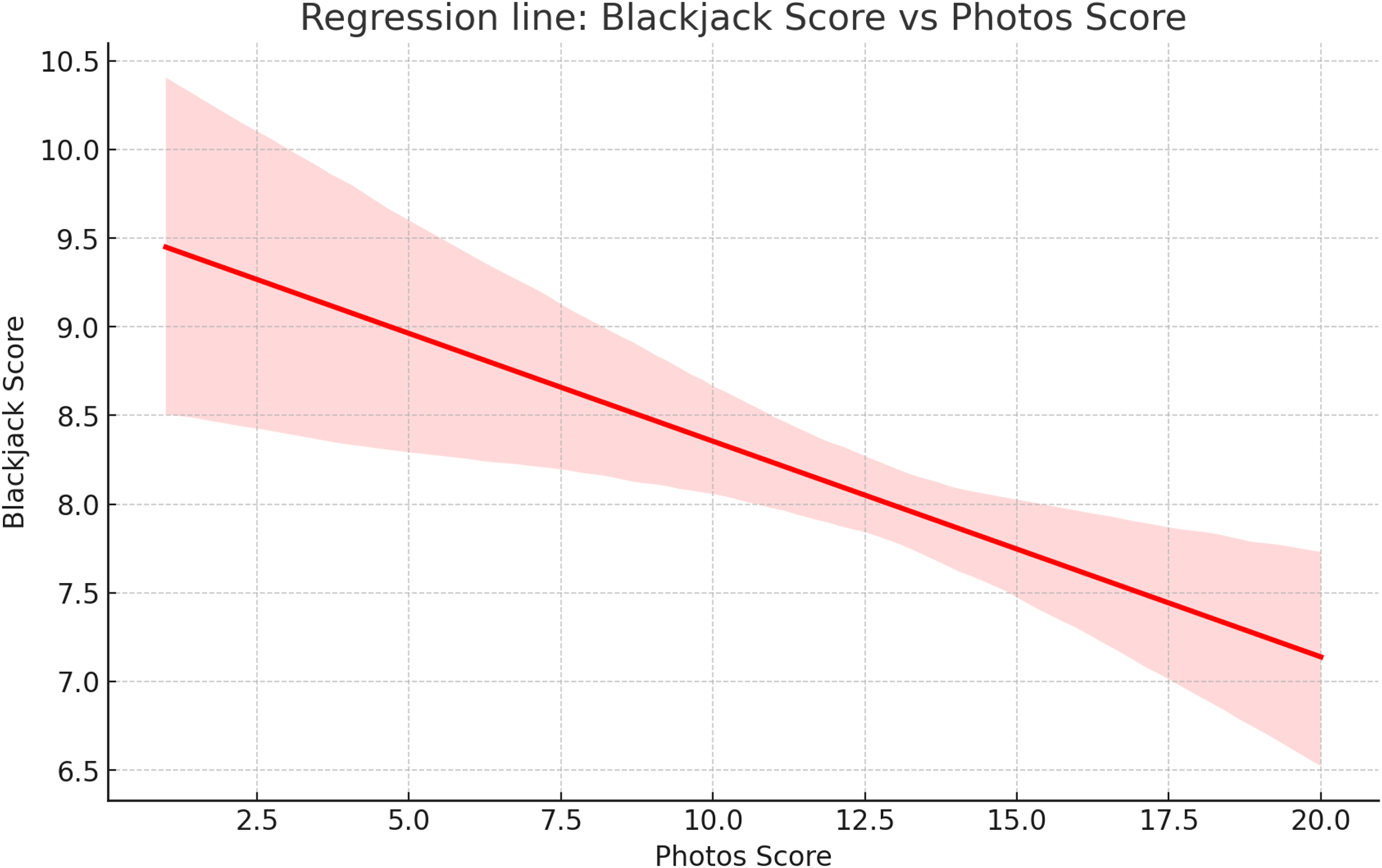
Blackjack scores versus photo ratings scores. N = 583. This plot shows a negative association w/95% confidence intervals between blackjack score and image rating task score, after controlling for net wealth, education, sex, age, race, marital status and if they have children. Standardised β = −0.14, p < .001 (see Table 3).
OLS regression modelling the association between blackjack scores and rating images.
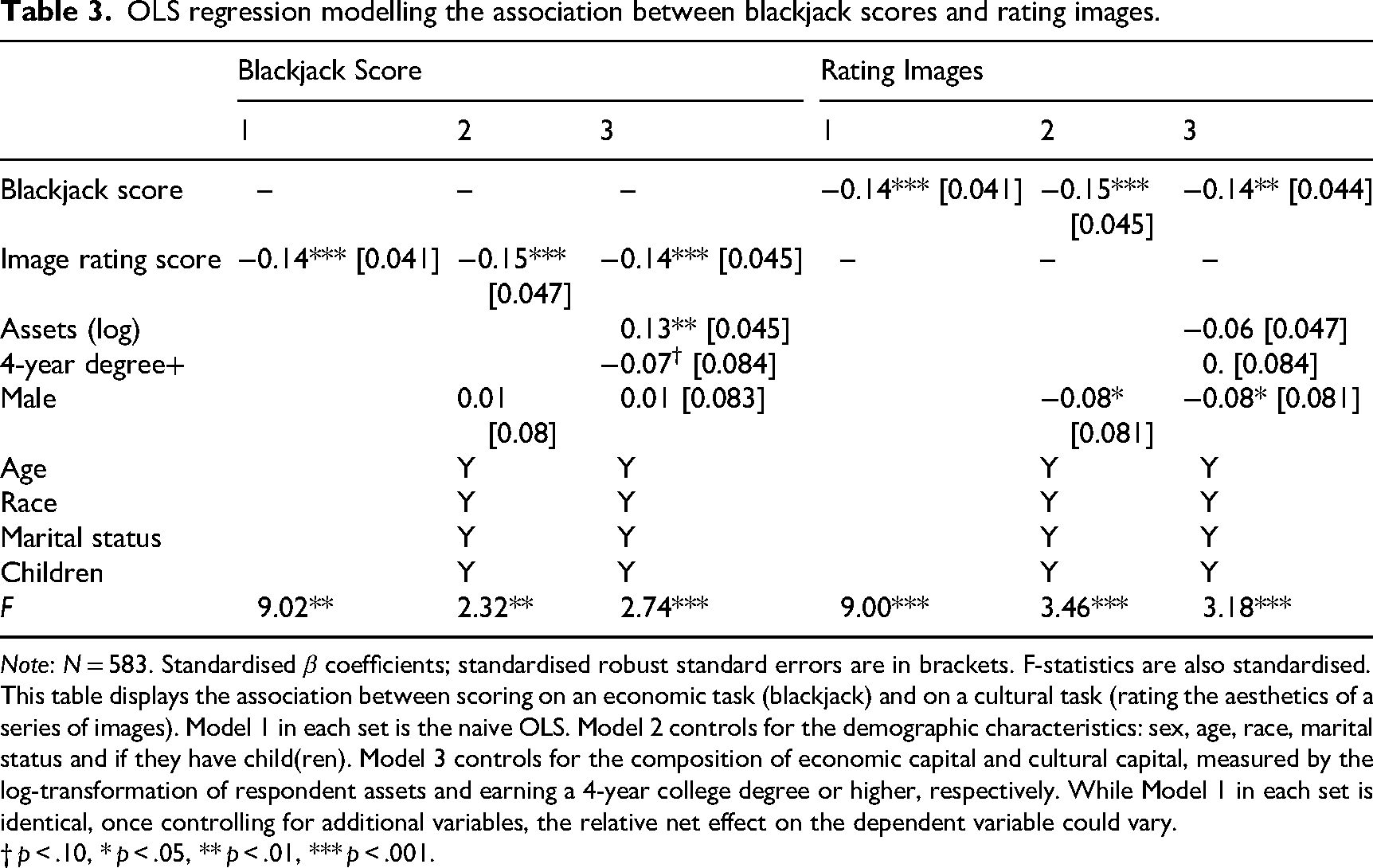
Note: N = 583. Standardised β coefficients; standardised robust standard errors are in brackets. F-statistics are also standardised. This table displays the association between scoring on an economic task (blackjack) and on a cultural task (rating the aesthetics of a series of images). Model 1 in each set is the naive OLS. Model 2 controls for the demographic characteristics: sex, age, race, marital status and if they have child(ren). Model 3 controls for the composition of economic capital and cultural capital, measured by the log-transformation of respondent assets and earning a 4-year college degree or higher, respectively. While Model 1 in each set is identical, once controlling for additional variables, the relative net effect on the dependent variable could vary.
† p < .10, * p < .05, ** p < .01, *** p < .001.
Further analysis of participants’ written descriptions showed that higher blackjack scores predicted a lower probability of providing interpretive responses for all three images (Figure 2; Table A1): Participants who won more hands of blackjack were significantly more likely to offer concrete, descriptive accounts of the images rather than interpretive or emotional responses. This pattern persists after controlling for net wealth, education and demographic variables.
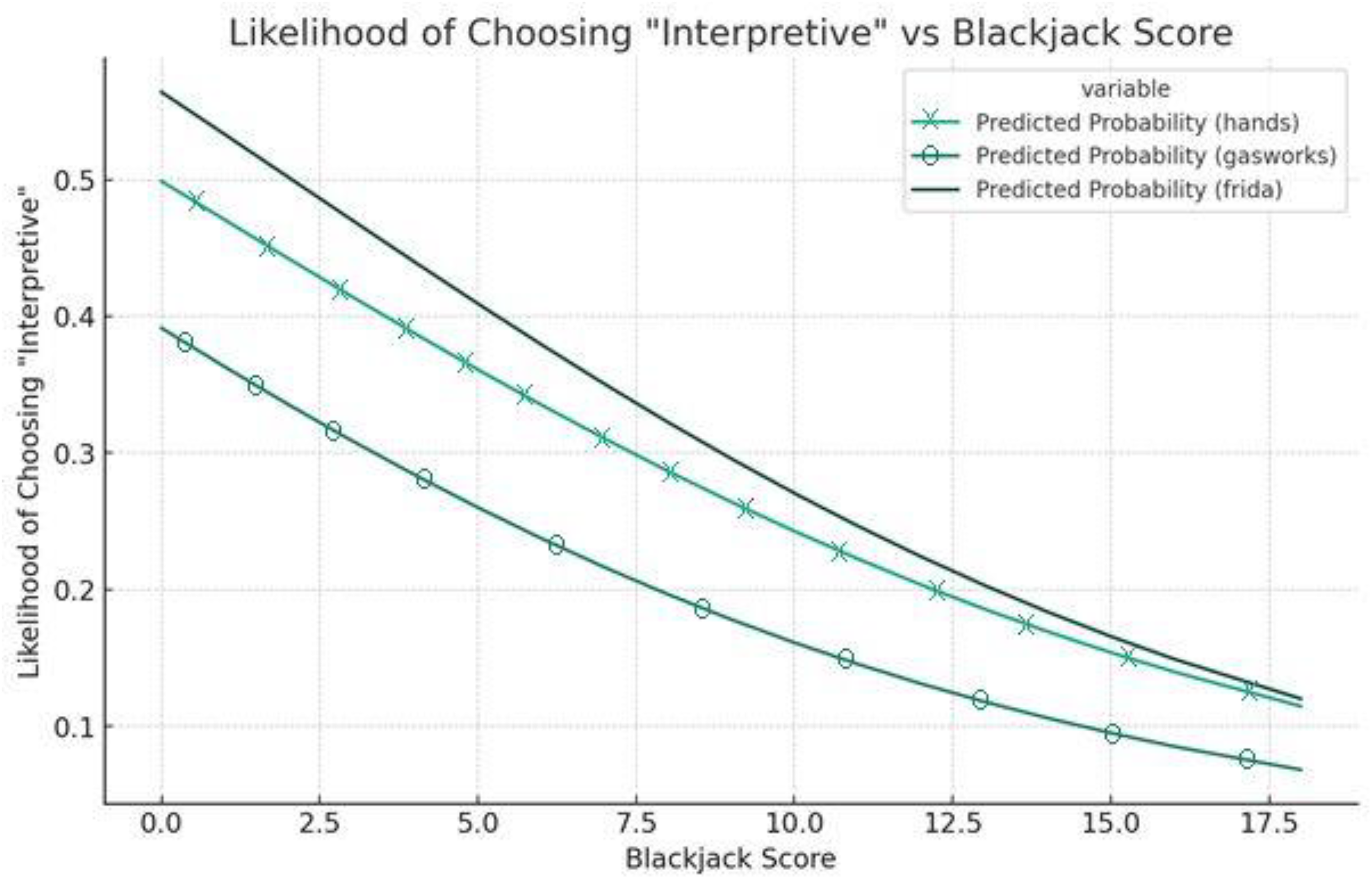
Predicted probabilities of interpretive code and interpretive image descriptions. N = 583. These predicted probabilities are based on the post-estimation results of logit models that control for net wealth, education, sex, age, race, marital status and if they have children. Standardised β = −0.32, p < .01 in all three models for the association between interpretive code and blackjack score (see Table A1). In the case of ‘Frida’, it is the association between blackjack score and recognising the artist (rather than just describing it).
Discussion
Study 1 provides initial evidence that economic and cultural dispositions, as reflected in task performance, relate to capital composition and appear to operate in tension with one another. Those who excel at calculating odds and making objective assessments, on average, also appear less inclined towards interpretive, symbolic approaches to cultural objects, all else equal.
The results support the theoretical expectation that economic and cultural fields cultivate different dispositions through their distinct principles of valuation and accumulation strategies. Note that these results represent probabilistic and average tendencies rather than deterministic relationships, with substantial individual variation. Nevertheless, the interference pattern reveals oppositional structuring: dispositions cultivated in cultural fields do not simply coexist with economic field competencies but negatively correlate with them, suggesting systematic cognitive trade-offs rather than parallel toolkits (cf. Barone, 2025; Stanovich, 2018)
Because the study necessarily condenses complex economic and cultural practices into brief, low-stakes tasks, the validity of the observed associations remains open to question; it is unclear whether the same dispositional tensions would surface when individuals confront higher-stakes, real-world choices that carry tangible costs and rewards. Study 1's findings thus raise an important question: Do these distinct dispositions also influence economic decision-making in contexts relevant to behavioural economics? Study 2 addresses this question.
Study 2: Loss aversion and capital composition
Task design
Study 2 assessed participants’ degree of loss aversion through a standard mixed-gamble paradigm. This validated approach has been widely used in behavioural economics to measure individual differences in loss aversion (see: Blake et al., 2021; Gächter et al., 2022; Kahneman and Tversky, 1979). Participants were presented with the following prospect: In the following lottery you have a 50% chance of winning or losing money: The potential loss is given. Please state the minimum amount $X for which you would be willing to accept the lottery: 50% chance loss of $25 50% chance win of $X X should be at least $____ to make the lottery acceptable.
To enhance reliability, participants completed the same task with a potential $100 loss as well as a $25 loss, and responses were averaged (question order randomised). This approach yields a loss aversion coefficient (λ), where a purely rational decision-maker would have λ = 1 (indicating equal weighting of gains and losses), while values above 1 indicate more loss aversion. The higher the λ, the greater the loss aversion. 7
Sample and data collection
Participants for Study 2 (N = 1453) were also recruited through AMT, with Study 1 participants excluded from the respondent pool. Out of an original target of 1500 respondents, 47 were removed by listwise deletion due to missing data. The sample was 53% male, 76% white, with a median age of 39 years. As in Study 1, educational attainment was higher than the general population (55% with 4-year college degrees or higher), and median income and assets were $40,000–$50,000.
Participants completed the loss aversion task and provided detailed information about their economic and cultural capital, as well as risk preferences and demographic characteristics, and received monetary compensation for their participation at approximately the pro-rata U.S. federal minimum wage.
Measures
Economic capital was measured as in Study 1.
For this study, cultural capital was measured using alternative approaches to test for robustness, including occupational decomposition (following Lizardo, 2006's use of Hauser and Warren's [1997] occupational indexes), and measures assessing both highbrow and popular cultural participation to account for cultural ‘omnivorousness’ (Peterson and Kern, 1996; Sullivan and Katz-Gerro, 2007).
Study 2 also included measures of risk tolerance and gambling propensity as control variables to help distinguish loss aversion from general risk aversion and gambling-specific attitudes.
Results
Table 4 presents regression results examining the relationship between capital composition and loss aversion (see also Figure 3). Four models are presented, each using a different measure of cultural capital.
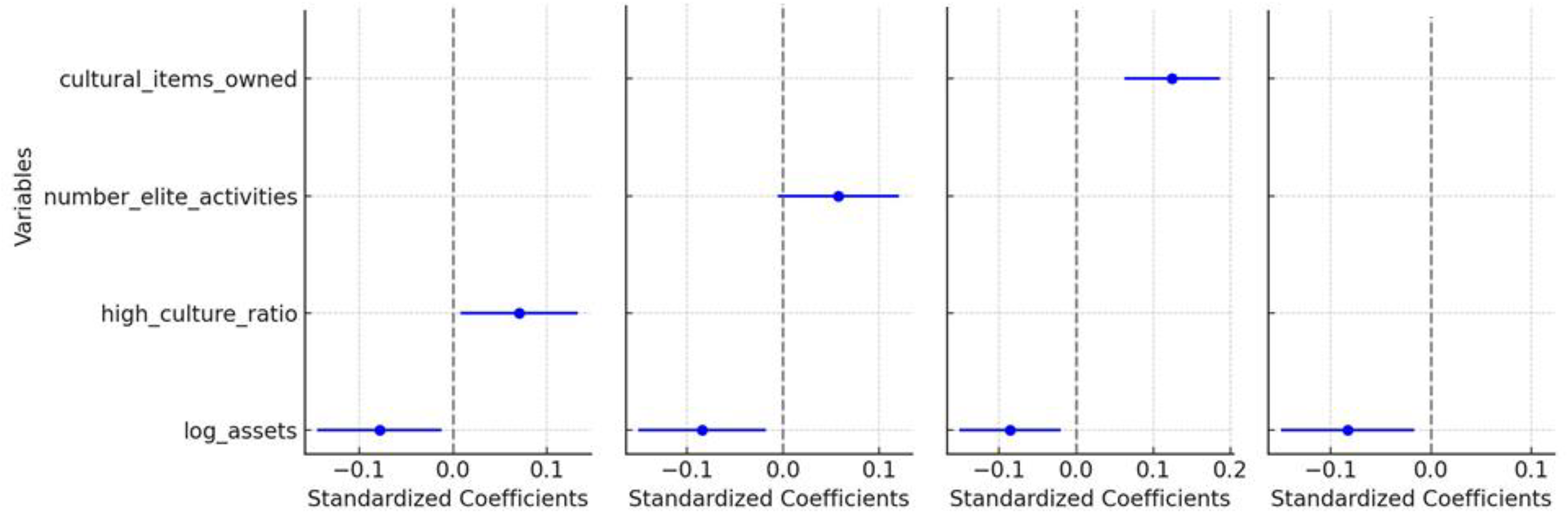
Individual loss aversion (λ) as it varies by economic capital and various measures of cultural capital. N = 1453–1441; higher levels of loss aversion appear to the right of dotted line (zero). Models also control for age, gender, marital status, individual risk aversion and propensity to gamble (not shown) (see Table 4a and 4b). Error bars represent 95% confidence intervals.
OLS regression modelling the effect of embodied cultural capital and economic capital on loss aversion.
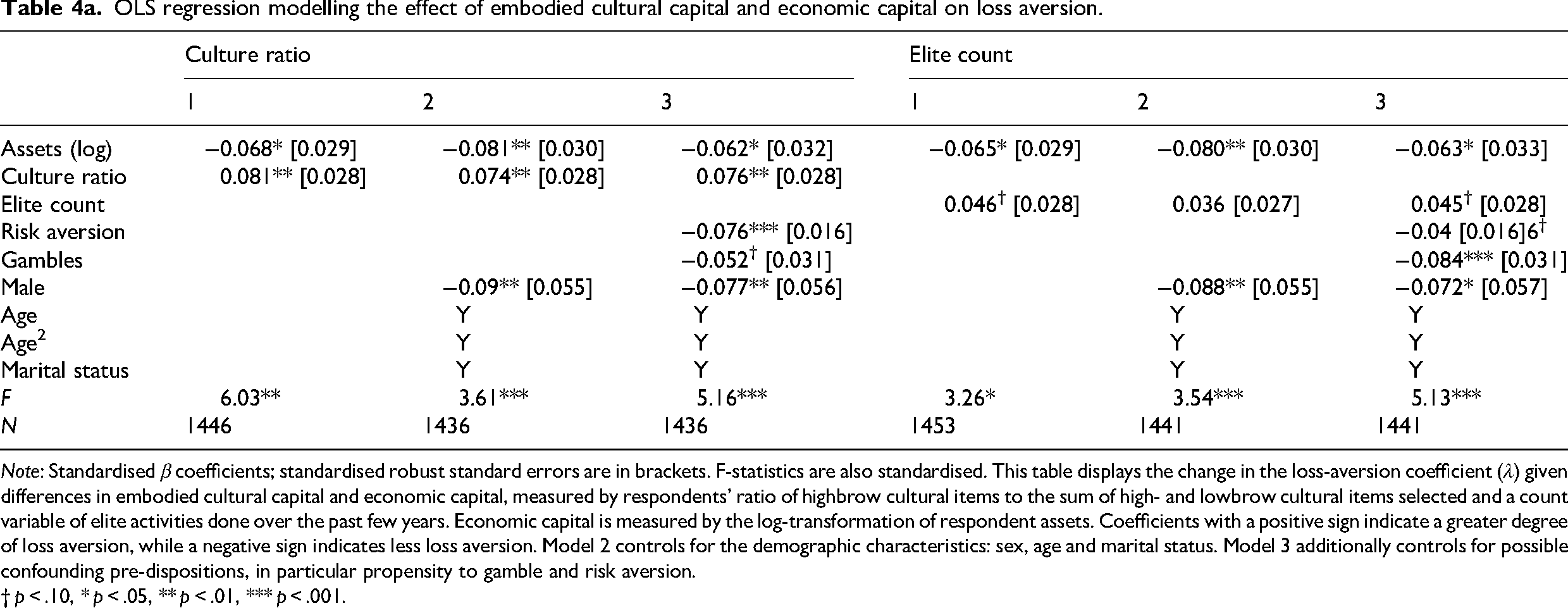
Note: Standardised β coefficients; standardised robust standard errors are in brackets. F-statistics are also standardised. This table displays the change in the loss-aversion coefficient (λ) given differences in embodied cultural capital and economic capital, measured by respondents’ ratio of highbrow cultural items to the sum of high- and lowbrow cultural items selected and a count variable of elite activities done over the past few years. Economic capital is measured by the log-transformation of respondent assets. Coefficients with a positive sign indicate a greater degree of loss aversion, while a negative sign indicates less loss aversion. Model 2 controls for the demographic characteristics: sex, age and marital status. Model 3 additionally controls for possible confounding pre-dispositions, in particular propensity to gamble and risk aversion.
† p < .10, * p < .05, ** p < .01, *** p < .001.
OLS regression modelling the effect of objectified cultural capital and economic capital on loss aversion.
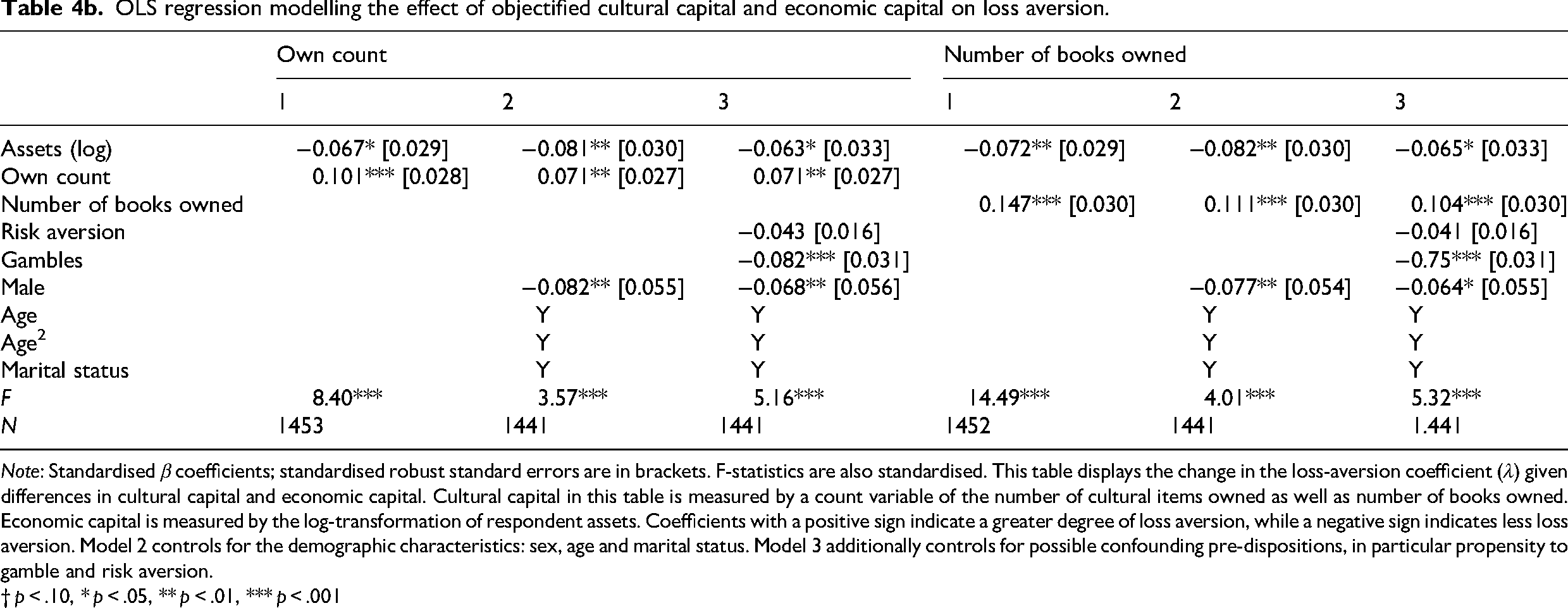
Note: Standardised β coefficients; standardised robust standard errors are in brackets. F-statistics are also standardised. This table displays the change in the loss-aversion coefficient (λ) given differences in cultural capital and economic capital. Cultural capital in this table is measured by a count variable of the number of cultural items owned as well as number of books owned. Economic capital is measured by the log-transformation of respondent assets. Coefficients with a positive sign indicate a greater degree of loss aversion, while a negative sign indicates less loss aversion. Model 2 controls for the demographic characteristics: sex, age and marital status. Model 3 additionally controls for possible confounding pre-dispositions, in particular propensity to gamble and risk aversion.
† p < .10, * p < .05, ** p < .01, *** p < .001
Across all specifications, economic capital negatively predicted loss aversion (standardised β ranging from −0.07 to −0.8, p < .05 or better), indicating that participants with greater economic resources tended to exhibit lower levels of loss aversion. Conversely, all measures of cultural capital positively predicted loss aversion (β ranging from 0.07 to 0.11, p < .05 or better), suggesting that participants with higher cultural capital tended to be more loss averse. These relationships persist after controlling for respondent risk tolerance, gambling propensity and demographic variables.
Discussion
In support of H3, the findings suggest that loss aversion – traditionally attributed to universal and wholly psychological mechanisms – is partially shaped by socially structured dispositions. Loss aversion reflects automatic emotional weighting of potential outcomes that occurs rapidly and intuitively before controlled reasoning can intervene (Johnson et al., 2006; Kahneman, 2011). Type 2 processes may subsequently override or modulate this initial reaction through deliberative reasoning (‘if the expected value is positive, I should accept the gamble’), but the automatic loss response itself operates below conscious awareness (Rick, 2011). That capital composition systematically predicts the magnitude of this response suggests that field socialisation calibrates not just conscious beliefs or deliberative strategies (Type 2) but also the emotional architecture of automatic responses (Type 1).
While Barone (2025) argues that different groups employ different mechanisms (some rely more on automatic scripts, others on deliberative cost-benefit assessment), this study reveals that field position shapes the calibration of automatic emotional processes themselves. Specifically, immersion in cultural fields – where symbolic capital once lost cannot be recovered, where reputational damage is often irreversible – may heighten automatic loss sensitivity in ways that transpose ‘irrationally’ to financial contexts where, objectively, equivalent gains and losses should balance. What appears as ‘bias’ may reflect accurate emotional calibration to one field's realities, but inappropriately applied to another's logic.
Study 3: Field socialisation and economic dispositions
Task design
The preceding studies establish a robust correlation between an individual's capital composition and their approach to certain aspects of economic decision-making. However, a key critique of this approach is its reliance on measuring capital stocks as proxies for the dispositions they are theorised to represent. While capital stocks are the result of past practices, they are an indirect measure of the lived, durational process of socialisation that actually forges the habitus. To address this limitation and test the hypothesised mechanism more directly, a third study was designed to measure participants’ socialisation history and its association with economic dispositions
If, as the theory suggests, dispositions are cultivated through prolonged immersion in fields with distinct logics and particular stakes, then direct measures of an individual's professional and educational history should be associated with their economic decision-making. This study specifically tests the hypothesis that direct, long-term socialisation in ‘economic’ fields is associated with lower loss aversion, while socialisation in ‘cultural’ fields is associated with higher loss aversion.
Sample and data collection
An original survey was administered to a new sample of U.S. adults recruited via the online platform Prolific Academic, an alternative to Amazon Mechanical Turk that has been shown to yield arguably more diverse and higher-quality data (Douglas et al., 2023). Looking to field a sample of 500 respondents, four were removed by listwise deletion due to missing data.
The resulting sample (N = 496) was 51% female, 72% white, with a median age of 46 years. 68% had a 4-year college degrees or higher and median income was $40,000–50,000/year. Participants received monetary compensation for their participation at approximately the pro-rata U.S. federal minimum wage.
Measures
As with Study 2, the dependent variable in Study 3 was loss aversion (λ), measured using the mixed-gamble paradigm described above.
The key independent variables were direct measures of field socialisation history:
As in the previous studies, standard demographic controls for income, wealth, age, gender, race, marital status and educational attainment were included in the analysis, along with one's propensity to gamble and general risk tolerance.
Results
Table 5 reports three ordinary least squares specifications that enter occupational field first on its own, then with demographic covariates, and finally with gambling propensity and self-reported financial-risk tolerance. In every model, current field of work predicts loss aversion in the theorised direction. Respondents employed in culturally oriented occupations are significantly more loss-averse than those in neutral occupations, whereas those in economically oriented jobs are less loss-averse. The occupational coefficients remain substantively large after adding in controls, indicating that field immersion explains incremental variance beyond capital stock and socio-demographics. Financial-risk tolerance (but not gambling propensity) is negatively associated with loss aversion, suggesting that the occupational effects are not reducible to generic risk attitudes.
OLS regression modelling the effect of occupation on loss aversion(λ).
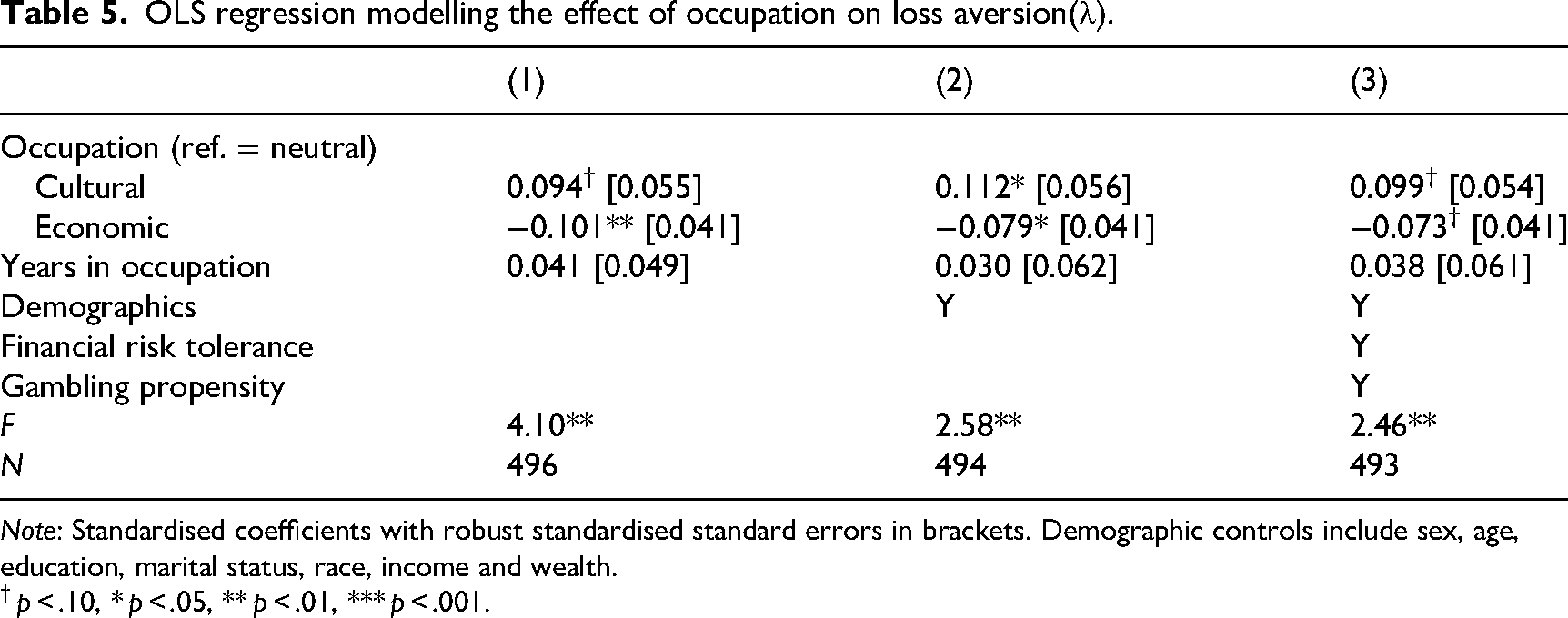
Note: Standardised coefficients with robust standardised standard errors in brackets. Demographic controls include sex, age, education, marital status, race, income and wealth.
p < .10, * p < .05, ** p < .01, *** p < .001.
Table 6 turns to educational socialisation. The share of university coursework in cultural fields is positively and statistically significantly related to loss aversion in all three models, while percentage of coursework in economic subjects predicts lower loss aversion. The pattern mirrors the occupational results after adding the same demographic, gambling and risk-tolerance controls. Coursework in ‘other’ fields is never significant, underscoring the specific contrast between economic and cultural tracks.
OLS regression modelling the effect of university coursework on loss aversion (λ).
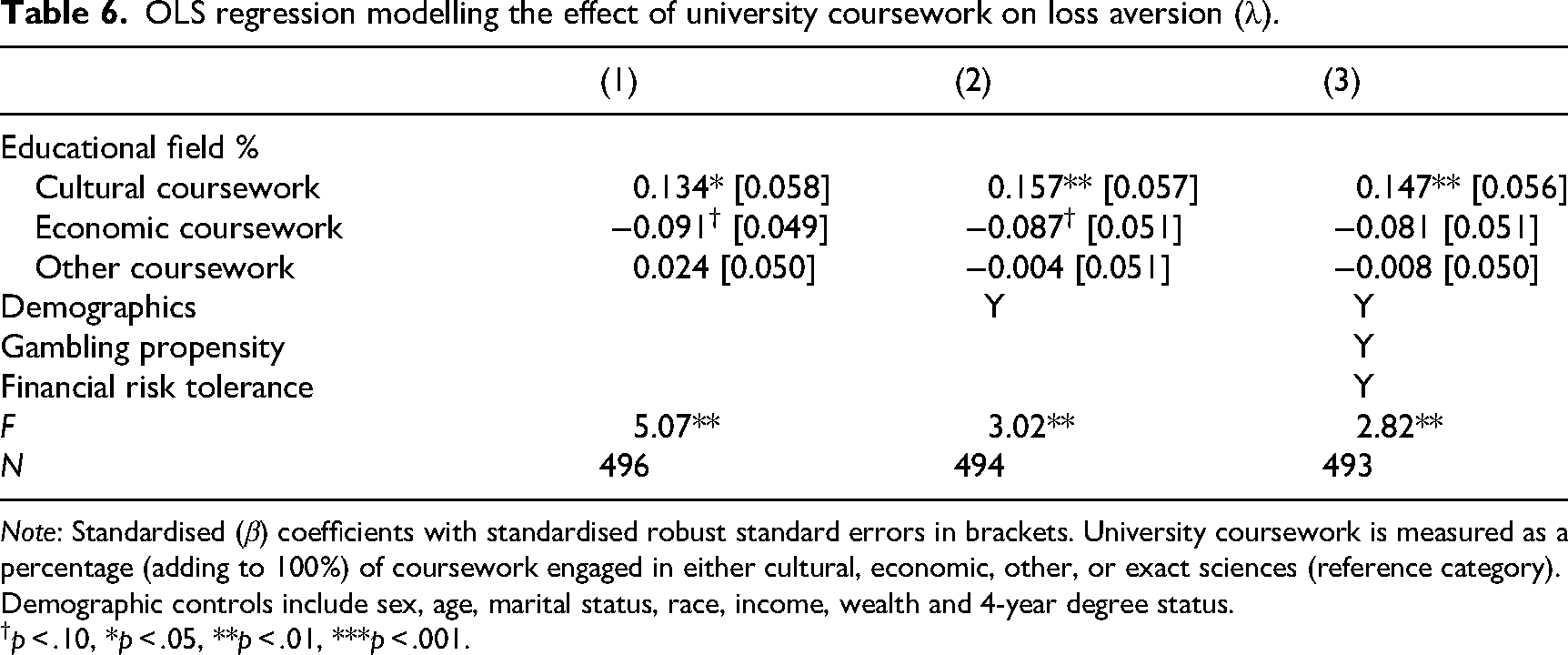
Note: Standardised (β) coefficients with standardised robust standard errors in brackets. University coursework is measured as a percentage (adding to 100%) of coursework engaged in either cultural, economic, other, or exact sciences (reference category). Demographic controls include sex, age, marital status, race, income, wealth and 4-year degree status.
p < .10, *p < .05, **p < .01, ***p < .001.
Parental occupation (either parent) was not found to be a significant predictor of loss aversion (see Appendix).
Discussion
This third study strengthens the paper's central argument. By moving beyond proxies of capital stock and using more direct measures of field socialisation, it provides stronger evidence for the mechanism linking social position to economic cognition.
Taken together, these models show that direct measures of field socialisation – what people do for a living and what they studied – account for unique variance in loss aversion above and beyond capital possession, demographics, or risk preferences. These findings provide support for H4: dispositions forged through immersion in economic versus cultural fields leave a durable imprint on how individuals evaluate potential losses. The significant findings for current occupation and educational history support the Bourdieusian concept of habitus as a product of repeated and embodied practice.
From a dual-process perspective, these findings illuminate how field socialisation operates through cognitive psychologists term ‘learning to automaticity’ (Bargh et al., 2012). Repeated immersion in economic fields – whether through occupational tasks requiring cost-benefit calculation, quantitative coursework emphasising probabilistic reasoning, or professional environments rewarding risk management – practices Type 2 processes (controlled reasoning) to the point where they become incorporated into Type 1 processes (automatic responses). A financial analyst's rapid assessment of risk, an accountant's immediate sense of whether numbers ‘look right’, or an investor's intuitive feel for market dynamics all reflect practiced skills that, through repetition, no longer require deliberative reasoning. Similarly, extended engagement with cultural fields practices aesthetic interpretation, symbolic evaluation and meaning-making to automaticity. An art critic's immediate ‘instinct’ about a work's significance, a literature professor's rapid assessment of textual quality, or a curator's intuitive sense of an exhibition's coherence all reflect skills that have been practiced to the point of automaticity.
Crucially, these learned automaticities then transpose to other contexts via the habitus – they become default responses activated even when contextually inappropriate or misaligned. Different field environments cultivate opposing automaticities rather than simply constraining development. It is not necessarily that cultural field socialisation provides less training in probability assessment (a deficit model), but rather that it actively cultivates alternative automatic responses – aesthetic interpretation, symbolic sensitivity, meaning-making – that, once established through years of practice, may interfere with economic or probability-based reasoning when individuals encounter cross-field decisions.
The non-significance of parental occupation alongside the strong effects of adult occupational and educational socialisation suggests that these automatic calibrations develop primarily through one's own sustained immersion rather than early childhood exposure, pointing to the importance of biographical field trajectories in shaping cognitive dispositions (see: Hayes and Miletzky, 2024, who find that economic socialisation is particularly salient in adulthood).
Overall discussion
The findings from three original studies provide converging evidence that economic and cultural capitals are associated not only with competencies in their respective domains but also with different – and perhaps normatively ‘irrational’ – approaches to economic choices.
For behavioural economics, these results challenge the field's predominantly psychological and evolutionary explanations for cognitive biases. Behavioural economists often attribute loss aversion to a deep-seated, biological fear response, similar to how animals react to threats (Kahneman, 2011: 282–283; Rick, 2011). They believe that people, much like prey animals evading predators, have an inborn instinct to avoid losses. This evolutionary account thus treats loss aversion as hardwired into human cognition, varying only due to genetic differences or temporary states. This, however, misses the mark on the impact of social conditioning on people's interpretation of loss and their reactions to it.
The paper thus makes its primary sociological contribution to field theory by providing micro-cognitive, quantitative evidence for Bourdieu's proposed chiastic structure using experimental and behavioural economics methods. Bourdieu theorised extensively that economic and cultural fields operate through fundamentally inverse logics, but with evidence drawn primarily from surveys of taste, educational choices and ethnographic observation of classed dispositions. The above studies translate those more macro-sociological insights into tractable behavioural measures. The negative correlation between field-specific competencies (Study 1), the opposing associations of capital types with loss aversion (Study 2), and the finding that biographical field socialisation predicts divergent cognitive patterns above and beyond capital stocks (Study 3) triangulate evidence that the economic-cultural opposition manifests as measurable interference in cognitive processes. Opposing field logics are not merely abstractions or metaphorical descriptions but generate observable patterns in individual-level decision-making, detectable using behavioural science measurement tools. In particular, a habitus cultivated in and aligned with one field transposes to create practical maladaptations when encountering decisions governed by opposing logics – what Bourdieu termed allodoxia, a form of category error or mis-recognition that occurs when dispositions developed in one field are unwittingly misapplied to another (Bourdieu, 1984; Deer, 2014; Hayes, 2020).
The findings make a second, related contribution to culture and cognition scholarship by introducing relational opposition as an explanatory principle beyond cultural variation or differential socialisation. Recent work has demonstrated that social position shapes cognitive processes in multiple ways. Vila-Henninger (2021) shows that economic goals and strategies – including whether actors pursue self-interest versus moral objectives – are socially learned through interaction rather than being innate or purely psychological (see: Frank et al., 1993). His model integrates cultural sociology, behavioural economics and neuroscience to explain both moral and self-interested economic action. McDonnell, Stoltz and Taylor (2022) similarly reveal class-linked evaluation scripts for price fairness judgments – what they term ‘market moralities’ – providing concrete evidence that cultural schemas vary by class position and directly shape how economic choices are evaluated. Barone (2025) provides the most comprehensive recent synthesis, developing a detailed typology of inequality-generating mechanisms ranging from automatic processes like role modelling and embodied cultural repertoires to reflective processes like cost-benefit assessments and metacognitive skills, all derived from dual-process architecture. His framework argues convincingly that inequalities operate through diverse mechanisms and that decision-making capacities themselves vary by social class – what he terms inequalities ‘under the skin’ (see also: Fligstein and Goldstein, 2015).
These establish that economic cognition is culturally mediated and operates through both automatic and controlled processes. However, this literature tends to conceptualize cultural influence as producing parallel differences: different groups possess different toolkits, beliefs, scripts, or capacities that lead to different outcomes but operate independently. Vila-Henninger shows that different groups learn different goals; McDonnell et al. show they employ different evaluation scripts; Barone's typology shows they utilize different mechanisms taken from a comprehensive menu. Each treats cultural variation as a matter of what different groups possess or employ, not how those possessions relate to each other structurally (see also: Stoltz, 2025).
This paper demonstrates something more specific: systematic cognitive interference. The distinction is consequential. If different groups simply possessed different cognitive frameworks, we would expect either no correlation between economic and cultural competencies (each operating independently like separate skillsets), or modest positive correlation (since individuals with greater total cognitive resources would tend to perform well across diverse tasks). The negative correlations observed suggest not separate toolkits but competing ones: being good at aesthetic interpretation predicts being worse at probability assessment (controlling for education and total resources, as well as other personal characteristics). Similarly, if cultural capital simply equipped people with different scripts – as McDonnell et al. (2022) suggest for price fairness – we would expect different responses but not systematically more loss averse ones in monetary contexts.
The evidence does not, however, imply that actors anchored in cultural fields are incapable of calculation, or that those embedded in economic fields are indifferent to symbolism. Rather, it shows that, on average, the weighting of cues differs once situations trigger corresponding schemata. The blackjack task rewards numeracy, rapid probability updating and risk balancing; respondents steeped in economic fields appear to mobilize those routines more readily and with greater skill. By contrast, rating photographs and narrating their meaning foregrounds competences cultivated in cultural fields. In both cases, field immersion (along with capital composition) supplies defaults that remain available even when the contextual stakes appear modest. Thus the ‘chiastic’ relation Bourdieu described should be understood as a tendency towards divergent emphases, not an iron rule of mutual exclusion or some grand duel between competing logics.
Heightened loss aversion among those with cultural capital may therefore represent a correct calibration to cultural fields where symbolic capital, once lost, cannot easily be recovered – a reasonable disposition that becomes ‘irrational/bias’ only when transposed to financial contexts where equivalent gains and losses should objectively balance, and where exhibiting loss aversion can lead to real material costs. Aesthetic and symbolic interpretation skills, invaluable in cultural production, actively interfere with assessments that prove valuable in financial decisions. This shifts explanation from individual-level errors (behavioural economics) or group-level differences (culture-cognition) to structural-level oppositions whereby fields organised through inverse principles cultivate habitus that generate predictable maladaptations when individuals cross field boundaries. The notion of oppositional logics of fields – domains organised around fundamentally incompatible principles of valuation and evaluation (Bourdieu's nomos and illusio) – provides explanatory resources that alternative frameworks lack.
One implication is that Type 1 and Type 2 processes are not neutral and universal cognitive architectures whose content varies individually while structure remains constant. Instead, the very capacities for certain types of automatic responses (e.g. aesthetic interpretation) and controlled reasoning (e.g. probability assessment) appear to be relationally structured by field position, at least in measurable part. In other words, prolonged socialisation in cultural fields may not simply fill automatic processes with aesthetic associations while leaving probability assessment capacity intact; it may actively develop automatic aesthetic response systems in ways that constrain or interfere with the development of probability assessment systems, and vice-versa.
This interpretation remains tentative given the paper's analytical strategy. The three studies were not designed to test DPT processes directly but to test field-theoretic predictions about capital composition and socialisation. The negative correlation in Study 1 could reflect task-specific interference (both tasks competing for working memory resources) rather than fundamental architectural opposition. The loss aversion findings in Studies 2 and 3 could reflect conscious strategic differences (cultural capital holders choosing to consciously weight losses more heavily) rather than automatic emotional calibration. Future research explicitly designed to test this hypothesis would require different methods: studies measuring cognitive capacity and experimental designs manipulating field context while isolating processing modes. Such research could determine whether the interference patterns observed here reflect temporary competition for cognitive resources or deeper architectural structuring by field socialisation.
Still, the consistency of patterns across different tasks – performance tasks, mixed-gamble paradigms and direct socialisation measures – alongside the theoretical coherence with Bourdieu's predictions, invites the architectural interpretation to be taken seriously. This reverses the typical intellectual traffic: rather than importing DPT to operationalize sociological concepts, field theory would contribute back to cognitive science by revealing how social structure penetrates cognitive architecture itself.
While this paper foregrounds field theory in conversation with culture and cognition, it also contributes to other important traditions in economic sociology. First, success in economic life often depends on one's ability to correctly interpret and navigate social contexts. In relational economic sociology, a ‘mismatch’ occurs when an actor improperly applies the norms, meanings and scripts from one social relationship to an economic transaction governed by different expectations (Bandelj, 2020; Zelizer, 2012). For instance, treating an intimate gift-giving occasion as a purely financial transfer violates the relational boundary, creating social friction and undermining the exchange. While this framework powerfully identifies what a mismatch is, the present study provides a mechanism rooted not in a momentary error of negotiation but in individuals’ deeply ingrained habitus. A transaction may therefore fail when dispositions honed in one field involuntarily ‘bleed’ into another, cognitively guiding an individual towards a logic that appears natural yet is relationally inappropriate.
Consider a theatre director deeply embedded in artistic networks and accustomed to relying on trust-based relationships and informal reciprocity. When applying for a formal bank loan, she may unintentionally violate expected transactional norms by framing her request around passion, personal connections and artistic merit rather than credit scores, collateral and repayment schedules, thus generating misunderstanding and mistrust that undermines the transaction. Conversely, a seasoned venture capitalist, trained to view social ties primarily as instruments for economic gain and efficiency, may reflexively approach family financial discussions – such as supporting an elderly parent or financing a child's education – through overly calculative language and logic rather than one of care and intimacy, triggering discomfort, moral offense and relational strain. In either scenario, the individual's habitus leads them towards a mode of valuation that, while perfectly valid in its own right, becomes inappropriate or even damaging when transposed into the other.
Second, classic embeddedness research shows that economic outcomes hinge on network structure and the quality of social ties – who trusts whom, what information travels where, and which reputations stick (Granovetter, 1985; Uzzi, 1999). Yet, as its critics note, the literature often jumps from network position directly to macro-level outcomes with only a thin account of the cognitive work that transforms networked information into concrete choices (DiMaggio, 2019; Pachucki and Breiger, 2010). The present study offers one missing layer: dispositions forged in distinctive fields appear to act as ‘interpretive filters’ for the signals that flow through these networks. An individual embedded in dense, finance-heavy ties not only receives more investment tips but – because of their particular socialisation – treats that information as actionable. By contrast, an art-world professional occupying a similarly cohesive network may hear the same tip yet discount it as speculative or morally suspect. Embedding therefore does more than supply information; it synchronizes informational content with field-conditioned processing styles, producing patterned heterogeneity that pure network analysis cannot fully explain.
Third, a burgeoning literature on the ‘financialisation of everyday life’ documents how ordinary households have come to view everything from education, health and even intimate relationships through the prism of financial calculation (Langley, 2008; Martin, 2002). These studies richly describe the spread of financial and calculative logics but rarely specify why some actors internalize them more readily than others. This oversight obscures the heterogeneous ways in which financial rationalities are adopted, resisted, or transformed across different social contexts and individual circumstances. From this study, we acknowledge that culturally oriented individuals, whose dispositional toolkits are deeply shaped by prolonged socialisation in cultural fields, approach financial logics with greater ambivalence precisely because their cognitive defaults prioritize symbolic meaning, moral integrity, or relational nuance over probabilistic calculation. For such actors, translating intimate or meaningful activities – like education, healthcare, or family relationships – into financial metrics feels intuitively uncomfortable or morally inappropriate, triggering resistance or selective reinterpretation of financialised practices. Financialisation is therefore not a uniform tide turning all into walking utility-maximisers but a selective uptake process, filtered through field-specific dispositions that either amplify or blunt the reach of financial logics in everyday life.
Beyond theoretical contributions, these findings have practical implications for understanding economic behaviour as leading to stratification in everyday life. If economic decision-making is partially shaped by ingrained dispositions, financial education and advising that focuses only on transmitting technical knowledge may be insufficient. A more effective approach might involve translating financial concepts into frameworks that acknowledge and leverage cultural dispositions rather than dismissing them as ‘irrational’. In this way, the findings also highlight a subtle mechanism for reproducing inequality: dispositions that confer status in cultural domains may unwittingly lead to less effective or even self-defeating financial decisions that, when compounded over time, limit economic mobility in an increasingly financialised economy.
Limitations and future research
As with all social science research, this paper has certain limitations, and I emphasize several important qualifications. First, the reported relationships are probabilistic rather than deterministic or causal, and there is substantial individual variation around the general trends, indicating the influence of other unmeasured factors. Second, the findings should not be interpreted as suggesting that cultural dispositions are ‘irrational’ in any absolute sense, but rather that different forms of capital seem to cultivate different cognitive approaches that are advantageous, or not, in different contexts. Third, many individuals possess balanced compositions of capital and may develop flexible dispositions, challenging simplistic oppositions between economic and cultural logics in the real world.
While the United States offers sharp contrasts between economic and cultural occupational spheres, the magnitude – and perhaps the direction – of field effects may differ in societies with different institutional arrangements, welfare regimes, or cultural traditions. In coordinated market economies like Germany or Nordic countries, where economic and cultural fields may be less polarised through robust public support for the arts and more egalitarian income distributions, the inverse relationship between economic and cultural dispositions might be attenuated.
The tasks used, moreover, represent simplified proxies for complex real-world decisions. While Study 3's findings on socialisation, for example, strengthen the argument, the relationship between dispositions and field position is likely reciprocal and mutually reinforcing over time, consistent with Bourdieu's dialectical model. Future longitudinal or panel studies are needed to track these dynamics. Such methods could also consider the effect on dispositions during periods of exogenous shock (e.g. sudden job loss, macroeconomic volatility, or large cultural shifts). To better disentangle socialisation effects from other confounding factors, future research could also employ designs with stronger causal identification, such as experiments or field studies of twins or siblings. Finally, qualitative research could provide valuable complementary insights into the mechanisms linking capital composition to economic decision-making in real-world settings.
Supplemental Material
sj-docx-1-asj-10.1177_00016993261419697 - Supplemental material for Cultural dispositions and economic choice: How field-specific logics shape ‘rational’ economic behaviour
Supplemental material, sj-docx-1-asj-10.1177_00016993261419697 for Cultural dispositions and economic choice: How field-specific logics shape ‘rational’ economic behaviour by Adam S Hayes in Acta Sociologica
Footnotes

Funding
The author disclosed receipt of the following financial support for the research, authorship, and/or publication of this article: This work was supported by the Israel Science Foundation (Grant Number 1836/22).
Declaration of conflicting interests
The author declared no potential conflicts of interest with respect to the research, authorship, and/or publication of this article.
Data availability
Supplemental material
Supplemental material for this article is available online.
Notes
Author biography
References
Supplementary Material
Please find the following supplemental material available below.
For Open Access articles published under a Creative Commons License, all supplemental material carries the same license as the article it is associated with.
For non-Open Access articles published, all supplemental material carries a non-exclusive license, and permission requests for re-use of supplemental material or any part of supplemental material shall be sent directly to the copyright owner as specified in the copyright notice associated with the article.
