






Abstract
In this study, we view market identities as interfaces between organizations and their external audiences and examine how the perceived market appeal of organizations can be influenced by the order in which the products or product features that determine their market identities are offered. We theorize that when audiences have different product preferences, organizations may increase their perceived appeal to some or all audiences by making certain features more or less salient through different orderings without making substantive changes to their products or product portfolios. We find strong support for our arguments in statistical analyses of the market identities of U.S. opera companies from 1995 to 2005. When opera companies group unconventional operas together, their market appeal decreases among season-ticket holders, an audience for whom unconventional opera is less appealing, but increases among opera critics, an audience for whom unconventional opera is more appealing.
The market identity of an organization is defined by its membership in the social categories that are used to identify and specify what to expect from the organization and its products (Jensen, 2010). As Rao, Monin, and Durand (2005: 970) noted, “Categories establish social and symbolic boundaries, and thereby constitute the identity of actors.” Market identities serve an important function as cognitive interfaces between organizations and their external audiences or stakeholders (Zuckerman, 1999; Lounsbury and Rao, 2004; Fleischer, 2009), unlike organizational identities, which emphasize the central, distinctive, and enduring organizational features that constitute identity for internal audiences (Albert and Whetten, 1985; Dutton and Dukerich, 1991; Glynn, 2000). Market identities prescribe what constitutes acceptable product offerings for organizations that claim a given identity, such as being a microbrewery (Carroll and Swaminathan, 2000), and they allow audiences to compare and evaluate these product offerings based on shared category expectations (Jensen, Kim, and Kim, 2011). The assignment of a market identity to an organization is therefore fundamentally a process of categorizing the organization based on mapping the observable features of the organization and its products to shared category dimensions. In the Scottish knitwear industry, for example, the market identities of knitwear manufacturers are assigned based on the size, location, knitting methods, assembly methods, and product styles of the knitwear manufacturers (Porac et al., 1995).
Whether market identities are assumed to have clear or fuzzy boundaries (Hsu, Hannan, and Koçak, 2009; Jensen, 2010), most research in this field focuses on the presence or absence of specific products or product features as the main mechanism to establish the market identity of an organization. A less-researched aspect of the process of assigning market identities to organizations is how the ordering (temporal or spatial) of product features or entire products in a product portfolio may influence the perceived market identity of an organization without changing the composition of the product portfolio itself. The ordering of products in the portfolio can influence the perceived appeal of the organization by making different alternative market identities more or less salient to external audiences. When similar products are grouped together temporally or spatially, the salience of these products increases (Campbell, 1958), which, in turn, influences how the organization is perceived by its external audiences. By manufacturers simply placing environmentally friendly cars together in car dealerships and promotional materials, for example, audiences are more likely to categorize an auto manufacturer as a “green” auto manufacturer, even if the manufacturer’s portfolio includes other products that are not environmentally friendly. Market identities expressed through ordering, in other words, allow organizations to influence how they are perceived without necessarily substituting or modifying the specific product features that ultimately define the assignment of market identity.
The flexibility of market identities is particularly important when different external audiences have different preferences. Audiences are often seen as a resource base that follows a “well-behaved unimodal distribution” in which the peak defines the market center (Carroll and Swaminathan, 2000: 721). When most audiences are located at the market center, the center is the most attractive position (holding competition constant), and most products represent compromises on incompatible features, such as automobiles’ engine power and fuel efficiency. When most audiences cluster at opposite positions in the market space, however, compromises on specific product features are less acceptable because audiences at either position are unlikely to accept simple compromises on product features. A common solution is to offer a portfolio of different products to target each audience, which creates the possibility for variation in the assignment of market identity to an organization. Given this scenario, the ordering of products in the portfolio will be important in itself because it can influence positively or negatively the perceived appeal of the organization by making different aspects of the product portfolio more or less salient to the audience.
Ordering is particularly important when organizations have heterogeneous audiences with different product preferences and therefore may be compelled to offer different products to different audiences. By straddling different product categories, however, organizations risk satisfying neither of their audiences and therefore being evaluated negatively (Zuckerman, 1999; Hsu, 2006). Organizations with heterogeneous audiences must therefore manage not only the composition of their product portfolios but also the ordering of their product portfolios. By making different aspects of a market identity more or less salient, organizations could soften the disadvantages of the broad generalist market identities necessary to serve heterogeneous audiences. We hypothesize how the ordering of a given set of products in the portfolio affects the perceived market identity of an organization, thus providing a unique mechanism to shape the perceived appeal of an organization by prompting audiences to focus on different aspects of a market identity. The perceived appeal of an organization refers to the fit between the perceived market identity and the tastes of its external audiences (Hannan, Pólos, and Carroll, 2007). We tested our hypotheses on the ordering of products with data from the U.S. opera market from 1995 to 2005, in which opera companies make repertoire choices that can affect their market identities.
Repertoire Order in Opera Companies
Opera companies implicitly make choices about their market identity when they decide what operas to include in their repertoire, and they face an important tradeoff between audiences with different preferences for conventional and unconventional operas (Pierce, 2000; Heilbrun, 2001). A conventional opera is an opera that is performed frequently because it appeals to broad audiences, such as Puccini’s Madama Butterfly, or because it is a particularly good example of a specific opera genre, such as Berg’s Lulu, which represents modern opera. Despite the dominance of conventional operas in the standard U.S. opera repertoire (Pierce, 2000; Heilbrun, 2001), most opera companies still include unconventional operas because, like most arts and entertainment organizations (Alexander, 1996; Uzzi and Spiro, 2005), opera companies face divergent commercial and artistic pressures. A core artistic value is to challenge audiences by questioning and transcending existing aesthetic beliefs: “The ability of an artist . . . to bring forth products that are original and novel is perhaps the central criterion for evaluating his/her contribution to the profession” (Hirschman, 1983: 52). The artistic demands for originality, however, often conflict with the commercial demands for accessibility. The production of art therefore entails a tradeoff between conventional safety and commercial success, on the one hand, and artistic originality and commercial failure, on the other (Becker, 1974, 1982).
The conflict between artistic originality and commercial accessibility is expressed in opera companies in the choice between conventional and unconventional operas: “There is a tension between the perceived safe course of following the herd and the risk of striking an individual line, which will seize attention by its boldness” (Payne, 2005: 318). The tension is accentuated by opera critics. As Robert Wilson (2005), the former chairman of the New York City Opera noted, “Music critics . . . often praise the unmelodious works . . . as ‘challenging,’ though audiences are largely unmoved. . . . As of now they [critics] still love the antitonal.” To satisfy commercial demands for accessibility and artistic demands for renewal, opera companies are therefore compelled to schedule both conventional and unconventional operas. Tenor Plácido Domingo expressed the relationship between opera repertoire and opera identity and the tension between conventional and unconventional opera clearly when he announced his dedication to new operas after becoming the artistic director of the Los Angeles Opera, promising that Verdi and Puccini would remain in the repertoire: “Don’t worry. . . . In many, many ways we will still be a traditional opera company” (Farber, 2000). One way that opera companies, without making any substantive changes to the composition of their seasonal repertoires, can influence their perceived appeal, both to audiences open to unconventional opera and audiences favoring conventional opera, is by simply changing the order in which the conventional and unconventional operas in their repertoires are performed.
By interspersing conventional and unconventional operas, opera companies make unconventional operas less salient, pleasing audiences that find unconventional operas less appealing by reducing the likelihood that they will view the entire opera repertoire as unconventional. Season-ticket holders have been shown to prefer conventional performances. Voss, Montoya-Weiss, and Voss (2006) found that revenue from season tickets decreases when theaters present a repertoire with more than roughly 25 percent innovative works, for example, and Martorella (1982: 142) noted that opera board members want to accommodate season-ticket holders by scheduling more conventional operas because of the importance of season-ticket revenue. Interspersing conventional and unconventional operas to reduce the salience of unconventional operas, however, may decrease the likelihood that opera critics, who are known to be more open to unconventional operas, will pay attention to an opera company. Getting attention from opera critics is important because it increases awareness of an opera company, and it represents a mechanism to move the opera company, its artists, and directors up in the opera status hierarchy (Shrum, 1996).
Opera critics, like other art critics (Wijnberg and Gemser, 2000), tend to pay more attention to unconventional operas because it is less repetitive for them to review unconventional operas, making it easier to prove their own value to their editors, readers, and other opera professionals. Opera critics also tend to be constrained by the institutional belief that media coverage should be novel or avoid saturation, and it can therefore be difficult to justify repeated reviews of the same operas (Hilgartner and Bosk, 1988). The openness of opera critics to unconventional opera is clearly expressed by critic Tommasini (2008): “I consider myself a proselytizer for new opera . . . someone who has urged companies to commission works and attended every premiere I could get to.” In addition, most opera critics are overwhelmed by unsolicited promotional materials from arts organizations, including opera companies, seeking to promote themselves and their performances by gaining critical attention (Shrum, 1996; Kotler and Scheff, 1997). In time-constrained environments, even experts tend to economize on cognitive efforts and focus on aggregate patterns in information rather than processing each piece of information individually (Alba and Hutchinson, 1987). According to these arguments, opera critics would be more likely to pay attention to opera companies that group unconventional operas together, and they may even interpret a block of unconventional operas as a stronger commitment to unconventional opera. We expect therefore that opera critics may be more inclined to review operas performed by opera companies with less interspersion in their repertoires.
Interspersing conventional and unconventional operas therefore decreases the likelihood that regular audiences will categorize an opera company as an unconventional opera company, which increases the perceived appeal of the opera company for them and therefore increases the demand for season tickets. Interspersion, however, also decreases the likelihood that opera critics will categorize an opera company as an unconventional opera company, which decreases the perceived appeal of the opera company for them and therefore decreases their willingness to cover any of its opera performances. We hypothesize therefore:
Methods
Sample and Measurement of Variables
The empirical setting for our research is the U.S. opera market from 1995 to 2005. Most of our data came from OPERA America, a service organization representing U.S. professional opera companies. OPERA America provides public information about the past repertoires of opera companies and has kindly provided us with access to its otherwise confidential annual financial survey of members. We included all the professional opera companies except seven opera companies that are dedicated to a specific subgenre of opera, which makes the tradeoffs that regular non-dedicated opera companies face less relevant. The sample to test the season-ticket hypothesis included all the 77 opera companies with repertoire sizes greater than two that offer season tickets, which, given the three-year conventionality indices we constructed (discussed below), resulted in 394 company-by-year observations. 1 We measured the appeal of opera companies to season-ticket holders by the percentage of available tickets that are sold as season tickets (Season tickets). To provide a stronger test of causality and reduce concerns about unobserved heterogeneity (Heckman and Borjas, 1980), we also estimated the change in the level of season-ticket sales by including lagged (one year) season-ticket sales in extra change models.
The sample we used to test the opera-critic hypothesis included all different operas performed by the 77 opera companies in the opera company sample, which, again given our three-year conventionality indices, resulted in 2,117 opera-by-company-by-year observations. Because our main focus was critics’ attention, our dependent variable in the opera-critic analysis is a binary variable coded one if a particular opera performed by a particular opera company in a particular year gets critical attention from any of the nine most prominent newspapers covering classical music (Opera critics coverage). We focused on the New York Times, the Los Angeles Times, the Washington Post, the San Francisco Chronicle, the Boston Globe, the Wall Street Journal, the Houston Chronicle, the Dallas Morning News, and the Chicago Tribune because they are known for their extensive nationwide coverage of classical music (McGill et al., 2005). We used different levels of analysis for season-ticket buyers and opera critics because the relevant product for each group is different. For season-ticket buyers, the relevant product is the entire yearly repertoire, whereas for opera critics, the relevant product is the individual opera. We nevertheless repeated the opera-critic coverage analysis at the seasonal opera-company level using the seasonal ratio of covered operas as our second dependent variable (Company critics coverage) and seasonal control variables to ensure the robustness of our results.
The main independent variable for both analyses is the ordering of operas within a seasonal opera repertoire presented by each opera company (Market identity order). We based the operationalization of this variable on DiMaggio and Stenberg’s (1985) measure of theater repertoire conventionality. Conventionality is measured by the number of times that each opera has been produced by all the opera companies in the population in a given period. We counted the number of times each opera was produced by all the opera companies in our population in the previous three years (to smooth arbitrary spikes due to composers’ anniversaries and festivals) prior to the current year, though our results are robust to using a five-year lag structure. The first year in our statistical analyses is therefore 1998 and conventionality is based on the years 1995–1997. Knowing the conventionality index of each opera in a repertoire, we then calculated the observed market identity order as the sum of the conventionality differences between adjacent operas in the observed repertoire. We next calculated the minimum market identity order the same way as the observed market identity order except that the operas were arranged by conventionality in ascending or descending order. We finally calculated the market identity order as the difference between the observed order and the minimum order divided by the minimum order and repertoire size. For example, the market identity order for company i in year t with the ordered repertoire of four operas with the conventionality indices 10, 1, 9, and 3, respectively, is:

Holding the size and composition of the opera repertoire constant, a higher market identity order indicates more interspersion in an opera repertoire, whereas a lower market identity order indicates less interspersion in an opera repertoire.
Control variables
We controlled for alternative explanations for season-ticket sales. At the opera repertoire level, we controlled for the conventionality of the entire opera repertoire, measured by the average of the conventionality indices in a repertoire (Repertoire conventionality). We also measured the standard deviation of these indices to control for the diversity of operas in the repertoire (Repertoire diversity), and we included the highest season-ticket price to control for opera quality and exclusivity [Highest ticket price (ln)]. Audiences may prefer not to attend the opera too frequently within a short time period, thus suggesting that we include the average month difference between one opera and the next one in a seasonal repertoire (Average month spacing).
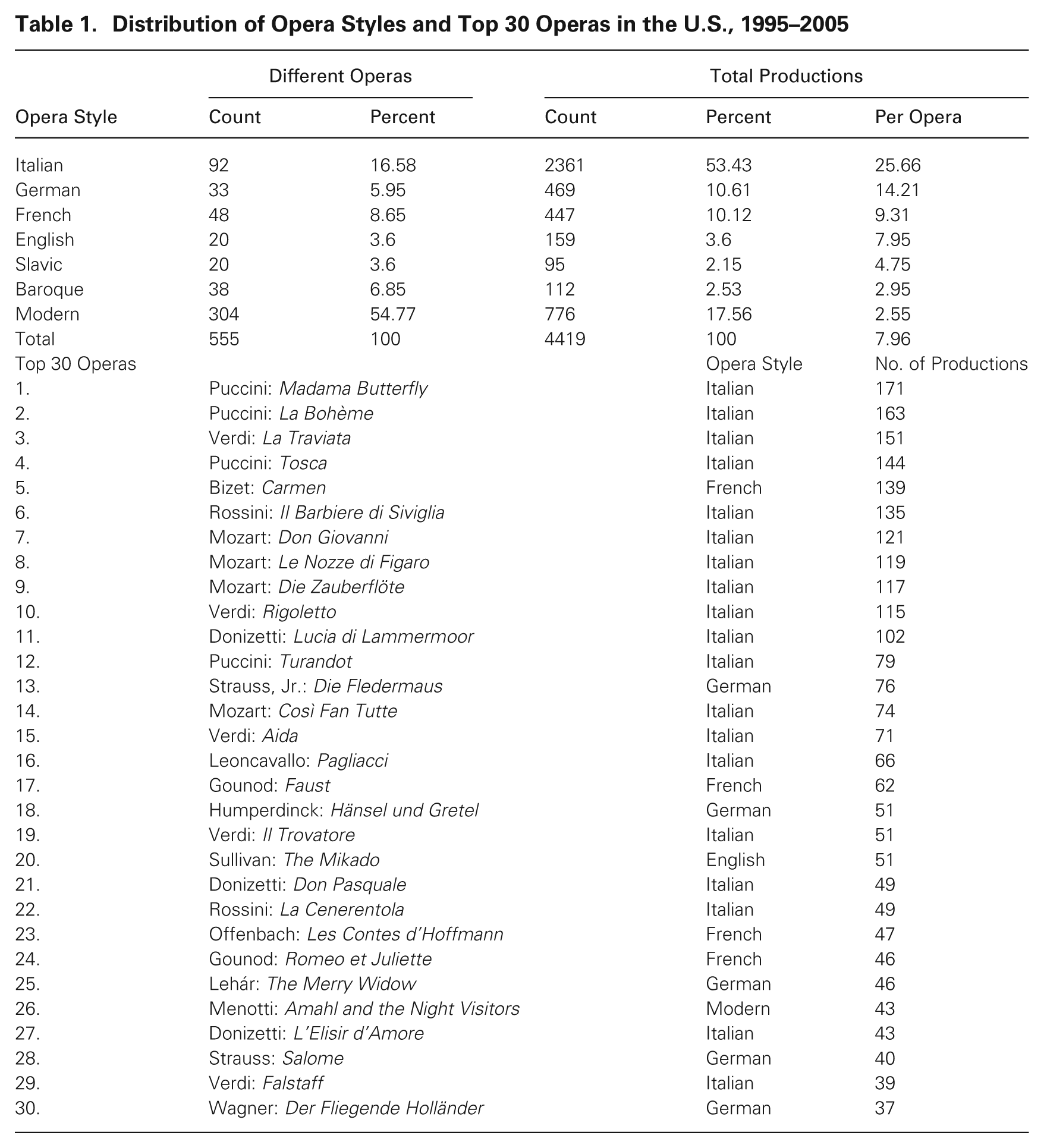
We also controlled for the presence of different opera types in the repertoire, because some types of opera are generally more popular than others (Martorella, 1977). We created a binary variable for each opera style. The Baroque style (operas by composers born before Mozart) includes composers such as Monteverdi, Handel, Gluck, and Haydn. The Modern style (operas whose composers were born after 1880 and therefore had developed their adult operatic style in the twentieth century) includes Berg, Stravinsky, Korngold, Weill, Britten, Glass, and Adams. The Italian style includes Mozart, Rossini, Donizetti, Bellini, Verdi, and Puccini; the German style includes Beethoven, Wagner, and Strauss; the French style includes Berlioz, Offenbach, Bizet, Massanet, and Debussy; the English style includes Sullivan; and the Slavic style includes Smetana, Mussorgsky, Tchaikovsky, and Janáček (Parker, 1994; Heilbrun, 2001). The styles are mutually exclusive. Italian is the comparison style, and the variable was coded one if the repertoire contained at least one opera of that style (German, French, English, Slavic, Baroque, and Modern opera). Finally, opera companies with larger repertoires have the option to schedule more operas of different styles, and the size of the opera repertoire may in itself affect ticket sales [Repertoire size (inverse)]. Table 1 shows the distribution of opera styles and the top 30 operas in the U.S. in the study period.
Distribution of Opera Styles and Top 30 Operas in the U.S., 1995–2005
At the opera-company or environmental levels, the size of an opera company, measured by the natural logarithm of the total annual expenses of the opera company (Pierce, 2000), may affect season-ticket sales and the extent to which an opera company can experiment with its opera repertoire [Budget Size (ln)]. In the opera context, the budget size is the most important indicator of status, which also allowed us to control for status effects on season-ticket sales. We used another dummy variable to account for any differences between regular opera companies and summer opera companies (Summer opera), as a large portion of summer opera company audiences are visitors and they tend to be less interested in season tickets. We controlled for financial performance of the previous year, defined by the total annual income minus total annual expenses (Lagged financial performance). Opera companies that are located in closer geographical proximity to other opera companies find themselves in a more competitive environment, and audiences are less inclined to commit to season tickets from any opera company (Competitive intensity). We measured competitive pressure by the repertoire-size weighted proximity of the focal opera to all the other opera companies in our population. Finally, we used the proportion of artists in the workforce in the county in which the opera company was located as a rough indicator of the preference for unconventional operas among a generally receptive audience (Share of artists in county). Building on Florida (2002), McGranahan and Wojan (2007) defined artists broadly as people working in artistic professions, including arts, performance, design, and entertainment. 2
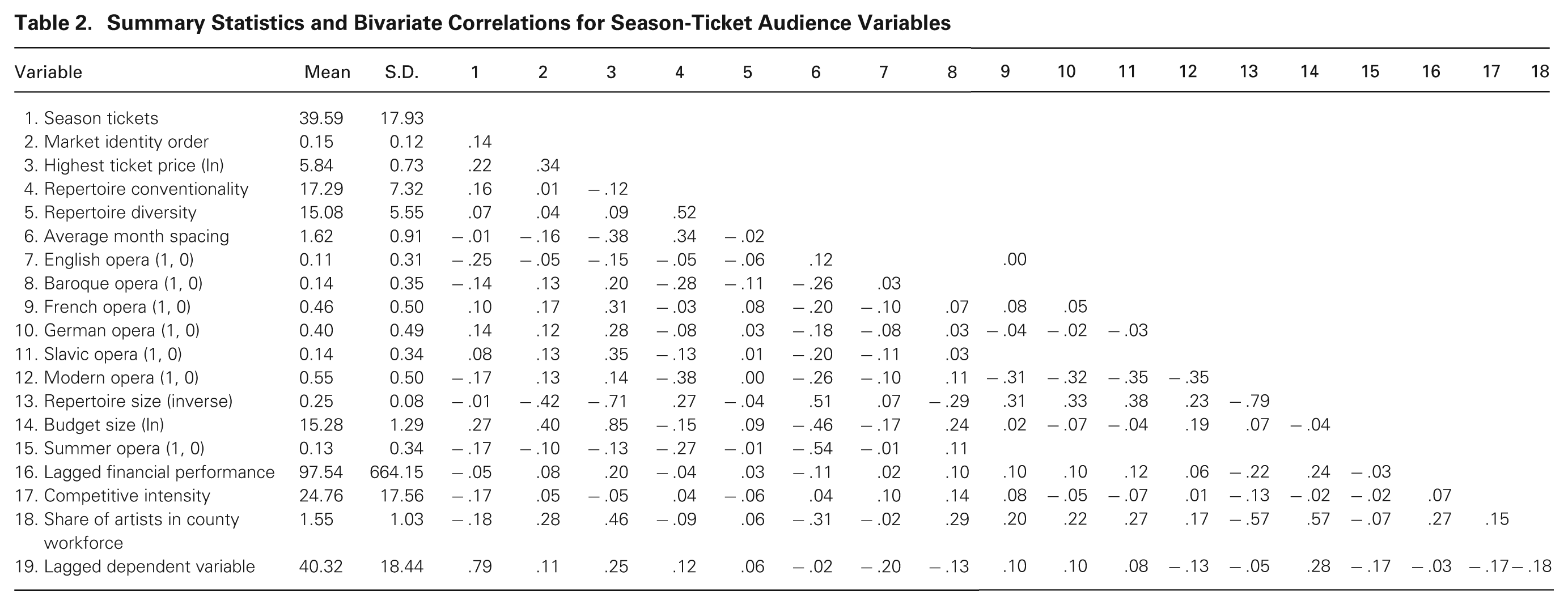
In the analyses of opera critics, we controlled first for the style (German, French, English, Slavic, Baroque, and Modern style) and conventionality of each individual opera (Opera conventionality) because opera critics pay particular attention to these types of operas. At the opera-company level, we used many of the same control variables used in season-ticket analyses [Budget size (ln), Repertoire size (inverse), Repertoire conventionality, Repertoire diversity, Summer opera, and Competitive intensity]. In addition, we controlled for the minimum distance (in natural logarithm of miles) to any of the nine newspapers for which the opera critics in our sample worked because it is easier for opera critics to cover geographically proximate than distant opera companies [Minimum geographic distance (ln)]. Finally, we controlled for the difference between the focal opera and the average conventionality of the immediate adjacent (before and after) operas in the repertoire (Adjacent opera conventionality) to control for the explanation that critics simply focus on the contrast between operas scheduled immediately next to each other and not on the entire repertoire. All the time-dependent variables were updated yearly. Table 2 contains summary statistics and bivariate correlations for variables in the season-ticket holder analysis, and table 3 shows statistics and correlations for variables in the opera critics analyses.
Summary Statistics and Bivariate Correlations for Season-Ticket Audience Variables
Summary Statistics and Bivariate Correlations for Opera Critic Audience Variables

Statistical Analyses
We used random-effects tobit regression to test our season-ticket hypothesis because season-ticket sales in theory are bound between 0 and 100 percent even though no opera company in the sample actually is bound (Tobin, 1958; Baum, 2004). We used crossed random-effects logistic regression to test our opera-critic hypothesis (Rabe-Hesketh and Skrondal, 2008). Logistic regression is appropriate because the dependent variable (coverage or not) is a dichotomous variable. Crossed random-effects are appropriate because the embedding of opera performances in both individual operas (Don Giovanni versus Wozzeck) and opera companies (Houston Grand Opera versus Seattle Opera) violates the basic regression assumption of uncorrelated errors. The crossed random-effects approach separates the unobserved opera and opera-company effects from the effects of the observed variables in the model. A fixed effects approach is not feasible because some variables, including the dependent variable, do not vary for all or some observations in an opera or an opera-company panel (some operas and opera companies were never covered and some were always covered).
Results
Table 4 presents the results of random-effects tobit regression analyses of season-ticket sales. Model 2 includes the main independent variable, market identity order, and it provides strong support for hypothesis 1: an interspersed ordering of operas in a repertoire is positively and significantly associated with season-ticket sales. Model 3 includes lagged (one year) season-ticket sales and shows that market identity order is positively and significantly associated with changes in season-ticket sales. We performed several robustness checks. We estimated seemingly unrelated regression models (Zellner, 1962) of season and single-ticket sales and found the results for season tickets similar to the random-effects tobit results. Interspersed ordering did not affect single-ticket sales, probably because, unlike season-ticket sales, they are subject to endogenous price adjustments. Opera companies often increase the number of tickets sold to poorly attended performances by reducing the ticket price before the performance begins (often in the form of student tickets and rush tickets).
Results of Random-Effects Tobit Model on Season Ticket Sales*
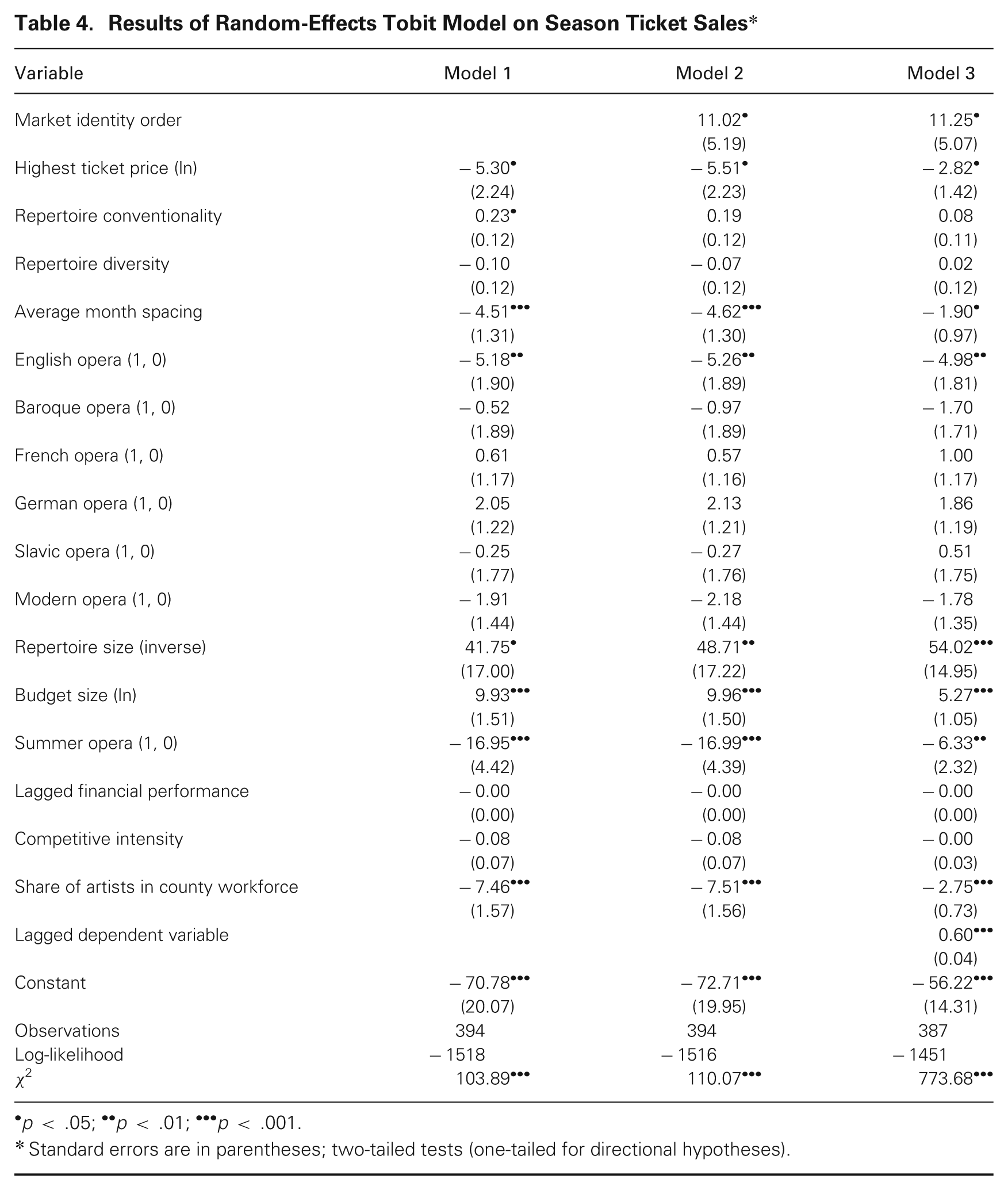
Standard errors are in parentheses; two-tailed tests (one-tailed for directional hypotheses).
In another robustness check, we estimated fixed-effects OLS regression models because unconditional fixed-effects tobit estimates are biased (StataCorp, 2007: 455) and found again that the results were similar to the tobit results. Finally, we estimated all the models with and without the Metropolitan Opera and New York City Opera because of the historically unique position of these opera companies in the U.S. opera industry and found that the results remained substantively the same.
Table 5 presents the results of crossed random-effects logistic regression analyses of critical coverage. Model 5 includes the main independent variable, market identity order, and provides strong support for hypothesis 2: an interspersed ordering of operas in the opera repertoire is negatively and significantly associated with opera critics covering an opera performance. Model 6 confirms our results at the opera-company level of analysis: opera companies with more interspersed repertoires are less like to be covered by opera critics, thus lending additional support to our argument that interspersion helps shape the perceived appeal of opera companies. We also examined if the interspersion of conventional and unconventional operas affected the evaluation of individual opera performances, although we have no strong theoretical reason to expect that it would affect how opera critics evaluate an opera performance once they have decided to cover the performance. Since few opera performances received outright negative reviews (less than 3 percent), and many received neutral or positive reviews (almost 85 percent), we focused on whether an opera performance, on average, received a very positive evaluation (more than 4 points on a 5-point scale). Model 7 shows, as expected, that interspersion did not affect the likelihood of receiving a very positive evaluation or (not reported here) a very negative evaluation. The only significant predictor of receiving a very positive evaluation is if the opera is a modern opera or a baroque opera, which provides some corroboration that opera critics favor unconventional opera.
Results of Crossed Random-Effects Logistic Regression on Critical Coverage*
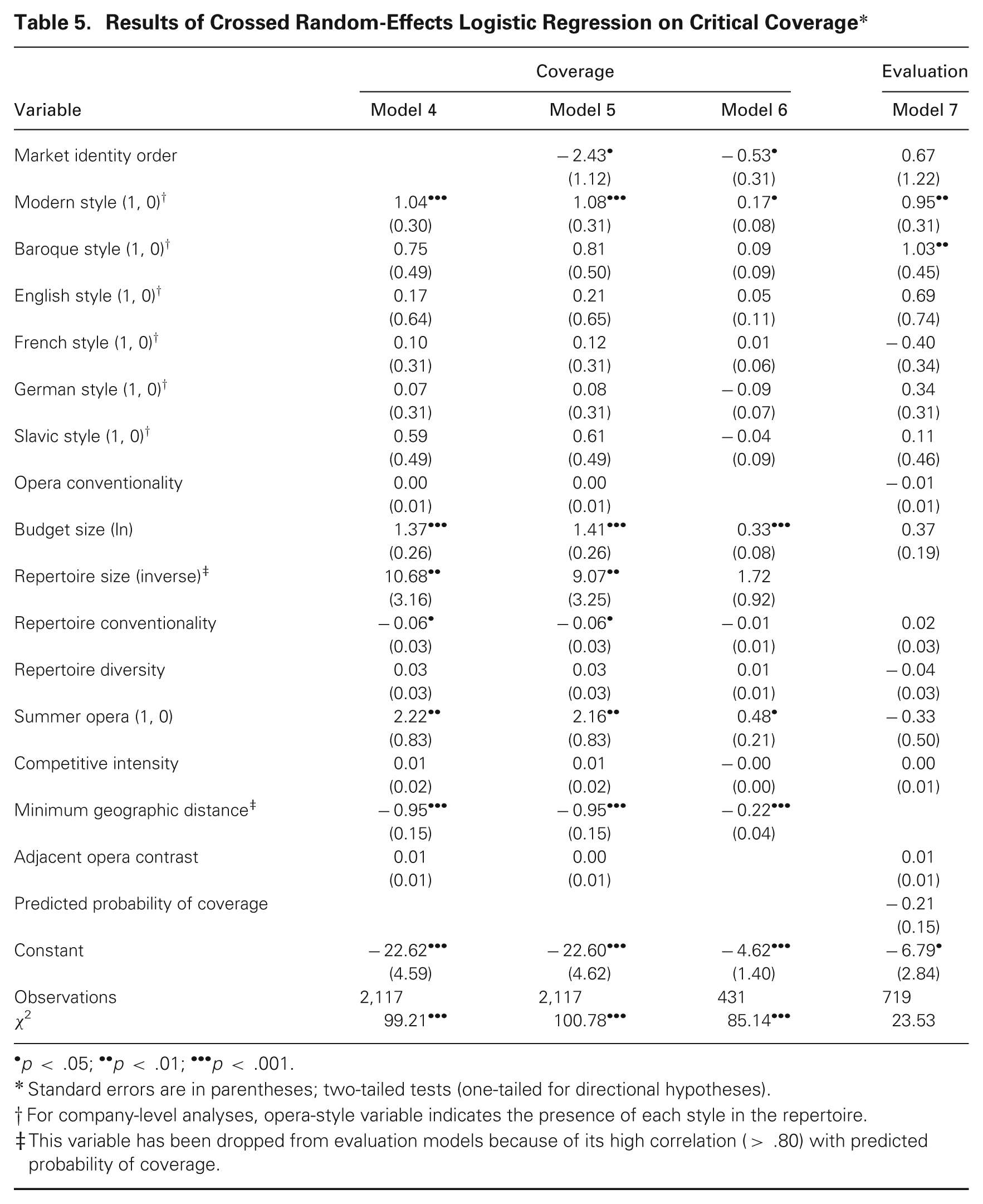
Standard errors are in parentheses; two-tailed tests (one-tailed for directional hypotheses).
For company-level analyses, opera-style variable indicates the presence of each style in the repertoire.
This variable has been dropped from evaluation models because of its high correlation (> .80) with predicted probability of coverage.
Discussion
We focused on the flexibility of market identities and theorized how the ordering of various product features affects market appeal, shifting attention from the absence or presence of the features, which underlies the assignment of market identities, to how the ordering of these features affects market appeal. We found that ordering provides an important mechanism to redefine market identities and therefore affects market appeal. Given the existence of heterogeneous audiences, organizations can benefit from increasing or decreasing the perception of certain features by deliberately changing the order. In the U.S. opera market, interspersing conventional and unconventional operas decreases the salience of unconventional operas, which, in turn, positively affects season-ticket sales but negatively affects being reviewed by opera critics. Our results showed that season-ticket holders were influenced positively by the interspersed ordering of unconventional operas in the repertoire, even controlling for the simple presence or absence of different opera styles. We also found that opera critics were less likely to cover opera performances by opera companies with interspersed repertoires.
Most research on market identity focuses on how to categorize organizations and products based on the simple absence or presence of specific products or product features (Porac et al., 1995; Zuckerman, 1999; Hannan, Pólos, and Carroll, 2007). By focusing on the ordering of products while holding the product portfolio constant, we contribute to developing a more nuanced understanding of market identities. Specifically, our focus on ordering differs from recent work on hybrid market identities. Rao, Monin, and Durand (2005) argued that distinct market identities erode when the product features from the two distinct market identities are recombined in a new hybrid market identity. We show, alternatively, that simply reordering these product features affects the salience of different features and therefore the perceived appeal of the market identity. If the hybridization of classical and nouvelle French cuisine is intended to bridge the divergent tastes of a heterogeneous audience, simply interspersing classical and nouvelle dishes on the menu to avoid disenfranchising audiences for either cuisine may be more effective because it allows purists to access their favorite classical and nouvelle dishes. More generally, our study points to an even more integrative solution: rather than simply prioritizing one audience over another, it may work better to balance the divergent demands across the composition decision and the ordering decision.
We also identify the role of agency in the formation and proliferation of market identities. Market identities are mostly viewed as relatively fixed social categories enforced by audiences, and organizations are regarded as passively conforming to given market identities (Zuckerman, 1999, 2000). We argue that the market identities themselves are also cultural schemas that provide agency to organizations (Sewell, 1992) and that ordering enables organizations to actively influence how their market identities are evaluated by making certain features more or less salient. Porac and Thomas (1990: 234) also identified the role of agency by arguing that organizations could be recategorized “via vertical shifts to a different level of perceived abstraction.” Unlike prior research (Porac and Thomas, 1994), we specified how to manipulate identity inferences by changing the ordering of the products and product features defining given market identity and how manipulating identity inferences affects market appeal with important audiences. Finally, our study contributes to research on what affects the demand for the performing arts (Currim, Weinberg, and Wittink, 1981; Kotler and Scheff, 1997; Voss, Montoya-Weiss, and Voss, 2006). We contribute to this literature by moving beyond portfolio composition to show that portfolio ordering also can influence the demand for the performing arts, thus drawing attention to socio-cognitive factors previously neglected in research on the performing arts.
Despite these contributions, our study has some limitations. We focused on the ordering of operas in a repertoire along a temporal dimension, although our theory does not distinguish between temporal and spatial dimensions. Future studies should examine how the spatial ordering of products and product features affects market appeal. The effects of spatial positions have been examined in recent experimental research on consumer choices (Hoch, Bradlow, and Wansink, 1999; Mogilner, Rudnick, and Iyengar, 2008). Hoch, Bradlow, and Wansik (1999), for example, found that organized or random assortments had different influences on perceived variety depending on characteristics of audiences, which suggests that our theory about ordering and its effects on market appeal could be expanded along the spatial dimension too.
The small sizes of opera repertoires suggest that it would also be informative to study ordering effects in contexts in which longer sequences of products and activities shape perceptions of order, thus suggesting some caution in generalizing our results to other contexts. Another limitation is that it is not possible to fully account for the causal mechanisms driving our results outside an experimental research design or in-depth case study, nor does our study address how repertoire decisions actually are made within opera companies (Johnson, 2007). We assumed that audiences use the simple distinction between conventional and unconventional operas (we did make sure that critics use the distinction) but did not actually observe the categorization process itself or how it affected the perceived market appeal. It would be useful to study the effects of ordering on the salience of features in an experimental setting or a case study to fully understand the effect of categorization on market identities. For the current study, however, because we tested our theoretical arguments on two different samples at two different levels of analysis, we are less concerned about not observing the ordering-effect process itself but encourage future research on this process.
What we have established is that there is value in going beyond the product portfolio approach to establishing a market identity and pitching it to an audience. It is not only what organizations have that matters. It is also how they present it.
Footnotes
Acknowledgements
We thank Victoria Johnson, Heeyon Kim, Jim Westphal, Daniel (Jinyong) Zyung, anonymous reviewers, and seminar participants at Columbia University and the University of Michigan for their excellent contributions to our research. We also thank Marc Scorca and Amy Smitherman from OPERA America for providing access to data on U.S. opera companies, Huggy Rao for his thoughtful handling of the review process, and Linda Johanson for helping us make our paper readable. Please direct all correspondence to Michael Jensen (
1
To ensure that our results are robust to the minimum repertoire size of three, we reestimated our models for opera companies with the minimum repertoire sizes of four and five, respectively, and found that the results remained the same.
