






Abstract
A nine-year ethnography is used to show how two investment banks’ controls, including socialization, targeted bankers’ bodies, how the bankers’ relations to their bodies evolved, and what the organizational consequences were. The banks’ espoused and therefore visible values emphasized autonomy and work-life balance; their less visible embodied controls caused habitual overwork that bankers experienced as self-chosen. This paradoxical control caused conflict between bankers and their bodies, which bankers treated as unproblematic objects. The conflict generated dialectic change that cognitive control theories overlook because they neglect the body. Cognitive control theories predict outcomes only in bankers’ first three years, when the banks benefited from bankers’ hard work. Starting in year four, body breakdowns thwarted organizational control. Despite bankers’ increased attempts to control their bodies, performance declined. Starting in year six, intensified breakdowns forced some bankers to treat their bodies as knowledgeable subjects. Because the body cannot be socialized completely, it helped numerous bankers transcend the banks’ socialization and modify their behaviors. Surprisingly, the banks benefited from this loss of control because the bankers’ ethics, judgment, and creativity increased.
One of our knowledge economy’s great paradoxes is that knowledge workers perceive their effort as autonomous despite evidence that it is under organizational control. Individuals experience action as autonomous when it is personally caused, reflecting the person’s choice (Deci and Ryan, 1987). Knowledge workers are highly educated and qualified employees who work on intellectual tasks (Alvesson, 2004). U.S. knowledge workers report autonomy on when and how to work, but their hours are more uniform than a personal-choice model would predict and higher than they are in other times and cultures. For instance, employees in most countries work less as they become wealthier, but highly paid U.S. workers work more (Mandel, 2005). They work over schedule and on weekends, citing “self-imposed” pressures (Society for Human Resource Management, 2009). Surprisingly, many highly educated and powerful individuals with the most attractive employment options, including software engineers, consultants, investment bankers, and lawyers, seemingly choose to work up to 120 hours per week (Kunda, 1992); are voluntarily electronically available twenty-four hours a day, seven days a week (Mazmanian, Orlikowski, and Yates, 2005); underreport hours (Deetz, 1997); resist directives to work less (Perlow and Porter, 2009; Kellogg, 2009); and extend themselves on behalf of the organization with dogged effort despite sometimes incapacitating illness and rebelling bodies. In his book about his years working on Wall Street and in Washington, Robert Rubin, the former treasury secretary and co-senior partner at Goldman Sachs, illustrated this autonomy paradox. Although he was a senior and therefore relatively autonomous knowledge worker, he ostensibly chose to exert himself intensively on behalf of the organization, suppressing and fighting his ailing body:
I was intent on not letting my back pain interfere with . . . Goldman . . ., so I did everything I could to keep functioning. For many months, I’d have to lie down at the office on a couch . . . . I was in the hospital three times . . . and each time I ran the arbitrage business from my bed. I was on the board of Studebaker-Worthington, and I participated in one meeting lying on the conference table. Once, the CEO of the company . . . called and asked me to meet him at his office on a Saturday to talk about selling the company . . . . I couldn’t walk for more than a few yards at the time, or even sit, but I went to [his] office and lay on the window seat . . . trying not to miss a beat by working from a horizontal position. (Rubin and Weisberg, 2003: 88)
From Rubin’s depiction, his exertion was freely chosen. As a business head, Rubin was sufficiently senior to delegate. Also, Goldman’s culture is famously collaborative (e.g., Endlich, 1999). It intentionally keeps individuals from the spotlight to showcase the firm’s resources and lets different combinations of individuals seamlessly substitute for each other. This means that others might have been able to fill in for Rubin. Given that there may have been other solutions, what compelled Rubin to extract this cost from his body? More generally, this “autonomy paradox” (Mazmanian, Orlikowski, and Yates, 2011) raises questions about contemporary organizational control’s nature and consequences: How do knowledge-based organizations facilitate members’ intense effort and perceptions of autonomy? What role does the body play in such demanding action? What are the evolving individual and organizational consequences?
Existing theories do not account for knowledge-based organizations’ control forms even though control is management’s “most fundamental problem” (Van Maanen and Barley, 1984: 290). They primarily focus on controls that are visible to participants; participants recognize how they are controlled. Yet some of knowledge-based organizations’ controls may not be readily visible to allow knowledge workers to retain the perception of autonomy, which they value (Davenport, 2005). Early work examined industrial firms’ external controls, which placed control within the owner, technology such as assembly lines (Taylor, 1911, 1947), and bureaucratic hierarchy, rules (Edwards, 1981), and job design (Hackman and Oldham, 1976). It assumed that workers fill jobs designed by managers. Control is visible through job descriptions, supervision, or peer pressure (Barker, 1993) even when job design enhances autonomy (Hackman and Oldham, 1976). Visible controls can cause reactance, in which workers reduce effort and oppose directives (Worchel and Brehm, 1971). These theories thus cannot explain knowledge workers’ intense effort and perceptions of autonomy. Also, in knowledge-based organizations, control based on hierarchy and management’s job design is less important. Hierarchies are flat and tasks are often not part of a job, but are crafted (Wrzesniewski and Dutton, 2001) by collaborating workers (Michel, 2007).
Research on needs and motivation, on which job design research builds, also falls short in explaining the autonomy paradox. These literatures argue that employees work hard for firms that satisfy autonomy needs and thus increase intrinsic motivation (Hackman and Oldham, 1976; Kanfer, 1994). Yet knowledge work has conditions that psychological experiments use to decrease autonomy and intrinsic motivation, including high pressure (Deci and Cascio, 1972), tight deadlines (Amabile, DeLong, and Lepper, 1976), a performance-versus-process orientation (Dweck, 1999), and ego involvement (Ryan, 1982), thus underlining the paradox of knowledge workers’ perceived autonomy.
Cognitive control theories, such as socialization and culture theories (Van Maanen and Schein, 1979; O’Reilly and Chatman, 1996; Schein, 1996) better explain why knowledge workers want to work hard but still do not account for the autonomy paradox. Socialization is a form of control that is both a process and an outcome. It ensues when employees accept a firm’s culture. Organizations target employees’ minds. They inculcate shared concepts, such as norms and values (Alvesson and Robertson, 2006) that workers ideally identify with (e.g., Pratt, 1998). Workers thus exert themselves on a firm’s behalf even without external control. Construing culture as shared concepts, these theories associate culture with a harmonious alignment of interest between workers and the organization (e.g., Schein, 1985; cf. Alvesson, 1993, 2002).
Nonetheless, cognitive controls leave important puzzles and gaps. First, like external controls, they are visible. Enculturation explicitly conveys concepts (Van Maanen and Kunda, 1989) that employees consciously adopt (Deetz, 1997). Concepts must be visible for employees to notice and use them (Barker, 1993). It is thus unclear why workers experience effort as self-chosen, versus submission to a collectively designed culture. Yet they would not work so hard unless they viewed choices as their own (e.g., Pittman, 1998).
The answer may be that some controls are not cognitive but bypass the mind—the domain of cognitive control theories—and target a neglected domain: the body. For example, organizations use controls such as timetables to create productivity-enhancing physical rhythms, architecture and floor layouts to organize bodies in space for optimal surveillance, and work techniques that weave bodies together with productive artifacts (e.g., Foucault, 1979). Socialization events influence workers’ conduct explicitly and directly; participants are told how to behave in line with a firm’s norms and rules. Embodied controls might be less visible because they influence workers’ conduct only indirectly and unobtrusively; they manifest as regular business activity that guides participants’ actions. Because the ostensive or primary purpose of business activity is not control, participants’ perception of autonomy can remain intact.
Second, because the body is controlled by organizations, it must be analyzed in order to understand socialization. The above quotation from Robert Rubin makes salient the toll that knowledge work can take on the body (cf. Kunda, 1992; Kellogg, 2009), implying that the harmony between employee and organization that cognitive theories posit may be only an artifact of their excluding the body. Because the body can resist exertion, including it in analysis can reveal conflict within the employee. Conflict predicts change. Prior theories may have missed such conflict because they have usually focused on socialization only for the first year of employees’ tenure, even though socialization is life-long (Bauer, Morrison, and Callister, 1998; see Pratt, Rockmann, and Kaufmann, 2006, for an exception), and body breakdowns may occur only after years of strain. To understand control’s extended influence requires a longer period of study. I used ethnographic methods to document the changes in employees’ response to control over a nine-year period as they occurred.
Third, prior theory offers conflicting predictions about the consequences of control. Control is desirable, but it can stifle creativity (Nemeth and Staw, 1989; Alvesson, 2002). Also, prior predictions are static, but control’s consequences may change with tenure. For newcomers, control’s intended positive consequence of conveying the firm’s culture may outweigh its unintended negative, creativity-stifling effects partly because junior knowledge workers, such as bankers, lawyers, and consultants, work primarily on technical tasks, which require less creativity. In contrast, for senior employees, who often help their firms compete by designing creative solutions, control’s creativity-stifling consequences can be a critical negative. At the same time, control’s intended positive consequences might be less important because senior professionals already know the culture and either follow it by habit and conviction or are powerful enough to reinterpret it according to personal interests, which tends to happen with visible controls (Scott, 2008b). A longitudinal approach can show control’s shifting consequences over time.
I present ethnographic data from two Wall Street investment banks that epitomize knowledge-based organizations. They are therefore ideal for studying contemporary control. I supplement cognitive control theories by building grounded theory about (1) how unobtrusive controls target employees’ bodies and interact with cognitive controls, (2) how this interaction transforms employees over time; and (3) what the consequences are for the person and the organization.
Organizational Control of the Body
Unobtrusive Organizational Controls
Unobtrusive controls more plausibly explain employees’ hard work and perceptions of autonomy than cognitive controls. In contrast to management-promulgated and peer-enforced cognitive controls, they are rarely articulated. They are structured into habitual business conduct (Guillén, 1994). As participants engage in socially structured activities, their bodies’ physical properties and dispositions are shaped to support these particular activities, often without participants’ awareness of such shaping (e.g., Bourdieu, 1977: 52ff; Giddens, 1991: 7). Because control agents, such as management or peers, are less visible in unobtrusive controls, employees mistakenly experience autonomy. They work hard and neglect family and health, not just because of choice based on rewards, punishments, or obligation, as prior theories posit, but because they cannot conceive otherwise (Castoriadis, 1992), even when it does not make sense to do so. For example, consultants only discovered that they could work less and still perform effectively when Perlow and her coworkers proposed and helped implement a program that forced reluctant consultants to take one evening per week off (Perlow and Porter, 2009). Unobtrusive controls are important to understand because they are so powerful. Unaware of organizational controls, workers are less likely to manipulate them by, for example, framing cultural concepts according to personal interests (Scott, 2008a). Because organizations use multiple forms of control (Alvesson, 2004), embodied controls are likely to interact with other parts of a heterogeneous control system.
Prior research offers limited insight into the unobtrusive controls of knowledge-based organizations. The Carnegie School has pioneered the study of unobtrusive controls (Simon, 1976; Perrow, 1986). This research tradition’s primary concern, however, is cognitive. It describes how unobtrusive controls subtly target the mind, directing information and attention in line with a firm’s decision premises. Unobtrusive controls may work differently to influence the body and extract high effort. Moreover, the Carnegie School concentrated on the internally consistent and top-management designed controls of industrial firms. But in knowledge-based organizations, controls are often emergent, not designed; they result from the sometimes contradictory actions of lower-levels participant (e.g., Eccles and Crane, 1988). We do not know how unobtrusive controls can be created at lower levels and without design and what the consequences of such controls are. Institutional theory focuses on habits, such as those created by unobtrusive controls. Yet it considers mainly visible and therefore “more superficial, ‘thinner,’ and less consequential” control, “including rule-setting, monitoring, and sanctioning” (Scott, 2008b: 428–429). Because this tradition features aggregate and macro-level studies, it lacks behavioral data on habits (Scott, 2008b) and the body’s role in action.
The Body’s Role in Action
The body always plays a role in action, yet this role has often remained unproblematized (Joas, 1997; Strauss, 2008). Exploring the body’s action role is particularly important for comprehensively understanding organizational control because unobtrusive controls influence action by targeting the body. Control theories are about action regulation (Weber, 1978). Cognitive research, which underlies cognitive control theories, also focuses on action regulation but does not empirically examine the body’s role. Most relevant are self-regulatory theories (e.g., Carver and Scheier, 1990) because they explain action directly (Kanfer, 1994). Theories of self-efficacy (Bandura, 1977), agency (Bandura, 2001), needs and motivation, including effectance motivation (White, 1959), and autonomy (McGregor, 1960; Deci and Ryan, 1991, 1995) are also relevant, but they do not predict action directly (Kanfer, 1994). For example, needs theories only predict action through a chain of predictors, namely, by predicting motives, which predict choice, which predicts intentions, which predict goals, and therefore self-regulation (Kanfer, 1994: 4). These theories assume a priori that the mind, often as the self-concept, both regulates the body unproblematically and generates action and knowledge. Structuration research proposes that the body’s properties mediate action but does not empirically examine how (Freund, 1988). Intuition could be construed as cues generated by the body (e.g., Bruner, 1962), but Dane and Pratt (2007), for example, modeled it on the tacit knowledge of experts (Erricsson and Smith, 1991; Simon, 1991) as conceptual and therefore mostly mental, leaving the body’s role unexamined.
Further, action and the body’s role in it are structured by culture. In Western cultures, the mind’s dominant and the body’s instrumental roles reflect a Cartesian tradition that devalues the body (Descartes, 1985). The shift to knowledge work conceals how the body influences action (Leder, 1990). Perhaps because task completion typically does not involve harsh physical labor but rather challenging mental work, the body moves into the background of participants’ experience. In our expert society, academic construals influence how people experience themselves (Giddens, 1991). Academic construals of knowledge work as “thinking for a living” (Davenport, 2005) may thus facilitate neglect of the body’s action role and therefore the body’s transparency.
By contrast, effective action in Asian cultures reflects a quiet mind that is sensitive to body cues (Nishida, 1990: 3). Even in Western cultures, creative individuals often suppress the mind to let the body dominate. For example, Bruner (1962) suggested that creativity requires freedom from various forms of mental concepts, such as social conditioning, defenses, and preconceived notions about the creative product, because these could impede sensitive perception of task cues. Such cues are better registered through intuition (pp. 20–21), which he understood as partly embodied (p. 21). Cross-cultural work shows that Westerners confer agency on individuals and Asians do so on collectives (Morris, Menon, and Ames, 2001) but does not acknowledge that cultures also differ in whether they confer agency on the body. Instead of synthetically assuming an instrumental body action role, as prior theories do, a cultural approach empirically studies body action roles and therefore holds promise for discovering and understanding diverse roles of the body in action.
A cultural approach differs from a cross-cultural one (Shweder, 1990). Informed by psychology, cross-cultural work often examines individuals’ static traits in a decontextualized way. Because the context and the person are presumed only to interact versus to be mutually constituted, they can be studied separately. For example, the collectivism of Easterners can be studied in a different context, such as the laboratories of a Western university, and the findings collected from college students are assumed to generalize to more experienced cultural participants (Triandis, 1995). Informed also by anthropology, a cultural approach studies how individuals develop as they are engaging with a particular context (e.g., Cole, 1996). Because the person and the context are assumed to be mutually constituted, they must be studied together. Studying individuals’ transformation over time is not a separate developmental concern but an integral part of understanding the cultural shaping of persons; one understands the nature of a phenomenon only when one understands the transitions that it undergoes (Wertsch, 1991: 87). Contrary to needs and motivation theories, which inform job design work, a cultural approach posits that needs, such as autonomy, are not stable and universal (Salancik and Pfeffer, 1977; Markus, Kitayama, and Heiman, 1996). It treats autonomy not as a person’s need but as a mutable cultural construction and thus raises questions about how this construction occurs, what its social functions are, and if and why perceptions of autonomy change.
Organizational research on the body is rare (Hassard, Holliday, and Willmott, 2000; Heaphy and Dutton, 2008) and often takes a realist “physiological lens” (Heaphy, 2007), which assumes that the body is a biological object. Most of it treats the body as an implicit aspect of organizational design and performance, as did Taylor (1911, 1947), or as an explicit topic in health and stress research (e.g., Katz and Kahn, 1978; Marmot, Bobak, and Smith, 1995; Cooper, Dewe, and O’Driscoll, 2001). The cultural approach, in contrast, treats the body as a problem and examines its cultural construction. Instead of assuming that the body is an object, it encourages study of the different extent to which organizationally shaped participants objectify the body over time and the differential implications.
Research on embodiment (Johnson, 1987; Lakoff and Johnson, 1999) construes the body as an objective source for thoughts, but it does not examine culture’s influence on how the body affects thought and action. Flow theory posits mind-body integration (Csikszentmihalyi, 1990; Hunter and Csikszentmihalyi, 2000), but flow research does not include any body-related variables (e.g., Quinn, 2005) and treats flow as an individual difference variable, not a cultural construction. Institutional work explores the cultural construction of stress (Barley and Knight, 1992; Meyerson, 1994, 1998). But it is not behavioral and does not examine how cultural constructions are instantiated in practices, which is necessary to understanding culture’s control of participants. Critical theory scholars have articulated the effects of capitalistic production on the body. The mind is split from the body because of the separation of physical and mental activity, because monotonous labor drains vitality and numbs the body such that the person does not feel it, and because etiquette rules force participants to separate what they feel from what they show (e.g., Marcuse, 1955; Marx, 1977; Lynch, 1985; Deetz, 1994a, 1994b). For example, because flight attendants had to project friendliness, they lost access to their real feelings (Hochschild, 1983). These dynamics can also be observed among highly educated knowledge workers. For example, medical socialization research has described the physically “deadening” effects of hard work and poor working conditions on medical interns (e.g., LeBarron, 1981: 241; Shem, 1978; Hafferty, 2000). Together, this work documents how organizations in our society typically socialize the mind to control and dissociate from a numb and passive body. But other body action roles can be empirically observed under different cultural conditions and perhaps also when participants within a culture transcend its constraints.
Transcending Socialization
Existing socialization and culture research depicts constraints but neglects how participants might transcend these over time, which means to notice and act more flexibly in relation to previously taken-for-granted assumptions, and exhibit novel orientations (DiMaggio, 1998). One tradition construes culture as an integrated system of shared values (Van Maanen, 1976, 1977; Louis, 1983; Schein, 1983) that can limit creativity (Nemeth and Staw, 1989), defined as the generation of novel, useful products or ideas (Oldham and Cummings, 1996: 607), because participants come to experience cultural choices as natural and are less likely to perceive alternatives. Cultural change often emerges from outside the culture. Participants thus do not transcend constraints but are merely locked into a different culturally salient frame, which, like any cultural frame, is likely to limit perceptions of alternatives.
A second tradition examines the strong cultures often found in knowledge-based organizations, which can resemble cults (O’Reilly and Chatman, 1996) and total institutions (Goffman, 1961). It also construes culture as shared values and the organization as the primary agent, contributing an understanding of how members can transcend the culture by being “deprogrammed.” Strong cultures encapsulate members physically, socially, and ideologically (Kanter, 1968; Greil and Rudy, 1984). Deprogramming requires removing individuals from the culture. This research tradition thus does not shed light on how individuals can transcend a culture while functioning within it, which may be necessary to protect participants who do not want to leave from control’s damaging effects, such as the overwork depicted by Rubin (Rubin and Weisberg, 2003) above, and from its creativity-stifling consequences.
A third tradition posits more agency for participants (for reviews, see DiMaggio, 1997; Morrill, 2008), who use heterogeneous and change-supportive cultural and political tool kits (Swidler, 1986; Kellogg, 2011) to alter the culture itself rather than attempting to transcend it (Lounsbury and Glynn, 2001). Because it assumes that members can only be socialized partially (DiMaggio, 1997), however, it also does not explain how they could transcend socialization. This approach might also be less relevant in explaining the uniformly long working hours in knowledge-based organizations because it predicts heterogeneous choices.
Scholars often study cultures as targeting the mind through concepts (e.g., Schein, 1983; O’Reilly and Chatman, 1996). In contrast, the study presented here illuminates how cultures also control action by targeting the body. Analyzing the body’s action role may explain where new orientations to the organization come from because bodily breakdowns can culturally distance committed individuals (e.g., Frank, 2002:. 8–16, 20–35, 115–122) and sensitize them to neglected cues and alternative perspectives.
Methods
This article is based on an ongoing study of how work transforms employees. I studied two investment banking departments, which I refer to as Bank A and Bank B to protect their identities, in two different banks. Investment bankers advise corporate clients on financial transactions such as the sale of a company or the public offering of securities. They conduct financial analyses and interconnect the bank’s resources to execute transactions. They are often confused with traders, who trade existing securities, such as stocks and bonds, but banking and trading constitute different cultures. Investment bankers see themselves as trusted advisors to clients; they work long and unpredictable hours. Traders have no client contact; they work according to the shorter and predictable market hours. They see themselves as “gamblers with fast reflexes” (Bank A trader) and “assholes who compete on who has the biggest dick” (Bank B trader). Although much has been written about trading (Lewis, 1989; Belfort, 2007), less is known about the highly secretive but economically important investment banking cultures.
Described by bankers as “boot camps” and “grind mills,” the banks presented extreme cases of the long working hours observable in modern knowledge-based organizations, which existed side by side with the job’s well-documented luxuries, such as a comfortable business travel style and free meals. Extreme cases render focal dynamics salient and thus facilitate theory building (Eisenhardt, 1989; Pettigrew, 1990). The banks served Fortune 500 companies; each had more than 60 employees; recruited from top business schools through similar practices; used 360-degree performance reviews; and paid a base salary and performance-contingent bonus.
I used an ethnographic case study design, which is powerful for building new theory (Siggelkow, 2007). It can persuasively demonstrate the violation of taken-for-granted assumptions (e.g., “the mind always guides action”) and their importance. Detailed description gets close to and conceptualizes variables for future quantitative work. Within-case contrasts unravel mechanisms that can otherwise remain implicit and that are crucial for tracking longitudinal change, as I do here. Lacking quasi-experimental design, however, case studies are vulnerable to validity threats (Cook and Campbell, 1979). They provide “existence proof” of a phenomenon but cannot also make the reader believe the proposed theory (Siggelkow, 2007).
I mitigated some threats through sampling and within-case replication. Specifically, knowledge-based organizations can be differentiated based on the extent of workers’ autonomy (Scott, 1965). The banks were autonomous, quasi-professional organizations. This means that bankers were entrusted with managerial tasks, such as defining and implementing goals, and represented a special type of employee: highly skilled and motivated, with internalized organizational norms, and strong preferences for autonomy. The employees of heterogeneous organizations, in contrast, follow rules and, being less skilled, accept reduced autonomy for coaching-based supervision; a structure that resembles traditional job design. I sampled based on impressionistic modal instances (Cook and Campbell, 1979): I chose my setting and participants based on impressionistic similarity to the class of settings and people I wanted to understand. The two autonomously structured banks were ideal for understanding unobtrusive controls in modern knowledge-based organizations because they lacked traditional visible controls, such as supervision and rules, and bankers epitomized the modern knowledge worker. Because replication enhances external validity (Cook and Campbell, 1979), I chose two different banks and tested whether a pattern established in one subsection of the data (i.e., one bank, one subsection of bankers) also held in the other.
Participants and Personal Background
I tracked four associate cohorts (two in each bank), which entered during the study’s years one and two. Observing bankers from entry ascertains that I would capture socialization’s effects. I report on nine years per cohort. Because cohorts entered one year apart, the total study time is ten years. I included bankers for as long as they stayed with a bank. The banks forbade me to reveal cohort sizes, attrition rates, or dates of the study. Throughout the study, the sample was in the double digits. At entry, associates were on average 28 years old, had MBA degrees and were about 50 percent female. Starting in year 5, about 65 percent were white males. Associates became vice presidents (VPs) after four years and directors after three more years. Before entering academia and starting this study, I was an associate at a Wall Street bank, where I cultivated relations that facilitated access for this unpaid research. Because of my background, bankers treated me as an in-group member, invited me to work and non-work activities, and trusted me with sensitive details involved in their changes over time.
Data Sources
I used four overlapping data sources, which I triangulated to bolster validity (Eisenhardt, 1989): observation (two years; about 7,000 hours), over 600 formal, semi-structured interviews, informal interviews with about 200 informants, and analysis of company materials.
Participant and non-participant observation
The banks allowed observation for two years. In year 1, I observed five to seven days a week (80–120 hours), mirroring bankers’ schedules, and then at least three days a week. To balance my deep familiarity with investment banking, I chose the observer as my primary role, jotting down notes (Freilich, 1970). As participant, I helped with minor tasks, a standard practice (Hammersley and Atkinson, 1997) that allowed me to ask otherwise intrusive questions. I sat close to bankers, noting what they said and did. To sample and balance observations, for each banker, I recorded (1) the observations’ log page numbers, (2) data sources I had used, (3) activity types, and (4) observation times and length. I opportunistically joined meetings, phone conversations, social functions, and training sessions.
Semi-structured, formal interviews
I conducted 136 formal 30- to 45-minute interviews. Because the banks forbade taping, I completed detailed notes immediately after each interview. As I was limited to one formal interview per banker, I interviewed during year 2, when I had clearer categories, and asked broad questions. Appendix A provides the interview protocol. I interviewed 60 bankers from Bank A and 48 bankers from Bank B, including focal bankers and those with whom they interacted. Friendly bankers conducted repeated follow-up interviews on their own time. In years 3 to 9, I completed almost 500 one-to-three-hour interviews, including two to four yearly interviews with every focal banker, usually in a restaurant, about (1) recent experiences and (2) how the banks’ practices had changed.
Informal interviews
I selected 200 informants for informal interviews based on evolving themes. Clients sometimes talked about bankers’ physical demeanor (e.g., “she could not keep her eyes open”) and performance. Bankers’ friends and family discussed work demands and bodily consequences. Industry experts as well as employees from other parts of the banks and other banks provided diverse perspectives on the banks’ practices. To ensure validity, bankers who were not part of my sample helped interpret the data throughout the study. In addition, three VPs from Bank A and one director and four VPs from Bank B commented extensively on drafts of the paper.
Documents
I analyzed (1) yearly performance reviews for all bankers and (2) documents about training, selection, socialization, and change in practices, such as dress code.
Analysis
I iteratively moved between data and emerging theory. I formulated common statements into first-order codes, such as “autonomy” (Locke, 2001). Bankers drew tree diagrams (Jehn, 1997) to define a code (“autonomy means that I use my judgment for deciding when to work”) and then identified key concepts contained in each answer (“This is not like what you see at clients. Using my judgment means that no one tells me what to do”). I selected observations and interview questions based on emerging themes (Spradley, 1979). The interview questions are provided in Appendix B. For example, I asked questions about whether other bankers also assessed their autonomy in relation to clients’ autonomy. I revisited the data to evaluate a code’s fit and sometimes discarded or revised a code. As “local integration” (Weiss, 1994: 168), I organized data by banker to track development, using diagrams, tables, and counts. I triangulated data by source. For example, to investigate developing body awareness, I counted a banker’s yearly body references. I regularly compared data within and across the banks, using a small number of bankers for a more “inclusive integration” (Weiss, 1994: 168). Thus moving from open to axial coding (Locke, 2001: 64–65), I tested mini-theories. For example, I theorized that bankers worked harder to compensate for breakdowns but found that different bankers used different strategies, including distraction, and that strategies changed over time (e.g., some bankers gave up controlling their bodies). I assembled categories into a coherent theory based on shared dimensions, such as distinct control aspects: (1) control practices (e.g., cognitive controls), (2) socialization transformation (e.g., body action roles), and (3) socialization outcomes (e.g., performance). I reexamined the data’s fit with this theory (Glaser and Strauss, 1967). To avoid elaborating data solely on theoretical grounds, I constructed evidence tables and checked again with informants. The Online Appendix provides an overview of the data structure and the creation of aggregate theoretical dimensions from first-order coding (http://asq.sagepub.com/supplemental).
Findings
I describe the interrelation between the banks’ stable control practices, evolving body action roles, and organizational consequences. Visible cognitive controls targeted the mind and highlighted autonomy and work-life balance. Values were explicitly stated and reflected in the absence of controls, including no official working hours, no productivity measures, no efficiency focus, no supervision, and no tracking of vacation time. Because prior work describes cognitive controls, I focus on the neglected embodied controls.
Less visible embodied controls bypassed the mind to target the body; they encouraged indiscriminate overwork and counteracted work-conflicting goals and bodily needs. These controls fostered self-monitoring techniques so that bankers monitored and self-adjusted work hours, deals lost, resource costs, and the effectiveness of recruiting. Open floor layouts encouraged bankers to be self-aware of their actions. The bank erased distinctions between work and leisure by providing administrative support 24 hours a day, seven days a week, encouraging leisure at work, and providing free amenities, including childcare, valets, car service, and meals. Some of the banks’ embodied controls focused on managing employees’ energy and included providing free caffeine and meals during “energy slumps,” hiring young people, focusing on energy as the main hiring criterion, and firing low performers because of their energy drain.
During years 1 to 3, the banks benefited from their bankers’ vigorous body control and repression as they complied with the unobtrusive controls. Starting in year 4, however, the body turned antagonistic through breakdowns, thwarting the banks’ goals. Bankers resisted, but performance declined. From year 6 forward, 60 percent of the bankers remained in the antagonistic pattern, but 40 percent released control over their bodies. It became a subject that guided bankers—and challenged banks’ control. Surprisingly, these challenges promoted creativity and benefited the banks.
Organizational Controls
Bankers joined and stayed at the banks because of high compensation, prestige, and future marketability (Michel and Wortham, 2009), but other reasons determined their daily effort, as summarized and elaborated in table 1: “[Money and power] don’t make me get up every morning and bust my butt. I work hard because I want to” (Bank A associate). Bankers felt autonomous because cognitive controls explicitly espoused the value of autonomy—”We trust our professionals to work autonomously.” As evidence for these values, bankers also pointed to absent external controls, such as supervision, which they observed at clients’ organizations. No one prescribed bankers’ working hours or tracked productivity and vacation time. As one Bank B associate said, “I could not work for an organization that required me to come at 9
Evidence of Organizational Controls

Bankers worked up to 120 hours per week even when there was nothing urgent to do. Only during later years did some bankers notice how unobtrusive controls, such as self-surveillance, intensified work effort. As one director at Bank A said,
We have no use for managers. Our systems ensure that people control themselves, sometimes without knowing it. We just feedback to people how well they are doing and we leave it at that. We don’t even set targets. People compete against themselves.
As an example, bankers recorded billable hours on time sheets. The banks did not track work hours, but bankers did: “The number matters to you just because you attend to it daily” (Bank B associate). Bankers saw time sheets as a “game,” trying to “beat their own best,” which caused indiscriminate overwork that felt “self-chosen,” concealing the banks’ influence. They also self-monitored deals lost to competitors, resource costs, including juniors’ time, recruiting teams’ effectiveness, and “recruiting batting averages,” which recorded how accurately they predicted recruits’ career success. Self-surveillance worked through embodied perceptual processes that often bypassed the mind. Bankers monitored concrete data that they did not always process abstractly, partly because the banks withheld cognitive control standards such as explicit norms and rules. Self-surveillance also resulted from organizing bodies spatially in open floors, including trading-floor-like tables. This layout was designed for a reason not related to control, namely, to enhance communication and train juniors, who could overhear senior bankers’ conversations. But because senior and junior bankers did not know if they were being watched, they behaved as if they were and monitored themselves: “Because I know that everyone can listen to what I say, I keep observing myself from their perspectives” (Bank A director).
Unobtrusive controls also erased work-leisure distinctions, thus counteracting work-competing goals and needs. The banks stated such work-life balance values as “ensuring that bankers have time to rejuvenate and spend with family” (Bank B director). Bankers also described the banks’ amenities at recruiting events to illustrate their lifestyle’s luxury. Yet services designed to free up time habituated bankers to long hours. A Bank B associate said about the 24/7 administrative support, “It is like a psych experiment where the light is always on. The only temporal markers are secretarial shifts. And they make it possible to work around the clock and isolate you from the outside’s rhythms.” Senior bankers mentioned how others’ constant presence implied that it was always time to work. Because such embodied cues could bypass conscious processing, they prevented bankers from perceiving control. The banks also erased work-leisure distinctions by encouraging leisure at work. Bankers could chat and play anytime. “You don’t pay by the hour. If they take longer . . . you just habituate them to being at work and getting all their needs met there” (Bank A director). The banks’ free car services, meals, health clubs, and dry cleaning valets mimicked homey bodily comforts:
This is like an artificial world. Instead of going home, after 5:00
“Feminists used to say that every woman could work if the wife takes care of chores. The bank is my wife’s wife.” This Bank A associate’s spouse echoed the banks’ framing of conveniences as spouse-like career support, highlighting bankers’ autonomy and hiding the bank’s control.
To secure full devotion, the banks also controlled energy: “Our most important currency is not time but energy. It is easy to keep people at work around the clock. Minds are willing. You have to fight the biology” (Bank B director). Senior bankers explained how the constant buzz of open floors’ layout facilitated long hours because it impeded reflection and nervously stimulated bankers. The banks also offered food and caffeine at strategic times, namely, “when people’s blood sugar slumps and that gives you energy to keep going” (Bank A associate). The banks hired cohorts of “young, energetic people,” because they could “grind out work,” as a VP at Bank A said. The average age was 35 years, “because you can’t sustain this pace much longer” (Bank B director). A VP at Bank A said, “We weed out low performers even when bankers are scarce, because one person who is not performing to the absolute maximum brings down everyone’s energy.”
Unobtrusive controls thus managed time, space, and energy. Unlike explicit cognitive controls, they were embodied in the environment and routines, sometimes for reasons unrelated to control. As long as they were junior, bankers mostly noticed verbal messages about autonomy and downplayed the importance of embodied controls, which made resistance less likely. As they became senior, some bankers noticed embodied controls: “I always thought that my choices are my own. Now I see how the bank subtly chooses for you” (Bank A director). But the unobtrusive controls had evolving effects on how bankers related to their bodies, which had consequences for the organization.
Developing Body Action Roles and Organizational Control Consequences Years 1–3: Body as object
Over the period of the study, all bankers exhibited the body-as-object action role when they started and changed to a body-as-antagonist action role. But different bankers entered new body action roles at slightly different points in time, albeit within the reported time categories (i.e., years 4 and 5 for body as antagonist and years 6 and forward for body as subject). During years 1–3, bankers construed their bodies as objects that the mind controls. They worked long hours, neglected family and hobbies, and fought their body’s needs in order to enhance productivity. They suppressed the need for prolonged sleep, taking “naps at 11 p.m. and then again at 1, 3, and 4.” When I asked, “Aren’t you worried that this will affect your health?” most responded like this Bank A associate: “For the next few years, work has priority. I’ll worry about my health then.” To my question, “What if you do irreversible damage?” many answered, “I am willing to take that risk.” They ignored illnesses and did not give priority to their health: 86 percent strongly disagreed with the statement, “I make my decisions at work with an eye toward how they affect my health.” “Everything he does, how he eats, sleeps, exercises, only has one purpose: to work longer and better,” summarized a Bank B associate’s wife. Friends and family often talked about bankers’ bodies, sometimes jokingly (“Your body is just a way to carry Hermès ties to you,”), but often with serious concern. In contrast to later years, bankers rarely said “my body.” When they said “I,” they referred to the mind, often in opposition to the body. For example, a fiancé said, “You cannot treat your body like a machine.” The Bank A banker rephrased by highlighting the mind’s will, without reference to the body: “I choose to live and work in a disciplined manner.” Table 2 summarizes the evidence for bankers’ evolving body action roles and the organizational consequences.
Evidence of Bankers’ Evolving Body Action Roles and Organizational Consequences

Control was high in years 1–3. Banks benefitted from bankers’ devotion. A Bank B VP later said about those years, “Without thinking about it, I did everything I could to numb my body so that it would not get in the way.” A Bank B director looked back: “I was so focused on keeping up that I never questioned the system. I know now that there is wiggle room.” As summarized in table 3, the banks’ yearly performance reviews showed that most bankers exhibited high technical and judgment performance during this period. Creativity was distributed more normally: up to 27 percent displayed high creativity.
The Development of Bankers’ Socialization Indicators*
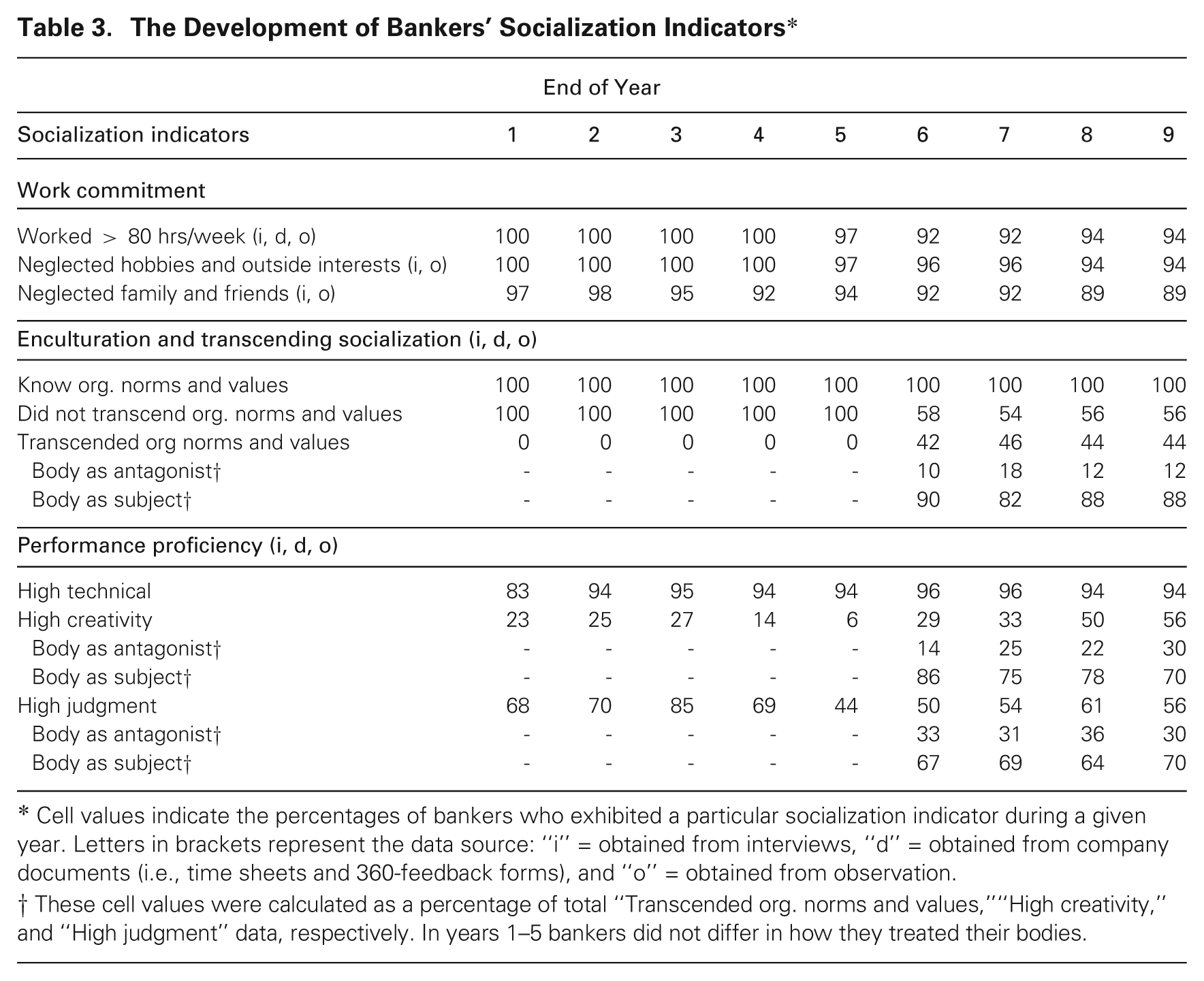
Cell values indicate the percentages of bankers who exhibited a particular socialization indicator during a given year. Letters in brackets represent the data source: “i” = obtained from interviews, “d” = obtained from company documents (i.e., time sheets and 360-feedback forms), and “o” = obtained from observation.
These cell values were calculated as a percentage of total “Transcended org. norms and values,”“High creativity,” and “High judgment” data, respectively. In years 1–5 bankers did not differ in how they treated their bodies.
Year 4 onward: Body as antagonist
Starting in year 4, bodies forced themselves into awareness through sometimes incapacitating problems. Bankers experienced puzzling bodily and psychological responses. Their out-of-control behavior sometimes sabotaged work, and the body emerged into experience as the antagonist, thwarting projects. Eighty percent of bankers strongly agreed with the statement, “I am trying harder to control my body but with less success than before.” The other 20 percent used different language for their antagonistic body relations, such as, “I wouldn’t call it control; I am at war with my body” (Bank A VP). A Bank A VP complained, “No matter how hard I kick my body, I can’t get any energy out of it.” A Bank B VP said, “It feels like my body is choking off all life force.” When asked why, the VP replied, “Who cares? There is nothing I can do but plow through work.” The body here is separate from and inferior to the “I,” like an object one can kick. It antagonistically refused resources and even strangled bankers from inside. Bankers also lost bodily control in the form of addictions and compulsions, such as eating disorders. Mild-mannered bankers became short-tempered:
I stormed toward the taxi, but the door was locked. The driver wanted to unlock it but couldn’t because I kept operating the handle. I became so furious that I kept banging against the windows like crazy, swearing at the poor guy. And then I turned around and saw that a managing director was watching with his mouth open. I was so ashamed. (Bank A associate)
Bankers developed embarrassing tics, such as nail biting, nose picking, or hair twirling. They experienced their bodies as antagonistically “taking over,” “taking revenge,” or “fighting back.”
To maintain performance, bankers pushed harder, trying to reassert control over their bodies. A banker combated her eating disorder by fasting and exercising more, training for a marathon even after midnight. A VP at Bank A explained how he controlled his temper: “I throw myself into work to discipline myself more.” Bankers also sought distraction. They shopped, partied, and consumed pornography to counteract numbness (“I need something to feel passionate about”), achieve control (“These are all ways to control something”), and escape (“It is a way to escape, so that I cannot even ruminate about my problems if I wanted to”).
Organizational control remained high. Bankers still worked hard and intended to act on behalf of the bank. Yet the control had unintended, negative consequences for the organization, including lapses in judgment and ethics and reduced creativity. More than 90 percent of the respondents strongly agreed with the statement, “My goals and the bank’s goals are completely aligned.” Bankers worked up to 120 hours per week, but with less creativity and judgment: “I had a binge attack during a meeting, and all I could think about is where to get food. Everything the client said blurred. I just wanted them to shut up so that I could do what I needed to do” (Bank A VP). A Bank B director said, “Most bankers turn into technicians . . . . Creativity is also a state of the body. It requires openness and a feeling of aliveness that is hard to square with years of deadening work.” Bankers also exhibited ethical problems, such as abusing power and shirking outside obligations. 1 A director at Bank A said, “When you lose the feeling for your body, and compassion and respect for yourself, you do the same to others. Bankers who have been riding themselves become people-eaters.” As a managing director at Bank B said,
People here are good at dealing with clients and colleagues because our system ensures this. But working this hard gets to people and we cannot control how they behave outside. When a banker is callous, arrogant, neglectful of obligations, this reflects badly on the firm—and it happens more often than we would like. Our reputation is our most important asset.
Year 6 onward: Body as subject
By year 6, about 40 percent of the sample treated the body as a subject that could guide action (“body as subjects”), gave up control over the body, and attended to its cues. The remaining 60 percent continued in the “body as antagonist” role.
Breakdown cycles
By year 9, 98 percent of those who treated the body as subjects had given up attempting to control their bodies: “I gave up bludgeoning my body into submission for one reason only: It doesn’t work” (Bank A VP). The other 2 percent preferred different language: “Control sounds so benign. I have given up completely ignoring and destroying my body for the sake of what I wrongly thought matters more . . . and started to develop a feeling for my body, a genuine interest and concern” (Bank A VP). Those who treated the body as an antagonist continued to control their bodies, talking about “letting your body know who is in charge” and “disciplining the body into obedience.” But the control of body as subjects generated escalating cycles of work-disruptive consequences and fierce control attempts, which taught bankers that the body was too complex to be controlled:
I learned the hard way that there are limits to what you can control. Everything I did to keep performing always had consequences that I did not want and that I could not anticipate. When I first got here, I worked so hard that I gained 60 pounds and got heart problems and diabetes. I picked up running to lose weight and that hurt my back and joints irreparably. [He ran about two hours per day, often at midnight.] Because I was in so much pain, I took pain killers that got to my liver. Then I went on a special diet and that affected my serotonin levels so that I was in a deep and dark depression. And the list goes on and on. (Bank B VP)
In contrast, those who treated the body as an antagonist experienced fewer disruptive consequences (“I overdo everything, but I have a doctor who is good at fixing me up”) or did not interpret breakdowns as their actions’ unintended consequences (“bodies just break down”).
Differential health or relationship experiences are less plausible explanations for the differences between those who treated the body as subject versus the body as antagonist. As shown in the comparison in table 4, in both groups, bankers had similar and comparably serious health issues and had family, friends, and partners object to the work’s high demands. In some cases, relationship conflicts about work caused bankers to leave the banks. For most who stayed, such objections continued but decreased because spouses took bankers’ behaviors for granted, partners achieved a truce, and bankers who were dating better managed their dates’ expectations. Because body as subjects valued performance, they stopped treating their bodies as antagonists, but they sometimes relapsed: “[When I relapse], I feel the effects immediately and stop the abuse. I don’t need to be hit over the head by a collapse” (Bank A director). Instead, they developed the following three strategies, which I did not observe in the body as antagonists: (1) they became distrustful of and stepped back from the mind; (2) they surrendered agency while acting; and (3) they developed a relational orientation toward the body.
Abbreviated Sample Analysis of Two Bankers’ Evolving Body Action Roles in Response to Organizational Control

Becoming distrustful of and stepping back from the mind
Before, body as subjects implicitly meant their mind when they said “I.” Starting in year 6, they construed the mind as separate and distrustfully distanced themselves from it because it could not control the body:
I have so often been convinced that I knew what I was dealing with and was dead wrong. Stress-related hair loss really was mercury poisoning until it was thyroid disease and that was before it was attributed to a special diet. These kinds of surprises were a real eye opener on how I was approaching things in general: always confident in my mind . . . . They made me vigilant toward my mind, watching it, and often choosing not to listen to it. (Bank B VP)
Like this VP, some bankers reflected on the mind, which is a form of meta-cognition, exhibiting a new dimension of self-awareness. They also reflexively stepped back from habitual stories and reactions:
When my body forced me to listen, I noticed that I had never before just listened and observed without any judgment or fear. [Previously], as soon as I felt that something was wrong healthwise, I panicked because I started to tell myself stories about not getting work done and clamped down on my body. I started to see that this is how I responded to everything. I always have the same type of fear-driven narrative in my head. (Bank B VP)
His body made the banker notice and orient away from fear toward situated cues. Breakdowns also intensified and thus caused bankers to confront habitual anxiety: “I only noticed my constant anxiety when it turned into fear because now I had to play this high-stakes tennis with hands and feet tied. . . . I gave up fighting fear and just accepted it” (Bank A VP). In contrast, body as antagonists mentioned anxiety less frequently and attributed it to situations rather than habitual interpretations. Body as subjects distanced themselves from the mind by silencing it (“when I listen, I silence inner dialogue”), orienting outside (“I concentrate on the situation and try not to get caught up in my mind”), and meta-cognition (“I literally ask myself: ‘what am I thinking about?’”), but without antagonism: “I am done fighting my body. I am not fighting my mind . . . . I observe, accept, and engage situations inquisitively, not fight quicksand” (Bank B VP). When body as antagonists listened, they did not observe the mind and accept situations but, instead, let the mind control (“listening gives you ammunition to convince them of your goals”).
The body caused cultural distance because it prevented full participation:
Whenever you want to do like everyone else and you can’t—like stay up nights in a row—you can beat yourself up . . . but also questions come up about why we are all thinking in this way . . . and you notice other ways to work and think. It’s like an awakening, a gradual process of recognizing that what you have taken for granted are cultural choices. (Bank A VP)
Bankers’ distancing came in spurts, usually when they fell short of cultural standards, and changed how they related to work: “I now more often remember that this is not me, but only a game that I choose to participate in even though I still want to be very good” (Bank A director). Body as subjects became curious about how clients and friends worked to discern alternatives. Body as antagonists rejected other cultures, admitting to a “not-invented-here syndrome.”
Surrendering agency while acting
Bankers surrendered agency when they could not complete actions alone: “[Breakdowns force you] to let go: delegate, trust others, and accept hiccups. You learn to not be the doer and to become part of a process” (Bank A director). They also yielded to the inner dynamics of action, noticing cues and respecting complexity:
When I was sick, I listened to my body. I saw that every activity has a cessation point. I had always pushed everyone beyond that and then things became unproductive. But I stopped forcing things. I stay open to how situations develop and yield to that. (Bank B director)I learned from my body. Breathing, hormones all of this goes on without any of your doing. I now believe that most of life works like that. Situations have their own dynamics. Things work best if you can align yourself. (Bank A VP)
Bankers spoke about action as “letting things unfold,” “being guided by the situation,” and “being receptive,” which indicated that their minds surrendered agency and opened to cues, including from their bodies. Body as antagonists mocked this approach: “Dick spends too much time in the new age self-help section at Borders,” “what a wuss,” “acceptance of mistakes . . . breeds mediocrity,” and “trusting others when your ass is on the line—that’s insane.”
Relational orientation toward body
Bankers built a relation with their body by attending to and trusting it. They exercised without headphones to feel body cues and stopped when injured; ate slower and without distraction (“I take at least half an hour”) instead of while working; and limited technology usage to “stop numbing myself” (e.g., disconnected Facebook, surfed less on the Internet). I first noticed such changes when a low-carb dieter ordered a baked potato, explaining, “I have always eaten according to research. But my problems came from dictating to my body and losing feeling for it. Now I eat what I am hungry for and trust this intuition.” Relating to the body was “like learning a new language.” Some bankers developed heuristics, such as “shackles on or off”: “When the shackles come on, I can feel it in my whole body, gut clenching, shoulder stinging, starting to sweat. If I don’t take signals seriously, my body makes me regret it” (Bank B VP). Bankers also stopped fighting low energy and heeded it as a cue: “I learned to differentiate between being tired and drained. When I am drained, my body says that something isn’t right and I stop and try to figure it out” (Bank A director). These bankers explicitly referred to the body, positioning it as a subject, an insightful advisor. Body as antagonists often changed routines in response to fads or research versus bodily prompts. They fought the body (“kicking my metabolism to do its fucking job”), submitting to extreme regimes like lemon-juice-only cleanses and boot-camp training. In contrast, body as subjects believed that “we are conditioned to overdo everything” and chose more moderate behaviors than before.
Bankers also negotiated with their bodies: “My body is scared that I will put it through the wringer again. When I feel out of control, I talk to myself, I reason, make concessions.” This Bank A VP identified with the body, including it in “myself.” A Bank B VP said, “I ask my body what would get me through a big push without it getting back at me. And I come through.” Bankers experienced the body as a subject, as having such person-like attributes as emotions, reason, and memory of good and bad treatment: “I see my body differently. It is a friend who has always supported me as best as she could, even though I ignored her. I always thought so highly of my mind, but it has let me down much more often than my body” (Bank B VP).
The body helped bankers recognize and transcend control. “Once your body forces you to stop certain behaviors, you ask why you engaged in them and whether there are alternatives. And you notice how the firm chooses for you” (Bank B director). Bankers chose consciously rather than always followed directives: “My body makes me live consciously. I say no more often, but I also say yes more consciously” (Bank A director). Breakdowns forced bankers to test taken-for-granted controls and discover freedoms: “When I was sick, I resisted demands because I couldn’t do it. That taught me to push back even when people get mad” (Bank B VP). Breakdowns loosened bankers’ job attachment, but bankers remained committed. A male Bank A VP said, “[Because I am ill], I might not work here forever, even though I want to. That gave me the courage to challenge decisions, like how we deal with women.” The body thus liberated bankers from intellectual bondage and trepidation.
Surprisingly, the banks benefited from the bankers’ transcending socialization and control. The performance problems of those who treated their bodies as antagonists continued. But the performance of body as subjects rebounded; they were creative because they had to reconcile the banks’ and the body’s demands:
I would love to pull the hours I used to. But my body won’t let me. So I have to be creative. I come up with products that don’t involve fire drills like before and go home at night. Because this makes money, I can ask for staffing and delegate. (Bank A director)
Like this banker, some could render hours predictable, but controls still compelled bankers to work long hours. Creativity also improved because bankers noticed previously ignored situations. Greg told a female recruit that women often left banking early. Flexible work arrangements had failed because clients were inflexible, and bankers who worked less were seen as “second-class citizens.” This conversation caused him to champion a successful new program:
And [the recruit] said, “I put in all this time and become a great banker but once I have a child, that’s it?” And this question and the emotion really got me. It made me think of [other women], whose kids are now in school and who could restart their careers . . . . That would be great for everyone, these women, younger women, the firm—all of us. (Greg, a Bank A VP)
Greg credited his new sensitivity to breakdowns: “I heard that story before but it had not registered. I was like a bulldog pursuing my goals. I wasn’t a jerk—just preoccupied. This [health] ordeal [his serious endocrine problems] put my goals in perspective and let me see what goes on around me.” Ethical sensitivity, including sensitivity to others’ problems, thus further enhanced creativity. It entailed awareness of cues, as opposed to a value change: “I just responded to what was in front of me,” “I did it without thinking,” and “It was almost a reflex.” Similarly, a Bank B director asked the bank’s training department to offer free co-training for developing country clients, who struggled with basic business processes, and bankers, who hence developed closer client relations and got more business: “I have always seen clients’ complaints about bottlenecks as excuses and tuned out . . . . But I now listen and help because I noticed the hardship for the client.” He explained his change: “Caring for myself made me care for others, without even trying.” Bankers also avoided gossip, picked up trash, and tipped waiters and cab drivers more generously because “these guys work so hard for so little money.” The banks benefited because bankers represented the banks as socially engaged and compassionate.
Firm tenure helps explain creativity. Senior lateral hires, who lacked firm knowledge, found their fresh ideas rejected as inappropriate. Bankers thus had to be socialized before they could effectively distance themselves. Seniority and power are potential, but less likely alternative explanations. Because of flat hierarchies, meritocratic cultures, and innovation dependence, the banks implemented all employees’ suggestions, including juniors who noticed clients’ needs during frequent client contact. Also, the body as subject pattern started in junior VPs. Instead of having power, they were especially vulnerable lay-off targets. They did work similar to what associates did, like execute deals, but were more expensive. Unlike directors, they rarely “owned” client relations and were therefore easily replaceable. It was often heard that “If one execution type leaves, you just hire another. They are as common as sand on the beach.”
Despite the body as subjects’ innovations, the banks’ long-hour work culture continued. As a VP from Bank A said, “It is difficult to change that system because people want it. We work hard because our industry has cycles. We have fewer bankers during booms so that we don’t have to lay-off in lean times . . . . there is a lot of ambition and ego. Even when I tell junior bankers to go home, they work secretly to put that unnecessary extra touch on the presentation.” The bankers’ ambition dominated, unless the body intervened.
Discussion and Conclusion
Knowledge-based organizations achieve control’s most elusive goal. They capture workers’ hearts, minds, and energy. I examined how and with what long-term consequences. Longitudinal behavioral research on control is scarce, inviting the present theory building. To supplement cognitive control theories that examine how firms control the mind and how the mind guides action, this study showed how companies control the body and how the body guides action. It yields a new understanding of how cognitive controls interact with embodied controls, the surprising twists that occur after prior socialization theories stop predicting, and how, contrary to prior work, socialization not only can constrain but can also free persons from taken-for-granted frameworks.
A Model of Organizational Control and Body Action Roles
Figure 1 describes how conflicting controls explained the puzzling autonomy paradox and thus affected the body’s evolving action roles (socialization as transformation), with shifting consequences for control (socialization as outcome).
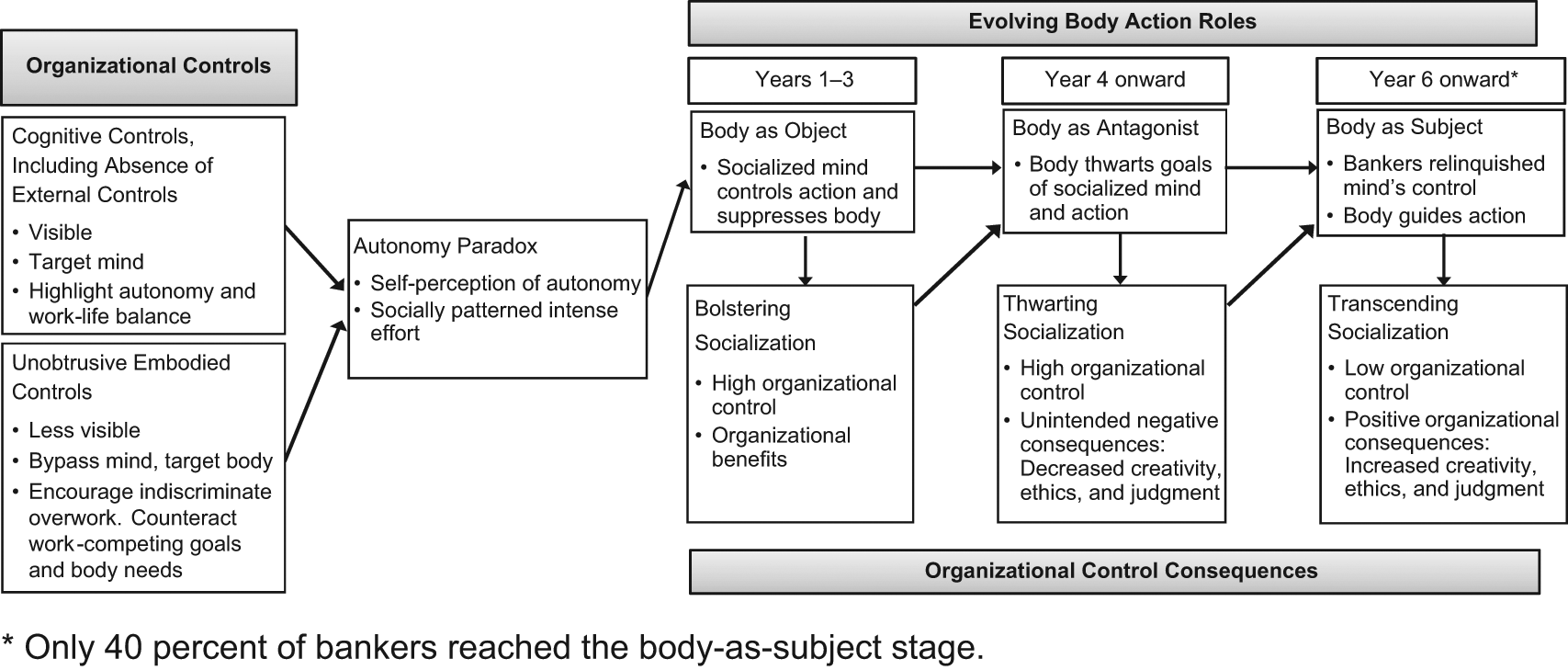
The dynamic relation between organizational control and body action roles.
Organizational controls
Conflicting organizational controls explained the autonomy paradox—bankers’ perceptions of autonomy despite intense, socially patterned work. Visible cognitive controls, including the absence of external controls, targeted the mind and highlighted autonomy through explicit values of autonomy and work-life balance. Conflicting with cognitive controls, unobtrusive embodied controls bypassed the mind, targeted the body, encouraged indiscriminate overwork, and counteracted work-conflicting goals and bodily needs. Bankers initially felt autonomous because they oriented toward the more visible cognitive controls.
Evolving body action roles and organizational control consequences
Because the banks controlled action through the body and because extreme work conditions made action depend on the body, the analysis transcended cognitive variables. Cognitive approaches and concepts such as “body schema” (Johnson, 1997) and “body image” (Tiemersma, 1982) construe the body as a mental representation and assume that the mind shapes action. In contrast, my cultural approach empirically examined how people enacted mind-body relations differently and how the body could also shape action, depending on whether people noticed its cues. The cultural approach does not synthetically assume a mind-body dualism, which would be problematic (Dennett, 1991), but posits that people can enact a dualistic mind-body relation (Leder, 1990). Considering the “body action role” affords an analysis of the conditions under which people behave as if body and mind were dualistically separate or not.
The autonomy paradox entailed bankers’ belief that they freely chose action based on mental goals (versus situational or embodied constraints). They thus let the mind control action, suppressed bodily cues, and enacted the passive body as object role that cognitive work takes for granted. This role bolstered socialization. Control was high, and banks benefited from bankers’ intense effort, which, however, contributed to bodily breakdowns after four years. Analysis reveals that these familiar facts entailed a different, active body role: the antagonistic body thwarted the mind’s goals and thus socialization. Organizational control remained high as the committed bankers fought their bodies. Yet the banks could not prevent compromised creativity, ethics, and judgment, because embodied controls were engrained too deeply.
One original finding is the beneficial body as subject role that some bankers exhibited starting in year 6. People reflect on taken-for-granted action when it breaks down and disrupts goals (Heidegger, 1962). Although body as antagonists could continue to perform, work-disruptive breakdowns caused body as subjects to meta-cognitively reflect on the mind, notice the limits of and thus relinquish its control, and let the body guide action. Bodily guidance facilitated body as subjects’ transcending of socialization. They remained committed but could sometimes structure work more predictably, notice previously invisible controls, choose more consciously, even countering controls, challenge the banks’ customs, such as the treatment of women, cease to judge the banks’ cultures as superior, and inquire about work alternatives they had once ignored.
Surprisingly, the resulting low control affected performance positively. “Transcending” socialization refers to an ongoing accomplishment. It reflects a different style of regulating action, as opposed to an inner state changed through epiphany. The body as subjects were more creative, ethically sensitive, and had better judgment, not primarily because they unlearned cultural content or learned new content, although there was conceptual learning. Rather, enhanced performance and learning were mediated by the body’s increased involvement in action. Specifically, bankers oriented less toward the mind and abstract cultural frameworks and more toward the body’s concrete, situation-specific cues to regulate action. They consequently noticed previously overlooked situational aspects, such as a colleague’s or client’s suffering. Also, the body forced bankers into actions that caused them to experience culturally rare situations, such as challenging someone’s expectations, and consequently learn that there was “wiggle room.” Solutions were new, yet appropriate, because the body cannot be completely socialized, and its perspective thus both deviated from and encompassed the banks’ cultures.
Generalizability and Boundary Conditions
The model likely holds for tasks with (1) high ego involvement (Ryan, 1982), (2) high-performance demands, and (3) creative, judgment, and ethical (versus technical) components. Knowledge workers’ selves can be at stake because they tend to believe that performance reflects their skills and judgment, versus job constraints, work is prestigious, and selection is competitive. Unlike the employees in job design research, they do not experience themselves as job holders; work is not what they do, but who they are (Davenport, 2005). Ego involvement is necessary but not sufficient. In the absence of high performance demands, people do not need to push their bodies.
The model may not hold for technical tasks, which rely on internal memory resources (Simon, 1991) and are unaffected by breakdowns. Creative, judgment, and ethical tasks also require connection to situated resources, such as interpersonal or task cues (Bruner, 1962). Breakdowns threatened bankers. Threat causes overreliance on internal resources, such as schemas, and neglect of situated cues (Staw, Sandelands, and Dutton, 1981). It is thus more likely to disrupt creative tasks than technical tasks. In our knowledge economy, however, most positions require creativity and judgment, especially for workers to improvise in unanticipated situations.
The model’s three conditions are likely present in high-stakes finance jobs, hospital-based medicine, software engineering, consulting, law, and also elite athletics, academia, and art. For example, the 33-year old violinist Janine Jansen cancelled concerts because of exhaustion: “It was just from crazy years of pushing myself. . . . And of course I didn’t notice . . . You always want to give more and more of yourself. But there comes a point when the body says, ‘Actually, I don’t have any more, sorry.’ I know now not to let that happen again.” (Jepson, 2011: D5). Jansen first used her body as an object (“pushing”), then broke down until the body as subject intervened (“the body says”), guiding her to transform her life (“not to let that happen again”).
Exacerbated breakdowns caused the body as subject pattern. Because health studies found that lower-class workers exhibit more frequent and serious ailments in part because of manual work (Marmot et al., 1991; Marmot, Borbak, and Smith, 1995; Papageorgiou et al., 1997), one might hypothesize that they also exhibit the body as subject pattern more frequently. The logic developed here, however, suggests that without the conditions above, ailments may not proceed to the body as subject pattern or affect performance. How prevalent these conditions are in lower-class work is an empirical question that this study is not designed to address.
Contributions
The interaction of embodied and cognitive controls
This study contributes to work on cognitive control. Like job design research, cognitive control research examines visible cognitive and external controls that managers or peers design into jobs and construes them as mutually reinforcing and, ideally, autonomy-enhancing. To explain why bankers worked intensively even when it did not serve the banks, this study uncovered less visible embodied controls that worked by contradicting rather than reinforcing other controls. Embodied controls are less visible and are thus difficult to resist because they do not control through jobs, from which individuals expect control, but through a diffuse infrastructure, and they are often but not always the unintended consequence of actions taken for other reasons, such as the open floors created to facilitate communication. Because controls tended to remain in place as bankers turned over, senior bankers often did not know why a practice, such as free food, had been implemented initially. Nevertheless, they sometimes recognized and actively exploited its control value. For example, as departments had to cut cost, they were more willing to fire bankers than to cut the food provided to “keep the troops going.” Cognitive controls let employees initially inspect and buy into an organization’s value system. Embodied controls remove such remnants of visibility, making people act against their conscious values, such as work-life balance, without their necessarily being aware of doing so.
This study reported bankers’ own changing perceptions of autonomy. The data on how unobtrusive controls regulate behavior can also be read as qualifying taken-for-granted perceptions of knowledge workers as more autonomous than industrial workers were thought to be. Knowledge work may not diminish but may displace control, surprisingly, targeting employees with the most rather than the least status, education, and options. The study also changes our understanding of control as neither inflicted by the powerful on the powerless, as in bureaucratic control, nor democratized, as in concertive control—which are the prototypical controls in cognitive and job design research—but as a web that trapped everyone alike.
The longitudinal aspects of socialization
Organizational scholars study socialization as intended change in knowledge, skills, and values (Chao et al., 1994), yet it encompasses all intended and unintended changes from cultural participation (Mortimer and Simmons, 1978). Tracking bankers longitudinally revealed that work also transformed them more fundamentally. It not only changed what they knew but also how they enacted essential aspects of being, namely, the relation between mind and body and action. This change matters because of its fundamental nature. It also alters predictions of socialization dynamics. Because cognitive control theories do not anticipate conflict, they predict that employees acquire culture linearly; they stop analysis after employees’ first year. This prediction failed starting in year four, when bankers enacted a conflict-laden mind-body relation that caused non-linear changes. Because controls stayed constant, these changes cannot be explained by changes in the cultural toolkit. Socialization supposedly creates constraint and conformity. This study, in contrast, reveals how it can undo both.
The consequences of strong control
This study tracked the bankers’ shifting perceptions of autonomy, their sense of the extent to which action reflects personal “choice” and “inner endorsement of one’s actions” (Deci and Ryan, 1987: 1025). Paradoxically, even though the body as subjects transcended some of the banks’ controls, they felt less autonomous than before and than body as antagonists. They felt that their body caused them to act, sometimes against their inner endorsement. They also noticed more cultural constraints than before, more than they could transcend, and more than the body as antagonists. Counterintuitively, the data suggest that less autonomy can be better. Research on job design, health, and psychological autonomy posit that reduced autonomy is bad. When subjects experienced their actions as less rather than more personally caused, creativity, cognitive flexibility, the persistence of desired behavioral change, and physical and psychological health declined (Deci and Ryan, 1987). Yet when body as subjects experienced their actions as less personally caused, they improved on these dimensions. This contradiction can be explained in terms of bankers’ developmental change, which “one-shot” experiments do not assess. Initially, bankers—like many people in our culture, including experimental subjects—were familiar, comfortable with, and skilled only at action controlled by the mind. Over time, however, bankers learned a new action strategy—letting previously neglected non-mental cues guide action—and the benefits of relinquishing mental control. The diversity of these cues could explain bankers’ enhanced creativity and flexibility. Enhanced skill at listening to the body—in addition to ongoing high demands and latent health issues—facilitated the persistence of the change to the body as subject and rapid response to early signs of psychological and health problems, thus potentially explaining enhanced well-being in the form of fewer debilitating breakdowns. The results of this study thus qualify prior work on autonomy. High autonomy is positive primarily in a culture that values and teaches the mental control of action. Low autonomy can be positive in a different culture that teaches the value and skill of surrendering control over action.
The study’s longitudinal approach also demonstrates that the more complex socialization dynamics described above produced more complex consequences. Prior cognitive research has either found that socialization is necessary and largely beneficial (e.g., O’Reilly and Chatman, 1996) or that it quells creativity (e.g., Nemeth and Staw, 1989). My data qualify these findings. The banks benefited from socialization during bankers’ first three years, incurred negative consequences during the next two years, and subsequently benefited when bankers transcended the earlier socialization. Extant research posits a forced choice between socialization and creativity. Participants remain creative when they are socialized only partially, for example, by investiture tactics that let them keep their personalities (Van Maanen and Schein, 1979), although Jones (1986) found that it encourages newcomers to passively accept the organization’s role definitions. Yet partially socialized individuals do not fully use company knowledge. In contrast to partial socialization, transcending socialization entailed that bankers gained cultural distance after they had fully acquired the culture. They could consequently use relevant cultural knowledge yet creatively transcend it. Moreover, bankers did not create this distance consciously; it was mediated by their bodies, initially against their wishes, and therefore did not imply reduced commitment.
Limitations and Opportunities for Future Research
It would have been ideal to push causality further to explain why only 40 percent of bankers experienced breakdown cycles. To examine whether shared prior socialization (Desmond, 2006) might account for this finding would have required more detailed life histories. Taping interviews would have better represented bankers’ own voices. Relying on interviews after year two limited my firsthand experience with how the banks’ practices changed. Nonetheless, my previous thorough understanding allowed me to ask targeted questions. Also, interviewing multiple bankers facilitated triangulation. Ongoing observation could have better captured the body action roles’ tacit and potentially embarrassing aspects. Bankers’ intimate accounts, however, suggested that they were candid, partly because of our ongoing relationships.
Future research could examine whether and how workers who exhibit non-instrumental body action roles can modify the organization’s overall culture. Going beyond prior work, the model predicts that knowledge workers will experience changes after completed socialization, what these changes are, and the sequence in which they occur. The time frame for each change likely differs across occupations and depends on workers’ physical constitution and work demands. Also, because socialization is a lifelong process, future research could examine whether other body action roles might emerge. The above boundary conditions could assist quantitative researchers in formulating and testing predictions about the specific types of workers and occupations to which this study’s model generalizes. Especially needed are more finely grained classifications of knowledge-based organizations, including heteronomous organizations, in addition to autonomous ones.
This study showed that work causes people to inhabit the body differently and thereby changed how they enacted agency. Future organizational research should examine additional work-induced variation in embodiment and related changes in other traditional social science categories, such as identity and cognition. For example, the body as subjects identified less with the mental guides that cognitive research takes for granted as a basis for identity (Higgins, 1996) and more with embodied and prereflective cues. Identity is a psychological root construct; changes in identity are associated with changes in many other psychological indicators, such as cognition, emotion, and motivation. Therefore, further research on contexts that promote the body as subject might uncover alternative forms in which other basic psychological processes can function.
In our Cartesian culture, which values the mind over the body, there are many influences that can compel ambitious workers to abuse and neglect their bodies besides embodied organizational controls, making body objectification a potentially widespread phenomenon. Overworking the body for years or decades might contribute to some of the life-style related diseases that are affecting an often sedentary knowledge-based workforce and deplete valuable creative potential. These costs might become especially severe and personally felt as we age. The resulting health problems are sometimes dealt with by handing out prescriptions on how to better work, sleep, eat, and exercise. Paradoxically, these may only worsen problems by further dictating to the body, suppressing its ability to inform action and preventing individuals from discovering this ability. A promising alternative to which future research could contribute involves sensitizing individuals to the body’s creativity. Research could document how and why individuals draw on their bodies to inform work and life changes and explore how organizations could better support and harness the body as a creative subject.
Footnotes
Appendix A
Appendix B
Acknowledgements
I am grateful to Mauro Guillén, whose insightful guidance helped bring out the study’s potential. I thank three anonymous reviewers for their extensive help, ingenious suggestions, and enthusiasm for the data. Linda Johanson’s sharp logic, elegant writing, and ideas on how to extend this research greatly improved the manuscript’s quality. I would like to thank friends and colleagues for many valuable suggestions and stimulating conversations: Aniket Aga, Michel Anteby, Sue Ashford, Christine Beckman, Jane Dutton, Martha Feldman, Connie Gersick, Adam Grant, Emily Heaphy, Victoria Johnson, Peter Kim, John Lafkas, Karen Locke, Melissa Mazmanian, Bertram Michel, Lance Sandelands, Hal Smith, Gretchen Spreitzer, John Van Maanen, Monica Worline, and Amy Wrzesniewski. I also received helpful feedback from the seminar participants at the Yale Anthropology Department, the Center for Organizational Research at the University of California, Irvine, and the Interdisciplinary Committee of Organizational Studies at the University of Michigan. Ken Chen provided excellent research assistance. Many thanks to my informants for their friendship and patience and for teaching me through their lives.
The banks did not allow me to report aggregate indicators on this measure.
References
Supplementary Material
Please find the following supplemental material available below.
For Open Access articles published under a Creative Commons License, all supplemental material carries the same license as the article it is associated with.
For non-Open Access articles published, all supplemental material carries a non-exclusive license, and permission requests for re-use of supplemental material or any part of supplemental material shall be sent directly to the copyright owner as specified in the copyright notice associated with the article.

