





Abstract
We examine the role of a practice’s opacity (versus transparency) in the interorganizational diffusion of organizational practices. Though the opacity of a practice is typically thought to impede diffusion, a political-cultural approach to institutions suggests that opacity can sometimes play a positive role. Given that adoption decisions are embedded in a web of conflicting interests, transparency may bring negative attention that, when observed by prospective adopters, inhibits them from following suit. Opacity, in contrast, helps avoid that cycle. Using the curtailment of health benefits for retirees among large U.S. employers (1989 to 2009), we compare the diffusion of transparent adoptions (i.e., partial or complete benefit cuts) with opaque adoptions (i.e., spending caps that trigger disenrollment). We find that transparent adoptions reduce subsequent diffusion of the practice to other organizations. This effect is fully mediated by negative media coverage, which is itself conditioned by the presence of opposition from interest groups. Opaque adoptions, in contrast, increase subsequent diffusion to other organizations and are facilitated by the involvement of professional experts. Thus, in addition to providing findings on practice opacity, our study contributes insight into how organizational fields shape diffusion by illuminating the role of third parties in the spread of controversial practices.
Keywords
The question of why certain practices diffuse while others do not has been a longstanding interest of social scientists (Rogers, 2003). Among scholars studying this question from the perspective of interorganizational diffusion, one dominant approach has been to examine the various factors that influence adoption decisions. Studies have shown that decisions among potential adopters depend on an understanding of what the practice entails (i.e., what it is) and the types of performance outcomes it generated for prior adopters (Levitt and March, 1988; Miner and Mezias, 1996; Strang and Soule, 1998; Rogers, 2003; Greve, 2005). This knowledge may be acquired through direct contact with agents involved in the practice, such as interfirm ties (Davis, 1991) or third-party carriers of the practice (Strang and Meyer, 1993), or through less direct means such as news media reports (Mazza and Alvarez, 2000). Such transfers of knowledge are facilitated by simplifying theoretical accounts that make it easier to communicate about the practice (Strang and Meyer, 1993). The logic is that adoption decisions rely to some extent on how readily the practice can be identified and understood, and the established wisdom is that diffusion is facilitated by the simplicity and transparency of a practice’s design because those make the practice easier to perceive and communicate (Rogers, 2003).
Diffusion researchers also increasingly recognize the ways that the political-cultural interests of actors in organizational fields shape the spread of new practices (Fligstein, 1996; Schneiberg and Soule, 2005; Sanders and Tuschke, 2007; Schneiberg and Lounsbury, 2008; Ansari, Fiss, and Zajac, 2010). This line of thinking has important implications for the logic of a practice’s clarity: if a practice has a controversial edge that makes adoption risky, then clarity may hinder rather than promote diffusion. Knowledge about such practices still travels through direct and indirect channels, but controversy introduces new salient outcomes and thereby shifts the conditions for diffusion. For implicated actors, controversial practices raise the possibility of confrontation through direct pressure tactics (McAdam, Tarrow, and Tilly, 2001) and reputational damage (King, 2008). Importantly, these possibilities are just that: there is considerable uncertainty as to if and how such damage may arise. One of the few sources of guidance, therefore, is the experience of referent others. In the face of controversial practices, organizations look beyond the financial performance outcomes of prior adopters and pay equal, if not more attention to image-relevant outcomes, such as the receipt of negative publicity. If a prior adopter receives some form of public backlash in response to its actions, organizations observing that will be cautious when deciding whether to adopt the same practice. Underlying the potential for such reputational harm among adopters, however, is the ease with which the practice can be identified and understood. Transparency can elevate the risk of backlash and therefore raise an impediment to diffusion; to spread, controversial practices must instead be adopted more opaquely, such that their visibility to potential opponents is limited.
In this paper we examine the role of a practice’s transparency versus opacity in the diffusion of controversial practices. Opaque practices are those for which observers have difficulty identifying key characteristics, including what is being done, to what degree it is being done, when the effects will transpire, and exactly who will have caused them; conversely, transparent practices are those for which these characteristics can be readily discerned. Transparency is thus fundamentally about streamlined causal reasoning—the ability to form inferences about how one thing affects another—which many scholars have shown is a crucial factor in making sense of observed events in the world (Ajzen, 1977; Tversky and Kahnemann, 1980; Levitt and March, 1988; Krynski and Tenenbaum, 2007). The design, announcement, and implementation of a given practice can each contribute to its perceived opacity from the perspective of observers.
We investigate these dynamics using the empirical context of the curtailment of retiree health benefits undertaken by U.S. employers. 1 Since the early 1990s, large corporations have been increasingly cutting back on their earlier commitments to retirees’ health benefits—known as other post-employment benefits, or OPEBs, in industry parlance—even as retirees and much of the general public have remained opposed to the changes (Schultz, 2011). OPEB curtailments can be designed, announced, and implemented under two general formats, diffusing via the adoption of two closely related alternative practices—benefit cuts or the introduction of caps on spending—which differ in their relative opacity. We compare these two related controversial practices for their effects on the likelihood of OPEB curtailments diffusing to other firms.
The Interorganizational Diffusion of Controversial Practices
Overview of the Curtailment of OPEBs
To examine the diffusion of a controversial organizational practice, we observe the curtailment of retiree health benefits among large U.S. employers. From the 1950s to the 1980s, large U.S. corporations routinely provided their employees with retiree health benefits—promising that they would arrange and fund lifetime health insurance coverage for the worker and direct family members upon his or her retirement from the firm, provided that the employee’s years of service were sufficient. 2 Along with a retirement pension and family health insurance coverage during years of employment, this agreement formed the backbone of a corporate employment benefits package that contributed to a long-term, stable employment relationship (Jacoby, 1998; Kochan, 1999). Beginning in the 1980s, however, an alternative logic was advanced, stemming from the belief that firms and workers both needed more flexibility to adjust to dynamic and competitive market conditions (Cappelli, 1999). This alternative logic was cited in connection with a range of new and changing employment practices, including organizational restructuring, de-unionization, greater use of contingent workers, and significant changes to employee benefits (Cappelli et al., 1997; Maxwell, Briscoe, and Temin, 2000).
Accompanying those changes, in the late 1980s and early 1990s, some large companies and their professional advisors began questioning the practice of providing generous retiree health benefits. Retiree health benefits were framed not as prior promises made to workers but, instead, as liabilities on the balance sheet (Arnold and Oakes, 1998). Transcripts from the Society of Actuaries, the professional association for employee benefits consultants, reveal the emergence of this challenge to existing practices. A 1985 transcript starts by noting that 94 percent of surveyed large and medium-sized companies provided lifetime medical coverage to retirees and then stated, “The subject of liabilities for retiree medical benefits is largely unexplored” and that “with medical care cost inflation, accounting proposals, Medicare’s financing problems, and court decisions, employers are becoming sensitized to their liabilities for retiree programs and will be giving these coverages more management attention.” In 1988, a proposal for a new corporate accounting rule (Financial and Accounting Standards 106) was circulated; the essence of this rule was to require companies to report to investors an estimate of the financial liability they held as a result of the promise to pay the retiree health benefits of current and future retirees. The comments of a leading actuarial professional recorded in this 1991 Society of Actuaries transcript are illuminating:
The first reaction that I observed is that when the actuary brought in the report with a [OPEB liability] number on it, the employer had a very emotional response . . . the second reaction was to get the attorneys involved. . . . The question was how can we terminate these plans unilaterally? Have we reserved all the rights to modify and amend existing retiree medical programs? So a lot of work was done early on to try to determine what the extent of the legal liability was for these plan benefits and how locked in place everybody was. (Society of Actuaries, 1991)
It was established during this period that nearly every American corporation had the legal right to terminate or otherwise unilaterally modify retiree health benefits for current and future retirees. 3 Prior to 1991, only a few companies had sought to cut back on their retiree medical benefits, largely in response to hostile takeover threats that increased scrutiny of their associated financial obligations (Gould, 1988; Barr, 1992). But as FAS 106 was discussed and then formally adopted in 1993, interest in curtailing retiree health care surged among corporate decision makers, fueled by the advice of employee benefits consultants and consistent with arguments from investors and securities analysts that retiree health care liabilities could threaten profits (Mittlestaedt, Nichols, and Regier, 1995; Fronstin, 2007; Standard & Poor’s, 2008). Retiree health benefit curtailment spread rapidly among the largest U.S. corporations.
The initial reports that large corporations were doing away with retiree health benefits were met with vocal outrage from retirees, citizen groups, and political leaders. Much of the ensuing controversy was picked up in the media as examples of companies and their leaders going back on their word (Kadereit, 2008). For example, a 2005 Time Magazine feature story on the subject was titled “The Broken Promise.” Media coverage of OPEB curtailment presented the public with a negative image of the companies involved (Schultz, 2011).
Amidst this context of ongoing controversy, OPEB curtailments continued to spread through corporate America. According to institutional change and interorganizational learning scholars, decisions among potential adopters should depend on both an awareness of the practice and an assessment of the possible outcomes related to it (Miner and Mezias, 1996; Strang and Soule, 1998). This knowledge may be acquired through direct observation, interorganizational ties, third-party carriers of the practice, or through secondhand reports. Though many studies assume that the content being observed and transmitted is the efficacy of the practice in terms of financial performance, the focus has recently shifted to the cultural and political consequences experienced by prior adopters (Briscoe and Safford, 2008; Ansari, Fiss, and Zajac, 2010). Public controversy surrounding a practice—outcry from aggrieved parties, judgments by media commentators, and accompanying negative publicity for adopting firms—makes these outcomes salient (King, 2008; Bartley and Child, 2011). If an adopter receives negative media coverage or interest group opposition, other organizations aware of those responses are likely to be wary of taking the same actions.
In diffusion research, transparency has long been assumed to facilitate the diffusion process. For example, Rogers (2003) theorized that the slow diffusion of new innovations is due in part to the complexity of the new technology—i.e., the inaccessibility of the knowledge surrounding its operation and implementation. Similarly, the diffusion of organizational practices has been theorized to be facilitated by a certain type of transparency, namely, the ease with which inferences can be made about the causal link between the behaviors and outcomes of peer organizations that have adopted the practice, a process known as “inferential learning” (Miner and Mezias, 1996). Yet controversial practices present an intriguing exception. Transparency in the case of OPEBs is likely to draw negative publicity and increase reputational risks, thereby impeding the diffusion process, contrary to expectations based on general diffusion theory.
For controversial practices, then, one key to diffusion is to somehow limit transparency. Here the complexity of modern corporate management affords ample room to maneuver. For example, many changes encoded in financial accounting are impenetrable to observers who lack professional training, making it unlikely that potential opponents outside the corporation would pose a threat. In such situations, minimized controversy means that neutral commentators would likewise be less attuned to the situation. Features of a practice’s design, announcement, and implementation that are less transparent may all lower the chances of interest groups opposing it and of negative publicity, thereby reducing the reputational risk associated with adoption. By contrast, features that unambiguously reveal a practice will generate barriers to diffusion—its objectionable nature will be more broadly perceived, making opposition more likely.
In part, the opacity of a practice can be shaped by the rhetorical or linguistic choices of organizational representatives when they announce a new practice (Ocasio, 2005; Davenport and Leitch, 2005). For example, organizational representatives may decide to convey information using technical jargon or complex sentence structures to make the implications hard to understand and thereby increase a practice’s opacity (Subramanian, Insley, and Blackwell, 1993). Prior to any announcement, however, the design and implementation of an organizational practice play a key role in shaping opacity. The design and implementation of a practice specify details, including a set of procedures that constitute the practice, their temporal ordering and spacing, and their intended consequences. These design and implementation features also influence the degree to which audiences can engage in the causal reasoning processes needed to make sense of the practice. Irrespective of whether the architects of a practice deliberately set out to obscure its features to prevent an audience from making sense of it, the design features can contribute on their own to a practice’s opacity.
In the case of the curtailment of retiree health benefits, there are two general practice formats whose design features lead to differing levels of opacity, although both practices are directed toward the same goal of reducing a firm’s liabilities. Benefit cuts, the transparent OPEB practice, involve eliminating health insurance offerings for some or all current and/or future retirees. Benefit spending caps, the opaque option, involves capping the firm’s future annual payment liabilities, usually expressed on a per retiree basis, at some given dollar level. Although seemingly easy to describe, caps are highly abstract in their effects: in an unknown future year, after the payment ceiling is overtaken by inexorably rising inflation in health care costs, the retiree will likely face a premium requirement that exceeds his or her ability to pay and will then disenroll. In practice, as health care costs climb, healthier retirees drop out of the capped plan, accelerating premium increases for those who remain and catalyzing the disenrollment spiral. The net result is a sharp reduction in the firm’s financial obligation (Schultz, 2011: 75).
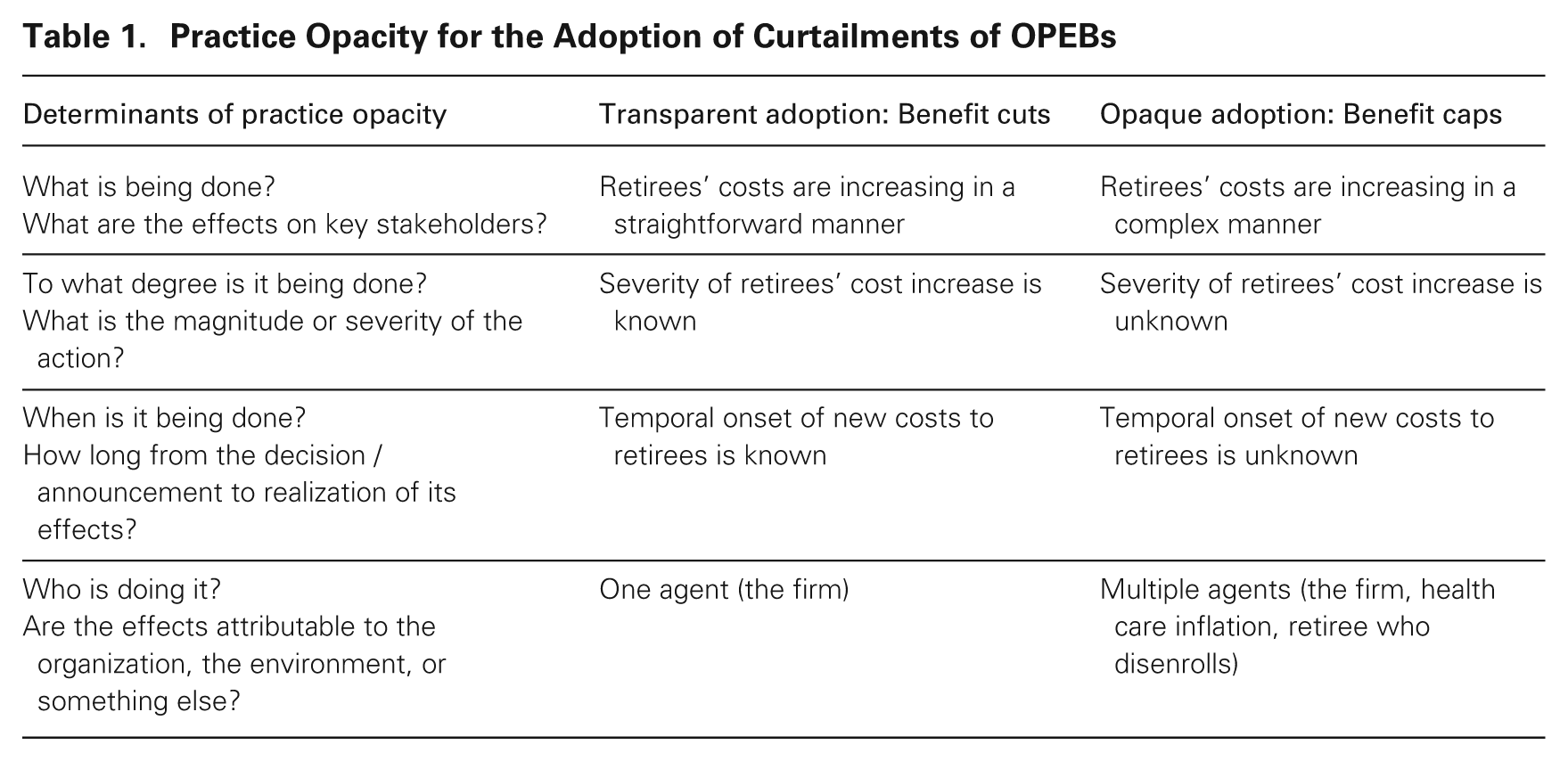
A key point is that for third-party observers, causal reasoning is comparatively more difficult for benefit caps than for cuts; hence we describe the former as opaque and the latter as transparent. Table 1 summarizes these key differences, as well as the underlying determinants of opacity for observers: a lack of clarity regarding what is being done, to what degree it is being done, when the effects will transpire, and exactly who will have caused them. The more difficult it is to answer these questions, the more opaque the practice. In the case of opaque benefit caps, individuals may not grasp the significance at the time of the announcement or implementation, and once their costs rise beyond a level they can afford, they may struggle to understand how that situation came about. One fledgling retiree interest group’s November 2006 newsletter is revealing: “We have heard from quite a number of members who are upset by large premium increases this year, and who are confused by premium amounts in their 2007 Enrollment Worksheets. We have again turned to [the company’s] Benefits staff to help us better understand these issues. After struggling with this information, we have a better understanding of how [the company] applies the cap, and of your frustrations, too.” 4 This statement was followed by a three-page newsletter of remarkable complexity. To reiterate, the determinants listed in table 1 contribute to opacity because they hinder the causal reasoning process, which is critical to the way individuals interpret and respond to events in the world around them (Ajzen, 1977; Tversky and Kahnemann, 1980; Krynski and Tenenbaum, 2007). As shown in figure 1, both practice formats continued to be adopted by firms in our sample throughout the study period.
Practice Opacity for the Adoption of Curtailments of OPEBs
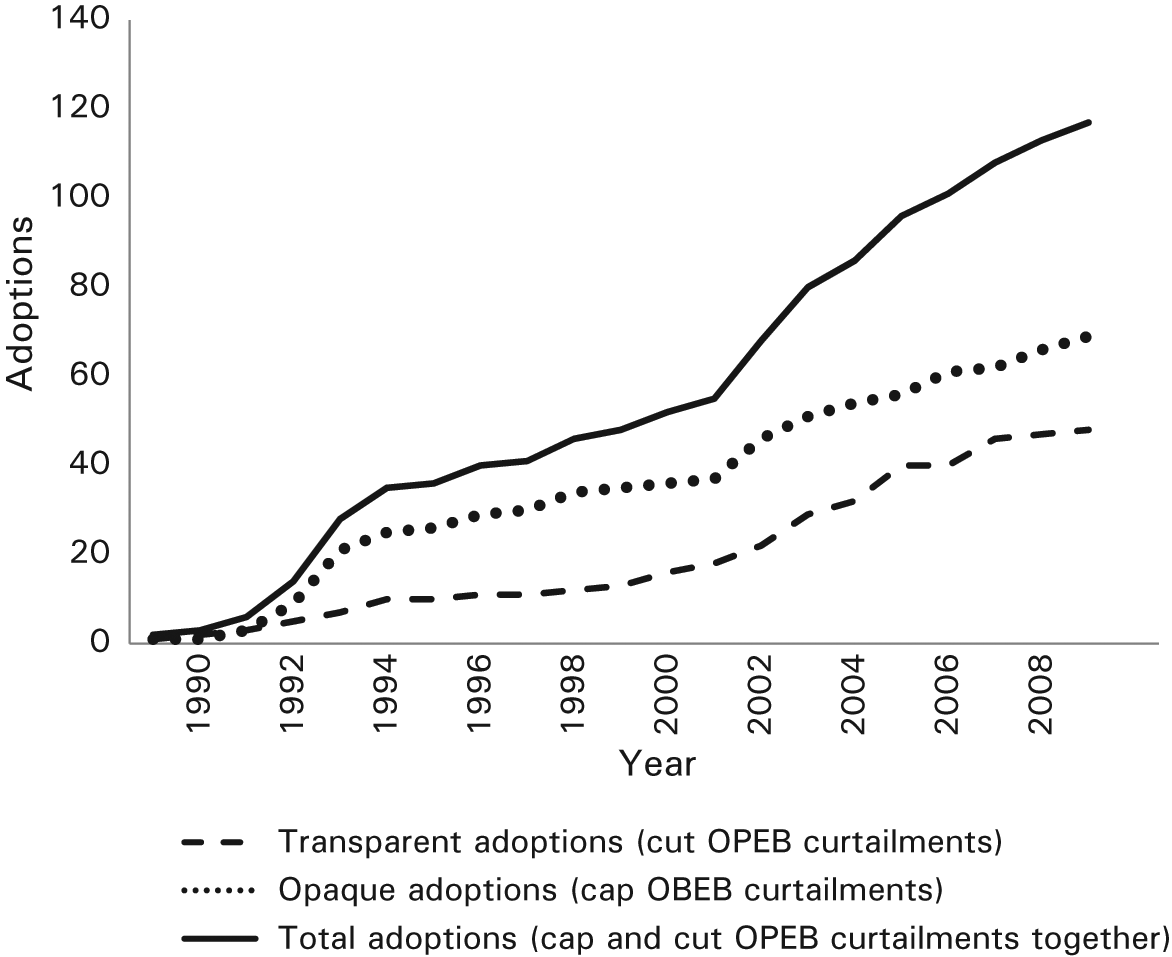
Cumulative adoptions of OPEB curtailments among Fortune 500 companies, 1989–2009.
The Mediating Role of Third-party Responses
Media studies and collective action research provide a base for understanding the mediating role played by key third-party actors—media outlets and interest groups—in the spread of controversial corporate practices. The media and interest groups may both serve as mediators when triggered by transparent adoptions, though the logic behind their effects differs slightly. Specifically, transparent adoptions attract more media coverage because they provide causal cues that make them more attractive as a news item, whereas interest groups react more to transparent adoptions because they present a clear causal story, making it easier to galvanize voluntary opposition.
In determining newsworthy stories, journalists seek out compelling storylines, often by incorporating dramatic elements—protagonists, antagonists, and plots based on conflict—into everyday events (Andreassen, 1987; Shoemaker and Reese, 1996; Rindova, Pollock, and Hayward, 2006). Yet the efficacy of such elements as rhetorical devices turns on their usefulness in simplifying the causal reasoning process (Ryan, 1991). Conflict can only be apparent to the extent that protagonists and antagonists are acting in ways that can be interpreted as directly impinging on one another. Acts of injustice provide built-in drama with a great deal of causal clarity and hence draw a disproportionate amount of media coverage relative to other issues (Beckett and Sasson, 2000). In the context of the debates surrounding managed health care in the 1990s, for example, news outlets gravitated toward stories featuring obvious causal agents responsible for an injustice—e.g., a health-maintenance organization refusing to pay for some particular treatment—regardless of the fact that such cases may not have been representative of managed care overall (Mechanic, 2004). Additionally, dramatic storylines are effective to the extent that the event in question can be linked to previously established cultural themes, for example, the underdog motif (“the little guy takes on big business”) (Ryan, 1991: 34).
In the context of retiree health benefits, benefit caps exemplify an incoherent drama. Caps are deficient in each of the categories listed in table 1 that help facilitate causal reasoning. As for the causal agency of the antagonist, the company is clearly responsible for the decision to cap benefits, but inflation in health care costs and the circumstances of a retiree’s personal health are perhaps equally responsible for the on-the-ground costs incurred by retirees. As for plot, it is not clear what is being done, to what degree it is being done, when the effects will be felt, or who exactly will have caused those effects. The costs of health care are being shifted in a complex manner that belies the intentions of the firm, and the severity and onset of those future costs are unknown. In contrast, benefit cuts are temporally precise events with a fixed causal agent (the firm) and known severity. Furthermore, benefit cuts align easily with a larger narrative about employers reneging on their end of the social contract, while benefit caps are harder to frame in such a manner. Cuts, therefore, offer a simpler, more culturally resonant storyline than caps.
Broadly speaking, interest groups’ responses may track the degree of media response, increasing as the clarity of the practice format increases. The logic is similar: given that opacity is a function of thwarted causal reasoning, interest groups will be less likely to mobilize when the causal agent—the target of their grievances—is less easily connected to the conditions that gave rise to those selfsame grievances. As social movement research has shown, a collectively felt grievance requires a clear causal narrative to gain traction. Cress and Snow (2000) argued, for example, that the more specific the group’s framing efforts—including who or what is exactly culpable, what exactly they are doing, and who exactly they are harming—the more interpretable the group’s arguments will be to recruits and neutral observers alike. Describing the causal story in terms of antagonists and protagonists also helps aggrieved groups establish an “identity frame,” or a collective sense of “us” versus “them” that motivates and focuses a group’s energies (Gamson, 1995). In the absence of such identities, the task of assigning blame is complicated and the momentum of the grievance is slowed.
Compared with OPEB cuts, caps carry qualities making them less attractive for journalists and less galvanizing for retiree advocates who could spur collective action to oppose them. Although caps may engender suspicion and distrust among retirees or other third-party groups who question the firm’s motives, the difficulty of constructing a causal story is likely to slow any effort to consolidate and communicate this suspicion.
In the diffusion framework, such potential differences in the media and interest groups’ responses to one firm’s adoption may be transmitted between corporations through at least two well-established pathways. First, of course, these responses may be broadcast in the media reports that are themselves part of the negative response to the firm’s OPEB curtailment decision. In general, considering the volume of business news coverage, such media stories are most likely to be noticed by other firms that are proximal competitors to the adopting firm. In addition to product market competitors, stories about OPEB curtailments may be followed by labor market competitors who hire workers from the same geographic region. A second well-established pathway involves managerial ties across firms. Many studies have found that information and influence flow through connections formed by executives serving as outside directors for other companies (Davis, 1991). For firms without competitive reasons to track each other’s moves, director ties create additional conduits for learning about the negative response to recent OPEB curtailment decisions. Although prior studies of director ties have emphasized their role in transmitting positive rationales for practices among corporate elites (e.g., Davis and Greve, 1997), these connections may also serve to relay information about negative third-party reactions that can influence the adoption decisions of organizational decision makers.
Based on the above discussion of clarity in adoption and diffusion processes, we expect that the transparent adoption of a controversial practice will hinder future diffusion, because competitors and connected firms will witness the ensuing negative third-party reactions and want to avoid the same fate. Although transparent adoptions may have the greatest negative impact on future transparent adoptions, their basic effect should be to delay firms’ willingness to engage in the adoption of either practice given the general sense of increased uncertainty surrounding the situation. The logic here presumes a mediating role for the media and interest groups. Hence, we also predict that transparent adoptions will generate higher levels of media coverage, with such coverage mediating the main effect; transparent adoptions will likewise lead to a higher likelihood of interest group opposition, with the latter also mediating the main effect. 5
The Role of Professional Experts in Spreading Controversial Practices
Organizational decision makers will typically want to avoid triggering third-party opposition and therefore will be wary of controversial practices that are highly transparent. Thus for a controversial practice to spread, it must be difficult for outside observers to comprehend while at the same time be accessible to potential adopters. Such partial visibility can be achieved through the involvement of specialized professional occupations (Rogers, 2003). Professionals can theorize organizational practices in ways that make them comprehensible through the cognitive infrastructure of professional expertise. This enables effective transmission of new practices across members of the profession (Mezias, 1990; Sutton and Dobbin, 1996; Rao, Monin, and Durand, 2003), while at the same time impeding comprehension by outsiders. The resulting asymmetry provides an environment in which opacity is maintained toward lay third-party groups that would potentially oppose it while creating favorable conditions for diffusion among professional experts and the organizations that are their clients.
Opaque OPEB adoptions (benefit caps) in particular were invented and honed by professional advisory services firms steeped in actuarial sciences and financial accounting. These actors theorized the practice and asserted its feasibility to corporate clients by drawing on the logic of contribution “caps” developed earlier in the shift from defined-benefit to defined-contribution pensions (Cobb, 2010; authors’ interviews). 6 This approach rests on theories of efficient risk allocation, whereby firms limit exposure to risks they cannot effectively influence. In estimating the impact of OPEB curtailments for employers, advisors used models that were particularly complex for benefit caps, requiring an analysis of future cost increases to retirees and subsequent retiree disenrollment behavior, as well as assumptions about discount rates, health care inflation rates, enrolled population health and mortality, and allowable amortization and related accounting rules (Society of Actuaries, 1985, 1991; PricewaterhouseCoopers, 2009; authors’ interviews). These models effectively reinforced the complexity of causal reasoning associated with the practice. Retirees on the receiving end of caps were often perplexed by the practice, as evidenced by retiree associations circulating memos to try to provide some clarification.
Theorization efforts may have sold corporate decision makers on the technical merits of OPEB curtailments—and the need to involve professional experts—but they do not directly ease concerns about negative third-party responses. Such concerns loom large: in addition to regulatory and legal uncertainties (Martens and Stevens, 1994; Swieringa, 1996), executives worried about public relations consequences given negative media publicity and the vocal responses of retiree interest groups gaining support in the U.S. Congress (Kadereit, 2008; Schultz, 2011). As a result, it was important for consultants marketing OPEB advisory services to reassure clients not just about their technical abilities but also about their ability to limit negative consequences stemming from the design, announcement, and implementation of retiree benefit curtailments. Consulting firms that could show examples of past clients implementing the practice without negative third-party responses should have been better able to market their services. For example, in the case of OPEB curtailments, articles in trade publications highlighted case studies in which consultants helped design and implement curtailments, including education programs targeting retirees and employees as well as coordinated public relations activities (Nichols, 2008), all of which signaled the need to actively manage third-party responses.
Over time, as the major benefits-consulting firms each gained experience with OPEB cuts and caps, they would be able to draw on past clients’ successes to illustrate successful adoptions. Given our arguments about the differential third-party response, opaque adoptions (caps) should more often have provided the examples of avoiding negative fallout than would transparent adoptions (cuts). Hence we predict that professional experts will serve as conduits for the spread of a contested corporate practice by marketing their prior experience with opaque adoptions and that this effect will be mediated by the diminished incidence of negative third-party responses.
Methods
Data and Statistical Models
Our sample consists of all U.S. Fortune 500 corporations, as published in the 1999 edition of Fortune magazine. We chose this sample because we had additional key data on this group of firms from a survey of corporate health benefits managers in those firms. The great majority of these corporations offered health insurance (OPEBs) to retirees during the study period. Based on our benefits manager survey, over 85 percent of these companies provided at least some retirees with health benefits at some point during the study period. The time period for our study is 1989 to 2009. The first record that we found of an OPEB event in our sample of firms occurred in 1989. Accounts of the phenomenon also tended to locate the onset of OPEB curtailments with the circulation of the Exposure Draft of FAS 106 in 1989. This report triggered attention among benefits managers and consultants to the OPEB liability issue.
Our primary data come from information in financial statements. Other data sources used in our analyses include a 1999 management survey covering several aspects of employee benefits practices. The survey, sponsored by the Robert Wood Johnson Foundation, had an 86.5 percent usable response rate. The survey targeted the senior-most executive with responsibility for employee health care benefits in each company. Survey questions covered a range of issues related to characteristics of, and changes in, health benefits, as well as other human resource practices, the backgrounds of senior human resource managers, and interorganizational benchmarking behavior among these managers. The data were gathered using a structured telephone survey with interviewers who were knowledgeable about health benefits and who received an initial 40-hour training on key substantive concepts in the survey as well as on nondirective interviewing techniques that promoted uniform data collection. Because the survey included information on the backgrounds of the managers themselves, special efforts were made to ensure that it was not completed by lower-level employees. Those efforts were successful; 88 percent of respondents held titles at the director of benefits, vice president for human resources, or officer level. Additional details on the survey can be found in Maxwell, Temin, and Watts (2001) and Briscoe, Maxwell, and Temin (2005).
For the present study, we used four non-subjective variables from the 1999 survey: (1) The number of benefits-eligible employees was taken from the sum of two survey items reading, “Of those full-time employees, how many are health benefits-eligible?” and “Of those part-time employees, how many are health benefits-eligible?” (2) The number of benefits-eligible retirees was taken from an item reading, “How many retirees receive health insurance through your company?” (3) The firm-level workforce unionization percentage was taken from the question, “Approximately what percent of your workforce is unionized?” and (4) The region in which the firm had the greatest number of employees was taken from a survey item reading, “I want to ask you about the health care purchasing for the metropolitan area in which you have the most employees. Please identify this metropolitan area.” We used the first three items as control variables in our analyses. The fourth item was used to identify geographically proximal firms that competed in the same local labor markets, as part of the competitor proximity network. To our knowledge, there is no other source of systematic data on these items. Consulting firm surveys have serious limitations because of their survey universe and sampling designs.
The validity of all survey items was assessed in pre-test interviews with senior managers (who were obviously domain experts) from 70 companies with sizes just below the Fortune 500. Many survey items were based on items used in earlier surveys conducted by the RAND Corporation, KPMG, and Hewitt. The survey items that were ultimately used in the survey were those that interviewees felt senior managers should know with confidence for their organizations. For these four specific items in particular, we have additional confidence, given that survey respondents had primary responsibility for decision making on employee benefits and that decision making would routinely involve use of these workforce items.
Financial data and SIC industries were taken from Compustat. Consulting firms’ data came from ERISA 5500 Schedule C forms, obtained directly from the U.S. Department of Labor’s Employee Benefits Security Administration via a Freedom of Information Act request. Board interlock data were compiled from Compact Disclosure for various years. We matched companies across datasets using Compustat identifiers, employer identification numbers, and official company names. Our understanding of the context also draws on our review of over 100 public archival documents and interviews with 12 informants (four consulting/accounting firm partners, one benefits broker, two former consultants, and five Fortune 500 senior human resource managers) involved in changing OPEB practices at Fortune 500 firms. These interviews were semi-structured, conducted by phone, and lasted from 30 to 90 minutes each.
In our primary analyses, we used discrete-time hazard models to predict OPEB curtailment events (Allison, 1984). Discrete-time hazard is defined as the conditional probability of a firm experiencing the event in time period t, given no event occurrences for that firm prior to t. Because firms tend to make changes to their employee and retiree benefits once per year, the use of a discrete-time model is particularly appropriate. Our risk set includes firms in the 1999 Fortune 500 that responded to the 1999 survey. We excluded firms that reported having fewer than 100 health-benefits-eligible retirees, reasoning that they were not at risk of adopting OPEB curtailments in a manner that would be comparable to the other firms. One firm in our original sample had entirely cut its retiree benefits prior to 1999, so even though it had fewer than 100 health-benefits-eligible retirees we did not exclude that firm from our analysis. The discrete-time analyses use a data structure based on firm-year observations. All firms become at risk starting in 1989 (or the first year they appear in Compustat, if after 1989) and ending at the year in which an OPEB event is recorded (or else 2009). The final risk set includes 388 firms and 7,230 firm-years. Time varying variables were lagged one year. We employed models predicting the decision to adopt OPEB curtailments of either format (i.e., either caps or cuts), as well as competing-risks models predicting the decision to adopt caps versus cuts (i.e., one practice or the other).
Our analyses for hypotheses 2a and 3a, predicting media and interest group responses, were conducted using negative binomial and logistic regressions, respectively, on firm-level data. Initial Poisson models for the media response count variables yielded evidence of overdispersion (Pearson chi-squared values over 2.0), leading to our use of negative binomial regression.
Dependent Variables
OPEB curtailment adoption
Our main dependent variable focuses on each company’s initial decision to adopt OPEB curtailment. We gathered information on the year of that decision and the type of OPEB curtailment event for each company in our dataset. Our primary source of OPEB events is annual financial statement filings to the Securities and Exchange Commission. When changes are made to OPEBs, a record can usually be found in the financial statement footnotes, but because this information is not captured in variables available in Compustat or similar proprietary databases, it required hand coding from full-text SEC filings.
To capture and categorize as many events as possible, we first consulted with two subject matter experts from public accounting. As a consequence of those discussions, we decided to use a multi-pronged strategy for identifying possible OPEB event decisions. First, we identified OPEB events following the accounting research tradition of searching a database of full-text annual financial statements (available in Lexis; e.g., Comprix and Muller, 2006). Specifically, we searched for the actuarial key words “curtailment” or “plan amendment” within fifty characters of a set of words referencing OPEBs (“health care,” “medical,” “post employment,” “post retirement,” or some permutation involving hyphenation or different spacing) in each company’s filings over the study-period years. Second, we used a proprietary database (R.G. Associates) to identify years in which companies in our sample reported large increases in curtailment gains and unrecognized prior service costs. Third, we searched a full-text news database (Lexis US major newspapers) for articles discussing retiree health benefits and specific companies in our sample, retaining those cases in which benefits were being reduced or eliminated. We identified 124 OPEB curtailment events, corresponding to 32 percent of the firms in our risk set.
Having identified possible OPEB events through those three methods, we then verified and coded the year of the OPEB event and the specific type of event by reading the relevant SEC filing footnote text for the year in question. We sought the earliest evidence of the decision to make changes, using dates cited in the 10-K filing as well as all other sources we had for a given OPEB curtailment. In many cases, we also examined annual reports from the year(s) prior to the initial target year to make sure the event was not announced earlier. In a few cases, we found announcements of future planned changes, in which case we searched for any other earlier announcements and then again used the year of the earliest record we found. 7 In addition to the year, we coded the type of OPEB event, as described below.
Media coverage of adoption
To obtain data on media coverage of OPEB curtailment events, we used a full-text news database (Lexis US all newspapers) to search for media stories discussing the companies involved in the OPEB events we identified. We included both national and local newspaper coverage. To be counted, the article had to make specific mention of the OPEB event in connection with that company, and the overall focus of the article had to be on retiree benefits. Each company was assigned a total newspaper article count if media coverage was found, 0 otherwise. We found a total of 166 news reports on companies in our sample, citing 55 of the companies in our sample.
Interest group response to adoption
We obtained data on retiree interest groups from the National Retiree Legal Network (NLRN). Interviews with retiree interest group leaders suggested that in most cases, the timing of group formation coincided with an announcement or rumor of OPEB curtailment at the corresponding employer. In some cases, loosely organized retiree groups that had been functioning primarily as social networks were mobilized during the formation of the advocacy group. To identify additional retiree groups beyond those affiliated with the NLRN, we searched online for websites of retirees from each company in our sample. This effort yielded few additional groups. Each company was coded 1 if a group existed, or 0 otherwise. We identified a total of 39 groups at companies in our sample.
Independent Variables
Proximity of prior adopters
Within the diffusion framework, our hypotheses focus on the effects of prior proximal OPEB curtailment events on future events. To examine these influences, we first modeled baseline interorganizational influence as a function of three different types of connections between firms, described below. These three types of connections among firms serve as the basis for constructing independent variables that reflect numbers of prior opaque and transparent proximal adopters. Over time, as prior adopters of one format or the other accumulate in the focal firm’s network, the corresponding independent variable is updated.
To capture a firm’s proximal competitors, we included other firms that had major employment concentrated in the same geographic region, and which therefore competed in local labor markets, as well as other firms in the same industry, with which they would compete for professional employees, customers, and other key resources. Regional proximity was derived from a question on the employer survey that asked respondents to identify the city in which their largest concentration of employees was located (in some cases this was the same location as company headquarters). Responses were coded into the Federal Information Processing Standard metropolitan statistical area codes, which were then used to define common regions. New Jersey and Eastern Pennsylvania were coded together with New York because many firms named this tri-state area as their region. In addition, we split California into northern and southern regions. For common industry, we considered two firms to be proximal if they shared the same primary two-digit SIC code (taken from Compustat records). Variables for proximal competitors included adoptions among other firms that shared the focal firm’s employment region and/or industry.
We also modeled connected firms using proximity based on the presence of an executive from one firm on the board of another firm. We used board interlock data from 1990 for the years 1990–1999 and then updated the data more frequently for the second decade, given evidence of decreasing stability in interlocks in recent years (Chu and Davis, 2011). Specifically, we used interlocks from 2000 for the period 2000–2004, and 2005 for the years 2005–2009. Variables for interlock-connected firms included adoptions among other firms that shared an interlock tie with the focal firm during the corresponding time period.
We constructed a separate network for common consultants based on firms retaining the same employee benefits consulting firm(s). We used data from the ERISA 5500 Large Plan Schedule C to identify all those advisory services providers that were paid for services related to employee or retiree health benefits by the companies in our sample. Using payment as evidence of a relationship, we identified linkages between each company in our sample and each of the ten largest advisory services firms providing benefits consulting during the time period of our study: Mercer, Watson Wyatt, Deloitte, Hewitt, Aon/ASA, Towers Perrin, PricewaterhouseCoopers/IBM, Buck/ACS/Mellon, and Cap Gemini/Ernst and Young (Kang, 2007). For companies with more than one employee and/or retiree health plan, we considered payment for consulting services related to any of those plans as evidence of a connection between the consulting firm and the company. These linkages formed the basis for a set of proximity ties among companies that shared the same consulting firm. We were able to obtain consulting firm data for three years during our study time period. We used 1997 ties for 1990 to 2000; 2001 ties for 2001 to 2005; and 2006 ties for 2006 to 2010. Variables relating to common consultants included adoptions among other firms that retained the same consultants as the focal firm.
Opaque and transparent prior adoptions
To test hypothesis 1, we first categorized prior adoption events in the focal firm’s proximity network as either opaque or transparent in format. We operationalized transparent adoptions using “cuts”—the ceasing of benefit provision for some or all of the company’s current or future retirees. An example of a cut reported in the OPEB footnotes is “In December 2005, the Company announced the elimination of postretirement health care and life insurance benefits for all salaried and certain hourly employees who have not reached the age of 60 with 10 years of service as of January 1, 2007.” There were 54 transparent cuts among companies in our dataset. In 12 of those cases, firms announced direct cuts involving the cessation of all retiree benefit subsidies.
We operationalized opaque adoptions using “caps”—an announced ceiling on the dollar contribution of the firm (usually per retiree) paid toward retiree benefits, above which retirees are responsible for paying the difference. An example of an opaque adoption from an OPEB footnote is “The Company has amended healthcare, dental, and life insurance benefits provided to eligible retirees and eligible survivors of retirees. The Company announced in 1992 a cap for people retiring after January 1, 1993 that would freeze the Company’s contribution to healthcare and dental costs in the year when costs were twice the average amount paid in 1992.” There were 70 opaque adoptions among companies in our dataset.
Media coverage and interest group response to prior adoptions
To test hypotheses 2b and 3b, we included time-varying variables based on the average levels of media coverage and interest group response to prior adoptions among the focal firm’s competitor and connected networks. The media count and interest group response associated with prior curtailments were taken from the corresponding dependent variables described above to test hypotheses 2a and 3a.
Control variable for prior adopters
To control for the possibility that transparent adoptions are less contagious simply because they differ in the size of the OPEB curtailment enacted, we included a variable for the magnitude of prior adoptions. The construction of this variable proceeded in two steps. First, to generate magnitudes for each firm that adopted OPEB curtailments, we started with the projected reduction in OPEB liabilities based on the firm’s estimated gains recorded in its financial statement footnotes (as positive curtailment gains and/or negative plan amendments). We then summed those values for the three years centered on the year of the first recorded OPEB reduction announcement, to reduce noise associated with the timing of the announcement and recording of gains. We then divided that figure by the total number of health-benefits-eligible retirees reported by the firm in the human resource survey. 8 The resulting magnitude-of-reduction variable reflects the estimated extent of losses for each retiree, approximating the severity of that firm’s reduction event for retirees (mean = $10,811, s.d. = $35,282). A simple comparison of the average magnitudes for all opaque versus transparent adoption events did not yield a significant difference (two-sample t-test not significant).
We then used this magnitude figure from each OPEB curtailment adopter to generate average magnitude levels for adoption events occurring proximal to each focal firm using the same criteria for competitor and connected proximity described above. For a given focal firm in a given year, this variable reflects the average severity of reductions made by alter firms in the three prior years. We created separate average proximal magnitude variables for each focal firm corresponding to that firm’s competitor proximity network (mean = .349, s.d. = 8.639) and connected (board interlocks) proximity network (mean = .309, s.d. = 8.025). Because reduction events were rare in any given year, over 90 percent of firm-year observations are 0. Values were multiplied by 1000 to facilitate table display. Other versions of these variables, including longer lags and cumulative levels of each firm’s proximal magnitudes, did not alter our findings.
Control variables for the focal firm
We controlled for several direct influences on a company’s chances of adopting OPEB curtailment. Because public justifications often focus on cost pressure stemming from either the high cost of the benefits themselves or the financial viability of the firm, we controlled for the size of the liability and the amount of slack resources at the firm. The variable OPEB liability controlled for the total estimated cost of future OPEB liabilities reported by the firm in the prior year’s financial statements (Net Periodic Postretirement Benefits Costs), taken from Compustat. These data are missing for certain firms in years prior to 1993 when FAS 106 began requiring all firms to report these liabilities; in those cases, we assigned the value from 1993 to the prior years. We divided this variable by 1000 to facilitate table display. We also controlled for the magnitude of OPEB liability using the logged total number of benefits-eligible retirees each company provided with health benefits. We took this measure from the employer survey, and it is therefore not time varying. We know of no other publicly available databases that include total retirees. We controlled for each firm’s resource slack. Firms that lack sufficient working capital to meet current resource needs may be under more pressure to engage in OPEB curtailments. We controlled for resource slack using current assets minus current liabilities, based on annual values taken from Compustat. This measure has been used in a range of studies to capture the extent of short-term resource utilization (e.g., Bromiley, 1991; Mishina, Pollock, and Porac, 2004).
We also controlled for analyst ratings change. Securities analysts make recommendations to investors about whether to invest in a given company by considering whether the strategic actions of a firm’s managers are consistent with their beliefs about shareholder value creation (Beunza and Garud, 2007; Benner, 2010). Analysts’ opinions matter to managers because they influence investors’ behavior, firms’ reputations, and access to capital (Womack, 1996; Hayward and Boeker, 1998). As securities analysts increasingly came to view OPEB liabilities as a drag on future corporate earnings, they began raising the issue in earnings conference calls with managers. When analysts downgrade their recommendations for a company’s stock, one way managers can respond—signaling their commitment to shareholder value creation—is to announce OPEB curtailments. To capture this pressure from analysts and investors, we used the change in average analyst ratings from January to December for each year and firm in our sample. The data came from the I/B/E/S database of monthly analyst ratings. Our variable was the change in average ratings on the 5-point scale used in all analyst ratings reported in this database (1 = strong sell, 2 = sell, 3 = hold, 4 = buy, 5 = strong buy). We found similar results for an alternative variable using the portion of analysts in a given year who downgraded ratings for the firm.
Workforce unionization, on one hand, may increase the ability of current and future retirees’ to have their interests reflected in a firm’s policies, reducing the chances of OPEB curtailment. On the other hand, union leaders may pursue the interests of current (employee) members over former (retiree) members, favoring adoptions. Our unionization variable comes from the employer survey, reflecting the percentage of the firm’s workforce that was unionized. We controlled for two types of events that may increase pressure or the opportunity to reduce benefits. We coded the year of bankruptcy events for companies in our sample from media reports and the Compustat historical file. The Compustat variables we used were the presence of a “TL” footnote attached to Total Assets (indicating liquidation or bankruptcy) and the Compustat deletion indicator. Participation in merger and acquisition (M&A) activity brings new stakeholders who may hold different preferences about OPEBs. We coded the year (if any) that companies in our sample were involved in M&A as an acquirer or acquired firm, using media reports and the Compustat historical file footnote variables on firms deleted from the dataset. Finally, although we did not have predictions on the effect of overall firm size, we controlled for firm size using total employment.
Results
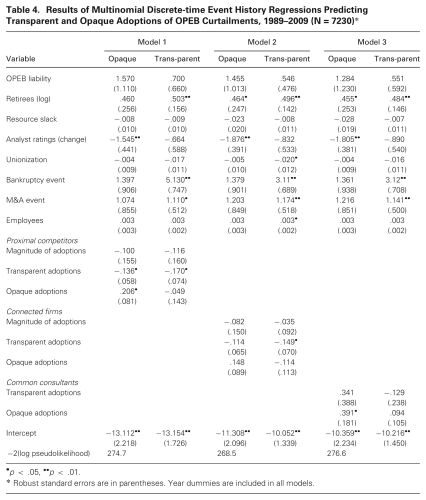
Table 2 presents descriptive statistics for the firm-year dataset. Table 3 presents the results of discrete-time event history analyses predicting adoptions of either practice (i.e., adoptions using either format), and table 4 presents the results of parallel competing-risks models predicting transparent and opaque adoptions separately. Models 2 and 3 in each table provide evidence on how different practice formats for proximal prior adoptions influence the odds of future adoptions. Consistent with hypothesis 1, transparent adoptions among both proximal competitors and connected firms decrease the odds of future adoptions. In table 3, the magnitude is approximately the same in both networks, such that each additional transparent adoption among proximal competitors or connected firms is associated with a 10 percent [100(1 – e−0.102)] lower odds of adoption. Model fit is significantly improved with the inclusion of the proximal adoption variables (model 2 vs. model 1 change in −2LL is 12.2, chi-squared with 3 degrees of freedom, p < .01; model 3 vs. model 1 change in −2LL is 8.1, chi-squared with 3 degrees of freedom, p < .05). The results in table 4 are similar, indicating that transparent cuts lower the odds of adoption for both transparent and opaque formats.
Descriptive Statistics and Correlations*
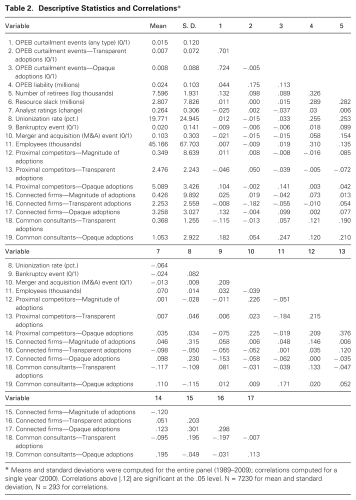
Means and standard deviations were computed for the entire panel (1989–2009); correlations computed for a single year (2000). Correlations above |.12| are significant at the .05 level. N = 7230 for mean and standard deviation, N = 293 for correlations.
Results of Discrete-time Event History Regressions Predicting Adoptions of OPEB Curtailment, 1989–2009 (N = 7230)*
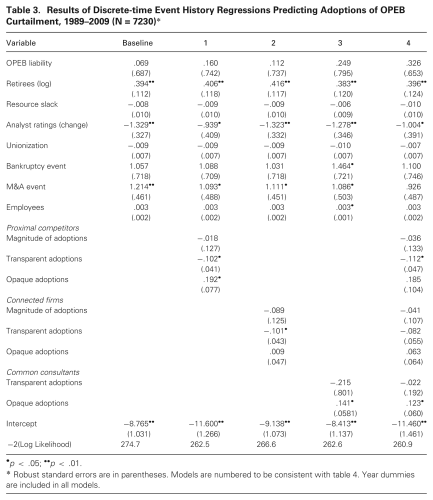
p < .05; •• p < .01.
Robust standard errors are in parentheses. Models are numbered to be consistent with table 4. Year dummies are included in all models.
Results of Multinomial Discrete-time Event History Regressions Predicting Transparent and Opaque Adoptions of OPEB Curtailments, 1989–2009 (N = 7230)*
p < .05, ••p < .01.
Robust standard errors are in parentheses. Year dummies are included in all models.
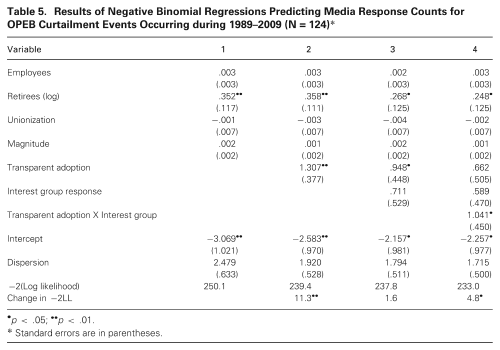
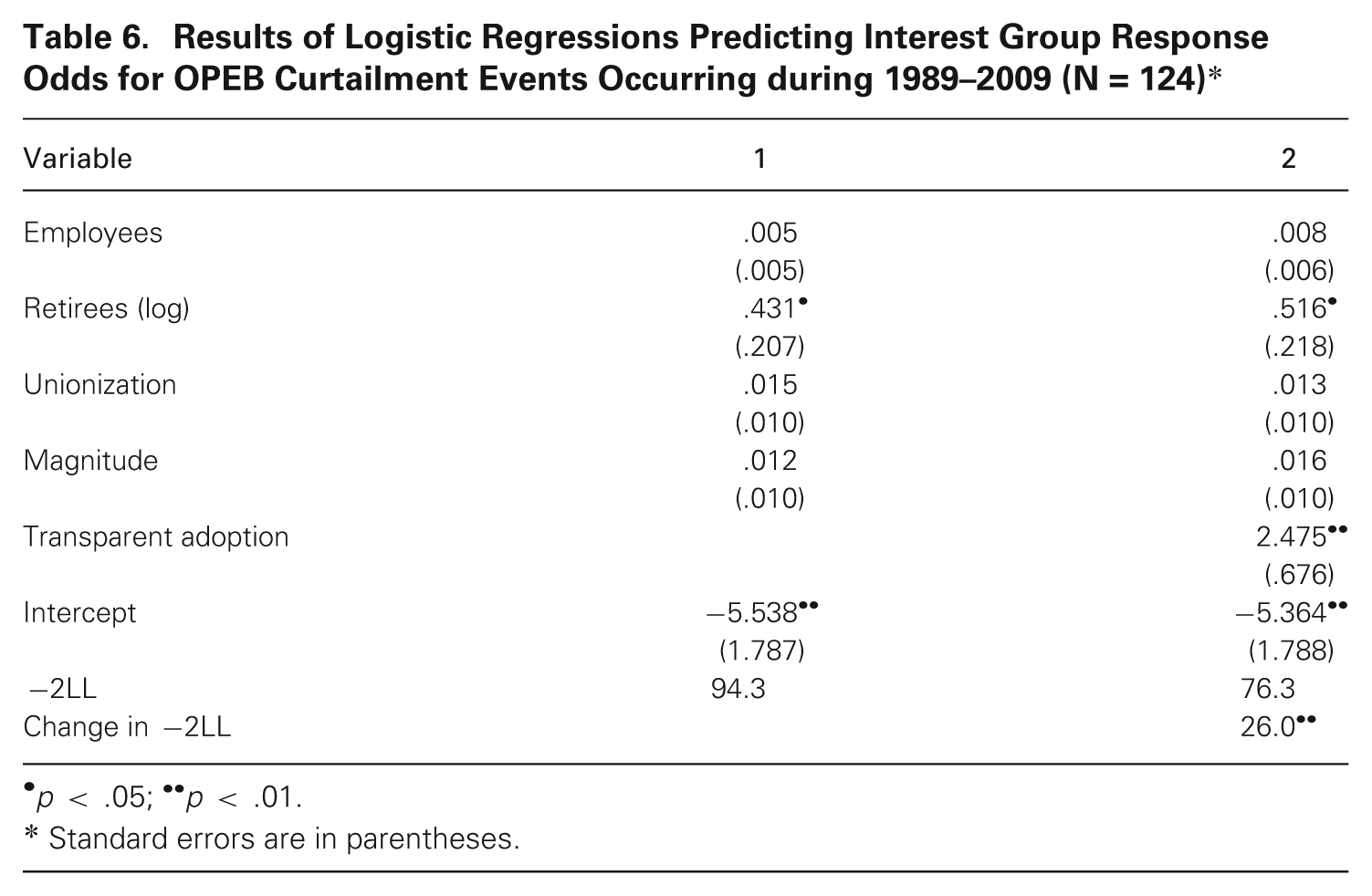
Hypothesis 2a predicted that transparent adoptions would be associated with more media coverage. The results from model 2 in table 5 indicate that transparent adoptions are significantly associated with a 3.7-fold increase in the expected count of media stories resulting from an OPEB curtailment event, supporting this hypothesis. Hypothesis 3a predicted that transparent adoptions would be associated with an increase in the odds of interest groups’ opposition, and model 2 in table 6 indicates support in the form of a significant 11.8-fold increase in the odds of interest group formation for transparent adoptions relative to opaque adoptions.
Results of Negative Binomial Regressions Predicting Media Response Counts for OPEB Curtailment Events Occurring during 1989–2009 (N = 124)*
p < .05; ••p < .01.
Standard errors are in parentheses.
Results of Logistic Regressions Predicting Interest Group Response Odds for OPEB Curtailment Events Occurring during 1989–2009 (N = 124)*
p < .05; ••p < .01.
Standard errors are in parentheses.
Hypothesis 2b predicted that media coverage would mediate the effect of transparent adoptions on diffusion. To test for mediation, we used nonparametric bootstrapping analyses (Preacher and Hayes, 2004) to test a joint meditational model of media coverage and interest group response as mediators of the negative relationship between proximal transparent adoptions and the likelihood of adoption by the focal firm. 9 Because the results in table 4 indicate that the main effects of transparent adoptions are similar for opaque versus transparent formats (the coefficients are not significantly different), we conducted mediation tests using the combined-format diffusion models from table 3. Turning first to the results among proximal competitors, we found that transparent adoptions had a significant total effect on the likelihood of adoption (total effect = –.200, S.E. = .061, p < .01), but the direct effect was not significant (direct effect = –.616, S.E. = .430, n.s.). Media coverage fully mediated the negative relationship between proximal transparent adoptions among competitors and the likelihood of adoption (indirect effect lower 95-percent C.I. = .090, upper 95-percent C.I. = 1.634), such that transparent adoptions received increased media coverage and, through that media coverage, reduced the likelihood of adoptions among proximal competitors. Because zero is not in the 95-percent confidence interval, the indirect effect of media coverage is significantly different from zero at p < .05 (two-tailed). The pattern was similar for a parallel mediation analysis focusing on proximity via connected firms. Transparent adoptions among proximal board-interlocked firms had a significant total effect on the likelihood of adoption (total effect = –.169, S.E. = .059, p < .01), but the direct effect was not significant (direct effect = –.100, S.E. = .074, n.s.). Media coverage fully mediated the negative relationship between proximal transparent adoptions among interlocked firms and the likelihood of adoption (indirect effect lower 95-percent C.I. = .046, upper 95-percent C.I. = 0.557). In sum, these results support hypothesis 2b. We did not find parallel evidence to support hypothesis 3b, that interest group response would mediate the negative relationship between proximal transparent adoptions and the likelihood of adoption. The 95-percent confidence interval for interest group response included zero for both proximal competitors and connected firms. Interest group response did not significantly mediate the proximal transparent adoption effect.
Hypothesis 4a proposed that professional experts would serve as conduits for the positive effect of opaque adoptions on diffusion. Model 3 in table 4 includes the effects of prior opaque and transparent adoptions by firms that retain the same benefits consultants as each focal firm. The results indicate an additional positive effect of professional experts as conduits. Each additional opaque event in the common consultant network increases the odds of future adoptions by 47.8 percent. The effect of common consultants for transparent adoptions was not significant.
Hypothesis 4b and 4c predicted that media coverage and interest group response, respectively, would mediate the positive effect of opaque adoptions via common consulting firms. To conduct this test, we ran the model predicting opaque format adoptions separately (i.e., without the competing risk of transparent format adoptions) and then used the same nonparametric bootstrapping procedure described above. Opaque adoptions among firms with common consultants had a significant total effect on the likelihood of adoption (total effect = .161, S.E. = .051, p < .05), but the direct effect was not significant (direct effect = .122, S.E. = .064, n.s.). Media coverage fully mediated the negative relationship between opaque adoptions among common consultant firms and the likelihood of adoption (indirect effect lower 95-percent C.I. = .026, upper 95-percent C.I. = 0.383). We did not find evidence of mediation associated with interest group responses. In sum, these results provide support for hypothesis 4b but not 4c.
Several control variables in tables 3 and 4 are noteworthy. First, among proximal competitors, opaque adoptions significantly increase the odds of future adoptions; however, the same is not true for firms connected through board interlocks. In addition, declining analyst ratings are associated with opaque adoption, while firms involved in M&A deals show an increased risk of transparent adoption. The size of the company’s retiree population is positively associated with both adoption formats. For completeness’ sake, we also included a saturated model (model 4) in table 3. In the saturated model, the negative main effects of transparent adoption remain significant for proximal competitors but lose significance for connected firms.
Additional Analyses and Robustness Checks
To extend these findings, we investigated whether media coverage mediated or moderated the effect of transparent proximal adoptions on interest group response, and/or interest group response mediated or moderated the effect of transparent proximal adoptions on media coverage. We did not find significant mediation effects, but we did find evidence of moderation. The increased effect of transparent adoptions on media counts was 2.83 times greater when interest groups had responded to adoption (model 4 in table 5). We did not find evidence of other significant interactions. Overall, the correlation between media and interest group responses across all adoption events is moderate (alpha = .36, p < .001).
Our finding that consulting firms act as conduits for the spread of opaque adoptions raises the question of whether some firms specialize in the opaque practice. Although all the major consulting firms may have the technical expertise to implement this practice, they may not be equally willing or able to market it. As more consulting firms gained experience with opaque adoptions, they could better relay that experience to future clients. To assess this, we examined the frequency of opaque adoptions across consulting firms. During the first decade (1990 to 1999), 7 of 10 consulting firms had experience with at least one opaque adoption, but only two firms had experience with two or more opaque adoptions. By the end of our study period, 9 of 10 consulting firms had experience with multiple opaque adoptions, yet the two firms with the most experience continued to account for over 50 percent of them. This suggests both broad consulting firm experience with opaque adoptions and also a degree of specialization across firms. 10
Discussion
Though the clarity of a practice may generally aid interorganizational diffusion (Rogers, 2003), we showed that when controversy descends on a practice via third-party actors, this situation can be reversed. When transparent adoptions attract more negative responses from news media and interest groups, those responses will be tracked by organizational decision makers who seek to avoid practices that bring negative value judgments and unwanted attention to their firms. The result is that transparent adoptions can effectively impede diffusion. Using the case of curtailments of retiree health benefits (other post-employment benefits, or OPEBs) diffusing across corporations, we found that transparent adoptions inhibit the diffusion of further transparent and opaque adoptions and that this effect is mediated by greater news coverage of transparent adoptions, which elevates the controversy and risk surrounding OPEB curtailments more generally. Although the chances of interest group formation also increased for transparent adoptions, the presence of an interest group did not significantly mediate the negative impact of transparent adoptions on diffusion. Instead, interest groups increased the media response for transparent adoptions, which in turn slowed diffusion. Firms that adopted OPEB curtailments using an opaque practice format—one less visible to most third-party audiences—were not as likely to trigger a negative reaction. These firms were able to keep the practice below the radar of opponents and skeptics, making it compelling for interorganizational emulation. Professional expertise played an important role in diffusion of the opaque format, as consulting firms provided channels for the influence of past adoptions that enjoyed limited negative media coverage.
Like all research, our analysis has important limitations that suggest directions for future studies. Our methods could be improved in several ways, including obtaining more fine-grained data on professional experts and using additional controls for the estimated magnitude of cuts among prior adopters. We also lack precise data on the timing of interest group formation in relation to OPEB curtailment announcements. In reviewing our interviews and archival documents, we could find no instances in which interest groups protested in advance of OPEB curtailment events, suggesting that they formed largely in reaction to (and temporally subsequent to) corporate announcements. Future studies should also examine practice opacity in the diffusion of other interorganizational practices, especially those that vary in the degree and type of controversy surrounding them. The organizational practice we studied was relatively rare (fewer than 2 percent of firms adopted in any given year), and opacity may operate differently when practices become more prevalent. Finally, our framework for conceptualizing opacity using factors that affect causal reasoning also needs validating across different practices.
Nevertheless, our findings provide insight into the diffusion dynamics of controversial practices. We show that such practices can diffuse in the absence of legitimating forces, namely, through design features that muddle their character and consequences for the general public, allowing them to spread without raising much objection. This finding likewise contributes to an understanding of the role of third-party observers—namely, the media and interest group advocates—in interorganizational diffusion and field changes (Fligstein and McAdam, 2011). Instead of examining any direct influence that these third-party actors exert by spreading a chosen platform (King, 2008; Soule, 2009) or amplifying an existing message (Rindova, Pollock, and Hayward, 2006), we theorized and found that interest groups and media outlets can serve an indirect, mediating function by raising the visibility level of controversial practices and thereby elevating reputational risks for others considering adoption. That mediation function comes with an unintended twist: while transparent adoptions are inhibited by efforts to bring to light the practice, opaque adoptions can continue despite elevated controversy. Diffusion under these conditions depends on partial, or “one-sided,” clarity: potential adopters must be able to perceive and understand the practice, but if objecting observers do, too, diffusion is slowed. A field perspective, focusing on the role of third parties (Strang and Soule, 1998; Lounsbury, 2001; Fligstein and McAdam, 2011), thus highlights the importance of design transparency and opacity in understanding organizational practice diffusion. An intriguing implication of this perspective, then, is that opacity can provide a pathway for practices to diffuse—i.e., proliferate numerically—without becoming institutionalized in the sense of achieving widespread legitimacy (Colyvas and Jonsson, 2011).
We also contribute to a growing body of work on how contention in a field shapes corporate behavior (Soule, 2009; King and Pierce, 2010). In directly protesting against a targeted organization, activists can threaten the organization’s tangible assets as well as its reputation. Our research suggests that reputational concerns may be particularly important for their wider field-level effects: even when not seeking to change society, interest groups’ responses to benefit curtailments fuel negative media coverage, which in turn influences other observing firms by making them less likely to follow suit. This negative effect spills over, in fact, from transparent to opaque adoptions, indicating that organizational decision makers exhibit some concern that audiences will generalize the negative response from one practice to other associated practices (see Jonsson, Greve, and Fujiwara-Greve, 2009). Our findings are also consistent with research on how activists influence corporate behavior through media coverage (King, 2008), though in this case, media attention has an indirect influence on organizational decisions surrounding the focal firm.
Our findings also add nuance to research on how professionals shape change in organizational fields, by uncovering their role in inhibiting attention and influence from potential adversaries. Existing work has highlighted the role of professionals in legitimating organizational responses to change, as they propose, theorize, and validate new practices that help organizational decision makers navigate ambiguous aspects of their environment (Edelman, 1992; Kelly, 1999; Greenwood, Suddaby, and Hinings, 2002; Dobbin, 2010). In contrast, we observe how professionals contribute to subverting the opponents of change, by helping organizations to package and transmit practices in a way that limits comment by outsiders. Future work should explore the degree of intentionality in this obfuscatory process, because unlike institutional decoupling (Meyer and Rowan, 1977), opaque adoptions involve little in the way of front-stage symbolism versus backstage substance. Instead, they represent a kind of sleight of hand occurring in plain sight of the audience, visible to all yet only fully comprehensible to informed insiders.
Footnotes
Acknowledgements
We are grateful for valuable comments and suggestions from Mark Anner, Lee Ann Banaszak, Matthew Bidwell, Henrik Bresman, Drew Carton, J. Adam Cobb, Jerry Davis, Mark Dirsmith, Isabel Fernandez-Mateo, Raghu Garud, Joel Gehman, Bradley Goldie, Royston Greenwood, Don Hambrick, Sarah Kaplan, Linda Johanson, John McCarthy, Vilmos Misangyi, Michael Penn, Pat Rafaeli, Sean Safford, Wenpin Tsai, Andrew von Nordenflycht, three anonymous ASQ reviewers, and seminar participants at Northwestern, Cornell, Wharton, Penn State, the Academy of Management, and the Industry Studies Association. Special thanks to Karl Muller for expert guidance in coding OPEB footnotes, Bill Kadereit and Ed Beltram for help with retiree advocacy groups, Department of Labor EBSA staff for help parsing IRS Form 5500, and all the industry participants who generously donated their time. The first author’s work on this project was supported in part by an Alfred P. Sloan Foundation Industry Studies Fellowship.
1
We use the term curtailment in its general meaning, which is to cut back or reduce, rather than the narrower technical meaning used in pension and benefit accounting.
2
Although retirees over 65 qualify for basic Medicare, employers’ policies cover additional costs and provide an expanded benefit; retirees under age 65 who lose coverage have few practical options for regaining it save through a spouse’s benefit policy.
3
Although health benefits for current employees and pension benefits for retirees are covered under the Employee Retirement Income Security Act (ERISA), retiree health benefits are exempted. The case Sprague vs. General Motors, filed in 1989 and settled in the U.S. Court of Appeals in 1998, resolved that as long as a “reservation clause” was included in official plan documents, companies can curtail or eliminate retiree health benefits regardless of any other written or verbal promises made.
4
Consistent with our research agreements, we have withheld the name of the Fortune 100 company whose retirees are represented by this interest group.
5
We do not formally hypothesize about the main effect of opaque adoptions (benefit caps), because our primary theoretical interest is in the effect of transparent adoptions on diffusion, but we present results for the effects of each practice on both the combined diffusion path as well as on each separate practice.
6
Interviews with industry informants are described in the methods section below.
7
We excluded changes that were only responding to 2004 Medicare Part D federal prescription drug subsidies.
8
For the one company in our dataset that completely cut its retiree benefits prior to 1999, we substituted the total number of employees as a proxy for the number of health-benefits-eligible retirees.
9
We used the bootstrap and binary_mediation STATA routines, with 1000 samples per analysis. Mediation is significant if the 95-percent bias-corrected and accelerated confidence intervals for the indirect effect do not include 0.
10
It is possible that professional experts act as a uniform group to promote opaque adoption methods. If this were true, we would expect a direct effect of any consulting firm presence associated with a firm to significantly predict adoption. We also investigated whether corporations that retained one of the large benefits-consulting firms were at a higher risk of adoption. A dummy variable for this situation did not yield a significant coefficient, suggesting that the mere presence or absence of professional advisors was not enough to influence adoption. We considered adding dummy variables for each unique consulting firm into the main model, to see if some individual firms were directly associated with adoption, but we had no prior expectations for this type of analysis, and we worried that the exercise would amount to blind data mining.