






Abstract
In this paper, we develop an account of the failure of private market-governance institutions to maintain market order by highlighting how control of their distributional function by powerful elites limits their regulatory capacity. We examine the New York Clearing House Association (NYCHA), a private market-governance institution among commercial banks in Manhattan that operated from 1853 to 1913. We find that the NYCHA, founded to achieve coordinating benefits among banks and to limit the effect of financial panics, evolved at the turn of the twentieth century into a device for large, elite market players to promote their own interests to the disadvantage of rival groups that were not members. Elites prevented the rest of the market from having equal opportunities to participate in emergency loan programs during bank panics. The elites’ control not only worsened the condition of the rest of the market by allowing non-member banks to fail; it also diminished the influence of the NYCHA and escalated market crises as bank failures spread to member banks. As a result, crises developed to an extent that exceeded the control of the NYCHA and ended up hurting even elites’ own interests. This paper suggests that institutional stability rests on a deliberate balance of interests between different market sectors and that, without such a balance, the distributional function of market-governance institutions plants the seeds of institutional destruction.
It is now widely understood that effective market economies are not “free” but instead rely on various forms of market-governance institutions. These institutions define norms, stabilize expectations, and consequently supply order so that transactions can occur and markets can expand. Because rules and norms guide interaction in a market and support its activity, strategic market players are motivated to build institutions to mediate the problems they encounter in exchange, competition, and production (Fligstein and McAdam, 2011). Private institutional practices built by market players themselves often take the form of an association that consists of members from a specific domain (Aldrich and Staber, 1988; Barnett, 2009). Examples of private market-governance institutions abound. As far back as the guild system in medieval Europe, traditional industrial trade associations have been involved in setting production standards, organizing collective lobbying, and certifying credentials. In recent decades, in response to social activism, various self-regulatory membership programs have emerged to certify firms’ compliance with social and environmental standards and to prevent others from claiming the related status and rewards. In general, private market-governance institutions codify, monitor, and enforce the norms that guide members’ actions and aim to address matters of members’ shared interests.
Because market-governance institutions create patterns for action, they will inevitably raise resource considerations and have distributional consequences. Market-governance institutions are thus laden with political implications. They can be designed to distribute scarce resources to some market actors but not to others, thereby creating a situation of institutional exclusion. Fligstein (1996, 2001) has offered a political-cultural model of markets that uses the metaphor of “markets as politics” and argued that market institutions “are best viewed as attempts to mitigate the effects of competition with other firms” (Fligstein, 1996: 657). He defined market institutions as sets of rules that powerful actors attempt to produce in order to stabilize their situation vis-à-vis other actors (Fligstein, 2008). Private market institutions are especially likely to fit this definition because they are designed and maintained by actors who have direct interests in them. With such a definition, however, the political-cultural model of markets implies a process of self-perpetuation. Because powerful market actors would have no incentives to change an order that works in their favor, market-governance institutions are likely to persist and, if there is an increasing benefit to power, even expand.
In this study, we propose that the distributional function of market-governance institutions contains within itself a destabilizing potential. Managing mutual dependence between social groups is critical for maintaining institutional stability. After all, the possibility for institutional incumbents to exercise power depends on the tacit or explicit assent of other groups that might otherwise disrupt existing arrangements. To ensure continuity, incumbents who benefit from existing arrangements need to strike a balance of distributional outcomes with other groups. Without such a balance, the very means that allow incumbents to concentrate market power can pave the way for regime collapse by compromising the regulatory efficacy of the co-opted institutions.
We draw on insights from power-elite theory (Hunter, 1953; Mills, 1956; Domhoff, 2009) to argue that private market-governance institutions created to achieve coordinating benefits can be captured by market elites as an instrument to obtain distributional advantages. What delineates the boundaries of market competition and cooperation is a common identity that may be created by shared salient attributes such as organizational form, incumbent status, or interaction in a network. Elites mobilize among themselves through social networks. A high level of network cohesion facilitates coordination and helps elites to better govern private institutions according to their group interests. Cohesive elites may be tempted to maintain a high level of exclusivity and deny the out-group equal opportunities for participation in an attempt to monopolize institutional benefits. But elites who succumb to this temptation ignore the fact that the stability of competitive environments rests on a deliberate distributional balance with the out-group. Their monopoly causes the condition of the rest of the market to deteriorate, diminishes the influence of market-governance institutions, and escalates the severity of market crises. When the efficacy of governance institutions in maintaining market order depends on the control over a sufficient market share and there is a strong negative spillover effect, elites’ efforts to deploy private market-governance institutions to control a market result in endogenous market disorder.
We developed theoretical predictions and tested them by studying the New York Clearing House Association (NYCHA), a private institution that regulated the commercial banking market in Manhattan for sixty years before the Federal Reserve replaced it in 1914. In an era without a central bank in the U.S., the NYCHA fulfilled some of the same functions as a central bank, providing emergency loans for member banks during financial crises and imposing discipline during normal times. Through alleviating the severity of bank panics, the NYCHA maintained market order at the epicenter of American capitalism and was once regarded as “a most important and beneficial part in the general economic health of the nation” (Gilpin and Wallace, 1905: 5). The NYCHA regulated the Manhattan banking market in an era in which the government supplied little regulation over the banking sector, an institutional vacuum that combined with high levels of market volatility to create demand for private sources of market order. The absence of formal governmental solutions to bank panics provides an opportunity, which is in increasingly short supply in modern contexts, for investigating the efficacy of private regulation in maintaining market order. The NYCHA also regulated the market in an era before antitrust laws were rigorously enforced, affording an opportunity to test its distributional function, which favored market elites. Finally, observing the NYCHA over its 60 years of regulation of the Manhattan banking market offers a remarkable opportunity to document the rise and fall of one of the most prominent private market-governance institutions in the economic history of the U.S.
Elite Control and Market Crises
In the political-cultural model of markets, market-governance institutions are viewed as sets of rules that powerful actors attempt to produce in order to stabilize their situation vis-à-vis other actors (Fligstein, 1996, 2001). Markets are contentious places. To curb uncertainties, privileged market actors attempt to defend their status through building institutions. Within an organization, struggles are about conceptions of control (Fligstein, 1990); between organizations, struggles center on rules of competition and cooperation. Thus regulatory authorities, either the state or private entities, are intimately linked with the power structure in a market. When market-governance institutions mobilize significant and highly valuable resources, they are often specifically intended to distribute resources to particular kinds of actors but not to others.
With such a conceptualization, however, the political-cultural model of markets implies a process of institutional perpetuation. Because market-governance institutions work to strengthen their positions within a market, powerful actors would have no incentives to challenge the status quo. Thus institutions are likely to persist. If power and institutions are mutually reinforcing, then institutions will be self-perpetuating. As such, the political-cultural model of markets provides few clues about possible sources of endogenous change. Instead, it points to exogenous entities or forces, such as shifts in environmental conditions that reshuffle power relations in a market, to explain institutional change (Fligstein, 1996). This self-perpetuation implication has to do with the political-cultural model’s view of institutional stabilization as a cultural project. Once in place, institutions lay out an enduring logic regarding how things work in a particular market setting; market actors are therefore cognitively constrained by a culture that favors incumbents. Hence institutional stabilization operates in a quasi-automatic process in that “groups in the field who have more power use the acceptable cultural rules to reproduce their power” (Fligstein, 2001:15).
Institutional stabilization is not necessarily an automatic process but rests on ongoing mobilization both within the institutionally advantaged group and between them and other social groups. Stability is not a settled outcome but reflects a relatively durable state of specific coalitional dynamics. Markets remain orderly if actors can coordinate under a set of compromises, even if they benefit unevenly from an institutional arrangement. Internally, incumbents need to mobilize among themselves to ensure conformity to norms and rules. They need to develop a high level of cohesion to monitor and regulate the behavior of members. Externally, incumbents depend on backing from other groups so that an institutional arrangement that favors them will run smoothly. Subordinate groups are also willing to ally themselves with more powerful groups if the latter can secure enough resources for them to survive (Powell et al., 2005). Thus social groups are actually embedded within a set of mutual dependencies. The dependence involves not just material resources such as inputs and outputs but also immaterial ones such as legitimacy and perceived trustworthiness. Due to the interdependence, a crisis in one group can spread to another. Thus maintaining institutional stability requires that incumbents assist others at critical moments. Doing so helps prevent a crisis from developing into an uncontrollable stage that will disrupt the routine reproduction in a market and end up hurting even incumbents’ own interests.
As a result, institutional outcomes do not need to reflect the will of any particular group but will depend on interactions and conflicts between different social groups. Market-governance institutions are not self-perpetuating and are always vulnerable to shifts because changing market conditions require constant renegotiation. Renegotiation is not always successful, however, because incumbents face a tension resulting from the need to manage external dependence by sharing privileges with other groups and the desire to monopolize distributional advantages by resorting to closure. Institutional exclusion occurs when incumbents attempt to maximize rewards by restricting access to resources and opportunities to a limited circle of the eligible. According to Weber (1968: 342), “the tendency toward the monopolization of specific, usually economic opportunities is always the driving force in such cases as ‘cooperative organization,’ which always means closed monopolistic groups.” Deeming exclusionary practices as a general character of any distributive system, Weber (1968: 342) concluded that institutional exclusion is “an ever-recurring process.” Exclusionary strategies, however, are a double-edged sword. If maintaining institutional stability means managing mutual dependence, then incumbents’ attempt to secure a privileged position at the expense of other groups would destroy a delicate balance and churn a market. In other words, institutional exclusivity breeds institutional instability.
This idea is elaborated by power-elite theory. Power-elite theory has been developed by political sociologists (Hunter, 1953; Mills, 1956; Domhoff, 2009) who assert that a group of interconnected social elites controls the decision-making power in society, designs policies that work in their favor, and consequently obtains a disproportionate amount of distributional advantages. Connecting through dense, overlapping networks, elites develop a high level of cohesion (Palmer, Friedland, and Singh, 1986; Kono et al., 1998; Marquis, 2003) and mobilize to achieve collective outcomes that serve their own interests (Vogus and Davis, 2005; Marquis, Davis, and Glynn, 2011). Power-elite theorists have recognized the danger of maintaining a closed system of social elites (Baltzell, 1964, 1971). As Tocqueville (1856) argued in The Old Regime and the French Revolution, in order for the upper class to maintain control over power and authority, interclass mobility has to be allowed; otherwise, distributional inequalities will only work to intensify interclass conflicts and induce social instability.
In an inquiry into why the nobility in France was struck down by violent revolution while its counterpart in Britain was able to avoid revolution and remain a ruling aristocracy, Tocqueville (1856) pointed to institutional exclusion as a critical mechanism. He observed that the British nobility adopted a much more open attitude and absorbed businessmen while its French counterpart “had deliberately cut itself off from the middle class and from the peasantry and had thus become like a foreign body in the State: ostensibly the high command of a great army, but actually a corps of officers without troops to follow them” (Tocqueville, 1856: 204). In praise of the British nobility’s unique capacity of being “prepared to stoop to conquer,” he argued that to maintain a robust ruling authority, elites need to move beyond their narrow self-interests, share their privileges with the lower classes, and fulfill a leadership role in society (p. 105).
While elites are sometimes defined as the upper class or their representatives, class origins are not the only basis for identifying elites or defining the boundaries of institutional exclusion. For example, Mills (1956) suggested that elites must be determined in the specific case of any given society, and he defined elites in the post-World War II U.S. as an institution-based social group that occupies the command posts of key economic, political, and military organizations rather than as a class. Similarly, Baltzell (1964) coined the term “WASP” (White Anglo Saxon Protestant), suggesting that group attributes, such as race, ethnicity, and religion, can serve as the basis of institutional exclusion. Studying gender-based exclusion, Clemens (1993) showed that women, excluded from electoral politics at the turn of the twentieth century, sought alternative means of influence, which led to an institutional innovation that profoundly transformed U.S. politics. Thus what is at the core of the concept of institutional exclusion is a distributional power struggle (Fligstein, 1996) in which social collectivities seek to monopolize institutions and maximize rewards by denying others equal access to resources and opportunities. The NYCHA was a prime example of an exclusionary institution.
The Founding and Function of the NYCHA
The NYCHA was founded in 1853, a time when the government supplied little regulation over the banking industry. After the two early central banks (the First and Second Banks of the United States, existing from 1791 to 1811 and from 1816 to 1836) failed, the U.S. entered a free-banking era, in which federal regulation was absent, and state authorities had limited power to charter and regulate banks. Loosened regulation caused market chaos: the average lifespan of a bank during this era was five years, and about half of all banks failed. This market chaos was amplified by a tragedy of the commons in market confidence in the banking industry, which is at the heart of bank panics (Calomiris and Gorton, 1991). Because ordinary depositors cannot easily judge the health of professionally managed banks, they tend to use the information revealed about certain banks to evaluate the soundness of others. As a result, negative news about a few banks or isolated bank failures can cause contagious bank runs. Under such a situation, a bank’s own prudence is not enough, as even originally solvent banks can face immediate liquidity problems and may be forced to sell their assets at steep discounts, which can result in insolvency and create more bank failures. Moreover, due to the law prohibiting branching, banks lacked geographical diversification and had limited intraorganizational coordination capacity (Marquis and Huang, 2009, 2010). Thus securing mutual assistance was vital for both the prosperity of a whole market and the survival of an individual bank.
The NYCHA was initially founded by 52 commercial banks as a cooperative device to centralize check clearing and save labor, and that is how it got its name. Except for one bank in Brooklyn, all the other banks were located in Manhattan. As a result of their initial cooperation, New York bankers soon recognized that the clearing house could also serve as a means to solve the market confidence problem. The NYCHA realized this function by offering emergency loans for members during bank panics. During the Panic of 1857, the NYCHA organized an emergency loan committee. The loan committee issued loan certificates to financially stressed members who in turn could use them in place of currency in the clearing process, freeing cash to satisfy depositors’ demands. In this way, loan certificates served as a medium to transfer cash from banks with surpluses to stressed banks so that members could survive bank panics. If a borrowing bank failed, the losses would be shared by allocating liabilities to members in proportion to their banks’ capital (Gorton and Huang, 2003). In this way, members jointly assumed the risk that an individual bank would fail, and the NYCHA essentially worked as a lender of last resort. Besides the material benefits that the NYCHA members obtained, affiliation with this private institution also increased an individual bank’s legitimacy. As Gilpin and Wallace (1905: 14) suggested, “the possibility of enjoying the benefit of the potential measures which the institution in the past frequently adopted for mutual protection in times of financial pressure infinitely increases its value to the banks which possess it, and insures to them the confidence of the money-depositing community.”
Elite Control and Mobilization
The NYCHA adopted a club structure that aimed to limit collective benefits to participants. Non-NYCHA banks could still use the check clearing function of the NYCHA through an agent bank that was a member, but non-NYCHA banks could not obtain emergency loans during panics and were not subject to the discipline of the NYCHA. To be admitted as a member of the NYCHA, a bank had to possess a minimum amount of capital and surplus and be approved by a large majority of existing members and by the Clearing House Committee (Gilpin and Wallace, 1905; Cannon, 1910). The Clearing House Committee was composed of five bank presidents and was “the body that has always really run the institution” (Tarbell, 1913: 42). As figure 1 clearly shows, the correlation between the size of banks and their membership in the NYCHA’s power circle (i.e., the Clearing House Committee and the position of president) increased significantly over time, indicating that large banks gradually came to control decision-making power within the NYCHA. Besides its central power circle, the NYCHA itself gradually became an exclusive group of large banks. When the NYCHA was founded in 1853, 90 percent of market players were members, but by the time of the Panic of 1907, the percentage had dwindled to less than 40 percent. During this time period, the NYCHA increased the minimum capital requirement for admission tenfold, making it increasingly difficult to join the institution. As William Sherer, the twenty-year manager of the NYCHA, admitted to the Pujo Committee in 1912, it was the policy of the NYCHA to admit only large banks (Tarbell, 1913). 1
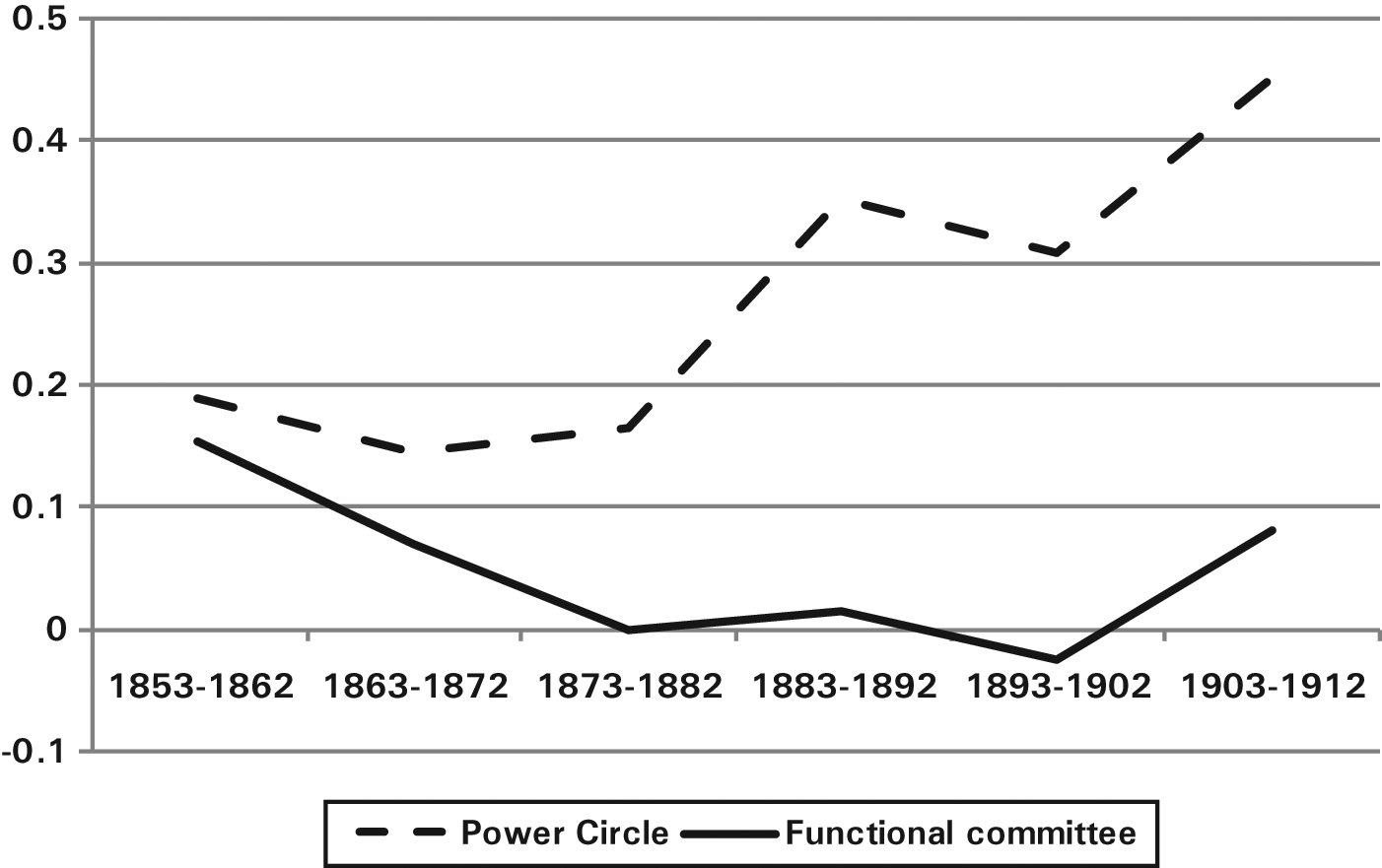
Correlation between bank size and membership in the NYCHA committees.*
The transformation of the NYCHA into an exclusive league of large banks is an emblem of the broader economic and social changes that occurred around the turn of the twentieth century. Research on this era has shown that the formation of large industrial corporations gave birth to new elites that built a common identity through overlapping social infrastructures such as exclusive social clubs, trade associations, and board interlocks (Baltzell, 1971; Zunz, 1982; Beckert, 2001; Marquis, 2003; Domhoff, 2009). Such venues provide forums for local elites to socialize with each other, exchange information, and coordinate collective actions. Researchers have documented that network cohesion facilitated elites’ collective actions in various self-serving causes (e.g., Mizruchi, 1989; Burris, 2005; Vogus and Davis, 2005; Marquis, Davis, and Glynn, 2011).
While elites are connected via multiplex networks, current research on elites has rarely calibrated different types of networks in equal terms or compared and contrasted their effects on elites’ mobilization. This is an important issue because organizational theorists have long argued that network content matters (Podolny and Baron, 1997; Haveman, 2000). Moreover, as the NYCHA served as a distributional instrument that favored elites, a legitimacy concern arose. The function of different types of social networks may be contingent on the legitimacy of the organizational processes that they facilitate (Davis and Greve, 1997). In the Manhattan banking market, social clubs offered open forums for bankers and other elites to meet. Within such semi-public forums, collusion was unlikely, and social clubs might have facilitated the diffusion of information and the formation of goodwill. Board interlocks, in contrast, were formed in smaller and more exclusive groups of board members with homogeneous economic interests and were sustained in private meetings, both conditions that work well for the purpose of concealment and that make interlocks more suitable structures for providing exclusive benefits to those occupying central positions. As such, social clubs and board interlocks may have functioned differently in facilitating elites’ control within the NYCHA.
Elite Exclusivity and Institutional Failure
When functioning as a distributional instrument for institutional incumbents to obtain advantages vis-à-vis other groups, a private market-governance institution is often closed. The exclusivity is necessary when incumbents attempt to accrue collective benefits to themselves and to prevent rivals from obtaining them. Although exclusivity helps to maintain a high level of elite cohesion, it also comes at a cost. As Tocqueville (1856) observed with regard to the French Revolution, violent revolution came to France because the nobility had degenerated into a caste that refused to assimilate the bourgeoisie, new men of increasing economic power and influence. Tocqueville’s insight that exclusivity breeds instability is doubly relevant for private market-governance institutions because in-group cohesion is necessary to resolve the free-rider problem that inhibits all forms of private governance. Exclusivity and the potential for group rivalry, then, are endogenous to the formation of private institutions. When the extent to which private institutions can supply market order depends on their ability to control a critical mass sufficient for market stability, elites controlling these institutions face a critical problem concerning how to manage the exclusivity.
Functioning as an instrument for large banks to control the market, the NYCHA excluded small banks and the newly emergent trust companies. Trust companies were a different form of banking organization, and their most important difference from traditional commercial banks was their organizational structure as a “department store of finance” (Herrick, 1909: 33). Trust companies were initially chartered as “corporations which would perform as savings banks for a wealthier clientele than the laboring classes presumably served by savings banks” (Neal, 1971: 37). To perform this function, trust companies obtained banking functions such as the ability to receive deposits and to make loans, gradually coming into competition with commercial banks. Trust companies grew rapidly with the accumulation of individual and corporate wealth, and they played important roles in reorganizing railroads and financing industrial consolidation at the turn of the twentieth century (Herrick, 1909). In the late 1890s, trust companies began to pose a serious threat to the older banking institutions (Neal, 1971). The rivalry between banks and trust companies had been further fueled by the controversy about the cash reserves of trust companies. Because trust companies were not chartered under banking regulations, they were exempted from the cash reserve levels required for banks (15 percent for state banks and 25 percent for national banks). Banks complained that it was unfair that trust companies were permitted to engage in banking activities without holding sufficient cash reserves. This claim of unfair competition allowed banks to legitimize a key competitive mechanism under their control, access to the NYCHA, to defend their interests.
In 1903, the NYCHA passed a rule requiring trust companies that cleared checks through NYCHA member banks to maintain a 15 percent cash reserve. But the NYCHA’s practice intensified the rivalry with trust companies, and rather than complying with the rule, most trust companies abandoned their relationship with the NYCHA. Representing the voice of trust companies, George W. Young, the president of the New York Trust Company, published a renowned article in the North American Review in 1906, accusing the NYCHA of dictating the market. Young (1906: 19) cautioned that the power of the NYCHA had drifted toward “a few strong hands” and that this private market-governance institution had become a tool for a “central, dominating group” to control the market. Because the NYCHA refused to place relations with trust companies on an “equitable” footing, the “enforced withdrawal of trust companies creates an unwholesome situation, both banks and trust companies admit” (Banking Publicity Association, 1905: 63). By forcing out trust companies, the NYCHA banks became market minorities; at that time, the trust companies’ deposits and total assets exceeded those of the associated banks of the NYCHA. “The weekly bank statement (of the NYCHA),” the Banking Publicity Association (1905: 63) reported, “is, therefore little less than farcical as a barometer of current changes in the banking situation and money market.”
The Panic of 1907 was different from previous bank panics in that it was centered on trust companies in New York (Moen and Tallman, 2000). On October 16, 1907, the failure by Augustus Heinze and his associates to corner the stock of the United Copper Company triggered runs on the banks and trust companies that had financed this stock speculation. The NYCHA took immediate action to assist three member banks that were affected but refused to extend assistance to affected trust companies. On October 22, the Knickerbocker Trust Company, the third largest in New York, sent an urgent loan request to the NYCHA, but the NYCHA committee refused this request and decided that “the advance of money for the protection of depositors is limited to its own members” (Clearing House Committee Minutes, 1907, quoted by Wicker, 2000: 91). Unable to obtain help elsewhere, Knickerbocker failed, which significantly deepened the market crisis. From October 22 to October 25, ten banks and trust companies in the New York area failed. The failure of the NYCHA to extend assistance to trust companies generated serious consequences. As Tarbell (1913: 44) suggested, “the community would have been better protected if the Knickerbocker had been a member of the Clearing House . . . (and) subject to the will of a sister bank.” The NYCHA played a passive role during the Panic of 1907, and self-interest prohibited it from taking responsibility for shoring up the whole market; thus the crisis was seen as a failure of private regulation (Sprague, 1910: 257).
Essentially, what caused the institutional failure of the NYCHA was the absence of “bold and effective leadership” (Wicker, 2000: 136). Here, leadership refers to an ability to control a special group that pursues its narrow self-interests without regard to the larger consequences for the community as a whole. This does not mean that elites have to be altruistic but that securing institutional stability requires maintaining a deliberate distributional balance. Elites need to carefully manage their interdependence with other actors, to weigh short- vs. long-term interests, and to make small sacrifices to avoid big evils; this is exactly what characterizes Tocqueville’s (1856: 122) definition of a “vigorous” ruling authority. The Panic of 1907 projected Tocqueville’s insights into private market-governance institutions. In the case of the NYCHA, exclusivity prevented the market-governance institution from acting swiftly to rescue rival groups, even when doing so would restore market order and consequently benefit the NYCHA’s direct supporters as well. Thus, when the efficacy of a private governance institution to supply market order depends on influence over a sufficiently large proportion of the market, we predict that the protection that a private market-governance institution offers to its participants will be reduced if a high percentage of market players are excluded from the private scheme.
The failure of the NYCHA to expand its institutional boundary was rooted in elites’ misjudgment of the interdependence between organizations. During bank panics, an individual banking organization’s poor performance could endanger the robustness of a whole industry. Mitigating this negative spillover effect was precisely how the NYCHA had stemmed the tide of bank panics. But legitimacy loss occurs not only within the same organizational form but also across forms with similar characteristics (Jonsson, Greve, and Fujiwara-Greve, 2009). Just as bank runs spread from trust companies to national banks during the Panic of 1907, in many other settings market punishments spill over from responsible organizations to others with different organizational forms but superficial similarities (Xu, Najand, and Ziegenifuss, 2006; Yu, Sengul, and Lester, 2008; Jonsson, Greve, and Fujiwara-Greve, 2009). Given the existence of such a negative spillover effect, the protection that a private market-governance institution offers to its participants may be even more reduced when a market is fragmented and the failure rate for the rest of the market is high. Therefore, understanding the particular mechanisms through which market stability is sustained sheds light on how elites’ efforts to deploy private institutions to defend their interests may ironically end up hurting their own interests.
Our theory predicts that NYCHA members became more vulnerable when they denied other market players equal opportunities for institutional participation and when the failure rate for other market players was high. But intriguing questions remain: what enabled the collective action within the NYCHA, and did all members fare equally within this collective institution? These questions are also theoretically important, as scholars who study private regulation have repeatedly pointed out that a free-riding problem plagues private regulation (e.g., King and Lenox, 2000; Short and Toffel, 2010). Thus it is worthwhile to test whether elites’ network cohesion might have supplied the normative control for the NYCHA. Moreover, power-elite theory predicts that when elites deploy market-governance institutions to obtain distributional advantages, their advantages often come at the expense of other market players, and well-connected business elites are especially able to extract preferential treatment (Hunter, 1953). Thus we further test whether the network cohesion within the NYCHA increased other banks’ likelihood of failure and whether NYCHA banks occupying central positions in elite networks might have benefited more from elites’ cohesion.
Method
Data
We compiled data on the population of banking organizations (banks and trust companies) in Manhattan and obtained their balance sheets from the Annual Report of the Superintendent of Banks of the State of New York (1853–1914) and the Annual Report of the Comptroller of the Currency (1864–1914). Our observation window covers the entire period of the NYCHA’s regulation over the Manhattan banking market from 1853 when the NYCHA was founded to 1913 when the Federal Reserve replaced the NYCHA as the market regulator. From 1853 to 1913, we identified 240 banking organizations that were headquartered in Manhattan. We collected the data on which of these were members of the NYCHA from that institution itself.
Variables
Our dependent variable is a banking organization’s hazard of failure in a year. Out of the 240 banking organizations in Manhattan during this period, 129 failed: 65 ended in liquidation, 63 were absorbed by another banking organization, and one bank moved out of Manhattan. Because voluntary mergers may occur for different reasons than failures, we followed other analyses of organizational failure by treating those banks that ended with a voluntary merger as being right censored. We followed Banaszak-Holl (1991) in distinguishing voluntary mergers from absorptions. We coded merger as an absorption or as being voluntary if historical documents clearly state which type of event occurred. For those without confirmation from historical documents, we coded a voluntary merger as occurring “when executive officers from both banks were retained or when the geographical location of one bank was maintained as the head office while the executive officers of the other bank were retained” (Banaszak-Holl, 1991: 28).
We measured institutional exclusion, the extent to which the market was beyond the control of the NYCHA, using the percentage of banking organizations that were not affiliated with the NYCHA in a year. We predicted that the NYCHA member banks’ failure rate would be higher when the percentage of banking organizations that remained outside the NYCHA was high. It is worthwhile to note that this measure of institutional exclusion is not subject to a reverse causality issue (i.e., banking organizations stayed outside the NYCHA because its protection for members was reduced). In fact, there were only two banking organizations that relinquished their NYCHA memberships before they failed, while all other NYCHA members maintained their membership until they dropped out of the population. Moreover, about 80 percent of the banking organizations that remained outside of the NYCHA were excluded for reasons unrelated to the functionality of the institution: 43 percent were trust companies that, as such, were prohibited from becoming NYCHA members, and 36 percent were banks that were too small to meet the minimum size requirements of the NYCHA. In addition, we considered the selection of banking organizations for NYCHA membership in our analysis. Another exclusion measure that takes into account market mass, using the percentage of the total assets of banking organizations that were not affiliated with the NYCHA in a year, generates results similar to those reported in this paper. The correlation between the count-based and the asset-based measures of institutional exclusion is 0.85.
NYCHA affiliation is a dichotomous variable coded 1 for banking organizations that were affiliated with the NYCHA in a given year. Non-CH member banks’ failure rate was measured as the number of non-NYCHA member banks that failed in the previous year. Hypothesis 1 predicted that the interaction term between a banking organization’s NYCHA affiliation and institutional exclusion would be positively related to its likelihood of failure. Hypothesis 2 predicted that the three-way interaction of a banking organization’s NYCHA affiliation, institutional exclusion, and non-CH member banks’ failure rate would be positively related to its likelihood of failure.
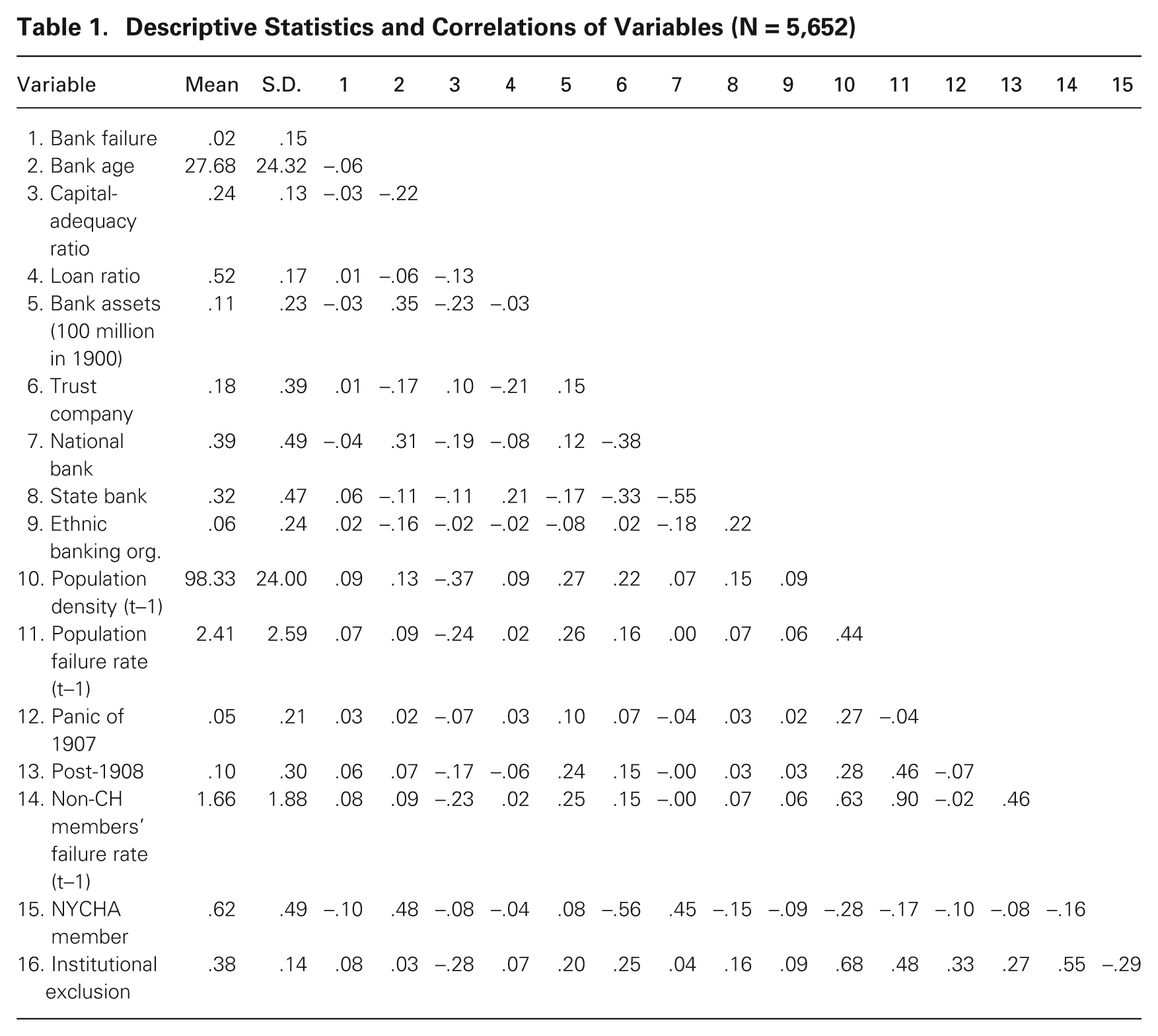
We controlled for a set of characteristics at the banking organization level. We controlled for age and the inflation-adjusted asset size for each banking organization. We also included a bank’s capital-adequacy ratio, measured as the ratio of its self-owned capital (including capital, capital reserve, profit, and surplus) to its total assets, and its ratio of loans to total assets in a year. We included three dummy variables to indicate whether a banking organization was a national bank, a state bank, or a trust company. The banks that existed between 1853 and 1863, before the National Banking Act defined the systems of national and state banks in 1864, formed the omitted category. We created a dummy variable to indicate whether a banking organization was an ethnic banking organization. We identified ethnic banking organizations as those with names that carried obvious ethnic characteristics. To control for the effect of the Panic of 1907, we created one dummy variable to indicate the years of 1907 and 1908 and another to indicate the post-1908 era. At the population level, we controlled for the population density of banks at the beginning of each observation year, as suggested by density-dependence theory (Carroll and Hannan, 2000). To capture possible rate dependence, we also included the failure rate of all banking organizations from the previous year. In unreported analysis, we also controlled for the square terms of population density and failure rate, but they were highly correlated with their singular terms, were not significant themselves, and did not affect other variables, and so we omitted them from the reported analysis. Moreover, the population failure rate is highly correlated with the non-CH member banks’ failure rate (r = 0.9), so to avoid the multicollinearity problem, we also tested hypothesis 2 by omitting the population failure rate; we found that the results remained similar. Table 1 reports the descriptive statistics and correlations of these variables.
Descriptive Statistics and Correlations of Variables (N = 5,652)
Analysis
One difficulty in modeling the impact of a banking organization’s affiliation with the NYCHA on its failure hazard is that a banking organization’s membership depended on choice by the bank and by the NYCHA. To address this concern, we adopted the inverse probability treatment weighting (IPTW) method (Hernán, Brumback, and Robins, 2000; Robins, Hernán, and Brumback, 2000) to correct for each banking organization’s tendency to join the NYCHA. This method is particularly useful for our research design because it helps to establish causal relationships when confounding variables (i.e., a banking organization’s conditions) are time varying and are also affected by previous treatment (i.e., NYCHA membership). Relying on the logic of counterfactuals, IPTW compares the failure rates of pseudo-populations (i.e., if all that are treated had not been treated and if all that are not treated had been treated). To do so, IPTW first estimates the time-varying probability of each subject being treated and then weights each subject with the inverse probability of being treated to adjust for the potential selection bias introduced by non-random treatment.
We implemented the IPTW model by first estimating a pooled logistic regression to estimate a bank’s likelihood of joining the NYCHA given that it was not a member in the previous year. Because there were only two banks that relinquished their NYCHA memberships before they failed, we assumed that a bank remained a member once it joined the NYCHA and defined the treatment as a regime shift: the probability of being a member was constant and equaled 1 once a bank became an NYCHA member. Thus it is only necessary to fit the model to a subset of the data, which includes the banks that had not joined the NYCHA yet:

where Y is a bank’s affiliation with the NYCHA in a year, L refers to the potential time-varying confounders that influenced both a bank’s likelihood of joining the NYCHA and its likelihood of failure (i.e., asset size, capital-adequacy ratio, loan ratio, and ethnicity), and V refers to other both time-varying and fixed-over-time variables that were potentially related to the bank’s likelihood of joining the NYCHA (i.e., other control variables at the bank and population levels). We calculated the denominator of the inverse probability weight for bank i at year t as

if bank i did not join the NYCHA by year t, and as

if bank i became an NYCHA member in year t. Robins, Hernán, and Brumback (2000) suggested that stabilized weight does not affect the consistency of the IPTW estimator but improves the efficiency of the estimation. Thus, following Hernán, Brumback, and Robins (2000), we stabilized the IPTW weight by estimating another pooled logistic regression, including the same set of variables except for the time-varying confounders and calculating the numerator of the stabilized weight with the same procedure used to calculate the denominator. The stabilized weights take the form:

The IPTW method assumes that observables are sufficient to control for confounding effects. In this study, the potential confounders that we controlled for included a banking organization’s size, capital-adequacy ratio, loan ratio, and whether it was an ethnic bank. It is reasonable to assume that these are the most important potential confounders, considering that the benefits of joining the NYCHA consisted mainly of saving the labor of check clearing and obtaining emergency loans during panics.
Organizational failure is often modeled using survival analysis. In this paper, we followed Hernán, Brumback, and Robins (2000) and fitted a weighted pooled logistic regression to estimate the odds that a banking organization would fail in a given year. Hernán and colleagues (Hernán, Brumback, and Robins, 2000; Hernán, Hernández-Díaz, and Robins, 2004) suggested that this is a convenient way to incorporate the IPTW method into survival analysis. 2 The use of weights induces within-subject correlation, which violates the assumption of standard logistic regression. To overcome this difficulty, we specified the robust estimation of the standard variation clustered by each banking organization.
Results
Table 2 reports the IPTW logit analysis of the impact of institutional exclusion on the effectiveness of the NYCHA in reducing members’ failure rates. Model 1 reports the baseline model and shows that NYCHA member banks had significantly lower failure rates. Model 2 includes institutional exclusion and shows that the population-level failure rate was significantly higher when the level of institutional exclusion was high. Model 3 tests hypothesis 1 and shows that NYCHA banking organizations were significantly more likely to fail when a high percentage of banking organizations were outside of the private institution. The result indicates that a one-standard-deviation increase in the institutional exclusion multiplied the failure odds of the NYCHA members by a factor of 2.5, lending support to hypothesis 1. Model 4 includes non-CH members’ failure rate and the two-way interactions of this variable with institutional exclusion and the NYCHA membership. Finally, model 5 tests hypothesis 2, whether NYCHA member banking organizations were even more likely to fail when institutional exclusion co-occurred with a high failure rate for the rest of the market. The result shows marginal support for this hypothesis. In addition, the coefficients of other variables in model 5 remain largely consistent as compared with those in model 4, and the fitness of model 5 also increases significantly over that of model 4 [χ2(1) = 4.514, p < .05]. These results indicate that the significant three-way interaction is not an artifact of multicollinearity. On average, when the institutional exclusion is set at its mean, a one-standard-deviation increase in the non-NYCHA members’ failure rate multiplies the failure odds of the NYCHA members by a factor of 6.3, lending support to hypothesis 2.
Impact of Institutional Exclusivity on Bank Failures (N = 5,652)*
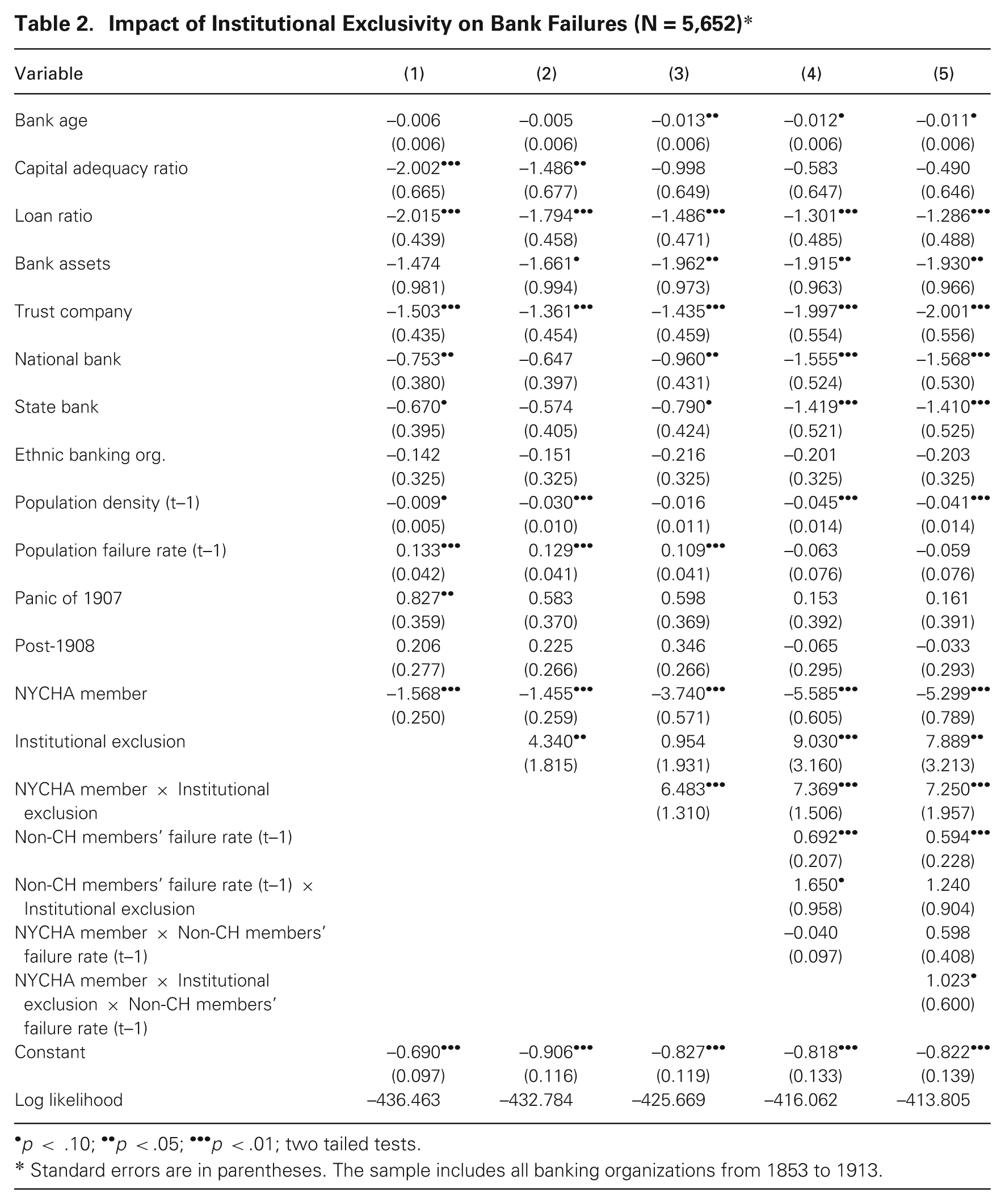
p < .10; ••p <.05; •••p <.01; two tailed tests.
Standard errors are in parentheses. The sample includes all banking organizations from 1853 to 1913.
Because our sample includes three types of banking organizations with different types of charters, customer bases, and investment structures, it is worthwhile to examine whether the effect of institutional exclusion varies with the subgroups of banking organizations. Thus we conducted additional analyses for each of the three types of banking organizations—national banks, state banks, and trust companies. Because the parallel system of the federal- and state-chartered banks was not established until 1864 when the National Banking Act was passed, we limited our observation window to the period between 1864 and 1913. Models 6–9 in table 3 show the analyses of national banks, and models 10–13 show those of state banks. The results in models 7 and 11 clearly support H1, showing that our prediction that NYCHA members were significantly more likely to fail when the institutional exclusion was high holds for both national and state banks. For H2, both models 9 and 13 show that the direction of the coefficients remains as predicted, but they are not statistically significant, which may be attributed to the relatively small sample size in the subgroup analyses. In addition, because none of the national banks was an ethnic bank, that variable was excluded from the analyses of national banks.
Impact of Institutional Exclusivity on Bank Failures, by the Charter of Banking Organizations*
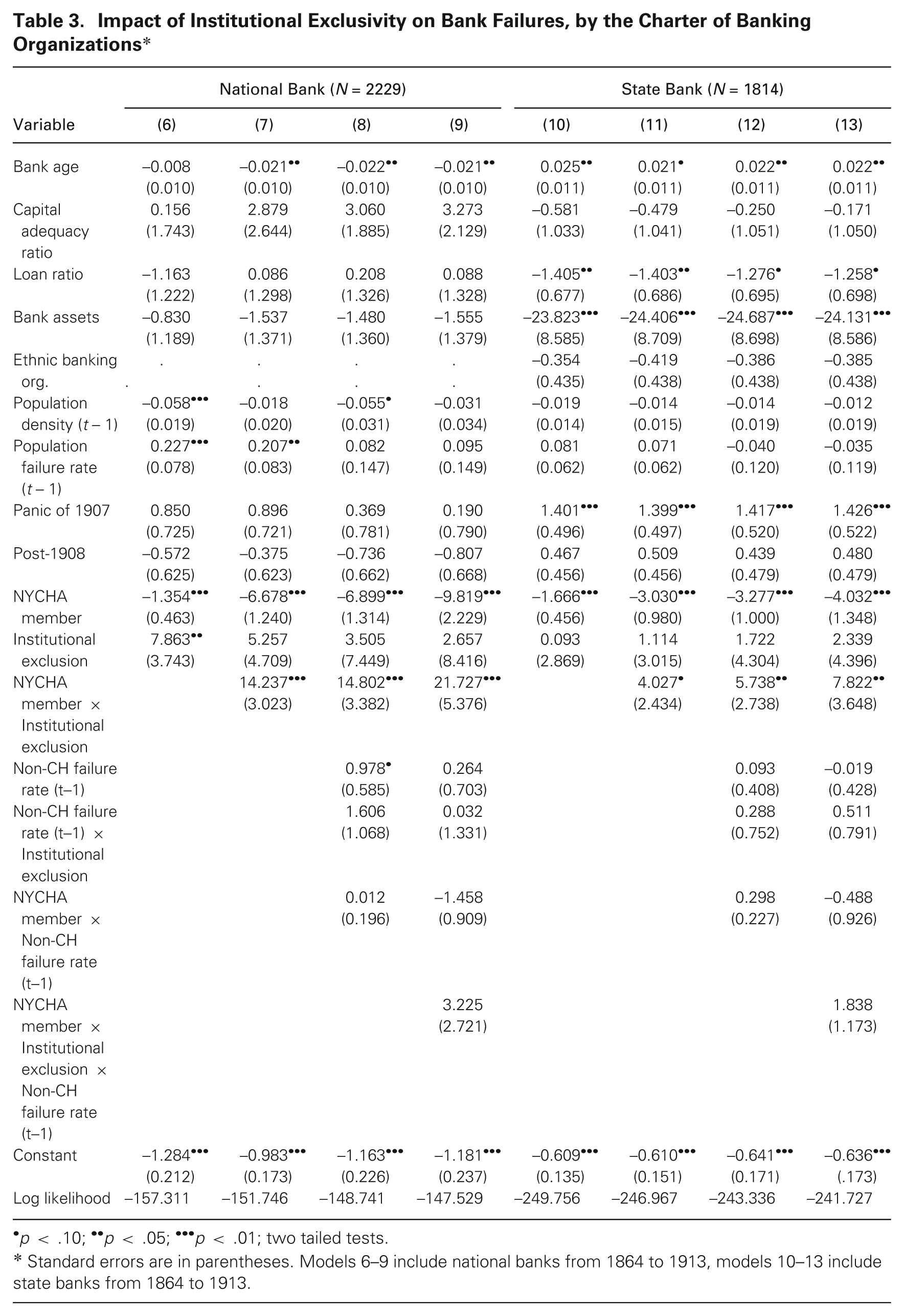
p < .10; ••p < .05; •••p < .01; two tailed tests.
Standard errors are in parentheses. Models 6–9 include national banks from 1864 to 1913, models 10–13 include state banks from 1864 to 1913.
Because trust companies became eligible for the NYCHA membership only after 1910, their analyses differ substantially from those of national and state banks. We thus omitted these analyses, but the results show that institutional exclusion significantly increased their failure rate as well. Finally, we also conducted subgroup analyses by banking organizations’ eligibility to join the NYCHA. These results also consistently show that the NYCHA members were more likely to fail when the level of institutional exclusion was high. All together, the subgroup analyses show the robustness of our finding that the NYCHA banks made themselves more vulnerable through exclusivity.
Modes of Elite Mobilization
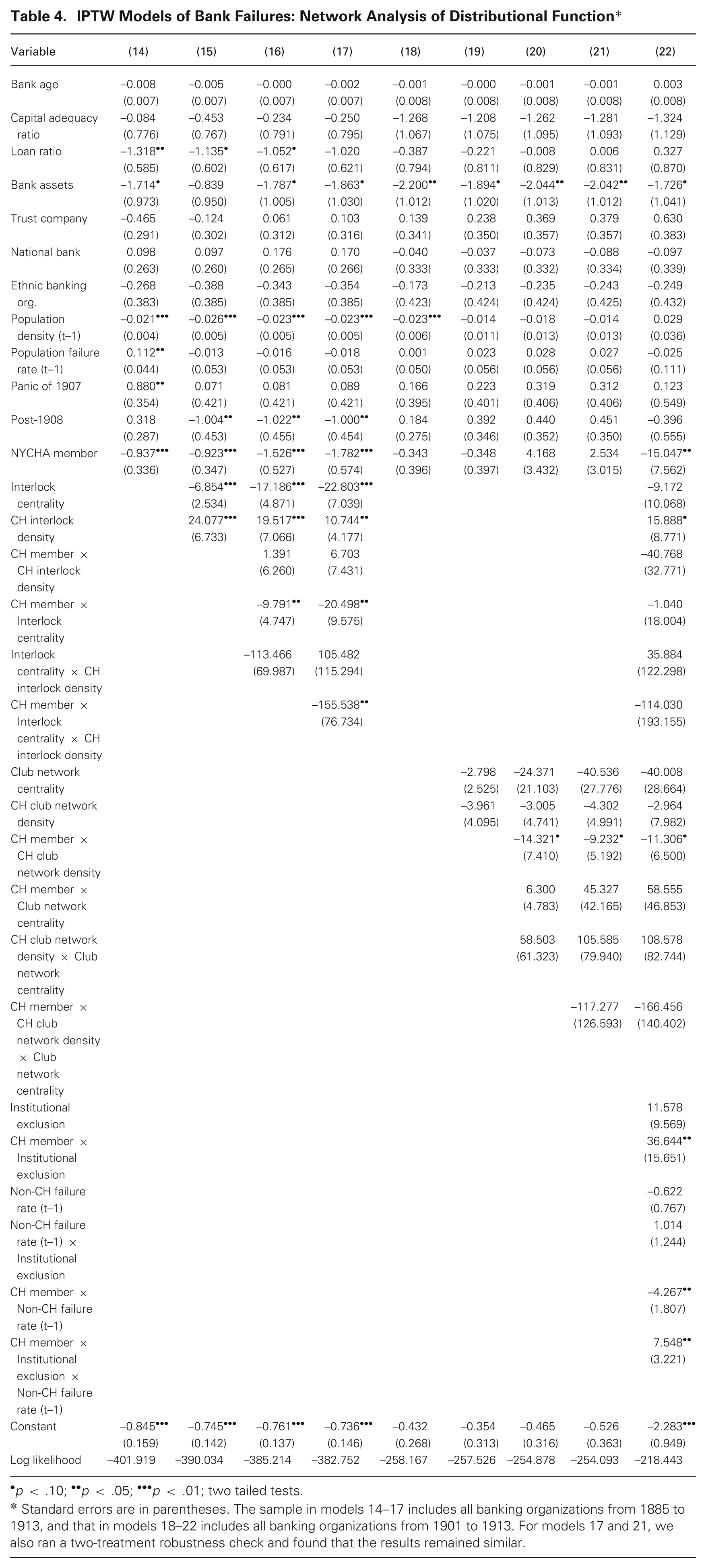
We further collected social network data to analyze how social networks facilitate elites’ mobilization within the NYCHA. We collected data on banking organizations’ executives and directors from 1885 to 1913 and measured the interlock network density among NYCHA member banking organizations using the ratio of the number of existent interlock ties between any pair of banking organizations to the total number of all possible ties between them, i.e., the sum of existing ties/[n × (n−1)/2]. 3 Similarly, we collected data on the NYCHA banking organization presidents’ affiliations with social clubs in New York City from 1901 to 1913 and calculated the social-club network density among NYCHA bankers. 4 In addition, we measured network centrality for each individual banking organization as the eigenvector centrality of a banking organization in the interlock or social club networks. The descriptive statistics of these variables along with other control variables are omitted to save space but are available upon request.
Table 4 presents the results. Models 14 to 17 test the distributional function of the NYCHA using the interlock network cohesion and show that (1) a banking organization with a high centrality within the interlock network was significantly less likely to fail, (2) the density of interlock networks among the NYCHA banking organizations significantly increased the failure rate of the whole population, and (3) a high level of NYCHA interlock density significantly reduced the failure rates of the NYCHA members that occupied central network positions. Models 18 to 21 replicate the analyses conducted in models 14 to 17 using the social club network cohesion and show that the coefficients were largely insignificant except that NYCHA member banks as a whole marginally benefited from the higher level of social club network density. Finally, model 22 reports the joint analysis of the variables of the two networks and institutional exclusion. The results in model 22 show that the effects of institutional exclusion either remained robust (b = 36.644, p < .05) or turned even more significant (b = 7.548, p < .05), indicating that the co-occurrence of institutional exclusion and non-CH members’ failure caused more failures of NYCHA member banking organizations in the later period of the NYCHA’s operation. In addition, we also adopted the two-treatment IPTW method that simultaneously controlled a banking organization’s chance of being a NYCHA member and of occupying a central network position. In these unreported analyses, our findings that central players were less likely to fail when the NYCHA interlock network was dense but not when the social club network was dense remain robust, confirming our expectation that network content matters.
IPTW Models of Bank Failures: Network Analysis of Distributional Function*
p < .10; ••p < .05; •••p < .01; two tailed tests.
Standard errors are in parentheses. The sample in models 14–17 includes all banking organizations from 1885 to 1913, and that in models 18–22 includes all banking organizations from 1901 to 1913. For models 17 and 21, we also ran a two-treatment robustness check and found that the results remained similar.
In unreported analyses, we further distinguished the effect of NYCHA member banks’ network density on the NYCHA and non-NYCHA member banks by conducting an additional set of subgroup analyses according to a banking organization’s NYCHA membership and using the network-centrality weighted IPTW models. We found confirming evidence that NYCHA member banks’ interlock density did significantly increase non-NYCHA banking organizations’ failure rate. Moreover, the NYCHA member banks benefited unevenly from the high network density of the institution: only those that occupied relatively central network positions enjoyed additional survival advantages.
Discussion and Conclusion
Fligstein and Dauter (2007: 106) likened the condition of the sociology of markets to “the blind monks and preachers who fail to see the whole of the elephant in Buddha’s famous parable”—each theory remains separate and distinct and provides an incomplete account of markets. To build a more general understanding of the origins, creation, and dynamics of markets, they urged scholars to seek out and explore the commonality and differences in their perspectives and be open to mechanisms that other scholars propose. Our investigation of the efficacy of the NYCHA over 60 years in stabilizing the Manhattan banking market answers their call to cross-pollinate ideas from different subfields of the sociology of markets.
Our findings extend Fligstein’s (1996) political-cultural model of markets by suggesting that market-governance institutions do not just self-perpetuate but can contain within themselves seeds of destruction. Institutional stability is not simply automatic but may need to be sustained strategically. Doing so requires managing mutual dependence between the institutionally advantaged and other groups. Thus the key to understanding the endogenous failure of market-governance institutions lies in specifying the precise mechanisms on which particular institutions rest. In the context of the NYCHA, organizations share a communal relationship in that the fate of an organization depends not just on its own actions but also on those of its peers. Ignoring this communal relationship, market incumbents’ capacity to stabilize their competitive environments through institution building is limited by the very structures they have helped to create.
We built on power-elite theory to argue that private market-governance institutions face a dilemma in managing their exclusivity when functioning as a distributional instrument for market elites. Institutional exclusivity helps to disadvantage rival groups, but it also limits the influence of market-governance institutions to only a portion of a market. When there is a negative externality from an individual organization’s poor performance to the robustness of an industry, elites’ own efforts to defend their interests through increasing institutional exclusivity result in market destabilization. We show that the NYCHA, a cooperative device founded to achieve the benefits of concerted actions by bankers, transformed into a closed system dominated by large, established banks to control the market around the turn of the twentieth century. But market elites’ deployment of the NYCHA to defend their interests ultimately worked to weaken that institution’s capacity for maintaining market order, as the deepening market fragmentation escalated market crises. The failure of the NYCHA to stabilize the market inspired debates about the adequacy of private banking regulations, which eventually led to the end of the NYCHA’s role as a market regulator.
Our finding that institutional fragmentation constrains regulatory effectiveness has implications for contemporary public and private market-governance institutions. Even the Federal Reserve system, which was established to replace the Clearing House, faced the same problem in its early days of operation. Although national banks were required to join the Fed, state banks had the discretion to remain outside of this public regulation. Federal Reserve officers recognized the limitation of a lack of sufficient participation from state banks, and they used the political opportunity of the entry of the U.S. into World War I to encourage participation, depicting joining the Fed as a patriotic action to support U.S. soldiers (Committee on Public Information, 1917). The Fed’s efforts to minimize institutional fragmentation were not a complete success. One of the most important reasons for the massive bank failures during the Great Depression was that large numbers of state banks remained outside of the Federal Reserve system (Davis, 1966). The Federal Deposit Insurance Corporation (FDIC) was later established partly to address this institutional fragmentation problem by assimilating smaller state banks into the federal regulation system. No market-governance institution can be effective without sufficient participation, but this issue is particularly salient for private institutions because they are sometimes intentionally closed.
For contemporary private-regulation programs, the institutional fragmentation problem manifests itself in terms of competition between multiple private-regulation schemes. In the past two decades, controversies over sweatshops, child labor, tropical deforestation, and other issues have spurred the creation of various private-regulation programs that certify organizations’ compliance with social and environmental responsibilities. There are at least seven different certification programs in the coffee industry, 11 for flowers, over 30 for forest products, over 40 for textiles, and over 100 for food products (Harbaugh, Maxwell, and Roussillon, 2010; Prado, 2010). Various certifiers have emerged to cater to the divergent interests of subgroups of an industry, and the differentiation strategies they pursue further enable opportunistic organizations to shop for certifiers. The new problem created by these competing certifiers is “a race to the bottom”: market order is destroyed when competing certification organizations decrease the stringency of their standards and focus their efforts on marketing in order to promote the adoption of these standards (Prado, 2010).
The problem of institutional fragmentation in many private-regulatory domains can be attributed to the coexistence of two social processes, exclusion and usurpation (Parkin, 1979). Institutional exclusion, as we have shown, is the attempt by one group to secure a privileged position at the expense of some other group. Institutional usurpation is the countervailing action by the “excluded,” who organize collective actions to win a greater share of resources and to challenge the privileges of institutional incumbents. Usurpation is, in fact, a consequence of, and a collective response to, institutional exclusion. Thus the institutional fragmentation problem is fundamentally related to a distributive process by which social collectivities attempt to maximize self-interest by restricting access to resources and opportunities to a limited circle of eligible players. Future scholarship could address these new problems of institutional fragmentation in public and private regulation to reveal more about the dynamic relationship between competition within an industry and the evolution of regulation programs in that industry.
The idea that a market is a contested arena also resonates with recent research that has emphasized that market players and their practices are embedded within broader cultural structures. Studies have shown that macro-level shifts in beliefs such as logics lead to changes in organizational practices (Ruef and Scott, 1998; Thornton and Ocasio, 1999; Lounsbury, 2001; Fiss and Zajac, 2004), the founding of new organizations (Haveman and Rao, 1997; Lounsbury, 2005), a gain in professional status (Lounsbury, 2002), divergent paths of innovation diffusion (Lounsbury, 2007), and resistance by professionals (Greenwood and Hinings, 1996; Marquis and Lounsbury, 2007). But most studies so far have investigated the consequences of the shift of institutions (Greenwood et al., 2011); few studies have investigated what causes logic shifts. An exception is Lounsbury and Rao (2004), who argued that the changes in the institutional belief system can be perceived as outcomes of competition by participants in organizational fields. This paper contributes to this small body of literature by suggesting that the shift in institutional logics can be triggered by the failure of private institutions. In particular, the failure of the NYCHA to restore market order during the Panic of 1907 led to the banking regulation reform that eventually introduced public means to alleviate bank panics and established the “regulatory logic” (Lounsbury, 2002: 256) in the American financial industry. In addition, this paper proposes a new mechanism that results in a shift of institutional logics: miscalculation by dominant market players.
That dominant market players played a role in accelerating the regulatory shift within the American financial industry echoes the finding of some legal scholars that regulation and law are not exogenous events but, rather, their creation and implementation are affected by organizational elites (Edelman et al., 2011). Thus analyzing how the linkages among elites, experts, and command posts shape policy and legal dynamics would enlighten our understanding of American financial regulation (Zald and Lounsbury, 2010). Just as the case of the Panic of 1907 illustrates, market elites’ inability to move beyond their narrow self-interests resulted in a serious crisis. It can be argued that, from a strategic perspective, what an effective market-governance institution requires is a capacity to suppress the specific group interests that work against the preservation of the system. We think that this point sheds light on the financial crisis of 2008. As scholars have pointed out, one important cause of the financial crisis of 2008 was the lack of government oversight of the highly risky mortgage-based security market (Fligstein and Goldstein, 2010). But the lax regulation and the lack of discipline are both the result of bankers’ active pursuit of their narrow, short-term interests. On this very point, the financial crisis of 2008 is strikingly similar to the Panic of 1907. This is exactly the situation that Mizruchi (2010: 435) labeled as a paradox of “power without efficacy,” in which “business, having won the war to free itself from the state and the workers, and having regained a level of legitimacy and admiration unlike anything since the 1920s, was now unable to prevent the collapse of its own system.”
Schneiberg and Bartley (2008) argued that industrial regulation in the twenty-first century has evolved from the traditional state-centered command and control to many alternative forms of “soft laws” such as industrial self-regulation. But our findings show that these alternative forms of institutions do not necessarily produce superior regulatory results. Actually, many soft laws were experimented with in the U.S. in the early twentieth century, but they produced failures (Schneiberg and Bartley, 2008). Thus when exploring the future route of American financial regulation, policymakers should keep in mind that, beneath the variety of regulatory forms lies a fundamental question: whether a market-governance institution can effectively balance the conflicts of interests between different sectors of the market in a fashion that can preserve the system as a whole. Our investigation of the NYCHA indicates that studying market elites and their struggles with other players adds a useful perspective that reveals the dynamic evolution of various alternative forms of market-governance institutions mushrooming in the twenty-first century.
In addition, we contribute to the theoretical integration of the sociology of markets by showing that studying market institutions contributes to power-elite theory. Power-elite theory has been criticized for assuming rather than empirically demonstrating elites’ advantages (Burris, 2005). Our finding that elites monopolized the NYCHA as a competitive instrument to disadvantage other market players suggests that private market-governance institutions are one instrument through which elites have achieved their advantages. Moreover, the current strands of scholarship in power-elite theory have focused on two mechanisms of how elites’ hegemony may induce institutional instability (Mahoney and Thelen, 2010). One mechanism concerns the distributional effects of institutions that may trigger divisions among elites (i.e., divided elites), and the other emphasizes that subordinate groups may be disadvantaged to such a point that they organize to break the prevailing institutional arrangements (i.e., united subordinate groups). Our findings suggest that, in the market setting, a negative spillover effect from an individual organization’s poor performance to the robustness of an industry is yet another mechanism that causes endogenous failure of prevailing institutions.
Our study also shows that, besides a distributional balance, the success of market players’ attempts to stabilize markets through institution building rests on networks, which are important means for elites’ mobilization. Our finding helps to promote the theoretical integration between institutional theory and social network literature. Network scholars have built on Granovetter’s (1985) seminal idea that structural cohesion reduces information costs and promotes trust, making formal institutional arrangements less necessary. Perceiving a substitution relation between networks and institutions, network scholars have shied away from incorporating norms and rules into their analysis (Fligstein and Dauter, 2007). We leverage power-elite theory to argue that social networks provided the structural foundations for the development of local elite culture through facilitating the formation of a high level of elite cohesion. Our findings suggest that when we shift our attention from individual actors to their collective action, network structures can mediate how effectively norms and rules can be applied to solve the problems that economic actors encounter in their interactions.
Moreover, we found that network content matters: while social networks that serve as semi-open forums increase transparency and nurture morality, those that support private, decentralized meetings serve only elite players and counterbalance the efficacy of private governance institutions in maintaining market order. This finding supports Davis and Greve’s (1997) argument that the function of different types of social networks is contingent on the legitimacy of the organizational processes that they facilitate. But we depart from Davis and Greve (1997) in that we found that interlocks are more, rather than less, likely to facilitate illegitimate organizational practices, to the extent that using exclusionary institutions to tip the balance of competition is illegitimate. One possible explanation is that we examined the function of interlocks before the Clayton Act in 1914 disbanded interlocks between direct competitors, while Davis and Greve (1997) studied their function in the 1980s. As the Pujo Committee’s report concluded in 1913, interlock networks were an important means for the so-called Money Trust to maintain its domination over financial and industrial markets. This conclusion raised the public’s fear that interlocks suppress competition and consequently led to the enactment of the Clayton Act to prohibit interlocks between direct competitors. As a result, the function of interlocks may have changed with the historical context (Mizruchi, Stearns, and Marquis, 2006).
We contribute to a more complete understanding of private institutions by showing that the founding and failure of private market-governance institutions can be asymmetric processes. To date, most studies of private market-governance institutions have been conducted by rational-choice theorists who attribute institutional incumbents’ gains in efficiency to the function of private institutions in securing coordinating benefits (Nee and Ingram, 1998). Our study shows that, while the rational choice view helps to explain the founding and early operation of the NYCHA, it oversimplifies the functional complexity of private market-governance institutions. Market-governance institutions exist not simply to realize coordinating benefits, they play an important role in discriminating distributional outcomes. Moreover, we found that the NYCHA failed to maintain market order not because of a free-rider problem but because its distributional nature limited its own capacity as a market regulator. We therefore encourage future scholars to take a more dynamic view of private institutions.
By revealing the dual function of private institutions in securing coordinating benefits and shaping distributional outcomes, this paper sheds new light on the widely shared observation that private institutions are less effective in large societies than in small communities. From Durkheim (1933) to Olson (1965) to Ostrom (1990), social scientists from various disciplines have attributed the disruption of the efficacy of private institutions to the increasing difficulty of monitoring and norm enforcement because of the enlarged scope of social life. Considering the distributional function shows one more twist. If cohesion is necessary to overcome the free-rider problem that all forms of private institutions face, maintaining a high intragroup cohesion would require excluding rival groups, especially in a large society that is more likely to have groups with competing interests. As we have shown, this exclusivity breeds instability. Thus exclusivity may be another built-in limitation that private institutions face when functioning in a large society. This may also partially explain why private institutions, despite being hailed as an important form of regulation, are far from being ubiquitous.
It is important for future scholars to test the scope condition of our theory. They should examine the conditions under which private market-governance institutions are more likely to be captured by elites. Elite capture may be more likely when industry evolution increases heterogeneity within an industry and when the threat of a competing group creates a condition for elites to justify their capture in the name of protecting collective interests (Rahim, 2010). In addition, as we have shown, elites’ interactions in private social settings facilitate their mobilization. Local tyrannies are also likely to form in the absence of formal structures such as collective rule making, mandated rotation of ruling positions, and monitoring by external governing bodies (Ostrom, 1999).
Future scholars should also examine the conditions under which elites’ capture may weaken or strengthen the regulatory efficacy of a market-governance institution. Understanding the particular mechanisms on which institutional stability rests is critical. Our study demonstrates that if elites’ capture creates sufficiently favorable conditions for other market players, a prevailing governance structure is likely to be reinforced. In other situations in which having an institution is more important than the content of the institution, elites’ capture may help to maintain market order, expand the size of the pie, and consequently enable a whole market to prosper.
What we demonstrate is that the effects of institutional processes are not only on the functioning of markets but also include outcomes of interactions and conflicts between different social groups. But institutional outcomes need not reflect the goals of any particular group. This has a fundamental implication for understanding institutional change, as it suggests that the forces of institutional decline are sometimes baked into institutions that seem robust. In this sense, institutional change and stability are inextricably linked.
Footnotes
Acknowledgements
We thank Peer Fiss, Joe Galaskiewicz, Linda Johanson, Mark Kennedy, Hayagreeva Rao, seminar participants at the USC Marshall School of Business for their advice, and Jane Banaszak-Holl for sharing her data with us. We are grateful to three anonymous ASQ reviewers and Henrich Greve for their helpful suggestions.
The Pujo Committee, led by Arsene Pujo, a member of the U.S. House of Representative, was created to investigate the so-called “Wall Street Money Trust.”
 provided a mathematical proof that pooled logistic regression is asymptotically equivalent to a time-dependent covariate Cox proportional hazard model when intervals between measurements are short, the probability of an event within an interval is small, and the intercept for the pooled logistic is constant across intervals.
Two banking organizations were coded as sharing an interlock tie if they had at least one common executive or board director. We collected the data from the Annual Report of the Superintendent of Banks of the State of New York (1885–1898), the Trow Co-Partnership and Corporation Directory of New York City (1885–1898), and the Directory of Directors in the City of New York (1899–1913). We started from 1885 because one of our sources, the Superintendent of Banks of the State of New York, did not start to list the names of executives and directors of state banks until 1885. Using the tie strength-weighted interlock density, which takes into account the number of shared executives and directors, generates similar results to those reported below.
We started from 1901 because one of our major data sources of club affiliations, Marquis’s Who’s Who in America, did not start to publish until 1899 and did not start to list club affiliations until 1901. We collected bank presidents’ club affiliations from Who’s Who and the Social Register of New York City. From these sources, we identified the ten most central clubs among the bankers and then manually checked the membership rosters of these clubs to verify each banker’s affiliation. In addition, we considered affiliations with two elite cultural organizations that bankers were actively involved in, the Sustaining Members of the Metropolitan Museum of Art and the Board of Directors of the Metropolitan Opera House. About 75 percent of the NYCHA member banks’ presidents appeared in the membership rolls of these clubs and cultural organizations. We coded two banking organization presidents as having a tie if they had at least one common social club affiliation. An alternative measure of the overall network density that takes into account the tie strength between any pair of banking organizations’ presidents generates similar results to those reported below.