






Abstract
In this paper, we examine the relationship between an organization’s proportion of female managers and the number of new management jobs initially filled by women versus men. We draw on theories of job differentiation, job change, and organizational demography to develop theory and predictions about this relationship and whether the relationship differs for jobs filled by female and male managers. Using data on a sample of New York City advertising agencies over a 13-year period, we find that the number of newly created jobs first filled by women increases with an agency’s proportion of female managers. In contrast, the effect of the proportion of female managers on the number of new management jobs filled by men is positive initially but plateaus and turns negative. In showing these influences on job creation, we highlight the dynamic and socially influenced nature of jobs themselves: new jobs are created regularly in firms and not merely as a response to technical and administrative imperatives. The results also point to another job-related process that differs between women and men and that could potentially aggravate, mitigate, or alleviate inequality: the creation of jobs. Thus this research contributes to literatures on demography, the organization of work, and inequality.
The stability of the set of jobs in organizations is frequently taken for granted across multiple bodies of literature. Scholars of opportunity structures have built many of their models on a presumption that women and men are sorted into and move through a structure of preexisting and stable jobs (e.g., Stewman, 1988). Organizational theorists continue to document inertia much more often than change in opportunity structures (e.g., Burton and Beckman, 2007; Beckman and Burton, 2008). These tendencies stand in contrast to a small but growing body of evidence showing that new jobs—distinct bundles of tasks with distinct new administrative job titles—are regularly created (Miner, 1987, 1991; Stewman, 1988; Cohen, 2013). This job creation is more complex than the addition of head count into preexisting positions. Rather, it is the creation of new positions with new titles through the bundling, unbundling, and rebundling of tasks into jobs and those into organizations. For example, the ranks of executives are reshaped when entirely new executive jobs (e.g., the chief operating officer and chief financial officer) are added and existing positions (e.g., chairman and chief executive officer) are combined, extended, or disaggregated (Harrison, Torres, and Kukalis, 1988; Hambrick and Cannella, 2004; Zorn, 2004). Such alterations to the landscape of jobs simultaneously change the prospects of organizations and their employees, transforming the way organizations’ work is done and pushing and pulling women and men into and out of a changing set of positions (e.g., Haveman and Cohen, 1994; Haveman, Broschak, and Cohen, 2009). Yet research on the organizational forces that drive change in the structure of jobs is limited, with little theory or evidence that directly explains organizations’ propensity to add jobs.
Insight into the forces that shape these structures comes from two sources: studies of the static properties of organizational job differentiation and studies of task changes within jobs. In the former, researchers attribute variations in the level of organizational job differentiation to the combined lure of administrative and technical efficiencies, normative and coercive pressures, and the demography of an organization’s workforce (e.g., Baron and Bielby, 1986; Strang and Baron, 1990; Baron, Burton, and Hannan, 1999). The literature on more micro-level changes within jobs further suggests that jobs may be altered in response to the qualities, actions, and interactions of those in and around them (Miner and Estler, 1985; Miner, 1987; Wrzesniewski and Dutton, 2001; Cohen, 2013). We build on these insights by theorizing about how two closely related factors drawn from these literatures affect job creation: organizational demographic composition and individual demographic characteristics. Specifically, we ask how the proportion of female managers in organizations influences the number of jobs created and whether newly created jobs are differentially assigned to male and female managers in those organizations.
There are overlapping theoretical and empirical reasons for focusing on demographic factors as drivers of job creation in organizations. Examining the intersection of organizational and individual demography allows us to advance existing research relating organizational demography to the level of job differentiation and managerial intensity in organizations (Strang and Baron, 1990; Baron, Burton, and Hannan, 1999; Baron, Hannan, and Burton, 1999). Across these studies, Baron and his colleagues have argued that organizations use their overall job structures to counteract conflict, dissatisfaction, reduced rewards, and other negative outcomes at the individual, group, and organizational levels produced by mixed-sex work settings. The pattern varies across studies. Baron, Burton, and Hannan (1999; Baron, Hannan, and Burton, 1999) found a linear negative relationship between the proportion of female managers at start-up and later managerial intensity for Bay Area technology companies. Strang and Baron (1990) found that balance in the proportions of men and women in work roles and occupations in the California Civil Service yielded a greater division of labor and more distinct job titles than either male- or female-domination. Baron and Bielby (1986) found no relationship between the proportion of men and women and job title differentiation in a sample of diverse organizations. This body of work has examined the effects of demographic composition on a highly aggregated organizational outcome—the overall level of job differentiation in organizations—and does not consider whether the organization’s structural responses differ for women and men.
This may be problematic for several reasons. Many of the theories drawn on in studies of demography—similarity-attraction, social-contact, and social categorization—are built on arguments that there are differences in how demographic composition affects minority and majority groups (e.g., Williams and O’Reilly, 1998; Tolbert, Graham, and Andrews, 1999). For instance, the likelihood of women exiting organizations varies with the proportion of women in organizations, but there is no parallel effect for men (Tolbert et al., 1995; Elvira and Cohen, 2001). Further, evidence suggests that job structures are altered depending on the demographic characteristics of the individuals who hold or will hold the jobs (e.g., Tilly, 1999; Skuratovicz and Hunter, 2004). Person-specific differentiation occurs when jobs are tailored for and by job holders (e.g., Miner, 1987; Bell and Staw, 1988; Wrzesniewski and Dutton, 2001), while at a more structural level, different types of jobs are created for, or assigned to, employees with different demographic characteristics (e.g., Skuratovicz and Hunter, 2004; Arndt and Bigelow, 2005). Together, this suggests that failure to explicitly examine differences in the effects of demographic composition across demographic groups masks important differences in patterns of the creation of jobs.
Second, there is a long tradition of research examining the effects of demography on the placement and movement of employees in organizational opportunity structures (Kanter, 1977a, 1977b; Pfeffer, 1983; for reviews, see Williams and O’Reilly, 1998; Reskin, McBrier, and Kmec, 1999). For example, in a multi-industry, multi-organization study, Huffman, Cohen, and Pearlman (2010) demonstrated that organizations with higher proportions of female managers, especially large and growing organizations, are more gender-integrated at all levels. Others have shown that the proportion of women in organizations affects the likelihood of women and men exiting and being hired and promoted (e.g., Tolbert et al., 1995; Cohen, Broschak, and Haveman, 1998; Elvira and Cohen, 2001; McGinn and Milkman, 2013). Although this line of work suggests that organizations’ demographic composition at one point in time influences demographic composition at later points in time, there has been little work examining whether there is a direct relationship between demographic composition and changes to other aspects of the organizational structure through which these women and men move.
By focusing on the interaction of managerial job creation, organizational composition, and individual demographics, we seek to develop a more nuanced understanding of when and how many jobs are created in organizations and who, men or women, occupies these new positions. Understanding organizational job creation is important, in part, because of what jobs are and what they represent for organizations and their managers and in turn for employees at all levels. A job is a stable amalgamation of tasks performed under an administrative job title (e.g., Cohen, 2013) and as such serves important functional and symbolic purposes. Functionally, jobs are the formal structure of organizations, marking territories and responsibilities. Jobs facilitate communication, coordination, and control, allowing organizational members to understand who is responsible for performing different tasks. Individual jobs and the overall structure in which they are embedded can be used to attract managers to organizations, to motivate and recognize outstanding efforts and ability, and to retain valued managers (e.g., Miner, 1987; Baron and Pfeffer, 1994; Rousseau, 2005). Externally, the labels assigned to jobs provide an organizational language (Meyer and Rowan, 1977: 349) that can be used to communicate to external stakeholders the organization’s activities and the locus of responsibility for organizational actions.
Organizational job structures—the set of jobs bundled into levels and functions in organizations—are also opportunity structures: systems through which employees move and attain status and rewards. What jobs employees hold determine not only their everyday activities but also their status, salary, satisfaction, and life prospects (Baron and Pfeffer, 1994). New jobs provide new and different—though not necessarily improved—opportunities. They may be rewards in and of themselves as well as harbingers of other intrinsic and extrinsic rewards, higher status, and improved opportunities, both for job holders themselves and potentially for others in the organization (e.g., Baron and Pfeffer, 1994). Further, any differences in how patterns of job creation affect employees from different demographic groups will translate into differences in attainment. If two groups have differential access to new jobs, they will also have differential access to rewards. Thus the implications of creating new jobs extend beyond the immediate addition of positions to organizational functioning and inequality of individual opportunity.
To address our questions relating organizational and individual demography to the propensity to create jobs, we study the number of managerial job titles created annually among a sample of U.S. advertising agencies from 1986 to 1998. Past research suggests that job titles provide reasonable proxies for positions (e.g., Baron and Bielby, 1986; Miner, 1987, 1991; Baron, Hannan, and Burton, 1999) and that differences in job titles correspond to actual differences in the tasks amalgamated into a job (e.g., Robbins, 2002). Following this, observing the appearance of titles allows us to observe changes in the opportunity structure of organizations.
There are several reasons for our focus on managers and on the advertising industry. We chose managerial jobs because change in this set of jobs is likely to have magnified effects. If job structures overall influence organizational adaptability, performance, and survival prospects, as well as individual opportunity, management job structures do so at a heightened level and have significant spillover effects. The individuals holding managerial jobs influence the operations of the entire organization, making it likely that any structural changes we observe in management jobs have significant organization-wide structural and social-political implications. Creating new positions in management may start a cascade of changes to other jobs throughout the organization. Further, much of what we know about the effects of demography is based on managerial jobs (e.g., Pfeffer, 1983), and evidence suggests that the demographic makeup of such jobs has a lasting influence not only on management but on employees throughout the entire organization. For instance, when there are more female managers in management ranks, there are greater levels of integration at all levels (e.g., Huffman, Cohen, and Pearlman, 2010). Among employees with female supervisors, men perceived receiving more managerial support and reported higher levels of optimism about their promotion chances than women (Maume, 2011). Because managerial jobs are also associated with higher levels of rewards and are seen as especially desirable compared with non-managerial jobs (e.g., Skaggs, 2009), people throughout the organization as well as clients and other people outside of the organization are likely to pay more attention to how these jobs are changing. Finally, given the current economic environment, management jobs are of particular interest, as the organization of management is a frequent target of attention in times of corporate downsizing and restructuring (e.g., Baron, Hannan, and Burton, 1999; Dencker, 2008).
The period of our study is a particularly dynamic time in which to examine the effects of the relative representation of women in management positions, as it was one of significant turbulence on this dimension. By the end of our observation period in 1998, 46.4 percent of full-time wage and salary workers in executive, administrative, and management positions were women; this is a substantial increase from the 34.2 percent in 1983, the first year that this specific category of data was collected (Bureau of Labor Statistics, 1999). This trend both indicates the importance of understanding the effects of the representation of women in management and provides us with variation on it.
Advertising agencies provide a rich venue for investigating the relationship between the proportion of female managers and the creation of new management jobs. Women have a long history of employment in the U.S. advertising industry dating back to the late-nineteenth century (Willard, 1897), when they typically occupied jobs as copywriters, market researchers, clerks, and stenographers. Over time, with the professionalization of the industry, men increasingly took control, though women, buoyed in part by the women’s movement of the 1960s and 1970s, continued to make inroads as the industry grew. By 1983, just before the beginning of our observation period, women made up more than half the people employed in advertising (Sivulka, 2009: 283–284). Some women, such as Caroline Jones and Linda Kaplan-Thayer, rose to prominence during this era, founding their own agencies after beginning their careers as a secretary and junior copywriter, respectively. But the experiences of most female managers had not changed so dramatically since the time when the fictitious and brilliant Peggy Olson of “Mad Men” rose up from the secretarial pool, in part, because she knew the bosses’ secrets (Fleming, 1996; Sivulka, 2009). During the 1980s and 1990s, men and women tended to be segregated into different departments and hierarchical levels in advertising agencies. Women gained access to positions in account management, and in lower-status functional departments such as media, accounting, and personnel, but were notably underrepresented in core functional departments, such as creative, production, and research (Ibarra, 1992; McDonough and Egolf, 2003). Women also tended to occupy jobs primarily at lower-level managerial ranks while industry-wide holding less than 3 percent of senior executive positions (Ibarra, 1992; Sivulka, 2009).
Advertising agencies also provide a fertile ground for exploring the creation of jobs, because as professional service organizations, their managerial employees are key strategic assets, meaning that agencies will work hard to attract, motivate, and retain key employees in the face of competitive, environmental, and endogenous forces. This may translate to heightened attention to individual managers and the structures in which they work. Lastly, this period is of particular interest in this industry as it was undergoing some transition in technologies and practices, and as a result, various endogenous and exogenous factors may have precipitated the job creation events of interest.
The Proportion of Female Managers and Job Creation
Organizational Job Creation
Organization-level job creation occurs when a new administrative job title representing a distinct amalgamation of tasks appears in the organizational hierarchy. New jobs may be created as employees enter organizations but may also be assigned to incumbents. When organizations create new jobs, they signal some underlying past or planned change in organizational structure or processes (Miner, 1987, 1991). Once created and filled, these new jobs become legitimate and tangible, with work tasks, rewards, and perquisites attached to them.
Questions of when and how many new jobs are created in organizations have received little direct attention in the organizations literature, but research on the level of detail in the division of labor and change in the level of managerial intensity provide initial insights. This work describes several interrelated organizational-level explanations for differences in the number and variety of jobs in firms that may also help explain the creation of new jobs (e.g., Baron and Bielby, 1986; Strang and Baron, 1990; Baron, Burton, and Hannan, 1999; Baron, Hannan, and Burton, 1999). A dominant explanation used to account for the number and variety of jobs in organizations is technical and administrative imperatives. Organizations maintain more differentiated job structures because the efficient and effective performance of work demands them. One demand concerns matters of scale and scope; the greater the volume and range of activities performed by organizations, the more a differentiated and specialized structure is necessary to effectively manage the operation (Baron and Bielby, 1986).
Another imperative relates to labor market factors. The structure of jobs may be a response to the number and type of employees who are available in the labor market, competition for employees, the movement of employees into and out of the organization, and the nature of the workforce within the organization. Certain job structures may fit better with particular workforce characteristics. Further, job structures may be used to gain control over workers. A greater division of labor can be seen as an efficient way to separate employees and exert control over them; if workers are given distinct job titles, they may be less likely to see themselves as similar and unite against management (Baron and Bielby, 1986).
Beyond such labor market considerations, institutional and market environments also drive job differentiation. Organizations may deploy more or less complex job structures to establish and preserve legitimacy with their constituencies and to cope with environmental and market complexity. Consistent with this view, Miner (1987) found that creating idiosyncratic jobs is a type of adaptation when organizations face ambiguity about their mission and resource uncertainty. Further, Baron and Bielby (1986) found that firms facing greater market complexity and diversity have more job-title proliferation. Together, this work on job differentiation identifies a set of factors that might also explain variations in the extent to which jobs are created.
Additional insight into the factors that determine when organizations will create more jobs can be gained from research examining the processes by which individual new jobs are created in organizations. Much of the research on these micro-level changes within jobs describes a system of two interrelated phases (Miner and Estler, 1985; Miner, 1987; Pentland, 1992; Wrzesniewski and Dutton, 2001; Rousseau, 2005; Cohen, 2013). First, a variation process generates ideas for alternative ways to bundle tasks into and across jobs. Second, through selection and retention processes an idea for the bundling of tasks is formally recognized and becomes part of the more enduring structure. In this two-phase system, a single new job is more likely to emerge (1) when more job-design variations are generated and (2) when such variations are retained. The likelihood of either of these occurring is determined by an overlapping combination of contextual and individual factors. Evidence suggests that people with certain characteristics, such as higher levels of or unused skills, greater need for control over their job, or unmet callings are more likely to accrue tasks and craft their jobs (e.g., Miner, 1987; Wrzesniewski and Dutton, 2001; Rousseau, 2005). Certain situations are also more conducive to the production of new ideas for jobs, for instance, situations with many problems, those with lower levels of interdependence, and those with higher levels of uncertainty (e.g., Wrzesniewski and Dutton, 2001; Cohen, 2013). Ideas for new jobs are more likely to become formalized when they serve both individual and organizational needs, when they are supported by powerful and knowledgeable advocates, and when they are generated in organizations that are facing more uncertainty and ambiguity about their mission (Miner, 1987; Rousseau, 2005; Cohen, 2013). Gender may play roles in each of these phases, as a characteristic of the people involved in generating new jobs or, at an aggregated level, as a characteristic of the situation in which new jobs are being created (Acker, 1994).
This model of the generation of individual jobs can also explain variations in the overall organizational structure of jobs. A larger number of jobs is likely to be created when there are more job variations generated in an organization and more ideas selected and retained in that organization. The extent to which these two processes generate new management jobs will be influenced by both organizational context and the characteristics of managerial job incumbents as represented by organizational and individual demography. Individual demography represents the type of people who will be generating ideas and advocating for them, while organizational demography represents the context in which idea generation and advocacy occur.
The Proportion of Female Managers
The demographic mix of managers in an organization is a critical component of the internal organizational environment and shapes behaviors of managers both as organizational actors (management) and as individual employees (managers). At least five different theoretical mechanisms—similarity-attraction, social categorization, social identity, group competition, and social contact—predict negative outcomes for both women and men being in groups that are either mixed or with a majority of women (for reviews, see Williams and O’Reilly, 1998; Reskin, McBrier, and Kmec, 1999). Though there is disagreement over the precise mechanisms and at what levels of female representation these negative outcomes are greatest, research on the effects of demography documents increased conflict, lack of cohesion, and negative job attitudes for members of mixed-sex workgroups and/or of groups with proportionately more female managers. For instance, Blau (1977) and Kanter (1977a, 1977b) both argued that intragroup relations will be poor in mixed minority-majority groups but should improve with greater proportions of minority members because the increased contact this allows between the groups leads to increased understanding and communication. Consistent with these arguments, in a cross-national study of the effects of the inclusion of women in symphony orchestras, various aspects of employee satisfaction and job attachment were lower for everyone when working in mixed-sex workgroups (Allmendinger and Hackman 1995). In addition to the negative psychological effects of mixed-sex work groups, there is evidence that negative material outcomes are associated with working in groups or organizations composed of relatively more women. For instance, pay for both men and women is lower for those in jobs, organizations, and occupations with larger proportions of women (e.g., Pfeffer and Davis-Blake, 1987; Baron and Newman, 1989; Elvira and Graham, 2002). A firm’s management may respond to the negative psychological and material outcomes associated with mixed-sex groups in multiple ways.
Management may create new jobs to mitigate the negative effects of working in mixed-sex work groups and to compensate employees for these negative effects. Distinctions created by adding new jobs establish more differentiated status hierarchies and thus maintain or increase status differences between male and female managers in the organization (Baron and Pfeffer, 1994). Further, such distinctions can create formal structural boundaries between male and female managers that may insulate high-status managers from low-status managers and reduce the potential for conflict and other negative outcomes in otherwise mixed-sex workgroups. To the degree that employees view unique titles as rewards, new jobs can be used to compensate for real and perceived losses associated with working in mixed-sex groups. Because the negative effects are greatest when workgroups are more diverse, we expect that management’s efforts to create distinctions through job creation will also be greatest when workgroups are more diverse.
Although this perspective suggests that there will be more job creation in mixed-sex work groups, it does not suggest whether female or male managers will be more likely to fill the new jobs. The existing body of empirical evidence is mixed on the question of at what levels such effects are strongest and silent on whether female or male employees are more likely to fill differentiated jobs (Baron and Bielby, 1986; Strang and Baron, 1990; Baron, Burton, and Hannan, 1999; Baron, Hannan, and Burton, 1999). Demographic theories suggest that women’s and men’s experiences of and reactions to organizational demography may be governed by different mechanisms (e.g., Tolbert et al., 1995). Following this, to predict the extent to which newly created management jobs will be filled by women versus men, we consider how female and male managers will be affected by, be accorded power and influence at, and respond to different levels of female representation in the managerial ranks.
Female managers’ responses
For women, multiple processes will work in concert to govern the relationship between the proportion of female managers and the number of newly created jobs filled by women. The first and foremost of these links the proportion of female managers to female managers’ motivation to have jobs that are distinct from those of others they work with. Majority members tend to exaggerate differences between themselves and minority group members and heighten social boundaries (Kanter, 1977a, 1977b). As a result, when there are few of them, female managers are likely to experience high degrees of social isolation and be less likely to seek any other forms of distinctiveness, such as newly created jobs. As women’s level of representation increases, however, their level of social isolation decreases, and they will be more likely to accept other bases of distinctiveness. They may even seek out distinctions, especially at high levels of female representation, when they may want to be different from all of the other women in management.
These effects of reduced social isolation and increased desire for distinctiveness will work in parallel with shifts in the level of power and influence that women have in the organization. When there are more women in management, female managers will have more power, status, and social support (Kanter, 1977a, 1977b) and, as a result, will be more effective in gaining access to new positions and in converting temporary arrangements into permanent jobs. The final mechanism here relates to the link between job satisfaction and workgroup composition. Women are most satisfied working in predominantly male settings and least satisfied in predominantly female settings (15 to 30 percent women) (Wharton and Baron, 1991). To the degree that they seek job distinctions as a remedy for their dissatisfaction, they would be most likely to seek job distinctions in female-dominated organizations. Separately and combined, these three mechanisms separately suggest that there will be a positive relationship between the number of jobs created and initially filled by female managers and the proportion of female managers in the firm. Thus we predict:
Male managers’ responses
Similar mechanisms will produce a very different pattern of effects for male managers because they are members of the numerical majority. The first of these, relating to the negative effects of working in mixed-sex workgroups, suggests a curvilinear relationship. Men have a much stronger negative response to working in mixed workgroups than do women. Whereas women are less satisfied in female-dominated workgroups (Wharton and Baron, 1991), men are less satisfied when working in more balanced workgroups (Wharton and Baron, 1987). Whereas women’s levels of self-esteem and depression do not vary with the workgroup’s composition (Wharton and Baron, 1991), men experience lower levels of self-esteem and satisfaction and higher rates of depression when working in organizations with more balanced proportions of men and women (Wharton and Baron, 1987). Closely related to this, as members of the dominant group, men stand to suffer a greater loss of status through association with lower-status female managers. The loss of status will be most pronounced in the highest-status (male-dominated) groups. At higher levels of female representation, there is less status to lose. To the degree that these negative effects of mixed-sex organizations motivate male managers to seek out distinctions in jobs, there will be a curvilinear relationship between the proportion of female managers and the number of new jobs that are filled by male managers (Kanter, 1977a: 206–242). The likelihood of new jobs being created and then filled by men will increase as the managerial sex composition increases from skewed minority groups (less than 15 percent women) to tilted minority groups (15 to 35 percent women) but at a decreasing rate as the managerial sex composition becomes more balanced (35 to 50 percent women).
Two countervailing forces, however, lead to predictions of a negative linear relationship. At low levels of female representation, men, as part of the dominant in-group, may also be driven to seek out new jobs to establish their distinctiveness from the many other men they work with (Baron and Pfeffer, 1994). This need for distinctiveness from other men will diminish as the proportion of women increases and men cease to be a dominant numerical majority and even experience benefits from token status (Wharton and Baron, 1987). As a result, men may be more motivated to seek out new and distinct job titles to make up for the monetary, psychological, and status losses associated with working in male-tilted and mixed-sex workgroups. This will be complemented by shifts in men’s power with the representation of women. Men will have the most power when they are the dominant numerical majority and will have sufficient influence to effectively lobby for such distinctions. This power will diminish as the proportion of women increases. At higher levels, when women become a numerical majority, however, men’s influence to secure desired employment arrangements will diminish, resulting in fewer new jobs being filled by male managers. When combined, the positive and negative effects of increasing proportions of women managers on the number of newly created jobs filled by men suggest the following hypothesis:
Methods
We tested these hypotheses using data on managerial jobs in a sample of advertising agencies headquartered in the greater New York City area during the period 1986 to 1998. In addition to those earlier noted, there are several reasons that managerial jobs in advertising agencies in this period are an appropriate setting for investigating the theoretical mechanisms underlying change in job titles. First, professional service firms, such as advertising agencies, face myriad endogenous and environmental pressures to create and eliminate roles, capabilities, and structures. Advertising in particular is a complex professional service (Mills and Margulies, 1980) in which managers tend to have highly differentiated functional and hierarchical roles (Ibarra, 1992; Pattis, 1996) clearly delineated by job titles. Second, advertising agencies present a context in which the structure of work has significant consequences for firms. Advertising agencies’ key strategic assets are embodied in individuals’ human and social capital rather than in physical assets or production processes (Coleman, 1988; Coff, 1997; Sharma, 1997). Thus how work is structured and the job titles that managers hold are critical for advertising agencies’ functioning. Finally, the advertising industry operates as an occupational internal labor market (Althauser and Kalleberg, 1981), particularly for firms in a limited geographic region such as the greater New York City area. Because formal career ladders in agencies tend to be relatively short, and advertising professionals are more likely to move up a hierarchy of firms rather than up their employer’s hierarchy of jobs, the risk of losing a manager to another firm is relatively high, which promotes the creation of new job titles.
We obtained annual data on advertising agencies for this period from the January/February issue of The Standard Directory of Advertising Agencies (hereafter called Agency Red Book, its title since 2003), the most comprehensive source of information on advertising agencies in the United States. The Agency Red Book is compiled semi-annually and updated quarterly using information supplied by the advertising agencies themselves, from business publications, and from annual reports. National Register Publishing strives to maintain the accuracy and integrity of Agency Red Book content through several means: direct contact with company employees, questionnaires sent to all agencies prior to inclusion in each edition, and targeted campaigns designed to keep information as relevant and up to date as possible. In addition, a dedicated team contacts each advertising agency and each house agency by phone annually to get direct feedback from agency leaders on the accuracy of their data.
The Agency Red Book contains data on all firms that are agencies of record for at least one national or multi-state advertiser that spends $200,000 or more on media per year. The Agency Red Book provides organizational and financial data, the client rosters for agencies, and, most importantly, the full names and job titles of agencies’ managers. We use the term manager to refer to all agency employees listed in the Agency Red Books. Agencies have two different kinds of managers: administrative managers, who hold positions of authority over other employees, and exchange managers, who work in roles related to exchange relationships (Broschak, 2004). Of the job titles that were created, 95 percent were at or above the vice-president level or included one of the following terms indicating that it was a managerial position: “coordinator,”“executive,”“director,”“manager,” or “supervisor.”
We used a random sample of 153 advertising agencies headquartered in the greater New York City area as listed in the 1986 edition of the Agency Red Book. The sampling frame included all New York City area agencies with gross billings of $3,500,000 or more for which the names of managers and the agencies’ clients were available in 1986. A visual inspection of the data indicated that agencies with gross billings below $3.5 million were unlikely to report the names of managers or clients. Because we required a minimum of three consecutive years of data to construct the variables to test our hypotheses, we omitted from the sampling frame the agencies that did not also appear in the 1987 and 1988 directories. We also excluded “house” agencies, proprietary advertising agencies established by client firms, resulting in a final sampling frame of 261 firms. Because mortality rates of advertising agencies are high, to avoid survivor bias, we purposively drew our sample from two subsets of advertising agencies: firms that survived until the end of our observation period and firms that had failed prior to 1998. This gives us 1,515 firm-year observations for our 153 agencies.
For each agency, we coded the names and exact job titles of every manager listed in the directory as well as the characteristics of each agency annually over the entire observation period or until the agency failed. We then used these yearly observations to identify when advertising agencies created job titles and to create career histories of each manager. Two years of data were necessary to identify when job titles were created, reducing our sample size to 1,362 firm-year observations. Missing values on some of the variables further reduced our usable sample size to 1,299 firm-year observations.
Dependent Variables
Our dependent variables are counts of the number of managerial jobs created in an advertising agency in a given year that are initially filled by women and initially filled by men. The job titles ranged from quite simple and even mundane (e.g., president) to complex combinations of job titles (e.g., chairman, chief executive officer, president, and account executive; or president and creative director). We counted every unique combination of titles as a distinct job title because each represented a variation in the roles and responsibilities formally assigned to managers. We coded a total of 2,598 different job titles across our sample of agencies over the 13-year observation period.
In measuring job creation, our interest was in the creation of jobs that were new to any of the 153 agencies, and not in job titles that were unique to the overall sample. Thus a job title such as chief financial officer, for instance, that might exist in Agency i, was still new to Agency j the first time it appeared in the Agency Red Book for that firm. Accounting for the fact that the same job titles can be used in multiple agencies, we coded a total of 5,957 different job-title–agency combinations across our sample of 153 agencies over the 13-year observation period.
We defined job creation as occurring in year t when a job title existed in an agency (A i ) in year t+1 but did not exist in that same agency in year t. For each agency, we created an indicator variable coded 1 in year t whenever a job title unique to agency A i first appeared in the Agency Red Book in year t+1. Because agencies might have created multiple unique job titles in any given year, we summed the number of job titles created per agency per year. Because we were interested in the occurrence of new job titles, in instances when more than one manager was assigned the same new job title in a given year, we recorded only one occurrence of that job title creation. A total of 3,961 jobs were created during the observation period. Thus 66.5 percent (3,961 of the total of 5,957) of the job titles we observed were created after the beginning of our observation period. We coded three types of job creation events: partly new titles, in which part of a job title is new to the agency but part previously existed (e.g., executive vice-president and creative director when previously only the title of creative director had existed); new combination titles, which are elaborations of an existing job title (e.g., vice-president to vice-president-finance) or combinations of two or more existing job titles within that agency; brand new titles, when job titles are entirely new to a particular agency. Of the 3,961 new job titles that were created during the observation period 1,176 were partly new, 1,870 were new combinations, and 915 were brand new. We summed across the different types of job creation events to arrive at a single measure of new job titles. Of these new job titles, all but 378 titles (9.5 percent) were assigned to a single individual, with the remainder of titles assigned to multiple individuals in the year they were created. The jobs most commonly added were media director, account supervisor, senior vice-president and creative director, vice-president, and vice-president and media director, all appearing as new, distinct jobs among our sample of firms more than thirty times. The job titles were coded into eight functional categories (account services, administrative, creative, media, other boundary spanners, production, research, unknown, and multiple categories) following Broschak (2004). Jobs were created in each of these categories, with the largest proportions being created in the administrative (23.4 percent), account services (15.8 percent), and creative (14.8 percent) categories, which were also the functional areas containing the greatest number of jobs. Table 1 shows the percentage of jobs observed in each category, the percentage created in each category, and examples of the new jobs that were created.
New Titles by Function
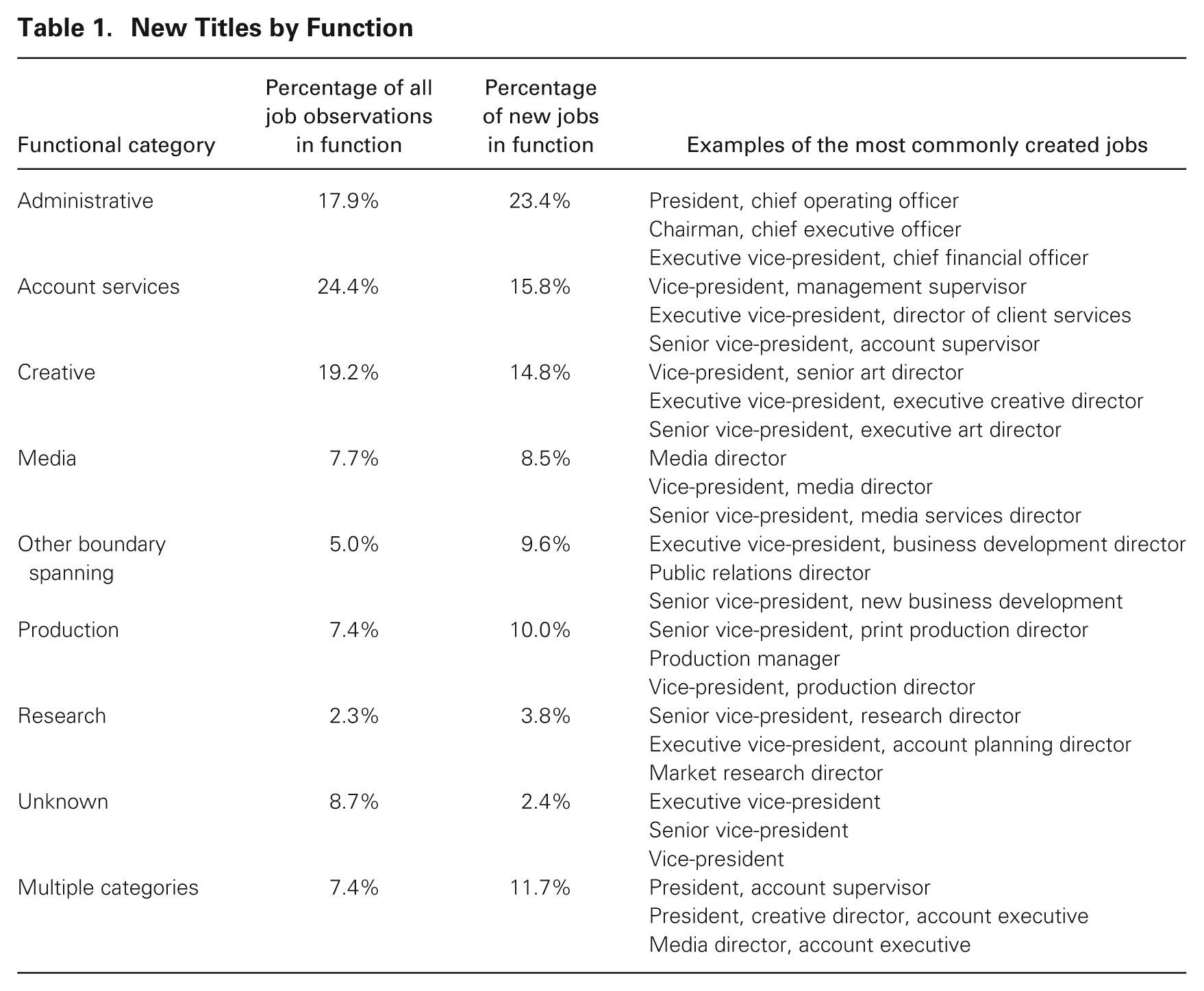
We coded the sex of advertising agency managers, using first names. For each name, sex was coded independently by three individuals, including the second author. Any discrepancies were then resolved by agreement between the first and second coders. Of the 8,580 managers in our dataset, 5,109 (59.5 percent) were men, 3,364 (39.2 percent) were women, and 107 managers (1.3 percent) were uncodable because only initials were given in the Agency Red Book. In cases in which first names were ambiguous (e.g., Pat), we followed previous research (Cohen, Broschak, and Haveman, 1998; Gorman and Kmec, 2009) and coded sex on the basis of whether the name was more frequently given to girls or boys according to the U.S. Census. A total of 727 managers (8.5 percent) were coded as having ambiguous names (284 male and 443 female managers). We used the sex of managers to determine how frequently new job titles were initially filled by male or female managers: 1,289 new jobs (32.5 percent) were filled by female managers alone, 2,466 new jobs (62.3 percent) were filled by male managers alone, 168 (4.2 percent) were filled by both female and male managers, and 38 (1 percent) were filled by managers whose names we could not code as male or female. The percentage of new managerial jobs that were filled by women in a given year ranged from a low of 28.0 percent in 1994 to a high of 39.7 percent in 1991.
Predictor Variables
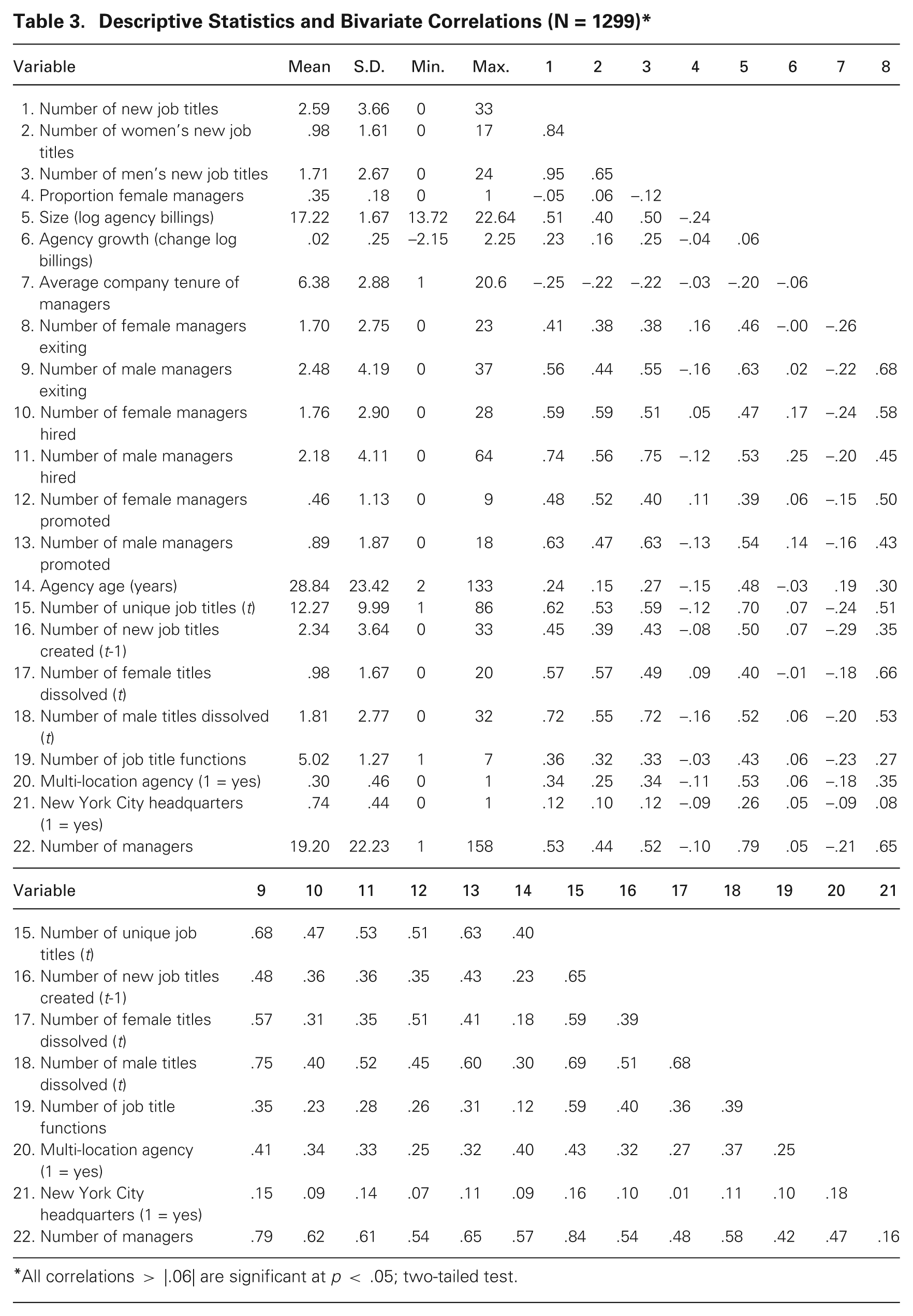
To test our predictions about the effects of the proportion of female managers, we calculated the percentage of managers in each agency annually who were female. The theoretical range of our variable was from 0 to 1, and we recorded observations across most of the range, though there were fewer observations of agencies with large proportions of female managers. Only 9 percent of our firm-year observations had more than 60 percent female managers, and 1 percent had more than 75 percent female managers. On average, managers were employed in agencies with 35 percent female managers.
Control Variables
We measured several variables to control for differences in firm characteristics that may explain job creation. First, we measured firm size because it has been linked to job title proliferation (Baron and Bielby, 1986). We assessed size as the annual gross billings for agencies in the focal year, adjusted for inflation. Because size was highly skewed, we used a log transformation before entering it into the analyses, and because evidence suggests there may be a non-linear effect of size, we included both size and size-squared in the models. Second, because firm growth and contraction are associated with the creation of jobs, we controlled for firm growth, which we assessed as the change in the log of billings between time t and t+1. Third, we controlled for agency age as the number of years since founding, as evidence suggests that age is related to the proliferation of job titles (Baron, Burton, and Hannan, 1999) and increased structural inertia (Hannan and Freeman, 1989). Fourth, we controlled for whether agencies were multi-site firms as a measure of firm scope, as greater scope may be related to greater needs for differentiating jobs. Finally, we also controlled for firms’ human capital by including the number of managers employed annually.
We also controlled for several firm properties directly related to job titles to better isolate the effects of sex composition. First, we controlled for the number of job titles that had been disbanded in the current year. For each agency, we created an indicator variable coded 1 in year t whenever a job title unique to agency A i appeared in the Agency Red Book in year t but not in year t+1. Because agencies may have abandoned multiple job titles in any given year, we summed the number of job titles abandoned per agency per year. We included three variables to control for a firm’s tendency toward job title proliferation. First, we included counts of the number of new job titles created in the previous year by each agency to capture each firm’s recent tendencies for job title creation. Second, we controlled for the existing complexity in job titles with a count of the number of unique job titles in an agency at the beginning of year t. Third, we controlled for the number of functional areas in which each firm had jobs, reasoning that agencies with jobs in a broader range of functions may be more likely to add jobs than agencies that have jobs in fewer functional areas.
Because alterations to the job structures may be responses to the career moves of employees, we controlled for the amount of managerial movement in and out of each agency. We measured three mobility variables: the number of hiring, promotion, and exit events in the firm in a given year. We identified mobility using the names, job titles, and employing firms for all managers reported by the agencies in our sample. Hiring events were coded as occurring in year t when a manager was listed in the Agency Red Book as an employee of a firm in year t+1 but not listed in year t. Exit events were coded as occurring in year t when a manager was listed as an employee of a firm in year t but was not listed in year t+1. Promotion events were coded as occurring in year t when managers were observed at one job level in year t but at a hierarchically higher job level in year t+1 (e.g., vice-president in year t and senior vice-president in year t+1). We summed annually the number of exit, promotion, and hiring events that occurred for women and men in each agency.
The number of jobs created may be related to the level of a firm’s human capital. To control for this, we first recorded the tenure of each manager as the number of years he or she appeared in the Agency Red Book as employed by his or her agency. For managers already employed in 1986, left-censoring was a problem. To account for that, we determined tenure by following each manager’s career with the current employer backward for a maximum of 10 years. Employment that began prior to 1976 was left-censored, and tenure clocks were assumed to start in 1975: 493 agency managers (5.7 percent) had left-censored organizational tenure. 1 We then calculated the average organizational tenure for each agency’s managerial workforce in each year as the mean tenure among all of an agency’s managers.
We included several control variables to account for environmental factors that might explain job creation. To control for labor market characteristics, we created a dichotomous variable coded 1 if the agency was headquartered in New York City proper and 0 if it was located in the New York City suburbs. In each model, we also included an indicator variable for each year to account for exogenous factors that could affect the creation of job titles. 2
Model Specification and Estimation
We performed one set of analyses testing for the effects of the proportion of female managers on the total number of jobs created per agency per year. To test our hypotheses about the effects of proportion of female managers on jobs filled by female versus male managers, we reformulated our dependent variable to be the number of managerial jobs first filled by women and men, respectively, and performed analyses for female and male managers separately. We tested the hypotheses by pooling the yearly data and estimating models on the pooled cross sections using time-series regressions.
Our dependent variables are counts of the number of jobs created by agency i in year t. A Poisson regression would be appropriate for these data but requires the strong assumption that the mean and variance of the dependent variables are equal. When the variance is greater than the mean, as is the case with each of our dependent variables, overdispersion of the data occurs, violating the assumption of the Poisson dispersion. To correct for overdispersion, we employed negative binomial regression techniques to estimate our models (Hausman, Hall, and Griliches, 1984; Ramaswamy, Anderson, and DeSarbo, 1994). We performed our analyses using the cross-sectional time-series negative bionomial regression procedure in Stata11. Cross-sectional time-series specification allows for firm-level effects to be included, thus accounting for both unobserved heterogeneity and for the non-independence of multiple observations per firm, providing robust standard errors. We analyzed each event using three different samples of data: all managers, only men, and only women managers. The general form of each model estimated was as follows:

Where Y(t) represents the number of new jobs created by agencies in year t, Y(t − 1) is the number of new jobs created by the same agencies in the prior year, X1(t) is a vector of time-varying independent and control variables measured in the current year. Proportion female managers and agency characteristics are measured as of the beginning of year t. Mobility events and the abandonment of job titles were measured during year t.
Because there is no theoretical reason to believe that there are certain agencies that will never create jobs and because the number of zeros is not excessive (35 percent for all jobs created, 54 percent for jobs filled by women, and 43 percent for jobs filled by men), standard negative binomial regression, rather than zero-inflated negative binomial regression, was the preferred model. All but three agencies created new jobs at some point in our observation period.
Results
Trends in Job Creation
Trends in job creation were evident in the advertising agencies we studied. Job creation events account for a substantial number of jobs in our dataset. Two-thirds of the jobs that were held by managers were created after the beginning of our observation period. Job titles were created in 65 percent of the agency-year observations. Of the 8,580 managers in our dataset, 3,556 (41.4 percent) received a new job title at least once during the observation period; 2,666 (31.0 percent) received one new job title; 633 (7.4 percent) received two new job titles; and 257 (3.0 percent) received three or more new job titles.
Job creation occurred somewhat steadily over our observation period. Table 2 shows the number of new jobs filled by female and male managers and the average number of new jobs filled by female and male managers by each firm in each year. This table shows that job structures evolved consistently throughout the observation period through the creation of jobs, always averaging between two and four new jobs annually per agency. Despite the consistency with which new job creation occurred, there was considerable firm-level variation in new job creation. In our sample, 16 advertising agencies created 60 or more managerial job titles during the observation period, while 41 agencies created five or fewer job titles.
Number of New Management Jobs Filled by Women and Men
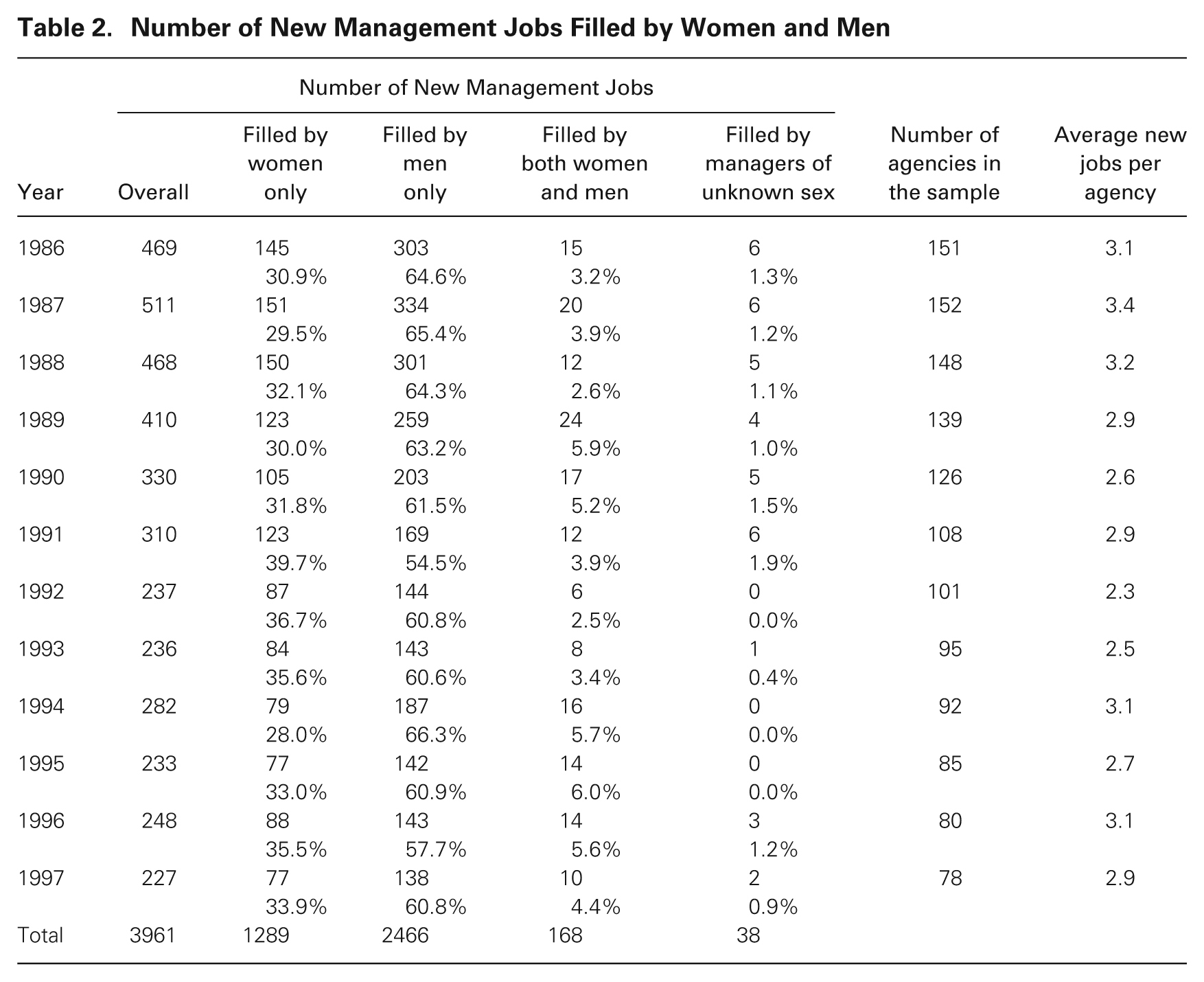
Of the newly created managerial jobs, 36 percent were filled by women and 64 percent were filled by men. 3 Because female managers accounted for 34 percent of the person-year observations in the data, and male managers 66 percent, newly created jobs were filled by female and male managers roughly in proportion to their representation in the entire dataset. Though there was some variation over our observation period in both the proportion of women or men and the proportion of jobs initially held by women or men over time, the two measures roughly track one another. Incumbent managers, those already employed in an agency, received 2,512 new job titles, of which 69.9 percent were assigned to men and 29.5 percent to women. Newly hired managers received 2,265 new job titles, of which 59.1 percent were assigned to men and 39.6 percent to women. Newly created jobs were filled by women and men across all of eight functional categories, with relatively more being filled by women than men in four of them: media, production, other boundary spanners, and research. Newly created jobs were filled by women across all levels in management, with relatively more new jobs being filled by women than men at lower levels.
Multivariate Analyses of Job Creation
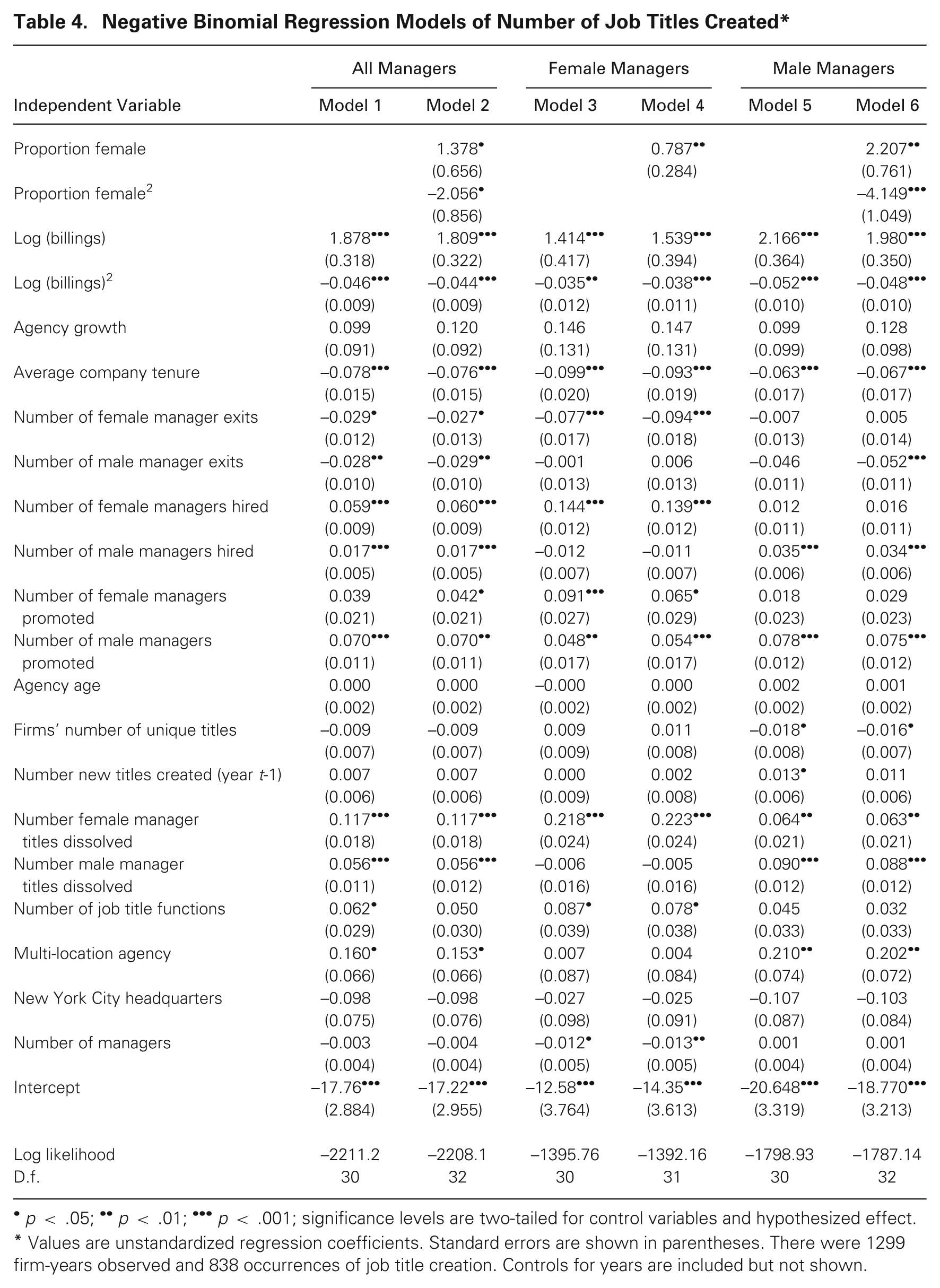
Table 3 presents the descriptive statistics and bivariate correlations of all the variables used in our models of job creation. Table 4 shows the results of the negative binomial regression models of counts of jobs created per firm per year. Models 1 and 2 show the results for the overall number of jobs created in agencies, as a point of comparison with the models of jobs created that were first filled by female managers (models 3 and 4) and by male managers (models 5 and 6). For each pair of models, the first column is a baseline model with controls only. All three of these baseline models show similar patterns of effects. In the second column for each pair of models we incorporate our independent variables. In model 2, the coefficient for the proportion of female managers is positive and significant, and the coefficient for the squared proportion female managers is negative and significant, indicating an inverted U-shaped relationship between the proportion of female managers and the overall number of jobs created. The inflection point for this curvilinear relationship is at 33.5 percent female managers. Hypotheses 1 and 2 predicted different patterns of job creation between jobs filled by female and male managers. In hypothesis 1, we predicted that the number of new jobs filled by women would increase with the proportion of female managers. Consistent with this, in model 4, the coefficient for the proportion of female managers is positive and significant, supporting hypothesis 1. We tested for a curvilinear relationship by rerunning our analyses and including the square of the proportion of female managers. In these supplemental models, the linear term for proportion female managers remained significant, but the squared term failed to reach statistical significance.
All correlations > |.06| are significant at p < .05; two-tailed test.
Negative Binomial Regression Models of Number of Job Titles Created*
p < .05; •• p < .01; ••• p < .001; significance levels are two-tailed for control variables and hypothesized effect.
Values are unstandardized regression coefficients. Standard errors are shown in parentheses. There were 1299 firm-years observed and 838 occurrences of job title creation. Controls for years are included but not shown.
Hypothesis 2 predicted that the number of new management jobs filled by men would exhibit an inverted U-shaped relationship with the proportion of female managers: increasing initially at low proportions of female managers before plateauing and then decreasing at higher proportions of female managers. In model 6, which is the subsample of new management jobs filled by men, the coefficient on proportion of female managers is positive and significant, and the coefficient on proportion of female managers squared is negative and significant, supporting hypothesis 2. In all cases, model fit improved with the inclusion of our explanatory variables.
To better interpret our findings, we graphed the effects of our explanatory variable on the number of newly created jobs filled by female and male managers, using the results from models 4 and 6, respectively, and holding all the other variables constant at their mean levels. Figure 1 shows the contrast between the effects of the proportion female managers on the number of new jobs filled by women and men. In organizations with relatively low proportions of female managers, the number of new jobs filled by male and female managers increases as the proportion of female managers increases. But the number of newly created managerial jobs filled by men increases with greater proportions of female managers only up to a peak of 24.4 percent female managers, and decreases thereafter. Thus only at low levels of female representation is the effect of the proportion of female managers on job creation greater for male than for female managers. In firms with more than 29.0 percent female managers, the number of new jobs filled by women outnumbers the new managerial jobs filled by men.
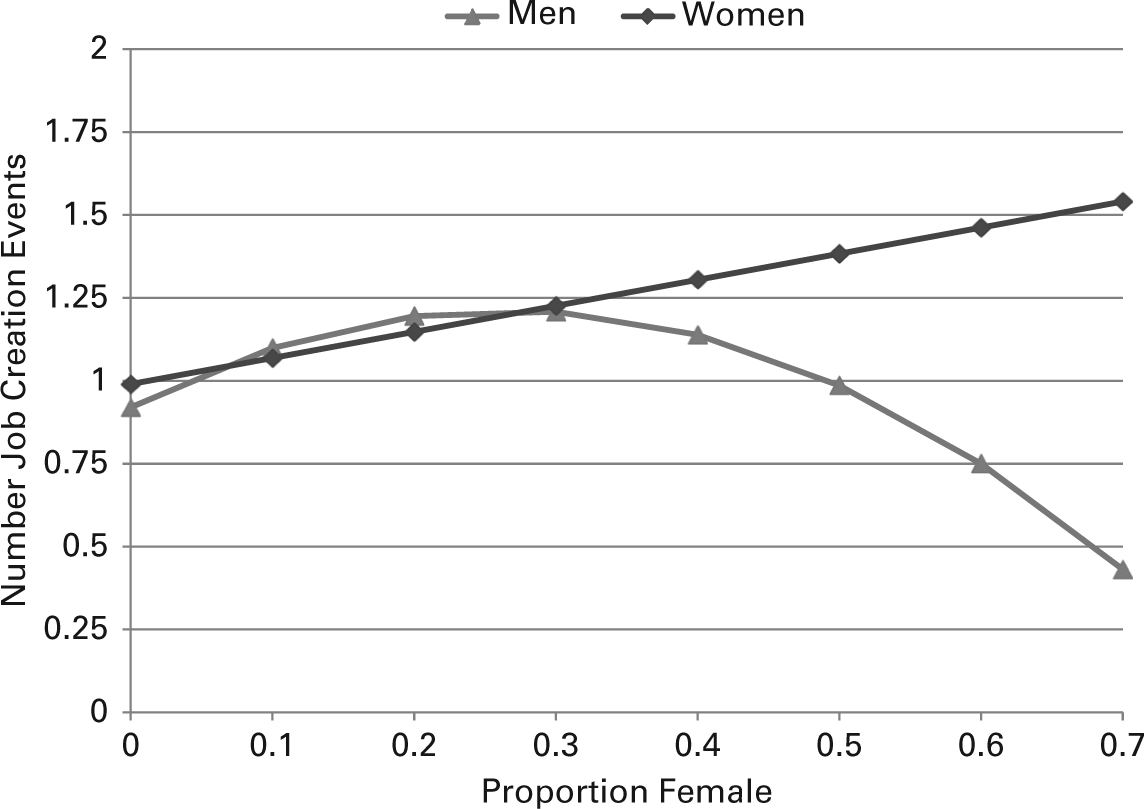
Number of jobs created and filled by male versus female managers.*
The patterns of relationships attributable to several of our control variables are noteworthy because they are consistent with our prior expectations and help to eliminate alternative explanations for the results we observed. First, it is possible that jobs are created merely as replacements for positions that were dissolved and that the dissolution of positions is related to the sex composition of organizations. We controlled for the dissolution of jobs held by female managers and by male managers in the same year as job creation, and as expected, the number of managerial jobs dissolved for both male and female managers has a significant positive effect on the number of new jobs filled by women and men, respectively. But over and above these effects, the relationships between the proportion of female managers and job creation remain significant, suggesting that job creation is more than a process of job replacement. Second, new jobs may be created in the wake of employees moving into new positions either through hiring or promotion, and evidence suggests that such events are related to the proportion of female managers in a firm (Cohen, Broschak, and Haveman, 1998). We controlled for the number of hiring, promotion, and turnover events in firms in the same year as job creation. In general, hiring and promotion events have strong positive effects on the amount of job creation, while turnover events suppress job creation. Again, our explanatory variable is significant, suggesting that our results for sex composition are not merely capturing job creation associated with the mobility of managers. Finally, it may be that new jobs are more likely to be created in larger and growing firms and that size and growth are related to the proportion of female managers. Our control variables for size (log billings) and size squared are significant, producing a net positive effect throughout the range of our observations. Surprisingly, the control for growth is not significant. Again, the effect of sex composition persists with these controls.
Further, in models not shown here, we tested for the effects of several other controls that might affect our results. We reasoned that job creation in advertising agencies might be related to the dynamics of client-agency relationships. We tested for the effects of forming and dissolving client relationships, but these variables were never significant, so we dropped them from our analyses. We also tested for normative pressures to create new job titles by creating a variable for each firm that captured the average number of jobs created in a given year by the other agencies in our sample. While significant, this variable did not appreciably alter the effects attributed to an agency’s sex composition.
Robustness to Alternative Specifications
We performed a number of additional analyses to eliminate alternative explanations for our results. One concern is that the creation of jobs filled by men and women, respectively, are not entirely independent events. It may be that an organization can only create a limited number of jobs and that creating and filling one job with a woman or a man means that it is unlikely another job can either be created or filled by a man or a woman. Another possibility is that firms create jobs first and then make the decision about whether to fill them with either women or men, again suggesting that job creation and the filling of new jobs are not independent. We addressed these concerns in two ways. First, we reran our models on the number of job titles filled by men and women, respectively, controlling for the number of job titles filled by managers of the opposite sex. In both cases, the control variables for new jobs filled by managers of the opposite sex were positive and significant, but the effects of sex composition were unchanged. Second, we reran the models using the seemingly unrelated estimation procedure (suest) in Stata11. This procedure can determine whether results from a negative binomial model on one dependent variable are affected by accounting for the estimation and covariance matrix associated with a second dependent variable. The results of this procedure indicate that even though the two dependent variables are not entirely independent, the results of estimating the effects of sex composition on new jobs that are filled by women are not affected by the effects of sex composition on the number of new jobs filled by men.
Another concern was that our findings would vary considerably depending on whether new jobs were filled by managers already in the agency versus those who were newly hired. To explore this issue, we ran separate analyses for jobs filled by female and male new hires and by female and male incumbents. For jobs filled by men, the results for new hires and incumbents were very similar, though for new hires, the main effect of the proportion of female managers was only marginally significant. For jobs filled by women, however, the effects of sex composition were significant only for jobs filled by incumbent women. This suggests that the effects of sex composition on job title creation are felt most strongly by incumbent managers. Perhaps women create and negotiate for distinctions in jobs much more once they are in an organization or are simply not effective at negotiating for job distinctions at the outset of their employment relationships. Further, management may only recognize such job distinctions for women once women have already demonstrated the value of the new arrangements.
Third, we tested whether our results were sensitive to our decision to use a random-effects negative binomial model rather than a fixed-effects model. A random-effects model controls for both within- and between-firm variation, while a fixed-effects model controls for between-firm variation. This means that the regression coefficients in a fixed-effects model can be interpreted as indicating a within-firm effect. We reran our models for the number of new jobs filled by men and women with the fixed-effects option in Stata11. Our results for the effects of proportion female managers on newly created jobs filled by men were unchanged. For newly created jobs filled by women, however, the coefficient for proportion of female managers was not significant. We interpret this to mean that our results for the proportion of female managers are driven by between-firm differences, rather than within-firm dynamics.
Fourth, we explored whether our findings were driven by outlier firms, that is, by the agencies that created large numbers of job titles relative to their competitors, perhaps because of major restructuring events. We reestimated our models twice, first entirely deleting the 5 percent of agencies with the largest number of jobs created and then deleting the 5 percent of firm-year observations with the largest number of jobs created. When we eliminated the 5 percent of agencies that created the most jobs, our results remained robust for both jobs filled by women and those filled by men. When we eliminated the 5 percent of observations with agencies that created the most jobs, our results remained robust for jobs filled by women. For jobs filled by men, however, both the proportion of female managers and its square became insignificant. When we dropped the squared term, the proportion of female managers is significant and negative. This suggests that the firms that are doing the most job creation are driving the curvilinear effect.
Finally, we examined whether our results were affected by including managers with ambiguous names or by including cases in which multiple female and male managers received the same job title. We reran our analyses including separate controls for the number of female and male managers with ambiguous names in the agency and three indicator variables representing that multiple men, multiple women, or both men and women received the same new job title in the same year. Across these alternative specifications, our findings for the proportion of female managers remained significant.
Discussion
We began this paper by noting that research on organizational and opportunity structures tends to presume that job structures in organizations are relatively inertial and that men and women move through a set of preexisting and stable positions. We suggested that this presumption, which permeates both sociological and organizational research, is empirically and theoretically problematic in the face of evidence that job structures frequently change and that they change at different rates in different organizations. We argued that it was important to build our understanding of change in these job structures because of what jobs are, what they do, and what change in them brings about for organizations and the individuals who inhabit them. For these reasons, it is important to build theory about how job structures change. Consistent with our expectations, we found that job structures in New York City advertising agencies were far from stable and that the patterns of change were far from identical across organizations. To explain some of this variation, we drew on arguments from the literatures on individual and organizational demography, job differentiation, and micro-level job change. We predicted and found that change in opportunity structures, specifically the number of jobs created in organizations, varies with the sex composition of a firm’s managerial workforce and that the effects of the proportion of female managers differ for jobs initially filled by female and male managers.
The volume of and the variation that we see in the number of jobs created underscores that job structures warrant a central place in organizational theory and analyses. This evidence adds to a growing body of research on the importance of explicitly attending to the nature of organizational job structures and how these change. For instance, recent work looking at the structures and experiences of top management teams (e.g., Burton and Beckman, 2007; Beckman and Burton, 2008, 2011) demonstrates that the jobs in an organization are conceptually and empirically distinct from the job holders and should be treated as such in research. The two may co-evolve but they are not the same thing. These positions have evolutionary trajectories shaped by things other than the experiences of the people who are positioned within them. Our work supports this idea and suggests that in ignoring the processes that influence the creation and alteration of jobs and job structures, scholars are missing a critical component of any story about mobility, stratification, and organizational structure. All of these are products of a system in which at least two sides are in motion and are responding to sometimes different factors.
In identifying the proportion of female managers as a determinant of job structures, our findings highlight that change in job structures is the product of more than technical and administrative imperatives or of the individuals holding positions in this structure. The proportion of female managers in organizations influenced job creation even after controlling for firm size, employee characteristics, the amount of managerial mobility, and environmental factors. Thus it is difficult to argue that job creation is only a response to technical and administrative imperatives or individual differences. Nor is organizational structure strictly a product of mimicry and outside social normative pressures, as our single-industry, single-geography design holds these factors constant. Here, job creation is also a product of local responses to local factors within organizations. This is consistent with assertions that the structure of jobs is in part a result of processes that are socially and politically, as well as rationally, determined (Weber, 1978; Baron and Bielby, 1986). At a much more micro level, evidence has demonstrated that the structure of tasks within individual jobs is shaped by incumbents and managers functioning in a system that extends beyond organizational borders (e.g., Miner, 1987; Cohen, 2013). This paper takes another step toward developing more complex theory to explain the creation and alteration of job structures, which in turn contributes to a richer understanding of both organizational and opportunity structures.
The patterns we see for the relationship between the proportion of female managers in firms and the number of managerial jobs created extends research on the effects of organizational demography. We found that the greater the proportion of women in a firm’s management, the higher the number of new jobs initially filled by female managers. This suggests that women’s desire to create distinctiveness is stronger when they work with others who are similar to them. It also suggests a strength-in-numbers explanation for the effects of organizational demography (Kanter, 1977a, 1977b) whereby the structure of work is altered through the creation of new jobs that are initially held by female managers because women are present in relatively higher numbers and are therefore more influential. Female managers who work in organizations with relatively more female managers will have greater relative bargaining power and so may be more effective in negotiating for what they see as desirable job distinctions (e.g., Phillips, 2001; Beckman and Phillips, 2005). Further, when there are relatively more female managers, women are more likely to be negotiating the terms of their employment with other women and have a greater likelihood of success (Rousseau, 2005). Finally, our finding is consistent with previous findings suggesting that women are least satisfied when they work in groups that are predominantly women. Thus having greater proportions of female managers in a firm’s management is a catalyst for job evolution among female managers. We found that the effects of the proportion of women did not diminish as the proportion increased, though because we have so few observations of female-dominated groups, we could not fully assess whether such effects might ultimately taper off. This might be explored further in environments in which women are more often numerically dominant.
In contrast, we found that the relationship between the proportion of female managers and the creation of new jobs that are initially filled by male managers follows a different pattern. The number of new jobs initially filled by men increases as the proportion of female managers increases, peaks at 24.4 percent female managers, and declines thereafter. The positive relationship between the proportion of female managers and the creation of new jobs filled by male managers is most pronounced in settings in which female managers represent a small but identifiable minority, when turbulence and intergroup conflict between female and male managers is likely to be highest, and therefore the forces to separate female and male managers and preserve men’s status are strongest. This pattern of findings is consistent with demographic theories (e.g., Tolbert, Graham, and Andrews, 1999; Wharton and Baron, 1987; Allmendinger and Hackman, 1995) positing that men in particular are negatively affected by working with relatively more women and that these effects are particularly strong in male-tilted or skewed work settings. The negative relationship between the proportion of female managers and the number of managerial jobs created beyond the 24.4 percent threshold may be the product of men having relatively less influence when relatively more women also hold positions of power.
Our findings suggest that organizational demography not only influences attitudes, behaviors, and who moves into and out of positions, as previous research has demonstrated, but that it also influences which positions exist for them to move into and out of. Thus we have established an important causal link from organizational demography to organizational structure, which may be just one of many such links between demography and organizational activities. For instance, depending on the demography of a firm’s managerial workforce, one might speculate that organizations alter the number or structure of their relationships with clients and suppliers, the types of markets they enter, their market strategy, and their overall management processes. Previous research has typically presumed that the causal relationships run in the opposite direction—that the client base, strategy, and management processes determine who will be brought in or promoted (Beckman and Phillips, 2005). Our research suggests that the causality may also run in the opposite direction: who is brought in and promoted may determine organizations’ client base, strategy, and management processes.
The patterns we identified here provide further evidence that the mechanisms linking demography to opportunity differ for female and male managers and, in doing so, reveal another mechanism that may produce inequality. Prior research has shown differences in how demography affects female and male managers. For instance, in a study of faculty turnover across universities, Tolbert and colleagues (1995) found that turnover rates for women but not men vary with the proportion of female faculty, which suggests that men’s movement in opportunity structures is relatively independent of the demographic make-up of the workforce. We too show differences across groups, but contrary Tolbert et al.’s (1995) finding, we show that men are affected by composition: actual opportunities for men vary with the proportion of women in the firm, and they do so in ways that are different than for women.
Much of what we found in this study might have been lost had we not disaggregated our analyses in ways past work has not. Past work on the proliferation of job titles has examined how demography influences the structure of jobs for all of management or the entire workforce but not at how it differentially influenced the job structures for women and men (e.g., Baron and Bielby, 1986; Strang and Baron, 1990, Baron, Burton, and Hannan, 1999; Baron, Hannan, and Burton, 1999). In contrast, when we examined the overall number of job titles created in organizations, our analysis revealed a curvilinear relationship between the proportion of female managers and the overall number of jobs created, similar to what we find for male managers. Thus what might appear to be a pattern for an overall relationship between organizational demography and job creation in actuality is driven by the pattern for men, who are over two-thirds of our sample. The relationship between the proportion of female managers and new jobs filled by women is markedly different.
Past research has also examined the relationship between demography and the static level of job differentiation rather than the more dynamic processes of job creation (and dissolution) that feed into the level of differentiation. To more closely echo the approach used in prior work, we ran additional analyses of the net change in the number of job titles in a firm, i.e., changes to the level of job differentiation. In these analyses, we found no relationship between the proportion of female managers in a firm and change in the number of distinct jobs. Those results alone might lead one erroneously to believe that the job structures did not vary with demography. Instead, our findings imply that there are significant effects of demography on job creation that we would not have seen had we examined only job differentiation.
The meaning of changes in the structure of jobs is subject to some interpretation both for individuals and for organizations. Are women disproportionately being assigned to jobs on the glass cliff when they are assigned these new jobs and being set up for failure (Ryan and Haslam, 2005, 2007)? Is job creation a form of reward or a method for segregating jobs, keeping women from the most influential positions, and justifying differences in rewards? To help us better interpret our findings, we conducted interviews with five advertising executives working in various positions and with up to 30 years of experience. These executives answered questions about their own experience with job creation, including whether they had been given new titles or had given new job titles to others. One female executive we interviewed provided anecdotal evidence suggesting that the segregation explanation for these patterns of job creation may be accurate. In her agency, a new managerial level and job title were created in account services to serve as something of a “holding pen” for managers who were on the path to senior vice-president, a title that was seen as the indicator of “making it” in that agency. It happened that the first person put into the job was a woman, one of the first female managers to rise to this level in the organization. At the time, according to her colleague, the action was interpreted as an attempt to keep female managers from top positions, though the woman did eventually rise to senior vice-president and then to executive vice-president. Although it is difficult to know whether her interpretation was correct, it is clear that the path she navigated to the top was different from that of the men who arrived there before her. Our findings, and this anecdote, suggest that future research might investigate the extent to which differences in the allocation of jobs to female and male managers promote equal status or preserve status differences. Our analysis was limited to a relatively small number of levels and functions. Descriptive statistics on those relatively small distinctions provide some indication that the new jobs initially filled by women are different from those initially filled by men. A more fine-grained examination of the consequences of patterns of job creation for the performance of professional service firms and their employees at all levels is an important avenue for future research. Does job creation influence the retention and performance of the professional staff and thus firm performance? Are these newly created jobs themselves retained in their current forms? What are the implications of these gendered patterns of change at the top for female and male employees at lower levels?
While this research takes a step toward understanding the complex causal relationship between organizational demography and structure, it is not without limitations. One potential limitation of this work is the use of the addition of job titles as a measure of new jobs. There are two potential problems associated with using changes in job titles to measure change in the job structure. The first is that we may be missing some of the more subtle changes that take place in jobs but that are not formally recognized with changes in job titles. The other problem runs in the other direction: changes in job titles may be only symbolic and may not reflect actual changes in the jobs. Only a relatively small number of these jobs are completely new to the firm. Most build on or combine existing titles. Even so, there is reason to suspect that these changes are significant in the context of advertising. The executives we interviewed suggested that making changes in the job structure is not undertaken lightly and is not something that just anyone can do. When asked who was responsible for changes in job titles, one executive responded, “Title changes come from the top. To change the titles, you need the conviction and carte blanche to do so.” Further, as we have noted, changes to this structure are not costless and will not be undertaken lightly. These titles are important for communicating to the clients on whom firms depend, as well as for communicating within firms. As one executive described it, “Our clients know and understand our titles.” The relationship between job titles and tasks and how these systems are used for communication by organizations warrant further empirical investigation.
Several other limitations relate to our setting. We investigated the effects of organizational demography on job creation, using a sample of managers in firms in a single professional service industry in which job creation was not an uncommon event and at a time when men were numerically dominant in the managerial ranks. Thus we would be cautious about generalizing our results to other industries or to other types of employees. For instance, would the same patterns hold in a strict up-or-out system, as seen in other professional service firms such as law, or outside of professional services altogether? Would it hold in a job level or industry in which women are numerically dominant? Our expectation is that we would see similar patterns in other professional service firms and in other firms that are expanding and experiencing shifts in the nature of the work being done. We would expect less job creation in more rigid or rule-bound organizations and that any such changes would not be related to the proportion of female managers in the organization. We also believe that future work should explore this phenomenon beyond the managerial ranks. One expectation is that both the volume of change in jobs and the influence of organizational composition would be muted for jobs in which there are many incumbents and attachment to unions and other occupational structures.
Finally, in our analysis we could only examine whether a job that was created was filled by a male or a female manager. Future research might explore whether jobs are created for specific people or whether they are created and subsequently filled with available employees and whether this makes a difference in the effects of the proportion of female managers. Our expectation is that while the processes may differ, most job creation involves elements of both creating jobs needed by the organization and creating jobs requested by employees.
In examining job creation in the way that we have, this paper contributes to thinking across multiple bodies of research. First, it pushes the creation of jobs into the forefront of the study of both work and organizations and demonstrates that neither field of research is complete without considering the dynamics of jobs and job structures. We did this by developing new theory specific to the process of organizational job creation, as well as by providing empirical evidence on the phenomenon. Second, it contributes to the demography literature by examining how demography influences organizational structures and not just the individual attitudes and behaviors of those who make up that demographic composition. Third, it expands approaches to understanding the production of inequality by showing that it is not enough to examine inequality by looking at employees’ movement through existing structures. It is also necessary to look at how those structures themselves move and do so differently for employees of different demographic groups. By bringing this array of literatures together, we advance understanding of jobs, organizations, demography, and opportunity as part of the same ecosystem, one that is best theorized and studied as a whole to advance understanding of any of its parts.
Footnotes
Acknowledgements
We thank Emily Block, Emilio Castilla, Alison Davis-Blake, Ruthanne Huising, Ken Koput, Linda Johanson, and Marc-David Seidel for comments on this paper. We also acknowledge the helpful comments of participants at the Clifford Chance Conference on Professional Service Firms, the London Business School / INSEAD Organizational Behavior Conference; McGill, Desautels Faculty of Management; the MIT Sloan School of Management’s Institute of Work and Employment Relations; Drexel, LeBow College of Business; University of Texas at Austin, McCombs School of Business; and the Wharton People and Organizations Conference.
Previous versions of this paper were presented at the 2006 American Sociological Association and 2007 Academy of Management Meetings. This paper benefited greatly from the exceptional editorial stewardship of Pam Tolbert and Huggy Rao and constructive feedback from reviewers.
This research was supported by a Research and Materials Development grant from the London Business School.