






Abstract
This paper identifies the causal symbolic effect of status on the prices organizations charge for their products. I exploit the classification of the châteaux of the Médoc, which sorted 61 wine producers into five growth classes in 1855, as a fixed hierarchical symbol of class status. The classification has defied attempts at revision for more than 150 years. This means that a château’s rank in the classification cannot be reversely affected by the quality or price of its wine, which greatly facilitates the estimation of the causal effect of status. To determine whether status serves as a signal of quality under uncertainty or satisfies the motive of conspicuous consumption, I study a period of time during which the uncertainty about quality has arguably declined because the Internet has made wine ratings ubiquitously available. I identify a symbolic effect of status on prices that increases in a time of decreasing uncertainty, which suggests the motive of conspicuous consumption as a driver of the effect. But the results caution that we might commonly overestimate the symbolic value of status if we underestimate the disproportional value that markets place on the pinnacle of quality, the enduring nature of reputation, and the effect of endogenous quality choices on estimates of status effects.
Keywords
The literature on status has extensively documented associations between organizational status and desirable organizational outcomes, theorizing a causal link (e.g., Podolny, 1993; Benjamin and Podolny, 1999; Bothner, Kim, and Lee, 2014). Recent empirical work on the individual level, however, calls into question whether the observed associations between status and outcomes reflect a causal effect of status on outcomes. By matching published articles written by scientists appointed as Howard Hughes Medical Investigators to articles of equally likely candidates who were not appointed, Azoulay, Stuart, and Wang (2014) showed that the symbolic effect of the appointment on citations to these articles is much smaller and more short-lived than commonly used estimators suggest. Their findings call into question the causality claims in the organizational status literature and whether a cumulative advantage can accrue to organizations based purely on the symbolic value of status (cf. Merton, 1968). A failure to establish causality, however, would not only imply that the observed effects of status may be little more than reflections of superior quality; it would also imply that the assertions about what drives status effects would be dubious if the effects were not causal to begin with.
Responding to these challenges, I seek to identify the symbolic value of status for organizations. Following recent discussions in the literature (Simcoe and Waguespack, 2011; Azoulay, Stuart, and Wang, 2014), I highlight two problem areas that impede identifying causal effects of status. First, it is possible to estimate positive, albeit spurious status effects even if there is a perfect correlation between status and quality or reputation. Second, if status is embedded in a web of reversely causal relationships with quality and organizational outcomes, then the standard estimators used in the extant organizational literature will generally not produce consistent estimates of the causal effects. Finally, I juxtapose the prevalent view of organizational status as a signal of quality under uncertainty (Podolny, 2005) and the motive of conspicuous consumption (Veblen, 1899) to assess their theoretical consistency with returns to status that are independent of quality.
To identify the causal effect of status on the prices organizations charge for their products, I analyze whether the grand cru classification of the châteaux of the Médoc (cf. Markham, 1998), which sorted 61 producers into five grands crus classés in 1855, exerts an influence on wine prices today. Created by powerful actors, this hierarchical symbol of class status has defied attempts at revision for more than 150 years. The classification cannot be reversely affected by the quality that the châteaux produce or the prices they charge. This eliminates two typical sources of endogeneity, which simplifies the task of estimating the causal effect of status. To investigate whether the uncertainty about quality or the motive of conspicuous consumption drives the returns to status in this market, I study a time period during which the uncertainty about quality has arguably declined due to the proliferation of information on wine quality over the Internet.
The Causality of Status Effects
The central concern of status scholars is that status orders create a reward structure that favors those who already occupy high-status positions (e.g., Merton, 1968). The phenomenon, known as the Matthew effect, is a purely symbolic effect of status independent of quality, as well as a substantive effect of status on subsequent quality and an effect of that quality on status acquisition even further down the road. Recent theoretical arguments have criticized the organizational status literature’s narrow view of status as a signal of quality under uncertainty (Podolny, 1993) because it neglects the symbolic effect of status and risks confounding status with a producer’s reputation for quality (Washington and Zajac, 2005; Jensen, Kim, and Kim, 2011). Moreover, empirical evidence is accruing that the standard estimators used in the status literature do not produce consistent estimates of status effects (cf. Simcoe and Waguespack, 2011; Azoulay, Stuart, and Wang, 2014). Understanding the difficulties associated with isolating the causal effects of status requires clearly distinguishing the competing constructs of quality and reputation, as well as creating models for the mechanism by which status is acquired and the mechanisms by which it creates advantages.
Mistaking Quality and Reputation Effects for Status
The process of acquiring status is viewed as one in which producers first choose a level of quality, where quality is defined as the performance of a product or service. Through the production of a certain level of quality over time, a producer acquires a reputation for quality. This reputation may help prospective buyers form expectations about the current level of quality of a firm’s products or services (Shapiro, 1983; Rao, 1994). Reputation should thus be relevant if prospective buyers believe that it predicts current quality in markets in which current quality is imperfectly observable (Shapiro, 1982).
As a byproduct of their past or present demonstrations of quality, organizations may obtain tokens of status such as awards or prizes, formal recognition or ranks, and connections or network positions. A wine, for example, may win gold medals in tasting competitions (Markham, 1998), be served at dinners of kings or presidents (Cocks and Feret, 1883), or become central and prestigious among peer wineries of its provenance (Benjamin and Podolny, 1999). This view of the process of status acquisition implies that status will generally be correlated with quality or reputation at some point in a producer’s history (cf. Lynn, Podolny, and Tao, 2009; Ertug and Castellucci, 2013; Azoulay, Stuart, and Wang, 2014). Separating the symbolic value of status from quality and the signaling value of reputation thus requires comprehensive controls for quality and reputation that render status the symbolic residual. The available controls for quality and reputation, however, are often less than perfect. The more complex products, services, or organizations are, and the more difficult it is to measure their characteristics, the more challenging it is to control comprehensively for quality and reputation. Because of that, status studies in settings like investment banks, universities, or professional service firms are likely to face an elevated risk of ascribing effects to status that are more easily explained by quality or reputation.
If status is acquired as a byproduct of quality or reputation, it remains indistinguishable from them as long as the status order simply reproduces the hierarchical order that exists in quality or reputation (cf. Podolny, 1993). This is true even if the status order represents differences in quality or reputation in an amplified way. The reason is that amplification without distortion preserves a rank correlation of one between status and quality or reputation. For status effects to be distinguishable from quality or reputation effects, a status order must be a distorted representation of the quality and reputation orders.
Nonetheless, it is possible to estimate significant, albeit spurious status effects even if status is only an amplified representation of quality or reputation. Tokens of status frequently accrue cumulatively or disproportionally. For example, the best athlete wins the most gold medals and becomes the star even if the performance difference to the second-best athlete is consistently small. Status may thus frequently be a nonlinear function of quality or reputation. The risk associated with this nonlinear relationship is that, instead of having an effect of its own, status might pick up a nonlinear appreciation for quality or reputation. This could happen if an empirical strategy for studying status constrains quality and reputation effects to be linear in the predictor, an assumption that is common to most organizational status literature.
The risk of mistaking nonlinear quality or reputation effects for status effects would seem to be the greatest in markets in which status is commonly believed to matter the most: superstar markets in which disproportional value is placed on the pinnacle of quality. Superstar or winner-take-all markets are a special form of markets with increasing marginal returns to quality, in which the superstar can serve large portions of the market due to low marginal costs (Rosen, 1981). We are familiar with such highly asymmetric reward distributions among wines, movies, professional services, and universities, for example (e.g., Frank and Cook, 1995). But in such markets, differences in outcomes might not be best explained by status. They might be better explained by differences in underlying qualities that are in limited supply and for which there are few or no substitutes, even if these differences are small. This suggests that we need to allow for increasing marginal effects of quality and reputation in order to attribute returns to status.
Furthermore, if quality varies heterogeneously across producers over time, we may perceive a status hierarchy to be a distorted representation of the reputation hierarchy even when it is not. The grands crus classés of the Médoc, for example, underwent periods of weakness in their history when the quality of their products matched neither their historic reputation for quality nor their supposed status. The consequence of such quality fluctuations is that status may capture a producer’s quality in the distant past or long-term average quality better than quality in the recent past does. If the market has reason to value quality demonstrations in the distant past or a producer’s long-term average quality, we might erroneously attribute effects to status if reputation is defined on an inappropriately short lag.
The three- to five-year lag with which extant studies have commonly controlled for past quality might thus be insufficient to capture producers’ reputations for quality. Schmalbeck (1998), for example, provided evidence that the reputations of law schools are virtually stable over at least 25 years. We should generally expect reputations for quality to be durable when quality perceptions update slowly. This occurs in markets in which the signal-to-noise ratio in quality signals is naturally high (e.g., law firms, movie production, baseball franchises), product generations revolve slowly or used products are traded in large volumes (e.g., cars), products are durable or they mature or improve with age (e.g., wine), or the consequences of consuming a product or service materialize slowly (e.g., university education). This suggests that we are at risk of mistaking markets in which reputations for quality are enduring for markets in which status matters, and some of the markets in which we believe status to matter the most once again seem particularly susceptible to this bias.
Cumulative Advantage and Reverse Causality
Empirically, the issues identified above all constitute cases of omitted variable bias. Yet the identification of causal status effects is further complicated by the potential reverse causality among status, quality, and organizational outcomes. As Benjamin and Podolny (1999: 585) noted in their analysis of the California wine industry, “There is undoubtedly a reciprocal relationship between the level of quality that a firm achieves and the structural position that a firm obtains.” But the standard estimators that have commonly been used in the literature generally do not produce consistent estimates of the causal effects in the presence of such reverse causal relationships.
Some of the complexities arise from the two mechanisms that are suspected of creating cumulative advantage (Merton, 1968). First, status may affect the quality level at which producers operate. Status may enable producers to produce at a higher level of quality (Merton, 1968) because, for example, status attracts greater funding or more capable or hardworking partners (Stuart, Hoang, and Hybels, 1999; Castellucci and Ertug, 2010). In addition, a producer may be motivated to maintain a high level of quality to avoid the risk of losing status (cf. Podolny, 2005: 12–14). A producer’s audiences might penalize a low-quality product for being inconsistent with not only the firm’s reputation for quality but also with its status claim. A self-reinforcing cycle of status and quality that escalates the quality differences among producers could result (Benjamin and Podolny, 1999). But if status affects the level or the trajectory of quality that producers pursue, then a producer’s reputation for quality in the past will be a biased predictor of the producer’s quality in the present. This problem will likely be more pronounced if a status shock happened recently, if status is time-variant rather than fixed, or if quality differences have no natural limit because the effect of status on subsequent quality is not fully captured by differences in producers’ reputations for quality. This would result in an overestimation of the symbolic effect of status. For example, Roberts, Khaire, and Rider (2011) sought to estimate the symbolic effect of hiring a prominent winemaker on wine prices, but their price equation did not directly control for the fact that wines were rated about one point higher if the winery had experienced the hiring of a prominent winemaker. A quality difference of one point, however, might be large enough to explain much of the effect they observed, suggesting that the effect might in large part be substantive rather than symbolic. Similarly, Azoulay, Stuart, and Wang (2014) observed that the symbolic effect of scientists’ status on the number of citations to their academic articles was much smaller than initially estimated once they accounted for the fact that the status shock enabled the scientists to publish papers in higher-quality journals. Controls for producers’ reputations may thus be insufficient to account for systematic differences in producers’ current quality levels that are driven by status (Podolny, 2005: 18).
Second, any causal effect of status on organizational performance may commonly be confounded with the reverse causal effect of organizational performance on status. Certain organizational outcomes, such as price or survival, seem particularly apt to drive status. That higher prices imply status is the precise idea of the “Veblen good” (Veblen, 1899; Leibenstein, 1950), for which the price of the good defines its status value rather than the status of the good defining its price. And while status might affect organizational survival (Bothner, Kim, and Lee, 2014), surviving organizations with a long history or heritage have also had more time and thus better chances to accumulate tokens of class status. Rather than status driving organizational outcomes, outcomes might drive organizational status in a dynamic feedback loop that can render status an artifactual correlate of performance (cf. Azoulay, Stuart, and Wang, 2014).
Finally, producers will choose only the level of quality for which they expect to be able to recoup their investments or be rewarded by the market otherwise, implying an effect of (expected) performance on quality (cf. Benjamin and Podolny, 1999). This means that a producer’s reputation—defined as the producer’s demonstrations of quality in the past—is composed of a series of choices in the past that are endogenous to current performance. This endogeneity problem should be more pronounced in markets with greater uncertainty because producers make investments in quality in these markets today to be rewarded for their reputations tomorrow. Neither current nor past quality choices can thus be treated as exogenous (see Fair, 1970). While the endogenous relationships between quality or reputation and performance do not directly involve status, standard estimators may propagate the bias in their estimates to the estimates of correlated variables such as status in ways that are difficult to anticipate without knowing the correlation structure of the data.
Causes of Status Effects
In the original view of organizational status (Podolny, 1993), a focal actor interprets the status of exchange partners as a signal of their quality, inferring the quality of an organization or its products and services from the status position the organization occupies. As status affects returns only indirectly through its effect on perceived quality, audiences would not have to rely on status to infer quality if quality were perfectly observable. Hence, for status to be valuable, one has to assume that there is residual uncertainty about quality or show empirically that returns to status increase with uncertainty. There is, in fact, strong empirical evidence supporting this view. Status generates greater returns when the uncertainty about the quality of a producer or product is high (Stuart, Hoang, and Hybels, 1999; Stuart, 2000; Simcoe and Waguespack, 2011; Azoulay, Stuart, and Wang, 2014).
In the alternative view, status is a positional good (Hirsch, 1977). Because high status is scarce by definition—there can be only a few at the top of any given status hierarchy (Podolny, 2005)—status can serve as a differentiator. The “pure social scarcity” (Hirsch, 1977: 21) of the status symbol itself, independent of its substance, enables social actors to assert their social precedence over their peers through the conspicuous consumption of high-status goods or affiliations (Rae, 1834; Veblen, 1899; Bourdieu, 1984).
The conspicuous-consumption perspective differs from the signaling perspective in two ways. First, conspicuous consumption requires an audience in front of which the focal actor consumes. The reason for consuming high-status goods shifts from what the focal actor believes about the quality of the products or affiliations he or she consumes to what the focal actor believes about the attributions his or her audience will make upon observing his or her consumption of the good (Correll et al., 2012). A focal actor’s uncertainty about the quality of a producer or product, which is central to the signaling perspective, is thus not a necessary condition for returns to status under the conspicuous-consumption perspective. Instead, a social actor’s belief that his or her audience will reward him or her for the conspicuous display of goods or affiliations is sufficient to generate returns to status even if he or she knows that substantively they are no better than their lower-status alternatives.
Second, the two views also differ in their implications for the relationship between status and quality and the persistence of returns to status over time. When status is defined as perceived quality under uncertainty (Podolny, 1993), status effects can persist only if a high level of uncertainty about quality is sustained. This is likely only for credence goods, for which uncertainty is fundamentally irresolvable. For experience goods, for which uncertainty is resolved in consumption, the flow of information among members of the audience would have to be inhibited across space and time, as uncertainty would otherwise likely be reduced through experience or word of mouth. For information goods, for which uncertainty can be resolved in advance, persistent status returns could only be explained by a cost advantage of relying on a noisy status signal over the acquisition of the available information about quality. For non-trivial purchases of information- or experience-rich goods such as cars, for example, it would be difficult to explain status returns based on the signaling perspective. The level of uncertainty about quality that is needed to generate status effects under the signaling perspective thus appears questionable for a fairly wide variety of contexts.
If quality reveals itself through consumption or interaction, uncertainty should decline over time, which would reveal whether status is a biased signal of quality. If status were a biased signal of quality, we would have to anticipate that the quality expectations associated with status will be adjusted until they are unbiased again. This would have two broad implications for returns to status under the signaling perspective. First, if status and quality were uncorrelated over extended periods of time, status could have no value in the long run. The lack of correlation would be revealed as such, and if a realignment of quality with status were not to occur, returns to status would be short-lived. Consistent with this argument, Azoulay, Stuart, and Wang (2014) showed that the effect of a status shock on academic citations is short-lived if the shock is uninformative about the underlying quality of the academics and their work. Second, because status would generally have to be an unbiased predictor of quality, status could not have an independent effect if quality is observable. Consistent with this argument, Benjamin and Podolny (1999) found that the effect of status depended on the level of quality among California wines, with inconsistent findings for the direct effect across two status measures.
Symbolic returns to status, by contrast, are theoretically independent of quality and should be able to self-perpetuate indefinitely. But returns to status that at face value satisfy the motive of conspicuous consumption could still be consistent with the intrinsic gratification derived from possessing a rare status good or affiliation. They would not necessarily satisfy the motive of conspicuous consumption as the “demonstration of wealth through the throwing away of money on more expensive goods that provide no greater utility but cost significantly more” (Benjamin and Podolny, 1999: 587). While recent evidence in the economics and marketing literatures supports the perspective that displaying status is a motive for consumption (Berger and Ward, 2010; Han, Nunes, and Drèze, 2010; Heffetz, 2011), we lack convincing causal evidence that consumers are willing to pay a premium for high-status products that perform no better or even worse than their lower-status competitors. Even though Benjamin and Podolny’s (1999: 585) study is frequently cited for the effect of status on prices, they noted that conspicuous consumption alone did not explain their results because the effect of status depended on a producer’s reputation for quality and “. . . only wish[ed] to assert that the existence of the status ordering constrains how firms can develop reputations for quality.”
Whether status effects, if they exist, are driven by the signaling or the symbolic value of status is ultimately an empirical question, the answer to which will depend on the context. But the signaling perspective offers clear advice on how to discern these effects. If status serves as a signal of quality under uncertainty, returns to status should decline as the uncertainty about a producer and product quality declines. Increasing returns to status when uncertainty is decreasing are inconsistent with the signaling perspective and would point toward symbolic returns to status from conspicuous consumption. I tested these questions about the causality and cause of returns to status among the grand cru classified châteaux of the Médoc.
Method
The Classification of the Châteaux of the Médoc of 1855
The grand cru classification of 1855 was commissioned by the Chamber of Commerce of Bordeaux and created by the Union of Brokers to be temporally displayed on a map at the Imperial Universal Exposition in Paris. The classification sorted the presumably 61 greatest producers of Bordeaux wine at the time into five grands crus classés. The Union of Brokers furnished the classification of the châteaux of the Médoc based on historic prices. Value-based classifications had long been a tradition in the trade of Bordeaux wine and were preferred over classifications based on quality judgments because the latter were seen to be subject to error. Importantly, the classification conferred grand cru (great growth) status directly upon the producer, not upon the terroir (location), thereby creating a persistent link between a château’s identity and its class status. This feature distinguishes the classifications of Bordeaux from the classifications of Burgundy, where class is based upon the terroir. Because the history of the classification is less important for the purposes of this article than the mere fact of its existence, I refer interested readers to Markham’s (1998) excellent history of the classification, as well as to Cocks’s (1846) and Cocks and Feret’s (1883) pre- and post-classification standard works Bordeaux: Its Wines, and the Claret Country and Bordeaux and Its Wines.
Multiple features make the grand cru classification of Bordeaux an unusually favorable setting in which to study status effects. First, the classification is a hierarchical signal of class status, reflecting not only quality and price but also the endorsement by elite actors: “. . . the wines of the Médoc are placed on the tables of Kings and Great of the earth,” (Cocks and Feret, 1883: 96–97). Second, the classification stands as one of the few examples of a normative and impenetrable status hierarchy. It was factually inscribed in law in 1949, when the conditions for the use of the term cru classé were set in stone (Markham, 1998: 177). Châteaux cannot be added to or drop out of the classification (see exceptions below), nor can the quality a château produces or the price it charges affect its rank in the classification. Third, 60 of the 61 châteaux of the original classification are still in operation. The fact that there is so little attrition implies that there is effectively no selection effect that could affect the analyses. Fourth, 60 of the 61 classified châteaux are located in the AOC (appellation d’origine contrôlée) Haut-Médoc, which guarantees the origin of the grapes and the grape varietals in the wine, or one of its sub-appellations, which include Margaux, St.-Julien, Pauillac, and St.-Estephe. The AOC Haut-Médoc is a fairly small area on the left bank of the Gironde estuary that contains approximately 392 producers on 18 square miles, about a quarter of the size of the wine-growing area of the Napa Valley. Fifth, even though the wines can be a blend of up to six grape varietals that are permissible by law, Cabernet Sauvignon generally dominates the wines. 1 Sixth, the châteaux generally sell the wines as futures, also known as en primeur, in the year after the harvest and 12 to 18 months before the wine is bottled. The wines are sold to brokers, who then further distribute the wines, largely implying homogeneity in channels and sales costs across châteaux. Seventh, without having tasted newly released wines, buyers have to rely on expert evaluations of the wines when making their purchase decisions. Rating agencies like Robert Parker’s The Wine Advocate and the Wine Spectator provide such ratings from blind tastings. Hence, they are presumably unbiased. 2 This implies that with respect to composition, terroir, climatic conditions, market mechanism, and institutional environment, the grand cru classified châteaux of the Médoc constitute a coherent set of producers with a fixed status hierarchy for which alternative explanations are unlikely to drive the effects of status shown hereafter.
Since 1855 there have been only three cases of mobility—one into the classification, one out of the classification, and one within the classification—that are worth noting. Château Cantemerle was added to the classification in late 1855 or early 1856 but is regarded as an original member of the classification today. Its owner, the widow Villeneuve-Durfort, appealed directly to the Union of Brokers, not the Chamber of Commerce, and was able to prove that her château had been unjustly omitted from the list (Markham, 1998: 158–161). The Chamber of Commerce or the Union of Brokers declined all other appeals at the time. Château Dubignon, classified as a third growth, ceased to exist. Its vineyards had first been absorbed into another classified growth, then spun out again (causing declassification), and later reabsorbed into multiple classified growths (Coates, 1995: 36). Finally, after decades of first-class quality and price, and lobbying by its owner, Baron Phillipe de Rothschild, Château Mouton-Rothschild was elevated from second to first-growth status under opaque circumstances by then Secretary of Agriculture, later President of France, Jacques Chirac, in 1973 (Lewin, 2009: 236–241). Although the need to update the classification was pointed out soon after it had been created (Cocks and Feret, 1883: 95), all such attempts were actively or passively barred by powerful actors, in particular the Chamber of Commerce of Bordeaux (Markham, 1998: 170–181; Lewin, 2009: 235–236).
There is a theoretical mechanism in place by which a revision of the classification could be undertaken today, but it is unlikely that this will ever occur. An official revision would require the approval of all producers within a class (Markham, 1998: 204). Producers at risk of losing their current grand cru classé status would have no incentive to vote in favor of a revision if class status indeed conferred benefits or were anticipated to do so in the future. As a proprietor of a classified château confirmed in personal conversation, a change in the classification can be deemed an impossible event today: “It is what it is; it is not going to change.” Given the impermeability of the classification, it is implausible to assume that producers choose their level of quality or set their price hoping that doing so would elevate their status in the classification.
Data
The data source is the Wine Spectator’s online database. I initially downloaded the ratings and tasting notes for all red Bordeaux wines of the vintages 1980 through 2010. I then restricted the data to the wines of the 61 classified châteaux for the vintages 1991 to 2008. The Wine Spectator records hold fairly complete data for this period for both the ratings and the release prices of these wines, and data from the 1980s allow constructing the châteaux’ reputations for quality. I used Wine Spectator data over data from www.erobertparker.com because the data from the Wine Spectator are more comprehensive. 3
Of the 61 classified growths, I excluded Château Haut-Brion from the analyses because it is the only chateau in the classification of 1855 located in Graves (specifically, Pessac-Leognan), an area outside of and not contiguous with the Médoc that created its own classification in 1959. Haut-Brion was included in the classification because it had had an exceptional reputation and had fetched a high price for more than 200 years at the time the classification was created in 1855. But the records suggest that Haut-Brion’s inclusion was selective because Château La Mission Haut-Brion, a neighboring château, was also highly regarded at the time and would have met the standards of the classification (Cocks, 1846: 167; Cocks and Feret, 1883: 240; Markham, 1998: 215). Haut-Brion thus stands as an exception in the classification of the great Médoc wines, though including it does not substantially affect the results.
The remaining 60 châteaux produced 1,080 vintage wines over the 18 years of study. I gathered ratings and tasting notes for 955 of these wines. For 858 of them, the records contain information about their release prices. Thus I had complete information for about 80 percent of the wines. The comparative completeness of the sample alleviates concerns about selection effects. Using only the observations for which instruments are feasible based on lagged variables reduces the sample to 836 observations. From this sample I derived the variables for my analyses.
The dependent variable is the GDP-deflated, logged per-bottle price of a wine at the time the wine was released. I measured quality by a wine’s rating as published in the Wine Spectator. Reputation was measured as the mean of the quality ratings over the years t−1 to t−5 or otherwise specified lags. I subtracted from both variables the observed minimum of 70 points, which renders the intercept informative. Status was measured by a château’s grand cru classé, operationalized by a set of dummy variables (baseline: first grand cru classé).
There had been many classifications before 1855 (Markham, 1998: 211–305), showing that a producer’s class was tied into a feedback loop with quality and price up until 1855. In essence, the classification of 1855 is the 135+ year lag of an endogenous variable. Lagged endogenous variables can be treated as exogenous only if there is no autocorrelation of the error terms, as endogeneity between contemporaneous variables gets carried over to endogeneity between lagged and current variables otherwise (Fair, 1970). For the dynamic feedback loop between status, quality, and rewards (cf. Merton, 1968; Benjamin and Podolny, 1999), the absence of autocorrelation would generally be an unrealistic assumption, but the fixed nature and old age of the classification remedy this issue. Even if the error terms were correlated at ρ = 0.97, the risk of carrying forward endogeneity from 1855 to the period of study would be negligible, as the residual autocorrelation would be 0.0164 at the beginning of the period of study. Hence the classification created in 1855 stands as an unambiguous symbol of class status that can be treated as exogenous today because of the passage of time.
Results
The Association of Status and Quality
To the extent that high-status châteaux own superior land, operate with superior technology, or are otherwise enabled or constrained in the level of quality they produce, châteaux in higher grands crus classés should produce at higher levels of quality, on average. Table 1 provides comparisons for the estimated differences in average quality between pairs of grands crus classés. The cells show the estimated quality difference between the column and the row grand cru classé. The estimates are from a regression of wine ratings on grands crus classés and vintage fixed effects. The p-values are from a series of F-tests against the null hypothesis that the respective column and row class fixed effects are equal.
Estimated Quality Differences between Classes of Grands Crus Classés, 1991–2008*
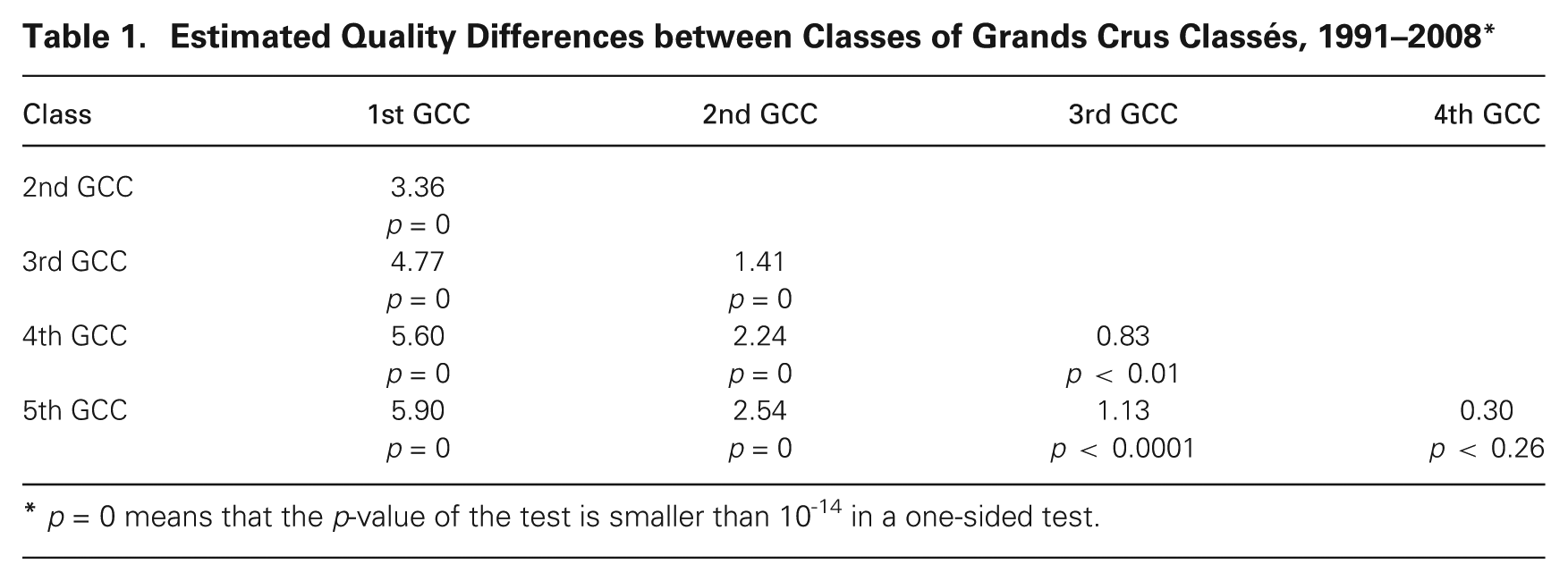
p = 0 means that the p-value of the test is smaller than 10−14 in a one-sided test.
Table 1 confirms that châteaux in higher grands crus classés produce higher quality, on average. For example, châteaux in the first class produce wines that are rated 3.36 points higher than wines from the second class and 5.90 points higher than wines from the fifth class, on average. These differences are highly statistically significant. By contrast, the fourth class produces wines that are rated only 0.30 points higher than wines from the fifth class. This is the only statistically insignificant difference. Generally, the quality differences are large at the top and become smaller toward the bottom of the classification, implying nonlinearity. The fact that quality differences between adjacent classes increase nonlinearly in status amplifies the concern that nonlinear marginal returns to quality (or reputation) could be attributed to status if unjustified linearity assumptions are forced upon the returns to quality or reputation. The differences in reputation (not shown) closely mimic the quality differences among classes. They must do so by definition because reputation is measured as an average over past quality.
This does not mean that quality and reputation are indistinguishable. The correlation between quality and reputation is only 0.48, attesting to the significant vintage-to-vintage variation in quality. There is also sufficient quality overlap between pairs of classes to warrant a comparison. In every class there is at least one producer (often more) that produces at a comparable level of quality as producers from one or more other classes. To provide graphic evidence for this overlap, figure 1 shows the mean estimates and confidence intervals for each château’s average quality over the years 1991 to 2008 from a regression of wine ratings on château and vintage fixed effects. The baseline and the mean of the vintage effects were added back in to show average quality aligned with the Wine Spectator’s 100-point scale. While the figure attests to the overlap of quality among producers from different classes, it also highlights that the first-class producers may not be comparable to the producers in some other classes.
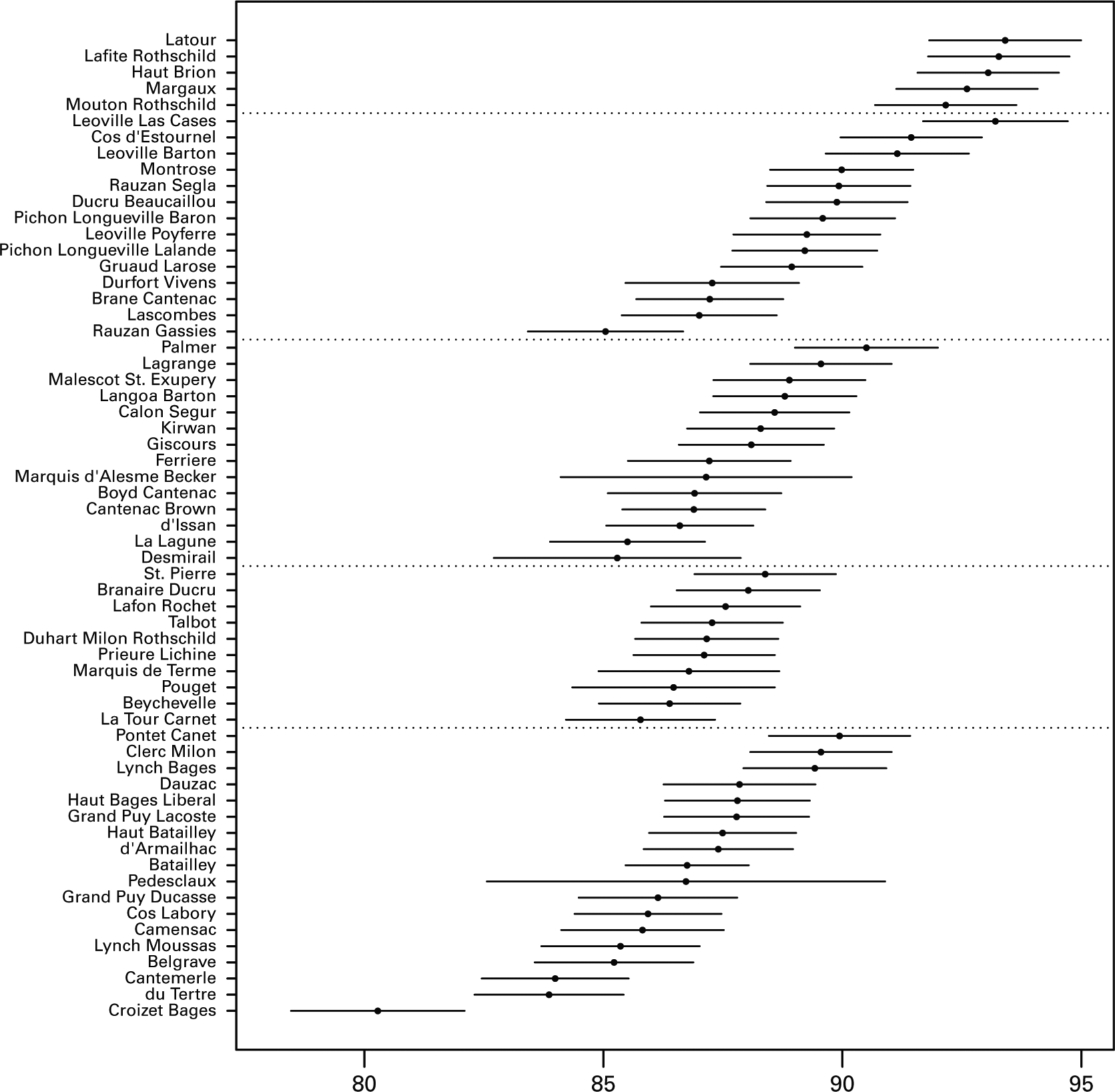
Château quality, 1991–2008.*
The Causality of Status Effects
The fixed nature of the classification prevents status from becoming entangled in a feedback loop with quality or organizational performance, thereby eliminating two sources of endogeneity between typically contemporaneous variables. This simplifies the task of estimating the causal effect of status, as displayed in figure 2. I addressed the third source of endogeneity, the reverse causal effect of performance on quality, which likely implies endogeneity between reputation and performance, with an instrumental variable and a matching estimator. The instrumental variable estimator allows making appropriate assumptions about the functional form of quality and reputation effects, as well as the market’s memory for quality, while endogenizing a château’s choice of its reputation. The matching estimator obviates these issues by comparing wines that look like monozygotic twins in terms of quality and reputation but that differ in their status class. These identification strategies are displayed in figure 3.
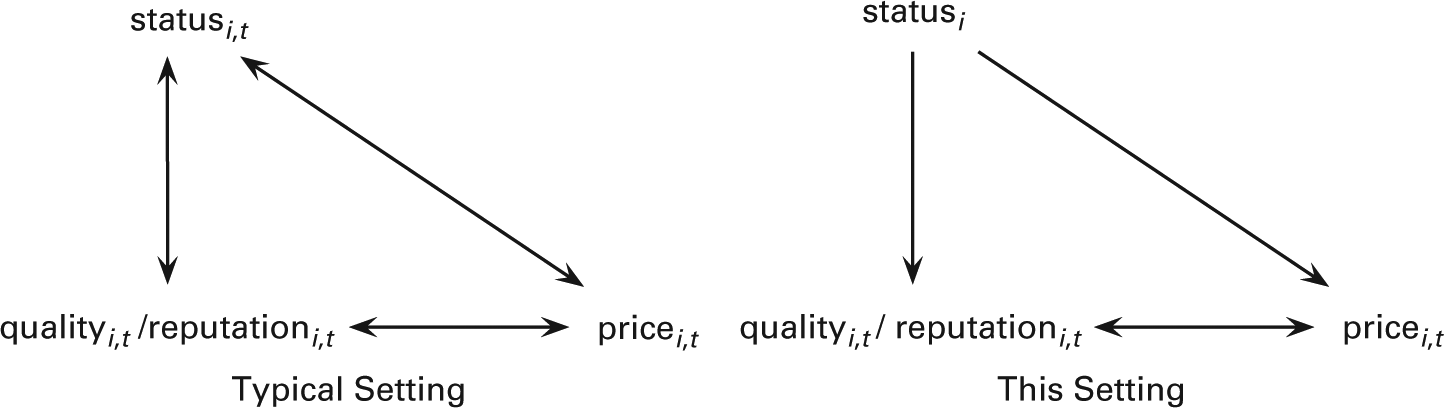
Endogeneity between status, quality/reputation, and price.
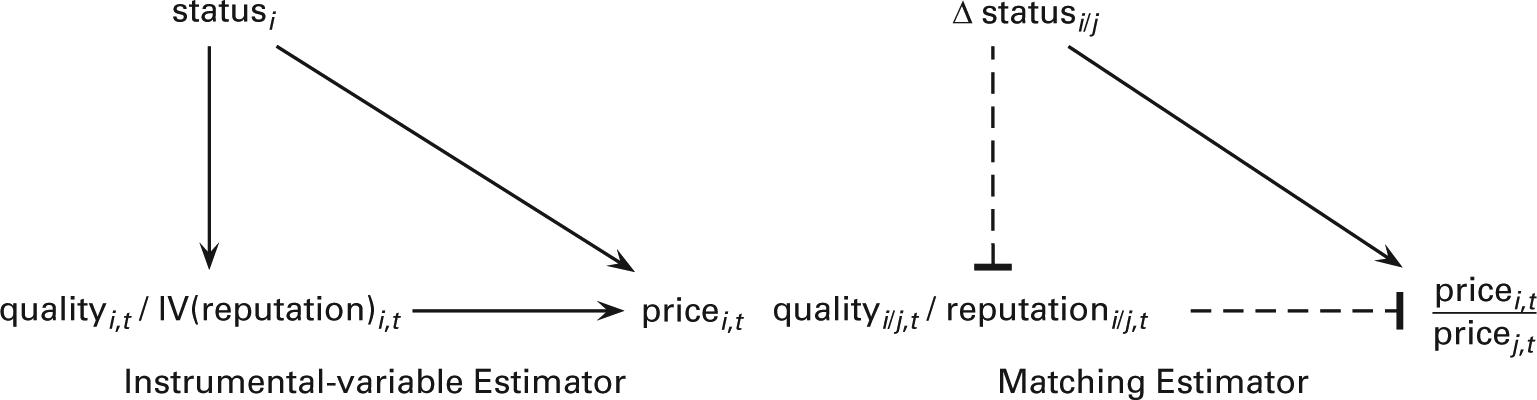
Identification strategies.
Instrumental variable estimation
To make appropriate assumptions about functional forms of the effects of quality and reputation, and to assess whether quality is an endogenous choice, the estimation proceeded in multiple steps. I first estimated a semi-parametric regression in which I regressed logged prices on smooth functions for quality and reputation that were determined by the data in a penalized maximum likelihood approach as well as grands crus classés and vintage fixed effects. This approach revealed two pieces of information. First, it indicated that the effects of quality and reputation on the logged price increase at the margin and suggested that they could be approximated by quadratic functions, as shown in figure 4. The quadratic functional form creates the complication that predicting quality or reputation using the instruments and then squaring the prediction is not permissible, as it would result in a “forbidden regression” that generally yields biased and inconsistent estimates (Wooldridge, 2010: 267). Instead, one has to instrument for both the linear and squared term, which increases the number of instruments needed.
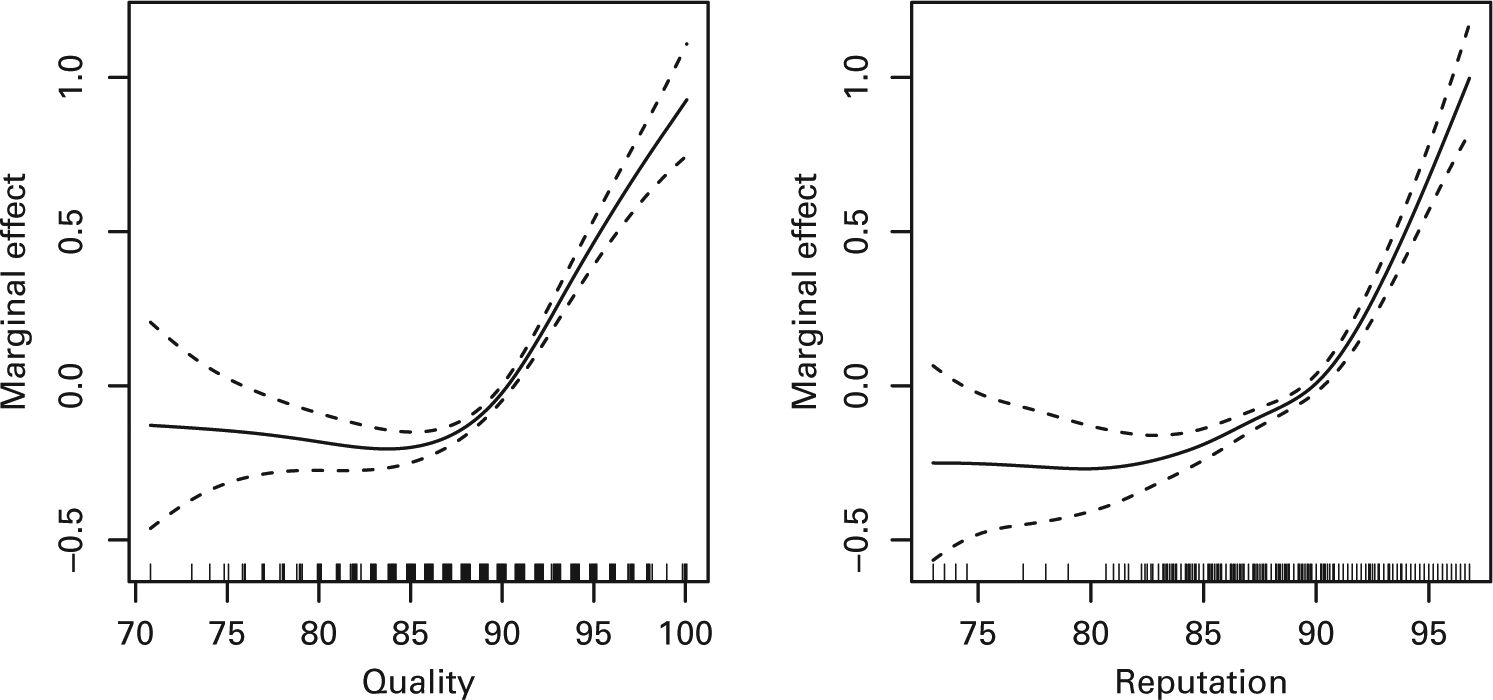
Estimated effects of quality and reputation on price.
Second, an inspection of the residuals of this regression indicated autocorrelation at the first, second, and third lag. The autocorrelation implies that reputation, operationalized as a moving average over endogenous quality choices in the past, cannot be treated as exogenous (e.g., Fair, 1970). I was unable to find a set of fully exogenous instruments that affect quality or reputation at the château level. Weather conditions would be a suitable exogenous instrument, for example, but weather data are not available at the château level. Lagged endogenous variables were the next best option for instrumentation. When instrumenting with lagged endogenous variables, one has to hope to find lags that maintain the strength of the instruments—because weak instruments can lead to more severe bias than fully endogenous independent variables—but minimize the residual endogeneity carried forward through autocorrelation (Arellano and Bond, 1991; Bound, Jaeger, and Baker, 1995). I did not find a sufficient set of lagged endogenous variables that satisfied the criteria of strength and exogeneity.
I eventually instrumented for a wine’s reputation for the vintages t−1 to t−5 and the squared term of this variable with the interactions of a wine’s reputation for the vintages t−6 to t−10 and the number of vintages for the period t−6 to t−10 that were reviewed in the Wine Spectator with the average rainfall in August and September (the months when the grapes ripen) and the average temperature in September over the vintages t−1 to t−5. The methodological reason for instrumenting in this way is that the lagged endogenous variables introduce variation at the château level and retain the strength of the instruments, whereas the weather characteristics introduce exogenous variation and depress the endogeneity problem carried forward through autocorrelation. The substantive reason for instrumenting in this way is the idea that high-quality châteaux should be less susceptible to bad weather. Consistent with this conjecture, the effect of the rain interactions was negative and the effect of the temperature interactions was positive in the first-stage regressions for the linear and quadratic term (not shown).
Only a model with more instruments than endogenous regressors allows using diagnostics to test the validity of the IV approach. Because of the dearth of valid instruments and the need to instrument for both the linear and the squared term, I instrumented for reputation but not for quality. There are two reasons why we may believe a priori that it is appropriate to instrument for reputation but not for quality in this context. One reason is that the classification should have exerted most of its effect on quality differences between classes prior to the period of study, which starts 135 years after the classification was created. Moreover, limits of the scale on which wines are rated put a limit on the maximum quality differences between classes. Hence past quality differences between classes should be a fairly accurate predictor of current and future quality differences between classes for the period of study. The second reason is that while châteaux may be able to select the average level of quality at which they produce, they may have little control over quality fluctuations from vintage to vintage, which are determined by the weather. Importantly, the conjecture that quality is exogenous conditional on instrumenting for reputation is testable. The instrument diagnostics (available at http://asq.sagepub.com/supplemental) maintained the null hypothesis that quality is conditionally. The final estimator is:

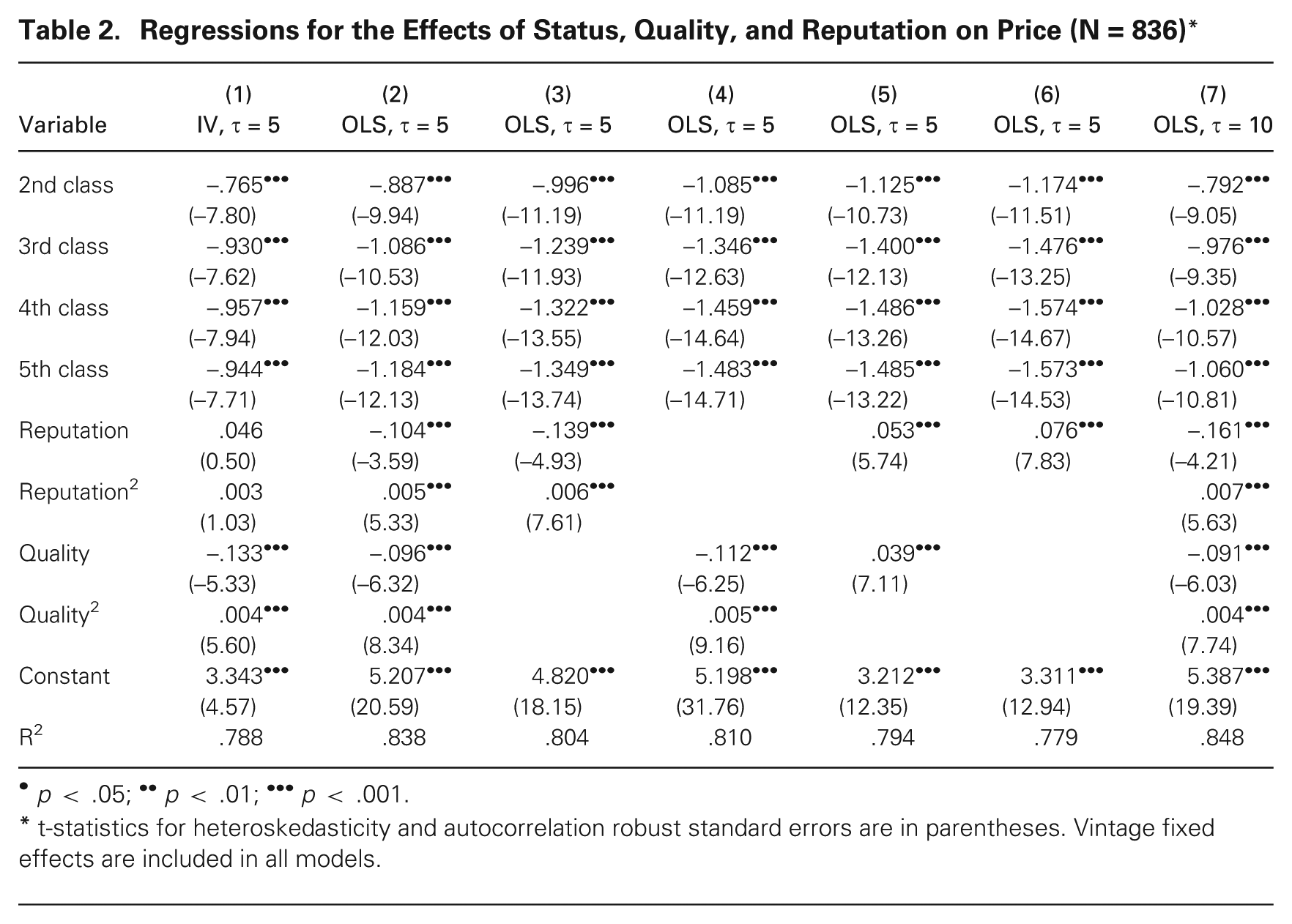
Traditionally, one would start the analysis by showing the more restricted models and progress toward relaxing the restrictions, i.e., the hierarchical inclusion of regressors and the switch from less to more sophisticated estimators. This approach is impracticable here. It would require displaying an inordinate number of models, many of which would not be very informative because they would relax multiple restrictions non-experimentally. Instead, I pursue the opposite route and start with the least restrictive model that best estimates the causal status effect. I then enforce experimentally the assumptions as they are commonly made in the extant literature and that I argued would bias the estimates of status effects. The results are presented in table 2.
Regressions for the Effects of Status, Quality, and Reputation on Price (N = 836)*
p < .05; •• p < .01; ••• p < .001.
t-statistics for heteroskedasticity and autocorrelation robust standard errors are in parentheses. Vintage fixed effects are included in all models.
Model 1 shows the estimates from the IV estimator and supports a causal effect of status on prices. The estimates indicate that, controlling for quality and reputation, first growths fetch prices 1/exp(−.765) = 2.15 times as high as second growths. Second growths are estimated to be 18 percent more expensive than wines from the third class. Wines from the third, fourth, and fifth classes charge prices that are not statistically different from each other. The insignificance of the reputation effects in this model is purely due to multicollinearity. An F-test indicates that the explanatory power of the model increases significantly when the reputation terms are included, and if I include the linear or the quadratic term alone, either term is flagged as a significant positive predictor of prices. The fact that model 1 is over-identified also allows putting an approximate bound on the residual bias contained in the IV estimates. The instrument diagnostics, described in the Online Appendix, indicate that the relative bias is about 5 percent. Hence, under the null hypothesis that all status effects are zero, the residual bias in the IV estimates should be no greater than 5 percent of the estimated coefficients.
Note that the quadratic form assumption forces a true U-shape into the quality effects within the range of data. It predicts that very low-quality wines (below 80 points) would fetch higher prices than wines in the 80- to 90-point range, albeit with very wide standard errors. This is a statistical artifact of the quadratic form assumption and of the fact that the data are sparsely populated below 80 points and very heavily populated above 85 points, which drives the shape of the curve. To assure that this does not affect the results presented hereafter, I conducted two robustness analyses. In one, I removed the wines with less than 80 points. In the other, I winsorized the data, retaining these outliers but limiting their extreme values to the 95th percentile of the observed range. Both analyses produced the same insights, with only slight differences in the coefficients.
Model 2 presents the OLS estimates of an otherwise identically specified model. Throughout, the estimates of the status effects are larger than the estimates of the IV estimator. A Hausman test rejects the null hypothesis that the IV and the OLS estimates of the status effects are equal. This confirms a significant bias of the status effects in the OLS estimates. Neglecting that the choice of quality is endogenous to prices carries over bias to the status coefficients despite the fact that status is fixed here.
Model 3 omits the product-quality controls. It assumes that conditional on reputation and status, the quality of the focal wine has no effect on price. An inability to control for quality on the product level is not uncommon in the organizational status literature (for an exception, see Benjamin and Podolny, 1999). This model overestimates status effects by 15 to 20 percent. A Hausman test rejects the null hypothesis that the status coefficients are equal to the estimates in model 1. Quality differences correlate with status even for this ancient and fixed status hierarchy and after conditioning on reputation. Reputation controls are thus insufficient to account for differences in current quality.
Model 4 is estimated for comparison only. It contrasts model 3 with a model that includes the quality controls but that omits the reputation controls. The model shows that a failure to control for reputation induces bias in the status coefficients of around 45 percent. The Hausman test between the status coefficients of model 1 and model 4 is highly statistically significant. A comparison of the estimates of models 3 and 4 implies that failing to control for reputation induces greater bias in the estimates of status effects in this context than failing to control for quality. This is expected here because status may correlate more strongly with past or long-term average quality than with current quality if quality fluctuates over time.
Model 5 replaces the nonlinear quality and reputation effects with linearity assumptions. This approach induces a bias in the estimated status effects of 47 to 57 percent. A Hausman test strongly rejects the null hypothesis that the status coefficients of model 1 and model 5 are equal. The resulting bias is greater than the biases induced by any of the other omissions.
Model 6 augments model 5 by omitting the control for current quality. It shows an even greater bias than model 5, overestimating status effects by 53 to 66 percent. These biases are remarkable because all models are log-linear models, which already embody an assumption of increasing marginal effects of quality and reputation on price. Nonetheless, the log-linear form proves insufficient to capture the extraordinary value this market places on high quality and reputation.
Model 7 defines reputation on a ten-year lag rather than a five-year lag. Otherwise, the model is specified like model 2. The comparison with model 2 shows that larger status effects are estimated when the market’s memory for quality is assumed to be shorter. The upward bias in the coefficients in model 2 over model 7 is approximately 12 percent. This cautions that choosing an arbitrary and inappropriately short lag on which reputation is defined may result in upward-biased estimates of status effects. The estimates seem to approach the IV estimates, but a Hausman test still rejects the null hypothesis, indicating a significant bias of the status effects in model 7 over model 1.
To assure that the smaller status effects in model 7 compared with model 2 are not the result of choosing a second arbitrary value of τ for the lag on which the market defines reputation, I systematically varied τ from 1 to 10 in models that were otherwise specified like models 2 or 7. For brevity, I do not present the regression table. Instead, I graphically present the estimated status coefficients as a function of τ in figure 5.
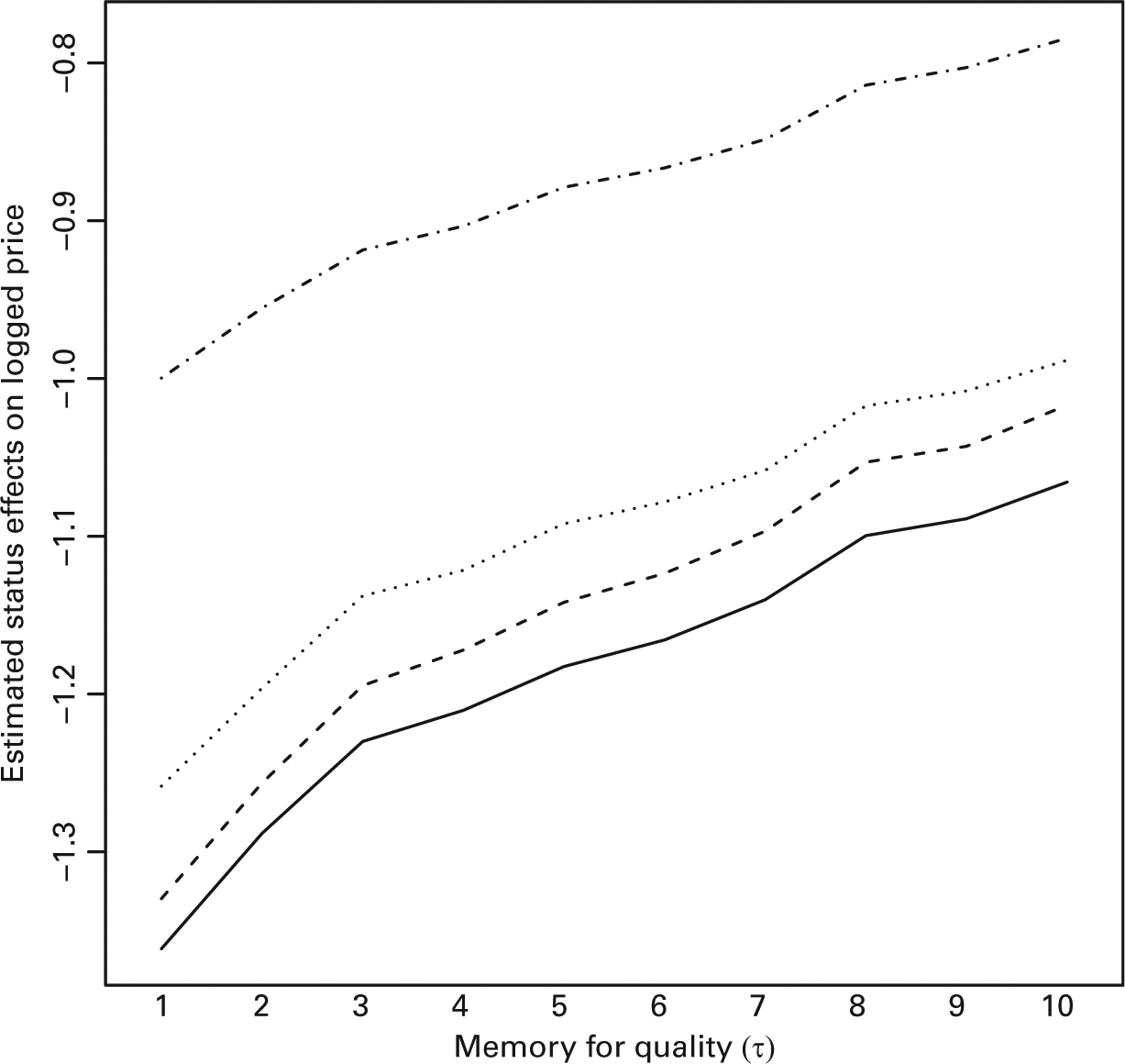
Status effects dependent upon the market’s memory for quality (τ).*
Figure 5 shows that the estimated status effects decline in the market’s assumed memory for quality. Compare, for example, the estimate for the fifth class (solid line) at τ = 1 and τ = 10. When the market is assumed to look back only one year to determine reputation, I estimate that a first-class wine costs 3.9 times the price of a comparable fifth-class wine. When the market is allowed to look back ten years to determine reputation, however, I estimate that a first-class wine costs only 2.9 times the price of a comparable fifth-class wine. It is disconcerting that the trend for status effects to decline does not further attenuate after year three. Without historic data reaching further back or without a consistent estimator as a basis of comparison (model 1), it would remain impossible to determine the appropriate lag even asymptotically.
Coarsened exact matching estimation
The regression analysis in table 2 allows us to estimate the price differences between all pairs of status classes. It is unclear whether all such comparisons are permissible given the data. For example, model 1 estimated that a first growth costs 1/(exp(−0.957)) = 2.6 times the price of a fourth growth. Yet figure 1 suggested that producers in the first and fourth class produce at such vastly different levels of quality that they should not be compared. The comparisons between some status classes might thus be an out-of-sample extrapolation of unknown validity.
To overcome this shortcoming, I complemented the regression analysis with a coarsened exact matching estimator that compares only wines and, thus, status classes that are in fact comparable. The idea of the coarsened exact matching procedure (Iacus, King, and Porro, 2009; Azoulay, Stuart, and Wang, 2014) is to find two units of observation that appear like monozygotic twins. It holds constant, within narrow limits, all important control variables except the variable of interest. Here the procedure matches two wines that are equal, on average, in quality and reputation but that differ in their status class. The question is whether status has a residual impact on price conditional on not having differentially affected selection into quality or reputation. The null hypothesis is that, conditional on being of the same quality and reputation, two wines should fetch the same price irrespective of class. A rejection of the null hypothesis would indicate that buyers are willing to pay for status at the margin. I constructed the matched sample requiring the following from two matched wines: (1) the producing châteaux are in different grands crus classes; (2) the wines’ ratings differ by at most one point; (3) the reputations of the two wines based on their average ratings over the past ten years differ by at most half a point; (4) the number of the past ten vintages of each wine that was reviewed by the Wine Spectator differs by at most one; and (5) both wines are from the same vintage.
The effect of a status difference on price is the treatment effect of interest. Hence the two wines are required to differ in their status class. The second through the fourth matching criteria aim to hold constant the quality and the reputation for quality of two matched wines. The last matching criterion holds vintage and macroeconomic conditions constant that might otherwise differentially affect the prices of wines from different vintages.
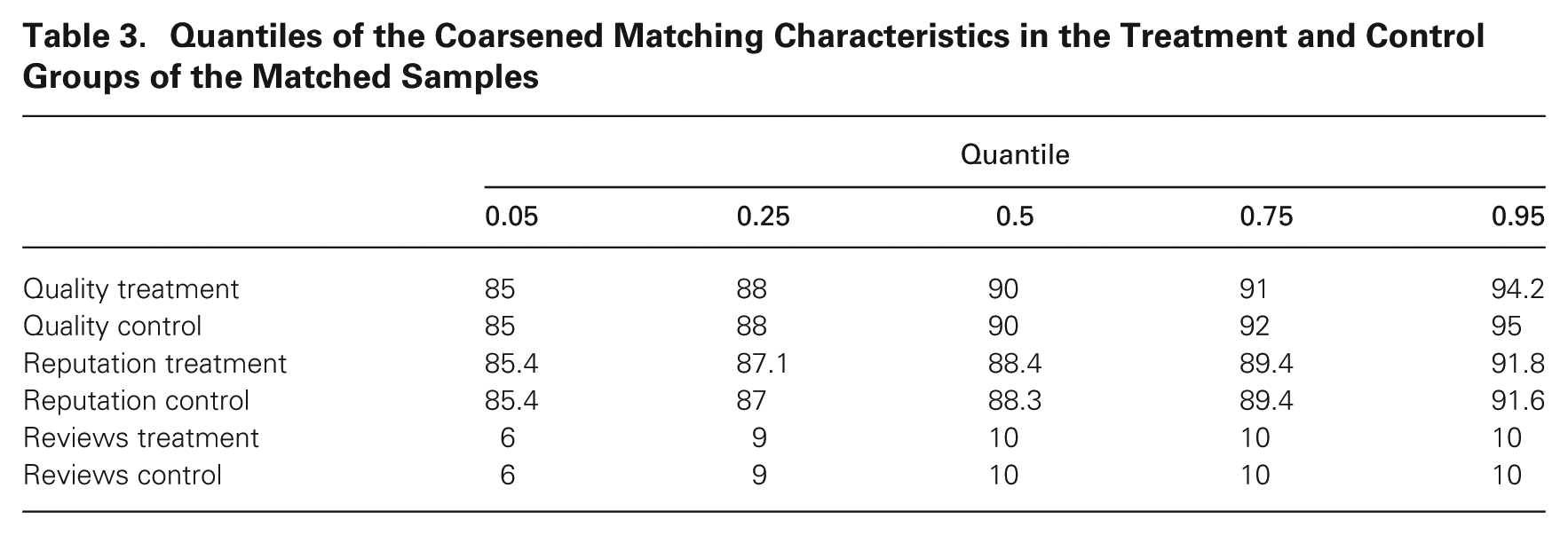
The matching procedure first identifies all possible matches given the matching criteria. If it finds more than one match for a focal wine, the matching wine is selected at random out of the possible matches. If no match is found, the observation is dropped. Double matches resulting in duplicate observations are removed. 4 Because I selected the match for each focal wine at random out of all potential matches, every run of the matching procedure yielded a somewhat different sample. To increase the accuracy of the estimates, I bootstrapped 300 matched samples according to the matching criteria. I provide a comparison of the treatment and control groups in the matched samples in table 3 and a comparison of the matched samples with the data at large in table 4.
Quantiles of the Coarsened Matching Characteristics in the Treatment and Control Groups of the Matched Samples
Quantiles of the Quality Distribution of the Matched Samples and the Data at Large
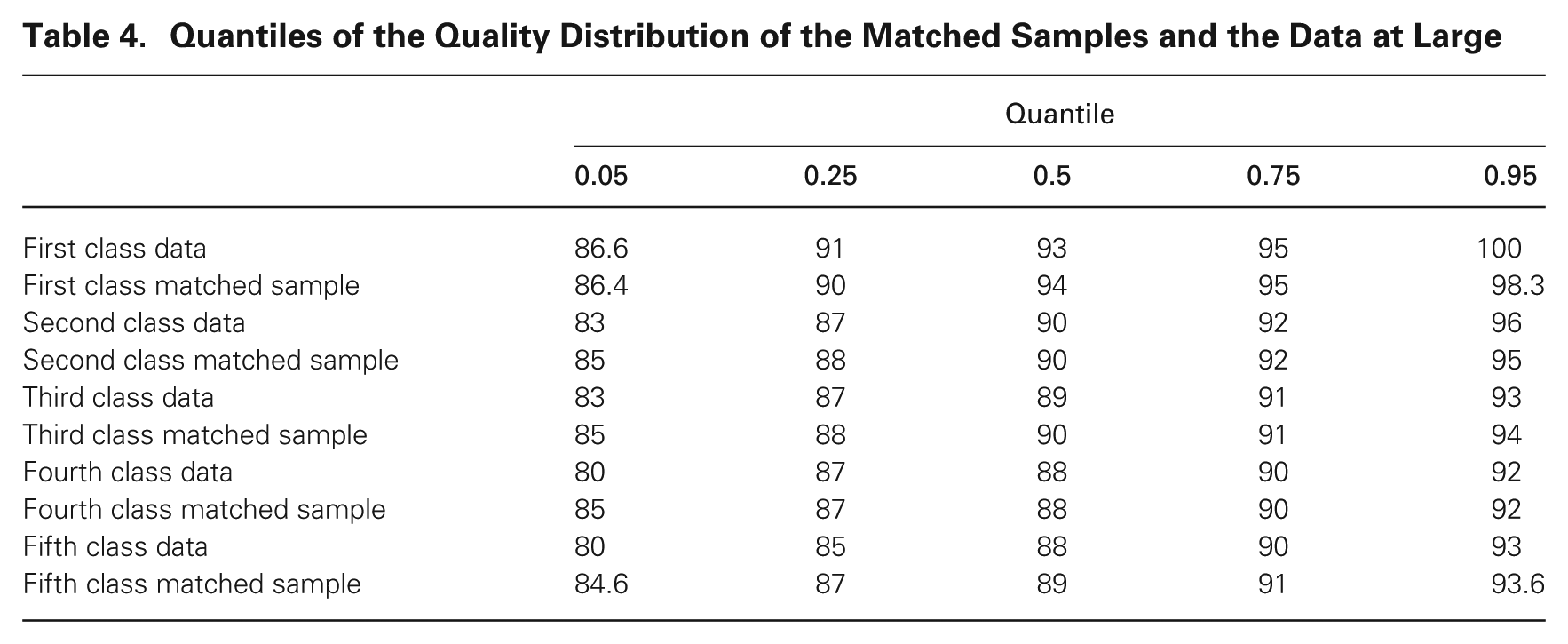
Table 3 shows the close correspondence of the treatment and control groups for the 300 matched samples in all quantiles of the coarsened matching characteristics. The treatment group stands for the wines in the higher grand cru classé and the control group for the wines in the lower grand cru classé that were matched to the treatment group. The table shows how closely the higher-ranked châteaux resemble the lower-ranked matches. The close correspondence between the higher- and lower-ranked matches is important to the causality claim of this analysis. Suppose the lower-ranked châteaux were to achieve only the lower bound of the allowable difference of the matching criteria. Then we would be unable to say that the price difference is truly due to a status difference and not due to the residual difference in quality or reputation. The effective absence of a difference reassures us that this estimator estimates a causal effect.
Table 4 shows the correspondence between the quantiles of the quality distribution of the 300 matched samples and the data at large. Some lack of correspondence is apparent in the lower quantiles for the lower classes, i.e., where wines are of such poor quality that they have no match or few matches within the grand cru classification. This table shows that the matched sample closely resembles the full data. The close correspondence between the matched sample and the data at large implies that the sample average treatment effect (SATT) identified with this analysis should generalize beyond the matched sample(s) and come reasonably close to the average treatment effect on the treated (ATT). That is, the estimated status effects should be representative of status effects on the population of the 61 grand cru classified wines of the Médoc.
I analyzed for each pair of grands crus classés the price ratio of the higher-ranked wines vis-à-vis their lower-ranked matches. This mimics the previous regression analysis. 5 The ratio indicates the price multiple buyers pay for the higher-ranked wine relative to the lower-ranked wine of tightly matched quality and reputation. A ratio significantly greater than one indicates a status premium. The results of the matched-sample analysis are presented in table 5.
Matched Sample Analysis: Relative Prices*
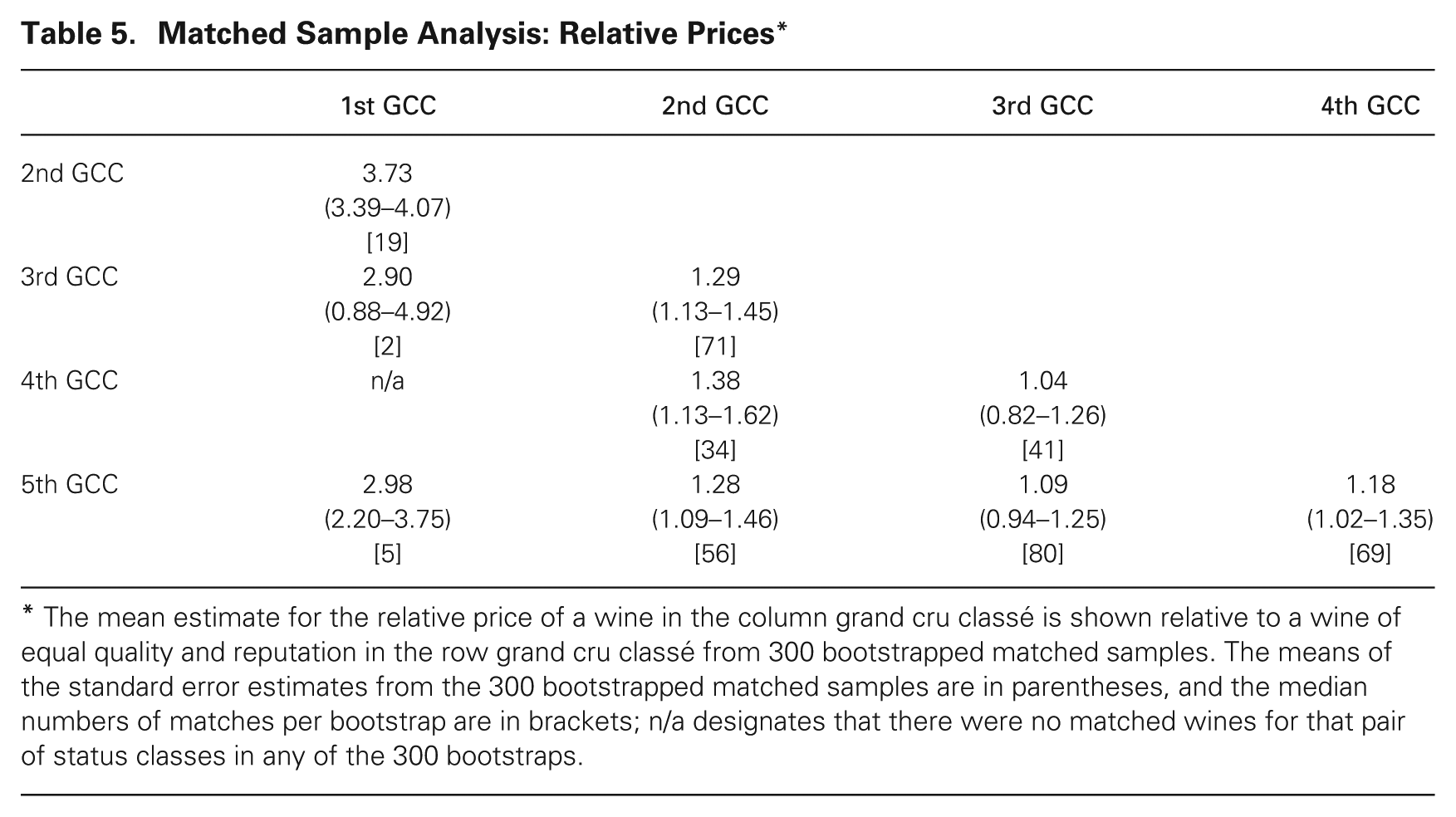
The mean estimate for the relative price of a wine in the column grand cru classé is shown relative to a wine of equal quality and reputation in the row grand cru classé from 300 bootstrapped matched samples. The means of the standard error estimates from the 300 bootstrapped matched samples are in parentheses, and the median numbers of matches per bootstrap are in brackets; n/a designates that there were no matched wines for that pair of status classes in any of the 300 bootstraps.
Table 5 shows that wines from the first grand cru classé fetch an estimated 3.73 times the price of wines from the second grand cru classé, holding quality and reputation constant. Wines from the first class are estimated to cost 2.9 times the price of a matched wine from the third class, but this effect is imprecisely estimated. There are only very sporadic matches of first-class with third-class wines, and they involve only one third-class producer (Château Palmer). Wines from the fourth class are never matched with wines from the first class. Finally, the matched samples contain a median number of five matches between wines from the first and wines from the fifth class. First-class wines are estimated to cost 2.98 times the price of a matched fifth-class wine. Overall, this analysis reproduces the finding that the first class enjoys a substantial price premium over the other classes. But it points out that a comparison of wines from the first class may be warranted only with wines from the second class, as wines from the lower classes match first-class quality and reputation sporadically at best.
Second growths fetch an estimated 29 percent more than third growths, 38 percent more than fourth growths, and 28 percent more than fifth growths of equal quality and reputation. It may come as a surprise that the advantage of the second over the fifth growths is smaller than over the fourth growths, but the confidence intervals of these estimates overlap widely. Moreover, this may reflect that the analysis brushes over some detail. Fourth growths are more likely to be matched with second growths that produce at the bottom of the quality distribution of the second class. By contrast, some high-quality fifth growths like Châteaux Clerc-Milon, Lynch-Bages, or Pontet-Canet are matched with châteaux closer to the top of the quality distribution of the second class (cf. figure 1), suggesting that status might play a more important role as a buffer than as a booster.
Third growths charge an estimated 4 percent more than fourth growths and 9 percent more than fifth growths, but these premiums are statistically insignificant. Fourth growths charge an imprecisely estimated 18 percent more than comparable fifth growths, which is just significant at the 5-percent level. Overall, six of the eight comparisons show significant returns to status. The price premium is huge for the first growths and substantial for the second growths, and it may be small or zero among the third, fourth, and fifth growths.
The Cause of Returns to Status
To assess the underlying cause for the status effects in this market, I studied their development over time. This analysis assumes that wine ratings effectively resolve the uncertainty about product quality. Wine ratings have become ubiquitously available with the proliferation of the Internet. This increase in the availability of information about quality should have reduced the buyers’ uncertainty about quality. If status returns were driven by uncertainty about quality, they should have decreased over the period of study.
Increasing returns to status over time will be inconsistent with the uncertainty hypothesis and point to the conspicuous consumption hypothesis only if three additional conditions hold. First, the classification must not have become a stronger signal of quality over time. Second, buyers must not have become more uncertain about quality over time, which might otherwise cause a greater reliance on the classification as a signal of quality even when its signal strength is constant. Third, competitive pressures on the lower classes must not have increased disproportionately relative to the competitive pressures on the higher classes, which would otherwise depress the prices of the lower-quality and, by correlation, lower-status châteaux more than the prices of the higher-status châteaux. In the first two cases, the uncertainty hypothesis would be a plausible alternative explanation to the conspicuous consumption hypothesis for increasing returns to status over time. In the latter case, increasing returns to status over time could be driven by unaccounted-for changes in the broader competitive environment that the classified châteaux of the Médoc face.
In analyses available from the author, I isolated three distinct time intervals over the period of study. Over the vintages 1991 through 1994, the classification became a stronger signal of quality due to increasing statistical precision (but not increasing effect size), and the Internet was in its infancy. For the vintages 1995 through 2003, none of the three conditions that might compromise the conspicuous consumption hypothesis apply. The classification did not become a stronger signal of quality, demand came from long-established markets (CIVB, 2010), and while competitive pressures seem to have increased, they increased proportionally for producers at all levels of quality (and, by correlation, status). 6 For the vintages after 2003, the influx of Chinese money (CIVB, 2010) resulted in a massive increase in prices. The Chinese might be particularly status-conscious, but due to their lack of experience with Bordeaux wines they might also be particularly uncertain about quality, which could result in an increased reliance on the classification as a signal of quality. Under these conditions, increasing returns to status over the time period 1995 to 2003 would provide the strongest evidence for the conspicuous consumption hypothesis.
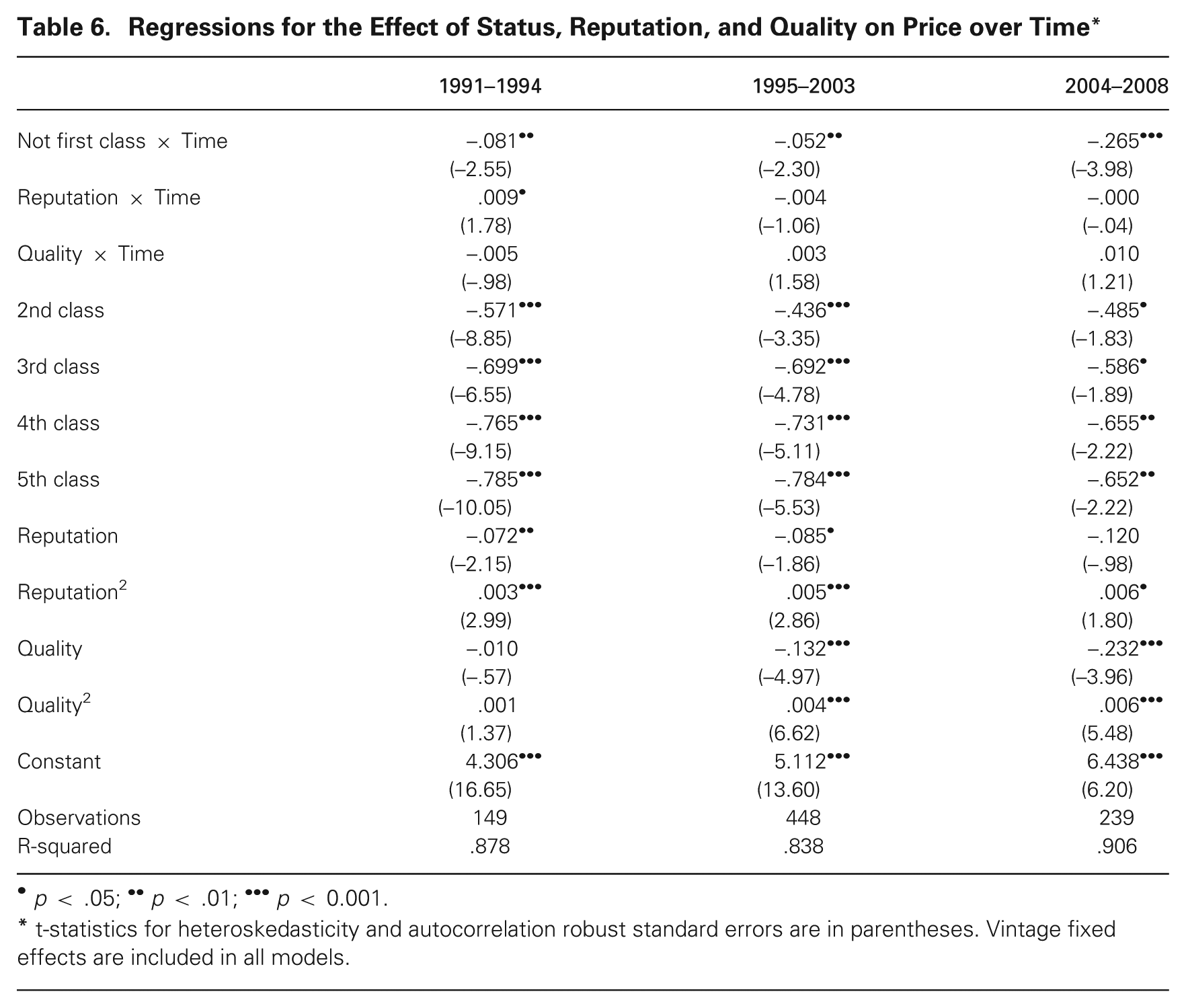
To assess the development of returns to status over time, I reestimated a variant of model 7 in table 2 for each of the three time periods. I included an interaction of a linear time trend with an indicator variable that takes the value of 1 if a wine’s producing château is not a member of the first class. Unreported regressions of the time-trend interaction with the individual grand cru classé fixed effects indicated that they were jointly statistically significant for each of the three time periods, but they were not significantly different from each other, implying that they can be collapsed into one. 7 As controls, I included linear time trends for the changing effects of quality and reputation on prices over time. More complex models or an IV estimator were not feasible because of multicollinearity or the number of required instruments. But if we make the assumption that the estimates will be similarly biased as the estimates in model 7 in table 2, we should expect that the following status coefficients might be overestimated between 3 and 12 percent. The results of the analysis are presented in table 6.
Regressions for the Effect of Status, Reputation, and Quality on Price over Time*
p < .05; •• p < .01; ••• p < 0.001.
t-statistics for heteroskedasticity and autocorrelation robust standard errors are in parentheses. Vintage fixed effects are included in all models.
All models indicate an increase in returns to status for the first class within the three time periods and hence over the period of study as a whole. The period between 1995 and 2003 offers the cleanest test of the conspicuous consumption hypothesis. Although smaller than in the other periods, the increasing relative advantage of the first class is statistically significant and economically sizeable. The first growths gained an estimated 5.3 percent (1/exp(−0.052)) per year relative to the other classes over this period. First-growth prices diverge even more strongly from the prices of the other classes for the vintages 1991 through 1994 and 2004 to 2008. The first class gained about 8.4 percent per year for the vintages 1991 through 1994 and a whopping 30.5 percent per year over the vintages 2004 through 2008 relative to all other classes. For reasons discussed above, the signaling value of the classification might explain the trends in these two time periods.
Invoking the uncertainty explanation for the period 1991 through 1994, however, would be paradoxical. While the status hierarchy has become a more precise signal of quality over this period, it is unclear how buyers would be able to realize and incorporate this information into the release prices of wines if they did not pay close attention to the ratings. This undermines the standard uncertainty explanation for increasing returns to status during this period. Instead it seems to be the stronger alignment between quality and status and, hence, the increasing certainty that the highest-class producers produce superior quality that exacerbates the returns to status during this period. This suggests that the increasing value of status in this period may not have been driven as much by the uncertainty about quality as it may have been driven by status accurately distinguishing the quality of producers’ offerings.
For the period of exploding demand from China for the vintages 2004 through 2008, both the uncertainty and the conspicuous consumption hypothesis are plausible explanations for the dramatic increase in returns to status. Even though the hypotheses cannot be tested with the data, there are some hints that the effect may be driven by conspicuous consumption more than by the uncertainty about quality. One press report indicates that the Chinese consider these wines luxury goods like any other and that they are not primarily concerned with the quality of the wines. The same report indicates that Château Lafite-Rothschild (the first growth heading the list that the Union of Brokers sent to the Chamber of Commerce in 1855) is the beverage of choice to ingratiate them with business partners, seal business deals, and entertain government officials. 8 Another report indicates that in Chinese restaurants, expensive bottles like Lafite are placed on the table with the label facing outward for everyone to see. Finally, up to 90 percent of all Lafite sold in China is counterfeited. Counterfeit goods are characteristic of demand from consumers who are interested neither in being deeply knowledgeable about that category of goods nor in their quality, but who attempt to elevate their status through the consumption of highly conspicuous goods that even uninformed audiences can identify (Han, Nunes, and Drèze, 2010). 9 This at least suggests that much of the first-growth effect for the vintages after 2003 is driven by the status-directed, ostentatious display of wealth among the Chinese buyers rather than their uncertainty about quality.
Discussion
The first goal of this paper was to identify the causal, symbolic effect of organizational status on product prices and to highlight the impediments to identifying causal status effects in the process. I investigated this question in the context of Médoc wines of the vintages 1991 to 2008 whose producing châteaux were classified as grands crus in 1855. The fixed nature of the classification resolved most of the endogeneity concerns that typically plague empirical studies of organizational status. Wine ratings from blind tastings enabled implementing tight controls for quality and reputation on the product level. The concern about reverse causality between quality and price was addressed with an instrumental variable and a matching estimator. As a result, this study provides one of the cleanest tests of organizational status effects yet that differentiates the effects of status, reputation, and quality.
The instrumental variable and matching estimators provided strong evidence for a causal, symbolic effect of status on the prices of the grands crus classés of the Médoc. The greatest returns to status accrue to the highest-status producers. The returns to status decline toward the bottom of the status hierarchy. The differences are indistinguishable from zero for some pairs of status classes in the instrumental variable and matching estimators, respectively. At least in this market, status is thus a phenomenon of categorical rather than continuous hierarchical distinction. But the descriptive statistics highlighted that the first-class châteaux broadly validate their status position by producing much higher quality, on average, than the producers in the other classes, and the matching estimator showed that this strongly limits their comparability. Whether this is a direct consequence of the incentives flowing from the status hierarchy is beyond the scope of this study and an interesting question for future research. It certainly does not explain why Château Leoville Las Cases, a second growth that has been producing at first-growth quality for 30 years, cost 60 percent of a first growth in 1991 but costs only about 25 percent of a first growth today.
Beyond identifying the causal effect, this study highlighted important sources of biases in status effect estimates. Comparatively small effect sizes in the extant literature give reason to suspect that many of the causality claims might not hold if the status effects were properly identified. The failure to control for reputation (demonstrations of quality in the past) induced greater bias in the status effect estimates than the failure to control for current quality. We may expect this finding to generalize to other settings in which the status hierarchy is ancient or fixed and is approaching the limit of its potential to determine quality differences between status classes. If status is expected to (continue to) drive quality differences between producers, by contrast, we should expect that the omission of controls for current quality becomes a more important source of bias (cf. Azoulay, Stuart, and Wang, 2014). Some studies that cannot directly assess the quality of a firm’s products or services might find a partial remedy for this problem by using forward-looking in addition to backward-looking versions of the available controls for reputation. This should purge status effect estimates from some of the substantive effects of status and thereby get closer to its symbolic effect.
Status, quality, and reputation are not only correlated, but their effects also all increase at the margin in this market. Restrictive assumptions about the functional form of quality and reputation effects were thus the most important source of bias for the status effect estimates. Even a log-linearity assumption, which already allowed for exponential effects of quality and reputation on prices, was too restrictive to account for the increasing marginal willingness to pay for quality and reputation. We should thus be careful not to misattribute returns to status that truly derive from the value markets place on the pinnacle of quality. Future work on status would benefit from testing and reporting the validity of its functional form assumptions.
In addition, the results alert us not to underestimate the enduring nature of reputation in markets in which we believe status to matter. Status may capture a producer’s long-term average quality better than its recent demonstrations of quality do. Hence we may mistake reputation for status effects if an empirical strategy defines reputation on an inappropriately short lag. Consistent with this reasoning, the estimated status effects among the grands crus classés of the Médoc declined as the lag on which reputation was defined was extended. Defining reputation on a longer lag seemed to remedy large parts of the bias in the OLS estimates, but without the reference point of a consistent estimator, it would be unknown how much of the bias is remedied and what the appropriate lag is. In studies that cannot track the entire quality history of a producer, returns to status that asymptotically approach a bound as the market’s memory for quality is extended or a plausible theoretical limit for the durability of reputations might provide some, albeit imperfect, relief from this problem.
Finally, I showed that neglecting to recognize that quality choices are endogenous can propagate bias to the status effect estimates even if status itself cannot be reversely affected by quality or price. The instrumental variable estimator produced the lowest estimated status effects of all estimators and allowed putting an approximate bound on the residual bias contained in the estimates. Less sophisticated estimators will neglect reverse causality and produce biased estimates not only for the endogenous variables themselves but also for correlated variables. As status scholars, we study a complex social phenomenon for which it is difficult to ascertain causality because of the endogenous feedback loops among status, quality, and organizational outcomes. While our methods need to address this complexity, some of these methods (like the matching estimator) need not be complicated. The choice of the empirical setting can also greatly aid in identifying the causal effect of status, as this work and other recent articles have shown (Simcoe and Waguespack, 2011; Azoulay, Stuart, and Wang, 2014).
By studying a period of time during which the Internet proliferated, I tested inductively two alternative root causes for the returns to organizational status: status as a signal of quality under uncertainty and conspicuous consumption. Previously, the evidence that buyers are willing to pay a premium for a good of equal or lesser quality had been weak. Consistent with the conspicuous consumption hypothesis, I found that the symbolic returns to status, i.e., that part of the Matthew effect that is not justified by differences in underlying quality, has strongly increased in a time of decreasing uncertainty and benefited only the highest-status producers. I conclude from this that uncertainty is not a necessary condition and the motive of conspicuous consumption is a sufficient condition to generate returns to status. Considerations of conspicuous consumption might enter many decisions that are not typically considered consumption. For example, this might include the choice among employers or educational institutions for purely symbolic reasons. Further inquiry into the scope conditions of conspicuous consumption is needed.
The presence of an audience, at least an imagined one, is a defining characteristic of conspicuous consumption as an explanation for status effects. In this view, a social actor consumes or displays goods or affiliations to elevate that audience’s perception of him or her. Without an audience, the motive of conspicuous consumption cannot generate returns to status. Under the perspective that status acts as a signal of quality under uncertainty, by contrast, no audience is required to generate returns to status. At least three features thus suggest themselves to testing the underlying mechanisms that drive or bound status effects: changes or differences in the presence, absence, or composition of audiences, the conspicuousness of goods or their consumption, or uncertainty about quality. Future work should continue to exploit such variation to identify the underlying explanation for status effects, but it would also benefit from more comparative studies of status hierarchies to identify their distinguishing features.
The reader should not interpret the evidence for conspicuous consumption to mean that uncertainty does not generally have a positive effect on the returns to status, which is a cornerstone of the theoretical and empirical organizational status literature. Instead, one should interpret this to mean that the uncertainty about the producers was low even before the advent of the Internet and that, therefore, a different root cause must explain the returns to status in this market. After all, each of the châteaux had been in existence for more than 150 years, and the trade was aware of rating agencies such as the Wine Spectator and Robert Parker well before the Internet started to proliferate. The purely symbolic returns to status I identified here imply that status acquisition becomes an organizational end in itself, beyond the purpose of signaling quality. How organizations can affect audiences’ perceptions of organizational status independent of quality remains an interesting question for future research.
Footnotes
Acknowledgements
I thank Brent Goldfarb, Ben Hallen, Rachelle Sampson, David Sicilia, David Waguespack, Pierre Azoulay, Scott Stern, James Stock, Ezra Zuckerman, and seminar participants at the University of Maryland, Dartmouth College, Duke University, Georgia State University, Harvard Business School, HEC Paris, MIT, Rice University, UC Berkeley, USC, and USI Lugano for helpful discussions. I appreciate the excellent guidance of Associate Editor Pamela Tolbert and three anonymous ASQ reviewers. I gratefully acknowledge the research assistance by Dolores Malter. All errors are my own.
1
The only other grape varietal that is used in a proportion that rivals or exceeds Cabernet Sauvignon for rare vintages and few châteaux is Merlot.
2
Robert Parker’s The Wine Advocate and the Wine Spectator are the most influential publications of the trade. Both use a 100-point scale for their ratings with virtually identical categorical cutoffs. The majority of the wines in this study are rated between 80 and 100 points, which puts them in the Wine Spectator’s good (80–84), very good (85–89), excellent (90–94), and classic (95–100) categories. Parker’s cutoff for the highest category is 96 points.
4
For example, a 2006 Château Lafite-Rothschild may be matched with a 2006 Château Leoville-Las-Cases in both instances, when Lafite is the focal wine and a match is being sought for Lafite and when Leoville Las Cases is the focal wine and a match is being sought for Leoville Las Cases. Double matches always occur when two wines are the only matches for each other.
5
The relative prices of two grands crus classés for the earlier regression analysis is obtained by exponentiating the difference between two grands crus classés coefficients (the omitted baseline for the first class is zero).
6
Competitive pressures were assessed by the number of wines reviewed in the Wine Spectator that fall in the categories 85–89, 90–94, and 95–100 points. The number of reviewed wines grew strongly over the period of study but at an indistinguishable rate across these categories.
7
In further robustness analyses, I substituted the time trend with world Internet prevalence, with the GDP of China, and with media mentions of Robert Parker and the Wine Spectator. All produce consistent results, but all are highly correlated with time such that it is not possible to distinguish among them.
9
Numbers vary across sources, reporting that between 70 and 90 percent of all Lafite sold in China is counterfeited. Sources: http://sinocism.com/?p=3238,  ; last accessed 14 December 2012.
Author’s Biography
References
Supplementary Material
Please find the following supplemental material available below.
For Open Access articles published under a Creative Commons License, all supplemental material carries the same license as the article it is associated with.
For non-Open Access articles published, all supplemental material carries a non-exclusive license, and permission requests for re-use of supplemental material or any part of supplemental material shall be sent directly to the copyright owner as specified in the copyright notice associated with the article.
