






Abstract
Using an original dataset of 4,183 former J-1 Visa holders from 81 countries—all of whom had worked in the U.S.—I examine how skilled return migrants, as cross-border brokers, transfer knowledge about organizational practices from abroad to their home countries. I hypothesize that returnees’ knowledge transfer success depends on their embeddedness in both their home- and host-country workplaces and develop and test theory about the organizational and cultural conditions that activate or suppress skilled returnees’ ability to broker knowledge across borders. Findings show that not only do host- and home-country embeddedness increase knowledge transfer success, but they also interact positively. At the organizational level, however, the presence of other returnees in a home-country workplace decreases the positive effect of a returnee’s host-country embeddedness, whereas the similarity of a returnee’s industry background to the home-country industry increases it. At the country level, high xenophobia in a given home country diminishes the positive effect of host-country embeddedness but increases the positive effect of home-country embeddedness. These findings inform an interpersonal perspective on knowledge transfer, contributing to work on brokerage, organizational learning, employee mobility, and the globalization of expert knowledge.
As the global movement of skilled people spreads ideas, technologies, and practices around the world, many have looked to skilled return migrants as agents of economic transformation in their home countries (Saxenian, 2006). Returnees are often regarded as cross-border intermediaries whose ties to foreign resources and familiarity with their homeland institutions enable them to bring innovative practices to organizations in their countries of origin (Kuznetsov and Sabel, 2006; Jonkers and Tussen, 2008; Choudhury, 2010). But some work suggests that returnees might be ill-suited to brokering knowledge, pointing out that many encounter readjustment difficulties (Potter, 2005; Szkudlarek, 2010), maintain their ties at home at the expense of developing only superficial expertise abroad (Chen, 2007; Obukhova, 2012), lack commitment to homeland institutions (Kenney, Breznitz, and Murphree, 2013), or face xenophobic responses in local environments (Adler, 1981; Bovenkerk, 1981; Gaw, 2000). Whereas the first line of research underscores the individual empowerment of returnees as cross-border brokers, the second identifies the interpersonal barriers facing returnees in their homelands.
The growing body of research on the cultural and organizational contingencies of social capital and brokerage can help us make sense of the conflicting findings (Burt, 1997; Song, Almeida, and Wu, 2003; Xiao and Tsui, 2007). This work has, in part, focused on how the positional advantage of a broker (Burt, 2005)—an individual who has ties to otherwise disconnected groups—does not always translate into functional advantages. For example, the presence of other brokers (Ryall and Sorenson, 2007; Buskens and van de Rijt, 2008; Reagans and Zuckerman, 2008), cultural environments that emphasize collectivist ideals (Xiao and Tsui, 2007), and the task orientation of the ties that constitute social capital (Ahuja, 2000) can all erode a broker’s ability to transform a positional advantage into a power advantage. This contingency perspective is useful in understanding variation in another important brokerage outcome that has not received systematic empirical treatment in this past work: the ability to command flows of information between disconnected groups.
Also useful is research in organizational learning on the link between workers’ mobility and interorganizational knowledge spillover. Much of this work suggests that organizational features, such as absorptive capacity, account for variation in knowledge transfer in studies of engineers (Almeida and Kogut, 1999; Song, Almeida, and Wu, 2003), accountants (Wezel, Cattani, and Pennings, 2006), scientists (Zucker, Darby, and Brewer, 1999; Azoulay, Graff Zivin, and Sampat, 2011), inventors (Marx, Strumsky, and Fleming, 2009), and financial analysts (Groysberg and Lee, 2009). Another view stresses that the characteristics of newcomers to organizations matter, especially their embeddedness in social networks (Hansen, 1999; Reagans and McEvily, 2003; Inkpen and Tsang, 2005; Dokko and Rosenkopf, 2010). Using these ideas, I develop a framework that links organizational evaluation and individual embeddedness as contingent mechanisms in an interpersonal perspective on organizational knowledge transfer. Furthermore, I decompose knowledge transfer by comparing the organizational and cultural factors that motivate an individual to share knowledge with those that explain the likelihood that a target organization adopts that knowledge.
Although much research assumes that returnees create economic growth by bringing resources and skills back to their home countries, little work investigates returnees’ knowledge transfer as an outcome itself (Saxenian, 2006). Tung and Lazarova (2006) offered one of the few comparative empirical studies of returnee skill transfer, finding that the failure to connect with colleagues prevents returnees from applying their skills in home-country workplaces. Oddou, Osland, and Blakeney (2009) outlined a theoretical model for understanding how a returnee’s success when reintegrating into his or her home country affects that person’s propensity to share knowledge. Finally, Lazarova and Tarique (2005) identified certain human resource tools that can facilitate reentry processes (see also Berthoin Antal, 2001; Au and Fukuda, 2002). This work identifies returnees’ knowledge transfer as an important problem, but few studies give clear evidence of which organizational and individual factors lead to positive knowledge transfer outcomes. Here, I offer a critical review of relevant work on employee mobility and knowledge transfer, relating it to research on return migration, and develop theory about how individual embeddedness and organizational evaluation serve as contingent determinants of knowledge transfer success. To test my arguments, I use data from an original survey I administered to 4,183 skilled migrants from 81 different countries, all of whom had worked in the U.S. under J-1 Visas before returning to their home countries. To supplement the survey data, I also conducted 161 in-person and phone-based interviews with survey respondents, who represented 25 different countries.
Employee Mobility and Knowledge Transfer
For this study, I adopted Argote and Ingram’s (2000) definition of knowledge transfer success, which occurs when a practice from one organizational unit is adopted as a routine in another. Knowledge, here, refers to a repeated and observable practice (Nelson and Winter, 1982; Winter, 1995); it is procedural, meaning organizationally embedded and expressed only when a task is being done (Cohen and Bacdayan, 1994). Examples include the adoption of safety routines in a manufacturing firm or the implementation of procedures for checking code quality in a software company. Studies of mobility have primarily focused on technical knowledge transfer, often using patent data as a way to study how the movement of technical personnel leads to knowledge spillovers (Jaffe, Trajtenberg, and Henderson, 1993; Almeida and Kogut, 1999; Singh, 2005). For instance, Song, Almeida, and Wu (2003) showed that firms tend to adopt the technical knowledge of newcomer engineers whose expertise is outside the firms’ core expertise in what they call “learning-by-hiring.” By contrast, studies of non-technical practices rely on proxy measures, such as performance, for knowledge transfer (Ingram and Roberts, 2000; Uzzi and Lancaster, 2003).
Much work has focused on the embeddedness of individuals in social networks as a determinant of knowledge transfer success (Burt, 1992). Reagans and McEvily (2003) suggested that ties to a cohesive group boost the motivation to share knowledge, while Levin and Cross (2004) argued that stronger ties reflect greater trust that can enhance the articulation of knowledge (see also Bechky, 2003). In addition, newcomers use their connections to access knowledge valuable to their new organizational sites and to realize opportunities to share knowledge (McEvily and Zaheer, 1999; Tsai, 2001; Inkpen and Tsang, 2005). These cross-organizational ties allow returnees, in particular, to offset institutional and cultural barriers to transferring knowledge across different countries as cross-border brokers. Saxenian (2006: 5), for example, traced the start of Taiwan’s semiconductor sector to returnees’ cross-border ties to the U.S., which enabled them to “identify promising new market opportunities, raise capital, build management teams, and establish partnerships with specialist producers located far away.”
Some work, however, posits that a broker doesn’t always have structural advantages, especially when it comes to knowledge transfer. For example, the presence of other brokers can diminish the positional advantage of any one broker (Ryall and Sorenson, 2007; Buskens and van de Rijt, 2008; Reagans and Zuckerman, 2008). Similarly, Podolny and Baron (1997) showed that the benefits of structural holes in an individual’s network depend on the content available through the ties. Other research has examined the cultural context of a broker’s advantage (Guler and Guillén, 2010; Vasudeva, Zaheer, and Hernandez, 2013). In particular, Burt, Hogarth, and Michaud (2000) warned that structural hole theory is primarily supported by data gathered in Western economies. Xiao and Tsui (2007) argued that in organizations that value high commitment and have a collectivist culture, such as many in China, brokers do not realize control benefits (see also Adler and Kwon, 2002; Ma, Huang, and Shenkar, 2011). Together, this work suggests that the cross-border embeddedness of returnees might not translate into knowledge brokerage advantages across all home countries.
At the organizational level, knowledge transfer between two firms is more successful if they are in the same interfirm network (Powell, Koput, and Smith-Doerr, 1996; Uzzi, 1996), have similar capabilities (Tushman, 1977; Hamel, 1991; Darr and Kurtzberg, 2000), or are co-located (Almeida, 1996). Scholars argue that knowledge is sticky, so that practices tend to be organization-specific (Szulanski, 1996). Thus the more similar two organizations are, the more easily a practice from one can be recreated in the other.
Because many organizations exchange resources across institutional and cultural boundaries, researchers have also theorized about international knowledge transfer. Kostova (1999: 312) argued that knowledge transfer is embedded in organizational and relational contexts that affect “the ability and motivation of members of the recipient unit to engage in a successful transfer.” In particular, cultural differences between countries become reflected in organizational differences, which can influence how individuals in a target organization might evaluate newcomers’ knowledge (Kostova and Roth, 2002). Research has shown that the institutional distance between organizations in two countries can stand in the way of the potential knowledge transfer between them (e.g., Kogut and Singh, 1988; Ambos and Ambos, 2009).
Two issues persist in the study of mobility and knowledge transfer to date. First, in terms of measurement, few studies have observed the transfer of organizational practices itself as a measurable outcome, and those that have done so have lacked systematic data on a broad set of practices. Moreover, studies that account for the spread of practices have lacked explicit data on the individuals engaged in knowledge transfer, leading researchers to conflate mobility and knowledge spillover. Second, the two main views of knowledge transfer via mobility—embeddedness in networks and organizational fit and distance—refer to separate aspects of knowledge transfer. The first view concerns a newcomer’s access to knowledge and motivation to share knowledge, and the second considers how shared knowledge is evaluated. Understanding knowledge transfer requires a comprehensive theorization from initiation to adoption (Szulanski, 2000). Work on contingent social capital provides a starting point for developing a framework that combines these views as interdependent elements of a multi-stage process.
Knowledge Transfer as an Interpersonal Process
Past work suggests that organizational features affect knowledge transfer because the success of adoption depends on the fit of the knowledge with the environment. By extension, they matter because they inform the interpersonal interaction in which the knowledge transfer occurs (Bechky, 2003; Iskander and Lowe, 2011). According to my interview data, in recounting knowledge transfer experiences, returnees focused on their interactions more than on the content of their knowledge. For example, Jorge, who upon returning to his native Mexico led an initiative to improve the safety standards of his company, a global supplier of building materials, told me, “In Mexico, safety is important of course, but in the U.S., it was much more important. The main challenge was to convince my bosses [and coworkers] that I was right. This was hard. They never had formal meetings about safety standards before, so we started [slowly].” This example shows that in organizations, two actors are always involved in knowledge transfer: the transferor (the returnee) and the recipients (the returnee’s home-country coworkers). The example also reveals that knowledge transfer itself occurs in two stages. The transferor first communicates an idea or practice to the recipients, and the recipients then evaluate it. Whether the shared knowledge is adopted depends on whether the transferor can access knowledge and communicate it effectively and whether the recipients evaluate the knowledge and, more importantly, the transferor positively (Oddou, Osland, and Blakeney, 2009).
The success of the first stage depends on the transferor’s individual embeddedness. Transferors must first have some idea or practice worth sharing and the ability to identify opportunities to share it. Embeddedness refers to the extent to which an individual is situated in a network of people, organizations, and institutions, which can grant access to resources that belong to that environment (Granovetter, 1985; Inkpen and Tsang, 2005). Newcomers who were highly embedded in their previous firms have greater access to resources indigenous to those firms and are likely to have more ideas worth sharing. In addition, transferors highly embedded in their new organizations gain more knowledge about their new surroundings, enabling them to better identify opportunities for knowledge transfer.
Success in the second stage depends on organizational evaluation. Recipients evaluate shared knowledge based on both its content and their attitudes toward the transferor, which come from recipients’ identification with the values and practices of the organization and its surroundings. Whether groups or organizations are receptive to newcomers depends on the compatibility of newcomers’ expertise and social backgrounds with those of the incumbent members (Rink et al., 2013). Similarity between a newcomer’s expertise and an organization’s competence can facilitate knowledge transfer because it is easier to find common ground. For example, a firm in the semiconductor industry is more likely to adopt suggestions from newcomers with a background in semiconductor design than from newcomers with experience with other electronic components. Too much similarity, however, can render a newcomer’s ideas redundant (Hedberg, 1991), so newcomers who do not achieve an optimal social distinctiveness from incumbent group members might be unable to convey the distinct value of their ideas (Brewer, 1991).
Returnees span organizational and country borders, each of which poses different challenges to knowledge transfer. Country-level dimensions such as cultural differences might hinder knowledge transfer (Kedia and Bhagat, 1988; Kostova, 1999; Kirkman, Lowe, and Gibson, 2006) and manifest themselves in organizational contexts by influencing recipients’ attitudes toward knowledge transferors. Recipients’ attitudes come from their membership in both the returnee’s new organization and the returnee’s home country and reflect the beliefs and practices of organizational features that might be industry- and workplace-specific, as well as cultural influences that are widespread in a given country.
What emerges from this interpersonal perspective is that a returnee’s cross-border ties serve as potential channels of knowledge flows, but organizational and cultural barriers can prevent their ultimate adoption. Organizational evaluation serves as the filter that determines whether these flows reach their destination. Organizational evaluation therefore affects knowledge transfer by suppressing or activating the advantages that individual embeddedness confers on a knowledge transferor as a broker.
Home- and Host-country Embeddedness
Skilled returnees are ideally situated to transfer knowledge back to their homelands because they are professionally embedded in both their home and host countries. Host-country embeddedness refers to the extent to which returnees were integrated in the workplace and other professional activities while abroad, and home-country embeddedness refers to the same involvement in their home countries. This comes from literature on employee involvement and participation, which links workplace embeddedness to the breadth and depth of one’s engagement in professional activities, such as attending conferences or socializing with coworkers (van Emmerik and Sanders, 2004; Cox, Marchington, and Suter, 2009). Greater engagement deepens one’s connection to a given environment, which in turn grants greater access to the resources embedded within that environment.
Home- and host-country embeddedness give returnees different advantages as cross-border brokers. High host-country embeddedness means that returnees have had the opportunity to build greater knowledge of foreign organizational practices. These returnees are more likely to have knowledge relevant for problem solving or improving practices in their home-country organizations. Having greater knowledge from abroad also allows returnees to more aptly recognize opportunities in their home countries for knowledge transfer. Specifically, returnees with high host-country embeddedness can make sharper comparisons between practices abroad and in their home countries, enabling them to better perceive issues in their home-country organizations that their newly acquired knowledge might resolve.
Home-country embeddedness can also help returnees recognize opportunities for knowledge transfer. Familiarity with local practices and values helps returnees more effectively recognize areas in which their knowledge can improve organizational practices. High home-country embeddedness can also instill greater trust in the relationships between returnees and their home-country coworkers, which can influence the success of knowledge transfer (Tsai and Ghoshal, 1998; Levin and Cross, 2004). This is especially relevant for newcomers who lack the familiarity with the organizational values that bind existing employees together; a strong local connection with home-country coworkers can help a returnee overcome this barrier to successful knowledge transfer. Strong ties abroad and strong ties at home thus serve two different but complementary purposes. Access to foreign networks facilitates a returnee’s access to novel ideas, and being embedded in local networks allows a returnee to gain the necessary familiarity with local colleagues and practices to successfully convey those ideas.
Chen (2007), however, cautioned that most returnees are weak knowledge brokers because few are deeply embedded in both foreign and local networks. For instance, according to Chen, many returnee entrepreneurs in China lack strong ties to both networks because they often sacrifice one for the other. This suggests that the advantages of host- and home-country embeddedness for knowledge transfer are mutually contingent. After all, host-country embeddedness might grant returnees greater access to foreign knowledge, but it means little without the trust from coworkers that comes from high home-country embeddedness. Similarly, returnees with strong ties to their homelands might be able to communicate easily with coworkers, but lacking strong ties in the host country can indicate that they might not have any relevant or worthwhile knowledge to offer.
Organizational Evaluation: Workplace Context and Host-country Embeddedness
Organizational evaluation depends on the compatibility of a newcomer’s and the recipients’ expertise and social background (Joardar, Kostova, and Ravlin, 2007). This compatibility serves as a lens through which recipients evaluate returnee newcomers’ outsider status, which they acquire by virtue of their time spent abroad. In terms of expertise compatibility, industry similarity between a returnee’s previous and new organizations facilitates knowledge transfer and moderates the effect of a returnee’s host-country embeddedness. I focused on industry similarity because of its prominence in past work on interorganizational knowledge transfer. With respect to social background, returnees’ most salient quality is their international work experience. Therefore the presence of other returnees (i.e., coworkers with similar international work experience) in a home-country workplace should also influence the evaluation of returnee newcomers and their host-country embeddedness.
Industry similarity
Organizations with similar strategies are better able to assimilate practices from one another (Hamel, 1991; Darr and Kurtzberg, 2000). Bechky (2003) argued that, in practice, successfully communicating knowledge depends on the transferors and recipients finding common ground, which is more easily achieved between similar partners. 1 As such, similarity between organizations and newcomers’ expertise can affect the interpersonal dynamic between returnee transferors and recipients. First, returning to a home-country organization in the same industry increases the relevance of the knowledge that returnees who are highly embedded abroad can access, while having high host-country embeddedness might not help a returnee transfer knowledge if he or she worked for an organization abroad that has little overlap with the practices of the home-country organization. Second, returning to an organization in the same industry can also increase the trust that recipients might place in a returnee’s access to foreign knowledge. Similarity in industry backgrounds between returnees and their coworkers allows them to refer to shared experiences and access a common industry vernacular. As a result, a returnee and his or her coworkers are more likely to find common ground, which increases trust in the returnee and the likelihood of the knowledge the returnee shares being adopted.
Similarly, having worked in the same industry abroad as their home-country organizations can also enhance the advantage of returnees’ host-country embeddedness for knowledge transfer success. Although higher host-country embeddedness can increase the volume and quality of knowledge that returnees can access abroad and consequently share in their home countries, it does not necessarily mean that the knowledge they share will be perceived as relevant. This is especially true if the overlap between a returnee transferor’s and recipients’ background expertise is minimal, in which case the positive effect of host-country embeddedness on knowledge transfer success is likely weaker. But if a returnee’s host-country employer belongs to the same industry as the returnee’s home-country organization, the relevance of the knowledge the returnee can access abroad is likely greater. This suggests that greater host-country embeddedness confers ties not only to more knowledge but also to more relevant knowledge, which is more likely to be adopted. In addition, having similar industry backgrounds facilitates trust between returnee transferors and their coworker recipients, activating knowledge flows. Thus higher home-country embeddedness can lead to even greater knowledge transfer success if the returnee’s industry experience abroad matches the industry category of the returnee’s home-country organization.
Presence of other returnees
Organizations that hire individuals with international work experience are arguably more prepared to adopt the knowledge that returnees bring from abroad, but the advantage for knowledge transfer of having worked abroad also becomes less apparent in these settings. A broker’s advantage derives from his or her ability to control information flows between different groups (Burt, 1992, 2005). As the number of alternative paths of resource flow increases between these groups, the broker loses authority in commanding this exchange (Reagans and Zuckerman, 2008). Results from numerous studies bear out the prediction that the structural advantages of a broker disappear as a network becomes saturated with other brokers (Burt 1997, 2005; Buskens and van de Rijt, 2008).
Thus a returnee is more likely to transfer knowledge successfully if he or she is the only member of a workplace who has worked abroad. First, the presence of others with foreign experience might prevent the returnee from sharing any knowledge from abroad at all. If other returnees with equally strong cross-border ties have already shared relevant knowledge from abroad, this renders any single returnee’s ideas less novel, less valuable, and ultimately less worthy of sharing. Second, in workplaces with other returnees, recipients might also be more resistant to a new returnee transferor. Past work has found that a newcomer to a group is more likely to influence change if the newcomer is more “socially distinctive” (Phillips, Liljenquist, and Neale, 2009). 2 Newcomer returnees likely face more stringent evaluation criteria from the other returnees in the workplace, who are better equipped to assess the quality of a returnee’s knowledge sharing, whereas their knowledge would not be subject to as high standards of peer review when coworkers lack foreign experience.
These same mechanisms also suggest that the positive effect of host-country embeddedness on knowledge transfer success is weaker for returnees in workplaces with other returnees. Higher host-country embeddedness confers a greater advantage on a returnee as a broker of knowledge, but the value of this advantage is relative. In workplaces where other returnees are present, higher host-country embeddedness does not necessarily lead to greater information control benefits. Therefore the value of being more tied to professional communities abroad diminishes in the presence of others who have the same ties and leads to fewer gains in terms of knowledge transfer success. In essence, a newcomer returnee’s advantage as a broker is conditional on the presence of other returnees.
Organizational Evaluation: Cultural Context and Host- and Home-country Embeddedness
Kostova (1999) suggested that because organizations are embedded in different institutional environments across countries, cultural distance can be a barrier to the cross-border transfer of organizational practices. Organizational values largely reflect the local environments in which organizations are situated (Stinchcombe, 1965; Powell and DiMaggio, 1991). Returnees’ experience abroad in part categorizes them as cultural outsiders, and recipients’ attitudes toward returnee newcomers reflect the collective attitudes of locals toward outsiders or foreigners. These attitudes, in turn, influence how useful having strong ties abroad and at home is for returnees’ knowledge transfer.
Home-country xenophobia
Pervasive cultural attitudes toward outsiders often manifest themselves in organizations (Kostova, 1999). Xenophobia, the fear of or resistance to foreigners, is especially relevant for shaping coworkers’ attitudes toward newcomer returnees. In some cases, collective xenophobia reflects policies that are discriminatory toward foreigners (Choudry et al., 2009) and that promote economic protectionism (Campbell, 2003) and ethnic nationalism (Hjerm, 1998). Regardless of where xenophobic attitudes originate, because workplace attitudes and practices tend to be congruent with national culture (Luthans, Welsh, and Rosenkrantz, 1993; Newman and Nollen, 1996), widespread xenophobia in a country is likely palpable in the country’s workplaces as well. According to studies of workplace attitudes toward immigrants, xenophobia can undermine foreign newcomers’ efforts to adjust to a host culture, constrain their career advancement, and limit their impact on the workplace (see Soylu, 2007, for a review).
Because returnees are partially identified as foreigners, strong xenophobic responses (Adler, 1981) can make domestic workers less receptive to the ideas they bring from abroad. First, domestic workers in more-xenophobic countries might perceive knowledge and other resources from beyond their country’s borders as threatening to their social and professional lives. Second, xenophobia can be returnee-specific—that is, returnees are penalized for being not only foreigners but also turncoats. Thus domestic workers sometimes perceive returnees with even more disapproval than those who are entirely foreign because they view returnees as actively abandoning their home countries (Bovenkerk, 1979). A compelling example comes from Bovenkerk’s (1981) study of Surinamese returnees who received professional training in the Netherlands only to be confronted with xenophobic attitudes upon their reentry. The hostility of native Surinamese toward returnees came from two sources: some thought that returnees posed a legitimate competitive threat in the labor market with their better training, and others felt that returnees had turned their backs on their homeland. As a result, although many Surinamese returnees were fully equipped to be “‘agents of social change’ . . . natives in Suriname paid very little attention to their expert knowledge” because their knowledge came from overseas (Bovenkerk, 1981: 164). This lack of receptivity based on xenophobia can serve as a significant barrier to returnees’ knowledge transfer.
Host-country embeddedness can be an indication of a returnee’s strong identification with professional communities abroad, which can trigger resistance from coworkers in xenophobic settings and make them less receptive to the returnee’s ideas. Returnees who are strongly embedded abroad might be aware of their own host-culture identification, making them less willing to share their knowledge from abroad in xenophobic environments in anticipation of resistance from their coworkers. As a result, the pervasive xenophobic attitudes of a returnee’s home country can effectively nullify the access to novel practices from abroad available through strong host-country embeddedness. Thus embeddedness in foreign networks becomes a prism through which knowledge recipients in xenophobic countries might evaluate returnees negatively rather than serving as a pathway for knowledge flow (Podolny, 2001).
Conversely, to overcome xenophobia, returnees can demonstrate to their coworkers that they are highly embedded in their home countries. Home countries that are xenophobic value shared local identities more, so strong home-country ties can be more important for knowledge transfer than strong ties abroad. In xenophobic settings, a returnee’s ability to relate knowledge from outside contexts to local organizational settings is more contingent on establishing a close kinship with coworker recipients. Kane, Argote, and Levine (2005) illustrated the importance of shared identity for knowledge transfer in an experiment, showing that in group work, even members of arbitrarily assigned groups valued the contributions of in-group members more than out-group newcomers.
This collective appeal to a superordinate social identity relates to the experience of many returnees (Tajfel and Turner, 1979; Kane, 2009). Returnee transferors can signal to their coworker recipients through their high home-country embeddedness that they subscribe to the same set of cultural beliefs. Because of in-group favoritism, recipients of knowledge transfer tend to view the knowledge shared by an individual with a common social identity more positively. For returnees, signaling their commitment to their home countries can boost knowledge transfer success in xenophobic home-country environments, which are more likely to exhibit in-group favoritism. In xenophobic settings, recipients’ desire to reinforce co-national solidarity can compel them to evaluate more positively the knowledge from returnees who identify strongly with their home countries. Thus shared identity can be a more important determinant of knowledge transfer in some countries than others. In countries with cultures that tend to favor co-ethnic ties and distrust outsiders, like South Korea (Shin, 2006), home-country embeddedness is arguably more important than host-country embeddedness for knowledge transfer success.
Figure 1 summarizes the arguments about organizational evaluation and returnees’ host- and home-country embeddedness and the hypotheses derived from them to assess cross-border knowledge transfer.
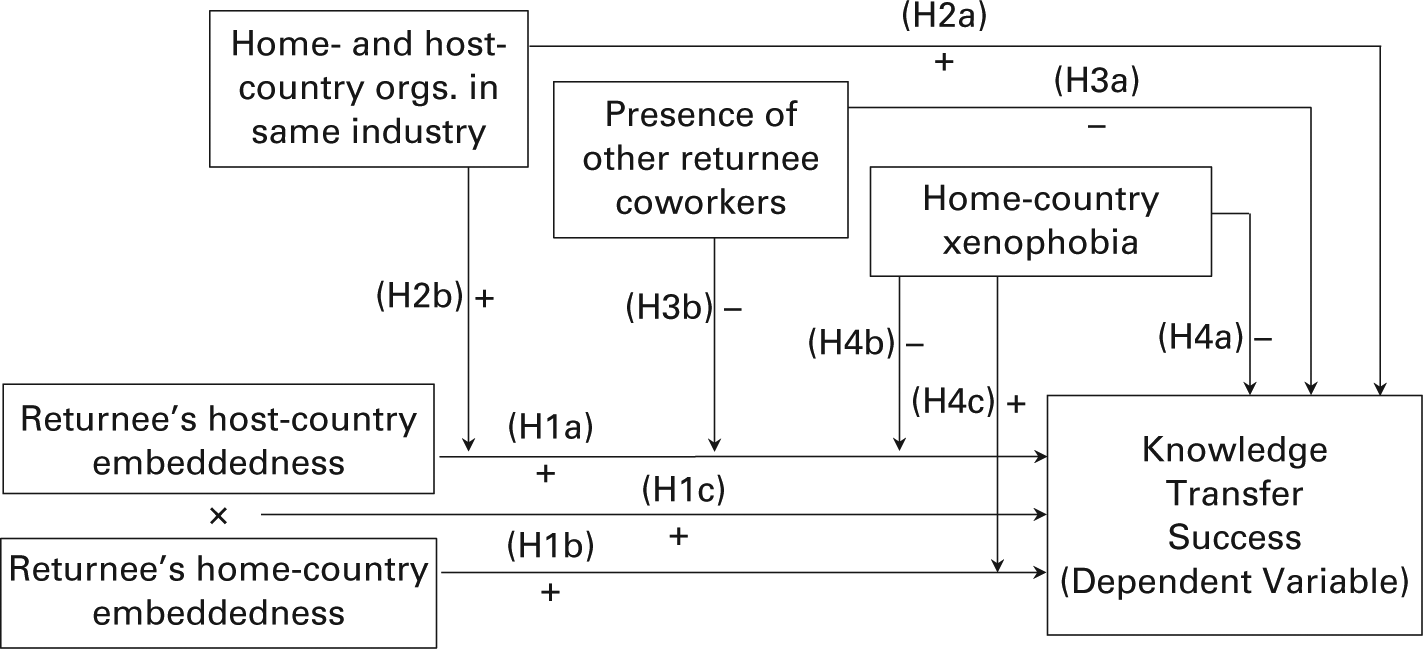
Summary of hypotheses about returnees’ embeddedness and organizational evaluations in cross-border knowledge transfer.
Methods
Data
Two main barriers stand in the way of collecting systematic data on skilled returnees. First, skilled returnees are highly mobile, making them a difficult-to-reach population. Second, the definition of a return migrant is ambiguous, depending on time spent abroad, age, and other factors (Dumont and Spielvogel, 2008). To address these challenges, I developed a survey for individuals who came to the U.S. to work under a special category of the J-1 Visa. To identify my survey population, I worked with a nonprofit professional exchange organization called International-Exchange (IntEx), which is designated by the U.S. State Department to sponsor J-1 Visas for skilled foreign nationals. The J-1 Visa allows foreigners who have had education and training in a professional field to work for a host company in the U.S. for between 3 and 24 months. Although several subcategories of the J-1 Visa exist, IntEx sponsors only intern and trainee J-1 Visas, which are functionally similar and given only to skilled workers, ages 21 through 35, with higher education and professional work experience.
Between 1997 and 2011, IntEx sponsored the J-1 Visas of 11,434 individuals from 93 different countries, who worked at Google, Merrill Lynch, and over 2,000 other small- to large-sized U.S. companies. The J-1 Visa requires that these workers return to their home countries after their visa term, but many obtain another visa to extend their stays. One advantage of studying IntEx-sponsored J-1 Visa recipients is that all returnees in this sample have had some meaningful professional experience in the United States. Table 1 summarizes the IntEx data on this survey population.
Descriptive Statistics for Survey Population*
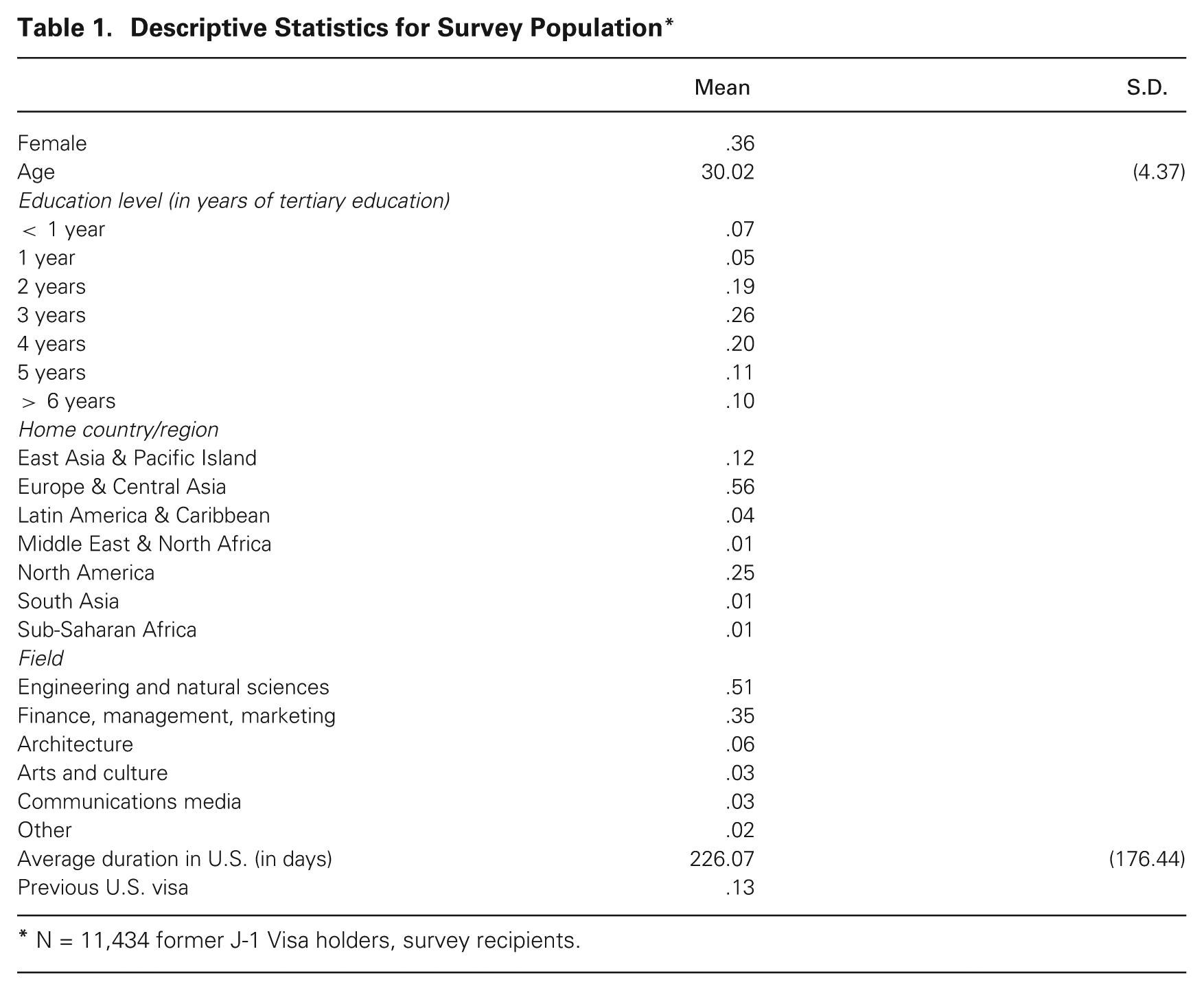
N = 11,434 former J-1 Visa holders, survey recipients.
Of the former J-1 Visa holders I surveyed, 4,183 responded (38 percent response rate; mean completion time: 43 minutes). I found no significant biases comparing respondents with non-respondents in basic demographic features, although technology workers were overrepresented in the respondent sample. Respondents answered questions primarily about their work activity in the U.S. and home countries, their experience readjusting to their home countries, and their experience transferring knowledge to their home-country workplaces.
The survey sample of former J-1 Visa recipients is ideal for my analysis because of its uniformity and heterogeneity. First, all returnees in this sample had significant professional work experiences in the U.S. and engaged with American coworkers. Returnees were therefore similar in that all were potential cross-border brokers of organizational practices. Second, the respondent sample represents diverse U.S. professional experiences, which allows for the generalizability of this study across industry and organizational domains. Thus this sample captures a broad variety of knowledge-sharing activity.
Also, because the sample includes returnees to 81 home countries, the survey data allow cross-country comparisons. This heterogeneity comes from the nature of the J-1 Visa. By comparison, H-1B Visas (Kerr and Lincoln, 2010) are primarily assigned to technology workers, most of whom are from India and China, and F-1 visas include immigrants seeking education in the U.S. but not always work experience. Importantly, the J-1 Visa holders here cover a more diverse array of countries while also capturing skilled workers from Canada and Mexico, which typically send skilled migrants to the U.S. under the TN Visa. Despite the differences among visas, table 2 reports substantial overlap among the top visa-receiving countries for the J-1, H-1B, and F-1 visas. This similarity lends external validity to the results of my study, which arguably are not simply an artifact of selection for the J-1 Visa.
Top 10 Countries of Origin by U.S. Visa Category*
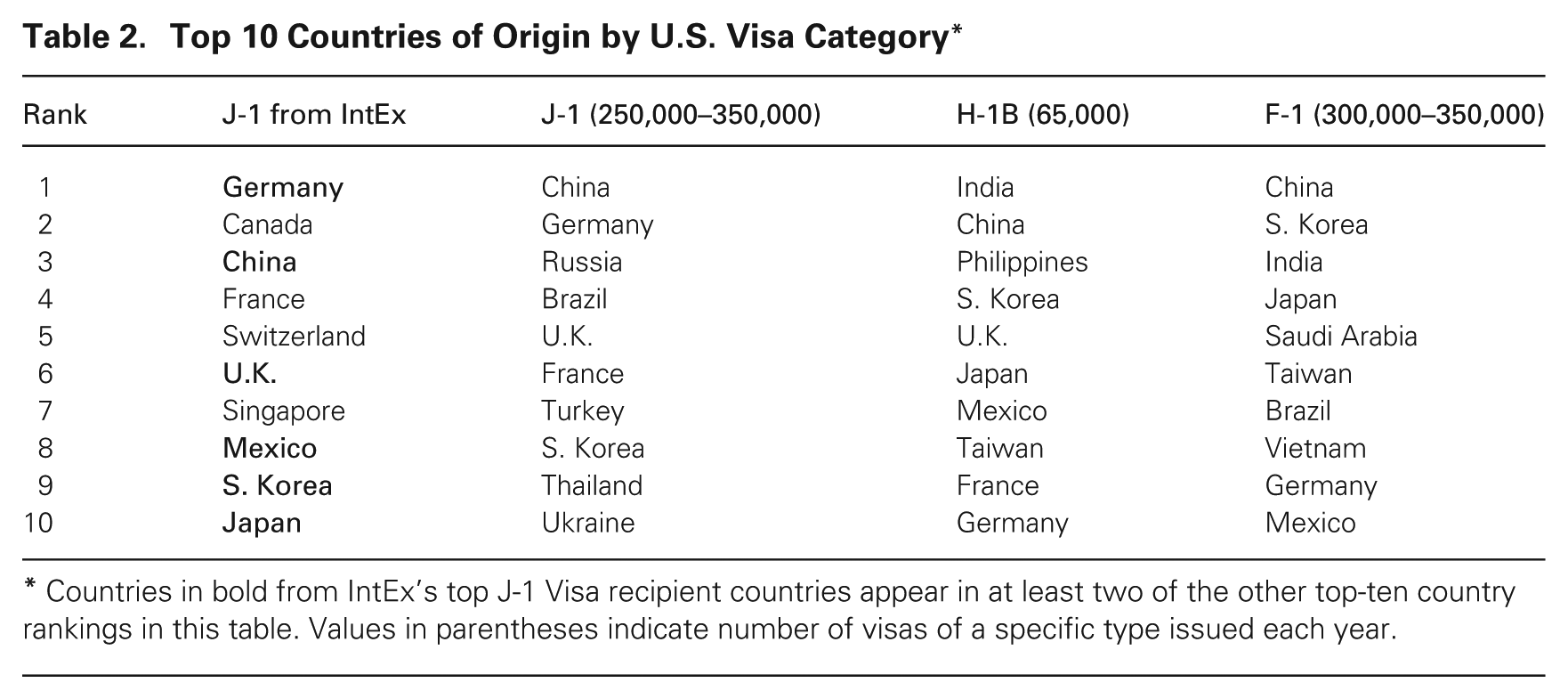
Countries in bold from IntEx’s top J-1 Visa recipient countries appear in at least two of the other top-ten country rankings in this table. Values in parentheses indicate number of visas of a specific type issued each year.
Measurement and Variables
Dependent variables
I conducted two main analyses of returnees’ knowledge transfer. In the first analysis, the dependent variable was returnees’knowledge transfer success. This occurs when a returnee shares knowledge in a home-country organization, and the organization adopts the returnee’s knowledge by altering or adding a routine practice. Past studies have identified evidence of knowledge transfer as the change in some organizational practice as a result of contact with another organization or the hiring of a new employee (Almeida and Kogut, 1999; Song, Almeida, and Wu, 2003). But it is sometimes impossible to tell whether the knowledge transfer itself is responsible for the change. Other studies have measured whether individuals share knowledge without specifying whether that knowledge becomes routinized (Reagans and McEvily, 2003).
Because I argued that knowledge transfer success entails an individual first sharing knowledge and a recipient then adopting the knowledge, I separated the measurement of these two constructs on the survey. Specifically, I asked respondents, “Have you ever shared any knowledge based on your experience working in the U.S.?” Then, for those who indicated that they had shared knowledge, I asked, “Did your company implement any of the suggestions you made as a routine procedure or repeated practice?” If the answers to both these survey questions were “yes,” I coded the dependent variable for knowledge transfer success as 1; otherwise, 0.
In the second analysis, I used the two survey questions above to compare knowledge sharing and knowledge adoption as separate outcomes. The goal was to isolate the stage of the knowledge transfer process that the organizational and cultural explanatory variables affect. In addition, because these dummy variables capture complex outcomes, it is important to assess their reliability. On the survey, I asked respondents who indicated that they shared knowledge to describe the nature, setting, and aftermath of the knowledge transfer in an open-ended response. I then compared these open-ended responses to their yes/no responses to the knowledge transfer success question. Most open-ended responses reflected a change in organizational practices based on my definition above. For those that did not, I coded the knowledge adoption variable as “no.” Despite this effort, I acknowledge that these binary measures sacrifice precision because they do not account for the type of knowledge shared and because they are self-reported, so they might introduce measurement error through personality bias. I address both issues in the “Further Analysis” section below.
Independent variables
To measure a returnee’s host-country embeddedness, I created an index out of the several survey questions about the breadth and depth of the returnee’s professional experience in the U.S. Past work suggests that measuring both the range of activities in which an employee takes part and the intensity of this engagement captures embeddedness by taking into account “the social pressures and structures within organizations . . . [in] explaining how business decisions are made” (Cox, Marchington, and Suter, 2009: 2151). Measures of breadth entail counting the different forms of professional interaction (Frenkel, 2003; van Emmerik and Sanders, 2004). Because I was concerned with the returnee’s embeddedness in U.S. professional environments, I used survey questions about the returnee’s U.S. professional experience within and beyond the workplace. To capture the breadth of host-country embeddedness, I counted the number of affirmative responses to these questions: (1) Prior to your J-1 experience, had you ever worked in the U.S.? (2) Have you completed an educational degree in the U.S.? (3) During your J-1 experience, did you have at least weekly contact with your coworkers? (4) During your J-1 experience, did you have at least weekly contact with your supervisor(s)? and (5) During your J-1 experience, did you attend any conferences or workshops related to your work?
Measuring depth of workplace embeddedness is important because it reflects the quality of involvement returnees had in the activities they specified. Measures of depth typically reflect the frequency of engagement in the activities specified in the breadth aspect of embeddedness (Felps et al., 2000). My measure of the depth of a returnee’s host-country embeddedness followed the same logic, using the following survey questions: (1) Prior to your J-1 Visa experience, how many years did you work in the U.S.? (scaled to a minimum 0 and maximum of 5); (2) During your J-1 Visa experience, how frequent was your contact with your coworkers? (0 = weekly or less, 5 = multiple times each day); and (3) During your J-1 Visa experience, how frequent was your contact with your supervisor(s)? (0 = weekly or less, 5 = multiple times each day).
A good measure of host-country embeddedness should take both depth and breadth into account as complementary features. Thus a single-unit rise in depth should have the same influence on host-country embeddedness as a single-unit rise in breadth. But because breadth and depth are complementary (Cox, Marchington, and Suter, 2009), for higher levels of breadth, each unit rise in depth should increase host-country embeddedness more than the last unit rise in depth (and vice versa). To satisfy these conditions, I combined depth and breadth in the following way. First, I calculated b as the number of affirmative responses to the breadth questions, which can have a maximum value of 5. I then computed d, which is the mean value of the responses to the depth questions, each of which has a maximum value of 5. Together, they form a coordinate pair (b,d). The minimum joint value of (b,d) is (0,0), and the maximum is (5,5). To measure host-country embeddedness, I calculated the Euclidean distance of a returnee’s (b,d) score coordinates to the origin, (0,0) using the formula
I calculated home-country embeddedness in the same way. 4 For breadth, I counted the affirmative responses to the following questions, which reflect the different forms of interaction returnees had prior to and during their experiences in the U.S.: (1) Before your J-1 Visa experience, did you have work experience in your home country? (2) Before your J-1 Visa experience, did you work for more than one company in your home country? (3) Before your J-1 Visa experience, did you complete a post-secondary degree in your home country? (4) During your J-1 Visa experience, were there workers in your company from your home country? and (5) During your J-1 Visa experience, did you communicate with colleagues, friends, and family in your home country about professional opportunities or other work-related matters?
For depth, I used the following questions, which reflect the frequency of the returnees’ interaction with their home-country contacts prior to and during their work experiences in the U.S.: (1) Before your J-1 Visa experience, how many years did you work in your home country? (scaled to a minimum of 0 and maximum of 5); (2) During your J-1 Visa experience, how frequently did you communicate with colleagues, friends, and family in your home country about professional opportunities or other work-related matters? (0 = never, 5 = every day or more); 5 and (3) During your J-1 Visa experience, how frequently did you interact with your coworkers who were also from your home country? (0 = weekly or less, 5 = multiple times each day). I combined these two breadth and depth scores using Euclidean distance to generate a home-country embeddedness measure. 6
Other independent variables
For hypotheses 2a and 2b, to measure whether a returnee’s previous organization in the U.S. and current organization in his or her home country were in the same industry, I first asked respondents to select the primary industry of their current home-country organizations. I also had access to IntEx’s data on the industries of the J-1 Visa holders’ host organizations in the U.S. I then coded whether the reported industry of the returnee’s current organization was the same as that of his or her U.S. host organization. I used IntEx’s industry list on the survey to facilitate comparison. Industries were classified into 25 broad categories, such as architecture and healthcare. To test hypotheses 3a and 3b, I assessed the presence of other returnees in a returnee respondent’s workplace with the survey question, “Do any of your current coworkers have U.S. career experience?” 7
Finally, I operationalized the level of a returnee home country’s xenophobia (hypotheses 4a, 4b, and 4c) using a measure from the World Values Survey (WVS, 2013). The WVS is a cross-national survey of attitudes toward moral, political, social, and economic issues from respondents around the world, conducted almost every year. One thousand respondents are selected through clustered random sampling from each country to ensure the representativeness of the data. For my analysis, I used the latest waves available for each respondent’s country. On the WVS, all respondents were asked, “Of the following groups, whom would you NOT want as a neighbor?” For each country, I calculated the proportion of respondents who selected “foreigners” as an answer. I dichotomized this variable such that a value of 1 indicates that the returnee’s home country scored above the median of this xenophobia index (among all countries included in the WVS). Because my sample included only individuals who worked abroad in the U.S., I also created a measure for country-level attitudes toward the U.S. based on the Pew Global Attitudes Project survey, which generated similar results. Respondents from 35 countries were asked about their attitudes toward the U.S., ranging from “very favorable” to “very unfavorable.” I took the proportion of those from a given country who answered “very unfavorable” as an anti-U.S. sentiment index. I used the latest wave available for each country in the Pew data. This measure is meant to be an approximation in which relative differences between countries matter more than absolute numbers. The Pew Global Attitudes Project is a global opinion survey that has been conducted since 2001. Within each country, 800–1,200 respondents are chosen. Sampling methods vary depending on country infrastructure. Surveys are conducted face to face when possible and by telephone otherwise. A total of 35 countries have been included in the survey, out of which a rotating group of 20–25 countries are surveyed in each semi-annual wave (see www.pewglobal.org for more information). Table 3 reports the xenophobia index for the survey respondents’ home countries and the anti-U.S. sentiment index. 8
Summary of Xenophobia Measures by Country*
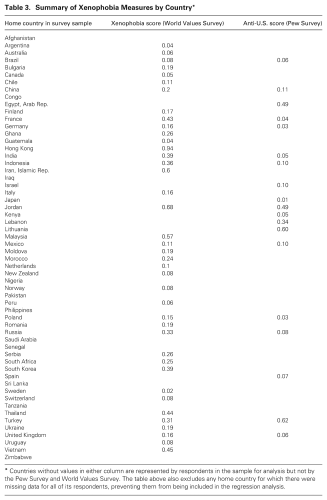
Countries without values in either column are represented by respondents in the sample for analysis but not by the Pew Survey and World Values Survey. The table above also excludes any home country for which there were missing data for all of its respondents, preventing them from being included in the regression analysis.
Using a country-level measure such as xenophobia to explain individual returnees’ behavior might suggest an ecological fallacy. Although a returnee’s home country might have a high xenophobia index according to the WVS, it does not necessarily mean that the returnee encounters xenophobic attitudes more frequently in his or her specific workplace. To address this, I included a question on my survey that asked returnee respondents, “To what extent do you think your (domestic) coworkers feel threatened by your work experience in the U.S.?” with responses on a 5-point scale ranging from “not at all” to “very much.” Figure 2 graphs the mean xenophobia score of returnees’ home countries by their responses to this survey question. It shows that returnee respondents who do not think their coworkers feel threatened by their U.S. work experience tend to be from the least xenophobic home countries, and the returnees who think their coworkers feel the most threatened are from the most xenophobic home countries. This cursory analysis supports using the WVS variable for country-level xenophobia, removing some of the concern of an ecological fallacy.
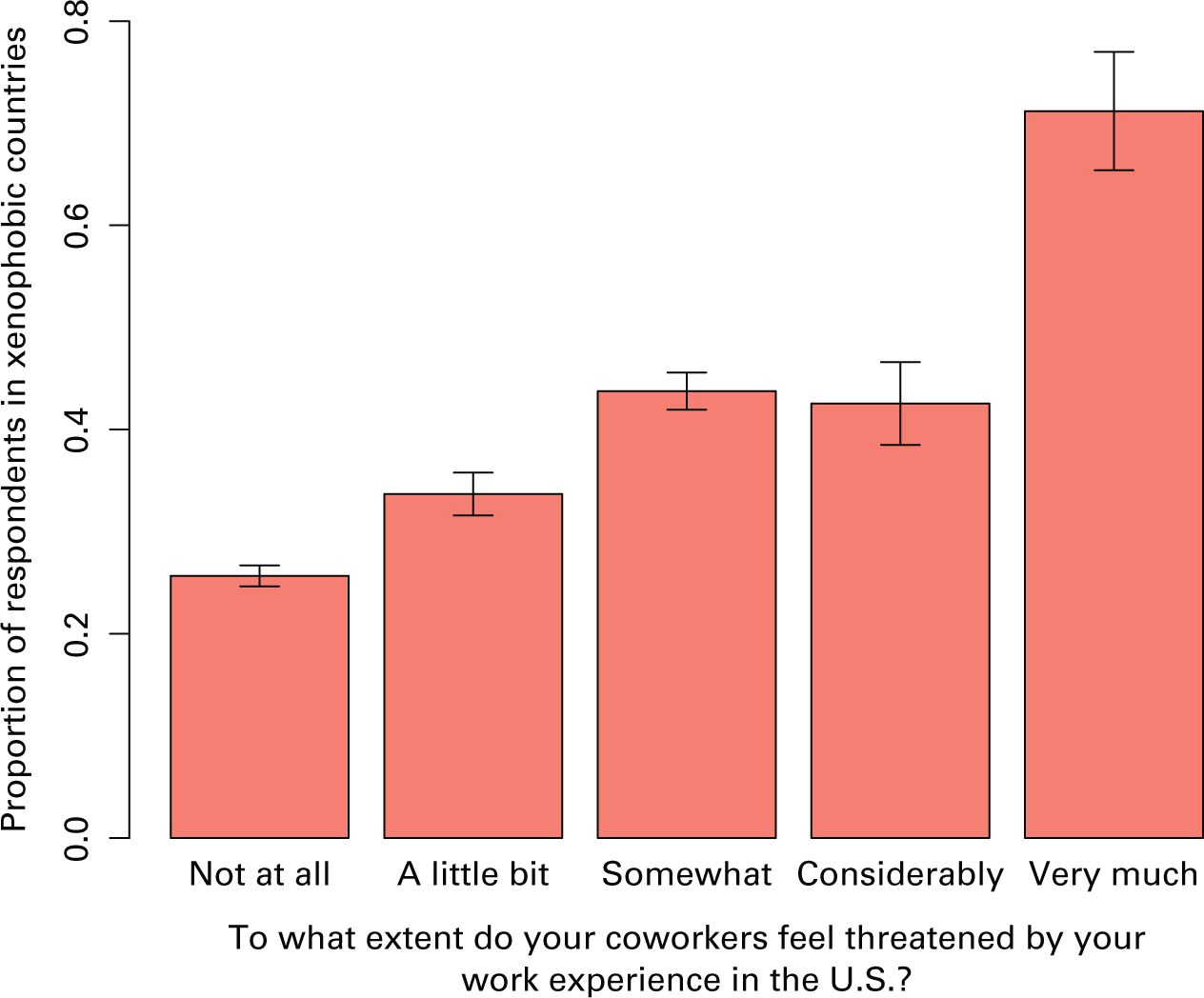
Bar graph of proportion of respondents in xenophobic countries by self-perceived xenophobia.
Control variables
I included returnees’ gender, age, and educational attainment as basic demographic controls in my models. I also included the amount of time the respondent had lived in his or her home country since coming back from the U.S. and the amount of time that the respondent lived and worked in the U.S., two variables that can be confounded with host- and home-country embeddedness. For workplace context, I controlled for the size of the returnee’s home-country organization, whether the organization does business in the U.S., and whether the returnee reports to a direct supervisor. I also added a dummy variable for whether a returnee works in a high-tech industry.
At the country level, returnees from countries that are more institutionally similar to the U.S. might also be able to find greater success in transferring knowledge. To control for this, I calculated measures of economic, political, and cultural distance based on Berry, Guillén, and Zhou (2010). Economic distance involves gathering the following data for the U.S. and a home country: income (GDP per capita), inflation (GDP deflator), and foreign direct investment inflows (% GDP) and outflows (% GDP). 9 I calculated Mahalanobis distance based on the standardized versions of the four measures listed above to generate economic distance between the U.S. and a home country. For political distance, I used a democracy index (The Economist, 2012), membership in the World Trade Organization, and attitudes on state responsibility for business and its citizenry (gathered from the WVS). For cultural distance, I used aggregated responses to WVS questions about authority, work, trust, and family.
Common methods bias
Because of the nature of survey data collection, respondents might respond to questions according to a certain profile, also known as a consistency motif, a source of common methods bias (Podsakoff, MacKenzie, and Lee, 2003). For example, respondents who are gregarious might be simultaneously more likely to share knowledge and to develop strong social ties at home and abroad. Podsakoff, MacKenzie, and Lee (2003) suggested several remedies for this bias. First, in terms of research design, one should use only data about behavioral variables, which are less subject to bias than attitudinal measures. For my analysis, the measures of knowledge transfer and host- and home-country embeddedness were based on behavioral questions. Second, different questions measuring a similar construct should not be closely co-located on questionnaires because this might induce an artificial correlation. The items that comprise the measures of host- and home-country embeddedness were scattered throughout my survey, and the knowledge transfer question had its own section, creating greater distance.
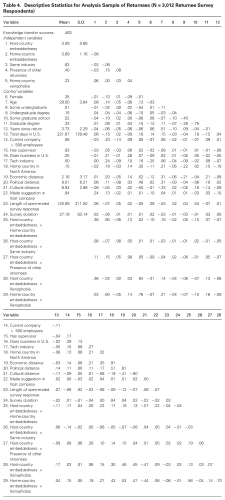
I also used control variables in my models to reduce common methods bias. I added a dummy variable for whether the respondent reported sharing any knowledge while working in the U.S. I also controlled for the time the respondent spent on the survey and the length of a respondent’s answer to the open-ended question on the survey, asking respondents whether they had anything else to share from their U.S. work experience. This helped to assure that a respondent’s likelihood of reporting positive knowledge transfer was not simply attributable to a high baseline willingness to share information in general. 10 Table 4 reports descriptive statistics and correlations for the variables used in the analysis.
Descriptive Statistics for Analysis Sample of Returnees (N = 3,012 Returnee Survey Respondents)
Finally, I also followed Podsakoff et al. (1990), who recommended controlling for common methods bias using an unmeasured latent method factor. This involves generating a latent variable through factor analysis that captures the covariance between all of the variables suspected of suffering from common methods bias. Here, I loaded my dependent variable for knowledge transfer success and my composite measures for host- and home-country embeddedness into a single factor (which explains 17.4 percent of their total variation). I then used the factor scores as a control variable in my models. This factor should account for the common variation of its component variables, which arguably comes from common methods bias.
Analysis
Because I operationalized outcomes for my first analysis on successful returnee knowledge transfer and my second analysis comparing knowledge sharing and knowledge adoption using dummy variables, I estimated logistic regression models. To adjust for survey response bias, I estimated these logit models, using all 11,434 survey recipients, as part of a sample selection model (Heckman, 1979). I first estimated a probit model with all survey recipients, predicting whether a recipient completed the survey. I then calculated an inverse Mills ratio from this model, which I included as an independent variable in the second-step logit models predicting knowledge transfer success for returnee respondents. 11
The Heckman model’s exclusion restriction states that at least one independent variable in the first-stage model—essentially, an instrument—must predict selection into the second-stage model’s sample and not be correlated with the second-stage model’s outcome variable. Here, I used a dummy variable for whether a recipient’s J-1 Visa application was handled by the Professional Development Program department (PDP) in IntEx. In IntEx, specialized departments handle applicants working for select large host companies, whereas the PDP department processes all other applications. My interviews with IntEx staff members confirmed that because of their larger application load, PDP staff members communicate with their J-1 applicants less frequently. This makes J-1 participants processed by PDP less likely to respond to a survey. Furthermore, there should be little reason to suspect that respondents’ affiliation with PDP affects the knowledge-transfer dependent variable in the outcome model. 12 Although this exogeneity assumption cannot be directly tested, a Wald test of the PDP variable in the first-stage probit indicated that it is relevant and a strong instrument (F-statistic = 33.035; strong instruments typically have F-statistic values that exceed 20).
Results
Organizational and Cultural Contingencies
Table 5 summarizes the samples I used in the first analysis, which includes all returnee respondents, and in the second analysis, which compares this same sample of returnee respondents to only those returnee respondents who reported sharing knowledge.
Summary of Samples and Outcomes Analyzed
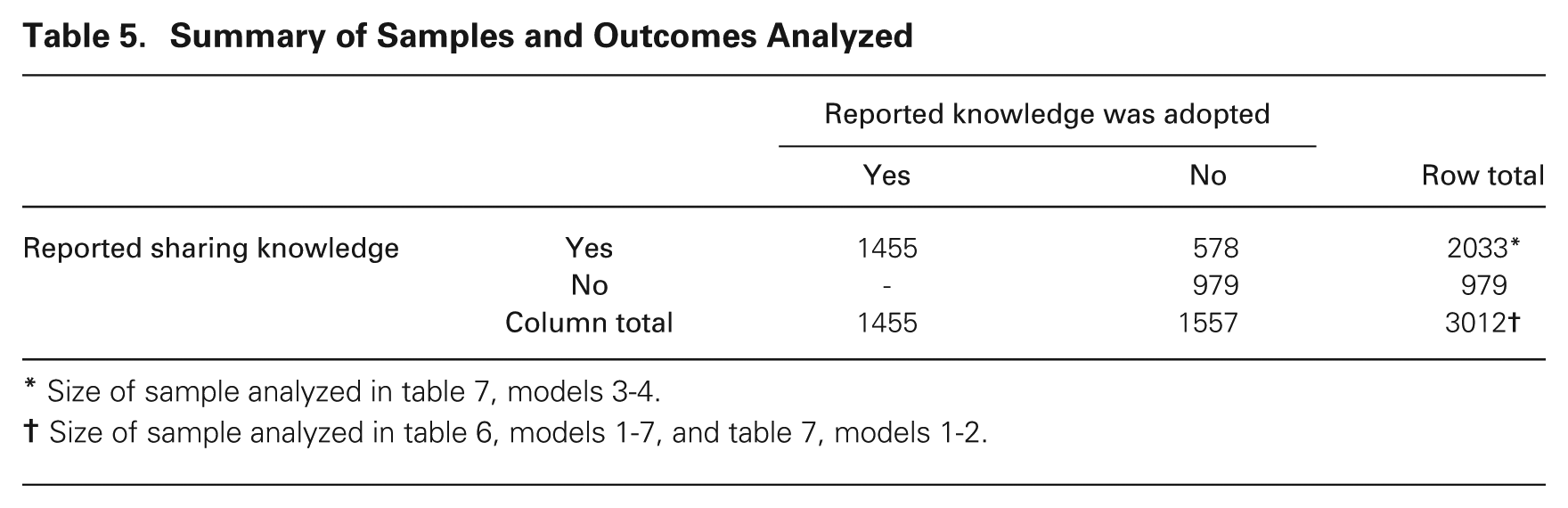
Size of sample analyzed in table 7, models 3-4.
Size of sample analyzed in table 6, models 1-7, and table 7, models 1-2.
The results of seven logistic regression models from the first analysis are reported in table 6. Model 1 contains control variables and main independent variables, model 2 adds the interaction between home- and host-country embeddedness, model 3 interacts host-country embeddedness with the same-industry dummy variable, model 4 contains the interaction between the host-country embeddedness and the presence of other returnees, models 5 and 6 contain interactions between the embeddedness variables and home-country xenophobia, and model 7 contains all interactions. I interpret all interaction effects using model 7, the full model. The negative and significant coefficient of the inverse Mills ratio indicates that the effects of the independent variables are downwardly biased without correcting for response bias. But estimating models without the inverse Mills ratio gave almost identical results.
Estimated Coefficients from Second-stage Outcome Logistic Regression Models of Successful Knowledge Transfer (N = 3,012)*
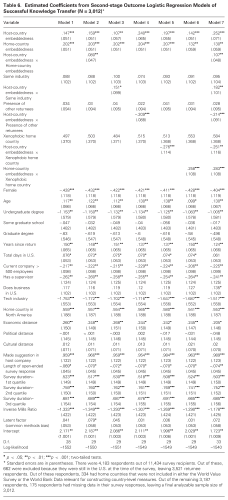
p < .05; •• p < .01; ••• p < .001; two-tailed tests.
Standard errors are in parentheses. There were 4,183 respondents out of 11,434 survey recipients. Out of these, 662 were excluded because they were still in the U.S. at the time of the survey, leaving 3,521 returnee respondents. Out of these respondents, 334 had home countries that were not included in either the World Value Survey or the World Bank Data relevant for constructing country-level measures. Out of the remaining 3,187 respondents, 175 respondents had missing data in their survey responses, leaving a final analyzable sample size of 3,012.
Out of the three institutional distance measures, only economic distance has any consistent effect on knowledge transfer success across models. As the economic distance between a returnee’s home country and the U.S. grows, the returnee is more likely to successfully transfer knowledge. This suggests that less-developed countries are more receptive to returnees’ ideas.
Because the effect of a unit change in an independent variable on the probability of the dependent variable taking on a positive value is non-linear, I interpreted the marginal effects in my models based on a hypothetical returnee with a baseline probability for knowledge transfer success of 45 percent (equal to the proportion of respondents reporting knowledge transfer success). Figures 3 and 4 graph these effects for this and other baseline probabilities (Zelner, 2009).
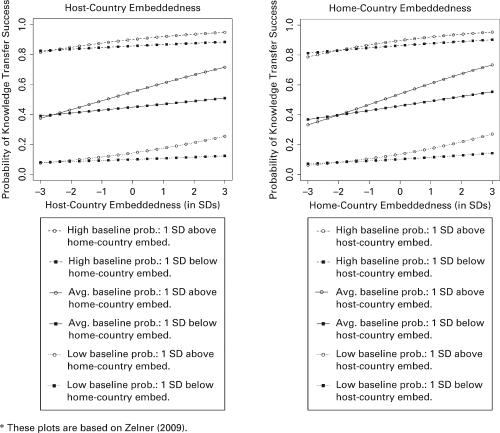
Predicted probabilities based on interacting host- and home-country embeddedness in model 7, table 6.*
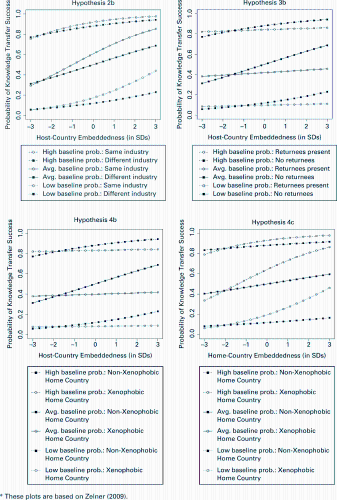
Predicted probabilities based on interacting host- and home-country embeddedness with organizational-level and country-level variables (model 7, table 6).*
Host- and home-country embeddedness
The model estimates in table 6 support hypotheses 1a and 1b, which state that a returnee’s host- and home-country embeddedness both increase knowledge transfer success. Specifically, increasing host-country embeddedness from its mean value by one standard deviation boosts the probability of successful knowledge transfer 4 percent. The same one-standard-deviation increase in the respondent’s home-country tie strength increases the probability of knowledge transfer success 6 percent. This suggests that returnees with higher host- and home-country embeddedness tend to have access to broader repositories of knowledge and can better identify opportunities for knowledge transfer.
In models 2 and 7, the interaction of home- and host-country embeddedness has a positive and significant effect on knowledge transfer success, offering support for hypothesis 1c. Thus the advantages of home- and host-country embeddedness for knowledge transfer are mutually contingent. According to the left-hand panel of figure 3, at one standard deviation below the mean level of home-country embeddedness, the effect of increasing host-country embeddedness is almost nonexistent. But at one standard deviation above the mean for home-country embeddedness, increasing host-country embeddedness by one standard deviation boosts the probability of knowledge transfer success almost 10 percent. The right-hand panel reveals the same pattern for the effect of home-country embeddedness as being contingent on host-country embeddedness. This result supports the claim that returnees are most valuable to their home countries if they have strong ties both at home and overseas.
Host-country embeddedness and industry similarity
Models 1 and 7 in table 6 do not support hypothesis 2a. Although the main effect of industry similarity on knowledge transfer success is positive, it is not significant. But the statistically significant interaction in models 3 and 7 supports hypothesis 2b, suggesting that the positive effect of host-country embeddedness on returnee knowledge transfer increases if the returnee’s current home-country organization is in the same industry as his or her organization in the U.S. In particular, as host-country embeddedness increases by one standard deviation, the probability of knowledge transfer success increases by almost 10 percent when the returnee’s host- and home-country organizations are in the same industry (figure 4). The same increase in host-country embeddedness, however, leads to only a 5-percent boost in knowledge transfer success if the returnee comes back to an organization in a different industry. Industry similarity, therefore, has an indirect positive effect on knowledge transfer success: it increases the relevance of returnees’ experiences abroad to their coworker recipients, which enhances the advantage that host-country embeddedness confers on them as knowledge brokers.
Host-country embeddedness and the presence of other returnees
The main effect of the presence of other returnees as coworkers does not reach significance across models, thereby lending no support to hypothesis 3a. But results from models 4 and 7 in table 6 indicate that host-country embeddedness gives returnee respondents less of a brokerage advantage if the returnee’s coworkers also have experience working in the U.S., supporting hypothesis 3b. A one-standard-deviation rise in host-country embeddedness leads to a boost in the probability of knowledge transfer success by 11 percent in workplaces in which the returnee is the only worker with U.S. experience. By contrast, in workplaces that have other returnees, the effect of host-country embeddedness on knowledge transfer success is flat. This supports the notion that when returnees do not serve as the sole links to resources abroad for an organization, their structural advantage as cross-border brokers disappears.
Upon first glance, this result appears counterintuitive. After all, the presence of other returnees might reflect the international orientation of a home-country workplace, increasing its absorptive capacity (Cohen and Levinthal, 1990; Szulanski, 2000). This would suggest that a returnee’s host-country embeddedness should have an even larger positive effect on knowledge transfer success, not a smaller one. One reason for the observed effect, though, is that a home-country organization’s international orientation affects a returnee’s knowledge transfer directly, while the presence of other returnees moderates the effect of a returnee’s individual embeddedness as part of the interpersonal knowledge transfer process. The negative interaction remains even when controlling for whether the home-country organization has business contact with the U.S., which by itself increases knowledge transfer success (model 7, table 6). Viktor, a Bulgarian returnee I interviewed, confirmed these opposing effects based on his experience in a U.S.-based software firm in his homeland after working at Google in the U.S.: At VMWare in Sofia, I felt much more comfortable because there was already a unit-testing procedure in place, which my colleagues were used to because they also worked abroad. In some ways, it was easier for me to adapt to . . . [So,] learning to work on large-scale projects at Google was definitely useful for my projects at VMWare since the software development processes were similar. But I don’t think I was able to bring anything new or different to the team.
Embeddedness and home-country xenophobia
Across all models, the main effect of home-country xenophobia is not statistically significant, lending no support to hypothesis 4a. It is possible, however, that some returnees are more likely to face xenophobic responses than others, as hypotheses 4b and 4c predict. The results in models 5 and 7 in table 6 support hypothesis 4b, which asserted that the positive effect of host-country embeddedness on knowledge transfer diminishes in more-xenophobic returnee home countries (model 7). I dichotomized my index of xenophobia to facilitate the interpretation of this interaction.
13
According to model 7, the interaction between the host-country embeddedness and the home-country xenophobia dummy variable is negative and significant. In a non-xenophobic home country, a one-standard-deviation increase in a returnee respondent’s host-country embeddedness increases the probability of knowledge transfer success by approximately 6 percent, whereas in a xenophobic home country, the same increase in host-country embeddedness boosts the probability of knowledge transfer by less than 1 percent. In other words, in xenophobic countries, knowledge recipients perceive the foreign embeddedness of returnee transferors negatively, transforming it into a liability rather than an advantage when it comes to knowledge transfer. Maria, an architect I interviewed who had returned to Uruguay, which has a high xenophobia index, illustrates the trouble she had in implementing her ideas in construction projects for local clients: Uruguayans like to keep to themselves, they don’t really like new things from the outside. When I first tried to tell my client my ideas came from my experience working on rural schools in the U.S., they were very much against them. I learned that if I wanted to use any of my new skills, I always had to hide that I learned them in the United States.
Hypothesis 4c also receives support in models 6 and 7, as the interaction between the home-country xenophobia dummy and home-country embeddedness is positive and significant. Increasing home-country embeddedness by one standard deviation in a non-xenophobic country leads to a 3-percent boost in the probability of knowledge transfer success, whereas the same increase in home-country embeddedness in a xenophobic country amplifies the probability of knowledge transfer success by almost 10 percent. These findings suggest that the importance of host- and home-country embeddedness for knowledge transfer varies by the pervasive cultural attitudes in a returnee’s home country. Thus cultural views play an important role in organizational evaluation as part of an interpersonal knowledge transfer interaction. 14
Decomposing Knowledge Transfer
In my second analysis, I disentangled knowledge sharing and knowledge adoption as separate outcomes by estimating a logit model of whether a returnee respondent shares knowledge and a logit model of whether the shared knowledge is adopted. 15 Table 7 reports the results. Model 1 shows that the main effects of home- and host-country embeddedness on knowledge sharing are positive and significant. Thus embeddedness in foreign workplaces confers access to more knowledge worth sharing, and home-country embeddedness grants returnees more knowledge transfer opportunities, making returnees more willing to share. Model 2, however, shows that the positive effect of home-country embeddedness on knowledge adoption is significantly greater than that of host-country embeddedness (p < .01). Home-country embeddedness can activate trust among coworkers, making them more receptive to returnees’ ideas, but host-country embeddedness does not necessarily engender as strong an effect.
Estimated Coefficients from Logistic Regression Models of Knowledge Transfer*
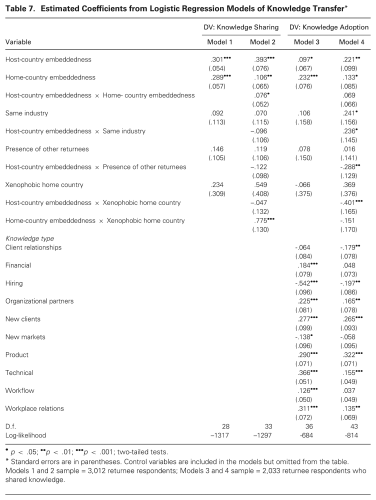
p < .05; •• p < .01; ••• p < .001; two-tailed tests.
Standard errors are in parentheses. Control variables are included in the models but omitted from the table. Models 1 and 2 sample = 3,012 returnee respondents; Models 3 and 4 sample = 2,033 returnee respondents who shared knowledge.
Model 2 also reports that the interaction between home- and host-country embeddedness is positive and significant for knowledge sharing. Although host-country embeddedness might boost the amount of knowledge a returnee can share from abroad, a returnee must, at the same time, realize opportunities for knowledge sharing, which come from stronger home-country embeddedness. A similar reasoning might explain the same positive interaction effect for knowledge adoption in model 4, but the smaller sample analyzed in model 4 is likely responsible for the non-significant coefficient.
In addition, whereas the interactions of host-country embeddedness with the organizational evaluation variables—same industry background, the presence of other returnees, and xenophobia—are positive and significant for knowledge adoption in model 4, they are not for knowledge sharing (model 2). This is consistent with my main arguments. According to hypothesis 2b, industry similarity increases the positive effect of host-country embeddedness on knowledge adoption because the knowledge that same-industry returnees share is arguably more relevant and thus more likely to be accepted. But although the potential for greater relevance might motivate returnees who are strongly embedded abroad to share more knowledge, the knowledge accessible by same-industry returnees also might be redundant, making them less willing to share it, thereby weakening the influence of host-country embeddedness on knowledge sharing. These opposing mechanisms likely account for the non-significance of this interaction effect for knowledge sharing in model 4. According to hypothesis 3b, the presence of other returnees in the workplace decreases the returnees’ knowledge transfer success, which explains its negative interaction effect with host-country embeddedness on knowledge adoption. It is unclear, however, whether the presence of other returnees would dampen the positive effect of host-country embeddedness on knowledge sharing because it would not diminish returnees’ access to knowledge from abroad.
Finally, hypothesis 4b concerns why recipients in xenophobic settings would be unlikely to adopt the knowledge shared by returnees who have strong cross-border ties, which is supported by model 4. The interaction effect in model 2, however, is not significant for knowledge sharing. Although some returnees would be disinclined to share knowledge from abroad in xenophobic settings, it is unclear why xenophobia would systematically weaken the positive association between host-country embeddedness and knowledge sharing. Curiously, the positive interaction between home-country embeddedness and xenophobia is significant for knowledge sharing but not for knowledge adoption. Because in-group members value in-group connections more in xenophobic settings, returnees with stronger homeland ties might be given more opportunities to share knowledge, thereby making them more willing to do so. It seems intuitive that recipients in xenophobic settings would be more likely to adopt the knowledge of returnees with stronger homeland ties as well, but model 4 does not support this assertion.
Further Analysis
I also conducted a sensitivity analysis to identify how strongly an unobserved variable—specifically, a respondent’s personality—must be simultaneously correlated with a treatment, such as host-country embeddedness, and a dependent variable, knowledge transfer, in order to render the coefficient of the treatment variable statistically null. If such an omitted variable is unlikely to exist, then the “unconfoundedness assumption” of the model is reasonably satisfied (Rosenbaum and Rubin, 1983; Imbens, 2003).
Figure 5 reports the results of a sensitivity analysis for the effects of host- and home-country embeddedness on returnee knowledge transfer (based on Harada, 2012). The upper panel in figure 5 plots two items: (1) the points representing the correlations of two independent indicator variables—made suggestion at work in U.S. and open-ended response above median length—with host-country embeddedness and knowledge transfer success and (2) a curve representing the threshold of these correlations for an omitted variable, beyond which the coefficient of host-country embeddedness becomes non-significant at the p < .05 level in a two-tailed test. Figure 5 shows that all of the independent variables in model 1 fall well below this curve. Intuitively, the variable closest to the curve is whether the returnee respondent had made suggestions in the workplace while working in the U.S., which represents a baseline willingness to share knowledge. The curve shows that for an omitted variable to disrupt the effect of host-country embeddedness, it must be simultaneously almost twice as correlated with host-country embeddedness and knowledge transfer success as this baseline willingness variable. This is improbable, making the models in table 6 insensitive to violations of the unconfoundedness assumption. Figure 5 also plots a sensitivity analysis of the effect of home-country embeddedness on knowledge transfer success with similar results. 16
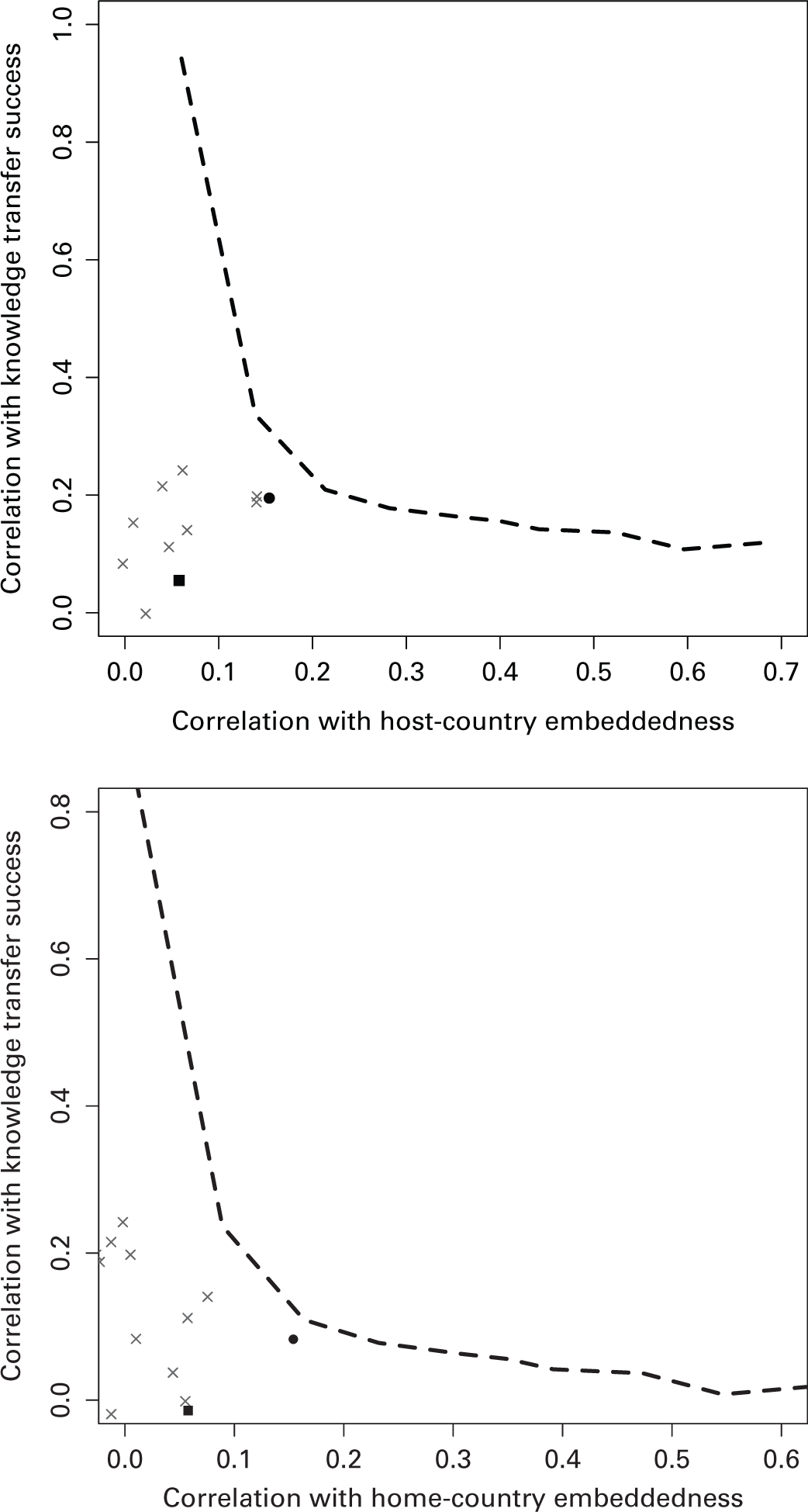
Generalized sensitivity analysis of model 1, table 6.*
In addition, if home-country embeddedness and knowledge transfer success were reflections of a respondent’s personality, they should have a positive relationship regardless of the respondent’s work environment. That is, were the respondent not working in his or her home country, home-country embeddedness should still increase knowledge transfer success if personality traits are driving these results. I explored this by estimating a logistic regression model using those respondents who reported that they were working in the U.S. (N = 667, i.e., non-returnees, see Online Appendix C). As expected, I found that the effect of home-country embeddedness on knowledge transfer success is not significant for respondents working in the U.S., whereas host-country embeddedness has a positive and significant effect.
Discussion
The results of this study show why some returnees are more effective cross-border brokers of knowledge flow than others. The answer lies in conceptualizing knowledge transfer as an interpersonal process with two contingent components: the individual embeddedness of a knowledge transferor and the organizational evaluation by the knowledge recipients. Whether transferors can initiate knowledge spillover first depends on the extent to which they are embedded in their current and past organizational surroundings. For the process to be successful, though, knowledge recipients must positively evaluate the knowledge and, more importantly, the transferor. This depends on recipients’ attitudes toward the transferor, which come from their organizational and cultural surroundings.
I found that being more embedded in their host and home countries increases returnees’ probability of successfully transferring knowledge back to organizations in their home countries. But because the effects of host- and home-country embeddedness interact positively, their advantages are also contingent on one another. Also, the positive effects of host-country embeddedness on knowledge transfer success diminish when other returnees are present in the home-country workplace. By contrast, when returnees’ industry experience from abroad matches the industry category of their home-country organizations, host-country embeddedness tends to have an even greater positive effect on knowledge transfer success. Finally, stronger host-country embeddedness does not increase knowledge transfer in xenophobic home countries, whereas higher home-country embeddedness is a greater advantage in such settings.
These findings underscore the need for a clearer theoretical understanding of the context of knowledge diffusion outcomes through brokerage ties (Burt, 1997). A chief theoretical contribution of this paper is the analytical separation between the structural and functional definitions of a broker. While others have shown how brokers’ relational advantages erode under certain structural conditions (Buskens and van de Rijt, 2008; Reagans and Zuckerman, 2008), I demonstrated how the cultural and organizational context of brokers’ surroundings can moderate their effectiveness in commanding knowledge flows. All returnees have the potential to transfer knowledge between their host- and home-country settings, but key non-structural features of their positions can hinder or enhance their ability to do so.
This study also makes several empirical contributions to work on cross-national knowledge spillovers through global mobility. First, I found evidence that certain institutional and cultural barriers can erode the structural advantages that scholars assume returnees have (Chaparro, Jaramillo, and Quintero, 2006; Dai and Liu, 2009). Whether returnees can effectively bring back novel practices from abroad depends on the settings in which they activate their cross-border embeddedness. Second, my analysis used data from an original survey that systematically identified instances of knowledge transfer. I avoided the use of proxy measures of knowledge transfer success by asking respondents directly whether their knowledge transfer led to some change in organizational practices, validating their responses with an open-ended survey question about their knowledge transfer experience.
These contributions join a growing body of research exploring the relationship between the global flows of people and expertise (Brown, Green, and Lauder, 2001; Filatotchev et al., 2011; Kogut and Macpherson, 2011). My findings encourage readers to interpret arguments about the benefits of return migration cautiously (Lazarova and Tarique, 2005; Obukhova, 2012). Recent work has cast skilled returnees as agents of economic transformation, but it has done so without systematic data (Mountford, 1997; Saxenian, 2006; Mayr and Peri, 2008). Moreover, this work often takes knowledge spillovers for granted in linking reverse migration to economic growth (Borjas and Bratsberg, 1996; Dustmann and Weiss, 2007). By contrast, the evidence from this study highlights the multiplex challenges returnees encounter in their homelands despite being characterized as ideally positioned to broker cross-border expertise.
Limitations and Future Research
A key limitation of my analysis is that I analyzed returnees who have had foreign experience only in the U.S. Because past work has shown that managerial and technical practices from the U.S. have become more widespread than those from other countries, the rates of returnee knowledge transfer in my data might be upwardly biased (Guillén, 1994; Djelic, 1998). Different host-country experiences can lead to different knowledge transfer outcomes. Although some research has compared returnees from different host countries, little work has done so for a skilled migrant population (Rohrlich and Martin, 1991; Hirshon et al., 1997; Furuya et al., 2009). This represents an opportunity for future researchers to compare returnees not only from different host countries but also those with different cultural experiences from the same host country.
In addition, methodologically, the data in this study come from a cross-sectional survey, which relies on a respondent’s memory in recalling behaviors related to, for example, embeddedness in work practices abroad. One possible implication is that these data might be underestimating the extent and range of activities in which a returnee was involved while working abroad. This would diminish the variation in host-country embeddedness, which can lead to an upwardly biased effect on knowledge transfer success (assuming there is no bias in this outcome variable). Addressing this important measurement issue would entail gathering longitudinal data on returnees’ knowledge transfer, which would bring greater credence to future studies of international migration and knowledge transfer.
The process of how knowledge brokers share, reconstruct, and implement their knowledge still stands as a black box. Although my work focused on the transfer of organizational practices, mobility is also responsible for the movement of technical knowledge, the diffusion of which has been studied extensively, representing an opportunity for future research on the transfer of technical knowledge through returnees. Many researchers have assumed that the main value that returnees bring to their home countries lies in their expertise, however it is defined. How they actually apply their know-how, however, remains shrouded. Future work should focus on investigating cross-border knowledge transfer as a negotiated and contentious process to advance our understanding of the links between international mobility and economic globalization.
Footnotes
Acknowledgements
This research was partially supported by a Kauffman Foundation Dissertation Fellowship Grant. I am grateful to Mark Granovetter, Woody Powell, Andy Walder, Natasha Iskander, Elena Obukhova, Waverly Ding, Rajshree Agarwal, Phil Kim, David Obstfeld, Sarah Soule, Rory McDonald, Emily Cox, Amir Goldberg, Damon Phillips, Bruce Kogut, Paul Ingram, and members of the Networks and Organizations Workshop at Stanford University for comments on this paper and other parts of my dissertation. Earlier versions of this paper were also presented at the Haas Innovation Seminar at the UC–Berkeley, the 19th Annual Consortium for Competitiveness and Cooperation at the University of Maryland Smith School of Business, the Society for the Advancement of Socio-Economics Annual Meeting, the American Sociological Association Annual Meeting, and the Academy of Management Annual Meeting. Many thanks go to the three anonymous reviewers whose advice was invaluable in shaping the important parts of this paper. Finally, I appreciate the editing and administrative guidance of Linda Johanson and Joan Friedman to produce the final version of this paper. Please direct all correspondence to