






Abstract
This article develops and empirically evaluates an institutional theory of gender inequalities in business start-up, ownership, and growth orientation. I argue that in contexts in which institutional arrangements such as paid leave, subsidized childcare, and part-time employment opportunities mitigate work–family conflict, women are less likely to opt for business ownership as a fallback employment strategy. As a result, women in these contexts may be relatively less well represented among entrepreneurs as a whole but more well represented in growth-oriented forms of entrepreneurship. To evaluate this claim, I analyze survey data from 24 countries over the span of eight years. Multilevel analyses show that supportive work–family institutions are associated with larger gender gaps in the odds of early-stage and established business ownership but smaller gender gaps among business owners in terms of their business size, growth aspirations, and propensity to innovate or use new technology. Consistent with my theoretical argument, women business owners are also less likely to report pursuing entrepreneurship because they lacked attractive employment options in contexts in which supportive institutions are in place. Findings suggest that institutional contexts characterized by salient work–family conflict may fuel women’s aggregate representation in business activity but reinforce their segregation into less growth-oriented (and thus lower-status) ventures.
Keywords
In spite of rising market opportunities in new, knowledge-based economies, women’s representation in business start-ups and ownership remains remarkably low, and this is the case across industrialized nations (Allen et al., 2008; Kelley, Bosma, and Amorós, 2010; see Jennings and Brush, 2013, for a review). In the U.S. in the late 2000s, women constituted 43 percent of managers, legislators, and senior officials (UNDP, 2009), but they owned only 28 percent of all private firms (Center for Women’s Business Research, 2009). Not surprisingly, men also start, own, and manage businesses that employ more workers, are more lucrative, and introduce more new products and services to the market (Kalleberg and Leicht, 1991; Tonoyan and Strohmeyer, 2005; Allen et al., 2008). These forms of inequality are particularly important for the question of gender stratification in organizations over the long term given that women’s presence at the top of an organization affects the likelihood that more women will subsequently be hired and promoted (Cohen, Broschak, and Haveman, 1998; Cohen and Broschak, 2013). A founder’s gender can also influence the types of structures and practices that new organizations adopt (Baron, Hannan, and Burton, 1999; Baron et al., 2002).
Though it is rarely identified as such, women’s persistent underrepresentation in entrepreneurial activity is one key feature of the broader stall in progress toward gender equality in the labor market that has been observed in recent years: although the number of U.S. women entering professional and managerial positions has increased since the 1970s (Percheski, 2008), this change, which was largely confined to white-collar occupations, has leveled off, and women remain vastly underrepresented in the most elite leadership positions (England, 2010; Leahey, 2012). This trend can be traced, at least in part, to the fact that employers increasingly expect and reward long or unpredictable hours yet fail to provide the resources—in terms of either time or money—that workers often need to simultaneously manage family obligations. These organizational practices, which are premised on an “ideal worker” who presumably has no, or very few, responsibilities outside of work (Acker, 1990; Williams, 2001; Jacobs and Gerson, 2004), create more work–family conflict for women than for men because cultural norms still prescribe that women have greater responsibility for caregiving (Blair-Loy, 2003; Correll, Benard, and Paik, 2007). As a result, many women end up reducing their work hours, changing jobs and/or occupations (often to a more female-dominated one), or leaving the labor force altogether (i.e., “opting out”) (Stone, 2007; Cha, 2010, 2013)—all of which compromise their long-term career prospects.
Yet work–family conflict is also known to be a key factor that motivates women toward entrepreneurship: starting one’s own business typically offers greater autonomy and flexibility in terms of work schedule, number of hours worked, and physical work location than most wage and salaried jobs (Moore and Buttner, 1997; Heilman and Chen, 2003; Hughes, 2003; Mattis, 2004; Maniero and Sullivan, 2006). Accordingly, women entrepreneurs often report less work–family conflict than their wage and salaried counterparts (Reynolds and Renzulli, 2005). Thus, because they create more work–family conflict for women than for men, organizational practices that are unsupportive of workers with family responsibilities may not only reinforce women’s segregation into female-dominated and lower-status jobs and occupations but may also fuel women’s entry into the male-dominated realm of entrepreneurship. But the extent to which such practices are actually associated with women’s aggregate representation in entrepreneurial activity—either in overall rates of business start-up and ownership or in more growth-oriented types of ventures—remains an open question.
On the one hand, institutional theorists have long argued that the incentives that lead individuals toward entrepreneurship are embedded in institutional arrangements (North, 1990; Sorenson and Audia, 2000; Hwang and Powell, 2005; Sørensen, 2007; Sine and David, 2010) but have not considered how such arrangements structure demographic heterogeneity in organizational populations by, for example, offering different types of incentives to men and women to start businesses. The more specialized scholarship on gender and entrepreneurship has made considerably greater strides in advocating institutional approaches to this issue (Ahl, 2006; Elam and Terjesen, 2010; Hughes et al., 2012), yet the majority of these studies focus on nascent (i.e., early-stage) entrepreneurship as an outcome, which excludes individuals who are running more-established businesses and does not address the issue of heterogeneity in the types of ventures men and women run. Thus we don’t yet know whether certain institutional arrangements—particularly those that may reduce the salience of work–family conflict as an incentive to start a business in the first place—might structure gender inequality across multiple entrepreneurship outcomes.
On the other hand, a large body of gender scholarship documents how institutions that support the reconciliation of work and family responsibilities at the national level are associated with gender inequalities in the wage and salaried labor market (see Hegewisch and Gornick, 2011, for a review) but has yet to consider their relevance for stratification in entrepreneurship. Moreover, although work–family policies are often found to promote women’s opportunities in the labor market, they are sometimes also associated with counterintuitive outcomes. For instance, countries with policies such as paid leave or subsidized childcare tend to have higher women’s labor force participation rates but fewer women in managerial positions (Mandel and Semyonov, 2006; Pettit and Hook, 2009). Prior studies have been limited in their ability to evaluate the mechanisms that underlie these countervailing patterns because most surveys lack information on individuals’ career-specific motivations, making it difficult to link the motivations behind women’s career decisions to the work–family institutions empirically.
This study addresses these gaps in the literature by developing and evaluating a novel institutional theory of gender inequality in entrepreneurial activity. I argue that, by mitigating the degree to which women experience work–family conflict in wage and salaried employment, supportive work–family institutions—specifically, the availability of paid leave, publicly subsidized childcare, and part-time employment—may reduce the likelihood that women will be motivated to turn to business ownership as a fallback, or “Plan B,” employment strategy. Because they reduce women’s incentives to fall back on entrepreneurship, supportive work–family institutions may be associated with two types of inequality: (1) gender disparities in rates of business start-up and ownership and (2) gender disparities in economic growth-oriented (i.e., higher-status) forms of entrepreneurship. I evaluate my argument using data from Global Entrepreneurship Monitor (GEM) adult population surveys conducted in 24 industrialized countries over an eight-year period that I match to several national-level indicators.
Entrepreneurship and Gender
Scholars have often understood women’s status in entrepreneurship by examining how patterns of gender inequality in the wage and salary labor market map onto this form of work. For example, women are less likely to have the human, social, and financial capital deemed critical for the recognition and pursuit of a market opportunity, such as workplace and managerial experience, heterogeneous social networks, income, and wealth (Aldrich, Reese, and Dubini, 1989; Loscocco et al., 1991; Loscocco and Robinson, 1991; Renzulli, Aldrich, and Moody, 2000; Kim, Aldrich, and Keister, 2006). And women who do become business owners often have less work, managerial, and prior start-up experience than their male counterparts (Loscocco et al., 1991; Jennings and Cash, 2006; Marlow and McAdam, 2010; Wood, 2010). Women business owners are also often segregated into industries that are competitive, crowded, and non-lucrative, such as retail, food service, and interpersonal care (Loscocco and Robinson, 1991; Moore and Buttner, 1997; Sappleton, 2009; Marlow and McAdam, 2010). Despite some women’s entry into less-traditional sectors in recent years (Brush et al., 2004; Fielden and Davidson, 2010), this segregation is one of the main reasons that women business owners continue to be less involved in product and process innovations than men (Tonoyan and Strohmeyer, 2005), have smaller businesses than men (Kalleberg and Leicht, 1991; Jennings and Cash, 2006), and are generally overrepresented in low-wage groups (Kalleberg, 2003; Budig, 2006a). Thus when women do pursue entrepreneurship, their career path is more likely than men’s to be fraught with financial vulnerability.
Gender-differentiated perceptions about the activity of entrepreneurship can also contribute to gender gaps in the likelihood of being a business owner in the first place (Arenius and Minniti, 2005; Minniti and Nardone, 2007; Nielsen, Klyver, and Evald, 2010; Thébaud, 2010). For instance, women are less likely than their male counterparts to believe they have the skills and abilities to start a business. Whether driven by individual dispositions or shared cultural beliefs that link entrepreneurship to men and stereotypically masculine traits (see e.g., Bruni, Gherardi, and Poggio, 2004; Gupta et al., 2009), these gendered perceptions make women less likely than men to pursue business ownership.
Nevertheless, research suggests that substantial inequality and cross-national variability in this inequality persist after taking these types of individual-level factors into account (Arenius and Minniti, 2005; Kim, Aldrich, and Keister, 2006; Elam and Terjesen, 2010). In recent years, scholars have critiqued the traditional focus on individualistic accounts (Ahl, 2006; Hughes et al., 2012), and some studies have begun to examine the role of macro-level institutional factors in explaining rates of nascent entrepreneurship. They find that, among economically developed countries, women’s rate of nascent entrepreneurship is higher where more women are in managerial positions (Minniti and Arenius, 2003), where normative support for women entrepreneurs is greater (Baughn, Chua, and Neupert, 2006), and where more women are in business leadership roles (Elam and Terjesen, 2010). Countries with higher overall levels of gender equality across multiple social domains, however, have also been found to have larger gender gaps in nascent entrepreneurship (Klyver, Neilsen, and Evald, 2013). Furthermore, cultural aspects of the institutional environment, such as discriminatory biases, may further limit women’s business activity (Brush et al., 2004; Thébaud, 2015; see Jennings and Brush, 2013, for a review).
I build on these studies by theorizing and evaluating how institutions designed to reconcile work–family demands are meaningfully related to women’s motivations to pursue entrepreneurship and may therefore be associated with women’s level of representation across multiple forms of entrepreneurial activity. By doing so, I seek to avoid the problem of “success bias,” a form of selection bias that often plagues studies of entrepreneurs and their business outcomes (see Ruef, Aldrich, and Carter, 2003), and to provide a more holistic account of how institutional arrangements relate to the multidimensional character of gender inequality in entrepreneurship. My study also diverges from prior analyses of the effects of national-level institutions on gender inequality in entrepreneurship because it leverages multiple years of survey data.
Gendered Entrepreneurial Motivations
Diverse motives can drive people toward entrepreneurship, such as the desire to be independent, to pursue advantageous market opportunities, or to find employment (Brush, 1992; Dennis, 1996; Buttner and Moore, 1997; Carr, 2000; Budig, 2006b). Though many of these desires have been found to be similar for men and women, one important gender difference in entrepreneurial motivations that offers theoretical purchase on the relationship between work–family institutions and gender gaps in entrepreneurship is that women are more likely than men to start a business in order to resolve work–family conflict (Green and Cohen, 1995; Moore and Buttner, 1997; Hughes, 2003; Mattis, 2004; Reynolds and Renzulli, 2005; Loscocco and Bird, 2012; Jennings and Brush, 2013). In other words, women entrepreneurs are more likely to opt for business ownership as a fallback employment strategy—that is, to be “necessity-driven”—in part because women are more likely to be in a situation in which they need to resolve competing demands on their time from their employers and their families. In a world where (1) organizations rarely provide workers sufficient resources, in terms of money (to cover the costs of childcare) or time (in the form of leave or a modified work schedule) to simultaneously manage work and family obligations (Jacobs and Gerson, 2004) and (2) cultural norms still assume that women are primarily responsible for housework and caregiving (Blair-Loy, 2003; Correll, Benard, and Paik, 2007), it is understandable that mothers and women who expect to be mothers are attracted by the relatively greater autonomy and flexibility that business ownership offers (Heilman and Chen, 2003; Reynolds and Renzulli, 2005). This interpretation is echoed in the finding that in the U.S. and Western Europe, marital status and the presence of children predict women’s business ownership more strongly than men’s (Boden, 1996; Carr, 1996; Arum, 1997; Lohmann, 2001; Taniguchi, 2002).
Ample evidence suggests, however, that not all motivations are created equal: women who are pushed toward entrepreneurship in an effort to resolve work–family conflict are also more likely to run smaller, less growth-oriented enterprises (Buttner and Moore, 1997; Cliff, 1998; Loscocco and Smith-Hunter, 2004; Budig, 2006a; Morris et al., 2006; Loscocco and Bird, 2012), a situation that increases their vulnerability to the inherent economic risks associated with entrepreneurship, such as failure or a low, unstable income. For instance, women who have been motivated by a desire for work–life balance report setting low maximum size thresholds for their businesses (Cliff, 1998) and are more likely to assume a secondary earner role in the family, a situation that prompts a preference for a small and/or home-based business (Loscocco and Bird, 2012). In addition, women who make the transition from wage and salaried employment to entrepreneurship during childbearing years—the years when work–family conflict is most salient—may also be younger and therefore have less work experience and relevant network ties than their male counterparts, resources that are arguably crucial for more growth-oriented forms of entrepreneurship. Studies in the U.S. and Europe also indicate that marriage and motherhood are stronger factors predicting nonprofessional women’s entry into self-employment than professional women’s, especially in national contexts that lack supportive work–family policies (Budig, 2006b; Tonoyan, Budig, and Strohmeyer, 2010). Because they are relatively disadvantaged in terms of human, social, and financial capital, nonprofessional women business owners may be less likely to be growth oriented than their professional counterparts.
Taken together, prior research indicates that work–family conflict affects the probability that a woman will be engaged in entrepreneurial activity, as well as the probability that she will be engaged in growth-oriented forms of entrepreneurial activity. Thus institutional arrangements that make work–family conflict generally more or less salient may influence gender inequalities in entrepreneurial activity because they affect the likelihood that work–family conflict will motivate women to pursue business ownership in the first place.
Gender, Entrepreneurship, and Work–family Institutions
A substantial body of research suggests that institutions designed to reconcile employment with caregiving responsibilities are associated with women’s level of integration into the labor market, as well as their status vis-à-vis men within it (see Hegewisch and Gornick, 2011, for a review). Many studies have investigated the possible effects of work–family policy approaches by grouping countries on the basis of “welfare state regimes” (Esping-Andersen, 1999; Orloff, 2002) or the gendered cultural logic that underlies policy configurations (Lewis, 1992; Fraser, 1994; Misra, Moller, and Budig, 2007), or by analyzing a single index of policy generosity (Gornick and Meyers, 2003; Mandel and Semyonov, 2006). But recent scholarship finds that these aggregations often mask substantial within-country variation in policy approaches, as well as the differential effects that certain approaches can have on labor market outcomes and cultural attitudes (Petitt and Hook, 2009; Charles and Cech, 2010; Misra, Budig, and Boeckmann, 2011). These scholars advocate analyzing policy approaches separately, while maintaining sensitivity to the ways they relate to the broader institutional context. I follow this latter tradition by investigating the effects of three work–family policy approaches that have been the focus of much scholarship: government-subsidized paid leave for mothers, government-subsidized childcare, and the availability of part-time work.
Paid leave
There is ample evidence that maternity and parental leave policies that provide mothers with job protection and income facilitate women’s employment (Gornick and Meyers, 2003, 2009; Pettit and Hook, 2009; Misra, Budig, and Boeckmann, 2011). These policies are effective because they allow for the short-term employment interruptions that are needed after the birth or adoption of a child without significantly compromising employment prospects or creating financial penalties. One important qualification, however, is that paid leave facilitates women’s attachment to the labor force most effectively when leaves are moderate in length. On one hand, new mothers who do not have access to paid leave at all or have only very short leaves often have no other choice than to reduce their work hours or leave the labor force altogether, a set-up that reinforces traditionally gendered divisions of labor (Fraser, 1994; Hegewisch and Gornick, 2011). This is often the situation in the United States, for example, where the federal government does not provide paid leave, and only a small percentage of relatively privileged employees have access to it through their states or employers (O’Connor, Orloff, and Shaver, 1999; Gornick and Meyers, 2003, 2009; Gerstel and Armenia, 2009). On the other hand, particularly long leaves weaken women’s engagement with and opportunities in the labor force because, by lengthening employment interruptions, they negatively affect the accumulation of human capital (Misra, Moller, and Budig, 2007; Gornick and Meyers, 2009; Misra, Budig, and Boeckmann, 2011). Furthermore, long leaves are more common in countries with laws that reward job tenure and firm-specific skills (Estévez-Abe, Iversen, and Soskice, 2001; DiPrete, Goux, and Maurin, 2002; Cooke, 2011), thereby generating incentives for employers to statistically discriminate against women of childbearing age (Soskice, 2005). Like short leaves, long leaves also reinforce traditional divisions of labor, as they are premised on the idea that mothers will (and ought to) be primary caregivers (Morgan and Zippel, 2003). Thus moderately long periods of paid leave are most effective at facilitating women’s employment: they make it financially feasible for women to form a family while maintaining employment, and in doing so, they signal normative support for women’s, especially mothers’, dual roles as earners and caregivers (Fraser, 1994; Gornick and Meyers, 2009).
Childcare
The public provision of childcare also facilitates women’s employment because it helps them meet the time demands of employment while minimizing the financial costs of purchasing childcare through the market. Countries such as Sweden, Norway, and France are known for funding extensive, high-quality childcare. Like paid leave, this policy is rooted in a cultural logic that workers with caregiving obligations—often women and mothers—ought to be able to maintain a high degree of engagement in the workplace if that is what they prefer (Fraser, 1994; Gornick and Meyers, 2009). Arguably, one unique consequence of state-supported childcare is that it expands the often female-dominated public sector, which may end up promoting occupational sex segregation (Chang, 2000; Charles et al., 2001; Charles and Grusky, 2004; Pettit and Hook, 2009). But research suggests that when work–family policies are analyzed separately, state-funded childcare is particularly likely to promote gender equality in the labor market (Eliason, Stryker, and Tranby, 2008; Pettit and Hook, 2009), perhaps because publicly funded childcare minimizes women’s labor force interruptions, as well as their childcare costs.
Part-time work
Some countries also explicitly encourage part-time employment as a strategy for women to combine employment with caregiving and household responsibilities (Gornick and Meyers, 2003; Misra, Moller, and Budig, 2007). In these contexts, sometimes referred to as “one-and-a-half breadwinner” models (Crompton, 2006; Lewis, Campbell, and Huerta, 2008), partnered women—especially mothers—are typically employed part time while their spouses work full time. States support this arrangement through tax structures, a broad political consensus, and laws ensuring part-time workers’ pay, benefits, rights, and/or training opportunities that are equivalent to those of full-time workers (Gornick and Meyers, 2003; Morgan, 2006; OECD, 2007). In the Netherlands, Switzerland, the UK, Germany, and Australia, which exemplify this strategy, about 40 percent or more of the female labor force between 2001 and 2008 worked part time (OECD, 2012b). Though similar to paid leave and childcare in that it facilitates women’s labor force participation, part-time work tends to marginalize women’s status in the labor market because it is often concentrated in female-dominated occupations and low-authority jobs that have fewer opportunities for promotion (Fagan and O’Reilly, 1998; Epstein et al., 1999; Charles and Grusky, 2004; Pettit and Hook, 2009). Moreover, it is rooted in a cultural logic that supports a traditional role for women as caregivers in the home instead of shifting care to states, markets, or men (Fraser, 1994; Misra, Moller, and Budig, 2007; Rubery, 2013).
Although countries differ in the extent to which they combine approaches or rely on any one approach, the three policies are similar to one another in that they mitigate work–family conflict by providing workers with the financial and temporal resources needed to balance employment with family. Because work–family conflict tends to have substantially greater bearing on women’s experiences and on their motivations to start a business than it does on men’s, it is possible to make predictions about how and why these arrangements may be associated with gender inequalities in entrepreneurship.
First, in contexts in which institutional arrangements mitigate work–family conflict, that conflict should be a relatively less important factor motivating women to become entrepreneurs; women who might otherwise be inclined to start a business to accommodate work–family demands are instead likely to remain in the wage and salary labor market because the institutional environment makes doing so more feasible. This is especially likely given that the majority of women workers report a preference for wage and salaried employment over entrepreneurship (OECD, 2014). In other words, where work–family conflict is a less-salient feature of the institutional environment, it is less likely to incentivize women to leave their wage and salaried jobs to start businesses. Therefore we should observe fewer women vis-à-vis men engaged in entrepreneurial activity in contexts with supportive work–family institutions, net of individual-level factors:
Second, if this relationship is driven, at least in part, by the fact that these institutional arrangements have a disproportionate influence on women’s incentives to start businesses, then such institutions should also map onto entrepreneurs’ reported motivations. Specifically, in contexts in which institutional arrangements mitigate work–family conflict, women who do start businesses should be relatively less likely to report having been motivated by a need for a better employment arrangement. That is, they should be relatively less likely to report falling back on entrepreneurship as a Plan B source of employment because work–family conflict is a less-salient feature of these labor markets. By contrast, in contexts in which policies do not mitigate work–family conflict, that conflict serves as a salient incentive for women to pursue entrepreneurship. Ultimately, because the incentive structure to become an entrepreneur is less gender-differentiated in contexts with supportive work–family policies, women and men entrepreneurs should report more-similar motivations:
Third, by affecting the gendered structure of entrepreneurial incentives, institutional arrangements may also be related to gender inequality in growth-oriented forms of entrepreneurship, for several reasons. As noted above, individuals who are pushed toward entrepreneurship out of the need for better work–family balance are less likely to have growth-oriented businesses (Cliff, 1998; Morris et al., 2006; Loscocco and Bird, 2012). Moreover, when policies that mitigate women’s employment interruptions are in place, women may be relatively more likely to accrue the work experience needed for growth-oriented forms of entrepreneurship before they start businesses. Finally, if work–family conflict is a stronger predictor of self-employment for nonprofessional than professional women in national contexts that lack “family friendly” public policies (Tonoyan, Budig, and Strohmeyer, 2010), national policies that reconcile work and family life may disproportionately reduce nonprofessional (and potentially less growth-oriented) women’s odds of being in the population of entrepreneurs. In short, a selection process may occur whereby the relatively smaller groups of women who do pursue business ownership in supportive institutional environments are more likely to pursue growth-oriented ventures. In these contexts, women’s enterprises will generally look more similar to their male counterparts’:
Method
Data and Variables
The individual-level data in my analysis come from the Global Entrepreneurship Monitor (GEM), the largest and most comprehensive cross-national survey focused on entrepreneurship. It was originally fielded in 1998 by researchers at Babson College and London Business School, and it included telephone surveys of the adult population in a small number of North American and Western European countries. In each year since, GEM surveys have been conducted in more and more countries by national teams of researchers, creating a large cross-sectional time-series dataset.
These data are uniquely advantageous for several reasons. First, unlike standard labor force surveys, GEM data allowed me to identify individuals who were engaged in any sort of entrepreneurial activity, either as someone in the process of starting a business or as a current business owner. Second, these data include a large random sample of individuals in each country and at multiple time points, which enabled me to reliably estimate gender differences in rates of entrepreneurship, as well as within the population of established entrepreneurs. Third, they include information about individuals’ motivations to start a business and key characteristics of their businesses, such as their likelihood of introducing a new product or service. All of these variables are lacking in standard labor force surveys. Yet one key limitation of the GEM data is that, because the survey is focused primarily on the various aspects of entrepreneurship, demographic information is limited. Therefore I was unable to tease apart the extent to which some individual-level factors, such as parental status or managerial experience, would possibly moderate my findings. For instance, because mothers are even more likely than women on average to experience work–family conflict, the observed relationships between supportive institutional arrangements, entrepreneurial motivations, and gender gaps in entrepreneurship outcomes would likely be stronger if I were able to control for parental status at the individual level. As such, this analysis offers a conservative test of the hypotheses proposed.
Given that the theoretical focus of this study is on institutional arrangements and labor markets in industrialized countries, I used a sample of 24 high-income countries (World Bank Group, 2013), all of which were deemed to have “High Human Development” by the United Nations Human Development Reports (UNDP, 2004, 2005, 2006, 2007, 2009, 2010). 1 These include Australia, Austria, Belgium, Canada, Czech Republic, Denmark, Finland, France, Germany, Greece, Iceland, Ireland, Italy, Japan, the Netherlands, New Zealand, Norway, Poland, Portugal, Spain, Sweden, Switzerland, the United Kingdom, and the United States. Surveys were conducted between 2001 and 2008 (N = 143); see table A1 in the Online Appendix (http://asq.sagepub.com/supplemental) for a full list of survey-years by country. This sample is useful because it represents a high degree of variability in work–family institutions, which helps generate reasonably reliable estimates of their relationship to inequality outcomes. I also restricted my sample to individuals in the labor force who were over 18 and under 55 years old. 2
My analysis followed a two-stage approach. First, I examined how work–family institutions in the 24 countries in my sample were associated with gender gaps in entrepreneurial activity, i.e., business start-up and ownership. Second, I restricted my sample to the population of established business owners to ascertain whether gender gaps in entrepreneurial motivations and in growth-oriented forms of entrepreneurship vary according to the institutional context.
Analyzing the Gender Gap in Rates of Entrepreneurial Activity
Individual-level variables
Panel A of table A2 in the Online Appendix presents the means and standard deviations for the individual-level variables used. The dependent variable in this first stage of the analysis is entrepreneurial activity. I identified a respondent as being engaged in entrepreneurial activity if she or he reported being actively “alone or with others, currently trying to start a new business” (i.e., a “nascent entrepreneur”) or “alone or with others, currently the owner of a business” that she or he helped manage (i.e., an established business owner). 3 Entrepreneurs are coded “1”; all others are coded “0.” I included both nascent entrepreneurs and established business owners in this measure because I am interested in the factors that give rise to the gender gap in entrepreneurial activity overall, regardless of the phase of organizational creation. By this inclusive definition, 13 percent of respondents in my sample were engaged in entrepreneurial activity. Supplementary analyses that disaggregated nascent entrepreneurs from established business owners produced very similar results (see model 1 in Online Appendix table A3).
Gender is the independent variable of central importance (1 = female). I also adjusted for individual resource-based factors with measures of age and education. Following prior studies, I tested for a nonlinear effect of age by including the square of age in the model. 4 I also measured education with a harmonized indicator for having a post-secondary degree (1 = yes).
In a supplementary analysis, shown in Online Appendix table A3, I also included indicators of entrepreneurial perceptions and a network tie to an entrepreneur. These variables measure whether or not an individual agrees that (1) she or he has the knowledge, skill, and experience required to start a new business (1 = yes), (2) fear of failure would prevent him or her from starting a business (1 = yes), and (3) she or he knows someone personally who started a business in the past two years (1 = yes). I did not include these variables in the main portion of the analysis because a skip pattern in the data collection of these variables in the 2003–2008 survey-years upwardly biases the percentage of entrepreneurs in the sample. 5
Work–family institutions variables
Table A1 in the Online Appendix shows the mean survey-level (i.e., country-year) variables for each country. Three key independent variables capture the presence of institutions aimed at reconciling work–family demands: the availability of paid leave for mothers, subsidized childcare, and part-time employment. First, paid-leave provision was measured by the weeks of full-time equivalent (FTE) paid leave that the state makes available to mothers (Ray, 2008; Ray, Gornick, and Schmitt, 2010; ILO, 2012; OECD, 2012a). 6 To incorporate policy changes over time, I used multiple sources to create an FTE paid-leave database. During the period of my study, 8 of the 24 countries experienced a relevant policy change. 7 The most substantial change occurred in New Zealand in 2002, where 14 weeks of paid leave were introduced (prior to 2002 there was no paid leave at all). Policy changes were lagged by one year. 8 The Czech Republic and Germany offer the longest paid leaves (~63 and 42 weeks, respectively), whereas Australia and the U.S. offer no paid leave.
I used a measure of total weeks of paid leave (rather than unpaid leave) because it is paid leave time that strengthens women’s attachment to the wage and salary labor market rather than weakens it (Mandel and Semyonov, 2006; Gornick and Meyers, 2009; Petitt and Hook, 2009). I also included a squared term for paid leave given that particularly lengthy leaves may decrease women’s attachment to the labor market and encourage discrimination by employers (Misra, Moller, and Budig, 2007). This measure is limited, however, because it cannot capture the many complexities of leave systems, such as variability in wage replacement rates, which affect the extent to which women can financially afford to take the leave, or incentives for men to take advantage of parental leave. Nevertheless, it does facilitate comparability across national contexts in the overall extent to which states provide leave support to working mothers.
Second, to measure the degree to which the state sponsors childcare provision, I used the percentage of a country’s GDP spent on childcare services (OECD, 2012a). The expenditure measure indicates the overall extent to which the government funds childcare services, including all public financial support (in-cash, in-kind, or through the tax system) for formal daycare services for children under the age of five. 9 Finland, Denmark, and Sweden spend the most on childcare (more than 0.6 percent of GDP), whereas Poland, Portugal, and Canada spend the least. Austria falls right around the average, with 0.3 percent of GDP spent on childcare.
Third, I included the percentage of women in paid employment who work part time (OECD, 2012b) as a proxy for the extent to which states facilitate part-time work as a viable work–family strategy for women. Less than 10 percent of female employees in the Czech Republic and Portugal work part time, whereas about 60 percent of female employees work part time in the Netherlands. Switzerland, Germany, the UK, and Australia also have high rates of women’s part-time employment.
Notably, these three indicators of work–family policy approaches are not strongly correlated with one another, suggesting that an aggregated index would not be appropriate. 10 Consistent with prior research (e.g., Petitt and Hook, 2009), the country-level means reveal that individual states implement supportive policy approaches to varying degrees. For instance, Sweden, which offers relatively generous paid leave and childcare, does not promote high rates of part-time employment for women; in contrast, the Netherlands, which offers highly generous paid leave and ample part-time work opportunities, does not spend very much on publicly funded childcare. Poland pursues paid leave as its dominant policy approach, with little support for paid childcare or part-time work as solutions. The United States is an outlier in that its scores are particularly low across all three measures.
Survey-level control variables
The models also include a number of controls for aspects of the institutional environment that are thought to have similar bearing on men’s and women’s likelihood of pursuing business ownership. For instance, studies suggest that men and women alike may be “pulled” toward entrepreneurship if legal structures are favorable for business start-up or the local area is characterized by an “enterprise” culture that values entrepreneurship as a beneficial, status-worthy endeavor (Hall and Soskice, 2001; Hughes, 2003; Sine, Haveman, and Tolbert, 2005). Unfavorable labor market conditions may also “push” individuals toward starting a business. Indeed, a country’s GDP per capita is negatively associated with rates of business ownership because people in poorer countries are more likely to be unemployed and/or in need of additional income (Acs et al., 2004). Men and women also turn to business ownership in response to job restructuring, unemployment, and low job security (MacDonald, 1996; Baines and Wheelock, 1998; Hughes, 2003), though this is likely less common in coordinated market economies that offer stronger institutional protections for workers and the unemployed (Hall and Soskice, 2001).
I included three variables that adjust for these kinds of economic and legal aspects of institutional contexts: GDP per capita (UNDP, 2004, 2005, 2006, 2007, 2009, 2010), the unemployment rate (OECD, 2012c), and an employment protection index that captures the overall degree to which a country’s laws protect regular and temporary employees from dismissal (OECD, 2012b). A series of alternative measures of the economic and legal context produced results similar to those presented here. 11 I also included a measure of the normative environment that may affect entrepreneurship rates: the social status associated with the activity of starting a business. The measure captures the mean survey-level agreement with the GEM survey statement, “In your country, those successful at starting a new business have a high level of status and respect” (1 = yes). The subjective social status associated with entrepreneurship is highest in Finland, where 85 percent of respondents deemed entrepreneurship to be a high-status activity; by contrast, only about 43 percent of Czech respondents felt that way.
In addition, I controlled for women’s overall position in the labor market and society with a measure of the percentage of managers, legislators, and senior officials who are women (UNDP, 2004, 2005, 2006, 2007, 2009, 2010). 12 Finally, I controlled for the fertility rate, which serves as a rough proxy for respondents’ propensity to have children (OECD, 2012a). All survey-level variables are standardized to facilitate interpretation and to help minimize collinearity. 13
Analyzing Gender Gaps among Established Business Owners
To address my second two hypotheses about how work–family institutions are related to gender differences in entrepreneurs’ motivations and in growth-oriented forms of entrepreneurship, I analyzed the subsample of established business owners. Panel B of Online Appendix table A1 shows descriptive statistics for this subsample.
Entrepreneurial motivations
The first dependent variable in this analysis indicates whether an entrepreneur reports that she or he became an entrepreneur because she or he lacked a more desirable employment option; 31 percent of business owners said this was the case. Those who indicated that they became entrepreneurs because they had “No better choices for work” were coded “1”; those who did not were coded “0.”
Growth orientation
Because previous research suggests that multiple, qualitatively different criteria can be used to determine the degree to which a business is oriented toward economic growth, I relied on four separate indicators to gain leverage on the overall concept: current business size, growth aspirations, innovativeness, and the use of new technology. Business size was measured by the log of the number of full-time employees. The number of employees was increased by 1 for each business to permit the log-transformation and to account for the owner’s labor (Loscocco et al., 1991). Next, following Kelley et al. (2012), I measured high-growth aspirations with an indicator variable for whether or not a respondent expected to hire more than five additional employees in the next five years (1 = yes). The third and fourth variables indicate whether, in the entrepreneur’s opinion, the product/service is “new and unfamiliar to all customers” (1 = yes) and whether or not the product/service “requires the use of technologies that are less than five years old” (1 = yes). 14 Although 17 percent of entrepreneurs expressed high-growth expectations and 22 percent were using new technologies, only 9 percent believed they were introducing a brand-new product or service.
In this analysis, I also controlled for an entrepreneur’s ownership share and business age. Ownership share is a dichotomous variable for whether the entrepreneur is a sole owner of the business or shares ownership with others (1 = sole owner). Business age was measured by the log of years since the business founder(s) first received wages, profits, or payments in kind. 15
Analytic Strategy
In the first stage of the analysis, I pooled the data across years and estimated separate logistic regression equations for each country that predicted the likelihood of being engaged in entrepreneurial activity as a function of gender and other individual-level covariates. These models allowed me to compare descriptively how men’s versus women’s predicted probability of being engaged in entrepreneurial activity differs across countries and to consider whether this inequality correlates with work–family institutions at the country level.
Second, I built survey-level variation into my analysis with multilevel logistic mixed-effects models (Raudenbush and Bryk, 2002; Rabe-Hesketh and Skrondal, 2012). I used a three-level model with individuals nested within surveys (i.e., country-years) nested within countries that predicts entrepreneurial activity. The advantage of this modeling strategy is that it can effectively estimate how gender gaps vary according to work–family policies, net of individual-level and survey-level characteristics. A three-level model is warranted because, in these data, most of the variation occurs at the country level (level 3), though there is some variation within countries over time (level 2). By allowing for dependence among the surveys for the 23 countries with repeated observations, I could estimate country- and survey-level variation in the intercepts and the gender coefficient (i.e., the “gender gap”). Because my objective was to investigate how the gender gap in entrepreneurship varies according to work–family institutions, my primary interest was in a model that fits cross-level interactions between the gender coefficient and the three variables of theoretical interest: the length of paid leave, state childcare spending, and the rate of women’s part-time employment.
In the third portion of the analysis, I constructed a series of models that compare outcomes for established men and women business owners using three-level models similar to those outlined above. I again fit cross-level interactions between gender and the three work–family institutions measures. The intercept and the gender coefficients were allowed to be random at the survey- and country-levels, whereas the effects of control variables were fixed. I fit logistic models to estimate the effect of gender on the odds of having been motivated by limited employment options, expressing high-growth aspirations, using new technology, and introducing a new product/service; a linear model predicts business size. 16
Results
Cross-national Patterns of Entrepreneurship
Figure 1 shows total entrepreneurial activity rates aggregated at the country level, i.e., the percentage of the workforce who reported that they were trying to start a new business or currently owned and managed one. France has the lowest entrepreneurship rate (about 6 percent), whereas Greece has the highest (about 25 percent). As previous research suggests (e.g., Hall and Soskice, 2001), entrepreneurship is somewhat more prevalent in liberal market economies that have institutions that facilitate entrepreneurship, such as Australia, New Zealand, and Ireland, whereas it is less prevalent in countries characterized by long-term employment, bureaucratic labor systems, or large welfare states, such as France, Sweden, and Japan. Greece’s particularly high rates of entrepreneurship are not surprising because although Greece is categorized as a high-income country, it has a relatively lower level of economic development and higher rates of unemployment than the other countries in the sample.
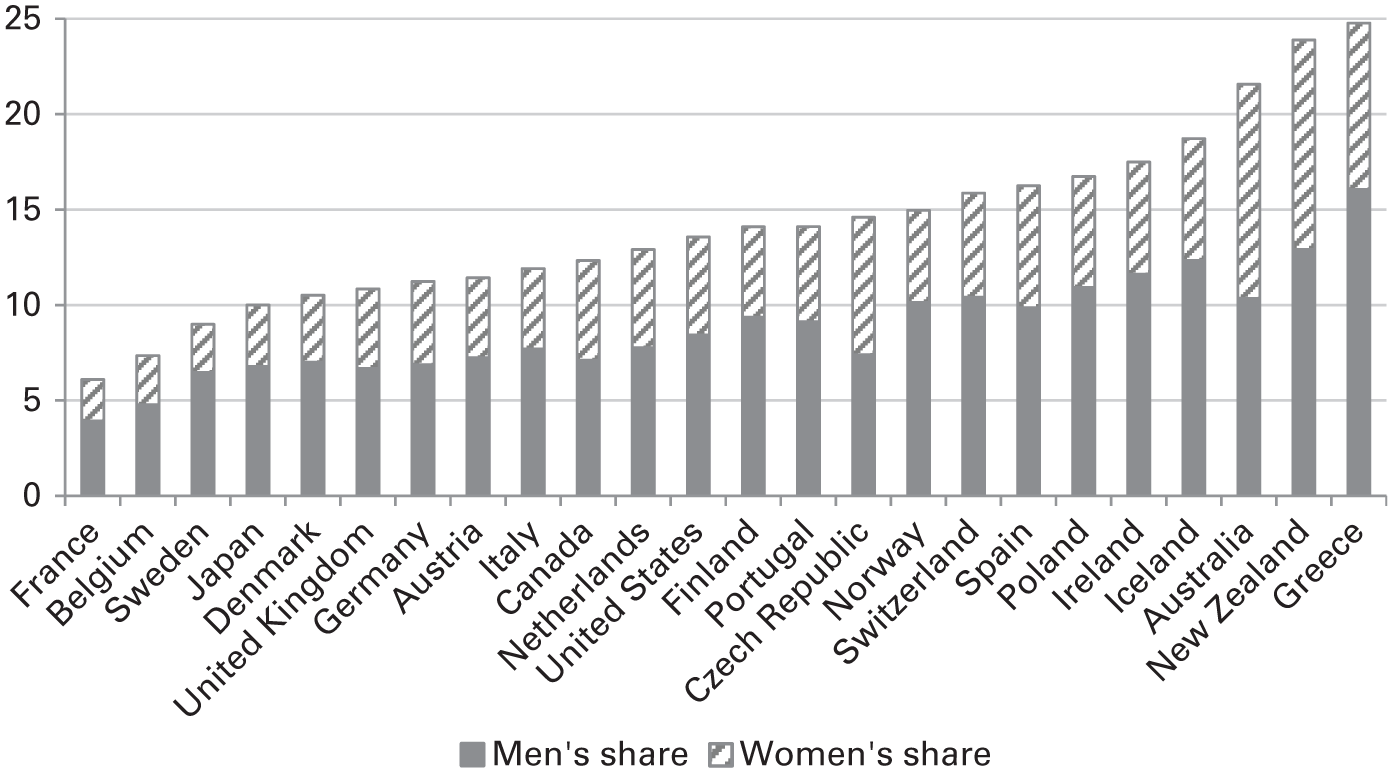
Entrepreneurial activity rates across countries by gender.
The graph also suggests that women are substantially underrepresented in entrepreneurship across countries and that, at least in these data, women’s degree of representation in entrepreneurship bears little association with the aggregate rate of entrepreneurship. For instance, in France and Belgium, the two countries with the lowest aggregate rates of entrepreneurship, women constitute about 36 and 35 percent of entrepreneurs, respectively. In New Zealand and Greece, the two countries with the highest aggregate rates of entrepreneurship, women constitute about 46 and 35 percent of entrepreneurs, respectively.
Figure 2 shows the gender gap in the predicted probability of being an entrepreneur (i.e., the average marginal effect of gender), as estimated by separate logistic regressions by country that adjust for education, age, and year of survey. By this measure, the gender gap is the largest in Ireland, Iceland, and Norway, where men’s probability of being engaged in entrepreneurial activity is at least 10 percentage points higher than women’s. In Ireland, for instance, women’s probability of being an entrepreneur is nearly half that of men’s (probability for men = 0.24; probability for women = 0.11; diff = 0.13). By contrast, men’s probability of being an entrepreneur is less than 3 percentage points higher than women’s in Canada, Spain, and Japan. In general, many of the countries in Northern Europe have large gender gaps. By contrast, Japan and some of the Southern European (e.g., Spain and Italy) and English-speaking countries (e.g., Australia, Canada, and the U.S.) have comparatively smaller gender gaps.
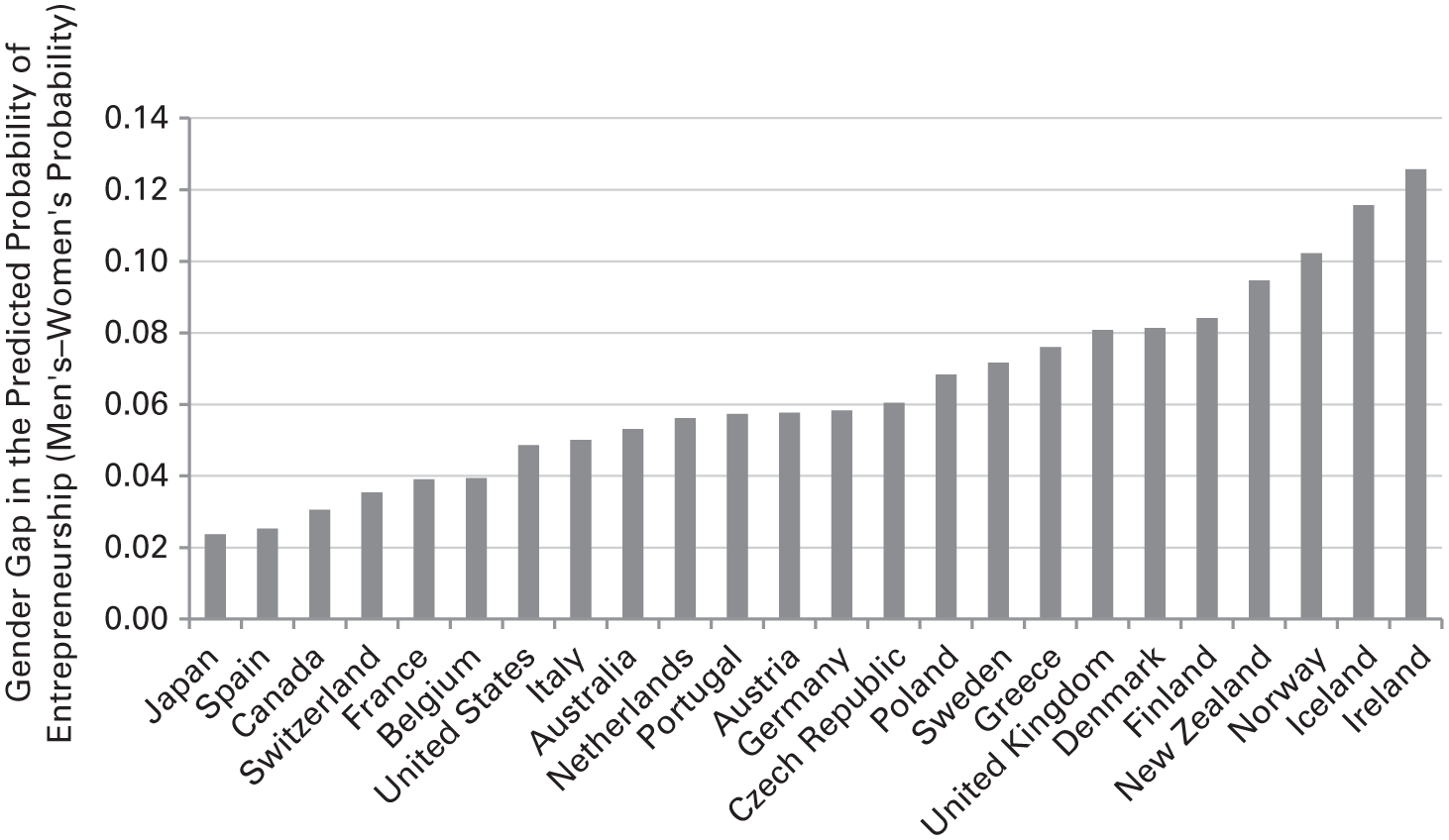
Size of the gender gap in the adjusted probability of entrepreneurial activity across countries.*
A simple investigation of the correlation between the size of these country-level gender gaps in the probability of entrepreneurship and the work–family institutions measures in each country (averaged across survey years) suggests that there is a positive association between childcare provision and the gender gap (r = .40), a weak association between paid leave and the gender gap (r = .14), and no association between women’s part-time work and the gender gap (r = −.02). Figure 3 plots the positive correlation between the level of state childcare spending and the size of the gender gaps in country-specific average marginal effects. The gender gap in the probability of being an entrepreneur is fairly high in states that generously fund childcare, namely Iceland, Denmark, Sweden, Finland, and Norway, and low in states that do not, such as Canada, Switzerland, and the U.S. Spain and Ireland are unusual cases: whereas both countries spend a moderate amount of GDP on public childcare, the gender gap in the probability of being an entrepreneur is small in Spain but large in Ireland. These variations could be attributable to factors such as cultural differences in the extent to which entrepreneurship is viewed as an acceptable career for women. Spain’s public funds for childcare are also highly decentralized and often combined with preschool programs that provide only part-day care (Valiente, 2003; Aguilar, Escobedo, and Montagut, 2013), which presumably limits access to care for children under three.
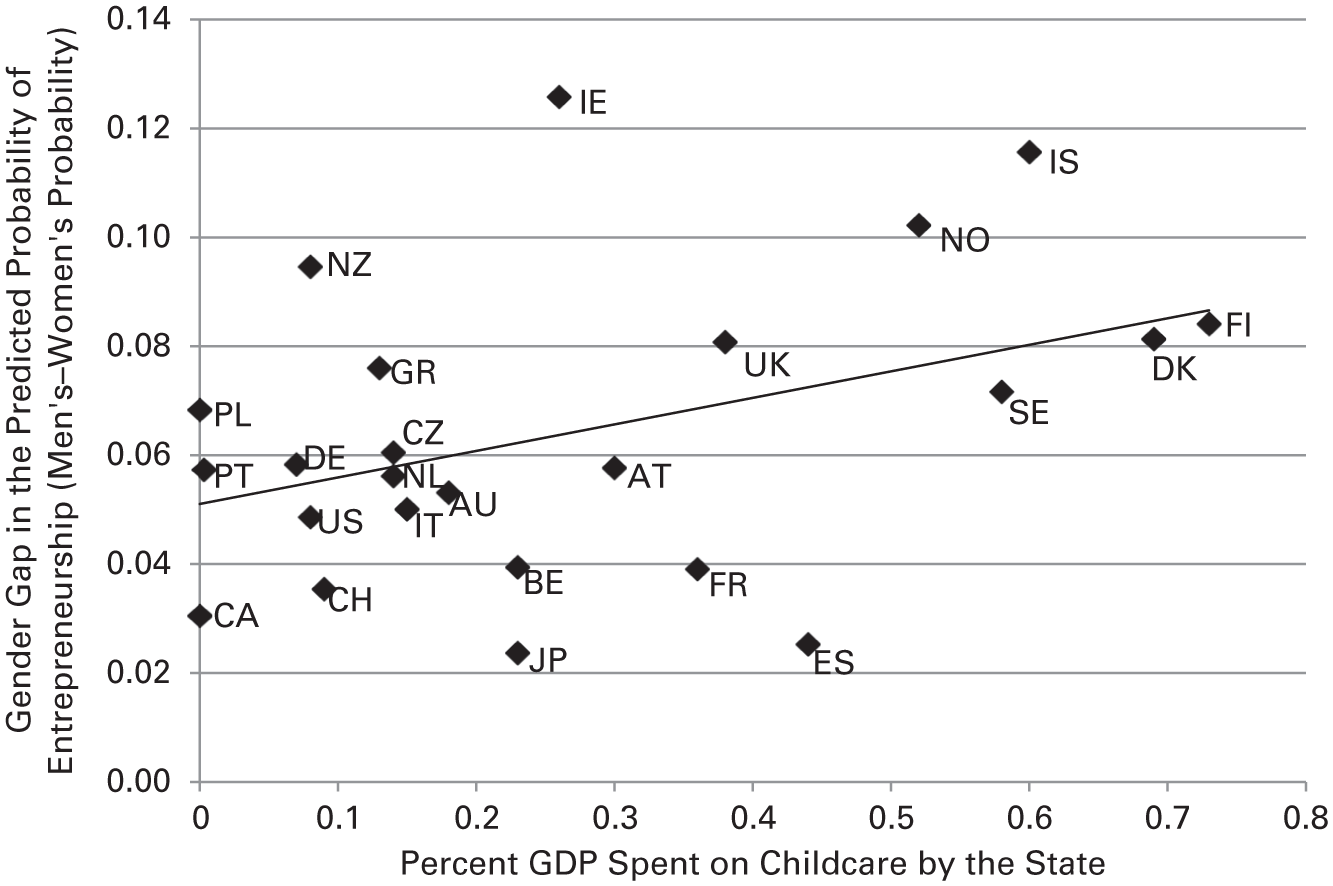
Size of the gender gap in the adjusted probability of entrepreneurial activity across countries, by state childcare spending.*
Modeling Gender Gaps in the Odds of Entrepreneurial Activity
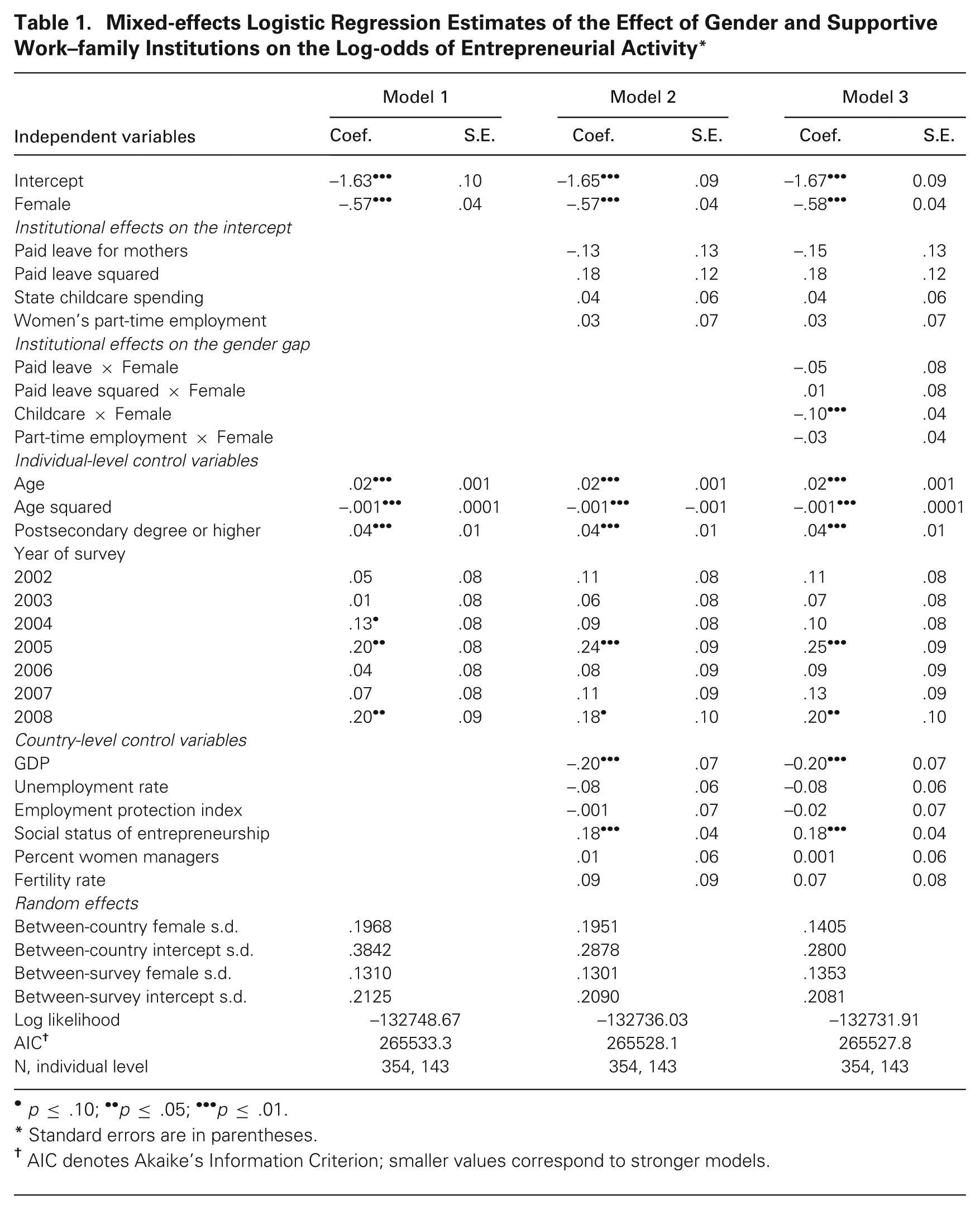
Table 1 presents results from multilevel models predicting the odds of being engaged in entrepreneurial activity as a function of individual- as well as national-level factors. 17 Model 1, a baseline model, fits only gender and human capital variables. It shows that individuals who are middle-aged and who hold a postsecondary degree or more are more likely to be entrepreneurs. Of more interest, however, is the strong negative gender effect. The coefficient indicates that, across the entire sample, women are just over half as likely to be entrepreneurs as men (exp (–0.57) = 0.57). In other words, men’s odds of being an entrepreneur are about 1.8 times greater than women’s (odds ratio for men = 1/0.57 = 1.75). The random effects in this model also suggest that, not surprisingly, there is more unexplained variability in the gender gap at the country level than at the survey level.
Mixed-effects Logistic Regression Estimates of the Effect of Gender and Supportive Work–family Institutions on the Log-odds of Entrepreneurial Activity*
p ≤ .10; ••p ≤ .05; •••p ≤ .01.
Standard errors are in parentheses.
AIC denotes Akaike’s Information Criterion; smaller values correspond to stronger models.
Model 2 adds country-level variables. The change in the random effect for the between-country intercept between model 1 and model 2 suggests that about 44 percent of the between-country variance in entrepreneurial activity rates can be explained by these variables. 18 Findings underscore the relevance of both economic conditions and cultural values for entrepreneurial activity: entrepreneurship is less common in countries with higher GDPs but much more common in countries in which respondents agree that it is a socially valued activity. For instance, individuals in a context that scores one standard deviation above the mean on the status of entrepreneurship variable (e.g., the U.S. in 2008) have 1.2 (exp (0.18) = 1.2) times the odds of being an entrepreneur than those in contexts with the mean score (e.g., Italy in 2007).
Model 3 adds cross-level interaction effects between gender and the work–family institutions measures: paid leave for mothers, childcare, and women’s part-time employment. In support of my first hypothesis, greater public expenditure on childcare is associated with significantly larger gender gaps in the odds of being engaged in entrepreneurial activity, net of individual- and country-level control variables. The estimated effects of paid leave and the size of the part-time labor force on the gender gap are also negative but, by contrast, small and not significant. The random effects further suggest that the work–family institutions variables tend to explain country-level (rather than survey-level) variation in the gender gap. The inclusion of the interaction terms reduces the level of unexplained variance between countries in the gender effect by about 48 percent. 19 In contrast, these variables do not explain survey-level variation, though this is not surprising given the small amount of change in work–family institutions during this relatively short time period.
To ease interpretation of the interaction effect between gender and childcare spending, figure 4 shows predicted probabilities from model 3 for men and women in contexts with different levels of childcare spending, holding all other variables constant at their mean. 20 In contexts with no state childcare spending (e.g., Canada in 2001), women’s probability of being engaged in entrepreneurial activity is about two-thirds that of men’s (probability for men ~0.15, probability for women ~0.10); in contexts that spend the most on childcare (e.g., Denmark in 2008), women’s probability is only half that of men’s (men ~0.16, women ~0.08). This difference in the gender gap is largely driven by a woman’s relatively lower probability of being an entrepreneur in high-childcare-spending contexts than in low-childcare-spending contexts.
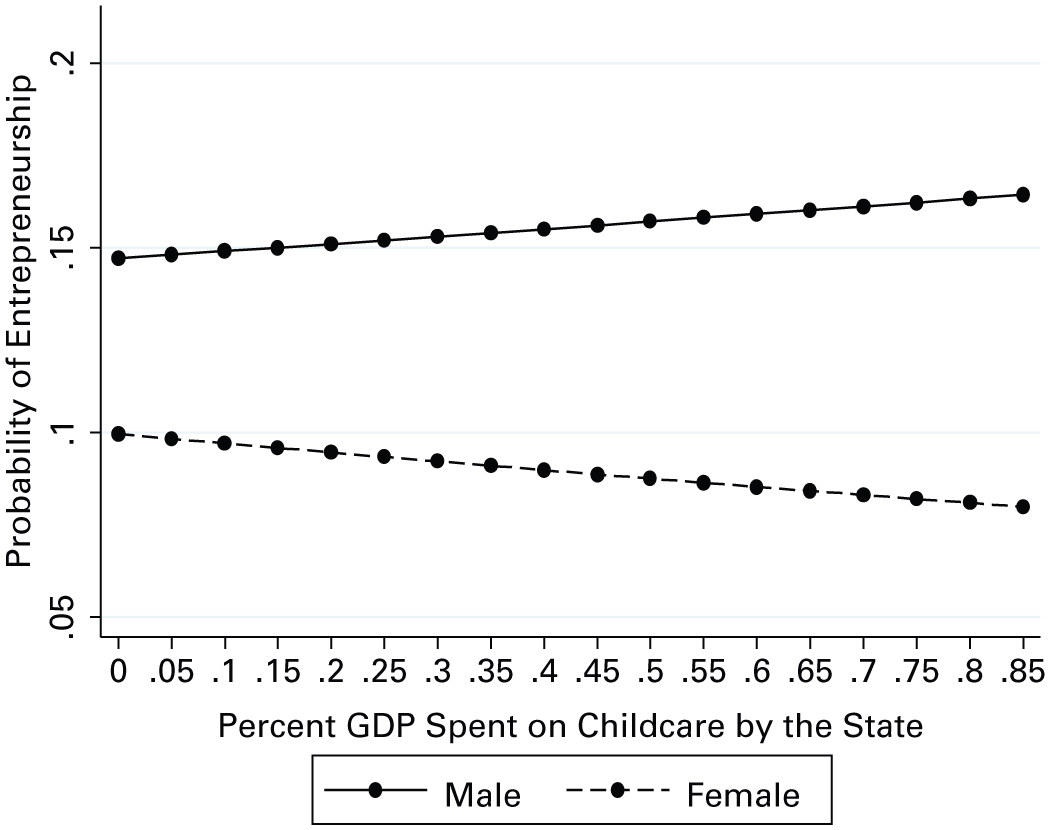
Predicted probabilities of entrepreneurship for men and women, by state childcare spending.
In short, countries that seek to alleviate work–family conflict through publicly subsidized childcare tend to have larger gender gaps in entrepreneurial activity. From a theoretical point of view, it is not surprising that state-sponsored childcare has a strong effect. This institutional support, which enables women to maintain their employment without long-term interruptions, is often singled out for its ability to mitigate work–family conflict (e.g., Pettit and Hook, 2009). If work–family conflict is particularly unlikely to be present as a factor motivating women toward entrepreneurship in such contexts, it follows that subsidized childcare would produce a strong dampening effect on women’s entrepreneurship rate.
Supplementary analyses (shown in Online Appendix table A3) indicate that this result is similar when predicting the odds of nascent entrepreneurship (3 percent of the total sample) and when individuals who are not employed are included in the analysis. It is also robust to the inclusion of cultural perceptions about entrepreneurship and network ties to other entrepreneurs at the individual level. As prior studies have also shown, individuals who believe they have the skill and experience necessary to be an entrepreneur, who do not fear business failure, and who know another entrepreneur are more likely to be one. Even when comparing individuals with similar perceptions and network ties, however, women’s odds of being an entrepreneur relative to men are significantly lower in contexts that spend more on childcare. 21
Gender Gaps in Plan B Motivations
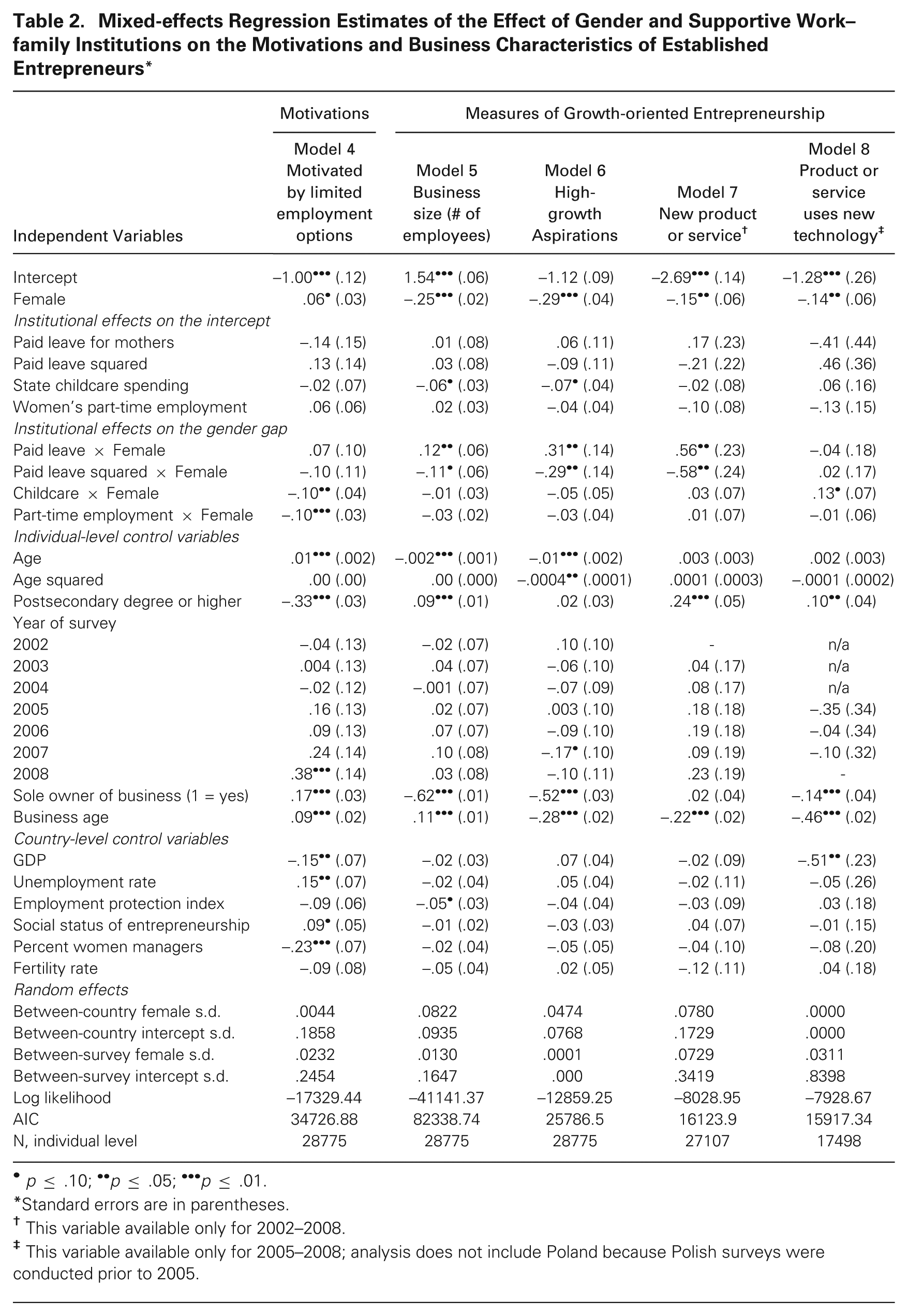
Next, I investigated the possibility that the observed relationship between public childcare funding and the gender gap in entrepreneurship may stem from variations in women’s entrepreneurial motivations across institutional contexts. As argued above, supportive work–family institutions should be associated with the gender gap in entrepreneurship, at least in part because they mitigate the extent to which work–family conflict motivates women to opt for business ownership as a Plan B employment strategy. Model 4 in table 2 evaluates this claim by estimating a multilevel model predicting the odds that a business owner reports having been motivated by a lack of attractive employment options. The estimated coefficients of the control variables in this model are generally unsurprising: older, less-educated, sole business owners with older businesses are more likely to have been motivated by a lack of attractive employment options. This motivation is also more common in contexts with lower GDPs, higher unemployment rates, fewer women managers, and stronger cultural support for entrepreneurship as a means of employment. Of greater interest for my purposes, however, are the cross-level interactions between gender and work–family institutional arrangements. These coefficients indicate that women entrepreneurs’ relative odds of having been motivated by limited employment options are significantly lower in countries with high childcare spending and high rates of part-time work among women.
Mixed-effects Regression Estimates of the Effect of Gender and Supportive Work–family Institutions on the Motivations and Business Characteristics of Established Entrepreneurs*
p ≤ .10; ••p ≤ .05; •••p ≤ .01.
Standard errors are in parentheses.
This variable available only for 2002–2008.
This variable available only for 2005–2008; analysis does not include Poland because Polish surveys were conducted prior to 2005.
Figure 5 shows predicted probabilities for men and women at different levels of childcare spending and part-time employment, holding all other variables constant at their mean. In support of my second hypothesis, women’s predicted probability of having been motivated by limited employment options is lower by about 9 percentage points in the context spending the most versus the least on childcare (.24 versus .33, respectively), and that probability is lower by about 4 percentage points in the context with the highest rate of women’s part-time employment versus the lowest rate of women’s part-time employment (.27 versus .31, respectively). These institutional effects for women are large enough that the direction of the gender gap reverses sign in countries with particularly high levels of childcare spending and part-time work for women: in these contexts, women business owners actually have a lower probability of being motivated by limited employment options than their male counterparts. This finding is consistent with my claim that work–family policies yield gender-differentiated incentives to become a business owner. Put differently, the larger gender gaps in the odds of being an entrepreneur in countries that reconcile work and family through paid childcare may arise, in part, because fewer women in these contexts are attracted to entrepreneurship out of a need to resolve work–family conflicts. 22
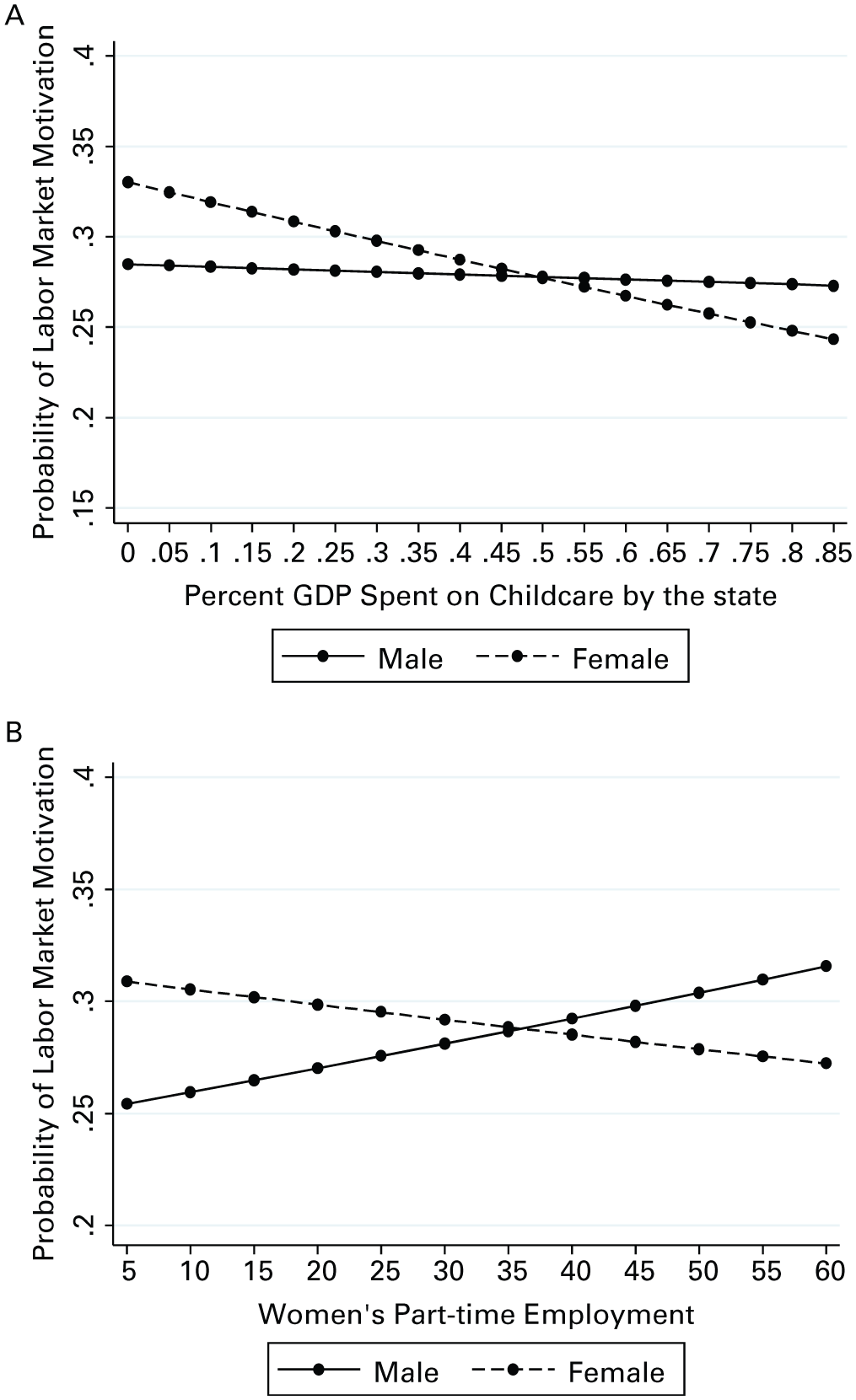
Predicted probabilities of being motivated by limited employment options for men and women business owners.
Gender Gaps in Growth-oriented Forms of Entrepreneurship
Finally, if supportive work–family institutions mitigate the extent to which work–family conflict motivates women toward entrepreneurship, might they also have bearing on which kinds of women are selected into the population of business owners, thereby affecting gender gaps in the growth orientation of the businesses that men and women own and operate? Models 5 through 8 in table 2 triangulate evidence for this possibility by estimating the effects of work–family institutions on gender gaps in business size, growth aspirations, innovativeness, and new technology use. The results from model 5 suggest that, while the gender gap in business size is unrelated to childcare provision or the prevalence of part-time work, it is significantly smaller in countries that provide longer paid leaves for mothers. Panel A of figure 6 shows the predicted values for men’s and women’s business size at different levels of FTE paid leave. The gender gap in business size is the smallest in the middle of the distribution, at about 25–30 weeks of paid leave; women business owners employ more workers in contexts with longer periods of paid leave, but this effect levels off and even decreases somewhat in contexts with particularly long leaves. This finding suggests that, in contexts in which leave policies enhance women’s experience in and attachment to the workforce by mitigating employment interruptions, women who do decide to become business owners tend to run larger businesses.
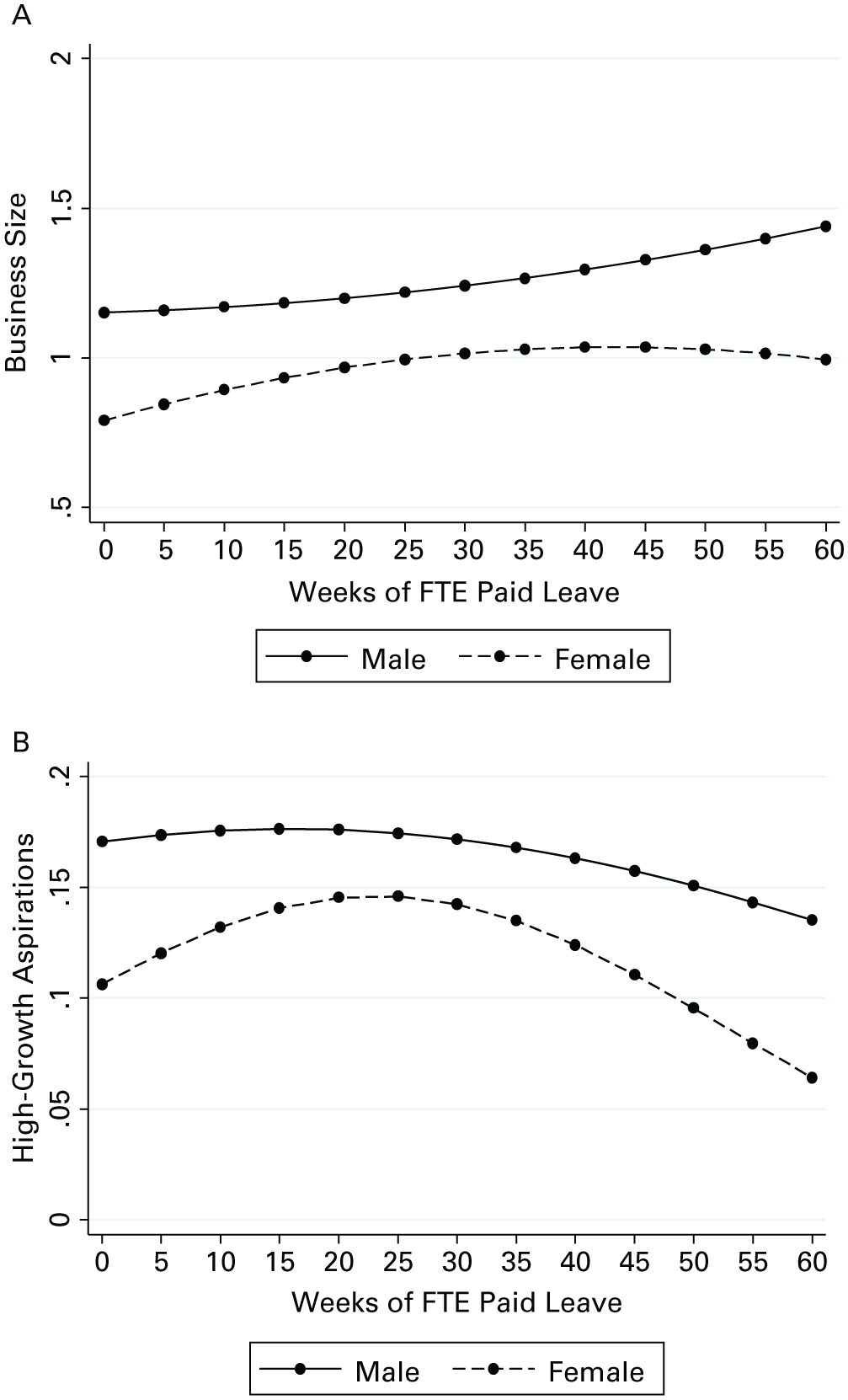
Predicted values for men’s and women’s current business size and predicted probabilities of high-growth aspirations, by weeks of FTE paid leave.
Model 6 examines whether or not an entrepreneur believes that she or he will hire more than five employees in the next five years. Consistent with prior research, the coefficient for “female” indicates that women are significantly less likely to express high-growth aspirations than their male counterparts. Similar to the finding for current business size, however, the interaction effects between the gender coefficients and the policy measures indicate that the gender gap is significantly smaller in contexts with moderate lengths of paid leave. As can be seen in panel B of figure 6, which shows the predicted probabilities for this model, women in contexts that have between 20 and 30 weeks of paid leave are considerably more likely to express high-growth expectations than their female counterparts in contexts with very little paid leave or with substantially longer periods of leave.
Model 7 estimates the effects of gender and work–family policies on whether or not an entrepreneur believes she or he is introducing a product or service that is “new to all customers.” The cross-level interaction effects with gender again show a strong curvilinear effect of paid leave: women entrepreneurs’ relative odds of offering what they perceive to be a “new” product or service are higher in countries that offer a moderate amount of paid leave. The predicted probabilities for men and women at different levels of FTE paid leave (panel A of figure 7) suggest that the difference in the gender gap across levels of FTE leave is due almost entirely to women business owners’ higher probability of offering a new product or service in contexts with moderate lengths of paid leave. That is, women are considerably less likely than their male counterparts to offer a new product or service in contexts with no leave, very short leaves, or very long paid leaves, but this gender gap is virtually nonexistent in contexts that offer between 20 and 30 weeks of paid leave. 23
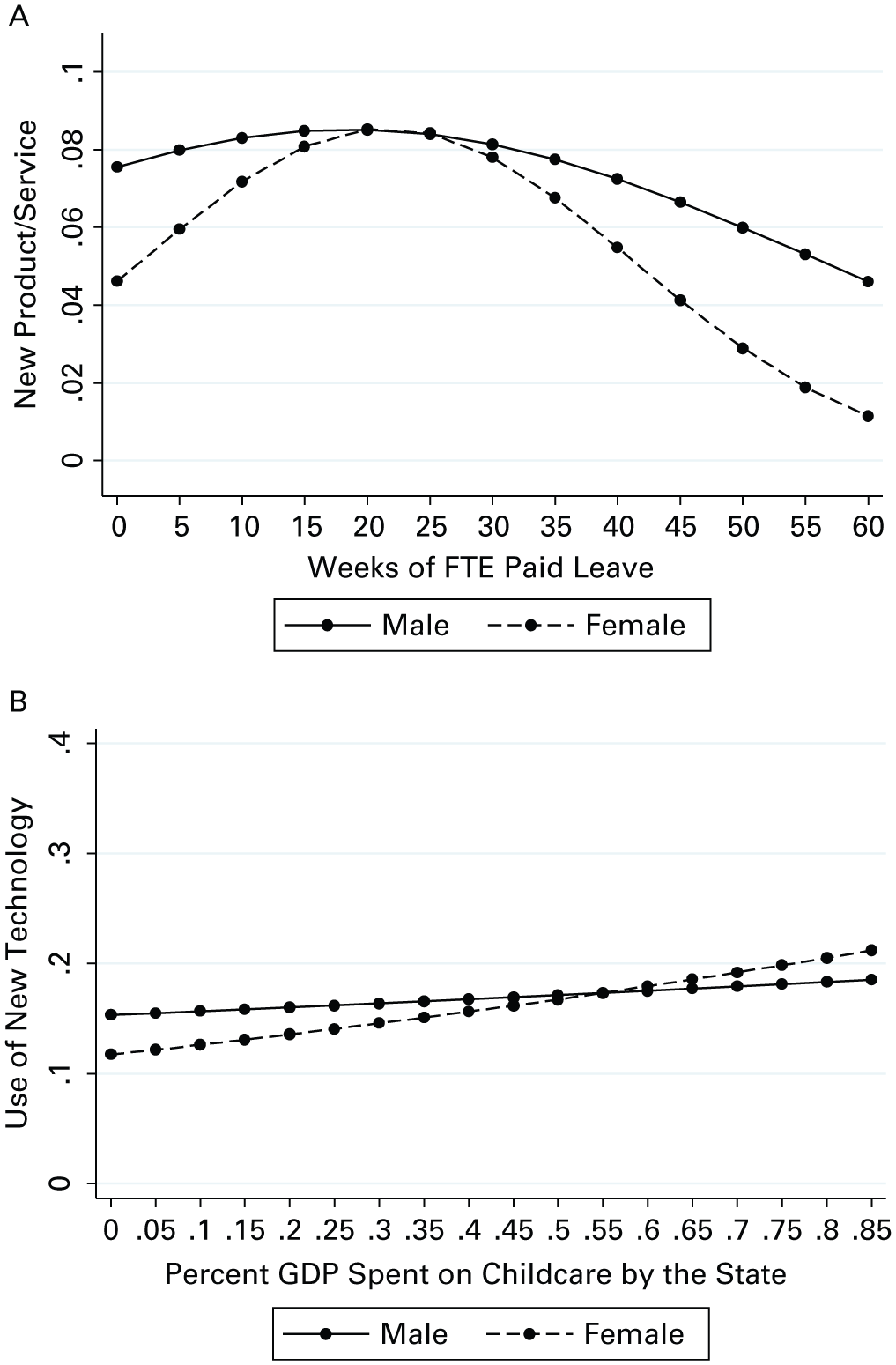
Predicted probabilities of innovation indicators for men and women business owners.
Finally, model 8 suggests that women entrepreneurs’ relative odds of offering a product or service that involves new technology are somewhat higher in countries that generously fund formal childcare. This effect is small relative to its standard error, though the random effects suggest that very little between-country variance in the gender effect is left unexplained. The predicted probabilities (panel B of figure 7) suggest that women business owners have a higher probability of using new technology in contexts that offer more childcare; the gender gap is indiscernible in contexts that spend more than 0.4 percent of their GDP on childcare.
Together, models 5 through 8 offer convergent support for my third hypothesis that women’s representation in growth-oriented forms of entrepreneurship will be relatively higher in contexts in which work–family institutional arrangements mitigate work–family conflict and thus mitigate incentives for women to rely on entrepreneurship as a fallback employment strategy. 24
Discussion and Conclusions
My analysis of 143 surveys conducted across 24 countries makes an important departure from prior work because, rather than investigating a singular aspect of entrepreneurial activity, it attends to the multidimensional nature of gender inequality in entrepreneurship: it persists regardless of whether “entrepreneurship” is defined by organizational creation (Thornton, 1999; Aldrich and Ruef, 2006) or by an orientation toward economic growth, profit, and innovation (Schumpeter, 1961, Kanter, 1983; Carland et al., 1984). This approach enabled me not only to address how institutional arrangements may have differing implications for inequality depending on how entrepreneurship is measured but also to discern how gendered institutional incentives link different forms of gender stratification in entrepreneurship to one another. I also utilized data that allowed me to directly examine the relationship between career-specific motivations and work–family institutions. By doing so, I evaluated a central, though rarely tested, premise behind the scholarship on work–family policies and gender stratification: that supportive work–family institutions are meaningfully related to the reasoning that underlies women’s employment decisions.
Specifically, my analysis aimed to identify (a) whether supportive work–family institutions are related to gender inequalities in entrepreneurship outcomes and (b) whether such relationships may be fostered, at least in part, because such institutions “degender” some of the institutionally embedded incentives that men and women experience to found new enterprises. To begin, I find that women constitute a lower share of early-stage and established business owners in contexts that offer generous public childcare provision. At first blush, this finding seems like a case of unintended consequences, given that policies like subsidized childcare are intended to promote women’s status in the labor force. But a closer look at the way that entrepreneurial motivations vary by institutional context reveals that women entrepreneurs in contexts with generous subsidized childcare, as well as ample part-time jobs, are also substantially less likely to turn toward entrepreneurship out of a need for a better employment situation. Together, these findings suggest that women may be relatively less likely to be entrepreneurs in supportive institutional contexts, at least in part because they are less likely to be in a situation in which they need to consider entrepreneurship as a fallback employment strategy. From this perspective, the policies accomplish their goal: by expanding women’s options in the wage and salaried labor market, supportive institutions reduce the need for women to rely on entrepreneurship as a Plan B strategy for reconciling work and family demands.
In addition, I found that women are more likely to be engaged in economic growth-oriented forms of entrepreneurship in institutional contexts that offer moderate lengths of paid leave and more generous childcare provision. Women run relatively larger businesses, express higher-growth aspirations, and are relatively more likely to introduce a new product or service in contexts in which a moderate amount of paid leave is offered; in countries with high levels of childcare provision, women business owners are somewhat more likely to sell products or services that require the use of new technology. These findings suggest that the institutional arrangements known to offer strong structural and normative support for the employment of workers with caregiving responsibilities—paid leave and subsidized childcare—are linked to women’s relative status within a population of entrepreneurs. In contexts in which these institutions are in place, the average woman has a broader menu of attractive opportunities in standard employment; therefore the women who do pursue entrepreneurship are a select group motivated by a desire to build larger, more innovative organizations that will have a more substantial impact on the economy and job growth. In contrast, women’s greater tendency to opt for business as a Plan B employment strategy when such arrangements are lacking appears to reinforce vertical aspects of gender inequality in entrepreneurship, given that women entrepreneurs in such contexts disproportionately run lower-growth, and thus lower-status, firms.
Overall, my findings suggest that a factor that typically reinforces gender segregation in the labor market—the absence of institutional supports for workers with caregiving responsibilities—may actually foster higher levels of women’s representation among business owners as a whole, an area of the labor market that is known to be particularly male-dominated. But, consistent with the dominant pattern, it may also foster women’s segregation into less-desirable and/or less-profitable forms of entrepreneurship. In short, in contexts in which supportive work–family institutions are lacking, women may achieve higher but not better levels of representation in entrepreneurship.
Importantly, not all institutional approaches to work–family reconciliation are linked to gendered entrepreneurship outcomes in the same way. In contrast to childcare and paid leave, the prevalence of part-time work is not associated with gender gaps in business start-up or ownership. And although limited employment options are significantly less likely to motivate women toward entrepreneurship in contexts in which part-time work is prevalent, part-time work is not associated with women’s representation in growth-oriented forms of entrepreneurship. Unlike childcare and moderate lengths of paid leave, which encourage full-time employment and limit labor market interruptions, part-time work is an arrangement that reconciles work and family in a way that marginalizes women’s employment status and reinforces a traditional division of labor (Epstein et al., 1999; Misra, Moller, and Budig, 2007; Rubery, 2013). Thus it appears that only institutional arrangements that reconcile work and family without marginalizing women’s employment status are associated with higher levels of women’s representation in growth-oriented forms of entrepreneurship. Yet there is also notable variation in the effects of paid leave versus childcare on the growth-orientation outcomes. For instance, paid leave is associated with gender gaps in business size, growth aspirations, and innovation, whereas subsidized childcare is associated with gender gaps in the use of new technology. Although this specific pattern of results was unexpected, it is possible that the effects may have been more consistent across outcomes if these data had included more fine-grained measures of business characteristics, such as revenue, profit margins, or intellectual property ownership. Future research would be well-served to investigate these patterns in further detail.
Finally, although the focus of this analysis was on formal aspects of institutions, my findings also point to the relevance of cultural values. First, scholars have argued that policies like paid leave and publicly subsidized childcare not only make it more feasible for women to combine wage and salaried employment with family obligations but also send a symbolic message that doing so is acceptable. My results are consistent with this cultural dimension of institutions, given that women are most likely to pursue entrepreneurship as a career-building opportunity rather than a fallback employment strategy in contexts in which these policies are present. Second, following sociological theory on the importance of social status and legitimacy (Weber, 1948; Johnson, Dowd, and Ridgeway, 2006), I found that a widely shared belief that entrepreneurship is a status-worthy activity is a key condition associated with higher rates of entrepreneurship. Individuals in such cultural contexts are also somewhat more likely to view entrepreneurship as a viable option in the event that they should encounter difficulties in the wage and salary labor market. These findings underscore institutional theorists’ claim that taken-for-granted cultural beliefs play a key role in the process of organizational creation (e.g., DiMaggio and Powell, 1991).
Contributions, Limitations, and Future Directions
This study contributes to prior theoretical and empirical work in several areas. First, I advance institutional theories of entrepreneurship to help explain an important aspect of demographic heterogeneity in organizational populations. Specifically, my study articulates how the institutionally embedded incentives that lead people toward entrepreneurship may operate quite differently for different groups of people, namely men and women. In doing so, I build on the growing body of work that has emerged in response to calls for more contextual approaches to the study of gender and entrepreneurship (e.g., Hughes et al., 2012). My analysis is the first of these to focus exclusively on work–family institutions or to consider how gendered institutional arrangements might simultaneously structure women’s underrepresentation in entrepreneurial activity as well as their underrepresentation in more lucrative and status-worthy forms of entrepreneurship. This multidimensional approach, which is an extension of the multidimensional approach taken to the study of “horizontal” and “vertical” forms of gender segregation in wage and salaried employment (Charles and Grusky, 2004; Weeden, 2004), highlights how these aspects of stratification, which are usually analyzed separately and with separate data-collection efforts, are contingent on one another: they are both, at least in part, related to the extent to which institutional environments make work–family conflict a salient barrier to wage and salaried employment for women. For instance, my finding that supportive work–family policies mitigate women’s tendency to opt for entrepreneurship as a Plan B employment strategy offers a specific account for why countries scoring higher on aggregate indices of gender equality may have larger gender gaps in start-up rates (Klyver, Nielsen, and Evald, 2013). In addition, my analysis contributes to the broader goal among organizational theorists to articulate the relationship between key aspects of societies and social structure (e.g., gender) and organizational processes (see e.g., Scott, 1996; Stern and Barley, 1996), which include organizational creation, leadership, and innovation.
Second, by focusing on work–family policies in particular, I extend the large and growing body of scholarship on the relationships between these policies and gendered labor market outcomes to the domain of entrepreneurship. Similar to the way that work–family policies have been shown to generate tradeoffs between women’s participation in the labor market and their status within it (Petitt and Hook, 2009; Hegewisch and Gornick, 2011), these policies appear to structure a tradeoff between women’s participation in business ownership and their representation among growth-oriented entrepreneurs. Unlike prior studies, however, the GEM data enabled me to empirically evaluate the theorized relationship between gender-differentiated career motivations and the work–family policies themselves. I can thereby establish that the association between work–family policies and these labor market outcomes results, at least in part, from the fact that policies are associated with the gendered labor market conditions under which women are making their employment decisions. Furthermore, because I analyze policy approaches separately, I am able to uncover how institutional approaches to resolving work–family conflict differ from one another in terms of their relationship to gendered entrepreneurship outcomes.
More broadly, the findings underscore the idea that women’s disadvantages in entrepreneurship are deeply rooted in the organizational structures, norms, and practices that tend to disadvantage them in wage and salary jobs. This implies that, especially when investigating the effects of policies on women’s status in entrepreneurship, a multidimensional approach is necessary. Although many women likely benefit from the autonomy of running a business, if they are running a low-growth enterprise they may not be any better off financially than they otherwise would be, and they may be even worse off given the unpredictable and unstable nature of running a business. From this perspective, policies like paid leave and childcare, which promote gender equality in wage and salaried employment by supporting workers with caregiving responsibilities, should also help ameliorate gender inequality in the innovative, job-creating, and leadership-intensive forms of entrepreneurship that are arguably so critical to economic growth. At the same time, if increasing women’s entrepreneurship rate is a policy goal, policymakers should attend to the incentives that such policies rely on; if they encourage entrepreneurship as a means of resolving gender-related barriers like work–family conflict, they are unlikely to produce a substantial improvement in women’s status in the labor market overall.
These findings also reveal that women are particularly underrepresented in entrepreneurial activity in contexts in which institutions mitigate their need to fall back on entrepreneurship as a Plan B career strategy. Therefore an important step for future research will be to uncover the mechanisms that make women so much less likely than men to pursue entrepreneurship as their ideal (or Plan A) career strategy. It is possible that this persistent gap may be attributable to distinctly cultural processes, such as the prevalent stereotype that entrepreneurship, especially a lucrative, growth-oriented form of entrepreneurship, is a male-typed activity (Bruni, Gherardi, and Poggio, 2004; Gupta et al., 2009). Such a belief may prove particularly durable in light of work suggesting that gender-essentialist ideology and expression often persist in the face of egalitarian trends (Charles and Bradley, 2009).
The data on which these findings are based are advantageous because they allow for comparisons of many aspects of gender inequality in entrepreneurship across a large number of national contexts and years, and they include information about individuals’ motivations to start a business, as well as several characteristics of their businesses. At the same time, my analysis is also limited in a number of respects and thus represents just one step toward uncovering the complex linkages between institutional environments and forms of gender stratification in entrepreneurship. First, because there is little policy change within countries during the relatively short time period covered by the surveys, my analysis is, like most cross-national research of this sort, predominantly cross-sectional. Therefore my conclusions are necessarily associational in nature. Future studies that rely on more consecutive years of data or that examine the effects of multiple policy changes over time within a single-country case would be better equipped to evaluate the theorized direction of the relationship between work–family institutions and gender stratification in entrepreneurship. Second, although the indicators provide a general sense of the extent to which states implement progressive institutional arrangements vis-à-vis work and family, they mask some variability by local context (e.g., regional differences in access to childcare services) and in the details of certain policies (e.g., the wage replacement rate for paid leave or incentives for men’s use of parental leave). 25 The relevance of such institutional arrangements may also be contingent upon demographic and economic factors, such as economic growth or changes in the number of young children. Third, the GEM data lack indicators that would be useful in teasing apart demographic variability in the observed effects. In particular, adjusting for parenthood and caregiving responsibilities would likely strengthen the observed association between work–family institutions and gender gaps in entrepreneurship outcomes, given that mothers, particularly those in unsupportive policy contexts, experience more work–family conflict than women do on average. Similarly, it is possible that more information on managerial experience and network ties would account for some additional portion of these gender gaps or that the effects are strongest in particular occupations or industries. Information on home-based businesses would also help shed light on linkages between policy approaches and the nature of Plan B-motivated entrepreneurship. Fourth, the measures of growth orientation available in the GEM are limited. For instance, it is unknown whether a firm’s employees work full time or part time, making comparisons of firm size fairly rough. The newness of a product or service and the use of new technology are also approximations based on the subjective perceptions of business owners themselves rather than on an objective rubric. The analysis also would have benefited from detailed information on industry, given that firm characteristics undoubtedly vary across industry types and women entrepreneurs are often segregated into certain industries, but there were too many missing data on this variable for me to include it in my analysis. Finally, variability by ethnic minority and immigrant status and across rural versus urban regions also likely contextualizes the extent to which an individual can acquire the resources needed to start a business and/or access the benefits of certain work–family policies. Future data collection efforts could begin to fill these gaps.
Though the focus of this analysis has been on establishing whether and how work–family policies are associated with unequal levels of men’s and women’s entrepreneurial activity, one important avenue of future research will be to examine how work–family institutions may be linked to inequalities in entrepreneurship indirectly through individual-level factors such as resources and perceptions (e.g., Elam and Terjesen, 2010). Indeed, education and/or social networks may be more crucial in some contexts than others, which may be particularly relevant for gender outcomes, given that access to work–family policies is more contingent on social class or occupational status in contexts with low levels of national provision, such as the U.S. (Gerstel and Armenia, 2009; Cooke, 2011). Future studies, especially those relying on qualitative and/or case-study approaches, would also be well equipped to uncover the mechanisms generating variability in the effects of the three policy approaches on specific entrepreneurship outcomes, as well as to investigate the possible relevance of contextual factors falling beyond the scope of this project, such as access to flexible work arrangements, the normative dimensions of gendered institutions, or government programs that target women business owners.
By investigating the linkages between work–family institutions and gender stratification in multiple forms of entrepreneurship, this study develops thinking across diverse literatures. To begin, it connects these aspects of gender inequality to the gendered organizational practices thought to contribute to the stall in progress currently observed in the U.S. wage and salary labor market. In particular, the finding that women are disproportionately likely to turn toward entrepreneurship as a backup employment strategy in contexts that lack supportive work–family institutions suggests that organizational practices premised on an “ideal worker” likely promote women’s representation among business owners overall while simultaneously reinforcing their segregation into low-growth, low-status ventures. Moreover, these findings underscore how different aspects of gender inequality in entrepreneurship, which have until now been addressed separately, are linked to one another through institutional arrangements. As such, this study articulates how a lack of institutional supports for workers with caregiving responsibilities not only contributes to women’s aggregate underrepresentation at the top of large organizations directly by, for example, prompting women to cut back their hours, but also indirectly by affecting women’s motivations to become entrepreneurs.
Footnotes
Acknowledgements
This research was funded by a grant from the National Science Foundation (#SES-0802329) and a dissertation fellowship from the Ewing Marion Kauffman Foundation. I thank Maria Charles, Shelley Correll, Michaela DeSoucey, Paul DiMaggio, Heather Haveman, Ko Kuwabara, David Pedulla, Craig Rawlings, Richard Swedberg, Kim Weeden, Associate Editor Pamela Tolbert, and anonymous reviewers for helpful comments and suggestions.
1
The Human Development Index takes into account GDP per capita, health indicators (e.g., life expectancy at birth), and education at the national level.
2
I analyzed individuals in the labor force in order to facilitate the interpretation of institutional effects. Including individuals who are not employed would make it difficult to disentangle institutional effects on entrepreneurship from institutional effects on employment status. One drawback of this strategy is that it may over- or underestimate the degree of overall inequality in entrepreneurship in countries with low women’s labor force participation rates. But analyses that include the full sample (see model 2 in Online Appendix table A3) indicate that the findings presented here are robust to the inclusion of individuals who are not employed.
3
Nascent entrepreneurs are defined as individuals who are actively trying to start a business but have not paid salaries, wages, or payments in kind for more than three months.
4
Age is grand mean-centered.
5
In survey-years 2003–2008, these questions were asked of only a random half of the sample of non-entrepreneurs but of all entrepreneurs (i.e., individuals who had indicated that they were either trying to start a business or who were business owners). For this reason, an analysis that includes these measures upwardly biases the percentage of entrepreneurs in the sample for post-2002 survey years. Because non-entrepreneurs were asked the question at random, however, it is possible to obtain reasonably unbiased estimates for the effects of gender on entrepreneurship.
6
FTE paid leave is calculated as the wage replacement rate multiplied by the duration of leave (see Ray, 2008, and Ray, Gornick, and Schmitt, 2010, for methodological details).
7
These included Denmark, Germany, Ireland, New Zealand, Portugal, Sweden, Switzerland, and the United Kingdom.
8
Robustness checks indicated that lagging the changes by two years, or not lagging changes at all, produced very similar results to those presented here.
9
Data were published in 2005 and again in 2007; information for missing years was imputed. Some researchers have alternatively used a measure of the percentage of young children who are enrolled in publicly funded childcare (e.g., Pettit and Hook, 2009), but a cross-nationally consistent measure of enrollment is available for only 17 of the countries in my sample. For these countries, the enrollment measure is highly correlated with the expenditure measure I used (r = .73). A drawback to both measures is that they do not capture variability by region in access to or quality of childcare services.
10
Overall correlations between work–family indicators are as follows: paid leave, childcare spending, r = .22; paid leave, part-time employment, r = −.30; childcare spending, part-time employment, r = −.25. Cronbach’s alpha and factor loadings are also low (α = .3552; factor loadings are < |.49|).
11
I investigated a series of alternative controls: an index that captured three legal arrangements that make starting a business difficult, i.e., the number of procedures required, the time it takes to complete a procedure, and the cost of official fees for legal services required by law (World Bank Group, 2013), union density, and the size of the service sector (OECD, 2012b). Models that controlled for these measures produced similar results to those presented here.
12
I also investigated a series of alternative indicators of the social and cultural status of women, which produced similar results but weaker model fits compared with the models presented. These include women’s labor force participation rate, the gender wage gap, the percentage of women in parliament, gender segregation by academic field, and national-level gender ideology (ISSP, 2002; UNDP, 2004, 2005, 2006, 2007, 2009, 2010; Charles and Bradley, 2009). Additional analyses also did not find evidence that these indicators were directly associated with the gender gap in entrepreneurship.
13
Pooled VIFs for country-level variables are ≤ 3.07. Models that entered macro-level predictors one at a time also showed similar results.
14
Data for innovativeness are available only for survey years 2002–2008; data for use of new technology are available only for survey years 2005–2008.
15
All continuous variables are grand mean-centered.
16
All logistic models estimate log-odds coefficients, but models that estimated odds ratios showed findings highly similar to those presented here.
17
A likelihood-ratio test comparing two unconditional means (empty) models that assumed the female slope coefficient was fixed versus random indicated that between-group variance in the size of the gender gap is significant. The intraclass correlation coefficients, which are calculated from the random effects in the unconditional means model, also suggest that a moderate amount of the total correlation between latent measures of entrepreneurial activity can be explained at the group levels (about 6 percent and 5 percent at the survey-within-country and country levels, respectively).
18
Percent change in the unexplained variance in the country-level intercept = [0.38422– 0.28782]/0.38422 = 0.439.
19
Percent change in the unexplained variance in the female effect between model 2 and model 3 = [0.19512–0. 14052]/0. 19512 = 0.481.
20
Predicted probabilities were generated from models using unstandardized values for country-level variables for the purpose of facilitating interpretation. They reflect estimates from the fixed portion of the model.
21
Additional robustness checks (not shown) also indicated that institutional effects on the gender gap are similar when these variables are included in the model one at a time.
22
A model that estimated these effects separately for the subsample of women only (not shown) confirms that women are significantly less likely to be motivated by limited employment options in contexts with more generous levels of state childcare spending than their female counterparts in contexts with less generous childcare spending.
23
Separate analyses of the subsample of women indicate that there is a significant curvilinear effect of paid leave on women’s business size, as well as their propensity to have high-growth aspirations and to introduce a new product/service.
24
Although I treated business size as an outcome variable in this set of analyses, it is also possible that some of the gender effects on growth aspirations and innovation outcomes could be affected by gender differences in current business size. In a separate analysis (not shown), I included business size as a covariate in the models predicting growth aspirations, the introduction of a new product or service, and the use of new technology. Results suggest that while business size produces the expected effect on these outcomes, the substantive conclusions about gendered institutional effects remain unchanged.
25
The U.S. was the only country with any discernible regional variability in the implementation of paid leave during the time period of my study, but prior studies suggest that there was some regional variation in funding for childcare services in five of the 24 countries: the U.S., Canada, Switzerland, the Netherlands, and Spain. A close look suggests that in many of these cases, such as Canada and the U.S., the variability pertains to a relatively small minority of the country’s population. I also conducted a sensitivity analysis, in which I estimated a series of models without one or more of these countries. Results were similar to those presented here, suggesting that this within-country heterogeneity is likely not large enough to affect the central findings.
Author’s Biography
References
Supplementary Material
Please find the following supplemental material available below.
For Open Access articles published under a Creative Commons License, all supplemental material carries the same license as the article it is associated with.
For non-Open Access articles published, all supplemental material carries a non-exclusive license, and permission requests for re-use of supplemental material or any part of supplemental material shall be sent directly to the copyright owner as specified in the copyright notice associated with the article.
