






Abstract
In this paper, we examine when members of underrepresented groups choose to support each other, using the context of the funding of female founders via donation-based crowdfunding. Building on theories of choice homophily, we develop the concept of activist choice homophily, in which the basis of attraction between two individuals is not merely similarity between them, but rather perceptions of shared structural barriers stemming from a common social identity based on group membership. We differentiate activist choice homophily from homophily based on the similarity between individuals (“interpersonal choice homophily”), as well as from “induced homophily,” which reflects the likelihood that those in a particular social category will affiliate and form networks. Using lab experiments and field data, we show that activist choice homophily provides an explanation for why women are more likely to succeed at crowdfunding than men and why women are most successful in industries in which they are least represented.
Homophily—the tendency of individuals to associate with others based on shared characteristics—is one of the most frequently studied mechanisms in the social sciences (McPherson, Smith-Lovin, and Cook, 2001; Kossinets and Watts, 2009). Starting with the modern scholarly articulation of homophily by Lazarsfeld and Merton (1954), research has shown that it originates from varied shared similarities, including class (Kandel, 1966), gender (Ibarra, 1992; Kleinbaum, Stuart, and Tushman, 2013), race or ethnicity (Zeng and Xie, 2008; Wimmer and Lewis, 2010; Hegde and Tumlinson, 2014), and organizational age, size, governance, or prominence (Powell et al., 2005; Rosenkopf and Padula, 2008). Homophily has also been used to explain a broad range of phenomena of interest, including venture capital (VC) investment (Hegde and Tumlinson, 2014) and the formation of organizational alliances (Powell et al., 2005; Rosenkopf and Padula, 2008; Ahuja, Polidoro, and Mitchell, 2009), among others (e.g., Duncan, Haller, and Portes, 1968). A common thread in these studies is their emphasis on the effects and bases of homophily rather than its underlying mechanisms.
The focus on outcomes is sufficient for many analytical ends when identities are simple and homophily is viewed as a “fundamental force” (Weare, Musso, and Jun, 2009) shaping the composition of social groups or networks. In practice, however, individuals may share both personal similarities and common group membership, which provides multiple bases for attraction (e.g., McCall, 2005; Lin and Lundquist, 2013), suggesting a need for an understanding of homophily as embracing both individual attraction and group membership. This need is likely greatest when considering homophily among individuals who belong to groups with histories of disadvantage that can shape relationships in complicated ways (e.g., Tilly, 1999), including perceptions of, and relationships between, co-group members (Marsden, 1988; Shrum, Cheek, and Hunter, 1988; Smith, 2005; Ingram and Morris, 2007). In these cases, the broad concept of homophily as “like attracted to like” may not suffice as a theoretical explanation. This coarse treatment may, in turn, partially explain inconsistencies in empirical research concerning homophily in the same population.
Consider, for example, the case of friendship within minority groups. Some research suggests a strong negative correlation between a racial or ethnic group’s size and the likelihood of friendship within groups, as the chance of encountering group members drops (Laumann, 1973). Other research, however, demonstrates that members of minority groups, such as African Americans, demonstrate significantly more homophily than whites, despite their numerical minority status, suggesting that the operation of homophily between individuals is shaped in part by individuals’ choices (Marsden, 1988; Shrum, Cheek, and Hunter, 1988). Yet this choice homophily, too, is conditioned by other social characteristics such as status or affluence, as revealed in sociological research suggesting that employed, poor urban blacks may choose not to help co-group members find work because of reputational concerns (Smith, 2005). Further problems arise when there are overlapping attributes that might trigger homophily or in situations in which tokenism is a concern (e.g., Kanter, 1977; Turco, 2010). Thus the logic of homophily plausibly operates via several underlying mechanisms at multiple levels of analysis, which leads to both theoretical and empirical identification problems in distinguishing the factors that influence when homophily occurs (McPherson, Smith-Lovin, and Cook, 2001).
To explain how variability in individuals’ group-level identity and identification can have an impact on individuals’ choices to support similar others, we introduce the concept of activist choice homophily. In activist choice homophily, the basis of homophilic support is not merely dyadic similarity but rather perceptions of shared structural barriers stemming from a common group-level social identity and an underlying desire to help overcome them.
Empirically examining the underlying mechanisms of choice homophily is difficult because of structural mechanisms that define the probability that individuals will interact with those with similar characteristics. These characteristics include race and ethnicity, sex and gender, age, health characteristics, education, occupation, social class, and status (Blau, 1977; McPherson, Smith-Lovin, and Cook, 2001; Kossinets and Watts, 2009; Centola, 2011; Centola and van de Rijt, 2015). This form of homophily, also called induced homophily, is not predicated on individual attraction per se but develops as networks of homophilous affiliation are reproduced and perpetuated (Blau, 1977; Kossinets and Watts, 2009). The pervasiveness of induced homophily makes it difficult to clearly distinguish choice homophily from induced homophily (McPherson, Smith-Lovin, and Cook, 2001; Kleinbaum, Stuart, and Tushman, 2013; but see Centola, 2011; Centola and van de Rijt, 2015). We distinguish induced and two forms of choice homophily here in the context of donation-based crowdfunding of female founders.
Women historically receive venture funding at much lower rates than men (Buttner and Rosen, 1989; Greene et al., 2001; Greene and Hart, 2003; Harrison and Mason, 2007; Brush, de Bruin, and Welter, 2009). There are many explanations for this disparity, including human capital differences, bias, and homophily (Shane, 2010). Induced homophily implies that female founders seeking funding will be less likely to have an opportunity to access venture capital networks that are historically dominated by male investors. On the personal level, interpersonal choice homophily suggests that an affinity for similar people may be a superficial reaction rooted in self-love: a male funder may be more comfortable or likely to favor a man over a woman because he sees himself in the former. This is the most common conception of choice homophily. In introducing activist choice homophily, we propose another form of choice homophily, one that arises from group-level identity concerns that are not rooted in mere fondness for someone with a common characteristic for egotistic reasons but rather group-level concerns. For example, women are underrepresented in a host of industries (e.g., technology, construction). And although a female funder might have a relative disinterest in construction, she may be more inclined to support a woman in this industry as a result of a desire to help someone penetrate barriers she can sympathize or empathize with and which she believes require assistance to overcome.
All three forms of homophily—induced, interpersonal choice, and activist choice—likely operate simultaneously and to differing degrees in varied contexts by different actors. The current literature, however, subsumes the two forms of choice homophily within the overall concept of “homophily.” In this paper, we explore and distinguish between these two forms of choice homophily as they relate to gender in crowdfunding, a context with no formal gatekeepers and thus with less induced homophily than other forms of new venture finance.
Homophily and Activism in Crowdfunding
Homophily has been widely applied in a variety of literatures, as can be seen in Online Appendix table A1 (http://asq.sagepub.com/supplemental), which lists studies involving homophily published in major management and sociology journals through 2015. Despite the popularity of the concept, however, precise differentiation and articulation of the drivers of homophily are rare, with homophily typically defined simply as “like attracted to like.” In this way, homophily is viewed as a basic social process, a “fundamental force” (Weare, Musso, and Jun, 2009: 149), or a “pervasive fact,” in the words of McPherson, Smith-Lovin, and Cook (2001: 416). In many cases, this broad application of homophily is sufficient, such as when homophily is used to describe social aggregates based on relatively discrete, distinct, and contextually meaningful categories (for a general attempt to do so, see Tilly, 1999). But researchers also use homophily as a theoretical explanation in settings in which its operation can be complicated by induced structural constraints in which choices are made about social actors who have multifaceted social identities (e.g., McCall, 2005; Lin and Lundquist, 2013), which can obscure the underlying mechanisms of homophily.
The literature has not generally addressed this issue. As can be seen in table A1, the commonality among many studies employing homophily as a theoretical explanation is a focus on the impact of homophily, writ large, rather than the pathways by which homophily might operate. In contrast, we theorize that choice homophily has multiple mechanisms and distinguish between activist choice and interpersonal choice homophily. For our research, we selected a context in which homophilous affinity has been implicated as creating persistent inequality: the funding of female entrepreneurs. In both policy and academic circles, there is substantial interest in the fact that women receive less venture capital (VC) than men (Brush, de Bruin, and Welter, 2009). Studies using various methods have found that only a small percentage, between 1 and 6 percent, of VC-backed companies have female founders (Greene et al., 2001; Harrison and Mason, 2007), compared with the 40 percent of all American businesses founded by women. This gender disparity also occurs within the funding network itself, as only 14 percent of all venture capitalists are women (Stuart and Sorenson, 2007; Cain-Miller, 2010).
Scholars have suggested a variety of causes for this disparity (Shaw, Carter, and Lam, 2010), including homophily (Becker-Blease and Sohl, 2007). As Stuart and Sorenson (2007: 223) stated: “If nascent entrepreneurs have gender homophilous networks, then the typical would-be female entrepreneur has few pre-established relationships with early-stage investors. One reason then why women may participate infrequently in entrepreneurship is that, compared to men, they are poorly positioned in the networks that facilitate entrepreneurial activity.” In the case of venture capital, induced homophily originates from distributional differences in female and male venture capitalists and professional network access.
To focus more purely on choice homophily, we turn to a new approach to funding in which induced homophily is lessened (but not eliminated) in principle: crowdfunding. Crowdfunding refers to a variety of ways in which entrepreneurs can fund their efforts by drawing on relatively small contributions from a large number of individuals using the Internet without standard financial intermediaries (Schwienbacher and Larralde, 2010; Mollick, 2014). Crowdfunding embraces a wide range of potential funding needs. Increasingly, however, crowdfunding appears to be a viable source of entrepreneurial seed capital (Schwienbacher and Larralde, 2010), allowing entrepreneurs to raise startup funding (see, e.g., Mollick, 2016). Additionally, the success of crowdfunded ventures like virtual reality firm Oculus Rift, bought in 2014 by Facebook for $2 billion, suggests that crowdfunding is a viable path to initial venture financing for high-growth ventures as well.
Due to reductions in search costs and social constraints, crowdfunding provides a mechanism for the funding of early-stage ventures that allows people to choose to help fund an idea they support and allows founders the opportunity to access potential same-gender funders. This can lessen induced homophily in a number of ways. First, crowdfunding removes traditional gatekeepers to startup finance, such as venture capitalists, and increases pools of potential supporters by giving anyone the opportunity to support a project. Second, the Internet affords the possibility of accessing a deeper pool of like-minded or favorably disposed individuals than is typically possible in geographically or socially constrained searches (see Fernandez and Su, 2004; Agrawal, Catalini, and Goldfarb, 2011), which reduces the prevalence of induced homophily in principle and allows us to focus on the issue of choice homophily.
Interpersonal and Activist Choice Homophily
Interpersonal choice homophily
Induced homophily necessarily shapes choice homophily, as opportunity structures define the options from which individuals make choices. Consequently, the majority of McPherson, Smith-Lovin, and Cook’s (2001) widely cited paper on homophily considers the bases of induction that affect social relationships. Even within fundamentally important social categories such as race, however, in which structural constraints are high and many other social forces operate in combination, scholars have found evidence of choice homophily (e.g., Shrum, Cheek, and Hunter, 1988; with respect to gender, see Kleinbaum, Stuart, and Tushman, 2013). In other contexts, the impact of induced or choice homophily does not appear to drive encounters (e.g., Ingram and Morris, 2007). Hence a more precise focus on choice is warranted, with an emphasis on considering more deeply which individuals are attracted to similar others and why, which may help define when and why choice homophily operates. To that end, we differentiate between two related but distinct bases of choice homophily—one derived from individual-level considerations and one from group-level considerations. The first is the generally understood form of homophily, which we refer to as “interpersonal choice homophily,” which invokes the adage that “birds of a feather flock together.” Friendships and other interactions are most common among similar people because individuals have, on average, a favorable inclination concerning commonly shared characteristics (Lazarsfeld and Merton, 1954; Verbrugge, 1977; Huston and Levinger, 1978; Ingram and Morris, 2007).
Scholars have identified a variety of dimensions under which interpersonal choice homophily operates, including shared values or status characteristics (Lazarsfeld and Merton, 1954; Katz and Lazarsfeld, 1955). The former refers primarily to shared beliefs, preferences, and other “internal states,” while the latter refers to definable socio-demographic characteristics, including race and ethnicity, age, and education. As a practical matter, however, the two are correlated because socio-demographic characteristics are often a basis for differential acculturation, which, in turn, shapes values (McPherson, Smith-Lovin, and Cook, 2001).
Consistent with this view, a substantial amount of research shows that gender is a common basis for homophily (e.g., Ibarra, 1992; Reagans, 2005; Kossinets and Watts, 2009). Kleinbaum, Stuart, and Tushman (2013), for example, investigated and distinguished induced and choice homophily in the e-mail communication network of one large technology organization. Although they found significantly more homophilous communication among women than among men, they could not definitively demonstrate what underlying mechanism explains this finding.
Generally, the underlying drivers of choice homophily based on socio-demographic similarity are rarely measured directly (see Online Appendix table A1) and may include (combinations of) affinity, trust, or ease of communication and evaluation depending on researchers’ priors and the empirical context considered (e.g., Festinger, 1957; Kossinets and Watts, 2009; Wimmer and Lewis, 2010; Gompers, Mukharlyamov, and Xuan, 2012; Hegde and Tumlinson, 2014). We group these potential sources of homophily under the single label of interpersonal choice homophily because they all operate through the dyadic identification of, and favorable inclination toward, those with common characteristics.
In entrepreneurship, interpersonal choice homophily is reflected in research that demonstrates that founders are drawn to form teams with those who are similar to them (Ruef, Aldrich, and Carter, 2003; Greenberg, 2015). Based on this logic, we expect to observe similar patterns in the context of crowdfunding, in which interpersonal choice homophily would result in attraction to similar others. In crowdfunding, however, the individual who supports a project would not necessarily know the individual who creates the project, suggesting that the degree of similarity hinges on asymmetric perceptions of similarity by the potential project supporter rather than on direct communication. The operation of interpersonal choice homophily leads to the following prediction:
Activist choice homophily
Interpersonal choice homophily, however, is not the only way in which choice homophily may operate, especially in settings in which group-level perceptions of disadvantage exist. In such situations, individuals may feel a common bond with other group members who share a disadvantage and affiliate with or support them through a second type of choice homophily, activist choice homophily. A substantial stream of literature suggests that individuals do not consider others in a vacuum but base choices on a shared sense of identity, as discussed in social identity and categorization theories (Tajfel and Turner, 1979; Turner et al., 1987; Stryker, Owens, and White, 2000). These theories assert that individuals have nested notions of identity, including those based on personal characteristics, and successive nested levels of salient group-level characteristics (Turner et al., 1987; Ashford and Mael, 1989); thus perceptions of group-level identity and discrimination influence individual interactions. The nature of these perceptions is contextual, informed by cognitive and social factors that influence someone’s sense of individual and group identity (Ely, 1994; Schmitt, Ellemers, and Branscombe, 2003) and may have heterogeneous effects across individuals.
Issues of group identity become particularly salient in the face of perceived discrimination (Jetten et al., 2011), creating a greater sense of collective identity (Turner et al., 1987; Schmitt, Ellemers, and Branscombe, 2003). This, in turn, leads some individuals sharing this identity to act to overcome a perceived common group-level barrier. In these situations, choice homophily is not just interpersonal but also necessarily invokes shared group membership, identity, and individual action in support of a co-group member.
Including attention to identity and shared group membership in our conception of choice homophily is important because it may help explain some contradictory results concerning the value of homophily in improving outcomes for women. For example, in a study by Cohen, Broschak, and Haveman (1998) of the California savings and loan industry, the authors found indications that shared gender had non-linear effects on promotion. It is more likely that businesses hire or promote women to a specific job level that already includes a high proportion of women, especially when there is a substantial minority of women occupying a position one step higher in the organization. When women make up the majority of the higher-level positions, however, promotion for women is less likely; this would seem to contradict predictions from both induced and interpersonal choice homophily. Further, when there are few women in higher-level positions, these tokens (e.g., Kanter, 1977) likely have to consider status maintenance, which can restrain in-group advocacy; it also highlights the tension between interpersonal and group-level considerations. In another study, Duguid, Loyd, and Tolbert (2012) found that, contrary to the underlying logic of interpersonal choice homophily, women and racial minorities in high-status work groups will not necessarily advocate for same-gender or same-race colleagues due to their personal concerns about not being valued by their work group.
Similar tensions are evident in work that examines how female managers act toward female subordinates and the conditions under which managers maintain the status quo or act as “agents of change” and assist other women (e.g., Cohen and Huffman, 2007; Maume, 2011). This work is predicated on notions of in-group preferences and homophily and focuses primarily on whether female managers support or otherwise advantage their female direct reports (e.g., Srivastava and Sherman, 2015). Empirical research is not, however, employed to distinguish which female managers support or advantage female subordinates or why. Rather, mechanisms such as homophily and in-group preferences based on ascriptive characteristics are presupposed to apply with limited variance among all female managers.
Yet variation in all these findings suggests that the operation of choice homophily is influenced by perceptions of structural deficits at the group level that connect the parties (even if these perceptions are held only vicariously, by inference, and asymmetrically), the importance placed by the decision maker on addressing these issues, and her perceived personal costs. It appears that the imperative to help others is greatest when there is a feeling of shared disadvantage and decreases when shared disadvantage is less clear. On this possibility, Cohen, Broschak, and Haveman (1998: 722) argued that “ . . . when women and men are nearly equally represented the advancement of women seems to warrant no special effort. Hence highly placed women may feel no need to push for hiring or promoting women into lower level positions.”
This implies that perceptions at the individual level of shared group-level structural deficits, as well as the motivation to ameliorate those deficits, determine an individual’s willingness to act. We therefore hypothesize the existence of activist choice homophily, which flows primarily from group-level interests rather than interpersonal mechanisms rooted in self-enhancement (e.g., evaluating a common characteristic favorably), functional considerations (e.g., ease of communication), or common thinking or taste (shared preferences).
Activist choice homophily may facilitate a greater desire on the part of the backer to see a co-group member succeed because she can either sympathize or empathize with the individual because of a shared social position and, thus, perception of common barriers faced. Without a belief that women require assistance, help will not be forthcoming (Hogg and Terry, 2000). Rather, the individual must believe that the target of her possible assistance (the founder in our context) is facing unfair constraints because of a salient, common group-level characteristic, such as gender, which she desires to help the founder overcome. By implication, the individual may infer or project that by attempting to found a business in a category in which women are underrepresented, the founder shares similar values concerning the treatment of women in a context (Katz and Lazarsfeld, 1955; Lipset, Trow, and Coleman, 1956). This leads us to predict:
This hypothesis implies boundary conditions. First, activist choice homophily should be prevalent only among disadvantaged group members. By implication, members of the disadvantaged group need to be aware of and care about such disadvantage and view the barriers to advancement as based on illegitimate bases rather than merit. Additionally, it is more likely that activist choice homophily will be evident in situations in which the outcomes of interpersonal interactions are professional rather than based on friendship, in which attraction should be based more on affinity than the desire to help someone overcome perceived disadvantage flowing from a common group-level social identity.
To examine these conditions and confirm that activist choice homophily operates outside laboratory conditions, we tested whether these predictions are observable in a real-world crowdfunding platform. Our theorizing about interpersonal choice homophily suggests the necessary condition for predicting activist choice homophily: women should be more willing to support other women in industry categories in which women are underrepresented.
A more general view of homophily, by contrast, does not require that women be underrepresented and thus provides a means of inferring the operation of activist choice homophily. On one hand, if interpersonal choice or induced homophily is operating and driving results, women should be more likely to raise funding in industries or product categories that have large percentages of women due to more opportunity for homophilous support. Activist choice homophily, on the other hand, suggests that support for female founders should be particularly high in categories in which women are traditionally underrepresented because that condition is necessary to trigger activist choice homophily. This allows us to hypothesize the effect of activist choice homophily:
We used two data sources to test these hypotheses: a laboratory experiment to differentiate among the various forms of choice homophily and unique data from Kickstarter to demonstrate the applicability of our proposed mechanism in real-world data.
Study 1
Data and Methods
Using the context of crowdfunding, we conducted a laboratory experiment to shed light on interpersonal and activist choice homophily. Because the activation of activist choice homophily requires group-level disadvantage, the study focused on technology projects, an industry category in which underrepresentation of women is common (e.g., Cain-Miller, 2010). For the experiment, we began by selecting the most popular, successfully funded Kickstarter project in the technology category not targeted at a specific gender group, an invention kit to create touchpads out of everyday items. To simulate real-world crowdfunding in the laboratory, the experiment included key elements of a crowdfunding campaign: public pitches for products by individuals seeking funding, a fundraising window, and the desired capital to be raised, called a “goal.” This public information also includes a description of what founders hope to accomplish with the money, rewards they offer in return for funding, and other material (e.g., videos, pictures) they believe will make the case for their efforts. We used the original version of the goal, pitch, and other material in the experiment, with the exception of the name and gender of the project designer.
We disguised the actual designers of this project (though we revealed them after the completion of the experiment to ensure they received proper credit) and randomly presented participants with one of two potential founders of each gender. We therefore used a 2 (founder gender) × 2 (participant gender) design. Each participant came to the lab and sat down at a computer, answered basic demographic questions, provided information about his or her experiences with crowdfunding, and then was assigned the Kickstarter project that had a randomized (male or female) founder. About half of women saw the project as created by same-gender (female) founders, and the other half saw the project as created by opposite-gender (male) founders; similarly, roughly half of men saw male founders, and half saw female founders.
To establish the founder-gender conditions, the only variation between the two was the name and picture of the founder. We took a number of steps to account for potential confounds in both the pictures and names of the founders. First, we selected photographs of individuals of the same race (Caucasian) and ethnicity (Scandinavian). Second, to ensure that the two photographs did not differ significantly on attractiveness, we used photographs that prior researchers found to be of average attractiveness (Lundqvist, Flykt, and Ohman, 1998; Oosterhof and Todorov, 2008). Third, to ensure that perceptions of agreeableness did not confound our results, both photos depicted individuals with a similar pose and smiling expression. Fourth, to ensure that issues of fashion (and related signals) did not differ, the original researchers photographed males and females wearing a similar gray t-shirt. Fifth, we selected names for each founder that were the most popular for the experimental participants’ age range along with the most common surname in the United States; the founders were therefore named Jessica and Michael Smith.
Participants
The participants in the study were 399 students at two private universities in the Northeastern U.S: 81.35 percent of our respondents were between the ages of 18 and 25; 10.95 percent were ages 26–34; 6.72 percent were ages 35–54; and 1 percent were ages 55–64. Approximately 62 percent of respondents were Caucasian. Females made up 63 percent of participants. At the end of the study, as a manipulation check, we asked participants to identify the gender of the individuals they saw in the study; 81 percent provided correct answers. The models below drop all cases that missed the manipulation check, though including them yields similar findings.
Dependent variable
To determine whether individuals would support a particular founder, we presented participants with the following choice: “As a bonus, we will give you an extra $1 at the end of this Lab session. If you would like, you can donate some of the money to the project in order to help its chances of reaching its fundraising goal. If the project does not reach its goal, it will not be able to access any of the funds pledged to it. How much of the $1 would you like to donate?” We coded a dichotomous measure as 1 if they chose to donate and 0 otherwise. Operationalizing the outcome as a fraction within the unit interval [0,1] yields similar results (see Papke and Wooldridge, 1996). This measure and underlying method of inferring pro-social behavior is consistent with research on intentions to donate (Bekkers, 2010) and games used in experimental economics that demonstrate a positive correlation between donating behavior in a lab experiment and in the field (e.g., Benz and Meier, 2008; Falk, Meier, and Zehnder, 2013).
Independent variables: Homophily
The experiment requires measures of both interpersonal and activist choice homophily. For interpersonal choice homophily, we asked participants to complete an established three-item measure based on the work of McCroskey, Richmond, and Daly (1975), each answered on a Likert 7-point agree/disagree scale: “This person is like me,” “This person thinks like me,” and “This person is different than me” [reversed].
To measure activist choice homophily, we developed a new scale that measures each of the three elements theorized above in terms of gender: (1) a perception that the participant (funder) sees the founder as a co-member in a group in which the participant is also a member; (2) as a consequence of this co-group membership, the participant (funder) believes that the founder likely faces shared negative inferences that have an impact on his or her chance of success; and (3) the participant (funder) believes that it would be desirable/important to see the second element ameliorated. Our theory suggests that all three elements are related and necessary for activist choice homophily to operate. Our measure of activist homophily taps into each of these three elements in terms of gender. The first item in the scale, “This person is representative of my gender,” measures the concept of shared group membership. The second item, “This person has to deal with some of the same gender stereotypes I face,” measures the idea that the participant believes the founder faces shared negative inferences related to group co-membership. Our third item, “It is important for society to see people like this one succeed,” measures the idea that it is desirable to see these negative inferences overturned and for co-group members to succeed. As above, we used a Likert 7-point agree/disagree scale. A confirmatory factor analysis showed the adequacy of the two separate scales (χ2(6) = 9.103, p < .168; RMSEA = .049, p-close .476; CFI = .99; TLI = .98).
To further validate these scales on a completely separate sample, we used Mechanical Turk to recruit 220 individuals. The sample was 56 percent male, 69 percent white, 11 percent Asian, 9 percent Hispanic, 6 percent African American, and approximately 5 percent identified as more than one race; 95 percent were between the ages of 18 and 64. Echoing the methodology of McCroskey, Richmond, and Daly (1975), our participants were randomly shown one of two women, either the “Jessica Smith” of our study or Sheryl Sandberg, the COO of Facebook, along with a one-sentence description of the individual. Participants then received the activist and interpersonal choice homophily scales. In this pre-test, the Cronbach alpha was .89 and .75, respectively. When these scales were used in our primary experiment the alphas were .71 and .55, respectively, with our activist choice homophily measure having an acceptable Cronbach alpha and the validated interpersonal choice homophily measure having a low alpha. This has been found to be a frequent issue with the validated homophily scale in complicated experimental settings (McCroskey, McCroskey, and Richmond, 2006). Running our statistical models with each indicator of the homophily scale separately yields consistent results, however, suggesting that the validated scale is appropriate.
To establish convergent validity, we asked participants a variety of questions about their attitudes toward supporting women in technology that should relate to activist but not interpersonal choice homophily. Using a Likert scale, we asked whether the respondent believed it important to support women as a group (“All else being equal, I would prefer to buy high technology projects developed by women”; “Women are unfairly underrepresented in high technology industries”; “Women need to support each other”; and “I would like to support women in technology”). The alpha coefficient for this set of questions was .78. We also asked whether respondents would support social interventions to improve the position of women in technology (“Do you agree with the following approaches to help women be more successful in the technology industry”: “. . . the government should pass laws outlawing discrimination,” “. . . women need to support each other more,” “. . . women need to speak out against unfair conditions,” “. . . women need to be encouraged to study related fields in college,” and “. . . there should be affirmative action for women”). The Cronbach alpha for this scale was .78. In ordinary least squares (OLS) regressions using the homophily scales to predict these attitudes, the activist choice homophily scale strongly predicted both the individual’s view of the importance of helping women (b = .211, t-ratio = 6.22, p < .001) and his or her belief in the need for social interventions (b = .280, t-ratio = 8.01, p < .001). 1 Interpersonal choice homophily did not (b = .025, t-ratio = .72, p = .472, and b = .032, t-ratio = .91, p = .365, respectively). We found consistent results when we regressed the homophily scales on each of the individual items of the scales. Considered collectively, these analyses help validate our activist choice homophily scale.
Control variables
As noted above, pictures of the male and female founders did not differ significantly on attractiveness. That said, a particular experimental participant might have a more or less favorable evaluation, which may have a bearing on his or her personal decision to donate. Consequently, we asked respondents “how attractive was the project creator?” We then specified a control that captures whether participants viewed the founder as either moderately or very attractive. 2
Because the founders are both Caucasian, we also included a control for the experimental participant being of a race/ethnicity other than Caucasian, to account for an additional dimension of homophily. 3 We used a measure indicating the extent to which participants viewed a project as a good idea (overall sample mean = 3.74; S.D. = .906). We included fixed effects for school to proxy for institutional factors that might shape choice. We also included a control indicating that the respondent had previously donated to a project on a crowdfunding platform, to capture experience assessing projects and founders (overall mean = 27.4 percent).
Table 1 provides summary statistics and correlation matrices for female and male participants in the lab study.
Summary Statistics and Correlation Matrices for Female and Male Participants in Study 1
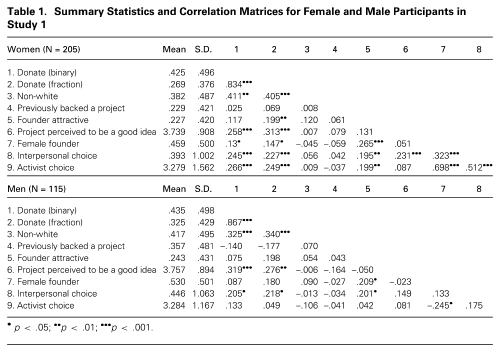
p < .05; ••p < .01; •••p < .001.
Statistical Methods
We employed the following model to test the hypotheses concerning activism using the experimental data:

Note that we estimate and present separate models for male and female participants. Hence
Results
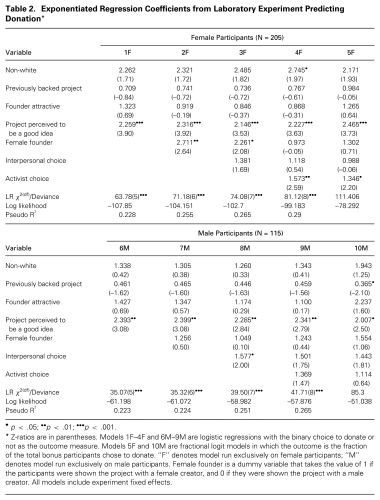
Table 2 presents exponentiated regression coefficients predicting whether participants chose to donate to the project at least some of their pay for participating in the experiment. As noted, we specified models separately for male and female respondents because of the complex interactions possible in non-linear models. The first five models are for female participants, and models 6–10 are for male participants. We denote female-only models with an “F” and male models with an “M.” Models 1F and 6M include only the controls to establish a baseline. Overall, there is only marginally significant evidence that race matters for female participants such that non-white respondents are more likely to donate (e b = 2.262, p < .10). There is no evidence that perceptions of attractiveness have any bearing on the decision for either men or women. For both, however, regarding the project idea favorably significantly increases the odds of donation (e b = 2.259, p < .001 for women; e b = 2.393, p < .001 for men).
Exponentiated Regression Coefficients from Laboratory Experiment Predicting Donation*
p < .05; ••p < .01; •••p < .001.
Z-ratios are in parentheses. Models 1F–4F and 6M–9M are logistic regressions with the binary choice to donate or not as the outcome measure. Models 5F and 10M are fractional logit models in which the outcome is the fraction of the total bonus participants chose to donate. “F” denotes model run exclusively on female participants; “M” denotes model run exclusively on male participants. Female founder is a dummy variable that takes the value of 1 if the participants were shown the project with a female creator, and 0 if they were shown the project with a male creator. All models include experiment fixed effects.
We enter the coefficient for a female founder in models 2F and 7M. Recall that we randomly presented to participants an image of a male or female founder, equilibrated on attractiveness and a host of other observable characteristics. The coefficient in the female equation is large substantively and significantly, implying an increase in the odds of donating of 171 percent (e b = 2.711, p < .01). The coefficient for male respondents is not statistically significant. Hence there is evidence of homophily for female participants but neither heterophily nor homophily for male participants.
To test H1, models 3F and 8M introduce the measures for interpersonal choice homophily. There is evidence that female participants are more likely to donate to projects initiated by founders that they view as like them (e b = 1.381, marginally significant). The same is true of male respondents (e b = 1.577, p < .05). This provides support for the first hypothesis.
Models 4F and 9M provide a test of the activist choice homophily mechanism proposed in H2. With the introduction of the scale in the equation for female participants, the female founder coefficient is significantly attenuated (e b = .973) and rendered insignificant. The activist choice homophily measure for women is correlated with gender (r = .698, p < .0001) and willingness to donate (r = .266, p < .0001) and substantially mediates the effect of interpersonal choice homophily (e b = 1.573, p < .01). There is no equivalent effect for men.
Models 5F and 10M include the same variables as models 4F and 9M. Rather than treat the outcome as a dichotomy (donate or not), however, we specified it as a fraction of the total amount participants could—but were not obligated to—donate, as a robustness check of the functional form of the relationship. We used a fractional logit model to estimate the equations (Papke and Wooldridge, 1996). As is evident, the results are consistent with those presented in the binary outcome models.
To further substantiate this finding, we estimated a binary mediation analysis (see generally Baron and Kenny, 1986; MacKinnon and Dwyer, 1993). We computed indirect effects using the product of coefficients approach. Bootstrapped standard errors (with 1,500 replications) reveal bias-corrected confidence intervals that do not include 0 for the total direct and indirect effect of activist choice homophily, but not for the direct effect, thus evidencing significant mediation (MacKinnon, Fairchild, and Fritz, 2007). 4 The bias-corrected confidence interval for interpersonal choice homophily does, however, encompass 0. Employing a Sobel–Goodman test yields similar conclusions. Results suggest that 79 percent of the direct effect is mediated in our model and that interpersonal choice homophily does not significantly mediate the direct effect. These estimates provide strong support for H2. 5
We conducted additional robustness checks to ensure that activist choice homophily operates as our theory predicts. Though interpersonal choice homophily does not significantly mediate donation, and activist choice homophily does, we sought to confirm that these results are robust to alternative operationalizations of our key construct. In particular, we examined whether results held after omitting the item measuring perceptions of gender representativeness (shared group identification). Our two-item scale excluding this measure positively and significantly (p < .05) predicted and mediated donation behavior, albeit to a somewhat lower degree than our three-item scale (results available upon request). Additionally, we examined whether those who perceive that women are unfairly disadvantaged in technology might support women. This measure did not explain away the relationship between activist choice homophily and donation.
These experiments provide evidence consistent with H1 and H2, but they cannot demonstrate that activist choice homophily exists outside a lab setting, nor do they test the importance of differing levels of potential disadvantage in explaining the impact of activist choice homophily. To test the prediction in H3, we conducted a second study using field data.
Study 2
Data and Methods
To determine the real-world applicability of our arguments, we used data on projects from Kickstarter, the largest reward-based crowdfunding site. We randomly selected 1,250 projects from five categories: gaming, technology, film, fashion, and children’s books. We chose these industry categories based on the gender distribution of backers and founders: the first two are predominantly male, the third is more evenly weighted, and the last two include higher proportions of women as founders and funders. Given these categories, the impact of interpersonal choice homophily may be magnified, and that of activist choice homophily reduced, by a second effect: industry typing.
Theory in sociology and psychology concerning occupational gender-typing and underlying schemas predicts that people often hold unconscious biases about the gender of the archetypical employee in a particular occupation or industry (White et al., 1989; Ridgeway, 1997, 2011; Williams, 2000: ch. 3; Gorman, 2005; Heilman, 2012). Statistically discriminating backers should thus favor founders with group-level characteristics that they believe predict a better ability to deliver the promised project (see generally Becker, 1959; see also Arrow, 1972, 1973; Fernandez and Greenberg, 2013). 6 Examples include a male entrepreneur in the male-dominated technology industry (e.g., Whittington and Smith-Doerr, 2008) or a female entrepreneur in the field of children’s books. This dynamic reinforces the effects of interpersonal choice homophily at the expense of activist choice homophily. Interpersonal choice homophily reinforces expectations that women should successfully raise funding in categories in which they are best represented because they also match industry stereotypes, and they should be less likely to successfully raise funding in areas in which they are least represented.
We imposed several restrictions on the sampling frame. First, we sampled only projects originating in the U.S., consistent with Kickstarter’s policies during the study window, which included projects from 2010 through the middle of 2013. Second, following Mollick (2014), we eliminated projects that sought less than $5,000 of funding. This restriction removes small projects that family and friends could fund while still incorporating a wide range of projects. Finally, each project in our sample included a pitch video on its proposed products or services, as videos are associated with higher-quality projects.
Dependent variable
We measured a project’s success as our outcome measure, using a dummy variable that denotes that the project was successfully funded by meeting or exceeding the founder’s fundraising goal. Kickstarter employs an “all or nothing” threshold for funding campaigns. Hence, by construction, our outcome measure quantifies whether a founder succeeded or failed to raise capital. Approximately 32 percent (S.D. = .466) of all projects succeeded in this respect.
Independent variables
We derived data on the gender of the founder(s) by visually analyzing and coding the apparent gender of each founder in each project. 7 Four research assistants (two male and two female) coded each project, and the kappa value of interrater reliability for gender exceeded .90 (with levels of agreement at 94 percent or higher; z-ratios > 30; and p < .0001). We specified intersection effects (Goodman, 2002; Greenberg, 2014) as predictors. These measures represent each of three cells in a two-by-two table with one or more female or male founders in the row or column. One measure thus denotes that a project has at least one female founder and no male founder. A second reflects a project that has at least one male founder and no female founder. The third represents a project with at least one male and at least one female founder. The omitted category reflects projects that do not have any identifiably gendered founders. This occurs when the project lists and graphically portrays a corporate entity, un-gendered avatar, mascot, or other non-human entity as the founder. We used this category as the baseline because it reflects a choice founders can strategically make when they determine how to present their identities online.
A second measure represents the proportion of a project’s backers who are female (female backers/total backers). We scraped these data on over 250,000 backers from Kickstarter and coded them algorithmically using the genderize.io tool by comparing first names with a database including 86,710 distinct names across 81 languages with known gender distributions. 8 Bivariate analyses suggest that the percentage of female funders is considerably greater in projects pitched by women (.59) versus those proposed by men only (.327) or men and women (.401)—contrasts are all statistically significant at p < .05 or greater. We specified interaction terms between the team gender composition variable for all female teams and the measure of female backers and those for industry categories to test H3.
Figures 1 and 2 present the unconditional distributions of various combinations of these measures. Female founders are more likely to found projects in fashion and publishing, followed by film. Female founders are comparatively less represented in technology and games. The same industry distribution is evident for female backers. Figure 3 suggests, however, that female backers’ industry preferences are contingent on the gender composition of the founder(s) of the project, thus revealing suggestive evidence of choice homophily. Figure 3 also reveals that female backers disproportionately fund other women in technology and, to some extent, video games—though the number of female founders in video games is too small to judge significance—especially given the low number of female backers in those categories.
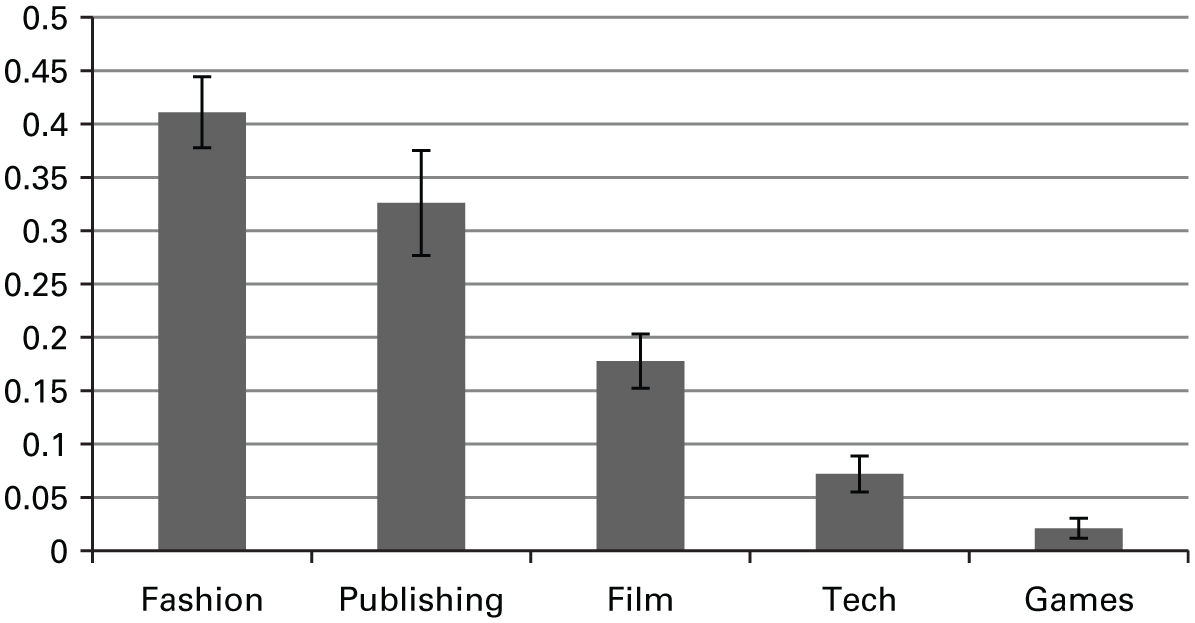
Proportion of female founders within industry categories.*
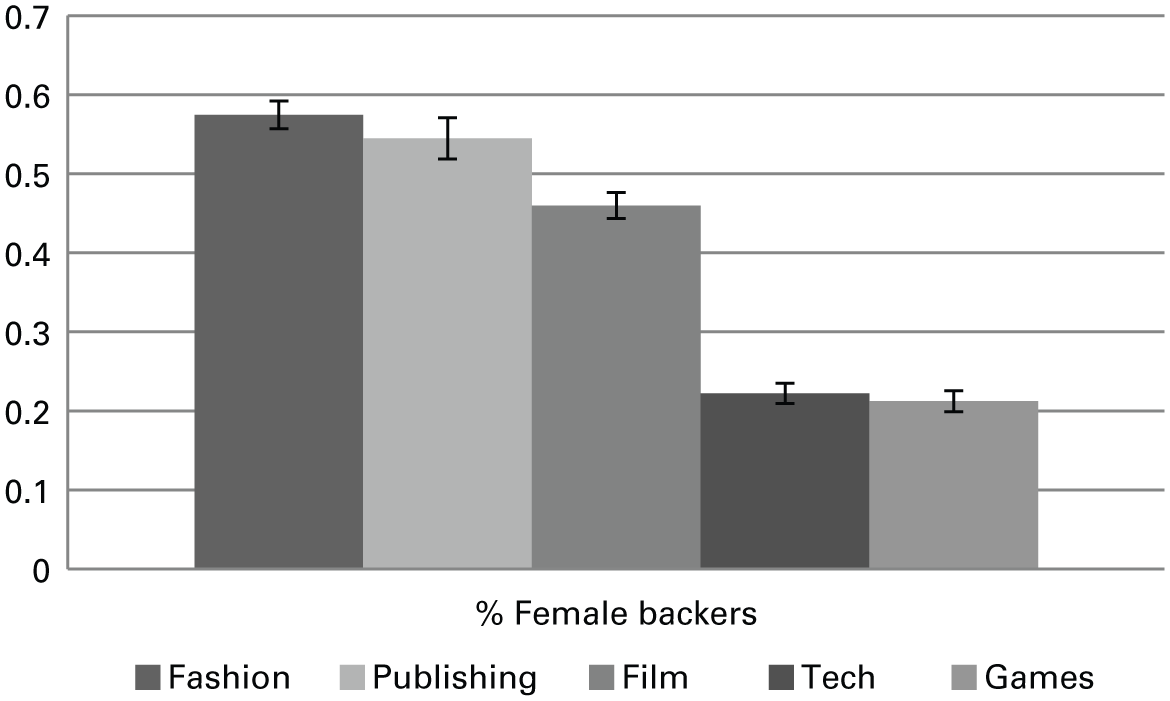
Proportion of female backers by industry category.*
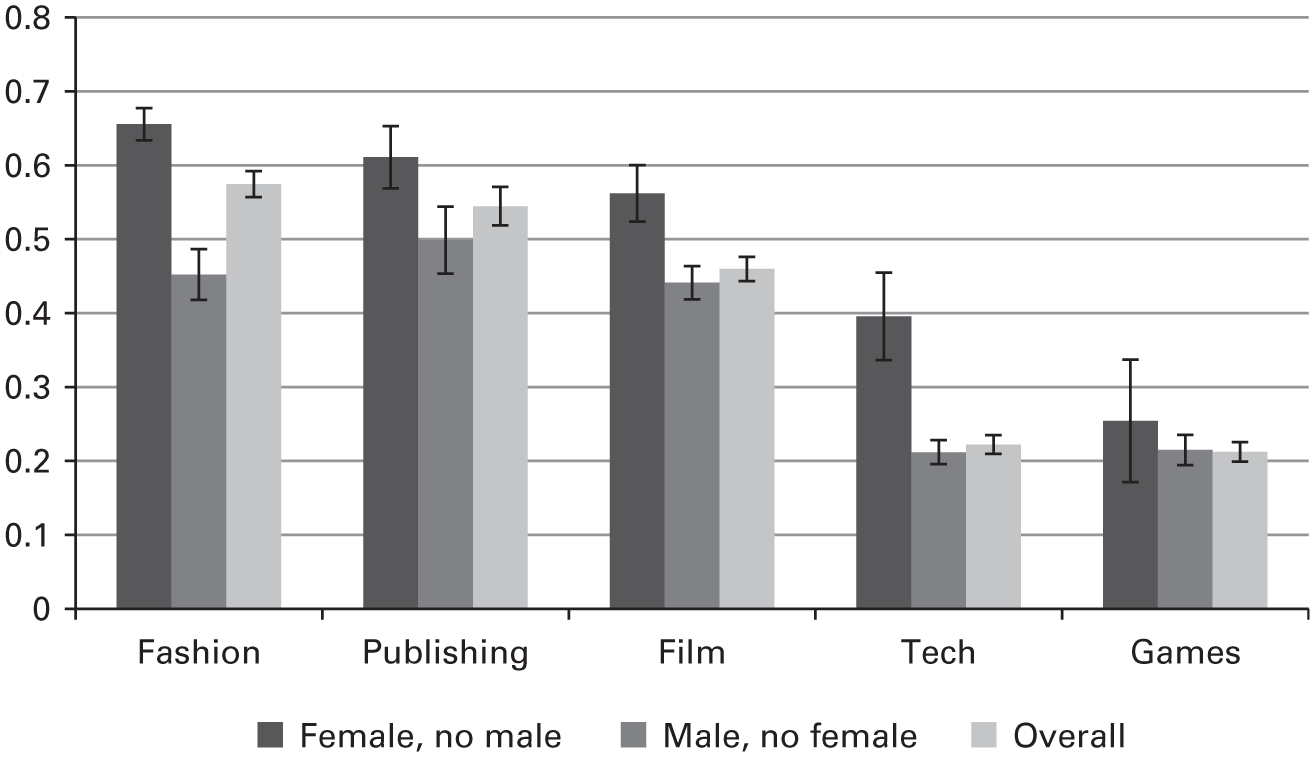
Proportion of projects funded by female backers by team gender composition and industry.*
Controls
We wanted to ensure that projects founded by at least one female and no male founder or vice versa do not differ in terms of the quality of their pitches or projects. We thus included a range of controls informed by prior literature to address this concern (Crosetto and Regner, 2014; Mollick, 2014). Measures include whether the project was featured on the Kickstarter site (mean = .04; S.D. = .195), the number of spelling errors in a pitch, and the degree to which founders provide timely updates to their backers, which is defined as within three days of starting a campaign. These factors predict successful campaigns because they suggest that the project creators put care into their pitches, though they do not control for the underlying quality of the idea. Of all these measures of quality, the only statistically significant difference across founders was that male founders provided project updates more often than female founders (.219 versus .157, p < .05) We also calculated the (Ln) funding goal ($26,211.49), as it constitutes both a hurdle for successfully funding a project and a signal to potential investors. Statistically significant bivariate differences are evident between projects pitched by male founders versus female founders ((Ln)goal = 4.159 versus 4.014, p < .001), or mixed gender teams (4.098, p < .05), though these differences disappear once we control for industry categories. We also included a measure of the founder’s network size as reflected in Facebook connections, based on the logic that founders with larger networks are in a comparatively better position to access financing on the site. We transformed this measure by taking the natural log. Bivariate analyses did not reveal statistically significant differences across founders in network size.
In robustness checks, we also included several measures to assess the competitive environments in which fundraising efforts occurred. We calculated measures of the local geography in the locations of the entrepreneurs, including the population size, number of artists, and average income in the closest metropolitan statistical area. 9 Because these measures do not significantly alter results or improve model fit, we do not present them in the main analyses (they are available upon request). We present summary statistics and pairwise correlations in table 3.
Summary Statistics and Pairwise Correlation Matrix for Kickstarter Data*
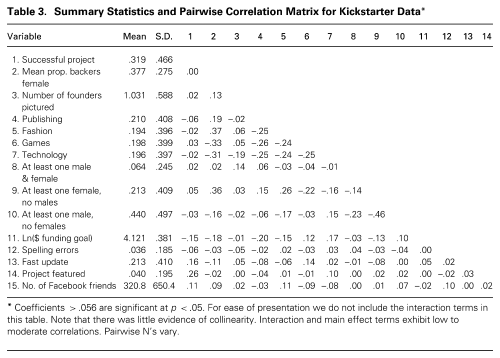
Coefficients >.056 are significant at p <.05. For ease of presentation we do not include the interaction terms in this table. Note that there was little evidence of collinearity. Interaction and main effect terms exhibit low to moderate correlations. Pairwise N’s vary.
Statistical Methods
We use a logistic regression model to determine whether a project is successfully funded. As noted above, the key predictors are intersection effects indicating that the project includes at least one female founder but no male founder; at least one male founder but no female founder; and at least one female founder and one male founder (see, e.g., Greenberg, 2014). Additionally, we include the fraction measure of female backers/total backers as a predictor and interact that measure with the coefficient representing a project with at least one female founder but no male founder.
Results
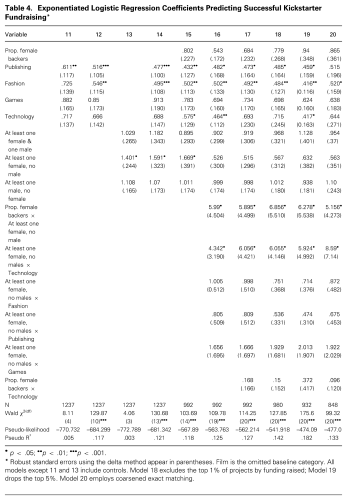
Table 4 presents exponentiated coefficients from a logistic regression model predicting the odds of a project achieving its fundraising goal. We begin by building intuition concerning baseline effects for industry categories in model 11 (an unconditional model) and model 12 (a conditional model). Results in model 12 reveal that relative to the baseline, film, projects in the other industries are less likely to achieve their funding goals. In the conditional model, the odds-ratio is .516 for children’s books, .546 for fashion, .666 for technology (marginally significant), and .85 (not significant) for games.
Exponentiated Logistic Regression Coefficients Predicting Successful Kickstarter Fundraising*
p < .05; ••p < .01; •••p < .001.
Robust standard errors using the delta method appear in parentheses. Film is the omitted baseline category. All models except 11 and 13 include controls. Model 18 excludes the top 1% of projects by funding raised; Model 19 drops the top 5%. Model 20 employs coarsened exact matching.
Model 13 is an unconditional model that includes only the founder gender variables. The omitted baseline represents a venture in which there is no evidence, such as a picture or name, to infer the gender of the founder(s). We selected this as a baseline because in our context founders can (strategically) choose to identify their genders or not. Moreover, it helps situate these observational data in the context of prior research that employs experimental methods to isolate observable gender effects via manipulation (Goldin and Rouse, 2000; Milkman, Akinola, and Chugh, 2012). Results suggest that projects founded only by a woman (or women) have 40 percent greater odds of a successful funding raise. The coefficients for all-male teams and those for mixed-gender teams are insignificant. Model 14 includes controls as well as the industry coefficients. With these measures included, the odds-ratio for projects founded by a female(s) is 1.59, an estimate that is significantly larger than that for projects founded by a male(s) (χ2(1) = 4.38, p < .05). Model 15 includes a measure of the proportion of backers who are female, and model 16 includes an interaction of the proportion female backers × all female projects, which can be interpreted as a measure of homophily. The predictive margin of a project with only a female(s) founder successfully raising funding in technology, which is the only category in which an estimate is positive and statistically significant, is .542 when the fraction of female funders is evaluated at its mean (the margin =.341 for all other projects); it is .62 when evaluated at one standard deviation above the mean (both p < .001). Model 17 includes a two-way interaction between the mean proportion of female backers in technology projects, which is negative and marginally significant (at p < .10). 10
Considered with bivariate estimates presented above and in Online Appendix B, these results imply that, first, female backers are comparatively more likely to support female founders than male founders and are comparatively less likely to fund projects in technology than other categories such as film, fashion, or publishing (see table B1 and figures 2 and 3). Even so, female founders in technology are considerably more likely to achieve their funding goals in Kickstarter. This is not the case in the other industry categories, which suggests that results are not merely the result of shared underlying preferences, consistent with H3. 11 These effects are economically meaningful because Kickstarter employs an all-or-nothing funding policy, and the average funding goal in our analytical sample is $26,211.49. This means that if a project does not meet its funding goal—even if the “miss” is by only a few dollars—it receives no capital to fund development.
We also conducted several robustness checks. Models 18 and 19 in table 4 exclude all cases in which the amount of funds raised was in the top 1 or 5 percent of all projects, respectively, to ensure that smash hits were not driving results. As is evident, results are consistent with prior models in both cases. Finally, model 20 employs coarsened exact matching (Iacus, King, and Porro, 2012) as a way of minimizing model dependence and statistical bias. The baseline multivariate distance value is L1 = .431. After coarsening matching, the L1 value is .334. The covariates discussed above are coarsened based on their distributions and prior research demonstrating the importance of specific values such as being featured (L1 = .01), spelling errors (L1 = .01), number of Facebook friends as a proxy for network size (L1 = .047), team size (L1 = .029), providing fast updates on progress (L1 = 4.9e16), and Ln(funding goals) (L1 = .06) (Mollick, 2014). After matching, the only variable that differs statistically significantly when compared by female founders is Ln(funding goal), which is a function of industry categories. We specified this model to address dependency and bias but do not include it to substantiate a causal interpretation based on observational data that may be subject to omitted variable bias. For comparability, the model includes the covariates included in model 17. Results of this model are consistent with those provided in prior models, and we obtain similar results if we estimate the model without matched covariates included. All models were also estimated using linear probability models, yielding similar conclusions. 12
General Discussion
Numerous studies across several disciplines have demonstrated the importance of homophily, but less attention has been devoted to the various mechanisms underlying choice homophily and its operation. Rather, theorists and empiricists presume that homophilic choice entails “like attracting like,” where “like” can be a host of characteristics, including race and ethnicity, age, education, and occupation, among others. By considering the mechanisms underlying choice homophily rather than viewing homophily as a single fundamental social force, we make several contributions. Theoretically, we proposed a distinction between two forms of choice homophily and clarified their conceptual distinctions, which may help explain discrepant findings in the literature concerning when, why, and which women are more likely to support other women, thereby providing a theoretical link between individual “agent” perceptions and action and structural patterns. Complementary research on “agents of change,” by contrast, focuses on “if” women support each other rather than explaining which women do so, under what conditions, and why (e.g., Cohen and Huffman, 2007).
To do so we articulated a novel form of choice homophily: activist choice homophily, which entails support for fellow members of disadvantaged groups. We argue that homophily at the individual level is not purely a dyadic phenomenon but also references group-level identities and perceptions of disadvantage. This suggests that activist choice homophily may stem from different sources than interpersonal choice homophily. Further, we argue that the prevalence of activist choice homophily, compared with interpersonal choice homophily, will depend on the social context and variation in individuals’ perceptions of, and concern for, disadvantage stemming from a group-level characteristic.
Our laboratory experiment revealed and substantiated the application of activist choice homophily, and we found evidence consistent with its existence in real-world data. By distinguishing these two forms of choice homophily theoretically and empirically while “purifying structure from choice” (McPherson, Smith-Lovin, and Cook, 2001: 420), we help clarify an underlying mechanism through which homophily in choice is linked to group-level structural considerations, providing a micro–macro linkage. In particular, we show that one prominent dimension of similarity—gender—is not necessarily rooted in dyadic preferences related to affinity.
Our research also contributes to the long-standing scholarly and policy discussion about gender disparities in entrepreneurship and attendant interest in persistent disadvantage with organizational origins (e.g., Baron and Bielby, 1980; Huffman, Cohen, and Pearlman, 2010). Because entrepreneurs are the source of new organizational forms, cultures, hiring practices, and blueprints that are difficult to change once enacted (Baron, Hannan, and Burton, 2001; Burton and Beckman, 2007; Beckman and Burton, 2008), minimizing gender disparities in startup rates may have implications for a host of other organizational and labor market outcomes (Bates, 2006; for similar logic in terms of managerial hiring practices, see Stoll, Raphael, and Holzer, 2004; Giuliano, Levine, and Leonard, 2009).
One potential proposal to alleviate gender disparities in general entails increasing female representation in positions of gatekeeping authority (e.g., Mühlenbruch and Jochimsen, 2013), in legislatures at the governmental level, boards of directors in corporations, or partners in VC firms. The logic of this approach is rooted in notions of homophily. A key assumption of this approach is that if more women rise to decision-making positions, they should in turn increase the proportion of women in other parts of the industry or organization as they remediate some of the historical discrimination against women. This is the essence of the “agents of change” argument.
There are, however, countervailing reasons to presume that this rationale is incomplete at best and, in some settings, incorrect. First, research on these approaches shows inconsistent findings between higher rates of female representation and individual-level outcomes for women in the same context. Audit and experimental studies similarly suggest that women in male-dominated fields (and other minorities in similar positions) may favor members of dominant categories at rates that rival members of those dominant groups (e.g., Nosek, Banaji, and Greenwald, 2002; Moss-Racusin et al., 2012; Milkman, Akinola, and Chugh, 2014). If this is the case, increasing representation in itself will not have its intended ameliorative effect.
Our study suggests that consideration of activist as well as interpersonal choice homophily is important in this context and tests the question of whether engagement by female funders ultimately leads to more successful fundraising by female founders. Although we find that women are considerably more likely to successfully raise capital than male founders, this effect does not appear due to representation in itself. In fact, we find the opposite: that women succeed where they are least represented as both funders and founders, such as in technology, an industry that is traditionally male-gender-typed. We argue that activist choice homophily plausibly explains this counterintuitive finding—that is, choice that is not necessarily based on a superficial preference for someone “who looks like me” or because of shared underlying taste or thought processes. Rather, its basis is the motivation to help someone who shares one’s gender to overcome structural barriers perceived by some to be associated with a shared categorical identity. Consequently, programs and policies predicated purely on representation-based interventions may be inefficient and possibly ineffective if they do not identify a sufficient number of these “activists.”
The importance of activist choice homophily also suggests a key mechanism by which the Internet can be used to reduce social structural constraints via the “democratization” of access to capital. It does so by affording access to a wider net of people motivated to help. These findings also add to an active and ongoing discussion about the role of gender in crowdfunding, such as the work of Marom, Robb, and Sade (2015), who found similar patterns in support for female-led Kickstarter projects using a different analytical approach and focused on male funders’ “taste” for discrimination toward women, for which we did not find evidence in our study.
Despite its strengths, this work nevertheless has some limitations that open avenues for future research. First, crowdfunding is not the same as investment, as crowdfunding backers use a variety of criteria to assess their donations rather than just return on capital invested. Nevertheless, crowdfunding is increasingly viewed as an alternative source of fundraising, and crowdfunding participants appear to look for similar signals of quality as those sought by investors (Mollick, 2014) and professional judges (Mollick and Nanda, 2016), suggesting value in the comparison. Although we informed and calibrated the laboratory experiment based on analyses of Kickstarter data, we conducted it using a sample from a different population consisting of university students. Hence, we cannot interpret the experimental results as the sole or even the main explanation of the patterns observed in the Kickstarter data, and we cannot distinguish comparative rates based on industry or employment experiences of funders. Rather, we view activist choice homophily as a plausible mechanism that can explain how such an empirical pattern may arise. Additionally, although we focus on activist choice homophily, it is certainly not the only factor of importance if the objective is to help women in the context of entrepreneurial finance. Other policies outside the scope of this paper, such as identity-blind assessments, may help in this respect. Similarly, activist choice homophily is merely one form of activism by individuals seeking to address social inequalities. It is likely that other approaches, from educating male venture capitalists about bias to creating support structures for female entrepreneurs, might help improve the opportunities for women seeking funding.
We also stress that our objective was not to provide a horse race between activist and interpersonal choice homophily. In the context we studied, direct interpersonal relationships are absent, and inferences about similarity at the dyadic level depend on limited, inferred information. We expect that as dyadic interaction increases, as does access to information or linkages to third parties that can provide information, individuals likely weigh more heavily individual-specific characteristics rather than group-level identity concerns, as more refined assessments of similarity can be calibrated (see, e.g., Fernandez and Greenberg, 2013).
Though we find no evidence that the effects we observe in the Kickstarter data are due to factors such as social network size or women accessing potential funders from greater distances, the fact that we have only a relatively crude control for underlying project quality and type unfortunately poses limitations. Although the controls we use to measure project quality are correlated with more sophisticated measures—see Younkin and Kashkooli (2013), who used research assistants to code project quality qualitatively in addition to the controls used in this paper—we cannot rule out the possibility that project quality differs by the gender of the project’s creator. Further, it is possible that even if overall quality is similar, women and men will have different preferences, with women creating more same-gender-focused projects. There are several reasons to suspect that systemic gender differences are not confounding the results, however. First, the field results show the relative homophilic advantage for women in the field of technology (with directionally consistent but statistically unreliable results for gaming), and not in other categories, which we would expect to see if the results are due to differences in the types of products women create and how they pitch them. Second, we were able to find similar results in the lab, where product/pitch quality remains constant. Though we do not believe it confounds our results, the existence of shared preferences for similar outcomes is worthy of further study.
Finally, our laboratory experiment employed statistical mediation. Future research that engages the topic of activism across various contexts, especially those where underrepresentation and discrimination are ambiguous, may fruitfully consider leveraging models of statistical mediation with moderation to more fully test a causal model of action (see generally MacKinnon, 2008). In such a case, an information condition consistent with activist choice homophily may plausibly activate its presence; however, this scenario was not reasonable in our university setting, where information about female underrepresentation is pervasive.
A potentially fruitful avenue for future research is to develop a better understanding of the circumstances and extent to which activist choice homophily is developed and invoked. Though we focused on gender, there are many bases of similarity that can be considered (e.g., race). Additionally, because we found that activist choice homophily partially mediates the effect of gender on donation, it is important to understand what social factors give rise to it. We are inclined to believe this orientation is itself rooted in life-course development, the family, culture, and social structure writ large. Thus future research might fruitfully investigate its origins and dynamics, as well as potential cross-cultural institutional differences (Thébaud, 2015). Finally, activist choice homophily, as proposed here, focuses on social identity linked to group-level disadvantage, but one can imagine other variants of group- rather than individual-level homophily that are rooted in social identities with positive valence. Some examples include common university affiliation or geographic region, which could serve as subjects of future research. Future work could also examine the ways in which activist choice homophily is affected by resource scarcity. In the crowdfunding context, backers are presumably using discretionary spending to support project creators. In other situations, however, members of a disadvantaged group may have to compete among themselves for resources, which would potentially alter the ways in which activist choice homophily operates.
Although women have historically been disadvantaged in raising capital for new ventures, our research shows that crowdfunding may present an exception to the rule. We demonstrate that activist choice homophily is a plausible reason that women successfully raise funding in crowdfunding campaigns. This explanation suggests that an activist subpopulation of women, interested in supporting fellow women in the face of perceived disadvantage, plays a critical role in the success of female founders, primarily due to the assistance of women helping female founders in technology, a male-dominated industry category. A commonly advocated prescription to address the issue of the underrepresentation of women in technology as founders, employees, or investors is to increase the representation of women in entrepreneurship and venture capital, but our findings suggest that activism, not just representation, is required to change the constraints facing women raising capital for new ventures. In general, our work suggests that attempts to alleviate historical inequality through representation of women and other minorities alone can be complemented by efforts to increase identification, mutual support, and activism among members of the underrepresented group.
Footnotes
Acknowledgements
For useful advice we thank Sigal Barsade, Matthew Bidwell, Adam Cobb, Martine Haas, Gavin Kilduff, Lisa Leslie, Nathan Pettit, Nancy Rothbard, Cat Turco, Tyler Wry, Ezra Zuckerman, and seminar participants at LBS, Maryland, MIT, NYU, Stanford GSB, and Wharton. Funding was generously provided by the Kauffman Foundation’s Emerging Scholars Program to each author. All the standard disclaimers apply.
1
The models had no controls, but individuals who failed the attention check question were dropped, for a total N = 184. For the social intervention scale, the model fit statistics were F(2,181) = 24.6, p < .001. For the importance of helping women scale, the model fit statistics were F(2,181) = 41.1, p < .001.
2
We asked about attractiveness and performed attention checks at the end of the survey. Following McCroskey, Richmond, and Daly (1975), we did not randomize the question order. Though we have no evidence that ordering matters in this context, this is a potential limitation.
3
For ethical reasons concerning inclusiveness and equal opportunity, we did not restrict the sample to white respondents. Conversely, we did not include race-based homophily because of the difficulty of distinguishing members of racial groups.
4
If we run a mediation analysis to assess a reverse process in which activism is the dependent variable and donation the mediator, the model explains only .04 of the total effect mediated, and bootstrapped standard errors encompass zero.
5
As a further robustness check to demonstrate that the processes hypothesized above apply only to an industry category in which women are underrepresented, we repeated this process using a separate experiment in the fashion category using a popular project entailing custom jeans for men or women. Results (available upon request) reveal that activist choice homophily does not appear to operate in fashion. This is sensible because there is no perception that women are underrepresented in this category. In our experiment, for example, 39 percent of respondents indicated they agree or strongly agree that women are underrepresented in technology (S.D. = .489). Slightly more than 41 percent of women agree or strongly agree with this statement, as did 31.17 percent of men. By contrast, only 7.7 percent of respondents (S.D. = .267) agree or strongly agree that women are underrepresented in fashion—10.34 percent of women and 2.63 percent of men. Paired t-tests reveal that these figures are statistically different overall (t-ratio = 8.524) for women (t-ratio = 6.878) and men (t-ratio = 5.031).
6
There are different theories of statistical discrimination. Some assume that productivity differences are at the first moment whereas others assume they are at the second moment (Aigner and Cain, 1977). For our purposes, this distinction does not have a bearing on theory development or empirical tests. Investors may have biases concerning what characteristics, including gender, may have a bearing on (or proxy for consequential unobservables predicting) being a good entrepreneur. Assuming this bias is in favor of male entrepreneurs, homophily in the case of male investors and heterophily in the case of female investors picks this up (e.g., Marlow, 2002).
7
Results were robust to other measurements of founder’s gender, including the names of founders in the project and the appearance of founders in videos promoting the project.
8
A parameter was generated concerning the probability that a specific name-gender attribution (male or female) was correct. In 90.57 percent of cases, the probability that assignment was correct exceeded 90 percent, suggesting a high degree of accuracy. In sensitivity analyses, we reran models including the measure for proportion of female backers excluding cases below the 90-percent threshold. Results remained consistent with those presented here. As a separate test of accuracy, we randomly selected 50 names from the Social Security Administration database used over 50 times for 2012 (90 percent of children have names that meet that criterion). Collectively, 26,826 children bore the 50 names that year. We ran these names through genderize.io and found that it correctly classified names that would have identified 25,412 children in the sample, or 94.7 percent. Moreover, genderize.io did not misclassify any of the names. The names it could not code were relatively rare (e.g., Vihaan, Assiyah, and Cattleya).
9
In analyses presented in table B1 in the Online Appendix, we determined whether projects founded by women attract female backers from further distances, thus overcoming constraints imposed by space (see generally Fernandez and Su, 2004). The model provides weak evidence contrary to this possibility.
10
Unfortunately, due to small cell sizes, we cannot reliably estimate a three-way interaction between proportion female backers × tech × female-only projects, and we do not find evidence of a statistically significant relationship for women in games (although the point estimate expressed as an odds-ratio is greater than one). If we run models combining the two female (fashion and publishing) and male (technology and games) typed categories, we derive qualitatively similar findings. The odds-ratio for female founders in technology combined with games is 3.974 (p < .05).
11
The interaction for tech × at least one female, no male founder differs from the analogous measures for fashion (χ2(1) = 3.99, p < .05) and publishing (χ2(1) = 4.31, p < .05). Further, in a model not presented here but available upon request, we included a measure of the Ln(median distance) between project and backers. Including this coefficient amplified the effects of homophily and the success of female founders in technology.
12
A counter-argument might be that members of Kickstarter who perceive female underrepresentation and wish to support women in technology might believe that a female founder is more competent. They may make this assumption based on a belief that, because of persistent barriers facing women, only the most talented and resilient women propose a project in this hostile environment. We found no evidence in a previous experiment supporting this idea. There were no significant differences by gender concerning beliefs that the project creators (1) knew what they were doing (rfemale under-rep = −.14, p = .34; rsupport women in tech = .16, p =.28) or that they could (2) deliver on their promises (rfemale under-rep = .023, p = .88; rsupport women in tech = .11, p = .47) in (3) a timely manner (rfemale under-rep = −.5, p = .75; rsupport women in tech = −.06, p = .68).