





Abstract
This article examines how local organizations respond to the global norm of corporate social responsibility (CSR), focusing on the case of workplace gender diversity in Japan. Though many global institutional investors have declared their commitment to CSR principles, whether and how their investments actually improve local practices has yet to be examined. We hypothesize that changes implemented by local firms in response to pressure from global institutional investors are shaped by political dynamics among competing professional groups in organizations. Through interviews with CSR managers and consultants in Japan, we find that CSR managers push for gender diversity only in the upper ranks of their organizations. This helps managers limit resistance from human resources managers, who want to maintain the traditional employment system, while still gaining support from investor relations managers, who support changes that are visible to investors. Our findings from panel data analysis further document this change above the glass ceiling. Analyzing more than 800 Japanese firms between 2001 and 2009, we show that both foreign investment and the within-firm influence of CSR and investor relations managers significantly increased the number of women on boards and in managerial positions but did not improve the lot of those in non-managerial or entry-level positions. Our study contributes to research on diffusion and organizational change by illuminating interprofessional politics in the local implementation of global norms.
Over the last two decades, corporate social responsibility (CSR) and related practices have become globally diffused. Studies show that social movement groups, nongovernmental organizations, and supra-governmental institutions have played a crucial role by creating codes of ethics in business and promoting socially responsible practices (Vogel, 2005; Bartley, 2007; Lim and Tsutsui, 2012; Locke, 2013). The outcome of these efforts is a truly impressive case of global norm-making (Halliday and Carruthers, 2007). Few studies, however, have examined whether and how the rise of CSR as a global norm has brought about meaningful changes at local (national and organizational) levels. This gap in the literature is unfortunate because global norm-making may lose momentum and eventually fade if it proceeds without stimulating substantial changes at local institutional and organizational levels. As Campbell (2005: 55) once lamented, diffusion studies often stop “at an organization or movement’s doorstep” without explaining how diffused models of action are “translated into practice” (see also Czarniawska-Joerges and Sevón, 1996). To further advance the research on global diffusion, we investigate local organizational responses to the global norm of CSR and their consequences.
Both global and local actors have roles in facilitating local acceptance of global norms. Many barriers exist that constrain the implementation of global norms in local organizations. According to institutional theory, decoupling—a gap between formal policy and implementation—is likely to occur when organizations respond to normative pressure (Meyer and Rowan, 1977). Oliver (1991) suggested that decoupling is most likely when there is no clear cost from noncompliance and the external demand imposed on organizations is not well aligned with their internal logics. Because the global norm of CSR promotes voluntary compliance and primarily targets global market actors, local organizations may see this new normative pressure as irrelevant to their operations and adopt socially responsible practices to improve their public image without actually intending to implement them (Delmas and Montes-Sancho, 2010; Marquis and Qian, 2014; Kim and Lyon, 2015; Marquis, Toffel, and Zhou, 2016). Two conditions seem necessary to deter decoupling: the presence of a stakeholder group that pushes for global norms and the better alignment of global norms with local demands. As stakeholders, foreign institutional investors and local CSR experts can play critical roles. A notable recent development in global CSR norm-making is the increase of socially responsible investing (Vogel, 2005). Because institutional investors have increasingly adopted the metrics of socially responsible investing to choose potential sites for investment, their presence can induce local organizations to embrace global CSR standards. External pressure alone, however, may not guarantee the acceptance of global norms—equally important is the mediating role of local actors. In particular, professional groups can help translate external norms into practice, using their knowledge as local experts (Halliday and Carruthers, 2007). Local organizations’ acceptance and implementation of global CSR standards likely depend on how local experts mobilize internal support and overcome potential resistance from other groups. The political dynamics among professional groups within the firm are therefore a crucial mechanism of local implementation.
We investigate how Japanese firms responded to the global CSR norm, specifically the pressure to increase workplace gender diversity. Japan is an appropriate site for this study because it is a context in which global standards for greater gender diversity diffused despite a strong local norm that conflicted with those new standards. In the early 2000s, major Japanese firms began to notice emerging global CSR standards and quickly adopted them so as not to fall behind their American and European competitors (Suzuki, Tanimoto, and Kokko, 2010; Kato and Kodama, 2017). But there remains a question about the extent to which they truly embraced the standards, especially regarding gender diversity, given the historically high level of gender disparity in the Japanese workplace (Brinton and Mun, 2016; Mun, 2016). Even today, very few women hold managerial or board positions in Japan (Nemoto, 2016). Using panel data from 800 Japanese firms as well as 24 interviews with CSR managers, we show that the large and persistent gap may not simply be an outcome of decoupling but may also be an outcome of interprofessional struggles within Japanese firms regarding how to reduce the workplace gender gap.
CSR and Gender Diversity in Japan
Workplace Gender Inequality
Despite rapid economic development in postwar Japan, gender disparity in the workplace has persisted. During the 1970s and 1980s, women earned only half of what men earned, and they typically participated in the labor market as part-time or contract workers (Houseman and Abraham, 1993; Ogasawara, 1998; Aiba and Wharton, 2001; Chang, 2004). This large gender gap has been attributed to Japan’s strong internal labor market system, which is based on lifetime employment (Brinton, 1993; Ono, 2010). In this system, employers invest in employee training, expecting that employees will stay with them until retirement; for the same reason, employees obtain firm-specific skills that are highly valued in one firm but are not easily transferrable (Dore, 1973; Lincoln and Kalleberg, 1985; Aoki, 1988). This skill-formation system based on mutual commitment has contributed to Japan’s organizational efficiency, but it disfavors women, who have a higher quitting rate than men (Brinton, 1993).
Efforts by the Japanese government have mostly failed to reduce the gap. The passage of the Equal Employment Opportunity (EEO) Law in 1985 and its revision in 1997 had only a meager impact on women’s employment opportunities (Upham, 1987; Asakura, 1999; Hanami, 2000; Hamada, 2005; Mun, 2016). Gender disparities in the Japanese workplace remain significant; less than 50 percent of women are full-time workers, compared with more than 80 percent of men, and women hold fewer than 10 percent of managerial positions and 1 percent of executive or board director positions (Statistics Handbook of Japan, 2015). 1 Japan has also ranked very low in various gender gap indices in the past few decades. In 2014, Japan ranked as the second-lowest performer among all OECD countries in The Economist’s glass ceiling index. Similarly, Japan ranked in the lowest third of all countries in the World Economic Forum’s global gender gap index. These statistics suggest that the gender disparity in Japan’s internal labor market system persists despite efforts to reduce it.
Foreign Investment as Pressure for Gender Diversity
Scholars of institutional change have argued that foreign actors who carry new norms can be agents of change; relatively free from the constraints of local institutions, they are in a better position to reveal inefficiencies in existing institutions and provide alternative solutions (Campbell, 2004; Ahmadjian and Robbins, 2005; Desender et al., 2016). Foreign actors may take on this role in reforming discriminatory employment practices in countries that exhibit a high level of workplace gender inequality. Previous studies have shown that foreign multinational firms tend to have employment practices that differ from those of local firms. For instance, they are less gender-exclusionary in hiring and promotion (Villarreal and Yu, 2007; Marantz, Kalev, and Lewin-Epstein, 2014), and they actively seek highly skilled female workers, who otherwise would face discrimination in local labor markets (Ono, 2007; Siegel, Pyun, and Chun, 2010). Multinationals, however, can act as change agents only for firms under their direct control. In this respect, foreign institutional investors can have broader influence. In fact, the rapid integration of global financial markets since the 1990s has led publicly traded companies in local markets to increasingly be subject to their influence (Gillan and Starks, 2003; Aguilera and Cuervo-Cazurra, 2004; Aggarwal et al., 2011).
In recent years, global institutional investors have exerted normative pressure on companies to adopt CSR practices (Aguilera et al., 2007; Campbell, 2007; Brammer, Jackson, and Matten, 2012). The United Nations and the International Labor Organization have promoted social criteria, including gender diversity and workers’ rights, as global standards supporting CSR and have pushed institutional investors to evaluate investee firms based on those criteria (Vogel, 2005). Several European countries have adopted ethical disclosure requirements for institutional investors, pressuring them to improve their records of socially responsible investment (Vasudeva, 2013). 2 A large industry has emerged that provides third-party ratings to global institutional investors. Market observers have expected that global institutional investors will increase their investment in socially responsible firms and closely monitor corporate social performance, including gender diversity. A recent report by the Economist Intelligence Unit (2014), for example, asserted that gender diversity will become a key factor in judging a company’s commitment to social responsibility.
The growth of foreign institutional ownership has put new pressure on Japanese firms to embrace global CSR standards. Unlike domestic investors, especially Japanese banks that were accustomed to having long-term relationships with particular firms (Gerlach, 1992), foreign institutional investors, such as U.S. or European pension funds, have pressured Japanese firms to adopt the global standards of corporate governance (Ahmadjian and Robbins, 2005; Jacoby, 2007; Olcott, 2009). Foreign investors have been most explicitly concerned about the traditional corporate governance practices of Japanese firms, but with the growth of socially responsible investment, they are now seen as conscious of investees’ legitimacy as socially responsible corporate citizens—particularly regarding gender diversity, given that Japanese firms fall far behind their global competitors on the issue (Suzuki, Tanimoto, and Kokko, 2010; Tanaka, 2015).
With considerable cash reserves, Japanese firms may feel little economic pressure to succumb to foreign investors’ demands. There is a risk, however, of being blacklisted as bad corporate citizens if they ignore the demands of foreign investors who care about CSR. The case of Nomura Securities, a major securities company, illustrates how such pressure is exercised. In 2002, the Tokyo District court acknowledged that Nomura discriminated against female employees in promotion and wages. Soon after, Global Ethical Standard Investment Services, a Sweden-based ratings agency, placed Nomura on its non-investment grade list, a fact subsequently reported in a UK-based newspaper (Townsend, 2003). In an attempt to be delisted, Nomura published “Nomura Securities Group Ethical Rules” and conducted an internal review of its personnel policy (Ishida, 2010).
Although foreign investors may not directly contact firms to demand gender diversity, market intermediaries do, such as consultants and research firms that provide ratings services to foreign institutional investors. Studies suggest that third-party ratings systems can be an important channel by which normative pressure is delivered (Sauder and Espeland, 2009; Sharkey and Bromley, 2015). CSR ratings agencies in Japan publish reports in which they connect gender diversity to socially responsible investment. For instance, MSCI, a major investment research firm that rates the CSR performance of Japanese companies for foreign investors, released a report highlighting the underrepresentation of women in managerial and executive positions as a key CSR risk factor facing Japanese firms (Takaba and Moscardi, 2014). Through these various channels, Japanese firms with high foreign institutional ownership are likely pressured to enhance gender diversity.
Interprofessional Politics and Organizational Response to Global Normative Pressure
Foreign actors introduce global norms in local contexts, but how the norms are implemented in organizations may depend on the role of local professional groups. The political dynamics among professional groups within local organizations are likely to shape the manner in which the organizations embrace global normative demands. Institutional theory posits that organizations are subject to various pressures from their external environments but are often left to devise their own measures of compliance (Meyer and Rowan, 1977; Edelman, 1992). Professionals are often responsible for this organizational construction of compliance. They devise solutions to respond to external pressures based on their expert knowledge (Stryker, 1994; Dobbin and Sutton, 1998; Dobbin and Kelly, 2007) and spread these solutions across organizations through their professional networks (DiMaggio and Powell, 1983; Strang and Meyer, 1993).
Relatively less emphasized is professional groups’ role in building internal support for proposed solutions. The external legitimacy of solutions does not automatically translate into internal legitimacy. Just as the external environment is full of diverse constituents, the internal environment of organizations is composed of individuals, groups, and departments with different interests and logics of action (Pache and Santos, 2010; Crilly, Zollo, and Hansen, 2012; Besharov and Smith, 2014). Multiple meaning systems often coexist, exerting disparate influences on organizational decision making (Hallett and Ventresca, 2006; Greenwood et al., 2011). The resulting internal competition and tension can prevent even an externally legitimized solution from receiving support from internal members. In that case, the adopted solution is likely to be decoupled from daily routines (Oliver, 1991). This does not mean that decoupling is inevitable, but it suggests that implementation significantly depends on the outcome of intergroup struggles within organizations (Kellogg, 2009; Tilcsik, 2010).
Professional groups with competing expertise are major participants in intraorganizational politics. In times of new external demands and rising uncertainty, they seek to expand their influence in organizations by providing solutions (Edelman, 1992; Dobbin and Sutton, 1998). Different professional groups, socialized in different cognitive and normative orders, may promote conflicting solutions and compete for approval from decision makers (Stryker, 1994; Dobbin and Kelly, 2007). To have their solutions selected, they mobilize expert knowledge, often with support from their professional associations (Lounsbury, 2002). Emerging professional groups are particularly active because a changed external environment can alter the internal opportunity structure and reduce the authority of traditionally influential groups (Thornton and Ocasio, 1999). Traditionally influential groups may also participate in the political struggle to repel challenges from emerging groups and to maintain the status quo (Glynn, 2000; Mun, 2016).
We highlight two strategies through which emerging professional groups achieve internal support. First, they may try to build alliances with other groups that share similar, mutually beneficial goals. Although traditional professions maintain a unique system of abstract knowledge with clear boundaries (Abbott, 1988), cross-boundary collaboration is inevitable in today’s organizational setting, where professional groups with overlapping jurisdictional boundaries coexist (Bechky, 2003; Battilana and Dorado, 2010; McPherson and Sauder, 2013). Second, emerging professional groups may also engage in bargaining with potential opponents to try to implement changes without being seen as posing too serious a threat to preexisting jurisdictional claims. Such bargaining seems indispensable because the drastic implementation of change can generate tension and even incur a backlash from defenders of the status quo (Hallett, 2010; Pache and Santos, 2010; Kellogg, 2012). This implies that successful implementation of change requires a certain level of compromise among an organization’s professionals.
How CSR Managers Promote Gender Diversity in Japanese Firms
To understand within-firm political dynamics among professional groups and the role of such dynamics in shaping Japanese firms’ embrace of gender diversity as a CSR goal, we conducted interviews at major Japanese companies. Between 2013 and 2015, we interviewed 24 CSR managers from 11 firms and three CSR consultants. Three firms allowed multiple visits, so a few managers were interviewed more than once. We also interviewed several human resources (HR) and investor relations (IR) managers, as well as foreign investors, which helped us obtain different perspectives. All of the companies we visited are based in Tokyo and are well known in their respective industries. They represent diverse industries, including finance, manufacturing, professional services, and retail services (see table A1 in the Online Appendix, http://journals.sagepub.com/doi/suppl/10.1177/0001839217712920). We contacted them through a leading HR research institute in Tokyo and visited those that agreed to be interviewed. We also recruited interviewees through referrals. Although our sample is small and is not representative of any particular kind of company, it includes influential companies that lead change in the Japanese corporate world. The sample gives us a vantage point from which to understand the localization of global norms.
All interviews with corporate managers were conducted in Japanese by one of the authors, and three interviews with CSR consultants were conducted in English as requested by the interviewees, all of whom were Japanese. The interviews followed a semi-structured format so that we could cover the themes we were interested in but also allow interviewees to add information from their own perspectives. Each interview lasted about an hour and was recorded and transcribed. We used interview transcripts to develop codes in relation to CSR managers’ conceptualization of their tasks and their interaction with other managers.
CSR managers’ promotion of gender diversity as a CSR goal
Despite its growing external legitimacy, the notion of corporate social responsibility is still met with skepticism in Japanese firms; its internal legitimacy has yet to be established. All CSR managers we interviewed described their most important role as communicating with internal members about external demands. A CSR department head at an IT services company said, “Communication is extremely important. [CSR] is well understood outside the company, but we want it to be internally accepted. So we attempt to translate the concepts of CSR, IR [investor relations], sustainability, using a language that our executives can easily understand. . . . I would say most important for us currently is to achieve internal penetration (shanai shintō).” To increase internal awareness, these managers organize lectures and seminars for executives, managers, and sometimes employees. Nevertheless, they are constantly challenged about whether CSR is an internally valid concept for their organizations. A CSR manager at the same IT services company said, “Even if we talk about the importance [of diversity issues], our voice is not considered seriously. So we often ask outside experts to talk to the HR department.”
In an attempt to overcome internal skepticism, Japanese CSR experts we interviewed proposed workplace gender diversity as a goal requiring focused action. The fact that internal legitimacy is weak can be partly attributed to ambiguity around the best ways for a company to be socially responsible. Environmental, social, and corporate governance issues are all major criteria used to evaluate how responsible a firm is, and each of these is broken down into subcriteria that are used to measure them. It would be hard, if not impossible, to pursue all of these subgoals. Of the CSR managers we interviewed, most emphasized social issues. In their opinion, Japanese companies perform poorly in major global rankings, such as the Dow Jones Sustainability Index, because of their poor record on social issues. Leading companies in Europe and the U.S. have consistently ranked higher than Japanese companies on labor issues, and workplace diversity is an important component of this. Although some had doubts, the CSR managers we spoke with believed that foreign investors monitor corporate social performance and that enhancing gender diversity is a task that is crucial to the organization and falls within their area of responsibility.
Competition and bargaining with HR managers
CSR managers’ active promotion of gender diversity generates tension with other groups. Human resource managers, a traditionally powerful group in Japanese firms (Jacoby, 2005), may find CSR managers’ promotion of gender diversity as potentially encroaching on their main area of responsibility, HR management. Japanese HR managers have long managed the workforce based on the internal labor market (ILM) logic of workforce management, which values long-term employees who accumulate firm-specific skills and commit to a single organization until retirement (Aoki, 1988). Although the logic does not specify who should be welcomed as long-term employees, women were typically excluded in Japan because they frequently quit at marriage or childbirth (Brinton, 1993; Estévez-Abe, 2005; Yu, 2009).
Many CSR managers we interviewed said that they had found it difficult to either interact with or persuade those HR managers who held on to the ILM-based model of workforce management. While CSR managers favor numeric goals or quotas to achieve gender diversity in a given timeframe, HR managers are generally opposed to such top-down approaches because they think that women should be promoted after accumulating relevant skills. HR managers at an IT company where we interviewed insisted that numeric goals are “not natural” and would not help increase productivity. Instead, HR managers prefer mentoring programs and work–family policies that would help women develop their own human capital. Most CSR managers we interviewed, however, complained that nothing would change or things would change “very slowly” if they followed HR’s approach.
Given these competing approaches, promoting CSR’s preferred method of achieving gender diversity requires considerable bargaining with HR managers. CSR managers at a finance company said that it took years of persuasion and sometimes threats of poor reviews from ratings agencies until their HR department “understood that there will be little improvement without setting numeric goals.” Nevertheless, CSR managers cannot simply ignore HR given that HR is a more-established function in Japanese firms and HR’s objection can undermine their agenda. Hence they compromise to garner support from HR. CSR managers we interviewed at a pharmaceutical company strongly supported numeric goals but felt limited in pursuing the goals without HR’s support:
Cooperation and alliance with IR managers
In addition to competing and bargaining with HR, CSR managers try to form alliances with other groups to broaden internal support for diversity management. Many CSR managers have developed a close, cooperative relationship with investor relations (IR) managers who share the goal of managing investors’ demands. As with CSR managers, IR managers are a newly emerging group whose role became prominent in the 1990s with the rise of foreign ownership (Yoshikawa and Gedajlovic, 2002; Jacoby, 2007). Although gender diversity is not their main concern, they share an interest in it because of increased requests from investment research agencies, both domestic and abroad, for information about their firms’ social and environmental performance. In addition, as annual financial reports have expanded to include both financial and non-financial information, which then becomes integrated into annual reports, IR managers work closely with CSR managers.
Collaborating with IR benefits CSR managers because it demonstrates their functional contribution to internal members. In addition to tension with HR, CSR managers suffer from the suspicion that social activities drain company resources. A CSR manager at a large pharmaceutical company said, “People [in the company] often complain about why the company has to work so hard on human rights issues.” In this regard, collaboration with IR helps CSR managers make a stronger business case about their tasks, because IR functions are seen as closely related to core business activities. For instance, the alliance with IR helps CSR managers promote the idea that enhancing gender diversity sends a positive signal to foreign investors that Japanese firms are trying to reform their traditional management practices. IR experts have suggested that diversity management is required of globally reputable firms (Nikkei Weekly, 2009). Taking note of the growth of socially responsible investment in Europe, the U.S., and later in Japan, they claim that if Japanese firms continue to exhibit extremely low gender diversity, they will appear to be falling behind the global trend and will lose foreign investors, particularly socially responsible ones (Nihon Research Institute, 2013). A survey of publicly traded Japanese companies conducted in 2005 showed that female representation in managerial positions is significantly higher in companies with a stronger IR function (Kawaguchi, 2009).
Change above the Glass Ceiling
The interprofessional dynamics among the three professional groups—CSR, HR, and IR managers—should shape how gender diversity increases in Japan. CSR managers are likely to promote gender diversity at the top in order to remain on friendly terms with HR managers, who want to retain their existing process of nurturing firm-specific skills—a process that begins when new employees are hired and continues as they move up the career ladder in the firm. Focusing on upper-rank positions enables CSR managers to promote gender diversity with the least disruption to the existing system. Thus most companies we visited recruited female board members from outside or set a minimal numeric goal for the proportion of female managers. Forging an alliance with IR managers may further enhance the push to enact highly visible change, such as by hiring female board members. Because their main goal is to impress foreign institutional investors, IR managers are less likely to engage in making fundamental changes internally than in making changes that are externally visible.
We thus hypothesize that gender diversity will increase in upper-rank positions above the glass ceiling as a result of pressure from foreign investors and the interprofessional struggle that follows. Previous studies have documented that women have a hard time breaking the glass ceiling because they face more obstacles, such as discretionary evaluation, as they advance in the organization (Kanter, 1977; Tomaskovic-Devey, 1993; Dencker, 2008; Gorman and Kmec, 2009). Such obstacles to women’s mobility from the bottom up, however, may be bypassed when pressure is exerted by external constituents. In that circumstance, companies may focus on increasing gender diversity from the top down in highly visible upper-rank positions that will immediately attract attention (Collins, 1997; Berrey, 2014).
Change is most visible when boards increase their gender diversity. As few Japanese firms have any female directors, adding just a single female director can be a strong signal to both internal and external constituents (Takeishi, 2007). A manufacturing company we visited exemplifies the intensive focus on board gender diversity. CSR managers in the company boasted that they successfully hired new female directors, now having two women out of 14 board members (or increasing women’s proportion to 14 percent); but at the same time, women represented a mere 3.5 percent of managerial positions and 16 percent of full-time, non-managerial jobs in the firm. We thus expect foreign institutional ownership and the influence of CSR and IR managers to increase gender diversity on boards. In addition, when pressure from foreign ownership and the professional push are combined, we expect that gender diversity on boards will increase even more:
For scholars who study the glass ceiling phenomenon, particularly in workplaces in which women have long been incorporated into lower-level managerial positions, the glass ceiling often refers to senior managerial positions or beyond. In Japanese firms, women still hold fewer than 10 percent of managerial positions, and the proportion decreases with firm size (Kawaguchi, 2013). Among the companies we visited, in no case have women assumed more than 10 percent of managerial positions. If lower-ranked managerial positions are dropped and only the positions that have supervisees are considered, women’s representation further shrinks. Thus enhancing gender diversity in management in Japanese firms is a much more challenging goal than it might seem initially. Most CSR managers we interviewed mentioned that they wanted to improve, and some even admitted that their current level of gender diversity in management was embarrassingly low. We thus hypothesize the following:
Gender diversity in non-managerial or entry-level positions is less likely to become a focus for CSR managers because HR managers are unwilling and IR managers have little incentive to seek change. Therefore we do not expect that either foreign institutional ownership or the influence of CSR and IR managers will increase gender diversity at these lower ranks.
Methods
We used panel data from 829 prominent, publicly traded Japanese firms from 2001 to 2009, which include detailed information about firms’ characteristics, ranging across diverse areas such as employment, investors, board members, and financial conditions. We collected the types and proportions of investors, functional areas of board members (i.e., whether they are in charge of CSR or IR issues), and gender compositions at four different ranks. Using these data, we analyzed changes in gender composition as the within-firm influence of CSR and IR managers and foreign institutional ownership increase. We paid special attention to the causality of our findings. First, we adopted a fixed-effects approach, which accounts for all time-invariant firm-specific factors (Allison, 2005). Second, we conducted a robustness check to further mitigate the possibility that our main findings might suffer from reverse causality or omitted variable bias, using an instrumental variable approach (Bascle, 2008; Angrist and Pischke, 2009).
Sample
We compiled our data from three sources: annual financial reports from the Nikkei NEEDS database for ownership structure and other financial conditions, Japan Company Handbook of Board Members (Yakuin Shikihō) for characteristics of board members and their functional areas, and Japan Company Handbook for Job Searchers (Shūshoku Shikihō) for gender composition at different ranks. The Nikkei NEEDS database and the Handbook of Board Members provide annual data for all companies listed either on the Tokyo Stock Exchange or the JASDAQ. The Handbook for Job Searchers also provides information annually, but it includes both listed and unlisted companies. Because the Handbook for Job Searchers is intended to provide college students entering the job market with information about basic company characteristics and welfare benefits, the publisher, Tōyōkeizai Shinpōsha, selects approximately 1,000 of the largest companies based on the number of people hired in the previous year. 4 Because the list of the 1,000 largest firms does not change much annually, we could construct company-panel data. By matching these three data sources, our sample includes 65 percent of the companies in the Handbook for Job Searchers and almost 25 percent of listed companies in the Nikkei NEEDS database. In the end, the data include information on 4,049 company-years for 829 firms between 2001 and 2009. The actual number of company-years used in the analysis is smaller for some models because of missing values.
Two aspects of our data are particularly important. First, our data include a subset of large, publicly traded companies in Japan. The median number of employees among all listed companies is 509, while the median of our sample is 1,531. Our sample does not represent the entire population of Japanese firms, but it is appropriate for the current research because prominent, globalized companies are the most likely to attract foreign investors. Second, the data are unbalanced. Although each year’s edition of Handbook for Job Searchers primarily surveys the same companies, the sample changes slightly from year to year. Some companies are no longer surveyed because they shrink, and new companies are added in their place. Some companies also drop out of our sample due to bankruptcy, delisting, or mergers, while others are added after they go public. Across the nine-year period, we have five years of data for the average firm.
Outcome Variables
We analyzed how gender diversity changes for different job levels as foreign institutional ownership and the within-firm influence of CSR and IR managers increase. We considered four different levels and thus have four outcome variables. The first variable is women’s representation on boards of directors. Most Japanese companies still have no female directors on their boards. Although the number has steadily increased since 2001—the percentage of firms in our sample that had at least one female director increased from 5 to 10 percent by 2009—still only 1 percent of all directors in 2009 were women. Hence we analyzed the appointment of female directors rather than the proportion or the number of female directors. Using information on individual directors from the Handbook of Board Members, we created a binary variable coded as one for company-years in which a given company appointed one or more new female directors.
Our second outcome variable pertains to the representation of women in managerial positions and is measured as the log odds that managers are women. Odds are calculated as the proportion of female managers divided by the proportion of male managers. 5 We used odds rather than proportion because its distribution is closer to normal with log transformation (Fox, 1997). Log transformation is necessary because the raw ratio of female to male managers is highly skewed, with most firms having very few female managers and a handful of firms having a large number of female managers. The log transformation of odds ratio has been used in previous studies to capture workplace diversity (e.g., Kalev, Dobbin, and Kelly, 2006; Dobbin, Schrage, and Kalev, 2015). Across the firms in our sample, the percentage of female managers increased, but only slightly, from 5 percent in 2001 to 6 percent in 2009. 6
In addition, we added two lower-rank positions to test whether the hypothesized effects of foreign institutional ownership and the within-firm influence of CSR and IR managers are observed only for upper-rank positions. Hence our third outcome variable pertains to the representation of women in non-managerial, white-collar positions. It is also measured as log odds. Our last outcome variable pertains to the representation of women at the entry level, which is measured as the log odds that new hires for non-managerial, white-collar jobs are women. Note that for this last outcome variable, we have data for 2001–2008.
Explanatory Variables
Our first explanatory variable to test H1a and H2a is foreign institutional ownership, measured as the percentage of a company’s shares held by foreign institutional investors. Figure 1 plots average share ownership by foreign investors for the firms in our sample, which has increased from 10 to 18 percent during the observation period. Though foreign investors pressure Japanese firms to reform discriminatory employment practices, Japanese financial institutions that may remain sympathetic to the Japanese-style employment system may serve as a buffer against such pressure (Ahmadjian and Robbins, 2005). To account for this countering influence, we also included in our analysis the percentage of shares held by Japanese financial institutions such as commercial banks, trust banks, and insurance companies.
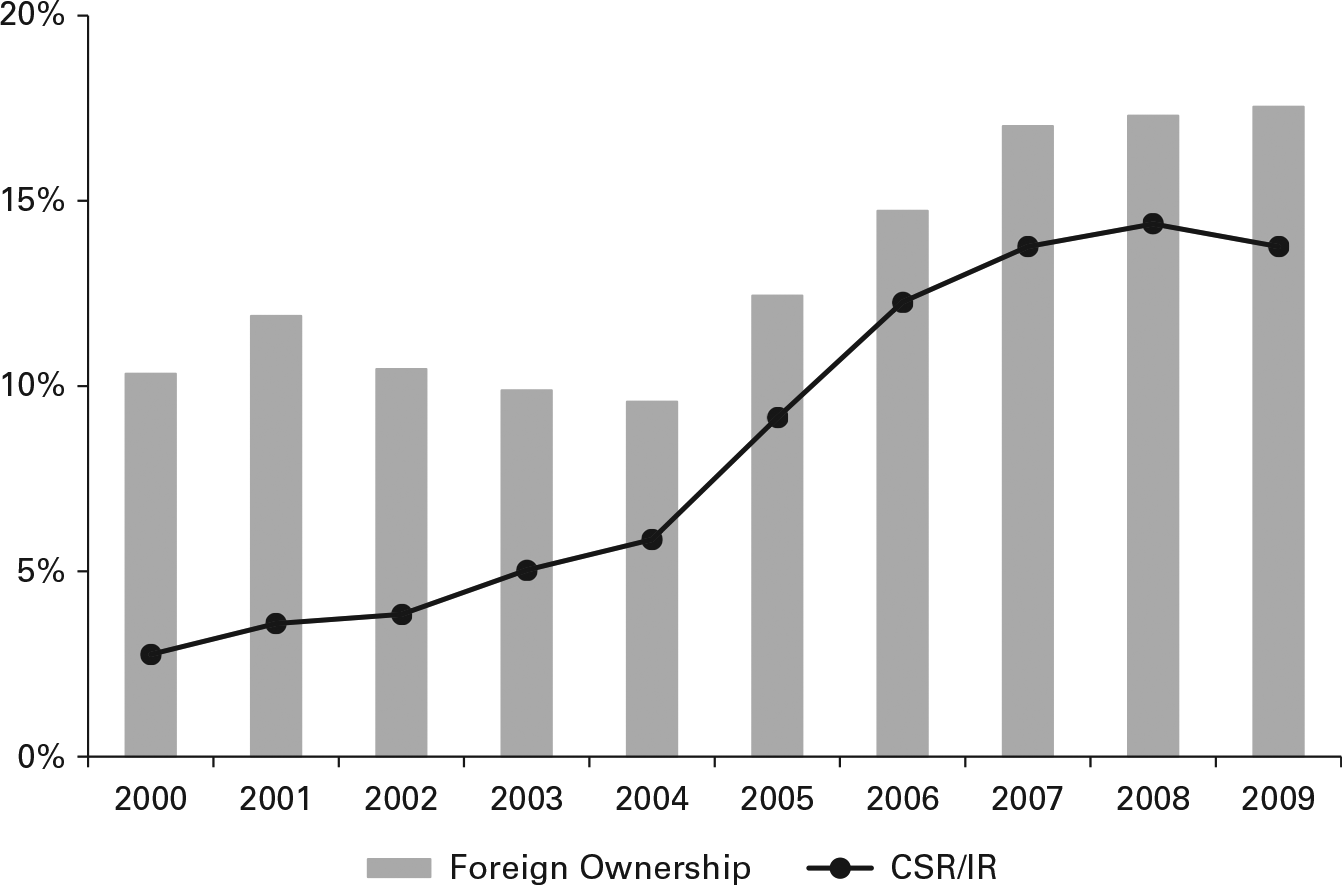
Foreign ownership and the percentage of firms with at least one CSR or IR director.
Our second explanatory variable to test H1b and H2b is the within-firm influence of CSR and IR managers, measured as the percentage of board members whose task areas described in the Handbook of Board Members include either CSR or IR. In most firms in our sample, there is only one CSR or IR board member, but their influence can be greater on small boards than on larger ones. Alternatively, one can use the presence of a CSR or IR department as a measure of the within-firm influence of CSR and IR managers. Our board-membership measure seems to be a better measure, given that in Japan the board of directors is the primary corporate decision-making body, composed almost exclusively of senior executives. 7 In this setting, CSR and IR managers can exert strategic influence through board membership (Jacoby, 2005). One concern is that if the majority of CSR or IR board members are women, they may promote gender diversity simply to help other women. This seems unlikely. During our observation period, there were only two female CSR or IR directors out of a total of 554 CSR or IR directors; excluding them barely changes our results. Figure 1 also plots the percentage of firms in our sample that have CSR or IR executives on the board. It shows an increase from 3 to 14 percent, suggesting that CSR and IR experts gained considerable ground in the 2000s. But HR managers who remain ambivalent about CSR or IR managers’ focus on numbers may limit their ability to accomplish their goals, so in our analysis we included the percentage of HR executives on the board to account for this influence. We did not make a prediction about HR’s effect on diversity, as most HR managers are not against gender diversity as a general principle but prefer an approach different from that of CSR. Hence it is unlikely that HR executives will have a positive influence, but it is also unlikely that their effect will be significantly negative. Finally, to test H1c and H2c, we included an interaction term between foreign institutional ownership and CSR/IR representation among board members.
Control Variables
We controlled for other factors that may affect the level of gender diversity. Women’s representation at a given level can be affected by gender composition at other levels. For each model, we controlled for women’s representation at higher levels to account for the women-help-women effect (Huffman, Cohen, and Pearlman, 2010; Kurtulus and Tomaskovic-Devey, 2012; but see also Srivastava and Sherman, 2015). For instance, when modeling women’s representation in managerial positions, we controlled for the presence of female directors on the board. Similarly, for each model, we controlled for women’s representation at lower levels to account for the pipeline effect (Baron, Mittman, and Newman, 1991). 8 Sex segregation can also be an important determinant. Japanese workplaces have long segregated women into jobs that don’t require significant training and don’t offer opportunities for promotion. After the enactment of the Equal Employment Opportunity Law in 1985, many Japanese companies adopted a two-track system, which channels men and women into managerial and clerical tracks, respectively (Mun, 2016). We created a binary variable for companies having the two-track system, using information from the Handbook for Job Searchers, which reports whether a company uses the two-track system when hiring new employees. These workforce composition and sex segregation variables can also capture the effect of having a progressive gender climate in a given firm, which is likely to increase workplace gender diversity. Company reputation or publicity may also have positive effects on gender diversity. Firm reputation is measured by an indicator variable of whether a firm was ranked in the annual listing of the 100 firms most attractive to college seniors, published by Recruit, a Japanese business publisher and staffing company. Recruit rankings are one of the most widely publicized sources of firm reputation in Japan (Ahmadjian and Robinson, 2001: 629).
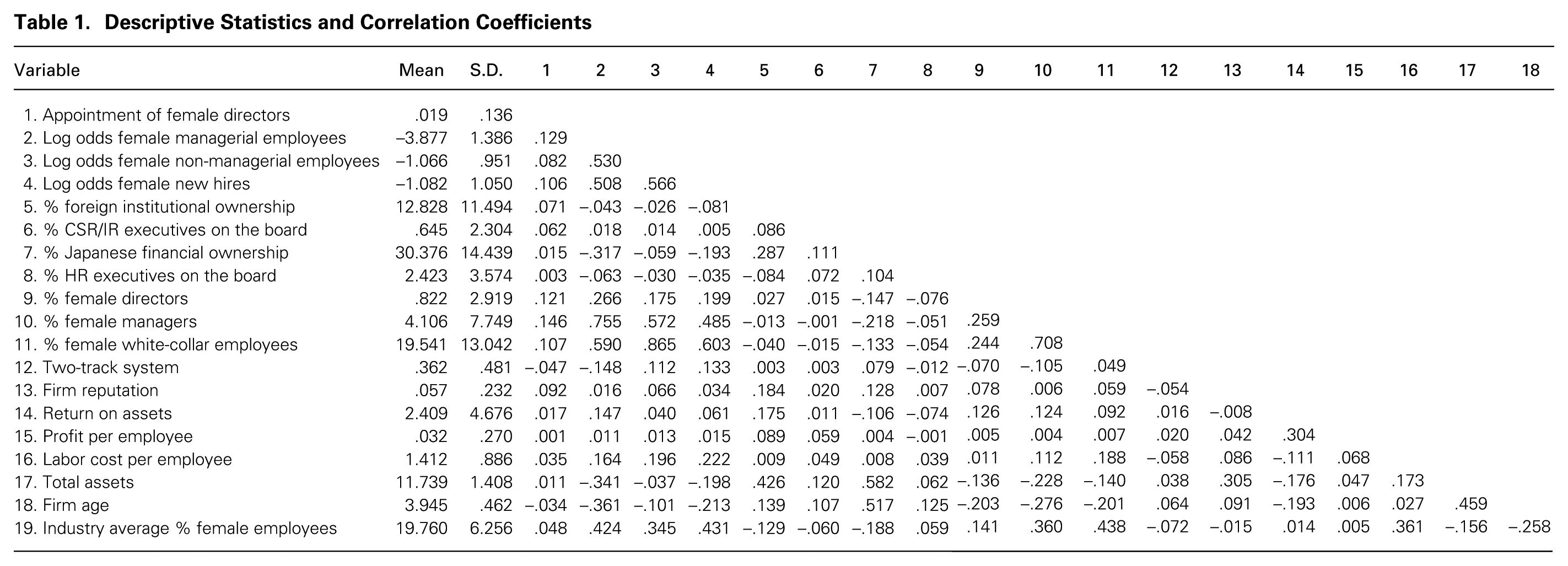
We also included several measures of financial conditions and other firm characteristics. First, because profitable firms are likely to attract foreign investment and will have sufficient resources to maintain CSR and IR functions, we controlled for firm performance, measured by return on assets and profit per employee. For similar reasons, we controlled for labor cost per employee. Because larger and older firms may stick to gender-biased, traditional employment practices, we controlled for firm size, measured by total assets, and firm age, calculated as the number of years since the firm’s founding. We used the log transformation of labor cost per employee, firm size, and firm age because their distributions are highly skewed. The average percentage of female white-collar employees in a given firm’s industry is included to control for feminization of the industry. 9 Finally, we included year dummy variables to account for any unmeasured secular trends. Table 1 reports descriptive statistics and correlation coefficients for variables used in the analysis, except for year dummy variables. All of the explanatory as well as control variables are lagged by one year to avoid simultaneity problems.
Descriptive Statistics and Correlation Coefficients
Statistical Methods
Our first outcome variable is the appointment of a female director, for which we conducted event history analysis. We used a discrete-time model because we did not know the exact date of the appointment but knew only the year in which it occurred (Allison, 1982). The estimation was done with the complementary log–log specification. Using this transformation provides a discrete-time analog for continuous-time hazard models, especially the widely used Cox regression model, so that parameter estimates can be interpreted in the same fashion as those from continuous-time models (Singer and Willett, 2003: 421). Because some companies appointed more than one female director during the observation period, we used robust standard errors that cluster by firm (Allison, 1995). 10
The remaining three outcome variables are all continuous variables, so we used the linear regression model. Due to the panel data structure of our data, ordinary least squares (OLS) regression is not suitable, because it does not account for dependence among multiple observations from the same firm and thus may not provide consistent coefficient estimates (Greene, 2008). One solution is to use the fixed-effects model. Another merit of the model is that it allows one to make a stronger causal argument about the relationship between variables by implicitly controlling for all time-invariant firm-specific characteristics (Allison, 2005). Industries, for example, are implicitly controlled for, although industry dummy variables are not included. This feature helps rule out the influence of unobserved firm-specific characteristics, such as company culture or tradition, which may simultaneously affect gender diversity, foreign institutional ownership, and the presence of CSR and IR board members. One concern about using the fixed-effects model is that its estimates can be imprecise when there is little within-firm variation. As an alternative, one may use random-effects analysis, which uses both within-firm and between-firm variation. This model can provide more efficient estimates of coefficients when the firm-specific effects are uncorrelated with the independent variables, but when this assumption is violated, the estimates can be inconsistent (Greene, 2008). We ran a Hausman (1978) test to check for this problem; the test result favored the fixed-effects specification in all cases. Hence we present results from the fixed-effects models. Nevertheless, random-effects models produce the same results for our key explanatory variables (see table A2 in the Online Appendix).
Results
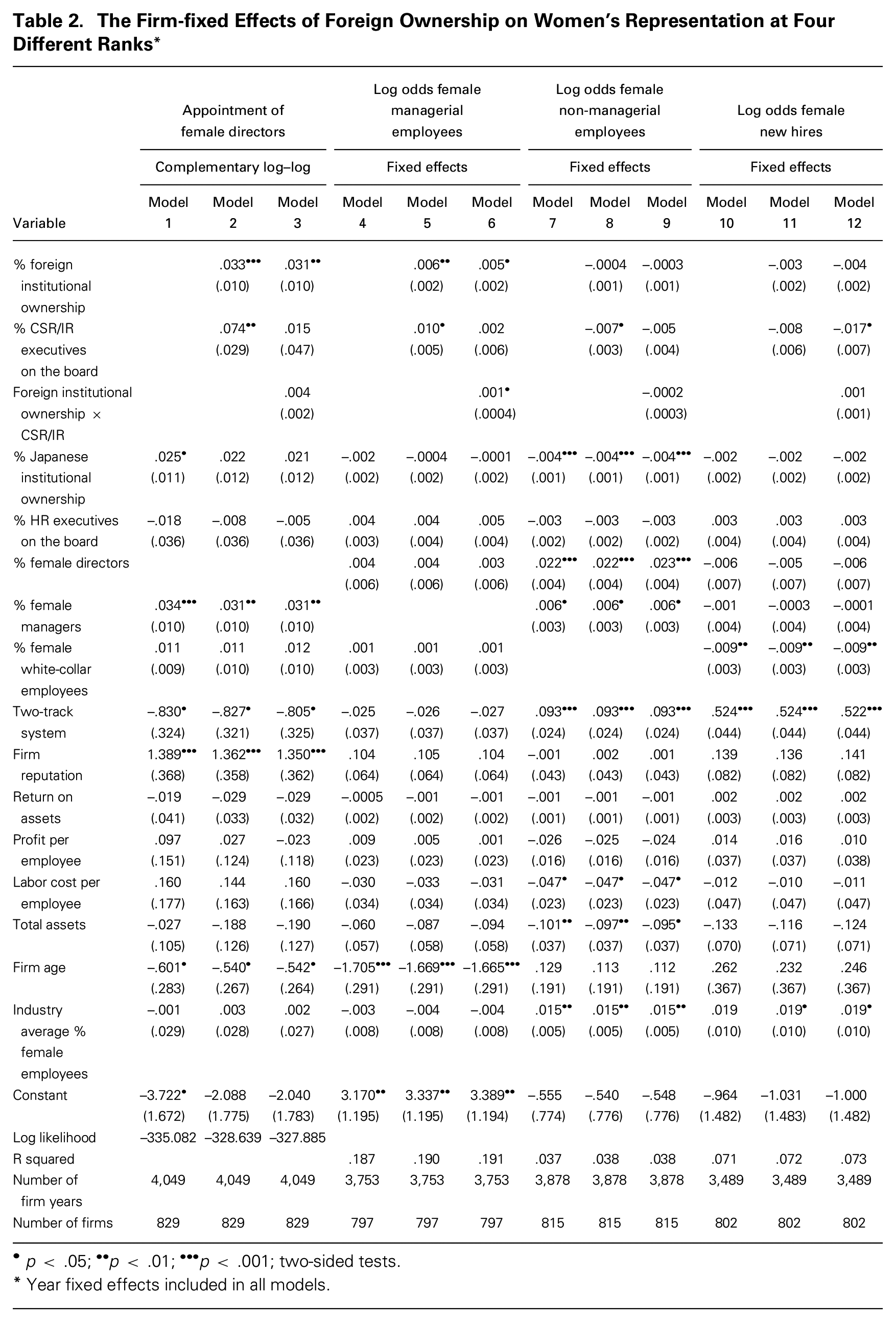
We present the results of the event history and the fixed-effects models in table 2. For each outcome variable, we present three models: the first model includes only control variables, the second model adds our key explanatory variables for foreign institutional ownership and the within-firm influence of CSR and IR managers, and the last model adds the interaction term between the two explanatory variables. The first three models report the results of the event history analysis of female-director appointments. For this analysis, the outcome is the rate of female-director appointments; exponentiated coefficient estimates (i.e., [exp(ß) – 1] × 100) can be interpreted as the percentage change in the rate associated with a one-unit change in a given explanatory variable. The remaining models report the results of the fixed-effects models of the log odds of women at the managerial, non-managerial, and entry levels, respectively. Because the outcome variables are log odds, the exponentiated coefficient estimates can be interpreted as the average percentage change in the odds, for example, that managers are female, associated with a one-unit change in the explanatory variable.
The Firm-fixed Effects of Foreign Ownership on Women’s Representation at Four Different Ranks*
p < .05;
Year fixed effects included in all models.
The results in table 2 support most of our hypotheses. First, we hypothesized that growth in foreign institutional ownership would lead to improvements in gender diversity at board and managerial levels. Supporting H1a, the results show foreign institutional ownership has a significantly positive effect on board gender diversity: a 1-percent increase in foreign institutional ownership increases the rate of female-director appointments by 3.3 percent. In addition, supporting H2a, a 1-percent increase in foreign institutional ownership leads to a .6-percent increase in the odds of managers being female. Foreign institutional ownership does not significantly increase gender diversity at the non-managerial or entry levels, which supports our hypothesis that gender diversity will increase only among visible positions because it is upheld as a signal to foreign institutional investors. Note that there is no similar positive effect from Japanese institutional ownership. In fact, the results show that firms with sizable domestic institutional ownership have significantly fewer female white-collar workers. One possible explanation is that such ownership insulates firms from external pressure to reform the traditional employment practices that privilege male workers.
Second, we hypothesized that the within-firm influence of CSR and IR managers would increase gender diversity at board and managerial levels, given their crucial roles in constructing gender diversity as a signal to foreign institutional investors. The results support both H1b and H2b that firms with CSR and IR board members are more likely to appoint female directors and promote women to managerial positions: adding one CSR or IR board member (equivalent to increasing their percentage by about 7 points, given that the average board size of Japanese firms during the observation period is 15 directors) increases the rate of female-director appointments by 71 percent and increases the odds of female managers by 7 percent. The board membership of CSR or IR executives, however, does not significantly increase gender diversity at the non-managerial or entry levels. In fact, the result in model 8 suggests that firms with CSR or IR board members have fewer female white-collar employees. These findings show that CSR and IR managers promote gender diversity only at the upper ranks, which are more visible to external observers. In contrast, the presence of HR board members has no significant positive effect on gender diversity at any level, suggesting that as champions of ILM-based employment practices, HR board members may aim to maintain the status quo.
Finally, we hypothesized that foreign institutional ownership would enhance the effect of CSR and IR board members. The results support both H1c and H2c. In model 3, however, the coefficient of the interaction term is only marginally significant at the 10-percent level. This finding shows that the presence of CSR or IR board members does not significantly increase the rate of female-director appointments when foreign ownership is very low but that their effect becomes significantly positive when 20 percent or more of a firm’s stock is held by foreign institutional investors. This is the case for about 15 percent of observations used for our analysis. In model 6, we find a similar positive and significant interaction effect for the log odds of women holding managerial positions. Figure 2 illustrates the interaction effect, holding other variables at the mean values. Foreign ownership increases women’s representation more when there is a CSR or IR director. In contrast, there is no significant interaction effect for women’s representation in non-managerial or entry-level jobs.
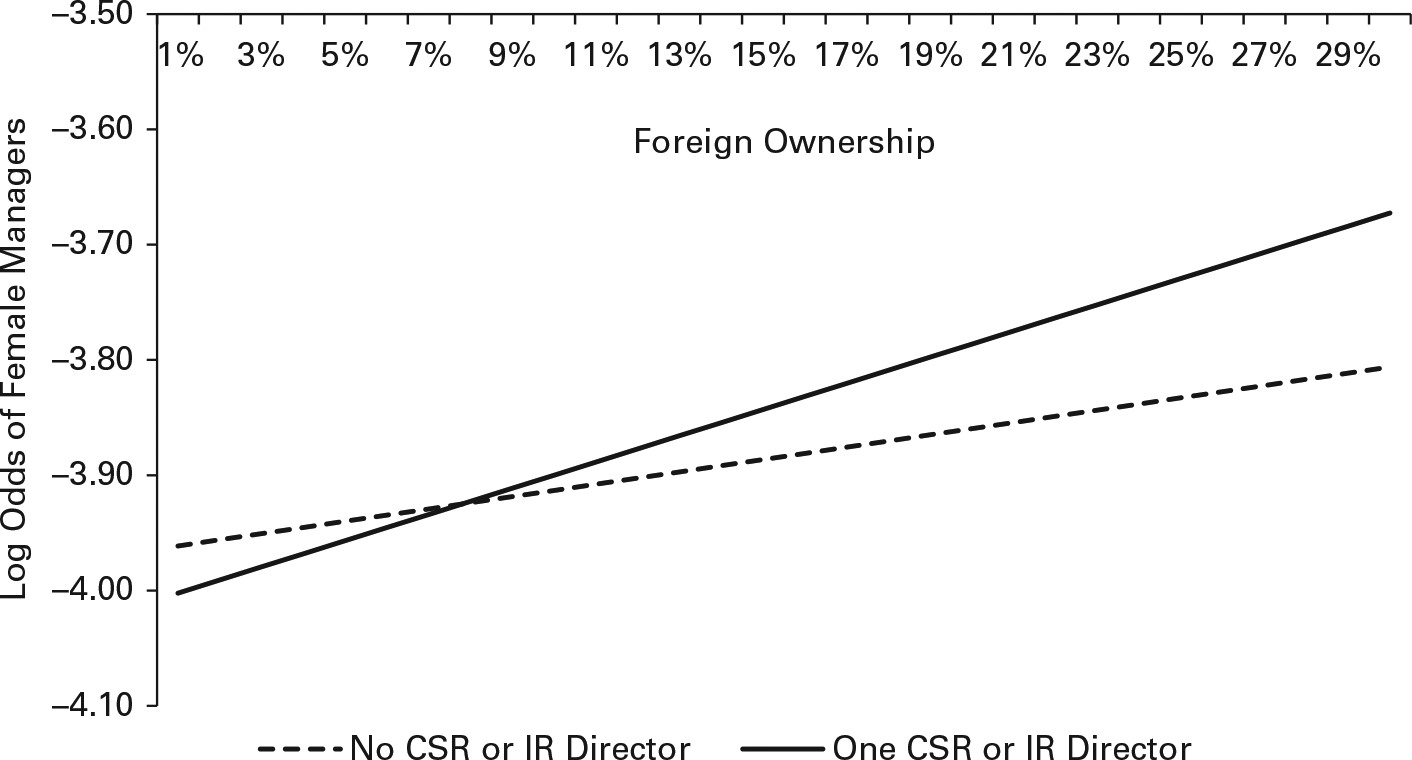
The effect of foreign ownership with or without one CSR or IR director.*
Robustness Checks
We used an instrumental-variable approach to address the issue of reverse causality, which is that foreign institutional investors may choose to buy shares of firms having more female directors or managers (Angrist and Pischke, 2009). Our instrument for foreign institutional ownership is the average stock price of American firms in the same industry as that of a given Japanese company for a given year. We assumed that the variable would affect the level of foreign institutional ownership but not women’s representation in Japanese companies. We conducted a test for weak instruments using the F-statistic obtained from the first-stage regression. The test assesses whether the instrument is relevant (i.e., correlated with foreign ownership). The F-statistic is higher than 10 in all cases, a rough rule suggesting that the instrument is not weak (Staiger and Stock, 1997; see also Bascle, 2008). For the event history model, we ran the instrumental-variable probit model using Stata’s ivprobit command, and for the fixed-effects models, we ran the instrumental-variable fixed-effects models using Stata’s xtivreg command. The results, reported in table 3, are substantively similar to the results in table 2. Foreign institutional ownership promotes gender diversity at the board and managerial levels but not at the non-managerial or entry levels. Reverse causality is less likely to be an issue for the effect of CSR or IR executives on the board. It seems unlikely in the Japanese context that female directors or female managers have enough within-firm influence to promote CSR or IR executives. We controlled for other possible confounders, including gender climate in the firm and firm reputation, through the workplace gender composition and Recruit ranking variables.
Effects of Foreign Ownership Using Instrumental-variable Approaches*
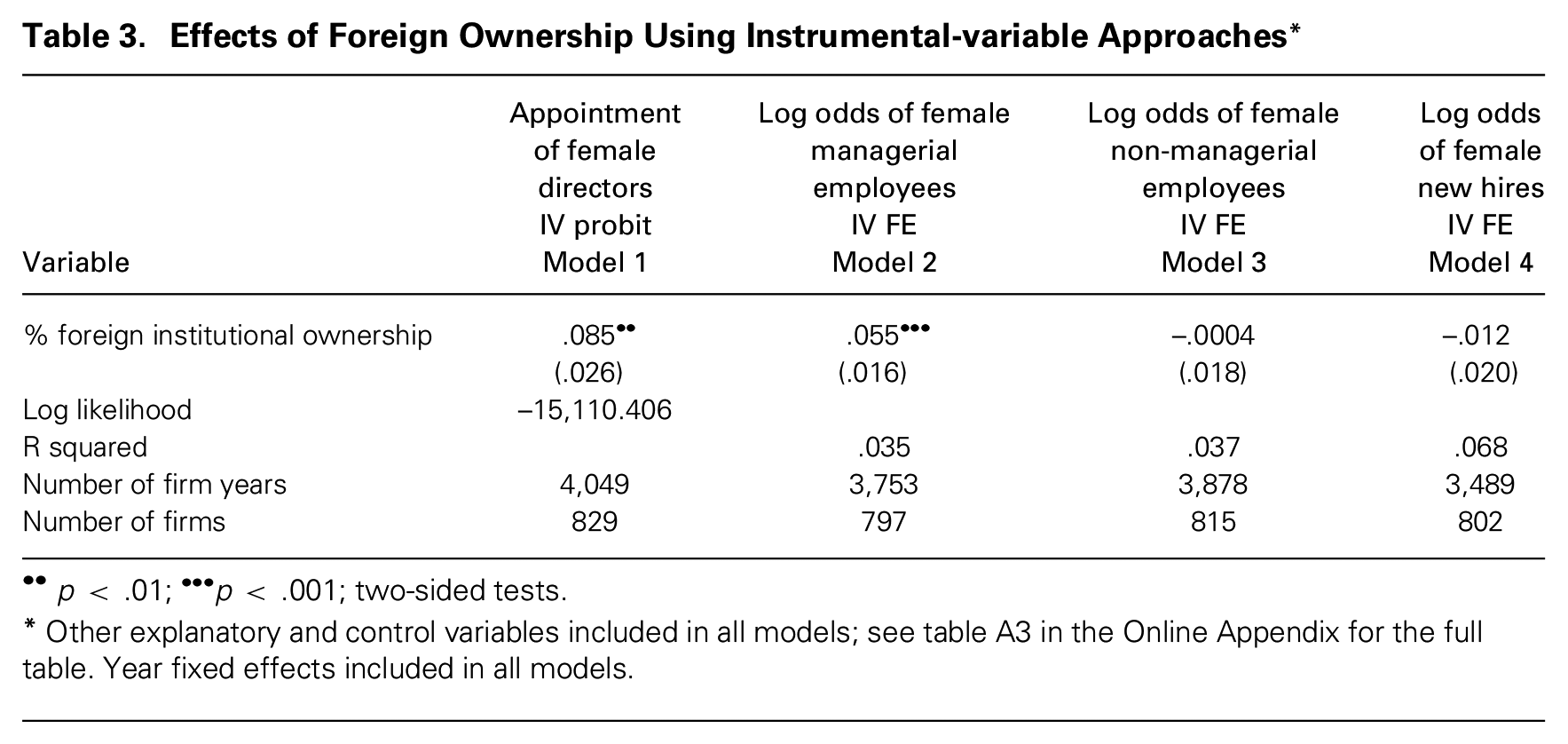
p < .01;
Other explanatory and control variables included in all models; see table A3 in the Online Appendix for the full table. Year fixed effects included in all models.
We conducted an additional robustness check to see if our use of log odds as dependent variables is a reasonable decision. We replicated our models in table 2 using ratios and proportions. For ratios, we ran fixed-effects models; for proportions, we ran fractional logit models using Stata’s xtgee command. We did not find any meaningful effects of the key explanatory variables on the ratio of female to male managers, but we found significant effects on the proportion of female managers. Because the ratio variable is highly skewed, it is understandable that the two models show different results. The results for female non-managerial employees and female new hires, in contrast, barely change whether we use ratios or proportions. Overall, given the high levels of skewness in our outcome variables, log transformation seems necessary. 11
Control Variables
Several control variables have the expected effects on gender diversity. The results in table 2 provide some evidence of the women-help-women effect and the constituency effect. Firms with more female directors and female managers have more female non-managerial employees, and firms with more female managers are more likely to appoint female directors. 12 Workplace sex segregation has a significant effect, but the effect differs for different job levels. Firms with the two-track system—a sex-segregating practice—are less likely to appoint female directors but have more female non-managerial employees and new hires. These patterns suggest that such firms mostly hire women for jobs in the non-promotional track, as secretaries and low-level administrators. Firm reputation, measured by Recruit rankings, has a significantly positive effect on the appointment of female directors, implying that firms concerned about publicity also focus on improving gender diversity at the very top. Most economic and financial variables have no statistically significant effect. Instead, women’s employment is influenced more by firm size, age, and industry. Large firms, which are likely to have strong ILMs, have fewer female non-managerial employees and hire fewer women. Older firms have fewer female managers. Industry-level gender composition has a positive effect on female non-managerial employees and female new hires. These results suggest that women’s opportunities in the workplace are less a function of a company’s financial conditions than of historical and structural conditions.
Discussion
Among industrialized countries, gender inequality in Japan has been markedly high, primarily because of employers’ reluctance and resistance to incorporate women into their core workforce (Brinton, 1993). Against this backdrop, our findings are striking: major Japanese firms have begun to appoint more female directors and to promote more female employees into managerial positions. Our interviews with CSR experts and panel data analysis strongly suggest that this change is a response to a new global CSR norm. Translating normative pressure that urges reform of discriminatory employment practices, local CSR experts have promoted gender diversity as a way for Japanese firms to remain on good terms with foreign institutional investors. Furthermore, firm-level interprofessional politics shape the boundaries of implementation. Instead of completely overhauling traditional employment practices, CSR managers have pushed for limited changes acceptable to other groups, IR and HR managers whose interests diverge. As a result, they have promoted gender diversity only above the glass ceiling—women on corporate boards and in managerial positions most visible to external constituents—without challenging the foundation of gender inequality at lower ranks.
Our findings contribute to understanding institutional and organizational change in the era of globalization. Foreign actors have been considered as change agents who may introduce new logics and push local firms to reform traditional practices (Ahmadjian and Robbins, 2005; Desender et al., 2016; Jung and Mun, 2016). We show that pressures from foreign actors are mediated by local actors who define and implement demands and that this mediation, though it results in changes, can also prevent a radical revamp of local institutions. The changes made to employment practices in Japanese firms have been contained through the efforts of local CSR experts who promote locally acceptable changes. This finding suggests that the translation of global norms varies depending on the needs and preferences of local constituents (Ansari, Fiss, and Zajac, 2010). A fruitful area of future research is to develop a classification of forms of local mediation and their outcomes, which are likely to vary by characteristics of both local and foreign actors. It is possible, for instance, that local actors promote gender diversity more when foreign investors are from more gender-equal societies. More generally, our findings suggest that future studies of diffusion and decoupling should focus on the interaction between levels—for example, global and local. Whether globally diffused practices are locally implemented will depend on how processes at those different levels are aligned (Halliday and Carruthers, 2007).
In addition, our study contributes to a growing body of work on how professional groups shape and implement organizational change (Edelman, Fuller, and Mara-Drita, 2001; Dobbin and Kelly, 2007; Briscoe and Murphy, 2012; Kellogg, 2014). In classical writings, professions are theorized as independent bodies with well-defined task areas and exclusive knowledge bases (e.g., Freidson, 1970). But many professionals today are experts employed by organizations who work side by side with other expert groups in those organizations (Leicht and Fennell, 1997). Our findings of the within-firm interaction among CSR, IR, and HR experts provide insight into the relational nature of professional work. Bargaining and alliances among the three groups and the emergence of CSR as a new task area in major Japanese firms demonstrate that professional boundaries can be relationally determined. Understanding interprofessional politics seems central to predicting the successful implementation of organizational reforms. How the relationships among professional groups evolve in organizations is beyond the scope of this paper, but an investigation of the ecology of intraorganizational professionals should be on the agenda for future research.
Although our study does not directly examine the effect of third-party ratings systems, the mediating role of local professional groups shown in this study can provide insight into how ratings systems influence organizations. Recent studies show that third-party ratings can be an important driver of organizational change and institutional transformation (Sauder and Espeland, 2009; Bromley and Powell, 2012), but their influence varies widely across organizations (Chatterji and Toffel, 2010; Sharkey and Bromley, 2015). Our study suggests that the presence of responsive expert groups can significantly increase organizational receptivity to ratings and the likelihood of substantive change in response to ratings outcomes. Furthermore, as illustrated in the top-down promotion of gender diversity as a result of within-firm political struggles in Japanese firms, resistance from other groups may reduce meaningful change and lead to the symbolic manipulation of rankings outcomes.
Social movement studies can also benefit from our findings on how intraorganizational politics shape organizational response to external pressures. Though earlier studies focused primarily on how the political opportunity structure influences social movements (McAdam, 1982; Amenta, Carruthers, and Zylan, 1992), recent studies have conceptualized the opportunity structure to be in a dynamic relationship with movements (Weber, Rao, and Thomas, 2009). As McDonnell, King, and Soule (2015) explained, social activism can change the corporate atmosphere and generate a favorable internal environment, which in turn increases the firm’s receptivity to future activism. Our study presents an empirical case of such mutual influence: external pressures for CSR empowered a within-firm expert group that attempted to mobilize internal support and implement CSR practices. We further find that external demands may not only empower internal advocates but also trigger countermobilization from those who have vested interests in the status quo. CSR managers’ push for gender diversity faced resistance from HR managers; hence they compromised by limiting the extent of change. This finding suggests that within-firm politics can be crucial to understanding the recursive cycle between social movements and corporate opportunity structures.
Our study substantively contributes to the literature on workplace gender inequality. Although it has long been argued that women’s opportunity structures are shaped by conditions both within and around the firm (Baron and Bielby, 1980), previous studies have predominantly explored the impact of intraorganizational factors (Cohen, Broschak, and Haveman, 1998; Reskin, McBrier, and Kmec, 1999; Elvira and Graham, 2002). We theorize and find that external pressures can have a significant impact when expert groups in the firm strategically shape the scope of progress to be made and garner approval from internal members. Though this channeling or mediation of professional groups has been investigated in previous studies (e.g., Dobbin, 2009), it has primarily been seen as a mechanism of decoupling and symbolic compliance (but see Briscoe and Murphy, 2012). We suggest that expert mediation can also be a mechanism of substantive implementation. Japanese CSR managers narrowly define gender diversity requirements of corporate responsibility as increasing the proportion of women in the upper-rank positions, which helps the goal of gender diversity to be internally endorsed. But though such mediation facilitates implementation, it may also limit women’s proportions to token levels. Either way, our findings demonstrate that the impact of external pressures for gender diversity is shaped by internal conditions, which selectively open up positions to women. The process we demonstrate fits into the emerging stream of research that identifies organizations as the sites in which inequality is produced and maintained (Acker, 2006; Avent-Holt and Tomaskovic-Devey, 2014).
Global norms of gender equality have arrived in Japan, but the way this has occurred differs markedly from expectations advanced by the global diffusion literature. World polity theory suggests that women’s rights issues globally diffuse as essential responsibilities of nation-states (Meyer et al., 1997; Ramirez, Soysal, and Shanahan, 1997). Our study instead suggests that global gender norms also increasingly diffuse through corporate channels as a corporate social responsibility. As a result of their absorption of vast domains of social activity, corporations are increasingly asked to provide solutions to social issues (Margolis and Walsh, 2003; Dobbin and Kelly, 2007). But as our study suggests, this often requires reframing social issues with a corporate logic. Japanese firms have embraced gender diversity not so much as a social issue but instead as an investor relations issue. Although the local translation of the global CSR norm has improved gender diversity in Japan in a relatively short period of time, the jury still seems to be out on its long-term consequences.
Footnotes
Acknowledgements
We are grateful for valuable comments and suggestions from Mary Brinton, Frank Dobbin, Jerry Himmelstein, Kim Pernell-Gallagher, Taekjin Shin, Don Tomaskovic-Devey, András Tilcsik, Shawna Bowden Vican, and seminar participants at Harvard Business School, Harvard U.S.-Japan Program, Hitotsubashi University, the National University of Singapore, and the UMass Amherst. Special thanks to Forrest Briscoe and three anonymous ASQ reviewers for improving the paper throughout the review process.
1

2
3
When we revisited the company in November 2015, CSR managers (one of whom was the same manager we interviewed previously) explained that HR managers had become more lenient about disclosing information about gender diversity to the public. One of the reasons given was that Japanese university students have begun to read CSR reports when applying for jobs. CSR managers persuaded HR managers by arguing that diversity can help attract talented new employees.
4
In 1985, when the Handbook for Job Searchers was first published, Tōyōkeizai Shinpōsha surveyed 1,005 companies hiring the greatest number of new employees in the previous year. Since then, the publisher has surveyed many of those companies annually.
5
The proportion of women in managerial positions can increase in several ways: (1) women fill outgoing men’s positions, (2) new positions for women are added, and (3) positions held by men are removed. Unfortunately, we do not have the detailed job- or position-level data required to sort out these three possibilities. Our dependent variable captures the organizational-level aggregate outcome for all of these separate processes. This aggregate outcome, despite its limitations, still allows us to examine whether women’s representation increases in management.
6
Because the Handbook data with which we constructed our gender diversity measures are self-reported by employers, our results may be conflated if companies with high percentages of foreign institutional investors overreport the number of female managers. This seems unlikely, however, because the target audience of the Handbook is college students who are looking for jobs. In this case, all employers might be similarly motivated to overreport to attract talented female students. In addition, if our findings were due to false reporting, we would expect firms to overreport female representation at all levels. As we will show in the following section, it is not the case.
7
This is different from the board of directors in the U.S., which primarily performs a monitoring function and is mostly composed of independent, outside directors (Gordon, 2007).
8
Our results are robust to excluding these composition variables.
9
10
Sixty-two companies (out of a total of 829 companies) appointed a female director during the observation period. Of these, 10 appointed more than one female director.
11
The results are available upon request.
12
The correlation between the percentage of female managers and that of female white-collar employees is quite high (.708), but our main results are robust to excluding either one of the two variables.
Authors’ Biographies
References
Supplementary Material
Please find the following supplemental material available below.
For Open Access articles published under a Creative Commons License, all supplemental material carries the same license as the article it is associated with.
For non-Open Access articles published, all supplemental material carries a non-exclusive license, and permission requests for re-use of supplemental material or any part of supplemental material shall be sent directly to the copyright owner as specified in the copyright notice associated with the article.
