







Abstract
Why do firms take positions on divisive social issues? In this article, I draw on theories of stigma by association to explain why firms’ mere proximity to controversial political actors may lead stakeholders to presume that firms silent on social issues are misaligned with the stakeholders’ sociopolitical preferences. Firms, in turn, countervail these presumptions of misalignment by eschewing silence and claiming sociopolitical positions. Substantiating this theory in the context of employee recruitment following the 2017 Unite the Right White supremacist rally in Charlottesville, Virginia, I show that Charlottesville’s employers combated presumptions that they shared demonstrators’ anti-diversity positions by making countervailing pro-diversity claims in their online job postings. In supplementary analysis, I show that the rally was associated with a newfound wage premium in job postings by Charlottesville’s employers but that this premium was lower when employers made pro-diversity claims. This study advances understanding of strategic sociopolitical positioning whereby firms make calculated appeals to stakeholders. It contrasts with related research showing that firms use social claims to combat negative evaluations resulting from their own actions or to differentiate from competitors. In doing so, it suggests opportunities for further research investigating, for example, additional motivations for firms’ sociopolitical positioning, how positioning might evolve in the context of growing political polarization, and how positioning might relate to workplace inequality and diversity.
Keywords
Why do firms take positions on divisive social issues? Despite some evidence that stakeholders reward firms that take positions aligned with the former’s preferences (Chatterji and Toffel, 2019; Wowak, Busenbark, and Hambrick, 2022), growing research suggests that firms face significant, offsetting motivations to stay silent. Not only does silence preclude accusations of hypocrisy (Wagner, Lutz, and Weitz, 2009; Janney and Gove, 2011; Carlos and Lewis, 2018) and unwanted pressure from activists (Vogel, 2005; Baron and Diermeier, 2007), but it may even cultivate false consensus, wherein stakeholders with varying preferences presume that silent firms align with those respective preferences (Burbano, 2021; Hou and Poliquin, 2022). In this account, presumptions of sociopolitical alignment mean that sociopolitical claims do little to enhance stakeholder perceptions that firms are aligned with the former’s preferences while also eliciting negative reactions from stakeholders misaligned with a stance. Closely related research in political science similarly demonstrates that silence can forestall scrutiny while allowing candidates to build larger, more-diverse coalitions (Conover and Feldman, 1982; Tomz and Van Houweling, 2009; Hurst, 2023).
But while this pessimistic perspective on the benefits of sociopolitical positioning largely supports “conventional wisdom” (Hambrick and Wowak, 2021: 33) that firms fare better when they remain silent (Friedman, 1970; Hadani and Schuler, 2013; Bhagwat et al., 2020), it raises questions about why firms often fail to do so (Larcker, Miles, and Tayan, 2018). For example, in the wake of Texas’s Senate Bill 8, which in 2021 codified a strongly pro-life stance on abortion, many Texas-based firms took highly publicized, pro-choice positions (Pardes, 2021). In the wake of Donald Trump’s victory in the 2016 presidential election, many U.S. firms made commitments to racial, gender, and LGBTQ+ diversity (The Economist, 2017). And, as I examine in detail in this article, in the wake of a large-scale White supremacist rally in Charlottesville, Virginia, in 2017, many Charlottesville employers added pro-diversity claims to their job postings. When firms take stances in these and other cases, do their actions primarily manifest top managers’ values or result from imitative processes among peer firms (Marquis, 2003; Briscoe, Gupta, and Anner, 2015)? When, in contrast, do such instances reflect calculated, strategic appeals to stakeholders (Melloni, Patacconi, and Vikander, 2023; Mohliver, Crilly, and Kaul, 2023)?
I draw on theories of stigma by association (Jonsson, Greve, and Fujiwara-Greve, 2009; Pontikes, Negro, and Rao, 2010; McDonnell, Odziemkowska, and Pontikes, 2021) to explain one reason that firms strategically take positions on sociopolitical issues. Central to my theory is the notion that stakeholders frequently generalize the positions of non-firm political actors (such as voters, politicians, legislatures, courts, or protesters) to firms they associate with these actors, often due merely to the physical proximity of these political actors and firms. Among stakeholders whose preferences do not align with these actors’ positions, this generalization engenders “sociopolitical stigma,” which, drawing on Devers et al. (2009), I define as stakeholders’ negative evaluations of a firm due to a perceived lack of alignment between this firm and stakeholders’ sociopolitical positions. By replacing stakeholders’ optimistic presumptions of sociopolitical alignment with pessimistic presumptions of sociopolitical misalignment, sociopolitical stigma by association undermines the feasibility of maintaining false consensus through silence.
Accordingly, firms associated with non-firm political actors viewed unfavorably by the firms’ stakeholders face incentives to eschew silence and combat this stigma by claiming sociopolitical positions aligned with their stakeholders’ preferences. Drawing on Werner’s (2012: 23–24) theory of private politics as defensive, strategic maneuvering, I propose that firms respond to these incentives by making “countervailing claims”: sociopolitical claims meant to offset or counter the negative effects of stigma by association. In my account, firms take sociopolitical positions not to offset negative evaluations arising from their own actions (Elsbach, 1994; Bansal and Clelland, 2004; McDonnell and King, 2013) or to counterposition vis-à-vis rival firms (Mohliver, Crilly, and Kaul, 2023) but, rather, to distance themselves from controversial non-firm political actors with whom they are associated.
I substantiate this theory in the context of employee recruitment following the 2017 Unite the Right White supremacist rally in Charlottesville, Virginia. Using a dataset of 66.5 million online jobs postings, I show that in the two years following the rally, employers in Charlottesville significantly increased their use of pro-diversity claims in their job postings. Consistent with my theory, the adoption of pro-diversity claims was not exceptionally widespread but was most pronounced when prospective applicants plausibly (1) were more inclined to generalize the White supremacists’ anti-diversity positions to Charlottesville’s employers and (2) held stronger pro-diversity preferences. In supplementary analysis, I show that the rally was associated with a newfound wage premium but that this premium was lower when employers made pro-diversity claims. I motivate and supplement my quantitative analysis with qualitative evidence from memoirs, media reports, and 21 original field interviews.
Theory
Firms increasingly take positions on divisive social issues. This positioning is distinct from the “pro-social” claim-making long examined in the impression management literature inasmuch as the former involves positions that are contested rather than “socially acceptable” (McDonnell and King, 2013: 388). Although nascent research in this area has tended to examine CEO activism (Chatterji and Toffel, 2019; Hambrick and Wowak, 2021; Hou and Poliquin, 2022; Wowak, Busenbark, and Hambrick, 2022), firms’ sociopolitical positioning is often not easily attributable to any single organizational member. Moreover, while some research narrowly considers position-taking with respect to issues unrelated to a firm’s business, in many cases a firm’s sociopolitical positioning does relate to business, including outdoor recreation companies taking pro-environmental positions, employers taking positions on their employees’ reproductive rights, or, more generally, firms with diverse workforces proclaiming the value of diversity. In contrast to corporate social responsibility or many other forms of non-market strategy, sociopolitical positioning is distinct in that it can be achieved with little expenditure of company resources (Wowak, Busenbark, and Hambrick, 2022: 554). This is not to say that more-costly, substantive actions cannot complement sociopolitical positioning but, rather, that the act of claiming a position is itself a theoretical construct of interest. This distinction mirrors a long tradition in political science that treats policy platform positioning as theoretically distinct from actual policies undertaken to pursue these positions (Dewan and Shepsle, 2011).
Stakeholder Responses to Sociopolitical Positioning
With little exception, emergent scholarly attention to firms’ sociopolitical positioning has examined whether these actions benefit firms. Highlighting upsides, some research emphasizes that positioning requires little expenditure of firm resources while increasing the extent to which stakeholders aligned with the espoused position reward the firm. On the first point, firms can take positions via simple statements in social media posts, television ads, or, as I will show, job postings, compared to more-resource-intensive non-market strategies such as self-regulation (Short and Toffel, 2010), political donations (Werner, 2017), corporate volunteer programs (Carnahan, Kryscynski, and Olson, 2017), or philanthropy (Luo, Kaul, and Seo, 2018). On the second point, workers (Carpenter and Gong, 2015; McConnell et al., 2018; Wowak, Busenbark, and Hambrick, 2022), consumers (Chatterji and Toffel, 2019; Panagopoulos et al., 2020), and even investors (Mohliver and Hawn, 2019; Bolton et al., 2020) may be inclined to reward firms that take positions aligned with these groups’ preferences.
A separate set of studies has illustrated significant, offsetting downsides of sociopolitical positioning. This research emphasizes that positioning may incur unwanted public scrutiny and asymmetrically negative reactions from stakeholders misaligned with the espoused position. Baron and Diermeier (2007) as well as Vogel (2005: 54–55) suggested that stance-taking attracts activists in favor of the claimed position, who perceive the firm taking the position as sympathetic to their cause and, consequently, as less likely to resist pressure to pursue costly actions consistent with the position. For example, Starbucks’s pro-environmental positioning drew attention from activists who, in turn, successfully pressured the firm to embrace costly changes to its coffee-sourcing procedures (Argenti, 2004). When scrutiny increases, there is also increased risk that a firm will be seen as hypocritical, which can significantly reduce stakeholder support (Vogel, 2005; Wagner, Lutz, and Weitz, 2009; Janney and Gove, 2011). For example, many organizations that stated support for the Black Lives Matter movement in the summer of 2020, including J. P. Morgan Chase (Jan et al., 2020), L’Oréal (Elan, 2020), and the United Kingdom’s Royal Academy of Drama and Art (Bakare, 2020), were subsequently accused of hypocrisy for actions inconsistent with these claims. Silence on sociopolitical issues forestalls these accusations and affords latitude for actions that might otherwise be deemed hypocritical (Carlos and Lewis, 2018).
Examining consumer reactions to corporate support for gun control in the wake of mass shootings, Hou and Poliquin (2022) demonstrated asymmetrically negative responses from consumers who oppose gun control. Similarly, Burbano (2021) presented evidence that taking a position on North Carolina’s trans-exclusionary bathroom bill failed to increase output among workers aligned with the position but significantly reduced output among workers misaligned with the position. Burbano proposed that these findings may be driven by false consensus bias, which is the tendency to overestimate the extent to which the unknown preferences of others match one’s own (Rosenhan and Messick, 1966; Ross, Greene, and House, 1977). These findings are also consistent with theories of negativity bias and loss aversion, according to which bad outcomes, in this case sociopolitical misalignment, have stronger behavioral implications than good outcomes produce, in this case sociopolitical alignment (Kahneman, Knetsch, and Thaler, 1991; Baumeister et al., 2001; Rozin and Royzman, 2001).
These findings suggest that claiming a sociopolitical position does little to improve perceptions of alignment among those aligned with the position and elicits outsize negative reactions among those misaligned with the position. The idea that claiming a sociopolitical position undermines stakeholders’ optimistic presumptions that the firm aligns with their preferences is consistent with related research in political science. By avoiding clear policy stances, political candidates can often attract a wider range of voters since these voters presume that the candidates’ positions align with their own different preferences (Markus and Converse, 1979; Conover and Feldman, 1982; Tomz and Van Houweling, 2009). Inasmuch as candidates take well-defined positions, they are incentivized to do so on only the few core issues on which voters expect them to take a position (Krosnick, 1990). This logic is especially germane to firms. If a firm fails to communicate quarterly earnings, the goods it sells, the salaries it pays, or other information most core to business, this silence will unavoidably elicit negative attention from investors, customers, and employees. Silence on divisive issues, however, may deflect unwanted scrutiny while leaving room for stakeholders to make optimistic presumptions regarding the firm’s stances on these issues. These strong motivations to remain silent perhaps explain why firms are silent on the vast majority of social issues. They also raise questions about when, if ever, decisions to eschew silence and claim positions on these issues are strategic. They suggest that firms’ taking positions on sociopolitical issues may simply reflect the values of top managers (Hambrick and Wowak, 2021) or result from imitative processes among peer firms (Marquis, 2003).
Combating Sociopolitical Stigma with Countervailing Claims
I propose conditions under which firms face strong incentives to eschew silence and strategically claim positions on divisive issues. My argument builds on Burbano’s (2021) observation that stakeholders make presumptions about the positions of silent firms. But whereas Burbano pointed only to optimistic presumptions arising from false consensus bias, I argue that these presumptions may sometimes be pessimistic. Pessimistic presumptions of sociopolitical misalignment erode the benefits of sociopolitical silence and incentivize firms to combat these presumptions with countervailing claims. In the following two subsections, I detail this two-part process wherein (1) stakeholders generalize non-firm political actors’ positions to firms associated with these actors, and consequently, (2) firms that depend on stakeholders whose preferences misalign with these positions combat this generalization with countervailing claims.
Sociopolitical stigma
My argument starts from the premise that stakeholders generalize the positions of non-firm political actors to firms associated with these actors. Frequently, this association will arise due to the firm’s location. For example, stakeholders observe a state legislature pass left-leaning laws and then presume that firms in that state tend to hold left-leaning sociopolitical positions. These generalizations, however, might arise also due to associations unrelated to location. For example, stakeholders might observe White supremacist rioters bearing Tiki torches and then presume that the vendors or manufacturers of Tiki torches share the rioters’ grievances. Critically, these presumptions arise from mere association and not because stakeholders see evidence that a firm’s actions are consistent with these positions. When political actors misalign with stakeholders’ preferences, this generalization engenders “sociopolitical stigma,” which I define as stakeholders’ negative evaluation of a firm due to a perceived lack of alignment between this firm and stakeholders’ sociopolitical positions. This definition is a variation of Devers et al.’s (2009: 165) definition of stigma as “a label that evokes a collective perception that [an] organization is deeply flawed and discredited.” In my construct, the discrediting “label” is distinctly sociopolitical: stakeholders with a shared sociopolitical preference collectively perceive these stigmatized firms as misaligned with their preferences and are consequently less inclined to reward them.
This argument is consistent with prior research demonstrating that individuals generalize the actions of focal entities to sets of associated entities (Adut, 2005; Pontikes, Negro, and Rao, 2010). The canonical example is Hollywood during the Red Scare, when audiences formed negative evaluations not only of actors who had been blacklisted as Communists but also of actors who had not been listed as Communists but had previously worked with blacklisted actors (Pontikes, Negro, and Rao, 2010). This inclination to generalize is starkly illustrated by evidence that individuals can incur negative evaluations due simply to physical proximity to individuals with stigmatized characteristics (Hebl and Mannix, 2003; Penny and Haddock, 2007; Pryor, Reeder, and Monroe, 2012). These generalization processes play a critical role in how stakeholders evaluate organizations. Unable to collect detailed information on large numbers of individual organizations, stakeholders frequently make wider inferences based on the actions of a small number of organizations. These interorganizational generalization processes have been documented in many contexts, including among organizations that share a parent organization (Jensen, 2006; Piazza and Jourdan, 2018), industry affiliation (Jonsson, Greve, and Fujiwara-Greve, 2009; Durand and Vergne, 2015; Naumovska and Lavie, 2021), partnership (McDonnell, Odziemkowska, and Pontikes, 2021), or organizational form (Yue, Rao, and Ingram, 2013).
Through these same generalization processes, political actors’ position-taking significantly shapes stakeholders’ presumptions regarding the positions of firms associated with these actors. Political actors attract media attention, which coordinates generalization processes and results in “collective perceptions” of firms’ sociopolitical positions, which, because large numbers of stakeholders hold them, become material to the firm (Devers et al., 2009: 157). Other forces or actors also plausibly shape stakeholders’ presumptions about firms’ sociopolitical positions. The prominence of political actors in the sociopolitical landscape, however, as well as their mandates to frequently take sociopolitical positions, means that they play a primary role.
Countervailing claims
These presumptions create incentives for firms to either claim a sociopolitical position or maintain silence. On the one hand, if the firm relies heavily on stakeholders whose preferences are further from these actors’ positions, then the firm is more incentivized to combat the ensuing stigma through countervailing sociopolitical claims. In this case, the firm faces a greater burden of proof in demonstrating to stakeholders that, despite association with a political actor who holds a disliked position, the firm is, in fact, aligned with its stakeholders’ preferences. In terms of Adut’s (2005: 216) evocative language, such firms have become, in the eyes of their stakeholders, contaminated “third parties” who, for reasons unrelated to their own actions, face pressure to demonstrate “extraordinary zeal” as they “signal rectitude or resolve” to their stakeholders’ preferences. In doing so, the firm still incurs costs associated with making these claims, such as unwanted attention from activists or accusations of hypocrisy, but these costs are more likely to be offset by the benefits of remedying stakeholders’ presumptions of misalignment. On the other hand, if the firm relies more heavily on stakeholders whose preferences are closer to the political actor’s position, then the firm benefits from presumptions of sociopolitical alignment and thus has a greater incentive to remain silent.
My characterization of strategic positioning is consistent with Werner’s (2012: 22–23) conceptualization of private politics, which modifies March’s behavioral theory of the firm to allow more room for “strategic calculation.” Central to both my argument and Werner’s (2012: 24) conceptualization is the idea that firms monitor the social environment and seek to “protect themselves and their reputations from hostile public opinion.” I argue, in contrast to this and other prior work, that sociopolitical positioning is not a direct response to competitors (Mohliver, Crilly, and Kaul, 2023), an effort to assuage general public distrust of corporations, or meant to compensate for the focal firm’s own missteps (Elsbach, 1994; Werner, 2012; McDonnell and King, 2013). Instead, countervailing claims arise as decision makers within firms come to believe that due to their mere association with political actors who take positions disliked by their stakeholders, they may benefit by combating presumptions that they share these disliked positions. Note that this argument operates regardless of exactly why perceptions of sociopolitical misalignment make stakeholders less inclined to reward firms. Whether this disinclination is fundamentally taste-based (i.e., due simply to ideological aversion) or statistical (i.e., due to concern that the sociopolitical position signals additional undesirable firm qualities), firms face incentives to remedy it by explicitly aligning with the preferences of the stakeholders on whom they most depend.
Empirical Context: Unite the Right Rally in Charlottesville, Virginia
I examine this theory in the context of employers’ positioning on diversity issues in the wake of the Unite the Right White supremacist rally in Charlottesville, Virginia, on August 11–12, 2017. This context is ideal for two key reasons. First, the rally was exogenous to the actions of Charlottesville’s employers. Although political actors constantly take positions on divisive issues, this positioning is often endogenous in firms’ other actions. For example, firms donate to politicians, lobby for legislation, participate in lawsuits, and officially sponsor parades and other protests. At the very least, they may employ individuals who privately engage in these activities. These activities make it difficult to infer whether firms’ sociopolitical positioning is a response to the positions taken by political actors or is, instead, driven by some other firm characteristic. In the case of the Unite the Right rally, however, White supremacist protesters came, with almost no exception, from outside of Charlottesville, thereby plausibly staining Charlottesville-area employers with an anti-diversity stigma that was unrelated to their own actions and even the private behaviors of their employees. Second, Charlottesville is isolated in rural central Virginia. This isolation allowed me to compare the responses of employers in this clearly defined treated location to the behavior of employers in control locations. In the remainder of this section, I describe the Unite the Right rally and provide preliminary, qualitative evidence from memoirs, media reports, and 21 original field interviews that Charlottesville employers sought to combat anti-diversity stigma arising from the rally through countervailing pro-diversity claims. 1 This illustrative, suggestive preliminary qualitative evidence serves primarily to describe the setting and build intuition for the large-data, quantitative analysis that follows.
Sociopolitical Stigma for Charlottesville Employers
The Unite the Right rally was organized in response to the Charlottesville city council’s decision in February 2017 to remove a statue of Confederate Civil War general Robert E. Lee. The rally attracted thousands of White supremacists from around the country to Charlottesville on August 11 and 12, 2017. Through their clothing, protest signs, and verbal chants, the agitators manifested strong anti-diversity positions. The event captured widespread attention, with striking images of mostly male, Tiki torch–bearing White supremacists appearing across major media outlets (McAuliffe, 2019; Signer, 2020).
Multiple accounts describe how the rally stained Charlottesville with a newfound anti-diversity stigma. In his memoir of the events, Terry McAuliffe (2019: 158), governor of Virginia at the time, characterized the rally as a “lightning bolt” that “lit up the scourge of racism and hatred of others as it really is, in the here and now.” Then-Charlottesville mayor Michael Signer characterized the rally as an “earthquake” in which perceptions of Charlottesville were “fundamentally shaken.”Signer (2020: 8) lamented that, due to the rally,
. . . Charlottesville would become synonymous with white supremacy and with terrorism. The city’s “brand” now comingled the pleasant contours of UVA and Monticello with swastikas, shields, swords, helmets, and that haunting chant: “Jews will not replace us.”
Some Charlottesville residents lamented a disconnect between these perceptions and their experiences. One resident quoted in The New York Times characterized “the portrait of Charlottesville that emerged from 2017” as “exaggerated,” bemoaning “a misconception that we just have Klan members hanging around Charlottesville” (MacFarquhar, 2021). Similarly, multiple interviewees described friends and family from out of town who had difficulty recognizing that almost no rioters were from Charlottesville, and thus these observers formed an inaccurate belief that the rally displayed anti-diversity attitudes that were common among Charlottesville’s residents. One interviewee recalled that while attending college out of state, her son was introduced as coming from “Charlottesville, where the Nazis ride.” She added, “that’s just the way outsiders perceived it.”
To more systematically substantiate this newfound stigma by association, I documented media mentions of Charlottesville in the periods before and after the rally. Using the LexisNexis media archives, which capture major print, audio, and television media reports, I documented the number of stories by month from 2015 through 2019 that contained the search terms “Charlottesville,”“White supremacy,” or both of these terms. Illustrating these patterns, Figure 1 shows strongly correlated upticks in each of these three search terms beginning in August 2017. The chart also shows correlated upticks in these search terms around the annual anniversary of the events (August 2018 and August 2019), suggesting that this newfound stigma was not transitory.
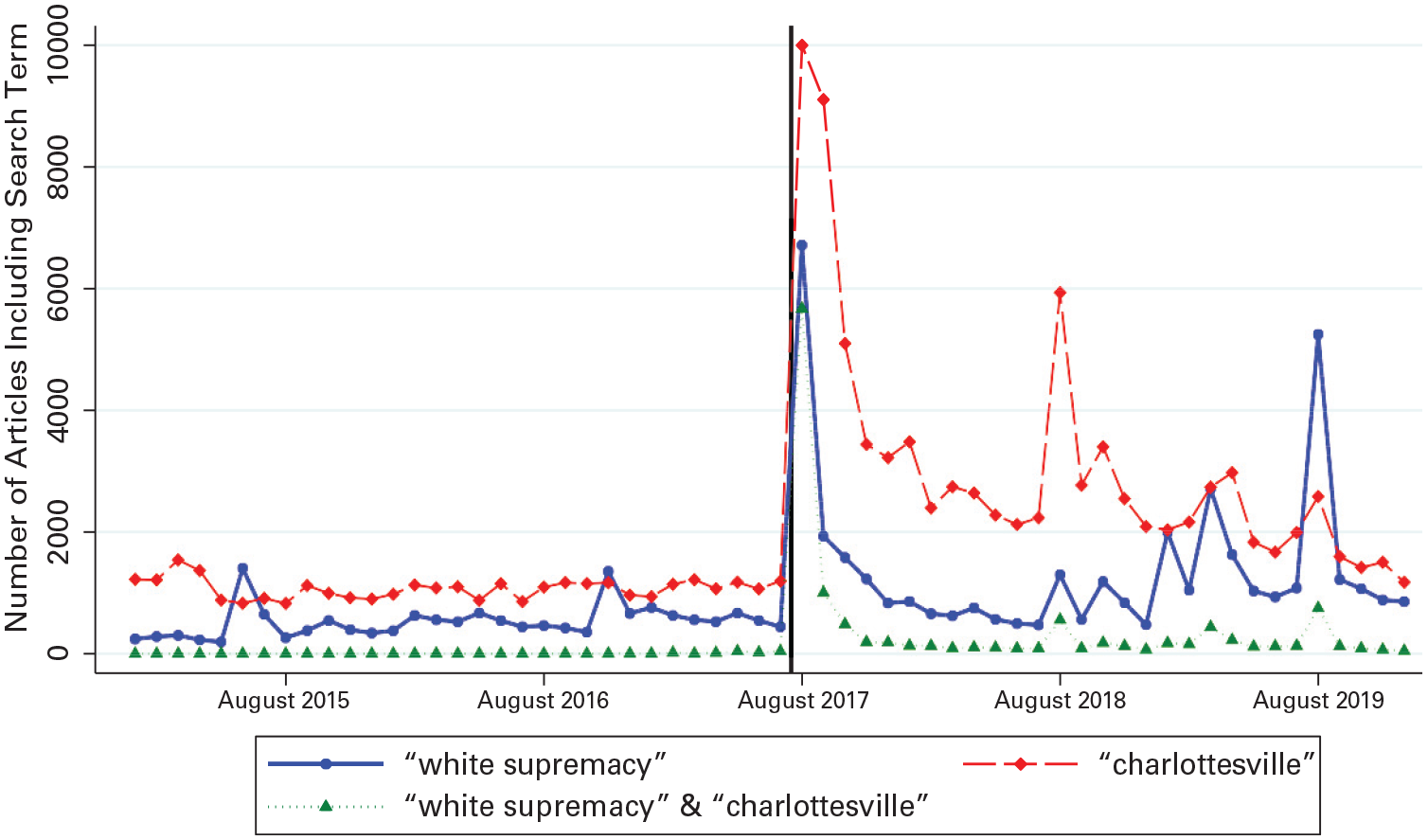
Association Between Charlottesville and White Supremacy After the Unite the Right Rally
My interviewees provided preliminary evidence that Charlottesville’s employers became sensitive to how this stigma by association shaped prospective employees’ perceptions of prospective employers. A Charlottesville government official recalled,
I can remember specifically a conversation with a large company in town that, you know, they had visits planned and they had to change those. And then they had people kind of [pause] concerned. . . . I think the local firms that were hiring, you know, significantly and looking to recruit people here, to take a job, had to kind of adjust their approach and be prepared to answer the question about [where they stood on the issue of diversity].
Reporting similar concerns, another interviewee commented,
Every time I try to hire someone at the highest level we have to talk about [the rally]. If they’re from Stanford, Duke, Berkeley, they’re like what the hell was that? Is that who you are?
Other interviewees mentioned similar difficulties. One expressed that the rally “came up repeatedly in interviews” and that “one African American applicant asked me explicitly about if and how [the employer] was resisting it.”
Countervailing Pro-Diversity Claims
The Unite the Right rally put Charlottesville’s employers in a difficult situation regarding whether they should speak up or remain silent on issues of diversity. Although most Americans do not explicitly support White supremacy, there are surprisingly high levels of agreement with anti-diversity positions central to White supremacist ideology. In a national poll conducted one month after the rally, fewer than 8 percent of respondents expressed support for “White nationalism” or “neo-Nazism,” but 31 percent agreed that the United States needed to “protect and preserve its White European heritage,” 39 percent agreed that “White people are under attack in this country,” and 57 percent said that Confederate monuments should remain in public spaces (UVA Center for Politics, 2017).
Disagreement about whether to respond to the Unite the Right rally with countervailing pro-diversity claims, moreover, reflected mainstream divisions in American society regarding the appropriateness of efforts to celebrate demographic diversity. People on the political left are more inclined than those on the political right to believe that demographic diversity should be celebrated (Fingerhut, 2018). This partisan division was manifest in the contrasting ways in which Democratic and Republican politicians responded to the events. While Virginia’s Democratic governor Terry McAuliffe immediately condemned the rally, Republican president Donald Trump equivocated before famously affirming that “there were very fine people on both sides” (McAuliffe, 2019). The emergence of diversity as a divisive sociopolitical issue is further evident in efforts under the Trump administration and Republican-led state governments to eliminate diversity, equity, and inclusion (DEI) initiatives (Fuchs, 2020), as well as in heated debates in local school board meetings regarding the appropriateness of educational initiatives related to racism, LGBTQ+ equality, and antisemitism (Thompson and Press, 2022). In this sense, my approach mirrors recent research that has leveraged the January 6, 2021, assault on the U.S. capitol (Li and Disalvo, 2023) or mass shootings (Hou and Poliquin, 2022) to examine firms’ sociopolitical positioning. In these cases, as in the Unite the Right rally, sharply divided mainstream public opinion on the appropriate response to fringe extremists put firms in a difficult position regarding whether they should speak up on the issue in question.
Comments from numerous interviewees suggested that Charlottesville’s employers were aware of this tension as they transitioned from staying silent to taking pro-diversity positions. In the words of one employee,
Prior to that event, [my employer] had obviously had an advocacy group, which took positions on matters of public policy, but those were limited to its sort of sphere of, stay in our lane. We’re going to talk about regulation. We’re going to talk about market ethics. . . . We’re not going to get out into broader social issues. And that changed for the organization as a result [of the rally], and there was some very robust internal discussion about where we should take positions on issues of social import.
Detailing this “robust internal discussion,” this interviewee went on to describe spirited back and forth about whether the firm should embrace a pro-diversity stance, remain silent, or even speak up in favor of the protesters’ First Amendment right to free speech. Similar debate was described by an interviewee from a different employer who indicated that it took an entire year of internal debate, paired with growing recognition that the rally was creating difficulties for recruiting, before the employer ultimately adopted pro-diversity claims.
Additional interviews and media reports provided further examples of employers across Charlottesville responding to the rally by eschewing silence and taking pro-diversity positions. One interviewee explained,
I think one of the things that really came out of the events from Unite the Right is that organizations I think went from a more passive support of social positions and sort of a tacit, we all got this right, to a much more active and vocal position on issues.
In an interview with the local newspaper C’Ville Weekly, Andrea Copeland, of the Charlottesville Chamber of Commerce, characterized this shift from silence to pro-diversity positioning as employers’ effort to combat presumptions that they shared the attitudes that had been on display at the rally. Her words closely mirror my theoretical argument:
A lot of companies, for good reason, have sat down and said, “What can we do to make things better, to make everyone feel welcome, to make this community aware that we don’t stand for exclusion, we don’t stand for racism, we don’t stand for what was on display August 11th and 12th?” (Pullinger, 2019)
An interviewee at a local financial services company reported that whereas speaking up on social issues “had not been [the employer’s] style in the first four years [the interviewee] worked there,” after the rally that changed as the employer “came out with statements [about diversity] and put up some kind of fluffy, but nice stuff on our website.” In another case, Jim Hall, CEO of WorldStrides, which sells educational trips for student groups, penned a letter titled “Our Hometown” on the company’s website, in which he stated,
It was a disturbing and sad weekend here in WorldStrides’ hometown of Charlottesville. . . . Today especially, I find solace in the work that we do as an organization. We expose young people to new places, new ideas, new people, and new cultures. Through that, I believe that we help them develop an understanding, appreciation, and love of diversity, and the richness that it brings to our lives.
Teachstone, a company that develops and markets online training resources, expressed similar sentiments. In a letter titled “A Message about our Home” and signed “The Teachstone Family,” the company affirmed the importance of “developing true and real relationships among people of all races, ethnicities, religions, and backgrounds.” In another case, the Charlottesville-based Center for Non-Profit Excellence lamented in an open letter on its website that “we were invaded this weekend. [sic] By violent, extremist hate groups that don’t reflect our collective values or the way we view the world.” The University of Virginia (UVA), Charlottesville’s largest employer, responded to the events with a series of countervailing pro-diversity claims. A general communication from the university stated that “Those who gather with the intent to strike fear and sow division do not reflect the University’s values and will not influence or diminish the University’s commitment to inclusion, diversity and mutual respect.” Shortly thereafter, a similar statement was issued by then-UVA president Teresa Sullivan, who affirmed that “the ideologies and beliefs expressed by many of the groups that have converged on Charlottesville this weekend contradict our values of diversity, inclusion, and mutual respect.” Illuminating a key motivation behind these statements, an interviewee who works in recruiting at UVA explained that in the wake of the rally, “we wanted to do everything we could to dispel the myth that this is who we are.” These many examples are consistent with my proposed theory: the rally created an anti-diversity stigma by association, which these employers felt compelled to combat via countervailing pro-diversity claims.
Econometric Analysis
These qualitative anecdotes are consistent with my theory, but they do not allow me to systematically demonstrate the proposed effect or address alternative explanations. In this section, I use a difference-in-differences design on a comprehensive dataset of online job postings in the United States to estimate the rally’s effect on Charlottesville-area employers’ propensity to make pro-diversity claims in their recruiting efforts.
Data and Variables
Pro-diversity claims in job postings
I operationalized sociopolitical claims in terms of firms’ use of pro-diversity claims in job postings. Whereas White supremacy celebrates racial and cultural uniformity, pro-diversity claims carry a multicultural ideology that celebrates racial and cultural differences (Plaut et al., 2011; Dover, Major, and Kaiser, 2016). In 2017 in the United States, pro-diversity claims marked (and continue to mark) a sociopolitical stance in opposition not only to a historical, White-dominated status quo but to political forces, especially on the right, that resist trends in growing diversity (Dover, Major, and Kaiser, 2016; McVeigh and Estep, 2019; Norris and Inglehart, 2019). An analysis of corporate sociopolitical stance-taking from this period concluded that “diversity [was] the most frequently advocated issue” (Larcker, Miles, and Tayan, 2018: 2), while experimental research demonstrated that pro-diversity claims in job postings carry a strongly Democratic partisan connotation (Hurst, 2021). Illustrating the sociopolitical nature of pro-diversity claims, a CNN photographer at the Unite the Right rally captured a now-iconic image of Confederate flag–bearing White supremacists marching far below a massive banner, hung by Charlottesville residents, emblazoned with the words “Diversity makes us stronger” (see Figure A1 in the Online Appendix). Thus, although some past research has characterized pro-diversity claims simply as pro-social claims (McDonnell and King, 2013: 397), in this context they represent a position on one side of a divisive social issue.
Examining pro-diversity claims in the context of online job postings has two key advantages for evaluating my theorized relationship. First, job postings constitute a near-universal medium whereby firms can make sociopolitical claims. Whereas only some organizations have a meaningful media presence, nearly all organizations post jobs online. Second, geographic variation in job postings allows for fine-grained inference regarding the strategic behavior I theorize. In theory, firms can tailor job postings across time, locations, and labor pools in response to variation in sociopolitical stigma and worker preferences. Other mediums firms use to make sociopolitical claims, such as social media posts or political donations, tend to lack location and labor pool specificity, making it more difficult to isolate my theorized mechanism.
To measure firms’ use of pro-diversity claims, I used a dataset of all online job postings in the United States in the four-year period straddling the rally. I purchased these data from Burning Glass Technologies, which collects all job postings from approximately 45,000 company websites, online newspapers, and online job boards. The company ensures that no more than 5 percent of vacancies found this way come from any one source, and it removes duplicate postings across job boards. Third-party analysis from 2014 estimated that Burning Glass captures all job postings in the United States that appear online (Carnevale, Jayasundera, and Repnikov, 2014). Analysis by Burning Glass from 2022 indicates that dating back to 2013, the data capture 98.7 percent of jobs included in the U.S. Bureau of Labor Statistics Job Openings and Labor Turnover Survey (Lightcast, 2022), which is the primary measure of U.S. job openings and is used extensively by policymakers and other labor market analysts. The data suffer some under-representation for jobs for which recruiting is less likely to occur online, such as those related to food preparation and service, office and administrative support, and construction. Thus, I can measure changes in employers’ use of pro-diversity claims only in online recruiting.
I coded a job posting as featuring a pro-diversity claim if it met any one of these criteria: (1) it included the word “diversity” but not only within the words “diversityjobboard,”“diversityjobs,”“diversitynursing,” or “pharmadiversity”; (2) it included the word “inclusion” but not only when followed by “in,”“of,”“onto,” or “with”; (3) or it included the word “inclusive” but not only in the phrase “all inclusive” or “inclusive of.” I detail, in the Online Appendix, the iterative process whereby I arrived at and validated this measure. This strategy is based on extensive analysis of random samples of job postings including the words “diversity,”“equity,”“inclusion,”“diverse,”“equitable,” or “inclusive.” I also examined a range of other words and phrases that might signal pro-diversity claims, including “belonging,”“bipoc,”“black lives matter,”“dei,” and “social justice,” but I found that these were rare. This approach yielded not only a very high true positive rate (I estimate that 96 percent of postings coded as featuring pro-diversity claims actually feature such claims) but also a very high true negative rate (I estimate that 97 percent of job postings coded as not featuring pro-diversity claims do not feature such claims).
Additional variables
I used additional variables at the job posting, employer, and geographic levels. At the job posting level, these include whether the job posts a salary (rather than an hourly wage or no information on compensation), the two-digit NAICS industry code, whether the job requires a bachelor’s degree, and the county in which the job is located. At the employer level, I identified employers that were not only hiring in Charlottesville but also based in or headquartered in Charlottesville. At the geographic level, I used the U.S. Census Bureau’s American Community Survey to collect annual five-year estimates of the county’s median age, the percentage of residents who identify as non-Hispanic White, the population, the fraction of residents who hold a bachelor’s degree, residents’ average annual earnings, and the vote share that went to Hillary Clinton in the 2016 election. I omitted job postings that were missing values on any of these job- or county-level variables or for which no employer was listed.
Appropriate Level of Analysis
When making pro-diversity claims, employers may either tailor the language of individual postings or make one-off decisions whereby they standardize language across many or all postings. This variation raises the question of whether analyzing individual postings or individual employers is the appropriate strategy for capturing employers’ decisions to use pro-diversity claims. I feature posting-level analysis as my main results for two related reasons. First, empirical patterns suggest that universal, standardized use of pro-diversity claims is the exception rather than the rule. Appendix Figure A2 shows that for the same employer, in the same county, in the same year, the share of job postings that feature pro-diversity claims varies significantly. Specifically, among employer–county dyads that make a pro-diversity claim in any of their postings in a given year, the percent of employers featuring pro-diversity claims in all of their postings is always below 30 percent and is well below 25 percent in three of the four years in my sample. Insights gleaned from analyzing this within-employer, posting-level variation helped me to arbitrate between competing theoretical explanations (see the section “Examining the Proposed Mechanism” below).
Second, by analyzing individual postings I also captured the reality that especially within larger employers, recruiting was not the purview of a single, central decision maker but, rather, the particular department, team, or division that was hiring. For example, although nearly all job postings by the University of Virginia (UVA) were coded by Burning Glass under a single employer, hiring was the purview of disparate academic departments, athletic teams, and administrative divisions. This likely explains, in part, why some but not all UVA postings across any six-month period in my data featured pro-diversity claims (see appendix Figure A4). Treating employers as the unit of analysis would inaccurately characterize larger employers as governed by a single decision maker or set of decision makers, giving them equal weight to smaller employers where this decision-making structure exists, such as single-location nail salons, restaurants, and laundromats.
There are two drawbacks to using job postings as the units of analysis. First, posting-level analysis arguably puts too much weight on employers that decide to include pro-diversity claims in most or all postings and then post many jobs. Second, posting-level analysis involves comparing different populations of firms in the pre- and post-treatment periods. I used employer–county fixed effects to ensure that postings by employers that do not appear in the pre- and post-treatment periods do not directly contribute to the estimated treatment effects, but postings by these employers might indirectly shape this estimate through their influence on time fixed effects or coefficients on controls. To assuage these two concerns, I supplemented my principal analysis, in which the outcome is whether a given job posting features a pro-diversity claim, by analyzing a balanced-by-year panel of employer–county dyads, for which the outcome variable is the share of job postings in a given employer–county–year that feature pro-diversity claims. Although neither level of analysis flawlessly captured a decision to make a pro-diversity claim, I show that my results are robust to either approach.
Summary Statistics
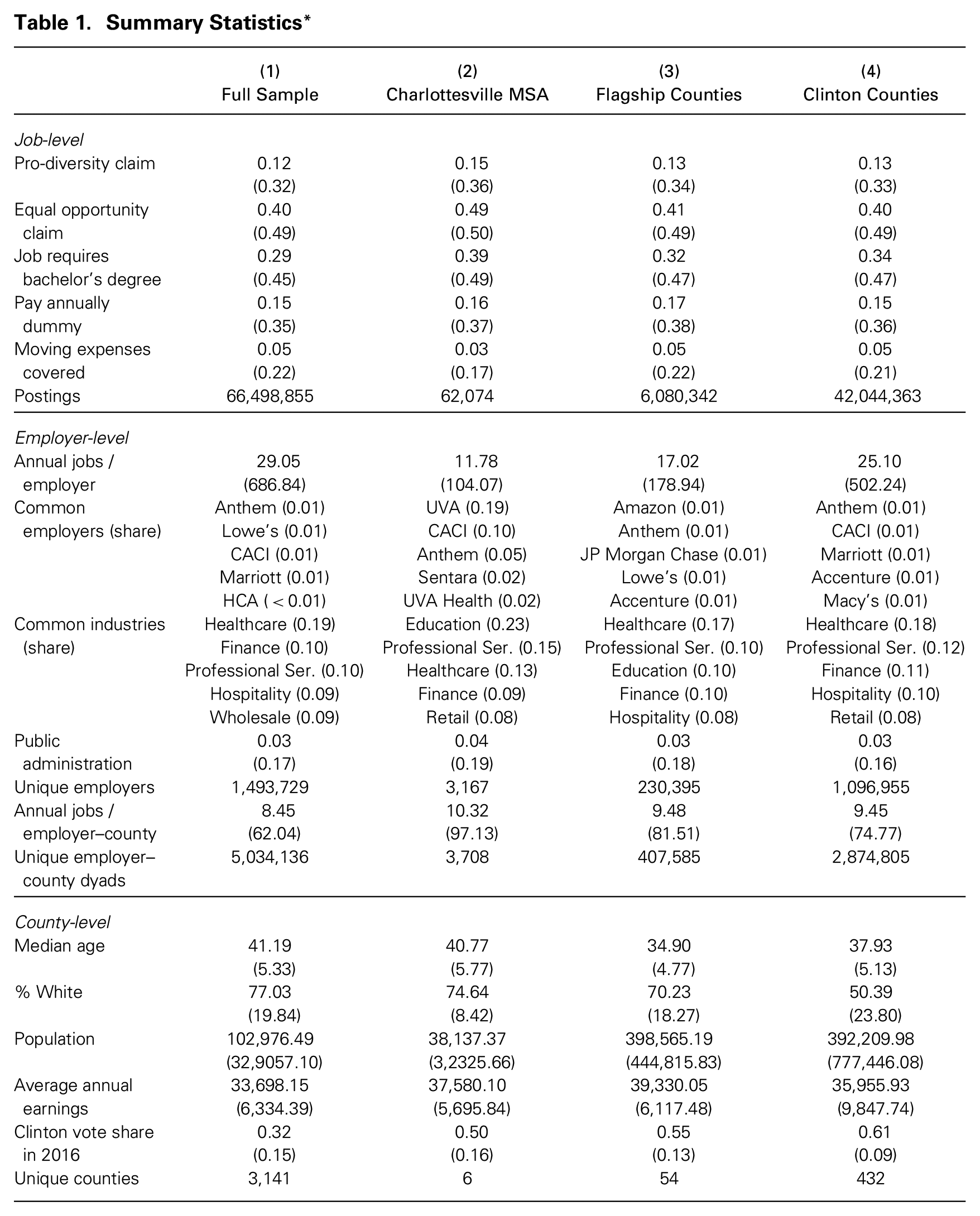
Table 1 presents summary statistics at the posting, employer, and county levels. I present these for the full sample, the Charlottesville MSA, counties that are home to flagship state universities, and counties in which more than 50 percent of the vote share went to Hillary Clinton in the 2016 presidential election. 2 Ninety-one percent of job postings in the Charlottesville MSA are in the city of Charlottesville. My full sample includes 66.5 million job postings, 12 percent of which feature a pro-diversity claim. This low rate is consistent with the idea, central to my theory, that employers are sensitive to the downsides associated with sociopolitical claims and thus tend to avoid them. Equal Opportunity claims, in contrast, which signal intentions for regulatory compliance, appear in 40 percent of postings. Consistent with my theorized relationship, Figure 2 shows that the share of Charlottesville-area job postings that featured pro-diversity claims increased 401 percent, from 8.3 percentage points in the pre-treatment period to 41.6 percentage points in the second year following the rally, while the use rate in jobs outside of Charlottesville increased only slightly. Whereas in the six months prior to the rally, the Charlottesville MSA was in the 64th percentile of MSAs in terms of the share of job postings that featured pro-diversity claims, two years later it had risen to the 99th percentile (see appendix Figure A3). Table A2 in the Online Appendix reports summary statistics for the employer-level, balanced panel dataset, and Figure 3 shows a similar, if smaller, increase in the use of pro-diversity claims when employers, rather than postings, are the units of analysis.
Summary Statistics*
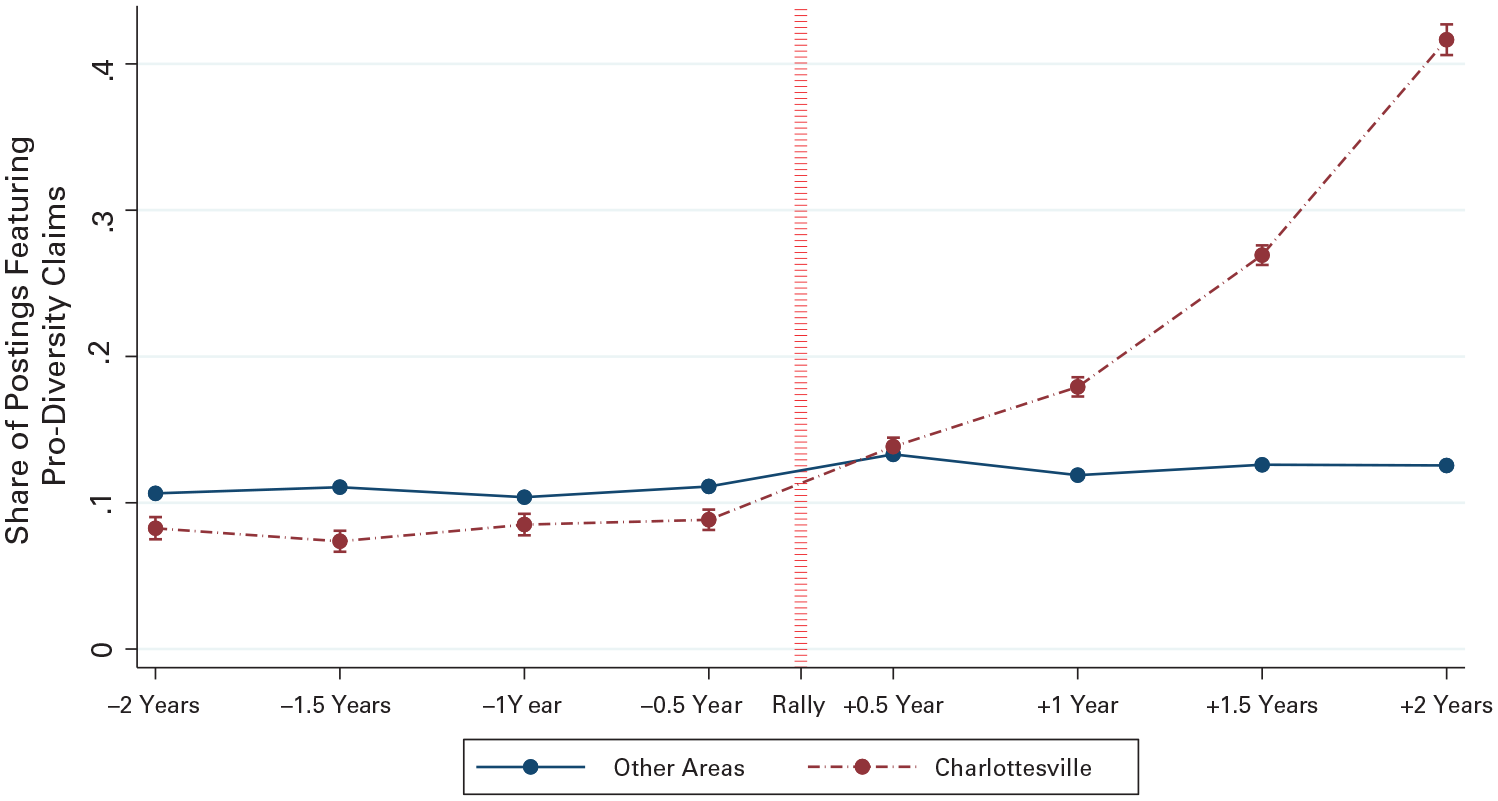
Share of Charlottesville Job Postings Featuring Pro-Diversity Claims*
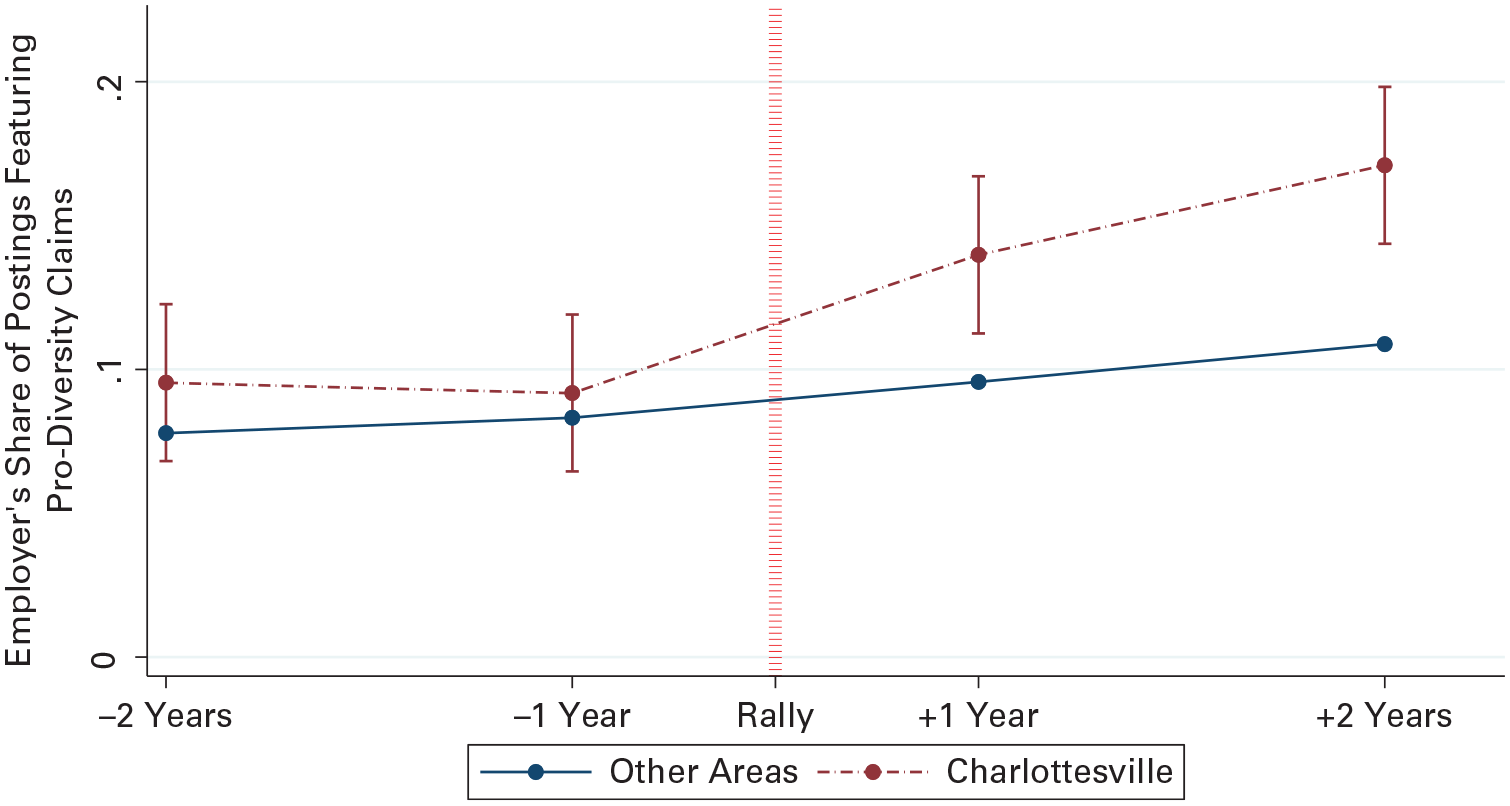
Share of Job Postings in Which Charlottesville Employers Featured Pro-Diversity Claims*
Difference-in-Differences Analysis
I estimated a difference-in-differences model in which I compared the difference in the use rate of pro-diversity claims among job postings in the Charlottesville MSA to the use rate of pro-diversity claims among all other job postings in the pre- versus post-shock periods. Specifically, I estimated,

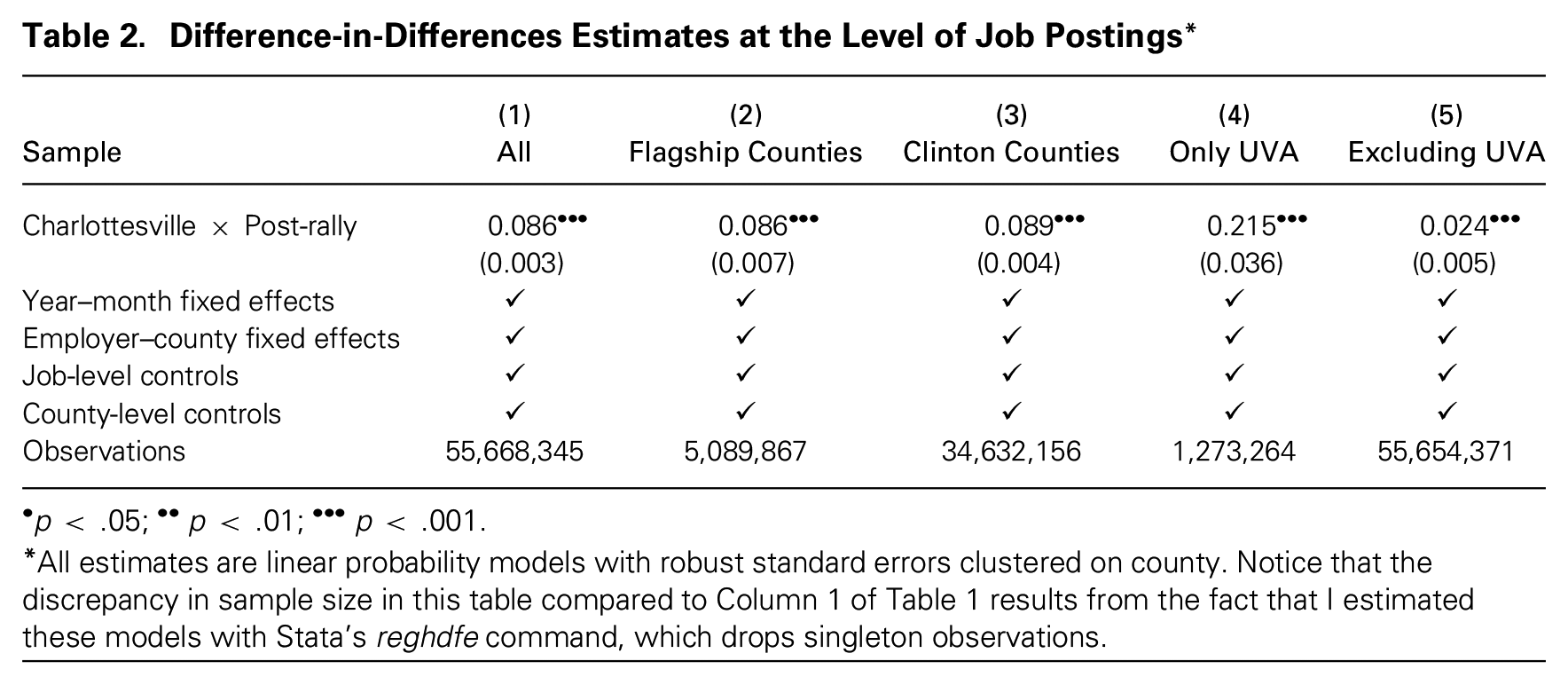
where Diversityi,c,t is a dummy equal to one if a job posting by employer i in county c in year–month t included a pro-diversity claim, Charlottesville×PostRally is a dummy equal to one if the posting was made in the Charlottesville MSA after August 12, 2017, X is a vector of the job- and county-level controls listed above, λi,c are employer–county fixed effects, λt are month–year fixed effects where months are measured in relation to the rally (i.e., August 12, 2017), and ϵ is the error term. β is the coefficient of interest and represents the difference-in-differences estimate of the Unite the Right rally’s effect on the extent to which job postings in the Charlottesville MSA featured pro-diversity claims. I estimated this relationship using a linear probability model with robust standard errors clustered on county. Results, presented in Model 1 of Table 2, illustrate that the estimated treatment effect of the Unite the Right rally on the share of Charlottesville-area job postings featuring pro-diversity claims was 8.6 percentage points (p < 0.001). Relative to the unconditional pre-treatment baseline rate of 8.3 percentage points, this represents a sizeable increase of 104 percent.
Difference-in-Differences Estimates at the Level of Job Postings*
p < .05; ••p < .01; •••p < .001.
All estimates are linear probability models with robust standard errors clustered on county. Notice that the discrepancy in sample size in this table compared to Column 1 of Table 1 results from the fact that I estimated these models with Stata’s reghdfe command, which drops singleton observations.
Evaluating Plausibility of the Parallel Trends Assumption
A key identifying assumption for causal interpretation of this estimate is the parallel trends assumption: in the absence of the Unite the Right rally, the difference between the rate at which job postings in the Charlottesville area featured pro-diversity claims and the rate at which postings in all other areas featured pro-diversity claims would have remained constant from the pre- to post-treatment periods. I conducted three exercises to examine the plausibility of this assumption.
Placebo thresholds
First, I re-estimated the treatment effect at the pre-treatment, placebo dates. I limited the sample to all job postings made in the two years prior to the rally and then re-estimated Equation 1, replacing the true treatment threshold with placebo treatment thresholds at three pre-treatment dates six months apart (February 11, 2016; August 11, 2016; February 11, 2017). These estimates, along with the estimate of β at the true treatment threshold for the full sample, are charted in appendix Figure A5. Although these three coefficients are significantly different from zero, they are all much smaller in magnitude than my estimated effect and in two of the three cases are in the opposite direction.
Time-specific effects
For a second test, I estimated an event-study model to examine whether there was a non-zero trend in the difference-in-differences estimates prior to treatment. Specifically, I estimated,

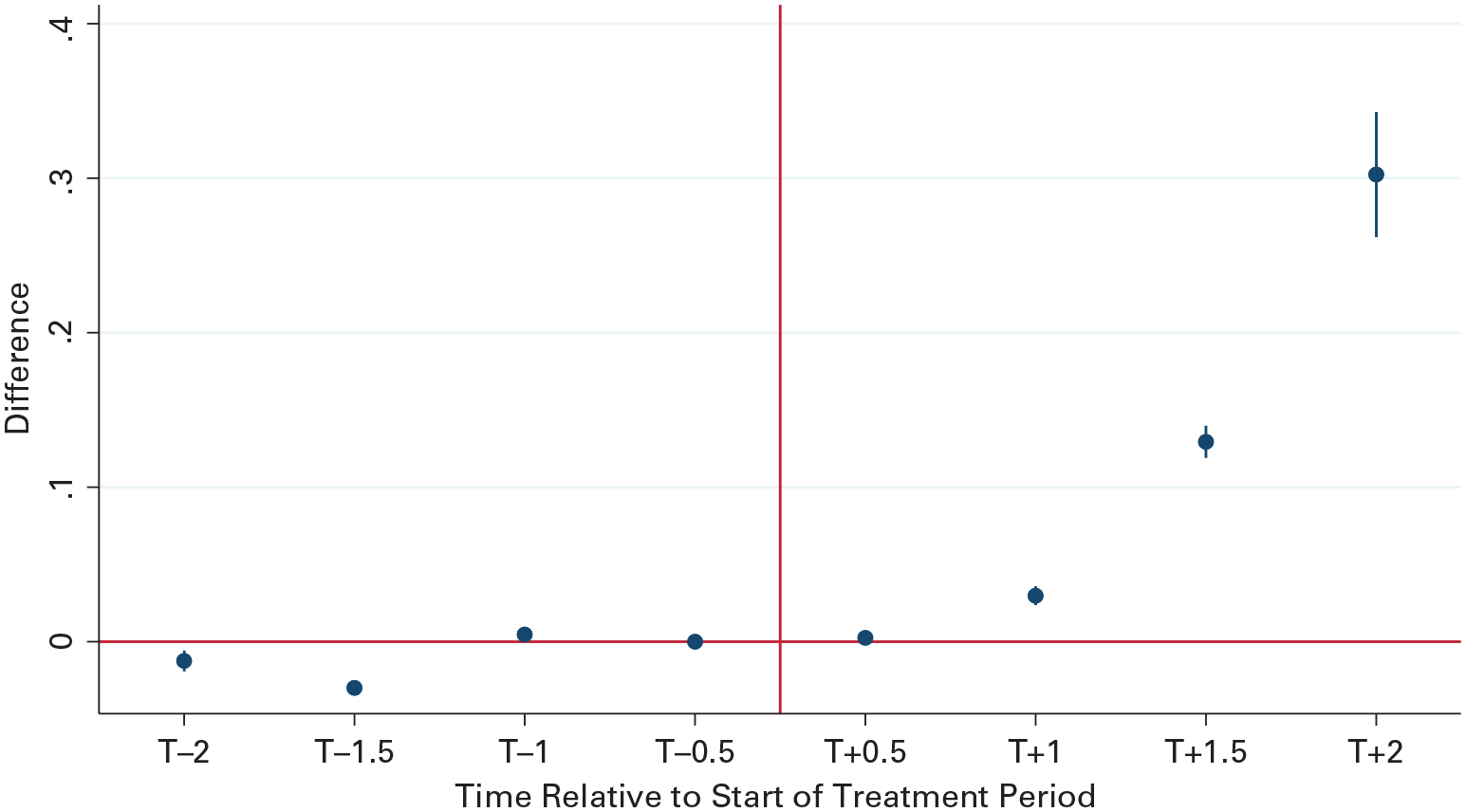
where period represents year dummies equal to one if the posting was made in period k where k∈ [−3, 4] corresponds to each of the eight six-month periods in the study’s time window (meaning k = −3 for entries made between August 12, 2015 and February 11, 2016, and k = 4 for entries made between February 12, 2018 and August 11, 2019). The parameters δk represent the period-specific difference-in-differences estimates. Note that the dummy for k = 0 is omitted so that these estimates are relative to the six-month period before the rally (February 12, 2017 to August 11, 2017). If there were no confounding pre-trends, then the test should not reject the null that δk = 0 for all k < 0. Figure 4 shows these estimates and shows that two of these coefficients are significantly different from zero but are very small in magnitude. I also estimated this event-style model while excluding postings from UVA. Appendix Figure A6 presents these results. In this case, the effects are smaller but also climb in the post-treatment period.
Dynamic Difference-in-Differences Estimates of δ k from Equation 2*
Parallel trends sensitivity analyses
Given the evidence of possible non-zero differences in pre-trends shown in Figure 4, I conducted a sensitivity analysis as suggested in Roth (2021). Roth recommended estimating the robustness of results to the hypothetical non-zero difference in pre-trends that would be detected 50 and 80 percent of the time. Appendix Figures A7 and A8 plot these hypothesized pre-trends relative to the estimates of δk and show that, even allowing for non-zero pre-trends of this size, the post-treatment coefficients
Considering Alternative Control Geographies
In the preceding analysis, the control group includes any job posting made outside of the Charlottesville MSA. A confounding trend or event, however, simultaneous with but separate from the Unite the Right rally, could have systematically increased the use of pro-diversity claims in job postings in a subset of places similar to Charlottesville. To address this possibility, I identified alternative control geographies that, in different ways, are particularly similar to Charlottesville.
Flagship state university counties
First, I identified counties that, like Charlottesville, are home to flagship state universities. Table 1 shows that these areas are more similar than the full U.S. sample to Charlottesville on numerous observed covariates. They may also be similar in important, less observable ways, such as their cultural importance and sensitivity to diversity issues. I re-estimated Equation 1, limiting the sample to postings in this subsample of locations. Model 2 of Table 2 presents the results. The estimated treatment effect in this case
Clinton counties
Second, I identified counties in which, like Charlottesville, a majority of voters supported Hillary Clinton in the 2016 election. This addresses the possibility of a general pro-diversity backlash to Donald Trump’s election in which employers in left-leaning areas augmented their use of pro-diversity claims. I again re-estimated Equation 1, limiting the sample to postings in this subsample of geographies. Model 3 of Table 2 presents the results of this regression. The estimated treatment effect in this case (
UVA versus other higher education institutions
Third, I re-estimated Equation 1 and excluded all Charlottesville-area job postings not made by UVA and all job postings outside of Charlottesville that were not made by colleges, universities, and professional schools. This addresses the possibility of an exceptional upward trend in the use of pro-diversity claims among higher education institutions during my time period of analysis, which, since UVA features so prominently in the Charlottesville labor market, might confound my results. Model 4 of Table 2 reports these results. The effect in this case is large (
Excluding UVA
Fourth, I again excluded UVA job postings and then re-estimated Equation 1. These results are reported in Model 5 of Table 2, which shows that the effect shrinks (
Synthetic control comparison
Finally, I employed the synthetic control method proposed in Abadie, Diamond, and Hainmueller (2010), which involves comparing a treated unit, in this case Charlottesville, with a synthetic control unit created from a weighted average of the untreated units. In addition to providing a way to identify the control group, this method allowed me to address the possibility that because I have few treated units and many control units, errors are heteroskedastic. To execute this approach, I limited the comparison set to job postings in MSAs, collapsed the data to the MSA–month level, and then calculated the weights for the synthetic control, using the geographic-level controls from Equation 1. Appendix Table A7 demonstrates the improvement in balance achieved by this synthetic control method. Figures A11 and A12 illustrate the main result, showing that the difference in the use rate of pro-diversity claims in Charlottesville versus the synthetic Charlottesville rose in the years following the Unite the Right rally. I then conducted the randomization inference method developed by Abadie, Diamond, and Hainmueller (2010). I iteratively applied the synthetic control method to each untreated MSA. A sample of these placebo effects, along with the effects for Charlottesville, is plotted in Figure A13. I then calculated the average mean squared prediction error (MSPE) for each placebo geography across the pre-treatment period, did the same across the post-treatment period, and calculated the percentage of placebo post- over pre-treatment MSPEs ratios that are greater than this ratio for Charlottesville. Figure A14 shows the distribution of this test statistic, which corresponds to a p-value of 0.010.
Employer-Level Analysis
So far, I have treated individual postings as the units of analysis. As I explained above, this approach better captures decisions to make pro-diversity claims but has the potential disadvantages of over-weighting the decisions of larger employers, such as UVA, and comparing different employers in the pre- and post-treatment periods. Accordingly, I repeated my main analysis at the employer level, using a balanced-by-year panel of employer–county dyads. Stated differently, the panel includes employer–county–year combinations in which the employer posted at least one job in that county in each of the four years of my study’s period. Here, the outcome of interest is the share of job postings in a given year in which a given employer in a given county made a pro-diversity claim. I estimated a two-way fixed effects difference-in-differences model,

where DiversitySharei,c,y is the share of job postings by employer c in county i in year y that featured a pro-diversity claim. The parameter of interest, β, represents the effect of the Unite the Right rally on the amount by which Charlottesville employers, on average, changed the share of their job postings that included pro-diversity claims. Results are presented in appendix Table A3. Here, the effect size is smaller (
Stable Unit Treatment Value Assumption Violations
Another identifying assumption in this context is the stable unit treatment value assumption (SUTVA): for my estimates to be unbiased, the rally would have affected Charlottesville exclusively and not spilled into other geographies. SUTVA is likely violated inasmuch as the rally received extensive media attention, plausibly resulting in a broader generalization process wherein job seekers became more inclined to presume anti-diversity stances among employers in locations in addition to Charlottesville. The bias resulting from this violation, however, would likely attenuate the estimated treatment effects inasmuch as, on balance, employers in these other locations, especially those in my alternative control subsets, would similarly tend to rely on left-leaning workers and would thus similarly face incentives to use countervailing pro-diversity claims to combat any spillover presumptions of anti-diversity positions.
Examining the Proposed Mechanism
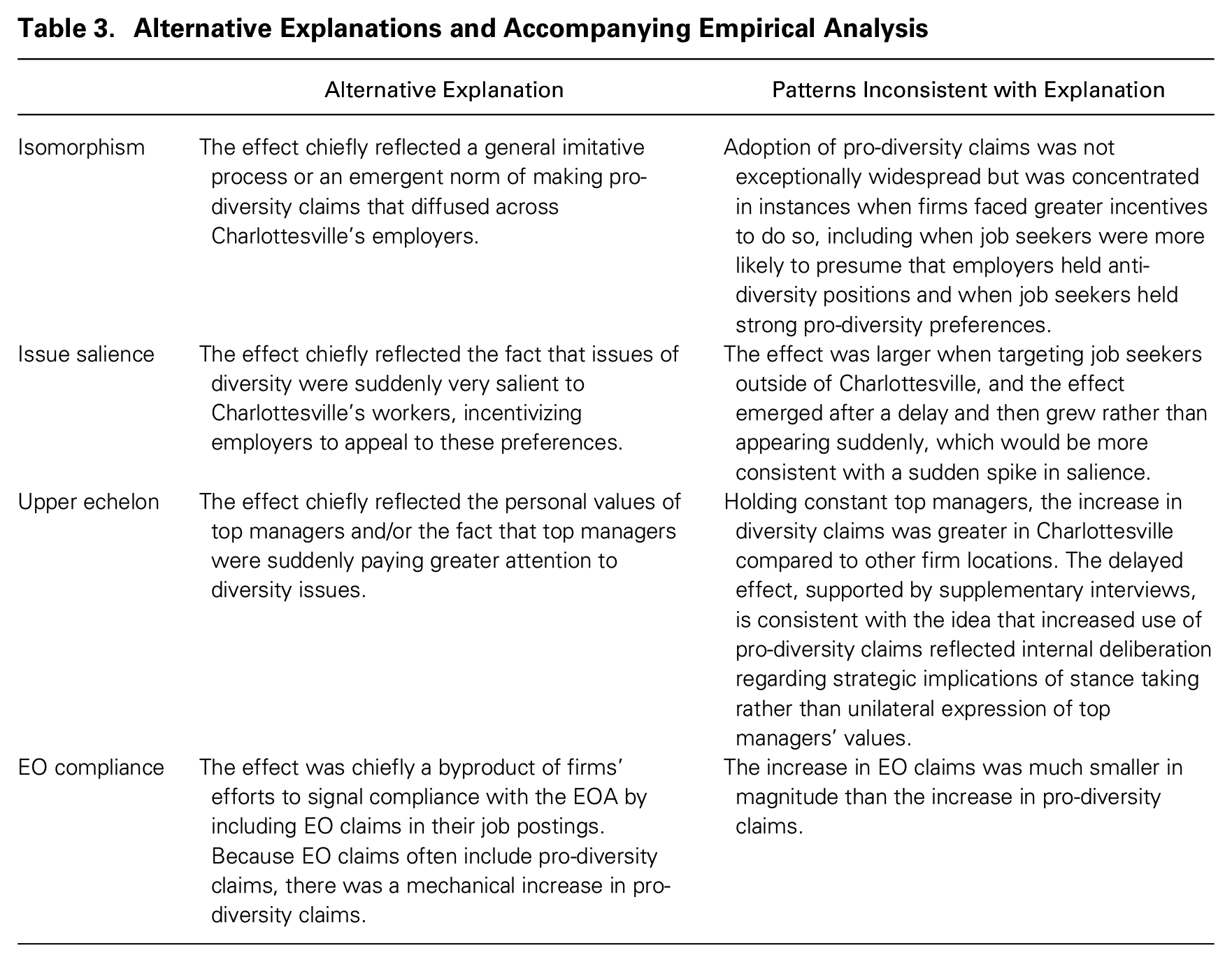
I have proposed that the sizeable increase in employers’ use of pro-diversity claims is a strategic, defensive response by Charlottesville employers meant to countervail the anti-diversity stigma they incurred from their proximity to the Unite the Right rally. But outside of the qualitative anecdotes described above, I cannot directly observe whether this was employers’ motivation for adopting pro-diversity claims. Moreover, my theorized mechanism is unlikely the only motivation for this behavior. In this section, I present a range of empirical patterns that are consistent with my proposed mechanism and less consistent with alternative explanations, including isomorphic processes, increased salience of diversity issues, upper-echelon attitudes, or efforts to comply with the Equal Opportunity Act. Table 3 summarizes these alternative explanations and empirical patterns that are more consistent with my theorized mechanism than with these other explanations.
Alternative Explanations and Accompanying Empirical Analysis
Examining Effects by Headquarters Location
If employers’ adoption of pro-diversity claims was strategic rather than the result of a more general isomorphic process or simply a manifestation of top managers’ values, it should have been greatest among employers most at risk of incurring anti-diversity stigma by association. To test this, I examined whether adoption was larger for employers not only located in Charlottesville but also headquartered there. This differentiates, for example, UVA and the CFA Institute, which are based in Charlottesville, from Bank of America, which has locations in Charlottesville but is headquartered in Charlotte, North Carolina. Since Charlottesville-based employers are more socially proximate to Charlottesville, they plausibly face greater risk of incurring stigma by association and, accordingly, face an outsize incentive to combat this stigma through countervailing pro-diversity claims. I estimated,

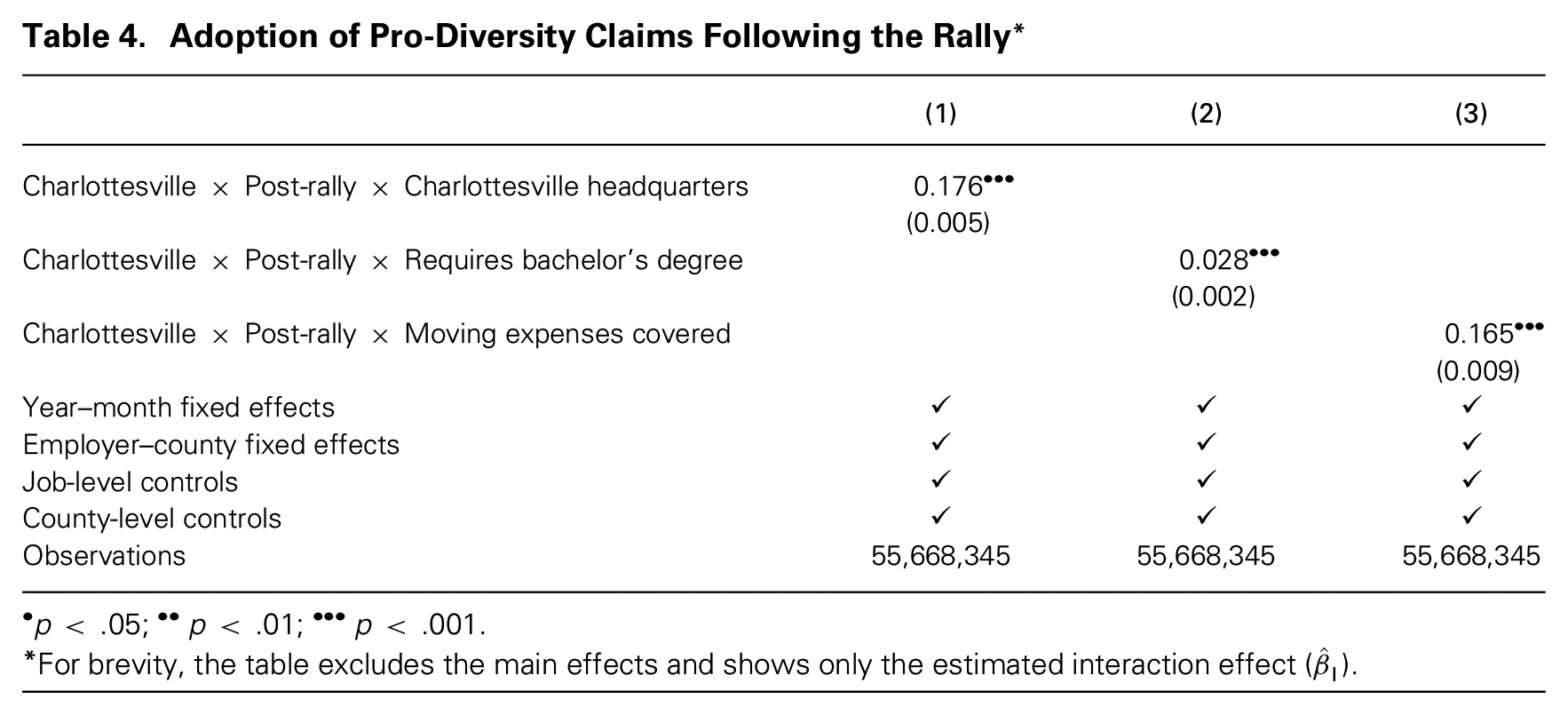
where CVilleBased is a dummy equal to one if the job posting was made by an employer based in Charlottesville. In this case, β1 is the coefficient of interest. These results are presented in Model 1 of Table 4, which shows that the effect of the Unite the Right rally on the use of pro-diversity claims in job postings was significantly larger for Charlottesville-based employers (
Adoption of Pro-Diversity Claims Following the Rally*
p < .05; ••p < .01; •••p < .001.
For brevity, the table excludes the main effects and shows only the estimated interaction effect (
Examining Effects by Target Applicant Pro-Diversity Preferences
I also examined whether the increase in pro-diversity claims in job postings was largest when prospective applicants held the strongest pro-diversity preferences. I tested this by leveraging the fact that bachelor’s-holding job seekers, on average, held significantly stronger pro-diversity views than did their non-bachelor’s-holding counterparts (Parker, Graf, and Igielnik, 2019). This education-based division was starkly visible in the 2016 presidential election, in which non-college graduates went 50/43 percent for Donald Trump, whose campaign became synonymous with anti-diversity positions and who was famously reticent to condemn the Unite the Right rally, while college graduates went 57/36 percent for Clinton (Pew Research Center, 2018).
To run this test, I re-estimated Equation 4 but replaced CVilleBased with a dummy equal to one if the posting indicated that applicants must hold at least a bachelor’s degree. Model 2 of Table 4 presents these results and shows that the effect was significantly larger (
Examining Effects by Geographic Scope of Recruiting
An alternative strategic explanation for the increased use of pro-diversity claims is that the main effects simply reflected firms’ efforts to appeal to Charlottesville’s workers, for whom, due to their proximity to the rally, issues of diversity had suddenly become very salient. If this were the case, the effects should be relatively larger when the geographic scope of recruiting was mostly limited to Charlottesville and smaller when employers sought applicants outside of Charlottesville. My proposed explanation, in contrast, would suggest that these effects would be largest when recruitment efforts focused on prospective employees outside of Charlottesville because those employees were less aware that the rally’s agitators were mostly from outside of Charlottesville, and thus those employees were more susceptible to my theorized generalization process. Multiple Charlottesville-based interviewees substantiated this variation in perceptions, expressing frustration that due to the rally, outsiders had inaccurately associated the community with anti-diversity positions.
To examine this possibility, I estimated heterogeneous treatment effects with respect to whether the job posting included a commitment to cover moving expenses. It is highly plausible that postings featuring these commitments were more likely to seek applicants outside of Charlottesville, compared to those that did not. I re-estimated Equation 4 but replaced CVilleBased with a dummy equal to one if the job posting included a commitment to cover moving expenses.
Model 3 of Table 4 presents the results and shows that the effect in these cases is significantly larger (
Examining Intrafirm Geographic Variation
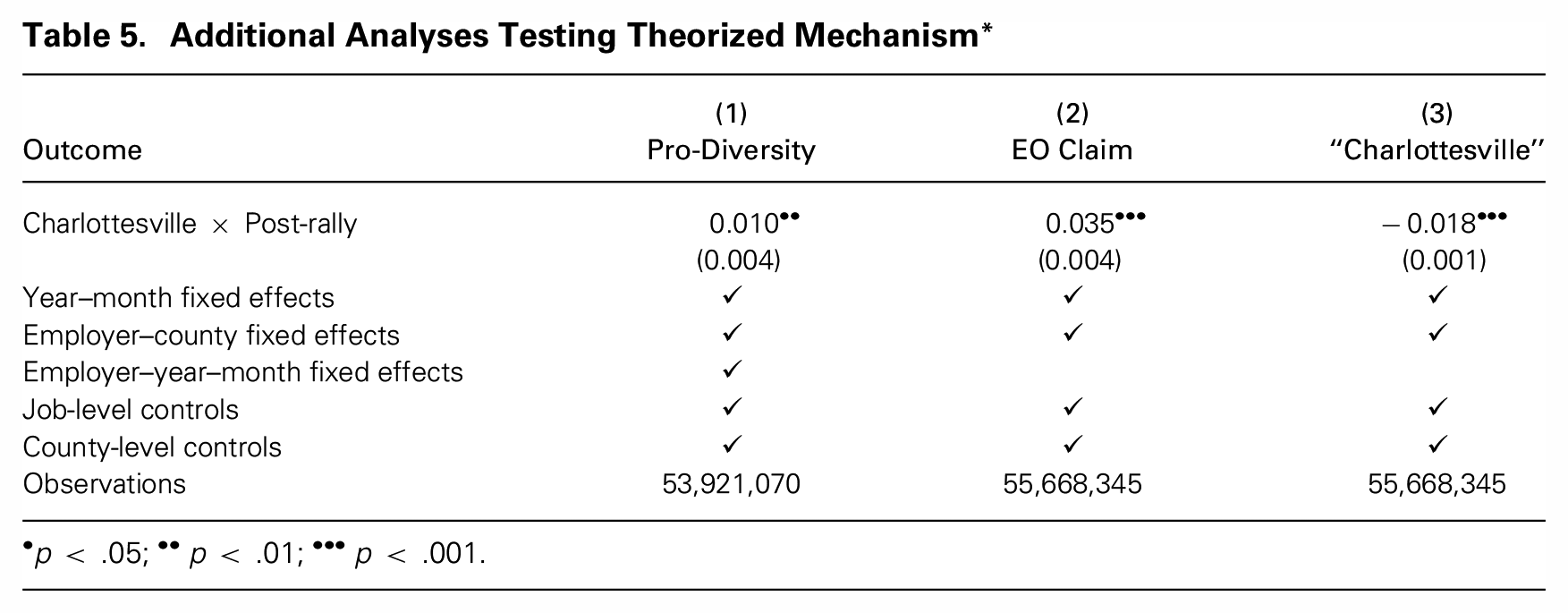
Next, I conducted another test to arbitrate between my theorized strategic explanation and an upper-echelon explanation that would characterize these patterns as an expression of top managers’ pro-diversity beliefs. While holding top managers constant, I examined whether a given employer was more likely to adopt pro-diversity claims in its Charlottesville job postings compared to its postings in other locations. I did so by estimating a version of Equation 1 in which I included company–year fixed effects (in addition to month and company–county fixed effects). This means that postings from employers that posted only in one county do not contribute directly to the estimated effect, which is why I did not feature this in my main analysis. I report these estimates in Model 1 of Table 5, which shows that in this case the effect is smaller but still significant (
Additional Analyses Testing Theorized Mechanism*
p < .05; ••p < .01; •••p < .001.
The Delayed Effect
As shown in the posting-level and employer-level analysis in both descriptive statistics (see Figures 2 and 3) and in difference-in-difference estimates (see Figures 4 and A6 as well as Table A4), the increased use of pro-diversity claims did not arise immediately following the rally but began to materialize after approximately six months and grew throughout the post-treatment period. If the effect had been driven primarily by an increase in the salience of diversity issues within Charlottesville or by top managers’ newfound desire to express their pro-diversity values, it would have been more likely to materialize immediately and then stabilize or diminish as the issue decreased in salience and/or top managers’ attention was drawn to other issues. The delayed effect, in contrast, is more consistent with the idea that the increased use of pro-diversity claims represented a calculated response from employers. First, the delay is consistent with a learning process wherein employers did not immediately appreciate the difficulties the rally had created for their recruiting efforts but, as prospective employees consistently mentioned the rally, began making pro-diversity claims. This learning process was substantiated by multiple interviewees who described their initial surprise when, following the rally, prospective employees began inquiring about employers’ stances on diversity. Second, the delay is consistent with the idea that employers deliberated and debated prior to their decisions to adopt pro-diversity stances. This, too, was substantiated by multiple interviewees.
Significant Non-Adoption
While the increased use of pro-diversity claims represented a substantial shift relative to the pre-treatment use rate in Charlottesville, by the end of the study period, a majority of postings in Charlottesville still did not feature pro-diversity claims. This pattern provides further support for my theorized mechanism. Universal or near-universal adoption of pro-diversity claims would be more consistent with an isomorphic process wherein the Unite the Right rally caused a general diffusion of the practice or initiated a general norm among Charlottesville employers to use these claims. Instead, I demonstrate that the adoption of the practice is selective and concentrated among employers that had the greatest incentive to do so, including those that were more likely to be associated with the Unite the Right rally and were targeting job seekers who held strong pro-diversity preferences.
Examining Equal Opportunity Claims
A separate alternative explanation is that this increase in pro-diversity claims mostly resulted from efforts to signal compliance with the Equal Opportunity Act (EOA), which prohibits employers from discriminating based on race, color, sex, religion, or national origin (Dobbin, 2009). Employers may have feared that the Unite the Right rally made employees, job seekers, regulators, or even the private bar more inclined to seek legal action for perceived discrimination, a possibility consistent with research illustrating that social activism often shapes broader regulatory outcomes (Fremeth, Holburn, and Piazza, 2022). Since Equal Opportunity (EO) claims are often accompanied by pro-diversity claims, an increase in EO claims motivated by a desire to signal compliance with the EOA may have mechanically led to an increase in pro-diversity claims. To examine this possibility, I re-estimated Equation 1 but replaced the outcome Diversity with a dummy equal to one if the job posting included an EO claim. I coded a job posting as including an EO claim if it featured the phrase “equal opportunity,”“equal employment opportunity,” or “eo” as a standalone abbreviation. Model 2 of Table 5 shows a significant increase in EO claims but that this effect was much smaller (
Mentioning Charlottesville in Job Postings
Finally, I examined changes in the extent to which job postings featured the word “Charlottesville.” Although this pattern is somewhat distinct from my theory of countervailing claim-making, a decrease in mentions would be consistent with my broader argument that employers recognized the liability created by their association with Charlottesville and sought to downplay this association in their recruiting efforts. Consistent with this idea, Model 3 in Table 5 shows that there was a significant decrease (
Supplementary Wage Analysis
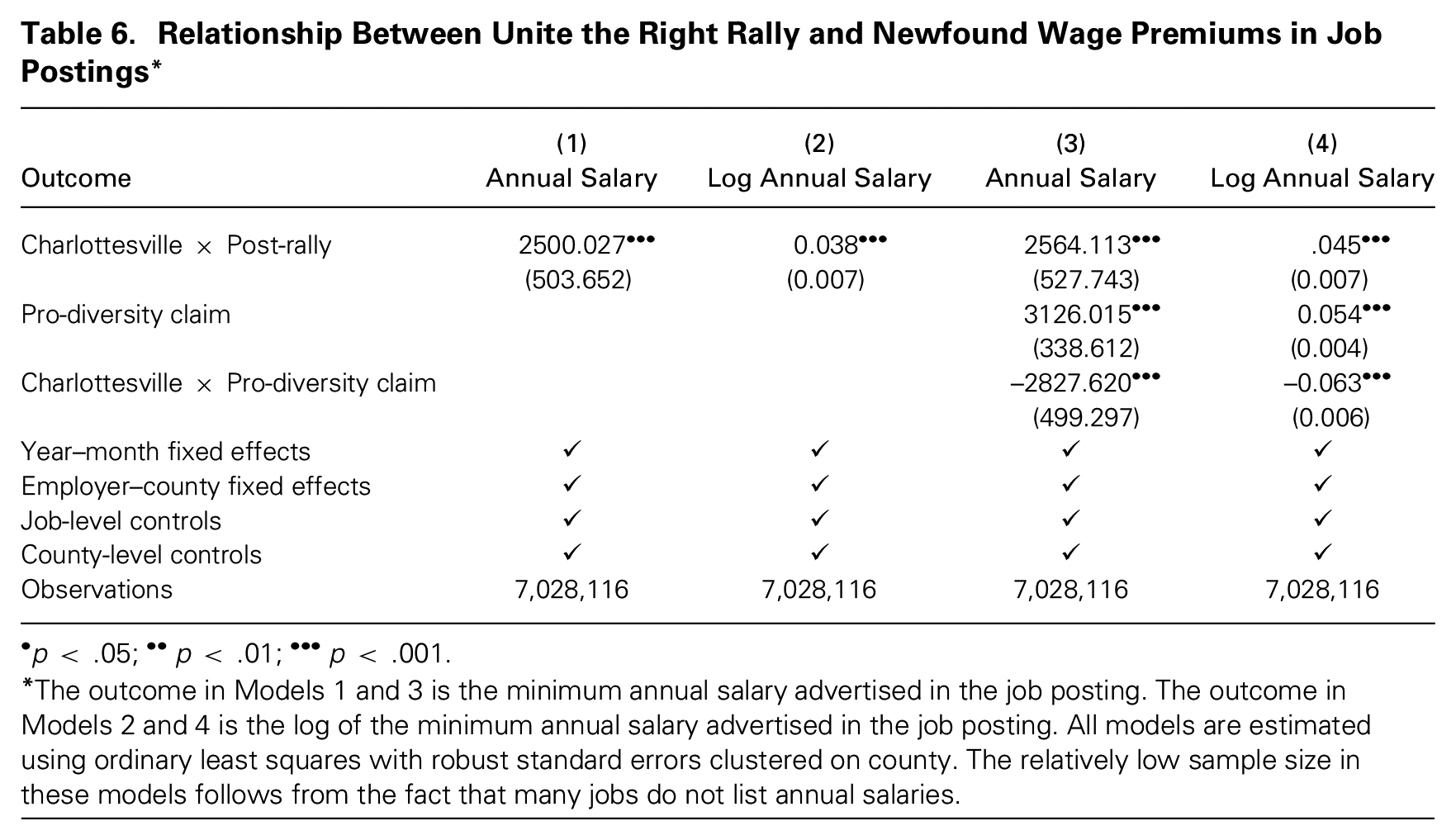
As a supplementary exercise, I examined whether the rally may have made it more difficult for Charlottesville’s employers to attract workers and whether pro-diversity claims ameliorated these difficulties. To examine whether the rally made it more difficult to attract workers, I focused on whether it affected the wages offered by Charlottesville’s employers. A newfound wage premium would be consistent with the idea that employers used higher wages to compensate for job seekers’ diminished inclination to work for them due to their stigma by association with the rally. To estimate the wage premium, I re-estimated Equation 1 but replaced the outcome Diversity with the annual salary listed in the job posting. When the annual salary was expressed as a range, I used the lower bound of this range. These results are presented in Model 1 of Table 6 and show that the rally is associated with a wage premium of $2,500.
Relationship Between Unite the Right Rally and Newfound Wage Premiums in Job Postings*
p < .05; ••p < .01; •••p < .001.
The outcome in Models 1 and 3 is the minimum annual salary advertised in the job posting. The outcome in Models 2 and 4 is the log of the minimum annual salary advertised in the job posting. All models are estimated using ordinary least squares with robust standard errors clustered on county. The relatively low sample size in these models follows from the fact that many jobs do not list annual salaries.
I next examined whether this premium was lower when employers used pro-diversity claims. A lower premium in the presence of pro-diversity claims would be consistent with the idea that these claims assuaged prospective employees’ concerns about the employers’ stances on diversity, allowing employers to substitute them for the higher wages they would otherwise pay to compensate for these concerns. In estimating this relationship, I acknowledge that since pro-diversity claims were not randomized, associations might have been caused by unaccounted-for third factors. The continued inclusion of a rich set of fixed effects and controls mitigates but does not eliminate this risk. I also cannot observe the relationship between different posting characteristics (i.e., salary offered, diversity claims) and whether the employer successfully filled the advertised position. Understanding these limitations, I re-estimated a version of Equation 4 in which I replaced the outcome variable Diversity with the annual salary and replaced the interacted variable CVilleBased with Diversity. These results are presented in Model 3 of Table 6 and show that the use of pro-diversity claims is associated with a significant reduction of the wage premium. Table A8 shows that these patterns are robust to the exclusion of postings by UVA.
Discussion and Conclusion
This article provides a novel strategic explanation for why firms take positions on divisive sociopolitical issues. Drawing on theories of stigma by association, I explained why firms’ proximity to controversial political actors may lead stakeholders to presume that firms silent on sociopolitical issues are misaligned with the stakeholders’ sociopolitical preferences and why firms combat these presumptions by making countervailing sociopolitical claims. I substantiated this theory by showing that after the 2017 Unite the Right rally, Charlottesville’s employers combated presumptions that they shared demonstrators’ anti-diversity positions by adopting countervailing pro-diversity claims in their online job postings. Consistent with my theory, I showed that the adoption of pro-diversity claims was not exceptionally widespread; it occurred most often when employers targeted prospective applicants who were plausibly more inclined to generalize the White supremacists’ anti-diversity positions and who held strong pro-diversity preferences. I showed, moreover, that the rally was associated with a newfound wage premium for Charlottesville-area job postings but that this premium was lower for job postings featuring pro-diversity claims.
Strategic Sociopolitical Positioning
This study advances nascent literature on strategic sociopolitical positioning, or the idea that firms’ sociopolitical positioning represents calculated appeals to stakeholders. It differs from related work suggesting that firms may use social claims to combat negative evaluations arising from their own actions (Elsbach, 1994; Bansal and Clelland, 2004; McDonnell and King, 2013) or to differentiate themselves from their competitors (Mohliver, Crilly, and Kaul, 2023). I demonstrate that certain firms strategically differentiate themselves from non-firm political actors with whom they are associated and whom key stakeholders view unfavorably. Whereas a growing body of both empirical (Burbano, 2021; Hou and Poliquin, 2022; Wowak, Busenbark, and Hambrick, 2022) and theoretical (Melloni, Patacconi, and Vikander, 2023; Mohliver, Crilly, and Kaul, 2023) research has sought to identify when sociopolitical positioning benefits firms, to my knowledge this article provides the first empirical evidence of firms strategically claiming sociopolitical positions. Further elaboration of this strategic perspective requires additional empirical studies that similarly treat firm behavior, rather than stakeholder reactions, as the key outcome of interest. Future studies may seek to theorize how strategic motivations, such as those outlined here and those outlined by Mohliver, Crilly, and Kaul (2023) and Melloni, Patacconi, and Vikander (2023), interact with expressive motivations, such as those identified by Hambrick and Wowak (2021). For example, top managers might generally prefer to express their political beliefs but carefully limit these expressions to instances likely to benefit the firm.
By examining sociopolitical claims in the context of job postings rather than in the public statements commonly examined in past research, this article also demonstrates how a firm’s positioning can be subtle and even tailored to particular stakeholder audiences. Future studies might compare firms’ job posting language with messages to consumers, shareholders, or other stakeholders. Evidence of a focal firm making contrasting claims that correlate with stakeholders’ contrasting preferences would further enrich the strategic view of sociopolitical stance-taking. Such research will benefit by examining novel data. Surveys by Hertel-Fernandez (2018), for example, suggested that in the United States, nearly 50 percent of managers attempt to mobilize their workers politically and 25 percent of workers have had a manager try to mobilize them. Analyzing the internal communications whereby these mobilization efforts occur would provide important insights into sociopolitical positioning. More generally, a fuller account of strategic positioning might clarify whether and/or when stakeholders’ reactions to perceptions of sociopolitical alignment are fundamentally taste-based (i.e., due simply to ideological aversion) or statistical (i.e., due to the belief that the sociopolitical position signals additional firm qualities). Such an account might elucidate, for example, the extent to which firms need to back sociopolitical claims with evidence that they behave in a way consistent with these claims.
Future work may also examine how these practices evolve in the context of growing political polarization. On one hand, growing polarization may generate ever-stronger negative reactions to firms’ sociopolitical stance-taking, which would seem to disincentivize such positioning. On the other hand, growing polarization may lead to greater sorting by political ideology, a possibility suggested by Bermiss and McDonald (2018). Sorting by political ideology would, it seems, incentivize sociopolitical positioning since there would be greater within-firm political homogeneity and, thus, less risk of alienating people on the other side of the position. The result of polarization may thus be an environment in which a shrinking number of firms with politically heterogeneous stakeholder bases deliberately maintain silence while a growing number of firms with politically homogeneous stakeholder bases increasingly speak up.
Human Capital Strategy
This article makes secondary contributions to research on non-pecuniary human capital strategy. Prior research has demonstrated how non-pecuniary firm characteristics can enhance potential applicants’ inclination to apply to jobs (Abraham and Burbano, 2021), increase the amount of effort exerted by workers (Carpenter and Gong, 2015; Burbano, 2021), improve employee retention (Bode, Singh, and Rogan, 2015; Carnahan, Kryscynski, and Olson, 2017; Bermiss and McDonald, 2018), and even reduce knowledge spillovers (Flammer and Kacperczyk, 2019). To date, however, this literature has been largely agnostic on whether firms cultivate these characteristics in an attempt to reap these benefits. To my knowledge, this study provides the first evidence of firms strategically adjusting their human capital strategy in an attempt to align with workers’ exogenously given, non-pecuniary preferences. Moreover, although I provide preliminary evidence that employers tailor their pro-diversity language and seem to do so in strategic ways, future research could do more to theorize and test the conditions under which employers standardize or tailor diversity-related recruitment strategies as well as the effects of these actions. Prior studies, for example, have illustrated how multi-location firms can benefit by delegating product development and advertising responsibilities to local offices that are better positioned to respond to the tastes of local markets. Are there analogous benefits to delegating recruiting strategies to local human resource functions that may be similarly well positioned to appreciate the political preferences in a given labor pool?
Diversity Strategy
By operationalizing sociopolitical positioning with employers’ use of pro-diversity language, this article also relates to literature on workplace inequality and diversity in recruiting (Cobb, 2016; Tolbert and Castilla, 2017; Dobbin and Kalev, 2021; Hurst, Lee, and Frake, 2022). Much of this research has examined organizational practices relating to current employees, such as diversity training, formalization of promotion criteria, and grievance systems (Kalev, Dobbin, and Kelly, 2006; Dobbin, 2009). Diversity claims, in contrast, target prospective employees and have potentially large impacts on who applies to and, ultimately, works at the firm. And while several lab and field experimental studies have demonstrated that these claims may in fact enhance applicant pool diversity (Kang et al., 2016; Abraham and Burbano, 2021; Flory et al., 2021), I provide, to my knowledge, the most comprehensive estimates to date of the extent to which firms actually use these claims. I estimate that in my study’s time frame, 12 percent of U.S. job listings featured pro-diversity claims. Given the ease with which firms can include pro-diversity claims in their recruiting efforts as well as growing public and regulatory pressure for workplace diversity, why is this rate so low? Do employers eschew these claims to avoid accusations of hypocrisy? Do they fear they will be seen as too political? I also present findings consistent with the conclusion that employers perceived as hostile toward minorities may need to pay a wage premium, but that these perceptions and their accompanying wage costs can diminish when employers make pro-diversity claims. Using the data and strategy for measuring pro-diversity claims that I present here, future research can address these questions and more fully illustrate when and to what effect employers use pro-diversity claims in their recruiting efforts.
Locational Stigma and Implications for Integrated Strategy
Finally, this study advances research on stigma by association. Whereas past research has demonstrated how stigmatizing generalization processes disseminate across organizations that share a parent organization (Jensen, 2006; Piazza and Jourdan, 2018), partnership (McDonnell, Odziemkowska, and, Pontikes, 2021), organizational form (Yue, Rao, and Ingram, 2013), or industry (Jonsson, Greve, and Fujiwara-Greve, 2009; Piazza and Perretti, 2015; Naumovska and Lavie, 2021), this article considers how these processes may disseminate due to simply sharing a location with non-firm or even non-organizational actors. This possibility has significant implications for integrated strategy, or the idea that firms enhance the success of their market strategies by undertaking complementary non-market strategies (Holburn and Vanden Bergh, 2014; Barber IV and Diestre, 2019). When, for example, a firm opens offices or acquires a firm in a new location, it exposes itself to possible stigma arising from positions taken by political actors in that location. This study suggests conditions under which these location-based market strategies should be paired with sociopolitical claims in order to combat stakeholders’ perceptions of sociopolitical misalignment.
These integrated strategies are visible in the U.S. in the case of corporate relocations to right-leaning states. Firms including Toyota, Hewlett Packard, and Tesla have recently moved headquarters from left-leaning states, such as California, to right-leaning Southern states, such as Texas. These locations offer attractive tax advantages and a low cost of living. In entering these locations, however, firms risk acquiring sociopolitical stigma resulting from right-leaning positions established by, among other things, anti-trans bathroom bills and abortion bans. Underlining this tension, Fortune magazine reported that although these states provide “pro-enterprise climates,” they are “simultaneously rolling out [right-leaning] laws that are an automatic turnoff to many young, liberal tech workers and force companies into damage control mode” (Leonhardt, 2021). Anecdotal evidence suggests that this “damage control” involves combating right-leaning stigma with countervailing left-leaning sociopolitical claims (Gelles, 2021; Pardes, 2021). Future research might use this context to test whether firms systematically employ countervailing sociopolitical claims to combat sociopolitical stigma arising from mergers, acquisitions, or relocations into right-leaning states.
A Note on Generalizability
The exceptional nature of the Unite the Right rally raises questions about this study’s generalizability. Even though there is surprisingly widespread sympathy with many ideas core to White supremacy (UVA Center for Politics, 2017), such dramatic manifestations are rare. Given the frequency with which politicians, legislatures, courts, electorates, and protesters take positions viewed unfavorably by large populations of stakeholders, however, the strategic behavior I theorize in this paper is plausibly ubiquitous. Numerous anecdotes suggest this is the case. In the wake of Texas’s Senate Bill 8, which codified a strongly pro-life stance on abortion, many Texas-based tech companies made countervailing commitments to women’s and reproductive rights (Pardes, 2021). In the wake of Donald Trump’s 2016 victory, which many saw as revealing the ubiquity of anti-diversity sentiment in the U.S. electorate, many U.S. firms made countervailing commitments to racial, gender, and LGBTQ+ diversity (The Economist, 2017). These and numerous similar contexts, however, present serious impediments to disentangling my theorized explanation from plausible alternative explanations. I overcame these impediments by exploiting idiosyncrasies of the Unite the Right rally. Thus, I leveraged idiosyncrasies of a somewhat unusual empirical context to test a broadly generalizable theoretical mechanism, which is similar to recent work by Favaron, Di Stefano, and Durand (2022). And while I consider the case of human capital and labor markets, my broader theoretical argument plausibly generalizes to stakeholders in product and other-factor markets who, past research has shown, are similarly disposed to allow their political preferences to shape their decisions to reward or spurn firms (McConnell et al., 2018; Chatterji and Toffel, 2019). Examining these additional stakeholder groups, moreover, may illuminate additional conditions under which countervailing claims are more or less likely to arise and/or achieve their intended purpose.
Supplemental Material
sj-pdf-1-asq-10.1177_00018392231203008 – Supplemental material for Countervailing Claims: Pro-Diversity Responses to Stigma by Association Following the Unite the Right Rally
Supplemental material, sj-pdf-1-asq-10.1177_00018392231203008 for Countervailing Claims: Pro-Diversity Responses to Stigma by Association Following the Unite the Right Rally by Reuben Hurst in Administrative Science Quarterly
Supplemental Material
sj-zip-2-asq-10.1177_00018392231203008 – Supplemental material for Countervailing Claims: Pro-Diversity Responses to Stigma by Association Following the Unite the Right Rally
Supplemental material, sj-zip-2-asq-10.1177_00018392231203008 for Countervailing Claims: Pro-Diversity Responses to Stigma by Association Following the Unite the Right Rally by Reuben Hurst in Administrative Science Quarterly
Footnotes
ORCID iD

Supplementary Material
1
2.
Author’s Biography
References
Supplementary Material
Please find the following supplemental material available below.
For Open Access articles published under a Creative Commons License, all supplemental material carries the same license as the article it is associated with.
For non-Open Access articles published, all supplemental material carries a non-exclusive license, and permission requests for re-use of supplemental material or any part of supplemental material shall be sent directly to the copyright owner as specified in the copyright notice associated with the article.
