







Abstract
Drawing on a 2.5-year ethnography of first-time founders in a coworking facility, I shed light on the process by which founders ascribe self-referential meaning to entrepreneurship—that is, how they develop an entrepreneurial identity in situ. I discovered that founders’ use of the coworking space occasioned distinct interaction patterns. Over time, varying interactions played a central role in whether the workspace became a community or remained a mere office space to these founders. Such emergent spatial meanings were coupled with whether founders themselves developed as entrepreneurs or not within their workspace. Founders’ perceptions of the workspace as a community were generally associated with their identifying more as entrepreneurs, while their perceptions of the workspace as an office were usually linked with their identifying less, and even disidentifying, as entrepreneurs. In explaining these dynamics, I contribute to research on identity and space, research on entrepreneurial identity, and broader scholarship on space and interactions in organizations. For first-time founders, the meanings associated with being an entrepreneur can be equivocal, and where they work helps to shape their answers to the questions “What is entrepreneurship to me?” and “Who am I?”
Entrepreneurship is the backbone of the U.S. economy. Entrepreneurial ventures account for an estimated 44 percent of the U.S. GDP and employ approximately 47.3 percent of the private workforce (Small Business Administration, 2019). Given the importance of entrepreneurship (Audretsch and Belitski, 2013; Malecki, 2018), scholars have attended closely to the drivers of entrepreneurial activity, such as new technologies, regulatory changes, and other sociocultural factors (Grégoire and Shepherd, 2012; Eberhart, Eesley, and Eisenhardt, 2017; Kimjeon and Davidsson, 2022).
In the past decade, entrepreneurial identity—founders’ self-referential meanings—has emerged as a primary driver of entrepreneurial activity (Mmbaga et al., 2020). Research suggests that entrepreneurial identity shapes the businesses that founders create (Fauchart and Gruber, 2011; Zuzul and Tripsas, 2020), how founders respond to adversity (Powell and Baker, 2014), how they grow (Mathias and Williams, 2017), and when and how they let go of their ventures (DeTienne, 2010; Rouse, 2016; Mathias and Williams, 2018). Scholars have examined not only venture outcomes associated with entrepreneurial identity but also what entrepreneurial identity comprises, as well as how, when, and why entrepreneurship becomes self-defining (Grimes, 2018; O’Neil, Ucbasaran, and York, 2022).
Yet, questions about where entrepreneurial identity develops, including the possible influence of entrepreneurs’ physical milieu, have largely been overlooked. We know especially little about the relationship between founders’workspaces and their entrepreneurial identity (Radu-Lefebvre et al., 2021). 1 Given the longstanding recognition that identity evolves in situ (Gergen and Gergen, 1988; Cerulo, 1997), it seems important to attend to where entrepreneurial identity unfolds. Echoing these and other foundational understandings of identity as a situated and social accomplishment (Berger and Luckmann, 1966), some organizational scholars have recently pointed to workspace, specifically, as a promising and still underexplored influence on identity (Ashforth, 2016; Ashforth, Caza, and Meister, 2022), particularly when one works independently (Petriglieri, Ashford, and Wrzesniewki, 2019; Howell, 2022). Thus, in this article I ask, what is the situated process by which founders ascribe self-referential meanings to entrepreneurship, or how do they develop an entrepreneurial identity in situ?
I focused on a context in which capturing the unfolding of entrepreneurial identity in situ was possible: a coworking space where many first-time founders congregated (Spreitzer, Garrett, and Bacevice, 2015; Garrett, Spreitzer, and Bacevice, 2017). I conducted a 2.5-year ethnography, tracing longitudinally 67 solo founders working to launch their businesses from the same coworking facility, OfficeCo. As I stayed in the field, it became clear that OfficeCo was more than a convenient background or catchment area. Founders dynamically co-constructed it, along with their self-understandings. Therefore, as is often the case with inductive research (Pratt, 2023), I narrowed my focus to how founders co-construct where they are and who they are.
I discovered that founders’ use of space occasioned distinct interaction patterns that, over time, influenced what the workspace became to these founders: a community or just an office space. These emergent spatial meanings were coupled with how founders themselves developed within their workspace: as entrepreneurs or not as entrepreneurs. Founders who perceived the workspace as a community generally identified more as entrepreneurs, and those who perceived the workspace as only an office generally identified less as entrepreneurs or even disidentified as such. Based on these findings, I explain why and how the founders in my sample, from a shared sense of ambiguity associated with doing entrepreneurship and high entrepreneurial ambitions, came to distinct workplace and identity understandings. In theorizing that the development of my informants’ entrepreneurial identity was closely coupled with the construction of their workplace from a common workspace—or with the process by which they filled their workspace with distinct meanings (Gieryn, 2000)—I contribute to scholarship on space and identity, entrepreneurial identity, and space and interactions in organizations.
Identity as a Situated Process of Meaning-Making
Entrepreneurial Identity
Entrepreneurial identity comprises the meanings that founders attach to who they are (Powell and Baker, 2014; Crosina, 2018; Ajay, Vough, and Oliver, 2023). As research suggests, these meanings vary in relation to the social groups and the roles that founders take as self-defining, also known as identity referents (Pratt, 2000). To illustrate, Fauchart and Gruber (2011) suggested that founders adhere to one of three social identity types, communitarians, missionaries, or Darwinians, based on distinct identity referents. Communitarians rely primarily on their community as the basis for self-definition, missionaries on broader society, and Darwinians on their competitors. Roles often invoked as identity referents include inventor (Cardon et al., 2009), user (Shah and Tripsas, 2007), innovator (Hoang and Gimeno, 2010), developer (Cardon et al., 2009), and manager (Mathias and Williams, 2017). Moreover, founders may take their own ventures as primary bases for their self-definition (Wagenschwanz and Grimes, 2021).
Extant definitions of entrepreneurial identity reflect this variation in the referents founders use to define themselves. To illustrate, Murnieks and colleagues (2014: 1589) defined entrepreneurial identity as “individual sets of meanings and behaviors that define those individuals when enacting an entrepreneurial role.”Hoang and Gimeno (2010: 42) referred to entrepreneurial identity as “an individual’s thoughts, feelings, and beliefs about oneself in the founder role,” and Kašperová and Kitching (2014: 438) cited “a set of concerns emergent from the embodied practices of agents committed to new venture creation and management in relation to their natural, practical, and social environments.”
Reflecting on the reasons for such broad-ranging definitions, Ajay and colleagues (2023: 5) noted that “the meanings underlying the [very] label [entrepreneur] are not shared.”Anderson and Starnawska (2008: 222) characterized entrepreneurship as “fuzzy and open to varied interpretations.” Thus, variation in these definitions relates at least partly to the nature of entrepreneurship, which is not “backed by licensing, professional associations, and other forms of support available to professionals” (Ajay, Vough, and Oliver, 2023: 3–4). Because their jobs are not externally imposed (Grant, Berg, and Cable, 2014), entrepreneurs have ample latitude over how they define who they are (Berry and Sanchez, 2019).
Variation in what founders define themselves in relation to implies that their identities require identity work: ongoing efforts toward “forming, repairing, maintaining, strengthening or revising the constructions that are productive of a sense of coherence and distinctiveness” (Snow and Anderson, 1987; Sveningsson and Alvesson, 2003: 1165). Understanding founders’ identity work is important because entrepreneurial identity ties closely to entrepreneurial thought and action (Lounsbury and Glynn, 2001). Notably, the meanings founders adopt as self-defining shape the market opportunities they pursue, the kinds of customers they serve, and the resources they deploy to develop business ideas into ventures (Fauchart and Gruber, 2011). As founders continue building their ventures, these self-referential meanings help them gain resources (Lounsbury and Glynn, 2001), evaluate and respond to opportunities in their respective environments (Zuzul and Tripsas, 2020; Foy and Gruber, 2022), and manage issues of growth and adversity (Powell and Baker, 2014; Mathias and Williams, 2018).
Research on identity work in entrepreneurship highlights the fluidity of founders’ self-referential meanings, suggesting for example that founders’ self-definitions can evolve in relation to founders’ ongoing efforts to align their personal identity with their ventures (O’Neil, Ucbasaran, and York, 2022) and that feedback can catalyze revisions in founders’ self-understandings (Grimes, 2018). This research tends to assume that founders have an entrepreneurial identity they are working from, which may not be the case for first-time entrepreneurs. In addition, this scholarship is elusive about the situated mechanisms and contextual influences that undergird founders’ identity development (Radu-Lefebvre et al., 2021), and it is particularly vague in this regard when founders have no established venture or clearly defined role(s) yet as referents for their identity (Crosina, 2018).
Developing Identity: Insights from Identification and Identity Work
Although not focused on founders or entrepreneurial identity per se, broader research on identification (Ashforth, 2016; Ashforth and Schinoff, 2016) and identity work (Brown, 2015; Lepisto, Crosina, and Pratt, 2015; Caza, Vough, and Puranik, 2018) in management and other disciplines offers helpful cues on mechanisms and influences that may also undergird entrepreneurs’ identity development. The latter highlights the agency that individuals exercise in developing (i.e., defining, maintaining, or changing) their identities (Snow and Anderson, 1987; Alvesson and Willmott, 2002; Caza, Vough, and Puranik, 2018). The former emphasizes why and how a given other becomes self-defining (Pratt, 2000; Ashforth, Harrison, and Corley, 2008).
With respect to why, one generally identifies with a given other—also known as a target or referent—as a means of reducing ambiguity. Identification helps individuals find order in their world by establishing in-groups and out-groups and by reducing uncertainty “through the deeper meanings provided by the collectives they associate with” (Ashforth, Harrison, and Corley, 2008: 336). Additional needs that identification helps to fulfill include self-knowledge, or locating the self to define the self, as well as self-affirmation and self-coherence, among others (Ashforth and Schinoff, 2016). Importantly, identification promotes self-enhancement, fit, and belonging (Ashforth, Harrison, and Corley, 2008). The degree to which individuals see a given identity referent as self-defining—also known as the strength of their identification (Cardon et al., 2005; Rouse, 2016)—is based on the degree to which they see that referent as meeting their specific needs (Ashforth and Schinoff, 2016). Identification strength matters because it motivates behavior, such that the greater the identification, the greater the effort and energy toward enacting behaviors that are consistent with a given referent (Brewer and Gardner, 1996; Brickson, 2013).
With respect to how identification occurs, meaning-making is a precursor: before taking a given target as self-defining, individuals must understand what that target is or stands for (Pratt, 1998, 2000). Based on these insights, founders need first to establish for themselves what entrepreneurship is and then to assess what entrepreneurship is to them.
Within established organizations and professions, such meaning-making is guided by shared socialization and training (Pratt, 1998; Ashforth and Schinoff, 2016), including by protracted exposure to given identity referents through team and role assignments (Ibarra, 1999; Pratt, 2000). In addition, organizations and professions traditionally offer workspaces where their members can congregate, which promote ongoing exposure to given identity referents, and provide an array of artifacts and symbols that organizational members may leverage to express their identities (Elsbach, 2003; Elsbach and Pratt, 2007). For example, Campbell and colleagues (1970) noted that managers relied on physical office features such as floor-to-ceiling walls and doors to convey their role identities (Zalesny and Farace, 1987; Shortt and Warren, 2012), and Elsbach (2003) found that by personalizing their desks, organizational members conveyed who they were, even when hoteling.
However, in the absence of curated and readily available social and physical raw materials, and given the varying nature of entrepreneurship itself, founders must devise other ways to ascribe self-referential meanings to entrepreneurship (Crosina, 2018; Ajay, Vough, and Oliver, 2023). Given that identity meanings develop in situ through interaction (Cooley, 1902; Mead, 1934; Blumer, 1969; Cerulo, 1997), starting from where founders work and those with whom they engage appears to be a promising angle to understand how they might ascribe self-referential meanings to entrepreneurship (Radu-Lefebrve et al., 2021).
Honoring this longstanding conceptualization of identity as a situated process of meaning-making (Berger and Luckmann, 1966; Gecas and Schwalbe, 1983), identity work research has started to nudge the idea that the built environment grounds identity (Ashforth, Caza, and Meister, 2022; Howell, 2022). In particular, Petriglieri, Petriglieri, and Wood (2018: 480) indicated that “how people conduct identity work is closely tied to where they do it” (see also Petriglieri and Petriglieri, 2010). Corroborating this insight, Petriglieri, Ashford, and Wrzesniewski (2019: 143) suggested that independent contractors’ workspace helped these individuals to “confine and evoke their working self.”
Yet, much identity research that considers workspace still treats space as a mere reflection of one’s identity as already established based on the social groups to which one belongs or the role(s) one occupies. Workspace has generally been seen as only “a symbolic medium for the expression of . . . identity” (Sundstrom and Sundstrom, 1986: 194). To illustrate, Zalesny and Farace (1987) expressed that physical settings in organizations bring visibility to workers’ affiliations and roles and, in so doing, help communicate their identity. Similarly, Shortt and Warren’s (2012) research on hairdressers vividly illustrated treatments of workspace as an identity mirror. In describing scuffmarks on the floor of their salon, a hairdresser in their study commented, “This is me! This is all my hard work over the years” (Shortt and Warren, 2012: 27).
Space and Interactions as Identity Raw Materials
But if identity comprises a situated social process of meaning-making (Cooley, 1902; Mead, 1934; Blumer, 1969; Cerulo, 1997), treating workspace as just an identity mirror negates social and processual aspects inherent to the very definition of identity. To better understand these aspects, particularly how physical space influences interactions, I selectively turn to a multi-disciplinary body of scholarship in geography, social psychology, and sociology that has attended to space as it relates to interactions.
This research distinguishes between the terms space and place, suggesting that “what begins as undifferentiated space becomes place as we get to know it better and endow it with value” (Tuan, 1977: 6). “Place . . . refers to space that has been given meaning through personal, group, or cultural processes” (Low and Altman, 1992: 5). Through interactions with others, a physical site acquires meaning (Prengler, Klotz, and Murphy, 2020). Some scholars use the terms place and built environment synonymously to indicate the “physical surroundings given meaning through interaction” (Milligan, 2003: 382).
Actors generally control the social construction of their built environment, yet they are also constrained by its physical construction (Milligan, 1998), particularly by the extent to which space design and layout facilitate access to others (McBride and Clancy, 1976). When artifacts such as hallways, staircases, and elevators allow for repeated and unplanned interactions, friendships and collaborations are likely to form. In their foundational study of dorm residents, Festinger and colleagues (1950) showed that those who lived close to one another were more likely to establish friendships than those who did not. Similarly, Allen (1977) found that the layout of a research and development facility played a critical role in the dissemination of knowledge among engineers; physical space that brought engineers in close proximity allowed for repeated exchanges among neighbors, which fostered their knowledge sharing over time.
Research that builds on these foundational studies has proliferated, with a focus on how physical space shapes interactions in established organizations. Kabo and colleagues (2014) showed that building design promoted exchanges among scientists, which in turn encouraged their propensity to collaborate and even to secure grant funding. Chown and Liu (2015) found that seat proximity among U.S. senators influenced not only their relationships but also the likelihood of their bill co-sponsorship. Lee (2019) showed that when workspace rearrangements promoted greater proximity, colleagues were more likely to form close connections that led to the elaboration of new ideas through increased knowledge sharing.
The architecture of a given space, including its accessibility and size, influences not only the opportunity for interaction but possibly also “the social obligation for interaction within it” (Fayard and Weeks, 2007: 619). Indeed, Fayard and Weeks (2007) noted that colleagues standing by the photocopier almost felt obliged to engage with one another. Their interactions varied in depth and content, from small talk to work-related topics, but through varied exchanges in the photocopier room, they generally learned more about one another. Elsbach and Bechky (2007) also observed that office design, as well as specific objects within an office space, can spur conversations. They found that adding a whiteboard in an open office promoted idea exchange and learning among colleagues. Thus, physical space and its artifacts can encourage engagement and idea exchange, as well as organizational members’ learning about each other through interaction.
In addition, some scholars have recognized that space itself may comprise an ongoing accomplishment instead of being a mere enabler or container of social exchanges (Fayard, 2012; Farin, 2020). Following her observations of individuals experiencing an art installation, Fayard (2012: 178) concluded that space is “constantly constructed,” as it dynamically “emerges from the relationships and practices of people living, working, and interacting.” This view of space implies a coupling or entangling (Orlikowski, 2007) of physical features (such as walls and hallways) with social practices. Yet, because management scholars have tended to study physical and social environments independently, there is still much to understand about space as “jointly physical and social in its influence” (Fayard and Weeks, 2007: 629; Petriglieri, Ashford, and Wrzesniewski, 2019; Fayard, Weeks, and Khan, 2021).
Taken together, these findings indicate that identity meanings develop in situ through interaction (Cooley, 1902; Mead, 1934; Blumer, 1969; Cerulo, 1997), and the built environment is central to interacting (Milligan, 1998; Fayard and Weeks, 2007; Fayard, 2012). Given the centrality of situated interactions in the development of one’s identity meanings, it is important to attend to both space and situated interactions to begin understanding how founders ascribe self-referential meanings to entrepreneurship. This focus seems particularly appropriate in the absence of organizationally sanctioned “identity raw materials.”
Methods
In this article, I focus on the situated process by which founders ascribe self-referential meanings to entrepreneurship, or how they develop an entrepreneurial identity in situ. The overall dearth of scholarship on this topic, as well as its processual nature, made qualitative methods appropriate (Creswell, 1998; Langley et al., 2013). I conducted an ethnographic study that captures the situated behaviors, developing meanings, and self-claims of 67 solo founders who were working toward launching their ventures from the same workspace.
Context
Because self-relevant meanings develop through situated social interactions (Berger and Luckmann, 1966; Brown, 2015), I found a context in which I could capture the unfolding of such interactions and meanings. I chose a space where many first-time founders congregated, a coworking facility with a high concentration of such founders: OfficeCo (pseudonym). This choice was aided by the emerging recognition that coworking facilities are a germane context in which to investigate identity dynamics (Spreitzer, Garrett, and Bacevice, 2015; Garrett, Spreitzer, and Bacevice, 2017), particularly among early-stage founders (Petriglieri, Ashford, and Wrzesniewski, 2019; Howell, 2022).
At the time of data collection, OfficeCo had all the features one might expect to find in a coworking facility, such as 24/7 secure building access, a check-in/administrator’s desk, kitchens, conference rooms, and recreational areas (Spreitzer, Garrett, and Bacevice, 2015). As such, it constituted a prototypical case of a coworking space (Yin, 2003). Like members of other coworking facilities, entrepreneurs at OfficeCo did not need to demonstrate specific venture-related milestones to be admitted. Rather, they had only to pay rent to use the facility. And unlike accelerators, which admit cohorts of high-potential entrepreneurs for set periods of time and offer them education and training (Cohen, 2013; Hallen, Bingham, and Cohen, 2014), OfficeCo provided only office space and access to social events as long as members paid rent (Spreitzer, Garrett, and Bacevice, 2015).
Data and Sample
As is typical with ethnographic studies, my fieldwork included both observations and interviews. I observed 67 first-time founders based at OfficeCo for a period of over 2.5 years, with intermittent breaks to analyze my data. I also interviewed these founders longitudinally to capture their evolving perceptions and self-understandings, as well as to gain details and clarity about the patterns I noticed in my observations.
Prior to collecting any data, I obtained formal consent from OfficeCo by signing an agreement with the management team, and I gathered formal consent from each informant. My agreement with OfficeCo included permission to recruit founders to participate in interviews and observations. The management team did not provide specific information about OfficeCo founders, such as age, tenure at OfficeCo, or prior background and work experience. I discovered this information in the process of personally meeting and recruiting informants.
Semi-structured interviews
Because my goal was to build theory, I based my sampling on theoretical logic (Glaser and Strauss, 1967). I selected first-time founders working at OfficeCo, excluding experienced entrepreneurs and others such as dislocated workers affiliated with established organizations, because their situations presented considerations beyond my focus, such as organizational membership and prior entrepreneurial experience, including successes and failures. Table 1 provides additional information about the informants I quote in the article; to find similar information about my full sample of informants, see Table A1 in the Online Appendix.
Information per Informant
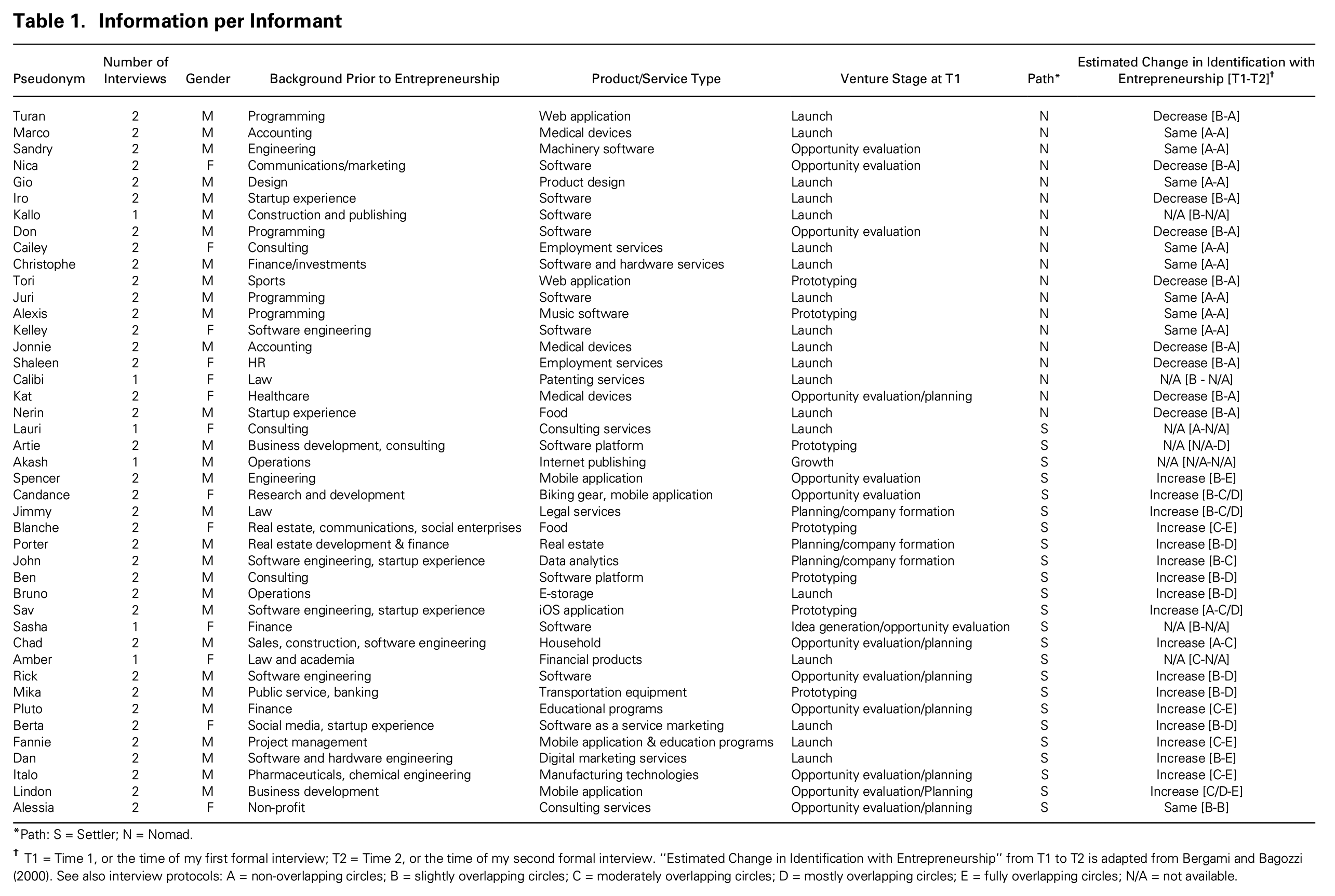
Path: S = Settler; N = Nomad.
T1 = Time 1, or the time of my first formal interview; T2 = Time 2, or the time of my second formal interview. “Estimated Change in Identification with Entrepreneurship” from T1 to T2 is adapted from Bergami and Bagozzi (2000). See also interview protocols: A = non-overlapping circles; B = slightly overlapping circles; C = moderately overlapping circles; D = mostly overlapping circles; E = fully overlapping circles; N/A = not available.
To identify individuals who fit my sampling criteria, I started working at OfficeCo. In doing so, I personally met and recruited informants one by one. I recruited informants on a rolling basis when I sat next to them, soliciting interviews only after we became acquainted with one another. Based on what they shared with me during our interviews or what I could reasonably infer based on our conversations, I learned that there was variation in their tenure at OfficeCo at the time of our first interview. I estimate that informants’ tenure ranged from less than one month to slightly over two years and that on average it was about one year. I was attentive to my informants’ arrival time and gathered real-time data for informants who had recently arrived at OfficeCo. I asked those who had been at OfficeCo for some time prior to their first interview to reflect on their initial motivations for joining OfficeCo and on their views of the space when they arrived, rather than expressing their in-the-moment perceptions.
To the extent possible, I formally interviewed my informants twice, leaving approximately 6 to 12 months between the first and second interviews. 2 I chose this interval because existing socialization research suggests that a 6- to 12-month time frame may be appropriate to capture possible variation in how individuals relate to their work (Brown, 1985; Bullis and Bach, 1989). In addition, early-stage entrepreneurial ventures go through significant changes quickly, which might affect how founders see themselves, as well as how they think and act (Shepherd, Souitaris, and Gruber, 2021). This approach allowed me to gain appreciation for the evolution of my informants’ experiences and opinions, including their unfolding self-understandings, and to collect data in the second wave of interviews that built on key themes from the first wave.
I conducted a total of 116 formal interviews: I interviewed 49 founders twice and 18 founders once (see Table 1). All interviews were recorded digitally and transcribed for analysis. Interviews ranged from 50 to 90 minutes in length. I stopped recruiting once I determined that adding informants would have unlikely expanded my developed understandings. In practice, this meant that themes from the first wave of interviews began to cohere, and I was not learning new information during my last interviews (Glaser and Strauss, 1967; Charmaz, 2006).
Again, as is typical in ethnographic studies (Bechky, 2020; Anthony, 2021), informal conversations with the 67 founders continued throughout my time in the field. I also conducted member checks (Lincoln and Guba, 1985) with 46 informants. During these additional touch points near the end of my time in the field, I shared preliminary findings. In return, informants offered comments and insights that helped me refine my theorizing. These member checks also gave me an opportunity to pose clarifying questions and helped me to ensure that my theorizing reflected as faithfully as possible my informants’ experiences. Importantly, they also helped me to assess theoretical saturation: to realize that conducting additional interviews was unlikely to expand my developed understanding (Glaser and Strauss, 1967; Charmaz, 2006).
Drawings
My data set includes drawings and accompanying narratives of my informants’ workspace that they generated during our interviews. By capturing individuals’ understandings of their workspace over time, such drawings complemented insights from my interviews and observations. Specifically, the process of drawing elicited “different and richer responses from the interviewee” that helped me “gain insights into their lifeworlds, experiences, and identities” (Meyer et al., 2013: 515–516). As others have also found, drawing can help informants reflect on and open up about various aspects of their work environment that may otherwise be difficult to express and capture (Shortt and Warren, 2012; Clarke and Holt, 2017). For example, my informants described physical aspects of their workspace, including features of their work environment (e.g., type of desks, walls, doors) that mattered to them, as well as how and why. Over time, these drawings also allowed me to see OfficeCo as emergent and constructed rather than static or assumed.
Most informants completed two drawings in conjunction with their two formal interviews. After each had completed and described their second drawing, I showed them their first drawing and asked them to comment on similarities and differences between the two. These efforts led to a total of 88 drawings. The number of drawings does not match the number of interviews because I began asking informants to draw only as I started recognizing the importance of workspace for their self-definitions. Thus, as is typical for inductive qualitative research, I modified my interview protocol over time to help informants voice their experiences and to align my questions to my emerging theorizing (Spradley, 1979). Illustrative questions for each interview protocol appear in Online Appendix I.
Observations
During my time in the field, I was at OfficeCo as often as four days per week and at least one day per week. I also attended several social gatherings open to OfficeCo members. I mirrored my informants’ behaviors with respect to when and how I shared my identity as a researcher. In particular, I explained my background and the scope of my presence at OfficeCo when I met and talked to them individually, rather than broadcasting this information in a way that could disrupt the social norms at OfficeCo. This is when I began formally recruiting informants for my study.
As with other ethnographers (Spradley, 1979; Barley, 1990), it took me some time to figure out what to observe and what not to observe, as well as how. As a result, borrowing Whyte’s words (1984: 27), some days in the field “yield(ed) little data of lasting value”; it took “time to fit into the scene, adjust to people, gain acceptance, and begin to understand what was going on.” However, my protracted immersion in the research context was crucial to completing this research, not only for recruiting participants but also for gaining an understanding of the social dynamics in the space, their evolution over time, and my informants’ evolving uses of their workspace. In addition, this immersion facilitated the process of establishing trust and rapport, which is critical to collecting rich and robust qualitative data (Charmaz, 2006). The following comment from one informant suggests the rapport I built at OfficeCo: You use a ThinkPad and I think that’s really the only thing that makes you stand out. If you got a Mac, you’d be just like everyone else because your mindset is very similar to everyone else’s. So being around you is like being around other entrepreneurs, they have their ups and downs . . . you’re never going to make a lot of money, and you will spend many years trying to get somewhere. So we are in very similar positions. (Mika)
To remain open to emerging themes, I initially adopted a largely unstructured approach in conducting observations (Spradley, 1979). I paid attention to the nature and frequency of exchanges among space occupants (neighbors and beyond), their movements within the space, as well as their appropriation (or lack thereof) of a range of common artifacts, including but not limited to computer monitors, meeting rooms, white boards, and chairs. I also changed my position in the space to observe people as they moved around. My observations over time became more focused on understanding how space occupants related to one another, how they talked with others about themselves and the work they did, and how they used the range of artifacts such as whiteboards, monitors, and various types of desks at OfficeCo. These efforts led to approximately 900 hours of observations over the 2.5-year period. I captured my observations in field notes during, or at the end of, each day at OfficeCo.
Analytic Approach
To start, I laid out my data by person, longitudinally (Langley et al., 2013) based on both my real-time data and the narrative causality expressed by my informants. Doing so helped me appreciate how data patterns unfolded. I traced why informants chose OfficeCo, why they stayed, how they described OfficeCo, how and why they (re)selected their seat within OfficeCo, what they did in the space, and how they defined themselves and those surrounding them over time. I also coded how they connected with their proximal others, such as through brief exchanges or lengthy conversations, as well as how these dynamics evolved, including in relation to their propensity for choosing the same seat or switching it. For example, when I first interviewed Ben, he portrayed OfficeCo as a convenient workspace. By the time of our second interview, his descriptions emphasized other entrepreneurs and a developing sense of community. Associated with these evolving perceptions were evolving relationships with his neighbors: somewhat superficial at first and later more frequent, open, and trusting. By contrast, Alexis’s understanding of OfficeCo remained focused on spatial aspects, as opposed to shifting toward social aspects. His relationships with others did not change and remained largely superficial, at the level of pleasantries. As I continued laying out my data per person longitudinally, I realized that the patterns I traced for Ben and Alexis captured the experiences of other entrepreneurs in my sample.
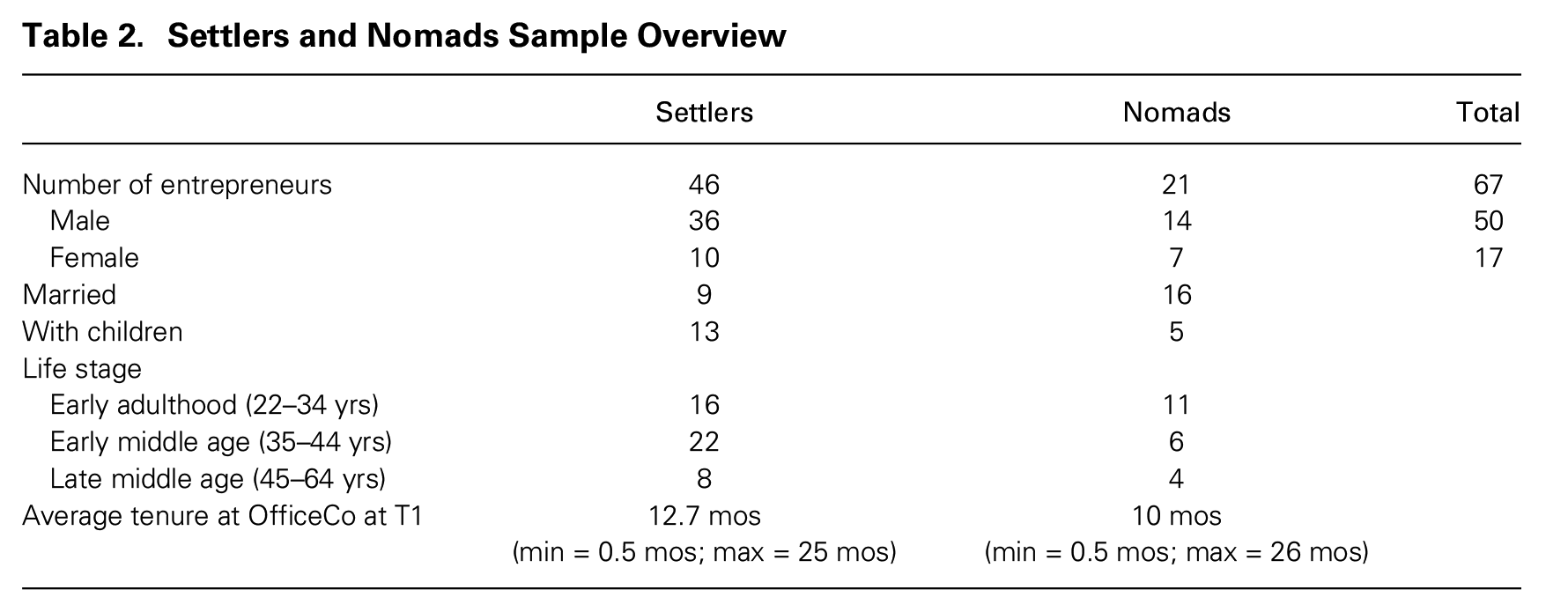
At this point, I employed a grounded theory-building approach (Locke, 2001), which involved switching back and forth between transcriptions, field notes, recordings, and existing theory, looking for explanations in these patterns. There appeared to be something about founders’ respective uses of space that ostensibly anchored their respective experiences at OfficeCo. Two groups emerged: (1) Settlers, or those who repeatedly chose the same seat (N=46; 69 percent of the sample), and (2) Nomads, or those who constantly varied their seat (N=21; 31 percent of the sample). Ben was in the first group, while Alexis was in the second. Table 2 summarizes the sample based on these two groups, and I explain the terms “Settlers” and “Nomads” further below.
Settlers and Nomads Sample Overview
I continued comparing and contrasting informants in these two groups across several dimensions to see if there were systematic reasons that explained their seating patterns (Bechky, 2020). For example, I considered their tenure at the time of the first interview, their background prior to entrepreneurship, and the type of products/services on which they were working. I could not systematically trace seating patterns to these dimensions. 3
Yet, I did discover differences between the entrepreneurs who repeatedly chose the same seat and those who constantly varied their seat, particularly as I re-examined their data longitudinally. I noticed diverging patterns over time in their responses to the identification question, which I adapted from Bergami and Bagozzi (2000), “Imagine two circles: one represents you and one represents being an entrepreneur. How much overlap, if any, do you see between the two?” (See Online Appendix I.) For those in the first group (Ben’s), the degree of overlap generally increased between T1 and T2, while for those in the second group (Alexis’s), it stayed the same (i.e., low/no overlap) or the overlap decreased. (See the last column of Table 1 for additional detail per informant in this regard.) Probing these differences through a series of follow-up questions, as part of my formal longitudinal interviews (see Online Appendix I) and through more-casual conversations, helped me appreciate that entrepreneurs in each group reached different conclusions about whether they could see themselves as entrepreneurs and why. 4 Interestingly, they also ascribed different meanings to their workspace.
As I analyzed my data further, I continued to compare and contrast those who repeatedly chose the same seat, whom I call “Settlers,” with those who varied their seat, or “Nomads.” This process eventually led to my theoretical model in Figure 1. Before settling on this model, I evaluated several options to see how they related to one another and to existing theory. Only after considering numerous possibilities and conducting member checks (Lincoln and Guba, 1985), I chose this framework, which best captures my informants’ experiences while providing a contribution to theory.
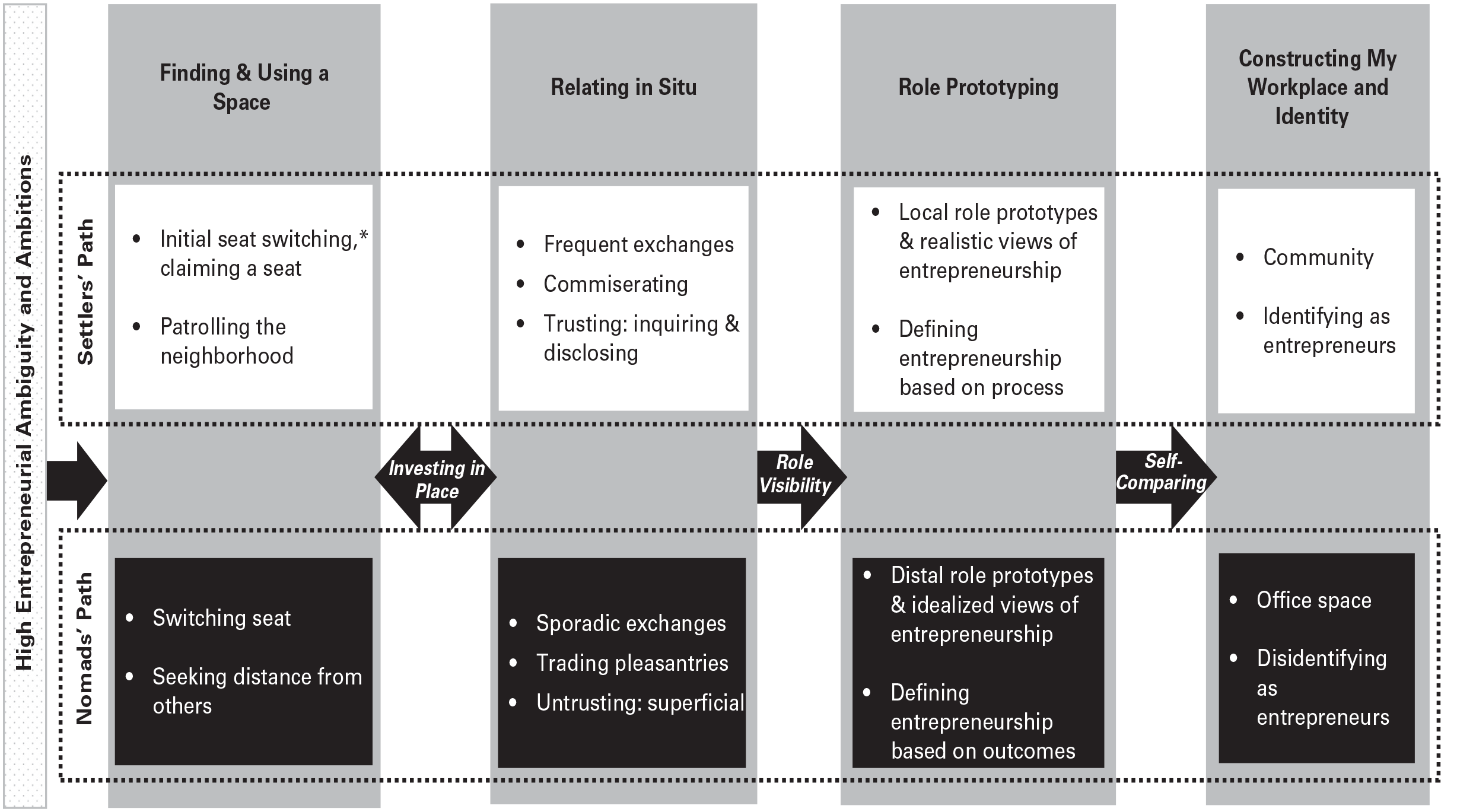
How Founders Ascribe Self-Referential Meanings to Entrepreneurship
Findings
My data broadly revealed that founders’ use of OfficeCo, and their patterns of interaction within it, grounded their social construction of entrepreneurship and of their workplace. The meanings that founders ascribed to entrepreneurship and space were related. Importantly, such coupled, varying meanings undergirded the development of their identities—for some, more as entrepreneurs, and for others, less or not at all as entrepreneurs. Although the process to ascribe meaning to entrepreneurship and space unfolded over the same primary phases, these phases manifested differently for my informants, as highlighted in Figure 1 through two pathways, one for Settlers and one for Nomads.
Figure 1 serves as the orienting framework for the presentation of my data and explanations that follow. As the figure suggests, all founders shared both high entrepreneurial ambiguity and ambitions, which motivated them to join a shared workspace filled with other entrepreneurs. However, differences in their use of the workspace and in their investment in place informed distinct patterns of interaction among neighbors. Through varied ongoing interactions, founders gained role visibility—more process or outcome focused—based on local or idealized role prototypes. Importantly, through ongoing comparisons between themselves and their developed role prototypes, founders elaborated meanings around both where they were—in a community of entrepreneurs or in an office space—and who they were—entrepreneurs or not. In presenting my findings, I attend to these differences while remaining focused on theorizing how founders ascribed self-referential meanings to entrepreneurship.
High Entrepreneurial Ambiguity and Ambitions
Early data revealed several similarities among my informants. In addition to being solo founders early in the process of creating ventures, they shared two other characteristics: they felt ambiguous about entrepreneurship, and they had high entrepreneurial ambitions. Initially, all founders expressed uncertainty about what to do because they perceived multiple ways of creating and running ventures, in addition to holding conflicting opinions about best practices and approaches. Mika and Iro summed it up as follows: There’s no right or wrong way [to be an entrepreneur]. I mean you pivot two to three times a day. You can talk to an adviser and they will tell you one thing and somebody else will tell you something else. There’s just no right way to do a startup . . . you know, there’s a million successful companies and they are run in a million different ways. (Mika, T1, Settler) There’s no article like “The 21 things to be an entrepreneur.” There’s no one way. . . . There’s no one way to become an entrepreneur. There’s also no one way to learn these things. (Iro, T1, Nomad)
As a result, many founders felt insecure, and at times alone, in their journey: Before I came here . . . I felt, you know, alone . . . it can be an isolating experience, a lonely experience. There can also be a sense of insecurity about it, financial and career insecurity without question. You do not know what to do, and sometimes even question who you are. (Porter, T1, Settler) When you are working for a startup you feel like you are really alone . . . it’s hard. (Tori, T1, Nomad)
Congruent with such feelings, most founders indicated a very low overlap or complete lack of overlap when, in my first wave of interviews, I inquired about the degree to which they saw who they were as overlapping with entrepreneurship (see Online Appendix I). Many commented that they did not see themselves as entrepreneurs because they were still learning what entrepreneurship meant for them. As Lauri and Nica expressed, I’ve never considered myself to be an entrepreneur. I sort of ended up here with this company . . . it’s been a very interesting process of learning for me . . . and I am still learning what this means. (Lauri, T1, Settler) I don’t feel like I’m an entrepreneur yet. I feel like I’m working alongside entrepreneurs, but I don’t know if I myself feel that. I’m no entrepreneur yet . . . I am not sure how I would define myself to be honest. (Nica, T1, Nomad)
Stress and anxiety often accompanied these tentative self-views: There’s a lot of really hard stretches that I go through where I question everything that I’m doing, you know. (Fannie, T1, Settler) I don’t think there is a formal way to become an entrepreneur. Everybody uses their own way . . . that’s why it’s very difficult and stressful. There’s no roadmap. I mean, you know what the steps are conceptually, but it is unclear how to get there. (Sandry, T1, Nomad)
Ambiguity regarding entrepreneurship did not dampen founders’ entrepreneurial ambitions. Rather, informants expressed a strong desire to build high-impact businesses, as shown in comments from Italo, whose venture was in biotechnology, and Sandry, in engineering: I am looking to develop a technology that can be revolutionary for what is the future of the pharmaceutical industry. Rather than producing medicine through step-by-step, large batch processes, everything will be done through a continuous process. (Italo, T1, Settler) I’m trying to develop this idea. I want to radically change the way things have been measured in rotating machinery. (Sandry, T1, Nomad)
High ambitions were coupled with unwavering commitment to develop their ventures. During my first wave of interviews, many founders emphatically volunteered that they were “all in” and wanted to “make it happen no matter what.” Akash and Kallo shared, I work hard, and if I have something I need to get done, I get it done, whatever, no matter how much time it takes. Maybe it’s extra time, maybe multi-tasking, maybe it’s working late hours. I’ll do whatever it takes. (Akash, T1, Settler) If you’re going to run a company, you create a thing, right? You have to be focused about that thing. You have to keep coming back to that thing. Keep pushing that thing. You have to believe in what you’re doing, because literally you are spending your own money out of your own pocket, and you’re not making money yet. (Kallo, T1, Nomad)
Finding and Using a Space
To ease entrepreneurial ambiguity and focus on nurturing their ambitions, founders decided to join a coworking facility filled with other entrepreneurs. In doing so, they thought they would meet like-minded others who might help them feel less alone and possibly offer insights from their own experiences of doing entrepreneurship.
OfficeCo became their coworking facility not only due to the high concentration of entrepreneurs it housed but also because the space met their physical and aesthetic needs. Their initial drawings and accompanying descriptions of OfficeCo reflected the importance of the physical space, particularly in their initial seat choice. For example, in describing their sketches, Porter and Kat noted, These are the windows. There’s a desk there . . . I would say that I typically sit at this table, in one of these spots. I like it because there’s some light. I like being near natural light and my files are in this cabinet over here, and I also like it because the printer isn’t too far away. . . . I find this to be a convenient location. (Porter, T1, Settler) I did rotate a lot for the first week or so. I pointedly tried out various locations, and I sat in a couple of other locations. I ended up liking that one [pointing at a desk] because it’s a standing desk, and I really like the standing desk. (Kat, T1, Nomad)
Figure 2 displays examples of early drawings from entrepreneurs like Porter and Kat who emphasized features of the physical space while sketching and explaining where they initially situated themselves.
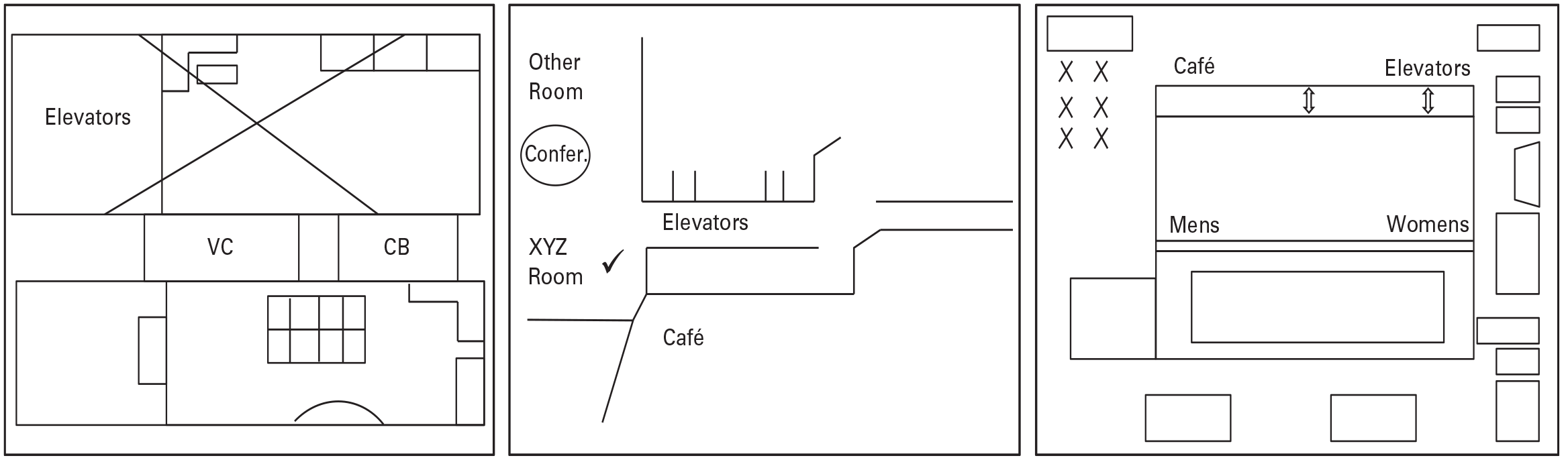
Initial Workspace Perceptions*
Settlers and Nomads
Although attraction to material features of the space drove founders’ initial seat choice, differences in seating patterns emerged. I capture these differences in two pathways exemplified by Settlers and Nomads (see Figure 1). Those in the first path, Settlers, tended to select a seat and return to it each day: I roll in here about 9:30. I sit almost at the same table every day. And then I bring my lunch, I work, and then I physically leave around 7:00 and then drive back home. That’s kind of a typical workday for me. (John, T1, Settler)
In contrast, Nomads changed their seats, sometimes making multiple changes during the same day: [Some days] I’ll sit in a conference room. Then other days I’ll just sit at the front. Sometimes when I’m actually realizing I am not being productive, I’ll say I’m going to finish one task in one location, then in the next location I’ll finish another task. (Tori, T1, Nomad)
Over time, Settlers and Nomads’ choices of staying put or moving occasioned the development of qualitatively different relationships with their neighbors and with the physical space itself. Thus, spatial and social relationships were tightly bound: for Settlers, the connections they established with their neighbors cemented their selection of the same seat and their investment in preserving it. 5 For Nomads, more-superficial connections, and in some cases the absence of connections with others at OfficeCo, reinforced their decision to change their spot and/or to create distance from specific others. In other words, finding and using space reciprocally connected to how founders related in situ (see Figure 1).
Tracing Settlers’ Path
Relating in situ for Settlers
By repeatedly choosing the same seat, Settlers tended to interact with a few neighbors, usually the same ones, who were also Settlers. This consistent daily contact (8 to 10 hours daily for many founders) fostered expressing vulnerability and commiserating. Settlers manifested their struggles outwardly, including through spontaneous outbursts of talk and gestures. For instance, it was common to hear Settlers swear aloud in response to undesired news while pounding their fists, dropping their heads on their desks, or placing their hands over their eyes and lifting their gaze to the ceiling out of frustration. One afternoon, I noticed Fannie staring at his computer exclaiming, “C’mon, c’mon . . . da_n it! I do not want to cancel this f_ck_ng program! This sucks!” Later the same day, I interviewed Berta, who had heard Fannie cursing. She offered an explanation: Some people get to a point where they are so overwhelmed by their tragedy that something just pops out. So they say, “What the heck. How can I do that?” It happens you’re on their side or it just happens right in front of you all the time. It is human nature to commiserate and help someone in trouble. And then from there, the relationship builds up. (Berta, T1, Settler)
As I watched Settlers work side by side, I noticed they bonded over common difficulties. In the exchange that follows, Rick confided to Mika a frustrating experience he had when pitching an investor. Mika sympathized by disparaging the investor.
How are you, man?
Okay I guess. I just pitched [Name of Investor] today.
Oh, I did not know you were doing that. How did it go?
I guess it went alright, but won’t know for sure for a few weeks. I tell you though, the guy pis_ed me off.
What do you mean he pis_ed you off?
Well, as I am pitching him he is like, “how long did it take you to memorize this?” And then he was challenging me and was like, “I don’t get how this app solves a real problem.” And I am like, “Well, it does not solve a problem, it just helps makes this process better.” And then he said, “So what is your plan?” And I am like, “Well, I want to give this a real shot and see how it goes.”
Man, fu_k_ng idiot. I hate when people ask you, “What is the problem you are trying to solve?” No fu_k_ng problem. Tell me what problem did Zuckerberg solve? Tell me what big problem YouTube solved, right? They just don’t get it. Don’t let that get under your skin.
In their interviews, Settlers noted the value of being able to commiserate with their neighbors: It’s kind of nice to—I don’t know if it’s misery loves company. It doesn’t have to have that negative spin but it’s something like, “You know, I know where you’re coming from.” And sometimes that’s just looking across and seeing somebody else scratch their head like, “What am I going to do?” Like, “It’s okay to not know what you’re going to do.” That’s kind of reassuring. I’m not the only one. There is like a lot of value in that. (Artie, T1, Settler) The group therapy aspect of it is, I mean, as a startup you’re pretty small, maybe a few people. It’s hard to find people in a similar position as you who are also going through the challenges of running a startup. So just knowing that there are other people in the same position as you is kind of helpful because startups are hard in a lot [of] different ways. (Mika, T2, Settler)
Seeking to protect and nurture these relationships, Settlers became increasingly territorial. For example, they started referring to where they sat as “my spot” or more collectively as “our neighborhood,” and they found satisfaction in claiming a specific desk. To illustrate, when Sasha reclaimed her usual seat, after successfully nudging away someone new to OfficeCo who had unknowingly occupied it, she turned to me and whispered with a grin, It is almost as if this seat had unofficially become mine. When someone sits here, I do not like it. I just have to give them a look and the next day, they are gone [laughs]. (Sasha, Field Notes, Settler)
Settlers’ developing territoriality also manifested in patrolling behaviors. For example, they developed the habit of spreading their belongings on nearby chairs and desks as a means of saving space for specific others and swiftly removing their items when these others arrived. In addition, Settlers attended carefully to their neighbors’ schedules and movements, as well as to any divergence from the regular setup. The following remark from Pluto shows the discomfort he felt when his neighbors did not come in and his reassurance in seeing them “back in their seats”: Well today it is nice, back to regular world order. You are back and in your usual seat, Amber, and Fannie is back facing the wall, not too many people on top of each other—that’s just the way I like it. (Pluto, Field Notes, Settler)
The formation of friendly relationships among Settlers further cemented their territorial behaviors. Pointing at his desk, Chad (a Settler) commented, “I just sit there, I am comfortable, I became close to them [referring to his neighbors].” Candance expressed a similar sense of security in being able to go back to the same area and trust the neighbors: I always know that there is a place that I can go to, and this place is very familiar to me, I have that security feeling. I cherish that I can talk to people, meet my friends here. I cherish this kind of opportunity that I have. (Candance, T2, Settler)
Thus, starting with selecting the same seat each day, Settlers invested in curating an environment in which they felt they could express themselves and support, as well as receive support from, their neighbors (hence “Investing in Place” as a mechanism linking “Finding and Using Space” and “Relating in Situ” in Figure 1). Developing what they themselves described as meaningful and helpful relationships enabled Settlers to become more comfortable turning to their neighbors as primary sources of support and information. As Bruno and Mika explained, So people I’m sitting with, or standing with, or working next to . . . is the first set [of people I talk to]. Because when you’re working next to someone you form a relationship with them . . . one gets frustrated about something, starts talking, and other people start talking. (Bruno, T2, Settler) I’m talking to my neighbors about business, legal issues, product questions. If you want to run an idea by somebody about a product feature, you can do that pretty easily because we’re comfortable with each other and we’re working friends. I can ask for their input, and I value their input a lot. I think a lot of it is about the connections that you make here. If you want to work late, there’s always somebody working late. If you want to get advice on something, people are here to give you advice, and they’re all kind of going through the same thing as you are. It’s partly support, like a support group type therapy. (Mika, T2, Settler)
Settlers also developed trust in their neighbors. Trust was most apparent in how they handled their personal possessions at OfficeCo and in how they engaged and spoke openly with others. I noticed that Settlers tended to leave valued belongings such as their laptops, wallets, and keys unattended for long stretches of time. In an informal conversation, Blanche revealed that she became comfortable leaving her computer overnight on her desk because “there’s a trust element that I have now where I don’t feel worried about leaving my computer here.”
Settlers also showed trust in their neighbors by inquiring with little hesitation about their experiences with entrepreneurship. Dan explained that seeing his neighbors every day gave him implicit permission to ask them questions: We have great conversations around business. I definitely learned a lot about business from people here [referring to his neighbors], what they go through, how they do things . . . people trust you if they see your face every day, and I can walk up to somebody and I can ask them a question just because they recognize me, because they see my face every day. (Dan, T2, Settler)
The importance of these relational dynamics, especially of openly inquiring about neighbors’ entrepreneurial experiences, is made evident in the following comment by Bruno, who suggested that without open dialogue neighbors could glean only limited information about one another’s experiences: You never see the full process until you talk to someone and have them explain every single thing they’re doing. You only see a glimpse of their work life [otherwise]. (Bruno, T2, Settler)
Because Settlers felt they could trust their neighbors and felt supported by them, they became more forthcoming in sharing their own experiences. Fannie disclosed the following to Mika: I am so happy, my supplier just replied to me! I have the feeling I did when I first dated my girlfriend. You know, we are so small that we cannot put too much pressure on him. So when he replies and does what he is supposed to, I am happy. (Fannie, Field Notes, Settler)
Settlers typically spoke openly about positive and negative experiences, but challenges drove their conversations. As John explained, Most conversations are driven by the current stress people experience here. The first deep discussion is generally about current challenges, and then it builds from there. Most entrepreneurs here relieve stress by talking with others about their challenges. (John, T2, Settler)
Blanche saw being able to open up to other founders about her frustrations as a unique perk of working from OfficeCo: For me it takes me almost an hour to get here. I could do it at the coffee shop, but I think having other people around me day in and out that I trust and that are doing the same thing gives me an opportunity to share my frustrations. So those are really, really helpful perks of working here. (Blanche, T2, Settler)
Role prototyping for Settlers
Openness afforded Settlers high visibility into other founders’ experiences. Understanding the journey others were on informed their own perceptions of what entrepreneurship entailed and helped them define their own role prototypes (hence the arrow labeled “Role Visibility” linking “Relating in Situ” to “Role Prototyping” in Figure 1).
Settlers recognized that their presence at OfficeCo influenced their developing understanding of entrepreneurship. As Rick explained, Certainly by being here your conceptual model [of what it means to be an entrepreneur] evolves . . . getting a sense of what the norms are or learning what a good business [is like] or characteristics you see in a good business that has potential. What a bad business looks like. What the people behind the business look like. What people that know what they’re doing look like. How to manage clients over the course of the contract. How to manage projects in an effective way that allows you to monetize them. (Rick, T2, Settler)
Settlers developed views of what entrepreneurship meant based on what they observed certain others (generally their neighbors) do at OfficeCo or based on local role prototypes. Lindon’s words highlight these dynamics: If you’re sitting next to them [referring to specific neighbors] you can hear them discussing marketing strategies or technical issues . . . it’s not a very structured way of learning what the startup world is about. But it’s about absorbing what other people are doing, bits and pieces of what they do. (Lindon, T2, Settler)
Settlers’ role prototypes were either embodied by a particular neighbor or self-crafted by selecting from the behaviors of several neighbors. Dan described Betriz as exemplifying entrepreneurship, while Sav created his own role prototype by taking inspiration from the “best qualities” of his neighbors at OfficeCo: She [Betriz] just works so hard. She’s all about relationships. She’s really good to everybody that she comes in contact with, and knows people basically won’t let her fail because she’s been so good to them. She is the definition of entrepreneurship. (Dan, T2, Settler) I just don’t take one person as a model. I try to take as many best qualities from multiple people as possible so that I can develop my own self. Rob is a very social person. He’s easygoing with his employees, and he’s also trying to make the company productive, and he’s successful. And Andrew, he’s really helpful with training his employees. He’s a very patient person. (Sav, T2, Settler)
Taking their neighbors as role prototypes meant that Settlers’ understanding of entrepreneurship was informed by their close-up perspectives of their neighbors’ experiences. As a result, their views of entrepreneurship generally appeared complex and realistic. Their perceptions emphasized process rather than outcomes. I noted that for Settlers, entrepreneurship involved navigating ongoing triumphs and tribulations, “working hard” to create something that might or might not succeed, and persevering, “knowing it might take weeks or months, but you cannot get depressed or discouraged.” The “real entrepreneurs” were those in the process of “figuring out what to do” rather than knowing exactly what to do, “dealing with uncertainty while keeping balance and direction.” In Rick’s words, It’s not about following rules or guidelines very well. It’s not about doing something. It’s about figuring out what to do. It’s a completely different skillset, I think. (Rick, T2, Settler)
Constructing my workplace and identity for Settlers
These perceptions served as primary bases for self-comparison, and engaging in comparisons helped Settlers internalize entrepreneurship. In particular, by comparing themselves to other entrepreneurs at OfficeCo, Settlers gave personal meaning to entrepreneurship, moving it from “this is what entrepreneurship is or means” to “this is what entrepreneurship means to me,” hence the arrow “Self-Comparing” that links “Role Prototyping” to “Constructing My Workplace and Identity” in Figure 1.
Having specific other founders and more information to leverage as bases for their self-comparisons, Settlers tended to assess their own similarity to these others and to develop a general sense of belonging: What I like about this place is there are people like me who are trying to start companies, and when I speak to people, they have the same issues. Among these early-stage companies, it feels like I belong, I’m part of a larger community, and I’m not just a guy in a coffee shop. (Ben, T2, Settler) You see people who are here who succeed and they are people, they are not like alien creatures who are entrepreneurs. They’re going to the bathroom, having some food, joking around . . . we think that “wow there’s something completely different about them,” and I think by being here you see that it’s just people [like me] who just pursue their passion . . . I think it makes it more approachable, and I think it can help people have confidence. (Jimmy, T2, Settler)
Perceptions of belonging at OfficeCo were coupled with how founders experienced and came to view OfficeCo itself—that is, with their construction of the workplace. Over time, Settlers’ descriptions of OfficeCo tended to emphasize community: I mean it’s a community that I think we all pull support from. So if I have a question about something that’s going on at work, I’ll ask someone who’s at my table. We bounce ideas off each other fairly often. (Alessia, T2, Settler)
In addition to hearing Settlers use the word “community” and related terms such as “support group” or “posse,” I noticed them behaving in ways that aligned with their sense of belonging to a greater collective, such as by helping others. For example, when the chef of HighFoods (pseudonym), one of the food startups based at OfficeCo, collapsed the night before customer appreciation day, several Settlers huddled around the CEO, brainstormed alternatives together, and made calls on his behalf in efforts to secure a substitute cook. Some went as far as putting their own work aside and assisting in the kitchen overnight “to get him through.”
Other behaviors suggesting Settlers’ sense of community included occasionally picking up after neighbors and buying or making food for one another. For example, Mika developed the habit of preparing and distributing dumplings once a week: “On Thursdays I have a few meetings back to back, so I cook for me and bring in food for people. It’s just a small thing, but people like it.”
Congruent with Settlers’ viewing OfficeCo as a community and behaving as its members, Settlers’ later drawings stressed the supportive connections they had established with neighbors, instead of emphasizing preferences for specific aspects of space as they had initially reported. Figure 3 juxtaposes a few examples of Settlers’ earlier drawings with later drawings. Here, other entrepreneurs take center stage.
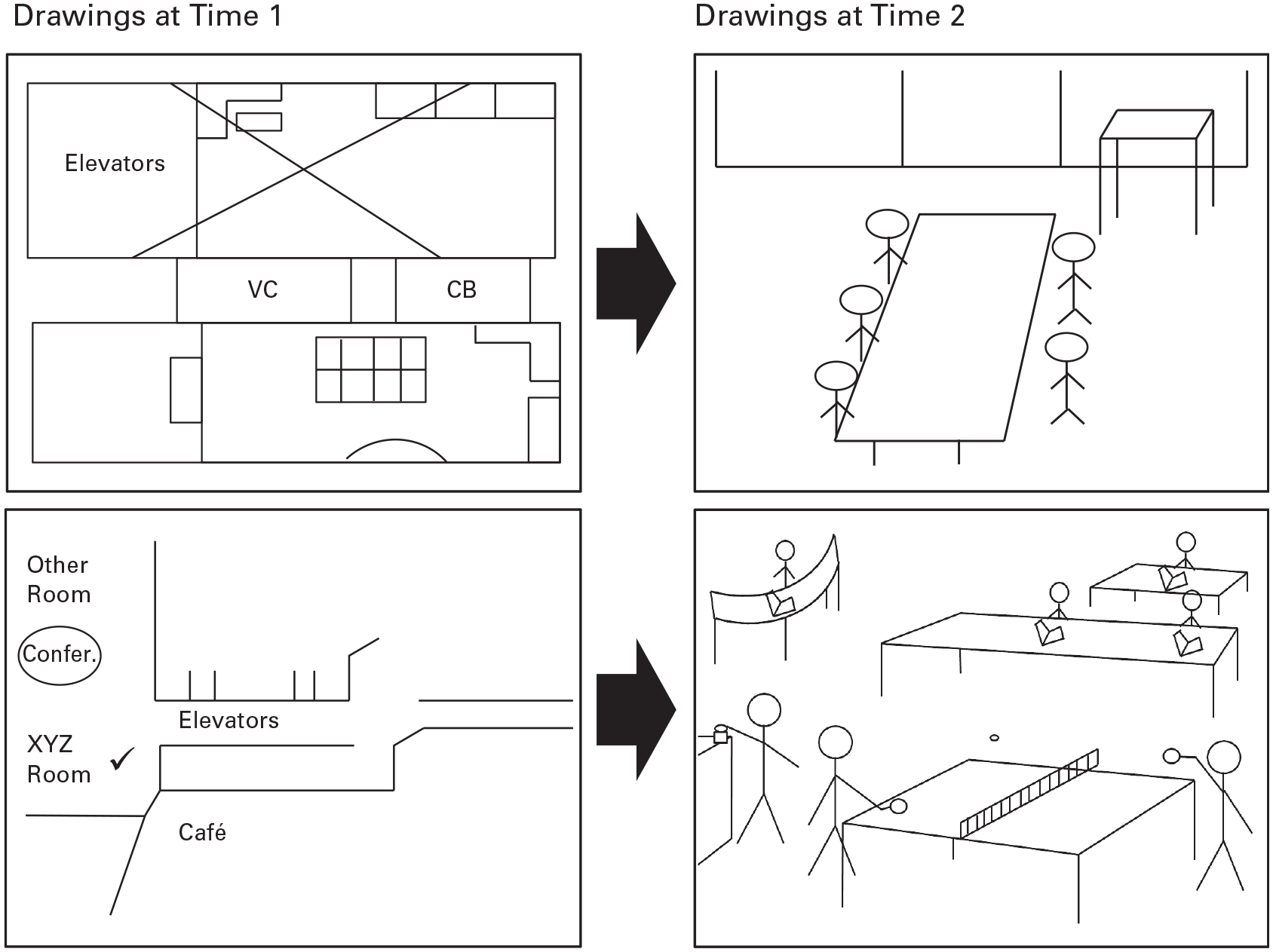
Constructing My Workplace as Community
Importantly, Settlers’ developed understandings of OfficeCo were associated with how these founders came to view who they were—with the development of their own identity. Their perceptions of being embedded in a community of like-minded others linked to their identifying as entrepreneurs. Berta’s comment below shows why the “sense of community” and feelings of similarity to and belonging with other entrepreneurs were important to her self-definition as a possible entrepreneur: It’s like what role model do you have in your head, right. Like if everybody you know works for somebody else, then you think working for somebody else is a very natural route. And if you hear so-and-so Zuckerberg with the Facebook thing and so-and-so Larry Page and Sergey Brin with the Google thing like wow, that’s some extraordinary people out there. They’re very smart or very brilliant. That startup stuff is not for me. But if you’re surrounded by friends and other people who do their startup and you hear their story, you’re like I’m not that different from them. I mean they’re not smarter. They’re not more confident. If they can do it, I can do it too. I think that [it] helps a lot for people to start seeing themselves as possible entrepreneurs. That sense of community is very important. (Berta, T2, Settler)
Access to local role prototypes who embodied the highs and lows of entrepreneurship made it easy for Berta and other Settlers to feel that they belonged and that they, too, were entrepreneurs because they were going through comparable struggles.
Mika and Dan also raised the importance of community and expressed that, now that they “understood better what it takes to be an entrepreneur,” they tended to define who they were based on what they did: Right now, I define myself pretty much by my business, by the success of my business, by the failures of my business, just by the business, by the grind, by the challenge. (Mika, T2, Settler) I’m a business owner. I own a marketing agency, and I usually say it’s a six-person marketing agency. So I own and run a six-person marketing agency. Being an entrepreneur actually means simply not quitting because it got too hard . . . for me, there is no turning back, so I’m going to just keep going no matter what, but at the same time, I’ve got—I can’t be stupid. (Dan, T2, Settler)
Settlers took entrepreneurship as self-defining because they saw what they were doing as aligning with the processes and behaviors of other founders: I think it is a process to be able to call yourself an entrepreneur. An entrepreneur should be doing it every day of his or her life working on something and creating something. If your one business is not going as well, or you shut it down, then you probably start another one, that’s what I am doing. (Lindon, T2, Settler)
Settlers’ clarity about who they were, or who they were becoming, accompanied perceptions that they no longer needed OfficeCo. Several Settlers said they no longer required the support of collocated others to develop their ventures: I think we were able to get the maximum out of what we could get from that space, and for startups the worst thing to do is to be stuck. You need to keep moving forward. I am thinking about leaving. (Spencer, T2, Settler) We have an idea of what we want to do, and we are now looking for less and less external validation, it’s now just a question of growing and getting it done. And so in that respect, I feel there is less dependence on OfficeCo. (Ben, T2, Settler)
Also associated with Settlers’ identification as entrepreneurs were their intentions of persevering with their ventures: There’s no turning back. I can’t turn back now. I’ve gotten this far, and there’s way more to go . . . why would I ever give up now? (Blanche, T2, Settler) Identity can be actually really useful in the entrepreneurship journey, that sort of grit to prove yourself: I can’t fail, this is who I am. (John, T2, Settler)
Tracing Nomads’ Path
Nomads went through a similar process to ascribe self-referential meanings to entrepreneurship. However, their different uses of the coworking space undergirded the development of qualitatively different relationships at OfficeCo and, ultimately, of different workplace and identity understandings than those I found among Settlers.
Relating in situ for Nomads
Nomads’ interactions were more limited compared to Settlers’. Rather than openly sharing their entrepreneurship challenges, they generally only exchanged pleasantries with their neighbors. They just greeted one another upon their arrival and departure from OfficeCo, or they made small talk about the weather and other topics largely unrelated to their ventures. And they often did so with people who were unfamiliar to them, as Nomads’ neighbors might be different every day.
With respect to entrepreneurship, they occasionally traded ideas and advice about discrete aspects of the work or business operations, such as technology platforms they preferred for a given task, hacks related to coding, or how to handle insurance for their collaborators. This brief interaction exemplifies the fairly limited nature of Nomads’ exchanges:
Excuse me, I could use your advice on something quick. Do you have a second?
Of course. How can I help?
Keynote or PowerPoint for a pitch, what do you think?
I would use PowerPoint and then convert the file to a PDF so that, no matter what machine the file will be projected with, nothing will get screwed up, like your fonts. [Marco looks over to Nica, who is listening.]
I do not know how to use Keynote, I am sorry . . . I always use PowerPoint.
Alexis summarized the nature of their scant interactions with others at OfficeCo as follows: I had somewhat limited connections with people . . . the interactions would be minor small-talk thing[s] like saying hello in the morning but not so much deeper things about work or projects. It’s rare to sort of get into a deeper conversation about things like “Oh you know, if you’re thinking about using this . . . then you get better results.” That sort of like deeper exchange just does not happen for me that much. (Alexis, T2, Nomad)
Rather than sharing their entrepreneurial experiences, including their challenges and tribulations, Nomads had the tendency of exchanging only information soundbites or of providing limited feedback and advice. Reflecting on these dynamics, Turan explained that he did not share his struggles because he was not comfortable with others and feared being judged by them: If you don’t feel comfortable enough that you can feel vulnerable with other people, you’ll be just basically afraid to fail in front of them. What are they going to think, or what if I screw up? That is why I do not share much. I keep to myself. (Turan, T2, Nomad)
Feeling that they could not open up to others at OfficeCo, some Nomads grew disappointed: My disappointment with OfficeCo was the fact that there was not too much exchange of ideas or collaboration. I mean there was little communication among people. (Sandry, T2, Nomad)
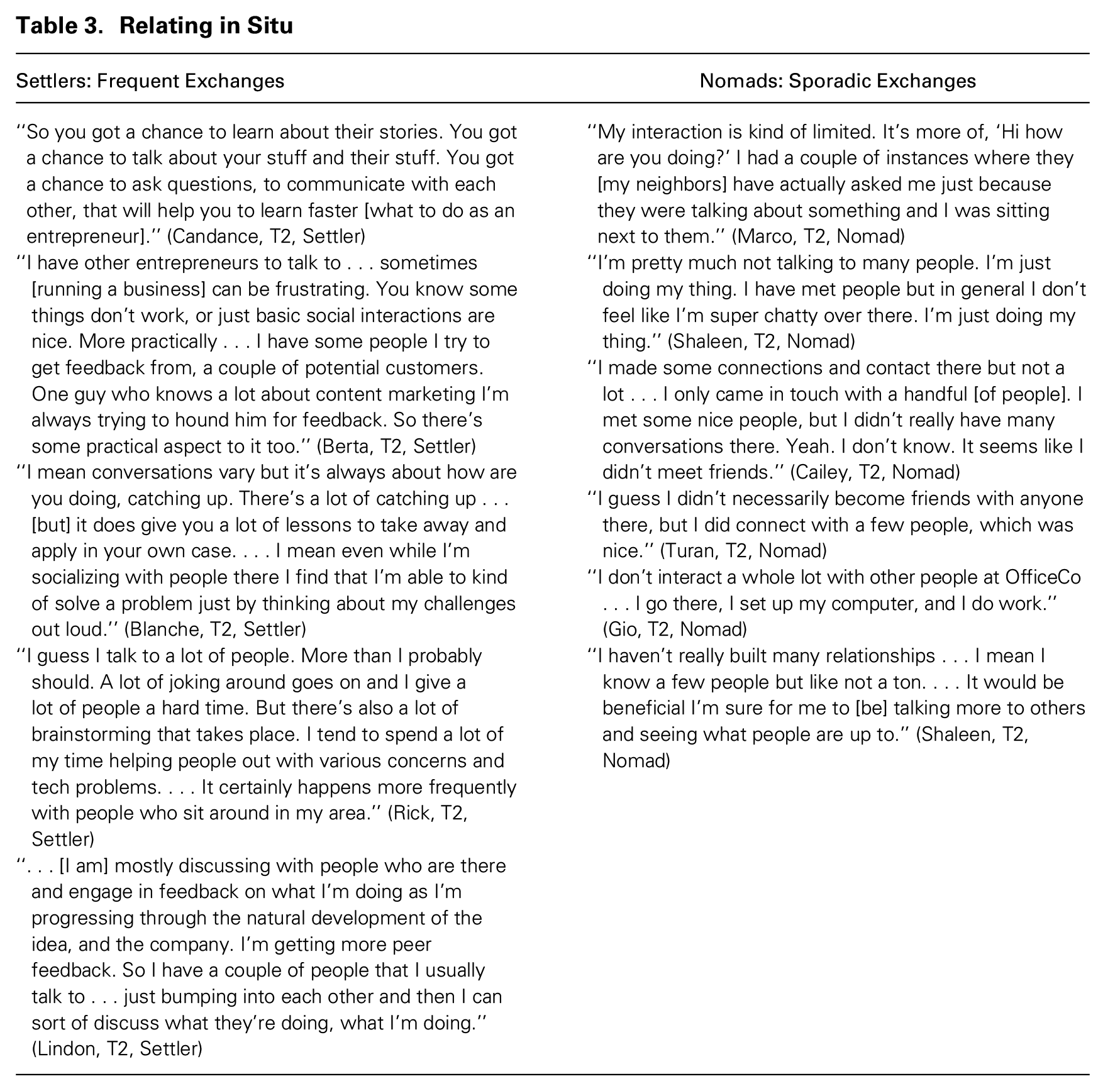
Table 3 displays additional data suggestive of Settlers’ and Nomads’ different relationships at OfficeCo, characterized by repeated and extensive interactions for the former and more sporadic/limited interactions for the latter.
Relating in Situ
Related to Nomads’ limited interactions was a general lack of attachment to any particular area within OfficeCo. Nomads moved around frequently, switching their spot even multiple times within the same day based on what they felt was a conducive location to execute specific tasks. Rather than pursuing certain others as their neighbors and making space for them, they sought distance from those whose mannerisms or work habits they found disruptive. Calibi, for example, commented, Like I said, the bros, you know, it’s like that’s their table. And it’s okay if you sit there, but you realize that you will be completely overcome by the bros [laughs]. So feel free to sit down at your own risk kind of thing. (Calibi, T1, Nomad)
Referring to the same group, Nerin bashfully commented, Well, you should try to sit among the people behind us [laughs]. People try to sit among them, then they all escape [laughs]. I did that myself! (Nerin, Field Notes, Settler)
Thus, while Settlers claimed a seat and even patrolled their neighborhood, Nomads switched their seats often, including as a means of distancing themselves from certain others. By recurrently changing their seats, Nomads never became trusting enough of their neighbors to share their experiences with them, especially their venture tribulations. Suggestive of their limited trust are that, unlike Settlers, they rarely left their personal belongings unattended, and they were more guarded in trading information.
These observations resonate with Nomads’ general perceptions of others at OfficeCo: instead of seeing them as supportive, Nomads concluded that OfficeCo entrepreneurs were always busy and focused just on their own interests and problems: People there are kind of in a struggling situation, people are very absorbed by solving important problems for their own life. My opinion is that people there are very busy, and they couldn’t get much more than just a few words in here and there. “Hi, how are you? What do you do?” (Sandry, T2, Nomad)
Due to these perceptions, Nomads continued to keep mostly to themselves or to engage only sporadically and superficially with their changing neighbors.
Role prototyping for Nomads
Nomads’ limited engagement did not mean that they were not interested in what others around them were doing. Indeed, they were still observing their neighbors and even eavesdropping when they could: I’m watching, you know, developers talk to a VC about their potential business idea. You know, people getting really excited and passionate about whatever idea they’re working on. (Shaleen, T2, Nomad) I always keep my ears open when I am getting a coffee. I am not eavesdropping, but I do listen to people’s conversations if I am in the vicinity [laughs] and, you know, you just want to know what’s going on around you. (Marco, T2, Nomad)
And like Settlers, Nomads valued any information they could gather: I was able to understand, get an understanding for how startups work. Before working at OfficeCo, I didn’t even really get what a startup was. I was literally blind to anything really tech or startup related. So I got a little bit of vocabulary just by being here and listening. (Nica, T2, Nomad)
These general understandings reflect Nomads’ limited access to other OfficeCo founders’ experiences and motivations.
Congruent with lacking deep knowledge about what other OfficeCo founders did and why, Nomads tended to take entrepreneurs removed from OfficeCo as their primary role prototypes and thus to rely on more-distal others to shape their views about entrepreneurship. These others included successful founders they had directly connected with in the past, as well as public figures such as Elon Musk or Paul Graham. To illustrate, I have never really met him but I actually read a lot of his essays and blog posts. His name is Paul Graham. He is an entrepreneur and talks about mostly startups technology, test startups and how to build startups. . . . His advice is good. He is successful at what he does. (Turan, T2, Nomad)
Aligned with taking more-distal and ostensibly successful others as their primary role prototypes, Nomads’ understandings of entrepreneurship emphasized the achievement of positive venture outcomes instead of the process of reaching them. For example, Nomads stressed aspects like “scoring a successful exit,”“making an impact in the world,” or “discovering a viable business model” as being at the core of what it means to be an entrepreneur. As Sandry put it, I believe that an entrepreneur is not only coming up with the idea, they are getting the idea across and are also successful. That’s my way of thinking about an entrepreneur. So if you, I mean I want to develop my business, but if you are not successful, you are not an entrepreneur in my opinion. To me entrepreneur is a person that not just owns the idea but shapes this idea into something profitable. Let’s say if I were to give a software example, I can have an idea of how to make the most beautiful app for whatever, but if I don’t make this happen, I’m not an entrepreneur. (Sandry, T2, Nomad)
What Nomads gleaned from observing and eavesdropping served only as a starting point for them to form views of entrepreneurship, which were removed from the actual experiences of other founders at OfficeCo, or were only loosely anchored in Nomads’ observations. For instance, in the midst of our second interview, Alexis stopped speaking to draw my attention to a founder who, at that moment, was meeting with visitors in a nearby conference room. He pointed out how this entrepreneur commanded the room, noting his charisma and the clarity of his messaging as reflected in the eyes of his audience (although we could not hear what he was saying from where we were sitting). Alexis saw this person as “a real entrepreneur.”
Constructing my workplace and identity for Nomads
As was the case for Settlers, these various understandings of entrepreneurship served as primary bases for self-comparison for Nomads. However, unlike with Settlers, Nomads’ emphasis on positive and hard-to-reach outcomes led them to see what they did and who they were as being different from others at OfficeCo, and they generally arrived at the conclusion that they did not belong. Nica’s remarks exemplify Nomads’ assessment: Being surrounded by people working in startups, you can see it [what it means to be an entrepreneur]. But at OfficeCo, I saw a different level of startups [from where I was]. (Nica, T2, Nomad)
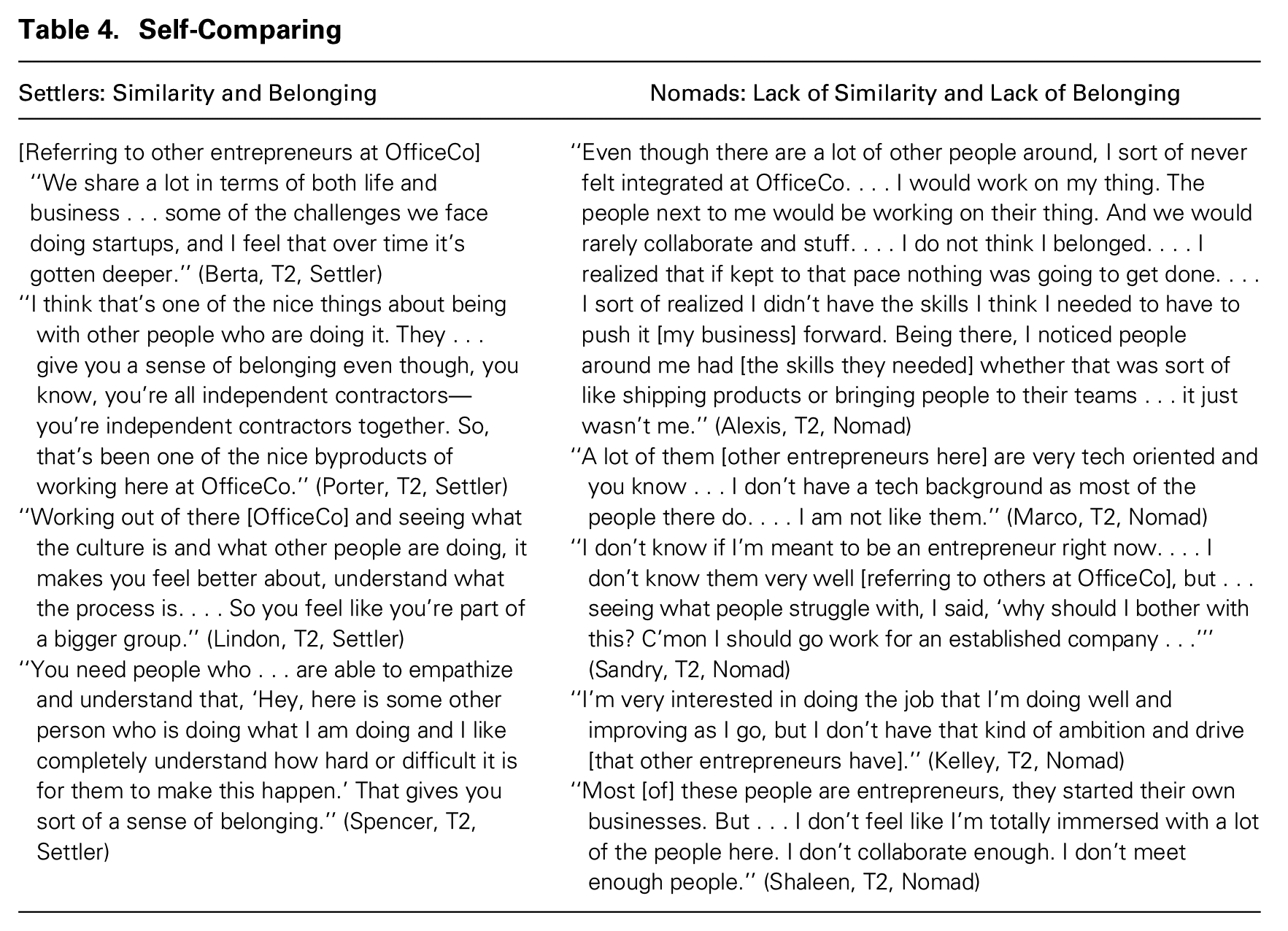
The quotes in Table 4 suggest that Settlers saw themselves as similar to and belonging with others at OfficeCo, while Nomads did not see themselves the same way.
Self-Comparing
Perceptions of not belonging were closely coupled with Nomads’ ongoing impersonal views of OfficeCo as an efficient office environment with desirable amenities. In Christophe and Jonnie’s words, It’s a very convenient space. It provides a quiet environment where I can work much more effectively than I used to work at home. And all the conference rooms and the phone booths and all the facilities are very convenient. (Christophe, T2, Nomad) It’s an attractive space, physically attractive space, nice conference rooms. They [referring to OfficeCo’s staff] make it, they’ve thought through all of what is needed to make it easy to just do your work. (Jonnie, T2, Nomad)
These impersonal views of OfficeCo aligned with Nomads’ later drawings, which, unlike Settlers’ drawings, focused on distinguishing spatial features of OfficeCo rather than on depicting other entrepreneurs. Commenting on his second drawing, Marco noted, It’s a pretty, let’s say pragmatic, depiction of what my work environment is, it’s the physical space that I work in. (Marco, T2, Nomad)
Several Nomads, disappointed by the lack of support they found at OfficeCo, took issue with the word “community” in their descriptions of OfficeCo: Easy to reach out and find help on specific tasks? Definitely not. It’s very surprising to me because I think that’s a big part of what people talk about, community. But I don’t think I have ever really felt that. Definitely not a community to me. (Don, T2, Nomad)
Figure 4 juxtaposes examples of Nomads’ first and second drawings. Although later drawings are more detailed, suggesting greater familiarity with OfficeCo, they still focus on distinguishing physical elements instead of people.
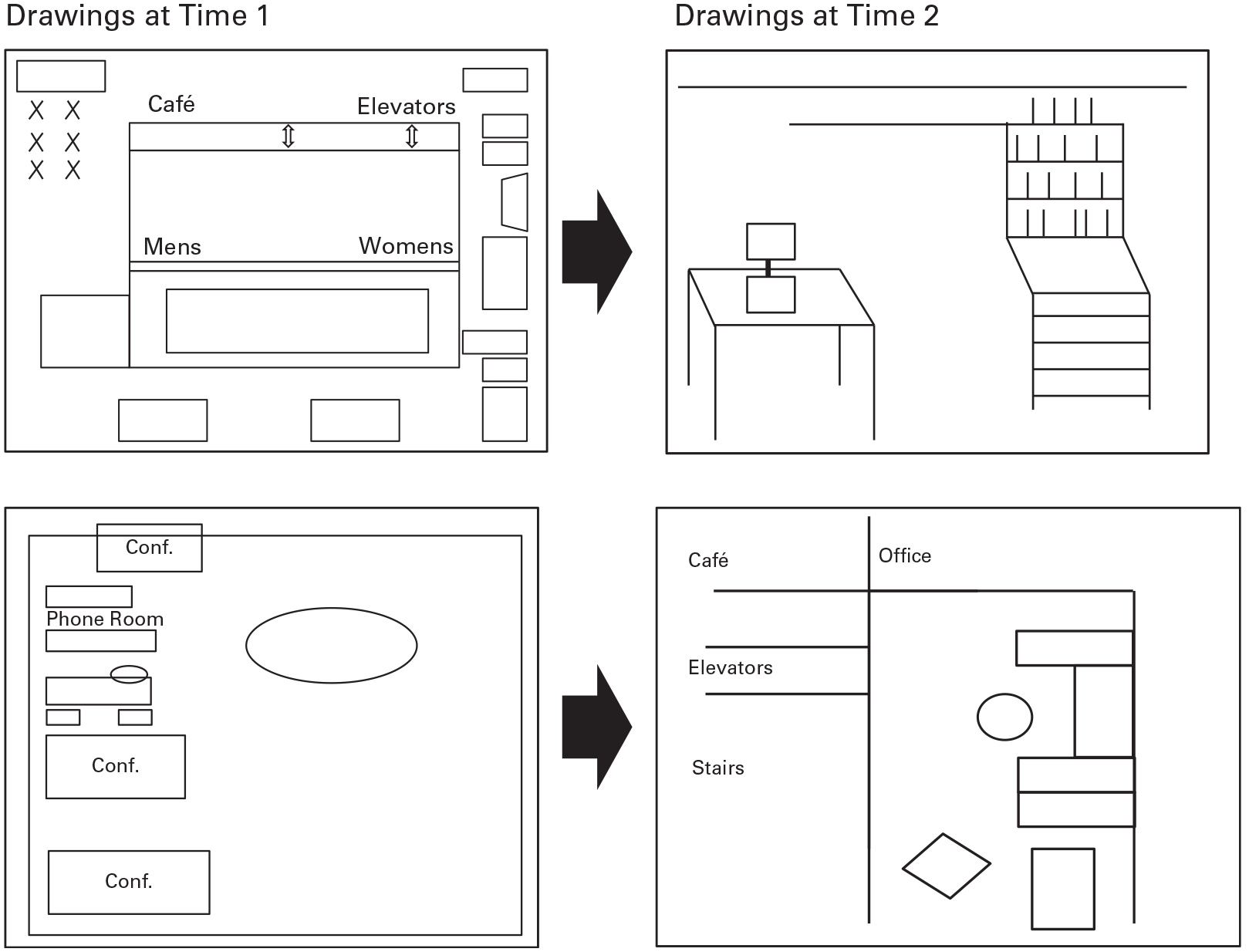
Constructing My Workplace as Office Space
Perceptions of OfficeCo as a mere office space were mirrored in how Nomads behaved over time. Unlike Settlers, who became communal with their neighbors, Nomads’ behaviors did not change. Rather, they continued to keep mostly to themselves and to interact only sporadically and briefly with other entrepreneurs around them.
Importantly, Nomads’ impersonal experiences and their views of OfficeCo as not being a community were associated with Nomads not defining themselves as entrepreneurs or with identifying less as entrepreneurs. Nomads lacked a general sense of community because they felt that they were different from other founders. For example, Don perceived that others at OfficeCo had greater drive than he did, which led him to believe that he was not an entrepreneur: I did not see myself as much of an entrepreneur. I thought about it, but I guess I’m lacking a certain level of drive that others here have, a need to exceed. (Don, T2, Nomad)
Cailey and Juri came to believe that entrepreneurs do not doubt their career choices or second-guess their skills. Because they doubted themselves, this meant they were not entrepreneurs: I mean I think this is where I don’t see myself completely as an entrepreneur. I don’t have the personal finances or stomach for risk I guess, just to say I’m never going back to working for somebody else. (Cailey, T2, Nomad) I am not overlapping [with this circle that represents entrepreneurship], maybe it is just my insecurity and the idea that I don’t fit that role. I wish I had certain skills that I don’t have. (Juri, T2, Nomad)
In light of these self-views, many Nomads suggested that they might leave OfficeCo to pursue new work away from entrepreneurship. Tori went as far as to return money to clients who had prepaid for his services. Explaining his decision to exit his business and join a firm that was already established, he said, “I could not do it anymore. I could not see myself as an entrepreneur. I had to leave.” He not only returned advance payments but also turned down investors: We got an opportunity to raise [funding], which would have been like a small seed round to continue expanding . . . [but] I turned down the money and then I started looking for a job. . . . We still have some assets and some relationships, and in January, I should be able to sell the business to a large enterprise. (Tori, T2, Nomad)
In summary, founders made distinct initial spatial choices when they joined OfficeCo: the choice to stay put or move around. These seemingly inconsequential decisions anchored the development of one of two pathways, characterized by distinct situated relationships, role prototypes, and understandings of entrepreneurship. Importantly, these understandings informed how founders came to see both who they were and their environment: they were either entrepreneurs in a community of like-minded others, or they were not entrepreneurs in an office space.
Discussion
My study suggests that in the face of ambiguity, first-time founders start from where they are to figure out who they are. The meanings they associate with entrepreneurship, with themselves, and with their workspace are closely coupled, and variation in these meanings links to their different space uses and interactions. Thus, examining how entrepreneurs use their workspace and interact in it may offer novel insights into why, among founders who share high ambitions and commitment to their ventures, some embrace entrepreneurship as self-defining and others do not. In explaining these findings, my research makes primary contributions to scholarship on identity and space and on entrepreneurial identity, as well as secondary contributions to broader research on space and interactions in organizations.
Identity and Space
Workspace is important to identity (Sundstrom and Sundstrom, 1986; Elsbach, 2003; Rafaeli and Pratt, 2006). With a few notable exceptions (Petriglieri, Ashford, and Wrzesniewski, 2019; Ashforth, Caza, and Meister, 2022), identity scholarship tends to treat space as a mirror of one’s identity as already established by the work group role(s) or group(s) one occupies. This research generally zooms in on the artifacts in a given workspace, rather than considering the workspace itself (Sundstrom and Sundstrom, 1986; Zalesny and Farace, 1987; Shortt and Warren, 2012).
In theorizing space as something that is dynamically co-constructed along with founders’ self-referential meanings, my study challenges treatments of space as a mere reflection of one’s identity (Elsbach and Pratt, 2007; Shortt and Warren, 2012). In the words of Sundstrom and Sundstrom (1986: 194), the workspace constitutes “a symbolic medium for the expression of a worker’s self-identity.” My theorizing does not negate the possibility that space can reflect one’s identity as already established by one’s self-defining roles or groups (Campbell et al., 1970; Shortt and Warren, 2012). But that does not mean the relationship between space and identity should be reduced to mirroring; scholars should be open to viewing space as a central and fluid dimension in which individuals develop who they are (Dale and Burrell, 2007; Taylor and Spicer, 2007), and not just as a static reflection or background.
Viewing the relationship between space and identity as dynamic, one could think of OfficeCo as an identity workspace: an environment that holds its members as they develop who they are (Kahn, 2001; Petriglieri and Petriglieri, 2010; Petriglieri, Petriglieri, and Wood, 2018; Petriglieri, Ashford, and Wrzesniewski, 2019). As Petriglieri and Petriglieri (2010: 44) conceptualized it, an identity workspace provides its members a combination of “reliable social defenses, sentient communities, and vital rites of passage.” I build on these foundational insights by suggesting that what a given identity workspace offers its members is not all that matters; what individuals do over time in their identity workspace also contributes to their developing understandings. I found that founders’ ongoing investment in their workplace played a central role in shaping not only their self-referential meanings but also the meanings they ascribed to the built environment itself. Examining collocated founders in an unstructured work environment, as opposed to MBA students undergoing the same structured socialization and training (Petriglieri and Petriglieri, 2010), helped me to capture this dynamism between place investment, unfolding identity, and spatial understandings.
My findings not only introduce the possibility of variation in one’s developing identity and place but also explain the close association between them. In anchoring both on physical and on social aspects, Settlers personalized their investment in OfficeCo. The space became almost a transcendent place, and as it did, their entrepreneurial identity settled, like a cake in a well-heated oven. Settling is both a term for picking a place and a term for a fluid turning into a solid, a metaphor for the co-occurrence of both in this group. 6 In contrast, by not attaching to place, Nomads’ experiences and understandings of OfficeCo remained largely disembodied, leading these founders to anchor their identities on distal and ideal aspects instead.
In bringing these dynamics to the fore, my research invites future scholarship on identity workspaces to not only zoom in on what the space offers to individuals in terms of physical and social support but also to attend to individuals’ investment in place, as the interplay between these two aspects contributes to identity outcomes. Given my experience at OfficeCo, scholars should find ways of capturing where individuals sit at work and how they use their workspace longitudinally (Milligan, 1998, 2003; Chanlat, 2006; Beyes and Holt, 2020). Indeed, without appreciating Settlers’ and Nomads’ initial attraction to material features of OfficeCo and their ongoing place investment, I likely would not have understood why and how they related to their proximal others. In turn, appreciating and closely watching the unfolding of situated relationships proved critical because developing relationships undergirded distinct role prototypes that served as primary identity referents for both Settlers and Nomads.
Staying with the dynamism between space and identity, some existing research has acknowledged a fluid link between an individual’s identity and their workspace (Elsbach, 2003; Milligan, 2003). In this scholarship, shifts in one’s identity have generally been associated with shifts in one’s physical workspace. For instance, Milligan (2003) found that the employees of a university campus restaurant experienced identity discontinuity as their organization moved to a different location, and Elsbach (2003) similarly noted that a change to non-territorial office arrangements threatened workers’ identities.
My work contributes to this research that describes changes in physical space as being associated with shifts in identity (Elsbach, 2003; Milligan, 2003). In particular, my data bring to light that changes in space need not be physical to trigger changes in identity. Indeed, even if the physical space did not change, how entrepreneurs invested in their space over time—what they made of it physically, psychologically, and socially—anchored the development of their identities. Thus, scholars should consider space as it relates to identity in a multidimensional way, starting with physical aspects of space but remaining open to transcending them.
At OfficeCo, developing identity meanings were closely coupled with developing situated interactions. The latter contributed to the definition of distinct role prototypes for Settlers and Nomads, which in turn informed their varying perceptions of entrepreneurship. Thus, in the absence of a common organization orchestrating meanings for its members through practices such as socialization and training (Pratt, 2000; Ashforth and Schinoff, 2016), founders may develop their own self-understandings by differentially using, and building relationships in, their workspaces.
These insights invite identity scholars to focus not only on where but also on how self-defining meanings take shape (Ashforth, Caza, and Meister, 2022). With respect to how, it would seem important to attend to not only interactions but also behaviors related to the space itself. In my case, patrolling the neighborhood and maintaining distance from others, which are ostensibly irrelevant to one’s developing identity, contributed to the formation of qualitatively different situated relationships. Such relationships anchored founders’ understandings of entrepreneurship and of who they were in relation to these understandings.
Although my rich longitudinal data provide a unique window on the co-construction of place and identity, time remains an undertheorized aspect that warrants additional focus. Extant research is ambiguous about how long an identity requires to develop (Brown, 1985; Marcia, 1988; Bullis and Bach, 1989), and my data, unfortunately, cannot mitigate this ambiguity. This is partly because, as I noted, when I first engaged my informants, their tenure at OfficeCo ranged from just a few months to over two years. I considered this variation closely, and although entrepreneurs’ tenures did not appear to drive their decisions to stay put or move, it is unclear why some took more time and some took less time to develop self-referential meanings as entrepreneurs. Attending more closely to the role of time in how, why, and when individuals might define (and redefine) themselves promises to be germane for future research.
Entrepreneurial Identity
Research on entrepreneurial identity highlights the centrality of identity throughout the venture creation process (see Mmbaga et al., 2020 and Radu-Lefebvre et al., 2021 for a review) and explains the psychological and social conditions under which entrepreneurship becomes self-defining (Grimes, 2018; O’Neil, Ucbasaran, and York, 2022). My research broadly builds on this body of work by shedding light on the situated process by which founders ascribe self-referential meanings to entrepreneurship, or how they develop an entrepreneurial identity in situ. Specifically, my granular longitudinal data allowed me to shed light on the overlooked role of founders’ ongoing uses of space and investment in place in the development of self-defining role prototypes.
To start, my data show that for first-time founders, the meanings associated with being an entrepreneur are equivocal (Berry and Sanchez, 2019; Ajay, Vough, and Oliver, 2023) and that founders’ local context can play an outsize role in their answers to “What is entrepreneurship to me?” and “Who am I?” Therefore, when examining the development of entrepreneurial identity, scholars should consider that entrepreneurial identity may be an ongoing process that can be set in motion even before the launch of new ventures, not a mere input in their creation (Sarasvathy, 2001). This possibility opens the door for entrepreneurial identity studies that more fully account for dynamism and variation in both content and outcomes. What does a founder identify with and why? When does this process unfold? Under what conditions might this process stall and with what consequences?
Although some research has already theorized entrepreneurial identity as a dynamic process (Crosina, 2018; Zuzul and Tripsas, 2020; Foy and Gruber, 2022), in extant research dynamism tends to be associated with the growth and development of entrepreneurs’ ventures (Powell and Baker, 2014; Mathias and Williams, 2018) instead of with entrepreneurs’ own meaning-making. My work brings attention to the latter, inviting scholars to attend to the influence of entrepreneurs’ workspaces and of collocated others in shaping the meanings entrepreneurs take as self-defining. In my case, place and entrepreneurial identity meanings were closely coupled. At the heart of such closely coupled meanings were situated relationships that informed the establishment of varying role prototypes. Because entrepreneurship is especially ambiguous (Ajay, Vough, and Oliver, 2023), founder role prototypes were key to informing participants’ understandings of entrepreneurship and of who they were in relation to such developed understandings.
With respect to outcomes associated with developing an entrepreneurial identity (Lounsbury and Glynn, 2001; Zuzul and Tripsas, 2020; Wagenschwanz and Grimes, 2021), my work implies a link between seeing oneself as an entrepreneur and persevering as one. Congruent with coming to see themselves as entrepreneurs, Settlers manifested interest in continuing to build their ventures, while Nomads expressed the desire to do something different, away from entrepreneurship. Future research may probe these dynamics further. For example, might Settlers’ espoused understandings of entrepreneurship help them endure the ongoing struggles associated with developing new ventures? If so, how? Leadership research (DeRue and Ashford, 2010) suggests so, as leader identity relates to perseverance in seeking leadership and learning opportunities, which in turn make leaders more effective. How might these dynamics apply to entrepreneurs? Only longitudinal research that tracks founders’ journeys for longer periods would help to address these questions.
My data also uniquely point to the normalization of struggle as an additional outcome associated with identifying as an entrepreneur. Research has traditionally shown that defining an identity should help insecure individuals resolve feelings of anxiety and ambiguity (Ashforth and Schinoff, 2016). However, my data suggest, counterintuitively, that those who took entrepreneurship as self-defining, the Settlers in my sample, normalized uncertainty and anxiety. In other words, investing in space and personalizing entrepreneurship as the basis for their own identity allowed them to appropriate the struggles of entrepreneurship. Understanding relationships with neighbors as “group therapy” for Settlers makes sense under this lens because therapy works by normalizing and humanizing struggle. In contrast, Nomads, with their ostensibly impossible ideals, came to perceive struggling as almost alien to entrepreneurship. Thus, the meanings they ascribed to entrepreneurship became identity-disconfirming. 7
An important boundary condition of my theorizing relates to the nature of my sample: my informants all attempted to rely on their workspace to mitigate ambiguity about doing entrepreneurship for the first time. It is unclear whether less-ambiguous or less-ambitious founders would experience comparable dynamics. Thus, while my insights do generalize to a broader theory (McGrath, 1981), the extent to which (if at all) they apply to other types of entrepreneurs, such as to serial entrepreneurs, remains an empirical question. Future research would benefit from focusing on such entrepreneurs and from analyzing how more-experienced founders rely on their workplaces, including as possible sources of identity. Future research would also benefit from studying the situated experiences of entrepreneurs who work from different locations, such as from libraries or coffee shops. These contexts might reveal additional space–identity mechanisms and influences that would help to broaden my theorizing.
Three additional, less explored aspects in my theorizing provide opportunities for future research. First, scholars should consider the role of success. Given the early stages of my informants’ ventures, I was not able to collect quantitative information to assess, in a systematic way, venture success. However, based on my observations and the information founders shared with me, there did not appear to be a relationship between venture progress/early-stage success and one’s propensity to self-define as an entrepreneur. The example (at the end of my findings) of Tori, who returned clients’ advanced payments and turned down investments, indicates this. Future research would benefit from systematically capturing indicators of success and from exploring how success might shape the place and identity dynamics I induced here.
Second, although I did attempt to narrow my explanations based on evidence from existing literature, the ordering of events in my longitudinal data, and my informants’ explanations during member checks (Lincoln and Guba, 1985; Pratt and Bonaccio, 2016), I can only reasonably suggest what drove my informants to invest in their workspace as they did. Future research may benefit from examining why some settle while others move. At OfficeCo, I could not observe systematic differences in this regard. Given the centrality of being a Settler or a Nomad for how my informants interacted and, ultimately, for how their identity developed, future research should explore factors that drive one to settle or move, including potential individual-level differences.
Finally, during my time in the field, Settlers remained Settlers and Nomads remained Nomads, and the two paths did not converge. This implies some path dependence in the situated process by which founders ascribed self-referential meanings to entrepreneurship. However, one might imagine that Settlers’ and Nomads’ paths could converge or diverge in the future, for example in conjunction with changed space occupancy rules, founders moving out, or venture-related events that impact founders’ needs to engage and relate with others. Future research on identity dynamics in comparable contexts should remain open to these possibilities, as they might reveal new mechanisms and influences about founders’ fluid process of self-definition.
Space and Interactions in Organizations
A secondary set of contributions of my study is to broader research on space and interactions in organizations. Management research has previously alluded to the possible role of space in informing rather than merely reflecting life in organizations (Kornberger and Clegg, 2004; Taylor and Spicer, 2007; Cnossen and Bencherki, 2019), noting that “organizational phenomena do not precede their spatial condition” (Burrell and Dale, 2003; Dale and Burrell, 2007; Beyes and Holt, 2020: 8). Specifically, research in management that follows sociomateriality principles (Orlikowski, 2007; Leonardi, 2013) has expressed the possibility of a recursive link between space and interactions. According to this scholarship, the physical layout of a given environment informs situated relating, and such relating contributes to shaping subjective interpretations of what that environment is (Fayard and Weeks, 2007; Fayard, 2012; Fayard, Weeks, and Khan, 2021). My findings bring empirical relevance to the recognition that “physical characteristics alone . . . have no unambiguous relationship with informal interaction”; only when we account for the social fabric of a given environment may we understand “what behaviors are afforded” (Fayard and Weeks, 2007: 625).
Attending closely to founders’ situated experiences at OfficeCo—what they did and how their behaviors changed over time in relation to both space itself and to other founders—helped me to articulate a mechanism through which workspace became workplace: investing in place. Previous research noted place attachment as associated with shifts from “space” to “place” (Milligan, 2003). If we extrapolate from my theorizing, investing in place likely relates to, and likely precedes, place attachment. Future research should explore the possible link between these two mechanisms, which are so central to how individuals experience and come to understand where they are and who they are.
In terms of methodology, inviting my informants to draw as part of my interview protocol proved especially helpful in capturing variation in their understandings of OfficeCo. There is a precedent in entrepreneurship and other disciplines for using drawings to elicit conversation (Meyer et al., 2013; Clarke and Holt, 2017). Yet, to my knowledge, my work may be among the first to deploy longitudinal drawings of workspace to capture shifting spatial meanings: from OfficeCo to community for Settlers and from OfficeCo to office space for Nomads.
Future research, particularly scholarship on workspace and interactions, should embrace drawings as a means of helping informants surface what they assume or otherwise take for granted. When asked without creating a visual aid, the founders in my sample struggled to articulate the importance of their space. However, when I invited them to draw first and then to reflect on their sketches, they were able to explain what they attended to in their environment and why, as well as how their understandings of space shifted. With respect to the latter, showing them their first drawing after they completed and described their second drawing was especially helpful. Longitudinal drawings also brought vividness to patterns that were not immediately obvious in my interview transcripts and field notes, thus serving as a helpful analytical tool. Scholars may similarly benefit from drawings for their own data analyses.
Finally, although it was not my primary focus, in theorizing the relationship between space and identity, my work also complements a rich body of cross-disciplinary scholarship on how space relates to life in organizations that has largely overlooked identity. In particular, this research focuses on the effects of space conceptualized in terms of an actor’s relative distance to a given other and on aspects such as group relationships (Levin and Cross, 2004; Casciaro and Lobo, 2008; Khazanchi et al., 2018), collaboration (Kabo et al., 2014; Catalini, 2018), learning (Myers, 2018), knowledge spillover, and innovation (Di Stefano, King, and Verona, 2017; Roche, Oettl, and Catalini, 2022). Accounting for the dynamism between an individual’s investment in place and their place/identity construction adds specificity to insights from this research and extends its theoretical purchase. For example, Myers (2018: 610) theorized “coactive vicarious learning . . . [as] a relational process of co-constructed, interpersonal learning that occurs through discursive interactions between individuals at work.” Such a process is influenced by proximity and leads to increased individual knowledge, among other factors (Myers, 2018). Building on these insights, my work further suggests that by influencing situated relating, investment in place likely informs the content of one’s learning and not just how much one learns. In my case, one could argue that both Settlers and Nomads acquired knowledge by being at OfficeCo. However, through their more frequent exchanges with their neighbors and inquiring, Settlers developed detailed and generally process-based views of entrepreneurship. In contrast, Nomads’ sporadic interactions were associated largely with outcome-based views of entrepreneurship.
Khazanchi and colleagues (2018: 596) posited that “office space dimensions” influence the types of ties individuals form in the workplace and that various “relationship-building mechanisms” such as “identity-oriented marking” mediate the relationship between office layout and the kinds of ties (instrumental or expressive) collocated others establish. My data suggest that identity can play an additional role: as an outcome of individuals’ investment in place. Moreover, space itself may become something different in the hearts and minds of those who inhabit it: in my case a community for Settlers and just an office for Nomads. This finding implies the possibility of a recursive link connecting individuals’ situated relationships, their identities, and their workspace, as well as a close coupling between their developing identities and understandings of place.
Treatments of space as a largely unidirectional influence over group- or organizational-level outcomes are common in this body of work (see Fayard, 2012 for a comparable critique), which focuses predominantly on measuring variation quantitatively on the impact of space over such outcomes. Scholars have been calling for research that “explore[s] alternative theoretical perspectives, as well as different research designs that use in-depth, qualitative analyses” (Angst et al., 2010: 1238). In particular, Kabo and colleagues (2014: 1483) called for “fine-grained data on spatial use patterns and actual interaction behaviors,” suggesting interviews and ethnographic observations as promising data sources to enhance understanding of the role of space in organizational life (see also Fayard and Weeks, 2007 for a similar call). In capturing up close individuals’ unfolding uses of space, interaction patterns, and developing spatial and identity meanings, my research addresses these calls and offers a novel perspective on the dynamic co-construction of place and entrepreneurial identity. More work lies ahead. I hope that my research will spur additional work in this germane area of inquiry.
Supplemental Material
sj-pdf-1-asq-10.1177_00018392241231587 – Supplemental material for Co-Constructing Community and Entrepreneurial Identity: How Founders Ascribe Self-Referential Meanings to Entrepreneurship
Supplemental material, sj-pdf-1-asq-10.1177_00018392241231587 for Co-Constructing Community and Entrepreneurial Identity: How Founders Ascribe Self-Referential Meanings to Entrepreneurship by Eliana Crosina in Administrative Science Quarterly
Footnotes
Acknowledgements
I am very grateful for the unwavering support of Michael Pratt, Callen Anthony, Hila Lifshitz-Assaf, and Jean Bartunek throughout the development of this research. I would also like to thank Mary Tripsas, Blake Ashforth, Erin Frey, Sarah Wittman, Suntae Kim, Douglas Hannah, Rebecca Karp, Esther Leibel, Tiona Zuzul, Spencer Harrison, Lyndon Garrett, and Candy Brush for their helpful comments on earlier drafts of this manuscript. My gratitude goes also to the participants of the Work Identity and Meaning research group at Boston College and of the Craft group at Harvard Business School who shared constructive feedback. A special thank you to Beth Bechky and the three anonymous reviewers who offered excellent guidance during the review process, as well as to Martha Lanning, Joan Friedman, and Ashleigh Imus for their helpful suggestions for improvement. Finally, a heartfelt thank you to my informants—without them this work would simply not have been possible.

1
Throughout the manuscript, I use “identity development” to denote the unfolding of identity (i.e., dynamism, evolution, change), not just the formation of identity.
2
It took about three months to conduct each wave of formal interviews.
3
I also continued examining within-group differences with respect to varying tenure at OfficeCo. There were no systematic differences between the Settlers who had just joined and those who were retrospectively remembering. In a similar way, there were no systematic differences between the Nomads who had just joined and those who were retrospectively remembering.
4
To the extent that an informant posed clarifying questions, I addressed the questions to facilitate their understanding. I took special care to ensure that my explanations were consistent. For example, when asked to explain the identification question, I noted, “Think of the first circle as being you, who you are, and of the second as representing entrepreneurship. How, if at all, is entrepreneurship self-defining to you, and in what ways?”
5
The Settlers in my sample clustered in 12 “communities” within OfficeCo.
6
Thank you to one of my anonymous reviewers for suggesting some of these words.
7
A special thank you to one of my anonymous reviewers for suggesting some of this language.
Author’s Biography
References
Supplementary Material
Please find the following supplemental material available below.
For Open Access articles published under a Creative Commons License, all supplemental material carries the same license as the article it is associated with.
For non-Open Access articles published, all supplemental material carries a non-exclusive license, and permission requests for re-use of supplemental material or any part of supplemental material shall be sent directly to the copyright owner as specified in the copyright notice associated with the article.
