







Abstract
Entrepreneurs can have a long-lasting impact on organizations they found, despite significant changes in the environment. Imprinting theory offers an explanation for this. Yet, knowledge of how imprinting occurs is still limited. Scholars have therefore called for more attention to processes and micro-level theories of imprinting, including the role of individuals. I therefore ask, how do entrepreneurs imprint organizations? Drawing on material from company archives, I conducted a longitudinal, historical case study of Zeiss, a German manufacturer of optical instruments, covering the period 1846–1990. I show how individual blueprints of the founder and his business partner were translated into persistent features of the organization through early decisions, teaching, role modeling, and formalized rules, which left structural, behavioral, and product imprints. The article extends theory on imprinting by shedding light on blueprints as sources of imprints, the multiple mechanisms by which individuals persistently shape core features of an organization, and the multiple organizational dimensions on which imprints are left.
Keywords
Entrepreneurs often found organizations to attain their goals. When they do, they shape organizations. Through imprinting, entrepreneurs can have effects on organizations that can last for decades or even centuries, despite substantial changes in the environment (Stinchcombe, 1965; Boeker, 1989a; Baron, Hannan, and Burton, 1999; Marquis, 2003; Burton and Beckman, 2007; Johnson, 2007; Beckman and Burton, 2008). While one stream of imprinting research focuses on the environmental, technological, or institutional conditions and their persistent effects on organizations (Stinchcombe, 1965; Marquis, 2003; Kriauciunas and Kale, 2006), another stream focuses on the role of individuals, such as entrepreneurs, in imprinting organizations (Boeker, 1989a, 1989b; Beckman, 2006; Johnson, 2007; Beckman and Burton, 2008; Fauchart and Gruber, 2011; Zuzul and Tripsas, 2020). The latter stream emphasizes that imprinting is “not a hands-off process exogenously determined by the . . . environment” (Hsu and Lim, 2014: 1138) but, rather, a process that works “through the efforts of entrepreneurial individuals” (Johnson, 2007: 117). With its focus on individuals and their decisions (De Cuyper, Clarysse, and Phillips, 2020), this approach can address the question of how and why certain environmental elements are incorporated into an organization while others are not even though they are present at the same time (Johnson, 2007: 101).
While there is a well-established body of organizational imprinting theory (reviewed in Marquis and Tilcsik, 2013; Simsek, Fox, and Heavey, 2015), and researchers acknowledge that “imprinting is a process” (Marquis and Tilcsik, 2013: 204), empirical studies have mostly left “the imprinting process black boxed” (Johnson, 2007: 101). Scholars have thus called for more attention to the processes of imprinting (Simsek, Fox, and Heavey, 2015). They point to a “need for the development of micro-level theories and explanations of imprinting” and for shedding more light on “mechanisms central to imprinting processes and dynamics,” including those relating to individuals (Simsek, Fox, and Heavey, 2015: 304, 298). I therefore focus on the question, how do entrepreneurs imprint organizations?
Answering this question extends organizational imprinting theory by elaborating micro-level theories of imprinting by individuals. For instance, it may strengthen our understanding of why some imprints are more persistent than others—a central question of imprinting theory. The question is also relevant for organization and strategy theory, given the impact of organizational features on performance (and performance heterogeneity across organizations) and the persistence of such features. It also matters for theories of organizational adaptation and environmental selection (Hannan and Freeman, 1984; Levinthal, 1991, 2021) because the degree of organizational adaptability plays a central role in those theories.
To address the question, I conducted a longitudinal, long-term, historical case analysis of the Carl Zeiss firm, drawing on material from the company archives from the period 1846–1990. The Zeiss firm shows persistence of some organizational features over time despite extreme disruptions, including the loss of codified knowledge and organizational members during World War II and the subsequent reconstruction of the firm in a substantially changed environment.
I focus on the founder, Carl Zeiss, and his business partner, Ernst Abbe, a second individual who had a major impact on the development of the firm during a sensitive period, and I investigate which micro-level processes and mechanisms they engaged to persistently shape core features of the organization (Marquis and Tilcsik, 2013). I show that Zeiss and Abbe had two blueprints for how to do tasks central to their firm. Blueprints “consist of rules or procedures for obtaining and acting upon inputs in order to produce an organizational product or response” (Hannan and Freeman, 1977: 935). I show how the two individual-level blueprints were translated into persistent features of the organization through early decisions, teaching, role modeling, and formalized rules, leaving structural, behavioral, and product imprints. The findings contribute to organizational imprinting theory, especially its individual-centered line (Boeker, 1989a, 1989b; Baron, Hannan, and Burton, 1999; Burton and Beckman, 2007; Johnson, 2007; Beckman and Burton, 2008), by extending theory on the processes and mechanisms by which individuals persistently shape core features of the organization.
Mechanisms of Organizational Imprinting by Individuals
The question of how individuals such as entrepreneurs or founders shape organizations in persistent ways has been at the center of imprinting research, especially the strand focusing on the role of individuals (Boeker, 1989a, 1989b; Beckman, 2006; Johnson, 2007; Beckman and Burton, 2008; Fauchart and Gruber, 2011; Zuzul and Tripsas, 2020). This research has found that individuals imprint, or persistently shape, organizations through the decisions they make about the organization in multiple “sensitive periods of transition during which the focal entity exhibits high susceptibility to external influence” (Marquis and Tilcsik, 2013: 195). Decisions and imprints that scholars have studied include the organization’s structure (Boeker, 1989b; Baron, Burton, and Hannan, 1999; Beckman and Burton, 2008), strategy (Boeker, 1989a), business model (Snihur and Zott, 2020; Zuzul and Tripsas, 2020), and organizational practices, such as employment practices (Baron, Burton, and Hannan, 1996; Baron, Hannan, and Burton, 1999; Burton, 2001).
In making such decisions, individuals are often guided by several factors (such as mental models of founders, Baron, Hannan, and Burton, 1999; Marquis and Tilcsik, 2013: 206). These factors can become sources of imprints (also called “imprinters,”Simsek, Fox, and Heavey, 2015: 290) when they are translated into characteristics of the emerging organization that persist (Marquis and Tilcsik, 2013: 199; Simsek, Fox, and Heavey, 2015: 310–311).
Prior research has shown that individuals’ attributes can have a long-lasting impact on organizations. These attributes can include individuals’ personality (Kimberly, 1979), identity (Fauchart and Gruber, 2011; Zuzul and Tripsas, 2020), experience, e.g., functional experience (Boeker, 1989b; Burton and Beckman, 2007; Beckman and Burton, 2008), as well as their values (Kimberly, 1979; Kimberly and Bouchikhi, 1995; Perkmann and Spicer, 2014) and logics (Baron, Hannan, and Burton, 2001; Almandoz, 2014). They can also include the mental models and blueprints that individuals hold, such as organizational models or employment models (Baron, Burton, and Hannan, 1996, 1999; Burton, 2001; Johnson, 2007).
A small set of inductive studies on the imprinting process have identified mechanisms by which individuals shape organizations persistently. These mechanisms can be grouped into those related to how individuals interact with the environment (including external stakeholders), how they interact with internal actors, and how they actively manage imprints. The first set of studies examine how individuals interact with the environment. In a study of the organizational form of the Paris Opera, Johnson (2007) investigated the processes through which the founder shaped this form—an organizational imprint—during the founding. She learned that the founder’s interaction with key stakeholders in the context was crucial for understanding which historically specific elements the founder selected and incorporated in his organization. Through this finding, she stated that “interactions of entrepreneurs with the relevant actors in their environment” are a key mechanism driving the “characteristics . . . that are built into an organization during the imprinting process” (Johnson, 2007: 105). In addition, investigating inertia in startups, Zuzul and Tripsas (2020: 407) found that founders’ reactions to changing environmental conditions are guided by the mechanism of identity affirmation whereby founders “engage in behaviors consistent with their identities.” For instance, the authors (2020: 395) reported that discoverer founders “prioritized experimentation and change in reaction to shifting conditions,” whereas revolutionary founders “reject[ed] potentially adaptive changes that they felt compromised novelty.” These authors thus highlighted how identity influences founders’ responses to the environment.
Another set of studies examine how individuals interact with internal actors. Snihur and Zott (2020) described two pathways by which founders persistently shape business models, one direct and one indirect. In one pathway, in early interactions with other organizational members, the founder taught employees specific practices (“memorable early mentoring”) and displayed behaviors that employees perceived as inspiring (“role modeling”) (Snihur and Zott, 2020: 565). Snihur and Zott (2020) thus extended Johnson’s (2007) finding reviewed above; whereas Johnson (2007) identified interactions with key external stakeholders, Snihur and Zott (2020) pointed to interactions with organizational members.
Finally, two recent studies shed light on how individuals actively managed imprints to change the imprints or make them persistent. Sinha and colleagues (2020) found that individuals used narratives to rearrange and modify the scope of imprints. Similarly, De Cuyper, Clarysse, and Phillips (2020) found that founders changed imprints by relating the changes to the original imprint in order to legitimate desired changes. As the above review shows, prior research has provided much evidence that individuals persistently shape organizations when they make decisions about organizing, and the research has revealed several mechanisms by which individuals do so. These mechanisms include individuals interacting with the environment (including external stakeholders), interacting with internal actors, and actively managing imprints through their narratives.
Whereas organizational imprinting research generally has considered many organizational features or dimensions that bear imprints (see reviews by Marquis and Tilcsik, 2013, and Simsek, Fox, and Heavey, 2015), less is known about the mechanisms by which individuals create imprints (for exceptions see Johnson, 2007; De Cuyper, Clarysse, and Phillips, 2020; Snihur and Zott, 2020; Zuzul and Tripsas, 2020). This gap suggests potential to extend organizational imprinting theory regarding the mechanisms by which individuals imprint features of organizations.
Method
To address the question of how entrepreneurs imprint organizations, I conducted a longitudinal, long-term, historical case study. Case studies are well suited for exploratory research questions and “how” questions (Eisenhardt and Graebner, 2007; Yin, 2009; Miles, Huberman, and Saldana, 2014). Longitudinal studies are useful for investigating processes and dynamics (Pettigrew, 1990; Kipping, Wadhwani, and Bucheli, 2014), and studies that cover long time periods “throw into relief organizational processes difficult to pinpoint in short-term studies” (Johnson, 2007: 104), which makes them especially attractive for research questions on the persistence of organizational features. Nevertheless, longitudinal studies are not used much in studies of imprinting (Simsek, Fox, and Heavey, 2015). In the organization literature, there is long-standing interest in drawing on insights made available through a historical perspective and historical research methods (Kieser, 1994; Maclean, Harvey, and Clegg, 2016; Argyres et al., 2020). Similar to Sinha and colleagues (2020: 562), I draw on the “emerging standards for historical organization studies” on integrating organizational and historical research methods (Rowlinson, Hassard, and Decker, 2014; Godfrey et al., 2016; Maclean, Harvey, and Clegg, 2016), even though my study is anchored mainly in the tradition of inductive theory development typical of historical case studies in organization research.
Empirical Context
For my empirical context, I chose the Zeiss firm, a manufacturer of optical instruments such as microscopes. It was founded by Carl Zeiss in Jena, Germany in 1846. In 1865, Carl Zeiss asked Ernst Abbe, a professor of physics at Jena University, to find a scientific basis for developing microscopes, to substitute craftsmanship and trial and error. Abbe joined the firm in 1866. By 1872, he had developed an analytical theory of the microscope that provided the scientific basis for designing microscopes, as Zeiss had envisioned. Thus, Abbe was the second central figure in the Zeiss firm, similar in importance to Carl Zeiss himself: Abbe realized the science-based product development that the Zeiss firm pioneered in the optical industry. Abbe became co-owner of the firm in 1876 and assumed its leadership when Carl Zeiss passed away in 1888. In 1891, Abbe transferred ownership to the Carl Zeiss Foundation, which he had set up. In 1945, the Zeiss firm was split into East German (in Jena) and West German (in Oberkochen) firms. Although the U.S. Army reached Jena first, in April 1945, on July 1, 1945 they left Jena, which was to be part of the Soviet occupation zone (subsequently the German Democratic Republic). The U.S. Army brought the 77 most important Zeiss staff to the U.S. zone, where they started the West German Zeiss firm. After the reunification of Germany in 1990, the two Zeiss firms merged again (Paetrow and Wimmer, 2016). Figure 1 provides a visual of the timeline.
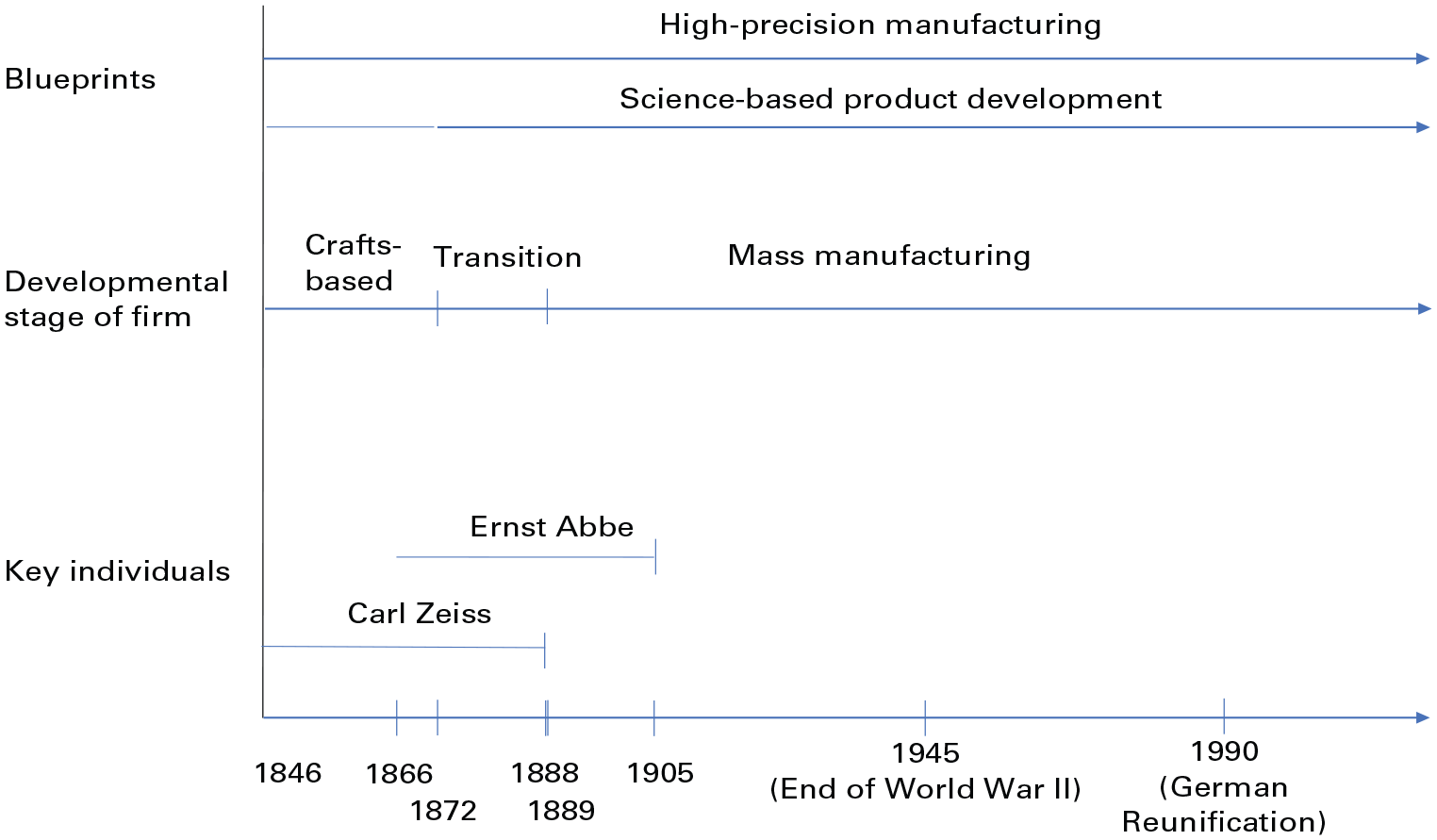
Timeline
I selected the Zeiss firm through theoretical sampling (Eisenhardt and Graebner, 2007; Siggelkow, 2007). The first sampling criterion was data availability from the time of the firm’s founding, given the importance of founding as one of the sensitive periods during which the focal entity exhibits high susceptibility to external influences (Marquis and Tilcsik, 2013: 195). Zeiss has a company archive that goes back to the firm’s founding in 1846. The second criterion was that some individuals had a strong and clearly discernible organizational impact that persisted, which enabled tracing of their actions and their impact on the firm (Marquis and Tilcsik, 2013). Corporate histories and biographies document that beginning in 1846, Carl Zeiss (and Abbe, after having joined in 1866) practiced high precision in manufacturing microscopes. Zeiss also pushed to apply scientific principles in developing new microscope objectives, or lenses, which was realized starting in 1872, after Abbe had discovered these principles (Auerbach, 1925; Schomerus, 1952; Feffer, 1997; Mütze, 2004). The third criterion was that some features of the organization needed to be persistent despite subsequent environmental changes (Marquis and Tilcsik, 2013; Simsek, Fox, and Heavey, 2015). The secondary literature suggested that Zeiss represents an extreme case in this regard, providing a strong instantiation of the phenomenon of interest that makes it easily discernible (Pettigrew, 1990; Eisenhardt and Graebner, 2007; Siggelkow, 2007). In 1934, an academic observer wrote of Zeiss, “The organization has withstood the test of many years of growth and change without essential alteration in its structure or its philosophy. It has met successfully the shocks of the Great War; the Revolution, the Inflation Period, and several severe industrial depressions” (Young, 1934: 292). Subsequently, World War II brought further massive and discontinuous changes: all patent documents and technical drawings (codified knowledge) disappeared; the firm lost many of its employees; it was split into West and East German firms; and the business environment in Germany in 1945 was substantially different from what it had been prior to the war (Hermann, 1989; Mühlfriedel and Hellmuth, 2004). Yet, despite such massive changes, the West German Zeiss firm recreated some of the pre-war organization structures related to science-based product development and high precision (Köhler, 1983; Hermann, 1989; Kogut and Zander, 2000). Because of these features, the Zeiss case has already drawn attention in the literature (Young, 1934; Weiss, 1949; Kogut and Zander, 2000; Buenstorf and Murmann, 2005).
Data Collection
In the first stage of data collection, I studied the secondary literature on Zeiss to understand the founder, the firm, its development over time, and its historical context; see the top of Table 1. To do so, I searched literature databases for works on Carl Zeiss, the Zeiss firm, and Ernst Abbe, covering English- and German-language sources. To develop a grasp of the context, I also read books on the history of microscopy and the optical industry. I included Abbe because along with Carl Zeiss, he was highly influential on the development of the Zeiss firm during a sensitive period. The time of Abbe’s involvement was not the founding period, but as Simsek, Fox, and Heavey (2015: 296) noted, “the imprinting role of individuals is not limited to . . . the founding period.”Marquis and Tilcsik (2013: 200) wrote that “sensitive periods should be conceptualized as periods of transition.” Abbe strongly influenced the Zeiss firm in its second major sensitive period: its transition from crafts-based to science-based product development. This took place in what a contemporary observer termed the “childhood” stage of the Zeiss firm (Auerbach, 1925: 22) and an “early stage of industry development” (Simsek, Fox, and Heavey, 2015: 292), before the mass manufacturing of microscopes. It represents a “discontinuit[y]” (Simsek, Fox, and Heavey, 2015: 299) in the product development process that Abbe himself had enabled with his scientific discovery. These features provide reason to believe that the Zeiss firm was “more malleable” during this period “than in normal times” (Marquis and Tilcsik, 2013: 199). In this transition, Abbe played a key role by bringing to fruition the scientific construction of microscopes that Carl Zeiss had attempted. During this time, Abbe also actively drove the reorganization of manufacturing and the building of an organization structure for product development (Cahan, 1997: 72–73; Plumpe, 2014).
Data Sources
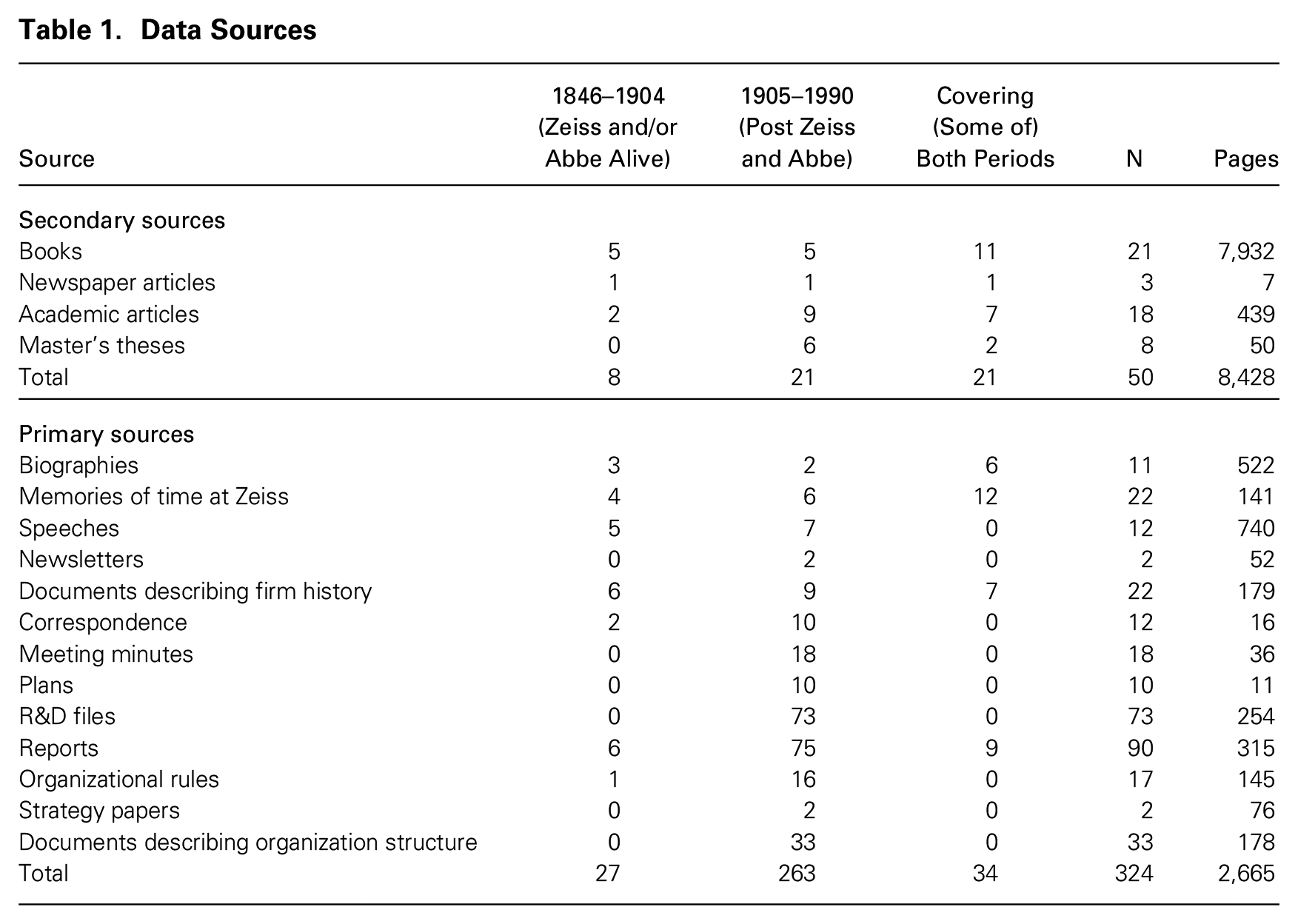
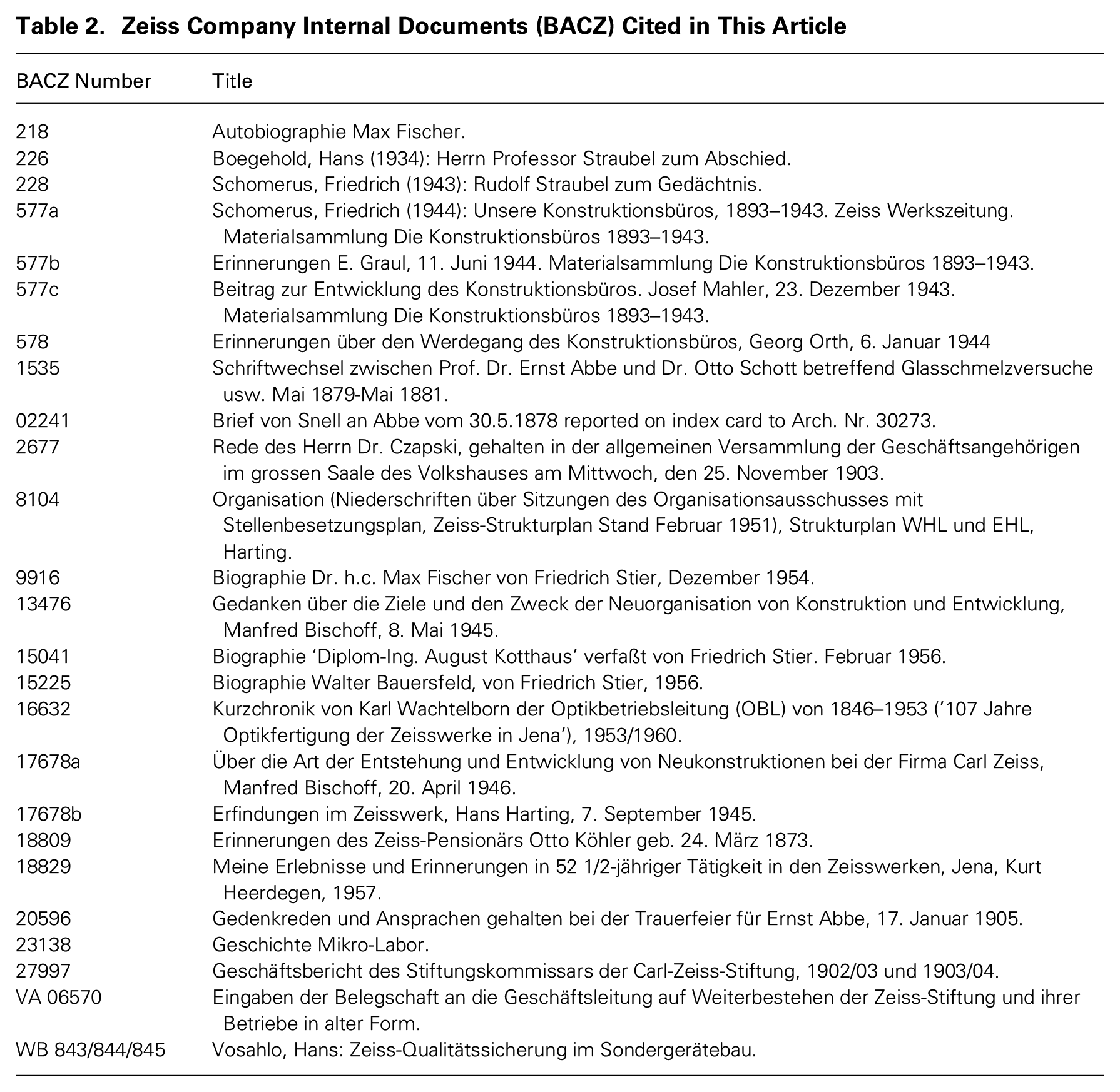
In the second stage, I collected primary data in the company archives of the Carl Zeiss firm and the Schott glassworks (also co-founded by Carl Zeiss) in Jena, Germany. On six trips to these two company archives, over several days for each trip, I consulted several hundred internal documents that describe the organization as it developed over time and how work was accomplished, e.g., documents describing organization structure, meeting minutes, R&D files, plans, reports, speeches, retrospective accounts by individuals of their time at Zeiss, organizational rules, strategy papers, documents describing firm history, and correspondence; see the bottom of Table 1. Overall, I collected or excerpted more than 300 documents. In Table 2, I provide a list of the internal documents (the primary sources) that I cite in this article; for example, a text citation to BACZ 218 refers to the Autobiographie Max Fischer that I found in Zeiss’s internal documents.
Zeiss Company Internal Documents (BACZ) Cited in This Article
Throughout the data collection process, I repeatedly consulted the company historian to get a solid overview of the archival material and to understand which types of documents contained which information. Two research assistants, historians by training, helped collect further data between my visits to the archives.
Data Analysis
Given the open-ended nature of the research question, I followed established methods for theory-building through inductive research (Siggelkow, 2007; Miles, Huberman, and Saldana, 2014). In analyzing the data, I engaged in an iterative process (Kipping, Wadhwani, and Bucheli, 2014; Miles, Huberman, and Saldana, 2014) and worked recursively between data and theory (Eisenhardt, 1989; Yin, 2009), employing analytical moves suggested by Grodal, Anteby, and Holm (2021). The fact that the Zeiss firm had features that persisted for a very long time despite strong discontinuities was puzzling and focused my attention on data that appeared “most surprising or salient” in this regard (Grodal, Anteby, and Holm, 2021: 597). I analyzed the data in four stages.
In stage 1, I familiarized myself with the context, the Zeiss firm, its products, organization, how work was accomplished at Zeiss, and how these aspects developed over time. I wrote notes and summaries about documents I had consulted, copied, or excerpted during each visit to the archives. Two research assistants developed synthesizing documents on microscope development and the organization of microscope development at Zeiss over time.
In stage 2, using open coding (inductive coding) (Strauss and Corbin, 1990), I identified how Carl Zeiss described what he considered important for his firm and what he did in organizing and managing it. Two points stood out very clearly as potential sources of persistent characteristics of the Zeiss firm: Carl Zeiss strongly insisted on high precision in manufacturing and on designing microscopes by applying scientific principles rather than by trial and error. (So did Abbe once he joined the firm.) After several iterations, I concluded that developing microscopes by applying scientific principles and insisting on high precision for the manufacture of microscopes fit well with the construct of blueprints. As a construct employed in organizational imprinting theory (Baron, Burton, and Hannan, 1999; Baron, Hannan, and Burton, 1999; Baron and Hannan, 2002), this notion is also suitable for anchoring the findings in that theory and contributing to it. Because the most salient blueprints indicated behavior for accomplishing tasks central to the firm (product development, manufacturing), I coded them as blueprints for how to do tasks.
In stage 3, I used open coding to identify features of the organization that appeared important for characterizing the Zeiss firm and that persisted over time (“imprints,”Marquis and Tilcsik, 2013: 206; Simsek, Fox, and Heavey, 2015: 292). Salient features that persisted for a long time despite strong discontinuities include the following: The Zeiss firm specialized in high-precision manufacturing and science-based product development. It had job roles and organization units focused on tasks central to this type of product development, e.g., calculation and technical drawing. It had a substantial number of employees in those job roles, and they had a particular way of doing their tasks as they insisted on this high precision and a science-based approach to product development. The Zeiss firm manufactured products characterized by high precision and science-based product development (Hellmuth and Mühlfriedel, 1996; Mütze, 2004). I coded these as different types of imprints in different organizational dimensions. For instance, I grouped together data on job roles in calculation and making drawings and categorized them as “specialist job role imprints.” I then merged categories into overarching categories by “identifying similarities between subordinate categories” (Grodal, Anteby, and Holm, 2021: 594). For example, I merged the categories “specialist job role imprints,”“managerial job role imprints,”“organization unit imprints,” and “imprints on workforce composition” into the overarching category “structural imprints” because they all relate to features of organization structure (Grodal, Anteby, and Holm, 2021: 593) that are relevant from an organization perspective (e.g., Penrose, 1959; Puranam, 2018; Burton et al., 2019: 249). I grouped together different persistent practices through which Zeiss employees had accomplished tasks (e.g., developed products by applying scientific principles), and I categorized them as “behavioral imprints.” Similarly, I coded the imprints relating to the products that Zeiss manufactured (product scope) as “product imprints” because product scope captures an important dimension of the products a firm offers. All three types of imprints were salient in their persistence across the discontinuity of World War II and its aftermath (e.g., Köhler, 1983; Kogut and Zander, 2000; Mütze, 2004). I complemented this round of open coding with a round of top-down (deductive) coding (Fereday and Muir-Cochrane, 2006), employing the canonical dimensions of organization structure (specialization, formalization, and centralization; Miller and Dröge, 1986). For example, I coded the statutes of the Zeiss Foundation as formalized rules.
In stage 4, in line with my focus on imprinting as an “agent-driven process” (Johnson, 2007: 117), I used open coding to analyze what Carl Zeiss and Ernst Abbe had done to implement the two blueprints, to identify the mechanisms by which they translated their individual blueprints to persistent features of the Zeiss organization. The puzzle of how the Zeiss firm came to have features that persisted for a long time despite strong discontinuities focused my attention on data that appeared most salient for this question, which also helped me to generate initial categories (Grodal, Anteby, and Holm, 2021: 597). For example, the fact that Zeiss and Abbe taught employees a particular way of doing product development and manufacturing appeared to be a salient mechanism that led to persistent practices among Zeiss employees. I categorized this mechanism as “teaching” because it captures an essential mechanism through which Zeiss and Abbe instilled particular practices in their employees (Grodal, Anteby, and Holm, 2021: 600). Another example is that, as the Zeiss firm grew, Abbe had employees specialize in manufacturing and product development, leading to the emergence of specialist job roles, for example in calculation and making drawings. I categorized this as “decisions about specialist job roles” because the data grouped in this category relate to the emergence of specialist job roles resulting from decisions about a process of dividing labor. I also dropped some categories I had identified earlier in the analysis process when they turned out to be “only peripherally related to the overarching theoretical story” (Grodal, Anteby, and Holm, 2021: 599).
I then identified relationships between these categories (Grodal, Anteby, and Holm, 2021). Sequential relationships were the most salient. For example, the two blueprints guided Zeiss’s and Abbe’s decisions and shaped core features of the organization in persistent ways, leaving structural imprints such as job role or organization unit imprints. Setting concepts in a sequential relationship—along with creating figures and iterating repeatedly between those and the data—helped me to tease out the mechanisms (Grodal, Anteby, and Holm, 2021) that translated individual blueprints to persistent features of the Zeiss organization. In this way, I developed a conceptual framework by identifying variables and relationships that extend and elaborate theory (Yin, 2009).
Because the primary data in this article come from historical sources, I also employed measures recommended for historical organization studies (Kipping, Wadhwani, and Bucheli, 2014). To gauge the validity and credibility of the sources, I took into account their temporal and geographical proximity to the events they covered, and I attempted to view each document from the perspective of decision makers within their historical context (Kipping, Wadhwani, and Bucheli, 2014). On several occasions I did so with input from the company historian and the two research assistants, who are historians. I employed triangulation (Miles, Huberman, and Saldana, 2014) among different actors and among different sources, e.g., internal memoranda and external communication, private letters and public speeches, or documents written by Zeiss employees and outsiders (Bhardwaj, Camillus, and Hounshell, 2006; Kipping, Wadhwani, and Bucheli, 2014; Rowlinson, Hassard, and Decker, 2014). The company historian also provided feedback on an earlier version of this article, as did a group of business historians at a conference dedicated to Zeiss’s history. For an historical study of an organization that reaches far back in time, a “member check” (Lincoln and Guba, 1985: 314) in the strictest sense is impossible. However, I subjected a prior version of this article to the closest substitute, presenting to historians with deep knowledge of the history of the Zeiss firm.
Findings
My analysis shows that Zeiss and Abbe had two blueprints for how to accomplish tasks that were central for their firm. Their blueprints became imprinted features of the organization through early decisions, teaching, role modeling, and formalized rules, which left structural, behavioral, and product imprints.
Two Blueprints of the Founder and His Business Partner
The two blueprints of Zeiss and, subsequently, Abbe were manufacturing with high precision and using scientific principles to develop new products.
High-precision manufacturing
Carl Zeiss considered high precision and high quality to be essential for his products right from the start (Abbe, 1887; von Rohr, 1930; Wittig, 1989: 98). To illustrate, when he underwent the exam for his business license as an optician in 1846, he complained to the examining authority that “[t]he questions . . . ‘lacked the mathematical accuracy and precision . . . which are essential in matters of applied mathematics’” (Paetrow and Wimmer, 2016: 39). He also made considerable efforts to realize and enforce precision: As Abbe (1896c: 70) commented, “from the beginning, Zeiss . . . always put the uncertain dexterity of the hand under strict control mechanisms.” For instance, he carried out rounds on the shop floor to personally inspect products in order to uphold high quality standards (Schomerus, 1952: 69). He also insisted “on the most diligent execution of all components” with “iron-hand-strictness” (von Rohr, 1930, App. IV: 9), sanctioning employees who did not fulfill his standards of precision. As a result, “from the very beginning, he had only released products that had stood up to ‘almost mercilessly strict tests’” (Willam, 1967: 31).
Ernst Abbe also insisted on “precision in mechanical execution” (BACZ 226: 1) in the production of optical instruments. 1 He argued that “no other function has to remain for the working hand than realizing precisely the forms and dimensions of all components that were determined by calculation” (Abbe, 1896c: 65; emphasis added). Beginning in 1867, the year after he joined the firm, Abbe also invented and developed a series of measurement, calibration, and testing instruments (Auerbach, 1925; Schmigalla, 1993; Mütze, 2004; Paetrow and Wimmer, 2016) that were crucial for realizing increased precision in manufacturing (von Rohr, 1930: 20–21). Moreover, Abbe actively engaged in adapting manufacturing methods to employ his measurement, calibration, and testing tools and methods (BACZ 16632: 7; Auerbach, 1925; Schmigalla, 1993; Cahan, 1997; Paetrow and Wimmer, 2016). He often made rounds on the shop floor to inspect products (BACZ 18809). Even when facing demands by military customers who were much more interested in lower cost and ease of transportation in combat than in maximum precision, he kept insisting on high precision (Florath, 1997).
Science-based product development
When Zeiss started his business, designing microscopes was purely a matter of craftsmanship. Zeiss was unhappy with this method: “I have something of an aversion to this relentless rigmarole of trial and error that is so common among us lens makers” (letter from 1855, in Paetrow and Wimmer, 2016: 57). Rather, he wanted to tap into the “power of science” to advance microscope design (Abbe, 1887: 62). Unfortunately, the scientific basis for designing microscopes was still lacking.
In 1850, while thinking about his second microscope, Zeiss actively tried to develop a scientific basis for designing microscope lenses. He asked a local mathematician, F.W. Barfuß, who had written a textbook on the construction of optical instruments, to develop a mathematical foundation for doing so (Paetrow and Wimmer, 2016). But Barfuß died in 1854, his efforts “a complete failure” (Abbe, 1887: 62). This “did not deter Carl Zeiss from launching into the same endeavor again” (Abbe, 1887: 62), even though giving up would have been completely understandable (Auerbach, 1922: 120). In 1865, Zeiss approached Ernst Abbe, a professor at Jena University, to solve this task, thereby showing “the stubbornness necessary to realize this idea” (Paetrow and Wimmer, 2016: 85). Abbe’s former assistant, Moritz von Rohr, mentioned that “it is reasonable to consider” that the aim of developing a scientific basis for the design of the microscope objective “had become such a part of Carl Zeiss’ innermost essence that he could not be without it at all . . . That he did not let himself be deterred by the decisive failure clearly shows how deeply ingrained this aim was in him” (von Rohr, 1930: 15; Schomerus, 1936: 3). Abbe actually discovered the formula specifying the criterion for sharp imaging in the area around the optical axis, taking into account the wave character of light (Paetrow and Wimmer, 2016).
Having cleared the path for using science to design the microscope objective (Paetrow and Wimmer, 2016), Abbe practiced the “design [of microscopes] in a purely rational way in all components . . . with purely mental labor, by theoretically identifying the effects of all components, before those components are executed physically” (Abbe, 1896c: 65; also see BACZ 226; Young, 1934). Zeiss and Abbe “held to their program so strongly that (at first) they cared less about improving lenses per se than about ensuring that their craftsmen properly executed the instructions given to them on the basis of Abbe’s theory and calculations” (Cahan, 1997: 72–73). In 1872, Abbe applied his new method in rapid succession “to redesign and test Zeiss’ entire existing line of microscope objectives, and to develop a new set of higher performance objectives to complement it” (Feffer, 1997: 41). The 1872 price list proudly mentioned that all of Zeiss’s microscope optics were based on calculations by Abbe (Boegehold, 1951; Paetrow and Wimmer, 2016; Wimmer, 2017). Zeiss stuck to this method even when competitors advertised their microscopes as not built like those from Jena (Abbe, 1896c: 67).
Thus, right from the start, Carl Zeiss had a blueprint for carrying out manufacturing tasks with high precision and a blueprint for developing microscope objectives by scientific calculation. He repeatedly attempted to realize this development by recruiting a scientist. In the second attempt, Ernst Abbe made this science-based development possible, thereby bringing to fruition Zeiss’s repeated attempts, by developing an operational way of implementing this blueprint.
Blueprints Translated into Organizational Imprints Through Early Decisions
Decisions about specialist job roles
From its founding in 1846 until the beginning of the 1870s, the Zeiss firm was organized according to the crafts system (Auerbach, 1925; von Rohr, 1930; Schomerus, 1952) whereby each person produced a complete instrument, without specialization. Between 1872, when Abbe enabled the scientific design of microscopes, and 1889, the Zeiss firm transitioned to science-based mass manufacturing (Auerbach, 1925; von Rohr, 1930; Schomerus, 1952; Willam, 1967; Cahan, 1997). The firm grew from fewer than 40 employees to more than 350, developed different product lines of microscope technology, and became a large manufacturing enterprise with an increasing degree of specialization.
In shifting away from the craft system, Zeiss and Abbe needed to decide along which dimensions to divide tasks that had previously been carried out by one person. In keeping with their two blueprints, when they involved others in tasks they initially had done themselves, they emphasized the distinction between product development and manufacturing (Abbe, 1896c). When they divided labor along those lines, they created specialization of manufacturing and product development sub-tasks, leading to the emergence of specialist job roles in these areas, such as draftsman (Auerbach, 1925; Mütze, 2004).
In manufacturing, this process involved specialization of shop floor workers into manufacturing mechanical parts or optical parts (Schomerus, 1952: 33; Hellmuth and Mühlfriedel, 1996: 66–67) and, for example, metal-working labor into drilling, milling, lathing, or stamping (Schomerus, 1952: 74; BACZ 16632: 9). Moreover, Zeiss and Abbe had some employees specialize in tasks essential for implementing the high-precision manufacturing blueprint, such as measuring thicknesses or apertures (BACZ 16632; Auerbach, 1925; Bauer, 2010).
When Abbe started to implement his blueprint for science-based product development, he was initially the only person capable of performing the required calculations, so he performed this task on his own (Mütze, 2004). Over time, he increasingly involved other calculation experts in the task, including Paul Riedel in 1879, Siegfried Czapski in 1884, Paul Rudolph in 1886, Albert König in 1894, Moritz von Rohr in 1895, and Rudolph Straubel in 1901 (von Rohr, 1930: 79; Schomerus, 1952; Hellmuth and Mühlfriedel, 1996; Mütze, 2004; Wimmer, 2017). Between 1886 and 1896, Rudolph, Czapski, and König took over from Abbe responsibility for calculations in the microscope, photo, measurement, telescope, and astronomy departments (Mütze, 2004: 324). Similarly, Abbe at first made all the technical drawings himself (Mütze, 2004: 70; BACZ 577a), but starting in the 1880s he involved others in making the drawings (BACZ 577a; BACZ 577b; BACZ 578).
By 1889, Abbe had implemented specialization in product development in two main tasks for science-based development, calculation and technical drawing, and created specialist job roles (Auerbach, 1925). The specialist tasks in calculation and drawing led to the emergence of specialist job roles, specifically calculation experts and draftsmen, which were henceforth found at the Zeiss firm (Auerbach, 1925; von Rohr, 1930; Schomerus, 1952; Hellmuth and Mühlfriedel, 1996; Mütze, 2004; BACZ 577a, BACZ 577b).
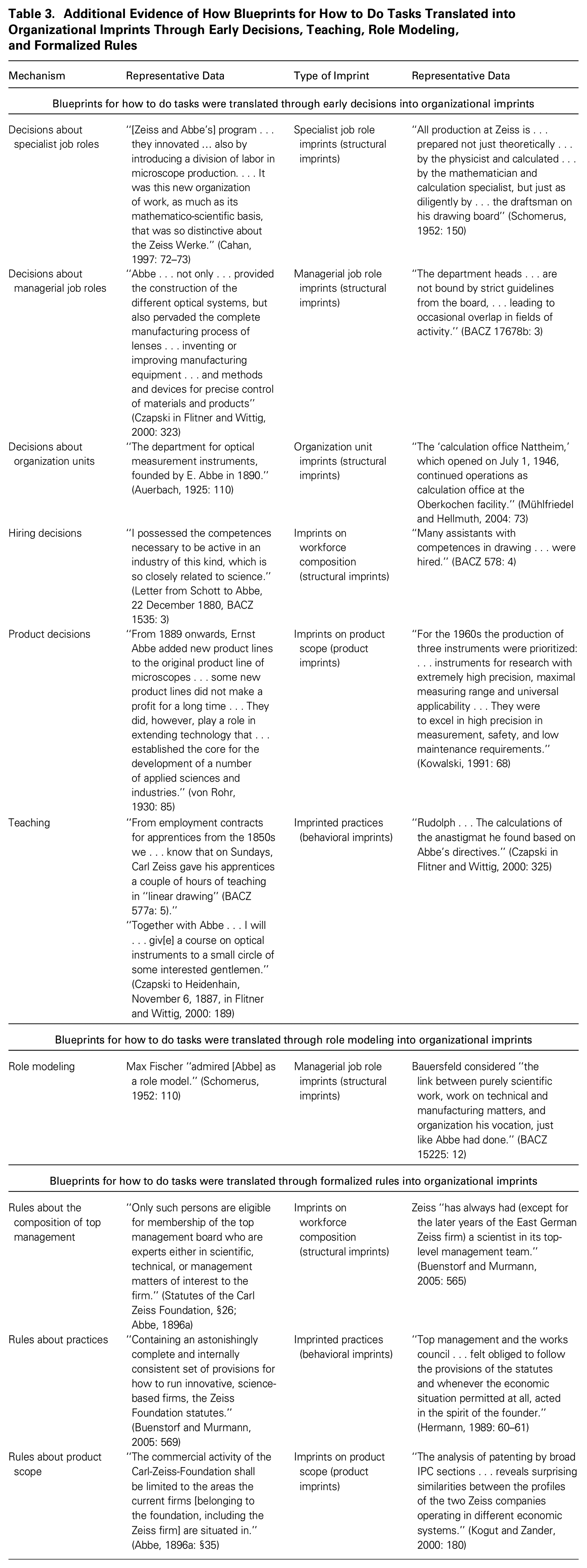
My findings also suggest that this early decision on the principle to use in dividing the overall task and the resulting emerging specialist job roles imprinted the organization in the long term by influencing subsequent decisions about further specialization and specialist job roles as the firm grew. Even after Abbe’s time, Zeiss managers decided to further specialize drawing work, for instance, into sub-tasks, which led to the emergence of related specialist job roles (BACZ 17678b; Combined Intelligence Objectives Sub-Committee, 1945; Wimmer, 2009). When the head of development at Jena, appointed after World War II (Bischoff), designed the post-war development organization, for instance, he included auxiliary staff who were in charge of things such as registration and reproduction of drawings (BACZ 17678a). The two blueprints for how to do tasks were thus translated into specialist job role imprints—a type of structural imprint—through early decisions about the lines along which to specialize and the emerging specialist job roles resulting from these decisions. Table 3 provides an overview and further evidence.
Additional Evidence of How Blueprints for How to Do Tasks Translated into Organizational Imprints Through Early Decisions, Teaching, Role Modeling, and Formalized Rules
Decisions about managerial job roles
Abbe believed that a tight link between product development and manufacturing—or more broadly, between science and technology—was essential (Abbe 1896a, §35; Schmigalla, 1993: 550). For many years, he was engaged in both product development and reorganizing manufacturing in order to implement the science-based product development and high-precision manufacturing blueprints for how to do tasks (Cahan, 1997: 72–73; Czapski in Flitner and Wittig, 2000: 323; Plumpe, 2014). This led him to regularly engage in a very broad span of tasks. In addition to conducting his calculation work, Abbe was also a driving force in manufacturing operations, organization, and strategy, and he served as Zeiss’s major entrepreneur who pushed the firm’s inventions to the market (Auerbach, 1925; Mütze, 2004: 39). Having designed glass-making experiments with Otto Schott that led to glass with the desired characteristics (Kühnert, 1946), Abbe also worked with Schott in founding, building, and managing the Schott glassworks in Jena (Auerbach, 1922, ch. 5; von Rohr, 1930: 63–68; Kühnert, 1957: XV). Czapski called Abbe “that strange and rare fusion of an ideal scientist and a practical businessman” (BACZ 20596: 4). Even shortly before Abbe retired, “all business matters were brought on his desk, even the most negligible ones, as he could not be convinced to add an intermediate layer” (BACZ 27997, Yearly Report 1902/03: 6).
Having decided to work consistently in this manner, Abbe defined his job role broadly, combining product development with reorganizing manufacturing and general management tasks. In this way, he translated the two blueprints into a managerial job role characterized by a broad set of tasks, a structural imprint. Note that how he translated the two blueprints into managerial job roles was different from how he did so for specialist job roles: For specialist job roles, the blueprints provided the lines along which to specialize (e.g., science-based product development). Thus, the content of the blueprints left a persistent mark for specialist job roles. In contrast, for managerial job roles, not the content of the blueprint but Abbe’s decision to dedicate himself to implementing both blueprints left a persistent mark; this decision set the scope of managerial job roles in terms of breadth of tasks encompassed in the role.
The job roles of managers in the generation succeeding Abbe also combined deep specialist expertise, for example in calculation, with a broad span of responsibilities. The responsibilities of management board members were not explicitly specified or clearly delimited (BACZ 27997: Yearly Report 1903/04). Responsibility for research was assigned to one of the board members only in 1945 (Wimmer, 2009). For example, board member (from 1903–1933) Rudolph Straubel’s “work in the Zeiss firm can be summarized in two points: Straubel as a technical physicist and as an entrepreneur” (BACZ 228: 95). Board member (from 1920–1941) August Kotthaus’s “activity initially covered technical matters, but later also spread into the commercial field and from the beginning also concerned social issues in the firm” (BACZ 15041: 7).
Over time, managerial job roles—a structural feature of organizations—were characterized by a broad set of tasks further down in the hierarchy as well. Guidelines for department directors from 1910 and a 1938 document show broad managerial job roles for department heads, which were at the next hierarchical level down from members of the management board. They were expected to be scientists but also to have and realize new product ideas, to take care of manufacturing, to be active in marketing, and to play a crucial role in assuring coordination (Wimmer, 2009; BACZ 23138). The broad scope of managerial job roles can also be gauged through data on inventions for the period 1919–1940: Members of the management board were involved in 27 percent of patents and almost 30 percent of the development projects in the microscope department (Wimmer, 2009). Broad managerial job roles were still a structural feature of the Zeiss organization in 1945. The Allied Intelligence Committee that visited Zeiss in April 1945 noted that “technical strength amongst its principals is again a feature” (Combined Intelligence Objectives Sub-Committee, 1945: 101); in other words, top managers had both management and technical skills.
The heads of research (Harting) and development (Bischoff) were tasked with rebuilding R&D after the end of the war. Two documents from 1945 and 1946 provide an inside view of their decisions relating to the organization of R&D, showing that broad job roles were maintained on different hierarchical levels: (a) the tasks of the head of the development offices “spanned the whole subject matter, as a rule; dividing it up, or specialization, is avoided” (BACZ 17678a: 3); (b) among the scientific employees and assistants in the development offices, tasks and responsibilities were not narrowly defined, either. Rather, one person was tasked with design and development but was also responsible for carrying out, in all detail, the work required for construction drawings (BACZ 17678a: 3). Even after the extreme, discontinuous changes related to the war and the split into two Zeiss firms, this job role design persisted in the Western Zeiss firm, which was set up from scratch on a greenfield site. A former head of R&D at the Western firm wrote that “natural scientists had the complete responsibility for products, and in those departments, there was always only one person responsible at the top” (Köhler, 1983: II–24). Department heads at the West German firm were therefore responsible for research, product planning, development, and sales—just like in Jena before the war (Köhler, 1983: II–24; Kowalski, 1996: 211).
The data thus suggest that Abbe’s definition of his job role, which was influenced by the two blueprints for how to do tasks and his implementation of both, subsequently impacted decisions about the scope of managerial job roles at different hierarchical levels. In this way, the two blueprints for how to do tasks were translated into managerial job role imprints, a type of structural imprint. Broad managerial job roles were a strong, persistent feature of the Zeiss organization for at least a century.
Decisions about organization units
Abbe’s work to implement the blueprints for science-based product development and high-precision manufacturing required a “complete reorganization of the firm, which occupied Ernst Abbe intensely and comprehensively in the years running up to 1889” (Plumpe, 2014: 13; Cahan, 1997). In this period, the firm was characterized by increasing headcount and specialization (von Rohr, 1930; Schomerus, 1952). Abbe decided to group the increasing numbers of specialists in calculation, drawing, and measurement into units defined in terms of those specializations. From the mid-1880s onwards, he set up dedicated organization units specializing in calculation, drawing, and measurement tasks required for science-based product development and high-precision manufacturing (Auerbach, 1925; Hellmuth and Mühlfriedel, 1996; Mütze, 2004). Building on a small group making the measurement instruments that Abbe had invented, which had existed since 1876 (BACZ 16632), he set up the department for optical measurement instruments in 1890 to provide such instruments for internal use (Auerbach, 1925; Mütze, 2004). The first drawing office originated in 1893 (BACZ 577a; BACZ 577b; BACZ 577c; BACZ 578; Schomerus, 1952: 149–150; Hellmuth and Mühlfriedel, 1996; Wimmer, 2002). By 1903, there were three drawing offices focused on different products (Hellmuth and Mühlfriedel, 1996). By 1899, two calculation offices existed (Backhaus, 1996: 39). By repeatedly grouping people into organization units defined along the above-noted lines of specialization, Abbe translated the blueprints for how to do tasks into organization units.
Subsequent managers also decided to set up further organization units dedicated to calculation, drawing, and measurement. In 1919, a new top management team faced the decision of how to reorganize the Zeiss firm after the massive changes brought by the war. They decided to retain the organization structure of calculation offices and drawing offices (then called “development offices”) but added new calculation offices so that there were three in 1919 (Mütze, 2004: 191). A department focused on measurement instruments for sale rather than internal provision was also set up in 1919 (Walter, 2000; Georgi, Kamp, and Mahl, 2009). In 1930, the measurement department was established, building on the department for optical measurement instruments (Bauer, 2010: 52) and dedicated to measurement and control tasks, for example adherence to physical and optical tolerances of finished products (Schomerus, 1952: 148; Nietzel, 2007; Bauer, 2010: 52). The number of drawing offices had increased to four by 1925 (Auerbach, 1925: 165), to six by 1933, and to seven in 1934 (Mütze, 2004: 422), and the number of calculation offices increased to five by 1943 (Combined Intelligence Objectives Sub-Committee, 1945: 94; Mütze, 2004: 322). Zeiss still had 16 R&D laboratories in early 1945 (Kogut and Zander, 2000: 172). After the war, the head of R&D in the East German Zeiss firm also chose calculation and development (earlier: drawing) offices again for the future R&D organization structure (BACZ 17678a; BACZ 8104; Wimmer, 2002). Likewise, when the West German Zeiss firm was founded in 1945, its managers decided to have calculation and development (earlier drawing) offices, like at Jena (Köhler 1983, VII–6: 2–3, VII–7: 4; Ziegler, 2014: 241). As the former head of R&D in the West German Zeiss firm noted, “the organization structure of Zeiss Oberkochen developed out of the old organization structure of the Jena parent company” (Köhler, 1983: II–24). Managers both at the East and the West German Zeiss firms again set up measurement units as well (Köhler, 1983: II–34; BACZ WB 843/844/845: 63). The former head of R&D in the West German Zeiss stated, “a central measurement department was set up right at the beginning, following the Jena template” (Köhler, 1983: II–34). These persistent units represent organization unit imprints, a type of structural imprint.
A second instance of organization unit imprints relates to the fact that since the mid-1890s, R&D at Zeiss had been decentralized: The department heads of the different product units were responsible for the complete process of development, production, and sales of their products (Auerbach, 1925: 164; Köhler, 1983: II–24; Kowalski, 1996: 211; Mütze, 2004: 68; BACZ 17678a: 2; BACZ 17678b). After Abbe, there was some movement toward increasing centralization of R&D at Zeiss, with the first steps taken in 1911–1912 (Mütze, 2004: 319). Between the First and Second World Wars, some research functions were gradually transferred from scientists in the product units to independent organization units focused on research (Wimmer, 2009: 97). Yet, at that time, many firms had already established central R&D departments (Wimmer, 2009). In contrast, Zeiss did not set up a central research unit in the interwar years (Wimmer, 2009), suggesting that the degree of decentralization of R&D units at Zeiss decreased more slowly than in other firms. Centralized R&D units appeared at Zeiss only in plans for the post-war period from 1942 and in organigrams from 1945 that show a functional structure of the firm (Mütze, 2004: 317–318; Wimmer, 2009: 97). However, a functional structure with central R&D functions “was not the trend at the time . . . to the contrary: generally speaking, at this time organizational functions were transformed to divisions again” (Wimmer, 2009: 97–98). At Jena, management set up a central development department and a central research department in March 1946 (Wimmer, 2002, 2009; Mütze, 2004). When the West German Zeiss firm was founded, some central units for R&D tasks were established. However, the former head of R&D of the West German Zeiss firm also reported that product groups or “‘departments’ were set up again in their old form . . . which reported directly to top management” (Köhler, 1983: II–27). Importantly, “like before [WWII], the heads of those departments or product groups were responsible for product development . . . That structure was, in principle, maintained until mid-1966” (Köhler, 1983: II–27). As an instance of organization structure that was influenced by blueprints and maintained over long periods, organization units with this specific allocation of responsibilities to unit managers represent a further organization unit imprint. This tendency toward R&D decentralization was still discernable half a century after Abbe’s death, even after the discontinuity of World War II. Overall, the findings suggest that early decisions about organization units and their specific features, such as unit managers’ responsibilities (which were influenced by blueprints for how to do tasks), affected subsequent decisions about organization units and their characteristics and left organization unit imprints (a type of structural imprint).
Hiring decisions
When Carl Zeiss scaled up manufacturing and needed to hire others, he chose people who enabled him to maintain the manufacturing of microscopes with high precision, in line with the blueprint for high-precision manufacturing. For instance, the very first person he hired, in 1847, was August Löber, whom Abbe (1896c: 71) characterized as having “such a highly-developed sense for precision and exactness.” Löber came to play a crucial role in the precision and quality of the workshop’s products (Feffer, 1997: 27). In 1878, Abbe’s father-in-law wrote that because of the “great accuracy of its works Zeiss can only use the most dexterous workers and therefore needs to pay much higher wages than all other optical workshops” (letter by Snell, May 30, 1878, BACZ 02241). An event around 1885 or 1886 demonstrates that competence in precise manufacturing was an important requirement for Carl Zeiss: On one of his daily rounds on the shop floor Carl Zeiss took a close look at microscope stands one of the workers had produced. He tried out the mechanism, the movements of the regulators, the tube extension—and did not say a word. He asked the worker to take the stands to the workshop, to the anvil. There, he took a heavy hammer and smashed one microscope stand after the other. “Now we are done with each other!” The worker subsequently left the firm. This drastic lesson [was] that there was no “cutting corners” at Zeiss where precision was concerned. (Schomerus, 1952: 69)
As noted, to realize the blueprint for science-based development of microscopes, Carl Zeiss actively chose and approached first F.W. Barfuß and then Ernst Abbe, both university lecturers and scientists (Wimmer, 2017). Abbe also collaborated with Otto Schott, a chemist. Endeavoring to eliminate trial and error, just like Zeiss and Abbe, Schott had applied scientific principles in developing glass through a series of experiments (e.g., letter from Schott to Abbe, 8 August 1879, BACZ 1535; Kühnert, 1946, 1957). In the transition from a crafts-based system to increasing specialization (Auerbach, 1925; Willam, 1967), Abbe also hired staff, such as Riedel (in 1879) and Czapski (in 1884), with competencies needed for implementing the science-based product development blueprint, i.e., in technical drawing (BACZ 577b, BACZ 578) and in mathematics (von Rohr, 1930: 79; Schomerus, 1952; Hellmuth and Mühlfriedel, 1996). Seventeen scientists, mostly highly qualified physicists, were hired between 1898 and 1902, bringing the number to 24 by 1903 (von Rohr, 1918; Cahan, 1997: 90). By that time, “the firm was run by physicists, several of whom also held faculty positions at the University of Jena” (Cahan, 1997: 90). Overall, in hiring staff, both Zeiss and Abbe regularly chose candidates for their specialist job roles who had the competencies required for science-based product development and high-precision manufacturing. In that way, they translated their blueprints into early hiring decisions.
Initially, Zeiss and Abbe made the hiring decisions. As the firm grew, many more staff were hired, and organization units with department heads were set up (von Rohr, 1930; Schomerus, 1952). Other people were increasingly involved in making hiring decisions. They, too, hired scientists with competencies in calculation to staff specialist job roles (also see BACZ 17678a), and the Zeiss firm also employed many scientists after Abbe’s time (Buenstorf and Murmann, 2005: 565). In 1987, for instance, 4,100 employees at Jena engaged in research, and Zeiss employed 4.7 percent of all R&D staff in the industrial sector in the German Democratic Republic in that year (Kogut and Zander, 2000). In the mid-1980s, the East German Zeiss firm spent 7.7 percent of turnover (income from sales) on R&D, among the highest percentages in the republic. At the same time, the West German Zeiss firm devoted about 10 percent of their turnover to R&D (Kogut and Zander, 2000). The two blueprints for how to do tasks were thus translated into a workforce composition imprint—a structural imprint—through early hiring decisions to staff the positions that Zeiss and Abbe had created.
Product decisions
During the first four decades, Zeiss produced only microscopes. In the late 1880s, Abbe started to extend the firm’s product scope through his decisions to develop and offer products such as photographic objectives, measurement instruments, prism binoculars, and astronomical and geodetic instruments (von Rohr, 1930; Walter, 2000; Mütze, 2004). When selecting new products to be developed, Abbe chose products whose development could build on the scientific results already attained. As Mütze (2004: 67) wrote, the diversification of product scope “derived from the diversification of the existing scientific results relating to the development of microscope objectives.” Those results were generated by the specialists whose job roles Zeiss and Abbe had created and whom they had chosen for those positions, to implement the science-based product development blueprint. Among them were Ambronn, Siedentopf, and Köhler, who made significant advancements in microscopy that laid the foundation for fluorescence microscopes (Wimmer, 2017).
As Abbe’s successor, Czapski, explained, a product’s expected profitability was less important in the selection of new products for development than the potential it offered for employing and further developing science-based product development competencies, as well as for learning (including in different fields) from the challenges the product presented in science-based development (BACZ 2677). In this way, Abbe’s science-based product development blueprint translated into product decisions when Abbe made decisions about product scope. These decisions then influenced his successors when they had to make decisions about product scope. For instance, Buenstorf and Murmann (2005: 567–568) highlighted that the East German Zeiss firm “with its early and ongoing involvement in laser technology . . . followed the principles laid out by Ernst Abbe in the Zeiss Foundation statutes.” Shaping long-term product scope, the two blueprints thus left an imprint on product scope, a type of product imprint.
Blueprints Translated into Organizational Imprints Through Teaching
Carl Zeiss and Ernst Abbe themselves enacted and implemented the two blueprints. They also taught employees how to carry out manufacturing and product development, thereby instilling in them a way of doing product development and manufacturing suited for implementing these blueprints. In doing so, they translated the blueprints into employee practices that turned out to be persistent.
Regarding manufacturing, Abbe attested that “Carl Zeiss . . . accustomed the others to an almost marvelous exactness and confidence in technical work” (Abbe, 1887: 62; BACZ 18829: 9) and “did everything to make a highly exact technique customary in his small workshop” (Abbe in Wittig, 1989: 98), including by “regular control of all individual work” (Carl Zeiss in Hellmuth and Mühlfriedel, 1996: 80). To achieve this, Zeiss personally taught his apprentices (BACZ 577a: 5), insisting on an “unrelentingly strict application of the law of quality work and precision” (Willam, 1967: 76). Abbe considered it “of significant importance for Zeiss’ progress” that August Löber, the first person he hired in 1847, shared Zeiss’s zeal for precision (Abbe, 1896c: 71; Willam 1967: 46). Moritz von Rohr, Abbe’s former assistant, wrote that strictly enforcing the precise execution of all components, as Carl Zeiss did, “became second nature to his [Zeiss’s] assistants. In this, Löber was Zeiss’s most highly esteemed ally” (von Rohr, 1930, App. IV: 9). Löber also developed the empirical procedures for manufacturing and testing the components of optical systems (Feffer, 1997: 27) and, in Abbe’s view, was “the immediate or indirect teacher of all our . . . optical workers” (Abbe, 1896c: 71; Auerbach, 1925: 9). Abbe fostered high precision by personally teaching manufacturing employees, too (BACZ 02241). After the division of labor was established between shop floor workers specialized in mechanical parts and in optical parts (Feffer, 1997; Paetrow and Wimmer, 2016: 90), “the exact precision work that Carl Zeiss had insisted on for the mechanical workers since the founding of the firm was now also instilled in the optical workers” (Schomerus, 1952: 33).
Abbe himself had developed the concrete blueprint for identifying through calculation the specifications of microscope objectives. He taught others whom he hired in the 1880s (e.g., Riedel and Rudolph) his calculation methods for developing new microscope objectives (von Rohr, 1930: 79; Czapski in Flitner and Wittig, 2000: 325). Starting in 1890, he selected a circle of young scientists whom he taught, called the “Abbe school” (Czapski letter to Dohrn, 1906, in Flitner and Wittig, 2000: 54; von Rohr, 1918). It included Rudolph, Czapski, Straubel, Pulfrich, Ambronn, von Rohr, Köhler, König, and Fischer (BACZ 218, Jenaer Volksblatt 5.10.1926; BACZ 228: 94). Abbe’s successor, Czapski, declared, “I am wholeheartedly his disciple and know everything I have come to know about optics since my university days from him, or have studied it on his suggestion” (Czapski in Flitner and Wittig, 2000: 325).
Several sources provide an in-depth view of how Abbe taught one member of the Abbe school, Max Fischer. They highlight the importance of Fischer working jointly with Abbe in the decade 1890–1900 (BACZ 218, Jenaer Volksblatt 31 January, 1915). Abbe’s former assistant, von Rohr, provided a detailed account of Abbe and Fischer’s interaction: Ernst Abbe controlled each and every task, everything his new employee did, and even provided original hints himself. Every day for two years he subjected his employee to a two-hour interrogation regarding all kinds of business activities. He was happy about any idea that was proposed to him, but also criticized each and every task that was accomplished, even every individual correspondence with regard to its effect on the recipients, whose side he would take in the interrogation. . . . When he was convinced that business matters would be carried out in his sense by his employee, he abruptly broke off the interrogations. (von Rohr, 1930: 84–85)
Other sources point out that “Max Fischer had the privilege of working with and next to Abbe for 13 years . . . and thus to habituate himself to his ways of doing business . . . so that he could orient all his actions to it also after Abbe’s death. In new situations, he knew exactly which actions would have found Abbe’s approval, had he still been alive” (BACZ 9916: 7). Having “worked with Abbe himself,” Fischer “had adopted [his] spirit and intentions” (BACZ 218, Jenaer Volksblatt 5 October, 1926).
As a consequence of teaching by Zeiss and Abbe, when the firm’s employees accomplished the task of manufacturing a microscope, they did so by employing practices that enabled high precision. An account describing the Zeiss workshop in 1864 highlights that “the machines, tools, and facilities were quite primitive and it seems astonishing that precision work . . . such as optics often smaller than 1 mm in diameter, were manufactured with such equipment” (BACZ 16632: 3). This was also true after Abbe’s time. Discussing a gyroscope design in 1925, Albert Einstein (Broksch, 2005: 3) argued, “As the accuracy requirements are so high . . . the difficulties involved are so immense that Zeiss is currently the only firm that can achieve a feat of this magnitude.” When production of eyeglasses was resumed in the West German Zeiss firm, new employees were being educated to adhere to the most rigorous precision standards (Hermann, 1989: 35). Management of the West German Zeiss firm chose not to pursue the alternative—to relax the required level of precision—even in the difficult, immediate post-war situation. In the 1970s, both the East German and the West German Zeiss firms were leading suppliers of lithographic objectives for semiconductor manufacturing equipment (Zschäbitz, 1999: 57–58), which require “absolute precision” (Paetrow and Wimmer, 2016: 137). Zeiss still maintains its focus on precision in manufacturing, for instance by pushing the boundaries in lithographic equipment (Marx, 2019). Likewise, the firm accomplished product development by applying scientific principles also after Abbe’s time, as documents from 1935 show (BACZ 23138). After 1945, both the East and the West German Zeiss firms continued this practice (BACZ 17678a, BACZ 17678b, BACZ 13476; Schomerus, 1952; Mütze, 2004; Paetrow and Wimmer, 2016). The analysis thus suggests that the two blueprints for how to do tasks translated into imprinted practices among Zeiss employees, i.e., behavioral imprints, through Zeiss and Abbe having taught employees how to do product development and manufacturing.
Blueprints Translated into Organizational Imprints Through Role Modeling
The generation of top managers who succeeded Abbe, such as Czapski, Fischer, Straubel, and Bauersfeld, all saw Abbe as a role model. Bauersfeld did not just occupy himself with scientific, manufacturing, and organization tasks; he was also inspired by Abbe to do so. Bauersfeld considered “the link between purely scientific work, work on technical and manufacturing matters, and organization his vocation, just like Abbe had done” (BACZ 15225: 12). Likewise, when describing his engagement in many different functional issues, Straubel explicitly mentioned, “that is Abbe’s spirit” (Czapski in Hermann, 1989: 122). For the Zeiss company historian, the “enormous importance” of the CEOs for research and the central role and multi-functionality of the scientific department heads is “probably . . . a heritage of Abbe’s” (Wimmer, 2009: 97), possibly an effect of “the Abbe model of the inventor-entrepreneur” (Wimmer, 2009: 91). Czapski mentioned that Abbe “has an effect through his example” (Czapski letter of 1 October, 1887, in Flitner and Wittig, 2000: 187). Max Fischer “admired [Abbe] as a role model” (Schomerus, 1952: 110).
The data thus suggest that Zeiss managers who succeeded Abbe emulated him in the definition of their job role. How Abbe filled his job role, and thus his implied definition of his job role as the top manager, was highly visible. Therefore, the two blueprints for how to do tasks were translated into managerial job role imprints through managers having considered this way of defining managerial job roles, being inspired by it and emulating it, a mechanism known as role modeling (Gibson, 2004; Snihur and Zott, 2020).
Blueprints Translated into Organizational Imprints Through Formalized Rules
In 1891, Abbe set up the Carl Zeiss Foundation and transferred ownership of the firm to it. The foundation is governed by statutes that are legally binding for the firm’s management team. The statutes formalize the firm’s principles and rules of management, describing “a comprehensive and coherent system of running a science-based company” (Buenstorf and Murmann, 2005: 544). The statutes reflect very detailed and systematic formalization, consisting of 122 paragraphs and running to almost 70 pages. They contain several provisions concerning the role of science for product development at Zeiss, as indicated by the science-based product development blueprint. For instance, the important role of science at Zeiss is written into the firm’s objectives: The Zeiss firm’s objective is not just to make a profit; rather, an additional objective is to contribute to scientific progress (Abbe, 1896a: §42). Three rules are of particular interest here. First, §26 codifies a rule about the composition of the top management board, whereby “at least one member has to be an expert in scientific matters of interest to the firm” (Abbe, 1896a: §26). Even after their appointment to the board, members of the management board must continue their regular activity in their field of expertise (Abbe, 1896a: §28; Abbe, 1896b: 339; Buenstorf and Murmann, 2005: 560). Second, the statutes contain “principles for running a science-based firm” (Buenstorf and Murmann, 2005: 553), which include practices and routines (Buenstorf and Murmann, 2005: 544) that enable the implementation of science-based product development. Abbe explicitly mentioned that he codified already existing practice: “the purpose is to fix for the future and to specify more precisely something that has already been taking place without formal rules” (Abbe, 1896b: 335). Third, the statutes contain a rule about product scope. Zeiss was only allowed to be “commercially active in such branches of optics, glass technology, the production of instruments and tools and related industries, which maintain the current close link between technology and science” (Abbe, 1896a: §35). Science-based product development, therefore, needed to play an important role in the areas in which the Zeiss firm was active (Abbe, 1896b; Cahan, 1997). The statutes even explicitly prohibited diversification into other industries: “entering commercial enterprises of a different kind and the active participation in such enterprises is permanently excluded, even just for investment purposes” (Abbe, 1896a: §35).
As he wrote the statutes, Abbe thus translated the science-based product development blueprint, which he had implemented, into formalized rules: Abbe wrote the statutes as well as a 58-page commentary to explain his motives behind them (Abbe, 1896b). Importantly, written in the 1890s, the rules in the statutes were formulated after Abbe had been practicing science-based product development for two decades, after he had instilled science-based product development in others, and after he had already used the fit of products with scientific results as the criterion for including new products in Zeiss’s product scope. The findings thus indicate that Abbe translated his science-based product development blueprint into formalized rules by codifying how he had regularly practiced this.
The statutes’ rules did not just remain dead letters; once established, they imprinted the organization by influencing Zeiss employees, including those beyond Abbe’s time. First, they influenced decisions about the composition of top management. Except for the last years of the East German Zeiss firm, in accordance with §26 of the statutes, there had always been a scientist on Zeiss’s top management team (Buenstorf and Murmann, 2005: 565), a structural imprint relating to the composition of top management. Second, with regard to practices, an early observer noted that “[t]he uniqueness of the Stiftung [Foundation] lies . . . in the literalness with which these objectives are interpreted and the thoroughness of the method employed to attain them” (Young, 1934: 293). Later, a U.S. judge concluded that “the management [of the West German Zeiss firm] has dedicated itself conscientiously to operating in accordance with the spirit, terms and purposes of Abbe’s statute” (Hermann, 1989: 216). The formalized rules therefore shaped long-term practices at Zeiss, leaving a behavioral imprint. Third, the codified criterion persistently shaped the product scope in the East and the West German Zeiss firms, leaving a long-term imprint: Even four decades after the two firms had been split, they both continued patenting in the same technology classes at an astonishingly high correlation (.93) even though one firm had operated in a market economy and the other in a centrally planned economy (Kogut and Zander, 2000). In this way, the science-based product development blueprint was translated into organizational imprints—structural, behavioral, and product imprints—through formalized rules.
Why did the statutes’ rules guide the behavior of Zeiss employees so strongly? The foundation’s statutes were binding for Zeiss management and thus had legal force. The legal force of the statutes alone, however, cannot completely explain the strong correlation between areas of invention pursued by the West and the East German Zeiss firms after 1948; the statutes were suspended in East Germany in 1948 when Zeiss was socialized (Buenstorf and Murmann, 2005; Steiner, 2014). My findings indicate that Zeiss employees felt an obligation to adhere to the rules that Abbe had codified. As Abbe’s successor, Czapski, argued in a speech to workers in 1903, “we have the obligation to act like Abbe put down on paper, and we need to fulfil this obligation independently of whether we like it or not” (BACZ 2677: 14). This sense of obligation and its strength became palpable when Zeiss employees went so far as to defend the Zeiss Foundation and its statutes when the foundation came under pressure. In 1933, the Nazi administration ordered Zeiss management to substitute the Zeiss Foundation representative with a Zeiss employee loyal to the Nazis and to change the statutes, conferring wide-ranging powers on the loyalist. Zeiss top management immediately submitted a formal complaint despite the fact that the leading local Nazi politician had “unambiguously threatened top management with concentration camp” (Hermann, 1989: 144). The Zeiss Foundation and its statutes remained intact, but parts of the statutes had to be changed. As soon as the Nazi regime had fallen, all changes made to the statutes during that period were immediately reversed (Buenstorf and Murmann, 2005: 564). In the German Democratic Republic, a first attempt was made to socialize the Zeiss firm in 1947. Zeiss employees spoke up and made petitions to Zeiss management “for continuation of the Carl Zeiss Foundation and its firms in their old form” (BACZ VA 06570). This first attempt was thereby blocked, even though Zeiss was socialized the following year (Steiner, 2014). The foundation and its statutes were reinstated when the East and West German Zeiss firms merged in 1990, and the statutes are still in effect today, albeit in an updated version from 2004 (Carl-Zeiss-Stiftung, 2010).
Discussion
This article presents findings from a long-term, longitudinal analysis of how two entrepreneurs persistently shaped an organization. The analysis reveals mechanisms by which the founder and his business partner translated blueprints for how to do tasks into persistent features of the organization (structural, behavioral, and product imprints). These mechanisms include early decisions, teaching, role modeling, and formalized rules. Adding to scholars’ attempts to unpack processes of imprinting and the role of individuals in it (Johnson, 2007), my study demonstrates in detail that the environment does not “stamp” itself upon organizations (Simsek, Fox, and Heavey, 2015: 304–305). In making this point, my article further bolsters the empirical evidence (Johnson, 2007; De Cuyper, Clarysse, and Phillips, 2020; Snihur and Zott, 2020; Zuzul and Tripsas, 2020) supporting a call for efforts to strengthen organizational imprinting theory regarding the mechanisms by which individuals imprint organizations. Extending recent studies on the imprinting process (Johnson, 2007; De Cuyper, Clarysse, and Phillips, 2020; Sinha et al., 2020; Snihur and Zott, 2020; Zuzul and Tripsas, 2020), my analysis suggests an empirically grounded model of organizational imprinting of blueprints for how to do tasks. Figure 2 illustrates this model.
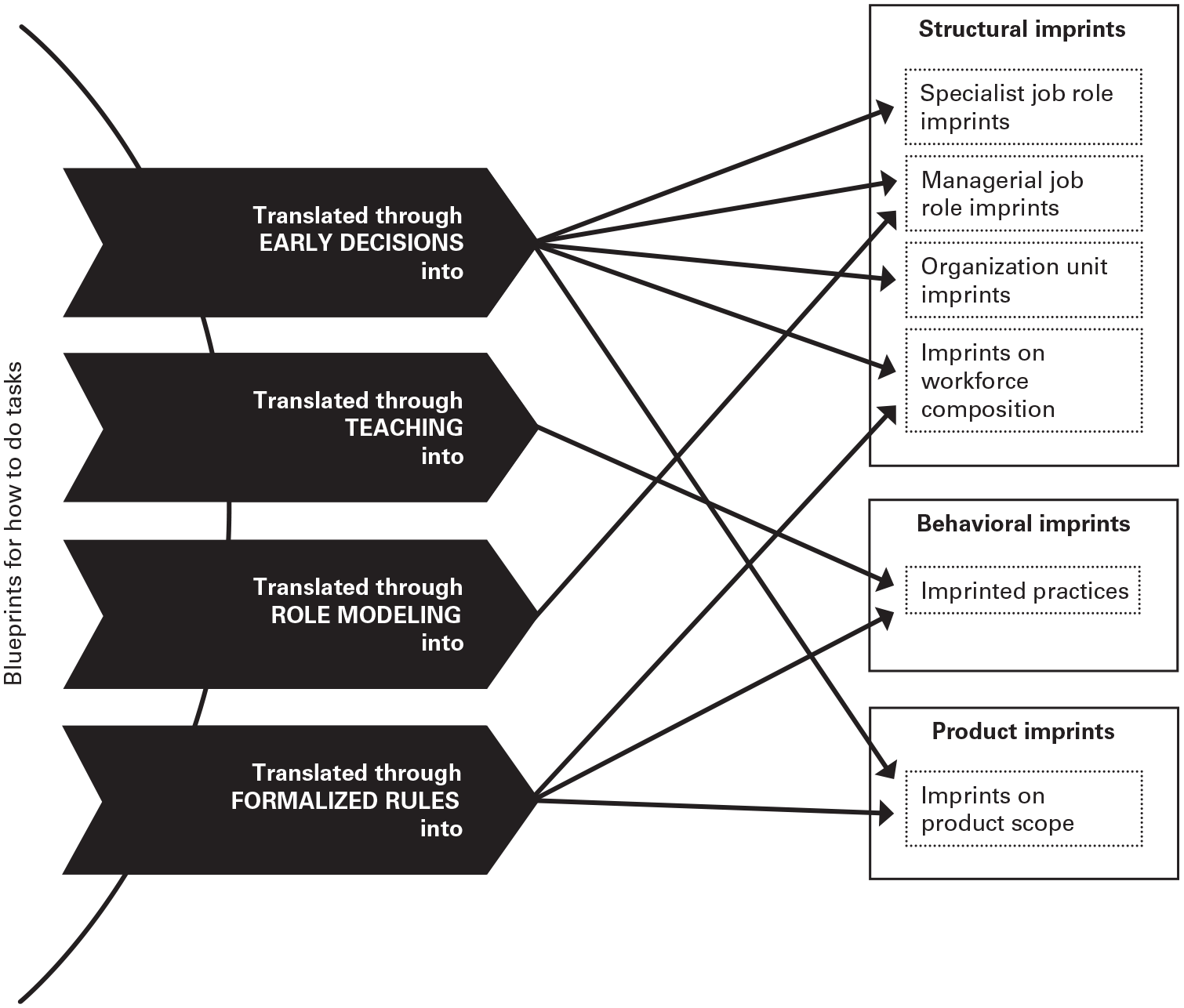
Model of Organizational Imprinting of Blueprints for How to Do Tasks
Based on this model, my study contributes especially to the individual-centered line of organizational imprinting theory (Boeker, 1989a, 1989b; Beckman, 2006; Johnson, 2007; Beckman and Burton, 2008) through three core insights that are relevant when we consider the model in the context of prior research. First, I reveal a new type of blueprint: one for how to do tasks, which acts as a source of imprints that leave a persistent mark on organization structure. Second, I find many organizational dimensions on which such a blueprint leaves a persistent mark, i.e., structural, behavioral and product imprints. Third, I explore multiple (rather than only one) imprinting mechanisms, i.e., early decisions, teaching, role modeling, and formalization. In the next sections, I discuss how each insight contributes to organizational imprinting theory.
Blueprints for How to Do Tasks as Sources of Imprints
First, I draw attention to blueprints for how to do tasks as sources of imprints. The Zeiss case is an extreme case (Eisenhardt and Graebner, 2007; Siggelkow, 2007) and prime example of that: The founder and his business partner did not have specific blueprints or models for how to organize or how to structure the organization (such as employment models or organizational models as in, for example, Hannan, Burton, and Baron, 1996; Johnson, 2007). Yet, the blueprints for how to do tasks did not just shape how tasks were done, as one would expect; they also shaped some features of organization structure. Although “organizational models or blueprints” have featured prominently in prior research (Baron, Hannan, and Burton, 1999: 529; Baron, Burton, and Hannan, 1996; Hannan, Burton, and Baron, 1996), other types of blueprints that shape organization structure have not been examined.
The findings of my article complement this prior research. Extending De Cuyper and colleagues’ (2020: 1597) study of “blueprint[s] for actions and decisions,” my study highlights the importance of blueprints for how to do tasks, and their role in imprinting organization structure. Specifically, it suggests the need to extend the understanding of blueprints beyond “methods for controlling and coordinating work” or “ways to organize and to manage” (Burton, 2001: 13–14), to include blueprints for how to do core tasks of the organization, that is, tasks that are central for the production of the firm’s goods or services (e.g., product development, manufacturing). My analysis provides empirically grounded arguments for doing so and suggests a type of blueprint that matters for the imprinting of organizations by individuals—not just for imprinting practices but also structures, a second essential organization design element (Burton et al., 2019).
This study illustrates the power of blueprints for how to do tasks. Perhaps surprisingly, these blueprints—rather than blueprints for how to organize—can even be the most salient drivers of persistent features of organization structure. The impact of blueprints for how to do tasks on persistent features of organization structure is still under-investigated, however. This study shifts attention away from the most obvious explanations for persistence of organization structure, such as organizing models, to blueprints for how to do tasks as an alternative explanation. Thus, I contribute to organizational imprinting theory through my empirically grounded suggestion to integrate blueprints for how to do tasks into organizational imprinting theory and to further unpack how they persistently shape organization structure.
Relationships Between Sources of Imprints and Persistent Features of Multiple Organizational Dimensions
The findings clearly show that one source of imprints (the imprinter) can leave persistent marks in many different dimensions (see Figure 2), thereby suggesting a one-to-many relation between a source and the persistent marks (imprints) it leaves in several dimensions. This one-to-many relation differs from the findings of some early studies of organizational imprinting showing the persistence of one feature over time, thereby foregrounding one-to-one relations (e.g., position definitions of first incumbents and their successors or organizational models and organization forms; Burton and Beckman, 2007; Johnson, 2007; cf. Marquis and Tilcsik, 2013: 206). My finding of a one-to-many relation adds to the findings of a few recent process studies that show one imprinter leaving persistent marks in multiple dimensions (De Cuyper, Clarysse, and Phillips, 2020; Snihur and Zott, 2020; Zuzul and Tripsas, 2020). My study suggests expanding the range of dimensions that can be imprinted. The dimensions studied to date include business model, technology, and ecosystem development (Zuzul and Tripsas, 2020); business model content, governance, and structure (Snihur and Zott, 2020); and type of organization, governance structure, and decision-making structure (De Cuyper, Clarysse, and Phillips, 2020). My study builds on and extends these findings to include several features that are considered essential organization design elements, like organization structure (e.g., job roles, grouping into organization units) and practices (Burton et al., 2019: 246). While some of these elements have been investigated in individual imprinting studies (e.g., job roles, Burton and Beckman, 2007; functional specialization, Beckman and Burton, 2008; also see Baron, Hannan, and Burton, 1999), these elements are still under-explored in organizational imprinting theory both in terms of their coverage and of the influence of different sources of imprints on each element. My study therefore helps to elaborate organizational imprinting theory by suggesting that we expand the set of organizational dimensions on which imprinting can leave persistent marks, to encompass organization design elements such as organization structure, decision systems, and managerial practices (Burton et al., 2019: 246) and their underlying components (Puranam, 2018). The study also suggests that scholars explore the mechanisms by which these elements and their underlying components are imprinted.
These essential organization design elements are central to several topics in organization science, for instance organizational adaptation, organizational performance, and persistent performance differentials among organizations (Puranam, 2018; Burton et al., 2019). Individuals such as founders and entrepreneurs make decisions on how to implement, say, a blueprint. One-to-many effects of that decision mean that their decisions and actions can have consequences in many dimensions, going beyond consequences for the focal dimension. For instance, a decision on how to carry out a task can have consequences for organization structure. Systematically integrating one-to-many relations in organizational imprinting theory thus offers the potential for a more fine-grained and powerful theoretical apparatus for understanding and predicting how social structures, including organization designs, emerge (Burton and Beckman, 2007: 239) and how the social characteristics of individuals involved (Baron, Burton, and Hannan, 1999: 14) but also one-to-many mechanisms (such as the ones shown here) influence this emergence.
My study also complements a possibility mentioned by Marquis and Tilcsik (2013: 195–196), who highlighted the multidimensionality of the environment. This multidimensionality implies multiple (antecedents of) sources of imprints. In contrast, my study points to multiple consequences of one source of imprints in multiple dimensions. Multiple consequences of one source of imprints seem promising not just for questions such as why some features are more persistent than others but also for strengthening organizational imprinting explanations of organization design adaptations (including organization structure). They also seem to hold potential for advancing understanding of imprinting’s impact on organizational adaptation and its implications, both from an industry level and a managerial perspective (Hannan and Freeman, 1984; Levinthal, 1991, 2021).
Multiple Mechanisms of Imprinting
My study also revealed mechanisms of imprinting that translated blueprints to organization features or dimensions, i.e., early decisions, teaching, role modeling, and formalization. Revealing these mechanisms extends organizational imprinting theory in four ways.
First, I explored types of decisions through which individuals shape organizations persistently. These decisions were all influenced by one source of imprints: blueprints for how to do tasks. The decisions concerned specialist job roles, managerial job roles, organization units, hiring, and products. Whereas decisions about job roles and organization units immediately shape some essential organization design elements (Burton et al., 2019), decisions about products to be offered influence which competences are needed, and hiring decisions shape the set of competencies available in the organization to be matched with job roles. These five decisions therefore concern central organization features that are interdependent. Because all five decisions were influenced by the same source of imprints, this source did not shape only individual organization design elements but also some of the interdependencies among them as well as other interdependencies (e.g., how specialist roles are defined influences whether coordination is required; Puranam, 2018). Interdependencies can play an important role for organizational performance and organizational adaptation (Levinthal, 1997). This finding therefore suggests that scholars investigate which other decisions also shape interdependencies and, thereby, the structure of interdependencies in an organization when they are influenced by a source of imprinting (Puranam, 2018).
Second, multiple imprinting mechanisms contributed to the persistence of Zeiss organizational features. As the model in Figure 2 illustrates, this fact suggests that scholars include multiple imprinting mechanisms as a useful step for elaborating “micro-level theories and explanations of imprinting” (Simsek, Fox, and Heavey, 2015: 304). As noted, a relatively small number of empirical studies have identified mechanisms, and some of these have foregrounded one mechanism (e.g., Johnson, 2007), whereas my study corroborates recent process studies that found several types of imprinting mechanisms at work (e.g., De Cuyper, Clarysse, and Phillips, 2020; Sinha et al., 2020; Snihur and Zott, 2020). Adding to these studies, I contribute to organizational imprinting theory by emphasizing multiple imprinting mechanisms as a useful direction and springboard for refining organizational imprinting theory.
Third, by elaborating the dimensions shaped by multiple imprinting mechanisms, I also extend process studies that found multiple imprinting mechanisms (De Cuyper, Clarysse, and Phillips, 2020; Sinha et al., 2020; Snihur and Zott, 2020). I focused on key organization design elements that have been less studied. My study thus contributes to organizational imprinting theory by identifying bundles of mechanisms that shape organization designs and their essential elements (Puranam, 2018; Burton et al., 2019).
Finally, finding multiple imprinting mechanisms also raises the question of how they relate to one another in shaping persistence in organizational features. In this regard, I extend the two studies that have specified how multiple imprinting mechanisms relate. My findings provide additional support for the conclusions of De Cuyper, Clarysse, and Phillips (2020) and Snihur and Zott (2020) that not just founders but also other organizational members play a key role in the persistence of organizational features. My findings also extend these two studies by highlighting a different, additional relation of the multiple mechanisms identified in each study. Both studies emphasize the sequential relation of the different mechanisms they identify: initial imprinting followed by imprint reinforcement and re-imprinting processes (De Cuyper, Clarysse, and Phillips, 2020), specifically “two mutually reinforcing pathways” (Snihur and Zott, 2020: 578), one being founders’ direct impact on the organization and the other the impact on other organization members, who in turn influence the organization, respectively. Complementing this kind of mutual reinforcement between multiple mechanisms, my findings suggest the possibility of organizational complementarities that can arise through the impact of multiple mechanisms, even independent of potential mutually reinforcing effects over time. For instance, decisions about specialist job roles can create complementarities with decisions about organization units, hiring decisions, and decisions about which products to manufacture (e.g., hiring a person with a certain skill set can have higher value than another given one set of specialist job roles). My findings therefore help to advance organizational imprinting theory by suggesting that scholars consider different potential relationships of multiple imprinting mechanisms and further explore how such different relationships influence imprint persistence and decay (Marquis and Tilcsik, 2013), the metamorphosis of imprints (Simsek, Fox, and Heavey, 2015), and “how organizational imprints stick” (De Cuyper, Clarysse, and Phillips, 2020: 1597).
Limitations and Future Research Directions
This article has several limitations that suggest further opportunities for research. First, to trace the impact of blueprints on the organization and the processes and mechanisms of their impact, I focused on only one type of imprinter, relegating others to the background. This focus indicates the need to shed light on the interactions between the mechanisms through which different types of imprinters leave a persistent stamp on organizations, in further research on the dynamics among imprint persistence, decay, amplification, and transformation (Marquis and Tilcsik, 2013; Simsek, Fox, and Heavey, 2015). Along those lines, integrating the influence of sources of imprints indicating how to do tasks with that of other imprint sources established in prior theory is a further task for future research.
Second, data available in archives have limits, consisting only of codified documents (and images), which omit tacit elements. Moreover, documents in corporate archives were written and selected for conservation by employees, which might reflect some biases (Kipping, Wadhwani, and Bucheli, 2014). To overcome this limitation, combining studies drawing on corporate archives with (long-term) observations or more fine-grained data would be beneficial. With the increasing availability of digital trace data on individuals’ actions, such data may offer the potential to advance questions such as why some imprints are more persistent than others and theory on imprinting as a “multilevel, interrelated process that is initiated by founders and maintained through collective agency” (Snihur and Zott, 2020: 555).
Third, the insights of this research result from a case study of one individual organization over a specific period in a specific place and therefore are not necessarily fully generalizable to organizations in other industries or countries and to other points in time, although they potentially provide analytical generalizability (Yin, 2009) by identifying variables and relationships that add to and elaborate theory. For instance, while I found that blueprints for how to do tasks had a persistent impact on the organization through four mechanisms, there might be more mechanisms through which such blueprints imprint organizations. Further research is needed to systematically study other instances in which entrepreneurs imprint organizations, to investigate whether there are mechanisms in addition to those identified in this study, as well as their boundary conditions.
Footnotes
Acknowledgements
I thank Paul S. Adler, Oliver Baumann, Stephan Billinger, Guido Bünstorf, Michael D. Cohen, Wolfgang Güttel, Alfred Kieser, Thorbjørn Knudsen, James G. March, Johann Peter Murmann, Brian T. Pentland, Dan Raff, Claus Rerup, David Seidl, Hans Eibe Sørensen, Kannan Srikanth, Nils Stieglitz, Jörg Sydow, François-Xavier de Vaujany, Wolfgang Wimmer, Sidney G. Winter, Ulrich Witt, Wendy Wood, Udo Zander, Francesco Zirpoli, seminar participants at, for example, Freie Universität Berlin, Ludwigs-Maximilians-Universität München, the Stockholm School of Economics, and conference participants at, among others, the Academy of Management, the Danish Research Unit for Industrial Dynamics, the European Meeting on Applied Evolutionary Economics, and the European Group for Organizational Studies, for their comments on earlier versions of this article. I am grateful to the editor, Christine Beckman, and three anonymous reviewers for their constructive feedback and suggestions, and to Joan Friedman and Ashleigh Suzanne Imus for their excellent copy edits. Any remaining errors are my own. I also thank Barbara Nietzel and Stephan Wallentin for research assistance, Sanne Kristina Timmermann and Klaus Elkær Skov for graphics support, Elisabeth Dalby Kristiansen for proofreading, and Wolfgang Wimmer and the staff of the Zeiss company archives, as well as the staff of the Schott company archives, Jena, Germany. This article benefited from financial support from the Agence Nationale de la Recherche and the Independent Research Fund Denmark, which I gratefully acknowledge.
