







Abstract
This study reveals how incumbent actors leverage physical place as a source of differentiation in response to the threat of digital commoditization. Through a longitudinal, qualitative analysis of the U.S. independent bookselling industry from 1995 to 2019, we outline how dispersed organizational actors responded to the rise of Amazon.com, an online retailer that threatened to displace brick-and-mortar retail. While many analysts predicted that Amazon’s emergence would incite a retail apocalypse, independent bookstores proved to be far more resilient than expected. We identify organizational emplacement—a process by which actors infuse meaning into physical spaces, thereby transforming them into valuable places—as a novel mechanism of value creation. Several practices are associated with this mechanism, including architecting the physical environment, anchoring to the local community, and sanctifying the meaning of place. This study offers a counterbalance to narratives of digital displacement and shows how physical place can be converted from a liability into an asset in the digital era.
In 1995, the American Booksellers Association (ABA) reported a historic high for the number of independent bookstores in the United States. Later that same year, Jeff Bezos launched Amazon.com, an online retailer that originally positioned itself as “earth’s biggest bookstore.” Readers flocked to Amazon, beguiled by the convenience, supposedly unlimited inventory, and low prices afforded by the e-commerce format. In conjunction with the continued competition of big-box retailers and the emergence of e-book technology, Amazon’s rise seemed the death blow for independent brick-and-mortar bookselling, and many analysts forecasted the complete collapse of the sector. Yet, surprisingly, these competitive and technological threats did not lead to displacement. Instead, in 2010 independent bookstores saw an unexpected increase in numbers. Bolstered by mounting calls to shop local, this trend continued such that, by the end of 2019, the number of independent bookstores across the country had risen by 53 percent, a function of both incumbent adaptation and new entry. At their 2019 annual industry conference, the ABA’s CEO opened his keynote address by stating, “It is a great time for indie bookstores. Bigger is not always better. We’ve shown it’s possible to change and adapt.”
Many corners of organizational life have been upended by digitalization. The rapid rise of the digital realm has fundamentally reshaped how we conduct our work, connect with loved ones, educate, entertain, and purchase goods (Leonardi & Neeley, 2022). Defined as “the ways in which social life is organized through and around digital technologies” (Leonardi & Treem, 2020, p. 1602), digitalization has been variously described as “a new world order” (Furr et al., 2022, p. 596), a “revolution” (Benner & Tushman, 2015, p. 498), and a shift that is “radically changing the nature of products and services” (Yoo et al., 2012, p. 1398). In particular, given digital technology’s unique ability to increase access and decrease costs (Massa & O’Mahony, 2021; Menz et al., 2021; Siggelkow & Terwiesch, 2019), scholars have noted that it is “fueling the commoditization process” (Adner & Lieberman, 2021; Dussart, 2015, p. 34). Digital commoditization, which we define as occurring when digital technology facilitates a devaluation of existing goods and services such that consumers perceive them as undifferentiated, has encouraged a narrative that incumbent firms entrenched in the pre-digital era face an existential threat. For example, the advent of the internet decreased the costs and friction of search such that information itself became commoditized, driving the devaluation of librarians’ expertise (Nelson & Irwin, 2014). Such threats have led scholars to warn that “digital technology could visit major trauma on established firms” that fail to adapt (Greenstein, 2017, p. 996).
Digital commoditization particularly threatens incumbent organizations whose core value proposition is housed in the physical realm. The physical realm refers to that which can be “seen and touched” (Yoo et al., 2012, p. 1398), including both products and places (Adner et al., 2019). Most pre-existing studies of digital transformation have focused on the displacement of physical products, such as 35mm film by digital imaging (Lucas & Goh, 2009; Tripsas & Gavetti, 2000), print-based newspapers by online news (Gilbert, 2005), and typewriters by computer-based word processing (Danneels, 2011). Scholars have also noted that digitalization has driven the gradual “erosion of physical space” (Burgelman et al., 2021, p. 511). Yet, few empirical studies have explored how place-based incumbents respond to the threat of digital commoditization. Take, for instance, the rise of e-commerce, online learning, and remote work. Each represents a devaluation of the physical—brick-and-mortar stores, classrooms, office buildings—and a shift toward its virtual representation, leaving incumbents to grapple with whether physical places still hold value and, if so, how they can activate it. This article therefore explores the following question: How do place-based organizational actors respond to the threat of digital commoditization?
Drawing on a qualitative analysis of the evolution of the U.S. independent bookselling industry over a 25-year period, we illustrate how organizational actors can reconceptualize physical place as a source of differentiation in the face of digital commoditization. Our contribution is two-fold. First, as the world becomes ever more digital, virtual, and global (Leonardi & Treem, 2020; Srnicek, 2017), there is an impression that placelessness has become, or will become, the new normal. As a result, physical products and processes are often perceived as liabilities (Cennamo et al., 2023). Our study of the resurgence of independent bookstores exposes a surprising alternative, showing how organizational actors can harness physical place as a source of value creation, preventing displacement. Second, we introduce a novel mechanism—organizational emplacement—which we define as the process by which actors infuse meaning into physical spaces, thereby transforming them into valuable places. In doing so, we theorize physical place as an overlooked asset that organizational actors can activate in consequential ways.
Physical Place in a Digital Era
Digitalization has forced incumbent organizations to take stock of physical assets that are rapidly being devalued by digital commoditization. While prior studies have examined how incumbents navigate the transition between analog and digital product offerings (Grodal et al., 2022), few have examined competitive threats to physical place. Below we examine the extent to which prior research sheds light on whether physical place is an asset or liability for incumbent organizations in the digital era.
Digitalization as a Commoditizing Threat
The pervasiveness and pace of digitalization has tested not only incumbent firms but also longstanding academic theories that endeavor to model and predict organizational success or failure (Benner & Tushman, 2015; Furr et al., 2022; Leonardi & Treem, 2020). Some scholars have gone so far as to contend that “the current progress of the digital revolution will almost certainly require a new conceptual apparatus” (Puranam, 2021, p. 620) and that digitalization has “led scholars to increasingly question the explanatory power and usefulness of extant innovation theory” (Nambisan et al., 2017, p. 223). In particular, digitalization requires a shift in representation, that is, the conversion of information from physical (i.e., analog) to digital form (Adner et al., 2019). Unlike traditional instances of technological change that present a transition between two physical formats—e.g., from bias to radial tires (Sull, 1999)—digitalization presents a transition in kind, creating a cleavage between physical and digital offerings (Leonardi, 2010).
A unique consequence of this transition from physical to digital is that costs are reduced and access is increased (Adner et al., 2019; Autio et al., 2021; Volberda et al., 2021). As a result, digitalization has been noted to accelerate the commoditization of goods and services (Adner & Lieberman, 2021; Dussart, 2015). Commoditization is a process by which differentiated offerings become increasingly undifferentiated. 1 In a commoditized market, goods and services become indistinguishable from each other such that consumers will buy the least expensive offering. Organizations thus compete on price and volume rather than unique value (Greenstein, 2004; Porter, 1985). For incumbents operating in the physical realm, whose pre-existing assets are devalued by this commoditization process, this poses a significant competitive threat.
Existing research in technology strategy offers multiple predictions about how incumbents are likely to respond to the threat of digital commoditization. First, incumbents may fall prey to inertia (Christensen & Bower, 1996; Tripsas & Gavetti, 2000; Tushman & Rosenkopf, 1992). Because discontinuities present a radical departure from pre-existing capabilities and norms, incumbents may respond with threat rigidity (Staw et al., 1981) and struggle to adapt (Adner, 2002; Christensen & Bower, 1996; Suárez, 2004). Even when incumbents recognize potential new opportunities (Eggers, 2012; Greenstein, 2017; Raffaelli, 2019; Vuori & Huy, 2016), they can be slow to capture the associated value (Danneels, 2011; Lucas & Goh, 2009; Tripsas, 2009). For example, Gilbert (2005) illustrated how incumbent newspaper organizations, entrenched in pre-existing resources and routines, struggled to adapt to the rise of digital media. Applied to the case of digital commoditization, specifically, theories of inertia predict that incumbent firms will neither adopt the commoditizing technology nor lower their prices to compete. Absent these actions, consumers are likely to move to the less expensive digital alternative.
Second, incumbents may choose to imitate the digital competitor. Strategic imitation has been defined as “a firm’s purposeful attempts to reproduce, in whole or part, another firm’s products, processes, capabilities, technologies, structures, or decisions in its pursuit of competitive advantage” (Posen et al., 2023, p. 76). Such decisions are often motivated by perceptions of opportunity (Eggers & Park, 2018; Smith & Tushman, 2005), hedging under uncertainty (Posen et al., 2023), or fears of being left behind (Lant & Mezias, 1990). For example, following the launch of Khan Academy, a free online education platform, many universities “acted quickly” by launching their own low-cost platforms despite concerns that doing so could “permanently damage their own brand” (Gans, 2016, p. 51). As Adner and Snow (2010, p. 1656) observed, many studies hold “the assumption that the ‘correct’ incumbent response to technological change is to embrace its inevitability.” However, there are risks to this approach in the case of digital commoditization. An incumbent’s attempt to imitate a competitor’s commoditizing practices, either by adopting the technology or lowering prices, may lead to a “commodity trap” that can unintentionally devalue existing assets (D’Aveni, 2010, p. x).
Third, incumbents may choose to differentiate from the digital competitor. A firm is perceived as differentiated when “it provides something unique that is valuable to buyers beyond simply offering a low price” (Porter, 1985, p. 120). For example, Benner and Waldfogel (2023) showed how digitization reduced the costs of movie production and distribution, leading film studios to differentiate the kinds of movies they created. Scholars have stressed that differentiation is particularly effective in the face of a commoditizing threat (Moon, 2010); by differentiating the value of their goods or services, incumbents can justify charging a price premium, thereby stemming the tide of pure price competition. However, studies of differentiation in response to commoditization have focused overwhelmingly on threats to product offerings (e.g., Fraser & Ansari, 2021; Reimann et al., 2010). These studies have thus identified product-centric sources of differentiation, such as product quality, product mix, and product branding (Miller & Wang, 2024; Moon, 2010), which may not be available when commoditization threatens a place rather than a product.
In sum, extant theory offers multiple but potentially incompatible predictions about how firms can successfully respond to the threat of digital commoditization. In the face of digitalization, incumbents may remain inertial, imitate the digital competitor, or attempt to differentiate by offering alternative sources of value. Common among this research is an emphasis on threats to products: newspapers by the advent of online media, information by the advent of the internet, and movies by the advent of digital production. Yet, a unique feature of digitalization is that it may commoditize not only what is being exchanged but also where that exchange is occurring. In other words, digitalization has the capacity to devalue products and also the location of transaction and interaction. Questions remain about how incumbents manage other physical assets, such as place, that are also at risk of devaluation by digital alternatives. This oversight led us to seek insight from peripheral fields that have attended more closely to the concept of place.
Perspectives on Place as a Source of Meaning
The fields of sociology (Gieryn, 2000; Kanter, 1972; Paulsen, 2004), humanistic geography (Relph, 1976; Tuan, 1977), and environmental psychology (Lewicka, 2011) have long stressed that physical places are wellsprings of meaning. In these perspectives, place is not “merely a point on some coordinate system” (McClay & McAllister, 2014, p. 3). Rather, it is defined more holistically in three parts. 2 First, places have a unique location. They are situated in space and nested within one another: your country, your neighborhood, and your home each represent located places. Second, places have physical form. They are constructed of tangible objects, whether that means bricks and mortar or mountains and trees. Finally, places are invested with meaning. They are “doubly constructed,” first built and then imbued with significance through interpretation, narration, and experience (Gieryn, 2000, p. 465). Without this third component, places remain mere spaces, disconnected from the individuals who inhabit them: “What begins as undifferentiated space becomes place as we get to know it better and endow it with value” (Tuan, 1977, p. 6).
Sociologists, in particular, have emphasized the role of place as a mechanism of social cohesion. At the level of city or community, material and symbolic elements work together to create distinct “place characters” that influence local patterns of action (Molotch et al., 2000, p. 793; Whyte, 1943). Place characters cannot be reduced to caricatures such as “college town” or “metropolitan city”—rather, they are intricate and idiosyncratic, shaping how daily life is structured and experienced (Paulsen, 2004). Smaller-scale places have also been shown to facilitate social cohesion. Oldenburg (1999, p. xi) defined “third places” as public, informal gathering sites outside of one’s home or work. He pointed to cafés, coffee shops, bars, and bookstores as environments that fulfill humans’ need for community. Without these local footholds, individuals confront risk of anomie, social dislocation, and a weakening of the “sociological superglue” that encourages a sense of togetherness (Putnam, 2001, p. 23; Turco, 2023). These studies share the perspective that although place as a concept is abstract, places in particular are “concrete, palatable, intimately meaningful” cornerstones of social life (McClay & McAllister, 2014, p. 2).
Despite longstanding attention to place in peripheral fields, management scholars have only recently begun to treat place as a construct of interest (Lawrence & Dover, 2015; Wright et al., 2021). Indeed, concerns have been voiced about the “ambiguous, shallow and/or inaccurate characterization of space and place in organizational research” to date (Wright et al., 2023, p. 1017). In response, the concept of place has begun to find traction among organizational theorists who share sociologists’ interest in meaning-making (David et al., 2020; Wright et al., 2023). These projects can be classified into two complementary perspectives based on their treatment of place as a subject and/or mechanism for organizing.
First, studies have treated place as a subject of maintenance. Research in this vein notes that places may be fertile ground for meaning-making but are prone to deterioration and therefore need to be protected and preserved. For instance, Wright and colleagues (2021) showed how custodians were able to maintain a hospital emergency department as a place of social inclusion in the face of the Ebola outbreak. Likewise, in their studies of Fogo Island (Dacin & Dacin, 2019) and the Grand Canyon (Crawford et al., 2022), Dacin and colleagues showed how custodians work to maintain localized traditions and invite new generations to reinterpret them for the future. Scholars have also illustrated how regions that have fallen into decline can be revitalized through the maintenance work of local inhabitants (Howard-Grenville et al., 2013). Together, this body of work suggests that physical places can be maintained by individuals who desire to preserve traditions and identities of the past. In these studies, places are a subject of organizing rather than “an active ingredient” (Finnegan, 2008, p. 369).
Second, studies have treated place as a mechanism for organizing and, thus, an active agent. Research on notable contexts such as Cambridge University dining halls (Dacin et al., 2010), English cricket grounds (Wright & Zammuto, 2013), Nazi concentration camps (Martí & Fernández, 2013), and the Scottish Parliament House (Siebert et al., 2017) has revealed that places house consequential practices and roles that can drive social reproduction or resistance over time. Lawrence and Dover’s (2015) study of housing sites in Vancouver likewise identified physical place as a source of material and symbolic resources, which together influence actors’ ability to identify problems and create solutions. A stream of studies on terroir have similarly shown how actors leverage the symbolic and literal “taste of place” (Trubek, 2008, p. 18) to spur the creation of categories (Boghossian & David, 2021), social movements (van Bommel & Spicer, 2011), and practices (Massa et al., 2017). Finally, research on field-configuring events has shown that place may facilitate change and stabilization simultaneously: By assembling in person, dispersed actors can diffuse ideas while reinforcing a shared identity (Aversa et al., 2021; Furnari, 2014; Lampel & Meyer, 2008; Zilber, 2011). Collectively, these studies suggest that physical place may operate as an active mechanism of change or stasis. However, scholars have remained silent about whether place holds strategic value that can be leveraged in response to a digital threat.
Pre-existing research thus offers competing views about the value of place in the digital era. Studies rooted in sociology offer a glimpse into the potential value of place when its material and symbolic elements are fully realized. Yet, physical locations are not always dense with meaning. In many ways, the rise of digitalization has driven a devaluation of places into meaningless spaces, as individuals flock to digital alternatives. Perhaps as a result, research in technology strategy tends to treat place as at best unnecessary and at worst a liability (e.g., Burgelman et al., 2021; Cennamo et al., 2023). How should we reconcile these differing perspectives? For place-based incumbents wrestling with the threat of digital commoditization (e.g., retailers, universities, offices), the answer to this question—whether physical place is an asset or liability—is more germane than ever. To explore these theoretical and empirical tensions, we turn to the unexpected resurgence of independent bookstores.
Method
Given our intent to develop theory on an underexplored topic, we conducted an inductive, longitudinal study (Edmondson & McManus, 2007) of the independent bookselling industry in the United States from 1995 to 2019. For several reasons, independent bookselling was an ideal setting for studying the dynamics of digital commoditization and physical place. For one, independent bookstores are bound to specific sites by bricks and mortar. This physicality was made salient by the rise of e-commerce, which threatened to replace the place-bound form with virtual exchange. Indeed, bookselling was one of the earliest applications of e-commerce (Stone, 2013), allowing us to chart a longer period of change than would be available in other settings. Moreover, independent bookselling offered a unique success case and, therefore, the opportunity to induce mechanisms that enable organizational adaptation (Eisenhardt & Graebner, 2007).
We selected 1995 as the starting point of this study for two reasons. First, based on our analysis, this year marked the historical peak of the number of independent bookstores in the U.S., after which the industry began its decline. Second, Amazon was launched in 1995, threatening to commoditize the bookselling industry. The sample ends in 2019 because the COVID-19 pandemic introduced complications that extend beyond the scope of this article. This time frame allowed us to chart 25 years of longitudinal data.
Empirical Setting
Independent bookstores are a mainstay of main street and have existed in some form in the U.S. since the nineteenth century (Lehmann-Haupt, 1951). This form of retail—with independent merchants manning brick-and-mortar stores—remained largely unchallenged until the mid-twentieth century. The first major threat came in the 1960s with the rise of the mall chains Waldenbooks and B. Dalton. Located in suburban shopping malls, rather than downtown, the mall chains expanded rapidly across the country, with Waldenbooks opening a new store each week on average during the 1970s. By 1995, after a series of acquisitions and consolidations, B. Dalton and Waldenbooks were absorbed by Barnes & Noble and Borders Group, respectively. These two fast-growing chains, known for their large square footage and discount pricing, ushered in the era of the big-box superstore. Independent stores struggled to adapt to the competition from superstores; by 1997, independents’ market share of adult book sales had sunk below their competitors’ for the first time in history (Miller, 2006). In the same year, Barnes & Noble and Borders accounted for nearly half of all bookstore sales (Miller, 2006). During this period, the American Booksellers Association (ABA) filed a series of lawsuits against superstore retailers and publishers, hoping to defend independent stores from discriminatory contract negotiations and pricing discounts. While the ABA achieved select regulatory wins, independent booksellers faced increasing threats from other quarters.
In 1994, Jeff Bezos quit his job on Wall Street and moved to Seattle to found Amazon.com, an online retailer. While the company would ultimately expand into numerous product categories, it originated as a specialist in bookselling, positioning itself as “earth’s biggest bookstore.” Although superstores were a significant source of competition for independent stores, they had made only incremental changes to the practice of bookselling: Products were still stocked in physical locations that readers would visit in person to make purchases. In contrast, by eschewing physical storefronts entirely, Amazon’s e-commerce model introduced a revolutionary digital form of retail. Considering booksellers as unnecessary middlemen that transferred products from publishers to readers, Amazon treated books as commodities that could be traded online, sight unseen. Beyond that, Amazon treated the retail channel as a commodity, hypothesizing that consumers would not be willing to pay more for a book just because it was sold in a physical store. Amazon’s transactions occurred via the company’s online site, and products were delivered directly to readers’ doors, replacing the physical with virtual exchange.
In 1997, Amazon went public. By 2004, e-commerce book purchases reached 20 percent of total market share, “the point of no return at which, as industry after industry has discovered, Amazon’s encroachment wipes out almost everyone” (Pandey, 2018). Amazon’s influence was compounded by claims that the company was engaged in so-called “loss leading” practices: selling books at prices below their net operating costs and purposefully taking a loss in order to drive out competition and capture market share. Amazon buffered these losses by diversifying into higher-margin product categories over time (Milliot, 2020). In 2009, the press reported that “Amazon has gone from ‘that bookstore’ in people’s mind to a general online retailer” (Stone, 2009).
This rapid rise and increasing dominance of Amazon put independent booksellers in “a death struggle to stay alive” (Howell, 2006, p. 21). By 2009, the ABA reported that its store membership had hit an all-time low. Between 2006 and 2009, one-third of all independent stores closed across the country. Taking note of this trend, many analysts began to predict the collapse of physical bookselling altogether, part of a broad retail apocalypse facing brick-and-mortar businesses. According to a Time retrospective on U.S. retail, the loss of local retail jobs during this period was “on pace to surpass the worst depths of the Great Recession” (Sanburn, 2017). Yet, despite such predictions, in 2010 the ABA reported a rise in the number of independent bookstores. This trend continued for ten subsequent years, with independent stores increasing in number by 53 percent between 2009 and 2019. This unexpected resurgence is depicted in Figure 1 and presents our article’s core phenomenological puzzle.
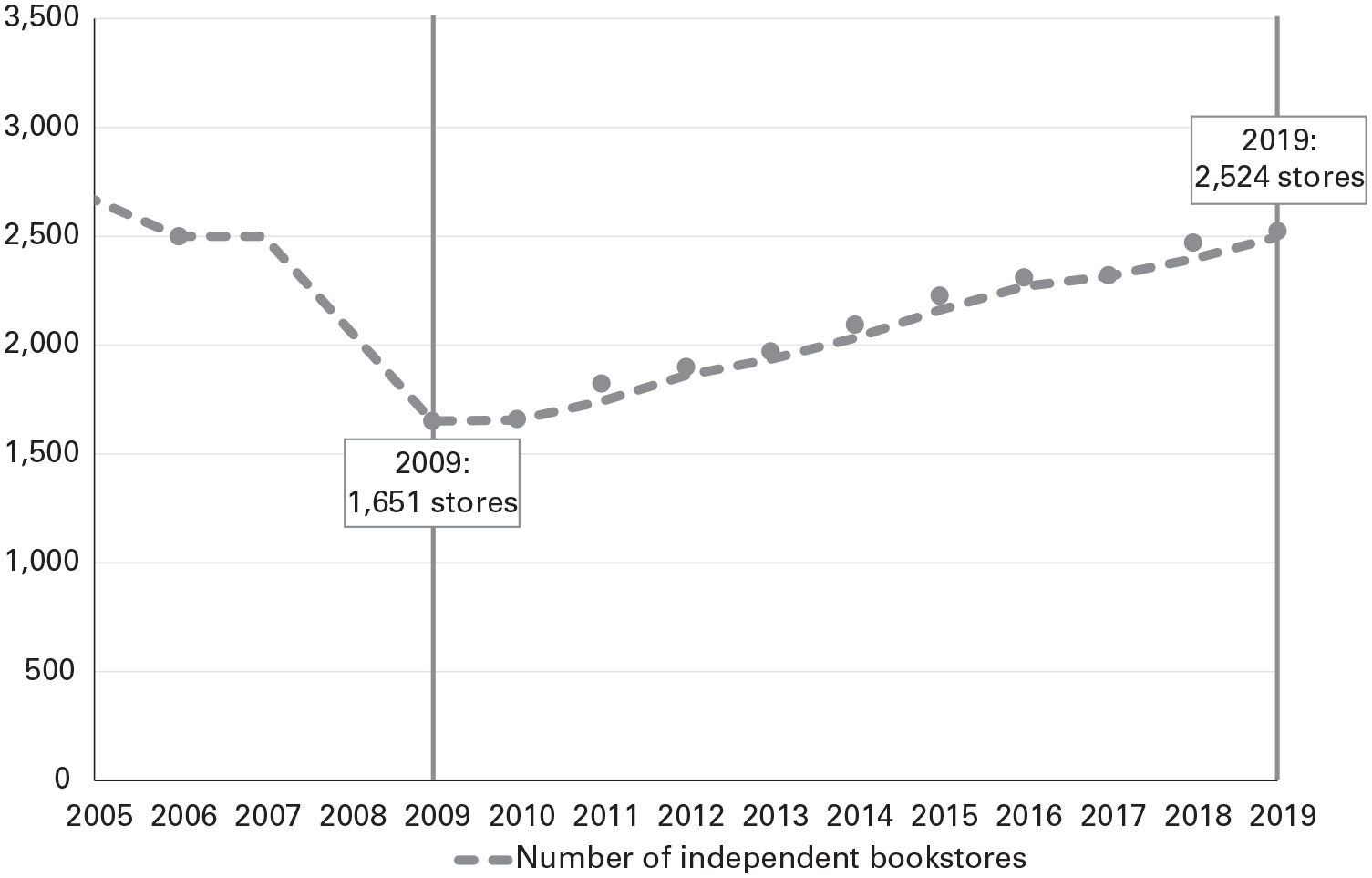
Trajectory of U.S. Independent Bookstores, 2005–2019
Data Sources
To better understand how independent bookstores were able to adapt to the threat of digital commoditization, we collected and analyzed four forms of qualitative data, encompassing multiple organizational actors across the U.S. This diversity of data allowed for triangulation between retrospective and contemporaneous accounts (Creswell, 2003), which is especially important in longitudinal, historical case research (Langley, 1999). Data sources, their collection timeline, and major events in the industry are summarized in Table 1 and Figure 2.
Summary of Data Sources*
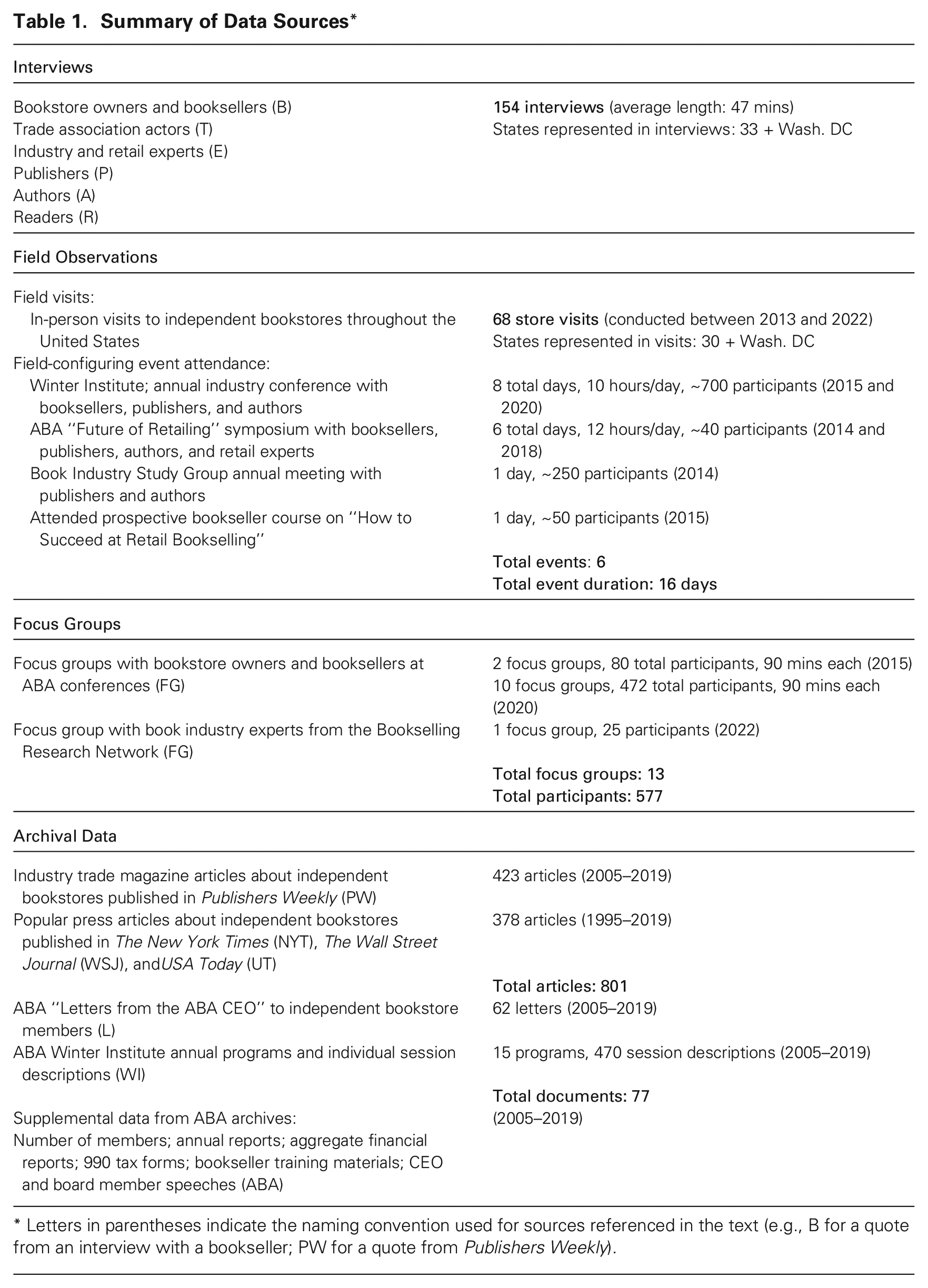
Letters in parentheses indicate the naming convention used for sources referenced in the text (e.g., B for a quote from an interview with a bookseller; PW for a quote from Publishers Weekly).
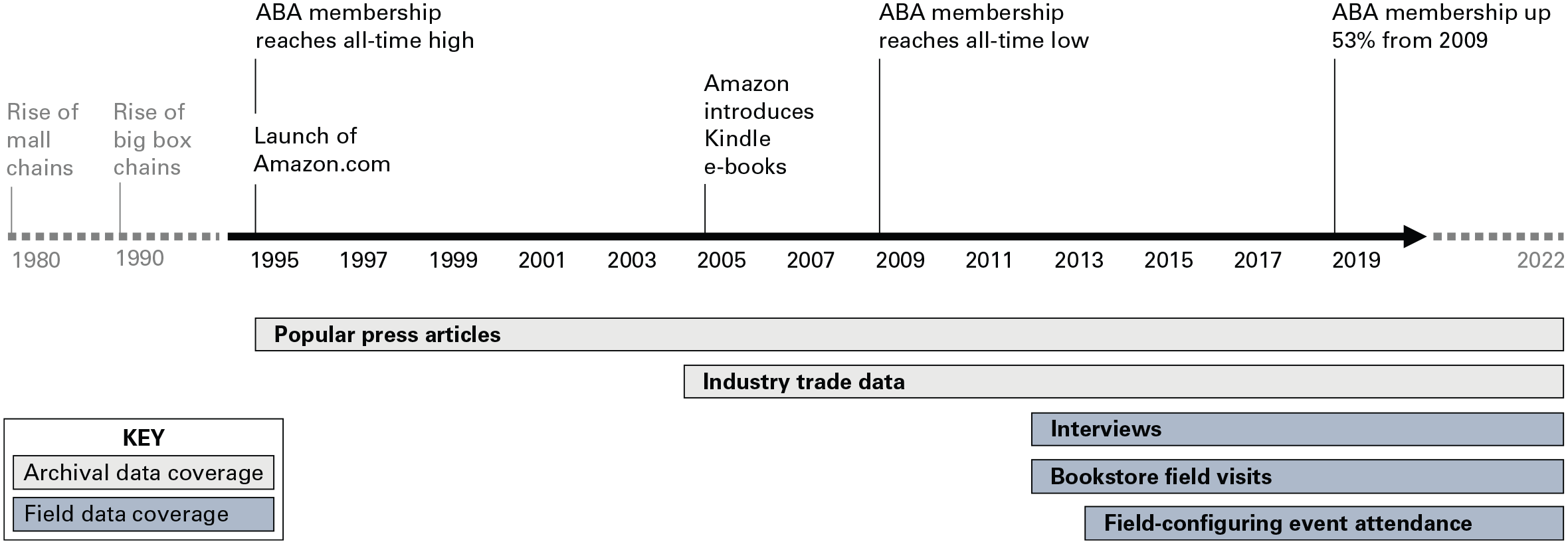
Timeline of Data Collection and Major Events in the Bookselling Industry
Interviews
Our main data source is 154 interviews conducted by the first author with various members of the independent bookselling industry between 2013 and 2022. The sampling strategy was theoretical rather than random (Glaser & Strauss, 1999), to ensure that the sample accurately represented the industry’s heterogeneity. Interviews were conducted with an array of actors, including independent booksellers and store owners, industry and retail experts, publishers, authors, and readers. Care was taken to ensure that both high-power (e.g., ABA leadership) and low-power (e.g., booksellers at small stores) actors were represented. Moreover, participants were sourced from a wide geographical spread, hailing from 33 states in the U.S. This helped to ameliorate possible concerns that the resurgence of independent bookstores was isolated to a specific geographic region. While many participants had been involved in independent bookselling since 1995 and thus could comment on their responses to Amazon’s emergence, others were relative newcomers and therefore offered diverse perspectives. The average interview lasted 47 minutes. Interviews were recorded and professionally transcribed.
Field observation and focus groups
This article draws on extensive in-person observation of independent bookselling. The first author visited 68 independent bookstores located in 30 states across the U.S. These stores varied in size and status. For instance, Powell’s City of Books in Portland, Oregon boasts 68,000 square feet of retail space and is renowned as one of the world’s largest independent bookstores. In contrast, a medium-sized independent bookstore tends to average 4,000 square feet in size. The sample is restricted to stores that (1) were ABA members, (2) sold new books (i.e., not exclusively used books), and (3) had a generalist inventory (i.e., not exclusive to a single genre, such as poetry or mystery). We took this approach to help ensure that the organizations in our sample were governed by similar restrictions and were recognized by one another and external audiences as members of the same sector (Grodal et al., 2021). Field visits were documented in field notes, photographs, and the collection of material artifacts such as bookmarks and leaflets. Figure 3 shows the geographic coverage of bookseller interviews and bookstore visits.
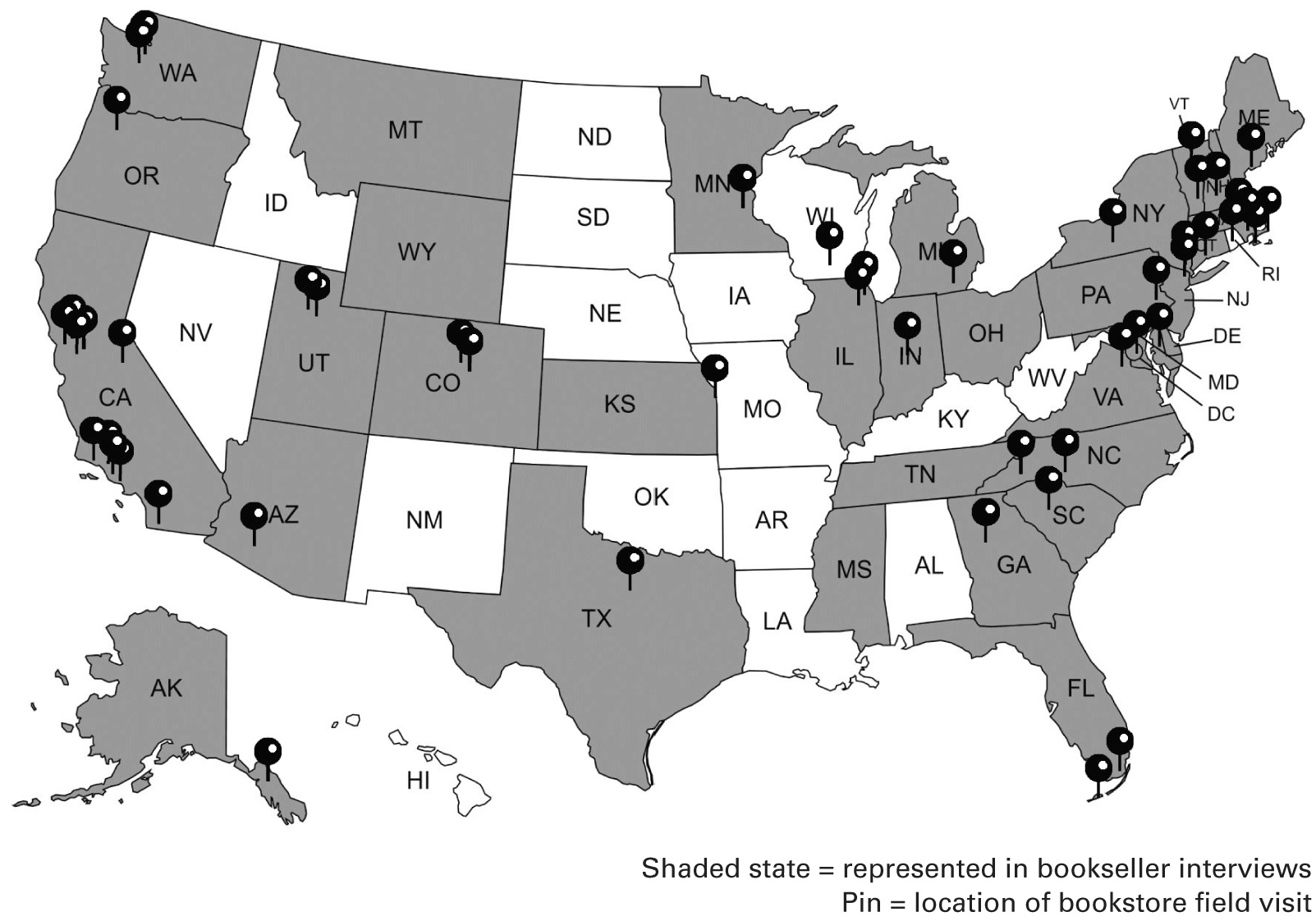
Interviews and Field Visits by Location
This study also draws upon the observation of numerous field-configuring events and focus groups given that they serve as sites of professional norm creation (Lampel & Meyer, 2008; Zilber, 2018). In 2014, the first author attended the Book Industry Study Group’s annual meeting of members, which gathers over 250 practitioners involved in the creation, production, and distribution of published material. In 2014 and 2018, the same author attended two three-day symposiums hosted by the ABA on the “Future of Book Retailing,” each attended by approximately 40 prominent booksellers, publishers, authors, and retail experts. In 2015 and 2020, the same author attended the ABA Winter Institute, the annual conference for the independent bookselling industry, which has over 700 participants every year. At the 2015 conference, the author conducted two 90-minute focus groups with a total of 80 booksellers on retail trends and also took a course for prospective and new bookstore owners on “How to Succeed at Retail Bookselling.” The course helped the first author to acquire “interactional expertise,” the knowledge required to communicate effectively in the language of the industry (Langley et al., 2013, p. 6). At the 2020 annual conference, the same author worked with the ABA to coordinate a series of 90-minute focus groups with a total of 472 booksellers, consisting of both open-ended questionnaires and small-group discussions on the challenges faced by independent booksellers. Finally, the authors led a focus group with 25 industry experts from the Bookselling Research Network in 2022. In total, we gathered data from six field-configuring events and 13 focus groups. Field observations and focus group data we collected after 2019 served as confirmatory member checks of our emerging theoretical model (Lincoln & Guba, 1985).
Archival data
Because the interviews were cross-sectional and may be subject to retrospective bias, we draw upon multiple sets of longitudinal archival data. To validate the industry’s performance over time, we obtained independent store membership data from the ABA for the period 2005 to 2019. We also collected 62 “Letters from the ABA CEO” that were sent to members between 2005 and 2019 and 15 conference programs for the Winter Institutes hosted during these years. The ABA also provided annual reports, speeches, 990 tax forms, aggregate financial reports, and bookseller training materials published during the study time frame. These materials offered useful insight into the internal operations and communications among booksellers, as well as confirmatory checks of our performance data. We also collected all articles in Publishers Weekly that mentioned independent bookstores published between 2005 and 2019. 3 Publishers Weekly, familiarly known as “the bible of the book business,” is the leading trade magazine of the book industry and has been in continuous publication since 1872. To develop a representative subsample, we sampled one-third of articles published per quarter, which resulted in a final dataset of 423 articles. Finally, we collected all articles published between 1995 and 2019 in The New York Times, The Wall Street Journal, and USA Today that discussed independent bookstores. This sample provided a third-party perspective on bookselling before and after the rise of Amazon and consisted of 378 articles.
Data Analysis
Given the ten-year duration of the first author’s fieldwork, the second author was brought on to the project to bolster both the credibility and clarity of our analysis (Lincoln & Guba, 1985). This collaboration was valuable as “the involvement of both insider and outsider authors offers a means to balance differing perspectives, combining intimacy with local settings and the potential for distancing” (Langley et al., 2013, p. 6). The combination of prolonged engagement and analytical distance also served to heighten our sensitivity to both micro- and macro-level processes (Langley et al., 2013). Our analysis was iterative as we cycled between data, emerging insights, and pre-existing theory. Data analysis consisted of four stages.
Stage 1: Constructing a historical narrative
To sensitize ourselves to the phenomenon, we first constructed a longitudinal historical narrative of independent bookselling over time (Eisenhardt & Graebner, 2007; Langley, 1999). This exercise aimed to identify the events and actors that influenced booksellers’ responses to various competitive threats between 1995 and 2019, including the rise of Amazon. By drawing upon contemporaneous archival data, the narrative helped to establish an account of action as it unfolded in real time. We further elaborated and sharpened the narrative over time as new insights emerged from our field research. The essential finding from this phase of analysis was phenomenological: Independent bookstores faced mounting competition from e-commerce between 1995 and 2009. After 2009, we observed a resurgence that comprised three elements: the adaptation of existing stores, the expansion of existing stores to additional locations, and the opening of new stores by new entrants to the industry. We therefore sought to induce the factors enabling this resurgence.
Stage 2: Identifying emergent themes
In the early years of data collection, interviews were open-ended, exploring the participants’ experiences in bookselling and their reactions to various threats such as the emergence of superstores, e-books, and Amazon. With time, these conversations made clear that the threats posed by superstores and e-books were waning, whereas Amazon’s dominance continued to intensify (McLoughlin, 2022). 4 These observations inspired more-direct questioning regarding sellers’ perceptions of the (dis)advantages of the brick-and-mortar format, particularly relative to the e-commerce model. In many cases, we conducted interviews within the bookstores themselves, which allowed participants to give us tours of their stores. During these interactions, booksellers frequently referenced both store design and geographic location. These findings recalled existing research in the sociology of place, so we reviewed that literature to better understand the defining components of place and any extant understanding of its relevance (if any) in the digital era.
In tandem, we inductively analyzed interviews. After open coding the transcripts, we progressively moved toward a more focused codebook, collapsing similar descriptive codes together and abandoning others (Grodal et al., 2021). In this way, our analysis shifted from open codes that aimed to break data apart toward axial codes that helped to relate concepts and categories to one another (Corbin & Strauss, 2008). For example, the codes “design of store displays” and “curation of inventory” were eventually abstracted, along with others, into a theoretical code for “architecting the environment.” Similarly, the codes for “call to shop local” and “anti-Amazon claim” were abstracted, along with others, into a theoretical code for “sanctifying the meaning.” We continued this process of collapsing and abstracting until we developed a final codebook.
Stage 3: Triangulating longitudinal patterns
Next, we aimed to cross-validate our interview participants’ cross-sectional and retrospective narratives (Creswell, 2003; Lincoln & Guba, 1985) and induce temporal brackets (Langley, 1999). To do so, we coded our sample of Publishers Weekly articles, using our emergent codebook, and graphed the frequency of each code’s use over time. Doing so helped to reveal how booksellers adapted to the threat posed by e-commerce. For example, whereas booksellers’ attention to price competition was high in the early days of Amazon’s emergence, it waned over time. Conversely, we saw how codes such as “architecting the environment” increased steadily post-2009. Through this iterative process, we identified two temporal brackets—digital displacement (t1) and organizational emplacement (t2)—which are reflected in our theoretical model.
When analyzing our longitudinal trends, we expected to find that the theoretical codes related to emplacement followed a consistent pattern across independent booksellers. We were surprised to find that, while codes associated with successful booksellers were similar, they appeared in unique configurations and sequences over time. This variety resonated with prior sociological research on place, which has stressed that places are idiosyncratic and distinct (Oldenburg, 1999; Paulsen, 2004). We therefore analyzed the interactions among the codes to understand how stores both co-created and diffused a shared repertoire (i.e., “a collection of practices held in common”) (Clemens, 1993; Seidel & O’Mahony, 2014: 695; Swidler, 1986). The study’s ten-year data collection allowed us first to identify the elements of this repertoire and subsequently to validate the diverse ways that booksellers employed them over time.
Stage 4: Assembling findings into a theoretical model
We iterated between our codebook, longitudinal patterns, and pre-existing theory to refine our core mechanisms. To validate our emerging theoretical model and search for gaps in our logic (Locke, 2001), we returned to the field and conducted a series of member checks, including focus groups, presentations at bookselling conferences, and follow-up interviews with booksellers and industry experts. Through this iterative process, we ultimately induced a theoretical model of organizational emplacement, described below.
The Process of Organizational Emplacement
In this section, we outline a process we term organizational emplacement, which we depict in Figure 4. We present our findings longitudinally, first outlining how booksellers struggled to respond to the emergence of Amazon, a digital commoditizing threat, and then outlining how they marshaled physical place as a source of differentiation. Our findings introduce three mechanisms through which organizational actors can transform physical spaces into meaningful places that hold strategic value. Refer to Table 1 for the naming conventions we use below when quoting sources (e.g., B for a bookseller and T for a trade association actor).
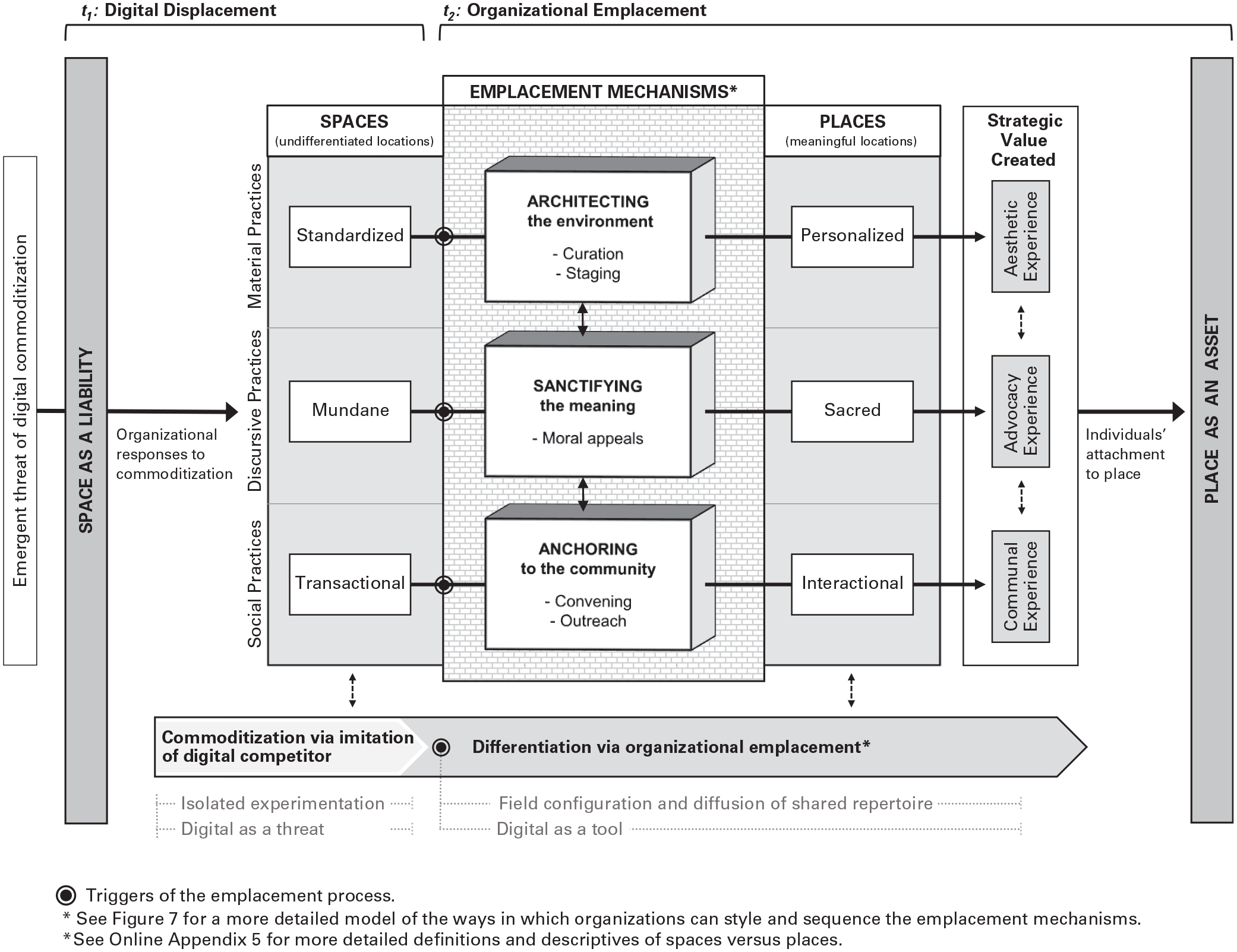
The Process of Organizational Emplacement
Digital Displacement: Space as a Liability (1995–2009)
The emergence of Amazon in 1995 threatened to displace the independent bookselling industry, inciting a 14-year decline in store numbers. Amazon’s business model operated under the assumption that consumers would be indifferent to the location of exchange (i.e., a physical store versus an online website) and would therefore purchase books from whichever source was cheapest and most convenient. In other words, Amazon posed a threat of digital commoditization: when digital technology facilitates a devaluation of existing goods and services such that consumers perceive them as undifferentiated. At first booksellers did not realize this emergent threat of commoditization. One bookseller recounted an early exchange with Jeff Bezos at a national bookselling conference in the mid-1990s: Bezos is sitting there and we’re all like, “Who is this guy? He wants to open up a store in his garage and he’s on a computer.” Not all of us at that point were computer literate . . . We just thought he was this odd character in the back of the room . . . I think the problem was none of us understood it. It was like, you mean you’re not going to have four walls? It is going to just be a warehouse and you’re going to be shipping out? . . . I just didn’t understand that. It didn’t make sense to me. (B_28)
Yet, with time, e-commerce proved to have clear strategic benefits. As a journalist reported at the time, “[Amazon’s] economic model offers plenty of advantages over traditional bookselling and its need for retail real estate . . . Amazon has just 33 employees, no expensive furnishings and no salespeople” (WSJ_1996). This online-centric footprint enabled the company to stock nearly unlimited inventory, to charge heavily discounted prices, and to provide convenience for consumers who would no longer need to drive to a physical store. These features represented a significant advantage in bookselling, in particular, given that product quality was undifferentiated. As one industry leader explained, In our business, the product—the book—is basically the same no matter where you buy it. You don’t get a better ending if the book gets lovingly hand-sold to you by some thoughtful, intelligent, independent bookseller as opposed to buying it off the skid in Costco or being sent to you by buying it online. (T_98)
Recognizing this, Amazon treated books as commodities that could be exchanged without physical interaction. This orientation was drastically different from prevailing norms in the bookselling industry. Indeed, certain booksellers refused to consider books as products at all. In an interview, one owner explained that “I have to say ‘so-called product’ as an independent bookseller because you can’t think of a book as a product. It’s weird to think of a book as a product . . . I think of things like ‘friend.’ I mean, it’s highly personalized, charged, powerful” (B_80). Thus, not only did Amazon’s online platform introduce novel practices, but it also reconceptualized bookselling as an activity that could be commoditized from top to bottom.
As Amazon’s e-commerce model grew, it ushered in an era of instability for incumbent independent booksellers. One long-time bookstore owner recalled of that time, [Pre-1995], those were good times. You really didn’t have to refine your business practices, and you really didn’t have to think up here, because it just wasn’t necessary. You just thought about books. And when the change came, suddenly the floor drops out from under you, and you think, “Either I’m going to go broke, or I’m going to rethink this and figure out what to do.” (B_21)
Faced with the escalating threat and the risk of store closure, many independents attempted to keep pace with Amazon by imitating its large inventory and low-price commoditizing practices. For example, some store owners enlarged their footprint, hoping to appease readers who were attracted by the seemingly limitless inventory offered by superstores and online sites. As a store owner described, “We expanded our store . . . I moved across the street and doubled the space and sunk a lot of money into it” (B_31). However, booksellers acknowledged that this effort to “combat the giants by being even more giant” (WSJ_2004) was less effective in the emerging digital era. One bookseller reflected on this realization: In 1995 somebody invented the internet . . . suddenly having 300,000 titles went from being very cool to being very stupid . . . Suddenly it’s like, well, wait a minute. You can buy all these books online. Everything. It’s not like you can buy some of these books, or the good ones . . .You can buy everything. So having everything in physical form on a shelf is suddenly not such a brilliant inventory management technique. (B_38)
In this phase, booksellers viewed their physical space chiefly as a liability; bound by four walls, they could not match Amazon’s volume of online inventory.
Independent booksellers also imitated Amazon’s pricing scheme by offering price reductions and book-bundle deals. They experimented with various models, including discounts on best-selling hardcover titles (NYT_2004; WSJ_2008; PW_2009) and frequent buyer programs (PW_1998; NYT_2001). However, as with inventory, booksellers reported that these practices were ill-fitted to the model of brick-and-mortar selling because stores operated on “razor-thin” margins to begin with, as low as 0 to 4 percent (PW_2018), making further reductions infeasible. One independent bookseller reflected that “Amazon and others have taught people to not pay full price. And in a margin sensitive business, that’s deadly” (B_44). As Jeff Bezos put it in an early Amazon press release, “There may be reasons to shop in the physical world. But price is not one of them” (PW_2002).
Although booksellers experimented with Amazon’s volume and pricing practices, inertia prevented many from imitating its digital practices. In the late 1990s and early 2000s, many stores still employed analog modes of data and inventory management. For example, one bookseller explained, Nothing was computerized. [Our owner] said over his dead body . . . There’s millions of dollars of inventory on the floor, but you never knew really how much was there. Everything was done by hand . . . We just had little pieces of paper that we wrote everything down on . . . You had a store that was doing maybe $75,000, $100,000 a day and it was just like, “pass the pieces of paper.” It was a joke. (B_79)
Digitalization caused apprehension among many booksellers given that it presented a radical departure from legacy brick-and-mortar operations. As one owner recalled, “We didn’t even have computers in the store in ’96 . . . I was just afraid. It was really frightening” (B_94). Over the decade to follow, booksellers slowly began to digitize certain practices, adopting point-of-sale systems, inventory management software, and rudimentary customer-facing websites (PW_2006; PW_2007; B_28; B_75; B_81; B_88). Even still, many were reticent to shift too far into the digital realm, explaining, “We didn’t want to be online booksellers. We wanted to keep to our old-fashioned way of doing things” (B_67).
During this phase, the threat of digital commoditization loomed large, as Amazon’s e-commerce model pushed the industry toward undifferentiated price and volume competition. Booksellers were forced to reckon with the liabilities afforded by their physical boundedness and the extent to which brick-and-mortar retail could remain competitive in the digital era. Despite independent booksellers’ efforts to imitate Amazon’s low-price and high-volume practices, consumers continued to embrace e-commerce as a digital alternative. Sellers would often observe this substitution in real time as customers engaged in showrooming, the practice of taking a picture of a book in a bookstore only to later purchase it on Amazon at a discount. Independent booksellers were increasingly confronted with consumers’ indifference to the physical form, a sentiment captured by one bookseller’s comment: “We were battling against the modern age. Our values were pure, our motives were sincere, but it was just too big of a fight” (PW_2008). In 2009, ABA store membership reached an all-time low.
Turning the Page: From Imitation to Differentiation
In phase one, bookstores competed with Amazon primarily through imitation: mimicking Amazon’s novel commoditizing practices. Over time, they shifted their approach to one of differentiation: seeking to create unique sources of strategic value. Our analysis revealed that this shift was triggered by two sources: (1) the ABA’s increase in field-configuring events and (2) booksellers’ increased familiarization with digital technology.
In the early years of Amazon’s emergence, booksellers relied primarily on isolated experimentation to combat the rise of e-commerce. However, as circumstances became more dire, the ABA began to play a more active role in configuring the geographically dispersed stores. In 2005, the ABA launched Winter Institute, an annual conference attended by industry actors including booksellers, publishers, and authors. In its early years, Winter Institute was primarily a way to facilitate interactions between these groups (WI_2005–2008). However, in 2009 the ABA began to expand the Institute’s “educational programming” in order to provide “actionable information” for booksellers (PW_2009). For example, a session in 2009 was titled “Surviving Tough Times: Best Practices from Booksellers” (WI_2009), and sessions in 2010 promised demonstrations of e-commerce and social media (WI_2010). In interviews, ABA leaders stressed the importance of bringing booksellers together at Winter Institute: “We put hundreds of entrepreneurs under one roof and get them to interact with each other. When you own and operate a retail business, you’re very isolated” (T_98). In the prior decade, booksellers had experimented with various practices to combat Amazon but had limited knowledge of other stores’ approaches. By increasing and bolstering field-configuring events, the ABA helped to collate and diffuse a shared repertoire of best practices that booksellers could draw upon and apply in their own stores. This gave booksellers a sense that “you’re not alone in this, you have this network you can constantly tap into” (B_90).
In addition, the ABA facilitated booksellers’ familiarization with digital technology. As discussed above, when Amazon first emerged, booksellers often expressed reticence to imitate its digital practices, perceiving them as a substitute for—and therefore a threat to—brick-and-mortar bookselling. However, in 2010, the ABA began to develop a tailor-made e-commerce system, “IndieCommerce,” which independent stores could adopt off the shelf as a supplement to in-store selling (WI_2010). This system facilitated a field-wide shift in perception: Rather than an existential threat, digital technology could be a tool productively employed on booksellers’ own terms. As one bookseller reflected, “What we have to do is just keep plugging for what we do, and what we stand for, and adapt as much as we can to [the digital]. And try to meld it towards our needs, rather than being melded by it” (B_88). Another owner echoed the sentiment, arguing that “you’ve got to hang on to who you are, [but] it’s not like keeping your head in the sand . . . Don’t get stuck” (B_92). Rather than clinging inertially to the analog era, booksellers became more familiar with digital technology, which enabled them to reconceptualize it from a substitute (i.e., threat) to a possible complement (i.e., tool). In doing so, they loosened the grip of threat rigidity and readied for change.
Thus, by 2010 independent booksellers had begun to coalesce into a more configured body that was primed for a new era. These shifts triggered and facilitated the co-creation of a novel differentiation strategy: organizational emplacement.
Organizational Emplacement: Place as an Asset (2010–2019)
In 2010, the ABA reported an unexpected increase in independent store numbers. Our analysis revealed that surviving bookstores had begun to reassess their competitive advantages, reframing their physical space from a liability into a potential asset for differentiation. An ABA leader discussed how booksellers shifted their approach after the record low of 2009: “We became a lot less preoccupied with what all of our competitors were doing . . . If you’re operating a bricks-and-mortar, how do you remain relevant? How do you make a bricks-and-mortar place someone wants to still come to?” (T_98). Independent booksellers began to look inward, re-evaluating their unique value rather than racing to imitate their competition. This introspective turn inspired a series of new practices that transformed bookstores from spaces into meaningful places worthy of patronage. We term this process organizational emplacement and outline its three core mechanisms below: architecting the environment, anchoring to the community, and sanctifying the meaning.
Architecting the environment: Curation and staging
Booksellers used material practices to architect the environment of their stores. We identified two associated practices—curation and staging—that booksellers employed to accentuate the personality of their stores. Every detail of store design was considered, all centered around the physical products themselves: the books. As one seller argued, “Books are . . . a piece of art . . . You want to pick it up . . . You walk into a bookstore and you feel enveloped by the words, the books. People love to bring that home, and have those things that they love in their bookshelves, and be surrounded by them” (B_34). Booksellers capitalized on this aesthetic materiality of books by architecting the environment in ways that would both highlight and enhance their products.
Given space constraints, booksellers used curation to tailor their book inventory. Instead of featuring The New York Times best-selling titles at the front of the store, akin to Amazon’s home page, independents’ shelves were often labeled as “Staff Favorites” or “Indie Bestsellers,” and they featured lesser-known titles and up-and-coming authors. As one bookseller commented, I enjoy my job more now [in 2014] than I did five years ago because I can now really spend more time curating my store. I don’t need to carry monster bestsellers . . . I can look out for authors and titles and books that I think, “Wow, this sounds really good, and I bet nobody else would carry it.” (B_75)
Throughout stores, staff also utilized shelf-talkers, handwritten notecards that hung on shelves to showcase books that reflected the personality and preferences of the booksellers who inhabited the space. For example, a description of one of Elena Ferrante’s celebrated novels read, “This is one of the most powerful novels I’ve ever read . . . The most-heart-wrenching, emotionally raw prose . . . I was transfixed.” Booksellers also increased the number of face-outs, books with covers rather than spines facing outward, in order to highlight attractive cover art. Thus, rather than being just a source of inventory constraint, stores’ physical boundedness became a productive friction that prompted booksellers to be more intentional about the selection and arrangement of their products. This led booksellers to explain that “our selection is not something that could be replicated by an algorithm” (FG_187) and that “people come to our stores now [in 2015] for a sense of discovery” (B_31).
Inventory was also curated to spotlight local authors or place-specific topics. For example, on field visits to stores in college towns, such as Literati Bookstore in Ann Arbor, Michigan and Flyleaf Books in Chapel Hill, North Carolina, we observed curated sections of books written by college alumni and professors. A cookbook section in a Vermont store had a prominent display of books on how to make maple syrup, and a store in Texas prioritized cookbooks relating to barbecue. Many children’s sections in the Boston area highlighted Robert McCloskey’s Make Way for Ducklings, which is set in the Boston Public Garden, while children’s sections in the New York City area highlighted Kay Thompson’s Eloise, which is set in Manhattan’s Plaza Hotel. As one industry leader said, Every store is going to be different, and every community is different, and part of [independent bookstores’] strength in our world is that they all are different. The store that you find in Boston is not going to be the same as the store you find in Southern California. (T_98)
By curating inventory within their stores, booksellers treated books not as commodities but, rather, as meaningful objects (e.g., “friends,”“pieces of art”) deserving of a unique home. As one bookseller summarized, “No one can compete with Amazon for prices. People come to [our store] for the careful curation and sense of place” (FG_24).
While curation focused on the core products, a second practice, staging, created the atmosphere to house those products. Great care went into crafting an immersive literary environment, a function of both store scenery and supplementary product offerings. Booksellers used staging to differentiate themselves from competitors, as one bookseller explained: When someone walks into this building, if we’re doing our job right, they know immediately that it’s not a big-box store . . . We’ve had lots of customers say that it’s an oasis. They come here sometimes not even to buy books, just to be in the environment . . . That kind of aesthetic combines what the floor is made out of, what the shelves are made out of, the lighting, everything inside. (B_67)
As this quote conveys, booksellers began to reinvest in numerous elements of store atmosphere. For example, they made efforts to craft whimsical children’s sections, which often featured toy train sets, child-sized seating, framed illustrations from popular children’s books, and cardboard cutouts of well-known characters such as the Cat in the Hat and the Hungry Caterpillar. New industry actors emerged to offer consulting services to rookie bookstore owners who hoped to elevate the aesthetic environment of their stores. In an interview, a bookstore interior designer explained the principles that she had gleaned from successful stores: When you walk in, they have warm and inviting pools of light . . . They have places that make you feel big, they don’t make you feel small. The ceilings are lower, the walls are tighter. They make you feel ensconced . . . It invites you to linger and invites you to really settle in . . . You don’t get overwhelmed when you walk in the door with merchandise and books. There is a foyer, there’s a resting place. It might be a table with some flowers or something simple, but instead of pushing constant merchandise it invites you to the fire. It invites you to gather around the fire and sit and talk a while. (E_130)
By staging books within a characterful environment, booksellers further differentiated from Amazon and its placeless, price-centric approach. Readers took note, with one effusing, “I’m so happy and love to support [this independent bookstore]. You can get books cheaper on Amazon, but you can’t go in, and sit, and browse. It’s not the same experience” (R_5).
Staging served a financial, in addition to aesthetic, purpose. Due to longstanding contracts with publishers, booksellers were not able to charge more for a book than the price printed on the cover. They therefore began to sell sidelines, higher-margin non-book items such as tote bags, coffee mugs, and book-themed socks. A long-time store owner explained this change in the industry: The people who are around today [in 2015] and who are still successful, or at least surviving, are people whose business models have shifted some. So in 1980, when we started our store, no bookstore that I knew of—or very few bookstores, anyway—would have had more than 10% of their inventory in non-book items . . . what’s called “sidelines” in our business now. (B_35)
However, our interviews revealed an internal conflict: While sidelines afforded greater margins, many booksellers expressed concern that they “compromised [their] cultural mission” (B_80). As one bookseller said, “There are diehards who would like us to not have any [sidelines] . . . But my board is very much focused on the bottom line. [Sidelines] better your margins . . . It’s a strange balance to try to find” (B_108). To mollify this conflict, booksellers used sidelines as staging elements, placing them intentionally throughout the store to create themed, room-like atmospheres. One owner outlined this design strategy: We buy a lot of those little stuffed animals, and we use them to frame books. So we’ll have Curious George, and we’ll have all those cute monkeys hanging around on the shelf . . . In the cookbook section, a beautiful bamboo salad bowl probably will sell, but will also say to the customer, “Oh, here are the cookbooks.” (B_21)
Staging practices thus played dual strategic roles: They supplemented profit and allowed booksellers to infuse their space with personality and style.
Collectively, the practices of curation and staging were aimed at an ostensibly simple goal: architecting bookstores into pleasant places to browse and discover new books. In this manner, through material practices, booksellers transformed their stores into personalized places rather than standardized spaces. Illustrative photos from field visits are presented in Figure 5. These findings are supported by our longitudinal analysis of Publishers Weekly, which shows that mentions of architecting the environment increased between 2009 and 2019 (see Figure 6).
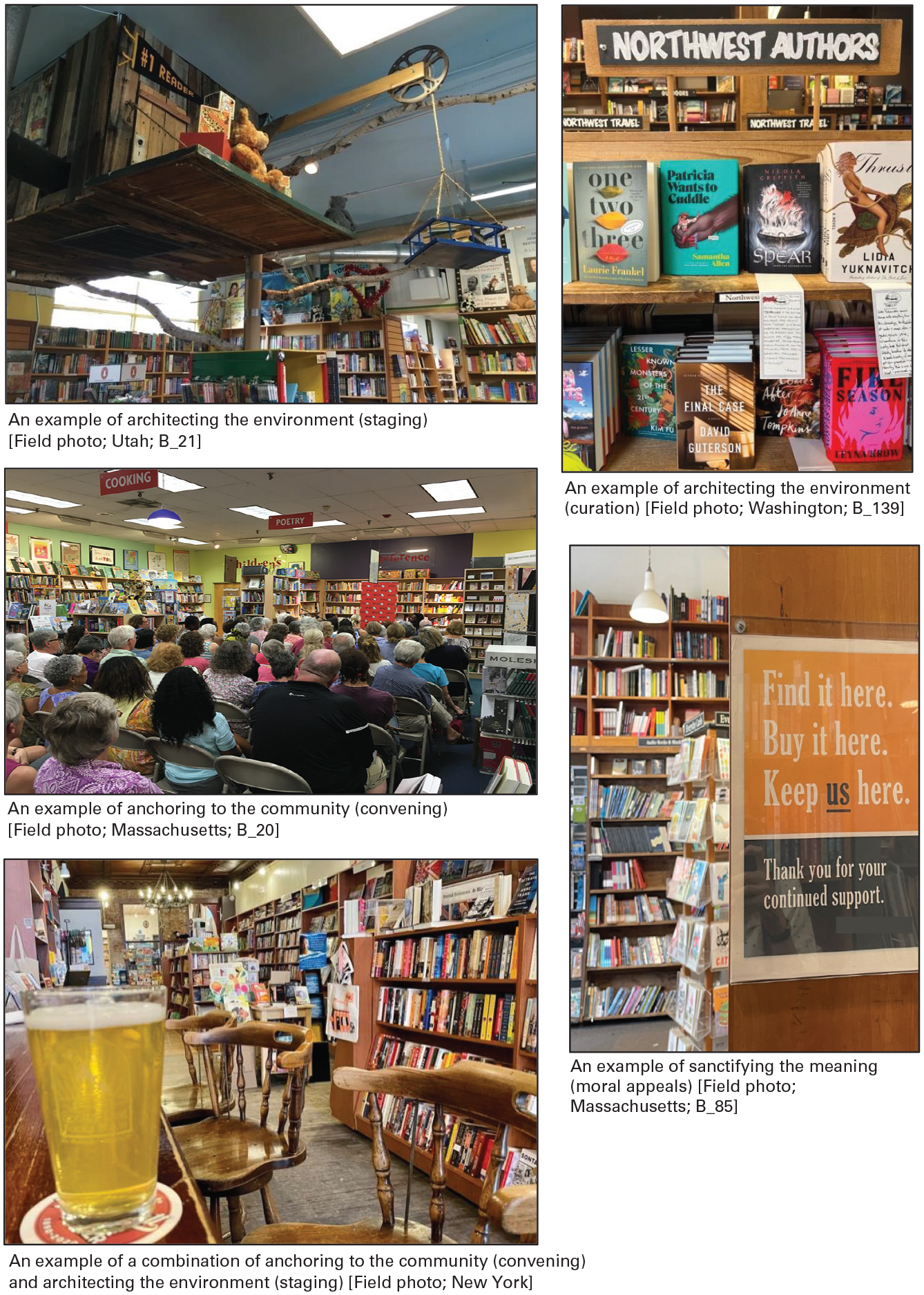
Pictures of Independent Bookstores from Field Visits
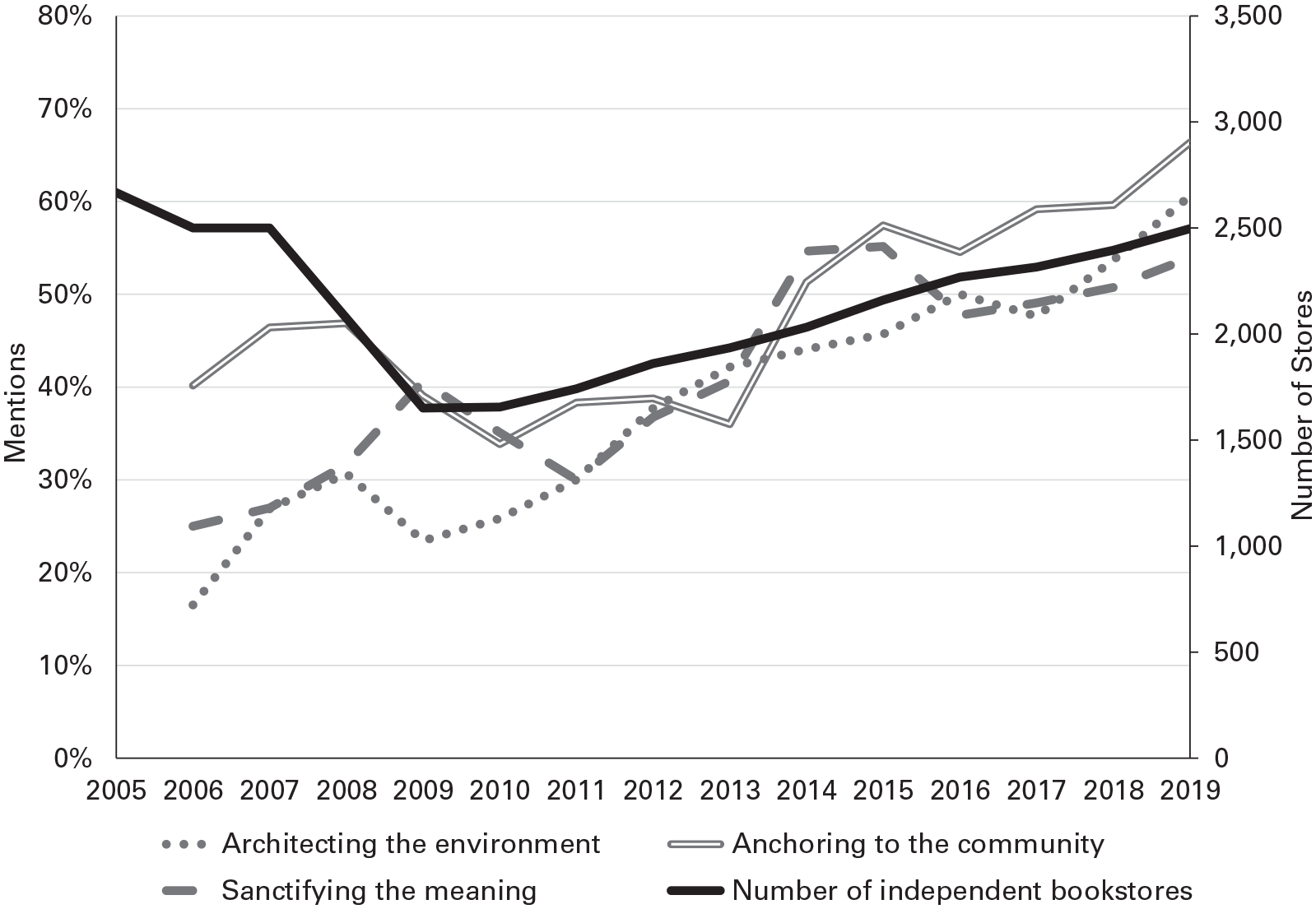
Frequency of Architecting, Anchoring, and Sanctifying Practices Mentioned in Publishers Weekly
Anchoring to the community: Convening and outreach
Booksellers also used social practices to anchor to the community. We identified two associated practices—convening and outreach—that booksellers used to foster neighborly interactions between bookstores, readers, and their communities. These practices were pursued through both analog and digital means.
Successful booksellers used their stores to facilitate social convening by expanding their event programming, including author readings and signings, children’s story times, and book clubs. A bookseller explained the diversity of events hosted at his store: “One night I was standing outside watching. We had a Spanish language event with about 40 people. We had an English-speaking author in another part of the store. We had music in our courtyard. Our café was filled in the back . . . and I’m thinking, ‘this is heaven’” (B_31). Some of these practices were not new for independent bookstores, which had commonly offered author readings and launch parties for notable books such as Harry Potter (NYT_2000; WSJ_2003; PW_2007). However, the frequency and diversity of events increased considerably during this period. As extreme cases, one owner noted that she would host upward of 600 events a year in her store (B_81), another up to six authors a day during the holidays (B_64), and another reported tripling her number of book clubs (FG_467). One owner mentioned that she was hosting so many events that she needed to hire an events coordinator because she could not keep track (B_94).
The practice of convening comprised more than formal programming; the simple existence of local gathering places also offered individuals a source of community connection. One bookseller explained, We have a lady that comes in several times a week . . . we have a little French coffee shop on the corner, and she goes around and gets coffee . . . and then she sits in front of our store and smokes a cigarette. And then she comes in the store, and we have a conversation, and more times than not she buys something. But she’s not going to get that anywhere else . . . First of all, she’s not going to get that if she goes in Barnes & Noble. And she’s not going to get that, clearly, from the computer. (B_94)
These workaday social interactions established bookstores as natural extensions of readers’ daily lives. This led many booksellers to view their convening practices as nourishing a basic human need. One owner effused that “you know, people are social animals. They love going out into their community . . . You’re part of that web of community. It’s one of the sweetest things about life, and that really is at the basis of what we’re doing” (B_21). Because bookstores offered a public place for social interaction, some readers viewed them as providing a “community service” (R_5). This neighborliness further differentiated independents from their competitors: I recognized that [independents] really aren’t in the same business as Amazon . . . You can buy a book anywhere, but you can’t buy community. If you want community you have to be a part of one, and all these stores are very much part of the fabric of their surroundings and their neighborhoods. (B_90)
In short, through convening practices, booksellers invited readers into their stores, establishing bookstores as sites of social interaction and cohesion.
In addition to bringing readers into the store via convening practices, booksellers increasingly anchored themselves to local institutions through outreach. This practice is summarized by one bookstore owner who explained, “We are very heavily integrated in our community. It’s like we have tentacles of partnerships all over the place, all the time” (B_38). These “tentacles” came in numerous forms. For example, many interviewees discussed the importance of having close partnerships with local school districts (B_31; B_38; B_81; B_94). One owner discussed a school initiative that they had organized for young readers: We have huge relationships with the school district . . . A local woman wrote a children’s book . . . We saw the book, she’s local to us, and we thought, “Okay, let’s do this whole program about this book.” . . . I’m not making any money on it, but I’m involving myself in the community . . . Their parents are all going to feel a little bit better about us as a business. So maybe when I’m in public [and say] “support your community,” it will connect a little bit. (B_38)
In a separate interview, a teacher and customer of the same store commented on what the partnership meant to him and local schools: “They do a lot of outreach with schools. They bring authors to our school on a regular basis. They’re also hyper-aware that not every kid can purchase a book, and so they make a point of trying to go out to the Title I schools” (R_4). Outreach to local schools was a natural way to integrate into the community, to gain access to a population eager for books, and to establish lasting relationships with readers.
Outreach also took the form of partnerships with other nearby institutions, such as local foundations and non-profits supporting the arts and humanities, and local Chambers of Commerce (B_31; B_71; B_81). Booksellers also often reached out to nearby independent businesses, and they described forming collaborations with neighborhood yoga studios (PW_2012), animal shelters (B_96), theaters (B_20), and hotels (B_20; B_31). By stepping out from their stores and into their surrounding environment, booksellers sought to establish themselves as neighborhood fixtures. As one store owner explained, “We’ve done various things outreaching in the community . . . part of it is we’re selling books, but part of it is people are seeing [our store] as part of the community” (B_20). These diverse partnerships were viewed as an essential way to secure the long-term viability of independent retail. Booksellers noted that they anchored their stores to the local community so that they were “not ‘too big to fail,’ [but rather] ‘too important to fail.’ We have to be too important to the community . . . Everything we do has to be geared to make us just too important to fail” (B_31).
Booksellers also became less reluctant to employ digital practices, gradually adopting social media, in particular, as an additional medium of social outreach. Social media channels such as Twitter and Instagram emerged as arenas of virtual interaction, places where bookish types could find community. For instance, by 2018 the “bookstagram” hashtag had been used on more than 25 million Instagram photos (Chittal, 2018). Many booksellers, particularly those who were young or new to the industry, recognized this growing platform and began to create social media accounts for their stores. These accounts allowed staff to post store news and happenings and readers to tag photos of their visits. As one bookstore owner noted, “The online world is a great way to make connections, too . . . You do it all. You do Twitter. You do Facebook. You do email. You do a website. You do Pinterest. We have a Tumblr” (B_73). Another bookstore owner explained a similar effort: “We brought on a social media coordinator . . . She’s really good, and we saw all our social media platforms grow by leaps and bounds . . . That’s another way to reach out to the community and really make them a part” (B_33). As with outreach to local institutions, by engaging with social media, booksellers anchored to a community of readers that existed beyond the store’s four walls, enabling them to become “very entrenched in the local fabric” (FG_191). In this way, booksellers utilized digital technology as a source of community, not commoditization.
Thus, while bookstores had long endeavored to be a center for the intellectual community (Miller, 2006), they deepened their social and local integration over time through the practices of convening and outreach. As one owner explained, I think we always were seen as the fount of knowledge about books . . . All that stuff hasn’t changed. But we weren’t seen as the center of our community in nearly as powerful ways as we are now [in 2016] . . . Even then, it wasn’t as central as it is now. I think now we are the very center of the web in every way. (B_21)
Through social practices, booksellers transformed their stores into places for interaction rather than spaces for transaction. These findings are supported by our longitudinal analysis of Publishers Weekly, which shows that mentions of anchoring to the community increased between 2010 and 2019 (Figure 6).
Sanctifying the meaning: Moral appeals
Whereas architecting the environment comprised material practices and anchoring to the community comprised social practices, sanctifying the meaning represented a discursive practice. We identified one associated practice—moral appeals—that booksellers used to sanctify the meaning of independent bookstores and thereby transform them into sacred places. Drawing from classical sociological perspectives (Durkheim, 1912), organizational scholars have recently defined the term sacred “in a more secular way to refer to a distinction between practices that are . . . ‘profane’ and practices that hold a higher social meaning or value” (Suddaby et al., 2023, p. 298). As booksellers architected the environment of their stores and anchored to their surrounding communities, they also infused these practices with higher meaning by explicitly articulating the moral meaning of place.
One way that booksellers sanctified the meaning of place was by spearheading calls to support local brick-and-mortar retail. They popularized phrases such as “buy local” (PW_2012) and “indies first” (PW_2013; PW_2014), which found purchase in a broader shop local movement that highlighted the positive externalities of patronizing community-based businesses. Booksellers discussed their coordinated effort to communicate this concept of “localism”: The thing that we really wanted [was] . . . to take that message out to the public. So they’re walking down the street, they’re seeing the “local” brand. And then it happens all over the country . . . And pretty soon everybody in your community comes in and says, “I’m so happy you’re here. I’m doing all my shopping locally.” (B_21)
While this movement has long roots and has cropped up in some form at varying points in history (cf. Ingram & Rao, 2004), independent booksellers shared a sense of authorship of this recent iteration. For instance, consider this discussion among three booksellers: B_41: If you ask John Q. Public, “what’s the first thing that comes to mind when you say, ‘Independent business’?” He’s probably going to say, “bookstore.” I think we were— B_43: In the beginning of it. B_44: I think that in most communities, booksellers have carried the [shop local] flag.
Similarly, while discussing the Small Business Saturday initiative sponsored by American Express, which was designed to encourage shopping at small businesses on the Saturday after Thanksgiving, another bookseller claimed, “I can guarantee that American Express wouldn’t have done [Small Business Saturday] if we weren’t hammering our communities about shopping local . . . We’ve positioned ourselves in the middle of this thing, the way no other industry has” (PW_2015). By fostering and diffusing the shop local movement, booksellers worked to reduce consumers’ indifference toward brick-and-mortar retail by portraying shopping local as a moral act.
Booksellers bolstered this portrait by making conscious efforts to educate consumers about how independent bookstores enriched and enlightened their communities. In the late 1990s, there was little information on the economic spillovers of shopping at independent stores versus at chains or online. Struck by this lack, a well-known independent bookstore owner commissioned a team of economists to conduct an economic impact analysis. The owner explained his reasoning and the results of the analysis: I said, “Look, let’s just find out. Is it quantitatively better to shop at locally owned business or not? I mean, I know it feels good for us, but is it good for anybody else?” . . . [And they find] that there’s a three-and-a-half times greater local economic impact if you shopped at locally owned business than when you shop at chains. (B_38)
Similar studies followed suit in other regions. As one bookseller explained, “It’s teaching people about every dollar they spend, where it goes—it’s that consumer education part that you can never stop” (B_81). Independent booksellers were persistent and took a multi-media approach: “Every other bookseller I know has an NPR program. We do radio reviews. We do reviews in newspapers. We all have not just print newsletters, but online newsletters, and we are all doing social media. We do so much to get the word out” (B_21). Booksellers used these methods not just to articulate the economic returns of locally owned businesses but also to awaken consumers to the moral underpinnings of their purchasing decisions. To ensure that this message came across, one store owner noted, “We give our staff ‘shop local’ talking points” (FG_37). Many stores also included this messaging on material artifacts, such as bookmarks, pamphlets, and receipts. For example, the bottom of one bookstore’s printed receipt read: How much money stays in your community when you spend $100? At a locally owned business: $68 At a chain store: $43 At Amazon: $ 0
To further sanctify the meaning of independent bookstores, booksellers demonized Amazon as a profane alternative. In interviews, booksellers would often criticize Jeff Bezos by name. One owner of a well-known independent store in the Pacific Northwest argued, “Books are not important to Jeff Bezos. Business is important to Jeff Bezos. Owning the world is important to Jeff Bezos . . . He’s basically the mafia . . . Man, that guy’s a shark” (B_71). Another bookseller went so far as to say, “I would like to maybe stab Jeff Bezos sometimes” (B_94). These opinions were actively and openly expressed to customers. One bookseller explained a common occurrence: “You have a customer who comes in and isn’t happy for one reason or another [and says], ‘Well I’m going to go get it on Amazon.’ And it opens up the door to a conversation: ‘Well, I’m sorry to hear that, but this is what we can do for you and your community where Amazon won’t’” (B_76). Over time, booksellers escalated these efforts by placing cardboard placards in their front windows with slogans such as “Books curated by real people not a creepy algorithm” and “Buy books from people who want to sell books, not colonize the moon.” These appeals played upon classic tropes of good versus evil, problematizing the indifference with which many consumers approached their online shopping decisions and calling them to action. As author and bookstore owner Ann Patchett articulated, Amazon doesn’t get to make all the decisions; the people can make them, by choosing how and where they spend their money. If what a bookstore offers matters to you, then shop at a bookstore . . . This is how we change the world: We grab hold of it. We change ourselves. (Patchett, 2012)
By authoring Amazon into an archetypal villain, booksellers cast themselves, and those readers who chose to shop locally, as the archetypal hero. This narrative served to further differentiate independent stores from e-commerce and to forge “a buy-in, not a dollar but an emotional buy-in with the store” (B_96).
By spurring a shop local movement, educating consumers, and demonizing Amazon as a profane alternative, booksellers sanctified the meaning of local brick-and-mortar retail. Independent bookstores, in turn, became sacred places endowed with higher meaning that transcended more-mundane forms of market exchange. Booksellers across the country described their stores as “a refuge” (FG_38), “an oasis of calm” (FG_44), “a community pillar” (FG_147), and “an anchor and safe place” (FG_461). As one bookstore owner explained, “There’s something sacrosanct about the book . . . There’s something about a bookstore that people love . . . There’s something about the fact that people remember who sold them A Wrinkle in Time” (B_89). The ABA president likewise effused, “More inclusive than many churches . . . more intimate than a bar where opinions can be met with jeers or worse, independent bookstores are, I’ll say it again, safe havens” (PW_2016). Readers agreed, with one saying, “I don’t really have a church, but if I had a church, it would probably be a bookstore” (NYT_2019). These findings are supported by our longitudinal analysis of Publishers Weekly, which shows that mentions of sanctifying the meaning increased between 2011 and 2019 (Figure 6). Tables 2a and 2b provide additional quotes supporting our theoretical model.
Combining the mechanisms to amplify emplacement
Our analysis revealed that in the early years of the emplacement process, booksellers employed the three mechanisms primarily as a disconnected assembly of independent practices. Only later did these mechanisms become a repertoire of practices operating in concert, and in ways that reinforced each other. Below we offer examples of the ways booksellers combined material, social, and discursive practices to amplify the impact of emplacement over time.
First, booksellers combined material practices (architecting) and social practices (anchoring) to create a welcoming environment for readers to convene. Practices such as adding armchairs, reading nooks, and communal tables enhanced atmosphere but also bolstered social goals by inviting readers to sit and linger. To enable larger-scale convening events, booksellers often placed bookshelves on wheels so that they could be reconfigured to create open space for chairs (R_10; B_68; B_73). Some booksellers went so far as to install coffee shops into their layout, solidifying their stores as places to stay and meet others rather than to merely purchase books and leave. One owner of a store in a college town explained that “some university professors hold office hours in the café, and many people come in daily” (FG_188). Such practices were not unique to independent bookstores; superstores such as Barnes & Noble, with their in-store cafés, had long positioned themselves as America’s “piazzas” (PW_2002). However, whereas Barnes & Noble’s cafés were outsourced to the Starbucks chain, independent stores most often opted for locally sourced coffee and baked goods, another reflection of their commitment to local retail. Through such practices, bookstores’ social priorities became manifest in their physical architecture, even when formal events were not actively underway.
Supplemental Evidence from Interviews and Archival Data (Emplacement Mechanisms)
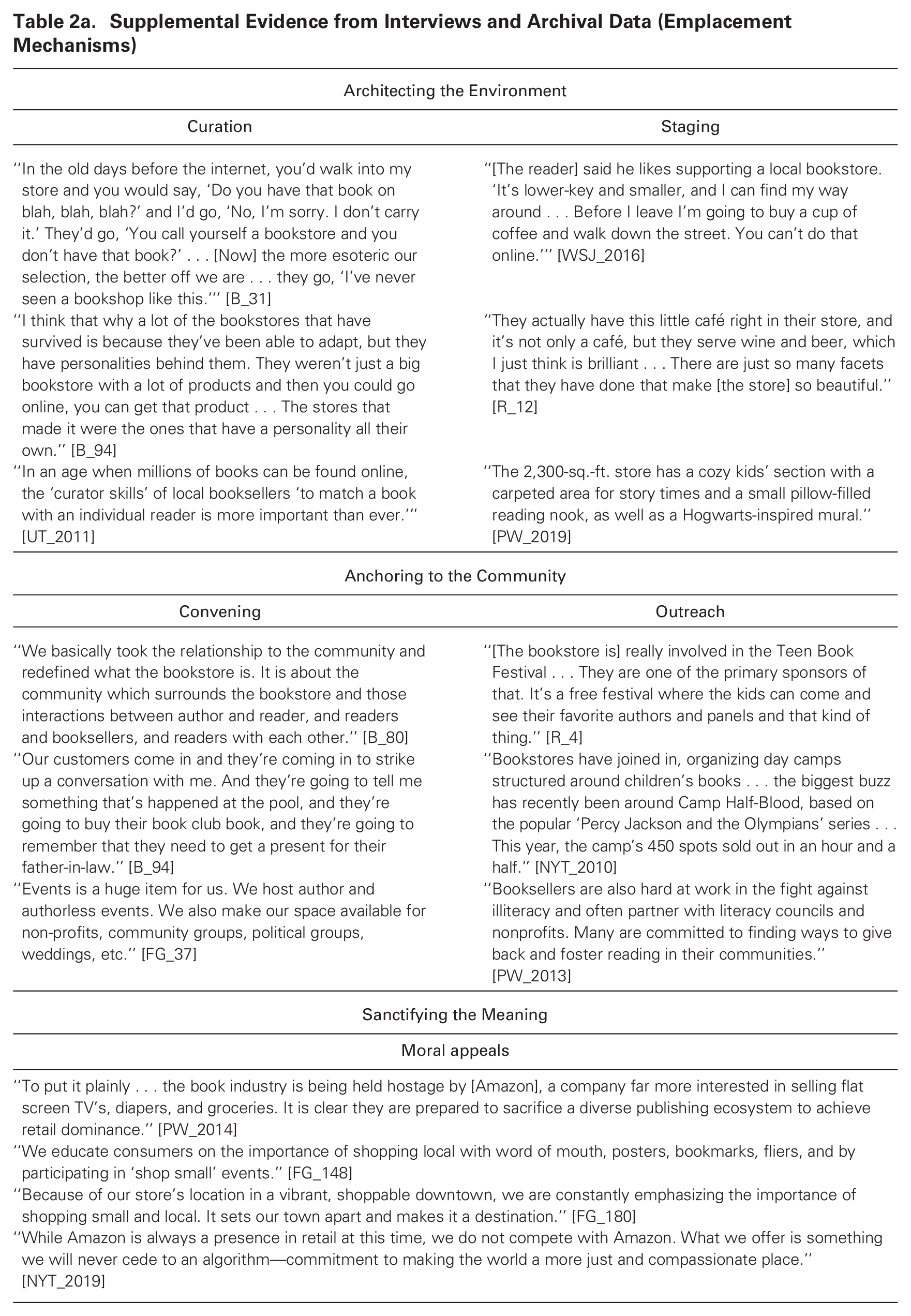
Supplemental Evidence from Interviews and Archival Data (Field Orientation and Perception of Digital)
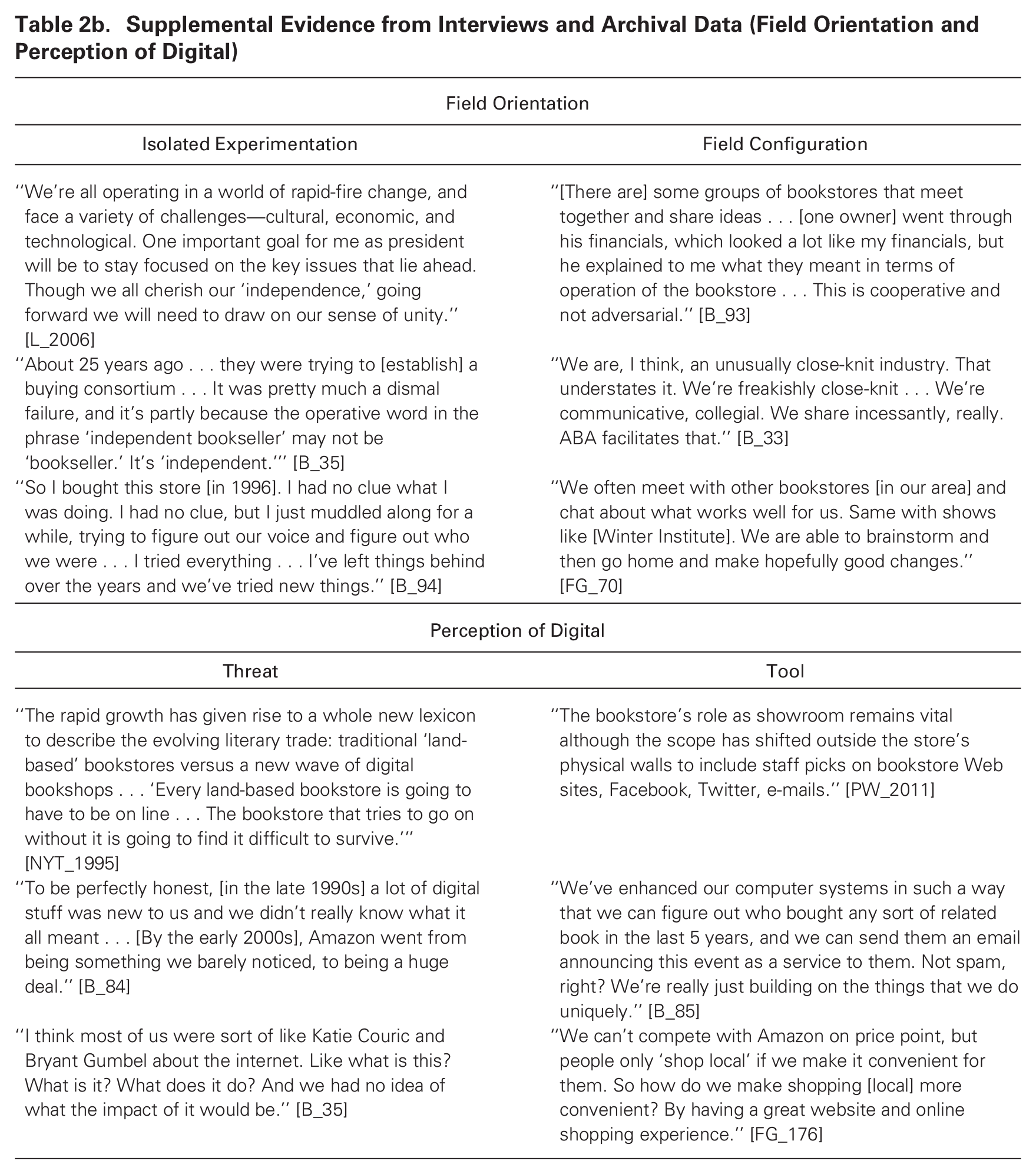
Second, booksellers combined material practices (architecting) and discursive practices (sanctifying) to concretize the shop local movement within their stores’ walls. Staff populated shelves and checkout counters with customized products that valorized independent retail, including tote bags, t-shirts, and coffee mugs with slogans such as “Keep Austin Weird: Support Your Local Businesses” and “Eat, Sleep, Read: Support Independents in Your Community.” In 2009, the ABA began to distribute signage to booksellers, including decals and posters, which communicated and celebrated membership in local and independent business alliances. Some stores also made their own signs to deter customers from browsing in store but buying online, such as one poster in New England that read “Find it here. Buy it here. Keep us here.” By using material objects to do sanctifying work, booksellers turned an abstract, discursive movement against Amazon into an in-store reality that customers could physically experience and consume.
Third, booksellers combined social practices (anchoring) and discursive practices (sanctifying) to involve readers in the mission to defend local retail. In addition to hosting events such as author readings, bookstores hosted events explicitly designed to reinforce the movement to buy local. For instance, facilitated by the coordinating efforts of the ABA, bookstores across the country began to celebrate an annual Independent Bookstore Day on the last Saturday of April. Similar events took place throughout the year, such as one featured in Publishers Weekly:“Booksellers have coopted Cyber Monday . . . In the independent bookstore community it has been rebranded Cider Monday . . . stores serve hot apple cider and snacks to woo customers away from shopping online” (PW_2016). Booksellers also became quite successful at harnessing social media to amplify their sanctifying and community outreach efforts. Numerous owners explained that they had “invested a lot in social media” (B_85) and “got much better [at] marketing and using social media” (B_77). Again, these efforts animated an abstract, discursive movement against e-commerce into something co-created daily by communities. By offering their stores as pillars of community, bookstores ritualized the act of coming together to shop locally.
Heterogeneous emplacement styles and sequences
Our analysis also revealed that the interactions between the three mechanisms were not rote but, rather, varied from store to store as booksellers tailored them to suit their personal and community needs. Figure 7 demonstrates how bookstores styled and sequenced the emplacement mechanisms in heterogeneous ways.
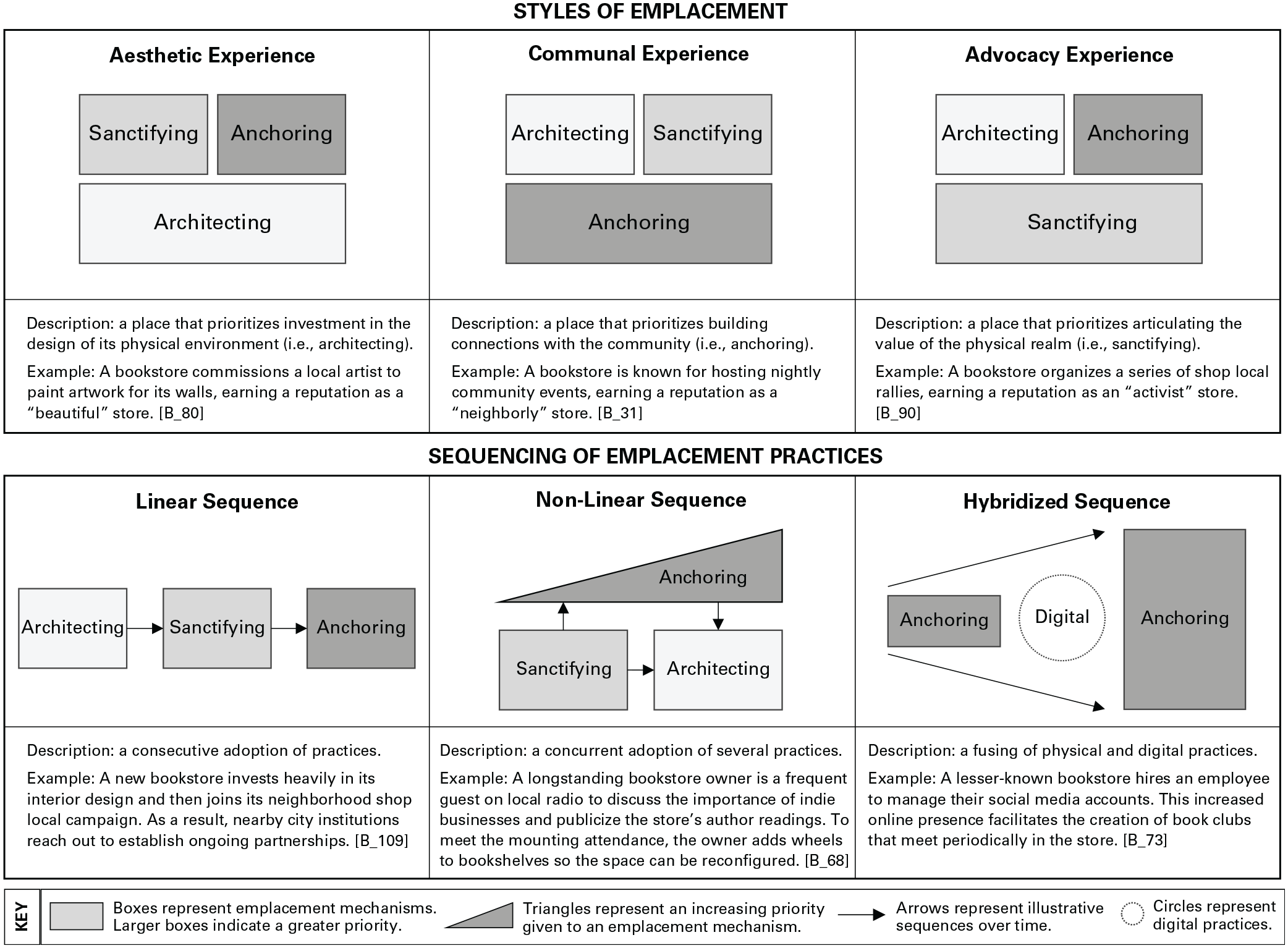
Styles and Sequencing of Emplacement
First, we found that stores displayed distinct emplacement styles based on their proportional investment in the three mechanisms. A comparative analysis of stores revealed three major approaches based on which of the emplacement mechanisms they prioritized. For example, certain bookstores emphasized an aesthetic experience, prioritizing investment in architecting their physical environment, and thereby earned reputations as beautiful stores. Others emphasized a communal experience, prioritizing building connections in the community, which helped them to earn reputations as neighborly stores. And others emphasized an advocacy experience, being particularly outspoken about the movement to shop local, and thus earned reputations as activist stores. Second, we found that bookstores were able to sequence the mechanisms in different ways. For instance, one bookstore owner began to invest in their store’s physical architecture only after convening events became so popular as to demand more space. But it was not necessarily the case that, for example, anchoring always preceded architecting. Indeed, other stores began to attract crowds because they had first invested in creating an aesthetically pleasing environment or were publicly vocal about the shop local movement. In brief, stores could be successful by ordering the mechanisms in linear, non-linear, and/or hybridized sequences so long as the three were present and interacted as a system.
These findings reveal that while emplacement as a theoretical process is abstract, in use it can manifest in many forms. Independent booksellers and industry actors co-created and diffused the practices of emplacement, thereby establishing a shared repertoire that individual stores could draw from in a multitude of ways. As the CEO of the ABA summarized, “There’s a hundred and one variations on the theme, but figuring out: ‘What is the range of services and things you can offer . . . in order to ensure that you can keep the bookstore going?’ That’s just what [booksellers] have to do” (T_98).
Strategic value created: Place as an asset
The process of organizational emplacement enabled booksellers to leverage physical place as a unique source of strategic value. Rather than simply selling books as commodities, booksellers offered readers an interactive experience that could not be replicated online. Beyond the traditional economic components of value (i.e., price and quality), retail scholars have highlighted that “the consumption experience itself can also be rich in value” (Mathwick et al., 2001, p. 41). 5 Whether by designing stores’ layout and lighting to create a cozy atmosphere, hosting after-hours parties for book releases, or simply getting to know the names of repeat customers, booksellers elevated book buying to a participative activity. As one new bookstore owner explained, “If we see our product as books, and what we compete on as price, we lose. No one can out-discount Amazon. No one can out-Amazon Amazon . . . But if we don’t see our product as books—if we see our product as a service—then we can compete” (B_20). Another bookseller similarly noted, “I frequently express that [our store] is an experience and Amazon is a transactional business” (FG_462). When they were successfully emplaced, stores became sites of experience rather than merely economic exchange, which allowed booksellers to differentiate themselves from digital competitors.
Moreover, emplacement differentiated independent bookstores by creating a bi-directional sense of attachment between stores and readers. Attachment refers to the emotional and self-expressive connections that consumers develop with an organization or product, leading to ongoing “commitment . . . and willing[ness] to pay a price premium” (Shimul, 2022, p. 400). By curating inventory to fit local tastes, integrating into the community, and involving consumers in the collective duty to defend local retail, booksellers forged an attachment between the physical stores and the people they served. As booksellers explained, this social contract was achieved by treating readers as “humans, rather than just consumers” (FG_186) and by “retain[ing] the values of that relationship . . . versus just being a place where people come in, throw money at us, and walk out again” (B_88). These actions resonated with readers. One reader explained, “I’m probably in the store at least once a month, sometimes twice a month . . . I’m just a junkie” (R_17). Another noted, “I try to give business to [the store] because they are locally owned and they’re near and dear to [our community’s] hearts . . . I love their business . . . I’m probably there once every couple weeks on average, sometimes more” (R_4). Through emplacement, independent booksellers fostered a sense of pride and commitment that led consumers to channel their money to local retail rather than online alternatives.
Through the organizational emplacement process, booksellers created strategic value that transformed their physical stores from liabilities that could never match e-commerce into assets that they could leverage as a source of strategic differentiation. By initially attempting to imitate Amazon’s commoditizing practices, brick-and-mortar retail stores were pushed toward becoming standardized, transactional, and mundane spaces. However, through a combination of material, social, and discursive practices, independent booksellers instead transformed their stores into personalized, interactional, and sacred places (depicted in Figure 4).
In 2019, the ABA reported that store numbers had increased by 53 percent since 2009, growing from 1,651 to 2,524 stores. Existing bookstore owners were at the forefront of this resurgence, experimenting with new practices and sharing their stories with peers and the public. Sensing promise, a new generation of bookstore owners entered the industry, with 479 new entrants joining the ABA between 2009 and 2019. In his 2019 State of the Industry letter, the ABA CEO reported that independent stores had seen a 7.5 percent growth in sales over the preceding five years. This upswing was reflected in “a sea change in the media’s coverage of independent bookstores” (L_2019). No longer predicting the collapse of the industry, popular press headlines instead noted that “Small Bookstores Thrive” (NYT_2019) and that they had found “The Secret to Succeeding in the Amazon Age” (WSJ_2019). In a speech at the ABA Winter Institute, author Malcolm Gladwell told the crowd, “Amazon has made you better booksellers . . . It has forced you to differentiate yourselves” (PW_2013). Indeed, the David-and-Goliath narrative helped booksellers to assign meaning to independent, brick-and-mortar retail. Yet, this narrative was also founded upon practical change. As our analysis reveals, it was through the combination of multiple practices—architecting their physical stores, anchoring to their communities, and sanctifying local retail—that independent booksellers were able to transform their physical spaces into valuable places.
Discussion
By examining the unexpected resurgence of independent bookstores in the United States, we revealed how incumbents can leverage physical place as a source of differentiation in response to the threat of digital commoditization. We introduced organizational emplacement—a process by which actors infuse meaning into physical spaces, thereby transforming them into valuable places—as a novel mechanism of value creation. Below we highlight how these findings hold theoretical and practical implications for research related to place, digital transformation, and incumbents’ responses to technological change.
Place as an Asset in Response to Digital Commoditization
A core contribution of this study is to reveal that physical place can be leveraged as a productive asset in the face of digital commoditization. With the rise of digitalization, many scholars have highlighted the “daunting task of changing the organization to embrace the new technology” (Lucas & Goh, 2009, p. 54). Building from a long tradition in technology strategy (Suárez & Utterback, 1995), this body of work operates under an implicit assumption that the odds are tilted in favor of the digital technology (Cennamo et al., 2023). These perspectives are thus likely to have predicted that e-commerce, given its promise of low prices and high volume, would displace brick-and-mortar retail. Indeed, when introducing his seminal theory of creative destruction, Schumpeter (1942, p. 85) drew inspiration from a similar setting as our own, stating that “the competition that matters arises not from additional shops of the same type, but from the department store, the chain store, the mail-order house and the supermarket which are bound to destroy” the prevailing shop form “sooner or later.” The rise of e-commerce seemed to present the next step in this Schumpeterian march.
Our findings offer an unexpected counter-narrative. We show how the transition from physical to digital can accelerate the commoditization process, threatening to devalue existing goods and services. Prior theories of technological change have predicted that when faced with such a discontinuity, incumbents are likely to remain inertial or attempt to imitate the new digital products (Benner, 2010; Danneels, 2011; Lucas & Goh, 2009; Tripsas & Gavetti, 2000). In fact, in the early days of e-commerce, many brick-and-mortar booksellers either fell prey to inertia or attempted to imitate Amazon’s commoditizing practices. However, by focusing not only on the products consumers purchase but also the place where exchange occurs, we reveal that incumbents faced with the threat of digital commoditization are not limited to either inertia or imitation. Rather, incumbents can differentiate by transforming the very thing at risk of devaluation—place—into a source of strategic value. Through organizational emplacement, actors offer consumers sensory, social, and meaningful experiences, thereby creating a strong sense of attachment. Our theory of emplacement thus extends prior work on attachment, which refers not only to consumers’ commitment to an organization or product (Shimul, 2022) but also to the human tendency to form tethers to place (Lewicka, 2011; Scannell & Gifford, 2010). This outcome contrasts with the effects of digitalization, which have been heralded as “eliminating or lessening material constraints . . . including limitations of time, space, location” (Leonardi & Treem, 2020, p. 1602). We thus introduce the prospect that, in a digital era, physical place can be a rare and inimitable resource.
We further show that digitalization is a distinct form of technological discontinuity (Adner et al., 2019; Benner & Tushman, 2015; Scott & Orlikowski, 2022; Vial, 2019) that offers incumbents a broader menu of options than those historically highlighted by technology strategists. The shift from analog to digital should not be treated as identical to technological discontinuities of a more linear shift in kind (e.g., analog to analog) (Cennamo et al., 2023; Orlikowski & Scott, 2023). By treating them as identical, both academics and practitioners are hemmed into dichotomies: threat or opportunity, disrupt or be disrupted (Furr et al., 2022). Yet, in the face of a digital threat, incumbents need not always face an adopt-or-die decision (Nelson et al., 2023; Raffaelli et al., 2022). Instead, scholars have begun to suggest that digitalization presents “a more complex story” and that there may be alternative strategies that “take advantage of incumbents’ strategic position and existing resources” (Furr et al., 2022, pp. 596–597). Our study introduces emplacement as one way for place-based incumbents to convert existing resources into assets when faced with a digital threat, even when they are not in a dominant position of market power (cf. Raffaelli, 2019). Importantly, emplacement does not necessitate the wholesale refusal of digital practices. Rather, digital technology is a flexible tool that can be leveraged either in service of commoditization or in service of community (Wellman et al., 2009). By familiarizing themselves with the digital but still holding fast to community connection, incumbents may be positioned to approach digitalization as a complement to, rather than substitute for, analog processes.
Organizational Emplacement: Transforming Spaces into Places
Physical places are fundamental to the human experience (Lewicka, 2011; Tuan, 1977; Whyte, 1943). Despite this importance, the concept of place has been relatively neglected by organizational theorists (David et al., 2020; Wright et al., 2023). Nathaniel Hawthorne once said of Anthony Trollope’s novels that they read “as if some giant had hewn a great lump out of the earth and put it under a glass case, with all its inhabitants going about their daily business, and not suspecting that they were made a show of” (quoted in Gopnik, 2015). In effect, prior organizational research on place has followed a similar style: It cordons off a “spatially confined” location and scrutinizes the dynamics unfolding therein (Aversa et al., 2021, p. 2077). In doing so, such research takes for granted that places are contained, pre-existing, and ready for individuals to make sense of or maintain. Our study shows that places do not materialize spontaneously; rather, they are “as much an achievement as a given condition” (McClay & McAllister, 2014, p. 3).
A core contribution of this study is to reveal that places can be constructed by agents with intention. Whereas prior research has focused on place preservation and maintenance (Crawford et al., 2022; Dacin & Dacin, 2019; Wright et al., 2021), we show how actors proactively work to create places that are too important to fail. The process of organizational emplacement captures a combination of material, social, and discursive practices, which together transform physical spaces into valuable places. By architecting the environment, anchoring to the community, and sanctifying the meaning of physical place, organizations are able to avoid becoming “thinned-out” spaces devoid of experience and attachment (Casey, 2001, p. 684). Instead, by infusing meaning into and drawing meaning out of both physical objects and social encounters, organizational actors create “thickly lived places . . . [in which] personal enrichment can flourish” (Casey, 2001, p. 685). In doing so, they contribute a vital source of prosperity, sociability, and character (Oldenburg, 1999; Turco, 2023). Thus, at its core, our theory of emplacement introduces a novel and powerful process of creating value, both economic and social.
An advantage of this study lies in its ability to explain how emplacement can be tailored to organizations while still maintaining its potency. Independent booksellers across our sample shared place as a common resource. Yet, on the ground, each store’s activation of place was uniquely its own, creating distinct place characters (Paulsen, 2004). Our analysis revealed that, while all three mechanisms were essential for emplacement to occur, they could present in any multitude of styles and sequences (Figure 7). In other words, we show that emplacement is enabled by the creation of a repertoire: a set of shared practices that individuals can draw from to suit localized needs (Clemens, 1993; Kellogg, 2011; Leibel, 2025; Seidel & O’Mahony, 2014; Swidler, 1986). Our study outlines how organizations and industry-level actors can together create and diffuse a revitalized repertoire as a means of strategic differentiation. As Weick (1979, p. 56) noted about effective organizational theory, “what seems to be a single phenomenon is in reality composed of assorted heterogenous elements.” The strength of our theory lies in its flexibility: Emplacement is not a rigid procedure but, rather, a repertoire that can be employed in custom-made ways to address the demands of local environments.
We also advance the notion that place is a relative construct defined in opposition to space or the digital realm (Gieryn, 2000; Tuan, 1977). Our work introduces the idea that environments exist along a spectrum and that place can be valorized in contradistinction to competitive alternatives. We thus offer a companion piece to Munir, Ansari, and Brown’s (2021) study of the desacralization and commodification of yoga. Our findings chart the reverse course of “secular enchantment” (Munir et al., 2021, p. 888), outlining how organizations become sacred in opposition to peers (cf. Suddaby et al., 2023; Zelizer, 1979). As our study reveals, independent booksellers were able to reposition their stores as a sacred alternative to the profane Amazon and the mundane big box. We thus introduce physical place as a unique source of differentiation that can be used to assign worth along a spectrum from profane (digital) to mundane (space) to sacred (place).
Our model of emplacement also outlines how actors create meaning through not only symbolic but also physical work. For decades, scholars have shown how actors use language to lend meaning (Selznick, 1957; Weick, 1979). But discursive practices are only one component of meaning-making, which has led scholars to voice concerns about the relative neglect of the physical within organizational scholarship (Barad, 2003; Boxenbaum et al., 2018; De Vaujany et al., 2019; Leonardi et al., 2012; Voronov et al., 2023). By showing how organizational actors use physical practices, alone and in confluence with the social and discursive, we show that place is both stuff—bricks and mortar, mountains and trees—and symbolic. We thus lend our voices to the chorus of scholars who have sought to rebalance the material and symbolic domains within organizational studies.
Beyond Bookstores: Generalizability of Organizational Emplacement
While any single case is limited in its generalizability, observations and global trends suggest that organizational emplacement is relevant in numerous other settings. During our period of study, other brick-and-mortar sectors were likewise able to fend off the threat of the retail apocalypse by employing emplacement practices. For example, independent coffee shops and brewpubs saw a surge in numbers during our study’s time frame, driven at least in part by their efforts to curate to suit local tastes and to ally with the independent retail movement (Brewers Association, 2022; Specialty Coffee Association, 2023). Similar to bookstores, these retailers offered a modern “third place” shown to be essential to civic and social life (Oldenburg, 1999, p. xi; Putnam, 2001). These trends support recent arguments that organizational theory may have “(prematurely) mourned the demise” of physical proximity (O’Mahony & Lakhani, 2011, p. 8). Instead, these additional cases provide further evidence that social and physical embeddedness in local communities continues to be a source of strategic advantage (Granovetter, 1985).
Our study also has implications beyond retail, as digital commoditization permeates various corners of organizational life. Digitalization has enabled the production and exchange of more offerings more cheaply. Although this increased access and reduced cost has benefits, our study also offers a cautionary note. The tide of digital commoditization can, intentionally or unintentionally, hollow products and places of their meaning and value. For example, colleges and universities have historically relied heavily on in-person instruction, yet the rise of online learning—with seemingly infinite courses made available for a low price—has called into question the continued value of the physical classroom. Our findings suggest that there are ways to protect and amplify the latent value housed in once-sacred places, such as the classroom, while simultaneously remaining alive to the potential advantages afforded by digital technologies. Future research should consider the conditions that enable organizations to successfully hybridize the value housed in both the physical and digital realms.
Likewise, as work becomes increasingly remote or hybrid (Neeley, 2021; Rhymer, 2023), the shift toward entirely or partially placeless work environments provokes new questions, chief among them whether physical workplaces will persist or be eclipsed by remote work (Ashforth et al., 2022). Office buildings sit vacant, and companies attempt to “lure their employees back into the workplace” (Ho, 2022), reflecting a need to infuse workplaces with meaning, experience, and attachment beyond production. As the chief product officer of the virtual co-working platform Zoom has argued, “The office has to earn its commute” (Hsu, 2023). Given this rising challenge for managers, our model extends prior studies of workplace design and identification (Crosina, 2024; Elsbach & Pratt, 2007; Stephenson et al., 2020) and invites researchers to entertain how organizational actors can transform work spaces into more meaningful work places.
Boundary Conditions and an Agenda for Future Research
Our study examined small, independently owned organizations in a cultural setting. Although we believe the theory of emplacement is also relevant to other place-based organizations, here we discuss how future research can test and refine the conditions of our model. First, the collapse of other brick-and-mortar retailers during our time frame suggests that emplacement cannot always be seamlessly replicated. While independent booksellers were able to leverage physical place, other booksellers were not. Notably, Borders Group went out of business in 2011, citing the rise of e-commerce as a contributing factor (Osnos, 2011). Amazon itself attempted to foray into brick-and-mortar bookselling in 2015; however, the company announced plans to shutter all locations in 2022. Even place-based organizations that were founded with a community ethos (e.g., Starbucks, Barnes & Noble) can fall prey to the commodity trap of scale (D’Aveni, 2010), charting the reverse course from places to spaces. One reading of these trends is that emplacement may be limited to a certain organizational form: small and independent. Indeed, large organizations are often criticized for attempting to co-opt independents’ strategies (Hedberg & Lounsbury, 2021; Jaffee, 2014), which in this case could manifest as what we would call an inauthentic form of “local washing” akin to greenwashing. Future research should explore the conditions under which actors can achieve emplacement in large, global, or publicly held organizations in which standardization is often paramount for efficiency gains.
Second, we studied a cultural industry. While this may make the process of meaning-making more visible (Khaire & Wadhwani, 2010), we recognize that emplacement may operate differently in other settings. For instance, emplacement may be more or less effective when the core product is highly technical in nature. We see promise in exploring this question more thoroughly in contexts such as banking (Marquis & Lounsbury, 2007) or advanced technology (Grodal, 2018), in which scholars have already intimated the importance of community. Furthermore, in certain contexts emplacement may not be necessary or strategic. Retail stores, college campuses, and offices are high-touch environments that lend themselves readily to emplacement because they serve as natural sites for human experience and attachment. Yet, other organizational environments, such as warehouses, may be more appropriately designed as spaces given that their purpose is to reduce costs and maximize efficiency. In our setting, Amazon constructed warehouses without expensive furnishings because they were never intended to be customer-facing (Stone, 2013). The decision to create a space versus a place therefore hinges on who will be using it and whether their experience can be a source of strategic or social value.
Our research raises new questions about how incumbents navigate the threat of commoditization by cutting-edge digital technologies. This can be observed, for instance, in the rise of media streaming services, which prompted an “absolute flood of content” such that consumers struggled to differentiate offerings by quality (Tassi, 2022). Generative artificial intelligence (AI) offers another potential mechanism of digital commoditization. Some scholars have expressed fears that generative AI operates as a homogenizing force (Mann, 2024), threatening to turn creative work into a commodity. Indeed, scholars have recently voiced concern that the “sacredness” of organizational research has itself been imperiled by the rise of commoditizing technologies, including generative AI, which have spawned “a vast, perplexing, and ever-expanding literature with few tools to navigate for quality” (Bechky & Davis, 2025, p. 18). Future research should explore how incumbents (e.g., journalists, artists, academics) identify and create novel sources of differentiation in response to this rising threat. Our study suggests that human-led curation, field-level configuration, and a willingness to embrace the threatening technology as a complement rather than a substitute may be essential.
Finally, we hope that our study encourages scholars to recognize that novel theoretical insights can be gleaned from studying small business. Local independent businesses remain cornerstones of economic, cultural, and social life, yet they are relatively understudied. According to the U.S. Small Business Administration, small businesses created two-thirds of net new jobs and accounted for 44 percent of U.S. economic activity in 2019, the final year of our study. Economic estimates further indicate that for every dollar spent at an independent retailer, more than three times as much money returns to the local economy compared to spending at national chains (AMIBA, 2021). A contribution of this article is to show how small organizations leverage place to create value. In doing so, we offer a model that attributes greater agency to local business owners, who too often are depicted in the shadows of “hyper-muscular” entrepreneurs with ambitions to transform the global economy (Aldrich, 2010; Powell & Colyvas, 2008, p. 277). Thus, our work addresses recent (Aldrich & Ruef, 2018) and seminal (Schumacher, 1973) critiques that scholars tend to neglect small businesses, a foundational sector of economic and social life, in favor of the high-growth organizations that often dominate public attention.
Conclusion
It is a paradox of modern life that as the world becomes increasingly networked by digitalization, individuals are often left feeling more dislocated than ever. The novel resurgence of independent bookstores serves as evidence that physical place continues to inform how individuals interact, transact, and find meaning, despite—or perhaps because of—the pervasive encroachment of the digital realm. Our theory of organizational emplacement suggests that place, when activated strategically, can be a productive resource, not a remnant, of modern society.
Supplemental Material
sj-pdf-1-asq-10.1177_00018392251333696 – Supplemental material for Organizational Emplacement as a Response to Digital Threat: The Novel Resurgence of Independent Bookstores
Supplemental material, sj-pdf-1-asq-10.1177_00018392251333696 for Organizational Emplacement as a Response to Digital Threat: The Novel Resurgence of Independent Bookstores by Ryan Raffaelli and Ryann Noe in Administrative Science Quarterly
Footnotes
ORCID iDs

Supplementary Material
.1
).2
).3
4
5
).Authors’ Biographies
References
Supplementary Material
Please find the following supplemental material available below.
For Open Access articles published under a Creative Commons License, all supplemental material carries the same license as the article it is associated with.
For non-Open Access articles published, all supplemental material carries a non-exclusive license, and permission requests for re-use of supplemental material or any part of supplemental material shall be sent directly to the copyright owner as specified in the copyright notice associated with the article.
