







Abstract
Organizational theory has predominantly studied elites, yielding significant insights but creating a narrow perspective on management practices and organizational dynamics. This essay argues that we can advance organizational theory by incorporating a comprehensive focus on populations marginalized across multiple dimensions—economic, educational, geographic, demographic, cultural, and social. Addressing these marginalized groups is crucial as they face barriers, stigma, and discrimination, which are often overlooked in elite-focused research. By bringing greater attention to marginalized populations and embracing an intersectional approach focused on multiple dimensions of marginalization, we have the opportunity to broaden the scope of management research, foster inclusivity, and better reflect the diverse realities of organizational life. This essay provides definitions, operationalizations, and exemplary articles for each dimension of marginalization, ultimately advocating a more comprehensive and inclusive perspective in organizational research.
As we mark the 70th volume of Administrative Science Quarterly (ASQ), it is time to reflect on the evolution of organizational research and contemplate its future directions. Organizational theory has long been shaped by studies of elites: the few “with vastly disproportionate control over or access to a resource” (Khan, 2012, p. 361). As Khan (2012, p. 362) clarified, “Within this definition, we can think of elites as occupying a position that provides them with access and control or as possessing resources that advantage them.” The focus on elites, while yielding significant insights, has created a narrow lens through which we view management practices and organizational dynamics (Hwang & Phillips, 2024). It is time for a paradigm shift.
This essay argues that we can advance organizational theory through greater focus on marginalized populations: those socially, demographically, geographically, economically, educationally, and culturally distant from elites and their resources. As the number of articles considering one of these dimensions increases, we are optimistic about the opportunity to also make a pivotal advancement by considering those marginalized on multiple dimensions simultaneously.
The importance of this shift in focus for management theory cannot be overstated. First, marginalized individuals are more likely to encounter barriers, stigma, and discrimination in their daily lives. It is incumbent upon organizational scholars to understand how organizations can prevent and mitigate these injustices (Howard-Grenville, 2020; Sawyer & Clair, 2022). Second, much management theory is built on studying elites in large, Fortune 500 corporations, which are a small and unrepresentative segment of the global population. Consequently, our understanding of management is skewed and not as generalizable as we sometimes claim. As inequality increases within nations, focusing solely on elites means studying a group that is becoming smaller over time, limiting the applicability of our theories to broader populations.
Third, privileging elite-focused research reinforces barriers for emerging scholars interested in marginalized populations. These scholars often face the dual challenges of framing their research within a contextually irrelevant body of literature and being perceived as pursuing atypical rather than mainstream inquiries. By facilitating publications on marginalized populations, we enrich the field and help diversify the academy, as scholars studying these populations are themselves often demographic minorities who are deeply familiar with marginalized experiences (Daviss & Correll, 2023; Lam et al., 2024).
Finally, while the field has been more frequently recognizing the importance of studying marginalized groups, we tend to do this work in a piecemeal fashion, often focusing on single dimensions of marginalization. For example, the increasing attention to gender diversity is laudable, but it predominantly centers on women in elite contexts, such as law firms in the United States (e.g., Phillips, 2005), rather than on women in more marginalized settings, such as factories in Mexico, in which women are also marginalized on multiple other dimensions. An intersectional approach, considering multiple dimensions of marginalization simultaneously, is needed to provide comprehensive theories and frameworks.
The narrow focus on elites in organizational research stems from several sources. One factor is the frequent use of archival and readily available data, which typically represent elite contexts. Additionally, stringent review processes can discourage deviation from established norms, making it challenging to pursue research on marginalized populations. The focus on elites in organizational research can also be attributed to the fact that the stakeholders of business schools are often elites or those who aspire to be elites, which influences what is considered relevant to those we teach, our funders, and the faculty in other departments within business schools, such as finance and marketing. Finally, a barrier to studying non-elite populations is that our data collection instruments are often not adequately designed to capture their thoughts, feelings, and emotions. For instance, non-elite populations often struggle to respond to Likert scales, possibly because the abstract nature of such scales can be unfamiliar or culturally irrelevant to them, leading to less-accurate or less-meaningful data (Ogden & Lo, 2011).
This essay calls for a renewed commitment to inclusivity and diversity in organizational research. We advocate a broader, intersectional perspective that comprehensively reflects the diverse realities of organizational life. We begin by outlining six dimensions of marginalization that we see as critical to consider in the study of organizations.
Dimensions of Marginalization
Demographic Marginalization
Demographic marginalization refers to the exclusion of specific groups based on characteristics such as age, gender, ethnicity, religion, sexual orientation, disability, and indigenous identity. Extensively studied in social sciences, demographic marginalization highlights how these groups face systemic barriers and discrimination (Ridgeway, 2011; Williams & O’Reilly, 1998). We begin our discussion with demographic marginalization because one’s position in this dimension could have downstream implications, affecting their position in other dimensions of marginalization.
There have been several calls within management research to study more demographically diverse populations. For example, Joshi et al. (2015) argued for the importance of incorporating diverse demographic contexts in management studies to better understand and address issues of inequality and discrimination within organizations. Post et al. (2021) emphasized the need to address structural inequalities and the interplay between diversity and inequality. Additionally, scholars have highlighted the importance of addressing the nuances of diversity, emphasizing that surface-level diversity (e.g., race, gender) often interacts with deep-level diversity (e.g., values, beliefs) in complex ways (Post et al., 2021). There have also been calls within organizational research to study specific demographic minorities to improve our understanding of management. For example, recent studies have underscored the critical role of Indigenous perspectives in enriching management and organizational theories (Kaplan, 2023; Salmon et al., 2023).
Studying diverse demographic contexts in management scholarship is crucial for several reasons. First, research shows that diversity can improve decision making and creativity, which are vital for organizational success in a globalized world (Ely & Thomas, 2001; Godart et al., 2020). Second, studying these contexts addresses the ethical imperative of equity and justice. Understanding challenges faced by marginalized groups is essential for implementing effective diversity and inclusion initiatives (Nkomo, 1992). Third, as global populations become increasingly diverse, organizations must adapt to attract and retain talent from diverse backgrounds; management theory should reflect changing workforce demographics (Joshi et al., 2011).
To operationalize what qualifies as demographically marginalized, we consider studies discussing ethnic and religious minorities, women, the elderly, LGBTQ+ populations, Indigenous populations, and people with disabilities. This classification provides a measurable criterion for identifying groups likely to face the effects of demographic exclusion. Research shows these groups often face systemic barriers that prevent equal opportunities (Joshi & Roh, 2009).
There are many exemplary articles modeling the examination of demographically marginalized populations. We highlight two studies that investigate often overlooked groups in management research, generating insights into the subtle struggles faced by marginalized populations. Chan and Anteby’s (2016) research used inductive interview data to study tasks that men and women perform in the U.S. Transportation Security Administration workforce. This article, which won the 2023 ASQ Award for Scholarly Contribution, shows how unequal task allocation perpetuates gender disparities in job quality and career progression, revealing subtle mechanisms of workplace inequality. Similarly, Feldberg’s (2022) research investigated challenges that women managers face in a U.S. grocery chain. Feldberg demonstrated that women managers, confronted with negative stereotypes, disproportionately focus on public, supervisory tasks to counteract these stereotypes, at the expense of other essential duties. Both studies focused on gender inequality in low-wage, service sector contexts—settings often overlooked in management journals, which are typically centered on higher-wage, professional settings—bringing renewed attention to task allocation as a key factor in within-job demographic inequality.
While there are other articles that explore various types of demographic marginalization, we highlight these studies because they straddle multiple dimensions of inequality—an important step toward illustrating the complex interplay of gender and socioeconomic factors. Recognizing these intersections is critical for understanding how marginalization operates within organizations. However, despite progress in examining gender inequality in low-wage contexts, a significant gap remains in fully embracing intersectionality. Too often, intersectionality is treated as an additive interaction term in quantitative models or as a contextual feature rather than as a lens to understand distinct experiences of individuals with multiple marginalized identities.
A key direction for future research is to revisit, through an intersectional lens, established findings on demographic inequality by asking, for example, how do experiences of marginalization differ between women of color in low-wage jobs and in professional settings? How does the interplay among race, gender, and class manifest in promotion decisions or performance evaluations? Scholars can also investigate how (and when) organizational culture and leadership amplify or mitigate these intersectional disparities.
Dupree’s (2024) study of intersectionality (gender and race) is a trailblazer in this regard; it examined intersectionality within a single dimension of marginalization—demographic—by focusing on the intersection of race and gender. The study reveals that Black women experience more backlash (e.g., are rated as cold or dominant) than White women when using assertive or dominant language (see also Hall et al., 2014; Livingston et al., 2012). This study adds to evidence overturning the common conception that all women leaders face similar consequences for assertive behavior, highlighting the importance of considering intersectionality in understanding marginalized groups’ experiences within organizational settings.
By prioritizing intersectional inquiry—not just as a methodological add-on but as a core research focus—management scholars can uncover hidden inequalities and generate richer theories about how power and exclusion operate in organizational contexts. This shift can reshape existing paradigms by offering more effective strategies for fostering inclusion and addressing workplace inequality at its roots.
Economic Marginalization
When comparing elites to marginalized populations colloquially, most observers recognize that one key distinction is access to economic resources. We identify economically marginalized populations as those excluded from formal market participation and economic resources (cf. Portes et al., 1989), and we identify economic marginalization as the processes by which this exclusion occurs. While marginalized communities may be actively denied economic resources, the marginalization is often embedded in structures and institutions that facilitate it without conscious effort.
Economic marginalization is often coupled with other dimensions we identify in this essay. Lower wealth or income is associated with restricted access to educational opportunities, social capital, and cultural capital. Economic elites are often geographically separated from economically marginalized communities and are overly represented by particular demographic categories.
The operationalization of economic marginalization may vary by empirical setting. Economic marginalization may vary not only within a country but also between countries (Gesthuizen et al., 2011). Acknowledging various ways to identify economic marginalization, we adopt an operationalization used by international organizations such as the European Union, The Organisation for Economic Co-operation and Development, United Nations, and the World Bank. These entities set country-specific poverty as 50 percent of a given year’s median income.
For example, according to the U.S. Bureau of Labor Statistics (2021), the U.S. median income across all occupations in May 2020 was $41,950. Those with an income under $20,975 are considered economically marginalized in the United States. This metric is similar to the U.S. federal poverty threshold of $21,720 for a family of three (the average family size in 2020 was 3.15) but also has the advantage of comparing economic marginalization across economies. To provide a qualitative perspective within the U.S. setting, we note that 370 occupational categories in 2020 had median incomes less than $20,975, including care workers, jobs in food services (e.g., short-order cook, waiter, waitress), and jobs in hospitality (e.g., housekeeping, front desk, parking attendant).
In South Africa, the national median income in 2020 was approximately ZAR 46,600 per year (around $3,105 USD) (Statistics South Africa, 2023). Applying the 50 percent median income threshold used by international organizations, we see that individuals earning less than ZAR 23,300 annually (about $1,552 USD) would be considered economically marginalized. Many informal sector workers, such as domestic or agricultural laborers, fall below this threshold. One advantage of this income-based criterion is that it can be generalized from being country-specific to context-specific.
Although research on economic marginalization is rare in top management journals, several business school scholars have published work on this topic in outlets outside the management field. For example, Wilmers and Aeppli’s (2021) research showed how the changing workplace has contributed to wage inequality; two decades of data reveal that high-paying workplaces no longer offer traditionally lower-wage jobs because they have outsourced jobs in occupations such as food service. Consequently, higher-wage employers are now dominated by high-wage occupations (managers), which has increased inequality and barriers to economic mobility. Similarly, Cobb and Stevens (2017) explored how corporate organization and employment practices influence income inequality at the state level in the United States. They demonstrated that large firms compress wage inequality through practices benefiting low-skilled workers, but they showed that the extent depends on organizational characteristics like racial diversity and geographic dispersion. Related, recent research in management journals has begun to examine how algorithmic management structures create new forms of economic precarity among marginalized gig workers (Cameron, 2024), highlighting how technological change in the workplace can reinforce existing economic inequalities.
Within management journals, recent research has more directly engaged the economic dimension of marginalization. Pongeluppe (2022) examined an economically marginalized population, using favelas (low-income neighborhoods) in Brazil as a research setting, which involves both economic and demographic marginalization (see also Pongeluppe, 2024). This research has the potential to advance management scholarship by expanding inclusivity and testing our core theories. Pongeluppe (2022) considered how firms investing within and outside marginalized communities differ strategically from those limiting investments to areas outside marginalized communities. While it does not represent a pattern in the field, this type of research along multiple dimensions is promising.
One way that management scholars can more explicitly engage economically marginalized populations is to ask which of our management theories have blind spots with respect to this dimension. In Western societies, economic inequality increasingly affects national discourse and organizational actions. Including economically marginalized populations can enrich our understanding of organizational processes and behavior. For example, a traditional approach in management would be to understand the effect of a pandemic from the perspective of managers, professionals, and scientists. However, unless we also examine the perspective of those who are low-income workers or in poverty, our theories are limited. This does not mean the data should exclusively center economically marginalized people, but it does mean they should be included in our theorization. In the context of organizational change, we can fully develop theories only when we consider the leaders, implementers, and targets of changes initiated or experienced by (and in) organizations. At a minimum, we should consider that targets of change may have a higher likelihood of being economically marginalized. More generally, our theories are robust to the extent that understanding organizational change includes cases in which economically marginalized individuals drive, not just accept, change.
Educational Marginalization
While there is no consistent definition of educational marginalization, we offer several guidelines for how management scholars can identify it. First, educationally marginalized individuals can refer to those whose education is notably less than the credentials typically valued in a specific market setting. Second, educational marginalization involves barriers to obtaining greater education. Third, to the extent that educational credentials are socially sanctioned positional goods (Araki, 2020), those who are educationally marginalized face a stigma associated with their marginalized status.
Educational marginalization is a distinct construct but may arise as a consequence of other forms of marginalization. In some contexts, it is an outcome of poverty; in others, educational opportunities are heavily gendered. Moreover, while this marginalization is often persistent, many scholars and policymakers treat it as a form of marginalization that can be remedied (U.K. Aid, 2018).
Education and international development scholars have noted different levels or types of educational marginalization (see Lewin, 2011), from those who never attend school, to those who drop out before key milestones, to those without post-secondary education (Furey, 2021). Furey’s (2021, p. 1000) commentary suggested that when scholars discuss educational marginalization, it is important to ask “relative to whom” and to consider how one measures education.
Unfortunately, there is no precedent in management scholarship for measuring educational marginalization since it has often been a blind spot. American adults with a high school degree or less, which is 37 percent of the population according to 2022 U.S. Census data, rarely warrant mention in our work. Instead, we more often focus on the 14.4 percent of U.S. adults with advanced degrees. This focus reifies the legitimacy of higher-educated individuals. In archival studies, education is typically relegated to a control variable, which masks variance that may be critical to understanding organizational processes and outcomes. This approach neglects a larger proportion of citizens and limits management theory.
While management scholarship has not conducted direct studies of educational marginalization, some studies can be extrapolated to advance our understanding. Hegde and Tumlinson (2020) examined entrepreneurship among individuals whose cognitive ability exceeds the median for their level of educational attainment. They argued that people with high cognitive ability but low formal educational credentials face discrimination in the labor market, which in turn motivates them to pursue entrepreneurship. Smith and Besharov (2019) studied a Cambodian social enterprise hiring disadvantaged Cambodians. Educational marginalization was not the focus of the article; however, they observed tension faced by the organization with respect to the low success rate of women in their program who had been rescued from sex trafficking. These women tended to have low education and experienced little success with training, leading to frustration from an MBA-trained manager (Smith and Besharov, 2019, p. 14). While this population was not explicitly recognized as educationally marginalized, noting it in a study dedicated to developing organizational theory is important and offers a potential foundation to build upon.
Management scholars could ask many important questions by considering educational marginalization. Recent attention to skill-based hiring, in which direct evidence of skills is given greater weight than credentialing, suggests several inquiries. What are the tradeoffs between skill-based and credential-based hiring? How does a firm effectively change from emphasizing educational credentials to skills? What are the implications of doing so for the organization of work within and between employers? To consider skill-based approaches, do management theories assuming higher education as part of an employee’s life course require updating? To the extent that post-secondary credentialing has implications for social capital, norms, and firm culture (Rivera, 2015), we may need to reexamine existing theories.
Considerations of educational marginalization will also likely be helpful as we seek to develop organizational theories that concern the role of generative AI. If, as a field, we examine only those who are highly educated, we risk misunderstanding how generative AI affects our theories of organizational processes and how those processes affect hiring, worker performance, productivity, work monitoring and evaluation, and firm outcomes. Indeed, to best understand how generative AI affects education itself, we must include those who are marginalized along this dimension.
Future research should also consider the intersection of educational marginalization and other dimensions of marginalization. We advocate understanding how educational marginalization affects our theories and how we can better clarify its processes and mechanisms in combination with economic marginalization. One’s intuition may expect that a low-income (male) high school graduate is a qualitatively unique combination of economic and educational marginalization, but it is less clear whether, when, and how our management theories should take such combinations into account. In addition to understanding how multiple dimensions operate in tandem, there are also opportunities to consider how different dimensions may affect one another. For example, demographic marginalization is an important dimension in this regard, as barriers and returns to education can vary by demographics.
Geographic Marginalization
Geographic marginalization focuses on communities excluded based on location, such as those in remote, rural, or underdeveloped areas with limited access to resources, infrastructure, and services. A small group of management scholars has emphasized expanding research beyond Western contexts to develop more inclusive and generalizable management theories. Tsui (2007) critiqued the narrow geographic focus of organizational research and called for including underrepresented regions to enrich our understanding of global management practices. Tsui et al. (2007) further underscored the importance of incorporating diverse geographic settings in organizational research. Recent calls, such as for “bringing Africa in” (George et al., 2016, p. 377), emphasize the growing recognition of the need to address geographic marginalization in studies. Prahalad’s (2004, p. 2) work on the “bottom of the pyramid” highlighted the need to examine specific groups within marginalized regions.
Studying diverse geographic contexts is crucial for several reasons. First, the same institutions that we might take for granted might not exist in international contexts, which is a phenomenon scholars refer to as “institutional voids” (Mair & Marti, 2009, p. 419; Mair et al., 2012; Palepu & Khanna, 1998). These voids can significantly alter how organizations operate and succeed. Second, developing knowledge about these contexts is essential because they encompass large populations and reflect a substantial share of the world’s pressing challenges. Research in these areas has the potential to initiate substantial societal improvements (Bell et al., 2017). Third, there’s an opportunity for us to expand or destabilize our limited canon established from studying contexts mostly in the Western world (Moretti, 2005), to better situate our knowledge, something that post-colonial scholars have emphasized (Westwood, 2004). Moreover, as management scholars increasingly engage with these populations, it becomes essential that they reflect on how to adapt their research practices to respect local values and ensure ethical integrity.
To establish an operationalization for geographically marginalized regions, we consider the study of areas classified as the “Global South,”“less developed countries,” or “Third World countries” based on their gross national income per capita of the previous calendar year. This classification provides a measurable operationalization for identifying regions likely to face compounded effects of geographic, economic, and social exclusion (World Bank, 2025). Conducting research in a developing country does not necessarily mean the context is geographically marginalized, though. For instance, studying a wealthy neighborhood in Bogotá, Colombia, would not represent the challenges of geographically marginalized populations.
Geographic marginalization also often involves factors such as rural versus urban disparities, displacement from homes, immigration, and segregation within the same region. These issues are prevalent in areas with limited access to resources, infrastructure, and basic services and are not captured by studying a developing country as a whole. Therefore, researchers should focus on economically and infrastructurally disadvantaged areas, taking care to not conflate the broader developing world with marginalization.
Some studies examine geographically marginalized populations to advance organizational theory. For instance, Bernstein’s (2012) research investigated electronics factories in southern China. This work is valuable because many workers are employed in manufacturing in China, and there is limited research in this context. Additionally, while we have long acknowledged that elite professional groups like scientists may value privacy (Gans et al., 2008), Bernstein’s finding that factory workers in China also desire privacy advanced our understanding of privacy in organizational theory. Embedding students who spoke Chinese in the factory line allowed Bernstein to understand the context deeply and to suggest that curtains around the factory floor might improve workers’ comfort and performance. He was able to causally test the impact of the curtain intervention on productivity. Bernstein’s field experiment advances our understanding of privacy by showing the counterintuitive relationship between privacy and productivity, even in a context characterized by surveillance. This study is notable for its deep engagement with the local context and its focus on populations marginalized geographically, educationally, and economically.
Another recent example is Raines et al. (2024), which examined how entrepreneurship policy aimed at lowering entry barriers in Mexico differentially impacted men and women, depending on local patriarchal norms. Although the policy made it easier to start businesses, women in marginalized geographic regions did not experience the same entrepreneurial gains as men did. Instead, women were often drawn into unpaid roles within businesses founded by men, reflecting the compounded effects of geographic, economic, and gendered exclusion. This study highlights the critical role that local cultural logics and marginalization play in shaping organizational outcomes even when policies are intended to be inclusive.
These examples are noteworthy for centering non-elite groups in geographically marginalized settings. Expanding our focus to include geographically marginalized populations helps us to address biases in organizational research and to develop theories more representative of the diverse realities of organizational life. This broader perspective enriches our understanding of management practices and highlights the resilience and innovation of communities historically excluded from academic discourse (Doering, 2016; Weiss et al., 2024).
By integrating intersectionality into studies of geographic marginalization, we can further uncover hidden inequalities and offer a comprehensive view of strategies that marginalized populations employ to navigate complex social and economic landscapes. For example, Ranganathan (2018) explored how artisans in a handicraft cluster in southern India set prices based on the type of buyer they encounter. While the article offers insights into the economic behavior of geographically marginalized artisans, it raises questions about the intersection of geographic and economic marginalization. The study focuses on artisans’ identification with their craft but pays less attention to how varying degrees of economic vulnerability within the artisan community might shape these pricing behaviors. Are poorer artisans, those with fewer resources or alternative income sources, less likely than artisans with slightly greater financial stability to offer discounts to discerning buyers? Addressing these questions in future research could shed light on how economic hardship interacts with geographic exclusion to produce differing patterns of market behavior, thereby enriching our understanding of marginalization across multiple axes.
Cultural Marginalization
Cultural marginalization refers to the exclusion of individuals who lack cultural resources or capital. Bourdieu (1984) introduced the concept of cultural capital, emphasizing how cultural assets influence social mobility and integration. Culture has been theorized as a toolkit (Swidler, 1986) whereby individuals use cultural tools to navigate social situations. Cultural marginalization occurs when individuals are excluded for not having these cultural assets, which are essential for social integration and acceptance. These resources can include language proficiency, country-specific knowledge, self-presentation styles (Goffman, 1959), and tastes in music or sports (Bourdieu, 1984).
To operationalize cultural marginalization, we consider studies of people labeled as “deviants” due to their (unintentional or intentional) deviation from revered cultural representations. These individuals do not follow a prescribed cultural template and are often recognized as outsiders. For example, due to their social position, marginalized groups often cannot use cultural elements in the same way as the mainstream dominant groups do. This aligns with Bourdieu’s notion that culture is both a means of social mobility and a tool for maintaining social hierarchies (Gelfand et al., 2011).
Studying culturally marginalized populations is crucial for several reasons. First, cultural capital plays a significant role in social mobility and integration, and those lacking it face systemic barriers (Lamont, 1992). Second, cultural marginalization often intersects with other forms of marginalization, compounding disadvantage (Ortner, 2006). Third, studying these populations can uncover how cultural exclusion operates and can inform policies for fostering inclusivity (Swartz, 1997). Sasaki and Baba (2024) argued that marginalized groups develop unique strategies for cultural survival and autonomy. They highlighted the role of cultural resources and actors’ varying levels of agency to navigate and resist cultural marginalization. Their article underscores the complex interplay between cultural resources and power structures. Similarly, Lamont et al. (2014) argued that marginalized groups often develop unique cultural repertoires to navigate their social environments, but these repertoires are not always valued by mainstream society. This study emphasizes the importance of understanding cultural strategies employed by marginalized groups and how these can facilitate or hinder social integration and mobility.
While empirical research on cultural marginalization is uncommon in organizational research, it does exist. Stephens et al. (2012) highlighted how cultural norms within American universities privilege middle-class ideals of independence, creating an unseen disadvantage for first-generation college students who come from more interdependent, working-class backgrounds. Their research shows that even when first-generation students have the academic ability to succeed, a cultural mismatch between their interdependent values and the independent norms of higher education undermines their academic performance. This study offers a powerful illustration of how exclusion can operate through the institutionalization of certain cultural norms rather than others.
Additionally, Ray’s (2019) work highlights how cultural marginalization operates within organizations. Ray discussed how organizations can perpetuate racial inequalities by valuing certain cultural practices and norms over others, marginalizing individuals who do not conform to these expectations. His work provides a framework for understanding how cultural and racial marginalization intersect within organizational contexts.
These studies contribute to a more robust understanding of organizational dynamics. However, there is still much to uncover about how cultural marginalization intersects with other forms of disadvantage, such as economic status, educational background, and geographic location. Future research could explore how subgroups within marginalized populations navigate cultural exclusion differently, by asking, how do working-class racial minorities in elite firms experience cultural marginalization, compared to their middle-class peers? How do marginalized groups, depending on their economic vulnerability or geographic isolation, strategically adopt or resist dominant cultural practices? These questions point to the need for intersectional analyses that offer richer insights into how overlapping forms of marginalization shape access, opportunity, and belonging within organizations.
Social Marginalization
We define social marginalization relationally as the social distance from those with shareable resources. In terms of social structure, social marginalization is associated with network disconnectedness (Phillips, 2011), in which marginalized people lack connections to a cohesive group of elites. That is, social marginalization is most pronounced when an individual or population is isolated from elites and those elites interact exclusively with one another. The denser the interactions among the elites, the greater the level of social marginalization, creating and reinforcing exclusion. Socially marginalized individuals lack social capital and resources and face a high barrier to accessing them. Social marginalization is conceptually distinct even when it co-occurs with other forms of marginalization.
Social marginalization relates to social isolation, which has been discussed in the context of civic engagement (Putnam, 2000) and community organizations (Kwon et al., 2013; Paxton, 2002). These perspectives point to the social distance one may have from a larger community and any associated challenges. Kwon et al. (2013) examined how social isolation affects the rate and type of self-employment. They find that at the community level, areas with more isolated voluntary organizations have lower rates of self-employment. Moreover, socially isolated individuals who do pursue self-employment are more likely to operate incorporated businesses, which depend less on word-of-mouth communication than unincorporated ones do.
While the literature on social isolation relates to social marginalization and has been applied to organizational questions, those perspectives often assume that socially isolated actors selected into that role. In contrast, our use of social marginalization is closer to Wilson’s (2012) invocation of social isolation regarding race and class to describe the urban underclass’s status after higher-income families’ out-migration. Social isolation is characterized by “inadequate access to job networks and jobs, the lack of access to quality schools, the decreasing availability of suitable marriage partners, and lack of exposure to conventional role models and informal mainstream social networks” (Wilson, 2006, p. 94). Smith and Simon (2020) noted that many criminal justice policies exclude justice-involved individuals from the labor market, focusing on exclusion and barriers independent of socially marginalized individuals’ actions.
In the context of scholarship by management scholars, our facility with social network concepts helps us to understand ways to operationalize social marginalization. The concept of a social network isolate is well known, as are approaches that distinguish the core from the periphery of social systems. While we do not advocate any single operationalization, studies by management scholars examine network isolates. Abraham (2020) examined the social marginalization of women small-business entrepreneurs through the denial of third-party referrals and endorsements. This research, published in ASQ, won best paper awards from management and sociology communities. Social marginalization may also be represented by tokenism (Kanter, 1977) or the consequence of demographic or economic marginalization (Ranganathan & Pedulla, 2021).
Management scholarship has long understood that social marginalization often intersects with other dimensions, such as demographic marginalization (Jeppesen & Lakhani, 2010; Westphal & Milton, 2000). This intersection has important theoretical consequences. While potential research questions may be readily available, we encourage scholars to engage these questions more deeply since the existence of the intersection may have already been established. What are the mechanisms behind the leadership of a manager who is both socially and demographically marginalized, and when does that combination lead to qualitatively different outcomes? There is also important work to be done with other dimensions. For example, how might an organization identify and maintain strategic alliances when it is geographically and socially marginalized, compared to an organization marginalized along one dimension? Even if answering these questions occurs through research agendas spanning multiple articles, such research has great potential to strengthen our field.
Discussion
Revisiting Our Central Thesis
The rise and growth of our field has been shaped by a tradition of centering elites. It has been a core characteristic of our collective identity. As the authors of this essay, we are aware of this bias, having contributed to this tradition. However, we are optimistic about opportunities to enrich our conceptual frameworks by balancing this emphasis with research integrating and centering marginalized populations. Our optimism is fueled by trends in the data that we show below and a recognition of growing initiatives by top scholars to modify the trajectory of management scholarship.
It is important to clarify that defining “eliteness” is itself a complex and contested task—one that has been richly explored by scholars such as Mintzberg (1983). We recognize that any attempt to pin down what constitutes an elite identity, occupation, or context is a project in itself and not the primary focus of our essay. In our work, we adopt a pragmatic approach by conceptualizing elites at the individual level, while acknowledging that concentrations of elites can also shape entire occupations and workplace contexts. However, our primary goal is not to theorize eliteness per se but, rather, to refocus scholarly attention on marginalized groups, particularly when multiple dimensions of marginalization intersect to shape experiences of exclusion, constraint, and disadvantage.
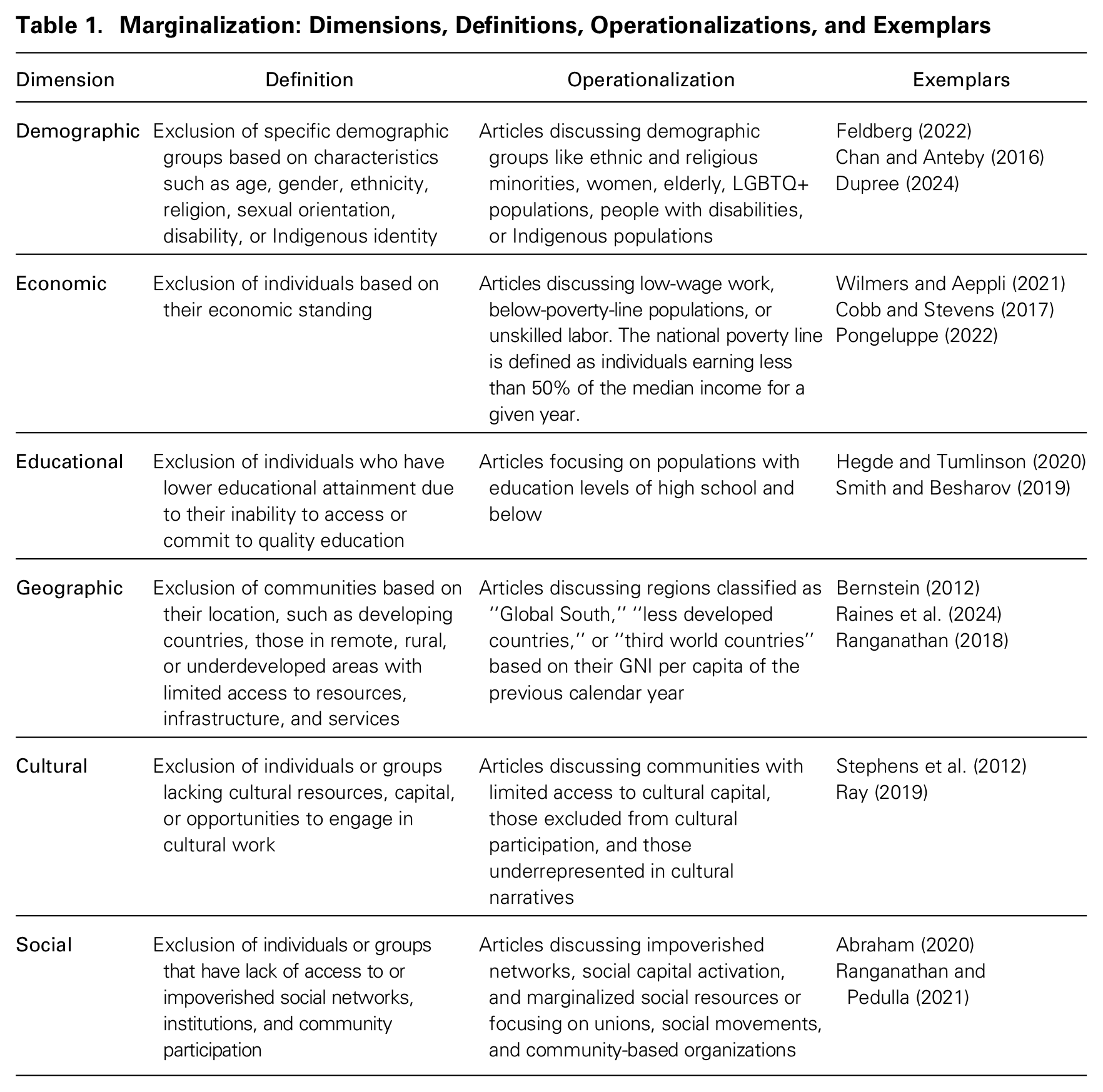
On the surface, our essay is a call for more research on marginalized populations to improve and strengthen the conceptual and prescriptive aspects of management scholarship. Table 1 summarizes each dimension of marginalization that we outlined in this essay, along with definitions, operationalizations, and some exemplary articles. Indeed, we believe that there is a slow but steady improvement in this regard.
Marginalization: Dimensions, Definitions, Operationalizations, and Exemplars
Our deeper point is that greater value should be associated with research that simultaneously tackles more than one dimension of marginalization. For example, Phillips (2005) focused on structural barriers to mobility for women passed along from parent to progeny organizations. However, this study addresses only one dimension: demographic (gender). While the identified barriers are substantive, the sample consists of Silicon Valley attorneys, who are educationally and economically elite, in an elite region. Thus, while Phillips’s (2005) research represented progress, it is not clear that it helps us understand barriers for most women, especially lower-income women, lower-educated women, women in developing economies, non-White women, or women with low cultural capital. Consequently, there is a lack of qualitatively different insights, which one might reveal by re-centering research on populations who are marginalized along multiple dimensions.
With this in mind, we close by sharing some of the positive momentum in the field that makes our call for research more likely to occur. These data and initiatives lead us to be optimistic about management scholarship becoming more inclusive with respect to marginalized people.
Positive Trends in ASQ
We examined trends in ASQ by conducting a content analysis of the journal’s articles published between 2019 and 2023. The data compilation first required collecting abstracts of all 134 articles published in these years. After starting the coding process ourselves, we hired two research assistants to carefully read each article’s abstract to determine whether each paper discussed individuals marginalized based on the six identified dimensions. Each article was independently reviewed and coded twice by separate individuals. This double-coding process aimed to minimize bias and ensure consistency in our assessments. Reviewers were trained on the coding scheme to ensure common understanding of the criteria and to promote uniform application of the codes. The Cohen’s kappa between the two sets of coding was 0.77, indicating a high level of agreement between the independent coders (Fleiss et al., 1981).
Some dimensions of marginalization were easier to measure than others. For example, cultural marginalization is more elusive and dependent on the context or setting. We stress, however, that cultural marginalization is conceptually distinct despite any measurement challenges and that diminishing the value of a dimension based on the ease of measurement leads us to undervalue its theoretical importance. We also acknowledge that our examination excluded important research both prior to 2019 and after 2023. Nonetheless, we believe the exercise remains illustrative of broader trends in the field.
Figure 1 compares the percentage of ASQ articles each year focused on a single dimension of marginalization versus multiple intersecting dimensions. The y-axis represents years, and the x-axis shows the percentage of articles. The darker bars represent single-dimension articles, while the lighter bars represent those addressing multiple dimensions.
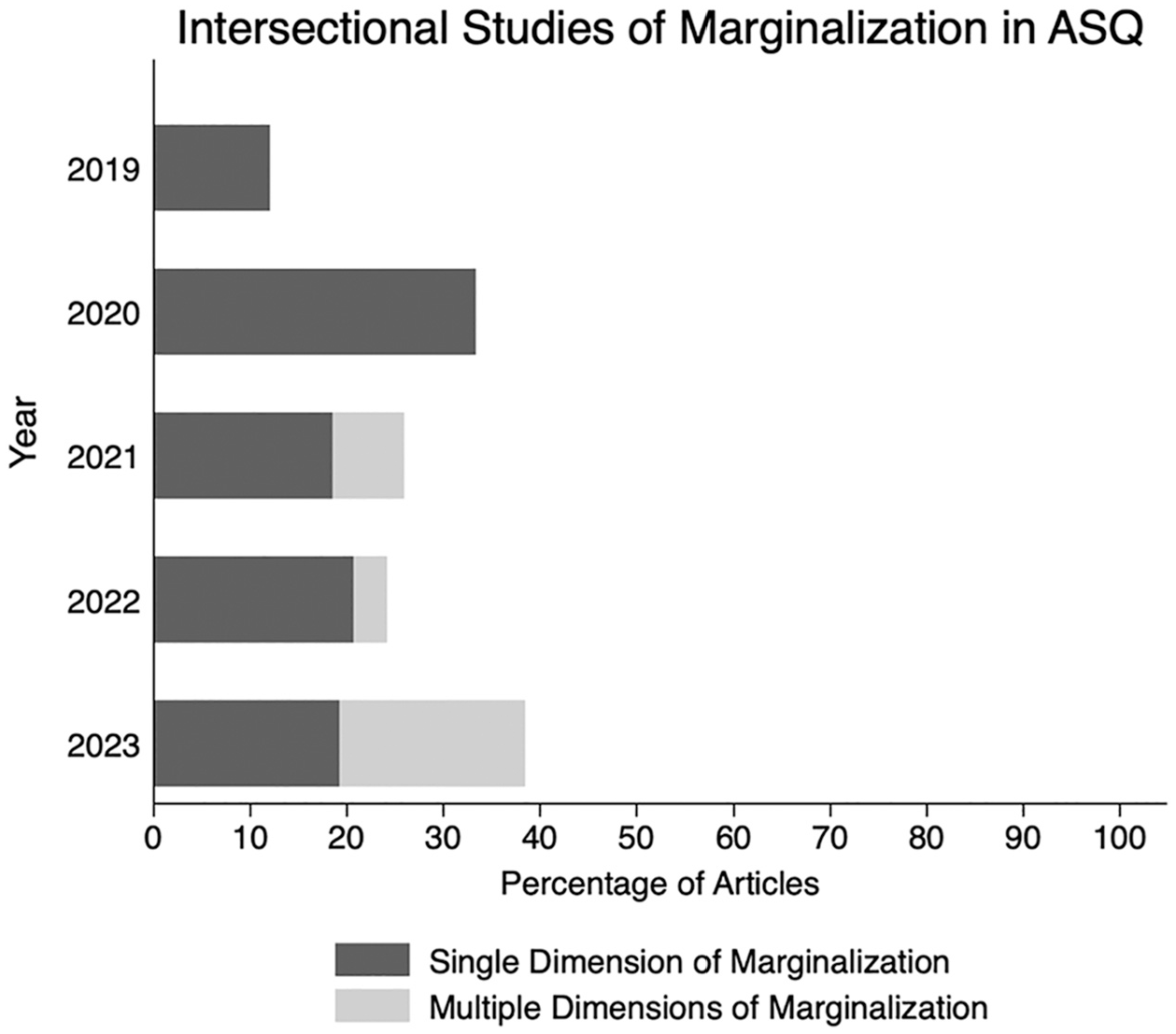
Percentage of ASQ Articles Each Year Focusing on Single versus Multiple Dimensions of Marginalization, 2019–2023
The pattern in Figure 1 indicates a promising shift: While single-dimension studies initially dominated, the proportion of articles addressing multiple dimensions has grown substantially, particularly in 2023, approaching parity with single-dimension studies. This finding underscores increasing recognition of intersectionality in organizational research. Our coding revealed that articles focusing on multiple dimensions have addressed at most two dimensions at once, but future research could examine the intersection of three or more dimensions. Indeed, articles published between 2023 and the time of this writing provide hope that this trend will continue, so that more articles explore how intersecting forms of marginalization shape organizational dynamics and inequities. Such studies would enable more inclusive and theoretically robust contributions to the field.
Qualitatively, too, among recent ASQ issues, there are signs of positive momentum. More-recent articles center elites less often than studies have done in the past, and some engage in research with direct implications for marginalized populations. Two articles published in 2024 demonstrate this trend. Pongeluppe (2024) centered citizens of the favelas in Brazil (economically and demographically marginalized) in his examination of policy interventions for improving entrepreneurship. While Canales and colleagues (2024) did not center marginalized populations in their data collection, their study of international development initiatives in multiple settings (Ghana, India, Mexico, and South Africa) promotes scholarship with findings that directly impact people marginalized geographically and along other dimensions related to the specific settings (e.g., educational, economic).
Other Signs of Positive Momentum
While scholarship focusing on marginalized populations across multiple dimensions is emerging, we recognize a larger movement of scholars promoting the production of high-quality research with significant social impact. For instance, the Responsible Research in Business and Management network aims to bridge the gap between scholarly research and societal needs, encouraging studies that address real-world challenges. Annual Responsible Research Awards celebrate research contributing to societal betterment by addressing critical issues and promoting responsible management practices.
Other efforts include diversity-focused conferences that foster inclusive research practices, as well as programs like the Indian School of Business’s external mentor program, which pairs junior faculty with mentors in top business schools to hone research agendas focused on local issues and to publish in top outlets. Conferences such as the Globalizing Organizational Theory Conference and the Migration and Organizations Conference bring together management scholars to broaden research scope and incorporate diverse perspectives. Centers like the Institute for Gender and the Economy (University of Toronto) and initiatives like the Collective Impact Virtual Salon (University of Pennsylvania) enhance the relevance and application of academic research by promoting collective impact and addressing pressing societal issues. These initiatives represent momentum toward a more inclusive and impactful academic landscape. Going forward, special issues in management journals focused on marginalized populations would be a valuable step in promoting more inclusive organizational research.
Suggestions for Building on Our Progress
In our experience, and that of scholars we have engaged with, journal editors are generally open to integrating marginalized populations into research. Reviewers, however, have shown more resistance to unconventional empirical settings. This resistance is understandable as reviewers aim to maintain a journal’s intellectual integrity. The challenge is that this resistance can be amplified when assessing articles that study populations marginalized along multiple dimensions.
Management journals are particularly susceptible to this challenge. They emphasize an article’s theoretical contribution to facilitate knowledge accumulation. However, if our foundational theories center elites, reviewers may unintentionally penalize manuscripts that do not build on these foundations. A reviewer assessing theoretical contribution faces difficult questions: Did the authors cite the perceived right literature? Did they use it appropriately? How well do the findings build on our understanding of previously published research? The natural path dependence of flagship management journals often means that research building on our elite-oriented past more easily connects to the literature. Consequently, even reviewers who advocate for including marginalized populations risk devaluing new research if that research is not anchored in past work on elites.
Reviewers supporting research on marginalized populations should also be thoughtful in assessing generalizability. An article on migrant farm workers in California may be deemed less generalizable than one on Fortune 500 C-suite executives, due to data familiarity and accessibility, as well as the theoretical questions explored in each setting. To the extent this occurs, reviewers may discount the generalizability of research on marginalized populations. While one can argue that a single CEO has greater impact than a single migrant farm worker, it is not clear that, in 2025, the marginal value to organizational theory of a submission on Fortune 500 C-suite executives exceeds that of a submission on migrant farm workers.
Another reason we consider reviewers’ role is that they invest heavily in feedback, striving to be developmental. This detailed feedback is particularly helpful to junior scholars, who receive actionable advice even when manuscripts are rejected. However, as reviewers, we should recognize that we are not only giving manuscript-specific feedback but also transmitting norms of what characterizes top publications, which tenure decisions hinge upon. If we assess that a hypothetical paper on migrant farm workers is not sufficiently generalizable or does not fit a top journal, we must interrogate why we have drawn that conclusion. Are we gatekeepers with implicit bias against submissions centering marginalized populations? Would we assess generalizability, contribution, or fit more positively if we reviewed the same manuscript for a top non-management journal?
We suspect that management scholarship has centered elites more often because data on elites appear to be more readily available, especially to researchers skilled in accessing and using archival data. Given the pressures to demonstrate research productivity, archival-oriented empiricists benefit from focusing on elites. Comparatively, field data studies in the qualitative tradition often examine people in occupations such as firefighting (Pratt, 2000), the military (DiBenigno, 2018), and emergency response (Karunakaran, 2024). Field experiments have focused on microfinance borrowers in Pakistan (Khan, 2024) and women micro-entrepreneurs in India (Kinger Hans & Ma, 2020). In addition to these methodologies, our perspectives can be expanded by methods like Ragin and Fiss’s (2017) qualitative comparative analysis/fuzzy set approach, which allows systematic comparison of cases to understand complex causal relationships in diverse contexts. Expanding our focus to include marginalized populations will likely require greater emphasis on fieldwork, field experiments, and comparative methods, leveraging rich, context-specific insights.
We want to be clear that integrating poor-quality research on marginalized populations does more harm than good. The proportion of well-executed studies on marginalized populations is probably similar to that of well-executed studies on elites. Given that the overall output of research centering marginalized populations is currently less than work centering elites, we do not expect trends in publishing on marginalized populations to accelerate quickly. But we believe the trajectory would be greater, and the field stronger, if we were more inclusive.
Acknowledgments and Limitations
As we write this essay, the United States is embroiled in a cultural, political, and rhetorical conflict over the legitimacy and advancement of diversity and related concepts. While our focus is relevant to this important debate, we do not directly engage it for three reasons. First, our goal is to present a thesis focused on the trends and trajectories of our scholarship rather than on current societal debates. We hope that our writing resonates with a reader five or ten years from now, even if the state of diversity in the zeitgeist has evolved. Thus, while our attention to demographic marginalization aligns with calls to advance research on diversity and intersectionality, we give equal conceptual weight to dimensions not studied with equal vigor in traditional diversity research, such as the economic, educational, geographic, social, and cultural dimensions.
Second, the contours of the current debates in the United States differ from what populations in non-U.S. settings may face. Marginalization along one or more dimensions consistently characterizes societies and economies globally. Narrowing our focus to the current DEI discourse risks privileging the U.S. and the West, while our thesis recognizes that scholarship on marginalized populations should not be limited to the West.
Third, we are humbly aware that we are not diversity scholars. Rather, we are scholars whose research has implications for diversity scholarship. There is a richly talented community of scholars with expertise and eloquence to effectively articulate the state and trajectory of diversity scholarship. Our approach is to address a corresponding challenge: the dearth of scholarship on marginalized populations in management journals.
Even in this essay, we are not immune from lack of inclusivity. Our typology of six dimensions is incomplete and does not easily accommodate important categories of marginalized populations. For example, individuals with disabilities are highly stigmatized globally, and while we included this important group in our definition of demographic marginalization, it does not as easily fit into our typology as other demographic characteristics do. This reality mirrors the relative scarcity of management research on disability, with a notable exception being Dwertmann and colleagues’ (2025) study examining how the presence of employees with disabilities in manufacturing units enhances coworkers’ cognitive flexibility, ultimately fostering greater idea generation and creativity. Their work highlights how management scholars can contribute to the study of marginalized populations not only by studying the individuals themselves but also by examining how organizations shape and are shaped by the presence of marginalized groups.
We also struggled with political marginalization as a dimension. For example, Mansbridge (1999, p. 639) defined politically marginalized groups as “those who have been legally deprived of the vote or other rights of citizenship,” including refugees and asylum seekers. We struggled with the best way to include this dimension in our typology, especially when attempting to identify exemplars in either sociology or management journals that would speak to organizational scholarship. Despite its importance in political science and potential relevance to scholarship on social movements and non-market strategy, any potential definition we considered was already captured by some combination of our six dimensions (economic, educational, geographic, demographic, cultural, and social). We ultimately elected not to include it, but we welcome other scholars who may point to improved delineations of our typology. In addition to identifying other potential dimensions, scholars could engage our topic by examining the process of marginalization. Our framework focuses on already marginalized people and populations, but scholars should also investigate how organizations and markets contribute to the rise or perpetuation of marginalization.
As a final caveat, we acknowledge that our biases and social networks likely affected our choices of exemplars highlighted for each dimension of marginalization. At least three-fourths of the exemplars feature scholars who, like us, have faculty positions in elite business schools. This can be misleading, as high-quality work on marginalized populations is not limited to scholars at the most well-known business schools. Classic works by Harriett Zuckerman (1977) and Robert K. Merton (1988) remind us that our illustrative approach likely draws disproportionate attention to authors from high-status institutions, compared to a more exhaustive approach to identifying relevant, high-quality scholarship. We ask readers to consider this potential bias while not dismissing our core arguments. In fact, identifying exemplars outside the highest-status institutions would reinforce our thesis.
Conclusion
We close this 70th-volume essay with thoughts on the upcoming decade of research. We hope that the 80th volume will represent an important milestone in the continued inclusion of theory and empirics relevant to marginalized, elite, and all other classes of populations. An important sign could be that future research extending our insights beyond the elite is rewarded by the management community in publications, article awards, board memberships, and editorships. This increase would facilitate a sustainable process by seeding the author–reviewer–editor pipeline, improving our collective expertise on marginalized populations, and combining it with our expertise on elites to yield more robust, rigorous, and relevant theories. Our optimism is also rooted in the fact that there are already scholars, including scholars in business schools, who produce and readily consume research that involves more than one dimension of marginalization or, more generally, do not limit their focus to elites in organizations and markets. While more high-quality research on marginalized populations is needed, we see the bigger challenges as structural constraints to getting that research submitted to top journals, surviving the review process, and having it valued by the profession when it is published. We align with the efforts highlighted in the “Other Signs of Positive Momentum” section, advocating for changes that will enrich the field.
Beyond the impact to our field, a greater focus on marginalized populations will lead to better, more inclusive policy prescriptions. Currently, we have too little to recommend to policymakers seeking to tackle disparities and address inequality. However, when management theories are grounded in the realities of those often left out of traditional research, the resulting insights can guide more effective and equitable policy decisions that benefit a broader range of stakeholders.
Footnotes
Acknowledgements
We would like to thank Laura Doering, Dan Wang, Paul DiMaggio, Heather Haveman, Leo Pongeluppe, Ussama Khan, Shelley Correll, David Pedulla, Adina Sterling, Ashley Martin, and participants at the Berkeley-Haas Macro Research Lunch for their valuable feedback on earlier drafts of this essay. We also appreciate the research assistance provided by Rakkshet Singhaal, Kinara Phillips, and Maggie Ye. Finally, we thank Christine Beckman and two anonymous reviewers for their helpful feedback. The authors contributed equally to this work.

Authors' Biographies
References
 narratives. Book review