







Abstract
Women in masculine-typed roles often experience their gender identity as a barrier to proving themselves by the ideal-worker norms of their male-dominated occupations. Yet, these women often internalize these experiences, blaming themselves for their struggles. They rarely identify as members of a disadvantaged identity group and often distance themselves from other women at work. How and when might such women externalize their struggles as gendered and collective? Drawing on data from a qualitative field study of staff working in many masculine-typed roles across various male-dominated occupations at a U.S. public-lands management organization, I develop grounded theory suggesting when and how some women might come to reappraise some of their struggles as rooted in the gendered cultures of their occupations rather than in their own deficiencies or idiosyncratic circumstances. I find that “parallel-peer connections” between similarly situated women outside their local tokenized work groups can spark transformative mindset shifts when these encounters occur under the right conditions: during a window of sensemaking about a career impasse and in a less competitive context that is conducive to sharing confidences. Some women credited these shifts with prompting them to shed years of self-doubt and to promote gender equality at work. This study contributes to our understanding of supportive workplace relations among tokenized women and mindset shifts at work.
Keywords
Women in male-dominated occupations face a mountain of well-documented challenges (Cardador et al., 2021; Chan & Anteby, 2016; Fernandez-Mateo & Kaplan, 2018; Joshi et al., 2015; Kanter, 1993) that contribute to the persistence of occupational gender segregation (Baron & Newman, 1990; Reskin & Roos, 1990). Widely held gender stereotypes promote skepticism that women can meet masculine ideal-worker norms for displaying competence, commitment, and fit (Abraham, 2020; Bailyn, 1987, 1993; Benson et al., 2026; Cardador, 2017; Cheryan & Markus, 2020; Conzon & Huising, 2024; Joshi, 2014; Kellogg, 2012; Kray & Thompson, 2004; Ridgeway & Correll, 2004). In addition to navigating intense pressures when tokenized as rarities in their work groups (Kanter, 1977; Sekaquaptewa & Thompson, 2002, 2003; Spangler et al., 1978), such women face a double bind (Feldberg, 2022; Trzebiatowski et al., 2022): Proving themselves as one of the guys can elicit backlash for violating gender-role expectations (Berdahl, 2007; Rudman & Glick, 2001) and for outperforming and potentially emasculating male colleagues (Berdahl et al., 2018; Berdahl & Moore, 1996; Campbell et al., 2021; Dobbin & Kalev, 2019; McLaughlin et al., 2012).
The rare women who win acceptance within male-dominated occupations often do so by accepting rather than challenging sexism within their occupations (Faniko et al., 2017), such as by skillfully participating in sexist joking at work (Alonso & O’Neill, 2021). Such women often distance themselves from their devalued gender identity (Derks et al., 2011, 2016; Duguid, 2011; Duguid et al., 2012; Ely, 1995). Rather than join in solidarity, women are often pitted against one another as they respond to intense pressures to distinguish themselves as the exceptional woman or so-called “queen bee” (Ellemers et al., 2004; Salles & Choo, 2020; Sheppard & Aquino, 2017; Staines et al., 1974). 1 While these dynamics can abate when there are higher proportions of women in leadership (Ely 1994, 1995), such numbers are rare in highly male-dominated occupations.
Women often experience their gender as a disadvantage in these contexts but tend to internalize and individuate attributions for their experiences; they blame themselves for their struggles and attribute their successes to personal savvy at playing a gendered game (Carian & Johnson, 2022; David & Derthick, 2017; Ely & Meyerson, 2000). Having self-selected into these occupations, such women are often deeply invested in mastering, rather than critiquing, the masculine ideal-worker norms of their occupations (Padavic, 1991; Roth, 2004). They rarely identify as members of a disadvantaged group or express solidarity with other women, often blaming themselves and other women for not measuring up when they struggle (Cech et al., 2011; Ely, 1995; Martin & Meyerson, 1998; Seron et al., 2018).
For example, studies by Cech and colleagues found that few aspiring women engineers identified as feminists or engaged in collective action to support gender equality, despite their acknowledgment of widespread sexism in their profession. Instead, they internally attributed their struggles to their own lack of merit, which discouraged them from both critiquing their profession and persisting within their profession (Blair-Loy & Cech, 2022; Cech, 2013; Cech & Blair-Loy, 2010; Cech et al., 2011; Seron et al., 2016; Seron et al., 2018). Other studies reveal that women may experience gendered penalties at work but express resignation toward them as their individual burden to bear—what it takes to make it as a woman in a masculine field (Carian & Johnson, 2022; Turco, 2010). Calls for women to “lean in” (Sandberg, 2015) may perpetuate this discourse, which often aims to “fix the women” (Ely & Meyerson, 2000, p. 105) rather than address structural sources of disadvantage (Ely et al., 2003; Ibarra, 1992; Kim et al., 2018; Padavic et al., 2020).
How and when might women in masculine-typed roles in male-dominated occupations come to shift their mindsets to reappraise some of their struggles as external, gendered, and collective? 2 Existing scholarship has yet to identify how such countercultural mindsets might be triggered into existence at work, particularly among those who do not initially identify positively with their devalued minority identity (Ely, 1995; Tajfel, 1981; Zweigenhaft & Domhoff, 2018). It is vital to understand such transformations: Psychologically, they may help women to shed unwarranted self-doubt and to more positively identify with aspects of their devalued gender identity; behaviorally, they may spur women to support other women at work and to advocate for gender equality within their occupations rather than accepting and perpetuating the status quo.
In this article, I draw on qualitative career-history and work-experience interviews with 48 women in a range of masculine-typed roles in many male-dominated occupations across multiple units of the same large public-lands management organization. I supplemented these data with 238 interviews with these women’s colleagues and supervisors, along with work site observations (i.e., job-shadowing sessions, work group meetings, social events, etc.). I use these data to build grounded theory identifying the transformative potential of “parallel-peer connections” among similarly situated women who are in the same occupation but from different non-gender-balanced work groups.
Specifically, I examine how these connections can spark mindset shifts when they occur under the right conditions at the right time: in a less-competitive context during a window of sensemaking about an unexpected career impasse (i.e., a major workplace rejection, after having apparently proven oneself, that generated strong negative emotions of shock and confusion). I show how these connections can prompt a newfound awareness among otherwise isolated women that some of their problems are shared and rooted in their gendered occupations rather than their own personal deficiencies. I contrast these transformative and supportive relations with the fraught relations observed among women working together in the same local, non-gender-balanced work groups.
I further examined the experiences of women who did not report mindset shifts and continued to internalize their experiences. While some of these women—who were generally younger and more junior in their careers—did not report experiencing a career impasse, many others reported experiencing impasses similar to those who had shifted their mindsets. However, these women did not report having connected with a parallel peer while in a window of sensemaking under conditions conducive to sharing struggles (e.g., some women were trailblazers with few or no parallel peers, some reported connecting at competitive trainings, etc.). These women tended to fall back on internalized explanations for their struggles. They viewed career impasses as personal problems to be endured on their own, perhaps normalizing these incidents as what it takes to make it as a woman in their fields. Such normalization, in turn, may have limited the potential for subsequent impasses to generate the shock and confusion needed to open new windows of sensemaking that may prompt women to reconsider the source of their struggles.
I build on scholarship on consciousness shifts and parallel-peer relations to suggest an alternative way to neutralize negative dynamics among tokenized women in male-dominated occupations and to suggest one way that countercultural mindset shifts might occur at work. In doing so, I identify a novel mechanism and set of enabling conditions for sparking transformative mindset shifts among tokenized women in masculine occupations such that they come to externalize rather than internalize their gendered struggles. By illuminating the range and complexity of women’s experiences in male-dominated occupations, this study shines a light on women who are lifting up other women at work in both tempered and more-radical ways to disrupt, rather than reproduce, the status quo.
Shifting One’s Consciousness to Externalize Gendered Struggles
Shifting one’s subjective perception of reality (Berger & Luckmann, 2016) to interpret experiences as structural and collective, rather than idiosyncratic and personal, may be a precursor to becoming a change agent who can critique the social structure in which one is embedded (e.g., Du Bois, 1968; Freire, 2021). For example, victims of sexual harassment are less likely to blame themselves if they identify as feminists (Gurin, 1985). Developing such a sociological imagination and the capacity to connect one’s biography to history (Mills, 1959) may be an important precondition for triggering a willingness to take action to improve the situation of one’s disadvantaged social-identity group (e.g., Ashford & Barton, 2007; Creed et al., 2010; Segal, 1996). Such a shift in perception may contain the seeds of agency that one needs to use their grasp of social structure to enact change (e.g., Canales, 2011; DeJordy et al., 2020; Du Bois, 1968; Emirbayer & Mische, 1998; Huising, 2019; Silbey et al., 2009). However, for members of a disadvantaged identity group, attaining a structural view of their struggles may be especially difficult in individualist workplace cultures that profess strong beliefs in meritocracy (e.g., Adler & Ayala-Hurtado, 2025; Castilla & Ranganathan, 2020; Jost, 2019; Sharone, 2013).
Prior studies of workplace change agents find that what are termed “tempered radicals” can discreetly rock the boat to incrementally seed small wins that improve the situation of their disadvantaged social-identity groups (Creed, 2003; Meyerson, 1998; Meyerson & Scully, 1995). These studies typically begin with the premise that tempered radicals, or those with trailblazer mindsets, exist by virtue of their difference from majority organizational members and their positive identification with their minority identities (Ashford & Barton, 2007; Heucher et al., 2024; Knowlton, 2024). However, we do not know what might trigger such countercultural mindsets into existence given that many minority identity members do not positively identify with their devalued identity group (Ely, 1995; Tajfel, 1981; Zweigenhaft & Domhoff, 2018).
An exception is Creed and colleagues’ (2010) interview study of ten gay ministers who progressed from expressing shame about their devalued sexual identities to pride and open advocacy for gay rights within two denominations of the Protestant church. This process entailed “embodied identity work” (p. 1336), triggered by deeply engaging with contradictions between these churches’ professed belief that God loves all and the ministers’ lived experience of their churches’ institutionalized homophobia (e.g., a minister who admitted to being gay could be defrocked). However, it remains unclear what prompted these ministers to grapple with this contradiction and to transform their mindsets.
Scholars of social movements remind us that individuals can and do transform themselves to critique the social structures in which they are embedded and that they previously accepted. For example, scholars of the second-wave U.S. women’s movement in the 1960s and 1970s have noted how consciousness-raising groups generated radical shifts in many women’s interpretations of their struggles (e.g., Rosenthal, 1984; Sarachild, 1973). During these voluntary women-only gatherings, women experienced epiphanies that their seemingly personal problems, from domestic violence to limited job opportunities, were shared with other women and had common, structural roots (Freeman, 1971; Hanisch, 1970; Ryan, 1992). These gatherings served as free spaces in which like-minded women could gather to mobilize for change (Polletta, 1999).
Connecting “the personal to the political” (Hanisch, 1970, pg. 76) can generate a sense of collective identity and of linked fate, or awareness that one’s own prospects are linked to those of similar others (e.g., Dawson, 1995). Such experiences can engender a sense of solidarity, or alliance and positive identification, with others who share one’s devalued identity, triggering a progression from “shame to pride” (Britt & Heise, 2000, p. 252). Such solidarity can, in turn, prompt some people to take risks to advocate on behalf of a shared social-identity group (Gamson, 1995; Taylor & Whittier, 1992, 1995).
Yet, this transformation process may unfold differently in workplace contexts. The social-movements literature has not yet considered how women in a competitive, male-dominated workplace context are evaluated against the few other women in their work groups. Simply connecting with a woman colleague in one’s work group, even in an isolated free space, may not be sufficient to encourage the women to disclose shared problems or to feel a sense of solidarity. Competitive pressures within work groups, particularly those with masculinity-contest cultures, in which men’s masculinity is at stake in daily work group interactions and femininity is derogated (Berdahl et al., 2018; Matos et al., 2018), further discourage vulnerability and mutual support among tokenized women. Women (and nonconforming men) face pressure to conform or risk being bullied and ostracized in such work cultures (Alonso & O’Neill, 2021; Glick et al., 2018; Regina & Allen, 2023). Indeed, as noted, research on workplace relations among tokenized women in male-dominated occupations suggests that these relations are often competitive and fraught (Ellemers et al., 2004; Loyd et al., 2008). Such gender-segregated work environments elicit a threat response that can push women to distance themselves from other women colleagues who share their devalued identity (Duguid, 2011; Duguid et al., 2012; Sheppard & Aquino, 2017; Tajfel, 1981).
In her writings about the elusiveness of shared sisterhood among Black women despite their shared challenges, Lorde (1984, p. 131) argued that internalizing society’s contempt for their multiple devalued social identities kept Black women alienated from one another, such that “connections . . . are not automatic by virtue of our similarities.”Lorde (1984) posited that developing self-love and acceptance of one’s devalued identities was a precondition for empowerment and solidarity. It remains unclear how such self-acceptance and solidarity, already difficult to achieve outside of work (David & Derthick, 2017; Tajfel, 1981), might occur in workplace contexts.
The Transformative Potential of Parallel-Peer Connections after Workplace Impasses
Consciousness shifts, epiphanies, or radical transformations in viewpoint often occur after a major negative life event or impasse that provokes a reckoning (Dane, 2020, 2024; Du Bois, 1968; Reid & Ramarajan, 2022; Schinoff et al., 2026; Segal, 1996). During these times of despair and bewilderment, individuals may reach out to others who they believe can help make sense of their struggles (Small, 2017). Sharing one’s problems with someone, even a stranger (Atir et al., 2022; Dungan et al., 2022), who has experienced similar challenges can elicit empathy and support (Batson, 1991; Thoits, 2011) and perhaps a fresh perspective. Given people’s tendencies to favor dispositional over situational and structural explanations for others’ behavior toward them (e.g., Gilbert & Malone, 1995; Ross & Nisbett, 1991), another person’s outside perspective might enable a more situational understanding of one’s struggles. But the similarity and timing of the other person’s shared experience may matter. Someone who endured an experience in the distant past that is similar to that of the focal individual may no longer recall the emotional intensity of the experience and may be dismissive and judgmental (e.g., Ruttan et al., 2015). Thus, timely connections among peers who can empathize may matter.
Small (2017) suggested that certain types of weak-tie relationships may be especially valuable for those seeking empathy for their distress about uncommon problems. Building on Simmel (1950) and Goffman (1959), Small (2017) theorized that people are more likely to disclose struggles to weak ties, such as strangers or acquaintances, when (1) the weak-tie confidant is not directly connected to one’s strong ties, among whom disclosure might negatively impact one’s reputation; (2) one desires empathy from someone who can relate from personal experience to one’s uncommon problems; and (3) an interactional opportunity arises that is favorable to disclosure, such as in a private setting (Small & Adler, 2019).
Finding a safe weak tie who can actively relate to one’s uncommon problems in a favorable setting for disclosure is statistically unlikely for an isolated woman in a masculine occupation. But organizations can provide opportunities to make such connections under more-favorable conditions (e.g., Blau, 1994; Kalev, 2009). Organization-sponsored conferences, trainings, and working groups may allow for otherwise isolated women to encounter similarly situated parallel peers, or women with role equivalence (Merton, 1957; Winship & Mandel, 1983) who work in similar masculine-typed roles and occupations but elsewhere within or outside their organizations. Such women may feel less competitive and safer with a parallel peer since the parallel peer is not directly connected to one’s strong-tie work group colleagues. As a respite from daily work group pressures, such interactions might even serve as liminal or identity work spaces that have been found to be conducive to learning and transformation (Howard-Grenville et al., 2011; Huising, 2019; Petriglieri & Petriglieri, 2010).
Research on parallel-peer connections is scant and inconsistent. Scholarship on parallel-peer organizations in the same industry suggests they can act as uniquely valuable sources of learning and motivation (Botelho, 2018; Zuckerman & Sgourev, 2006), but relations among individuals are generally expected to be competitive because they often serve as reference points for measuring one’s own career success (Bothner et al., 2007; Burt, 2010; Merton, 1957; Wasserman & Faust, 1994). Yet, given that women in highly male-dominated occupations face distinct, uncommon problems, they may derive unique benefits that supersede competitive concerns from connecting with role-equivalent parallel peers. For example, Pamphile (2022) found that isolated corporate social responsibility officers credited their counterparts at other organizations for providing valuable support navigating similar challenges in their work, while Ody-Brasier and Fernandez-Mateo (2017) found that marginalized women champagne grape growers supported one another’s businesses by sharing pricing information. These findings suggest that parallel-peer connections among otherwise isolated women within an occupation may foster more supportive rather than competitive relationships, including the possibility of sparking transformative mindset shifts from recognizing that one’s seemingly idiosyncratic struggles may actually be shared and gendered.
Methods
To explore these dynamics, I analyzed interview and observational data from a qualitative field study of women’s work experiences in a wide range of masculine-typed roles across many male-dominated occupations at a large U.S. public-lands management organization. While these women reported facing uncannily similar challenges as one of the few women in their different work groups and occupations, they reported variance in how they related to these similar experiences. Some women internalized these challenges, as the literature would expect, blaming themselves and their lack of merit for their and other women’s struggles. However, many reported having experienced a dramatic shift since earlier in their careers, such that they no longer saw their struggles as personal and idiosyncratic but as rooted in the gendered cultures of their masculine occupations. Below, I share the details of my data collection and analytic process, which helped me make sense of this puzzling variance to build grounded theory attempting to explain when and how these major shifts in mindsets might occur.
Data Collection
I collected data between 2017 and 2021 as part of a larger qualitative field study of the work experiences of staff across many occupations at a large U.S. public-lands management organization. This article primarily draws from career history interview data on the work experiences of 48 women currently or formerly in masculine-typed roles across various male-dominated occupations. These primary data are supplemented with 238 interviews with a subset of these women’s work group colleagues and supervisors, along with colleagues in their broader organizational units. I additionally spent over 450 hours at these women’s work sites, making dozens of job-shadowing and work group observations (at work group meetings, work sites, trainings, etc.), and I attended social gatherings and unit-wide and organization-wide events, which allowed me to observe the majority of the focal 48 women in situ at their work sites.
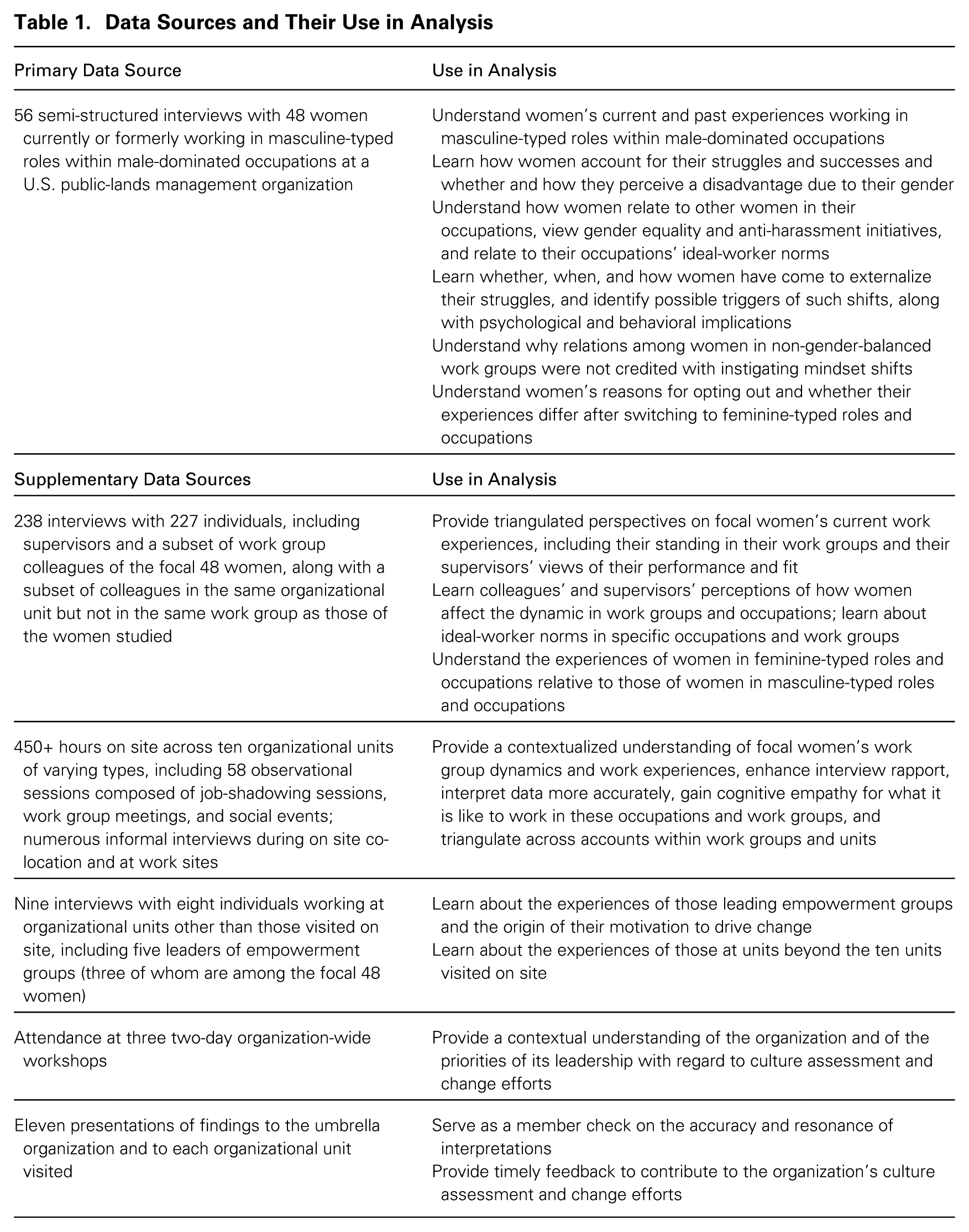
Like other organizations in 2017, this organization was grappling with publicized incidents of sexual harassment and gender discrimination and was receptive to a researcher studying employees’ work experiences in depth and across occupations, to better understand the organization’s culture. I learned early in my fieldwork that women in masculine-typed roles and occupations were facing the most challenges, relative to women in feminine-typed roles and occupations. For subsequent fieldwork, I took steps to ensure that I reached saturation (Staller, 2021) on a sufficiently broad sample of women (Patton, 2002; Weiss, 1994) working in masculine-typed roles across different occupations, career stages, and backgrounds in different types of organizational units (e.g., large, small, urban, rural, etc.), so that my theorizing would encompass this range rather than apply only to certain types of women in certain kinds of units (Small, 2009; Weiss, 1994). Table 1 and Online Appendix A provide a summary of all data collected.
Data Sources and Their Use in Analysis
The land-management organization provided an ideal context for examining the experiences of women in masculine-typed roles. Studying a single organization allowed me to hold constant organization-level factors (e.g., structures, policies) that might shape women’s experiences. The organization also housed many types of male-dominated occupations; the same five broad occupational buckets were present in each organizational unit, with variance in the specific occupational roles (in parentheses below): (1) Law-Enforcement and Protection Occupations (law-enforcement officers and rangers, wilderness rangers, climbing rangers, emergency medical technicians); (2) Trade Occupations (electricians, plumbers, carpenters, construction-crew members, waste-water treatment operators, historical-reconstruction specialists, maritime-trade craftspeople, mechanics, machine operators, specialized vehicle operators and conductors); (3) Trail and Maintenance Occupations (trail crews, maintenance workers, building maintenance); (4) Historical and Interpretive Occupations (military and industry historians and guides, preservation specialists); and (5) Science and Resource-Protection Occupations (scientists, resource management, plant and weed crews, wildland and structural firefighters).
In the course of this broader data-collection effort, I spent over 450 hours on site at ten organizational units. Organizational units were bounded by geography and charged with preserving, protecting, and supporting visitation of specific natural-resource and cultural-historical sites designated as public lands. Units varied in terms of size (large, mid, small), location type (urban, rural), region of the country, and unit type (natural resource, cultural-historical). I selected units to maximize range on these dimensions (Small, 2009; Weiss, 1994).
The logic of my sampling approach aimed to interview all women in masculine-typed roles within male-dominated occupations at each unit visited, along with each woman’s supervisor and a subset of each woman’s work group colleagues. To create my interview invitation lists, I leveraged detailed staff rosters and organizational charts; I identified occupational work groups (e.g., all law-enforcement officers assigned to the same geographic area, all members of the same trail crew, etc.) and inferred gender from names, corroborated with unit secretaries, and invited all women in masculine-typed roles within male-dominated occupations to participate. For non-supervisory staff, I randomly selected staff within each work group at the unit. 3 The email invitations sent to those selected contained a link to a confidential interview-scheduling tool, in which participants also entered demographic and background information. I supplemented this sampling approach with purposeful sampling by speaking with work group supervisors, as well as a few additional staff identified on site who had not initially been invited—typically temporary, seasonal staff not on the roster—for the broader study.
Despite having largely reached data saturation by the end of 2019, I delved deeper into areas of emerging theoretical significance (Staller, 2021) by conducting additional phone interviews, primarily in 2020 and 2021, with eight staff members who were external to the ten units visited. These interviews included five women identified by other interviewees as having led women’s empowerment-related initiatives, who served as information-rich cases (Patton, 2002). Three of the five were among the 48 women included in the focal analysis; the other two were excluded because they were not in masculine-typed roles or occupations. I also conducted member checks of my emerging analysis (Lincoln & Guba, 1985) by presenting preliminary findings to leadership and members of each unit studied. Across all units visited on site and via these additional phone interviews, I invited 50 women with experience in masculine-typed roles within male-dominated occupations to participate in the study, and 48 participated.
Total interview time with the focal 48 women averaged 93 minutes, while total interview time with their colleagues and supervisors averaged 79 minutes. I recorded interviews when granted permission; otherwise, I took extensive handwritten notes. Interviews were semi-structured and aimed at attaining detailed understanding of each woman’s past and current work experiences and how they had changed over time, including how she had navigated being among the few women in her occupation (the interview guide appears in Online Appendix B). I employed ethnographic interviewing techniques (Spradley, 2016), asking for detailed stories and examples. I also drew on knowledge from my supplementary fieldwork (e.g., work group observations, etc.) to ask more informed and contextualized follow-up questions to attain greater cognitive empathy (Small & Calarco, 2022). The organization had surveyed all permanent employees earlier in 2017 to measure the prevalence of harassment; the results were announced as I began fieldwork. This coincidence provided a natural opening to ask interviewees whether they were surprised by the results of the survey and to probe, for instance, whether they believed women’s reported complaints. I interviewed eight women a second time. Interviews are, by nature, retrospective narrative accounts; interviewees may not fully recall or report all concrete details of their experiences. The value in this approach lies in inductively identifying patterned meaning-making processes and novel mechanisms (Small & Cook, 2023). By asking a common set of interview questions, I was able to provide all interviewees similar opportunities to reflect on similar types of experiences; by using a semi-structured approach, I was able to delve flexibly into matters of resonance to inductively identify novel dynamics (Weiss, 1995).
Data Analysis
Data analysis centered on the career histories and current work experiences of the 48 focal women currently or formerly in masculine-typed roles in male-dominated occupations. The analytic process, though nonlinear and iterative (Strauss & Corbin, 1990), consisted of three broad stages. In the first stage, I open-coded my data for themes and wrote memos about puzzling dynamics. Early on, I observed that the struggles women faced in male-dominated occupations were uncannily similar across a wide array of occupations and units. I noticed variance, however, in how women said they related to the challenging circumstance of being one of only a few women. The majority blamed themselves for their struggles; a large subset, however, reported having experienced dramatic shifts in their mindsets since earlier in their careers, such that they now attributed many of their struggles to the masculine cultures of their occupations.
In the next stage of analysis, after reading the literature and encountering the theoretical puzzle posed by women who had reported shifting their mindsets, I systematically compared patterns in these women’s experiences (Grodal et al., 2021; Timmermans & Tavory, 2012). To gain a triangulated perspective, I coded the data on each woman’s reported career history and current work experience alongside available data from her work group colleagues, her supervisor(s), and observational sessions. I compiled an Excel workbook consisting of data and career-history summaries for all 48 women, to facilitate comparison of women’s within-person experiences across a set of common dimensions and codes.
I coded as “accepting the norms of their masculine occupations” stories or statements suggesting that women must assimilate to succeed (e.g., other women should “grow some balls” and “suck it up”). I coded as “internalizing experiences” any statements or stories in which women blamed themselves or personal and idiosyncratic circumstances for workplace struggles (e.g., viewing struggles as their personal problem to address by fixing themselves because they were not measuring up, questioning whether they were skilled enough or should quit, reporting ongoing anxiety and self-doubt about their competence, commitment, or fit, etc.). I coded as “mindset shifts” women’s descriptions of experiencing “an epiphany,” “realization,” “really powerful shift,” “turning point,” of becoming “awake” or of “eye-opening” moments, and related expressions (e.g., describing their “former” selves as “naïve”) or narrative accounts indicating a shift in perception regarding the source of their struggles at work over the course of their careers.
I coded as “externalizing experiences” women’s statements or stories that situated the source of their workplace struggles as external to themselves, residing in the gendered cultures of their occupations (e.g., “false cowboy culture,” “patriarchal culture,” “the good ole boys’ club”) or in colleagues’ behavior (e.g., “locker-room talk,” “victim-blaming,” “sexism”). I coded as “self-acceptance and embrace of their devalued identity” any statements or stories about reducing efforts to assimilate or embracing more stereotypically feminine aspects of their identities (e.g., no longer emulating masculine leadership styles, etc.). I coded as “expressing solidarity” stories or statements about helping or protecting new women from hazing or harassment and disavowing sexist joking that benefited them individually but “hurt other women.” I coded as “tempered efforts to support gender equality” stories about discreetly working within the system to drive more modest changes within their local work group or unit while minimizing backlash (e.g., joining existing “culture change” committees, using individual influence to hire or support women at their units, etc.). I coded as “radical efforts to support gender equality” more-disruptive and visible actions, such as initiating collective action and founding or leading women’s empowerment groups, which aimed for impact beyond their local work groups and units to target their broader organization and occupations.
My analysis revealed that while nearly all women said they had begun their careers largely internalizing workplace struggles, a subset shared that they later shifted to externalizing their struggles. The commonality among most women who had shifted their mindsets was that they recognized features of their own seemingly idiosyncratic personal struggles in those of a woman or group of women similarly situated in the same masculine occupation but external to their daily tokenized work group; this recognition occurred in less-competitive contexts (e.g., conferences or non-evaluative trainings, a newly gender-balanced work group), as the women grappled to make sense of an unexpected and confusing major workplace rejection (what I later labeled a “career impasse”). The specifics of career impasse experiences varied; what was common across these women’s experiences was their reports of strong negative emotions of shock and confusion following a rejection after having believed they had proven themselves and had largely gained acceptance in their work groups. These career impasses differed from the many stories of struggle shared by nearly all women about navigating challenges that were less emotionally charged and largely expected as part of the process of proving oneself in the face of negative gender stereotypes about women’s perceived incompatibility with masculine-typed roles.
Immense variety was also apparent in the types of parallel-peer connections reported—one-on-one and group interactions, one-off and repeated interactions—and in an array of organizationally mediated settings where they occurred, such as trainings, conferences, and working groups, along with newly gender-balanced local work groups. I examined variance in career impasse experiences (e.g., severity, type, etc.) and in the types of parallel-peer connections, but I did not observe any notable patterns (see Online Appendix C for percentages).
In the final stage of analysis, I returned to my data to more closely examine the experiences of women who did not report shifts in their mindsets. Many of these women had also experienced similar career impasses. However, they did not report a transformative parallel-peer encounter; instead, they appeared to have resolved their confusion and shock by internalizing the rejection as a personal problem to endure and as what it takes to succeed as a woman in a male-dominated occupation. In some cases, a career impasse that was endured without parallel-peer support prompted a woman to consider opting out of their role and into a feminine-typed role or occupation. Many of these women expressed resentment of women who had complained about similar career impasses. Though it is possible these women may have interacted with a parallel peer, some were trailblazers for whom there were few or no parallel peers available to connect with when they first experienced a career impasse. For others, parallel-peer connection opportunities occurred in conditions unconducive to disclosure (i.e., competitive, evaluative contexts like the required intensive law-enforcement training, in which no mindset shifts were reported). These patterns led me to conceptualize career impasses as opening “windows of sensemaking,” a period of time during which a woman may shift her mindset about the source of her struggles if she connects with a parallel peer who can relate, under conducive conditions for disclosure, while the window remains open.
Ten women had experience in work groups that included another tokenized woman; I examined the dynamics of these relations to examine why the relationships between these women were all fraught and competitive, rather than transformative and supportive, even in the four work groups in which one of the women in each of the four dyads had shifted her mindset while the other had not. This analysis helped me to theorize additional conditions under which women’s relationships may be more likely to spark transformations.
I next examined the data for potential individual factors that might affect the likelihood of shifting one’s mindset and of experiencing a career impasse. This analysis revealed the potential importance of seniority and motherhood status. I then subdivided the 48 women into five ideal-type profiles, based on whether they had reported experiencing a career impasse, switching into a feminine-typed role, connecting with a parallel peer, and/or engaging in radical or tempered change advocacy. As I discuss below, I learned that nine of the 19 non-transformers had not (yet) experienced a career impasse and were, on average, younger, more junior in their careers, and not mothers. I further learned that, though the remaining transformers and non-transformers who had experienced career impasses were largely similar, among the transformers some took a more tempered versus radical approach to supporting gender equality at work.
I also examined the data for alternative explanations, such as whether the #MeToo movement and/or the organization’s own anti-harassment initiatives, rather than parallel-peer connections after career impasses, might have prompted women to externalize their struggles. Most women who had externalized their experiences described having done so prior to the anti-harassment initiatives and the #MeToo movement of 2017. Only a few women referenced #MeToo during interviews (and in passing, rather than as a trigger for their mindset shifts). I used these analyses to build grounded theory suggesting when and how women in masculine-typed roles in male-dominated occupations might shift their mindsets to externalize their workplace struggles.
Findings
Internalizing and Accepting the Status Quo Despite Experiencing Gendered Disadvantage
In a range of masculine-typed roles across various masculine occupations, the women participants reported having largely internalized gendered experiences early in their careers: They blamed themselves for their struggles and accepted their occupations’ masculine ideal-worker norms for demonstrating competence, commitment, and fit (see Online Appendix D for more examples). These women sought to overcome negative stereotypes of femininity that rendered their gender identity incompatible with those norms. Participant D43 described the skepticism she faced as she sought to prove herself as an “exceptional woman” and “one of the guys”:
They almost immediately put me on [a certain crew] where all the hard-asses were, and they definitely made me prove myself. . . . [What] was hard for me to deal with was the assumption that I wasn’t going to be as good as any of the guys just because I was a girl. . . . Sometimes I would do things just to prove that they couldn’t get to me.
The content and strength of ideal-worker norms varied by occupation, but femininity was consistently devalued. Work group members sometimes openly asserted that being a woman was incompatible with their work. One machine operator commented, “I’d say most women are just not cut out for what we’re doing out there. It’s manly man’s work. . . . it would probably be better just to be all men” (A32). As C66 explained, “One of [my colleagues] said in front of a bunch of people, ‘Women shouldn’t be in law enforcement.’” Motherhood was often viewed as incompatible with commitment norms. Participant O10 reported the “perception of once you have a child, that it’s like, ‘Well, now you just leave.’ . . . I had a supervisor say, ‘Well, you’re having a kid now. You’re not coming back.’ And I’m like, ‘Yes, I am.’ He’s like, ‘No, you’re not.’”
Despite experiencing their gender identity as a liability, the vast majority of these women did not initially identify as members of an oppressed group or express a feminist affiliation or solidarity with other women.
4
“My whole upbringing . . . I would have pooh-poohed all feminism, and the idea that I was being discriminated against,” E92 said. “I just didn’t notice it.” Or consider participant E31: Despite years of unwanted sexualized comments from her supervisor, which eventually prompted her to leave for a different organizational unit, she did not view such treatment as harassment or identify as a member of a disadvantaged group at the time. She saw her struggles as an idiosyncratic personal issue with her supervisor:
I’ve never been a “girl-power” kind of person, you know what I mean? I’ve always been someone that—I’ve related to men, my coworkers, my male coworkers, better than female coworkers. I don’t know why, but I just did. I didn’t really look at myself as being in a . . . “us-and-them” kind of thing. It was more this guy [her supervisor] and myself.
Expressing self-doubt while maintaining distance from a devalued gender identity
Rather than blaming sexism, these women blamed themselves; they reported self-doubt and anxiety while navigating pressures to be “perfect” (E51) and “twice as good” (E31). Participant D48 reported ongoing lack of self-confidence despite having received positive evaluations: “I doubt myself a lot, but that’s just who I am. . . . I have to get myself more confidence too.” Participant E51 reported anxiety and surprise at her strong evaluations: “I was personally very nervous and overwhelmed . . . feeling like you have to prove yourself, or maybe more so, and not feeling like you’re in the boy’s group. . . Usually, mine have been good evaluations . . . maybe I did better than I thought. . . . [I’m] my own worst critic.”
Many of these women expressed contempt toward their devalued gender identity group. “You’re like, ‘OK, they’re wimps, and we’re cool, and girls are dumb.’ If I try and act more like you [more like a man], then you’ll be OK with me,” explained E3 regarding how she and her all-male work group had looked down on women. Or consider the disparaging way in which participant D48 talked about fellow women law-enforcement officers: “[Women] just come off not with [command] presence. Do you know what I mean? . . . So [they] come off weaker in a sense, or helpless.”
Expressing pride in being exceptional and dismissing women’s struggles
Women who had gained (some) acceptance expressed pride at having proven themselves, and they internalized success as evidence of their personal savvy at playing a gendered game. They blamed their own and others’ struggles on failure to overcome negative gender stereotypes and saw themselves as exceptions in a devalued category from which they otherwise disassociated. For example, F19 described with pride how she had differentiated herself, and faulted women who had failed to assimilate: “Even as a woman I’ve always been able to dish it out and take it, which has always helped. . . . I’ve noticed that they [men] don’t really joke with her [the other woman in her work group] like that, because they know that she’s a little more sensitive.” These exceptional women largely expressed skepticism about other women’s claims of discrimination or sexual harassment; they either claimed they had not experienced such treatment themselves or asserted that other women should endure it as they had. Participant A4, who had risen to a leadership position, dismissed other women’s complaints about harassment or stalled careers:
For me, it’s about accepting expectations with what the job is. . . . If I’m responsible for me, I’m responsible to fix it. If I have low morale, I need to fix that for myself. . . . [T]here was one situation where the supervisor should have done more [to address sexual harassment]. I said, “I don’t want to work with him again.” I didn’t file a formal complaint. But I removed the issue for myself . . . Some [women] will say, “I’ve been here this many years with no promotion.”. . . You need to work for it. You can’t blame it on the workplace. . . . Why would I expect someone to go out of their way to help me?
These data suggest that the women I studied entered their occupations largely accepting, rather than critiquing, existing masculine ideal-worker norms. Though most recognized that these norms disadvantaged them, they internalized their struggles as they strove to prove themselves as exceptions. Dismissive of other women’s complaints, they believed that women need to assimilate to succeed. They did not report engaging in efforts to support gender equality.
The Transformative Potential of Parallel-Peer Connections after Career Impasses
Many women continued to internalize their struggles and successes, but a large subset reported that they now viewed their workplace struggles in a radically new way. My data suggest that these shifts in outlook were triggered by a major workplace rejection, after having apparently proven themselves, that generated strong negative emotions of shock and confusion—what I refer to as a career impasse. I theorize that career impasses can open a window of sensemaking to resolve these strong emotions, creating an opportunity for these women to reconsider the source of their struggles.
Windows of sensemaking after career impasses
Career impasses elicited shock and confusion: The rejection subverted the woman’s belief that she had proven herself by masculine ideal-worker norms. Such career impasses were described in emotion-laden language: “it took me to my knees” (E35), “stunned” (B38), “horrifying” (D61), “wanted to cry all the time” (F14), “crushed me” (E92), “too big to ignore” (O1), “in freakout mode” (F71), “ridiculous” (B35), “blew my mind” (B42), “a stab in the back” (F22), “thrown by it” (D48), “the hardest thing that had ever happened in my life” (B12). The specifics varied; in all cases the immediate outcome was an interval of intense reassessment—a window of sensemaking—in pursuit of a plausible explanation for the rejection. The most common types of career impasses were (1) being passed over for promotion, (2) being denied deference to one’s authority post-promotion, (3) being denied respect after being deemed high-performing, (4) having one’s commitment to work questioned after becoming pregnant or bearing a child, and (5) receiving unwanted romantic or sexual attention or advances from supervisors or colleagues that threatened career advancement.
For example, participant O11 shared how the shock of being passed over for promotion in favor of a junior male peer instigated a period of “awareness” to reassess her career:
Another male was hired over me who was lesser qualified, and then I had to train him! . . . I had a new supervisor that . . . was always going to my male counterparts for leadership acting positions, or to fill in for him when he was gone—always alluding to how they would be the next supervisor. Not even sometimes alluding, just saying [so]! . . . [Afterward], I was going through this awareness of what was happening around me. . . . I had these moments to process . . . the first seven or eight years of my career in [her occupation].
Another frequent career impasse involved being promoted or deemed high performing but denied respect by peers or deference to one’s authority by direct reports. Participant E92 described her shock when, after having been promoted, and convinced that she had won acceptance, a male colleague defied her authority: “It was one of those things where, when I would try to take leadership, he would just take over. . . . It’s just exhausting! . . . I noticed it happened a lot, and it kept happening. I just kept getting stepped on. . . . A lack of respect for my experience.”
Pregnancy and return to work postpartum also prompted career impasses: Motherhood was often viewed as incompatible with norms for displaying commitment. Participant C66 was outraged when her supervisor predicted to others that she would not return to work after giving birth:
With [my] chief, we were out on patrol once and he said, “I don’t know why you’re trying so hard. . . . You’re just going to get married, get pregnant, and quit.” That really pissed me off, because I care about my career. I love my job. . . . Then . . . when I was pregnant, he told people . . . I wasn’t going to come back after I had the baby. . . . I had never said that!
Others’ career impasses involved sexual or romantic comments or advances. Participant D61’s career was derailed after her boss asked to kiss her while she was up for promotion:
Then I got to the point where I wanted to advance. . . . By that time, my former boss had [tried to kiss me] at a . . . party. Yes, not awesome. . . . He’s my boss; I’ve known him for like 10 years or whatever at that point. He was like, “May I kiss you?” I was like, “Wait, what!?!” Yes, it was horrifying.
After recounting that she had vomited at the shock of this overture, D61 added that the experience had had “a big impact on my personal life and just my job happiness” and triggered a period of sensemaking and reevaluation of her career.
Mindset shifts toward externalizing personal experiences from parallel-peer connections
My data suggest that connecting with a parallel peer—a woman or group of women similarly situated in the same masculine occupation—during a window of sensemaking about a career impasse can spark a transformative shift toward viewing one’s seemingly idiosyncratic personal struggles at work as gendered and collective. I theorize that such connections can offer otherwise isolated women newfound awareness that many of their problems are rooted in their gendered occupations rather than solely in their personal deficiencies. By contrast, I theorize that in the absence of a parallel-peer connection during a window of sensemaking, confusion and shock may be resolved by falling back on prior internalized explanations of viewing one’s struggles as a personal problem to be individually endured and overcome. Subsequent career impasses may come to be normalized and viewed as less shocking and distressing, decreasing the likelihood they will be emotionally charged enough to open future windows of sensemaking, precluding later mindset shifts. Thus, many women continued to internalize their struggles after having experienced similar career impasses. 5
Participant F22 explained the transformative power of the parallel peers she had met at an occupation-wide training that occurred during a window of sensemaking about having been passed over for promotion:
I used to go home and cry, like, “What am I doing wrong?” Not anymore. . . . When I get to go to different trainings. . . I meet a lot of cool people and make good connections. Like I said, that’s when I realized a lot of stuff is going on, not just here but throughout the whole system. It’s not just the [organization]; it’s just the [whole occupation], period. I realized I’m not the only one. And that also brings the sense of community too, because, really, you realize you’re not the only one going through this, and that we can help each other.
Participant B12 likewise described how a parallel-peer connection sparked a newfound realization that she was not alone in grappling with what had seemed to be purely personal struggles: “[The parallel peer] is another girl who went through an interesting, somewhat similar situation [at a different unit]. . . . We talked about stuff for a while. . . . [You realize it’s a] thing [sexual harassment] that we all deal with. . . . I was like, ‘I know the situation.’”
Women whose viewpoints had shifted described various types of parallel-peer connections after various types of career impasses. Some were one-off connections lasting a few hours, days, or weeks at a conference or training; others involved more sustained and regular contact, such as an assignment to a project-based working group. Some were dyadic connections with one other woman, while others were with a small group of parallel-peer women. Common across this array of connection types was that the focal woman recognized her seemingly idiosyncratic personal struggles in those of a woman or group of women similarly situated in the same masculine occupation but external to her daily tokenized work group, while in a less-competitive context (e.g., conferences or non-evaluative trainings, a newly gender-balanced work group).
About half of the reported parallel-peer connections involved a woman or group of women from another organizational unit or who were external to the organization but in the same occupation, whom the focal woman often met at a conference, training, or organization-wide working group. For example, participant F14 had been grappling with ostracism by her colleagues after she was promoted over a longer-tenured but lower-performing male colleague, an account corroborated by her supervisor. She recounted having had strong emotions over the fallout from her promotion: “You go from striving to prove yourself and never being able to, and then you finally realize, ‘Oh, I’m competent. I don’t have to prove myself.’ Then they hate you.” She struggled not to cry at work and felt she had no one to talk to: “[And] I could talk to no one else on the crew about this. . . . It’s something that I can never talk to anyone about, ever. . . . Every single day, I [felt] like I could start crying.” She then described the transformative effect of meeting a parallel peer at a technical training while she was sensemaking about this post-promotion impasse. After having reappraised her struggles, she now considers herself “awake” to collective issues facing women:
I spent two weeks in this training working with one other young woman who is almost exactly my age, and she had [also been promoted, in the same occupation but at a different organization]. It was amazing! . . . We saw eye-to-eye on so many things. We had really similar work ethics, really similar priorities. I totally got where she was coming from with a lot of things. . . . In the . . . industry, it’s just very gendered . . . [After that,] I had enough . . . I feel like I’m the only person that’s awake, but I can’t make them see what I see.
Similarly, participant O11, the lone woman in her work group, reported an “epiphany moment” after attending a small conference with other women in her occupation, while struggling to make sense of the career impasse (described above) of having been passed over for promotion:
I think for a long time I didn’t even realize what was happening around me. I didn’t have the language or the awareness to be like, “Whoa, this is not cool.”. . . The [organization] had a [type of] conference. . . . It was just like a whole room of 30–35 females that are in [one of two occupational subspecialties]. . . . That was definitely an epiphany moment, because it was the first time I saw myself reflected in my job.
Acknowledged as a high performer, participant D47 reported feeling isolated as “the only girl” and “wasn’t really being invited” to after-work social events. While grappling with having been passed over for promotion, she was assigned to an organization-wide virtual special-project group; for the first time, she interacted with parallel-peer women in her occupation but outside her work group. After engaging with the women in this group, she reported, her entire outlook changed:
Things changed for me, like in how I see things here, from being on the [special-project] working group. . . . I continued to do it even off-season, as a volunteer. . . . But I call into the calls. And it’s so inspiring to be on these calls. It’s men and women, but a lot of women from [other organizational units] . . . and it’s inspiring to hear everything they’re talking about.
Other parallel-peer connections occurred within organizational units during unit-wide working-group meetings, social events, or assignments to a gender-balanced (vs. tokenized) work group. 6 Participant E54 shared the “eye-opening” effect of connecting at an after-hours organizational unit-wide social event with similarly situated women: “When I was hanging out with a bunch of women . . . everybody had had a terrible situation. It was just really amazing to hear six women in a room together, and everybody has been hurt or harassed.” Typically isolated at work, she found the experience transformational: “I don’t have a lot of female friends, because a lot of people that I hang out with happen to be guys. That was definitely eye-opening.”
In another example, participant F71 was navigating feelings of self-blame and worry following a second episode of unwanted romantic attention from a (second) male colleague: “I was just in freakout mode. . . . I was just so worried. . . . [i]t was my fault, the second time. . . . I just had this real fear. . . . Like, one time it happens, OK. And then the second time it’s like, ‘Oh, am I the problem?’” Her self-blame dissolved when, while sensemaking with a parallel peer, she recognized her own struggles in another woman’s experiences (with the same man):
I did end up telling a female coworker [in the same unit but a different district] about it a number of months later after he had left . . . and she ended up telling me [about similar experiences with the same person]. . . . It happened with someone else as well! . . . I told her my story. . . . Sometimes you get extra validation of hearing someone else say, “Yes. I know your instincts are actually right, and this is actually really messed up.”
Participant F71 now saw herself as an advocate for calling out harassment at work. She had persuaded her supervisor to hold a volunteer accountable for harassment by declaring forcefully, “We also have a right to work in a place where . . . people aren’t making comments about our bodies.”
Five women reported transformative parallel-peer connections while working in local gender-balanced work groups for the first time.
7
These women reported realizing that the femininity-deprecating work group cultures they had come to view as normal were not inevitable and that pressures to compete with other women eased when they were not tokenized. Participant O10 expressed surprise at the palpably different tone of the first gender-balanced meeting she ever attended:
I think when there’s more women, it’s just a different feeling. . . . I happened to go to this [meeting], and I was like, “This is the best meeting.” I couldn’t figure out why. Then I was like, “Oh, everyone is talking, and everyone is not interrupting, and going back and forth.” I looked around the room, and it was 50/50 male/female. It was so completely different. People let them [women] talk and respected their difference in opinion. I thought, “When’s the last time you’ve been to a 50/50 meeting?” I couldn’t even remember. I was like, “Have I ever been to one?” It was just completely different.
Or consider participant F09, who was resistant at first to viewing her struggles as gendered. When she was passed over for promotion, the affront was called out by women in her newly female-dominated work group:
It was just, I’d say, probably about my third or fourth year in that I started noticing little things [about being treated differently as a woman], but I was still new enough that it’s like, “OK, maybe that’s not the way it's done.” . . . These other two women were picking up on that same thing: that it was like we were not being valued. We were not being utilized. . . . That our ideas were being ignored. Men were being promoted faster. . . . “Hey, I’ve been here eight years and yet you promote a guy who came two years after I did, before me?” . . . The [work group] at that time [had become] primarily all women. . . . A lot of us women were getting together at various points and discussing. . . . I have to say, this was the first job that I’ve ever felt discriminated against based on my sex.
Participant E3 experienced a similar shift in mindset after being assigned to a gender-balanced crew for the first time upon returning to her former unit, on the heels of a career impasse in which her authority was flouted after she had moved across the country to take a higher-ranking role at a new unit:
I’m coming in, and I’m the only woman in [my department]. I’m 28, the age of everyone’s daughter. . . . [A new colleague] got up in my face and was cursing at me. . . . I just got in my truck and drove around, and called my boyfriend and said, “I think I’m going to leave.”
8
After quitting, she uneasily returned the next season to her previous crew, in which she had long been the lone woman. She was pleasantly surprised to find that the crew, now more gender-balanced, treated her as “a respect[ed] human being” rather than a tokenized “lady on the trail”:
It was weird. . . . I was hesitant to come [back] here, because I didn’t want to be the only lady [on this crew], but two other women started soon after. We’re pretty even, and now it’s a lot better! . . . I don’t want to be the only lady on the trail. It’s good when we have more women. Then you’re treated as a respect[ed] human being.
She credited her transformation to the new women on her crew who shared similar struggles:
I realized I have a problem, and it’s not my problem. . . . Working with more and more women and realizing that this isn’t just a problem I’ve had. This isn’t just some incidental thing that has only happened to me. . . . Meeting other women who had the same experiences, you’re like, “This is happening to everyone. This is happening everywhere to everybody.”. . . It’s part of this false cowboy culture.
The meaningful commonality among these varied connections is that the focal woman, grappling to make sense of a career impasse, came to recognize her own problems in the struggles of a similarly situated parallel-peer woman or group of women. This discovery was associated with prompting an often transformative recognition that some of one’s workplace challenges may be rooted in gendered occupational cultures rather than in one’s own deficiencies.
The Implications of Externalizing One’s Gendered Struggles
After having recognized their struggles in those of a parallel peer, many women reported striking shifts in how they related to their gender identity and to other women in their occupations.
Transformation of self-doubt into self-acceptance and embrace of a devalued identity
Many women reported experiencing a freeing sense of self-acceptance after a long interval of blaming themselves for their struggles. Participant B42 articulated what was now self-evident to her: “It’s so hard for people to see . . . It feels personal, but it’s not personal.” Years of doubt and contempt toward their devalued gender identity often gave way to a newfound embrace of elements of their gender identity that they had previously viewed as a shameful liability. Consider the reflections of participant F14:
I tried to emulate male leadership styles . . . because I wanted to move up. . . . I realized . . . that that leadership style is not me. It just doesn’t work for me. I take elements of it, and I use it like a tool almost sometimes . . . I think having left that behind, I realized I don’t want to do that. It’s too fake. It takes too much energy, and we don’t need more male leaders [laughter].
Or consider participant E3, who no longer second-guessed or blamed herself for being “too sensitive” to her work group’s derogatory gendered language. She described her newfound ability to voice her discomfort authentically and to call out her colleagues as those who needed to change:
[A coworker] has said stuff to me that’s made me uncomfor table. I can call him out and say, “That’s fucked-up shit.” He’ll say, “Sorry.” . . .This is what they often say about women, that we’re “difficult” or we’re “too sensitive.”. . . That, to me, is a red flag, because I think, “What are you saying?” . . . When someone says that other people are “really sensitive,” I start really leaning in to think, “What kind of person are you?”
Finally, participant O10 described how, after years of trying to conform to masculine norms, she began advocating for aspects of her devalued gender identity, such as emotional intelligence:
I just wanted to blend in. . . . I wanted to—I don’t want to say masculinize, but to be one of the guys. . . . [If] you’re uncomfortable, or someone . . . says something about your boobs or something, you make a joke about it or laugh along. . . . I wouldn’t do it that way now, but back in my former young self, that’s what I did to fit in. . . . For [my occupation], the leadership is defined as male generals. . . . [Now, at a meeting], I was like, “I’m never going to be a [type of] male general. Can we identify leadership some other way?” . . . Everything is very much about projecting a [masculine, intimidating] “command presence,” and I’ll say, “Well, how about emotional intelligence? Can we have training . . . like that?” It’s like, “What? You want to do that squishy-gushy [feminine] stuff?” . . . It seems very challenging to take on the culture. . . . I really want to do it.
Transformation of pride at being exceptional into solidarity
For many women, pride in being an exceptional woman was replaced with a sense of linked fate and solidarity with other women that many credited with emboldening them to take risks to advocate for greater equality. Not only did these women no longer personalize rejection; some also renounced embracing masculine norms to achieve acceptance as harmful to other women. Participant E3 described the moral obligation she felt to stop idealizing masculine norms that she now saw as hurting all women:
I realized [trying to assimilate] still wasn’t working in my favor. I was like . . . “Not only am I not winning; I’m also actively making this worse for other people [women].”. . . It’s an easy trap to fall into when you’re already someone who works in a male-dominated field. Maybe you’ve had lots of male friends. It’s like you get sucked into this false cowboy culture.
Or consider participant B35, who expressed solidarity with women who had reported harassment. Instead of blaming women for harassment training, she became openly critical of “victim blaming”:
When [the organization] started having this whole sexual-harassment talk, I almost felt like there was slight resentment in [my male colleagues’] tones. . . . It’s like, “Don’t resent women because they’re reporting it. Resent your male peers because they’re acting on it.” They’re the reason you have to do this (i.e., take harassment training), not the women. . . . Yes, maybe you shouldn’t be acting like that, instead of victim-blaming.
This participant also went out of her way to warn a new woman about a problematic male colleague: “I had to give her the heads-up about him. . . . It’s just trauma that doesn’t need to exist.”
Participant O10, too, felt a duty to help other women avoid what she had endured:
I could fight them off verbally with, like, verbal judo, like attacking back [in response to pervasive sexist joking]. But I can’t expect [every woman] that comes into [this occupation] is going to fight back with words just like I do. Or [they] shouldn’t have to do that. You just come to work and do your job . . . Why is there some macho standard that you have to meet? Why don’t we [women] lift each other up instead of seeing if you wash out?
Finally, participant O11 reported that her newfound sense of linked fate with other women, after her above-noted “epiphany” resulting from connecting with parallel peers, had emboldened her to launch an empowerment-and-support group for women at her organizational unit:
I’m not the only person out there that feels like this in my work group. I’m not the only one that feels isolated and out there on their own island. I was like, “What if?” I was like, “There’s tons of ladies in this [large organizational unit] doing super-rad things at all different levels.” . . . I was like, “What if I put them all in the same place and we just learn from one another and we support one another, we share collective experiences?”
Connections among tokenized women in male-dominated work groups were not transformative
It is noteworthy that no woman named fellow token-women work group peers (if they had any) as having prompted a mindset shift. My data on women in work groups with another tokenized woman suggest that, consistent with prior theory on women’s behavior in tokenized contexts (e.g., Duguid et al., 2012; Ellemers et al., 2004), these contexts were unconducive to disclosure of struggles or offers of support. These women were managing constant comparisons that cast them as competitors and pressured them to distance themselves from their devalued gender identity. Status flowed from winning acceptance as one of the guys, not from befriending other women.
Consider participant F14 again, who externalized her struggles after having connected with a parallel peer in the wake of the fallout over her promotion. She belonged to the same work group as that of F19, who had established herself as its exceptional woman. F14 explained that she felt uncomfortable confiding in F19 about her struggles and transformation; if anything, her transformed mindset widened the gulf between them. F14 felt that F19 could not relate; F19 distanced herself from F14, who she believed was not conforming to the group’s masculine culture. F14 explained:
We do have another woman, but she’s from [a military branch] and she has embodied a lot of these attitudes and does not acknowledge a lot of this stuff [about gender]. I would not ever bring this stuff up to her, because she’s so like, “I’m one of the guys, grrr.” She makes the same jokes and talks about sex all the time [at work] . . . but I’m like, “You are exactly what I would expect a military woman to act like.” She’s just absorbed it all.
Participant F19 said, in turn, with regard to F14’s unwillingness to engage in joking that disparaged femininity, “People have realized, with me, they can joke a lot more and get away with a lot more [lewd] jokes [than with F14], and I’m just going to laugh. It doesn’t bother me. . . . I’m like, ‘Man, [F14 and those like her] really need to get over it.’”
In all four work groups in which one woman had externalized her struggles and one had not, relations between the two remained fraught. Consider the strained relations between participants E36 and E35, the only women in their work group: E36 accused E35 of hazing and “bullying” her. Despite having endured intense trials as a trailblazer in her occupation, E35 described E36 as “the hardest person [I’ve] ever dealt with.” E36 shared how their relationship soured after she was promoted:
It was right around the time I became [promoted]: one work relationship in particular kind of started to sour. . . . [E35] has a lot of seniority, a lot of seniority. That is why the bully dynamic is existing. . . . [It] sucks, because it’s like “the catfight.” My issue is with her—and I hate that, because I don’t want to have that dynamic with another female; it feels so primitive and gross. . . . I feel like [I’m a threat]. . . . I figured out this thing that was a problem up at [a worksite]. After figuring that out, instead of [E35 saying], like, “Good job, thanks for doing that,” it was immediately after that that the bullying escalated really extremely.
E35 corroborated E36’s perspective:
[E36 is] probably the biggest—the hardest person that I’ve probably ever dealt with. And I’ve dealt with a lot here in 26 years. . . . I carried her for all those years, and then when she [received a promotion], our new supervisor . . . when he first came on, [E36] called me a bully! . . . I know E36 has a hard time with me, but she’s 20 years behind me in the field. . . . I blazed the trail for her . . . and now I’m called a bully!
All relationships among long-standing women colleagues in a tokenized (vs. gender-balanced) context remained fraught and competitive. Notably, though, relationships among women who had adopted externalized outlooks and women new to their occupations were more supportive: In multiple instances, women with transformed outlooks helped newly hired women and sought to shield them from hazing. For example, participant E3 went out of her way to support women new to her occupation by showing them the sexual-harassment reporting policy and alerting them to a sympathetic manager whom they could report to discreetly and expect to be believed. “When some new women came on, I showed them our harassment policy,” she explained. “I said, ‘If anything makes you uncomfortable, this is what you can do.’” Participants B42 and E01 proactively supported newly pregnant women in their circles, such as by sharing pregnancy uniforms and pointing out postpartum resources. Participant F14 volunteered at a career day dedicated to encouraging girls to enter her occupation. Participant E92 took it upon herself to informally mentor and protect a new woman intern from hazing by another senior woman, resulting in the intern’s reassignment to another group:
I think the one thing I have witnessed this year that really bothers me is [that we had a] new [woman] volunteer [intern] this year. . . . When I saw that she was here . . . I hugged her. I was excited, and like, “Oh my god, you’re working with us! Sweet, woo-hoo!” I did have a thought like, “Hmm, I wonder how that’s going to go?”—because I knew she’d be working with this one girl, who’s a very tough personality for me. . . . I got the sense that [the intern] was unhappy. . . . It sounds like [the intern] felt [the senior woman] is just on her, every day. Her feeling is, “Are you trying to make me cry? Because that’s how [I feel].” She just shut down. . . . Since then [and due to my intervention], they have reassigned [the intern] to something different. I hope it works out for her. It’s sad to me, because we had this opportunity to help somebody find their career.
My data suggest that several conditions may need to align for a parallel-peer connection to have a transformative effect: (1) the context may need to be a non-competitive, non-tokenized setting conducive to sharing struggles; (2) the focal woman may need to be experiencing a window of sensemaking about a career impasse; (3) a suitable parallel peer may need to be available to connect with, though there are few women in these occupations; and (4) the peer may need to be able to relate to the career impasse. Thus, even among women who attended trainings and conferences at which parallel-peer connections were reported, bad timing or misalignment of conditions may have precluded transformative parallel-peer connections. For example, three women reported having connected with potential parallel peers in their occupation’s intensive law-enforcement trainings but did not report mindset shifts in these competitive, evaluative contexts.
Exploring Individual and Situational Factors Associated with Mindset Shifts: Ideal-Type Profiles of Women in Male-Dominated Occupations
I grouped the 48 women studied into five ideal-type profiles (summarized in Table 2 and visualized in Figure 1) based on whether they had reported (1) experiencing a career impasse, (2) switching out of a masculine-typed role, (3) connecting with a parallel peer, and (4) engaging in radical versus tempered change advocacy after externalizing their struggles. I explored demographic patterns across profiles (detailed in Online Appendix C). These profiles suggest the possible moderating effects of seniority and motherhood status on the likelihood of experiencing a career impasse.
Ideal-Type Profiles of Women in Male-Dominated Occupations
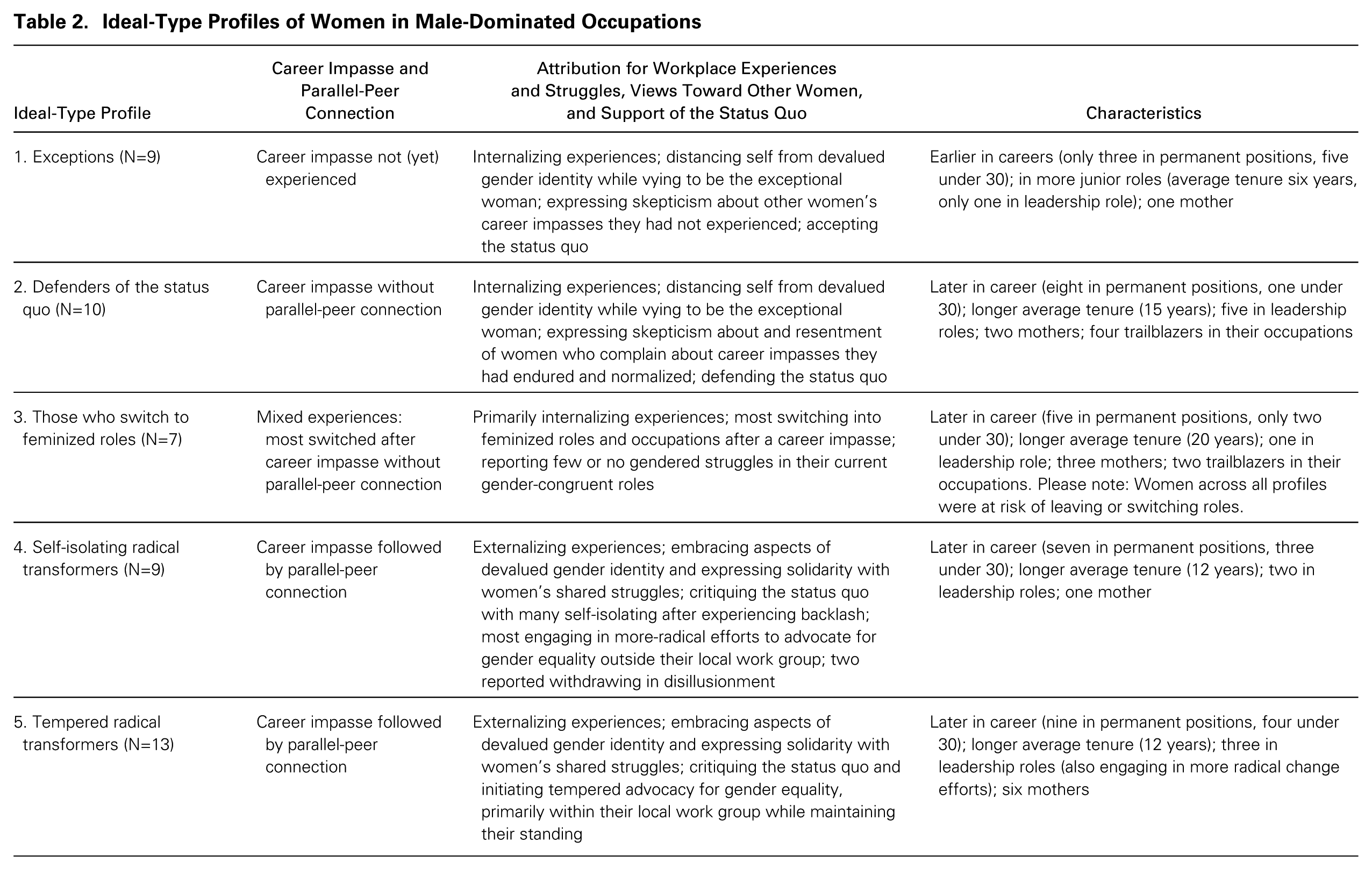
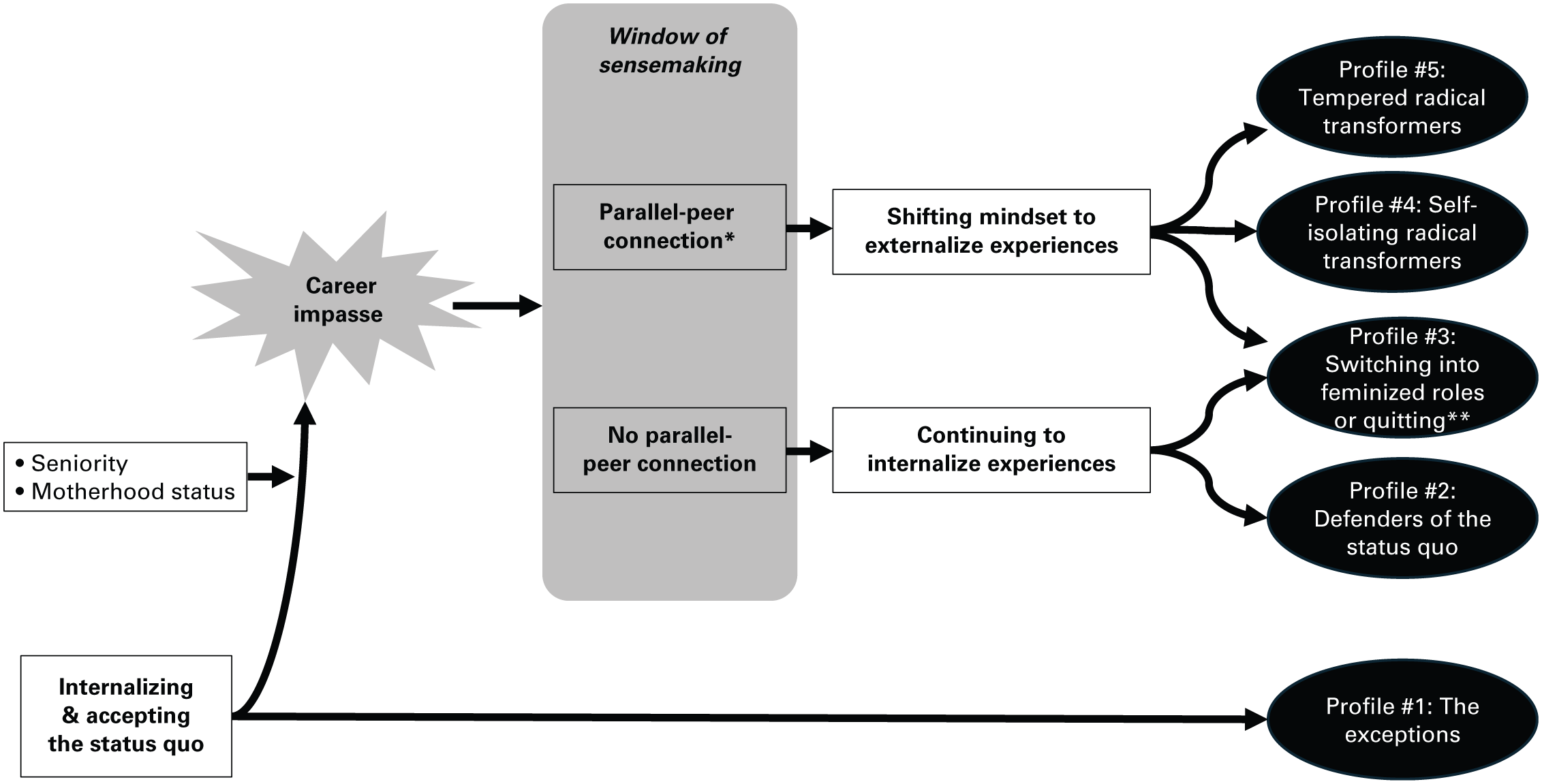
Ideal-Type Profiles of Women in Male-Dominated Occupations and the Transformative Potential for Parallel-Peer Connections after Career Impasses to Spark Mindset Shifts
Profile 1: The exceptions
Nine women reported never having experienced a career impasse. They thus did not experience the need for sensemaking that might open a window to shift one’s consciousness; they continued to accept the status quo. Most of these women were in temporary roles and under 30, with an average tenure of six years; only one was a mother. Their junior status may have made them less threatening to colleagues and shielded them from eliciting backlash (e.g., Dobbin & Kalev, 2019; McLaughlin et al., 2012). For example, participant E55, who had only worked entry-level, temporary roles, expressed pride in her acceptance as “one of the guys”:
I am the only woman here among [her occupational role]. It’s men across the board, at this [unit] and my last [unit]. But I think it’s fine. . . . I’m really just treated as one of the guys. . . . It seemed like they (i.e., her male colleagues) all had to watch themselves at first. But then once we all got to know each other, and they realized I’m cool, it was fine. And now no one cares [that I’m a woman].
Participant E93 reported not having endured the career impasses experienced by other women in her occupation; she did not view her experiences as gendered: “I just felt comfortable [as a woman in a male-dominated occupation], but I think that’s my personality. If I could stereotype, I’d be like an alpha female; that’s what people tell me. I don’t see it, but I am and I know I am.”
These women were generally skeptical of the struggles of other women, whose experiences they could not relate to. For example, participant D69 expressed skepticism of reports of sexual and gender-based harassment: “Everyone has their own definition of what harassment is. . . . They might have [had] a bad day. We don’t know. . . .” These exceptional women largely accepted the status quo and blamed other women for failing to assimilate. As F19 shared, “I’ve told several women, like, ‘Hey, you’re going to grow some balls and get a thick skin. You’re in a male-dominated world. You need to toughen up a little bit.’” They were largely indifferent to workplace anti-harassment or gender-equity initiatives; they did not see a need for them.
Profile 2: Defenders of the status quo
Ten women had experienced a career impasse but did not report having connected with a parallel peer about it. They largely internalized career impasses as personal burdens to manage and endure, or they considered opting out because of the impasse. These women maintained non-feminist orientations; many expressed resentment toward women who complained about career impasses. They also viewed their own subsequent career impasses as less shocking and upsetting than prior ones, perhaps having normalized such incidents as what it takes to succeed as a woman. Normalization may also have decreased the likelihood of new career impasses being emotionally charged enough to open future windows of sensemaking. Most of these women were in more-senior and permanent roles, were over age 30, and had an average tenure of 15 years; only two were mothers.
For example, consider participant D61, who questioned her career after her boss tried to kiss her while she was up for promotion. Having internalized the situation as a problem she needed to solve on her own, and not having reported connecting with a parallel peer at the time, she quit to remove herself from circumstances she called “toxic.” In her new role, she again experienced unwanted romantic attention but did not label it harassment because it seemed less egregious than the previous situation, which she had perhaps normalized. She confidently described how easily she had deflected the advance: “I was like, ‘Dude, no. I’m not even responding to that.’ . . . The term sexual harassment, not really, because it wasn’t—it just wasn’t sexual harassment.” She went on to label colleagues reporting harassment as “complainers” who had it easy:
Having gone from my previous agency—and I probably can’t even count the incidents [of harassment] there—I think it’s a much different environment than [that one]. And I think it’s surprising [that there are reports of harassment here] . . . . How do you differentiate those who are just disgruntled and want to give [the organization] a bad name, for whatever reason? Sexual harassment is something [that could give the organization a bad name]. . . . There is a lot of the, I think, institutionalized complaining and moaning about things.
Four of these women had been trailblazers, among the first to enter their occupations at their units; thus, they may have had extremely limited opportunities, or perhaps none, to connect with a parallel peer after a career impasse. For example, E35 was the first woman in her specialized trade occupation at her unit. While making a broader point about how easy women have it today, she recounted that she had had to endure extreme attacks early in her career:
At first, the guys were really ticked off, because they were making comments . . . that I was making more money than them. . . . Someone tried to run me off the road! Yes. Chemicals in the plants, they were set up a certain way so they’d splash [on me]. And you need to work with them (these men). Yes. It makes you, whatever—it took me to my knees, actually. It did. And I was really naïve. I never worked with people like that!
After noting how this career impasse “took me to my knees,” she recounted how she stuck it out:
Finally got my act together and decided either I’m going to stay or I’m going to go. If I stay, what kind of attitude? How can you get there? . . . When there’s like a 6’5” guy and he tracks you down, and he shouldn’t even be at my plant, technically—I didn’t call him there or whatever; he was there for me—. . . He traps me in the corner. He puts his hands out and he’s like, “You want to take over my plant? You think you’re—?” Yes. Like, “You know, I can just walk right under your arm, right? I don’t feel intimidated. You know that, right?”
Perhaps because she had endured this career impasse without support, she had little empathy for women who complained about harassment, including the complaints of women who had left:
These girls aren’t here anymore. I never saw anything happen so I don’t know for sure, because I only heard one side of the story. . . . I’ve had comments made, but I would tell them (harassing colleagues), “You’re out of line. I’m not going to hear it again.” Then it doesn’t happen again. I think they were just testing the water [to] see how far they could go.
Participant E51 struggled to decide whether she should quit over being constantly gossiped about, picked on, and having her authority flouted by a male colleague, culminating in a career impasse that endangered her when he publicly ignored her directives on the job. She second-guessed whether her struggles were gendered, internalizing them and blaming herself for not having a good enough skill set to prove herself to him, despite having received high evaluations from her supervisor. “Sometimes I’m not sure if it’s my gender or not—like with [that] particular coworker [who had put her in danger when he disregarded her authority], if I just didn’t have the skill set, the background, he expected or thought I should have. . . . It changes day to day whether I’m even thinking about coming back [next season],” she confided as she leaned toward internalizing this impasse while grappling with it on her own.
Some women reported that they had never discussed their career impasses with other women in their occupations. Participant D48 said she had endured nearly four years of unwanted romantic attention from a colleague. Her supervisor at the time refused to intervene and blamed her: “[My old boss] made me feel like I was too nice to people. . . . I had a problem with [unwanted romantic attention from a colleague] here and he [the supervisor] made me feel like it was my fault because I ‘was being too nice . . . flirty.’” Though she received emotional support from a “best friend” male colleague at the time, when asked if she had talked to women peers about such harassment dynamics, she answered, “I guess I haven’t really. I guess I never had an opportunity to.” Despite her own experience, she remained skeptical of claims of harassment made public by a woman in her occupation: “I didn’t know, because of how open she was, if she’s very honest or not being truthful. So I’d like to hear both sides of the story.”
These women may have had opportunities to connect with parallel peers under the right conditions; they did not recount having done so, perhaps due to bad luck or bad timing. As noted, some connections occurred in unconducive conditions (i.e., competitive, evaluative training contexts like national law-enforcement training, in which no mindset shifts were reported).
Profile 3: Women who switched into feminized roles and occupations
Seven women switched from masculine-typed roles to feminine-typed roles or occupations. Most did so after having experienced a career impasse without the support of a parallel peer, with some invoking fit or motherhood-related concerns. Participant F102 mentioned the fit-related relief that her mother had expressed when she switched to a feminine-typed role: “Even when I first started off as a [masculine-typed role], my mom said, ‘What are you doing!?’ When I started the office job [in a feminine-typed role for the same work group], she says, ‘Good, I’m glad you’re doing that now.’ OK, mom.” These women reported few or no gendered struggles in their current gender-congruent roles.
Two of these women had been trailblazers, with few parallel peers available when they first experienced a career impasse. For example, when D35’s supervisor denied her request for a schedule modification to accommodate her evolving childcare needs, she described the resulting career impasse and its aftermath, which derailed her career, as a personal choice (i.e., “I had to choose”) to switch into a lower-ranking feminine-typed role with greater flexibility. She did not externalize her struggles as rooted in gendered penalties for mothers in her occupation. Instead, she blamed an idiosyncratic personality clash with her supervisor (i.e., “The truth [was the supervisor] didn’t like me”), and she remained skeptical of other women’s harassment claims in her occupation (e.g., “The ‘harassment’ was verbal. There was no touching. If those involved were the same sex, it would have just been [considered] a personality clash”).
Women across all profiles were at risk of quitting or switching roles. Many women shared stories of women who had left; others confided that they were considering leaving or retiring early. As participant B43 explained, “I will retire early. . . . I have had enough.”
Profile 4: Self-isolating radical transformers
Among the women who transformed their mindsets after having connected with a parallel peer (detailed above), nine reported experiencing intensive backlash after they began critiquing masculine work norms. In response, many said they “self-isolated,” that is, they reported modifying their roles to interact less often with male colleagues. The most common ways to self-isolate were to volunteer for work no one else wanted (e.g., working with volunteers) and to refuse roles overseeing male colleagues. These women’s demographic characteristics resembled those of the defenders of the status quo: Most were in more-senior and permanent roles, over age 30, had longer average tenure (12 years), and only one was a mother. Many pursued more-radical efforts in support of gender equality outside their work groups but within their occupations or the broader organization.
For example, F14, who had stopped participating in joking that disparaged femininity, was largely ostracized; her peers openly articulated their dislike for her, despite having received high ratings from her supervisor. Participant F14 coped by self-isolating; she did so by volunteering for a tedious task no one else wanted: “I said, ‘Let me take an independent lead on the [niche] projects all around the [worksite].’. . . This year I have been working mostly alone.” Meanwhile she channeled her frustration into activism in support of gender equality within her occupation. She and the parallel peer she had met launched a podcast about challenges facing women in her occupation; she also volunteered at a career-day program to encourage girls to enter her occupation:
What I can do, or what I’ve been working on doing, is just . . . my friend [the parallel peer she had met at a training] and I are like, “Oh, let’s start a podcast for women in [their occupation].” I do things like this. There’s this [unit] that does this summer camp for girls of middle-school age . . . and they have a career day. I’ve gone to that for two years in a row.
Having renounced their preoccupation with acceptance within their work groups, self-isolating women often undertook more-radical and ambitious advocacy efforts in their broader units, organization, and occupations. For example, participant O11 founded an after-hours women’s group whose popularity spread beyond her unit. Facing work group backlash, she self-isolated by minimizing interactions with male coworkers while cultivating ties with like-minded women across the organization:
I became pretty unpopular [in my work group] because I wasn’t going along with the program anymore. I was speaking to the system and the people that benefit from the system. I think it makes a lot of people uncomfortable. . . . So I would say, if anything, it [launching a unit-wide women’s-empowerment group] made me pretty unpopular [in my work group]. . . . [Outside my work group], I feel like my ally network . . . has grown exponentially, and so a lot of females across the [organization] are our strong supporters and allies, for sure.
Other more-radical actions included launching a women’s-history program despite backlash (D47), organizing to threaten to file an EEO complaint (F9), creating an informal harassment-support group (B12, B42), joining an inaugural committee and internship program to promote diversity in hiring (E92), and speaking out publicly about gender issues (O1, B12).
Profile 5: Tempered radical transformers
The remaining 13 women who reported having shifted their mindsets shared how they now advocated for change in more-tempered ways while largely maintaining their standing in their work groups and avoiding major backlash, unlike the radical transformers. Some of these women maintained acceptance by skillfully using humor to resist sexist norms without alienating colleagues (e.g., the “verbal judo” described above by O10), while advocating for change in more-discreet ways. Participant E31 used her power as a new work group manager to create a healthier culture for women. Participant B42 created supports for other parents. Participant C66 volunteered to lead an internal committee to improve the culture of her unit, explaining, “I’m the chair of the [type of] committee. Instead of just bitching, I’m trying to do something about it.” These women resembled the defenders of the status quo and self-isolating radical transformers in terms of seniority/permanency of roles, tenure, and age, though more were mothers.
Three women who had attained higher-level leadership positions took steps, both tempered and more radical, to ease conditions for women following in their wake. All shared accounts of holding individuals accused of harassment formally accountable. Participant O10, described above, spearheaded initiatives to promote gender equality, such as a pay-gap study and all-woman crews, to improve recruitment and retention of women. She also organized a women-and-leadership conference and advised on policies affecting women in the organization. She explained her more structural perspective on the challenges of retaining talented women in her occupation:
That has led me to have a work group in [her occupation] of trying to look at why women leave [the organization] and culture. . . . Is it a culture resulting in [women] leaving? Are there challenges, life challenges, that we’re losing highly skilled, talented people. . . Can we have some of these uncomfortable conversations?
Discussion
Drawing on interview and observational data of women at various career stages in masculine-typed roles across a range of occupations at the same organization, I developed grounded theory identifying the potential role of parallel-peer women in prompting women’s mindset shifts to externalize gendered struggles as rooted in their occupational cultures rather than in their personal deficiencies and idiosyncratic circumstances. The psychological and behavioral implications of these transformative shifts impacted how these women conducted themselves at work, felt about their gender identity, and engaged in efforts to advocate for gender equality at work.
Women Lifting Up Women: The Transformative Potential of Parallel Peers
Existing scholarship on women in masculine-typed roles in male-dominated occupations has largely examined how intense pressures encourage women to blame themselves and to become alienated from other women at work (e.g., Cech et al., 2013; Garcia-Retamero & Lopez-Safra, 2006; Martin & Meyerson, 1998; Seron et al., 2018). Such women often vie to be perceived as the exceptional woman who defies negative stereotypes about women’s presumed incompatibility with masculine ideal-worker norms (Cardador et al., 2021; Derks et al., 2016; Duguid et al., 2012; Ellemers et al., 2004; Ely, 1995; Lorde, 1984; Loyd et al., 2008). How these fraught dynamics can be disrupted is important to understand because they are thought to perpetuate women’s underrepresentation in male-dominated occupations: The few women who succeed often endorse norms that discourage other women from persisting in their occupations (e.g., Alonso & O’Neill, 2022; Ellemers et al., 2004; Faniko et al., 2017).
Prior studies have found that the presence of more women in leadership in male-dominated occupations can foster improved relations among women and more positive gender identification (Ely, 1994, 1995); this study offers an alternative to neutralizing so-called queen-bee pressures, even in more-common scenarios in which women in leadership are scarce. I find that a previously overlooked type of relation—among parallel peers in the same occupation but external to one another’s local non-gender-balanced work groups—can spark transformational interactions among women when they occur under the favorable conditions theorized in this study. Earlier studies may have missed this type of relation because most such studies have limited themselves to examining relations among women in the same work groups or departments (e.g., Duguid et al., 2012; Kanter, 1977, 1993; Loyd et al., 2008) or how the proportions of women in senior leadership impact their relations with junior women and their views of their gender identity (Ely, 1994, 1995).
This study also suggests that the timing of parallel-peer connections is crucial for such interactions to have transformative potential. Prior studies suggest that sharing one’s struggles with someone who has endured a similar challenge in the distant past may elicit a dismissive and judgmental response (e.g., Ruttan et al., 2015); my study suggests that confiding in a parallel peer who can relate to similar dynamics can result in empathetic—and sometimes transformative—interactions. Such interactions among parallel peers may provide not only social support and learning (Ody-Brasier & Fernandez-Mateo, 2017; Pamphile, 2022; Small, 2017; Zuckerman & Sgourev, 2006) but also a radically new perspective on the source of one’s shared struggles. Further research is needed to investigate how long after a career impasse the window of sensemaking remains open for shifting one’s perspective, how similar the career impasse must be among parallel peers, as well as whether new windows of sensemaking can reopen and for how long.
Such timing dynamics may also help to explain why some women who experienced career impasses did not shift their mindsets. A few who had been trailblazers in their occupations had had few or no parallel peers. Other women reported that they did not disclose their struggles to another woman occupational peer. The theory developed here suggests a role for serendipity (e.g., McCay-Peet & Toms, 2015); many factors and conditions may need to align for transformations to occur. Without timely opportunities for shared sensemaking, people may fall back on familiar explanations for confusing experiences (e.g., Maitlis & Christianson, 2014; Weick, 1995).
Existing research has also largely conflated all women who accept the status quo and distance themselves from other women (e.g., Ellemers et al., 2004; Loyd et al., 2008). My analysis identifies two ideal types of such women distinguished by whether they have experienced a career impasse. Some women may dismiss gender-equality and anti-harassment efforts because they genuinely do not see a need, not having personally experienced a major rejection at work. In contrast, other women who endured career impasses in the distant past but resolved them on their own, without the support of parallel peers, may come to normalize such experiences as a cost of success in a male-dominated field. They may experience subsequent career impasses as less shocking and distressing, limiting their potential for opening new windows of sensemaking needed for reconsidering the source of their struggles.
Finally, this study advances our understanding of how disadvantaged social-identity group members might achieve solidarity despite initially having a negative identification with their devalued social identity (Ely, 1994, 1995; Tajfel, 1982). Lorde (1984) argued that self-acceptance and self-love are necessary precursors of solidarity, but did not specify how these states can be achieved, particularly in competitive work settings (Duguid, 2011; Duguid et al., 2012; Ellemers et al., 2004; Loyd et al., 2008). This study suggests non-competitive parallel-peer connections as a potential pathway from self-doubt toward self-acceptance and positive identification with one’s devalued identity at work. However, the multiple conditions that may need to align for such connections to be transformative may help to explain why shared sisterhood is so difficult to achieve (Lorde, 1984). Those with multiple devalued identities may find it even more challenging to connect with a parallel peer who can truly relate to their intersectional struggles.
Theorizing the Triggers of Women’s Countercultural Consciousness Shifts at Work
Prior research has found that women in male-dominated occupations often experience their gendered disadvantage but internalize and personalize these struggles. They rarely identify as members of a disadvantaged identity group, let alone as advocates for gender equality (e.g., Carian & Johnson, 2022; Cech, 2013; Seron et al., 2018). Studies of tempered radicals who act as change agents suggest that most had established pre-existing positive affiliations with their disadvantaged social identity, such as a feminist consciousness, before joining their organizations (Knowlton, 2024; Meyerson & Scully, 1995). Little research has sought to identify triggers of such transformations at work. I propose one such mechanism—a parallel-peer connection during a window of sensemaking about an unexpected career impasse—that under the right conditions (i.e., a non-competitive context) can create an opening for women to become newly receptive to externalizing their workplace struggles as collective and gendered.
I further identify the role of organizations in (inadvertently) offering opportunities for parallel-peer women to meet at organizationally sponsored trainings, conferences, working groups, and social events conducive to discovering shared struggles. Settings that remove women from day-to-day pressures to compete with and be compared to the few other women in their local tokenized work groups (e.g., Ellemers et al., 2004) may serve as identity workspaces or liminal spaces of transformation (e.g., Howard-Grenville et al., 2011; Petriglieri & Petriglieri, 2010).
One reason that prior studies have not identified such consciousness shifts may have to do with the career stages of the women typically studied. For example, the aspiring engineers examined by Cech and colleagues (Blair-Loy & Cech, 2022; Cech, 2013; Cech & Blair-Loy, 2010; Seron et al., 2016; Seron et al., 2018) may have been too junior and too unthreatening (e.g., as entry-level non-mothers) to have experienced the career impasses associated with the mindset shifts identified in this study. Other studies sampled more senior trailblazers (e.g., Derks et al., 2011; Kanter, 1977), who are apt to have had fewer parallel peers given the scarcity of women in their occupations in the past. By sampling a range of women at different career stages across occupations, I was able to uncover novel dynamics not theorized in prior research.
This study also advances our understanding of radical shifts in consciousness among women who initially do not identify as feminists. Contrary to the social-movement literature’s expectations that, on the basis of a shared and historically disadvantaged social identity, women will inevitably find solidarity when gathering together (e.g., Britt & Heise, 2000; Freeman, 1971; Gamson, 1995; Polletta, 1999; Rosenthal, 1984; Ryan, 1992; Sarachild, 1973; Taylor & Whittier, 1992), none of the women I studied reported a shift in consciousness as a result of daily interactions with strong-tie women in their local work groups. My research aligns with prior findings in organizational behavior that strong-tie relationships among women in the same work group are unlikely to generate support and solidarity because of pressures that pit tokenized women against one another (e.g., Derks et al., 2011, 2016; Duguid et al., 2012; Ellemers et al., 2004; Loyd et al., 2008) in male-dominated contexts with few or no women in leadership (Ely, 1994, 1995). I extend this research by identifying a new type of connection, among parallel peers, that may spark consciousness shifts and solidarity under the right conditions.
This research also advances our understanding of internal-change agency at work (Heucher et al., 2024). The existing literature suggests that women in male-dominated occupations who advocate for change, and persist, tend to do so discreetly by acting as tempered radicals who “effect change without making trouble” (Meyerson, 1998, title page) so as not to disrupt their acceptance (Creed, 2003; Meyerson & Scully, 1995). I contribute to this literature by showing how some women may take more-radical actions and still persist in their roles despite backlash. I found that, acting out of a sense of linked fate with other women, some women engaged in more-radical change advocacy outside their work groups, while isolating themselves to interact less with colleagues within their work groups. Though self-isolating may have limited their advancement, they cultivated ties with like-minded women elsewhere to sustain themselves in the face of backlash while they advocated for change. It is notable that women acted in ways that went against their personal self-interest, especially given research showing how individual women can raise their status by engaging in practices like participating in sexist workplace joking (Alonso & O’Neill, 2022). My study suggests that when women act out of a sense of linked fate with other women, they may be more willing to accept individual penalties for collective gains on behalf of their disadvantaged social identity group (Prengler et al., 2023).
Finally, this study contributes to a small body of disconnected scholarship that examines the experience of epiphanies (Dane, 2020; McDonald, 2007). The scant work on epiphanies suggests that they can be triggered by negative events or awareness of contradictions that provoke reflection, including career reckonings (Creed et al., 2010; Dane, 2020, 2024; Du Bois, 1968; Reid & Ramarajan, 2022; Segal, 1996). Such studies have largely treated epiphany as an individual-level phenomenon, entailing the introspective, private experience of recognizing one’s most heartfelt values or true calling (Dane, 2020, 2024; Miller & C’de Baca, 2001). This study highlights the role of relationality in sparking some epiphanies: in this case, parallel peers who trigger the development of a sociological imagination (Mills, 1959) that connects one’s personal struggles to shared structural forces (DeJordy et al., 2020; Du Bois, 1968; Freire, 2021; Silbey et al., 2009). Parallel peers may offer a unique perspective, as outsiders to one’s work group who do not know one’s colleagues, thus providing a more objective, rather than embedded and myopic, view of one’s struggles as collective and structural rather than personal and idiosyncratic.
Future Research Opportunities, Alternative Explanations, and Limitations
Future research
Further research is needed to test this theoretical model with different populations of women in masculine-typed roles within other occupations. A recent historical account of the fight for gender equality in science (Zernike, 2023) suggests potential theoretical generalization of the thesis that parallel-peer connections after career impasses can trigger shifts in mindset. The protagonist, Nancy Hopkins, who was among the first senior women scientists at MIT and a “reluctant feminist” (LeMieux et al., 2024), initially refused to believe that her gender would hold her back in her purportedly meritocratic field. Her mindset shifted after meeting with the few other women scientists at MIT (in other departments) in the 1990s—parallel peers—while she was grappling with the career impasse of having insufficient space to conduct her work; she learned that the other women, too, had smaller work spaces (and were paid less) than male colleagues of lesser rank. 9 Emboldened by newfound understanding of her struggles as collective and gendered, Hopkins led a campaign that resulted in MIT formally acknowledging and taking action to correct systemic gender discrimination. Her efforts are credited with improving the situation of women in science at universities across the world today (LeMieux et al., 2024).
A strength of my study is that it holds constant many organizational factors, such as policies; even so, certain features of the organization may have made it particularly conducive to mindset shifts. One such feature is the organization’s provision of learning and development opportunities via trainings, conferences, and organization-wide working-group assignments, at which many parallel peers found one another. The organization may also have fostered the career impasses associated with the reported mindset shifts, given the predominance of work groups with indicators of masculinity-contest cultures, which are especially challenging for women (Alonso, 2018; Berdahl et al., 2018). Recent scholarship reminds us that such cultures are not inevitable and that not all men endorse these norms (e.g., Ely & Meyerson, 2010; Reid, 2015; Reid et al., 2018).
Most occupations I studied were also considered blue-collar and have few women members; future research should examine whether and how parallel peers might also support mindset shifts within primarily white-collar, male-dominated occupations. I expect that the theory developed in this article would not hold in more gender-balanced occupations and work groups or those without masculinity-contest cultures that deprecate femininity. Future research should examine, for instance, whether a “culture of companionate love” (O’Neill & Rothbard, 2017, p. 78) discovered among some firefighter work groups also extends to include women firefighters. Local work group culture may be an important moderator for future research to examine. In addition, occupational variation in ideal-worker norms may mean that motherhood status, for example, may be less penalized in some occupations, such as blue-collar occupations in which shift work can enable men’s greater involvement in parenting (Reid et al., 2018; Shows & Gerstel, 2009).
More research is also needed to examine whether this theoretical model generalizes to women with multiple devalued identities, such as racial minorities in predominantly White occupational work groups like the ones at the organization I studied. Given research on intersectionality suggesting that women of color face distinctive challenges that White women do not (e.g., hooks, 1984; McCluney & Rabelo, 2019; Rosette et al., 2018; Smith et al., 2019), women who are tokenized on multiple dimensions may have even fewer opportunities to connect with similarly situated parallel peers. Research with a larger sample of racial minorities is needed to examine these dynamics, along with whether parallel-peer connections might play a role in externalizing race-based struggles at work. One of the few racial minority women in my sample reported that being in a work group with other women of color for the first time sparked a mindset shift that prompted her to reappraise past career struggles as racialized. This shift occurred during a window of sensemaking about a career impasse in which her advancement opportunities were curtailed, and her (now-former) boss had referred to her as “a diversity hire” and selected her for frequent “photo ops”:
The feeling that you don’t deserve your job, I think, is the big one. I think it eats at [you] for a long time, even down the road, even when you’re way past that first job . . . I didn’t really think of it as that [racism] until I started working with people of color more in the last couple of years and sharing notes, comparing things: racism from visitors and “micro-aggressions” from superiors, or whatever it is being called, [being labeled] “a diversity hire”. . . I don’t think I really recognized that [racism] was happening to me [before those connections]. [Since then] I’ve had this conversation with co-workers, women of color, who have had that from either a peer saying that about them, or supervisors. . . . [being labeled a diversity hire] is a really hard one for people of color to overcome—because it makes you feel like you didn’t earn your job. (E90)
Alternative explanations
Might selection effects and reverse causality be at play, such that the women whose mindsets changed were predisposed toward feminism, and a pre-existing feminist orientation led them to seek out parallel peers? My within-person career-history data suggest that this is not the case. The vast majority of women reported having entered the organization with antifeminist orientations, having self-selected into these occupations and desiring to be a part of these masculine cultures. Women largely described parallel-peer connections as serendipitous; most expressed surprise at having stumbled upon others who could empathize with their seemingly idiosyncratic problems. The few women whose orientations shifted after joining a gender-balanced work group expressed surprise at working with more women; they had not sought out gender balance. One might also wonder whether the #MeToo movement and/or the organization’s anti-harassment initiatives might have prompted women to externalize their struggles. Nearly all women who had externalized their experiences described having done so prior to any anti-harassment initiatives and the #MeToo movement of 2017; only a few mentioned #MeToo, in passing, and not as associated with a mindset shift.
In all but two cases, parallel-peer connections occurred in circumstances unrelated to women’s empowerment (e.g., a technical training). The exceptions were an occupation-specific women’s leadership conference and a working group commemorating a milestone in U.S. women’s history. The fact that only two women’s outlooks changed after connecting with parallel peers in a women’s-empowerment context raises important questions for future inquiry: whether opportunities for such connections can be planned and whether planned encounters can have the same transformative effect. Women who self-select into such opportunities might not experience the sense of destiny that can imbue serendipitous experiences with meaning (Dane, 2020, 2024).
One might also wonder about the male colleagues of the women I studied and their role in supporting women’s mindset shifts and advocacy efforts. While some women reported sensemaking about career impasse experiences with their close male colleagues, such interactions were not credited with sparking mindset shifts, which is consistent with the theory developed in this article. While connections with male colleagues (as well as strong-tie friends and family members outside work) were sometimes credited with providing emotional support, these connections were not associated with mindset shifts, perhaps because they could not relate to the lived experience of being a tokenized woman in ways that surfaced recognition of shared structural challenges.
Some male colleagues and supervisors were acknowledged as allies who supported gender equality in their work groups and occupations. Others were recognized as playing protector roles, particularly men partnered with some of the women studied. These women, largely represented within the “exceptions” and “tempered radical” ideal-type profiles, had husbands or boyfriends who were known to and respected by these women’s work group members and often worked in the same work group or unit as these women. These ties may have shielded some women in the “exceptions” profile from career impasses by rendering them off-limits for harassment, and may have provided some “tempered radicals” cover to engage in advocacy without provoking the backlash experienced by women who lacked such protections. Future research is needed to explore these dynamics further, particularly given recent studies suggesting that women partnered with men in the same occupation may accrue career advantages (Moon & Stuart, 2018) and enjoy more favorable work experiences than single women do (Merluzzi & Phillips, 2022).
Limitations
One important limitation of this study is that I lack data on the perspective of the parallel peers in question and did not observe these interactions. I can only theorize about the effect of these reported encounters. Future research should examine the details of these connection opportunities, including exactly what was shared and the mindsets and career impasses of the parallel peer(s). Future research should also examine the precise timing of how long ago career impasses had occurred before being shared and whether this timing is related to factors that influence when women feel safe enough to share their experiences, along with whether windows of sensemaking can reopen and other factors that might impact women’s receptivity to experiencing a dramatic mindset shift.
Another limitation is that my data are retrospective and not longitudinal. I drew on detailed career histories and triangulated accounts from colleagues and supervisors; it would be ideal for future research to track women throughout their careers, beginning before they choose an occupation. Future research might also use other methods to test the mechanisms inductively discovered in this study (i.e., parallel-peer connections during windows of sensemaking after a career impasse under conducive conditions) and to assess generalizability. While prior research suggests that dramatic changes in one’s beliefs are best prompted through direct social interaction rather than media exposure (Gamson, 1995; Katz et al., 2017; Rogers et al., 2014), future research might identify other potential triggers of transformative mindset shifts about workplace struggles and whether parasocial or virtual connections can spark such changes. For example, future studies might conduct a field experiment to examine whether parallel-peer connections can be encouraged virtually and intentionally to spark mindset shifts, such as by using social media to share narratives of career impasses with women in the same occupation, career stage, and circumstances (e.g., postpartum, post-promotion, etc.).
Implications for Organizations
This study has important implications for organizations that house male-dominated occupations and are genuinely committed to ensuring that everyone, regardless of their social-identity group membership, has a fair chance to succeed. Such organizations could offer opportunities to convene parallel-peer women in a given occupation, in contexts conducive to learning, reflection, and sharing experiences (e.g., occupation-specific private women’s gathering, etc.), at junctures when women may be most likely to experience a career impasse (e.g., return to work postpartum, promotion to a senior role, etc.), and within a window of sensemaking. This study suggests that mentoring programs that pair women in the same occupation but in different work groups, or at similar career stages, might foster more supportive and potentially transformative relations than would those that pair women within the same work group or department or that pair junior women with senior trailblazers. Organizations might also consider creating more gender-balanced work groups whenever possible (Hampole et al., 2024). Business schools might strategically time executive education offerings to bring together women at similar career stages in similar masculine-typed roles or occupations and at junctures likely to provoke career impasses. They might also target mid-career women, rather than junior women, who are less likely to have experienced career impasses, and senior trailblazers, who may be especially committed to the status quo. Finally, organizations’ internal-change advocates ought to think carefully about which women to invite to lead gender-equity initiatives. Some trailblazers who have endured career impasses without support may undermine rather than promote gender-equity efforts.
While we have gained extensive insight into the pressures that lead women to blame themselves for their struggles and to distance themselves from other women in male-dominated occupations, we have more to learn about how and when women might externalize their struggles as gendered and collective and support other women at work. This study develops grounded theory on how and when parallel-peer connections might trigger such transformative shifts in mindset, and explores the psychological and behavioral implications of such shifts.
Supplemental Material
sj-pdf-1-asq-10.1177_00018392261436817 – Supplemental material for Women Lifting Up Women: The Transformative Potential of Parallel-Peer Connections
Supplemental material, sj-pdf-1-asq-10.1177_00018392261436817 for Women Lifting Up Women: The Transformative Potential of Parallel-Peer Connections by Julia DiBenigno in Administrative Science Quarterly
Footnotes
Acknowledgements
I am indebted to Associate Editor Erin Reid and three phenomenal reviewers who helped realize the potential of this paper, along with those who generously provided valuable feedback at various stages, including Lotte Bailyn, Kate Kellogg, Amy Wrzesniewski, Curtis Chan, Laura Adler, Elana Feldman, Erin Frey, Elyse Ganss, Robin Ely, Marissa King, Melissa Valentine, Allie Feldberg, Michel Anteby, Melissa Mazmanian, Rodrigo Canales, Sarah Kaplan, Erin Cech, Emily Erikson, Rene Almeling, Arvind Karunakaran, Matt Beane, Susan Silbey, Wanda Orlikowski, Lisa Cohen, Ruthanne Huising, Summer Jackson, and Ezra Zuckerman, along with seminar attendees and conference participants at Yale SOM OB, Yale SOM Qualitative Working Group, INSEAD, Tuck, MIT Sloan, George Washington University, HBS RGE, ASA, and AOM. I am also appreciative of the expert copy-editing of Ann Goodsell, Joan Friedman, and Ashleigh Imus. This paper is dedicated to my daughter, Elana, along with my incredibly supportive spouse, Charles. Finally, I am deeply grateful to the members of the public-lands management organization who shared their experiences and time with me.
1
See Sheppard and Aquino (2017) and  for a critique of the term “queen bee.” Men who compete with other men at work are not given a similar label. I use the term exceptional woman instead.
2
The literature would not expect women in feminine-typed roles (e.g., secretaries) to face similar backlash because their work roles are congruent with stereotypical gender roles (e.g., Berdahl, 2007; Berdahl & Moore, 1996).
3
Exceptions include Unit A, where all employees were invited to participate, and the much larger Unit E. I later learned that three of the four women in masculine-typed roles within male-dominated occupations in Unit A had self-selected into the study. At the significantly larger Unit E, I first randomly selected work groups and then invited all women in masculine-typed roles within those chosen work groups to participate. Please see for more details.
4
Only two women of the 48 reported having held positive views toward feminism before joining the organization. One had since switched to a feminine-typed occupation; the other described still having internalized her early struggles to gain acceptance as rooted in her own deficiencies rather than in those of her gendered occupation when she first joined the organization.
5
A subset of nine women, whose experiences I explore further below, reported never having experienced a career impasse and continued to internalize their struggles and successes.
6
Connections between parallel peers within an organizational unit were more common among women in large units that encompassed multiple districts or large geographic areas.
7
Gender-balanced work groups were more likely among smaller work groups and those in certain occupations with high seasonal churn in work group composition.
8
Women who experienced career impasses sometimes reported also turning for emotional support to individuals with whom they had strong ties—often husbands, boyfriends, and close male colleagues and sometimes women relatives or friends outside their occupation—while sensemaking about career impasses. Such pre-existing strong-tie connections, who could not directly relate, were largely credited with providing social and emotional support rather than sparking mindset shifts, and sometimes with reinforcing idiosyncratic and personalized interpretations.
9
In a Scientific American (LeMieux et al., 2024) interview, Nancy Hopkins recounted her mindset shift to externalize her struggles: “I thought . . . if you’re good enough, you will overcome them with your great discovery, and then nobody will question you. And I was wrong . . . And I gotta say that the moment I realized it [that women scientists were facing pervasive discrimination] was the worst moment of the whole thing. You realize you’d been fooling yourself. In a way, nobody had ever seen you as a full participant in this system that you loved and had given your life to . . . that people saw you somehow differently [as a woman].”
Author’s Biography
Julia DiBenigno is a professor of organizational behavior and sociology (by courtesy) at Yale School of Management, 165 Whitney Avenue, New Haven, CT 06520 (
References
Supplementary Material
Please find the following supplemental material available below.
For Open Access articles published under a Creative Commons License, all supplemental material carries the same license as the article it is associated with.
For non-Open Access articles published, all supplemental material carries a non-exclusive license, and permission requests for re-use of supplemental material or any part of supplemental material shall be sent directly to the copyright owner as specified in the copyright notice associated with the article.
