







Abstract
Catastrophic innovation failure derails firms’ innovation process and threatens their legitimacy. Prior research has analyzed internal and external responses to failure separately, focusing either on intra-firm learning and failure remediation or on efforts to sustain stakeholder support. Research on these responses’ co-evolution has been notably absent. We examine how a firm jointly recalibrated internal design choices and external strategic framing following catastrophic innovation failure, through a study of Virgin Galactic’s 2014 test flight crash. We introduce and develop the concept of the “promise–risk balance”: a state in which the uncertainty inherent to innovation and the framing communicated to stakeholders stand in generative tension and jointly support the innovation process. Catastrophic innovation failure disrupts this balance. We map Virgin Galactic’s recalibration of risk via internal design choices and recalibration of promise via external framing as interdependent levers to restore balance. We show that design choices aimed at de-risking technology can have adverse effects on a firm’s capabilities, externally dampening promise. Following failure, strategic reframing must bring the firm’s external message in line with actual capabilities and inspire stakeholder support. Recognizing and managing interdependencies between design choices and strategic framing is crucial to the continuity of the innovation process and firm survival.
Keywords
The pursuit of radical innovation allows firms to create products, services, and processes that push the technological frontier, alter consumer behaviors, and upend existing industries to create new ones (Foster, 1986; Henderson, 1993; Tushman & Anderson, 1986). Effecting such technological, social, and economic changes is often a central goal of innovating firms (e.g., Rindova et al., 2009; Zuzul & Edmondson, 2017; Zuzul & Tripsas, 2020). However, the uncertainty that characterizes the pursuit of radical innovation exposes firms to failure (Fleming, 2001) and, in particular, to catastrophic innovation failure: failure that is unexpected, large-scale, unusually costly, and public and that occurs during a firm’s non-routine research and development activities (Chai et al., 2022; Vaughan, 1990). Unlike small-scale innovation failures that can be framed as sources of new knowledge (Edmondson, 2023), catastrophic innovation failure can destroy valuable technology, consume precious development time, and deplete critical resources (Vaughan, 1990), abruptly interrupting a firm’s innovation process. And unlike routine or operational catastrophes that typically expose systemic errors (Perrow, 1984), catastrophic innovation failure can call into question the firm’s intended innovation trajectory and unravel its legitimacy (Chai et al., 2022). In the wake of such failure, stakeholders may question whether further pursuit of the innovation, or even the firm’s survival, is plausible and worthwhile. Can the firm successfully innovate? Even if it can, should it?
Despite the impacts of catastrophic innovation failure, few studies have examined how firms respond to it (see Chai et al., 2022; Vaughan, 1990 for notable exceptions). Studies have tended to examine routine or operational failures and to focus on one of two distinct types of firm responses: internal (e.g., Baum & Dahlin, 2007; Beck & Plowman, 2009; Cannon & Edmondson, 2005; Haunschild & Sullivan, 2002; Khanna et al., 2016; Weick & Sutcliffe, 2001) or external (see Bundy & Pfarrer, 2015 and Iqbal et al., 2024 for overviews). With regard to internal responses, research has found that failures threatening firm survival can trigger a threat-rigidity response (Staw et al., 1981), leading the firm to narrow its attention on understanding and addressing the causes of the failure (e.g., D’Aveni & MacMillan, 1990; Shi et al., 2018; Shimizu, 2007; Sirmon et al., 2008). This narrowed focus can ampify a firm’s ablity to respond to failure (Haunschild & Sullivan, 2002; Park et al., 2023; Rerup, 2009) but may also constrain its ability to push the technological frontier. With regard to external responses, the firm must rebuild support from stakeholders, including investors, customers, and the public (Bundy & Pfarrer, 2015; Iqbal et al., 2024; Raffaelli et al., 2025), and maintain legitimacy by acknowledging its inability to live up to expectations set in the past (Garud et al., 2014; Hampel et al., 2020). This can be done through effective strategic framing: the use of “rhetorical devices that actors strategically deploy through their communication” (Falchetti et al., 2022, p. 133) to convey mission, priorities, and efforts to stakeholders (Cornelissen & Werner, 2014).
However, studies have not examined how a firm’s internal design choices and external strategic framing co-evolve following failure—particularly catastrophic innovation failure. This omission is significant because an innovating firm’s success (and perhaps even its survival) depends on both its internal and external responses to failure, and because each response can shape or limit the other. For example, changes to internal designs that appear effective in addressing the root causes of the failure can render the existing strategic framing untenable (e.g., Raffaelli et al., 2025). If this is not addressed, stakeholders may perceive inconsistencies that can lead to a loss of trust, legitimacy, and support (Garud et al., 2014; Hampel et al., 2020; McDonald & Gao, 2019). At the same time, strategic framing efforts that appear to manage the failure with stakeholders may inadvertently set unrealistic expectations or temporal commitments that narrow the firm’s feasible design space (Karp & O’Mahony, 2025; Zuzul & Edmondson, 2017). Analyses that isolate one type of response risk under-appreciating such interdependencies. In this article, we therefore ask, how can innovating firms recalibrate their internal design choices and external framing following catastrophic innovation failure?
To answer this question, we examined a single, in-depth case: Virgin Galactic’s (VG) deadly test flight crash. VG aimed to develop reusable space vehicles, a radical innovation that departed from the single-use spacecraft produced by government agencies like NASA (Roy, 2025). The purpose of the innovation was to establish the space tourism industry and to enable the commercial exploration of space. On October 31, 2014, VG’s SpaceShipTwo VSS Enterprise (hereafter, Enterprise) broke apart during testing, destroying the spacecraft and killing a pilot. To study this case, we assembled and analyzed an extensive archival dataset and complemented these data with in-depth interviews with individuals in charge of or familiar with the firm’s efforts at the time.
We found that VG’s catastrophic innovation failure upended two critical elements of its innovation process: the risk inherent to developing new-to-the-world products and services and the promise of what those eventual offerings would deliver to customers and society at large. Prior to the crash, VG paired risk with a promise that conveyed the firm’s goal of transporting its pioneering customers beyond the Kármán line, the internationally recognized boundary of space at an altitude of 100 kilometers (km). The crash both increased the salience of risk and undermined stakeholders’ confidence in the firm’s promise. Following the crash, VG recalibrated risk through its internal design choices: The increasingly risk-averse firm made design decisions that de-risked its technology. While these updates resulted in a safer spacecraft, they also added significant weight. Given the vehicle’s fuel capacity and propulsion capability, the heavier spacecraft could no longer reach the intended altitude of the Kármán line. Design choices, in other words, affected the firm’s technological capabilities and thus undermined its initial promise. VG recalibrated promise by altering its strategic framing: The firm’s promise now highlighted its pursuit of a planet-centric mission and re-established its ambition as reaching the U.S. Federal Aviation Administration’s (FAA) recognized boundary of space at an altitude of 80 km. Despite offering an arguably inferior product from a technical standpoint, this reframing enhanced the perceived worthiness of VG’s mission and enabled the firm to resume its innovation process.
Our findings have implications for research on innovation, failure, and strategic framing. We contribute to the literature by theorizing how firms can recalibrate risk and promise following catastrophic innovation failure. We propose that a firm’s pre-failure internal design choices and external strategic framing establish an initial promise–risk balance: a state in which promise and risk stand in generative tension, allowing the firm’s innovation process to unfold with internal alignment and external support. Catastrophic innovation failure disrupts the promise–risk balance: The firm and its stakeholders confront newly salient risks (Iqbal et al., 2024; Vaughan, 1990), and prior expectations associated with promise are put in doubt (Chai et al., 2022). We show that the firm’s post-failure recovery involves its joint deployment of internal design choices (to reduce risk, sometimes at the expense of technical capability) and external strategic framing (to rebuild promise in a post-failure, capability-consistent way). Our analysis reveals that, following catastrophic innovation failure, a firm must actively reconstruct the promise–risk balance: As the firm’s design choices reshape what is technologically possible, its strategic framing must both inspire stakeholders’ support and reset their expectations to what its capabilities can deliver.
Firm Responses to Catastrophic Innovation Failure
All firms engaged in innovation must navigate the inherent uncertainty of their activities (Fleming, 2001), which typically unfold through trial-and-error processes (Thomke, 2003). By definition, this approach includes the possibility of failure, as “error” implies an unsuccessful outcome. Small-scale experimental errors can slow down progress yet are often critical to the learning that eventually yields a successful innovation (Edmondson, 2023; Khanna et al., 2016). They can therefore be embedded into a firm’s learning process and support its progress (e.g., Cannon & Edmondson, 2005; Edmondson, 2023; Sitkin, 1992). In contrast, catastrophic innovation failures can disrupt a firm’s trajectory (Chai et al., 2022; Vaughan, 1990). Their unexpectedness makes them difficult to anticipate (Weick & Sutcliffe, 2001), their public nature can upend the firm’s relationship with stakeholders, and their scale and cost can disrupt the firm’s operations and deplete its resources (Vaughan, 1990), threatening its survival (March & Shapira, 1992).
Unlike routine or operational catastrophes, which often expose systemic errors, negligence, or lapses in oversight (e.g., Baum & Dahlin, 2007; Haunschild & Sullivan, 2002; Perrow, 1984; Petriglieri, 2015), catastrophic innovation failures tend to arise from the inherent uncertainty in pushing technological boundaries. While firms manage operational catastrophes by apologizing, taking responsibility (Elsbach, 2003), or vowing to learn from the ensuing crisis (Madsen & Desai, 2010), catastrophic innovation failures can be more difficult to overcome. They often invite skepticism about the viability and worthiness of the firm’s innovative endeavor and even the validity of its entire industry (Chai et al., 2022). Such failures jolt a firm’s legitimacy (Garud et al., 2014; Suchman, 1995) and can lead stakeholders to withhold critical resources needed to get the firm back on track. Hence, following catastrophic innovation failure, firms face two simultaneous core challenges: re-examining their internal development and technology to de-risk the innovation and rebuilding their legitimacy in the eyes of external stakeholders.
Internal Response: Threat Rigidity
Following catastrophic innovation failure, firms must focus their efforts internally on understanding the root causes of the failure and on ensuring that it does not recur (March, 1991; Perrow, 1984). Research on threat rigidity suggests that, if the failure threatens firm survival, it can narrow the firm’s attention and lead to the adoption of restrictive control mechanisms, including increased centralization and formalization (D’Aveni & MacMillan, 1990; Shi et al., 2018; Shimizu, 2007; Staw et al., 1981). A threat-rigidity response can focus the firm’s attention and resources on diagnosing the underlying causes of failure (Park et al., 2023; Rerup, 2009) and on understanding how its internal activities and design choices may have contributed (Beck & Plowman, 2009; Haunschild & Sullivan, 2002; Madsen, 2009). This focus can lead the firm to make new design choices that prevent subsequent failures (Beck & Plowman, 2009; Haunschild & Rhee, 2004; Haunschild & Sullivan, 2002; Madsen, 2009; Park et al., 2023) and improve future performance (Madsen & Desai, 2010).
However, a threat-rigidity response can also shape the type of innovation that follows failure. Threat rigidity increases a firm’s risk aversion, leading the firm to prioritize known solutions and familiar routines (Shi et al., 2018; Shimizu, 2007). The firm’s concentrated attention can trigger problemistic search, leading the firm to seek and adopt incremental solutions rather than engage in broad exploration (Cyert & March, 1963; Levinthal & March, 1993). And increasingly centralized systems typically prioritize exploitative learning, leading the firm to enact refined procedures and tighter decision rules that trade off long-term innovation for immediate reliability (March, 1991). Together, these mechanisms can orient the firm toward immediate, demonstrably safe remedies but away from the experimentation required to pursue innovation that pushes the technological frontier (Thomke, 2003). Because the firm’s internal response to failure may reshape its innovation trajectory, the firm must also adjust how it communicates that trajectory to external stakeholders.
External Response: Strategic Framing
Specifically, following catastrophic innovation failure, firms must frame their efforts in ways that rebuild confidence and support among external stakeholders, including customers, the press, analysts and investors, and other industry experts (Bundy & Pfarrer, 2015; Chai et al., 2022; Iqbal et al., 2024; Raffaelli et al., 2025). Strategic framing helps actors interpret and give meaning to actions in settings of high complexity and uncertainty (Christianson et al., 2009; Kaplan, 2008; Lounsbury & Glynn, 2001; Raffaelli et al., 2025). Through framing, firms position their innovation within “webs of meaning” that stakeholders use to assess value (Rindova et al., 2009, p. 485). Framing allows a firm to set expectations about what it will achieve, how its products will perform, and, in the case of radical innovation, how this innovation will shape the future (Rindova & Martins, 2021). Framing can thus capture the promise of the firm on its quest for innovation (Garud et al., 2014).
In particular, strategic framing can help make a firm’s innovations intelligible, credible, and attractive to key stakeholders (Falchetti et al., 2022; Hiatt & Carlos, 2019; Kahl & Grodal, 2016; Kaplan & Tripsas, 2008). By drawing on assertions, images, metaphors, and other rhetorical devices, firms can educate stakeholders on why their innovations are worth pursuing (Bartel & Garud, 2009; Cornelissen & Clarke, 2010). The firm can portray itself as a capable and credible innovator in order to acquire enough goodwill from stakeholders to thrive, either in the form of implicit support (e.g., a sense of appreciation for the firm’s innovative projects) or explicit backing (e.g., the provision of resources) (Lounsbury & Glynn, 2001, 2019). For example, firms can catalyze adoption of their innovations by framing them as both new and familiar (Hargadon & Douglas, 2001; Kahl & Grodal, 2016; Navis & Glynn, 2011). This framing can crystallize in stakeholders’ minds a future in which the innovation exists as a commercially viable product and as a socially valuable endeavor (Hargadon & Douglas, 2001; Lounsbury & Glynn, 2019; Weber et al., 2008). In this way, effective framing can “reduc[e] audience members’ perception of the risk associated with the exploitation of novel entrepreneurial opportunities, and . . . motivate[e] them to commit” material and symbolic resources (Falchetti et al., 2022, p. 134).
Because catastrophic innovation failure can challenge stakeholders’ expectations and beliefs about a firm and even its industry (Chai et al., 2022), it may require the firm to recraft its strategic framing to sustain stakeholders’ support (Garud et al., 2014; Raffaelli et al., 2025). Separately, crisis management research suggests that firms can benefit from strategic responses that balance accountability (how much responsibility the firm accepts for the failure) and attention (how much the firm focuses stakeholders’ awareness on the crisis and its remedies). Taken together, these studies show that firms that balance accountability with focused attention—owning the failure and keeping stakeholders apprised of their responses—sustain less reputational damage than do firms that deny or deflect (Bundy et al., 2017; Bundy & Pfarrer, 2015; Iqbal et al., 2024; Zavyalova et al., 2012). In short, firms can overcome crises by tailoring framing to address stakeholders’ concerns (Raffaelli et al., 2025) and by rebuilding trust and legitimacy (Iqbal et al., 2024).
But while studies have suggested that reframing is an integral part of strategic change (Barr, 1998; Barr et al., 1992; Raffaelli et al., 2025) and crisis response (Bundy & Pfarrer, 2015; Iqbal et al., 2024), few have examined whether and how a firm’s external framing relates to its internal design choices following catastrophic innovation failure. We therefore lack a holistic understanding of how firms simultaneously correct course and reframe their quest after such failure.
Methods
We conducted an in-depth, inductive, single-case study of VG’s response to its fatal powered test flight crash. 1 On October 31, 2014, in the Mojave Desert in California, VG’s first vehicle, Enterprise, broke apart in midair shortly after being released by its carrier, WhiteKnightTwo. The USD 500 million spacecraft was destroyed, and co-pilot Michael Alsbury was killed. Pilot Peter Siebold, who was thrown clear of the disintegrating aircraft and parachuted to the ground, survived with multiple injuries. Since catastrophic innovation failures like VG’s crash are extremely rare but public events, they can generate rich, revelatory data (Eisenhardt & Graebner, 2007). A deep dive into a single case such as this (Pratt, 2009; Siggelkow, 2007) is therefore particularly useful for building new theory (Edmondson & McManus, 2007). VG’s crash generated unusually detailed public data, enabling fine-grained and direct examination of the firm’s design choices and framing.
Empirical Setting
Founded in 2004, VG operates in the commercial space industry and develops radical innovations to deliver space tourism, research in space, and other services. VG was founded by Sir Richard Branson as part of the Virgin Group, which operates in diverse industries including travel, telecommunications, and finance. At the time of the crash, other firms in the commercial space industry included SpaceX and Blue Origin.
To set up VG, Branson and his team partnered with Burt Rutan, the engineer who designed SpaceShipOne, a two-seater vehicle that was awarded the prestigious Ansari X Prize (USD 10 million) in 2004. SpaceShipOne was the first privately developed spacecraft launched beyond the Kármán line (at an altitude of 100 km) twice within a period of two weeks; it thus had the potential to transport passengers repeatedly into suborbital space. In 2005, VG partnered with Rutan’s company, Scaled Composites (hereafter Scaled) to set up The Spaceship Company (TSC), a joint effort to further develop and enlarge the reusable spacecraft to accommodate at least six space tourists and two pilots. The partners worked on Enterprise, a next-generation, enlarged reusable spacecraft, and its carrier, WhiteKnightTwo. In parallel, VG set up operations in the Mojave Desert and built a spaceport in New Mexico.
By the time of the crash in 2014, VG had sold more than 700 flight tickets, priced between USD 200,000 and USD 250,000, and had conducted 54 successful tests of Enterprise and 172 successful tests of WhiteKnightTwo. Branson and some early customers had already begun astronaut training in preparation for VG’s maiden passenger flight. If successful, VG would allow customers to experience a unique view of the Earth as well as several minutes of weightlessness, previously experienced only by professional astronauts.
Data Collection
We collected a rich set of archival data that included contemporaneous accounts of events from multiple perspectives, complemented by 15 in-depth primary interviews conducted with stakeholders who had intimate knowledge of different aspects of VG’s operations. Table 1 summarizes our data sources. In Online Appendix 1, we share a detailed list of the traditional media, digital media, and video sources cited throughout the paper.
Data Sources
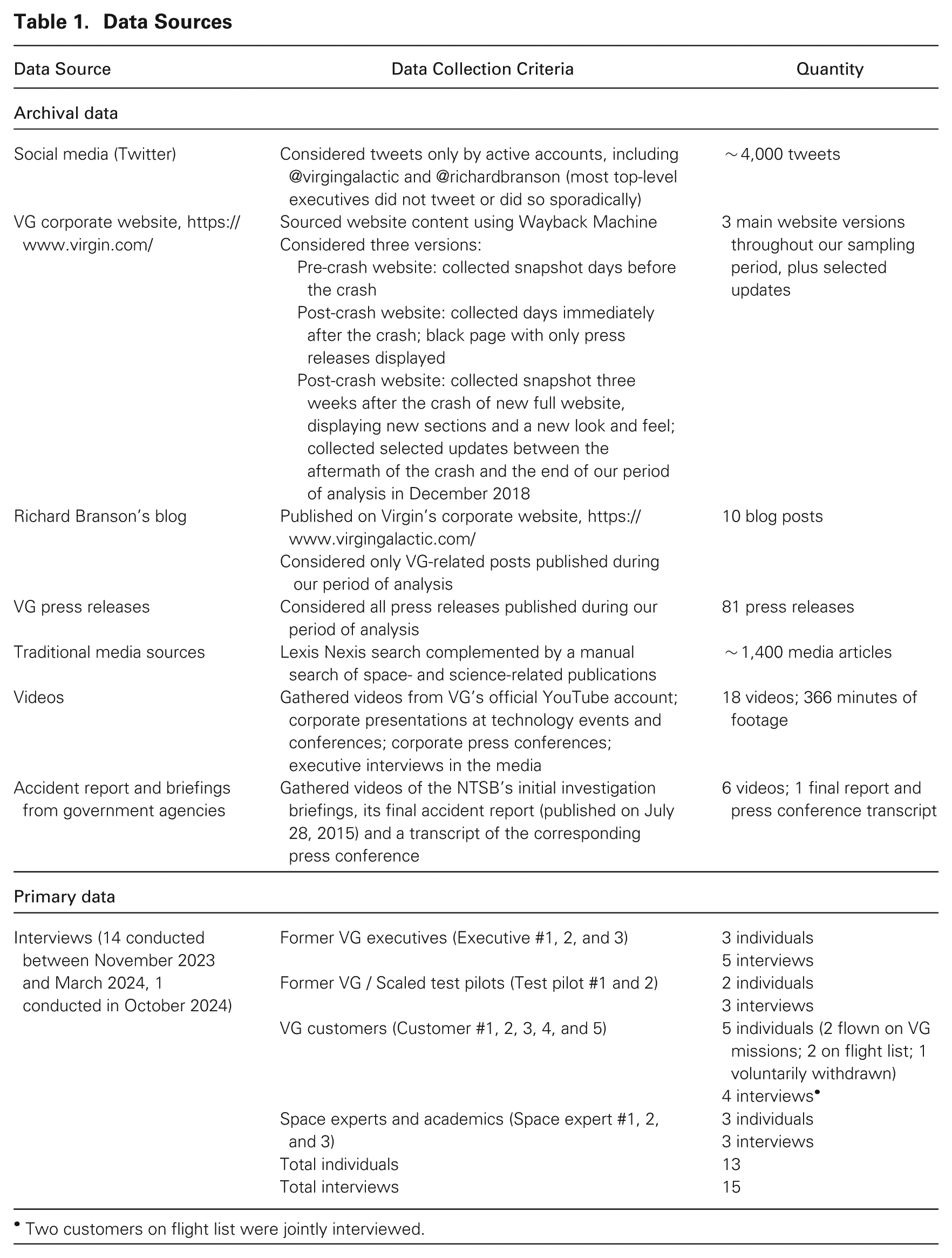
Two customers on flight list were jointly interviewed.
Archival data
We anchored our data collection around VG’s crash. We analyzed data from the period beginning December 7, 2009, when Enterprise was first unveiled, until December 13, 2018, when VG’s second vehicle, SpaceShipTwo VSS Unity (hereafter Unity), first reached space. This period covers major milestones in VG’s space program before and after the 2014 crash. Because the crash took place almost a decade before we initiated the study, we constructed a rich archival dataset from public sources, including executive blog posts, website content, press releases, traditional media articles, tweets, videos of keynote presentations, and government agency reports. Triangulating across multiple archival sources provided us with a near-comprehensive view of VG’s actions and framing over time (Golden-Biddle, 1997).
Social media sources
Since VG heavily used Twitter (subsequently renamed X), we collected all tweets posted during our period of interest from VG’s corporate account (@virgingalactic) and Sir Richard Branson’s account. This yielded approximately 4,000 tweets for the corporate account alone. Branson’s account was parsed for VG-related tweets only. Tweets often provided links to long-form content, which we coded as well.
Blog posts
Branson keeps a blog on VG’s parent company website (www.virgin.com). We gathered all 10 VG-related entries published during our period of interest.
Corporate website
Using historical archives of VG’s corporate website (www.virgingalactic.com) on Archive.org’s Wayback Machine, we gathered all available snapshots of the website’s structure and content (including text, photographs, and videos). We found three main versions of the website in our period of interest: one version from the days prior to the crash, another from the days immediately after the crash, and a final one some weeks thereafter. 2 The company’s website remained relatively constant in the months prior to the crash. Similarly, once the website changed in the weeks following the catastrophic failure, few changes occurred during our period of interest.
Corporate press releases and traditional media sources
We collected all 81 press releases published by VG during our period of analysis. We used the LexisNexis database to gather all articles from traditional media sources mentioning VG during that period, resulting in approximately 1,400 articles. We compiled all direct quotes from VG top executives mentioned in these articles published by news organizations and popular science publications. Following prior research (e.g., Nelson, 2017; Nelson et al., 2023; Zuzul and Tripsas, 2020), we drew on these public statements to understand leaders’ strategic framing of and rationale for VG’s decisions. We also relied on a book and two articles written in the aftermath of the crash by journalists who were granted widespread access to VG.
Videos
From YouTube, we gathered and transcribed 18 videos, keynote speeches, and interviews featuring VG executives, totaling 366 minutes of footage. We prioritized videos of substantial length (the shortest runs for 10 minutes, the longest for 68 minutes) in which executives spoke in depth about VG’s internal design choices and the significance of its innovation both before and after the crash.
Accident report and briefings from government agencies
In addition to these firm-specific archival data, we gathered and transcribed six videos of the National Transportation Safety Board’s initial investigation briefings, its final report on the probable causes of VG’s test flight crash, published on July 28, 2015, and a transcript of the corresponding press conference. These data sources specified the root causes of the crash.
Primary interviews
While archival data is appropriate for building theory on public events that unfold over prolonged periods of time (e.g., Anteby & Molnár, 2012; Nelson et al., 2023; Raffaelli, 2019), it can raise concerns about impression management and may provide incomplete insight into a private firm’s internal activities. To mitigate these concerns, in 2023 and 2024 we conducted 15 in-depth interviews with 13 individuals directly involved with VG around the time of the crash. The interviews allowed us to triangulate and validate insights that emerged from our archival data and to enrich our understanding of VG’s crash and its aftermath from multiple viewpoints.
We interviewed five former VG test pilots and executives, including individuals who were stationed in VG’s control room when the crash occurred, as well as executives responsible for safety, customer relations, and communications before and after the crash. 3 In addition, to better understand stakeholders’ responses to the crash, we interviewed five customers who had pre-paid for VG’s passenger flights, including individuals who eventually flew on two of VG’s commercial missions. Finally, we interviewed three aerospace academics and experts who were extensively quoted in the media following the failure.
To reach these individuals, we combed through our archival data and identified 37 individuals: 8 executives, 18 customers, and 11 experts connected to the crash. We compiled their contact information through public sources and LinkedIn and emailed them to request interviews. Despite the difficult nature of the subject and the length of time between the event and our study, several responded to our request. Initial interviewees referred us to additional interview candidates, yielding an overall response rate of approximately 35 percent. Interviews were recorded and professionally transcribed and ranged from 32 minutes to two hours (the average length was one hour). We focused our questions on understanding the causes of the crash, VG’s internal and external responses, and stakeholders’ opinions of those responses. To reduce recall bias, we used our historical timeline and artifact prompts (e.g., website, book quotes) during interviews and cross-checked all claims against archival records, as we describe below.
Data Analysis
We began our data analysis by constructing a historical timeline. Triangulating across archival sources, we built a timeline of VG’s key milestones from its inception until 2018, considering not only the crash but also major changes in strategy, personnel, partnerships, internal development, and technology. We show critical milestones in Figure 1.
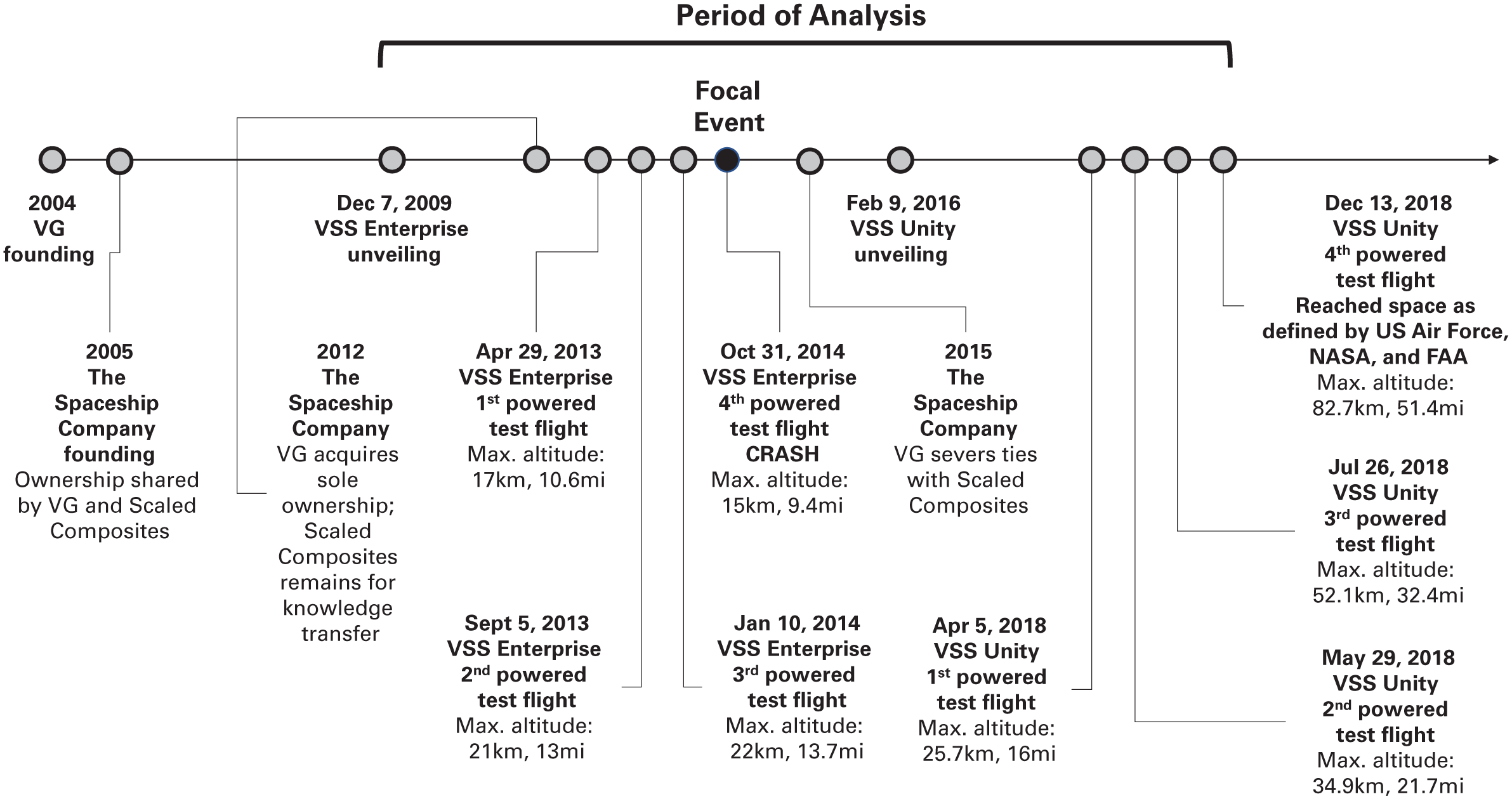
VG Timeline
Our initial intent was to understand, by coding the archival data, whether and how VG’s external strategic framing shifted following the crash. We began with open coding (Charmaz, 2006) and then organized categories, using axial coding logics (Corbin & Strauss, 1990) to examine relationships among codes over time. Due to the volume of data, we first examined day-to-day changes in all sources one month before and one month after the crash. Two of the authors open-coded separately to look for themes in how VG described its efforts. They frequently came together to compare the codes to build a common repository, including “inspirational stories” VG told about milestones reached, “positive attributes” VG attached to its technology, “ecosystem features” VG emphasized, and “potential challenges” VG faced in its innovation process. In discussions among the entire author team, we looked for shifts across codes over time and noticed that two themes seemed to shift in patterned ways: “promises” made about the innovation and “risks” inherent in its development.
Intrigued by this shift, we compiled all statements relating to promise and risk in the entire set of archival data spanning our period of interest. Alternating between working separately and together, we refined our initial coding scheme by developing another level of axial codes within “promise” and “risk” statements. Risk statements varied in (1) who was described as having “control over the development process”: Some statements referred to the firm’s “reliance on partner’s capabilities” to attenuate risk; other statements emphasized VG’s “reliance on its own capabilities” to manage risk. In addition, some risk statements described (2) the firm’s “development philosophy” as a “focus on simplicity and skill,” while others emphasized a “focus on robustness,” which implied the presence of redundancies, to manage risk. Promise statements varied in how they described the (1) “nature of the experience,” or the essential attributes and meanings attached to the firm’s offering: Some promises were “participant-centric,” or focused on how the experience of spaceflight would serve customers and the firm; others presented a “planet-centric” framing emphasizing the benefits of enabling space access for all humanity. Promise statements also varied in (2) the “basis of credibility,” or the central elements that made the firm’s promise viable: Some statements framed “technology as core” by stressing the uniqueness and superiority of the firm’s innovation, while others referred to “people as core,” focusing on employees’ efforts to bring the innovation to life; some statements highlighted “what is known,” anchoring credibility in prior success, while others emphasized “what remains unknown,” casting learning and exploration of the future as the engine of innovation. Finally, promise statements varied in their stated (3) “ambition”: While some emphasized VG’s “commitment to its goal” of attaining the Kármán line, others emphasized the lower FAA definition of space in a “compromise with the firm’s actual capabilities.”
Comparing the axial codes over time, we recognized clear shifts following VG’s test flight crash. We then considered whether and how these shifts clustered together and related to VG’s historical timeline. To do this, we drew on our interviews in which subjects spoke at length about the internal changes VG made, as well as how its external communications evolved following the crash. We coded all statements relating to promise and risk in the interviews, using the axial codes from our archival data analysis. This coding allowed us to triangulate the shifts that emerged from the archival data. We relied on the complementarity of our data sources: While the archival data provided a robust record of what happened, our interviews provided insight into why these changes occurred and how they affected promise and risk.
Specifically, our interviews with VG’s test pilots and technical executives sensitized us to the important effects of certain internal design choices that VG made to lower risk following the crash. For example, interviewees spoke about VG’s increased risk aversion in the aftermath of the crash and described how this led to choices like increasing the amount of thermal protection on the spacecraft. They also described how thermal protection impacted the vehicle’s safety and altitude. We corroborated our coding through the archival data, relying in particular on work by journalists embedded within VG after the crash (for example, quotations of employees’ accounts that compared VG’s pre- and post-crash levels of thermal protection) and interviews with aerospace experts (who, for example, mentioned the impact of these levels of thermal protection on both risk and altitude). The interviews also revealed other important design choices that we triangulated through the archival data and later catalogued and detailed. Table 2 provides selected examples of these choices.
Selected List of Post-Crash Design Changes Considered for SpaceShipTwo VSS Unity
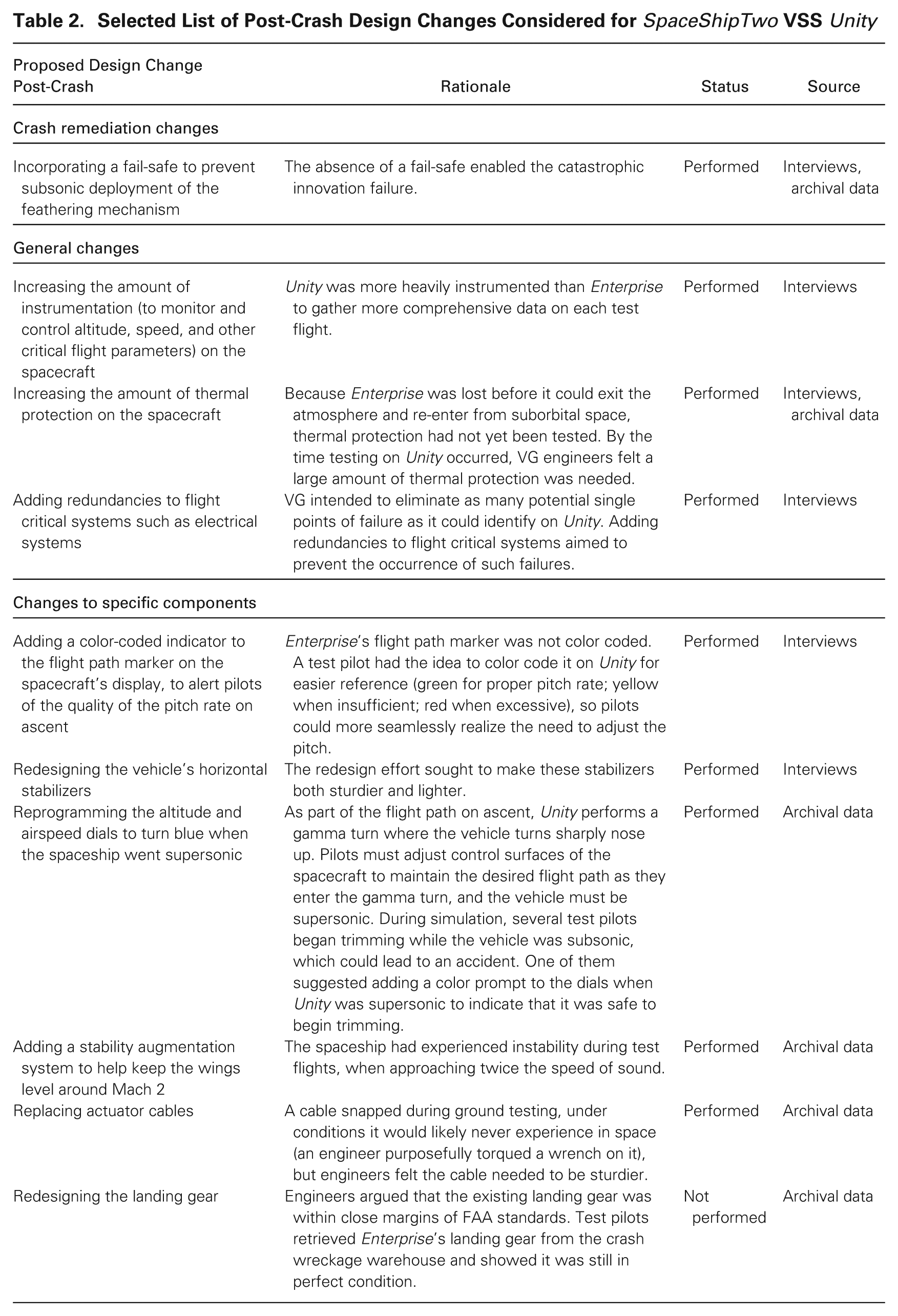
Comparing across our analysis, we considered the effect of these internal design choices on the innovation’s risk; at the same time, we recognized that VG used its external strategic framing to redefine promise. Before the crash, VG’s external strategic framing conveyed the goal the firm would achieve through its revolutionary technology. In contrast, after the crash, VG’s external framing conveyed the pursuit the firm was undertaking, abstracting from technical specifics to present a broader narrative about the worthiness and meaning of the firm’s innovation. Our interviews with VG’s former communication executives revealed the reasons behind VG’s framing shift; our interviews with customers and space experts, coupled with direct quotes from archival data, helped us to understand how stakeholders responded to the framing.
We folded these observations into a single empirical model that illustrates how VG altered its design choices and redefined its strategic framing after the crash. Finally, we abstracted away from our research context to offer a generalizable theoretical model. As is typical in inductive qualitative research, we iterated among data analysis and re-analysis, theory development, and literature review (Locke, 2001) until we felt the theory and data converged (Rouse et al., 2025).
Findings
Our analysis revealed how VG recalibrated risk and promise through its internal design choices and its external strategic framing, respectively, following its catastrophic innovation failure (see Figure 2). Prior to the crash, VG calibrated risk through two critical internal design choices. First, it ceded control over the development process by relying on the capabilities of its development partner, Scaled. Second, it centered its development philosophy on technical simplicity and pilot skill. These choices, however, left its vehicle, Enterprise, vulnerable to single points of failure, as the malfunction of a single component could cause significant disruption. The crash exposed the limitations of this approach. Immediately after the crash, VG adopted a more risk-averse stance that resulted in design choices intended to de-risk the technology. The firm increased its control over the development process and shifted its development philosophy toward robustness (e.g., a fail-safe, redundancies, automation). Its new spacecraft, Unity, was consequently safer than Enterprise. But due to weight added as a result of post-crash design choices, the vehicle could only reach an altitude of 80 km, meeting the FAA’s definition of space but falling short of the 100 km Kármán line that had anchored VG’s pre-crash ambition. Thus, the firm’s design choices both de-risked the spacecraft and reduced its technological capabilities.
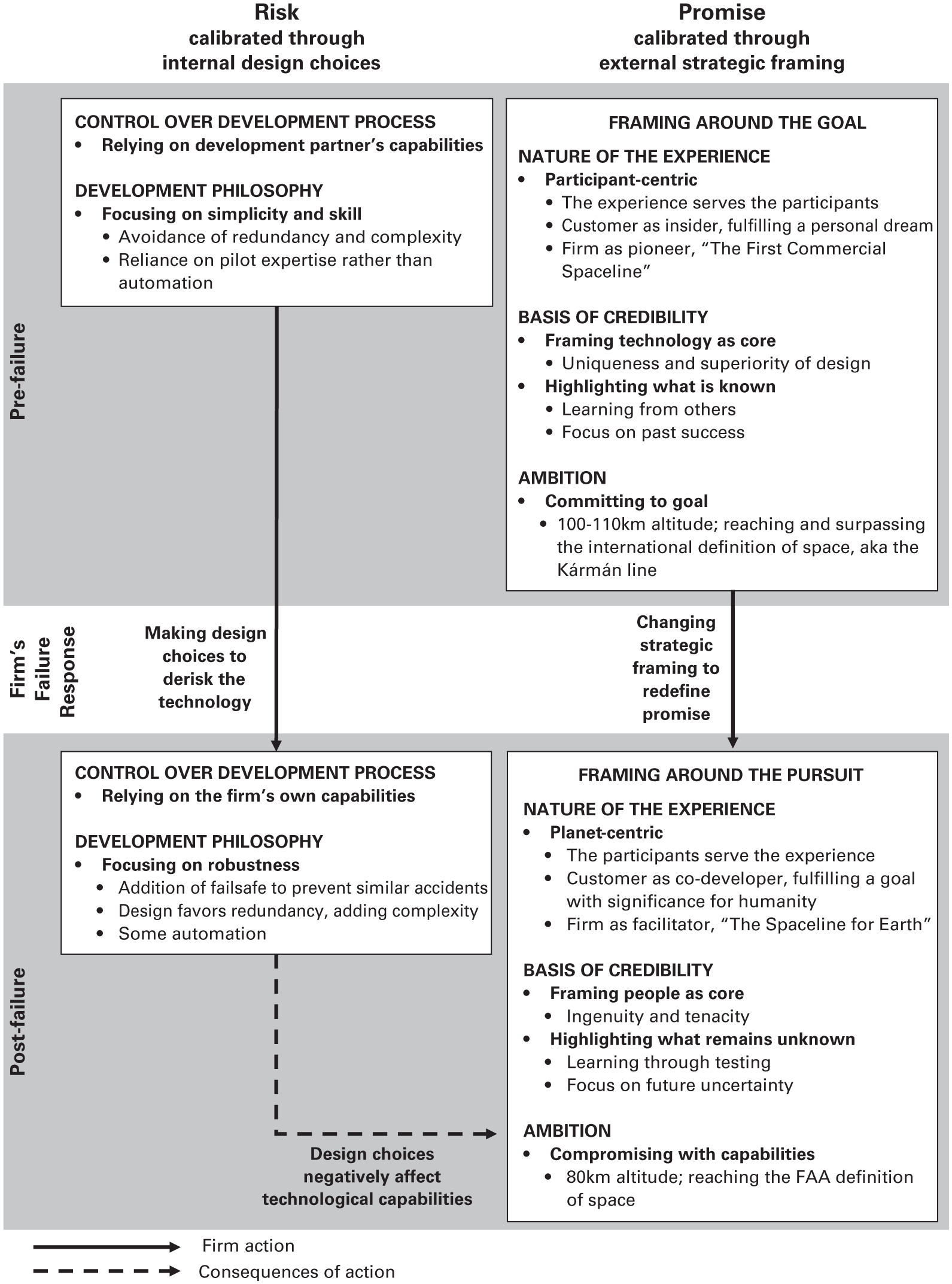
Empirical Model of the Evolution of Virgin Galactic’s External Strategic Framing and Internal Design Choices Following Catastrophic Innovation Failure
In parallel with its recalibrated design choices, VG responded to its catastrophic innovation failure by changing the company’s strategic framing to redefine its promise externally. Pre-crash, VG’s promise was framed around three components of the firm’s goal: a participant-centric experience, credibility grounded in technology and known aspects of the innovation process, and an explicit target of reaching the Kármán line. Following the crash, VG sought to rebuild meaning and credibility, despite design choices that decreased its spacecraft’s technological capabilities. To do so, VG shifted to a promise framed around the firm’s pursuit by emphasizing three elements: a planet-centric mission, credibility grounded in its people and exploration of the unknown, and ambition re-anchored at around 80 km, in line with revised capabilities. Tables 3 and 4 provide additional evidence for VG’s calibration of risk and promise, respectively.
Recalibrating Risk Through Internal Design Choices in the Wake of Catastrophic Innovation Failure*
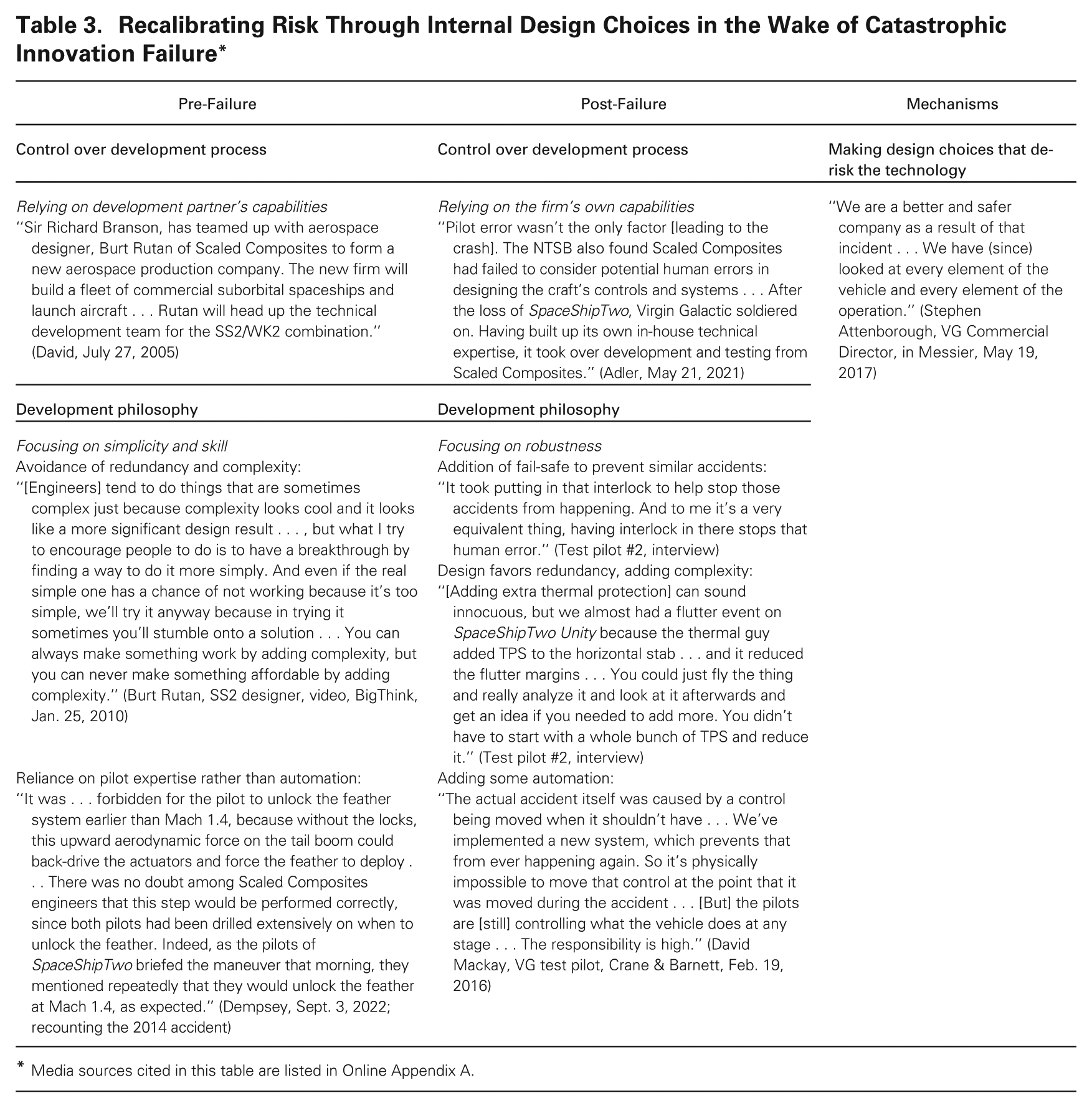
Media sources cited in this table are listed in Online Appendix A.
Recalibrating Promise Through External Strategic Framing in the Wake of Catastrophic Innovation Failure*
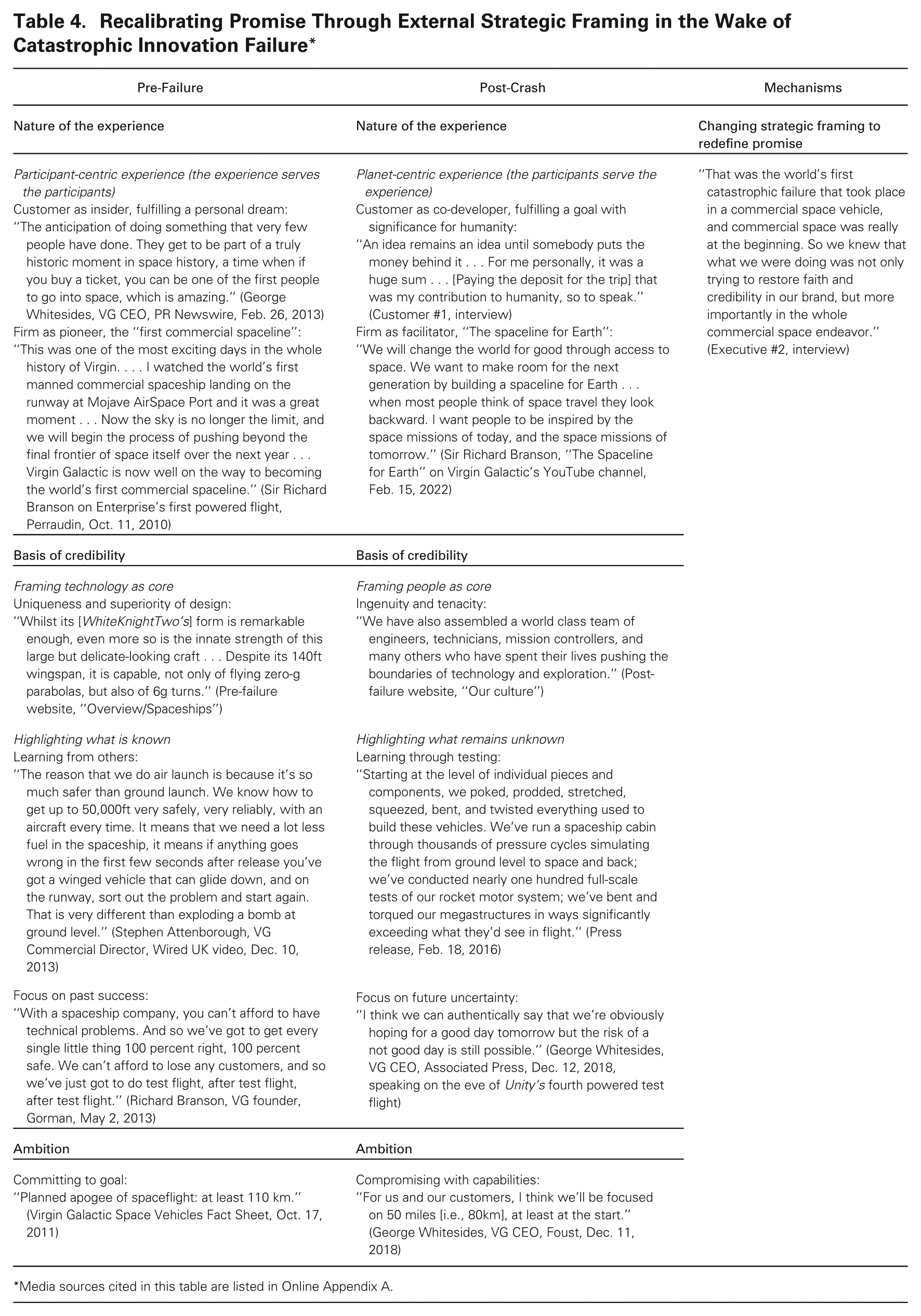
Media sources cited in this table are listed in Online Appendix A.
Pre-Failure: Calibrating Risk Through Internal Design Choices
Prior to the crash, VG calibrated risk through two critical design choices: relying on its partner’s capabilities to control the development process and focusing on simplicity and skill as the cornerstone of its development philosophy.
Control over the development process: Relying on development partner’s capabilities
Seeking to build up its engineering expertise in aerospace, VG developed Enterprise by establishing a manufacturing arm, TSC, in partnership with Scaled, a renowned prototype shop. VG was effusive in its praise of Scaled’s founder, Burt Rutan, and of the spacecraft he had designed. Branson was quoted in an article stating,
I went looking for engineers and technicians who could build a spaceship. I wouldn’t have done it unless I could find the genius who could make our dreams become a reality, and Burt Rutan was the genius who made all of this possible. Having spent time with him, I decided he was the person to build a spaceship that could well revolutionize space travel. (Montoya Bryan, Nov. 23, 2010)
This setup gave VG access to a proven design lineage (from SpaceShipOne) and brought speed and expertise in development. At the same time, by relying on Scaled’s capabilities, VG placed critical elements of risk calibration under the joint venture’s control.
Development philosophy: Focusing on simplicity and skill
VG’s choice to rely on its partner cohered with TSC’s development philosophy. Most of TSC’s personnel came from Scaled, and these engineers followed two principles in their design choices: (1) avoidance of redundancy and complexity and (2) reliance on pilots’ skills and expertise rather than on automation. To maintain as simple a design as possible, TSC “shied away from building inhibitors and safety latches, instead seeking to hire the best engineers and pilots—finding and mitigating risk through procedures and professionalism rather than hardware” (Schmidle, 2021, p. 69). Unlike competitors whose vehicles relied heavily on automation, TSC conceived Enterprise as an analog vehicle, meant to be flown via manual control and effort rather than automation. An analyst noted in an article,
Despite the futurism of its mission, the vehicle was a relatively simple aircraft. No autopilot. No automation. The other space companies would control the journey to space with computers: everyone on board was more or less along for the ride. Once a Virgin Galactic ship was airborne, the fate of the ship and its crew was in the pilot’s hands. (Schmidle, Aug. 13, 2018)
These two principles shaped all design choices, including changes made after test flights. For example, after Enterprise’s first powered flight, test pilots reported that the vehicle experienced severe instability on the tail—twitching and bobbing—due to strong forces encountered while traversing the transonic region. 4 Instead of reducing instability by programming the spacecraft to automatically perform certain maneuvers, like changing the angle of flight, TSC maintained Enterprise’s analog flight controller and gave test pilots freedom to determine how best to respond. Similarly, test pilots noted that unlocking the feathering mechanism, a lever used to manually change the position of the spacecraft’s wings, too early or below the transonic region could be catastrophic. TSC responded by relying on pilots’ training, rather than adding an inhibitor to the hardware to prevent premature unlocking. According to one internal account, “installing an inhibitor would add complexity. . . . This was why the company hired elite test pilots who understood the risks, and the pilots all agreed that it would be wasteful to spend time or money on something so obvious” (Schmidle, 2021, pp. 90–91).
The two principles that guided internal design choices were deeply embedded in TSC’s philosophy and Scaled’s lean approach to prototype manufacturing. An article published during VG’s early years noted that VG was fully on board with this approach:
Virgin [Galactic] and Rutan have pursued a rigorous campaign to simplify operations on their spaceships, following a basic philosophy succinctly spelled out by Whitehorn [early VG President]: “Complexity means fuckups” . . . The craft has few moving parts, and instruments are absurdly simple. (McKie, April 26, 2006)
In the same article, Rutan stated that Enterprise’s design logic was “stick-and-rudder . . . it is rocket science, but it is the cheapest, most basic variety” (McKie, April 26, 2006). By avoiding the complexity of redundant systems and automation, TSC sought to minimize the time and resources required for iterative design changes. TSC’s streamlined approach allowed engineers to focus on refining key aspects of the design and addressing immediate challenges, rather than becoming encumbered by thinking about the integration of complex systems.
However, these principles also exposed Enterprise to the risk of single points of failure: situations described by a VG executive in the media as “one bolt falls off and you die” (Higginbotham, March 7, 2013). TSC’s deliberate avoidance of redundancies meant that every part of Enterprise played an irreplaceable role in its operation. If one element failed, the entire mission could be at risk, along with the lives of those aboard. This lack of redundancy created a fragile design architecture that test pilots were willing to live with, knowing it allowed little margin for human error. These choices played a critical role in Enterprise’s catastrophic innovation failure.
Pre-Failure: Calibrating Promise Through External Strategic Framing
Before the crash, VG calibrated risk with a promise framed around three components of the firm’s goal. Its external communications cast the experience of spaceflight as participant-centric, grounded credibility in technology and known aspects of the innovation (prior demonstrations, proven materials and methods, established design features), and set ambition explicitly at attaining the Kármán line.
Nature of the experience: Participant-centric
VG’s pre-failure framing of promise was participant-centric: The firm (1) highlighted how the experience of spaceflight would serve the participants—customers and the firm itself; (2) described customers as insiders fulfilling a personal dream and referred to them as “future astronauts” (Pre-failure website, “Booking”); and (3) depicted the firm as a pioneer, referring to itself as the world’s “First Commercial Spaceline” (Pre-failure website, “Who We Are”). VG portrayed the experience it would offer to customers as unique and life-altering. As Branson put it, “The thinking was to create a spaceship company that could give people the most memorable day in their lives” (Langewiesche, April 1, 2015). VG’s website described the experience of spaceflight vividly:
Then the countdown to release, a brief moment of quiet before a wave of unimaginable but controlled power surges through the craft. You are instantly pinned back into your seat, overwhelmed but enthralled by the howl of the rocket motor and the eye-watering acceleration which, as you watch the read-out, has you traveling in a matter of seconds, at almost 2500mph, over 3 times the speed of sound. (Pre-failure website, “Overview/Experience”)
Similarly, Steve Isakowitz, then VG’s chief technology officer, explained that passengers would “feel all the effects of what an astronaut goes through going to orbit. . . . The noise, the vibration, the acceleration, are almost the same as if you were sitting there in the Space Shuttle trying to go up to orbit” (Higginbotham, March 7, 2013). On-board cameras would capture the entire journey, making it “the most photographed event of their lives,” according to Mark Butler, then VG’s director of spaceport development (Higginbotham, March 7, 2013).
Emphasizing that among billions of humans on Earth, only about 500 people—all professional astronauts—had been to space, VG portrayed its own future astronauts as belonging to “the world’s most exclusive club” and promised they would “become insiders in one of the most amazing and inspiring projects anywhere in the world” (Pre-failure website, “Overview/Space Tickets”). By going to space, VG stressed, customers would fulfill a personal dream of great significance. Stephen Attenborough, then VG’s commercial director, said in an article that VG was “lucky to be able to offer people the chance to achieve their lifetime dream” (Lam, Nov. 7, 2013). VG’s website noted, “Later that evening, sitting with your astronaut wings, you know that life will never quite be the same again” (Pre-crash website, “Overview/Experience”).
In tandem, VG described itself as the “First Commercial Spaceline,” suggesting that it would not only succeed in providing the exclusive experience of space tourism but that it would be the first company to achieve it. George Whitesides, then VG’s CEO, noted the significance of being first, highlighting the technological, experiential, and societal achievements that VG would meet: “We really do aspire to build the world’s first commercial spaceline. And to us, that means a lot more than just having a vehicle. It means really building out an experience, and the start of an industry” (Wall, Oct. 18, 2011). Branson stressed the pioneering nature of VG’s endeavor: “We are now very close to making the dream of suborbital space a reality for thousands of people . . . achieving our ultimate and long-term goal of leading an industry which opens up the huge potential of space to everyone” (Targeted News Service, Dec. 16, 2010).
Basis of credibility
Framing technology as core
Before the crash, VG anchored its credibility on the technological capabilities of its spaceship. VG’s website and executives described the vehicle and its carrier in extensive detail and highlighted their uniqueness and superiority relative to vehicles that had come before. For example, the website noted,
Virgin Galactic’s commercial space launch system . . . overturns much of the traditional thinking behind 50 years of space launch. . . . These features add up to a system which can be described as environmentally benign compared to any form of space launch technology, manned or unmanned that has ever existed. (Pre-failure website, “Overview/Environment”)
Similarly, Attenborough praised the carrier WhiteKnightTwo at a conference in 2013:
That carrier aircraft in its own right is the world’s largest all-carbon composite aviation vehicle ever built. It is the most fuel-efficient aviation vehicle of its size. It is a remarkable bit of kit, and it has this unique heavy payload high-altitude capability. It can take about 17 tonnes up to at least 50,000 ft. There is nothing else around that can do that, and it does it extremely efficiently. (Wired UK video, Dec. 10, 2013)
Thus, by emphasizing its space vehicles’ unique design, efficiency, and groundbreaking advancements, VG anchored its credibility on their technological superiority.
Highlighting what is known
VG’s pre-crash statements also anchored its credibility by highlighting known aspects of the innovation process and emphasizing how the firm was learning from others. In its external communications, VG repeatedly underscored its analysis of pre-existing knowledge in aerospace and its diligence in learning lessons from successes and failures experienced by others, including NASA and private contractors. These statements sought to reassure stakeholders that VG had already accounted for many potential safety concerns. For example, according to VG’s pre-failure website, the firm “looked at many plans for potential space launch vehicles. All were rejected, primarily on the basis that they were fundamentally unsafe by design.” VG’s chosen solution “focused on a number of design features . . . [that] could make the vehicles many thousands of times safer than any manned spacecraft of the past.” VG then listed several instances in which its design avoided known challenges that others in the industry had encountered: Enterprise’s horizonal launch reduced the amount of potentially dangerous fuel the spacecraft needed to carry; VG used carbon fiber composite, a material “four times the strength of steel and a quarter of its weight,” for both the spacecraft and launch vehicle; VG used a hybrid motor, rather than a strictly liquid or solid motor, for “simplicity and safety”; and VG used a feathering mechanism to enable re-entry to Earth—a critical safety component. According to VG,
This part of space flight [i.e., re-entry] has always been considered as one of the most technically challenging and dangerous and Burt Rutan was determined to find a failsafe solution. . . . The feather configuration is . . . highly stable, effectively giving the pilot a hands-free re-entry capability, something that has not been possible on spacecraft before without resorting to computer controlled fly-by-wire systems. (Pre-failure website, “Overview/Safety”)
VG also communicated credibility by pairing concerns about safety with positive statements about the firm’s development milestones. For instance, after Enterprise’s second supersonic rocket-powered test, Whitesides said to reporters, “Today, we expanded the SpaceShipTwo rocket-powered flight test envelope. . . . Each powered flight of SpaceShipTwo yields cumulative progress that builds the foundation for safe and exciting commercial space flights” (Business Wire, Sept. 5, 2013). Thus, VG’s pre-failure framing highlighted the known aspects of the innovation process by emphasizing the firm’s learning and past technological successes. In this way, VG reassured stakeholders of its credibility, particularly its commitment to safety and reliability.
Ambition: Committing to a goal
VG’s framing stressed the firm’s commitment to the goal of reaching, and potentially exceeding, the Kármán line at 100 km altitude. A former VG executive confirmed that the firm’s ambition was to mirror the feat of its predecessor technology: “SpaceShipOne broke 100 km and that’s what all the early Virgin Galactic marketing was about—100 km” (Executive #3). A former test pilot also confirmed in an interview, “When I worked on SpaceShipOne, the X Prize rules were to fly to 100 km, the internationally recognized boundary of space. So Virgin initially latched onto that [to develop Enterprise]” (Test pilot #1). VG was vocal and explicit about committing to this altitude. Its pre-crash website included diagrams depicting the entire flight experience, from take-off to landing, which explicitly showed the spacecraft’s expected apogee (i.e., maximum altitude) at 361,000 ft, or 110.03 km (Pre-crash website, “Download our Brochure”). In an interview, a customer relayed a comment they received from a VG executive in the early days: “We’re going to far exceed 100 km. We’re going to leave no doubt about it that we went where people want us to go.” The customer noted that “VG understood some people want the bragging rights. They don’t want anyone having an asterisk beside their name of did they or did they not go to space” (Customer #2).
Thus, VG’s pre-crash framing of promise centered on a bold, participant-centric goal that celebrated the spaceflight experience as an individual-level milestone, positioned its customers as insiders embarking on a once-in-a-lifetime adventure, and framed the firm as the “First Commercial Spaceline.” VG anchored its credibility in its innovative technology as an unparalleled achievement in aerospace engineering and emphasized the spacecraft’s ambitious performance goal of reaching the Kármán line. Catastrophic innovation failure both increased the salience of risk and led stakeholders to question whether VG’s promise would materialize.
Experiencing Catastrophic Innovation Failure
On the morning of October 31, 2014, Enterprise was poised to complete its fourth powered test flight. Instead, only seconds after being released by its carrier, the vehicle broke apart in midair, killing a pilot and severely injuring another. A preliminary investigation highlighted a fault in the engineering of Enterprise’s feathering mechanism, meant to stabilize and facilitate its descent back to Earth after reaching peak altitude. This feature was originally designed to be deployed at Mach 1.4 (i.e., 1.4 times the speed of sound), safely beyond the transonic region. In the doomed flight, the co-pilot prematurely unlocked the feathering lever, and the mechanism deployed with the vehicle moving between Mach 0.8 and 0.92. Because Enterprise had no redundancies to keep the feathers from moving, the strong forces acting on the vehicle at that slower speed compromised its structural integrity, leading it to break apart.
The technical cause of the crash was understood at VG almost immediately. In an interview, an individual present in the control room during the crash recalled listening to the pilot and co-pilot running over the post-launch procedures, and realizing the co-pilot had prematurely unlocked the feathering lever:
He said, “0.8, unlocking,” . . . I looked up to make sure I hadn’t missed it—[maybe they] were already supersonic. And they weren’t. I was just reaching for the button [to contact them] and the telemetry froze and I knew what happened . . . it was obvious that there was no longer a spaceship. . . . [Another employee] looked up at me, [like], “What’s going on?” I said, “They unlocked the feather trans-sonically. They’re gone.” (Test pilot #2)
Similarly, an interviewee recalled, “We had video, we had telemetry and onboard data from the vehicle. . . . In this case, it led to a very clear picture of what transpired” (Executive #1). Another interviewee confirmed, “The blame quickly went to the feather unlock system” (Test pilot #1). Following an investigation, the National Transportation Safety Board released its report in July 2015, confirming the root cause of the accident: The co-pilot unlocked the lever too early, the pilot did not have time to react, and lack of redundancies meant there was no technological stop.
From an organizational perspective, the catastrophe had a profound impact on VG. Employees described the event in vivid and emotional terms that underscored its significance and the tragic loss of life. Internally, the company faced the challenge of adjusting its design choices to prevent similar accidents in the future. An executive said in an interview,
It was surreal . . . everyone at the company should have known days like that were possible. You’re dealing with experimental vehicles that move really fast, that have never been flown before. It’s the reason you have test programs. It’s the reason you have test pilots. So we all knew it was a possibility, but of course, you never think it’s going to happen. . . . You prepare for it, you train for it, and you hope to never use that training. . . . [After the crash] we had everyone trying to learn very, very quickly. (Executive #3)
Externally, stakeholders wondered whether VG’s promise was tenable. While many stakeholders supported VG, others directly questioned whether the firm should continue its efforts. For example, a space analyst said, “It’s really a crisis of confidence. . . . [T]he public has to have confidence that this is a safe thing to go do. And I think, psychologically, restoring that confidence is going to be a real challenge” (CBS newscast, Nov. 1, 2014). In an interview, an aerospace expert recalled his thoughts following the crash:
What does that mean for Virgin Galactic? . . . if I had a ticket for Virgin Galactic, would I still want to go? I felt quite guilty for thinking this, but I thought it validates my belief that they’re playing around with things that are really dangerous. And this shows that they are really dangerous. This should be a splash of cold water for every commercial operator looking to try and do this, because it’s a reminder that . . . human spaceflight in particular is such an unforgiving occupation and pastime. (Space expert #2)
As a result, after the crash, VG was faced with the need to revisit its internal design choices to address newly acknowledged, salient risk, and with the need to alter its external strategic framing to account for the occurrence of failure and to sustain stakeholder support.
Post-Failure: Recalibrating Risk Through Internal Design Choices
In response to the crash, the increasingly risk-averse VG recalibrated risk by making design choices to de-risk its technology. This involved taking control of the development process and shifting its development philosophy to favor robustness, aiming to avoid similar failures. However, although these design choices resulted in a safer spacecraft, they also negatively affected its technological capabilities.
Failure response: Making design choices that de-risk the technology
Immediately following the crash, and consistent with expectations from research on threat rigidity (e.g., Shi et al., 2018; Sirmon et al., 2008; Staw et al., 1981), VG narrowed its attention to understand the causes of the failure and ensure that similar catastrophes could not occur in the future. While the root cause of the accident required a straightforward technical fix, our data suggest that after the crash, VG became increasingly risk averse. A book whose author was given full access to VG immediately after the crash describes the risk aversion that began to guide design choices: “Nobody wanted to live with another fatal accident on their conscience” (Schmidle, 2021, p. 142). On a personal level, an engineer recalled,
I was becoming more risk averse. . . . We as engineers often don’t have the ability to assess the big picture. As humans we are notoriously bad at risk assessment and probability. You have to consciously make an effort to do this kind of analysis. (Schmidle, 2021, p. 158)
Risk aversion had implications for VG’s overall development process and philosophy, as the company embarked on finalizing its second vehicle, Unity, already 65 percent assembled and 90 percent structurally complete at the time of the crash (NBC News, Nov. 5, 2014).
Control over development process: Relying on firm’s development capabilities
Following the crash, VG brought the development of Unity fully in house, taking control of TSC and ending the long-standing partnership with Scaled. The crash appeared to accelerate a process that had begun two years earlier, when VG acquired Scaled’s stake in TSC. Initially, the firms planned for a full takeover once commercial operations were in place. However, by breaking ties with Scaled immediately after the crash, VG committed to making all subsequent design choices alone, thereby relying on its own development capabilities. In a press conference, Whitesides confirmed, “Our operations team was poised to take the baton from our partners, Scaled Composites, as they carried on the final flights of the test program—their test flight program. . . . But it was not to be” (Petersen, Jan. 23, 2015).
VG executives noted that taking over development enabled the company to imprint the program with its own mindset that prioritized safety and decreased risk. “We wanted that authority and that control,” a former executive mentioned during an interview (Executive #3). In the press, Whitesides commented,
Our second spaceship is being built by our wholly-owned sister organization, The Spaceship Company (TSC), who along with Virgin Galactic, will be responsible for testing and operating the vehicle. . . . We’re committed to making any modifications or improvements that we feel are necessary to improve the safety of the vehicle. (Gray, Jan. 27, 2015)
Development philosophy: Focusing on robustness
Empowered with full control over development, VG focused its internal design choices on increasing robustness by (1) adding a physical fail-safe, (2) favoring redundancy in design, and (3) adding some automation, all oriented toward preventing similar future accidents (see Table 2 for Unity design changes found in our data). First, VG added a physical fail-safe to the vehicle’s feathering system. In an interview, a former test pilot described how the company “put in an interlock to help stop those accidents from happening” (Test pilot #2). The interlock would prevent the feathering mechanism from being deployed at speeds lower than Mach 1.4 and would require manual overriding from the pilots should early deployment be required for any reason. Media reports from the time of the crash confirmed this change: “Virgin Galactic had . . . completed safety measures, including a modification to the feather lock system with an automatic mechanical inhibit to prevent unlocking or locking the feather during safety-critical phases of flight” (Gajanan, July 28, 2015).
This technical improvement represented a relatively straightforward fix, easy both to design and implement. Will Whitehorn, VG’s former chairman, noted in the press that the cause of the crash was “relatively intellectually easy to fix to make the vehicle safe” and by no means required large-scale changes to the spacecraft. “We are not facing a catastrophic design fault in the whole vehicle,” he added (Sample, Nov. 3, 2014). A former executive echoed this idea in an interview, stating that “very few changes were needed to the vehicle [for accident remediation]” (Executive #1).
However, VG’s increased risk aversion also led it to overturn TSC’s prior principles of simplicity and reliance on pilot expertise; instead, VG increased Unity’s robustness by adding redundancy and some automation. The same executive recalled,
We took an approach where we scrub the entire vehicle and go, “Hey, we need to eliminate any potential single point . . . factors, failures that could be there.” In an accident, it’s always easy to fix what happened. . . . The real challenge is going through and fixing what else could have happened. . . . We really had to go through that process. (Executive #1)
For example, VG added a stability augmentation system to help keep Unity’s wings level around the transonic region, diminishing the wobbling the spacecraft might experience during that part of the flight (Schmidle, 2021). VG’s risk aversion was also evident in the decision to add extremely high—according to some, redundant—levels of heat protection to the vehicle. Unity’s predecessor technology, the two-seater SpaceShipOne, had 14 pounds of thermal protection systems (TPS). In contrast, according to internal accounts, Unity was carrying “a couple hundred” pounds of TPS (Schmidle, 2021, p. 234), but the vehicle was only twice the size of SpaceShipOne (Pre-crash website, “Scale Comparison Chart in Overview—Spaceships”). In an interview, Test pilot #2 described how this redundancy was the result of engineers’ risk aversion: “[Rutan] said, ‘If you have somebody whose sole job in life is to keep you from burning up, you will end up with three times the TPS that you need.’ [Engineers think:] ‘It’s not gonna burn up on my watch, I’m gonna make sure it’s protected.’”
VG’s design choices after the crash thus diminished the inherent risk of the innovation. Mike Moses, VG’s senior VP of operations, contrasted the post-crash approach to the earlier development philosophy: “They [development partner Scaled] were asking, ‘Is [the spacecraft] safe for twenty flights?’ We’re asking, ‘Is it safe for a thousand flights?’” (Schmidle, Aug. 20, 2018). “Everyone wanted to build a safer ship,” noted a journalist with deep knowledge of VG (Schmidle, 2021, p. 158). In the same vein, our interviews revealed that VG employees and executives believed that “Unity was safer than Enterprise” (Test pilot #2).
Design Choices Negatively Affect Technological Capabilities
While VG’s post-crash design choices succeeded in de-risking the spacecraft, Unity’s technological capabilities, especially its expected altitude, were constrained as a result. Specifically, the added redundancies and automated components that VG introduced to Unity rendered it substantially heavier than Enterprise. The weight was further increased by the inclusion of an attractive new cabin where future astronauts would sit. A former test pilot explained the impact of cascading design choices on weight:
Unity . . . was more heavily instrumented than they had planned for it to be. . . . They were adding weight to make it stronger . . . such as the landing gear. . . . It’s unbelievable how you can make one part stronger and slightly heavier and then you got to beef up that supporting structure and it just keeps on going up. . . . It just escalates out of control really quick. (Test pilot #2)
Unity’s added weight affected the performance of the spacecraft, leading a key executive to worry “that [VG’s] risk-aversion would compel them into building a tank with wings” (Schmidle, 2021, p. 158). Given Unity’s fuel capacity and propulsion capability, increased weight reduced the maximum altitude the spacecraft could reach. According to the same test pilot, “Each few 100 pounds impacts [altitude] by 1,000 feet of apogee or more” (Test pilot #2). The journalist embedded in the company after the crash described the reasoning behind and consequence of these decisions: “Every pound would cost them in performance. These were more than engineering decisions. They were philosophical ones, statements of their [VG’s] tolerance for risk” (Schmidle, 2021, p. 157). During development and testing, it became clear that Unity would reach an altitude of only about 80 km. While this was the U.S. definition of space as recognized by the FAA, it fell short of the 100 km Kármán line. It therefore became debatable whether VG’s vehicle would reach “space.”
Thus, in the wake of the crash, the increasingly risk-averse VG recalibrated risk in its internal design choices. VG took full control of development, prioritizing robustness over the ambitious goals that had previously defined its spacecraft. This trade-off constrained Unity’s technological capabilities: Unity would deliver an inferior customer experience, compared to Enterprise.
Post-Failure: Recalibrating Promise Through External Strategic Framing
Both in immediate response to the crash and later, VG’s post-failure strategic framing revealed a renewed sense of promise. VG’s promise was now framed around the firm’s pursuit rather than its goal. The nature of the experience shifted from participant- to planet-centric. The basis of credibility moved from technology and known aspects of the innovation process to people and disciplined exploration of the unknown. And ambition was re-anchored at 80 km—rather than the 100 km Kármán line—consistent with revised capabilities.
Failure response: Changing strategic framing to redefine promise
After the crash, VG’s reframing of promise was part of a deliberate attempt to reassert the meaning of its effort. In an interview, a former executive directly responsible for crafting the firm’s external messaging at the time recalled how, in the wake of the crash, “The brand and communications side [of VG] was much more focused on ‘What is all this for? Why are we building this technology, if not for improving access to space, improving our ability to unite as a civilization, as a society, as stewards of our planetary home?’” (Executive #2). The same executive elaborated:
I went to events and I communicated with our future astronauts. . . . Going to space and seeing our fragile planet from that distance is something that is so unique and filled with purpose, and also filled with the unknown of what happens when you come back down. . . . What will you do with that insight? (Executive #2)
In the same vein, Branson noted in a 2015 blog post, “Virgin Galactic is not just about taking people up to space, but also about connecting space to Earth. We believe that exploring space will make life better on Earth—a broader perspective is crucial to solving our planet’s greatest challenges” (Brown, Feb. 28, 2015).
Nature of experience: Planet-centric
VG’s post-failure framing elevated the meaningfulness of the firm’s endeavor for the entire planet. VG did this by (1) highlighting how the participants in spaceflight would serve the experience—an inversion of the relationship in its prior framing, (2) describing customers as co-developers and societal change agents, and (3) framing the firm as facilitator of a prosocial, planet-centric mission.
First, the firm now highlighted customers’ role in enabling VG to democratize access to space. Whereas the experience had previously appeared to serve the customers, customers were now framed as helping VG diffuse the innovation to benefit the entire world. The website noted,
Our Future Astronauts have formed an engaged, vibrant, and active community, united by a shared passion for the future of commercial space. . . . The power of this community has already changed lives, and each astronaut will continue to make a difference long after they have flown. (Post-failure website, “Future Astronauts”)
This sentiment was echoed by customers, especially by those who would eventually experience spaceflight in VG’s commercial missions. One of them said in an interview, “The people who bought tickets share the same vision, and they want the world to share the vision. . . . The more people we send up there, the more the word of how special our planet is, how fragile our planet is, will come back” (Customer #1).
Second, VG envisioned customers as co-developers of a worthy program before their flight and as change agents serving the planet upon their return. Customers were still referred to as “future astronauts” but were portrayed as belonging to “the most exciting club on Earth,” rather than the most exclusive. This excitement was rooted in the new perspectives customers would gain from viewing our planet from space and how these would help them change our world for the better. On its revamped post-crash website, VG declared that “exploring space makes life better on Earth” and presented the experience in collectivist and prosocial terms:
By sending humans to space, we as a species have learned incredible things about human ingenuity and human physiology. . . . Space exploration has inspired generations of entrepreneurs, inventors, ordinary citizens, and entire new industries. . . . Only through the exploration of the unknown can we continue to grow and evolve. (Post-failure website, “Why we go”)
Finally, after the crash, VG described itself as “the Spaceline for Earth,” a moniker that no longer directly pertained to success but, instead, suggested a new identity aligned with its planet-centric mission. This stance was communicated across all channels but was especially evident on VG’s new website, unveiled on November 21, 2014, three weeks after the crash. Many of the website’s sections, such as “Human Spaceflight,” “Who we are,” “Why we go,” and “Our vision for the future,” suggested different ways that VG would contribute to improving life on Earth:
Virgin Galactic is part of an incredible story that has been thousands of years in the making, driven by the deeply human need to explore our universe, to innovate new and lasting technologies and to create a better future for our society and our planet. (Post-failure website, “Who we are/Our culture”)
Thus, VG’s new framing redefined the experience it offered, tying democratized, innovation-enabled space travel to a better understanding of space and of our own planet. It also allowed VG to untether its efforts from the specifics of its technology—perhaps partly due to the inherent riskiness and uncertainty this technology entailed. As one expert described in an interview, “[Talking about] the technology would have posed too many questions. The narrative of exploration doesn’t pose any questions” (Space expert #2).
Basis of credibility
Framing people as core
VG’s post-crash framing of promise moved away from basing credibility on the firm’s technology in favor of highlighting the people who were actively building it. In this way, VG shifted from celebrating technology as an unparalleled achievement in aerospace and, instead, emphasized the daily process of pursuing its broader purpose of democratizing space travel. To this end, VG produced various materials, including white papers and a video series entitled “Elevating Unity,” which focused on challenges and successes in the construction of the new spacecraft. Employees directly involved in the vehicle’s construction were featured prominently as narrators. A former executive recalled,
We decided to focus on the people, because people are what earn the hearts and minds and also reinforce the trust and credibility of the technology. So we spent quite a bit of time building video of the people behind the scenes . . . on the hangar floor. . . . They were the everyday people who were contributing to building this commercial spaceline. We just wanted [the videos] to be available to anyone who was curious about, why are we doing this? What’s the point of all this and how it works? (Executive #2)
In parallel, employees were featured in media produced by selected journalists who were given full access to observe and report on VG’s post-crash efforts.
Highlighting what remains unknown
After the catastrophic innovation failure, VG’s external framing also shifted from highlighting known aspects of the innovation process to what remained unknown and unpredictable in space exploration. This move sought to normalize the inherent uncertainty of private space exploration, to rebuild credibility with and help create tolerance for failure in stakeholders. Rather than emphasizing how the firm learned from others’ successes and failures in aerospace to avert potential risk, as it had done before the crash, VG now stressed the importance of probing the unknowns in the innovation process. Moses noted, “You’re always pushing against what you know, versus what you don’t know, and how much of what you don’t know matters” (Schmidle, 2021, p. 216).
In particular, VG communicated its credibility by sharing with stakeholders what it was learning and what it expected to learn from its testing program. A former executive recalled a new emphasis on sharing and explaining the uncertain nature of test flights to build credibility for its promise: “We had to do the heavy lifting of explaining what test flights were all about. . . . We became much more focused on describing test flights” (Executive #2). The firm’s language on testing no longer solely highlighted VG’s milestones but also its intention to probe previously unknown anomalies and failures and eventually correct for them: “All of this is hard work, and all of it takes time. All of it takes testing” (press release, March 10, 2016). Another press release (July 26, 2018) echoed, “Every time VSS Unity is tested on the ground, or in the skies, we gain invaluable experience and fresh data. This continuously improves our modelling and helps us optimise objectives and test points as we progressively expand the flight envelope.”
VG also sought to re-establish credibility by focusing on and normalizing future uncertainty as intrinsic to spaceflight. A press release (March 10, 2016) noted, “There is no guarantee that things will work perfectly the first time they are tested; in fact, one is much better off assuming the opposite.” VG also conveyed an appreciation of failure as a source of insight. For example, Whitesides noted in an interview about Unity’s development, “Whether on the ground or in the air, developmental test[ing] is intended to understand, improve and confirm the capabilities of new systems. Failure in the context of test, while unfortunate and in our case tragic, is essentially part of the deal” (Clark, Jan. 14, 2015). In short, credibility of promise no longer rested on closing questions but on openly engaging the unknowns inherent in spaceflight. Branson’s tweet one day after the crash reflected this: “Space is hard—but worth it. We will persevere and move forward together.”
Ambition: Compromising with capabilities
Finally, post-crash, VG redefined the meaning of success by aligning its ambition with what its new Unity spacecraft was capable of achieving, rather than committing to a goal and building technology to meet it. When it became clear that Unity would not surpass the Kármán line, VG reframed success to align with the spacecraft’s capabilities, defining space as beginning at 80 km—the FAA standard. Although there was significant debate about the boundary of space in the aerospace community, according to an expert, “If you ask people in the space industry, nine out of ten would say space starts at 100 km” (Space expert #2).
5
In an interview, a former test pilot explained VG’s reframing:
I think the writing was on the wall . . . after the third powered flight. . . . They got enough motor data that they could . . . extrapolate that out and [see] we are not going to make the Kármán line. That’s where [executive] said: “If you can’t make the Kármán line, then change the definition of space.” (Test pilot #2)
This redefinition reflected a pragmatic response to the technological constraints of Unity while allowing VG to uphold its promise of delivering a spaceflight experience. By aligning ambition with what Unity could achieve, VG preserved its credibility while shifting focus to the broader significance of democratized access to space. For example, when Unity reached a company-record-breaking altitude of 82.7 km during a powered test flight, VG simply tweeted, “SpaceShipTwo, welcome to space” (VG tweet, Dec. 13, 2018). Whitesides reinforced this definition in the press, emphasizing VG’s adherence to U.S. standards over international ones: “For Virgin Galactic, the major milestone that we perceive is the altitude at which NASA and Air Force folks get their astronaut wings, which is 50 miles [80 km]” (Prigg, Dec. 11, 2018).
Thus, after the catastrophic innovation failure, VG changed its strategic framing to redefine promise. VG’s post-failure promise coalesced into framing around the pursuit. The firm recast the experience as planet-centric and prosocial, shifted the basis of credibility to people and transparent learning amid future uncertainty, and re-anchored ambition at 80 km, in line with revised capabilities. Rather than offering an individual-level promise focused on the personal thrill of spaceflight (e.g., how cool would it be for you to go into space?), VG now articulated a collective promise that emphasized the broader significance of space exploration (e.g., how great would it be for humanity if space weren’t restricted to professional astronauts?). Space tourism was portrayed as a difficult yet profoundly worthy pursuit, with a transformative impact on humanity that exceeded any one individual or even VG itself. This shift allowed VG to uphold its promise of delivering a spaceflight experience while reframing it as a meaningful step toward its broader pursuit of democratized space access.
Stakeholder Responses to VG’s Recalibration of Risk and Promise
While we do not aim to explain success or failure, our analyses indicated that most key stakeholders, including customers, investors, alliance partners, analysts, and space experts, responded positively to VG’s recalibration of risk and promise after its catastrophic innovation failure. In contrast, a small number still expressed skepticism. Table 5 presents stakeholders’ reactions to VG’s recalibration of risk and promise, both in favor of and against VG.
Stakeholder Reactions to VG’s Recalibration of the Promise–Risk Balance Following Catastrophic Innovation Failure*
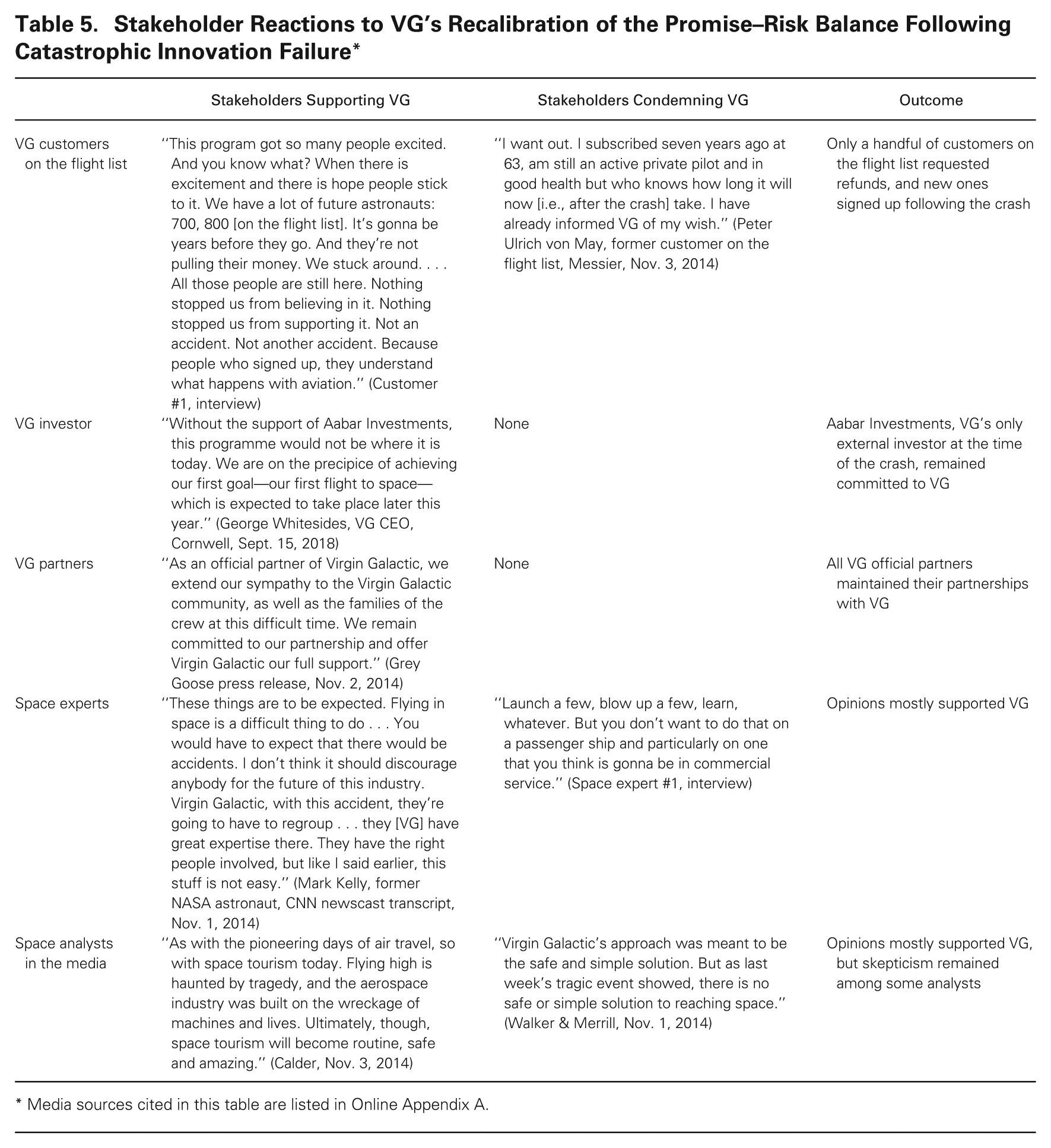
Media sources cited in this table are listed in Online Appendix A.
In an interview, a customer described how, following the crash, “A tiny number of people did decide not to proceed, but the vast majority . . . held in” (Customer #4). Attenborough stated in the media that, of over 700 people on the flight list, VG had lost only “a handful” (Culliford, April 12, 2019). Some people made a point of signing up after the crash. Branson noted, “We have had inquiries about purchasing Virgin Galactic tickets this week, including many new Future Astronauts either signing up or in the process of signing up to show solidarity with the team and the project” (Branson blog post, Nov. 6, 2014). Numerous customers made public their support. Some tweeted in the aftermath of the crash and throughout Unity’s development. Customer Ron Rosano, who flew on Unity’s fourth commercial mission, wrote, “I’m Moving Forward Together with Virgin Galactic and Scaled Composites. Get the badge and sport your support” (customer tweet, Nov. 4, 2014). He also started an outreach program, educating high school students about the future of space travel and the opportunities it presents to young generations. Others offered visible shows of support: Customer Gisli Gislason tattooed the VG “evolution of flight” logo on his arm and tweeted a photograph (customer tweet, Dec. 23, 2014). Aabar Investments, VG’s only investor outside of the Virgin Group at the time of the crash, maintained its stake in VG, as confirmed by Whitesides in a speech stating that VG’s “team and investors remain committed to the goal of opening space for all” (Boucher, Jan. 9, 2015). Likewise, VG alliance partners (such as Grey Goose, Land Rover, and The Sierra Nevada Corporation) and other members of the space community, such as NASA, publicly expressed their support. In an interview, a customer summarized the effects in these terms:
I remember the day when that happened [i.e., the crash], and [Branson] sent us all a video. He was crying . . . he said, we’ll overcome this. Just hang in there with us, kind of like the phoenix out of the ashes. And people stayed, customers stayed, employees stayed. It shows the dedication to the company. (Customer #1)
A former VG executive directly attributed the continued stakeholder support to the company’s efforts to recalibrate risk and promise. Describing VG’s work in the media to communicate its renewed ambition and commitment to safety, the executive said,
[The response to the crash in the media] was . . . neutral and it was all we could expect. . . . Of course, a devastating catastrophe happened, it was terrible to everybody. . . . But we were able to recruit people . . . we brought in amazing key pilots. So in that way, I think you can see that the credibility was restored and not negatively impacted. (Executive #2)
Reflecting on the crash in an interview, a customer echoed VG’s framing of failure as an inevitable part of space exploration: “Do you think the Wright brothers didn’t have a few crashes? I mean, look at NASA . . . look at Challenger. . . . Human loss is always a terrible thing. . . . But, in experimental aviation . . . [sometimes] somebody crashes, somebody dies” (Customer #1).
Notably, debates about whether VG could truly reach the boundary of space continued. For example, an analyst summarized,
[U]pgrades and additional safety mechanisms make Unity heavier but more robust than Enterprise. As a result, Unity will fly up to a maximum altitude of just above 80 km, while Enterprise was designed to fly above 100 km. . . . Unity will therefore not technically fly to space, though it will fly . . . where the curvature of the Earth is clearly visible. (Bennett, April 5, 2018)
More directly, another analyst told reporters, “If I were about to spend $250,000 on a Virgin Galactic ticket to space, I’d sure as hell want to go to ‘space’ [100 km]” (Tangermann, Dec. 13, 2018). VG, however, continued to promise its customers that they would reach space. One customer who would eventually fly on a Unity commercial mission noted in an interview that he was initially “disappointed” to hear the spaceflight would likely not reach 100 km altitude. “People were saying, ‘that doesn’t count’” (Customer #3). He noted that he and other customers spoke with scientists and educated themselves on the debate about where the boundary of space lies. After taking part in his VG mission, he stated, “Some people might not call it space. But we rode a rocket, we were weightless, we were in a vacuum where there is no air. . . . I think it’s a little petty to say ‘You weren’t really going to space’. . . . But if you want to be that particular, I can’t fight against that” (Customer #3).
VG’s recalibration of risk and promise after the crash supported the firm’s innovation journey. The program continued, and in 2018, when Unity reached a maximum altitude of 82.7 km above the Earth during its fourth powered test flight, Branson celebrated by stating, “Today, for the first time in history, a crewed spaceship built to carry private passengers reached space. . . . Today we showed that Virgin Galactic really can open space to change the world for good” (Foust, Dec. 13, 2018). In February 2019, the FAA awarded commercial astronaut wings to the two pilots, Mark “Forger” Stucky and Frederick “CJ” Sturckow. “Like the early days of aviation, these commercial space flights take grit and innovation—the very attributes it takes to blaze a trail for generations to follow. . . . It’s that grit and innovation we want to recognize,” said an FAA official (Dwyer, Dec. 13, 2018). Similarly, NASA, which had loaded a set of four microgravity experiments onto Unity, tweeted, “Congrats to @VirginGalactic on SpaceShipTwo successfully flying to suborbital space.”
Theorizing the Promise–Risk Balance
Considering our findings from Virgin Galactic’s crash, we propose a general framework for the recalibration of risk and promise following catastrophic innovation failure (see Figure 3). We summarize the nature of this construct over time in Table 6. We use the term “balance” to denote the relationship between the two calibrated elements of risk and promise that emerges through a firm’s internal design choices and external strategic framing. The presence of balance indicates that risk and promise are set in relation to each other and that they stand in generative tension, jointly supporting the firm’s innovation process. It does not imply that the two are equal in absolute terms.
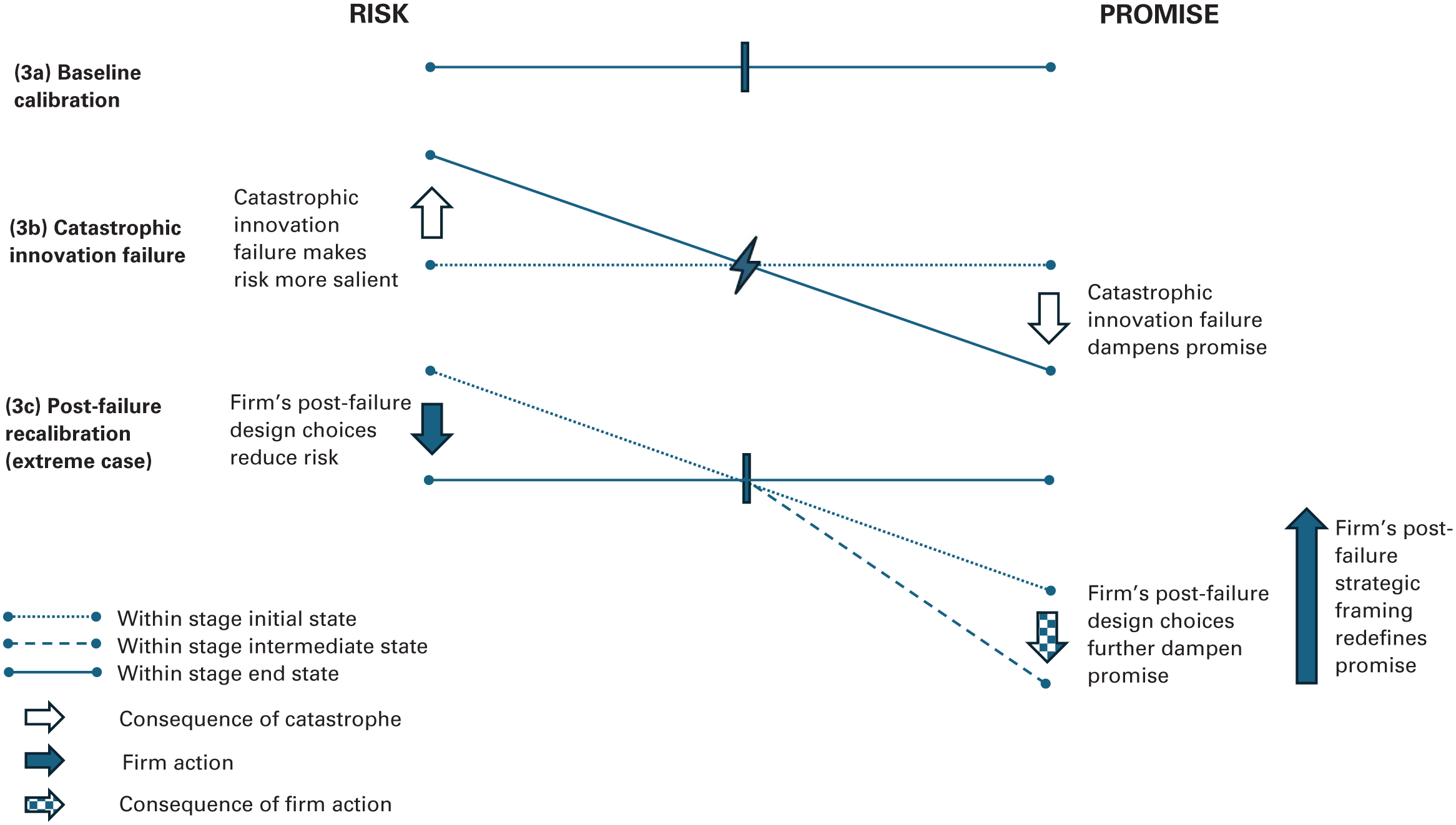
A Conceptual Framework of Recalibrating the Promise–Risk Balance
Recalibrating VG’s Promise–Risk Balance: Summary
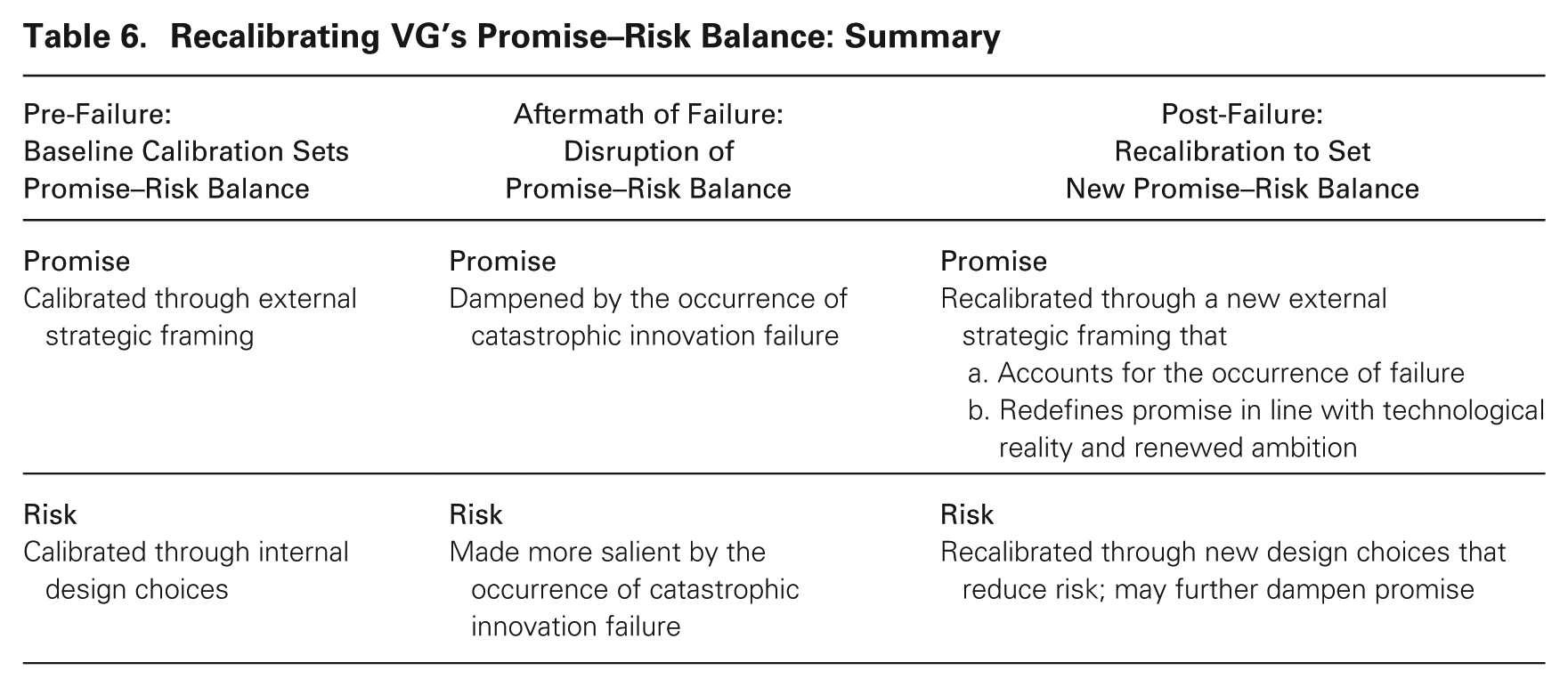
Baseline Calibration (3a)
Initially, a firm explicitly or implicitly selects a combination of internal design choices and external strategic framing that yields an initial promise–risk balance. Risk emerges from technical and design choices about the innovation and from the firm’s internal development philosophy. Promise emerges from the firm’s external framing about the worthiness of its innovation: how it portrays the experience, what grounds credibility, and what ambition it declares. Risk and promise are balanced when they yield a generative tension that supports the firm’s innovative efforts: They provide internal clarity and alignment in terms of how to address risk and foster external stakeholder support.
Catastrophic Innovation Failure (3b)
Catastrophic innovation failure can disrupt a firm’s initial promise–risk balance in two ways. First, failure makes the risks associated with the innovation salient to the firm and stakeholders. Some of these risks may, until then, have remained latent or unknown. Employees may come to understand that success is not certain. Development teams may also directly and viscerally observe the consequences that arise from design flaws or shortcomings. External stakeholders may question whether the innovation is feasible or whether the firm possesses the capabilities and know-how to complete the innovation. Second, the failure dampens the firm’s promise by rendering declared performance targets more remote and by casting doubt on prior bases of credibility. And seeing the high costs involved in catastrophic innovation failure (costs that may far exceed financial or programmatic considerations), stakeholders may also doubt the worthiness of the firm’s endeavor. The firm thus moves to an intermediate state characterized by heightened risk salience and dampened perceived promise.
Post-Failure Recalibration (3c)
To recalibrate both risk and promise, the firm can deploy two levers. First, the firm can make design choices that address the risks made salient by the catastrophic innovation failure. However, in some cases, those design choices may reduce the capabilities of the innovation, casting further doubt on the firm’s promise. The firm can address this by drawing on a second lever: strategic framing. By redefining the experience, shifting the basis of credibility, and re-anchoring ambition, the firm can raise the perceived worthiness of its endeavor. We propose that the two levers are jointly necessary for the firm to achieve a new promise–risk balance. Design-only responses may yield a safer but less compelling innovation, while framing-only responses risk a credibility gap if promise exceeds what design can plausibly deliver. By recognizing interdependencies and adjusting both, the firm can recalibrate toward a new promise–risk balance and continue on its innovation journey despite the setbacks caused by catastrophic innovation failure.
Discussion
We examined Virgin Galactic’s fatal 2014 test flight crash to theorize how firms can recalibrate their internal design choices and external framing in response to catastrophic innovation failure. We proposed that a firm’s internal design choices to diminish risk and its external strategic reframing to manage promise are interdependent, and they jointly shape the firm’s post-failure prospects. We introduced a new construct, the promise–risk balance, to signify the state in which the risk associated with the innovation’s development and the promise inherent to its realization stand in generative tension with each other and jointly support the innovation process.
As firms embark on a radical innovation journey, they calibrate risk through design choices that shape the innovation’s technical architecture and development (e.g., Perrow, 1984; Reason, 1990; Sitkin, 1992; Weick & Sutcliffe, 2001). In parallel, firms calibrate promise through strategic framing that conveys the innovation’s aims to stakeholders (e.g., Cornelissen & Werner, 2014; Falchetti et al., 2022; Navis & Glynn, 2011; Zott & Huy, 2007). We show how the promise–risk balance can be disrupted by catastrophic innovation failure and how it can be recalibrated. Stakeholders’ perceptions of the firm’s ability to deliver on its initial promise likely change (Chai et al., 2022), while the firm’s own understanding of the risks underlying its emergent technology become salient (Vaughan, 1990). We propose that the firm’s innovation effort needs to be both reframed externally and redesigned internally following catastrophic innovation failure. We find that internal redesign and external reframing are interdependent levers, mutually constraining choices whose feasible sets are shaped by the firm’s own pre-failure balance. Our findings have theoretical and practical implications for understanding innovation, failure, and strategic framing.
Implications for Innovation
Our findings suggest that when failure is unexpected, large-scale, costly, and public—and when it occurs during a firm’s non-routine research and development activities—post-failure innovation requires aligned internal and external action. Much of the innovation literature treats post-failure response as largely internal: The firm must diagnose what went wrong, learn, adjust designs and development, and keep moving forward (Edmondson, 2023; Haunschild & Sullivan, 2002; Madsen & Desai, 2010; Sitkin, 1992). But we show that internal design choices geared toward reducing risk may come at the expense of technical capabilities, unsettling the promise that anchored stakeholder support. At the same time, strategic framing efforts can set expectations that narrow the firm’s internal degrees of freedom and constrain its feasible design space (Karp & O’Mahony, 2025; Zuzul & Edmondson, 2017). Therefore, post-failure innovation requires aligning what is re-engineered with what is reframed. This perspective extends innovation research by theorizing strategic framing as a critical, rather than ancillary, part of post-failure innovation. We propose that, after catastrophic innovation failure, innovation entails not only identifying and remedying technical causes but also re-establishing a credible promise–risk balance that rebuilds meaning in line with revised capabilities (Garud et al., 2014; Rindova et al., 2009).
Our findings also have more-general implications for all innovating firms seeking to establish an initial promise–risk balance. In competitive (Camerer & Lovallo, 1999) or nascent (Zuzul & Tripsas, 2020) markets, innovative firms are often founded or led by overconfident (Busenitz & Barney, 1997) or visionary (e.g., Zuzul & Edmondson, 2017; Zuzul & Tripsas, 2020) founders whose optimism about the future may lead to ambitious—perhaps even seemingly arrogant—external promises (Dushnitsky, 2010; Gans, 2022). Internally, these leaders may expect and even welcome small failures as part of experimentation (e.g., Cannon & Edmondson, 2005; Sitkin, 1992), but they may underestimate the likelihood of catastrophic innovation failures. The result may be an initial promise–risk balance that emphasizes promise and downplays risk—a proposition that could be examined on a larger sample of firms.
Our analysis of VG’s evolution suggests that a firm’s initial, pre-failure promise–risk balance may shape both stakeholders’ reactions and the firm’s own external and internal responses to catastrophic innovation failure. We found that VG was able to maintain stakeholders’ support following catastrophic innovation failure, but only with extensive recalibration to both de-risk the technology and rebuild promise. This outcome may be partly explained by the firm’s early framing of ambitious promise, which resulted in an outsized stakeholder reaction to failure. Ambitious or overconfident pre-failure framing can raise the benchmark against which the failure and any post-failure redesign are judged, requiring more extensive reframing with a humbler tone to restore credibility. This extends Garud and colleagues’ (2014) and McDonald and Gao’s (2019) argument that stories and aims can create expectations that later become liabilities: Early promise that is over-calibrated may sustain momentum in the absence of setbacks but amplifies legitimacy challenges when a large public failure occurs. We propose that re-establishing the promise–risk balance in the aftermath of catastrophic innovation failure depends on the firm’s balance before the failure and is therefore neither formulaic nor deterministic. This finding extends research on innovation by adding an antecedent to an effective response to failure: A firm’s pre-failure promise–risk balance conditions what is needed and what is possible following failure. Research on a larger sample of firms could test this idea by examining whether firms’ pre-failure balances are associated with distinct stakeholder responses and effective responses.
Implications for Managing Failure
We also contribute to research on managing failure. This research has largely evolved through two separate streams: one examining internal responses to failure (including threat rigidity) and the other examining external responses to failure (or crisis more broadly). Threat-rigidity research predicts narrowing of attention, greater formalization, and a preference for known solutions following threatening events (D’Aveni & MacMillan, 1990; Shi et al., 2018; Shimizu, 2007; Staw et al., 1981). Internally, narrowing attention and tightening controls can be adaptive for diagnosing causes and preventing recurrence of failure (Haunschild & Sullivan, 2002; Park et al., 2023; Rerup, 2009). Indeed, we found that VG’s internal responses to failure were consistent with expectations from threat-rigidity research. At the same time, this internal narrowing had external consequences that are not typically considered by this research. We propose that the same design and governance changes that reduce risk can lower capabilities and unsettle previously articulated promises, inviting audience skepticism unless firms proactively reframe following failure. In short, the effects of a threat-rigidity response are not contained within the boundaries of the firm: They can alter the basis of stakeholders’ expectations and their relationship to the firm. Externally, VG responded not by narrowing but, rather, by broadening its frame (Raffaelli et al., 2025), extending its promise from being goal- and participant-centric to being pursuit- and planet-centric. Our findings therefore suggest that, following failure, firms may need to pair internal narrowing of design choices with external broadening of strategic framing.
This finding also contributes to our understanding of how firms respond externally to failure or crisis (Bundy & Pfarrer, 2015; Iqbal et al., 2024). Most empirical research in this area has focused on how firms frame the crisis event itself or its immediate causes (Chai et al., 2022; Elsbach, 1994; Williams et al., 2017), rather than examining how firms adapt both their internal responses and their external communications over time. By analyzing these two dimensions simultaneously and over an extended period, our study reveals dynamics that differ from what existing literature might predict. Research on crisis management suggests that organizations can overcome crises by accepting responsibility and by providing granular and transparent details about their internal adjustments (e.g., Bundy & Pfarrer, 2015; Iqbal et al., 2024; Lamin & Zaheer, 2012). Indeed, following the crash, VG could have developed a narrow framing that emphasized how its control over development and its technical improvements led to a safer spacecraft. Instead, VG did the opposite, broadening to develop a new, planet-centric framing. This suggests that, when catastrophic innovation failure may call into question a firm’s entire innovation journey, firms may need to move beyond the framing strategies explored in prior research toward a more expansive reframing that highlights their mission. In doing so, they can recontextualize failure as part of a larger, meaningful endeavor.
Implications for Strategic Framing
We advance research in strategic framing (e.g., Falchetti et al., 2022; Fiss & Zajac, 2006; Hargadon & Douglas, 2001; Kahl & Grodal, 2016) by decomposing promise into three components and proposing how firms can reframe each component after catastrophic innovation failure. VG’s pre- and post-crash framing of promise narrated the nature of the experience (participant-centric vs. planet-centric), the basis of credibility (technology/knowns vs. people/learning amid unknowns), and the firm’s ambition (goal-anchored vs. capability-consistent). Decomposing promise in this way clarifies the levers available to managers as they consider how to reframe in response to internal or external changes (Raffaelli et al., 2025). First, firms can reorient the nature of the experience they aim to offer stakeholders. That experience can fall on different spectra: from practical to aspirational, concrete to abstract, or local to global, to name a few. Second, the firm can reorient its basis of credibility, which establishes the firm’s ability to deliver on its promise in the eyes of stakeholders. The basis of credibility can point to different resources, knowledge, or capabilities, such as superior technology, proprietary processes or IP, or unique talent. Third, the firm can reorient its overall ambition, which sets the bar against which the firm wishes to be measured and assessed. Importantly, while we analytically distinguish these components, VG shifted all three during our period of analysis. Future research can examine whether and to what extent the components can be decoupled or adjusted independently as firms reframe their promises.
We note that taken together, these three dimensions aggregate into two broad ways of framing an innovative effort: framing around a goal that highlights a desired end result and framing around the pursuit by narrating the journey. Strategic frames centered around a goal vividly illustrate a future in which the innovation exists as a technical achievement and an economically successful product (Rindova & Martins, 2021). Frames centered around a pursuit narrate the vicissitudes of the innovation journey. These frames invite stakeholders to partake in the uncertain, innovative pursuit and to be a part of its developments and revelations.
This finding extends the distinction between outcome frames and process frames. In a study of the FBI’s evolution over 12 years following the 9/11 terrorist attacks on the United States, Raffaelli et al. (2025) theorized that leaders can build support for long-term change after an external catastrophic shock by sequencing the two types of frames: Goal-oriented framing galvanizes stakeholders toward rapid and dramatic shifts, while process-oriented framing sustains long-term change. Similarly, our findings suggest that frames centered around a pursuit can elicit lasting stakeholder support. Both typologies reflect a broader distinction of framing around ends versus means. Our findings further suggest the mechanisms through which framing around means generates stakeholder support: Emphasizing means can realign external expectations with internal capabilities, confer firms expanded degrees of freedom regarding the ends they pursue, and normalize uncertainty to help create tolerance for failure. The similarities between these findings despite their radically different contexts—an established government agency facing a dramatic environmental shock; an innovating firm experiencing catastrophic innovation failure—suggest the broader generalizability of this distinction. We see significant potential for future research to further probe whether, when, and why firms should frame around ends versus means.
We also note that VG’s reframing involved redefining promise in a way that implicated its industry, not just the firm. To anchor its ambition on its post-failure capabilities, VG shifted its definition of space from the Kármán line at 100 km to the FAA’s 80 km. In a nascent industry, in which there are few regulatory standards (Aldrich & Fiol, 1994; McDonald & Gao, 2019) or prior benchmarks indicating what constitutes success (Zuzul, 2019), firms can select among distinct definitions to find one that aligns with their capabilities (Granqvist et al., 2013; Santos & Eisenhardt, 2009). By shifting the reference point of what counts as space, VG may have helped to turn a post-failure constraint into a legitimate target. As a leading player in its industry, VG may have contributed to normalizing 80 km as a meaningful accomplishment. While examining this possibility is outside the scope of this study, we see potential for future research to explore how firms’ framings can shape the standards and benchmarks that emerge in nascent industries (Garud et al., 2002; Kahl & Grodal, 2016; Navis & Glynn, 2011).
Future Research Opportunities
Our findings provide opportunities for future research that further develops the relationship between internal design choices and external strategic framing, the promise–risk balance, and the process of responding to failure. In-depth, inductive qualitative case studies can provide rich description but are limited by reduced generalizability to other settings, which may be even more true in the context of idiosyncratic rare events such as catastrophic innovation failure. Our case was extreme by design. However, we believe that our findings can apply to firms in less-extreme settings: Many innovating firms and entrepreneurs implicitly establish a promise–risk balance. Failures or setbacks (even when not catastrophic) unsettle the balance and require some recalibration. Factors such as the nature of the failure (and its potential to threaten firm survival), the nature of the innovation (and its potential to expand the technological frontier), and the nature of the industry (from emergent, to rapidly developing, to mature or declining) may affect the way recalibration is performed.
We hope that future research will simultaneously examine firms’ internal and external responses to diverse changes, including technological shifts or other types of crises and disasters, to assess whether firms’ framing of promise and risk shifts in a similar manner and to evaluate the effects of these changes on performance or survival. Our study also reflects the challenge of studying failure via archival and interview data without the researchers being ethnographically embedded in the firm to capture the details of changes and actions following events. While ethnographic studies of an anticipated failure (particularly a catastrophic failure) may be difficult to plan, future research could examine in detail whether and how risk and promise are recalibrated after different types of changes, such as planned technological shifts.
There are also several promising avenues for future research to further develop the concept of the promise–risk balance. For example, researchers might explore how different initial promise–risk balances among entrepreneurial ventures shape distinct outcomes in the development of radical innovations. Do distinct audiences—for example, regulators versus investors—respond differently to the same promise–risk balance? If so, how can firms calibrate risk and promise in a way that appeals to their entire audience set? Does an optimal calibration depend on the balances set by other firms in the industry?
Future research may also explore the degree to which a promise–risk balance confers the robustness we theorize in this paper. For example, a longitudinal study observing multiple failures may reveal nuances that our case study of a single catastrophic event could not capture. How is the promise–risk balance recalibrated in the face of multiple failures? When does repeated failure begin to undermine stakeholders’ support and enthusiasm, and how can firms continue to maintain the balance? Alternatively, a comparison of firms with different promise–risk balances that experience similar failures might illustrate how such balances might offer more or less of a buffer against adverse stakeholder or market responses.
Conclusion
Our study of Virgin Galactic illuminates how firms recalibrate their internal design choices and external strategic framing in response to catastrophic innovation failure. We propose that after such failure, the promise–risk balance is disrupted, yet promise and risk can be jointly recalibrated to achieve a new balance that enables the organization to continue its innovative endeavor and attain its commercial goals. These insights contribute to deeper understanding of how firms not only recover and learn from failure but also reshape the meaning of their innovation efforts to sustain stakeholder support and continue their pursuit of radical change.
Supplemental Material
sj-pdf-1-asq-10.1177_00018392261446610 – Supplemental material for The Promise–Risk Balance: Recalibrating Design Choices and Strategic Framing Following Catastrophic Innovation Failure*
Supplemental material, sj-pdf-1-asq-10.1177_00018392261446610 for The Promise–Risk Balance: Recalibrating Design Choices and Strategic Framing Following Catastrophic Innovation Failure* by Sen Chai, Anil R. Doshi, Luciana Silvestri and Tiona Zuzul in Administrative Science Quarterly
Footnotes
Acknowledgements
We are grateful to our handling editor, Siobhan O’Mahony, and three anonymous reviewers for their stewardship and feedback throughout the writing of this work. We also thank attendees at the annual meeting of the Academy of Management, the Strategy Research Forum, and seminars at Harvard Business School, McGill University Desautels Faculty of Management, and the University of Michigan for helpful suggestions. We are especially indebted to Elizabeth Altman, Susan Cohen, Eliana Crosina, Cedric Gutierrez, Douglas Hannah, Becky Karp, Suntae Kim, Esther Leibel, Pinar Ozcan, and Mary Tripsas. This article has benefited from the generous research support provided by Harvard Business School, McGill University, and the UCL School of Management. We honor the life and memory of co-pilot Michael Alsbury, who lost his life during the test flight examined in this study.
Data Availability Statement
Our data collection drew on two main sources: publicly available archival materials and proprietary interviews with former VG employees, customers, and space experts. Details on the publicly available data sources are provided in the Methods section, with full references for quoted materials listed in Online Appendix 1; URLs are provided where appropriate. Interview transcripts cannot be shared beyond our research team due to IRB requirements, which seek to protect the anonymity of our informants.
1
In a powered test flight (or rocket-powered flight), the spacecraft fires its rocket engine after release, accelerating to very high, often supersonic speeds. The vehicle follows a rocket-powered ascent trajectory before re-entry and landing. Powered test flights help test the spacecraft’s performance in a high-risk environment characterized by extreme speeds, forces, and temperatures. They aid engineers in the detection of propulsion, thermal protection, or structural integrity issues, among others. In contrast, in an unpowered test flight (or glide test), the spacecraft is released from its carrier aircraft but does not ignite its rocket engine. It glides back to Earth using aerodynamic control alone. Unpowered test flights make it possible to test the spacecraft’s handling, stability, control systems, and landing performance in a lower-risk environment.
2
Due to copyright restrictions, we cannot show screenshots of VG’s website. The website shortly before the October 31, 2014, crash can be accessed here: https://web.archive.org/web/20141021020230/http://www.virgingalactic.com/. The website immediately after October 31, 2014 can be accessed here: https://web.archive.org/web/20141103004145/http://www.virgingalactic.com. The November 21, 2014 website can be assessed here: https://web.archive.org/web/20141121224807/
3
Given the relatively low number of test pilots and executives employed by VG at the time of the crash, we do not report on their precise roles or functions, to preserve informants’ anonymity.
4
The transonic region is the speed range between Mach 0.8 and 1.2, in which some airflow around the spacecraft may reach supersonic speeds while other parts remain subsonic, subjecting the vehicle to complex aerodynamic forces.
5
There was speculation about the altitude at which the Kármán line should sit. In 2018, an astronomer at the Harvard-Smithsonian Center for Astrophysics published a paper suggesting 80 km as a more accurate boundary of space (McDowell, 2018). The study prompted the Fédération Aéronautique Internationale, guardians of the definition of the Kármán line, to issue a statement suggesting a revision might be needed. As of this writing, the definition remains unchanged at 100 km altitude.
Authors’ Biographies
References
Supplementary Material
Please find the following supplemental material available below.
For Open Access articles published under a Creative Commons License, all supplemental material carries the same license as the article it is associated with.
For non-Open Access articles published, all supplemental material carries a non-exclusive license, and permission requests for re-use of supplemental material or any part of supplemental material shall be sent directly to the copyright owner as specified in the copyright notice associated with the article.
