






Abstract
This study examines how people change their relationship with work through the adoption and enactment of a new work ideal: a novel aspiration for what constitutes an optimal work life. Drawing on two years of ethnographic observation of the Financial Independence Retire Early (FIRE) community, two rounds of interviews with 55 informants, and analysis of archival materials, I identify four community tactics that informants used to promote a new “work optional” ideal rooted in financial freedom. I then show how the transformational capacity of this ideal hinged on individual perceptions of its appeal and attainability, which evolved via an interplay of group influence and individual sensemaking. Enactment of the new work ideal ranged from radical recalibration to marginal modification of working life. This study explains not only how people are persuaded to adopt a new ideal for work but also why that ideal varies in its transformative impact. I discuss the implications for research on the ideal worker norm, the meaning of work, and ideological conversion.
Keywords
What prompts people to adopt and enact a new ideal for work? This question bears particular relevance in the United States, where many white-collar workers struggle to uphold the “ideal worker norm,” a culturally valorized expectation that the best workers prioritize work above all else, maintain constant availability to their employers, and demonstrate unwavering commitment to their careers (Acker, 1990; Blair-Loy, 2003; Dumas & Sanchez-Burks, 2015; Reid, 2015; Williams, 2001). Increasingly, this norm includes not only the expectation that workers perform well but also that they love their work and make it central to their identity (Cech, 2021; Derfler-Rozin & Pitesa, 2020; Jachimowicz & Weisman, 2022; Kwon & Sonday, 2026; Tokumitsu, 2015). While compliance can bring professional reward (Cho & Jiang, 2022; Derfler-Rozin & Pitesa, 2020; Perlow, 1998; Reid, 2015), it often comes at a steep personal cost, prompting people to sacrifice health, relationships, and leisure to devote more time and energy to work (Heaphy & Trefalt, 2024; Michel, 2011; Schinoff et al., 2026; Schor, 2008). Against this backdrop of strain, the question of how people imagine and forge a new relationship with work takes on greater significance.
Although scholarship has long recognized that a person’s relationship with work can change, it has primarily focused on how people reinterpret the meaning of their job, career, or occupational identity (Ashforth & Kreiner, 1999; Carton, 2018; Jiang, 2021; Jiang & Wrzesniewski, 2023; Nelson & Irwin, 2014; Pratt et al., 2006; Schabram & Maitlis, 2017; Wrzesniewski & Dutton, 2001). This research illuminates how people reframe present work—often in response to challenges or changes—but offers less insight into how adults reimagine working life more fundamentally by questioning how work ought to fit within a life well lived. Understanding this process is increasingly important amid evidence that the social contract with work is fraying (Bidwell, 2013; Cappelli, 1999; Davis, 2016; Hacker, 2006; Kalleberg, 2011; Uchitelle, 2007). Changes in the employee–employer relationship, along with the Great Recession (2007–2009) and the COVID-19 pandemic (beginning in 2020), have exacerbated workers’ discontent (Cooper, 2014, p. 6; Leiter & Cooper, 2022), yet existing theory offers limited insight into how people transform their work lives. We do not fully understand, for example, what makes a new approach to working life imaginable and compelling or what enables some people to act on new visions for work, while others hesitate or remain wedded to old ones.
This study examines how people change their relationship with work not through role reinterpretation (e.g., Carton, 2018; Wrzesniewski & Dutton, 2001) or job redesign (Hackman & Oldham, 1976) but through the adoption and enactment of a new work ideal: a novel aspiration for what constitutes an optimal work life. Here, “work life” refers to the totality of a person’s relationship with the domain of labor, including its content, meaning, structure, and centrality. I ask, how are people persuaded to adopt a new work ideal, and why does individual enactment of that ideal vary? I explore this question inductively through a two-year ethnography of Financial Independence Retire Early (FIRE), an ideological community whose followers pursue “work optional” lives in which they are financially free from work. My theorizing draws on 141 hours of field observations and multiple interviews with 55 followers.
FIRE offers a compelling case study for two reasons. First, its followers collectively challenge dominant assumptions about the role of work in life, articulating and advocating a fundamentally different vision than the one they have been socialized to uphold. Against their own cultural conditioning, they have rejected and replaced the ideal worker norm with a new aspiration, which is a somewhat uncommon achievement. Understanding why and how they moved away from the ideal worker norm is worthy of study, particularly because this norm is often portrayed as “pervasive and powerful” (Kelly et al., 2010, p. 281). Second, although community followers converge around a common work ideal, they differ in how they enact it: Some radically restructure their work lives, while others make only modest or symbolic changes. This variation is puzzling; how is it that people socialized to uphold the same ideal enact it in such distinct ways? Exploring this variance can offer new insight into socialization and conversion (Greil & Rudy, 1984a; Van Maanen & Schein, 1979) by diagnosing why collectives do not always successfully inspire meaningful change among all their members. Studying this community thus reveals not only how people are persuaded to embrace a new work ideal but also why that ideal is not equally transformative.
By shifting focus from retrospective sensemaking of one’s current job and toward the generative work of imagining and striving for a better work life, my research opens up two new theoretical vistas. First, it highlights how work meaning is intertwined with broader beliefs about what it means to live well—beliefs that, when reimagined, can spur future-oriented constructions of a better work life that transcend specific tasks, roles, or careers. Second, this study foregrounds the role of community-level sensegiving in scaffolding those aspirations, showing how collective persuasion shapes not only what people desire from work but also what they come to believe is possible. In so doing, it deepens current understanding of how a person’s work life can evolve and why it may stagnate.
Work Devotion, the Ideal Worker Norm, and Contemporary Strain
Several decades of research suggest that workers in modern organizations face rising pressure to commit themselves fully to work. This trend is particularly true in the United States, where a work devotion schema (Blair-Loy, 2001, 2003) prevails. This cultural model is rooted in the seventeenth-century Protestant work ethic, which cast diligent labor as evidence of divine favor (Weber, 1930; Williams et al., 2013). The model took further shape in the mid-twentieth century, when postwar prosperity and the rise of large bureaucratic corporations cemented the ideal of the loyal, career-committed employee (Kanter, 1977; Whyte, 1956).
The work devotion schema provides the cultural underpinning of the ideal worker norm, the institutionalized expectation that good workers prioritize their jobs above all else and remain constantly available to employers’ needs (Acker, 1990; Reid, 2015; Williams, 2001). This norm often operates as a form of unobtrusive control, transforming work into a moral act and prompting people to define themselves by their deep investment in their jobs (Williams et al., 2016, p. 527). Workers under the influence of this norm will often choose to work long hours even when given the freedom to set their own schedules (Mazmanian et al., 2013; Michel, 2011; Perlow, 1998; Reid, 2015). They do this not only to avoid professional penalties (Heaphy & Trefalt, 2024; Padavic et al., 2020; Perlow, 1998; Reid, 2015) but also to assure themselves and others of their virtue.
In the past, many U.S. workers felt that sacrificing nonwork priorities was an acceptable exchange for the benefits they received from their employer. Whyte (1956, p. 129) noted that the guiding premise of the postwar employment relationship was to “[be] loyal to the company and the company will be loyal to you.” This exchange was tenable in part because the workforce was dominated by married men with wives who managed the unpaid labor of homemaking and caregiving (Acker, 1990; Hochschild & Machung, 1989; Williams, 2001). However, as more women entered the paid workforce in the latter half of the twentieth century, the invisible labor they performed had to be redistributed, outsourced, or compressed into evenings and weekends, often without a corresponding reduction in expectations at work (Goldin, 2006; Hochschild & Machung, 1989). This change made compliance with the ideal worker norm more difficult.
At the same time, the social contract with work has eroded such that worker loyalty no longer offers the same benefits. Over the past several decades, changes in the U.S. economy and labor practices have led to significant declines in long-term employment (Bidwell, 2013; Cappelli, 1999), job quality (Kalleberg, 2011), and financial security (Cooper, 2014; Hacker, 2006). Most employers may now terminate workers without notice, without reason, and with little regard for their past sacrifice (Hacker, 2006; Uchitelle, 2007). An increasingly common sentiment toward work is that “You can’t count on your employer . . . You can only count on yourself” (Cooper, 2014, p. 6). Modern workers are thus caught between a cultural ideal that demands complete devotion to work and an economic reality that offers diminishing returns on that investment.
Despite this growing tension, scholars have noted that within U.S. culture, the ideal worker remains “largely unchallenged as [a] cultural norm” (Davies & Frink, 2014, p. 34). While some workers attempt to resist it, their methods tend to be covert. For example, workers may limit unnecessary interaction with colleagues (Conzon & Huising, 2024), strategically select projects that are less time-consuming (Heaphy & Trefalt, 2024; Reid, 2015), or privately adopt flexible work arrangements (Lupu et al., 2022; Reid, 2015) to subvert the demands of the ideal worker norm without directly opposing it. Even when workers dare to make work less central (Heaphy & Trefalt, 2024) or question its merit altogether (Scruggs, 2024), their deviance often gains traction only through hidden, informal networks and is rarely sanctioned by formal workplace culture. The tendency toward covert resistance reflects both the professional risks of openly challenging the ideal worker norm (Padavic et al., 2020; Perlow, 1998; Reid, 2015) and its continued influence as a pervasive mechanism of control.
My study builds on this body of research by shifting focus from how workers navigate within the confines of the ideal worker norm to how they attempt to escape it altogether. It explores a nonwork context in which people openly criticize the basic tenets of the ideal worker norm and try to upend it with a new ideal that offers a fundamentally different relationship with work. It further examines the outcomes of orienting one’s life around this new ideal, investigating why some people successfully reshape their work lives in its image while others remain tethered to the status quo.
Sensemaking a New Work Life
This study is also informed by research on the meaning of work (Rosso et al., 2010), which has long shown that the way people think about work varies and shifts over time (Bellah et al., 2007; Brief & Nord, 1990; Budd, 2011; Dobrow, 2013; Schabram et al., 2023; Terkel, 1974; Wrzesniewski et al., 1997). Scholars in this domain frequently draw on the processes of sensemaking, sensegiving, and sensebreaking to explain how meaning is created, given, or destroyed (Gioia & Chittipeddi, 1991; Maitlis & Christianson, 2014; Pratt, 2000b; Weick, 1995; Wrzesniewski et al., 2003). Within this paradigm, action and interpretation are reciprocally related (Weick, 1988; Weick et al., 2005), a dynamic often referred to as enacted sensemaking (Schabram & Maitlis, 2017).
Building on this paradigm, my study explores how people make sense of and come to enact a new work life. Leslie and colleagues (2019) argued that people hold relatively stable ideologies about how work and life relate that are shaped by chronic contextual primes. Yet, it remains unclear whether and how these ideologies are reshaped or reimagined in adulthood. Research on the meaning of work has shown that a person’s interpretation of their work can shift in response to changes in tasks, titles, or occupational rhetoric (Ashforth & Kreiner, 1999; Fine, 1996; Grant et al., 2014; Pratt et al., 2006), pressing challenges (Jiang, 2021; Jiang & Wrzesniewski, 2023; Schabram & Maitlis, 2017), and/or social influence (Beer et al., 2022; Carton, 2018; Lips-Wiersma & Morris, 2009; Pratt & Hedden, 2023; Wrzesniewski et al., 2003), which may be relevant to how more-foundational beliefs about the role of work in life can change. Wrzesniewski (2002, p. 233), for example, found that the 9/11 terrorist attacks against the United States in 2001 spurred some people to re-examine their work lives and seek careers that were more prosocial. My study also explores how people introspect and act on emerging visions of future work, but it shifts the focus from individual sensemaking of a particular career path to the social construction of an optimal work life.
Several studies illuminate how social construction may facilitate new work lives. Pratt (2000a), for example, illustrated how one organization, Amway, used dream-building techniques to encourage distributors to develop new aspirational visions for themselves (e.g., owning a luxury car) that were connected to their sales goals. Like informants in my study, many Amway distributors dreamed of financial independence or being their own boss, and those dreams were circulated and popularized within the organization. However, that study emphasized how dreams were co-opted to sustain organizational identification and to extract labor for profit. This study, in contrast, examines how dream building facilitates ideological transformation and what happens when people attempt to live out their dreams.
Weisman’s (2021) study of career pivots also offers insight by showing how people enact radical, unconventional changes in their work lives. Her findings show that people construct self-narratives that help them to shift toward work they see as a calling, often despite loss of status, identity, or security. However, her study focused on the psychological rather than social dynamics that are involved in this process, and it only examines cases of people who had a calling and successfully pivoted toward it. Several questions remain unanswered: How do people come to want a radically different relationship with work in the first place? What social mechanisms help people feel that a previously unthinkable path is now possible or even preferable? And why are some people able to make radical changes in their work lives, while others remain stagnant? This study takes up these questions by exploring how one community disseminated a new ideal that reshaped what people wanted from work. Studying this process extends prior research by showing not only how people collectively envision a new work life but also why they sometimes fail to bring it to life.
Conversion Communities
A final area of literature that informs this study is research on socialization (Ashforth et al., 2007; Van Maanen & Schein, 1979) and conversion (Greil & Rudy, 1984a; Kilbourne & Richardson, 1989; Lofland & Stark, 1965). Since broader beliefs that shape work are culturally entrenched (Bellah et al., 2007; Boova et al., 2019; Brief & Nord, 1990; Budd, 2011; Weber, 1930), fundamental shifts in how a person relates to this domain may require not just individual introspection but socialization into new norms, values, and vocabularies. Literature on ideological conversion is particularly relevant to this case. Defined as “a radical reorganization of identity, meaning, and life” (Travisano, 1970, p. 600), conversion is understood as a particular type of socialization that is centered on self-change in religious or quasi-religious settings (Kilbourne & Richardson, 1989, p. 15; see also Long & Hadden, 1983; Snow & Machalek, 1984). Identity transformation organizations (ITOs; Greil & Rudy, 1984b) aim to bring about this kind of change and include not only religious movements (Hine, 1970), utopian societies (Kanter, 1968, 1972), and cults (Balch & Taylor, 1977) but also groups centered on fitness (Dawson, 2017) and recovery (Greil & Rudy, 1983). Much like the context of my study, these communities rely on collective practices to persuade people to abandon old ideals and lifestyles in favor of new ones.
As mentioned, one puzzle of my research stems from the observation that, despite being socialized to uphold the same ideal, informants varied in their enactment of it. To some degree, scholars have long observed that not all members of ITOs experience equally profound transformations (Snow & Machalek, 1984). For instance, Nock (1933, p. 6–7) and Shepherd (1979) contrasted “conversion,” defined as a complete and radical shift in worldview, with “adhesion,” a more superficial or partial incorporation of new beliefs (see also conversion versus alternation; Greil & Rudy, 1984a; Pilarzyk, 1978; Travisano, 1970, p. 598). Among other factors, the nature and degree of contact between members and nonmembers (Greil & Rudy, 1984a, 1984b; Lofland, 1977; Pratt, 2000a), as well as internal features of the group such as continuance (personal investment), cohesion (affective bonds), and control (disciplinary tactics) (Kanter, 1968, 1972), help to explain variance in commitment. However, these distinctions were traditionally used to compare and contrast across ITOs rather than to examine individual differences within the same group.
Understanding why people within the same community exposed to similar socialization practices might experience different degrees of transformation requires a closer look at within-group variation. One early effort in this direction comes from Lofland and Stark (1965), who distinguished verbal and total converts in a millenarian cult. Verbal converts “professed belief” but differed from total converts, who “exhibited their commitment through deeds as well as words” (p. 864; see also psychological versus structural conversion, Austin, 1977 and different forms of identity conversion, Gordon, 1974). The authors found that depth of conversion was linked to the intensity of social contact and that co-residence with other members inspired more profound transformation. While this research introduced the possibility of internal variation, it assumes a fairly encapsulated group context (Greil & Rudy, 1984b; Pratt, 2000a) and cannot explain within-group variance in my research setting, in which members do not cohabitate and are best described as loosely affiliated acquaintances.
Pratt’s (2000a) research on Amway distributors again provides a helpful point of departure; although he did not study ideological conversion per se, he documented how people exposed to the same socialization processes came to identify with the organization in different ways (positively, negatively, or ambivalently). These differences were shaped by the success or failure of organizational sensebreaking and sensegiving efforts, as well as differences in individual sensemaking with members, nonmembers, or both. My study builds on this insight but shifts the focus from variation in identification to variation in conversion and enactment trajectories. Rather than exploring discrete categories of organizational identification, I trace how people move along a continuum of enactment, sometimes deepening their commitment to a new work ideal and sometimes retreating from it. Many of the dynamics I identify, including disillusionment with the status quo (Hoffer, 2011; Lofland & Stark, 1965), dream building (Pratt, 2000b), and experimental action (Kanter, 1972), have deep roots in extant literature. What is new here is an explanation of how these elements interact with individual sensemaking to instill two key perceptions that enable transformation, and of what unfolds when they fall short.
Method
Research Approach and Context
This study is based on a two-year ethnographic investigation of Financial Independence Retire Early, an ideological community that advocates financial freedom from work. Followers realize this goal by reducing living costs, maximizing earnings, and investing in passive income sources like index funds and real estate. As I explain in my findings section, followers primarily seek greater choice over how to spend their time. Their plans for what they will do after they reach FI vary: Some desire an early retirement and a life of leisure; some aim to shift careers or pursue other endeavors currently deemed too risky or low paying; and some intend to remain in their current job but enjoy a greater sense of security or flexibility.
Although FIRE lacks a formal hierarchy, early adopters and evangelizers serve as informal leaders. Followers vary widely in their involvement, ranging from passively lurking in online forums to actively participating in events and content creation. FIRE’s origin traces back to the 1990s when the book Your Money or Your Life (Dominguez & Robin, 1992) was first published, which established both a philosophy for work and a financial strategy that became popular in online forums. It was further galvanized by the Great Recession (2007–2009), which made economic insecurity more salient. The effects of this downturn were particularly acute in the United States, where high household debt (Mian & Sufi, 2015), limited social protections (Hacker, 2006), and broad exposure to housing and credit markets (Gorton & Metrick, 2012) left people especially vulnerable to financial hardship. Although followers of FIRE reside primarily in the United States, it is part of a broader financial self-help movement that has increasing global appeal (Fridman, 2016).
Interest in FIRE has grown significantly in recent years. Global subscriptions to its most popular online forum grew from around 550,000 in February 2019 to over 2.3 million by June 2025. Most followers are college-educated working professionals. Although 32 percent of interviewees reported growing up lower or lower-middle class, as adults nearly all belonged to the middle or upper class. Ninety-four percent of informants had at least a four-year college degree, 93 percent were White, and their median household income was between $90,000 and $99,000 USD. 1 Informants therefore represent a relatively privileged sector of society, though they would not be considered members of the 1 percent or billionaire class. Table 1 offers further demographic information.
Summary of Sample •
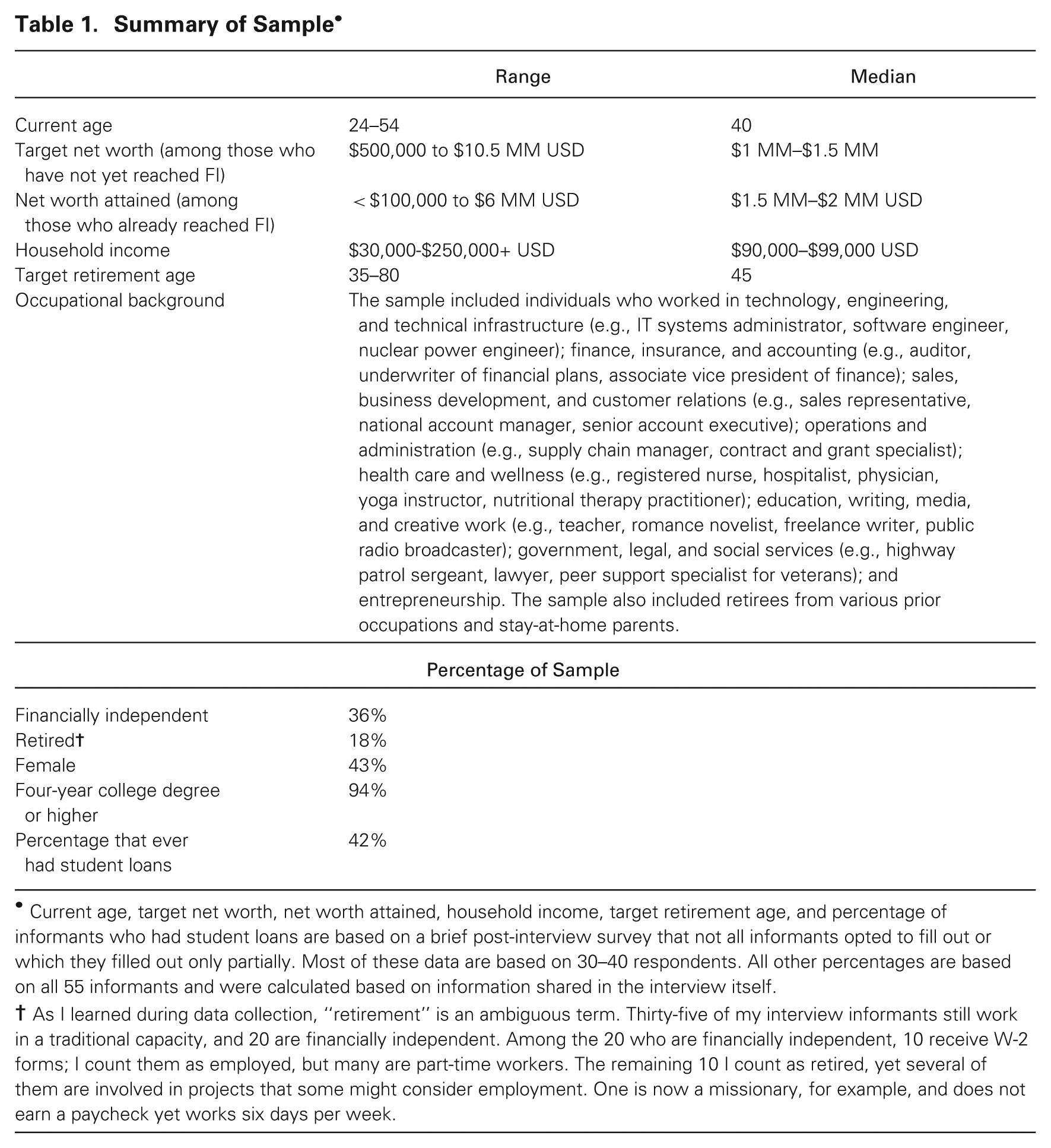
Current age, target net worth, net worth attained, household income, target retirement age, and percentage of informants who had student loans are based on a brief post-interview survey that not all informants opted to fill out or which they filled out only partially. Most of these data are based on 30–40 respondents. All other percentages are based on all 55 informants and were calculated based on information shared in the interview itself.
As I learned during data collection, “retirement” is an ambiguous term. Thirty-five of my interview informants still work in a traditional capacity, and 20 are financially independent. Among the 20 who are financially independent, 10 receive W-2 forms; I count them as employed, but many are part-time workers. The remaining 10 I count as retired, yet several of them are involved in projects that some might consider employment. One is now a missionary, for example, and does not earn a paycheck yet works six days per week.
Sampling
I initially engaged in purposeful sampling (Patton, 2005), recruiting anyone who self-identified as a FIRE follower. At public FIRE events and in online forums, I introduced myself as a researcher and provided information about how to sign up to be interviewed. Initial informants varied considerably in their circumstances. Some were still in debt and had just learned of FIRE, while others were retired millionaires. During the first wave of data collection, I gradually shifted to theoretical sampling (Corbin & Strauss, 2015; Eisenhardt, 1989), selecting new informants based on emerging theory, including their post-FI plans and level of frugality.
Data Sources
I collected data from three sources. The first source was 141 hours of non-participant observation, conducted in multiple settings. I attended a monthly meet-up group (MonthlyFI) for 24 months starting in April 2019. MonthlyFI was based in a midsized Midwestern city and comprised approximately 30 members, who had discovered the group primarily through word of mouth. Members gathered in coffeehouses, parks, and followers’ homes to discuss topics related to financial independence. Additionally, I attended several one-time events, including a documentary screening, webinars, and FIRE Camps—multi-day retreats with talks, breakout sessions, and socializing that involved 55 to 85 attendees. Throughout my fieldwork, I took detailed notes during or immediately after observations. Although informants were aware of my role as an outsider and researcher, I engaged in commitment acts (Feldman et al., 2003, p. 36) to build trust and establish rapport. For example, I carpooled with informants, participated in group activities, and joined group meals.
The second data source was interviews. I conducted a first round of semi-structured interviews with 55 FIRE followers between March 2019 and October 2020. Each interview took place either in person or via videoconference and lasted 60 minutes on average. Of these informants, 35 were pursuing FI, while 20 had already achieved it. I asked questions about their views on money, life, and work (see Online Appendix A for the interview protocol). At the end of the interview, informants completed a brief survey detailing their net worth, background, and savings goals. I anonymized all data. Most initial interviews occurred before the onset of the 2020 COVID-19 pandemic, so between October 2020 and March 2021, I invited all informants for follow-up interviews to explore whether the pandemic or the brief 2020 stock market crash had affected their views on money and work. I also asked them to share any changes in their perspectives or circumstances since we had last spoken. Forty-two informants (76 percent) agreed to a second interview, which lasted, on average, 46 minutes (see Online Appendix B for the protocol). These second-round interviews were crucial for understanding shifts in enactment patterns, as I explain in my findings section.
Lastly, I analyzed foundational texts and archival data to supplement my primary sources and to develop a more nuanced view of the community. Many informants had discovered FIRE online or through mass media. I studied materials that informants mentioned frequently, which included three books, three podcasts, a blog, and an online forum. I also reviewed online news articles and blog posts that were critical of FIRE, to better understand the social disapproval that informants reported and why a person might grow disillusioned with a new work ideal or the community that endorses it. See Table 2 for a summary of collected data.
Summary of Data Collection
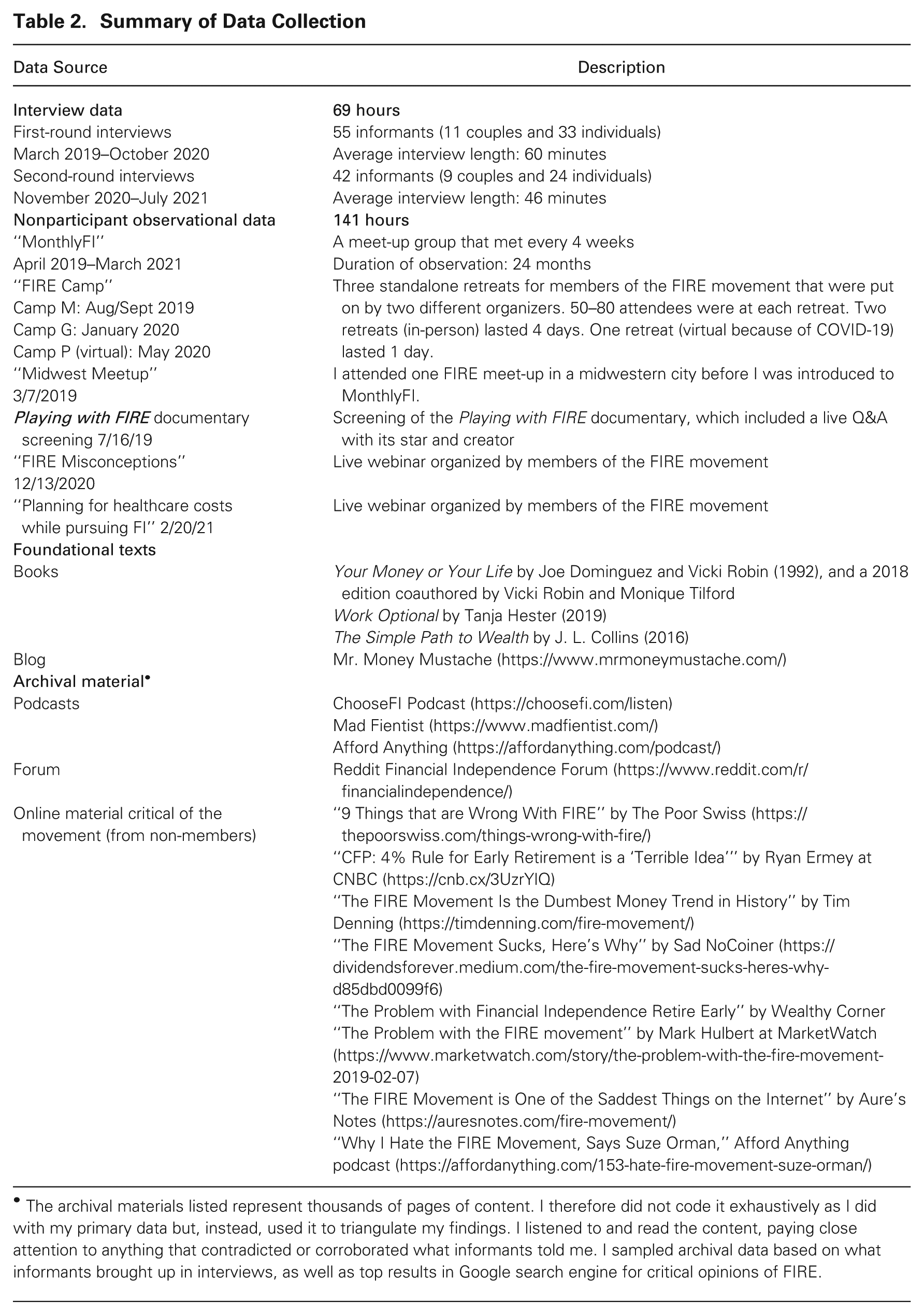
The archival materials listed represent thousands of pages of content. I therefore did not code it exhaustively as I did with my primary data but, instead, used it to triangulate my findings. I listened to and read the content, paying close attention to anything that contradicted or corroborated what informants told me. I sampled archival data based on what informants brought up in interviews, as well as top results in Google search engine for critical opinions of FIRE.
Data Analysis
I analyzed my data using an inductive, constructivist grounded theory approach (Charmaz, 2014). The goal of my analysis was to develop a theoretical model that was anchored in the data yet could also deepen understanding of similar processes in other settings (Feldman, 1994, p. 2). Data collection and analysis occurred simultaneously; I iterated between extant literature and the data to develop new theoretical insights.
Two observations significantly shaped the trajectory of my analysis. The first was the realization that informants consistently articulated the same ideal for work regardless of their background and their future life plans. I was struck by the consistency of their language when describing the overarching relationship they sought with work (i.e., “work optional”) and why it was worthwhile; a common refrain in the field was, “You can always get more money, but you can never buy more time.” This uniformity suggested that some degree of socialization had taken place, and I immersed myself in observational data and foundational texts to understand the specific indoctrination informants had received that persuaded them to adopt this new ideal, which seemed so contrary to the ideal worker norm. The second observation that shaped the trajectory of my analysis was that, despite adopting a common ideal for work, informants exhibited significant variation in how they lived out that ideal. In particular, I noted that the extent to which this ideal transformed informants’ work lives varied substantially. Some informants drastically altered their career trajectories after becoming involved with FIRE, while others remained in the same roles and maintained nearly identical lifestyles to those they had before joining. Thus, the second puzzle I sought to understand was variance in individual sensemaking that resulted in diverse enactments of the shared work ideal.
I employed several common inductive analysis techniques to understand these observations. Throughout the life of the project, I engaged in memo-writing to identify and probe tentative lines of inquiry (Charmaz, 2014). I regularly shared my memos with colleagues to ask for their perspective and to maintain theoretical openness while I was in the field. I also carefully coded my observational and interview data in batches while I was still in the field. I did initial coding (Charmaz, 2014), during which I coded small thought units ranging from a few words to a paragraph (Locke, 2001; Pratt, 2023). During this stage of coding, I remained close to the original text and the in vivo wording of my informants. Some examples of initial codes include “FatFIRE,”“checking net worth weekly,” and “questioning everything.” As I began to identify patterns in the data, I transitioned to focused coding (Charmaz, 2014), in which I moved forward with initial codes that held the most potential for new theoretical insights, i.e., those that could help explain the two previously mentioned observations or which otherwise related to sources of surprise and variance in the data. I abandoned codes that simply reaffirmed past research findings, did not suggest or explain any meaningful variance, or dealt with a process that was too far removed from my interests as an organizational scholar. I coded the data several times, merging, splitting, and dropping codes as I made sense of it (Grodal et al., 2021). I then began to develop abstracted codes that had broader transferability. Examples of the resulting codes include “anti-work rhetoric” and “radical recalibration.”
During one part of my data analysis, I adopted a narrative approach (Baumeister & Newman, 1994; Bruner, 1987) so that I could better understand differences in enactment of the FIRE ideal. This approach is particularly useful for understanding how people make sense of personal experiences (Baumeister & Newman, 1994; Boudens, 2005). During this phase, I analyzed the narrative arc of each interview informant, the story they told me about their FIRE journey, and how it evolved between the first and second round of interviewing. I noted where their story began, key turning points, emotional tone, hardships, career plans, ongoing challenges, and self-reported change, and then compared it with those of other informants. I paid close attention to how much informants changed (or planned to change) their work lives. Their changes ranged from radical to modest. I identified two individual perceptions that seemed to account for these differences. Lastly, I examined evidence of people shifting along the enactment continuum at the time of their second interview or within their retrospective accounts of their FIRE journey, which helped to verify the mechanisms that move a person toward or away from radical enactment.
Toward the end of my analysis, I sought to merge the different pieces of my model into a unified explanation of both the group processes that prompt different people to adopt the same ideal for work and the distinct individual sensemaking dynamics that lead to different enactments of that ideal. I noted several reciprocal relationships within my data in which individual perceptions and group-level tactics were mutually enhancing. I used a software program (NVivo), spreadsheets, and diagrams (Draw.io) to help me visualize how the data fit together. I collected data until I had a model that adequately explained how a new work ideal was adopted and variably enacted in the FIRE community and which further data failed to improve (see theoretical saturation, Glaser and Strauss, [1967] 2009). I engaged in member-checking with several members of MonthlyFI to verify my understanding of the data (Lincoln & Guba, 1985). My analysis eventually yielded a model that was accurate to my context yet also informative of other group settings in which people adopt and enact a new ideal for work.
Findings
My data indicate that ideological communities like FIRE can meaningfully reshape how people relate to work by promoting a new ideal that reorients personal priorities. Yet, individual transformation is not guaranteed. As I will show, FIRE inspired some informants to dramatically reconfigure their working lives, while others remained relatively unchanged. Community sensebreaking and sensegiving tactics aimed to bring about radical transformation; I first present the tactics in their most effective form: how they functioned when they operated as intended. I then examine variation in enactment, showing how differences in sensemaking and personal circumstances help to explain why community tactics do not always produce their intended effects. Together, these findings shed light on what drives the adoption of a new work ideal and why that ideal is not universally transformative. Supporting data come from field observations (O), foundational texts (FT), interviews (I), and archival materials (A).
A New Work Ideal: “Work Optional”
FIRE was organized around a new work ideal—a novel aspiration of what constitutes an optimal work life. This ideal was not a work orientation or professional goal; rather, it was a future-oriented vision of how work ought to fit into the broader context of life. It was normative and forward-looking but untethered to a particular occupation or industry. However, because the ideal was infused with prescriptive ideas about how to live well, it had the capacity to alter the content, centrality, structure, and meaning of the work that informants pursued. As I observed it, the new work ideal resided at both the collective level and the individual level; it was evangelized and reinforced by the FIRE community, but it was also internalized and variably enacted by individual informants.
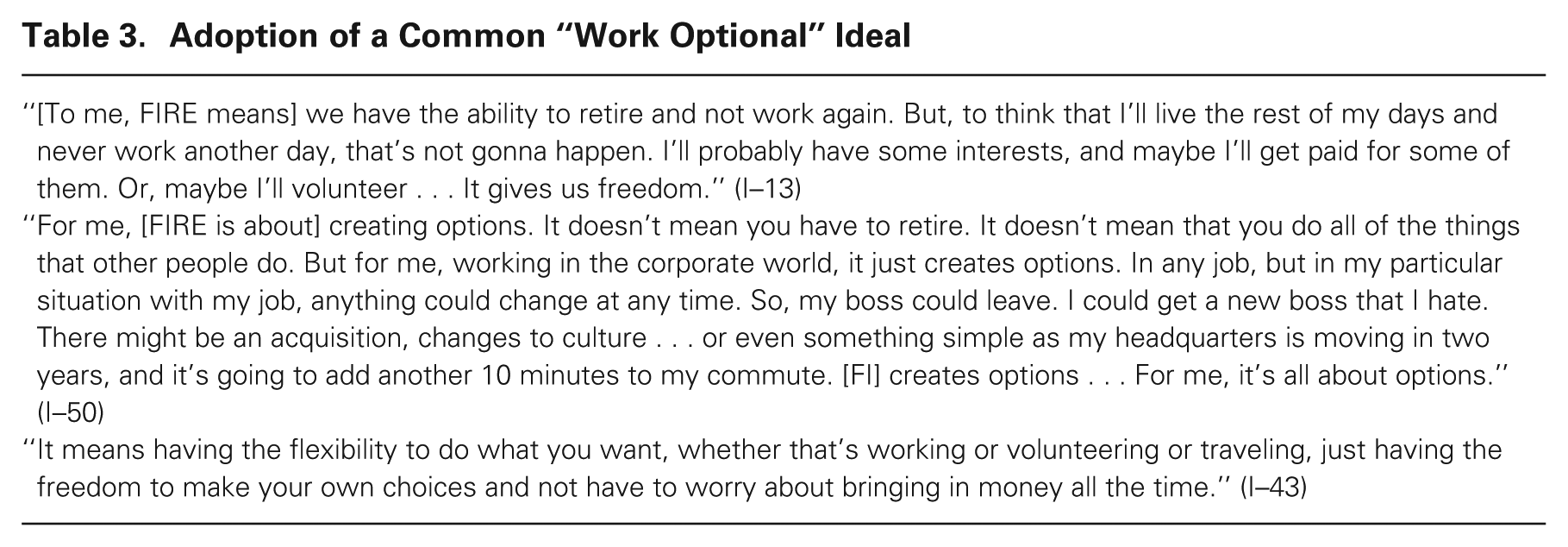
Community followers referred to this new work ideal as “work optional” (popularized by Hester, 2019), “FI” (shorthand for financial independence), or “time freedom.” Though it went by several names, the core principle remained the same: The ideal relationship to work was one in which work was a choice rather than a financial necessity. This ideal was vividly described in foundational texts: “[Work optional is about] reclaiming your life from our nonstop work culture so that you decide what role work will play in your life, instead of society deciding for you” (FT–Hester, 2019, p. xv–xvi). Other FIRE authors defined it as being “free to work for fun, for giving back . . . [or] whatever you choose . . . It’s about the choice of where you direct your most precious resources: Your time, your attention, and your life” (FT–Robin and Dominguez, 2018, p. 274). Informants’ language reflected a shared understanding of this ideal: “Financial independence is having the option to work or not” (I–3a 2 ); “To me, [FIRE] means I can choose to work . . . I [can] choose what I want to do with my time . . . It’s really just about not having that reliance on a paycheck [where] somebody else gets to decide [for me]” (I–4a) (see additional quotes in Table 3). As these quotes illustrate, the work optional ideal directly challenged the ideal worker norm by encouraging people to regain control over time that had been surrendered to organizational demands: “Our current environment towards work is so focused on putting in hours and hours and hours. That’s not necessarily the best life that people might choose to live, but they don’t feel [like] they have a choice a lot of times, or don’t even think about it because that’s just what everyone does” (I–11a).
Adoption of a Common “Work Optional” Ideal
FIRE sought to not only convince followers of the merit of the work optional ideal but also to transform how they structured and understood their work lives. Whether the community inspired significant change depended on how successfully it cultivated two key perceptions: appeal and attainability. Without sufficient appeal, the new work ideal lacked emotional traction. Without a sense of attainability, it was regarded as little more than wishful thinking. As such, community persuasion tactics aimed to enhance these perceptions in tandem.
Community Tactics to Enhance the Perceived Appeal of the New Work Ideal
Cultivation of an anti-work rhetoric: “Slave to a paycheck.”
One way in which FIRE enhanced the appeal of the new ideal was via the cultivation of an anti-work rhetoric: sensebreaking language that portrayed the standard work relationship as violating. Notably, FIRE was not against all work, but it decried economically coerced work. Foundational texts used hyperbole to frame reliance on a paycheck as a form of enslavement: “Those who live paycheck to paycheck are slaves. Those who carry debt are slaves with even stouter shackles. Don’t think for a moment that their masters aren’t aware of it” (FT–Collins, 2016, p. 32).
This rhetoric was also employed at in-person gatherings through dramatized testimonials, where followers recounted their journeys toward FI in terms of liberating themselves from the bondage of financial dependence. One speaker at FIRE Camp M, for example, recalled a family vacation cut short by work obligations. He explained how, every year, his family would visit a fishmonger on the last day of their trip. One year, as they were enjoying that final meal of vacation—steamed shrimp—his kids begged him to let them stay longer. He refused because he needed to return to work. With tears in his eyes, he told the audience,
The food tasted so good, and we were having such a good time . . . [On the way home,] I looked in the rearview mirror at my kids in the backseat of our minivan and saw them resigned to their fate. I felt small. I was not free. I had to find a way out. I drove white-knuckled back [home] . . . [On that day,] I promised myself that I would never have to ask permission from work to spend time with my family again. Instead, I was going to ask my family for permission to spend time with other people. (O–Field notes FIRE Camp M, Day 3)
Several attendees, moved by the familiar and regrettable experience of sacrificing time with family for the sake of work, had tears streaming down their faces at the conclusion of the talk.
The community’s anti-work rhetoric and individual work disillusionment were reciprocal and mutually reinforcing. For some informants, disillusionment with work predated their involvement in FIRE and contributed to their desire to join:
I graduated in 2010 . . . It was an awful economy, jobs were tough, and I was in and out of contract work for about three and a half years . . . During that time period, I was feeling vulnerable, and just a victim [of] the job market . . . I didn’t know where my next paycheck was going to come from, didn’t know where I was going to be living, could I afford rent, could I afford a car payment if I needed a new car? . . . [I had] no benefits, no health insurance, no 401k matches, no HSA matches. (I–29a)
In such cases, the anti-work rhetoric held immediate resonance, and when informants shared their own experiences of work disillusionment with other followers, it reinforced that rhetoric, offering new fodder for the shared claim that financial dependence on work was problematic. In other cases, informants did not initially harbor strong work disillusionment but developed it after joining the community. One community member noted, “[After finding FIRE] I suddenly started to dread going into the office and sitting under those fluorescent lights—something that never bothered me before” (A–“Why we ditched the FIRE movement”). Another shared, “If I didn’t know about FIRE, my job would be more enjoyable . . . The more that I got immersed, [the more] I was like, ‘this sucks’” (I–49b). These quotes suggest that the community’s anti-work rhetoric not only reinforced pre-existing work disillusionment but also stoked it among individuals who were not previously aggrieved. It convinced followers that changing their relationship with work was necessary and urgent to forgo further violation:
I really hated the idea that somebody else controlled 10 hours of my day to the point where I really saw it as a form of indentured servitude or slavery. I just really did not like [the idea that] somebody else has that kind of power over me. [I realized that] I’ve only got one life to live. I need to make the most of it. (I–51a)
While the “slave to a paycheck” rhetoric likely seemed overblown or historically insensitive to outsiders, its function within FIRE was to problematize the status quo and to stoke disillusionment.
Directed dream building: “Why for FI.”
A second group tactic that enhanced the appeal of the new work ideal was dream building (Pratt, 2000b). Community leaders directed followers to imagine what their lives might look like if they no longer needed to work for money, an activity sometimes referred to as stating their “why for FI” (see also Barrett & Mendonsa, 2017):
Today one of the facilitators led a group breakout session called “Life after FI.” . . . He asked each participant to share their “why for FI”: their motivation for reaching FI, which generally involves a career or lifestyle change that a person feels they cannot make until they have greater financial security. The first woman to speak said that once she reaches FI and leaves her current job, she wants to use her background in genetics to help police departments solve cold cases. Another woman, a pharmacist, recently left her job to pursue a career in standup comedy. A photographer shared her dream of traveling full-time with her husband. A man who works for a CPG company shared that he wants to become a full-time community organizer. (O–Field notes FIRE Camp M Day 3)
Facilitators acted like life coaches, pushing followers to be ambitious in their aspirations. One speaker at FIRE Camp G said, “If your dreams aren’t scaring the heck out of you, you aren’t dreaming big enough” (O–Field notes FIRE Camp G Day 3).
For some informants, participation in FIRE helped them to surface and articulate long-standing dreams they already held. One informant at FIRE Camp G, for example, noted, “I always knew I wanted to deliver babies” even though she worked in the Navy. Her FIRE journey thus became oriented toward reaching FI and becoming a doula. In other cases, however, informants had never considered the possibility of not working or being able to switch careers: “Before [joining FIRE], there was no concept in my head of a day before 65 or 70 where you’re not working, where a job isn’t part of your life. I just had never even considered it” (I–9a). For these informants, dream building offered a means of constructing a new vision for themselves from the ground up. One informant noted, “As we learn others’ stories, our circle of what is possible for our own lives expands” (O–Field notes FIRE Camp G Day 3).
Dream building promoted aspirational longing: the desire for a future that was meaningfully different from the present. While individual work disillusionment (stoked by the anti-work rhetoric) provided the emotional push toward the new work ideal, aspirational longing supplied the emotional pull. 3 Longing was most intense among informants who had developed a vision of the future that was both specific and distinct from their present. Informants who found the new work ideal most compelling, for example, included a sales operations manager who dreamed of volunteering with a wildfire rescue nonprofit and an auditor who aspired to become a teacher. These possible selves (Markus & Nurius, 1986) had been overlooked or dismissed in the past because they did not offer the financial stability that informants believed they needed. Releasing themselves from the assumption that they would always rely on a paycheck allowed informants to imagine new possibilities that deepened their commitment to the new work ideal by revealing its potential to improve their lives. Specifically, dream building helped informants to construct a vision of a life in which meaningfulness, rather than money, would be the central driver behind their life choices.
Community Tactics to Enhance the Perceived Attainability of the New Work Ideal
Evangelization of a new financial strategy: The “simple math of early retirement.”
FIRE aimed to enhance not only the appeal of the new work ideal but also its perceived attainability. One way it did this was by evangelizing a new financial strategy. The aim of evangelizing a new financial strategy was to promote material feasibility: the individual perception that a new work ideal could be realistically achieved given one’s resources, circumstances, and constraints.
The new financial strategy that was promoted by FIRE centered on personal finance and the “shockingly simple math behind early retirement” (FT, Adeney, 2012). Followers were told to front-load their savings at the beginning of their career and to invest in low-cost index funds or exchange-traded funds 4 to maximize compound interest: “As soon as you start saving and investing your money, it starts earning money all by itself. Then the earnings on those earnings start earning their own money. It can quickly become a runaway exponential snowball of income” (FT–Mr. Money Mustache Blog, Adeney, 2012). Unlike mainstream advice that encourages workers to save 15–20 percent of their income over a lifetime (Young, 2025), FIRE endorsed a much higher savings rate: “Increase your savings rate . . . to 20, 30, 40, 50 percent. We know people that are saving 85 percent of their paychecks” (A–Barrett & Mendonsa, 2017). To achieve this level of savings, followers were instructed to live below their means: “[B]uy only what you can prudently afford . . . avoid debt unless you have an assurance that you will be able to repay it promptly, and always have something put away for a rainy day” (FT–Robin & Dominguez, 2018, p. 172). Community leaders emphasized the importance of limiting material desires: “To have a good and meaningful life, you need to overcome your insatiability . . . learn to want the things you already have, rather than wanting other things” (FT–Adeney, 2011). Followers were encouraged to track “every cent that comes into or goes out of your life” (FT–Robin & Dominguez, 2018, p. 70–71) and to adhere to a disciplined budget.
By saving and investing early, followers benefited from a longer period of compounding interest, which enabled them to reach FI and retirement sooner: “Forget a 40-year work career. If you can save 50 percent of your income, your path to FI charts itself in 10 to 15 years” (A–Barrett & Mendonsa, 2018). While mainstream society viewed working years and financial needs as somewhat indeterminate, FIRE posited that they were finite, calculable, and dependent on the 4 percent rule. This rule of thumb was based on a seminal study on retirement savings (Bengen, 1994) that found that 4 percent was a safe withdrawal rate to avoid outliving one’s investments. 5 According to this rule, someone who is comfortable living on no more than $80,000 per year in retirement, for example, would need to accumulate two million dollars of invested savings. The 4 percent rule provided clarity on how much money was enough to live on, which prevented informants from embarking on an interminable quest for more money. It also gave the impression that anyone could reach FI, since it framed early retirement as a function of annual spending rather than earnings, which was viewed as more controllable: “You almost get to choose the price of how much it costs for your freedom” (I–23a). Once an informant reached their “FI number,” 6 they were considered financially independent, and the work optional ideal was realized. 7
Crucially, the resonance of this strategy hinged on informants’ identification of a relatable exemplar: someone like them (i.e., similar in age, occupation, number of kids, lifestyle, risk tolerance, etc.) who had followed the strategy and experienced success. Online content and in-person testimonials frequently emphasized that anyone—or nearly anyone—could reach FI if they set their mind to it. FIRE retreats, for instance, showcased people who had reached FI or accomplished notable financial milestones despite challenges. For example, at FIRE Camp M, one man described having paid off thousands of dollars in student loan debt in just two-and-a-half years. In a webinar on “Myths about FIRE,” the hosts asserted that the strategy “isn’t just for privileged people” and then shared the story of a couple who went bankrupt at age 50 but still retired within ten years by following the FIRE strategy.
Relatable exemplars enhanced perceptions of attainability by convincing informants that the new work ideal was materially feasible for someone like themselves:
Generally, it takes hearing somebody’s story that you can envision yourself being in [to inspire change]. [People] hear . . . a story that they can relate to . . . Then, once that clicks, they feel like, “Oh, this is actually an option.” Then they start talking about all the changes they’ve made in their [lives.] (I–48a)
Once informants cultivated a sense of material feasibility toward the new work ideal, they began to experiment with lifestyle changes. Informants worked to reduce expenses related to transportation, housing, and other costs. For example, they noted, “Bike commuting was the biggest thing [that we changed] . . . We eventually went down to one car” (I–15a), “We moved in with an older adult in [our city] through a home share program . . . We don’t pay anything, we just live there, and, in exchange, we provide a sense of security and help with [chores]” (I–39a), and “I started making my own laundry detergent and face wash” (I–26a). They also sought to increase their income through promotions and side hustles. For example, one MonthlyFI member boosted his earnings by reselling warranty-return mattresses out of his garage, while another rented out a spare bedroom in his home. All these changes were in service of reaching FI.
As informants made changes to their lives, they shared their successes and failures with the broader community, which created a feedback loop in which individual experimentation informed and refined the group’s financial strategy: “You don’t have to go at this alone. That’s the beauty of the FIRE movement . . . there are a whole bunch of smart people out there who have already thought about the questions that I’m pondering right now . . . [You can] go [to] the group and say, ‘Here’s the dilemma I’m in’” (I–7a). At MonthlyFI, attendees played a game called “Money Talk,” which involved a deck of cards with conversation starters related to FI, including, “What is a financial tool that is worth the cost?” and “What is one frugal thing you do every day?” Informants discussed their answers to these questions in ways that facilitated mutual learning. In a similar spirit, attendees at Midwest Meetup were invited to “share your biggest financial challenge or struggle right now”:
For nearly a half hour, the group engaged with [Tess] and [Joe] about their financial issue. They have three kids and bought a 4,000 square foot home before learning about FIRE. They now feel that their mortgage is getting in the way of reaching financial independence: “We [want] a duplex [where] we could rent out one side of it and have the other side magically fit all 5 of us.” Attendees brainstormed other options that the couple could explore, since finding a duplex that would fit their whole family would be difficult. (O–Field notes from Midwest Meetup)
These interactions illustrate how FIRE followers actively co-created a new financial strategy and offered mutual assistance in ways that enhanced perceptions of material feasibility.
Cultivation of a shared nonconformist identity: Frugal weirdos
While the evangelization of a new financial strategy made the new work ideal seem materially attainable, cultivating a shared nonconformist identity made it seem socially attainable. Many informants noted that adopting lifestyle changes carried social costs. Deviating from mainstream norms regarding money, work, and consumerism prompted ridicule or rejection from community outsiders. Not owning a car to save money, for example, triggered judgments of poverty or cheapness; early retirement was often seen as lazy. Some informants were relatively impervious to these judgments: “My family jokes about the way I dress. [They’ll say] . . . ‘you look like a hobo,’ but I don’t care” (I–52a). Other informants were highly sensitive:
[T]he investing side of the whole thing isn’t challenging, [but] dealing with the emotional, and mental, and societal pressure was extremely challenging . . . Having grown up poor, I was very sensitive to people thinking I was poor . . . It was a really easy trigger for me. But we weren’t high income earners . . . so we really had to choose: Either I’m going to grow wealth, or I’m going to look wealthy, but I can’t do both. That was hard. Like, when coworkers make fun of your car, [or] make fun of the fact that you always pack your lunch, or that you go camping for vacation. Not having the praise, and approval from your peers, even though we felt good about our choices. We didn’t mind eating lunch from home. Neither of us are fast food people, so it shouldn’t have felt like a sacrifice for us, except that a lot of people looked down on it and pointed it out to us. (I–20a)
Lifestyle deviations thus carried interpersonal costs that could make the new work ideal feel socially unattainable even when it was materially feasible.
The perceived social cost of the new work ideal involved two forms of risk. The first was relational. Several informants described strained relationships with friends and family while pursuing FI, especially if they belonged to circles in which socializing centered on spending. One informant, for example, became estranged from her friend group as she embraced a more frugal lifestyle: “[Our friends] liked stuff. They liked to socialize. Instead of being at home and making food . . . they’d order pizza or go get bubble tea . . . They stopped inviting [me and my husband] to outings because we just never went, or we were the cheapest people at the table” (I–16a). Another informant noted that lifestyle changes had strained his marriage: “My wife grew up in a family where they took fancy trips every year . . . We’ve had blowups [over money] . . . [She] has said, ‘If this is the way we’re going to live to get to FI, I don’t want it. You go your way, [and] I’ll go my way’” (I–33a).
A second aspect of social cost was reputational risk, which involved concerns about status loss. This risk was most acute for informants who were high earners embedded in elite or upwardly mobile social circles in which occupational prestige, deep investment in work, and conspicuous consumption were the norm (e.g., doctors, lawyers, etc.). Their high salary enhanced their ability to reach FI from a material standpoint, yet their esteemed positions bound them to stronger social expectations related to lifestyle standards:
I definitely feel jealous of [our friends who are also doctors] that they can leave off the boat anytime . . . I think of what it means to be a wife of a doctor, [and I feel] like I’m supposed to be having these things. That’s how people think of you. [They think,] “Wow, you make a ton of money.” . . . Even my dad, he’ll still say to me, “Why aren’t you guys living it?” (I–55a)
It was also less acceptable for these informants to leave work, which drove some of them to engage in “stealth followership”: concealing their pursuit of FI, adopting only inconspicuous lifestyle changes, and hiding their early retirement. One informant, for example, retired early from her role as the vice president of a mortgage company. She noted, “I didn’t use the ‘retired’ word . . . [I just said] I was taking time off, I was taking a sabbatical . . . I didn’t say that I was leaving my job or that I was retired because I felt like people [wouldn’t] understand it” (I–42a).
These two risks show that those who were best positioned to enact FI materially were often in the worst position to enact it socially. To mitigate the social cost of enacting the new work ideal, FIRE constructed a shared nonconformist identity—sometimes described as being a “frugal weirdo”—emphasizing the idea that followers could embrace being different, together. FIRE cultivated this identity by redefining traits and behaviors that might be ridiculed by mainstream society as valid and admirable. At a screening of the documentary Playing with FIRE, for example, facilitators organized an icebreaker in which frugality was applauded:
The facilitator said, “I want anyone who has a car with over 100,000 miles on it to put your hand in the air.” Many hands went up. He started to increase the mileage by 50,000-mile increments (“Keep your hand in the air if your car has at least 150,000 miles,” etc.). Eventually only one hand was left in the air. He asked the man how many miles were on his car. The man proudly proclaimed that there were about 270,000 miles on his car, and the audience gave him a long round of applause. (O–Field Notes, Playing with FIRE)
What might be seen as shameful elsewhere—driving a very old car—was instead celebrated as worthy of praise. Organizers at the same event distributed stickers that read “Frugal Friends Unite!” which attendees proudly displayed on their jackets and bags. These efforts made the new work ideal seem more attainable by offering a sense of belonging even as informants engaged in stigmatized, counter-normative behavior: “[FIRE gives me] a sense of belonging to something—knowing that there are others out there that care about this and it’s okay to not feel a part of the mainstream culture” (I–36a).
Personalized Enactment of a New Work Ideal
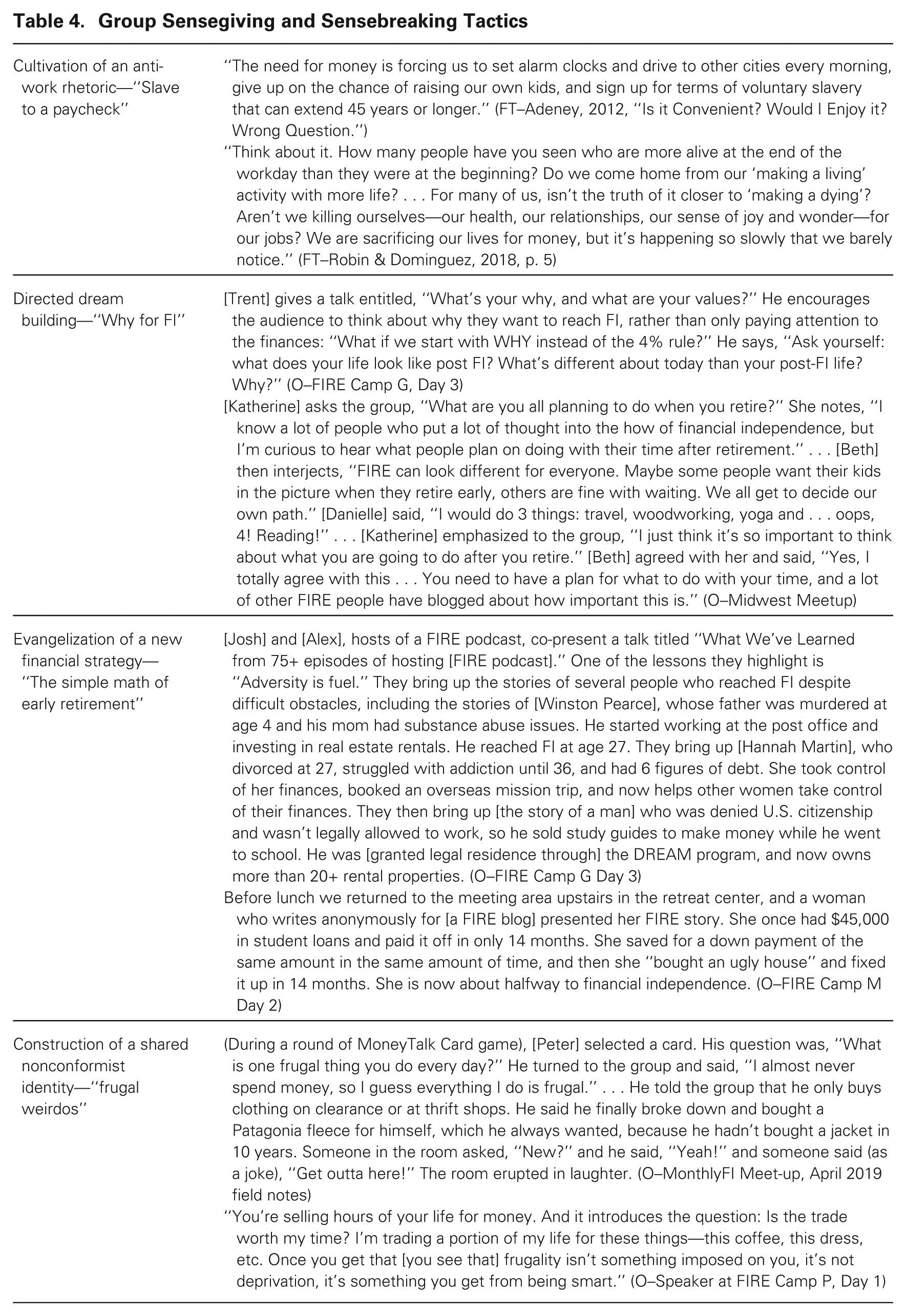
Although FIRE sought to inspire sweeping life changes in its followers (see Table 4 for further evidence), not everyone enacted the work optional ideal in the same way. Some informants drastically altered their work lives (a pattern I refer to as “radical recalibration”), while others made only nominal changes (a pattern I refer to as “marginal modification”), and many fell between these two extremes. This variation reflected informants’ subjective assessment of how appealing and attainable the new work ideal felt in their own lives. To illustrate this subjectivity, I present the stories of three informants—similar in age, gender, and income—whose enactments of the work optional ideal varied significantly according to their unique understanding of its relevance to their lives.
Group Sensegiving and Sensebreaking Tactics
When perceived appeal and attainability are high: Radical recalibration
Owen (I–2) is in his late 40s and married with four adult children. He spent most of his career as a market researcher. He was highly skilled, respected, and well compensated, yet his account of work was marked by a strong sense of violation. In his first interview, he noted, “My wife and I joke that I have PTSD from work. I don’t, but it’s this idea [that], in some respects, it was a traumatic experience.” He hated the politics and competition at work as well as “the constant underlying stress that comes with management responsibility.” He likened work to a “prison camp.”
A turning point came when a close friend died of cancer: “His wife was left destitute. [It was] terribly sad. From that moment on . . . I admitted to myself [that] I am a financial ignoramus and I’ve got to educate myself.” Owen began reading books and listening to podcasts on personal finance to help secure his family’s financial future. Eventually, his interest in personal finance led him to FIRE. The new work ideal held immediate appeal: “I remember listening to the ChooseFI podcast . . . they talked about how money is about buying freedom. My head exploded . . . [It was] just like, wow. That is the most revolutionary thing I think I’ve ever heard.”
FIRE offered catharsis and further stoked Owen’s pre-existing disillusionment with work; he mirrored the community’s anti-work rhetoric when describing what the work optional ideal meant to him: “It means the freedom to do what I want with the time that I have and that I’m not a slave to having to work for a paycheck. I can work if I want to [but] I don’t have to . . . This idea [that] I’m buying my freedom is very, very motivating for me.” FIRE also helped Owen surface new dreams for himself that would not be possible without FI; he and his wife developed plans to serve as overseas missionaries. This dream was both specific and divergent from his life as a market researcher, and it elicited strong aspirational longing: “It [was] psychologically so fulfilling to think about escaping from work.”
FIRE also successfully convinced Owen that the new work ideal was highly attainable. He developed a strong sense of material feasibility toward FI after finding a relatable exemplar: “I liked the White Coat Investor podcast, which is done by a doctor. [Like him], I had a high income.” He concluded that, “If you have a college degree, I think you have a good chance of [reaching FI] if you start early enough and are focused.” Owen’s confidence in the material feasibility of FI motivated him to make lifestyle changes. He became particularly savvy at investing: “I saved a lot of money [and] put in place investments . . . I did everything I could to educate myself so [that] I could [reach FI].” Although his high salary enabled him to continue to spend lavishly in many areas of life, he cut back on some discretionary spending: “We’ve driven the same car for 10 years.” Owen also perceived low social cost in pursuing the work optional ideal; his wife was largely supportive: “My wife has always been more frugal than me . . . she was on board.” Moreover, he was not attached to his work identity—“I’ve always felt like my life is bigger than my work”—nor keen on impressing his peers—“I was always a pretty private person at work. I never had a massive social investment in my work colleagues.”
Because the new work ideal seemed both highly appealing and highly attainable, Owen’s enactment of it involved a dramatic transformation of working life: a pattern I refer to as radical recalibration. He remained in market research for several years, saving aggressively, but then retired in his late forties. At the time of his second interview, he was already stationed overseas as an unpaid religious missionary. Like his prior job, the work was demanding and sometimes stressful, but its content, structure, and meaning were fundamentally different:
It can be stressful in times of emergency. We had an appendectomy that needed to be done [the other day] at the local hospital with one of the missionaries, and that was really scary . . . So, yes, there’s stress . . . but it’s very rewarding and no, it’s not the same type of stress [as before], because when you really love what you do, you can take it. And I certainly love doing this a lot more than I had loved my [last] job.
Owen noted that his underlying motivation for work had changed:
[Before], my loyalty was to the paycheck. Just to be really Machiavellian about it. I enjoyed my colleagues, but if there wasn’t a paycheck, I wouldn’t be going there. My job was a means to an end, which was FI . . . But the difference here now is my motivation is completely different. It’s not about money, it’s about the love of the service that we’re giving and the love of the people here, and so it’s just nice to be giving and not taking. I guess that’s the big difference, right? When you’re in an employment contract, it’s about, “What am I getting out of this? How can I get paid more?” And now it’s more about “What can I give? Can I give more—more than I’m even giving to it at the moment?”
Owen’s enactment pattern exemplifies the radical recalibration of working life that is possible when ideological communities are particularly successful at persuading followers to believe in both the appeal and the attainability of a new work ideal. After his exposure to FIRE, Owen drastically renegotiated his relationship with work. He not only changed his work orientation, shifting from a job to a calling, but also restructured his entire career trajectory.
When perceived appeal and attainability are low: Marginal modification
Richard (I–31) is single and in his early 50s, with no children. He has worked in the biomedical field for several years and was introduced to FIRE by a friend. He immediately understood its conceptual value: “It gives you freedom. Which means you don’t have to work for your living. Which means you can leave a job you don’t like, for example.” Yet, in practice, he loved his work: “It gives me purpose and meaning, and a reason to get up in the morning . . . and a way to contribute to society.” This deep appreciation of work inoculated him against the community’s anti-work rhetoric. He rejected the idea that he was a “slave to a paycheck”: “I think [people] discount the value and the meaning that work can provide . . . I like working . . . So, I want to change [the community’s name] to Financial Independence Retire Never—FIRN.” His stance demonstrates the limits of collective persuasion; although FIRE successfully stoked work disillusionment among informants with negative, ambivalent, or even mildly pleasing views of work, it had far less sway over those, like Richard, who found their work deeply meaningful. Richard’s love of work also curbed the effectiveness of dream building. Despite hearing a range of testimonials from other community members who had left their jobs for greener pastures, he noted, “I don’t even know what else I would do all day [if I retired early]. Maybe I would figure out what [else] to do, but I like working.” Because he found work so fulfilling, Richard had difficulty imagining something better that might take its place. Taken together, FIRE failed to instill either disillusionment toward work or aspirational longing, which limited the appeal of the new work ideal, even prompting Richard to amend it (to FIRN) and to discard early retirement as a goal.
In addition to its low appeal, Richard also viewed the work optional ideal as somewhat unattainable, not because he lacked financial resources (like Owen, he was a high earner) but because he questioned whether FI was truly achievable for anyone other than the ultra-wealthy:
We live in a highly volatile world. I don’t think my current level of net worth puts me in a position where I don’t have to worry about anything financially . . . [Maybe] if somebody has $10 million dollars, then they don’t have to worry about finances anymore, but below that [amount], I feel like [it’s a mistake for people to] think they don’t have to worry about finances, or [that] they’re independent. At the end of the day, what does independence mean? I mean, if the markets go down or there’s [bad] inflation, if the dollar collapses, they’re not insulated from that.
Richard’s skepticism toward community estimations of risk impeded him from developing a strong sense of material feasibility toward FI. In particular, he was not convinced that the 4 percent rule was a reliable benchmark for financial independence; he had ongoing concerns about looming existential threats (financial and ecological) that were fundamentally beyond the level of protection that a few million dollars could provide. As such, he viewed FI as an elusive goal.
Despite his skepticism toward the material feasibility of FI, the community successfully persuaded Richard to embrace a “frugal weirdo” identity and significantly curb his spending: “I follow [a famous FIRE blogger], and he’s so frugal. I really think that consumerism is just out of control . . . It’s just not sustainable. It’s just what a lot of people think is normal. It’s just not good.” Over time, he came to view frugality as a kind of ethical commitment and made significant lifestyle changes to increase his savings rate; he sold his car, saved 70 percent of his income, biked everywhere, and avoided restaurants. However, he made those changes with the understanding that they would provide greater financial resilience, not financial independence:
Some people in the FIRE movement have come up with the term financial resilience. It’s probably a better description [of what is achievable]. Again, I do believe that the [ultra] rich don’t have to worry about anything, like whatever happens. I’m not at that level and probably never [will be], but I don’t depend on the monthly paycheck either. Would you call that financial independence? No, probably not.
Notably, Richard’s embrace of frugality offers strong evidence of community influence. He shared that, growing up, “We had cars. The house was huge. Seven TVs. Things like that. So, we did not [live] frugally, my family.” FIRE helped to undo this prior socialization toward materialism. Thus, while other elements of the community’s persuasive repertoire—the anti-work rhetoric, dream building, and the promise of an early retirement—left Richard unconvinced, the “frugal weirdo” social identity was deeply persuasive and kept him engaged: “I’ve really gotten a lot out of being part of the community. While I don’t subscribe to a major part of it . . . I still feel like I will continue to be friends with people in the movement and continue to share a lot of values.”
Richard’s case illustrates what happens when community tactics are less persuasive. He expressed no interest in early retirement, asserting in one interview that “I want to work until I’m 80.” His enactment thus reflects a pattern I refer to as marginal modification: Only nominal changes were made to the content, structure, centrality, and meaning of work, shaped by relatively weak perceptions of the appeal and attainability of the new work ideal.
When perceived appeal and attainability are middling or mixed: Tempered enactment
Between the extremes of radical recalibration and marginal modification were informants who held middling or mixed perceptions of the appeal and attainability of the work optional ideal. These informants displayed a tempered enactment. Jason (I–32) illustrates this pattern. Jason is a physician in his mid-40s who is married with two children. Unlike Owen, Jason did not view his work as deeply violating, nor did he describe himself as trapped or exploited. Instead, he spoke of his career with appreciation and pride: “I don’t regret what I did. [Being a physician] was an amazing profession that allowed me to do something important every day of my life . . . I was there for deaths, I got to see humanity so up close and personal . . . I can never regret that.” At the same time, Jason felt constrained by the demands of his work; long hours practicing medicine left little room for a long-standing creative side: “There was an expressive side to myself that kept on pushing itself to come to fruition . . . When I was a new attending, I started an art business . . . Throughout my career I’ve written poetry and short stories, and so I knew that there was this creative side that wasn’t being met by being a doctor.” After Jason learned about FIRE, dream-building practices prompted his aspirational longing for a future in which creative pursuits took precedence over professional status: “The one thing that changed [the most] after I learned about [FIRE] is [that] I came to the conclusion that being a doctor was probably more secondary to this other [creative] stuff, whereas [before] I had always thought that other stuff was secondary to being a physician.” As Jason was caught between an appreciation for his work as a doctor and the allure of more time for creative pursuits, the new work ideal held middling appeal to him.
Jason also had middling perceptions of the attainability of the new work ideal. His sense of material feasibility was high; he first learned of FIRE through a personal finance book written by a fellow physician, an easily relatable exemplar, and quickly realized that he had effortlessly and unknowingly reached FI: “I had probably been financially independent for years before [finding FIRE]. I just didn’t have the vocabulary and the math and the calculators to truly understand it.” However, Jason perceived more social cost in adopting the new work ideal than either Owen or Richard did. His father had been a physician, and he felt significant pressure to carry on a family legacy by continuing to practice medicine. In addition, most people in his social world held a much higher standard for what constituted sufficient reserves to slow down or retire: “People in my life [had said,] ‘When you have $10 million in the bank, [then] you can slow down.’” Expectations to keep working, accumulate wealth, and center his identity around his work as a doctor were thus particularly strong. As a result, the thought of potentially leaving his job felt destabilizing rather than freeing:
If you take someone like me, who’s so identified with being a doctor [and] then all of a sudden say, okay, at the drop of a dime you can leave that profession . . . that [realization] caused me a decent amount of anxiety, because it really made me question, who am I? What am I about? What is my true identity? If I don’t need to be a doctor tomorrow, then who am I? I was a father and a husband and a friend and all those kind of things, but a big part of my identity was tied up in being a physician.
The most significant impact that FIRE had on Jason was that it helped him to defy entrenched social expectations and to redefine himself beyond his occupation. Although Jason did not identify as frugal (once noting, “I was never against luxury . . . [I spend money] in ways other people would consider frivolous or anti-FIRE”), he embraced and benefited from the group’s emphasis on nonconformity, particularly as it related to unconventional career paths and disentangling one’s identity from work.
As Jason had somewhat middling perceptions of the appeal and attainability of the new work ideal, he adopted a tempered approach to enactment. He slowly reduced his clinical work except for hospice care, which brought him deep fulfillment. Restructuring his work in this way made space for his creative pursuits to flourish:
I started pulling back on everything I didn’t like about my job, and what I was left with was my job as a contractor for hospice . . . I enjoyed [my colleagues there] . . . There were no nights, no weekends . . . I only had to be somewhere physically Tuesday, Wednesday, and Thursday . . . [That] allowed me a huge amount of free time to start pursuing these other things . . . [like] podcasting, which I’ve found to be an incredible creative outlet. So, all of this naturally flowed from whittling down on all the things I don’t like about work. And once I did that, all these other wonderful, creative things had space to germinate.
Jason’s enactment lacked the dramatic urgency of Owen’s sweeping transformation but entailed a more substantial shift in the content, structure, centrality, and meaning of work than did Richard’s marginal enactment.
Comparing Owen, Jason, and Richard illustrates how community tactics shape but do not fully determine the enactment of a new work ideal, even among informants of similar age and income. Community sensebreaking and sensegiving efforts encouraged informants to view the new work ideal as both appealing and attainable, yet their resonance varied according to each person’s subjective evaluation of their life circumstances. Table 5 provides additional examples of variation in enactment as they relate to subjective evaluations of appeal and attainability.
Variance in Individual Enactment
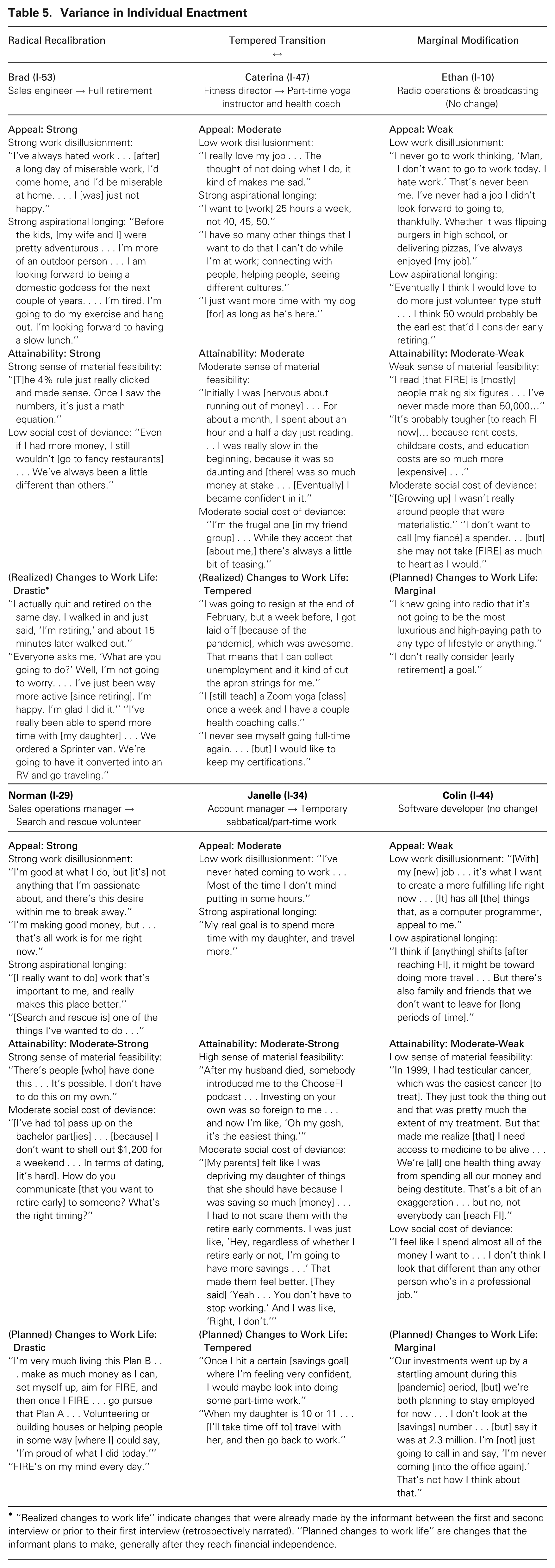
“Realized changes to work life” indicate changes that were already made by the informant between the first and second interview or prior to their first interview (retrospectively narrated). “Planned changes to work life” are changes that the informant plans to make, generally after they reach financial independence.
Appeal and attainability as dynamic and mutually reinforcing: Shifts along the enactment continuum
I observed 11 cases in which informants shifted along the enactment continuum as life events reshaped their sensemaking of the FIRE ideal. These within-person shifts provide further evidence of the central role that perceived appeal and attainability play in shaping enactment. They also reveal how these two perceptions are often interrelated: As circumstances change, appeal and attainability tend to rise or fall together in mutually reinforcing ways. Consider Charlotte (I–26), who experienced a sudden increase in the appeal of the work optional ideal, which then prompted a reassessment of its attainability. At the time of her first interview, Charlotte worked in brand licensing and exhibited low levels of both work disillusionment and aspirational longing:
I work for a company that treats me really well. I love my colleagues like they’re my family . . . I [recently] looked at my life and thought, “Well, this is what I would want my life to look like if I was FI.” So, if I reach it in eight years, or slow down a little bit and reach it in 10, 12 years, whatever it is, it’s almost irrelevant if I ever reach it because I already feel it. I’m at the place that I think that people are trying to get to by chasing FI.
At this point, Charlotte’s enactment of the new work ideal was marginal, primarily because it held low appeal. However, between her first and second interviews, Charlotte discovered that she was being paid less than her male colleagues despite superior performance: “It just became very clear that I was being held to a much higher standard than my male colleagues. And it pissed me off because it’s discrimination.” This revelation increased Charlotte’s disillusionment with work and, in turn, heightened the appeal of the work optional ideal. Crucially, this shift in appeal inspired her to reassess the attainability of the new work ideal, and she lowered the threshold for what counted as enough financial progress to enact radical change in her work life. In FIRE vernacular, “F-you money” refers to financial reserves that allow a person to walk away from a bad work situation without financial fear, even if they have not yet reached full FI (FT–Collins, 2016, p. 87; see also Collins, 2011). Although this concept initially felt irrelevant to Charlotte, it became central to her sensemaking as the appeal of leaving work intensified. As she explained, “I ran the numbers [to see] where I was financially . . . Reaching FI is not the only level . . . I took a look at my liquidity [and realized] I have ‘fuck you money.’” She went on to say, “I am not financially independent, but I am financially secure enough to not put up with that bullshit.” As Charlotte came to see the work optional ideal as more appealing and attainable in the short term, she decided to leave her job to pursue entrepreneurship. This transition reflected a fundamental reconfiguration of her working life and a shift toward a more radical enactment of the new work ideal.
I also observed cases in which informants shifted in the opposite direction, toward a more marginal enactment of the new work ideal following an initially radical approach. Natalie (I–18), for example, initially planned to work a few more years in her current role as an academic advisor before shifting to remote work and traveling in an RV with her husband. However, after giving birth to her first child between interviews, her sense of material feasibility declined: “Just with the cost of having a baby and the cost of daycare and all of those things, it just doesn’t seem as likely to be on the same timeline . . . We had all these ideas of wanting to travel and do all these other things, and that’s just not quite as feasible.” As her perceived attainability declined, Natalie tempered her aspirations: “[We still] try to do our best in saving for retirement, but . . . we’ve had to be[come] a little bit more flexible.” She also adopted a more charitable view of her work: “I appreciate my work more than I did before and so I’m not as eager to leave . . . [It’s] an escape from [caretaking] all the time . . . I love being with my baby and all that, but it can be exhausting and [work offers] just a different activity” (I–18b). As Natalie’s life circumstances changed, she became less able to sustain cost-saving practices, less aggrieved by work, and less enamored with the idea of living out of a van: “There’s not as much of a rush to reach [FI] . . . I’m not as obsessed about it as I was before” (I–18b).
Although it is difficult to disentangle which perception shifted first, the sequencing within Natalie’s narrative suggests that the dampened attainability of the new work ideal was followed by a decline in its perceived appeal—the inverse of Charlotte’s pattern. That is, as the new work ideal seemed more and more out of reach, Natalie reframed her work as more satisfying and her earlier aspirations as less desirable. Regulating the appeal of the new work ideal in this way likely made its unattainability in the short term more psychologically bearable. See Figure 1 for further examples of enactment shifts.
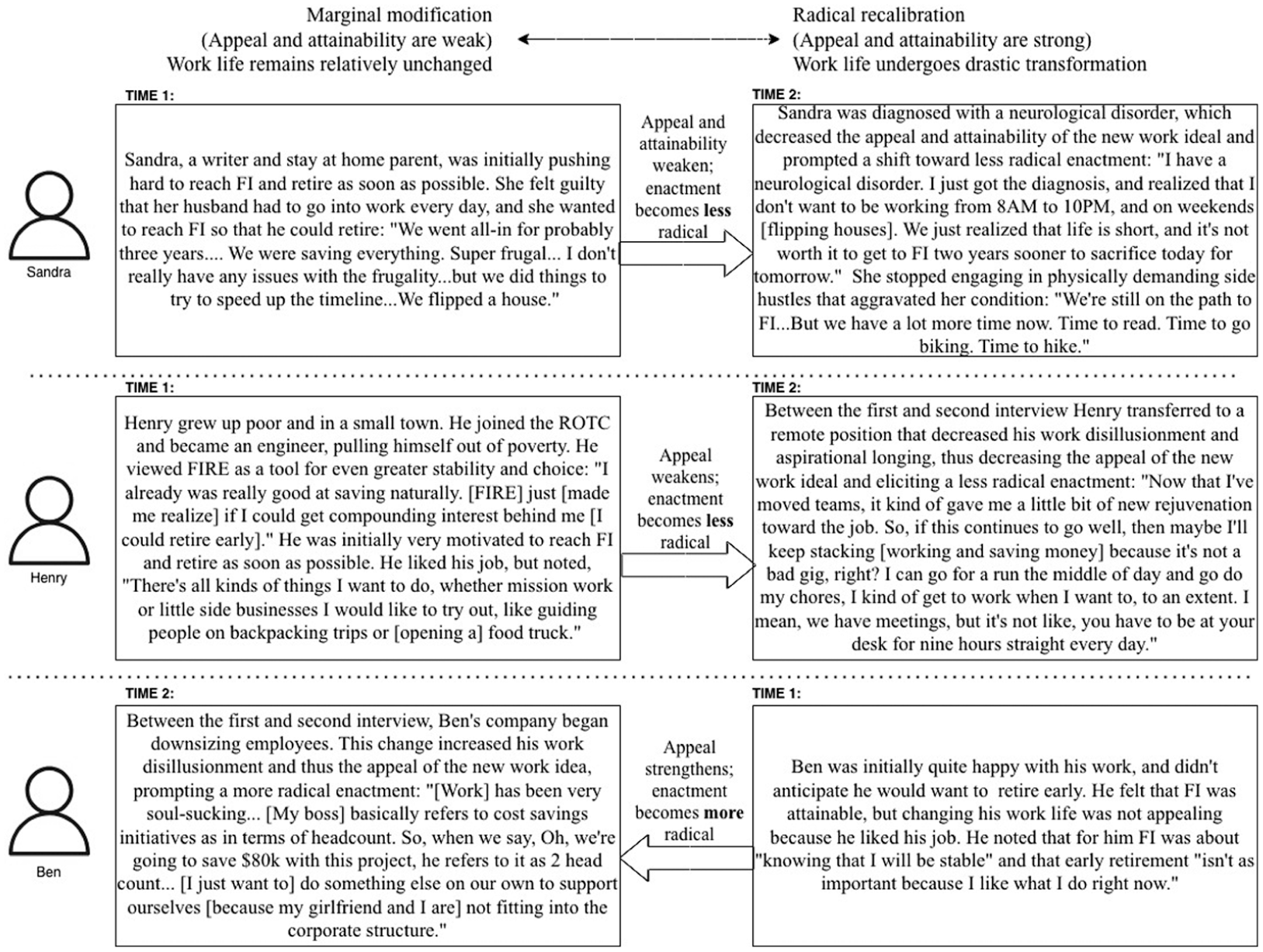
Examples of Within-Person Shifts in Enactment
Although appeal and attainability typically rose and fell together, a small subset of informants held starkly divergent evaluations of the two. In cases of high appeal but low attainability, the work optional ideal retained strong emotional pull, yet informants struggled to imagine a viable pathway to reach it, often because they could not relate to community exemplars. These cases manifested as frustrated striving in which persistent desire was coupled with ongoing discouragement. One such informant, Gabe, disliked work and longed for a financially free life: “A job is a waste of my life, honestly. There are so many other things that I [would rather] be doing with my day” (I–24a). Yet, he perceived FI as materially out of reach, associating its attainment with unacknowledged privilege:
Even if I get this new job, which is going to be a huge salary increase for me, retiring early [is still unlikely]. I even kind of scoff at the whole concept, the idea of this FIRE “movement” . . . this is not a movement. This is the one percent of the world . . . Anybody that I have read about or spoken with who has achieved early retirement [had] some major life thing that happened to them that [they treat as] so insignificant. [They’ll say] “Oh no, no, my parents just gave me the whole wealth of the family company, but it was nothing.” . . . Or, “My grandpa paid for my entire college education.” It’s like, what? [They] just casually, nonchalantly mention these things that are not what the rest of the world has access to . . . Even as someone who is engaged in this, and I’m working towards it too, I still get turned off by it. (I–24a)
Even though FIRE sought to showcase rags-to-riches stories, Gabe felt that most exemplars received early financial support and worked in high-paying professions that were inaccessible to him. Although Gabe was college educated, he grew up in poverty, financed his own education through student loans, and held a relatively low-paying job in public service. Many FIRE exemplars were thus unrelatable to him. Over time, he stopped attending MonthlyFI gatherings, suggesting that when high appeal cannot be tempered and attainability remains persistently low, frustrated striving may give way to disengagement.
The opposite combination, low appeal alongside high attainability, was rare but still present in the data. In these cases, informants viewed FI as feasible but felt little emotional attachment to the work optional ideal. For example, one informant had nearly achieved FI but noted in her second interview, “I used to think I wanted to retire and just be done working. I realized that doesn’t suit me at all. I want stuff to do” (I–43b). Her growing disinterest in retirement muted any motivation to significantly alter her work life, and she gradually disengaged from the community: “It wasn’t as exciting . . . my interests have just changed.”
Taken together, these cases illustrate the limits of appeal and attainability as standalone mechanisms of change: Even when one perception is strong, people do not radically enact the new work ideal if the other is weak. That both forms of misalignment may culminate in community disengagement reinforces the central claim of this study: Appeal and attainability must be jointly present for people to fully adopt and radically enact a new work ideal.
The Adoption and Enactment of a New Work Ideal
Ideals matter. They can move people from present to future, enable new possibilities, and shape personal strivings. This article traces how one ideological community persuaded people to adopt and enact a new work ideal, work optional, and why that ideal was not equally transformative among all its members. Figure 2 summarizes the findings.
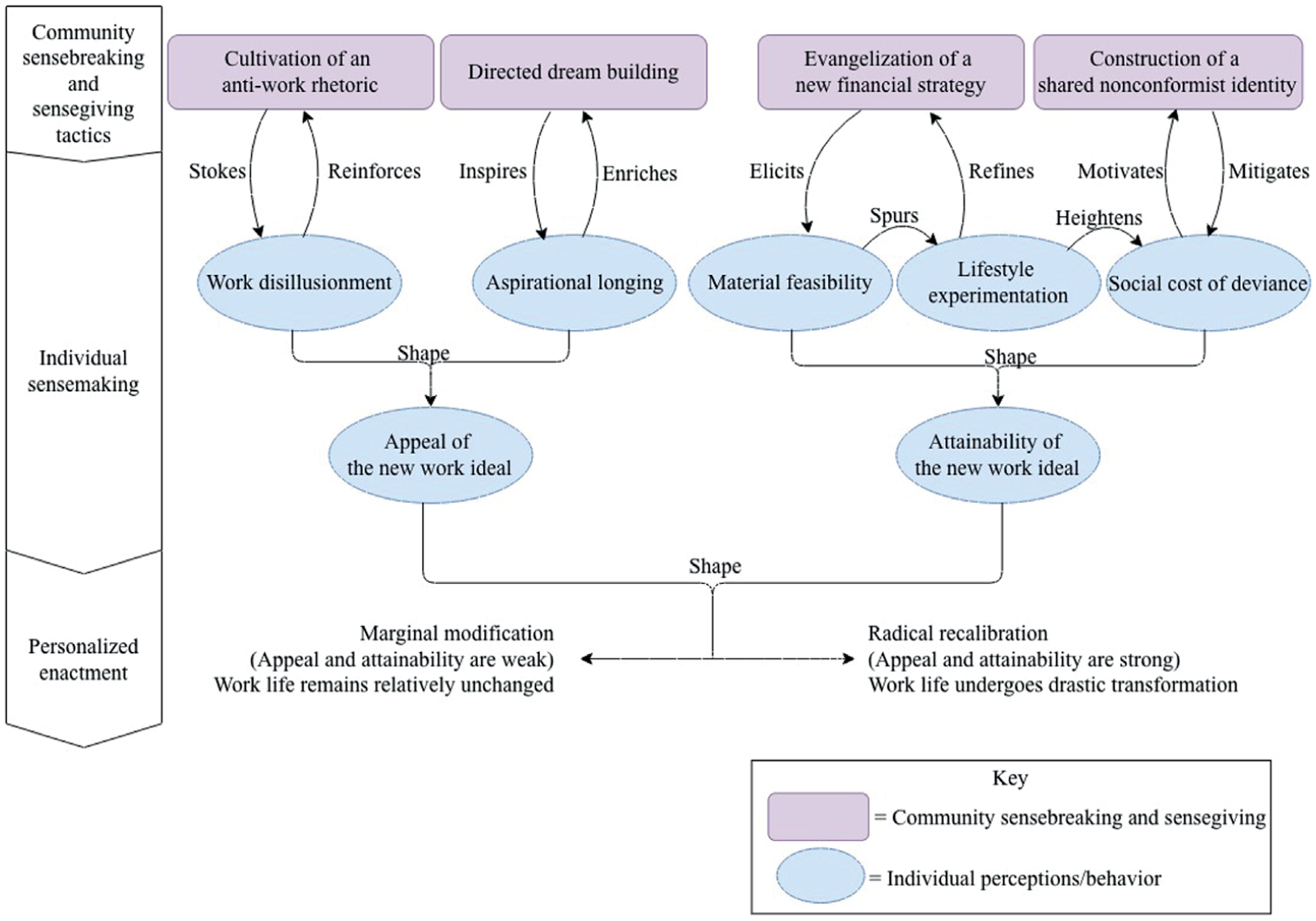
The Adoption and Enactment of a New Work Ideal
I present the adoption and enactment of a new work ideal as a cross-level process marked by feedback loops between community persuasion and individual sensemaking. At the community level, four sensegiving and sensebreaking tactics promote the new work ideal. Two tactics, the cultivation of an anti-work rhetoric and directed dream building, enhance perceptions of the ideal’s appeal by stoking work disillusionment and aspirational longing, respectively. Two others, the evangelization of a new financial strategy and the construction of a shared nonconformist identity, enhance perceptions of the ideal’s attainability by demonstrating material feasibility and mitigating the social cost of deviance from mainstream norms. When members share their experiences of work disillusionment, aspirational longing, lifestyle experimentation, or the social strain of nonconformity, those experiences reinforce, enrich, or refine the community’s interpretive repertoire.
The proposed theory includes two important qualifications. First, community influence has limits. Collective messaging about a new work ideal is filtered through members’ subjective understandings of their circumstances, commitments, and values. Through sensemaking, individuals develop personalized perceptions of the ideal’s appeal and attainability, which shape enactment along a continuum ranging from radical recalibration, in which working life undergoes drastic transformation, to marginal modification, in which working life remains relatively unchanged. The community was least able to induce radical recalibration when one or more of its persuasion pathways stalled: Some informants’ deep love of work blunted the anti-work rhetoric, others’ contentment with the present stifled dream building, and still others either viewed community exemplars as too dissimilar to offer credible proof of concept or remained too committed to mainstream values to bear the social cost of deviance. These were not all-or-nothing barriers: Community messaging could still sway people who liked their work, differed somewhat from typical exemplars, or retained some attachment to mainstream values, but more extreme misalignment along any of these pathways made radical recalibration less likely. Second, conversion to a new work ideal is dynamic rather than fixed. Community tactics shape the interpretive lens through which members view the world, but their influence can wax and wane as circumstances change. Members may revisit previously unconvincing messages with renewed openness or move away from elements of the ideal that once felt compelling, shifting their enactment accordingly. The model thus reflects both the reach and the limits of community influence as people discern what kind of work life is desirable and achievable.
Discussion
Theoretical Implications and Future Directions
This research offers several contributions to current scholarship. First, it presents a new pathway by which people can resist the ideal worker norm. Prior research on the ideal worker norm has primarily examined how people maneuver within its confines: coping but not thriving under its weight (Heaphy & Trefalt, 2024; Reid, 2015). The pressure of this norm is intensified by two compounding forces: the erosion of organizational commitment to workers (Bidwell, 2013; Uchitelle, 2007) and the rise of cultural narratives that encourage workers to find passion and purpose in jobs that often fall short of those aims (Cech, 2021; Graeber, 2018; Jachimowicz & Weisman, 2022; Kwon & Sonday, 2026; Tokumitsu, 2015). This study extends this research by examining how people respond to these pressures not through minor workarounds but by cultivating a new ideal that redefines an optimal work life and reorients a person’s priorities and decisions. Michel (2011, p. 329) noted how unobtrusive controls like the ideal worker norm prompt people to overwork not only out of consideration of rewards and punishments but also because they render alternative action inconceivable. Under the influence of the ideal worker norm, overwork becomes an unquestioned default. This research shows how ideological communities can help people overcome this obstacle by prompting them to imagine previously unthinkable ways of relating to work, in this case freedom from a paycheck, and then enact it. It extends Heaphy and Trefalt’s (2024) concept of the sustainable worker schema by shifting the purview of resistance from workplace settings, where challenges to overwork must often remain covert (see also Scruggs, 2024), to nonwork communities, where new ideals can be openly evangelized with less fear of reprisal (see also Creary & Locke, 2022).
This research also makes several key contributions to the meaning of work literature. First, it introduces a new construct, a new work ideal, to describe how people develop novel aspirations of an optimal work life. This construct opens new avenues for research on how people generate novel, forward-looking aspirations for work that extend beyond their current role or career path. While existing literature acknowledges that people can proactively construct new meanings for specific tasks or occupations (e.g., Ashforth & Kreiner, 1999; Jiang, 2021; Wrzesniewski & Dutton, 2001), this study broadens that scope by showing how they come to question taken-for-granted work–life ideologies (Leslie et al., 2019) and construct new work lives. It answers calls for more research on how people change their mind about what they want from work (Schabram et al., 2023, p. 424) and builds on studies of dream building (Pratt, 2000b) and career pivots (Weisman, 2021) by showing how people come to desire a new work life and why some people are more able than others to realize it. Consequently, the findings offer insights into factors that may inspire and enable people to shift their work orientation (Schabram et al., 2023), pursue nontraditional career paths (Ashford et al., 2018; Ashford et al., 2007; Petriglieri et al., 2019), or negotiate a better work–life balance (e.g., Gorges, 2023; Greenhaus & Allen, 2011; Kossek & Lautsch, 2018; Rothbard et al., 2005). My model indicates that work disillusionment and aspirational longing can make a new work life appealing, while a high sense of material feasibility and low social cost enable restructuring.
This research also expands knowledge of who can shape work meaning and how. While this study does not exclude the possibility of people adopting a new work ideal on their own, it suggests that ideological associations like social movements, religions, or lifestyle communities may be especially fertile ground for fostering a new work ideal by offering a social cocoon (Greil & Rudy, 1984b; Pratt, 2000a) in which unconventional views of work can be cultivated and new work arrangements can be pioneered. Communities like FIRE that operate on the periphery of society are less encumbered by traditional social mores. This quality makes them ideal for developing alternative ways of thinking about and relating to work. Further, they can provide the necessary social support to withstand mainstream disapproval. This research thus contributes to growing scholarship on how non-work relationships shape how people view their work (Dekas & Baker, 2014; Jiang & Wrzesniewski, 2022; Maitlis, 2022; Petriglieri & Obodaru, 2019). It shows that even loosely connected people who interact in settings far removed from their usual social networks (in interstitial or free spaces; see Furnari, 2014; Polletta, 1999) can still affect one another’s work by promoting new ideals that shape work’s content, structure, centrality, or meaning.
This study further extends scholarship on work meaning by calling attention to the financial considerations that shape the pursuit of meaningful work, i.e., work that is deemed significant, positive, and worthwhile (Michaelson & Tosti-Kharas, 2024; Pratt & Ashforth, 2003; Rosso et al., 2010). Research on meaningful work has tended to emphasize interpretive processes, job design, and relational experiences that make work feel significant, often foregrounding the subjective experience of meaning while bracketing the material conditions that enable people to pursue, cultivate, or refuse particular forms of work (for recent reviews, see Bailey et al., 2019; Lysova et al., 2019). This study advances this line of research by illustrating that financial considerations are often central to the pursuit of meaningful work and that money can play a critical role in enabling people to imagine and enact desirable work lives (see also Ward, 2024). Within the FIRE community, money was valued not as an end in itself but, rather, as the means for expanding a person’s capacity to choose work on their own terms. By demonstrating how financial security reshapes the conditions under which work is pursued or refused, this study answers calls for greater integration of money into organizational theorizing (Leana & Meuris, 2015) and broadens the scope of the meaning of work literature to better account for the economic foundations of agency in the construction of a meaningful work life.
Lastly, this research advances scholarship by providing new insights into within-group variation in conversion communities. Greil and Rudy (1984b, p. 311) observed that “the implicit assumption that all members of a given group have all undergone the same essential transformation process . . . constitutes [a] major weakness of the typical case study of the conversion process.” Yet, scholars have continued to under-theorize variation in the depth and degree of conversion among people exposed to similar socialization. This study addresses that gap by analyzing not only group persuasion tactics that aim to inspire transformation but also individual differences in sensemaking and enactment. It identifies two key psychological levers, perceived appeal and perceived attainability, that are co-constructed through group influence and individual interpretation and shape how fully a new work ideal is enacted. Importantly, this approach moves beyond categorical views of conversion and, instead, conceptualizes it as a continuum of enactment, a fluid and evolving process rather than a discrete, one-time shift. In my model, radical recalibration reflects a full conversion to the new work ideal, while marginal modification signals a more tentative adoption that verges on nonconversion; between these extremes are a wide range of enactment patterns that an individual may exhibit.
This reconceptualization sheds new light on long-standing debates about the necessary conditions for conversion. Early scholarship often focused on identifying the specific dynamics that enabled transformation in a particular setting and would use such cases to refute generalized models of conversion. For instance, acute stress was once viewed as a necessary precondition for conversion (Lofland & Stark, 1965), until studies of Pentecostal groups challenged this claim (Gerlach & Hine, 1968; see also Snow & Phillips, 1980). Likewise, affective ties were considered essential in the Nichiren Shoshu Buddhist movement (Snow & Phillips, 1980), yet research on born-again Christians showed that conversion could occur even in their absence (Austin, 1977). Over time, scholars converged around the idea that “no single model [can] describe conversion to all perspectives in all social situations” (Greil & Rudy, 1983, p. 23–24). Building on this insight, my research emphasizes how the strength of conversion hinges on whether group efforts to endorse a new ideal successfully cultivate strong perceptions of appeal and attainability within each individual follower. Viewed through this lens, successful conversion may depend less on which particular tactics a conversion community employs and more on the cumulative impact of their chosen tactics on these two key perceptions, which shape the transformative capacity of a new ideal. Many of the mechanisms studied in the conversion literature, such as mortification (Kanter, 1972) and encapsulation (Greil & Rudy, 1984b), can be understood as tools that enhance one or both of these perceptions.
Practical Implications
This study has several practical implications for workers and communities that wish to inspire self-transformation. First, for people dissatisfied with their working lives, the findings suggest that actively engaging with a community that champions a new work ideal may offer crucial relief, inspiration, and support. Joining such a community not only provides a sense of belonging but also exposes members to alternative perspectives on work, empowering them to make meaningful changes that enhance life satisfaction. Communities like FIRE can help people navigate the challenges of reimagining and restructuring their work lives, offering both practical advice and social validation as they work to align their actions with their aspirations.
Second, for organizations that aim to promote alternative ideals and lifestyles, such as identity transformation organizations (ITOs), this study underscores the critical role of ongoing sensegiving and sensebreaking to produce lasting commitment (Pratt, 2000b). To foster meaningful transformation, communities must make their new ideal feel both appealing and attainable. The findings also suggest that effective ITOs offer both practical advice for lifestyle change and a strong social infrastructure that reinforces the change process. A shared nonconformist identity and opportunities to connect with other followers can help people stay the course, particularly when they face resistance or incomprehension from broader society. In this way, community-based support, both practical and social, serves as a buffer against backlash and a bridge to sustained transformation.
Limitations
This study has several limitations, which also suggest avenues for future research. First, while qualitative methods are useful for developing rich accounts of social processes (Van Maanen, 1979), the findings are not necessarily generalizable to the broader population. My model may not hold in other cultural contexts in which different social and institutional structures are at play and the work devotion schema and ideal worker norm are less prevalent. Nonetheless, many of the findings are expected to be transferable (Lincoln & Guba, 1985; Yin, 2017) to other contexts in which people are striving to relate to work in a new way, such as communities of digital nomads (Hennigan, 2023; Prengler et al., 2025), effective altruists (Gabriel, 2017), and “tradwives” (Proctor, 2022, p. 7). Future research could further explore the extent to which the proposed model applies across different cultural contexts and whether the adoption of a new work ideal ever occurs outside the influence of an ideological community.
Second, this study uses a sensemaking lens (Weick, 1995) rooted in social constructivist and symbolic interactionist traditions (Blumer, 1986; Charmaz, 2014) to examine the adoption of new work ideals. Some may argue that macro-level forces like economic and social conditions are the primary drivers of evolving work attitudes (e.g., Inglehart, 2018), which might suggest that FIRE is merely a manifestation of a particular historical moment rather than the main driver of individual change. While I acknowledge that broader trends like economic volatility, deteriorating job quality, and a global pandemic (Davis, 2016; Hacker, 2006; Kalleberg, 2009, 2011; Leiter & Cooper, 2022) play a significant part in reshaping attitudes toward work, it is critical to recognize that macro-level shifts necessitate new vocabularies and strategies of action for people to make sense of changing landscapes and to adapt to new conditions (Swidler, 1986). My study thus focused on the microsociological processes that prompt people to adopt and enact a new ideal for work, but future research could explore how macro-level conditions contribute to the emergence of ideological communities that foster new work ideals.
Third, because this study focuses on people who self-selected into FIRE, it cannot definitively separate the effects of community participation from pre-existing dispositions or concurrent life circumstances that may have independently prompted people to seek a new relationship with work. Moreover, the study does not provide insight into counterfactual trajectories by examining how similar people might have evolved if they had pursued financial independence outside an ideological community or if they had never engaged with FIRE at all. Future research could address this limitation through comparative designs (e.g., contrasting community participants with non-community FI pursuers or early defectors) or mixed-method approaches that better isolate when community exposure is catalytic versus when it primarily organizes and accelerates changes already underway.
Conclusion
Although entrenched beliefs and the demands of daily life may make it difficult to envision new possibilities for working life, this study reveals that people sometimes encounter ideological communities that prompt them to rethink what they want from work and how they ought to live. Embracing a new work ideal reshapes how people see themselves and what they value, opening pathways to either radical transformation or more incremental change in their work lives. Crucially, the transformative power of a new work ideal depends on its perceived appeal and attainability. By tracing how community interactions and individual sensemaking continually reshape these perceptions, this research illuminates how social constructions can redraw the boundaries of what is seen as a desirable and achievable work life.
Supplemental Material
sj-pdf-1-asq-10.1177_00018392261457399 – Supplemental material for “Work Optional”: The Adoption and Enactment of a New Work Ideal in the Financial Independence Retire Early Community
Supplemental material, sj-pdf-1-asq-10.1177_00018392261457399 for “Work Optional”: The Adoption and Enactment of a New Work Ideal in the Financial Independence Retire Early Community by Laura Sonday in Administrative Science Quarterly
Footnotes
Acknowledgements
I thank associate editor Erin Reid and three anonymous reviewers for their thoughtful and constructive feedback throughout the review process. I thank the members of my dissertation committee—Lance Sandelands, Jane Dutton, Mike Pratt, Cheng Gao, and Erin Cech—for their invaluable guidance on this research since its inception. I thank Sue Ashford, Winnie Jiang, Michelle Barton, Kira Schabram, Jon Jachimowicz, Matthew Rogers, and members of the Beauty Salon for their helpful input on early drafts of this manuscript. I thank organizational scholars who offered intellectual community for this research at various stages of development, including audiences at The University of Michigan, The University of North Carolina at Chapel Hill, The University of Nebraska-Omaha, The University of Toronto, Duke University, Harvard University, and The Center for Positive Organizations. Finally, I thank the many members of FIRE who generously contributed their time and their stories to this research. I am especially grateful to my interviewees and to the leaders and attendees of “MonthlyFI,”“FIRE Camp,” and “Midwest Meetup” for their openness and support.
Data Availability Statement
Due to the sensitive nature of the interviews and to ensure participant confidentiality, raw transcripts are not available. An anonymized coding structure and illustrative quotes are available upon request.
Supplementary Material
1
These numbers correspond with findings from a larger survey of 1,611 followers conducted on Reddit in 2018. Among U.S. respondents of that survey, 91.3 percent had at least a four-year college degree, 79.7 percent were White, and median gross household income was $109,402. Public survey results are available here: 
2
All interview informants were assigned a numerical pseudonym (I–#). The letter at the end of the pseudonym indicates whether the quote originates from their first (a) or second (b) interview.
3
Followers often distinguished between these two forms of motivation by referring to them as “retiring from” versus “retiring to” (i.e., escaping work versus running toward a dream). While both were motivating, community leaders frequently stressed that the latter was particularly important for long-term happiness.
4
Such as Vanguard’s Total Stock Market exchange-traded fund (VTI)
5
Some critics have suggested adjustments to the 4 percent rule due to changes in market conditions and longevity. Because of this, some followers of FIRE have advocated a more conservative withdrawal rate of 2–3 percent. An appropriate safe withdrawal rate varies depending on factors like market performance, life expectancy, inflation, and portfolio mix, but 4 percent is a common rule of thumb for financial planners.
6
Calculated savings goal, usually based on the 4 percent rule.
7
Subgroups formed within the community around different spending/savings targets. Common variants include LeanFI, in which people support a relatively low-cost retirement via minimalism and aggressive cost reduction; FatFI, in which people strive for a more luxurious retirement with less restricted spend; CoastFI, in which people save only until their investments are projected to grow sufficiently to fund retirement at a traditional age, allowing them to work jobs in pre-retirement that only cover their current expenses; and BaristaFI, which combines partial savings (typically aligned with the 4 percent rule) with part-time or lower-wage employment.
Author’s Biography
References
Supplementary Material
Please find the following supplemental material available below.
For Open Access articles published under a Creative Commons License, all supplemental material carries the same license as the article it is associated with.
For non-Open Access articles published, all supplemental material carries a non-exclusive license, and permission requests for re-use of supplemental material or any part of supplemental material shall be sent directly to the copyright owner as specified in the copyright notice associated with the article.
