






Abstract
Somali giving practices during severe crises are shaped by diverse socio-demographic profiles and varying patterns of digital technologies. Using a cross-sectional survey of Somalis in Eastleigh, Nairobi, and multinomial logistic regression, this article examines the factors shaping giving in response to crises. The findings reveal that education redirected giving towards Kenya, while specific clan affiliation and being born abroad redirected it abroad. Older age was significantly associated with giving abroad. Social media engagement broadens giving by drawing non-givers into the practice. Acting as a constitutive infrastructure, social media has homogenised the practice across socio-demographic boundaries. Giving is therefore a choice; it is shaped by a person's sense of connection to crises, as determined by their degree of integration, ties to areas of origin, and commitment to the public good. Crisis response strategies should therefore prioritise inclusive digital technologies and use narratives that connect people to particular crises.
Introduction
Somalis have long mobilised resources to provide assistance and relief during crises both in their places or countries of origin and their current places of residence. However, the Somali community has become increasingly socio-demographically diverse, and its giving practices have largely shifted to digital platforms. This article examines these practices, asking (1) what forms of assistance Somalis provide during severe crises and how socio-demographic factors influence these giving practices and (2) to what extent digital technologies are integrated into giving practices and how the use of social media tools influences Somali's likelihood of giving.
These two questions are explored by focusing on how Somalis in the Eastleigh neighbourhood of Nairobi, Kenya, responded to severe crises both locally and abroad between 2021 and 2024. The included crises were not pre-defined at the outset of the study but, rather, reflected survey participants’ reported crises and their responses to them. “Severe crisis” includes what Musa and Kleist (2022: 75) describe as “high intensity crisis and major disasters,” as well as what Maxwell et al. (2016: 68) term “large-scale conflict.” Per these definitions, a crisis such as drought is considered “severe” when the needs of those affected exceed the resources “mobilised within close social ties such as family and kinship” (Musa, 2023: 13; Musa and Kleist, 2022: 76). The inability of close social ties to respond is important to note. During severe crises, collective assistance must mobilise distant social ties that extend, in the Somali case, to the larger clan, as well as across clan lines by appealing to shared Somaliness and religion (Musa, 2023: 13). In other words, severe crises induce assistance practices that transcend kinship obligations and duty. Moreover, in contrast to lesser crises, during severe crises, all those affected are assisted, regardless of their affiliations (Hammond et al., 2011).
During severe crises impacting the Somali community, assistance is mobilised and delivered through established Somali networks (see Edle et al., 2026); however, giving is voluntary and a matter of individual choice. It is important, therefore, to identify determinants of individual giving, which are, I argue, influenced by the socio-demographic traits of individuals. As the Somali community becomes more socio-demographically diverse, how are these changes affecting the practice of giving? At present, it is not evident how changes in the demographic, economic, and social profiles of the Somali diaspora affect giving (Musa and Kleist, 2022). In addition, more work is needed to understand variations in giving behaviour among different generations of Somalis (Sadouni, 2009), the role and significance of clan affiliation (Hassan et al., 2021), and the effects of declining incomes in the countries where Somalis have chosen to reside on Somali giving. At the same time, the extensive and growing use of digital technologies raises additional questions about how humanitarian assistance processes are enacted. Earlier studies have shown that such technologies have enhanced the efficiency of remittances, potentially expediting the mobilisation and coordination of assistance and facilitating the creation of new partnerships between actors (Akhmatova and Akhmatova, 2020; Hassan et al., 2021). However, little is yet known about how social media use shapes giving behaviour and how this may vary across socio-demographic groups. This article therefore addresses these two interrelated gaps in current knowledge.
At the empirical level, the analysis presented in this article focuses on giving within the Somali community in Eastleigh, Nairobi, Kenya. This community, which can be perceived as heterogeneous, comprises a diverse range of Somali identities that include Kenyan Somalis, Somalian refugees residing outside the Dadaab and Kakuma refugee camps, and the “near” and “wider” Somali diaspora (Johansson, 2020; Scharrer, 2020; Scharrer and Suerbaum, 2022). The near diaspora includes Somali forced migrants with limited resources who chose Eastleigh in Kenya because of familiar language, lifestyle, and living conditions (Scharrer and Suerbaum, 2022). The wider diaspora group spans Somalian returnees from Europe and North America (Scharrer, 2020) as well as investors from Somalia (Ahmed et al., 2024). In addition, some Somalis use Eastleigh as a transit point to other destinations or to Somalia when travelling from other countries (McAteer et al., 2023; Varming, 2020). It should also be noted that many Somali individuals residing in Eastleigh do not fit into any of these categories (Scharrer, 2018).
Many members of the Somali community have lived in Eastleigh since their ancestors settled in the area during the colonial era. Other Somalis arrived as forced migrants from Somalia due to conflicts in the 1970s and 1980s and the collapse of the Somali state in the 1990s, as well as more recent crises (Johansson, 2020; Shaffer et al., 2018). The Somali population in Eastleigh is also diverse in economic terms, ranging from those who are poor to owners of lucrative businesses, with a significant proportion of low-income wage-earners between these extremes (Scharrer and Carrier, 2019). Unlike these low-income wage-earners, Somalian returnees are relatively affluent, comprising mostly educated male professionals and entrepreneurs (Scharrer, 2018).
The remainder of this article proceeds as follows. It initially presents the conceptual framework of giving within translocal and public good practices. Following this, it reviews the literature on the determinants of giving to situate these practices within the wider context of humanitarian assistance. After describing the methods employed, the article presents and discusses the empirical results. It then concludes with implications for mobilising crisis relief and understanding social media as a contemporary giving infrastructure.
The article makes three main contributions to the literature on giving by the Somali. First, it demonstrates how different forms of giving reflect distinct translocal dimensions. The key argument advanced is that giving is selective, reflecting an individual's orientation towards their current country of residence and places of origin, as well as patterns of giving for the public good. Second, it advances the literature by comparing giving practices across multiple destinations, including giving within Kenya and giving to destinations in other countries. Third, in contrast to most prior studies, the article uses quantitative methods to analyse the forms and drivers of giving and the effects of social media use on giving behaviour.
Translocality, Public Good Practices, and Giving
This article draws on concepts from the literature on translocality and public good practices to explain giving behaviour. Translocality describes the ways in which social actors are embedded in multiple places and the connections that actively influence life in each place (Greiner and Sakdapolrak, 2013; Regasa and Lietaert, 2025). Because these places may be within and/or across national borders, the concept of translocality has often been applied to fields such as migration and humanitarian studies (Musa and Kleist, 2022). Translocality allows researchers to understand how individuals’ ties to multiple places shape outcomes both in their current places of residence and their places of origin.
Embeddedness here refers to actors’ sense of belonging to and being integrated into one or more localities, such that they form part of local social, economic, cultural, and institutional contexts (Musa and Kleist, 2022). Embeddedness in local contexts thus refers to the varying extent to which actors are grounded in the specific social, cultural, and economic contexts of different places. When applied to humanitarian giving, embeddedness suggests that giving practices are shaped by the networks actors build in particular places, with the relevant networks varying according to where a given crisis unfolds. Accordingly, Musa and Kleist (2022) suggest that giving in Somali communities is shaped by financial capacity and the extent of actors’ translocal embeddedness, including the density of their kinship obligations.
Connectivity is important to the study of translocality because it enables people to maintain their translocal identity and sense of belonging. For example, digital technologies now afford opportunities for instant communication and instant money transfer (Norman et al., 2024), both of which strengthen embeddedness. High levels of digital connectivity blur the boundaries between places. What happens in one location quickly shapes the daily lives of people in another, so that experience is increasingly lived across borders rather than within a single setting. Appe and Papyan (2025) argue that this connectivity to other places, specifically one's homeland, shapes the decisions of diaspora members and their descendants to donate. Examining connectivity and embeddedness together is thus important for understanding giving practices and the socio-demographic factors that influence them.
Beyond seeing giving as a result of embeddedness and connectivity, some studies have focused on giving as a public good practice, that is, as a “voluntary action for the public good” (Payton, 1988, cited in Wiepking, 2021: 198). From this perspective, diaspora philanthropy involves the dedication and transfer of resources, such as money, time, labour, and knowledge, to countries of origin as a means of enhancing the public good (Appe and Papyan, 2025). At the micro-level, individuals may contribute to the public good because they derive personal satisfaction from the act of giving itself (Andreoni, 1990), a motivation that extends beyond private compassion or familial obligation. Individuals who see giving as a way to contribute to the public good seek to benefit entire communities in crises and achieve a broader societal impact through giving. Such public goods giving may be particularly pronounced in instances where nation states are unable to provide public services, leaving individuals and civil society actors to fill the gaps (Edle et al., 2025).
In sum, giving may result from a convergence of translocal mobilisation, facilitated by connectivity, and commitment to the public good. This article examines and elucidates the extent to which Somali giving, both to areas of origin and often in parallel to crises in host societies, is driven by these three factors.
Socio-Demographic Factors Associated with Giving
In the wider literature on general philanthropy, studies indicate that micro-level crisis assistance is heavily driven by the circumstances and situations of those who give (Barman, 2017; Brinkerhoff, 2014). This section outlines the socio-demographic factors that the Somali diaspora literature identifies as drivers of giving. It draws on broader scholarship on migrant giving, which provides essential theoretical context and highlights the gaps in existing research that this study addresses. The factors considered here and measured in this study include generation, age, gender, and clan affiliation; economic status (based on employment status); length of residence; and education. I also consider the extent to which individuals use digital technologies and how this shapes their giving behaviour.
Despite widespread recognition in the literature that the demographic characteristics of Somali diaspora members are changing, it is not clearly understood how giving might be affected by generational changes and the shifting composition of the diaspora in terms of age and gender (Brinkerhoff, 2014; Hammond et al., 2011; Musa and Kleist, 2022; Sadouni, 2009). Nevertheless, Kleist and Abdi (2021) have speculated that generational changes could lead to variations in the extent of diaspora engagement in giving, not only between earlier and more recent migrants but also between those who were born in Somalia and those born in their host countries. To the extent that generational changes have occurred, these shifts raise questions about the sustainability of a crisis relief model based on social ties and cross-border translocal activities (Kleist et al., 2025).
A related issue concerns giving among Somali youth (i.e. individuals aged between 18 and 35). The extant literature has identified four main patterns in the giving practices of Somali youth. First, limited assistance among youth during crises is due to unemployment and/or low income (Hammond et al., 2011; Kleist, 2018). Second, the ways young people give differ from the forms of support provided by their older family and friends. For instance, Musa and Kleist (2022) have described how youth in the diaspora provide emergency assistance as volunteers or interns in health and educational institutions. Similarly, a study by Hammond et al. (2011) found that young Somalis in the diaspora were more likely to support community projects than to send regular remittances to distant relatives and preferred to volunteer their skills rather than give cash. Moreover, in some instances, youth contribute indirectly via their parents or other older family members. Consequently, Somali youth may be more involved in assistance during crises than has generally been recognised. Third, nonetheless, studies have attributed low levels of giving among youth to weakening social ties. Consistent with this view, Johansson’s (2020) study of Somali refugees in Eastleigh found that younger refugees had more limited experiences and understanding of Somalia than the older refugees. Fourth, there is evidence of a cultural expectation that parents should play a greater role in assistance than their children. Youth are expected to learn from their parents’ experiences and to transition to take up assistance roles as they mature (Musa and Kleist, 2022). These findings and observations underscore the need to understand giving behaviour across ages, a need which the present study sets out to address.
On gender, various studies indicate that both men and women send money to their country of origin as part of cultural obligations (Sadouni, 2009). Somali women in the diaspora are, in some cases, the main source of financial support for their families back home. Somali diaspora women's associations play an important role in fundraising and remittances (Hammond et al., 2011). For example, Somali businesswomen in Zambia mobilised resources and supported those affected by the 2020 floods in Qardho, Puntland (Koshin et al., 2026). Nevertheless, women's giving may not be as easily visible as that of men because many women are hesitant to disclose their remitting behaviour (Hammond et al., 2011). Koshin et al. (2026) have further revealed that gender shapes aid provision, resource distribution, and crisis-time legitimacy. It should be noted, however, that some studies have suggested that there are no significant differences between male and female giving in the diaspora (Ouacha et al., 2024).
Clan affiliation has also been found to be associated with giving (Hassan et al., 2021; Horst et al., 2015). Somali assistance is based on clan systems, which are bound by a “social contract” that transcends geographic location and social class (Musa and Kleist, 2022). Edle et al. (2026) add that diaspora and local members are required to contribute to a “collective” pot in the form of qaraan (clan-based collections). Due to initial migration patterns among Somalis, a family, clan, or kinship with many members residing in the diaspora has a greater capacity to mobilise assistance. During the 2017 drought in El Berde, for instance, clan families who were more connected and had more members in the diaspora received greater assistance, in comparison to clan families with fewer connections (Majid et al., 2018). In this way, clans influence who gives, who receives, and how such resources are channelled. Yet, clan and kinship systems are not static. For example, Norman (2022) reveals that contributions by the Somali diaspora following the Mogadishu bombings in October 2017 were driven by individuals’ conceptions of Somaliness rather than clan affiliation. Likewise, a study in Johannesburg on Somali migrants and refugees found that, although clan identification was evident, the clan was not always regarded as a primary form of organisation (Sadouni, 2009). The influence of clan affiliation on giving is thus far from straightforward.
Variations in earned income also have implications for giving. On the one hand, economic stability increases the likelihood of giving for relief during crises (Brinkerhoff, 2014; Hammond et al., 2011). For example, a study of remittances among African migrants in South Africa found that those earning high incomes remitted more in the form of cash and goods (Nzabamwita, 2018). This finding suggests that limited income-earning opportunities are likely to reduce the ability of Somalis in the diaspora to remit money to their countries of origin (Kleist, 2018). On the other hand, high income does not always lead to higher rates of giving. For instance, a study of Coptic Egyptian Christians in the diaspora found that although income enhances the capacity to assist, at higher income levels the inclination to contribute may wane (Brinkerhoff, 2014). This implies that the effects of employment on giving depend on the specific circumstances of crises and the relations that arise from these circumstances.
Length of residence affects giving in various ways. Although Nzabamwita (2018) did not find that duration of stay had a significant influence on remittance behaviour among African migrants in South Africa, other studies have found that longer residence is associated with reduced transnational engagement and greater giving in the country of residence. For example, Brinkerhoff (2014) established that longer duration of residency among Coptic Egyptian Christians in the diaspora led to higher financial donations and more volunteer hours for philanthropic activities in the host society. Similarly, length of residence in a community increases levels of participation in informal giving circles, both for migrants residing in countries within Africa and abroad (Mahomed, 2023). Increased giving and engagement in the country of residence has been attributed to social integration (Millán-Franco et al., 2019). At the same time, length of residence has been found to be negatively associated with the extent of transnational engagement (Janská et al., 2024; Jones and De la Torre, 2011).
Several studies suggest that education is positively associated with giving. For example, higher levels of education correspond to higher levels of institutional engagement in the country of origin (Janská et al., 2024). Similarly, highly skilled and educated people are more willing and able to live transnational lives and become actively engaged in the country of origin (Levitt and Lamba-Nieves, 2011). Other studies suggest that education leads to greater integration in the country of residence. For example, education increases voluntary membership in ethnic associations in the country of residence (Brinkerhoff et al., 2019). In addition, educated people are often more well-integrated into the society of their current residence (Janská et al., 2024).
The role of digital technologies in crisis response has been extensively studied. In most of these studies, digital tools encourage giving by providing the infrastructure for diaspora aid mobilisation, coordination, and delivery. By enabling diaspora members to learn about crises in real time, smartphones and other digital tools allow for much faster and more efficient responses compared to traditional methods (Chonka et al., 2025; Norman et al., 2024). The literature indicates that this digital technology facilitation occurs primarily through two channels, namely digital networking and mobile financial transfers. First, digital platforms play a critical role in information sharing and network coordination. For example, Somali businesswomen in Lusaka utilise platforms such as Facebook and X (formerly Twitter) for transnational fundraising appeals (Koshin et al., 2026). Furthermore, kinship associations heavily rely on WhatsApp for real-time information verification, decision-making, and fundraising coordination (Edle et al., 2026; Koshin et al., 2026). While WhatsApp is primarily a messaging application, it functions in this context as a vital form of social media or digital social infrastructure because it enables multi-user community building, group governance, and the maintenance of transnational kinship networks across the global diaspora (Norman et al., 2024). Through these networking platforms, digital technologies also expand the scope of giving to include social remittances, such as telemedicine and online workshops held during the COVID-19 pandemic (African Union, 2021).
Second, the integration of mobile money platforms has streamlined the actual mechanics of giving. Digital transfers have disrupted traditional cash-based hawalas (Elmi and Ngwenyama, 2020; Hassan et al., 2021), allowing for immediate cross-border resource delivery. For instance, diaspora networks frequently utilise M-Pesa for initial collections in Kenya and Hormuud Telecom's EVC Plus for direct disbursements to recipients in Somalia (Edle et al., 2026). This shift not only accelerates the delivery of funds but also improves financial inclusion and aid access for marginalised groups in Somalia (Chonka, 2025). Therefore, the present article examines the role of these digital technologies in shaping giving during humanitarian crises. Because platforms such as WhatsApp and mobile money have become everyday channels of resource mobilisation, a higher frequency of digital engagement indicates greater integration into this contemporary crisis response infrastructure, thereby increasing an individual's likelihood of giving.
In sum, this article addresses two main gaps in the existing research: (1) the lack of clarity about how socio-demographic factors drive giving practices among Somalis during severe crises and (2) the lack of research on the extent to which giving is digitalised and how this affects giving. The article uses new empirical data to address these gaps by focusing on the socio-demographic, digital technology, and social media attributes that shape giving among Somalis.
Data and Methodology
This article is based on a cross-sectional survey conducted in Eastleigh, Nairobi. Eastleigh was purposely selected because it hosts a large population of Somalis. It is located in Kamukunji sub-county and is divided into five administrative wards: California, Eastleigh North, Eastleigh South, Airbase, and Pumwani. The study focused on Eastleigh North and Eastleigh South wards because they host the highest number of Somalis. Since the Somali household population in the two study locations was unknown, the sample size was estimated using the infinite population formula. Using a 95 per cent confidence level, a margin of error of 5 per cent, and maximum variance (p = .5), I determined that a minimum sample size of 385 households was required. The study, however, was able to collect data from 750 heads of households, 725 of which were retained after excluding incomplete responses. These data exceeded the minimum threshold and improved the effective margin of error to approximately 3.6 per cent.
Sampling and Sample Selection
A multi-stage systematic sampling design was used to select the survey participants. The sampling frame was geographically delimited by a North-South transect starting at 19th Street in Eastleigh South and ending at Major Kinyanjui Street in Eastleigh North. To ensure a representative spatial distribution, a structured skipping pattern was applied at three distinct stages. The first stage involved the selection of streets, where a systematic skipping pattern was used to include every second street along with the transect. The second stage was the selection of apartment buildings and the determination of a starting point. To achieve this, a skipping pattern was applied to select every fifth apartment building. In addition, on each selected street, the midpoint was identified as the starting point, followed by selecting apartment buildings in opposite directions. In each selected apartment building, a final skipping pattern was used to identify every fifth household for an interview. To ensure the sample reflected diverse perspectives, the selection of heads of households alternated between seeking a male or female head in each successive household.
Study Tool and Operationalisation of Variables
Data were collected through a structured questionnaire designed to obtain information about the participants’ socio-demographic characteristics, social media use, and their practices of giving in response to severe crises. The questionnaire was designed using SurveyToGo software and administered in person by trained research assistants between December 2023 and January 2024. Interviews were conducted in Somali, Kiswahili, or English depending on the participants’ preference. The data were automatically captured in SurveyToGo software and exported to STATA 19 BE for analysis.
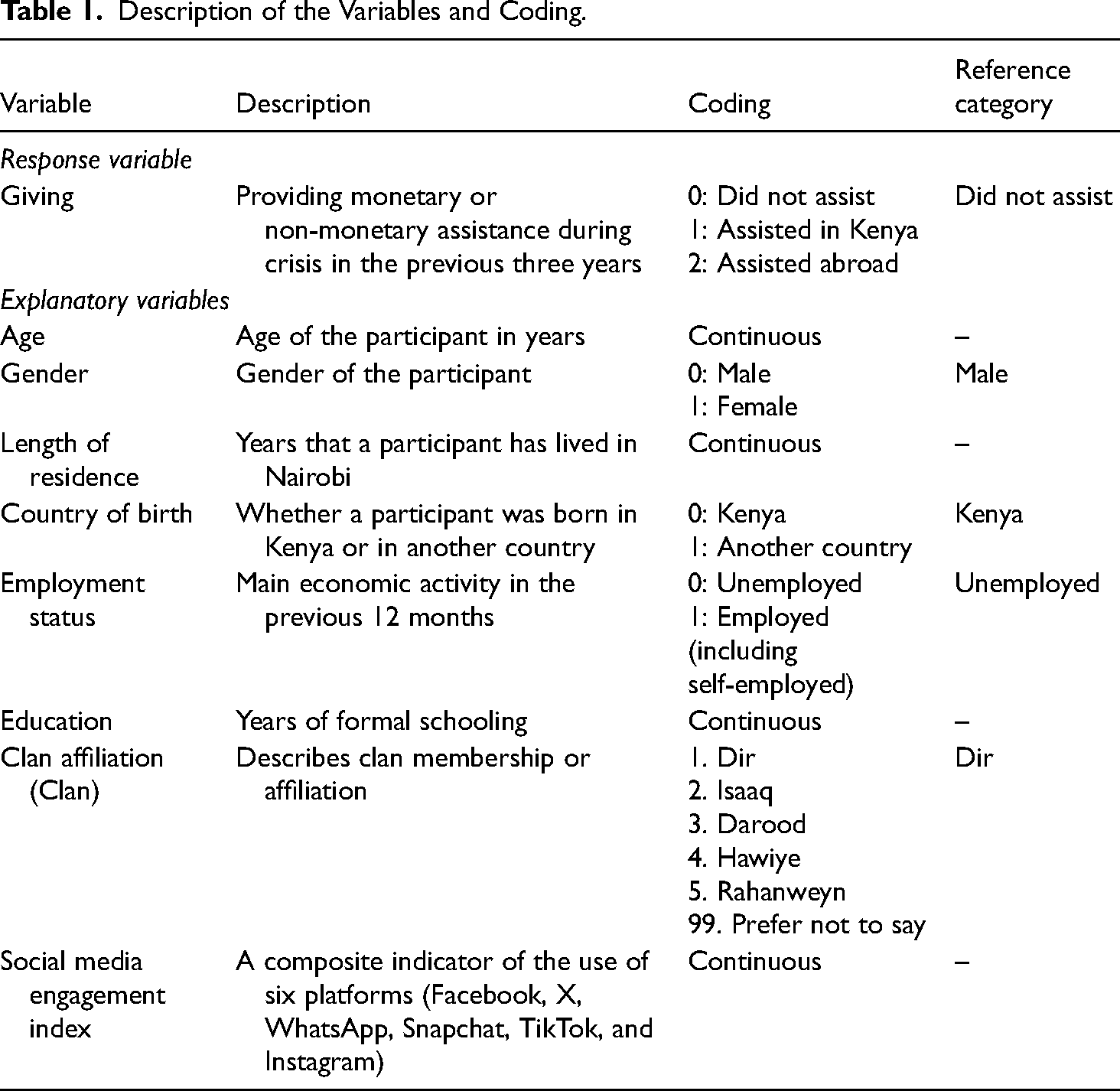
The dependent variable in this study is giving in response to severe crises that occurred between 2021 and 2024. It is operationalised as a three-level unordered categorical variable representing giving patterns. The outcome takes the value of (1) for assistance within Kenya, (2) for assistance to other countries, and (0) for no assistance at all. The independent variables used to predict giving were identified from the literature reviewed above and included age, gender, education, clan, length of residence, country of birth, employment status, and social media engagement (Table 1).
Description of the Variables and Coding.
Data Analysis
Frequency distributions were used to describe different forms of giving, as well as the types and location of crises. Data on the use of digital technologies were captured as multiple responses and subjected to polytomous analysis, with the results presented as a percentage of cases. Social media engagement was analysed using an index, constructed from self-reported usage frequencies across six platforms: Facebook, X, WhatsApp, Instagram, Snapchat, and TikTok. The frequent use of these platforms reflects active engagement with the digital infrastructures that are now central to organising contemporary crisis response. While WhatsApp is a messaging app rather than traditional social media, it is included here because it serves as an essential, everyday tool for kinship, governance, and resource mobilisation within the global Somali diaspora (Norman et al., 2024). Therefore, this study uses social media engagement as a proxy for the broader digital infrastructure used to mobilise and coordinate giving. The index follows the formative measurement tradition, in which behavioural indicators jointly constitute a composite rather than reflecting a common latent variable (Diamantopoulos and Winklhofer, 2001; Sharma et al., 2025). Responses were coded as binary indicators of heavy versus rare use, with the missing values treated as rare use. To construct the index, Multiple Correspondence Analysis (MCA) was applied to combine the six binary indicators (Greenacre, 2017). The sign of the initial inverted scores was reversed so that higher values indicate heavier use. The resulting index was standardised to a mean of zero and unit variance, producing a normalised measure of an individual's breadth of social media use. The validity of the index was assessed using methods for formative composites. The first MCA dimension explained 78.7 per cent of total inertia, with consistent loadings across the six indicators. The index correlated strongly with alternative scoring methods (r > .83) and varied, as expected, with employment and residence. Weaker associations with age and education simply reflect the sample's uniformly high social media adoption (85 per cent heavy WhatsApp use).
The determinants of giving were estimated through a multinomial logistic regression model. The output of the model was presented in the form of coefficients and the magnitude estimated using the average marginal effects. To examine interaction effects, a series of models was estimated, each adding one interaction term to the main-effects model. The models included seven two-way interactions: social media engagement × country of birth, social media engagement × age, social media engagement × employment status, country of birth × clan, country of birth × education, country of birth × age, and age × employment status. The overall significance of each interaction was assessed using a joint Wald test. To avoid the unreliability of log-odds coefficients on the probability scale (Mize, 2019), all interactions were assessed and visualised using average predictive margins. To account for multiple comparisons across the seven interactions, a Bonferroni-adjusted threshold of α = .007 was applied. Effects meeting only the nominal p < .05 threshold were treated as exploratory.
The methods explained above have some limitations. Firstly, this study is based on self-assessed dependent and independent variables captured through cross-sectional data, which cannot establish causal relationships. Secondly, the effect of social media engagement on giving was measured through self-reported social media use, which is limited as a basis for inferring causal relationships. Thirdly, this study is based on socio-demographic factors, some of which are not statistically significant. This could be due to limitations in selecting the factors or could reflect the influence of other factors that have not been considered. Further, while the sample met the statistical threshold for analysis, it is important to be cautious when interpreting the findings due to potential bias in the selection of participants and possible errors in the translation of the questionnaire and interviews using the local language (Jacobsen and Landau, 2003). Finally, while the results of this study may be applicable in similar contexts, data were collected from Somalis in a specific area (Eastleigh), which limits the generalisability of the results.
Ethical Considerations
This study was conducted in compliance with the law and ethical requirements. A research licence for this study was obtained from Kenya's National Commission for Science, Technology and Innovation (License No: NACOSTI/P/23/30405). All research procedures were conducted in strict compliance with ethical guidelines for research involving human participants. Before collecting data, informed consent was obtained from all participants. Moreover, the study only involved heads of households who were 18 years of age or older. During the consent process, the research assistants explained the objectives of this study to the participants, their expected roles, and how the data would be processed. Participants were also invited to request clarifications and were informed of their right to decline participation or withdraw from the interview at any time. To guarantee anonymity and minimise potential harm, no personally identifiable information was collected. Furthermore, all research data were secured on encrypted drives with restricted access.
Results
The findings indicate that slightly over half (53.66 per cent) of the sample participants were from Eastleigh North and that about half (50.9 per cent) of the participants were female. Most of the sampled participants were born in Kenya (55.31 per cent), while the rest were born in Somalia (35 per cent) or Ethiopia (9 per cent). The average length of residence in Nairobi was 8 years, ranging from 1 to 31 years. The average age of sampled participants was 35 years (with a range of 18–75 years). The years of education of the household head averaged 11 years (with a range of 0–21 years). In the twelve-month period preceding the study, 60.97 per cent of the participants had engaged in some form of income-generating activity (employed by someone else or operating a business), while the rest had not been involved in any income-generating activity (39.03 per cent). Hawiye was the most represented clan affiliation at 45.24 per cent, followed by Darood (25.38 per cent), Isaaq (14.76 per cent), Dir (13.66 per cent), and Rahanweyn (0.97 per cent).
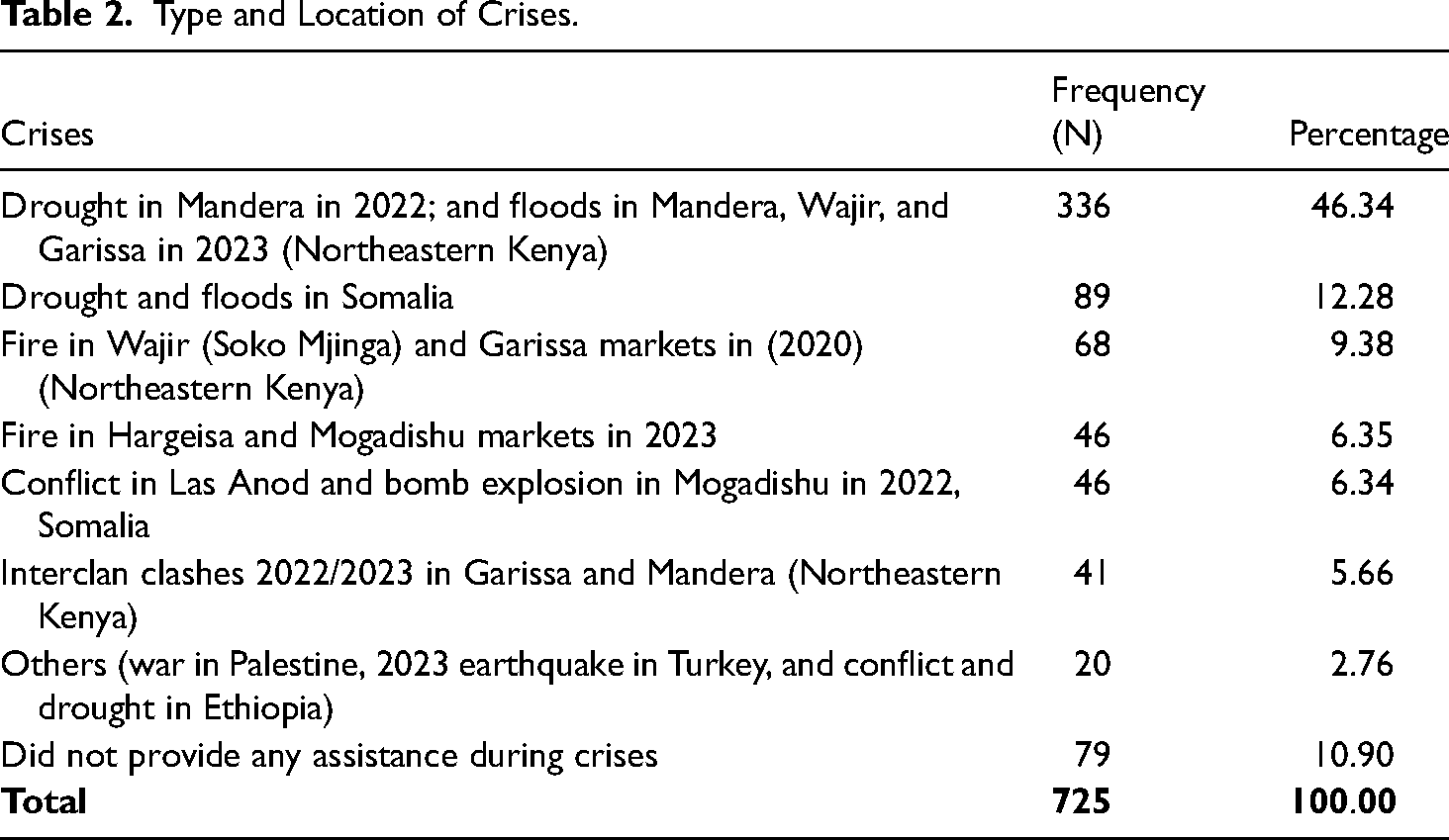
An overwhelming majority of the participants (89.10 per cent) had provided assistance in response to crises. Such assistance took the form of monetary and non-monetary contributions, encompassing donations of foodstuffs (48.14 per cent) and money (28 per cent) and the provision of transport services (5.66 per cent) and shelter (4.69 per cent), as well as time volunteered to mobilise such assistance (2.62 per cent). Assistance was provided during crises that occurred in Kenya (63.31 per cent) and abroad (25.79 per cent). Table 2 indicates that giving in this period was mostly undertaken in response to natural disasters that occurred in Kenya and Somalia (58.62 per cent), such as floods and droughts. This finding is in line with Kleist et al.'s (2025) claim that drought is the baseline for crises among the Somali. Other crises to which the study participants responded with assistance included conflicts, inter-clan clashes, market fires, and violent explosions.
Type and Location of Crises.
WhatsApp is the most frequently used platform (94.74 per cent of cases), followed by Facebook (87.56 per cent of cases) and TikTok (74.32 per cent of cases). These technologies were mostly used to receive updates and inform others about ongoing giving activities (99.06 per cent of cases) and to engage with others by liking, disliking, disagreeing with, or supporting others’ posts (41.04 per cent of cases). A small number of participants reported using digital technologies for accountability (6.29 per cent of cases) or to provide assistance virtually (1.42 per cent of cases).
Digital channels were the most prevalent form of sending money (97.46 per cent of cases). The three most commonly used channels were M-Pesa (52 per cent), Taaj (36 per cent), and WorldRemit (1 per cent). The results indicate that 57.24 per cent of the participants preferred exclusively digital channels, while 42.76 per cent preferred a hybrid of digital and non-digital channels. The speed of the process was the most cited reason for their preference for digital technologies (56.31 per cent of cases).
Social media engagement primarily distinguishes givers from non-givers, rather than local from overseas givers. It was lowest among those who did not give (M = −1.51, SD = 1.16), higher among those who gave within Kenya (M = +0.14, SD = 0.84), and highest among those who gave abroad (M = +0.30, SD = 0.71), F(2, 722) = 143.13, p < .001. All other demographic differences were weak and non-significant (categorical differences ≤ 0.22 SD; continuous |r| < .07).
Table 3 illustrates the average marginal effects of the multinomial logit regression. Model 1 establishes a demographic baseline (education, age, gender, country of birth, employment status, length of residence, and clan). Model 2 introduces the social media engagement index. Inclusion of the social media engagement index significantly improves overall model fit and nearly doubles explanatory power (Pseudo R2: .115 to .236; AIC: 1023.36; BIC: 1133.7). A robust Wald test (χ2(2) = 116.94, p < .001) and all the Variance Inflation Factors scores below standard thresholds (mean = 1.44, max = 2.47) indicate that social media acts as a highly significant, independent predictor of giving that does not suffer from multicollinearity. Hausman tests confirmed that the Independence of Irrelevant Alternatives assumption was not violated (all p > .50). This means that the inclusion of the social media index doubles the model's explanatory power, confirming that digital engagement operates as a primary, independent catalyst for crisis giving regardless of an individual's socio-demographic profile. Therefore, Model 2 is adopted for all subsequent marginal effects and interaction analyses.
Average Marginal Effects from Multinomial Logistic Regression on the Probability of Giving within Kenya and Abroad.
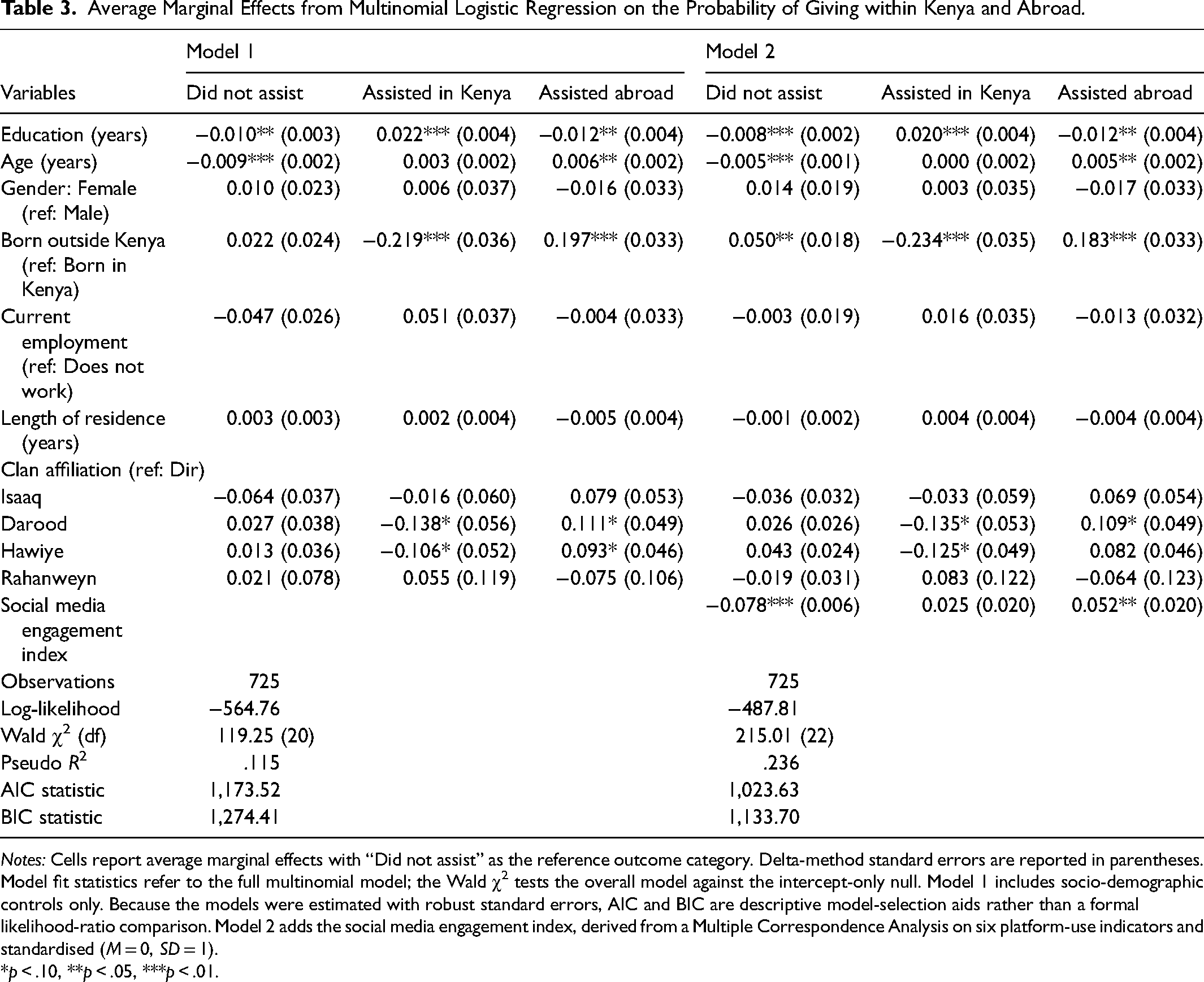
Notes: Cells report average marginal effects with “Did not assist” as the reference outcome category. Delta-method standard errors are reported in parentheses. Model fit statistics refer to the full multinomial model; the Wald χ2 tests the overall model against the intercept-only null. Model 1 includes socio-demographic controls only. Because the models were estimated with robust standard errors, AIC and BIC are descriptive model-selection aids rather than a formal likelihood-ratio comparison. Model 2 adds the social media engagement index, derived from a Multiple Correspondence Analysis on six platform-use indicators and standardised (M = 0, SD = 1).
*p < .10, **p < .05, ***p < .01.
Model 2 indicates that having been born outside Kenya was significantly associated with a higher likelihood of giving for crises abroad and less likelihood of giving for crises in Kenya. Foreign-born participants were 18.3 percentage points more likely to give abroad than Kenyan-born participants (p < .001) and 23.4 percentage points less likely to give within Kenya (p < .001) than Kenyan-born participants. Higher social media engagement significantly increased the likelihood of giving abroad and reduced the likelihood of not giving altogether. A one standard deviation increase in the social media engagement index is associated with 7.8 percentage point decline in the probability of providing no assistance (p < .001) and a 5.2 percentage point increase in the probability of assisting abroad (p < .05). Higher levels of education were associated with a higher probability of local giving and a reduced probability of giving abroad. Each additional year of education increased the probability of giving in Kenya by 2 percentage points (p < .001) and simultaneously reduced the probability of giving abroad by 1.2 percentage points (p = .001). Age was significantly associated with giving abroad but showed no significant relationship with giving in Kenya. Each additional year of age increased the probability of giving abroad by 0.5 percentage points (p = .006). Clan affiliation was associated with giving for some groups but not others. Both Darood and Hawiye members were significantly less likely to give locally (p = .011) than the Dir reference group, but only Darood members showed a significant increase in giving abroad (+10.9 percentage points, p = .027). The remaining clans (Isaaq and Rahanweyn) showed no significant effects on any outcome (all p > .19). However, these clan effects should be interpreted with caution due to modest sample sizes within certain clan-by-outcome cells.
Seven interaction terms were sequentially added to Model 2 to assess their moderating effect on giving behaviour (Appendix Table A1). Analysis revealed that several key factors are associated with giving independently, without interacting. There were no significant interactions between country of birth and age (χ2(2) = .82, p = .663), digital engagement (χ2(2) = .77, p = .681), or clan (χ2(6) = 6.14, p = .408). The interaction between age and social media engagement was likewise not statistically significant (χ2(2) = .49, p = .783).
In contrast, two interactions resulted in a greater likelihood of giving domestically rather than abroad. Higher education was associated with a greater likelihood of local giving and a reduced likelihood of giving abroad among both Kenyan-born and foreign-born participants.
This shift was steeper among the foreign-born, significantly narrowing their gap with Kenyan-born participants (χ2(2) = 7.71, p = .021). Social media use was strongly associated with local giving among the employed (p = .023) but showed no impact on giving abroad (p = .184), though the overall interaction was not significant (χ2(2) = 5.19, p = .075). In sum, these interaction analyses indicate that most factors associated with giving operated the same way across groups, with the same characteristics predicting giving regardless of origin or age.
The few exceptions concerned local giving specifically, where the link between education and local giving was stronger among the foreign-born, and the link between social media use and local giving was stronger among the employed.
Discussion
Most participants reported giving in response to natural disasters, particularly the droughts and floods affecting Kenya and Somalia. Examining the determinants of this giving revealed two distinct patterns: one shaping whether people give, the other shaping where their giving goes. Giving was associated both with ties to areas of origin, reflected in how country of birth, clan affiliation, and age relate to it, and with integration into the social and economic life of the current area of residence, reflected in how education orients giving locally. Cutting across both, social media engagement emerged as a key infrastructure for giving, broadening participation across demographic groups while leaving its destination to other factors. The sections that follow take up each pattern in turn.
Being born outside Kenya and affiliation with the Darood clan were associated with a significant redirection of giving from local crises to crises abroad. In other words, these traits generate a homeland-oriented giving pattern. This pattern may be due to the personal history of forced displacement and the responsibility that migrants feel towards kin in their countries of origin (Horst et al., 2015). Other research has noted that more remittances are sent to locations with longer traditions of migration, such as Somaliland and Puntland, in part because a higher number of people from those locations are in the diaspora (Majid et al., 2018). Contributions during crises follow a similar pattern, flowing to areas with a higher proportion of people living in the diaspora. Overall, the findings suggest that giving is associated with a sense of belonging to one's area of origin. Overall, the findings suggest that giving is tied to a sense of belonging to one's area of origin, which is more likely to be found among older people born in Somalia, and is intensified when crises occur there. This may be the case for individuals from certain clans who are more likely to assist due to personal connections or stronger ties to the location to the affected areas, rather than just their clan identity.
In addition to being born abroad and being part of certain clans, older age also encourages giving for crises abroad without any reduction in support for local crises. The interaction analysis revealed that this aging effect does not vary significantly by country of birth, employment, or social media engagement. Economic ability is therefore unlikely to explain the lower likelihood of giving among younger participants. Moreover, the uniform age effect in the case of both foreign-born and Kenyan-born participants suggests that, despite the importance of country of birth on its own in the analysis, given expectations are also transmitted through socialisation and do not require that one have been born in Somalia.
Overall, the age-related shift towards transnational giving reflects both cultural expectations about who should give at what age and cohort differences in how strongly younger and older Somalis feel connected to areas of origin. The obligation to mobilise transnational support accumulates over the lifecycle as individuals assume greater responsibility within the family and community, and as the next cohort gradually takes over assistance practices (Musa and Kleist, 2022).
Moving in the opposite direction, the localising effect of education suggests that education may deepen ties to host-societies. This pattern is observed among individuals born both in Kenya and abroad, likely because education promotes greater integration into the local socio-economic environment. It may also encourage a shift towards giving for the public good. Regarding greater integration, Carrier (2016) has observed that Eastleigh has a burgeoning educated Somali business and professional class who view the neighbourhood primarily as a site for economic opportunity and as an investment destination. This is especially true for Somali returnees from North America and Europe, who favour Nairobi due to its investment opportunities and a lifestyle that closely resembles that of Somalia. This education-related pattern is further explained by the framing of giving as a public good (Appe and Papyan, 2025). From this perspective, highly educated individuals are more likely to prioritise the stability of their immediate environment. Giving is directed towards broader social change and is perceived as contributing to the public good in the areas where they reside. Education, therefore, broadens crisis giving, extending its destination from the country of origin to include the country of residence.
Beyond the socio-demographic determinants of giving, the findings indicate that social media is a constitutive infrastructure for crisis giving that broadens giving. In the literature, digital technologies are viewed as enablers of transnational ties and essential in mobilising giving. The present findings extend this literature in two ways. One, they reveal that the greatest effect of social media engagement was broadening giving uniformly across different groups. Rather than simply enabling existing giving practices, social media use converts non-givers into givers. It had little effect towards giving abroad and no significant association with local giving. This finding diverges from much of the existing diaspora literature, which largely conceptualises digital technologies as an infrastructure that channels resources back to the country of origin. This finding aligns with Anschütz and Judge's (2025) study, which demonstrates how digital technologies function as a key infrastructure for resource mobilisation. Two, social media engagement was a stronger predictor of giving than any demographic characteristic. This suggests that giving abroad is increasingly organised through digital platforms, which have come to shape giving independently of demographic characteristics. However, the cross-sectional design employed in this study cannot directly confirm this shift over time. Nonetheless, the findings indicate that social media engagement is associated with giving uniformly across age, education, employment, and country of birth. This finding contrasts with the digital-divide literature, which emphasises the stratifying effects of digital access. Social media engagement therefore appears to play a homogenising rather than stratifying role in crisis giving, broadening participation across demographic categories. The rise of social media use as a key infrastructure for giving does not entirely displace the influence of background characteristics. Country of birth and selected clan affiliations continue to influence the destination of giving, indicating that digital connection and origin-based ties are complementary, rather than mutually exclusive.
Conclusion
Giving continues to provide vital relief to people affected by recurrent droughts, conflicts, and other crises, especially in fragile regions. Debates about giving in disaster- and conflict-affected contexts are thus highly relevant in view of current global humanitarian crises. Accordingly, this article has analysed forms of assistance in response to severe crises and how socio-demographic factors affect giving among Somalis in Eastleigh, Kenya. It has also analysed the use of digital technologies and how social media engagement shapes giving.
The results reveal that both the likelihood of giving and the destination of the resources are shaped by a broad range of factors. Education redirects giving towards Kenya, while older age and foreign birth redirect it abroad, with foreign birth having the greatest effect of any predictor on the destination of giving. Clan affiliation similarly encouraged giving abroad among Darood participants, while Hawiye participants gave significantly less in Kenya without a statistically distinguishable shift in giving abroad. Social media engagement primarily drew participants into the giver population while channelling that giving outside Kenya rather than local destinations. The interaction tests yielded no evidence of moderation, suggesting that each of these factors operates additively. Giving is therefore the joint product of multiple independent influences, each shaping a different facet of whether people assist and where their resources are directed.
The findings of this study imply that giving reflects translocal embeddedness. Giving expresses both a tie to a place of origin and a degree of integration into the social and economic life in the current area of residence. The destination of giving, therefore, becomes an indication of how individuals balance their connections across multiple places and communities.
Giving is selective and self-directed rather than uniformly associated with particular locations. Individuals appear to give in ways that affirm their roles in society and that express commitment to the public good, both locally and abroad. The destination of giving is therefore shaped not only by ties to particular places but also by the individual choices people make about which causes and communities to support.
Digital engagement is reshaping how people give without diminishing the demographic structures that have long shaped giving behaviour. While the literature has suggested that demographic and digital factors may interact to amplify or redirect giving, none of the interactions tested in this study survived correction for multiple testing, and none produced substantive moderation on the probability scale. Social media engagement, country of birth, and other demographic characteristics therefore appear to operate as independent rather than interactive influences. Digital connectivity operates alongside demographic characteristics rather than overriding them, with giving emerging from the combined influence of both.
A key implication for crisis response is that prompting people to give and directing that giving towards particular causes require different strategies. Inclusive digital campaigns widen participation and attract new donors more effectively than demographic targeting. Additionally, mobilisation should adapt to a crisis location. Broad digital outreach is suitable for crises abroad, whereas local causes require engaging individuals based on their community embeddedness rather than their country of birth. Future research should employ longitudinal designs to test whether digital engagement drives giving or whether transnationally oriented people self-select into digital spaces. These studies should incorporate detailed metrics such as specific platform use and homeland content exposure to clarify exactly how social media influences giving for causes abroad.
Footnotes
Acknowledgements
The author would like to thank the five research assistants who administered the survey. The author would also like to thank Nauja Kleist, Mark Bradbury, and the two anonymous reviewers for their helpful comments.

Ethical Approval and Informed Consent Statements
Participation in the interviews was voluntary, and verbal informed consent was obtained from all Participants. Research licence to conduct this study was obtained from Kenya's National Commission for Science, Technology & Innovation (License No: NACOSTI/P/23/30405).
Funding
The author disclosed receipt of the following financial support for the research, authorship, and/or publication of this article: This research was conducted as part of the Diaspora Humanitarianism in Complex Crises (D-Hum) program, hosted at the Danish Institute for International Studies (DIIS), and funded by the Danish Ministry of Foreign Affairs, with additional support from the Danida Fellowship Centre. Danish Consultative Research Committee (FFU).
Declaration of Conflicting Interests
The author declared no potential conflicts of interest with respect to the research, authorship, and/or publication of this article.
Data Availability Statement
The data that support the findings of this study are available from the corresponding author, Obadia Okinda Miroro, upon reasonable request.
Author Biography
Appendix
Tests of Two-Way Interactions in the Multinomial Model of Giving. Notes: N = 725. Each interaction was added individually to the additive specification (Model 2; pseudo R2 = .236). Models were estimated by multinomial logistic regression with robust standard errors; “did not contribute” serves as the reference outcome. The Wald χ2 represents the joint test of the interaction's product terms across both non-baseline outcome equations (giving within Kenya and giving abroad); df is the number of product terms. The country of birth × clan model was estimated after collapsing the smallest clan (Rahanweyn, n = 7) into the reference category to resolve complete separation arising from a single perfectly predicted cell. Because seven interactions were tested, the Bonferroni-corrected threshold is α = .05/7 ≈ .007. Only country of birth × education interaction reached the nominal significance (p = .021), but it does not survive this correction; thus, no interaction meets the corrected threshold. * p < .05 (uncorrected).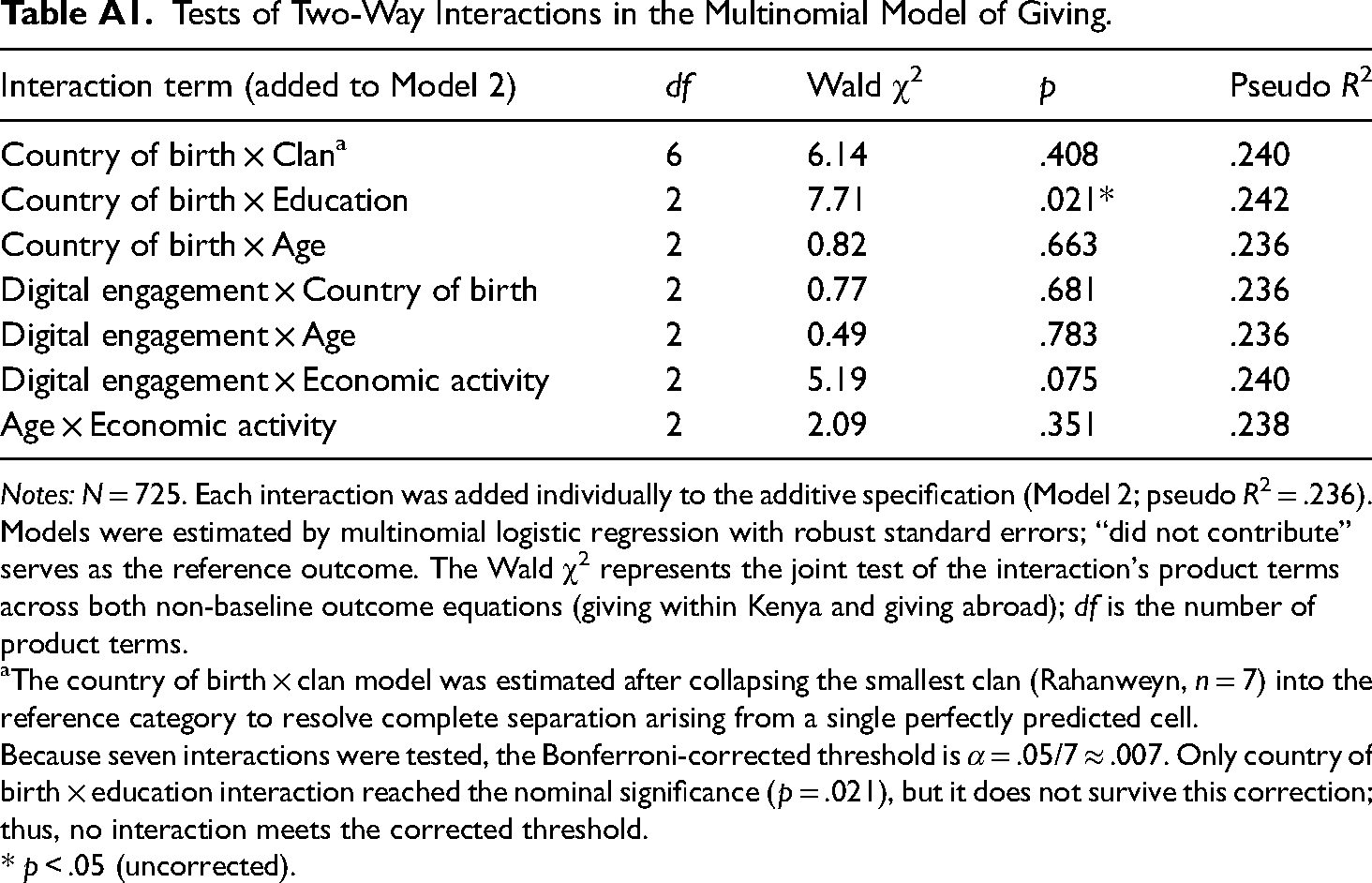
Interaction term (added to Model 2)
df
Wald χ2
p
Pseudo R2
Country of birth × Clana
6
6.14
.408
.240
Country of birth × Education
2
7.71
.021*
.242
Country of birth × Age
2
0.82
.663
.236
Digital engagement × Country of birth
2
0.77
.681
.236
Digital engagement × Age
2
0.49
.783
.236
Digital engagement × Economic activity
2
5.19
.075
.240
Age × Economic activity
2
2.09
.351
.238