






Abstract
Data from the 1998 to 2005 waves of the Panel Study of Income Dynamics are used to assess the particularistic mobility thesis, which maintains that among women there is a racialized continuum in the determinants of and timing to mobility into two “upper-tier” occupational categories. Findings support this theory, though racial gaps along the continuum are greater for professional/technical than for managerial/administrative positions. Specifically, the route to mobility for African Americans is relatively narrow and structured by traditional stratification causal factors, including human capital, background status, and job/labor market characteristics. In contrast, the route to mobility for whites is relatively broad and unstructured by the stratification-based causal factors, and they experience mobility the quickest. Along both dimensions, Latinas occupy an intermediate position between African Americans and whites. Implications of the findings for understanding racial inequality among managers, executives, and professionals are discussed.
Pursuant to women’s increasing representation in the U.S. labor market, an enormous literature has examined their stratification-based experiences. Along these lines, the overwhelming majority of this work has explicated the dynamics of gender stratification by comparing men and women and uncovering a primary and deep-rooted form of inequality (for reviews, see Jacobs 1989; Reskin and Bielby 2005). Overall, encompassing hundreds of research pieces—journal articles, books, and essays—this literature documents that both structural (e.g., occupational segregation/crowding of women into devalued “sex typical” occupations [see Tomaskovic-Devey 1993; Jacobs 1989]) and ideologically based (e.g., patriarchal dominant ideologies of workplace governance [see Risman 2004; Ridgeway and Smith-Lovin 1999]) factors explain gender inequality across the wide range of workplace-based rewards.
As several sociologists have pointed out, however, the sheer magnitude of gender differences has deflected attention away from examining intragender group stratification among women on potentially critical bases such as race (Higginbotham and Weber 1992; England, Christopher, and Reid 1999). Indeed, assessing race within a disadvantaged status, that is, among women, broadens our understanding of racial stratification in the American workplace: our knowledge of racial stratification among women—relative to our knowledge among men—is limited in terms of the range of socioeconomic outcomes considered, and the sources of documented racial differences have been characterized as “virtually non-existent” (Reskin 2000, 322). Overall, among women, we know that African Americans and Latinas, relative to whites, receive lower earnings and socioeconomic status “returns” from human capital investments, such as educational attainment and workforce experience (Farley 2004; Jaynes and Williams 1989). In addition, they have limited access to reward-generating structural characteristics of jobs, including, most conspicuously, supervisory responsibility (R. Smith 2002), and are disadvantaged in occupational mobility rates—both upward and downward (Spalter-Roth and Deitch 1999; Wilson and McBrier 2005).
Among these socioeconomic outcomes, the sources of racial gaps among women moving upward into well-rewarded and prestigious occupational destinations, such as “upper-tier” (Wilson, Sakura-Lemessy, and West 1999) managerial, professional, and executive positions, emerge as particularly worthy of in-depth investigation. Upper-tier slots offer material (e.g., income, benefits, and retirement packages) and symbolic rewards (e.g., prestige, honor) that enhance life-chance opportunities on an intragenerational basis and secure resources to assist in the intergenerational transmission of status (Wilson, Sakura-Lemessy, and West 1999; Leicht and Fennell 2001). These slots are also associated, for example, with salutary job and generalized social psychological orientations (e.g., esteem, job and life satisfaction and intellective functioning), many of which are also transmitted to one’s children, thereby enhancing their quality of life and that of future generations (Kohn 1969).
Among men, the old adage that minorities “have to work twice as hard to get ahead” has been demonstrated in the context of the particularistic mobility thesis (Wilson, Sakura-Lemessy, and West 1999; Wilson 1997; Stainback, Robinson, and Tomaskovic-Devey 2005): employers’ decisions regarding promotion are based on employees’ demonstrating the range of informal, requisite criteria (e.g., perceived loyalty, sound judgment, and trust). Minorities, lacking opportunities to demonstrate them, are restricted to attaining mobility along a relatively formal and circumscribed route. Accordingly, the low mobility rates of African Americans and Latinos into managerial/administrative and professional/technical census categories (Wilson 2005) as well as mobility into unspecified occupational destinations (Baldi and McBrier 1997; R. Smith 2005) are captured by traditional stratification criteria, such as attaining substantial human capital (e.g., educational attainment, substantial workplace experience, and tenure with current employer), coming from a privileged background, and having favorable job/labor market characteristics (e.g., union status, sector [Wilson, Sakura-Lemessy, and West 1999; R. Smith 2001]). Conversely, whites—in addition to relying on this formal path—can utilize a more informal networking route based on demonstrating informal criteria, which, overall, translates into discrete mobility paths.
To date, no work has examined whether a similar association exists between mobility rates and the process of attaining upper-tier occupations on the basis of race within a disadvantaged status, namely, being a woman. Furthermore, no work has examined an auxiliary mobility issue—also absent in analyses of men—namely, the temporal sequencing of upward mobility. What is significant is that the earlier that mobility takes place in one’s career, the greater the time spent enjoying the material and symbolic rewards of incumbency in an upper-tier slot. In fact, the earlier that mobility is attained, the more resources can be accumulated and the more time can be spent cultivating the important networks that help to ensure the intergenerational transmission of an occupational position (Maume 1999; Wilson and Roscigno 2010).
This study fills this void by using data from a nationally representative sample to assess whether the particularistic mobility thesis can (1) explain the process of mobility into upper-tier occupations among white, African American, and Latina women; and (2) explain race-specific timing to mobility into upper-tier occupations among white, African American, and Latina women.
Theory
Extending the particularistic mobility thesis to explain the process and timing of race-based disadvantage among women derives from a synthesis of the approximately twenty existing survey-based studies, case studies, and review/theoretical essays that address race-based promotion practices among women who work in predominantly white-owned and -managed firms/businesses (Kennelly 1999; Browne and Misra 2003; Feagin and Sikes 1994; Tomaskovic-Devey 1993; Bell and Nkomo 2001; Fernandez 1981; Fosu 1992; Tomkiewitz and Brenner 1996; Reskin and Padavic 1994; Mundra, Moellner, and Loez-Aqueres 1995; James 2000; King 1995; Higginbotham and Weber 1992). These studies tend to be rooted in “intersectionality” theory (P. Collins 2008; Browne and Misra 2003) and establish that the statuses of race and gender constitute interrelated but distinct stratification systems. Accordingly, dynamics associated with the racialized system, for example, occupational segregation and unequal access to educational and training opportunities (Browne and Misra 2003), may compound disadvantage, operating within the gendered system, for example, occupational segregation and the devaluation of female jobs (Reskin and McBrier 2000).
In terms of causal mechanisms, this body of work maintains that the tendency of minority women to receive unfavorable performance evaluations, relative to white women, constitutes a form of disadvantage in the mobility process. Specifically, it identifies the employment practices that reinforce negative race-based stereotypes unique to minority women that, ultimately, render promotion difficult relative to white women. Accordingly, this literature documents that an element of “modern racism” (Pettigrew 1985) permeates the mobility process within a disadvantaged gender status. This form of racism—consistent with broad formulations that have no specific gender referent, such as “laissez-faire racism” (Bobo, Kluegel, and Smith 1997) and “color-blind racism” (Bonilla-Silva 2004)—is subtle, institutional, and even ostensibly nonracial in nature, and it tends to produce disparate outcomes by race without reference to the traditional ill will associated with classic “Jim Crow” discrimination (Pettigrew and Martin 1987; Bobo, Kluegel, and Smith 1997). Overall, dynamics that drive this subtle form of racism range from the perceived “business necessity” of maintaining a stable workforce and customer/client base (Wilson 1997; Pettigrew 1985) to cognitive distortions inherent to such social psychological constructs as “statistical discrimination” (Tomaskovic-Devey and Skaggs 1999) to “self-serving attributional bias” (Pettigrew and Martin 1987) that is associated with stereotypes about the fitness and suitability to be a productive worker.
A first line of studies highlights the dynamics of allocation of African American women and Latinas into internship/mentoring and training programs. These women, specifically, are allocated into programs that are segregated along race/gender lines (e.g., Latinas work alongside Latinas) and that are supervised by coracial women (e.g., Latinas workers are supervised by Latinas) so that minority women are restricted to “hyper-segregated” (Bell and Nkomo 2001) job networks (Tomkiewitz and Brenner 1996; Bell and Nkomo 2001; Kennelly 1999; Higginbotham and Weber 1992). Restriction to these networks, in turn, limits cross-racial interactions, thus reaffirming negative race-based stereotypes that have an “intersecting race/gender content” (Browne and Misra 2003). These stereotypes range from being tardy or unreliable (Kennelly 1999) and having a penchant for complaining about work assignments and perceived discrimination (Kennelly 1999; McGuire 2002) to being prone to hostile outbursts toward coworkers and customers and impatience and lack of loyalty toward supervisors (Feagin and Sikes 1994).
A second set of studies emphasizes inequities in race-based allocation to job tasks among minority women. Specifically, African American women and Latinas are channeled into “racialized” job functions that revolve around producing services used or concerned with minority populations and those that assign minority women, relative to white women, to less substantively complex tasks that involve less reading, less writing, and less complex computer skills (James 2000; Feagin and Sikes 1994) Allocation into these positions serves to stigmatize minority women, reaffirming invidious stereotypes, and places them in positions that are unconnected to mobility ladders.
Predictions
Determinants
The line of research that extends the particularistic mobility thesis to women posits that dynamics associated with allocation on the basis of race among women disadvantage Latinas and African American women in mobility prospects, relative to white women. Specifically, the “double disadvantage” experienced by minority women—that is, discrimination within a disadvantaged gender status—that is fueled by unique intersecting negative stereotypes renders minority group women, relative to white women, disadvantaged in a manner analogous to men: that is, on a particularistic basis. Accordingly, relative to white women, minority women are favorably assessed for promotion on a relatively narrow basis. They must compensate, being forced to rely on a relatively formalistic and narrow route to promotion that is captured, relative to whites, by traditional stratification-based causal factors that encompass human capital, background status, and job/labor market characteristics.
Timing
It is further hypothesized that—in accordance with dynamics associated with the particularistic mobility thesis—minority women, on average, should take longer to achieve mobility than white women. Along these lines, having to rely on relatively formal means—including, most notably, the acquisition of significant human capital—as a prerequisite to promotion is a slow and deliberate process. Thus, for minority women, the time required to overcome negative stereotypes, it is assumed, is longer than that required to utilize networking and other informal strategies more often employed by white women to attain mobility.
Refinement to Theory
Studies comprising the particularistic mobility thesis provide a basis for further differentiating how causal dynamics posited by this perspective should impact the determinants of and timing to mobility into upper-tier occupations among minority women. Latinas, specifically, should be less prone to particularistic bias than are African American women. First, anecdotal evidence from several case studies of race-based experiences at work suggest that Latinas are allocated to less segregated task groups and internship programs than African American women, leaving them better able to communicate relevant job-related personal characteristics (Fernandez 1981; Yaffee 1995). Second, survey research has demonstrated that whites hold less invidious stereotypes toward Latinas than they do toward African American women (see Kluegel and Bobo 2001; Bobo and Massagli 2001). As such, relatively benign perceptions of Latinas regarding job-related personal characteristics, such as work ethic, intelligence, and penchant for criminality, translate into, relative to African Americans, a more favorable set of baseline personal characteristics. Accordingly, these relatively benign perceptions may be the basis of less severe forms of cognitive distortion, such as self-serving attribution bias and statistical discrimination in the promotion process.
Overall, based on these studies, racial differences in the determinants of and timing to occupational mobility into upper-tier occupations along lines enunciated by the particularistic mobility thesis should operate along a racialized continuum. Specifically, the path to mobility for African American women should be most narrow and circumscribed; that is, it is most dependent on traditional stratification-based causal factors, including, most notably, human capital. Conversely, the route to upper-tier slots for white women should be broadest, meaning it is most generalizable and least dependent on traditional stratification-based causal factors. Finally, Latinas should occupy an intermediate ground between African Americans and whites. In addition, as the timing of mobility into upper-tier occupations is a function of opportunities to reach them, race-based patterns in timing should proceed along a parallel track to the determinants of mobility. Accordingly, African Americans should experience the slowest movement into upper-tier occupations, while whites should move into these occupations most rapidly. Furthermore, Latinas should ascend into them in a temporally intermediate fashion between African American and white women.
Data and Methods
Data from the 1998 through 2005 waves of the Panel Study of Income Dynamics (PSID) were pooled to examine racial differences among women in the determinants of and timing to mobility into upper-tier occupations (see Hill [1992] for a detailed description of the PSID data set). The PSID originated in 1968 and is an ongoing longitudinal survey of all members of 5,000 households to determine changes in their economic well-being. The sample for the current study consists of a cohort of 528 full-time non-self-employed African American women, 983 white women, and 266 Latinas who were between the ages of 18 and 55. 1 The variables used in the analyses are as follows.
Dependent variable
Upper-tier occupations consist of two of the eleven broad-based 1970 census-based occupational categories—managers/administrators and professional/technical workers. The managers/administrators category includes jobs that are high on a “supervisory dimension” (Hout 1988), that is, having decision-making responsibility over the size, personnel, and direction of firms (Parcel and Mueller 1983; Bridges and Villemez 1994). The professional/technical category includes positions that put a premium on the attainment of formalized training in specialty areas and typically involve relatively high levels of formalized credentialing as a prerequisite for entry (Leicht and Fennell 2001).
Predictor variables
The influence of several categories of factors in structuring the determinants of and timing to occupational mobility among African American and white women as well as Latinas are included.
Race and socioeconomic background
Race is coded as 1 for African Americans and Latinas, with white women serving as the reference category. Background status is measured with two variables. The first is years of mother’s education (years). 2 The second is whether the respondent came from an “intact family” when growing up. This variable is coded 1 if the worker had both parents in the household until age 16 and 0 if the worker did not have both parents in the household until age 16. 3
Human capital credentials
The influence of several human capital credentials is assessed. First, level of educational attainment is coded as a series of dummy variables, specifically, “postcollege” and “college,” with “less than college” serving as the reference category. Second, consistent with prior research, attendance at work is used as an indicator of job commitment (Mueller and Price 1992; Wilson and McBrier 2005). Specifically, job commitment is operationalized as the mean number of job absences among respondents in a year. Job absences are reverse-coded so that higher scores reflect greater commitment (i.e., fewer absences) and lower scores reflect lesser commitment (i.e., more absences). Third, time spent at present employer is included, which is measured by the number of months the respondent has worked for her present employer. The fourth human capital characteristic included is prior work experience, which is measured by the number of years the respondent has worked full time in the labor force since age 18. Finally, the number of hours worked per week is included as a control variable.
Job/labor market characteristics
The influence of several job/labor market characteristics is assessed. First, union status of job is coded as 1 = yes, 0 = no. Second, sector of employment is coded as 1 = public, 0 = private.
Finally, this study uses an interaction-based strategy to assess the determinants of mobility into upper-tier occupations for African American and white women as well as Latinas. Accordingly, interaction terms are created for race and all independent variables in the model, with whites serving as the reference category (coded 0) so that the paths to promotion for the two groups of minority women is compared to that of whites. Overall, this strategy is appropriate for our purposes: it controls on all independent variables, thereby assessing whether the vector of predictors operates in a significantly different fashion for minorities vis-à-vis white women.
Statistical model
Multinomial logistic regression is used to assess the determinants of the two occupational categories. This multivariate technique is used for evaluating categorical dependent variables that are treated as distinct and unordered, and the issue of interest is to identify factors that contribute to being in a particular upper-tier occupational category rather than not being employed in either of them. The output from the multinomial logit analysis includes one fewer vector of coefficients than there are choices in the model. The B estimates represent the log odds of being in a particular category relative to a base category resulting from a one-unit change in the independent variable of interest. Thus, for the analysis of the three-category dependent variables, occupational categories, two vectors of coefficients are produced. Because the base category for these analyses is occupational categories other than the managers/administrators or professional/technical ones, the coefficients represent the net effect of the independent variables on the probability of being employed in the two white-collar occupational categories rather than being employed in either of them. In addition, for multinomial logistic regression analyses, odds ratios are constructed by computing the antilog of each coefficient.
Last, mobility into upper-tier positions is identified by tracking occupations of respondents across survey years. In particular, a discrete-time hazard rate model—a form of event-history analysis—is used to track career experiences (Allison 1984). The dependent variable in event-history analysis is the hazard rate, an unobserved variable that indicates the probability that a person will experience an event at a particular time given that the person has not yet experienced the event. Event-history analysis estimates the probability of becoming upwardly mobile for each person-year of exposure to the risk of experiencing the event; this entails treating each person-year of exposure to the risk of moving upward from a non-upper-tier occupation during the eight waves as if it were a separate observation and pooling these observations.
Workers were defined as “being at risk” for becoming mobile if they worked in a non-upper-tier occupation and were paid by an employer. Beginning in 1998, workers were followed until they experienced a career transition, specifically, moving to an upper-tier occupation, or a move to unemployment or self-employment. When experiencing a transition to an upper-tier slot, the worker is no longer in the risk set and is dropped from the analysis. Thus, the number of cases contributing to the pooled set decreases each year. Respondents excluded from the initial sample in 1998 could enter the risk set in later years if they met the selection criteria. Similar to those selected in 1998, these workers remained in the risk set until they experienced a career transition. The total number of person-years in the 1998 to 2005 pooled data set was 2,911 white, 1,556 African American, and 721 Latina.
Overall, after pooling the eight years of observations, a multinomial logistic regression equation is specified, which models the odds of being mobile between year and year t = 1. As tenure is controlled, the model estimates the likelihood of becoming mobile given the failure to have been mobile at an earlier duration. Results from this model approximate a discrete-time hazard rate, which accommodates time-varying covariates (Allison 1984; Teachman 1983).
Results
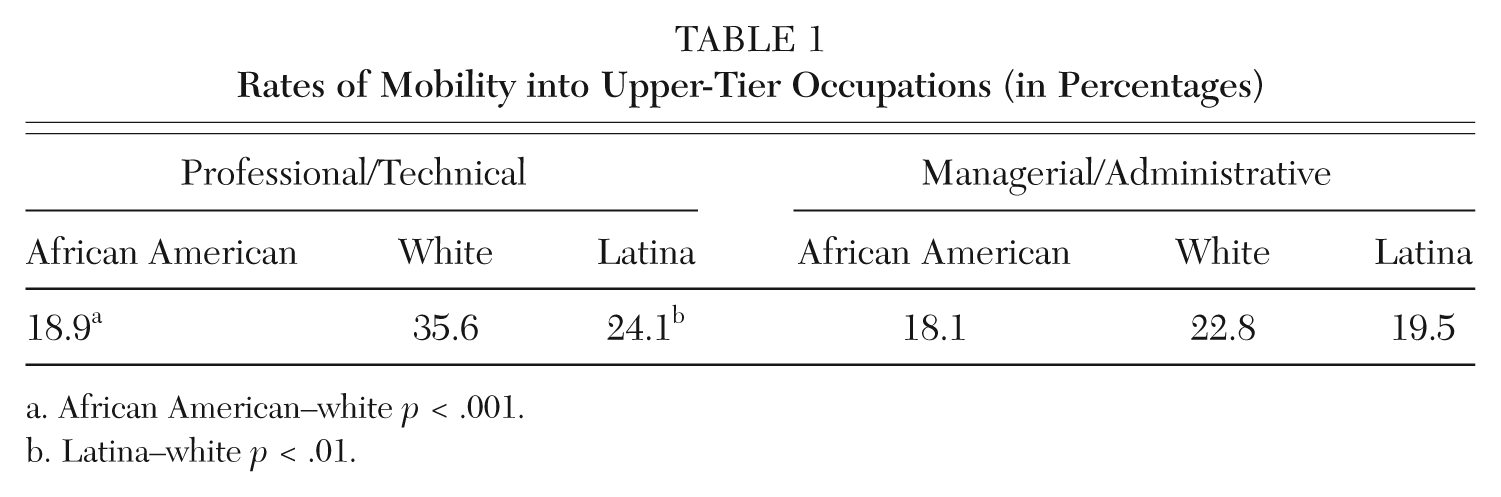
The first stage of analysis used descriptive statistics to address the race-specific incidence of mobility for the white, African American, and Latina sample of women into both census-based upper-tier occupational categories during the 1998 to 2005 period. Table 1 reports these results from an analysis of variance (ANOVA) procedure).
Rates of Mobility into Upper-Tier Occupations (in Percentages)
African American–white p < .001.
Latina–white p < .01.
The findings indicate that there is variation in the distribution of race-based representation across the two upper-tier categories among the sample of women. The racial gap between whites and the two minority groups of women is pronounced in the professional/technical category. Specifically, 35.6 percent of whites, 18.9 percent of African Americans, and 24.9 percent of Latinas experience mobility into the professional/technical category. 4 Furthermore, access is significantly different between whites and the two groups of minority women. The racial gap, however, between whites and the two groups of minority women in access to the managers/administrators category is less, and there are no significant differences between whites and either minority group. Specifically, 22.8 percent of white women, 18.1 percent of African American women, and 19.5 percent of Latinas experience mobility into the managers/administrators category.
Determinants of mobility
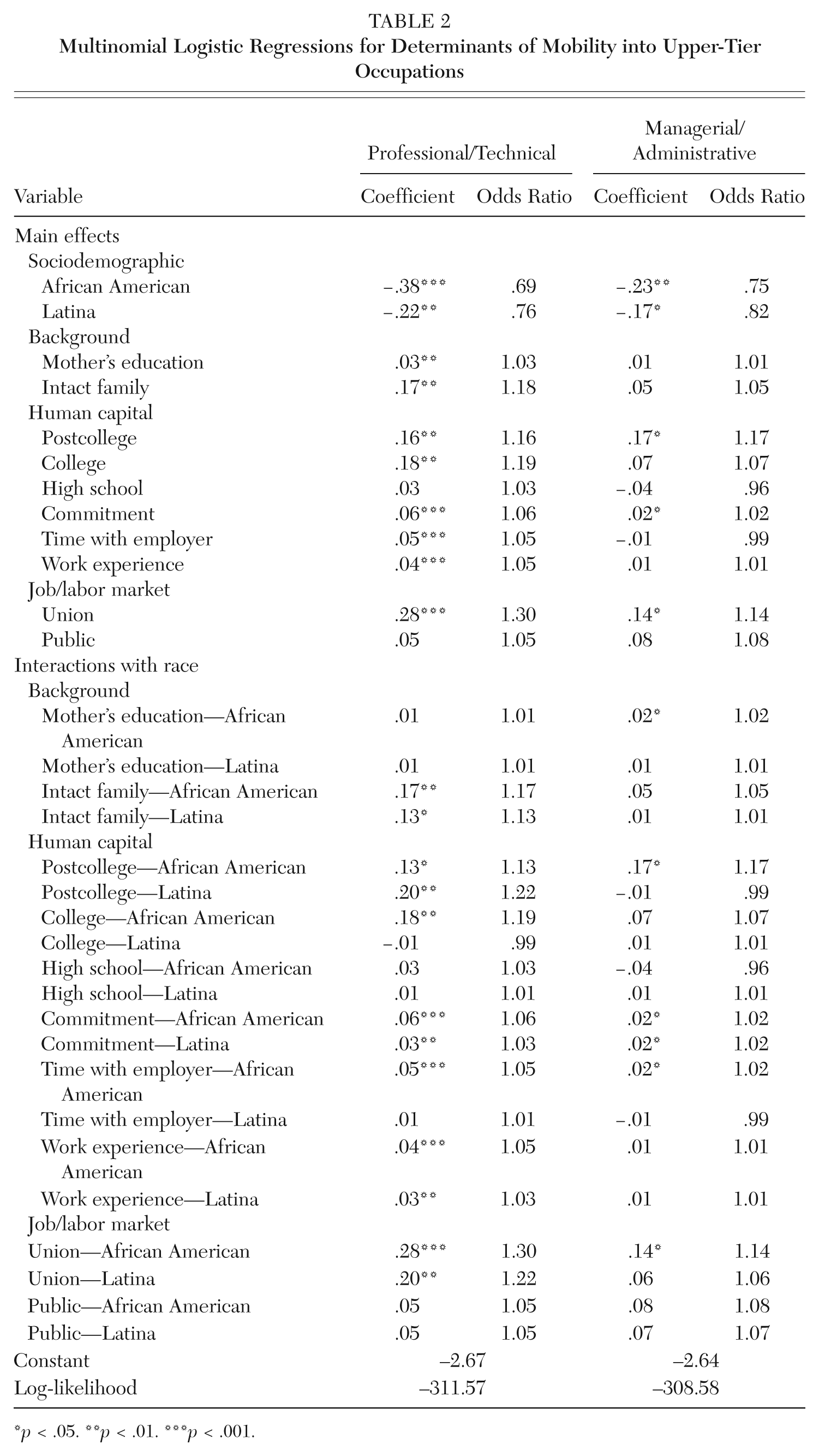
Table 2 reports results from multinomial logistic regression models for the determinants of mobility into the professional/technical and managers/administrators occupational categories among white and African American women as well as Latinas.
Multinomial Logistic Regressions for Determinants of Mobility into Upper-Tier Occupations
p < .05. **p < .01. ***p < .001.
Professional/technical
Findings indicate there is greater support for prediction from theory in the context of the determinants of mobility into professional/technical occupations. First, at least half the interaction terms—specifically, seven out of nine for African Americans vis-à-vis whites and five out of nine for Latinas vis-à-vis whites—exert significant differences. Second, the effects of these variables are along lines predicted by theory; that is, they produce a more narrow and more scrutinized path to mobility for minority women, relative to white women. Furthermore, the effect of these variables is pronounced: of the seven significant among African Americans, six—the overwhelming majority—exert either robust (p < .001) or moderate (p < .01) effects; of the five significant variables for Latinas, four exert moderate effects and one exerts a modest effect (p < .05). In particular, African Americans’ attainment of professional/technical jobs, relative to whites, increases, respectively, by 1.06, 1.04, 1.06, and 1.05 times the marginal odds of not reaching this occupational category with unit increases in job commitment, time with present employer, and work experience. Furthermore, African Americans’ attainment of the professional/technical jobs, relative to whites, increases, respectively, by 1.17, 1.13, and 1.19 times the marginal odds of not reaching this occupational category if they come from an intact family and have either a postcollege or college education. Finally, among variables measuring job/labor market characteristics, findings indicate that African Americans’ attainment of the professional/technical jobs, relative to whites, increases by 1.30 times the marginal odds if they work in a unionized position.
Similar results—though not as pronounced—are found among Latinas, relative to white women. Specifically, Latinas’ attainment of jobs in the professional/technical category, relative to white women, increases by 1.03 times the marginal odds of not reaching this occupational category with unit increases in job commitment and work experience. Furthermore, Latinas’ attainment of jobs in the professional/technical category, relative to whites, increases respectively by 1.13, 1.22, and 1.22 times the marginal odds of not reaching this occupational category if they come from an intact family, have a postcollege education, or work in a unionized slot.
Managerial/administrative
Findings from Table 2 also support predictions from theory in the context of the determinants of mobility into managerial/ administrative occupations. However, while whites are favored along lines predicted by theory, gaps are minor relative to findings regarding entry into professional/ technical slots. First, four out of nine interaction terms exert significant effects for African Americans, vis-à-vis whites, and two out of nine exert significant effects for Latinas, vis-à-vis whites. Furthermore, the magnitude of all significant variables for both groups, vis-à-vis whites, is modest. In particular, African Americans’ attainment of occupations in the managerial/administrative category, relative to whites, increases respectively by 1.02 times the marginal odds of not reaching this occupational category with unit increases in mother’s education and job commitment. Furthermore, African Americans’ attainment of positions in the managerial/administrative category, relative to whites, increases respectively by 1.17 and 1.14 times the marginal odds if they have a postcollege education or work in a unionized position. Finally, Latinas’ attainment of jobs in the managerial/administrative category, relative to whites, increases by 1.02 times the marginal odds of not reaching this occupational category with unit increases in job commitment and time with employer.
Timing to mobility
Table 3 reports results from event-history analyses regarding the timing of experiencing upward mobility into each of the two upper-tier occupational categories among white women, African American women, and Latinas. The timing to mobility is determined by substituting the race-specific means on predictor variables from Table 1 into the models in Table 2. By allowing tenure to vary, the models predict the odds of experiencing movement at each year of tenure. After transforming the predicted odds to predicted probabilities, the cumulative product of one minus the duration-specific mobility probabilities yields a survival curve (highlighting findings for years one, four, and eight in tabular form). Plotting the survival curve against duration in the job will show how long the typical respondent in the PSID sample waits before becoming upwardly mobile.
Timing to Mobility into Upper-Tier Occupations (in Months)
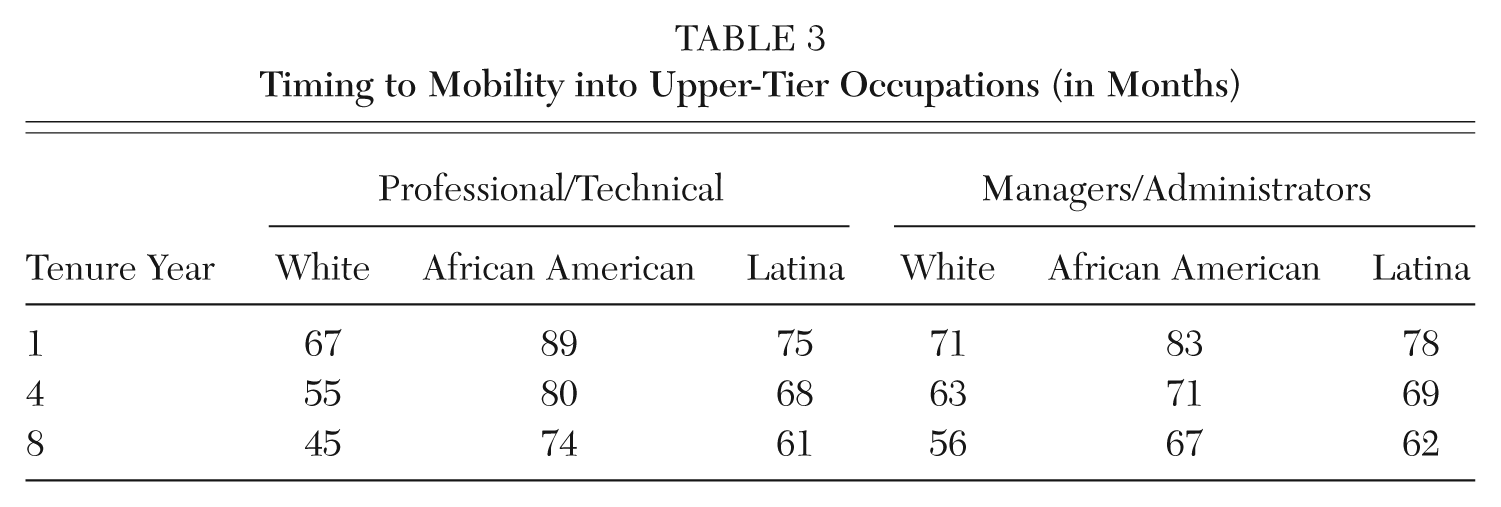
The findings highlight a racialized continuum in the timing to mobility into both professional/technical and managerial/administrative categories along lines enunciated by the particularistic mobility thesis. Accordingly, in terms of timing to reach professional/technical slots, racial differences favoring white women over minority women should be relatively pronounced. Specifically, it is predicted that after eight years, 45 percent of white women will not have been upwardly mobile, meaning that 55 percent will have left the risk set and experienced mobility into upper-tier occupations. In contrast, in the eighth year, it is predicted that 74 percent of African Americans will not have been upwardly mobile, meaning that 26 percent of African American women will have experienced mobility into upper-tier slots. Finally, by the same logic, it is predicted that in the eighth year, 39 percent of Latinas will have experienced mobility into upper-tier slots.
The findings also indicate that racial gaps between white and minority women in timing to mobility into managerial/administrative occupation are not as great as gaps in timing into professional/technical occupations. Specifically, it is predicted that after eight years, 56 percent of white women will not have been upwardly mobile, meaning that 44 percent will have left the risk set and experienced mobility into upper-tier occupations. In contrast, in the eighth year, it is predicted that 70 percent of African Americans will not have been upwardly mobile, meaning that 30 percent of African American women will have experienced mobility into upper-tier slots. Finally, by the same logic, it is predicted that in the eighth year, 34 percent of Latinas will have experienced mobility into upper-tier slots.
Conclusion
The findings from analyses of the PSID sample of women support predictions from the particularistic mobility thesis, though gaps along the predicted racialized continuum are greater for the professional/technical category than they are for the managers/administrators upper-tier occupational category. Specifically, a racialized hierarchy, favoring whites and disadvantaging African Americans most, with Latinas occupying a middle ground, emerges in terms of both the determinants of and timing to mobility into both occupational categories. Specifically, the route to mobility for African Americans is most narrow and structured by traditional stratification causal factors, including background status and job/labor market characteristics, and they are slowest to experience mobility. The route to mobility for whites is the most broad and unstructured by the stratification-based causal factors, and they experience mobility the quickest. Along both issues, Latinas occupy an intermediate position between African Americans and whites. 5
It is important to specify how findings constitute forms of disadvantage for Latinas and, especially, African American women. First, the narrower path to mobility appears deleterious: long-standing discriminatory barriers that impede the acquisition of, for example, human capital—such as access to postcollege education (Braddock and McPartland 1987) and high rates of job displacement (Wilson and McBrier 2005; Spalter-Roth and Deitch 1999)—serve to depress rates of mobility among minority women. Conversely, whites are not similarly handicapped. They attain upper-tier occupations in at least two ways: similar to African American women and Latinas, they advance through a relatively formal process, but they also do so through a variety of informal means unavailable to minority women. Overall, the greater range of options for white women would seem to translate into higher mobility rates. Second, the slower ascent to upper-tier occupations among minority women signals disadvantage. As mentioned earlier, the longer spell spent outside upper-tier occupations means minorities lose a greater amount of socioeconomic rewards—both material and symbolic—than whites, who have an advantage on an intragenerational and intergenerational basis. Furthermore, African American women and Latinas who climb the occupational ladder would seem to be handicapped in terms of an increasingly important dimension of stratification in the first decade of the new millennium, namely, the stability of jobs: in an era in which job displacement by way of layoffs, furloughs, and reductions to part-time status has accelerated, seniority status has become increasingly prized as a resource that insulates workers from job loss (B. Smith and Rubin 1997; Cappelli 2000).
What is significant, and not to be overlooked, is that the findings also indicate that among women, particularistic practices have varying effects across upper-tier occupational categories, with racial effects in the determinants of and timing to managerial/administrative slots being more pronounced than in professional/technical slots. In fact, several recent gender-based studies may help to explain variation in racial gaps in the determinants of and timing to professional/technical jobs vis-à-vis manager/administrator occupations. They suggest, in particular, that women—across racial categories—suffer from a pronounced form of “social closure” (Weber 1968) that includes institutional forms of exclusion from occupations that invoke supervisory responsibility (R. Smith 2002; Reskin 2000; Moller and Rubin 2008). Apparently, when firm control and direction is at stake, gender—across racial groups—acts to depress occupational attainment, thereby partially counteracting the race-specific impact of particularism. Conversely, in the context of professional/technical occupations, where incumbency translates into well-paid and prestigious positions but does not as directly offer opportunities to exercise control/power over firms (Leicht and Fennell 2001), particularism acts unencumbered to create greater variation by race in access to upper-tier slots among women.
Finally, there is reason to suspect these forms of minority group disadvantage produced by particularistic practices are not likely to recede any time soon. In particular, a hallmark of the “new restructured workplace” (Kalleberg 2009) is enhanced employer “flexibility,” an outgrowth of increasing de-bureaucratization of workplace rules/regulations (Moller and Rubin 2008; Kalleberg 2009), the rise of short-term employment contracts (Cappelli 2008; Moller and Rubin 2008), and the loss of traditional employee-based equal employment opportunity protections (Skrentny 2001; Stainback, Robinson, and Tomaskovic-Devey 2005). Significantly, flexibility has increased discretion among employers when making promotion-relevant decisions, likely fueling particularistic practices (Kalleberg 2009; Cappelli 2008). Accordingly, vigorous policy is necessary if we are to “stem the tide” and reverse the impact of these recent developments in the workplace. In this regard, policies should be enacted that minimize employer discretion by establishing clear-cut guidelines for promotion that are based on objective criteria such as educational prerequisites and relevant work experience. In addition, policies should be enacted to ensure that African American women and Latinas are increasingly represented across the range of settings and contexts within firms that facilitate racially integrated informal and formal social networks. These measures—if enacted in a manner that makes firms “legally accountable and responsible” (Kalev, Dobbin, and Kelly 2007)—help to level the playing field with respect to providing opportunities to demonstrate the informal criteria that are important bases for promotion into upper-tier occupations.
In sum, the findings from this study provide additional evidence for the recent statement by Bonilla-Silva (2004) that in the contemporary American workplace—across both gender groups—a racialized continuum is coming to characterize stratification-based dynamics. Nevertheless, it must be emphasized that this study does not represent the “final word” regarding the race-based determinants of and timing to mobility of women into upper-tier occupations. Researchers, for example, should conduct more refined analyses. First, they should assess how particularism structures the determinants and timing of mobility across specific jobs, such as for lawyers, doctors, accountants, and so forth. In fact, occupational-level data may mask inequality generated by phenomena such as race-based job “ghettoization” (Vallas 2003) that have been documented to operate at the job level (Reskin 2000; S. Collins 1997). Second, researchers should more directly capture the influence of the causal mechanisms posited by the particularistic mobility thesis that produce racial inequities among women in mobility into upper-tier occupations. There is a limitation in a survey-based approach that bases its results on the explanatory power of a model with a particular focus on sets of variables that measure, for example, human capital credentials. Specifically, interpretations of occupational attainment processes that are based, in part, on the presence or absence of relationships between objective characteristics such as human capital and occupational attainment may be problematic because the lack of significance of it may be due to unmeasured factors. Accordingly, it is important for researchers to undertake case studies in specific organizations where the potential exists to observe firsthand the practices of employers that account for race-specific mobility dynamics. Overall, when these suggestions for research are implemented, we should further understand how, among women, racial stratification—in the context of occupational mobility—unfolds.