






Abstract
The authors use the Migration between Africa and Europe (MAFE) project data to examine the incidence and duration of child-parent separations and the determinants of child-parent reunification among Senegalese migrants. Their findings indicate that approximately one-sixth of the Senegalese children in the sample were separated from their parents due to parental migration to Europe. These separations are relatively long, especially if the absent parent is the father. Reunification of Senegalese migrant parents with their children is infrequent, both in Senegal and in Europe. However, the location where reunification occurs is important, as it is associated with markedly different family types. Parents who end separations by returning to Senegal belong to families that clearly depart from the Western nuclear model, whereas Senegalese families in which parents decided to bring their children to Europe are closer to Western family arrangements.
In the process of migration, families undergo profound transformations that are often complicated by extended periods of separation. Governments of receiving countries frequently trumpet their concerns about the potential multiplier effect of family linked migration (i.e., individuals sponsored by family eventually become permanent residents and are then able to sponsor additional family members) and periodically implement legal reforms aimed at restricting new immigration grounded on family ties. In contrast, immigrants’ associations and officials from the sending countries often complain about the tedious procedure that relatives left behind have to go through to join their kin abroad, emphasizing transnationalism as an increasingly common family arrangement. Both the government representatives and the immigrants’ advocates provide their audiences with narratives of individual cases that support what they present as uncontested fact. Yet the empirical data to support either of these two beliefs are extremely limited and weak. Indeed, we still have little sense of the prevalence and determinants of different forms of family separations related to international migration.
In this article, we analyze separations of Senegalese children from their parents due to parental international migration to Europe. Using data from the Senegalese section of the Migration between Africa and Europe (MAFE) dataset, we first provide a detailed account of children’s separation experiences, their incidence, and their duration. Our findings indicate that these separations are relatively frequent among the Senegalese population: approximately 16 percent of the children included in our sample had been separated from one or both parents for at least one year during their childhood as a result of parental international migration to Europe.
Additionally, our results suggest that these separations usually last for extended periods, which might have various consequences for the children’s well-being. Bearing this in mind, we consider the main factors that drive the decision to end a child-parent separation among Senegalese migrants who have come to Europe. In particular, we analyze whether this decision differs depending on where reunification takes place—in Europe or in Senegal. In light of our results, we discuss how the decision to end parent-child separation may be related to particular migrant strategies while also linked to different cultural notions of family organization and functioning.
Previous Studies on Family Separation due to International Migration
During the past two decades, many authors have insisted on the increasing importance of transnational migration practices among international migrants, citing the substantially reduced cost of (potentially frequent) international trips, among other reasons. In parallel, concern about the potential consequences of these practices for the involved families, especially for children, has also grown (Hondagneu-Sotelo 1994; Parreñas 2005).
Children’s improved economic circumstances after parental migration, especially if they are left behind, have been noted in a range of studies. Remittances definitely provide a financial boost that enables families to reach a standard of living more suitable to the development of their children, which would perhaps not be possible otherwise. Yet as recently described by the UNICEF report on the impact of international migration for children left behind in Latin America, if one or both parents emigrate, household and childrearing responsibilities fall to other relatives, which involves a potential risk that the children will not receive the same level of health and nutritional care and protection against abuse and exploitation that they would have received from their parents. Furthermore, the absence of their parents may imply the loss of their (most important) role models, nurturers, and caregivers, and this can translate into feelings of abandonment, vulnerability, and loss of self-esteem, among other problems (UNICEF 2007).
Unfortunately, the available evidence does not allow us to know which of these potential opposite effects tends to prevail (see Whitehead and Hashim [2005]; Mazzucato and Schans [2011] for a review). Empirical assessments of the consequences of international migration for children and their families remain largely inconclusive in both quantitative and qualitative research. Many of the transnational studies, which are mainly qualitative, emphasize the great internal fluidity of (African) transnational families and the flexible working and living arrangements of their members (Bledsoe 2008; Riccio 2001b; Rodríguez-García 2006). They interpret this fluidity as reflecting family structures and ideologies that do not necessarily fit the rigidity of the Western nuclear-family model. Transnational families are portrayed as different from ordinary immigrant families not so much because of the act of crossing national borders but, rather, because the dispersion of the family is accomplished without sacrificing a sense of collective welfare and unity (Bryceson and Vuorela 2002). Some authors have stressed that these transnational family arrangements among African families, specifically, may even be reproductions of family forms that are common in the origin country, rather than family forms that have been adapted to the migration context (Bledsoe and Sow 2011; Whitehouse 2009).
In contrast, some say these practices largely constitute a sort of “forced strategy” developed by the migrants to come to terms with the restrictive immigration policies of receiving countries and their own economic constraints (Mazzucato and Schans 2011). These authors highlight the negative emotional effects for the relatives involved (Suárez-Orozco, Todorova, and Louie 2002), especially for the children when the migrant parent is the mother (Parreñas 2005).
The context and characteristics of the parents’ decision to migrate and separate from their children seem to be crucial factors in determining the effects that these separations have on their children. However, we still do not know how common these family transnational practices are among immigrants. And second, it is not clear whether these practices reflect the wish of migrants to maintain their culturally different and more flexible family arrangements, or whether they are the only option available because of increasingly stringent regulations on international migration and family reunification. In particular, it remains unclear when and why some transnational families evolve into reunified immigrant families while others remain separated for extraordinarily long periods; and if they reunify, it is not clear why some accomplish reunification by taking their children to their country of immigration while others achieve the same goal by returning to their country of origin.
Unfortunately, the more traditional theoretical approaches to migration decisions—neoclassical economics (NE) and the new economics of labor migration (NELM)—do not provide a clear picture in this area. If considered at all, the family dimension of migration has been restricted to the decision to initiate the separation (Sandell 1977; Mincer 1978; Stark 1991; Borjas and Bronars 1991) rather than the decision to end it. And the few empirical studies devoted to reunification have focused almost exclusively on reunification at destination (see Velling [1993] for an exception).
According to the NE approach, international migrants move in response to higher wages at destination and are driven by the goal of maximizing their lifetime earnings (Sjaastad 1962; Todaro 1976). In the absence of a substantial reduction in the wage differential between the country of origin and the country of destination, they will stay permanently abroad. Return would occur only if they fail in their original goal of maximizing income because of unemployment, or because the emotional costs of moving are higher than expected (i.e., they unexpectedly miss their home country and the people there).
In contrast, the typical migrant under the NELM approach is a target-earner who migrates with a pre-fixed level of savings in mind and for whom return to the home country is not a reaction to a failure in meeting the original goal but rather the final stage of a preestablished plan. Indeed, NELM conceives of international migration as a family strategy to diversify the sources of household income to manage the economic risks that result from failures in the sending country’s markets (Stark 1991). Migrants’ separation from their family is part of the plan and accepted from the beginning as necessary to achieve their financial targets as quickly as possible. 1
In accordance with these theories, Constant and Massey (2002) argued that the reunification of children in the destination country makes sense only for the income-maximizing migrant that the NE model envisions, due to these migrants’ permanent settlement intentions. Reunification of children at destination would detract from their parents’ work effort and increase consumption, thus reducing their odds of return and frustrating the initial migratory plan of the typical target-earner migrant in the NELM. In other words, the country of origin seems the only logical place to reunify with the left-behind children in the NELM framework, whereas the country of destination would be the only reasonable location to reunify for the income-maximizing migrants conceived by the NE approach.
The expected timing of reunification will also differ between income-maximizing migrants (NE) and target-earners (NELM). Constant and Massey (2002) stated that income-maximizing migrants are willing to endure relatively long separations until proper arrangements (in terms of housing, schools, etc.) can be made to bring their families permanently to the country of destination. However, it could be argued that it would make sense for the parents to bring their children to the immigration country at a young age to allow the children to benefit from schooling at the destination and to facilitate their long-term economic and social integration. But the actual option to do so is probably conditional on the number of children left behind and their ages, as a few studies have found (Velling 1993; González-Ferrer 2007).
In contrast, for the migrants envisioned by NELM, reunification with left-behind children is expected to take place only in the country of origin whenever the migrants achieve their savings target. Migrants will try to return to their country of origin as soon as possible; however, the moment when this finally happens likely depends heavily on the economic performance of the migrants at destination.
Unfortunately, these theoretical expectations have rarely been put under serious and systematic scrutiny, mainly because of a lack of relevant data. In the United States, for instance, quantitative analyses on the process of family reunification have been mostly based on official data that cover exclusively legal reunification taking place at destination, and they offer a very limited set of explanatory variables (Jasso and Rosenzweig 1986). To the best of our knowledge, no specific quantitative analysis has addressed the process of parent-child separations and reunification, despite growing evidence that tightened immigration policies have increased the number of children who join their parents in the United States as irregular migrants (Cornelius et al. 2008).
Indeed, we still know very little about migration decisions from a family perspective and their implications for the duration of child-parent separations. Furthermore, as we have seen, the hypotheses one can derive from the NELM and, especially, the NE in this regard are limited and apply more aptly to the dynamics of typical Western nuclear families than the functioning of typical families in other cultural settings. In effect, both theories fail to consider the importance of flexible household boundaries regarding intrahousehold decisions and resource availability, which have already proved to play a key role in explaining differences in children’s outcomes in Latin America and West African countries (Desai 1992). In these societies, the meaning of parent-child separation and thus decisions about whether and how to end such separation may substantially differ from what both the NE and NELM have suggested.
Senegalese Families and Their Migration to Europe: A Short Review
Family system(s) in Senegal
In Senegal, similar to almost all West African societies, the basic social unit is some form of extended family. According to the latest census (2002), the average Senegalese household includes 9.1 persons, which is not surprising if one takes into account, among other things, that 25 percent of all marriages are polygamous (Vázquez Silva 2010). Moreover, after marriage, the wife usually moves to her husband’s house, where she handles house chores and caring tasks in collaboration with other women of the family, including other spouses if the husband is polygamous (Poiret 1996).
However, in the Senegalese traditional family model, being a couple does not necessarily imply living together in the same place. Findley (1997) estimated that between 43 and 68 percent of Senegalese couples had lived apart at some point during their lives. This reflects not only the “weakness of the conjugal bond” (Findley 1997) but also economic strategies of African families that choose to scatter their members, through domestic or international migration, to diversify sources of income and risk, a behavior that fits quite well with the NELM theory (Stark 1991).
In any case, and regardless of migration, when a new wife moves into her husband’s household, she comes under the authority of not only her spouse and other older men in his family but also of older women, especially her mother-in-law. 2 Parents, and elders in general, are afforded a great deal of respect and authority in Senegalese society. In many instances, the parents (i.e., fathers) decide whether and to where their children migrate, choose their children’s spouses, and receive and administer at least part of the remittances that their adult migrant children send back to Senegal. In this social context, the migrants’ parents may play a central role in reunification decisions.
Some qualitative studies among Senegalese families in Spain have described how and why the reunification of the spouse and children in Europe is often delayed if the mother-in-law is old and sick (Vázquez-Silva 2010). It is first a question of moral and social obligation: one of the most important duties of a responsible Senegalese wife is to take care of her mother-in-law, especially if her mother-in-law is widowed. Obviously, this social expectation limits the wife’s opportunity to join her husband abroad. Second, from the elders’ viewpoint, the migration of the migrant’s wife and children might imply not only that the elders would receive less everyday help and care at home but also that the elders might receive less in remittances from their absent son. For the migrant, the arrival and settlement of his nuclear family would imply greater expenses abroad and thus less money (and incentives) to remit. Indeed, keeping the wives and children of the absent sons in Senegal and opposing any form of reunification at destination makes perfect sense for the elder parents: their sons will continue to send remittances, the left-behinds (wife and older children) will increase the workforce available to the extended family (all the more necessary when young men are absent), and the presence of the wife and children in the home village substantially increases the likelihood that migrants will eventually return.
In such a family system, caring for the migrant’s children in the home country is not viewed as a burden by the nonmigrants. Actually, taking care of someone else’s children is common in sub-Saharan Africa, where children belong to their lineage as much as to their parents. Such fostering is indeed quite common: According to Demographic and Health (DHS) surveys in African countries, between 9 and 35 percent of households shelter children who live without their parents (Pilon and Vignikin 2006). Many parents believe that fostering is an efficient device to help children become independent adults with proper values (Bledsoe and Sow 2011). This belief has been invoked by authors to explain why some West African migrants who live with their children abroad often send them back to their origin country (Barou 2001; Razy 2007; Whitehouse 2009; Bledsoe and Sow 2011). Quantitative evidence on this practice is scarce, but some results support this idea. For instance, according to Beauchemin, Hamel, and Simon (2010), 20 percent of the children of immigrants from sub-Saharan Africa born in France and living there in 2008 had lived for at least one year in their parents’ country of origin; in most cases, this stay began when they were less than six years old.
The consequences of these separations for children in sub-Saharan Africa are not clear. Past studies have suggested that children separated from their mothers at a very young age have higher risks of mortality and morbidity, either because they were weaned too soon (hence being more vulnerable to diseases and malnutrition) or because they were not properly identified in health programs targeting mothers (Ainsworth [1967] and Thomas [1981], cited by Bledsoe and Sow 2011). Consequences are thought to vary depending on the caretaker: because children often are educated by people who are not a biological parent, the migration of the father and/or mother does not necessarily imply a disruption in children’s lives. Conversely, some authors argue that the separation from the caretaker that follows reunification with the absent parent(s) may actually have a stronger disruptive effect (Barou 2001). Importantly, in West African societies, no stigma either for children or for their parents is associated with their separation. On the contrary, separation from their parents is valued as a form of education for children, especially for adolescent boys (Bledsoe 2008; Gasperetti 2011). This belief is strong among some African migrants abroad (in Europe and elsewhere), who want their children to be raised in their origin culture so that the children are not “spoiled” by the Western way of life (Barou 2001; Riccio 2008; Whitehouse 2009).
Senegalese migration to Europe 3
The first significant wave of migration from Senegal to Europe, to France in particular, started in the early 1960s among the Soninké and Toucouleur ethnic groups of the Senegal River Valley. Migration began as a male affair, and family reunification at destination was explicitly discouraged by communities in both the home country and the receiving states in Europe. However, the prolongation of family separations, the difficulty and expense of frequent visits, and the closing of France’s borders in the mid-1970s led to some migration by women and children in the 1980s (Timera 1996; Barou 2002).
Senegalese families in France encountered many challenges. Polygamous families that partly reunified there often faced serious housing difficulties and a range of integration problems. Also, the absence of the extended family disrupted the usual forms of social organization and control, and the dominant role of the father and husband began to fray (Barou 2002). The idea that French law was too favorable to women spread among the Senegalese community, and men started to fear family reunification; these concerns were fueled by elders who stayed behind in the home village (Azoulay and Quiminal 2002). In 1993, a French law forbade reunification of polygamous families, and the right-wing government passed other laws that denied residency permits to foreign spouses who had been in the country illegally prior to marrying and increased the waiting period for family reunification from one year to three. In this social and political context, family reunification in France likely did not represent an ideal outcome for many Senegalese immigrants.
In the 1980s, Senegalese migration flows started to diversify, as both Italy and Spain became attractive destinations in Europe. Although France still hosts the largest number of legal Senegalese immigrants in Europe (seventy-five thousand in the 2008 French Census; see Institute National de la Statistique et d’Études Économiques [INSEE] 2011), recent figures from Spain and Italy indicate that the gap has narrowed. In Italy, Senegalese legal residents numbered more than 67,000 at the beginning of 2009 (Istituto Nazionale di Statistica [ISTAT] 2009). For the same year, the corresponding figure in Spain was approximately 32,500 (Observatorio Permanente de la Inmigración [OPI] 2009). 4
Senegalese immigrants to Italy and Spain are mostly Wolof, a patrilineal ethnic group with social norms that are very similar to those of the Soninké and Toucouleur ethnic groups. However, the flow to Italy reveals a large proportion of members of the Murid brotherhood, whose networks are known to provide them with strong resources to live abroad and to practice commercial transnational activities (Riccio 2001a; Bava 2002). Migrants to these two newer European destinations also belong to cohorts who tend to move more frequently without parental permission, which is a recent phenomenon (Lalou and Ndione 2005; Riccio 2008). Nevertheless, they seem to keep a quite strong attachment to their home country as well (Riccio 2006; Sinatti 2011). Moreover, they are also said to share some “resistance to family reunification” with their predecessors who migrated to France, a characteristic that is interpreted as a product of both an economic choice (relatives are more expensive to maintain in Europe) and of a sociocultural option, the latter of which reflects the value that migrants place on the type of education children receive in their home country (Riccio 2008; Gasperetti 2011).
The aforementioned variations in the timing and characteristics of Senegalese migration to each of these three European countries are reflected also in the age and gender composition of their respective Senegalese communities. In 2008, the Senegalese population in Italy presented the greatest gender imbalance (only 15 percent of Senegalese legal residents were women [ISTAT 2009]), followed by Spain (23 percent [OPI 2009]) and France (45 percent [INSEE 2011]). In 2001, only 29 percent of children of Senegalese origin in Italy had been born in Senegal (Mencarini, Baldoni, and Giampiero 2009). The corresponding percentage in Spain was 55 percent (Instituto Nacional de Estadística [INE] 2002) and 43 percent in France in 1999 (French Census [INSEE 1999]). These figures indirectly suggest that France has the highest incidence of reunification of Senegalese families, followed by Spain and Italy.
The difference between France and Spain regarding the incidence of parent-child reunification is confirmed by the results of the two most recent nationally representative surveys of immigrants in the two countries: Trajectories and Origins (TeO) 2008 and Encuesta Nacional de Inmigrantes (ENI) 2007, respectively (see Figure 1). Unfortunately, such data are not available for Italy.
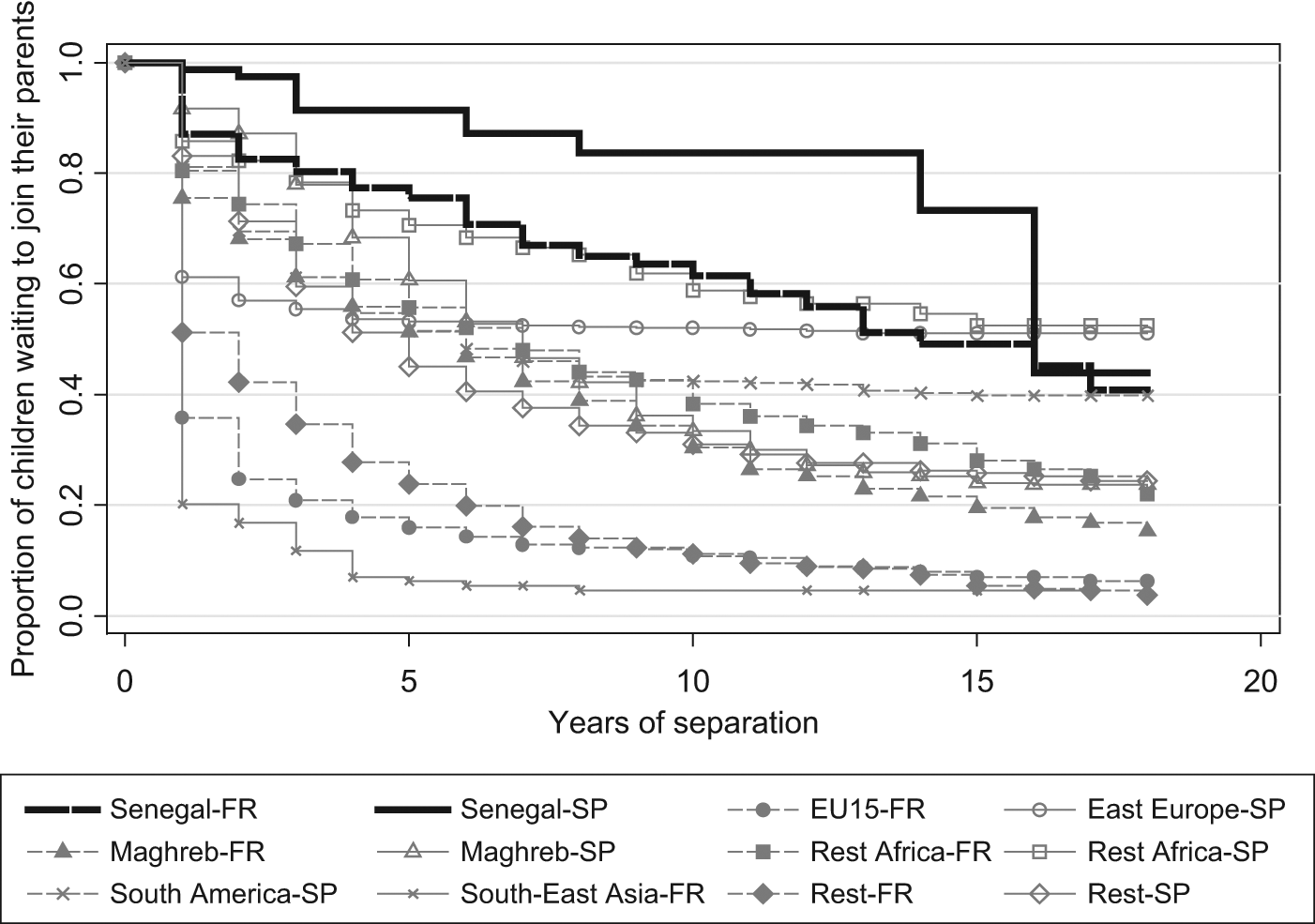
Proportion of Left-Behind Children Waiting to Join Their Migrant Parents in France (FR) and Spain (SP), by Parents’ Region of Origin and Years since Separation
As Figure 1 shows, the proportion of left-behind Senegalese children who are waiting to join their parents in Spain is larger than it is in France. Ten years after separating from their child(ren) because of migration, approximately 60 percent of the immigrant parents were still living in France without their child (i.e., 40 percent had reunified in France), whereas the corresponding proportion among Senegalese immigrant parents living in Spain was approximately 85 percent. This difference is easily explained by the more recent arrival of Senegalese migration to Spain than to France. Yet in both countries, the pattern of reunification among this group of Senegalese children is much slower than that of immigrants of any other origin. In France, only 25 percent of the left-behind Senegalese children had joined their parent(s) in France after five years of separation, whereas in all other groups, including migrants from the Maghreb (who are also Muslim and African), the proportion of reunified children in that time frame was substantially larger. The contrast is even greater in Spain, where only 10 percent of initially left-behind Senegalese children had joined their parent(s) after five years of separation; the corresponding proportion among children of Eastern European and South American migrants was almost 50 % and among children from the Maghreb, the proportion was approximately 40 percent.
Although the samples of Senegalese migrants included in these two surveys are too small to draw strong conclusions from, 5 it seems that one common characteristic of Senegalese immigrants is the lower incidence of reunification with their children in comparison to the other main immigrant groups in their respective countries of destination. 6 However, these figures tell us only one part of the story—the one that happens at destination. In fact, these kind of retrospective data, collected in the immigration-receiving countries, involve a significant drawback: they survey only migrant families or parents who still lived in the country of destination at the time of the survey; those who decided to return to their country of origin and reunify there with their children are excluded. In other words, these surveys completely neglect family reunification that takes place in the home country, which may bias any conclusion drawn from these data about the timing and determinants of the process of family reunification.
Research Questions and Hypotheses
Despite a growing number of qualitative studies on transnational families, very little quantitative evidence exists regarding the duration of child-parent separations and the factors explaining why and where (and whether) these separations end. In this section, we use previous evidence and references to draw various hypotheses to be tested with the quantitative data of the MAFE project. In particular, we discuss how the probability of ending child-parent separations in the case of Senegalese migrant families is likely to vary depending on length of the separation, the child’s age and gender, the type of household and family relationships within it, and the experience of the migrant parent(s) during their stay in Europe.
Time and child’s characteristics (age and gender)
As we discussed above, neither theory nor previous empirical evidence offers a consistent prediction of how time since separation and the children’s age affect children’s chances to reunify with their absent parent(s). Reunification in Europe is not likely to take place soon after separation, for at least two reasons. First, it seems that Senegalese migrants prefer that their children grow up surrounded by their origin culture, and they often delay reunification in Europe until their children have reached late adolescence (Barou 2001; Whitehouse 2009). Second, making the proper arrangements for family reunification in Europe (legal procedures, housing selection, economic stability, etc.) takes a considerable amount of time. But if separation continues for too long, the integration perspectives of the children will be seriously hampered, and reunification in the origin country is likely to turn into the preferred option, not only for parents but also for children who will likely become less willing to migrate and join their parent(s). For all these reasons, child-parent separations may be long lasting among Senegalese migrants.
Girls are clearly expected to be discriminated against in the process of child-parent reunification (Barou 2001). Among more traditional families, girls are probably less likely to be taken to Europe because their parents fear they will be “spoiled” by the Western way of life and because Senegalese communities in Europe are still strongly biased toward males. In addition, it is quite likely that daughters are more help than sons at home in the country of origin. Evidence on the differential effect of daughters and sons on the return propensity of Turkish immigrants in Germany (Dustmann 2003) seems consistent with the hypothesis that parents have a stronger preference to raise their daughters in the country of origin.
Type of household and family relationships
Regardless of the child’s gender, studies have shown that having a lot of children delays reunification in Europe, because each sibling is a potential competitor for a ticket to Europe, and because the cost of rearing children is higher in Europe, where extended family support networks are usually not available. Large families are more difficult to accommodate in the European context, especially if they are polygamous; these families encounter not only housing problems but also social stigmata and severe policy restrictions. Senegal, which is more tolerant of this type of family arrangement, seems to be the logical choice for large and polygamous families to reunify.
Finally, with regard to the role that members of the extended family may play in the process of parent-child separations and later reunification, we expect that parents who did not decide to migrate exclusively on their own (i.e., people whose migration was ordered or strongly encouraged by their fathers) will be more likely to reunify in Senegal rather than bring their children to Europe, reflecting the influence and preferences of other household members, especially the elders. For similar reasons, we also expect that the death of grandparents will increase the likelihood that a family will reunify in Europe. Such events will clearly diminish the obligations of migrants and their spouses to the extended family in the home country, and it will reduce the relative costs of moving the children to Europe if the grandparents (especially grandmothers) had been involved in childrearing.
Integration and context of reception at destination
It seems reasonable to expect that the better the labor and economic conditions of the migrant parent(s) in Europe, the more likely it is that reunification will take place there, since the legal and income requirements will be more easily fulfilled. Legal immigrants have a better chance of bringing their left-behind children to Europe. In addition, being a legal resident in Europe facilitates short visits to the country of origin, which might also help those involved to endure longer separations and delay reunification in Senegal.
On the other hand, differences in the Senegalese migration experience among the three European countries considered in this article are likely to be translated into a higher rate of reunification in France than in Spain and in Italy, especially, because of the longer settlement, stronger legal status, and more gender-balanced structure of the Senegalese migrant population in France, and because of the smaller presence of matrilineal ethnic groups in Spain and Italy. However, once these compositional differences are controlled for, cross-country differences in the probability to reunify with children in Europe might disappear, unless these differences are mostly due to the effect of different immigration policies applied to Senegalese migrants in our three countries. Immigration restrictions should, theoretically, reduce the probability of reunifying in the European country, although no clear effect on the likelihood of doing so in Senegal can be predicted.
Data and Method
The MAFE survey: Strengths and limitations
The analyses performed in this article rely on a new data source extracted from the MAFE-Senegal project. The MAFE team collected data both in Senegal and among Senegalese migrants in their main European destinations (France, Italy, and Spain) during 2008. For cost reasons, the sample in Senegal was limited to the region of Dakar, which accounts for approximately one-quarter of the national population; and it is, as of this writing, the country’s main supplier of international migrants (Lessault, Beauchemin, and Sakho 2011); accordingly, the sample from the origin country cannot be considered as nationally representative for Senegal but only for the capital region. We obtained 1,067 individual completed questionnaires in Dakar, including both nonmigrants and returnees. 7 In addition, 603 Senegalese were interviewed in France, Italy, and Spain (approximately 200 in each country). The municipal register in Spain (Padrón) offered a national sampling frame from which documented and undocumented migrants could be randomly sampled. Respondents in France and Italy were sampled through varied nonprobabilistic methods (e.g., intercept points and contacts obtained from migrant associations) to fill quotas by gender, age, and legal status. Individuals had to be 25 to 75 years old (to have long enough life histories), be born in Senegal (to exclude second-generation immigrants in Europe), and have ever had Senegalese nationality (to exclude immigrants in Senegal) 8 to take part in the survey.
The questionnaire was designed to collect longitudinal retrospective information on a yearly basis from birth until the time of survey for each sampled individual, regardless of the person’s country of residence at the time of the survey. The data collected include a wide range of information on the migration and occupation histories of the interviewees, as well as on their family histories (e.g., children, partnerships). Unfortunately, neither partners nor children of the MAFE interviewees were personally interviewed. However, the respondents were asked to provide us with some information about them. Namely, the MAFE respondent was asked what was, at the time his or her relationship with them started, the country of birth, nationality, educational level, labor force status, and occupational status of all his or her previous and current partners and spouses. With regard to their children, the MAFE respondents were asked to provide information on the year of birth, gender, birth order, and country of birth for all the children they ever had, even if they had died prior to the survey. Interestingly, the questionnaire also included a specific module in which the respondent reconstructed the international migration trajectory of all their partners, spouses, and children. This module allowed us to reconstruct (with some limitations) the migration experience of couples and their children.
Of the 1,670 interviewed individuals (including migrants in Europe and return migrants and nonmigrants in Senegal), 427 were childless at the time of the survey. The total number of children born to those remaining in our sample was 4,613. We linked the international migration history of each of these children to that of their parents, using the information provided by the interviewed parent (sometimes the mother, sometimes the father). By doing so, we reconstructed the periods of child-parent separations due to international migration to France, Italy, or Spain and analyzed their duration and the factors that contributed to ending such separations. Separation spells included in our sample span from 1980 to 2007: approximately 25 percent of the separations started between 1980 and 1990, another 25 percent between 1991 and 1996, and the remaining 50 percent between 1997 and 2007. Our analyses excluded separations resulting both from parents’ internal migration and from parents’ international migration to countries other than France, Spain, and Italy. We excluded the former because the MAFE questionnaire did not record internal migration trajectories of partners and children of the interviewees, and the latter because MAFE did not survey migrants living in countries other than France, Italy, and Spain.
We defined a parent-child separation as any period of at least one year during which a child lived in a country other than the one in which one or both of his or her biological parents lived. Shorter separations had to be disregarded due to data limitations. Separation end denotes either when the child migrated to the immigration country of the absent parent(s) and resided there for at least one year or when the absent parent(s) returned to Senegal—where the child lived—and stayed there for at least one year. 9
Incidence and duration of child-parent separations
In this section, we describe in some detail the prevalence and duration of child-parent separations, using the complete sample of Senegalese children, according to their place of birth. If the child was born in Senegal, separation occurs when one or both parents migrate to Europe. If the child was born in Europe, separation may occur when one of the parents takes a trip to Senegal and stays there for at least one year, leaving the child in Europe with someone else, or when the child is sent to Senegal while at least one parent remains in the destination country. In both cases, reunification may happen ultimately in Senegal or in Europe.
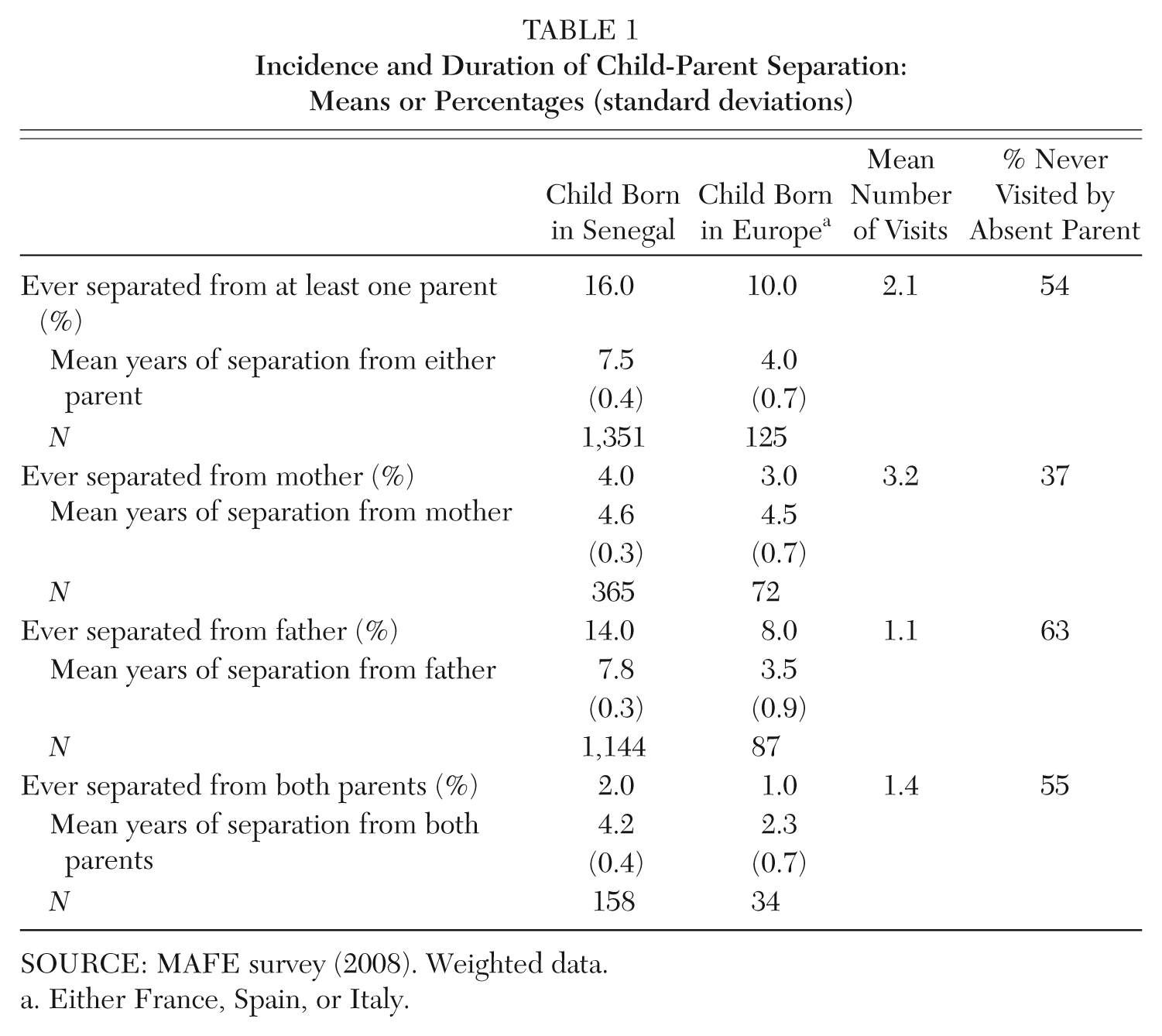
As can be seen in Table 1, separation from one parent due to international migration to France, Italy, or Spain affected approximately 16 percent of children born in Senegal to parents who lived in the Dakar region in 2008. Note that this percentage does not cover all parent-child separations derived from international migration but only those from international migration to France, Italy, or Spain, highlighting the high prevalence of this phenomenon. The corresponding percentage among children of Senegalese origin born in these three European countries was 10 percent, which confirms relatively strong connections with their country of origin among the immigrant Senegalese families living in Europe.
Incidence and Duration of Child-Parent Separation: Means or Percentages (standard deviations)
SOURCE: MAFE survey (2008). Weighted data.
Either France, Spain, or Italy.
Due to the characteristics of Senegalese migration, most child-parent separations are separations from the father (14 percent of children born in Senegal had this type of separation, versus only 4 percent who were separated from their mothers). In addition, as can be observed, simultaneous separations from both parents are infrequent.
The duration of these separations is significant (see Table 1). On average, child-parent separations in our sample lasted for more than seven years. Separations were particularly long among children born in Senegal who were separated from their fathers (almost eight years). Moreover, these long separations were rarely interrupted by visits from the absent father to the country where his child lived, as indicated in the last column (63 percent of children separated from their fathers were never visited by them). Separations were shortest among children who were born in Europe and were separated from both parents simultaneously (one year), and visits were substantially more common when separations were due to the mother’s absence (only 37 percent of these children were never visited during the separation period). 10
The estimations of the prevalence and duration of child-parent separations among Senegalese families clearly illustrate the numerical relevance and the variety of this phenomenon. In the sections that follow, we focus on separations experienced by children who were born in Senegal and were left behind after the migration to Europe of one or both parents. We then examine the factors that delay or accelerate the end of separation, which may result from either the child’s migration to the country to which the parent(s) migrated or from the return of migrant parent(s) to Senegal to rejoin the child(ren).
Methods
First, we computed discrete-time survival functions, indicating the proportion of children who had reunified with their migrant parent(s) at different times since first separation. Children still separated from one or both parents at the time of the survey or at their 18th birthday were treated as censored. Survival functions (Blossfeld and Rohwer 2002) were computed to account for two possible outcomes: reunification in Senegal (i.e., the migrant parent returns to the country of origin after spending more than one year in Europe) or the child migrates to Europe where reunification takes place.
Second, we performed multivariate discrete-time event history analyses in which we modeled time until the child-parent(s) separation ends. A multinomial specification was used to distinguish the two locations where reunification could take place (Senegal versus the European countries). These event history analyses were specified as a logistic multinomial regression (Yamaguchi 1991):

where P riy is the conditional probability that child i reunifies with his or her migrant parent(s) either in Europe or in Senegal (the place being denoted by the subscript r) versus remaining separated (denoted by the subscript s) at year y, given that reunification has not already occurred. α is a constant term, and X riy is a vector of explicative variables (including the baseline hazard function), with β denoting the value of the estimated coefficients of the models for each variable.
Note that the separation may end with reunification in the country of destination (France, Italy, or Spain); in the country of origin (Senegal); or with censorship if the child and his or her parent(s) were still living in different countries at the time of the survey, or if the child reached age 18 or died and thus left the risk set. 11 Finally, it should be noted that our dependent variable does not take into account whether the reunification was achieved by a legal process; in other words, our dependent variable includes both legal and de facto reunifications.
All results are weighted to take into account the complex survey design of the data and are based on robust standard errors, which were obtained by clustering siblings with parents.
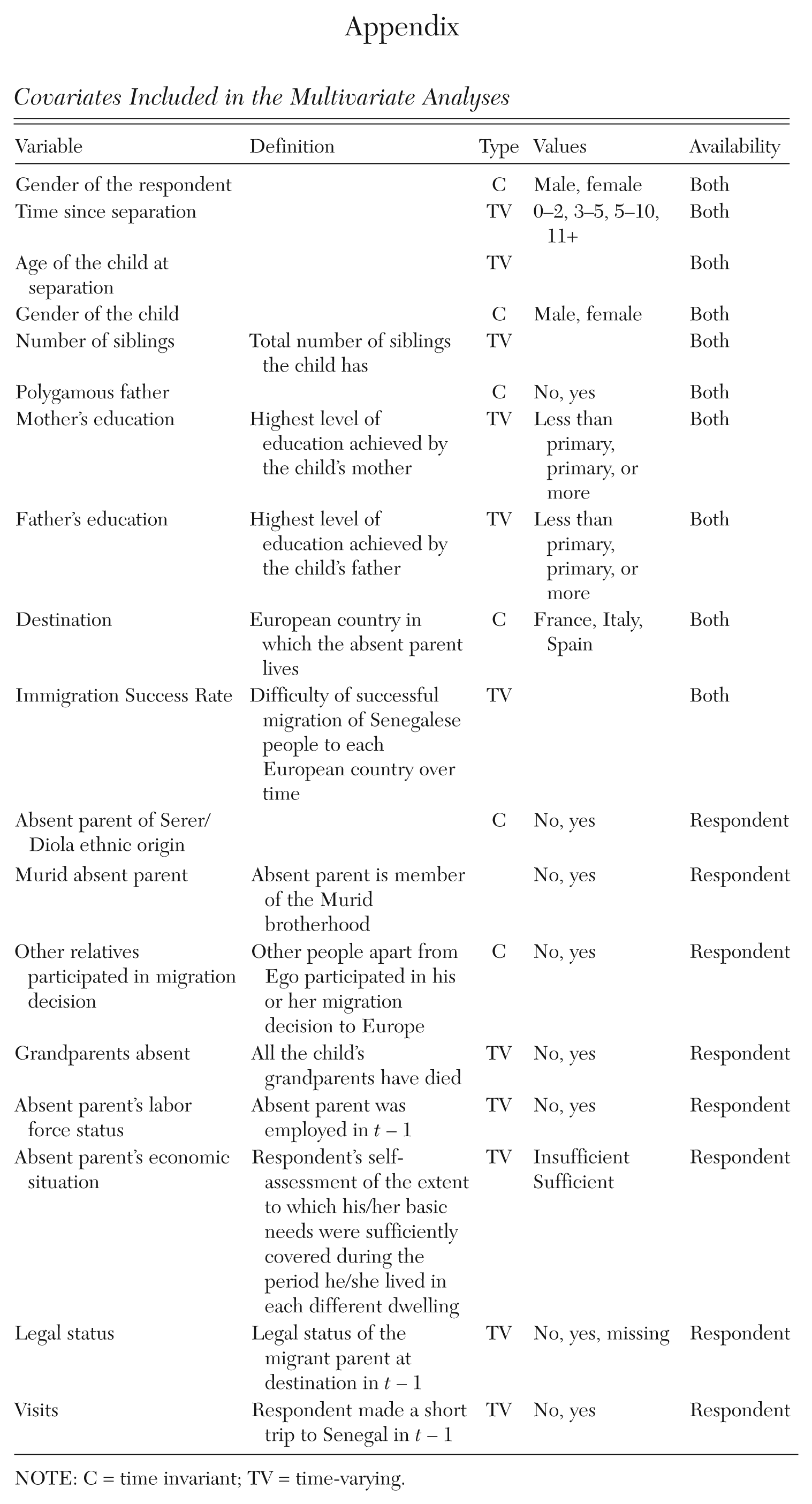
The appendix lists and explains each of the covariates included in the analyses. Unfortunately, in MAFE, some variables related, for instance, to the circumstances that surrounded the migration decision, the legal status of the migrant, or his or her remitting behavior, which are crucial to test some of our hypotheses, are available for the respondent only and not for his or her partners and spouses. Since the migrant parent can be either the respondent, or a partner or spouse, a clear asymmetry is implied in the amount of parental information available for children, depending on whether the absent migrant parent was personally interviewed by the MAFE team. Sometimes the parent who took the survey was also the migrant parent from whom the child was separated (e.g., a father living in France whose child is left behind with her mother in Senegal). In these cases, we had all the information we needed to test our hypotheses. In other instances, the MAFE respondent was not the absent parent (e.g., the father living in France) but the nonmigrant parent still living with the child in Senegal. In these cases, we lacked some crucial information about the migration experience of the absent parent, which prevented us from properly testing some of our hypotheses.
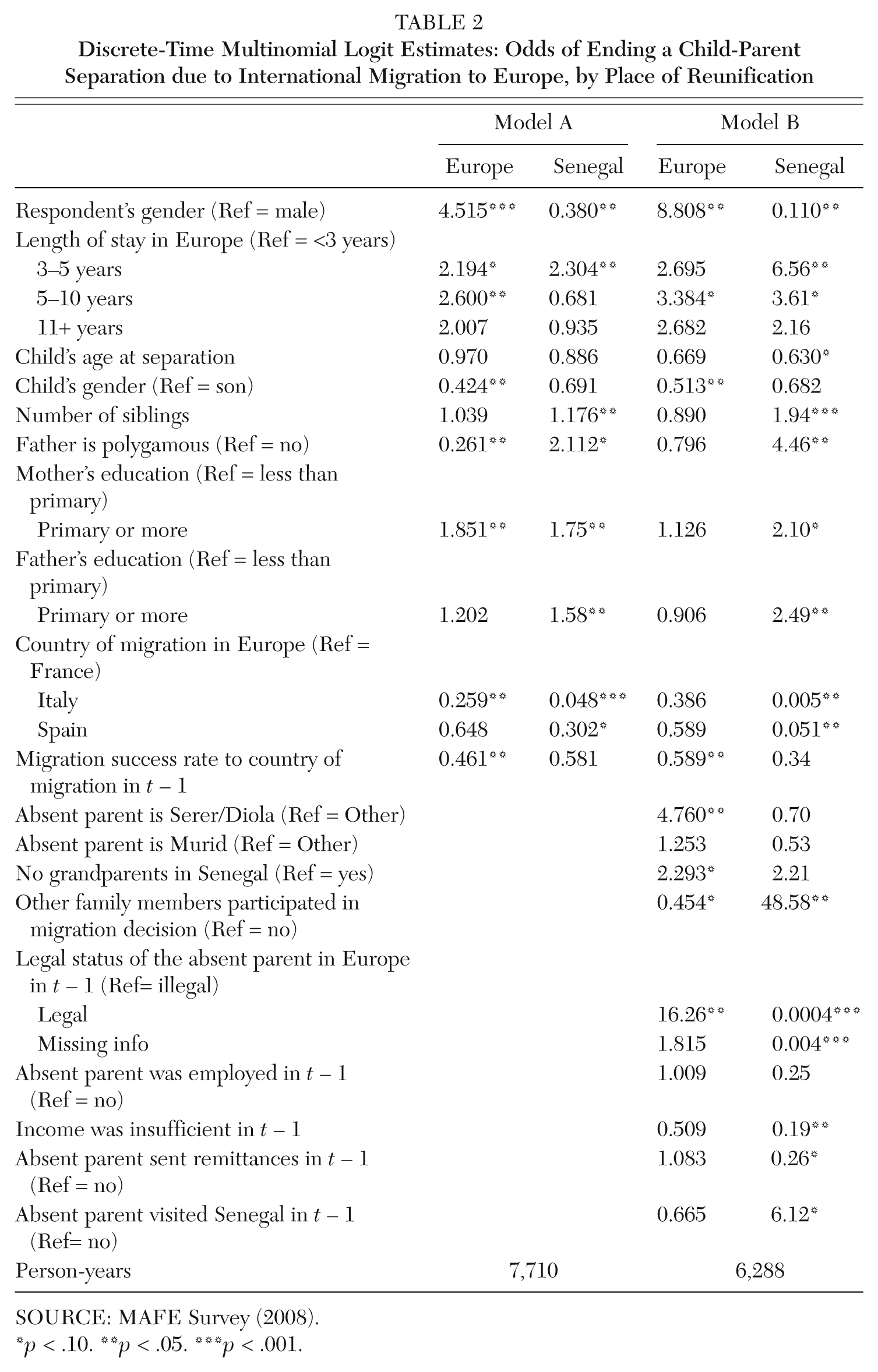
For this reason, we decided to run two different multivariate models. Model A includes all children left behind, regardless of whether either the migrant parent (most commonly the father) or the parent who stayed in Senegal with the child responded to the survey. Model A thus includes a limited set of explanatory variables, that is, the variables that are equally available for both parents regardless of whether they are the respondent. Model B, in contrast, includes a larger set of variables, among which some are available only for the survey’s respondent. This model is thus restricted to children left behind by a parent who happened to be a MAFE interviewee (hence a smaller sample of analysis as reflected in the number of person-years reported at the bottom of Table 2). 12
Discrete-Time Multinomial Logit Estimates: Odds of Ending a Child-Parent Separation due to International Migration to Europe, by Place of Reunification
SOURCE: MAFE Survey (2008).
p < .10. **p < .05. ***p < .001.
Before discussing our results, we need to give some words of explanation for the variable “Immigration Success Rate.” This variable is a proxy for the policy context, which is likely to influence when and where Senegalese migrant parents reunify with their children. Given the difficulty of using legal information to construct an index that measures changes in immigration policies over time for three different countries, we utilized some information available in the MAFE survey to construct a variable that indirectly measures how difficult it was—at different points in time—for Senegalese people to enter France, Italy, and Spain.
One of the questionnaire modules asked our interviewees the following questions: “We have already talked about the places where you lived for at least one year. But have you ever undertaken concrete steps in order to leave and settle in a different country, without, however, having so far been successful in getting there?” If so, “to which countries did you want to go? In which year did you make your first plans to go to this country? Did you abandon your plans to go to this country? If yes, when?” This set of questions was repeated for each of the countries listed in response to the second question. We counted and aggregated all unsuccessful migration attempts to each destination country (Spain, France, and Italy) that all interviewees reported for every year since 1970. Next, we divided the resulting number of failed attempts by the aggregated number of actual annual entries to each of the three countries in our survey. The resulting figure indicates, for each year over the considered period, how many migration attempts failed per each successful entry to each of our three European destinations. 13 This figure can be taken as a proxy for how difficult (or easy) it has been for a Senegalese individual to enter each of these countries since 1970. Obviously, one of the main factors underlying changes in the value of this variable over time should be immigration policies implemented by each receiving country. However, other factors, such as the efficacy of smuggling networks, are also captured in those variations.
Figure 2 plots the value of this indicator over the period of observation for each country of destination. As can be seen, successful entry into France was considerably more difficult than into Italy and Spain for most of the period under consideration. However, since the early 2000s, the opposite seems to be the case. The indicator was erratic and unreliable before 1980, when migration to Europe was not common; even if individuals in our survey had attempted migration and failed during this time, it is unlikely that many would have been able to remember the attempts and report them correctly. However, less than 5 percent of the separation periods in our sample occurred before 1980. In the analyses, we took the indicator’s value in t – 1 to avoid risk of endogeneity.
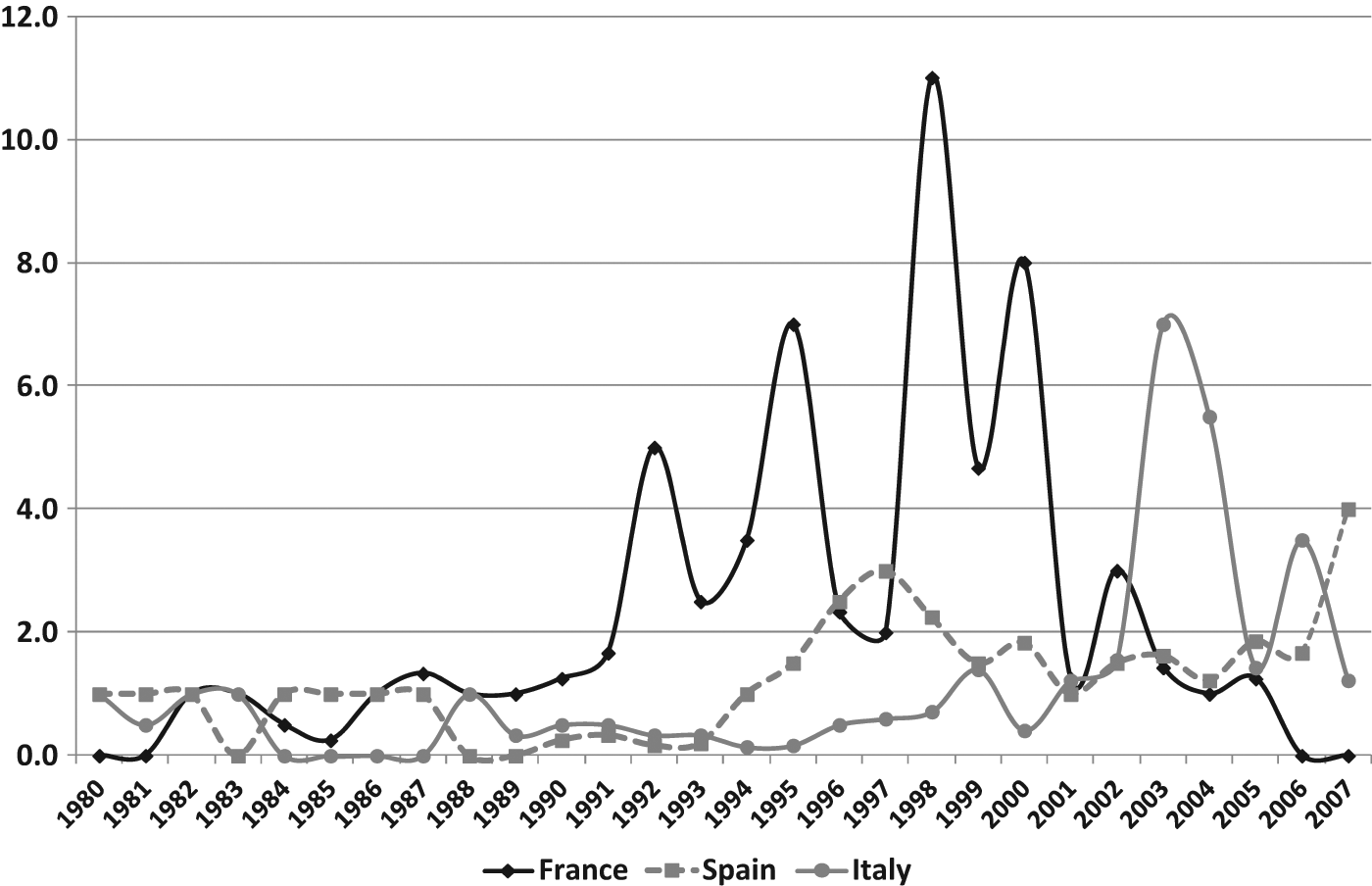
Migration Success Rate among Senegalese Population, by Year and Country of Destination
Results and Discussion
To obtain a first glimpse of the process by which Senegalese migrants ended their child-parent separations, we calculated discrete-time survival functions, indicating the proportion of children who had reunified with their migrant parent(s) at different moments in time since separation occurred. As can be seen in Figure 3, approximately 70 percent of the Senegalese children separated from their parents due to parental migration to Europe continued living in different countries 10 years after the initial separation. This implies substantial child-parent separations, consistent with the results previously shown for France and Spain in Figure 1. In addition, a comparison of the lines in Figure 3 indicates that reunification of Senegalese migrants with their children seems to be equally infrequent, regardless of the place of reunification.
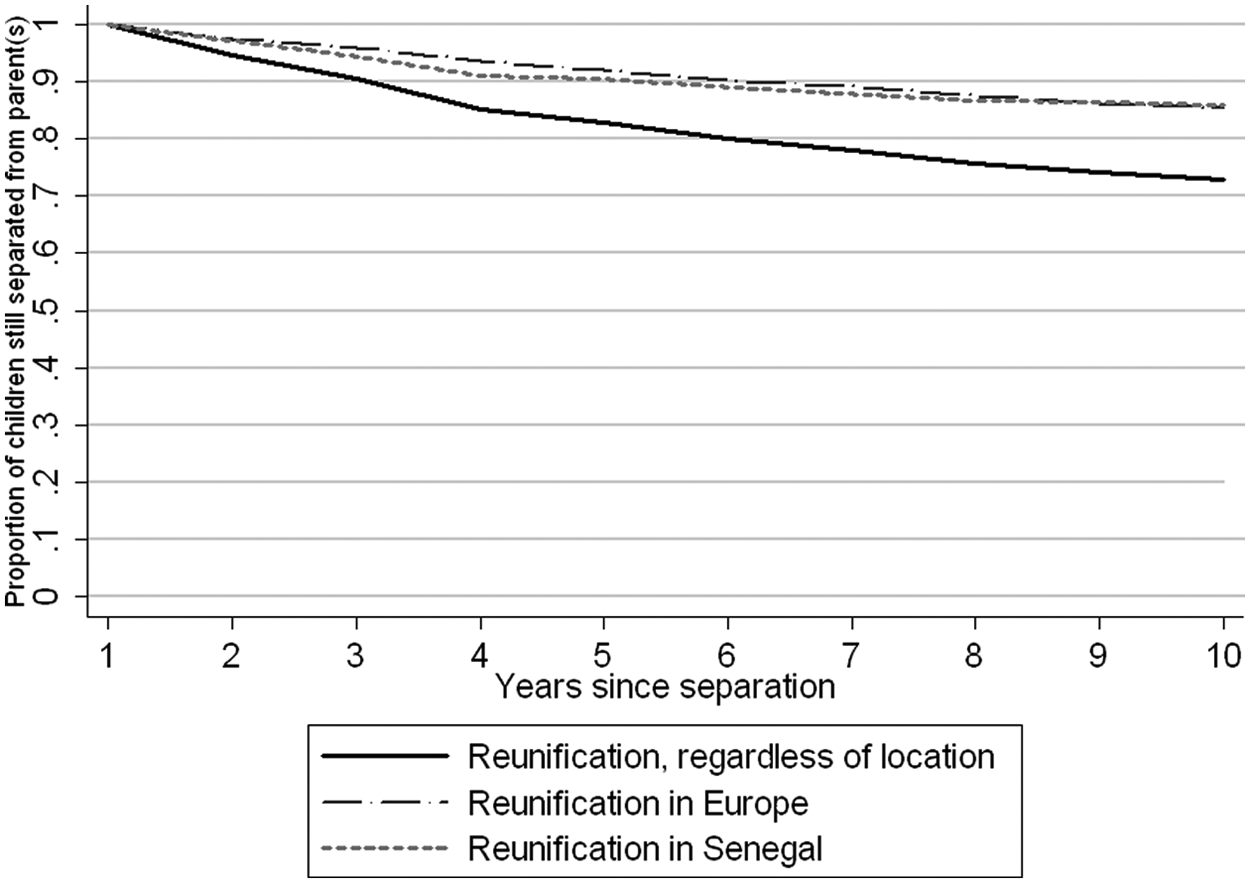
Proportion of Children Waiting to Reunify with Their Absent Parent(s), by Place of Reunification and Time since Separation
Multivariate analyses
In Table 2, we present the results from discrete-time multinomial logit regressions that estimate the probability of reunifying with one’s child after a separation due to international migration to Europe. We distinguish reunifications that happened in Europe from those that happened in Senegal. Most of the results obtained in model A (which utilized a larger sample but fewer explanatory variables) remained unchanged in model B, and the main variables added to the specification in model B displayed the expected effect, as shown below.
First, our results reveal two distinct temporal patterns in the Senegalese child-parent reunification process, depending on whether reunification occurs at destination (i.e., in Europe, through child migration), as the NE approach implicitly assumed, or at origin (i.e., in Senegal, through the parent’s return), in line with the NELM approach. In the first case, the probability of reunification increases over time, especially after five years since the separation. In contrast, the process of returning to Senegal for reunification with children follows an inverted U shape, increasing between two and five years of separation and decreasing afterward. These results suggest three conclusions. First, reunification, either in Europe or in Senegal, takes some time and preparation, and accordingly, it rarely happens in the very first years following the separation. Second, reunification in Europe is likely to happen later rather than sooner; this accords with the interpretation that Constant and Massey (2002) made from the NE for the process of reunification at destination but is contrary to our expectation that parents willing to settle at destination would want to facilitate their children’s integration by bringing them as soon as possible. And finally, migrants who moved with the intention to return (the target earners) do not seem more prone to endure longer separations than the income-maximizing migrants; rather, as we expected, they tend to reunify after just a few years.
Second, our results clearly support the expectation that being a girl consistently reduces the chances of reunification in Europe. Girls may be more helpful with, for instance, sibling care or other home tasks, than are boys, and therefore, they have higher chances of remaining with other relatives in Senegal. In contrast, boys are expected to either invest in education or to migrate (or both) to provide for the family. Accordingly, they are more often sent to Europe.
A larger number of siblings tend to slightly favor reunification in the country of origin, because the economic cost of raising a child is lower in Senegal than in Europe and having other relatives willing to take care of the child(ren) can be relatively easy and is socially well accepted. This idea is confirmed by the effect of the presence/absence of grandparents in model B. When all of a child’s grandparents are dead, reunification is much more likely to occur in Europe. This may be explained by the reduction in logistic support to take care of the children, but another factor may be the increasing freedom of choice that this loss sometimes affords. In line with this second interpretation, our results strongly confirm the idea that when members of the extended family participate in the migration decision of the absent parent(s), the parents are much more likely to return to Senegal than to reunify with their children in Europe. Also in line with our expectations regarding family structure is the fact that children of polygamous couples are less likely to rejoin their absent parent(s) in Europe than in Senegal, arguably because of the legal restrictions on polygamy and its social stigma in most European countries that do not exist in the home country.
Finally, results in model A clearly confirm differential incidence of reunification, depending on the European country to which the absent parent(s) migrated. Senegalese parents who migrated to Italy seem substantially less likely to end separations in either location, which may reflect the intense transnationalism often described among the Murid men living in Italy. In contrast, Senegalese living in Spain are as much more likely to reunify in Europe than are those who live in France, but they are less likely to do it in Senegal. Yet contrary to our expectations, these cross-country variations did not disappear in model B after we controlled for differences in the ethnic and religious composition of the Senegalese communities in these three countries. Moreover, they did not disappear after controlling for differences in their legal status, their economic performance across the three countries, or potential differences in the difficulty of migrating to each of these destinations over time. However, most of these variables displayed the predicted effect on the pattern of reunification with children.
For instance, when the migrant parent is a legal resident in Europe, the probability of bringing the children to Europe (at destination) substantially increases while the probability of reunification at origin decreases. This result, in the case of target-earners who do not intend to relocate the whole family at destination, supports the idea that legal status facilitates more stable transnational arrangements in which families endure long separations, probably because the ability to make frequent visits to the origin country make the separations more bearable. Indeed, visits by the absent parent to his or her child(ren) in Senegal increase the probability of ending the separation by returning to Senegal but do not affect the probability of bringing the child to Europe.
Similarly, in periods when migrating to these European countries became more complicated (i.e., more attempts failed than succeeded), migrants’ separations from their children tend to lengthen, since the probability of reunifying in Europe shrank without a parallel increase of reunifications in Senegal. To the extent that immigration policies implemented by receiving countries in Europe are expected to largely affect this “migration success rate,” the policy implications of this result are evident: tougher immigration policies tend to prolong the separations between Senegalese migrants in Europe and their children, rather than promoting reunification at origin, with all the negative influences that long-lasting separations may have for the children involved and also for the overall integration process in receiving societies.
Finally, it seems important to remark that migrant mothers seem much more likely than migrant fathers to end separations from their children by bringing them to Europe. 14 This may reflect strong gender differences concerning the emotional costs that parents incur when separated from children. But it could reflect also a different type of selectivity affecting the migration of Senegalese mothers compared to that of fathers; it could be that the Senegalese mothers who migrate to Europe are more willing than Senegalese migrant fathers to settle permanently in Europe and, thus, to reunify with their children there.
Conclusion
Although previous qualitative studies have insisted on the negative emotional effects that separation from migrant parents may have for their children, these studies have also systematically emphasized the need to consider the complexity of the separation experience, its length, and its circumstances to correctly understand the children’s responses to family separations due to migration (Suárez-Orozco, Todorova, and Louie 2002).
In this article, we have examined these issues (the complexity of the separation experience, its length, circumstances, and ending) among Senegalese parents participating in international migration to Europe, and their children. Our results have confirmed that these separations are an extended phenomenon that affected approximately 16 percent of our sample of children born in Senegal at some point during their childhood. Furthermore, the average duration of these separations appeared to be quite long, especially in cases where the father was the absent parent.
In our analyses, we investigated the extent to which these separations and their duration may reflect different migration strategies. Our results are mixed in this regard and suggest the existence of two types of migrants. On one hand, absent parents whose families depart from the Western nuclear model (polygamous, with larger numbers of children, grandparents alive in Senegal, from a predominantly patrilineal background, and whose relatives participated somehow in their migration decision) tend to either endure longer separations or reunify with their left-behind children by returning to Senegal. On the other hand, when the absent parent is the mother, or from an ethnic group in which maternal lineage dominates, who enjoys legal status at destination and cannot rely on the help (or pressure) of parents and in-laws still in Senegal, bringing the children to Europe appears to be a more likely option to end separations.
Finally, our results highlight that tougher immigration policies in Europe do not seem to have promoted more reunification back in the origin country but, rather, have tended to lengthen child-parent separations. The presence of the extended family in Senegal may facilitate these prolonged separations by providing logistic support for raising children and by minimizing the social stigma that, in other communities, is attached to split families and absent migrant parents. In any case, it is important to recognize that long parent-child separations are likely to hamper the integration prospects of migrants and their children in the destination country.
Footnotes
Appendix
Covariates Included in the Multivariate Analyses
| Variable | Definition | Type | Values | Availability |
|---|---|---|---|---|
| Gender of the respondent | C | Male, female | Both | |
| Time since separation | TV | 0–2, 3–5, 5–10, 11+ | Both | |
| Age of the child at separation | TV | Both | ||
| Gender of the child | C | Male, female | Both | |
| Number of siblings | Total number of siblings the child has | TV | Both | |
| Polygamous father | C | No, yes | Both | |
| Mother’s education | Highest level of education achieved by the child’s mother | TV | Less than primary, primary, or more | Both |
| Father’s education | Highest level of education achieved by the child’s father | TV | Less than primary, primary, or more | Both |
| Destination | European country in which the absent parent lives | C | France, Italy, Spain | Both |
| Immigration Success Rate | Difficulty of successful migration of Senegalese people to each European country over time | TV | Both | |
| Absent parent of Serer/Diola ethnic origin | C | No, yes | Respondent | |
| Murid absent parent | Absent parent is member of the Murid brotherhood | No, yes | Respondent | |
| Other relatives participated in migration decision | Other people apart from Ego participated in his or her migration decision to Europe | C | No, yes | Respondent |
| Grandparents absent | All the child’s grandparents have died | TV | No, yes | Respondent |
| Absent parent’s labor force status | Absent parent was employed in t – 1 | TV | No, yes | Respondent |
| Absent parent’s economic situation | Respondent’s self-assessment of the extent to which his/her basic needs were sufficiently covered during the period he/she lived in each different dwelling | TV | Insufficient | Respondent |
| Sufficient | ||||
| Legal status | Legal status of the migrant parent at destination in t – 1 | TV | No, yes, missing | Respondent |
| Visits | Respondent made a short trip to Senegal in t – 1 | TV | No, yes | Respondent |
NOTE: C = time invariant; TV = time-varying.
Note:
The Senegalese section of the Migration between Africa and Europe (MAFE) project is coordinated by INED (C. Beauchemin), in association with the Université Cheikh Anta Diop (P. Sakho). The project also involves the Universitat Pompeu Fabra (P. Baizán), the Consejo Superior de Investigaciones Científicas (A. González-Ferrer), and the Forum Internazionale ed Europeo di Ricerche sull’Immigrazione (E. Castagnone). The survey was conducted with the financial support of INED, the Agence Nationale de la Recherche, the Région Ile de France, and the FSP Program “Migrations Internationales, Recompositions Territoriales et Développement.” The scope of the MAFE project was broadened to include Ghanaian and Congolese migration in 2008. For more details, see  .
.
Notes
Amparo González-Ferrer is a research fellow at the Center for Humanities and Social Sciences (CCHS) of the Spanish National Research Council (CSIC). Her research interests lie in the areas of social demography, international migration, integration, and immigration policies.
Pau Baizán is ICREA (Institució Catalana de Reçerca i Estudis Avançats) Research Professor at the Pompeu Fabra University in Barcelona. His research focuses on family formation dynamics, the influence of institutional conditions on fertility, the determinants of migration between Africa and Europe, and the relationships between family and migration.
Cris Beauchemin is a researcher at INED (Institut National Études Démographiques) in Paris. His main research interest lies with population and development, migration and urbanization, international migration, integration, and transnationalism. He is director of the projects Migration between Africa and Europe (MAFE) and Trajectories and Origins (TeO).