





Abstract
Theoretical and empirical approaches to the design of effective messages to increase healthy and reduce risky behavior have shown only incremental progress. This article explores approaches to the development of a “recommendation system” for archives of public health messages. Recommendation systems are algorithms operating on dense data involving both individual preferences and objective message features. Their goal is to predict ratings for items (i.e., messages) not previously seen by the user on content similarity, prior preference patterns, or their combination. Standard approaches to message testing and research, while making progress, suffer from very slow accumulation of knowledge. This article seeks to leapfrog conventional models of message research, taking advantage of modeling developments in recommendation systems from the commercial arena. After sketching key components in developing recommendation algorithms, this article concludes with reflections on the implications of these approaches in both theory development and application.
Keywords
The success of Amazon and Netflix has drawn wide attention to the underlying recommendation algorithms deployed to generate user-specific predictions regarding other products the user would like. The capacity of these recommendation systems to automatically sift through product records and select a short list that meets a target user’s needs, while doing so simultaneously for millions of others, makes the approach worthy of investigation by communication scholars interested in message tailoring.
Online recommendation systems encompass a wide variety of approaches to providing evaluative information about products and services. These currently include open-ended commentaries, product reviews, simple likes and dislikes, star ratings, preferences, behavioral selections (such as views of YouTube videos), and even ratings of the utility of the recommendations themselves (McAuley and Leskovec 2013; Schafer, Konstan, and Riedl 2001). The presence of recommendations accompanying products, services, and informational entities fundamentally changes the way the public information environment must be studied (Bennett and Iyengar 2008; Jenkins 2006; Kim et al. 2013). For example, a set of news stories prepared and published by institutional sources now exists as news items plus recommendations so that their effects on audiences can no longer be equated to the effects of the news stories alone.
In this article, we focus on only one type of recommendation system, the often hidden algorithms that use a person’s prior preferences and choices in a limited domain of cases to predict their choices—that is, making recommendations—for other items to which they have not yet been exposed. Two factors differentiate algorithmic recommendation systems from other forms of prediction using standard social scientific methods: behavioral data and individualized predictions. In both the Amazon and Netflix use of recommendation algorithms, the issue is not what people prefer and like or even what segments of people (men, women) like. Rather, based on what a specific person has selected previously (that is, viewed, moved to the shopping cart, or purchased), what will that same person likely select in the future from a range of possibilities not yet examined? Note that past behavior by the target person is required, and a prediction for that person on entities as yet unseen is the result. This goal is a lofty one indeed, but methods seeking to achieve it have been deployed and are being invented in an emerging media environment where preference data are extensive and widely available. In what follows, we present current practices in the process of developing recommendation algorithms illustrating their application to informational products such as public health messages and news stories.
Standard approaches to message testing and research, while making progress, suffer from very slow accumulation of knowledge, weak theory that fails to guide choices in a comprehensive way, and an infinite number of features that demand evaluation. Tailoring messages to individuals’ needs is often treated as the gold standard for effectiveness (Rimer and Kreuter 2006). Yet the number of message features—from the trivial to the profound—on which tailoring can occur is overwhelming. This article seeks to leapfrog conventional models of message research by taking advantage of extensive developments in recommendation systems.
Although a fully functional recommendation system inevitably consists of various components operating together (e.g., a data management system, the design of the webpage layout, incorporation of user feedback such as ratings and reviews, etc.), it is the recommendation algorithms that we focus on here.
The work on recommendation algorithms in commercial applications falls into three categories: content of the items being recommended, collaborative recommendations based on patterns of user ratings (also known as social filtering), and their hybrid using both types of data (Adomavicius and Tuzhilin 2005; Almazro et al. 2010). This article will sketch key components in developing the algorithm for each category, drawing the implications of these approaches in both theory development and application.
Approaches to Building Recommendation Systems
Two essential data matrices
The goal for any recommendation system is to estimate a target user’s evaluation of an unseen item from a pool of items that have yet been seen by the target person. The system recommends to the user the top item(s) on the list of estimated rankings. To accomplish this task, the recommendation system typically utilizes two sets of information: descriptions of and evaluation from users on items in the system.
The content of items in the system can be described in a myriad of ways, an infinite number really. For instance, Netflix movies are categorized by production year; actors; director; and a variety of genres, ranging from general tags like “romantic dramas” to very specific niches like “violent thrillers about cats for ages 8 to 10” (Madrigal 2014). Content features stored in a well-structured format considerably speed up the process of identifying items similar to those that have already received positive ratings from the target user, and in turn, the system can recommend ones most closely mimicking the target user’s past selections. This calculus, namely, to recommend items similar to the ones the user preferred in the past, is the fundamental principle of content-based recommendation systems (Lops, de Gemmis, and Semeraro 2011; Pazzani and Billsus 2007). With that said, items of interest to communication scientists—such as news articles, health-related public service announcements (PSAs), video clips, and so on—typically come unstructured and require either manual or computer-assisted coding to transform them into suitable data formats for mathematical calculation. The result is an item profile where each feature serves as a unique “variable” to describe one aspect of the item. In the item (row) by content feature (column) matrix (see Figure 1), each item is treated as a separate case, which is mathematically equivalent to a vector located in a high-dimensional feature space.
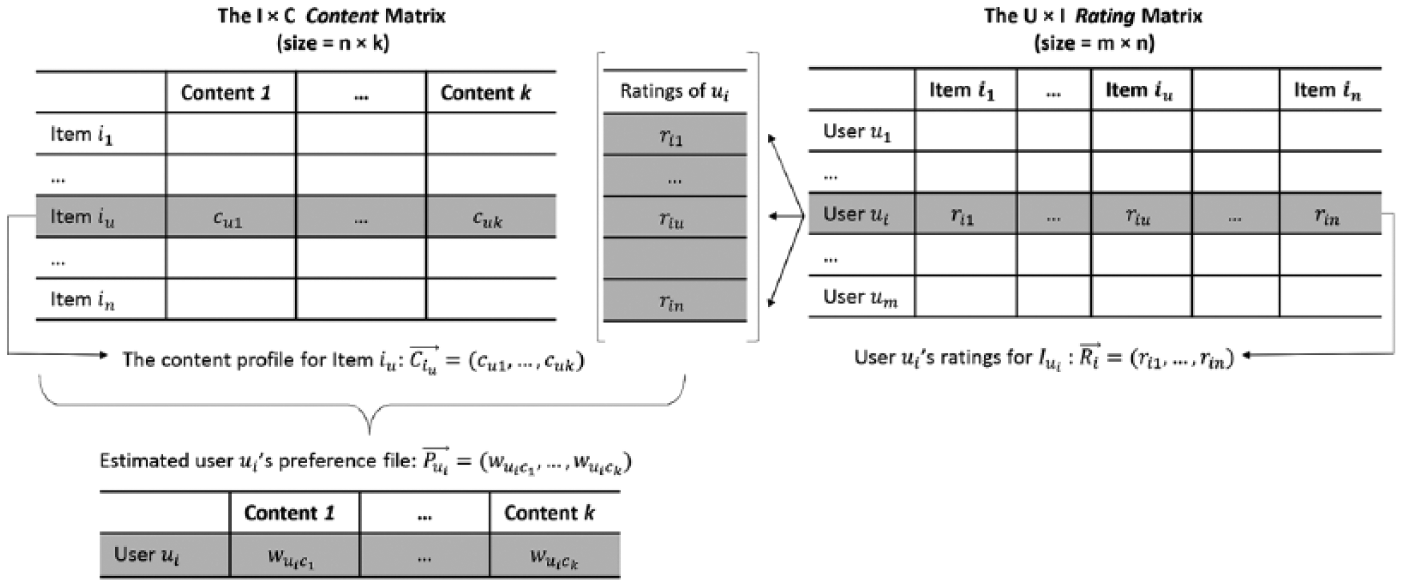
Two Essential Matrices and the Estimation of User Preference Profile
The second matrix (see Figure 1) crucial to recommendation systems is the user (row) by item (column) record of users’ evaluations of items as they accumulate over time. Evaluations can take many forms including purchase records, ratings on various scales, “save for later,” and so forth, all presumed to signal users’ true preferences. More implicit feedback such as clicks to view or download, viewing times, and re-transmissions via social media can also be included. The user by item matrix can have a variety of entries from individual evaluations to more summary versions for each item.
Depending on the number of users’ evaluations of items stored in this single matrix, a matrix of dense data would allow grouping users by the similarity of their evaluations of the same set of items (for more details, see the sections “Item Clustering” and “Hybrid Recommendation Systems”). Assuming common evaluations and stability over time, a well-designed recommendation system can predict the value of a new item to a target user based on evaluations assigned to that item by other users who are “similar” in taste to the target user, based on co-rating history of other items (Cacheda et al. 2011; Koren and Bell 2011). This collaborative filtering (CF) approach to recommendation does not utilize content features in its algorithms at all and solely operates on the user by item rating matrix, although various hybrid recommendation models take advantage of both content features and user ratings (Barragáns-Martínez et al. 2010; Burke 2007).
Here we introduce the notation system used from here forward. The set of users in the system is denoted as
Content-based recommendation
Building a content profile for items
Communication scholars are familiar with using content analysis to characterize news articles, social media posts, user comments, health-related PSAs and so forth along theoretically important dimensions to explain or predict individual-level or aggregated outcomes. Content-based recommendation starts with building a content profile for each item in the system using a common set of features and that represents any item Iu as a feature vector
A variety of approaches to content-based recommendations have been deployed in the literature but they typically require dense data in the U × I matrix. When such data are sparse, item clustering allows the number of items needed to be reduced so that the evaluations per item-cluster by users are denser than the evaluations per item. Content-based recommendation makes predictions for user preferences for new items based solely on content similarity to previously rated items. However, the number of previously rated items must be dense for content filtering to work.
Item clustering
Because the density of data in the U × I matrix for some communication research will be sparse, we first treat the issue of item clustering of the transpose of the I × C matrix as a prerequisite for the application of some of the methods described in content-based and collaborative recommendation described below.
Item clustering operates on the transpose of the I × C matrix to produce groupings of items much smaller than the original number of items much the same as is done with questionnaire items to reduce their dimensionality. A wide variety of distance metrics among pairs of items and a variety of clustering techniques are available to yield a set of item groups that would redefine item space. Lesot, Rifqi, and Benhadda (2009) offered a detailed survey on different families of distance/similarity metrics such as Jaccard, Euclidean, cosine and Mahalanobis distances and distance-converted similarity scores. Readers interested in the state of art of existing approaches and algorithms to clustering—including but not limited to k-means/medoids, spectral clustering, and density-/model-/graph-based techniques—are invited to consult Aggarwal and Reddy’s (2014) recent book on this subject.
The purpose of item clustering is to optimize between two criteria: increase the number of user evaluations per cluster (so a small number of clusters is desired) and maximize the similarity of items within a cluster (so a larger number of clusters is desired). Optimizing between these two criteria depends on the density of the user ratings before clustering and the number of items in the original set. Recent simulation data indicates that no a priori clustering criterion will provide a single, well-defined clustering of items (Kleinberg 2002). Instead judgment by the researchers and pertinence to the research questions are required.
In what follows on content-based and collaborative filtering, we describe users, content features, and individual items. However, in the presence of sparse data the reader can insert “item clusters” in the place of “items” to allow the applicability of the approach in the presence of sparse data.
The user preference profile: User content weights
After constructing the item profile, a user preference profile based on the U × I rating matrix is developed. The preference profile
For example, for user ui, given the set of rated items
After obtaining the user profile, the recommendation problem is reduced to simply searching for the item in the database that matches up closest to the user profile. “Closeness” between the item profile

where K is the total number of features characterizing both the item profile and the user profile. After being compared with the target user’s preference profile, the item or items receiving the highest cosine score(s) will be recommended to user ui.
More advanced learning algorithms
Other than simply relying on the heuristic of taking averages, more advanced algorithms from the machine learning literature can be leveraged to boost the accuracy of estimating the user profile
Another classification algorithm that assumes a probabilistic generative model is the Naïve Bayesian Classifier (NBC). This approach estimates the probability that item iu belongs to a category Gp (e.g., “liked” or “disliked”) given the set of content features
Content-based recommendation systems are useful for capturing the nuances in objective features of items themselves, and are most desirable when there are only a limited number of users in the system. In addition, since content features can be coded and processed offline, it is feasible to prepare item profiles before the system is even open to users. This feature renders content-based recommendation systems scalable to a large number of users as half of the computation can be done offline. On the other hand, one of the most serious drawbacks that content-based systems face is overspecialization due to the simple principle of recommending items similar to those preferred by the user in the past. The method is prone to producing “boring” recommendations. Recommendation systems based on CF, on the contrary, can mitigate overspecialization by taking advantage of “peers” with whom the target user never interacts.
Recommendation Based on CF
Classic CF recommendation systems only utilize the U × I rating matrix, leaving information about item content attributes in the I × C content matrix unexploited. Two major subcategories of CF have been widely adopted: the memory-based k-nearest neighbor (k-NN) approach and the model-based matrix factorization approach (e.g., Singular Value Decomposition or SVD).
Memory-based neighborhood models
k-NN operates by identifying a pre-specified number (n = k) of items most similar to the ones that have received ratings from the target user (i.e., item-based CF, hereafter referred to as IBCF; see Figure 2 for illustration); or alternatively, by identifying other users in the system that share similar tastes with the target user (i.e., user-based CF, hereafter referred to as UBCF). Though conceptually similar, IBCF is distinct from content-based recommendation as the degree of similarity between any pair of items iu and iv is not assessed from comparing content profiles
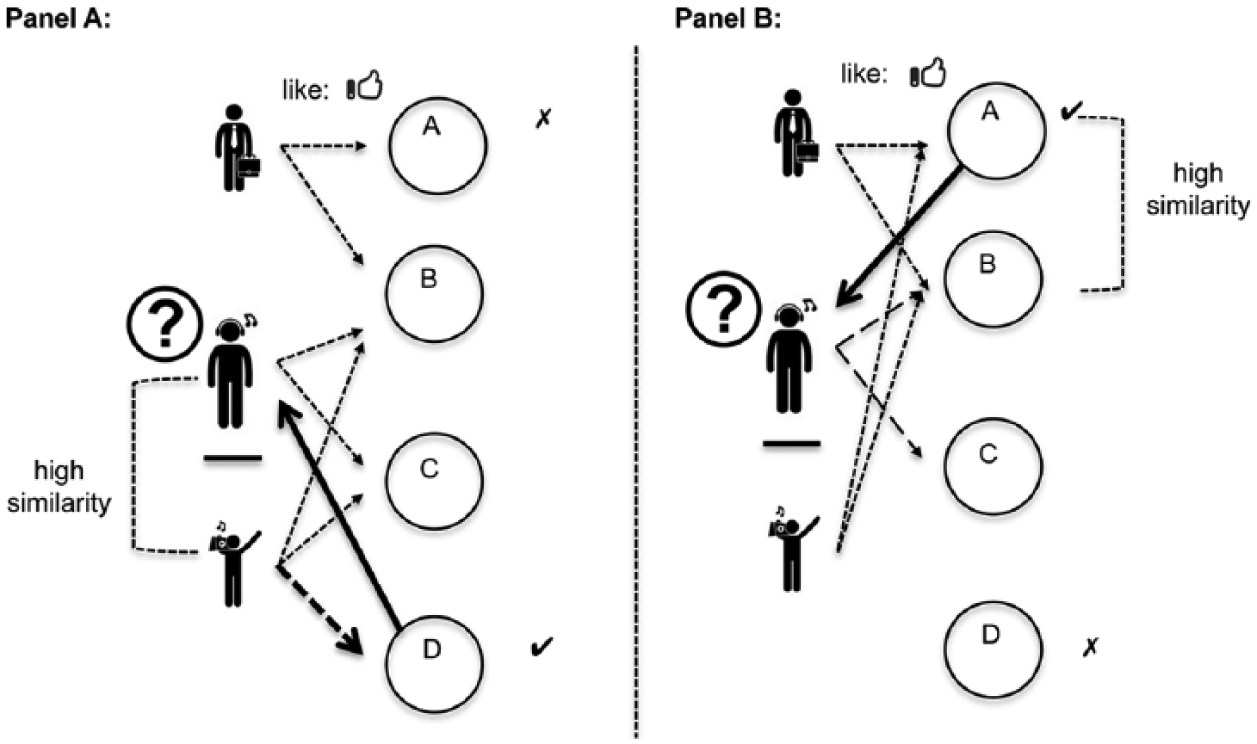
The Idea Behind User- and Item-Based Collaborative Filtering
The key component in k-NN is the similarity function that defines the pairwise item-item relationship in IBCF, and analogously the pairwise user-user relationship in UBCF. In IBCF, the most popular choice is cosine-based similarity with modifications. Figure 3 illustrates how the similarity between iu and iv is determined.
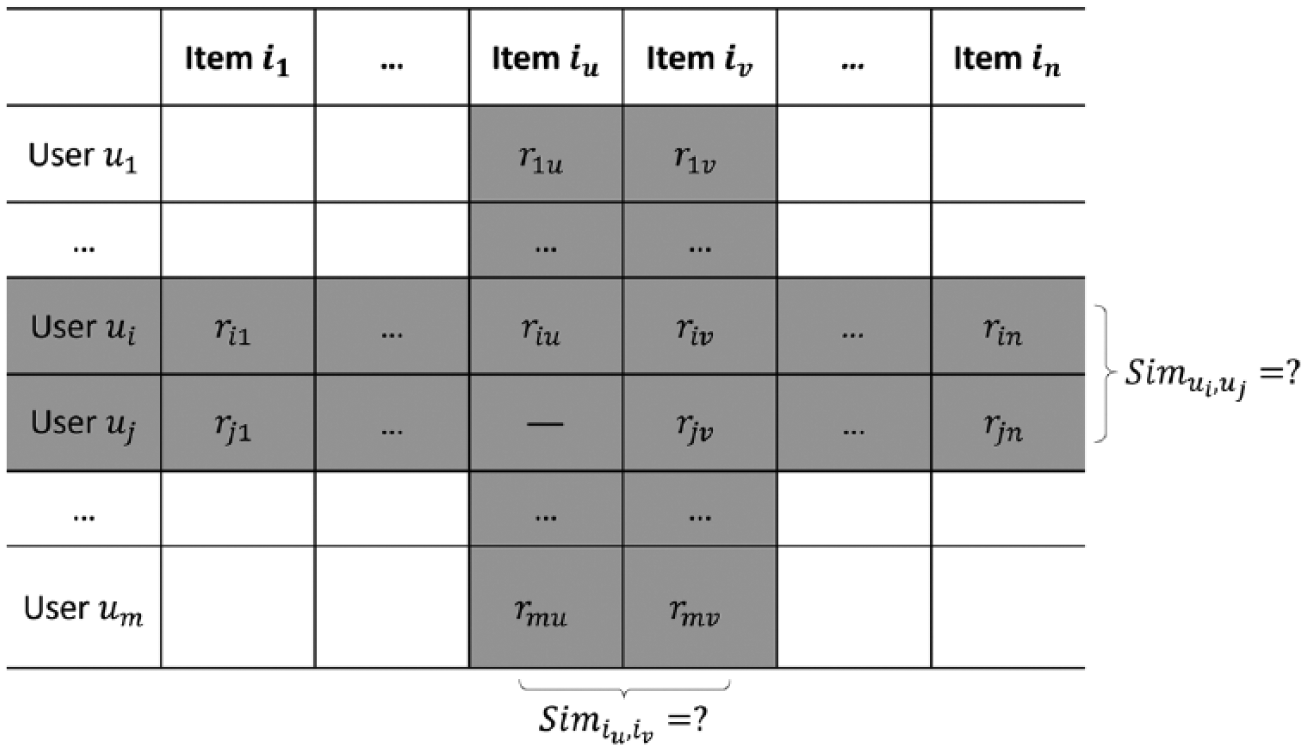
Calculation of Pairwise Item-Item (in IBCF) and User-User (in UBCF) Similarities
First, ratings by users in

Third, once the item-item similarity matrix is set, the system continues to predict the target user ui’s rating

In practice, the predictive accuracy will be greatly enhanced if we take into consideration the target user’s rating tendencies and the target item’s overall popularity across all the users in the system (Bell and Koren 2007; Koren and Bell 2011; Rajaraman and Ullman 2012). Equivalently, this is to build a baseline prediction model:

where biu is the baseline prediction, μ is the global average rating across all the users and all the items in the system,

Last, the system simply searches through all the predicted ratings and recommends the item(s) that have the highest score(s).
In UBCF, the prediction

Incorporating the same baseline model in IBCF, the predictive model can be specified as follows:

In both IBCF and UBCF, the value of k unfortunately cannot be deduced from theoretical principles but is usually guided by empirical availability of rating data. The general rule of thumb would suggest, though, that a small number of high-confidence neighbors will provide a better ratio of signal to noise than a large number of neighbors whose similarity weights are less accurate or unreliable (Desrosiers and Karypis 2011).
Readers might find IBCF and UBCF to be two sides of the same coin. They are both motivated by the same conceptual framework and follow very similar steps in generating recommendations. In practice, which one is chosen depends largely on the ratio between the number of users and items. IBCF can save considerable computing resources when the number of users outnumbers items (Desrosiers and Karypis 2011). Researchers have also proposed integrative methods to fuse these two (Wang, de Vries, and Reinders 2006).
Model-based CF using matrix factorization methods
Unlike memory-based k-NN approaches, model-based CF assumes the observed rating matrix is generated from an underlying linear model:
Although memory-based and model-based CF allow “innovative” selections different from the ones the target user has already seen, CF is vulnerable to the problem of sparse data. Memory-based CF will be unstable if there are little data on the target user’s past ratings, or given past ratings, there is nevertheless little overlap among raters. Moreover, CF cannot make recommendations for newly added items until they are rated (Adomavicius and Tuzhilin 2005). In light of these drawbacks, hybrid recommendation methods that combine the merits of both content-based and CF methods hold the potential to be fruitful in overcoming the weaknesses of both.
Hybrid Recommendation Systems
Hybrid recommendation methods have been proposed to address the problem of sparse ratings in a CF system, especially when there are few co-ratings for pairs of items. In this case, content similarity from comparing the items’ content profiles can be imported to improve the calculation of item-item similarity scores, hence enhancing the accuracy of IBCF (Pazzani 1999). Alternatively, predicted ratings based on content similarity can be used to impute missing values in the U × I rating matrix before performing CF (Melville, Mooney, and Nagarajan 2002; Eckhardt 2012). Some researchers combine content similarity and rating similarity to develop a unified item-item similarity matrix (Mobasher, Jin, and Zhou 2004). Still another technique supplements user-user similarity by incorporating extra information on users, such as demographic data, or other domain-specific individual attributes relevant to user similarity (e.g., smoking status for a system recommending tobacco-control messages) (Burke 2007). As with the constructions of many small groups of items based on content clustering described earlier, a similar approach with users can help with the sparse data issue by treating clusters of users as interchangeable.
Different recommendation methods can be fused to achieve better accuracy. One of the best-known examples in this regard is the Koren and Bell algorithm (Koren, Bell, and Volinsky 2009) that won the million-dollar Netflix prize. Despite the complexity in the algorithm that addresses temporal dynamics in user-item interactions, what sits at its core is the combination of factorization methods (e.g., SVD) operating at the regional level and neighborhood methods (e.g., k-NN) at the local level (see Bell, Koren, and Volinsky [2007] for details about the unified model).
Although there are no general guidelines regarding what type of hybrid methods would achieve better results, it is our belief that in the domain of public health message recommendations, some hybrid forms of content-based and CF methods should outperform using either of them alone. The good news is we can experimentally test the performances of various recommendation algorithms once the system is set up.
Applying Recommendation Systems
The success of any public health campaign depends in large measure on how effectively information is communicated to the targeted audience through the use of messages. Message tailoring selects the most appropriate set of message features based on an individual’s unique needs. Meta-analytical reviews have confirmed that compared with nontailored interventions, both print and web-delivered tailored interventions are more effective in stimulating and sustaining desirable behavioral changes in domains of smoking cessation, healthy diet maintenance, physical activity, and regular mammography screening (Noar, Benac, and Harris 2007; Krebs, Prochaska, and Rossi 2010; Lustria et al. 2013). Despite the consensus among public health scholars and practitioners that tailoring works, the scholarly community has not reached an agreement on what core set of message features should be tailored to achieve optimal effectiveness in a given behavioral domain (e.g., smoking cessation) let alone across domains (Rimer and Kreuter 2006).
Conventional approaches to testing effective messages are often experimental and manipulate a few features at a time. This paradigm has produced important but very slow accumulation of knowledge and has shown only incremental progress in providing guidance to the practice of health message tailoring.
What recommendation systems can provide is message tailoring without the a priori specification of the content features. Instead, content features can be chosen before, during, or after the fact of item selection and the weights of individual content features for a given user assessed. The weights for features by user represent the extent to which a given set of features works for a given user. Users can be grouped on the basis of similarity in feature weights or items can be grouped in terms of those having similarities in feature weights across users ex post facto. In the recommendation approach, tailoring becomes a set of feature weights for a given user or for a new user similar in his or her choice architecture to a past user.
Recommendation systems have come out of commercial applications and so their roots are primarily predictive, rather than theoretical and explanatory. However, as we suggested above, recommendation systems can provide outcomes from prediction models that are unique and unanticipated parameter values. It is these values themselves that can become the objects of explanation. For example, to have a particular set of feature weights be predictive of a set of item ratings for a subgroup of users is an outcome from collaborative and content-based recommendation algorithms but is also an object of explanation. The prediction approach of recommendation systems asks why these features work for these users in this context. Why do other groups rely on other features for their positive and negative assessments? How much diversity (that is, uncertainty) exists in the feature weights overall? Given the diversity in feature weights, is tailoring to individual users worth the effort? To answer these types of questions is to offer explanations and construct predictive mechanisms—in short to model and build theory. So although recommendation systems are prediction-oriented at their heart, they can provide outputs in the form of parameters, which themselves become the objects of explanation.
The density of data required by recommendation approaches is a challenge for communication scientists, but it is also a challenge in commercial applications. The use of sparse data workarounds helps to deal with the sparseness issue. These include creating optimal subgroupings of items or subgroupings of users so that the density per subgroup is improved under the assumption of parallelism within subgroup. Much research is being done to propose and evaluate various solutions to the sparse data problem but this should not stop us from deploying relatively straightforward solutions that de facto are variants of missing data options through clustering of items and clustering of users.
The idea that the number of items available for rating is too small to be a serious set ignores the fact that the number of news articles generated daily by the press is gigantic; the number of antismoking PSAs in the CDC’s archive is in the thousands; the number of health-based or political videos on YouTube is huge; as are the number of public comments, blog, and micro blog comments on any topic daily. So the items and reactions to them provide an extensive database for cultivation both as they exist online and as objects of more intensive study using crowd sourced samples in Amazon’s Mechanical Turk or other more representative sets of raters.
Although many of the pertinent developments in methodology and statistics for recommendation systems are coming from engineering, computer science, and even physics, the core analyses are at heart modifications of techniques reasonably well known to social scientists. The identification of individual weights for content features in predicting item ratings is a standard outcome from certain classes of multilevel models. The clustering techniques for items and for users employ measures of distance and clustering that are variants of procedures used commonly in the social sciences. Although data manipulation and management are challenges within the recommendation environment, the analytic tools are translations and extensions of existing and more or less well-known techniques.
The effectiveness of any recommendation algorithm can be assessed by comparing the algorithm’s predictions for a target person to that of a simpler standard. For example, if a content-based recommendation does less well in predicting a user’s rating of unexposed messages than does the mean rating of all other users, then the algorithm is certainly ineffective. If the algorithm outperforms the simple mean, then it can be compared to other more conservative standards such as other algorithms, computationally simpler ones, ones based on smaller training sets and so on.
Recommendation systems offer a way to envision prediction of unseen items by users. They identify item features as one basis for predicting future choices but also incorporate individual variation in what features matter more and for whom. They also incorporate behavioral similarity between users as a basis for predicting what will be preferred in future exposures. Although these two components are in principle obvious elements in prediction of future choices, the methods and techniques being employed in the data environment of emerging media marks recommendation approaches as candidates both for predictive possibilities and theoretical advancement. It would be a mistake for theoretically inclined social and communication scientists to ignore recommendation systems and their algorithms or label them as counter to the goals of the scientific enterprise. After all, every science requires a fact base from which to build explanations and theories. Recommendation systems seek to build exactly that—prediction models both for the sake of pure prediction to solve a problem but also to provide truly predictive (versus “retro-dictive”) models that then become the objects of explanatory accounts. Researchers employing recommendation modeling do not need to think of themselves as the unwanted progeny of commercial vendors just because they focus on predictive models. Such models are or at least can be the basis for explanatory theory.
Footnotes
Joseph N. Cappella is the Gerald R. Miller Professor of Communication at the Annenberg School for Communication at the University of Pennsylvania. His research focuses on health and political communication and the ways that effective and ineffective messages function in these arenas.
Sijia Yang is a doctoral student at the Annenberg School for Communication at the University of Pennsylvania. He studies how the dynamics between message production/processing and social interactions produce collective outcomes such as misinformation spreading and curbing, public opinion formation, and moralization of previously moral-neutral entities in both political and health domains.
Sungkyoung Lee is an assistant professor in the School of Journalism at University of Missouri, Columbia. Her research focuses on understanding mediated message processing and designing effective health communication messages.