






Abstract
We argue that the relative persistence of racial segregation is due, at least in part, to the process of residential search and the perceptions upon which those searches are based—a critical but often-ignored component of the residential sorting process. We examine where Chicago-area residents would “seriously consider” and “never consider” living, finding that community attraction and avoidance are highly racialized. Race most clearly shapes the residential perceptions and preferences of whites, and matters the least to blacks. Latinos would seriously consider moving to numerous neighborhoods, but controls for demographics and distance from the respondents’ home make Latino preferences much like those of whites. Critically, the geography of existing segregation begets further segregation: distance from current community significantly affects perceptions of the communities into which respondents might move. While neighborhood perception may cause persistent segregation, it may also offer hope for integration with appropriate policy interventions.
Chicago is a city of neighborhoods. Chicago’s neighborhoods cast into relief the city’s identity of world-class ambitions with small-town feel. Politicians like to extol the virtues of neighborhoods providing unique identities to the places where Chicagoans live their everyday lives (e.g., Daley 2010). While the mayor and city boosters extol the virtues of the diversity of experiences across its neighborhoods, what they do not highlight is that Chicago continues to be one of the most segregated cities within one of the most segregated metropolitan areas in the country (Logan and Stults 2011). While one might experience substantial diversity traveling across the neighborhoods and communities in the Chicago area, there is little diversity within each neighborhood.
There is little controversy about the fact that segregation is associated with inequality. To take a few examples, most suburban schools outperform urban ones; everyday amenities are more readily available in white neighborhoods; and community hospitals face chronic funding and staff shortages not experienced by their private or nonprofit counterparts (e.g., Logan, Oakley and Stowell 2008; Immergluck 2002; Small and McDermott 2006). The negative consequences of racially segregated neighborhoods are so consequential that segregation could be considered the structural linchpin of persistent racial inequality in the United States (Bobo 1989; Sharkey 2013). The unequal distribution of resources across metropolitan communities hampers the ability of racial and ethnic minorities in particular to succeed. Therefore, there is a compelling need to understand how people come to live in the nondiverse (and ultimately unequal) neighborhoods that make up this unequal landscape.
To date, racial residential segregation is usually explained in one of three ways (Charles 2003; Quillian 2002): the reduced purchasing power of minorities relative to whites due to economic inequality (e.g., Alba and Logan 1993; Iceland and Wilkes 2006); racially biased residential preferences (e.g., Clark 2009; Krysan et al. 2009; Lewis, Emerson, and Klineberg 2011); and discrimination by housing market actors, such as real estate agents and loan officers (e.g., Massey and Denton 1993; Roscigno, Karafin, and Tester 2009; Ross and Turner 2005; Squires 2007). All three are important factors, but they fall short of describing the forces that perpetuate racial segregation. Economic inequality has declined, racial attitudes have become more tolerant, and illegal discrimination has declined; yet high levels of segregation persist. In this article, we follow a new line of inquiry to examine the perceptions that residents hold about actual communities in the Chicago metropolitan area and the potential consequences of those perceptions on racial residential segregation. We view these perceptions as a critical but often-ignored component of the residential sorting process that translates into persistent segregation or offers the potential for racial integration (see Krysan, Crowder, and Bader 2014 for a more thorough discussion).
We examine two questions in this article. First, where would residents of the Chicago metropolitan area seriously consider searching for housing? Second, where would those same residents never consider searching for a house or apartment? The first provides a sense of where residents would initially channel their resources in a housing search. The second identifies where residents would impose limits on their housing search if it expanded beyond their initial search destinations—limits that would make moves to those neighborhoods very unlikely. To answer both questions, we rely on responses that residents gave about real communities in the Chicago metropolitan area, not ideal or hypothetical neighborhoods. By studying real neighborhoods, we can estimate the factors that influence search patterns, especially in our case the importance of a community’s racial composition on the willingness to consider or likelihood of avoiding particular communities.
Background
The long history of racial segregation scholarship has focused on the three reasons cited above: interracial economic inequality, racialized residential preferences, and racial discrimination. We have argued elsewhere (Krysan, Crowder, and Bader 2014) that the primacy of these arguments has neglected a focus on the process of residential selection. This means that we have little evidence about how people come to know about and perceive communities in their metropolitan area. We also fail, then, to know how residents’ knowledge and perceptions influence their housing searches that, in turn, structure patterns of racial segregation. Asking what those perceptions are and the influence that race exerts on those perceptions can help to uncover systematic processes that perpetuate racial segregation. To be clear, though, these neighborhood perceptions no doubt interact with, affect, and result from interracial economic inequality, racialized residential preferences, and racial discrimination (see Krysan, Crowder and Bader 2014 for a detailed discussion of this argument).
There is a small body of related research that focuses on the idea of community perceptions and the influence of racial composition on it. Some (Quillian and Pager 2001; Sampson and Raudenbush 2004) focus on perceptions of one’s existing neighborhood rather than where one might move. Other research does examine perceptions of other communities (Charles 2000; Krysan 2002) and finds that racial composition influences neighborhood perceptions, but this research has examined only a handful of neighborhoods. Finally, Krysan and Bader (2007) most closely matches our current effort, but did not control for important community covariates and examined perceptions of blacks and whites only.
This article contributes to the literature in three ways. First, and most importantly, our theoretical framework is specifically situated within questions about the processes of moving that might maintain (or, ideally, abate) racially segregated neighborhoods. We investigate in which communities Chicago-area residents would seriously consider searching for a home and communities they would never consider; the latter is a part of the search process that the existing literature generally neglects.
Our emphasis on both attraction and avoidance comes from a need to focus on how residential preferences translate into searches. As economic geographers note, housing searches are expensive in terms of both time and resources (Brown and Moore 1970), and knowledge gleaned from one search is rarely applicable in the next search since people search for houses infrequently (MacLennan 1982). Information constraints place bounds on how well people can optimize their preferences and, as a result, residents quickly reduce their choice-set to a manageable size (MacLennan 1982). To reduce the size of the choice-set, residents likely eliminate communities from consideration (and would thus “never consider” them) while prioritizing relatively few places to initially search (and thus “seriously consider” them). Though we ask about hypothetical future moves, the responses are given about communities in a real metropolitan area that have real identities. This means that our work is situated in new theoretical frameworks that focus on how individuals think about options in metropolitan areas (also see Quillian, this volume).
Second, this article extends previous research by including important community characteristics as control variables. Some evidence suggests that social class characteristics that are correlated with racial composition explain racialized residential preferences (Harris 1999, 2001). Our previous study of Detroit (Krysan and Bader 2007) isolated the association between racial composition and community perceptions among thirty-three communities. That article, however, did not measure the influence of two of the most important contextual variables associated with race and thought to explain perceptions: school quality and crime (Emerson, Chai, and Yancey 2001; Goyette, Farrie, and Freely 2012). Even for residents without students, schools influence home prices sufficiently to affect where residents without children would consider living, and evidence suggests that racial composition of school districts affects metropolitan-level segregation (Logan, Oakley, and Stowell 2008).
Third, our previous article studied Detroit, a traditionally black and white segregated city. In this study, we study the multiethnic metropolis of Chicago and offer for the first time a close look at the community perceptions of Latinos.
Data and Methods
Our analysis is based on data from the 2004–5 Chicago Area Study (CAS), a face-to-face multistage area probability sample of adults 21 years and older living in households in Cook County, Illinois. Cook County (which includes the city of Chicago) was first stratified by racial/ethnic composition based on counts from tracts in the 2000 U.S. Census, and oversamples were drawn of African Americans, Latinos, and those living in racially mixed neighborhoods. A total of 789 interviews were completed in the CAS, with a 45 percent overall response rate (based on RR4 in American Association of Public Opinion Researchers [2008]). Interviews were conducted in either English or Spanish from August 2004 through August 2005. All analyses are weighted for probability of selection and adjusted for nonresponse.
For one module of the interview, respondents were given a booklet of maps showing major roads and forty-one communities (see Figure 1 for the map used in data collection). Next to each of the forty-one areas labeled on the map were checkboxes, which allowed respondents to mark any community in which they would seriously consider looking for a house or apartment. On a separate map they were asked to mark any community in which they would never consider searching for housing. Chicago neighborhoods were defined using Community Areas (though we named South Lawndale “Pilsen/Little Village” and combined Oakland and Kenwood into “Bronzeville” on the map), and suburban communities were defined using Census Designated Places. The responses to each of these map questions constitute the dependent variables in this analysis.
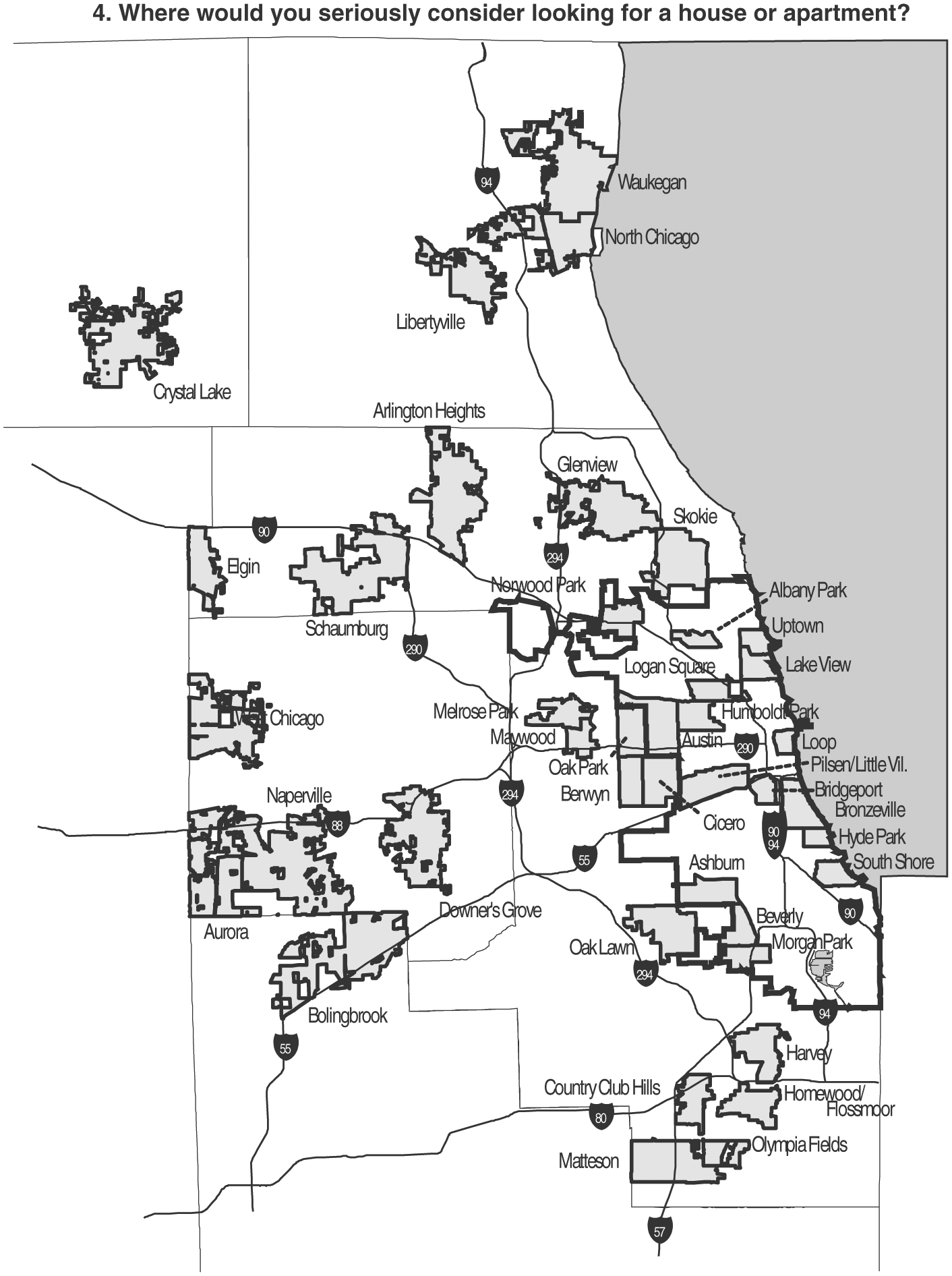
Map Used to Measure Community Attraction and Avoidance, 2004–5 Chicago Area Study
We limited the map to forty-one communities to reduce respondent burden since more than 300 neighborhoods and communities exist in the Chicago metropolitan area. We purposively selected the forty-one areas to reflect a variety of communities including places inside and outside the city with a range of housing prices and a variety of racial compositions. To orient readers to the racial composition of these communities within the context of other Chicago communities, we plot the proportion of white, black, and Latino residents in Chicago Community Areas and Census Designated Places in Figure 2. For a complete overview of the comparison of neighborhoods identified on the maps and those not, see Krysan and Bader (2009). Relative to the distribution of Chicago neighborhoods, the fifteen Chicago neighborhoods labeled on the map underrepresent “all black” community areas and overrepresent racially mixed communities. The twenty-six suburban communities labeled on the map underrepresent “all-white” communities and overrepresent mostly black and racially mixed communities compared with the region’s suburbs.
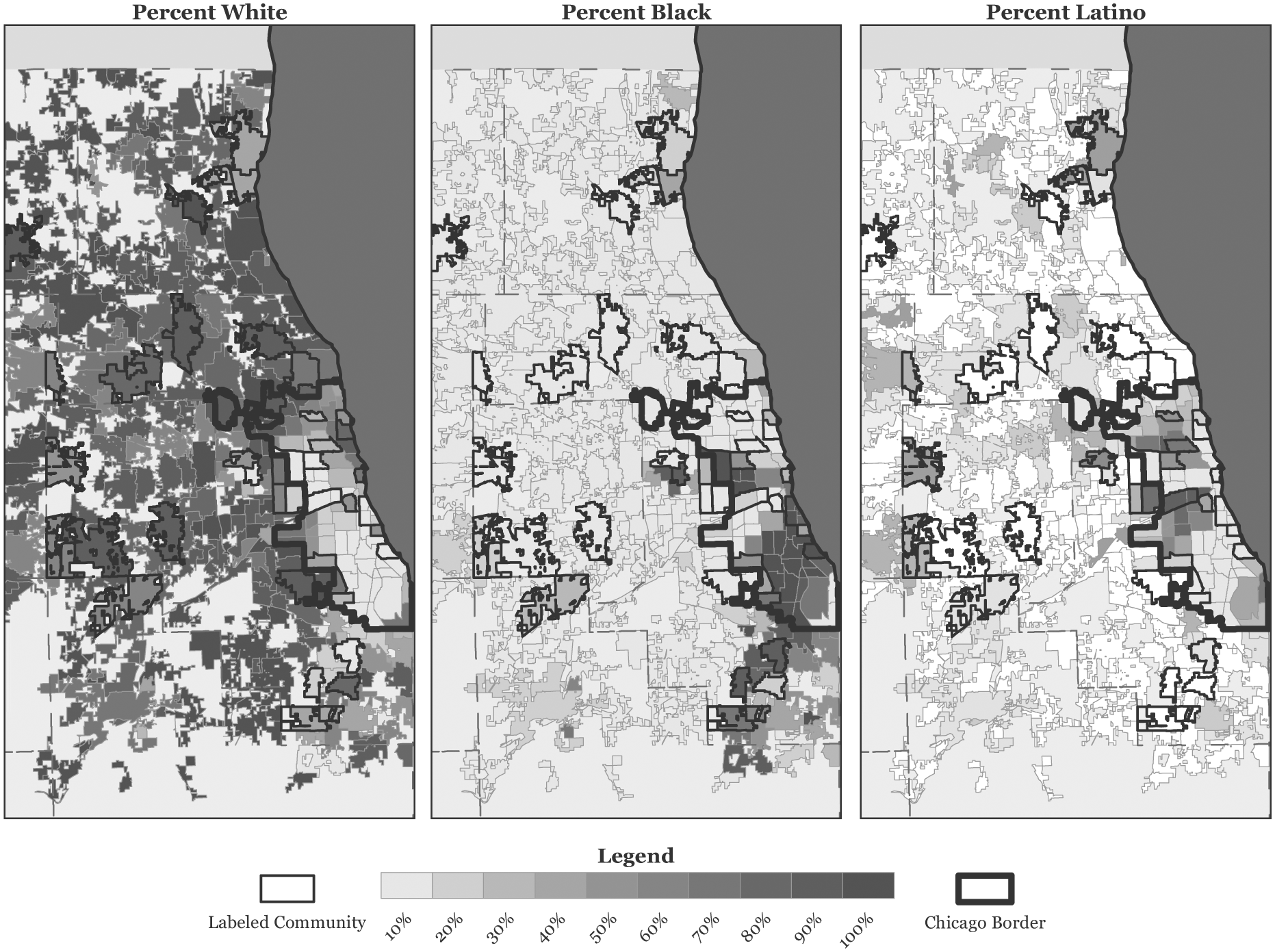
Racial Composition of Chicago Area Census Designated Places and Chicago Community Areas, 2000
Analytic approach
Our initial descriptive analysis examines the proportion of respondents of each racial group that indicates they would seriously or never consider communities. We supplement our general overview presented here with detailed online materials. 1 To summarize similarities and differences across racial groups, we rank-ordered the list of communities by the proportion of respondents endorsing the community for each racial group and calculated Spearman’s rank-order correlations on those rank-ordered lists.
For each dimension—seriously consider and never consider—we examined the influence of respondent race on endorsing each community by conducting a series of forty-one logistic regressions. We first conducted baseline regressions with respondent race as the only predictor before adding controls for individual-level attributes. We controlled for demographic characteristics, income, education, and the distance from the respondent to the community.
Finally, we used multilevel logistic regression models to assess the influence of race among the entire sample of communities simultaneously. Conceptually, these multilevel models combine the forty-one separate regressions into a single model to estimate the overall effect of race on endorsing communities. Conducting this analysis allowed us to model whether responses to each dimension were a function of individual characteristics of respondents, characteristics of the community being evaluated, or an interaction between the two.

Equation 1 shows the model used to estimate each of these three types of associations. Pci is the probability that respondent i endorses community c for the particular dimension (attraction or avoidance). The coefficients γ0r measure the influence of each of R respondent-level variables, Xri, on endorsement for individual i. The coefficients γq0 measure the influence of each of Q community-level variables, Wqci, on endorsement for each community c that individual i evaluates. The coefficients γqr measure the relative difference of community-level variable Wqci for a respondent with individual-level variable Xri on the endorsement of a community. This is how we measure the influence of respondent race (XRACEi) on the evaluation of communities based on the racial composition of communities (WRACECOMPci). The cross-level interactions, γqr, change the interpretation of the “main effects,” γ0r and γq0: γ0r is the predicted level of Xr at the intercept (i.e., when Wq equals zero) and γq0 becomes the level of Wq at the intercept (i.e., when Xr equals zero). For example, if Xr were an indicator where 1 = black and 0 = white and Wq equals the percent African American in the community, then γ0r equals the log-odds that a black respondent would endorse the community with no African Americans, and γq0 becomes the change in log-odds that a white respondent would endorse a community for each percentage point increase in the percentage of African Americans.
Finally, for a small subset of the communities, respondents who said they would “seriously consider” or “never consider” it were asked to explain, in their own words, why they felt that way. A complex coding scheme was constructed to capture the themes mentioned by respondents. Once our two research assistants achieved intercoder reliability in excess of 80 percent agreement for each theme, they proceeded to conduct coding of the open-ended responses. Our analysis includes a brief discussion of the main themes that emerged in response to the question about why selected communities were attractive or unattractive, respectively. 2
Results
Community attraction: Where would people “seriously consider” searching for housing?
The percentages of residents endorsing the idea of living in any particular community were relatively low. They ranged from 4 percent to 20 percent. Only thirteen communities were endorsed by at least 10 percent of respondents. Whites were the choosiest racial group: only ten communities were endorsed by 10 percent or more of whites while at least 10 percent of Latinos endorsed sixteen communities and at least 10 percent of blacks endorsed eighteen communities. The list of ten communities endorsed by at least 10 percent of whites was, with only a few exceptions, made up of predominantly white suburbs. The list of communities endorsed by at least 10 percent of Latinos and blacks was more diverse and included racially mixed and predominantly white communities in addition to communities where their own group had a substantial presence.
The Spearman correlation coefficient, which focused on the rankings of most- to least-endorsed across racial groups, showed that white and Latino endorsements were positively correlated (ρ = .60, p < .001). The ranking of communities by blacks was, however, uncorrelated with both white (ρ = .02, n.s.) and Latino (ρ = –.07, n.s.) rankings. These initial findings show that whites are more selective in where they would seriously consider living, but that there are similarities in the communities that whites and Latinos find attractive.
What happens when we control for demographics and distance?
Figure 3 graphically presents the results of the series of forty-one logistic regressions. Each of the maps compares the odds of selecting each community across two racial groups. Communities where the two groups were statistically different in their likelihood of choosing it are filled with a color based on the group more likely to consider the community. Communities outlined with a thin line had a statistically distinguishable difference in the race-only model, and communities outlined in a thick line had a statistically distinguishable racial difference after the full set of controls was added.
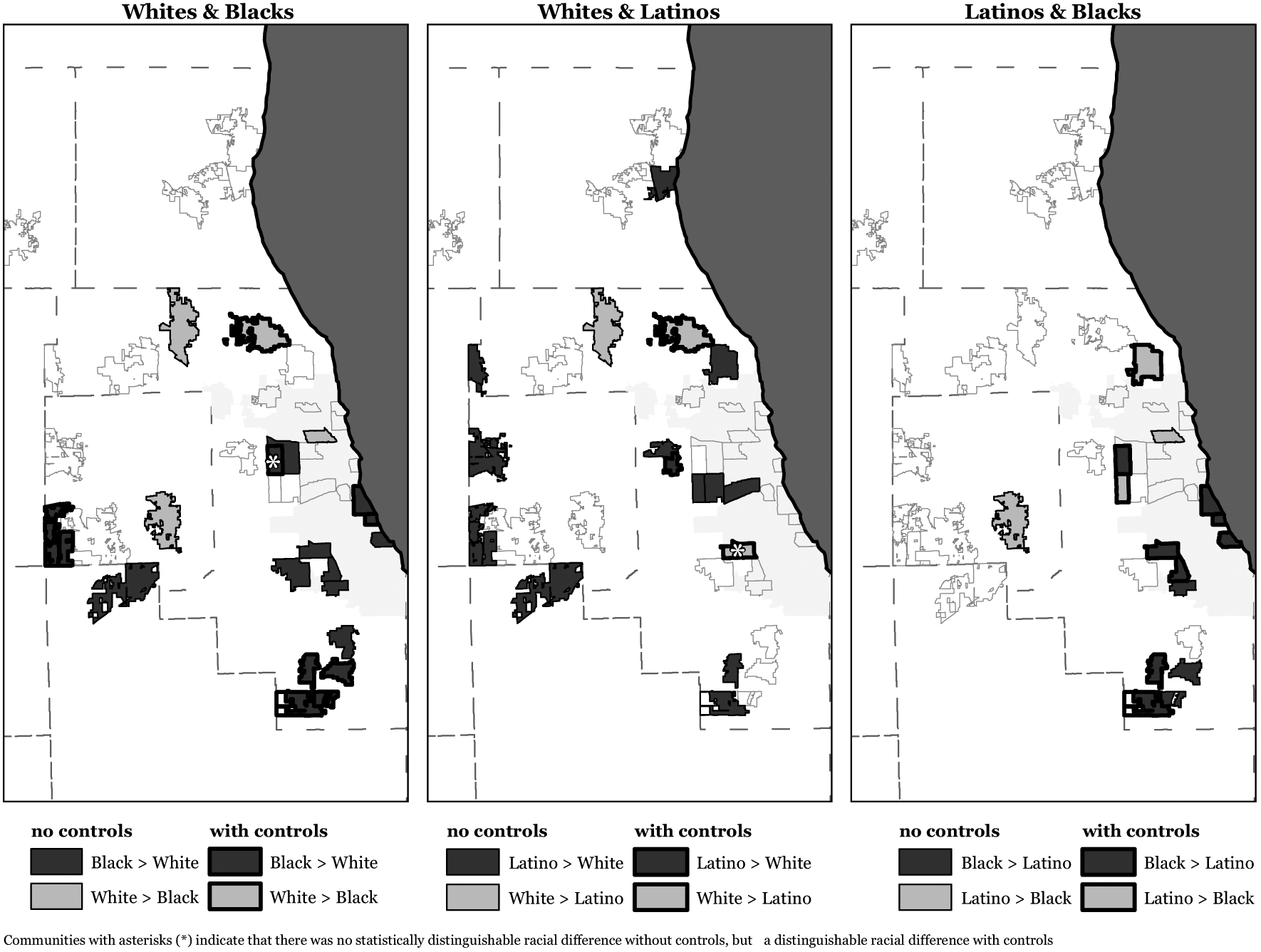
Statistically Distinguishable Racial Differences in Community Attraction With and Without Controls for Socioeconomic Status and Distance
The left panel of Figure 3 shows racial differences in community attraction between whites and blacks. The four communities whites were more likely than blacks to find attractive are filled in light gray; three communities were predominantly white suburbs and one was the gentrifying, mostly Latino neighborhood of Logan Square. After adding controls, it is only Glenview, which is 82 percent white, where whites remain more likely than blacks to consider, indicated by the light-gray fill and heavy outline.
The fifteen communities that blacks were more likely to consider than whites are filled with dark gray in the left panel of Figure 3. Seven were in the city of Chicago: three overwhelmingly black neighborhoods, two black-white integrated neighborhoods, and two multiethnically integrated neighborhoods. The other eight were suburban communities. Among these eight are all five southern suburbs labeled on the map, of which two are predominantly black, two are black-white integrated communities with black majorities, and one is black-white integrated community with a white majority. The remaining three suburbs were two multiethnically integrated western suburbs and one nearly all-white inner-ring suburb. After adding controls, blacks were more likely than whites to consider two Chicago neighborhoods (overwhelmingly black Bronzeville and multiethnic Hyde Park), all but one southern suburb, and one multiethnic western suburb (shown with gray fill and heavy outlines). Blacks were more likely to consider integrated Oak Park (shown on the map with an asterisk) after adding controls, even though there was no distinguishable racial difference without controls. After controlling for individual attributes and geographic distance, whites were more likely to consider one overwhelmingly white community whereas blacks were more willing to consider eight communities, including four with majority-white populations.
The middle panel of Figure 3 shows the comparison between whites and Latinos. Whites were more likely to consider two predominantly white northern suburbs, both filled with light gray, and whites remained more likely to consider one (shown with a heavy outline) after adding controls. Adding controls revealed that whites were more likely than Latinos to consider the multiethnic South Side neighborhood of Ashburn (shown with an asterisk). Latinos were more likely than whites to consider thirteen of the communities in the model without controls (communities filled with dark gray). One community remained more likely to be considered by Latinos after adding controls: the predominantly black suburb of Maywood (11 percent Latino, 84 percent black), shown with dark gray fill and a heavy outline.
The right panel in Figure 3 compares the communities that blacks and Latinos found attractive. Blacks were more likely to consider eleven communities (filled with dark gray). Six of the eleven were in the city of Chicago, all of which were on the South Side. Three were predominantly black neighborhoods, one black-white integrated community, and two three-group racially integrated communities. Four of the five suburban communities with these differences were southern suburbs. The remaining suburban community was the black-white integrated community of Oak Park. The racial differences in all but three communities were robust to controls (those with significant differences after adding controls are outlined with a heavy outline).
Community avoidance: Where would Chicago-area residents “never consider” looking for a place to live?
The percentages of residents saying they would avoid any particular community were high. Out of the forty-one communities on the map, at least 40 percent of respondents overall would never consider thirty-three, and more than 60 percent would never consider twenty-three communities. The higher prevalence of “never considering” communities is consistent with the idea that people limit their choice sets. But whites were, on average, much more likely than blacks or Latinos to dismiss all kinds of communities. Latinos were the least likely and blacks were in between. Forty percent or more of whites would avoid all but three communities. But there were only eighteen communities avoided by at least 40 percent of blacks, and only four avoided by at least 40 percent of Latinos. While 60 percent of whites avoided a majority of communities (twenty-three), there are no (0) communities avoided by 60 percent of blacks or Latinos. Although whites were more likely to never consider communities, the rank-order of communities endorsed as places whites would never consider was similar to Latinos, as indicated by the high Spearman’s rank-order correlation (ρ = .71, p < .001). There is no correlation between the ordering of communities by whites and blacks (ρ = –.13, n.s.) and a weak correlation in Latino and black ordering (ρ = .27, p < .10).
What happens when we control for demographics and distance?
The community-by-community assessments of racial differences in community avoidance are presented in the maps in Figure 4. In the left panel, the results show that whites were more likely than blacks to avoid thirty-one of the forty-one communities (shown with light gray fill). The remaining ten communities that whites were equally likely to avoid are all northern and western suburbs, except for the North Side (predominately white) Chicago neighborhood of Norwood Park. After adding controls, statistically distinguishable results disappear in ten of the communities (those filled with light gray and outlined with a thin border): three diverse but majority white far western suburbs and a mixed white-Latino western suburb; two multiethnically diverse far northern suburbs; a majority-Latino near-in suburb; and two Chicago neighborhoods. Adding controls also revealed that whites were more likely than blacks to avoid the overwhelmingly white North Side neighborhood of Lakeview. There are no communities that blacks avoid more than whites.
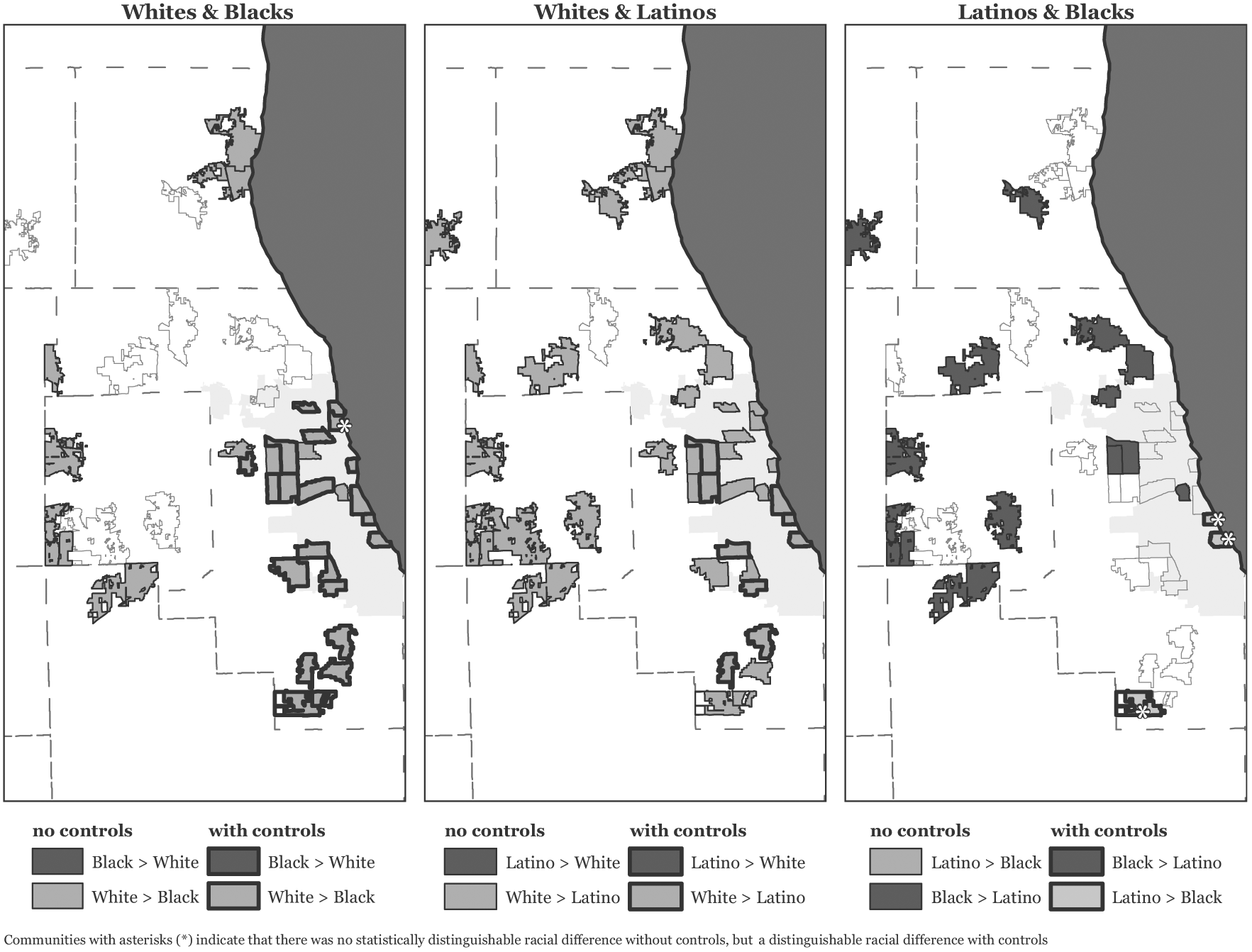
Statistically Distinguishable Racial Differences in Community Avoidance With and Without Controls for Socioeconomic Status and Distance
The middle panel of Figure 4 reports the comparison between whites and Latinos. Whites were more likely than Latinos to never consider forty of the forty-one communities (filled with light gray on the map). The sole exception is Arlington Heights, a community whites and Latinos were equally likely to never consider. After adding demographic and geographic controls, however, whites were more likely to not consider only nine of these forty communities (those communities with a heavy outline filled with light gray). The nine communities include one racially mixed and five predominantly black Chicago neighborhoods. The remaining three were a predominantly Latino inner-ring suburb and two predominantly black southern suburbs.
The comparison of neighborhoods blacks and Latinos would avoid is in the right panel of Figure 4. Blacks were more likely than Latinos to indicate that they would never consider thirteen communities (shown with dark gray fill on the map). These include six predominantly white suburbs and three more integrated suburbs. All of these differences disappear after introducing demographic and distance controls. Introducing controls, however, revealed three communities that Latinos were more likely to avoid than African Americans (shown in light gray fill with heavy outlines on the map).
Is it just a racial proxy?
The logistic regressions suggested that racial composition influences how different racial groups evaluated communities. To answer this question systematically, we tested whether a community’s racial composition had an influence on community evaluations and whether this influence persisted after controlling for levels of crime, school test scores, and other social class characteristics of the community.
Seriously consider
Column 1 of Table 1 shows the results of the models estimating individual- and community-level influences on where residents would seriously consider living. The individual-level variables in the top panel of Table 1 show that residents with a BA degree or more education tended to select more communities overall, and older respondents tended to select fewer communities to seriously consider. Consistent with geographic search models, communities with larger population sizes were more likely to be “seriously considered,” likely because they were better known. The farther away the community was from the respondent, the less likely a respondent was to seriously consider that community, an effect that declined as distance increases.
Generalized Hierarchical Linear Model of Respondents Seriously Considering and Never Consider Communities by Community and Individual Characteristics
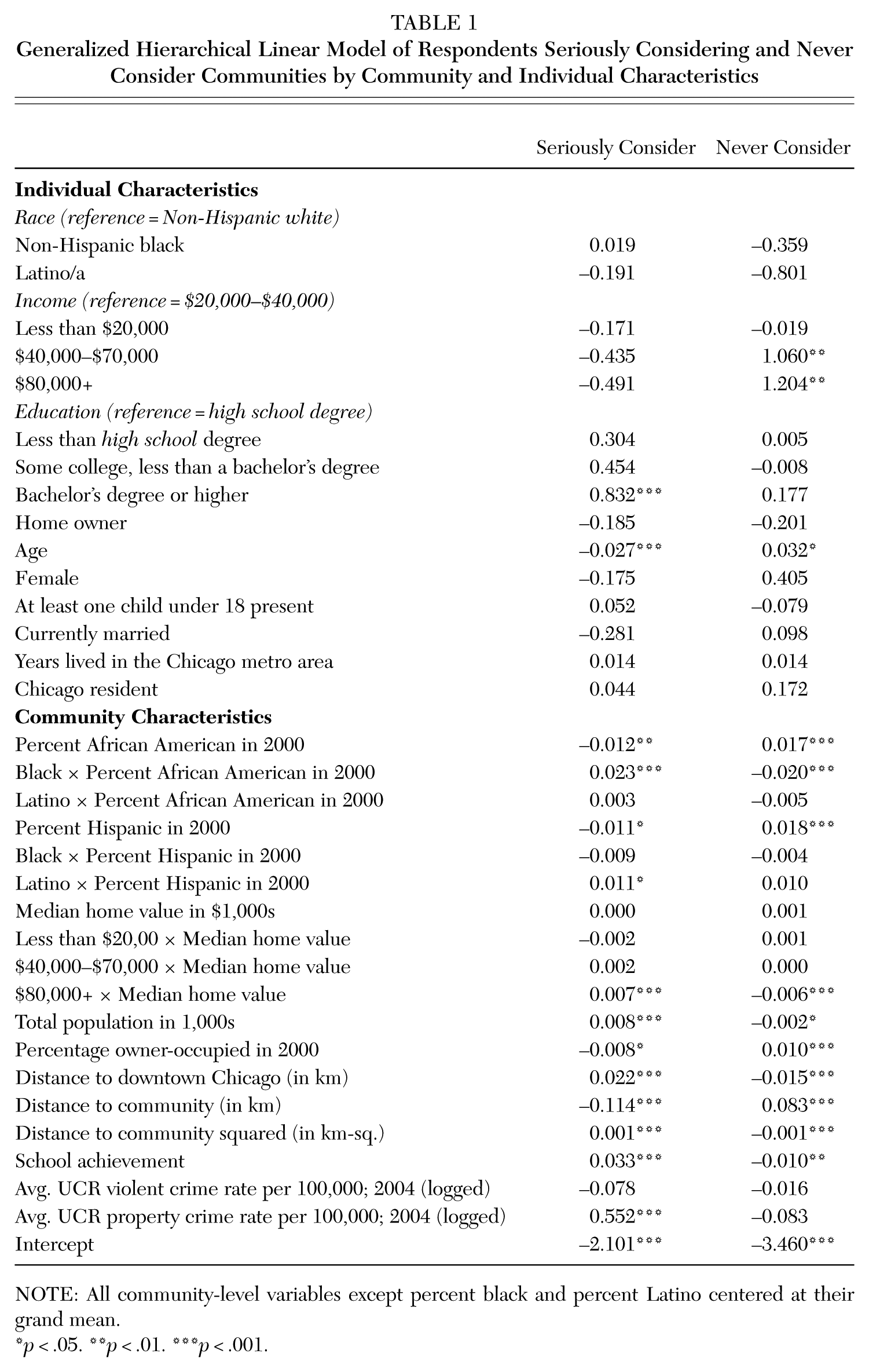
NOTE: All community-level variables except percent black and percent Latino centered at their grand mean.
p < .05. **p < .01. ***p < .001.
The cross-level interactions reveal that race influenced where people would consider moving. Whites’ willingness to seriously consider neighborhoods declined rapidly as the percent black and Latino increased (reported as the “main effect” of racial composition). A 10-percent increase in the percentage of blacks or Latinos reduced the odds that a white respondent would consider the community by 11 percent and 10 percent, respectively. Blacks were much more likely than whites to consider neighborhoods as the percentage of blacks in communities increased (reported as “Black × Percent African American”), but were not statistically different from whites as the percentage of Latinos increased. Latinos were more likely than whites to consider neighborhoods with larger percentages of Latinos. The interaction (“Latino × Percent Hispanic”) was the same magnitude in the opposite direction as the main effect (both have an absolute value of 0.011), which means that Latinos were largely unaffected by the percentage of co-ethnics present in communities. Latinos were not statistically different from whites in their odds of endorsing communities as the percentage of blacks increased.
These racial influences existed even in the presence of controls that are thought to explain differences in racial preferences. These include home values, school scores, and crime rates. Following economic arguments, residents with the highest incomes were more likely than those with modest incomes to consider moving to communities with higher home values. Higher school test scores were positively correlated with respondents seriously considering the community. Counter-intuitively, however, higher property crime rates were also associated with higher desirability. This association was due to the Loop, which was a very desired community with a high property crime rate. Removing the Loop eliminated this association.
Never consider
Column 2 of Table 1 reports the results for residential avoidance. A positive coefficient indicates that a respondent was more likely to “never consider” the community, meaning positive coefficients indicate increased odds of avoidance. Whites were more likely to avoid communities as both the percentage of African Americans and Latinos increased. A 10-percent increase in either increased the odds that whites avoided the community by just under 20 percent. Both blacks and Latinos were less likely than whites to avoid communities as the proportion of black residents increased (though the influence is only significant among African Americans). The statistically insignificant coefficients on both interactions with percent Latino mean that blacks, whites, and Latinos were all about equally likely to avoid a neighborhood as the proportion of Latino residents increased, even when controls for demographics, distance, and the school quality and crime characteristics of the neighborhood were added. By contrast, as the percent of African Americans increased, blacks were less likely to avoid the community relative to whites. Blacks and Latinos were as likely as whites to avoid nearly all-white communities (neighborhoods without blacks or Latinos); if anything, blacks and Latinos were less likely to avoid white communities.
Again these racial differences persisted after controlling for neighborhood characteristics. The wealthy were more likely to avoid neighborhoods with lower home values. Communities with higher school test scores were less likely to be avoided. Crime, however, was not associated with community avoidance as neither violent nor property crime rates had independent effects on whether a community would be avoided.
Consequences of the context of perceptions of place
We conclude with a final analysis that confirms the importance of perceptions of places and illustrates the context in which people develop their perceptions of places. This analysis reports on the results from open-ended follow-up questions asking respondents to explain why they would (or would not) consider two communities: Schaumburg and Homewood/Flossmoor. The responses illustrate the subtle manner in which attraction and avoidance were racialized even when the basis of responses was similar across racial groups.
In particular, the responses to Schaumburg and Homewood/Flossmoor reveal the importance of geography. A substantial number of whites said they would seriously consider Schaumburg and those who would seriously consider it explained that they found the proximity to family and friends attractive, in addition to its amenities and the quality of homes. By contrast, Schaumburg was unlikely to be seriously considered by blacks because they felt that it was isolated, too far from school and jobs, and that it is away from the city. The inverse was true of the racially diverse southern suburb of Homewood/Flossmoor. Blacks favored Homewood/Flossmoor because of its community environment, quality of housing, and good schools, whereas whites and Latinos avoided the community because they felt that it was too isolated, far from school and jobs, and they were unfamiliar with it. Because geography is relative to the person rating, being “proximate” or “too far” is a function of where one lives. Due to the ongoing racial segregation of Chicago, what is proximate or too far is racialized. While whites and blacks give the same reasons for their perceptions, they are literally coming at each of these communities from different places.
Discussion and Conclusion
A more thorough understanding of racial influences on the housing search process is necessary to understand continued racial segregation. We focused on the influence of race on two search-related dimensions of community perceptions: where people would seriously consider and where they would never consider living. We find that race structures the communities that respondents find attractive and the communities that they would avoid.
Race most clearly shapes the residential perceptions of whites. Our results show that they were most likely to start their searches in white communities. Our results further suggest that failing to find a place to live in one of those communities, whites were unlikely to expand their search into communities with more than a token percentage of blacks or Latinos. This penchant for self-segregation cannot be explained by nonracial community factors such as schools or crime, as previous research has suggested (e.g., Harris 1999, 2001). Whites, we found, were likely to maintain segregation at both the initial and subsequent phases of the residential search.
Racial composition influences blacks the least. They would seriously consider a larger number of places than whites and consider a more diverse mix of communities, from nearly all-white to nearly all-black and almost everything between. Blacks also crossed off many fewer communities than did whites. Our final models showed that they were as likely as whites to consider all-white communities and not any more likely than whites to avoid all-white communities. Blacks’ more expansive and inclusive choice sets contradict evidence and presuppositions that minorities would have more geographically constrained choice sets (e.g., Huff 1982). These results also undermine the idea that black self-segregation is responsible for metropolitan patterns of segregation.
Latinos are the most complicated group. Chicago-area Latinos would seriously consider quite a few places and exclude just a small set of communities. But, once we controlled for demographics and distance from the respondents’ home to the community, Latinos’ preferences became much like whites’ preferences. This convergence might suggest that Latinos were following the classic spatial attainment model; at the same time, Latino perceptions differ enough from whites that the convergence expected by the spatial attainment model might not hold. The differences are also complicated by the fact that many whites found the largely Latino gentrifying neighborhoods in Chicago attractive.
One implication of our study is that we need more research on the housing search process. Research tends to focus on studies of residential preferences or revealed preference studies. The former are usually unmoored from reality while the latter, by showing only the final disposition, fail to reveal how inequality seeps into the process. The result is that we know very little about how searching and moving perpetuates inequality or how to intervene in the process. In the absence of empirical data on the search process, scholars fall back on the assumption of an economically rational model of housing search where people attempt to optimize their preferences.
Here, we find the major difference between the two dimensions—attraction and avoidance—instructive. Respondents were far more likely to avoid communities than seriously consider living in them. This difference is consistent with consumer choice theory that people attempt to create manageable choice sets to guide their decision-making (Schwartz 2000; Iyengar and Lepper 2000). It suggests an important way that the rational behavior of people searching for homes is bounded by existing information. It also provides a possible reason for the slippage between stated preferences and revealed outcomes that moves beyond existing explanations that focus on housing market discrimination (e.g., through racial steering) or institutions (e.g., through interracial economic inequality).
A second implication of our study is the dynamic role of geography. We find that the geography of existing segregation begets further segregation as distance affects respondents’ evaluations of communities and influences how they think about different communities. Respondents found nearby communities more attractive than those farther away, just as they were more likely to avoid distant communities. This follows closely with economic search theory positing that the probability of searching in a place will be inversely proportional to the community’s distance from the person and that searchers are more likely to already know about nearby communities (Clark and Smith 1979; Krysan and Bader 2009). The legacy of past segregation increases the chances that communities near respondents are likely to be ones composed largely of their own racial or ethnic group.
What this implies is that any influence of racial composition on community perceptions after controlling for geographic distance could, therefore, be considered a contemporary effect of race on perceptions of place. The legacy of past segregation structures residents’ knowledge of and perceptions about communities. Part of that likely happens through social ties. Having friends or family in communities influences how people perceive those communities and makes them more or less desirable. Racial homophily in social networks might exacerbate these racialized perceptions of place and perpetuate racial segregation (see Krysan, Crowder, and Bader 2014 for more detailed argument).
We believe our results imply that the analysis of racial segregation needs to happen on two levels. On one, we need to investigate how people decide where to move. Community attraction and avoidance influence different parts of the search process and, thus, affect racial segregation differently. On the other, our findings highlight the way in which places have reputations (Semyonov and Kraus 1982).
Perception of place and the perils of policy
This research provides a warning of sorts for policy-makers. American housing policy has moved away from place-based, supply-side solutions to one in which individuals in need of housing assistance are provided vouchers so that they can “choose” where they want to live (e.g., Pattillo, Delale-O’Connor, and Butts 2014; Sharkey 2013; Goering and Feins 2003). In this context, understanding how people decide where to live becomes increasingly important. Though there is a growing body of rich research into this process among the very poor, rounding out our understanding to include the spectrum of income levels is important to understanding the complete landscape. This is a critical step if we are interested in understanding the mechanisms through which inequality is perpetuated so that we can shape policies that might help to alleviate it.
Failing to account for the perceptions of place might perpetuate inequality and concentrate poverty and affluence. If the aggregate result of individual moves reinforces existing segregation because of racialized perceptions of place and the dynamic role of geography, housing policies that encourage individual moves might exacerbate existing inequality. This is especially true because whites seek to live among whites and avoid living among minorities. Our results provide solid evidence for this while also contradicting the assertion that the particularly high levels of segregation of African Americans are due to “self-segregating” preferences (e.g., Thernstrom and Thernstrom 1997; Patterson 1997). In our study, we found at least some white communities that would be seriously considered by all three groups. But we did not find a single all/mostly white community that was excluded from consideration by a substantial number of any racial/ethnic group.
The policy inaction that stems from this assumption—that is, if people are choosing to self-segregate, then policy has no role—is equally inappropriate. Instead, our results show that African Americans would seriously consider (and in other research we show, would also actually search in) communities with a number of different types of racial compositions. Thus, racially biased proclivity among African Americans cannot explain findings demonstrating the greater likelihood of blacks to move to predominantly black neighborhoods (e.g., Crowder 2001; South and Crowder 1998, Sampson and Sharkey 2008), at least in initial stages of the search process.
Comprehending the ongoing experience of racial residential segregation as we approach the fiftieth anniversary of the Fair Housing Act requires insights not found in the traditional theoretical molds. Our study points research on racial segregation in new directions. We emphasize the need to understand the search process and provide evidence for a plausible model of search behavior. We also show the need to understand how perceptions structure place reputations. New data are needed to investigate how these processes combine to perpetuate racial segregation and potentially influence the success of American housing policy.
Footnotes
NOTE:
The authors gratefully acknowledge the support of the National Science Foundation (SES-0317740), the Ford Foundation, and the University of Illinois at Chicago, which funded the data collection reported in this article. The authors wish to acknowledge their conversations and collaboration with Kyle Crowder, which contributed to the ideas in this article.
Notes
Michael Bader is an assistant professor of sociology at American University in Washington, DC. He studies how patterns of neighborhood change have evolved since the civil rights movement, processes that perpetuate spatial inequality, and measurement of neighborhood environments.
Maria Krysan is a professor in the Department of Sociology and at the Institute of Government and Public Affairs at the University of Illinois at Chicago. She studies residential segregation, racial attitudes, and survey methods. Her current work examines how community perceptions, knowledge, and experiences influence housing searches and perpetuate segregation.
References
Supplementary Material
Please find the following supplemental material available below.
For Open Access articles published under a Creative Commons License, all supplemental material carries the same license as the article it is associated with.
For non-Open Access articles published, all supplemental material carries a non-exclusive license, and permission requests for re-use of supplemental material or any part of supplemental material shall be sent directly to the copyright owner as specified in the copyright notice associated with the article.
