







Abstract
More than 2 million American children have a parent incarcerated, making the consequences of parental incarceration for families a critical concern. A growing literature documents significant challenges not only among incarcerated men, but also among their spouses, partners, and children. Much remains to be learned about these experiences, however; and the data available for doing so are limited. In this article, we demonstrate how the quality of available data on paternal incarceration can be improved by supplementing a leading population-based survey of families with administrative records on criminal history from a state criminal justice agency. This administrative supplement provides only a low-end estimate of the extent of criminal justice involvement in our sample, but still increases the number of fathers identified with criminal histories by more than 20 percent. Building on such a supplement—in our current survey or future ones—could improve the identification of justice-involved fathers on a broader scale.
As of 2010, more than 2 million American children had a parent incarcerated (Western and Pettit 2010), motivating a far-reaching examination of the criminal justice system and its role in family life. More than 90 percent of incarcerated parents are fathers (Western and Pettit 2010), and a growing literature documents significant disadvantage not only among incarcerated fathers, but also among their spouses, partners, and children (See Wakefield, Lee, and Wildeman, this volume; Wakefield and Wildeman 2014 for revews).
Much recent research on paternal incarceration is based on household surveys in which respondents may report that they or a family member have been to prison or jail (Foster and Hagan 2007; Geller et al. 2012, among others). These surveys provide rich descriptors of family life, including identification of incarcerated family members outside the household. However, survey data are limited by the inherent risk of attrition, recall error, and underreporting (Groves 2004), as well as challenges in identifying when respondents or their family members were incarcerated, for how long, or for what offenses (Geller et al. 2012; National Center for Family and Marriage Research 2012).
In this article we examine the ways in which survey data can be strengthened for the study of incarceration and families through an administrative data supplement. Using data from a leading source of information on incarcerated fathers, the Fragile Families and Child Wellbeing Study, supplemented with administrative data from a state criminal justice agency, we find the combined dataset identifies a significant number of fathers with previously unreported criminal histories and adds rich detail on the nature of their criminal justice involvement. However, we also note challenges in matching survey respondents to comprehensive criminal history data, which may lead to attenuated estimates of incarceration’s effects. We therefore conclude the article with recommendations for prospective collection of administrative criminal history data alongside current and future household surveys.
Background
To date, the literature examining parental incarceration in the United States has relied on three methods of data collection. First, qualitative studies (Arditti, Lambert-Shute, and Joest 2003; Braman 2004; Comfort 2008, this volume; Nurse 2002) provide rich descriptions of the lives of incarcerated men and their families. However, these studies focus predominantly on descriptive accounts of family stressors and are not designed to distinguish the challenges caused by incarceration from those tied to broader socioeconomic disadvantage.
A second set of studies uses data from population-based household surveys, such as the National Longitudinal Study of Adolescent to Adult Health (Foster and Hagan 2007; Roettger et al. 2011), the Fragile Families and Child Wellbeing Study (FFCWS; Geller et al. 2012), and the Project on Human Development in Chicago Neighborhoods (Wakefield and Wildeman 2011), in which fathers may self-report criminal justice involvement, or family members may identify fathers as having been incarcerated. Population-based surveys are valuable because they contain families with and without incarceration histories, providing a control group against which researchers can assess the disadvantage faced by incarcerated fathers and their families. They also follow families prospectively, allowing the examination of family circumstances prior to many fathers’ incarceration. Furthermore, some surveys systematically oversample socioeconomically disadvantaged families, providing both a large sample of families with fathers who have been incarcerated and a comparison sample vulnerable to many of the same socioeconomic challenges correlated with incarceration.
However, longitudinal surveys also have limitations. Because they do not focus on criminal justice, they may not capture details of fathers’ incarceration experiences. Attrition rates also tend to be high among socioeconomically disadvantaged respondents, suggesting incarcerated fathers may be difficult to retain. Further, stigmatized behaviors such as criminal involvement are often underreported in surveys (Golub et al. 2002; Groves 2004). While some surveys supplement self-report data with reports by other family members, proxy respondents are less likely to accurately recall the experience of others (Gelman and Hill 2007). Women may also underreport the criminal history of a man with whom they are romantically involved (Caspi et al. 2001) but report such information if the relationship ends, introducing systematic measurement error.
A third literature uses administrative data to examine the effects of incarceration on outcomes such as recidivism risk (Nagin, Cullen, and Jonson 2009) and employment (e.g., Kling 2006). However, incarcerated fathers are frequently not connected to their children in official records, since most live in different households when arrested (Geller 2013; Johnson and Waldfogel 2002), are not primary caregivers, and may not be designated legal guardians. Over the past 20 years, there has also been a sharp increase in the availability of criminal history information through private companies conducting background checks (Bushway et al. 2007); however, these companies are not organized by state, are not regulated by public records laws, and the data they provide have been found to contain significant discrepancies with records available through official sources (Bushway et al. 2007). We therefore limit our discussion to the potential for public administrative sources to study the effects of paternal incarceration on families; however, their utility on their own is limited.
Several European studies use a mix of household surveys, national registry data, and administrative records of parents’ criminal histories (Murray and Farrington 2010; L. Andersen, this volume; S. H. Andersen, this volume), allowing for long-term assessments of incarceration and its effects on family life. However, these studies would be difficult to replicate in the United States, where criminal history data are collected at federal, state, and county levels (Bushway et al. 2007). While criminal records may be integrated with other administrative data at a state or local level (Berger et al., this volume; Cho 2009a, 2009b, 2011), these studies are limited in their generalizability. To date there is no comprehensive data collection that integrates systems across states.
Current contribution
In this article we assess the potential of an administrative dataset provided by a state agency to supplement one of the leading household surveys examining children and families, to provide comprehensive information on fathers’ involvement in the criminal justice system. We focus our analysis on the extent to which administrative data matching identifies incarceration histories unreported in family survey data, as well as the extent to which survey respondents provide information on paternal criminal histories beyond that in administrative data.
To our knowledge, this study represents the first attempt to combine an American population-based family survey with computerized criminal history data from administrative sources. Although our analysis is based on a very small subsample of the FFCWS, our work with the criminal justice clearinghouse in one state provides a barometer for the feasibility of broader data matching. Although we do not make inferences about the broader population—or even the broader FFCWS sample—our findings offer guidance for future data collection efforts.
Methods
Data sources
Data are drawn from the New York City subsample of the FCWS, supplemented with Computerized Criminal History records provided by the New York State Division of Criminal Justice Services.
The Fragile Families and Child Wellbeing Study
The FFCWS is a leading source of information about the role of incarceration in urban families (see Reichman et al. 2001 for a description of the sample and design, and Geller, Jaeger, and Pace, forthcoming, for a discussion of the study’s contemporary use). The study systematically oversamples unmarried parents, providing a sample that is socioeconomically disadvantaged, with high rates of incarceration among the fathers. Many of the families without paternal incarceration also face socioeconomic disadvantage, improving our ability to isolate incarceration effects from other sources of family instability. The study also measures a wide range of postincarceration outcomes among fathers, mothers, and children. However, to date, measurement challenges have limited analyses of justice system involvement.
New York State Computerized Criminal History Files
We supplement the FFCWS with Computerized Criminal History (CCH) data provided by the New York State Division of Criminal Justice Services (DCJS), sent to the FFCWS director’s office at the end of 2014. The CCH data contain information about adult arrests for fingerprintable offenses (i.e., misdemeanor or felony offenses) sent to DCJS by police departments in municipalities across New York State.
The CCH file provided by DCJS is known as a “top charge” file obtained through a “name search.” The research team provided names and personal identifiers of FFCWS fathers to DCJS to identify participants with criminal justice contact in New York State. 1 In this particular search, DCJS staff selected the best candidate match and returned at most one matched individual for each FFCWS record submitted. Fathers found to have criminal histories through the name search process were matched with their New York State identification numbers, unique identifiers used by state agencies to link the records of justice-involved individuals across agencies. The resulting file included information on the most serious charge at each arrest for a fingerprintable crime. 2
Notably, DCJS does not receive information about nonfingerprintable arrests (for violations), federal offenses, immigration detention, juvenile offenses, or arrests that occur out of state. The CCH data also do not include information on sealed records; the record of an arrest may be sealed if it results in an acquittal, the dismissal of charges, a conviction for a violation or other noncriminal offense, or if the person is granted youthful offender status. Accordingly the CCH data include some, but not all, incidents that might lead someone to spend time in jail and represent a lower bound on the disruption to family life that might be caused by paternal criminal justice involvement.
Analysis sample
The analysis sample for the proposed study is based on the 384 FFCWS families with children born in New York City. Records were searched for the 333 fathers identified by name (87 percent of fathers in the New York City sample) and date of birth. 3 Social Security numbers (SSNs) were submitted for 192 of the 333 fathers searched (58 percent).
Human subjects concerns
Criminal history records include sensitive information; an extensive literature documents the potential of a criminal record to stigmatize formerly incarcerated individuals in the labor and housing markets and throughout their communities (see, e.g., Western and Pettit 2010). Moreover, the FFCWS is a publicly available, deidentified dataset widely used by social science researchers. Therefore, it was critical to protect participant identities throughout the name search process. 4 Communication of name search information to DCJS was therefore done exclusively by the FFCWS director’s office at Princeton University. Identifying information was communicated using encrypted “pseudo-identifiers” to prevent the linkage of names and other identifying information to the family details provided in the survey responses.
Upon receipt of the top charge file from DCJS, the FFCWS director’s office removed all personal identifiers. Although deductive disclosure was unlikely from the remaining file, the study director’s office took further efforts to protect participant identities and generalized all incident-level data to further minimize the risk of deductive disclosure. The resulting file included no exact dates (referring only to the month and year of incidents), or specific locations (identifying regions only as “New York City,” “Suburban New York City,” and “Upstate”). The resulting encrypted, generalized criminal history file was then merged into the FFCWS dataset.
Key variables
Survey reports of paternal criminal history
The FFCWS asks several questions in which parents may indicate a father’s history of justice system involvement. Parents are asked directly about fathers’ criminal histories at the one-, three-, five-, and nine-year follow-up surveys (hereafter, “Y1”, “Y3”, “Y5,” and “Y9”). However, questions are asked differently of fathers and mothers; details about the questions asked at each wave are provided in Table 1, with illustrative examples provided in the appendix.
FFCWS Criminal History Reports by Parent and Wave
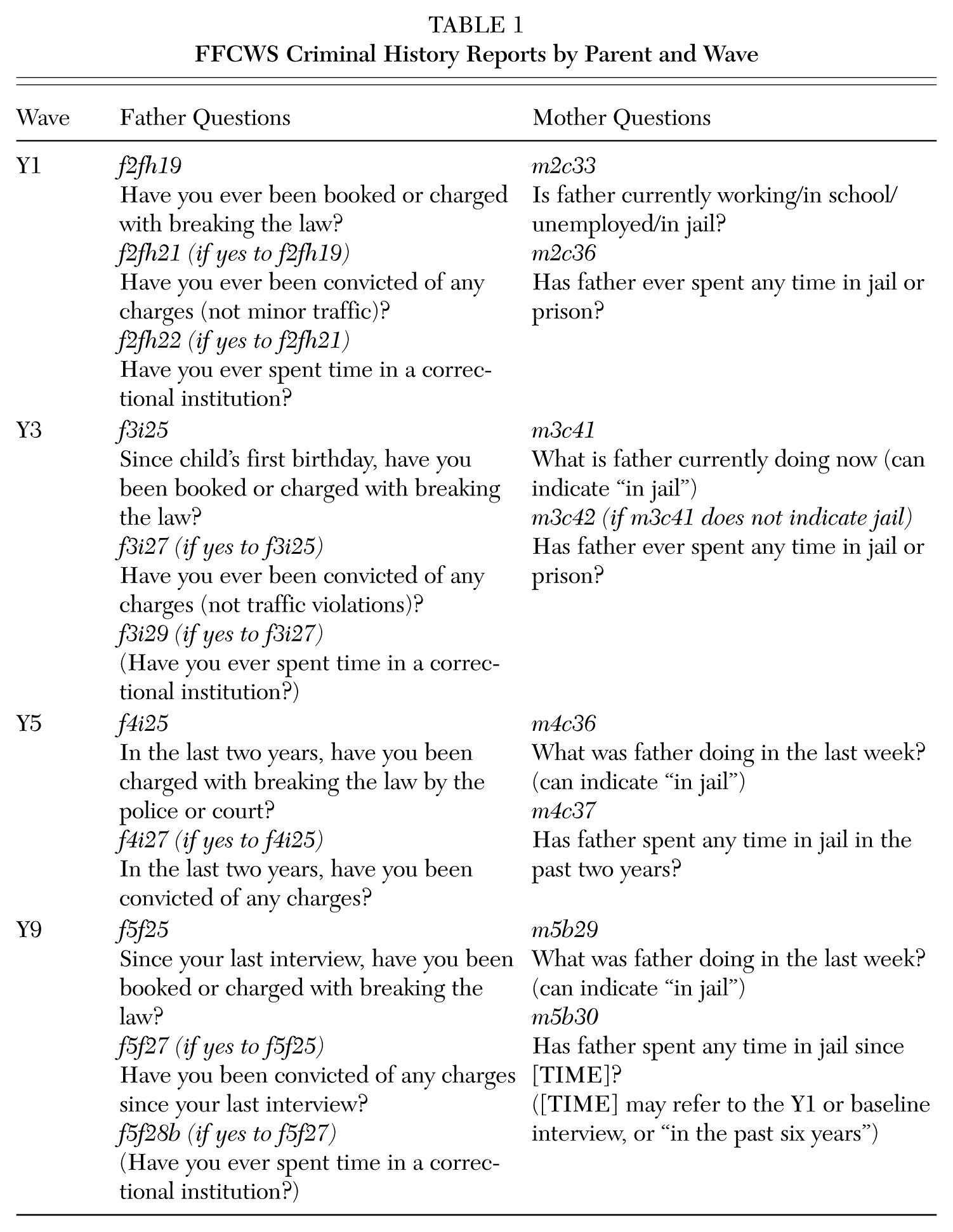
Generally, fathers are asked more detailed questions than are mothers: they are first asked if they have been charged with a crime in a particular time period; if so, they are asked if they were convicted of a crime; and if so, they are asked if they have spent time in prison or jail. Mothers, on the other hand, are simply asked if their partner has ever been incarcerated. 5 Mothers’ questions are therefore more inclusive than fathers’: If a father was charged with a crime, held in central booking or jail for a period of time, but charges were ultimately dismissed, mothers would have an opportunity to report the incident, but fathers would not: they would report the charge, but with no conviction, they would not be asked about incarceration.
Given the differences in how mothers and fathers are asked to report fathers’ involvement in the criminal justice system, it is not surprising that parents’ reports do not always align. Furthermore, as the FFCWS progresses, the period of time that elapses between mother and father interviews increases (Geller, Jaeger, and Pace, forthcoming), increasing the risk of inconsistency between parents’ responses. To resolve inconsistencies between mother and father reports of fathers’ criminal justice involvement at a given wave, many researchers categorize incarceration histories using an inclusive indicator that incorporates any indication of incarceration, even if inconsistencies exist (Geller et al. 2012).
To understand how administrative data might be used to adjudicate between reports that differ across parents, we focus our analysis on the Y1 survey wave, examining both mothers’ and fathers’ direct reports. We expect Y1 reports of fathers’ criminal histories to contain the least measurement error, since both parents are simply asked to report any criminal justice contact the father had until that time. In later waves, parents often are asked to report only recent experiences, which introduces a risk of telescoping or other recall errors (Rubin and Baddeley 1989). Given attrition over time, we also expect that Y1 reports on fathers’ criminal histories will be provided by the largest subsample.
Administrative reports of paternal criminal history
Although the CCH data provided by DCJS are a lower bound on the lifetime prevalence of justice system involvement among the FFCWS fathers, we refer to fathers as “ever involved” with the New York State criminal justice system if the DCJS name search returns at least one arrest; though note that additional records may exist. To identify whether fathers have been incarcerated, we focus specifically on the CCH variable noting the “collapsed sentence type” of the top charge disposition. Although a variety of sentences may be reported in the data—along with a wide range of minimum and maximum incarceration terms, when relevant—we focus specifically on whether arrestees received a custodial sentence, a noncustodial sentence, or if their case disposition was something other than a conviction. 6
Analytical Approach
Our research examines the extent to which our administrative data supplement identifies father involvement in the criminal justice system that is unreported or underreported in the FFCWS. We begin with an evaluation of the matching process itself, examining the extent to which the identifying information provided to DCJS was used to detect criminal history records among the fathers.
Matching
Our matching analysis begins by assessing the number of families who match to at least one CCH record of contact with the criminal justice system. DCJS recommends checking each returned case against available identifying information, and we identify the extent to which discrepancies exist between the survey and administrative records of the fathers’ dates of birth, race, and ethnicity. We also identify the number of matches that were based in part on SSNs.
Within our matched sample, we compare the contents of the survey and administrative data, focusing specifically on events that preceded the Y1 follow-up interview. Because we obtained the administrative data after several waves of the survey were completed rather than prospectively, we begin by stratifying the administrative data to identify arrests that came before each parent’s Y1 interview. We next examine, of those incidents clearly timed before the Y1 interviews, the extent of survey-administrative concordance: how incidents reported in the administrative data were identified in either fathers’ self-reports or mothers’ partner reports. We also examine whether FFCWS survey reports suggest criminal justice involvement not indicated in the CCH data.
Finally, in addition to examining concordance between parents’ individual reports of incarceration and the fathers’ administrative records, we also identify the extent to which mothers’ and fathers’ reports of incarceration align with each other. To the extent that parents’ reports are discordant, we examine which conflicting survey reports are resolved through the identification of administrative records. Most generally, we seek to understand the potential sources of differences in reporting, to inform future surveys and reduce discrepancies.
Results
Survey-administrative matching
Of the 333 fathers for whom records were searched, seventy-seven had CCH records of at least one arrest. An additional forty-four fathers had criminal justice involvement (at least a criminal charge) indicated in at least one survey question but did not have CCH records. The seventy-seven fathers in the CCH data—23 percent of the submission sample—were identified in between one and thirty-six incident records each, for a total of 417 arrests. Comparing the identifying information that DCJS provided for the seventy-seven matched fathers to the information provided in the survey, we found that thirty-eight fathers, slightly less than half of those with records returned, had information in their CCH records that matched perfectly with the information provided in the FFCWS. As shown in Table 2, the remaining thirty-nine fathers had one or more discrepancy, mostly related to race and Hispanic ethnicity, which were not used in the name search beyond verification of already-identified potential matches.
Details of Matches of CCH/FFCWS Reports of Identifying Information
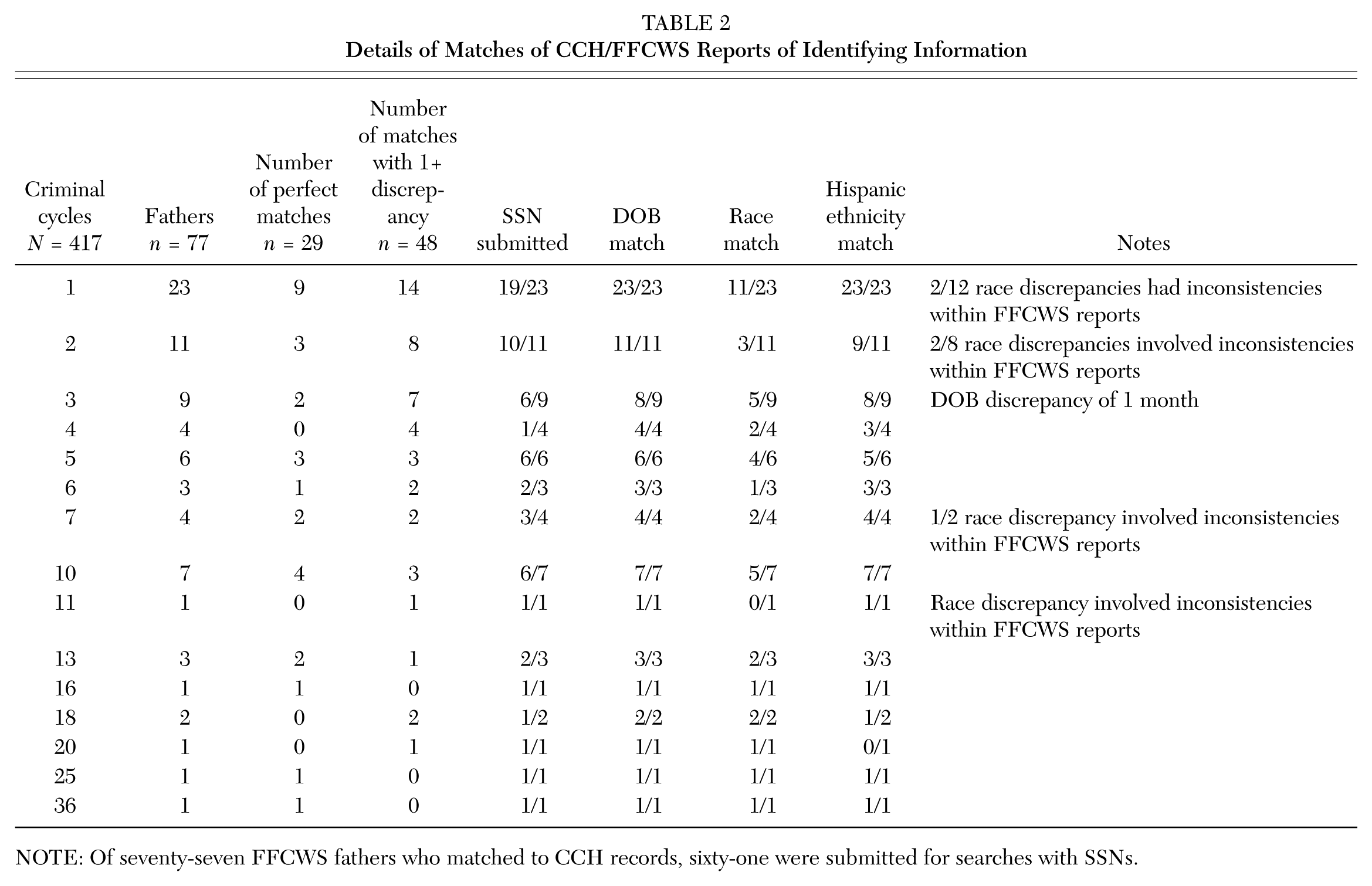
NOTE: Of seventy-seven FFCWS fathers who matched to CCH records, sixty-one were submitted for searches with SSNs.
Among the records that were matched, 79 percent had a SSN included in the submission. More than 88 percent of names submitted without an SSN were unmatched, a match rate 20 percentage points lower than the names submitted along with an SSN. We have no reason to believe there is a difference in the true prevalence of criminal histories by whether a father’s SSN is known by the FFCWS, suggesting that the SSN is a key component of record identification.
Survey-administrative concordance: The example of Y1
Turning to our examination of concordance between survey and administrative data, we first examine the timing of all 417 arrests reported, to identify cases clearly timed before the Y1 survey, as shown in Table 3.
Timing of Arrests with Respect to FFCWS Y1 Interviews
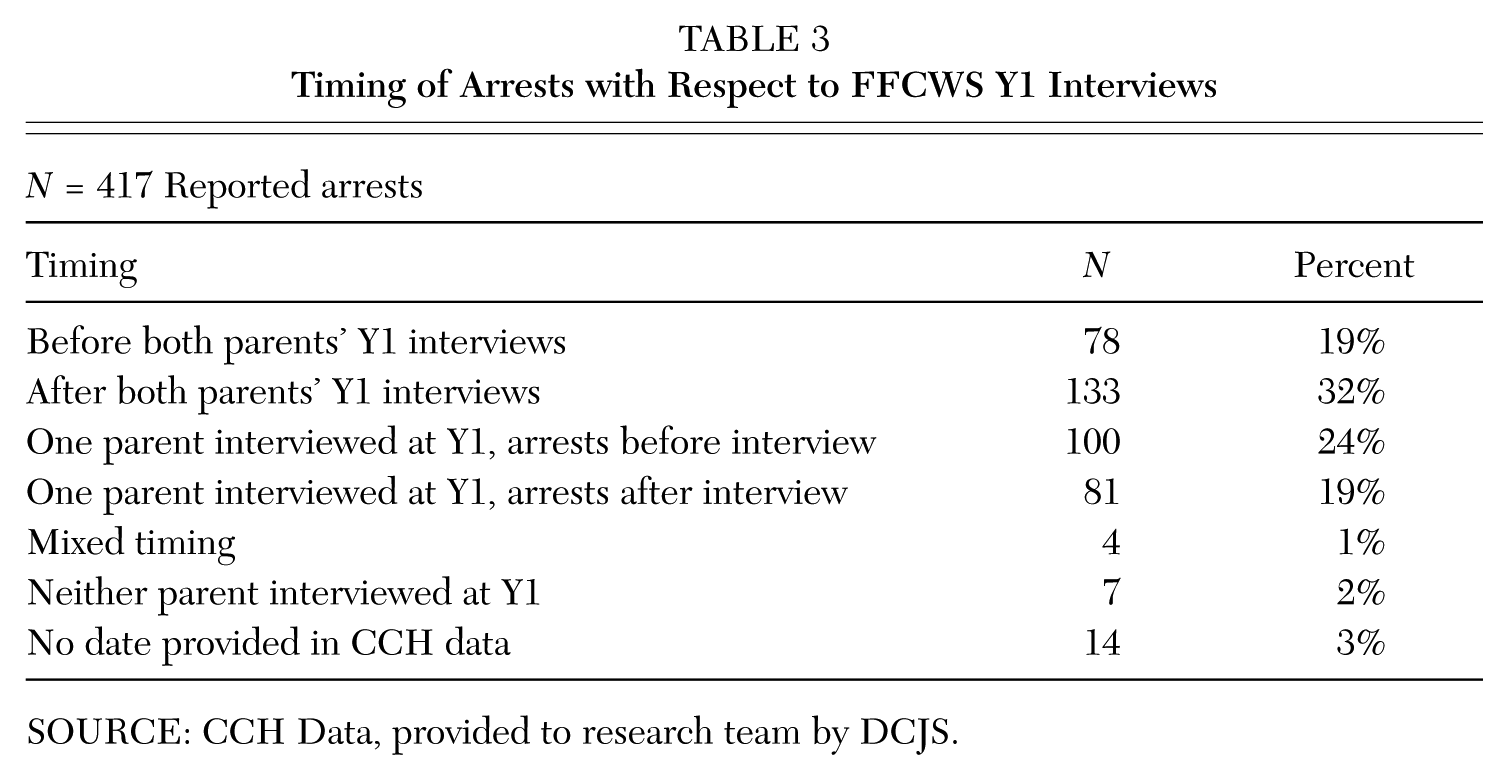
SOURCE: CCH Data, provided to research team by DCJS.
Of the 417 reported arrests, just more than half were associated with families in which both parents were interviewed at Y1: seventy-eight took place before the associated fathers’ and fathers’ partners’ Y1 interview, and 133 took place after both parents’ Y1 interviews. Another 181 events occurred in couples with only one parent interviewed, but were clearly timed with respect to that parent’s interview: one hundred came before, and eighty-one came after. These “clearly timed” cases constitute 94 percent of all reported incidents. The remaining 6 percent include cases in which neither parent was interviewed, arrest dates were not provided, or the arrest timing was “mixed.” 7 In the interest of clarity, we exclude these cases from the matching analysis. Further, we focus specifically on the 178 arrests that are clearly timed before the Y1 interview. These arrests are associated with fifty-five fathers.
Father reports
Of the fifty-five fathers with arrests before the Y1 survey wave, almost one-third (seventeen) were not interviewed at Y1. Of those fathers interviewed, most reported having been charged with a crime, but many did not (twenty-two reported having been charged, sixteen reported not having been charged). Notably, those fathers were not subsequently asked about conviction or incarceration. Moreover, of the sixteen fathers not asked, twelve had CCH data indicating convictions by their Y1 survey. (The remaining four had charges dismissed or not disposed of.) Of the twenty-two fathers asked about conviction histories, ten reported conviction and subsequently reported having been incarcerated. Another ten reported not having been convicted, and two declined to answer. 8 These twelve fathers were not subsequently asked about—or given the opportunity to report—incarceration, although five had CCH data noting previous sentences to jail or prison, or “time served.” Another seventeen fathers reported having been charged with a crime at some point before the survey, though no prior incidents appeared in the CCH data. Three of these fathers also self-reported having been convicted of a crime (though none reported incarceration).
Mother reports
Of the fifty-five fathers with pre-Y1 arrests in their CCH records, five had partners who were not interviewed. Of the fifty mothers interviewed, three reported that their children’s father was incarcerated at the time of their interview. Each of these fathers had CCH records of arrests or convictions in the year leading up to their partners’ sixth interview, and all three had prior incarceration sentences in their records. Another twenty-one mothers reported that their partners had been incarcerated at some point before her Y1 interview.
In addition to the mothers reporting that their partners had been incarcerated, twenty-three reported no incarceration, and three declined to answer the question. However, just more than half (thirteen) of these mothers had their reports of “no incarceration” borne out by the CCH records. Eight others had partners sentenced to prison or jail before their Y1 interview, and the remaining two had partners who had been sentenced to “time served,” suggesting they had spent at least some time incarcerated while their case was processed. In addition, all three mothers who had declined to answer the incarceration question had partners sentenced to jail or prison at least once before their survey took place.
Of the twenty-one mothers reporting that their partner had been incarcerated, only thirteen had partners with jail or prison sentences in their administrative records at the time of the Y1 interviews, or sentences to “time served.” In addition to the fifty-five fathers with arrests before Y1, sixteen mothers reported their partners had been incarcerated, including one who said he was incarcerated at the time of her Y1 survey, although these fathers had no records in the CCH data at that time. This suggests several possibilities: As in cases where fathers self-reported criminal histories unobserved in the CCH data, the survey reports could refer to federal or youthful offender incidents, arrests outside of New York, arrests for nonfingerprintable offenses, sealed records, immigration offenses, or pretrial detention. However, the mothers’ reports could also reflect an alternative possibility: that the mother’s reports reflect an inaccurate understanding of their partners’ criminal histories.
Couple mismatch
One notable strength of the FFCWS dataset is its collection of couple data; mothers provide information on the fathers of their children, which is particularly valuable for the many families in which fathers are not interviewed. However, the FFCWS couple data introduce considerable complexity in the examination of paternal incarceration. To minimize this complexity in the current analysis, we focus on reports at Y1. As shown in Table 4, just less than two-thirds of the 333 families in the initial analysis sample have both maternal and paternal answers to the question of paternal incarceration at Y1. In approximately 90 percent of these cases, parental reports are in agreement, and nearly all of these agreed-upon parental reports are supported by the CCH data.
Parental Responses to Survey Questions on Fathers’ Criminal History, and Corresponding CCH Records
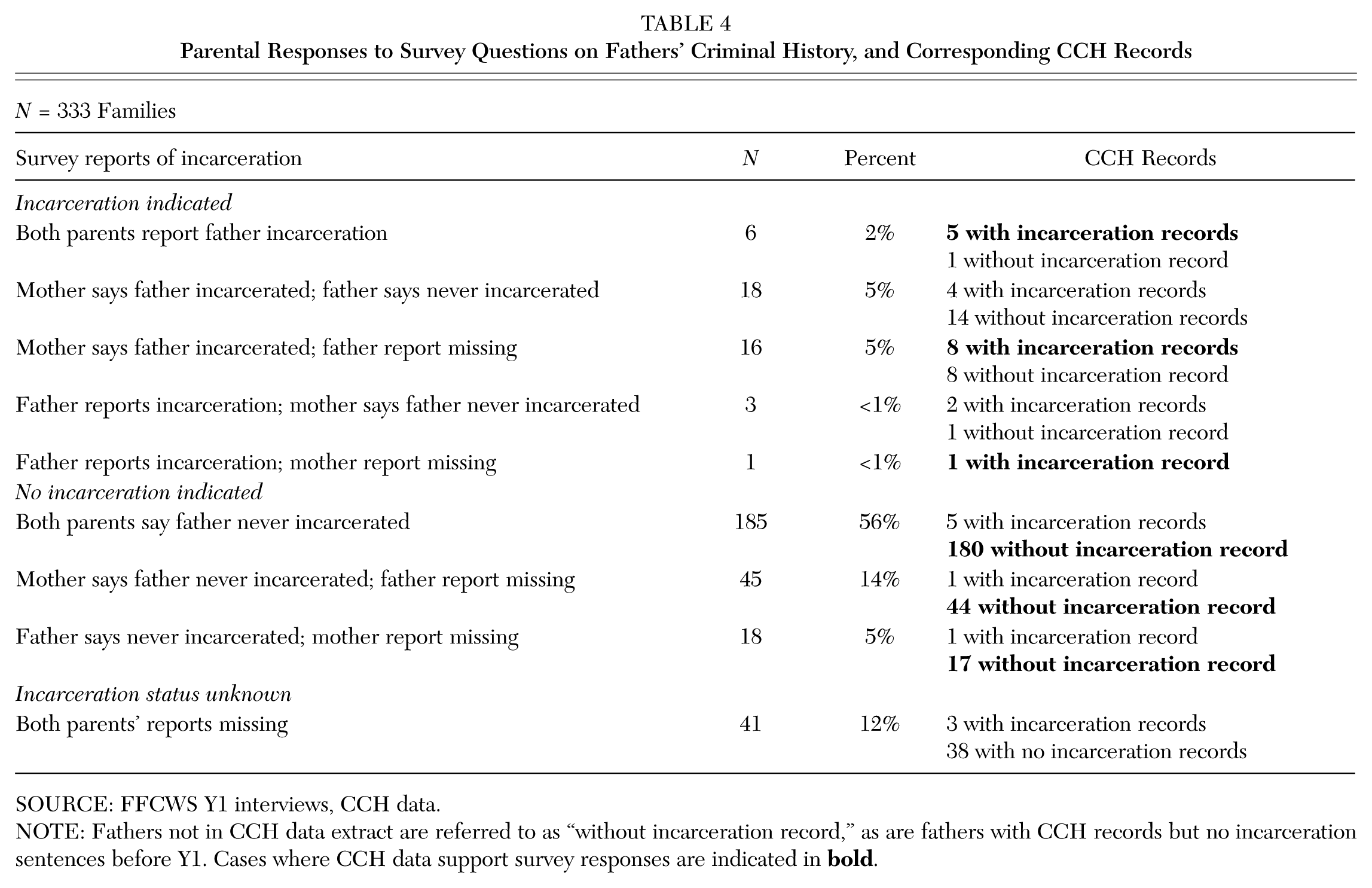
SOURCE: FFCWS Y1 interviews, CCH data.
NOTE: Fathers not in CCH data extract are referred to as “without incarceration record,” as are fathers with CCH records but no incarceration sentences before Y1. Cases where CCH data support survey responses are indicated in
The remaining 121 couples in the analysis sample do not have answers about fathers’ incarceration from both parents. In approximately one-third of these cases, neither parent reports on the father’s incarceration history; almost none of these forty-one fathers had CCH records. 9 Another sixty-one mothers reported on their partners’ incarceration histories, with no corresponding father report. Most reported that their partner had never been incarcerated, nearly always consistent with the CCH data. Mothers reporting that their partner had been incarcerated were less likely to have supporting CCH reports; only eight out of sixteen such fathers were noted in the CCH data as having been sentenced to prison, jail, or time served. It was much less common for fathers to report on incarceration without a corresponding report from their partners, though in nearly all such cases the fathers’ self-reports were consistent with the CCH data. The extent to which parents offered conflicting reports in their Y1 surveys was relatively small, though conflicting reports became more prevalent in subsequent waves (Geller et al. 2012). In approximately one-third of these cases, CCH records confirm that the father had been incarcerated.
Newly identified criminal histories
In total, forty-four fathers were reported as having been incarcerated, either in self-reports, partner reports, or both. The CCH supplement identifies an additional ten fathers as having spent time behind bars before the Y1 survey wave, increasing the number of fathers known to have incarceration histories by more than 20 percent. Although a full treatment of subsequent survey waves is beyond the scope of this analysis, it bears noting that ninety-three of the fathers had some report of criminal justice contact 10 in at least one FFCWS survey wave. Twenty-eight additional fathers had at least one arrest in the CCH data, increasing our count of justice-involved fathers by approximately 30 percent.
Underreporting is common in survey data, particularly in discussions of a stigmatized status. Estimates of reporting of food stamp receipt range from 22 percent to 50 percent (Almada, McCarthy, and Tchernis 2015), suggesting that our current estimates of criminal justice underreporting are of comparable magnitude. Moreover, since the CCH data are known to exclude several classes of arrests that might lead to incarceration, it is likely that the true rate of underreporting is even greater than the 20–30 percent currently measured.
Discussion
Survey-administrative matching
Summary of findings
With information commonly collected from respondents in household surveys, it was feasible to gather criminal history records compiled by a large state’s criminal justice clearinghouse. Matches were based on a name search that also considered fathers’ dates of birth, SSNs, or both, and were further verified in many cases using fathers’ race and ethnicity. While some discrepancies exist between the matched CCH data and the FFCWS data, most of these discrepancies were in fathers’ race and/or ethnicity, which were not themselves part of the search process. It bears noting that these race/ethnic differences may exist due to differences in reporting sources: reports of father race and ethnicity in the CCH data were determined by the reporting agency (often based on the reports of an arresting officer), while the FFCWS reports were based largely on self-reports and partner reports.
As the CCH data reflect only adult arrests for fingerprintable offenses (in which records were not subsequently sealed), the incidents reported represent a lower bound on the fathers’ criminal histories than may be reported in comprehensive survey data. However, the combined dataset identifies 20–30 percent more fathers as involved with the criminal justice system, depending on the measure of involvement used. This finding underscores the difficulty of comprehensively measuring criminal justice involvement with survey data, and lends support to the strategy of identifying fathers as incarcerated, or justice-involved, based on any survey responses that indicate such involvement, even if inconsistencies exist. The CCH data stand to add value to the FFCWS by identifying justice-involved fathers not reported in the survey (with the understanding that still more may exist).
In addition to the arrest, disposition, and sentencing information analyzed in this analysis, the CCH data include the dates of the charged offense, arraignment, and disposition, as well as the minimum and maximum sentences in cases when fathers are incarcerated. These data offer the potential to construct detailed, if partial, event histories of fathers’ fingerprintable arrests in New York State. The CCH files also contain information about the top charge type in each arrest (including the standardized charge code from the FBI’s Uniform Crime Report, so charges could be compared across subjects and even across states) and charge class (Felony classes A-I through E, Misdemeanor classes A and B, and Violations). Moreover, offense charge and class are provided for the arrest, arraignment, and disposition charges, providing valuable information about fathers’ case trajectories. Arrestees are frequently arraigned on more serious crimes than their ultimate disposition charges, and the CCH data provide the potential to observe this charge decay. Further, when fathers are convicted of felonies, drug offenses, sex offenses, or other charges that may disqualify them from housing or labor market opportunities, this may also be noted.
Limitations and directions for research and policy
The matching process in this analysis was limited by several factors. As noted, the CCH data are not exhaustive of fathers’ potential arrest experiences, and forty-four out of the 333 fathers in our analysis sample had criminal justice either self-reported or reported by their partners but did not have records returned in the CCH data. The name search process was also a cumbersome one, and DCJS staff members were forthcoming about its limitations. Records could have been obtained more efficiently if the FFCWS research team had access to the fathers’ New York State identification numbers and searched by identification number rather than by name.
The study was also limited by its focus on only the New York City sample and criminal history records within New York State. Not only could fathers in our sample have out-of-state records, fathers sampled from other cities (e.g., Newark, NJ) may have records in New York State that we failed to search for or identify. While expanding the collection of administrative data beyond New York State is a logical direction for future research, it bears noting the challenges in broader data collection. While the FBI maintains criminal history records information, this information is limited to federal offenders and state offenders in states that voluntarily provide the information (Bushway et al. 2007). We anticipate that state-level information will be more comprehensive when collected on a larger scale. The field would be well-served by researchers building on the work of Bushway et al. (2007) to identify the accessibility of records information in all fifty states and documenting each state’s request procedures. Our understanding of incarceration and its role in families and broader society would also be substantially improved by policies that made comprehensive criminal history data available for social science research while protecting sensitive personal information.
Survey-administrative concordance
Summary of findings
Focusing specifically on the criminal justice contact reported in the CCH data by the Y1 survey wave (or, for parents not interviewed, by 2001), we find that the CCH reports provide significant information not reported by parents in the FFCWS. Although the CCH data represent a lower bound on fathers’ arrest experiences, we find that the survey fails to fully identify even this subset of fathers’ arrests. This is most pronounced in cases where fathers do not report having been charged with a crime and are thus not asked about, or given an opportunity to report, further involvement such as conviction and incarceration. In some of these cases, their partners, who are not asked about charges or convictions, indicate that the father had been incarcerated; however, in cases where both parents provided incarceration reports, the reports coincided more than 90 percent of the time. In most cases these reports were supported by the CCH data. The greatest disparity between survey and administrative data came in cases where mothers reported fathers as having been incarcerated, but fathers were not interviewed or did not report incarceration. It is possible that these maternal reports may reflect pretrial detention.
Limitations and directions for future research
This analysis is clearly based on a very small sample—New York City is just one of twenty cities sampled in the FFCWS, and the analysis sample of 333 families represents only 6.7 percent of the full FFCWS sample. We also focus predominantly on just the Y1 survey rather than leveraging the longitudinal nature of the FFCWS. Much of the analysis focused largely on just 178 arrests experienced by fifty-five fathers, barely more than 1 percent of the FFCWS sample. We therefore make no inferences about the broader FFCWS sample or the population of urban fathers.
Moreover, it is likely that the concordance observed between mother and father reports of fathers’ incarceration at Y1, and between the survey and administrative reports, deteriorates at later waves of the FFCWS. Not only does survey attrition increase over time, questions about criminal history in Y3 and beyond vary not only in the format of the questions being asked of mothers and fathers, but also in the time frame being examined. Attempts to reconcile responses to these questions may be plagued by measurement error. Mothers may report on a single period of incarceration at both Y1 and Y3, and because fathers rarely have their Y1 interviews exactly on the date of their child’s first birthday, may have gaps or overlaps in the waves of analysis. Further, there is a risk of telescoping, or fathers reporting criminal justice contact at Y1, and mistakenly reporting the same incident again at Y3. In these cases, the events noted in the CCH records may add significant value toward resolving discrepancies between parents. On the other hand, it is also noteworthy that attrition is greater in the New York City sample than in other cities surveyed in the FFCWS. The value added by the CCH data may therefore be attenuated in other cities, which have higher survey reporting rates.
Despite the limitations of this analysis, the matching process and results identify several directions for future research. It bears noting that the process of matching the survey and administrative data was a long and laborious one that took multiple years. If a broader-scale administrative criminal history supplement were to be added to the FFCWS, it would likely be a resource-intensive process that took several years to create. Given the variety of arrests not included in New York State CCH data, a broader supplement would serve only as a lower bound on the extent of criminal justice involvement among the FFCWS fathers, rather than replacing the survey data altogether. Nonetheless, such a supplement could identify a significant number of fathers whose criminal histories were not self-reported or reported by partners.
We also strongly encourage future survey researchers studying incarceration and families to collect administrative data alongside each wave of new surveys. This will require significant preparation, such as the informed consent of survey respondents and a data protection plan that permits the exchange of identifying information with criminal justice agencies without breaching participant confidentiality. Survey researchers would also be well served by designing questionnaires to collect criminal history information that could support and be enhanced by administrative data rather than replaced by it. For example, it would be more useful to ask fathers indicating arrest histories where their justice involvement took place, whether records were sealed, and for identifying information that could locate them within state systems, than to ask what their justice involvement included or when it took place; this information could be ascertained with far more precision in administrative data.
Although beyond the scope of the current analysis, several other features of the CCH data suggest directions for future research. For example, the disposition variables identify arrestees “convicted upon plea of guilty,” “convicted upon verdict after jury trial,” and “convicted upon verdict after bench trial,” based on different disposition codes, with other codes indicating even more detail. Most arrestees were “convicted upon plea of guilty,” including some fathers who did not indicate conviction in their survey responses. While these mismatches may be the result of fathers hiding their criminal histories, it is also possible that respondents do not equate plea bargain experiences with a conviction.
It is also notable that a substantial portion (16 percent) of the charges resulting in conviction led to a sentence of “time served.” This suggests that many arrestees are held in central booking or in jail for some or all of the time their case is being processed. Much remains to be learned about pretrial detention in the United States, though what we know suggests that the processing of a criminal charge may be incredibly disruptive for individuals and families (Feeley 1979; Fellner 2010; Glaberson 2013a, 2013b; Lewis 2013a, 2013b). Surveys examining the role of incarceration in families must seek to identify early stages of contact with the criminal justice system, not only incarceration following sentencing. From a survey methodology standpoint, more research—such as a mode experiment where question wording is randomly varied across respondents—is needed to know whether survey questions require more explanation than typically given in household surveys. Mode experiments can also be used to test whether some choices in question wording lead to more comprehensive reports of criminal justice involvement than others.
Conclusion
The past 10 years has seen increased recognition of the criminal justice system as a major influence in family life and a driver of broader social inequality. The literature has expanded rapidly, with a growing consensus that on average, incarceration is associated with considerable risk for families. However, much remains to be learned about how incarceration changes family dynamics, the extent to which its effects are cumulative, driven by the time that fathers spend behind bars, or tied to particular charges and sentences. The event histories provided in administrative criminal history data have the potential to substantially enrich surveys about family functioning so that we may better understand these effects. Matching a small subsample of the FFCWS to some of these administrative records underscores their potential. However, data matching must be done carefully, not only with attention to correctly identifying records as matches, but also with a full understanding of the substantive limitations of the administrative records—including, but not limited to, aspects of a respondents’ criminal history that might not be included. Administrative data matching is likely to be most effective and reflective of these concerns if done prospectively alongside a longitudinal survey. Our findings also underscore the importance of a thorough understanding and disclosure of the limitations of current survey data. However, with those limitations in mind, existing surveys have greatly expanded our knowledge of parental incarceration at a population level and stand to further broaden the knowledge base in coming years.
Footnotes
Appendix
NOTE:
Administrative data are provided by the New York State Division of Criminal Justice Services (DCJS) in the interest of information exchange. The opinions, findings, and conclusions expressed in this article are those of the authors and not necessarily those of DCJS. Neither New York State nor DCJS assumes liability for its contents or use thereof. Funding for this research was provided by a seed grant from the Columbia Population Research Center at Columbia University. Research reported in this publication was supported by the Eunice Kennedy Shriver National Institute of Child Health and Human Development (NICHD) of the National Institutes of Health under award number R01HD36916, as well as a consortium of private foundations. The content is solely the responsibility of the authors and does not necessarily represent the official views of the National Institutes of Health. Irwin Garfinkel, Sara McLanahan, and Lorie Smith-Goshin provided crucial intellectual support for the project. Chelsea Davis provided outstanding research assistance.
Notes
Amanda Geller is a clinical associate professor of sociology at New York University. Her research examines the interactions between socioeconomic disadvantage and the criminal justice system and their joint effects on individuals, families, and communities. She serves as executive director of the Fragile Families and Child Wellbeing Study summer data workshop.
Kate Jaeger is the project director for the Fragile Families and Child Wellbeing Study at Princeton University.
Garrett T. Pace is a research specialist at the Office of Population Research at Princeton University. His research interests include inequality and family well-being.