







Abstract
This article investigates the purpose and effects of presidential campaign visits. I recount common strategic rationales for rallies, town hall meetings, impromptu conversations, and the like, and then show how candidate visits are geographically assigned. I also investigate the impact of campaign visits, finding that while state-level political factors influence the location of visits, the visits themselves have little effect on local media markets. Finally, a bespoke survey is used to measure visits’ influence on visited and unvisited respondents in the closing stages of the 2012 presidential election: respondents are shown to have little knowledge about candidate visits, and the visits themselves have only a small and evanescent effect on voter intentions.
When you hear the words “presidential candidate,” what image comes to mind? If you are like most people, you probably imagined an older white man, in a business shirt with his sleeves rolled up, beaming either a winning smile or with a furrowed look of empathy, standing on a stage festooned with patriotic bunting. You might also have called to mind supporters wearing white straw hats, or a crowd handpicked to demonstrate the candidate’s appeal to all segments of the American public. Whether you are attentive to political minutiae, or you are the type of person for whom an impending presidential election seems to arrive unbidden every four years, the process of running for president, for most Americans, is inextricably linked to the staging and broadcast of campaign visits.
A visit’s hokey theatrics are irresistible to both the campaigns and the national press. For the media, visits provide striking images, which their audience uses to determine a candidate’s fitness for office. Stories of grand campaign strategy, or wonky scrutiny of policy proposals, are of fleeting interest to a distracted audience. Similarly, the other great demand on a candidate’s time (fundraising) is intentionally withheld from media scrutiny, precisely because of its unseemly portents. For these reasons, candidate visits—whether huge rallies in airplane hangars or stadiums and theaters, back-and-forth town halls in a VFW building, or an informal conversation in the vestibule of a Cedar Rapids Denny’s—are well suited to both the press and the campaigns. The candidate gets to present him- or herself in a controlled environment, in a setting that the audience regards as conventional. The media is provided vivid footage, a speech designed to provide pithy soundbites, and occasional flashes of the candidate thinking on his or her feet.
Despite the foreboding numerical challenge of a single office holder being elected by 330 million citizens, millions of Americans find inventive ways to participate in the presidential race. As Table 1 demonstrates, attendance at candidate visits is a key way that Americans bring the glamour of a presidential campaign into their own lives. In the year preceding the presidential primaries in Iowa and New Hampshire, candidates are frequently seen speaking with very small groups of voters. This standard is impossible to meet in a general election, where a candidate must divide his/her time among a dozen states deemed politically pivotal. Table 1 demonstrates that almost 2 million people attended a presidential candidate’s public events in the closing stages of the 2012 election. While the political parties will passively seek out more Americans, and more Americans will engage in less costly expressive acts (such as displaying a candidate’s bumper sticker), attending a visit is clearly the principle way that the average battleground-state resident can make a distant candidate seem tangible.
Mass Participation in Presidential Campaigns, 2000–2012
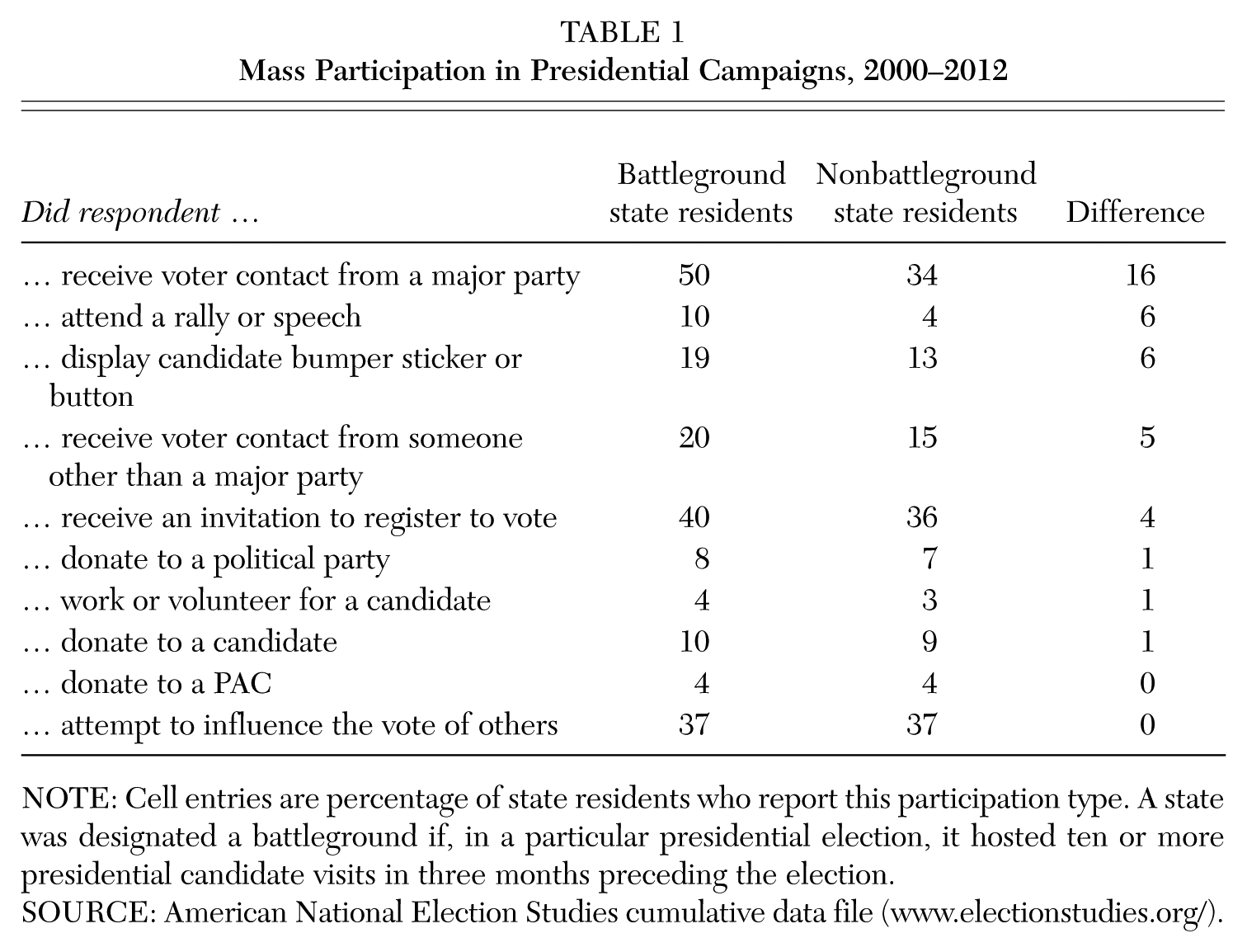
NOTE: Cell entries are percentage of state residents who report this participation type. A state was designated a battleground if, in a particular presidential election, it hosted ten or more presidential candidate visits in three months preceding the election.
SOURCE: American National Election Studies cumulative data file (www.electionstudies.org/).
When pushed to justify the use of scarce resources in staging campaign events, 1 campaign consultants claim that visits stimulate voters on three levels. First, the travel to and from the visit location provides the candidate and his/her staff a captive cabin of journalists who might be softened to the candidate. The national press’ willingness to cover at least some of the event itself provides a small way to affect the tone of coverage, or so the justification goes. Second, they claim that visits create an opportunity for press coverage on local TV affiliates, which can focus on a candidate’s position on a local issue. Finally, consultants claim visits accrue additional, nonmedia advantages at the local level. An event of sufficient size can impress enough voters directly to make some difference in a pivotal state. According to this account, long after the candidate has left, the echoes of their visit remain—in the willingness of locals to write checks or to volunteer.
Contra the consultants, political scientists have provided an equivocal account of visits’ electoral impact and implications. Two things temper political scientists’ enthusiasm. First, the common political rally or town hall is a mature electoral technology, and neither party likely possesses secret knowledge to make its event uniquely appealing. Therefore, a well-staged visit might provide a temporary bump, but it is likely to be offset quickly. Second, meager visit effects are consistent with the broader campaign literature, which finds presidential campaigns struggling to be heard amid the din of competing political considerations. Unfortunately, both are possibilities—that visits’ effects are offset by visits by opponents, or that visits’ effects are genuinely small and fleeting—and are difficult to distinguish empirically.
This article first describes consultants’ claims about visits and how patterns of visits are determined, briefly contrasting these claims with the social science research on visits. Next, I show how presidential visits were actually allocated to states, TV marketplaces, and counties since the 2000 election to see which theories best explain visit patterns. I then consider news coverage of presidential campaigns, showing the clamorous political environment in which campaign events are staged. Finally, I exploit a bespoke dataset that tracked six presidential visits during the 2012 election to estimate visits’ effect on voters’ evaluations of candidates. I show that visits are most effective in influencing press coverage at the national level and within battleground states. Visits’ effects on voters themselves, however, are much more modest than consultants often claim, and visits appear to have no effects outside the market that hosts a visit. These findings support the notion that overall electoral outcomes are mostly insensitive to campaign strategies.
A Campaign’s Rationale for Visits
To affect national press coverage
By the time a presidential campaign gets to midsummer and the two parties have determined (at least to a presumptive standard) their respective candidates, the national media is consumed with coverage of the campaign. At one time, the dominant source of information on candidates and the race was the presidential campaign itself —where candidates went and what they said when they were there. Now, an array of media sources provides public polling, punditry, and predictions to satisfy a voracious and mercurial audience. The United States has become home to an increasingly noisy media environment, with campaigns struggling to assert themselves as an authoritative source on candidates. When learning about a candidate, voters tend to favor the press as the source of news because they have no (apparent) interest in a particular campaign’s success or failure, and the media is sophisticated in producing compelling content. Overall, a modern campaign’s ability to affect the press coverage of its candidate is at an historical nadir.
What tools remain for a campaign to affect national media dialogue? Campaigns can participate in social media on a candidate’s behalf; they can also dedicate hundreds of millions of dollars to TV advertising. Among consultants, candidate visits are a comparably influential tool to affect national press coverage. Most importantly, visits are a valuable service provided for TV journalists, in a tacit exchange for positive coverage. While print journalists can easily cover nonvisual policy stories, TV journalists are required to find moving images to complement their story. Candidate events are ideal for this objective: if a TV journalist’s particular story of the day is one that casts a candidate in a positive light, the candidate is likely to discuss it explicitly at some event. If the story is negative, their very failure to address it at the event is newsworthy. No matter the story, therefore, campaign visits are a vital source of TV footage, and a campaign’s failure to have visits would be a slight to the press.
Second, the very process of moving candidates, their staff, and elements of the national press corps from one campaign event to another is a critical way to build rapport between the candidate and the press. This was the subject of Timothy Crouse’s (1973) exposé on the coverage of the 1968 and 1972 presidential elections in The Boys on the Bus. According to Crouse, the months spent in close proximity to one another and the creeping convergence of a candidate’s political ambitions with the journalist’s professional ambitions provide journalists an unconscious willingness to share a candidate’s perspective: [The journalist] had spent months in making a close, monomaniacal study of the candidate. He had become a very narrow specialist. If there was any justice in the world, the reporter thought, the candidate would come through and justify this fantastic expenditure of time. Otherwise, what a tragic, absurd, depressing waste (p. 56).
To consultants, this serves as perhaps the key personal justification for a candidate’s investment in visits. Travel to places allows a candidate and the press to build a rapport, on planes, in hotels, and on buses. 2 Apart from fostering a personal rapport, hosting journalists at events also provides a powerful opportunity to subtly shape their impressions of the horse race. Well-attended rallies overflowing with enthusiastic supporters provide an informal marker of the campaign’s public standing. 3
To affect local press coverage
It’s not important that we get coverage for the sake of coverage—that is, to get [Nixon’s] name in the papers or to get across any particular thing that he’s saying. But it IS important that we get across that he was here. Here in New York we’re used to having the big wheels come to us; out in corn country, it’s a big event. But you don’t get that feeling of location in a press conference in a hotel room. That could have been done anywhere. . . . So get him out in the streets, in front of some landmarks, and have him walking, so the cameras are forced to get interesting angles. . . . Show that he’s not only interested enough to come to Sheboygan, but that he wants to learn a little about Sheboygan, too; establish a rapport, identification.
By the late summer, with the party’s nomination firmly in hand, consultants are paid to mold the candidate into the best possible fit for each battleground state. This is partially because policy positions adopted to mollify party elites and win a primary campaign might incur political costs in certain battleground states. 4 It is easy for a candidate to say nice things, but actually traveling to a state and spending time with local office holders and public figures is a meaningful (albeit costly) way to show that a state is important to the candidate. The things a candidate says while visiting a state are important, too. To a sometimes amusing extent, any tenuous connection between a candidate and the surrounds—a distant relative’s attendance at a local college, or a penchant for a local brand of ice cream or type of barbecue—signals common values and sincere regard for the state. For a fleeting moment, local media coverage will consist of the candidate visiting the area and saying pleasant things that are unlikely to be subject to political attack.
At these visits, the local press is usually given privileged access to a candidate. Just as the campaign airplane perceptibly softens the national press corps to the candidate, a presidential campaign will often regard a political correspondent at a local TV affiliate as a “soft touch” whose reluctance to grill a national political figure promises a receptive media setting for the campaign. In these interviews, national political issues may be given some attention, but local issues are the main subject. Local issues pose largely a blank slate for a presidential candidate, and a prime opportunity to explain how this particular issue amply demonstrates his/her promise.
The pattern of visits indicates how strong the notion of using these events to affect local media coverage really is, for Democrats and Republicans, and incumbents and challengers alike. Figure 1 shows the distribution of visits by major party presidential and vice presidential candidate since 2000 for the three months preceding each general election. Clearly, the allocation of visits is quite stable between successive elections. States that hosted a large number of visits in a single election, such as Washington in 2000, only to disappear from the presidential battleground, are comparatively rare. The allocation is also stable between parties. Visits in Iowa, Ohio, Florida, Michigan, Wisconsin, or Pennsylvania are comparably attractive to each party. Incumbent presidents seem to have no distinct pattern from challengers. There appears to be a reliable pattern of candidates favoring their home state, even if the state is not politically marginal. 5
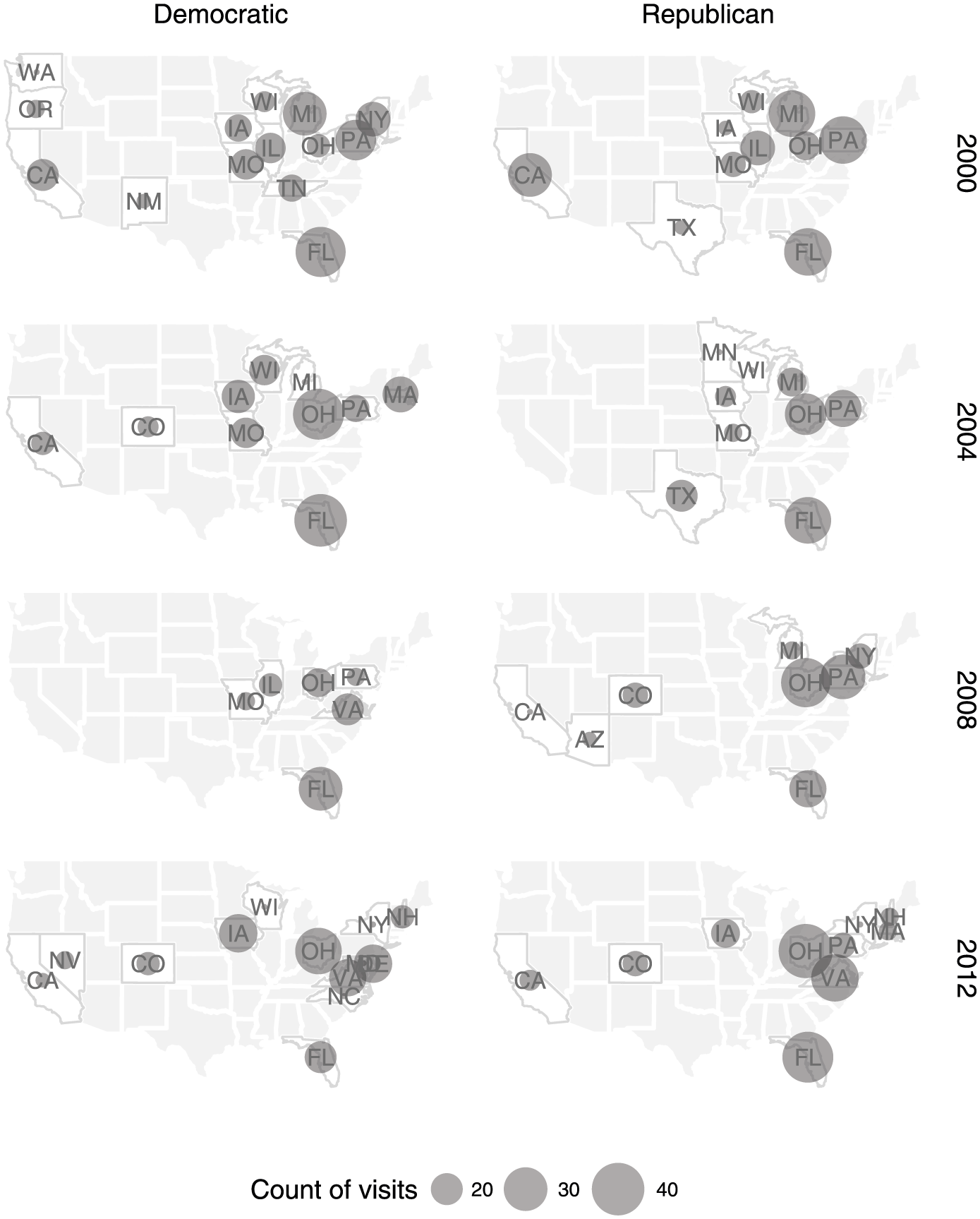
Visit Frequency for Republican and Democratic Party Presidential and Vice Presidential Candidates During the Three Months Preceding a Presidential Election, 2000–2012
To affect local press resources
The final motivation for a candidate to visit different states is that these visits have the ability to generate political effects net of changed media coverage. It is campaign lore to expect a spike in volunteers at a field office after a candidate visit is announced. Similarly, following a successful visit, campaigns attempt to capture the available information from those who have attended a rally, for example, so that they may be cajoled into providing volunteer labor, giving financial support, or just receiving a reminder to vote. Such advantages are particularly relevant in rural states, where it is more expensive to seek voters out in their homes.
During these visits, presidential candidates also meet in private with local officials. During the primary, these meetings are among the most important commitments a traveling campaign undertakes. By the general election, of course, all elected officials are expected to be supporting their party’s nominee. A visit and personal connection, however, can make such offers of support less perfunctory and more meaningful.
In sum, consultants rationalize visits because of their political implications, whether to affect national media coverage, to affect local media coverage within a battleground state, or to improve political support in the immediate vicinity of a visit. Figure 1 suggested that state factors seem to trump national factors in determining where a visit takes place. To provide a more thorough test of the three accounts, Figure 2 shows the relationship between visits and the way states, TV markets, and counties have voted for president in recent elections.
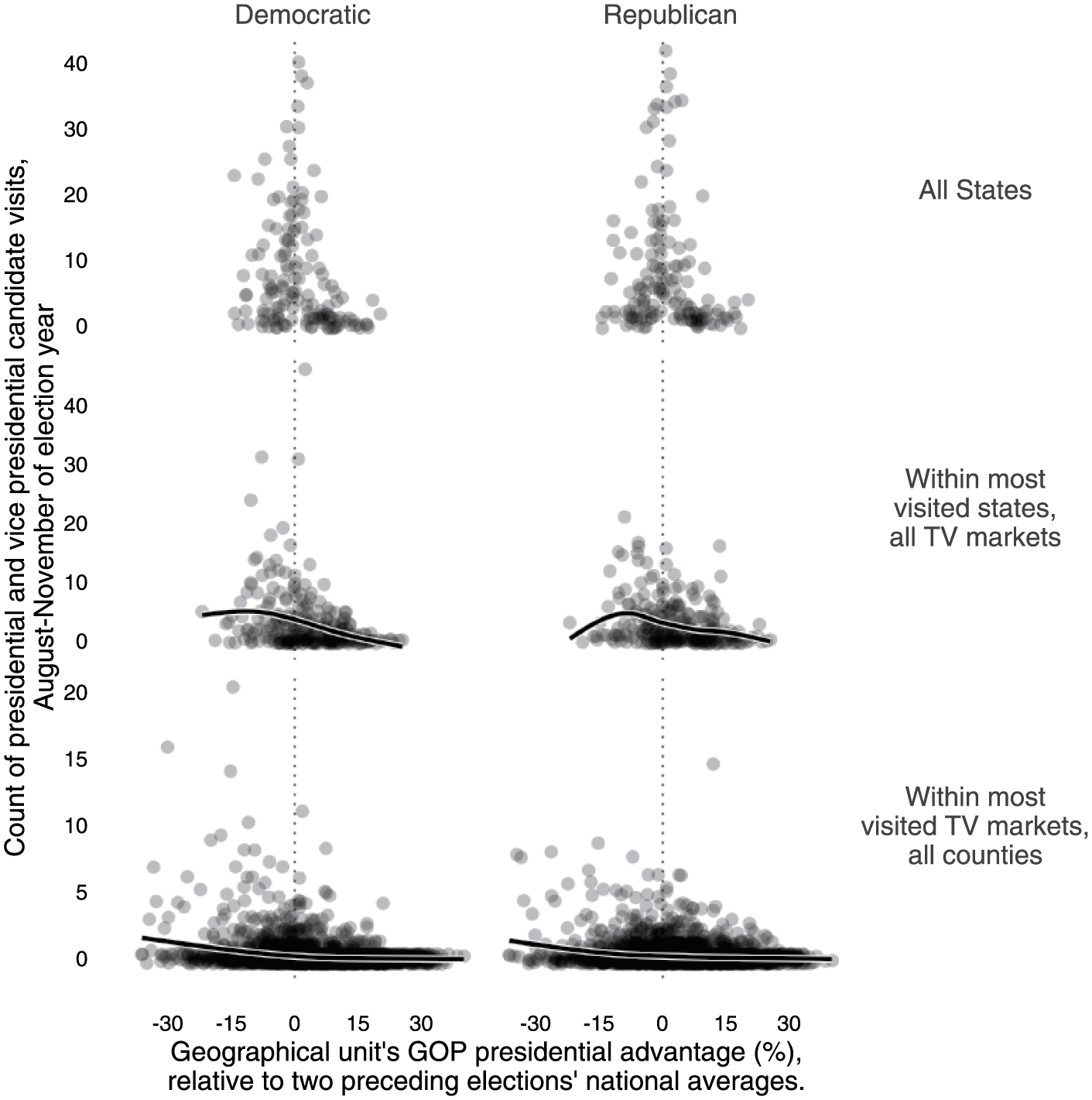
Visit Frequency for Democratic (left column) and Republican (right column) Presidential and Vice Presidential Candidates During the Three Months Preceding a Presidential Election, 2000–2012, by Geographical Unit and Political Circumstance
If visits were intended principally to shape a national political dialogue, we should expect no relationship between states’ voting history and their visit count. The top row of Figure 2 shows that to host more than twenty events, a state must be politically pivotal (that is, it must mirror the national political division). The middle row tests the extent to which local news coverage affects visits’ allocation. This is far from a conclusive case, in that the most visited TV markets are actually those that lean Democratic in presidential voting. This reflects the distribution of voters within a battleground state, since those markets that have the most voters tend to feature large cities, and Democratic presidential candidates tend to fare best in large cities. A more conclusive case is provided in the final row, which shows no relationship between counties’ voting patterns and their propensity to host a presidential candidate. Instead, these results suggest that local benefits from a candidate’s visit are accrued as a providential happenstance, rather than a formal objective. 6
The pattern of visits that emerges from Figures 1 and 2 suggests that a blend of rationales one and two account for the places a candidate visits. National factors do not exclusively shape a campaign’s allocation of visits. If shaping the narrative in the national media were campaigns’ key objective, candidates would stage visits across the United States. Instead, a tiny number of states host almost all campaign events. However, it is also clear that state politics is not determinative, since the most marginal TV markets in a battleground state are no more visited than markets that reliably support one party. While it is vital to hold state events, the intended impacts on media coverage in a particular state’s TV market are only of secondary importance.
Political Scientists’ Research on Campaign Visits
Some research supports the claim that elections are tractable to campaign strategy. Daron Shaw’s (1999) work supports the claim that campaign visits are influential. Shaw provides a series of estimates that show that visits during the 1992 and 1996 presidential elections had a direct effect on attitudes and also improved tone and quantity of press coverage. Similarly, Shaw and Roberts (2000) find that events influenced prices of political futures contracts in both the 1992 and 1996 presidential elections. J. Paul Herr (2002) finds, in the 1996 election, a large effect of President Clinton’s visits on his eventual state-level vote, but only on those visits after October 1; he finds no effect of Senator Dole’s visits. Among state executives, Shaw and Gimpel (2012) randomized the visit schedule of the Republican Governor of Texas, Rick Perry, during his January 2006 primary bid for the gubernatorial election. Among the twenty Texas media markets, Shaw and Gimpel chose twelve to host a gubernatorial visit over three consecutive days, and polled 1,000 respondents daily throughout January to model changes in attitudes. Shaw and Gimpel find the primary vote choice strongly responsive to candidate visits: both Republican and Independent respondents in visited markets were between 5 and 6 percentage points more likely to indicate that they would vote for Perry. Visit effects were statistically apparent for almost seven days.
Other research, though, shows trivial effects of campaign visits, supporting the claim that campaigns simply mediate political fundamentals (e.g., economic conditions and demographics) that drive election outcomes. Holbrook (1994) regresses averaged polls on running sums of political events and finds that national conditions were, on average, five times as influential as campaign events over the 1984, 1988, and 1992 elections. Holbrook and McClurg (2005) find that, controlling for other campaign efforts in a state, presidential candidate visits had no effect on turnout in the 1992, 1996, and 2000 elections. Hill, Rodriguez, and Wooden (2010) model polling averages as a function of candidate visits and find effects in only those states that are not subjected to other campaign efforts.
On balance, therefore, campaign events are found to have only a modest effect on voter behavior, such that only in the most marginal elections would the pattern of campaign visits prove decisive. However, most existing studies of campaign visits rely on aggregate measures of voter preferences or gather individual measures of attitudes months after the visits, making it difficult to measure visits’ true impact.
Effects on Media Coverage
While visits are plainly intended to affect media coverage, it is far from obvious that they have any systematic effect. Presidential elections are an unparalleled media event. In the closing months of a presidential election, the candidates are assured coverage no matter how they spend their time. During the campaign’s closing stage, both candidates undertake a frenetic routine of visits, while the press lavish them with comprehensive media coverage. In effect, we are in the jaws of an uncertain counterfactual—if the candidates staged far fewer campaign events, might they still enjoy the same volume of media attention?
This challenge is clear in Figure 3, which depicts the relationship between candidate visits and the frequency of candidate media mentions (whether in newspapers, in the left column; or in TV news transcripts, in the right column). The second and third rows show these relationships within two frequently visited battleground metropolitan areas (vertical lines indicate candidate visits, with solid lines indicating Democratic visits and dashed lines indicating GOP visits). The top row shows the coverage at the national level. A similar relationship exists for both categories of national coverage: a very modest coverage advantage to the incumbent candidate. 7 A shift in the volume of coverage occurs in the early summer, with volume growing in a linear fashion until it spikes in the days immediately preceding the election. Immediately following the election, coverage of Mitt Romney (the defeated candidate) quickly falls to a trivial amount, while Barack Obama returned to the coverage he enjoyed during the spring.
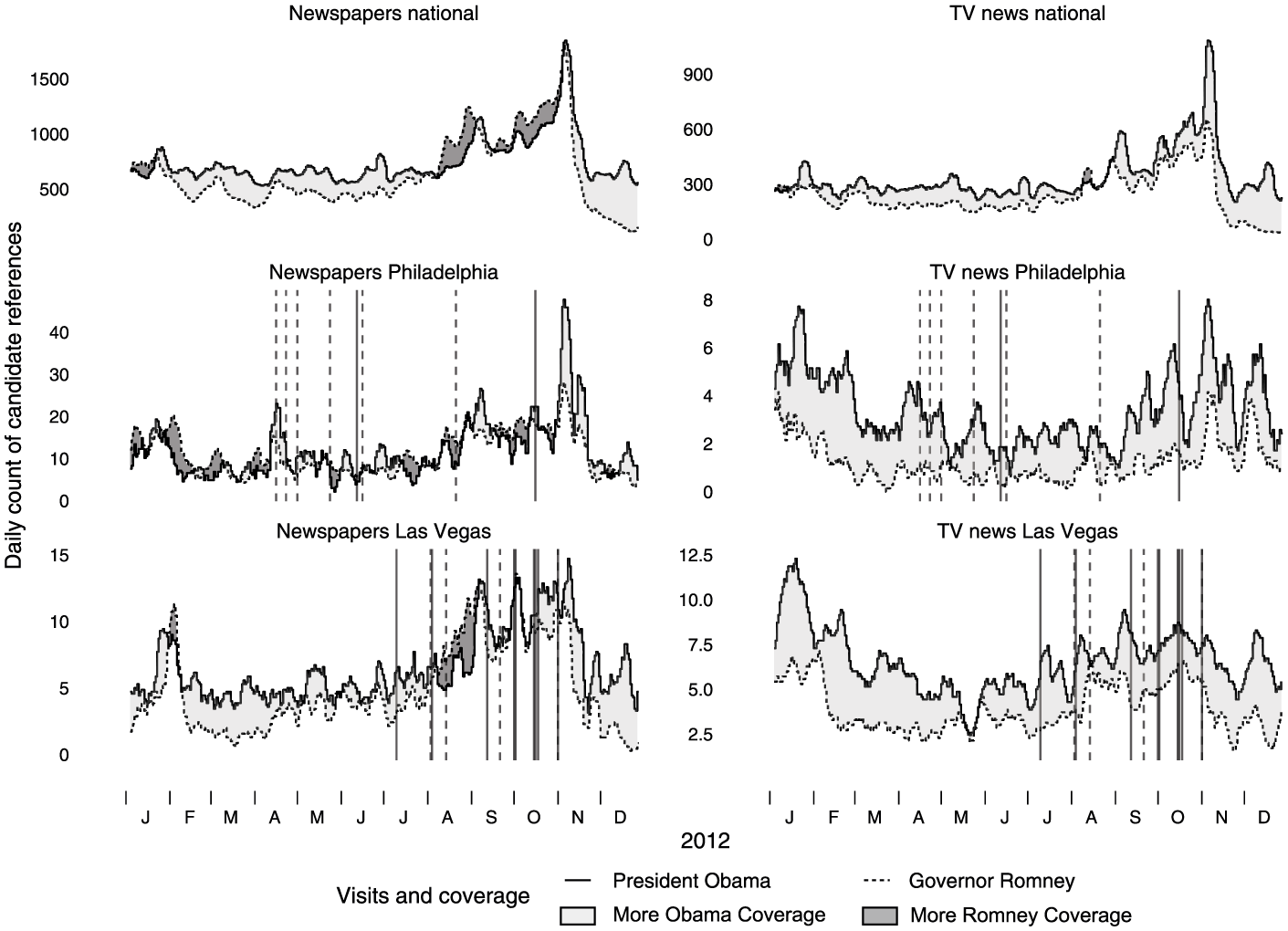
Relationship Between Candidate Visits and News Coverage, 2012 Presidential Election
Coverage inside visited markets demonstrates some peculiarities. For instance, TV news coverage was more inclined to report on President Obama, with this difference remaining approximately constant over the course of the election. The apparent relationship between candidate visits and coverage is much more modest. Compared to the noisy variation in coverage caused by emergent campaign events, and the structural shifts pertaining to the stage of the campaign, the apparent effect of discrete campaign events is hard to discern.
For a precise estimate of visits’ media impact, I modeled each candidate’s volume of press coverage as a function of a dummy indicator for visits, the month of the year, the day of the week, and lagged measures of the volume and the difference in volume of the preceding news coverage. Each combination of candidate, market, and media type was estimated separately. Figure 4 depicts the estimate of visits’ effects on coverage. While we observe some meaningful difference between candidates (Obama’s visits enjoyed larger spikes than did Romney’s), and some difference according to medium (with biggest spikes in newspapers, rather than TV news), the size of these effects overall was very modest, with no more than three extra stories following a visit. While this analysis does not account for changes in the tone of coverage, these findings do not suggest that visits have a large impact on local media coverage.
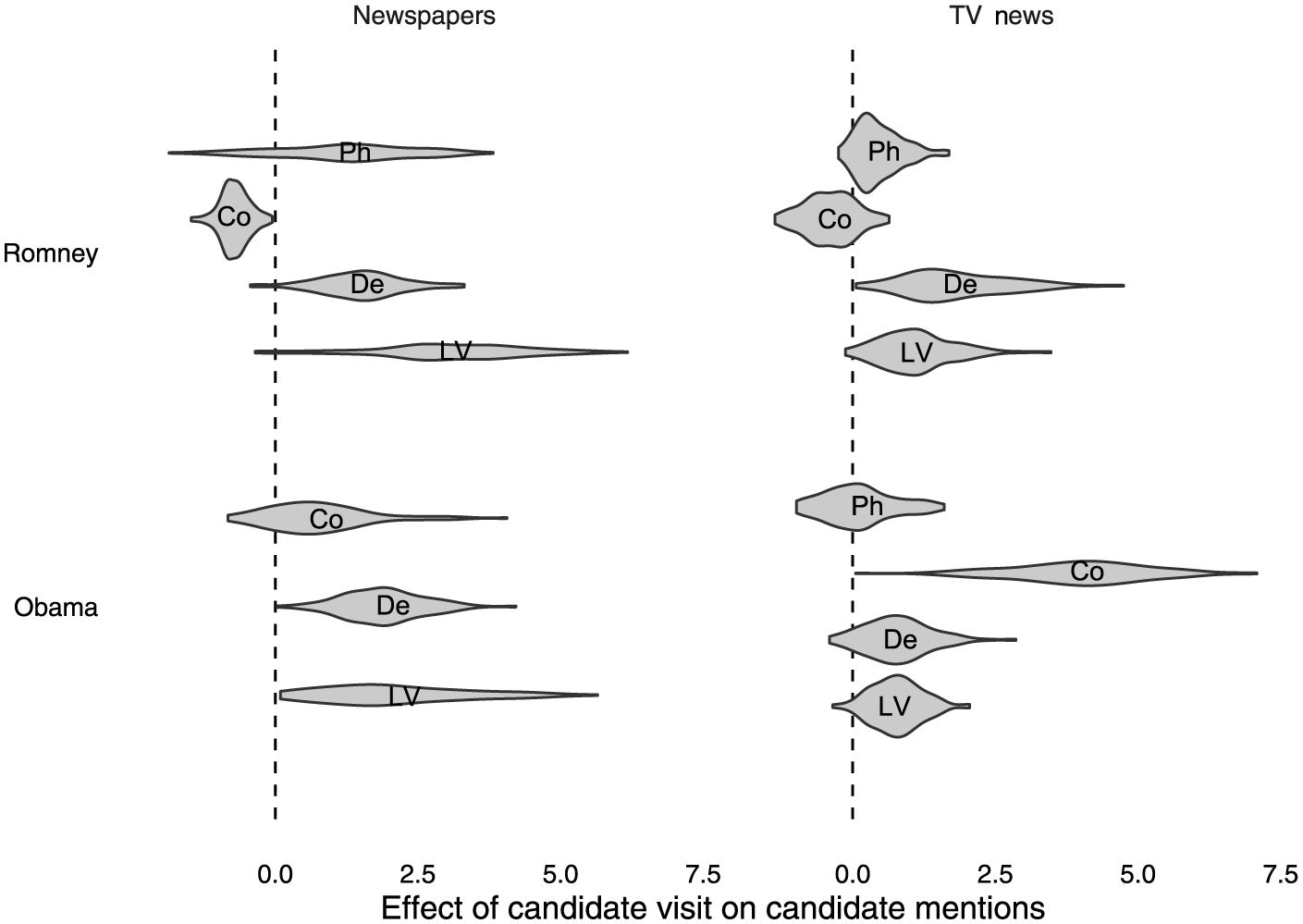
Effect of Candidate Visits on News Coverage, 2012 Presidential Election
Effects on Mass Attitudes
As a final test, I estimate the effect of candidate visits on individual voters. During the 2012 election, 64,312 respondents were surveyed in an instrument that followed the GOP presidential candidates through four visits in four states, with respondents contacted in visited markets and in contiguous markets. 8 The sample was drawn from the five states’ voter rolls, among registered voters whose previous vote history indicated that they were likely to vote in the 2012 general election. Calls were made via a computerized autodialer. The timing of voter contact was also structured around the visits, so that calls were made on the day before a visit, the day of a visit, and each of the three days following a visit, to estimate how visits’ effect changes over time.
First, Figure 5 shows respondents’ awareness with candidates’ recent visits, controlling for respondents’ partisanship, and the type of visit a TV market hosted (whether a market hosted a visit, was contiguous to a visit, or did not host a visit; and whether a market hosted a joint or a single candidate visit.) We observe very strong partisan effects on respondents’ perceptions of recent candidate visits. Despite no Democratic candidate visiting these markets in the three weeks preceding the survey, Democrats were between three and ten times as likely to report a recent Democratic candidate visit, compared with independent and Republican respondents. GOP respondents were similarly likely to think their copartisan candidate had been a recent visitor even in an unvisited market. President Obama’s higher profile also seems relevant—even in an unvisited market, all partisans were more likely to report familiarity with a recent visit from Governor Romney. This suggests that respondents expect an incumbent’s events to be covered more extensively, so that they are comparatively certain when they cannot recall a recent presidential visit.
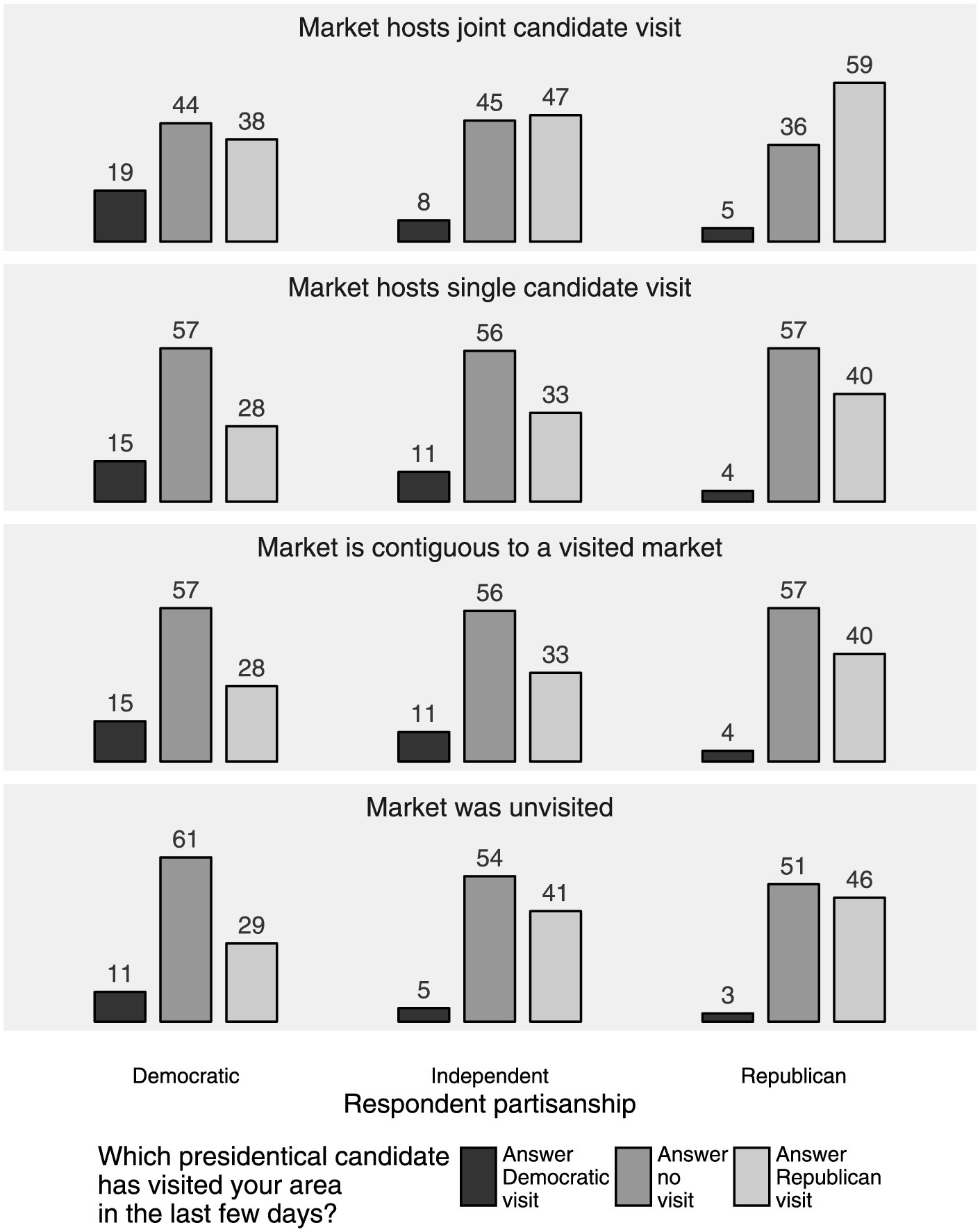
Respondent Familiarity with Candidate Visits, by Visit Type and Respondent Partisanship
Visits also seem to achieve negligible spillover effects. Compare, for instance, perceptions in contiguous markets and those in unvisited markets: the distribution of perceptions is indistinguishable. This demonstrates that, within a battleground state, but outside of the specific visited market, coverage of a visit is indistinguishable from generic campaign coverage from across the presidential battleground.
Finally, vote intention seems to be only weakly responsive to campaign visits. Table 2 reports visits’ impact as estimated by single multinomial regression model, where vote intention is modeled as three category dependent variables (whether a respondent indicated Obama, Romney, or uncertain vote intention), interacted with a visit dummy, the type of visit, and the number of days since a visit. Controls for respondents’ partisanship, age, income, race, and education were also included. In Table 2, I report the mean difference in predicted probabilities of vote intention among respondents in a visited market compared with an identical respondent in an unvisited market. Bold text indicates when a difference is significantly different from zero. As one might expect, independent respondents were most responsive to candidates’ visits, increasing their probability of intending to vote for Governor Romney by around 5 percent. Effects are far smaller for partisans: support increasing for the visited candidate by 2–3 percent.
Effect of a Candidate Visit on Respondents’ Vote Choice, by Respondent Partisanship and Days Since Candidate Visit
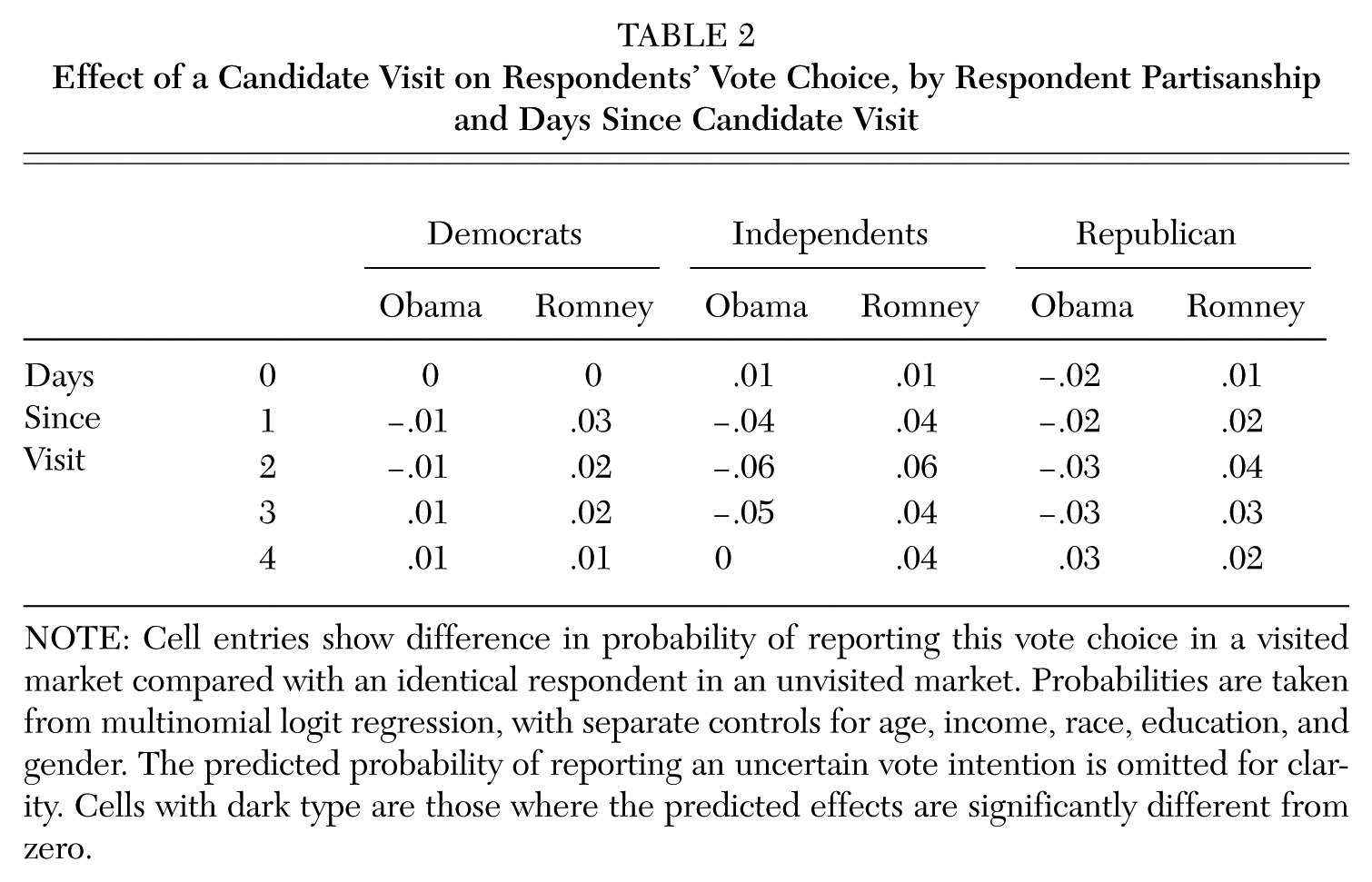
NOTE: Cell entries show difference in probability of reporting this vote choice in a visited market compared with an identical respondent in an unvisited market. Probabilities are taken from multinomial logit regression, with separate controls for age, income, race, education, and gender. The predicted probability of reporting an uncertain vote intention is omitted for clarity. Cells with dark type are those where the predicted effects are significantly different from zero.
These effects are not only small, they are also ephemeral. No effect is apparent on the day of the visit, and no effect remains apparent after the third day following the visit. Only independents are affected by visits for more than two days. In this way, those who argue that campaigns have minimal influence on electoral outcomes, even in an ideal circumstance, are vindicated.
Conclusion
Of all the tools in a campaigns’ strategic arsenal, the campaign visit is distinguished by its unchanging nature. At least since the advent of television news, visits have been used as a powerful lever to affect a candidate’s press coverage. The observed pattern of visits within the battleground states—where the most politically pivotal markets were not more frequently visited—suggests consultants intend visits to affect the national media narrative rather than local coverage. Visits were found to have a small effect on the candidate’s press coverage in visited markets, and survey respondents’ awareness that their city had hosted a visit was ephemeral and strongly geographically contained, which limited a campaign visit’s influence on vote intention.
Taken together, these findings invite a thought experiment: if visits have only a moderate impact on voters but consume vast amounts of the candidates’ and their staff’s time, attention, and resources, why not neglect visits and instead redouble candidates’ attention to fundraising? New resources could then be spent on those activities that have been shown to more reliably influence voters—advertising, building out campaign infrastructure at the local level, and providing more resources for voter contact—and especially inspire turnout.
In this experiment, travel to the pockets of the country with wealthy donors would double as the candidate’s visits schedule; public events could be staged in the largest states (which have many recurrent donors but are rarely battlegrounds) to provide the required rallies to the national press. On the other hand, this strategy might appear so anomalous and so discordant with visits’ traditional role as a necessary part of the American electoral tableau, that the financial advantages might be offset, especially if it appeared that the candidate was privileging donors at the cost of being accessible to voters.
It is also possible that visits have some political consequence that has alluded this analysis. For instance, visits might provide a subtle accumulation of popular goodwill for a candidate that has a delayed effect on vote choice. Visits might serve to inoculate a candidate to the attacks of his/her rivals, such that a candidate’s support would have declined further, absent the visits. Visits might also serve to solidify the coordination between a presidential campaign and their copartisans running congressional campaigns in battleground states.
Conversely, the results reported above might be a true reflection of visits’ tenuous impact. In this case, we might account for visits’ privileged command of campaign resources by considering the importance of tradition, inertia, and the degree of alignment between a candidate’s interests and the interests of their staff. According to this account, visits remain so frequent because of campaigns’ aversion to change and innovation. To adjudicate between these possibilities, further research inside campaigns is required, especially focusing on the strategic calculations of senior staff, making the campaigns themselves the subject of research rather than the host.
Footnotes
Notes
Thomas Wood is an assistant professor of political science at The Ohio State University. He studies public opinion, voting behavior, and political campaigns.