







Abstract
Research among prospective UK undergraduates in 2002 found that some students, especially from low social classes, were deterred from applying to university because of fear of debt. This article investigates whether this is still the case today in England despite the changing higher education landscape since 2002. The article describes findings from a 2015 survey of prospective undergraduates and compares them with those from the 2002 study. We find that students’ attitudes to taking on student loan debt are more favorable in 2015 than in 2002. Debt-averse attitudes remain much stronger among lower-class students than among upper-class students, and more so than in 2002. However, lower-class students in 2015 do not have stronger debt-averse attitudes than do middle-class students. Finally, debt-averse attitudes seem more likely to deter planning for higher education among lower-class students in 2015 than in 2002.
Research conducted in 2002 among prospective UK undergraduates found that some students, especially from low social classes, were deterred from applying to university because of their fear of debt (Callender and Jackson 2005). This article investigates whether this is still the case in England. The article compares findings from a 2015 survey of prospective undergraduates with those from the 2002 study. The article considers whether prospective students’ attitudes toward student loan debt have changed since 2002, in the light of radical higher education (HE) funding policy reforms and changing political and ideological contexts, and how students’ attitudes may contribute to differences across social classes in their intention to participate in HE.
We focus exclusively on potential full-time undergraduates attending “public” universities in England and the policies affecting them. 1 The lessons learned may be more far-reaching, with likely relevance for countries with cost-sharing policies such as the United States where student loan take-up and debt have risen and income-driven repayment plans have emerged on the policy agenda (College Board 2015; Carey 2015). This research is also significant because prospective HE students’ attitudes toward student loan debt are not well understood while existing research is limited. Studies on loan aversion that have been conducted among students who are currently enrolled in the United States and the UK (e.g., Bachan 2014; Burdman 2005; Goldrick-Rab and Kelchen 2015; Harrison, Agnew, and Serido 2015; Harrison et al. 2015) reveal nothing about how student debt influences prospective students’ decisions regarding HE. The most comprehensive UK studies exploring prospective students’ attitudes toward debt and HE participation are based on data that are at least a decade old (Davies and Lea 1995; Callender and Jackson 2005; Bates et al. 2009). Since these studies were undertaken, student-funding policies have changed dramatically and debt has risen sharply, raising questions about the findings’ relevance for today’s students and for public policy. Now most students in England have to borrow if they want to enter HE. This article exploits a unique dataset derived from a survey of prospective students in 2002 and another in 2015, allowing us to examine changes in students’ attitudes toward student debt over time and the role played by these policy reforms and shifting political and ideological contexts in shaping these attitudes. This is central for understanding the continuing socioeconomic inequalities in access to HE in England and abroad.
The Shifting Higher Education Landscape
Student funding policy changes, 2002–2015
The evolution of HE funding systems, in England and elsewhere, is dominated by prevailing political and ideological currents, rather than purely economic and pragmatic considerations. Recently, England, like many countries, has moved from a system where the costs of funding HE are shouldered primarily by taxpayers, through government subsidies, to one where students pay a large share. This cost-sharing approach, a global phenomenon, seeks to increase the total resources available to HE, specifically from nongovernmental or private sources (McMahon 2009; Johnstone and Marcucci 2010). 2
A series of cost-sharing policies occurred between 2002 and 2015 in England. First, there were large tuition increases. The government-set cap on tuition rose from £1,000 ($1,296) 3 a year in 1998 to £3,000 ($3,890) in 2006/07, and to £9,000 ($11,664) in 2012/13 (current prices). By 2016, all universities, except one, charged £9,000 for all their courses. Only further education (FE) colleges charged less (Office for Fair Access [OFFA] 2015). Any competitive advantage of charging lower tuition was outweighed by the benefits of higher tuition income.
Second, in 2006/7, government-subsidized income-contingent student loans were extended to cover all students’ tuition fees, making tuition rises more politically and socially acceptable. Graduates start repaying these loans once their income reaches a specified threshold, currently £21,000. 4 Graduates pay 9 percent of earnings above this threshold until they have repaid their loan, with any outstanding debt forgiven after 30 years. Repayments are taken directly from the graduate’s salary through the tax system. In 2006/07, the interest paid was equal to inflation (Retail Price Index [RPI]) or the Bank of England base rate plus 1 percent, whichever was lower (in effect, a zero or negative real interest rate). In 2012/13, a real interest rate was charged, between inflation and inflation plus 3 percent, with a sliding scale dependent on a graduate’s annual earnings, making the costs of borrowing more expensive but reducing government costs.
Third, means-tested government grants for low-income students’ living costs were replaced with enhancements to preexisting government-financed maintenance loans, available to all students and with the same repayment terms and conditions as tuition loans. Since 2002 these grants have been reduced in value, frozen and eroded by inflation, restricted in eligibility, and between 1998 and 2004, abolished completely.
These policy developments have been informed by a strengthening of the cost sharing ideology of “who benefits pays,” and a quest for the greater marketization of HE with tuition and loans playing central roles (Callender and Scott 2013). Higher tuition and loans are justified, following human capital theory, by a view of HE participation as a private investment for private returns—that is, it benefits the individual more than society. Tuition increases and loans have been portrayed by successive governments as “fair” (Department of Education for Education and Employment [DfEE] 1998; Department for Education and Skills [DfES] 2003, 83; Department for Business, Innovation and Skills [DBIS] 2011, 17) because graduates usually benefit from better paid employment (National Committee into Higher Education [NCIHE] 1997, 288; DfES 2003, 2). The 2011 White Paper about the £9,000 tuition increase asserted that “graduates … earn more than non-graduates. … So it is fairer to finance the system by expecting graduates to pay, if and when they are in better paid jobs” (DBIS 2011, 17). The White Paper also argued that income-contingent tuition loans make HE affordable and free at the point of entry, while credit and liquidity constraints are removed (DBIS 2011, 16). The costs of borrowing are depicted as reasonable, and loan repayments “more affordable for everyone” (DBIS 2011, 24), while extra support is available for the poorest students, allegedly safeguarding wider HE participation (DfES 2003, 2; DBIS 2011, 24). These messages were promoted to potential HE students when tuition fees were increased in 2006/07 and 2012/13. Students may have internalized this policy discourse of a positive graduate salary premium and the “risk-free” nature of income-contingent loan repayments.
Following these policy changes, students became heavily reliant on loans to fund their HE studies. By 2013/14, 92 percent of students had taken out a loan for tuition and 89 percent for maintenance (Student Loans Company [SLC] 2015), suggesting that most cannot afford to study unless they are willing to borrow. Between 2002 and 2015, tuition rose by 553 percent after allowing for consumer price inflation during this period. Average student loan debt (both tuition and maintenance) on graduation rose from £8,666 ($11,180) (2002 prices) (Callender and Wilkinson 2003) to £44,035 ($57,211) (2014 prices) (Crawford and Jin 2014, 2), representing an increase of 260 percent after allowing for inflation. Under current arrangements, it will take graduates about 28 years to clear these debts, while the majority will never repay their loans in full (Crawford and Jin 2014).
Higher Education Participation in England and Student Funding
These policy changes occurred alongside a government commitment to HE expansion, with a stated desire to widen HE access. Despite these increases in tuition and prospective debt burdens, HE participation rates for 17- to 20-year-olds in England began to rise gradually in 2007, reaching 38 percent in 2010. A sudden jump to 42 percent occurred in 2011, as applicants tried to avoid the planned tuition increase in 2012, followed by a sharp drop to 36 percent in 2012/13, and then a climb back to 41 percent in 2014/15 (Department for Education [DfE] 2016).
There are considerable socioeconomic differences in these participation rates. Rates for low-income students have increased recently, albeit from a low base. Data on university acceptances indicate that 18-year-olds from disadvantaged areas are 65 percent more likely to enter HE in 2015 than they were in 2006. But they remain two and half times less likely to enter HE than their more advantaged peers, and eight and a half times less likely to enroll in the most selective universities (UCAS 2015, 92, 99). This growth in enrollments is consistent with recent improvements, also from a low base, in national examination attainment of low-income students at aged 16 (Social Mobility and Child Poverty Commission [SMCPC] 2015), confirming the important contribution of prior educational achievement to explain higher education participation patterns.
HE participation rates also are lower for men than women (37 percent compared with 46 percent in 2013/14 [DfE 2016]), and among white students than minority ethnic groups. In 2015, HE entry rates ranged from 28 percent for whites to 37 percent for blacks and 41 percent for Asians overall, rising to 58 percent for Chinese students specifically (UCAS 2015, 12).
Research confirms that money matters for HE access and lower-income students are more price-sensitive (Leslie and Brinkman 1987; Heller 1997). Tuition increases tend to depress higher education participation, especially among disadvantaged groups, but the type and mix of aid is important (for a review of the literature, see Baum, McPherson, and Steele 2008; London Economics 2010; Long 2008; Dynarski and Scott-Clayton 2013). However, research findings are contradictory, with some evidence that neither tuition increases nor the introduction of income-contingent loans affect enrollment, especially among students from disadvantaged backgrounds with appropriate university-entry qualifications (Hemelt and Marcotte 2011; Cardak and Ryan 2009).
In England, the introduction of £1,000 tuition fees and the replacement of student grants with loans for maintenance in 1998 had no effect on young people’s participation (Higher Education Funding Council for England [HEFCE] 2005). Dearden, Fitzsimons, and Wyness (2010) show “upfront tuition fees in 1998 had a small negative impact on participation among high income groups” but the rise in tuition fees to £3,000 in 2006 had “no impact on participation, largely because tuition fees were accompanied by large increases in loans and grants” (p. 2). Crawford and Dearden (2010) find that some English students, especially those from higher socioeconomic backgrounds and with higher grades, started university a year earlier (2005/06) than they might otherwise have done (2006/07) to avoid having to pay higher tuition fees. However, overall, there was no evidence that the 2006/07 finance reforms led to a sustained fall in HE participation. No similar analysis has yet been undertaken exploring the consequences of the tuition fee increase to £9,000 in 2012/13. Chowdry et al. (2012) warn that debt aversion might affect participation, especially among students from the poorest backgrounds.
Student Attitudes toward Debt and Higher Education Participation: Theory, Empirical Evidence, and Hypotheses
This section examines how extant research measures student debt aversion and explores student attitudes toward debt. It then provides a conceptual framework for analyzing these attitudes, which leads to the three hypotheses that we test.
Debt aversion: Conceptual and measurement issues
Debt aversion (sometimes called loan aversion) is a reluctance to incur debt and refers to the psychological costs associated with carrying debt, in addition to any explicit costs and risks associated with taking out loans (Baum and Schwartz 2013). Debt aversion can be distinguished from risk aversion, which covers a wide range of life contexts (e.g., personal safety, health, and career progress) and is not confined to financial choices such as borrowing (Dohmen et al. 2011). Debt aversion in relation to HE has been defined as “an unwillingness to take a loan to pay for college, even when that loan would likely offer a positive long-term return” (Cunningham and Santiago 2008, 10). Baum and Schwartz (2013, 16) suggest that the prospect of being left with unmanageable debt “might deter people from making investments they would judge wise if the downside were simply wasted expenditures as opposed to debt” (Baum and Schwartz 2013, 16). Palameta and Voyer (2010) define loan-averse students as those willing to invest in HE but unwilling to take on loans to do so. In England, current students’ high dependence on loans suggests that—in the absence of alternative funding sources (apart from family)—an unwillingness to borrow, in effect, excludes most students from participating in HE.
Definitions and measurement of student debt aversion, and especially its relationship to HE participation, vary between studies, producing different results that are not necessarily directly comparable (Boatman, Evans, and Soliz 2017). Here we focus primarily on studies of prospective students. Studies that measure debt aversion through monitoring prospective students’ actual borrowing and enrollment behavior are rare. In Field’s (2009) randomized controlled experiments, law school applicants at New York University were offered either upfront loans that could be forgiven or tuition subsidies that could later turn into loans. Both aid programs were designed to be financially equivalent. Applicants offered tuition subsidies were more likely to enroll than those offered upfront loans (42 percent compared with 32 percent). This finding was interpreted as confirming debt aversion in high-stakes decisions, derived from both social norms regarding indebtedness and psychological burdens associated with debt.
A series of studies use survey respondents’ preferences for cash, grants, or grants plus loans in hypothetical financial aid packages to measure debt aversion. In Johnson and Montmarquette’s (2011) laboratory experiments in Canada, high school students were asked to make a number of binary choices between cash and various forms of loans and grant. As an incentive to choose their preferred option, one choice was honored. Just over 12 percent (152 of 1,248) of participants were defined as debt averse because they always chose a grant over cash and never chose a loan over cash. These respondents were “insensitive to price and completely sensitive to subsidy type” (Johnson and Montmarquette 2011, 39). Palameta and Voyer (2010, 60), using a similar approach, defined loan aversion as when their Canadian high school students, likely to enroll in college, only took a grant and never a combination of grants and loans. They find that between 5 and 20 percent of their sample was loan averse, a pattern linked to “relatively low numeracy, a tendency to discount future benefits, and doubt about the returns to PSE (post-secondary education), especially university.” Caetano, Palacios, and Patrinos (2011) measure the existence of debt aversion in Latin America using a World Bank survey, where participants were presented with choices that were financially equivalent. A greater preference for the “human capital contract” option compared to “loans” was taken as confirmation of debt aversion and the importance of language in the labelling of financial aid. Labelling a contract as a “loan” decreases its probability of being chosen over a contract by more than 8 percent.
Some studies measure debt aversion as rejection of loans offered (Goldrick-Rab and Kelchen 2015) or borrowing low amounts (Burdman 2005). Such behavior may be due to debt aversion, or because students do not need the money, or require small amounts, to pursue their studies.
Another method for measuring debt aversion is through assessing attitudes toward debt, usually via student surveys. In some studies, a single question is asked (Bachan 2014; Oosterbeek and van den Broek 2009). In others, an attitude scale is created to gain a nuanced understanding of the structure of student debt attitudes. Davies and Lea’s (1995) UK study was one of the first to use this latter approach. Their unidimensional “attitudes to debt” scale was constructed to run from prodebt to antidebt. Their scale consisted of fourteen items, administered in a five-point Likert format, covering general philosophical/moral and day-to-day attitudes toward debt. They subsequently developed their longitudinal method to include prospective students and found that attitudes changed with the experience of debt. Prospective higher education students are less debt tolerant than current students and graduates (Lea, Webley, and Bellamy 2001), a finding echoed by Haultain, Kemp, and Chernyshenko (2010).
Callender and Jackson (2005) used a reduced version of this scale and, in a move away from a unidimensional concept, also measure the “cost/benefit balance of going to university.” They identified both moralistic attitudes critical of debt and positive attitudes that recognize the value of debt in supporting investment in higher education. They showed that debt averse attitudes deterred disadvantaged prospective students from applying to university.
Haultain, Kemp, and Chernyshenko (2010) detected low levels of internal reliability for Davies and Lea’s scale in other UK and New Zealand studies, suggesting that this is because “students’ attitudes to debt may not, in fact, be unidimensional, and are not ordered on one tolerant versus intolerant of debt continuum” (p. 323). They found that attitudes toward debt among prospective and current tertiary students in New Zealand are best described by two uncorrelated dimensions, “fear of debt” and “debt utility.” They concluded that the average student is fearful of debt but realizes it is useful.
The current study builds on these well-established methods for measuring debt aversion through student attitudes, and specifically on Callender and Jackson (2005), but uses a refined attitude scale. We then examine the relationship between debt-averse attitudes and students’ HE intentions.
Prospective students’ attitudes toward debt
Callender and Jackson (2005) found that ethnic minority, first-generation, and lower-class students appeared particularly wary about taking on debt to pay for HE. Haultain, Kemp, and Chernyshenko (2010) revealed that “fear of debt” is associated with parents not having attended university and attending schools in lower-income catchment areas.
Bates et al.’s (2009) analysis of two large-scale longitudinal studies of 16- and 17-year-olds in England found that one third of those who want to apply to HE have concerns about the associated debt burden that make them question their decision to apply. Those with the greatest debt aversion are among those least likely to apply to HE. Attitudes toward debt vary, with those from low-income and disadvantaged backgrounds, black and minority ethnic groups, and young women being the most debt averse. These debt-averse but academically qualified students are the most likely to feel that owing money is wrong, borrowing money is not a normal part of today’s lifestyle, debt can be very difficult to get out of, and student loans are not a cheap way to borrow money.
Burdman’s (2005) qualitative study confirms that U.S. students from low-income families avoid borrowing, often because of concerns about their ability to repay, which negatively affects their HE decisions. She argues that, for many students, debt aversion frequently begins with their parents. Similarly, Perna (2008) showed that potential U.S. higher education students’ willingness to borrow varies depending on their financial resources and is influenced by their families and high schools. Low-income students’ unwillingness to borrow limits their HE opportunities and willingness to enroll in universities compared with community colleges. Both Perna (2008) and Burdman (2005) highlight the role of low-income parents in discouraging loan take-up.
By contrast, Wilkins, Shams, and Huisman’s (2013) study of English high school students, just before the 2012/13 reforms, uncovered “an increasing anxiety about financial issues” (p. 136) but no evidence that low-income students are more likely to be deterred from HE entry because of the costs and debts involved. They reason that HE entry is gradually becoming the norm for students from various social backgrounds, so “students from working class backgrounds may feel compelled not to lose out and therefore opt to enroll” (Wilkins, Shams, and Huisman 2013, 12). Esson and Ertl’s (2016) study of prospective students subject to the 2012/13 reforms observed variations in attitudes toward debt, tuition fees, and plans to enter HE by the type of high school attended but concluded that, for the majority, tuition debt was not “a major factor in the decision whether or not to enter higher education” (p. 8). This is because prospective students consider an HE degree vital to securing employment in a competitive labor market, while income-contingent loans mean the government and not the student is liable for any financial loss.
Conceptual framework and hypotheses
In line with Perna’s (2006) conceptual framework for understanding potential HE students’ enrollment decisions, we assume that students’ decisions and attitudes toward debt and HE are shaped by context: the student and family context; the school and community context; the higher education context; and the broader social, economic, and policy context. Although school staff and career advisors were excluded from our study, we draw on students’ responses to questions about the extent of encouragement from teachers and school friends to enter HE. “Differences in students’ perceptions of loans reflect differences in the messages students receive about loans from their parents, school counselors and teachers, and the broader state policy context” (Perna 2008, 601).
Following Callender and Jackson (2005, 2008), we argue that, when students decide to enter HE, they assess the expected costs and benefits of investing in HE, consistent with human capital theory. This assessment, including the risks, is in very broad terms, rather than rigid cost/benefit analysis. As Brynin (2013, 285) argues, It is unlikely that many young people calculate the economic value of education relative to an expected career. They are likely instead to have a notion of a “good” job, which would partially be based on some (often vague) idea of expected pay, but also on the job’s prestige and the skills it requires.
In summary, we propose, like Perna (2006), that students’ subjective understanding and perceptions of these costs and benefits, their views about their academic and financial resources, and their HE choices are shaped by their socioeconomic backgrounds and other resources they derive from their cultural and social capital. In addition, we suggest that students are likely to absorb the respective political and ideological backdrop and policy rhetoric in their decision-making. Policies are more than a statement, but an “authoritative allocation of values” (Kogan 1975, 55), which do not “float free of their social context” (Ball 1990, 3).
From this contextual framework, three hypotheses for the current study emerge. First, in the light of continued growth in HE participation in England at a time of rising tuition fees and increases in student borrowing following policy changes and their pervasive rhetoric, we posit that:
Hypothesis 1: Young people’s attitudes toward taking out student loan debt were more favorable in 2015 than in 2002.
Next, motivated by the cross-national evidence on debt aversion, social class, and HE participation discussed above, we submit two further hypotheses to empirical scrutiny.
Hypothesis 2: Where debt averse attitudes exist, they are stronger among lower-class students than among students from other social classes in 2015 and in 2002.
Hypothesis 3: All else being equal, debt averse attitudes contribute to lower rates of planned HE participation by lower-class students compared to students from other social classes in 2015 and in 2002.
Research Methods
To investigate key issues concerning student loan debt, we draw on two nationally representative surveys of students in England who were studying toward HE entry-level qualifications such as A levels or vocational qualifications at Level 3 on the UK Regulated Qualifications Framework. 5 The first survey was carried out in 2002 and the second in 2015. Several questions in the 2015 survey were identical to those asked in the 2002 survey. In both years, the samples comprised students in their final year of studying toward HE entry-level qualifications in (1) government-funded high schools, (2) independent (private fee-paying) high schools, and (3) further education colleges.
There are some differences in the ways the samples were constructed and the survey questionnaires were distributed. In 2002, the survey was conducted on a random sample of high schools and colleges and data were collected using in-class self-completion questionnaires, handed out to students by teachers. In 2015, a sampling frame of potential individual respondents was built using student contact details drawn from two national databases that had become accessible since 2002: the National Pupil Database and Individual Learner Records held by the Department for Education. Questionnaires were sent to most students through a mix of postal and email methods. Since the National Pupil Database does not contain contact details for independent school students, a sample of these students was obtained through direct approaches to independent schools, with teachers given a choice of handing out paper questionnaires to students or providing them with the information required to complete questionnaires online. 6
Although the 2002 survey covered the whole of the UK and included a proportion of students aged 22 and older, the 2015 survey was confined to England and largely to students age 17 to 21. 7 Accordingly, in this article, comparisons between the two samples are confined to 17- to 21-year-old students in England. About 7 to 8 percent of these students in each year did not reply fully to survey questions concerning attitudes toward debt and these cases were omitted from our analysis. 8 This process yields final samples of 1,028 students in 2002 and 1,427 students in 2015 (see Table 1). Some 60 percent of respondents in 2002 and 62 percent in 2015 were female, reflecting the higher female HE participation rate over the last 20 years noted above. The proportion of 18- to 19-year-olds was 81 percent in 2002 and 87 percent in 2015. Using an indicator of social class, based on the occupations and economic activities of the primary income earners in student households, upper-class students accounted for a higher share of sampled students in 2002 (41 percent) than in 2015 (32 percent), while the reverse was true for middle- and lower-class students. 9 The proportion of sampled students who had definitely decided to apply for HE courses was slightly higher in 2015 (81 percent) than in 2002 (78 percent).
Student Samples by Type of Educational Institution, 17–21-Year-Olds in England, 2002 and 2015
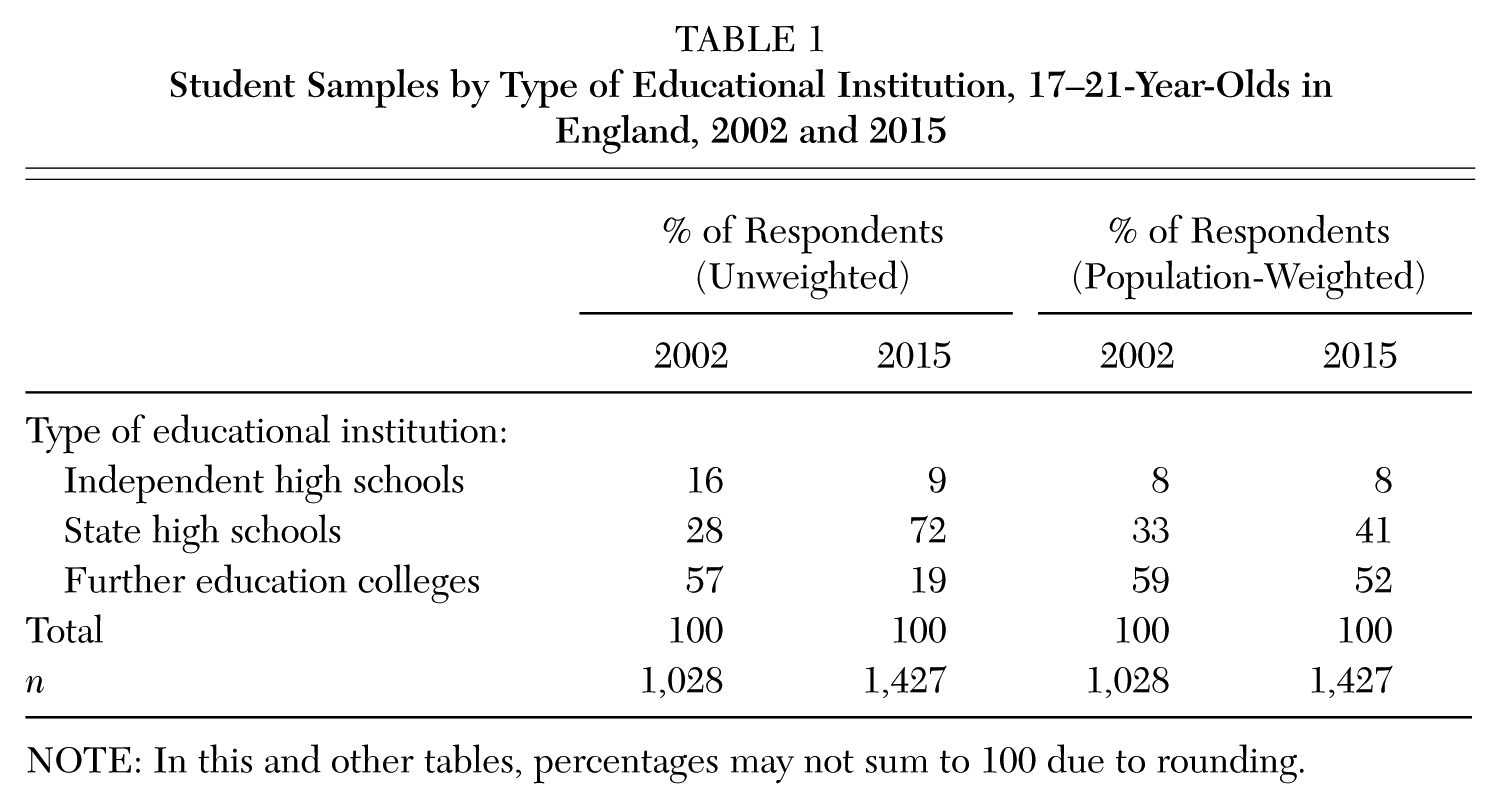
NOTE: In this and other tables, percentages may not sum to 100 due to rounding.
In terms of sample composition by educational institution attended, the unweighted share of FE students in 2015 was considerably smaller than in 2002, contributing to a larger unweighted share of government-funded high school students in 2015. This was partly due to a shift from FE colleges to government-funded schools in recent years among students taking HE entry-level qualifications and partly due to a lower response rate by FE students than in previous years. To derive nationally representative estimates of student attitudes toward debt and other variables, sample data are weighted to national profiles of students by type of institution attended and qualification aim. These weights were developed using Labour Force Survey 10 data for 2002 and 2015, as well as official statistics on young people’s participation in education, training, and employment in England (see Table A1 in the appendix for further details).
Because of the relatively small (unweighted) share of further education students in 2015 compared to 2002, we test the sensitivity of our main findings to compositional differences between the two samples by estimating equivalent results for high school students only (excluding further education students) as well as for all students and by comparing unweighted with weighted estimates. Our main findings prove to be robust to the outcomes of these sensitivity tests. 11
Index of social advantage
In addition to information on the occupation and economic activity status of main income earners in respondents’ households in 2002 and 2015, we also have information for both years for anticipated financial support from family, parental attendance at university, and family encouragement to attend HE. All three items constitute mechanisms of social advantage, which we would expect to be less available to lower-class students than to upper- or middle-class students. To avoid problems of multicollinearity when all of these measures are included in the same specifications, we use the three family-level indicators to construct a summary “index of social advantage,” with a scale of zero to three. Three indicates high anticipated level of financial support from family, plus at least one parent attended university, plus reported family encouragement to attend HE; while zero indicates that none of these advantages apply. This index is highly positively correlated with the occupation-based social class measure and also with attendance at fee-paying independent schools (see Table 2). In our multivariate analyses, we use this index as a second measure of social background in addition to our occupation-based indicator of social class.
Social Advantage Index by Social Class and Type of Educational Institution (Population-Weighted)
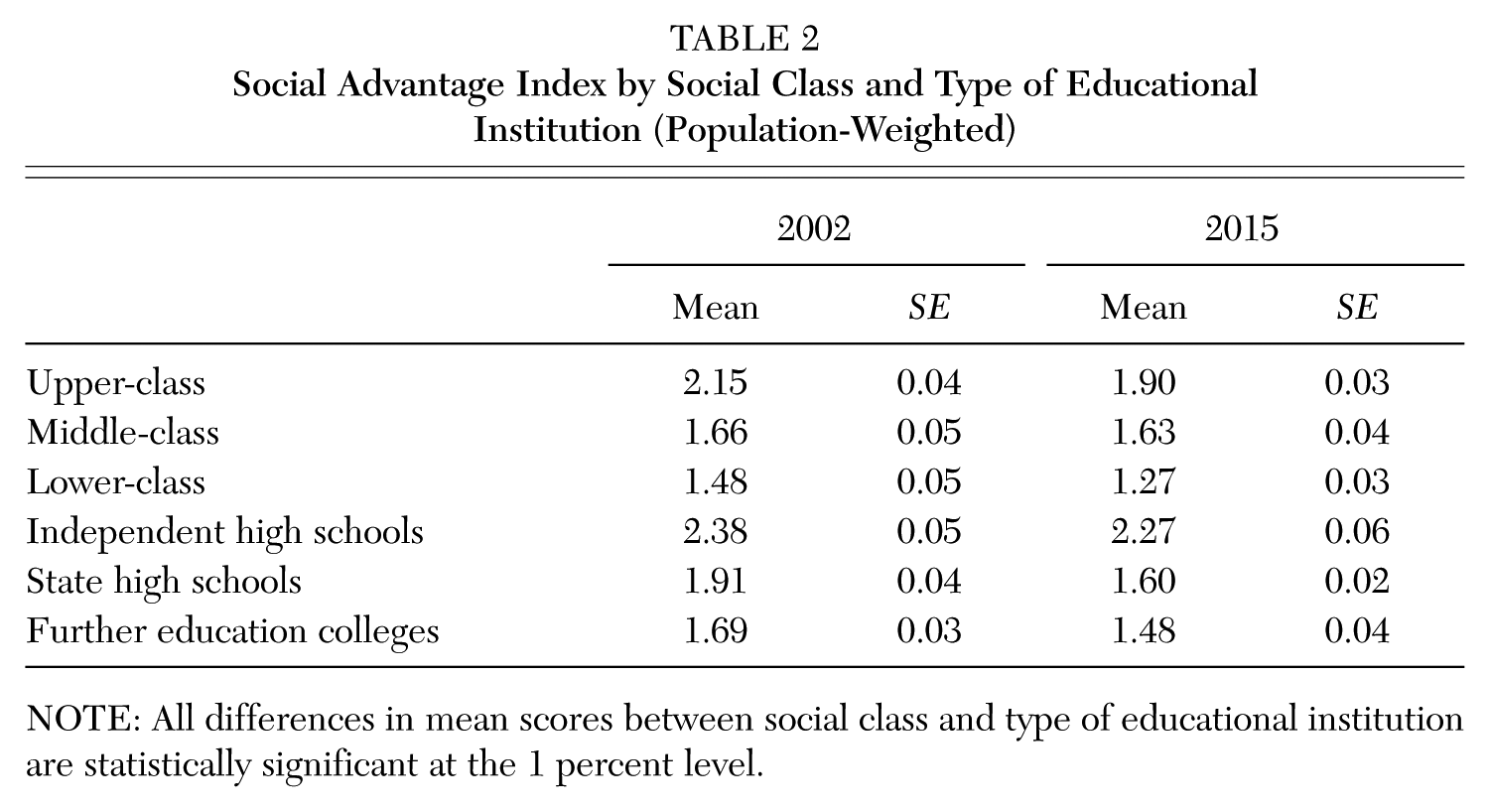
NOTE: All differences in mean scores between social class and type of educational institution are statistically significant at the 1 percent level.
Debt-averse attitudes
To assess students’ attitudes toward debt, both surveys asked a series of questions about the extent to which respondents agreed with various statements about debt. Generally more students in both years agreed with statements that are favorable to debt (i.e., “debt is a normal part of today’s lifestyle”; “it is OK to be in debt if you can pay it off”) than with the criticisms of debt (i.e., “there is no excuse for borrowing money”; “owing money is basically wrong”). Half of 2002 respondents and just over 70 percent of 2015 respondents agreed with the fifth statement: “You should always save up first before buying something” (see Table 3).
Extent of Agreement with Statements Regarding Debt, 17–21-Year-Old Students in England, 2002 and 2015 (Population-Weighted)
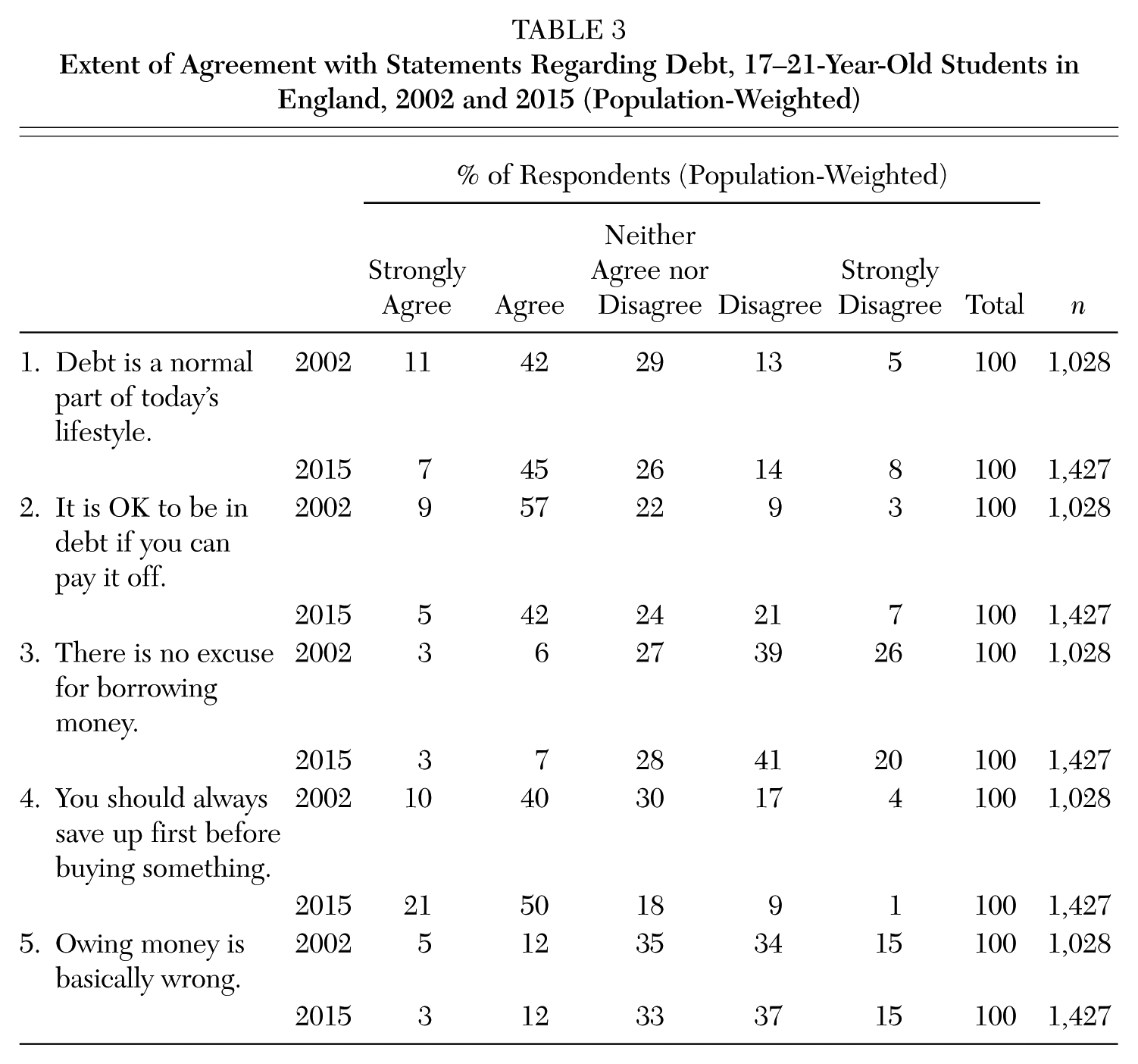
Factor analysis of the responses to these five statements produced two factors with eigenvalues greater than unity for each year. One, based on the first two statements, can be interpreted as a summary measure of attitudes favorable to debt. The second (based on statements three to five) can be interpreted as a summary measure of the extent of debt averse attitudes among students. The latter measure explained 57 to 58 percent of the total variation in the responses to statements three to five in each year. These factor scores, with means of zero and standard deviations of one, are entered as measures of debt-averse attitudes in 2002 and 2015 in the multivariate analysis. 12
Data analysis
Hypothesis 1 is tested by comparing 2002 and 2015 responses to relevant survey questions on student attitudes toward taking out loans to pay for university education. To test Hypothesis 2, we regress our summary measure of debt averse attitudes for each year on measures of social class with controls for other relevant individual characteristics:

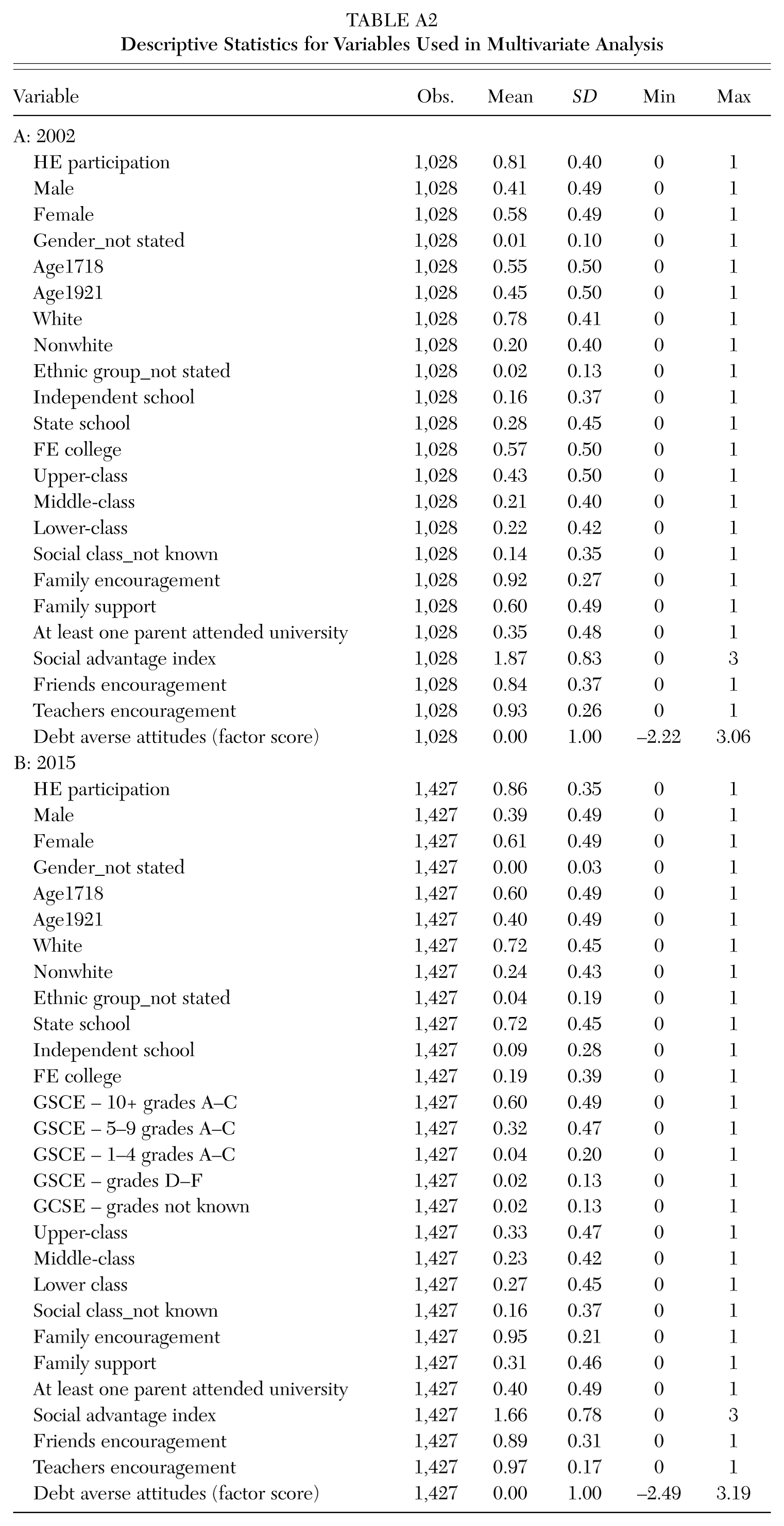
Here DAi is the debt-averse attitudes score for student i and Xji is a vector of j dummy variables denoting social class, gender, age, ethnicity, and type of educational institution attended. For 2015, we also control for prior educational attainment on the General Certificate of Secondary Education (GCSE) national examination that English students typically take at age 16. No equivalent data are available for 2002. Descriptive statistics for these and other variables used in multivariate analysis are shown in Table A2 in the appendix.
To test Hypothesis 3, we conduct multivariate analyses of higher education participation in 2015 and 2002, modeling the probabilities that individuals plan to undertake HE as follows:

where

F(.) is the cumulative distribution function of the standard normal distribution, and Xi is a vector of individual-level and school-related characteristics that are expected to influence the probability of participating in HE. These variables are gender, age, ethnicity, and social class; the degree of encouragement to enter HE provided by friends and teachers; and, for 2015, prior educational attainment at GCSE level.
Findings
Changes in student attitudes to debt
To test Hypothesis 1—that young people’s attitudes to taking out student loan debt were more favorable in 2015 than in 2002—we first examine the extent of student agreement with the statement that “borrowing money to pay for a university education is a good investment.” As Table 4 shows, the proportion of respondents agreeing with this statement rose from 52 percent in 2002 to 74 percent in 2015. Mean response scores calculated on a one to five scale show a statistically significant increase from 3.35 in 2002 to 3.98 in 2015 (p < .001). As a check on the sensitivity of these findings to the inclusion of FE students who were relatively undersampled in 2015 compared to 2002, we carried out similar estimates for high school students only. These estimates show a similar pattern of change between 2002 and 2015 as for the full samples including FE students. 13
Extent of Agreement with Statements Regarding Student Loan Debt, 17- to 21-Year-Old Students in England, 2002 and 2015 (Population-Weighted)
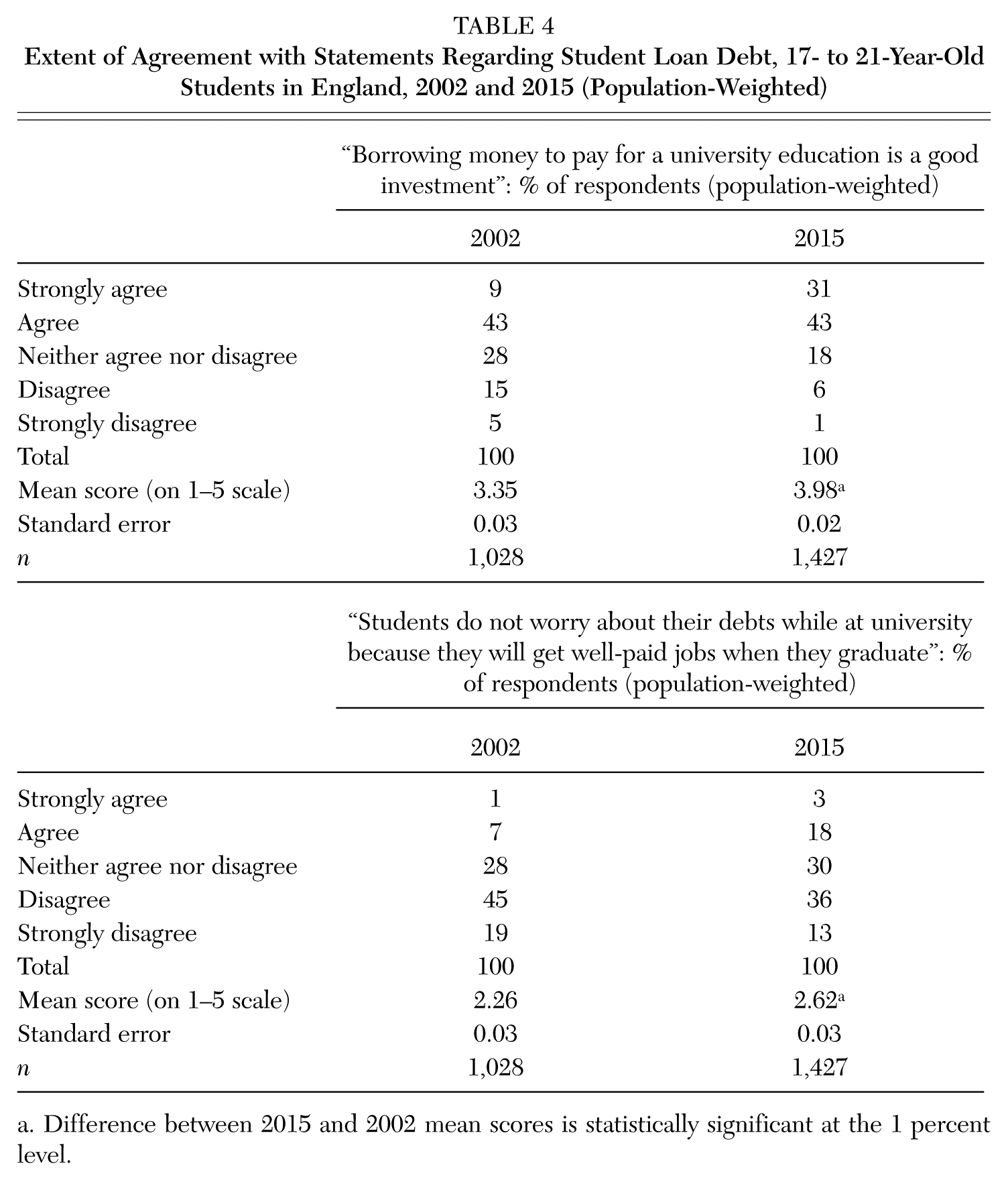
Difference between 2015 and 2002 mean scores is statistically significant at the 1 percent level.
The bulk of the change in attitudes toward debt between the two years occurred among female students rather than among men: 76 percent of females in 2015 agreed with the statement that “borrowing money to pay for a university education is a good investment” compared to 46 percent in 2002. The shift in attitudes was broadly similar across social classes.
Together, these findings provide strong support for Hypothesis 1. Other survey responses help to explain why young people’s attitudes toward taking out student loans have, on average, become more favorable even as prospective debt burdens have increased. In particular, student confidence in the positive impacts of higher education qualifications on earnings prospects appears to have grown. There was a statistically significant increase between 2002 and 2015 in the proportion of students agreeing with the proposition that “students do not worry about their debts while at university because they will get well-paid jobs when they graduate.” Mean response scores for this question, calculated on a one to five scale, rose from 2.26 in 2002 to 2.62 in 2015 (p < .001).
Debt aversion and social class
Hypothesis 2 posits that, where debt-averse attitudes exist, they are stronger among lower-class students than among students from other social classes. To test this hypothesis, we estimate equation 1, using the summary measure of debt-averse attitudes as the dependent variable. Table 5 shows that upper-class students were significantly less likely to hold debt-averse attitudes in 2015 than were lower-class students, the reference category for both the upper- and middle-class variables (see column 2). Comparison with the equivalent upper-class coefficient for 2002 suggests that the gap in mean debt-averse attitude scores between upper- and lower-class students widened sharply since 2002 for 17- to 21-year-old students in England. Indeed, the upper-class coefficient for 2002 is lower than for 2015 and is not statistically significant due to a relatively high standard error (see column 1). 14 The second indicator of social background, the index of social advantage, is significantly negatively related to debt aversion in both 2002 and 2015 (see columns 4–5).
OLS Estimates of Debt Aversion: 17–21-Year-Old Students in England, 2002 and 2015
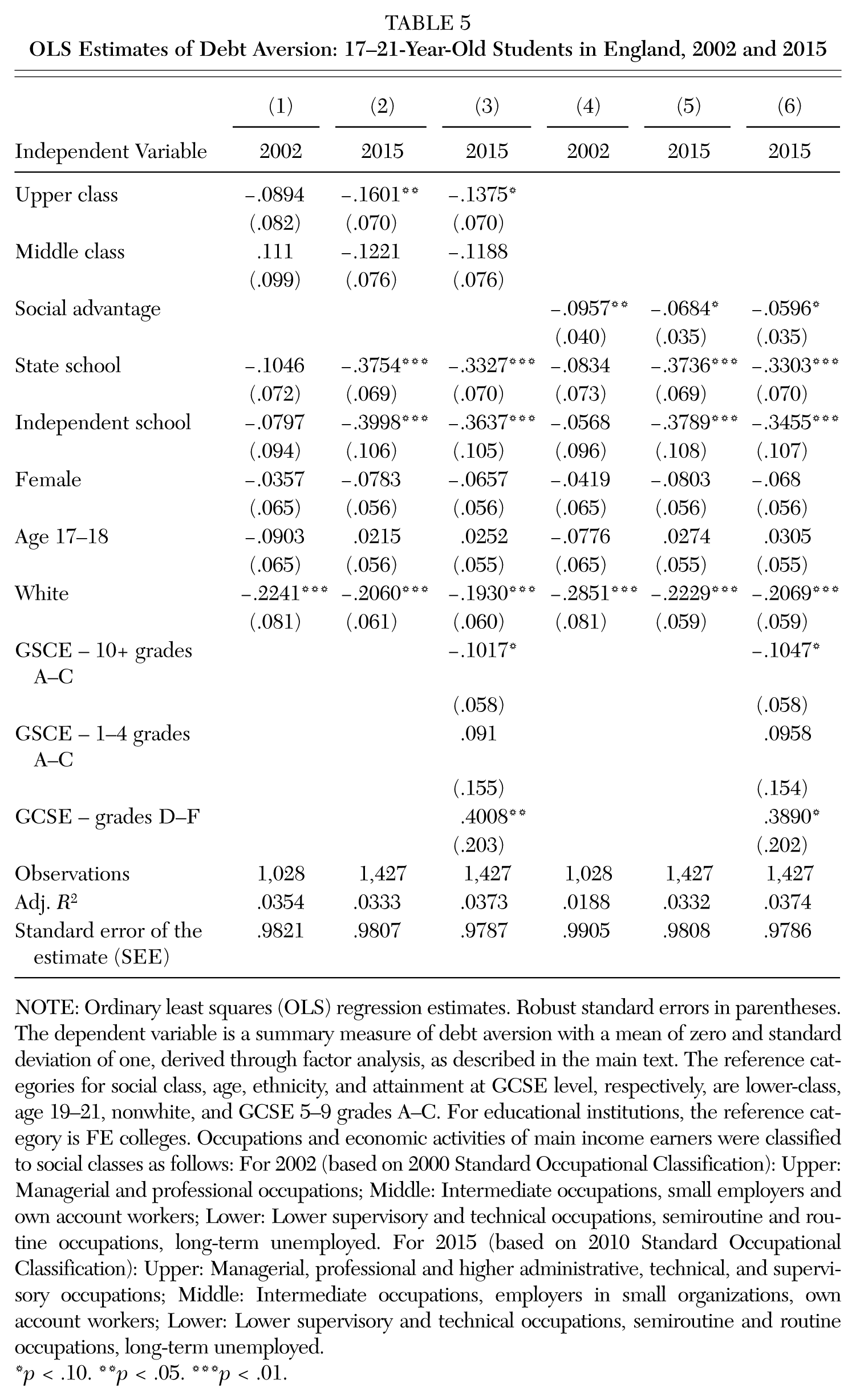
NOTE: Ordinary least squares (OLS) regression estimates. Robust standard errors in parentheses. The dependent variable is a summary measure of debt aversion with a mean of zero and standard deviation of one, derived through factor analysis, as described in the main text. The reference categories for social class, age, ethnicity, and attainment at GCSE level, respectively, are lower-class, age 19–21, nonwhite, and GCSE 5–9 grades A–C. For educational institutions, the reference category is FE colleges. Occupations and economic activities of main income earners were classified to social classes as follows: For 2002 (based on 2000 Standard Occupational Classification): Upper: Managerial and professional occupations; Middle: Intermediate occupations, small employers and own account workers; Lower: Lower supervisory and technical occupations, semiroutine and routine occupations, long-term unemployed. For 2015 (based on 2010 Standard Occupational Classification): Upper: Managerial, professional and higher administrative, technical, and supervisory occupations; Middle: Intermediate occupations, employers in small organizations, own account workers; Lower: Lower supervisory and technical occupations, semiroutine and routine occupations, long-term unemployed.
p < .10. **p < .05. ***p < .01.
Apart from lower social class status, other variables that contribute to students holding debt averse attitudes are attendance at FE colleges in 2015 (as compared to attendance at independent and government-funded high schools) and being nonwhite (in both years). All findings for 2015 are robust to controlling for prior attainment at GCSE level (see columns 3 and 6).
Focusing specifically on differences between middle- and lower-class students, in 2002 the coefficient on middle-class is positive compared to lower-class students, while in 2015 it is negative (see columns 1 and 2). Due to wide dispersion of debt-averse attitude scores for middle-class students in both years (reflected in the relatively high standard errors attached to the middle-class coefficients), we cannot attribute statistical significance to differences between middle- and lower-class students in either year.
Overall, the findings in relation to social class and the index of social advantage provide partial support for Hypothesis 2. Lower-class students are more likely to display debt-averse attitudes than upper-class students in 2015 and this disparity appears to have grown since 2002. However, there is no clear evidence of lower-class students being more debt averse than middle-class students in either year.
These findings are generally robust to sensitivity tests confining estimation to school-based students (excluding FE college students) and reestimating equation 1 using weighted least squares. 15
Higher education participation and social class
Having established that debt-averse attitudes tend to be stronger among lower-class than upper-class students, we now examine evidence relating to Hypothesis 3. This hypothesis posits that, all else being equal, debt-averse attitudes still contribute to lower rates of planned HE participation by lower-class students compared to students from other social classes.
Table 6 reports probit estimates for equation 2, modeling the probability of individual students planning to participate in HE in 2002 and 2015, using the indicator of social class. The estimated probability of upper-class students planning to participate in HE in 2015 is 5.9 percentage points higher than for lower-class students after controlling for various individual and school-related characteristics (column 2), slightly lower than the estimated 7.5 percentage points differential in 2002 (column 1). The estimated probability of middle-class students planning to enter HE is not significantly higher than for lower-class students in either year. These patterns of class difference remain when we enter our measure of debt averse attitudes as an additional regressor (columns 3 and 4). In both years, debt-averse attitudes are negatively related to planned HE participation, significantly so in 2015 but not in 2002. 16
Probit Estimates of Higher Education Participation: 17- to 21-Year-Old Students in England, 2002 and 2015; Marginal Effects (Evaluated at Sample Means), Using Occupation-Based Indicator of Social Class
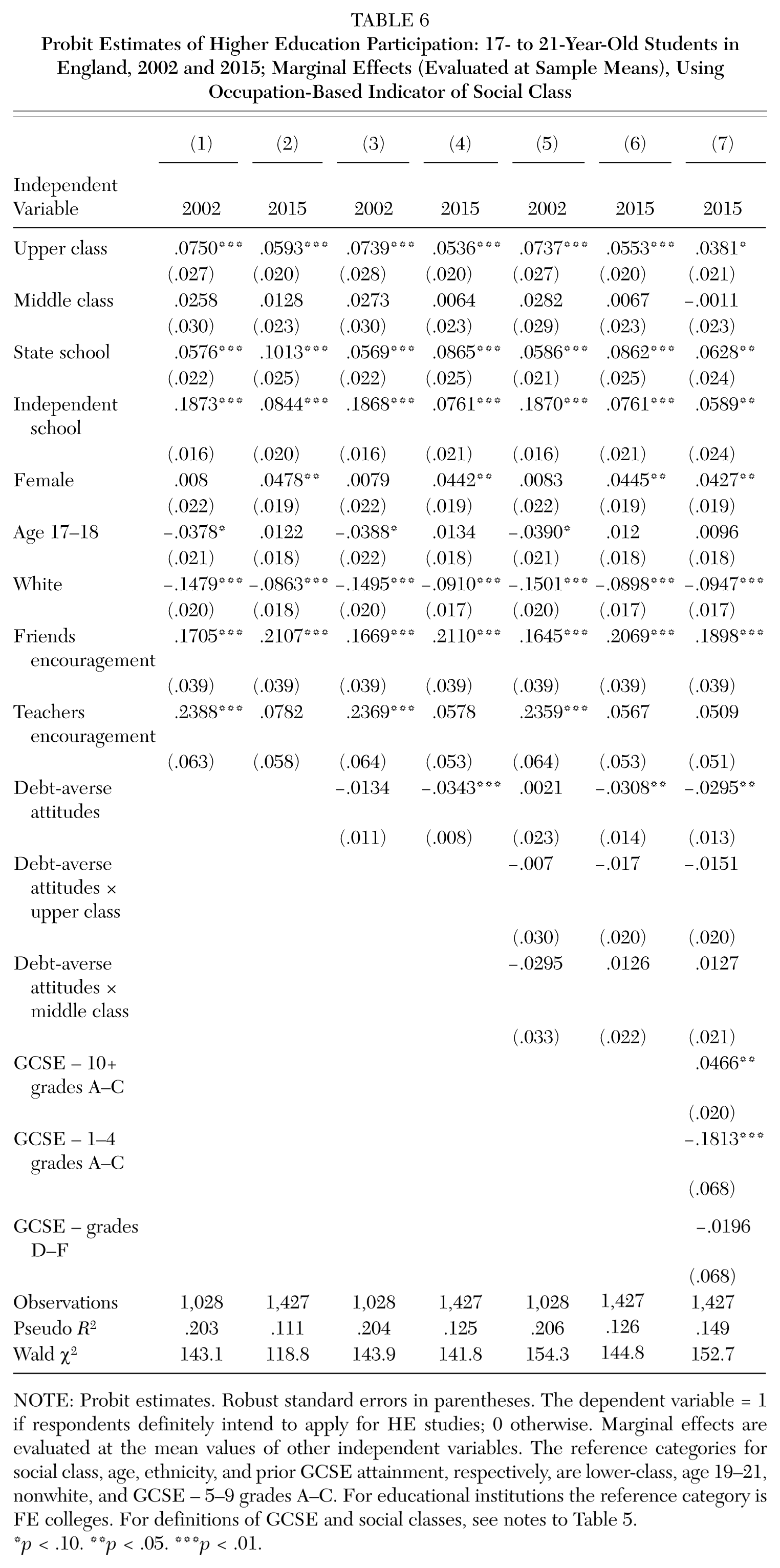
NOTE: Probit estimates. Robust standard errors in parentheses. The dependent variable = 1 if respondents definitely intend to apply for HE studies; 0 otherwise. Marginal effects are evaluated at the mean values of other independent variables. The reference categories for social class, age, ethnicity, and prior GCSE attainment, respectively, are lower-class, age 19–21, nonwhite, and GCSE – 5–9 grades A–C. For educational institutions the reference category is FE colleges. For definitions of GCSE and social classes, see notes to Table 5.
p < .10. **p < .05. ***p < .01.
Several control variables are positively associated with anticipated HE participation in both years: attendance at government-funded and independent schools (compared to FE colleges), being from nonwhite ethnic backgrounds, and having received encouragement at school from friends to apply for HE studies (columns 1–7). Encouragement from teachers played a significant role in both years but apparently made a smaller contribution in 2015 compared to 2002. The reasons for this change are unclear but may suggest that HE participation is now taken for granted in schools. Attending government-funded high schools appears to have a smaller positive effect on plans for HE participation than attending independent schools in 2002, but 13 years later this differential appears to have disappeared.
We test Hypothesis 3 by entering two additional variables denoting interactions between debt-averse attitudes and, respectively, upper- and middle-class status (columns 5 and 6). The coefficient for the debt-averse attitudes variable refers to the association between debt-averse attitudes and planned HE participation by students in the lower-class reference category. For 2015, we observe a significant negative link between debt averse attitudes and lower-class status, but the coefficient on the same variable in 2002 is not statistically significant. The finding for 2015 is robust to controlling for prior attainment at GCSE level (column 7).
The extent of the association between debt-averse attitudes and planned HE participation by students in other social classes relative to the lower-class reference category can be estimated by adding together the coefficients on the debt-averse attitudes variable and the respective debt-averse attitudes/class interactions in models 5–7. Tests of the joint significance of these coefficients showed no significant role for debt-averse attitudes for middle-class students in 2015 (p = .284). For upper-class students, the equivalent combination of coefficients was significantly different from zero (p = .001). However, any association between debt-averse attitudes and planned HE participation by upper-class students is small compared to the association between debt-averse attitudes and planned HE participation by lower-class students. As shown in column 7, the estimated probability of upper-class students planning to participate in HE in 2015 is still 4 percentage points higher than for lower-class students after taking account of associations with debt aversion and prior attainments by students at the General Certificate of Secondary Education level (column 7).
In Table 7, we replace the social class variable with an index of social disadvantage, the inverse of the social advantage index, which, as described above, is highly correlated with social class. We focus on social disadvantage to explore the impact of interacting this class indicator with debt-averse attitudes. The coefficient on this interaction term is easier to interpret when both its constituent variables have similarly signed independent associations with planned HE participation.
Probit Estimates of Higher Education Participation: 17- to 21-Year-Old Students in England, 2002 and 2015; Marginal Effects (Evaluated at Sample Means), Using Index of Social Disadvantage
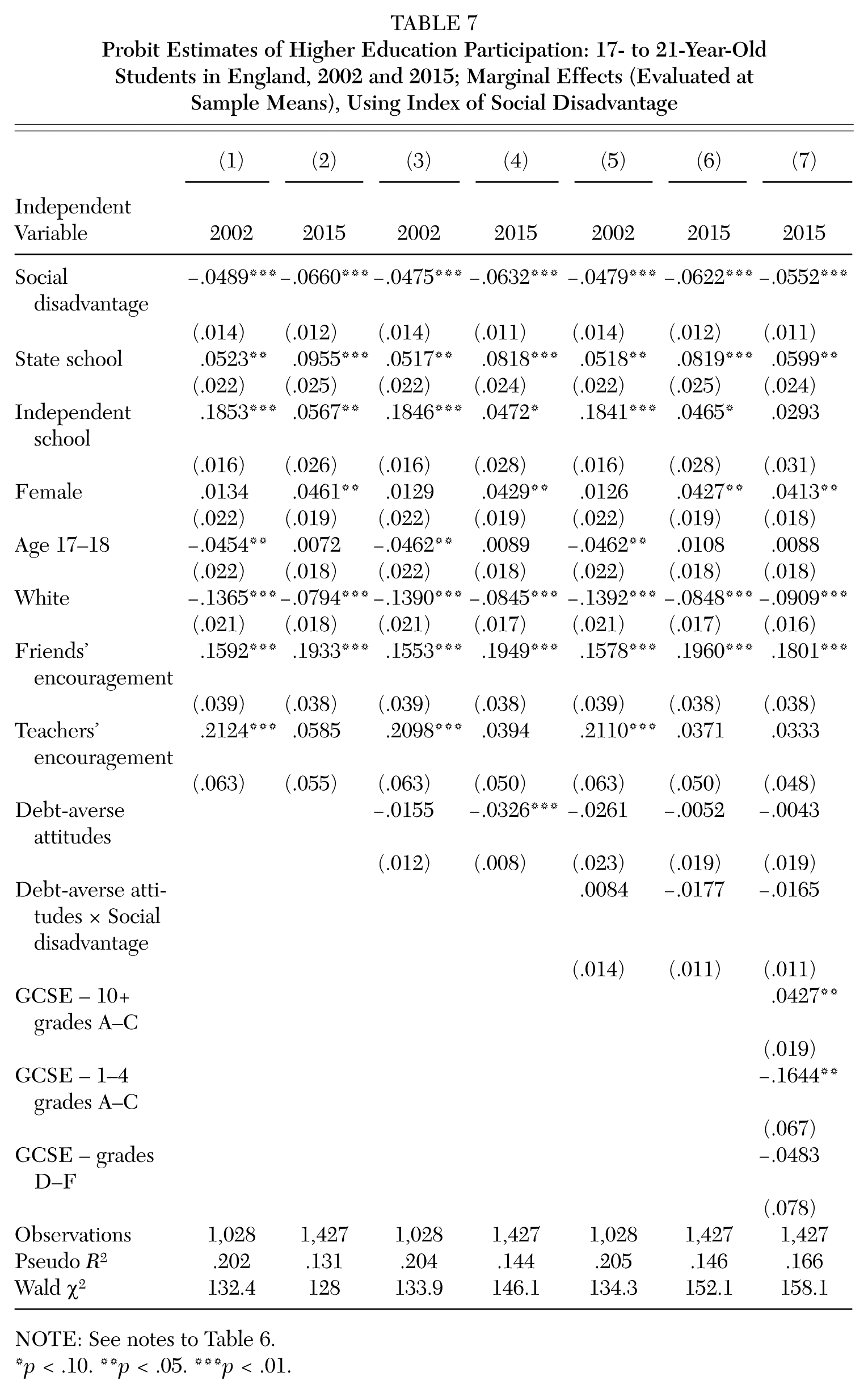
NOTE: See notes to Table 6.
p < .10. **p < .05. ***p < .01.
The analyses show that social disadvantage is negatively related to students’ intention to enter HE in both years, with the estimated contribution approximately 2 percentage points greater in 2015 than in 2002 (columns 1–2). These estimated contributions change very little when debt-averse attitudes are entered as an additional regressor (columns 3–4). Unlike with the measure of social class in Table 6, the coefficients on the interacted debt-averse attitudes/social disadvantage variable are statistically insignificant in both years (Table 7, columns 5–7). This finding is a reminder of the sensitivity of our results to the way that variables relating to social background are defined.
Overall, our findings provide strong support for Hypothesis 3. Debt-averse attitudes in 2015 still contribute to lower HE participation by lower-class students compared to students from other social classes. This inference is generally robust to sensitivity tests when the sample is restricted to school-based students only (i.e., excluding FE college students) and when estimates for the full sample are based on population-weighted data.
Discussion and Conclusion
HE participation in England has continued to rise in recent years across all social classes, despite the apparently daunting climate: large hikes in tuition, massive increases in student loan debt, and repayment through government subsidized income-contingent loans accompanied by restrictions on maintenance grants. Nonetheless, concerns remain among commentators that lower-class students who achieve suitable qualifications to enter HE may be deterred from participation by the level of debt required to participate in HE.
Drawing on surveys in 2002 and 2015 of high school and FE college students, we tested three hypotheses:
H1: Young people’s attitudes toward taking out student loans were more favorable in 2015 than in 2002.
H2: Where debt-averse attitudes exist, they are stronger among lower-class students than among students from other social classes in 2015, as well as in 2002.
H3: All else being equal, debt-averse attitudes contribute to lower rates of planned HE participation by lower-class students compared to students from other social classes in 2015, as well as in 2002.
We find clear evidence to support the first hypothesis. In 2015, 74 percent of students agreed with a statement that “borrowing money to pay for a university education is a good investment” compared with 52 percent in 2002. This change partly reflects growth in the proportion of students who agree with the statement, “Students do not worry about their debts while at university because they will get well-paid jobs when they graduate.” There is also a widespread understanding that future loan repayments will be income-contingent.
Nonetheless, a sizable minority of students have debt-averse attitudes. We find partial evidence for the second hypothesis, with lower-class students exhibiting more debt-averse attitudes than upper-class students in 2015, and much more debt-averse attitudes than lower-class students in 2002. Middle-class students in 2015 are not more debt averse than lower-class students in the same year.
We find strong support for the third hypothesis. Lower-class students are still far more likely than students from other social classes to be deterred from planning to enter HE because of fear of debt. This applies both to the comparison between lower- and upper-class students and between lower- and middle-class students even though levels of debt aversion are similar among middle-class and lower-class students. Debt aversion seems more likely to deter anticipated HE participation among lower-class students in 2015 than in 2002.
In 2015, upper-class students were 4 percentage points more likely than lower-class students to anticipate going to university, even after controlling for debt-averse attitudes, prior academic attainment, and numerous other variables. However, intent to participate is not statistically different for lower- and middle-class students after controlling for other variables.
The gap between upper- and middle-class planned participation cannot be attributed to debt aversion among middle-class students, even though their debt-aversion levels are similar to lower-class students. Many factors shape students’ HE enrollment decisions. Our index of social advantage, which captures anticipated financial support from family, parental attendance at university, and family encouragement to attend higher education, is significantly and positively related to planned HE participation. The high degree of correlation between this social advantage index and social class confirms that such economic and cultural capital is available most to upper-class students. Further research would be useful to learn more about how these, and other unevenly distributed family-level influences, contribute to student attitudes to debt and willingness to incur the heavy debts now associated with HE studies in England.
Prospective students’ more relaxed attitude toward student loan debt in 2015 is unsurprising. The large tuition increases mean very few students have a choice but to take out a loan if they want to go to university. They recognize that HE is essential for a well-paid job. As HE participation moves from mass to universal (Trow 1973), young people have few alternative options but to enroll in HE. By contrast, in 2002, loans were restricted to living costs, and students could find ways of minimizing these costs, thereby reducing their reliance on loans (Callender and Jackson 2008). Reflecting the ubiquitous policy rhetoric since 2006, and as Esson and Ertl (2016) have shown, HE has been “sold” successfully to prospective students as a “good investment” with a high graduate earnings premium. Income-contingent loans were promoted as “risk free” because of the expected financial returns to HE and because the government, not students, bears any financial penalties associated with low graduate earnings.
This analysis shows that, with tuition fee increases and growth in student loan debt between 2002 and 2015, debt-averse attitudes increased among lower-class prospective students, the gap in attitudes between lower- and upper-class students widened, and fear of debt negatively contributed to lower-class students’ anticipated HE participation relative to other social classes. These changes occurred over a period when real household median disposable incomes grew by just 3 percent to £28,092 ($36,416), and median full-time gross earnings were unchanged at £27,600 ($35,797) (Office for National Statistics [ONS] 2015, 2016). Most potential students are now being asked to borrow about one and a half times their family’s annual income.
The similar levels of debt aversion among middle- and lower-class prospective students in 2015, unlike in 2002, also may reflect changes in student funding. These middle-income groups have been particularly “squeezed” by restrictions on grant eligibility, limited access to institutional aid, and parents with no disposable income to make up for these losses, making their children increasingly reliant on loans.
The growth of social class differences in debt aversion and planned HE participation may be related to the increasing dispersion of graduate earnings over time (Green and Zhu 2010). Graduates are much more likely to be employed and earn considerably more than nongraduates. But graduates from wealthier backgrounds earn significantly more than graduates from poorer backgrounds even after completing the same degrees from the same universities, and graduate earnings vary depending on the university attended (Britton et al. 2015). Arguably, then, there are now even greater risks and uncertainty concerning the returns of HE for students not attending the “best” universities and from the highest social classes.
A key limitation of our study is its focus on prospective students’ intentions about entering HE. The analyses do not show the impact of debt on prospective students’ actual behavior, choices, and decision-making. The relationship between attitudes toward debt and actual debt is unclear. We cannot assume that attitudes toward debt affect borrowing behavior. Both cognitive dissonance theory (Festinger 1962) and self-perception theory (Bem 1972) suggest that, if people must acquire debt, they will adjust their attitudes so that they accept debt. Debates about the relationship between attitudes and behavior have a long history in social science. The potentially powerful impact of perceptions of actuality on behavior is well established (Kettley, Whitehead, and Raffan 2008).
Nor can we assume from this cross-sectional study any causal inferences or that debt-averse attitudes result in nonparticipation. This conclusion would require a longitudinal study tracking students from high school into HE or alternative paths. This is one area for future research. Another is overcoming other methodological constraints in demonstrating causal links and the need for studies that include randomized controls and/or exploit quasi-experimental situations.
Our exploration of prospective students’ HE intentions and attitudes toward debt from cross-sectional surveys—which no other study has attempted—demonstrates changes over time and provides useful insights for policy. It contributes to the large extant literature on the determinants of, and socioeconomic differences in, HE participation. These results are a useful reminder to policy-makers, HE institutions, and researchers that academic attainment alone cannot explain these variations. Student debt aversion also plays a role, challenging the mindset that the problem of unequal HE participation lies primarily within the secondary schooling system.
Although HE participation rates have continued to grow in England, despite rises in tuition and student loan debt, policy-makers and researchers also need to recognize that such changes can influence HE enrollments, especially among underrepresented groups. Indeed, England’s student funding system, predicated on the accumulation of student loan debt, potentially undermines widening participation policies rather than broadening and equalizing HE participation. Income-contingent loans are not necessarily a protection against this, or student loan debt aversion.
Yet in September 2016, maintenance grants for low-income students were abolished again and replaced with larger loans, leading to further rises in debt for the poorest 40 percent of students from an estimated £40,500 ($52,383) to £53,000 ($68,55) (Britton, Crawford, and Dearden 2015). In September 2017, the tuition cap will be increased to £9,250 while the repayment threshold on loans is to be frozen retrospectively. Debt will be highest among those from the lowest-income families. Will yet more prospective low-income students be deterred from entering HE and have limited HE opportunities because of fear of debt?
Footnotes
Appendix
Descriptive Statistics for Variables Used in Multivariate Analysis
| Variable | Obs. | Mean | SD | Min | Max |
|---|---|---|---|---|---|
| A: 2002 | |||||
| HE participation | 1,028 | 0.81 | 0.40 | 0 | 1 |
| Male | 1,028 | 0.41 | 0.49 | 0 | 1 |
| Female | 1,028 | 0.58 | 0.49 | 0 | 1 |
| Gender_not stated | 1,028 | 0.01 | 0.10 | 0 | 1 |
| Age1718 | 1,028 | 0.55 | 0.50 | 0 | 1 |
| Age1921 | 1,028 | 0.45 | 0.50 | 0 | 1 |
| White | 1,028 | 0.78 | 0.41 | 0 | 1 |
| Nonwhite | 1,028 | 0.20 | 0.40 | 0 | 1 |
| Ethnic group_not stated | 1,028 | 0.02 | 0.13 | 0 | 1 |
| Independent school | 1,028 | 0.16 | 0.37 | 0 | 1 |
| State school | 1,028 | 0.28 | 0.45 | 0 | 1 |
| FE college | 1,028 | 0.57 | 0.50 | 0 | 1 |
| Upper-class | 1,028 | 0.43 | 0.50 | 0 | 1 |
| Middle-class | 1,028 | 0.21 | 0.40 | 0 | 1 |
| Lower-class | 1,028 | 0.22 | 0.42 | 0 | 1 |
| Social class_not known | 1,028 | 0.14 | 0.35 | 0 | 1 |
| Family encouragement | 1,028 | 0.92 | 0.27 | 0 | 1 |
| Family support | 1,028 | 0.60 | 0.49 | 0 | 1 |
| At least one parent attended university | 1,028 | 0.35 | 0.48 | 0 | 1 |
| Social advantage index | 1,028 | 1.87 | 0.83 | 0 | 3 |
| Friends encouragement | 1,028 | 0.84 | 0.37 | 0 | 1 |
| Teachers encouragement | 1,028 | 0.93 | 0.26 | 0 | 1 |
| Debt averse attitudes (factor score) | 1,028 | 0.00 | 1.00 | –2.22 | 3.06 |
| B: 2015 | |||||
| HE participation | 1,427 | 0.86 | 0.35 | 0 | 1 |
| Male | 1,427 | 0.39 | 0.49 | 0 | 1 |
| Female | 1,427 | 0.61 | 0.49 | 0 | 1 |
| Gender_not stated | 1,427 | 0.00 | 0.03 | 0 | 1 |
| Age1718 | 1,427 | 0.60 | 0.49 | 0 | 1 |
| Age1921 | 1,427 | 0.40 | 0.49 | 0 | 1 |
| White | 1,427 | 0.72 | 0.45 | 0 | 1 |
| Nonwhite | 1,427 | 0.24 | 0.43 | 0 | 1 |
| Ethnic group_not stated | 1,427 | 0.04 | 0.19 | 0 | 1 |
| State school | 1,427 | 0.72 | 0.45 | 0 | 1 |
| Independent school | 1,427 | 0.09 | 0.28 | 0 | 1 |
| FE college | 1,427 | 0.19 | 0.39 | 0 | 1 |
| GSCE – 10+ grades A–C | 1,427 | 0.60 | 0.49 | 0 | 1 |
| GSCE – 5–9 grades A–C | 1,427 | 0.32 | 0.47 | 0 | 1 |
| GSCE – 1–4 grades A–C | 1,427 | 0.04 | 0.20 | 0 | 1 |
| GSCE – grades D–F | 1,427 | 0.02 | 0.13 | 0 | 1 |
| GCSE – grades not known | 1,427 | 0.02 | 0.13 | 0 | 1 |
| Upper-class | 1,427 | 0.33 | 0.47 | 0 | 1 |
| Middle-class | 1,427 | 0.23 | 0.42 | 0 | 1 |
| Lower class | 1,427 | 0.27 | 0.45 | 0 | 1 |
| Social class_not known | 1,427 | 0.16 | 0.37 | 0 | 1 |
| Family encouragement | 1,427 | 0.95 | 0.21 | 0 | 1 |
| Family support | 1,427 | 0.31 | 0.46 | 0 | 1 |
| At least one parent attended university | 1,427 | 0.40 | 0.49 | 0 | 1 |
| Social advantage index | 1,427 | 1.66 | 0.78 | 0 | 3 |
| Friends encouragement | 1,427 | 0.89 | 0.31 | 0 | 1 |
| Teachers encouragement | 1,427 | 0.97 | 0.17 | 0 | 1 |
| Debt averse attitudes (factor score) | 1,427 | 0.00 | 1.00 | –2.49 | 3.19 |
Claire Callender has a chair in Higher Education Policy at both UCL, Institute of Education and at Birkbeck, University of London. She is deputy director of UCL’s Centre for Global Higher Education (CGHE). Her research and writing focus on higher education student finances and funding and related issues.
Geoff Mason is a visiting professor at the Centre for Research on Learning and Life Chances (LLAKES), UCL Institute of Education, London. He was previously senior fellow at the National Institute of Economic and Social Research, London, for many years, where he specialized in productivity, innovation, education, training, and labor markets.
NOTE:
The research for this article has been supported by the Economic and Social Research Council (ESRC; grant reference ES/J019135/1ESRC) via the Centre for Research on Learning and Life Chances (LLAKES), UCL Institute of Education, London. We are grateful to the ESRC and LLAKES for their financial support; to Julia Griggs and Klaudia Lubian (at the National Centre for Social Research, London), who administered the survey and advised on its design; and to the students who participated in the survey; and to the Department for Education for providing access to the National Pupil Database and Individual Learner Records. We also thank Francis Green, John Thompson, LLAKES seminar participants, and especially Laura Perna and Nick Hillman for helpful comments on previous versions of this article. Responsibility for remaining errors is ours alone.