







Abstract
In this study, we ask how work values impact different forms of labor market participation of young adults across Europe. We define work values as individuals’ intrinsic and extrinsic motivations to work and the value of work as the importance or centrality of work in individuals’ lives. We use data gathered from young adults in eleven European countries in the CUPESSE project to investigate the role of the two sets of values regarding employment and self-employment. We then replicate our analysis on a larger sample using data from the European Social Survey (ESS). Our findings suggest a high importance of nonpecuniary benefits for self-employment. Analyses based on both CUPESSE and ESS datasets clearly showed the high, positive impact that independence and creativity have on self-employment. We also show that extrinsic values, such as job security, are more important for employees than they are for the self-employed. Additionally, we find that the value of work in life does not differ between the employed and the self-employed. In sum, these findings suggest that values related to self-employment are not rooted in a general value of work, as Max Weber postulated in his Protestant Work Ethic nearly one hundred years ago, as much as in the aim to achieve personal satisfaction.
Almost a decade after the onset of the Great Recession, labor markets in industrialized countries are going through a substantial change. The growing degree of flexibility required by the markets, coupled with the decrease in work protection set by policy-makers, is putting more and more workers in a permanent state of training and reinvention. This is particularly salient for younger generations, who are often outsiders to the system of social protections (Skedinger 2010) and are confronted at the same time with a growing range of potential opportunities brought on by new technologies. In this scenario, entrepreneurship and self-employment are gaining centrality in the labor markets. First, entrepreneurship has been found to have a positive impact on innovation, employment, and growth (Dvouletý and Lukeš 2016). Second, labor markets are changing in such a way that some characteristics typical of self-employed work, such as independence, are becoming increasingly common (Manyika et al. 2016). Hence, because of both policy incentives and market changes, self-employment might become more the norm than the exception in future labor markets.
At the same time, studies on work values across generations show that younger individuals are less intrinsically motivated to work and see work as less central in their lives (Twenge et al. 2010); this is despite previous research suggesting that the most important motivational factors for entrepreneurs are intrinsic, nonpecuniary rewards (Burke, FitzRoy, and Nolan 2002; Schjoedt 2009). Thus, today’s young adults may be less apt than their predecessors to engage in entrepreneurial activities that require time and effort (Gorgievski, Ascalon, and Stephan 2011) in a moment when labor markets appear to be more in need for them to do so.
As prior studies do not give a final answer to the question of what motivates young entrepreneurs, we suggest the following approach to bridge this gap. On one hand, work values are the aspects of work that individuals find desirable, the motivating factors for people to prefer one job over another (Fayolle, Liñán, and Moriano 2014; Twenge et al. 2010). Both intrinsic and extrinsic values have been found to motivate entrepreneurial careers (e.g., Douglas and Shepherd 2000; van Gelderen 2016; Stephan, Hart, and Drews 2015). On the other hand, there is the centrality that people attribute to work in their lives, a trait that we may call value of work (Bal and Kooij 2011; Diefendorff et al. 2002; Gallie, this volume). In his seminal work, Weber (1905) postulates that entrepreneurs have a strong work ethic, that is, they consider work as more central in their lives. We indeed see that entrepreneurs spend more hours at work than wage employees (Cardon and Patel 2015), but the answer to the “why” question is not conclusive. Moreover, research has found that both work values and centrality differ between today’s young people and previous generations (Cogin 2012; Twenge et al. 2010).
Our first research question, then, is whether self-employment among young adults in Europe is determined by work values or a more general work centrality. Our second research question focuses on the differences between intrinsic and extrinsic work values and which of these is more prevalent among young employees or entrepreneurs. To answer this question, we draw on self-determination theory and its applications in management and behavioral sciences. We then move beyond both questions and ask whether employees or the self-employed are more likely to keep working if they are financially independent. To study whether and how current young entrepreneurs differ from people who choose a more conventional career path is of great importance as it may inform both policy-makers and human resource specialists about the workers’ motivational profiles that are likely to be common in the future. This may help to prepare measures that tap into the real motivational profiles and are not misplaced, for example, by overestimating the importance of financial incentives.
To identify the motivational forces behind the choice between paid and self-employment, we utilize two different datasets of European young adults. First, the main dataset includes respondents aged 18 to 35 from eleven European countries and originates from the Cultural Pathways to Economic Self-Sufficiency and Entrepreneurship (CUPESSE) collaborative research project. Second, we test the results from this dataset by analyzing a larger sample of the same age drawn from the tenth round of the European Social Survey in 2010. While the former data allow for a deeper analysis and more items in the model, the latter provide broader generalizability through a tested and well-renowned methodology and a larger sample of countries.
We elaborate on the theoretical background of both constructs, investigate past research, and develop hypotheses. Then, in the following section of this article, we describe the CUPESSE and European Social Survey (ESS) datasets and our subsamples, present our research methods, discuss the results, and give concluding remarks.
Conceptual Foundations and Theoretical Framework
In this study, we compare the prevalence of two theoretical constructs among employees and self-employed individuals: work values, the aspects of work that people regard as desirable in their working life (Ros, Schwartz, and Surkiss 1999; Twenge et al. 2010); and work centrality, that is, the “value of work” in a person’s life (cf. Paullay, Alliger, and Stone-Romero 1994). Both concepts belong to a general view of values as evaluative standards, which inform the abstract goals guiding individuals’ career choices, as well as their perception of what is right and wrong in the workplace (Gallie, this volume; Parry and Urwin 2011; Smola and Sutton 2002). As such, they are central driving forces behind individuals’ career prospects and their performance in the workplace (e.g., Bal and Kooij 2011; Fayolle, Liñán, and Moriano 2014; Twenge et al. 2010).
Work values
Research on entrepreneurial motivations stems from a need to mark the psychological underpinnings of entrepreneurial behavior (Carsrud and Brännback 2011). While some treat values and motivations as separate—albeit related—concepts, with values being more general than specific motivations (Fayolle, Liñán, and Moriano 2014), the majority of studies understand the concepts as equivalents, both theoretically and empirically (Bardi and Schwartz 2003). A focus on young adults arises in the literature mainly because of the incentives businesses need to offer to attract or retain younger workers (Twenge et al. 2010) and due to the high levels of youth unemployment that cause significant social pressures, especially in southern Europe (Sarfati 2013). Hence, we limit this review to the types of work values that have been pointed out as relevant for both topics.
First, we distinguish between intrinsic and extrinsic work values (Amabile 1997; Ros, Schwartz, and Surkiss 1999) as a part of self-determination theory (Ryan and Deci 2000). Intrinsic values (or motivations) link a person’s job to her own need for self-realization, and they express themselves through valuing a job as meaningful, creative, interesting, and self-determined. Extrinsic values include status recognition, high income, job stability, and opportunities for career advancements, that is, they do not relate to the type of work itself. However, extrinsic values can, under some circumstances, become internal, that is, when the individual attributes value to them without external control (Gagné and Deci 2005). Even in that case, there is often a sense of pressure to engage in an action, such as “I must work to keep the job or to make enough money.” While classical models of economic behavior used to focus on extrinsic rewards as the main motivational factors, self-determination theory, as well as subsequent research, has highlighted and confirmed the importance of intrinsic motivation for behavior, performance, and satisfaction in the workplace (Ryan and Deci 2000; Gagné and Deci 2005) and in entrepreneurship (Benz and Frey 2008).
Work centrality
The construct of work centrality relates directly to personal normative views on work ethic and the role of work in one’s life (Dose 1997; Gallie, this volume). As such, it has its roots in Weber’s (1905) original formulation of the Protestant work ethic. Yet newer studies understand the Protestant work ethic independently from personal religious affiliations (Miller, Woehr, and Hudspeth 2002) and conceptualize it as hard work, industriousness, and attitudes toward money and leisure time (Furnham 1990). Cogin (2012) refers to work ethics as a way of incorporating work as part of one’s own identity. As this study contrasts specific work values with the general position of work in the respondents’ lives, we use the construct of work centrality as the “beliefs that individuals have regarding the degree of importance that work plays in their lives” (Paullay, Alliger, and Stone-Romero 1994, 225). As socialization and prior experiences impact these beliefs, they differ among cultures, religions, and social groups. Thus, work centrality can but does not need to have roots in the Protestant work ethic, which makes it more appropriate for a cross-country study.
From a theoretical standpoint, young people value autonomy and personal growth: they prefer creative environments where they can work independently, learn marketable skills, gather experience that will serve them in the future (Martin 2005), and seek a portable career with greater degrees of personal flexibility (Glass 2007). In other words, they are expected to be driven more by intrinsic values. On the other hand, given a higher focus on family life and free time (Shaw and Fairhurst 2008) as well as a trend toward less work centrality among young adults (Smola and Sutton 2002), it remains unclear how central work is for young adults in the twenty-first century.
A link to career choice
How do work values and centrality affect people’s career choices? In general terms, values as motivational constructs are the driving force of various behaviors, entrepreneurial behavior included. It is natural for an individual to pursue important values by behaving accordingly (Bardi and Schwartz 2003). However, the relationship between values and entrepreneurship warrants enhanced scholarly attention (Fayolle, Liñán, and Moriano 2014). Existing research identifies three values as particularly relevant for distinguishing self-employment from paid employment as a career choice: independence, creativity, and a low need for security (Amabile 1997; Jaén and Liñán 2013; Schjoedt 2009). Additionally, financial motivation is said to be a crucial factor for starting an entrepreneurial activity (Douglas and Shepherd 2000; Hessels, van Gelderen, and Thurik 2008). While independence and creativity are regarded as intrinsic values, a need for security and a high income are genuinely extrinsic factors.
It is important to point out that existing research on values and entrepreneurship does not focus on young people. However, research on generational differences of work values shows that today’s young adults—defined as those born in the 1980s and 1990s—are less motivated by intrinsic factors than previous generations (e.g., Twenge et al. 2010). At the same time, labor market changes and the rise of the “gig economy” are reducing the relevance of extrinsic rewards such as security for a multitude of jobs (Manyika et al. 2016). Hence, it is crucial to assess whether intrinsic and extrinsic values are still associated with self-employed work among younger individuals in the way they used to be for previous generations.
Independence is the best-confirmed value of entrepreneurs (Burke, FitzRoy, and Nolan 2002; van Gelderen 2016; Rauch and Frese 2007; Stephan, Hart, and Drews 2015). By running their own firm, entrepreneurs have autonomy in organizing their own time, in determining procedures to carry out their work tasks, and in general decision-making. Independence is thus a major driver of entrepreneurship (Carter et al. 2003; Hessels, van Gelderen, and Thurik 2008; Schjoedt 2009; Shane, Locke, and Collins 2003; Benz and Frey 2008) and entrepreneurs’ job satisfaction (Benz and Frey 2008; Hundley 2001). Need for creativity captures the interest to look for novel ways of action, the importance of developing one’s own ideas and accomplishing something new (Edelman et al. 2010; Rauch and Frese 2007). Empirically, the importance of this trait for entrepreneurship is more controversial than is the case for independence (see, e.g., Carter et al. 2003). However, Rauch and Frese (2007) link entrepreneurial behavior to other creativity-related values, such as innovativeness. Hence, we would expect the need for creativity to have an impact on people’s career choices. These two expectations lead to our first hypothesis:
Intrinsic values place the source of reward within individuals’ psychological satisfaction, be it due to self-expression or personal freedom, rather than external, pecuniary benefits. These are the kinds of rewards that, according to previous research, appeal to entrepreneurs the most (Burke, FitzRoy, and Nolan 2002; Hamilton 2000). A general implication of intrinsic values is that entrepreneurs should be willing to continue working even if they do not have an immediate economic need for it. In other words, if an entrepreneurial career is driven by such values, we would expect self-employed individuals to be more willing than employees to continue working even if they are not financially obligated to do so. Indeed, a study on lottery winners by Arvey, Harpaz, and Liao (2004) found that 10 percent of winners started their own business, even though they had no economic need to do so. Thus, we hypothesize,
Looking at extrinsic factors, job security correlates significantly with paid employment (Burke, FitzRoy, and Nolan 2002; Tyszka et al. 2011). Individuals valuing security may find the challenges of entrepreneurship threatening and unattractive (Jaén and Liñán 2013). It is important to emphasize that this value negatively affects the self-employed career choice. Yet in the literature it is often entangled with other financial incentives. Stephan, Hart, and Drews (2015) note that most of the existing studies of entrepreneurial motivation ignore the distinction among income security, personal wealth, and significant financial success (e.g., Edelman et al. 2010). Tyszka et al. (2011), in one of the rare studies to differentiate these constructs, find that the most important motive in the group of nonentrepreneurs is job security, which is not important for opportunity-driven entrepreneurs. Hence, it is important to distinguish between the value of security and the value of high income or wealth. Whereas high income and wealth creation are often suggested as key values of entrepreneurs (Douglas and Shepherd 2000; Hessels, van Gelderen, and Thurik 2008), previous research shows that the self-employed in general are willing to work for lower wages (Hamilton 2000; van Praag and Versloot 2007). The high-income motive seems to be essential only for a small group of growth-oriented entrepreneurs (Hessels, van Gelderen, and Thurik 2008). Most entrepreneurs start and run firms, even if it means lower earnings in the earlier stages of the entrepreneurial life cycle and no certainty of higher earnings in the later stages (Hamilton 2000). In their review, van Praag and Versloot (2007) concluded, contrary to the common view of superstar entrepreneurs, that most entrepreneurs have lower income levels than nonentrepreneurs. In other words, when starting an entrepreneurial career, personal fulfillment is expected to be valued more than making money (Hemingway 2005). Thus, we hypothesize,
Finally, entrepreneurship often requires significant effort, hard work, and long hours (Douglas and Shepherd 2000). Hyytinen and Ruuskanen (2007) find that self-employed individuals, in comparison with employees, work longer hours, work more in the evenings and on weekends, have less leisure time, and are less frequently absent from work. All these behaviors are indicators of an underlying ethic that places work at the center of the individual’s life (Miller, Woehr, and Hudspeth 2002). Indeed, Weber’s seminal essay on the Protestant work ethic explicitly links the greater sense of dedication and leisure avoidance of Puritans to a heightened sense of self-reliance that ultimately gave a boost to individual enterprise in early capitalism (Weber 1905). In line with this theory, we expect entrepreneurs to hold normative views that place work at the center of life (i.e., work centrality; cf. Diefendorff et al. 2002). People who attribute great value to work will more likely choose self-employment due to its potential to position work at the center of one’s life. Thus, we hypothesize,
The Database
We base our analyses on two different data sources: data from the CUPESSE research project (Tosun et al. 2018) collected in 2016 1 and from the fifth round of the ESS collected in 2010. We use the ESS5 data because they are the most recent round that includes questions on work values from the module “Family, work and well-being.” Given our interest in young adults, we select only individuals within the age range 18 to 35 in ESS5 data as well. While we are aware of possible differences in value preferences due to the different time of data collection in the two datasets, we maintain that comparing two data sources of this size provides a remarkably high external validity to our results.
Given our focus on career choice between self-employment and paid employment, we exclude from both datasets the respondents who are unemployed; in full-time education; doing training, household work, full-time caring, or military service; or those who selected “other.” Moreover, in the CUPESSE sample, we exclude all those who are self-employed in the family business, as succession represents its own career path including very distinct job value sets (cf. Feldmann, Lukeš, and Uhlaner 2018). After some adjustments due to listwise deletion of missing values in the explanatory variables (no imputation was conducted), the final samples on which we base our analyses are 10,774 young adults in eleven countries in the CUPESSE data and 9,163 young adults in twenty-eight countries in the ESS data. 2
Operationalization and Methodology
Operationalization
Our dependent variable, career choice, is a binary indicator taking value 1 if the respondent is self-employed and 0 if she or he works as an employee. As for the independent variables, we group them as follows: the first group comprises demographic controls, whose impact on self-employment has been widely demonstrated in entrepreneurship literature; the second group captures respondents’ work values; and the third group adds two variables related to work centrality.
The control variables include a basic set of demographic indicators. They describe age (a continuous numerical variable ranging in both samples from 18 to 35, centered on the median age of 28); gender (a dummy variable for male respondents); and education (an ordinal variable based on the International Standard Classification of Education [ISCED] 2011, recoded in three categories, and centered around middle education). 3 Further, we use two dummy variables to indicate whether the respondent belongs to an ethnic minority and whether the respondent has caring responsibilities. We capture entrepreneurial role models in the family by a variable that takes a value of 1 if one parent was self-employed when the respondent was 14, 2 if both parents, and 0 if there was no entrepreneurial role model. Additionally, to control for idiosyncratic differences between countries, we include country dummies, 10 in the CUPESSE data and 27 in the ESS data. The baseline category is Germany in both data sources, as it is the largest national sample in both datasets.
The second group of indicators comprises variables describing the respondents’ work values: how much they value creativity, independence, job security, and high income in a job. In the CUPESSE dataset, the variables are coded from 1 (very unimportant) to 4 (very important) and were retrieved from a specific job-related item battery (see Table 1 for exact wording). In the ESS dataset, the variables creativity and independence are coded from 1 (not like me at all) to 6 (very much like me) and were retrieved from the Schwartz item battery of basic human values; the values job security and high income are coded from 1 (very unimportant) to 5 (very important) and stem from a battery of job-related items.
List of Questionnaire Items in CUPESSE and ESS 2010
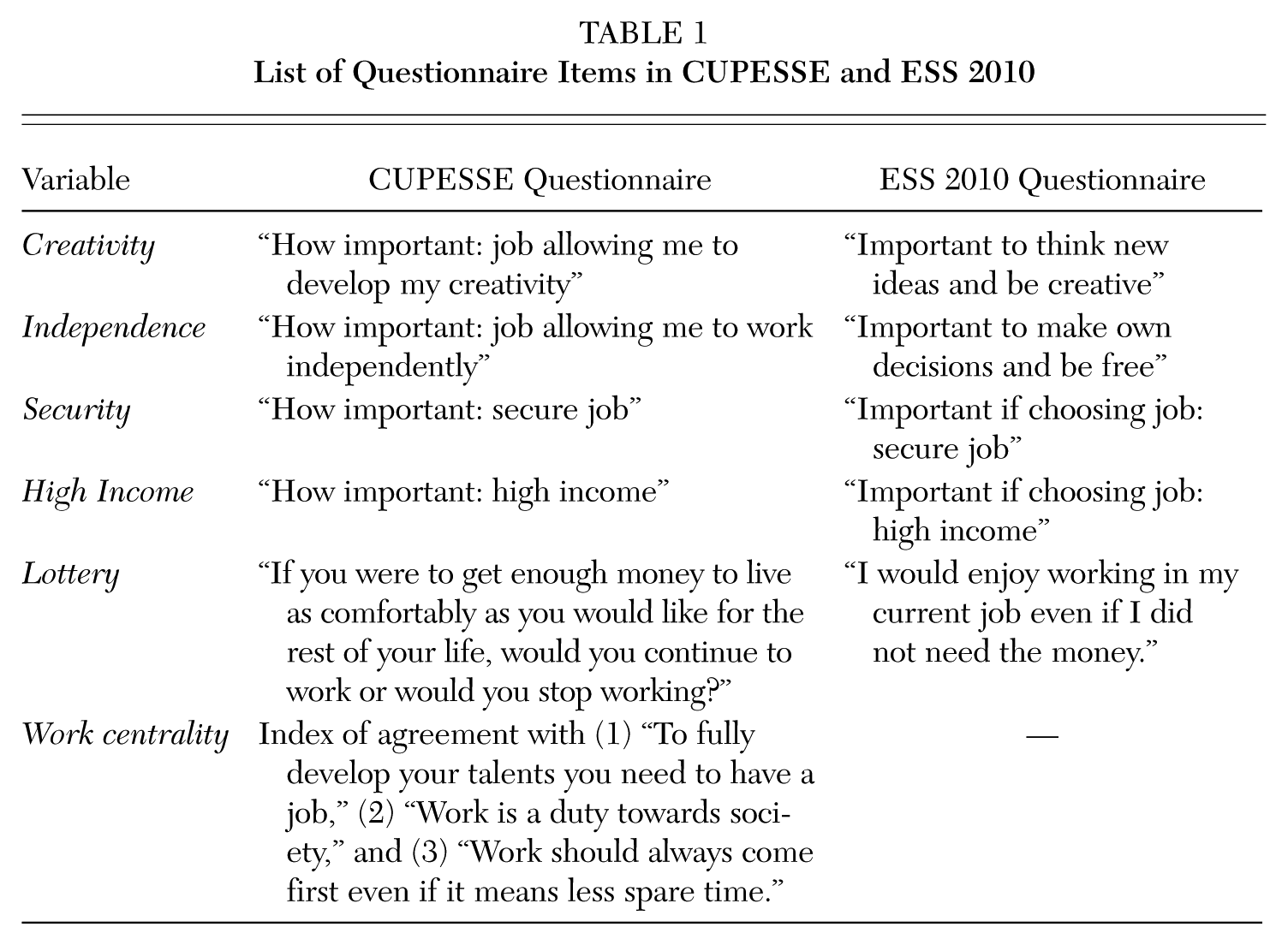
The third group of predictors contains the variables lottery and work centrality. In the CUPESSE dataset, the lottery variable describes whether respondents would continue to work or would stop working if they were to get enough money to live comfortably. It is categorical with the values of −1 for those who would cease to work, 0 for those who do not know, and 1 for those who say they would keep working nonetheless. The variable work centrality represents an index of three items, to which respondents are asked to express their degree of agreement. All indicators range from 1 (strongly disagree) to 4 (strongly agree). Cronbach’s alpha for this index is .61, and the average interitem correlation is .35. As this is a small three-item scale and Cronbach’s alpha grows with the number of items, such reliability may be considered as satisfactory (Cortina 1993) given that prior factor analysis suggested one underlying dimension for these variables. In the ESS dataset, the lottery item is retrieved from the similar question coded from 1 (strongly disagree) to 5 (strongly agree). Unfortunately, in the ESS data there are no equivalent items to calculate the work centrality index. Exact questions are listed and compared in Table 1. 4
We treat all items with Likert-type response formats as quasi-continuous interval data that allow parametric statistical analysis in line with the recommendations of Carifio and Perla (2007).
Model specification
As our dependent variable is a binary indicator, we conduct a binomial logistic regression. The coefficients display how a unit change in the independent variables affects the log of the odds to be self-employed compared to having a paid employment. For the CUPESSE models (1–3), we include the variable groups incrementally: first, we include only controls and country dummies; second, we add the different work values; and finally, we add the predictors concerning work centrality. Then, we model the regression of the ESS data (4–5), first including control variables only, then all variables. In line with the recommendations of Angrist and Pischke (2008), we do not apply any weights to the model estimation.
Results and Discussion
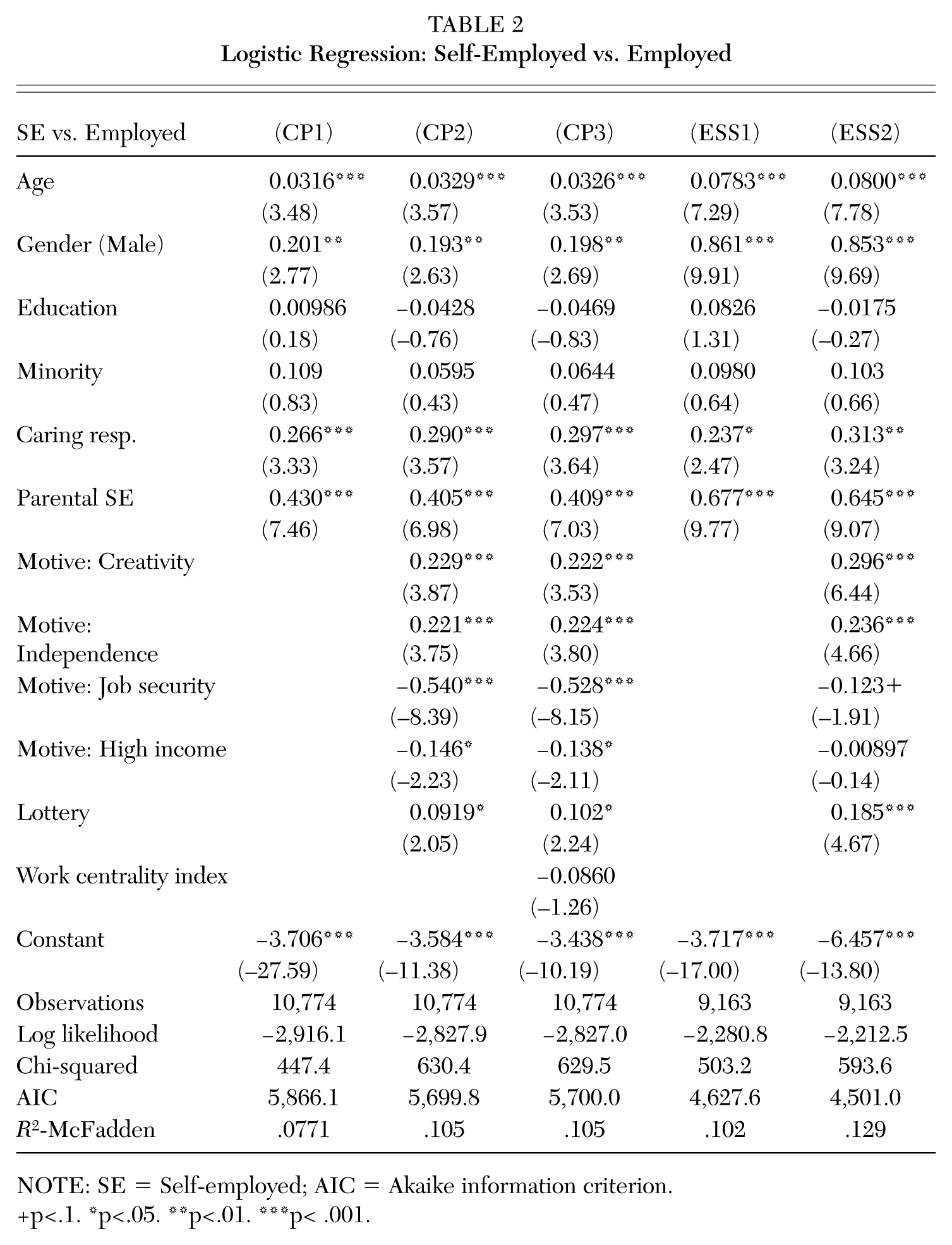
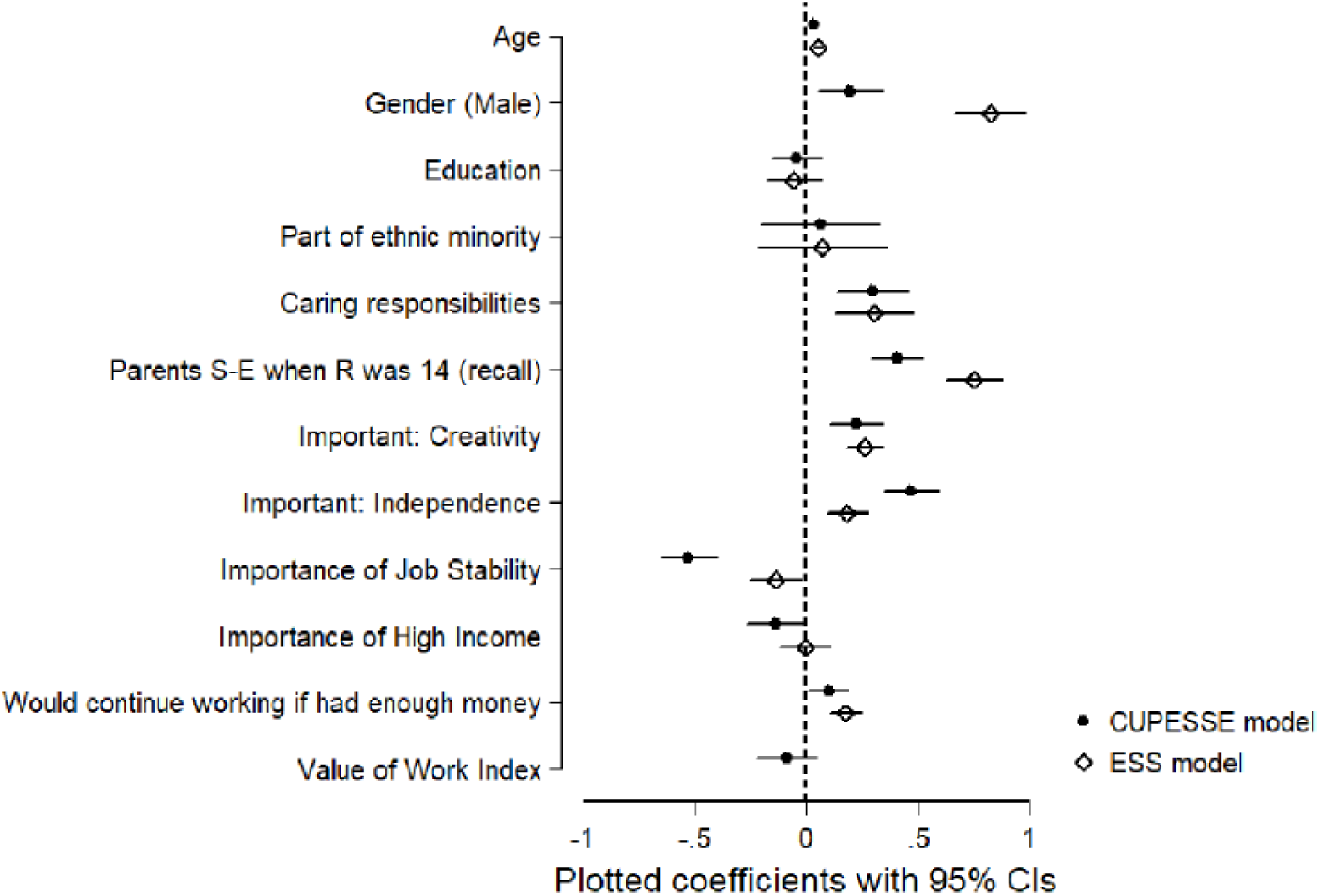
In the CUPESSE model (see Table 2), our expectations concerning work values receive partial support. Hypothesis 1, on the intrinsic work values, creativity, and independence, is fully supported: self-employed individuals are more likely than employees to value creativity (β = .222; p < .001) and independence (β = .224; p < .001) in CUPESSE data. Both our results for creativity and independence clearly confirm the findings of previous studies (e.g., Benz and Frey 2008; Burke, FitzRoy, and Nolan 2002) and underlie the importance of both values under different economic circumstances. Hypothesis 1b on the lottery indicator also receives full support (β = .102; p < .05). This finding further confirms the importance of nonpecuniary benefits of entrepreneurship as suggested by previous studies (Burke, FitzRoy, and Nolan 2002; Hamilton 2000).
Logistic Regression: Self-Employed vs. Employed
NOTE: SE = Self-employed; AIC = Akaike information criterion.
p<.1. *p<.05. **p<.01. ***p< .001.
Hypothesis 2 about extrinsic work values, income, and job security is also fully supported: self-employed individuals are less likely to value high income (β = –.146; p < .05) and job security (β = –.54; p < .001) than employees (cf. Tyszka et al. 2011; Hamilton 2000). Last, we must reject hypothesis 3 on work centrality. Self-employed individuals do not score significantly higher than employees with respect to the index (β = –.086; p > .1). In other words, self-employed people do not attribute a higher value to work in their lives than do employees. This result is surprising, especially in relation to the lottery question. These combined findings suggest that the willingness of the self-employed to continue working, even if they do not need to, is due not to the position of work in their lives and morals but to nonpecuniary benefits of entrepreneurship and satisfaction of their own intrinsic needs. Thus, in this regard, self-employment represents an attractive career choice that promises work as an enjoyable pastime.
Covariate Effects on Self-Employment
Moreover, the ESS model supports almost all results derived above. Hypothesis 1 is fully supported: self-employment correlates with independence (β = .236; p < .001) and with creativity (β = .296; p < .001). Also, hypothesis 1b on the lottery indicator receives full support (β = .185; p < .001). Hypothesis 2 on extrinsic work values, however, is not fully supported. In the ESS model, only security value (β = –.123; p < .1) significantly and negatively correlates with self-employment; the income variable is not significant. We suggest that the economic recession, which in 2010 was still around the peak stage, may have played a role in shifting the determinants of individual career choices: the value of high income may be lower during economic crises when unemployment is high and wages are under pressure. Indeed, some previous studies found that the higher rates of unemployment brought about by the economic crisis increased the chance that individuals started a business against their own preference, but by necessity (Vegetti and Adăscăliței 2017).
Considering prior studies, these results confirm the importance of intrinsic work values for self-employment as well as lesser importance of extrinsic values. Surprisingly, the self-employed score much higher in the lottery indicator, which suggests—in line with prior results—that they do not work for pecuniary benefits, but at the same time work does not take a more central position in their lives. One approach to address this finding could be that young adults do not understand work by itself as a duty or as central in their lives, but much more their current job with its specific benefits (cf. discussion of work centrality and job involvement in Paullay, Alliger, and Stone-Romero 1994).
Yet it remains unclear when and where these policy suggestions can enter political manifestos. Debus, Tosun, and Maxeiner (2017) discuss under which circumstances which parties tend to adopt these entrepreneurship-friendly policies in their political manifestos: with somewhat different implications for countries with a socialist heritage, parties are more prone to adapt entrepreneurship-friendly policies in times of economic hardship.
Conclusion
This study provides an empirical assessment of how different values attributed to work relate to different career paths among young adults. Previous literature shows that today’s youth regard work as less central in their lives and appear to value less both intrinsic and extrinsic factors (Cogin 2012; Twenge et al. 2010). Given the economic relevance of entrepreneurship for innovation and employment, policy-makers increasingly strive to support it (Dvouletý and Lukeš 2016). To tailor this support effectively, there is a need to understand motivational patterns behind entrepreneurship because such patterns predict the career choice of becoming and remaining self-employed.
Despite many studies inquiring about entrepreneurial motivation, none has so far differentiated work values and work centrality between employees and the self-employed. This study fills this gap with a specific analysis of young adults between 18 and 35 in thirty different countries in 2010 and 2016. Results provide mixed evidence for our expectations. One robust pattern emerging from the data is that intrinsic values, such as independence, creativity, and the willingness to continue working even if not needed, correlate positively with the probability of being self-employed. Thus, we support the link between self-determination theory and self-employment. On the other hand, we find that extrinsic factors such as valuing a secure job correlate more strongly with paid employment. For valuing high income, another extrinsic value, the negative association with self-employment holds in only one of the two samples used. Finally, we do not find any correlation between work centrality and self-employment.
This study contributes to the literature on young adults’ behavior in the labor market, the literature on entrepreneurial motivation, and last, to policy-makers’ understanding of the entrepreneurial mind. While work centrality has been found to decline among young adults (Twenge et al. 2010), the current study shows that this decline does not affect young adults’ choice to start their own business. Moreover, extrinsic work values and the prospect of high and secure income do not lead young people into self-employment; quite the contrary, it motivates them to become wage employees. Based on self-determination theory (Gagné and Deci 2005), one may even expect the opposite, namely, that various pecuniary subsidies offered to entrepreneurs may replace their intrinsic values and inhibit efforts to establish an entrepreneurial culture. This stands in contrast to classical economic views that extrinsic factors such as high income motivate entrepreneurs. Thus, political programs to boost entrepreneurship should not merely focus on such levers but rather provide as many opportunities for intrinsically meaningful self-employment as possible; political decisions regarding self-employment should not underestimate the importance of intrinsic values. Policies focused on reducing the red tape and bureaucracy may prove to be more efficient drivers of entrepreneurial activity as they enable entrepreneurs to enjoy more independence and creativity. Likewise, these findings suggest a new paradigm for entrepreneurship education: while many educational policies define entrepreneurial skills as key capabilities to be studied (including grading and testing), creating an atmosphere where students may freely develop self-determination, creativity, and independence may be a more promising avenue. Our study suggests that among younger individuals, the choice to become self-employed is driven largely by genuinely intrinsic values.
Supplemental Material
Online_Appendix – Supplemental material for Work Values and the Value of Work: Different Implications for Young Adults’ Self-Employment in Europe
Supplemental material, Online_Appendix for Work Values and the Value of Work: Different Implications for Young Adults’ Self-Employment in Europe by Gerbert Kraaykamp, Zeynep Cemalcilar, Jale Tosun, Martin Lukeš, Manuel Feldmann and Federico Vegetti in The ANNALS of the American Academy of Political and Social Science
Footnotes
NOTE:
We recognize financial support by the project Cultural Pathways to Economic Self-Sufficiency and Entrepreneurship (CUPESSE; Seventh Framework Program of the European Union; Grant Agreement No. 613257). We thank Fabian Kalleitner and one anonymous reviewer for their guidance and support, which improved this research endeavor in many ways.
Notes
Martin Lukeš is head of the entrepreneurship department and vice-dean for research and PhD studies at the Faculty of Business Administration, University of Economics, Prague. His research focuses on psychology of entrepreneurship, evaluation of entrepreneurship policies, and entry into self-employment.
Manuel Feldmann is a doctoral researcher at the University of Heidelberg in Germany, in the Department of Political Science. His research is directed at the connection of entrepreneurial psychology and policy with a focus on quantitative analyses.
Federico Vegetti is a postdoctoral research fellow at the University of Milan in Italy. His research interests lie at the intersection of political science, sociology, and psychology, which he investigates using mostly quantitative methods.
References
Supplementary Material
Please find the following supplemental material available below.
For Open Access articles published under a Creative Commons License, all supplemental material carries the same license as the article it is associated with.
For non-Open Access articles published, all supplemental material carries a non-exclusive license, and permission requests for re-use of supplemental material or any part of supplemental material shall be sent directly to the copyright owner as specified in the copyright notice associated with the article.
