







Abstract
Do states with more guns have higher rates of fatal police shootings? This article uses a validated measure of firearm availability (the percentage of suicides committed with a firearm) to examine the relationship between gun proliferation and fatal police shootings. It expands on existing research to include (1) measures of access to Level I and II trauma centers, (2) interpretation of the findings from the lenses of “statistical prediction,” and (3) tests for structural differences between models for black decedents versus nonblack decedents. Findings confirm the correlation between statewide prevalence of gun ownership and fatal police shootings for both all decedents and unarmed decedents. It provides partial support for “statistical prediction” by police and finds that greater access to trauma centers is associated with lower rates of citizen deaths. The analysis suggests a far broader range of policy options for saving lives, such as better enforcement of legal restrictions on firearm possession, than focusing solely on policing systems.
“An unarmed police depends, of course, upon an unarmed citizenry.”
Since 2014, highly publicized instances of fatal police shootings have reopened scrutiny of the factors that trigger deadly encounters with the police. Research on this issue has been limited, in part, because data from government sources cataloguing even a count of instances of fatal police shootings in the United States is woefully incomplete (Barber et al. 2016; Zimring 2017). The research that has been done has focused on community factors such as racial composition and levels of violence (Klinger et al. 2016; Takagi 1974; Goldkamp 1976) or the impact of police adoption of less lethal technologies than firearms (Ferdik et al. 2014). The research of Zimring (2017) and Sherman (2018), however, set the stage for a broadening of the inquiry into putative causes of this pressing but neglected problem.
This analysis focuses on another possible contributing factor to the problem—the availability of firearms. Hemenway et al. (2018) reported a strong state-by-state relationship between rates of fatal police shootings and the household prevalence of firearms availability. Using the Washington Post multisource database, the authors found a pronounced positive relationship across the fifty states between state rates of fatal police shootings and firearm prevalence. The analysis in this article expands on the Hemenway et al. study by adding new data, new concepts, and new models. The evidence presented here suggests a far broader range of policy options for saving lives—such as better enforcement of legal restrictions on firearm possession and rapid transport of shooting victims to trauma centers—than focusing solely on police behavior, or even police systems.
Analytic Context
Deadly force is justified when an individual poses a serious threat to the safety of the on-scene officers or bystanders (Harmon 2008). An armed individual is a prime example of such a threat. Klinger et al. (2016), in an analysis of police shootings in St. Louis, MO, report that in 79 percent of incidents in which police discharge their weapon, at least one of the suspects possessed a firearm. Zimring (2017) analyzes a dataset assembled by The Guardian of fatal police shootings in the United States in 2015 and reports that in 56 percent of those instances, the decedent possessed a firearm. For the data used in this analysis, which was assembled by the Washington Post and covers the period 2015 to 2018, the percentage of decedents possessing a firearm is the same as in the Guardian data—56 percent.
Because firearms, unlike most other weapons, provide the capacity to inflict bodily harm at a distance, suspects possessing firearms pose a particularly high risk to police officers. Zimring (2017) argues that weapon availability is the only plausible explanation for the vastly higher rates of fatal police shootings in the United States compared to European countries. Still, the linkage between firearm availability and fatal police shootings is not obvious. As described in Cook (2018), presently only 31 percent of U.S. households possess firearms. For the vast majority of those owners, there is no realistic prospect of their using the weapon for an illegal purpose. But Cook (2018, 360) goes on to observe, “In jurisdictions in which gun possession is common, offenders may find it easier to access a gun in the informal or underground market. Indeed, the stock of guns in private possession serve as a reservoir from which most problematic transactions originate.” By this mechanism, higher overall firearm availability may translate into more frequent encounters between police and armed suspects, even though most guns are held by law-abiding individuals. The general availability of firearms may also affect the probability of fatal shootings in circumstances in which the decedent is later (“ex-post”) found to be unarmed. Police officers must make judgments about the risk of harm at the beginning of each encounter (“ex-ante”). In places where gun availability is higher, police officers may surmise (ex-ante) that they are at greater risk of harm via what economists and statisticians call statistical prediction/discrimination and act accordingly. Police officers’ concern about encounters with armed suspects is real. Zimring (2017) reports that in more than 90 percent of killings of police officers in the line of duty, the killer inflicted the fatal injury to the officer with a firearm.
Data
This study uses statewide estimates of the rate of fatal shootings based on data assembled by the Washington Post on instances of police use of deadly force nationwide over the period 2015 to 2018. The data were assembled to remedy the shortcomings of data available from government sources, which underreport fatal police shootings by the police by at least 50 percent (Tate et al. 2016) or are limited to only a small subset of states (Barber et al. 2016). The Post created their dataset by searching local news reports, law enforcement websites, and social media; and monitoring relevant independent databases. For this analysis, the data for 2015 to 2018 were combined to create statewide rates over this period. 1
Two Centers for Disease Control and Prevention (CDC) sources were used to estimate two alternative estimates of gun prevalence by state. The primary estimate, which derives from the CDC’s WISQARS fatal injury reports, is the percentage of suicides statewide that are committed with a firearm. This percentage, which is commonly referred to as the FSS, is a widely used and validated measure of firearm availability (Cook and Ludwig 2006) and is calculated for each state for the period 2012 to 2014. A secondary CDC estimate is based on the 2004 Behavioral Risk Factor Surveillance System (BRFSS). Miller et al. (2013) used these data to calculate by state the percentage of households in which an adult is reported to possess a firearm. This survey-based prevalence estimate precedes the fatal shootings rates used in this analysis by a decade, but it is the latest available estimate based on the BRFSS.
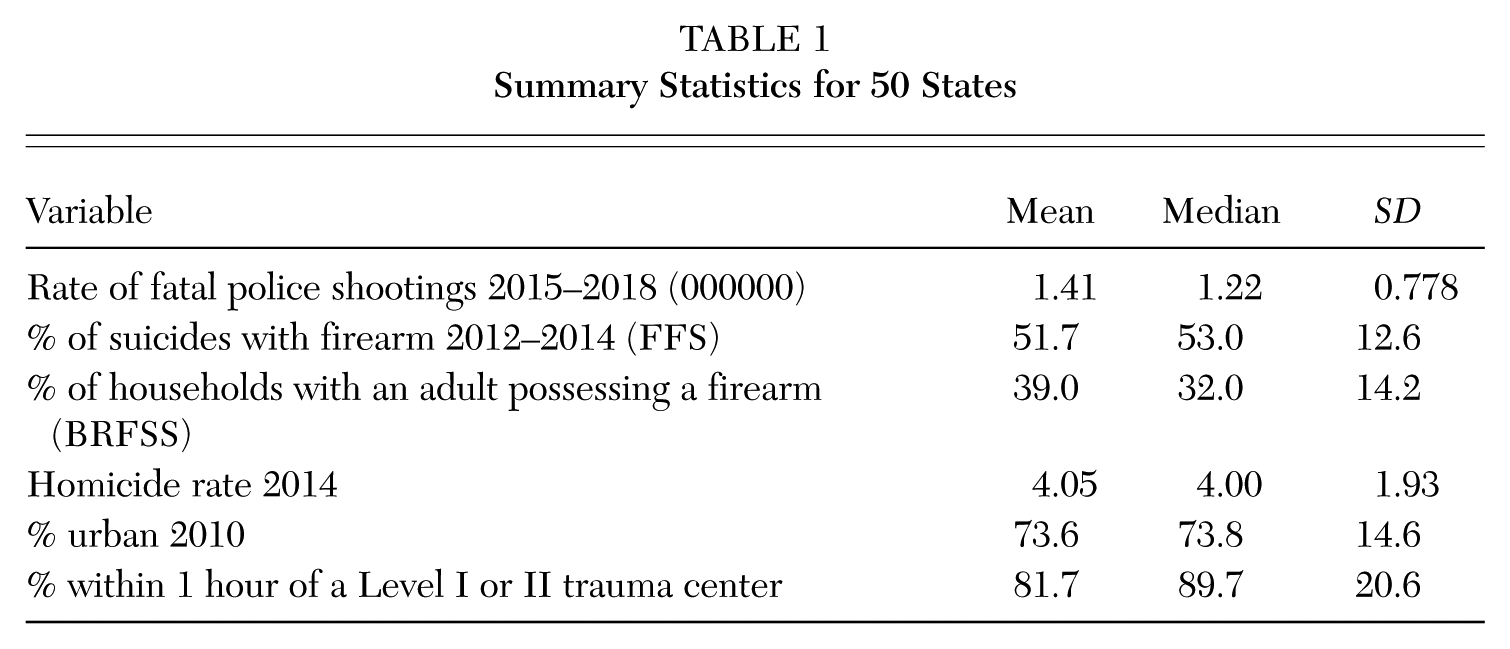
Also included in the analysis is an estimate of the percentage of the state’s population residing within one hour of a Level I or II trauma center (American College of Emergency Physicians 2014). As discussed in detail in Jacoby, Reeping, and Branas (this volume), proximity to a trauma center is often a decisive factor in whether a badly injured individual survives. Because the Washington Post data do not account for all violent encounters (they only record violent encounters with police that end in death), the proximity of trauma services is important to an accurate analysis. The analysis also includes the statewide homicide rate in 2014 and the percentage of the population living in urban areas. Table 1 reports summary statistics on all these variables.
Summary Statistics for 50 States
Analysis
As indicated at the outset, an armed citizen in a confrontational encounter with the police is a prime example of a circumstance where the citizen may be posing an imminent threat to the police and therefore is more at risk of being shot by the police. Thus, the first step in the analysis is to examine the correlation across the fifty states between firearm prevalence and the percentage of fatal encounters where the decedent possessed a firearm. That correlation is indeed positive and very pronounced: .54 for the primary firearm suicide proportion measure of firearm prevalence. But does this positive correlation translate into higher overall rates of fatal police shootings? Figure 1 suggests that it does. It plots the association of the natural logarithm of the rate of fatal police shootings with the natural logarithm of firearm suicide proportion (FSS). Superimposed on the scatterplot is the corresponding regression of firearm prevalence on the fatal shootings rate.
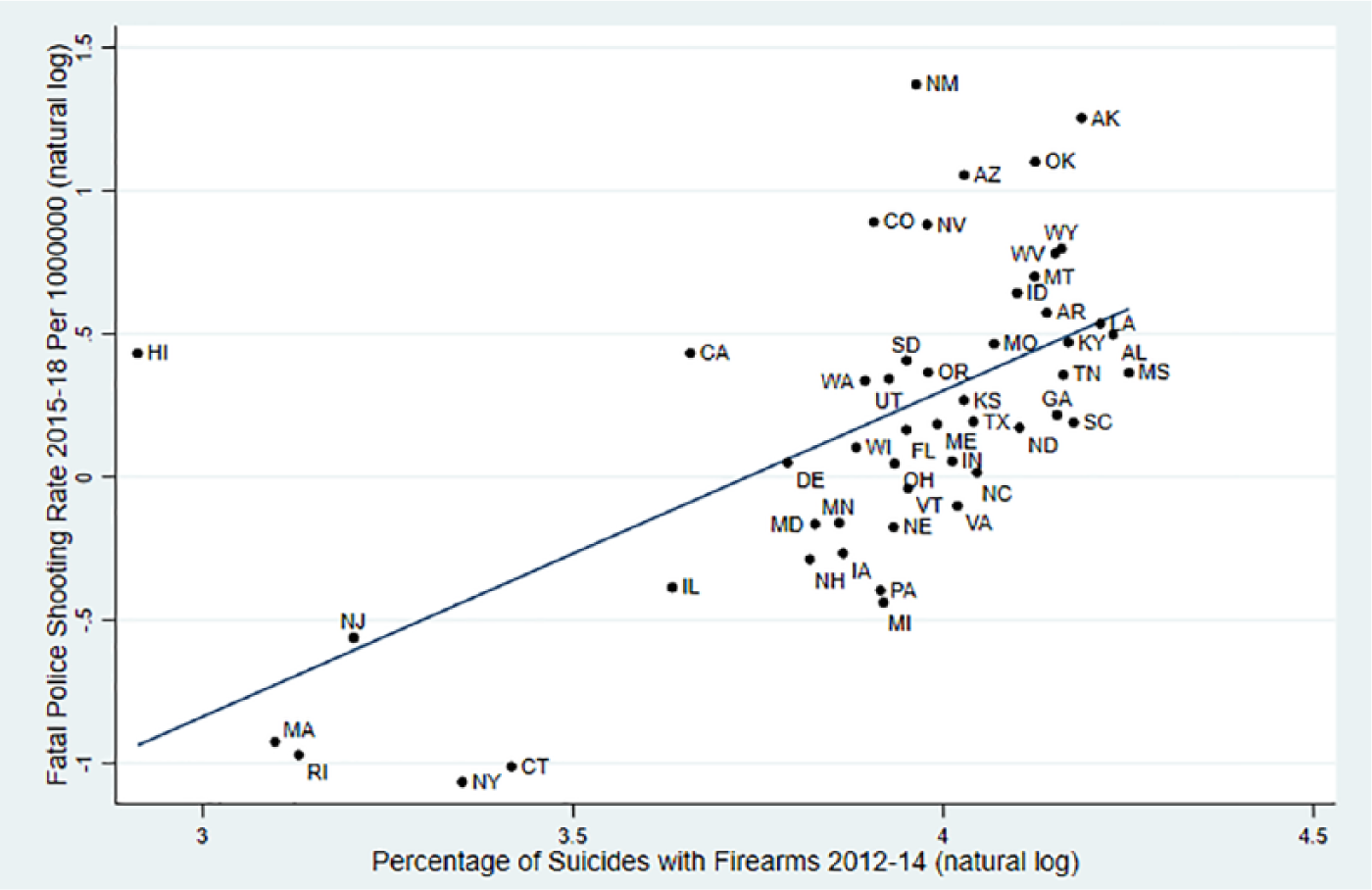
Fatal Shootings Rate 2015–2018 (natural log) versus Percentage of Suicides with Firearms 2012–2014 (natural log)
Table 2 reports a detailed technical analysis: a series of regressions in logarithmic form with robust standard errors. The most basic specification includes only the FSS and trauma care proximity measures. The percent urban and homicide rate variables are next added to the specification, followed by a specification expanded to include regional dummy variables distinguishing the four largest census regions—East, South, Midwest, and West. The regional dummy variables are intended to serve as catch-all variables measuring socioeconomic and demographic characteristics other than urbanization and the homicide rate to distinguish regions that are correlated with both the rate of fatal shootings and gun prevalence. Inclusion of the regional dummies is important because there are distinct differences across regions in gun prevalence, with eastern states tending to have the lowest prevalence rates and western states the highest prevalence rates.
Regression Results for Natural Logarithm of Rate of Fatal Police Shootings
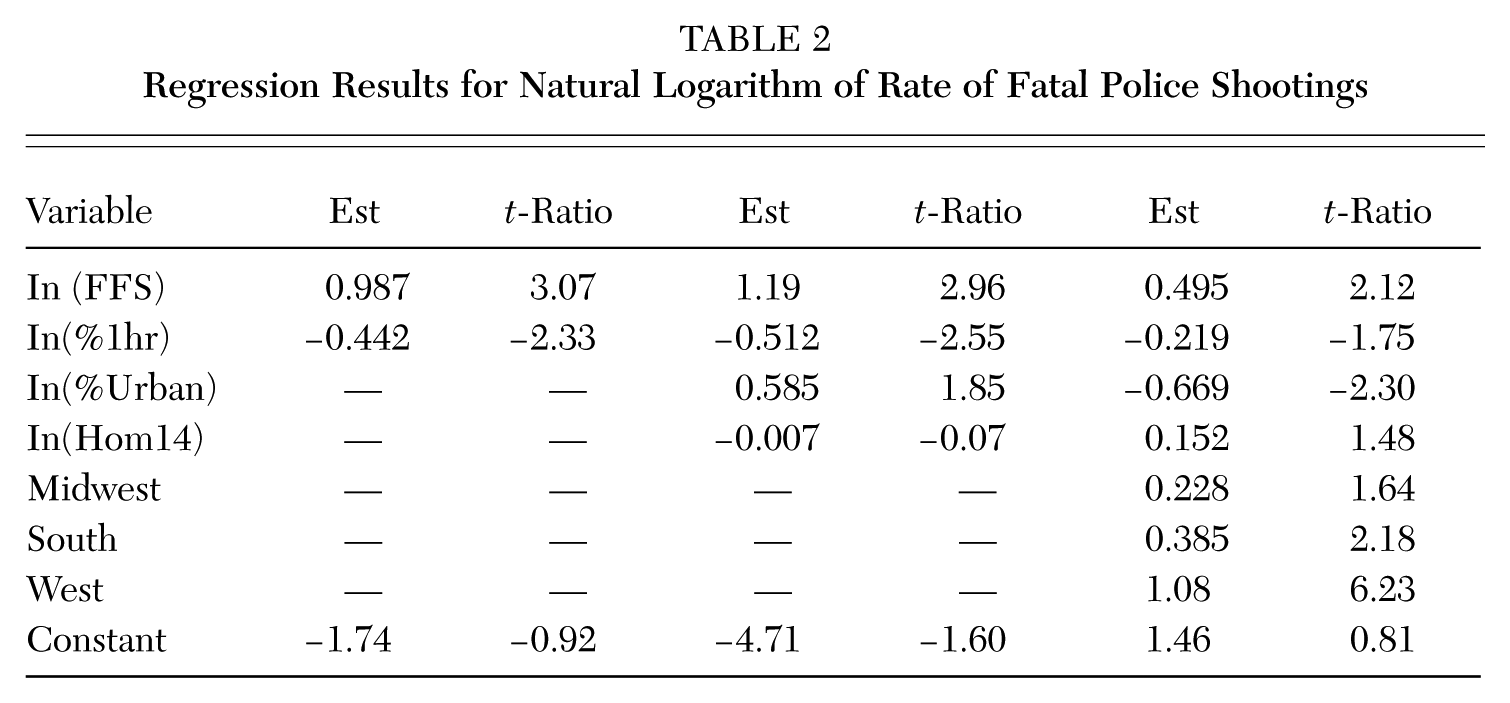
In all specifications, the FSS has a positive, statistically significant association with the fatal shootings rate (.05 or lower). The magnitude of that association, however, is sensitive to specification. Inclusion of the regional dummy variables reduces the association, which can be interpreted as an elasticity, from a 1 percent increase in gun prevalence being associated with about a 1 percent increase in the rate of fatal shootings to instead about a 0.5 percent increase in fatal shootings.
Trauma unit proximity is also associated with the rates of fatal shootings by police. Absent the regional dummy variables, this association is negative and significant—greater proximity of the population to trauma units is associated with lower fatal shootings rates. Inclusion of the regional dummies, however, reduces the magnitude of the proximity association by more than a half and leaves the association significant for only a one-tailed test at the 5 percent level.
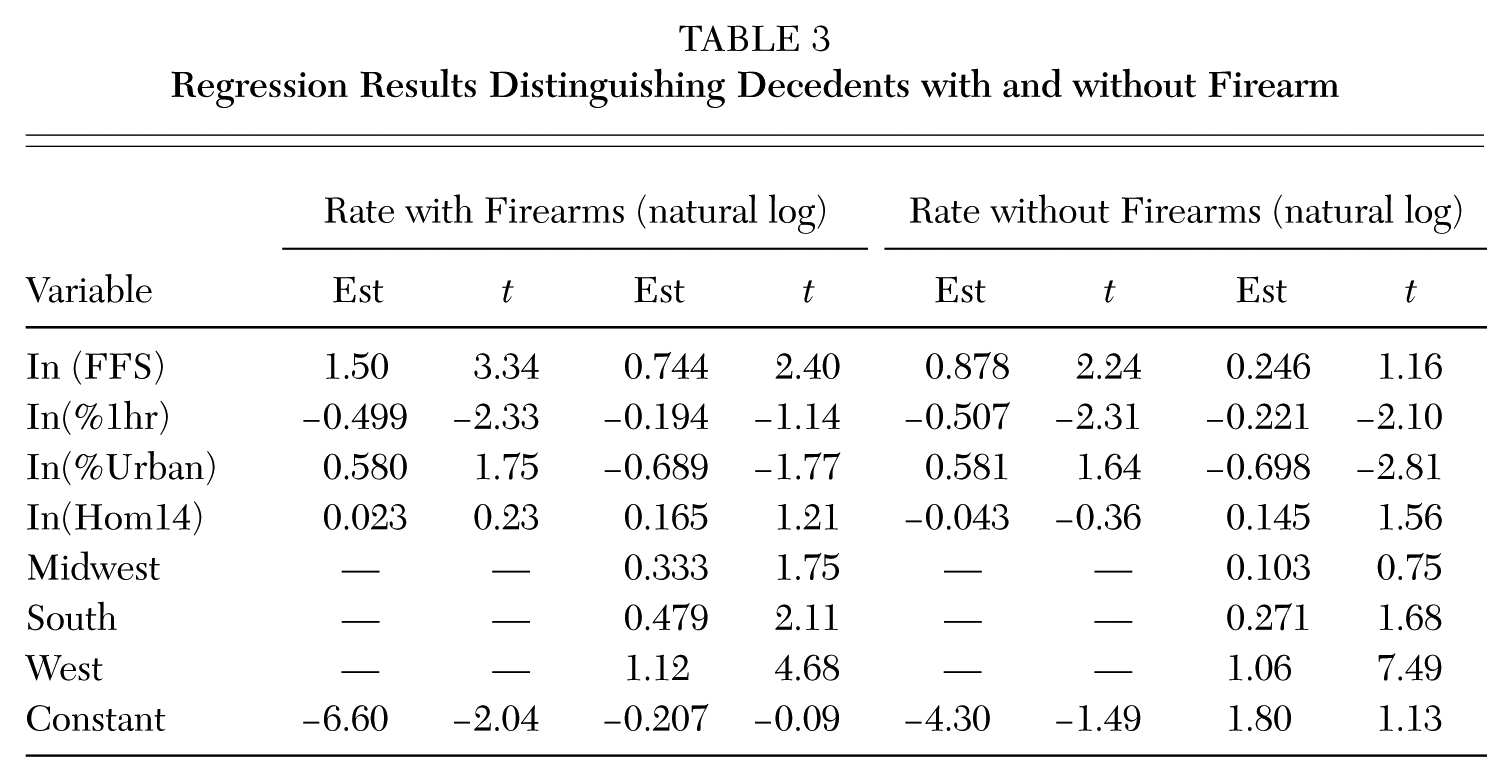
Table 3 reports counterpart regressions splitting out rates for individuals who were and were not found to have been in possession of a firearm when police shot them fatally. The gun prevalence elasticities are larger for the regressions based on rates of individuals with firearms than those without firearms. In all specifications, the elasticity estimates for individuals with firearms are significant (.05). Higher firearm prevalence is positively and significantly associated with the rate of fatal violence against individuals who were found not to possess a firearm, when analyzed without the regional dummies. 2 Inclusion of the regional dummies, however, leaves the coefficient estimate, while positive, insignificant at conventional levels of significance. These findings lend credence, albeit limited, to the statistical prediction/discrimination hypothesis advanced in the introduction of this article. That is, higher gun prevalence is associated with higher rates of police officers possibly anticipating a greater likelihood that suspects possess a firearm even when suspects had no gun.
Regression Results Distinguishing Decedents with and without Firearm
Race and Rates of Fatal Shootings
As with most measures of contact with the police, blacks are disproportionally represented among the decedents in the Washington Post data—24.5 percent of decedents were black, about twice their representation in the overall U.S. population. These data do not have nearly the detail required to make credible inferences about the influence of race independent of other characteristics of the encounter. The data, however, do potentially illuminate whether the association of firearm prevalence and fatal police shootings varies across race. Tests of differences in the coefficients of the FFS variable between separate regressions for black and nonblack decedents identified no significant difference, which implies that firearm availability does not differentially affect rates of fatality across race.
A variety of supplementary analyses were conducted to test the sensitivity of the results to an alternative measure of gun availability, the percentage of households in 2004 by state in which at least one household member reported owning a firearm, and to outliers. Regressions based on the alternative measure of gun prevalence yielded similar findings to those reported in Table 2 and residual analysis revealed no influential outliers, including, specifically, Hawaii, which can be seen in Figure 1 as a potential outlier. Negative binomial regressions based on the counts of fatal encounters by state yield similar results.
Discussion
The analysis identifies a pronounced, highly significant association between the statewide rate of fatal police shootings and the statewide prevalence of firearms. This association is not dependent on a statistical model with statistical controls or dependent on the presence or not of an outlying state. It is, however, an association based on a cross-sectional analysis of the fifty states. It, thus, begs the question of whether it can plausibly be interpreted as reflecting a causal effect of the availability of firearms on fatal police shootings. Confronting that question requires that we consider alternative interpretations.
Alternative interpretations include (1) reverse causality (hypothesizing that police use of deadly force might be the cause of firearm proliferation in the population), (2) suicide-by-cop (the prevalence of citizens who behave in ways threatening enough to cause the police to use lethal force), and (3) omitted variable bias (failure of this analysis to include the causal variable). Reverse causality would require that citizens are arming themselves for self-protection in anticipation of encounters in which the police might shoot them. This interpretation strains credulity. Rather than providing self-protection, arming oneself in police encounters is more likely a strategy for getting oneself killed. That fact brings us to the suicide-by-cop interpretation.
Undoubtedly, there are some instances in which the decedent was intent on provoking police officers to shoot them. Brandishing a firearm in the presence of police officers serves the aim of making the police the instrument of one’s demise. Thumbnail sketches of the fatal incidents at the Washington Post website, however, suggest that overt attempts to provoke the police for the purpose of committing suicide are rare. Unintended actions that may have that effect, however, are more frequent. In about 25 percent of the incidents, the decedent was judged to be mentally ill. The sketches of some incidents involving a mentally ill decedent involve aggressive behavior on their part with no apparent instrumental purpose beyond acting out delusional impulses. However, even in these circumstances, if the individual were not in possession of a firearm, the aggressive behavior is less likely to pose an imminent threat to the officer or bystanders, and thereby use of fatal force may be less likely. In this sense, the presence of a firearm may heighten the risk of fatal shootings independent of the intentions of the individual who is acting out. Most incident descriptions, however, involve circumstances that cannot plausibly be interpreted as reflecting a desire by the decedent to be killed by the police.
The third alternative interpretation is “omitted variable bias,” or the absence of another explanation that may actually cause the outcome and is highly correlated with the variables we have measured. This risk is always a concern in analyses of observational data, particularly in a cross-sectional analysis such as this one that includes only a limited number of observations. The risk in this case, however, begs the question of what those unmeasured causes might be. Figure 1 shows that the bivariate correlation between state-level rates of fatal shootings and the FSS-based measure of gun prevalence is pronounced. A counterpart figure based on the BRFSS-based measure of prevalence is comparably pronounced. Gun prevalence across states is not random—prevalence is lowest in more urbanized eastern states and highest in more rural western states. However, as the regressions reported in Table 2 show, the association between gun prevalence and fatal shooting rates persist even with the addition of urbanization and regional dummy variables to the regression and controls for proximity of trauma services and the homicide rate.
Other sources of omitted variable bias may, of course, remain. Of particular concern are the very large regional differences in fatal shootings rates. Potential confounders not adequately accounted for by the regional dummy variables may thus remain unidentified. Notwithstanding, the fact that the association is resilient to the inclusion of four important potential sources of bias is noteworthy.
None of these alternative interpretations, in my view, provides a compelling alternative explanation for the associations reported in Tables 2 and 3. Rather, the leading candidate is the evidence we have analyzed. That evidence supports the interpretation that one consequence of higher rates of firearm prevalence in a state is a greater frequency of police encountering individuals who are armed or suspected to be armed, which in turn results in a greater frequency of police using fatal force.
Policy Implications
What are the policy implications of this conclusion? One is to take steps to reduce the availability of firearms to active offenders or individuals at high risk of offending. Policies that are intended to have this effect are universal background checks and barriers to straw purchases (Cook 2018; Zimring 2017). Sherman (2018) also makes numerous policy recommendations related to the governance and training of local police. Keeping weapons out of the hands of the mentally ill may also be effective.
Although not the principal focus of the analysis, the analysis also found a pronounced negative association between the fatal shootings rate and proximity to trauma care—not a surprising finding. Promptly administered emergency care to traumatic injuries such as gunshot wounds can often make the difference between life and death. Thus, the analysis also serves to reinforce the policy recommendations on trauma care made in Jacoby, Reeping, and Branas (this volume), Zimring (2017), and Sherman (2018).
Footnotes
Notes
Daniel S. Nagin is Teresa and H. John Heinz III University Professor of Public Policy and Statistics at Carnegie Mellon University, an elected fellow of American Academy of Political and Social Science, and the recipient of the Stockholm Prize in Criminology in 2014 and National Academy of Science Award for Scientific Reviewing in 2017.