







Abstract
Poverty rates among single parents vary considerably across countries, in part reflecting differences in the generosity and design of minimum income protections. We ask what the optimal ways are to target income support to single parents, if the prime objective of policy is to shelter those households from poverty. We map minimum income provisions for working and nonworking single-parent households across Europe and the United States, showing that three things matter for adequate minimum income protection. First, minimum wage levels matter, obviously for working single parents, but also for jobless ones since they effectively set the ‘glass ceiling’ for out-of-work benefits. Second, the overall generosity of the child benefit package is crucial to shelter both working and jobless single parents from poverty. Third, countries that employ a strategy of “targeting within universalism” (that is directing extra support to vulnerable groups such as single parents within the context of a universal benefit program) tend to do best.
Single parents face particular challenges. Even in the most developed welfare states, they are confronted with high poverty risks. Nieuwenhuis and Maldonado (2018) point out that single parents are caught in a triple bind of not having adequate resources to find employment that is adequate to provide economic well-being, while benefit levels are inadequate as well. Altogether, single parents face difficulties in combining the roles of sole breadwinner and sole care provider. They obviously lack the options that couples have to share these tasks.
Because of the particularly challenging circumstances that single-parent households face, there is a relatively easy case to be made for providing those households with extra public income support. Just as welfare states already redistribute from childless individuals to families with children to minimize the welfare loss associated with childrearing, the state could also, as it were, step in as a substitute for the income from an absent partner. Extra income through social transfers, for example, can enable them to outsource some caregiving. Or the extra money may allow them to work less and devote more time to parenting.
On top of the inherent challenges single parents face, they are also more likely to be in a weaker economic position. Most single-parent families are headed by women (Chzhen and Bradshaw 2012). They are thus at a disadvantage in terms of labor market opportunities and earnings, especially when they have lower levels of education (Gornick 2004; Härkönen, Manzoni, and Bihagen 2016). Moreover, the lower skilled among them are often reliant on jobs in sectors like retail, hospitality, or social services that require childcare at the most irregular hours, exacerbating work-care struggles that are hard enough as they are.
In short, single parents are in an inherently disadvantaged economic position in societies where double-earner households set the norm. And the less skilled the working parent is, the more the disadvantage compounds, not just because of their lower earnings capacity, but also because of their reliance on jobs with irregular hours that generally cannot be worked remotely. All of this warrants a degree of preferential treatment, especially if a child’s well-being is the principal concern. Poverty has detrimental effects for children for the entirety of their life course, especially in terms of educational and cognitive outcomes (Najman et al. 2009; Lacour and Tissington 2011).
There is thus a multifold and well-documented rationale for providing single parents with extra state support—“targeting” in social policy terminology. This begs the core question in this paper: what is the optimal degree of targeting when it comes to providing income support to single parents, especially if the prime objective is to shelter them from financial poverty?
The Complexities of Targeting Public Income Support
The debate on targeting essentially comes down to the allocation of resources: who should get what degree of social protection? Benefits are targeted if there is variation in the statutory benefit amount across different categories of the reference group. Oppositely, benefits are universal if they are given to all members of the reference group, regardless of their income or other conditions.
In between, there is a range of possible variations in benefit allocation. A benefit could for example only be awarded to households under a certain income ceiling. This is what we call low-income targeting. One could also choose to only provide benefits to the members of a certain risk group, such as single parents. This is categorical targeting. But a benefit can also be designed in such a way that—although everyone receives the benefit—certain persons receive a higher amount. This is commonly referred to as “targeting within universalism”.
But there are also limits to targeting towards single parents, or so it can be argued.
First, there has been a trend towards individualization of social and welfare rights for emancipatory reasons (Alm, Nelson, and Nieuwenhuis 2019; Jepsen and Meulders 2002). Advocates of gender equality in particular have pushed for rights that are independent of marital status or household context. This has resulted in a decline of social security rights that distinguish by household status and thus indirectly discriminate against women, for example, in the shape of higher benefits for sole breadwinners. Similarly, personal tax systems in many countries have moved away from joint taxation systems, which effectively tax dual-earner households more, towards more individualized approaches.
Second, there is concern about what targeted benefits do to behavior. In Losing Ground, Charles Murray (1984) claimed that U.S. policies to help single parents had led them to become dependent on that support. He claimed that American welfare as it then existed had brought breakdown of the traditional family and more children out of wedlock. The book ignited a storm of criticism, especially from policy scholars, but the fact that it resonated in the public and political sphere said a lot about the perceptions and concerns that existed. Bill Clinton successfully campaigned on the promise to “end welfare as we know it,” essentially acknowledging and echoing Murray’s critique. Similar debates have existed elsewhere, albeit often in more veiled terms. Concerns of work and family formation incentives clearly affect the political feasibility of support targeted at single parents.
Add to that the well-known argument among social policy scholars that programs for the poor tend to become poor programs. In 1998, Korpi and Palme famously claimed that the more countries target benefits at the poor, the less likely they are to reduce poverty. That, they argued, is because strongly targeted benefits, being politically less popular and robust, tend to be smaller programs. Research has shed critical light on such claims. Somewhat of a consensus seems to have emerged that “targeting within universalism” yields the best redistributive outcomes (Jacques and Noël 2018; Marx, Salanauskaite, and Verbist 2016; Van Lancker and Van Mechelen 2015). That is because two channels of poverty reduction are simultaneously at play: large budgets along with higher benefit levels for the families most at risk of poverty.
Thirdly, targeting brings complexity (Brady and Burroway 2012; van Oorschot 2002; Bradshaw 2012). The more targeted and conditional income support provisions are, the more complex they can become. Benefit recipients lead complex lives, requiring rules covering every possible contingency. People may draw on many different sources for their incomes. Incomes from work may not be regarded in the same way as, for example, alimony payments. People may have complex or unusual living arrangements, especially when they are newly repartnered or when there are other adults living in the household, for example, dependent elderly people. All these complex and sometimes exceptional situations require rules to determine eligibility, increasing the effort required on the part of applicants to find out what they are entitled to and how that may change if something changes to their circumstances. Yet many people do not have the time and/or capacity to process that complex information. One important consequence is significant non-take-up of strongly targeted benefits, effectively limiting their capacity to help.
So, what is the optimal degree of targeting when it comes to providing extra support to single parents if we want to shelter them from financial poverty? For this purpose, we empirically map minimum income provisions for working and nonworking single-parent households across rich welfare states, identifying the best-performing countries, and trying to determine what those countries have in common in the provision of support to single parents.
How We Compare Minimum Income Support across Countries
Our objective is to compare the adequacy of minimum income support provisions for both working and nonworking single parents across the European Union (EU), the UK, and the United States for 2020/2021. Adequacy refers to the level of the income package relative to the poverty line in each country, for that family type. To gauge adequacy, we use model family type simulations reflecting the net disposable incomes of single parents in situations of interest, taking into account all the relevant benefits and taxes in each country.
For our calculations we use EUROMOD, a tax-benefit microsimulation model that allows us to calculate, in a comparable manner, the effects of taxes and benefits on household incomes for each EU member state and the UK. EUROMOD also includes an add-on, called the Hypothetical Household Tool (HHoT), that allows us to simulate the effect of the tax-benefit system on model family types. Calculations for the United States were carried out separately using the same methodology.
The most interesting feature of this approach is that it is directly reflective of policy intent; that is, it is reflective of what policy seeks to achieve. An alternative approach could be to look at poverty outcomes, for example on the basis of representative household survey data, but such outcomes are only partially driven by policy. Labor market and economic conditions and sociodemographic differences matter at least as much. It is nevertheless important to stress that our family type estimates represent a “best-case” scenario, in which families are fully aware of all the benefits to which they are entitled and take the necessary steps to apply for those. In reality, there is imperfect enforcement, for example of minimum wages, and there is imperfect take-up of benefits due to bureaucracy hurdles, stigma or low levels of knowledge of a given program. In the United States, for example, we assume that jobless households receive both Supplemental Nutrition Assistance Program (SNAP) benefits and cash assistance from Temporary Assistance for Needy Families (TANF). In reality, however, access to TANF cash assistance is increasingly difficult to acquire. Thus, our minimum income packages for jobless households in the United States may overstate the average level of income that these households receive in reality. Similar caveats are likely to apply to other countries, as well.
Table 1 provides an overview of our general assumptions regarding the selection of the model family types. For our purposes, we contrast a 35-year-old single parent with a couple of the same age, both with two children aged 7 and 14, in two different income situations.
As we are interested here in the minimum income floor below which nobody is supposed to fall, we assume
Aside from the earned wage and/or income supplements provided by the tax-benefit system, the model families are assumed to have no savings or other income sources. Finally, households are assumed to be tenants on the private market. Rents are set at the national median market rent for each family type.
Core Features of the Model Family Types
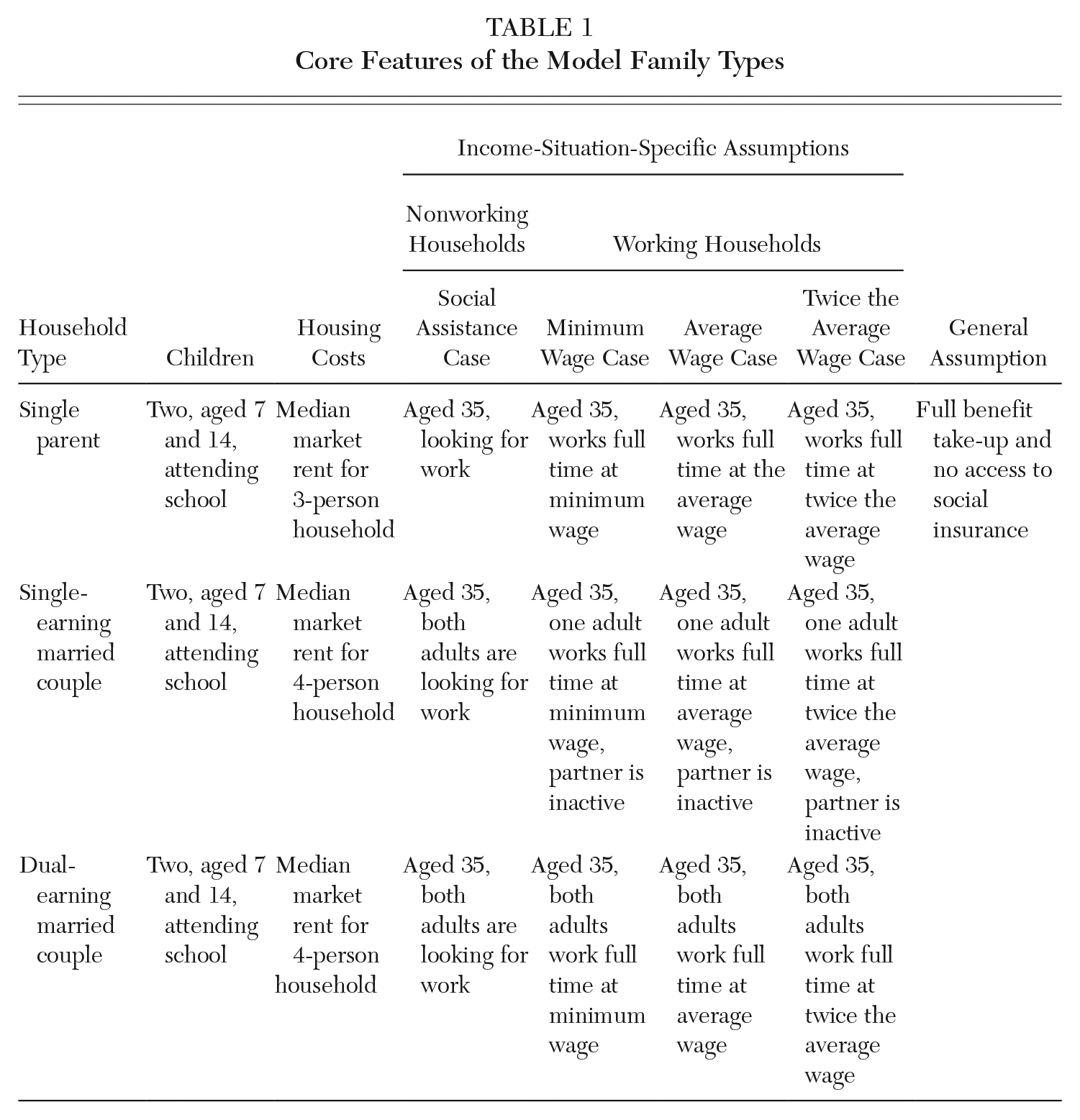
In measuring the legally guaranteed minimum income situation in each country, we include all income transfers that people are entitled to by law and are simulated in the tax-benefit microsimulation model EUROMOD. We thus limit ourselves to a strict focus on income only. Admittedly, the adequacy of minimum income packages is defined not solely by the level of household income it guarantees, but also by inter alia additional cost compensations and in-kind benefits for low-income households, duration requirements, strict-means tests, and sanctions.
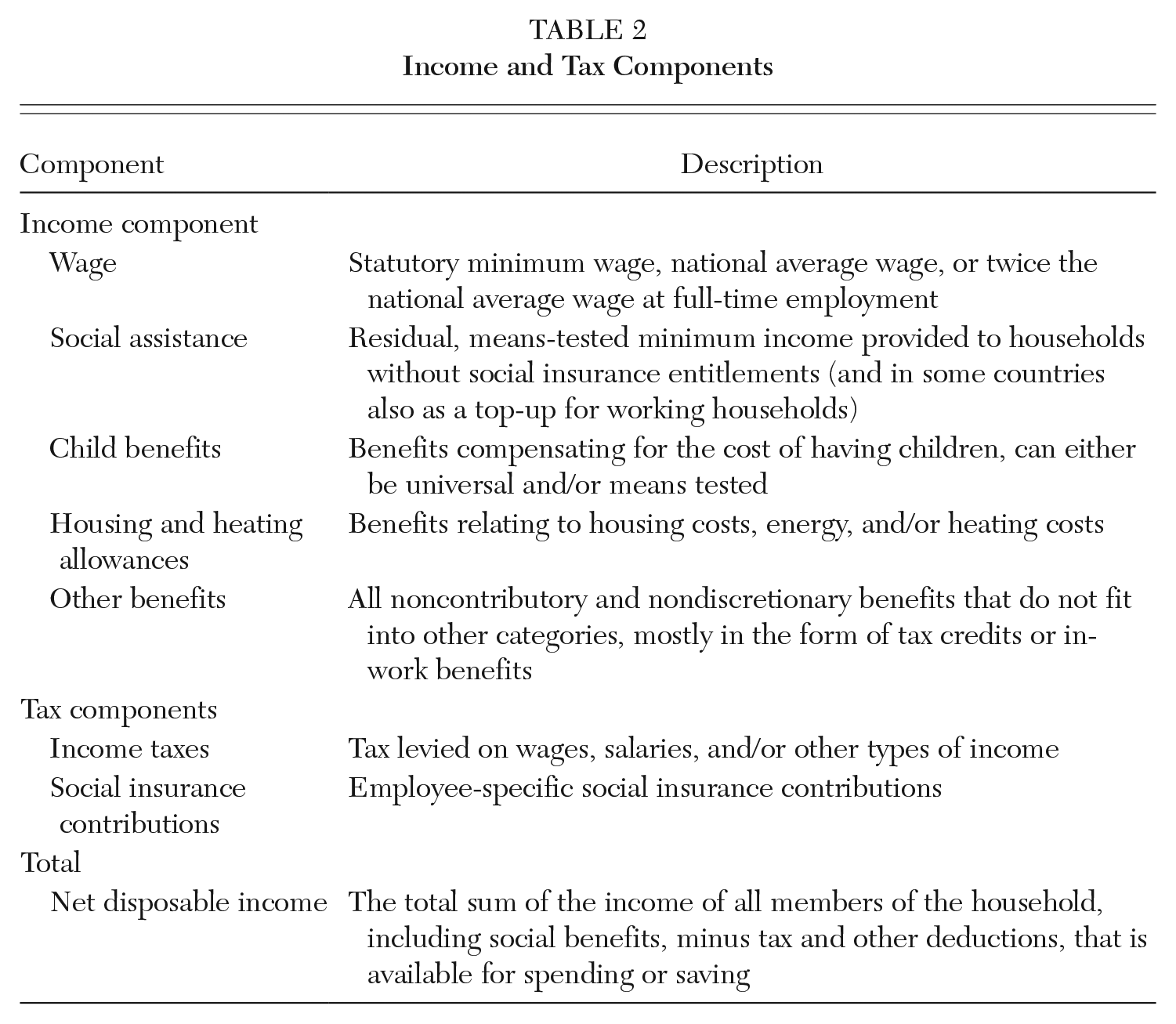
Table 2 gives an overview of all the income components and protections we consider. In the selection of applicable schemes, we follow a risk-type approach, by first establishing the specific situation and then assessing which schemes would be applicable in each country according to national tax-benefit legislation. For working households, we naturally start with wages. In the nonworking case, the first income component comprises social assistance. These earnings will then be affected by direct taxes—the income tax and social insurance contributions individuals have to pay. These typically reduce income, except in the case of (refundable) tax credits. Lastly, we take all nondiscretionary and noncontributory cash benefits into account for which our model families are eligible. We exclude all temporary COVID-19-related policy measures as we are interested in the structural situation of single parents at the bottom of the income distribution.
Income and Tax Components
We calculate minimum income provisions for all EU member states, with two notable exceptions. In the working case, only countries with (quasi-)statutory minimum wages are considered. This rules out Cyprus, Denmark, Finland, Italy, and Sweden. In addition, Denmark, Finland, and Slovenia are excluded from the single-parent case due to missing single parent benefits in the microsimulation model EUROMOD. In addition, we will also include the United Kingdom (UK). The UK government is currently rolling out the Universal Credit, which is set to replace the so-called “legacy” benefits—including unemployment benefit, tax credits, and housing benefit—into one benefit paid monthly to claimants. With the rollout still underway, we estimate both the full legacy benefit situation (labelled UK – ORIG) as well as the universal credit situation (labelled UK – UC indicating Universal Credit).
In addition, we will pay particular attention to how the United States compares relative to the UK and the EU member states. Recently, the US introduced the American Rescue Plan of 2021 (ARP). The ARP is a $1.9 trillion aid package that President Biden signed into law in March 2021 to provide economic relief amidst the ongoing COVID-19 crisis. One key element of particular interest is the substantial expansion of the Child Tax Credit (CTC). For the 2021 tax year, the CTC is upped from the original $2,000 credit to $3,000 per child aged 17 or younger and $3,600 for children under the age of 6. The expanded CTC is fully refundable, meaning that nonworking households are now also eligible to receive the benefit. In the simulations below, we only include the six monthly CTC payments that a family receives within 2021; we exclude the additional payout that households may receive in spring 2022 after completing their taxes. In order to evaluate how this reform shifts the level of minimum income protection in the United States, we estimate both the before (labelled US – ORIG) and after (labelled US – BP indicating “Biden Plan”) situation.
Definitions
Before proceeding to the results, it is important to clarify some of the key concepts that are used throughout this article.
At-risk-of-poverty threshold
We express the net disposable income, and related income components, as a percentage of the at-risk-of-poverty threshold (AROP60). This is the official indicator used by the European Commission, which defines poverty as having a net disposable income below 60 percent of the national median equivalent household income. Equivalization entails giving members of the household different weightings—using the modified OECD equivalence scale—in order to take account of the differences in household size and composition. The total household income is then divided by the sum of the weightings to yield a representative income. In the United States, poverty is typically measured in a different way, but we apply the EU-style relative income threshold to maintain consistency across the countries examined.
Child-related benefit package
The child-related benefit package is a concept that includes all child-related income support given to a household with children, going from child benefits and child tax credits to social assistance top-ups or housing allowances that take account of the presence of a child. Empirically, we quantify the value of the child benefit package by deducting the net income of a hypothetical childless family from the net income of an identical family with children at the same earnings level. Due to a lack of cross-nationally comparable and up-to-date childcare costs in EUROMOD, our analysis is confined to primary and/or secondary school children only. A caveat thus is that we do not factor in any benefits geared towards young children, such as childcare compensation schemes. Note also that childcare compensations depend on the actual take up of and availability of childcare. The minimum wage worker we look at here is very likely to be employed in hospitality, retail or services, where nonstandard hours are common. People in such jobs have a very hard time finding suitable childcare. So the assumption that low-income households will always get the full compensation they are entitled to on paper would be a very strong one indeed, even if we had the data on that. This having been said, policies aimed at making childcare more affordable can nonetheless have an important poverty-alleviating effect for single parents, but only if these childcare investments are actually being allocated to poor households with children (Hufkens et al. 2020; Van Lancker and Ghysels 2012; Pavolini and Van Lancker 2018). If subsidized childcare slots, for example, flow back to those already in work, the so-called Matthew effect, then the poverty impact is low.
Targeting indicator
In order to fully capture the targeting design of the child benefit systems across different countries, we adopt two distinct targeting indicators.
Income targeting implies allocating a higher benefit amount towards low-income households, usually based on a means test. To operationalize income targeting, we adopt the income targeting indicator proposed by Marchal and Van Lancker (2019). When applied to our institutional model family simulations, the concentration coefficient offers a measure of the extent to which child benefits are intended to end up with richer or poorer income groups. For most of the countries, we have information on the level of the child benefit package for four income cases: a single parent receiving social assistance, a single parent living on a minimum wage, a single parent earning the average wage, and a single parent making twice the average wage. The concentration coefficient is then expressed as follows:

with benefit B, income distribution Y, and G(Y) the cumulative distribution function of Y. The concentration coefficient assumes a value between −1 and 1. A value of TI < 0 denotes targeting towards lower income households, TI > 0 denotes targeting towards higher income households, and TI = 0 indicates that the child benefit package is strictly universal. The advantage of this indicator is that it is intuitively interpretable and comparable across countries. And, in comparison to other income targeting measures, it can also handle both nonlinear targeting and targeting within selective systems.
Categorical targeting implies providing higher benefits to specific risk groups, such as single parents. To operationalize single parent targeting, we adopt the single-parent targeting indicator proposed by Van Lancker, Ghysels, and Cantillon (2015). By comparing between couples and single parents—whose only difference is the fact that the latter, holding other factors constant, do not have a partner—we can directly measure the statutory degree of targeting towards single parents. More specifically, we estimate the ratio of the child-related benefit package that single parents are entitled to over the child benefit package that couples are entitled to for both the social assistance and minimum wage case. A value of TI > 1 denotes targeting towards single parents, TI < 1 denotes targeting towards couples, and TI = 1 indicates that couples and single parents are entitled to an equal child benefit package.
What We Found
Minimum income protection for working single parents—the state of affairs
We start with a look at working single-parent households. Figure 1 presents the net disposable income of a single parent with two children depending on one full-time minimum wage and this relative to the 60 percent poverty threshold.
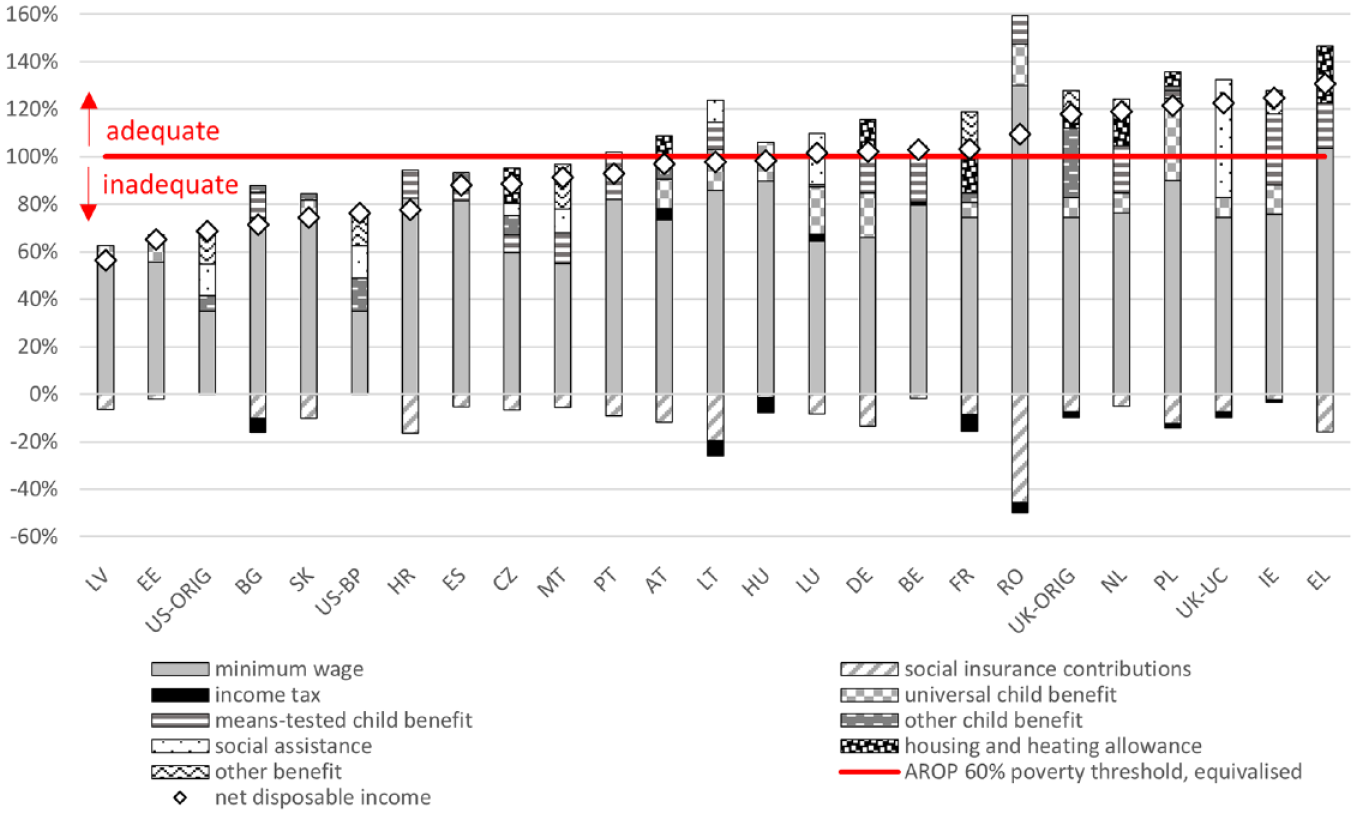
Working Single Parent with Two Children—Minimum Wage
Nearly all EU member states have either a legal or collectively bargained minimum wage. Levels differ markedly between countries. Minimum wages for full-time workers are comparatively high in relative terms in Romania and Greece. At the other end of the spectrum, the U.S. federal minimum wage is exceptionally low by international standards. In fact, the highest minimum wage outranks the U.S. minimum wage by a factor of almost four in relative terms. A minimum wage income is almost never sufficient to lift a single parent with two children above the poverty line. The average minimum wage, net of taxes and social security contributions, relative to the poverty threshold, equals only 64 percent. This is far below the level needed to be free of poverty.
Fortunately, tax-benefit systems have an important impact on living standards of minimum wage households. The value of the benefits households get generally surpasses any taxes or social insurance contributions. The overall level of financial support provided to single parents nonetheless varies largely across different welfare states. Gross-to-net efforts range for example from a burden of about 20 percent of the poverty line in Romania to an added boost to the net disposable income equal to almost 50 percent in the United Kingdom.
Child benefits are the most common and important form of income support for households with children. All countries provide some type of child benefit, whether it is universal or means tested, or both. In a third of the countries covered here, single parents working at the minimum wage are also still eligible for means-tested social assistance top-ups. These ensure that in-work income exceeds the out-of-work social assistance benefit, through earnings disregards in the calculation of the top-up. Next, some households in the situation simulated here are granted housing and/or heating allowances 1 to compensate for the cost of living. Finally, targeted income support is available to those in employment in some countries. These take the shape of employment-conditional benefits of one type or another to boost in-work income. Examples of considerable in-work benefits are the Prime d’Activité in France, the In-Work Benefit in Malta, the Earned Income Tax Credit (EITC) in the United States and the Working Tax Credit in the UK, which is being replaced by the Universal Credit.
All these different income components together make up the net disposable income of a household. In about half of the countries, a single parent raising two children and working full time at the minimum wage will have an income package above or around the poverty threshold. This implies that in the other half of the countries single parents will inevitably be at risk of poverty if they have no other source of income besides their earnings from minimum wage employment. The countries that guarantee the highest net disposable incomes are Greece, Ireland, the UK, Poland, and the Netherlands.
Figure 1 also shows that the level of income protection guaranteed in the United States is worryingly low. The expansion of the CTC, part of the ARP, if it were to be made permanent, would certainly improve the situation of single parents in the United States, but would not yet propel the United States to a leading position compared to other peer countries.
In the online appendix, the minimum income situation of a single parent can be compared to the minimum income situation of a single- and dual-earning couple with children. Surprisingly perhaps, net disposable incomes tend to be slightly more sufficient for low-paid single-parent households compared to single-earning coupled-parent households. That is mainly because single parents often receive benefits that are as high as what couples with children get, while having one adult mouth less to feed. Some countries also have specific single-parent benefits or social assistance top-ups. Dual-earning households, on the contrary, are virtually always protected against poverty, even if they are only making the minimum wage.
Minimum income protection for jobless single parents
We now move on to minimum income provisions for nonworking households. In Figure 2, we show the adequacy of minimum income protection schemes for a single parent with two children receiving social assistance. Social assistance is a means-tested, residual benefit that serves as the ultimate safety net provision in most rich welfare states.
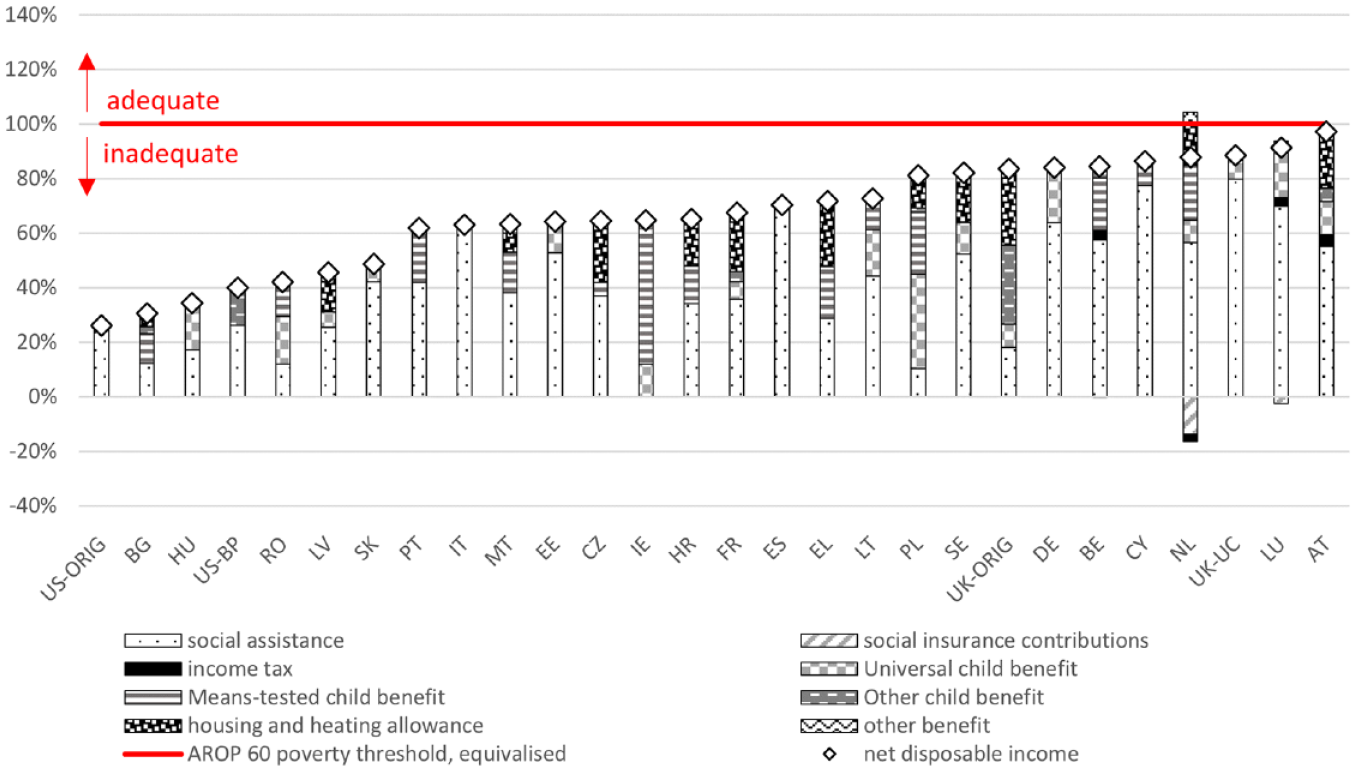
Jobless Single Parent with Two Children—Social Assistance
For jobless single parents, the situation is bleak almost everywhere. Virtually none of the countries included in our comparison ensure adequate income support to jobless single parents. Only in Austria does the net disposable income reach the poverty line. Again, there are massive disparities across the welfare states. The United States, Hungary, and Bulgaria cluster at the very bottom with benefit levels below half of the poverty line, indicating severe exposure to poverty for nonworking households with no social insurance or other entitlements. Our data confirm the picture presented by past studies: social assistance is inadequate for poverty prevention in most countries (Van Mechelen and Marchal 2013; Immervoll 2012; Nelson 2013).
Households with children of course do not solely rely on (general or categorical) social assistance. In most countries, child benefits and housing allowances provide important income supplements. However, in around half of the EU member states, child benefits are included in the social assistance means test. Taxes and social insurance contributions are rarely a heavy burden on jobless households receiving social assistance because such benefits are usually exempt from taxes. In a few countries, social assistance beneficiaries can even claim a tax refund through refundable tax credits. Sometimes there are also additional benefits or social assistance top-ups available for single parents, which is why, in general, the social floor is again relatively higher for single-parent households.
What matters for adequate minimum protection
What is important for adequate minimum income protection? We provide three primary takeaways.
First, minimum wage levels matter. The level of the minimum wage, where it exists, obviously matters for single parents dependent on earned income. But minimum wages are also key to adequate minimum income protection for people not in work since they determine the “glass ceiling” for out-of-work benefits (Cantillon, Parolin, and Collado 2020). After all, policymakers will want to make sure that “work pays more than welfare”.
Figure 3 plots the empirical relationship between the national minimum wage level and the adequacy of total income support for working single parents across the observed countries. Clearly, total income support tends to be higher in the countries with a higher relative minimum wage floor. Decent wages are thus a first necessary—but not sufficient—condition for ensuring adequate income protection to single parents; a condition the outlier United States currently does not yet meet. On the contrary, in terms of minimum wage efforts, the United States lags behind its peer countries. Their minimum wage, at least at the federal level, is currently far too low to ensure adequate minimum incomes to single parents working full time.
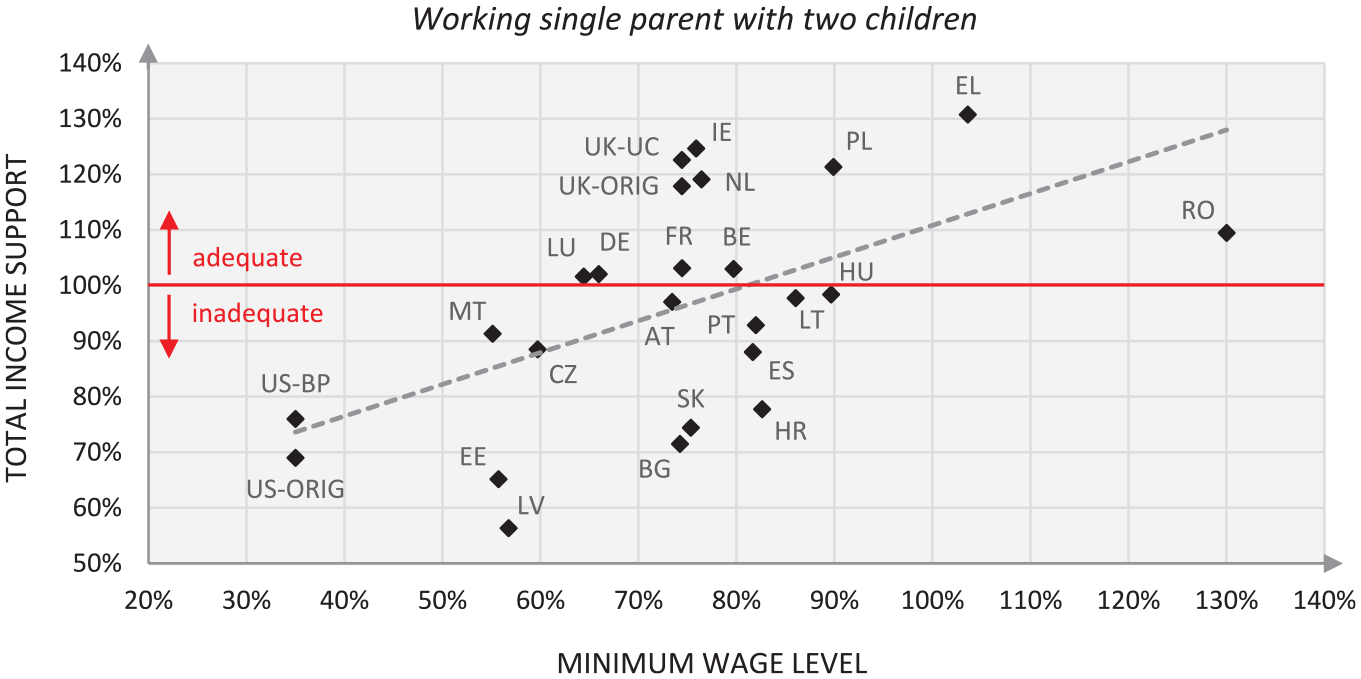
Relationship Minimum Wage and Total Income Support
It is important here to stress that enforcement matters. The minimum wages we use in our calculations do not necessarily say a lot about the actual wage floors in countries and the actual incidence of low pay. Lack of monitoring and effective sanctioning may mean that workers are paid below the minimum, for example, because actual working hours are underreported. In fact, research shows that union strength and collective bargaining institutions matter more for effective wage floors than minimum wages (Garnero 2020).
Second, the overall generosity of the child benefit package matters. A large body of research has demonstrated that child benefit systems can contribute significantly to the reduction of child poverty and single-parent poverty (Leventi, Sutherland, and Tasseva 2019; Van Lancker, Ghysels, and Cantillon 2015; Bradshaw, Keung, and Chzhen 2018; Morissens 2018). As the child benefit package de facto makes up a substantial part of the household budget of single parents, it can surely have an immediate impact on the incomes of those at high risk of financial poverty.
Figure 4 plots the empirical relationship between the total child benefit package and the adequacy of total income support for working and nonworking single parents. The scatterplot displays a clear uphill pattern as we move from left to right, indicating a very strong correlation between the overall generosity of the child benefit package and the legally guaranteed level of minimum income protection. In the countries that ensure minimum incomes at or above the poverty threshold for single parents, the total child benefit package thus plays an exceptionally significant role in doing so, perhaps even more strongly than minimum wages.
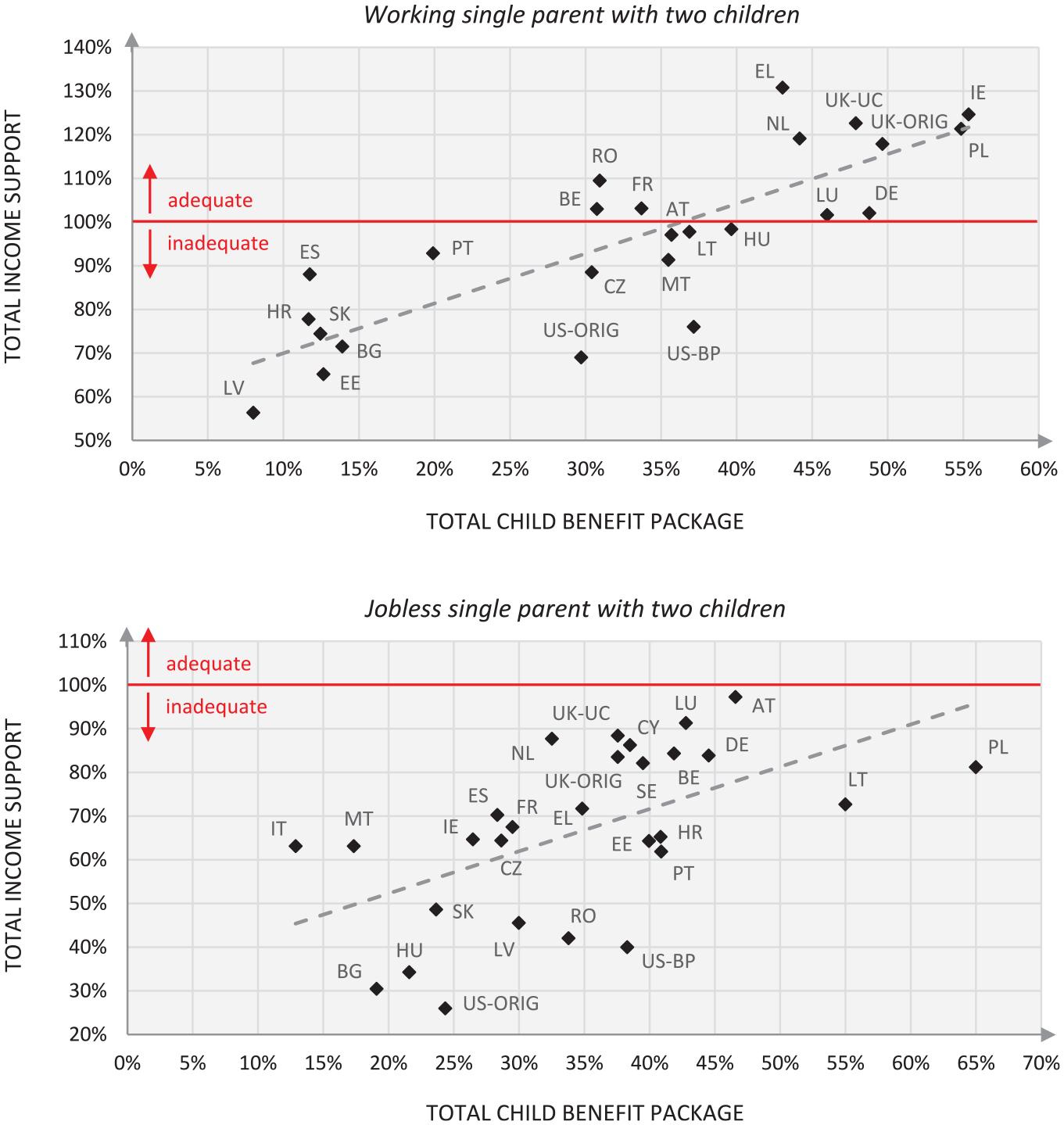
Relationship Child Benefit Package and Total Income Support
Third, child benefit generosity tends to be higher in countries employing targeting within universalism. Besides simply the level of spending, the targeting design is one of the most important determinants of the efficacy of child benefit systems in mitigating poverty among single parents; but it matters how targeting is done (Van Lancker, Ghysels, and Cantillon 2015; Salanauskaite and Verbist 2013; Morissens 2018).
Figure 5 displays bivariate scatterplots for the level of income targeting and the adequacy of the total child-related benefit package. Although child benefit systems vary greatly in terms of targeting intentions, we still see that in the vast majority of the countries, the child benefit package is income targeted by intent and by design: low-income single parents are entitled to more generous benefits than higher-income single parents. The top performers in terms of income targeting consist of the UK, Portugal, Cyprus, and Sweden.
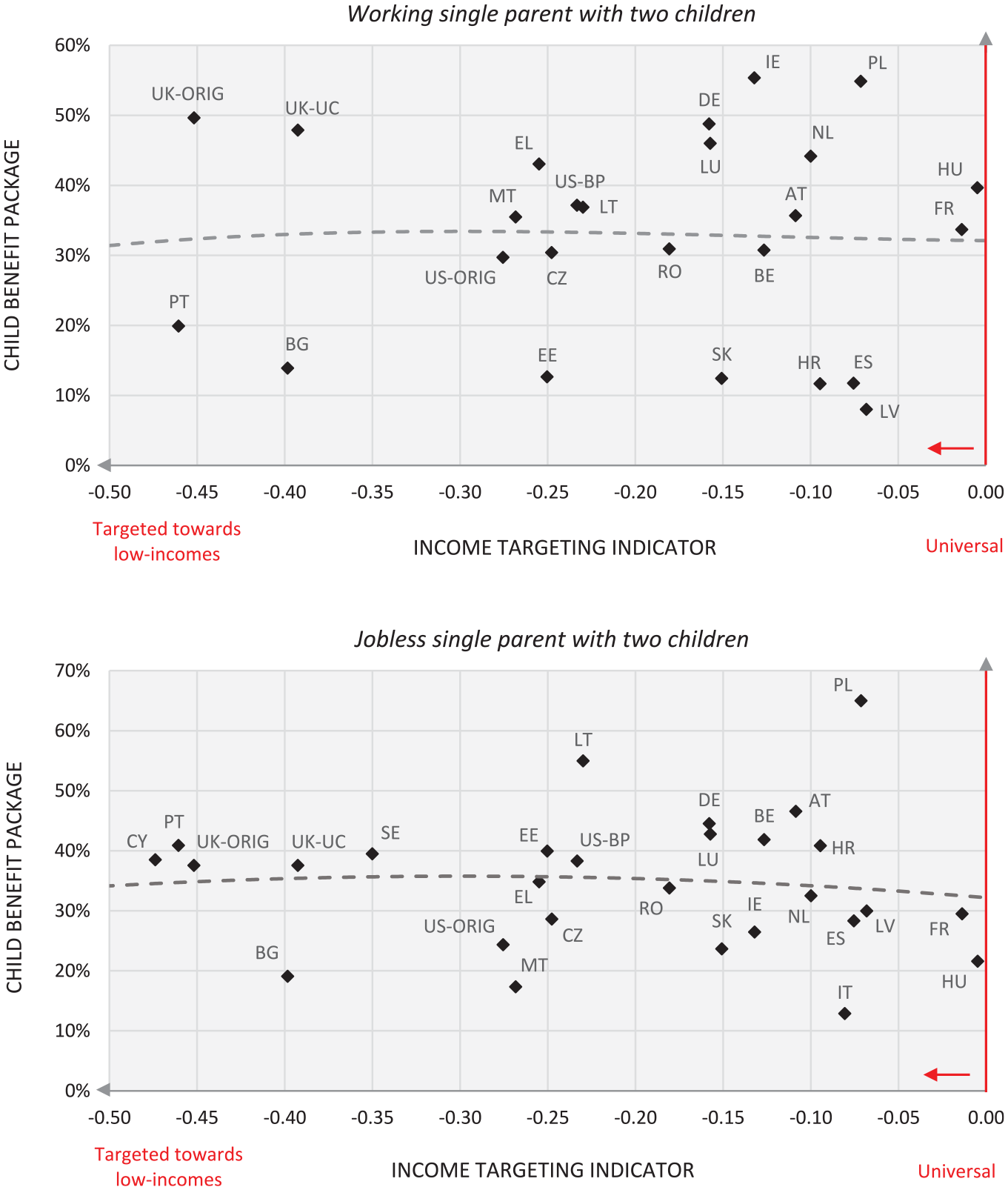
Relationship Income Targeting and Child Benefit Package
Although the trendline is much less pronounced, it is still quite apparent that countries providing the most generous child benefit package to single parents tend to obtain a moderate score on the income targeting indicator. Countries that hardly target their child benefit package—such as Hungary or Latvia—or have an entirely means-tested system—namely Portugal and Bulgaria—perform less well than mixed systems. All in all, our results are in line with other recent findings (Kenworthy 2011; Van Lancker and Van Mechelen 2015; Marx, Salanauskaite, and Verbist 2016).
A similar observation applies to targeting towards single parents. Figure 6 displays bivariate scatterplots for the level of single parent targeting and the adequacy of the total child-related benefit package.
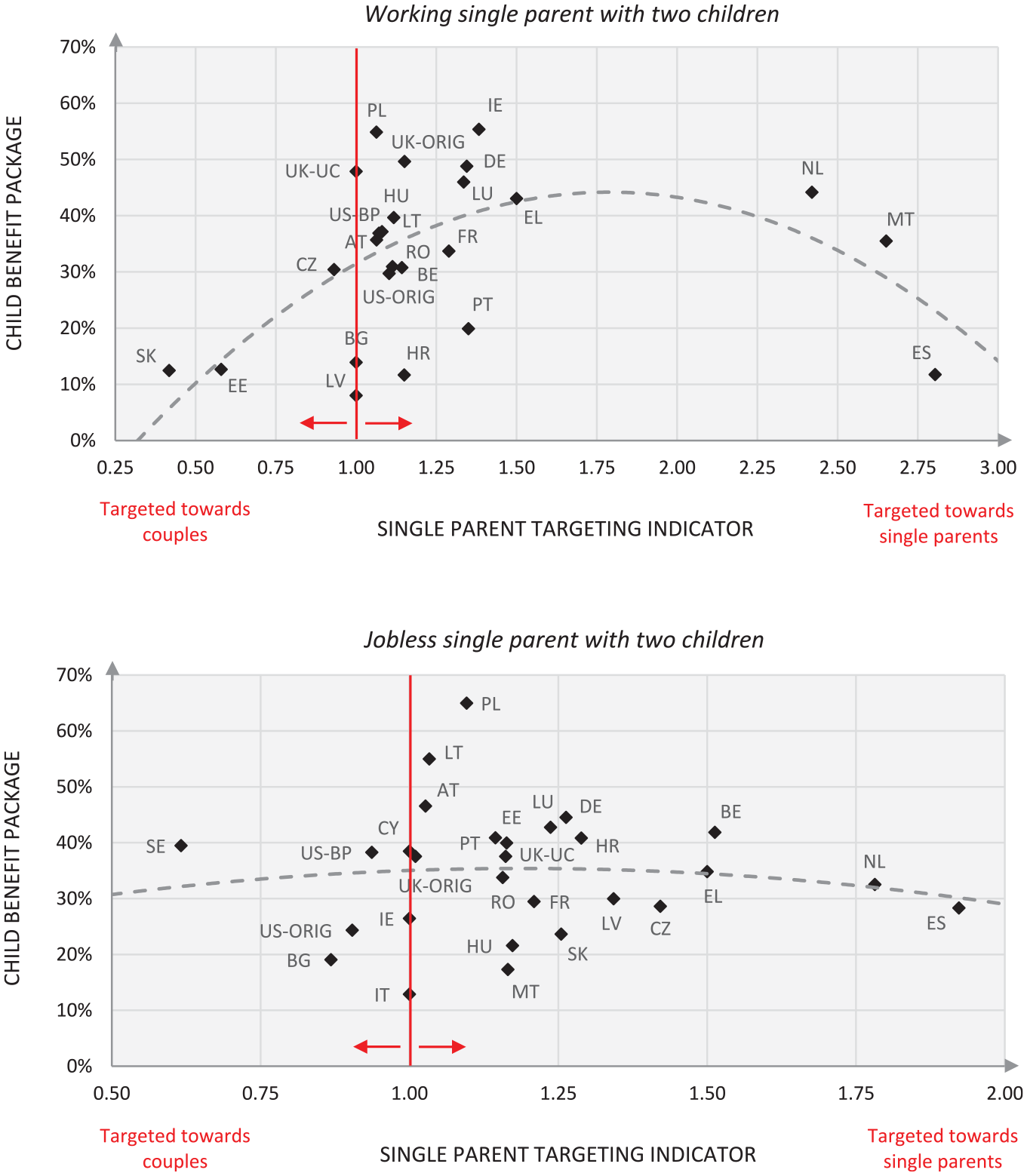
Relationship Single Parent Targeting and Child Benefit Package
The degree of single-parent targeting depends on the earnings level. In the social assistance case, only Bulgaria, Sweden, and the United States favor coupled parents over single parents. Ireland, Italy, and Cyprus are neutral between family types. All other countries recognize the extra challenges faced by single parents, although in different degrees. In the minimum wage case, three different countries leave single parents worse off: Czechia, Slovakia, and Estonia. The UK, Bulgaria, and Latvia, on the other hand, treat working single parents identically to coupled parents, while all other countries target additional support towards single parents. Especially Spain, the Netherlands, and Malta are prime examples of single-parent targeting.
The trendline first slopes upwards when going from left to right, but then goes slightly down again. The total child-related benefit package is broadly speaking the most generous in countries that target a relative part of their child benefits towards single parents, albeit substantiated by a universal first layer. Seeing that supplements for specific social groups, particularly single parents, are not as well established yet as means-tested benefits, it is an important observation that the most adequate minimum income systems in fact target (part of) their child benefits towards single parents.
Now that we have provided insight in the relevance of targeting designs in poverty alleviation, we explore at last in more detail the structure of the child benefit package. The overall degree to which the child benefit package is targeted actually depends on the specifics of each benefit included, such as the strictness of the means test, and on how various benefit types are combined into one package.
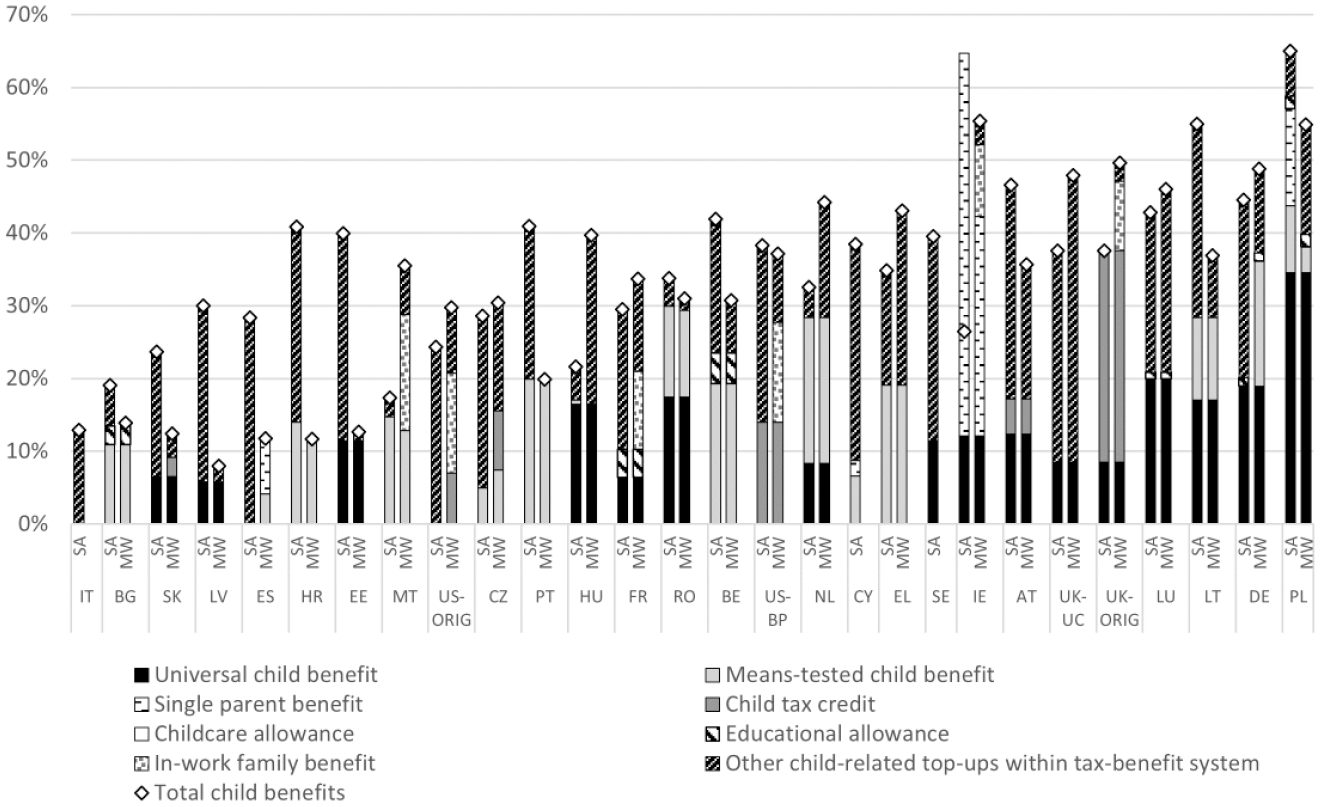
Figure 7 shows the cross-country variation in the institutional composition of the child-related benefit package of a single parent with two children depending on social assistance (SA) or working at the minimum wage (MW). Countries are ranked by the average level of total child benefits, expressed as a percentage of the poverty line.
Working and Jobless Single Parent with Two Children—Child Benefit Package
Child benefits naturally make up a very important part of these child-related benefit packages. There are a few countries where child benefits are strictly universal. About a third of the countries have a strictly means-tested policy model, providing child benefits only to households with an income below a certain threshold. The remaining countries combine universal and means-tested child benefits. Countries not only use cash transfers to compensate for the costs related to raising a child, but increasingly also tax credits and allowances. The United States is the only one where the child benefit package consists chiefly of tax benefits. In addition, most countries provide a specific childcare allowance and/or educational allowance to assist eligible families with the care and education of their children. Sometimes additional income support is also specifically available to working households, putting work-poor single parents at a disadvantage in those countries.
When countries want to provide extra support to single parents, there are also multiple possibilities. Countries can simply alter the benefit amount for single parents within already existing benefits, but a small number of countries have also chosen to administer a specific single-parent benefit. Ireland is a case in point, having a large means-tested benefit targeted at single parents, called the One-Parent Family Payment. Cyprus and Poland also have a single-parent benefit, while Spain has a working-single-parent tax credit.
The generosity, degree of targeting and composition of the child benefit package thus varies greatly across countries. Comparatively generous packages for single parents are to be found in countries where income support is multilayered and combines a universal child benefit system with well-targeted supplements by means of income-related cash benefits, tax credits, or social assistance top-ups. In a nutshell, to what extent countries support single parents financially largely overlaps with whether they employ targeting within universalism. Ireland, Germany, Poland, and the UK are textbook examples with child benefit levels equivalent to over 50 percent of the income needed to stay out of poverty. The expansion of the CTC in the United States would raise the level of child benefits offered to low-income single parents already up to almost 40 percent of the income needed to stay out of poverty.
Conclusion
A range of policy instruments can be deployed to make sure single parents have adequate financial resources. These include minimum wages and other forms of wage regulation, child benefits, tax credits, social assistance top-ups, and other allowances. If well designed, these instruments can complement and reinforce each other. We have demonstrated that there is substantial variation in the levels of income protection provided to single parents across Europe and the United States. This is not only true in terms of levels (relative to the poverty threshold) but also in terms of how the benefits are provided.
It is clearly possible to make sure that working single parents have minimally adequate incomes. We find that the total income of single parents having to make ends meet on a sole minimum wage income reaches or exceeds the at-risk-of-poverty threshold (defined as 60 percent of equivalized median household income) in about half of the countries reviewed here. The plight of jobless households with children on the other hand remains extremely worrisome. Minimum income provisions remain largely inadequate to ensure an acceptable minimum living standard, usually by a wide margin.
Although optimal policy mixes cannot be readily defined—political context, budget constraints, and other country-specific context factors matter—our results reveal three vital steps towards more adequate minimum income protection for families with children.
Set wage floors as high as the local labor market can take without adverse employment effects. Wage floors are key to adequate income protection for both workers and people not in work. Minimum wages de facto determine the “glass ceiling” on out-of-work benefits, as policymakers are concerned with safeguarding financial incentives to work. Some of the countries with the highest minimum wages (or effective wage floors as in the Nordic countries) have well-functioning labor markets, with very high employment and low persistent unemployment. Adequate minimum incomes for workers do not need to come at the cost of fewer people in work.
Have universal child benefits as a first layer of supplementary income protection. Our simulations reveal that in the countries that manage to ensure net disposable incomes at or above the poverty threshold, the child benefit package plays a particularly significant role in doing so. Universal child benefits provide immediate and stable income support at low administrative cost and without causing disincentives to work or to move up the earnings ladder. Child benefit packages for those on the lowest incomes tend to be higher in countries with universal cash benefits.
Have targeted income supplements for single parents on low incomes. It bears repeating, however, that targeting comes at the cost of bureaucratic complexity and sometimes stigma, resulting in significant levels of non-take-up or incomplete take-up. Timeliness is also a serious issue: people do not always get support when they need it. Technology may be coming to the rescue here. Advances in information and communication technology (ICT) should make accurate, timely, and cost-effective targeting more achievable. Yet the botched conversion in the UK from the existing multiple means-tested benefits to the unified Universal Credit that seeks to target income support in close to “real time” has provided countless distressing stories. Overreliance on ICT and automated decision making (ADM) can compound the effects of simple errors. Existing patterns of prejudice can get incorporated into algorithms, effectively reproducing them with greater consistency and ruthlessness than humans. In the Netherlands, the “Toeslagenaffaire” (supplements affair) prompted parliamentary enquiries and resignations of senior civil servants, ministers, and eventually the entire government. In short, while a degree of targeting in income support is essential to help the neediest in an adequate and cost-effective way, it is still easier said than done.
Supplemental Material
sj-docx-1-ann-10.1177_00027162221120448 – Supplemental material for Income Support Policies for Single Parents in Europe and the United States: What Works Best?
Supplemental material, sj-docx-1-ann-10.1177_00027162221120448 for Income Support Policies for Single Parents in Europe and the United States: What Works Best? by Janet C. Gornick, Laurie C. Maldonado, Amanda Sheely, Elise Aerts, Ive Marx and Zachary Parolin in The ANNALS of the American Academy of Political and Social Science
Footnotes
Notes
Supplemental Material
Supplemental material for this article is available online.
Elise Aerts holds an MSc in social and economic sciences at the University of Antwerp. Currently, she is a PhD researcher at the Centre for Social Policy Herman Deleeck. Her research focuses mainly on social policy, income inequality, and micro-simulation.
Ive Marx is a Professor of social policy at the University of Antwerp and director of the Centre for Social Policy Herman Deleeck. He has published extensively on the issues of minimum income protection, including the volumes Minimum Income Protection in Flux (Palgrave) and Handbook on In-Work Poverty Research (Edward Elgar).
Zachary Parolin is an Assistant Professor of social policy at Bocconi University in Milan and a senior research fellow with Columbia University’s Center on Poverty and Social Policy. His recent work on poverty, inequality, and social policy has been published in the American Sociological Review, Demography, Nature Human Behaviour, and elsewhere.
References
Supplementary Material
Please find the following supplemental material available below.
For Open Access articles published under a Creative Commons License, all supplemental material carries the same license as the article it is associated with.
For non-Open Access articles published, all supplemental material carries a non-exclusive license, and permission requests for re-use of supplemental material or any part of supplemental material shall be sent directly to the copyright owner as specified in the copyright notice associated with the article.
